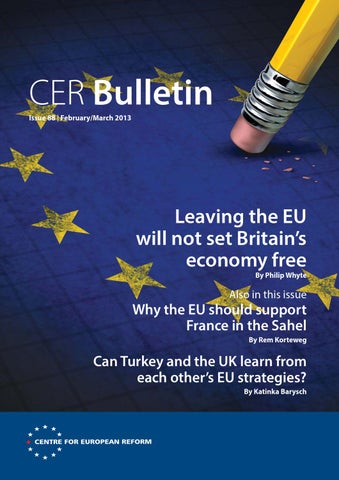
CER Bulletin Issue 88 | February/March 2013
Leaving the EU will not set Britain’s economy free By Philip Whyte
Also in this issue
Why the EU should support France in the Sahel By Rem Korteweg
Can Turkey and the UK learn from each other’s EU strategies? By Katinka Barysch
Leaving the EU will not set Britain’s economy free by Philip Whyte
EU membership, British eurosceptics are fond of asserting, has become the principal obstacle to the country’s prosperity. The regulatory and other costs of membership have ratcheted relentlessly upwards, just as the economic benefits of trading with an ageing and sclerotic region have fallen. Britain, to use a term now very much in vogue, has “shackled itself to a corpse”. If the UK loosened its relations with the EU – or perhaps left the club altogether – it would free itself of the irksome regulatory burden that cripples British business and could focus on developing trading relations with faster-growing economies outside the EU. It is not hard to see why such a narrative appeals to many British minds. At a sentimental level, it harks back to a bygone age when the country was a globe-trotting, island nation largely unencumbered by European entanglements. And at a rational level, it rests on claims that are at least partly valid. It is true that the EU is, to an important degree, in the business of regulation, and that most EU countries have a greater appetite for regulating markets than Britain. It is also true that in certain areas of policy, common minimum EU standards are set at higher levels than the UK might have chosen, had it been left to its own devices. Nevertheless, the overall thrust of the story is deeply misleading. Contrary to popular belief, the EU is not an iron cage that imposes rigid uniformity on its members. Despite the alleged
shackles of EU membership, the UK’s product and labour markets are among the freest and least regulated in the developed world. Most of Britain’s supply-side deficiencies originate at home, not in Brussels. And while there is little evidence to suggest that EU membership hampers the development of trading links outside Europe, the flow of goods, services and people across British borders would probably be less free if the country left the EU. Start with regulation. If EU membership really entailed everything that the eurosceptics like to imply, one would expect two things. First, the EU would have a strong levelling effect on its member-states: because of ‘harmonisation’ at EU level, markets for goods, services and labour would look much the same in Italy and Greece as they do in Ireland and Britain. That
INFO@CER.ORG.UK | WWW.CER.ORG.UK CER BULLETIN ISSUE 88 | FEBRUARY/MARCH 2013
they do not is so obvious it barely needs stating. What the EU mostly does is set the common minimum standards that are necessary for mutual recognition – the animating principle of the single market – to operate. EU countries, however, retain plenty of freedom.
implements EU rules that it participates in the single market. The difference between the UK and Norway is not that one complies with EU rules while the other does not. It is that one (the UK) influences the design of the rules, while the other (Norway) does not.
Second, if eurosceptics were right, one would expect Britain to look less ‘Anglo-Saxon’ than, say, Canada or the US. Since the EU supposedly interferes so much, and the continental influence on its rules is reputedly so strong, Britain’s markets would be more regulated than elsewhere in the liberal English-speaking world. Yet there is no evidence that they are. According to indices of regulation compiled by the serious-minded and impartial OECD, the UK’s product markets are the least regulated in the developed world, and its labour markets are only marginally more regulated than in the US or Canada.
To free itself of any obligation to transpose EU rules, the UK would have to leave the single market as well as the EU. At that point, its trade with the EU would be subject to tariffs and other barriers that do not currently exist. Britain would have to conclude trade deals with its largest trading partners (arguably with less negotiating clout than it has within the EU). And the expected fall in the regulatory burden would be modest. Not only would British exporters still have to meet EU standards to sell there, but many domestic regulations would replace EU ones: climate change will not stop just because Britain leaves the EU.
Equally wide of the mark is the assiduous insinuation that the main long-term constraints on the British economy stem from EU membership. Most serious studies of the supplyside shortcomings of the British economy identify some combination of the following factors: poor infrastructure, notably in transport; skills shortages, reflecting high drop-out rates from secondary education and weak vocational training; rigid planning laws that distort land use, push up commercial rents, and limit economies of scale; and a complex, costly and inequitable tax system. All these deficiencies are home-grown; none originate in Brussels. Nor is there much evidence to support the repeated assertion that the vitality of Britain’s trade and investment relationship with the rest of the world is sapped by its continental entanglements. German exports to Asia have thrived over the past decade despite the purportedly crippling handicaps of EU membership. As for the UK, a chunk of the foreign direct investment (FDI) it attracts depends on the country’s membership of the EU. This is not true of all FDI, of course, and much would stay in the UK if the country left the EU. But note the asymmetry: it is doubtful that leaving the EU would make the UK more attractive to foreign investors. Would Britain be freer and more open outside the EU? It is doubtful. The oft-repeated claim that Britain could, like Norway, free itself of EU rules but still participate in the single market is particularly mystifying. It betrays ignorance of how the single market differs from a free trade area, as well as the terms on which Norway participates. It is precisely because Norway
“Contrary to popular belief, the EU is not an iron cage that imposes rigid uniformity on its members. ” In one policy area at least – immigration – there are good reasons to think that Britain would take steps to make its borders less open than they are at present. Net migration to Britain has risen strongly over the past decade – a trend many voters blame on EU membership. The government has responded by calling into question the free movement of workers (a fundamental principle of the single market); and by making it harder for foreigners to come to the UK (potentially hurting export industries like higher education and tourism). Left to its own devices outside the EU, the UK would probably pull the drawbridge higher. In short, eurosceptic attempts to cast Britain as a country whose globalising ambitions are frustrated by the bureaucratic and protectionist instincts of continental Europeans are deeply misleading. Leaving the EU would not be an economic liberation. It would resolve none of the domestic failings that are the main constraints on Britain’s long-term growth. It would do little to lighten the regulatory burden on British business. And it might well leave the UK more closed to the outside world, not less.
Philip Whyte Senior research fellow, CER
2
Why the EU should support France in the Sahel by Rem Korteweg
“Now what?,” asked US General Carter Ham after he heard about the French assault in Mali. Europeans are asking the same question. Jihadist rebels in Mali have forced the hand of France and Europe. A regional spillover is becoming more likely. Europe should step in to avoid this scenario, yet engagement in the Sahel is fraught with problems. Why should Europe get involved? Since the jihadist takeover of northern Mali, the humanitarian situation has deteriorated. A virulent brand of sharia is enforced including mutilation and other human rights violations; some 150,000 Malians have fled south and an equal number have migrated to impoverished neighbouring countries. A food crisis is pending. The Western Sahel has not registered high on the list of priorities in European capitals. The primary concern for Europe however, is the presence of a terrorist safe haven in northern Mali – an area the size of the Benelux, Germany and Poland combined. Continuing turmoil, or even a collapse of the regime in Bamako, raises the spectre of violent instability stretching across the Sahel, potentially enabling jihadists in Mali and groups such as Boko Haram in Nigeria or even Al-Shabaab in distant Somalia to join forces. The recent terrorist attacks in Algeria have demonstrated the risk of spillover. Borders are porous in the Western Sahel and some of Mali’s neighbours – particularly Mauritania and Niger
– are equally weak, poor and susceptible to Islamist insurgencies. The Western Sahel is a thoroughfare for illegal migration, cocaine-trafficking and other forms of organised crime that harm European interests. Jihadists and criminal networks have coalesced and are able to operate freely across the region. Al Qaeda in the Islamic Maghreb (AQIM) and others have made a living kidnapping and smuggling goods and people. In addition to the recent kidnappings at the Algerian gas plant, 14 European and Algerian nationals remain in the hands of jihadists. Furthermore, the jihadist takeover of northern Mali cannot be disconnected from the recent Arab revolutions, particularly in Libya. NATO’s reluctance to put boots on the ground in Libya allowed the proliferation of arms when the regime collapsed. Some of these are now in the hands of the jihadist groups and AQIM. A regional approach is therefore necessary. President Hollande has been right to take a lead in the intervention. French nationals in
INFO@CER.ORG.UK | WWW.CER.ORG.UK CER BULLETIN ISSUE 88 | FEBRUARY/MARCH 2013
the capital Bamako need to be defended or evacuated. The proximity of French-owned uranium mines in Niger means Paris also has strategic economic interests in the region. Then there is the broader issue of demonstrating political leadership in Francophone Africa, which France still considers its strategic backyard. The French ministry of defence says that it aims to eliminate the armed jihadist groups in Mali, yet this may not be realistic. Rather than confront the French forces directly, the jihadists are likely to retreat into the cities, initiate a guerrilla campaign or wait out the French presence. A protracted French ground assault to capture northern Malian towns like Timbuktu, Gao and Kidal is unlikely. Instead the French will aim to push back the rebel groups from the south and weaken their military capabilities. The exit strategy is to keep the jihadists down until the UN-sanctioned African-led International Support Mission in Mali (AFISMA), undertaken by the Economic Community of West African States (ECOWAS), can take over. For now, other EU states and the United States remain at arm’s length. The UK, Germany, Denmark, Italy, the Netherlands, Belgium and Canada have offered support, mostly logistics. The United States has committed logistics, surveillance and reconnaissance, but will ’lead from behind’ as it did during the Libya campaign. After years of operating in Afghanistan, with defence austerity biting and increasing concern over places like Syria and Iran, most Europeans and the US are reluctant to become involved in such a complex region. However, the longer it takes for AFISMA to take over, the more pressure France will exert on its European allies, especially the UK, to join the mission. Preparations for AFISMA have been troubled. Concerns with the mission’s planning, insufficient troop numbers and weather conditions have delayed its deployment. The French are now pushing for a faster pace. The plan calls for a force of 5,500 West African troops, with Nigeria, Senegal and Burkina Faso providing the lion’s share. Yet lack of preparation remains a serious concern, and it is unclear whether forces from coastal, predominantly Christian, West Africa possess the military and cultural skills to operate in the desert environment of Muslim Sahel. The contribution by Chad – not an ECOWAS state, but experienced in conducting military operations in the Sahel – is welcome. Meanwhile Algeria, the region’s powerbroker, is reluctant to support international intervention. AFISMA’s objective will be to support the Malian armed forces to retake control of the country. However, the government in Bamako is weak
and lacks clear leadership. While President Traoré is the interim head of state, real power resides with Captain Amadou Sanogo, an army captain who led a coup d’état in 2012. The military is a hotchpotch of several thousand troops of questionable loyalty. Military resources are so stretched that as the army gives chase to one rebel group, the resulting vacuum can be exploited by another. While the French intervention will arrest the jihadists’ march towards Bamako, it may be weeks or months before the Malian military can rout them. In support of this objective the EU has decided to provide some 200 troops (separate from the French commitment) to train the ailing Malian military and a similar number to protect the trainers. Europe should prepare for a longterm commitment.
“The EU’s priority should be to develop a political strategy to avoid the instability in Mali spilling over to fragile neighbours. ” Aside from training, the EU’s priority should be to develop a political strategy to avoid the instability in Mali spilling over to fragile neighbours like Mauritania and Niger. Just as Europe is supporting political transitions in North Africa, it should commit resources to prevent the Western Sahel from descending into chaos. In March 2011, the EU adopted a strategy for security in the Western Sahel. The document details a sensible approach to support development, strengthen the rule of law and facilitate diplomacy. In line with this strategy the EU now runs a very small civilian mission in Niger (EUCAP-SAHEL) focused on fighting crime, corruption and terrorism. However, the strategy must be urgently updated to reflect the deterioration of the security situation. A robust security dimension is missing: one in which Europe works with regional partners and institutions to build a comprehensive counterterrorism capability with the aim to secure Mali and strengthen Niger and Mauritania. This calls for military, intelligence, justice, economic and development instruments to be joined up. France, along with EU High Representative Catherine Ashton, should cajole European states to contribute. They should also ask the US for reconnaissance, surveillance and targeting capabilities, including special forces, to help sustain the current mission. In the meantime, managing the Sahel’s instability will become a European burden.
Rem Korteweg Senior research fellow, CER
4
Can Turkey and the UK learn from each other’s EU strategies? by Katinka Barysch
David Cameron’s Conservative Party wants to renegotiate Britain’s membership of the EU, hoping to obtain a looser, more flexible relationship. Turkey may also soon ask for a new kind of ‘associate membership’. Although there are different, and deep-rooted reasons for euroscepticism in each country, Turkey and the UK have certain things in common: an imperial past, great power aspirations and an attachment to traditional notions of sovereignty, sometimes at odds with EU supra-nationalism. They also happen to be fed up with the EU. But the similarities stop there. Turkey began accession talks eight years ago but progress has been painfully slow. Negotiations have started on only 13 of the 33 chapters of EU law that Turkey needs to adopt to become a member; and no new chapter has been opened in the past 36 months. Cyprus continues to block parts of the accession talks, as does France, even under its new president, François Hollande. Meanwhile, the government of Recep Tayyip Erdogan is losing its appetite for democratic change and economic opening. In some areas, such as press freedom, it is moving backwards. The stalemate in the accession talks is creating a poisonous atmosphere that makes it hard for the EU and Turkey to work together in foreign policy, migration, trade or energy – all areas where there are potential synergies. That is why Sinan Ülgen – an analyst at Carnegie Europe – suggests that Ankara and Brussels start
looking for a way out. His model of a ‘virtual membership’ for Turkey is not meant as an alternative to full membership. Rather, he hopes that new forms of association will create the kind of trust and goodwill that will be needed to rekindle the accession talks once political circumstances are more propitious. Turkey does not want to join the long list of the Union’s ‘strategic partners’ that includes Russia, China, Indonesia and South Africa. Strategic partners do not align their policies with the EU. But Turkey already has a customs union with the EU and has moved towards European standards in areas ranging from competition policy to prison management. Nor does Turkey want to emulate Norway and the other members of the European Economic Area. Having been promised full membership, Turkey would rightly refuse any model that requires it unilaterally to
INFO@CER.ORG.UK | WWW.CER.ORG.UK CER BULLETIN ISSUE 88 | FEBRUARY/MARCH 2013
adopt the acquis without delivering accession in return. That leaves only the ‘Swiss model’ of bilaterally negotiated deals in selected areas. Ankara would be consulted on EU rules in, say, trade and transport but it would not get a vote in the relevant EU bodies. Ülgen thinks that the Turks would be happy to trade minimal influence in Brussels for the right to decide in which areas they want to follow EU rules. Many British Conservatives find the idea of a ‘pick and choose membership’ equally appealing. Yet a lot of Britons hope that the UK will retain strong influence in the EU; and they would not be happy with the customs union that Turkey operates with the EU. This union excludes services – so important for the City and the British economy – and it disadvantages Turkey whenever the EU strikes trade deals with third countries (these countries then gain access to the Turkish market while the country in question does not automatically lower its tariffs for Turkish goods). Cameron wants Britain to benefit fully from the EU single market and stay a member of the Union provided it can opt out of selected bits, such as social legislation. But the biggest difference between the UK and Turkey lies not in their level of ambition for a new EU deal but in their starting positions. Turkey is an aspiring (if irritated) applicant looking for a workable relationship with the EU. The idea of an associate membership remains hugely controversial in Turkey. But within the EU, the ambivalence of the association model could appeal both to Turkey sceptics (such as France, Austria or Germany) – who will hope to
divert Turkey from the membership track – and Turkophiles (the UK, Sweden or Spain) who seek to prevent the rupture in EU-Turkey relations that could result from continued stalemate in the accession talks. The UK, by contrast, is a long-standing member of the club. As such, it has much more leverage over the EU. But it is also expected to respect club rules and etiquette, which includes the principle that one member-state should not attempt to blackmail others. Cameron’s emerging strategy of coupling the request for renegotiation with the ‘threat’ of a UK referendum – and ultimately an EU exit – is creating bad blood on the continent. Turkey, as an outsider asking for closer ties, does not have such problems. It is easier to negotiate a prenuptial agreement than a divorce settlement. Ultimately, the EU may not offer a pick-andchoose deal to either Turkey or the UK. The European Commission finds the Swiss model complex, slow-moving and rather frustrating. Sensitive to growing European tensions, the Turks will be very careful not to associate themselves with the British strategy. But many Turks may secretly hope that the UK will succeed in creating more flexible models of membership that would also be more palatable for Turkey. If, however, the British end up voting for withdrawal, Turkey would lose one of its strongest allies inside the EU.
Katinka Barysch Deputy director, CER
CER in the press Bild Zeitung 23rd January 2013 As a former global power, London is used to setting its own agenda instead of laboriously searching for compromise. “London tends to think more global than European”, says Katinka Barysch of the CER.
The New York Times 15th January 2013 “This idea that Germany is a powerhouse dragging the rest of Europe along with it is a bit of a myth,” said Philip Whyte of the CER. “You have a very weak periphery and a core which is not as strong as everyone seems to believe.”
The Daily Mail 7th December 2012 “The consequences [of slump] are likely to be far-reaching. Not only will governments struggle to push through the needed reforms, but there is a risk of a broader backlash against the market economy and the EU,” said Simon Tilford of the CER.
The Globe and Mail 22nd January 2013 Mr Cameron “is gearing up for what I would call a counterterrorism-light approach,” said Rem Korteweg of the CER. But Britain will face huge challenges if the Mali conflict spreads to other parts of Africa, in particular Nigeria.
Le Monde 14th January 2013 “[If Britain left the EU] Germany would run economic policy and France its security policy”, Charles Grant of the CER told us. “The US would have less influence in Europe and EU policies would be more likely to diverge from those of the US.”
Reuters 14th December 2012 Europe’s common security policy is “stuck between the strategic realities of declining defence budgets, waning European power in the world and a lack of will and ability to project strategic force outward”, said Hugo Brady of the CER.
Financial Times 9th December 2012 Charles Grant, director of the CER, sets out in a new article what is at stake: “British withdrawal requires two conditions to be satisfied. First, the government of the day must call a referendum on whether to leave the EU; second a majority of voters must want to quit.” The Sunday Times 25th November 2012 John Springford of the CER said: “To try to get employment rules changed, when lots of countries feel they are an integral part of the single market, will be very difficult.”
6
INFO@CER.ORG.UK | WWW.CER.ORG.UK CER BULLETIN ISSUE 88 | FEBRUARY/MARCH 2013
Recent events 16 January CER roundtable on ‘Half in half out: Can Turkey and the EU learn from each other’s EU policies?’, London With George Eustice MP and Sinan Ülgen
George Eustice MP and Katinka Barysch
17 December FR-UK defence forum roundtable on ‘The European dimensions of Franco-British defence co-operation’, Brussels Speakers included: Julian Braithwaite, Philippe Errera, Nathalie Errard, Ludwig Decamps and Lieutenant General Ton Van Osch
Philippe Errera and General Ton Van Osch
21 November Allianz-CER forum on ‘A Multi-tiered Europe? The political consenquences of the euro crisis’, Brussels Speakers included: Giuliano Amato, Miroslav Lajcak, Lord Kerr, David Miliband MP and Wolfgang Schüssel
Wolfgang Schüssel
David Miliband MP
Recent publications Britain’s 2014 justice opt-out: Why it bodes ill for Cameron’s EU strategy Hugo Brady
Asia’s fading miracle George Magnus
How to expand renewable energy after 2020 Stephen Tindale
What a banking union means for Europe Philip Whyte
To read all of our recent publications please visit our website.
For further information please visit
www.cer.org.uk