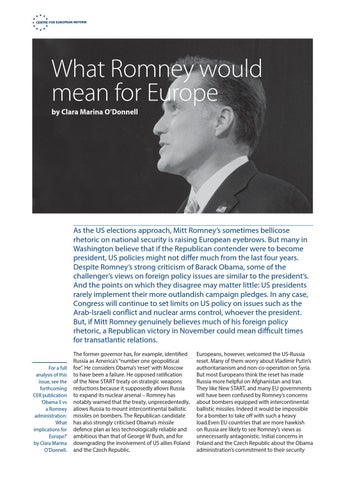
What Romney would mean for Europe by Clara Marina O’Donnell
As the US elections approach, Mitt Romney’s sometimes bellicose rhetoric on national security is raising European eyebrows. But many in Washington believe that if the Republican contender were to become president, US policies might not differ much from the last four years. Despite Romney’s strong criticism of Barack Obama, some of the challenger’s views on foreign policy issues are similar to the president’s. And the points on which they disagree may matter little: US presidents rarely implement their more outlandish campaign pledges. In any case, Congress will continue to set limits on US policy on issues such as the Arab-Israeli conflict and nuclear arms control, whoever the president. But, if Mitt Romney genuinely believes much of his foreign policy rhetoric, a Republican victory in November could mean difficult times for transatlantic relations.
For a full analysis of this issue, see the forthcoming CER publication ‘Obama II vs a Romney administration: What implications for Europe?’ by Clara Marina O’Donnell.
The former governor has, for example, identified Russia as America’s “number one geopolitical foe”. He considers Obama’s ‘reset’ with Moscow to have been a failure. He opposed ratification of the New START treaty on strategic weapons reductions because it supposedly allows Russia to expand its nuclear arsenal – Romney has notably warned that the treaty, unprecedentedly, allows Russia to mount intercontinental ballistic missiles on bombers. The Republican candidate has also strongly criticised Obama’s missile defence plan as less technologically reliable and ambitious than that of George W Bush, and for downgrading the involvement of US allies Poland and the Czech Republic.
Europeans, however, welcomed the US-Russia reset. Many of them worry about Vladimir Putin’s authoritarianism and non-co-operation on Syria. But most Europeans think the reset has made Russia more helpful on Afghanistan and Iran. They like New START, and many EU governments will have been confused by Romney’s concerns about bombers equipped with intercontinental ballistic missiles. Indeed it would be impossible for a bomber to take off with such a heavy load.Even EU countries that are more hawkish on Russia are likely to see Romney’s views as unnecessarily antagonistic. Initial concerns in Poland and the Czech Republic about the Obama administration’s commitment to their security
info@cer.org.uk | WWW.CER.ORG.UK CER BULLETIN issue 86 | OCTOBER–NOVEMBER 2012 4
have been largely addressed, after the US placed fighter jets in central Europe and started holding regular military exercises there. And Poland has been working on its own reset with Russia in recent years. Romney promises to declare China a currency manipulator in order to encourage Beijing to revalue the renminbi (believing that its level hurts US industry). Europeans find many of China’s trade practices frustrating, but try to avoid a confrontational approach with Beijing. EU governments would be particularly keen to avoid a US-China trade war in the midst of the eurozone crisis. While most European countries have long wanted to end military operations in Afghanistan, Romney has criticised the Obama administration for leaving too soon and trying to talk to the Taliban. Romney wants to keep the detention camp at Guantanamo Bay and ‘enhanced interrogation techniques’, while Europeans have welcomed Obama’s efforts to eliminate both. On Iran, Romney has made clear his willingness to use force to stop Tehran from developing a nuclear weapon – while most Europeans would not go that far. Romney’s rhetoric on the Middle East peace process is also at odds with European views. The Republican contender has opposed President Obama’s attempts to stop Israel building illegal settlements – efforts which have been applauded by most EU states. Romney has also pledged to reduce financial assistance to the Palestinians if they form a unity government that includes Hamas. The EU on the other hand, despite its dislike of the militant group, is willing to work with a Hamas that is reconciled to Fatah and renounces using force against Israel. But on several foreign policy issues (including those above), Romney’s views appear changeable and somewhat contradictory – perhaps because his team includes both neoconservatives who backed George W Bush’s wars and realists with a more pragmatic perspective. So some of Romney’s policy recommendations are in fact quite similar to those of the current US government. Like Romney, Obama says that he would – if necessary – use force to stop Iran obtaining a nuclear weapon. Like Obama, Romney would withdraw US troops from Afghanistan in 2014. Like the current administration, Romney is against US military intervention in Syria unless Bashar al-Assad’s regime resorts to chemical and biological weapons. Romney is even willing to co-operate with Russia on missile defence as long as Russia is not given a ‘veto’ on US security – a position shared by Obama.
In any case, how many of his controversial policies would Romney implement if he won the election? Many presidential contenders, after all, have walked away from campaign pledges: Obama also promised to label China a currency manipulator, while George W Bush was against using US troops for nation-building. Mitt Romney already has a track-record of about-turns on policy. Although he now questions whether humans are responsible for climate change, he previously strove to reduce greenhouse gas emissions. And although Romney now lists Obama’s raid against Bin Laden among the president’s few foreign policy successes, the challenger opposed covert operations in Pakistan when Obama first voiced the idea in 2007.
“Congress will continue to set limits on US policy on issues such as the Arab-Israeli conflict and nuclear arms control, whoever the president. ” Romney’s endorsement of increasingly hawkish objectives abroad (and conservative policies at home) seems designed to win over sections of the Republican party which were uncomfortable with his initially moderate positions. The former governor’s policies and views could change again, once today’s rhetoric has served its purpose. Given the candidate’s malleability, and his pledge to strengthen ties with America’s allies, the Europeans may have an opportunity to shape a President Romney’s foreign policy views, on issues such as Russia and Iran. But even then, Mitt Romney’s room for manoeuvre would probably be constrained by US domestic politics. Over the last four years, an uncompromising Congress has hampered President Obama’s efforts on numerous domestic and foreign fronts – including further cuts in nuclear weapons and shifting US policy towards the Middle East peace process. Republicans within Congress might be more conciliatory towards a Republican President. But US politics – which two leading US scholars, Thomas Mann and Norman Ornstein, have characterised as “utterly dysfunctional” – are set to remain ideologically polarised, notwithstanding who wins the presidential elections.
Clara Marina O’Donnell
Research fellow, CER and non-resident fellow The Brookings Institution