LENTEN DEVOTIONAL
Central United Methodist Church
Light on Central’s Lenten Cross
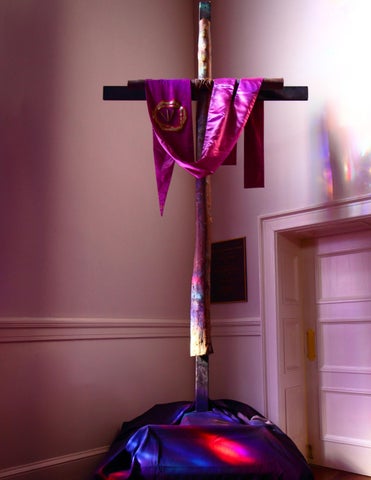
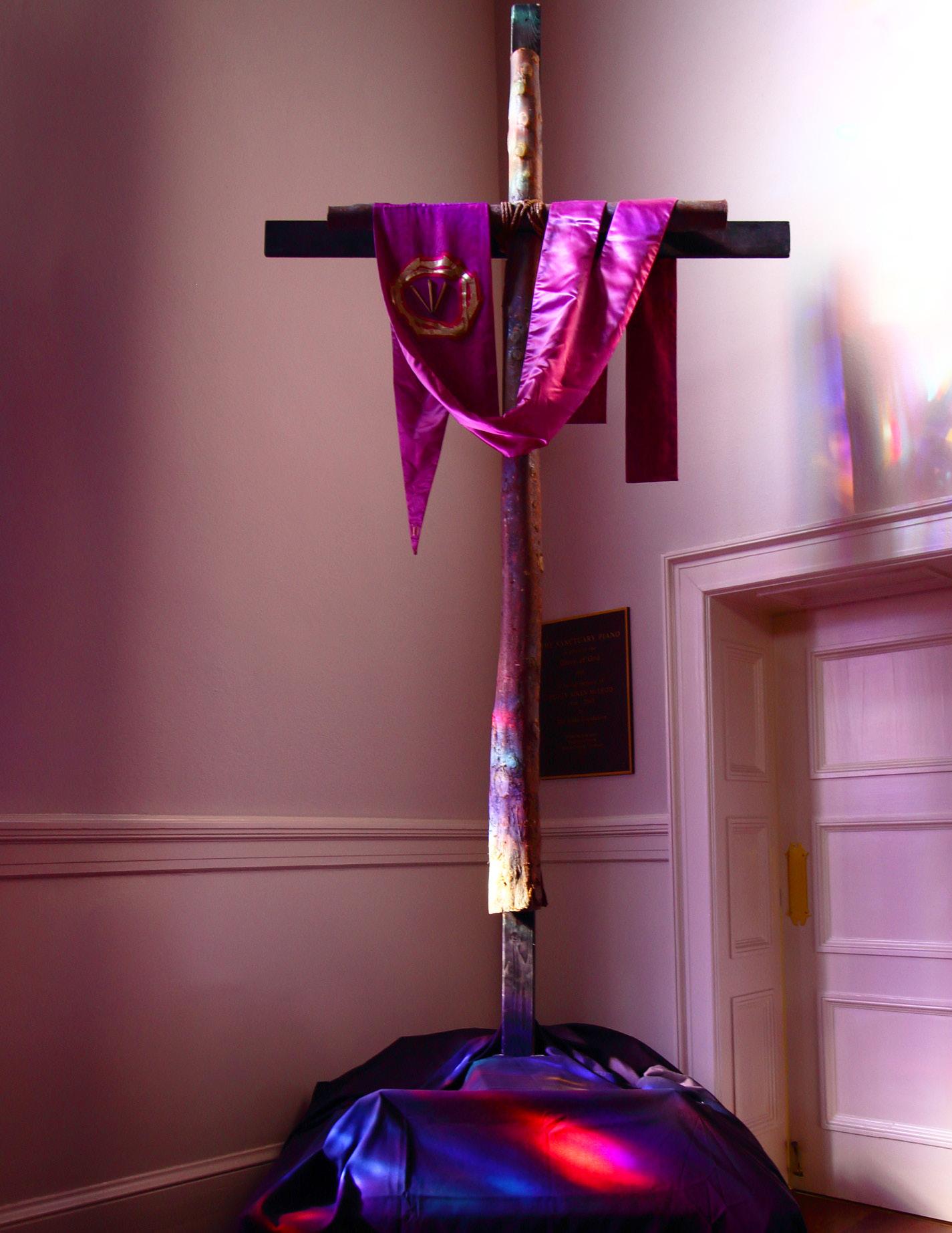
Interpretation of the Cover Photo
It was early in Lent 2020. I was attending the 9:00 a.m. service. As the congregation finished the hymn that precedes the sermon and sat down, I glanced over at the wooden cross Central traditionally erects during Lent, draped in the purple liturgical color of the season. As Thomas began his sermon, the colors caught my eye. I’m sure an astronomer could give us a scientific explanation, but all I know was that sunlight shown through the stained-glass windows, causing a myriad of colors to shine on the cross and wall beyond. What caused me to completely lose focus on the sermon (sorry, Thomas) was the largest blotch of color, deep blood red, that was fixed almost squarely on the juncture of the vertical and horizontal beams.
As the sun rose in the sky, the colors slowly changed, moved, or faded, except the large blotch of red. It never changed color. Instead, during the sermon it slowly moved down the cross, seeming to drip or flow downward. By the time the sermon ended, the red had settled below the cross, as if a pool of blood.
Realizing that the angle of the sun would change each day, I asked my friend, John Frank, to come back to the sanctuary the following day and capture the colored scene I had watched. The cover photo for our Lenten Devotional Book is a result of John’s photography.
We can never fully appreciate the horror of a crucifixion; the gory bloody spectacle. We attempt to understand the indescribable suffering our Christ underwent to free us of the clutches of sin and death forevermore, but we will never fully understand this side of heaven. Sometimes though, like that Sunday morning, God gives us a peek at the depth of God’s gift to us; that while we were still sinners Christ died for us
I wish we could recreate that scene every Sunday in Lent, but we can’t. What we can do is contemplate the snapshot that John captured, and look for other ways God gives us a peek at His great plan. We can immerse ourselves in this Lenten season, including use of these devotions to help us prepare for that wonderful celebration come Easter morning.
Blessings, Art Justice
Lenten Devotional
Editorial Committee
Missy Brown
Renae Chadwick
Mary Davidson
Carlanna Hendrick
Rev. Meg Jiunnies
Art Justice
Katri Skinner
The Editorial Committee wishes to thank Rev. Thomas Smith for his guidance and Philip Maenza for his hard work in compiling the devotional book for publication.
Lenten Devotionals
Foreword
The forty-day season of Lent is upon us. In the most basic sense, Lent is the season of preparation for Easter as Advent is the season of preparation for Christmas. It mirrors the 40 days Jesus spent in the wilderness, spiritually preparing himself for his public ministry. Before beginning his journey toward the cross, Jesus immersed himself in this spiritual preparation. He withdrew to be in absolute solitude, free from all distraction. Free from distraction, Jesus prayed and fasted so that he was solely focused on God’s plan and purpose for his ministry.
Jesus was sinless and had no need to repent, but we are far from perfect. Lent calls us to imitate Jesus and earnestly seek God. Lent stresses repentance as the means by which we seek God. To repent is to turn one’s back on sin and reorient one’s life toward God. Lent invites us to look critically within ourselves to identify those areas of our lives that interfere with our relationship with God. This is no easy task, but God gives us the means by which to seek this type of introspection.
This critical introspection is part of who we are as Christians in the Methodist tradition. Early Methodists met in groups called class meetings. Despite having class in the name, class meetings existed primarily for spiritual formation and encouragement. Members of classes covenanted to seek both personally and collectively what our Methodist tradition calls the means of grace. These means of grace are those things that open us to God’s grace and allow God’s grace to make us more like Jesus. The means of grace include (but are not limited to) prayer, Bible study, worship, fasting, and Christian service. The means of grace are not magical activities that make us better people. Rather, they are things we do to open ourselves to God’s presence. In so doing, we create space in our lives for God to change us into being more Christ-like. Like Jesus in the wilderness, seeking the means of grace helps us shut out distractions so that we can better pay attention to God.
I pray this devotional guide helps you seek the means of grace this Lenten season. Read the words of Scripture suggested here. Read the reflections from our brothers and sisters. Let this guide call you to prayer and an experience of God’s presence. In so doing, allow God to speak to your heart and guide you into making course corrections where they are needed. In other words, accept the Lenten call to repent and reorient your life toward God.
I would be remiss if I did not offer a special word of thanks to the Editorial Committee for the many hours spent shaping and compiling this work. Thank you also to the many writers who share their experience of God’s word with us. Central is greatly indebted to all of these for their incredible work. Please extend a word of thanks when you see them.
Yours in Christ, Thomas
The Season of Lent
Lent is the church season preceding Easter. It is a 40-day period (excluding Sundays) of repentance, fasting and preparation for the coming of Easter. It is a time of self-examination and reflection. It begins 46 days before Easter Sunday, with Ash Wednesday, and ends on Holy Saturday. The six Sundays within that time are not counted, thus 40 days. Our devotional book, like most, however, will include devotions for the six Sundays during the Lenten period.
The Sundays in Lent are not counted in the forty days because each Sunday represents a “mini-Easter.” These six Sundays are in Lent, but they are not of Lent. On each Sunday in Lent, the reverent spirit of Lent is tempered with joyful anticipation of the Resurrection.
The origins of Lent go back to the very early days of the church. The Council of Nicea (325 A.D.) mentions “the 40 days of Lent.” Lent is traditionally associated with penitence, fasting, almsgiving, and prayer. Unfortunately, for much of our church history, Lent has taken on a morose nature. Whatever else it may be, Lent should never be morose. Lent should be an opportunity to reflect on and re-focus our lives, and let God change our heart.
Our Senior Pastor, Thomas Smith, said it best, “for me the idea of penitence in Lent involves outward acts of sorrow for sin but also the notion of repentance as a reorientation of one’s life toward God. Lent comes to me every year as a call to course correction. It’s like my GPS telling me I missed a turn and then telling me how to get back on the right route to where I need to go.”
The scripture readings for each week of Lent until Passion/Palm Sunday focus primarily on the meaning of baptism and discipleship. The Sixth Sunday, Passion/Palm Sunday, focuses on Christ’s triumphal entry into Jerusalem and his subsequent passion and death. Holy Week is the final week of Lent, beginning with Passion/Palm Sunday and concluding with Holy Saturday. It is during these days that the scripture readings focus primarily on the last days and suffering and death of Jesus.
In the Body
Ash Wednesday 2 Cor. 5:6b-6:10
Rev. Ann Kovan
Skin is the envelope of the body. It cups all our livingness inside and shields us from dangerous, poisonous, corrosive elements on the outside. Our human dreams, our desires, our hurts, and our pains are packaged in our flesh. Skin is how God chose to make his love clear to us. He loves us so much that he constrained himself within the human form, with the same skin limits as us. Jesus grew up just like us with bruises, scrapes, bug bites, and scabs. He had pain and wounds and itches. Eventually, his human skin couldn't protect him from the whips, thorns, and nails that ripped, punctured, pierced, and brought him death.
Our skin is elastic. While we are still in the body, away from God, we can bend the body into acts of praise and worship to move us closer to God. Today, we begin a 40-day “bow” before God (You can do this daily Lenten posture imaginatively or literally if you are physically able). First, we go from our feet to our knees, so we can’t run away from God. Then we drop our hands to the ground, forcing us to release our grip on desires that take the place of God in our life pride, control, material things, our tightly guarded schedules. Next, our stomach contacts the ground, reminding us to have self-control over the things we consume. Then our face, to cease our tongue from blaming, criticizing, and gossiping. Finally, our forehead kisses the ground. We are prone before God, our skin extended on the dust. Ashes to ashes, dust to dust. We confess our sins, empty ourselves, and fully submit to God.
So, in full surrender, we bow before God with all we have: face and forehead pressed upon the ground, imprinted with the mark of the cross. We pick up the cross, and our skin, with all its perishable qualities, begins to become a beautiful vessel containing the ever-increasing, imperishable spirit of God. We become an envelope holding God’s love letter to the world.
Prayer: Lord, hear our confession. While we wait to be fully present with you in Final Victory, help us to be as present as we can in this life, incarnating your Spirit to become like you for the world. Amen.
The Word of the Lord
Thursday After Ash Wednesday
Jonah 3:1-10
Elvie Eaddy
Lent is a time to listen for the word of the Lord. To pray and listen. To read and listen. To listen and discover ways to serve. I begin by praying after Christmas about my upcoming Lenten journey, seeking what it is I need to focus on during Lent.
In this scripture, Jonah is acting on a second chance to listen and to do God's will. Lent has become, for me, a time to look for a second chance to grow in my spiritual journey. Those second chances may require that I look deep into my heart to find pride, bitterness, and negativity. It is a time to find ways to forgive or release guilt and accept His forgiveness. My Lenten journeys have helped me identify things I need to give up. I have found, through the power of the Holy Spirit, that I am able to make changes that I had been unsuccessful doing on my own. These journeys have not been easy, but the rewards were many. By focusing on one or two areas over the 40 days of Lent, I began to discover that joy, compassion, and love were evasive when I let undesirable attitudes fill up those little places in my heart. I found ways to be more generous and serve others. I also found that my sacrifice at Lent became my greatest blessing.
Is there something that is taking me away from my Nineveh journey? Have I made choices that have taken me in the opposite direction keeping God from using me? Are there habits I need to give up or knowledge I can acquire to become closer in my walk with God?
Prayer: Dear Lord, Give me the desire to seek your will in my life. The desire to spend time reading, studying, and praying. The desire to change and let you refine me. Amen.
One Single Act
Friday After Ash Wednesday
Romans 5:12-19
Sandra Howard
Have you ever been a part of a group that was punished for the act of one member of the group? That time in school when one person did not follow directions and everyone in the class was punished with a silent lunch period or no recess? That time at work when someone missed a deadline and everyone missed out on their expected performance bonus? Do you remember the complaints from your classmates or coworkers about how unfair it is to punish everyone for something that a specific individual did wrong?
What about that time when one man, Adam, disobeyed God, and all of creation, existing and for generations to come, faced death and separation from God for his sin? Even though our sin is not the same sin as the specific sin of Adam’s disobeying a specific command of God, we all face the same punishment and consequences. But the story does not end there. Generations later, another single individual, in a tremendous act of love, offered forgiveness and reconciliation to all of creation for the act of Adam, the single individual who brought the punishment on himself and all of humankind.
During the season of Lent, we remember the tremendous act of love of that single individual, Jesus of Nazareth, who took upon himself the sin of all of creation and faced the consequences of death and separation from God so that all of humanity can now be reconciled to God. In a world filled with cries of It’s not my fault and Everyone else is doing it, Jesus of Nazareth said simply, I’ll take the blame and the consequences. Be reconciled with God. In that single act of love, a single individual, Jesus of Nazareth, restored creation’s relationship with God that another single individual, Adam, had damaged for everyone.
Prayer: Dear God, thank you for the gift of reconciliation offered by Jesus. Thank you for expressing your love in such a powerful way - Love so amazing, so divine, demands my soul, my life, my all. Amen.
Saturday After Ash Wednesday Psalm 32
Laura Lee Justice
What an awesome God we serve. One who forgives us without repercussions. All we have to do is ask.
Remember when you were young and got a bad grade on a test, and you had to have your paper signed by the end of the week? It made you sick to your stomach, thinking about disappointing your parents and having them see that you did not try to do your best. The end of the week comes, and it is time to fess up. Afterwards you feel like a weight has been lifted. You deal with the consequences, and it is over...forgiven.
That is the way it is with God. If you do something that is wrong all you need to do is take your sins to him and ask to be forgiven. Do not let it hang over your head and weigh you down. Just pray and talk to God. He will forgive, and God will never stop loving you. Even those we read about in the Bible; Noah, Moses, David, Mary Magdalene, just a few of many. They were not perfect. Their mistakes are written throughout the Bible. But did God turn away from them? No, he embraced them and lifted them out of sin and darkness to be the leaders of the faith, even for us today. It is the imperfect that God calls upon to spread his word and his love.
Prayer: Dear Heavenly Father, I fail, I cannot hide that from you. I am imperfect and make mistakes every day. But oh, what joy I can feel even amid my mistakes, because you are a loving and forgiving God. Even when I am hard on myself, I remind myself that your love for me is all around me, and all I need is You. The world may judge me for the mistakes I make, but only your judgment holds any standing over my life. “’I will confess my transgressions to the Lord.’ And you forgave the guilt of my sin.” Forgive me now my loving Father, and I pray for your protection from the troubles of this world. Surround me with songs of deliverance. Amen.
Feast Or Fast
First Sunday in Lent
Matthew 4:1-11
Gilliam Skinner
Here we are at the first Sunday in Lent, known as Quadragesima Sunday because now there are really only 40 days until Easter. Sundays and feast days are not counted, so we are allowed a break from our Lenten fasting every Sunday during Lent. Today, the scriptures are all about fasting! Bummer, right? It makes me feel a little guilty not sticking to my promise to deny self in order to grow as a Christian. So, what is it about fasting?
According to Dietrich Bonhoeffer, “Strict exercise of self-control is an essential feature of the Christian life. Such customs have only one purpose-to make the disciples more ready and cheerful to accomplish those things which God would have done.”
I often wonder, why did Jesus fast. My best answer is that while He is God in the flesh, he is also totally human in the flesh. In order to focus himself away from His human side, he needed to strengthen his spirit by denying his human needs. Matthew 17:16-21 reminds us that He knew there would be things coming at Him and us that could only be conquered by the combination of prayer and fasting.
Our scripture reading bears this out as Satan comes directly at Jesus, tempting him repeatedly with the things that trip us up daily, sins of the flesh (hunger), sins related to pride (you have the world at your feet), and the sin of denying God (by testing his love for us).
So, I guess I really did need to hear about the importance of what we are doing throughout Lent! We are following in the footsteps and habits of our Lord by denying ourselves in order to be ready for the stumbling blocks which are surely coming our way.
Enjoy the feast, work starts tomorrow!
Prayer: Abba Father, Thank you for the gifts of this world. Help me to stay focused on my journey through Lent so that I may grow and be ready for the temptations and trials which are surely coming my way. Amen.
Faith Over Fear
Monday of the First Week of Lent Genesis 15:1-6
Shay Justice
Abram waited over a decade on God’s promise of an heir. With no results, he told God, “You have given me no children.” At the time, he did not know that he would wait many more years after that declaration until he received an answer. Despite this, Abram had faith. How amazing was it of Abram to believe God even with all the events happening around him! Abram was afraid that he would die childless and so, his estate would go to his servant. In spite of his fears, Abram chose to believe God’s promise instead of surrendering to his fears.
God gave Abram an illustration of just how vast are God’s promises and His grace. Abram was told that the number of his offspring would be more than the number of stars in the night sky! I’m not sure if you’ve looked up at the night sky lately, but that is A LOT! God fulfilled his promise to Abram in a way that was so much bigger than Abram could have ever imagined. If you ever question God’s promises, just remember to look up at the night sky and view the same constellations that Abram saw thousands of years ago. Remember how God provided for Abram, and know He will provide for you too. When we are afraid, unsure, or having doubts, God, just as He did for Abram, becomes our shield. The rewards we receive from God supersede that which God asks of us.
Prayer: God, please give me the strength to have faith like Abram. Please remind me daily that You will provide for me. Help me to remember that you are my shield and my reward. Keep my eyes on the stars you made, reminding me of your generous mercy and never-ending grace. Amen.
God Keeps His Promise And Is Always With Us
Tuesday of the First Week of Lent
Romans 4:13-25
June Baird
Faith does not make things easy, it makes them possible. Faith is having confidence in what we hope for and the assurance about what we do not see.
I grew up in a home where we read Bible stories and attended church. As an adult I called myself a believer and raised my family to believe in God and His Son who died and rose again for everyone. There came a time when I had to stop believing in myself, and thinking I could handle whatever life threw my way. Finally, the night came that I gave everything to God and prayed “Lord I surrender all to You.” Now, I have found my real faith and have built a relationship with God. My days are filled with God’s hope and promise. He is always with me breathing new life into me. When my days are heavy and even painful, this is when God is closest to me. I can hear His words, “Lay down your burdens and I will give you rest.” Even at those times when I stumble back into my old ways and listen to the world pulling me in so many directions, I remember the words “Father Forgive them” and once more I know His Grace is the promise He gave me. I have learned, as the hymn lyrics say, “Tis so sweet to trust in Jesus; Jesus, Jesus precious Jesus O for grace to trust him more.”
God made Abraham a promise, “I have made thee a father of many nations” and “not being weak in faith, he considered not his own body now dead, when he was about hundred years old and deadness of Sarah’s womb. He staggered not at the promise of God through unbelief; but was strong in faith giving glory to God.”
Prayer: Dear Father thank you for words of comfort, strength and peace. I find courage to face the world with your guidance and forgiveness. I will trust in Your promise. Amen.
Siblings
Wednesday of the First Week of Lent Hebrews 2:10-18
Jody Parker
Ancestry is a very popular topic. Everyone seems to want to know about their relatives. We probably all hope that we come from some famous person; however, we can never hope for a better ancestor than what we have in Christ Jesus. We are told in Hebrews that we are brothers and sisters of Jesus. And we all have a common Father.
With this knowledge we understand that all are our brothers and sisters - those that we feel close to and those we do not even know.
Too often this world - especially the media and messages on the internet - seek to cause family rivalry. As a human parent does not want that, most certainly our heavenly Father does not. Jesus taught us we should love our brothers and sisters as we are to love Him.
As hate breaks apart the family, so love unites it. We are to see each person as a brother or sister. The world tries to divide us by our ancestry, but Jesus unites us in claiming each one of us as brother or sister.
In many congregations, members talk of or to one another with the first name, preceded by the title brother or sister May we do that in our mind with each person we meet or think about. I believe and pray that this might make us more loving - if we remember we are all part of the same family.
We are glad that Hebrews tells us about our ancestry. We come from the best, and prayerfully we are to always attempt being worthy.
Prayer: Dear kind, loving, Father God, we are indeed exceedingly blessed by being brothers and sisters with our Lord and Savior Jesus. Thank you for surrounding us with grace to try and be worthy family of His. Help us to understand that we are more than protected and saved by our relationship to you. May we never forget we are so blessed. Guide us to pray that all our other human brothers and sisters will also be so blessed. Give us hope in grace to live in peaceful, loving family with all. We ask in our brother Jesus’ holy name. Amen.
Tough Love
Thursday of the First Week of Lent Hebrews 4:12-16
Ann Binnarr
The word of God is a sharp truth. It has the ability to cut through what we are unable to see or understand. Our sense of security becomes vulnerable, helpless and defenseless. Our misgivings and failures are no longer hidden. We begin to understand God's deep sense of anger about our sin and rebellion. Our exposure becomes a way of healing. We develop an awareness of where we end and God begins. The ascended Christ, Son of God, intercedes on our behalf. He is sympathetic to our concerns. Although he is without sin, he has an all-knowing understanding of what it is like to be us.
Prayer: Dear God, help us to better understand your mighty love. As we move from faithlessness to spirituality, may we thank Christ for being so actively aware and giving. When we face our challenges and adversities, we thank you. May we be forever grateful for the love of you and Jesus. Amen.
The One, True High Priest
Friday of the First Week of Lent Hebrews 5:1-10
Madeline Gregory
There are many roles that Jesus plays while he is on earth: teacher to the unlearned, friend to the unlikeable, supporter of the least of these. He shows us how to be a servant leader and how to advocate for others. As children, we learned these roles because they are easier to understand than say, “intercessor.”
Lent calls us to examine how we are living, and often, we use these roles to help us align our behaviors. We ask, “What would Jesus do, and am I doing that?” We read parables that turn our understanding of our behavior on its head. We reevaluate priorities. We are more thoughtful about how we spend our time. We do all these things Jesus shows us how to do during his earthly journey.
Today, our author in Hebrews explains the role of the high priest in the early church and his specific responsibilities. These are very different than the earthly roles that Jesus played. As we read the scripture, we understand his earthly time allowed him to become the high priest, and he is the only one who could. He was human, yet not. He experienced weakness yet did not succumb. He understood what it was to be human, and he was also the ultimate sacrifice for our sins. He struggled with his calling, but he closed his prayers in total obedience stating, “Yet not as I will, but as you will” (Matthew 26:39) He understood God’s assignment.
Prayer: Father, I know the high priest is not a role I can embody. I am thankful that Jesus fulfilled this role for me. I also know the earthly roles of Jesus still matter during Lent and every day. Help me love my neighbor as Jesus did. Help me teach your children to love as Jesus loved. Help me advocate for those less fortunate. Help me lead with a servant’s heart. I am so thankful Jesus is the high priest who can deal with me gently and understands my walk more deeply than I ever can. I am forever grateful. In his holy name I pray. Amen.
Stay with God
Saturday of the First Week of Lent Psalm 27
Ansley McGinnis
David begins this Psalm by affirming that he is fearless, afraid of no one because “The Lord” is his light and salvation, the stronghold of his life. He further says that his confidence and assurance of his safety will not be shaken. The Lord will intervene and take care of his enemies, even in wars.
In the second part, David requests a place in the “House of the Lord all the days of his life” so that he may gaze upon the beauty of the Lord and “seek Him in His temple.” David again declares that God will keep him safe “in the day of trouble” and will hide him “in the shelter of His tabernacle.”
David offers a plea to the Lord: “Hear my voice when I call, Lord; be merciful to me! I will seek your face, O Lord. Do not hide your face from me. Do not reject or forsake me. Though my father and mother forsake me, the Lord will receive me. Teach me your words O Lord - do not turn me over to the desires of my foes.”
This Psalm reveals that David was devoted to God and felt his protection. It also reveals that even David’s faith wavered at times. David was like most of us, knowing that God is always with us and yet, in difficult periods of life, even David’s faith faltered. The good news is that David reminds us to “be strong and wait for the Lord.”
Prayer: “There is a place of quiet rest, near to the heart of God. A place where sin cannot molest, near to the heart of God. There is a place of comfort sweet, near to the heart of God. A place where we our Savior meet, near to the heart of God. There is a place of full release, near to the heart of God. A place where all is joy and peace, near to the heart of God. O Jesus, blest Redeemer, sent from the heart of God. Hold us, who wait before Thee, near to the heart of God.” Oh God, Keep me near to you throughout my life. In Christ’s love. Amen.
For God So Loved the World
Second Sunday In Lent
John 3:16-21
Missy Brown
When I saw my assignment for the devotion booklet - John 3:16-21 - I didn’t have to look it up. Instead, I was comforted with an early memory: I could hear my own child-voice saying as fast as I could, “John 3:16 - For God so loved the world that he gave his only son that whoever believes in him shall not die but have everlasting life. John 3:16,” exactly as we children learned to memorize scripture - verse number, passage, verse number again. This memory led to others, similar in warmth: standing in my first church looking up at mom as she would sing, in my opinion too loudly, “grant us wisdom, grant us courage” or better “A-a-a-a-a-le-e-lu-u-ia” on Easter Sunday morning. Then I pictured the fabric mobile I made at VBS one year with the word JOY on it and an acrostic poem, reminding me that J O Y comes when we put Jesus first, Others next, and Yourself last. I reminisced about holding hands and singing the Doxology with our extended family in my aunt’s foyer every Thanksgiving and even about bedtime routines with my own children when they were little: camping out under the Christmas tree lights in December, hearing a voice say “night, see ya in the morning, sweet dreams, and all that stuff,” or “luh you too.”
While I know the significance of this scripture is God’s saving grace through the gift and acceptance of Jesus Christ, our avenue to eternal life, I appreciate the nostalgia it elicited for me this time. These refreshing memories must be something like eternal life: church and family congregation, a resounding chorus of Alleluias, praising God from whom all blessings flow, a quiet voice telling us we are loved too, Easter, homecoming, and all that very good best-stuff!
Prayer: Dear God - Thank you for the glimpses of eternal life that you give us now. Let this light guide and encourage us as we navigate the darkness in the world and make our way home to you. Amen.
Monday of the Second Week of Lent
Romans 5:3-4
Philip Maenza
Reading a passage of Scripture like this one can tend to make us feel uncomfortable. As much as we all want to experience the hope produced by suffering, not many of us want to experience afflictions or suffering. That doesn’t make us bad Christians, it just makes us human. I think part of the issue is thinking afflictions have to be a huge life-changing experience to count towards our “hope-producing quota.” In some seasons of our lives, this could true, such as a loss of a loved one, but most of the time these hope-producing afflictions are seen through daily frustrations and trials. These afflictions can be an illness, a dwindling bank account, a stubborn child, or a difficult coworker. In short, the human experience in all its beauty and frustration is a hopeproducing experience. This means that you shouldn’t write off the hard things in your life, but rather choose to apply Biblical wisdom in those situations because it’s all for a purpose. Ultimately, it’s for our good and God’s glory.
I guess the next question becomes, “Why does suffering produce patience, perseverance, character, and hope and how does it bring glory to God?” If I were to be completely honest, if I had a choice, I would rather purchase these virtues from Amazon. I am pretty sure that with Amazon Prime I could have them all in two days or less and the most ‘suffering’ I would have to do is walk to my mailbox. When we suffer we tend to look for, and notice, God more in our lives, but even in the small tribulations, God is working in our lives. This process can be long, but waiting develops a patience in us. This patience deepens into a steadfast determination called perseverance and it is there, in the perseverance of life, where hope shines.
Prayer: Dear God, I know you love me and carefully measure every trial and have a loving purpose to accomplish in every tribulation. I won’t seek trials and search out tribulation, but I won’t despise them or lose hope when they come. I trust Your love in everything. Amen.
In The Desert
Tuesday of the Second Week of Lent
Exodus 17:1-3
Debby Stephens
Poor Moses. That’s what most people think when they read this passage. In the previous chapter (Exodus 16) the people complained they were starving to death. So, God provided quail and manna (which tasted like “wafers made with honey” - yum ) But when he told them about the manna, Moses was very specific. Gather only on six days, bringing in twice as much on the sixth. Don’t try to gather enough for two days, except before the Sabbath, because the leftovers will spoil. Don’t gather on the seventh day because none will be there. And yet they disobeyed all the time. Basically, “putting God to the test.” Now they are once again complaining because they have no water. Even though they have seen miracle after miracle rescue them. They saw the plagues attack the Egyptians and kill their first born, leaving the Israelite children alive. They saw the Red Sea (or Sea of Reeds) part for them to go through. They saw the Egyptians die when the parted waters came back together. My husband once said after reading these passages, “If I had been there and seen the water part, and then fall back again on the Egyptians, that would have been it for me. Game over. I would have never complained again.”
But are we any different? How many times are we just like these complaining machines? How often do we forget that God has our back; that no matter what happens, he’s there to tell our Moses to strike that rock and get water for us? In our modern lives we are inundated with information. We hear the news and we can feel helpless, and hopeless. For some of us it’s Lent all the time, it’s always dark and gloomy. We can’t allow ourselves that luxury. We are called to be the light at the end of the tunnel, the crucified Christ risen. Or the Moses, rescuing the flock one more time.
Prayer: Merciful and steadfast Lord, people say we should have the patience of Job, but I think we should have the patience of Moses. Let us be as faithful and kind as he was, with what are still a stiff-necked people. We ask this in the name of Jesus Christ, our Lord and Savior. Amen.
Wednesday of the Second Week of Lent
John 4:7-14
Ellen Smith
A few years ago, I was blessed to participate in Walk for Water events in Charleston. I was so moved by my first event that I continued to participate every year. The events raise awareness for millions of women and children who must walk to retrieve water for daily living. Event participants carry an empty bucket for 1.5 miles, fill it with water, then walk another 1.5 miles to pour the water into a large pool. This mirrors the 3 mile walk many women and children take to fetch water, which often is unsafe to drink. Walking in the summer heat, filling a bucket with water and retracing my steps – I was made profoundly aware of how much I take clean water for granted.
In today’s scripture, we meet Jesus and the Samaritan woman at the well. Jesus shares with her the essential nature of water for our physical well-being. We also see the essential nature of water for our spiritual wellbeing. As I volunteered to raise funds and awareness for clean water amidst the global water crisis, one day and one bucket gave me pause to reflect on the gratitude of something so basic that we often take for granted. Water is in our showers, dishwashers, washing machines, sprinkler systems, and community fountains. How often do we take Jesus, whose grace is our spiritual water, for granted? How can we find that pause to return our gratitude and appreciation for all that He does for us each day? How can we use this spiritual water to grow in our relationship with Him?
During Lent, we are called to reflect on our faith journey and on Christ who leads the way. I challenge you to get back to basics. Just as we need water for physical survival, so we also need Jesus for spiritual survival. Find a Bible study, join a Sunday School class, volunteer to serve in worship and pray! Fill your cup with the spiritual water that comes only from Jesus Christ.
Prayer: Dear Heavenly Father, we thank you for the water that you give so freely to enrich our lives and renew our bodies. Meet us at the well and pour out upon us your spiritual water. In the name of Christ, our living water. Amen.
Born Again?
Thursday of the Second Week of Lent
John 3:4-5
Julia Sisco
Nicodemus, a Pharisee held in high regard for his knowledge and observance of Jewish Law, has heard of the miracles of Jesus and comes acknowledging him as “Rabbi,” a “teacher come from God.” Before he can ask a question, Jesus proclaims that one must be born again. Nicodemus is confused, but Jesus repeats, “If you want to enter the kingdom of God, you must be born of water and the Spirit.”
I imagine that Nicodemus came that evening feeling confident of his own righteousness. He was after all, a highly respected, religious leader of the council! Yet Jesus seems to be saying, “You don’t have what it takes despite your religious practice. You lack something still, Nicodemus – a cleansing.”
Six hundred years earlier, God promised a cleansing to come, one that would wash away sin as water washes stain. Ezekiel writes that hearts, transformed by God’s Spirit, will be made new and would hold within them a deep desire to walk in step with God, to obey and live in agreement with His good and perfect will. (Ezekiel 36:25-27)
Jesus came bearing the weight of this promise, and on the cross paid the cost for our ultimate do-over. During Lent, let us examine our hearts to ask, am I going through the practice of religion or fully inviting the cleansing of Jesus Christ? Do I hold a deep desire to abide in his will, to live and love and forgive as He did? Is His fruit (Galatians 5:22-23) apparent in my daily life, or is it time to ask for a do-over of new life in His name?
Did Nicodemus understand and embrace his second birth? Consider who brought the anointing oils to the foot of the cross. Who dared place their hands on this lifeless “one come from God”? It was Nicodemus! (John 19:39)
Prayer: Savior, Son of God, we open ourselves before you. Help us to see beyond our religious behavior and offer our whole hearts for your cleansing. Make us fully alive by your Spirit, our transformed lives a testament to your amazing grace. Amen.
Keeping Watch
Friday of the Second Week of Lent
Psalm 121:1-2
Susan McGrath
My help comes from the Lord the Maker of Heaven and Earth.
I always look up to the heavens and say, "God if you’re willing, I'm willing "
I have some serious health issues, including no immune system. When COVID-19 hit the U S , no one knew the government would soon close everything down. I had been feeding the homeless from my home for years and when things closed down, all shelters and places where those in need could get a meal closed too! Now the homeless had nowhere to go.
I decided to keep my doors open. I had no idea how I would be able to feed all these people, but God was willing and he sent people from different churches to help. Many other individuals donated money, food, clothing or anything else the homeless might need.
First, a friend of mine and I made masks to hand out to the homeless. Then we devised a safe system to try and eliminate, as much as possible, the spread of COVID when people in need would come to get their food. The crowds were much larger than expected! I needed God's intervention.
I looked up and prayed and overwhelmingly my prayers were answered. I could feel God keeping watch over us day and night. For the homeless who came, none left hungry and they were given items they needed from what we had on hand. Most importantly, none of the homeless or volunteers contracted COVID from helping at my house.
Prayer: Dear Lord, thank you for answering my prayers in time of need. You watched over all of us and kept us safe. You make everything possible. Amen.
Take Up Your Cross and Follow Me
Saturday of the Second Week of Lent
Mark 8:31-38
Judy Floyd Bywater
In the Gospel of Mark, we hear Jesus as He begins to teach his disciples what the days ahead will be like for Him and His followers. Jesus spoke plainly so that they might understand that He would be rejected, killed, and would rise again. Being reprimanded by Peter, Jesus responded with, “Get behind me, Satan!” Peter’s words and actions were taken by Jesus as being not on the side of God, but of men.
There are times in our lives when we are challenged to choose a path. Perhaps we find ourselves at the intersection of a path of anger and a path of compassion, or a path of love and a path of hate. We may face a choice of defiance or acceptance or of lawfulness or lawlessness. Would it not help if we considered which path would be on the side of God and which on the side of men? Which path would require us to take up the cross of Christ and follow Him?
Jesus referred to those of his time as an adulterous and sinful generation. Might we not do the same? It is hard to love when one is filled with hate or to forgive when one has been deeply harmed. There are certainly times when we as Christians must ask ourselves, can I deny myself, take up His cross and follow Him? Some Christians in our day attempt to give up something during the Lenten season. What better offering than to give up words and actions that are on the side of men and replace them with those that are on the side of God.
Prayer: Most gracious and loving Father, we give you thanks for your son, Jesus Christ, who came and lived among us and gave up his life so that we would be forgiven and have everlasting life. Thank you for His example of love, kindness, fairness, and understanding of the paths that are placed before us. May we share the love we have been shown with others and give you the glory as we choose to follow the path that will lead to life eternal. Amen
Hippie Turned Mad
Third Sunday In Lent
John 2:13-22
Robb Sasser
The First Baptist Church in my South Georgia hometown often felt like a second home to me. From Sunday morning and Sunday evening activities, to Wednesday night dinner and youth group, and other activities inbetween, I spent a lot of time in the building. And yes, outside of services in the sanctuary, not much of that time was spent worshipping. It’s the same at Central. I do wonder if God gets angry with us because we sometimes use his Church for something other than true worship.
I think of Jesus as being the peaceful type, almost like a hippie and not prone to anger. We learn in today's scripture, Jesus became angry when he went into the temple in Jerusalem just before the Jewish Passover and discovered the religious leaders were allowing commerce to take place there. He went as far as to publicly show His anger by scattering the money and overturning tables. Not a hippie type thing to do! This outward show of disapproval contributed to the religious leaders wanting Him crucified.
Jesus is reminding us that no matter how often we are present in the Temple, or the Church, our mere presence does not connect us to God. He exposes our religious pretensions. He displays righteous anger, not impulsive anger. God wants us to have true worship with Him. He is against everything that is a substitute for true worship.
In this passage, Jesus replaces the pretension with something better. He informs us, He is the new Temple - the way to God - not a building or some religious rituals. We can use the Church to connect with Him and worship Him collectively, but our true relationship is best formed in our individual time studying His word and praying with Him. We don't need a pilgrimage to Jerusalem or even to be in our own church to have a connection to God, and we can thank Jesus for that.
See you in Church!
Prayer: God, as we approach Easter, remind us that Lent is one of the special times to be present in Church worship. Remind us that we are not there expecting the Church to serve as our link to you, but are there because of our personal relationship with you through your son Jesus. Amen.
Our Navigator
Monday of the Third Week of Lent
John 1:1-5
Bill Flynn
These verses tell us that we, and all things, have been created by God. He is a Being of great power, intellect and beauty. Just as the heavens reflect who God is, we also reflect our Creator. What we do with our gifts from Him is our gift to Him!
Over two thousand years ago, Christ came in the flesh to show us what the truth means and our pathway to eternal life. His desire then is the same now because we are dependent on His guidance every day. His Son shines in our darkness so that we have access to the Father.
The metaphor of Jesus being Light and the Living Word is a beautiful one. This became real for me in 1969 when I was a pilot in the Air Force. I was assigned to ferry a C-123 from Florida to Vietnam. These small planes were limited in distance due to fuel and limited in altitude due to lack of oxygen. We were completely dependent on the navigator’s ability to orient our position in relation to the stars using only a sextant. This guidance gave us the ability to island hop, making multiple stops for fuel. Likewise, Christ knows how to guide us through our uncertainty, throughout our journey in life, so we can learn to trust Him with our life - because He gave us His.
When Jesus’ life and light penetrates the darkness in our hearts, it reveals that we are loved with heart, soul, mind and strength. He wants us to be in relationship with Him - because to be disconnected from Him feels like darkness. The Word became flesh so we do not have to live without His Presence We cannot pay the debt we owe to God, but Jesus came to die on the cross, thereby paying our debt in full. That is what He meant by His last words, “It is finished.” The debt has been paid.
Prayer: Dearest God, we come to You as sinners, asking for forgiveness and help in turning from the darkness to your Light. Amen.
Tuesday of the Third Week of Lent Psalm 81
Doug Poston
We love to celebrate. Think of the many things we celebrate. Big occasions like the marriage of two people, the birth of a child, the start of a new job or business. Accomplishments such as graduations, promotions, achieving a goal. Milestones such as birthdays, anniversaries. Common occurrences such as the end of the work week.
In today’s scripture, the Psalmist reminds us to sing, shout, make music, celebrate. We all enjoy these activities. But we are not to do this just for our entertainment, we are to do these things in obedience to God. Sounds like a great way to start each day. Sounds like a great way to live our lives.
And if we have trouble finding the motivation, the Psalmist encourages us to look back at God’s faithfulness in our past. To look at how God has lifted and set us free from our burdens, heard our cries and rescued us in times of trouble, been with us in our trials and difficult times, delivered us. The Psalmist even reminds us that when we have not listened and been obedient but have followed our own way, God is still there, watching over us, waiting for our return, ever ready to bless us.
What does he require? He requires us to listen, to put our faith in him only, to enjoy his protection, and receive his blessings.
The Psalmist reminds us God has been, is, and will always be faithful. What better reason to sing, shout, make music and celebrate? Come let us celebrate our God!
Prayer: Dear Lord, lift our hearts that we may be obedient to your call for us to sing, shout, make music, and celebrate today, and each day. Amen.
Spiritual Communion
Wednesday of the Third Week of Lent
1 Corinthians 10: 1-4
Allana Hilley
As a baby, who is pure and of no sin, is baptized by droplets of water from the sea, they are welcomed into a community of love; we as sinners are also baptized by the sea engulfing us daily. The sea of the world continuously keeps us treading water while we idolize things to help us get ahead in everyday life. Just like with the Israelites, God always appears just in time to save us and bring us back to our spiritual communion with him.
As you read in verses 3-4 about the spiritual food and spiritual drink, close your eyes and reflect back to a time when you were struggling to find time to talk to God, maybe you were filling your cup with other idols and breaking bread with other sinners. How did you find your way back? Did you tread through those rough waters alone? Were you able to have a spiritual communion with God to confess your sins?
Now reflect on your present prayer life, are you talking with God, spiritually breaking bread with him and having him as your guide to help lead you to the surface? Remember God is always near. Lift up your heart to him.
Prayer: Heavenly Father, thank you for always rescuing me from the rough seas and surrounding me with a community of others. I pray that you will continue to provide me with hope and reassurance. Amen.
Jesus Proclaims
Thursday of the Third Week of Lent John 7:14-19, 37-38
Mac Lucius
In this passage, after having arrived at the festival in secret and having waited three days, Jesus revealed himself and taught in the temple courts. His teaching once again brings him into conflict with the religious leaders. While the leaders have all been formally taught, Jesus does not have the same training; rather, He claims that obedience to the will of God is superior to anyone that speaks on their own merit.
On the final day, Jesus proclaims, "Let anyone who is thirsty come to me and drink. Whoever believes in me, rivers of living water will flow from within them.” Jesus is inviting all those gathered to believe and letting them know that as believers they will receive the Holy Spirit. During this Lenten period, be intentional about seeking the living water that is Christ.
Prayer: God, let me be humble and seek to obey your word. Help me to remember that it is only through You rather than myself that all things come. Let the Holy Spirit fill us each day and be with us as a reminder of God's love and glory. Amen.
God’s One Small Flower
Friday of the Third Week of Lent Ephesians 2:10
Lori Payne
It took three years, canceled plans and many rescheduled flights to finally disconnect. My hiking shoes were laced, and with bottled water in hand I began the hike that I had so longed for. Montana. Big Sky. In that moment I reveled in the birds calling to one another, in the faint sound of the water fall, the greetings of the occasional hiker descending the trail and in the great aloneness. Taking in all of the lush vegetation, fallen trees and jutting crags along the way something caught my eye. I later discovered it was Bitterroot, Montana's state flower. Not a cluster of pale lavender flowers, just that single one. Doing its best to grow and thrive in the overgrown forest. A unique flower among the undergrowth. I had a feeling that flower was put there just for me.
Some of us feel like the "odd man out," marching to the beat of our own drums, never quite fitting in. Often joining the crowd and denying our own wonderful uniqueness and the gifts given to us even before we set foot on this great big world. God intentionally created you, just one you and it was good. So, after 50 (plus) years I embraced the gifts I had been given, embraced my faults and became intentional in my pursuit of God's will for my life. Not in the pursuit of another's life but in my life.
So yes, it took many cancellations, rescheduling and 2,139 miles to reach that one small flower but in those minor inconveniences, I found my uniqueness and the goodness that God intended for me.
Prayer: Creator of the Universe, You made us all unique. Let us each be the change and the good the world needs by using the gifts we have been given. Let us fervently pursue your will for us and embrace our diversity so that we might share with others your perfect love for us. In Jesus' name we pray. Amen.
Witnessing To The Love Of God
Saturday of the Third Week of Lent Psalm 23
Grace
Miller Moody
A lonesome ear finds hope in this verse, as I did. I learned this passage as a child and I use it to quickly settle my nerves. I feel the hand of God more strongly through repetition and this verse engages my thoughts and calms my worrisome mind.
Sometimes, we may see this verse as useful strictly for hardships, rather than using it for witnessing to others. However, God may be discerned in this verse as security and life anew in Christ for others as well as ourselves. It has the power to provide support and consolation as it reassures. Reading and coming to understand God’s message in this Psalm helps explain God’s direction for our life. Instead of avoiding discomfort, we have a gift from God of guidance.
Prayer: Loving God, help me to understand the love and comfort of these words, and to share it as my witness to others of your great love. In the name of Jesus, I pray. Amen.
What Is Your Blindness?
Fourth Sunday in Lent John 9:1-7, 39-41
Rene Josey
In this Lenten season of self-examination and reflection, this miraculous story of sensory healing provides us an opportunity to consider our own sensory deficits that might hinder a focus on Christ. In addition to sensory or spiritual deficits, worldly overload of our senses can also obscure a Christ-centered focus; thus, the Lenten practice of fasting from over-stimuli may be a productive step in healing our vision of the resurrected Christ.
Maybe your spiritual blindness is an adherence to old thoughts, old interpretations, old rules, or old ways of looking at things. While Christ’s miracle here does fulfill the old prophecy (“Then shall the eyes of the blind be opened, and the ears of the deaf shall be unstopped.” Isaiah 35: 5-6), the radical new Christ broke the mold even as he fulfilled that old prophecy.
Here, Christ takes a new approach and heals on the Sabbath and uses the occasion to preach to Pharisaic spiritual blindness; by his actions, Christ sent the message that he was the new way, the new truth, and the new life. The healed man’s simple refrain, when subsequently interrogated by the Pharisees, revealed his faith in the divinity of Christ – even without a full understanding thereof. Although also hard for us to understand, Christ’s life of sacrifice and love fulfilled the prophecy (Jeremiah 31:31-34) of a new covenant for the whole of humankind. (Hebrews 8:6-13)
Whatever our sensory impediment or spiritual blindness, whether present at birth, brought on by ourselves, or simply present through an insidious encroachment of worldly matters and responsibilities, it can be healed in some way by the love of God - even for those of us with little or confused faith and understanding.
Prayer: God, help us all to know what blindness, sensory deficit, and/or sensory overload prevents us from a focused effort to follow Christ. God, help heal us from those impediments so that we may draw closer to you. Amen.
How High Can You Count?!
Monday of the Fourth Week of Lent Jeremiah 34:31-34
Molly Lee
How many times will God forgive us for our sins? How high can you count?
The prophet Jeremiah was an Israelite priest who lived and worked in Jerusalem during the final years of the kingdom of Judah. At that time, the Israelites were worshiping other gods and building shrines to idols. Some even adopted the Canaanite practice of child sacrifice. Their leaders had abandoned the Law and fallen into corruption. Because they made themselves weak, the Babylonians conquered them, forced them into exile for 70 years, and destroyed their temple.
The Israelites chose to disobey God and the consequences of their sin was severe. Nevertheless, God did not abandon them. He sent Jeremiah to warn them of their destruction before their exile. Jeremiah pointed out their sin, but also offered hope of reconciliation. In Jeremiah 34:31, Jeremiah announces that the time is coming when God “will make a new covenant with the House of Israel and with the house of Judah.” Jeremiah prophesied that God would soon inscribe the laws of the Torah not on tablets but on the hearts of people (Jeremiah 34:33). God would heal the Israelite’s rebellion so that one day they could follow Him fully.
Why would God offer us reconciliation and forgiveness from egregious sin? It’s not because we are worthy of forgiveness or we deserve such reconciliation. It’s because of who God is. God has a unique love for wayward people (Matthew 18:11-13). He lives among us (Numbers 35:34). He dwells with us (Exodus 29:45). We are God’s treasured possession (Deuteronomy 7:6). When we repent, we can count on God to forgive us of all of our sins (1 John 1:9)
Prayer: Dear Heavenly and Loving Father, we confess that we have sinned against you in so many ways. We have made idols. We have done things that hurt others. We are unworthy of Your grace and love. Lord, please forgive us. Save us from self-destruction. Help us find Your truth and follow Your example. Amen
The Breath of God
Tuesday of the Fourth Week of Lent Ezekiel 37:1-14
Jim Canup
Needless to say, the Israelites knew hard times very well. Their suffering was of epic proportion. Their hopes and dreams had been shattered. Resuscitating the Kingdom of Israel seemed hopeless - as hopeless as bringing life to dry bones. How vivid and even ghoulish Ezekiel’s vision was! “The hand of the Lord was on me” does not seem compatible with that scary vision.
The Bible is full of stories of suffering, especially in the Old Testament. Even in the Gospels, the crucifixion of Jesus was agonizing as he cried, “Why have you forsaken me, Lord?”
No doubt, we all have experienced suffering in our lives. St. John of the Cross refers to the most severe of these experiences as “The Dark Night.” These may be times when our normal coping skills and faith practices fail us and our lives seem totally upside down. The more we live, the more we realize that suffering is a part of life. Yes, even in Christ, we are not immune from suffering. Yet, the same Breath of God that brought forth Adam, that sustained the Israelites, and that Jesus breathed in his last breath, continues to be our Source of Life.
When all else fails, return to your breath, prayerfully, quietly. Words and thoughts are not necessary. How do you experience the “hand of the Lord”? Consider these words from a hymn:
“Breathe on me, Breath of God, Till I am wholly Thine, Until the earthy part of me Glows with Thy fire divine”
And then pray, slowly and calmly: Prayer: Christ Eternal, Source of Life, I breathe in your Loving Presence, I breathe out my tears of gratitude, I breathe in your Healing Touch, I breathe out my worries, I breathe in your Divine Assurance, I breathe out my doubts. Amen.
Card Carrying Sinner
Wednesday of the Fourth Week of Lent Psalm 51:1-12
Mary McDougal
In this Psalm we see that David has sinned and asks God for mercy. How many of us have personal struggles? We all do. It might be something as simple as staying on a diet or not buying something on Amazon (so easy.) Maybe it is seeing a loved one struggle. I have struggled with all of these and many more! I am a card-carrying sinner!
Every day I wake up and start my daily prayer. Dear God, help me stay on my diet today. It works pretty well the first half of the day, but by dinner I have fallen off the diet wagon. Help me not order on Amazon. This works about 20 days a month! Now the last one……help me love better, not only love the one struggling, but all who are taking care of them. I do pretty well with this some days. I recently experienced my son going through a horrible illness. Some days I did not like the doctors’ diagnoses. Eventually, my prayers were answered and he found the right doctors for his condition.
Every day I ask God for mercy for my sins. I ask Him the same thing a lot of days. When I wake up and start my prayers I know he hears me. I know I must try harder to stay healthy. I know I must not spend money I don’t need to spend. I now know it was not the doctors I did not like but the words they shared with me. I need to love mankind.
Prayer: Dear God, help me today to realize my sins and do better. Let me see all who are struggling and be kinder and more loving to them. Amen.
Cry Out to God!
Thursday of the Fourth Week of Lent Psalm 130
Andy Kovan
As my daughters (a high school senior and a college freshman) enter new seasons of their lives, I wanted to prepare a scrapbook filled with moments we shared over the years. As I began to collect all the photos, I was flooded with a wide range of emotions, memories, and moments during these times that were not captured by these treasured images.
In the background – behind the camera – stood a proud Mom and Dad watching them achieve their goals and grow as humans. Joy and accomplishment. While burdened with the stresses of work, finances and life. Fear and anxiety. Appreciation of the effort exerted in competition on their various fields of play. Pure fanaticism and love. Yet a constant through all these emotions, memories, and moments of life – through the ups and downs – was prayer.
At times, there were the simple, quiet communications to God. “Thank you for ______” or “Please be with .” Other times, however, things were different. The prayer was more urgent. Emotion-filled. And, at times, desperate pleas to our Father.
In Psalm 130, which is included in a section of scripture called the Song of Ascents, the Psalmist sings – or cries out – to God to demand and insist his prayers be heard. This cry is uttered with complete confidence that God will in fact hear the prayer. There is confidence that God will – and does forgive. There is confidence God will – and does answer every prayer. Be patient, all the while knowing that the prayer will be answered (though not always as we desire ) There is confidence that God is the very epitome of love; the essence of who God is.
So, with complete confidence, we can know that God hears us as we cry out for help, forgives us, answers us and, most importantly, loves each of us without condition as a parent loves a child.
Prayer: Dear God our Father, you hear our prayers. Forgive us as we are sinners. Answer us, as we know you do. And continue to love us, unconditionally. As we do you. And for all this, we are thankful. Amen.
The Compass
Friday of the Fourth Week of Lent
Romans 8:6-11
Wendy Richardson
With its seemingly mystical orientation, for centuries, the compass has guided many a sailor and hiker on their expeditions. In his letter to the Romans, Paul reminds us that we, too, are pilgrims on a journey, called to follow the moral compass bestowed upon us by the Holy Spirit and resist the daily temptations of the flesh. In a world inundated with greed, materialism, and a disregard for the environment and humanity, it can be a challenge to stay centered on God’s path. Where is the needle of your moral compass currently set?
On a recent summer vacation, my family traveled to Arizona and Nevada. We hiked the trails of Thunder Mountain and Bell Rock in Sedona before heading to the Grand Canyon. Nothing could have prepared us for the overwhelming magnificence of the Grand Canyon. Sedona’s impressive vistas were no comparison to the seventh natural wonder of the world. Rays of sunlight cast varying shades of light and shadow across the massive expanse of naturally sculpted rock formations creating a canvas that seemed surreal. Its majesty was a much-needed reminder that God is still King of Kings and Lord of Lords. From the Grand Canyon, we traveled to Las Vegas, “Sin City.” High-rise luxury hotels, casinos, and flashing neon lights overstimulated and captivated our minds. Just when we had reset our compasses to the Spirit, we were thrust into an environment of all things of the flesh.
Doesn’t life resemble the Grand Canyon and Las Vegas? Our inner compass finds its center and all is well in the Spirit of Christ until temptation leads us off track, hence the never-ending battle between the flesh and the spirit. Paul reminds us that, despite our imperfect nature, God constantly breathes renewing life into us, through the Holy Spirit and the gift of his Son.
Prayer: Dear Father, we praise you for the beauty of your creation and for your Holy Spirit who continually revives our soul when we become lost. As we continue our Lenten journey, help us to set our eyes on the Cross and your Son, who died so that we may live. Amen.
“No Thanks; I’m Good.”
Saturday of the Fourth Week of Lent
Isaiah 7:10-14
Gary Brown
Overestimation of our own abilities and indifference to clear messages from God can be a very dangerous combination.
In this scripture, Ahaz, the king of Judah, is terrified that Jerusalem will be invaded and destroyed by a coalition of its two neighbors. Ahaz considers himself a master strategist and plans to persuade a larger nation, Assyria, to come to his defense. God sends Isaiah to tell him that God would protect Jerusalem, and he should have faith and not join with Assyria. God told Ahaz to ask for whatever sign he needed to know that Jerusalem would be saved, but Ahaz, paralyzed by fear, refused. In his refusal, he referenced Deuteronomy by saying “I will not put the Lord to the test.” His reference to scripture is cynically insincere because the truth is that he had already made up his mind to join with Assyria and did not trust God’s promise.
When you consider yourself to be smart, even an expert in some area of knowledge, it is very difficult to take directions from other people – even from God. I think we have all been in situations where we have mapped out a plan and, having given it much serious thought, made up our mind. At that point if we get new information, even if we know it is probably true, it is difficult to start all over and reconsider our decision. We prefer to do what we think is good leadership by sticking to the plan, keeping a steady course. The problem with that is when the information comes from God, when you can feel that certain, spiritually charged truth, even the best decision-making can’t compete with that. Arrogance and stubbornness will lose every time.
In our story, God sends a sign of God’s own choosing to Ahaz anyway and foreshadows a future, greater truth through the birth of a child to be called Emmanuel – God with us.
Prayer: Dear God, please help us remember that your truth is greater than all the knowledge and wisdom in the world. Amen.
Trusting the Lord FULLY
Fifth Sunday In Lent
John 11:1-4; 17-44
Jennifer Walters
TRUST that God is always in control and always working out every situation for our good. Even when we feel that we have lost, we should be dependent enough on Christ to trust that he is never late, he is never wrong, and he has never forgotten us.
When Lazarus’ family sent word to Jesus that he was sick, Jesus responded that illness would not end in death. He already knew God would use this as an opportunity to show his glory. As Christ wept, he was not grieving his friend in that tomb. His heart was troubled because the people who loved him lost hope in his sovereignty. They had chosen their customs and “common sense” and natural reasoning over HIS WORD. He knew believers of all time would put limits on his power and question his timing.
We doubt the LORD when he does not show up “on time” or in the way we think he should. During this Lenten season, let God show us in his word and in our lives that he does not fail or let us down. It is never too late for Jesus. He created the universe and everything in it. He established time as we understand it, and he conquered death as we know it. His ways are truly higher and better than ours, and if we have the patience and faith to wait on him, he will prove again to us that he is in control and has never forsaken those who love and seek him.
Prayer: Jesus, you are infinitely wise, good, and powerful. I confess that I often trust my own judgement without seeking your will and your way. How often I step in the way to fix what you have broken. Help me to hold on. Help me to stay so focused on your Word that I lean into you more than my own feelings. When I do not understand, help me to TRUST YOU! Amen.
A Promise from God
Monday of the Fifth Week of Lent
Jeramiah 32:36-41
Laura Strait
The season of Lent is a time of reflection that allows us to get ourselves back on track for the relationship that God expects for us. These Bible verses from Jeremiah give us a glimpse of how we can do that, and what God promises to us in return.
In this passage, God tells us he will provide us with “singleness of heart and action,” meaning that we will have sole devotion to him in all that we do. With this mindset and action, we will “fear” him not in the way you think, but in a sense that we draw near to him and find refuge in him.
But what is to come? In exchange for these acts, God promises that he will rejoice and never stop doing good for us, provide a relationship where we never go without him, and plant us in this land with all his heart and soul. We will always have him, and all will then go well for us and our children.
This sounds like more than a favorable promise to me! Let us use these verses as a guide through Lent to grow in our faith and prepare for the life that awaits.
Prayer: Dear God, we thank you for this day and for another opportunity to learn and grow in our relationship with you. Help us to find the strength to live as you intended for us and to be the disciples you want us to be. We thank you for the promises you have made and for the hope and gifts you continue to provide. Amen.
Limitless Possibilities
Tuesday of the Fifth Week of Lent Ephesians 2:1-10
Anne and David Stone
In his book The Alchemist, Paulo Coehlo tells the story of Santiago, a shepherd boy who travels the desert on a quest to find his Personal Legend. Very near his final destination, he and his mentor, an alchemist, are captured by Bedouin warriors, accused of being spies, and sentenced to be executed in three days unless Santiago can summon the powers of nature and destroy the warriors’ camp.
After two stress-filled days, and confronted with his certain death if he were unsuccessful, Santiago decided to enlist the help of The Wind to create a sandstorm that would save the lives of himself and the alchemist. “You can’t be the wind,” the Wind responded to the boy’s plea, “We’re two different things.”
“That’s not true,” Santiago replied, “I learned the alchemist’s secrets in my travels. I have inside me the winds, the deserts, the oceans, the stars, and everything created in the universe. We were created by the same hand, and we have the same soul…Just teach me to be the wind for a few moments, so you and I can talk about the limitless possibilities of people and the winds.”
As the wind contemplated the shepherd boy’s proposal, Santiago added, “When you are loved, you can do anything in creation. When you are loved, there’s no need to understand what’s happening, because everything happens within you, and even men can turn themselves into the wind. As long as the wind helps, of course.”
As it says in today’s scripture, because of God’s great love for us, He made us alive in Him, even when we were dead in our transgressions. As we go through our lives, let us share God’s love with those around us. When we are loved, we can do anything in creation! We are God’s handiwork, created in Christ to do good works. Let’s talk about the limitless possibilities of people…and of God!
Prayer: Gracious Lord, we thank you for the riches of your grace. Help us to share your love and mercy in our community and accomplish great things in your Holy Name. Amen.
God of the Living
Wednesday of the Fifth Week of Lent
Matthew 22:23-33
Helen Holland
Jesus’ response to the religious leaders when asked about the resurrection astonished the crowds. The religious leaders wanted to “trap” Jesus but Jesus simply told them they did not understand what resurrection was because they did not know the Scriptures nor the power of God. The crowds and, most likely, each of us can only relate to things by our experiences and images of present life. It is all we have to go by, but when relating to the things of God it is simply not enough.
It is comforting for us to apply what is familiar to the unfamiliar. It eases our discomfort with the unknown. We tend to gravitate to this notion and disregard what is truly important. We resist delving deeper and finding the true meaning. Jesus wanted the crowd to know and understand the power of God and not just what heaven would be like. Jesus wants us today to know God’s word and to concentrate on a committed relationship with Him, believing that the resurrected are like angels in heaven enjoying eternal life.
Prayer: Lord, teach us to have faith. Teach us to leave the details to you and know in Your word we have all the information we need. During this season of Lent, please aid us in a continued, active relationship with You, refocusing us on how to pray and how to relate to the unknown. Help us to know that You are the God of the living and that heaven will be beyond our greatest expectations. Amen.
Now What?
Thursday of the Fifth Week Of Lent
1 Samuel 16:1-13
Marlene Porter
Now what? The only job qualifications we are told at this point are that David was reddish brown, had beautiful eyes, and was good-looking; and he tended sheep. I am sure that he experienced a variety of emotions when he heard the news that God had chosen him to be the king of Israel, only the second one in history, while the current king was still ruling Israel. Should he turn it down or accept the challenge? In today’s job market would his job skills transfer? He was not even in line to inherit the throne. To top it all off, Samuel went to Ramah and David was left to ponder this on his own.
When God chooses us for His purposes, He always equips us for the task. David had on-the-job experiences that prepared him for the time he would be king. He had to play music for the king, slay a giant, and fight a few Philistines along the way to gain skills to be king. And God placed people in his life to help him.
When my husband felt the call to start CHOiCES Charter school, he felt that it was an impossible task. He had never been in school administration and knew little of school politics. God assured him that he just needed to be available and willing and He would place the people in his path to help him. There were many miracles and blessings along the way that God revealed to our family, the students, and Florence/Darlington communities as the result of Ralph’s willingness to go where God was leading him.
We can be comforted by many more examples in the Bible where God picked even the lowliest of us to do His work. God is faithful to all of His followers. God will give you the means and skills to do His work. He calls us to His service and equips us to the task. David, the son of Jesse, woke up one morning a shepherd and that day became a king. By being obedient to God’s call, we can become part of His royal family too.
Prayer: Lord, we are thankful that you are always with us, even when we face daunting tasks. Equip us for our journeys daily. We praise your name. Amen.
Living A Wonderful Life
Friday of the Fifth Week of Lent Philippians 1:21-30
Charles Howard
Life is hard. On that I think we can all agree. Have you ever wondered about your impact on this world? We all from time to time wonder to ourselves whether or not our presence matters…whether or not our lives are meaningful. When I have these thoughts, I’m reminded of the traditional Christmas movie IT’S A WONDERFUL LIFE. As you know, the movie centers around the main character, George Bailey, dreaming and being shown what life might look like without him in it. Family, friends, and his community are all negatively impacted by his absence.
We are told as Christians the ultimate glory is that we will spend eternity with God in heaven. That thought is comforting and helps give us peace as we consider our own demise. While that is our end goal, Paul reminds us in this passage that living our lives is just as glorious and important. Paul chose to live his life to spread the word of Christ, to live his life more like Christ, and ultimately not be held back by the confines of death. He was prepared to die, to be with God, and that, in a sense, released him to speak boldly about Christ without fear of retribution.
For non-believers all that matters are earthly possessions. There is no end game or ultimate payoff. Paul’s message is that there is more to life than personal possessions. Serving others and living for Christ carries much more satisfaction and importance. We should always be mindful of our responsibilities as Christians and strive to live more like Christ. Hard times will come and we all will suffer. It is important that we fight through tough times, drawing strength from our faith and one another, so that we may continue to live our lives for Christ. Just like George Bailey, our lives matter. Paul’s challenge is to make sure that our lives matter to as many people as possible.
Prayer: Dear Lord, help me to live my life more like You. Like George Bailey, lead me to help others while unabashedly serving you and helping others lead a wonderful life. Amen.
Rejoice and Be Glad
Saturday of the Fifth Week of Lent Psalm 118:1-2, 19-29
Tyner Jiunnies
It is important to remember the ultimate core of what Lent is all about - remembering the wonderful gift that God has given us. During Lent, we should be careful not to wane in our giving praise and thanks to God for that gift.
In this Psalm, we are reminded that God, through Christ, has opened the gates of the righteous to us, that we may experience salvation. The author extends praise to God, thanking God for all that God will do. We have an even better perspective on this event than the author does. We can continue to sing God's praises, not just for what God will do, but also for what God has done and continues to do in our lives. God is good, God's love endures forever, and for that, we must praise God.
Lent is a time of preparation for the ultimate gift that God extends to us, but it is also a time of self-denial. Our modern understanding of Lent charges us with giving up something, usually fast food, soda, or television. In the ancient world this was a much more strenuous activity. Christians would follow long periods of fasting wherein they would deny their body as much as they could, hoping that, through this asceticism, they would be able to bring their spirits closer to God. In this time of denial and preparation, turning our eyes to the Lord and singing praises may seem like a strange response. However, through trials and tribulations, denial and fasting, God continues to support us, love us, and hold open the gates of the righteous for us. For that, God deserves all the praises we could ever sing.
Prayer: Dear God, we thank you for this holy mystery in which you have given yourself for us. Lord, save us. Lord, grant us success. You are my God and I will praise you. You are my God and I will exalt you. Thank you for all that you have done for us, all that you are doing for us, and all that you will do for us. In your heavenly name we pray, Amen.
“Donkey Detail”
Palm/Passion Sunday
Matthew 21:1-11
Rev. Tom Pietila
As Jesus was about to descend the Mount of Olives to enter Jerusalem, Matthew reports, he sent two of his disciples out to fetch a colt. It seems to be a minor detail of transportation, but a good bit of the Palm Sunday story is about acquiring this animal. While we are always reading and singing about this great “parade” into Jerusalem, Matthew is oddly occupied by these details of fetching a donkey.
Tom Long of Emory notes that Jesus does not tell us who is assigned to the “donkey detail,” but we can imagine that they wished for a more important part to play in this grand parade than searching and mucking around for a donkey. For this they left their fishing nets? How long has it been since they were arguing among themselves who was the greatest, and who will sit at Jesus’ right hand?
How ironic that on this very public and glorious day of Jesus’ ministry, a day in which he will be welcomed into Jerusalem with sweet hosannas, they are engaged in this most unromantic form of ministry. Whatever they heard when Jesus called them to “follow me,” it has led them to the gritty details of everyday life.
We are called to “prepare the way” for Jesus’ ministry, and it is his ministry, not ours, that ultimately counts. We are mere “donkey fetchers.” However, because we are “preparers of the way,” the routine, exhausting, donkey-fetching details of our service are gathered into the great arc of Jesus’ redemptive work in the world. Sometimes discipleship looks and feels like speaking a quiet word in a meeting, emptying a bedpan for a loved one, or spending time with someone who has no idea who you are. “Preparing the way of the Lord” usually looks like standing knee deep in the mire of some stable trying to corral a donkey for Jesus.
Prayer: Use me, Lord, in whatever way you see fit. I simply and gladly prepare the way for your humbling glory. Amen.
An Eastertime Attitude
Monday of Holy Week
John 12:1-11
Cameron Bridgeman
There are three main parts to dissect from this passage from John that takes place just days before Jesus is crucified. Much like the variation of today’s attitudes, Jesus, Lazarus, Martha, Mary, Judas, the high priests, and the Jews’ frames of minds were intensely different.
Martha, Mary, and their brother, Lazarus hosted a great dinner in honor of Jesus. During this dinner, Jesus was enjoying himself, while his friends all gathered in fellowship, graciously serving each other in their own ways. Mary positioned herself at Jesus’ feet, anointed Jesus’ feet with oil, and then wiped His feet with her own hair. Mary’s actions were beautiful, gracious, generous, and full of love and praise.
In this moment, Judas greedily criticized Mary and questioned Jesus. Jesus immediately defended Mary by foreshadowing his impending death. He explained to Judas that the oil Mary used to anoint his feet with, is the same oil that she had been saving to use at his burial. Jesus further explained that Mary will always have the poor to serve but will not always have Jesus to serve.
Mary was not only grateful that Jesus had raised her brother Lazarus from the dead, but she also knew what was to come. She knew before the others in the room had figured it out. Jesus must die to save them (and us) all. Mary’s humble act of love should not be criticized with the head but should be glorified with the heart.
Prayer: Lord, as we progress through this Holy Week, help us to have humble hearts, knowing what is to come. We repent of all our sins and beg your forgiveness. Amen.
Tuesday of Holy Week
John 12:20-36
Ann Orr
The door creaked as I entered Joe’s work shed. There he was perched on the wooden stool in his all too familiar overalls. Old Joe held in his knurled hands a hammer that he was using to insert a nail into a birdhouse. He acknowledged me with his usual nod as I leaned on the work bench.
Over Joe’s table, hanging on a piece of wood, was a wrinkled paper, yellowed with age. The thumbtack attaching the paper to the wood was rusted. I leaned in to get a closer look at the writing on the paper. Scribbled in pencil were the words “God is #1.” As I stood to leave, Old Joe bid me farewell and said to return in a week and the birdhouse would be ready for me to take home. The words on the scrap of paper seemed to haunt me. It was such a few words, but the words were powerful.
A week went by and I returned to the smell of freshly cut wood in Old Joe’s work shed. I spied the beautifully created birdhouse, but something else caught my attention. The yellowed piece of paper with the impactful words was missing. Immediately I questioned Old Joe as to why he had taken the paper down. He looked at me and smiled. “I don’t need that paper anymore cause those words are now written on my heart.”
Old Joe understood the words of our scripture today. Seeds of light had been sown in a humble way by Old Joe; however, the seeds of light were sown to reflect God’s gift of His resurrected Son.
Prayer: Almighty and powerful God, use us, your humble servants, to shine a light into this world by our thoughts, our actions, and our spirit of belief in a risen Christ. Let us sow our seeds of God’s unselfish, unconditional love deep into the hearts of others. Sometimes let us remember that the most powerful words might be written on a piece of crumpled, yellow paper. In Your Name we pray. Amen
He Was Loved By Jesus
Wednesday of Holy Week
John 13:21-32
John Crouch
What is the first thing that comes to mind when you hear the name Judas? For most of us the first thing we think of is betrayal. Judas is the one who made a deal with the authorities. Judas is the one who “went out” into the “night ”
Maybe the second thing that comes to mind is a sense of relief. “The disciples looked at one another, uncertain” wondering who among them was the betrayer. “Lord, who is it?” I’ll bet that Peter and the others breathed a sigh of relief when Jesus gave the piece of bread to Judas.
You know what that’s like, right? Have you ever been in a situation where you knew someone was going to be named, and you held your breath hoping it was anyone but you? And do you remember the sense of relief when it was Judas and not you?
The only time that we hear about Judas in the scriptures is at the end of the story. The Judas who betrays Jesus, but what about the beginning-of-the-story-Judas? I wonder what Judas felt the day Jesus called his name? What gift was he given? With what was he entrusted? You cannot betray unless you’ve first been given something to betray; love, friendship, trust, confidence, responsibility, a call.
With what have you been entrusted? What gifts and promises have you been given? What are they asking of you, and how are you responding? Don’t make this into a judgment, good or bad, right or wrong. Just recognize the complexities and contradictions that constitute our lives, that constituted Judas’ life. Let that inform and guide how you want to live.
And let’s not forget one last thing about Judas. His feet were washed just like the feet of the other disciples. He was loved by Jesus with the same love as were the others. With all the complexities and contradictions of his life, he has a seat at the table with Jesus. And so do we.
Prayer: Father, we thank you for how much you love us. So much that you were willing to give us your Son while we were still sinners. Amen.
The Service of Tenebrae
Maundy Thursday
John 13
Rev. Meg Bryce Jiunnies
It is truly heartbreaking to read this account of Jesus, a human man, sitting among the people he was closest to on this earth. Although a sense of impending doom had to be hanging over the disciples, Jesus alone knew and understood that it was much more than feeling hunted, it was a betrayal of friends and loved ones. Betrayal and denial that had to sadden him deeply.
It is all too easy to forget that Jesus was a man. It is a lot more comfortable to imagine that Jesus, knowing what was to come, went through the motions so that we might be forgiven. It is much more tragic to think that he suffered emotionally and physically. What this passage of scripture illustrates is that Jesus chose to live as a man, feel pain and suffer as a human. That is much harder for me to face.
On Maundy Thursday, the Service of Tenebrae forces us to face this reality. Maundy Thursday, the beginning of the three-day service before Easter, reminds us that we have been given a mandate by Jesus to love one another as we have been loved. Jesus sat among those he loved, knowing that betrayal and denial were to come. The Service of Tenebrae scriptures recount the suffering and death of Jesus while darkness increases as we extinguish a candle after each of the sixteen readings. This Service illustrates the increasing despair that night, punctuated by a loud crash before the last reading, symbolizing the death of Jesus and what the world would feel like without the presence of God. This is shocking and unpleasant. Together we face what humankind has done to Jesus, and what Jesus has done for us.
We cannot understand the mandate to love until we understand how much we are loved.
Prayer: Loving Jesus, give us the courage to face the hurt and pain of your crucifixion, and the knowledge that you have overcome it all for us. In deep gratitude, we offer thanksgiving and praise. With renewed commitment, we go forth into the world to share the Gospel. In the Name of Jesus, the Christ, we pray. Amen.
What’s Good About It?
Good Friday John 19:16(b)-42
Art Justice
Today is known throughout the world as Good Friday. This isn’t the place to do a history lesson on how it got to be called “Good.” Instead, we ask the question: what’s good about it? That question has been the theme of any number of articles and commentaries by some very learned theologians. Yet we still ask: what is “Good” about this Friday?
Ask anybody who was there at Calvary, John, Jesus’ mother, Mary the wife of Clopas, Mary Magdalene, or his followers who stood at a distance. And don’t forget the two thieves, hanging on either side of Jesus; not a good day for them. They all had a different reason for the lack of goodness in that day.
Of course, at the time, none of them remembered what he had often said, something about three days. He had also told his disciples just the night before that it was “good” that he was leaving – to their advantage even. He had told them that he would be more substantially with them in his absence, than when he was there. None of them understood it when he told them. If it even crossed their minds sometime that Friday, it was of no comfort.
No, at the time there was nothing good about it. It would take part of three days before it dawned on any of them that there was some type of good that came about that Friday. But it didn’t take long for the good from that Friday to take hold. In just a matter of years, the message of Jesus had spread like wildfire. For over 2000 years, this particular Friday has continued to grow in significance. Thousands crowd into the narrow streets of the Old City of Jerusalem and walk the Via Dolorosa, though the actual street Christ walked on is many feet below the current street level. Businesses close and churches hold special services. People walk the Stations of the Cross all across the world. Some walks are in nice upscale locations, and some use soup kitchens, homeless shelters, and even porn shops as a station at which to stop and contemplate the “good” in this Friday.
Those of us who know how the story ends tend to ask how those who were there did not know. How could they not know? All we have to do is think back less than 24 hours ago, recalling some of our own missteps and sin; we answer our own question.
It takes prayer and humble worship to begin to understand what makes it good. It also takes the recognition that Good Friday and Easter cannot be separated from each other. They are two sides of the same coin.
Maybe Romans 5:8 says it best, “But God shows his love for us, because while we were still sinners Christ died for us.” On this day, God hung on a tree for me, for you, for us, because He loves us that much. Very good, indeed.
Prayer: Lord, help us pray through the darkness of this day, for the dawn of heaven is breaking upon the horizon. Amen.
A Beginning
Holy Saturday Job 14:1-14
Renae Chadwick
The crucifixion is not the story of the Messiah that anyone expected. That the Author of Life would die at the hands of his own creation is unthinkable. No one – not even the closest of Jesus’ followers – could comprehend it. The disciples had left everything to follow Jesus, and believed him to be The Anointed One who would restore Israel. Their King was gone. Their hopes and dreams had been shattered. They believed in resurrection, but for all of God’s people at the end of time, not for one person in their present day. Imagine the despair and utter hopelessness they must have felt on that Passover Sabbath.
In today’s Scripture passage, Job laments that a tree has more reason for hope than any man because a tree has the power of regeneration. Humans face inescapable mortality, as did Jesus in human form. Ever since Adam and Eve were banished from the Garden of Eden, human beings have been excluded from accessing the Tree of Life, a symbol of eternal life. Job questions whether man’s renewal from death is possible. Is there more beyond this earthly life where we can reconcile our relationship with the Father? Is hope possible?
How could Jesus’ followers have anticipated that his death was not an ending, but the beginning of a new creation through Christ, the root of Jesse, wherein God’s world and humanity’s world collided for the inbreaking of the Kingdom of God here on earth? Jesus could not have ushered in a new creation without allowing the poison of the old creation to have its full effect. But his tree of death and suffering was to become the tree of life and hope. What a distance between the brutality on the cross and the blessing through the cross! “What are we to make of Christ? There is no question of what we can make of Him; it is entirely a question of what He intends to make of us (C.S. Lewis).”
Prayer: Heavenly Father, thank you for the day Jesus took my place, for the day grace happened to me. Amen.
Christ
Easter Day
John 20:1-18
Rev. Thomas Smith
Let us review the story so far. Jesus was crucified and died on Friday afternoon. With the Sabbath quickly approaching, Jesus was hurriedly laid in a tomb. On Sunday morning, Mary Magdalene finds the tomb empty. When she encounters the resurrected Jesus, she does not recognize him. She mistakes Jesus for the gardener and asks him if he knows where Jesus’ body has been taken. Jesus speaks Mary’s name and she recognizes him. Mary’s sorrow turns to joy in the blink of an eye. That is what Mary Magdalene and the other disciples experienced on the first Easter morning.
It is noteworthy that Mary did not recognize Jesus. As one of Jesus’ closest followers, how could she not recognize him? The issue lies in the nature of resurrection. There is a difference between resuscitation and resurrection. To be resuscitated is to be brought back to life as one was immediately before death. Resurrection is something different. Jesus was raised in a perfect body, one that is no longer bound by death. Mary’s earthbound, unresurrected mind struggled to understand Jesus’ new reality. When Jesus spoke Mary’s name, she recognized the voice of the One who called her to discipleship and her tears turned to joy as she became the first person to have a personal experience with the resurrected Jesus. All human beings are a union of body and soul. Before his crucifixion, Jesus was spiritually perfect and without sin. But, his body was subject to death. In the resurrection, Jesus was raised to be perfect both spiritually and physically. And this is good news! Death awaits us all, but the promise of a resurrection like Jesus’ awaits us as well.
Christ is risen and everything has changed. One of my favorite reflections on the implications of Christ’s resurrection is from the fourth century bishop, John Chrysostom. In his Paschal Sermon, John wrote:
O Death, where is your sting? O Hell, where is your victory?
Christ is risen, and you are overthrown.
Christ is risen, and the demons are fallen.
Christ is risen, and the angels rejoice.
Christ is risen, and life reigns.
Christ is risen, and not one dead remains in the grave. For Christ, being risen from the dead, is become the first fruits of those who have fallen asleep. To Him be glory and dominion unto ages of ages. Amen.
Prayer: Christ is risen from the dead: trampling down death by death; and upon those in the tomb bestowing life. Though you did go down into the grave, O Immortal One, you put down the power of death and rose a conqueror, O Christ our God. You spoke clearly to the myrrh-bearing women, Rejoice. You bestowed peace upon your disciples, and to the fallen you have brought resurrection. And like Mary at the empty tomb, we rejoice. Amen. Based on the Paschal Troparion