

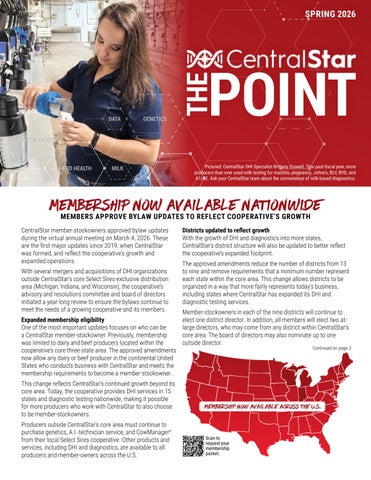
CentralStar member-stockowners approved bylaw updates during the virtual annual meeting on March 4, 2026. These are the first major updates since 2019, when CentralStar was formed, and reflect the cooperative’s growth and expanded operations.
With several mergers and acquisitions of DHI organizations outside CentralStar’s core Select Sires-exclusive distribution area (Michigan, Indiana, and Wisconsin), the cooperative’s advisory and resolutions committee and board of directors initiated a year-long review to ensure the bylaws continue to meet the needs of a growing cooperative and its members.
One of the most important updates focuses on who can be a CentralStar member-stockowner. Previously, membership was limited to dairy and beef producers located within the cooperative’s core three-state area. The approved amendments now allow any dairy or beef producer in the continental United States who conducts business with CentralStar and meets the membership requirements to become a member-stockowner. This change reflects CentralStar’s continued growth beyond its core area. Today, the cooperative provides DHI services in 15 states and diagnostic testing nationwide, making it possible for more producers who work with CentralStar to also choose to be member-stockowners.
Producers outside CentralStar’s core area must continue to purchase genetics, A.I.-technician service, and CowManager® from their local Select Sires cooperative. Other products and services, including DHI and diagnostics, are available to all producers and member-owners across the U.S.
With the growth of DHI and diagnostics into more states, CentralStar’s district structure will also be updated to better reflect the cooperative’s expanded footprint.
The approved amendments reduce the number of districts from 13 to nine and remove requirements that a minimum number represent each state within the core area. This change allows districts to be organized in a way that more fairly represents today’s business, including states where CentralStar has expanded its DHI and diagnostic testing services.
Member-stockowners in each of the nine districts will continue to elect one district director. In addition, all members will elect two atlarge directors, who may come from any district within CentralStar’s core area. The board of directors may also nominate up to one outside director.
Continued on page 2
The board of directors will implement a transition plan, with district reorganization and board elections under the new structure beginning at CentralStar’s 2027 annual meeting. Together, these updates help ensure CentralStar’s governance structure reflects the cooperative’s growing customer base while continuing to prioritize producer representation and memberstockowner leadership.
Additionally, during the annual meeting, member-stockowners confirmed the board of directors’ election results.
Congratulations to Tim Servais, Stoddard, Wis.; Lee Jensen, Elk Mound, Wis.; Lyle Ott, Brillion, Wis.; Jeff Horning, Manchester, Mich.; and Ken Carnahan, Butler, Ind., on re-election to represent their districts.
If you would like to learn more about becoming a CentralStar member-stockowner, or request a membership packet visit: mycentralstar.com/ member-stockowners/.

Bovine Accellyte II supports cows before, during, and after heat-stress events, helping them recover faster and start the next heat event stronger. On-farm data from 23 Midwest herds showed that while all herds experienced summerconception declines, those feeding Bovine Accellyte II maintained a +7.3% conception-rate advantage.
Patronage and dividends
CentralStar distributed more than $1.8 million to member-stockowners this year through common-stock patronage and preferredstock dividends. Patronage and dividend checks were distributed in February.
The board approved a patronage distribution of $1,524,979 for common stockowners, with 80% ($1,220,000) paid in cash. The remaining balance is allocated to members and converted dollar-for-dollar to preferred stock after eight years. Additionally, the board of directors approved a $7-per-share dividend on all shares of preferred stock, totaling $356,951.
In March, in accordance with the CentralStar capital plan and current board policies, $301,000 of retained patronage from 2017, belonging to common stockowners, was converted to 3,001 shares of preferred stock.
These distributions are one of the benefits of cooperative ownership, providing earnings to dairy and beef producers who do business with and choose to be a member-owner of CentralStar.

Scholarship applications due June 1
CentralStar is again offering multiple $1,000 scholarships to member-stockowners or their children.
To be eligible for consideration, applicants must be enrolled in a four-year college or a one- or two-year technical college or short-course program in an agriculture-related field or be a high school senior admitted into one of these programs. Get details and apply at: mycentralstar.com/scholarship/.

Establishes electrolyte balance
Promotes cell hydration
Delivers fluid and energy directly to cells

and Reproductive Consultant

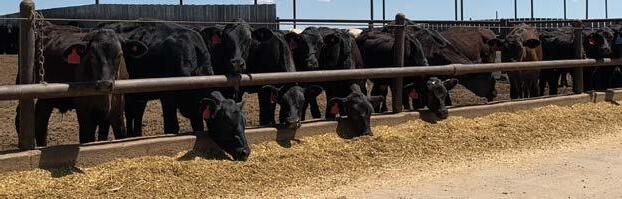
This year’s Discover Conference brought together more than 200 experts to take a deep dive into the booming beef on dairy sector. With food demand rising and margins tightening, efficiency is critical. Our efforts impact food production, food security, the environment, and public health; but, most importantly, the future of our farms.
Beef on dairy calves are different
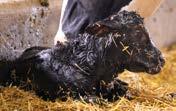
One thing became glaringly clear during this meeting of the minds: beef on dairy calves do not fit the same management practices used for traditional dairy replacements or native beef calves. The good news is that scientists, professionals, and industry leaders are actively working to build a blueprint for success. New research is helping answer some critical questions.
Younger animals are typically genetically superior
Genomic testing remains one of the fastest ways to drive genetic progress and weed out inferior animals. However, implementing a breeding strategy with the oldest half of the herd bred to beef has been shown to make similar growth in genetic merit over time. Dr. Chad Dechow, from Penn State University, discussed research suggesting that younger dams may offer a more favorable epigenetic state, the hypothesis being that the highest producing cows do not necessarily produce the highest milking daughters, as more energy is directed to milk production rather than fetal development.1
Genetic potential sets the ceiling; management sets the floor Nutrition and management in the first days of life have a very visible and long-lasting impact on lifetime performance. According to Dr. Pedro Carvalho, from Colorado State University, calves with poor transfer of passive immunity from colostrum were 13 pounds lighter at 180 days of age and experienced a 15% higher mortality rate compared to their better managed counterparts.2 Calves that gain the most weight in the first six weeks of life tend to perform better in both milk production and carcass yield later on. This solidifies the importance of a strong start for these animals. Calves that get a rough start will almost certainly never reach their genetic potential.
Beef calves nurse four to eight times per day while on their dams and are typically weaned between four and six months of age. In contrast, dairy replacements often receive two large feedings per day and are rapidly transitioned to solid feed by around 60 days of age. Dr. Tom Earleywine, with Purina Mills, presented research showing that calves fed three times daily gained 20.7 pounds more through 12 weeks of age.3
His take-home message was clear: the most vulnerable group of animals on the farm tend to draw the short straw as time, labor, and resources are stretched thin. Rushing the transition phase from preweaning to ruminant compromises gut health and predisposes calves to liver abscesses later in life.
Even if calves are leaving the farm as day-olds, investing in tight colostrum protocols and smooth transitions from milk to starter feed pays off, building a reputation for strong, healthy calves that will keep buyers knocking at your door regardless of what the cattle market does.
There is often concern over the negative implications of beef on dairy crossbreeding. Despite some beef breeds having a slightly longer gestation length, using beef sires does not increase calving difficulty, the occurrence of any health event, or reduce performance during the first 60 days of the subsequent lactation.4 Beef-sire genetics did, however, significantly influence performance and carcass quality, where much of the added value lies.
The exceptionally high prevalence of liver abscesses in feedlot cattle was a major topic of discussion, and rightfully so, as it costs the industry a whopping $683 million annually. Researchers consistently linked liver health to overall performance and carcass quality, reinforcing the importance of proactive management strategies.
A quality study, in cooperation with Texas Tech University, found that while liver abscesses occur in more than 40% of beef on dairy animals industry wide, ProfitSOURCE® cattle showed a dramatically lower incidence at just 6%.5 In this study, ProfitSOURCE animals were raised on the dairy of origin
Emily Middleton-Gyomory, Regional Consulting Manager

A herd with a bulk tank somatic cell count (SCC) of 115,000 would be considered a milk quality success by most industry standards. Yet, a look at this 1,000-cow herd, shows cows with an average lactation somatic cell score (SCS) of 4.0 or greater produced 900 fewer pounds of energy-corrected milk (ECM) per cow compared to herdmates with lower SCS. While only 7% of the herd fell into this higher SCS category, the lost milk still added up to nearly $12,000 in unrealized production.
Frequently monitoring bulk-tank SCC is an important indicator of overall milk quality, but it does not tell the whole story. In a 2025 Hoard’s Dairyman webinar on milk quality1, Michigan State University’s Pamela Ruegg, D.V.M., shared it’s not enough to only use bulk-tank SCC to monitor a herd's milk quality; it is also important to monitor subclinical and clinical mastitis. Following are several valuable key performance indicators (KPI’s) Ruegg shared that are important for managing your herd.
u Percent of herd with subclinical mastitis (SCC >200,000): <15%
u New infection rate: <8% (SCC <200,000 on prior test and >200,000 on current test)
u Percent of cows with chronic infection: <8% (SCC >200,000 on prior and current test)
u Fresh infection rate, 1st lactation: <10% (SCC >200,000 on first test)
The impact of higher SCC went beyond milk production. These cows also averaged 15 more days open than cows with a lactation average SCS below 4.0. While only 7% of the herd is represented by SCS of 4.0 or higher, it all adds up and highlights how subclinical mastitis can decrease profitability even in herds with excellent bulk-tank SCC. There can be high SCC cows that are heavy shedders but can be diluted in the bulk tank, especially in larger herds.
This example clearly shows that even herds with low bulk tank SCC can incur hidden losses that quietly erode performance. The key is knowing where to look and using the right tools and metrics to uncover what the bulk tank alone can’t reveal.
u Fresh infection rate, 2nd+ lactation: <15% (last test previous lactation <200,000 and first test current lactation >200,000)
It’s impossible to calculate or manage these metrics without routine monthly DHI testing.

Pathogen identification is an important next step which helps guide the course of action. For individual cows it leads to treatment or culling and can identify if adjustments need to be made with bedding-management practices, teat-dip products, etc., for groups or the whole herd. CentralStar has created a resource to help guide the next steps. Scan the QR code to learn more about effectively managing mastitis pathogens, from identifying the source to key prevention strategies.
The importance of pathogen identification is underscored in the 2025 Hoard’s Dairymen Round Table2 featuring National Dairy Quality award winners. All six herds represented identified they routinely DHI test to monitor subclinical mastitis and also perform pathogen identification testing to determine if and how a cow should be treated.
Managing subclinical mastitis today is critical, but genetic selection can help reduce risk over the long term. The Herd Health Profit Dollars® (HHP$®) index places 13% emphasis on mastitis resistance for Holstein sires. The top 100 Holstein sires for HHP$ have an average SCC of 2.84 compared to the top 100 Holstein sires for NM$ which average 2.93. The same top 100 HHP$ bulls are also a full point higher for mastitis resistance.
Obviously, genetics alone won’t eliminate mastitis challenges, but incorporating mastitis resistance into selection can support ongoing management efforts and protect future production.
While an average case of mastitis costs around $2503, subclinical mastitis is just as costly at $1104/cow/year because it often goes unnoticed. This herd example is proof that low bulk-tank SCC doesn’t tell the whole story.
Identifying these losses requires looking beyond the bulk tank, using monthly DHI testing, monitoring key mastitis KPIs, and following up with pathogen identification when needed. Connect with your CentralStar team to identify opportunities in your herd and put a plan in place to reduce these hidden losses.
References:
1.https://hoards.com/article-37346-put-that-data-to-work-manage-milk-quality.html
2.https://www.nmconline.org/wp-content/uploads/2025/02/Making-the-most-oftheir-milk-RT.pdf
3.https://www.agproud.com/articles/62526-dollars-down-the-drain-what-one-caseof-mastitis-can-cost-you#:~:text=The%20average%20cost%20of%20a,make%20 decisions%20regarding%20mastitis%20difficult.
4.Ott SL 1999: Cost of herd level production losses associated with subclinical mastitis in U.S. dairy cows NMC annual Meeting proceedings 199:152

Identify cows with subclinical infections DHI
Test combined samples of high-SCC cows with Complete 16 Mastitis PCR
Interpret PCR results
• E. coli was the strongest pathogen detected
• Indicates potential issues with manure management
• Verify bedding is clean and dry
• Scrape alleys to prevent pooling/build-up
• Ensure milking prep removes all manure from teats

Repeat monthly to
• Track progress over time
• Detect future outbreaks early
Continued from page 3 from day one through finishing. Their exceptionally low rate of liver abscesses speaks volumes to the consistent nutrition and management throughout their life and circles back to the importance of superior genetics, high quality colostrum, and good passive transfer of immunity at birth.
The bottom line
Beef on dairy isn’t just a trend: it’s a strategic investment.The research reinforces a few key priorities.
u Colostrum matters: Failure of passive transfer reduces growth and increases death loss.
u Feed for growth: Calves fed 3x daily gain more weight early, setting up future performance.
u Manage early life well: Better transitions and nutrition can reduce issues like liver abscesses later.
u Genetics matter: Beef on dairy does not increase calving difficulty, but it does add value through carcass quality.

Whether calves leave as day-olds or stay through finishing, tightening protocols from day one pays. The opportunity is clear: raise healthier calves, capture more value, and build a program that performs from start to finish. Talk with your local CentralStar team to help pull it all together.
References:
1. Dechow, C. (2025). Genetic Considerations for Beef x Dairy [Conference presentation].
2. Carvalho, P. (2025). Extended colostrum/preweaning nutrition management [Conference presentation].
3. Earleywine, T. (2025). Beef x Dairy – Start with the finish in mind! [Conference presentation].
4. Basiel, B.L. et al. (2024). The impact of beef sire breed on dystocia, stillbirth, gestation length, health, and lactation performance of cows that carry beef × dairy calves. Journal of Dairy Science, Volume 107, Issue 4, 2241 – 2252
5. ProfitSOURCE: Your source for proven carcass quality. (2024). https://www.selectsires.com/article/ ss-blog/2024/11/01/profitsource-your-source-for-proven-carcass-quality
Cows given two boluses of Cow Start™ Complete at calving produced +5.3 pounds more milk per day over the first 100 days of lactation, returned to breeding sooner, and had higher first-service conception.











TJ Roth | Banner Ridge Farms, LLC