Open Streets
Reimagining Streets for People in Philadelphia
Reimagining Streets for People in Philadelphia
Reimagining Streets for People in Philadelphia
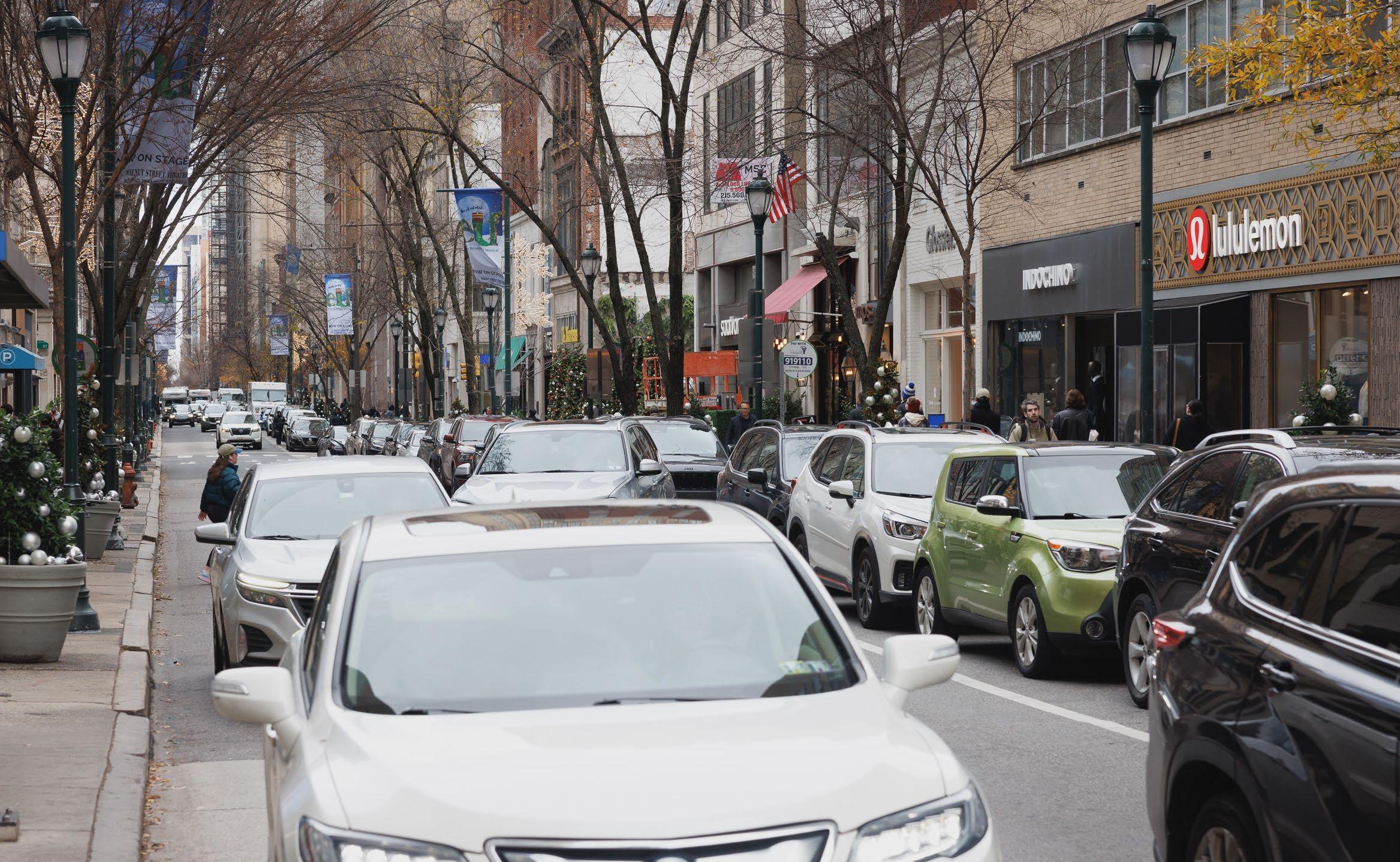
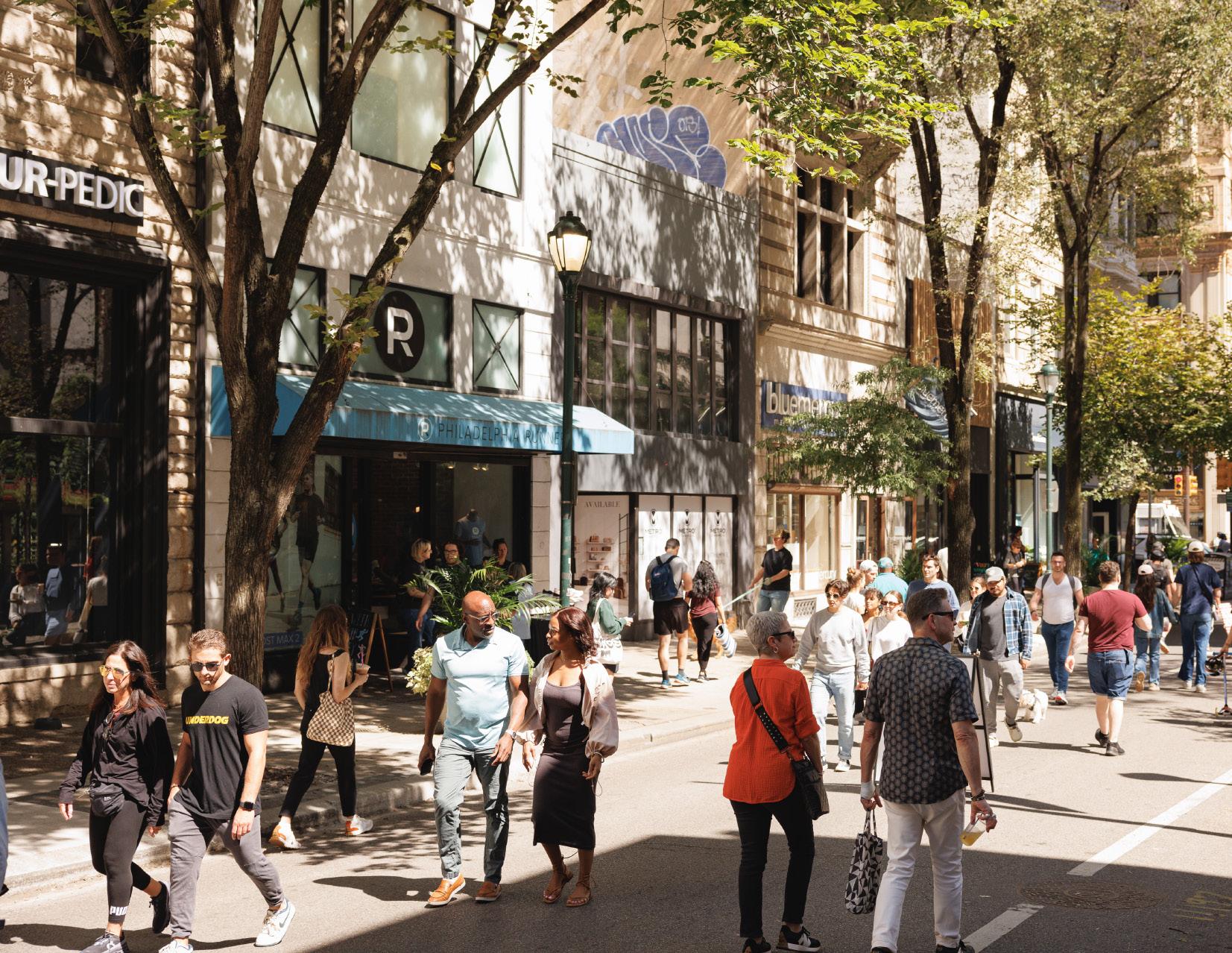
Picture Rittenhouse Row on a typical Sunday morning. People fill the sidewalks, browse Anthropologie, Philadelphia Runner, or the Apple Store, people-watch over brunch at one of Parc’s coveted sidewalk tables facing Rittenhouse Square. Yet, despite the retail activity and sidewalk animation, two-thirds of the space between buildings is allocated to vehicular storage and movement rather than the foot traffic that is generating commercial revenue.
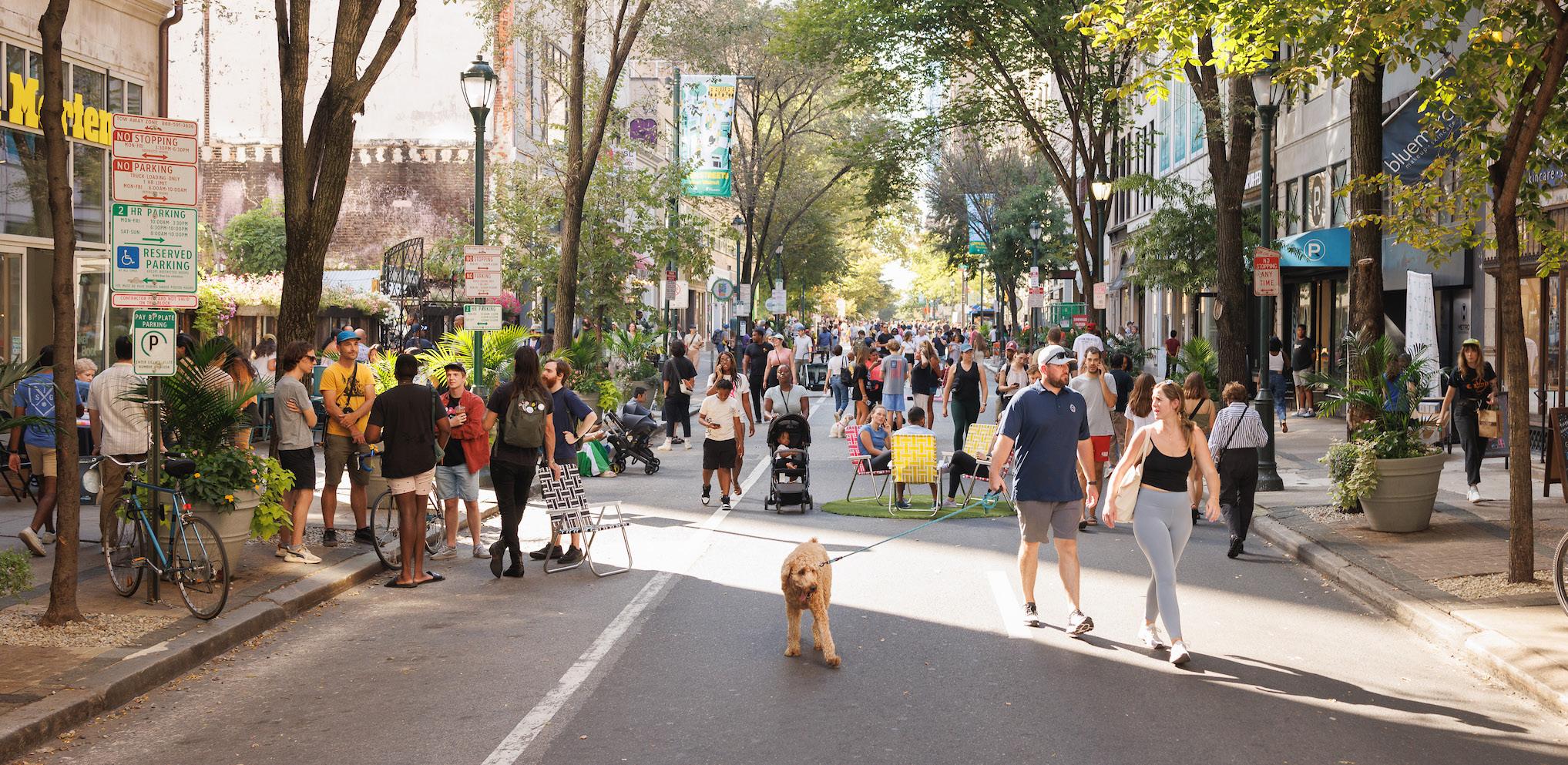
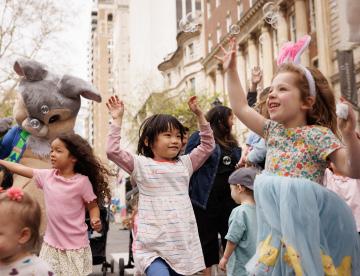
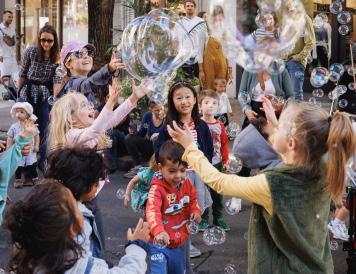
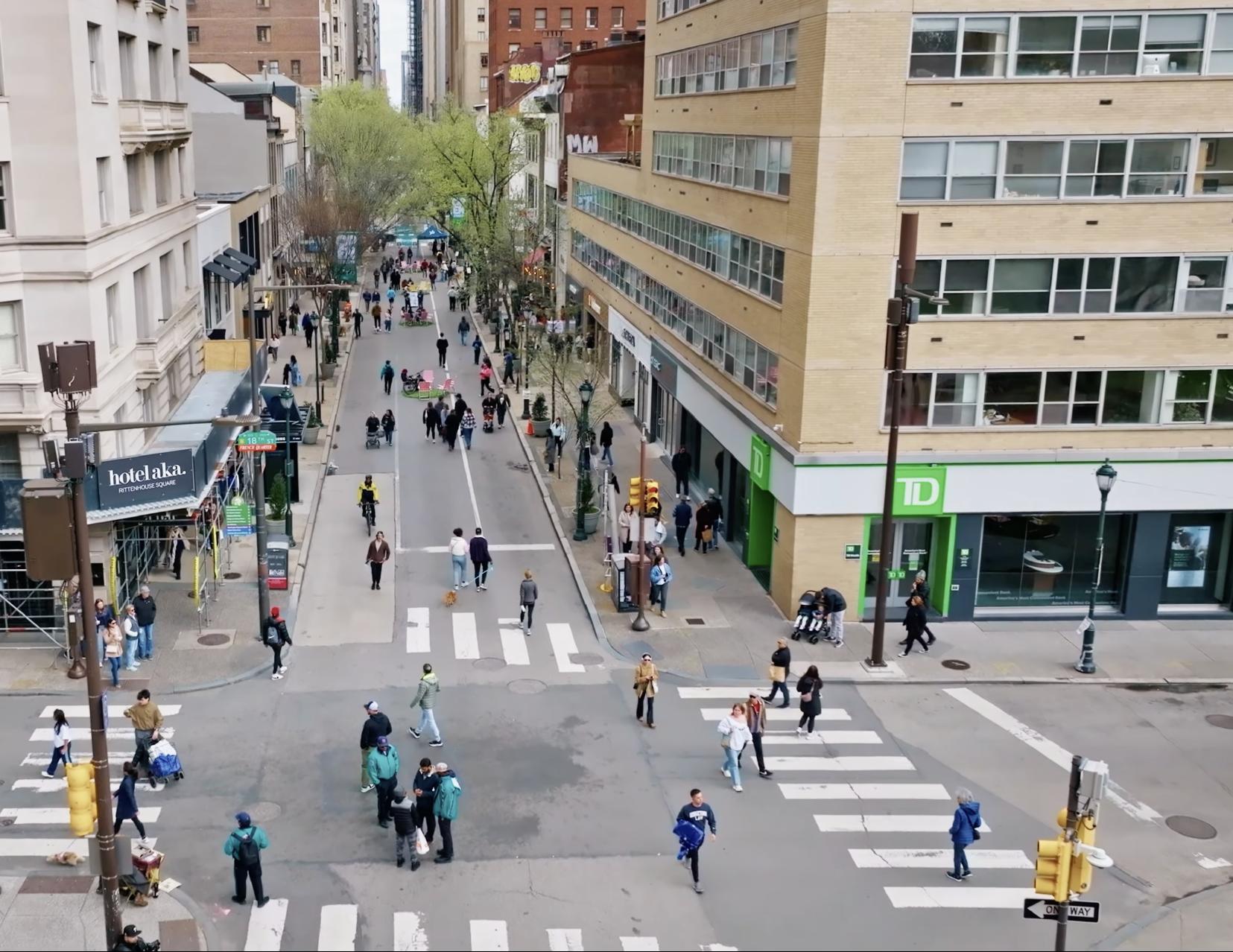
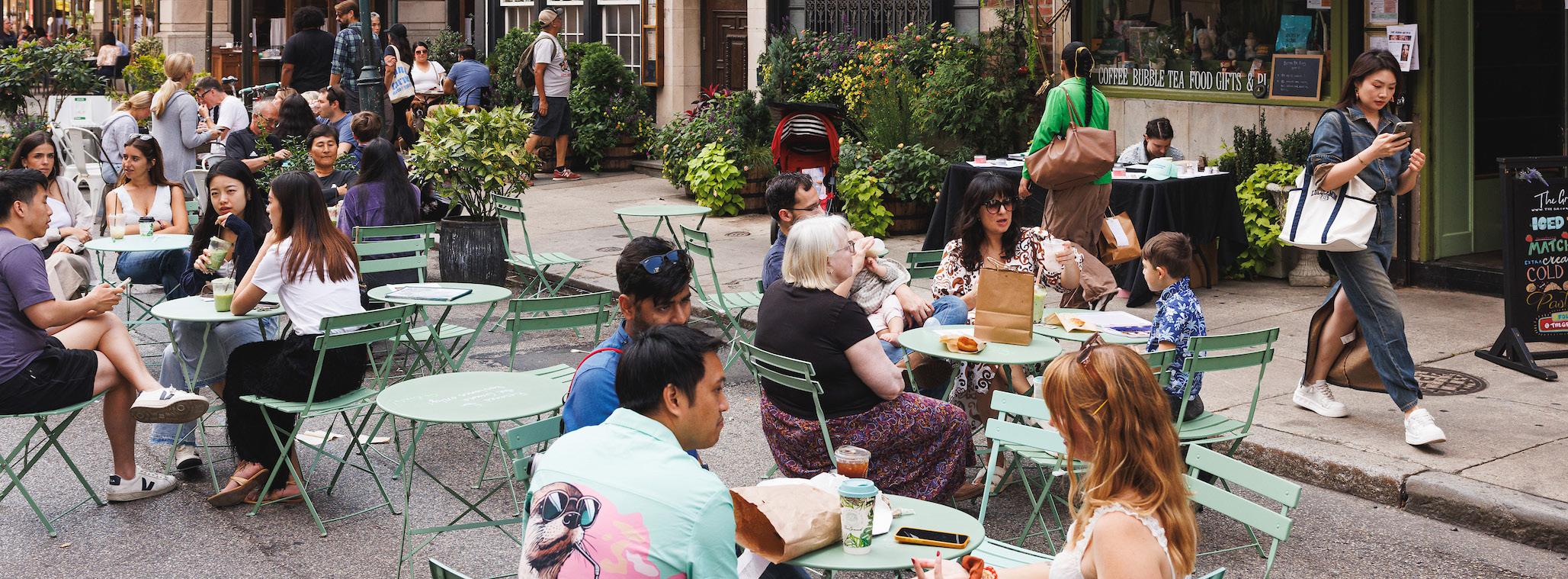
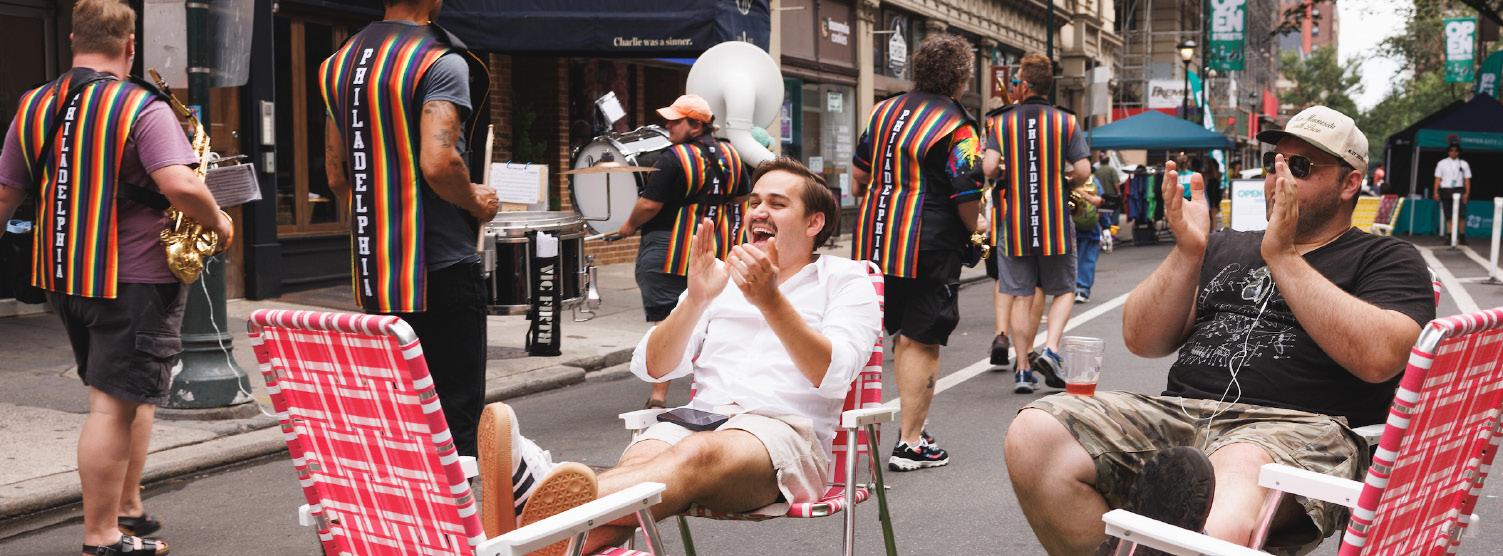
Now, picture the same street on any Open Streets Sunday. Thousands of people are strolling, sitting, eating, playing, and discovering a version of their city that the street, on any other day, makes structurally impossible. Toddlers, initially cautious about crossing the curb line, chase giant bubbles through the middle of an intersection. Couples, families, and friends linger over brunch on tables that spill up and down 18th Street. Dogs make friends. Suburbanites make a day of it. And, critically, retail sales and foot traffic are up significantly. Nothing about the street has been rebuilt or redesigned. The space has simply been reallocated, temporarily privileging people and place over throughput.
Streets consume an extraordinary share of urban land, and for most of the last century, cities have operated under a single, largely unexamined assumption about what they are for. Moving cars through has been the default. Everything else — walking, sitting, playing, gathering — must negotiate for whatever is left over. Open Streets questioned that assumption, temporarily, and revealed what becomes possible when a city's default operating code gets rewritten in favor of people and place.
Around the world, great shopping streets are places first. As a college student studying abroad in Florence, I marveled at (and was perhaps radicalized by) the nightly Passeggiata — the liminal time between work and supper when Florentines strolled the
pedestrianized shopping streets to see and be seen. Copenhagen’s Stroget and Barcelona’s Ramblas are two iconic examples of well-performing retail streets that are great places. There are many examples outside of Europe, from Mexico City and Bogota to Tokyo and Sydney.
What these streets share is something that has become increasingly rare and increasingly valuable: they are places where people gather, encounter one another unexpectedly, and share physical space. Much has been written about the troubling rise of loneliness and isolation in modern life — a crisis accelerated by a culture that has placed growing value on the remote, the private, and the digital, from where we work and shop to how we celebrate and socialize. So much of life has migrated elsewhere that the streets and public spaces where unscripted human connection still happens at scale have taken on new significance. A downtown that welcomes diverse groups and gives them reasons to linger is critical infrastructure for civic life.
America's experiments with pedestrianized streets, from Denver's 16th Street Mall to Santa Monica's 3rd Street Promenade, have produced mixed results, and those results have made cities cautious. But the choice is not binary. Between a street that belongs entirely to cars and one that belongs entirely to pedestrians lies a broad and largely unexplored middle ground. The lesson is that even a partial, temporary reallocation of street space toward people delivers returns that car-dominated streets cannot.
Temporary, flexible, and reversible, the Open Streets model captures the benefits of a people-first street without requiring a costly permanent bet. Philadelphia, through Open Streets, has begun to claim that middle ground — and few cities are better positioned to do so.
In 2025, Philadelphia was named the most walkable city in America by USA Today's 10 Best Readers' Choice Awards for the third consecutive year. Developed largely before the automobile became dominant, Center City concentrates residential towers, office buildings, restaurants, shops, arts institutions, and services on a compact, flat footprint, with interwoven land uses that would be nearly impossible to create from scratch today. Ground-floor retail and restaurants keep sidewalks animated and interesting, and Center City District's on-street teams provide cleaning, public safety, homeless outreach, and hospitality services that make those sidewalks comfortable and inviting for everyone.
Rittenhouse Row has earned a place among the nation's premier urban retail corridors, alongside Georgetown's M Street and Venice Beach's Abbot Kinney, because the street delivers what today's best retail brands require — density, walkability, and a growing residential population — because of the street itself: a continuous, engaging cadence of storefronts under a tree canopy that maintains visual interest and invites exploration on every block. The brands that have chosen it, including Vuori, Veronica Beard, and Jordan World of Flight, understand that people on foot are better for business than people in cars. Open Streets was the natural next step.
Twenty events later, the results exceeded what our measured optimism allowed us to predict. More than 170,000 visitors. A 38% average sales increase for participating businesses. A “Best of Philly” recognition from Philadelphia Magazine. Inga Saffron declaring Open Streets a “Philadelphia Ramblas on Walnut Street.” The Philadelphia Inquirer’s editorial board calling it an example of "thinking big — and sticking the landing." A recurrence that has evolved the program from novelty to expectation without losing the quality that made people show up in the first place.
Our team built something special and we built it carefully, earning trust from restaurants and retailers, coordinating city agencies, and executing the event with the kind of operational precision that only looks easy from the outside. This report is, in part, a record of that work and an expression of gratitude for everyone who contributed to it: our staff who set up and broke down every barrier, our city partners, including the Philadelphia Police Department, who made it operationally possible, the businesses that took a chance on something new, and the community members who showed up and kept showing up until Open Streets felt less like a program and more like a fixture of city life.
The results have been good for Center City, good for the retailers and restaurants of Rittenhouse Row, and good for Philadelphia, adding a chapter to the story of a downtown that is resilient, inventive, evolving, improving, and ambitious.
The question this report leaves open is not whether Open Streets works. It's how far we can take it. The pages that follow begin to answer that question.

Prema Katari Gupta President & CEO
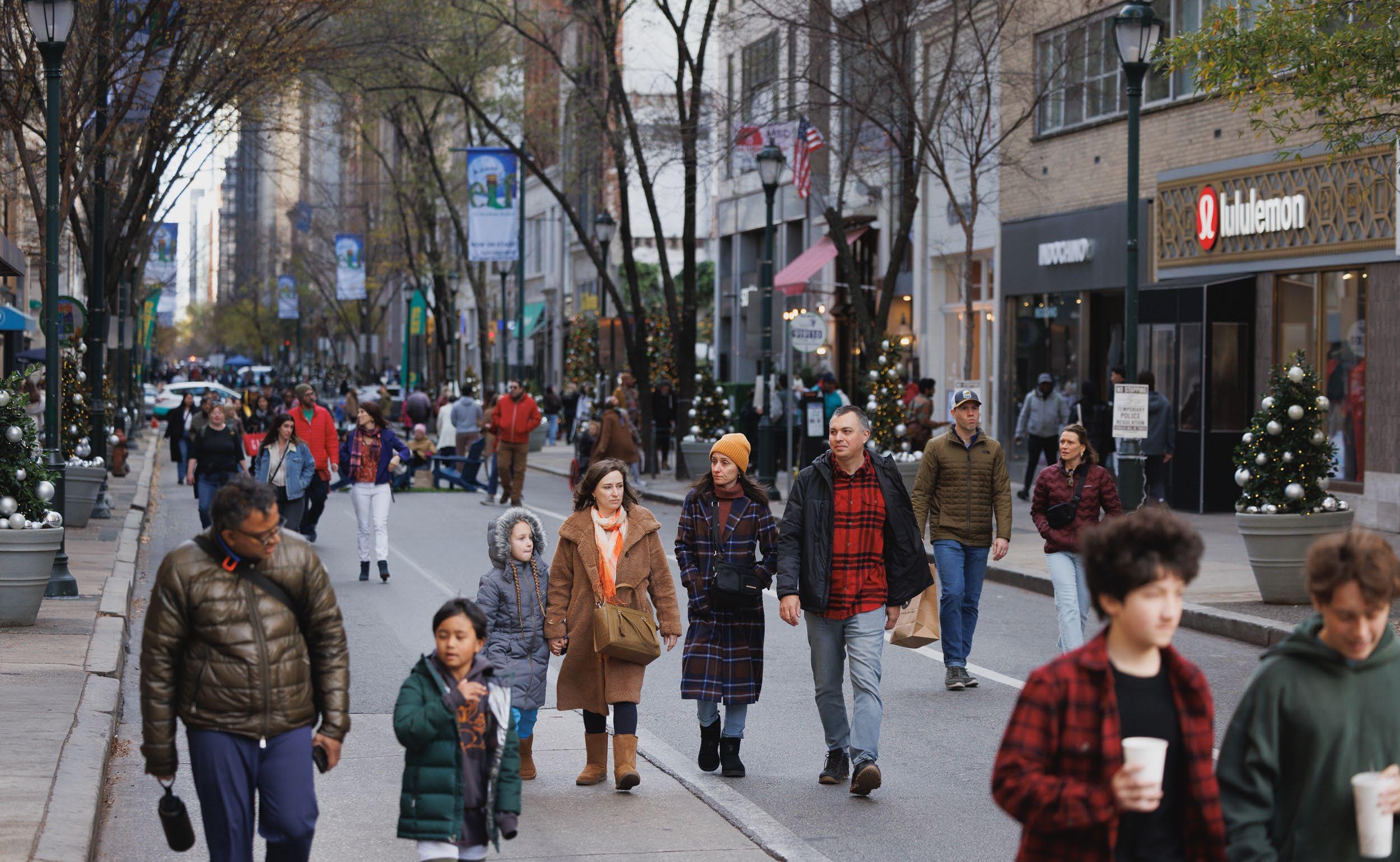
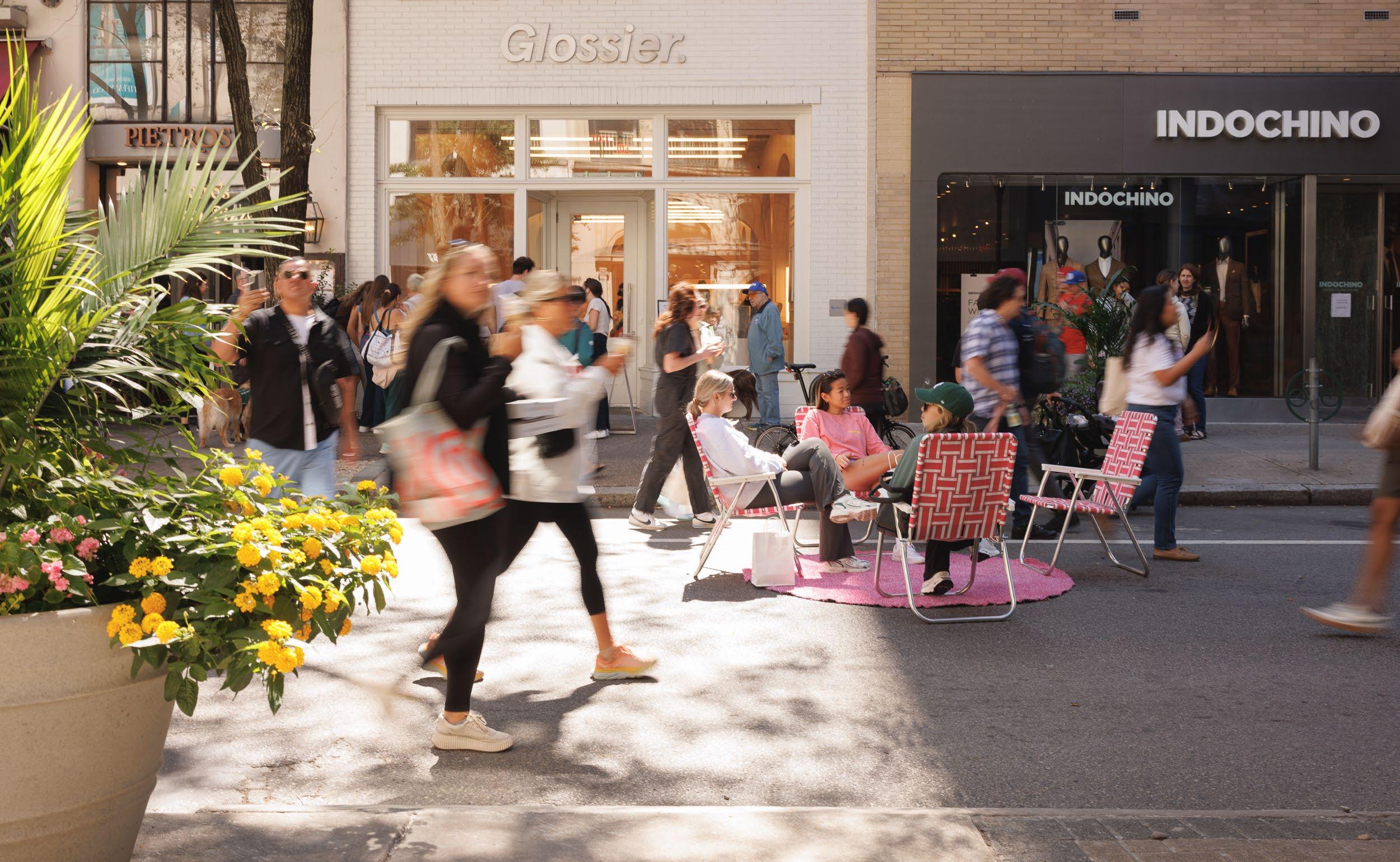
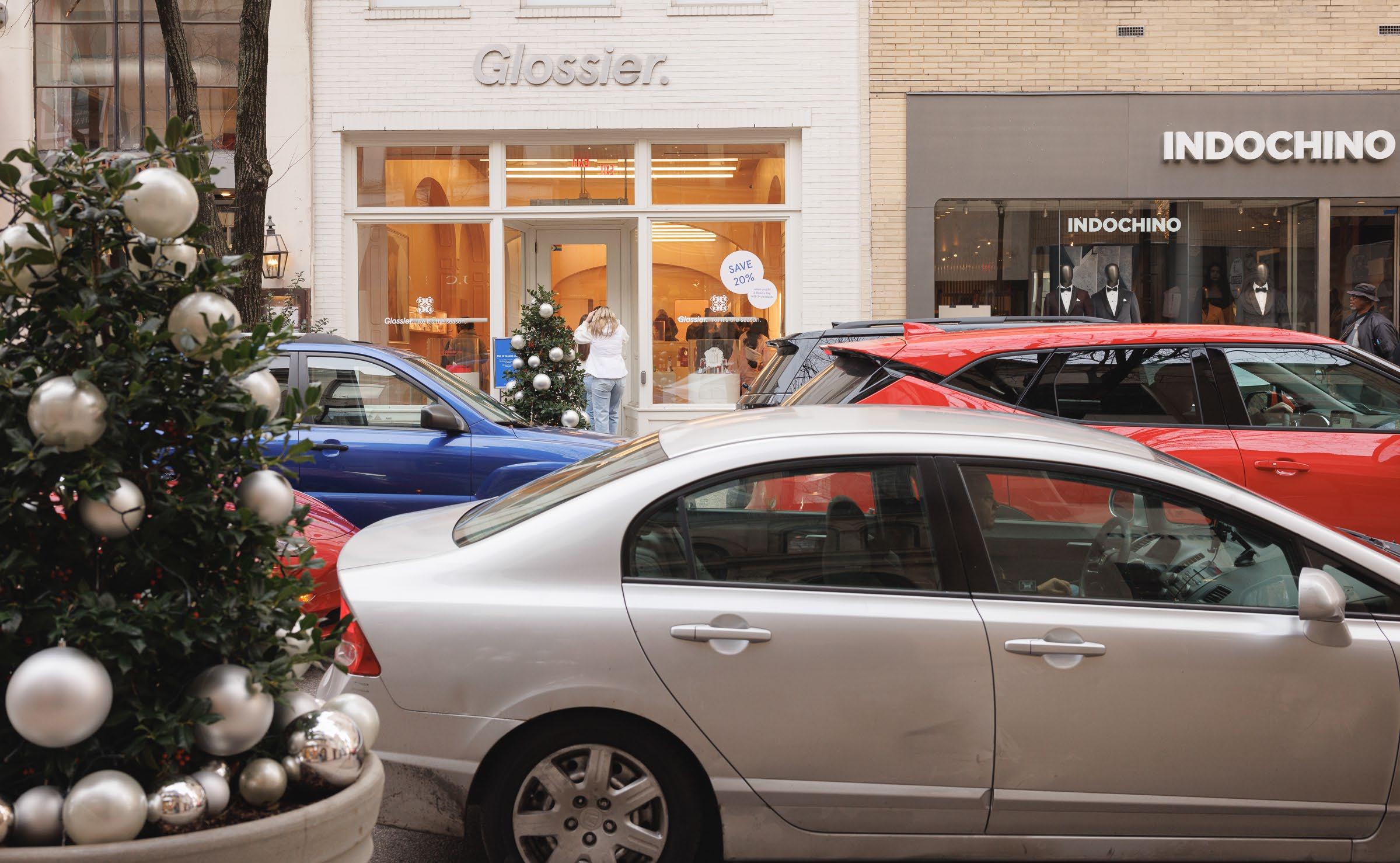
The determination to launch Open Streets grew out of several ingredients already baked into Center City’s DNA: a highly walkable street network; a robust mix of retail, restaurants, and residential uses; and a demonstrated appetite for shared civic experiences. The idea of car-free streets is also something familiar to many Philadelphians—from neighborhood block parties and street festivals to more recent experiences such as weekend bike rides along MLK Drive, the papal visit, Philly Free Streets, and the street closures that supported outdoor dining and provided a lifeline for restaurants during the pandemic.
The pandemic itself proved to be an immense stress test on the resilience of downtowns across the country, leaving in its wake a series of challenges, from office retention and retail occupancy to broader quality-of-life concerns and a growing loneliness epidemic. At the same time, it revealed something essential: the critical role the public realm plays in sustaining the social and economic health of cities. Street closures, streeteries, and expanded outdoor dining—once
considered luxuries or add-ons—became lifelines for businesses almost overnight. The number of outdoor dining seats across Center City nearly doubled from 3,500 in 2019 to a peak of 6,700 in September 2021. CCD parks similarly shifted from primarily recreational amenities to essential public health infrastructure.
In that spirit, and in response to the shifting retail landscape, CCD saw an opportunity not only to recoup what had been lost, but to build forward—carrying the most successful aspects of that period into a more intentional and durable civic practice. Open Streets: West Walnut emerged from this moment as a way to extend those benefits to residents, business owners, and visitors alike, with implications for Center City and Philadelphia that reach well beyond a single corridor or season.
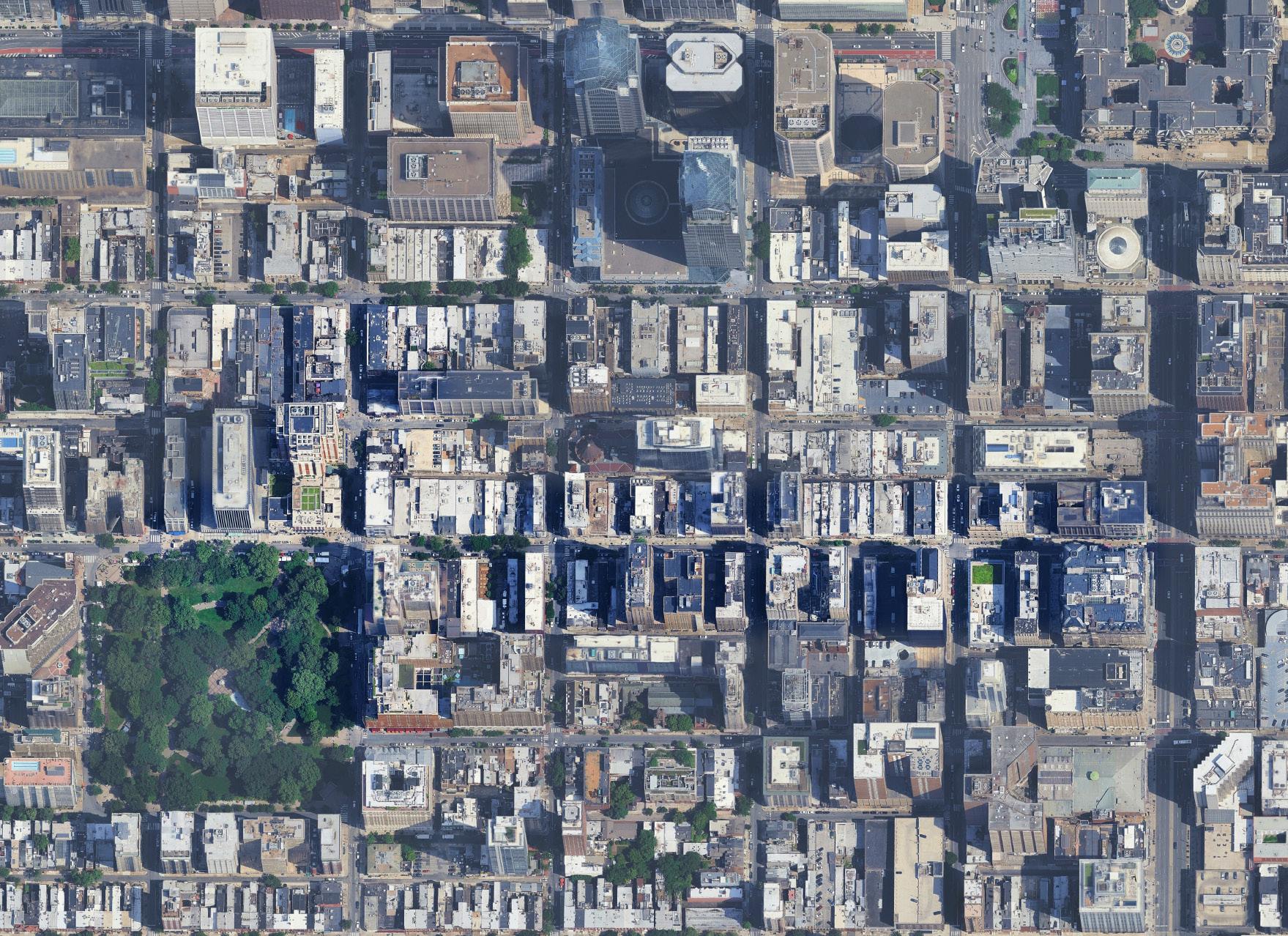
Center City’s highly walkable grid and diverse mix of retail, restaurant, residential, office, cultural, and open-space uses create an ideal framework for a temporary car-free streets program such as Open Streets.
Open Streets was designed, in part, to reinforce Center City’s walkability and enhance the retail and consumer experience for residents and visitors. As such, West Walnut Street and the Rittenhouse neighborhood emerged as an ideal place to pilot a car-free streets program at scale.
The corridor network—Walnut Street from Broad to 19th, and 18th Street from Chestnut to Locust—combines several conditions that proved essential to the program’s success: a high concentration of well-established restaurants and retail and proximity to densely populated residential neighborhoods. More people live within a 15-minute walk of this shopping area than many peer districts including the Newbury & Boylston area in Boston, Georgetown in Washington, D.C., and State Street in Chicago. This builds in a consumer base that can sustain the retail mix even without influxes of visitors and office workers.
The area’s retail mix has evolved dramatically in recent years, as digitally native brands have responded to Center City’s rapid population growth which has resulted in a larger and younger population with more spending power than ever before. The area is singular among Philadelphia’s commercial corridors, competing directly with the broader region’s major shopping destinations (King of Prussia, Suburban Square, Cherry Hill) rather than
other neighborhoods within city limits. Its co-tenancy of major lifestyle brands competes directly with each of these suburban centers, while holding the distinction of being the first landing place for many new-to-market retailers. Layer in the plethora of locally founded and only-in-the-city retailers alongside its widely renowned food and beverage scene, and it is clear that the area offers a shopping and dining experience unmatched by anywhere else in Greater Philadelphia.
Anchored by Rittenhouse Square, one of Center City’s most beloved and heavily used public spaces, the area already functions as a natural gathering place, making it well suited for a program centered on pedestrian activity and shared civic experience.
Equally important are the physical characteristics of the streets themselves. Street widths, block lengths, and a varied architectural context—from historic facades to contemporary storefronts—create an engaging and legible environment at walking speed. Together, these attributes encourage strolling, lingering, and moments of discovery, reinforcing the street’s role as a place rather than simply a route.
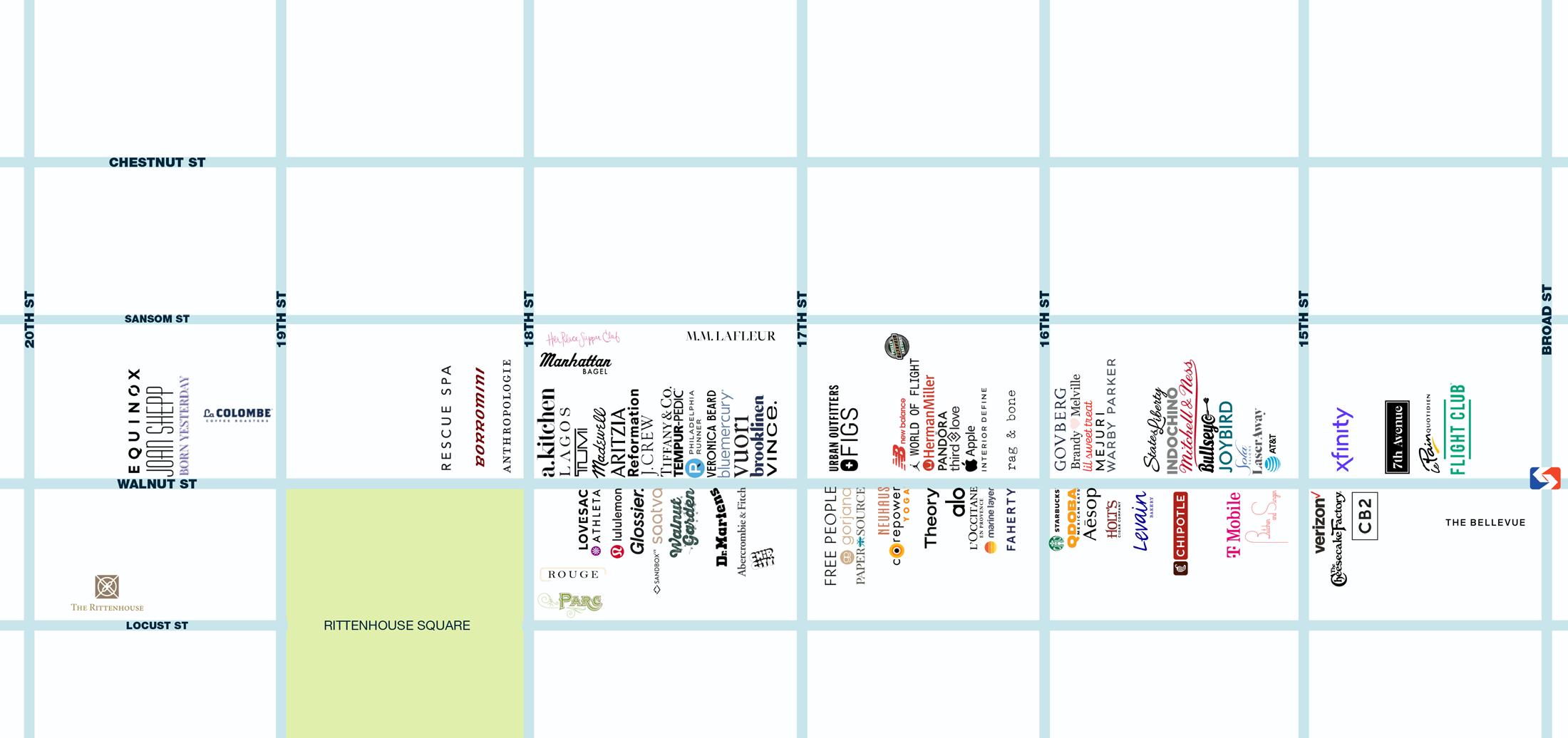
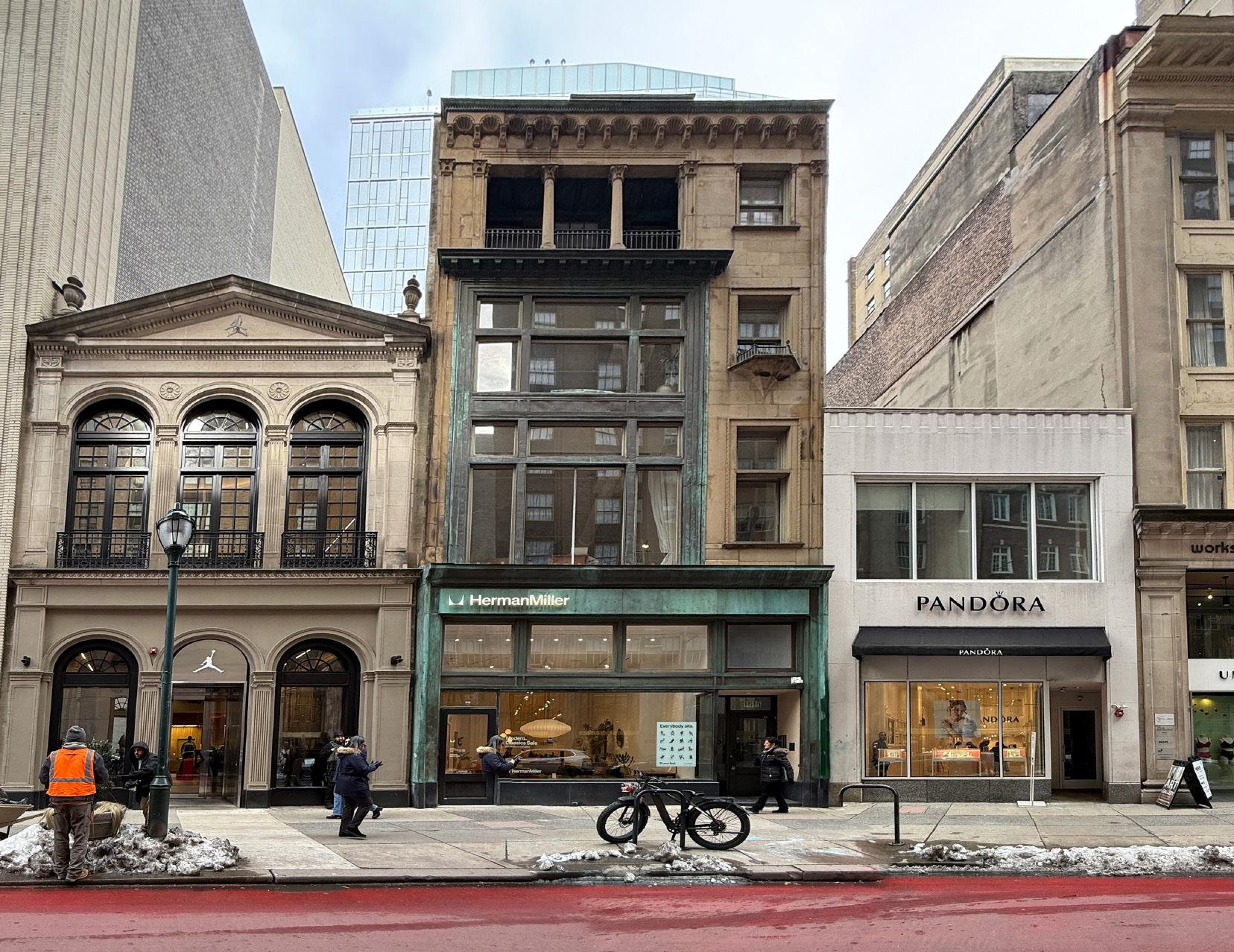
The diversity of historic facades, varied building heights, and contemporary retail frontages is a defining feature of West Walnut Street — one that often goes unnoticed when the corridor is dominated by traffic. Open Streets offers a different vantage point, highlighting Philadelphia’s architectural character and reinforcing the role the built environment plays in shaping an engaging pedestrian experience.
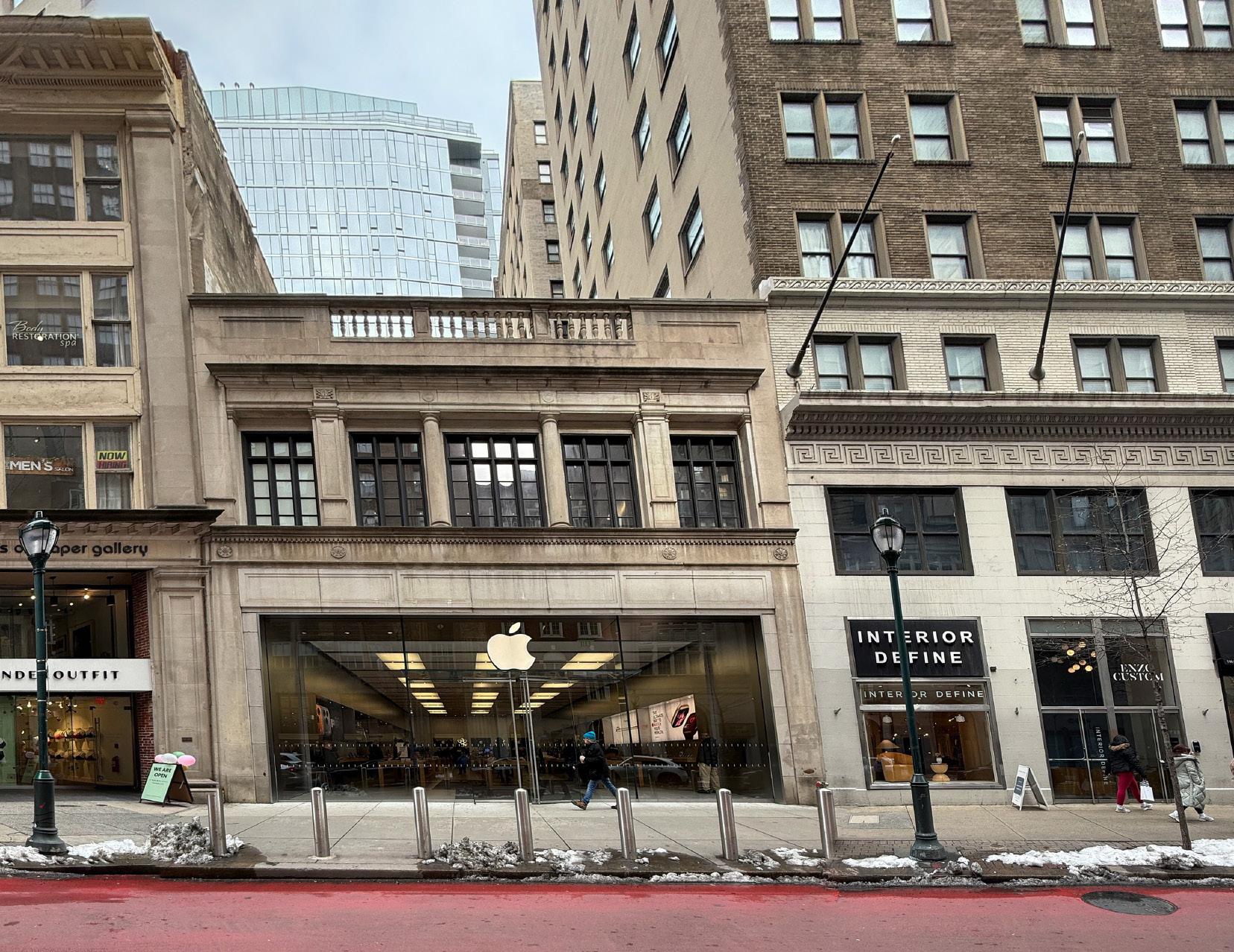
West Walnut and 18th streets, known colloquially as Rittenhouse Row, together make up one of Philadelphia’s most robust retail corridors, home to a mix of local and national retailers and many of the region’s most celebrated restaurants and cafes.
While CCD has supported the corridor with a variety of placemaking and promotional initiatives, Open Streets: West Walnut represented a different kind of endeavor requiring more personal and targeted communication with businesses along the corridor. To test CCD’s core hypothesis—that streets filled with people generate more economic activity than streets filled with cars—trust and buy-in from businesses were essential.
CCD engaged the local merchants’ association early in the planning process to communicate program goals and assist with outreach through its membership network.
That outreach was followed by door-to-door engagement with businesses with details about the program and opportunities to activate on the sidewalk or in-street. These one-on-one conversations create trust with merchants and reinforce that Open Streets is designed to support, not disrupt, day-to-day business operations.
This practice continues at the start of each Open Streets season. Beyond information sharing, these conversations strengthen relationships, provide valuable insights and anecdotal data on how to enhance the program moving forward.
While business engagement formed the foundation of Open Streets, translating that support into a safe and functional program also required close coordination with city agencies, a process that shaped how Open Streets operates in practice.
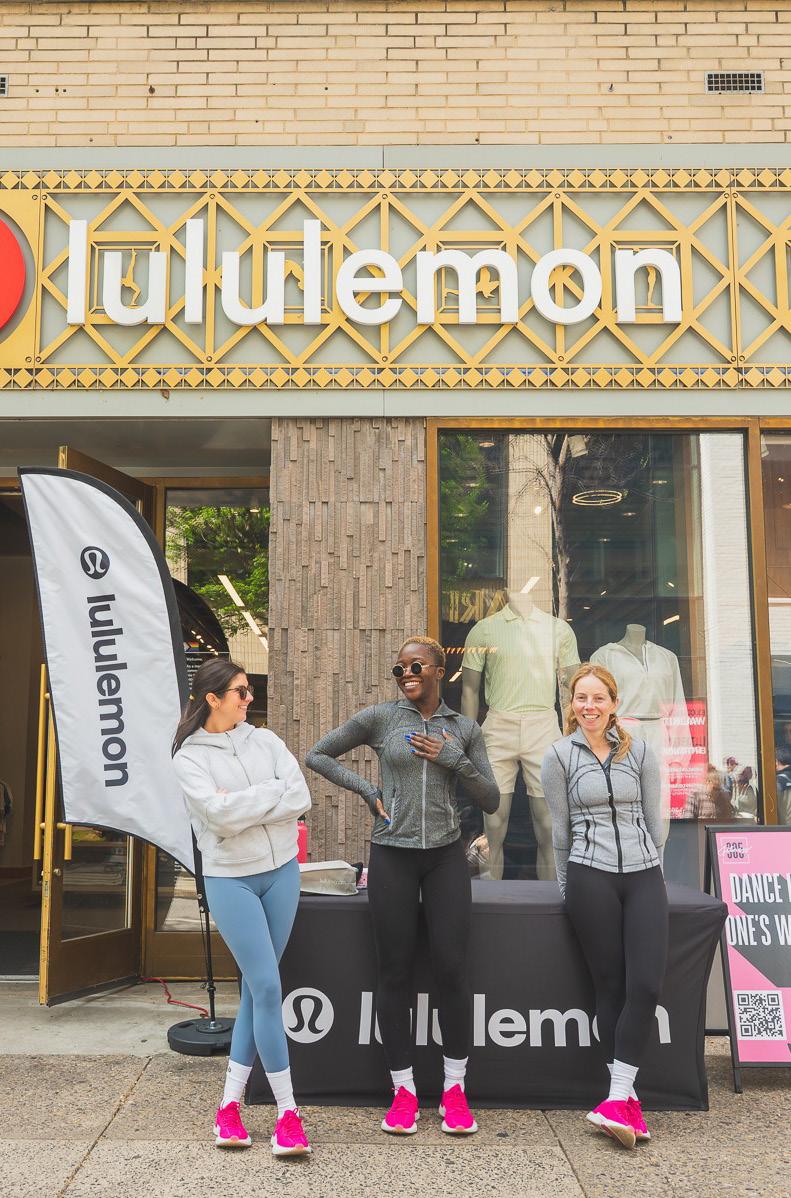
The decision to hold Open Streets on Sundays, primarily during the shoulder seasons, was similarly informed by data and context. Traffic volumes are typically lower on Sundays, and many businesses experience slower periods during these months, creating an opportunity to introduce pedestrian activity without significantly disrupting vehicle circulation. Organizing the program into defined “seasons,” a minimum of four consecutive Sundays, helped establish a sense of rhythm and familiarity for both visitors and businesses, distinguishing Open Streets from a one-off event.
This consistency allowed restaurants and retailers to plan ahead and adapt, whether by extending outdoor seating, adjusting staffing, or creating pop-up experiences to engage customers directly on the street. Over time, the combination of place and predictability reinforced Open Streets as a recurring civic ritual rather than a temporary closure.
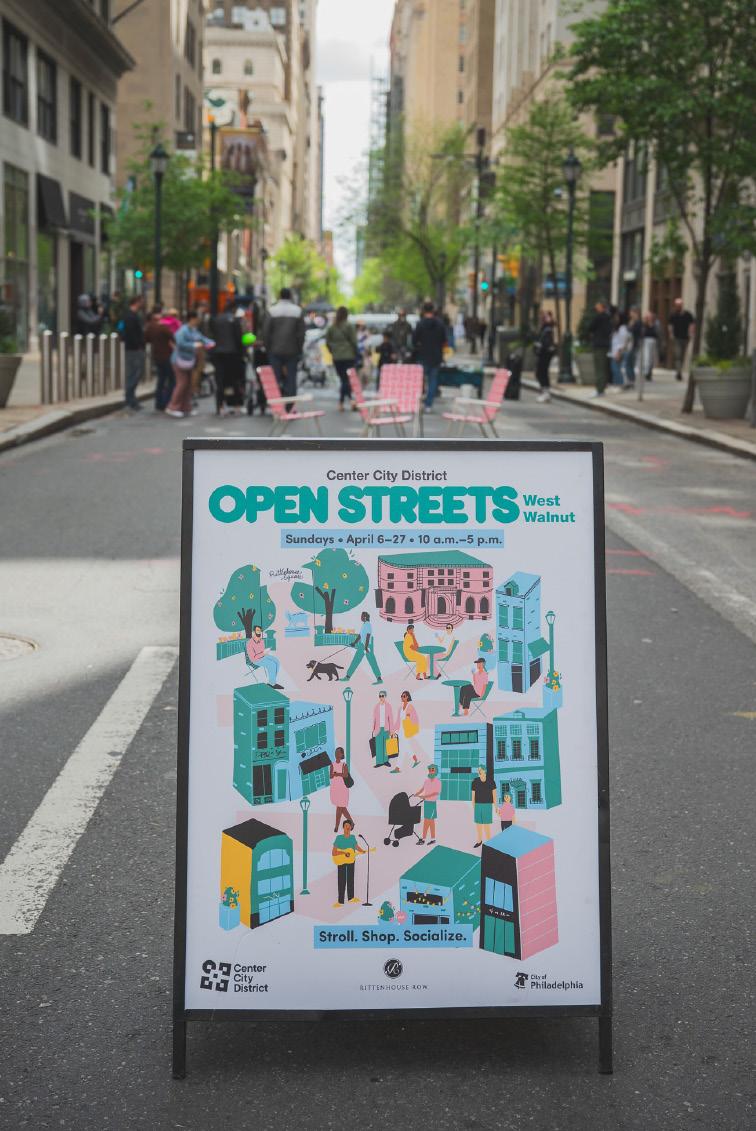
Behind the scenes, Open Streets requires balancing creative goals with operational efficiency. Advance planning and a thorough framework allow the program to scale up while maintaining quality, safety, and integrity:
Clear goals and objectives should guide each Open Streets season, whether driving foot traffic to businesses, supporting outdoor dining, or expanding access to public space. Planning takes time, so coordinating schedule, permits, insurance, communications, budget, staffing, programming, and street closures, need thoughtful consideration.
Open Streets relies on close collaboration with multiple City agencies, including the Office of Special Events, the Department of Streets, and the Philadelphia Police Department. Permitting, traffic control, and safety planning are coordinated well in advance, with the City recognized as an essential program partner.
Once the operational framework is established, the focus shifts to the experience on the street. Identify where and how programming can be effective — whether it be seating, games, or performances — and how it can enhance the pedestrian experience without overshadowing it. Flexibility is key.
A coordinated marketing and communications strategy ensures that businesses, visitors, and residents understand when and where the program will occur. Consistent messaging helps build brand recognition and familiarity and encourages repeat visits.
The priority on an Open Streets day is to ensure a safe, welcoming, and accessible on-street environment. Achieving that requires a visible on-the-ground presence and adequate staffing to support setup and breakdown, safety coordination, and a create an inviting presence within the footprint.
The process of evaluation is designed into the Open Streets program. Pedestrian counts, business feedback, and visitor data help assess performance and inform what is working and what can be improved from season to season, ensuring the program evolves in response to the needs of businesses and stakeholders.
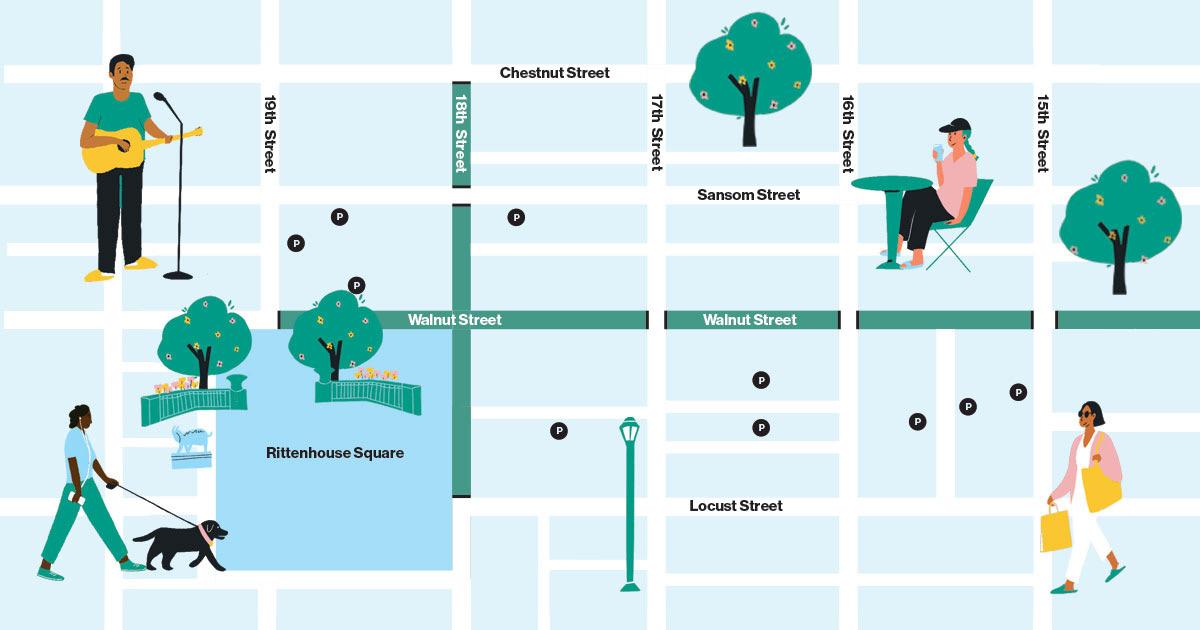
From the outset, Open Streets sought to strike a careful balance: animating the street without overwhelming it. The program intentionally departs from a traditional street festival model, not because there is anything inherently wrong with festivals, but to reinforce a core premise of Open Streets: that temporarily ceding the street to pedestrians, and reconnecting people directly to local businesses and restaurants, is itself the primary program.
In this context, the shared experience of being together in public space becomes the activity. The street — familiar, accessible, and kinetic with everyday movement — serves as the main attraction, with retailers and restaurants playing a central supporting role.
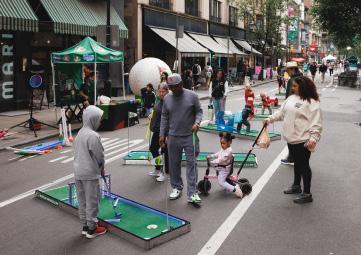
At the same time, experience showed that a light layer of programming can help attract visitors and encourage them to stay longer. Rather than competing with the street or nearby businesses, these elements were designed to complement them, offering moments of delight while preserving the openness and flexibility of the corridor. Programming generally fell into the following categories:
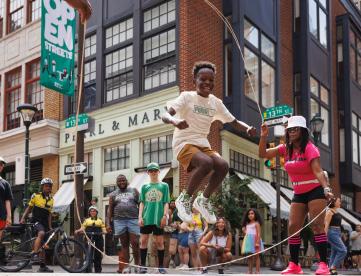
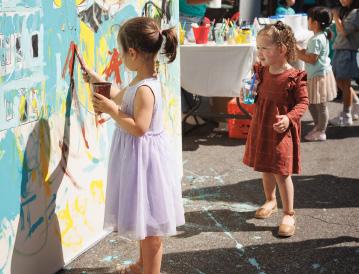
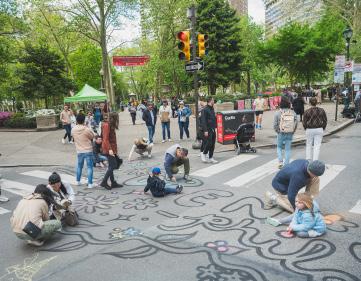
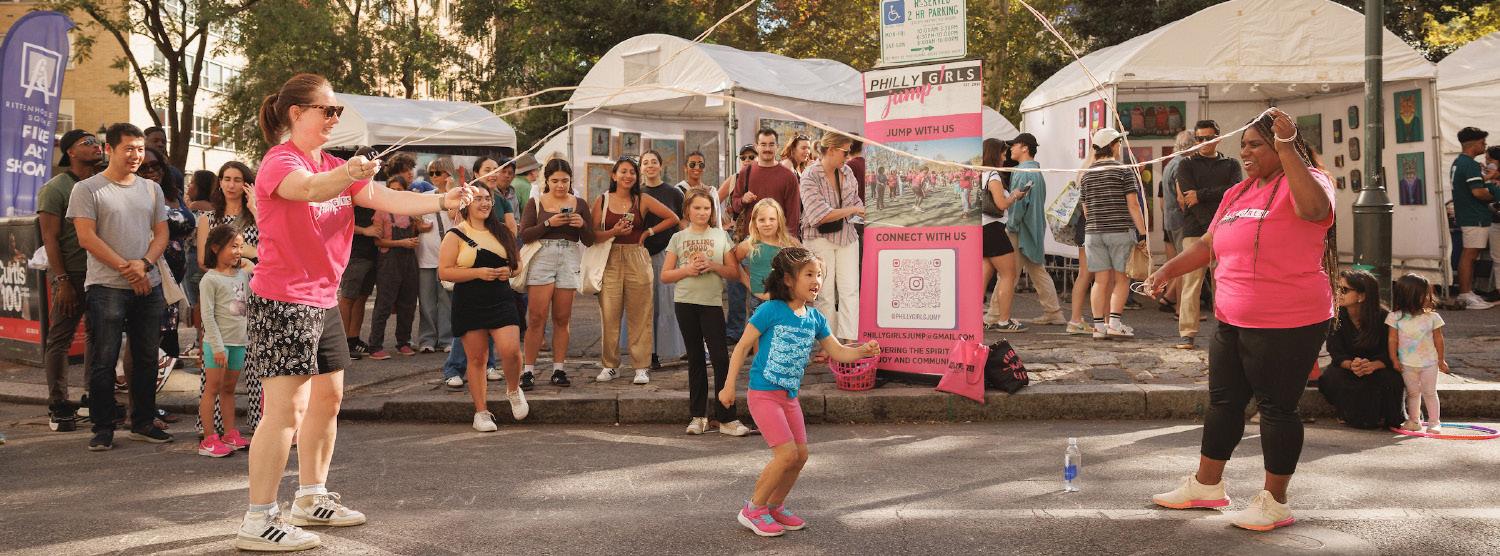
For all that Center City offers, safe and accessible outdoor activities for children can be difficult to find. A car-free street reduces stress for parents and caregivers while creating space for simple, creative engagement, from magical bubble performances and paint-bynumber installations to jump-rope sessions led by local groups such as Philly Girls Jump.
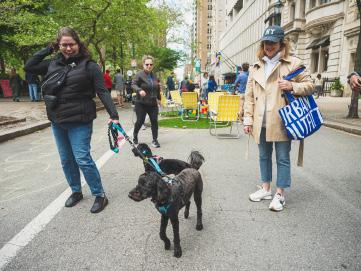
One of the program’s more unexpected outcomes was the growing presence of dogs and their owners. While dedicated dog parks are limited, Open Streets offered an informal alternative. Water stations and occasional dog-friendly activations, such as a pop-up photo booth, made the route welcoming to visitors on both two legs and four.
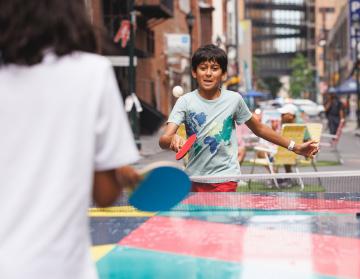
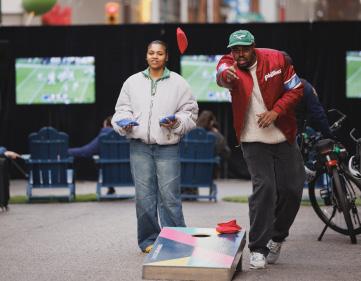
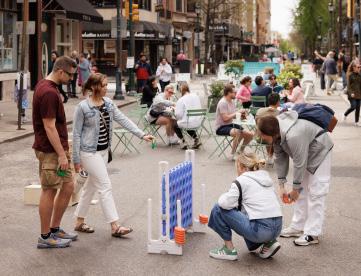
Oversized versions of familiar games — including giant chess, Connect Four, cornhole, and ping-pong — transformed the street into a playful, shared environment. These activities were accessible to all ages, easily movable, and required little instruction, reinforcing the spontaneous and low-barrier nature of the experience.
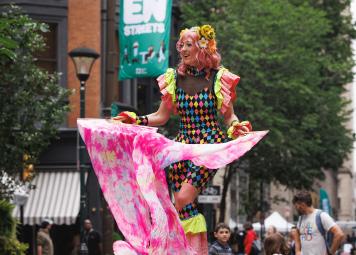
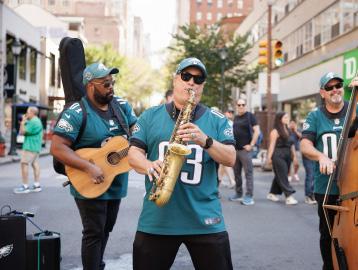
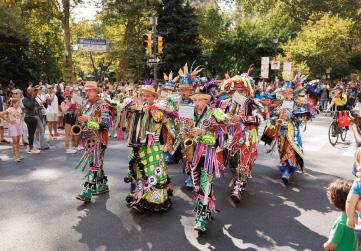
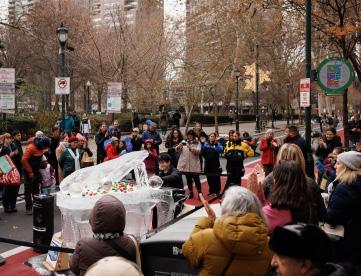
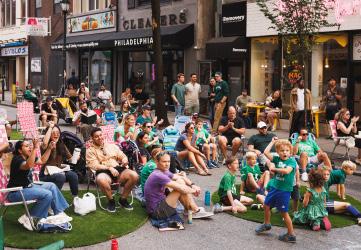
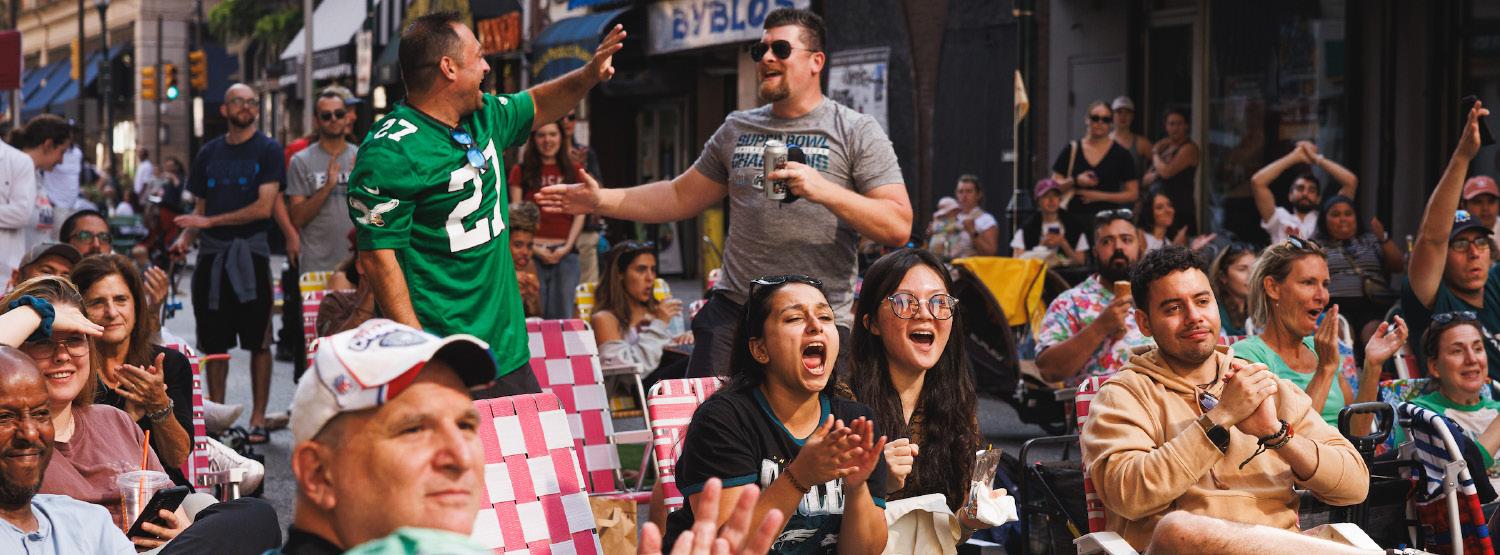
Philadelphia is a city proud of its deep roots in music, the creative arts, and of course, sports. Engaging local performers — from violinists and dancers to stilt walkers — introduced moments of surprise and warmth along blocks more commonly defined by traffic. These performances helped create a welcoming atmosphere while showcasing local talent in an everyday civic setting. And if it’s Eagles season, there’s something special about bringing people of all ages together to watch a game, in the middle of a car-free street.
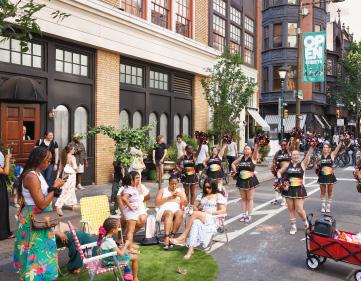
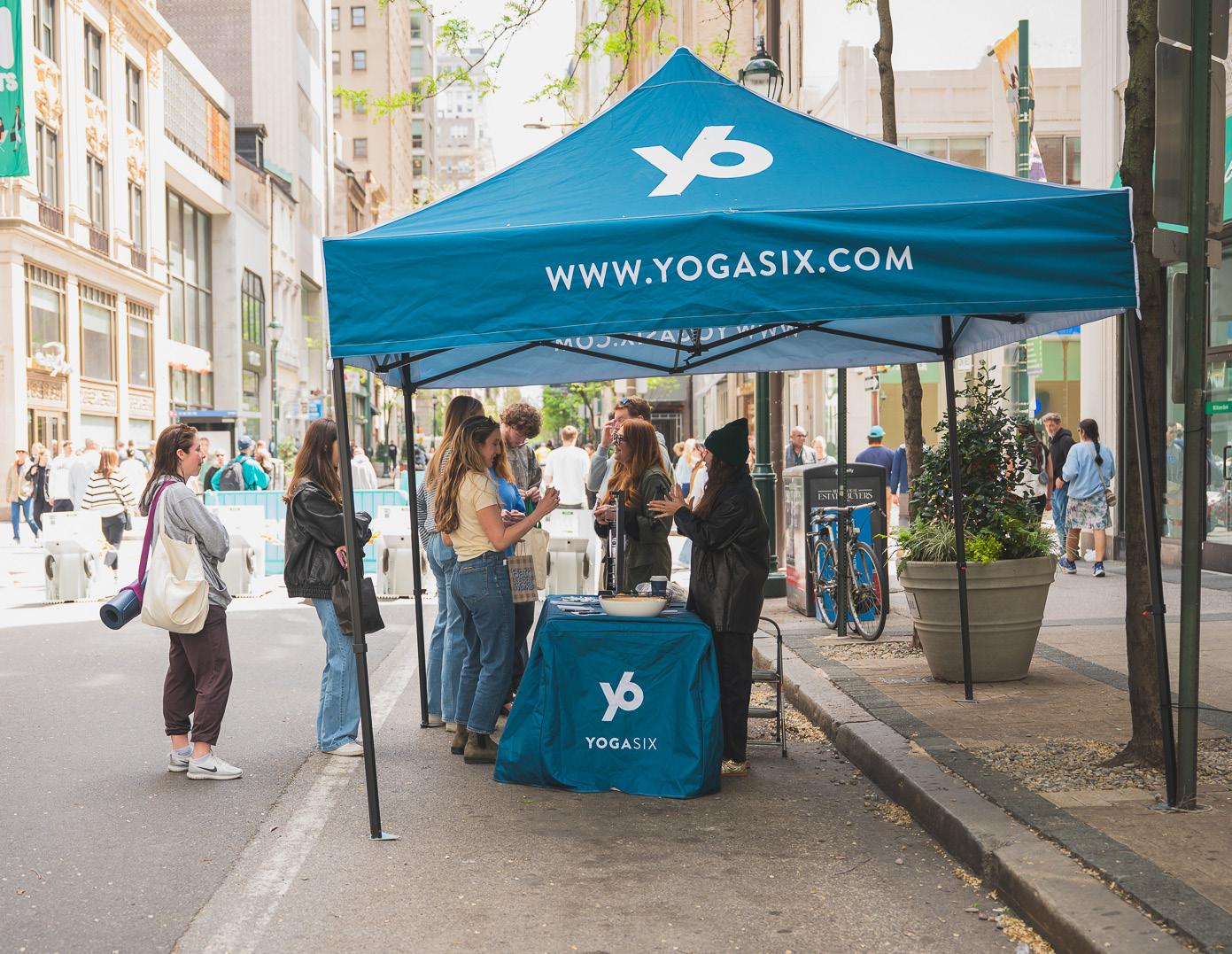
Open Streets has been an incredible way to build awareness for YogaSix Rittenhouse as a small, locally owned business. The CCD hosts are always kind, supportive, and engaged throughout the weekends. This program is a lifeline for visibility to us as we are located on the 5th floor of the Allman Building.
“ “—YogaSix
“Amazing idea. We supported several local businesses that otherwise we would not have known about in a relaxed, comfortable environment that felt safe.”
—Open Streets Attendee
The positive effects on businesses and restaurants within the Open Streets: West Walnut footprint have emerged as one of the program’s most compelling outcomes to date. The initial hypothesis—that people are more likely to spend money on foot than from behind the wheel—has been reinforced by both observed activity and reported business performance. Along a corridor with an average density of 16 retailers and restaurants per block, the ability to move at a walking pace creates opportunities to browse, linger, and engage that simply do not exist while traveling by car. By creating a more inviting pedestrian environment and expanding space for foot traffic, Open Streets unlocked significant potential to support the businesses along the route.
Open Streets: West Walnut welcomed more than 10,000 visitors on average to the pedestrianized footprint each Sunday between 10 a.m. and 5 p.m., marking a 27% increase in pedestrian activity compared to comparable non–Open Streets Sundays in prior years. Beyond the immediate footprint, the heightened pedestrian volumes spilled over to the surrounding blocks as well. Foot traffic across the broader Rittenhouse Row corridor (bounded by Chestnut to Spruce streets and Broad to 20th streets) was 18% higher during Open Streets than on comparable Sundays in prior years. Visitors also lingered beyond event hours, with activity from 5 p.m. to 10 p.m. also remaining 18% above prior-year Sunday levels.
Open Streets drew a notably higher share of local residents, with 37% of attendees living in Center City or adjacent neighborhoods, compared to 29% on a typical non-event day, underscoring the value of temporary car-free streets within a walkable, livable downtown. At the same time, 35% of visitors travelled from the suburbs or outside the Philadelphia region, demonstrating that Open Streets also serves as a regional draw and offers a positive Center City experience that encourages repeat visits.
Center City District surveyed businesses along the route following each event to determine whether elevated pedestrian volumes translated into measurable commercial impact. Among businesses reporting gains, in-store foot traffic increased by an average of 62% compared to a typical Sunday. Participating businesses also reported average sales growth of 38% during Open Streets events.
Beyond direct increases in visitation and sales, Open Streets also generated secondary benefits tied to visibility and dwell time. Onstreet amenities such as seating, light entertainment, and interactive activities encouraged visitors to spend more time along the corridor. As a result, nearly 60% of survey respondents reported discovering a business they had not previously known about.
When asked what they valued most, visitors consistently pointed to seating, on-street entertainment, and interactive elements. While the precise relationship between these offerings and individual business performance cannot be fully isolated, the data suggests that improving the pedestrian experience plays a meaningful role in supporting both customer engagement and economic activity. In other words, the findings indicate that the way the street feels has a meaningful impact on how the corridor and its businesses perform.
Key findings from the 2024-2025 Open Streets: West Walnut season include:
170,000
total visitors throughout the duration of the program
27%
increase in pedestrian activity compared to non-Open Streets Sundays from the prior year
37%
of attendees live in Center City or adjacent neighborhoods
35% of visitors came from the suburbs or outside of the Philadelphia region
10,000
average visitors welcomed at Open Streets West Walnut event
62%
increase in business foot traffic when compared to non-Open Streets Sunday
38%
increase in average business sales when compared to non-Open Streets Sunday
18%
increase in foot traffic across the broader Rittenhouse Row corridor (Chestnut to Spruce streets, Broad to 20th streets)
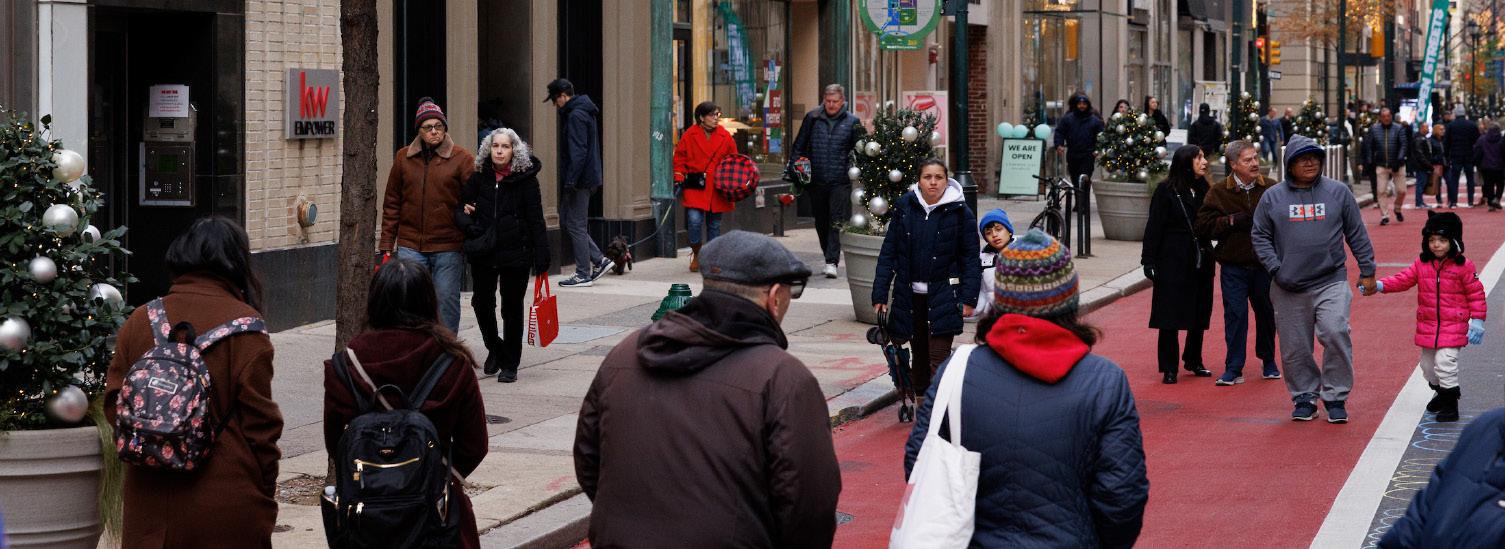
“ “Philadelphia Runner has loved being part of Open Streets Philadelphia! Events like this create space for people to move, connect, and enjoy the city on foot, which we always encourage more of. As a locally owned running store, we’re proud to support initiatives that make Philadelphia more active, more welcoming, and more connected.
—Philadelphia Runner
“Streets and their sidewalks, the main
public
places of a city are its most vital organs.”
—Jane Jacobs, The Death and Life of Great American Cities
In many ways, car-free streets represent one of the most costefficient tools available for transforming public infrastructure and generating economic activity. Unlike capital-intensive projects, Open Streets is tactical and flexible, requiring no permanent construction, no design or engineering process, and minimal disruption beyond the event itself. The program leverages walkability, the existing street network, and public space, making it possible to deliver meaningful impact with comparatively modest investment.
Other North American cities—including New York City, Chicago, Boston, and Montreal—have capitalized on this approach over the past decade by establishing recurring, city supported car-free street programs. In that sense, Philadelphia may be a bit late to the party. But this effort is less about catching up and more about building a model that reflects Philadelphia’s distinct strengths, culture, and urban fabric.
Looking to peer cities with comparable density, street grids, and downtown conditions provides valuable perspective on how car-free streets can evolve from pilots into permanent civic infrastructure.
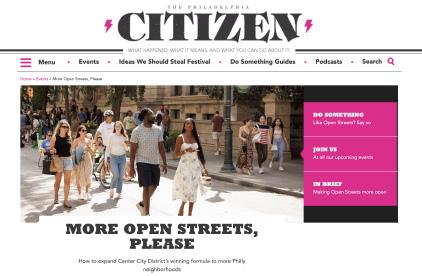
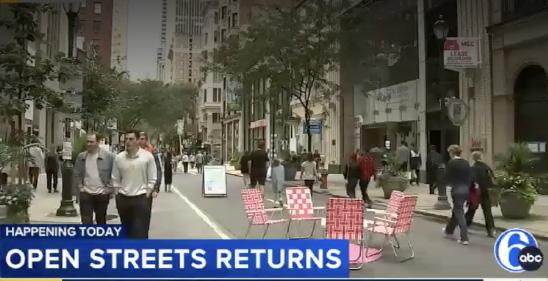
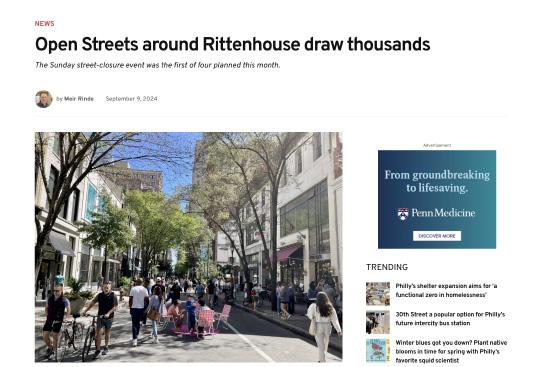
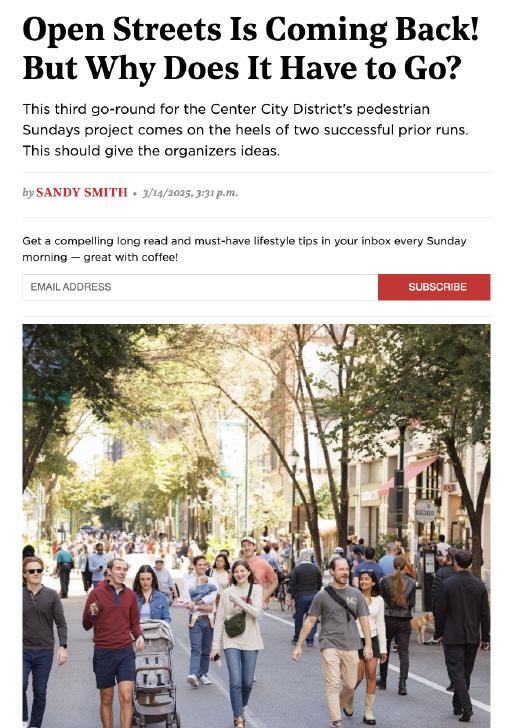
The impact of Open Streets has extended well beyond retailers and restaurants. Media coverage has been overwhelmingly positive, highlighting increased sales and foot traffic while capturing strong public enthusiasm for the program. More notably, several pieces have posed a larger question: can this become a permanent fixture in Center City.
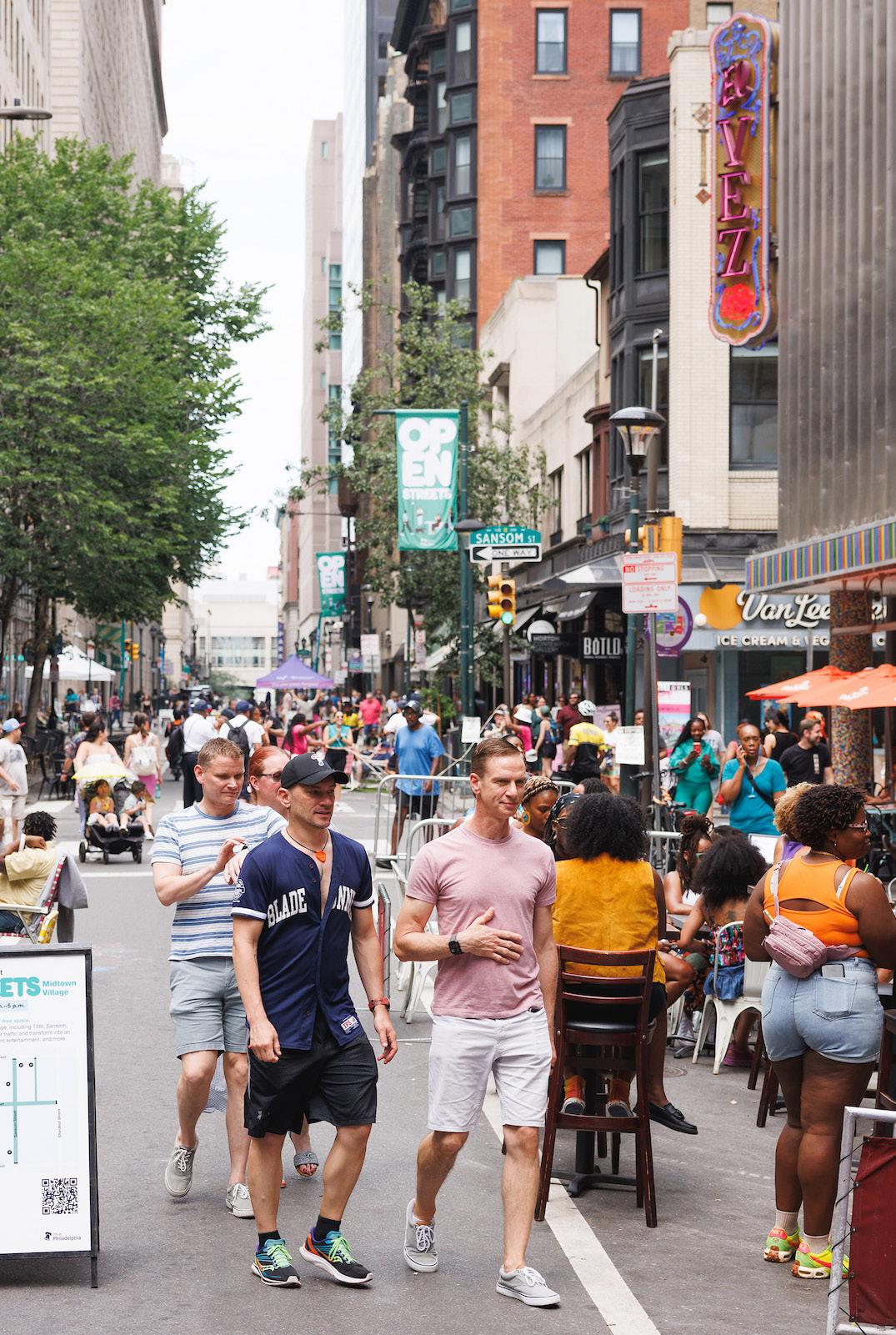
Against that broader context, CCD tested how the Open Streets model might translate to a different type of commercial corridor by launching Open Streets: Midtown Village. For four Sundays, 13th Street from Chestnut to Locust and Sansom Street from 12th to Juniper were temporarily pedestrianized, shifting the focus to a more restaurant-oriented district east of Broad Street. The goal was to support extended outdoor dining while maintaining the core Open Streets ethos: driving foot traffic to businesses through a people-first street environment with a light programming overlay.
Early outcomes were encouraging. Businesses reported increased engagement and higher sales, and pedestrian activity exceeded that of a typical Sunday. At the same time, the pilot revealed several important lessons about how Open Streets should be adapted to different commercial environments.
Unlike Rittenhouse Row, Midtown Village is primarily a dining destination, with peak activity occurring later in the day. Operating hours of 11 a.m. to 6 p.m. proved too early to capture the district’s typical customer activity and did not align with the rhythm of neighborhood use. In addition, Sundays in June, at the start of the summer travel season, tend to be quieter overall.
These findings reinforced an important principle: while the Open Streets framework is transferable, it is not static. Each corridor requires informed adjustments based on its cultural and economic landscape. In response, CCD is testing a revised model in 2026, shifting Open Streets: Midtown Village to Tuesday evenings to better align with office worker schedules and peak dining demand.
As Open Streets expands, the primary challenges to scaling the program—while maintaining consistent safety and programmatic standards—are operational capacity and cost. A typical Open Streets: West Walnut event requires approximately 16 CCD staffers for setup, breakdown, safety coordination, and on-the-ground management. The largest expense remains street closure and safety requirements administered through the Philadelphia Police Department.
To reduce long-term costs while maintaining a high standard of safety, CCD invested in the Meridian 1200 Archer barrier system— a movable, modular barrier that can be deployed in place of CCD and police vehicles while providing similarly effective protection. In addition to lowering recurring operational expenses, the system reduces visual clutter and improves sightlines along the corridor, reinforcing the pedestrian-first intent of the program and creating a more welcoming street environment.
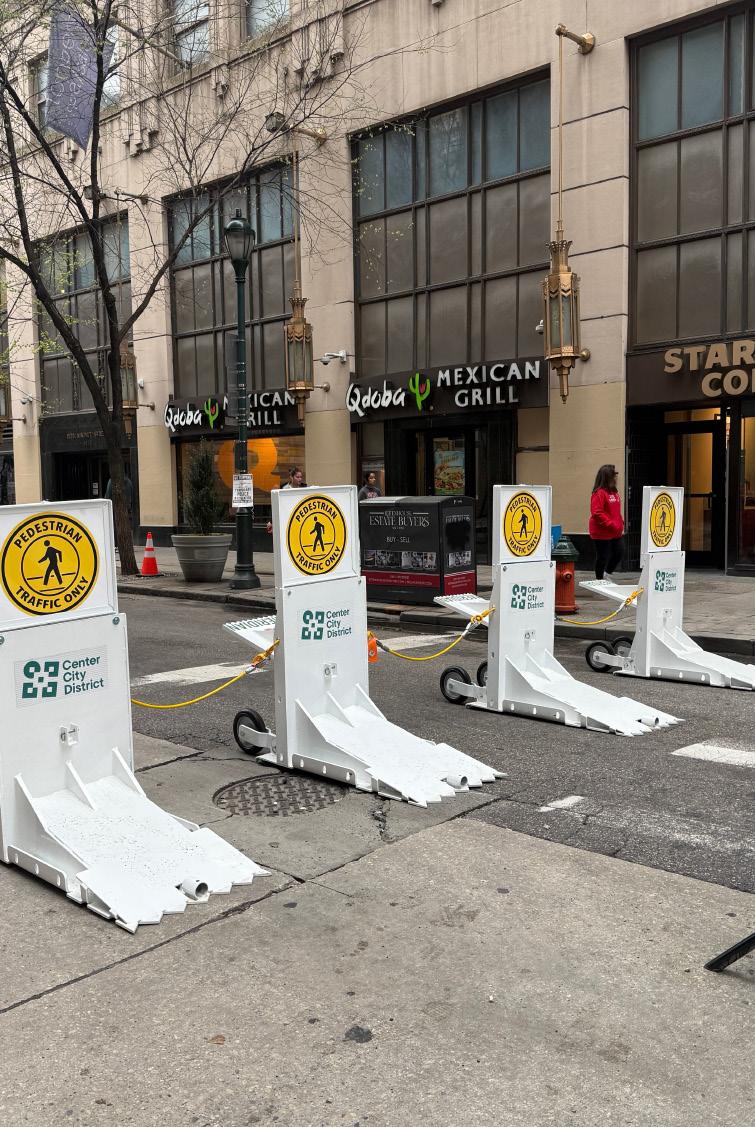
While these constraints are real, they are resolvable. Open Streets demonstrated clear success from the outset, confirming that the concept is sound. The primary challenges to growth lie not in public demand or program performance, but in existing operational and regulatory structures that drive costs and limit flexibility. The following recommendations outline a practical strategy for scaling car-free street programs in Philadelphia, focusing on consistent rules, predictable costs, and shared tools that allow Open Streets, and similar initiatives, to be delivered safely and at scale.
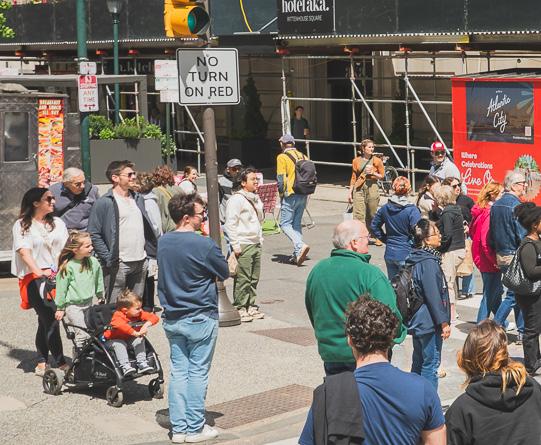
Establish a distinct permitting framework for recurring car-free street programs, separate from street festivals or special events. This pathway would focus specifically on temporary street closures and pedestrian use, rather than the full suite of requirements typically associated with street festivals. Cities such as New York and Chicago have adopted similar models, demonstrating that recurring, lowimpact street closures can be administered efficiently at scale.
Public safety must remain the highest priority. However, current street-closure practices, particularly reliance on vehicle deployments, make recurring programs costly and, in some cases, cost prohibitive for civic organizations. Establishing a city supported approach to offset or subsidize these costs would enable programs like Open Streets to be both safe and accessible, enabling more organizations to deliver recurring car-free street programs across Philadelphia.
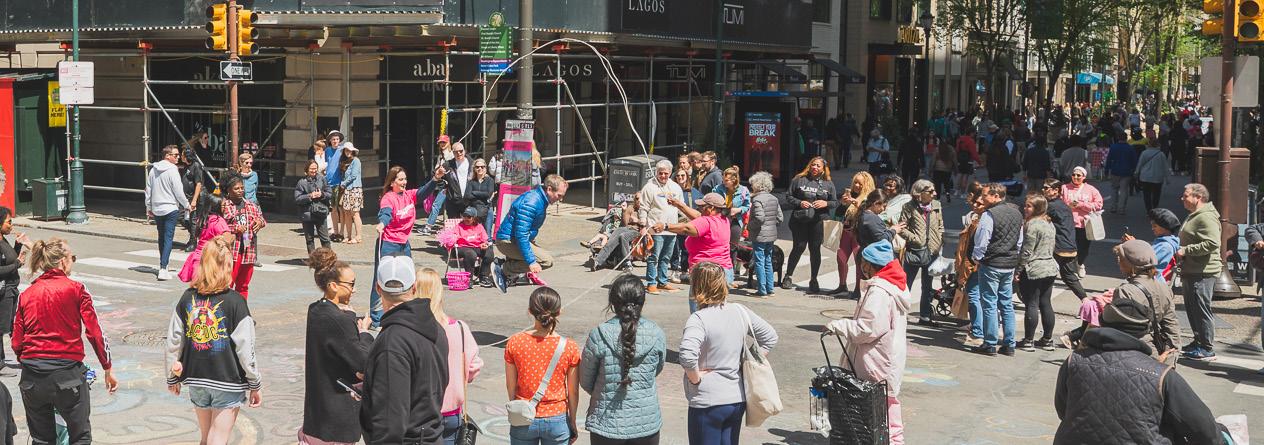
CCD’s investment in modular barrier systems has helped reduce long-term operational costs while improving the pedestrian experience. These systems are effective, but they require upfront capital investment. Assistance from the city, such as purchasing, leasing, or maintaining a shared inventory of modular barriers, could lower barriers to entry for additional organizations while reducing reliance on vehicle closures.
In select, high-use locations, permanent or semi-permanent infrastructure may offer a long-term solution. Vehicle-rated retractable bollards, commonly used in cities internationally, provide the greatest flexibility for shared street use but come with higher costs and some disruption. These investments should be targeted to corridors with sustained demand and frequent use, where long-term returns justify the expense.
As programs scale, consistency becomes as important as creativity. Developing a set of citywide best-practice guidelines for car-free streets, informed by public agencies and civic leaders, would help organizations evaluate feasibility, understand budgeting, and support broader adoption across Philadelphia.
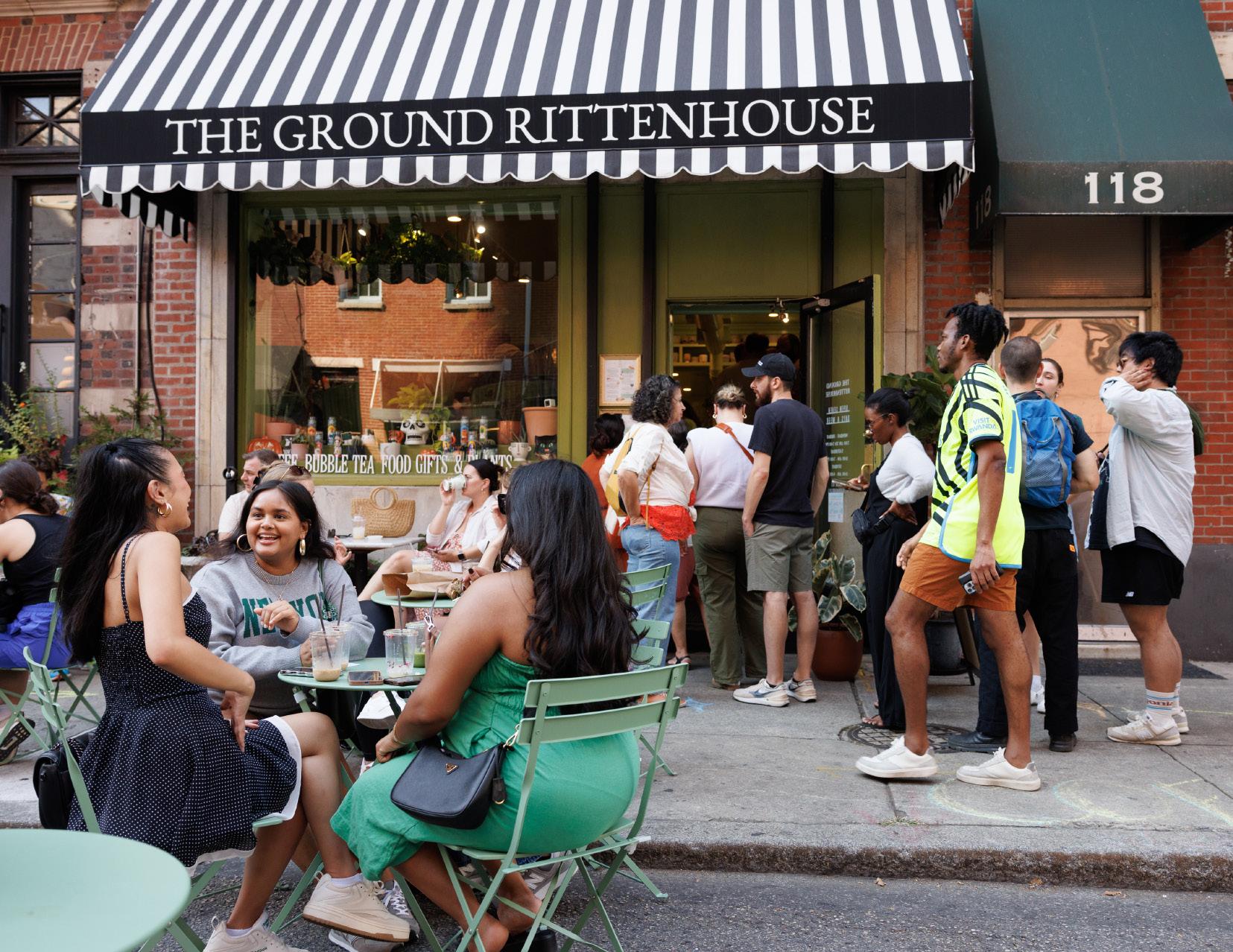
We had an amazing experience and are grateful to the CCD for taking on this large lift. I think it is transformative for the neighborhood and such a wonderful way to get the community engaging with the outdoor street and sidewalks in a totally new way. It was so family friendly. We had a line out the door from open almost until the end of open streets.
“ “—The Ground Coffee, Plants & Gifts
“The
street is the river of life of the city, the place where we come together, the pathway to the center.”
—William H. Whyte, Rediscovering the Center
Imagine, in the not-too-distant future, a Center City where temporary car-free streets are part of our everyday experience rather than a seasonal novelty. Where dining, shopping, and spending time in the street feels ordinary, routine, and woven into downtown life throughout the year. For residents, this becomes a familiar rhythm. For visitors, it becomes part of the itinerary, alongside visiting restaurants, local shops, and cultural destinations.
If there is one takeaway from this report, it is that this scenario is achievable. Open Streets has demonstrated that there is real demand for, and real social and economic benefit from, sustained car-free street programs in downtown Philadelphia. What began as a pilot has, in many ways, moved from novel to expected.
The opportunity ahead is to ensure that Open Streets continues to evolve, and that the model can be expanded thoughtfully and adopted by other organizations and districts across the city. Doing so will require treating temporary car-free streets as a form of civic infrastructure—supported by clear policies, consistent practices, and shared guidelines—that makes the program scalable and economical without compromising safety or the trust of the businesses, residents, and visitors who bring it to life.
This report was researched and written by Andrew Jacobs, Vice President of Planning and Public Realm, with contributions from Clint Randall, Vice President of Economic Development, JoAnn Loviglio, Vice President of Communications and PR. The Open Streets report team also includes Giavana Pruiti, Director of Promotions and Activations; Jimmy Salfiti, Retail Economic Development Manager; Leo Manning, Director of Strategic Communications, Jinah Kim, Urban Designer, Bryant Gosnell, Graphic Designer; David Orantes, Art Director.
Special acknowledgment to the Center City District operations team whose work makes Open Streets possible includes Faisal Ali, Director of Facilities and Parks Operations; John Crichton, Senior Manager of Public Safety Operations; Aaron Walters, Senior Manager, Park and Facilities Operations; Terrence Keene, CSR Outreach Manager.
On-the-ground photos by Matt Stanley Photography (Matt Stanley) Drone photography by WooderIce (Hector Nuñez)