2023-2027 Plan and Budget for the Center City District
Plan and Budget for the Center City District
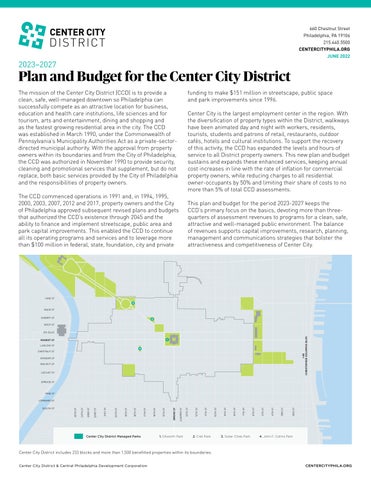
The mission of the Center City District (CCD) is to provide a clean, safe, well-managed downtown so Philadelphia can successfully compete as an attractive location for business, education and health care institutions, life sciences and for tourism, arts and entertainment, dining and shopping and as the fastest growing residential area in the city. The CCD was established in March 1990, under the Commonwealth of Pennsylvania’s Municipality Authorities Act as a private-sectordirected municipal authority. With the approval from property owners within its boundaries and from the City of Philadelphia, the CCD was authorized in November 1990 to provide security, cleaning and promotional services that supplement, but do not replace, both basic services provided by the City of Philadelphia and the responsibilities of property owners.
funding to make $151 million in streetscape, public space and park improvements since 1996.
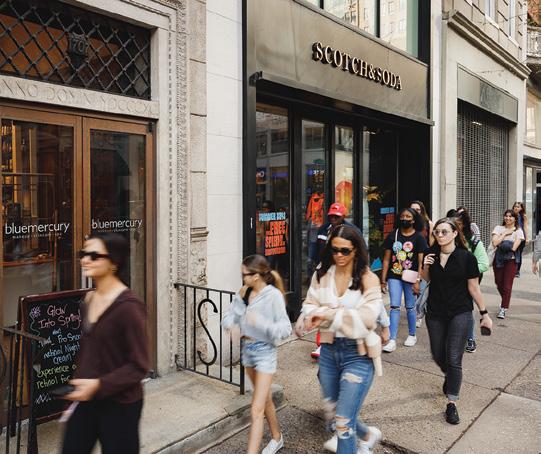
Center City is the largest employment center in the region. With the diversification of property types within the District, walkways have been animated day and night with workers, residents, tourists, students and patrons of retail, restaurants, outdoor cafés, hotels and cultural institutions. To support the recovery of this activity, the CCD has expanded the levels and hours of service to all District property owners. This new plan and budget sustains and expands these enhanced services, keeping annual cost increases in line with the rate of inflation for commercial property owners, while reducing charges to all residential owner-occupants by 50% and limiting their share of costs to no more than 5% of total CCD assessments.
The CCD commenced operations in 1991 and, in 1994, 1995, 2000, 2003, 2007, 2012 and 2017, property owners and the City of Philadelphia approved subsequent revised plans and budgets that authorized the CCD’s existence through 2045 and the ability to finance and implement streetscape, public area and park capital improvements. This enabled the CCD to continue all its operating programs and services and to leverage more than $100 million in federal, state, foundation, city and private
This plan and budget for the period 2023-2027 keeps the CCD’s primary focus on the basics, devoting more than threequarters of assessment revenues to programs for a clean, safe, attractive and well-managed public environment. The balance of revenues supports capital improvements, research, planning, management and communications strategies that bolster the attractiveness and competitiveness of Center City. 2023–2027
Cleaning and Maintenance
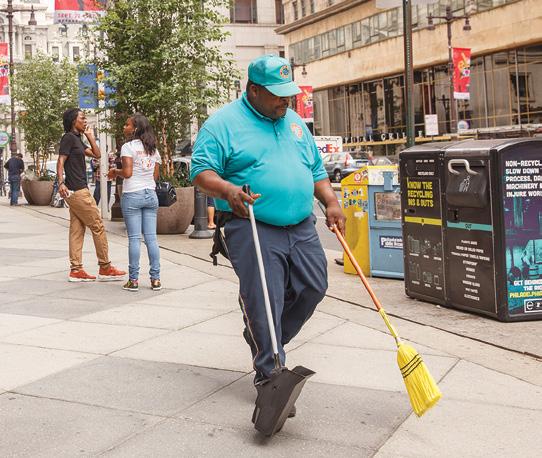
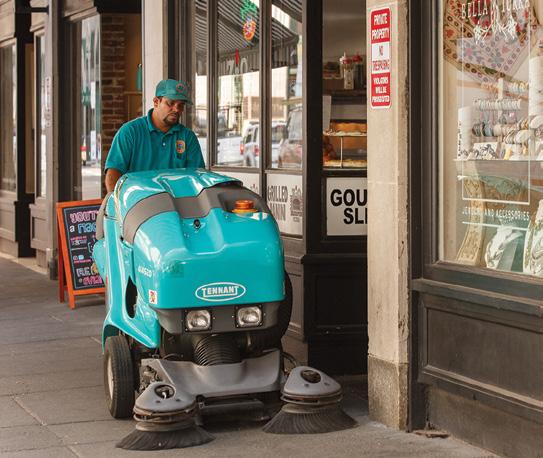
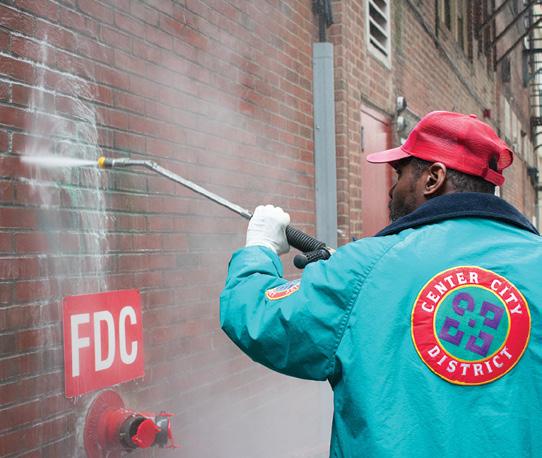
Through its primary cleaning program, the CCD deploys 100 uniformed sweepers, mechanical equipment operators and supervisors on two overlapping shifts, seven days per week, providing up to 12 hours of services per day. CCD crews supplement the sanitation services of the City of Philadelphia and ensure that Center City’s sidewalks are clean and its streetscape graffiti-free. Cleaners are also deployed to ensure that CCD-managed parks are cleaned and maintained at a high standard. Seasonally, a team of pressure washers provides weekly power-washing of sidewalks throughout the CCD. The City’s Streets Department cleans the streets from curb to curb, empties and maintains public trash receptacles and enforces sanitation laws. Through competitively selected contractors, the CCD assists property owners in fulfilling their legal obligation to keep their sidewalks free of litter and debris. This supplementary program has six components:
• Mechanical sweeping: Sidewalks and related public areas are mechanically swept early each morning to ensure that downtown routinely “opens clean.”
• Daily recurring manual and mechanical sweeping: Daily manual and mechanical sweeping of all sidewalks and related public areas at least three times throughout the working day by uniformed cleaners ensures that the central business district remains attractive and clean.
• Evening cleaning: In recognition of the increased evening pedestrian activity and residential population, the CCD provides a seasonal, early evening shift in prime entertainment and dining areas in warm weather months.
• Monthly power washing: The CCD provides high-pressure washing twice a month, except in winter, to remove accumulated stains, gum and grime from all sidewalks.
• Graffiti removal: To improve the appearance of downtown, maintenance crews remove posters and stickers and remove or paint over graffiti on streetscape furniture and the ground floor of building facades. Separate teams remove graffiti from public, street-furniture.
• Fee for Service: At no expense to District property owners, CCD employs 10 additional cleaners and three supervisors to clean several residential and commercial areas adjacent to the CCD on a fee-for-service basis. The CCD also provides employment opportunities for disadvantaged workers, such as formerly homeless individuals, returning citizens and those making the transition from welfare to work, performing maintenance services within the CCD and staffing fee-forservice contracts.
Safety and Crime Prevention
To enhance public safety and to provide information and directions to pedestrians, the CCD works in partnership with the Philadelphia Police and deploys supplementary, uniformed on-street patrols. The CCD also works in partnership with other safety professionals engaged by office buildings, hotels, education, health care, arts and cultural institutions. The CCD’s supplementary services have five components:
• Enhanced Police Coverage: Since 1991, the Philadelphia Police Department and the CCD have maintained a unique collaborative relationship to improve police coverage for office workers, residents, hotel guests, convention delegates, theater and retail patrons. Officers deployed from the 6th and 9th Districts, which cover the area from Poplar to Lombard Streets, river to river, provide motorized patrols throughout the boundaries of the CCD. But additional Philadelphia Police Department bicycle-patrol and officers on focused foot-beats are deployed from a police substation provided by the CCD in its offices. The Police Department supports the costs of staffing this substation seven days a week during two shifts with a police captain, supervisors and dozens of patrol officers.
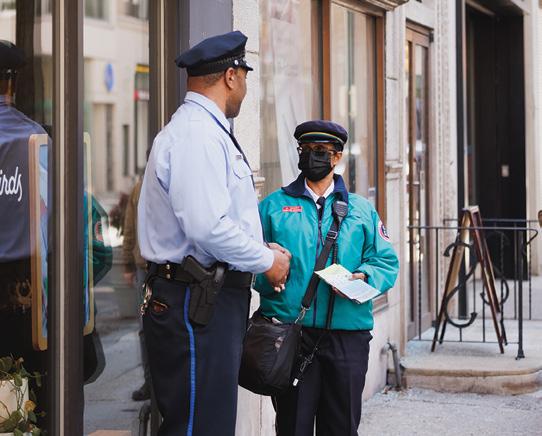
• Community Service Representatives: The goal of the Community Service Representative (CSR) program is to provide public safety, hospitality and outreach services within the boundaries of the CCD by deploying CSRs on foot beats, seven days a week. CSRs are a uniformed, but unarmed, deterrent to crime, provide a welcoming and reassuring presence and serve as the “eyes and ears” of the Philadelphia Police Department through two-way radio communication. CSRs provide information and directions to pedestrians and visit groundfloor businesses and front-line office building staff within their assigned services areas to provide information about CCD services and to respond to challenges.
CSRs are first aid/CPR certified and provide services to those in need. CSRs stand joint roll call with the Philadelphia police officers who staff the CCD’s police substation, share information and coordinate deployment.
Specially trained CSR teams provide outreach services to the homeless population in Center City and work in partnership with social service and mental health teams and the Philadelphia Police Department to help those on the street connect with needed services. CCD dedicates a van to transport those who seek shelter and services. Up to 52 CSRs and supervisors are deployed in two shifts to cover morning, daytime and evening activities.
• Bike Patrol: To support the duration of the recovery process CCD contracts for a uniformed, unarmed bike patrol that is coordinated with both the CSR program and the Philadelphia police to provide enhanced public safety services within the District.
• Public Space Collaborative: CSRs use hand-held computers to track and report visible sanitation and health code violations, providing that information to the responsible party. CCD has no responsibility for, nor surveys the condition of any walking surfaces or driving surfaces. The CCD neither removes snow and ice from sidewalks nor surveys for these conditions. These are the responsibility of private property owners or the City of Philadelphia. The CCD does not maintain nor report the condition of any stairways or concourse level walkways that lead to public transit. These are the responsibility of public transit agencies. Bi-monthly, the CCD convenes the Public Space Collaborative, bringing together a dozen representatives of public and private agencies responsible for the quality of public spaces within the CCD boundaries. CCD provides information at these meetings; it has no authority to compel action.
• Crime Prevention Services: Professional staff provides computerized incident mapping and analysis to identify crime trends and patterns and work in partnership with law enforcement and the private sector to develop strategies to reduce crime. Staff provide immediate text-message updates on significant events and occurrences through the Alert Philadelphia emergency communications network in partnership with the Philadelphia Office of Emergency Management.
Marketing and Communications
To position Center City as a competitive business location, the primary regional destination for dining, culture, entertainment and shopping and to enhance the downtown as a premier place to live, the CCD supports three types of efforts:
• Retention and Recruitment Strategies: The CCD researches, produces and distributes office, retail and residential marketplace information both in print and online and works in partnership with commercial brokers, owners, developers, the City of Philadelphia and economic development agencies to attract businesses from outside the region, encourage new business startups, retain businesses within Center City and expand the residential population, including families with children.
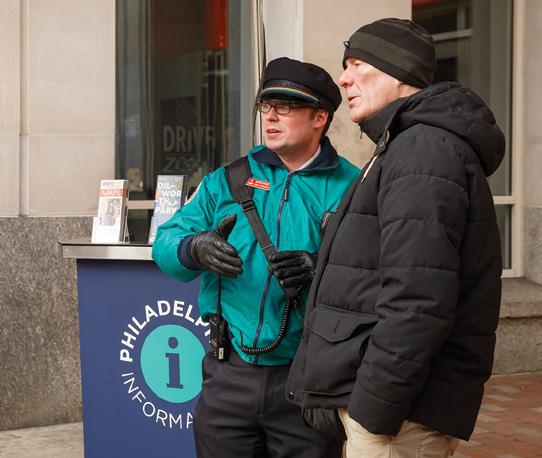
• Communication Strategies: The CCD makes use of a broad range of traditional and interactive media to reach diverse audiences, managing multiple websites, producing a seasonal print and periodic email newsletters, and communicating through social media platforms including Facebook, Twitter, Instagram and LinkedIn. The CCD also deploys mobile information kiosks from which staff distributes traditional brochures and pamphlets and answers inquiries.
• Event Strategies: The CCD produces events within CCD managed parks as well as several District-wide events each year designed to promote Center City’s restaurants and retailers, including Center City District Restaurant Week, Center City District Sips and Shop Center City Saturday
Streetscape Maintenance, Enhancement and Capital Improvements
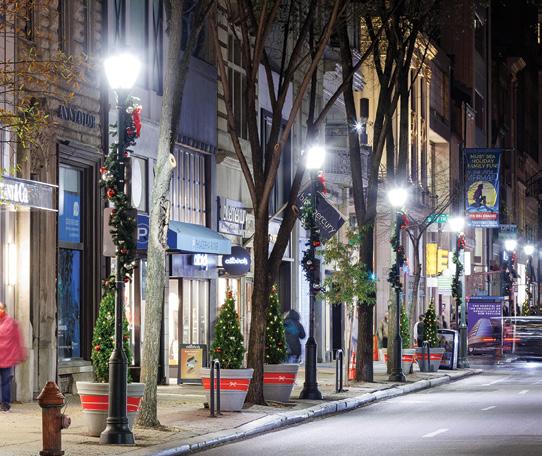
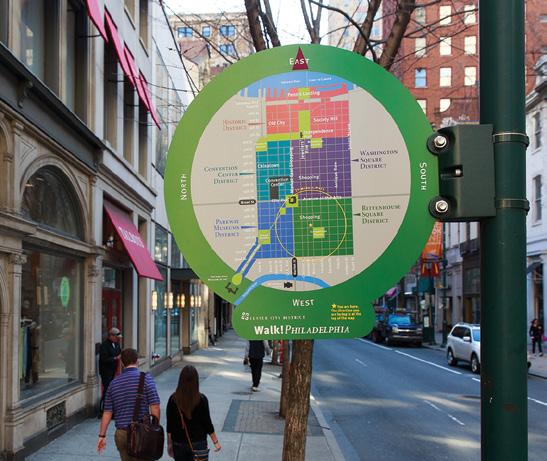
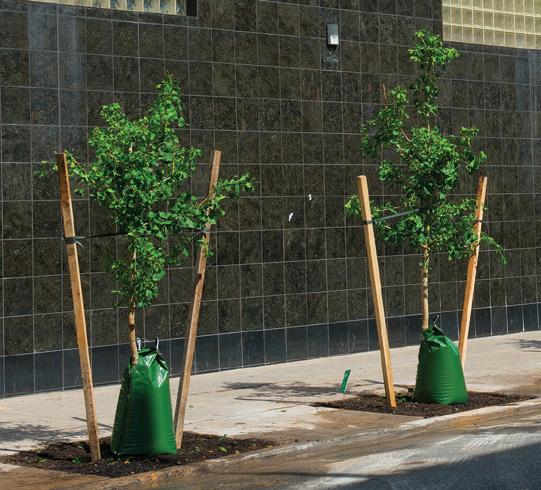
It is the responsibility of all property owners to keep their abutting sidewalks clean and well maintained, including repair in a timely manner of settled, raised or broken sidewalks and removal of snow and ice. To supplement required maintenance by property owners of their walkways and to enhance Center City as an attractive place to walk, the CCD has financed or secured more than $151 million to fund streetscape and park improvements during the last three decades, including more than 2,900 pedestrian-scale light fixtures, 900 trees,
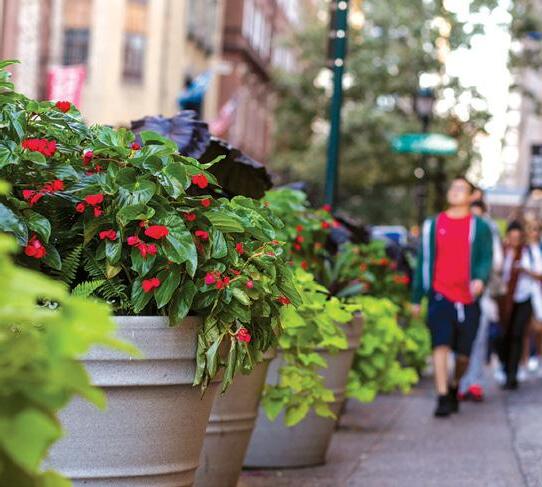
450 planters and hanging baskets, 1,300 pedestrian signs and maps, vehicular-oriented and transit signage and lighting on the facades of 24 buildings in the downtown’s two major cultural districts. The CCD continues to maintain and update these improvements, while managing transit posters and banners that add color and life to the streetscape, providing a low-cost means for arts, cultural and civic groups to communicate their messages. In the next five years, the CCD will continue to invest in landscape, streetscape, transit signage and public amenities, working in partnership with both local government and property owners to upgrade the public environment of Center City.
Park Management and Maintenance
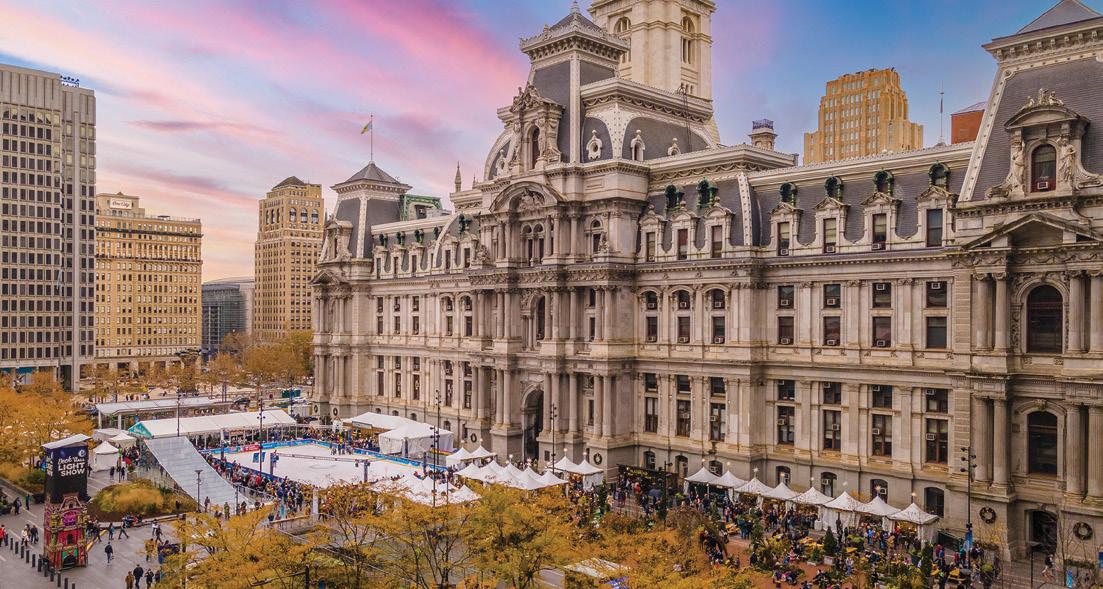
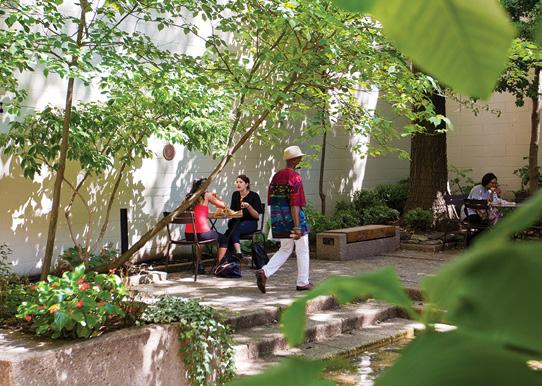
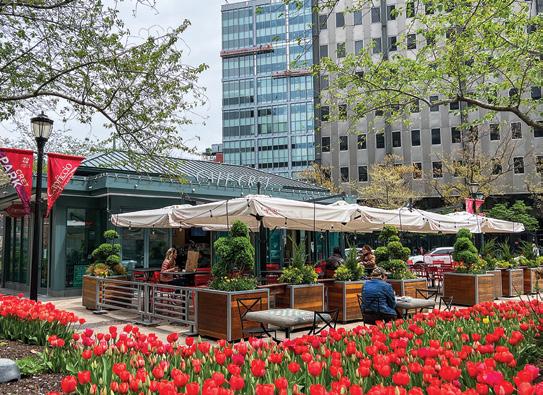
CCD capital investments have transformed four parks that the District now owns or leases on a long-term basis from the City of Philadelphia (Collins Park at 1707 Chestnut Street, Cret Park on the 1600 block of the Parkway, Sister Cities Park on Logan Square and Dilworth Park on the west side of City Hall). To manage and program these parks, CCD commits both its own staff and competitively-selected vendors to maintain these public spaces, provide amenities and events to animate them and generate sponsorship and rental revenues that are pledged to fund the cleanliness, safety and attractiveness of these public spaces. By increasing sponsorship, activation and event revenues from activities in the parks, the CCD will minimize the amount of assessment revenues devoted to the ongoing maintenance and management of these public spaces.
Additional Capital Improvements
The plan and budget enables CCD to plan, finance or install additional pedestrian-scale and façade lighting, streetscape, bicycle and transit enhancements, park and other publicarea improvements that enhance the competitiveness and attractiveness of the District. Decisions about the most costeffective method of financing will be made based on interest rates, while always remaining within the existing debt capacity authorized by this plan and budget. In 2027, 2032 and 2037, the CCD shall present to District property owners a new plan and budget that shall not be less than two times the annual debt-service obligation.
Administration and Funding
A diverse 23-member board of directors, representing Center City’s major property owners and a wide cross section of prominent leaders of business, real estate, neighborhood, civic and health care organizations, governs the Center City District. The Center City District is administered by a professional staff and devotes the overwhelming share of its resources to highly visible and effective on-street programs.
It will remain the policy of the Center City District to provide to all persons equality of opportunity in employment and contracting. The CCD will continue to ensure that minorities and women have an opportunity to participate in its bidding processes without impediments of discrimination and to ensure that it does not contract with businesses that discriminate against minorities and women in the solicitation and utilization of subcontractors and suppliers.
The CCD funds both its programs and debt-service payments primarily by mandatory assessments on taxable properties within the District. Under Commonwealth law, the CCD annually bills directly and collects the assessments from property owners. As required by law, the CCD will base its assessment of all types of property, including residential, on the assessed value for real estate tax purposes without reduction for any tax abatement on account of improvements granted by the City of Philadelphia, homestead exemptions or for exemptions for Keystone Opportunity Improvement Zones and the like.
Residential Assessments
Following the 2012 and 2014 amendments to the Commonwealth’s Municipality Authorities Act, the CCD will continue to elect to assess owner-occupied residential properties (including single-family, condominium and cooperative properties) by reducing CCD-assessed charges to all residential owner-occupants by 50% and will implement the further limitation that the total assessed value of all residential owner-occupied properties within the District will not cumulatively exceed 5% of the CCD’s annual aggregate value of assessments in any year covered by this plan.
The CCD will continue to assess each condominium building as a single benefitted property. The CCD bill to the condominium association will be itemized by unit and reflect for each residential condominium unit a 50% reduction in the value determined by the City’s Office of Property Assessment (OPA), without regard to any abatement or homestead exemptions by the City of Philadelphia, as well as the further provision that residential owner-occupied properties cumulatively will not exceed 5% of the CCD’s annual aggregate value of assessments. The condominium association will then allocate the itemized, reduced CCD assessed charges among the building units proportionately, based on each unit’s OPA assessed value, collect from the individual unit owners and remit to the CCD the total due from the entire condominium association.
Other Income
CCD’s assessment revenues are used to fund services and physical improvements within the District. Tax-exempt properties, such as schools, hospitals and religious institutions, are not assessed, but the CCD requests and receives voluntary contributions from owners of tax-exempt properties within CCD boundaries that receive the benefit of District services. The CCD also receives income and revenues that offset the cost of maintaining parks, including sponsorship for events, event rentals, advertising, café, ice rink and other participation fees and retail rents. The CCD receives revenues for diversified fee-for-service activity, including sidewalk cleaning, landscape maintenance and limited graffiti-removal services in adjacent residential and commercial areas. Revenues in excess of expenses from these fee-for-service agreements are used to augment services and fund capital improvements within the CCD.
The CCD receives fees for management of other organizations, such as the Central Philadelphia Development Corporation and benefits from contributions made to the Center City District Foundation. These management agreements and charitable contributions enable District property owners to derive the benefit of research, strategic and physical planning, and public forums that seek to strengthen the vitality and competitiveness of Center City as the vibrant 24-hour hub of the Greater Philadelphia region, while contributions to the Foundation enable CCD to expand operating programs and carry out additional capital improvements.
Center City District Plan and Budget 2023-2027
(This budget shows assessment and non-assessment revenues to enable owners to have a full view of CCD operations. However, property owners only have an obligation under this budget for assessment-supported activities.)
1. Billing in 2023 assumes Assessed Value data supplied by the Office of Property Assessment (OPA). Subsequent years assume both new properties currently under construction commencing occupancy and an appreciation in value for existing properties.
2. Includes current and prior year collections and adjustments for assessments that may be reduced upon appeal. Reduced assessment credits are assumed at larger than historic rates in response to citywide possible continued effects of the pandemic on commercial occupancies. Collection ratios are assumed at 95% in 2023 and 96% thereafter.
3. Interest earned on operating accounts and other accounts, including streetscape improvement accounts, grants, exempt property contributions and other income.
4. Reflects anticipated management fees earned for managing affiliated entities.
5. Income generating activities, sponsorship and rental activities in CCD-managed parks, including Crét Park, Sister Cities Park, Collins Park and Dilworth Park.
6. Income relating to CCD fee-for-service activities, sponsorship income in support of marketing activities and projected management fees relating to public spaces projects funded by grants.
7. Represents allocation of CCD cash reserves to address potential expenditure shortfalls relating to increased spending on pandemic and back to work activities.
8. Cleaning program within the boundaries of the CCD, including supplemental sidewalk cleaning services, services to parks, graffiti-removal services and warm weather pressure-washing services.
9. CSR program, Safety and Crime Prevention Services, including parks, and administrative support for the CCD police substation. Assumes enhanced third party security services in 2023 and 2024 to address pandemic related back to work activities.
10. Ongoing marketing activities and promotions of business, including promotions of parks, property owner communications and website development and maintenance.
11. Maintenance of public spaces and streetscape enhancements within CCD boundaries as a result of capital improvements since 1996. In addition, this line item includes expenses relating to operations of CCD-managed parks, including Crét Park, Sister Cities Park, Collins Park, and Dilworth Park. Also includes debt service relating to improvements at Dilworth Park in 2014.
12. Staff and direct expenses relating to management of CCD, including reporting, internal audit, human resources, business services and operations administration.
13. Staff and direct expenses relating to short- and long-term planning functions in support of CCD’s mission. Also includes staff salaries and benefits, which are reimbursed through affiliates.
14. Allocation of funds, from CCD assessment sources for continued capital improvements and upgrades to the streetscape, and public spaces within the CCD, such as lighting, landscaping and directional signs. May also include additional debt service allocation for future capital projects.
15. Debt service relating to CCD refinance of the 2004 bond issue, which matures and is fully paid off in 2025.
16. All departments include an allocation of indirect expenses in support of CCD operations. Expenses do not include non-cash operating expenses such as depreciation, and certain amortized bond costs.
*Policy relating to reduced assessments — the CCD assessments are based on the assessed values for taxable real estate as determined by the Office of Property Assessment (OPA). In any given year, property owners have the right and ability to appeal the OPA assessment to the Board of Revision of Taxes (BRT) and not the CCD. The CCD’s policy, as noted annually on its Statement of Charges Assessed, is to re-calculate the annual charge(s) and allow an adjustment(s), as appropriate, to allow a credit against the property’s next annual CCD charge, if the certified assessed value of the property is reduced on appeal by the BRT.
Photography: Matt Stanley, BeauMonde Originals, Melvin Epps, Marissa Fischetti, WeFilmPhilly