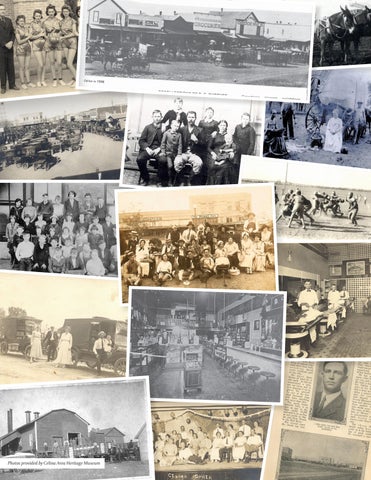
Photos provided by Celina Area Heritage Museum 16 | City of Celina
Celina, Texas: 150 Years of People, Passions, Places, and Pastimes Where Lives Connect: Tracing Celina's 150-Year Journey from a Cattle Trail Outpost to a Modern City Centered on its Historic Square. Long before the town of Celina was officially established in 1876, the land upon which it would rise held stories of movement and promise. The Preston Trail, a vital cattle thoroughfare stretching from Texas to the Midwest, crossed through the region, bringing drovers, pioneers, and dreams of prosperity to this fertile corner of Collin County. By the 1870s, settlers drawn by rich blackland soil and boundless opportunity began putting down roots in what would become one of North Texas's most cherished communities. In October 1879, a small settlement began to form a few miles southwest of present-day Celina. John T. Mulkey, the town's first postmaster, christened it after his hometown of Celina, Tennessee, linking the fledgling community to the traditions and values he held dear. By 1880, a Methodist church stood at the center of town, doubling as a schoolhouse and serving as the heart of community life. Within a few years, a general store, drug store, cotton gin, and gristmill opened, supporting the 150 residents who called this first incarnation of Celina home by 1884. Yet like many frontier settlements, the town faced challenges. By 1892, the population had plummeted to just 50 souls as economic hardships and isolation took their toll. The community's fortunes, however, were about to change dramatically with news that would alter its destiny forever. In 1902, word reached Celina that the St. Louis, San Francisco and Texas Railway, known affectionately as the Frisco, would soon extend its line through the area. There was one catch: the tracks would miss the little town by a mile. Rather than accept isolation from this vital artery of commerce and connection, the merchants and residents of Celina made a bold decision that would become the stuff of legend. They would move the entire town to the railroad. In February 1902, in an extraordinary feat of determination and community cooperation, businesses and houses were placed on rollers and pulled by traction engines one mile north to a new site. The Town Site Company had already secured land from William Willock's pasture, laid out streets, and placed lots for sale. This remarkable undertaking earned Celina the enduring nickname of Rollertown, a testament to the pioneering spirit and adaptability that would define the community for generations. The dramatic relocation proved more than a physical move; it was a declaration that Celina's
people would not be left behind, that they would shape their own destiny through hard work and unity. For the first few years after the move, Celina's commercial district consisted of a row of wooden buildings facing the railroad tracks. Then, in 1910, local businessman J. Fred Smith envisioned something grander: a proper Town Square that would serve as the commercial and social center of the community. Smith, who would later go on to design and develop Snyder Plaza near Southern Methodist University in Dallas, laid out plans for a central Square surrounded by uniform brick buildings. The transformation was swift and remarkable. By July 6, 1911, just ten months after Smith began his work, several new brick buildings were ready for occupancy. Gravel was spread on the streets, and businesses eagerly relocated from their wooden structures into the new permanent buildings around the Square. Many of the old wooden buildings were moved into residential sections and converted into homes, a practical recycling that spoke to the resourcefulness of Celina's people. This Downtown Square, completed over a century years ago, remains the beating heart of Celina today. Through every era of the town's history, through prosperity and hardship, through quiet seasons and explosive growth, the Square has endured as the place where lives connect. It has been the site of Saturday afternoon shopping trips, community celebrations, wartime scrap metal drives, Christmas tree lightings, high school homecoming parades, and countless personal moments that weave together the fabric of smalltown life. The Square's permanence amid constant change has made it more than a geographical center; it has become the soul of the community, the physical embodiment of Celina's commitment to preserving its character while embracing its future. Celina was officially incorporated in 1907, and by 1910, the first U.S. Census count recorded 724 residents. The town was thriving. In 1915, Celina Pike opened as the first road in Collin County built exclusively for automobiles, a sign of progress and connectivity. The town boasted two banks, a newspaper, and municipal water works. By 1920, the population had grown to 1,126 residents supported by a diverse and bustling economy. Cotton and wheat dominated the agricultural landscape, Life Connected. | 23
with the rich prairie yielding bountiful harvests that filled wagons bound for the cotton gins and grain elevators around town. The 1912 McKinney Democrat-Gazette painted vivid portraits of Celina's farming families: S.J. Lewis, who came from Tennessee nearly 40 years earlier and amassed 666 acres of prime Collin County land paid for by cotton and livestock; J.C. Ownsby, who settled just a few feet from where he first arrived from middle Tennessee 32 years before and built a farm of over 500 acres; and countless other families whose names, like Willock, Malone, Hunn, Snodgrass, and Moore, would become synonymous with Celina's heritage. Like communities across America, Celina faced the crucible of the Great Depression. The population that had reached 1,126 in 1920 fell to 994 by 1940. Families tightened their belts, helped one another through hard times, and held fast to faith and community. The Depression tested Celina, but it could not break the spirit forged in the early pioneer days. The Second World War brought different challenges and a profound sense of shared sacrifice. Young men and women from Celina served across Europe, the Pacific, and every theater of war. Back home, the community rallied in support. The Downtown Square became a collection point for scrap metal that would be melted down and transformed into the machinery of war. Families gathered for community Thanksgiving and Christmas services at the churches around town, offering prayers for the safe return of their soldiers and comfort to those with loved ones far from home. In December 1944, the Celina Record shared the heartwarming story of two Celina brothers serving in the Pacific who randomly encountered each other overseas and shared a Thanksgiving meal together, talking of home and wishing everyone back in Celina a Merry Christmas. Such stories bound the community together through those difficult years. In the bustling era after World War II, Downtown Celina hummed with activity and variety. Around the Square, residents could shop at Celina Grocery Company, Perkins and Rucker Cash Grocery, or Allen's Variety Store. They could catch a movie at the Queen Theater or the Ritz Theater, enjoy a soda at Dyer and Jones Rexall Drug Store, or have their teeth cleaned by Dr. W.H. Stallcup. The Celina Record kept everyone informed of local news, while the Celina Motor Company offered Fords, Ken Massey and Bob McIlroy sold Chevrolets, and Claud Rogers dealt in Farmall tractors. Three cotton gins 24 | City of Celina
processed the harvest, two banks managed finances, and establishments like the Celina Frozen Food Locker helped families preserve their provisions. On Saturday afternoons, the Square filled with people waiting for the four o'clock drawing, when Johnny May would climb into the back of a pickup truck with a wire basket full of residents' names and local merchants would award cash prizes and merchandise. As a child, Jane Huddleston recalls hearing her name called for the prize and running from her parent’s house a few blocks away to claim her fortune. These weekly gatherings were more than commerce; they were community, a regular rhythm that brought neighbors together and reinforced the bonds of small-town life. Celina may have remained small compared to nearby cities, but it possessed something those larger places often lacked: a deep sense of identity, of knowing who you were and where you belonged. For generations, Celina residents spoke of the three F's that defined their hometown: Faith, Family, and Football. Beautiful churches were built in and around Downtown during the town's growth years, and they became focal points not just for worship but for community life. Methodist, Baptist, Presbyterian, and other congregations welcomed families through their doors, hosted holiday celebrations, organized community services during times of national crisis, and provided the moral and spiritual foundation in which the town was anchored. Several historical churches stand today on or near the Square. Most notably, the old Methodist church now serves as the beautiful chambers for the Celina City Council. Family has always been central to Celina's identity. Multigenerational ties run deep, with children growing up on the same land their grandparents farmed, attending the same schools, and carrying forward the values and traditions of those who came before. Families built legacies not of wealth or fame but of service, dedication, and love for their community. They understood that the true measure of a life well-lived was found in contribution to their hometown. The pioneers of yesteryear rest today at the Old Celina Cemetery and the Cottage Hill Cemetery, but their lives and their love are felt strongly each time the community gathers. Some of their home places are developing into living, dining, and shopping destinations, but their legacies should forever stand tall. And then there was football. From the time G.A. Moore built
the legendary Celina Bobcats program that captured the town's first state championship in 1974, through eight more state titles in subsequent decades, Friday nights under the lights became sacred in Celina. The old stadium and press box, still standing today as a monument to athletic excellence and community pride, witnessed generations of young people learning lessons about teamwork, perseverance, and character that would serve them far beyond the playing field. The tradition extended to every activity: championship cheer squads, award-winning bands, powerhouse soccer teams, and academic competitors all carried the Orange and White colors with pride. The annual homecoming parade still winds through Downtown around the historic Square each fall, linking past and present in a celebration of school spirit and community identity. Like much of the American story, Celina's past includes the reality of segregation. Until the 1960s, black students in Celina were educated at the George Washington Carver School. Today, a historical marker designates the site of the Carver School, ensuring that this chapter of Celina's history is neither forgotten nor repeated. The marker stands as a testament to the resilience of those who persevered through that era and as a commitment that all children of Celina should have equal opportunities to thrive. The marker reads in part, “On this site, from approximately 1948 until 1965, the George Washington Carver School held grades 1-8 and provided the main educational opportunities 1945-46 Football Team for black/colored students in Celina Texas.” This historical space will soon become a thriving part of the linear Ousley Park that will stretch along Doe Branch. Throughout its history, Celina has been a community that loves to celebrate. In 1976, the town marked both America's Bicentennial and Celina's Centennial with a grand celebration on the Square. Residents competed in pie contests, threelegged races, and greased pig competitions. A colorful parade featured cars, horses, floats, and the Shriners Band. Music and dancing carried late into the evening as the entire community came together to honor the past and look toward the future. The Lynn D. Stambaugh Fun Day, named for a beloved local banker, became a beloved annual tradition beginning in the late 1970s. For a quarter century, this all-day festival brought families to the Square for pancake breakfasts, fun runs, performances by the high school band, Little Miss Celina contests, drill team and cheerleader exhibitions, tractor pulls, barbecue dinners, and evening music and street dancing.
Today's annual Celina Cajun Fest, Cinco de Mayo celebrations, Splash & Blast, Touch-a-Truck, Beware! of the Square, and Christmas on the Square events carry forward this tradition of gathering, of making memories, and of connecting lives around the beloved Downtown Square. Holiday traditions have always held special meaning in Celina. Thanksgiving brought community services rotating between churches, with congregations joining together in gratitude and fellowship. During World War II and other times of national crisis, these gatherings took on added significance as the community prayed for service members and offered mutual support. Christmas has always been magical in Celina, with the Square transformed into a winter wonderland, a grand tree lit with ceremony, carolers filling the air with song, and Santa arriving to greet excited children. These traditions, passed down through generations and adapted for each new era, maintain the continuity and character that make Celina special. For much of the twentieth century, Celina's population remained relatively stable. The town maintained its small-town character, with everyone knowing their neighbors and the Downtown Square remaining the center of community life. Then, in the 21st century, everything changed. By 2010, the census population had surged to 6,028. By 2020, it had reached 16,739. Today, estimates place Celina's population near 60,000, with projections suggesting eventual growth to more than 380,000 residents. The transformation has been breathtaking and, for longtime residents, sometimes overwhelming. Yet through this explosive growth, Celina has remained committed to preserving the heart and heritage that make it unique. In 1996, Celina was designated an official Main Street City by the Texas Historical Commission and the National Trust for Historic Preservation. This recognition formalized the community's commitment to preserving and enhancing its historic downtown. In 2019, the Celina City Council adopted a comprehensive Downtown Master Plan that balances preservation with thoughtful growth, ensuring that the historic Square will remain the heart of the city even as new development transforms the landscape around it. The beloved water tower above the Square has been preserved and strengthened. Historic homes have been restored with care. The old Bobcat Stadium has been acquired for perpetual Life Connected. | 25
preservation as part of the Ousley Park. The brick buildings that J. Fred Smith envisioned in 1910 still stand, welcoming new businesses while honoring the past. In 2024, construction began on an ambitious new municipal complex adjacent to the Square, including a four-story parking garage, a modern Downtown Center, and an expanded public library. This forward-thinking investment represents the community's confidence in its future while maintaining connection to its past. The project carefully preserves the historic character of the Downtown area while providing the infrastructure needed to serve a rapidly growing population. The community stands at a crossroads as Celina celebrates its sesquicentennial. The small farming town of 50 people in 1892, the thriving community of 1,126 in 1920, and even the steady town of 1,861 in 2000 has transformed into one of the fastest-growing cities in the country. New residents arrive daily, drawn by excellent schools, economic opportunity, and the promise of hometown character within reach of big-city amenities. Celina
in 1914 The challenge and the opportunity for the next 150 years lie in maintaining what made Celina special while welcoming newcomers into the fold. The pioneer spirit that led settlers to put buildings on rollers and move an entire town for a better future still lives in the community's DNA. The faith that sustained families through depression and war remains strong in vibrant churches throughout the city.
The commitment to education and youth that led generations of residents to never miss a school event continues in parents and grandparents who pack gymnasiums and stadiums to cheer on the next generation. The love of celebration and gathering that brought families to Saturday afternoon drawings and Lynn D. Stambaugh Fun Days now draws tens of thousands to Celina Cajun Fest, Splash & Blast, and other annual festivals.
The historic Downtown Square, that remarkable achievement completed in just ten months in 1911, remains the geographic and spiritual center of Celina. Standing on the Square today, one can look up at the water tower that has watched over the community for generations, walk past brick buildings more than a century old, and feel the weight of history and the pull of the future in equal measure. This is where John T. Mulkey established the post office and named the town. This is where merchants moved their businesses to meet the railroad. This is where citizens collected scrap metal during World War II. This is where families gathered for Christmas tree lightings and where homecoming parades still march each fall. This is where, for 150 years, lives have connected. The story of Celina is ultimately a story of people: people who dreamed, who worked, who sacrificed, who celebrated, who persevered, and who built something lasting. It is a story of passions: for faith, for family, for education, for community, for excellence in all endeavors. It is a story of places: the Downtown Square, the old stadium, the churches, the schools, the homes where generations were raised. And it is a story of pastimes: Friday night football games, Saturday afternoon shopping, Sunday morning worship, harvest festivals, Christmas celebrations, and countless ordinary moments that become extraordinary in retrospect. As Celina begins its next 150 years, may these people, passions, places, and pastimes continue to define and unite this remarkable community, ensuring that the hometown heart beats strong even as the city grows, and that the values of the pioneers who put a town on rollers guide every decision about the future. This is Celina, Texas, where life is, and always has been, connected.
C ELEB R A T E CEL I N A ' S 150 TH !
Experience the heart and soul of our community by visiting the official Celina 150th Anniversary website, your digital home for all things celebrating this historic milestone! Dive into the town's founding stories, explore interactive maps of our most cherished historical landmarks, and listen to powerful oral histories from the families who built our legacy. From sprawling photo and video galleries to deep dives into our rich heritage, this is the ultimate destination to see how 150 years of tradition are paving the way for our future. 26 | City of Celina