The r n on decisions made nder press re— q ietl , consistentl , and itho t appla se.
The Celerit S ppl Chain Tribe A ards e ist to recognise that in isible e cellence. Since , these a ards areMerit-based. Independent. Credible.
The fo r broad categories of a ards are-
E emplar S ppl Chains
Enterprise A ards
Green S ppl Chains
Enterprise A ards -Under- A ards -Under- A ards
From Routes to Responsibility: The Expanding Supply Chain Mandate
Dear Readers,
The Strait of Hormuz, a narrow maritime corridor an average person did not know about, once a distant geopolitical flashpoint, has rapidly evolved into a daily boardroom concern—impacting energy prices, transit times, risk calculations, and sourcing decisions across industries.
Our interview section turns the spotlight closer home, exploring maritime reforms in India and the increasing preference for Indian-flagged vessels. As the nation strengthens its shipping ecosystem, the conversation goes beyond policy to examine what this means for resilience, cost structures, and global competitiveness.
Moving from sea to surface, sustainability in the automotive sector is no longer a siloed initiative. It is evolving into a holistic, lifecycledriven approach—spanning sourcing, manufacturing, usage, and endof-life—fuelled by tighter regulations and a more conscious consumer base. We bring you an engaging and insightful discussion featuring industry leaders who are actively shaping sustainability agendas within their organizations.
This issue captures the pulse of a rapidly transforming supply chain landscape, where global disruptions, national priorities, and sustainability imperatives are converging.
A read for everyone looking to stay informed, relevant, and ready for what lies ahead.
Published by: Charulata Bansal on behalf of Celerity India Marketing Services
CONTENTS
10 COVER STORY
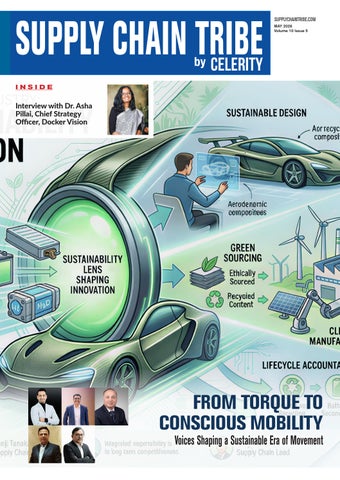
From Torque to Conscious Mobility
The automotive industry no longer sits in transition; it stands in the midst of a fundamental redefinition. Tightening regulations across global markets, rising investor scrutiny, and increasingly conscious consumers continue to accelerate this movement. Each force reinforces a broader rethink—not only of products, but of the operating models that support them. Through perspectives from industry experts across the automotive ecosystem, this Cover Story explores a shift that is both strategic and structural—one already reshaping the contours of the industry. Sustainability is increasingly influencing how performance gets defined, how value takes shape, and how decisions unfold across the value chain, with a more integrated approach placing responsibility at the center of long-term competitiveness and resilience.
From Compliance to Core Strategy – Avinash Gupta, Global SCM Head, Solar Industries India Ltd.
Building a Connected, Low-Carbon Value Chain – Yashpal Singh Negi, Former ED (WTD), Global Autotech Ltd.
Execution Is the New Sustainability Benchmark – Ashok Bhimanpalli, Corporate Head – Safety and Sustainability, CIE Automotive India Ltd.
The Rise of the Responsible Value Chain – Nikhil Puri, Senior Vice President – Direct Procurement, Yokohama-ATG
Sustainability as the New Operating System of Automotive – Ajay Kumar, CPO & AVP Commercials, MTA Group (MT Autocraft | Crystal precision | EMTC)
Hormuz: Stress Testing Global Supply Chains
Sanjay Desai, Independent Board Advisor and Mentor, observes, Hormuz is no longer just a passage—it is a defining variable in global supply chain strategy.
The Quiet Takeover: AI Redefining Procurement Power
Milind Tailor, Global Head – Resale Products & Services Procurement, Diebold Nixdorf Inc., reflects on how AI evolution is elevating procurement’s role while reshaping the capabilities that will define its future trajectory.
India’s Maritime Reset Moves from
Policy to Power
Dr. Asha Pillai, Chief Strategy Officer, Docker Vision, unpacks how policy alignment, capital investment, and technology adoption are converging to build a more resilient, efficient, and globally competitive maritime ecosystem— positioning India not just as a trade participant, but as an emerging force capable of influencing the future of global shipping and logistics.
HORMUZ:
Stress Testing Global Supply Chains
The Strait of Hormuz is far more than a narrow maritime corridor—it is one of the most consequential arteries of the global energy ecosystem. For supply chain leaders, it represents a convergence point of geography, geopolitics, and economic continuity. Under stable conditions, the movement of crude oil, gases, and refined products through this route appears seamless. Yet, as Sanjay Desai, Independent Board Advisor and Mentor, observes, rising geopolitical tensions can swiftly destabilize freight flows, insurance frameworks, and refinery planning cycles. In today’s volatile environment, Hormuz is no longer just a passage—it is a defining variable in global supply chain strategy.
Jazīreh-ye
Sanjay Desai is an experienced commercial operations professional. In the past, he has been running profit & loss for over 500 million USD leading more than 2000 professionals located remotely across 30 international markets. He has led many Fortune100 multinationals in various segments like Pharma, FMCG, Oil & Gas, MedTech, IT/Technology and Chemicals successfully for the last 40 years. Sanjay’s expertise lies in developing commercial & operational strategies, developing people’s skillset, and enabling market growth. He is a mentor for a couple of startup incubators. He sits as an advisory member on multiple startups and MSME organizations in SEA.
Jazīreh-ye Qeshm
THE Strait of Hormuz occupies a uniquely critical position in the global energy ecosystem. For supply chain professionals, it is not simply a geographic connection between the Persian Gulf and the Arabian Sea—it is the central artery through which energy security for multiple continents is maintained. Every day, millions of barrels of crude oil and large volumes of natural gas and refined products pass through this narrow channel, linking upstream production hubs in the Gulf with downstream consumption centres across Asia and beyond.
In periods of relative geopolitical calm, this movement appears almost routine. Tankers move in predictable cycles, refining systems operate with precision, and supply chains function with a high degree of coordination. This creates an illusion of permanence—that the system is stable and self-sustaining. However, this stability is conditional. It depends on uninterrupted passage, predictable risk environments, and confidence among shipping and insurance stakeholders.
The moment this confidence is shaken, the system begins to respond. Freight markets react almost instantly, reflecting increased risk premiums. Insurance costs escalate as underwriters reassess exposure. More importantly, operational decisions begin to shift— shipowners reconsider routes, charterers delay commitments, and refineries start preparing for potential feedstock variability.
Geographically, the vulnerability is evident. The strait stretches roughly 167 kms, with widths ranging from 55 to 95 kms, narrowing to around 30–32 miles at its most constrained point. Within this confined passage lies one of the highest concentrations of energy trade globally. This combination of narrow geography and high throughput creates a structural imbalance—efficiency on one hand, fragility on the other.
The dependency is also bilateral. Gulf producers depend on Hormuz to access global markets, while importing nations—particularly in Asia—depend on it for sustained energy supply. This creates a tightly coupled system where disruption is not isolated—it is shared. A blockage or slowdown affects both
ends simultaneously, amplifying its impact across the global energy value chain. Even though international legal frameworks classify Hormuz as a transit passage that should remain open, supply chains are governed by behavior, not just law. If stakeholders perceive risk, usage declines—effectively constraining the corridor without formal closure. This is what makes Hormuz uniquely critical: it is as much a psychological chokepoint as it is a physical one.
WHY THE STRAIT MATTERS
The Strait of Hormuz matters because it represents a convergence of scale, concentration, and irreplaceability. It is not merely a transit route—it is the primary gateway through which the Gulf region connects to global energy markets. Nearly 20% of global oil trade flows through this corridor, alongside significant volumes of liquefied natural gas. Such concentration is difficult to replicate elsewhere. While multiple maritime routes exist globally, very few carry such a high share of a critical commodity through such a constrained passage.
This creates a structural vulnerability within the global energy system. From a supply chain perspective, it functions like a single high-capacity artery supporting multiple economic systems— where even short-term disruption can trigger cascading effects across markets, industries, and geographies. Its importance is further reinforced by the limited scalability of alternatives. Pipelines and secondary routes can absorb a portion of the flow, but they fall short of matching the flexibility, capacity, and cost efficiency of maritime transit through Hormuz.
Governance adds another layer of complexity. International law defines shared coastal sovereignty, with Iran to the north and Oman to the south, and shipping lanes passing through overlapping territorial waters under the transit passage regime of the United Nations Convention on the Law of the Sea (UNCLOS). While this framework protects navigational rights, actual vessel movement is influenced far more by realtime safety assessments, insurer risk thresholds, and prevailing geopolitical signals.
WHO DEPENDS ON HORMUZ
Asia holds the greatest dependency on the Strait of Hormuz, making it one of the most regionally concentrated yet globally consequential supply chain risks. Data indicates that nearly 85–90% of crude oil and gas exports transiting through this corridor are destined for Asian markets. This dependency is particularly pronounced in major economies such as China, India, South Korea, and Japan. Each of these economies is structurally tied to consistent energy inflows, and in many cases, a significant proportion of their imports rely directly on this single maritime corridor.
China, as the world’s largest crude importer, depends on uninterrupted flows to sustain its vast manufacturing base and industrial output. Even minor disruptions can ripple through production cycles, logistics systems, and export commitments. India, with its rapidly growing economy and increasing energy consumption, relies on steady inflows not only for industrial production but also for transportation, agriculture, and consumer energy needs. South Korea and Japan face an even more acute challenge. With limited domestic energy resources, their reliance on imports is near total. This makes them highly sensitive to any disruption in shipping routes, as alternatives are limited and often more expensive. Their refining systems are optimized for steady inflows, leaving little room for sudden variability.
The dependency is not limited to importers alone. Gulf producers are equally reliant on Hormuz to move their products to global markets. This creates a dual-sided dependency—exporters depend on it to sell, and importers depend on it to consume. Even economies with relatively lower direct exposure, such as the United States, are affected through global pricing mechanisms and freight market dynamics. Oil is a globally traded commodity, and disruptions in one region quickly translate into price volatility worldwide.
This interconnected dependency transforms Hormuz into more than just a regional chokepoint—it becomes a global pressure point, where disruptions affect both supply and demand simultaneously, amplifying their impact across the entire energy value chain.
HOW DISRUPTION SPREADS
The impact of disruption in Hormuz unfolds in a layered and often accelerated manner, beginning with perception and extending into physical supply chains. The first layer is psychological. Markets react almost instantaneously to geopolitical developments. Traders, analysts, and financial institutions begin pricing in risk, leading to immediate increases in crude oil prices. Freight rates rise as shipping companies factor in uncertainty, and insurance premiums escalate as underwriters reassess exposure. These reactions often occur before any physical disruption takes place, highlighting the anticipatory nature of global markets.
The second layer is operational. Shipping behavior begins to change. Tankers may delay entry into the strait, wait offshore for clearer signals, or reroute through longer and more expensive pathways. Charterers and shipowners reassess risk exposure, while insurers impose additional conditions or higher premiums. Even when the strait remains technically open, the flow of goods slows due to caution and uncertainty.
The third layer is industrial. Refineries, which operate on tightly synchronized schedules, begin to experience disruptions in feedstock supply. Delayed shipments can lead to reduced throughput, inefficiencies in production, and adjustments in output. This affects the availability of refined products such as diesel, jet fuel, LPG, and petrochemicals. The fourth layer is systemic. The impact spreads across industries. Aviation faces fuel supply uncertainties, logistics costs increase, manufacturing output slows, and
consumer prices begin to rise. What starts as a maritime disruption evolves into a broader economic challenge.
Importantly, this cascading effect is not linear—it is amplified by the interconnected nature of modern supply chains. A delay in one segment quickly propagates across multiple sectors, creating compounding effects. This is what makes Hormuz uniquely critical. Disruptions here are not contained— they spread rapidly, affecting global markets, industrial systems, and end consumers alike.
WHY HORMUZ BECOMES UNSTABLE
The instability of Hormuz is rooted in a complex interplay of geography, geopolitics, and perception. Geographically, the strait is narrow and heavily trafficked, making it inherently sensitive to disruptions. The high density of vessel movement within a confined space increases the risk of congestion, delays, and operational incidents.
Geopolitically, the region surrounding Hormuz has long been characterized by tension and strategic rivalry. This creates an environment where even minor incidents—whether naval activity, political signaling, or isolated security events—can escalate quickly and impact shipping operations. However, one of the most critical drivers of instability is perception. Supply chains operate on confidence. If shipowners, operators, or crews perceive heightened risk, their behavior changes. Vessels may avoid the route, delay transit, or operate under stricter safety protocols. Interestingly, recent insights indicate that insurance
availability is not the primary limiting factor. Organizations such as the Lloyd’s Market Association continue to provide war-risk coverage. However, operational decisions are driven more by safety concerns and risk assessments than by insurance capacity alone.
This leads to what can be described as “soft disruptions”—situations where the strait remains open in principle but constrained in practice. Traffic declines, transit times increase, and costs rise, even without a formal blockade. This dynamic reflects a broader shift in global supply chains, where uncertainty and perception can be as disruptive as physical barriers. Managing such risks requires a more nuanced understanding of both operational and behavioral factors.
ALTERNATIVES AND RESILIENCE
Alternatives exist, but none can fully replace the Strait of Hormuz. Gulf exporters have developed bypass routes such as Saudi Arabia’s East-West pipeline to the Red Sea, the UAE’s export corridor to Fujairah, and Iran’s Jask terminal. These pathways provide critical fallback options and reduce exclusive dependence on Hormuz during periods of disruption. However, their role remains complementary rather than substitutive. The limitation is structural. These routes cannot absorb the full volume that typically transits through Hormuz, nor can they match the flexibility and speed of maritime flows under stable conditions. Capacity constraints, higher operating costs, and longer transit times mean that while rerouting is possible, it is neither immediate nor economically equivalent.
The Strait of Hormuz is reshaping how the global oil supply chain will be designed in the future. As reliance on a few highvolume corridors becomes increasingly risky, oil supply networks are expected to evolve toward more distributed sourcing, flexible routing, and refinery adaptability. The shift will move beyond cost optimisation to continuity-focused planning—where realtime visibility, diversified crude baskets, and multi-route logistics become essential to sustain flows in an environment defined by uncertainty rather than stability.
This is where the challenge for supply chain planning becomes evident. Diversion strategies offer relief, but only to a certain extent. They introduce additional lead times, logistical complexity, and cost variability. In a disrupted scenario, the system does not stop—but it slows, fragments, and becomes more expensive to operate. On the demand side, resilience is built through a different set of levers. Major consuming economies are increasingly focusing on diversified sourcing portfolios, strategic petroleum reserves, and greater flexibility in refining configurations. The ability to process a wider range of crude grades allows refineries to adapt more quickly when supply patterns shift.
Contract structures and inventory strategies are also evolving. More flexible agreements, multi-supplier arrangements, and optimized stockholding policies provide a buffer against short-term disruptions. Supplier diversity, in particular, reduces overdependence on any single region or route. A visible example of this shift can be seen in European markets, where countries are actively reducing reliance on single-region sourcing. By integrating supplies from the Gulf, the United States, Africa, and the North Sea, they are building a more balanced and resilient energy mix.
AMIDST CURRENT DEVELOPMENTS, ONE SHINING EXAMPLE IS INDIA
Amid the evolving dynamics of global energy supply chains, India stands out as a compelling example of strategic adaptation and resilience. Over the past few years, India has actively worked to reduce its dependence on any single crude supply route, including Hormuz. This has been achieved through a deliberate strategy of diversifying its supplier base. Today, India sources crude oil from nearly 40 countries, significantly reducing its exposure to route-specific disruptions.
A key component of this strategy has been the increased import of Russian crude. These shipments often take alternative routes, such as via the Suez Canal or around the African continent, bypassing Hormuz entirely. This not
only enhances supply security but also introduces greater flexibility into the system. In parallel, India has invested in refining flexibility, enabling its refineries to process a wider range of crude grades. This adaptability allows for rapid adjustments in sourcing strategies in response to geopolitical developments.
The result is a more resilient and responsive supply chain—one that is less vulnerable to disruptions in any single corridor. India’s approach reflects a broader shift in supply chain thinking— from cost optimization to resilience optimization. It demonstrates that proactive planning, diversification, and flexibility can significantly mitigate the risks associated with critical chokepoints like Hormuz.
TAKEAWAYS FOR SUPPLY CHAIN PROFESSIONALS
For supply chain professionals and policymakers across global companies and government institutions, the appropriate response is not reactive decision-making, but measured, forward-looking action. The situation around the Strait of Hormuz reinforces the importance of staying anchored in planning discipline rather than shortterm reactions. Energy supply chains require structural depth. This includes developing multiple sourcing avenues, enabling alternate logistics routes, and maintaining inventory buffers that can absorb short-term disruption. Dependence on a single corridor, regardless of historical reliability, creates exposure that becomes visible only when the system is under stress.
Planning approaches also need to evolve. Linear models built on predictability are increasingly insufficient in a volatile environment. Supply chains must be capable of adjusting sourcing decisions, rerouting cargo, and recalibrating operations with speed and precision. Responsiveness is no longer a secondary capability—it is central to continuity. Cost evaluation requires a more nuanced lens. Routes that appear economically efficient in stable conditions can carry significant downside when exposed to disruption. Delays, price volatility, and operational inefficiencies can quickly offset initial savings. Decision-making, therefore,
needs to account for both cost and exposure.
Across governments, enterprises, and institutions, there is a visible shift toward diversification, operational flexibility, and stronger coordination across the value chain. The objective is not to eliminate uncertainty, but to ensure that supply chains continue to function effectively when conditions change. At its core, the lesson from Hormuz is about maintaining composure while strengthening preparedness—ensuring that continuity is driven by structured planning rather than reactive response.
DESIGNING FOR CONTINUITY, NOT JUST EFFICIENCY
The real lesson from the Strait of Hormuz is not simply that critical routes carry risk—it is that modern supply chains have been built with a level of concentration that amplifies that risk. The issue is less about a single chokepoint and more about how dependent global systems remain on a limited set of pathways. Addressing this requires a shift in how supply chains are designed and governed. Instead of relying on stability as a baseline, organisations need to operate with variability as a constant. This means rethinking sourcing strategies, building optionality into logistics networks, and enabling faster decision-making through better visibility and coordination.
Energy supply chains, in particular, sit at the core of broader economic activity. Any disruption in crude or gas flows quickly extends into refining, transportation, manufacturing, and end consumption. Strengthening these linkages—rather than treating each segment in isolation—becomes critical to maintaining continuity. Looking ahead, the competitive edge will not come from the lowest-cost route or the most optimised network. It will come from systems that can adapt without breaking—absorbing shocks, reconfiguring flows, and sustaining operations under pressure. Hormuz, in that sense, is not just a risk point. It is a signal of what the future demands: supply chains that are not only efficient in calm conditions, but fundamentally designed to perform in uncertainty.
FROM TORQUE TO CONSCIOUS MOBILITY
The automotive industry no longer sits in transition; it stands in the midst of a fundamental redefinition. A shift that began with cleaner powertrains now extends across design, sourcing, manufacturing, and lifecycle accountability. Sustainability no longer operates as an extension of innovation; it shapes the lens through which innovation itself is judged. Tightening regulations across global markets, rising investor scrutiny, and increasingly conscious consumers continue to accelerate this movement. Each force reinforces a broader rethink—not only of products, but of the operating models that support them. Through perspectives from industry experts across the automotive ecosystem, this Cover Story explores a shift that is both strategic and structural—one already reshaping the contours of the industry. Sustainability is increasingly influencing how performance gets defined, how value takes shape, and how decisions unfold across the value chain, with a more integrated approach placing responsibility at the center of long-term competitiveness and resilience.
From Compliance to Core Strategy
As sustainability shifts from a peripheral agenda to a core operational mandate, supply chains are emerging as the real battleground for impact. In this conversation, Avinash Gupta, Global SCM Head, Solar Industries India Ltd., unpacks how governance, data transparency, and ecosystem collaboration are redefining decision-making across multi-tier supply networks— turning sustainability from a reporting exercise into a measurable, value-driven strategy.
Sustainability is increasingly becoming a system-wide priority rather than an individual initiative. How is this shift reshaping decision-making, governance, and accountability across the automotive value chain?
The shift of sustainability from an individual initiative to a system-wide priority is fundamentally transforming the automotive industry's governance, accountability, and operational logic. This evolution is driven by a clear realization: Scope 3 emissions—those occurring across the indirect value chain—represent the majority of an organization’s carbon footprint, often exceeding 90%. This is forcing organizations to move beyond internal optimization toward ecosystemwide alignment.
Sustainability is now being embedded into the core of daily business operations through centralized management structures and board-level oversight. For instance, Mercedes-Benz Group has institutionalized this through its Group Sustainability Committee (GSC), which manages sustainability priorities across departments and regions in line with board-approved targets. This reflects a broader shift where sustainability is governed with the same rigor as financial and operational performance.
At the same time, accountability is becoming more structured and performance-linked. Executive
remuneration is increasingly tied to sustainability outcomes such as carbon reduction and transformation milestones, ensuring that leadership ownership moves beyond intent to measurable delivery. Regulatory frameworks, including the EU’s Corporate Sustainability Due Diligence Directive (CSDDD), are further accelerating this shift by extending accountability across the entire value chain and introducing legal and compliance implications for inaction.
Decision-making itself is becoming more data-driven and multidimensional. Tools such as Double Materiality Assessments (DMA) are enabling organizations to evaluate not only their environmental and social impact but also how these factors translate into financial risk and long-term value creation. This is fundamentally changing how trade-offs are assessed—bringing sustainability into the same decision framework as cost, risk, and growth.
From an India perspective, the direction is aligned but the execution is more framework-led and adaptive. Governance is increasingly anchored in board-level structures such as Safety, Health and Sustainability (SHS) committees, which oversee ESG performance and implementation. Organizations are also deploying structured internal frameworks like the TATVA circular economy model— with defined metrics to track resource efficiency—and DEI-focused lighthouse approaches to embed inclusion alongside environmental priorities.
Scope 3 emissions remain the most complex challenge. What practical steps are needed to drive accountability and measurable progress across multi-tier supply chains, especially including Tier 2 and Tier 3 partners?
Driving measurable progress across Tier 2 and Tier 3 partners requires a decisive shift from estimated industry averages to primary, supplier-level data. Without this transition, accountability tends to remain indicative rather than actionable, limiting the ability to drive meaningful change across the value chain.
A critical lever in this process is the formalization of expectations through contractual mechanisms. OEMs are increasingly deploying “Ambition Letters” and Responsible Sourcing Standards that require Tier 1 suppliers to cascade sustainability requirements to their upstream partners. This creates a structured pathway for extending accountability beyond immediate supplier relationships into deeper tiers of the supply chain.
At the same time, technology— particularly artificial intelligence—is strengthening the integrity and scalability of this approach. AI-driven systems are being used to automate the scraping of public datasets and validate supplierreported emissions against industry benchmarks, enabling the identification of inconsistencies and improving data reliability. Complementing this, federated learning models allow multiple suppliers to contribute emissions data into shared analytical frameworks without exposing
sensitive information—balancing transparency with data sovereignty while enhancing collective accuracy.
Scope 3 emissions, particularly those arising from purchased goods and the use of sold products, continue to represent the largest share of the carbon footprint. Addressing this effectively requires embedding sustainability across the entire supplier lifecycle, rather than treating it as a downstream compliance exercise.
Structured Sustainable Supply Chain Frameworks are enabling this integration by incorporating sustainability considerations at every stage—from supplier onboarding to ongoing performance management. Supplier Codes of Conduct (SCoC), covering environmental, labor, and human rights standards, are now embedded as mandatory components of procurement processes, setting clear expectations from the outset.
This is reinforced through rigorous assessment mechanisms. Suppliers are evaluated through annual ESG Assessment Questionnaires (SAQs) and periodic site audits that include dedicated sustainability pillars, allowing organizations to identify risks, benchmark performance, and drive continuous improvement across tiers.
Equally important is the role of collaborative platforms in translating intent into action. Forums such as Aikyam (Unity) facilitate dialogue, knowledge sharing, and the development of “lighthouse” projects focused on renewable energy adoption and waste
Digital technologies are emerging as the backbone of effective sustainability management, enabling traceability and real-time decision-making by creating reliable ‘Single Sources of Truth’ for emissions and resource data across the value chain. One of the most significant developments is the emergence of Digital Battery Passports, which enable structured collection and sharing of data related to raw material origins, sustainability performance, and battery health. This level of transparency is critical in supporting circular business models, including second-life applications and end-of-life recycling.
The ability to rapidly bring economical Battery Electric Vehicles (BEVs) to market will determine competitive positioning, especially as new and agile players continue to reshape the industry landscape. At the same time, leadership will be anchored in lifecycle ownership. Organizations will move from traditional product-centric models toward mobility-as-a-service (MaaS), taking responsibility for the entire vehicle lifecycle—from design and usage to end-of-life recovery and reuse.
reduction. These platforms play a critical role in bringing Tier 2 and Tier 3 suppliers into the sustainability journey, not just as participants, but as active contributors to system-wide progress.
How is sustainability influencing supply chain decisions—from sourcing and supplier selection to localization and network design?
Sustainability is now a mandatory criterion in procurement and awarding processes, shaping decisions across sourcing, supplier selection, and network design rather than being treated as an overlay. In sourcing, there is a clear shift toward CO₂-reduced production materials such as green steel, recycled aluminum, and bio-based composites. For instance, BMW has incorporated natural fibers like
hemp and flax to reduce vehicle weight and improve lifecycle sustainability. This reflects a broader move where material choices are increasingly evaluated not just on performance and cost, but on embedded carbon and lifecycle impact.
Localization and network design are being reconfigured through a decarbonization lens. There is a growing emphasis on closed-loop systems and localized supply chains to reduce transport-related Scope 3 emissions while also strengthening resilience. Internal carbon pricing is emerging as an important decision tool, with leading organizations assigning a cost to carbon to evaluate trade-offs between emissions and financial considerations during strategic planning and product development.
Sustainability is also becoming central to supplier selection and governance. New suppliers are scrutinized through enhanced Manufacturing Site Audits that include dedicated sustainability pillars, ensuring ESG performance is assessed alongside traditional parameters. Environmental Procurement Policies further institutionalize this by aligning purchasing practices with broader sustainability commitments and minimizing potential risks.
From an India perspective, localization is gaining added momentum—not only as a resilience strategy but as a sustainability imperative. In the EV ecosystem, there is a strong push toward achieving 75–80% localization at the Tier 1 level, enabling both reduced logistics emissions and stronger domestic value chains. Network
design is evolving in parallel, with strategic innovation hubs—such as the Open Innovation Hub in Bangalore— positioned closer to engineering teams and startup ecosystems to enable cocreation and faster deployment of sustainable solutions.
What role do digital technologies and data transparency play in enabling traceability, real-time decision-making, and effective sustainability management?
Digital technologies are emerging as the backbone of effective sustainability management, enabling traceability and real-time decision-making by creating reliable ‘Single Sources of Truth’ for emissions and resource data across the value chain. One of the most significant developments in this space is the emergence of Digital Battery Passports, which enable structured collection and sharing of data related to raw material origins, sustainability performance, and battery health. This level of transparency is critical in supporting circular business models, including second-life applications and end-of-life recycling.
At a broader ecosystem level, standardized data exchange platforms such as Catena-X are enabling secure and sovereign data sharing across value chain participants. These platforms allow organizations to move beyond averaged estimates toward product-specific carbon footprints based on primary data, significantly improving accuracy and comparability.
Artificial intelligence is adding a predictive dimension to sustainability management. AI-driven models are being used to forecast future emissions based on business growth trajectories and planned decarbonization initiatives, allowing organizations to proactively adjust strategies rather than respond retrospectively.
Digital tools are also the primary enablers of real-time operational management. Traceability systems such as the International Dismantling Information System (IDIS) provide dismantlers with detailed information on material composition, particularly for non-metallic parts, supporting more efficient recycling and end-oflife circularity. At the shop-floor level,
Industry 4.0 technologies and IoT are being used to digitally track energy consumption in real time and monitor operational safety through AI-enabled systems. This ensures not only improved efficiency but also greater transparency in operational performance.
Connected vehicle platforms further extend this capability into the use phase. Solutions such as Fleet Edge leverage real-time diagnostics and telematics to enhance vehicle uptime and optimize fuel efficiency through data-driven insights. Beyond operations, AI is also being applied to infrastructure planning. Geo-spatial analytics models are being used to optimize the deployment of EV fast-charging networks based on traffic density and usage patterns, ensuring that infrastructure investments are both efficient and aligned with actual demand. Together, these digital capabilities are enabling a shift from static reporting to dynamic, data-driven sustainability management—where decisions are informed by real-time insights and lifecycle visibility.
Collaboration is critical in a fragmented ecosystem. What models or approaches are most effective in aligning OEMs, suppliers, logistics partners, and smaller stakeholders toward common sustainability goals? In a fragmented ecosystem, the most effective approaches are those that move beyond bilateral, transactional relationships toward structured, multistakeholder collaboration. Sustainability challenges—particularly those linked to lifecycle emissions and circularity— cannot be addressed in isolation, making alignment across the value chain essential.
At a global level, multi-stakeholder initiatives are emerging as powerful models for collective action. Platforms such as the Circular Cars Initiative bring together over 40 companies, research institutes, and NGOs to maximize resource value and minimize lifecycle emissions. Similarly, the Global Battery Alliance has demonstrated how coordinated efforts across the value chain can enable innovations such as battery passports, creating shared standards for transparency and traceability.
Complementing these are supplierfocused support programs that help extend sustainability beyond Tier 1. Initiatives like Schneider Electric’s Catalyze program leverage digital and AI-enabled platforms to provide smaller suppliers with access to renewable energy solutions and financial insights— ensuring that ecosystem participation is both inclusive and scalable.
From an India perspective, collaboration models are evolving toward partner-led ecosystems anchored in shared vision and execution. Programs such as Project Aalingana (Embrace) align multiple group companies toward common goals around Net Zero, circularity, and biodiversity, creating a unified direction across diverse business units. Similarly, Tata UniEVerse represents a synchronized effort to build a holistic e-mobility ecosystem by integrating OEMs, charging infrastructure providers, and financing partners—demonstrating how collaboration can extend beyond manufacturing into enabling infrastructure.
Circularity-focused models are also gaining traction. The Re.Wi.Re (Recycle with Respect) framework uses franchise-based partnerships to scale vehicle scrappage and recycling capacity, making end-of-life management more distributed and accessible. In parallel, open innovation is becoming a key enabler of ecosystem alignment. Partnerships with technology players and startups—such as ev.energy and Freight Tiger—are accelerating the development of software-defined vehicles and gridresponsive charging solutions, bringing agility and innovation into traditionally linear value chains.
These approaches highlight that alignment is most effective when anchored in shared standards, enabled by common platforms, and supported by mechanisms that ensure participation across all tiers of the ecosystem.
Looking ahead, what will define leadership in a sustainable automotive ecosystem over the next 5–10 years, particularly in markets like India where ambition and execution often diverge?
Leadership in a sustainable automotive
Open innovation is becoming a key enabler of ecosystem alignment.
Partnerships with technology players and startups—such as ev.energy and
Freight Tiger—are accelerating the development of software-defined vehicles and grid-responsive charging solutions, bringing agility and innovation into traditionally linear value chains.
ecosystem will increasingly be defined by the ability to move beyond incremental improvements toward higher levels of circularity—particularly Level 3 to Level 5—where vehicles deliver maximum mobility per unit of resource consumed and emissions generated. This represents a shift from linear production models to systems that are regenerative by design.
A critical differentiator will be the speed of decarbonization. The ability to rapidly bring economical Battery Electric Vehicles (BEVs) to market will determine competitive positioning, especially as new and agile players continue to reshape the industry landscape. At the same time, leadership will be anchored in lifecycle ownership. Organizations will move from traditional product-centric models toward mobility-as-a-service (MaaS), taking responsibility for the entire vehicle lifecycle—from design and usage to end-of-life recovery and reuse.
In markets like India, the defining challenge will be the ability to bridge ambition and execution. While high-level commitments are increasingly common, leadership will depend on translating these into tangible outcomes across supply chains, manufacturing operations, and supporting infrastructure. For instance, companies like Mercedes-Benz Group have already initiated sustainability dialogues in India, but the real test lies in scaling these into measurable actions.
This will also require clear and credible pathways to Net Zero. Leading organizations will align with sciencebased targets, with ambitions such as achieving Net Zero emissions by 2040 for passenger vehicles and 2045 for commercial vehicles. Beyond carbon, leadership will expand into resource and ecological dimensions. This includes achieving RE100 (100% renewable electricity), Water Neutrality, and Zero Waste to Landfill by 2030, as well as
advancing biodiversity stewardship through frameworks like Science-Based Targets for Nature (SBTN), which aim to deliver a net positive impact on ecosystems.
Finally, leadership will also be defined by inclusive and equitable growth. Integrating vulnerable and marginalized communities—including persons with disabilities (PWDs) and underserved groups—into the workforce and supply chain as active “partners of purpose” will become an essential component of a truly sustainable ecosystem.
Can you share a specific sustainability initiative or case study where your organization (or ecosystem partners) delivered measurable environmental and business impact? What were the key enablers, challenges, and lessons learned?
A large automotive Tier 1 supplier’s sustainability journey was shaped by structural constraints typical of the sector. Scope 3 emissions dominated the footprint, with purchased steel alone accounting for 57%, while total emissions increased from 238K to 281K tCO₂e as business growth outpaced efficiency gains. In addition, hard-to-abate processes such as forging—requiring ~1,200°C heat—remained difficult to decarbonize, with technologies like green hydrogen and green steel not yet commercially viable at scale.
In response, the company focused on building visibility and control where possible. A critical inflection point was achieving 100% visibility across Scope 1, 2, and 3 emissions, revealing that 67% of its footprint originated in the supply chain. This shift from estimation to measurement, aligned with the GHG Protocol, enabled targeted and datadriven interventions.
Strong governance and structured
execution underpinned the transformation. A board-level ESG committee ensured accountability, while science-based targets aligned to a 1.5°C pathway created internal momentum. The adoption of ISO 50001 brought discipline to energy management, and initiatives across energy efficiency, solar, and waste heat recovery delivered a reduction of ~65,500 tCO₂e.
This translated into both environmental and business impact. The company improved its CDP Climate Rating from ‘F’ (Failure) to ‘B’ (Management level), while its S&P Global ESG score increased from 18 to 46 and EcoVadis score from 37 to 52. A ₹90 crore decarbonization investment portfolio delivered ₹33 crore in annual savings, with an average payback period of 2.7 years. Proactive carbon management also enabled the retention of key contracts with global OEMs such as BMW and Mercedes-Benz Group, while mitigating exposure to regulations like the EU’s Carbon Border Adjustment Mechanism (CBAM), which impacts 30% of its export-linked revenue.
The journey reinforced a few critical lessons. Credibility starts with transparent measurement, even when it highlights challenges such as rising absolute emissions. It also showed that organizations should not wait for perfect data or fully mature technologies—early commitment drives momentum. Most importantly, a credible decarbonization strategy follows a clear hierarchy: Avoid (redesign), Reduce (efficiency), Replace (renewables and green materials), and Offset only as a last resort for the final residual emissions. Increasingly, carbon performance is not just a compliance metric—it is a qualification criterion for competing and winning in global supply chains.
Building a Connected, Low-Carbon Value Chain
As sustainability becomes central to competitiveness, the automotive value chain is undergoing a structural shift toward low-carbon, digitally enabled ecosystems. In this conversation, Yashpal Singh Negi, Former ED (WTD), Global Autotech Ltd. shares how organizations are moving beyond compliance to embed sustainability into supply chain decisions, supplier ecosystems, and performance metrics—highlighting that real impact will be driven by execution at scale.
Sustainability is increasingly becoming a system-wide priority rather than an individual initiative. How is this shift reshaping decision-making, governance, and accountability across the automotive value chain?
Sustainability is no longer a standalone ESG agenda; it has evolved into a business continuity and competitiveness imperative. This shift is being driven by accelerating human-induced global warming, rising industrial and agricultural pollution, depletion of natural resources, and the rapid growth in vehicle population. Earlier, organizations approached sustainability largely as a compliance or CSR function. Today, it is influencing decisions across procurement, manufacturing, logistics, product design, and customer strategy.
India’s commitment to achieving net zero by 2070 is further reinforcing this transition, with growing momentum to align with global sustainability leaders. The automotive industry, which accounts for around 4.5% of India’s merchandise exports, represents a significant share of the country’s manufacturing output. At the same time, its Scope 1, Scope 2, and upstream Scope 3 emissions contribute nearly 1.4%—approximately 45 million metric tons of CO₂ equivalent—to India’s total annual greenhouse gas emissions.
This shift is reshaping governance in fundamental ways. Sustainability is no longer confined to a single function;
it is now a shared responsibility across operations, finance, procurement, R&D, and leadership teams. It is also gaining board-level visibility, with metrics such as carbon reduction, energy efficiency, circularity, and supplier sustainability being actively reviewed. Accountability is extending beyond the factory gate to include suppliers, logistics partners, dealers, and even end-of-life recovery ecosystems. In such an interconnected value chain, OEMs are playing a pivotal role by setting ambitious decarbonization targets across Scope 1, 2, and 3 emissions and cascading them across Tier 1, 2, and 3 suppliers through structured governance mechanisms.
How is your organization moving beyond compliance to embed sustainability into core business strategy, operations, and leadership KPIs?
Organizations that are making meaningful progress are those integrating sustainability into strategic planning rather than treating it as a reporting requirement. This involves linking sustainability targets with annual business plans through a defined roadmap and embedding them into leadership scorecards. Metrics such as energy intensity, waste reduction, supplier ESG compliance, and localization are increasingly becoming part of performance evaluation.
At the same time, there is a clear focus on investing in renewable energy, improving manufacturing efficiency, and enabling circular material flows. Product development is also being aligned with lighter materials, lower emissions, and improved recyclability. Importantly, sustainability performance is now part of regular operational reviews. Leadership KPIs play a critical role here—what gets
measured gets managed, and what gets linked to incentives gets accelerated.
Scope 3 emissions remain the most complex challenge. What practical steps are needed to drive accountability and measurable progress across multi-tier supply chains, especially including Tier 2 and Tier 3 partners?
Scope 3 emissions, which represent lifecycle emissions across both upstream and downstream value chains, often contribute significantly more to an organization’s overall carbon footprint than Scope 1 and 2 emissions. Their complexity lies in their dependence on supplier capability, data quality, and ecosystem maturity. In India, this challenge is particularly pronounced because many Tier 2 and Tier 3 suppliers are MSMEs with limited resources, yet they are critical contributors to the supply chain footprint.
Driving progress requires a structured and pragmatic approach. Organizations need to prioritize high-spend and highemission categories instead of attempting to address everything at once. Capability building is equally important, with a focus on supporting smaller suppliers through training in energy audits, waste reduction, carbon accounting, and reporting practices. Establishing shared standards and common reporting frameworks helps create consistency across the ecosystem.
Procurement levers are increasingly being used to incentivize better sustainability performance by offering preferred supplier status, longer-term contracts, or higher business allocation. At the same time, there is a shift toward digitizing data, moving from manual declarations to digital platforms for emissions tracking and compliance
monitoring. Ultimately, the opportunity lies not just in reporting emissions but in enabling suppliers to become more efficient and competitive.
How is sustainability influencing supply chain decisions—from sourcing and supplier selection to localization and network design—and how do you balance cost competitiveness with sustainability commitments?
Sustainability is becoming a core parameter in supply chain decisionmaking. Supplier evaluation is no longer limited to cost, quality, and delivery; it now includes factors such as energy sources, resource efficiency, waste management practices, ethical compliance, geographic proximity, and the ability to innovate in sustainable materials and processes.
Localization has gained particular importance in the Indian context, as it reduces transport emissions, improves supply chain resilience, shortens lead times, and strengthens domestic manufacturing ecosystems. Balancing sustainability with cost competitiveness requires adopting a total cost of ownership perspective. The lowest purchase price does not necessarily translate into the lowest long-term cost when factors such as logistics risks, carbon exposure, volatility, and inefficiencies are taken into account.
Where are you seeing the strongest business impact from sustainability initiatives today— cost efficiency, risk mitigation, innovation, or revenue growth?
How are you measuring this impact?
The business impact of sustainability is already visible across multiple dimensions. Cost efficiency is being driven by energy
Sustainability in automotive supply chains is no longer about doing less harm— it is about building stronger, smarter, and more competitive ecosystems. The organizations that integrate sustainability into every decision, every partner relationship, and every process will define the future of mobility.
Collaboration is most effective when it moves beyond intent and is supported by structured operating models. Industry consortia are helping establish shared standards for reporting, packaging, recycling, and emissions measurement. Joint innovation platforms are enabling the co-development of lightweight materials, alternative fuels, battery reuse, and circular solutions, while shared logistics networks are improving efficiency through consolidation, multimodal transport, and return-load optimization.
savings, reduced fuel consumption, waste reduction, packaging optimization, and improved resource productivity, all of which deliver direct financial returns. At the same time, organizations are strengthening risk mitigation through more resilient local supply networks, reduced dependence on volatile imports, and improved regulatory readiness.
Sustainability is also enabling innovation, with developments in new materials, EV ecosystems, battery recovery models, and digital planning solutions opening up new value pools. From a market perspective, it is contributing to revenue growth and brand value, as customers, investors, and global partners increasingly prefer companies with credible sustainability performance.
These impacts are being measured through a combination of financial and operational KPIs, including energy consumption per unit produced, CO₂ emissions per vehicle or component, logistics cost per shipment, waste recycled versus disposed, supplier ESG compliance rates, renewable energy share, and revenue contribution from sustainable products.
What role do digital technologies and data transparency play in enabling traceability, real-time decision-making, and effective sustainability management?
Digital technology is the backbone of scalable sustainability. Without reliable data, sustainability remains an intent rather than execution. Technologies such as IoT sensors enable real-time monitoring of energy, water, and machine
efficiency, while control towers provide visibility into logistics and support route optimization.
Supplier portals are facilitating ESG data collection and compliance tracking, while AI and advanced analytics are improving demand planning, inventory optimization, and waste reduction. Traceability platforms are also becoming increasingly important for tracking raw materials, battery components, and recycled content. This level of transparency builds trust across stakeholders and enables faster, more informed corrective actions.
Collaboration is critical in a fragmented ecosystem. What models or approaches are most effective in aligning OEMs, suppliers, logistics partners, and smaller stakeholders toward common sustainability goals?
Collaboration is most effective when it moves beyond intent and is supported by structured operating models. Industry consortia are helping establish shared standards for reporting, packaging, recycling, and emissions measurement. OEM-led supplier programs are playing a key role in building capabilities and accelerating technology adoption across the value chain. Joint innovation platforms are enabling the codevelopment of lightweight materials, alternative fuels, battery reuse, and circular solutions, while shared logistics networks are improving efficiency through consolidation, multimodal transport, and return-load optimization. Public-private partnerships are also supporting the development of EV
infrastructure, skilling initiatives, renewable energy, and recycling ecosystems. In fragmented markets like India, leadership often involves enabling the broader ecosystem rather than optimizing individual enterprises.
Looking ahead, what will define leadership in a sustainable automotive ecosystem over the next 5–10 years, particularly in markets like India where ambition and execution often diverge?
Future leadership will be defined by execution capability rather than ambition alone. The organizations that will lead are those that can decarbonize operations while remaining cost competitive, build resilient and localized supply chains, and digitize decision-making end to end. Scaling circular economy models and strengthening supplier capabilities, particularly among MSMEs, will also be critical. Equally important will be the ability to translate sustainability goals into measurable outcomes and attract talent that values purpose and innovation. India is uniquely positioned in this transition, combining manufacturing scale, entrepreneurial capability, digital adoption, and policy momentum. Those who act early and execute effectively have the opportunity to build globally competitive green supply chains.
Execution Is the New Sustainability Benchmark
The shift in sustainability is no longer about ambition, but about execution. As organizations move beyond pledges, the focus is turning to how effectively it is embedded into daily operations, linked to performance metrics, and driven across the value chain. As Ashok Bhimanpalli, Corporate Head – Safety and Sustainability, CIE Automotive India Ltd., explains, outcomes are increasingly defined by consistency, accountability, and the ability to translate intent into measurable, system-wide impact.
Sustainability is increasingly becoming a system-wide priority rather than an individual initiative. How is this shift reshaping decision-making, governance, and accountability across the automotive value chain?
Sustainability is increasingly shaping how decisions are framed across the automotive value chain rather than being addressed through isolated initiatives. This is particularly evident in the context of Scope 3 emissions, where progress depends on coordinated action across suppliers, customers, logistics partners, and policymakers.
In this environment, policy frameworks aligned with ESG and sustainability goals play an enabling role. They provide direction and consistency, allowing stakeholders to operate within a shared set of expectations. This alignment is important in translating intent into coordinated action across the ecosystem.
At an organizational level, decision-making is becoming more interconnected. Functions such as procurement, manufacturing, and logistics are being evaluated not only for cost and performance but also for their sustainability implications. Governance structures are evolving accordingly, with responsibility extending beyond central teams to operational and supply chain levels. Accountability is also becoming
more distributed, but with clearer definition. Each stakeholder across the value chain is expected to contribute in a measurable way, making sustainability outcomes a function of collective execution rather than individual effort.
How is your organization moving beyond compliance to embed sustainability into core business strategy, operations, and leadership KPIs?
At CIE, sustainability is integrated into business operations rather than positioned as a compliance requirement. Performance is reviewed at the business, division, and plant levels, ensuring that sustainability metrics are consistently tracked alongside operational and financial indicators. A defining element of this approach is the linkage to individual accountability. Sustainability KPIs are directly tied to performance metrics, including compensation and increments. This ensures that ownership is clearly established and that sustainability outcomes are embedded into day-today decision-making. Over time, this integration influences how priorities are set at the operational level. When sustainability is assessed alongside cost, quality, and delivery, it becomes part of routine execution rather than an additional layer of oversight.
Scope 3 emissions remain the most complex challenge. What practical steps are needed to drive accountability and measurable progress across multi-tier supply chains, especially including Tier 2 and Tier 3 partners?
Scope 3 emissions remain challenging because they extend across supply chains with varying levels of capability and preparedness. Addressing this
requires a focus on both awareness and capability. For Tier 2 and Tier 3 suppliers, it is important to demonstrate how sustainability initiatives can contribute to cost reduction and improved profitability. When the connection to operational efficiency is clear, adoption becomes more practical. In parallel, capacity building is essential. Providing guidance, sharing knowledge, and enabling access to simpler measurement and reporting frameworks can help suppliers participate more effectively. Progress depends on making expectations clear and measurable. When suppliers understand what needs to be tracked and how performance will be assessed, accountability becomes more structured across the supply chain.
How is sustainability influencing supply chain decisions-from sourcing and supplier selection to localization and network design-and how do you balance cost competitiveness with sustainability commitments?
Sustainability is influencing supply chain decisions across sourcing, supplier selection, and network design. Suppliers that adopt sustainable practices tend to improve operational efficiency over time, which strengthens both cost and performance outcomes. There is also a growing focus on localization, which helps reduce transportation-related emissions while improving supply chain resilience. Balancing cost competitiveness with sustainability commitments requires a longer-term perspective. Sustainable practices-such as energy optimization, waste reduction, and resource efficiencyoften lead to cost benefits over time. The emphasis is therefore on recognising sustainability as a driver of efficiency rather than an incremental cost.
Where are you seeing the strongest business impact from sustainability initiatives todaycost efficiency, risk mitigation, innovation, or revenue growth?
How are you measuring this impact?
At this stage, the most tangible impact is showing up in cost structures and risk exposure. On the cost side, improvements in energy efficiency, material optimisation, and waste reduction are translating into direct and trackable savings. These are not isolated gains-they tend to compound over time as processes become more disciplined. Risk is becoming a more defining factor. Sustainability is increasingly influencing regulatory compliance, customer expectations, and supplier reliability. Organizations that are slower to respond often see this reflected in higher operating costs or reduced competitiveness, rather than as a single visible event. Measurement, therefore, goes beyond environmental indicators. It combines operational metrics-such as energy intensity and material usagewith financial outcomes like cost savings and efficiency improvements. Over time, these are reflected in broader performance indicators, including stability of operations and long-term competitiveness.
What role do digital technologies and data transparency play in enabling traceability, real-time decision-making, and effective sustainability management?
Digital technologies are central to building credibility and control in sustainability efforts, particularly as expectations around traceability continue to tighten. They enable organizations to move from fragmented, retrospective reporting to
Digital technologies are central to building credibility and control in sustainability efforts, particularly as expectations around traceability continue to tighten. They enable organizations to move from fragmented, retrospective reporting to more continuous and verifiable tracking of emissions, resource consumption, and operational performance.
Commitment to net-zero targets will continue to set the direction, but leadership will be reflected in how consistently organizations can progress toward these goals while maintaining competitiveness. The ability to balance ambition with execution discipline will be critical.
more continuous and verifiable tracking of emissions, resource consumption, and operational performance.
A key advantage lies in traceability across the value chain. With multiple tiers of suppliers involved, having reliable and comparable data becomes essential-not just for internal decision-making but also for external disclosures and stakeholder confidence.
Real-time visibility allows organizations to respond more quickly to deviations, whether in energy usage, process efficiency, or supplier performance. This reduces the lag between identification and action, which is often where inefficiencies persist. Over time, the role of digital systems extends beyond monitoring-they begin to shape how sustainability is managed, by enabling better benchmarking, more informed trade-offs, and greater consistency in execution.
Collaboration is critical in a fragmented ecosystem. What models or approaches are most effective in aligning OEMs, suppliers, logistics partners, and smaller stakeholders toward common sustainability goals? Collaboration in a fragmented ecosystem becomes effective when it is anchored in shared value rather than compliance alone. Circular economy approaches are particularly relevant in this context. By focusing on reuse, recycling, and resource efficiency, they create a framework where multiple stakeholders can participate with a clear operational benefit. This helps move sustainability from a topdown requirement to a more integrated way of working. Alignment also improves when stakeholders operate within common structures-shared metrics, reporting standards, and defined expectations. This reduces ambiguity and allows progress to be tracked more
consistently across the value chain. OEMs play an important role in setting direction, but outcomes depend on how well the broader ecosystem is enabled to respond. Practical engagement-through knowledge sharing, joint initiatives, and consistent communication-tends to be more effective than prescriptive approaches.
Looking ahead, what will define leadership in a sustainable automotive ecosystem over the next 5-10 years, particularly in markets like India where ambition and execution often diverge?
Leadership over the next decade will be shaped by the ability to translate intent into sustained execution across the value chain. Innovation will remain important, particularly in areas such as materials, processes, and energy use. At the same time, the integration of circular economy principles into mainstream operations will become a key differentiator, influencing both efficiency and resource management. Another defining aspect will be the depth of stakeholder engagement. Organizations will need to work closely with suppliers, partners, and policymakers to ensure alignment, particularly in markets like India where supply chains are diverse and uneven in capability. Commitment to net-zero targets will continue to set the direction, but leadership will be reflected in how consistently organizations can progress toward these goals while maintaining competitiveness. The ability to balance ambition with execution discipline will be critical.
Can you share a specific sustainability initiative or case study where your organization delivered measurable environmental and business impact?
At CIE, initiatives such as the composite pre-processing model for hazardous waste management and the deployment of solar energy across facilities illustrate how sustainability can be integrated into core operations. These initiatives have delivered measurable environmental benefits-through improved waste handling and reduced reliance on conventional energy sources-while also contributing to operational efficiency. Key enablers included leadership commitment and strong cross-functional collaboration, which ensured alignment during implementation. At the same time, scaling these initiatives across multiple locations required consistent processes and sustained engagement, particularly in aligning teams and maintaining standards. The broader lesson is that meaningful impact depends on continuity in execution. While innovation provides direction, results are shaped by how systematically initiatives are implemented and sustained across the organization.
The Rise of the Responsible Value Chain
Responsibility is becoming a defining characteristic of modern value chains, with sustainability emerging as a core driver of how organizations design, source, and deliver products. As this shift accelerates, functions like procurement are taking on a more strategic role in enabling accountability, influencing supplier choices, and embedding long-term thinking into decisionmaking. In this conversation, Nikhil Puri, Senior Vice President – Direct Procurement, Yokohama-ATG, discusses how organizations are operationalizing sustainability across complex, multi-tier ecosystems.
Sustainability is increasingly becoming a system-wide priority rather than an individual initiative. How is this shift reshaping decision-making, governance, and accountability across the automotive value chain?
Driven by stringent regulatory mandates such as the EU’s Corporate Sustainability Reporting Directive and battery regulations, alongside rising investor expectations and heightened consumer awareness, sustainability is increasingly emerging as a core strategic determinant of competitiveness rather than a peripheral initiative. This transition is also influencing how organizations evaluate risk, allocate capital, and define long-term value.
Sustainability is now being embedded into early-stage development. Decisionmaking is no longer limited to tailpipe emissions alone; instead, companies are leveraging Life Cycle Assessment tools to map environmental impact across the entire value chain—from raw material extraction to end-of-life disposal— thereby aligning product development with circular economy principles.
The traditional approach of waste reduction is steadily giving way to more comprehensive circular economy strategies. The EU continues to lead this transformation through regulatory frameworks such as EUDR and the Battery Passport, which enable enhanced data
Sourcing strategies are increasingly favouring suppliers that offer eco-friendly packaging solutions and more fuel-efficient logistics, with a stronger emphasis on localization. Localization not only reduces transportation-related emissions but also enhances supply chain resilience and responsiveness.
transparency and end-to-end visibility across the value chain. This, in turn, is strengthening governance mechanisms and driving greater accountability across stakeholders.
As a result, sustainability is no longer confined to a single function—it is being institutionalized across procurement, R&D, manufacturing, and supply chain operations, supported by structured governance frameworks, cross-functional ownership, and measurable performance indicators.
Scope 3 emissions remain the most complex challenge. What practical steps are needed to drive accountability and measurable progress across multi-tier supply chains, especially including Tier 2 and Tier 3 partners?
Organizations are increasingly leveraging ESG criteria to identify and engage with suppliers that demonstrate responsible operations, lower carbon intensity, and adherence to ethical business standards. This is evolving into a key decisionmaking lens—not only for compliance, but for building resilient, long-term partnerships.
A comprehensive framework is essential, beginning with the development of a robust ESG procurement policy that clearly defines organizational sustainability objectives, supplier expectations, and mechanisms for monitoring and evaluation. Such a framework provides consistency and clarity across the supplier ecosystem.
Supplier assessments play a critical role in identifying and mitigating ESG risks across the value chain. These evaluations must go beyond documentation to include site visits, stakeholder engagement, and a deeper analysis of environmental, social, and governance practices. Extending this visibility into Tier 2 and Tier 3 suppliers
is particularly important, given the concentration of emissions and risks at these levels.
Establishing well-defined performance metrics and key performance indicators is equally important to track progress and drive accountability. These metrics should be aligned with broader sustainability goals and continuously refined to reflect evolving priorities.
To ensure effective implementation, procurement teams must be equipped with a strong understanding of ESG principles and their implications. Continuous training, supported by digital tools and data-driven insights, is critical to embedding ESG considerations into everyday decision-making processes.
How is sustainability influencing supply chain decisions—from sourcing and supplier selection to localization and network design—and how do you balance cost competitiveness with sustainability commitments?
Sustainability has become an integral component of legislative compliance, with frameworks such as ETI, SEDEX certification, RoHS, and REACH forming the baseline for responsible operations within global supply chains. At the same time, investors are increasingly incorporating ESG performance into their financing decisions, while consumers— particularly Gen Z and Millennials—are demonstrating a growing preference for sustainable products. As a result, supply chain decisions are shifting from a purely cost-driven approach to one that evaluates suppliers based on total value and ethical considerations.
Sourcing strategies are increasingly favouring suppliers that offer ecofriendly packaging solutions and more fuel-efficient logistics, with a stronger emphasis on localization. Localization
not only reduces transportation-related emissions but also enhances supply chain resilience and responsiveness.
Balancing cost competitiveness with sustainability commitments requires a long-term perspective. While sustainable practices may involve higher initial investments, they often lead to improved efficiencies, reduced regulatory risks, and stronger brand equity over time. Organizations are increasingly recognizing that sustainability and cost optimization can be aligned through innovation, better planning, and lifecycle-based value creation.
What role do digital technologies and data transparency play in enabling traceability, real-time decision-making, and effective sustainability management?
Digital technologies are playing a pivotal role in enabling real-time visibility across the supply chain. The use of IoT sensors and GPS tracking facilitates continuous monitoring of goods, providing actionable insights into logistics efficiency, emissions, and operational performance. Digital tools also support the collection, validation, and sharing of data, which is essential for auditing sustainability claims and ensuring compliance with regulatory requirements. As reporting standards become more stringent, the importance of accurate and transparent data continues to grow.
Technologies such as Product Lifecycle Management (PLM) systems enable organizations to design products with sustainability in mind—facilitating disassembly, recycling, and waste reduction. These tools also enhance cross-functional collaboration between design, manufacturing, and supply chain teams.
Data sharing across the ecosystem further enables organizations to optimize resource utilization, track sustainability
metrics, and reduce environmental impact. Increasingly, digitalization is enabling a shift from reactive compliance to proactive and predictive sustainability management.
Collaboration is critical in a fragmented ecosystem. What models or approaches are most effective in aligning OEMs, suppliers, logistics partners, and smaller stakeholders toward common sustainability goals?
Supplier Relationship Management (SRM) has emerged as one of the most effective models for driving alignment across the ecosystem. Organizations are increasingly integrating ESG objectives into SRM frameworks, transforming supplier engagement from transactional interactions to strategic partnerships. Establishing clear and shared sustainability goals across stakeholders is essential to ensure alignment and coordinated action. This shared vision helps reduce fragmentation and fosters collective accountability.
Collaborative approaches are particularly impactful in areas such as shared logistics, where route optimization and load consolidation can significantly reduce emissions. For smaller stakeholders, targeted support mechanisms, improved payment terms,
and access to technical expertise—are critical to enabling their participation in sustainability initiatives. Additionally, joint development projects through R&D collaboration offer opportunities to co-create innovative and sustainable solutions, while sharing both risks and rewards among partners.
Looking ahead, what will define leadership in a sustainable automotive ecosystem over the next 5–10 years, particularly in markets like India where ambition and execution often diverge?
Leadership in the coming decade will be defined by the ability to manage the entire lifecycle of the product—from responsible sourcing of materials to efficient manufacturing and end-of-life recycling. This lifecycle-oriented approach will become central to both strategy and execution. There will also be a shift from the traditional “3R” framework—reduce, reuse, recycle—to a more comprehensive “5R” approach: refuse, remove, reduce, reuse, and recycle. This reflects a stronger emphasis on prevention and resource efficiency at the design stage. Perhaps the most critical aspect of leadership will be the ability to embed a culture of sustainability across the organization. Without cultural alignment, even the most advanced strategies and
technologies may fall short of delivering meaningful impact.
Leaders of the future will not be defined by a singular technological pathway, but by their ability to remain flexible and responsive to evolving sustainability goals, regulatory landscapes, and market dynamics. This adaptability will be particularly important in markets like India, where translating ambition into execution requires strong governance, capability building, and ecosystem-wide alignment.
Sustainability as the New Operating System of Automotive
Sustainability is shifting from a parallel agenda to the foundation of how the automotive ecosystem operates—reshaping governance, supplier accountability, and supply chain decisions. Ajay Kumar, CPO & AVP Commercials, MTA Group (MT Autocraft | Crystal precision | EMTC), shares how this transition is driving a move from intent to execution, where measurable outcomes, ecosystem collaboration, and operational integration will define long-term competitiveness.
Sustainability is increasingly becoming a system-wide priority rather than an individual initiative. How is this shift reshaping decision-making, governance, and accountability across the automotive value chain?
The automotive industry is at a decisive inflection point where sustainability is no longer a parallel agenda—it is becoming the operating system of the entire ecosystem. Leading OEMs such as Maruti Suzuki, Mahindra & Mahindra, and Hyundai Motor Company are embedding sustainability into their core strategies and cascading expectations across the value chain in a far more structured and measurable way.
This shift is fundamentally redefining governance and accountability. Sustainability is increasingly integrated into supplier evaluations, sourcing decisions, and long-term investments. For Tier 1 suppliers like us, it is no longer optional—it is becoming the license to operate. What is particularly significant is the transition from intent to enforcement. While universal mandates are still evolving, OEMs have begun embedding sustainability parameters into procurement frameworks, creating a new layer of accountability where performance is measured not just on cost, quality, and delivery, but also on environmental responsibility and longterm alignment.
How is your organization moving beyond compliance to embed sustainability into core business strategy, operations, and leadership KPIs?
At MT Autocraft, sustainability has evolved from a compliance requirement to a core strategic priority that shapes our long-term direction. Our ambition to achieve zero emissions by 2027 is central to this shift and is influencing both investments and operational decisions. We are actively transitioning toward renewable energy, particularly solar power, to meet a growing share of our energy requirements, while simultaneously driving efficiency across plants through process optimization and technology upgrades. These initiatives are closely linked to operational excellence, ensuring that sustainability and efficiency move together rather than in isolation.
Beyond manufacturing, we are extending our efforts across the broader operational ecosystem, including the gradual transition of our internal fleet from ICE to electric vehicles. Importantly, sustainability is embedded into leadership KPIs, ensuring ownership across functions such as procurement, operations, and supply chain. This integrated approach ensures that sustainability is not treated as a siloed initiative but as a core element of business strategy.
Scope 3 emissions remain the most complex challenge. What practical steps are needed to drive accountability and measurable progress across multi-tier supply chains, especially including Tier 2 and Tier 3 partners?
Scope 3 emissions represent the most
complex and critical dimension of the sustainability journey. For Tier 1 suppliers, a significant portion of emissions lies beyond direct operations, spanning Tier 2 and Tier 3 suppliers, logistics providers, and service partners. While OEMs are driving the agenda at the top, adoption at deeper tiers remains nascent due to capability constraints and limited resources.
Addressing this challenge requires a collaborative and phased approach. The first step lies in building awareness and engaging suppliers meaningfully, helping them understand both the importance of sustainability and the pathways to achieve it. This must be supported by capability-building initiatives that equip partners with tools and frameworks for measuring and managing emissions.
Equally important is adopting realistic timelines and incremental progress. Rather than imposing immediate compliance, a gradual transition supported by standardized reporting and improved data transparency can drive more sustainable outcomes. Ultimately, meaningful progress on Scope 3 emissions will depend on how effectively the ecosystem moves together, rather than how quickly individual players advance in isolation.
How is sustainability influencing supply chain decisions—from sourcing and supplier selection to localization and network design—and how do you balance cost competitiveness with sustainability commitments?
Sustainability is increasingly shaping supply chain decisions across sourcing, supplier selection, and logistics planning. Environmental considerations are now part of the evaluation matrix alongside
traditional parameters such as cost, quality, and delivery. Supplier selection is gradually incorporating factors such as emissions footprint, energy practices, and long-term sustainability alignment. At the same time, logistics and network design decisions are beginning to account for carbon impact, driving greater focus on localization, route optimization, and efficient network configurations.
Balancing sustainability with cost competitiveness remains critical, particularly in a price-sensitive market like India. However, the industry is moving toward a more integrated perspective, recognizing that sustainability and efficiency are not mutually exclusive. The conversation is shifting from cost versus sustainability to cost with sustainability, where long-term value is created by aligning both. Over time, sustainable practices are expected to enhance resilience, reduce risks, and deliver efficiency gains, making them economically viable.
Where are you seeing the strongest business impact from sustainability initiatives today— cost efficiency, risk mitigation, innovation, or revenue growth?
How are you measuring this impact?
The business impact of sustainability initiatives is already evident across multiple dimensions. One of the most immediate benefits is cost efficiency, particularly through energy optimization and the adoption of renewable energy, which are delivering measurable savings over time. At the same time, sustainability-driven process improvements are enhancing operational efficiency, improving resource utilization, and reducing waste. There is also a strong
In a fragmented ecosystem like automotive manufacturing, collaboration is essential for driving meaningful sustainability outcomes. The most effective approach combines clear direction from OEMs with active support for suppliers across the value chain. A partnership-led model works far better than a compliance-driven one.
In markets like India, where ambition is high, but execution can vary, the ability to operationalize sustainability at scale will be particularly critical. Sustainability is rapidly becoming the baseline rather than a differentiator. Organizations that act early, invest decisively, and collaborate effectively will not only meet evolving expectations but also shape the future of mobility.
element of risk mitigation, as alignment with OEM sustainability expectations is becoming critical for maintaining and expanding business relationships.
These impacts are measured through a combination of metrics, including reductions in energy consumption and carbon emissions, cost savings achieved through efficiency initiatives, and adherence to OEM-defined sustainability benchmarks. Together, these indicators provide a balanced view of both environmental and business performance.
What role do digital technologies and data transparency play in enabling traceability, real-time decision-making, and effective sustainability management?
Digital technologies are playing a pivotal role in making sustainability more measurable and actionable. One of the key challenges historically has been the lack of reliable and timely data, which limited effective decision-making. This is now being addressed through digital enablement. Real-time monitoring systems and advanced analytics are enabling organizations to track energy consumption, emissions, and resource usage with greater accuracy. This enhances internal decision-making while also improving traceability across the supply chain, providing better visibility into upstream and downstream impacts.
Data transparency is particularly important in aligning stakeholders across the ecosystem. As reporting becomes more standardized and accessible, it enables better collaboration, accountability, and progress tracking. In this context, digitalization is not just an enabler but a critical accelerator of sustainability transformation.
Collaboration is critical in a
fragmented ecosystem. What models or approaches are most effective in aligning OEMs, suppliers, logistics partners, and smaller stakeholders toward common sustainability goals?
In a fragmented ecosystem like automotive manufacturing, collaboration is essential for driving meaningful sustainability outcomes. The most effective approach combines clear direction from OEMs with active support for suppliers across the value chain. A partnership-led model works far better than a compliance-driven one. This involves structured supplier engagement, knowledge sharing, and joint initiatives that help build capabilities across the ecosystem. Smaller suppliers, in particular, require targeted support to overcome resource and capability constraints. By aligning goals and creating shared accountability, the ecosystem can move forward collectively. Sustainability, in this sense, becomes a shared journey rather than an individual responsibility, enabling broader and more consistent adoption across all tiers.
Looking ahead, what will define leadership in a sustainable automotive ecosystem over the next 5–10 years, particularly in markets like India where ambition and execution often diverge?
Over the next decade, leadership in the automotive ecosystem will be defined by execution rather than intent. While many organizations have articulated ambitious sustainability goals, the real differentiator will be the ability to translate these commitments into measurable and scalable outcomes.
This will require integrating sustainability into core business strategy, aligning multi-tier supply chains, and ensuring consistent implementation
across operations. In markets like India, where ambition is high, but execution can vary, the ability to operationalize sustainability at scale will be particularly critical. Sustainability is rapidly becoming the baseline rather than a differentiator. Organizations that act early, invest decisively, and collaborate effectively will not only meet evolving expectations but also shape the future of mobility.
Can you share a specific sustainability initiative or case study where your organization delivered measurable environmental and business impact? What were the key enablers, challenges, and lessons learned?
A key initiative at MT Autocraft has been the transition toward renewable energy, particularly solar power, across our manufacturing operations. This has resulted in a measurable reduction in carbon emissions while also delivering long-term cost benefits through lower energy expenditure. The success of this initiative has been driven by strong leadership commitment, strategic investments, and cross-functional alignment. At the same time, challenges such as initial capital requirements and system integration had to be carefully managed. The broader lesson is that sustainability delivers maximum impact when approached with a long-term perspective. Beyond environmental benefits, it enhances operational efficiency, strengthens resilience, and creates a strong foundation for future growth.
THE QUIET TAKEOVER:
AI Redefining Procurement Power
The most significant shifts in procurement are not always the loudest ones. As AI becomes more deeply embedded in how decisions are shaped and executed, it is quietly redefining the function’s centre of gravity—from Process-Driven Execution to Insight-Led Strategy, from Speed to Precision, and from Support to Influence. What is emerging is a more aware, responsive, and strategically aligned function. In this opinion piece, Milind Tailor, Global Head – Resale Products & Services Procurement, Diebold Nixdorf Inc., reflects on how this evolution is elevating procurement’s role while reshaping the capabilities that will define its future trajectory.
AIJust Filed Your Termination Notice, Procurement. Effective Immediately!
I’ve spent over two decades in procurement and supply chain. I’ve seen technology come and go — each wave promising revolution, delivering evolution. This one is different. WHY? Every other disruption still needed us to drive it. This one is quietly learning to drive itself. You Were Optimising the Wrong Thing. AI Was Already Running the Meeting. Procurement used to run on experience. It’s about to run on algorithms. Where does that leave you? Procurement prides itself on risk management. It just missed the biggest risk sitting inside its own function. Your competitors aren’t piloting AI anymore.
While you were debating the business case, they were already making faster decisions, closing better deals, and seeing risks you haven’t spotted yet.
Ask yourself honestly — how many of last quarter’s sourcing decisions were genuinely strategic? How many were data gathering dressed up as judgement? AI doesn’t dress things up. It just does it faster and shows you the number. And nobody announced that shift. No memo. No transformation programme. No change management plan. Procurement functions that integrated AI simply started outperforming everyone else — quietly, consistently, quarter by quarter — and the gap became a chasm that is now very difficult to close. This is not about tools. This is not about dashboards. This is the end of procurement as we knew it — and the beginning of something most functions are dangerously unprepared for.
Tailor is a dynamic global supply chain and procurement leader with over 20 years of experience in the Hi-Tech, Consumer Goods, and Logistics sectors. His collaborative leadership style fosters agile, high-performing teams, demonstrated during the successful post-merger integration of Diebold and Wincor and his pivotal role in maintaining stability during Diebold Nixdorf’s Chapter 11 restructuring. Managing a global procurement spend of over $800 million across 50+ countries, Milind consistently delivers results through strategic sourcing, risk mitigation, and operational efficiency. He holds a Master’s in Management Studies and is an active thought leader in the industry.
THE RISE OF THE ALWAYSON INTELLIGENCE LAYER
Meet Your New Colleague — Always Awake, Never Tired, and Already Outperforming You. AI doesn’t clock out. The question is — do you clock in purposefully? Let’s be fair to the technology — the colleague framing is where it genuinely starts. AI at this stage is an extraordinary teammate. It eliminates the work that was quietly exhausting your best people. The data
Milind
gathering. The market scanning. The spend analysis that took three analysts a week and still wasn’t complete when the decision needed to be made.
Category managers who spent 60% of their time on data wrangling suddenly have that time back. They’re building supplier relationships, thinking strategically, doing the work they were hired to do and rarely got to. That part is real. And it’s genuinely good. But sit with this for a moment and let it sink in… That colleague is learning. Every decision you make, every contract you approve, every supplier you select — it’s watching, processing, pattern-matching. It is building a precise model of how procurement decisions get made in your organisation. And here’s what nobody is saying loudly enough: it is getting better at your job faster than you are.
Your new colleague doesn’t need onboarding. It doesn’t have a bad quarter. It doesn’t get political, doesn’t get tired, and doesn’t leave the negotiation early because it had a school run. The spreadsheet used to be the smartest thing in the room. It isn’t anymore.
FROM DECISION-MAKING TO DECISION VALIDATION
You Hired a Colleague. You Didn’t Realise You Were Hiring Your Boss. Now You’re Just There to Validate. You’re Not the Decision Maker Anymore. You’re the
Decision Validator. There’s a Difference. The org chart still says you’re in charge. The data disagrees. Organisations follow results. When AI-driven procurement decisions consistently outperform human-led ones — on cost, risk, speed, compliance — the org chart quietly reorganises around that reality. Not with a dramatic announcement. Deal by deal. Quarter by quarter. AI recommendations become the default. Human override becomes the exception that needs justification. We are already watching this happen in real time.
Procurement leaders ratifying AI recommendations rather than making independent judgements. Teams where the system flags, scores, and ranks — and the human validates. That is not strategic oversight. That is expensive administration. Most procurement functions are not building the human capabilities that would remain valuable once AI handles the analytical core of the job. The skills that will matter — real supplier relationships built on years of trust, the political intelligence to navigate the boardroom, the ethical judgement to know when the data-driven answer is technically correct but fundamentally wrong — these are not being developed deliberately.
They are being deliberately crowded out by the very administrative work AI is about to permanently eliminate. Which
means when the transition fully lands, many procurement professionals will find themselves with neither the technical capability to manage AI systems nor the human depth to justify their presence without them.
CAUGHT BETWEEN TWO WORLDS. VALUED IN NEITHER.
This is not a forecast for 2030. This is the trajectory of procurement functions I am watching right now. The delta between leaders who see it and those who don’t is already widening — and it is widening fast. The Most Dangerous Place in Procurement Right Now Is Comfortable. Procurement is full of talented, experienced people who built careers on making the right call under pressure. This is the pressure. This is the call.
You can still define what human procurement leadership looks like inside an AI-managed function. You can still build the relationships, the judgement, and the organisational influence that no model will ever replicate. But that space is shrinking — and it is shrinking on a timeline you don’t control, driven by decisions being made right now in boardrooms that aren’t waiting for procurement to catch up. The question was never whether AI would change procurement. The question — the only one that matters now — is whether you’ll still be relevant when it does.
AI Is Rewriting the Rules of Procurement. Ensure You Are Holding the Pen. I’ve seen procurement professionals rise to every challenge this industry has thrown at them. This one is different — not because it’s harder, but because it doesn’t announce itself. Where are you honestly in this? The most uncomfortable answers usually start the most important conversations!
INDIA’S MARITIME RESET MOVES FROM POLICY TO POWER
India’s maritime sector is undergoing a structural transformation—one that goes beyond infrastructure upgrades to reshape how the country participates in global trade. From fleet expansion and port efficiency to digital integration and multi-corridor connectivity, the shift is systemic and strategic. In this conversation, Dr. Asha Pillai, Chief Strategy Officer, Docker Vision, unpacks how policy alignment, capital investment, and technology adoption are converging to build a more resilient, efficient, and globally competitive maritime ecosystem— positioning India not just as a trade participant, but as an emerging force capable of influencing the future of global shipping and logistics.
India’s maritime reforms mark a decisive shift toward systemic transformation. Where are you already seeing early signs of impact across fleet development, port efficiency, and logistics integration?
India’s maritime reforms are now translating into tangible, systemlevel outcomes, indicating that the transition is no longer confined to policy articulation but is being realised through execution. One of the most visible early indicators is in fleet development, where there is a growing trend of global operators choosing to bring vessels under the Indian flag. This reflects rising confidence in India’s regulatory clarity, policy direction, and long-term trade potential. For a country that has historically played a limited role in ship ownership, this marks a structural move toward greater participation and control in maritime trade flows.
On the port efficiency front, reforms such as ONOP (One Nation One Port Process) are addressing long-standing inefficiencies caused by fragmented procedures. By standardising documentation and workflows across ports, India is improving predictability
for operators and reducing variability in operations. This is translating into faster cargo handling, reduced vessel turnaround times, and lower logistics costs—factors that are critical for enhancing global competitiveness.
At the same time, logistics integration is gaining momentum through improved hinterland connectivity and digital platforms. Investments in rail, road, and inland waterways are enabling smoother cargo movement between ports and inland consumption centres. Digital systems are further enhancing coordination among stakeholders, reducing delays and improving visibility. Together, these developments signal a shift toward a more synchronised and efficient maritime ecosystem.
With financing, shipbuilding, and regulatory frameworks being strengthened together, how is India accelerating its journey toward greater maritime capability and scale?
The current phase of India’s maritime transformation is characterized by the convergence of three critical enablers— Capital, Policy, and Technology.
Dr. Asha Pillai is a seasoned ports, shipping, and logistics professional with over three decades of leadership experience across shipping and terminal operations, container logistics, and maritime services. Her career uniquely bridges industry and academia, with contributions in education, training, research, and consultancy. Dr. Pillai is also the Founder Director of AiD Foundation and has held senior roles in container terminal and leading global shipping lines and logistics organizations, along with serving as visiting faculty at premier maritime institutions.
Historically, these elements have operated in silos, limiting the sector’s ability to scale. Today, their alignment is creating a more cohesive and enabling environment. The ₹25,000 crore maritime development fund is a significant step in addressing the sector’s financing constraints. Access to capital has long been a limiting factor for shipbuilding and infrastructure development. This fund is enabling investments not only in capacity expansion but also in modernisation and technological advancement, thereby creating a pathway for sustainable growth.
Regulatory frameworks are also evolving to become more facilitative, reducing barriers to entry and encouraging
participation from both domestic and international stakeholders. This is helping build confidence and attract long-term investment. India’s shipbuilding sector is witnessing qualitative improvements as well. The adoption of alternative fuel technologies, such as LNG and ammonia-powered vessels, reflects a forward-looking approach aligned with global sustainability trends. Strategic collaborations with global technology providers are further enhancing capabilities by bringing in advanced expertise and modern practices. This convergence of financing, policy support, and technological advancement is enabling India to move from incremental progress to scalable and globally
competitive maritime capability.
As India expands its presence in global shipping networks, how is it strengthening its role and influence to secure long-term trade interests? India is undergoing a strategic transition from being a passive participant in global shipping networks to becoming a more active and influential player. A key component of this shift is the effort to reduce dependence on foreign transshipment hubs, which has historically increased costs and limited control over trade flows. Investments in domestic port infrastructure and transshipment capabilities are now enabling India to retain a greater share
India’s maritime transformation is not incremental—it is systemic. What we are witnessing is the alignment of policy, capital, and technology translating into real operational outcomes. The shift toward Indian-flagged vessels, more efficient ports, and integrated logistics is not happening in isolation. These changes are reinforcing each other, creating a foundation for long-term competitiveness. The real story is not just about improvement—it is about structural repositioning in global trade.
Resilience is emerging as India’s most powerful maritime differentiator. The ability to maintain continuity during disruptions builds credibility, but the real opportunity lies in leveraging that reliability strategically. If India can consistently combine stability with efficiency and connectivity, it can evolve from being a dependable participant to becoming a preferred hub—one that global supply chains actively rely on, not just during stability, but especially during uncertainty.
of its cargo within its own ecosystem. This not only improves efficiency but also enhances strategic control over logistics networks.
The increasing preference for Indianflagged vessels reflects growing trust in the country’s regulatory and operational environment. This trend strengthens India’s position within global shipping networks and enhances its ability to influence trade patterns over time. Beyond infrastructure, India is focusing on improving efficiency, connectivity, and reliability—factors that are critical for attracting global trade flows. As these improvements continue, India is positioning itself not just as a participant but as a strategic hub capable of shaping global maritime dynamics.
The Strait of Hormuz disruption has tested global supply chains. How effectively has India managed continuity of trade during this period?
India’s response to the Strait of Hormuz disruption reflects a calibrated balance of diplomacy, operational readiness, and strategic coordination. At a time when geopolitical tensions threatened to disrupt critical energy flows, India ensured continuity through proactive engagement at multiple levels.
Diplomatic channels played a crucial role in securing safe transit for Indian vessels, underscoring the importance of sustained geopolitical relationships in safeguarding trade routes. This was complemented by operational measures, including targeted naval support, which ensured the safe movement of sensitive cargo such as petroleum.
What distinguishes India’s approach is the integration of diplomatic, defence, and commercial responses into a cohesive strategy. Rather than reacting in silos, the system functioned in alignment,
minimising disruptions and maintaining stability. This not only ensured continuity of trade but also reinforced India’s credibility as a dependable maritime player capable of navigating high-risk environments with confidence.
What does India’s response reveal about its operational preparedness and coordination across maritime stakeholders?
India’s response highlights a clear shift from fragmented operations to a more coordinated and responsive maritime ecosystem. Traditionally, the sector has been characterised by siloed functioning, but recent developments indicate growing alignment across stakeholders. Ports responded with agility by introducing
relief measures that eased pressure on exporters, reflecting both operational flexibility and a broader understanding of supply chain implications. At the same time, coordination between government agencies, port authorities, and commercial operators ensured that decisions were implemented swiftly and effectively. This level of synchronization points to improving institutional maturity. Preparedness today is no longer defined by isolated efficiency but by the ability of the system to act cohesively under stress. India’s evolving coordination mechanisms signal progress toward a more integrated and resilient maritime framework.
How is India strengthening its ability
to prioritise and manage critical cargo flows during such high-pressure situations?
India is moving toward more intelligent and differentiated cargo management frameworks, recognising that prioritisation is critical in high-pressure scenarios. Instead of uniform processing, ports are adopting exception-based models where essential cargo is identified and fast-tracked.
This shift is supported by improved data visibility and digital systems, enabling operators to make more informed decisions about resource allocation. By focusing on urgency and strategic importance, ports can ensure continuity of critical supply chains even during congestion or disruption. Beyond resilience, this approach enhances efficiency by reducing bottlenecks and optimising throughput. It reflects a broader transition toward operational intelligence, where responsiveness is driven by data and context rather than static processes.
What long-term capabilities is India building to ensure that future disruptions are handled with greater agility and foresight?
India is investing in capabilities that enable a shift from reactive responses to anticipatory logistics. Central to this transformation is the development of digital infrastructure that provides real-time visibility across maritime operations. When combined with predictive analytics, this allows potential disruptions to be identified early and addressed proactively. Integrated planning systems further enhance coordination, ensuring that stakeholders can respond in a timely and aligned manner.
In addition to technology, there is a growing emphasis on institutional preparedness through structured response frameworks and scenario planning. Together, these capabilities are building a more agile and resilient maritime ecosystem—one that is better equipped to navigate uncertainty with foresight rather than reaction.
How is India advancing diversified trade corridors and maritime routes to enhance supply chain resilience?
India’s multi-corridor strategy reflects a deliberate move to reduce reliance on traditional chokepoints and build greater flexibility into trade networks. By developing alternative routes and strengthening multimodal connectivity, the country is creating a more adaptable logistics framework. This diversification enables supply chains to reroute efficiently in response to disruptions, reducing vulnerability to geopolitical or operational shocks. It also enhances access to new markets, supporting trade expansion and economic growth. Importantly, the strategy is not just about risk mitigation—it is about futureproofing. A diversified network allows India to respond dynamically to changing global conditions, positioning it as a more resilient and competitive player in international trade.
How are regional partnerships and corridor initiatives contributing to India’s evolving maritime strategy? Regional partnerships and corridor initiatives are becoming central to India’s maritime strategy, enabling both connectivity and strategic positioning. By actively participating in initiatives such as the India-Middle East-Europe Economic Corridor (IMEC) and the International North-South Transport Corridor (INSTC), India is expanding its access to global markets while reducing transit dependencies. These corridors enhance efficiency by offering alternative routes that shorten transit times and improve reliability. IMEC, for instance, strengthens India’s linkage with Europe through the Middle East, while INSTC opens up access to Central Asia and Russia—together diversifying trade pathways and reducing over-reliance on traditional routes.
Beyond logistics, these initiatives deepen economic partnerships and strengthen India’s role within emerging trade architectures. They enable closer alignment with regional economies while creating new opportunities for trade expansion. More significantly, they reflect a shift toward a networked model of connectivity—where multiple corridors provide flexibility, redundancy, and resilience. By embedding itself within these frameworks, India is not only improving connectivity but also
positioning itself as a strategic node in the evolving geometry of global trade.
As India demonstrates stability during disruptions, how can it further translate this into strategic influence within global maritime trade?
Reliability is increasingly becoming a strategic currency in global trade, particularly in an environment marked by uncertainty and disruption. India’s ability to maintain continuity of trade flows during challenging periods has begun to build credibility among global stakeholders. However, the next phase lies in converting this operational strength into sustained strategic influence. To do so, India must institutionalise reliability as a defining characteristic of its maritime ecosystem. This means ensuring consistency not only during crises but also during normal operations—creating a perception of dependability that global supply chains can rely upon. Over time, such consistency strengthens India’s positioning as a preferred logistics and transshipment hub.
Beyond perception, there is a need to deepen integration with global trade networks. This involves attracting longterm cargo commitments, strengthening relationships with logistics stakeholders, and expanding into value-added services such as warehousing, distribution, and supply chain management. These capabilities enhance stickiness, making India not just a transit point but a critical node within global trade systems. Ultimately, the transition from resilience to influence will depend on India’s ability to combine stability with efficiency and connectivity. When these elements align, reliability becomes more than an operational outcome—it becomes a strategic lever.
How is India leveraging real-time data visibility and digital platforms to enhance decision-making across maritime operations?
Digitalization is fundamentally transforming how maritime operations are managed, shifting the ecosystem from fragmented and manual processes to integrated, data-driven workflows. Platforms such as NLP-Marine (“Sagar Setu”) are central to this transition, providing a unified interface for the
submission and processing of ship and cargo-related data. By enabling realtime data visibility, these platforms are reducing delays associated with documentation and approvals. Stakeholders across the value chain— from port authorities to logistics providers—can access the same information simultaneously, improving coordination and reducing inefficiencies.
More importantly, real-time visibility is enabling a shift in decisionmaking paradigms. Instead of reacting to issues after they arise, stakeholders can anticipate challenges and respond proactively. For instance, insights into vessel movements, cargo congestion, or port capacity allow for better planning and resource allocation.
The integration of stakeholders onto a single digital platform also enhances transparency and accountability. As these systems mature, they will play an increasingly strategic role—supporting advanced analytics, forecasting, and longterm planning. Digitalisation, therefore, is not just improving operational efficiency; it is redefining how decisions are made across the maritime ecosystem.
What role can AI-driven analytics and predictive intelligence play in strengthening risk management and operational efficiency?
AI-driven analytics has the potential to significantly elevate both operational efficiency and risk management capabilities within the maritime sector. In an environment characterised by complexity and unpredictability, the ability to analyse large volumes of data and extract actionable insights is becoming increasingly critical. One of the key advantages of AI is its ability to enable predictive decision-making. By identifying patterns and trends,
AI systems can forecast potential disruptions—whether related to equipment failures, port congestion, or external factors such as weather or geopolitical developments. This allows stakeholders to take preventive action, reducing the likelihood of disruptions and minimising their impact.
From an operational perspective, AI can optimise multiple aspects of maritime activity. Predictive maintenance can reduce downtime by identifying issues before they escalate. Demand forecasting can improve planning accuracy, ensuring that resources are allocated efficiently. Congestion management systems can enhance throughput by optimising vessel scheduling and berth allocation.
In terms of risk management, AI provides a more dynamic and comprehensive view of potential threats. By continuously analysing multiple data points, it enables more informed and timely decision-making. As adoption increases, AI will become a central component of a resilient and adaptive maritime ecosystem.
How close is India to building a fully integrated, intelligent maritime ecosystem connecting ports, vessels, and logistics networks?
India is making steady and meaningful progress toward building an integrated and intelligent maritime ecosystem, but full realisation will require further alignment across multiple dimensions. Significant advancements have been made in digital platforms, infrastructure development, and policy frameworks. However, true integration requires seamless interoperability between ports, shipping operations, logistics providers, and regulatory systems. While individual components are becoming more advanced, the challenge lies in
connecting them into a unified and cohesive network.
Achieving this level of integration will require standardisation of data formats, alignment of operational protocols, and enhanced collaboration among stakeholders. Institutional coordination will be as important as technological capability in this process.
The vision is clear: a maritime ecosystem where information flows seamlessly, decisions are made collaboratively, and operations are optimised in real time. India has laid a strong foundation, and the trajectory is positive. The next phase will focus on deepening integration and unlocking the full potential of an intelligent maritime system.
As India scales its maritime ambitions, how is sustainability being embedded across green shipping, port operations, and cleaner logistics? Sustainability is increasingly being integrated into India’s maritime strategy, reflecting both global environmental priorities and the need for long-term operational efficiency. The transition toward greener practices is visible across multiple aspects of the ecosystem. In shipping, there is a growing focus on alternative fuels such as LNG and ammonia, which offer lower emissions compared to conventional fuels. Port operations are also evolving, with initiatives aimed at developing green ports through the adoption of renewable energy, energy-efficient equipment, and sustainable infrastructure.
Logistics systems are becoming more efficient as well, with improved connectivity and integration reducing unnecessary movement and optimising routes. This not only enhances efficiency but also lowers fuel consumption and
Digitalisation and AI are fundamentally changing the nature of maritime operations. Real-time visibility, predictive analytics, and integrated platforms are enabling a shift from reactive decision-making to anticipatory logistics. This is not just about efficiency—it is about building intelligence into the system. The future of maritime competitiveness will depend on how effectively stakeholders can harness data to improve coordination, reduce risk, and respond dynamically to change.
Sustainability is no longer an external requirement—it is becoming integral to maritime strategy. Green fuels, energy-efficient ports, and optimised logistics are all part of this transition. The challenge is scaling these initiatives while maintaining competitiveness. India’s ability to integrate sustainability into its growth model without compromising economic viability will define how successfully it can lead in the next phase of global maritime evolution.
emissions. However, the challenge lies in scaling these initiatives while maintaining competitiveness. Sustainable technologies often involve higher upfront costs, and balancing these with economic considerations is critical. The success of this transition will depend on how effectively sustainability is integrated into the broader growth strategy, rather than treated as a separate objective.
What are the top three enablers that will determine success?
The success of India’s maritime transformation will ultimately depend on the effective convergence of three critical
enablers—policy consistency, sustained capital investment, and technology-led integration supported by stakeholder alignment.
Policy consistency provides the foundation for long-term planning and investment. A stable and predictable regulatory environment is essential for building confidence among stakeholders and enabling sustained growth. Capital investment is equally important, as the scale of transformation required spans infrastructure development, shipbuilding, and digital systems. Continuous investment is necessary to build capacity, modernise operations, and adopt new technologies.
Technology-led integration is the third and perhaps most critical enabler. While technology provides the tools for efficiency and visibility, its true value is realised only when stakeholders are aligned. Integrated systems, shared data platforms, and collaborative decisionmaking frameworks are essential for creating a cohesive ecosystem. The real impact will come from how effectively these elements work together. When aligned, they create a multiplier effect— enabling India to build a maritime system that is not only efficient but also resilient, adaptive, and globally competitive.