Accelerating
04 The Art of Orchestrating AI
AI is the orchestra section; your systems are the instruments. Without a conductor, it’s just noise. Here’s how to create harmony.
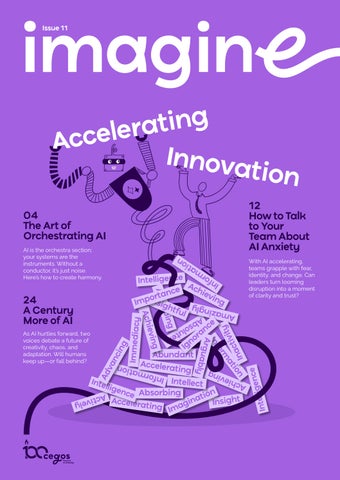
AI is the orchestra section; your systems are the instruments. Without a conductor, it’s just noise. Here’s how to create harmony.

12 How to Talk to Your Team About AI Anxiety
With AI accelerating, teams grapple with fear, identity, and change. Can leaders turn looming disruption into a moment of clarity and trust?
As AI hurtles forward, two voices debate a future of creativity, chaos, and adaptation. Will humans keep up—or fall behind?

Contributors
Publisher Cegos UK
Writers
Jonna Sercombe
Emily Link
Ben Heath
Tim Volans
Rebecca Woods
Simone Sullivan
Reuben Fletcher-Louis
Blair Wagner
Ross Hardy
Anite Cangi
Lara Mohammad
Scarlet Woods
Sahanshil Dangol
Editors
Emily Larson
Scarlet Woods
Design
Daisy Whittle
Illustration
Daisy Whittle
Gaby Bran
Sahanshil Dangol
Printed in the UK by Blissetts Unit 1, Shield Drive, West Cross Industrial Park, Great West Road, Brentford, TW8 9EX
interesting idea to a real part of how we learn, work, and grow. It’s changing the way organisations support development — not by replacing the human element, but by enhancing it.
thing remains clear; technology is at its best when it the recommendations, but it’s the people who bring curiosity, creativity, and connection — and they’re
The interesting thing about this edition is that we look beyond common conventions — from sharing a team perspective in A Century More of AI (p.24), to debating the impossible in Can AI Make Us More Human? (p.34). Our aim is to open up the conversation, moving past the usual narratives to shine a light on the practical and the surprising.
As you read on, I hope you feel encouraged to
all part of shaping what comes next.
Copyright Cegos UK © 2026
All rights reserved. No part of this magazine may be reproduced, in whole or in part, without written permission is made to achieve total accuracy, we cannot be held responsible for any errors or omissions within this magazine.
To work with us please contact: info@cegos.uk or call +44 (0) 2033185753 cegos.uk

Enjoy the read,

Jonna Sercombe CEO Cegos UK &
US

As
At


Is “AI First” the future of work or just another overhyped slogan? Tim Volans makes the case that the real revolution lies in orchestration — intentionally weaving autonomy, governance, and human-centred design into the fabric of organisational strategy.
commune, nestled in some faraway hills, you will undoubtedly have seen countless headlines extolling the virtues of AI. “AI First” or “AI Native” slogans emblazon websites and collateral, but what does — or what should — this newly coined phraseology mean?
It would seem that it can mean anything from the inclusion of AI chatbots to the use of AI-developed, tested, and deployed code, and almost everything in between.
I’ve always been a bit of an AI sceptic. Until, a number of years ago, I sat in on a prompt engineering course led by a veteran trainer in the IT sector. It all became much clearer when
I examined the origin of my initial scepticism. My hesitation wasn’t rooted in a dislike of technology, but rather in a fatigue with “solutionism” — the idea that we can simply sprinkle some silicon-based magic dust over a
In the world of Learning and Development, we see this often. A new platform arrives, everyone buys a licence, and six months later it sits gathering digital dust because nobody
increase in AI implementation expected over
up organisational structures. 1

When we talk about orchestration, we are moving away from the idea of AI as a stand-alone “assistant” and towards AI as a foundational layer of the business ecosystem. If you think of a traditional orchestra, you have various sections: strings, brass, woodwind and percussion. Each is brilliant in its own right, but without a conductor and a score, you simply have a lot of noise.
In a corporate L&D context, your “sections” might include your LMS, your content libraries, your performance data and your communication channels. Orchestration is the art of making these elements communicate with one another through an AI framework to create a seamless experience for the employee.
For instance, an “AI First” approach shouldn’t just mean a learner can ask a bot for a course recommendation. It should mean AI has already analysed the learner’s a bespoke three-minute microlearning module from internal documentation, and scheduled a practice tool and a strategy.
• Contextual Insight: nuances of our organisation’s culture so that AI provides relevant, tone-appropriate support.
• Data Integrity & Sovereignty: Ensuring information is accurate and secure. This is increasingly 2 Human-Centric Design: Recognising where the line between human and AI should be drawn.
There is a pervasive worry that AI orchestration leads to the dehumanisation of the workplace. However, by automating the administrative heavy lifting — the tagging of content, the scheduling, the basic knowledge retrieval — we free up humans to do what they do best: innovate, empathise, and collaborate.
We must, however, be careful not to fall for the ‘easy investment in thought. You cannot orchestrate what you do not understand. If your underlying learning at a larger scale.
The prompt engineering course I attended was a revelation because it reframed AI from a “Google on steroids” into a “reasoning engine.” It shifted the burden
For L&D professionals, this changes our job descriptions. We are no longer just content curators or workshop facilitators; we are becoming architectural
Sources: 1 Salesforce. (2025). HR Leaders to Redeploy a Quarter of Their Available at: https://www.salesforce.com/uk/news/stories/agentic-aiimpact-on-workforce-research/. 2 State of AI in the Enterprise, The Untapped Edge. (2026). Available at: https://www.deloitte.com/content/dam/ assetszone3/us/en/docs/services/consulting/2026/state-of-ai-2026.pdf.
As we look toward the future, the term “AI Native” will likely fade away simply because it will become the default. We don’t call ourselves “Electricity Native” businesses anymore; we just expect the lights to come
The “Art of AI Orchestration” is about preparing for that inevitability. It is about moving past the sceptic-versusevangelist debate and getting down to the practical curiosity and a deep, empathetic understanding of how people actually learn and grow.
For those of us in senior leadership roles, our task is to lead this transition with a steady hand. We must encourage experimentation while maintaining a focus on tangible outcomes. We aren’t just buying software; we are redesigning the way our people interact with knowledge.















Click here your copy and we’ll send you Imagine for free.






Click here your copy and we’ll send you Imagine for free.













Click here your copy and we’ll send you Imagine for free.

Somewhere in this issue, one of the articles was entirely written by AI. No human drafts, no editing passes, no late night coffee — just a machine doing its best impression of us.
Think you know which one it is?
Scan the QR code to place your bets with a chance at winning two free places at our next Leader of the Future programme.