SEP/OCT 2026 • ISSUE 4 • VOL 53
THE MAGAZINE OF CANADIAN ENERGY GEOSCIENTISTS
Reservoir cegageos.ca
CALL FOR 2027 BOARD DIRECTORS 3 POSITIONS AVAILABLE President-Elect, Finance Director-Elect & Publications Director.
SUBMISSION REQUIREMENTS To be eligible for nomination, candidates must be voting members of CEGA (Full, Emeritus, Honorary, Recent Grads) and in good standing with the organization. There are two methods to make a nomination: Complete and submit the Candidate Form to the CEGA Nominations Committee for consideration. Complete and submit the Nomination Form requiring 25 Voting Member signatures. If a candidate receives the necessary signatures, they will stand for election.
DEADLINE TO SUBMIT October 6, 2026.
SUBMISSION CONTACT Emma MacPherson, CEGA Managing Director, emma.macpherson@cegageos.ca.
In This Issue
SEP/OCT 2026
4
From the Editor
6
Your Association: The Early Years
11 Volunteer Spotlight: Jennifer Unterschutz 12 Live-In Fossil 17 Volunteer Spotlight: Catherine Huff 18 Adventures in Borneo
SWEAT THE SUBSURFACE ROAD RACE/ FUN RACE
GUSSOW 2026: CRACKING THE CRETACEOUS CODE
CORE CONFERENCE: NOW ACCEPTING ABSTRACTS
PAGE 9
PAGE 10
PAGE 16
UPCOMING EVENTS & EDUCATION EVENTS INFO PAGE 14&15
EDUCATION INFO PAGE 26&27
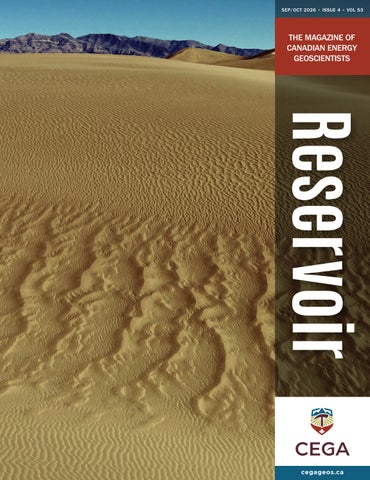
Dune field, California. Ripples have been created on the Mesquite Flats Sand Dunes of Death Valley National Park in the Mojave Desert, west of Las Vegas. Ripples and dunes owe their origins to complex interactions amongst wind patterns, wind velocity, climate, and the nature of the substrate. Consequently, an interpretation of the specific origins of the patterns in this image is not possible, although the extreme temperatures experienced in Death Valley could play a role. As hard as it is to believe, it is thought that at one point during the Pleistocene, the valley was filled with a lake up to 180 m deep. The lack of vegetation testifies to the transitory nature of the present landscape. The sand itself is interpreted to have been sourced from the adjacent Cottonwood Mountains and, although well-sorted, is mineralogically immature, comprising primarily quartz and feldspar. Photograph by: Gerald David Osborn
RESERVOIR ISSUE 4 • SEP/OCT 2026
3
FROM THE EDITOR SARAH SCHULTZ, TECHNICAL EDITOR FOR THE RESERVOIR
WELCOME
TO THE SEPTEMBER/OCTOBER RESERVOIR! This issue’s cover photo, featuring the Mesquite Flats Sand Dunes of Death Valley, sets the tone for an issue about the places geology takes us. We begin looking back. With 2027 marking the 100th anniversary of CEGA, Clint Tippett starts a series on our early years. This entry includes a reprint of Dr. John Allan’s guest editorial from the Alberta Society of Petroleum Geologists’ 1953 News Bulletin. If only we all could look so good in the field! In Adventures in Borneo, Jon Noad recounts his PhD fieldwork in Sabah, where he mapped basins by Lada and longboat and named new fossil crabs after the friends who helped him along the way. In Live‑In Fossil, he finds a seven‑bedroom house in southeast Spain built in the shape of a Miocene scallop. Both are a reminder that curiosity and a good pair of boots are still the heart of what we do. There are many CEGA events to attend this fall. Our technical luncheon series starts back up on September 22, and the Sweat the Subsurface road race kicks off on September 24. I am especially excited for Gussow 2026, to be held in Banff from October 13–15. It includes a full slate of talks and some unique field courses. I hope to see you there!
Sarah Schultz
Technical Editor, Reservoir
PUBLICATION INFORMATION The RESERVOIR is published six times per year by the Canadian Energy Geoscience Association. The purpose of the RESERVOIR is to publicize the Association’s many activities and to promote the geosciences. We look for both technical and non-technical material to publish. The contents of this publication may not be reproduced either in part or in full without the consent of the publisher. No official endorsement or sponsorship by the CEGA is implied
4
RESERVOIR ISSUE 4 • SEP/OCT 2026
for any advertisement, insert, or article that appears in the RESERVOIR unless otherwise noted. All submitted materials are reviewed by the editor. We reserve the right to edit all submissions, including letters to the Editor. Submissions must include your name, address, and membership number (if applicable). The material contained in this publication is intended for informational use only. While reasonable care has been taken, authors and the CEGA make no guarantees that any of the equations, schematics, or
devices discussed will perform as expected or that they will give the desired results. Some information contained herein may be inaccurate or may vary from standard measurements. The CEGA expressly disclaims any and all liability for the acts, omissions, or conduct of any third-party user of information contained in this publication. Under no circumstances shall the CEGA and its officers, directors, employees, and agents be liable for any injury, loss, damage, or expense arising in any manner whatsoever from the acts, omissions, or conduct of any third-party user.
BOARD OF DIRECTORS 2026
PRESIDENT
PAST PRESIDENT
PRESIDENT ELECT
FINANCE DIRECTOR
Christa Williams
Shelley Leggitt
Astrid Arts
David Lipinski
Canadian Discovery Ltd. christa.williams@cegageos.ca LinkedIn
Outwest Energy shelley.leggitt@cegageos.ca LinkedIn
Cenovus Energy astrid.arts@cegageos.ca LinkedIn
AtkinsRealis directorfinance@cegageos.ca LinkedIn
FINANCE DIRECTOR ELECT
CONFERENCES DIRECTOR
OUTREACH DIRECTOR
Thomas Plumridge
Taylor Berezowski
Dilpreet Khehra
MEMBER PROGRAMS DIRECTOR
Freehold Royalties directorfinance@cegageos.ca LinkedIn
Canadian Discovery Ltd. conferences@cegageos.ca LinkedIn
University of Calgary outreach@cegageos.ca LinkedIn
EDUCATION DIRECTOR
PUBLICATIONS DIRECTOR
Rachelle Pinnow
Michael Wamsteeker
GROWTH & ENGAGEMENT DIRECTOR
Cenovus Energy education@cegageos.ca Linkedin
Parex Resources publications@cegageos.ca LinkedIn
Scott MacKnight Whitecap Resources Inc. membershipdirector@cegageos.ca LinkedIn
Gareth Williams Touchstone Exploration Inc. membershipdirector@cegageos.ca LinkedIn
OFFICE CONTACTS
CEGA OFFICE #415, 500 4th Ave SW Calgary Alberta, Canada T2P 2V6 Tel: 403‑264‑5610 | cegageos.ca
MEMBERSHIP INQUIRIES Tel: 403‑264‑5610 Email: membership@cegageos.ca
CONFERENCE INQUIRIES Kristy Casebeer Tel: 403‑513‑1234 Email: kristy.casebeer@cegageos.ca
ADVERTISING INQUIRIES Latoya Graham Tel: 403‑513‑1230 Email: latoya.graham@cegageos.ca
MANAGING DIRECTOR Emma MacPherson Tel: 403‑513‑1235 Email: emma.macpherson@cegageos.ca
RESERVOIR ISSUE 4 • SEP/OCT 2026
5
YOUR ASSOCIATION
The Early Years CLINTON TIPPETT
As we all know, 2027 marks the 100th anniversary of the Alberta Society of Petroleum Geologists/Canadian Society of Petroleum Geologists/Canadian Energy Geoscience Association. We are taking this occasion to write some topical, and hopefully entertaining, articles about our history so we can gain some perspectives on where we’ve come from, where we are now, and where we might be headed.
There are several good sources of historical material already out there. The most significant is the 2002 volume, written by David Finch, titled “Field Notes – The Story of the Canadian Society of Petroleum Geologists”. This was created for the 75th anniversary of the organization and built on an earlier, less formal, unpublished manuscript that David composed for the 50th anniversary of the Society, titled “The History of the ASPG‑CSPG 1927‑1978”. “Field Notes” is certainly the go‑to reference for our first 75 years. A pdf of the book has been loaded onto the CEGA website for easy reference. Closely associated with “Field Notes” was a series of interviews David Finch conducted as a part of his research. Most were with Past Presidents, but a number of other individuals significant to the Society were also interviewed. These records, both the audio recordings and transcripts, are now housed at the Glenbow Western Research Centre at the University of Calgary. The history of our industry is intimately intertwined with the evolution of our organization—and vice versa. Hence, we can learn a lot from examining the people and companies that have shaped our sector of the economy and our organization. One of the central figures in the preservation of Canadian petroleum history was geologist Aubrey Kerr who joined the ASPG in 1945. Beginning in about 1960, Aubrey took it upon himself to research and communicate to others about many individuals and topics in this regard. His works were published as a series of articles in the Journal of Canadian Petroleum Technology (1978–2000) from which a subset were re‑published in his books, The Corridors of Time, The Corridors of Time II, and A Sampling of Searchers. Aubrey served on the executive of the ASPG in 1956 and 1957 and, later in life, contributed another series of historical articles to the CSPG Reservoir (1997–2000). Of course, Aubrey is also well known for his books, Leduc, Atlantic No. 3, Redwater, and others. Many of Aubrey’s interviews are also preserved in the university collection.
6
RESERVOIR ISSUE 4 • SEP/OCT 2026
The ASPG had a slow start, and it wasn’t really until the discovery of Leduc and related fields that the organization took off in terms of membership and activities. In May 1953, in light of this burst of participation, the Society launched the A.S.P.G. News Bulletin, which was, in many ways, the precursor to today’s CEGA Reservoir. Responsibilities were assigned to various volunteers, specifically K.A. Olsen (editor), Diane Loranger (geologic articles), L.E. Workman (exploration desk), and Richard Erickson (business manager). It is of interest to note the prominent role played by Miss Loranger, a paleontologist employed by Imperial Oil. The primary role of the Bulletin was to publish short technical articles, abstracts from presentations, announcements of technical meetings (both for the ASPG and others, like the AAPG and GSA), and reports from the Society’s field activities. It also identified new publications. Two pictures related to the 1953 Field Conference trip to the Crowsnest Pass are included here. Like many publications produced for organizations in those days, the Bulletin also contained a number of non‑technical features, including Society social activities (e.g., dances, curling bonspiels, parties), professional employment and educational moves, as well as birth and death announcements and a smattering of industry advertisements, both geological and geophysical. Lists of new members were prominent features. The July 1953 issue alone listed 87 additions to the Society’s headcount! On a personal note, I recognized quite a few of those names, so I suppose this somewhat dates me! In order to give some additional historical flavour to this article, I have included to the right an editorial written by John Allan for the June 1953 issue of the Bulletin (v. 1, no. 6). Dr. Allan was one of the founding members of the ASPG and served as its Vice President in 1928. He is considered by many to be the “Father of Geology” in Alberta. The “Allan Hammer” was, and still is, the ceremonial symbol of the ASPG/
Summaries of technical articles, particularly those that have been printed in journals less available to many geologists and geophysicists, indicates a topic which might be explored. It would seem that “The Exploration Desk” column offers wide possibilities.
I believe I was probably the first resident geologist in Alberta. Quite true, in the period 1873 to 1910 four “wise” men from the east (Ottawa), Selwyn, Tyrrell, McConnell and Dowling had observed and recorded several important pages on the geology of Alberta, in which there are still many uncut pages. After May 1914, when Turner Valley wet gas field was discovered by bringing in of Dingman No. 1, many geologists arrived, a few to have a “look see” and several to take up residence. In 1928, the geologists working in Alberta, thirty‑five in number, organized the Alberta Society of Petroleum Geologists, affiliated with the international A.A.P.G.
JOHN ALLAN IN THE FIELD
DR. ALLAN WROTE: To be asked to contribute the first guest editorial in your recently organized Alberta Society of Petroleum Geologists News Bulletin is indeed an honour and a pleasure even though it intimates that there is now a pioneer group of geologists in Alberta and that I am one of those early members. A few comments on some of the events leading up to the formation of the A.S.P.G. might be of general interest to some of the members, with apologies for personal references. Fourty‑eight years ago in the last week of May I first set foot in Alberta as a geologist and have lived here since 1912. In fact,
There has been a rapid increase in Alberta in the number of geologists, geophysicists and those in other allied branches of the petroleum industry. Geological and allied data from widespread exploration have been so extensive that some medium would be beneficial to acquaint the geologist with most recent interpretation of data which would be of interest. This News Bulletin under the sponsorship of the A.S.P.G., if in addition to geology, includes other branches in which the membership of the Society is interested, should fill an important gap by supplying to the membership “interesting material not obtainable elsewhere”. The proposed objectives for this organization are commendable, primarily a source of “News”, current geological findings, individual interpretations, abstracts of papers presented before the Society, and various other topics. This News Bulletin should not become mired in the field of technical journalism which seems to be quite adequately covered.
Before the organization of the A.S.P.G. there was little opportunity for geologists to compare notes or swap data. In fact, this trend was “taboo” or even forbidden outside government circles. Geologists working in Alberta were the first to realize that a liberal exchange of results from exploration, and exploration data, particularly stratigraphical, was advisable and helpful to all parties concerned. Through the medium of the Society, by papers and discussions, the more correct interpretations of at least certain geological problems in Alberta become better known to a larger number of geologists. This freer exchange of ideas, through the medium of the Society, has expanded rapidly in the past quarter century. It would seem that the News Bulletin could be a means of promoting closer cooperation between geologists. As a teacher for fourty years, as a part‑time geologist for both federal and provincial governments, and as a private consultant, it has been my experience from long practice, that there is more satisfaction, and better returns from a free discussion of one’s own problems with other geologists. Congratulations to those sponsoring this “News Bulletin”. John A. Allan, Emeritus Professor (Geology), Edmonton, Alberta, May 21, 1953
RESERVOIR ISSUE 4 • SEP/OCT 2026
7
CSPG/CEGA Presidency and resides in the CEGA office. Check it out, if you haven’t seen it. Although technology and industry organization have altered many of the pathways to sharing knowledge, the core message that Dr. Allan conveyed still rings true today. One point deserves further mention: careful readers will have observed that Dr. Allan specifies 1928 as the date when the ASPG was founded. This is not quite true. To quote Field Notes (p. 1): “And so, this informal group created the Alberta Society of Petroleum Geologists (A.S.P.G.) at an organizational meeting in December 1927. …the Society received a charter in early 1928 from the provincial government...”. Clearly the 1928 date was just the paperwork—the true establishment of the ASPG took place in late 1927, apparently in the Empress Cafeteria in downtown Calgary. Our story continues in the next issue of the Reservoir.
The 1953 ASPG Executive on the Third Annual Field Conference – Crowsnest Pass Left to Right: Bill Farmilo (Business Manager), Con Hage (Past President), Barney Clare (Secretary), Harold Parsons (Vice President), Earl Abbott (President), Missing: F. G. Lines (Treasurer) PHOTO BY F. (FLOYD) K. BEACH SOURCE: SEPTEMBER 1953 ISSUE OF ASPG NEWS BULLETIN
BIOGRAPHICAL SNAPSHOT Dr. Clinton Tippett joined the CSPG in 1980. He is a Past President of the Society, having served in that role in 2018. He is currently a member of the Medal of Merit Committee and is technical editor of the Geological Calendar Committee, as well as a SIFT field‑trip leader. He’s had a lifelong interest in the history of the petroleum industry, including that of the CSPG and CEGA. Clint worked closely with David Finch on the production of the 75th anniversary Field Notes volume. To round out his historical involvements, he is also President of the Calgary‑based Petroleum History Society and Chair of the Turner Valley Oilfield Society.
1953 Field Trip Committee and Related Contributors – Third Annual Field Conference – Crowsnest Pass Back Row, Left to Right: Bob Douglas, Ted Link, McCullough, Jim Scott, Rudolph, Digby McLaren Front Row, Left to Right: Workman, Buckland, Bill “Big Chief” Gallup, Eleanor Burton, Cam Sproule, Beazley SOURCE: SEPTEMBER 1953 ISSUE OF ASPG NEWS BULLETIN
8
RESERVOIR ISSUE 4 • SEP/OCT 2026
LAST CHANCE TO REGISTER Registration closes September 17, 2026
SWEAT THE SUBSURFACE ROAD RACE/FUN RUN Thursday, September 24, 2026 Join us for a 5 km or 10 km race or fun run/walk! All registrations include a t-shirt, a chance to win great prizes, and a ticket to the race after party, including food and drink.
SPONSORSHIP OPPORTUNITIES AVAILABLE!
https://cegageos.ca/social-events/
OCTOBER 13-15 | BANFF, AB
CRACKING THE CRETACEOUS CODE In October 2026, geoscientists and industry professionals will gather in the heart of the Canadian Rockies for one of CEGA’s most cherished technical events. Hosted in Banff National Park, the Gussow Conference offers three days of focused, high‑impact technical exchange, set against a backdrop that is as inspiring as it is iconic. This year’s theme, “Cracking the Cretaceous Code: Unlocking the Strata of the Western Canada Sedimentary Basin (WCSB),” reflects both the enduring importance and evolving complexity of Cretaceous‑aged successions. As one of the most dynamic and economically significant intervals in the basin, the Cretaceous continues to drive exploration, development, and innovation across Western Canada.
SESSION 3: Channeling the Past: Decoding Ancient River Systems Fluvial systems are both familiar and notoriously complex. This session dives into the challenges and opportunities of interpreting ancient river deposits, from the prolific McMurray Formation to the Horseshoe Canyon outcrops. With advances in datasets, tools, and conceptual models, geoscientists are continuing to unlock increasingly subtle and heterogeneous reservoirs, demonstrating that these systems still hold significant untapped potential.
SESSION 4: Stratigraphic and Reservoir Insights from the Lower Cretaceous
What sets Gussow apart is its single‑track format. Every attendee participates in the same sessions, fostering a shared experience that encourages deeper discussion, cross‑disciplinary learning, and meaningful collaboration. The 2026 program is designed to deliver both scientific depth and practical relevance, bridging academic insight with real‑world application.
Focusing on active plays, this session connects technical innovation with performance outcomes. Case studies will highlight reservoir characterization, recovery strategies, and production optimization, offering insight into what’s driving success in today’s commodity environment. As development continues across the Lower Cretaceous, understanding the link between geology and value has never been more important.
A PROGRAM BUILT ON INSIGHT AND APPLICATION
SESSION 5: Reevaluating the Upper Cretaceous: Case Studies of the Colorado and Belly River Groups
The 2026 technical program is structured around five sessions, each exploring key aspects of Cretaceous geology across the WCSB.
SESSION 1: Reconstructing the Cretaceous: Basin Development and Regional Context Opening the conference, this session examines the tectonic and paleogeographic evolution of the basin. By taking a basin‑scale perspective, speakers will explore how large‑scale processes influenced accommodation, sediment routing, and stratigraphic architecture. This regional framework provides critical context for understanding local variability and reservoir heterogeneity, setting the stage for the more focused discussions that follow.
SESSION 2: Investigating Cretaceous Coastal and Marginal Marine Systems The Western Interior Seaway left behind a rich and complex record of shoreline and coastal deposition. This session highlights the diversity of marginal marine environments, from deltas and shorefaces to estuaries and beaches. Presentations will draw on both outcrop and subsurface data to explore sedimentology, stratigraphy, ichnology, and depositional models, offering new perspectives on how these systems evolved across the basin.
10 R E S E R V O I R I S S U E 4 • S E P / O C T 2 0 2 6
The final technical session turns to the Upper Cretaceous, with a focus on the Colorado and Belly River Groups. Through detailed case studies, speakers will examine reservoir complexity, risk mitigation strategies, and emerging geoscience techniques aimed at improving production potential. This session emphasizes the importance of re‑evaluating established plays with fresh data and new approaches.
Gussow 2026 offers a uniquely collaborative, single‑track format where every conversation builds on shared insights fostering deeper engagement and meaningful cross‑ disciplinary dialogue. Its location in Banff provides an inspiring setting to connect with peers and step beyond the day‑to‑day. The Gussow Committee looks forward to welcoming you for a technically compelling and memorable event, where the challenge is clear: crack the Cretaceous code and unlock the future of the WCSB.
My CEGA Story: Volunteer Spotlight Jennifer Unterschutz INTRODUCTION Jennifer Unterschutz has been a dedicated member of CEGA’s volunteer community, contributing her technical expertise and a strong commitment to supporting students and early career geoscientists. A recognized technical leader at Imperial Oil, she remains closely connected to the broader geoscience community while actively giving back through CEGA’s initiatives. Now serving in her third year on the Graduate Thesis Awards Committee, Jennifer plays an important role in evaluating and recognizing outstanding student research, helping to highlight excellence across the next generation of geoscientists. Prior to this, she dedicated five years to the Outreach Committee, where she helped create meaningful opportunities for students to engage with the industry and build early professional connections.
This month, we’re proud to spotlight Jennifer and her continued contributions to CEGA! Q&A with Jennifer Q: What inspired you to first get involved with CEGA? A: “After finishing university, I was looking for a meaningful way to give back to the community that had supported me early in my career. As a student, I benefited from CEGA (CSPG) conferences and events. These events were where I first saw the breadth of geoscience careers and began building a professional network. Those experiences made the industry feel welcoming and full of possibility. Joining the Outreach Committee felt like a natural way to keep that momentum going and help create similar opportunities for the next generation of geoscientists.” Q: What does being a CEGA member mean to you, both professionally and personally? A: “Being a CEGA member helps me stay connected to the geoscience community (my people). Through CEGA events and committees, I’ve built lasting professional relationships and genuine friendships. Being involved energizes me and reminds me why I chose geoscience: curiosity, collaboration, and a passion for the history of our planet.” Q: In what ways has CEGA supported or influenced your professional growth? A: “CEGA has been a constant source of learning throughout my career. Every event offers new insights, not just into geology, but into the broader industry, business realities, and career development. Those experiences have helped me grow into a more wellrounded professional and to better understand my role within the broader geoscience and energy community.” Q: What is one fun fact about you that others might not know? A: “I started playing ice hockey when our university geology department decided to form a women’s intramural team. None of us had much experience, but we had an incredible time stepping outside our comfort zones and trying something new together. While we didn’t win any trophies, the friendships lasted, and many of us went on to form a team in Calgary that’s been playing together for over 20 years!”
Thank you, Jennifer, for your continued dedication and leadership within CEGA. We’re grateful for the energy and commitment you bring to the community.
RESERVOIR ISSUE 4 • SEP/OCT 2026
11
Live-In Fossil JON NOAD | STANTEC CONSULTING; UNIVERSITY OF ADELAIDE
Many years ago, while leading a geological field trip, we were driving through the Spanish countryside when we came across a quite astounding construction project. The building was being erected to look like a giant shell, perched atop a hill. We were able to wander through the “empty shell” of the edifice, devoid of straight walls. Something reminded me of it the other day, so I contacted the Carboneras Tourismo offices in Almeria, SE Spain, for more information. Imagine my surprise to find that you can actually OWN it—the building is a hotel and is up for sale.
Aerial views of the Concha de Fazahali
The building is in La Cueva del Pájaro, in Carboneras, and is named Casa Concha de Fazahali. It was built in 1993 by the architect Luis Santos Morueco, who was inspired by one of the many fossilised shells that can be found in this region. The mainly shallow‑marine Miocene deposits surrounding the town yield abundant shells, large clypeasterid sea urchins that look like bowler hats, and fossil fish preserved in radiolarites (sedimentary rocks so light that you can lift boulders and feel a little like Atlas). Other fascinating sedimentary and volcanic rocks include Porifera coral reefs, stacked fluvial deposits, and the tidal Mecanicos (garage) section in Sorbas, where lion and bird footprints, and beds of fossil dragonfly nymphs, are interbedded with classic, tidal herringbone cross‑ stratified sandstones. This section even produced a fossil dolphin, which students (we won’t name the university involved) attempted to smuggle out of the country, before being caught by the local policia. There are also thick gypsum beds deposited during
12 R E S E R V O I R I S S U E 4 • S E P / O C T 2 0 2 6
The sloping, ribbed roof of the building
A Miocene scallop, the inspiration for Casa Concha
Herringbone crossstratification in tidal deposits
Fossil bird footprints from the Mecanicos section in Sorbas
Messinian Gypsum deposits (these are from Cyrenaica in Libya)
El Gordo megabreccia, a mass transport deposit in the Tabernas Basin
the Messinian Salinity Crisis, when the Mediterranean Sea dried up and aeolian dunes carpeted the sea floor. Casa Concha is located 8 km from local beaches and features seven bedrooms, six bathrooms, multiple sitting rooms, and expansive communal areas. Set in the picturesque landscapes of Cabo de Gata Natural Park, this extraordinary property offers panoramic views of the surrounding mountains and valleys. It can be yours for a paltry 698,000 euros (plus taxes) AND guarantees access to some of the world’s most spectacular geology.
REFERENCES https://rarosjardines.blogspot.com/ https://www.youtube.com/watch?v=e0ywqyIYRFk https://www.youtube.com/watch?v=hHiFLP9nTwk
The “Neapolitan Slice,” fault slices named after a cake
RESERVOIR ISSUE 4 • SEP/OCT 2026
13
2026 UPCOMING EVENTS INFORMATION
TECHNICAL TALKS September 9 Wednesday, 12:00 – 1:00 PM
In-Person
International Technical Division Talk
New insights on inherited fault reactivation during Mesozoic development of the Newfoundland and West Iberia (Portugal) conjugate rift margins Location: CEGA Classroom, 500 4 Ave SW, Calgary, AB
September 18 Friday, 7:30 – 9:00 PM
Hybrid
Palaeontology Technical Division Talk
The anatomy, taxonomy, and tooth replacement of a sabre-toothed Cretaceous fish Location: Mount Royal University Room B108 & Online
September 23 Wednesday, 12:00 – 1:00 PM
Online only
Geothermal Technical Division Talk
Urban Direct Heating Geothermal Project Development in Regina, Canada – A Case Study
September 24 Thursday, 12:00 – 1:00 PM
Online only
Canadian Well Logging Society Technical Division Talk Reservoir Quality and CO₂ Mineral Trapping Potential of Subsurface Strata in Metro Vancouver: An Automated Mineralogy Approach
14 R E S E R V O I R I S S U E 4 • S E P / O C T 2 0 2 6
October 1 Thursday, 12:00 – 1:00 PM
Hybrid
Geothermal, International, and Structural Geology Technical Division Talk
A new dimension in fault recognition from seismic – Understanding and Tapping into Flow Location: CEGA Classroom, 500 4 Ave SW, Calgary, AB & Online
October 21 Wednesday, 12:00 – 1:00 PM
In-Person
International Technical Division Talk
Review of Walvis Basin Prospectivity: Similarities and Differences with the Orange Basin, Offshore Namibia Location: CEGA Classroom, 500 4 Ave SW, Calgary, AB
SOCIAL EVENTS September 24
Sweat the Subsurface 5km/10km race – see page 11 for more information Location: Bow River Pathway
2026 UPCOMING EVENTS INFORMATION
TECHNICAL LUNCHEONS Season Tickets Available until September 18 One ticket, seven luncheons at a discounted price Tables or individual tickets available. See the full lineup on our website
September 22 Tuesday, 11:30 AM – 1:00 PM
In-Person
November 24 Tuesday, 11:30 AM – 1:00 PM
In-Person
The Duvernay, from Outcrop to Subsurface: Translating Complex Stratigraphic Models into Predictable, Simple Patterns for Reservoir Quality Evaluation
Open-Hole Multilaterals for Waterflooding the Clearwater Formation in Central Alberta – History, Performance, Challenges and Outlook
Speaker: Henry Galvis, Spartan Delta Corp.
Speaker: Dr. Bruce Carey
Location: Calgary Petroleum Club, Devonian Room 319 5 Ave SW, Calgary, AB T2P 0L5
October 20 Tuesday, 11:30 AM – 1:00 PM
Held in collaboration with SPE Calgary Chapter Location: Calgary Petroleum Club, Devonian Room 319 5 Ave SW, Calgary, AB T2P 0L5
In-Person
Sedimentary Facies and Sequence Stratigraphy of the Lower Cretaceous Dina and Cummings, Alberta, Canada Speaker: Scott Botterill, Alberta Energy Regulator Location: Calgary Petroleum Club, Devonian Room 319 5 Ave SW, Calgary, AB T2P 0L5
VISIT UPCOMING EVENTS
RESERVOIR ISSUE 4 • SEP/OCT 2026
15
CORE E CONFERENCE 2027: NOW ACCEPTING ABSTRACTS The Core Conference nce 2027 Committee is excited to announce that the call for abstracts acts is officially off f icially open! Click to learn more or visit ff our website below.
WWW.CORECONFERENCE.CA
16 R E S E R V O I R I S S U E 4 • S E P / O C T 2 0 2 6
My CEGA Story: Volunteer Spotlight Catherine Huff INTRODUCTION For the past several years, Catherine Huff has served as Chair of CEGA’s Technical Division in Structural Geology, where she organizes engaging technical speakers and moderates the division’s presentations. Over the years, she has also contributed to CEGA in a variety of volunteer roles, including serving on the SIFT Committee, participating in the Graduate Thesis Awards and Regional Graduate Scholarship selection committee, and volunteering as a visiting lecturer. Through her leadership and dedication, Catherine has helped create valuable learning, networking, and mentorship opportunities for CEGA members. We’re grateful for the time and enthusiasm she brings to the association and are pleased to highlight her volunteer journey.
This month, we’re proud to spotlight Catherine Huff and learn more about what keeps her engaged year after year! Q&A with Catherine Q: What inspired you to first get involved with CEGA? A: “Volunteering with CEGA provided a way for me to reintegrate into the Canadian market after international opportunities and an expatriate assignment in Southeast Asia took me out of the country for an extended period. It was a great way to reconnect with the industry and build professional relationships.” Q: What does being a CEGA member mean to you, both professionally and personally? A: “Careers in natural resources can be a wild ride, and CEGA has provided continuity and connection throughout my career. Geopolitics, the industry, and companies are forever changing, and CEGA has offered consistency and a network of great people with shared interests and goals. I’m especially grateful for the opportunity to build relationships with my peers and for the friendships I’ve made along the way.” Q: In what ways has CEGA supported or influenced your professional growth? A: “CEGA has expanded my professional horizons by introducing me to topics I hadn’t previously considered. I especially enjoy the lunchtime technical division talks and Core Conference. Serving on the CEGA Thesis Awards Committee has also been an excellent way to find out what’s fresh in university research projects. Networking and attending CEGA events keep me engaged, current, and connected within the industry.” Q: What is one fun fact about you that others might not know? A: “My curiosity for geology was sparked while I was working on an archaeological dig. Interest in stratigraphic principles led to me taking some classes in geology and opened a whole new world for me!”
Thank you, Catherine, for your continued dedication and leadership within CEGA. We’re grateful for the energy and commitment you bring to the community.
RESERVOIR ISSUE 4 • SEP/OCT 2026
17
Adventures in Borneo Jon Noad | Stantec Consulting; University of Adelaide
INTRODUCTION Life is full of twists and turns. After completing a Masters in Sedimentology, with my thesis focused on Dinosaur Provincial Park in Alberta, I was lucky enough to be offered a PhD project. One mention of the location… “Borneo!”… and I was hooked. Another student had worked on the mélanges of eastern Sabah, in eastern Borneo, and reported that highway improvements had opened up new, promising outcrops. We put together a project focused on a series of circular basins crossing the eastern Sabah peninsula and I prepared for my first field season. Prising a research permit out of a senior government official in the Malaysian embassy was probably my biggest challenge. I arrived in Kota Kinabalu, Sabah’s capital, and headed to the Geological Survey. I explained my plans to the geologists, who immediately asked how I would access the basins. Apparently, it would involve a $10,000 helicopter ride, or a two‑and‑a‑half‑week walk into the Maliau Basin. I rapidly revised my plans to focus on three, more accessible, Miocene basins further north and east that I knew only from maps (Fig. 1). Fortunately, I had valuable help from my “local collaborator,” Felix Tongkhul, a professor at the local university. Two days later I was driving his Lada cross country to start my fieldwork, passing Mount Kinabalu (Fig. 2) en route to the coast. At one point I had to stop the vehicle to allow an enormous snake to slither across the road—both its head and tail were hidden in undergrowth on either side of the road.
SANDAKAN This wonderful little town, formerly the capital of Sabah, holds so many memories. I turned up and booked into a very inexpensive “hotel” and then spent a few days reconnoitring before starting to log sections. The city is home to Sepilok, a sanctuary for orphaned orangutans (Fig. 3). It was located within my field area (as was about a third of eastern Sabah!), so I was allowed to access it at will. Clad in shorts and a light shirt, I passed Asian tourists in full jungle survival gear—no leach would get in there! Another “highlight” was Batu Sapi (Fig. 4), a rock with three supports that was supposed to look like a cow (“sapi” in Malay). It was a cemented sandstone, and I took a boat out to map it, nervously having to surrender my passport. There was also a crocodile farm and boat trips to the turtle islands, as well as seafood restaurants to die for, with the living animals in baskets dangling in the sea. But the geology was my highlight. My early forays found fossil mangrove lobsters (Fig. 5), associated with root systems (Fig. 6) and interbedded tidal deposits. These passed laterally into thick, upper shoreface coastal sands (Fig. 7). The offshore equivalent had enormous gutter casts (Fig. 8), created by offshore‑directed storm currents, five times the size of any previously recorded. Finally, there were offshore mudstones replete with fossil crabs (Fig. 9). One outcrop yielded over 25 species of crab, many new to science, and another 30
2
FIGURE
18 R E S E R V O I R I S S U E 4 • S E P / O C T 2 0 2 6
1
Sketch map of the geology of eastern Sabah
FIGURE
FIGURE
FIGURE
2
4
6
The summit of Mount Kinabalu at 4095 metres
FIGURE
3
FIGURE
5
Orangutan in the Sepilok Orangutan Rehabilitation Centre, Sandakan (from Becky Exploring website)
Batu Sapi (Cow Rock) on the coast of southern Sandakan
Fossil tree in Miocene mangrove deposits exposed near the police station, Sandakan
Thalassina anomala, a Miocene mangrove lobster found at Bird Quarry, Sandakan
FIGURE
7
Striking shoreface sandstone cliffs on Palau Berhala (Idols Island) near Sandakan
invertebrates, including a new fossil argonaut (octopus egg case). I was later able to name some of the crabs after people who had helped me during my studies. Eventually I logged 145 sections (Fig. 10), with a cumulative length of more than 5 km, and collected more than 200 species of fossils (excluding the many microfossils). The highlight was Miocene tapak burong—fossil bird footprints (Fig. 11) cemented to the base of an ironstone crust, separating (mangrove) channel deposits from mudstone beds. There were also deer and mangrove lobster tracks, as well as several gastropod species indicative of mangroves. All this and numerous
FIGURE
9
FIGURE
8
Gigantic gutter casts exposed in Sandakan
rooted, buttressed mangrove trees, many preserved on a flat mudstone area outside the local police station where (luckily) migrants are too scared to build. The study of fossil mangroves became a pillar of my thesis. Another stunning outcrop was exposed on a new housing estate at Taman Inda (Fig. 12). The section was 150 m long and 50 m thick, shallowing‑up from offshore mudstone, through gutter cast channels, and capped by stacked upper shoreface sandstone beds. The upper surfaces were beautifully wave rippled (Fig. 13). I measured hundreds of palaeocurrent readings across the basin and used the data to reconstruct
A selection of Miocene fossil crabs preserved in offshore, cemented storm deposits
20 R E S E R V O I R I S S U E 4 • S E P / O C T 2 0 2 6
FIGURE
FIGURE
11
12
Summary map of geology and logged sections on the Sandakan Peninsula
Fossil bird footprints from Sandakan
FIGURE
FIGURE
10
13
Cemented wave rippled sandstone showing interference patterns
Shallowing upward stratigraphy exposed at Taman Inda, Sandakan
RESERVOIR ISSUE 4 • SEP/OCT 2026
21
FIGURE
14
Palaeogeographic reconstruction of the Sandakan Formation, showing the depositional facies belts identified from field logging. An interpretation of the current pattern (‘sediment flux’) has been added, using palaeocurrent data collected from outcrop
the palaeogeography (Fig. 14). A previous report from 1951 estimated the formation thickness at 1200 m, but unraveling the structural geology identified multiple repeated sections and reduced the overall thickness to less than 300 m. At some point I needed to visit the city offices of oil palm plantations, to where I would be moving once my work in Sandakan was complete. It ALWAYS seems to be 35 degrees and 100% humidity in Borneo, so I took a change of shirt and pants and dart into a bathroom to change before entering the offices so I didn’t look too hot and bothered. The Trushidup plantation owners became close friends. They were Chinese Malays: Charles, who drove a Jaguar, was the accountant, as well as commodore of the yacht club. I used to tease him that he was more British than me! His brother, Bart, was a botanist, while the third brother, Peter, was the engineer (and a mean golfer). They often took the local police officers, responsible for monitoring immigrants, out to karaoke bars, and I would get invited along for “colour.” We also went crabbing in the modern mangroves, catching crustaceans the size of dinner plates. One day they took me out to Palau Berhala (Fig. 15), a local island with sandstone cliffs more than 100 m high. More importantly, an outcrop exposed the basal contact of the sandstones overlying volcanic tuffs, marking the base of the basinal deposits. Another time I had to ask a logging magnate if I could access his property to log a coal seam. He offered me a very large glass of wine (wine is vanishingly rare in Sabah). which turned out to be pure brandy.
22 R E S E R V O I R I S S U E 4 • S E P / O C T 2 0 2 6
FIGURE
15
Aerial view of Palau Berhala
TANJONG FORMATION
FIGURE
I then headed south to the Bukit Garam (“salt hill”) Basin (Fig. 1). Access was along a north‑ south road cut through the rainforest that had sadly opened up the whole region to logging, much of it illegal. The basin was filled with the Tanjong Formation, with deltaic lobes and thin turbidites. I was thrilled to find the odd, hexagonal trace fossil Paleodictyon (Fig. 16), as well as a variety of meandriform burrows indicating relatively deep‑water deposits. Over the course of a week, I logged a 13 km long, continuous sedimentological section along trenches dug for plantation drainage. I spent several weeks living on the oil palm plantations. While saddened by the degradation of the landscape, the development opened up new outcrops. I slept on a plastic mattress and watched the rats briskly crossing the rafters above me. Every night an elderly Indonesian gentleman, Murah, the security guard, would wake me and we would head out on his tractor to patrol for poachers, sharing the odd kretek (cinnamon) cigarette. He spoke no English, and my Malay was pretty pathetic, so we mostly nodded at each other. We saw some amazing wildlife, including many nocturnal mammals, often given away by their red eyes reflecting Murah’s torchlight.
Paleodictyon, a deep water trace fossil from the Tanjong Formation, Trushidup Plantation
FIGURE
17
Large amber clast from the Trushidup Plantation
Probably my geological highlight was the fossil amber, occurring in clasts the size of a grapefruit (Fig. 17). I sent samples back to the Natural History Museum in London to be analyzed and received word in a phone message (no emails or cell phones in those days) that they contained fossil insects, including millipedes, ants, thrips, and fossil wasps (Fig. 18). There was also a magnificent exposure through a small submarine canyon (Fig. 19), complete with lateral‑accretion surfaces, suggesting meandering flow at depth. During this phase of fieldwork, one of my most exciting adventures was taking a small boat up Sabah’s largest river, the Kinabatangan. I was accompanied by Allagu, a friendly, local geologist from the Geological Survey. We travelled upstream for six days, finding the odd outcrop and spying wildlife, including large freshwater crocodiles. We finally arrived at a small village. Allagu told me I was only the second Orang Putih (white man) to ever come this far. The previous visitor was an Australian girl, 14 years earlier. After her visit, the villagers built a long house to support their burgeoning tourist industry, and by the time I arrived, the long house had completely collapsed. The villagers were certainly excited to have a guest and brought an endless succession of things to show me, everything from soft‑shelled turtles to glass bottles dating back decades.
16
FIGURE
18
Parasitic wasp in Miocene amber
FIGURE
19
Small submarine canyon, Trushidup Plantation
RESERVOIR ISSUE 4 • SEP/OCT 2026
23
FIGURE
20
Quarry exposing Oligocene Gomantong limestone near Sukau
FIGURE
21
Guano pile exposed in Gomantong Caves
SUKAU AND AN ATTENBOROUGH MOMENT This remote village, located to the east of the Bukit Garam basin, is famous for its wildlife, including proboscis monkeys, orangutans, and two herds of pygmy elephants. These are the descendants of herds of Indian elephants, presented to a former Sultan of Brunei, that escaped and made their way to the Sukau area. There are also wild boars, one of the only animals to eat oil palm fruiting bodies. The oils in the fruit make their hearts very fatty, so they can only run a short distance before pulling up, panting. Another animal that eats the fruits is a record holder, the massive Siamese Rhinoceros Beetle, considered the strongest animal compared to its body weight. This area features outcrops of the Oligocene Sukau Limestone (Fig. 20), rich in corals, giant foraminifera, and bryozoans. The limestone is mined for road metal, opening up excellent outcrops. There are also several caves, including the Gomantong Caves, where the nests of cave swifts are harvested for soup, and Agop Batu Tulug Caves in Batu Putih, a hugely important archaeological site containing ancient wooden coffins. The Gomantong Caves, made famous when David Attenborough waded through guano in Planet Earth, host huge piles of guano (Fig. 21) carpeted in cockroaches and freshwater crabs, as well as bat colonies that exit the caves at nightfall. I logged several sedimentary sections through the caves, knee‑deep in guano, hammering the limestone and getting sprayed by bird poop in the process. A lovely caveat to this section: I collected hundreds of fossils from the limestone quarries, including more than 20 species of coral; many bivalves and gastropods; foraminifera; and other fossils including vertebrates. I also brought back numerous samples for thin sectioning (Fig. 22). The fossils went to the Natural History Museum in London, which later used them to win a €5 MM grant for Malaysian doctoral students to study them. Years after, I was lucky enough to meet some of the students while on a trip to London.
LAHAD DATU The last basin in our survey is on the Dent Peninsula. Outcrops of the Ganduman Formation include thick fluvial deposits, with rooted trees, and highly fossiliferous, shallow‑marine mudstones. Yet it is the tidal deposits that catch the eye: a series of stacked, tidal channels outcrop in a road cut (Fig. 23), filling an incised valley more than 200 m wide and 50 m deep. Many of the channels are filled with tidal rhythmites. The trace fossils are gigantic; probably, the large organism size prevented them from being washed away by strong tidal currents. Another tidally influenced deposit shows perfect tidal bundles, the elements deposited twice daily over a complete tidal cycle.
FIGURE
22
Large foraminifera in thin section from the Gomantong limestone
FIGURE
24 R E S E R V O I R I S S U E 4 • S E P / O C T 2 0 2 6
23
Huge Miocene incised valley filled with tidal channel deposits
ASSEMBLING THE BASINS Looking at the overall structural configuration of eastern Sabah, my interpretation is that the subcircular basins originally formed a single, contiguous basin (Fig. 24). Later far‑field tectonics, related to collision along the northern Borneo margin, led to partitioning of the basin into remnants that were bounded by perpendicular faults. This is supported by measurements of individual faults across Sabah and seems more likely than another proposed model, in which the basins were created by a series of meteor impacts, although that would have been pretty cool! The Kutai Basin in onshore Kalimantan has a very similar structural character, with the development of box folds driven by inversion, later planed off by erosion. FIGURE
24
Palaeo‑reconstruction of eastern Sabah 16 million years ago
CONCLUSIONS I have had to skip over climbing Mount Kinabalu (twice). I had several snake sightings, including a green tree snake (it was green and in a tree; Fig. 25). There was the time my vehicle was filled with the wrong fuel, requiring draining the tank; the time local migrants stole my wallet, one of whom was caught with my wife’s photo in his pocket; and the time I had to dive for cover as a massive swarm of bees flew over, brushing my back. I remember saying no to overly friendly folk while making my way home from the bar; playing football with the local lads on the outcrop (Fig. 26); and receiving a bunch of rambutans (lichees) from a couple as an apology after being bitten by their dog, which required a rabies jab. I haven’t had time to mention the tiny village of Telupid, located to the northeast of my field area, and home to extensive serpentinites. It also hosted a tiny Miocene basin requiring logging of some poorly exposed outcrops. The vegetation grows so quickly that almost any outcrop will be grown over within a few months. There were two flying ant infestations while I was there—suddenly the street food looked a lot less appetizing. One evening I was chatting to some locals about tourism: they have a river, so I suggested that rafting might be an option. However, they were much more excited about the “Crying Tree”: four to five days after a particularly heavy rainfall, the branches suddenly droop, releasing hundreds of litres of rainwater. Surely this would attract customers? There are a hundred stories waiting to be told, but I recommend that you make your own stories on a visit to Sabah. Far away from the red tape and politics of Kuala Lumpur, filled with lovely, vibrant and friendly people, and with some of the best wildlife viewing in the world, Sabah is a place to treasure. And if you get bored of all that, there are always some spectacular (though temporary) rock exposures to delight you.
FIGURE
25
Green tree snake
FIGURE
26
Young Sabahans waiting for me to play soccer
RESERVOIR ISSUE 4 • SEP/OCT 2026
25
UPCO MIING UPCOMING G EDUC AT TION N EDUCATION LOWER TRIASSIC AT EVAN V N THOM VA THOMAS MAS CREEK— CREEK—GO K GO TA K— T TAKE KE A HIKE TOGE TOGETHER! ETHER! Field Trip
Saturday, September 12, 2026 26 9:00 AM – 3:00 PM Leader: Simon Poirier Location: Evan Thomas Creekk Trailhead Online registration closes: September eptember 10, 2026
AVY VY OIL OPTIMIZING PRODUCTION TION FROM M HEAVY HEAV AV OIL RESERVOIRS R USING GEOCHEMISTRY GEOCHEMIISTRY Short Course
Thursday, October 1, 2026 8:30 AM – 4:30 PM Instructors: Martin Fowler & Barry Bennettt Location: Calgary Petroleum Club Online registration: September ber 24, 2026
PETROPHYSICS ESSENTIALS: NTIALS: FUNDAMENTALS FUNDAMENTA TALS TA S TO APPLICAT APPLICATION A ATION Short Course
Thursday, October 1 to Friday, y, October 2, 2026 8:30 AM – 4:30 PM Instructors: Reigh MacPherson, on, MacPherson MacPhers r on Energy Consulting; rs Con nsullting; Jeff Dickson, Strathcona Resources Ltd.; Feliz eliz Todea, Strathcona Resources Reso ources Location: Calgary Petroleum Club Online registration closes: September 24, 2026
CARBONATE DEPOSITIONAL SYSTEMS Short Course
Friday, October 30, 2026 8:30 AM – 4:30 PM t ; Rob Instructors: Jean Hsieh, Sedimentary Geology Consultants; ts R Forkner, Think Onward Location: Calgary Petroleum Club Online registration closes: October 23, 2026
26 R E S E R V O I R I S S U E 4 • S E P / O C T 2 0 2 6
UPCO UPCOMING O MING G EDUC C ATION N EDUCATION GEOLOGY FOR ENGINEERS GINE EE ERS AND TECHNOLOGISTS Short Course
Tuesday, November 17 to o Friday, Fridaay, November 20, 2026 8:30 AM – 4:30 PM Instructors: Thomas F. Moslo Moslow; ow; Jean-Yves Chatellier Location: Calgary Petroleum eum Club Online registration closes: es: November Novvember 10, 2026
INTEGRATED STRATIGRAPHY TIGR RA APHY AND RESERVOIR R ARCHITECTURE OF THE ATHABASCA OIL SANDS AND DS S Short Course
Thursday, November 19 to Friday, Frriday, November 20, 2026 8:30 AM – 4:30 PM Instructor: Cynthia Hagstrom, trom, Nova Nova Geoscience Location: AER Core Research arch Centre Ceentre Online registration closes: es: October Octo ober 29, 2026
GEOLOGY FOR NON-GEOLOGISTS N-GE EO OLOGISTS Short Course
Wednesday, November 25, 25 2026 2 26 202 8:30 AM – 4:30 PM W Instructor: Michael Webb, We Webb bb Geoconsulting Location: Calgary Petroleum Club Online registration closes: November 18, 2026
RESERVOIR ISSUE 4 • SEP/OCT 2026
27
W W W . C E G A G E O S . C A
JOIN J OIN
TODAY T TO ODA D Y DA about us s
our mis mission iis ssion ss
Dedicated to supporting its members since 1927, CEGA continuously offers new opportunities to enhance their skills and enrich their experiences, from events to publications to receiving grants to awards and much more.
The Mission of the Society is to advance the professions of the energy geosciences - as it applies to geology; foster the scientific, technical learning and professional development of its members; and promote the awareness of the profession to industry and the public.
COMMUNITY CONNECTION
PROFESSIONAL DEVELOPMENT
Learn new skills and expand your professional
Further your education and receive CPD credits
network by volunteering with any of CEGA’s
with our technical offerings - technical luncheons,
programs.
division talks, short courses, field seminars, and more!
EXCLUSIVE RESOURCES Advance your te technical echnical knowledge through peer-
NETWORKING OPPORTUNITIES Meet members of the industry through our social
reviewed paperss in the Bulletin of Canadian Energy
events. Several networking events are held throughout
Geoscience and articles in the digital Reservoir
the year, as well as our annual sporting events - Mixed
magazine.
Golf, Road Race, and squash q tournament.
415 - 5 500, 00, 4th Ave SW, Calgary, AB, T2P 0J8 Phone : 403-234-5610 4 | Web : www.cegageos.ca | Email : membership@cegageos.ca
28 R E S E R V O I R I S S U E 4 • S E P / O C T 2 0 2 6