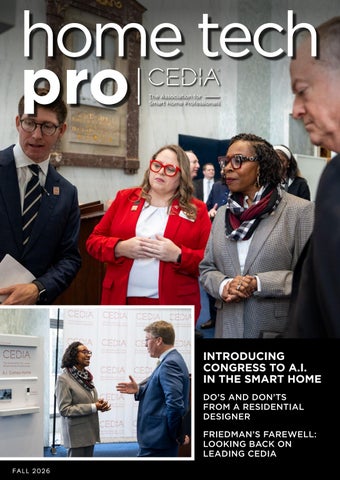
INTRODUCING CONGRESS TO A.I. IN THE SMART HOME DO’S AND DON’TS FROM A RESIDENTIAL DESIGNER FRIEDMAN’S FAREWELL: LOOKING BACK ON LEADING CEDIA FALL 2026
Home Theater Projectors
Booth #3511
Chosen By Enthusiasts Exclusive D-ILA Technology. Stunning Realism. Unmatched Detail.
4K
8K
True Resolution
e-shiftX
N at i ve 4 K P ro j e c t i o n
Ad va n c e d 8 K e - s h i ft X Te c h n o l o g y
Tr u e 4 K re s o l u t i o n w i t h exc e pt i o n a l c l a r i t y a n d re a l i s m .
E n h a n c e s s h a r p n e s s a n d d e pt h fo r a n eve n m o re i m m e r s i ve ex p e r i e n c e .
HDR
35M+
Frame Adapt
Pixels
Fra m e Ad a pt H D R w i t h Au t o To n e M a p p i n g
O ve r 3 5 M i l l i o n P i xe l s
O pt i m i ze s e a c h s c e n e fo r exc e pt i o n a l H D R i m a g e s t h at a re b r i g ht e r, m o re c o l o r fu l a n d h ave a w i d e r d y n a m i c ra n g e .
E x p e r i e n c e u n p a ra l l e l e d d et a i l a n d t h e h i g h e st N at i ve C o nt ra st .
✓BLU-Escent Laser
✓Filmmaker Mode
✓All-Glass Motorized Lens
✓Out-of-the-Box Accuracy
✓Professional-Grade Performance
✓Auto Low-Latency Mode
Explore All Available Features on the JVC Projector Website https://www.jvc.com/usa/projectors/
JVCProjectors@us.jvckenwood.com
CONTENTS
22
09
16
CEDIA ADVOCACY
DO’S AND DON’TS FROM A RESIDENTIAL DESIGNER
FRIEDMAN’S FAREWELL
Elizabeth P. Lord-Levitt provides advice to integrators
Looking back on Daryl’s time leading CEDIA
An update on global advocacy work, including a new AI demonstration on Capitol Hill
06 10 12 20
I AM CEDIA Donny Carlyon discusses his reasons for joining CEDIA
INTEGRATION FOR GOOD How GivingBack.tech is turning surplus technology into social impact
CEDIA SMART HOME AWARDS Beyond what you see
INTEGRATOR OF 2027 We predicted this, here is the proof
26
STEERING MY BUSINESS SUCCESS With CEDIA’s business education and toolkit
28
DESIGNING FOR THE NEURODIVERSE Reframing technology from novelty to necessity
32
FROM HOMES TO MAIN STREET Epitome Living discusses scaling from residential to light commercial
38
BEYOND AESTHETICS How light, sound, and scent shape the experience of home
home tech pro
1
THANK YOU FOR MAKING OUR LIVES BETTER Welcome to this edition of Home Tech Pro, timed to coincide with CEDIA Expo.
CONTACT
8475 Nightfall Lane Fishers, Indiana 46037 USA Email: info@cedia.org Telephone: +1 800-669-5329 Unit 2, Phoenix Park St Neots Cambridgeshire, PE19 8EP, UK Email: info@cedia.org Telephone: +44 (0)1480 213744
FRONT COVER (l-r) CEDIA Immediate Past Chairperson and CEO of Josh.ai Alex Capecelatro and CEDIA Chairperson and Owner of TruMedia Amanda Wildman share the “A.I. Comes Home” demonstration with U.S. Representatives Yvette D. Clarke (NY-09) and Mark Messmer (R-IN) during CEDIA Day on Capitol Hill 2026. Inset: Clarke with James A. Mayo, Executive Director Indirect Sales and Distribution, Samsung. Photos by Aileen Taylor Photo.
COPYRIGHT
All material in Home Tech Pro is the copyright of CEDIA and any reproduction of said material would require written permission from the association. Although every effort is made to ensure the accuracy of published content, CEDIA cannot accept responsibility for any factual errors that may occur or for the veracity of claims made by contributors.
Every year, this specific issue brings with it a unique surge of energy as the trade show that bears our name is in final planning. It represents the culmination of months of hard work, anticipation, and innovation across our entire industry. The show floor will soon be humming with the latest advancements in home automation. For me, however, this particular Expo carries an even deeper, more personal significance. This will be my final CEDIA Expo serving as your Global President and CEO, and this is the last welcome message I will write for these pages ahead of my retirement next year. When I joined CEDIA, I knew I was stepping into a world of brilliant technologists and dedicated professionals. What I didn’t fully realize then was just how profoundly this community values connection, collaboration, and the shared vision of what “home” can be. Together, we have navigated an era of incredible growth, expanding the design and build community, while always keeping our core mission – supporting the professional integrator – at the center of everything we do. CEDIA Expo has always been the heartbeat of our community. It is the place where the abstract future of residential technology becomes a tangible, living reality. As I walk the floor this week, I will be looking back with immense gratitude for the milestones we’ve achieved together, but more importantly, I will be looking forward. The talent, passion, and ingenuity in this industry ensure that CEDIA’s brightest chapters are still to be written. I’ll always remain a fan of what you do, and look forward to many more years of walking the Expo floor as a civilian. Thank you for your partnership, your dedication, and for welcoming me so warmly into this extraordinary community. And most of all, thank you for doing the important work of making people happy in their homes. I look forward to celebrating with many of you in person at CEDIA Expo. Let’s make this Expo one to remember. Warm regards, Daryl Friedman CEDIA Global President & CEO
CEDIA: T H E A S S O C I AT I O N FOR SMART HOME PROFESSIONALS™ 2
home tech pro
FIND US ON:
WHERE CUSTOM INTEGRATORS Where custom ACHIEVE MORE. integrators achieve more.
We’re more than a group, we’re a community. Strategic programs with elite vendor partners
“Before joining, I was hesitant about whether the membership cost would deliver enough value. That concern disappeared quickly. With-
Powerful peer-to-peer networking & invite-only events Robust education, tailored for integrators Expansive distribution network
in two or three months, we were seeing meaningful benefits through vendor programs, shared knowledge, industry relationships, and direct support available to us. After joining Oasys, we doubled our gross revenue three consecutive years in a row. Most recently, we had the best year in our nearly 14-year company history. We simply would
Business & financial services to enhance operations Proprietary website and marketing tools
not have achieved that level of growth without the Oasys team, our fellow members, and the outstanding vendor partners and programs the group has brought into our business.” Tom Bradford,
The Boulder Home Theater Company
Ready to achieve more? Visit oasysgroup.org.
NEWS IN BRIEF CEDIA APP FEATURES FIRST INDUSTRY CALENDAR AND MORE Earlier this year, CEDIA launched the first-ever smart home industry events calendar, available exclusively on the CEDIA Membership App. In addition to CEDIA-hosted events, the calendar features upcoming trade shows, education opportunities, networking events, and more across the global smart home industry. The app is free to download, and access to the calendar is available to all users. CEDIA members can also enjoy members-only content, including: •
Personalized Profile: Create a detailed profile highlighting industry expertise, areas of interest, CEDIA certifications, and general location, making it easy for peers to discover and connect.
•
Portfolio Sharing: Showcase professional achievements by uploading images, videos, documents, and URLs to highlight standout projects and milestones.
•
Live Feed: Share updates and project insights while engaging with posts from fellow professionals in a familiar, social-style feed.
•
Member Directory: Network smarter with access to a searchable directory of CEDIA professionals, viewable by list or map for both local and global connections.
•
Forums: Take part in in-depth discussions organized by theme, share knowledge, and seek advice in a dedicated members-only environment.
•
Portal: Find your next smart home industry career opportunity or star. Search for open roles or post an open position available at your company.
LISTENING ACROSS EUROPE In April, CEDIA President & CEO Daryl Friedman, CEDIA EMEA Managing Director, Matt Nimmons and CEDIA EMEA Senior Manager Business Development, Steven Carter traveled through Belgium, France, Spain, and Germany for a series of listening tours focused on strengthening relationships with members and gaining firsthand insight into the needs of each local market. The first stop was Belgium where host Koen Pepermans from Niko provided a sneak preview of their new brand
Download the CEDIA Membership App now in the App Store or Google Play Store.
MOTIV. Chris Verbinnen also organized visits across Benelux to see the B&G Domotica and ELUXO BV showrooms. The next stop was in Paris with hosts Søren Winther and the team at L-Acoustics. The group was highly engaged, and CEDIA even welcomed new member, MyCiné Créateur de Home-Cinéma. The roadshow continued to Madrid, hosted by STARS AV and organized by Patrick B. Kahr, followed by a site visit at Smart Business with Sergio Rojas Participants represented many of Spain’s leading integration businesses and contributed to a thoughtful discussion about the opportunities and challenges facing the market. The final stop in Frankfurt featured demonstrations from Samsung showcasing technology for hospitality, corporate, retail, healthcare, and education environments, including an interactive classroom solution that enables teachers to manage students’ tablets. Thank you to all of the hosts, organizers, and attendees who made these conversations possible. The insights shared throughout the tour are helping shape CEDIA’s business plan for Europe and ensuring the association delivers even greater value to members across the region.
4
home tech pro
N E WS I N B RI EF
CEDIA LAUNCHES IN-HOUSE RESEARCH DIVISION In May, CEDIA announced the launch of its first in-house research division and the hiring of Ryan Bardach, who will lead the new arm of the business. As Director of Research, Bardach will establish CEDIA as the trusted source of market intelligence for the professional smart home channel. He will also be responsible for increasing the value and utility of CEDIA research for members and other key audiences such as adjacent industries and media. Bardach brings extensive experience in the market research industry. He has worked with a diverse range of clients, including private equity firms, B2C and B2B retail organizations, and companies in the energy and utilities sector. His expertise spans both quantitative and qualitative methodologies, with a focus on market assessments, voice-of-customer research, brand sentiment analysis, employee engagement, and longterm tracking studies. His professional background is equally diverse, with experience in the military, telecommunications, and operations management. He holds a Bachelor of Arts in psychology and history from Indiana University, as well as a market research certification from the University of Georgia. “CEDIA has always been a trusted voice for the industry, and this new research division allows us to take that even further,” said CEDIA Global President and CEO, Daryl Friedman. “By investing in our own data and insights, we’re equipping integrators and trade suppliers with the knowledge they need to stay competitive and make informed business decisions.”
LATEST WHITE PAPERS EXPLORE HUMAN-CENTRIC LIGHTING CEDIA white papers take a deep dive into applications, recommendations, and advice on a wide range of industry topics: from software and hardware to best practices, standards, and formats. The white papers are heavily researched and crafted thoroughly by industry experts to break complex subjects down for professionals. Recently, CEDIA introduced three new white papers discussing Human-Centric Lighting, each focusing on a different topic, including why we need it, artificial light, and design. These white papers were written by technical writer and educator, David Meyer and were reviewed by lighting designer, Andy Bull and CEDIA Director of Technical Education Programs, Ken Erdmann. “The figures that I discovered during the research for the paper revealed that we as a society spend somewhere between 85 and 90% of our time indoors,” said Meyer. “I’ve since found out that this figure has actually been revised upwards and is now 93% in the United States and 92% in the UK. This is unhealthy for humans, especially if the quality of that light is poor, so this is where integrators come into the equation.” CEDIA white papers are free to download for CEDIA members. Visit cedia.org/education/ white-papers to get a copy.
Ryan Bardach Director of Research, CEDIA
home tech pro
5
I AM CEDIA 6
home tech pro
I A M CED I A
I AM
DONNY CARLYON Founder & CTO of HAAS Home Technologies
What was your journey into the smart home industry? My introduction to the industry came while I was studying electrical engineering in college. I worked part-time for a family-owned business that combined a hi-fi store with a residential integration company. It was an incredible environment to learn in because I was exposed to every aspect of the business. One day I might be helping with AutoCAD drawings, another I would be attending sales meetings, and sometimes I was pulling cable on-site. This was around 1999, when the smart home industry was still in its early stages, and I was fascinated by the scale and complexity of the projects being delivered. It gave me the opportunity to experience both the hi-fi side of the industry and the emerging world of residential integration. After graduating, I spent some time working for a large manufacturer before realizing I missed the variety and
HAAS Home Technologies Showroom
creativity of the integration business. I eventually returned to the industry and held a number of roles before co-founding HAAS Home Technologies in 2015 with my business partner,
The company name is unique. Where does it come from?
Pierre Cloutier, who brought extensive experience from the
The name comes from Dr. Haas and the Haas Effect, which
energy trading sector.
explores how humans perceive sound arriving from different directions.
Tell us a bit more about HAAS Home Technologies and
When I was researching engineering and audio-related
those early years.
terms during the start-up phase, I came across it and
Like many businesses, the early days involved wearing a
thought it was interesting. People often assume HAAS is
lot of hats. I was responsible for design work, sales, project management, client meetings, and site support, often all in the same week. At the same time, I was rebuilding relationships within the Austin design and construction community.
an acronym for something related to home automation, but it isn’t. We simply liked the connection to audio and engineering, and the story behind it has become an important part of our identity.
Although people knew me from previous roles, HAAS
When did you join CEDIA and why?
Home Technologies was a new business, and we needed
We joined CEDIA almost immediately after launching the
to establish our own reputation.
business in 2015. Throughout my career, I had worked with
One thing that has always differentiated us is our engineering-led approach. My background is in electrical
companies that were already members, so becoming part of the association felt like a natural step.
engineering, and today our design and engineering
In the early days, we made good use of training
department is a major part of the business. We place a
opportunities, including CEDIA boot camps and educational
huge emphasis on documentation, planning, and process,
resources. Those programs were incredibly valuable as we
which helps us deliver complex projects efficiently and
built the business and developed our team.
consistently.
We remain a CEDIA member because we believe it is
home tech pro
7
I AM CEDIA
important to support an organization that acts as a thought leader for our industry and continues to advocate for professional standards. Tell us about your showroom. Our showroom is based in downtown Austin and was designed to reflect the type of luxury living environment our clients aspire to create in their own homes. Rather than a collection of product displays, it feels like a carefully designed living space where people can experience technology in context. Interestingly, we completed the showroom in March 2020, which wasn’t ideal timing given what was happening in the world. It was a significant investment, and there was some uncertainty at the beginning, but it has proven to be one
“
In the early days, we made good use of training opportunities, including CEDIA boot camps and educational resources. Those programs were incredibly valuable as we built the business and developed our team.
of the best decisions we have made. While it helps clients experience technology firsthand, it has also become a hub for the design-build community. We host events, educational sessions, parties, and networking opportunities, giving architects and designers a place to connect and collaborate.
You’ve enjoyed success in the CEDIA Smart Home Awards. How important are awards to your business? I would say that we have placed great emphasis on awards as part of our overall marketing strategy, with the CEDIA Smart Home Awards being top of the list for us. We were fortunate that some of our earliest CEDIA Smart Home Awards submissions were successful, including winning Best Showroom and Best Documentation in 2021. We then went on to win Excellence in Documentation in 2025 and are very excited to be a finalist in Best Home Cinema and Best Integrated Home this year. We can’t wait to see if we walk away with a trophy. We appreciate the emphasis that CEDIA puts on design, engineering and documentation as part of their awards program, as to us, these are the elements that we have always focused heavily on. Gaining recognition through CEDIA validates the processes and standards we already had in place. What excites you most about the future of the industry? One area that excites me is energy management. As our electrical division has grown, we have become increasingly involved with systems that help homeowners monitor and manage energy usage more effectively. It is a category that I think will become increasingly important in the years ahead. I am also looking forward to seeing how the residential and commercial sectors continue to influence one another. Events such as CEDIA Expo and ISE provide a fantastic opportunity to see emerging technologies before they reach the residential channel. Perhaps most of all, I enjoy seeing a renewed interest in high-quality music listening. The popularity of vinyl and dedicated listening spaces shows that people are once again engaging with music as an experience rather than simply background noise. As someone whose career began in hi-
Donny (left) with Pierre Cloutier (right), Co-Founder & CEO of HAAS Home Technologies, at the company’s showroom in Austin, Texas.
8
home tech pro
fi, I find that particularly exciting. haasht.com
Do’s And Don’ts from a Residential Designer BY ELIZABETH P. LORD-LEVITT, ELIZABETH P. LORD RESIDENTIAL DESIGN LLC
As smart home technology continues to be an increasingly important part of residential design, successful projects depend on more than technical expertise. They depend on collaboration. For Elizabeth P. Lord-Levitt, Principal Designer at Elizabeth P. Lord Residential Design LLC, integrators are not an add-on luxury; they are an essential trade, alongside plumbers, electricians, HVAC specialists, and contractors. Her advice to integrators is clear: come into the project early, communicate simply, and remember that everyone is working toward the same goal, which is a home that functions beautifully for the client. One of the biggest opportunities, Lord-Levitt says, is helping designers understand what is possible without expecting them to become technology experts. Designers are often the client’s advocate throughout the construction process, guiding not only the aesthetics, but also the way the home supports everyday life. They need to understand the right questions to ask. Would automated shades make this room more comfortable in the afternoon? Would smart lighting improve security while the client is away? Would a simple bedside control make daily routines easier? Once they have these questions in their back pocket, they can identify for which part of the project an integrator should be brought into the conversation.
ELIZABETH P. LORD-LEVITT
Just as important is how integrators explain their work. Lord-Levitt cautions against overwhelming clients and designers with jargon. “Clients don’t know what they don’t know,” she explains. They do not necessarily need to understand the technical details of wire sizes, junction boxes, or system architecture. They need to understand how the technology will solve a problem or improve their lifestyle. A simple handout with a clear menu of options or a
“good, better, best” approach can make smart home solutions feel approachable rather than intimidating. Her don’ts are equally direct. Don’t lead with ego. Don’t arrive on-site acting as though technology takes priority over every other trade. And don’t dismiss smaller scopes of work. A project that starts with automated shades, smart lighting, or a simple TV and speakers set up may become the foundation for a long-term relationship with a designer, and future referrals to larger opportunities. Integrators can also help designers overcome the perception that technology is competing with the materials budget. Rather than positioning AV or smart home systems as money taken away from beautiful finishes, they should show how the right scope can support both beauty and function. The conversation should not be framed as choosing between attractive design and practical technology, but as finding the right balance for the way the client will actually live in the home. Experience centers and showrooms also play a valuable role. Lord-Levitt believes designers should visit them before bringing clients, so they can ask questions and understand the options as this will help them better guide the client through decisions. Ultimately, Lord-Levitt sees the best integrators as educators and collaborators. They make technology feel human. They show designers and clients how small, thoughtful smart home features can make a home safer, more comfortable, more efficient, and more enjoyable. For integrators, the message is simple: be approachable, be flexible, be part of the team. Help designers see technology as another tool for creating better homes. elizabethplord.com
home tech pro
9
INTEGRATION FOR GOOD - REAWAKEN YOUR CORPORATE HEART How GivingBack.tech is Turning Surplus Technology into Social Impact
F
or years, the technology sectors have embraced innovation as a means of improving lives. Yet behind every new product launch and technology refresh lies a less visible challenge: what happens to the equipment left behind? Thousands of perfectly functional displays, speakers, projectors, conferencing systems and control devices are removed from homes,
offices, universities, hospitality venues and commercial environments every year. While some find a second life elsewhere, much of it is recycled, scrapped or ultimately sent to the landfill despite retaining significant practical value. It was this disconnect that inspired the launch of GivingBack.tech, a new UKbased initiative that was launched by Ian Morrish, Founder and MD of Together for Cinema.
The concept for GivingBack.tech is simple but potentially transformative. It connects businesses with surplus technology to registered charities and Community Interest Companies (CICs) that can put that equipment to meaningful use. “Commercially, some products may have no value,” explains Morrish. “They may have been written off or superseded by newer models. But practically, to the right organization, they can have enormous value.” FROM CINEMA ROOMS TO A NATIONAL PLATFORM Morrish is no stranger to harnessing the generosity of the AV industry for social good. Since launching in 2009, Together for Cinema has delivered immersive cinema rooms to children’s hospices and other deserving organizations across the UK. The initiative became a Community Interest Company in 2023 and has since completed 62 installations with an equivalent commercial value of £1.6 million, all funded through donated products and services from across the industry. Through this work, Morrish noticed how surplus technology that still worked perfectly, had no route to organizations that needed it. As an example, Coventry University renew their AV kit every 5 years. And what happens to that old equipment? Well, it’s ripped out and much of it is disposed. What a waste! At this point, Morrish created the idea of GivingBack.tech. CREATING A CIRCULAR ECONOMY FOR TECHNOLOGY Launched in June 2026, GivingBack. tech operates as a marketplace with no commercial transactions. Manufacturers, distributors, integrators and technology companies can register as donors and list surplus equipment they no longer need. Registered charities and CICs can then browse available products and request items suitable for their activities. The platform’s role is deliberately straightforward. GivingBack.tech verifies that recipient organizations are legitimate charities or CICs before allowing access to available products. Once approved, donors and beneficiaries connect directly, with arrangements for collection or delivery agreed between both parties.
10
home tech pro
A CALL FOR COLLECTIVE ACTION
The objective is not to create another commercial channel but to build a sustainable ecosystem that keeps useful technology in circulation for longer while supporting organizations that often operate with limited budgets. “There is everything good about GivingBack.tech,” says Morrish. “There is no money that changes hands.” In an era where environmental responsibility is becoming increasingly important across every sector, the platform offers a practical example of circular economy principles in action. EARLY MOMENTUM, REAL IMPACT
Central to the success of GivingBack. tech is industry participation.
THE CONCEPT FOR GIVINGBACK.TECH IS SIMPLE BUT POTENTIALLY TRANSFORMATIVE.
Although still in its infancy, the initiative has already demonstrated significant potential. Within weeks of launch, around 45 beneficiary organizations had registered on the platform and products were already being distributed across the community sector.
The technology enabled two families, caring for children with an extremely rare terminal condition, to connect and communicate with one another despite living in different parts of the country.
Available items range from touchscreen displays and projectors through to speakers, conferencing equipment and AV accessories. The common factor is that every product is given a second life instead of becoming waste.
It’s a powerful illustration of a wider truth: technology’s value is measured not simply by its specification or market price, but by the difference it makes to people.
The impact extends far beyond the hardware itself. Morrish recalls one example involving a donated video conferencing system that was installed at a children’s hospice.
As Morrish points out, whether it is a conferencing system helping families stay connected or a television creating moments of comfort in a hospice environment, every donated product can continue delivering value for years.
Morrish believes that almost every organization in the technology sector possesses equipment that could benefit a charity rather than sitting unused in storage. Support is already emerging. Distribution specialist, Alltrade has agreed to act as a collection and distribution hub, helping to simplify logistics and accelerate the movement of donated equipment around the UK. Morrish continues; “This initiative is about helping organizations ‘awaken their corporate heart’ and recognize opportunities to make a positive difference alongside their commercial ambitions.” Technology manufacturers, distributors, integrators and installers with surplus equipment can support the initiative by registering as donors and listing products through GivingBack.tech. For those companies who would like to support GivingBack.tech further, Morrish encourages them to join as a financial partner to help expand the platform and increase its reach across the UK charity sector. Information regarding these ways of supporting this initiative can be found at givingback.tech
home tech pro
11
CEDIA Smart Home Awards 2026
Beyond What You See It’s CEDIA Smart Home Awards season, with the three regional ceremonies starting to take place from September. The awards have grown into one of the industry’s most prestigious programs, honoring outstanding projects, products, businesses, and individuals. The 2026 celebration will reflect on the legacy of the program, while looking ahead to the future of connected living under CEDIA’s global theme, Beyond What You See.
The 2026 Business, Product, and Project finalists are as follows:
BUSINESS AMERICAS
A S I A PAC I F I C
EMEA
ADI
ADI Asia Pacific
ADI EMEA
Aspire Audio Video Solutions, LLC
Baillie
Agrima Solutions LLP
CWAV LLC
Canohm
Alltrade Distribution Ltd
Daisy
Connected Logics
Beyond Alliance
DMF Lighting
Crestron Electronics
HTS
Custom Integration and Electrical
OneVision Resources
Kolosseum
Sonance
ProGlow Electrics Ryelec Automation Wired By MJD
Blackroom CasaDigi Connected Future Automation Solutions IndigoZest Ltd Luxury Personified LLP Miantic AV Distribution Pvt Ltd Monitor Audio Group Moss Technical Services Ltd SMC TechVault Vinshek Private Limited
12
home tech pro
INTEGRATOR AMERICAS
A S I A PAC I F I C
AKTIVA
Automation Associates
Agrima Solutions LLP
Bridger Automation Pty Ltd
ARLED Solutions GmbH
Bureau of System Integration
Audio Visual Control Systems Limited
Audio Images (Henry’s Audio Visual Solutions) Casaplex Elliston Systems & Design, Inc. ETC Florida HAAS Home Technologies Integrated Smart Technologies Lima Sound Contractors SAC Nerve Inc. Petrone Technology Group Inc. SmartTouchUSA Wenner
Cinema Lusso
EMEA
Avensys
Connected Logics
B&G Audio Video Solutions BV
Electrify AV
Beyond Alliance
Liquid Automation
Blackroom
Perfect Integration
Cinemaworks & Louise Tarling Limited
Ryelec Automation
Cyberhomes Limited
The Digital Picture
Dellicompagni
Wavetrain Cinemas
Easing
Wired By MJD
Epitome Living
Zene Private Theater
Future Automation Solutions High Tech Homes Inspired Dwellings Ltd Labiib Solutions MCBEE Projecting & Sounding Art Qube Integration Smart Business Sound Decisions Consultancy & Services TechVault
PRODUCT FINALISTS
2026 AWARDS CEREMONIES
G LO B A L
AMERICAS ASCENDO Immersive Audio GmbH
SEPTEMBER 3
AudioControl
CEDIA EXPO, COLORADO CONVENTION CENTER, DENVER
Coastal Source Crestron Electronics DMF Lighting Harman International HK Lighting Kaleidescape, Inc.
EMEA OCTOBER 23 NATURAL HISTORY MUSEUM, LONDON
Lutron Electronics Perlisten Audio, LLC Samsung Electronics America Savant Systems, LLC Sonance Sony Consumer Integrated Systems
A S I A PAC I F I C OCTOBER 28 THE ISLAND GOLD COAST BOUTIQUE HOTEL, SURFERS PARADISE
Storm Audio Symbol Logic Wisdom Audio
TICKETS: CEDIA.ORG/AWARDS
Individual finalists not decided upon at time of print
home tech pro
13
CEDIA Announces Peter Lyngdorf as 2026 Lifetime Achievement Award Recipient Peter Lyngdorf is a prominent Danish entrepreneur and audiophile who has left an indelible mark on the world of sound and remains committed to exploring new frontiers in audio technology. As an innovator in high-performance audio, Lyngdorf has consistently reshaped expectations of what is possible in residential sound reproduction. From founding HiFi Klubben, the successful retail chain now spanning more than 100 stores, to establishing influential product brands including Steinway Lyngdorf, Lyngdorf Audio, and DALI, and co-founding Purifi, his work has helped drive some of the most significant advances in loudspeaker, amplifier, and room-correction technology. Among the most notable is Equibit™ technology, which transforms the PCM audio data on a CD or any other digital source into the PWM signal of a switching power amplifier and drives the loudspeakers directly – a milestone in high-end audio as the world’s first truly digital amplifier. The breakthrough originated with Lars Risbo, whose idea Lyngdorf brought to life by funding and helping develop the technology. Lyngdorf applied the same conviction to room correction, leading the development of RoomPerfect™ alongside its chief architect and creator, Jan Abildgaard Pedersen – the world’s first 3D room-mapping technology and one of the largest patent filings in audio history, with over 50 claims for new technology. That enduring interest in amplification later carried into Purifi, which he co-founded to pursue its patented near-zero-distortion amplifier technology and transducers. Lyngdorf’s influence extends beyond engineering breakthroughs. Through strategic partnerships, including the creation of Steinway Lyngdorf in collaboration with Steinway & Sons, he helped elevate residential audio and home cinema into the luxury market, demonstrating how cutting-edge technology and craftsmanship can work together to create world-class experiences.
14
home tech pro
Peter Lyngdorf
Accepting the honor, Lyngdorf said: “Throughout my career, I have believed that technology should always serve the listener. Every innovation – from pioneering digital amplification to developing RoomPerfect™ – has been driven by one simple goal: helping people experience music and film as naturally and authentically as possible in their own homes. When we introduced our first multichannel systems in North America, we knew the CEDIA community was the right partner because exceptional products only reach their full potential in the hands of exceptional integrators. He added: “To receive this recognition from the professionals who have brought our innovations to life for so many homeowners is truly one of the
great honors of my career. I see this recognition not as the end of a journey, but as encouragement to keep asking what is possible.” Daryl Friedman, Global President & CEO of CEDIA added: “Peter has spent decades pushing the boundaries of audio innovation while never losing sight of the end goal to create exceptional listening experiences for homeowners and giving integrators the tools they need to deliver them. He has left a lasting mark on the industry and continues to influence its future, making him a truly deserving recipient of CEDIA’s 2026 Lifetime Achievement Award.” Lyngdorf will be recognized at the 2026 CEDIA Smart Home Awards. cedia.org/awards
home tech pro
15
FRIEDMAN’S FAREWELL Looking Back on Leading CEDIA By: Jessica Bowes, CEDIA Communications Manager
16
home tech pro
W
hen Daryl Friedman was hired as CEDIA’s Global President and CEO in November 2021, he didn’t come in with a master plan to turn the association on its head. He started by listening. Not just to a handful of members, but to the global CEDIA community. He had been CEDIA-adjacent before, having represented audio professionals in his previous role at the GRAMMYs, but it was those conversations that fully immersed him into the professional smart home industry. What he learned during that 90-day listening tour informed him of where the association’s priorities should be. And so, ACE was born.
Advocacy modes, and immediate access to expertise. When Friedman heard about CEDIA’s CEDIA’s in-person training has expand“best kept secret,” he knew he needed ed under Friedman, too. This year, to spread the word far and wide. Friedman spearheaded the launch Through his prior advocacy work, of CEDIA Connect, a pilot program Friedman understood that if you aimed at serving members in key IT HAS BEEN THE HONOR OF MY weren’t at the table with conregions with interactive training, PROFESSIONAL LIFE TO LEAD THIS gress, you were on the menu. followed by a peer networking ASSOCIATION THROUGH A PERIOD OF So, he put CEDIA at the table. event and the opportunity to SIGNIFICANT TRANSFORMATION. WITH A STRONG BOARD LED BY INTEGRATOR For three years in a row, earn CEDIA certifications. AMANDA WILDMAN AND A TEAM OF CEDIA Day on Capitol Hill has Early on, Friedman also eduCOMMITTED PROFESSIONALS THAT HAVE been a staple in the industry cated himself by working as an EARNED THE GREAT PLACE TO WORK® calendar. CEDIA leaders gather integrator for a day alongside CERTIFICATION FOR THE PAST TWO in Washington, D.C. to advocate CEDIA Board Chairperson and YEARS, I CAN PASS THE BATON WITH for policies that support smart integrator, Amanda Wildman. Not CONFIDENCE. home professionals and the future only was the experience one of his workforce, building on CEDIA’s onmost memorable days at CEDIA, but DARYL FRIEDMAN going U.S. advocacy work to protect it also gave him a deeper understanding technology integrators. and appreciation for the work integrators But advocacy isn’t something that happerform on a daily basis. pens once a year. Friedman’s influence also led to the successful launches of CEDIA What’s Next NextGen and the CEDIA Foundation. These For CEDIA, a search committee is currently asks, “How can we make this experience two initiatives have educated hundreds of in the process of identifying the next global better for our members?” That question young professionals on the smart home president as CEO. Friedman remains comhas led to some major activations, like industry, funded dozens of trainings for mitted to ensuring a smooth transition, the CEDIA Town Hall at CEDIA Expo, industry newcomers, and even helped a and plans to remain onboard to support combined research with the NKBA|KBIS, his successor as long as he or she needs. few of them secure job placements. and the launch of the CEDIA Premium More recently, Friedman established two For Friedman himself, he looks forward Membership tier. new departments within CEDIA: research to picking up his violin, untouched for On top of in-person connection, and design-build outreach. Having leveled five years, and spending more time with Friedman has worked to increase the out the association’s finances, Friedman his wife Marcia and dog Rosie. And he value of CEDIA’s digital presence. He has wanted to reinvest in areas that matter looks forward to visiting CEDIA Expo made strategic investments in CEDIA’s SEO most to members: in their relationships 2027 as a fan. efforts to improve search rankings and lead with partner trades and in data that supAs he reflects on the past five years, more people to the CEDIA channel. He also ports decision making. Friedman says “It has been the honor helped launch the CEDIA Membership App, of my professional life to lead this assoopening up a new avenue for members Connection ciation through a period of significant from around the world to connect via For Friedman, the connection piece has transformation. With a strong board led by forums, events listed on the only indusalways been about leading by example. integrator Amanda Wildman and a team of try-wide events calendar, and the local For the past five years, Friedman has done committed professionals that have earned finder service. more than show up to obligatory events the Great Place to Work® certification for the past two years, I can pass the baton like CEDIA Expo and ISE. Each year, his calEducation with confidence.” endar is filled with multiple CEDIA Award ceremonies, Tech + Business Summits, As always, Friedman’s inbox remains Under Friedman’s leadership, CEDIA’s member show room visits, industry events, open. Whether you have a question about online learning platform underwent a partnership meetings, and more. CEDIA or would like to wish him well in complete overhaul with robust new feaBut showing up isn’t all he does. Far this next chapter, he can be reached at tures, like streamlined employee training, before an event even happens, he often ceo@cedia.org. enhanced data insights, diverse learning
home tech pro
17
CEDIA D&B OUTREACH CEDIA is continuing to invest in strengthening relationships across the design and build community to position CEDIA members as an essential component of modern living environments. Here’s a roundup of recent updates: CEDIA Creates Design & Build Outreach Department In
April,
CEDIA
announced
the
appointment of designer, Andrea
connections between the design and
process by engaging with designers,
technology communities and supporting
architects, homebuilders, and their trade
meaningful, long-term growth within the
organizations. Through targeted events,
design and build sector,” said Harvey.
strategic partnerships, and program
Harvey as Director of Design & Build
Harvey brings more than 20 years of
Outreach. Harvey now leads a new global
experience at the intersection of interior
department within CEDIA to enable its members to grow their businesses by forging strong partnerships with interior designers, architects, and builders. “I’m excited to bring my background in design and industry relationships to CEDIA, with a focus on strengthening
design, construction, manufacturer partnerships, and professional education. She is the Founder of Ash Interiors &
development, Harvey will support CEDIA members’ business growth by increasing adoption of integrated technology in both new-build and retrofit residential projects.
relationships across the design-build
CEDIA and Its Members Support WOW!house 2026
ecosystem while advancing collaboration
CEDIA was named the official technology
among
Her
sponsor of WOW!house 2026, the
background also includes representing
acclaimed annual showhouse presented
luxury
by Design Centre in London, which took
Design, where she has cultivated strong
trade
professionals.
manufacturers,
delivering
professional education programs, and
place throughout June.
presenting at national industry forums.
In its fifth year, WOW!house 2026 brought
As Director of Design & Build Outreach,
together world-class interior designers
Harvey will position smart home
and leading international brands from
technology as an essential component
around the world to create spectacular
of the modern home construction
rooms and outdoor spaces. The event is widely recognized as a highlight of the global interiors calendar and a powerful platform for innovation, creativity, and collaboration across the design and build community. This sponsorship helped to raise the profile of the smart home industry and facilitated connections between CEDIA members and the interior designers involved in the 22 room sets, supporting their technology requirements and enhancing the quality of their projects. CEDIA was delighted that eight integrator members and several manufacturer members took part in WOW!house 2026, including Butler Harwell; Custom Sight & Sound Ltd (CSS); Equippd; Homeplay Ltd; Ih, Technology Simplified; LAV Projects; Nucleus AV Ltd and POWERPLANT
Andrea Harvey Director of Design and Build Outreach for CEDIA
Home Automation. These members were supported by the following trade suppliers: Crestron, John Cullen Lighting, K-Array, L-Acoustics, Lutron, Rako, Sonance, Sonos, and Triad.
18
home tech pro
“WOW!house represents the very best of what our industry can achieve through collaboration, bringing together visionary designers, leading brands, and expert integrators to create truly immersive and inspiring spaces.” explains Harvey. “At CEDIA, we are proud to support our members as they demonstrate how seamlessly integrated smart
Winners of the CEDIA Smart Home Tech Awards at the NKBA Design & Industry Awards gala
home technology can elevate design, enhance atmosphere, and enrich the overall experience of a space. This year’s showcase is a powerful example of technology working hand-in-hand with creativity, and we’re delighted to be part of it as official technology sponsor”
NKBA Introduces CEDIA Smart Home Tech Award at KBIS
this partnership for the benefit of our memberships,” Friedman said in presenting the award. “I thank Bill Darcy and the entire NKBA team for this important alliance.”
Looking Ahead to Smart Home Day Annually on Nov. 3, CEDIA champions international Smart Home Day to raise
The winning project created an open-
awareness of the smart home industry
concept space in a home that was
The CEDIA Smart Home Tech Award
and the professionals who make it all
full of promise but constrained by
made its debut at the Design & Industry
work seamlessly. The first iteration in
a fragmented and awkward layout.
Awards in February just before KBIS 2026
2025 was a global success that brought
Besides the appliances, smart home
began its three-day run in Orlando. Daryl
together the architect and designer
tech features included layered lighting,
Friedman, Global President and CEO
community, smart home integrators,
with more than 250 feet of concealed
of CEDIA, presented the honor and a
and homeowners through locally hosted
tape lighting integrated into the white
$5,000 prize to designer Jen Stockwell
events, educational programming,
oak-wrapped beams, transforming the
from Stockwell Homes in Edina, Minn.,
and a community-driven social media
ceiling into a glowing canopy. Adding
and integrator Alex Lelchuk from Lelch
campaign. Details of the 2026 Smart
to the comfort and beauty, a NetZero
Home Day will follow in due course.
in Minnetonka, Minn.
water-vapor fireplace provides ambiance
“Our two organizations have forged
without emissions or pollutants. There
a greater collaboration this past year,
are motorized Lutron shades throughout
in conducting our joint research, and
the space, allowing for seamless natural
I know we will continue to build on
light control.
cedia.org/designbuild
WOW!house 2026
home tech pro
19
We Predicted This. Here’s the Proof. Inside the Committee Working to Keep Your Business Ahead of 2030 Four years ago, CEDIA’s Technology Advisory Committee told the channel that the future belonged to integrators who could read people, not just products. The newly formed Industry Foresight Committee just spent six months checking their own work – and the data backs them up. By the CEDIA Industry Foresight Committee
I
n 2022, a small group of volunteer experts inside CEDIA (Rich Green, Peter Aylett, and Godon van Zuiden) made a bet on your behalf. They argued that the integrator of the future would win not by being the best installer in the room, but by being the best listener – someone who could translate a client’s life into a system, not just a system into a quote. They called the paper “The Integrator of 2027,” and they staked the association’s credibility on it. This year, that same community of volunteers – now organized as the CEDIA Industry Foresight Committee – went back and checked. Not with vibes. With data: CEDIA’s own benchmarking, the Matter standard’s actual release history, market sizing on the fastest-growing segment in the smart home category, and named, on-record interviews with integrators in the field right now. What they found is the subject of this piece, and it’s also a reminder of something easy to forget in a busy season: this kind of forward-looking research is a standing member benefit, done by people who do this work for love of the industry, not because anyone is billing you for it.
20
home tech pro
THE TRACK RECORD GOES BACK FURTHER THAN YOU THINK If this sounds like a new initiative, it isn’t. CEDIA’s foresight work traces back to 2011’s “ESC of 2016,” continued with a 2015 follow-up called “Integrator of 2020,” and most recently produced “The Integrator of 2027” in 2022 – a paper widely covered by outlets including Forbes. The pattern across all three: a volunteer Committee makes a falsifiable prediction, and a later volunteer Committee checks it against what actually happened. That track record matters because it’s the opposite of the usual industry-trend content you might be used to skimming past. This isn’t a vendor’s roadmap or a single consultant’s hot take. It’s a standing institutional habit of CEDIA grading its own homework in public, on your behalf.
WHAT THE COMMITTEE GOT RIGHT – WITH THE RECEIPTS The 2027 paper made a core argument: integrators who positioned themselves as experts in human experience, not just installers of hardware, would be the ones still standing in 2026 and beyond. The Foresight Committee’s research this year found hard evidence behind three of the paper’s boldest calls.
On aging-in-place and inclusive design, the paper’s emphasis on Active Assisted Living and dignity-first design has gone from a forward-looking bet to a measurable growth category, with independent market research projecting that segment’s growth rate at more than 32 percent annually through 2030 – the fastest of any smart-home category. Hundreds of new companies have entered the space, and AARP’s own AgeTech initiative describes the moment as an inflection point for the entire industry. On interoperability, the Committee’s prediction that the Matter standard would mature and reduce the friction integrators have long had to engineer around has played out almost exactly on schedule – with one important wrinkle. Matter has shipped six major updates since the paper was written, adding support for cameras, energy management, and multi-controller setups. But ecosystems still don’t all implement it the same way, which means the integrator who can navigate the gap between “certified” and “actually works together” is more valuable today, not less. And on artificial intelligence, the area the original paper most under-called, the Committee found something the paper missed in 2022 and could only now confirm: the dividing line in this channel is no longer who has heard of AI, it’s who has built it into daily operations. Industry survey data shows the large majority of integration firms have already moved their business operations to the cloud – the necessary first step toward operational AI – with adoption now accelerating fastest in design, documentation and client support.
THE HOME HEALTHCARE SEGMENT OF THE SMART HOME MARKET IS PROJECTED TO GROW FASTER THAN ANY OTHER SEGMENT THROUGH 2030 - DRIVEN BY EXACTLY THE AGING-IN-PLACE TREND THE COMMITTEE CALLED OUT FOUR YEARS EARLY.
WHERE THE COMMITTEE IS TELLING MEMBERS THE TRUTH: “WE DON’T KNOW YET” Just as important as what the research confirmed is what it didn’t. On two specific questions – whether privacy and data-trust practices have become something integrators can package and sell, and whether discovery and design work has become a standalone, defensible line item – the Committee’s research came back empty. Not because the original paper was wrong, but because no one has yet measured it at the channel level. That’s not a footnote. It’s the whole point of having a standing research body instead of a one-time press release: a Committee willing to publish “we don’t have the data on this yet” is a Committee you can trust when it says “we checked, and this held up.” The Foresight Committee has flagged both open questions for CEDIA’s newly expanding research division, with the goal of closing the gap in a future member survey.
WHY THIS IS A MEMBER BENEFIT, NOT JUST A MAGAZINE STORY It’s worth being direct about what this represents for your business. CEDIA members have access to a body of subject-matter expertise whose explicit mandate is to study where the industry is headed and report back honestly, including when the evidence doesn’t support a popular assumption.
current – that what CEDIA certifies and teaches reflects where the industry is going, not just where it’s been. That’s a different kind of resource than a single vendor’s white paper or a trade publication’s annual trend list. It’s closer to having a research division on retainer, feeding directly into the standards your work is measured against and the credentials that prove it.
WHAT’S NEXT: FROM 2027 TO 2030
The Foresight Committee isn’t stopping That work doesn’t happen in isolation. at a retrospective. CEDIA Expo 2026 Foresight is one of four pillars under features a session explicitly bridging CEDIA’s Professional Development the Integrator of 2027 findings to the Committee – alongside Standards and Committee’s emerging vision for 2030 Recommended Practices, Certification – a sign that this isn’t a one-off report and Education – all coordinated toward but a continuing commitment to giving a single goal: a clear, verifiable standard members an honest, of professional evidence-based look at competence for the CEDIA Business WHITE PAPER what’s coming next. integration industry, built on a Job Task The original 2027 Analysis of what paper closed with a the work actually simple instruction: ask The integrator of 2027 requires, a pathway the right questions, that lets professionals follow the standards progress from first and monetize the exposure to mastery, process. Four years and validation that later, with real data lets the market behind it, that advice trust the result. holds up better Foresight’s role in than ever – and the that architecture is Committee that wrote to make sure the it is still on the clock, standard itself stays working for you. ABSTRACT
CEDIA's Technology Advisory Council explored societal and technological trends to provide industry foresight about the business of being an integrator in 2027. This white paper presents its findings, proposing a lesser focus on technology and product-centricity, instead moving to user-centricity, designing hyper-personalized user experiences to improve the human condition. Given the changes and challenges in the way people access and live with technology, this transition will be essential in sustaining and growing business opportunities and profitability into the future.
KEYWORDS
User-centric | Design | Holistic | Experiences | Profit | Standards
How to Put This to Work A few ways this research is meant to be used, not just read: • Lean into aging-in-place and inclusive design now, while the category is still under-saturated relative to its growth rate. • Reframe interoperability as a service, not a solved problem - clients still need someone to make “certified” ecosystems actually talk to each other. • Audit your own firm’s AI adoption against the channel benchmark: if your cybersecurity or CRM tooling lags behind your accounting software, you’re not alone, but you are behind the leading edge. • Watch for the Foresight Committee’s next member survey - the open questions on privacy and discovery monetization are exactly where your input as a working integrator will shape the next finding.
© 2022-2024 CEDIA, All Rights Reserved
home tech pro
21
CEDIA ADVOCACY CEDIA provides an update of its global advocacy work from the year so far.
On March 26, 2026, the CEDIA Executive Leadership Team, Board of Directors, and industry leaders gathered in Washington, D.C., for the third annual CEDIA Day on Capitol Hill.
22
home tech pro
UNITED STATES CEDIA took to Washington, D.C. for its third annual CEDIA Day on Capitol Hill on Thursday, March 26. CEDIA leaders from around the country were joined by the CEDIA Board of Directors and industry partners to advocate for policies that support smart home professionals and the future workforce. The trip began with an insightful dinner and briefing on Wednesday evening from Rep. Linda Sánchez (D-CA), who discussed the state of Congress and how best to advocate. The following day saw meetings with the Department of Labor, a CEDIA demonstration in association with the Congressional Smart Cities Caucus, and breakout meetings with congressional offices. “In its third year, CEDIA Day on Capitol Hill continues to be one of the most important days on the calendar for the professional smart home industry,” said CEDIA Global President and CEO, Daryl Friedman. “We’re building on strong advocacy momentum from 2025 by lobbying for policies that strengthen career pathways, support the industry’s workforce, and secure formal recognition for the role technology integrators play. Next year, we look forward to inviting CEDIA members to join us so even more voices can be part of the conversation.” Advocating for the Industry at the U.S. Department of Labor CEDIA leaders engaged with the Department of Labor to advance efforts for an official occupational classification for “Technology Integrator” and to explore a national apprenticeship pathway, strengthening the pipeline for skilled talent in the smart home sector. “AI Comes Home” Demonstration on Capitol Hill At the Rayburn House Office Building, Amanda Wildman, CEDIA Board Chairperson and Founder of TruMedia Home, and Alex Capecelatro, Immediate Past Chairperson and CEO of Josh. ai, presented “AI Comes Home,” highlighting how artificial intelligence incorporated into professional integration create safer, smarter, and more connected homes. The demonstration booth included Lutron/Ketra shades and lighting, IC RealTime security, and Sonos audio – all
controlled by Josh.ai. Hosted by Rep. Rudy Yakym (R-IN), various representatives and their staff stopped by to participate in the demonstration, including Rep. Mark Messmer (R-IN), Rep. Yvette Clarke (D-NY), and Rep. Judy Chu (D-CA). The demonstration was presented in cooperation with the Congressional Smart Cities Caucus. Caucus Co-Chair Yvette D. Clarke noted, “Thank you to the CEDIA team in its entirety – both for hosting our caucus for today’s event and for their tireless work to unite smart home technologies with every American family. It is my sincere hope that our essential caucus will continue to serve as a forum for bringing together industry leaders – like those of CEDIA – to share solutions, ideas, and best practices around how our communities can most benefit from new forms of smart technology.” Lobbying on Technology and Workforce As lobbying progressed, CEDIA advocates met with Senate and House offices to discuss key legislation supporting the smart home industry and the workforce: S. 2802 / H.R. 1641 – Student Debt Alternative and CTE Awareness Act: Requires the Department of Education to publish clear, comprehensive data on career and technical education (CTE) programs on the Federal Student Aid website, positioning CTE as a viable alternative to four-year degrees.
WE’RE BUILDING ON STRONG ADVOCACY MOMENTUM FROM 2025 BY LOBBYING FOR POLICIES THAT STRENGTHEN CAREER PATHWAYS, SUPPORT THE INDUSTRY’S WORKFORCE, AND SECURE FORMAL RECOGNITION FOR THE ROLE TECHNOLOGY INTEGRATORS PLAY. DARYL FRIEDMAN
H.R. 4105 – Veterans Energy Transition (VET) Act of 2025: Establishes grants to connect transitioning service members, veterans, and their spouses to skilled careers in energy, including CEDIA industry careers. S. 244 / H.R. 866 – ROUTERS Act: Directs the Department of Commerce to assess national security and cybersecurity risks tied to consumer routers, modems, and similar devices – particularly those linked to foreign adversaries.
Assistant Secretary Dr. Henry Mack (left) and CEDIA Vice President of Education Paul Dolenc (right) following meetings at the U.S. Department of Labor.
home tech pro
23
THESE NEW UK BUSINESS BULLETINS ARE DESIGNED TO GIVE OUR MEMBERS PRACTICAL, RELEVANT GUIDANCE ON SOME OF THE MOST IMPORTANT BUSINESS ISSUES AFFECTING THE SMART HOME SECTOR TODAY. MATT NIMMONS
AUSTRALIA / NEW ZEALAND CEDIA continues to work with Powering Skills Organisation – a federally recognized Jobs and Skills Council – on the development of a formal apprenticeship program for the smart home technology integration industry in Australia and New Zealand. The program will establish a structured, nationally recognized training pathway for new entrants to the trade, giving employers a clear framework for bringing on and developing apprentices. It also marks an important step in the industry’s broader effort to secure formal occupational recognition, helping to position smart home integration as a defined and respected career path. Development is progressing well, with release targeted for Q1 2027. CEDIA will share further details with members as the program moves toward launch.
professionals including: • Contractual Guidelines for Smart Home Professionals • Insurance for the Smart Home Technology Industry: A Practical Guide • VAT Guidance for the Smart Home Industry “These new UK Business Bulletins are designed to give our members practical, relevant guidance on some of the most important business issues affecting the smart home sector today,” said CEDIA EMEA Managing Director Matt Nimmons. “By expanding this resource library, we are continuing to support integrators with clear, accessible information that helps them operate more confidently and effectively, while also strengthening CEDIA’s wider advocacy efforts across the UK.” The three newly released guides, now available free of charge to all
CEDIA members, expand the UK Business Bulletins collection to eight in total. Covering legal, financial, and operational matters, these bulletins are tailored to address the evolving needs of smart home businesses, offering updates and expertise to help companies adapt to a changing regulatory and commercial environment. The UK Government Affairs Committee was introduced as part of the association’s wider efforts to expand advocacy activity and increase support for members navigating policy, regulatory, and business challenges within the region. To access the full collection, visit my.cedia.org/shop. Members interested in contributing insight or raising concerns on issues affecting the industry are encouraged to contact CEDIA at member@cedia.org.
UNITED KINGDOM CEDIA has released three new UK Business Bulletins, continuing its commitment to delivering practical business guidance and strengthening advocacy support for members across the UK smart home industry. Developed with input from CEDIA’s UK Government Affairs Committee, the latest resources cover key operational and regulatory topics affecting technology integrators and smart home
24
home tech pro
For more information on CEDIA’s advocacy initiatives, including ways you can get involved, visit cedia.org/advocacy
home tech pro
25
M E M B E R U S E C A S E : B U S I N E S S TO O L K I T
Steering My Business Success With CEDIA’s Business Education and Toolkit
A
s a smart home integrator, it can be challenging to find the right balance between delivering customer expectations and protecting business profit margins.
by Richard Colman, Luxe Smart Homes
At times, I found it difficult to know whether the labor rates I was quoting would deliver the level of profit the business needed, particularly when estimating hours for more complex projects. I had a good instinct for how long certain tasks should take, but as the business grew and I began working with subcontractors, it became clear that productivity could vary significantly from one person to another. Using subcontractors initially made this easier to manage, as I could apply a margin to their rate and know that I was making a percentage on their time. However, I still questioned: if I quoted 10 hours for a project, how could I be sure it would actually take 10 hours? When a job overran, or when a subcontractor took longer than expected, that margin was quickly eroded. This was what drew me to my first CEDIA business education session, led by industry expert, Leslie Shiner. The course helped me identify the “grey areas” that can easily be overlooked but have a major impact on profit. Small inefficiencies, inaccurate time estimates, and unproductive days can quickly turn what appears to be a profitable project into one that simply does not deliver the return required. It shone a light on the difference between the margin I thought I was achieving and the margin I was actually
26
home tech pro
making. It encouraged me to look much more closely at labor rates, time, overheads, and the true cost of delivering a project. I came away with the decision that Luxe Smart Homes would not take on work unless it met a defined margin point – a simple, yet effective takeaway. Another big lesson was around utilization. With subcontractors, there is a level of flexibility. They completed a job and moved on. With employees, however, the fluctuating nature of project work meant there could be gaps between installations, delays on site, or days spent on non-billable tasks such as tidying the warehouse and completing internal admin while waiting for the next project to begin. Those days still carried a cost, even if they were not generating revenue. This prompted me to reassess how the business was structured. I had previously imagined growing from subcontractors to a larger employed team, but when the business reached eight people, much of my time was taken up with HR, project management, design, sales, and administration. Without the right systems, accountability, and roles in place, it became clear that growth for its own sake was not necessarily the route to a stronger business. The CEDIA session gave me the confidence to look at the business more stategically and to ask whether each member of the team was being used effectively. If engineers were not achieving high utilization, the business was paying for downtime. In a project-based industry where schedules can shift by several
profitability is built in, rather than left to chance.
weeks, that insight was critical. It reinforced the importance of flexibility, accurate forecasting, and making sure labor is treated as a measurable cost, not an assumption.
Product margin is something our industry pays a lot of attention to, but labor margin is just as important. Using Leslie’s labor calculator has allowed me to make sure every quote includes the right level of labor cost. I now have much greater confidence that the business will make money on each project, unless something significant changes, because our payments are staged in a way that supports cash flow and protects profitability.
It also changed the way I viewed revenue, profit, and overheads. Many business owners can be encouraged by the amount of money coming into the business, but as a company grows, overheads inevitably increase too. More space, more support, and more people all add costs. If those costs are not properly understood, the extra profit you think is there from more projects can quickly disappear. Through CEDIA’s business education pathway and resources such as the Business Toolkit, I was able to take a more disciplined approach to pricing, labor planning, and profitability. I became more confident in setting rates, more selective about the work we accepted, and more aware of the true cost of running the business. Most importantly, it helped me move from relying on instinct to making decisions based on clear numbers, giving Luxe Smart Homes a stronger foundation for sustainable growth. The Business Toolkit then gave me practical tools to apply those lessons in business day to day. Resources such as Creating a Break-Even Analysis, Understanding Labor Costs, Change Order Management, and Creating a Financial Dashboard helped me quantify exactly what I needed to earn and how to structure my charges. Now, every quote factors in precise labor costs, ensuring
THE EDUCATION SESSIONS PROVIDED ME WITH ACTIONABLE TASKS. LESLIE’S ADVICE TO ‘INCREASE YOUR RATES’ WAS SIMPLE BUT TRANSFORMATIVE.
The education sessions provided me with actionable tasks. Leslie’s advice to “increase your rates” was simple but transformative. I implemented changes quickly and saw immediate improvements in earnings. The toolkit’s Excel sheets also made break-even scenarios tangible, helping us confirm whether the figures supported the way we wanted to run the business. I highly recommend these training courses and resources. I’d go as far as to say that if you attend one of Leslie’s sessions, you’re almost certain to come away with at least two key takeaways that could have an immediate impact on your profitability. It might be as simple as identifying an inefficient process or gaining the confidence to increase your rates. Whether you’re just starting out or have been in the industry for decades, my advice is the same: sign up for one of Leslie’s business courses as soon as you can.
CEDIA Premium members can access Leslie's business courses via CEDIA Online Learning, including Financial Reporting, Business Financials, Managerial Accounting, Financial & Legal Tax Issues, Cash Flow Strategies, Strategic Finance, & Financial Analysis. She will also be hosting four courses at CEDIA Expo 2026 – all included with CEDIA's All Access Conference Pass.
home tech pro
27
Designing for the
Neurodiverse By LaDonna A. Eriksen Chief Executive Officer, Director of Education at Construction Education Consortium™ An estimated 15–20% of the world’s population is neurodivergent. These are people with autism, ADHD, dyslexia, sensory processing differences, and other neurological variations. That simple fact reframes how we should think about residential design. Too many smart homes are built around assumptions that favor novelty, complexity, and rapid sensory change. For a large group of residents, those same features – flashing scenes, dense menus, and unpredictable automations – can create sensory overload, anxiety, and a loss of control. The result is not merely inconvenience; it’s a home that fails to be a refuge. This article translates that reality into practical design strategies for integrators and designers who want living spaces to be calmer, more predictable, and genuinely inclusive. The goal is not to build clinical environments but to make everyday homes work better for more brains.
THE PROBLEM WITH DEFAULT SMART HOME DESIGN Most consumer smart home systems assume a narrow user profile: someone who tolerates abrupt sensory shifts, enjoys exploring layered menus, and welcomes novelty. For neurodivergent residents, those assumptions can cause a break down. Complex touchscreen interfaces with dozens of options increases cognitive load. Automation routines meant to be intuitive and responsive can feel unpredictable. Lighting scenes that shift abruptly can be startling or disorienting. Designers and integrators must stop treating accessibility as an afterthought. Neuroinclusive design is a life-changing opportunity. It is one that rewards thoughtful choices about light, sound, temperature, interfaces, and routines. When those elements are tuned to human needs rather than product demos, homes become safer, calmer, and more usable.
28
home tech pro
SENSORY FIRST LIGHTING Lighting is foundational to comfort and regulation. Poorly specified fixtures such as flickering drivers, abrupt color shifts, or harsh color temperatures can trigger visual stress and anxiety. Sensory first lighting follows a few clear rules: • Tunable white spectrums that allow warm, neutral, and cool settings without color distortion. • Flicker free drivers and dimming that preserves color temperature across levels. • Gradual transitions instead of sudden scene jumps; program fades that take several seconds to change intensity or hue. • Consistent color palettes tied to routines, assign a small set of hues to activities (morning = soft blue; study = neutral white; wind down = warm amber) and use them sparingly. These choices make the environment legible. When light signals what comes next, people experience fewer surprises and more predictability.
SOUND AND ACOUSTIC DESIGN Sound shapes mood, attention, and safety. Uncontrolled noise spikes, including appliances, traffic, or distant conversations can fragment focus and escalate stress. A layered approach to sound works best: • Acoustic treatments such as rugs, curtains, wall panels, and bookcases absorb and diffuse sound, lowering reverberation. • Masking strategies like white noise or pink noise machines create a consistent auditory backdrop that reduces the impact of sudden noises. • Noise canceling headphones and portable sound machines give residents a predictable auditory bubble for study or downtime. • Programmed white noise scenes for nap or study times, with simple toggles to turn masking on or off. Integrators should treat sound as a core design element, not background noise.
TEMPERATURE, AIR QUALITY, AND TACTILE COMFORT Thermal comfort and air quality are sensory inputs that often go overlooked. Small, quiet changes can make a big difference: • Localized temperature zones and quiet fan modes prevent disruptive drafts and sudden HVAC noise. • Air purification and low noise purifiers reduce irritants that can exacerbate sensory defensiveness. • Tactile choices – soft textiles, weighted blankets, and supportive cushions help residents regulate through touch. Tailoring these systems to individual sensory profiles supports concentration, sleep, and overall well being.
SIMPLIFIED INTERFACES AND RELIABLE CONTROLS Complex interfaces are a cognitive burden. Simplification is the most direct path to usability: • Expose only essential controls on primary dashboards; hide advanced settings behind clearly labeled menus. • Single function physical buttons and large, high contrast touch targets reduce errors and speed interaction. • Consistent voice confirmations and gentle auditory feedback reassure users that commands were received and executed. • Immediate overrides – a big, obvious “stop” or “pause” button puts control back in the user’s hands.
The goal is not to build clinical environments, but to make everyday homes work better for more brains.
Design for predictability: users should always know how to stop or change an automation without hunting through menus.
ROUTINES, VISUAL CUES, AND TIMERS Transitions such as getting dressed, leaving the house, and winding down are often the hardest parts of the day. Visual scaffolds and predictable timing reduce friction: • High contrast icons and images placed where actions occur (by the sink, at the door, on a bedside table) cue the next step. • Consistent color coding for activities helps the environment itself communicate sequence. • Visible, gentle timers – large numerals, progress bars, or subtle animated rings give a concrete sense of time remaining without startling the user. • Multimodal cues that combine visual timers with soft chimes and voice prompts increase reliability. Integrate these elements into a single, easy to read dashboard – either an app, kitchen display, or smart speaker routine to show the day’s sequence. Predictable cues lead to clearer mornings and smoother transitions.
ASSISTIVE TECHNOLOGIES THAT BELONG IN THE HOME A range of assistive tools can be integrated into everyday systems: • Smart assistants: A single voice command like “bedtime” can dim lights, lower blinds, nudge the thermostat, and start calming audio. Design voice routines with gradual fades and manual overrides. • Augmentative and Alternative Communication (AAC): Apps such as TouchChat and Proloquo2Go give nonverbal or partially verbal people a reliable voice. Mount devices at accessible heights, create charging stations, and map automations to AAC buttons. • Text to speech and speech to text: These tools make reading and writing accessible—listen while following highlighted text or dictate notes and messages. • Wearables and trackers: Devices that monitor movement, heart rate, and sleep can reveal patterns and trigger supportive routines before stress escalates. GPS wearables offer geofencing and alerts for caregivers while preserving dignity.
home tech pro
29
• AI personalization: Smart planners, adaptive readers, and AI voice tools can learn individual patterns and gently adjust timing, text complexity, or prompts. Personalization must be transparent and privacy respecting. Each tool is most effective when it’s part of a layered, predictable system rather than a standalone gadget.
PRACTICAL STEPS FOR INTEGRATORS Start with a short sensory intake: ask about favorite colors, sound sensitivities, mobility constraints, and routine pain points. From there: • Design for predictability: favor routines over novelty and include clear overrides. • Layer solutions: combine lighting, sound, tactile supports, and simplified interfaces. • Offer trials and training: let families test headphones, AAC setups, and automation scenes; provide short, illustrated guides and in home coaching. • Collaborate with clinicians: occupational therapists and speech therapists can advise on sensory profiles and become referral partners. These steps reduce service calls, increase client satisfaction, and create systems that truly work for residents.
ETHICS, PRIVACY, AND CONSENT Many assistive technologies collect sensitive data such as location, emotion trends, or health metrics. Prioritize consent, transparency, and local control. Offer on device processing when possible, clear data retention policies, and easy opt outs. Use monitoring to inform care, not to surveil; tracking should support autonomy and dignity.
Getting Started Checklist Audit the home for sensory hotspots: noisy appliances, harsh lighting, high traffic transition zones. Simplify interfaces: create a “daily” dashboard with three to five core actions. Program predictable routines with gradual transitions and visible timers. Layer acoustic and visual supports: rugs, panels, white noise scenes, and consistent color cues. Integrate AAC and assistive apps into physical spaces and automations. Document settings and provide short, illustrated how-to guides for families.
A SMARTER, KINDER HOME Designing for neurodiversity reframes technology from novelty to necessity. Small, intentional choices, including flicker free lighting, gentle voice routines, visible timers, and simplified controls can turn a house into a predictable, calming environment that supports focus, independence, and dignity. For integrators, neuroinclusive homes are a design challenge with a clear human and commercial upside: better outcomes for residents and a meaningful point of differentiation in a crowded market. If you’re ready to start, begin with a short sensory audit and one predictable routine, either morning or bedtime, and build from there. The changes are practical, measurable, and, most importantly, life changing for the people who live with them.
30
home tech pro
Design Sound into the Space
Not the other way around. We craft and engineer architectural audio for inspired spaces. Custom speakers that disappear into any aesthetic while delivering an experience-first, design-centric approach to sound.
Minimally Visible Systems
Invisible Speakers
Custom Finishes
IP66 Rated
View more & start collaborating
FROM HOMES TO MAIN STREET Home Tech Pro recently sat down with Scott McMurray, Founder and Director of Epitome Living to discuss scaling from residential to light commercial projects.
32
home tech pro
Tell us about Epitome Living. Epitome Living was founded in 2017 to enhance people’s lives at home with technology that automates everyday tasks like turning on lights, controlling the building’s temperature, and opening and closing blinds. Since then, the company has diversified to deliver smart technology and audiovisual installations in commercial settings like showrooms, offices, and hospitality venues whilst retaining its core residential smart home offerings. How significant is the crossover from residential into light commercial? Whilst the technology used for residential projects and commercial projects is the same, we find that client interactions differ significantly. The decision-making hierarchy within a business differs from residential project decision making, for instance. In a residential project, the homeowner has control over specification to their own personal tastes. In a commercial setting, decisions are often made by business development managers or senior leaders and are always commercially driven. The emotional attachment to the project changes, then, with the focus falling on creating emotional impact for the client’s end customers rather than fulfilling dream home hopes. What are the key benefits of integrating home-style AV solutions into these commercial environments? Home-style AV solutions are generally sleeker and more aesthetic than commercial installations. A key benefit to a commercial client is bringing this design focus into their environment to create better experiences for themselves and other end users.
room’s threshold outlines the modes of the room. All any team member needs to learn to control the technology in the room is what these modes engage and how they fulfil a need in the room. In this example there’s ‘welcome’, ‘demo’, and ‘cleaning’ on the keypad, alongside some hidden volume control buttons for audio. ‘All off’ on the keypad turns all the technology in the room off. The technology that’s controlled with this keypad includes AV, lighting, and turntables. Describe typical applications or projects that you’ve worked on. Our typical commercial projects are conference rooms. Ordinarily our clients in these spaces want the same aesthetic, invisible technology as homeowners do to make their offices more appealing to staff and customers. For us, that involves creating a simple screen sharing process for staff members in a meeting room to use a wall-mounted display for hosting virtual meetings. When a wireless dongle is plugged into the host’s laptop, this system gives access to the camera, speakers, and microphones we build into the room and align with design choices. This external equipment optimizes the sound quality and overall meeting experience for those in the room and those on the other side of the camera. You’re not typically installing residential technology that allows a homeowner to host virtual meetings, yet the same principles for creating great, highperformance spaces apply when it comes to AV.
This leans into the ‘resi-mercial’ trend that’s been around for a few years now. Design filters from how technology works to create better outcomes into the whole aesthetic of the space and its usability. This improved user experience is a key benefit of using home-style AV solutions in commercial environments.
The technology we integrated complements the skills of the salesperson rather than taking the spotlight.
We also see high-end hospitality projects as residential projects, as the feeling of elevated home comfort is what the end customer wants. We use this thinking as a guideline for everything we do commercially, even if it’s installing conference room technology in an office.
How can the integration of residential AV technology help create unique, immersive brand experiences for guests or clients in commercial settings?
Which products/technologies stand out for you and why? We use Loxone to control the majority of our projects. Loxone brings all the technology in a space into a single system. It’s user-friendly for us as integrators, but more importantly, for our clients. Loxone’s hardware is also particularly aesthetic and completely customizable. As an example, we recently installed a Loxone system in the demonstration room of a heating technology manufacturer. A custom keypad at the
The demonstration room install I mentioned previously is an excellent example of using technology to create a unique, immersive brand experience. It’s easy for staff to be trained on and then use, whilst also creating an interactive sales experience for their customers. The technology we integrated complements the skills of the salesperson rather than taking the spotlight. As a result of the installation, the company’s product demonstration experience has led to the company becoming an attractive ‘destination’ place for visiting customers.
home tech pro
33
Buyers want commercial return on investment from their purchase rather than simply fulfilling a vision. What role does user-friendly design and interface play in making AV technology more accessible to both guests and staff in these spaces? This is key for Epitome Living when it comes to commercial installations. If the interfaces of the technology systems are complicated or clunky, that’s going to frustrate clients who want a positive commercial impact from their investment. If the system is confusing, it’s more than likely not going to be used. User-friendly design can be seen most clearly with keypads that are used to control technology systems. If the design brief requires minimal visual interruption with technology – as it often does in residential settings – then sleek, unlabeled hardware can be installed in the project. Muscle memory kicks in quickly with homeowners, and use of the interface becomes intuitive. In commercial installs, it’s advisable to use hardware that has at least some indication of what it’s for. With some interfaces, visual indicators come with plus and minus symbols for volume control and arrows up and down for shading control. We even tend to specify these for guest bedrooms in residential projects or communal areas like living
34
home tech pro
rooms. That’s how you maintain a design brief whilst also keeping the confidence of the end user in mind. The benefits of a system’s interface design being user friendly saves time for employers who need to train new staff on how to use the system. Integrators should aim for their commercial client having full confidence that they’re using the system correctly and can explain it to others, as the person you’re dealing with won’t be the only person using the system and might not be at the company forever. What advice would you have for residential integrators thinking about diversification into light commercial applications? None of this is unique advice, but it should be helpful for understanding what to expect with commercial projects. Remember that the decision-making process will be different in commercial settings. Buyers want commercial return on investment from their purchase rather than simply fulfilling a vision. In theory, commercial installations come with tighter schedules for a similar reason. Don’t bet on that being the case, as delays do often come, but go into the project knowing decisions will be made quickly to get from design to installation ASAP. And finally, commercial payment terms can differ from residential payment terms. My advice is to ensure at the very beginning of a project that the client’s payment terms can align with your payment terms. This protects both your cash flow and your sanity, as you won’t need to wait 120 days to get paid after failing to clarify your terms at the beginning of the project. epitomeliving.com
Workforce Development Inspiring the Next Generation of Smart Home Professionals in the USA For a second year in a row, CEDIA has been involved with the SkillsUSA Internet of Things (IoT) competition, with the aim of helping to shape the next generation of smart home professionals. SkillsUSA is a national nonprofit serving more than 442,000 high school, college, and middle school students and professional members enrolled in training programs in trade, technical, and skilled service occupations. Each year, its competitions give high school and college students the opportunity to demonstrate their technical skills in real-world scenarios. The Internet of Things (IoT) competition challenges students to apply technology integration concepts, such as sensor networks, connected devices, and automation systems, to solve problems that mirror those faced by professionals in the smart home industry. The competition is developed and judged with input from CEDIA to ensure students are learning real-world, employer-relevant skills.
Students celebrate their success after earning medals in the SkillsUSA IoT competition.
36
home tech pro
Eric Rasmussen from Intuitive AV, a CEDIA member who was involved with the program this year, commented: “Serving as a proctor and judge at SkillsUSA was a reminder of why this competition matters – it’s building the next generation of custom integration professionals. My advice to every contestant: stay curious, keep learning and align yourself with organizations like CEDIA early. The trainings and certifications are noticed and appreciated, and they help to further professionalize the industry. We look forward to supporting the competition for years to come.” This year, there were between 16-20 competitors, with different divisions for high school and college-level students. On Day 1, students install the materials, while on day 2, participants focus on programming and conduct mock interviews. CEDIA Foundation Operations & Workforce Manager, Tara Guertin supported the mock interviews with the high school students. Daniel Henderson, the man behind the SkillsUSA National Smart Home IoT contest commented: “SkillsUSA Nationals is genuinely one of the highlights of my year. We hear a lot
of negative noise about the next generation; their ambition, their work ethic, and their focus; and then I walk into that arena and watch tens of thousands of young people completely dismantle that narrative. “Our IoT Smart Home contestants came ready to work. They arrived prepared, asked thoughtful questions, embraced feedback, and genuinely wanted to learn. From the professionalism they demonstrated during the interview process, to some of our strongest written test scores, to the creativity and craftsmanship shown during the hands-on competition, they consistently exceeded our expectations. These students aren’t just learning how to install products, they’re developing the technical, troubleshooting, and customer service skills that make successful integration professionals. I am genuinely proud to know many of them will go on to fill critical gaps in this industry across the country.
THESE STUDENTS AREN’T JUST LEARNING HOW TO INSTALL PRODUCTS, THEY’RE DEVELOPING THE TECHNICAL, TROUBLESHOOTING, AND CUSTOMER SERVICE SKILLS THAT MAKE SUCCESSFUL INTEGRATION PROFESSIONALS.
“Smart home technology has moved well beyond being a niche market. As connected devices become a standard part of modern homes, the need for skilled professionals who can design, install, secure, integrate, and support those systems continues to grow. That’s exactly why competitions like this one matter, and exactly why CEDIA’s growing involvement is so meaningful. We’ve already grown from six contestants to 26, and with CEDIA’s support, I look forward to accelerating that even further; bringing in official industry certifications, aligning our curriculum with industry standards, expanding into more advanced integration technologies, and preparing students for the connected homes and intelligent systems they’ll be installing tomorrow.”
Building the Future Talent Pipeline Through Industry Engagement in the UK The Baker Dearing 2025 Impact Report paints a clear picture of the challenges facing technical education in the UK, and why stronger collaboration between education providers and the smart home industry has never been more important. And CEDIA is ensuring it continues to support this. The report was created to measure the impact of employer-guided technical education and to highlight both the opportunities and barriers facing young people as they prepare for careers in technical industries. While skills shortages continue to grow across sectors including engineering and digital technology, access to high-quality technical education is declining. One of the most striking findings is the almost 75% decline in Design & Technology GCSE entries since 2010, alongside evidence that many students still leave education without the skills, industry awareness, or employer connections needed for modern careers. According to the report, this challenge stems from a combination of factors. Schools often face financial barriers when delivering technical subjects, while meaningful engagement with employers remains limited across much of the education system. As a result, many young people have little exposure to technical career pathways or the practical skills employers increasingly require. Addressing these issues is at the heart of Baker Dearing Educational Trust’s work. Thanks to CEDIA’s partnership with Baker Dearing, the two organizations have worked together to host events and activities at four UTC’s, including BMAT STEM Academy, Derby Pride Park, London Design & Engineering UTC, and UTC Sheffield Olympic Legacy Park. Most notably, CEDIA arranged for a number of students and staff from Derby Pride Park to visit ISE in Barcelona, providing valuable exposure to career opportunities in this sector. As the partnership between Baker Dearing and CEDIA continues to evolve, it offers a practical blueprint for tackling the industry’s future skills challenge while inspiring the next generation of technical talent.
home tech pro
37
aesthetics
BEYOND How Light, Sound, and Scent Shape the Experience of Home
By Sharon L. Sherman ASID CID CKD NCIQU Founder of Thyme & Place Design and Thymeless Well-Being As an interior designer, I spend a great deal of time thinking about how people live in their homes. Not how a home photographs, but how it functions on an ordinary Tuesday morning, during a busy workday, or at the end of a long evening. The best homes support the rhythms of daily life. They simplify daily routines and remove unnecessary obstacles from everyday living. While beautiful finishes and furnishings certainly contribute to a home’s appeal, true luxury often comes from something less visible. It comes from how a space makes us feel. For years, conversations about wellness in the home focused primarily on dedicated spaces such as home gyms, yoga rooms, and spa-inspired bathrooms. While those features remain important, I believe wellness design has evolved into something much broader. Today, wellness is integrated throughout the home and influences the way we experience our surroundings every day. One of the challenges with wellness design is that most homeowners never ask for it. In fact, they rarely use the word “wellness” at all. I have never had a client call me and say they need lighting that supports their circadian rhythm. They tell us they aren’t sleeping well because the morning sun pours into their bedroom too early. They don’t ask for acoustic treatments. They tell us they are tired of hearing doors slam throughout the house or that their open floor plan feels noisy and chaotic. They don’t request a distributed audio system.
38
home tech pro
They tell us they love music and wish they could enjoy it throughout the home without blasting the volume or carrying speakers from room to room.
As designers and technology professionals, part of our role is learning to listen beyond the request itself. Often homeowners are describing a challenge, an annoyance, or something that simply isn’t working well in their daily lives. Our job is to uncover the underlying issue and then identify solutions that improve how the home functions and feels. The conversation is rarely about technology. More often, it is about comfort, convenience, rest, focus, connection, and enjoyment. Light, sound, and scent may not always be the first topics discussed during the design process, yet they have an extraordinary impact on comfort, mood, productivity, and relaxation. When thoughtfully integrated, they help create homes that feel as good as they look. The Power of Light
Few elements affect our daily experience more than lighting. Light influences how we work, come together to prepare meals, entertain, relax, and transition from one part of the day to another. Yet many homes still rely on a basic approach to lighting, with little consideration given to how a room may serve multiple purposes throughout the day.
As designers, we have long understood the importance of layered lighting. Ambient lighting provides overall illumination. Task lighting supports specific activities. Accent lighting highlights architectural details, artwork, and decorative features. Together, these layers
create depth, functionality, and visual interest. Today’s technology allows us to take that concept even further. You don’t want the same level of light when you are cooking as you do when you move to the dining part of the day. Lighting systems can now adapt to changing activities and lifestyles. Bright, focused light can support concentration and productivity during the day. Softer, warmer illumination can create a more relaxed atmosphere in the evening. Thoughtfully programmed lighting scenes allow homeowners to transition seamlessly from one activity to another without constantly adjusting switches and controls. The earlier lighting decisions are discussed between the designer, architect, electrical contractor, and integrator, the more successful the outcome tends to be. Fixture selection, control systems, furniture placement, artwork illumination, window treatments, and shading solutions all influence the final result, which is a more nurturing environment to be in. Remember that sunny morning wakeup call? A homeowner may not ask for tunable lighting or automated shades. Understanding the problem allows the design team to recommend solutions the homeowner may never have known existed. Good lighting is not simply about visibility. It is about creating environments that support the
way people live. Sometimes it is about controlling natural light as much as artificial light. Sound Matters More Than We Realize While lighting often receives significant attention during the design process, sound is frequently overlooked, but sound has a profound influence on how a space feels. Many homeowners are surprised to discover how much unwanted noise affects their comfort level. Mechanical systems, hard surfaces, open floor plans, and poor acoustic control can create environments that feel distracting,
I HAVE NEVER HAD A CLIENT CALL ME AND SAY THEY NEED LIGHTING THAT SUPPORTS THEIR CIRCADIAN RHYTHM. THEY TELL US THEY AREN’T SLEEPING WELL BECAUSE THE MORNING SUN POURS INTO THEIR BEDROOM TOO EARLY.
stressful, or exhausting. At the same time, intentional sound can enrich daily life. Music during meal preparation. Background audio while entertaining. Nature sounds in a primary suite. Curated playlists that support focus, relaxation, or family gatherings. These experiences contribute to the atmosphere of a home in meaningful ways. The conversation around sound should include both acoustic control and audio enjoyment. Reducing unwanted noise is just as important as introducing desired sound. Soft furnishings, area rugs, wall treatments, drapery, upholstered furniture, and thoughtful space planning all play a role in managing acoustics. Acoustics are often shaped by choices that designers make every day. When those decisions are coordinated with an integrator’s recommendations, homeowners benefit from both improved performance and a more cohesive design. A homeowner may describe a room as noisy, busy, or uncomfortable without realizing poor sound management is contributing to the problem. Others may simply wish they could listen to music throughout the house without sacrificing conversation when family and friends gather. These are the moments where design and technology
home tech pro
39
can work together to create meaningful improvements to everyday living.
be tailored to support the homeowner’s routines and lifestyle.
The Emotional Connection to Scent
This is where collaboration becomes particularly valuable. An interior designer may hear a homeowner say they are struggling to sleep because light enters the room too early in the morning. An integrator may recognize an opportunity for automated shading and lighting controls. Together, they can develop a solution that addresses the homeowner’s concern without the homeowner ever needing to understand the technology behind it.
Scent is perhaps the most overlooked component of residential design, yet it may be one of the most powerful. We often associate scent with memory. Certain fragrances can instantly transport us to a favorite destination, remind us of a meaningful experience, or create a sense of comfort and familiarity. Luxury hospitality environments have long understood the role scent plays in shaping a guest’s perception of a space. Increasingly, homeowners are seeking ways to create similar experiences within their own homes. Whole-home scent systems and integrated fragrance solutions are making it easier than ever to establish a consistent sensory experience. Some homeowners prefer fresh, clean fragrances. Others gravitate toward warm, comforting scents or subtle botanical notes. There is no universal solution because scent is deeply personal. The goal is not to overwhelm a space. Instead, it is to create an environment that feels welcoming and aligned with the way homeowners want to experience their home. This contributes to the feeling of a warm hug that a room designed with well-being in mind can provide. When combined with thoughtful lighting and sound, scent becomes another layer that contributes to a home’s overall atmosphere. Technology Should Support the Experience of Home One of the most significant shifts I have observed over the years is that homeowners are becoming less interested in technology for its own sake. They are not necessarily looking for more gadgets or more complexity. It’s incredibly frustrating not being able to access the television or your music when you want to just kick back and tune out. Clients want systems that work intuitively, including lighting that enhances daily life, audio systems that are easy to use, and environmental controls that maintain comfort without constant adjustment. The best technology often disappears into the background. It becomes part of the architecture and design rather than
40
home tech pro
CONTROLS SHOULD ADAPT TO THE HOMEOWNER, NOT THE OTHER WAY AROUND. THAT IS WHERE GREAT DESIGN AND GREAT TECHNOLOGY CAN CHANGE THE COURSE OF A PROJECT.
competing with it. Homeowners stop thinking about the technology itself and simply enjoy the mental, physical, and emotional benefits it provides. Controls should adapt to the homeowner, not the other way around. That is where great design and great technology can change the course of a project. Collaboration Creates Better Outcomes Lighting is impacted by furniture placement, artwork, window treatments, and architectural details. Acoustics are influenced by flooring, wall finishes, ceiling treatments, and furnishings. Scent systems often require coordination with HVAC professionals and technology integrators to ensure they are properly incorporated into the home. That is why collaboration between interior designers and technology professionals is so important. When designers and integrators engage early in the process, opportunities emerge that might otherwise be missed. Lighting plans can be developed alongside furniture layouts and architectural features. Audio systems can be thoughtfully integrated into the design rather than added as an afterthought. Controls can
The same is true for sound. A homeowner may complain that a space feels noisy or stressful. The designer may address materials, furnishings, and room layout while the integrator develops strategies for audio distribution and acoustic control. The homeowner experiences the outcome, not the individual components. That is why the most successful projects begin with understanding how clients want to live and what challenges they experience every day. Each design professional works together to provide the best outcome for the client, not themselves. The technology is the solution. The lifestyle is the goal. Looking Beyond Aesthetics Design is not just about how a home looks. It is about how a home feels. When we consider light, sound, and scent as part of the overall design conversation, we create opportunities to improve everyday living in meaningful ways. The future of residential wellness will not be defined by a single room or a specific product. It will be shaped by thoughtful decisions that support the rhythms of daily life, simplify daily routines, and create environments that feel comfortable, functional, and deeply personal. At its best, design helps people live better in the homes they already love. Thoughtfully integrated technology can play an important role in making that possible. The best homes are not simply designed to be seen. They are designed to be lived in.
thymeandplacedesign.com
September’s CRA deadline is almost here in the E.U. Is your business ready? By Alex Buchan, Director, SafeShark From September 11, 2026, one of the Cyber Resilience Act’s first major legal obligations comes into force. This means that manufacturers placing products with digital elements on the European market must be able to detect, manage and report actively exploited vulnerabilities and severe cybersecurity incidents within tightly defined reporting windows. Many businesses remain focused on the Act’s December 2027 implementation date. The reality is that the first operational deadline arrives much sooner, and organizations that are not ready by September could find themselves exposed from day one. Operational readiness, not just compliance Unlike traditional product compliance, vulnerability reporting is not something that can be addressed through a single round of testing or documentation. It demands continuous processes, clear internal ownership and the ability to respond rapidly when security issues emerge. Manufacturers must be capable of identifying actively exploited vulnerabilities, assessing their impact and submitting an initial report within 24 hours of becoming aware of the issue. Further notifications must follow within prescribed deadlines, while affected users may also need to be informed and provided with appropriate mitigation guidance. Many organizations still lack the internal processes needed to monitor vulnerabilities across their products and supply chains. Others have not established clear reporting responsibilities or determined which national Cybersecurity Incident Response Team (CSIRT) they will need to engage with. These operational gaps can quickly become compliance risks once the reporting obligations begin. In practice, this means knowing who identifies a vulnerability, who determines whether it is reportable, who is responsible for notifying the relevant authorities and how the necessary information is gathered and verified within the statutory reporting windows. Without clearly defined processes, meeting the reporting deadlines will be extremely challenging. Preparation should therefore focus on putting robust vulnerability management processes in place. Organizations should be able to monitor vulnerabilities from multiple sources, coordinate effectively with suppliers, triage incidents consistently and prepare information for submission
through ENISA’s reporting framework. Software Bills of Materials (SBOMs), vulnerability management platforms and clearly documented internal procedures all have an important role to play. Why RED still matters Another common misconception is that manufacturers can focus entirely on CRA and put existing requirements to one side. The cybersecurity requirements introduced through the Radio Equipment Directive Delegated Acts (RED DA) remain in force until 11 December 2027. Products that fall within RED must therefore continue to demonstrate compliance through EN 18031 testing in order to access the European market. In practice, this testing also provides valuable preparation for the wider cybersecurity requirements that will ultimately be introduced under CRA. For many manufacturers, both regimes will need to be managed in parallel until December 2027 when CRA supersedes RED.
Why the next few weeks matter The countdown has already begun. The organizations that spend the coming weeks strengthening their vulnerability management processes, not simply reviewing their product compliance, will be in the strongest position to meet September’s requirements. And manufacturers don’t need to start from scratch. SafeShark has published a series of free practical guides covering the Cyber Resilience Act, vulnerability reporting requirements and next steps, designed to help businesses understand what is required and where to focus their preparation. Download them at SafeShark.co.uk
home tech pro
41
Elevate Your Company with Homeowners and Design/Build Pros with CEDIA’s Enhanced Member of Excellence Program Wendy Griffiths, CEDIA Senior Vice President, Membership & Global Development, explains the benefits of CEDIA’s enhanced Member of Excellence program and how the new designation gives credibility through endorsement across core categories that matter most to clients. Belonging to CEDIA connects businesses to a powerful global network of home technology professionals. The smart home industry has matured significantly, and consumers deserve a way to identify integrators who demonstrate excellence across every aspect of their business, not just technical installation. Member of
Excellence provides that verification. The CEDIA Member of Excellence program offers companies a valuable pathway to distinction in the industry with the opportunity for recognition. In April, we relaunched the program, a rigorous and comprehensive designation for smart home professional companies. It recognizes CEDIA members who have taken their business to the next level, with a focus on exceptional customer support, award-winning projects, and industry altruism. This instills confidence in consumers’ choices. We believe that being a CEDIA Member of Excellence, you will win more desirable projects, command higher margins, differentiate permanently, close faster, and attract top talent.
The Pillars of Verified Excellence To become a CEDIA Member of Excellence, applicants must demonstrate all of the following five pillars: • Dedicated: Premium and/ or Professional tier integrator membership for five consecutive years • Certified: Multiple active CEDIA certifications • Disciplined: No active or historical insolvencies or bankruptcies associated with the company or its directors in the last ten years • Committed: Documented customer care plans extending beyond installation • Detailed: Comprehensive project documentation Applicants must also meet one of the following pillars: • Collaborative: Active involvement as a CEDIA volunteer or Design & Build Outreach Instructor • Celebrated: Recognition as a CEDIA Smart Home Awards project or business finalist in the last five years
Award-winning project from Member of Excellence, IndigoZest
42
home tech pro
Alan Matthews of Automated Spaces is one of the first UK members to sign up. He commented: “Applying to join the CEDIA Member of Excellence program felt like a natural evolution to our relationship with CEDIA. We had already made the internal commitment to have our team members gain CEDIA’s formal certifications. I am an active CEDIA volunteer as well as a Design & Build Outreach Instructor. We also had been previously shortlisted as a finalist in the CEDIA Smart Home Awards. Then, when we reviewed the qualification criteria for the Member of Excellence program, it became obvious that applying was the logical next step for Automated Spaces. “So, all we had to do was complete a relatively simple online application, where we provided reference evidence from our clients. As CEDIA already had records of our certifications and volunteering activities, it was only a short while later that we gained our Member of
Award-winning project from Member of Excellence, Cinemaworks
“For us, being a Member of Excellence is valuable on two levels: the recognition matters, but more importantly, it gives clients a clear way to differentiate between companies when choosing who to trust with their home. In an industry where standards can vary widely, that independent benchmark means something.” Nicolai Landschultz, IndigoZest
Excellence designation. “That was back in 2023, and I was very pleased to see the updated qualification criteria for this year’s induction onto the program include the requirement for applicants to also submit evidence of project documentation and support agreements. This enhanced qualification standard certainly adds to the level of assurance that clients can feel when they decide to engage with a company who is a CEDIA Member of Excellence.” The Process The Member of Excellence application process requires integrators to provide comprehensive documentation for review by CEDIA. • Submit Application: Demonstrate financial standing, customer care plans, and project documentation. We already have your records for membership longevity, volunteering, certifications, and CEDIA Awards. • Review & Verification Process: CEDIA
reviews your submission against established criteria across all seven categories. • Receive Designation: Upon approval, receive your Member of Excellence badge, marketing materials, and directory listing. • Market Your Achievement: Use provided materials to promote your designation to clients, partners, and your market. Member of Excellence status is renewable every three years, requiring ongoing verification to maintain compliance and status. Nicolai Landschultz of IndigoZest is also a CEDIA Member of Excellence in the UK. He added: “At IndigoZest, we’ve always held ourselves to a high standard – not just in the systems we design and install, but in the way we support our clients long after completion. The Member of Excellence program gave us a framework to
demonstrate that commitment formally. The process to enter was simple, with us essentially sharing the documentation we already create as part of every project. “For us, being a Member of Excellence is valuable on two levels: the recognition matters, but more importantly, it gives clients a clear way to differentiate between companies when choosing who to trust with their home. In an industry where standards can vary widely, that independent benchmark means something.”
For more information about the Member of Excellence program or to begin an application, visit cedia.org/excellence or contact the CEDIA membership team at member@cedia.org.
home tech pro
43
“
PEOPLE IGNORE DESIGN T H AT I G N O R E S P E O P L E ~ FRANK CHIMERO, VISUAL ARTIST
THE LAST 5% THOUGHT-PROVOKING TAKEAWAYS
According to Sotheby’s International Realty 2026 Mid-Year Luxury Outlook report: The global longevity economy is projected to grow from US$5.3 trillion in 2023 to US$8 trillion by 2030, making health-focused homes a major luxury trend
38% of luxury real estate professionals say that aging in place is becoming a growing priority among affluent homebuyers
Homes and developments featuring comprehensive wellness amenities can command up to a 30% price premium
44
home tech pro
“ I think the CIT certification is an important first step because it gives you a strong foundation and the credibility that comes with being CEDIA certified. It teaches you things you just don’t learn on the job. ” - JOSH VERNON | CIT, Monterey Technology Solutions
“ You interview your builder, you interview your interior designer… you should absolutely do the same with your integrator. ” - KATE WATSON‑SMYTH | Interior Design Writer and Author
“ The best way to [give the customer the right impression] is get them a demonstration… they don’t get the impact of the brightness and the performance of a direct view LED until they’re in front of it. ” - DAVE CUSICK | DreamWall
The world’s highest-fidelity movie player.
learn more at www.kaleidescape.com