Cedar Valley Divide
Kirkwood Community College’s
Art & Literary Magazine
L etter from the editors ,
The Cedar Valley Divide has enjoyed another fantastic year, thanks to the support of Kirkwood and the surrounding community. We were truly amazed by all the submissions we received, and exploring these talented pieces was a memorable journey.
While 2026 has had a tumultuous start, one of the common threads we have seen through these various conflicts is art. Strife sparks the inspiration and the need for creative expression, serving as odes to our humanity. This collection recognizes the individual perspectives of the artists who shared their gifts with us.
We’re proud to display non-fiction stories about the catharsis that comes with pursuing passions, page-turning fiction stories of passive-aggressive recipes and letters from OCD to the person suffering from it, soul-captivating poetry about immigrating to America and finding home in music, using weather as an analogy for war, and breathtaking art pieces featuring fashion, nature photographs, portraits of our own student body, and so much more.
A special thanks to our faculty advisors Lisa Angellela and Danny Plunkett, for being amazing at hosting and guiding this year’s Cedar Valley Divide.
Sincerely,
Ava Clemetson
Danielle Ellis
Jess Hardy
Rachel Rasmusson
Olivia Schanz
Table of Contents
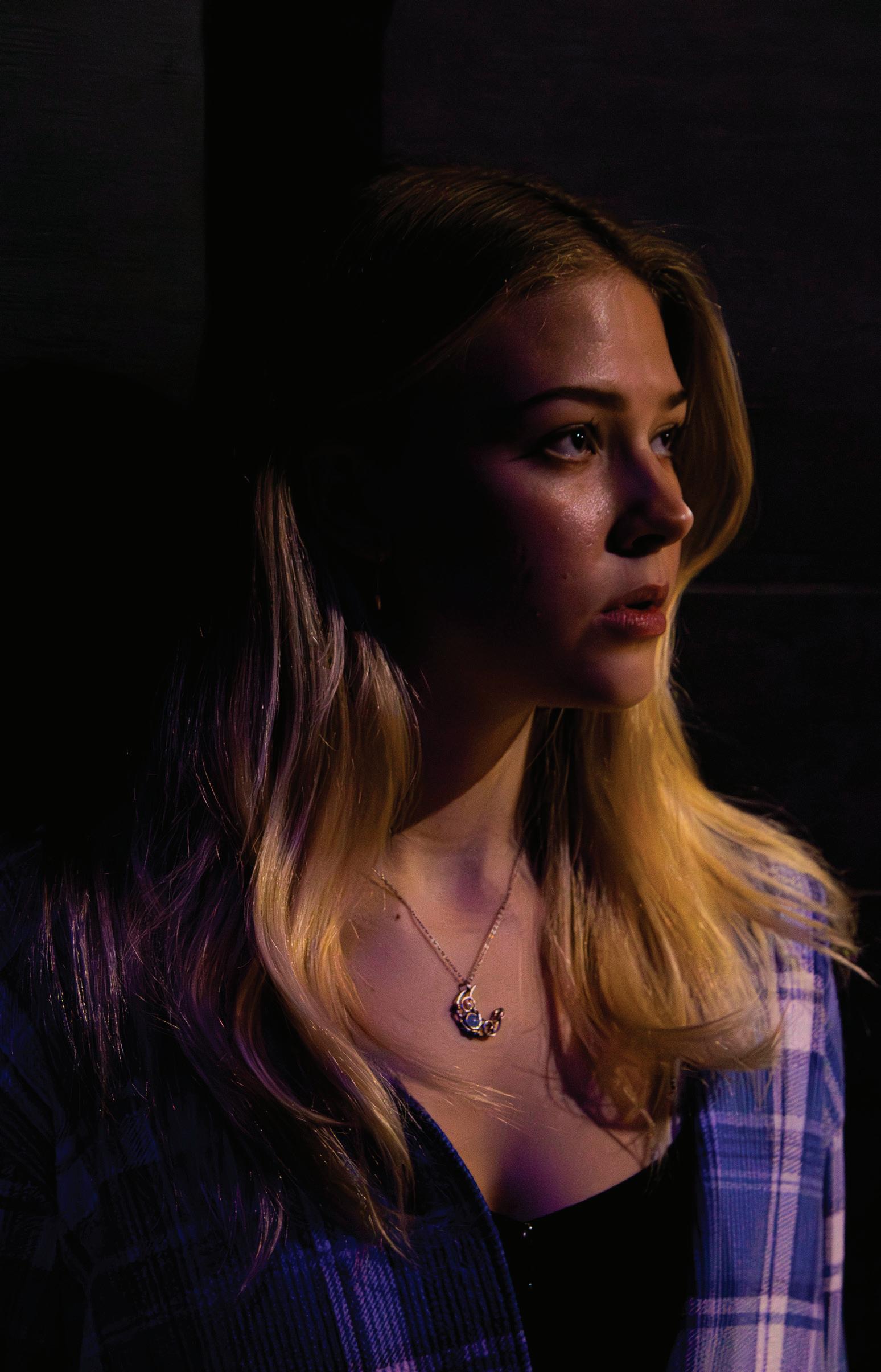
‣ Andrew Forcier, Break a Leg Photography
The Cheer I Carry
By: Alex Baker
Soft rustling echoed down the track . Drums tapped somewhere in the distance while my mom sat beside me. My hand kept inching for popcorn, but my eyes stayed locked on the show in front of me. One girl went up, shook a sign, and came back down. Another flipped and was tossed from stunt group to stunt group. It felt like a circus; bodies juggled midair; smiles held like spotlights.
We were at a local high school football game, but I didn’t care about the football. I cared about the cheerleaders. Their white uniforms glowed in the stadium lights meant for the players behind them, but the magic was on the track. “G-O! Let’s go!” they shouted. I felt like they were talking to me: tenyear-old me, asking me to do something more than clap along. They were pushing me towards cheer.
Growing up, I never quite fit in. I was short, never had a haircut that fit my face, and I was always the lightest voice and kid in class, and people let me know. Kindergarten was the first time I learned how easily a personality can become a target.
We were in the bathroom after recess—tiny sinks, paper towel scraps floating on water, the whole room smelling like soap that never fully beat the smell of kids. I was washing my hands, humming something I didn’t even realize I knew. Then one kid looked over and grinned like he’d discovered a crime.
“You sing ‘Barbie Girl’ when you poop!” I blinked. “What?”
He said it louder, like volume equals truth. Another kid repeated it. Then another. The rumor spread by lunch the way glitter spreads in a classroom—impossible to contain once it’s everywhere.
For the record, if I ever sang it, it would have been while washing my hands. Still, kids would point and yell, “You sing ‘Barbie’ when you poop!” and laugh in my face. I didn’t even understand why it was so funny. I just learned that sometimes you can be innocent and still get convicted.
In third grade, during a group project, last picked as usual, I was forced to sit with the most popular girl in school: let’s call her Avery. The classroom had those inch-high laminated tables that never stopped wobbling. Our teacher dropped the instruction sheet in the center like it was a sacred document. Avery didn’t even look at it. She looked at me.
“Why do you sound like you’re gay?” I didn’t even know what that meant. I asked her.
Everyone at the table laughed like I’d just performed a joke on purpose. I remember the heat climbing up my neck, my ears ringing, the room suddenly too bright. I was humiliated by a word I didn’t even understand. I went home and said I had a stomachache because I didn’t have language for what I actually felt. Funny how, when Avery graduated, she came out with her girlfriend.
By fifth grade, the teasing turned into a game called Disease Monster. The rules were simple: I was always the monster, and everyone else sprinted away. It started at recess like a joke someone forgot to end.
We were on the blacktop, the sun baking the painted lines into mirages. One kid shouted the name of the game, and suddenly they were all running. I chased because that’s what you do when kids yell a game title. You play.
But they weren’t playing with me. They were performing my isolation. The circle widened every day. The running was exaggerated—arms flailing, fake shrieks, dramatic leaps away from me like I was radioactive. No goal, no winners, just running from me. No one would sit with me on the playground, but they’d run from me. I was a 65-pound fifth grader; no one feared being caught.
Every night, I cried when I got home. My parents met with teachers. The concern they heard back was that I “played with girl toys more than girls.” We couldn’t switch classes; the school had one hallway and one class per grade. Kids punched, pinched, slapped, and kicked, and still I held on. I had dreams like any kid, and quitting was exactly what they wanted.
Middle school arrived, and I braced for the same song and dance. I can’t recall much of any of it—only that I got tired of dimming myself. I started trying to be my actual self. School became my runway. I begged for Adidas tracksuits, platform sneakers, and stickers for my off-brand water bottles.
The first day I walked in wearing a pink hoodie with glitter across the front, someone behind me muttered, “Why does he dress like that?” Another chimed in, “That’s so gay.”
This time, I didn’t shrink. I turned, smiled, and said, “If you’re going to stare, at least compliment the outfit.”
Laughter broke out, but it landed differently. Not all of it was at my expense. That became my survival skill: clap-backs sharp enough to keep people from pushing further. When someone called me weird, I said, “Good. Normal’s boring.” When they mocked my voice, I answered louder. On the outside, it looked like confidence.
On the inside, my hands still shook, my throat still closed, but each time I stood my ground, I felt something small and solid building in me. I wasn’t fixed, but I wasn’t defenseless anymore.
In high school, I did everything: concert choir, show choir, student council, French club.
Sometimes I even wore the mascot suit. But cheer was what I cared about most. I tried out.
Tryouts felt like stepping into the world I’d watched from the stands for years. The gym buzzed with music and chatter; numbers pinned to shirts, bows tied tight, bodies stretching on blue mats. My palms were slick, my stomach twisted, but when the counts started; five, six, seven, eight, my body knew where to go. Motions snapped. Jumps hit. My voice rang out. For once, I wasn’t thinking about how I sounded. I was thinking about how it felt to finally be on the mat.
When the list went up, I stared at my name to make sure it didn’t disappear. Alternate or not, I was on the team. I was one of four boys, and I worked like hell to earn a spot on the competition and varsity squads.
Practices became my favorite part of the day. The mat burned under my shoes; the air smelled like sweat, perfume, and hairspray. We drilled motions until our arms ached, counted out stunts in unison, caught flyers as they fell back, trusting us completely. We messed up, laughed, reset, tried again. There were inside jokes, shared snacks, late-night messages about routines. I wasn’t the Disease Monster or the rumor or the punchline. I was a base, a teammate, a part of the pyramid.
On Friday nights, walking onto the track in uniform, I felt like ten-year-old me had finally crossed the distance from the bleachers to the sideline. The crowd blurred into noise. The lights were hot on my skin. When we hit a routine clean and the stands roared, something in my chest lit up. I belonged there. I was proud of myself—of my body, my voice, my presence in that line.
By senior year, I’d checked the boxes: elected to student council by popular vote, placed on homecoming court, made varsity cheer. It felt like a Jenga tower—stacked high, one wrong pull away from collapse.
The game before Senior Night was an away game at a neighboring high school, fifteen minutes away. Seniors usually sat in the back of the bus. I took my seat, my bag as my passenger. But this time our new assistant coach, covering for our head coach, took the headcount, then stopped.
“You need to sit in the front,” she said.
“Me?”
“It’s a new school policy. Boys can’t sit with girls.”
I didn’t argue—not yet. I moved. Then I went home and did my research. I checked every handbook and policy, emailed counselors and administrators. There was no such rule. At the next away game, I took my usual spot. I even had a handwritten note from my guidance counselor saying I could sit where I wanted on the bus. The coach saw me and locked eyes.
“Alex, you need to move. You know the policy.”
“There’s no policy,” I said. “I looked it up.”
She said, “You might do something with a girl.” I was stunned. All those years of being mocked and shoved for being too feminine, and now I was suddenly a threat.
“What the fuck do you mean? I’m gay?” I shouted back. She gave me a puzzled look and then said four words that broke me: “You might be lying.” Something I’d been beaten about until I bled; she thought I could be lying about it.
We went back and forth for five minutes. Teammates chimed in; some for me, some silent, some looking away. Then she said, “If you don’t move, we won’t go to the game. Everyone will have to go home.”
I froze. If I stayed, I punished the whole team. The same old choice: take the hit so no one else has to. Tears welled. I moved to the front and sobbed quietly, feeling like that little kid all over again—the one everyone ran from, except this time I knew exactly why.
When we arrived, I called my mom, and she picked me up. I messaged our head coach that I was quitting. I wrote that I wouldn’t let a bigot coach me. The assistant coach was gone by the end of the year, but the damage was done.
Cheer had been the thing I’d looked forward to my entire school life. I never questioned being on the team; it was my proof of belonging. Losing it felt like losing a second family. I missed the burn in my legs after long practices, the sting of catching a flyer just right, the sound of our voices hitting the same word at the same time under the lights.
But after the grief, something shifted. I realized I didn’t need a uniform or a bus seat to make me real. I’ve spent years chasing approval: classmates, coaches, teachers, even my own. I thought fitting in was the prize. It isn’t. Fitting in is a costume that never quite fits.
I might be a feminine man who dresses differently and likes different things—but that’s the point; that’s the gift. I used to think being special meant being noticed. Now I think it means standing, even when someone tries to sit you in the front alone. It means knowing that even when your voice shakes, it still counts.
It means learning that the cheer you need most isn’t chanted from the track; it’s the one you carry inside, steady as a drumline. Fitting in is temporary. Being yourself lasts longer than the lights. B
Turning Over
By: Wendy Labinger
Iremember when we sL ept in a velvet spoon-drawer, our sterling silver bodies bound with a ribbon, a knot we said we’d never untie. Now we sleep in a magic bed, one that grows larger every night. Sometimes, I am so small and you are so far away. I am Alice in the dark
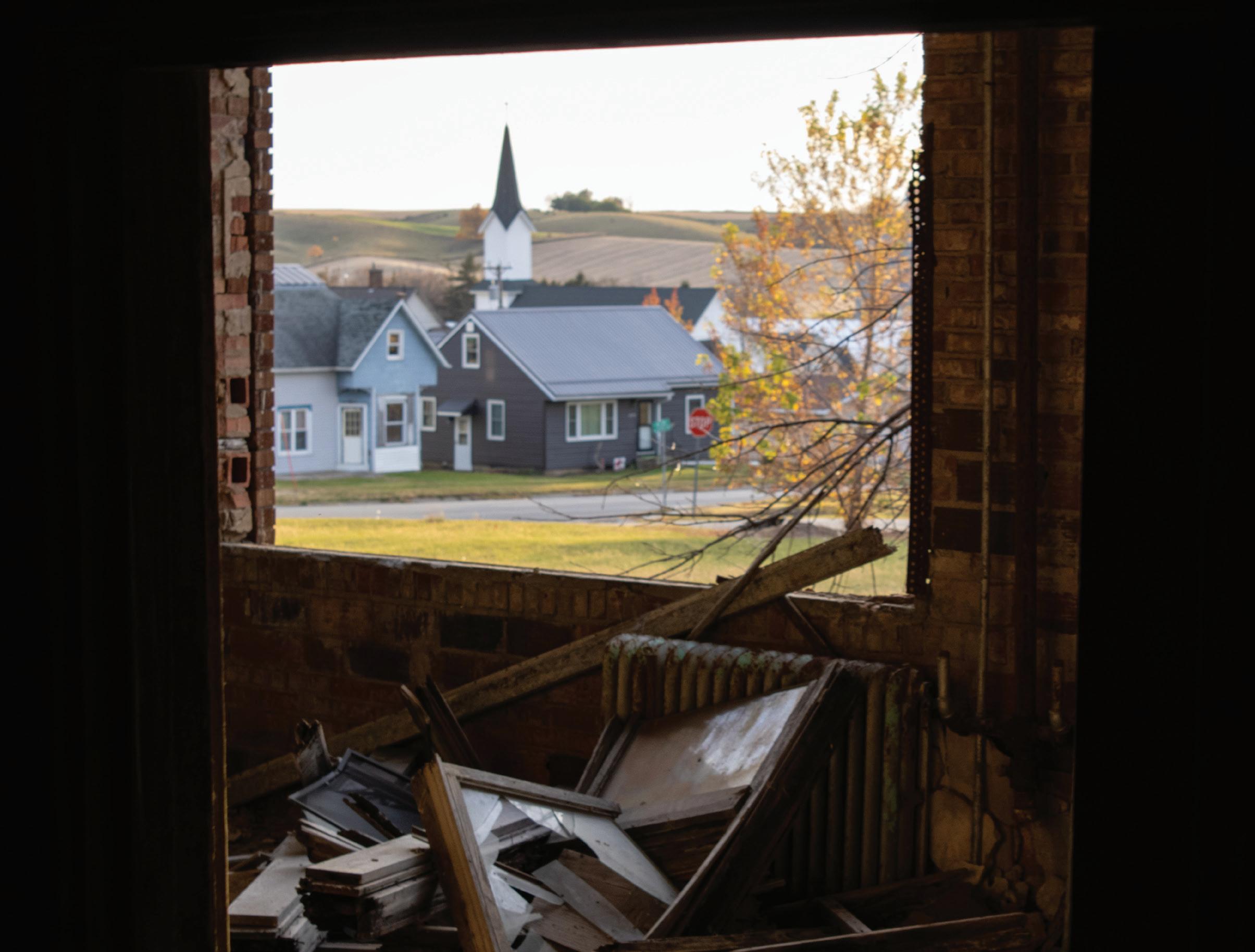
Dimitri Makedonsky, Tall Drink of Water Glasswork
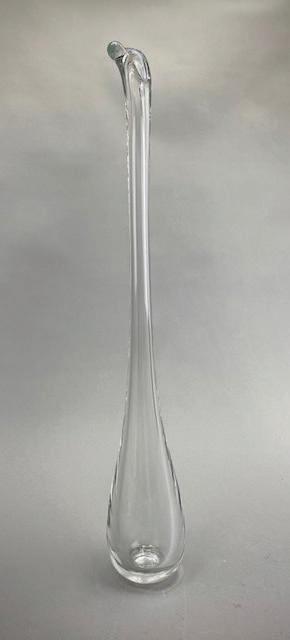
Troy Downs, The View Outside Photography
Passive-Aggressive Waffle Cookies
By: Sharon Falduto
h eL en ,
Here’s the recipe for those chocolate waffle cookies you liked from the last potluck. You’re going to have to find your waffle iron, and, no, since I know what you’re thinking, you never loaned it to me. I do not have your waffle iron, Helen. My waffle iron is a white Hamilton Beach brand one that I bought new at the Younkers back in 1986. It’s a good waffle iron, even if it still has the ghosts of waffles past in its crannies.
No, I don’t know what brand your waffle iron is. Sunbeam, maybe.
Before I get to the recipe, Helen, I need to tell you about that privet hedge. I know it’s on your property, but I still think you should have at least asked me before you just had it all trimmed down. Now it’s barely a foot off the ground. A foot! That doesn’t give me any “privet” at all, Helen. Privet means “privacy.” You could have come over and asked us. A trim, sure. But all the way down to the ground? Really, Helen?
Here’s your ingredients:
• 1½ cups sugar
• 1 cup margarine (that’s two sticks)
• 4 eggs
• 2 teaspoons vanilla (not tablespoons)
• 2 cups flour
• 8 tablespoons cocoa (not teaspoons)
• A dash of salt
You’re going to need your tablespoon AND your teaspoon, and no, Helen, I don’t know where your measuring spoons are. They are not at my house, and I’m not loaning you mine.
First thing, cream the sugar and the shortening (that’s another word for “margarine,” that’s how it’s written in my cookery book). “Creaming” means “blend it together.”
Then beat in the eggs and then vanilla (that means “slowly pour them into your mixing bowl while you’re operating the hand-held beater that I’m pretty sure is mine”).
Then stir in the dry ingredients (that’ll be the sugar, the flour, the cocoa, the salt).
Now you’ve got it all looking like a batter, I hope; all creamed together. Drop it in rounded teaspoons full into the heated waffle iron–oh right, I should have told you to turn the waffle iron on before you started making the batter.
Close up the waffle iron and cook for a minute or two. The cookies burn quickly, so don’t keep them on the iron too long!
The WAFFLE iron, Helen.
The problem is that now you can see right into my yard without that hedge, Helen. What if I want to lounge in my pelt back there? Just because I never have before doesn’t mean I won’t in the future.
After the waffle cookies cool, I like to put some icing on. This is where I get lazy and use the kind of frosting they have in cans now.
And then I eat the cookies while naked in my yard.
Ha! B
The Dondo’s Call
By: Waterz Yidana
Iwas born where drums cou L d ta L k
Where rhythm was a mother tongue
Before I learned to write my name
I learned to move to the heartbeat of home
In Ghana, music is not noise
It is prayer, it is laughter, it is memory
It calls the child to dance
It calls the elder to remember
When the Dondo drum speaks, we listen
For it carries the stories our mouths forget
Then I crossed the ocean to America
And silence met me at the airport gate
No drums, no ululations
Only the hum of machines and winter wind
For a moment, I thought the music stayed behind
But one evening in Iowa
A jazz tune called my name
James Tutson sang with gentle fire
Trumpets swayed, guitars whispered
And I felt home knocking on my chest
I joined with a Djembe beat
Soft at first, then bold, then free
And the room turned into a village again
The saxophone answered my drum
The piano laughed in reply
And for the first time
Africa and America danced together in sound
Music stitched my worlds together
Thread by thread, note by note
It taught me that culture is not a cage
It is a bridge made of rhythm and soul
Now when I play highlife or Burna Boy in my room
My friends listen, smile, and move
They may not understand the words
But they feel the truth inside the tune
Because music doesn’t need translation
It only needs a heart that beats
And mine beats still
To the drum that spoke across the ocean
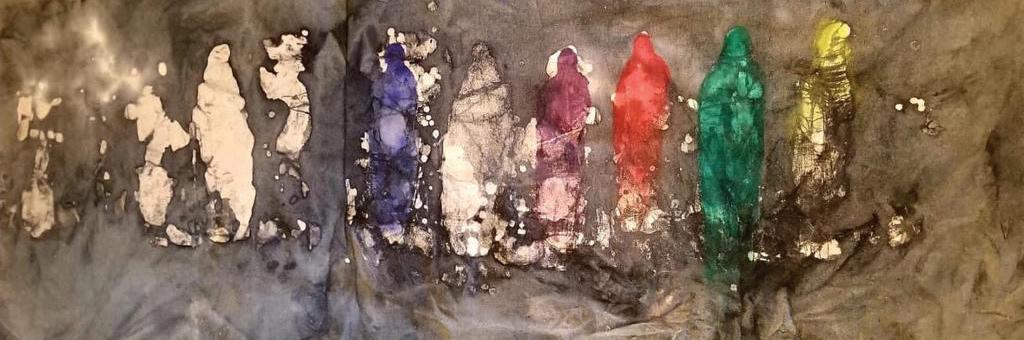
Taissir Abdelgadir, Moving 2
Batik
Neither, Nor
By: Paul Brandon Bremer
Gun meta L creeps across november , when the breeze bites, but winter isn’t in it.
The sad fact hasn’t happened, the need to pull on a Ushanka, freezer mitts, bunny boots. No,
Mondays are still a gold Rolex of leaves, the tea steaming in countess cups. Coffee is for the dark,
mercury below zero, the Edinburg’s second hand stiff and slipping,
death’s bad grammar baked into the brain after living’s out of season. Contraction and abandonment the gulag’s heart.
But now, the season’s out of sort, neither fall nor winter, a skittish pigeon building its nest under neither bridge nor barn.
With Love, Your Friend, OCD
By: Kaleigh Keeney
dearest friend,
It has recently come to my attention that you have been talking about me behind my back, saying that I’m “irrational” and “annoying.” Apparently, you told your friend that you’ve been stressed lately and that it’s making your OCD worse. You said you’re worried enough already and don’t need me giving you a “crushing sense of impending doom.” First of all, rude. I’m just keeping you prepared for possible outcomes. Life-changing tragedy could strike at any moment. I’m not gonna lie and be all, “Oh don’t worry dear, everything’s gonna be okay, you aren’t gonna get in a horrible accident that leaves you paralyzed and permanently disfigured.” Lying is bad, and I’m not bad.
Second of all, you didn’t even call me by my nickname. It’s Calp, remember? Stands for “can’t help.” You came up with it as a kid to let mom know you weren’t trying to misbehave, you couldn’t help it. Ringing any bells? I mean, really? My full legal name? Why are you acting like you hate me? Talk about being a backstabber. Maybe you are turning into all the things you hate, just like I said. Sorry, I know I’m being bitter. I just want you to realize that the way you’ve been talking about me is hurting my feelings. I feel the need to defend myself now, hence why you are receiving this letter. If I could, I would sue you for defamation of character, but instead, we can just have a nice chat.
Listen, our friendship went on record nearly 15 years ago. I thought you loved me. Why else would you feel so bad when you don’t listen to me? Remember all the good times we’ve had? Sitting away from everyone at recess with your head in your hands because you were so stressed about picking up each rock and wood chip that was special? (To be fair, that wood chip did totally look like a heart, and it’s good you took it because I was right; I haven’t seen another one like it.) Personally, I loved recess. It was just me and you.
Do you remember crying every time the garbage man came because you might’ve accidentally thrown away something really important and now it will be gone forever? Or screaming when mom threw away that napkin you drew a perfect smiley face on until she dug through the Dairy Queen trash can to find it? And don’t forget about the sidewalks… oh, we spent hours walking around in
patterns until it was just right. Those were the good old days.
I’m like… second guessing our entire relationship now. Were those even good times for you? I was having the time of my life. We were so close. Even when you got relentlessly bullied to the point you switched schools three times, who was with you through it all? Me. I was there with you, in your head, no matter what. I always will be. You need me.
Besides, don’t you miss having a little danger in your life? You’re so boring now. You haven’t jumped off the top of a swing set (even though you really didn’t want to) in years. If the issue is the swing set thing, we can totally do something else. There’re plenty of other things you can jump from. I have a few ideas.
Or maybe you’ve just stopped caring about your family and friends. If you were a good person you would do what I say you need to do to save the people you love. If you don’t listen to me, everyone will think you’re a bad person. You’ll be a bad person. Or maybe you already are. I once told you, “If you don’t put yourself in danger and jump off the swingset, your grandma will fall instead. Don’t be selfish, you’re much younger and will recover. You don’t want to kill your grandma do you?” I’m just saying, think about it; you did all those things and clearly it worked because grandma didn’t die. I was right.
When you were little you used to scream and hit your head on the wall because no one understood what was wrong. I hated when you did that. No offense but not only did it make me look bad, it also made you look like a little brat. They still don’t understand. They never will. But that’s why you need me; I do.
Anyways, communication is an important part in any healthy relationship, which I hear you “don’t think we have” because I’m a “liar.” Who died and made you queen? Whatever. The point is, I want you to see my point of view; it’s important you hear me out. I just want to keep you safe. You know deep down that I’m right. There’s so much proof that I know what I’m talking about. I say someone’s gonna break into your house and kill you if you don’t check that the door is locked. You check that the door is locked. No one breaks in and kills you. Pretty simple chain of events, I’d say. I don’t know why you’re doubting me. I mean really… I’m a liar? Maybe you’re the liar. Might I propose the idea that that may be why everyone hates you? I know you think I’m just trying to make you feel bad when I say that, but I’m just putting it out there. This used to be so much easier…
Continuing on, let’s start on this whole “irrational thing.” It is NOT irrational to think you might have carbon monoxide poisoning right now. You said you didn’t feel good and looked up the
symptoms and they match. You don’t have a carbon monoxide detector. It makes sense. Could be black mold too. However, because I care about you and want you to be healthy, I will provide some alternative reasons for why you don’t feel good, as well as some solutions. You could be sick with something else. Any time you’re around people there’s germs… everywhere… not to feed into the stereotypes about myself, but, yeah, obviously I’m gonna be concerned about that. So, I recommend you wipe down all of your belongings with a disinfectant wipe: phone, iPad, TV remote, controller, and hey, you sat on that public toilet seat without covering it earlier… go ahead and wipe your legs down too. A few chemicals can’t be that bad for your skin. Now, it’s important that you keep that fear of getting sick in the back of your head, just in case. One wrong move and it’s over.
For example, did you wash your hands before eating those chips? I don’t think you did. And you touched the handle of a gas station door earlier. Who knows what kind of stuff is lurking there... some construction worker could’ve blown his nose and got snot on his dirt-covered hands and then touched that door handle. In which case, you basically just ate a snot-dirt combo meal. Yuck. Maybe you should make yourself throw up. I’ll wait.
On another note, I have prepared something for you. If all I’ve said thus far wasn’t enough to convince you to STOP shit-talking me and accept that I’m not only right but good for you, I present to you the following example.
You get ready for bed and get under the covers. It’s been a long day, you can barely keep your eyes open, you can’t wait to fall asleep. You’ll be out before your head even hits the pillow. But wait… what’s that? You forgot to shave your legs today. Usually, that wouldn’t matter to someone, but you’re special. You toss and turn but can’t get comfortable. You feel every hair itch against the sheets. It’s insufferable. It feels like the physical embodiment of what a fork scratching a plate sounds like. You’re now hyperaware of every sensation. Your shirt is pulled weird, it’s twisted, it’s horrific. But then again, this fabric is just as bad. It’s all wrong. Your shirt is too small, the sleeves are scrunched, your legs itch, it’s too hot in here, your sheets aren’t pulled up all the way. You try to yank them up, but they’re tucked in too tight, your pillow is warm, your head is at an awful angle, your hair is on your neck, everything’s wrong, and you can’t sit still.
Your body is telling you to get up and run, but your brain is too focused on the thousands of horrible sensations tearing into your skin. You try to quiet me, but I don’t stop, I get louder. Listen to me. Why are the back of your legs itchy… What’s happening? It feels like you have chemical burns or something. Oh my God, you used that disinfectant wipe. Why would you EVER think that’s a good idea? No… no, do NOT blame this on me. Did you plug your phone in and set an alarm so you don’t
miss work and get fired? Did you lock the door earlier? Oh God, you took your meds right? Right??? If you miss doses of that you’ll get that bad rash the doctor told you about. You could die. Maybe that’s why your legs feel like that. If you missed a dose, it’s already starting, you can’t go back now. You locked the door earlier, right? Wait, be quiet… what was that? You talked about Skinwalkers earlier, did you say Skinwalker out loud? You know you shouldn’t do that. What if you said something about being safe and didn’t knock on wood after. Did you lock the door? What if someone’s out there? What if something’s out there? Did you lock the door? Was that sound from outside or the TV? Did that shadow move? Did you lock the door? What was that noise?
DID YOU LOCK THE DOOR???
Suddenly, you’re on the verge of tears. But then, I tell you to go check the lock. Make sure all the doors are secure and peek out the windows, too. Okay, no one’s there. Go shave your legs, honestly just take a shower again. Now change into a different shirt—no, not that one—okay, that one’s fine. Make sure you took your meds and set your alarms. Fluff and flip over your pillow, put your hair up, and try again. You feel better now, don’t you? You’re welcome.
What will it take for you to see? I mean what’s best for you, I am what’s best for you. You need me. Imagine all the things that would’ve gone wrong if it weren’t for me. Imagine how awful you’d feel all the time if I didn’t tell you how to fix it. If I’m such a liar, why do you always feel better after doing what I say? Try to prove me wrong all you want; I’m right and you know it. So go ahead, knock on wood, scratch that itch, check that lock. You know you want to. I’m not a liar, I’m not irrational, and I’m not leaving. It’s me and you, kid. I’ll see you in the morning.
With love, Your Friend OCD B
By: Mark Hanley
chemica L s
poisoning our food and water toxins in the well sprayed over the fields like hell when will we be motivated by prophecy not by profit?
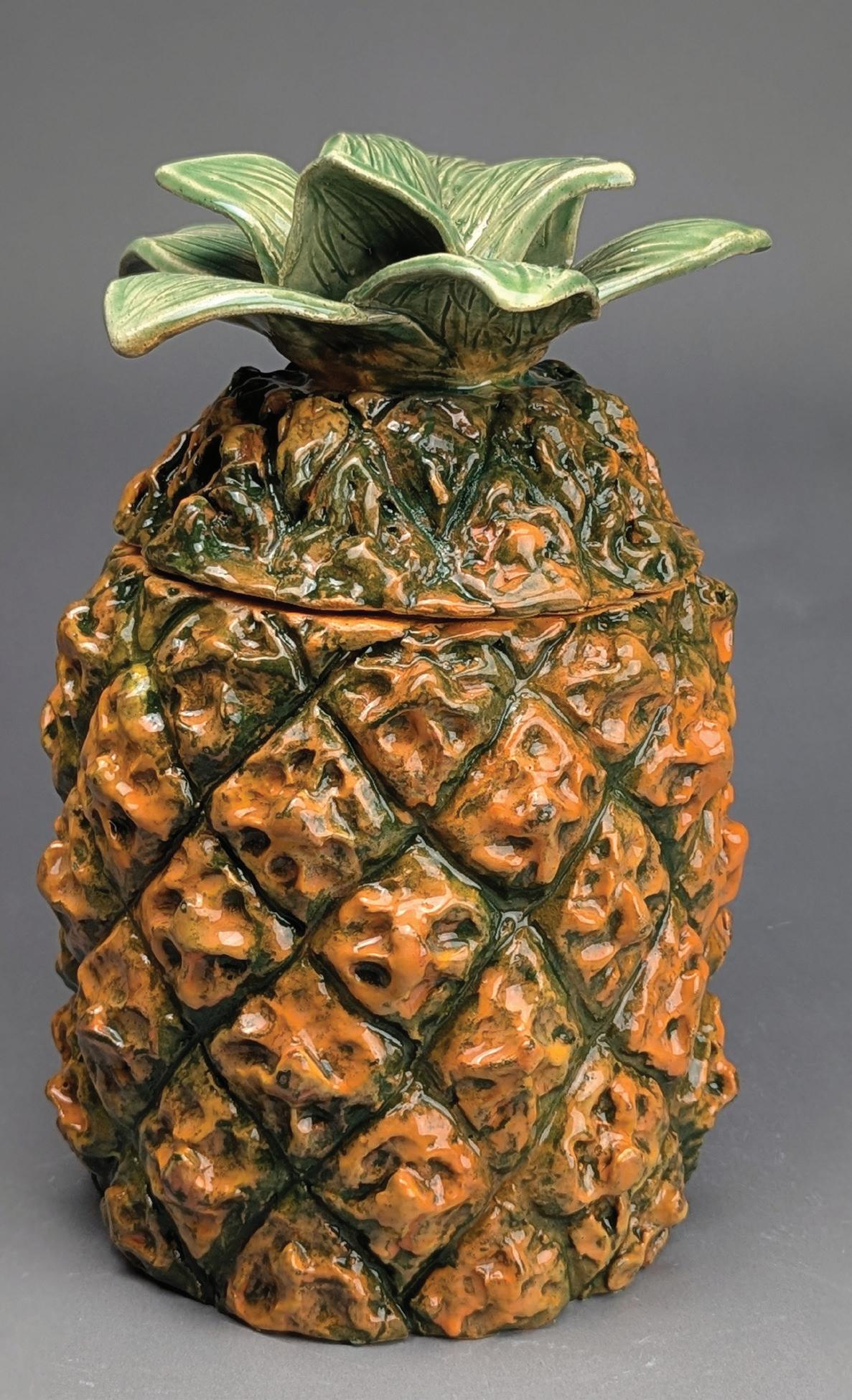
Yuchan Wong, Pineapple Ceramics
Ceramics
Pursuing Passions
By: Jason Hedlund
It all started twenty-eight years ago with a simple phone call from my cousin.
“Want to go duck hunting tomorrow?” he asked casually.
It was the opening morning of waterfowl season in Iowa. At that point, I had only hunted deer, turkey, and upland birds. I was not the least bit familiar with waterfowl hunting. Still, without much thought, I said yes. “Sure,” I replied. “What do I need to do?”
He began listing what I needed: an Iowa hunting license, the wildlife habitat fee, both state and federal duck stamps (U.S. Fish & Wildlife Service), and HIP registration (Iowa Department of Natural Resources). I jotted everything down quickly, not really understanding what half of it meant, and grabbed my shotgun. I figured I’d learn the rest on the go.
The next morning arrived cloaked in fog. The kind of heavy mist that muffles sound and makes the world feel distant and mysterious. I threw on rain gear and what I thought were appropriate boots— cheap, knee-high rubber ones. They looked the part but weren’t up to the task. We arrived at the marsh just before dawn. The place was a mosaic of shallow water and thick, sticky mud. As we made our way into the water, the mud clung to each step like wet cement. It didn’t take long before one of my boots got sucked in so deep we couldn’t pull it free. I tried digging around it, twisting my foot, even pulling with both hands. Nothing worked. Eventually, I gave up and hobbled the rest of the way wearing one boot and one soggy sock.
We found a spot behind a dense patch of willows, set up the decoys, and waited for legal shooting light. I didn’t really know what to expect. I’d never set up in the predawn darkness listening for birds, never watched the world come alive from a marsh. As the sun started to rise, the air filled with sound— fast, sharp whistles of ducks cutting through the fog. My cousin and his friend raised their guns and opened fire. I froze; I didn’t even know what they were aiming at. But as the morning wore on, I started to understand. I began to recognize silhouettes in the distance. I learned to track movement, to look for the way wings curved or how birds dropped suddenly from the sky. Eventually, I took a shot. I didn’t hit anything, but I had crossed a threshold: I was no longer just watching—I was participating.
Then, my shotgun slipped from my hands and fell into the water. I pulled it out, but it was done— muddy, wet, and nonfunctional. My cousin just laughed, dunked his own shotgun into the same water, pulled it back up, and shot three ducks in quick succession like it was nothing.
As we made our way back out, my other boot met the same fate as the first. Somewhere out there, buried deep in the Iowa mud, are both of those boots—my first offering to the world of waterfowling. That same day, I went to the local hunting store and made two important purchases: a new shotgun and my first pair of chest waders. I didn’t know it at the time, but that trip marked the beginning of a lifelong obsession. Twenty-eight seasons later, I’m still just as hooked. In fact, this morning—another opening day—I fell into the river again. Different year, same story.
But over the years, I’ve come to realize that waterfowl hunting doesn’t begin in the marsh. It begins with preparation—and paperwork. In Iowa, anyone 16 or older needs to carry several permits and certifications to hunt waterfowl legally: a valid Iowa hunting license, the Iowa wildlife habitat fee, the State Migratory Game Bird Fee, and the Federal Duck Stamp. In addition, HIP (Harvest Information Program) registration is required each season (Iowa Department of Natural Resources).
The Federal Duck Stamp is more than just a permit. It’s a piece of conservation history. Every year, a new species is featured—this year, it’s the Northern Pintail, an elegant duck with a long neck and sleek silhouette. Proceeds from duck stamp sales go directly toward protecting wetlands and habitat across the country, making it one of the most successful conservation programs in the United States (U.S. Fish & Wildlife Service). Migratory game birds are protected by federal regulations to ensure their populations stay healthy as they travel between northern and southern regions each year. For me, the required duck stamps have become more than just hunting permits—they’re symbols of conservation and tradition. I’ve collected them over the years, preserving each one in a scrapbook that holds not just stamps, but memories from the field.
It’s also important to understand that “migratory game birds” include many species of ducks and geese and each comes with its own season, bag limits, and regulations. Over the years, I’ve chased all kinds of waterfowl. Early in the season, we hunt teal—small, fast ducks that dart like fighter jets just above the water’s surface. Later, we shift to bigger birds: mallards – green heads, wood ducks - woodies, northern pintails, American wigeon, and my personal favorite – the bufflehead or buffie (Ducks Unlimited). As winter rolls in, Canada geese and snow geese begin to dominate the skies. Each species brings its own challenges, and each phase of the season demands a different approach.
In those early years, I thought the first thing you needed to worry about was your gun. But now, I know the process really begins with the right camouflage. The terrain dictates the pattern. In a wooded swamp, I wear something dark and leafy. When I’m in an open marsh surrounded by cattails, I switch to lighter, straw-colored camo. Matching your environment is the key to remaining unseen, and staying still is just as important (Strobl). Next come the waders—a lesson I learned the hard way. Chest waders are essential if you plan to hunt in flooded timber, ponds, lakes, swamps, or rivers. As the season progresses and temperatures drop, insulation becomes critical. What keeps you warm also keeps you safe. While the firearm often gets the spotlight, seasoned hunters know that the right camouflage pattern and a reliable pair of chest waders can be just as important—if not more so—when it comes to a successful hunt.
Only after that do we talk about firearms. Most seasoned hunters use a 12-gauge shotgun, prized for its power and versatility. A 20-gauge is lighter and can be a great option for smaller-framed hunters or those chasing early-season teal. I also learned to appreciate the importance of a choke tube, which allows you to control your shot pattern—whether you want a wider spread at close range or a tighter pattern for longer shots (Strobl). Shotguns, like all gear, range in price and quality. After nearly three decades, I’ve invested in high-performance equipment that can take a beating and keep firing. My wife, who started hunting just two years ago, uses a more budget-friendly setup—and it works great for where she’s at. The point is, your gear should match your needs, not your neighbor’s.
But beyond the birds, the gear, and the shooting, duck hunting has given me something even more meaningful: time. Time to reflect. Time to unplug. Time spent in silence, surrounded by water, sky, and the call of distant birds. There’s a rhythm to it, one that grounds me in a way nothing else does. It’s also given me relationships—deep ones. I’ve spent countless mornings sitting shoulder to shoulder with friends and family in layout blinds or boat blinds, swapping stories between volleys. I’ve taught others how to read the wind, how to call a duck, how to set a decoy spread. And I’ve learned from them in return.
Looking back on that first hunt—bootless, wet, cold, and clueless—I laugh. But I also recognize it for what it was: the start of something lasting. Waterfowling isn’t just a sport. It’s a way of life, built on tradition, patience, and respect for the natural world. Every fall, I still feel the same anticipation I did that first opening morning. The same nervous energy. The same childlike excitement. And every time I step into the marsh, I remember where it all began.
With a phone call.
With a muddy sock.
And with a pair of boots—still out there somewhere in the marsh, waiting for me to come back. B
Works Cited
Ducks Unlimited, 17 October 2024. https://www.ducks.org/hunting/waterfowl-id.
Iowa Department of Natural Resources. 2025-26 Iowa Hunting, Trapping, & Migratory Game
Bird Regulations, 2025.
Strobl, Reid. Hunter Ed, 5 February 2024. https://www.hunter-ed.com/blog/duck-huntingbeginners-guide/
U.S. Fish & Wildlife Service, 2025. https://www.fws.gov/rivers/service/buy-duck-stamp-orelectronic-duck-stamp-e-duck-stamp
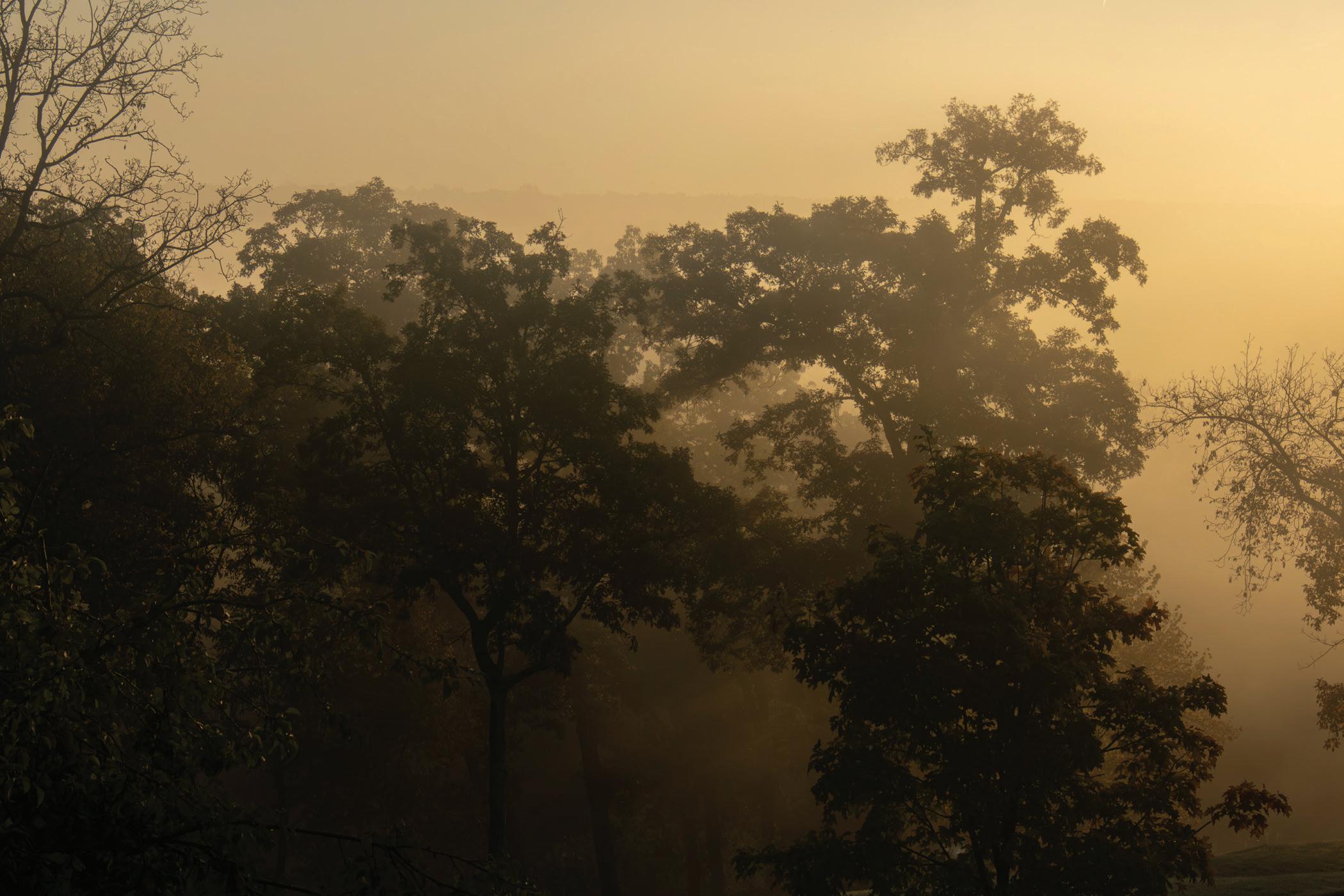
Katelynn Newton, Softly, Morning
Photography
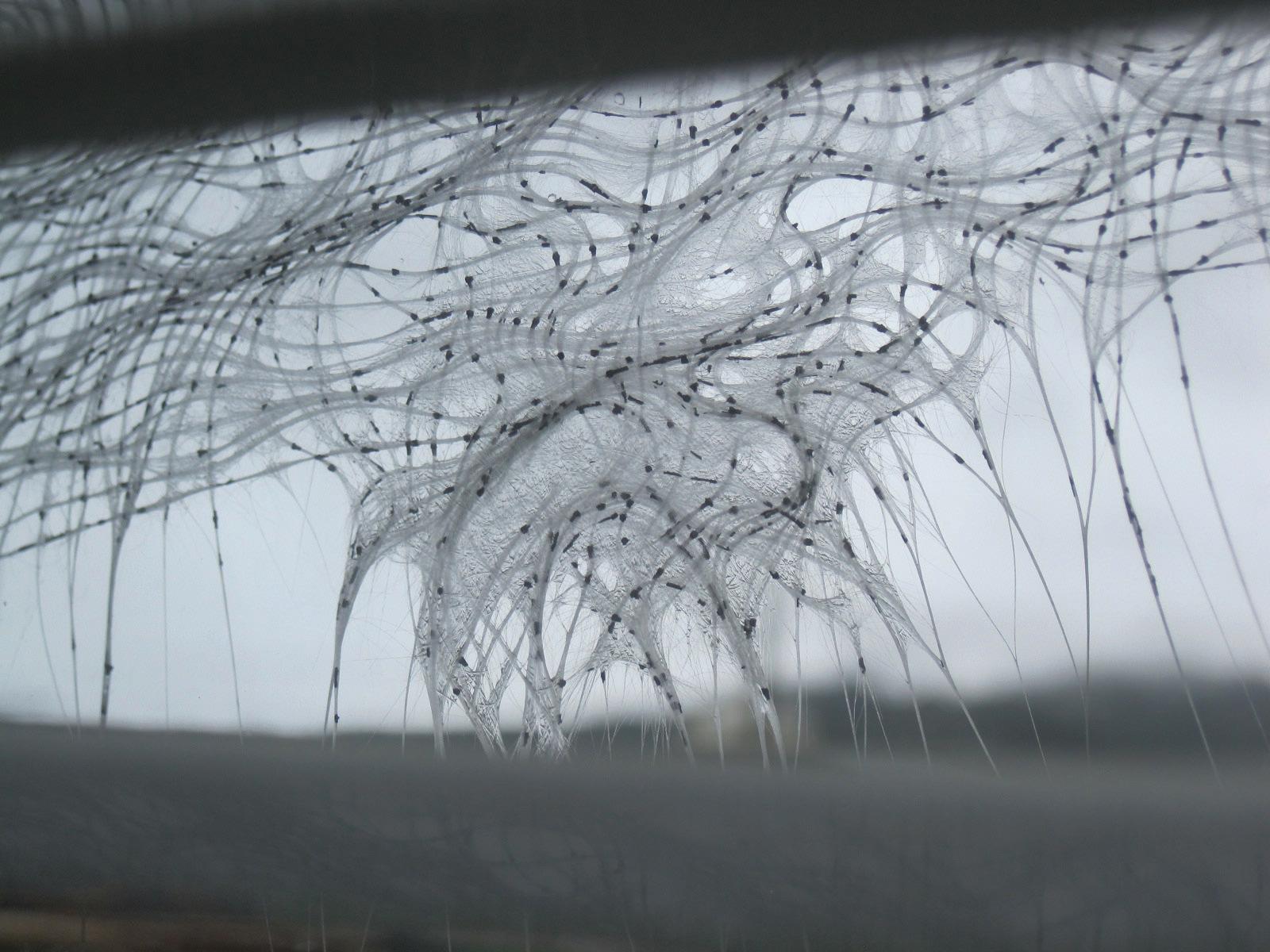
Christen Tack, Testament of Time
Photography
my time
By: Mark Hanley
I heard
The spouse
Of a classmate
Had passed
Only 41 years old
I thought about My Own Mortality
The day my cards Will Fold
I thought about
My funeral
I thought About what Comes next
I thought About heaven
If I try my very best.
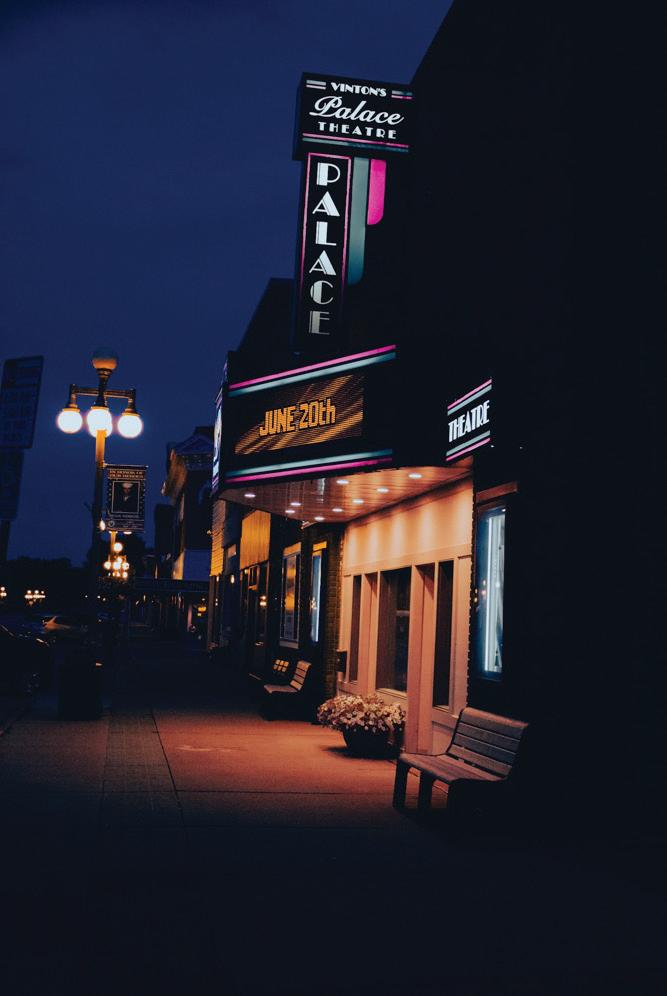
Destinee Bahr, Cinema at Sundown Photography
Photography
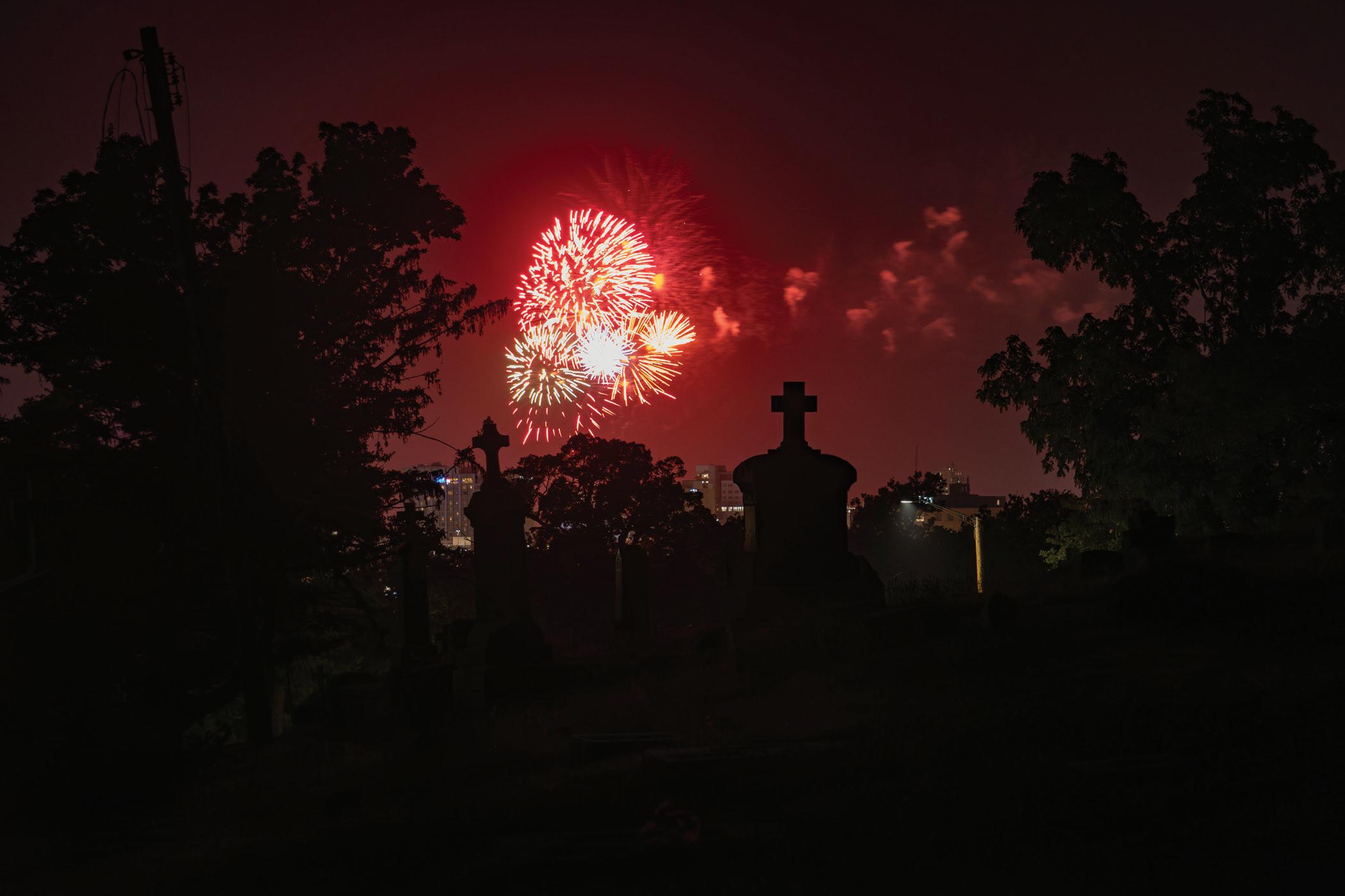
Marloe Spencer, An All-American Experience
Tiny Plastic Action Figures
By: Pete Hadland
Ican’t be a hero. The pressure. The expectations. The anxiety. The time. Day in day out. No reprieve. No anonymity. Constantly courageous. Continuously virtuous. Virtually incorruptible. The inevitable movie franchise. Having no say in which actor the studio picks. The merchandise. The tiny plastic figures of me everywhere shoved into cupboards and toy boxes and shoe boxes and chewed by dogs and toddlers. The attention. The quips. The ready quips. Always having to be ready with the ready quips. All too much
I can’t be a villain. The guilt. The failure. The constant failure. The elaborate scheming. Having a nemesis. The sheer stress of having a nemesis. Day in day out. Relentlessly nefarious. Necessarily mischievous. Uncontrollably ambitious. The inevitable movie franchise. The studio will pick a disgraced actor who’s due for a comeback. The Oscar win. The tiny plastic figures of me that will look like that actor who did that awful thing. The catchphrase. A ready catchphrase. Always having to be ready with the ready catchphrase. All too much
But things can’t continue. The tedium. The monotony. The HR approved music mix that loops every forty-five minutes. The greetings cards. Walls and walls of greetings cards. The trinkets. So many trinkets. Expensive random trinkets for every occasion. And Janice. Day in day out. Janice and her updates on her daughter. The daughter about whom so much is known. All are now involuntarily stalking her. The inevitable movie franchise. The tiny plastic action figures. A world full of tiny plastic daughters of Janice. All too much
But an anti-hero. That could work. Six months. Six months to become a total bastard. Changing the messages in the get-well cards. Eating Janice’s clearly marked probiotic yogurt. Closing at 7:50 instead of 8. Hiding the gender-reveal trinkets. Switching all the envelopes so none of them fit. Then one great act. One moment of gold-standard-Hollywood-epic heroism. And they’ll all say that underneath that shell there is a heart. The heart of a hero. And it won’t matter what actor they choose for the movie franchise. It won’t matter whether the little plastic person has a kung-fu grip. Because Janice might shut up about her daughter for five minutes.
Small dreams. Five minutes of peace. No heroes. No Villains. No redemption arcs repeating and repeating and repeating and repeating. The screens. Big. Small. Twenty-four hours a day. Binge. Wash. Repeat. Everything and everywhere. Technicolor trance. Surreptitiously subliminal. Uncontrollably unavoidable. Be the tiny plastic action figure. Good. Evil. Right. Wrong. Hero. Villian. Win. Lose. Win at all costs. Never ask what winning looks like. Escape. Hide. Distract. You are the beautiful tiny action figure with a kung-fu grip barely holding on to reality. Small dreams. Five minutes of peace. No space left. All too much.
29
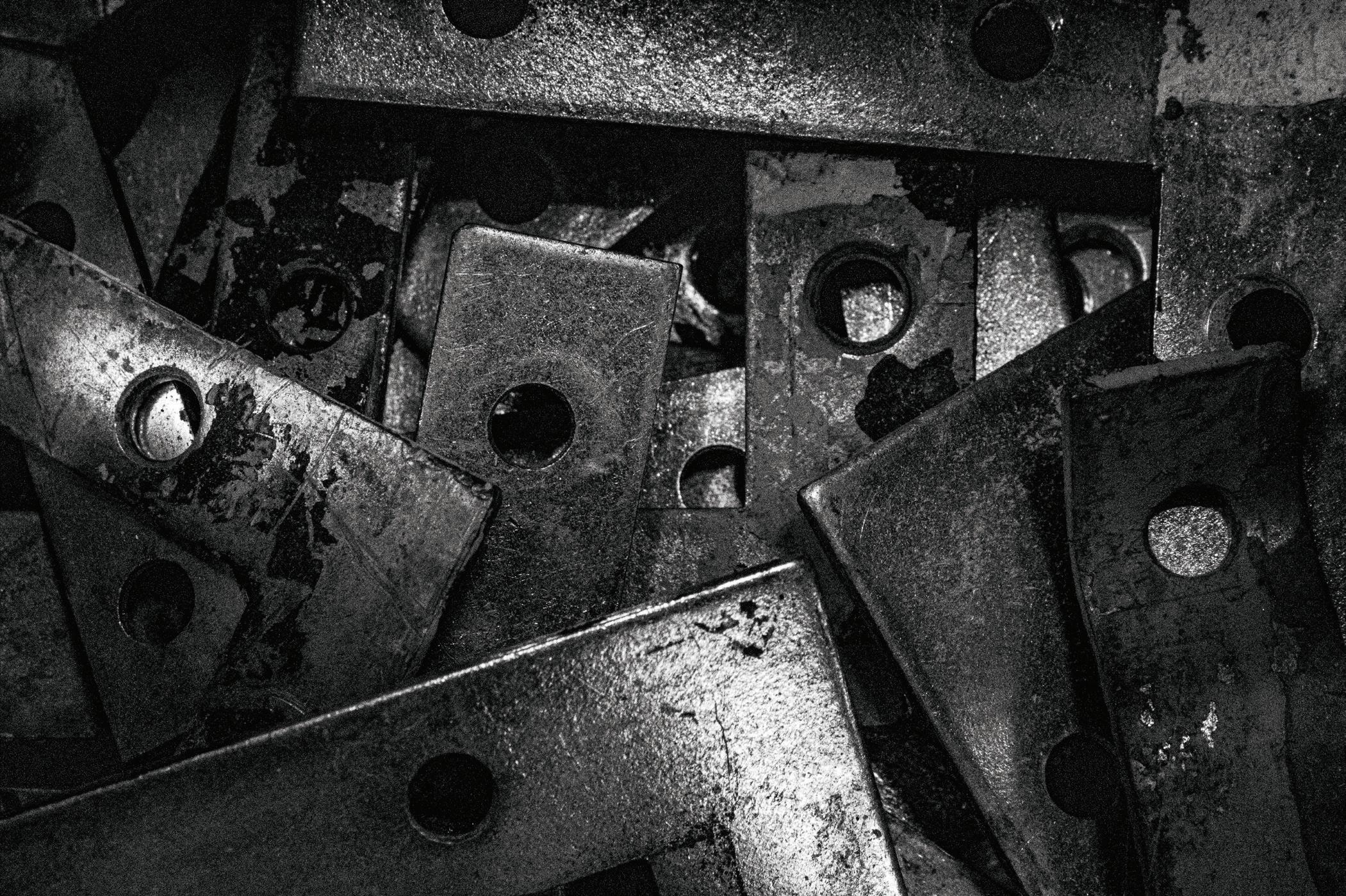
Andrew Forcier, L-Brace
Photography
Falling Apart
By: Todd Case
t a special session of the broken l ake city council , the engineers, and the PhDs and the DNR reported that three of our ten city wells had gone kaput. There was discussion about the Jordan and Dakota aquifers, and limestone and dolomite, and droughts and good money after bad. The mayor pro tem estimated it took five gallons of water a day to raise a hog, and Tully Yates, who farms three sections of corn and soybeans this side of Early, thought that number unlikely, but on second thought, might not be far off. Miriam Miller had recently retired after thirty-five years at First Bank & Trust (or Worst Bank, depending) and stated matter-of-factly that American Pork slaughtered fifteen thousand hogs a day and used two million gallons to do it, and someone else said “that can’t be right, two million gallons of water a day?” Over the years, Miriam had loaned bushels of money to many of the families in the room and at the dais, looking out over her cheaters propped on the bridge of her nose, she slowly nodded in the affirmative. Councilwoman Olivia Ortega raised the specter of the proposed bitcoin mine on the north end of the county. “And where will that water come from?” she asked. She then veered off course from her prepared remarks and mentioned nitrates and then tariffs relative to China while grain piled up on the ground outside of the chock-full elevator in Aurelia. That proved to be the last straw for Walt Pierce, a Farm Bureau agent, who accused Ms. Ortega of being an aginner, and she was shouted down as talk turned to sedition. There was a call to order, and the council woman apologized, admitting that she’d gotten caught up in the moment. It had been a long time since anyone had heard someone sincerely apologize, and it seemed to give the room just enough oxygen to adjourn the meeting.
When we exited city hall, the moon was waxing, and the chimes from one of the churches struck the time. Those chimes hadn’t been heard in a decade or more, and none of the three churches on the corners of Lake and Chautauqua had performed any work on them recently or it would have made the Pilot Chronicle. My wife, Sandy, and I lost our son, Mac, fifteen years ago this month. The moon and the fall air bring him a little closer to us this time of year, and walking out of that meeting to my car I thought the hardest thing is to not resent each other when we need one another the most, when we’re losing everything together at the same time.
The next morning, I left the house as Sandy was waking up, and before I went to work, I drove out
around the lake. There was a breeze blowing from the south, so the stench from the hog plant didn’t have its grip on us. Someone had bought and paid for a billboard out on the Schaller blacktop that read “Normal is not coming back. Jesus is. Revelations 14.”
Broken Lake is what was left after the last of the glaciers disappeared from our neck of the woods fourteen thousand years ago, a shallow, thirty-two hundred acre bowl that tends to silt in with some of the richest dirt on earth. Years ago, the Kinne Company cut ice out of the lake every winter and sold it to keep our goods from spoiling, and the shards of Mill Creek pottery and arrowheads found on its banks were carried in the pockets of schoolchildren. At one time on the east side there was a boathouse and an amusement hall with a twenty foot slide into the water, and on the opposite side, the town side near the old ballroom that still stands, a petting zoo with a monkey cage for the enjoyment of our farmers and town folk, and a baseball diamond laid out in a field. Since the thirties, the plant has tended to dump waste into the lake whenever they think our heads are turned, and it takes some corporate arm twisting to make it right. But we love the lake; it’s ours, and we still boat on it, and pull perch and walleye from it, and wax poetic on its banks to those we love. It giveth and it taketh away.
Driving along Stoney Point and looking north across the lake, the town’s dense tree line separated sky from water on the horizon. I passed huge, round bales of hay in the adjacent field. The clouds looked unfamiliar, thinner, and the sky was as flat as the hood of my car. I read somewhere that the clouds are dying, and their shade along with them. A person doesn’t know what to believe anymore. I used to read Grimms’ Fairy Tales to Mac, and he loved how anything was possible: a girl could grow her hair long enough to escape from a castle tower and a man could sleep for a hundred years. That all seemed to check out, the anything is possible hypothesis, sometimes in the best, most decent way and sometimes not, but if the glaciers could disappear, and the dinosaurs, why not the clouds?
I stopped for a quick breakfast at the C’mon In across the highway from the lake. The regulars were at the round table in the middle of the cafe for their Thursday morning meeting. They called themselves the Hayes District, at least informally. The group started out as a gun club and evolved into a social fraternity of sorts: like-minded men whose mission was a little murky to some of us, something about community service and patriotism. I heard through the grapevine that they’d hired an attorney out of Sac City to draw up a charter. I knew them all: two insurance agents from competing offices, a welder, a local realtor who is also a Eucharistic minister in the Lutheran church, a newbie officer on the force, and a farmer and his adult son, generally accepted as a good kid who doesn’t know his ass from a handful of sand.
I nodded to the group, patted Oren Woodrow on the shoulder as I walked by just to keep it cordial. I’ve known Oren since the second grade, though I haven’t really visited with him since the pandemic.
Our conversations are limited now to the weather and the cost of doing business.
By some miracle there was an open table at the window, and I sat myself. Across the road, small white caps slapped against the rocks. Pup, a three-legged lab mix, skipped across the jetty, a ragged red bandanna tied around his neck; we all call him Pup, even though he has gray in his muzzle. He doesn’t seem to belong to anyone in particular, minds his manners, and begs with polite disinterest. He disappeared down into the tall reeds and cattails along the bank as I heard Cole Hoyt, the welder, call for a vote.
Loretta cut through the crowded room carrying her electronic thingy ready to take my order. I’d guess she is in her mid-twenties, and she is wise beyond her years. “That outfit over there?” she said, indicating Oren and his friends with a thumb over her shoulder. “Mindless over matter,” she said, and winked. She attends the local college when she can afford it and once she graduates won’t be long for Broken Lake. I’ve wondered if she and Mac would have gotten along, been friends, if he would have found her as funny as I do.
The cafe has been across from the lake for as long as I can remember. It has served the town for fifty years or more, run by the same family, the Coldwells, until it sold a few years ago to Ruben Garcia. It had been nothing more than a metal outbuilding until it was razed after the sale and Ruben put up a more appealing commercial building, upgraded the kitchen and overcame the town’s resistance to new ways.
Miriam Miller was in a corner booth, and she caught my attention, asked me to call her later. I suspected it was about the council meeting the night before. As Loretta delivered my eggs and toast, Pup resurfaced from the orange ditch lilies that line the road. He loped across the highway and cut behind the old DX gas station. The pumps had long since been removed, the plume of underground gasoline cleaned up, and now it’s a third rate used car lot. I noticed the Hayes District had adjourned, and its members off to their day jobs. I paid my tab, and as I left the parking lot and swung out into traffic, I swear I saw Mac hanging a right on red at the Ivanhoe corner until I caught myself. Sandy says losing someone implies they may be found, so I guess I keep looking. The possibility of seeing him again never goes away.
A large white envelope showed up on our kitchen table a few days later, a blue sticky note attached to it. “From the City,” Sandy wrote. “They’re calling it a survey. Book club till 9 and home after.”
I warmed up a plate of spaghetti and sat down to read through the documents. There was a cover letter signed by a council member and the city engineer stating that their aim was “to ensure that the city drinking water is safe, and the people of Broken Lake informed before a dime of taxpayer
money is spent.” The survey reminded me of a civics test meant to hold us accountable, like an oath of sorts, but it was unclear to what or whom we were pledging our allegiance. There was a multiplechoice component where all of the answers seemed both true and false at the same time, consisting of questions that might solicit responses as such:
Yes, I do.
Yes, I will.
Yes, I am.
I thought I heard Sandy walk in, but it was just our ancient refrigerator settling down for the night. Sandy understands grief as something akin to metal that you bend and flex and hammer into hope. When Mac first passed, she used to dream about him in his black and white checkerboard Vans helping her repair something mechanical from a car, maybe, that she couldn’t quite identify; she described it as the size of a fist, his slender fingers turning it over in his hands, gauging and weighing it, and then making a few precise adjustments before handing it back to her. She possesses a calmness that draws people to her in the aisles of Clark’s Grocery to small talk about the price of eggs or tell her about their children’s accomplishments.
The survey included boxes to check indicating a willingness to volunteer, although it was unclear why they were asking, and at the bottom of the document just above the signature line, who would be willing to door knock, and who wouldn’t. A deadline for return was highlighted and an SASE included.
We live a couple of houses up from the lake in a 1940s bungalow that will be paid off in a few years. After scrolling online about the people swept off the streets like cattle and another government shutdown, I walk out into the evening toward the shore. Walnuts drop from the neighbor’s tree into the street, popping like hail stones as they land. I remember Mac riding his bike up and down this little street of ours that intersects the lake, and as I’d watched him ride, I imagined him pedaling out over the water and into his future, as if that bike had wings. We called him The Boy, like he was the only one in the world. He would have been twenty-seven in December, and some days it’s an awful thing to bear. I look up at the night sky, October, thankful for the stars and the cool night air that makes me wish I’d put on a heavier jacket. “Snappy” is how my father used to describe this weather when he was still here. I don’t know how you prepare for the well literally running dry, or the death of a child, or that moment when the clouds become extinct. In a few days the moon will be full, illuminated, a tension that pulls the tides, a light that helps us keep the time. B
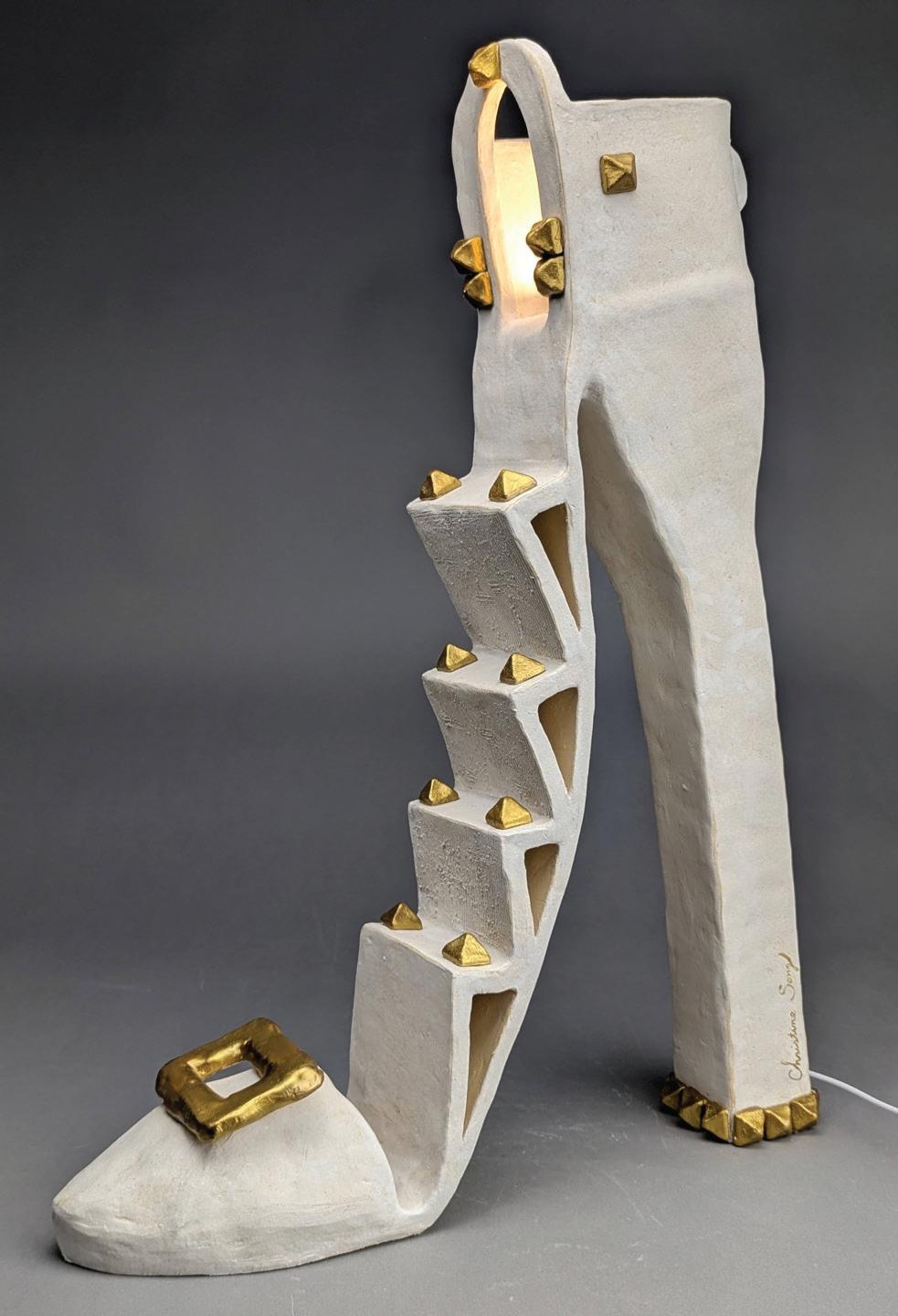
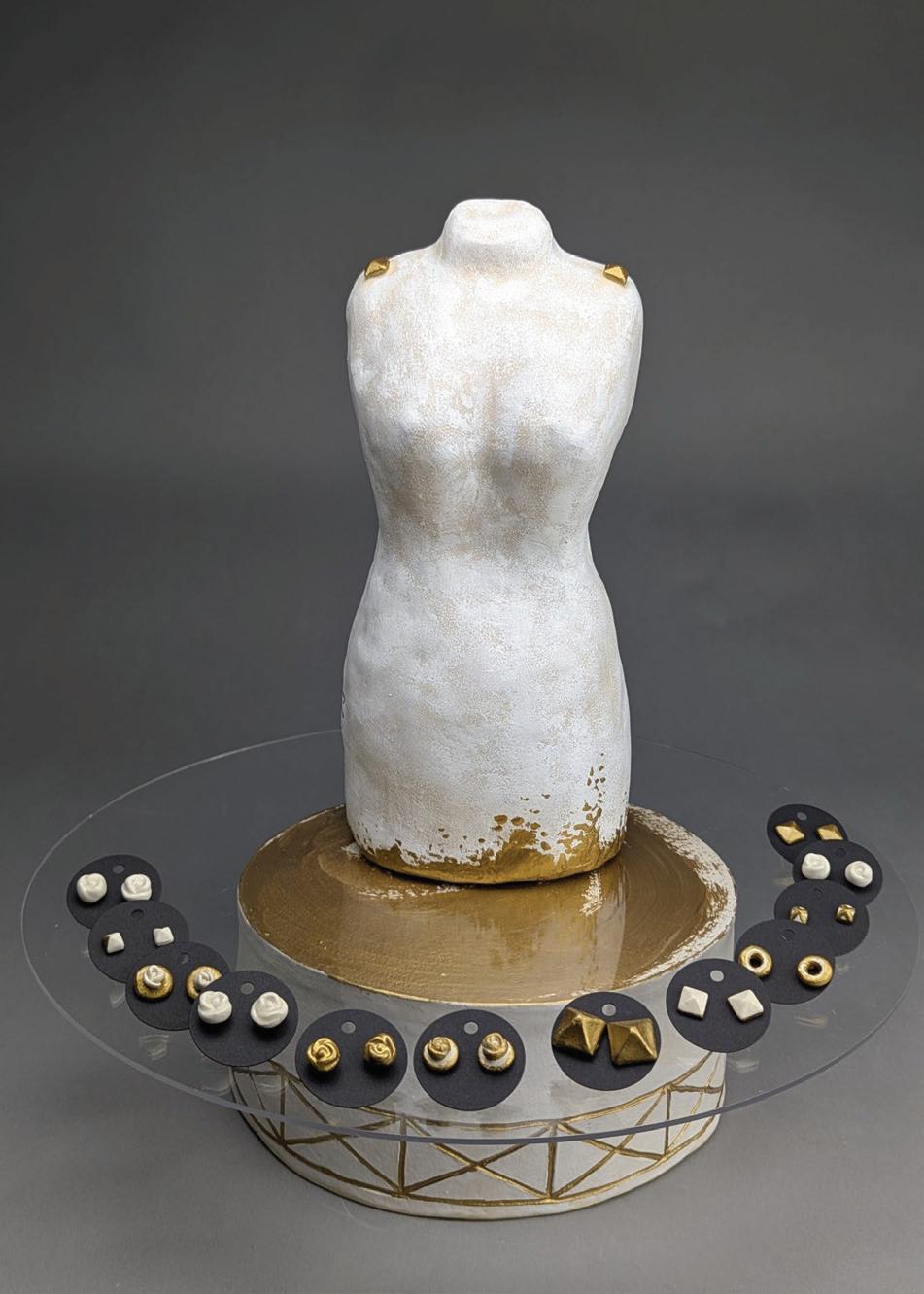
Christine Song, Jacob’s High Heel Ceramics
Mixed Media
Christine Song, Rose of Sharon
Red Rain
By: Chase Heath
Bullets rain
Bullets rain
Bullets rain
Wipe your tears
It’ll be alright
Here’s the rain
Let it wipe your tears away
Blue tainted red, a quiet storm takes all
Backpacks for vests, folders for Kevlar
Bullets rain
Bullets rain
Bullets rain
A sea turned black before lighting strikes
A beast bears its fangs
Lightning strikes hot but the kids cold
Let the bullets rain
Let the bullets rain
Let the bullets rain
Children silenced as Mr. Mag speaks
Families stained with red mist memory
They didn’t want to die but, yet it rains
A government’s pride can’t die, even while it rains
Cries turn screams, an iron sea is all we see
Bullets rain
Bullets rain
Bullets rain
The red for kids
The stars a statistic
The blue we don’t see as bullets rain
Bullets rain
Bullets rain
Bullets rain
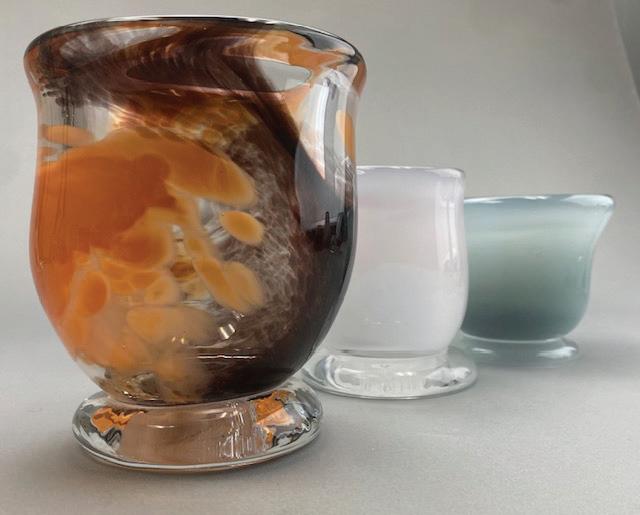
Dimitri Makedonsky, Bowl Color Experiment Glasswork
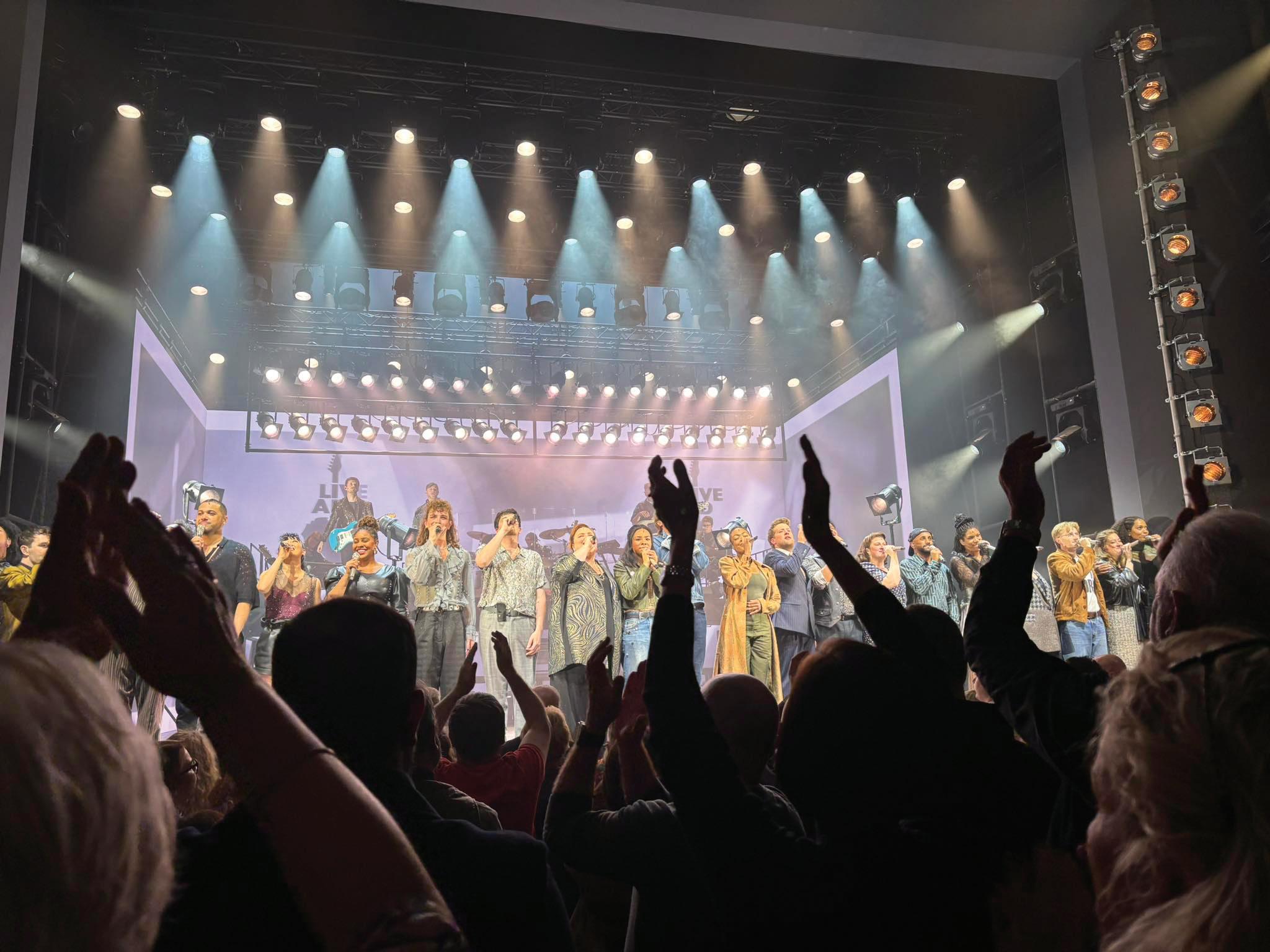
Sharon Falduto, The Ovation Photography
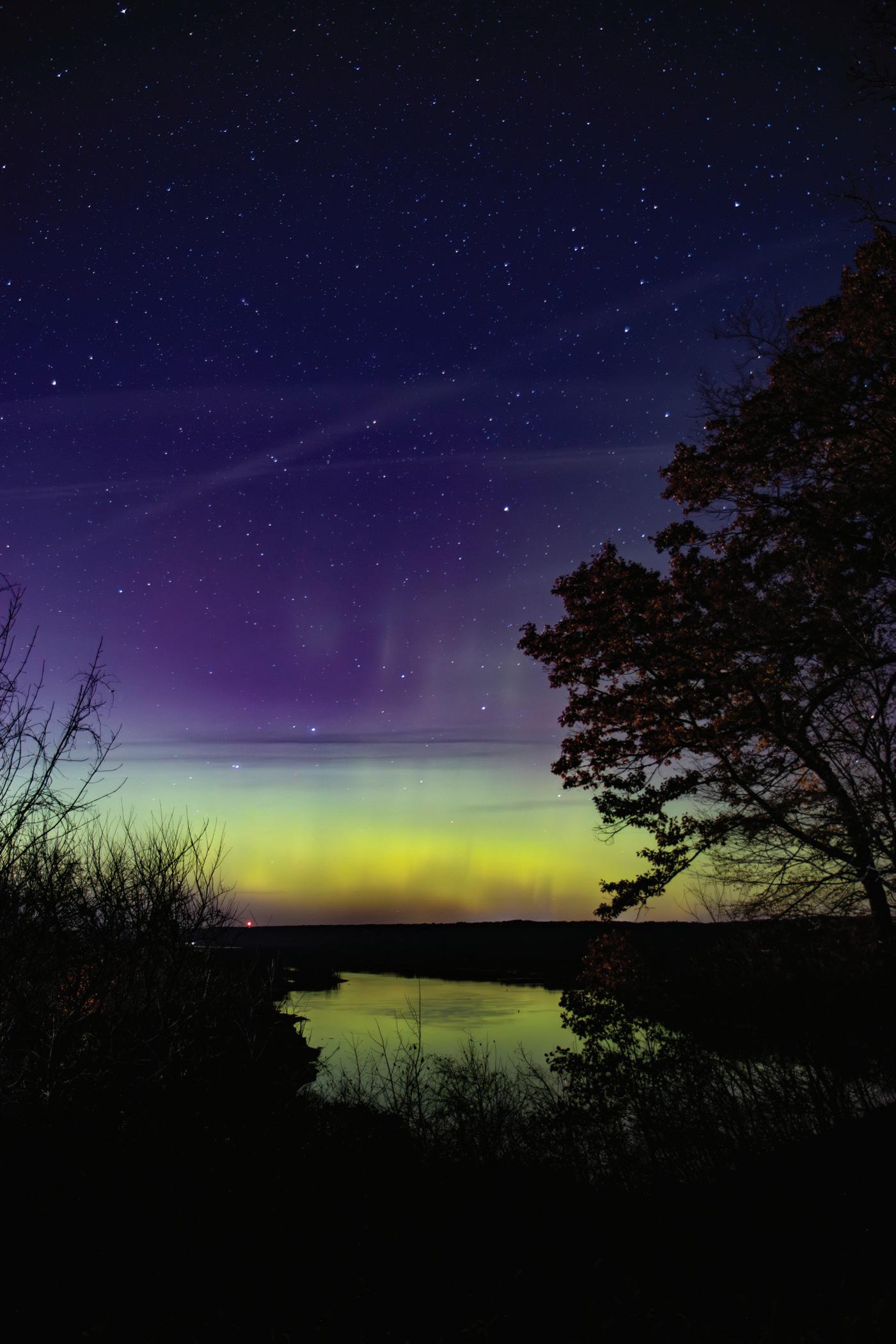
Kota Winterboer, Painted Night
Photography
The Rope
By: Paul Brandon Bremer
I’m knee-deep in the dark , fumbling with the buttons of my collar, my cuffs.
One sock is missing, a shoelace has snapped.
The waitress forgets the milk with my meal.
I lose the beat, the day runs away.
Still, I can’t let go of the rope.
The words, like the way, won’t say what I want,
the key to their meaning broken off in the lock.
Memory, whispering sets me on edge:
a dream leaning against a lamp post, whiskey glass in hand— a girl, her hair braided glass.
Surely a man can write a library and still end up broke. Still holding on to the rope.
Jade Heth, Still Waters Photography

The Script
By: Danielle Ellis
his wife wasn’t beautiful . He didn’t think he could love her if she was. She was constantly mocked on the Internet, considered to be out of his league. She wasn’t ugly. Just normal. Average and human in a subpar, animalistic world.
Unfortunately, he was part of said collective and she couldn’t handle it anymore. Six months ago, she had packed up, but he insisted on leaving; he would never displace her. That’s what the penthouse was for. The one he secretly kept renting for when he would become insufferable. A place for him to hide in the shadows like a rat.
They hadn’t separated in a long while. Several years. He hadn’t been more annoying than usual. Maybe it was because their son was getting older. Twelve at the time, turning thirteen today, his birthday.
His son, Anthony Howard. His wife, Justine Howard.
He was born Black Derek Howard. Growing up, whenever his family had company or one of their fancy, polite parties, his father would gather the crowd and explain giving little Black a last name as a first name. He’d laugh about it, adding that the boy came out darker than expected so he named him Black.
His life was nothing more than a joke to his father. He was used to it. The crowd was always unsuspecting, chuckling nervously as their eyes fell on him. Tucked under his father’s arm, mimicking normalcy.
His mother had to wait until the embarrassment had landed before sweeping him away. Trying to comfort him with warm and gentle words that wouldn’t stir the company. They were a family of secrets. Even to his mother.
His name was Howard D. Black. HD Black professionally, and he preferred if people called him Hud. Hud arrived at the birthday party in the exact fashion Justine probably expected. Burdened with
gifts and toys.
He had a tidy mental list of every single thing his father had done wrong. Created when his wife told him she was pregnant. He was careful, meticulous. Methodical. Not one item had been replicated or inflicted.
His father never gave him anything, so Hud gave everything he could. Anthony was a spoiled child, and Hud didn’t regret it.
Justine’s brown eyes met him. Her lips pressed into a thin line. They discussed this, he knew it was too much. She knew it was compulsion. Uncontrollable—Damn it, couldn’t he spoil his own child?
Perhaps she felt this telepathic, one-sided argument. She turned, rolling her eyes without any real heat, and walked over to the tables used to create a buffet. She looked a little different, but he couldn’t figure out how. Maybe her cheeks were thinner.
“I brought food, too.” He said, throwing his voice at her like a ball.
She caught it. “I know. The guests brought dishes, but I left space for your nonsense.” Justine wasn’t annoyed. He knew when she was.
She was right, of course. The caterers would arrive shortly with arrangements spanning barbeque to East Indian fine dining. He never had a birthday party himself. Had never been to one growing up. As an adult, it was easier. Booze and food. Some good tunes. Done.
Children needed. What he provided wasn’t what they typically required. A hard way to learn. But he always learned the hard way.
Hud placed the gifts near the others, looking around his home. He inhaled, rubbing his hands together, hoping so deeply he would be allowed to stay.
“Where’s Anthony?” he asked even though Justine had disappeared. Didn’t matter. She had mom ears. Heard everything from everywhere.
“Outside with friends,” She called out from whatever sanctuary she had found.
He nodded to no one, taking the rolled stack of papers from his back pocket. Barely held together by a staple begging for mercy.
“Got another one for you,” he called out. Placing the gathered words on the end table. Always the same one. Their script table.
He felt compelled to clarify. “Another script.” And love letter. And biography. And apology.
Writing was one of the few things that came naturally to him. He didn’t make up stories. He
gathered those he loved, sitting them down as an audience in his mind, and told them something. Many things. Becoming characters that said what he couldn’t.
To date, he’d told Justine the most. Second, was Anthony. Unfortunately, his son was a little squirt right now. He wouldn’t understand the messages for a while.
Justine reappeared, routing to the script table like an NPC. Her eyes softened as she read the cover. It was a coming-of-age story, titled Mesquite Creek. The small town where she had grown up. She looked up at him, but he turned away. Leaving his muse and script doctor alone as he walked to the kitchen door that led outside.
The green yard spilled out before his eyes. Fenced, for safety. Mowed, because he still paid for the upkeep. Justine never had to worry about anything. He made sure of it.
Something about the sun-swept day reminded him of his mother. She had been beautiful. Justine was everything his mother wasn’t. Vocal and resolute. Occasionally unyielding. His mother had been soft like a cotton towel. Soaking up his misery until she simply couldn’t hold anymore. Then it dripped back on him.
Anthony was playing tag it seemed. His youthful vigor was unmistakable. The children ran, full stride, maximum horsepower. Hud stood at the door and smiled. Wanting to close in yet too afraid to leave the safe distance.
Justine’s footsteps were light, but he heard them. He entertained the idea of fleeing. Hands flailing as he screamed. Theatrics were for the actors. He hated actors, but they supplied his livelihood. His literal life blood.
Justine leaned against the door; the curtain scrunched under her weight. She tapped the script in the palm of her hand before placing it on the island. Eyes on him. Waiting for him to man up and face his own destruction.
Justine wouldn’t say it like that. She wasn’t a butcher’s blade. Just teethed like a butter knife.
“I’m sorry,” she said, speaking first. It surprised Hud, making him meet her eyes. “I didn’t mean to…” She trailed off with a soft sigh, crossing her arms.
Oh no.
That was the pose of damnation. When they were encroaching the end. She’d only said it twice, and he had narrowly escaped the clutches of darkness.
Three strikes, you’re out.
He wasn’t even a sports fan.
He flinched when she caressed his cheek. She didn’t touch him often because of the tendency. She sighed, looking down. “I’ve been behaving childishly.”
This wasn’t divorce. This was unknown territory. He hadn’t thought they had any left. Twenty years of ups and downs should have covered everything.
He wrapped his arms around her, knowing she needed warmth. “What’s wrong?”
She sniffled. He tensed; Justine hardly ever cried.
“You’ve done nothing wrong,” she said. That seemed unbelievable, but he didn’t interrupt. She had gone quiet, and he waited.
“My doctor found a mass on my kidney.” Her voice crackled and died out like a radio. A muffled wail took the place of words.
The thump in his chest was uncomfortable. A heart wasn’t supposed to beat so frantically.
He didn’t cry. Couldn’t.
He wanted to. For Justine. For their son.
His emotions were entirely under his control. Regrettably, he powered them off and misplaced the remote control. It’s what they fought about. His emotional constipation as she called it.
Until this exact moment, he had escorted the critique from one ear to the other, slamming his ear drum behind them. Now, he felt ashamed.
“Does Anthony—How long…” He trailed off with a heavy breath. Questions could feel like planning. Right now, she looked healthy. There was no need to march her to the pearly gates just yet. “I’ll be here, every step of the way.”
“I know.” Her voice trembled, “I have six months. Maybe eight.” Not enough. That’s not what he had planned. Not what was written. He was supposed to raise Anthony to adulthood. Watch Anthony graduate and thrive, marry and start his own good life.
Then Hud could die. He would be ready and willing. It wouldn’t be sad but a celebration. Everyone would cheer and dance, hip-hip hooray for the sad sack finally meeting what he deserved.
Justine would remarry and choose better this time. She would be happy and love hard and die a satisfied old woman.
This wasn’t supposed to happen. Not to her.
He whispered, “You deserve a long life.”
“You deserve to be happy,” she said. Already starting to prepare, to say and share what she needed to for the inevitable.
He almost lied to her, saying he was happy so she could have some peace. They could move on to the next request of her life wishes. A lie couldn’t go undetected.
“I’ll survive,” he said, being careful as if this were a polygraph test, “And Anthony will be alright. I’ll take care of him and make sure he has everything he needs.” A beep went off in his mind. Worse than tinnitus. He hadn’t meant to lie; the sentiment was genuine. Misguided, perhaps. Anthony needed his mother. Shoes a father couldn’t fill.
“I know. You’ll do your best and that’s all children really need.” She had more faith in him. Always seeing his potential. Sometimes convincing him to act on it.
Hud held her, squeezing as if they could morph into one. Justine pulled back with the most broken smile. Her lashes clumped together, and her cheeks were wet.
She cupped his face. “It’s alright. We still have tomorrow.”
He touched his brow to hers. One day they would run out of tomorrows.
It took a long moment, but they scraped up some composure. He wiped away Justine’s tears. Helped her look a bit like her old self before the truth hand ripped something away.
With held hands, they left the safe distance. He called for Anthony as if the courage had been with him the entire time. His son turned around, his game interrupted. He hesitated before unconditional love dragged him across the yard. He wasn’t kicking or screaming. Tiny victories.
“Hi Dad,” Anthony spoke in his raspy voice. Soulful, like Hud’s mother. It had skipped a generation. Hud spoke as if a ghost was constantly sneaking up on him.
Like him, Anthony was darker than they had expected. They hadn’t known what to expect. Hud’s father was European. His mother was from the backwoods of Louisiana. She was forced to stuff her legacy and culture in a locker when his father was around.
Justine was almost his inverse. Caribbean father and a mother who was also mixed, but with Italian and Mexican. Anthony’s DNA was scrambled eggs.
Hud wasn’t a physically affectionate father. It was on the list. His instincts had scribbled the note, first and foremost and in bold. It made sense at the time. Informed by a painful childhood.
It was something Hud couldn’t consolidate. No compromise fit his truth. He watched other fathers hug their sons and pat their heads. Out in the open and seen. Hud was too afraid to follow the
example. His family had secrets. Other families could, too.
Justine ran her fingers through Anthony’s flowing yet kinked hair, a silent command to give his father a hug. Anthony obeyed, leaning forward and wrapping his arms around Hud. Justine’s pinched brow made him return the embrace. Loose and distanced to avoid causing harm, knowing he was inflicting a different one.
Hud attempted conversation, “How’s school going?”
Anthony pulled back, arms crossing. “Good. There’s a science fair coming up. I want people to stop fearing radiation.”
“That’s an awfully big goal.” Hud’s hands slid into his pockets, clenching into fists. Not knowing what to do with himself.
“You tell me to dream big,” Anthony said, leaning into his mother. She carelessly wrapped an arm around him. Her eyes fell on their son, already saying half a goodbye.
“I’ll help you think of some ideas after the party,” Hud said. Wanting to reach out to his son, knowing he would snatch away if Anthony connected.
Academics were equal ground. A neutral and secure space for all of them. Justine asked about a girl in Anthony’s class, and Hud followed his family to the heart of the festivities.
Justine was losing weight. She didn’t face this with sorrow. She stood on the scale and did a quiet cheer for reaching a goal. She had always been healthy, never obese. Weight loss wasn’t a goal she needed. He watched from the bed. Arms crossed. Legs crossed. Tense and tight. Becoming a human knot.
Three months in. The doctor had said six to eight.
Her cheeks were starting to sink, and her collarbone stuck out across her chest. Her flesh was falling through like a foot on quicksand.
A clock ticked behind his eyes. Three to five months left. At most 216,000 seconds and dropping. She sat beside him, unraveling his knot with a hug. Held him like a baby to the chest. “We need to talk.”
They never stopped. Even when separated. Some couples forgot how to communicate, but they spoke daily. Life was full of events and who better to share them with than the woman who had become half of him.
She wasn’t talking about casual conversation.
He had been digging through his baggage in search of some maturity. Something honest and strong to face the situation with. So far, all he’d found was the same childish regression. This wasn’t a conversation he wanted to have, and it showed.
She was patient. Always waiting until he was ready. Quiet until he returned the embrace. “Anthony is becoming a young man. You can’t keep treating him like a child.”
“He grew up too soon,” Hud spoke with certainty, a finger pointed to his child doing exactly what he was supposed to. He didn’t want Anthony to be slow or stagnant.
Justine pulled back to meet his eyes, “You need to talk to him. A real talk. He needs to know what you’ve been through, so he can understand.”
“I’m not the one. That’s you.” Hud said, “You’re the emotional and nurturing one. I make sure Anthony doesn’t act up, and I help him with his homework and projects. It’s why we work.”
“I’m not saying become a different person, Hud.” Justine’s voice was soft as she spoke. “Just give a little so he can understand the person you are.”
Justine never asked for anything. She stood by and took part in everything that had come their way. When they separated, she stilled and waited. Diffusing any possible resentment and letting him rearrange his mind.
“I promise.” He spoke quickly to outrun his fear. “I just…” His breath shuddered, “It won’t be immediately. Not today, or tomorrow.”
She nodded. “I know. You have time.” So, they hoped. He didn’t trust planning anymore. Everything had been following along as if they’d rehearsed and were putting on an award-worthy performance. Only for the ceiling of the theatre to crash in.
He helped her get dressed, hiding the hurt from her slowed movements. Justine was a bouncy person. Going from one space to another with a boing. Now, she simply walked. One foot in front of the other.
Anthony was already in the kitchen. Twirling a spoon in his mountain of cereal. Not a bite had been taken. He knew better. They didn’t allow wasted food. Hud didn’t criticize it. This wasn’t misbehavior.
He had been trying something new lately. Doing his best to bridge the gap that grew as his wife slipped away. Hud extended a hand, stiff and robotic, giving Anthony a single pat on the head. Pulling back and watching, making sure the boy wasn’t harmed.
Every time he did this, Anthony gave him the same bewildered look. That was fine. Confusion was an improvement from horror.
His idiosyncrasies were like breathing for Justine. She patted Anthony’s head properly as if it were a demonstration. His son gave him a lingering look of perplexity before returning to the neglected breakfast.
Poor boy. He was truly getting the worst of it. Three to six months and he would lose the best thing that had happened to both of them. Left in the custody of a flustered, gawky idiot. Of course, he stared despondently into cinnamon and sugar circles.
Isolation was on the avoid list. Growing up, his father never took him anywhere. Hud went from school to home. When Derek Howard was away, when Hud and his mother were allowed to live, she took him to museums and zoos. Stuffing everything into the short time they had.
“You wanna go to the science museum?” Hud asked.
Anthony shrugged. “The one downtown?”
Even Hud knew better. Anthony required fresh experiences. “No, in Fort Worth.”
The boy perked, turning towards at his mother as she poured a cup of coffee, “Can mom come?”
“Of course!” she said, voice chirping like a birdsong, “If I’m up, I’ll always be trucking along.”
Anthony’s smile was small. So young but he understood the kindness in the effort. Bittersweet. Hud shifted his weight before deciding to sit. He didn’t slump, didn’t scream. He couldn’t let Anthony see him being weak.
By the time they were in the car, Hud felt so stupid. Fort Worth’s Museum of Science and History was massive. Justine couldn’t…he had been thinking about several yesterdays, when her face was full and her gait was unfaltering.
Hud reached for her hand as he drove, rubbing his thumb over her knuckles. “Is this okay?”
She nodded. He expected her to, but he also knew she wouldn’t lie.
“We can get a wheelchair.” She smiled as if presenting a life-altering invention. How was he supposed to survive without his brain and his heart? Hud took a deep breath, glancing at the rearview to check on Anthony. His son gazed out the window. Thoughtful and silent.
Repressing, perhaps. Or maybe pre-grieving. Only one of those was tolerable. Maybe money could fix it. Minted bills had only solved half of his problems so far, less if one asked his wife. But it was the only thing he had in abundance.
Hud decided. Declared it in the open, empty space of his own mind. Anthony would be put in therapy. He’d work out the grief and never became a husk like his father. This felt right, like his first smart and mature decision.
they were told guidelines and advice to keep breath in Justine for a bit longer. Hud had reviewed the notes. Memorized them. Letting her sit up in the chair for too long was ill-advised, especially outside.
They were in month seven. What could be added? An extra day? Maybe another week? Unless it was the forty years owed to her, was it truly worth it?
He called for Anthony as he picked his wife up and placed her in the wheelchair. She looked as nice as she could. He bathed her every night, combed her hair, and dressed her. Holding out her jewelry box so she could choose adornments and spritz her favorite perfume.
Their son appeared in the doorway. He liked to push the wheelchair. Maybe it made him feel useful.
The front yard had a garden that was still young. Hud started it with her when he first came back home. It was something she had always wanted to do.
Justine took a deep breath of fresh air, sitting primly and content. Soaking in the sun like one of the flowers. Hud mirrored her smile because Anthony needed to see it. He almost gave Anthony a singular pat, but Hud wasn’t convinced it was painless.
Anthony sat on the porch beside his mom, and she ran her fingers through his hair. It was getting unruly, but the boy didn’t want to cut it. Hud had tried to convince a comb to cooperate, but the boy’s texture was an amalgamation of ethnicities, and they were all competing.
Hud leaned against the rail, noticing Justine’s sunken eyes and hollow cheeks. Her glow was fading. Hud was certain, absolutely convinced, he would rather drop dead. Slipping away hurt entirely too much for every. single. person. involved.
“What do you want for supper?” he asked.
“We can’t eat out again,” she said, giving him a look, playful as if her doom wasn’t impending.
Hud chuckled softly, “I wasn’t. I can throw something together.” He glanced at Anthony. His vibrant, busy-bodied son had grown quiet and sullen. His spirit was slipping away with his mother.
Justine followed Hud’s sight. For the first time in over half a year, there was a crack in the facade. Her smile collapsed. Wasn’t allowed to hit the ground. She caught it and placed it back where it belonged.
“I’ll teach your dad how to make lasagna.” She always spoke as if they had infinite time.
Mentally, Hud made space for a new recipe, like a reticulating machine. She had taught him thirtyeight dishes. He felt it wasn’t enough. Anthony would eat more than thirty-eight meals as he grew.
Anthony didn’t seem confident in this possibility. He shrugged, leaning against her chair. Her smile left only because she sat it down, looking up at Hud. Justine said nothing, but he heard the plea to make it better.
He didn’t know Anthony well enough. He knew his son was brilliant and kind. Strong and resilient like his mother. Creative and analytical like his father. But the correct word-to-action combination to unlock joy or laughter? He had no damn clue.
“Why not both?” His voice cracked, sounding more uneven than usual, “If I screw it up, at least there’ll be something worth eating.” The suggestion sounded as illogical and desperate as he felt. The boy’s mother was dying, and Hud was talking about food. “Then we can go for a drive. Get out of the house for a while.”
Silence followed. He and Justine barely breathed, watching each other as if a stare could manifest hope.
Anthony finally spoke up: “Can we get ice cream instead and have lasagna tomorrow?”
He and Justine exhaled at the same time. Anthony had spoken as if this were a compromise with death itself, asking for one more day to be a family. Hud decided to make this a habit and soften the request as each day passed. So, they wouldn’t be disappointed when death spoke its final command.
a nthony had advanced two grades up. Part of the list. Hud had tutored the boy since he was in the womb. When Justine sat back against the headboard, rubbing her swollen belly, he would lean over and whisper math to his son.
Two plus two is four.
One plus one is two.
Three plus three is six.
Out of order because rearrangement took reasoning and that was real intelligence.
Hud glanced at Anthony as he chopped vegetables. His son sat at the island, patient and quiet as he studied for a test. Consistent behavior so far. Anthony always did his homework while his father cooked. In their old normal, Anthony would study in his room while Hud overworked the keyboard in his office and Justine clacked utensils in the kitchen.
Hud had no idea what he’d done to deserve commitment. He was afraid talking would mess everything up. They didn’t usually conversate unless Justine was in their presence.
Silence was incorrect. Hud knew this. His promise to Justine inched forward in his conscious thoughts. He glanced at Anthony again, knowing damn well he had nothing to say.
“If you have questions about anything, you can ask.” Hud wasn’t talking about homework, but he wasn’t prepared for Anthony to know that.
His son looked up, but not at Hud. He stared across the room at the blender they had bought during a phase of healthy eating. The device was promptly forgotten as the dust on the lid suggested.
His son asked, “How come you never talk to people like Mom does?” Anthony did that. He found obscurities and held them under a magnifying glass.
“I talk to people all the time. That’s how I find work.” Hud felt that had been obvious, but maybe Anthony just hadn’t witnessed it. Hud’s work usually took place behind the closed door of his office.
“Mom has friends.”
Hud knew. They called often and occasionally dropped by. Justine attracted good people. The kind who would bring gifts that a soon-to-be widower and single father might need without overstaying their welcome.
Hud said, “I have friends.”
He, in fact, did not. More than two people was a crowd and he didn’t like being amongst them. He had close associates, but his world orbited Hollywood where his father had been prominent. Hud saw Derek Howard everywhere. Pictured on office walls, in someone’s mouth when they shared memories.
“I’ve never seen them.” Anthony had pushed the book away, arms crossed on the counter. Still facing the blender as if it had answers and enough scrutiny would expose them.
Hud pondered this. Wondering why it was important. What could Anthony possibly learn from his father’s imaginary company? Maybe looking for common ground. His son had friends who visited all the time. Anthony was sociable and gregarious like his mother.
Hud was quiet and hidden like his mother. Only family was allowed to get close, and he kept Anthony at arms distance. Had to, or else the secrets might manifest, warping Hud into a monster, and then they would have secrets too.
The vegetables had been abandoned. Their juices made his hands sticky as they hung limp at his side. Hud looked back at the blender. Searching for his own answers. “Would you feel better if I had friends?”
The boy shrugged. “I don’t know.”
Communicating with kids was frustrating. They never said what they meant, and you had to bang on a closed door to get in. Usually only to find more confusion.
Mentally, he added something to a new list. His “Anthony’s Needs” list. Sustenance was listed first, only because Hud was certain of it. Security was next. Now, he jotted companionship. No explanation included because he didn’t have one.
Hud supposed he could ask. A fist against the closed door.
“You brought it up as if it matters to you.” Hud went back to the vegetables, following a hunch. Anthony had closed off when given too much attention. Perhaps he was like a cat. Only curious when in the peripheral.
“I don’t know.” Anthony repeated, “Mom’s friends might stop coming around and you don’t have any.” Hud’s lie had been seen through and discarded.
Fear of abandonment made sense. Hud relaxed and tensed at the same time. He hoped Anthony knew he wasn’t leaving; at the same time, he realized his presence was the same as absence.
“Her friends ask about you all the time.” Hud made sure he didn’t sound disappointed. “They’ve bought you all sorts of things. They won’t forget you.” He tried to speak like his wife. Attempting soft and encouraging despite feeling awkward in a Justine-shaped costume.
Anthony nodded a little, eyes narrowing. “Okay.”
The reply was simple, and he pulled the book to himself, studying again. Hud felt as if he had misstepped and wasn’t sure how. No relief had been found, but Anthony wasn’t antagonized either. He willingly stayed even if the response felt like a retreat.
Hud wanted to crawl all the way upstairs and beg his wife to live forever..
h e heard a nthony ask his mother if she could help him with his homework. Her reply was barely audible. A whispered, “Of course.”
Hud stood in the bathroom, facing the mirror, hands pressed down on the counter. Staring at a man consumed with fear and apprehensive of grief. The ninth month, long enough to birth a child. Their deals with death were running thin.
He was working on a new script. A commission. Supposedly written for the client but the story was his. The plot would land wherever he demanded. Maybe rewrite his entire life. He’d done it before. Maybe he’d write the story Justine deserved.
When accepting this project, the director sat across from Hud in a conference room. Mid-sentence, the woman chuckled suddenly, telling Hud his father would have been proud of him. He was sure the woman believed it. Derek Howard had been a renowned actor. Every moment outside of home was in character, putting on a show the entire globe loved. At home, his critics were silenced.
Justine called out to him. Hud heard it. He had been listening for her voice. He stood straight but didn’t leave, covering his face with his hands.
He wanted to walk out and find a healthy woman. Full of happiness and wisdom and faith and life. Anthony spoke up for her, almost shouting as if his father had grown deaf. Hud dropped his hands and opened the door.
She smiled as if he’d gone on a long journey, holding her hand out for him. “You should let Anthony read your scripts.”
Hud wanted to hear her voice, but he wished she wouldn’t speak. It seemed hard for her, like she put all the energy she didn’t have into conjuring words. He sat beside her, taking her hand.
“Sounds good. If that’s something he wants to do.” Part of the list. Giving choices he had never received. His son didn’t respond. Hud hadn’t expected him to. They had counted down and she was still with them. Could be any day now. They all felt it.
They helped Anthony with his homework even though he didn’t need it. Justine stayed strong for their son’s sake, but it was almost too much. Hud could see it in the way she glanced at him. She usually slept these days. When the assignment was finished, he sent Anthony to get ready for bed. Their son gave his mother a gentle hug before leaving.
“You haven’t talked to him yet.” She whispered.
Hud shook his head. The promise hadn’t been forgotten, just buried underneath care and mounting misery. “I will. I promised. I just need to find the right words.”
“Don’t wait until it’s too late, okay?” Her lidded eyes stayed on him. It felt as if he should make it another promise, but it wouldn’t be a genuine one. It would be impossible for him to gauge. What was between just in time and too late?
“I’ll try,” he said. Her smile was small, and she tried to give his hand a reassuring squeeze, but she couldn’t grip anymore.
“That’s all I need.” She swallowed, looking towards the door like Anthony stood there. “Maybe he should spend some time with my brother.”
Hud had considered this. Toying with the idea whenever he waited for Anthony after school or sat
alone in his office, ignoring obligations. Anthony would want to be with his mom. But should he? Hud could only envision psychological horror. No child should see their parents die. “I’ll call him and ask.”
“Doesn’t have to be right now,” She said, “You can wait until tomorrow.”
Hud agreed. They still had a bit more to bargain with.
two weeks later , on the morning of the tenth month, Hud sat beside his wife, talking to her because she could no longer speak. She smiled at him, taking the deepest breath she had in months. Justine turned to her side, a hand tucked under her head as if sleeping, closing her eyes. A conscious decision.
They had reached their last tomorrow.
hud hadn’t cried when his wife died. He had sniffled and held her hand as if she would wake up. Took a long time before he pulled away to make the appropriate calls. First her brother but unfortunately Anthony had answered, speaking a rushed greeting as if he had been waiting patiently for a miracle.
Hud didn’t know if he was in shock or a coward. He couldn’t say it. Couldn’t hear Anthony cry. He had to. There was no more we, no one else to run to and hide behind. His half had been stolen.
He gathered enough courage to say, “Buddy…I’m so sorry.”
There was silence.
Then the softest sob.
Nothing in the world could prepare a person for this. It hit him, shook him. Triggering something. Or maybe Anthony had shown the way, given permission. His eyes stung and just a few tears fell. Exactly three. He wiped them away and told Anthony he would come for him soon.
h e followed all her requests for the funeral . No deviations. There could be no rewrites; it had to be perfect the first time. Anthony had sat nearby as decisions were made. Quiet in his presence. Sometimes with tears, usually in contemplation.
Hud understood. It lingered for him too, the feeling that someone should be there. A feminine, bouncing woman should have walked into the room by now, a familiar voice should have called out.
Anthony needed.
Hud had nothing to give. He had been a husk. Now his fibers had been taken too. He had to create something. Starting from an amoeba that could evolve.
He didn’t think Anthony could suffer through an awkward head pat. A comfort offering had to go deeper than that, nose-diving into uncomfortable territory. Hud had observed other fathers. Researched happy men and stripped their relationships bare. Laying out all the pieces for a full investigation.
Affection wasn’t painful. Intellectually, Hud knew this. Historically, his perception of normal had been deeply contorted and then covered with make-up.
He listened to hold-music on his call to the mortuary, looking through his office door at Anthony leaning back against the wall, his hands held behind him. Quiet and waiting. For what, Hud didn’t know.
With small steps, Hud pattered across the short distance and reached out, then hesitated. His arm hovered above Anthony’s head. His son looked up at him. Too solemn for bewilderment, or maybe Hud’s oddities were becoming familiar.
He dropped his arm around Anthony’s shoulders quickly, before Derek Howard could convince him otherwise.
Hud flinched with the touch he had initiated. He watched Anthony, hoping all the research had been accurate. He wouldn’t know what to do if he caused pain.
Anthony pressed against him, wrapping his arms around his father’s waist. The suddenness of it exhumed buried memories. They played behind his eyes. His tender instincts had been turned inside out. Disemboweled.
Hud winced as if contact was unnatural but ignored it. He couldn’t keep listening to the voice of betrayal. He held Anthony closer, trying to blink away discomfort in his eyes.
His promise hadn’t been forgotten. He still remembered Justine’s advice.
Hud felt the wet slide of tears down his cheeks. It was okay because Anthony would assume they were for Justine. Most of them were. He just had a lot to grieve.
With a deep breath, Hud looked down at his son, giving him an absolutely miserable smile, “When I’m done with the call, I have something to tell you.” B
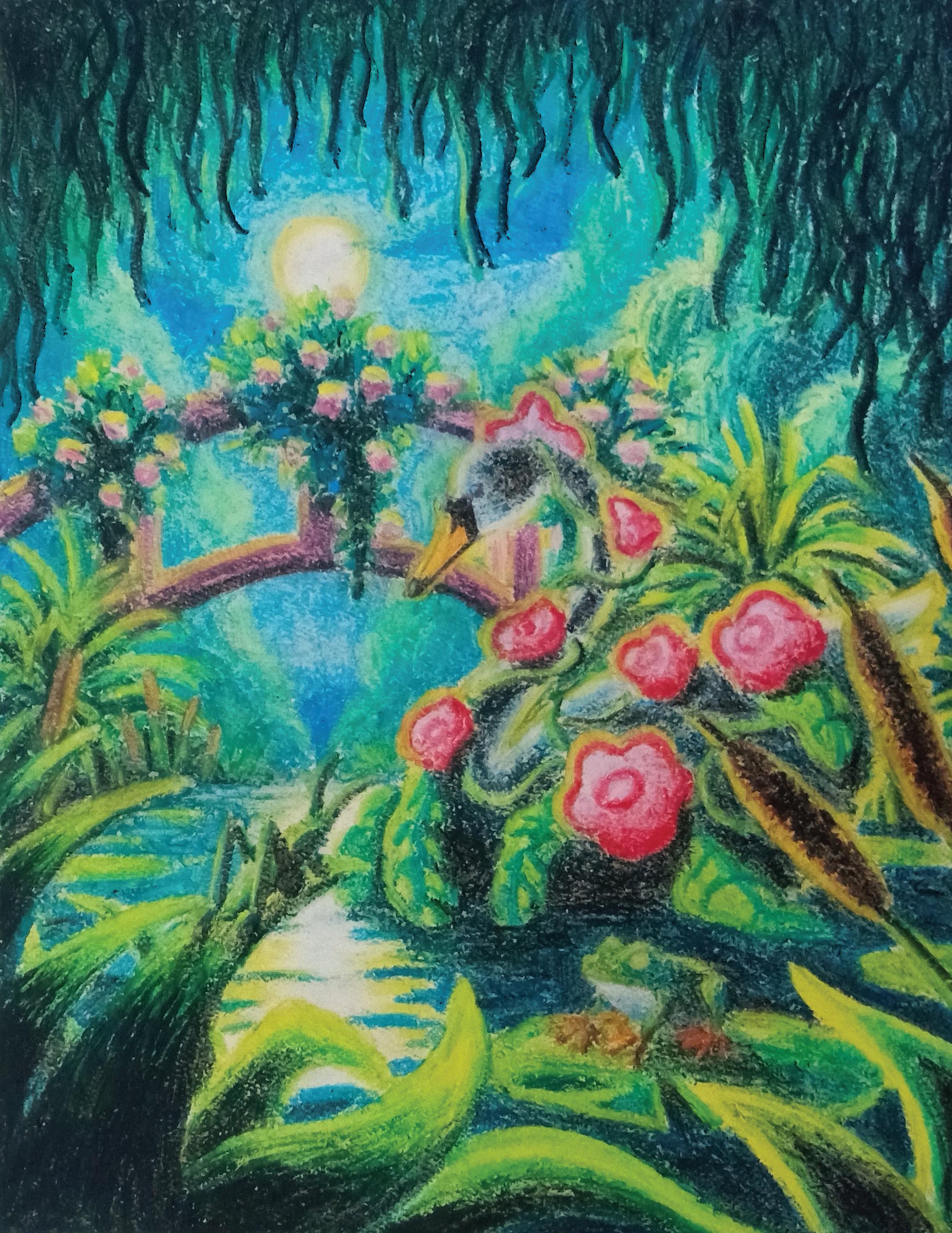
Michael Mullenix, Blooming Swan Oil pastel
Contributors
Taissir Abdelgadir grew up in Omdurman, Sudan and is currently studying digital art at Kirkwood. She has used art to express herself throughout her life, starting in childhood. She loves to use batik fabric, which is historically used by African women to express their trials and “long fight to freedom.” The colors used in her piece Moving 2 are purposeful and symbolic in their meanings. Sudanese women will often wear red to weddings, and widows wear white to express mourning. When describing the meaning of her piece, Abdelgdadir said, “The image is a reflection of the central role women have in Sudanese communities, both at home and in the diaspora, including Iowa. They provide each other with steadfast support in times of grief as well as joy.”
Destinee N. Bahr is a single mother, an officer of the honor society Phi Theta Kappa, and a determined academic. She overcomes obstacles in her life with a smile, and strives to uplift those around her. When describing what her inspiration was for her photograph Cinema at Sundown, she said, “I chase the quiet moments that slip past unnoticed, the ones you won’t fully understand until years later, when nostalgia softens the image and suddenly it means everything.”
Alex Baker is a 21-year-old business transfer major from Benttendorf, Iowa. He’s in his second year and is planning to continue his studies at Ambrose University. Inspired by his own experiences, “The Cheer I Carry” held significant emotional weight. He said, “‘The Cheer I Carry’ is really about being truthful and raw, and about learning how to be the bigger person in difficult situations that shaped my self-growth and success. It reflects a lot of what I carried with me for years and what I’ve learned from those experiences.”
Paul Brandon Bremer is a grateful alumnus of Kirkwood Community College (Class of 1992) who currently teaches English composition and literature courses at Front Range Community College, Westminster Campus, in Denver, CO. He said, “The creative impetus for writing ‘Neither, Nor’ and ‘The Rope’ derived from the restlessness and shaky emotional imbalance of the human heart stranded between seasons and the inexplicable vicissitudes of daily living.” His debut collection of poems, Tough Skins, was published by Redhawk Publications in 2025.
Todd Case , author of “Falling Apart,” has appeared in the Cedar Valley Divide three times. He is a real estate broker in Iowa City and an avid reader of fiction.
Troy Downs returned to Kirkwood to earn a degree in digital arts. He has started exploring photography as a medium within the last year. His picture The View Outside captures an interesting contrast. He said, “I am fascinated by small towns in general and the view outside this window tells a story about the idealized version of small towns that it is depicted on the outside vs what small towns can really be like on the inside.”
Danielle Ellis , author of “The Script” is a writer from the Quad Cities and a reader for The Colored Lens. Her work has appeared in Westbrae Literary Group, Kings River Review, Third Wednesday Magazine and is forthcoming in Penumbric, Neon & Smoke, and Brilliant Flash Fiction . Website: Danifellis.com - Bluesky: @daniellefellis.
Sharon Falduto is a student advisor for English language learners. She writes fiction and creative nonfiction, and volunteers at the Iowa Radio Reading Information service in her free time. The recipe that inspired “Passive-Aggressive Waffle Cookies” was given to her by her mother’s friend. Faldauto assures her readers that she “isn’t really such a crotchety neighbor, and she would happily share her cookies with you.” She shared the story behind her photograph The Ovation as follows: “The Ovation is a photo from the end of a performance in the West End of London called ‘Just For One Day,’ a jukebox musical about the Live Aid concert that took place on July 13, 1985.”
Andrew Forcier, the photographer behind Break a Leg and L-Brace, is a theatre student at Kirkwood. He performed in Kirkwood’s fall musical Urinetown as Mr. Cladwell. His photograph Break a Leg, features Eloise Price. Andrew is
inspired by the “beauty in both the people around him and in ordinary objects.” He spent time helping to build the set for Urinetown, where he was inspired by seemingly insignificant objects like a bucket of L-braces. He would like to thank the important people in his life: “Marrianna Coffey for allowing him to use her space as a makeshift photography studio, the cast of Urinetown for agreeing to be models in various photography projects he had in mind, his parents for always encouraging him to try new things, and finally a duck he met back in 2023 for always being a consistent and stable part of his life no matter what challenges are thrown their way.”
Pete Hadland is an adjunct professor at Kirkwood. He graduated from the University of Arizona with an MFA. “Tiny Plastic Action Figures” is one of his many published works. You can find his other pieces at Pinky Thinker Press, Brink , Mauldin House, and Firewords. He is “relatively sure” he exists, but is absolutely certain that he is “a dad to the greatest kids in the entire universe.”
Mark Hanley is a linguist and musician. He’s a Kirkwood alumni, and went on to graduate from the University of Iowa with a bachelor’s degree in Russian. His farming heritage grew his desire to understand the environmental ramifications of “conventional farming” and inspired his poem “glyphosate.” His second poem “my time” was written after the funeral of a classmate’s wife. It made Mark “think about his own mortality and want to ‘make every day count.’”
Chase Heath is a first year Kirkwood student. His poem “Red Rain” came to him after he watched another news story about a school shooting. He said, “this is more of a call out to the United States government for their failure to enforce safer education and not changing a system that was not designed for peace but for violence and oppression with laws written by corporations and the ultra wealthy.”
Jason Hedlund , author of “Pursuing Passions,” is a returning student. He was inspired by his daughter who earned three bachelor’s degrees. He is currently studying business management with a plan to transfer to Notre Dame to complete his own bachelor’s degree. The inspiration for his essay comes from his late Uncle Wayne. He said, “Through missteps, laughter, and the steady warmth of his guidance, the marsh became more than a place to hunt; it became a place to belong. This is a tribute to mentorship, memory, and finding love for the outdoors in the most unexpected moments.”
Jade Heth is studying construction management and embraces her creativity through photography and art. She enjoys being outdoors, reading and drawing. When speaking of her inspiration for her photograph Still Waters, she said, “I was taking in the landscape when I noticed three small lily pads floating on the water. They stood out to me in such a beautiful, peaceful way, but there was also something bittersweet about it, knowing that something so delicate and alive would soon fade with the cold.”
Kaleigh Keeney is a criminal justice major who spends her free time “surrounded by art.” She said, “there is art in everything, and my favorite thing to do is look for it.” Her hobbies include drawing, writing, poetry, music and photography. Her inspiration for her piece “With Love, Your Friend, OCD” came from an OCD diagnosis at six years old. She said, “I was told by my first therapist that my OCD is not me, but something I deal with. I was told to talk back. I wrote this piece to show what that feels like, and just how persistent OCD can be.”
Wendy Labinger, author of “Turning Over,” is a former English Language Acquisition adjunct professor at Kirkwood. In 2016 she received a PEN America Emerging Voices Fellowship. She has worked with many acclaimed poets, including former U.S. Poet Laureate Philip Levine. Her poems have been published in Sheila-Na-Gig, The Brillantina Project, the Rattling Wall’s anthology of post-election writing, Only Light Can Do That , among others. Wendy lives in Iowa City where she is working on her first collection of poetry.
Dmitri Makedonsky is the artist behind Tall Drink of Water and Bowl Color Experiment. You can find his other works in Heuer Publishing, Amazon Books, and Lyrical Iowa. He first discovered glass blowing on a trip to Colonial
Williamsburg, VA, and was inspired by the craftsmen and women there. Eventually, he joined the Kirkwood glass program. “Thanks to Kirkwood’s amazing warm/hot glass department under the direction of Professor Christopher Gray, Dimitri enjoyed an incredibly creative experience that he deems ‘life-changing,’ and hopes to continue his glass journey-exploring contemporary sculpture and introducing other media such as metal and stone into his creations.”
Michael Mullenix is an artist specializing in 2D art. He is inspired by nature and everyday moments. His piece Blooming Swan was influenced by a trip to the Des Moines zoo where he saw the “Lights at the Zoo.” A display of swans caught his attention; he said, “each swan was at least ten feet tall and were glowing with flowers surrounding them. Another inspiration for this work is the artist Clause Monet, whose paintings influenced the impressionist feeling I hoped to capture in this piece.”
Katelynn Newton , a high school student, was driving when she was moved by the landscape she found. She pulled over and captured the photograph Softly, Morning. She said “Just beyond the field is a busy road, though it isn’t visible in the image. I was intrigued by the way nature can feel untouched even while existing alongside the movement and noise of everyday life.”
Christine Song is a fashion design student. She has recently gotten “into the world of ceramics,” and draws inspiration from “the Bible, nature, literature, and the connections in everyday relationships.” Her two pieces Rose of Sharon and Jacob’s Ladder reflect her inspiration to mix “functionality with artistic expression to transfer meaningful stories.”
Marloe Spencer is a midwestern photographer and writer. Between balancing being a wife, mother, an artist, she can be found chasing storms, walking through cemeteries and abandoned buildings, trying to capture “the intersection of landscape, weather, and the built environment.” Her photography “focuses on moments when the atmosphere transforms familiar places, revealing the uneasy relationship between natural forces, human ambition, and the systems that govern everyday life.” Her piece, An All-American Experience “is a direct criticism of American ideologies in the modern regime, and the celebration of life, liberty, and the pursuit of happiness juxtaposed with the fragility and impermanence of our existence in addition to lives dismissed and neatly tucked away into statistics.”
Christen Tack, a Kirkwood student, stepped out of her comfort zone to capture her photograph Testament of Time. The subject of this photo is a window screen on a Wyoming ranch. She observed, “It stands fast, though shredded, as a testament of time against all that comes against it. One could take that as an anecdote to life and how you can get through the storms if you have the grit and determination to do so.”
Kota Winterboer, third-year digital arts student, works as a photographer and photo editor for the school newspaper Communique. Two of their photos were printed in last year’s edition of the Cedar Valley Divide. They are inspired by, “the horror, the macabre, and the uncanny, often examining themes of identity, transformation, and the strange.” Painted Nights was the first opportunity they had to capture the northern lights.
Yuchan Wong, is a ceramics student. She was inspired to create her piece Pineapple Ceramics by a jar shaped like a pineapple at her house. She said, “I thought it was too plain, so I decided to create a more realistic-looking pineapple.”
Waterz Yidana, author of “The Dondo’s Call,”is a Ghanaian playwright, poet, and essayist. His works explore identity, exile, philosophy, and social change. An Honorary Fellow of the International Writing Program at the University of Iowa, he is currently studying in Iowa and continues writing for global audiences.
Submit to next year’s magazine: https://www.kirkwood.edu/cedarvalley