

ANNUAL ECONOMIC REPORT

Dear reader,
Welcome to the CECE Annual Economic Report!
Following an exceptionally difficult 2024, the year 2025 brought the first signs of recovery for Europe’s construction equipment industry, with sales increasing by 4.6%. After the sharp downturn of 2024 - marked by a -19% commercial performance - the sector gradually regained momentum. Industry sentiment, reflected through the CECE Business Barometer, also improved as 2025 progressed.
With the geopolitical background and the specific case of the US market being hit by economic slowdown and tougher export conditions, I believe these numbers are particularly encouraging.
The outlook for 2026 remains cautiously optimistic. Current projections anticipate a moderate upturn in Europe’s construction machinery market, supported by improving conditions in housing, civil engineering and the robust repairs and maintenance segment. Nevertheless, several headwinds persist, including ongoing supply chain pressures, labour shortages and uncertainties linked to tariffs and geopolitical developments.
In this Report, you will find in depth analysis of Europe’s macroeconomic context, detailed assessments of key client sectors and a comprehensive review of equipment sales performance.
This publication is the result of close cooperation between CECE member associations, our economic affairs experts and national partners who provide essential insights into developments within individual markets. Their collective work ensures that this report remains a valuable, publicly accessible source of intelligence for companies, policymakers and all stakeholders interested in understanding the trends shaping Europe’s construction equipment ecosystem.
Please feel free to share this report widely within your network. Comments and feedback are always welcome at info@cece.eu
I hope you will enjoy reading this publication!
Executive Summary
CONSTRUCTION INDUSTRY
The European construction industry faced continued challenges in 2024, as activity fell by 2.4% throughout the Eurozone. The decline came after a weaker 2023, when elevated building costs, ongoing inflation, and higher interest rates significantly slowed momentum.
EXTRA FEATURE: PARTNER INSIGHTS
In 2025, the global construction and infrastructure sector entered a phase of consolidation after the post-pandemic surge, as higher interest rates, inflation, and labour shortages slowed growth. At the same time, asset finance became increasingly strategic in supporting cash flow, enabling technology and sustainability investments, and positioning the industry for a cautious recovery in 2026. DLL played a key role in this shift, providing lifecycle-focused, partnership-driven financing solutions to OEMs, dealers, and contractors.
EQUIPMENT


Riccardo Viaggi CECE Secretary General
The European construction equipment market returned to moderate growth in 2025, with sales up 4.6% after the sharp 19% drop in 2024. Growth accelerated in the second half of the year, led by road machinery and a rebound in tower cranes, while earthmoving equipment was broadly flat and concrete equipment lagged. Regional trends were mixed, with stronger performance in Northern and Western Europe and weaker results in parts of CEE and Turkey.
The market has likely bottomed out and is expected to see modest growth in 2026, supported by infrastructure investment and improving sentiment. Single-digit growth remains achievable, provided no major external shocks disrupt the recovery.

MACROECONOMIC VIEW
The European industry stabilised in 2025,
but recovery is moderate in 2026
The European economy experienced an uncertain environment in 2025. It was marked by trade tensions, restrictive financing conditions and intensifying international competition. Despite this, the Euro area still recorded moderate growth of around 1.4%, following an almost stagnant year in 2024. However, this improvement in activity levels remains fragile and was highly uneven across the countries and sectors.
The European industry has not regained any real momentum yet. After several quarters of decline or stagnation, industrial activity stabilised in 2025, but is not showing significant growth. Manufacturing output remains below its pre-crisis levels in several major countries, particularly Germany, which is only slowly emerging from a period of declining activity.
Across the Sectors, performances were very different last year. Aerospace,
defence, energy and some industrial technology segments benefited from solid order books and public investment programmes. However, in contrast, automotive, intermediate goods and some branches of industrial equipment continued to be held back by weak demand and intense international competition, particularly from Asia.
In 2025, demand within Europe provided the main support for economic activity, thanks to resilient household consumption and strong public spending. In contrast, investment remained uncertain in some sectors, especially within industry, where many companies focused on specific projects and postponed investments to increase capacity.
For industrial equipment, activity was constrained by interest rates, uncertain demand and high energy costs.
For manufacturers of machinery and industrial equipment, 2025 was a year of
stable activity. Projects were concentrated within a few dynamic segments, notably energy transition, automation and strategic industries, but investment in replacements remained limited.
The outlook for 2026 remains cautious. Eurozone growth is expected to be around 1.4%, reflecting a stabilization of the growth rate. Industrial investment should gradually recover, but in a cautious and highly selective manner, focused on productivity, automation and decarbonisation projects.
As a result, 2026 is likely to represent a stabilisation phase within the industrial cycle, rather than the beginning of a strong recovery. European industry is slowly emerging from the low point within the cycle, but the recovery in investment remains gradual and highly targeted.
Sources: European Commission - Oct 2025 (GDP); European Commission - May 2025 (Investment)
CONSTRUCTION INDUSTRY
The European construction sector stopped declining in 2025 but is not out of the crisis yet
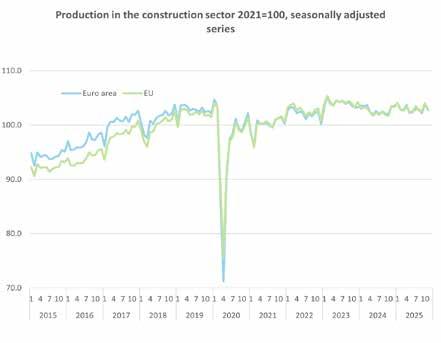
2025 saw a continuation of the slowdown in activity that began in 2023 across the European construction sector. After experiencing inflation and sharp rises in interest rates in 2022 and 2023, construction markets experienced two years of improvement, particularly in house building activity. In 2025, most indicators pointed towards the same conclusion: the sector has stopped declining but has not yet returned to a real growth trajectory.
At the macroeconomic level, the environment remains weak. European growth was limited to around 0.9% in 2025, with limited levels of investment and only modest growth in consumption. Interest rates have stopped rising and are gradually stabilising, but they remain high compared with pre2022 levels. This continues to impact on household solvency and on investment decisions on real estate developments.
In this respect, the main weakness within the European construction sector in 2025 was new building activity, particularly for house building. Recent European data shows that total construction output was stable year-on-year, but with a strong divergence between the different segments. New building activity was still declining last year, while civil engineering grew by roughly 3%, resulting in overall construction activity being stable.
This divergence reflects the downturn in the housing sector which is affecting most major European markets, while infrastructure continues to help to compensate for this.
This situation is highly visible within Germany, France and Italy, where housing markets have been significantly affected by high interest rates and declining af-
fordability. In Germany, the sector has undergone one of the sharpest adjustments in Europe. Between 2020 and 2025, the construction market saw a 10% fall in activity levels, and 2025 was characterised by stagnation, particularly in housing. A significant rebound is not expected in 2026, with growth this year projected to be around 2.5%, mainly driven by infrastructure and public investment.
France is in a similar position, but with a more significant decline in new building activity. The sector experienced a third consecutive year of decline in 2025, with activity levels falling by around 4%. New house building remains the main weakness, with only 283,000 new housing starts during the year, compared with a long-term average of 360,000 units.
Within public works, the situation is less severe but still negative. Activity levels are expected to decline by around 0.9% in 2025, with order intake dropping sharply
during the year, signalling weaker activity ahead. These figures confirm the divergence between new building and civil engineering, with the latter acting as the stabilising force within the industry. Italy is experiencing an even stronger decline. After several years of strong growth driven by the “superbonus” renovation scheme, the market declined significantly in 2025 following the reduction or removal of these subsidies.
Following this, the sector is returning to more normal demand levels, with a noticeable drop in activity after a period of expansion supported temporarily by public spending.
In contrast, Spain appears to be one of the more dynamic markets in Europe. Supported by stronger macroeconomic conditions and a gradual recovery in house building, the construction sector is expected to grow by more than 10% between 2025 and 2027.
Infrastrucre projects and energy investments financed through European funds are also supporting civil engineering activity. The United Kingdom provides the “middleground” within the construction sector in Europe. After a period of strong financial pressure due to high borrowing costs, the sector is expected to return to a growth path. Construction activity is projected to increase by just over 10% between 2025 and 2027, supported in particular by transport and energy infrastructure projects. However, this recovery remains cautious, due to the continuation of high interest rates and uncertain housing demand.
CIVIL
ENGINEERING:
MORE RESILIENT BUT HIGHLY DEPENDENT ON PUBLIC BUDGETS
In this contrasting landscape, civil engineering and public works represented the main stabilising factors within the construction sector in 2025. Across Europe, civil engineering output grew by around 3% year-on-year, in clear contrast with the decline in new building activity. This confirms the countercyclical nature of infrastructure investment and its role in supporting overall activity.
Several different factors explain the resilience within civil engineering and public works. In many countries, investments in electricity grids, interconnections, renewable energy and railway infrastructure have
Sources: Eurostat (Dec. 2025); Euroconstruct Winter Conference (2025); FFB (Dec. 2025); FNTP (Dec. 2025); ING European Construction Outlook (2025) Construction sector by major European country in
making on public budgets. In many countries, public finances are under pressure after years of economic support linked to the pandemic and the energy crisis.
Local authorities, which play a central role in infrastructure investment, are increasingly being forced to prioritise operating expenditure over new capital projects.
In some cases, the timing of elections are also reinforcing this situation. Pre-election or post-election periods are often characterised by delays or reprogramming of investment decisions. This reduces opportunities for public works companies and impacts on order intake, even when infrastructure needs remain significant.
As a result, civil engineering acted as a buffer in 2025, but was not strong enough to fully offset the decline in new building activity across the major European economies. Activity remains broadly stable, but
that 2025 was a year of stabilisation or a slight decline. After a significant contraction in 2024, European construction activity stabilized, but without a clear growth engine.
House building remains the weak segment, while public works provided a degree of support without generating strong growth.
The outlook for 2026 is more favourable. The stabilisation of interest rates, a gradual recovery in private investment and the continuation of infrastructure programmes should support a return to moderate growth.
Most country forecasts within Europe point towards construction activity increasing by around 2% to 2.5% in 2026. This improvement should be driven by a recovery in house building after two years of sharp decline and is also supported by a ramp-up in investment levels linked to energy transition and infrastructure projects.
In summary, 2025 was a year of transition for the European construction sector. The period of declining activity is coming to an end, but the drivers of growth remain uncertain. The sector enters 2026 with the prospect of a gradual recovery, but
ity and public investment policies rather than a spontaneous rebound in demand.


CONSTRUCTION AND ASSET FINANCE: A YEAR OF ADJUSTMENT, AND THE ROAD AHEAD

The past year has been one of adjustment for the global construction and infrastructure sector. After the postpandemic surge in activity, 2025 marked a period of consolidation as increased interest rates, cost inflation, and labour shortages weighed on investment decisions. Yet while growth slowed, the year also underlined the growing strategic importance of asset finance in keeping projects moving and enabling the sector to prepare for the next phase of expansion.
Public infrastructure investment remained the backbone of activity through 2025. Major transport, energy, and utilities programmes across the US, UK, and Europe continued to progress, providing a degree of insulation from softness in private residential and commercial construction. However, the nature of this investment, phased, milestone-driven, and often subject to regulatory timing, put pressure on contractors’ cash flow and balance sheets. Asset finance played an increasingly important role in bridging this gap, allowing equipment investments to be aligned more closely with project timelines and utilisation rather than frontloaded capital outlay.
For original equipment manufacturers (OEMs) and dealers, the past year reinforced the value of embedded, point-of-
sale financing. As customers became more selective and liquidity conscious, flexible finance solutions supported equipment adoption while protecting working capital across the supply chain. The usage-based structures, step-up payment profiles, and milestone-linked drawdowns proved particularly effective in matching financial commitments to operational reality. In this environment, asset finance evolved from a transactional add-on to a core commercial capability.
Labour constraints were another defining theme of 2025. Persistent skills shortages across construction markets limited capacity and increased project risk. In response, contractors continued to invest in productivity-enhancing machinery, automation-ready equipment, and digital fleet solutions. Asset finance supported this shift by lowering barriers to entry, enabling firms to adopt advanced technologies without destabilising cash flow. Financing increasingly became a means of managing labour risk as much as funding asset acquisition.
Sustainability also moved further up the agenda over the past year. Electrification of compact equipment and site vehicles gained momentum, driven by emissions regulations and ESG commitments. While higher upfront costs remained a challenge, financing helped accelerate adoption by spreading costs across the asset lifecycle. This trend is expected to strengthen as environmen-
tal criteria becomes more embedded in project tendering and funding decisions.
For the remainder of 2026, the outlook is cautiously optimistic. Many forecasts point to a return to modest growth, driven by infrastructure investment, energy transition projects, and a gradual recovery in housing markets. As activity rebounds, the role of asset finance is set to expand further, not only in funding equipment but in shaping how assets are deployed, upgraded, and managed over time.
DLL, a leading global vendor finance company, enters this next phase from a position of strength. With deep sector expertise and a partnership-led approach, DLL continues to support OEMs, dealers, and end users with financing models that reflect real-world construction dynamics. By focusing on lifecycle value, operational flexibility, and embedded partnerships, DLL helps the construction sector convert upcoming opportunity into sustainable growth-led approach.
In a market moving from adjustment to revival, asset finance stands out as a key enabler - underpinning resilience today and building capacity for the years ahead.

Scan the QR code to explore how DLL can partner with you to support business growth
Confidence is improving

The latest ERA/IRN RentalTracker survey undertaken in late December 2025 and early January this year shows that confidence is improving in Europe’s rental market. There is no dramatic upturn, but the trend is clear.
It’s too early to report a full return to confidence in Europe’s rental sector, but the latest ERA/IRN RentalTracker survey does show an improving trend all the main measures: current business conditions, quarterly activity year-on-year, capital investment plans and fleet utilisation.
More than 105 companies operating in Europe completed the survey between 15 December and 19 January.
There was a positive balance opinion of +20.4% on ‘business conditions now’ (38% reporting improving conditions, 17% reporting worsening conditions, and 45% seeing no change.) That’s the highest positive balance since the second quarter of 2022, when the pandemic bounce-back was underway.
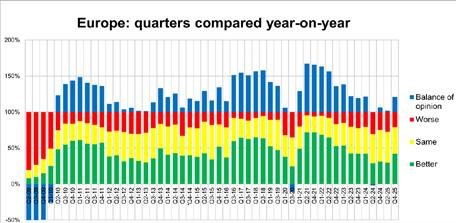
There was a similar +21% balance when Q4 2025 activity levels were compared to the same quarter in 2024. That follows three surveys between June 2024 and June 2025 with either a small or zero positive balance.
Time utilisation also seems to be improving, with a +29.3% positive balance of opinion on time utilisation during Q4 2025. Only 16% saw a decline in utilisation, with a sharp increase in those reporting improving utilisation - from 31% in the second quarter of 2025 to 45% in Q4.
CAPITAL INVESTMENT PLANS
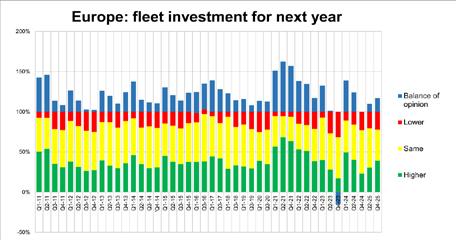
Asked about capital investment in 2026, there was also a healthy +17% balance of opinion, with 39% expecting to spend more this year than last compared to 22% forecasting a lower outlay. In Q2 last year 30% were expecting to spend more in 2026, so the improvement in senti-
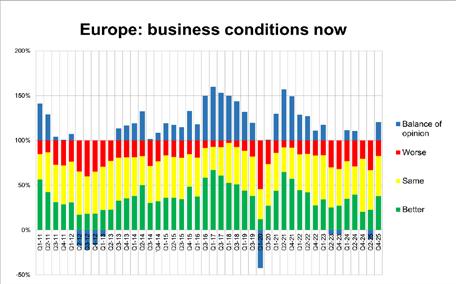
Europe: business conditions now
ment is significant. That +17% balance of opinion is the highest since Q2 2024 and has been building steadily since then.
The survey also finds the industry with its most positive view looking forward for more than three years, with a +48% positive balance of opinion: 58% are expecting things to be better a year from now and only 10% were expecting them to be worse.
Of course, a positive view on future activity tells you something about current conditions, but the fact remains that
the respondents were expressing the greatest confidence on future business conditions since the first quarter of 2022.
Recruitment intentions are always a good indicator of business sentiment, and here there remains a desire to recruit more staff: 39% want to add staff in the first quarter of 2026 against the 8% expecting to reduce their staffing.
That high level of demand for staff has been maintained ever since 2021 and reflects wider challenges in business to recruit and retain workforce.
Europe: quarters compared year-to-year
REGIONAL VARIATIONS
When it comes to results for different countries and regions, remember that the results should be viewed in the context of relatively small number of responses – given that we have 103 in total.
What is notable about the survey results is the positive views held by companies in Spain and Italy. In five of the six metrics on business sentiment (see the tables), Iberian companies were the most positive – a remarkable, consistent result.
Sometimes positive sentiment reflects an improvement on a dire situation, but in the case of Italy and Spain the Q4 results follow similar levels of confidence from the Q2 survey earlier in 2025. There is a sustained level of confidence in these markets.
France, Germany and the UK/Republic of Ireland are below the European average in virtually all the measures of business confidence. No surprise, perhaps, given the lacklustre performance of the economies of these countries.
Europe: quarters compared year-to-year
The results for multinational companies were mixed: above average when it comes to looking 12 months ahead 61% expect conditions to be better - and also positive on the trend for fleet utilisation. However, the biggest companies were also the least likely to increase investment in 2026 and among the least likely to be increasing their workforce.
There are so many determinants of business confidence and so many wider geo-
political and economic uncertainties, that drawing a definitive conclusion from the Q4 survey is dangerous to do. But there is no question: for the moment at least, confidence is growing in Europe’s rental industry.
Source: KHL, European Rental Association ERA. Rental Tracker is jointly organised by International Rental News (IRN) and ERA.
Shipments of surface mining equipment were on a downward trend in 2025
According to the latest update from leading sources, exploration activity within the global mining market has been on a slight downward trend following peak levels reached in 2022. This trend continued in 2025, when activity fell by 1% on 2024 levels, reaching $12.4 billion. Gold and copper account for around three quarters of global exploration budgets. The latest update on drilling metrics is more positive and shows that there were more projects started in 2025 than in the previous two years and this was the highest since 2022.
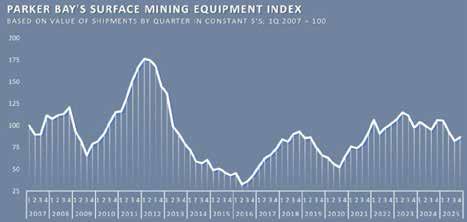
The Parker Bay Company monitors deliveries of surface mining equipment to the global mining market on a quarterly basis. Their latest update for Q4 2025 is shown in the graph below and indicates that shipments were on a downward trend during last year but showed a pick-up in the final quarter. Shipments in Q4 showed just under an 8% increase on Q3 levels and this resulted in shipments for the full year being 6% lower than 2024 levels. The graph below shows the value of shipments, rather than units, and this saw a 9% reduction in 2025 compared with the previous year, indicating a bigger fall in more large/high value equipment.
In terms of the main product lines, the value of truck shipments fell by 7% while the value of excavators/loaders declined by 17% last year. The latest update highlights that this difference is largely due to a global shift toward smaller capacity hydraulic shovels and wheel loaders.
Complementing Parker Bay’s data, GlobalData provide information on the population of global surface mining equipment. This covers six types of major mining equipment: trucks, hydraulic excavators, rope shovels, wheeled loaders, dozers and motor graders. At the end of 2025, the global population was estimated to be 240,313 units, excluding equipment in quarries. The largest share of machines was in Asia Pacific, at 60%, dominated by China, followed by the Middle East & Africa at 9%. This machine population is forecast to rise by a CAGR of 2% by 2030. GlobalData also provide information on un-
derground mining equipment consisting of trucks and underground loaders/LHDs. At the end of 2025, the population of this equipment was estimated at 23,514 units. With steady growth in output, as more mines ramp up and come on stream, the total number of vehicles is forecast to rise by a CAGR of 1.7% by 2030. Highest growth in machine counts is expected in North America and Europe, followed by Africa and the Middle East and Oceania.
During the International Mining and Resources Conference (IMARC) 2025 in Sydney industry discussed mining technology trends for 2026: landscape will be defined by the rapid integration of advanced digital systems, automation, and process innovation to improve productivity, safety, and sustainability. A major theme is the expansion of automation and autonomous operations, including selfdriving haul trucks, remote drilling systems,
and robotics that reduce human exposure to hazardous environments while increasing operational consistency. These systems are increasingly powered by AI and advanced analytics, enabling predictive maintenance, real-time optimization, and smarter decisionmaking at both the equipment and enterprise level. Another core development is enhanced subsurface intelligence, using high-resolution sensing, data modelling, and edge computing to improve orebody visualization and mine planning accuracy. On the processing side, innovation in coarse particle flotation, advanced comminution technologies, and energy-efficient grinding systems is improving recovery rates while lowering energy intensity. Together, these technologies signal a shift toward digitally connected, highly automated, and more resource-efficient mining operations that prioritize productivity, safety, and environmental performance.
European construction equipment sector sees moderate recovery in 2025
The European construction equipment market saw a turnaround in 2025 with moderate growth in sales of 4.6%. While this did not compensate for the substantial decline of 19% in 2024, it was still a significant development amid the challenging economic and geopolitical background. After a weak start to the year with a decline of 8% in the first quarter – not an unusual pattern in the run-up to the world’s major exhibition bauma – Q2 brought a modest recovery of 5% compared with the same period in 2024. The second half of the year showed strong momentum with growth in sales of 12% and 9% in Q3 and Q4, respectively.
All product segments saw similar developments in 2025, with increased momentum in the second half of the year. Sales of tower cranes had the highest growth rate last year at 22%. However, this needs to be put into perspective after a disastrous 2024 when the market collapsed, resulting in a 45% decline in sales.
The second biggest building construction equipment segment, concrete machinery, saw a 3% decline in sales, despite a very strong finish to the year. In the civil engineering segment, earthmoving equipment sales were almost flat (-1%) while sales of hydraulic attachments went up by 9%. Finally, road machinery recorded steady growth of 12% in 2025.
There was a mixed pattern for regional sales last year. In Southern Europe, the Spanish market that had been the most dynamic previously, saw sales grow by 9%, while Italy recorded a minimal decline of 1%. Central and Eastern Europe did not see a return to growth, as sales were flat compared with 2024.
Most Northern and Western European markets saw strong growth in sales in 2025, with Nordic (+14%) and Benelux markets (+12%) the best performing.
However, in the biggest markets, growth was more moderate.
Sales in Germany increased by 6%, the UK market saw growth of 9%, and the French market was almost flat (+1%).
EARTHMOVING EQUIPMENT
Sales of earthmoving equipment in Europe saw a minimal decline of 1% in 2025. However, this was characterized by two different halves to the year. The first half of the year showed substantial declines – even in the “bauma quarter”, with Q2 seeing a fall in sales.
The second half of the year saw growth, that almost made up for
the losses in the first six months. Similar to 2024, the trend in sales last year saw heavy equipment (+2%) perform better than compact earthmoving machinery (-2%).
This is primarily due to the delayed impact of the exceptional growth that mini and compact equipment saw during 2021 to 2023, which has delayed the need for investment in replacement equipment.
Sales of compact wheel loaders saw a double-digit decline of 10% last year, while mini excavators and skid-steer loaders both experienced minimal declines of only 1%.
Monthly construction equipment sales in Europe (index 2010=100)
Due to strong growth in sales in Turkey, backhoe loaders (+/-0%) did not record any sales declines at all. In the heavy equipment segment, the highest-volume product crawler excavators saw moderate 4% growth in sales in 2025.
ADTs (+25%) and crawler dozers (+13%), both recovered from the declines they had suffered in 2024. However, large wheeled loaders and wheeled excavators have not seen a return to growth yet, with both seeing minimal declines of 1% last year. The top five markets saw a mixed pattern of sales in 2025.
While the German market went down slightly by 2%, the UK saw a steady 10% increase in sales. This was different to the overall trend for equipment sales in the UK and was due to a very strong first half followed by more moderate sales in the second half of the year. In Italy, earthmoving sales declined by less than 1%, while the French market went down by 9%.
Turkey saw minimal sales growth of 1%, with slowing momentum over the course of the year. It is interesting to highlight that the Nordic markets (-2%) and the Benelux (-5%), which saw strong sales overall for construction equipment, didn’t see growth in earthmoving equipment sales.
Sales in Southern Europe were flat, while CEE markets recorded a modest decline (-4%).
Falling sales on the Balkan markets (-16%) were more significant, but the low absolute volumes did not make a significant impact on overall sales levels.
ROAD EQUIPMENT
Sales of road machinery on the European market went up by 12% in 2025. While Q1 recorded a minimal decline, the remaining quarters all saw double-digit sales growth.
The decline in sales seen in 2024 has almost been compensated for, but sales within the sector last year were still one quarter below the 2022 record levels.
The performance within the light (+13%) and heavy (+8%) compaction equipment segments were not as different as in previous year. Within light equipment, vibratory plates (+14%) and tampers (+12%)
both saw double-digit sales growth. Pedestrian rollers experienced more modest growth as sales went up by only 7%.
Within the heavy compaction equipment segment, the flat market sales for tandem rollers – by far the largest-volume product – prevented the overall segment from showing stronger growth overall. Singledrum rollers (+18%), trench rollers (+25%), and combi rollers (+13%) all saw strong growth, but the impact of these products is limited because of lower volumes.
Finally, sales of asphalt pavers in Europe grew by 13% in 2025. Looking at the regional pattern of sales last year, the top three countries saw different levels of growth. Sales in Germany increased by 11%, but this was
surpassed by France with 18% growth.
Alongside this, the UK market saw limited growth last year at only 2%. Within the major regions, CEE markets (+7%) and Southern Europe (+1%) only saw moderate growth in sales. In contrast, the Nordic markets (+39%), Austria/Switzerland (+34%), and the Benelux (+26%), all saw very significant growth in sales.
The Balkan markets saw modest growth last year at 4%, while Turkey was the only market to experience a moderate decline in sales of 7%.
CONCRETE EQUIPMENT
Despite its strong exposure to the building construction industry – which has
been a decisive factor in the recent industry downturn – concrete equipment sales were impacted by the downturn relatively late.
As a result, it is now the segment where recovery in sales started later. Sales on the European market declined by 3% in 2025. Following a disastrous start to the year with a 32% fall in sales in the first quarter, the situation improved consistently during the course of last year, culminating in growth of 37% in Q4. However, this was in comparison with a very weak last quarter in 2024.
Italy remained as the largest concrete machinery market last year, with sales growing by 13% from already high absolute levels. The German market showed a remarkable recovery with a 22% increase in sales and almost caught up with the level in Italy. Sales on the Turkish market dropped by 25% but it still remains number three within Europe. Spain (-3%) and France (-20%) are at similar levels of sales. The top five markets account for two thirds of total concrete machinery sales within Europe.
The UK suffered a severe decline in sales of 21% last year, while the Benelux markets went down by 13%, Austria/Switzerland saw moderate declines of 7% and the Nordic markets went down by 5%.
On a more positive note, CEE (+1%) and the Balkan markets (+3%) saw moderate growth in sales in 2025. Product trends within the concrete equipment segment were mixed once again. Sales of truck-mounted pumps (-17%), stationary pumps (-21%), and truck mixer pumps (-9%) all saw significant declines. In contrast, batching plants (+14%) and mixer systems (+13%) saw double-digit growth in sales last year. Sales of truck mixers – the product with the largest volumes – were flat compared with 2024.
Within the light equipment segment, concrete vibrators recorded modest growth of 9%.
TOWER CRANES
Sales of tower cranes on the European market increased by 22% in 2025.
However, this return to growth still leaves sales at low absolute levels after the 45% decline seen in 2024. In 2025, there was a growing momentum in sales during the course of the year, with Q4 delivering impressive growth of 40% in the last quarter of the year. Saddle-
jib cranes (+22%) and luffing-boom cranes (+16%) saw similar levels of growth last year. Italy, the largest market in Europe, recorded sales growth of 22%. In contrast, and against the overall trend, the French market saw a 6% decline in sales last year.
Alongside this, the German market saw a 26% increase in sales and almost reached the same absolute levels as France. Turkey experienced another year of decline (-17%), and the UK market saw a bigger fall in sales of 40%. Southern Europe recorded 28% growth in sales in 2025 and accounted for more than one third of the total European market.
Both the Benelux and CEE markets saw sales double compared with 2024, and
Nordic markets (+36%) as well as Austria/Switzerland (+32%) both saw significant levels of growth last year.
SUMMARY AND OUTLOOK
It was encouraging to see that the European construction equipment market has seen the market bottom and then experience moderate growth in sales in the second half of 2025.
The sector seems to have weathered the economic downturn.
Segments like road machinery have already seen a return to reasonable levels of sales, while others like concrete equipment and tower cranes will need another year of recovery in 2026 to emerge
Product groups: construction equipment sales in Europe compared to previous year in %
from the deep crisis that hit the sector. The improving market situation is reflected in CECE’s business climate survey. The Business Barometer index has improved significantly since November last year after a long period of stagnation.
While there was still a majority of manufacturers reporting dissatisfaction with the current business situation in the February 2026 survey, a significant majority of companies expected their business to improve in the coming six months. This gives rise to hope that the recovery within the European market will continue well into 2026.
The German market is currently the one that CECE members are most optimistic about, but in all European markets there is a majority of companies anticipating growing business in the coming months. Manufacturers of earthmoving equipment and hydraulic attachments are currently the most optimistic sub-groups. None of the segments are expecting business to decline in the coming months. However, it needs to be recognized
that while the recent economic downturn has been overcome, the challenges for European manufacturers have not gone away. The concept of free trade is becoming more and more obsolete and competition from China is becoming more significant in many markets.
The European market is experiencing regulation and structural challenges rather than economic challenges as the leading experience currently. European exports to the USA fell by almost 30% in 2025, and it is unlikely that they will pick up in the year ahead amid the current tariff regime.
However, there are some markets with a positive outlook – most notably India, Latin America, and the Middle East – but supplying these markets with exports from Europe is becoming increasingly difficult and local production is often required to satisfy domestic demand.
In the era of de-globalization, a strong European market with a level playing field for all participants is more essential than ever.
Currently, it looks like demand in Europe might pick up further in 2026, particularly due to significant infrastructure investments in major markets like Germany. In the absence of further external shocks –which unfortunately can’t be ruled out –single digit growth within the European market is a realistic outlook for this year.
National perspectives by CECE members
The national CECE member associations shed more light on regional developments in the European construction equipment sector, describing main drivers of growth and forecasting the year 2026.
COUNTRY & ASSOCIATION

HOW DID THE MARKET DEVELOP IN 2025?
Earth-moving and construction equipment
- After the sharp decline in 2024, we had hoped for a slight recovery in 2025. For construction machinery, however, this recovery has not materialised, and the market experienced a further decline
2025 invoicing trends vs. 2024
- Compaction: −14%
- Earthmoving: −1%
- Material handling: −1.5%
- Transport: +0.5%

- Continuous high spendings on new road infrastructure. More in execution.
- Planning of new projects seemingly influenced by slow decision-making processes including selection of best routing together with local authorities.
- New housing projects under construction – still not fulfilling the demand
- Stronger footprint of machine renting business visible on smaller jobsites, while large construction remains with contractors using mostly own machinery
WHAT WERE THE MAIN DRIVERS?
Earth-moving and construction equipment
- Residential construction continues to face significant challenges due to changes in, and uncertainty surrounding, taxes and subsidy schemes. By contrast, infrastructure construction remains supported by major projects, including the Oosterweel project (Antwerp ring road and port) and the ring road and port developments in Ghent.
- At the same time, the new federal government has introduced greater labour flexibility, which partially alleviates the shortage of skilled workers.
- Highways – Prague ring road D0, Link Prague – Ostrava (North –D35)
- 137 km of new Highways under construction (8% increase of total highway system length in CZ
- Renewals of Railroad systems under construction Increasing capacity of to Germany and Poland
- Low unemployment rate secures intensive need for machinery in the market
- Availability of financing tools to secure further development is important both from State and Private funds and EU cofinanced projects
WHAT IS THE FORECAST FOR 2026?
Earth-moving and construction equipment
By the end of 2025, the backlog in invoicing had been fully cleared. The increase in order intake gives reason for cautious optimism for 2026, although no truly spectacular growth is expected.
Source : Sigma (Equipment Representatives for Public and Private Works, Building and Handling)
- Czech economy is strongly depending on Germany and is focusing on exports, so all problems in key countries are quickly reflected in the output of industry
- Slow growth in machinery demand
- CZ Government change in late 2025 may allow start of spendings in next 2026 and 2027. Risk is increasing overall state debt
COUNTRY & ASSOCIATION

HOW DID THE MARKET DEVELOP IN 2025?
- Import of construction equipment increased by 0,5 % and export by 5,3 %
- Construction in total increased by about 0.8% (fixed-price value added), after very large declines in 2023–2024
- Housing is estimated to increase by 1 % after very depressed levels, but starts have stayed weak, despite easing inflation and the positive interest rate outlook
- Civil engineering estimated to increase by 4%
- The French construction equipment market remained weak in 2025.
- Activity stayed below historical averages.
- Building and ready-mix concrete were particularly depressed.
- Public works slowed due to budget pressure on local authorities.
- Equipment sales declined slightly or stagnated.
- Rental activity was more resilient, but CAPEX remained cautious.

- After the strong declines in 2024, the German construction equipment market (earthmoving) grew marginally by 1% in 2025.
- 2025 was marked by a very weak first quarter followed by increasing growth impulse over the course of the year
- German market is almost exactly at the 25-year average right now

- Construction equipment sales in Italy slightly decreased by 1%:
- Earth-moving machines declined by 1%;
- Road machines increased by 2%.
WHAT WERE THE MAIN DRIVERS?
- Clean transition and rail projects for civil engineering
- Data center and energy-intensive investment pipeline can be a meaningful non-residential driver, but it’s sensitive to electricity tax and policy uncertainty
- Drop in subsidised housing production lowers the baseline and forces a larger jump from market-based housing to lift starts
WHAT IS THE FORECAST FOR 2026?
- Construction in total to increase by 3,5 %, driving by increase in housing from its current very low volumes, but this is uncertain
- Civil engineering is expected to increase by 2 % and non-residential construction by 3 %
- Fleet renewal driven by ageing equipment.
- Rental companies playing a central role in demand.
- Infrastructure maintenance needs (roads, rail, urban assets).
- Urban regulations (emissions, noise, safety).
- Strong focus on cost control and TCO rather than growth.
- 2026 should mark the end of the downturn.
- Market expected to be stable or slightly positive.
- Forecast: around +0 to +1% in equipment sales.
- Demand driven mainly by replacement, not expansion.
- Compact and versatile machines expected to perform better.
- Ready-mix concrete will remain weak.
- Improvement of building construction industry scenario (building permits are growing again) starts to have a positive effect on equipment demand
- Multi-billion infrastructure fund of the German government could bring first growth impulse in the second half of 2026
- A continuation of the recovery is realistic, and sales are expected to grow by around 5%
- Peak levels of 2022/23 remain out of reach for the near and medium-term future
- PNRR - the National Recovery and Resilience Plan introduced by the EU to address the economic losses caused by the pandemic
- ZES - the Special Economic Zone is a designated area in Southern Italy aimed at enhancing competitiveness by simplifying administrative procedures and providing tax benefits to businesses operating within it
- Hyper-depreciation 2026 - is a tax incentive that allows companies to deduct an increased portion of the cost of innovative capital goods compared to their actual value, thereby reducing taxable income.
- If the hyper-depreciation measure were to remain limited to EU countries, the Italian market would shrink by a third, while without this restriction it could have expanded by up to 8%.
COUNTRY & ASSOCIATION
HOW DID THE MARKET DEVELOP IN 2025?
WHAT WERE THE MAIN DRIVERS?
WHAT IS THE FORECAST FOR 2026?


- Growth in public infrastructure renovation (roads, utilities, public works) strongly supported demand for earthmoving machinery


- Overall sentiment in 2025 points to stable, infrastructure-driven growth, though not explosive—consistent with a gradually expanding construction equipment market



- Construction Equipment sales up by 10 %, driven mainly by the production and compaction segments.

- Earthmoving sales up by 23%.
- Compact machinery sales down by 3%

- Compaction sales up by 6%

- First time exceeding the 9.000 machines per year sold since the crisis of the early 2010s.


- Market continues its upward trend after bottoming out in 2012, a trend that was only interrupted in 2020 due to the pandemic
- The year ended with an acceleration in growth following the positive signs seen in the first half of the year, in which sales increased by 4.5% compared to the previous year.
- CE minor increase in volume


- Mining has stable high volume
- Infrastructure renovation strongest driver for earthmoving
- Wind & renewable energy projects boosting equipment demand
- Warehousing & logistics expansion sustained construction activity
- Technological upgrades new models (diesel + electric) driving replacements
- Shift toward electrification new electric excavators gaining adoption
- Growth in the Construction sector: +4%
- Strong activity in public works and infrastructure projects: investments exceeding €10 billion national investment in 2025 - Spanish economic environment more favorable than the European one.
- Market growth is favored by high financial costs and the need to renew fleets.
- Recovery of supply chains and improved availability.
- The Dutch construction equipment market is forecasted to grow steadily from 2025 onward, supported by a CAGR of 2.95% between 2025–2031 reflecting robust medium term momentum that begins in 2026
- 2026 outlook is steady growth, slightly higher than 2025
- Moderate slowdown expected: forecast growth for 2026: +3.6%
- Investment in modern and sustainable infrastructure will be a key driver
- Energy efficiency renovation of buildings will continue to drive demand for equipment.
- Improvements in supply chains in 2025 will lead to greater stability in machine availability in 2026.
- Sales of construction and earthmoving equipment grew by just under 5% in 2025, following a significant 20% decline in the previous year.
- The outturn last year was very much in line with forecast, anticipating modest growth.
- 2025 was a year of two halves with strong growth in the first half, followed by a downturn in the second half. Sales in the last quarter ended up at the lowest levels since 2020.
- Infrastructure is and will be a driver
- House construction still low production
- Mining commodity prices’ still a driver
- Construction output in 2025 showed 1.5% growth, stronger than the 0.2% growth seen in the year before. Output in 2025 consisted of 1.7% growth in new work and a 1.1% increase in repair and maintenance activity.
- Construction output in 2026 is expected to be supported by growth in commercial developments, infrastructure and public sector activities.
- Slightly increasing volume for both CE and Mining.
- Construction output is forecast to grow by 1.7% in 2026. A downgrade on earlier forecasts of 2.8% growth. The weak economic growth and lack of confidence within the industry are expected to continue this year.
- Sales of equipment are expected to be relatively flat in 2026 following two years of decline.
O N T R I B U T O R S
Take a moment to acquiant yourself with the dedicated members of our CECE reporting team. The individuals listed here have actively contributed to shaping and curating the content within this publication. Their collective efforts aim to provide you with insightful and comprehensive coverage of various aspects within the industry.



ROMA
GUZIAK
Senior Communications Manager, CECE
Roma keeps the publication in order by managing deadlines and laying out the publication into a publishable version, once all chapters have been drafted. In addition, together with Riccardo, she coordinates the production of the report’s animated movie.

PAUL LYONS
Market Information Manager, CEA
Paul, apart from being one of the contributors of the report by drafting the Global Mining Industry chapter, is also responsible for the proof-reading of the entire text. Being a native English speaker, this task was entrusted to him. Thanks to Paul no linguistic bloopers sneak into our report.
ELEONORA BODO
Office Manager, UNACEA
Eleonora, together with Corrado, collaborates on creating the Snapshots. This chapter is adjusted annually to address industry-specific themes that are timely and significant - spanning from trade fairs and major investments, to CECE Economic Forum session during the Summit and the Congress.

RUDOLPH GANZEL
Director of Economic Affairs, EVOLIS
Rudolph is responsible for drafting the Macroeconomic View which provides insights into the economy of the euro zone. He also contributes to the publication by drafting the Construction Industry chapter, covering the construction sector by country.
SEBASTIAN POPP
Deputy Managing Director, VDMA
Sebastian contributes to the publication by providing the text for the Equipment Market chapter, covering tower cranes, earthmoving, road and concrete equipment. Sebastian is also involved in the drafting phase of the script of the report’s animated movie.

RICCARDO VIAGGI
Secretary General, CECE
Riccardo is the head of the organisation, and oversees the whole publication. He is also involved in providing input into the report by writing the opening statement and drafting the rental industry chapter. In addition, together with Roma, he coordinates the production of the report’s animated movie.
OUR SECTOR IN FIGURES
300 000 OVERALL EMPLOYMENT
1 200 COMPANIES
59 BN € REVENUES
15 BN € EXTRA EU EXPORT
SOURCE: CECE

What is the Committee for European Construction equipment?
CECE represents the European construction and mining equipment industries towards the European Institutions, coordinating the views of its national member associations, and working with other organizations worldwide to achieve a fair competitive environment via harmonized standards and regulations.
The sector counts around 1200 companies. Its durable and innovative machinery are working tools to help to build the houses, offices, factories, roads, railways and bridges that serve citizens across the globe. Manufacturers invest and innovate continuously to deliver equipment with highest productivity and lowest environmental impact. Efficiency, safety and high-precision technologies are key.
WHAT WE DO






CECE is the acknowledged partner of the institutions of the European Union for all questions related to the construction and mining equipment industries. Based in Brussels, CECE’s work involves political representation and the monitoring of legislation and standardization on behalf of its member associations and their corporate members.
CECE also cooperates with CEN and ISO, the European and International Committees for Standardization. CECE furthermore delivers and economic and statistical services to its members and partners.
Representing the interests of the industry
New buildings and infrastructures connect people, boost economies and serve people all over the globe. Construction equipment manufacturers are highly innovative and have invested heavily in increasing the productivity of their machines, while reducing their environmental impact.
The European construction equipment industry forms an important, integral part of the European machinery sector. Manufacturers are predominantly small and medium-sized companies but also large European and multinational companies with production sites in Europe. The industry employs directly and indirectly up to 300,000 people.
Statistics and economic topics
CECE collects a and provides up-to-date market data for many types of construction equipment, providing a leading indicator for the development of European construction equipment markets.
Since 2008 CECE runs a monthly business trend enquiry, the CECE Barometer. The companies taking part in the Barometer receive a report about the economic situation in Europe each month.
Exhibitions
CECE gives patronage to a limited number of leading sector exhibitions, contributing to successful trade fairs around the globe.

Rue Jaques de Lalaing 4, 1040 Brussels
Phone: +32 2 706 82 26
E-mail: info@cece.eu
website www.cece.eu
Follow CECE also on:

