Citizens
FAGDEL
Engelsk for Teknologi- og industrifag
THERESE HOLM
MONICA OPØIEN STENSRUD
© CAPPELEN DAMM AS, Oslo 2026
Materialet i denne publikasjonen er omfattet av åndsverklovens bestemmelser. Uten særskilt avtale med Cappelen Damm AS er enhver eksemplarfremstilling og tilgjengeliggjøring bare tillatt i den utstrekning det er hjemlet i lov eller tillatt gjennom avtale med Kopinor, interesseorgan for rettighetshavere til åndsverk. Enhver bruk av hele eller deler av utgivelsen som input eller som treningskorpus i generative modeller som kan skape tekst, bilder, film, lyd eller annet innhold og uttrykk, er ikke tillatt uten særskilt avtale med rettighetshaverne. Bruk av utgivelsens materiale i strid med lov eller avtale kan føre til inndragning, erstatningsansvar og straff i form av bøter eller fengsel.
Design og sats: Welt, Erlend Askhov Omslagsdesign: Erlend Askhov Omslagsillustrasjoner: Jon Arne Berg
Forlagsredaktører: Birger Nicolaysen og Patricia Kathleen Bronte
Bilderedaktør: Birger Nicolaysen
Trykk: Livonia Print Sia, Latvia 2026
Utgave 1 Opplag 1
ISBN 978-82-02-89694-2
Papiret i Cappelen Damms bøker er hentet fra bærekraftig skogsvirke. Ingen av forlagets produkter bidrar til avskoging eller forringelse av skog. Cappelen Damm arbeider for å redusere miljøbelastningen fra våre bøker så mye som mulig.
Les mer om Cappelen Damms miljøarbeid ved å scanne QR-koden: www.citizens.cdu.no www.cdu.no
Referring to this textbook using APA 7th
In a text:
(Holm & Stensrud, 2026, p. 000) 000 = the page number where the quote/information is found
In List of References: Holm, T. & Stensrud, M.O. (2026). Citizens YF Fagdel – Engelsk for teknologiog industrifag. Cappelen Damm.
Preface
We are pleased to present an English textbook created especially for you as a student of Technological and Industrial Production. As you work through the different topics in this book, we hope you will find them interesting, relevant to your studies and helpful for developing your skills so you can become a confident English user in your future profession.
The textbook is organised into three main chapters, each focusing on essential aspects of your education and future working life. At the end, you will find a vocational glossary to support your language learning, with definitions of terms and Norwegian translations.
Chapter 1: Careers
This chapter explores a variety of jobs within your field. You will meet people working in different professions, learn about day-to-day tasks and key skills, and reflect on your ambitions and career choices. You will also have the opportunity to practise writing a job application and to consider what makes work meaningful and rewarding.
Chapter 2: Tools & Procedures
Here you will learn about the tools, equipment and procedures used in your line of work. The chapter covers workplace vocabulary and provides practice in understanding and following written and oral instructions. You will also reflect on the importance of clear communication in the workplace and see how English is used in authentic professional situations. The chapter also includes practical tasks for talking about equipment and learning procedures.
Chapter 3: Caution!
The final chapter focuses on challenges and safety issues in your future profession. You will explore important topics such as health and safety routines, recognising occupational hazards, reporting accidents and dealing with workplace problems. Through real-life stories, scenarios and tasks, you will reflect on responsibility, reputation and how to handle difficult situations. The chapter helps you develop language for risk assessment and promotes safe, professional working habits. Other topics include workplace challenges related to ethical behaviour, for example professionals who “cut corners” at work.
Each chapter offers a variety of texts and tasks to help build your English skills and professional competence. At the end of each chapter, you can review your progress and reflect on what you have learned. Throughout the book, you will find opportunities to develop speaking, reading, listening and writing skills — always connected to your education programme.
Our hope is that this textbook will support you as you improve your English, and that you enjoy the learning experience.
We wish you every success in your studies!
Monica & Therese
Chapter 1: CAREERS
Chapter 2: TOOLS & PROCEDURES
Chapter 3: CAUTION!
Glossary
Note:
→ Listening texts and recordings of reading texts: citizens.cdu.no
→ Challenging tasks are marked with a darker colour like this:
→ Exam preparation: information, examples of exam tasks and useful tips for answering them at citizens.cdu.no
Careers
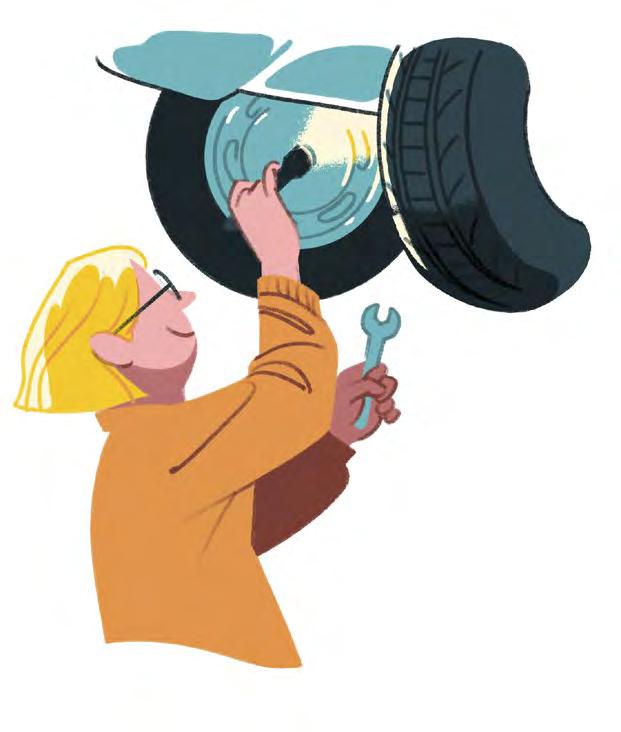
Focus
In this chapter, you will:
→ listen to, understand and use words and phrases related to your future profession
→ learn about different professions within Technological and Industrial Production
→ reflect upon various aspects of careers in Technological and Industrial Production
→ learn how to write a job application
Reflect
Discuss with a partner:
A What is most important to you when choosing a future career: good pay, good colleagues or interesting work?
B Is it important for you to work where you already live, or would you like to travel to work somewhere else?
C Have you always known what you want to become, or are you curious and open to possibilities?
Chapter keywords
→ career
→ profession
→ occupation
→ t ask
→ skill
→ quality
→ professional
→ workplace
→ job application
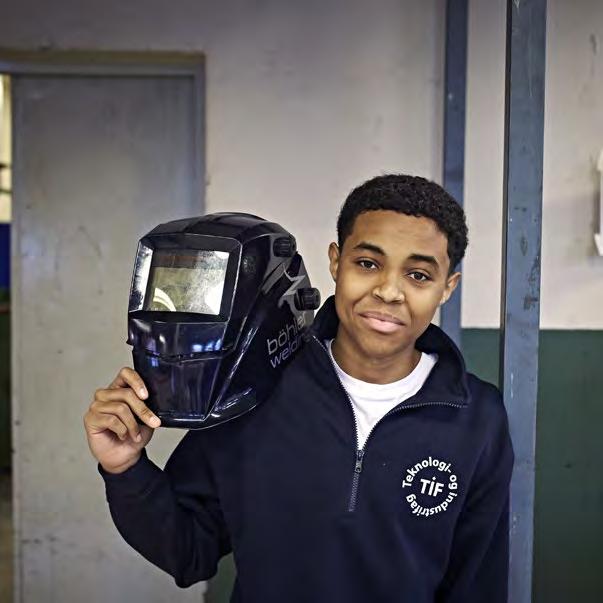
Why Did You Choose this Education Programme?
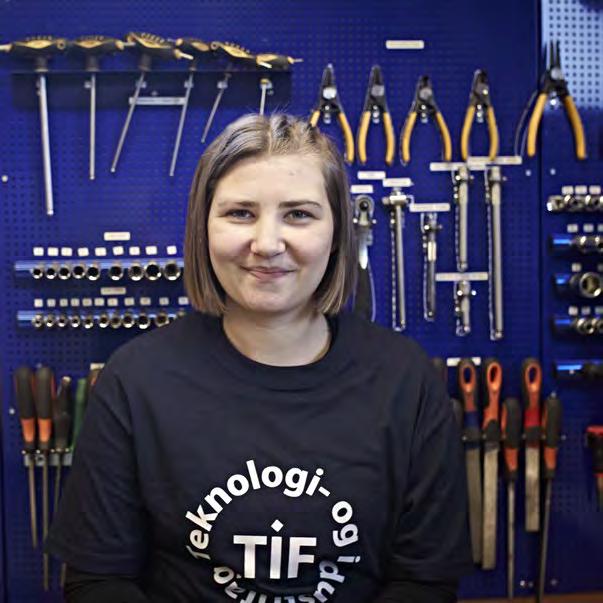
Here is an interview with two students from Technological and Industrial Production. The interview was carried out when the students were almost done with their first year.
Why did you choose to study Technological and Industrial Production?
LUCAS (16): In 10th grade I honestly didn’t have a clue about what I wanted to do next, and I was so bored with school. Then we had to visit this school for an Open Day, and we got to see the classrooms and the workshops. I spoke to a couple of guys in the second year, and they had a lot of good things to say about studying here. So when it was time to apply, I put this as my first choice.
AMANDA (17): My older brother went here a few years ago, so I am kind of following in his footsteps.
Do you have any family members who also work in this profession?
LUCAS: Yes, sort of. My uncle works in the petroleum industry as a crane operator. That’s not for me, though, because I don’t like heights.
AMANDA: Yes, both my brother and my dad are car mechanics, and they both started out by studying Technological and Industrial Production. My brother is actually a motor vehicle body repair technician. There’s always lots of car talk at home.
What do you think you want to work as?
LUCAS: At the moment, I’m thinking about becoming a welder. When we did welding in the workshop, I found out I have a bit of a talent for it. I enjoy working with tools, and I’ve heard it’s fairly easy to get a job. It would be fun to help build big things like bridges and skyscrapers, so I can tell people later that I made them!
AMANDA: Since I grew up around people who really love cars, it’s probably no surprise that I also want to work with cars! My dad jokes that I should become a mechanic specialising in wheels, chassis and suspension, so the three of us could start our own workshop and cover different tasks. That sounds cool, but I think I want to become a car mechanic for light vehicles, as that fits my interests better.
1 Understand:
True or False?
Are the statements below true or false? Correct the false statements with information from the interviews.
�� Lucas chose Technological and Industrial Production because of his brother.
�� Lucas thinks that finding a job as a welder is not going to be a problem.
�� Amanda has several family members who are car mechanics.
�� Amanda plans on working in her family’s workshop.
workshop verksted/verkstad to apply (to) å søke (på) / å søkje (på)
petroleum olje
crane operator kranfører/kranførar motor vehicle body repair
technician bilskadereparatør welder sveiser/sveisar
suspension her: oppheng light vehicle lett kjøretøy / lett køyretøy
2 Interact & Create: Interview
�� In pairs, interview each other using the same questions that the students in the text answered. While your partner is speaking, take notes rather than writing full sentences.
�� After you have finished the interview, use your notes to write a short text in the same style and structure as the one you have just read. Make sure your text includes the key information from the interview and is written in complete sentences.
Here are a few examples of occupations within Technological and Industrial Production:
Glossary: see p. 108
Maintaining
Able to handle stress
Close attention to detail Good

Planning, taking and analysing tests
Maintaining instruments and equipment
Assessing and verifying analysis results
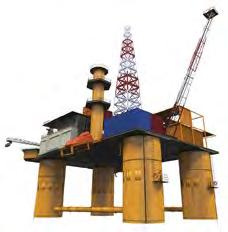
Possible to work in land-based industry
Often long stays at sea
Close
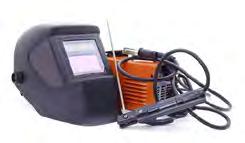
Can work in building construction
Can work in shipbuilding
Can work in manufacturing
Transport
Freight terminals or airports
Maintaining equipment Physical
Able
Handling
Processing

Securing transport of goods and cargo
Servicing,
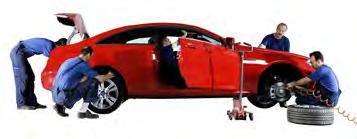
Using
Repairing
Can work in car dealership or independent repair shop
Often works with computers
1 Create: Quiz
�� On your own, make a quiz with five questions based on the mind map. Example: In which occupation is a good knowledge of English necessary? ( Answer : ship engine mechanic)
�� Swap quizzes with a partner. See who can answer the most questions correctly.
2
Create: Mind map
The following occupations were not included in the mind map on pp. 8–9:
CNC operator – car body repairer – transport driver –locksmith – seaman – sheet metal worker
Choose three of these occupations and create a mind map with the same kind of information as in the mind map you have studied.
3 Practise:
Listening
My chosen occupation
Look at the questions below and make sure that you understand what they mean before listening to Christine Henderton from New Zealand at citizens.cdu.no.
�� What is the text mainly about?
1 Christine’s school
2 Christine’s job choice
3 New Zealand
�� What is true about Christine?
1 She has always been interested in torque and propulsion.
2 She has always wanted to work at sea.
3 She has always wanted to travel the world.
�� What is mentioned in the text?
1 Christine likes that she gets to travel the world.
2 Christine is happy that she has moved away from home.
3 Christine would have liked more female colleagues.
There are many different jobs within Technological and Industrial Production. Below you can check out some of them. Note: a job can also be called an occupation, a profession, a career, a vocation or a trade.
What Are They Doing?
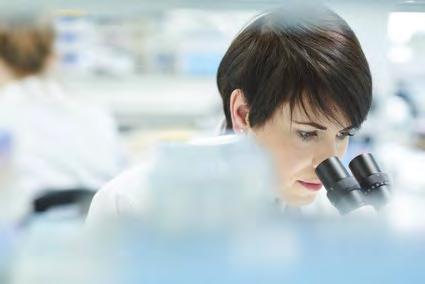
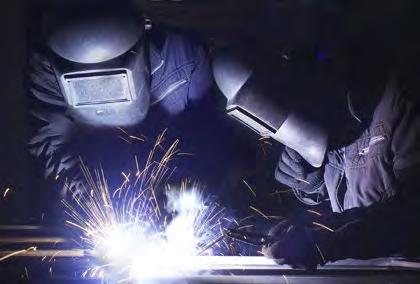
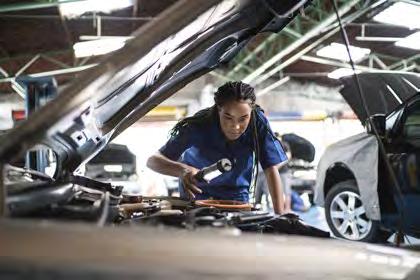
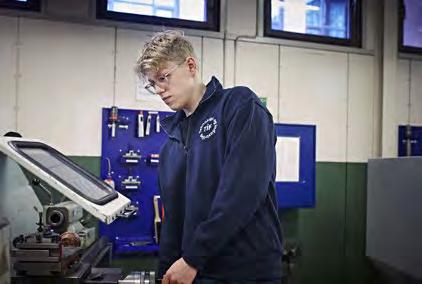
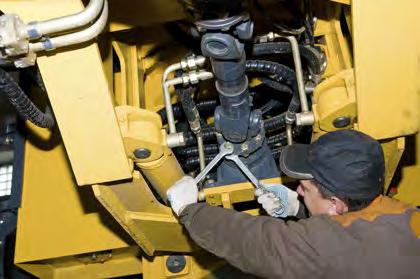
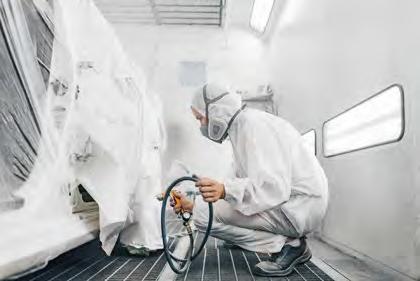
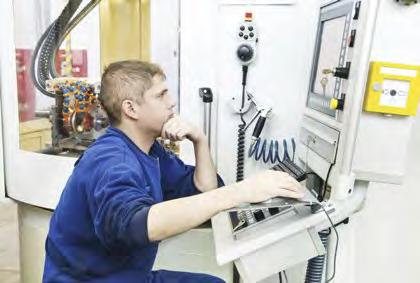
1 Practise: Workplace vocabulary
Who does what? Which picture matches each description?
�� A CNC operator is concentrating on his work.
�� A car painter is spraying a car.
�� A heavy vehicle mechanic is working on a loader.
�� A laboratory technician is examining a sample.
�� A light vehicle mechanic is diagnosing a problem.
�� Two welders are working together.
�� A lathe operator is inspecting and maintaining a lathe.
2 Practise: Workplace vocabulary
�� Below are some possible occupations you can choose as a student of Technological and Industrial Production. Match the Norwegian title with the correct English translation.
A. sveiser 1. logistics operator
B. platearbeider 2. well operator
C. verktøymaker 3. transport driver
D. faglaborant4. toolmaker
E. vaskerioperatør 5. welder
F. billakkerer 6. car painter/sprayer
G. bilmekaniker7. sheet metal worker
H. yrkessjåfør 8. laundry operator
I. logistikkoperatør9. seaman
J. brønnoperatør10. car mechanic
K. matros 11. laboratory technician
�� Here are short descriptions of some of the jobs in task 2A. Find out which job matches each description:
1 Operates heavy laundry equipment such as the tumblers and the extractors, loading and unloading laundry into and out of the machines.
2 Produces, modifies and repairs the tools used in manufacturing processes.
3 Uses pieces of thin steel, aluminium or other alloyed metal in manufacturing and construction.
4 Prepares the surfaces of vehicles, matches and mixes colours and applies paint to vehicles.
5 Operates large vehicles to transport cargo over various distances.
For help answering this task, see the Vocational Glossary (p. 102).
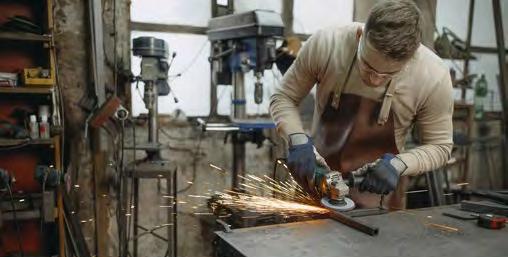
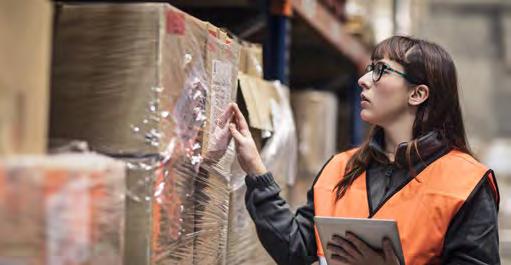
3 Create: Writing
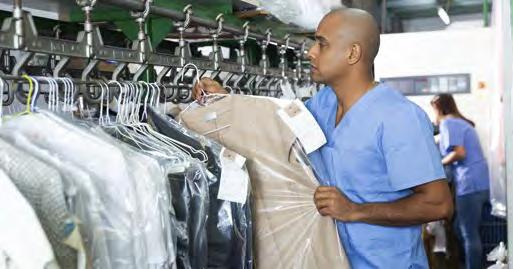
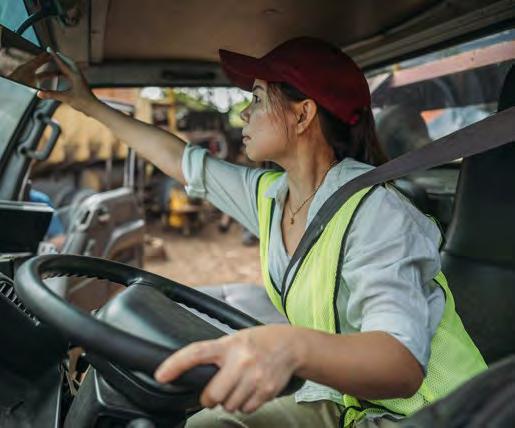
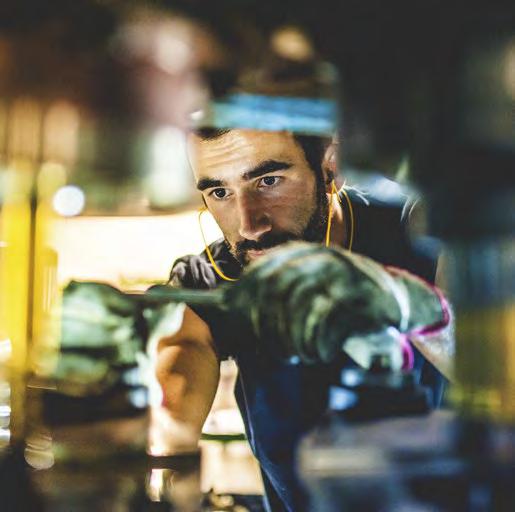
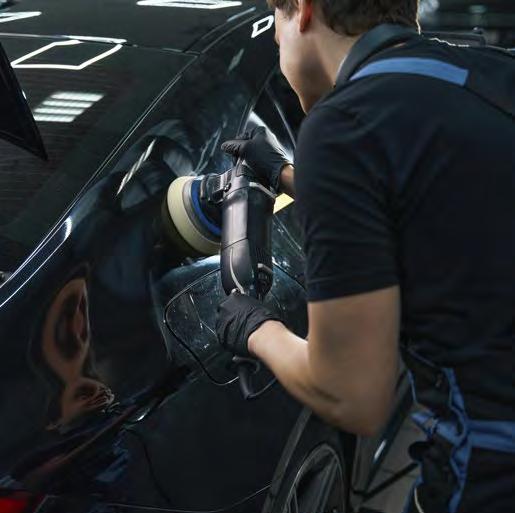
Write a caption (bildetekst) for each of the photos below where you describe what is happening in the photo, and who is doing it. Write the captions using the -ing form. Example: A toolmaker is talking to a colleague.
Use the name of the correct occupation for each photo, and combine it with one of the verbs:
Occupations: logistics operator – seaman – transport driver –laundry technician – sheet metal worker
Verbs: check – relax – grind – hang – adjust

Practise:
Vocabulary
A In pairs, divide the words below between you and find out what they mean. Use each word in a sentence to show that you understand its meaning.
Student 1: hand-eye coordination – vehicle – agile –ensure – patient – problem-solving capabilities
Student 2: options – factories – maintaining – equipment – manufacturing – comply with – cooperate
B Then explain the words to each other, using your sentences as examples.
Four Occupations
Glossary: see p. 108
As a student of Technological and Industrial Production, you have a large variety of options when you start specialising in a certain occupation. When choosing a future career, you should consider both your personal interests and job opportunities. Maybe you are someone who loves physical work and using your hands, or perhaps you enjoy fixing something that does not function. The text on the next pages gives short descriptions of four occupations, including information about each job and the skills it requires.

INDUSTRIAL MACHINERY MECHANIC
What do they do?
Industrial machinery mechanics work in industries such as chemical and mechanical manufacturing, the oil sector, shipbuilding and wood processing. Their main tasks are to maintain and repair equipment and machinery. They may work in factories or on site, and they use a range of instruments, hand and power tools, and machines. They also help ensure that machinery and factories run safely and efficiently by carrying out regular and emergency checks.
What qualities or skills do they need?
As an industrial machinery mechanic, you should be careful and thorough, always putting safety first. You need strong technical skills and good hand-eye coordination. Furthermore, you should be healthy and agile, as working conditions can sometimes be tough. Industrial machinery mechanics must be able to work independently as well as with a team.
VEHICLE VALETER
What do they do?
A vehicle valeter is also known as a car detailer. They usually work for a car dealer or a car rental company, where they prepare new and used cars for sale or rental. They also clean, polish and perform surface treatments on customers’ cars. Typical tasks can include degreasing, washing and polishing the car’s exterior, as well as cleaning, vacuuming and polishing the car’s interior. Another aspect of a vehicle valeter’s job is to repair damage to glass, paint and interior.
What qualities or skills do they need?
When you are a vehicle valeter, you should enjoy working with cars, be able to handle physical work and be thorough. You need good communication skills, since the job includes talking with both customers and suppliers. Most employers also require a driving licence so you can move vehicles around your workplace.
a What does an industrial machinery mechanic do?
b Where do vehicle valeters typically work?

LABORATORY TECHNICIAN
What do they do?
Laboratory technicians work with researchers, scientists and engineers in laboratories, assisting with a range of experiments and investigations. Their tasks can be varied, but key jobs include using and maintaining instruments and equipment, as well as planning and conducting tests and analyses.
What qualities or skills do they need?
A laboratory technician works in a variety of situations. You need to be able to work independently and systematically, but you must also cooperate and communicate with specialists and users of laboratory results. Furthermore, you need to be careful, precise and patient. It is essential that you stay up to date on health, safety and environment regulations.
NDT INSPECTOR
What do they do?
NDT is an abbreviation of “Non-Destructive Testing”. NDT inspectors work in a variety of fields, including oil and gas, manufacturing and engineering. They make sure that products comply with technical drawings, standards and specifications. Key tasks include assessing risks related to health, environment and safety (HSE), planning and organising inspections, doing calculations and carrying out checks.
What qualities or skills do they need?
As an NDT inspector, you must be detailoriented and have strong problem-solving skills to notice and fix problems when they arise. Good communication skills are important, so you can share information clearly with people who do not have specialist knowledge. You also need thorough knowledge of the tools and methods that you use in your field.
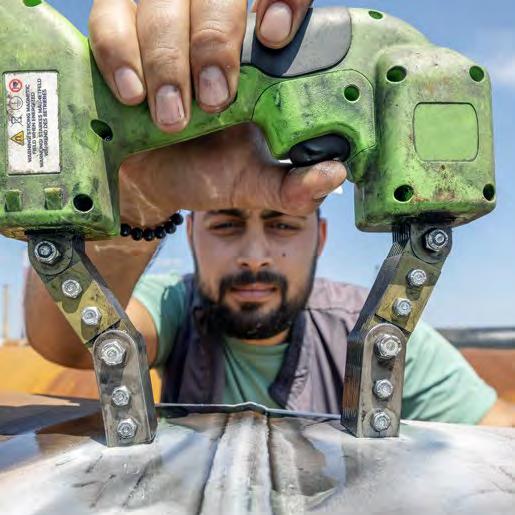
a Name two tasks carried out by a laboratory technician and two tasks carried out by an NDT inspector.
b Why are communication skills important in these two occupations?
checklist: Go to citizens.cdu.no to find a list of the most important points from the text you have read.
1 Understand
According to the text, who …
�� inspects technical drawings?
�� cleans and vacuums cars?
�� assists on various experiments?
�� will assess risks connected to HSE?
�� repairs minor damage to a car’s glass and paint?
�� maintains and repairs machinery?
�� needs good hand-eye coordination?
�� must enjoy working with cars?
�� needs to be patient?
�� can work in manufacturing?
�� can work with wood processing?
�� can work with researchers and scientists?
2 Create: Word bank
3 Practise: Workplace vocabulary
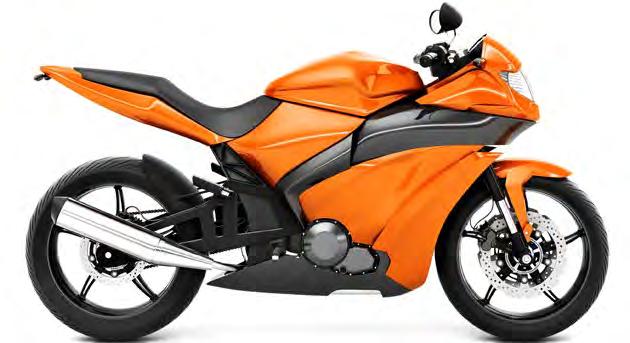
�� Label the parts of the motorcycle above with words from this list:
foot peg / drive chain / seat / handlebar / front fork / headlight / gas tank / disc brake / hugger / front fender / exhaust pipe
�� Here are descriptions of four of the words from 3A. Identify what is being described:
→ This item moves in a rotating manner. Its main purpose is to transmit power from one place to another.
→ This item is important for making other motorists notice the bike. LED bulbs can improve its visibility.
�� Read through the text again to find words. Copy the table below and write at least four words in each category.
Word list A
I know what these words mean!
Word list B I think I know what these words mean. Check in a dictionary or ask someone.
Word list C I do not know what these words mean. Check in a dictionary or ask someone.
Example: independently –selvstendig Example: method Example: abbreviation
�� Write a sentence for each word you have written in word lists B and C.
�� Choose two words from your list B and two words from your list C. Write an explanation in English for each word. Example: method → A method is a particular way of doing something.
→ This item holds the wheel in place. The item gets its name from the way it looks.
→ These items are used to slow down and stop the motorcycle, most commonly by using hydraulic pressure.
�� Can you find five other parts of a motorcycle that can be added to the list in task 3A?
4 Create: Writing
Choose an occupation within Technological and Industrial Production that is not mentioned in this text, and write a similar text about it, answering these two questions:
→ What do they do?
→ What qualities or skills do they need?
The vocabulary lists on p. 102 may be useful to you here.
Understand & Mediate
Work in pairs. Each of you chooses three different people: Samira, Gary and Ruth, or Ben, Harry and Tom.
A Individually, read the three texts and write down 4–5 keywords about each of the people you have chosen.
B Use the keywords to tell your partner about the people you have read about.
Professional Pride
pro·fes·sion·al·ism
noun
The competence or skill expected of a professional. The key to quality and efficiency is professionalism.
OXFORD ENGLISH DICTIONARY
Having professional pride means being proud of your work. Here, six workers in jobs within Technological and Industrial Production explain what makes them proud of the work they do.
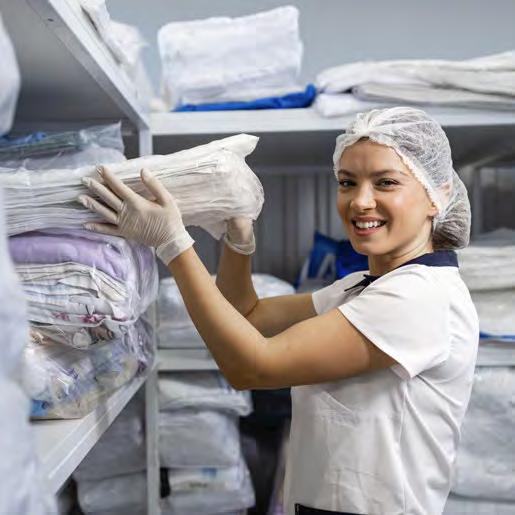

SAMIRA SAHAL:
I work as a laundry technician at a hospital. Every day, patients and staff in this hospital use the textiles, linen, towels and clothes that come out of this laundry. Everything we do in the laundry can have consequences for vulnerable patients who depend on us to ensure that the textiles are hygienically clean. The fact that doctors, nurses and patients trust in the quality of my work gives me a sense of responsibility that I find rewarding.
Glossary: see p. 108
GARY LEECH:
I have worked as a sheet metal worker for the past five years. The company I work for is quite small, and we mainly do ductwork. When I first started, the company sometimes lost money because we could not meet deadlines. For example, my co-workers sometimes didn’t notice holes in the duct walls and finished the work before anyone found the problem. Then, of course, they would have to take some of it down, fix it and remount. A total waste of time! I take great pride in being a fast and precise worker, and I think my attention to detail and ability to plan ahead have made it easier for us to finish jobs on time.

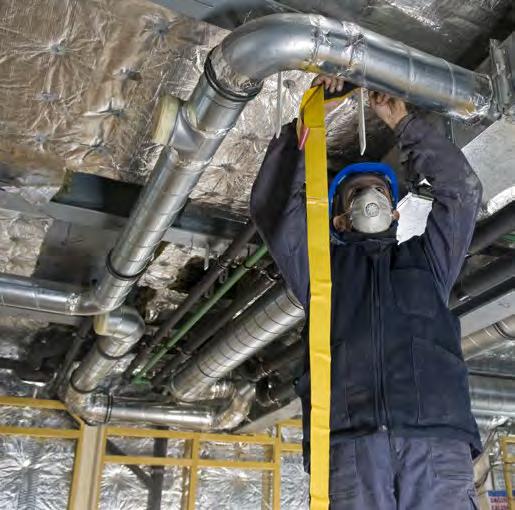
RUTH NGUYEN:
I have been a crane operator for two years. People are often surprised that, even though I work 85 metres up in the air, I am in fact afraid of heights. For example, I’ve tried indoor climbing, but my fear made it difficult for me. Somehow, being in the tower crane feels different. I stay in radio contact with my co-workers on the ground, and that helps a lot. Also, because I am so high up, the height feels less real. So, I am proud to say that I do my work to the highest standard – despite my fear.
BEN HENDERSON:
I work as a gunsmith for the Canadian Armed Forces. Here, I maintain and repair weapons and weapons systems. I am also responsible for fixing various equipment, such as scales, hydraulic lifts, locks and cooking equipment. Just the other day, someone brought me a C9 rifle that was double-feeding rounds. Three of my colleagues had already tried to fix it and concluded that the weapon would have to be scrapped. Guess who got it working in the end? I must admit, that made me feel proud.

HARRY STANTON:
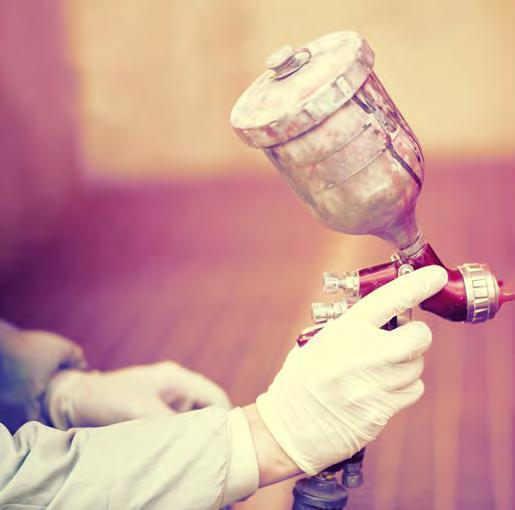
Fisheyes, bleeding, wrinkling, dulling, crow’s feet and sag: many things can go wrong when painting a car. I am currently an apprentice car painter and, while I love my job, there is a lot to learn and many mistakes to avoid. People want their cars painted so they look nice and fresh, and it is simply not acceptable to deliver flawed work. I have had trouble with trapped air, or “fisheyes”, in the past, but I think I have finally learnt how to prepare the surface properly. On my last job, there was not a single fisheye. That made me feel very proud.
TOM SULLIVAN:
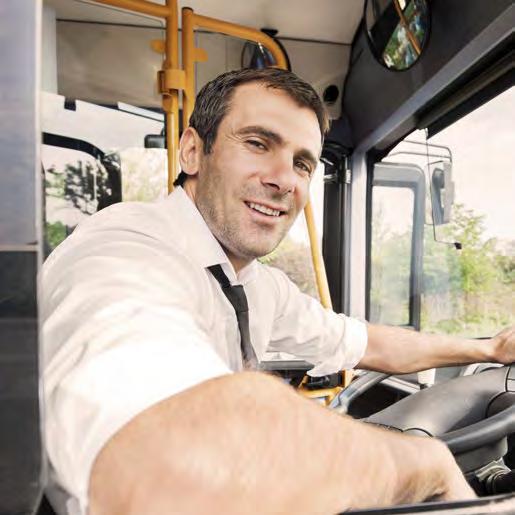
I have been driving buses for about twenty-five years. I work for Tower Transport in Darwin, and we cover a large area with several small villages. Many of the people who live there are elderly and do not drive, so they rely on us to get around. We help our passengers live active social lives. It’s a great job. I take pride in helping the elderly, and I know most of my passengers by name. It makes me especially proud when I drop senior citizens off near their homes and they smile at me and say, “Thanks, Tom. See you on Friday.”
checklist: Go to citizens.cdu.no to find a list of the most important points from the text you have read.
1 Understand & Reflect
After working in pairs and presenting the different people to each other, you should now be able to discuss the following questions:
�� What do these people work with? What kind of skills does each of them need in their job, do you think?
�� What makes them proud of their professions?
�� In your opinion, who has the best reason to feel proud? Explain your answer.
2 Practise: Workplace
vocabulary
�� Match the person/job with the correct work-related keywords. It is likely that many of the words are new to you, so use dictionaries and other sources for help.
Samira, laundry technician base metal – bend allowance – notch – punch
Gary, sheet metal worker counterweight – mast – jib – tower crane
Ruth, crane operator barrel – chamber – clip – ramrod Ben, gunsmith hygiene standards – contamination –linen – disinfection
�� Translate the work-related keywords into Norwegian.
�� Work in pairs. Write the names of all the items in the list in task 2A on pieces of paper. Place the pieces face down on the table. Student A chooses a piece and tries to describe the item to Student B who tries to guess what it is.
�� Below are descriptions of the key responsibilities of a car painter. Place the missing words correctly in the text. Choose from the following words: hazardous – masking – spray guns – computer – finish
→ Preparation: Cleaning, sanding, removing rust/ dents, applying putty, and (1) parts not being painted.
→ Color matching and mixing: Using (2) systems or manual skills to create exact colors for repairs or custom designs.
→ Application: Spraying primer, base coats, clear coats, or custom graphics using (3) in controlled booths.
→ Finishing: Inspecting for flaws (runs, sags), polishing, waxing, and ensuring a high-quality, durable (4).
→ Safety and maintenance: Wearing protective gear (respirators), handling (5) materials, and maintaining equipment/work areas.
3 Create: Writing
Choose one of the following tasks:
�� Write a text about an imaginary person who is a specialist operator in the chemical process industry, a car mechanic, a well operator or a long-haul truck driver. Use the texts on pp. 17–19 as models.
You should include:
→ what tasks this person performs at work
→ what skills this person needs to do this job
→ what makes this person feel proud at work �� Write a text about having pride in the work you will do in the future. Include the following:
1 Introduction: Describe the job you have chosen to focus on. What tasks will you have to do? What skills and knowledge will you need? Make sure to include at least one sentence telling the reader what your short text is going to be about.
2 Second paragraph: Write about one aspect of the job that you think will make you feel proud. E xplain this part of the job, and give examples to show why you think it will make you feel proud.
3 Third paragraph: Write about another aspect of your job that you believe will make you feel proud. Explain how and why this aspect is important to you.
4 Conclusion: Sum up your ideas from paragraphs two and three. Reflect on how being proud of your work can make you a better employee.

Interview:
Learning a Trade
1 Practise:
Listening for information
Below are some statements not found in the recordings. Who could they belong to: Linda, John or Martin?
�� “I’ll be a drilling and maintenance operator.”
�� “I want to become a laboratory technician.”
�� “I’m an apprentice motorcycle repair technician.”
�� “I’m off to the offshore sector.”
�� “The main job is to collect and analyse samples of different materials.”
�� “In a small workshop like this I get to do all sorts of jobs.”
�� “I’m the type of person who enjoys routine jobs.”
�� “I’ll be documenting hazards and deviations, to prevent accidents.”
Practise:
Vocabulary
Match these words from the audio recording with the correct translation: maintenance – adjust – disassemble – mount – troubleshooting – sample – equipment – hazard – analysis
analyse – diagnostisering – utstyr – demontere – feilsøking – vedlikehold/vedlikehald – justere – risiko – montere –prøve(eksemplar)
In this interview, you will meet three young Norwegians speaking with a British journalist. He is visiting Norway to write an article about the vocational courses available in Norwegian upper secondary schools. To learn more, he has decided to meet three students from the Technical and Industrial Production education programme.
Listen to the interview at citizens.cdu.no before working with the tasks.
Glossary: see p. 108
�� “I definitely don’t shy away from grease and oil.”
�� “I’ll work with microscopes and centrifuges as well as computers and lab software.”
�� “I’ve tinkered with MCs since I was far too young to drive one.”
�� “Two weeks on, four weeks off: That’s brilliant!”
2 Create: Writing
Choose one of the tasks below.
�� Write a text where you explain the differences between the three occupations presented in the interview.
�� Based on the interview, which of the occupations do you find most interesting? Write a short text in which you explain why.
Reflect
A What does it mean to have good communication skills? What makes communication “good”?
B Why is good communication important in the following situations?
→ when two laboratory technicians work together on different aspects of a research project
→ when two avionics technicians perform maintenance on an aircraft
Car Mechanics and Communication
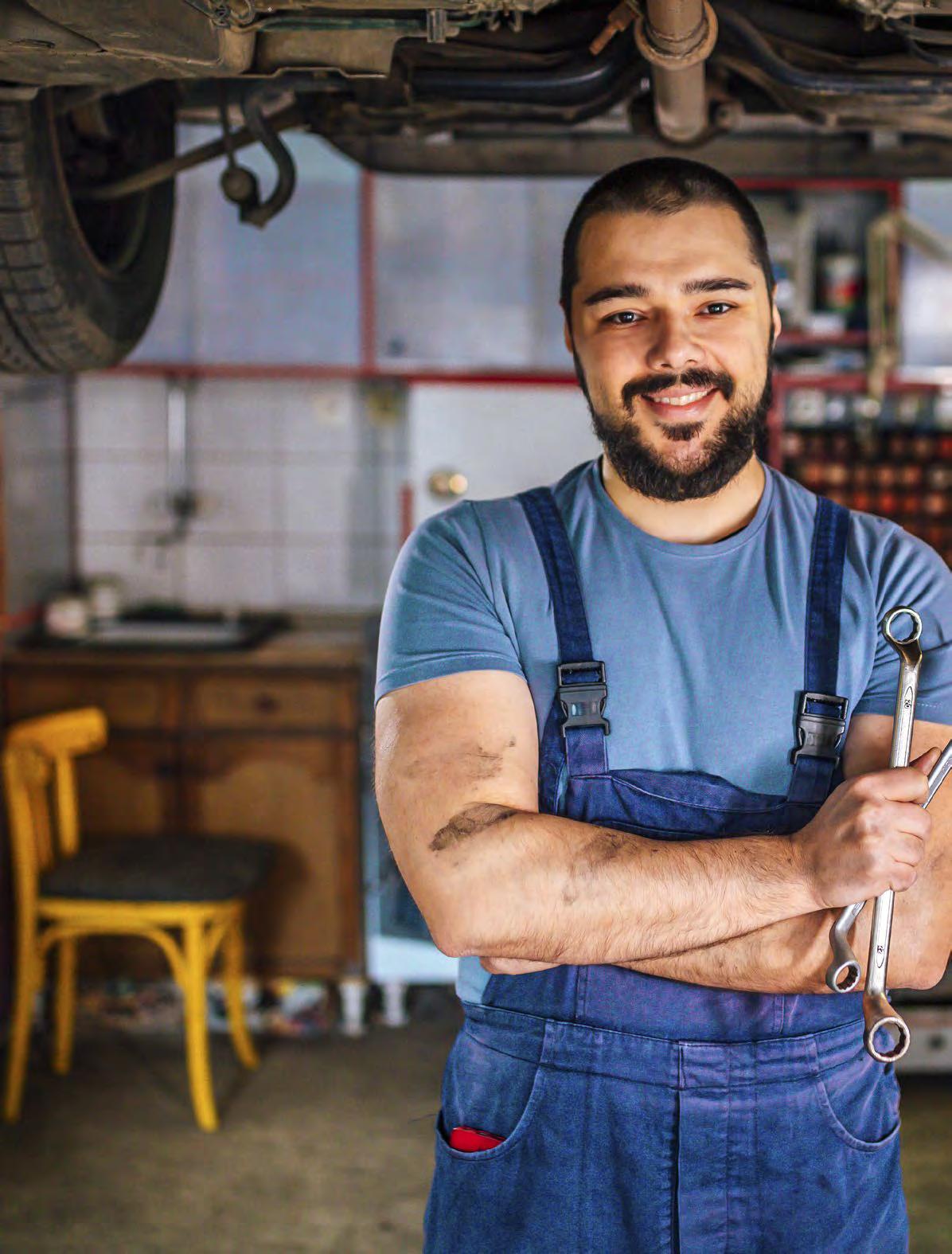
Ahmed is a car mechanic. This is what he says about the importance of good communication skills in his workplace:
“Car mechanics need to be able to inspect, diagnose and repair most cars on the market today. In other words, we must keep our professional knowledge up to date. At the same time, we need good spoken and written communication skills to talk with customers, colleagues and suppliers.
It is important to pay attention to customers’ body language and ask questions to check their understanding. Many of my customers don’t know much about cars, so I often need to explain complicated technical terms in a simple way. For example, coolant and battery might be familiar terms, while problems with the fan belt or shock absorber are more difficult for customers to understand. In these cases, I need to describe the cause of the problem and what I need to do to fix it, without using too much technical language. You might say that I translate from “mechanic language” to “everyday language”. By changing my language for customers, I hope to reassure them that we will fix their car properly. This way, they are more likely to return to us the next time their car needs repairs.
Sometimes, I have customers who don’t understand Norwegian well, and then English is almost always the best option. It can be difficult to describe a car problem in English. I often use my phone to find pictures and translations, and I have even downloaded a translation app to help me communicate better. I find it easier to use English in written communication, such as when ordering spare parts. This gives me more time to look up words and find easier ways to explain things.
I also need to communicate effectively with people from all kinds of backgrounds. Different cultures have different traditions, especially when it comes to greetings and personal space. I usually let customers show me how they want to communicate. Being aware of cultural differences helps me avoid misunderstandings or awkward situations with new colleagues or customers.
Being professional means staying calm and respectful, even when the client is frustrated. I avoid blaming others or making excuses. Instead, I focus on solutions. I have also learned to confirm all details before starting a project. That includes things like appliances, materials and our timeline. Making sure communication is clear early on can prevent problems later. Good communication in my field is about building trust, one conversation at a time.”
communication skill kommunikasjonsevne professional knowledge fagkunnskap supplier leverandør term her: begrep/omgrep coolant kjølevæske familiar her: kjent fan belt viftereim shock absorber støtdemper/ støytdempar spare parts reservedeler/ reservedelar greeting hilsen/helsing solution løsning/løysing to confirm å bekrefte appliance utstyr, apparat to prevent å forebygge / å førebyggje to build trust å bygge tillit / å byggje tillit
1 Understand
In pairs, answer the questions below. Point to examples from the text in your answers.
�� Why is it important to read the customer’s body language?
�� How does Ahmed adapt his language to the customer?
�� How can visual tools like sketches or photos help when communicating with customers?
�� Why is it important to confirm details with clients before starting a job?
�� How can you stay professional when a customer is unhappy or something goes wrong?
�� What does it mean to build trust through communication in the workplace?
2 Interact
Work in pairs. Look at the list of “Top 10 Communication Skills at Work” on the right.
�� Student 1 reads the first piece of advice: “Listen actively: Pay full attention (…).”
�� Student 2 asks: “Why is this important at work?”
�� Student 1 explains: “Because …”
�� Student 2 reads the next piece of advice and so on. Repeat until you have covered all ten points.
TOP 10 COMMUNICATION SKILLS AT WORK
1. Listen actively: Pay full attention when others speak. Show you understand by nodding, repeating key points and asking questions if anything is unclear.
2. Be polite and respectful: Show good manners such as saying “please” and “thank you”. Treat co-workers, supervisors, customers and clients with respect, even in stressful situations.
3. Speak clearly and simply: Use short, direct sentences when explaining something. Avoid slang so everyone can understand you easily.
4. Ask questions and seek help: Don’t be afraid to ask if you don’t understand an instruction or a customer. It is better to ask twice than to make a mistake.
5. Use correct vocational vocabulary: Learn and use the technical words for tools, materials and procedures in your trade. This helps you communicate clearly with colleagues and follow instructions exactly.
6. Adapt your language to the situation: A customer or client may not understand professional terms as well as your co-workers.
7. Use positive body language: Smile, make eye contact and stand in a way that shows you are open and willing to work.
8. Choose the right communication medium: Decide whether to use face-to-face conversation, phone calls, emails or written reports based on the situation. Pick the method that makes your message clear and reaches the right person quickly.
9. Communicate well with your team and adapt to others: Share information with your teammates and listen to their ideas so work goes smoothly.
10. Report problems quickly: If you see something unsafe or a mistake happens, tell the right person immediately. This helps keep the workplace safe and efficient.

3 Reflect: Talking & writing
�� Which communication skills do you believe are the most important in your future job? Rank the skills listed in task 2 from 1 (most important) to 10 (least important). Give reasons for your opinion.
�� Compare your list with another student’s list and discuss the similarities and differences in your rankings. Then work together to make a new, combined list.
4 Create: Writing
Write a short text (150 –200 words) about why communication will be important in your future workplace. You can include:
→ Why good communication matters when working with customers or co-workers
→ E xamples of what good or bad communication might look like
→ How communication can solve problems or prevent misunderstandings
→ Any experiences you have (from work, school or even daily life) where communication made a difference
5 Reflect: Cases
Here are descriptions of two different situations where you need good communication skills. Discuss with a partner what you would do in each situation.
Case 1: You have a job where two people are needed on the morning shift to handle customers and new deliveries. However, your colleague is always late for work. Your colleague gets the same wage as you, even though she works up to one hour less every day. How would you solve this situation?
Case 2: You are responsible for training two new employees, a Polish man and an Iranian woman. You must use English to communicate with them. What should you be aware of when you communicate with these new colleagues?
Reflect
How do you think jobs in Technological and Industrial Production will change in the future? In pairs, try to come up with three changes that you think will happen in the next 30 years, and explain why you think so.
The following article will give you several positive opinions on the future of professions in Technological and Industrial Production.
C H A LLE N GE
Industry 5.0: The Future of Work in Technological and
Industrial
Production
A new industrial revolution is on the way, the so-called “Industry 5.0”. Earlier industrial revolutions mainly focused on making things faster or cheaper, but Industry 5.0 is also about making work better for people and better for the planet.
Industrial revolutions
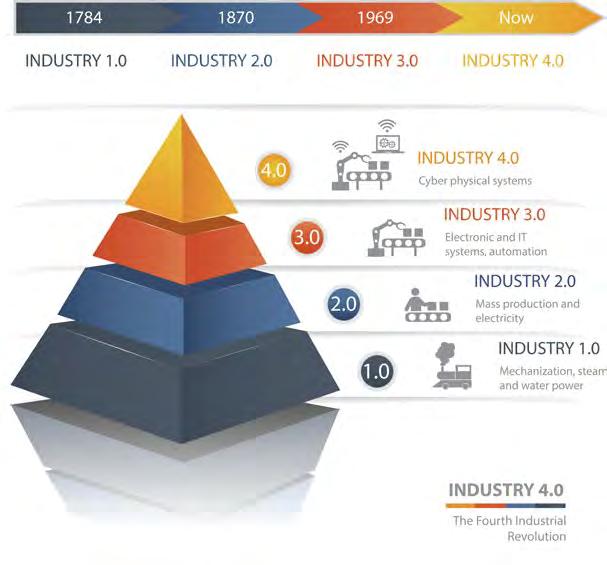
How did we get here? The journey toward Industry 5.0 has taken place over several centuries. It began with the first industrial revolution, what we can call Industry 1.0, in the late 1700s, when steam and waterpower took over manual labour and revolutionised production in factories.
In the late 1800s the second industrial revolution arrived as electricity and assembly lines helped make products faster and cheaper.
Industry 3.0 began in the 1970s with the introduction of computers and automation, which meant less physical labour but required more technical skills.
In the 2000s, digital technologies led to yet another industrial revolution, called Industry 4.0. Artificial Intelligence (AI), robotics and using the internet to connect machines through the Internet of Things (IoT – see p. 47) were important parts of this ongoing development. That brings us to the near future: Industry 5.0.
Machines supporting people
Industry 5.0 will combine the power of machines with the creativity and problem-solving ability of humans. In the past, factories and industries used machines to replace human workers, especially during Industry 4.0 with its focus on automation, AI and robotics. The goal was to speed up production, lower costs and improve efficiency. While these changes were useful, they sometimes made work less personal and even pushed workers aside.
steam damp manual labour håndverk/ handverk factory fabrikk assembly line samlebånd/ samleband
automation automatisering physical labour fysisk arbeid technical skill teknisk ferdighet / teknisk ferdigheit ability evne to replace å erstatte to improve å forbedre / å forbetre
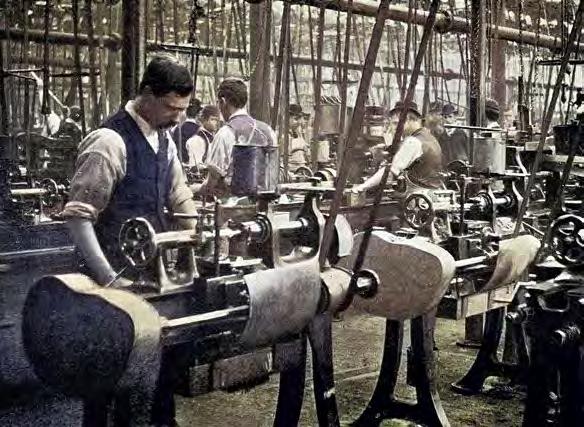
Left: Lathes powered by belts. Workers manufacturing rifles at the Royal Small Arms Factory in Birmingham, 1890s.
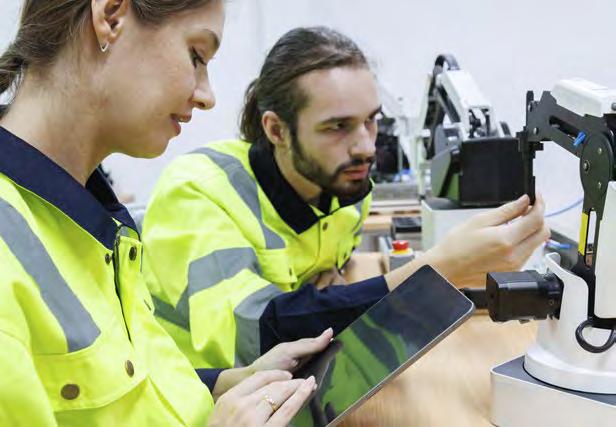
Right: Automation engineers study and inspect a robotic arm.
This graph shows how industry has developed from Industry 1.0 to Industry 4.0, which is where we are today. Industry 5.0 will be the next big step and is coming soon.
approach tilnærming skilled worker fagarbeider/ fagarbeidar collaborative robots samarbeidsroboter/samarbeidsrobotar welding sveising rewarding givende/givande valuable verdifull working conditions arbeidsforhold sustainability bærekraft/ berekraft waste avfall pollution forurensning/ forureining climate change klimaendring to do harm å gjøre skade / å gjere skade impact påvirkning/påverknad
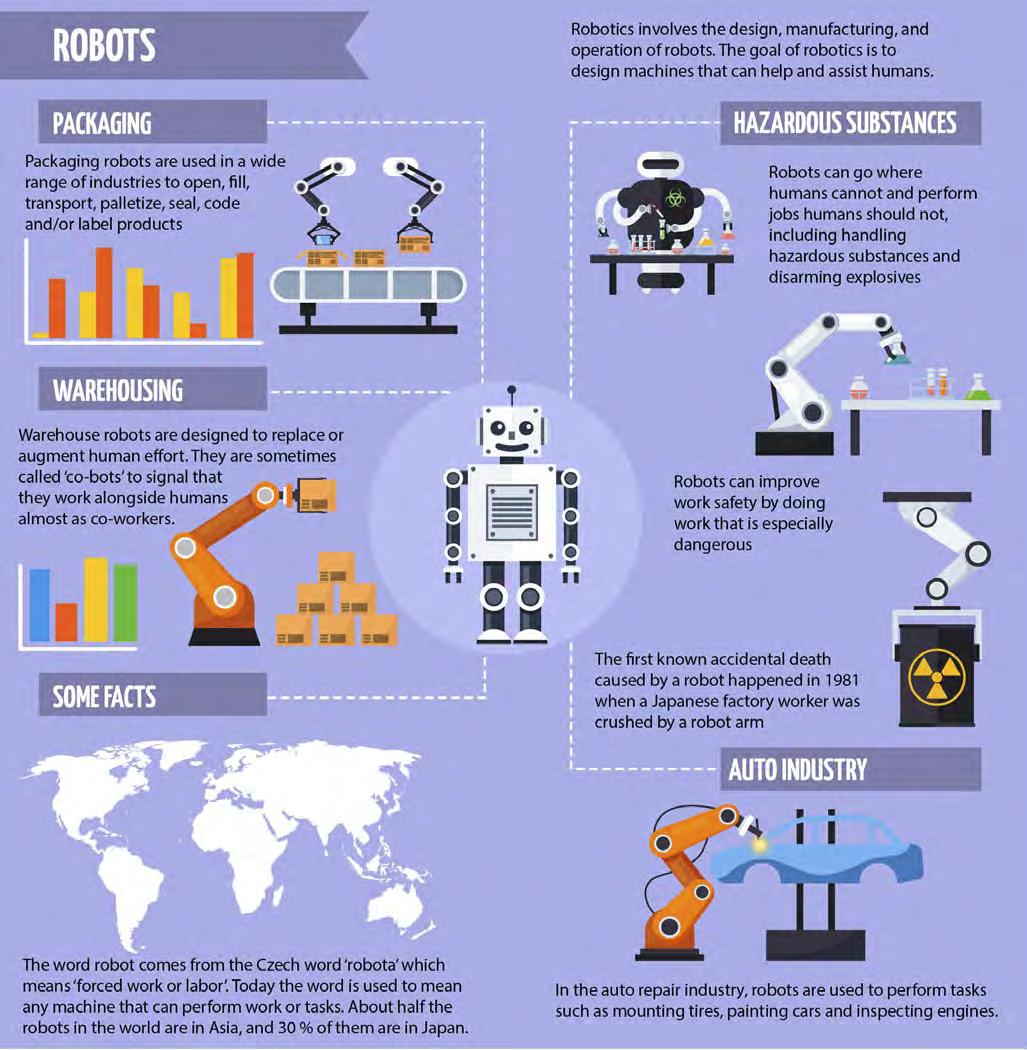
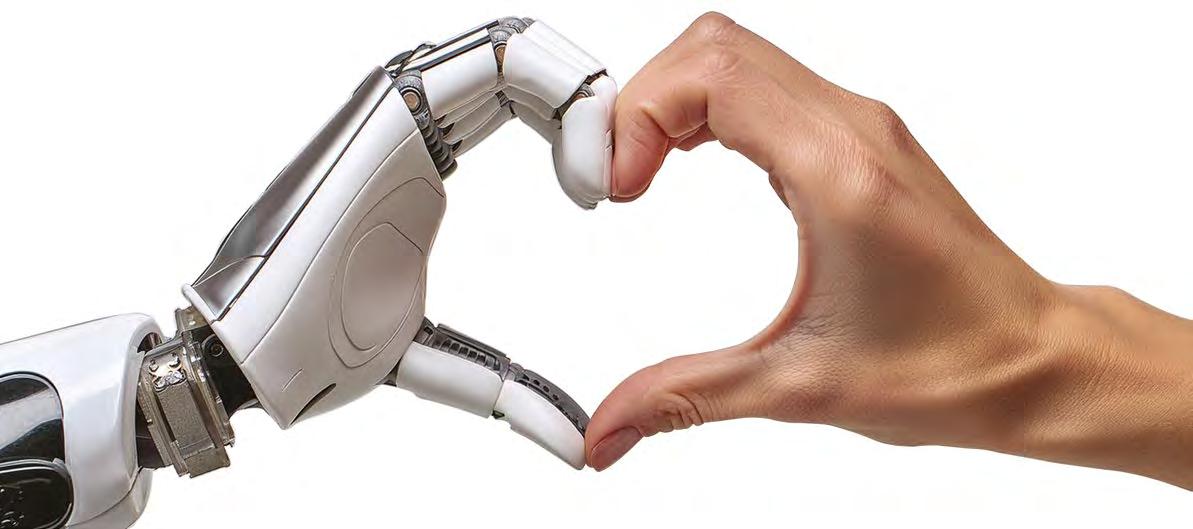
Industry 5.0 takes a new approach: machines will support people – not replace them. As a skilled worker, you will work together with machines, using both your hands and your mind. In modern factories, you might see collaborative robots – or “cobots” – working safely alongside humans. If you work in a metal workshop, a robot can help you lift heavy metal parts while you do the detailed welding and quality checks. The machine handles the hard, repetitive tasks, and you can focus on the skilled, important ones. This teamwork makes jobs safer, smarter and more rewarding. Machines are strong and fast but do not think for themselves, while humans are creative and smart but need to rest, so working together means better results.
Making work better
In this new way of working, employees are not just “resources”. They are seen as valuable individuals with knowledge, ideas, and creativity. Supporters of Industry 5.0 ask: How can we make work better for the worker, not just cheaper for the companies? That means better working conditions, more meaningful tasks and more opportunities for workers to grow and learn.
In addition to being more people-centred, Industry 5.0 also focuses on sustainability. In the past, factories often used too much energy and created a lot of waste and pollution. In Industry 5.0, companies are working to be part of the solution to climate change. They aim to reduce pollution, use clean energy and create products that are better for the environment. The goal is no longer to just “do less harm”, but rather to make a positive impact.
Working smarter, not harder
Industry 5.0 is a new way of thinking about industry. It is about working smarter, not harder. It combines the best of human skills, like creativity, flexibility and care, with the power of modern machines. In your future job, you will use machines and tools but also take on responsibility, work as a team with technology and play a positive role in society. The ideas and goals of Industry 5.0 show that the future of work is not just about machines, but about people and progress, working together.
1 Understand
In pairs, use information from the text to answer the questions below. Write full sentences.
�� When did the first industrial revolution (Industry 1.0) begin, and what powered the machines?
�� What made mass production faster and cheaper during Industry 2.0?
�� Which technologies were introduced in Industry 3.0, and what kind of skills did workers need more of?
�� What kind of digital technologies led to Industry 4.0?
�� How does Industry 5.0 change the way machines and humans work together?
�� What are “cobots”, and how do they help workers in modern factories?
�� How does Industry 5.0 view human workers differently from earlier revolutions?
�� What does Industry 5.0 aim to do for the environment?
�� What does the phrase “working smarter, not harder” mean in the context of Industry 5.0?
2 Create: Summary
Write a summary of the text. Focus on giving a general description of the main ideas of the text. Try using your own words as much as possible.
3 Reflect: Quotes
The purpose of the article you have read is to show a positive future involving new technology. Discuss the following quotes from the text in pairs or small groups.
�� “Machines are here to support people –not to replace them.”
Do you agree? Can machines really support humans without replacing jobs? What are examples of this in real life?
�� “Industry 5.0 is about working smarter, not harder.”
What does this mean in practice? What tasks at school or work could be done “smarter”? How can machines help with that?
�� “Employees are not just ‘resources’. They are seen as valuable individuals with knowledge, ideas and creativity.”
Do you think companies treat workers like this in real life? How can companies show that they value their workers? What skills or attitudes do you think you bring to a future workplace?
4 Reflect: Talking or writing
Talk or write about the following questions:
�� Which part of a future job in Technological and Industrial Production do you find most interesting? Why?
�� How do you feel about working with both machines and people as a team? What skills do you need to work well with robots and machines in modern factories?
�� What kind of tasks will humans still do better than machines?
5 Create: Writing
@RobotsGottaLoveThem has read the text “Industry 5.0: The Future of Work in Technology and Industrial Production” and has posted about it on his social media. Write a response to his comment. In your response, refer and respond to the text and contribute with your own perspectives. Comment on and question, agree and/or disagree, with what has already been written.
The recommended length for this text is 150 –200 words.
@RobotsGottaLoveThem:
Wow, I love this! At home, I already use loads of smart technology, and it makes things much easier. So why not use advanced machines to help people do their jobs better? If robots or “cobots” can handle the boring or tough jobs, people can spend more time using their skills and being creative. It’s not just about making things faster – workers get to do more interesting jobs, work in safer conditions and have more chances to learn new stuff. To me, this is the future, and I can’t wait to see all the exciting new tech and ideas in technological and industrial jobs in the future.
6 Create: Writing
Think about how the Industry 5.0 revolution will affect your future job. Then write a short text (about 100 –150 words) where you share your thoughts. These questions might help you:
most exciting to work with?
→ Do you think the fifth industrial revolution will change your job a lot? Why or why not?
→ What skills do you think you will need to learn to be a successful worker in the future?
→ What part of a job in Technological and Industrial Production makes you feel proud or motivated?
You can use some of these sentence starters in your text:
→ In the future, I think Technological and Industrial Production will …
→ I believe Industry 5.0 is (not) important because …
→ The skill I most want to develop is …
→ I will feel proud as an [insert your profession] when …
→ The text says that … I think this is (not) true because…
→ One challenge for workers in the future will be …
→ I agree with the idea that workers must … because …
→ I would like to work with … because …
7 Practise: Workplace vocabulary
Employees in professions within Technological and Industrial Production have many different tasks. Look at each line of words below. In each line there is one word which has nothing to do with the other three. Can you find the “odd one out” in each line? Make sure you know what the words mean and be prepared to defend your choices to the rest of the class afterwards.
�� hammer – screwdriver – wrench – electric drill
�� welding – mask – gloves – ladder – hard hat
�� operate – whisper – install – repair
�� logistics operator – electrician – car painter –asphalter
Application Letter
An application letter is a document where you state your interest in a job, scholarship or something similar. Competition can be tough, so your application letter needs to stand out. Here is what you should include. (Note that some companies use standardised formats that you fill in when you apply for a job there.)
Structure of the text
This is one way your application letter can be structured if it is sent as a separate document attached to an email, e.g. in Word or as a PDF.
1 The address and contact information of the sender. If you are writing an email, you include your contact information at the bottom, after your signature
(2 The address of the receiver – if this is mentioned in the advertisement)
3 The date
4 A polite greeting, for example: Dear Sir/Madam, Dear Mr Brown, Dear Mrs Johnson
5 a) Explain why you are writing the letter and introduce yourself
b) Information on your background
c) Explain why you think you are suitable for t he job / scholarship / position
d) If applying for a part-time job, you should include when and how much you are able to work
6 Closing politely, for example: I am looking forward to hearing from you, Thank you for your consideration
7 Polite ending: Sincerely, Yours sincerely, and your name.
8 References: the names of people a potential employer can contact to find out more about you, for example a former employer or teacher
It is always important to tailor your application letter to what you are applying for. Some advertisements (ads) may require you to provide specific information. Read the ad carefully to make sure you include what is asked of you.
What you should include in all application letters:
→ Polite phrases that show respect for the person you are addressing. This is important in formal letters.
→ Linking words that tie the text together.
→ Positive words that help you “promote” yourself.
Do not:
→ Use abbreviations: write “do not” and “I am”, not “don’t” and “I’m”.
→ Write much longer than a page. The purpose of an application letter is to get you to an interview, so it should be short and precise.
Example ad and application letter
Jamie is looking for a part-time job, mainly on weekends. He is studying to be a car mechanic and would like a job in relation to this. Jamie sees this notice in Paul’s Autocare Centre:
ASSISTANT WANTED
Paul’s Autocare Centre is looking for an assistant, preferably a student of Technological and Industrial Production, to help out on weekends and in busy periods. You will carry out tasks like:
→ cashier duties
→ managing the car wash
→ assisting the mechanics
Full training will be given, but a strong interest in cars will be helpful.
Apply to: manager@paulsautocare.co.uk
Sender →
Here is Jamie’s application letter:
POLITE PHRASES LINKING WORDS POSITIVE WORDS
Jamie Payne
27 Colmore Row
Birmingham B3 2EW
email: Jamiepayne@hotmail.com
Telephone: (020) 838 6454
Date →
Opening greeting → Why he is writing →
Background: work experience →
Background: interests →
14 May 2026
Dear Sir or Madam
I wish to apply for the job as assistant in your Autocare Centre, as advertised in your window. My name is Jamie Payne, I am 17 years old and I currently go to Birmingham City College. Here I am training to become an auto repair mechanic for light vehicles.
I have previously worked as a babysitter, which I enjoyed. As a result, I have excellent references you may call. Furthermore, I have been helping my uncle out in his garage, as he too is a mechanic. He has taught me a lot.
In my spare time I like to ride my bicycle and restore old cars with my father. My main interest is old British cars. Therefore, I often spend time trying to find parts and reading about old cars. I have wanted to be a mechanic since I was a little boy. It is my dream job.
Why he is suitable →
What kind of employment he is looking for →
Closing politely →
Polite ending →
Signature →
References →
I think the position of assistant is perfect for me. I have a true passion for cars. I am tidy, service-minded and love to be around people. In addition, I am quite knowledgeable about cars.
I am looking for a job on weekends, although I am flexible. If there are busy periods I can help out on weeknights and during holidays as well.
I am looking forward to hearing from you at your earliest convenience.
Yours sincerely, Jamie Payne
References:
Geoffrey Cooper, car mechanic 07700 901042
Miriam Tremblay, babysitting customer 07700 909183 Akal Singh, teacher 07700 901278
TASKS
1 You are applying for a job in your field (choose a profession from the list of job titles on p. 102). The employer wants to know what kind of person you are and why they should hire you. Write a short text (80 –120 words) where you describe yourself using positive words (adjectives).
What to include:
Who you are (a short introduction) – What you are good at (skills and qualities) – Why you would be a good worker for this job
Helpful adjectives you can use (look them up if you are uncertain of what they mean):
hardworking – reliable – responsible – motivated – skilled – flexible – friendly – eager to learn – precise – meticulous – adaptable – quick learner – respectful – trustworthy – patient – innovative – team-oriented – honest –safety-conscious – attentive – diligent – determined –punctual
Sentence starters you can use:
→ I am a … person who …
→ My friends and teachers say that I am …
→ I am good at …, and I always …
→ I believe I would be a good employee because …
2 A representative from your local job centre is visiting your school and leaves behind a leaflet for the students attending vocational courses. The leaflet advertises an international apprenticeship programme for the company WorkStart Placements.
Write an application letter, using the structure shown on p. 32 and vocabulary you have practised in this chapter.
LOOKING FOR AN APPRENTICESHIP?
We are looking for students in vocational training programs in Technological and Industrial Production. We work with a range of local and international companies and are eager to match motivated students with great training environments.
We want someone who:
→ is currently studying a vocational subject
→ is reliable and willing to learn
→ has good references from school or previous work
→ shows a positive attitude
Please send your application letter and CV to: WorkStart Placements c/o Nina Orellana nina@workstartplacements.org
We look forward to hearing from you!
3 When you have finished writing your application letter in task 2, swap with a partner and give each other feedback by pointing out two things the application does well and one thing that can be changed to improve it.


Chapter 1
1 Review:
Focus points
Use this scale to describe your level for each of the “I can …” statements below:
Very well – Well – Needs some work – Needs lots of work
→ I can understand and use words and phrases related to my future profession.
→ I can talk and write about many different professions within my education programme.
→ I can reflect upon various aspects related to professions within my education programme.
→ I can write a job application suited to the job I am applying for.
2 Review:
Key terms
A In pairs, divide the keywords on page 5 between you and find out what they mean. Use each word in a sentence to show that you understand its meaning.
B Then explain the words to each other, using your sentences as examples.
3 Review:
Discussing and writing paragraphs
A Discuss with a partner: In which of the occupations in this chapter would you most like to work, and in which would you least like to work?
B Write a short reflection note (two to three paragraphs) explaining the choices you discussed in task 3A. Include a topic sentence and supporting sentences in each paragraph.
4 Create: Poster
Make a poster presenting your future occupation using text and pictures.
Target audience: Students in years 9 and 10
Purpose(s): To inform and convince
Your poster should include:
→ a description of what the work involves and typical workplaces
→ a short explanation of the education and training you will need
→ skills you need in this occupation
→ relevant illustrations
When finished, present your poster to your classmates in groups of four. (You may also want to display your posters in your classroom for the rest of the class to see.) For relevant words and phrases you might need, see pp. 102-107.
Tools & Procedures
Focus
In this chapter, you will:
→ learn about different tools and pieces of equipment used in Technological and Industrial Production
→ reflect upon the importance of being able to use English as your language of work
→ listen to, understand and use words and phrases related to your future profession
→ create oral and written texts relevant to your future profession, such as instructions and procedures
Reflect
A How do you think good English skills could be useful in your future workplace?
B What are some tools or equipment you might use in your future job?
C Why is it important to follow specific procedures or instructions at work?
Chapter keywords
→ tool
→ procedure
→ equipment
→ communication
→ lingua franca (common language)
→ invention
→ instructions
→ workplace vocabulary