
C California Style & Culture

Page 1


Trina Turk’s Vibrant Desert Retreat

A 1960s Revival on Rincon Point

Kenny Scharf’s Pop Surrealist Home

FASHIONABLE LIVING | 2026

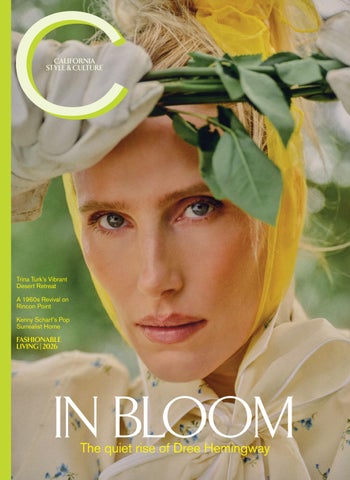
IN BLOOM

The quiet rise of Dree Hemingway
Ralph Lauren

BEVERLY HILLS SOUTH COAST PLAZA WYNN LAS VEGAS

Buccellati

For what’s hot in the Golden State, visit magazinec.com

35 LACMA EXPANDS

The long-awaited David Geffen Galleries are open

36 ART & DESIGN NEWS

Libertine and Harris Reed offer fashionable solutions to interiors

40 MODULAR MAGIC

Now you can take home an Eames home

42 STYLE NEWS

Must-have collabs from Jil Sander & Oliver Peoples, Thom Browne & Asics

46 FAST TRACK

The L.A. to S.F. bullet train is closer than you think

50 DINING NEWS

The top four tables to book now up and down the state

54

DREE HEMINGWAY

From runway starlet to Hollywood star, how she conquered fashion and film

66

TRINA TURK

Is this Palm Springs home her grandest design yet?

76

RINCON POINT

A 1960s artist retreat reborn for modern living

93

TOC

84

KENNY SCHARF

The pop surrealist opens up his hillside abode

HAUTE HOTELS

Chic stays with interior decor takeaways

100

WHEN IN SAN FRANCISCO

The design guru Ken Fulk’s favorite haunts

JENNY MURRAY

& President

Style & Content Director ANDREW BARKER | Creative & Design Director JAMES TIMMINS

Beauty Director KELLY ATTERTON

Contributing Fashion Editor REBECCA RUSSELL

Senior Editors

GINA TOLLESON

ELIZABETH VARNELL

Managing Editor SARAH RUTLEDGE

Photo Editor LAUREN WHITE

Art Director ANDREW WREN

Contributing Editors: Caroline Cagney, Elizabeth Khuri Chandler, Kendall Conrad, Kelsey McKinnon, David Nash, Stephanie Rafanelli, Diane Dorrans Saeks, Nathan Turner

Masthead

Contributing Writers: Anush J. Benliyan, Max Berlinger, Catherine Bigelow, Samantha Brooks, Alessandra Codinha, Kerstin Czarra, Helena de Bertodano, Richard Godwin, Robert Haskell, Martha Hayes, Christine Lennon, Degen Pener, Jessica Ritz, S. Irene Virbila, Chris Wallace

Contributing Photographers: Chantal Anderson, Christian Anwander, Matthew Brookes, Gia Coppola, Roger Davies, Victor Demarchelier, Amanda Demme, François Dischinger, Graham Dunn, Adam Franzino, Sam Frost, Adrian Gaut, Lance Gerber, Alanna Hale, Rainer Hosch, Bjorn Iooss, Kurt Iswarienko, Danielle Levitt, Blair Getz Mezibov, Dewey Nicks, Frank Ockenfels, David Roemer, Jessica Sample, Jack Waterlot, Ben Weller

Contributing Fashion Directors: Chris Campbell, Cristina Ehrlich, Petra Flannery, Fabio Immediato, Maryam Malakpour, Katie Mossman, Jessica Paster, James Sleaford, Christian Stroble, Samantha Traina

Executive Director, West Coast

SUE CHRISPELL

RENEE MARCELLO Publisher & Vice President

Director Digital, Sales & Marketing

AMY LIPSON

Sales Development Manager ANNE MARIE PROVENZA Controller LEILA ALLEN

C PUBLISHING

2064 ALAMEDA PADRE SERRA, SUITE 120, SANTA BARBARA, CA 93103 T: 310-393-3800 SUBSCRIBE@MAGAZINEC.COM MAGAZINEC.COM

Executive Director, Information Technology SANDY HUBBARD

FOUNDER’S LETTER

I always look forward to this special issue, Fashionable Living, because it captures the essence of life in California and shows us how we actually inhabit this breathtaking state. California living is truly an indoor-outdoor experience, with architecture and design choices that blur the line between inside and out. Few homes embody this more seamlessly than the Rincon residence of Kendall Conrad and David Cameron. Raised at one of the region’s most iconic surf spots, Conrad inherited her family home and, alongside her designer husband, reimagined it into a spectacular modern retreat that honors its history while embracing today’s style.

Step into the world of artist Kenny Scharf, whose colorful Los Angeles home reflects his larger-than-life personality. Scharf leaves his mark wherever he goes, proving that homes should speak to the spirit of their inhabitants. Designer Trina Turk takes a similar approach with a mountainside abode in Palm Springs, where her signature desert style transforms the space into a singular expression of her aesthetic vision, from the conversation pit to the pristine pool.

And then there is Montecito’s Lotusland, perhaps the most beautiful spot on earth. Its 40 acres of stunning botanical gardens provided the perfect backdrop for actor Dree Hemingway to showcase this season’s finest fashion, merging couture with landscape in effortless harmony.

Founders Note

Mixing fashion, art, interiors, and exteriors is at the heart of this issue: a celebration of how we live, in this paradise, on our own terms. Within these pages, no notes are needed — everything receives top honors, from style to space, and from personality to place.

DREE HEMINGWAY wears PRADA.

Editors’ Picks

Leaders of rings

ring, $6,400, cartier.com.

BULGARI ring, $4,500, bulgari.com.

GRAFF ring, $8,800, graff.com.

BUCCELLATI ring, $3,600, buccellati.com.

Photography by EMMAN MONTALVAN. Styling by CHRISTOPHER CAMPBELL. Hair by TAKUYA SUGAWARA at Walter Schupfer. Makeup by TOBI HENNEY at The Wall Group. Manicure by ALEX JACHNO at Opus Beauty. Prop styling by PETER GUERACAGUE. Shot on location at GANNA WALSKA LOTUSLAND.
CARTIER
Tommy Bahama

C PEOPLE

“The Naughty Pig is a perfect little dive bar with the best burgers.”
“Natalie Martin’s on Melrose for beautiful dresses.”

Christopher Campbell

Christopher Campbell, the fashion stylist for our cover feature, “Dree’s the Word” (page 54), studied at New York University. His career includes positions at Details, Absolute, Departures, and Blackbook. He has also collaborated with magazines like British GQ, Robb Report, and Flaunt, and works regularly with Lord & Taylor, Macy’s, and Hudson’s Bay. MY C SPOTS The Naughty Pig is a perfect little dive bar on Sunset with the best burgers around • Purple Panther Vintage pop-up on Sunday nights at El Cid when dance fever strikes • Colibrí pop-up at Los Balcones when meeting friends for dinner.

Christine Lennon

Journalist and author Christine Lennon has written for C Magazine for 20 years. For this issue, she penned our cover story on actor Dree Hemingway, “Dree’s the Word” (page 54). Lennon is also the contributing home and design editor at Sunset magazine, and she has worked at W, Vogue, and Harper’s Bazaar. She lives in Los Angeles with her husband and children.

MY C SPOTS Inspiration Point hiking trail in Santa Barbara

• The Flower Market in downtown L.A. is always exciting

• Natalie Martin’s shop on Melrose for the most beautiful, comfortable dresses.

Contributors

Fashionable Living Issue 2026

“Don’t miss Catalina Island, Joshua Tree, and Lake Arrowhead.”

Emman Montalvan

Cover photographer Emman Montalvan, who shot “Dree’s the Word” (page 54), is an artist inspired by the beauty of everyday life and human connection. Raised on a farm in Bukidnon, Philippines, and now based in L.A., he uses photography to tell meaningful, story-driven narratives. Through warm light and thoughtful composition, his work captures both the essence of his subjects and the vision behind each project. MY C SPOTS Catalina Island • Joshua Tree • Lake Arrowhead.

Lance Gerber

“The Mojave Preserve is a photographer’s dream.”

Lance Gerber, who photographed “House of Turk” (page 66), is renowned for his expertise in fine art documentation, interior design, architecture, fine art, and still-life images. Gerber finds inspiration in the desert landscapes, where he explores the powerful transformative effects of the natural world and its ongoing role in his personal and artistic discovery. MY C SPOTS Mount San Jacinto, which is in my backyard • Hancock Park in L.A. • The Mojave Preserve, a photographer’s dream.

True Love Always

PHOTO: MARC BERNARDES

C STATEMENTS

CONTRIBUTORS

Elevated Art

Michael Govan’s vision for a 21st-century LACMA is complete

For nearly two decades, LACMA director Michael Govan championed Peter Zumthor’s stark design for the museum’s new wing, the David Geffen Galleries. Now the Pritzker-winning architect’s first and only building in the U.S., a serene expanse of poured-in-place concrete, is open. “Zumthor’s projects are all specifically and deeply related to their site, and they are all constructed of simple, real materials and details animated with ever-changing light and shadow,” Govan says. “His spaces are dynamic, and deeply emotional.”

The curvilinear 347,500-square-foot structure spanning Wilshire Boulevard and housing the museum’s expansive permanent collection on a single level seeks to reinvent the way such spaces are curated. Works are grouped in a nonlinear way that prioritizes exploration and includes multiple histories of particular times and places. The flow of bodies of water, from the Pacific and Indian Oceans to the Atlantic Ocean and Mediterranean Sea determine what art is installed and where. Govan has likened the arrangement to cabinets of curiosities, the post-Renaissance precursors to museums. Indeed, Zumthor, the creator of minimalist masterpieces including the Therme Vals hotel and spa in his native Switzerland, trained as a cabinet maker before studying design and collaborated with L.A. firm MASHstudios to create the made-inCalifornia vitrines and platforms for the encyclopedic art trove.

L.A. County and donors including Geffen contributed to the $720 million new wing. While the project — where works by local artists Liz Glynn, Todd Gray, Diana Thater, and Lauren Halsey have pride of place — faced criticism, modifications, and delays, the result is a bold cultural hub that’s already played host to Vanity Fair’s 2026 Oscar Party and is the setting for Jonathan Anderson’s first Dior Cruise collection to be shown in May. 5905 Wilshire Blvd., L.A., 323-857-6000; lacma.org

Architect Peter Zumthor’s fluid new wing, the David Geffen Galleries, houses LACMA’s permanent collection on a single level.

ART & DESIGN NEWS

PAGE TURNER

From the reimagining of a client’s 1990s Malibu beach house to a tropical penthouse in Singapore, NATHAN TURNER’S I LOVE DECORATING (Abrams, $50) is more than an anthology about interiors; it’s also an inside look at Turner’s unique design process. Filled with personal stories and practical advice that takes readers on the often daunting and improvisational journey of home design, each of the 11 gloriously photographed projects showcase Turner’s well-traveled approach to design and traditional aesthetic. nathanturner.com. D.N.

WILDE WORLD

Statements - Art + Design News

A WELL OF OUTDOOR LIVING

Having inspired design aficionados and tastemakers since 1996, Shane Brown’s Culver City–based Big Daddy’s Antiques has reinvented itself 80 miles up the coast in Carpinteria as THE WELL GARDENS, a nine-acre property that offers an incredibly immersive, wholly unique curation of antiques and furnishings as well as new emphasis on botanicals and outdoor living. The space, which is located across from the Santa Barbara polo fields, opened April 18. More than two acres serve as a greenhouse space with winding pathways, olive trees, historic oaks dripping with lanterns, water features carved from limestone, and a serene pond. The updated concept also acts as the nursery for The Well family (of The Well in Summerland) while maintaining its reputation as a creative hub for design. “As [our] roots expand along the California coast, the mission remains unchanged,” Brown says. “To design a living, timeless story with a palette of historic antiques binding human experience with botanical life.” 3376 Foothill Rd., Carpinteria; thewellbybdantiques.com. D.N.

1. Shane Brown has opened THE WELL GARDENS in Carpinteria, a companion spot to Big Daddy’s Antiques. 2. NATHAN TURNER’s latest book showcases 11 projects, some presented for the first time. 3. HARRIS REED

HARRIS REED, the California-born designer whose namesake fashion house presents maximalist demi-couture collections, is immersing himself in interiors. He has joined forces with Tim Butcher and Lizzie Deshayes, founders of London-based hand-painted, hand-embroidered silk wall coverings firm FROMENTAL, on a collaborative line of designs for walls, plus cushions and throws. His fashion collections form the creative foundation of the launch, which includes wisteria prints, plumeria in jewel-toned hues, and tiger stripes in pewter, copper, and other bold tones. A meadow filled with stark wispy trees is depicted, and there’s a lavish naturescape of flora and fauna created in bold colorways meant to evoke the spirit of bohemian decadence and named after author and poet Oscar Wilde. fromental.com. E.V.

and FROMENTAL have joined forces to create a new line of wallpaper. 4. HOMESTEAD offers architect-designed planned homes. 5. Don’t miss Johnson Hartig’s rugs for PATTERSON FLYNN. 6. Botanicals are highlighted in ARMANI/CASA’s Precious Fiber 4 wall coverings.

RESILIENCE ROOTED

After the devastating wildfires of January 2025, the question of how to rebuild quickly but wisely became urgent. In searching for a solution for those affected, East L.A.–based designer Sarah Weichel (Swike Design) and architect Ben Jones (BRCJ Designs) also identified a gap in the market. Enter HOMESTEAD . Sitting somewhere between custom architecture and off-the-shelf plans, Homestead offers two architect-designed homes (1,500 and 2,250 square feet) that can be adapted to individual sites and local codes. Each plan meets IBHS Wildfire Prepared Home Plus standards, with features including ember-resistant vents, enclosed eaves, Class A roofing, defensible landscaping strategies, and readiness for solar. thehomestead.la. M.H.

REBEL RUGS

When JOHNSON HARTIG launched fashion label Libertine in 2001, he became known for his irreverent mix of punk, art, and science. Now the L.A. designer is bringing that same fearless eye to interiors with a debut rug collection for PATTERSON FLYNN. The starting point was personal: Hartig couldn’t find rugs for his own home that felt timeless yet a little unexpected, so he designed them himself. The result is a collection that plays with saturated color, rich texture, and offbeat charm, drawing on wide-ranging influences, including 17th-century Indian textiles, 1970s Paris, and scientific illustrations. Hand-knotted in wool and silk using Persian and Tibetan techniques, the rugs feel as thoughtful as they do expressive. Jilly, for example, features an intricate floral pattern inspired by vintage block prints reimagined in soft, tonal hues. pattersonflynn.com. M.H.

Statements - Art + Design News

FINER FIBERS

Drawing on botanical and stone motifs, ARMANI/CASA’s Precious Fibers 4 wall coverings collection, created with Milan-based Jannelli & Volpi, takes inspiration from the stage as well as the runway. The intertwined patterns, prints, and hues made of silk with nonwoven fabric backing reflect both the Italian house’s runway roots and its founder’s love of theatrical performances. Ancient Rome’s marble palaces, the setting of Costantino Dall’Argine’s ballet Attea, informs one design; “Willow Song” from Gioachino Rossini’s Otello led to elongated leaves on pleated matte silk. A checkerboard motif becomes three-dimensional in a Siegfried pattern named for Richard Wagner’s opera, and naturally, the moiré ripples and watercolor look of Odette reference the enchanted setting of Pyotr Tchaikovsky’s Swan Lake. 125 N. Robertson Blvd., L.A., 310-358-0901; armani.com. E.V.

GIVE PEACE A CHANCE

For seven decades, Yoko Ono has developed a boundarybreaking avant-garde art practice involving simple acts meant to forge peace and connection. THE BROAD ’s Yoko Ono: Music of the Mind spotlights the ideas she has explored to get viewers to pause and reflect. On view are materials from her collaborative Bed Peace, staged in 1969 with John Lennon in Amsterdam and Montreal. Press pictures illustrate the concept as she and her new husband used the publicity of their honeymoon to call for an end to the Vietnam war while seated between the sheets. Ono’s oeuvre calls for participation, and the works compiled here — at her first solo museum show in Southern California, organized in collaboration with the Tate Modern — compel viewers to contribute their thoughts and ideas to her creations. Interactive instruction works from the ’50s are also here with short actions for viewers to take or ponder. Wish Trees for Los Angeles, first realized with hopes written down and tied to Santa Monica tree branches in 1996, will also take over the museum’s East West Bank Plaza for the duration of the show as new entries are penned and attached to downtown olive boughs. May 23–Oct. 11. 221 S. Grand Ave., L.A., 213-232-6200; thebroad.org. E.V.

1. From top: Yoko Ono: Music of the Mind, Gropius Bau, Berlin 2025; My Mommy Is Beautiful in Yoko Ono: Music of the Mind, Gropius Bau, Berlin, Germany, 2025, at THE BROAD. 2. NIGHT GALLERY’s group exhibition includes, from left: Cynthia Daignault, Stable Diffusion 2, 2024; Elise Rasmussen, the 4th (Spiral Jetty), 2024.

3. Nostalgia meets design in HAY OUTOOR MARKET BY JASPER MORRISON outdoor and camping gear.

Statements - Art + Design News

AT FIRST BLUSH

NIGHT GALLERY in L.A. has curated a group exhibition, Blush, at Christie’s San Francisco with works by female artists addressing nature and beauty amid the push for artificial intelligence that’s reshaping their practices. The landscapes they depict and what they see in the wild is filtered and transformed through this lens. The residency — with works by painters Jane Swavely, Mira Dancy, Sarah Blaustein, Cynthia Daignault, and Sarah Miska, alongside those by landscape artist Lily Kwong, multidisciplinary artist Wanda Koop, sculptor Anne Libby, and photographer and video artist Elise Rasmussen — groups together pieces with organic subjects mediated by the modern world. Possibility and deep feeling coexist with the technological factors that haunt and enthrall us. Through May 9. 49 Geary St., S.F., 415-982-0982; nightgallery.ca. E.V.

SAY HAY

Understated and thoroughly useful items are the sort that catch British designer Jasper Morrison’s eye. Now he has teamed up with the Danish furniture line founded by Mette and Rolf Hay to refine outdoor necessities like folding furniture made with lightweight, water-lacquered beech, portable cooking and grill tools, and more. The purposeful, minimalist line, HAY OUTDOOR MARKET BY JASPER MORRISON, is a nostalgic take on classic camping gear, and includes more than 30 objects for a jaunt into the great outdoors. The furniture and accessories include striped textiles woven from durable recycled polyester and inspired by traditional striped Basque patterns Morrison discovered at a flea market. Shared open-air moments, both urban and remote await. dwr.com. E.V.

The Larson | Burmester Group Defined

by Design.

In a city shaped by design, The Larson | Burmester Group operates at the intersection of architecture, culture, and taste, curating their clients’ homes that define the Los Angeles landscape.

A Georgian estate once home to Audrey Hepburn. A Cliff May designed ranch in Sullivan Canyon. A forthcoming architectural in Santa Monica crafted by Jesse Bornstein.

Each property a study in form, history, and intention.

With over half a billion in sales and 22 years of combined experience, The Larson | Burmester Group represents a refined approach to real estate—where every home is considered, and nothing is ordinary.

Larson Burmester Group

Global

310.303.9397

graham.larson@sothebys.realty DRE 01905737

Global

310.882.3596

spencer.burmester@sothebys.realty DRE 02108258

685 ELKINS ROAD | BRENTWOOD $9,995,000 co-listed with Jennifer Montague

MODULAR MAGIC

Inspired by Ray and Charles Eames, a new grid-based home offers a

pavillion of possibilities

Statements - Eames

Nestled in a particularly alluring hillside in the Pacific Palisades and overlooking the tranquil ocean is the angular, colorful Eames House. Built in 1949 and dreamed up by designers Ray and Charles Eames, it remains the lasting — and singular — manifestation of their philosophy of architecture: functional, sophisticated, and unsparingly simple yet utterly childlike in its charms.

In the years that followed, this synthesis of home and office has become, in a word, iconic, with the landmarked site representing a certain apex of midcentury design. Design aficionados and aesthetes can now inhabit their own slice of this Eamesian ideal. The Eames Pavilion System, which just debuted at the Triennale Milano, is a collaboration between the Eames Office and the Barcelona outdoor furniture manufacturer Kettal. Drawing on the Eames archive, this dynamic and first-of-its-kind project pushes the brand toward an innovative new chapter while maintaining the designers’ visionary principles.

The Pavilion System is a modular, prefabricated solution to modern living built around a grid-like frame that balances a small footprint with maximized interior space and can be adapted to its inhabitants’ work and life needs. “The nice thing about it is when you see it, it’s not a replica,” says Eames Demetrios, the director of the Eames Office and grandson of Ray and Charles. “In fact, you could use the module to make something huge, really — it’s almost endless. But at the same time, when you see it, it definitely has the spirit of the house.”

Based on research of unrealized residential projects from 1945 to 1954, the Eames Office is releasing the project now because it found an ideal partner in Kettal, known for its expertise in prefabricated buildings. The Pavilion System is built around flexible structural modules that can be reworked in a variety of configurations, ranging from a small singlestory 16-square-meter pavilion to a fully realized, expansive two-story

C STATEMENTS

Design aficionados and aesthetes can inhabit their own slice of Eamesian ideal.

home. Materials — which were a core part of the Eames philosophy — are humble and utilitarian: aluminum, wood, glass, and polycarbonate. “What Charles and Ray really, I think, tapped into is the elegance of those materials,” Demetrios says.

Statements - Eames

Demetrios points to the larger two-story option as a good example of what this project could be at its most expansive — a version of which will be on display in Milan. “It shows, for one thing, that you can prefab a beautiful two-story structure,” he says. “There’s something about that sort of home — with the view from the second floor and the big open space in it — that is very compelling. I think that is a great stand-in for the potential. Because, again, it’s literally a modular system.” Similarly useful, however, is the fact that they could be used to make short-term pop-up shops or, even, ADUs on existing plots of land, a popular solution to the L.A. housing crisis. He even suggested a few could be grouped together to make a small compound.

“You don’t need to see yourself as a potential customer to be really attracted to this idea of how much further Charles and Ray took the idea of modularity than we generally knew about until this project unfolded,” Demetrios says. “I think people could see that the Eames House has certain features; there’s a certain number of bays, and it has some modularity to it. But when you see that this was really just the beginning of their exploration — I think that becomes very intriguing.”

from opposite top left: The Eames Pavilion System is a modular prefab solution; a rendering illustrates the system’s near-endless modularity; warm wood paneling and considered proportions evoke the spirit of the original; Charles and Ray Eames outside the Eames House, which was completed in 1950; the system’s materials include aluminium, glass, and polycarbonate; interiors balance openness and intimacy.

Clockwise

STYLE

The Thrill of the Hunt

THE REAL REAL’s reimagined flagship boutique designed for consigning and shopping on one of San Francisco’s most hallowed retail corridors surrounding Union Square has reopened, with women’s and men’s ready-to-wear, fine jewelry and watches, and expanded areas for consignor appointments and private showings. The reworked space is another homecoming of sorts for the S.F.-based president and CEO Rati Sahi Levesque. She says circularity is the key to modern retail, and the online marketplace’s 17th bricks and mortar store is meant to be a gathering place for the sustainably minded, the hyperfocused, and the casual browser alike. 253 Post St., S.F., 415-554-3700; therealreal.com/sf. E.V.

Subtle Sight

Speed Round

THOM BROWNE is weighing in on suit-and-sneakers pairings in a collaboration with ASICS Sportstyle that reinterprets the Gel-Kayano 14 with considered finishes, including suede or smooth leather, piping, and cross-stitch finishing. He intertwines precise tailoring and athletic stripes throughout his line but also embraces the breathable, performance-driven aspects of the sneaker, including mesh uppers and an updated insole. 8408 Melrose Pl., L.A., 213-357-0420; 3333 Bristol St., South Coast Plaza, Costa Mesa, 714410-8485; 432 Jackson St., S.F., 415655-3618; thombrowne.com. E.V.

Statements - Style News

Understatement is itself a statement in the new collaboratively designed eyewear drop from West Hollywood–based OLIVER PEOPLES and JIL SANDER , the readyto-wear line helmed by Simone Bellotti that originated in Hamburg, Germany. The launch includes sunglasses in two ultra-minimalist styles with angular Japanese titanium frames, triangular or squared, around made-in-Italy lenses. Voluminous acetate frames with ergonomic temples come in a cat-eye model; a horizontal eye-obscuring slash; and a chunky rectangular design with no visible screws, all of which are unisex. The frames take on Sander-adjacent hues like green, pink, butterscotch, and black. jilsander.com; oliverpeoples.com. E.V.

Wild West

THE GREAT is harnessing STETSON’s enduring construction and rugged take on Western heritage in a new collaboration that pairs reimagined women’s apparel with hats, boots, and belts. California-based cofounders Emily Current and Meritt Elliott have conjured a modern take on the Americana mainstay’s designs. Floral embroidery, prints influenced by vintage fabrics, and tooled belts join Gus hats with 6X fur felt. A cognac-colored saddle-stitch leather bag, an embroidered Herd dress cinched at the waist with a Concho belt, and a pair of cowboy boots made in León, Mexico, in pearl, washed indigo, or brown make riding off into the sunset even dreamier. stetson.com; thisisthegreat.com. E.V.

ValentinoGaravani
Giorgio Armani
Gabriella Hearst

STYLE MEN’S

OUT OF THIS WORLD

Swiss watchmaker IWC SCHAFFHAUSEN is now the official timekeeper of VAST , the California commercial space station company dedicated to launching humans back into lowEarth orbit. The partnership pairs IWC’s engineering division, XPL, with Vast’s brainiacs to develop and test purpose-built watches for human spaceflight — think simulated launch vibrations, material compatibility checks, and prototype evaluations at Vast HQ. The mechanical watch is tough enough to survive a rocket launch and beautiful enough that earthlings will want to wear it. iwc.com. M.B.

MORE THAN MEETS THE EYE

An apprenticeship in Rome and a trip to Japan resulted in TEDDYS EYEWEAR, the Montecito brand from founder Teddy Bliss. “The design language is rooted in classic geometry and refined to feel modern and considered,” he says. “It’s a balance: California in spirit [relaxed and expressive] and Japanese in execution [precise and disciplined].” Each frame is handpolished and features seven-barrel hinges, hardware details made from pressure-plated precious metals, and a custom-engraved wire core. Lenses are optical-grade, provide full UV protection, and are finished with an antireflective treatment. The Montecito native — a fifth-generation avocado farmer, avid surfer, and artist — draws inspiration from certain California touchstones: the light, the pace, the coastline. teddyseyewear.com. M.B.

Statements - Mens News

CLOUD WALKING

Italian tailoring house CANALI is known for its obsessively crafted, rakish suiting, and that rigor has been channeled into the ever-casual sneaker. The Nuvola (Italian for “cloud”) is built around one guiding principle: Luxury should never feel heavy. Crafted from buttery calfskin suede, the shoe could be seen on anyone from a Burbank-bound studio exec to a Century City power agent. What sets it apart is how it’s made: stitched construction over glued, hand-painted piping executed in three painstaking steps, and a discreet Freccia motif at the quarter. Designed to pair as easily with a tailored blazer or your best vintage denim, the Nuvola doesn’t ask you to choose between dressed up and casual — the sort of fashion ethos that Californians live and die by. canali.com. M.B.

GO TOPLESS

The British car that charmed Brigitte Bardot on the French Riviera and ferried the Beatles around Caribbean resorts has made it to the West Coast. MOKE, the open-air all-electric automobile, is unveiling its California Collection in three new shades: Sonoma Red, Laguna Blue, and Venice White. Originally a military vehicle, the Mini MOKE went fully electric in 2022 and has since become a cult favorite. Thanks to a partnership with Shaver Automotive in Thousand Oaks, locals can now get their hands on one — with test drives, immediate delivery, and a refundable $990 deposit to hold your spot — but only 325 will be available across the U.S. in 2026. Top speed is 50 mph, the vibes are immaculate, and the price starts at $49,500. Zipping around with the coastal breeze running through your hair and sunshine on your skin? Priceless. mokeamerica.com. M.B.

All Aboard the Bullet Train

Skeptics said it would never happen, but California’s dream of high-speed rail between L.A. and S.F. has already left the station

Picture this: Around 7 a.m., a Hollywood producer boards a train at a revitalized Union Station. As the sleek train hits 220 miles per hour, she’s sitting in a first-class cocoon-style seat that offers a pull-down curtain for privacy as she negotiates with her lead actor’s agent. She makes it to San Francisco in 2 hours and 40 minutes, just in time for a late-morning meeting at a tech company (to offer a supporting role to the hottest AI actor of the moment). After lunch, she makes it back to L.A. in time to quickly change for a premiere. The trip is seamless and productive — her AI agent has been firing off emails around the globe via high-speed Wi-Fi powered by the same 100 percent California clean energy that’s hurtling the train forward.

If you find this scenario hard to imagine, you’d be forgiven. The plan to build the California High-Speed Rail connecting San Francisco and

Los Angeles has been delayed for so long that it can seem like a mirage. It’s also hard to picture because California has long been a state defined by its freeways, and very little in the way of high-speed rail exists in the United States, putting the nation decades behind countries like Japan, which last year celebrated the 60th anniversary of its first bullet train. It might then come as a surprise that some elements of the first phase of high-speed rail are already done. In the Central Valley, there are nearly 60 built structures — bridges, overpasses, viaducts — along the 171mile route linking Merced to Bakersfield. In February, Governor Gavin Newsom announced the completion of a 150-acre Southern Railhead Facility in Kern County, a turning point that means track installation can begin later this year. “We’re demonstrating that California isn’t waiting for the future. We’re building it,” Newsom said. State Transportation Secretary Toks Omishakin says the project has finally moved “from planning to implementation.”

It doesn’t mean trains will be running soon. The Central Valley portion won’t open until 2033; expansion north to Gilroy and south to Palmdale is expected by 2038; and sub-three-hour trips between L.A. and San Francisco remain a hope for 2040. Estimated costs have ballooned from $45 billion to $126 billion, largely because of inflation — and that’s just Phase 1, spanning 494 miles with a projected 28.4 million annual riders.

cap-and-invest greenhouse-gas-reduction program, recently extended through 2045, and is seeking a major private investment partner this year. Building in phases creates its own risks. “I’m a little bit concerned,” says Giovanni Circella, the director of the 3 Revolutions Future Mobility Program at UC Davis, “because potentially the ridership results from the first phase might not be very successful.” Disappointing numbers from a stretch of track that bypasses L.A. and the Bay Area could fuel a public backlash. “That makes it easy for people who are not supporting the project to say, ‘We told you this is a waste of public money,’ ” he says. Terplan counters that incremental building is hardly unique to rail — many highways, including Interstate 5, were built over decades. The rail authority’s $14 billion in spending has already generated

“We’re demonstrating that California isn’t waiting for the future. We’re building it.”
Governor Gavin Newsom —

Statements - Long Read

$25 billion in economic benefits through job creation and materials purchasing. The train’s route through Fresno and Bakersfield — the state’s fifth- and ninth-largest cities — could unlock what planners call a “corridor of opportunity.” The goal is walkable urban environments built around housing, retail, education, and innovation, particularly in agtech and bio-industrial manufacturing, sectors where the Central Valley already leads. Circella cautions that such investment doesn’t always follow the tracks, pointing to French secondary cities that gained highspeed rail connections but failed to attract the hoped-for development.

Lawsuits, political opposition, and the painstaking acquisition of land along a dedicated track route — including 45 miles of tunnels through mountain passes — have slowed progress. Last year the Trump administration pulled back $4 billion in federal funds. Because the rail line runs on dedicated tracks, the High-Speed Rail Authority must acquire all land along the route and work with utility companies to reroute power lines and other infrastructure — a process that can be painfully slow. As of December 2023, the authority had acquired 2,258 of a required 2,295 parcels in the Central Valley alone. To streamline future phases, the rail authority is seeking greater power from the California legislature over land-use decisions. “Looking back, what California didn’t do is provide some of the regulatory speed and certainty to get through this process,” says Egon Terplan of nonprofit group California Forward.

California high-speed rail was first proposed in 1979. Plans inched forward until 2008, when 53 percent of California voters approved Proposition 1A, allocating $9.95 billion to the project. Some funds have already gone toward rail infrastructure improvements in L.A. and the Bay Area, including the electrification of Caltrain tracks between San Francisco and San Jose — making them, Terplan says, “high-speed rail ready.” Funding remains the biggest issue. The rail authority still isn’t fully financed, but it can count on $1 billion a year from California’s

But the most immediate benefit may be simpler: giving Californians a genuine alternative to cars. Without one, Terplan says, “people are subject to the whims of what gas prices are doing to them.” High-speed rail could ease pressure on the state’s strained freeway system and airports, many of which are already at capacity. Circella points to Italy, where high-speed rail between Milan and Rome — also built in phases — eventually displaced short-hop air travel significantly. “Today the major solution to travel between these cities is the train. Now other cities complain they don’t have high-speed rail.”

Beyond Phase 1, the vision expands considerably. Further extensions would bring high-speed rail south to San Diego and north to Sacramento, connecting California’s major population centers. There is also the prospect of linking with Brightline West, the privately funded highspeed line currently under development between San Bernardino County and Las Vegas. This would effectively make the Southwest a single interconnected fast rail corridor. For urban planners, the longerterm prize is what happens around the stations: the kind of dense, walkable districts that have transformed the areas surrounding highspeed rail hubs in Japan, France, and Spain. “High-speed rail is in some ways the best manifestation of a vision to fundamentally integrate and connect California in a way that sets the state up for a better economic future,” Terplan says. The skeptics will point to the delays, the cost overruns, and the decades still to come. But as Terplan puts it, “There’s no place in the world that has built high-speed rail that regrets it.”

Southern Flair

Carolina Herrera’s Latin roots inspire the brand’s La Jolla debut

“I loved the idea that fans were once a kind of private language among women, where a small gesture could say everything without a word,” says Wes Gordon, creative director of CAROLINA HERRERA. He sought to capture the “intimacy and mystery” of such gestures in the house’s new Consuelo Fan bag, launching alongside a trio of fresh clutches this spring. The sculpturally shaped accessory, named after a close friend of the house founder who was never without a folding fan, is one of Gordon’s many recent nods to Spanish and Latin American culture, and comes on the heels of the house’s La Jolla boutique opening in March.

Over the past year, Gordon showed a cruise collection at the Anahuacalli Museum in Mexico City, and his Spring/Summer 2026 designs debuted in Plaza Mayor in Madrid. “Of course, the house has a rich Latin heritage through Mrs. Herrera herself, and that energy and vibrancy have always shaped the way we approach design,” he says. Gordon, who was raised in Atlanta and graduated from London’s Central Saint Martins, interned with Dominican designer Oscar de la Renta and launched an eponymous line in New York, all in his 20s, before being appointed successor by the Venezuela-born founder at 31. Eight years on, Gordon says he shows in “places whose creative communities inspire us and whose spirit aligns, where fashion can feel like a creative exchange rather than just a backdrop.”

The La Jolla boutique’s pink venetian plaster and travertine furniture, reflecting the brand’s aesthetic codes, catch the sunlight, as do the bags and boldly hued runway collection, fresh from its debut in Spain. “The joyful designs, rich in color and texture, and that sense of warmth feels very much in tune with the spirit of California,” Gordon says. “There’s an ease to the way style lives here, but also a sense of individuality and optimism.” 4489 La Jolla Village Dr., San Diego, 858-224-5200; carolinaherrera.com

Statements - Profile

1. Wes Gordon’s Resort 2025 collection for Carolina Herrera shown in Mexico City. 2. The new Carolina Herrera boutique in La Jolla. 3, 4. Looks from Gordon’s Spring/Summer 2026 collection shown at Plaza Mayor in Madrid. 5, 6. The new Consuelo Fan bag. 7. The designer. 7.

Lighter Layers

Quilted clothing for high altitudes gives way to multidimensional light-as-air outerwear in Moncler’s Summer 2026 collection reinterpreted with transportable layers designed for breezy summers spent seaside, lakeside, along shaded mountain trails or in sun-filled meadows. The Milan-based heritage line, known for its signature puffiness, pairs pillowy warm weather looks with neutrals and playful colors and patterns. The new designs in collections for men and for women prove durable, breathable technical gear is not just essential for harsh alpine conditions. Performance fabrics are also ideal for unpredictable temperature shifts that bring wind or rain amid an otherwise idyllic day. Beyond reinterpreting staples for comfort and protection without the thermal thickness necessary for polar designs, Moncler is also lightening up its color palette with pastels and a cheeky new campaign with actor Jamie Dornan. The images play on the idea of puffy outerwear with buoyant inflatable-looking sea creatures from a lobster and crab to a flamingo, seahorse, whale, and octopus. The playful marine life and estuary-dwellers match hues found in the new collection and some larger-than-life versions are making their way to cities around the world this summer, from an octopus in Milan to Seoul and to a lobster in Chengdu to flamingos in Paris and Miami.

Moncler’s signature pillowy looks float into summer

Moncler - adv

Men’s layered looks include light down-filled gilets or streamlined hooded shirts without down, and there are whisper-weight nylon windbreakers and field jackets as well as retro bowling shirts, striped polos, relaxed pants, shorts, and T-shirts to pair with crochet beanies or striped poplin bucket hats. The designs come in vibrant scarlet reds and rich burgundy hues as well as sunny yellows and relaxed denim and natural tones. Meanwhile, the women’s collection palette pairs stripes, gingham checks, and florals with pastel neutrals, pinks, and orange hues alongside forest greens. There are washed nylon parkas and shells plus quilted shirt jackets, a gingham pussybow playsuit, polo shirt dresses and pastel-printed shorts. In short, this new utilitarian gear has an airy effortlessness. moncler.com.

Clockwise from top right: Actor Jamie Dornan in Moncler’s Summer 2026 light-as-air looks; more from the men’s and women’s collections; charming inflatablelooking sea creatures, who will travel to various cities in the months ahead.

DINING NEWS

Swizzle Me This

Set in an old art deco church hall just south of Highland Park, HERMON’S is the latest from Last Word Hospitality founders Adam Weisblatt and Holly Fox, who have hit just the right menu and price point for a low-key cocktail and dinner spot. Center front is a large tiled U-shaped bar; the rest is comfy booths. Chef DK Kolander includes clams and guanciale in his two-sheet lasagna. Hangar steak au poivre flies out of the kitchen. Martini options start with a tiny ’tini — vodka or gin, dirty or not. Espresso martini comes as a single or double shot. Dessert? No question: the lemon custard baked Alaska. Open daily 5–10 p.m. 5800 Monterey Rd., L.A., 213-559-0924; hermonsla.com. S.I.V.

Farm to Table

Many restaurants tout their farm-to-table bona fides, but the new MONTE’S in Montecito, from Endwell Hospitality, has its own regenerative Rincon Hill Farm in Carpinteria that produces veggies, fruit, and mushrooms. All that goodness is reflected in chef Daniel Kim’s eclectic menu. If you don’t go for the signature smash burger, try the coal-roasted cone cabbage in smoked shiitake XO and Wagyu strip loin with black garlic A1 steak sauce or Mt. Lassen trout with charred lemon. The can’t-miss orange grove negroni is dosed with dry curaçao and scented with orange bitters. Open Wed.–Sun., 5–9 p.m. 1198 Coast Village Rd., Montecito, 805-330-4590; montessb.com. S.I.V.

Statements - Dining

News

Ciao Bello

Pacific Pleasures

If the first culinary ventures from Laura and Sayat Ozyilmaz resemble Sayat’s Turkish heritage, the couple’s newest addition, MARIA ISABEL , takes after Laura’s mother in more than its name. The intimate 50-seat restaurant is a love letter to the Pacific coast of Mexico, with dishes like aguachile, ceviche, duck confit enmoladas, and rockfish pescadillas. The space, designed by Jenne Wicht of JAK W, is equally transportive. Adventurous drinkers may try the Ser un Sol, a cocktail made with pox, a ceremonial Mayan spirit infused with whole cacao beans and lifted with clarified guava, marigold, and chamomile amaro. Open Tues.–Sat., 5–9:30 p.m. 500 Presidio Ave., S.F., 415-275-0075; mariaisabelsf.com. K.M.

A sleek Milan-inspired restaurant has just set down in Silver Lake. Designed by Dean Levin of L.A.’s 22RE, BAR DI BELLO is wrapped in dark walnut with a marble floor and a red travertine bar. Start with summery spritzes and classic cocktails, then try Sicilian anchovy toast or suppli all’Amatriciana. Florentine beef tartare is scented with rosemary and lemon. Pastas — like orecchiette in a veal, guanciale, and cream ragù bianca — are handmade. The bar has osso buco alla Milanese paired with the requisite saffron risotto and Milan’s typical breaded chicken cutlet. Open Wed.–Sat., 5–11 p.m. 3300 Sunset Blvd., L.A.; bardibello.la. S.I.V.

In the Glow

Old California style is an aesthetic that’s revered in Santa Barbara and coveted around the world. Santa Barbara Lighting Company (SBLC) was created to celebrate this heritage with handmade, original pieces designed with time-honored techniques. Every fixture is an architectural gem that offers that old California glow. “It’s not just a light; it’s a piece of art,” says SBLC founder Jimmy Rickard, a sixthgeneration Santa Barbarian. “It’s the jewelry of the house that makes the home really special.”

Santa Barbara Lighting Company celebrates time-honored designs

Santa Barbara Lighting Co - adv

The artisan-made lanterns, pendants, and sconces can be spotted at landmarks such as the Santa Barbara Mission, and while newly remade, they look like they’ve been around forever. And that’s exactly the goal of Rickard and his lead designer, Britt Jewett. Together they continue to refine and expand their collection of highend, top-quality lights, which have sparked interest from designers such as Michael Smith, Mark Sikes, Ken Fulk, Una Malan, Jacquelynne Lanham, and Stephen Shadley.

It was Shadley who spotted a SBLC collection piece early on with his client, producer Ryan Murphy, igniting a collaboration that helped catapult SBLC into a new level of demand. While it began with just one fixture in 2014, they ended up ordering more than 250, and continue to work to partner on projects.

“Clients are always excited to find us and are impressed with locally handmade, high-quality lighting,” Rickard says. “I won’t let any piece out of the factory unless it’s perfect.”

“It’s not just a light; it’s a piece of art.”

With a full in-house team of artisans, along with engineering and design, Rickard oversees every element of the business, which he has built from the ground up. He and Jewett still sit and sketch new ideas rooted in history — from 1920s Spanish Revival influences to coastal, traditional, and modern fixtures — and then use today’s technology to show clients how these lights would look inside and outside their homes or businesses.

“We’re designing constantly to bring new designs to the collection, always staying consistent to the brand and the demand of the industry,” Rickard says, adding that every handcrafted light is created and finished in their Southern California facility before it leaves his door and makes its way to light up someone else’s home or business.

Now SBLC fixtures are glowing all over the globe. Says Rickard: “I love bringing a piece of Santa Barbara to the rest of the country and world.” santabarbaralighting.com.

Clockwise from top left: The De La Guerra 04 Wall Mount; the De La Guerra 08 Arm Mount; Jimmy Rickard, founder of Santa Barbara Lighting Company.

CALIFORNIA

C MAGAZINE'S FIRST BOOK IS NOW AVAILABLE

FASHIONABLE LIVING 2026

54 From runway starlet to Hollywood leading lady, Dree Hemingway conquered fashion and film

66 Is this Palm Springs home Trina Turk’s most ambitious design yet?

76 A 1960s artist retreat on Rincon Point is thoughtfully reborn for modern living

84 Pop surrealist Kenny Scharf opens up his vibrant hillside abode

CHANEL jacket, price upon request, pants, $9,900, shawl, $8,800, and earrings, price upon request.

Dree’s

PRADA dress, price upon request, shoes, $1,290, and bag, $4,400. Headscarves worn throughout, stylist’s own.

the Word

Feature - Hemingway

Fashion knows her face and you already know her name, but with Love Story, Dree Hemingway embarks on an alluring new chapter in a storied family tree

Words by CHRISTINE LENNON
Photography by EMMAN MONTALVAN
Styling by CHRISTOPHER CAMPBELL

price upon request. 8 OTHER REASONS

HERMÈS jacket,
earrings, $56. Opposite: MIU MIU top, $1,950, skirt, $5,100, and hat, $825. HARRY WINSTON earrings and bracelet, prices upon request.
“It’s the first time most people have registered that I’m acting, even though I’ve been doing it a long time.”

It’s fun to watch people spot Dree Hemingway out and about in L.A., ordering coffee in Hollywood on a Wednesday morning. The 38-year-old actor, model, and mom of a 3-year-old girl is clearly someone. She has what you’d call presence, and bone structure that practically demands to be photographed. Strangers consider her face for a few seconds, puzzling over where and when they’ve seen her. It has been this way for Hemingway for the nearly two decades she’s been working in front of the camera. She’s carried her heavyweight last name and legacy as Mariel’s daughter and Ernest’s great-granddaughter lightly, making a living as a model, establishing her acting career with intriguing parts in indie movies, and flying just under the radar.

much I went back and watched old interviews of Hannah on The Tonight Show with Jay Leno — she nailed the giggle, the cadence, the whole thing,” he wrote.

“It was incredible, and I am so grateful,” Hemingway says. “I mean, there’s part of me that wishes it had happened earlier. Obviously I have that female fear of aging. So I worry about time, but I feel more comfortable with myself than ever.”

Feature - Hemingway

But then Ryan Murphy’s smash hit Love Story happened earlier this year, and a seismic shift is now in progress.

“This show was my first adventure into television land after working mostly in independent film. So it’s the first time most people have registered that I’m acting, even though I’ve been doing it for a really long time,” says Hemingway, who portrayed Daryl Hannah, the actor and former girlfriend of John F. Kennedy Jr.. To look at her today — wearing no jewelry except a wedding band, a plain white T-shirt, perfectly aged denim, and a navy crewneck tied around her shoulders — it seems she could have played a convincing Carolyn Bessette Kennedy too. From the friendships she made on set with fellow phenoms Paul Kelly, Sarah Pidgeon, and Grace Gummer, to the chance to revisit her carefree life in New York in her 20s, the experience has been a game changer.

“Paul reminded me that we worked together on a Tamara Mellon campaign for Jimmy Choo years ago, and it was incredible to work with him again,” she says. “Grace is like family. Sarah is just a magical creature. There were no big egos.” The nine-episode show racked up more than 65 million viewing hours by its conclusion, setting a record for Hulu/ Disney+ as its most watched FX series. Vintage Calvin Klein searches soared on resale sites (Bessette Kennedy worked for the designer); across TikTok and Instagram, there was a posting frenzy of “what we looked like in the 1990s.” But some living members of the Kennedy family, as well as Hannah, dismissed the show.

The writer Derek Blasberg jumped to its defense in his And Another Thing Substack newsletter. “I loved Dree Hemingway’s performance so

Getting to this place — as a performer and a person at ease with the space she and her family occupy in contemporary American culture — has taken some effort. The work has paid off, as demonstrated by the way Hemingway discusses her atypical background with clarity and candor — including growing up knowing of her mother’s talent and fame, as well as the tragedy and mental health challenges previous generations of Hemingways faced. “My ’90s were spent wearing Old Navy, with my very long, unbrushed hair, mildly albino, talking to animals,” she says, laughing. “I was outside constantly.”

After her mother, Mariel, had a blaze of fame and glory in her early life — starring in cultural lightning rod movies like Personal Best and Star 80, and earning an Academy Award nomination for Woody Allen’s Manhattan in her teens — she moved back to Sun Valley, Idaho, in the late ’80s to raise her two daughters away from the glare of Hollywood. Hemingway and her sister, artist Langley Fox, just 21 months younger, grew up river rafting, hiking, and watching Nick at Nite and Turner Classic Movies. They weren’t completely removed from the trappings of fame, since they attended Ernest Hemingway Elementary School. The shadow of their great-grandfather, who committed suicide in 1961 three months before Mariel was born, loomed large. And the death of their aunt, Mariel’s sister Margaux, from a drug overdose when Dree was 9 years old contributed to the air of tragedy that clings to the Hemingway family story.

“It was different [in Idaho] because we were little kids. The parents knew, but they wouldn’t talk to us about it,” she says. “When we moved to California when I was in middle school, I started to think about my family differently and understand it — especially when I was asked to read my great-grandfather’s books in high school, and my teachers asked me for inside information that I didn’t have. Now I understand the

Feature - Hemingway

BOTTEGA VENETA dress, $11,900, and shoes, $1,300.
TOD’S dress, $5,195. HARRY WINSTON necklace and bracelet, prices upon request. Opposite: ZIMMERMANN bodysuits, $310 each, pants, $2,200.
CHLOÉ coat, $4,750, skirt, $2,990, shoes, $670, and earrings, $590. Opposite: LORO PIANA jacket, $3,195, and pants, $1,360. HARRY WINSTON necklace, price upon request.
“Obviously I have that female fear of aging. So I worry about time, but I feel more comfortable with myself than ever.”

obsession. But it was almost embarrassing then. Historians and English majors know more about him than I do. But it is fascinating. I did go through a period when I was younger when I rebelled against it. I was angry that people wanted me to know about him, for some reason.” She laughs. “And now I’ve matured.”

Hemingway credits Mariel’s commitment to mental health education for giving her the tools and perspective to handle the pressures of growing up as part of that dynasty. Her mother founded the Mariel Hemingway Foundation and is a prominent mental health advocate, author, filmmaker, and speaker who works to destigmatize mental illness, suicide, and addiction.

Feature - Hemingway

“My mom has always been my inspiration,” she says. “She tried very hard to give us a normal upbringing, and she very much sheltered us from the hoopla of it all. But that’s all I’ve ever known. I’ve been put on a pedestal, which in some ways I like because I’m a performer, and I like being the center of attention. But then because of that pedestal, people sometimes forgot I was also going through the same things everyone else goes through.”

As a fiercely independent teen who knew she wanted to pursue a career in acting, she left school early, earning a GED diploma, and quickly became an in-demand model, working for brands including Chanel, Gucci, Valentino, and Chloé. Her sister also modeled to support her art career, and they’ve both grown to appreciate the privilege more than they did in their younger years.

“Being a starving artist is hard, and we both have modeled mainly to pay the bills,” she says. “I’m really grateful that fashion has supported me, and I haven’t just done it for money exclusively. You do have those jobs where you feel like a prop, which I used to dislike. I have started to love it, though. I enjoy taking pictures more because I’m not comparing myself to what the standard is. Maybe after having a kid, I don’t take so many things as seriously.”

All the while, she has had movie roles, appearing in festival favorites like Sean Baker’s Starlet in 2012, which the Oscar winner made early in his career. Hemingway’s performance earned praise for her charm and sensitivity in portraying an adult film star. “That film was such an adventure. It was independent but really guerilla, with hidden cameras and a lot of improv,” she says. “There was so much exploration and trust involved.”

Today Hemingway and her Italian partner, Nick Delli Santi, split their time between their home in West Hollywood and an apartment in Rome. She is trying to piece together a childhood for her daughter with some access to nature and open spaces, as she had, but with closer proximity to the business. Fortunately, the Hemingway legacy doesn’t faze Delli Santi. “It’s not something that he thinks about. I’m a big character to begin with, and very much the focal point of the relationship,” she says, laughing. “I can see it sometimes with our larger community, when people introduce me as Ernest Hemingway’s great-granddaughter. I think, ‘Oh, I see what’s going on here.’ I understand. It’s exciting for them, and I don’t want to take that away from them. I’m OK with it. And he doesn’t care. He’s great.”

She’s preparing for another movie role, but she’s tight-lipped about the details. And her days as a vaguely familiar but underrecognized face appear to be numbered. “The director of this project called me and said, ‘You’d better stay pale,’ which will be hard, since I was just outside so much this weekend for my daughter’s third birthday party,” she says. It’s hard to picture Hemingway hiding in the shade. With her classic good looks, her down-to-earth charm, and her relaxed nature, she’s the very picture of the Golden State.

“I’m like the poster child, I know. I’m a very sunny person,” she says. “I can’t help it.”

Shot on location at Lotusland, Montecito’s sprawling botanical gardens where rare plants join all manner of flora. Lotusland Celebrates, the nonprofit’s annual gala, will be held July 18. The afternoon-to-sunset event, which benefits the organization’s mission to preserve the natural world — complete with a garden walk, dinner, and live auction — will be hosted by Jane Lynch with special guest Martha Stewart. Code LOTUSLAND10 for a virtual trunk show with premier partner Oscar de la Renta benefits the Gardens. Also on offer are lots including a garden tour and lunch with Stewart at her Bedford estate, a Rose Story Farm bespoke garden design, David Webb jewelry paired with a New York experience, and a stay at Château Troplong Mondot with a Bordeaux tasting and Michelin-starred dinner, among many others. Online auction July 9–19, lotuslandcelebrates.org.

Hair by TAKUYA SUGAWARA using Bumble & Bumble at Walter Schupfer. Makeup by TOBI HENNEY at The Wall Group. Manicure by ALEX JACHNO at Opus Beauty. Prop styling by PETER GUERACAGUE. Shot on location at GANNA WALSKA LOTUSLAND in Montecito.
PRADA shirt, $3,700, pants, $2,250, and boots, $1,950.

“Modern architecture is about seeing the materials. They’re not covered with moulding and ornamentation,”

But adding collected

designer Trina Turk says.
vintage pieces and flea market finds creates coziness and keeps the house from feeling like a period piece.

HOUSE OF TURK

Feature - Trina Turk

After decades dressing Palm Springs’ finest, Trina Turk has created Soleil House, a colorful love letter to modernism that fully embodies her fashion philosophy

Words by BOOTH MOORE Photography by LANCE GERBER
“I saw William Cody’s ceiling and I was like, ‘You know, it makes it feel warmer.’ So we ended up doing it on the outside decks.”

Perched among the red-brown rocks of the Cahuilla Hills, the decrepit 1963 relic had been vacant for years — its asymmetrical pool sitting empty, its windows obscured by debris. But when fashion designer Trina Turk started snooping around during the pandemic, she saw past the neglect to what would become Soleil House.

“We walked around the exterior, and you couldn’t even see into the windows because there was so much stuff piled up inside. But what you could see, especially from the far end of the pool, is the view, the lines, and the bones of the house,” says Turk, who has become a fervent preservationist, a board member of the Palm Springs Modern Committee, and a founding supporter of the Palm Springs Art Museum Architecture and Design Center.

For Turk, who is practically synonymous with Palm Springs after nearly three decades as a part-time resident, spotting diamond-in-the-

Trina Turk x Tesselle cement breeze blocks offer shade on arrival. Opposite, from top: The caftan room features a mix of vintage and archival Trina Turk styles featuring the brand’s sunny outlook; Turk kept the quirky, asymmetrical pool with a view as is.

rough modernism is second nature. The potent imagery of her sunny clothing in campaigns shot at architecturally important homes by Richard Neutra, Albert Frey, Craig Ellwood, and others helped bolster the image of the postcard-perfect destination and usher in an era of design-forward desirability.

She and her late husband, Jonathan Skow, became engrossed in Palm Springs modernism in the early 1990s, when they bought and restored their streamline moderne Ship of the Desert house. “All the interest in new construction had moved down valley, so Palm Springs was just sort of left here,” she says. “And, at the time, you could find these houses that had never been touched.” As Soleil House has proved, you still can.

Before she even knew the architect’s name, Turk could see the potential. So when the house went on the market in fall 2024, she bought it. While the crew was cleaning out junk from the basement, original plans surfaced and confirmed the designer was Harold J. Bissner, known for designing stately homes in San Marino and Pasadena before moving to the desert in the late ’50s, where he began working on more modern projects.

More important than the provenance, though, was the idea it sparked. Over the years, Turk had worked with home design partners such as Schumacher and Flor, but she never brought those collaborations together in one place. Soleil House would become her showcase. From the outset, that meant color.

“There is a lot of beige decor out there,” Turk says. “There is a thing that’s happening where people buy midcentury homes, and they’re blowing out the walls and painting everything a really blinding white. The character and the intimacy are being lost. What I wanted to do was revive the house, hopefully maintain some coziness, and also express the true nature of our brand in a place that’s not a retail space.”

fashion aesthetic and passion for modernism that guided her in taking the 2,300-square-foot house on two floors down to the studs, removing the layers and debris to get to the character as it was intended to be. “Modern architecture is about seeing the materials. They’re not covered with moulding and ornamentation,” she says. “What we do at Trina Turk is also very simple. There aren’t a lot of complicated styles. We choose interesting fabrics or create interesting prints and let them speak for themselves. The three words we use to describe our brand are color, print, and optimism. And I think modernism is also optimistic. All these houses were built after the Second World War. People were really excited about having this leisure lifestyle in the desert. So that’s also a connection.”

It was the first time she had worked with hard materials, including designing custom Tesselle sunburst breeze blocks to enclose the carport, which offer a very Trina hello to those arriving at the top of the winding driveway. “It’s best in the morning, when the light is coming through,” she says of the sunny-shadow pattern play.

Feature - Trina Turk

The inspiration for the mustard yellow, chocolate brown, soft turquoise, and aqua palette came early. One touchstone was an abstract mixed media Joseph Szeghy ’60s-era painting she found on Chairish. Another was Albert Frey’s 1964 Frey House II high above the Palm Springs Art Museum, with visual language that made a lasting impression. Turk was drawn to the way Frey’s interiors relate to the desert landscape: yellow draperies echoing brittle bush blooming on the hillside, turquoise corrugated metal ceilings “like a car finish…or frosted nail polish,” as she describes it, reflecting the vast sky.

By the time Turk bought the property, the hoarder house had been only minimally cleaned for sale, and the reality of the project set in.

“The creatures had definitely taken over,” she says, showing photos of peeling walls, boarded-up windows, and overgrown landscape. There was a baby grand piano in the living room that she had to crane out. But she has restored homes before. “When we were redoing the Ship of the Desert, we had a huge fire. And when it was demoed down to what was salvageable, there really wasn’t much house left,” she says. “So I reminded myself of that experience and that this was going to be fun.”

While building her business, she had noticed similarities between her

The house’s original layout reflected an era when kitchens were tucked away behind louvered doors and views sacrificed for family bedrooms, but Turk’s interventions brought the house into the rhythms of contemporary life. She removed a wall that was blocking one of the best panoramas and opened the kitchen with a new window onto the hillside’s dramatic sheer rock, sacrificing a bathroom to connect the room more fully to light, landscape, and guests. In the living room, she created a conversation pit — the most seductive midcentury gesture — which allows for a full view of the mountaintops. “I was channeling the Alexander Girard conversation pit at the Miller House,” Turk says, referring to architect Eero Saarinen’s collaboration with the prolific designer in Columbus, Indiana, in the mid-’50s, which started the sunken living room craze. She softened hers with yellow-linen-upholstered banquettes, Flor carpet tiles, and a scattering of Trina Turk embroidered and needlepoint pillows. It feels convivial rather than reverential, a place to settle into with martinis and view of the nearby fireplace, which has its original screen. The media room — or “snug,” as she calls it — was also carved out as part of the reworking of the floor plan, revealing the whole expanse of the valley through the sliding glass doors on the front of house. A study in textures, it’s furnished with a ’60s basket loveseat, shelves full of colorful glass bottles and decanters from Joe Cariati, and a hairy white bench purchased at FOG Design+Art. Touches like these, vintage pieces, and flea market finds keep the house from feeling like a period piece.

Across the board, Turk favored matte finishes. The Fireclay tile used in the kitchen and bathrooms eschew the glazed surfaces that were typical in the early ’60s. The same sensibility guided the choice of honed marble for the Saarinen oval dining table from Design Within Reach. “I didn’t want anything to be shiny,” she says. That decision gives the house a more casual, tactile sophistication.

That feeling is reinforced underfoot. Turk chose terrazzo floors, rich with honey and amber-colored stone, from Modern Home because they

Feature - Trina Turk

Clockwise from top left: The marble-top Design Within Reach Saarinen dining table is peak midcentury modern; sunburst patterns are a recurring motif throughout; Trina Turk for Schumacher Sunbeam fabric covers the pool loungers; “a palm extravaganza” wrapped in Paul Poiret for Schumacher Ananas wallpaper and fabric. Opposite: Bringing in color was a must for the fashion designer.

Feature - Trina Turk

From top: Vintage outdoor furniture mingles with affordable swing chairs from Wayfair; a wall was removed and a conversation pit added to open up the panorama of the valley. Opposite: Light and landscape were foundational elements.
“I was channeling the Alexander Girard conversation pit at the Miller House.”

felt ideal for Palm Springs and materially right for the story she wanted to tell. In the primary bedroom, which has a view of the Bob Hope House, Turk leaned into pattern mixing with the confidence of someone who has built a career on making bold combinations feel effortless. Leafy wallpaper, a family heirloom quilt, layered Moroccan rugs, and colorful velvet cushions create a room that feels composed but relaxed. In the guest room, she removed a porthole window that was “just weird,” installing a sliding glass door. She also created shelves around the platform bed, which she decorated with old leather-bound books that had belonged to her father — and just happen to be in the right palette. Then there is the caftan room, the most overtly fashion-inflected space in the house. “A palm extravaganza” wrapped in Paul Poiret for Schumacher Ananas wallpaper, it features one of the earliest designers to expand from fashion into home furnishings, a relationship Turk clearly appreciates. The room features a vintage daybed piled with custom pillows in the same Poiret print, along with caftans from Turk’s collection and archive.

Feature - Trina Turk

A bamboo bar room acts as a transition between indoors and out. Turk imagined it as the interior of a beach cabana, and its striped wallpaper gives the space continuity. The stripes visually extend into the exterior tongue and groove oak overhangs, while alternating colors of tile at the pool’s waterline echo the same pattern. “I had been to William Cody’s family home in Palm Springs, I saw the ceiling in that house, and I was like, ‘You know, it makes it feel warmer.’ So we ended up doing it on the outside decks,” she says. She added a plaster bench around the curve of the pool for soaking and restored the streaming water jets to create more of a party vibe. The cheery sunburst pattern from the breeze blocks is reflected in the Schumacher indoor-outdoor fabric Turk designed for the pool furniture and umbrellas.

For all its design intelligence, Soleil House does not take itself too seriously. Swinging chairs hang against the view on the front deck. “Who doesn’t want to sit in a swinging chair?” she says, laughing. Soleil House is a stunning renovation, but it also proposes a fuller vision of her brand as a lived experience that could inspire a hotel venture, she hints. But for now, Palm Springs has another revived midcentury gem. And appropriately, it is the architecturally significant photo backdrop for a new fashion collection, Trina Turk’s Summer Soleil.

Trina Turk x Santa Barbara Umbrellas and Trina Turk x Schumacher fabric-covered loungers bring the home’s resort feel outside to the pool deck.
A modernist gem, the Conrad family home has witnessed the dramatic grandeur of Rincon Point for nearly six decades.

A 1960s Revival in Rincon

Part writers’ salon, part surfers’ paradise, the Conrad family home at Rincon Point has always had a story. Designer and family member David Cameron just gave it more room to tell it

Words by LORIE DEWHIRST PORTER Photography by JACOB GUTHRIE
“It’s like a living organism. It’s fun to keep it evolving. ” Kendall Conrad

Feature - Kendall

The California coastline boasts many breathtaking spots, but Rincon Point is in its own category. Immortalized by the Beach Boys in 1962 in “Surfin’ Safari,” the Queen of the Coast is nestled at the knuckle of Santa Barbara and Ventura Counties, and it hosts peerless cylindrical waves that lure surfers from around the world. Witnessing this spectacle is a small community of homes developed in the ’50s, a close-knit neighborhood with second- and third-generation owners. Designer Kendall Conrad grew up at Rincon, and her family home recently got a thoughtful refresh by her husband, David Cameron. The home’s design strongly resembles Sea Ranch, the Sonoma County planned community established in the ’60s. A hybrid of modern and vernacular architecture, the original Sea Ranch homes featured plain wooden siding, ribbon windows, shed roofs, and lots of natural light. Built in 1967, the Conrad house shares all those features. Its creator, Adolph Rosekrans, attended architecture school at UC Berkeley, where Sea Ranch’s architects were faculty members. Rosekrans’s design showcases one of the primary goals of modernism: to bring the outdoors inside. The famous surf is visible from nearly every room, and the dramatic geometry of the interior spaces facilitates a constant but changing influx of natural light during the day. Simple redwood decking surrounds the home, enhancing the indoor-outdoor nature of the architecture.

In short, the house started with very good bones. Updating it wasn’t about changing its identity “but about making it livable for us now, while keeping that sense of continuity intact,” Cameron says. “It was about making careful adjustments so the house could continue to evolve without losing what made it feel like itself. The first responsibility is to the architecture — understanding what was intentional, what has aged well, and what simply needs to be clarified.” The ’70s-era dark brown ceiling beams were painted white, and the Saltillo tile floors were replaced with wood. Cameron designed the sleek custom white oak millwork throughout the house, in keeping with an overall neutral palette — simple but powerful changes. Now, Cameron says, “The light carries further, the spaces breathe more easily, and the ocean reads as an extension of the rooms. It was just about refreshing a really nice piece of architecture.” Conrad agrees. “I love what David created. The house is so much lighter and more spacious now.”

Unlike his other projects, Cameron has a long history with the house. “It was right after my senior year,” he says. “And that summer I met Kendall.” At the time, Conrad’s parents, Barnaby and Mary, were leading a salon-like existence at the house, having started the Santa Barbara Writers Conference, a weeklong convocation of renowned and aspiring authors. (After more than five decades, the Writers Conference is a big part of Santa Barbara culture.)

With its shed roof, wooden siding, and natural light, the home’s architecture strongly resembles the Sea Ranch community in Northern California. Opposite: Clerestory windows provide plenty of natural light during the day. Iconic palm trees line the path to the front door. Exterior paint in Moth Wing by Sherwin-Williams.

Clockwise from top left: The dramatic geometry of the house facilitates a constant but changing influx of light during the day; Cameron designed the sleek custom white oak millwork throughout the house in keeping with an overall neutral color palette, including a wooden chair from Porch in Summerland; redwood decking surrounds the entire home, enhancing the indoor-outdoor nature of the architecture; in the art studio, a toreador’s wood valet stand used by her father shares space with Conrad’s sculptures.

Feature - Kendall

“The light carries further, the spaces breathe more easily, and the ocean reads as an extension of the rooms. ” David Cameron
The home’s ’70s-era dark brown ceiling beams were repainted with SherwinWilliams Alabaster White. A curving coffee table and wooden chairs from Porch rest on a Nordic Knots rug.
Conrad at work in the art studio that once belonged to her father, Barnaby. Modular display and storage units by David Cameron Studio. Sculpture by Kendall Conrad. Opposite, from top: The ocean reads as an extension of the living room; on the wall, Render 1, 2026, charcoal on paper by Chet Taylor. Custom Sofa. Travertine and oak coffee tables by David Cameron Studio.

Barnaby Conrad was, among many other things, a writer. His 1952 novel, Matador, based on his bullfighting days in Spain, sold three million copies. He also owned a wildly popular bullfighting-themed nightclub and bar, El Matador, in San Francisco. (The leather-bound El Matador guest book, packed with pen-and-ink drawings by bold-faced authors and movie stars, rests on a shelf in the house den.) He kept company with literary luminaries like John Steinbeck and Sinclair Lewis. He was also an artist: His hand-drawn portraits of friends Truman Capote, James Michener, and Alex Haley are in the Smithsonian’s National Portrait Gallery in Washington, D.C.

Given her parents’ high-profile lifestyle, Conrad’s childhood was anything but ordinary. Her memories include weekend lunch parties with guests like Haley and Michener. “There was always a party,” she says. “My mom was a great cook. We do quite a bit of entertaining as well, but not to the extent of my parents. It doesn’t get quite as wild as those days.” The house’s decor was eclectic, like its owners. “The house was like a museum,” Conrad says. “They had so much stuff in it. They collected everything from their travels around the world. There wasn’t one inch of wall space for artwork because all my dad’s artwork was up.” Cameron’s impression of the Conrad household is reverential. “I’d never been in a space like that,” he says. “It was so interesting; there was so much of their life out. All Barnaby’s bullfighting paraphernalia, and letters from Bing Crosby and Hemingway framed. It was just their life. It was everywhere.”

Conrad and Cameron went their separate ways for several years while Barnaby and Mary continued their glamorous life at the house. Conrad’s modeling career took her to Milan, Paris, and New York. (Paris Review said, “Modigliani likely would have loved her.”) Cameron moved to New York and started a successful sportswear line, later shifting to directing music videos and creating commercial campaigns for clients including Adidas, Verizon, and Polaroid. The pair reunited and married in 1996

on the lawn overlooking the ocean at the house. In 2010 they combined their creative forces under the umbrella of the Kendall Conrad luxury brand, which produced handbags, sandals, and jewelry that she designed. As the brand’s creative director and CEO, Cameron designed three retail stores and led the creative direction.

After Mary’s death in 2023 (Barnaby died in 2013), Conrad started pursuing her long-standing desire to become a full-time artist. She shuttered the stores and went back to school to learn sculpture, working in Barnaby’s former art studio on the Rincon property. (Her first show at Santa Barbara’s Separate Reality gallery opens in May.)

Cameron established David Cameron Studio (davidcameronstudio.com), focusing on residential and retail interiors. The couple have two daughters who work in the arts and wellness fields. “They love exploring nature, camping, and surfing, which means they visit often,” he says.

The house has come full circle. Conrad is fully dedicated to her sculpture practice, and her works are making their way into the house, just as Barnaby’s did. Cameron continues to tweak the furnishings. “I like to change it around all the time,” he says. The weekend lunch parties continue. As Conrad says, “It’s fun to keep it evolving. It’s like a living organism.”

Feature - Kendall

Kenny Scharf’s Pop Surrealist Home

From his hilltop perch, the pop artist takes us on a tour of his whimsical home, filled with stories of the era he helped define

Words by DAVID NASH Photography by RAINER HOSCH
A stacked totem pole sculpture by the artist welcomes visitors to his home. Opposite: Kenny Scharf with his beloved fully restored 1959 Cadillac Fleetwood.

Hanging out in the kitchen of the midcentury storybook house in Culver City that Kenny Scharf has called home since 1999, it’s hard to believe the man making me a cup of coffee is also a pioneering pop surrealist who helped define New York City’s art scene in the 1980s. Dressed in a well-worn graphic T-shirt, black athletic shorts, and Crocs, he has just led me on a tour of his hand-built greenhouse, where he revives spent orchids rescued from the dumpsters of local nurseries. This man is the same artist who rose to fame alongside Andy Warhol, Keith Haring, and Jean-Michel Basquiat.

Known for his futuristic sculptures and vividly colorful, cartoonsaturated pseudo-psychedelic paintings, the 67-year-old California native has works in the permanent collections of the Museum of Contemporary Art, Los Angeles; the San Francisco Museum of Modern Art; the Museum of Modern Art; and the Whitney Museum of American Art, among many other institutions worldwide. “In 1985, I was only 25 years old when I was included in the Whitney Biennial,” he says. “I was very young, and I thought, That’s it, you’ve made it.” It’s not a surprising admission. When he landed in the Big Apple six years earlier, Scharf was already obsessed with the mythology of Andy Warhol and The Factory. “The whole culture was so cool — I had to be in New York. Growing up in L.A., I knew there was an art scene, but my only connection with art would be, let’s say, seeing airbrushed vans or visits to The Huntington museum on special occasions to see [Thomas Gainsborough’s] The Blue Boy or Pinkie — you know, highfalutin kind of art.” Today’s budding creatives, on the other hand, have The Museum of Contemporary Art, the Getty, and The Broad — in addition to LACMA and The Huntington — to expand their horizons.

Feature - Scharff

Born in late 1958 at Cedars of Lebanon Hospital on Fountain Avenue in Hollywood — now the Church of Scientology Pacific Area Command Base, known as “Big Blue” — Scharf grew up in the shadow of Tinseltown’s bright young things. “I went to Beverly Hills High with all those kids like Jamie Lee Curtis and Shaun Cassidy, who never gave me so much as a hello,” he says with a chuckle. “But when I moved to New York at 19 years old, in my very first week I met Keith Haring and Jean-Michel Basquiat and found myself on the stage at Max’s Kansas City nightclub with Klaus Nomi. Joey Arias and I were his dancers. Everything opened right up and it was exactly where I was supposed to be.” After graduating from the School of Visual Arts, Scharf became known for his immersive Day-Glo black-light installations, Cosmic Caverns, and began to show at revolutionary venues like MoMA PS 1, Fun Gallery, and Tony Shafrazi’s eponymous exhibition space.

Four decades later, he’s represented by several top contemporary art galleries, including Honor Fraser Gallery in L.A., Totah in New York, and Almine Rech throughout Europe and Asia. In the past 10 years, auction results for his acrylic and spray paint works on canvas — often featuring cartoon characters like The Jetsons, Fred and Wilma Flintstone, Marge Simpson, and his own otherworldly characters — have reached well into the six-figure range. In a 2021 Christie’s New York 21st Century Evening Sale, Time Travel, a painting from 1984, fetched $870,000 — nearly three times its low estimate. Scharf’s brand collaborations, including those

From top: A drawing by Keith Haring dedicated to Scharf’s ex-wife, Teresa, above one of Scharf’s “Noicee” Karbombz! decals; Scharf with his devoted cat, QT. Opposite: An artand memorabilia-filled nook in the home’s entry.

for Dior’s Fall 2021 men’s collection (“Kim Jones sent me a message on Instagram and was like, ‘Do you want to do something together?’ — and oh my God, it was huge”) and Mattel, for which he created a signature “Karbombz!” design for the Hot Wheels Garage of Legends series in 2025 (“It was like a dream come true because as a kid I was obsessed with Hot Wheels”) have brought him to the attention of a younger, wider audience beyond the art world.

Nestled alongside Baldwin Hills Scenic Overlook — a 58-acre state park nine miles southeast of Downtown L.A. — Scharf’s modest 1959 three-bedroom, two-bathroom perch is surrounded by propagated dragon trees, flowering geraniums, thickets of ivy, and clusters of succulents. And with unparalleled views stretching from the Pacific Ocean to the Hollywood sign and mountains beyond, it is far removed from the energy and urban grit of New York 50 years ago. But, even at first glance, the terraced property feels more like an immersive installation at the Fun Gallery (the first to host solo shows by street

Feature - Scharff

“I paint really intensely for a good six hours straight.”

artists like Scharf, Haring, Basquiat, and Fab 5 Freddy) with dozens of his monumental sculptures placed whimsically around its perimeter. “It basically started when things didn’t sell — the bronzes and ceramics that never found a home — and I didn’t want to store them,” he says of the countless works while gesturing to some erected in the direction of a lively koi pond. “That one’s from the ’80s and those two are probably 20 years old.” Elsewhere, a collection of life-size memorabilia he purchased from Bedrock City (the shuttered theme park in Arizona inspired by The Flintstones) — including the Flintmobile, Barney Rubble’s bed, and a statue of Dino that he painted iridescent purple — offers a glimpse into the artist’s private, colorfully constructed world.

From the outside, the house itself — with its sun-worn, wood-clad white facade, peeling green trim, and amber “bubble glass” inset front door — is utterly traditional, except for the jungle of greenery and objets d’art enveloping it. The inside, however, is a different story altogether: Think Swiss chalet–themed Yoga Korunta studio meets the set of The Brady Bunch, where rooms are little time capsules bedecked with rustic furnishings, flea market finds, unusual accoutrements, and museumworthy works of art. The living room is outfitted with a system of wall-mounted Iyengar yoga ropes — and a pelvic swing anchored to its ceiling — that Scharf uses daily to stay centered and in shape. “I actually made that sofa and lamp,” he says, pointing to the sinewy metal-framed furnishings that juxtapose a George Nelson Marshmallow sofa. “I had this crazy Victorian house in upstate New York that was featured in House & Garden back in 1985. I couldn’t afford anything I liked, so I made

From top: One of the artist’s recognizable graffiti-style characters; Scharf in his handbuilt greenhouse, where he rehabilitates spent orchids and other plants rescued from dumpsters at local nurseries. Opposite, from top: The stylized garage doors of Scharf’s 1959 midcentury storybook ranch house in Culver City; sweeping views from the pool.

Feature - Scharff

Feature - Scharff

all the bent metal furniture for it,” Scharf says. In the kitchen, the built-in brown appliances, copper backsplash, overhead cabin lamp, and scalloptrimmed cabinetry — complete with a birdhouse over the range — are all original and charmingly outdated. Over the sticker- and magnet-clad refrigerator hangs a Roy Lichtenstein Paper Plate from 1969; above the sink is a framed childhood painting of four chickens. “I made that when I was 7 years old,” he says.

Nearly every bit of wall space is taken up by an impressive and eclectic array of artwork, some by his own hand and others by cherished friends like Robert Maplethorpe, Dennis Hopper, Andy Warhol, Francesco Clemente, Keith Haring, and Cindy Sherman, to name a few. “This one’s really tough — it’s the very last thing Keith ever tried to draw,” he says as we view the framed black outline of a half-complete Radiant Baby that, at less than an inch long, is undeniably moving. “He just couldn’t finish it.” Haring died soon after, in February 1990, of AIDS at age 31. Other earlier marker drawings by the graffiti artist dedicated to Scharf’s daughters, Zena and Malia, are equally stirring. “Keith was Zena’s godfather,” he says as I read aloud the phrase written along the left-hand side of one depicting an elephant doing a handstand on a kid’s head, dated 1985: “For the loveliest girl in the world — K. Haring.”

“ When you feel alone and it’s hard, you go to your art as solace, and you make great art.”

Feature - Scharff

As we continue chatting, Zena appears with her dog, Scooby, for whom a bowl of water is already waiting by the kitchen door. She lives close by and visits frequently with her two children. “They’re 13 and 11 years old and they love to sleep over, and we have dinner together quite often,” he adds. “My other girl, Malia, lives in Woodstock, New York, and has a 5-year-old boy.” He says they’re preparing for a family trip to Brazil (where he met their mother, whom he has remained close to after their divorce). “Before we go,” he says, “I’m trying to finish up new oil paintings for a show [that opens] at the end of May at Nanzuka gallery in Tokyo.” Then, almost as an afterthought, he mentions Kenny Scharf: Emotional, an exhibition that opened last summer in China at the Modern Art Museum Shanghai and has traveled to the Hubei Museum of Art in Wuhan (it’s on view through the end of June) — and another show, opening in June, at the Nakamura Keith Haring Collection just outside Tokyo. “That one will have some larger pieces including five sculptures and a Cadillac I painted back in 1985 [on loan from another collection in Japan].” Locally, his last solo exhibition, GO WILD!, was held at Honor Fraser Gallery in the summer of 2024. But given his work ethic, a new show could be in the works. “I sit and paint really intensely for a good six hours straight,” he says of his daily routine. “I start at around 11 a.m. and have about 10 [pieces] going on at the same time.”

Despite his success — early and recent — the recognition and reverence for his late friends and contemporaries such as Warhol, Haring, and Basquiat has eluded him. Perhaps it’s partly because the oeuvres of these superstars were capped by their premature deaths within a five-year span, whereas Scharf’s output continued — and possibly because museum curators and art world arbiters have, until now, eschewed his work. “I’ve been trying to get more museum [shows and interest] going for decades, and those doors are finally starting to open,” he says of his late-career achievements. “There are a lot of reasons for that, but I’d like to think it’s because my art is standing the test of time and, maybe, the gatekeepers in the art world are changing. I always had the kids loving my work, and now those kids are grown up.”

As our afternoon together comes to an end and Scharf prepares for the 20-minute bike ride to his Inglewood studio, the artist offers a final thought about his métier. “I’ve come to the conclusion that when you’re not being celebrated — when you feel alone and it’s hard — you go to your art as solace, and you make great art,” he says. “But the truth, for me, is that when you are celebrated it feels so fucking much better.”

Opposite, clockwise from top left: Scharf’s home is filled with artworks from friends like Keith Haring, Andy Warhol, Jean-Michel Basquiat, and Francesco Clemente; the artist basks in the sunshine that fills his lush garden; a view from the kitchen, where he starts each day with a cup of coffee; a large-scale sculpture of Dino acquired from Arizona’s former Bedrock City theme park and subsequently painted iridescent purple.

Promo

C DISCOVERIES

BRUMFITT
VERMELHO HOTEL in Melides, Portugal.

MELIDES, PORTUGAL Vermelho Hotel

Travel

Rare is the designer who can stamp a signature on planet fashion. But Christian Louboutin is one of them, with his red-bottomed stilettos famous the world over. Less well-known is VERMELHO HOTEL, the 13-bedroom hotel the French designer created in the sleepy town of Melides, Portugal, a short drive from Comporta. Louboutin wintered on this part of the Atlantic coastline for more than a dozen years before he got to work on the enchanting space — which, naturally, features lots of red (vermelho means “red” in Portuguese). The space is about so much more than just vivid pops, however. It feels like a private home bursting with lively frescoes and exquisite craftsmanship, prioritizing storytelling over perfection. Take inspiration from the hand-carved facade of Italian sculptor Giuseppe Ducrot, the local hand-painted azulejo tiles, or the frescoes by Greek artist Konstantin Kakanias. Some local crafts would be easy to take home with you (there are many artisans in the village), but if you love the doors by Los Tres Juanes carpentry in Granada or the silver cocktail bar by Villarreal silversmiths, it might require some extra organizing. vermelhohotel.com

Clockwise from top left: The hotel is named after the color red and its owner and designer, Christian Louboutin, sourced local tiles to kit it out; the hotel exterior follows the Melides tradition of being painted azure blue; a hand-painted corridor — the designer filled his first hotel with frescoes, rare art, and antiques; Vermelho boasts 13 individually designed rooms and two villas and a pool.

Villa Igiea

VILLA IGIEA, a late 19th-century neo-Gothic villa, was transformed into a grand hotel around 1900 by Sicily’s powerful Florio family. It’s the perfect place to escape from Palermo’s thrilling chaos, with Libertystyle interior and tiered gardens that are the epitome of classical calm and elegance. You might not be able to re-create the impressive coastal setting (it’s perched above the Gulf of Palermo at the foot of Mount Pellegrino), but you can take inspiration from the soft and relaxing palette — blues and greens that are never too saturated — created by Olga Polizzi of the Forte family, which owns and manages the property. The giant frescoes in the Igiea Terrazza Bar or the bold floral printed chairs that combine beautifully with the abundance of plants in the Florio restaurant wouldn’t look out of place in Montecito or on the bluffs in Malibu. The villa is a perfect interior inspiration for anyone less keen on aggressive modernism and more inclined toward the classic and comfortable. Materials like marble, wood, and rattan add texture and befit an uncluttered layout that allows light and views to dominate. And while you’re in Palermo, go on the hunt for antiques, art, and vintage furniture so you can ship a piece of Sicilian history back home. roccofortehotels.com/hotels-and-resorts/villa-igiea.

Clockwise from top: The colonnade of the Igiea Terrazza Bar, which looks onto the Gulf of Palermo and is the perfect spot for a Negroni Svegliato at aperitvo hour; a bedroom designed with sage accents by Olga Polizzi (sister of Rocco Forte) in collaboration with renowned architects Paolo Moschino and Philip Vergeylen of Nicholas Haslam Studios; painted walls, statues, and busts nod to Palermo’s baroque palazzos, which the 19thcentury Villa emulates.

Travel

The giant frescoes that combine beautifully with the abundance of plants wouldn’t look out of place in Montecito or Malibu.

COLIMA, MEXICO

Hacienda de San Antonio

Set at the foothills of the Volcán de Colima, HACIDENDA DE SAN ANTONIO is a majestic and meticulously restored 120-year-old estate adjacent to its 5,000-acre working ranch and nature reserve, Rancho Jabalí. Coming here feels less like checking into a hotel and more like being welcomed into a fantasy civilization. Behind the scenes is buzzing with activity because they grow and create almost everything you eat and drink, including all-organic cheese, meats, jams, ice cream, coffee and bath products. (The picnics are a must, set out on the lawns, lagoons, and the wild corners of the estate.) Each of the 25 suites is shaped by owner Alix Goldsmith’s instinctive eye and the work of interior designer Filipe Lencastre, formerly of Aman Hotels, with French doors opening onto private terraces overlooking the gardens or the volcano. There’s a relaxed and warm feel to the textiles and antiques; unexpected details like the use of volcanic stone and the custom-made armoire minibars and cocktail stations take you by surprise. haciendadesanantonio.com

Clockwise from top right: Once a family estate, British financer and tycoon Sir James Goldsmith opened it as a hotel in 2000; the Hacienda was decorated by Sir Goldsmith’s daughter Alix Goldsmith and interior designer Armand Aubery, who incorporated traditional fine arts and crafts of Mexico; Jimmy’s Bar; each of the 25 suites has private balconies or terraces inviting the outside in.

Travel

KYOTO, JAPAN

Capella

Travel

It’s all meditative perfection at the brand new CAPELLA in Kyoto, an 89-room traditional townhouse (machiya) that’s been reimagined for the modern world by Kengo Kuma & Associates and the Brewin Design Office. This sanctuary near the famous Miyagawa-chō Kaburenjo theater is pure tranquility, with soothing hues, intricate textures, and the calming courtyard water around which the suites are arranged. Kyoto’s rich heritage is evident everywhere in the hotel’s Japanese artworks and artifacts, which go as far back as 1,200 years. The hotel uses natural wood, stone, washi paper, bronze, and ceramics, making texture more important than aesthetic. Light is soft, diffuse, and gentle. The machiya is a traditional Kyoto townhouse layered with a sequence of spaces moving from public to private, spaces within spaces with a particular purpose. Rather than thinking of rooms as isolated zones, they’ve used hallways, screens, level changes, or lighting shifts to create a sense of a journey. Even a small space can feel richer if it unfolds gradually rather than all at once. capellahotels.com/en/capella-kyoto.

Kyoto’s rich heritage is evident through Japanese artworks and artifacts that go as far back as 1,200 years.
Clockwise from top left: One of 89 rooms with Japanese artwork on the walls and the occasional artifact; built around a central courtyard, the modern hotel respects Kyoto’s architectural style and traditions; Sonoma by SingleThread restaurant is a collaboration with three-Michelin-starred chef Kyle Connaughton and head farmer Katina Connaughton of the NorCal favorite; spanning four stories, Capella is designed by Kengo Kuma, who conceived the national stadium for the 2020 Olympics in Tokyo.

WELLNESS World Class

FUEGUIA 1833

Argentine artist Julían Bedel approaches perfume as a living art form. Each FUEGUIA 1833 scent is a limited-edition composition shaped by botanical research, rare ingredients, and time. Conceived as olfactory landscapes, they feel closer to environments than traditional fragrances. His first West Coast gallery, recently opened at South Coast Plaza, gives that philosophy a physical form. Inspired by California adobe and villa architecture, carved wooden doors lead into a space defined by material and mood: Cotto Lombardo floors engraved with the Fueguia emblem, a cherry wood ceiling, and bronze wall

Beauty

From Paris to Patagonia, three design-led spaces bring beauty and ritual to Southern California

A French beauty maison, a Japanese head sanctuary, and an Argentine perfume laboratory have each opened a new address on the West Coast. Three entirely different cultures, three distinct philosophies of beauty and self-care, all arriving here with the same conviction: How a place looks and feels is inseparable from the experience of being there. What sets them apart is how fully that idea is realized: a head spa built around nighttime ritual, a beauty boutique with a living-room feel, and a scent space where fragrance is treated as an environment.

lamps designed and cast by Bedel. A custom-made central table presents 105 perfumes, and tokonoma-inspired shelving displays the full Fueguia universe, including vintage compositions aged for more than five years. 3333 Bristol St., Costa Mesa; fueguia.com

SISLEY PARIS

Inside The Lawn, Brentwood’s new indoor-outdoor destination on San Vicente Boulevard, SISLEY PARIS has opened its first California boutique. The space is warm, layered, and more living room than flagship. Pink walls, rich wood shelving, and colorful candles set the scene, alongside a full edit of fragrances, makeup, and skincare across 1,120 square feet. A signature lampshade painted by artist Elzbieta Radziwill, a longtime collaborator on Maison Sisley’s interiors and niece of founder Isabelle d’Ornano, anchors the space. Two private treatment rooms, featuring handpainted Cellules wallpaper, are dedicated to the brand’s plant-

YOLU in West Hollywood.

based skincare treatments, while a hair station and Hair Rituel menu complete the picture. 11911 San Vicente Blvd., Ste. 130, L.A.; sisley.com

SEOUL SECRETS

YOLU

Beauty

At YOLU, design sets the tone before the treatment begins. The West Hollywood head sanctuary opens into a bright, naturally lit styling space, but step into the treatment room and the outside world recedes as deep indigo light settles over you like nightfall. Rooted in the Japanese philosophy of yoru no biyo (nighttime beauty), the experience is built on the idea that care begins in the evenings and reveals itself by morning. The treatment works through the scalp, neck, and shoulders with a rhythmic, deeply muscle-focused technique, using Yolu’s Japanese-developed hair and scalp products. A cascading waterfall rinse blurs the line between treatment and ritual, followed by a scalp serum application and a blow-dry. Signature treatment $185. 8118 W. 3rd St., L.A., yolubeauty.com.

WHEN IN SAN FRANCISCO

Ken Fulk

Backpage

Interior designer Ken Fulk revels in the optimism and the quirks of San Francisco

San Francisco is a mythical, magical city full of optimism and surrounded by natural beauty. Even after 30 years, it still takes my breath away. It’s the only place where I could have made up this life for myself, and I try not to take that for granted.

I dress up every day — and I have since I was a kid. Here, that means going into my dressing room and picking out a suit and tie from my wardrobe. It’s something I look forward to each morning. A fresh haircut from DOYLE LAVARIAS is another of my favorite rituals.

The greatest joy of my life here is hiking with my dogs — going directly from my front door into the wilderness of Twin Peaks — or strolling into town. And I do love a rousing game of pickleball — indoors or outside, it’s an obsession. I’m also a huge WAYMO fan. Once you ride in one, you quickly realize that distracted humans shouldn’t be driving 3,000-pound weapons.

For such a cosmopolitan city, San Francisco has been missing a hotel that has the gravitas of great history and good bones combined with true luxury and gracious comfort. That was our goal as we sought to bring the shine back to the crown jewel of Nob Hill, THE HUNTINGTON HOTEL. I’ve long said that if I could eat at only one restaurant for the rest of my life, it would be ZUNI CAFÉ. That still holds true. It’s an open, airy restaurant with double-height windows overlooking Market

Street and the streetcars that traverse it. After more than 40 years, it’s as relevant and delicious as it was when I first experienced it in the early 1990s, and the wood oven–roasted chicken is legendary.

San Francisco is still a town with wonderful quirky independent shops. A few of my favorite interiors spots are the PERISH TRUST, SUE FISHER KING, and the wonderful LINDA FAHEY’s works at our own retail shop, now open at SAINT JOSEPH’S ARTS SOCIETY

The CASTRO THEATRE reopened in March after a multiyear restoration. First up was a 20-show residency with Sam Smith, which

“It’s the only place where I could have made up this life for myself.”

was incredible. I went back a few weeks later to see my friend John Waters receive the Frameline Award, along with a screening of Serial Mom. A very San Francisco occasion.

On the heels of a years-long transformation of The Huntington Hotel and The Big Four restaurant in Nob Hill, designer Ken Fulk is at work on the Beverly Hills Hotel’s first expansion since the 1940s.

his cultural hub, Saint Joseph’s Arts Society; Sue Fisher King; Twin Peaks; artist Linda Fahey’s snakes line walls in a Fulkdesigned dining room; a martini at Zuni Café; The Huntington Hotel.

CALIFORNIA

STYLE & CULTURE

Turn static files into dynamic content formats.

Create a flipbook