ENGINEERING CLASS DEVELOPS BIONIC ARM | 35KCAMPAIGN REACHES ORPHANS | SUMMER 2026
COLORADO CHRISTIAN UNIVERSITY
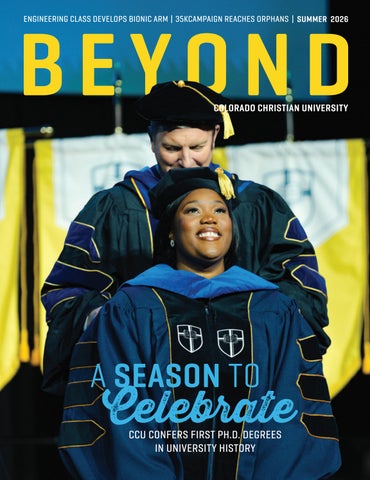
A SEASON TO
Celebrate CCU CONFERS FIRST PH.D. DEGREES IN UNIVERSITY HISTORY
2 | CCU.EDU
From the
PRESIDENT Dear CCU Community, At Colorado Christian University, we believe education is not simply about preparing students for careers — it is about preparing them to lead lives of purpose and influence. In a world where culture often shifts rapidly and convictions can easily be shaped by the loudest voices, CCU remains committed to equipping students to lead culture rather than be led by it. This calling shapes every aspect of the CCU experience. Through Christ-centered academics, vibrant campus life, and intentional discipleship, students are challenged to think critically, engage thoughtfully, and stand firmly in truth. They are learning not only how to succeed in their professions but also how to serve faithfully in the places God calls them — whether in business, education, ministry, science, the arts, or public life. That same spirit of Christ-centered scholarship and cultural engagement was evident throughout this spring semester as Colorado Christian University celebrated several historic milestones. Most notably, the University marked its 112th Commencement ceremonies and conferred Ph.D. degrees for the first time in CCU history, recognizing the inaugural graduates of the University’s Doctor of Philosophy program in Counselor Education and Supervision. We were also honored to welcome former U.S. Secretary of Education Betsy DeVos as our 2026 Commencement speaker, encouraging graduates as they prepared to step into communities across the nation and around the world as courageous Christian leaders. This season also included the Pinnacle Christian Writers Conference, led by New York Times bestselling author and CCU Trustee Jerry B. Jenkins, which brought together writers and communicators for encouragement, mentorship, and professional development grounded in a biblical worldview. A special highlight was a virtual appearance by Anne Graham Lotz, whose message challenged attendees to pursue their calling with faithfulness and conviction. Together, these moments served as a meaningful reminder of the University’s mission to prepare students and leaders to impact the world with grace and truth. As you read this issue of BEYOND, I invite you to celebrate the ways God is at work through Colorado Christian University, to pray for our students — that they would graduate with wisdom, conviction, and the courage to influence the culture around them for Christ — and explore ways God may be asking you to help further His work at this great University. Soli Deo Gloria,
Eric K. Hogue, M.Th.
President
BEYOND | 3
Inside VOLUME 10 NO. 2
06 HOPE CENTER STAGE!
22 A SCHOLAR FOR THE MOMENT
09 ALUMNI SPOTLIGHT
24 CAN YOU STILL BE MOVED?
12 HEWITT HOMECOMING
32 A NEW CROSSING
16 IMPACTING THE CULTURE
34 CCU CELEBRATES THE
SCHOOL OF MUSIC BRINGS HELL0, DOLLY! TO LIFE NATE GRASZ LEADS THE WAY FOR FAMILIES, FAITH, AND FREEDOM HUGH HEWITT RETURNS FOR THE PRESIDENT'S SPEAKER SERIES
50 STUDENTS ATTEND THE NATIONAL MARCH FOR LIFE
19 MY WHOLE LIFE FOR YOUR WHOLE LIFE, FOREVER.
THE RYDER FAMILY GIVES HOPE TO ORPHANS 4 | CCU.EDU
DR. DAVID CORBIN JOINS CCU AS PROVOST
JERRY B. JENKINS HOSTS THE PINNACLE WRITERS CONFERENCE RECLAIMING FUNDAMENTAL PRINCIPLES IN AMERICA'S 250TH
CLASS OF 2026
COMMENCEMENT HIGHLIGHTS AND A NEW MILESTONE
40 ENGINEERING FOR IMPACT
DR. CORY HIXSON AND STUDENTS AIM TO CHANGE ONE GIRL'S LIFE
A publication of Colorado Christian University
OUR MAGAZINE BEYOND is published twice annually by Colorado Christian University (summer and winter). Through its pages, we seek to share the story of CCU and God’s faithful provision for more than 100 years, while highlighting the people who go beyond and make CCU the great Christian university it is today. Whether you are an alumnus, alumna, or friend of the University, this magazine is designed for you — because your story, our story, His story, is meant to be told
UNIVERSITY ADVANCEMENT TEAM Vice President of University Advancement and President of the CCU Endowment Foundation: Daniel LaBry Assistant Vice President of Major Gifts and Stewardship: Amanda Grogan Director of Major Gifts: Mark Heckelmann Director of Prospect Research and Grants: Kara Johnston Mott Director of Advancement Services: Jill Sneed (MOL '23) Associate Director of Annual Giving and Strategic Engagement: Paul Grizzle (B.S. '19, MBA '23, M.S. '24) Strategic Engagement Gift Officer: Bridget Radke Philanthropy Officer: Trevor Garrett Database Administrator: Trent Fleming (B.S. '26) Donor Relations Specialist: Daniel Van Kooten (B.S. ’26)
BEYOND PRODUCTION & CREATIVE TEAM
43 A LIGHT IN THE DARKNESS
THE WAR OF IDEAS AND AYAAN HIRSI ALI'S JOURNEY TO FAITH
46 MORE THAN WINS
THE CULTURE BEHIND A HISTORIC SEASON FOR WOMEN'S SOFTBALL
50 PREPARING LEADERS FOR WHAT'S NEXT
CCU OFFERS NEW PROGRAMS AS WE LOOK TO THE FUTURE
56 BE THE REASON SOMEONE SUCCEEDS
TRANSFORMING A STUDENT'S FUTURE THROUGH SCHOLARSHIPS
59 BENEDICTION
GRACE & TRUTH IN CULTURE
Assistant Vice President – Communications, Creative Services and Web: Lance Oversole (B.A. '06) Senior Graphic Designer and Production Manager: Will Nagel (BFA '02) Project Manager: Kristen Rummel Strategic Communications Manager: Heather Johnson Lead Writer/Editor: Heather A. Eades University Photographer: Luke McNeal Graphic Designer: Rich Griffis Graphic Designer: Catherine Wagner Contributing Editor: Kara Johnston Mott
MISSION Christ-centered higher education transforming students to impact the world with grace and truth. Colorado Christian University cultivates knowledge and love of God in a Christ-centered community of learners and scholars with an enduring commitment to the integration of exemplary academics, spiritual formation, and engagement with the world. We envision graduates who think critically and creatively, lead with high ethical and professional standards, embody the character and compassion of Jesus Christ, treasure the gospel, and who thereby are prepared to impact the world in their callings.
ON THE COVER Duchana Gille (Ph.D. ’26) receives her doctoral hood from CCU Provost Dr. David Corbin.
BEYOND | 5
HOPE
Center Stage! CCU’S SCHOOL OF MUSIC BRINGS HELLO, DOLLY! TO LIFE ALONG WITH NEW MAJOR By Heather A. Eades
T
here are few events in life outside of church that can bring people together emotionally quite like the performing arts, especially theatre. In a world often marked by distraction and disconnect, live performance has a unique way of drawing people into a shared human experience. For a few hours, an audience of strangers becomes a community. That sense of connection was unmistakable this past February as Colorado Christian University’s School of Music packed out the Lakewood Cultural Center with more than 1,500 patrons across five sold-out performances of this year’s spring musical, Hello, Dolly!. But for CCU’s theatre department, moments like these go far beyond ticket sales. They are ministry. For Director and Associate Professor of Theatre, Bethany Wood, selecting Hello, Dolly! was both an artistic and spiritual decision. Based on Thornton Wilder’s 1938 comedy The Merchant of Yonkers (later revised as The Matchmaker in 1955), the musical challenged students not only creatively, but personally. “What really resonated with our students,” said Wood, “was the idea of people who had gone through loss and were reclaiming life.” At its heart, Hello, Dolly! is about renewal. Dolly Gallagher Levi is a widow learning how to live fully again after grief. Horace Vandergelder wrestles with loneliness
6 | CCU.EDU
and guardedness after loss. Even the supporting characters long for joy and freedom after seasons of discouragement and frustration. While the Broadway classic delighted audiences with humor and charm, Wood also encouraged the cast to explore the humanity beneath the comedy. “These characters have pain in their past,” Wood explained. “But they’re choosing joy. I want people to notice that difference. And to wonder why.” That perspective transformed the production process into something more meaningful than merely lines and choreography. Students learned to approach storytelling as a way of helping audiences recognize redemption, empathy, and hope. “Every performance carries a message,” shared junior Isabelle Blanken (B.A. ’27) who played the title role of Dolly Gallagher Levi. “And storytelling is one of the most powerful ways to reach people.” For Blanken, playing this role was the realization of a dream years in the making — and a glimpse into a calling that both originated and continues to flourish at CCU. Years ago, Blanken sat in the audience as a child watching Hello, Dolly! the last time it was performed at CCU. “I remember I met the girl who played Dolly, and I was so inspired!” said Blanken. “I went home that night and I told
my parents, ‘I wonder if I’ll ever get to be on the stage like that’ — because at that point, I was purely a dancer.” Now a double major in musical theatre and dance, Blanken was honored to take on the iconic role herself this spring. “It was a dream come true,” she said. “To come full circle — it was such a surreal, beautiful moment.” Blanken is bound to share many more “pinch-me” moments as she continues taking small steps of faith toward big dreams on stage. She hopes to pursue a professional career in musical theatre — performing on national tours, exploring film, and eventually moving to New York City with plans for Broadway. But wherever her path leads, her purpose remains steady. “I want to use what I’ve been given,” she said. “To tell stories that matter. To share hope.” It is a calling shaped not only by talent, but by transformation. “I love the idea that God gave us these gifts for a reason,” Blanken continued. “When we perform, we’re using those gifts for His glory.” For students in the program, that sense of calling shapes every rehearsal and performance, as they explore the arts as both profession and ministry.
According to Wood, that mindset changes how students approach their craft. Performance becomes less about recognition and more about service — using creativity to encourage, connect, and reflect deeper truths about the human experience. It has also created a culture within CCU’s theatre department where artistic excellence and spiritual purpose work hand in hand. Wood ensures that ministry happens as much backstage as it does under the spotlight. Students describe an environment marked by encouragement, unity, and shared mission, where faculty invest deeply in both artistic growth and personal development. “God is moving here,” said Wood. “And it’s beautiful to see Him working through our students.” Wood believes the arts are especially important in today’s culture because they create something many people are desperately missing: genuine human connection. “You cannot do theatre with your phone in hand,” said Wood. “You have to be fully present.” That goes not only for actors, but for audiences as well. In a time marked by rising anxiety, loneliness, and digital disengagement, Wood explained that live theatre calls people back into relationship — with one another and with the stories unfolding in front of them. BEYOND | 7
“I used to think theatre simply helped build empathy,” said Wood. “Now I think it’s part of the antidote to the mental health struggles we’re seeing. Theatre brings us face to face again. You have to be present. And that kind of connection is powerful.” Theatre also requires collaboration, vulnerability, and trust. Cast members must rely on one another, working toward a shared goal rather than individual recognition. Wood compares that process to the body of Christ itself. “When we’re creating theatre together, we’re functioning as the church,” said Wood. As CCU’s theatre department continues to grow — including the launch of a new musical theatre major and expanded professional opportunities — the mission remains clear: Prepare students to enter the world as thoughtful, faith-filled artists.
“We are creating culture,” said Wood. “And we’re doing it in a way that reflects truth, dignity, and redemption. You can’t always control the content, but you can control the intent.” “We want our students to go into the world and create art that honors Christ,” said Wood. That means real-world experiences for students with professional auditions, masterclasses, internships, and industry connections while learning how to integrate their faith into their work. Whether pursuing Broadway, teaching, local theatre, or arts leadership, they carry with them a belief that story can do more than entertain — it can heal hearts, connect us as humans, and offer hope. It can minister. And at Colorado Christian University, that is exactly what the arts are meant to do.
Only 110 seats remain!
Take a Seat! Campaign
Reserve yours today with a tax-deductible gift to CCU’s School of Music. Each gift of $500 or more includes a personalized nameplate in the Armstrong Center and will help fund essential equipment, instruments, and technology for the McDonald Performance Hall. Thanks to the generosity of donors like you, we’ve raised over half of our $225,000 goal! Make your impact: Scan the QR code or fill out the insert today!
8 | CCU.EDU
Alumni
SPOTLIGHT
RUNNING
POINT Life
FOR
By Heather A. Eades
CCU ALUM NATE GRASZ LEADS THE WAY FOR FAMILIES, FAITH, AND FREEDOM
A
lot can happen in a decade. As alumnus Nate Grasz (B.A., B.S. ’15) returned to Colorado Christian University’s campus for Hugh Hewitt’s Homecoming on March 13, he reflected on how much had changed since his last visit — from the addition of the Anschutz Student Center (2017) and Rockmont Hall (2019) to the newly completed Armstrong Center (2024) — and also what remained the same. Pausing at Leprino Hall, where he once helped broadcast The Hugh Hewitt Show, Grasz sat down with BEYOND magazine to reflect on life since graduation — including marriage, fatherhood to two children (with one on the way), and his role as executive director of Nebraska Family Alliance (NFA) — the Family Policy Council for the state of Nebraska. At the center of it all
is the lasting impact of his time at CCU that continues to guide his work and calling today.
A FOUNDATION FOR INFLUENCE Grasz arrived at CCU in 2012 as a student-athlete from Omaha, Nebraska, drawn by the opportunity to play basketball. A double major in business administration and political science, he graduated in December 2015, leaving with a drive and motivation that extended into courts of a different nature, along with an understanding that vocation and calling are not separate pursuits. Now leading the charge for NFA (an independent organization affiliated with Focus on the Family), Grasz is running point on often unpopular or challenging cultural conversations to play a role in shaping them — a foundation he credits to his time at CCU. BEYOND | 9
“Pretty quickly, the relationships and people I met at CCU, the professors and a multitude of unique opportunities — they all worked together to solidify a desire to be involved in government and public policy,” said Grasz.
“ IF I LOOK BACK...
IT'S JUST SO CLEAR TO ME That transformation took place both inside and outside THAT GOD WAS PREPARING the classroom, particularly through Grasz’s involvement with the Centennial Institute. There, he encountered ME THEN FOR WHAT first-hand experiences and conversations that wove faith, policy, and culture together through a biblical lens — an I AM DOING NOW. environment that helped him begin thinking critically
”
about the world around him. “Everything was through a Christian worldview,” Grasz explained. “The professors and the speakers that were brought to campus provided me with so many unique opportunities to be shaped and mentored by people who are actively serving in government or influencing the culture with truth.”
One of the most defining experiences came during Grasz’s senior year, when he worked as an associate producer for nationally syndicated radio host Hugh Hewitt. Broadcasting daily from campus, Grasz contributed to the program while gaining real-time exposure to national conversations and how to approach them with grace and truth. “It was just Hugh and me, every afternoon,” Grasz recalled. “I would help prepare notes for the show, then every day I would just get to watch him interview the top lawmakers and conservative thinkers from across the country. I really got to learn from him, and I’m so grateful for that experience.” Those moments — equal parts classroom, mentorship, and real-world application — helped confirm a calling that had been steadily taking shape. “If I look back at all of the different opportunities and experiences I’ve had, it’s just so clear to me that God was preparing me then for what I’m doing now,” said Grasz.
FROM CAMPUS TO CALLING After graduating, Grasz returned to Nebraska, married his high school sweetheart, Brenna (B.A. ’15), also a CCU alum. Brenna received her law degree from the University of Nebraska, served as the attorney for the Protect Women & Children campaign in 2024, and now practices part-time while staying home with their two children (Briella, 4 and Jesse, 2) and awaiting their third this August.
Nate, Brenna, and Sen. Ricketts with Pro-Life
10 | CCU.EDU
Petitions
Nate immediately began working at NFA in January 2016. Starting as policy director, he now serves the organization as executive director, leading its mission to “advance family, freedom, and life.”
“ WE CAN EITHER
INFLUENCE CULTURE OR BE INFLUENCED BY CULTURE.
”
For Grasz, the work extends beyond politics — it is deeply personal and also spiritual. “We’re not a political organization,” Grasz explained. "We're a Christian ministry that cares about politics and policy because we care about people." In his role, Grasz collaborates with elected officials, engages in legislative advocacy, and helps shape policies affecting families across Nebraska. His work spans issues such as religious liberty, education, human trafficking, and the protection of life. “We’re at the tip of the spear in the battles that are shaping our culture,” said Grasz. Over the past 10 years, several milestones stand out to Grasz. He authored legislation creating commemorative birth certificates for families who have experienced miscarriage, providing a meaningful way to honor lives often left unrecognized. He also helped lead the passage of the First Freedom Act, strengthening religious liberty protections in Nebraska, and played a key role in a historic ballot initiative strategy — with language authored by Brenna — that secured constitutional protections for unborn children. Central to Grasz’s work is a principle he first began to understand at CCU — that culture is not something to passively absorb, but something to actively mold. “As believers, we can either influence culture or be influenced by culture,” said Grasz. “And so much of what we see is a continued decline in morality and the breakdown of God’s design for marriage, family, and life.” For Grasz, addressing cultural challenges requires more than policy solutions; it requires recognizing deeper roots. “Most of the issues that we face aren’t political,” commented Grasz. “They’re moral issues, and they are spiritual issues.”
Yet Grasz’s approach is not defined by confrontation, but effectiveness — communicating with clarity, empathy, and purpose, prioritizing people over arguments. “Our hope is that every person we interact with, even if they disagree with us, would never be able to say that we didn’t represent Christ well.” It’s a posture that reflects a balance of standing firm without losing sight of the people on the other side of the conversation.
A CALL FOR THE NEXT GENERATION Looking ahead, Grasz sees reason for hope — not because the challenges are diminishing, but because more individuals are stepping forward to meet them. “Courage begets courage,” said Grasz. “I think we are seeing across our country more Christians starting to stand up and speak out.” For current CCU students preparing to enter an increasingly complex cultural landscape, Grasz’s encouragement is both timely and enduring. “God could have put us here at any time,” said Grasz. “And He chose to put us here in this time and place to be a light for Him.” It is a reminder that cultural leadership is not reserved for a select few, but it is a calling extended to anyone willing to step into their moment with faith and conviction. “We’re not promised results,” Grasz added, “but we're guaranteed to lose every battle we don’t show up for.” BEYOND | 11
Hewitt Homecoming By Heather A. Eades
Hugh Hewitt returns to Colorado Christian University for The President’s Speaker Series
C
olorado Christian University welcomed alumni, students, faculty, and community friends for a memorable evening on March 13 as nationally syndicated radio host, attorney, author, and former CCU professor Hugh Hewitt returned to campus as the featured guest of the President’s Speaker Series.
12 | CCU.EDU
Hosted by CCU President Eric Hogue and presented through the Centennial Institute, the event — held in the Fran and Larry Donnithorne Great Hall on campus — served as both a homecoming and a reflection on the role of faith, leadership, and conservative thought in today’s rapidly changing cultural and political landscape.
The evening marked the culmination of what organizers jokingly described as an “endurance test” for Hewitt. His day on campus included breakfast meetings, podcast interviews, a luncheon, two hours of live broadcasting, and multiple meaningful conversations with students and alumni. Despite the fullness of the day, the atmosphere that evening remained energetic and unstoppable, reflecting the genuine excitement of attendees gathered to hear from a speaker whose influence spans law, journalism, broadcasting, and politics. For Hewitt, however, the visit carried significance beyond a typical speaking engagement. It was a return to the University that played a role in his own professional and personal journey. Hewitt reflected on teaching constitutional law at CCU in 2015 and on his longstanding relationship with the University — one rooted in his friendship with former CCU President Bill Armstrong and continued under President Hogue’s leadership.
“
“I cannot introduce this man with impartial detachment,” said Hogue. “I like him. I love him. I am a Hugh Hewitt fan, and I’ve been a Hugh Hewitt fan for a long time.” Originally hailing from Warren, Ohio, Hewitt’s resume alone is notable: He clerked on the United States Court of Appeals for the D.C. Circuit, served six years in the Reagan administration as an assistant counsel in the White House, special assistant to two attorneys general, and as a Senate-confirmed deputy director of the Office of Personnel Management. He also served as the founding executive director of the Richard Nixon Presidential Library.
I am a Hugh Hewitt fan, and I've been a Hugh Hewitt fan for a long time.
In his introduction, Hogue presented Hewitt not only as a nationally recognized public figure, but as a longtime, trusted friend and fellow Buckeye — sharing over two decades together at Salem Broadcasting — and someone whose career has modeled thoughtful Christian engagement in the public square.
”
On top of his storied experiences in the political realm, Hewitt has served as a tenured constitutional law professor at Chapman University’s Fowler School of Law for 30 years, author of 14 books, Emmy Awardwinning television host, and veteran interviewer with more than 25,000 interviews to his name. Yet throughout the evening, his remarks centered less on numerous accomplishments and more on calling — particularly the role of faith in civic responsibility.
Titling his address “A Flock of Black Swans,” Hewitt offered a wide-ranging keynote speech that wove together constitutional law, current events, media, Israel, and the charge for Christians to engage thoughtfully in public life. Despite the breadth of topics, his central message remained clear: Ideas matter, truth matters, and Christians must not retreat from the public square.
President Hogue moderates a Q&A with Hugh Hewitt following his presentation on American politics, media, and culture.
BEYOND | 13
“
Full on, Hugh. It's the DNA of the University.
Drawing from his own experience as a White House lawyer and veteran political commentator, Hewitt also offered candid reflections on interviewing public figures and navigating the complexities of today’s media landscape. He emphasized the need for principled voices willing to engage thoughtfully and intelligently in mainstream discourse. At several points, Hewitt shifted from political analysis to matters of deeper moral and cultural significance. He spoke passionately about America’s relationship with Israel, grounding his perspective in constitutional principles and moral clarity. Hewitt’s commentary reflected a larger theme woven throughout the night: Conviction must be anchored in both truth and principle, not shaped merely by reaction or partisanship. He stressed that faithful engagement in public life often requires navigating complexity with both courage and intellectual rigor. Some of the evening’s most compelling moments, however, came during the conversational Q&A session between Hewitt and Hogue. Their discussion ranged from presidential debate moderation and media bias to conservative leadership and the future of Christian higher education.
Though Hogue arrived prepared with what he described as “four pages, forty-two questions,” the exchange flipped when Hewitt posed a question of his own: “To what extent do you want Colorado Christian University to be a participant in politics in Colorado and the nation?” asked Hewitt. Hogue’s response was immediate. “Full on, Hugh,” he said. “It’s the DNA of the University.” Hogue then pointed to the work of the Centennial Institute and CCU’s broader mission of equipping students to influence culture through thoughtful, Christcentered leadership. “If we can make an intellectual argument — one that is grounded in history like you did tonight — and present it in a way that makes sense and is both winsome and compelling — I want every one of our graduates in the middle of the town square making those arguments,” said Hogue. The exchange captured another defining aspect of the CCU experience: preparing students for professional excellence, but also to enter culture equipped to lead with conviction, wisdom, and humility.
broadcast a live edition of The Hugh Hewitt Show from campus, featuring CCU alumni serving in | CCU.EDU 14 Hewitt politics, government, law, business, and the nonprofit sector.
”
Hewitt joins President Hogue for the President’s Podcast.
Hewitt meets with CCU students.
Hogue noted, “You have to lead, and you have to have a voice.”
decision to enroll at CCU.
Hewitt affirmed that vision, referencing the six CCU graduates who had joined him earlier in the day for his live campus broadcast — echoing his time in 2015, when CCU students spent a semester assisting with The Hugh Hewitt Show in a studio built for him on campus by Bill Armstrong.
As the audience rose for a final standing ovation, the evening stood as more than a distinguished lecture or alumni reunion. Hewitt’s return served as a powerful reminder of CCU’s enduring commitment to develop graduates who are intellectually serious, spiritually grounded, and prepared to engage the most pressing issues of their time.
“They were fabulous,” said Hewitt. “These graduates are doing all sorts of things. They are lawyers, and they are activists, and they are public policy people. I just thought, this is great!”
In a cultural moment often defined by noise and division, the President's Speaker Series offered something increasingly rare: substantive dialogue rooted in conviction, history, faith, and mutual respect.
In one of the evening’s most celebratory highlights, Hogue surprised Hewitt with an official proclamation from the Office of the President, recognizing March 13, 2026, as Hugh Hewitt Day at Colorado Christian University in honor of his contributions to both CCU and public life.
For those in attendance, Hewitt’s homecoming offered a compelling example of what that vision can look like in practice: a career and a life built not merely by influence, but by thoughtful public engagement, shaped by faith, courage, and a willingness to enter difficult conversations.
Reading the proclamation, Jaimie Erker (B.A. '18), director of “In a landscape that rewards communications and advisor volume or banging pots and to the director of pans or making noise over Centennial Institute, substance, outrage over shared a personal analysis, Hugh has done reflection on Hewitt’s something genuinely influence, noting that countercultural,” said attending his Young Hogue. “He has Conservatives remained serious, Leadership he has remained Conference as brilliant, and he a high school has remained student played a Hewitt and President Hogue with CCU Strategic Communication students believable.” pivotal role in her BEYOND | 15
By Jaimie Erker
CENTENNIAL INSTITUTE TAKES 50 STUDENTS TO THE 2026 NATIONAL MARCH FOR LIFE significant snowstorm is expected to hit the east coast this weekend.” Those were the last words I wanted to hear as we prepared to travel with 50 CCU students and three chaperones to Washington, D.C., for the 2026 National March for Life. 16 | CCU.EDU
Weather has always been a consideration for this trip. The March for Life began as a protest against the Supreme Court’s decision in Roe v. Wade, issued in January 1973, and it continues each January to serve as the national rallying point for the pro-life movement. Unfortunately, January is not always the most accommodating time of year — in Colorado or D.C.
50 students from Colorado Christian University gather on the National Mall to rally for the end of abortion in our country.
Despite these weather warnings, months of logistical planning and student fundraising meant the trip would go on. We arrived in D.C. on Thursday, January 22, to sunshine and unseasonably mild temperatures. During our first evening in the city, the team headed to the Conservative Partnership Institute for a briefing with Eric Teetsel, a former CCU Life Directions Center advisor and now CEO of the Center for Renewing America. Teetsel shared how connections made through the late President Bill Armstrong helped launch his career in Washington, as well as the importance of remaining true to Christian conservative principles while working in the nation’s capital.
a breakfast reception with former Vice President Mike Pence and his wife, Karen Pence. Students spent time networking and engaging with senior policy fellows, pro-life leaders, and members of Congress before Pence paused to snap a quick selfie to send to CCU President Eric Hogue. He also spent time with CCU’s student body president Jonathan Radcliffe (B.A. '26) and two student senators, Noah Hakalmazian (B.S. '27) and Calvin Schmidt (B.A. '28).
PACKED ALONG MADISON DRIVE WITH MORE THAN 100,000 PARTICIPANTS...
Friday brought another beautiful day — moderate temperatures and some light cloud cover — perfect weather to be outside all day for the largest human rights protest in the world. Students began their morning early on the National Mall for a live segment with Rachel Campos-Duffy on Fox & Friends, where CCU for Life co-president Stephanie Heil (B.A. '26) was interviewed alongside Jennie Bradley Lichter, president of March for Life. Following the broadcast on Fox News, we made our way to Advancing American Freedom’s headquarters for
Returning to the National Mall, students were buzzing with excitement for the March for Life rally, where speakers included Vice President J.D. Vance, Speaker of the House Mike Johnson, and Cissie Graham Lynch. During the rally, a video message from President Donald Trump was also highlighted, along with a letter and blessing from Pope Leo XIV — marking the first time a pope has directly addressed March for Life’s participants in this way. Packed along Madison Drive with more than 100,000 participants, we joined the procession toward the U.S. Capitol. Along the route, chaperone Dr. John Wind broke out his portable speaker and led the students in a variety of chants and hymns to energize the group.
BEYOND | 17
Group selfie at the March for Life
Former Vice President Mike Pence with CCU students in Washington D.C.
“ IT WAS ENCOURAGING
After a full day on the National Mall, we love to treat students to a familystyle Italian meal, where chaperones facilitate discussions on students’ impressions throughout the March, including what effective messaging looks like for the pro-life movement.
FOR ME TO BE A PART OF THE CONVERSATION.
Reflecting on how the March impacted him, one student remarked: “A core memory from this trip was when we were walking in the March, and I saw a group of people showing images of mutilated unborn children. Part of me understood the need to be exposed to the reality of this issue, but the images made me sick. As an uncle, I see such beauty and wonder in my nieces and nephew, and I can’t imagine a world without them. This experience has deepened my personal commitment to stand for life, and I want others to feel the importance of this cause as strongly as I do.” During our monument tour later that evening, the weather began to shift dramatically. Temperatures quickly dropped into the teens, accompanied by biting wind chills. The storm was moving in — and with a vengeance! After closely monitoring conditions and several days of evaluating travel options, we adjusted our plans to ensure a safe return for the group. 18 | CCU.EDU
Flights were rescheduled throughout Saturday afternoon, which meant the group was unfortunately unable to spend the full day at the National Pro-Life Summit. However, students were still able to hear from top conservative and pro-life leaders, including Nick Freitas, Abby Johnson, Kristan Hawkins, Stephanie Gray Connors, and Kevin Sorbo.
”
By Saturday evening, all students had returned safely back on campus. The following day, news broke that Washington D.C., was essentially shut down due to the storm, with reports of approximately six inches of snow topped by several more inches of sleet. Despite the disruption, our students were able to enjoy the majority of the March for Life weekend while still making it back in time for classes on Monday morning. While this trip serves as an important and sobering reminder of the ongoing national battle to end abortion in our country, it also provides students with a tangible opportunity to engage the culture and consider how they can be part of the movement to effect meaningful change. Following the trip, one student reflected, “It was really impactful to see how different politicians and activists are working to fight abortion in our nation, and it was encouraging for me to be part of that conversation.”
My Whole Life For Your Whole Life
FOREVER.
HOW TWO CCU ALUMNI ARE GIVING HOPE TO ORPHANS AND BUILDING FAMILIES By Kara Johnston Mott
$35 k
That is the cost of a small SUV. Or a tiny home. Or a backyard landscaping project. Or — most strikingly — the average cost of adopting a child.
For Chad (B.A. ’10) and Joni (Miller) Ryder (B.A. ’11), that number became a calling. As founders of 35Kcampaign, a nonprofit organization that helps Christian families
fund the adoption of children with special needs, sibling groups, and older children, the Ryders are working to remove financial barriers and bring children into loving, Christ-centered homes. Their mission is “…to help alleviate the stress of fundraising and provide ample support for these children to be placed in Christian homes where they are assured to hear the good news of the gospel of Jesus Christ.” BEYOND | 19
Reflecting on that time, Joni explained, “The one-child policy was in effect, and women were not allowed to give up kids for adoption, as it was considered child abandonment and a crime. Because of this, 80% of Chinese women had to choose abortion with great shame and pain.” Witnessing both the devastation of abortion and the overwhelming need to care for orphans profoundly shaped their next steps. After returning to the United States, Chad and Joni founded 35Kcampaign in 2014, named for the dollar amount surrounding adoption costs. Their goal was clear: to assist more Christian families through the financial and emotional challenges of adoption and, ultimately, to help more children find hope in Jesus.
Their passion for adoption was shaped long before the organization began. Growing up, Chad’s family regularly hosted international exchange students in their home, fostering in him a love for multi-national family integration. Joni, meanwhile, will tell you she always felt called to adopt — a desire that was amplified during a high school trip to Thailand, where she served in an orphanage rescuing children from trafficking. That shared calling came into clearer focus when they both enrolled at Colorado Christian University. There, God began weaving together their futures. Both served as student body presidents — Chad in 2009-10, followed by Joni in 2010-11 — and during their time at CCU, their leadership skills, spiritual formation, and love for one another grew in tandem. It was also there that God continued to point their hearts toward a future that would include international missions and adoption. After marrying in May 2012, the Ryders quickly began preparing for a move to China, where they would serve in a children’s home for kids with special needs. They arrived in January 2013 and stepped into a deeply challenging environment. While there, Joni also launched the first pro-life counseling center in China to support women during pregnancy. 20 | CCU.EDU
At the heart of their work is a deeply biblical understanding of adoption. As they explain, “All adoption starts with trauma, and you are called to help them — birth families, kids, and adoptive families — through it with love and family bonds. We see this in our relationship with God — how He loves us as His children. Adoption looks like the gospel. It has taught us what God has done for us rather than what we have done for the child. It is very humbling as you learn to rely on the Lord in both the great moments and hard moments.” The Ryders are living out these principles through the formation of their own family, as well. They have two biological children, Leland (8) and Millie (1), and two adopted children — Desmond (13) and Mina (3). Mina’s adoption story, in particular, illustrates how God prepares hearts to welcome a child that hasn’t previously been met. Born in India, Mina was known to the Ryders only through photos and periodic communication with the orphanage. “Your commitment to a child comes before your love for them,” Joni said. “Feelings come after we act out our love.” When it came time to bring Mina home, Chad and Joni traveled to India with Desmond and Leland, staying there for two months. That time allowed them to fully experience the culture, food, and places surrounding Mina’s home. “This family time overseas really bonded us together with Mina,” Chad shared. “She is fully blind, and we wanted her brothers to be able to describe her homeland to her as she grows up.” That experience also had a profound effect on the family’s understanding of identity and belonging. “We have made India a part of us, just as Mina will make
being American part of her story,” Joni said. “We are the Ryder family — each with our own personality, history, and life before we became a family. Our children belong to us because we share life with them — each day we share their joys and troubles, and that makes us a family.” Through their journey, the Ryders have come to see more clearly that each person is made in the image of God and is worthy of love. Children enter the adoption system for many reasons — genetics, abandonment, poverty — but each life carries inherent dignity and purpose. As Chad reflects, “Mina’s blindness will allow her to fulfill God’s plan for her life.” Their faith continues to anchor them, especially in difficult seasons, as Scripture reminds that as we abide in the Lord, He meets our every need. The Ryders often return to Matthew 6:33: “But seek first the kingdom of God and his righteousness, and all these things will be added to you.” Joni added, “It’s not always financial support, but sometimes His provision is people walking with us, counseling us, and helping us.” That sense of community, they note, is critical. The Ryders know too well the pain of loneliness and isolation adoptive families can experience, even in churches. “We tell churches to welcome families who look different or who have kids with challenging behaviors,” Chad said. “Staff and volunteers should do trauma training. Universities can also talk about it early and often, so students can think about the future and how they might consider taking care of orphans.” Looking ahead, there are signs of progress in the support and encouragement for adoptive families. The landscape has more awareness of the global problem of
“ The good news is
that for those families who want to adopt, there is funding available.
”
kids who need families, and many countries are working to streamline adoption processes while implementing ethical safeguards to protect children from trafficking. More people are also recognizing the full spectrum of adoption, including walking with and supporting biological families in the difficult decision to place a child for adoption. Even so, significant challenges remain. According to Pew Research Center, adoption rates are declining. Between 2019 and 2023, international adoptions fell by 57%, and adoptions through foster care decreased by 26%. “The good news,” Chad noted, “is that for those families who want to adopt, there is funding available. To date, 35Kcampaign has helped 50 families in their adoption journeys as they continue to obey God’s calling.” At home, the Ryders continually remind all four of their children of a simple but powerful truth that has become a family motto: “my whole life for your whole life forever.” It’s a phrase that captures not only the Ryders’ commitment to one another, but also their response to God’s call. Their family is a beautiful testament of what can happen when we go where God leads us and put our faith into action. In a remarkable and deeply meaningful milestone, the first child supported by the 35Kcampaign, Zy Iwasaki, will begin his journey at CCU as a freshman in the fall of 2026. What began as an act of generosity — faithfully giving so that a child might be placed in a Christcentered home — has come full circle in a way few could have imagined.
Zy Iwasaki will be attending CCU starting in the fall of 2026.
This is the heart of the 35Kcampaign. And this is only the beginning. To learn more about the 35Kcampaign and the families it serves, visit: www.35kcampaign.org. BEYOND | 21
A Scholar for the Moment Dr. David Corbin Joins CCU as Provost NEW PROVOST BRINGS A CLEAR AND COMPELLING VISION TO COLORADO CHRISTIAN UNIVERSITY’S FUTURE
W
hen Colorado Christian University announced Dr. David Corbin as its new provost, it marked the culmination of a lengthy national search. The process was defined by careful discernment, broad interest, and sustained prayer. After more than a year and a half and 63 applicants from across the country, the University found in Corbin a leader whose life and work align closely with its mission.
Christian College. Each has shaped his understanding of how faith and learning meaningfully intersect.
That alignment is rooted not only in experience, but in character and conviction.
Alongside his work in the classroom, Corbin has served in significant academic leadership roles. At The King’s College, he was dean of the School of Politics, Philosophy, and Economics, where enrollment doubled during his tenure. He later served as provost and interim president at Providence Christian College, providing steady leadership during a critical season of institutional transition.
Corbin brings more than two decades of scholarship and leadership in Christian higher education. A political philosopher by training, he has taught across a range of disciplines, including political philosophy, American politics, international relations, and politics and literature. His academic career has included appointments at the University of New Hampshire, Boston University, The King’s College, and Providence 22 | CCU.EDU
He earned both his bachelor’s and master’s degrees in political science from the University of New Hampshire and completed his Ph.D. at Boston University. His scholarly work reflects a deep engagement with the enduring questions of public life, the nature of truth, and the role of institutions in forming thoughtful, responsible citizens.
His experience also extends into K–12 Classical Christian education. He served as head of school at
Geneva School of Boerne in Texas, where he focused on academic quality, faculty development, and mission alignment. Most recently, as an executive partner at Exemplar Advisors, he worked with mission-driven institutions across the country to strengthen their strategic direction and long-term sustainability. These experiences collectively reflect a leader who understands both the intellectual and institutional dimensions of Christian education. That perspective was evident in his first address to the CCU community.
as God’s world and to act within it with humility, courage, and hope. Corbin also affirmed the essential role of CCU’s College of Adult and Graduate Studies and CCU Online in advancing the University’s mission. By removing barriers for working adults, military families, and place-bound students, these programs extend access to a Christcentered, academically rigorous education. They ensure that more students can be formed for lives of purpose and service.
commitment “to (His) Christ is inseparable
Framing his remarks within the University’s mission to glorify Jesus Christ, Corbin spoke with clarity about the responsibility of Christian higher education in the present cultural moment. He emphasized that the work of the university is not merely to confer degrees, but to form students. The goal is to equip them to think clearly, live faithfully, and lead responsibly.
Wherever they are, these students are fully part of the CCU community.
from his approach to education.
Central to that formation is a renewed commitment to academic excellence. Corbin underscored the importance of rigorous scholarship, measurable learning outcomes, and high expectations for both faculty and students. A CCU education, he noted, should prepare graduates for meaningful work and positions of influence, grounded in both competence and character. He also highlighted a commitment to a strong liberal arts and humanities core. This approach cultivates essential habits of mind, including close reading, careful reasoning, persuasive writing, and moral imagination. These disciplines connect students to a sustained intellectual conversation that stretches from Jerusalem and Athens onward, forming the basis for thoughtful engagement with the world.
This emphasis on both excellence and accessibility reflects a broader institutional priority. CCU is committed to preparing graduates who are not only well-educated, but exceptionally employable and equipped to contribute meaningfully in their fields.
”
President Eric Hogue, in announcing Corbin’s appointment, described him as a “thoughtful academic leader whose commitment to Christ is inseparable from his approach to education.” That integration of faith, intellect, and purpose will be central as CCU continues to strengthen its academic identity. As Corbin begins his tenure, he does so at a pivotal moment in the life of the University. With continued growth across its programs and a clear, unwavering mission, CCU is positioned to expand its impact in Christian higher education. In Dr. David Corbin, the University welcomes a scholar and leader prepared to carry that work forward with clarity and conviction.
That intellectual tradition is not pursued in isolation. It is integrated within a distinctly Christ-centered vision of education, where all learning is situated within the larger narrative of creation, fall, redemption, and restoration. In this way, students are not only equipped to understand their disciplines, but to see the world BEYOND | 23
President Hogue and Dr. David Corbin share a vision for academic excellence at CCU Conversations.
CAN YOU STILL BE
Moved?
Jerry B. Jenkins is a New York Times best-selling author and a member of CCU's Board of Trustees. 24 | CCU.EDU
At the
Pinnacle Christian Writers Conference By Jerry B. Jenkins
Chris Fabry moderates Q & A with freelance panel.
T
he room fell silent, no doubt reminding attendees — whom I affectionately refer to as campers — of their home writing caves, where they toil in solitude. But sitting backstage in the Doug and Linda McDonald Performance Hall in the Armstrong Center at Colorado Christian University, the hush signaled something was up. Despite the fact that most writers are introverts (I know this from experience), when they get together, they can jabber like chickadees. I had been immersed in my own speaking notes, one foot bouncing to cover my angst and determination that everything must go right this weekend.
So, what was it that had resulted in this strange stillness? The campers had loved worship leader Biff Gore’s vocals and guitar, as well as conference chaplain Dr. Don Sweeting’s devotional. I peeked out through the curtain. Popular Moody Radio Network daily show host Chris Fabry, our emcee, was sharing bad news and good news. The bad news was that our headline keynoter, Anne Graham Lotz, had been on the plane in North Carolina when her flight was canceled. And no rebooking would get her to us in time. The good news was that she had raced home and videoed her entire message so we could show it on the BEYOND | 25
Dr. Angela Hunt meets with a conference attendee.
big screen the next evening. Her teaching on the Holy Spirit became one of the highlights of the conference. I especially enjoyed my vantage point, which allowed me to see men and women from all over the country. They included many first-timers who had come with stories — or ideas for stories — they felt called to write but had no idea what to do next. They reminded me of myself decades ago, not knowing what to do with my dreams. That’s why, for this conference, I made sure to invite keynoters and speakers with the right attitudes and approaches — not to mention with memories of their own humble beginnings. Though to a person, they were now what some would refer to as overachievers — successful, visible, widely published authors — they well remember when they too were unknown and unpublished. I wanted colleagues on the platform and in the breakout session classrooms who were quick to disabuse campers of the notion that they should be worshiped or in any way be put on pedestals. We gathered April 17–19 at CCU not merely to discuss the writing craft, the development of individual platforms, or even the dramatically shifting currents of Christian publishing — as important as all those things are. We were there to confront the deeply personal questions the campers harbored within: Am I called to this? Can I do this? And what do I do next? For three days, they heard from people who have landed where they long to be. And they learned that success and visibility are hardearned and never guaranteed. 26 | CCU.EDU
Anne Graham Lotz addresses the conference via video.
I've had this idea for years, but
don't know if it's any good.
I opened with a challenge in the form of a question: Can you still be moved? My point was that readers love to be educated and entertained, but they never forget when they’ve been emotionally moved. So always aim for the heart. Bestselling novelist Dr. Angela Hunt spoke on “The Plot Skeleton,” bringing to life the structure that eludes so many beginning writers, but which has resulted in Hunt’s more than 170 published works. In breakout sessions, Hunt, Fabry, James Scott Bell, Eva Marie Everson, and DiAnn Mills covered the basics of writing for beginners, journeymen, and even those already published. Marketing experts David Loy and Chase Neely covered how to build a following. Campers also enjoyed one-on-one 15-minute counseling sessions with more than two dozen publishing insiders.
Best of all, between sessions, small clusters formed where campers compared notes, traded misgivings, and often admitted their ambitions for the first time. The conference promised “craft, community, and calling,” which became more than a slogan. It became real, an experience. One first-time camper told me she had nearly stayed home. “I’ve had this idea for years,” she said, “but I don’t know if it’s any good.” By day two, she was eager to get back to her keyboard. One moment, a bestselling novelist would address a packed room. Over lunch, that same person would engage with a table full of campers, peppering them with questions about their work and encouraging them as if they were colleagues — because they were. Many attendees told me they were surprised and delighted at how spiritual the conference proved to be. I confess that surprised me, as “Christian” is in the name of the event and the middle name of the university where it was held. Each day began not with strategy, but with Scripture. Sweeting’s devotions anchored the conference in the written Word of God. Something shifts when each day begins like that, because our campers were more than casual listeners. Many came because they recognized that writing is more than a pastime, more than a hobby. It can become a calling that requires discipline and courage, long after so-called inspiration fades.
Various breakout sessions were held throughout the weekend.
For some, that meant committing — finally — to finish a manuscript. For others, it meant rethinking a project that wasn’t working or recognizing that the message they most need to write is the one they’ve been avoiding. One camper described it this way: “I didn’t leave with all the answers. But I know the questions I’m supposed to be asking next.” Long after the last session, many remained — still talking. Still asking. Still imagining what might come next. Though they needed to get back to the airport, few seemed in a hurry to leave — me included. They wanted to talk about writer’s fear and seemed fascinated that someone of my vintage still battles the same. I was there to teach, but I wound up being reminded why we write and what it costs. The work matters because a story well-told communicates Truth with a capital T. What a privilege to offer not a shortcut, but a calling back to community. My prayer is that the Pinnacle Christian Writers Conference put writers and want-to-be writers in the company of others who understand the challenge of shaping words for a purpose. Mostly, I wanted them to know that they are not alone. Long after the final session, those conversations remain in the pages yet to be written. And perhaps that is the truest measure of the Pinnacle Conference. What will be written next.
BEYOND | 27
{ C
A
LEGACYOF STORYTELLING
AND
FAITH.
}
THE JENKINS FAMILY READING ROOM
olorado Christian University recently dedicated the newly established Jenkins Family Reading Room in the CCU Library — a beautiful new space designed for student study, quiet reflection, and inspiration. More than simply a reading room, the space now serves as a tribute to the enduring impact of Christian storytelling and the legacy of one of the most influential authors of the modern era, Jerry B. Jenkins.
Among the items displayed are first editions from the world-renowned Left Behind series; various professional awards, recognitions, and memorabilia accumulated throughout Jenkins’ distinguished career as one of the nation’s most influential Christian communicators; and memorabilia connected to The Chosen — the globally successful television series developed by Jenkins’ son, Dallas Jenkins.
Made possible through a generous gift from Jenkins and his family, the room features numerous items from the author’s personal archives, many of which now permanently adorn the CCU Library within the Armstrong Center. Together, the collection offers students a rare glimpse into decades of literary achievement, ministry influence, and cultural impact.
The collection also includes two rare original versions of Warner Sallman’s iconic Head of Christ — one oil painting and one chalk rendering — among the most recognized depictions of Christ in modern history. The works, famously rediscovered in a Chicago thrift store and later acquired by Jenkins, received national attention following their remarkable recovery and appraisal.
28 | CCU.EDU
Michael Jenkins (B.A. ’08), Dianna Jenkins, and Jerry Jenkins joined CCU President Eric Hogue and First Lady Tammy Hogue for the ribbon cutting.
The displays celebrate the family’s lasting impact on Christian storytelling.
Head of Christ by Warner Sallman
The room itself was intentionally designed to provide students with a peaceful atmosphere for reading, contemplation, and academic work while surrounding them with reminders of how God uses creativity, writing, and media to shape culture and communicate truth. “For decades, Jerry Jenkins has demonstrated what it looks like to faithfully engage culture through storytelling,” said CCU President Eric Hogue. “We are deeply grateful for his generosity and for the opportunity to preserve and share pieces of his remarkable journey here at CCU. The Jenkins Family Reading Room is not only a beautiful addition to our campus — it is a place where students can be inspired to pursue excellence, creativity, and Christ-centered
CCU Library Director Matthew West and Jerry Jenkins
influence in their own callings.” The collection reflects a lifetime dedicated to advancing stories rooted in faith, hope, redemption, and truth. For students walking through the Armstrong Center or settling into the reading room for an afternoon of study, the space quietly communicates a larger message: Christian voices can profoundly shape literature, media, and culture. As students gather in the room throughout the academic year, the Jenkins Family Reading Room will continue serving as both a place of scholarship and a visible reminder of the lasting impact faithful storytelling can have on generations to come. BEYOND | 29
WHAT IT
MEANS TO BE
CONSERVATIVE
T
By Greg Schaller, Director of Centennial Institute
here is much debate today surrounding what it means to be a conservative. As differing ideologies compete to claim the true moniker of “conservatism,” it is vital to reaffirm the foundational principles of American conservatism.
Traditional conservatism, particularly in the American context, draws from the philosophical foundations laid by thinkers such as Edmund Burke and Russell Kirk. It emphasizes a respect for inherited wisdom, moral order, and gradual change rather than radical upheaval. It blends classical liberal ideas of individual liberty with a commitment to social stability, limited government, and traditional values. Unlike more libertarian or populist strains, traditional American conservatism prioritizes the preservation of cultural and institutional continuity as essential to fostering a stable and flourishing society.
•
Human Imperfection and Restraints on Power: Recognizing human nature as flawed and prone to selfishness, conservatives advocate for checks on political power, including limited government, separation of powers, and moral restraints from family, church, and community. American conservatism draws on this principle in its support for the Constitution's design, which disperses authority to prevent tyranny.
•
Individual Liberty Linked to Responsibility: Freedom is prized but must be exercised within moral and social boundaries, often tied to property rights and free enterprise. Traditional American conservatism champions God-given rights — including life, liberty, and the pursuit of happiness — while emphasizing that liberty flourishes when individuals act responsibly within families, communities, and institutions. It therefore rejects radical and unchecked individualism.
•
Rule of Law and Order: A predictable legal system, applied equally, is essential for justice and prosperity. This principle underpins American conservatism's commitment to constitutionalism, federalism, and opposition to arbitrary rule, ensuring that both the governed and governors are accountable under the same legal framework.
•
Strong National Defense and Fiscal Responsibility: While not always central to pure traditionalism, American variants emphasize the importance of defending national sovereignty and exceptionalism through military strength. This commitment is frequently coupled with prudent economic stewardship, including responsible fiscal policies to avoid debt and promote free markets.
These fundamental principles include: •
•
Enduring Moral Order: Traditional conservatives believe in a transcendent moral framework — often rooted in Judeo-Christian values and natural law — which guides both human behavior and politics. This principle asserts that political problems are fundamentally moral and spiritual in nature, rejecting the notion that purely secular or utopian solutions can resolve society’s deepest challenges. In America, this conviction is reflected in the Declaration of Independence's reference to God-given rights and in the Constitution's role in upholding ethical governance. Custom, Convention, and Continuity: Conservatives adhere to established customs and traditions as sources of wisdom accumulated over generations. These traditions provide stability and guard against the chaos of untested innovations. In American conservatism, this respect for continuity is reflected in reverence for historical precedents — including federalism and the Founding Fathers' vision — and in viewing rapid change as disruptive to social harmony.
30 | CCU.EDU
As conservatives, we must commit to living out and defending the enduring principles that sustain ordered liberty and moral truth. We must steward the conservative tradition to ensure that when we pass it on to the next generation, there is a lasting adherence to these foundational principles that foster human flourishing.
July 31 - August 1, 2026 Colorado Christian University WesternConservativeSummit.com
SCAN FOR INFORMATION
BEYOND | 31
A New CROSSING By Dr. David Murphy
RECLAIMING OUR FUNDAMENTAL PRINCIPLES IN AMERICA'S 250TH YEAR
O
n the icy Christmas night of 1776, General George Washington crossed the Delaware River in one of the most famous military actions in American history. The audacity of this raid — a turning point in the American Revolutionary War — serves as a powerful model for the can-do spirit that embodied the critical American birth year of 1776 and must once again define the United States. Washington refused to be bound by the tactical conventions of his time, securing a pivotal victory that restored patriots’ confidence and saved the Revolution from near-certain failure. America250 should be a time of grand celebration. But it must also be a time of cultural reflection and realistic self-evaluation. Our homeland faces a profound and unsustainable cultural and political impasse. If the United States is to see another 250 years, renewing our founding spirit and commitment to citizenship is essential. This renewal begins with a return to our foundational principles and a deliberate effort to pass them on to the next generation of leaders.
32 | CCU.EDU
Uniquely American values began to emerge even before America’s July 4, 1776, birthday. In 1630, John Winthrop, the Puritan leader and first governor of the Massachusetts Bay Colony, delivered his now-famous sermon, "A Model of Christian Charity," aboard the ship Arbella en route to the New World. In that sermon, he declared, "For we must consider that we shall be as a city upon a hill. The eyes of all people are upon us." This simple saying, derived from Jesus' words in Matthew 5:14 — "You are the light of the world. A city set on a hill cannot be hidden" — has become a defining expression reflecting American identity. To remain that shining light, Americans must rediscover the fundamental principles that shaped the nation at its founding in that pivotal year of independence. There are four keys to this restoration, and they already exist in the Declaration of Independence: personal liberty and responsibility, shared values, limited and responsive government, and solid moral foundations. These four fundamental American ideas are not relics of the past; they remain essential to our nation’s future and must be rediscovered as they were originally understood.
The Founding Fathers held a famously high view of both personal liberty and responsibility. The Declaration regards these rights as fundamental and inalienable, granted by the Creator rather than by government. Life, liberty, and the pursuit of happiness are so well known in today’s vernacular that the phrase has almost become a cliché, but their meaning remains foundational. These rights — and the responsibilities that accompany them — undergird our national identity and define the civic duty of every U.S. citizen. Protecting them requires a renewed commitment to the responsible civic duties of informed, involved citizenship. Active, informed citizens will naturally work to recover shared American values. The naïve assumption that these values are self-sustaining has been thoroughly debunked. Civic virtue is indispensable to a Constitutional Republic and requires constant and intentional cultivation. Western classical ideas on virtue and liberty are discovered and preserved through religious freedom and robust civic education. America must return to the fundamentals of its JudeoChristian heritage to restore and elevate virtue as a core expectation of U.S. citizenship. We should resurrect the Founding Fathers’ understanding of government as a necessary evil with limited scope: to protect natural rights, maintain law and order, and defend against internal and external threats. Aware of the dangers and seductive influence of concentrated power, through constitutional design, they established a federal government limited to enumerated powers, with a system of checks and balances to prevent its abuse. The federal government was not granted unlimited power to expand or encroach on state authority or individual liberty. The Constitution, the Bill of Rights, and the federal structure were carefully constructed to restrain power. Yet, despite these safeguards, federal and some state governments have ballooned into a bureaucracy that President Washington would neither recognize nor endorse. A bloated bureaucracy has little incentive to respond to its citizens. The Founders established a republic rather than a direct democracy — one that derives its power from the people and is administered by officials beholden to them.
“
To regain trust in our national leadership and federal structure, the first step is a return to strong moral principles.
”
Today, however, there is widespread distrust of the U.S. federal government across the political spectrum.
To regain trust in our national leadership and federal structure, the first step is a return to strong moral principles. These foundations are distinct from shared values. While virtue denotes moral character, morality is that character in action — proper conduct grounded in religious, ethical, or natural law. The Founders built America on Judeo-Christian morality, but overwhelming evidence shows these foundations are eroding and must be restored. America is and remains an exceptional nation — not because of its inherent superiority, but because of the enduring foundational ideals on which it was built. When Washington crossed the Delaware on that cold Christmas Eve in 1776, the world had not yet seen a nation grounded in such revolutionary and deeply rooted biblical principles. Yet this exceptionalism that defined our nation’s first quarter-millennium is not guaranteed. It is fragile and requires constant nurturing. As the nation approaches its 250th anniversary, the path forward is clear: Audaciously return with conviction to the basics that made America great at its founding, or the union cannot survive. The mission is as critical as the one Washington faced as he led his small armada across the Delaware River. Dr. David Murphy is the Dean of Behavioral and Social Sciences for the College of Adult and Graduate Studies. BEYOND | 33
CCU Celebrates THE CLASS OF 2026
AND A Historic NEW CHAPTER By Heather A. Eades
34 | CCU.EDU
T
he applause began long before the first graduate crossed the stage.
Families leaned over arena railings with cameras raised. Friends waved handmade signs from the stands. Faculty members smiled proudly as their now-graduates filtered into Blue Arena in Loveland, Colorado, carrying not only momentary excitement but that of years of sacrifice, perseverance, growth, and calling. On May 8, Colorado Christian University celebrated 1,895 graduates during two Commencement ceremonies, marking the close of the University’s 112th academic year. Throughout the day, CCU conferred 14 doctoral degrees, 621 master’s degrees, 900 bachelor’s degrees, and 360 associate degrees. For many graduates, the moment represented the culmination of years spent balancing coursework with careers, athletics, ministry, internships, family responsibilities, and late nights of study. But
Commencement 2026 also represented a landmark in the life of the University itself. For the first time in CCU history, the University awarded Doctor of Philosophy degrees. As the inaugural graduates of CCU’s Ph.D. in Counselor Education and Supervision program crossed the stage, they marked the beginning of a new era for the University. Offered through the School of Counseling, the program represents CCU’s first doctoral research degree and reflects the University’s continued expansion in academic rigor, professional excellence, and spiritual growth.
20 26
University leaders described the occasion as both historic and deeply significant.
“Commencement was a meaningful opportunity to celebrate graduates formed in wisdom, prepared for meaningful work, and called to bless the world,” said CCU Provost Dr. David Corbin. “It reflects the distinctive combination of academic excellence and Christ-centered purpose that defines Colorado Christian University.” BEYOND | 35
36 | CCU.EDU
That sense of purpose echoed throughout both ceremonies — one held in the morning for the College of Adult and Graduate Studies and one in the afternoon for both the College of Undergraduate Studies and CCU Academy.
That message was further reflected as the University awarded honorary doctorates to DeVos and local Lakewood business owner Jack Phillips for their leadership, courage, and commitment to living out their convictions in the public square.
Former U.S. Secretary of Education Betsy DeVos delivered the keynote address, encouraging graduates to approach the future with courage, humility, and conviction. Drawing from Micah 6:8, DeVos reminded students that influence is not ultimately measured by achievement alone, but by faithfulness.
Phillips, owner of Masterpiece Cakeshop, became nationally known following a landmark U.S. Supreme Court case decided in his favor in 2018 involving religious liberty. His presence at Commencement served as a visible reminder that faith and conviction often require perseverance, particularly in challenging cultural moments.
“The true value of life,” she told graduates, “is the difference you make in the ways you walk with God and spread the love of Jesus.” Her message resonated with many in attendance as graduates prepared to enter professions ranging from healthcare and counseling to business, education, ministry, technology, and the arts. Throughout the day, a consistent theme emerged: success and faithfulness are not competing pursuits.
The ceremonies also highlighted students whose leadership had already left a lasting impact on the CCU community. Senior Kale Edmonds received the 2026 CCU Leadership Award, the University’s highest student leadership honor recognizing exceptional Christian character, service, and leadership. The award includes a $25,000 cash prize made possible through the generosity of Vistage and Sam Reese. BEYOND | 37
A history major pursuing secondary education licensure from Gretna, Nebraska, Edmonds served as director of Fellowship of Christian Athletes at CCU while competing on the University’s Cross Country and Track & Field teams. This year, his leadership continued off campus during his student-teaching placement at Evergreen High School following a tragic school shooting.
opportunities in ministry and missions around the world. But regardless of profession or path, University leaders emphasized that Commencement at CCU represents more than the awarding of degrees.
University leaders described Edmonds as an example of the kind of graduate CCU strives to develop — one who leads with compassion, steadiness, and Christ-centered purpose, even in difficult circumstances.
“At CCU, Commencement is more than the celebration of a degree — it is the commissioning of leaders,” said CCU President Eric Hogue. “It marks the moment students step boldly into their purpose, equipped to engage culture with grace and truth, lead courageously in their professions, and faithfully live out the work God has placed before them.”
As the ceremonies concluded, the atmosphere reflected both accomplishment and anticipation. Some graduates are preparing to enter classrooms, hospitals, counseling offices, churches, nonprofits, and creative industries. Others will continue their education or pursue
For the Class of 2026, the day marked both a culmination and a beginning — celebration of what has been accomplished and an invitation to continue living out the CCU difference in a world deeply in need of wisdom, conviction, and hope.
38 | CCU.EDU
COURAGE FOR the Calling BETSY DEVOS ENCOURAGES GRADUATES TO WALK BOLDLY AND HUMBLY INTO THE FUTURE
T
here were many highlights of Colorado Christian University’s Commencement 2026 filled with encouragement as much as accomplishment. Into that hopeful moment stepped former U.S. Secretary of Education Betsy DeVos, offering graduates an encouraging vision for the road ahead through this year’s keynote address. A nationally recognized leader in education, philanthropy, and public service, DeVos has spent decades advocating for expanded educational opportunities and principled leadership. Throughout her career, she has championed the belief that every student is uniquely created by God with gifts and talents meant to be cultivated and used in service to others. Serving as keynote speaker for both Commencement ceremonies, that conviction shaped the heart of her message to the Class of 2026. Speaking to both traditional and adult learners throughout the day, DeVos acknowledged the perseverance that had brought students to this celebratory moment on stage. Many had balanced careers, families, and ministries while pursuing their degrees; others had prioritized learning around sports, campus leadership, and personal responsibilities. Their journeys, she noted, reflected lives already shaped by determination, sacrifice, and trust in God’s leading. Rather than offering conventional advice about career advancement or achievement, throughout her address, DeVos challenged graduates to view their future work as a different measure of success. Regardless of their field of expertise, she encouraged students to approach each career opportunity as a calling — a chance to serve others with integrity, compassion, and courage. Drawing from Micah 6:8, she reminded students that influence is shaped as much by character as accomplishment. Throughout her remarks, DeVos reflected on leadership formed by faith and conviction. Guided by her own
Christian faith, DeVos also spoke about the importance of humility and grace in a culture often driven by recognition and division. Humility, she noted, is not weakness but a discipline learned through service to others. Drawing from her own experiences in public service, she encouraged graduates to remain grounded in truth while extending kindness to others, even in challenging circumstances. DeVos’s message resonated deeply with the spirit of the day. As the ceremonies drew to a close, Commencement felt less like an ending and more like a commissioning — a reminder that a Christ-centered education is not simply to shape careers, but to shape lives of meaningful impact. BEYOND | 39
ENGINEERING - FOR -
IMPACT By Heather Johnson
I
n a lab filled with computer models, prototypes, and engineering sketches, students at Colorado Christian University are creating far more than a classroom project.
They are designing a custom prosthetic hand for a nine-year-old girl named Adie. What began as an assignment in CCU’s Computer Aided Design and Engineering Applications course as an opportunity to apply principles of 3D modeling, rapid prototyping, and engineering design to a real-world challenge quickly evolved into something with deeper value. Associate Professor of Engineering Dr. Cory Hixson introduced his students to Adie, a young girl born without a hand, transforming the project from academic exercise to personal mission.
40 | CCU.EDU
Dr. Cory Hixson and his team of engineering students
“What began as an idea for a meaningful class project quickly became something much more personal,” Hixson said. “Our students are designing something for a specific child with real needs and a real story.” After receiving permission from her parents, students met directly with Adie to better understand her daily life and how a prosthetic could support her independence. Having previously used prosthetics, she offered thoughtful perspective and valuable feedback about what had and had not worked, while also sharing what she hoped a new design could help her achieve. Suddenly, the assignment was no longer theoretical. No longer designing for an abstract, hypothetical user profile, students began engineering for a child who wants greater independence — to play more freely on
the playground, help in the kitchen, ride a bike, kayak, and put her hair into a ponytail on her own. For many students, the experience transformed their understanding of what engineering can be. “As an undergrad, I didn’t think I would have an opportunity like this in my first year,” said Faith Ramsey, a first-year engineering student-athlete from Gilpin, Colorado. “But when the opportunity arose, it unlocked the potential for CCU engineering students to help and serve others in our community.” The project also introduced students to a significant challenge in pediatric prosthetics: growth. Children can often outgrow prosthetic devices quickly, requiring costly replacements and continual adjustments as children develop. To address this, students are exploring a modular design approach that would preserve the prosthetic’s functional core while allowing for affordable component modifications over time, as Adie grows.
Dr. Cory Hixson explaining the innovations he and his team have been making. (above) Adie and her parents (left) BEYOND | 41
PJ Chambers (B.S. ’29)
“
WE’RE THINKING ABOUT HOW SHE PLAYS, WHAT SHE WANTS TO DO INDEPENDENTLY, AND HOW ENGINEERING CAN HELP MAKE THOSE THINGS POSSIBLE.
“The goal is to make something that adapts with her,” one student explained. “We’re thinking about how she plays, what she wants to do independently, and how engineering can help make those things possible.” That mindset reflects an essential lesson in usercentered design: True engineering addresses human needs, not just technical problems. Along the way, students are gaining practical hands-on experience in CAD modeling, 3D printing, rapid prototyping, iterative testing, and collaborative problemsolving. Yet the project’s most profound lessons extend outside the realms of engineering software and technical training. “It allows me to really embrace my identity in Christ,” said PJ Chambers, a first-year engineering student from Chicago. “Dr. Hixson helped me uncover my potential and realize the ideas we bring forward can genuinely make a positive impact.” That spirit of service reflects something distinctive about the CCU educational experience. 42 | CCU.EDU
”
“This reflects the kind of experience we seek to cultivate in every student,” said CCU Provost Dr. David Corbin. “An education that equips them to apply their learning in ways that contribute meaningfully to the world.” While students hope to deliver functional prototypes by semester’s end, faculty see this initiative as the foundation for something even greater.
The long-term vision includes interdisciplinary collaboration across programs such as kinesiology and entrepreneurship, expanded maker initiatives, and eventually a broader University environment where students across disciplines work together to solve realworld problems for real people through innovation. At its heart, however, this project is about more than engineering. It is compassion in action. It is students discovering that the skills they are developing in the classroom can become powerful instruments of service. And it is about a little girl discovering that innovation, empathy, and faith can come together in extraordinary ways to change lives — including her own.
A LIGHT IN THE
DARKNESS THE WAR OF IDEAS AND AYAAN HIRSI ALI’S JOURNEY TO FAITH By Jaimie Erker
A
yaan Hirsi Ali, born into a Muslim family in Somalia and later dubbed the “fifth horseman” of atheism, recently announced that she has become a Christian. Her story is one of remarkable faith, incredible strength, and unexpected influence — including that of a Lakewood baker. On February 24, 2026, she joined Centennial Institute and a sold-out audience at
McDonald Performance Hall for an evening of reflection, testimony, and challenge. As perhaps one of the most significant intellectual voices of our age, Hirsi Ali rose to prominence from her story of fleeing fundamentalist Islam to becoming a member of the Dutch Parliament and an outspoken advocate for women’s rights. BEYOND | 43
Ayaan Hirsi Ali is joined onstage by Kristen Waggoner, John Stonestreet, and Jack Phillips for a moderated conversation.
During her public address, she considered what she described as an increasingly fraught war of ideas. Marxism and Islamism are actively attempting to reshape our culture and society toward one of subservience. These ideologies — one seeking socialism, the other seeking theocracy — see the opportunity to undermine the spirit of individual liberty that defines American society. “Anatoliy Golitsyn argued that the international communist movement had identified the West’s great vulnerability: its culture. Convince a people that their civilization is irredeemably corrupt, and they will dismantle it for you willingly,” Ayaan cautioned. “The Islamists read from the same playbook: Capture the institutions, shape the narrative, and exploit the openness of free societies to work against those very freedoms from within.” This, she emphasized, is a battle those who inherit the legacy of American exceptionalism and the Western tradition cannot afford to lose. Understanding the invaluable intellectual heritage we enjoy — and the dangers of those who seek to destroy it — are essential 44 | CCU.EDU
to the preservation of our nation. Ayaan charged that “The evidence is all around you — in the churches, in the courts, in the freedom to sit in this room and hear a woman born in Somalia tell you that your civilization is worth defending. That is not nothing; that is everything. Now go sell it.” Following her remarks, Hirsi Ali was joined onstage by Kristen Waggoner, president, CEO, and chief legal counsel of Alliance Defending Freedom, and John Stonestreet, president of the Colson Center, for a moderated conversation about faith. Reflecting on her childhood in Somalia, Hirsi Ali described growing up in a fundamentalist Muslim home, striving to be a good Muslim in all aspects of her life. “But the God of Islam had rules, and I failed all the time,” she shared. “I was programmed into believing in rules and becoming an adherent to rules without questioning them.” After fleeing an arranged marriage, she eventually found herself in the Netherlands. In the aftermath of the September 11 terrorist attacks, she began to
question what could cause those men to commit such evil. She realized it was because the attackers thought they were carrying out Muhammad’s rules to be good Muslims. This disillusionment led her to reject Islam and embrace atheism. As an atheist, a worldview grounded in human reason became the pinnacle — divorcing reason from a faith in God. And for a time, she was happy — until life became difficult and her beliefs proved insufficient in the face of personal struggle. “I became depressed. I was saturated in fear, worry, and anxiety. I hated myself, she said. It was during this period when she met a psychiatrist who told her that she was spiritually bankrupt, and Hirsi Ali made the choice to pursue the Christian God she had heard so much about and long observed from a distance. Meanwhile, behind the scenes that evening, before the packed auditorium, a quiet cake baker paced nervously backstage. Jack Phillips of Masterpiece Cake Shop in Lakewood, Colorado — yes, that cake shop which has dominated religious liberty headlines for over a decade — unexpectedly served a role in Hirsi Ali’s faith journey. That evening, he anxiously awaited his opportunity to meet her for the first time, face-to-face. A video clip from a previous interview played on screen for the audience, in which Hirsi Ali recalled the moment several months prior that had first caused her to question her confidence in atheism and to consider Christianity. Referring to Phillips’ case, she shared: “I thought atheism was the epitome of reason and tolerance. Then I was on the East Coast when this story broke about some guy who didn’t want to bake a cake and some people who were going to make him bake a cake.” It was this event, she explained, which sowed the seeds of doubt in her atheistic reverence for reason. As the lights came back up, Waggoner turned to Hirsi Ali and asked: “If you could address that obscure baker now, what would you say to him?” Hirsi Ali lauded Phillips' bravery to stand up for his faith — before he joined them on stage, where she leapt to her feet to embrace him. In that exchange, the power of the gospel was on full display as a humble baker learned that his story of standing for his faith had caused one of the world’s leading former atheists to reconsider her faith and turn to Jesus. And this faith in God, Hirsi Ali testified, has brought new life.
“
The evidence is all around you – in the churches, in the courts, in the freedom to sit in this room and hear a woman born in Somalia tell you that your civilization is worth defending. That is not nothing; that is EVERYTHING. Now go sell it.
Reflecting on how she hopes to be remembered, she offered a simple epitaph: “Ayaan Hirsi Ali — A broken woman saved by the grace of Christ who tried to understand that grace.” BEYOND | 45
By Heather Johnson
MORE
THAN WINS T
THE CULTURE BEHIND CCU SOFTBALL'S HISTORIC SEASON
he numbers surrounding this year’s Colorado Christian University softball team are difficult to ignore. A 47game win streak. A No. 1 seed in the South Central Region. The first NCAA Regional host site in program history. On paper, the Cougars look like one of the most dominant teams in Division II softball. But inside the dugout, something deeper is driving the success. “We don’t even look at our stats,” senior Arriana Wright said with a laugh. “We actually had to stop the other day and ask, ‘Wait… how are we doing?’” That mindset captures the culture that has become the foundation of CCU softball under Head Coach Larry Hays. “We want to compete for championships, absolutely,” Hays said. “But more importantly, we want our players to leave here knowing who they are in Christ and understanding their value goes far beyond the game.”
46 | CCU.EDU
That philosophy has shaped a program unlike any Wright had previously experienced. A senior transfer in her first year at CCU, Wright arrived in Lakewood after competing at both the junior college and Division I levels, still searching for a place where she truly belonged. “I was scared,” Wright admitted. “I didn’t know the Bible. I didn’t know if I would be accepted.” Instead of pressure to perform or fit a particular mold, she found teammates willing to walk alongside her. Through team Bible studies and latenight conversations in the residence halls, Wright discovered a culture centered on authenticity rather than perfection. “I came in with more questions than answers,” she said. “And I had people who would just sit with me and say, ‘Let’s figure it out together.’” Wright describes a team culture where accountability is paired with grace, and teammates support one another through difficult moments both on and off the field. “He cares about us as people before softball,” Wright said of Hays. “He’ll pull you aside and ask how you’re doing. He’ll check in on your family.
He’s always there for us.” That mindset shapes the way the team competes as well. “When someone makes a mistake, we know the next person is going to pick us up,” Wright said. “We’re not playing for our stats. We’re playing for each other.” Long before the postseason began, the Cougars had already made history. The team earned the No. 1 seed in the South Central Region and the opportunity to host the first NCAA Regional in program history — milestones that reflected something more significant than simply success on the scoreboard. Players consistently point back to the culture — not the rankings — as the defining characteristic of the season. Junior pitcher Hanna Espinoza believes that difference is felt immediately by anyone who steps into the program. “At CCU, I found a softball program that not only wins big, but a culture that reminds you that you are more than your sport,” Espinoza shared.
BEYOND | 47
“
THE GOAL IS NOT SIMPLY TO WIN GAMES, BUT TO DEVELOP PEOPLE OF CHARACTER, CONVICTION, AND PURPOSE.
Espinoza, who serves as the team chaplain, shared that some of the most meaningful moments of the season have actually happened away from the field. “One of the highlights of my time playing softball at CCU has been holding Bible studies with my teammates off the field,” she said. “We are all at different stages in our walk with God, and it has been the biggest blessing to learn from each of them and get to know the person behind the player.” That intentionality extends throughout the athletic department and broader campus culture at CCU. According to CCU Athletic Director Jon Poag, the goal has never been simply to build successful teams, but to foster environments where students
48 | CCU.EDU
”
grow as leaders, teammates, and followers of Christ. “At CCU, we believe athletic success and spiritual formation are not competing priorities,” Poag said. “The goal is not simply to win games, but to develop people of character, conviction, and purpose. This softball team is a beautiful example of what can happen when those things align.” Players also describe a campus environment that encourages community and friendships beyond sport. “We don’t just live with other softball players — we live with a variety of people,” Wright said. “That changes everything.”
For Hays, now 82 and still shaping lives from the dugout, this season added another remarkable chapter to one of the most respected coaching careers in collegiate softball — one built as much on relationships and mentorship as victories on the field. In a profession often defined by turnover, Hays has remained a steady presence at CCU, building a program known for developing young women with purpose, character, and resilience. This season, he guided the Cougars to a historic year that included RMAC Coach of the Year honors and the opportunity to host the first NCAA Regional in program history. Players describe Hays less like a distant coach and more as a trusted mentor. And for a team that has accomplished nearly
everything possible on the field this season, the players believe their greatest achievement may be the culture they build together. “We’re not perfect,” Wright said. “We fight like sisters sometimes. We get exhausted. We go through hard things. But we come together, and we help each other. That’s what makes us strong.” That strength has carried the Cougars through one of the most remarkable seasons in program history. But long after the final inning, those within the program believe the legacy of this team will not be measured primarily by wins or championships. Because while trophies eventually collect dust, the people they became — the character formed, the relationships built, and the lives impacted along the way — will endure.
BEYOND | 49
PREPARING
LEADERS
FOR WHAT'S
NEXT
F
rom artificial intelligence to healthcare and the arts, Colorado Christian University is expanding academic programs designed to meet workforce needs without losing sight of purpose.
The world students are preparing to enter looks very different than it did even a decade ago.
Artificial intelligence is reshaping industries. Mental health challenges are rising across generations. Healthcare systems are evolving rapidly. Businesses are increasingly driven by data and emerging technologies. At the same time, many students and working professionals are asking deeper questions about meaning, ethics, calling, and how to faithfully engage a rapidly changing culture. At CCU, those realities are not viewed as competing tensions — they are viewed as opportunities. This year, CCU launched a slate of new undergraduate, graduate, and professional academic programs designed to prepare students for high-demand careers while remaining firmly grounded in biblical truth. “Looking across the Christian higher education landscape, there’s a clear need to add programming that intentionally unites academic preparation and a willingness to cultivate the world in the pursuit of blessing others,” said Dr. David Corbin, provost of Colorado Christian University. “We believe these programs, grounded in foundational biblical wisdom and
50 | CCU.EDU
understanding, will further enable our students to serve faithfully wherever they are called.” The expansion reflects a broader institutional conviction: students should never have to choose between rigorous professional preparation and spiritual formation.
MEETING THE MOMENT Few sectors illustrate that reality more clearly than technology. CCU’s newest offerings include expanded pathways in computer science, software engineering, business analytics, and artificial intelligence — fields that continue to transform how businesses operate and how society functions. But at CCU, the goal extends beyond technical competency alone. Students are challenged to think critically about the ethical, human, and cultural implications of innovation while developing the skills needed to lead in an increasingly technology-driven world.
SERVING WHERE THE NEED IS GREATEST Healthcare and counseling represent another area of significant growth. As workforce shortages persist and mental health needs continue to rise, CCU has introduced programs designed to prepare compassionate, highly trained professionals equipped to serve individuals, families, and communities
with both excellence and conviction.
DESIGNED FOR EVERY STAGE OF CALLING
From advanced nursing pathways to marriage and family therapy, these programs reflect a growing need for leaders who combine professional expertise with Christcentered service.
That commitment extends beyond traditional undergraduate students.
ENGAGING CULTURE WITH PURPOSE CCU is also investing in programs that prepare students to engage culture through creativity, communication, ministry, and public leadership. New offerings in areas such as Christian apologetics, musical theatre, worship arts, and language studies recognize that influence extends far beyond traditional professions. Whether students are called to healthcare, business, ministry, education, the arts, or public life, the University’s aim remains the same: to develop graduates equipped to lead with wisdom, courage, and faithfulness. “At Colorado Christian University, we are committed to equipping leaders who can navigate a rapidly changing culture with wisdom and professional excellence,” said President Eric Hogue. “These new programs reflect our dedication to preparing graduates to lead in critical fields while remaining grounded in biblical truth.”
Through CCU Online, adult learners balancing careers, family responsibilities, and vocational transitions continue to find flexible academic pathways designed to meet them where they are while maintaining the same academic rigor and Christ-centered mission. As industries evolve and culture continues to shift, Colorado Christian University’s academic strategy reflects both urgency and clarity. The University is not simply responding to market demand. It is preparing graduates to step into consequential spaces with competence, conviction, and a distinctly Christian worldview. Because in a changing world, faithful leadership matters more than ever.
VIEW ALL PROGRAMS HERE BEYOND | 51
College of ADULT AND GRADUATE STUDIES Undergraduate and Graduate Programs
CCU OFFERS UNDERGRADUATE AND GRADUATE DEGREE PROGRAMS FOR THOSE READY TO ADVANCE THEIR CAREER OPTIONS, EXPERTISE, AND EARNINGS POTENTIAL.
SCHOOL OF BEHAVIORAL AND SOCIAL SCIENCES AI Art and Photography (Certificate) Applied Psychology (B.S.) Emphasis in Biblical Studies Emphasis in Clinical Counseling Emphasis in Criminal Justice Communication Studies (A.A., B.A., Certificate) Creative Writing (B.A.) Criminal Justice (A.S., B.S., Certificate) Criminal Justice (M.S.) Emphasis in Campus, Event, and Organizational Safety General Studies (A.A.) Psychology (A.S., M.S.)
SCHOOL OF BIBLICAL AND THEOLOGICAL STUDIES Biblical Studies (A.A., B.A., M.A., Certificate) Christian Ministry (B.A.) Christian Apologetics (M.A.) Executive Leadership in Christian Ministry (M.A.) Theological Studies (M.A.)
SCHOOL OF BUSINESS AND TECHNOLOGY Accounting/Accountancy (B.S., M.S., Certificate) Business (B.S.) Emphasis in Entrepreneurship Emphasis in International Business Business Administration (A.S.) Business Administration (MBA) 52 | CCU.EDU
Emphasis in Advanced Accounting Emphasis in Artificial General Intelligence Emphasis in Cyber Security Emphasis in Economics Emphasis in Enterprise Agility Emphasis in Healthcare Administration Emphasis in Leadership Emphasis in Project Management Computer Information Technology (A.S.) Computer Information Technology (B.S.) Emphasis in Artificial General Intelligence Emphasis in Cyber Security Emphasis in Data Engineering Emphasis in Database Management Emphasis in Networking Computer Science (A.S., B.S.) Cyber Security (A.S., B.S., M.S.) Data Analytics (A.S., B.S.) Economics (B.S.)
Entrepreneurship (Certificate) Ethics (Certificate) Healthcare Administration (A.S., B.S.) Healthcare Administration (Certificate) Human Resource Management (A.S., B.S., M.S., Certificate) Information Systems Management (B.S.) Emphasis in Artificial General Intelligence Emphasis in Cyber Security Logistics and Supply Chain Management (A.S., B.S., Certificate) Marketing and Sales (A.S., B.S., Certificate) Nonprofit Management (A.S., B.S., Certificate) Organizational Leadership (MOL) Organizational Management in Project Management (B.S.) Project Management (A.S., Certificate) Public Administration (MPA)
College of ADULT AND GRADUATE STUDIES Undergraduate and Graduate Programs
SCHOOL OF COUNSELING Clinical Mental Health Counseling (M.A.) Emphasis in Marriage and Family Therapy Emphasis in Substance Use Disorders Marriage and Family Therapy (M.A.) School Counseling (M.A.) Counselor Education and Supervision (Ph.D.)
SCHOOL OF EDUCATION PROFESSIONS Alternative Licensure Alternative Licensure — Special Education Curriculum and Instruction (M.A.) Emphasis in Alternative Licensing Emphasis in Biblical Studies Emphasis in Teaching English to Speakers of Other Languages Early Childhood Education (B.A.) Educational Leadership (M.Ed.) Elementary Education (B.A.) Special Education (B.A.) Special Education (M.Ed.) Licensure or Non-Licensure Emphasis in Alternative Licensing Endorsement in Special Education Generalist TESOL (M.Ed., Certificate) Endorsement in Culturally and Linguistically Diverse Education
SCHOOL OF NURSING AND HEALTH PROFESSIONS Nursing (BSN*, RN-BSN) BSN to DNP Adult-Gerontology Primary Care Nurse Practitioner and Transformational Leadership (DNP) BSN to DNP Family Nurse Practitioner and Transformational Leadership (DNP) BSN to DNP Nurse Educator and Transformational Leadership (DNP) MSN to DNP Transformational Leadership (DNP)
A.A. = Associate of Arts | A.S. = Associate of Science | B.A. = Bachelor of Arts | B.S. = Bachelor of Science M.A. = Master of Arts | M.Ed. = Master of Educational Leadership | M.S. = Master of Science | MBA = Master of Business Administration MOL = Master of Organizational Leadership | MPA = Master of Public Administration | MSN = Master of Science in Nursing Ph.D.= Doctor of Philosophy | DNP= Doctor of Nursing Practice
* BSN is offered in-seat only
BEYOND | 53
College of UNDERGRADUATE STUDIES Undergraduate Programs
SCHOOL OF BUSINESS AND LEADERSHIP Accounting (major, minor, dual degree)
Business Administration and Management (major, dual degree) Business as Missions (minor)
Business Analytics (major, minor) Camp Management (minor) Economics (minor)
Entrepreneurship (major, minor, dual degree)
Finance (major, minor, dual degree) International Business (minor) Leadership (minor, emphasis)
Management (minor, emphasis) Marketing (major, minor, dual degree)
Military Science — Army (minor)
Outdoor Leadership (major, minor) Pre-Law (minor, emphasis)
Public Accountant Preparation (minor)
54 | CCU.EDU
SCHOOL OF EDUCATION Classical Elementary Education (Elementary Education track) Coaching (minor) Education (minor) Elementary Education Licensure (Liberal Arts major) English (emphasis) K-12 Music Education Licensure (Music major) K-12 Physical Education Licensure (Physical Education major) K-12 Special Education Generalist Licensure (Liberal Arts major, dual degree) Reading Education (minor) Reading Literacy (emphasis) Secondary English/Language Arts Licensure (English major) Secondary Science Licensure (General Science major) Secondary Social Studies Licensure (History major) Secondary Mathematics Licensure (Mathematics major)
Social Studies (emphasis) Special Education (minor) Teaching and Learning (major)
SCHOOL OF HUMANITIES AND SOCIAL SCIENCES Augustine Honors (minor, emphasis) Communication (major, minor) Creative Writing (minor) Criminal Justice Law and Practice (major, minor) Digital Media (minor) English (major, minor) Global Studies (major, minor) History (major, minor) Liberal Arts (major) Politics (major, minor) Psychology (major, minor, dual degree) Public Relations (minor) Social Science (major) Spanish (minor) Strategic Communication and Digital Media (major)
College of UNDERGRADUATE STUDIES Undergraduate Programs
SCHOOL OF MUSIC Contemporary Music (minor) Dance (minor) Music (major, minor) Emphasis in Commercial Music Emphasis in Composition Emphasis in Performance Emphasis in Music Production and Engineering Music Conducting (certificate) Music Education K-12 Licensure (major) Music Theatre (major, minor) Sacred Music and Literature (minor) Theatre (minor) Worship Arts (major, minor)
SCHOOL OF NURSING AND HEALTH PROFESSIONS Nursing (major)
SCHOOL OF SCIENCE AND ENGINEERING Biology (major, minor) Chemistry (minor) Computer Science and Software Engineering (major) Engineering (major) Engineering Design (minor) Health Sciences (major) Kinesiology and Exercise Science (major, minor) Mathematics (minor) Pre-Engineering (associate) Pre-Medical Profession (major) Pre-Physician Assistant (major) Pre-Physical Therapy (major) Science (major) Sports Management (major) STEM Research (minor)
SCHOOL OF THEOLOGY Apologetics and Evangelism (major, minor) Biblical Archaeology (minor) Biblical Exegesis and Linguistics (major) Biblical Studies (minor) Biblical Studies with Languages (major, dual degree) Church History (minor) Intercultural Ministry (minor) Ministry Management (major) Philosophy (major, minor) Theology (major, minor, dual degree) Young Life Leadership (minor) Youth Ministry (major, minor)
Top-tier
ACADEMICS. UNWAVERING
Values.
COLLEGE OF UNDERGRADUATE STUDIES Over 100 degree program options are available for traditional, on-campus undergraduate students — located in Lakewood, Colorado, in the heart of the Rocky Mountain region. ccu.edu/undergrad
COLLEGE OF ADULT AND GRADUATE STUDIES Over 100 associate, bachelor’s, master’s, and doctoral degree options are offered 100% online — designed for busy adults, Military Friendly®, with transfer scholarships available. online.ccu.edu
BEYOND | 55
Reason
BE THE SOMEONE SUCCEEDS YOU CAN TRANSFORM A STUDENT'S FUTURE THROUGH SCHOLARSHIP GIFTS By Kara Johnston Mott
SUPPORT STUDENT SCHOLARSHIPS 56 | CCU.EDU
E
ach year, thousands of alumni, parents, faculty, staff, and friends come together to make eternal investments in scholarships for CCU students. Through their generous giving, donors help turn dreams into opportunities for students as they prepare to impact the world with grace and truth. Scholarship gifts to the CCU Fund (supporting oncampus students) and The Hope Fund (serving online adult learners) ensure that students can access the Christ-centered education they desire and deserve. These gifts also help reduce student loan debt that can hinder their futures. More than financial assistance, scholarships quietly remind students that someone believes in them. On the flip side, scholarship donors know they helped change a life — an impact that echoes through classrooms, careers, and communities for decades. Currently, 56% of our on-campus students qualify for need-based aid, and that number jumps to 75% among our online students. Your gifts to the CCU Fund and The Hope Fund directly support students in need, helping them remain enrolled and continue toward celebrating their graduation and a bright future. Behind every scholarship recipient is a story of trust that God will meet their need. Students like Emily, who is pursuing a nursing degree and hopes to work in pediatric oncology. David, who wants to use his business degree to launch a company that employs individuals with disabilities. And Isaiah, who seeks an engineering degree to help develop his home community in Uganda. These are more than students — they are tomorrow’s promise and future Christian leaders. You can help meet
If you wish to discuss your gift with a member of the Advancement team, please contact Paul Grizzle, Associate Director of Annual Giving and Strategic Engagement at 303.963.3234 or email pagrizzle@ccu.edu. Thank you for making a lasting difference.
their needs and be the reason they succeed through your gift to the CCU Fund or The Hope Fund. There is a common misconception that giving only matters if it is a large gift. In reality, most gifts to CCU are modest — but when combined, they add up to millions of dollars in support each year. This collective impact is the true power of giving. Your gift — no matter the size — becomes part of something greater, helping as many students as possible. As CCU looks to the future — with bold plans for innovation, growth, and impact — the support of donors like you remains a cornerstone of our mission. Join this tradition of generosity and give today. You may return your gift in the enclosed envelope or scan the QR code to visit our secure, online giving site and select either the CCU Fund or The Hope Fund. Your generosity will make a difference in a student’s life.
SMART AND POWERFUL GIVING Discover how you can multiply the impact of your giving in ways that honor God, provide for your family and further the important mission of Colorado Christian University.
LEARN MORE ccu.edu/giving 303-963-3330 AdvancementServices@ccu.edu
BEYOND | 57
.
Over 100 Undergraduate and Graduate Programs Offered 100% Online
.
Flexible 5-Week Courses
.
.
Designed for Busy Adults Supportive Christian Community Accredited, Respected, and Rooted in Faith
58 | CCU.EDU
The
BENEDICTION Grace & Truth in Culture By Susan Pahlau Assistant Professor of Communication
W
hen I worked at NEWS4 in Denver, investigative reporter Tom Martino demonstrated a valuable communication skill that I still use today. As I accompanied him on interviews, I marveled at how he asked questions out of genuine curiosity and listened more than he spoke. In doing so, he uncovered the truth and delivered stories that impacted the culture, helping make wrongs right.
INVESTIGATING CULTURE WITH CURIOSITY As Christians, our calling is to hold to God’s truth and then proceed with grace — to remain curious about what is happening in our corner of the world and to investigate with biblical discernment. The primary Greek word for "discernment" is diakrisis (διάκρισις), which refers to the ability to make thorough judgments and to distinguish or separate, particularly between good and evil. The word implies "seeing through" a situation in order to determine the right course of action, with the Holy Spirit guiding us as we seek to influence culture, with love leading the way.
BEYOND CULTURAL JOURNALISM Most of us know what it feels like to enter a conversation with someone who has a hidden agenda — no awareness, no connection, no
compassion, only assumptions and a lack of curiosity. Instead, let us seek to know, love, and understand the people God has placed in our lives. People want to feel seen and heard, so it is important to communicate in ways that show we authentically care. This begins with being good listeners. When we listen well, a deeper sense of understanding develops, and gentle guidance is more readily received.
A CULTURAL COMMISSION When we approach culture with discernment, genuinely seeking to know and understand the people in our lives, let me ask you this: What then is yours to do? In other words, engage faithfully only in what God asks of you, and be encouraged that it is the Lord who fights for you — and He who will ultimately make all wrongs right.
BENEDICTION As we connect with people in our culture, I pray that we would abound in grace while holding fast to truth — and above all, demonstrate much love. Scripture puts it best: “And it is my prayer that your love may abound more and more, with knowledge and all discernment, so that you may approve what is excellent, and so be pure and blameless for the day of Christ.” — Philippians 1:9-10 (ESV)
BEYOND | 59
OFFICE OF UNIVERSITY ADVANCEMENT 8787 W. Alameda Ave. Lakewood, CO 80226
VIEW A DIGITAL VERSION OF THIS ISSUE AND OTHERS HERE
ccu.edu/beyond