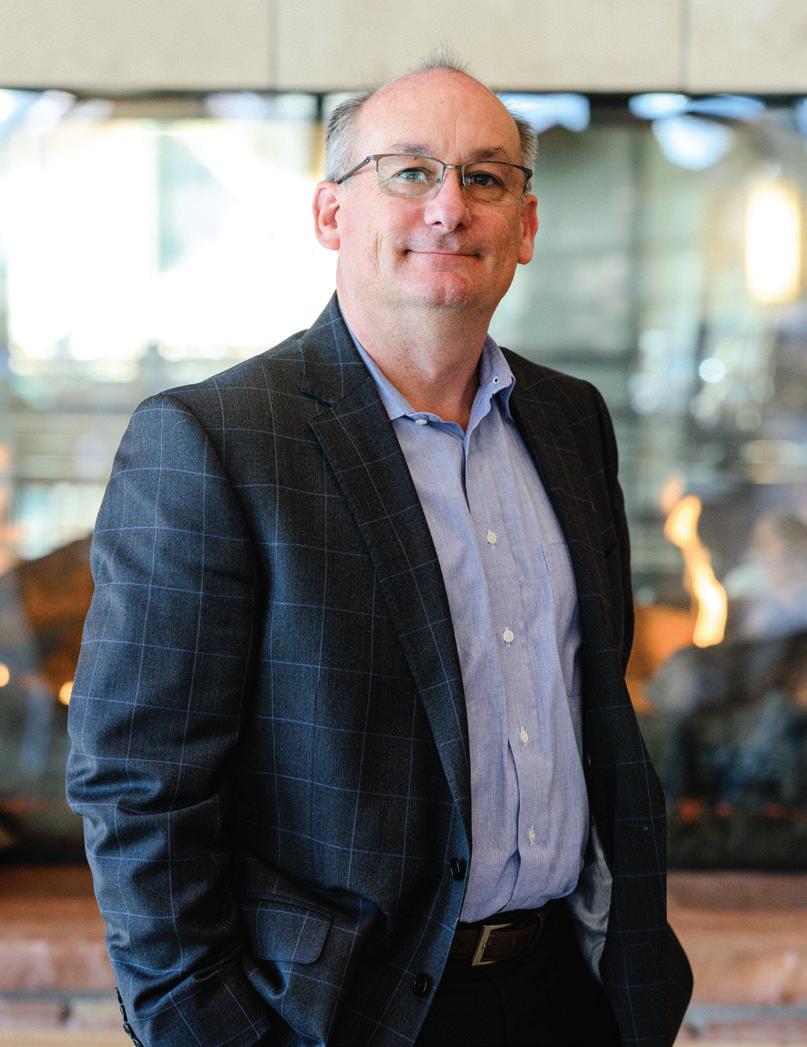
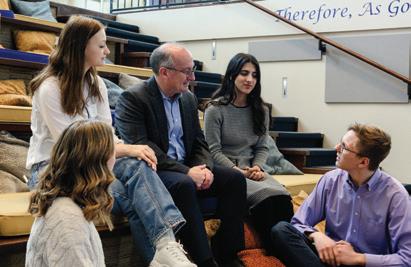
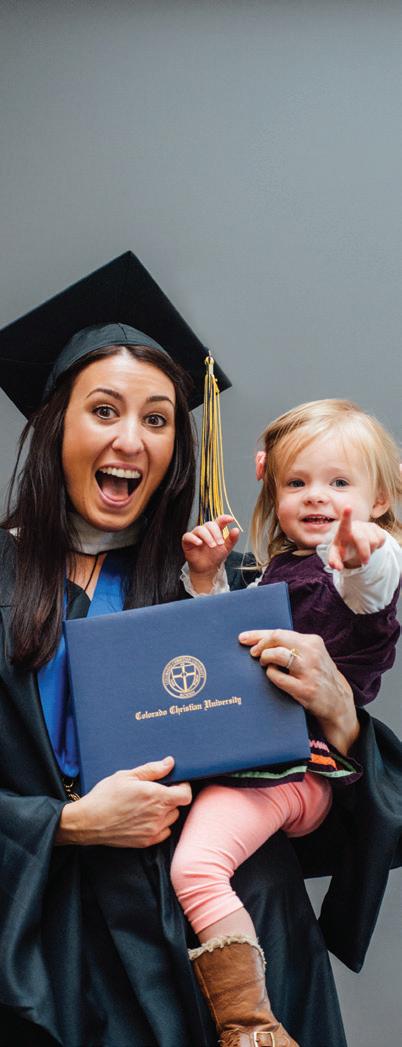
As a season of renewal and growth, spring is filled with beautiful reminders of God's constant faithfulness. We see these themes reflected in the lives of our students and faculty as they boldly step into the callings God has placed on their hearts.
This edition of Beyond magazine is filled with stories of students, faculty, staff, and alumni who embody Colorado Christian University’s mission to impact the world with grace and truth. Whether in a science lab, on the streets of Washington, D.C., or on the athletics fields, tracks, or fairways, the CCU community depicts Christ-centeredness in all they do.
Behind our amazing students are the staff and faculty, faithfully cheering them on in God’s calling. CCU’s faculty demonstrate remarkable stamina and a deep commitment to Christ-centered learning as they inspire the next generation of leaders. In this issue, you’ll read how they have encouraged students to pursue the callings God has placed on their hearts. You’ll also discover how students were impacted by a once-in-a-lifetime opportunity to learn from one of Christian music’s most influential artists, how our student-athletes continue to shine both on and off the field, and get the scoop on the newly introduced CCU Leadership Award.
As we look ahead, we remain steadfast in our vision to be a GREAT Christian university — one that stands boldly for truth, equips students with an unshakable biblical foundation, and prepares them to lead with conviction and courage. Thank you for your continued prayers and support; your partnership makes this mission possible. May this season remind us of the new life we have in Christ and the great hope we share in Him.
Soli Deo Gloria, Eric K. Hogue, M.Th. President
A publication of Colorado Christian University
Our Magazine
In BEYOND, our goal is to share the story of CCU, as well as God’s faithful provision for more than 100 years. We aim to share the stories of the people who go beyond and make CCU the great Christian University it is today. Whether you’re an alum or a friend, this magazine is designed for you, because your story, our story, His story, is meant to be told.
University Advancement Team
Daniel LaBry, Vice President of University Advancement and President of the CCU Endowment Foundation
Kerrie Baiz, Manager of Donor Services
Amanda Grogan, Senior Director of Major Gifts
Mark Heckelmann, Director of Major Gifts
Kara Johnston Mott, Director of Annual Giving and Strategic Engagement
Betsy Simpson, Manager of Donor Relations
Jill Sneed, Executive Assistant to the VP of Advancement
Davina Vannice, Manager of Advancement Services
BEYOND Production & Creative Team
Assistant Vice President – Communications, Creative Services and Web: Lance Oversole (B.A. ’06)
Strategic Communications Manager: Heather Johnson
Lead Writer/Editor: Heather A. Eades
Contributing Editor: Kara Johnston Mott
Project Manager: Kristen Rummel
Graphic Designer: Michelle McCorkle
Mission
Christ-centered higher education transforming students to impact the world with grace and truth.
Colorado Christian University cultivates knowledge and love of God in a Christ-centered community of learners and scholars with an enduring commitment to the integration of exemplary academics, spiritual formation, and engagement with the world. We envision graduates who think critically and creatively, lead with high ethical and professional standards, embody the character and compassion of Jesus Christ, treasure the gospel, and who thereby are prepared to impact the world in their callings.
Cover Photo: JeffreyGrounds Photography
Feature Photography: JeffreyGrounds Photography and LiLo
Colorado Christian
8787 W. Alameda Ave., Lakewood, Colorado 80226
303-963-3000 | ccu.edu
SONGS OFLIFE
By Heather A. Eades
LEAD THIS WAY.
That is the message Colorado Christian University President Eric Hogue hopes students take to heart with each inspirational guest of the President’s Speaker Series.
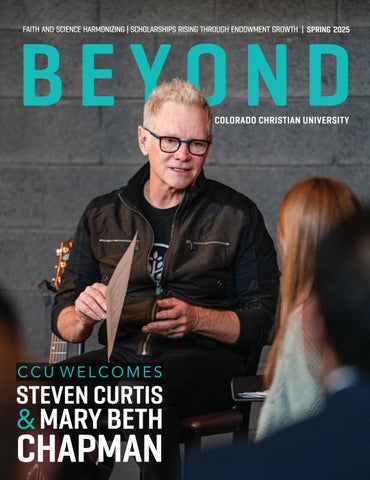
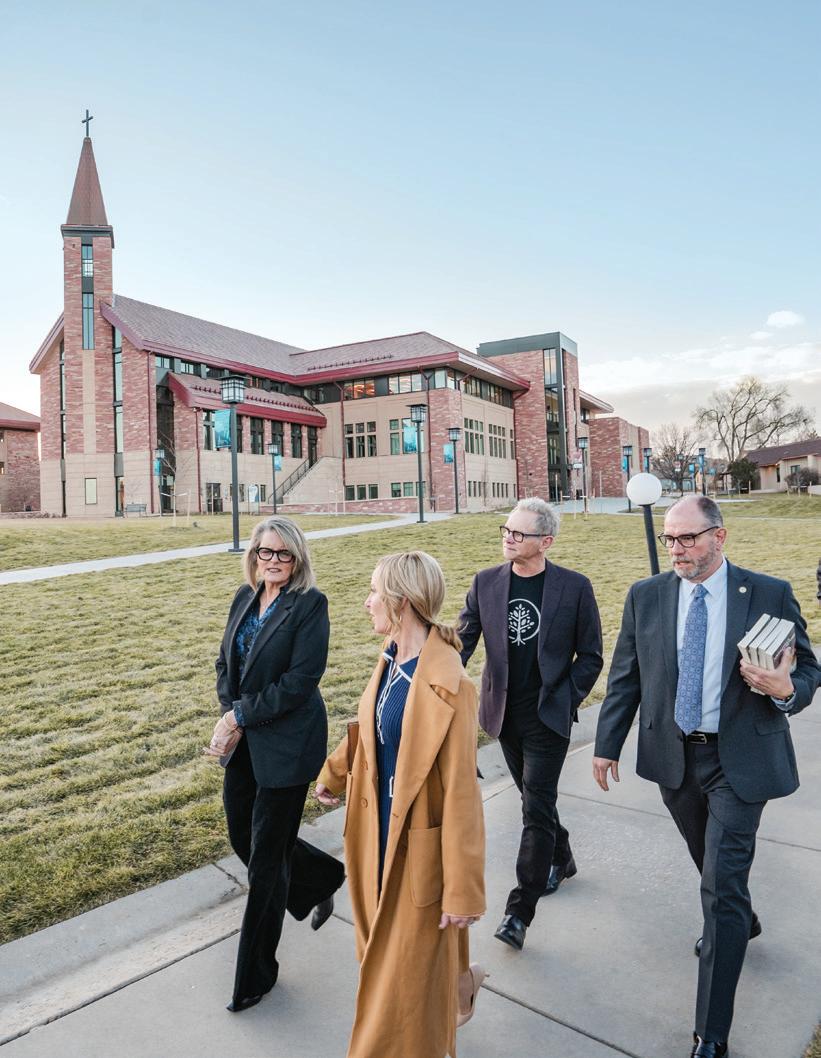
It is also why CCU was honored to welcome legendary singer/songwriter Steven Curtis Chapman and his wife, Mary Beth for the second installment of the series, held on February 7, 2025, in the Armstrong Center — home to CCU’s School of Music. When the five-time Grammy winner isn’t leading the music charts with more than 50 No.1 hits (and counting), he and Mary Beth are leading by example through lives marked by unwavering faith, authenticity, and dedication to using the arts for God’s glory with excellence.
The newly launched speaker series is Hogue’s innovative response to the University’s mission to develop students who lead with conviction, character, and Christ-centered vision. This campus-wide initiative is designed to bring prominent Christian leaders from a variety of fields to CCU, offering students powerful examples of godly leadership that reflect and embody the University’s 13 Strategic Priorities.
“The goal from the start,” said Hogue, “was to bring in individuals who not only agree with our values — but who live them. That’s why Vice President Mike and Karen Pence launched our event series, and that’s why Steven Curtis and Mary Beth Chapman were the natural choice to follow. Their lives serve as exemplary, real-world models of all 13 of CCU’s Strategic Priorities.”
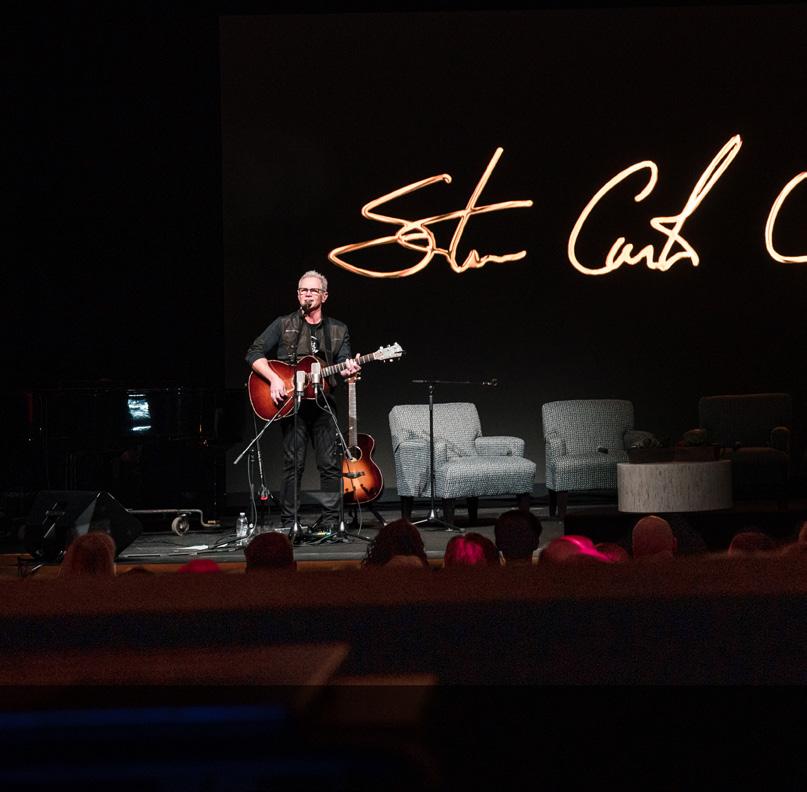
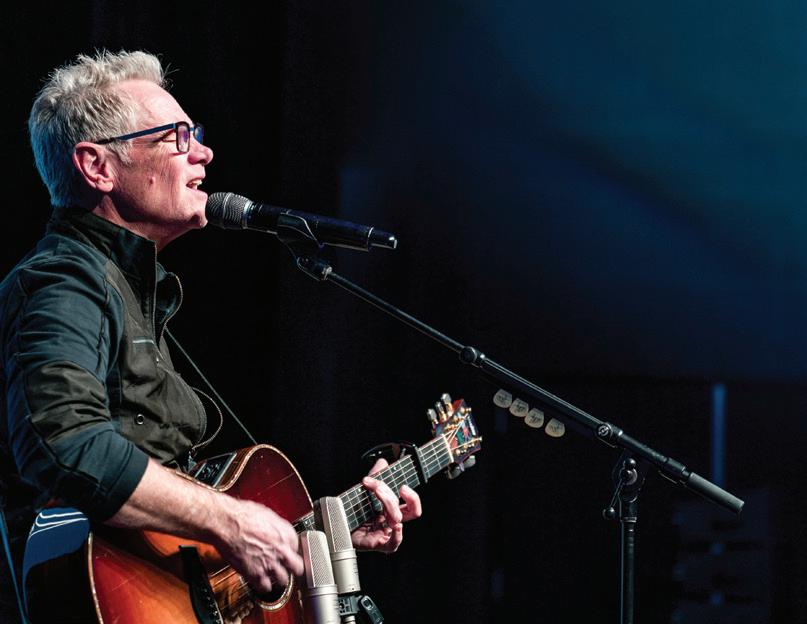
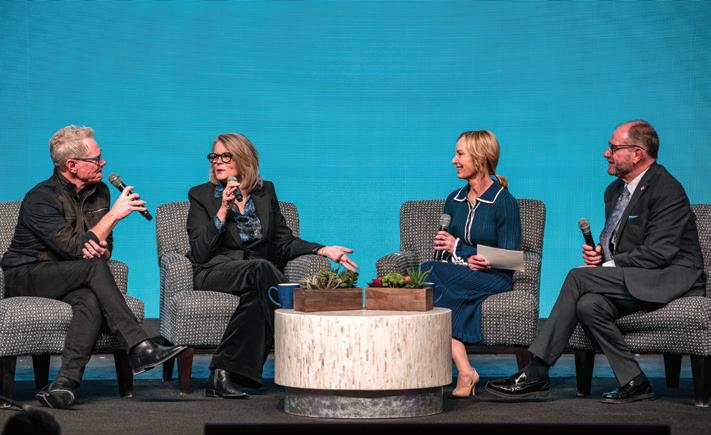
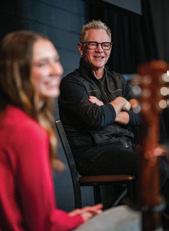
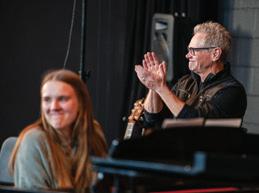
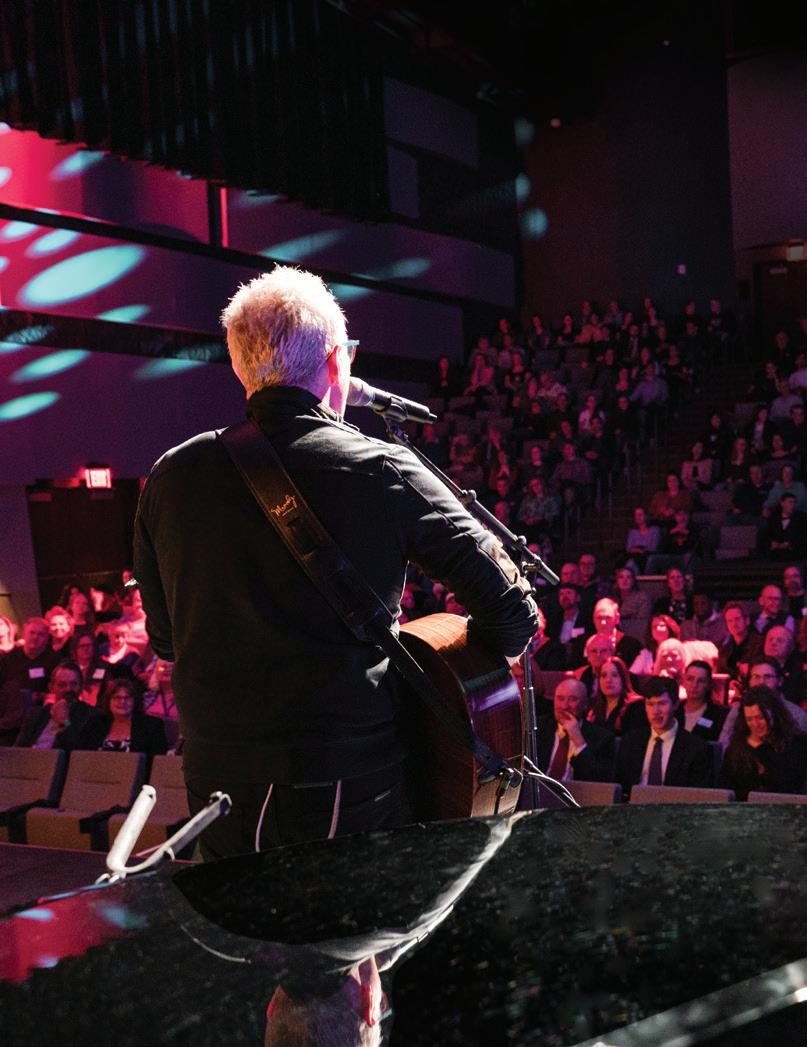
With the recent opening of the Armstrong Center — establishing the return of CCU’s School of Music to the Lakewood campus — the opportunity for students to learn and gain wisdom from Christian music’s most awarded artist and his bride was especially timely. During a daylong event that included a private Master Class for School of Music students, Steven Curtis Chapman encouraged students to boldly use the gifts God has entrusted them, and to do so with authenticity. That evening, before a sold-out audience, Chapman demonstrated what that looks like in practice, providing an energetic and emotional performance, followed by a moderated discussion featuring his wife and ministry partner, Mary Beth Chapman. The full-day event went far beyond a lecture or performance — it offered students, faculty, staff, and friends of CCU an inspirational, heartwarming, Spiritfilled encounter that left a lasting impact, much like a song that continues to echo in the soul.
For Hogue, the Chapman’s visit also carried personal significance.
“Steven and I have been friends since 1986,” Hogue shared. “We go way back, and I’ve seen how his life —
his marriage, his ministry, and his music — has remained anchored in the grace and truth of Jesus Christ.
“I think Steven Curtis Chapman has written the hymnbook for the Church and believers over the past 30 years,” Hogue continued. “I personally remember his songs — going all the way back to ‘Weak Days,’ his first 45, to ‘I Will Be There,’ and of course, ‘Cinderella.’ But more than that, I also remember what I was going through in my life when each of those songs came out — and how that song helped me.”
The impact of Chapman’s songs over the past three decades powerfully illustrated to students the importance of creating music that ministers to people in every season of life and demonstrated how songs crafted with excellence can change the world.
“My hope is that students take away from their time with Steven the understanding that you don’t get to where he is without hard work and discipline,” said Hogue. “If you’re going to be in music, be good! Work at it. Be excellent.”
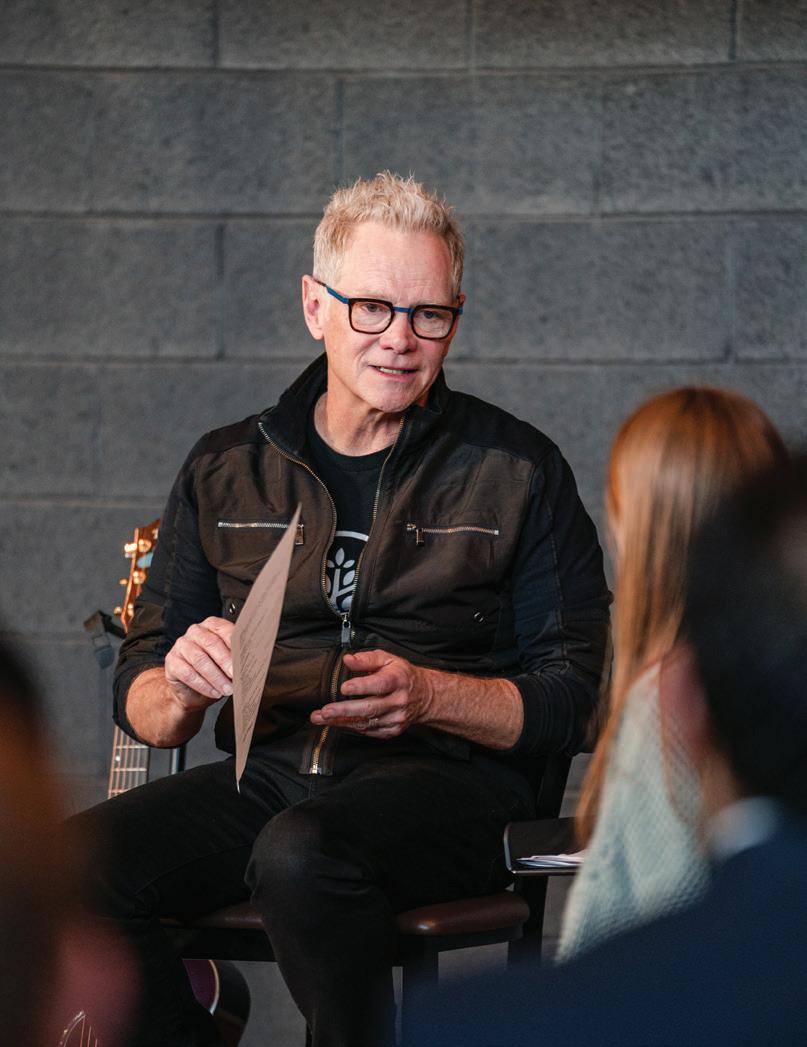
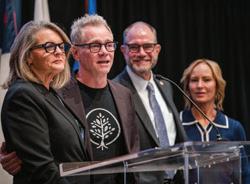
Steven Curtis and Mary Beth Chapman dive into real life conversations on faith, talent, music, and marriage at CCU’s second President’s Speaker Series event.
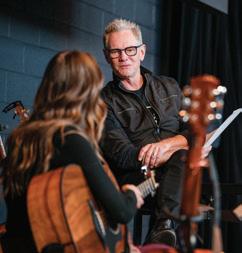
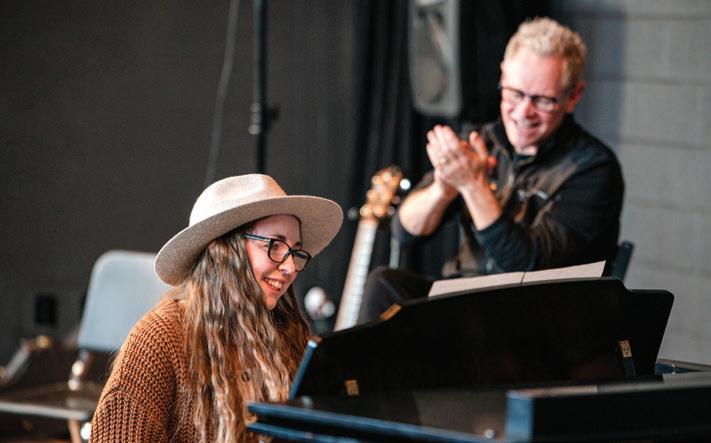
A SELECT GROUP OF STUDENTS RECEIVED POINTED AND INTENTIONAL COACHING FROM STEVEN CURTIS CHAPMAN DURING A SPECIAL MASTERCLASS IN THE SCHOOL OF MUSIC.
“I’m someone who has experienced firsthand that when we offer up our gifts to God —musical or otherwise, whatever they may be — and truly recognize those gifts as something God has entrusted to us to use for His glory, amazing things can happen!”
–Steven Curtis Chapman
MENTORING THROUGH MUSIC
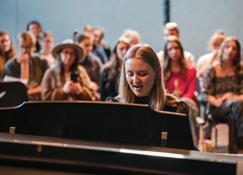
The Chapmans’ day on CCU’s campus began with an exclusive Master Class led by Steven Curtis Chapman for nearly 100 students from the School of Music. Held in the Armstrong Center’s music department, this private session featured six student composers chosen for the once-in-alifetime opportunity to perform their original songs and receive insightful and encouraging feedback from the legendary artist — a 60-time Dove Award winner and recent inductee into the Grand Ole Opry.
The class provided students far greater lessons than a typical technical workshop — it was a mentoring moment that challenged CCU’s future music leaders to pursue both authentic faith and professional excellence. Chapman
shared his personal journey, from his humble beginnings in Kentucky to the path God has led him on through songwriting and performing — including the launch of his current “Speechless ’25” tour, celebrating 25 years of one of his most adored albums. His consistent message to students: Work hard to become excellent stewards of the unique gifts God has entrusted to each of us.
“I’m someone who has experienced firsthand that when we offer up our gifts to God — musical or otherwise, whatever they may be — and truly recognize those gifts as something God has entrusted to us to use for His glory, amazing things can happen!” said Chapman. “Sometimes it’s amazing like a grammy award or something equally visible, but more
often, it’s not the kind of success the world would call ‘amazing.’ Instead, it’s being a part of creating something that touches the heart of someone.”
He continued, “When people ask me, ‘How do you get to that big stage? How do you make it?’ my bit of advice has always been: the ol’ ‘bloom where you’re planted.’
Wherever God has placed you at this moment, that’s the most important place for you to be. Be faithful with whatever He’s given you to dig into. Use the opportunities and skills He’s entrusted to you, and work hard at it. It may not be the big stage right now — it may never be. But God has given you this opportunity to be faithful and to use it for His glory.”
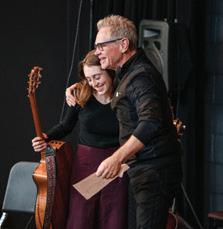
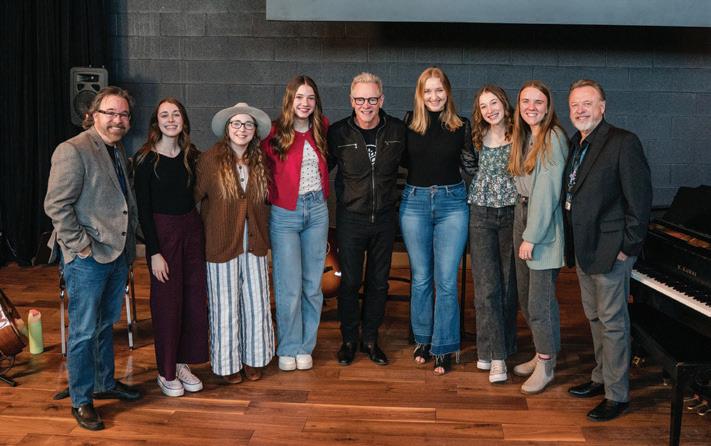
STUDENTS AND PROFESSORS POSE WITH STEVEN AFTER COMPLETING THEIR MASTER CLASS.
"Steven and Mary Beth model for us all the importance of an unshakeable faith. Together, they have experienced great tragedy — significant tragedy — and yet, even as we stood by and grieved with them, we watched their faith grow stronger and their determination to love each other and love their family deepen through it all."
– President Eric Hogue
A NIGHT TO REMEMBER
Not only is Steven Curtis Chapman, the most awarded Christian artist in music history, an ideal leader to share music industry insights and wisdom with students in the School of Music, but the Chapmans together offered an inspirational example for all — one that extends far beyond the stage.
The highlight of the evening came when Chapman took the stage for a sold-out performance in the McDonald Performance Hall. Weaving together his chart-topping hits, personal stories, and pauses of spiritual reflection, the artist led the audience on an emotional and uplifting collection of his songs through the ages and the moments that inspired them. The performance celebrated Chapman’s own great adventure of life, faith, and music.
Holding more No. 1 songs than any other Christian musician, Chapman brought the energy and passion to the evening event, opening with some of his most wellknown hits, including “Speechless,” “Dive,” “Magnificent Obsession,” and “Cinderella.” He also gave the audience a sneak peek of his latest song, "Forever the Love of My Life," released that very day.
Balancing joyful excitement with more personal insights, CCU President Eric Hogue and First Lady Tammy Hogue joined the stage to host a moderated Q&A session with the Chapmans. The open and heartfelt conversation
touched on the couple’s Christ-centered marriage, their adoption foundation Show Hope, and the challenges of raising a family amid a musical career through the highs and lows of life.
The Chapmans also spoke candidly about their response to personal tragedy — especially the devastating loss of their daughter in 2008 — which stands as a powerful testimony of pressing into God through the most heartwrenching circumstances.
“Steven and Mary Beth model for us all the importance of an unshakeable faith,” said Hogue. “Together, they have experienced great tragedy — significant tragedy — and yet, even as we stood by and grieved with them, we watched their faith grow stronger and their determination to love each other and love their family deepen through it all. Their lives reflect what we teach and model here at CCU in a profound way.”
Perhaps the highest compliment of the evening came from Mary Beth Chapman herself. Reflecting on the spirit of CCU’s campus and the warm welcome they received, Steven Curtis shared, “My wife has already given CCU the highest compliment possible — she said that our granddaughter will most certainly be considering CCU when the time comes. This is a very special place. You can feel it.”
LEAD THIS WAY
At its core, the President’s Speaker Series is not just about bringing industry leaders to campus — it’s about providing CCU students with living examples of how to integrate faith and leadership into every aspect of life.
“If I could hold up a sign to our students,” said Hogue, “it would say, ‘Lead this way.’ Lead yourself. Lead others. Lead your marriage. Lead your family. Lead this country. Lead the Church…this way. That’s what these speakers represent. That’s what we want for our students, and that’s why we were so honored to have Steven Curtis and Mary Beth Chapman as the second guests in the President’s Speaker Series.”
AS THE SERIES CONTINUES, CCU looks forward to welcoming more voices of influence from the realms of politics, business, the arts, and beyond — voices that will continue to inspire students to lead with grace and truth, and to be the light of Jesus Christ in this world. The ultimate hope is that CCU students will not only follow these examples but also rise to become godly leaders in their own fields, paving the way for others through excellence in their giftings and living lives of unwavering faith.
Scan the QR to watch the video recapping this incredible event.
HEALING HEARTS
CCU students called to serve Ukrainian war refugees
BY CORY BUTZIN
RACHEL LINGLE (M.A. ’25) KNEW SHE MIGHT HEAR UNCOMFORTABLE THINGS. That comes with the calling. She enrolled in Colorado Christian University’s Clinical Mental Health Counseling Program to positively impact the lives of others.
But serving people in her hometown of Portland, Oregon, was one thing. Sitting face-to-face with displaced Ukrainian mothers and children in Budapest, Hungary — less than 800 miles from the war-torn border — was another.
“I felt nervous about whether I had the tools to be effective with the demographic we were working with,” she said. “This is unimaginable pain and suffering. But I found peace knowing God equips those He calls. He’s been with us throughout the program. He’s provided us with an education that has trained us well, and He was with us in every single interaction with the refugees.”
SHOTS FIRED
During the fall of 2021, Russia’s troop buildup along the Ukrainian border gave NATO — and much of the world — reason to believe war was imminent.
Back in 2014, under President Vladimir Putin, Russia had already invaded Ukraine, a former Soviet republic, and
annexed the Crimean Peninsula. Many believed Putin wanted more.
On February 24, 2022, Russian forces launched a fullscale invasion from Russia, Belarus, and Crimea, igniting a war that has now raged for three years. While numbers fluctuate, the Council on Foreign Relations reports over 40,000 civilian casualties and nearly 11 million Ukrainians displaced internally and abroad.
It’s a war of presidents and dictators, troops and tanks, billions of dollars in aid, and binding NATO resolutions. And now, it’s a war that has also involved Dr. Casey Hall, assistant professor of Counseling at CCU, who saw an opportunity to help those in need.
“About a year and a half ago, Dr. Josh Kreimeyer and I were talking at residency,” Hall said. “I told him I had this idea and asked if he wanted to be involved. He’s made many trips to Ukraine and has contacts from his work with the United Nations and the military. He said, ‘Of course,’ and then Dr. Kateryna Kuzubova — who is originally from Ukraine –– also wanted to help.”
They brought the idea to Dr. Ryan Burkhart, dean of the School of Counseling.
“We told him we had this crazy idea: Take students overseas to serve people affected by the war in Ukraine,” Hall said. “We originally wanted to go into Ukraine, but with it being an active war zone and a Level 4 travel advisory, the University said absolutely not. Thankfully, Dr. Kreimeyer had some contacts, and we ended up partnering with George and Sharon Markey at Bridge UA.”
On February 10, 2025, Hall, Kreimeyer, Kuzubova, and 17 CCU counseling students boarded a plane in Chicago, bound for Budapest, Hungary, to begin an international internship assisting those displaced by the war.
GETTING STARTED
It takes a significant amount of behind-the-scenes work to prepare for a single class each semester, let alone take students to the doorstep of an active war zone to counsel Ukrainian refugees.
“I handled everything stateside,” Hall said. “That included meetings with Dr. Burkhart, Dr. (Earl) Waggoner, and the human resources and legal teams. We also met with the director of CCU2theWorld, CCU’s international missions organization. Their grad assistant, Bobby Campbell, was instrumental in coordinating many of the logistics.”
Meanwhile, Kreimeyer handled all the arrangements in Budapest, including lodging and planning the retreat locations.
“I’d never been there,” Hall said, “but Josh’s daughter, son-in-law, and three grandchildren are missionaries in Budapest, so he’s been there many times.”
The faculty opened 15 spots for students, but more than 40 applied.
“We limited the openings to students who had completed their practicum, so they all had some real-world counseling experience,” Hall explained. “We prioritized those with missions or international travel backgrounds, and we were especially interested in students who had worked with couples or children.”
Ultimately, 17 students met the criteria and joined the three CCU faculty members. Each completed several additional hours of training prior to departure, and again after arriving in Budapest.
This group included students from Colorado, Arkansas, Montana, Washington, California, Oregon, and Illinois. They met up in Chicago and flew to Hungary together.
“We did extensive cultural training,” Hall said. “Kuzubova is from Ukraine, and Kreimeyer has been traveling there for 10 years. As a team, we discussed Ukrainian culture, mindset, and their remarkable resilience. We also focused heavily on trauma-informed care and reviewed logistics to ensure everyone was prepared.
“Our students had excellent resources available to them, and some even took Ukrainian language lessons in advance to attempt to better communicate with the people we were serving.”
“A lot of the refugees just needed someone to sit with them in their pain and hear their stories — even if it was just for 15 or 30 minutes."
GETTING TO WORK
Upon landing in Budapest, the group reviewed their training and went to work.
“We spent two days at a school, working with parents, students, and teachers,” Hall said. “One day was a ministry day, where we invited local pastors to meet with us. Another day, refugees from the nearby villages came into Budapest to receive support.”
Hall, Kreimeyer, and Kuzubova split the students into three teams, each focused on a specific area of treatment.
“Most of the sessions were group therapy unless someone requested individual time,” Hall explained. “We focused on the mind, body, and spirit — helping participants understand the importance of nurturing all three.”
With most Ukrainian men still restricted from leaving the country due to martial law and military obligations, the majority of those served were women and children.
“A lot of the refugees just needed someone to sit with them in their pain and listen to their stories, even if just for 15 or 30 minutes,” Hall said.
She recalled one particularly moving session. “There was a little boy, maybe 9 or 10 years old, who was angry at his dad. He didn’t understand why his father had to be away. One of our male students led the session and was able to speak to the boy from that perspective. He helped that child see that sometimes people act from a place of fear –and that his dad was doing what he had to do to protect their family, even if it didn’t feel that way.” Again and again, CCU students encountered stories of heartbreaking loss and leaned on their education, training, and faith.
“I asked the Lord going into it, ‘What can I offer people who’ve experienced such horrific things?’” said CCU student Monica Szkorla (’25). “I felt Him say, ’Just trust and let Me work.’ They didn’t need solutions — they needed space. Space to process, to be heard, and to know their burdens weren’t too heavy to share. They needed validation. They are still standing. Despite everything, their choices to keep going were courageous and strong.”
In all, the group worked with nearly 90 refugees over four days.
But more meaningful than numbers, Hall said, was the deep sense that both students and faculty were not only competent in their calling, but unwavering in their commitment to Christ’s restorative work.
“What Josh, Katya, and I took away from this experience was immense gratitude for working at a university that supports this kind of mission,” Hall said. “I’ve worked at
places where this would never have been an option. At CCU, from the top down, we’re encouraged to pursue the dreams and callings God puts on our hearts.”
It’s a calling that Hall hopes to be the first of many.
“We have big goals for future trips,” Hall said. “This trip aligned with the University’s strategic priorities and CACREP standards for multicultural counseling. I don’t know of any other CACREP-accredited programs doing a trip like this one.”
Bridge UA has invited the CCU team back for another trip in June, and other organizations have already reached out to build partnerships with CCU’s counseling program.
In addition to the life-changing experience, each student earned close to 40 direct client hours — valuable progress toward the 600 necessary for graduation.
“We were able to work directly with our students and see them put what they’ve learned into action. That’s huge,” Hall said. “Normally, students only see us in class or at residency. But on this trip, they saw us in action and then modeled that on their own. They realized that you can be a counselor and still be authentically yourself.”
And the impact was genuine.
“Being able to trust what we’ve learned and knowing that the Lord is with us in every interaction — I loved getting to see that,” Lingle said. “I saw it in the small hallway conversations, in the ways my classmates cared for people. It was powerful to see God’s hand in every detail.”
"Being able to trust what we’ve learned so far and knowing that the Lord is with us in every interaction — I loved getting to see that."
alumni SPOTLIGHT
By Heather A. Eades
LIFE IN FOCUS
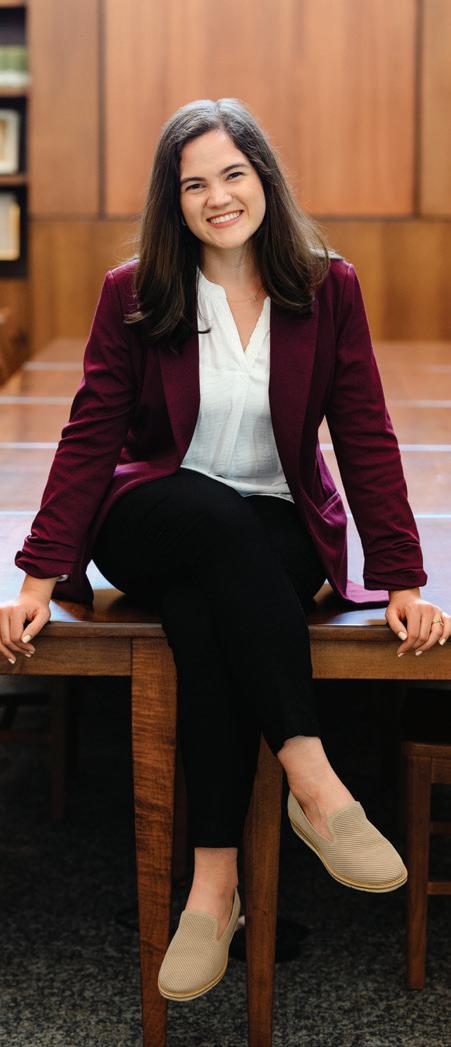
Describing herself as “an accidental photographer and entrepreneur,” CCU alumna Lisa Lord (B.A. ’99) shares a brief snapshot of her journey from classroom education to teaching business owners how to elevate their brand identity and marketing strategies, all while incorporating her passion for photography.
Lisa Lord arrived at Colorado Christian University by means of family connections and a desire to find the right fit for her education and career goals. After spending just one semester at a public state university, she transferred into CCU, where her boyfriend (now husband) was attending, and her mom was employed. From the moment she arrived on campus, Lord instantly felt at home.
“I immediately loved it at CCU,” said Lord. “The close-knit feel, the professors — I just felt known.”
Drawn to the University’s excellent teacher education program and its strong sense of community, Lord grew in her giftings with middle schoolers and graduated with a Bachelor of Arts in Education, licensed with an endorsement in Social Sciences.
“I felt extremely prepared to be out there in the world,” said Lord. “I felt equipped to walk into a classroom and be successful. And when it came to furthering my career, I felt like I knew how to learn and could do whatever I set my mind to.”
And that’s exactly what Lord did. She taught middle school for over three years and loved every moment of it. However, as she transitioned into motherhood, her calling to be at home with her children led her to step away from the classroom — and into an unexpected opportunity.
A spontaneous photo shoot for her sister sparked a passion in Lord that grew into LiLo Photography, her branding and commercial photography business. What began in 2010 with borrowed equipment and a willingness to learn has now blossomed into a thriving career, where Lord continues to use her gift for teaching and her creative eye to help clients visually tell their stories and represent themselves online.
Returning to CCU’s campus as a photographer for this issue of Beyond magazine has been a full-circle moment for Lord — a reminder that while her career path has shifted from classroom to camera, God has been orchestrating every step along the way. For LiLo Photography’s owner and creative, it’s also a reminder of the unexpected ways God weaves together passion, purpose, and calling over a lifetime.
ROOTED TOGETHER
GROWING A LEGACY THROUGH THE CCU ENDOWMENT FOUNDATION
Colorado Christian University celebrated a new milestone as it started 2025 with more than a half million dollars in scholarships and academic program assistance made available to students for the 2025-26 academic year from the CCU Endowment Foundation (CCUEF).
“The $527,000 in real dollar represents a 40% increase over the previous year, driven primarily by new individual donor investments into the endowment foundation,” shared Daniel LaBry, president of the CCU Endowment Foundation. “CCUEF currently hosts 86 endowment funds focused on the individual donor’s heart desire, but collectively invested for greater impact. Of these funds, 94% are dedicated to student scholarships,
THE STUDENTS PICTURED IN THE BACKGROUND REPRESENT THE LIFE-CHANGING IMPACT OF SCHOLARSHIPS MADE POSSIBLE THROUGH THE CCU ENDOWMENT FOUNDATION. 2019 2020 2021 2022 2023 2024 $15M $10M $5M
$13,546,133
$5,185,005
$5,788,841
$7,103,292
$6,266,759
$9,860,563
Since receiving its charitable status in 1995, the foundation has grown to almost $14 million through donor investments. It is managed by a volunteer Board of Directors, including three members of CCU’s Board of Trustees and three additional directors with financial and legal expertise who comprise the Investment Committee. Together, they provide strategic oversight and careful stewardship of the foundation’s assets.
“The foundation is blessed with a Board of Directors committed to responsible financial oversight, ethical investment strategies, and transparent reporting,” said LaBry. “Their counsel and guidance ensure that our donors’ generous investments are managed wisely and maximized to the benefit of our students, faculty, and the mission of CCU.”
To ensure long-term sustainability, the CCUEF Board of Directors implemented a rolling five-year average award policy in late 2023. This approach helps stabilize annual scholarship and program allocations by reserving a portion of funds during strong investment years, maintaining resource availability during weaker market periods. It’s a strategy rooted in wise stewardship, designed to preserve and grow the endowment’s impact for future generations.
Over the most recent five-year period, CCUEF’s investment returns have ranged from a high of 24.18% this past year to a low of -15% during the market’s most challenging year following the pandemic.
For planning purposes, the foundation uses an average 5% annual return to illustrate the typical long-term impact of endowment funds. Donors are given up to three years to meet the minimum $25,000 investment to start an individually named endowment fund. Gifts of any size can also be directed to the general endowment or other established funds, supporting CCU’s most strategic priorities.
Every endowed gift — regardless of size — has a compounding impact, growing over time and multiplying its effect on future generations of CCU students and faculty. CCUEF has become an essential part of the University’s future financial stability, empowering CCU to:
Provide student scholarships, ensuring financial barriers do not hinder access to a Christ-centered education.
Enhance academic programs, fostering innovation and excellence in teaching and learning. Support distinguished faculty, helping CCU attract and retain educators who inspire, mentor, and lead. Secure CCU’s long-term mission, safeguarding its commitment to developing Christian leaders who impact culture and society.
Ways to Establish a Legacy Gift
1. Simple Bequest
One of the easiest ways to create a legacy is by including CCU in your will or living trust. A bequest allows you to designate a specific amount, a percentage of your estate, or a residual gift after other distributions — ensuring your values continue to support future generations of CCU students.
2. Benefactor Giving
Designate CCU as a named beneficiary in your will or estate to create an endowment fund in honor of a loved one, a family legacy, or a personal passion. These funds can be directed
toward scholarships, faculty support, or University programs of your choice, leaving a lasting impact in a meaningful way.
In addition to generous cash contributions, there are multiple meaningful ways to establish a legacy gift through the CCU Endowment Foundation. These options allow donors to make a lasting difference while aligning with their financial situation and philanthropic goals.
3. IRA Charitable Rollover
If you are 70½ or older, you can make a direct, tax-free gift to CCU from your IRA. This is a tax-smart way to give while making a significant impact on students and faculty.
4.
Estate and Planned Gifts
Integrate your philanthropic goals into your long-term financial planning through estate gifts, including
charitable remainder trusts, life insurance policies, and donor-advised funds. These planned gifts offer potential tax benefits while securing an enduring legacy at CCU.
The CCU Advancement Team is here to help you navigate the many options that exist to invest in what God is doing through Colorado Christian University. If you would like to learn more or be connected with a Christ-centered philanthropic advisor, please reach out to your Gift Officer or contact the Advancement Office at: advancement@ ccu.edu or 303-963-3330.
“Imagine being able to ensure that any student who desires a Christ-centered college education can afford to do so — or that we can attract and retain Christ-centered faculty who are experts in their fields of study," said Daniel LaBry. "Those two goals alone are primary reasons why CCU must continue to grow its endowment.”
“In the past year, I’ve watched three of CCU’s most beloved science faculty leave for higher-paying jobs — despite their deep alignment with our mission and commitment to our students,” said LaBry. I’ve also personally met prospective students from missionary and pastoral families who were drawn to CCU’s Christ-centered environment but simply couldn’t afford to attend, even with financial aid. It’s heartbreaking — and it’s why we are determined to grow the CCU Endowment Foundation.”
According to the 2024 Commonfund Study of Endowments by the National Association of College and University Business Officers, the median endowment size of colleges and universities was $209.1 million. Nearly one-third of participating institutions reported endowments of $100 million or less — including CCU, whose endowment stood at just $13.5 million in 2024. For comparison, other wellknown Christian institutional endowments include Anderson University with $49 million, Azuza Pacific University with $98 million, Biola University with $163 million, Taylor University with $300 million, Hillsdale College with $900 million, Grand Canyon University with $1.2 billion, and Liberty University with $2.2 billion.
“Our prayer and goal is to grow the CCU Endowment Foundation to the $300 million range,” LaBry continued, “to generate the type of financial assistance that could one day replace current levels of federal aid and to help us attract and retain Christ-centered, mission-aligned faculty. Reaching that goal will likely require significant estate and planned gifts from donors committed to leaving a legacy of Christ-centered higher education.”
LaBry added, “For now, we celebrate the $527,000 in support that CCUEF will provide for this coming year. We trust that God is already working in the hearts of those He has called to support His mission through CCU, and we give Him all the glory for what He will accomplish.”
Leaving a legacy through a planned gift to Colorado Christian University is a meaningful way to impact future generations with a Christ-centered, higher education, all while aligning with your personal, financial, estate-planning goals.
Join alumni Fred (B.A. ‘82) and Lorie Lautenbach of Rockmont College (a heritage institution of CCU), and take the first steps to exploring estate planning with confidence and ease.
Sacred Assumptions
HOW CHRISTIANITY SHAPED SCIENCE
by Dr. John Wind
Since the publication of William Draper’s History of the Conflict Between Religion and Science in 1874, many have assumed that Christianity and the practice of science are fundamentally at odds. The truth is that modern science — defined by the combination of theory and empirical testing — emerged uniquely within distinctly Christian cultures and was built upon explicitly Christian presuppositions. These include the belief that nature’s order is a product of God’s creative reason, free choice, and wise design; that nature’s order is intended by God to be understood and studied through human observation; and that human understanding, including of the natural world, is fallible and therefore requires rigorous testing and supporting evidence. As
scholar Rodney Stark succinctly puts it, “Christian theology was essential for the rise of science.” In this sense, even atheist scientists today are operating on the borrowed foundational principles of Christian theology.
The key arena for the development of modern science was the European university — an institution invented by the medieval church — beginning with the University of Bologna in Italy in A.D. 1088.
The following timeline selectively highlights some of the noteworthy Christian contributions to the advancement of science over the past 1,000 years. All of the following individuals operated within Christian presuppositions, most of them as devout believers.
1088 First university founded, University of Bologna (the first of 78 universities founded in Europe by 1500).
1150 University of Paris is founded, becoming the leading center for the advance of learning and the rise of science in continental Europe.
1167 University of Oxford is founded, becoming the leading university in England.
1267 Roger Bacon, an English scientist, publishes Greater Work, covering mathematics, optics, and astronomy, as well as his early contributions to the development of the scientific method.
1345 Thomas Bradwardine, William Heytesbury, John Dumbleton, and Richard Swineshead (University of Oxford scholars known as the “Calculators”) become the first to apply mathematics to physics and the first to develop logarithmic functions and the Mean Speed Theorem.
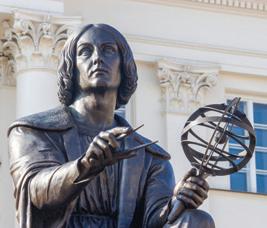
1543 Nicolaus Copernicus, a Polish mathematician and astronomer, building on previous developments within European universities, publishes On the Revolutions of the Celestial Spheres, which helps establish the foundation of modern astronomy by proposing the heliocentric theory of planetary motion.
1564 Ambroise Paré, a French surgeon, publishes Treatise of Surgery, helping launch the modern practice of surgery through his innovative surgical techniques, especially in battlefield medicine and wound treatment. Reflecting on his work, Paré states, “I treated him, God cured him.”
University of Bologna
Nicolaus Copernicus
Blaise Pascal
1596 Johannes Kepler, a German astronomer, publishes The Cosmographic Mystery, providing mathematical support for proving Copernicus’ heliocentric theory and laying the foundation for his later formulation of the three laws of planetary motion. Kepler famously describes his work as “thinking God’s thoughts after Him.”
1620 Francis Bacon, an English philosopher and statesman, publishes The New Organum, clearly enunciating and formally outlining the basic principles of the scientific method — observation, hypothesis, experimentation. His emphasis on inductive reasoning earns him the title “Father of the Scientific Method.”
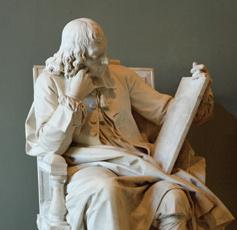
1642 Blaise Pascal, a French mathematician and physicist, invents the first mechanical calculator. In addition, Pascal founds both modern probability theory and the science of hydraulics, while also contributing to the advance of differential calculus.
1661 Robert Boyle, an Irish scientist, publishes The Skeptical Chemist, founding the modern discipline of chemistry. Boyle also makes many significant contributions to physics, including Boyle’s Law, which states that the volume of a gas is inversely proportional to the pressure.
1687 Isaac Newton, an English mathematician, physicist, and astronomer publishes Mathematical Principles of Natural Philosophy, establishing a mathematical framework for calculating the movement of all objects in the universe and universal gravitation. In this work, he formulates his three Laws of Motion and articulates the Law of Gravity.
1735 Carolus Linnaeus, a Swedish botanist, publishes The System of Nature, founding taxonomy, the modern scientific classification of plants and animals.
1831 Michael Faraday, an English physicist and chemist, invents the electrical generator, an application of his discovery of the principles of electromagnetic induction, diamagnetism, and electrolysis.
1844 Samuel Morse, the American inventor of the telegraph, sends the first official telegraph message, “What hath God wrought!” (Numbers 23:23, KJV), between Baltimore and Washington, D.C.
1845 James Joule, an English physicist, identifies the principle of energy conservation, later called the First Law of Thermodynamics. In his honor, energy units are now measured in “joules.”
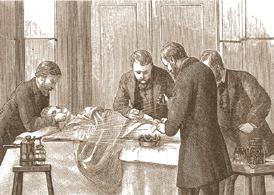
1867 Joseph Lister, an English surgeon, publishes Antiseptic Principles, building upon Pasteur’s experiments and pioneering antiseptic surgery, which dramatically reduces surgical deaths.
1896 George Washington Carver, an American agricultural researcher, becomes the first president of the Tuskegee Institute. Over the next 47 years, he makes discoveries, including identifying more than 400 different products that can be made from peanuts and sweet potatoes.
2000 In the 20th century, professed Christians won 72.5% of Nobel Prizes in Chemistry, 65.3% in Physics, and 62% in Medicine (Baruch A. Shalev, 100 Years of Nobel Prizes, Americas Group, 2002).
Dr. John Wind (Ph.D., Southern Seminary), associate professor of Theology, has taught for 10 years at CCU. He is the author of Do Good to All People as You Have the Opportunity: A Biblical Theology of the Good Deeds Mission of the New Covenant Community (2019).
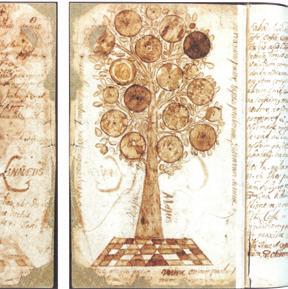
Örtaboken (Herb book), an early Linnaeus manuscript, 1725
Joseph Lister
Scientific Inquiry
Sierra Rose's (B.S. ’23)
Unexpected Journey to Medical School
By Heather Eades
When Sierra Rose first stepped onto the campus of Colorado Christian University as a freshman, she had her sights set firmly on a future in elementary education. Confident at the time that her calling was to the classroom, not clinics, becoming a family physician was the furthest thing from her mind. But as her semesters at CCU unfolded, Rose’s plans followed suit. God paved a new way, developed new gifts, and helped shape a new dream through what can only be described as “the CCU difference.”
Now a first-year medical student at Texas College of Osteopathic Medicine (TCOM), Rose reflects on the transformative impact of CCU’s science and engineering programs on her journey, and the professors who invest in their students far beyond the classroom.
Although Rose has always been a devoted Christian, attending a faith-based university wasn’t initially part of her plan. But CCU offered a unique combination of beauty, mission, and opportunity that she couldn’t ignore.
“Growing up in the Bible Belt, I wasn’t convinced I wanted to attend a Christian college,” Rose shared. “But I loved the Lord, I wanted to be in the mountains, and when I learned about the World Changers Scholarship, I knew I had to apply.”
The World Changers scholarship is CCU’s prestigious full-tuition award, granted annually to three incoming freshmen who demonstrate exceptional academic excellence and leadership potential. After a weekend on campus of interviews, analyzing essays, and deep conversations with CCU faculty, Rose’s heart was set.
“By the time I left, I knew CCU was where I wanted to be — scholarship or not,” said Rose. “If God wanted it to work out, I knew it would. And I was all in.”
Rose’s leadership in high school — launching a nonprofit to support children in south Dallas experiencing food insecurity — helped her earn that scholarship and opened the door at CCU to continue serving kids through a future in education.
Initially, Rose thrived in the School of Education, loving her early field experiences in local classrooms. But over time, she began to consider other career options to challenge herself.
With the support of CCU faculty mentors, Sierra discovered that healthcare is compatible with her life goals and values.
“I was passionate about elementary education,” said Rose. “But in the same breath, I was researching all the things I could do past becoming a teacher — certification as a principal, working at the university level, etc.,” said Rose.
Even though she was already searching for opportunities outside of the classroom before she was officially inside of one, deep down, she wasn’t ready to let go of the idea of teaching.
When COVID-19 sent her back home to Texas, Rose used the time to reflect and manage her stress through “holy yoga,” a Christ-centered practice combining Scripture meditation with traditional yoga postures. Wanting to share the personal benefits of this exercise with others,
Rose became certified to teach it, and along the way, discovered a new appreciation for studying anatomy.
As Rose returned to campus in the fall that year, her professors noticed her shift in interest. Dr. Julie Schultz, learning of Rose’s new passion, encouraged her to explore CCU’s newest program.
“She said, ‘You should join our new kinesiology program and just see what happens.’ Best advice I ever received!” said Rose.
She enrolled in the program, taking kinesiology classes alongside her education courses and was quickly connected with Dr. Bryan Crutcher, former assistant professor of Kinesiology and Exercise Science, who offered to mentor her as she explored a field markedly different from elementary education.
“We met weekly,” said Rose. “And Dr. B (Crutcher) told me, if by the end of the semester you still feel called to be an elementary major, great! I’ve done my job, and you’re walking in the Lord’s will. But if by the end of the semester you’ve determined that you want to join my program, wonderful! I’ve done my job, and you’re walking in the Lord’s will.’”
With the support of CCU faculty mentors like Crutcher, career counseling, and continued reflection, Rose discovered that healthcare revealed itself to be more compatible with her life goals and values. So, she reset her sails and adjusted her career path toward physical therapy, officially joining the kinesiology program.
LEARN WHERE SIERRA ROSE'S JOURNEY LEADS NEXT! DISCOVER HOW GOD USED KINESIOLOGY AT CCU TO PAVE THE ROAD TO MEDICAL SCHOOL. SCAN THE QR CODE TO CONTINUE HER INSPIRING STORY ONLINE!
Where Mission
By Dr. Mark A. Parker
Faith Integration in Science and Engineering Method Meets
Colorado Christian University is guided by Strategic Priorities which direct the implementation of our Mission. They apply to all we do and are integrated throughout our curriculum and in our classrooms. There are four of these priorities that are especially relevant to the integration of our Christian faith in our science and engineering programs, both inside and outside the lecture hall: “Honor Christ in all we do…, Teach students to trust the Bible…, Teach students to think for themselves, and Be seekers of truth.” In a culture where young people are often taught to make their own truth, question authority and the historical sources of knowledge and wisdom, and be guided by the whims of the latest influencer, these are radical principles.
At CCU, all things begin with the understanding that “In the beginning, God created…” This foundational truth grounds everything we do, recognizing God as both Creator and sustainer. Starting from this perspective allows us to recognize that any endeavor to understand His creation is a form of worship which can glorify Him. As Paul reminds us in Romans 1:19-20 (ESV):
“For what can be known about God is plain to them, because God has shown it to them. For his invisible attributes, namely, his eternal power and divine nature, have been clearly perceived, ever since the creation of the world, in the things that have been made.”
The prevailing ideologies of the current culture — especially in the study of the sciences — can sometimes lead to a crisis of faith for young believers. Yet, this struggle is both unfortunate and unnecessary.
CCU’s Strategic Priority mandating us to teach our students to think critically and well is especially appropriate here. F. Scott Fitzgerald once wrote, “The test of a first-rate intelligence is the ability to hold two opposed ideas in the mind at the same time and still retain the ability to function.” This insight is especially fitting for those who study creation while honoring God as its Creator.
Augustine echoes Paul’s teaching in Romans, reminding us that God reveals Himself to us through His two books: Scripture and the created world. At times, we may struggle to reconcile perceived conflicts between our understanding of both. However, until we are able to reach clarity, it may be necessary to hold these ideas in tension — still fully believing in the truth of the Bible, God as Creator, and the discoveries of science.
The beauty of a CCU education is that students are taught to honor Christ, trust the Bible, and think critically and well. This includes understanding that while there are pillars of the Christian faith — clearly laid out by the Bible and reflected in our Statement of Faith, which
"And so, by studying the ‘things that have been made’ with worshipful reverence, while acknowledging God as Creator, we honor Him."
are non-negotiable, at the same time there may be peripheral issues where Christians may hold differing yet acceptable interpretations.
Unfortunately, it is often these peripheral issues that can lead to a crisis of faith for young believers pursuing a secular education. This is both unfortunate and unnecessary. At CCU’s School of Science and Engineering, our goal is to provide an environment where students can deepen and strengthen their faith in God and their trust in the Bible. At the same time, we equip them with the tools to think well and find joy in the study of His creation, without any perceived conflicts threating their faith in Christ as Lord and Savior.
Dr. Mark Parker is the dean of the School of Science and Engineering and professor of Biology. He holds a Ph.D. in Biological Sciences (University of Denver) and M.A. in Theology (Colorado Christian University). He trained as a developmental biologist and neuroscientist and has been pivotal in revamping the curriculum and increasing enrollment in CCU’s Science and Engineering program.
What If We Built It?
THE FUTURE OF SCIENCE AND ENGINEERING AT CCU STARTS HERE
by Heather A. Eades
At Colorado Christian University, the defining feature of our School of Science and Engineering lies not only in what we teach, but in why we teach it — and in how our students are impacting the sciences for God’s glory. However, where we go from here requires immediate attention toward the development of a new Science and Engineering Center to ensure the program’s future success.
What sets CCU apart even further is the strength of our exceptional faculty. Our professors are deeply committed to their students, to academic excellence, and to honoring Christ through their work and contributions to the sciences.
However, to continue meeting the growing demand for CCU’s science and engineering programs, it is critical that we provide both our students and faculty with the facilities and resources they need — now more than ever. As
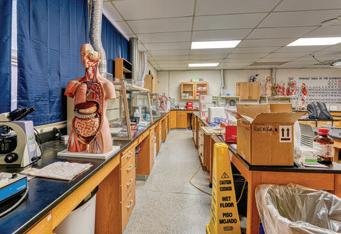
CCU President Eric Hogue candidly describes it, the current facilities in the Beckman Center are “like CCU’s ugly duckling.”
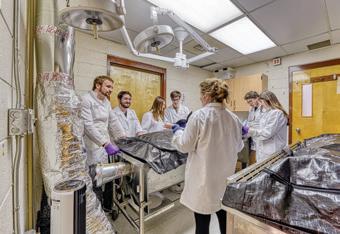
“Labs and classrooms from the 1970s do not reflect the excellence we expect from our students or the excellence our faculty deliver,” said Hogue. “Prospective students fall in love with our faculty, but when they see the facilities, they hesitate. That disconnect must change.”
We’ve already witnessed the impact at CCU when investment meets vision. The recent transformation of the former campus bookstore into a state-of-the-art kinesiology lab was a needed renovation to accommodate a thriving, rapidly growing program in need of more space due to burgeoning enrollment. This success proves what is possible and highlights the urgent need to do the same for every program in the School of Science and Engineering.
THE BECKMAN CENTER HAS SERVED FAITHFULLY FOR DECADES BUT TODAY’S SCIENCE AND ENGINEERING STUDENTS NEED FACILITIES THAT MATCH THEIR AMBITION.
“Our students deserve this. Our faculty deserve this,” said Hogue. “We made that effort for School of Nursing in the Allison building; we made that investment for the School of Music in the Armstrong Center. Now, we need to make that investment a reality for the Science and Engineering Center. Having a brand new, updated facility would undoubtedly help increase and accommodate our growing enrollment immediately — just as we have seen happen with our nursing and music programs,” said Hogue. “There is no question.”
Thanks to the generous support of donors, alumni, and friends of the science and engineering program at CCU, nearly $13 million has already been raised toward a new Science and Engineering Center. As Hogue emphasizes, the time is now to complete what is projected to be a $40 million construction project.
Despite the limitations of outdated facilities, CCU’s outstanding faculty continue to inspire, innovate, and graduate students who are fully equipped to impact the world for Christ.
“Kudos to our faculty and to the dean of the School of Science and Engineering in this tough situation,” said Hogue. “They’ve made it work. They’ve produced wonderful students. But the state of our facilities limits the number of students who want to come to CCU. If you meet our faculty, you’re going to fall in love with them. But when you see the facility, you may fall out of love with the idea of attending CCU. I believe that whole heartedly.
“On my watch, that will change — and it needs to change as quickly as possible,” said Hogue. “It’s time to step back, take a hard look in the mirror, and keep moving forward with excellence.”
And the Word became flesh and dwelt among us, and we have seen his glory, glory as of the only Son from the Father, full of grace and truth.
– John 1:14 (ESV)
GRACE AND TRUTH IN THE PUBLIC SQUARE
by Greg Schaller
GREG SCHALLER TAKES
THE HELM AT CCU’S
CENTENNIAL INSTITUTE
As I walk around our Lakewood campus, I am repeatedly challenged by the words “Grace and Truth” displayed across University signage at every turn.
Since stepping into my new role as director of Centennial Institute at Colorado Christian University, I have contemplated these words — not only as a source of inspiration but also as a challenge. They inspire me because they serve as Christ’s prescription for engaging the world; yet they also convict me, as I recognize how often I fall short of living them out fully. I realize I am not alone in this struggle, and I view leading Centennial Institute with these principles at the forefront as both a profound opportunity and a sacred responsibility.
As I assume the leadership of Centennial Institute (C.I), I am committed to advancing our unofficial motto: “Grace and Truth in the Public Square.” If we hope to establish a lasting impact, we must not only seek to inform our students and broader community but also engage our culture both effectively and faithfully.
During my time as a professor of politics at Colorado Christian University from 2009 through 2017, I had the privilege of working closely with Centennial Institute’s founder John Andrews, and former University President Bill Armstrong, which gave me a deep understanding of C.I.’s vital work and mission. After being away for seven and a half years, it is a great honor to return to CCU and lead Centennial Institute into its next chapter. I look forward to reconnecting with former colleagues and friends, while also collaborating with new partners to expand C.I.’s impact on the next generation of Christian conservative leaders.
Established in 2009, Centennial Institute at Colorado Christian University exists to increase public understanding of critical issues concerning faith, family, and freedom. What sets C.I. apart is its distinctively conservative perspective. While the overwhelming majority of public policy think tanks start with the assumption that government is the essential means for solving societal problems, the conservative approach views public challenges differently. In his first inaugural address, former U.S. President Ronald Reagan articulated this philosophy, stating: “We leave to private initiative all the functions that individuals can perform privately and only reluctantly turn to the states and localities to
address public needs, with federal action as a last resort.” Rather than looking to government as the first solution, Reagan encouraged individuals to solve problems through their own initiative, relying on government intervention only when absolutely necessary. This remains a guiding principle at Centennial Institute.
The work and mission of Centennial Institute is to explore alternatives to government intervention, advocating for government solutions only when absolutely necessary — and always with the smallest possible footprint.
The current political climate demonstrates the urgent need for Christian conservative leadership. From 2017 to 2024, I served as president of the John Jay Institute in the northern suburbs of Philadelphia, where our primary program was a fellowship for recent college graduates. This initiative provided both academic and practical training, seeking to raise up a new generation of principled Christian leaders. It is my hope to introduce elements of that same academic programming to Centennial Institute and the broader CCU campus. Just as CCU is positioned to be a GREAT Christian University, C.I. has a unique opportunity to positively shape the world with Grace and Truth — impacting both our current culture and securing the future of the great American experiment.
VOICES FOR THE VOICELESS
CCU Students Stand for Life in the Nation’s Capital by Jaimie
Erker
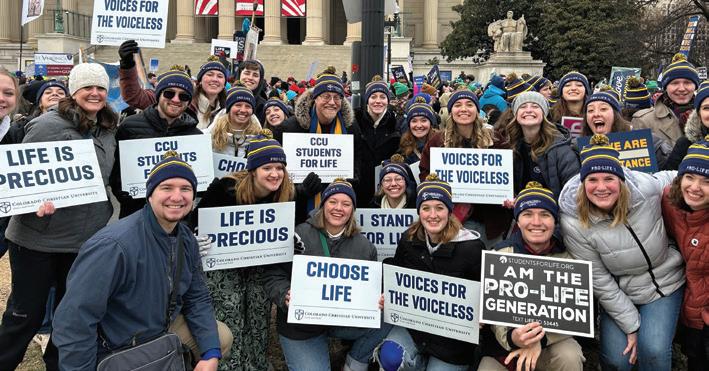
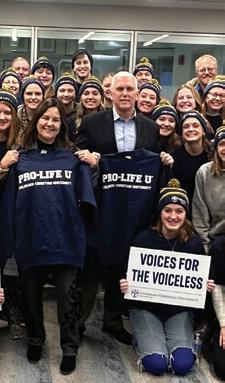
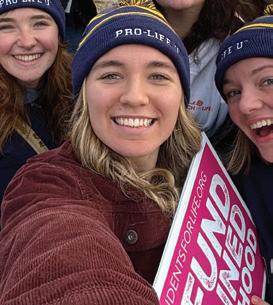
Forty-two students, clad in “Pro-Life U” t-shirts and blue-and-yellow striped beanies, made their way through the bustling streets of Washington, D.C., armed with “Voices for the Voiceless” and “Life Is Precious” signs as they took a stand for life at the 52nd Annual March for Life this past January.
The National March for Life is the world’s largest annual human rights demonstration, first held in 1974 as a response to Roe v. Wade. Although Roe has since been overturned, the fight for the protection of preborn lives has shifted to the state level.
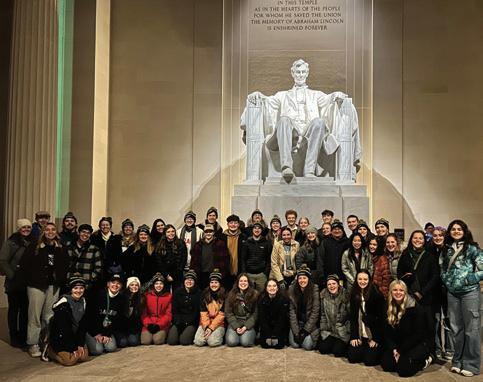
Since 2018, Centennial Institute has organized a contingent of passionate pro-life students from Colorado Christian University (CCU) to travel to Washington, D.C. for the March for Life. From January 23-26, 2025, Centennial Institute staff and CCU professors accompanied students for three days of thought-provoking discussions centered around the ongoing fight for the preborn.
While in D.C., students participated in a private policy briefing at The Heritage Foundation, exploring the feminist movement and its impact on the abortion debate. They also attended an exclusive pre-March open
house hosted by the Advancing American Freedom Foundation, at the invitation of 48th Vice President Mike Pence and his wife, former Second Lady Karen Pence. At the March for Life, students heard from notable pro-life and political leaders, including U.S. Vice President J.D. Vance, Florida Governor Ron DeSantis, and U.S. House Speaker Mike Johnson. Additionally, they attended the National Pro-Life Summit, which featured renowned speakers such as Dr. Ben Carson, Kayleigh McEnany, Dr. Kevin Roberts, and Bethany Hamilton.
Our CCU students returned transformed. In a debrief meeting following the trip, several students expressed how they had been confronted with aspects of the abortion debate they had not previously encountered and now felt more equipped to engage in meaningful conversations with their friends and family.
This is why Centennial Institute is so honored to offer this life-changing opportunity to our students: Our ultimate mission is to equip them to engage culture with grace and truth. The annual March for Life trip immerses students in all aspects of the pro-life movement, providing them with the requisite knowledge to speak truth boldly and the necessary empathy to extend grace and love to both mother and child.
Following their visit to CCU for the President’s Speaker Series in November, Vice President Mike Pence and Mrs. Karen Pence invited CCU students to a special reception in Washington, D.C., held just before the National March for Life in January — a gesture that grew out of the meaningful connection formed during their time on campus.
WHY I MARCH
Student Reflection: Stephanie Heil, (B.A. ’26)
“Why We March.” That was the theme of this year’s March for Life, which I had the privilege of attending. It was one of the most incredible things I have ever experienced.
The Pro-Life movement is very near and dear to my heart. As a former foster child who was later adopted, I know firsthand the value of life. I also lost my biological sibling to abortion. The Pro-Choice side loves to use exceptions and excuses for justifying abortion by citing circumstances such as the conditions of the foster care system, teen pregnancy, children prone to disabilities or chronic illness, cases of rape, etc. But I march as an example, because I am living proof against almost every excuse the Pro-Choice movement uses to justify abortions.
When I heard about the opportunity to participate in the March for Life, I knew I needed to go — and it was incredible. The joy of the Lord was contagious, and the people I marched with were so inspiring. Everyone had their own reasons for marching, and hearing their stories was one of my favorite parts of the experience.
I have always felt a responsibility to stand up for the life that my biological sibling didn’t get to live — to live my life in a way that honors them. Getting to go on this march meant that I got to be a voice for the voiceless, including my lost biological sibling, and to be an example of what it means to beat the odds of justified abortion. That is why I march.
Congratulations, Class of 2025!
“WE
James “JB” Brown of CBS News Charges CCU’s Class of 2025: CHANGE THE CULTURE
LOVE YOU, BIG BRO!” “YOU DID IT, MOM!”
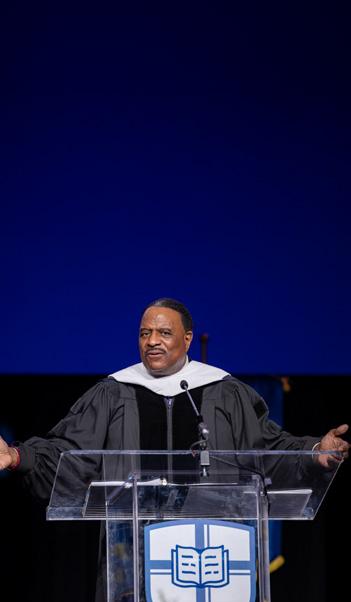
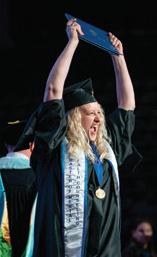
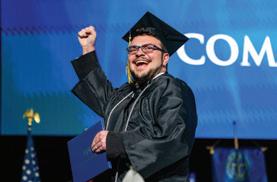
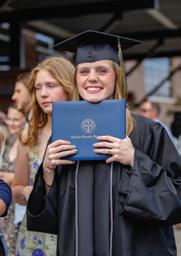
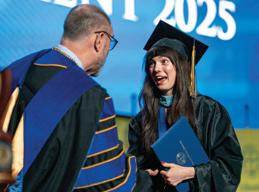
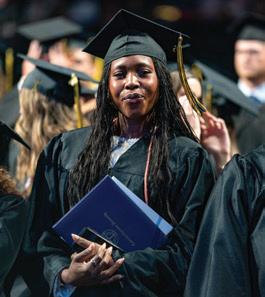
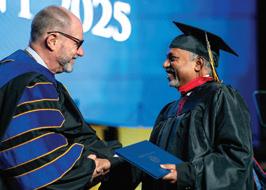
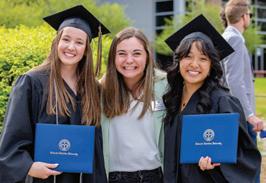
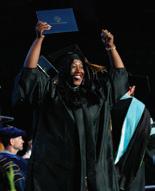
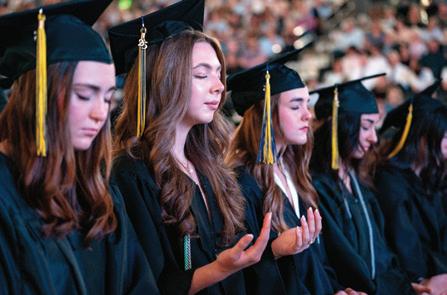
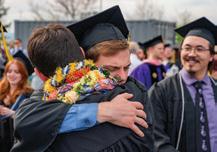
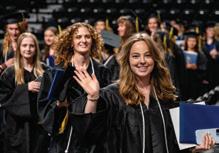
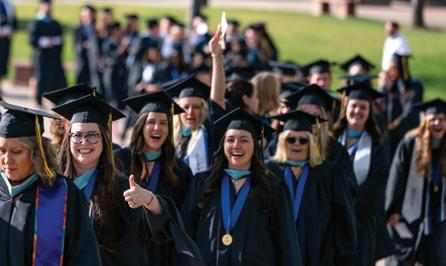
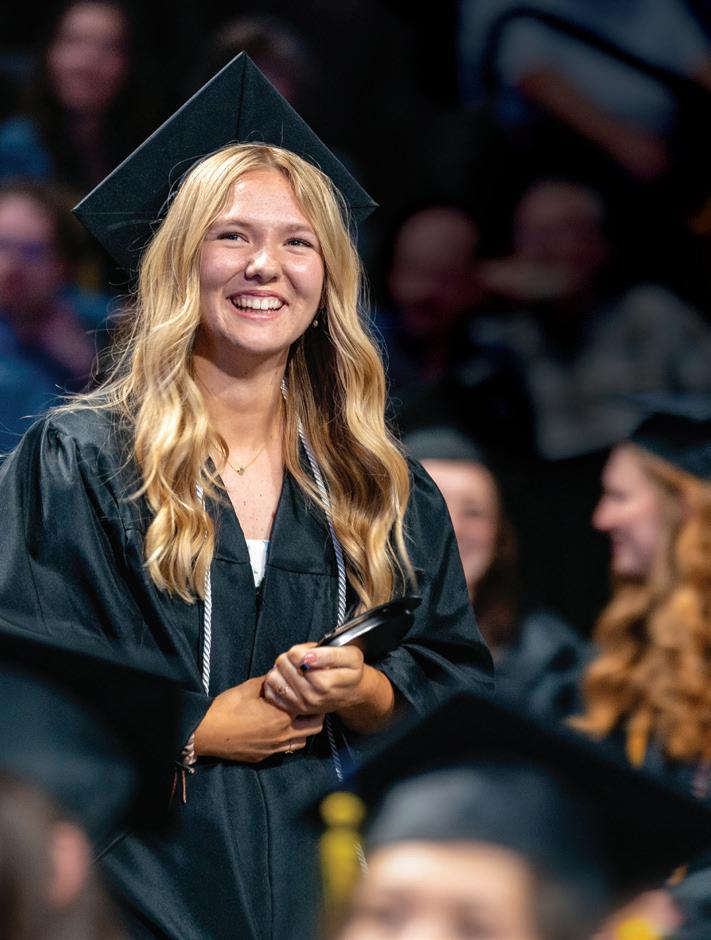
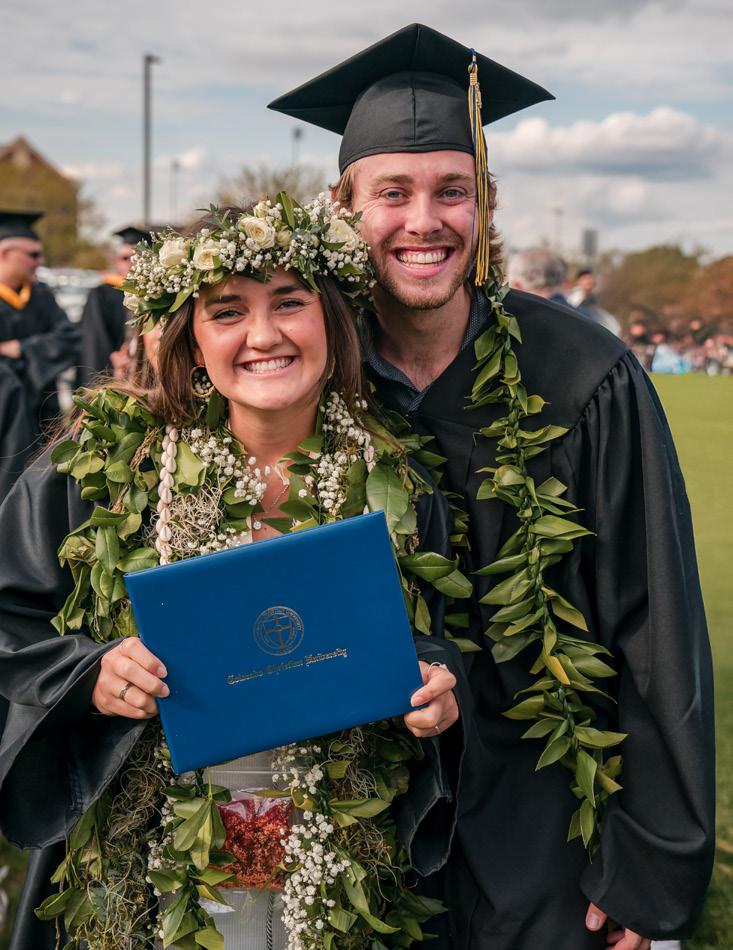
Heartfelt cheers such as these echoed throughout Blue Arena in Loveland, Colorado, as family and friends gathered on May 9 to celebrate the dedication, perseverance, and accomplishments of Colorado Christian University’s Class of 2025. The 111th Commencement ceremony marked a significant milestone in the lives of each graduate — as well as a historic moment for the University, honoring one of its largest graduating classes to date.
Two back-to-back ceremonies — one in the morning for the College of Adult and Graduate Studies, and one in the afternoon for the College of Undergraduate Studies and CCU Academy — celebrated the launch of 1,459 graduates. Each one stepped confidently from the podium, walking towards careers and culture after having been refined through their Christ-centered higher education. The ceremonies recognized the conferral of 4 doctoral degrees, 408 master’s degrees, 785 bachelor’s degrees, and 262 associate degrees.
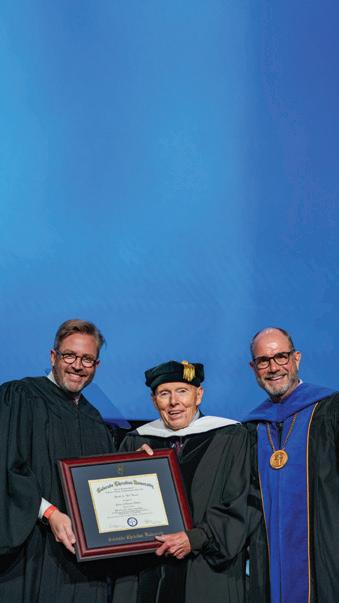
In recognition of distinguished service and lasting impact, CCU also awarded Honorary Doctorates to James “J.B.” Brown and Hal Krause.
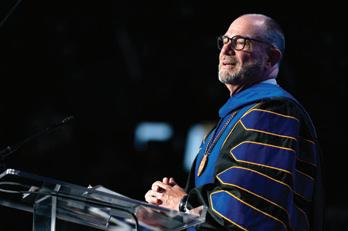
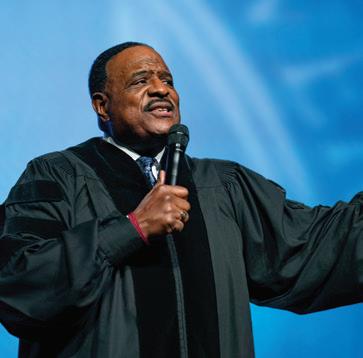
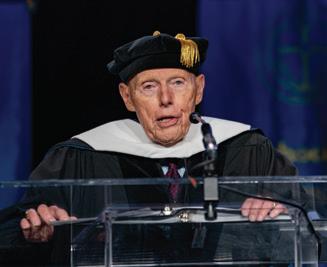
Brown, the five-time Emmy Award-winning host of "The NFL Today" on CBS, is known not only for his excellence in broadcasting but also for his unwavering commitment to leading a life grounded in grace and truth. As this year’s Commencement keynote speaker, Brown drew upon his sports background to illustrate the significance of the day’s ceremonies. He challenged graduates to now “break the huddle and run the play” — encouraging them to go out into culture to spread the hope of Jesus Christ.
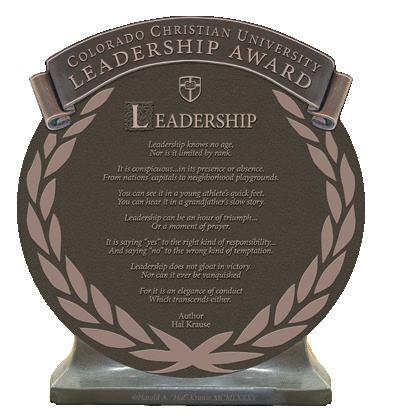
Krause, a former CCU trustee, entrepreneur, and dynamic visionary, has played a pivotal role in establishing innovative campus initiatives. His efforts include securing the $1 million endowment that funds the new CCU Leadership Award, a prestigious annual honor recognizing one outstanding junior or senior in the College of Undergraduate Studies who exemplifies the University’s core values of Christian leadership, character, and service. The award serves as CCU’s highest distinction for Christian leadership. No other Christian university currently offers a leadership award of this kind.
This lead gift, joined by contributions from 12 other donors, including FirstBank, brought the vision to life.
Beyond the jubilant festivities surrounding each student’s success, the day was ultimately about more than academic achievement. As CAGS student speaker Lakin Garcia (B.S. ‘25) expressed in her opening address: “CCU didn’t just prepare us for careers — it prepared us for callings.” The event was a profoundly moving celebration to witness as hundreds of graduates, confidently prepared to “break the huddle” and “run the play,” stepped into their next
chapters as the hands and feet of Jesus Christ. “We’ve got reinforcements coming from CCU, going out into culture," said Brown. "You have been developed to be leaders in culture — so go out, do your job. We all belong on the same team, and I praise God that you’re coming to the rescue just in time. To God be the glory.”
CCU President Eric K. Hogue provided a final charge to the graduates, encouraging them to impact their spheres of influence with grace and truth.
2025 HONORARY DOCTORATES
JAMES “J.B.” BROWN
James “J.B.” Brown is a five-time Emmy Awardwinning broadcaster and host of "The NFL Today" on CBS. A respected voice in both sports and news, Brown has hosted 11 Super Bowls and contributes to "60 Minutes," "Face the Nation," and more. A dynamic communicator and ordained minister, he uses his platform to share his faith and advocate for causes such as domestic violence prevention. Brown is also a founding partner of the Washington Nationals. At CCU’s 2024 Commencement, he inspired graduates to “break the huddle and run the play” for Christ in the world.
HAL KRAUSE
Hal Krause is a visionary entrepreneur, former CCU trustee, and longtime supporter of Christian education. A University of Wyoming alumnus, Krause founded multiple global businesses including Crestcom International and FasTracKids, advancing leadership and early childhood education worldwide. He served on the Republican National Committee and ran for Congress in 1986. At CCU, he played a pivotal role in campus development and led the creation of the $1 million endowment for the CCU Leadership Award. Krause and his wife, Elaine, have four children and attend West Bowles Community Church in Denver. His legacy at CCU spans more than 30 years of faithful service.
“WE’VE GOT REINFORCEMENTS COMING FROM CCU, GOING OUT INTO CULTURE. YOU HAVE BEEN DEVELOPED TO BE LEADERS IN CULTURE SO GO OUT, DO YOUR JOB. WE ALL BELONG ON THE SAME TEAM, AND I PRAISE GOD THAT YOU’RE COMING TO THE RESCUE JUST-IN-TIME. TO GOD BE THE GLORY.”
– JAMES "J.B." BROWN
1,459 DEGREES AWARDED
262 ASSOCIATES
785 BACHELORS
408 MASTERS
4 DOCTORATES
THE LEADERSHIP AWARD WAS MADE POSSIBLE THROUGH A $1 MILLION ENDOWMENT INITIATED BY ENTREPRENEUR AND LONGTIME CCU TRUSTEE HAL KRAUSE. HIS LEAD GIFT, JOINED BY CONTRIBUTIONS FROM 12 OTHER DONORS, INCLUDING FIRSTBANK, BROUGHT THE VISION TO LIFE. AS CCU’S HIGHEST DISTINCTION FOR CHRISTIAN LEADERSHIP, NO OTHER CHRISTIAN UNIVERSITY CURRENTLY OFFERS A LEADERSHIP AWARD OF THIS KIND.
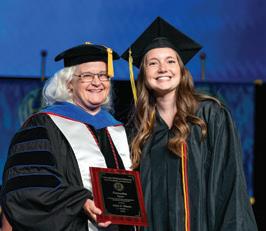
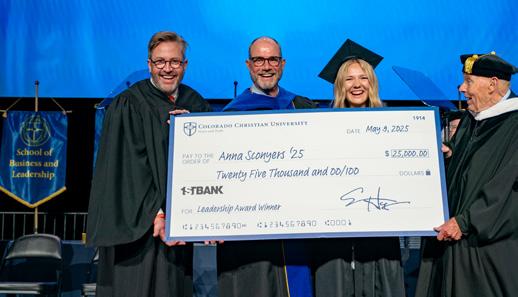
During the afternoon undergraduate ceremony, the inaugural CCU Leadership Award was presented to senior Anna Sconyers, who graduated with a double major in Biblical Studies and Business Administration.
Sconyers served as the student director of CCU’s Women’s Ministry, leading a team that ministered to over 900 women each semester and organizing a conference with more than 1,000 participants. She also demonstrated entrepreneurial and Christ-centered leadership through her handcrafted clay jewelry business, Just Anna, which donates a portion of its proceeds each month to support local community needs.
In addition to the recognition during the Commencement ceremony, the award included a $25,000 cash prize underwritten by FirstBank in honor of the impact Sconyers had as CCU’s most outstanding student leader.
“THIS AWARD WILL SERVE AS A REMINDER THAT CHRISTIAN LEADERSHIP IS A LIFELONG CALLING, AND I PRAY IT ENCOURAGES GENERATIONS OF CCU STUDENTS TO LEAD WITH BOLDNESS AND INTEGRITY,” SAID HAL KRAUSE, WHO INSPIRED THE AWARD.
Sconyers’ name will be the first to be engraved on a four-sided, four-foot granite pedestal permanently displayed on CCU’s campus. She also received an eightinch replica of the campus award to commemorate this exemplary accomplishment.
Trees Planted by Water
You can cultivate a CCU student with your charitable giving.
ANNUAL
GIVING REFLECTS THE VALUES
that shape a university’s community. At Colorado Christian University, our success and growth are related to the commitment of our alumni, parents, students, faculty, staff, and friends who contribute annual gifts toward scholarships, programs, buildings, athletics, and other initiatives. The collective effort of many donors — regardless of the size of contributions — has the power to make a meaningful difference.
Yearly donations from supporters like you stand as a seal of approval for the Christ-centered education our students receive. For alumni and parents, annual gifts also strengthen the connection with the University long after graduation. For our friends and others, charitable contributions can help ensure that Christ-centered education remains accessible and available to future leaders.
Since our humble beginnings in 1914 as the Denver Bible Institute, CCU has grown and flourished like an aspen grove, nurturing students’ spiritual, academic, and personal development. Aspens are unique in that what looks like a grove of individual trees is actually one interconnected organism. This system allows nutrients and minerals to flow through the roots, ensuring that each sapling receives what it needs to grow. Likewise, the Bible also uses trees to illustrate God’s provision and the redemptive work of Jesus on the cross.
Like an ever-expanding aspen grove, CCU started with just a handful of students in our founding year to the nearly 12,000 students we count today (1,450 students on campus, 9,000 online, and more than 2,000 in our high school programs through CCU Academy). Much of this growth and success can be directly attributed to the generosity of donors like you. Thank you.
Take a Seat!
CCU’s School of Music is at home in the Armstrong Center.
Paul reminds us in 2 Corinthians 9:8 that “…God is able to make all grace abound to you, so that having all sufficiency in all things at all times, you may abound in every good work.” (ESV)
We invite you to be part of our expanding grove by making a meaningful gift today. Your investment in Christcentered higher education will, like the aspens, pass along vital support for students in need. These future nurses, teachers, doctors, lawyers, pastors, missionaries, and business leaders need your provision and investment to grow and flourish as they develop roots in the faith and branch out toward their future.
You can preference your gift to a variety of opportunities, all of which share one common goal: helping students receive a deeply rooted, Christ-centered education, so they can impact the world with grace and truth.
No matter the amount, 100% of every dollar works hard to provide resources to the area(s) you love and the students who need your help. Visit our secure site with the QR code below, or use the reply envelope included inside this issue to send in your gift today.
If you wish to discuss your gift with a member of the Advancement team, please contact Kara Johnston Mott, director of annual giving and strategic engagement, at 303-9633320 or email kjohnston@ccu.edu. Thank you for making a difference!
This is your last chance to "take a seat" before our fall 2025 seat naming reveal and celebration. Details to come, so sponsor your seat today!
Gifts of $500 or more allow you to name a seat with a beautiful brass nameplate with up to three lines of text. You can honor or memorialize a loved one, your family, or reference a favorite Scripture verse.
Navigating the Future
THE CRITICAL ROLE OF CHRIST-CENTERED HIGHER EDUCATION
A MESSAGE FROM PRESIDENT ERIC HOGUE
As we find ourselves in an era marked by rapid secularization, Christian colleges and universities, including Colorado Christian University (CCU), stand at a significant crossroads. We face the dual challenge of maintaining academic rigor while fostering a biblical worldview, all while remaining culturally relevant to the very students we serve, who are actively shaping their beliefs about faith.
At CCU, our unique educational model is not just a response to these challenges; it is a powerful affirmation of our mission. Anchored in the liberal arts tradition, our education is a vibrant vehicle for developing well-rounded individuals equipped to navigate the complexities of modern life. We believe that a liberal arts education cultivates critical thinking, creativity, and effective communication — skills that transcend cultural shifts and moral dilemmas.
As David Dockery, a respected leader in Christian higher education, aptly stated, “Genuine Christ-centered education involves more than the passing on of content.” It is about shaping character, nurturing personal development, and guiding spiritual transformation. Here at CCU, we are committed to ensuring that our students graduate not only with knowledge but also with the wisdom to apply that knowledge in service to others, reflecting Christ-like love and grace.
In the midst of rigorous academic pursuits, our students discover their passions and purposes. Through selfreflection and scriptural guidance, they embark on a journey to discern their callings. This process immerses them in what we call a “personal practicum,” where they learn to integrate their intellect, emotions, and actions. This experiential learning cultivates a profound understanding of their responsibilities as leaders who act with integrity, transparency, and unconditional love in a world often skeptical of authentic faith.
However, we must remain vigilant against the threat of mission drift — the gradual erosion of our foundational principles. Without careful stewardship, Christian institutions risk losing their identity and relevance in a secular landscape. At CCU, we are unwavering in our commitment to our mission: to uphold academic excellence while remaining faithful to our biblical convictions.
In a society where college students increasingly define their own beliefs, it is imperative that Christian universities like ours equip students to face cultural challenges with
both conviction and grace. As New York Times columnist David Brooks has noted, Christian education offers a unique opportunity to engage the human experience in a way that integrates faith, emotion, and intellect. This holistic approach nurtures individuals with devoted hearts, courageous minds, and purposeful souls — qualities that our culture desperately needs.
At CCU, we train our students not only in the rigorous Western academic tradition but also through the lens of a Christ-centered, evangelical, and conservative worldview. This dual preparation empowers them to engage thoughtfully with the world, confronting cultural idols that distort truth and undermine the dignity of the human person, the Imago Dei.
We are committed to forming a generation of students who can “live in the tension” — leading with the grace of Jesus Christ while upholding the truth of God’s Word. Our mission extends beyond simply imparting knowledge; we aim to develop graduates whose lives, characterized by unconditional love and a steadfast commitment to truth, serve as powerful testimonies in a world longing for authenticity.
As we expand our academic programs and address the needs of the workforce, we will do so without compromising our core values. The mission of Christian education at CCU is not just to prepare students for careers; it is to equip them for faithful service, intellectual engagement, and lifelong spiritual transformation.
Though the cultural and legal landscape may become increasingly challenging for Christ-centered institutions, our distinct mission remains a beacon of hope. By prioritizing both academic excellence and unwavering fidelity to biblical truth, Colorado Christian University continues to shape graduates who are not only intellectually capable but also spiritually steadfast.
As we navigate the future, our responsibility is clear: We must remain vigilant stewards of mission-centered education. The path ahead may present challenges, but the reward — a generation of courageous, Christ-honoring leaders — is a journey worth every effort. Together, we can continue to fulfill our calling and make a lasting impact on the world.
DANIEL VAN KOOTEN’S LEAP FROM HIGH SCHOOL TO COLLEGE JUNIOR
At Colorado Christian University, students encounter a dynamic, thought-provoking, and practical approach to learning more about the triune God in every course — never a lukewarm faith or watered-down theology. This commitment to academic excellence and biblical truth can begin as early as high school through CCU Academy.
For Daniel Van Kooten (B.S. ’26), the road to CCU started long before his first day on campus, and CCU Academy paved the way. Watching his sister, Madelyn (B.A. ’20), graduate from CCU’s College of Undergraduate Studies (CUS) gave him an early glimpse of CCU’s dedication to Christ-centered education. Eager to get ahead in high school, Van Kooten explored various dual-credit options. After attending a Preview Day, he knew CCU was where God was leading him.
Initially hesitant about liberal arts requirements, he was captivated by the School of Business’s practitioner model. “I was blown away by the professional quality of the program and the professors,” he said. “I left there knowing I wanted to go to CCU.” He completed his senior year with online dual enrollment courses through CCU Academy, setting himself up for a smooth transition.
Compared to other dual enrollment and community college experiences — where “simply showing up was enough to stand out” — CCU Academy offered something more. His courses were academically rigorous and deeply connected to Scripture.
“With CCU Academy, I got the best of both worlds — academic excellence and a biblical foundation,” he said. “The quality of the online platform, BrightSpace, was a huge advantage. It was clearly designed to be userfriendly and engaging.”
By May 2024, Van Kooten had earned his Associate of Arts degree through CCU Academy. He entered CUS as a junior, now pursuing a B.S. in Business Administration with a minor in Finance. Though upper-division courses were intense, he felt academically and spiritually ready. He now
thrives on campus — from Spikeball club to Chapel and worship nights — and will serve as a Resident Assistant next year.
“With my A.A. degree, I essentially shaved off two years of undergrad, affordably. It’s an incredible value.”
Today, CCU Academy offers online dual enrollment courses at just $100 per credit hour. Serving 6,000+ high school students annually, it’s helping students build a strong academic and spiritual foundation.
SCAN QR TO GO TO CCU.EDU/ACADEMY AND LEARN HOW YOUR STUDENT CAN GET AHEAD BEFORE COLLEGE!
College of Adult and Graduate Studies Undergraduate and Graduate Programs
CCU OFFERS UNDERGRADUATE AND GRADUATE DEGREE PROGRAMS FOR THOSE READY TO ADVANCE THEIR CAREER OPTIONS, EXPERTISE, AND EARNINGS POTENTIAL.
SCHOOL
OF
BUSINESS AND TECHNOLOGY
Accounting/Accountancy
(B.S., M.S., Certificate)
Business (B.S.)
Emphasis in Entrepreneurship
Emphasis in International Business
Business Administration (A.S.)
Business Administration (MBA)
SCHOOL OF BEHAVIORAL AND SOCIAL SCIENCES
Applied Psychology (B.S.)
Emphasis in Biblical Studies
Emphasis in Clinical Counseling
Emphasis in Criminal Justice
Communication Studies
(A.A., B.A., Certificate)
Creative Writing (B.A.)
Criminal Justice (A.S., B.S., Certificate)
Criminal Justice (M.S.)
Emphasis in Campus, Event, and Organizational Safety
General Studies (A.A.)
Psychology (A.S., M.S.)
SCHOOL OF BIBLICAL AND THEOLOGICAL STUDIES
Biblical Studies (A.A., B.A., M.A., Certificate)
Christian Ministry (B.A.)
Executive Leadership in Christian Ministry (M.A.)
Theological Studies (M.A.)
Emphasis in Advanced Accounting
Emphasis in Cyber Security
Emphasis in Economics
Emphasis in Enterprise Agility
Emphasis in Healthcare Administration
Emphasis in Leadership
Emphasis in Project Management
Computer Information Technology (A.S.)
Computer Information Technology (B.S.)
Emphasis in Cyber Security
Emphasis in Data Engineering
Emphasis in Database Management
Emphasis in Networking
Computer Science (A.S., B.S.)
Cyber Security (A.S., B.S., M.S.)
Data Analytics (A.S., B.S.)
Economics (B.S.)
Entrepreneurship (Certificate)
Ethics (Certificate)
Healthcare Administration (A.S., B.S.)
Healthcare Administration (Certificate)
Human Resource Management (A.S., B.S., M.S., Certificate)
Information Systems Management (B.S.)
Emphasis in Cyber Security
Logistics and Supply Chain Management (A.S., B.S., Certificate)
Marketing and Sales (A.S., B.S., Certificate)
Nonprofit Management (A.S., B.S., Certificate)
Organizational Leadership (MOL)
Organizational Management in Christian Leadership (B.S.)
College of Adult and Graduate Studies
Undergraduate and Graduate Programs
Organizational Management in Project Management (B.S.)
Project Management (A.S., Certificate)
Public Administration (MPA)
SCHOOL OF COUNSELING
Clinical Mental Health Counseling (M.A.)
Emphasis in Marriage and Family Therapy
Emphasis in Substance Use Disorders
School Counseling (M.A.)
Counselor Education and Supervision (Ph.D.)
SCHOOL OF EDUCATION PROFESSIONS
Alternative Licensure
Alternative Licensure — Special Education
Culturally and Linguistically Diverse Education (M.Ed.)
Endorsement in Culturally and Linguistically Diverse Education
Curriculum and Instruction (M.A.)
Emphasis in Alternative Licensing
Emphasis in Biblical Studies
Emphasis in Culturally and Linguistically Diverse Education
Early Childhood Education (B.A.)
Educational Leadership (M.Ed.)
Elementary Education (B.A.)
Special Education (B.A.)
Special Education (M.Ed.)
Licensure or Non-Licensure
Emphasis in Alternative Licensing Endorsement in Special Education Generalist
TESOL Certificate
Endorsement in Culturally and Linguistically Diverse Education
SCHOOL OF NURSING AND HEALTH PROFESSIONS
Nursing (BSN*, RN-BSN)
Nursing (MSN)
Emphasis in Clinical Care Management in Adult and Geriatric
Emphasis in Nursing Education
Nursing Practice in Visionary Leadership (DNP)
College of Undergraduate Studies
Undergraduate
Programs
SCHOOL OF BUSINESS AND LEADERSHIP
Accounting (major, minor, dual degree)
Business Administration (major, dual degree)
Business As Missions (minor)
Business Data Analytics (minor)
Camp Management (minor)
Computer Information Systems (major, minor)
Economics (minor)
Entrepreneurship (major, minor, dual degree)
Finance (major, minor, dual degree)
International Business (minor) Leadership (emphasis)
Biblical Studies with Languages (major, dual degree)
Church History (minor)
Intercultural Ministry (minor)
Ministry Management (major)
Philosophy (major, minor)
Theology (major, minor, dual degree)
Young Life Leadership (minor)
Youth Ministry (major, minor)
Top-tier academics. Unwavering values.
COLLEGE OF UNDERGRADUATE STUDIES
Over 100 degree program options are available for traditional, on-campus undergraduate students — located in Lakewood, Colorado, in the heart of the Rocky Mountain region. ccu.edu/undergrad
COLLEGE OF ADULT AND UNDERGRADUATE
STUDIES
Over 100 associate, bachelor’s, master’s, and doctoral degree options are offered 100% online — designed for busy adults, Military Friendly®, with transfer scholarships available. online.ccu.edu
At Colorado Christian University, success on the track starts long before the race begins. It’s cultivated in the character, calling, and Christ-centered leadership of the coaches who guide CCU’s Cross Country and Track & Field programs. Over the past few years, CCU has emerged as a competitive force at the national level — not only because of the talented athletes on the roster, but because of the vision and dedication of Head Coach Evan Verbal and Assistant Coach Lyndsey Marshall.
Marshall, a former collegiate sprinter and long jumper, joined CCU after sensing God’s call to move from New Jersey. Passionate about mentoring the whole athlete, she brings energy and focus to CCU’s growing sprints program while nurturing a Christ-centered team culture.
Verbal, a CCU alumnus and former DII All-American, returned as head coach after a season at Regis University. His roots at CCU run deep — as a student, athlete, and now coach. He’s driven to grow the program’s national profile while developing strong, faithful student-athletes.
Together, Verbal and Marshall model a coaching philosophy built on excellence, integrity, and faith. Under their leadership, CCU’s program is thriving — and the finish line is only the beginning.
benediction
by Dr. Lene Jaqua
“He has shown you, O mortal, what is good. And what does the LORD require of you?
To act justly and to love mercy and to walk humbly with your God.”
Micah 6:8 (NIV)
Scientific discovery is but a witness to God’s craftsmanship. Whether quarks and electrons or a massive galaxy supercluster, everything in Creation points to Him.
Science is also an act of stewardship. Scientific labors are a response to God’s first call to Adam to tend the garden (Genesis 2:15). Scientists study and care for the earth, plants and animals, and fellow human beings.
Our world is full of beauty, and yet, in its fallen state, it is also fragile.
The intricate patterns, laws, and systems that govern the very existence of the universe — whether through the complexities of cellular respiration or the precision with which the Earth orbits the sun — evidence purposeful and intelligent design. Thus, the natural world, in both its aesthetic and functional aspects, invites us to reflect on our Creator’s creativity, to say nothing of His omniscience and omnipotence.
Yet, it is also through science that we witness the delicate balance required to sustain life on our planet – to say nothing of the consequences of disrupting said balance. Pain from disease and decay, the impact of environmental degradation, as well as the suffering of those caught in cycles of poverty and injustice, are part of our fallen condition. And yet, it may happen that through science, we discover cures, innovations, and solutions that bring measures of healing and restoration.
For every advance in technology, every breakthrough in medicine, and every discovery in the cosmos, we give thanks. These are gifts from God, and we recognize them as testaments to His provision and grace.
God’s gift of science includes diverse and divergent disciplines, from the mathematical intricacies of quantum mechanics to the complexities of molecular genetics. No single human intellect can grasp the entirety of our scientific
knowledge. Even our greatest experts remain confined within their disciplines. Science is a community endeavor for the entire planet, and, as such, scientific knowledge is continuously expanding beyond individual comprehension, revealing ever-deepening mysteries of divine designs.
Though fallible, science is a self-correcting enterprise, grounded in rigorous methodology and peer review. Errors or misconceptions are continuously challenged, refined, and corrected through empirical evidence, as well as through continuous scholarly review and critique. This process reflects a pursuit of truth that well aligns itself with Christian values. Rather than dismissing science for its occasional errors, we as believers should appreciate its honest and structured means of correcting and refining knowledge.
Yes, a vastness of scientific knowledge can be overwhelming, and it can lead some people (including Christians) to skepticism of that which they do not fully comprehend. This is understandable, but I would suggest that a more contemplative stance might be in order. Rather than nourishing our doubts, the unfathomable depths of the created order should humble and awe us as we bow before God’s boundless majesty. Faith and science need not present as an irreconcilable binary. Rightly understood, they illuminate different dimensions of truth. Science explores the mechanisms of creation, while faith reveals its purpose. Since all truth originates with God, genuine discovery cannot contradict divine wisdom.
May we ground our search for knowledge in God’s love, aligning our search with His divine purposes of justice, mercy, and humility. May our work in science be used for the good of all people, for the care of creation, and for God’s Glory.
Dr. Lene Mahler Jaqua is a professor and chair of Physical Sciences and Mathematics in the School of Science and Engineering at Colorado Christian University. She holds a Ph.D. in Theoretical Nuclear Structure with a minor in Solid State Physics from the University of Arizona.