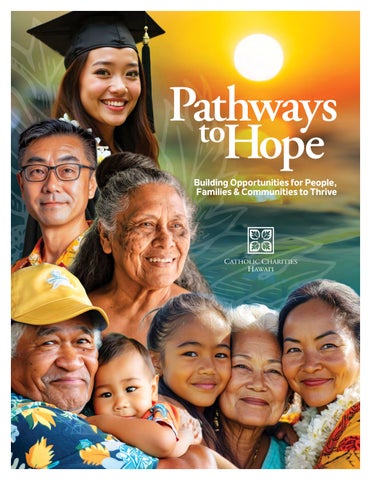
Pathways toHope Building Opportunities for People, Families & Communities to Thrive
and thriving Hawai‘i where all people are seen, heard, Our Asafe,resilient and connected to the support and resources they need to Vision flourish – spiritually, socially, economically, and emotionally.
Problem Statement Hawai‘i faces urgent social and economic challenges that threaten residents’ wellbeing, especially vulnerable populations.
state government roles are vacant. Outmigration and aging shrink the labor pool, while skilled professionals leaving for the mainland accelerate a “brain drain,” weakening systems and limiting access to services, especially in As of 2025, nearly 1 in 8 residents live in rural and neighbor island communities. Hawai‘i is also highly vulnerable poverty, with Native Hawaiians, Pacific to natural disasters, environmental Islanders, immigrants, and kūpuna degradation, and climate change, which disproportionately affected. Despite full-time work, many households remain disproportionately impact low-income housing cost-burdened due to median communities and deepen inequities. home prices over $831,000 and rents Meanwhile, social service systems rising more than 25% in five years. are stretched thin, with limited access According to the 2025 ALICE to mental and behavioral health care, Report, over 45% of households live culturally competent services, and below the ALICE threshold or in caregiver support. As of late 2024, poverty, struggling to afford basic needs 22% of adults reported missing needed despite employment. Many don’t qualify mental health care – 39% among young for public assistance yet cannot keep up adults – and over 30% showed signs of with Hawai‘i’s high cost of living. depression or anxiety. Yet Hawai‘i meets At the same time, the share of only 14% of its mental health provider residents aged 65+ has grown to over demand, far below the national average. 21% – above the national average of These gaps are especially pronounced 18% – with Hawai‘i County nearing for youth and marginalized populations. 25%. This aging trend raises concerns Long waitlists, workforce shortages, about long-term care, caregiver and fragmented systems make it shortages, and elder support services. harder for individuals and families to Compounding this, Hawai‘i’s cost find stability, access care, and pursue of living is estimated at 84% above pathways to health, wellbeing, and the U.S. average, while wages remain economic mobility – essential to stagnant and many residents juggle thriving communities. multiple jobs to survive. The shortage Nonprofits face a shifting donor of affordable housing, reliance on landscape and declining funding. tourism, and speculative real estate investment, contributes to community Federal pandemic relief has ended, local philanthropy is stretched, and many displacement and erodes generational donors are reevaluating strategies amid stability and cohesion. uncertainty. This threatens nonprofit Persistent workforce shortages – capacity – already strained by thin especially in healthcare, education, margins and staff shortages – to meet and social services – strain the state’s rising needs. The safety net for vulnerable capacity. Hawai‘i has only 58 workers populations risks becoming overstretched. per 100 job openings, and 27% of
1 IN 8 HAWAI‘I RESIDENTS LIVE IN POVERTY
MORE THAN
45%
OF HAWAI‘I HOUSEHOLDS LIVING BELOW THE ALICE THRESHOLD OR IN POVERTY
21%
OF HAWAI‘I RESIDENTS ARE AGED 65 AND OLDER
COST OF LIVING IN HAWAI‘I IS
84%
HIGHER THAN THE NATIONAL AVERAGE HAWAI‘I HAS ONLY
58
WORKERS FOR EVERY
100
JOB OPENINGS HAWAI‘I MEETS ONLY
14%
OF ITS MENTAL HEALTH PROVIDER DEMANDS
Response The
H
awai‘i stands at a crossroads. The convergence of high poverty, soaring housing costs, workforce shortages, an aging population, and a deepening mental health crisis threatens the stability and wellbeing of its residents.
Families and kūpuna are struggling to make ends meet, even while working multiple jobs. Young people face rising rates of depression and anxiety, yet encounter long waitlists and inadequate access to care. At the same time, fragmented systems, displacement, and climate vulnerability disproportionately impact those already on the margins. These challenges, if left unaddressed, erode the generational strength, cohesion, and resilience of Hawai‘i’s communities. In response, Catholic Charities Hawai‘i (CCH) draws on its faithrooted values of compassion, dignity, excellence, and social justice to walk alongside individuals and families at their most vulnerable moments. We provide holistic, integrated programs – spanning housing, mental health, senior services, immigrant support, family strengthening, and pathways to economic mobility – that address both urgent needs and long-term barriers to stability, self-sufficiency and resilience. By combining direct service with systems-level advocacy and strong community partnerships, CCH seeks not only to alleviate hardship but to create the conditions for lasting change.
Our theory of change rests on five interconnected strategies: 1. Grow and strengthen partnerships to expand reach, eliminate service duplication, and drive systemic solutions. 2. Expand programmatic reach to meet growing needs in housing, mental health, and family stability, while innovating new services and funding models.
3. Invest in our teams and systems to ensure a strong, values-driven workforce equipped with the tools and support to deliver highquality care. 4. Measure and communicate impact using human development frameworks like the Social Determinants of Health to ensure accountability, transparency, and trust with stakeholders. 5. Advance sustainability and stewardship of our resources by embedding financial resilience and environmental responsibility into all operations through continuous learning and innovation. By pursuing these strategic actions, we believe that individuals and families in Hawai‘i will gain greater stability, self-sufficiency, and resilience. They will be better able to access housing, mental health support, and elder care; navigate fragmented systems; and find pathways to hope and opportunity. Communities, in turn, will experience reduced inequities, stronger safety nets, and enhanced collective capacity to withstand economic, social, and environmental challenges.
Our Theory of for
Hope
This diagram shows how Catholic Charities Hawai‘i links strategic actions with programs that support individuals, families, kūpuna, youth, unhoused persons, veterans, and migrants. It maps the stages of progression from stability to self-sufficiency, resilience, and thriving, highlighting the points where our programs provide catalytic support while ensuring all voices in the community are recognized through advocacy. Together, these efforts form a pathway of hope that strengthens Hawai‘i for generations to come.
Stability » Self-Sufficiency » Resilience » Thriving ‘Ōpio
Kanaka
YOUTH
Koa Kahiko
INDIVIDUAL
VETERANS
ELDERLY
FAMILY
UNHOUSED
‘Ohana
Kūpuna
Together. We are all the voices of our community.
g ty Enga ement + S i n up mu po m r Co
SA1
Grow Partnerships
SA5
Mobility c i om n o Ec
Expand Reach
Advocacy
SA3
Invest in Teams and Systems
ng ei lb
SA4
Show Lasting Impact
SA2 Menta l H e alth
Stewardship and Sustainability
+ W el
H o us i n g +
A resilient and thriving Hawai‘i where all people are seen, heard, safe, and connected to the support and resources they need to flourish – spiritually, socially, economically, and emotionally.
E‘e Moku
t
Our Vision
MIGRANT
Home‘ole
Strategic Actions SA1
Grow & Strengthen Partnerships
OBJECTIVE #1 Foster deep collaboration with government agencies, businesses, parishes and community organizations to expand reach, share resources, and drive systemic change.
SA2
Explore new programming and funding opportunities.
OBJECTIVE #2 Strengthen internal systems and processes to improve operational efficiency, support staff success, and ensure high-quality service delivery.
Measure and Communicate the Lasting Impact on the People We Serve
OBJECTIVE #1 Use human development frameworks such as Social Determinants of Health (SDOH) to assess outcomes, guide decision-making.
SA5
OBJECTIVE #2
Invest in Our Teams & Systems
OBJECTIVE #1 Prioritize leadership development and succession planning, offer competitive compensation, and foster a values-driven, inclusive work culture.
SA4
Enable collaboration with other organizations to align services and elevate broader community impact.
Grow Our Programmatic Reach to Serve More People in Need
OBJECTIVE #1 Increase accessibility to core services while growing our program portfolio on mental health.
SA3
OBJECTIVE #2
OBJECTIVE #2 Communicate the value and effectiveness of our work.
Advance Sustainability and Stewardship of Our Resources Through Continuous Learning & Innovation
OBJECTIVE #1 Strengthen environmental sustainability and resilience in our work by reducing CCH’s environmental footprint, promote climate resilience, and align with partners.
OBJECTIVE #2 Promote financial and operational stewardship by using resources ethically, sustaining long-term stability, and continuously adapting operations to meet emerging needs.
Clarence T. C. Ching Campus 1822 Ke‘eaumoku Street, Honolulu, HI 96822 CatholicCharitiesHawaii.org