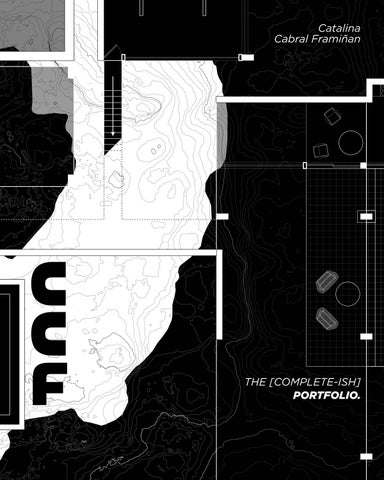
CCF.
Catalina Cabral Framiñan.
Phone: +13054409361
Email: catalinacabralf@gmail.com
Instagram: @kataka.arch
Education. Experience. Awards.
University of Miami
Bachelor of Architecture
Summa cum Laude
BA. History
GPA 3.969/4.0
Grad. May 2025
MAST Academy
Cambridge AICE Diploma w/ Distinction 420/420 Pts
Grad. June 2020
Scholarships + Academic.
AIA Miami Diversity Scholarship Oct 2024
AIA Florida Scholarship June 2024
KBCF School Choice Scholarship May 2024
The Villager’s Scholarship March 2024
Presidential Architecture Scholarship 2020-2025
Presidential Scholarship 2020-2025
Provost Honor Roll 20202025
Deans List 2020-2025
DaftBüro
Architectural Designer May 2025 - Present
Shigeru Ban Architects Internship Jun-Aug 2024
ConConcreto
Research Unit
Research Assistant
Jan 2022-May 2025
USoA Fabrication Lab
Aug 2021-May 2025
ARC 102 (1st Y. Studio) Teaching Assistant Jan 2025-May 2025
RJ Heisenbottle Architects Internship Aug 2019-March 2020
Speaking.
NYU Jordan Center
Undergraduate Research Symposium Mar 2024
ASEEES National Conference Dec 2023
Speaker @ Miami Women in Architecture Annual 8x8x2 Fall 2022
Moderator @ 2022 Smart Cities Conference May 2022
Archisource Drawing of the Year 2025 Affinity Medal + Shortlist x2 July 2025
Arch League NY Deborah J. Norden Fund Grantee April 2025
Faculty Award for Outstanding Design Work in the B.Arch Program May 2025
Honors Thesis Award May 2025
ArtExpo New York Photography Competition Finalist April 2025
AIA Miami Student of the Year Oct 2024
AIA Miami Emerging Professionals Best Portfolio Award June 2024
Buildner Virtual Home Comp. Honorable Mention + Shortlist Oct 2023
ArchHive Student Project Award Honorable Mention June 2023
From Forest to Building Student Design Category Winner Jul 2022
Best of Visual Rep. III Studio Winner Dec 2021
Courses.
USoA Rome Semester Fall 2024
Open City Studio: Tokyo Blue Summer 2023
AA Visiting School New York: Urban Futures Summer 2022
AA Visiting School Mars 4.0 Spring 2021
CLT In Situ Workshop Summer 2021
Languages.
English [Native]
Spanish [Native]
Italian [Limited]
Japanese [Basic]
Software.
Rhino 3D
AutoCAD
Revit
Adobe Suite
Affinity Suite
Blender
Twinmotion
VRay
Final Cut Pro
Statement.
My name is Catalina Cabral Framiñan, and I am a recent graduate of the University of Miami’s School of Architecture B.Arch program, with an additional BA in History from the College of Arts and Sciences. These dual degrees have trained me to understand how cities can emerge from layered cultural, political, and environmental forces. Growing up in Miami and traveling frequently to my parents’ hometowns of Mexico City and Buenos Aires has made me attentive to how inherited memories, systems, and material traces can shape architecture and, by extension, everyday life. This sensitivity evolved into how I approach my design work, seeing architecture not only as tectonics but also as storytelling.
Studying abroad was essential in my formation. In Tokyo, through my school’s Open City Studio program, I explored the cultural and spatial logic of water in Japanese architecture and urban formation. My return to Tokyo as an intern at Shigeru Ban Architects taught me how material experimentation, humanitarian design, and environmental responsibility can coexist within a
contemporary and prolific design practice. A subsequent semester in Rome reinforced my interest in designing in cities where heritage is both a burden to bear and a starting point for designing with the future in mind. After graduating, I pursued independent research in Japan through the Architectural League of New York’s Deborah J. Norden Travel Grant, studying industrial ruins and rural regeneration to understand how “industrial ghosts” can come back to life once the economic engines that birthed them abandon them.
These experiences have shaped my belief that architectural design must operate through close investigation of inherited context while guiding it towards an new future.
Issuu Portfolio

Miami, Refugee Camps, Oxford, Coral Gables, Brownsville, Coconut Grove, Metaverse, New York, Brickell Key, Beach, Setouchi, Mexico City, Hialeah, Tokyo, Rome, Simpson Park, Baku, Tampico, Comodoro Rivadavia, Cantarell

CENTRO TLALTICPAC.
Location: UNAM, Mexico City
Type: Academic | Individual
Year: Undergraduate 4th Year
Semester: Fall 2023
Project Length: 10 weeks [Sep-Dec 2023]
Professor: Charlotte von Moos cvonmoos@miami.edu
*All drawings completed by myself
The eruption of Xitle unleashed rivers of fire that consumed the ancient city of Cuicuilco, silencing it beneath a vast, black sea of lava. Over centuries, the hardened flows of the Pedregal de San Ángel sculpted a landscape both untamed and enduring, its jagged expanse resisting the passage of time. Life slowly returned, weaving itself through the cracks of the now-cool earth, until architects and artists like Luis Barragán, Max Cetto, Mathias Goeritz, and Diego Rivera saw beauty in the volcanic terrain, envisioning a modern refuge within its wildness. Upon this rugged foundation, UNAM now rises alongside El Pedregal’s homes and gardens, a testament to a land shaped by fire, reclaimed by nature, and reimagined by human hands.
[Right] Drawing shortlisted at the Archisource Drawing of the Year Awards 2025


In Mexico City, the National Autonomous University (UNAM) stands as a key influencer in the architectural education of the city. Its campus, marked by distinctive murals and modern structures, serves as a hub where students delve into both traditional and contemporary architectural practices, shaping the city's architectural narrative.
Proposed to act as a connecting point between practicing architects and university-level studies, it is located in the southern, more public section of the University City, on an untouched spot of malpais (the rock formation, created by the lava flow of the Xitle), allowing for architectural experimentation on the terrain.


Through 3D scanning the geological terrain through aerial Structure from Motion (Sfm) Photogrammetry and by utilizing the resultant model a more informed combination of architecture and landscape is created, with the ability to precisely calculate the excavated areas to be used for construction.


The campus itself is known for the malpais landscape its built on, as well as the modernist structures designed by Mario Pani and Enrique del Moral, two of the leading modernist architects of Mexico. Centro Tlaltípac aims to marry the two, creating an orthogonal architectural system embedded into the landscape and creating a more symbiotic relationship between the two. The staggered orthogonal volumes are spread throughout the landscape, attuned to the respective topography and connected by pathways, creating a sense of exploration through the intensely rocky landscape.


Embeddded within the landscape.

Nothing would be achieved if the construction destroyed the natural beauty of the place. To avoid this, it is enough then they would contribute entirely to the benefit of the owners: First it would not be permitted to destroy more than partially one of the three layers of lava that constitute the basaltic mantle, limiting its use as quarries to current exploitation and setting a surface and volume limit….
For constructions, it would be authorized to remove stone from the lot at the site of the building with the material from the surface layer of volcanic stone, preserving the other two for the foundation…

The greatest possible use of the stone from El Pedregal itself is paramount, thereby obtaining the homogeneity of the architectural material, which will characterize it for its same solidity, low cost and beauty. The Above does not exclude the national use of concrete, iron, glass and wood, but the non-construction of tile roofs must be established as an absolutely indispensable condition, with terrace roofs being preferred…
-Diego Rivera,
on the planning of El Pedregal


A studio space dedicated for architectural research is submerged into the heart of the site, surrounded by workshop, communal, and residency spaces carefully positioned to create moments of thoughtfulness while coexisting with the terrain.

MUSEO DEI MUSEI.
Location: Rome
Type: Academic | Individual
Year: Undergraduate 5th Year
Semester: Fall 2024
Project Length: 9 Weeks [Oct-Dec 2024]
Professor: Luca Galofaro, Stefania Manna luca.g@lgsma.it stefania.m@lgsma.it
*All drawings completed by myself
Museo dei Musei proposes a new museum for Rome which combines portions of the collections of 14 of the main museums in Rome, including the National Roman Museums, National Etruscan Museum, Museo delle Civilta, and MAXXI among others. Located at the intersection of via Flaminia and via Guido Reni, across from the MAXXI, the project proposes an adaptive reuse of the existing military warehouse structures, with the introduction of three new volumes, an impressive glazed “spine” and a new public piazza leading down into the museum proper.

METROPOLITAN ROME
Located at the crux of several axis on a main bend of the Tiber river, the museum site sits outside of the main “cone” of the touristic center while maintaining a direct connection to it through via Flaminia. The surrounding context holds less historical “baggage” with several contemporary architectural projects such as the MAXXI, the Olympic village, Parco della Musica, and Foro Italico located within a 1030 min walk.
MUSEUMS
WATERWAYS
RAILWAYS
ROADS
MUNICIPI
RIONI
50M CONTOUR
10M CONTOUR
5M CONTOUR


CINEMA
LOBBY TICKETS
CENTRALE
MONTEMARTINI/ SPINE
GALLERIA NAZIONALE


The underground portion of the “spine” would house a portion of the collection of the Centrale Montemartini, also symbolically connecting the circulation of the two sites, as the Centrale holds a distinctive “first floor industrial vs second floor garden” layout.
LOCKERS ROMAN
MAXXI
ETRUSCAN
BATHS OF DIOCLETIAN
MONTEMARTINI/ SPINE
A central glazed spine connects the underground realm of the museum with the existing ground floor, creating a “winter garden” within the volume of the museum. After removing parts of the existing warehouse roofs (keeping to the existing precast modular dimensioning system) three rectangular volumes are made to “float” above the spaces, allowing for an open-air cinema and patio to exist below.
These three “new” volumes would house the three more modern and purpose built museums of the MAXXI, MACRO, and Galleria Nazionale di Arte Moderno. The ground floor would be host to some of the more “traditional” Museums such as that of the National Roman and Etruscan Museums or the Palazzo Barberini. The underground portion would act as the main entry point (thus allowing for a circulation that rises through the “layers of Rome”) as well as housing the Centrale Montemartini collection and archive/restoration facilities for the museum.


A set of stairs would lead down into the entrance of the museum, allowing for a transitional space, letting light into the underground portion of the spine, as well as providing a new public piazza on via Flaminia.


LEGEND
Entry Forum
Bookshop
Entry Lobby + Ticketing
Centrale Montemartini
Excavated Exhibition
Archives + Restoration
Ground Floor Connection Bridges
Temporary Exhibition
Baths of Diocletian
National Roman Museum
National Etruscan Museum
Exterior Cinema
MIAC
Galleria Nazionale
Museo delle Civilta
Palazzo Barberini
Palazzo Braschi
MAXXI


ECO-NEST.
Location: Governor’s Island, NYC
Type: Academic | Group
Collaborators: Hazel Xing, Milad Saboori
Year: Undergraduate 2nd / 3rd Year
Semester: Summer 2022
AAVS New York: Urban Futures
Project Length: 1 Week [August 5-13]
*All drawings completed by myself after end of course
The ECO-Nest proposes a modular, component based urban system to be installed in Governors Island in New York City. Inspired by concepts of video game urbanism and designed to provide refuge from the bustling city, the system is flexible and expandable to accommodate growth. The raised platforms allow the system to permeate the existing coastline, blurring the demarcation of land vs water and allowing it to function even under flooding conditions in the future. Designed from a “catalog” of different functions, the new urban proposal would enable a certain form of “glamping” (which already exists on the island) as well as new functions of play, meditation, and urban circulation.

A series of components was created, each able to connect with the other to create a flowing urban fabric raised on stilts and be nestled in a sort of artificial canopy.

Circulation v.1
Circulation v.2
Meditate
Treehouse 2
Treehouse 1
TREEHOUSE MODULE
The treehouse module re-thinks the existing “glamping” program of Governors Island, proposing two different style of accommodation within the overall clustering.


Each of the components can be clustered into a larger series, each with individual programs. The resulting cluster “catalog” could then be aggregated further, creating an even larger fabric with each cluster “villages” being interconnected.

CLUSTER V3
Components
• Play
• Circulation v.1
• Circulation v.2
• Generate
• Meditate


The raising of the components came at the face of sea level rise and flooding conditions that Governor’s island faces. By raising them, not only can the fabric continue to expand even after coastal areas are flooded, but the coastline is permeated, providing interest both on land and on the water.
PHASE 1

PHASE 3
PHASE 2
VOXEL IN THE GROVE.
Location: Coconut Grove, Miami
Type: Academic | Individual
Year: Undergraduate 2nd Year
Semester: Spring 2022
Project Length: 9 Weeks [Feb-April 2022]
Professor: Shawna Meyer
shawna@ateliermey.net
*All drawings completed by myself
Voxel in the Grove proposes a multifamily affordable housing complex in West Coconut Grove built entirely of a hybrid Southern Yellow Pine, 5ply CLT and Glulam column structure. A voxelized mass would surround a communal courtyard, with small terraces connected by metal catwalks on upper levels, creating an exterior circulation to access most of the units. The 16 differently shaped units within give a range of options, providing a village like space nestled into the forest-like structure, creating a diverse community in the complex, one which promoted diverse interactions between its inhabitants.
Project received a Category Award at the From Forest to Building Student Competition in 2022
Project received an Honorable Mention for the ArchHive Student Projects Awards in 2023


Extruding a single mass from the setback line maybe maximizes interior space, but its boring and predictable

Using a grid created by the 9' 9" dimensions of a standard CLT panel, we can create a voxelized grid and play with it.
No longer boring and predictable!

Rather than randomly “pixelating/voxelizing” the mass of the structure, the anatomy of a tree was used to base the form of pixelation. The first floor would be the “trunks,” pulled back and split into separate masses, creating large spaces punctured by glulam columns, as if one was walking through the forest. The second floor would extend significantly out over the first, as if they were the base branches, the thickest ones that extend the most. The third floor, while still branching out would be “thinned” out, much like the branches of a tree when you go up. The fourth floor would house a roof terrace, with very little mass, reflecting the canopy of a tree.


1st Floor 2nd Floor

3rd Floor

IMPRACTICALLY PRACTICAL
To create the diverse range of unit types, a system of panels was devised and placed along the 9’ 9” grid (tailored specifically to account for the standard CLT panel dimensions) created for the mass of the building. Walls were strategically placed to create rooms, thus shaping the different unit layouts. This was done instead of creating a repetitive system, to be able to provide the diversity in unit shapes and thus create an organic, almost grown pixelation of the plan. This can be seen as creating “impracticality” instead of being “practical” and using a modular material in an un-modular way, showing that as long as you have a set system of panel “blocks” and someone willing to think it through, you don’t have to resort to a standard, repetitive system of using a wood load bearing/columnated structure. Wood is a material that is full of life, full of unpredictability, and here it would be used as such to create spaces that reflect that life.
PANEL SYSTEM

*According to OneClickLCA

Plate Connector
5 ply Glulam Column
Rothoblaas 14” Screw Wood Trim
Sill Plate
Rothoblaas 14” Screw
5 ply CLT Insulation
Plywood Sheathing
VaproShield Membrane
Furring Strip
Engraved Steel Facade*
Choice Floor Material (Tile, etc.)
Acoustic Mat + Floor Underlay
Triple glazed Window
Aluminum Window Frame*
Deck Furring (Drainage)
Wire Rope Guardrail*
or
or
UNIT STATS
x2
1 Bedroom x6
2 Bedroom x4
3 Bedroom x4
16


INSULAE: MIAMI-MADE
Location: Miami, FL
Type: Academic | Individual
Year: Undergraduate 4th Year
Semester: Spring 2024
Project Length: 10 Weeks [March-April 2025]
Professor: Carie Penabad, Adib Cure cpenabad@miami.edu acure@miami.edu
*All drawings completed by myself
Insulae proposes a new model for Miami using its original standard sized city blocks while increasing density and promoting aesthetic diversity, allowing for individual design within the proposed framework. A standard set of dimensions and facade division would allow for easy customization within the set system, thus allowing for the easy densification of the blocks. The resulting block type would be more similar to that of the Roman “Palazzina” which promotes densification while preventing super-height structures, thus limiting the need for wider streets and still using the existing block plans. The name ‘insulae’ comes from the latin word for a Roman apartment building, drawing a line from the original Roman prototype to the more modern
Studio was a joint studio held simultaneously in Miami and Yale SoA.


Location: Magic City Casino
Collaborators: Tate Nowell, Sebastian Hernandez
*Drawings completed by myself

An initial urban masterplan exercise kicked off the studio, using the large Magic City Casino, located on the edge of Little Havana and Flagami in Miami. Currently an extensive parking lot with a casino and defunct dog racing track, the idea was to redevelop the site into higher density mixed-use housing to act as a prototype for the current single-family residential model in the area.
BASE DESIGN BLOCK GEOMETRY VEHICULAR

DEDICATED GREEN SPACE
Location: Magic City Casino
Collaborators: Tate Nowell, Sebastian Hernandez
*Drawings completed by myself
DEDICATED PUBLIC SPACE ZONING
VEHICULAR PATH
PEDESTRIAN PATH

PEDESTRIAN ACCESS
Using the typology of a palazzina block, the site was divided into vehicular and pedestrian paths, with the defunct dog track turned into a public park. The palazzina was further pushed and pulled, creating irregular shaped blocks that would mimic an organically grown street pattern while maintaining an approximate 100x100 lot dimension.


Following the urban planning exercise was an individual project to develop a chosen housing type for Miami.
The palazzina was chosen for the project and a standard set of dimensioning and division was created for the original Miami block that would allow for easy modification of the already existing urban lot. The standard 50’x100’ block would be merged in sets of two, creating a new 100’x100’ double lot as base. From there setbacks and circulation corridors are defined, allowing for further division.


[Top] Part of a ‘floor plan catalog’ created to showcase the dozens of combination of units and layout prototypes in more detail.
[Left] 67 unique floor plans ranging from Hotel-room, dorm, studio, 1-bed, 2bed, 3-bed, non-square, and penthouse types showcase the endless combinations possible within the frameworks of the 100’x100’ lot plan.
1:100 Scale model of a ‘Miami palazzina’ prototype.

A standardized division system present in the prototypes as well as the separation of the facade from the unitary division of the plans allows for diversification.Even though each facade type uses a standard division for structure, aesthetic differences allow for a more varied urban-scape.

Through a component based design structure the basic prototype block building can be endlessly adjusted and customized, from the scale of the unit allowing for more diversity in tenants to the presence of a more aesthetically diverse urban city scape, avoiding monotony in design and promoting a more colorful community.

This drawing won the Affinity medal for the 2025 Archisource Drawing of the Year Awards


CODA: KOMOEREBI
Location: Simpson Park, Miami
Type: Academic | Individual
Year: Undergraduate 5th Year
Semester: Spring 2025
Project Length: 11 Weeks [Feb-April 2025]
Professor: Florian Sauter
fsauter@miami.edu
*All drawings completed by myself
CODA Imagines a house for the Japanese composer Ryuichi Sakamoto, nestled within Simpson Park in Miami, a dense native hammock isolated within the overall landscape of the city’s urban center. The design takes its cues from the Japanese term “komoerebi” which refers to the dappled light that filters through tree canopies. From this, the concept of solids and voids were developed to create concrete “crystals” to hold the more rigid programs of a house, while two circular slabs primarily consisting of glass would embed the more public programs within the natural context.

Coda: (kōdə); the concluding passage of a piece or movement, typically forming an addition to the basic structure.
komorebi (木漏れ日): (kō-mō-reh-bē); sunlight leaking through trees
The project is called CODA: Komoerebi, connecting two separate terms: Coda referring to this conceptual house being designed posthumously for Sakamoto as well as this being my final design project of my Bachelors, and komoerebi referring to the concept for the design of the house.
When first visiting the site for the purpose of this project, I was drawn to the way the light filtered through the dense canopy, and decided to use my 1960s film camera to purposely unfocus the image and only capture the light in an unfocused bokeh. Captured in black and white, this became the initial concept for the play of solids and voids.
In order to connect the design to Sakamoto’s music, I created a series of paintings of acrylic gouache on paper which captured a form of “notation” based on the shapes and monochromatic patterns I inherently associated with his music. Each painted piece came to be a “notation” of a separate composition of my favourite of Sakamoto’s albums, andata. These pieces came to become the inspiration for the form of the house, with solid volumes being placed in an endless sea of noise (in this case, the natural context of the park itself).


Noise Diagram

This noise diagram aims to represent noise present in the house, with its main concentration being within the music studio.
In an attempt to preserve as many trees on the chosen location as possible, the two main slabs that connected the different concrete program volumes was punctured by holes of different radii, encased by cylindrical glass to maintain the separation of interior to exterior. For the exterior perimeter channel glass was chosen in order to diffuse the horizontal view (connecting back to the original images of unfocused light) as well as forcing the view to be of the forest floor and canopy accessible through the glass ceiling and floor present in the western portion of the house facing away from the public path. The concrete volumes would house Sakamoto’s music studio, bedroom, bathroom, and genkan (Japanese style entry area) as well as an “unfinished” volume providing an exterior terrace overlooking the surrounding environment while still blocking off the path.


PATHWAY VIEW MUSIC STUDIO VIEW


LIVING AREA
HIDDEN IN THE TREES


[Left] Roof plan of the house overlayed a 3D scan of the chosen location rotated to face North. Elevations of each cardinal direction.
[Right] ¼”=1’ Scale model, 3D printing and laser cut acrylic


OIL AND CITY
Location: Varied [Baku, Tampico, Comodoro Rivadavia, Bay of Campeche]
Type: Academic | Individual
Year: Undergraduate 5th Year
Semester: Spring 2025
Project Length: Multi-Year Research
Advisors/Mentors: Eduardo Elena, Vyta Pivo, Christina Crawford edelena@miami.edu vpivo@miami.edu christina.crawford@emory.edu
*All drawings completed by myself unless otherwise noted
Oil and City and the solo thesis exhibition “Oil Future/Past” explored the entanglement of oil extraction and urban form across Baku, Tampico, and Comodoro Rivadavia—three cities transformed by petroleum industries in the twentieth century. Combining archival research, cartographic analysis, and speculative design, the 130-page written thesis examined how geological, political, and economic forces shaped housing, infrastructure, and collective identity in these petro-cities. The culminating exhibition presented a series of maps, diagrams, and conceptual proposals, including speculative designs for the adaptive reuse of offshore oil platforms, inviting viewers to consider how extractive landscapes might be reimagined as spaces of civic possibility.
[Right] Created as a traditional Mexican amate painting using ink on amate bark paper, the drawing creates a narrative for the “foundation” of the idealised city of Cantarell in the Gulf of Mexico.


Research Thesis Summary:
This thesis examines how oil-based industry shapes urban development through a comparative study of Baku, Comodoro Rivadavia, and Tampico. Challenging the notion of a singular “resource curse,” it argues that oil urbanism emerges from the interplay of geography, governance, and cultural-political agendas. Analyzing pre-industrial form, geological constraints, industrial models, housing strategies, and migration, the study shows the three study cases through an interdisciplinary lens. Through archival and spatial analysis, it frames oil urbanism not as a fixed prototype but as a spatial and political condition whose legacies shape cities in a postoil era. In addition to the written research thesis, a curated exhibition was done to present the research as well as the design component which studied the repurposing of offshore oil rigs in the Bay of Campeche.

Link to publication on Issuu: https://issuu.com/ccframinan/ docs/oil_and_city

[Top] Exhibition Images
Unlike traditional design projects that rely on prescriptive plans and sections, this project presented the speculative redevelopment of oil fields through “found objects” such as invented newspapers, postcards, and archival ephemera. These narrative artifacts were used to show the story rather than tell it directly, inviting viewers to piece together imagined futures through traces of everyday life rather than fixed drawings.
OBJECTS FOUND

[Top] “Found Objects” Original artifacts and invented narratives.
By introducing both true (past) and invented (future) archival materials that mirror each other, visitors are encouraged to rethink preconceived ideas of history and architecture and both’s relationship to the stories of the ordinary people than inhabit cities and how they interact with their built environment.
INDUSTRIAL GHOSTS
Location: Japan
Type: Research | Individual
Year: Post-Graduation [Gap Year]
Project Length: Ongoing
Architectural League of New York Grant Project
*All drawings completed by myself
Industrial Ghosts is an ongoing project examining how abandoned extractive landscapes in Japan shape the communities built around them and how they can contribute to their regeneration even after abandonment. During the grant-funded research trip in fall of 2025 three sites were distilled as the main areas of focus: copper in the Seto Inland Sea and their rebirth as “Art Islands”, coal mining in Hokkaido’s Ishikari Basin and the ghosts left behind by the industry’s end, and gold extraction on Sado Island and the current tourist interest due to its recent UNESCO status. Rather than treating industrial ruins as obsolete remains of an expired industry, the project asks how architecture, memory, and cultural re-programming can mediate between difficult histories and future regeneration, while also situating the project within Japan’s broader questions of rural depopulation, adaptive reuse, and an uneven legacy of modernisation.
[Right] Yubari Coal Museum area in Japan. Abandoned coal mining industry.

The three sites were selected to represent different extractive histories, geographies, and industrial trajectories within Japan. The Seto Inland Sea’s Art Islands illustrate a curated and distinct model of regeneration, where former copper and industrial sites, once mired in scandals regarding illegal industrial waste, have been reactivated through art, architecture, and sustained private investment. Hokkaido’s Ishikari Coal Basin was chosen for its scale and placement within Hokkaido’s broader history: central towards Japan’s rapid industrialisation during the Meiji era, it now presents a landscape of abandoned mines and declining towns shaped by economic shifts and rural depopulation. Sado Island’s gold mines offer an older example where centuries of extraction have been absorbed into a consolidated narrative, recently recognised by UNESCO as a World Heritage Site, yet also holding controversial histories of conscripted labour. Together, these sites attempt to provide a holistic reading of how interplaying variables can influence the afterlives of such landscapes and who’s architectural regeneration can perhaps provide solutions to the twin issues of rural depopulation and urban over-crowding.

Map of locations visited during grant-funded research travel.


[Top] From left to right: Teshima Yokoo House, Karami blocks, Inujima former copper refinery
[Bottom] Hiroshi Sugimoto Gallery: Time Corridors in Naoshima (Designed by Tadao Ando)
The research trip combined site visits, photographic documentation, conversations with local institutions, and an interview with the director of the Yubari Coal Mine Museum in Hokkaido to ground research with lived experiences. Visiting the various sites revealed contrasting strategies of post-industrial survival: from top down cultural tourism in the Seto Inland Sea, to fragmented and under-resourced grass-roots preservation efforts in Hokkaido’s declining coal towns, to globally recognized heritage tourism in Sado Island with governmental promotion nation-wide. The project is ongoing, but the trip resulted in original maps, photographs, and interviews that will be compiled into a detailed research report, with a shorter 4,000 word report scheduled to be posted on the Architectural League of New York’s website in February as well as a linked traveloguesque book.


Samples from a class on the studies of Louis Kahn and Rafael Moneo through the act of drawing.
Surrounding is a study of light and shadow through detailed rendering of the modern marble facade of the extension of the Bank of Madrid by Rafael Moneo. Detailed to mimic the elements of the old facades but made modern through digital fabrication and sculpting.
To the left another light and shadow study of a reflected ceiling of two of Louis Kahn’s buildings: the First Unitarian Church and the Dhaka National Assembly. Similar in the idea of plan, both featuring central assembly halls with side light-well lit spaces.


Film Photography samples, using a range of cameras and film mediums from 35mm to 127 and 120 film.

Selected drawing made for the Arquine Mextropoli 2023 Competition. Individual work and drawing, for the projects “Voces de la tierra” (Voices of the Earth), a temporary monument made to the major earthquakes that occurred in Mexico in the previous 25 years.