Harmless Fun
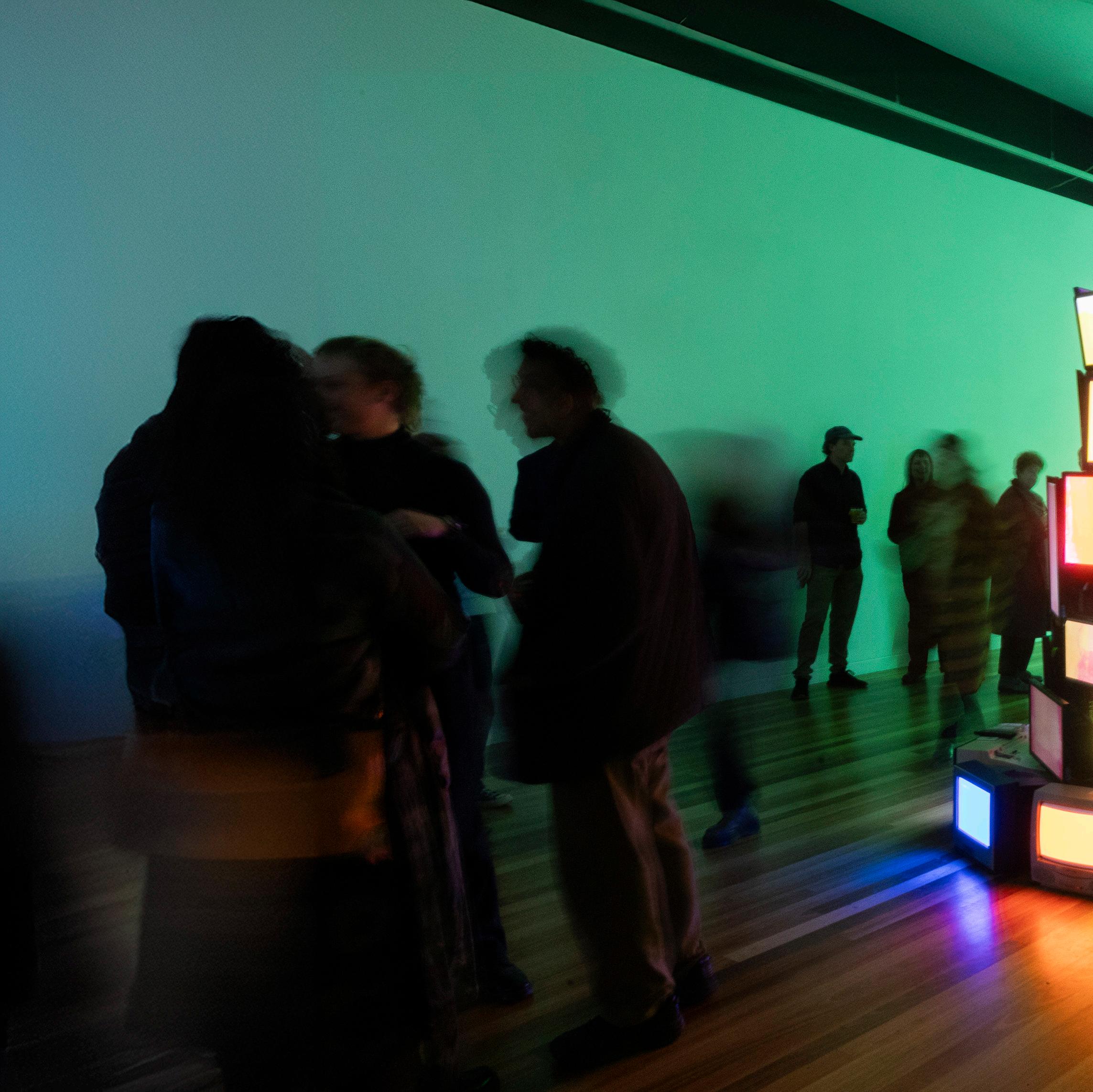
A stack of monitors, humming to one another. They wear a patchwork of gels in pink, orange, blue and yellow, poised in a way that feels monumental, but worn. It reminds me of a place in Budapest, where you can see old soviet monuments torn down and re-configured in tribute to the devastation of its regimes upon ordinary lives.1 Nicci Haynes’ monuments in Canberra Contemporary Art Space, reconfigure the waste of our time – TV screens, cables and spotlights – in a playful, alchemic turn that asks us: what can you see in a pile of junk?
{ 5 Weeks Earlier }
“For me, how you get to a place is more important than the place you got to”2
Walking into Nicci’s studio is like crossing a threshold. A tightly packed wardrobe that leads somewhere surprising. Not Narnia, but a lively universe of gum-wrappers, photographs, spoons, drawings, matches and tulle, which pinned on a corkboard, become characters in a rigorous enquiry.
Nicci points to two TVs on her studio floor, which flicker bold numbers through static bands of grey and black. “I saw the screens on the side of the road,” she says, bouncing towards them. Explaining that their analogue inputs are no longer functional, Nicci is using an RF converter to tinker with their display. To her surprise, their snug position has allowed them to pick up the same signal. She looks attentively at the discarded TVs,
“They’re communicating.”
As she continues her tinkering, my eye wanders to the corkboard mounted on the wall above. I attempt to string together the conspiracy of images on display, consulting my mental rolodex of art movements in the hope that one might be the missing link. I see echoes of Fluxus, Arte Povera and Punk, but when I ask Nicci her opinion on situating her work within the art historical canon, she says “I can make a story about my practice.”
I ask her to go on.
“But it’s really about trying to get things to work. Figuring things out.”
Indeed, Nicci is accustomed to weaving cerebral stories about her work; tales that link images and materials that have otherwise resisted immediate intelligibility. RGB’s aesthetic anchor in the language of colour, may appear to depart from earlier text-based works, or her experiments in film and animation. However, RGB is Nicci’s latest articulation of a sustained interest in the mechanics of perception, which tests the limits of understanding through systematic forms of enquiry.
“it’s quite scientific in lots of ways,” she says about her creative process, as she unravels a receipt roll.
The roll features a sequence of images that have been printed using heat, transforming it into a roll of film. Nicci knows how to re-engineer the substances and energies at her disposal, having trained initially as a scientist, specifically a Pharmacologist. As an applied discipline, Pharmacology integrates chemistry, biochemistry and neuroscience, providing a firm foundation from which to tinker with human perception. Nicci explains, “I like the fact that when people talk about rods and cones in the eye, I know what they are referring to… ”
The RGB (Red Green Blue) colour model is a system that underpins electronic displays, such as TVs and digital screens, building on additive techniques from stage lighting, photography and printmaking, where overlaying primary colours can produce an array of different secondary and tertiary hues. It’s remarkable to think about colour systems as predictable and ordered, when there can be so much disagreement about whether a t-shirt is pink or purple, blue or green.
Nicci flicks through her visual diary, which is thick with sketches, photos and swatches of coloured material. She is detailed and rigorous in the documentation of her experiments, although they are not directed towards a pre-defined hypothesis or objective truth. Instead, Nicci’s process “untethers artmaking from expectations”, allowing for spontaneous and messy moments of creation. She couples this with deep reflection, where her creative thinking oscillates between “go[ing] backwards and forwards; between explaining things to myself, and trying to connect things to the outside world.” We flick past a playful series of self-portraits, where Nicci is dressed in white with splashes of RGB colour, her dancing captured in a Muybridge-style dissection of movements. Looking at the silly images, she says, “I think fun is underrated.”
I agree.
We chat about the purpose of my text.
{ 3 second intermission }
“What do you like in a catalogue essay?” I ask.
“Oh that is an interesting question… I suppose it should give a bit of a backstory”
There are so many stories and characters behind Nicci’s solo exhibition, it’s difficult to choose just one as protagonist: the redemptive arc of discarded materials; surprising encounters between art and science; or carnivalesque spectrums of light that tickle ocular rods and cones. But Nicci searches her memory, remembering a catalogue essay that described the experience of being an artist with honesty – an experience that is less likely to come out by situating Nicci’s work alongside Fluxus or Arte Povera, although Punk may be a better fit.
“It feels like an act of resistance to spend so much time, in this climate, making something that, for most of us, doesn’t fit into the economic system,” Nicci says.
Dick Hebdige famously analysed Punk as a ‘style in revolt’, which harnessed techniques of bricolage to resist the growing consumerism of 1970s Britain. He describes how,
“Objects borrowed from the most sordid of contexts found a place in the punks’ ensembles: lavatory chains were draped in graceful arcs across chests encased in plastic bin-liners. Safety pins were taken out of their domestic ‘utility’ context and worn as gruesome ornaments through the cheek, ear or lip.”3
As I take another look around Nicci’s studio, I see adornments of e-waste, repurposed cords and wire, which are both prickly and playful, like a punk bricolage. While The Sex Pistols and The Clash partied against (or with) Britain’s despondency in the face of Thatcher’s economic agenda, I wonder whether Nicci’s backstory reveals a slightly different kind of rebellion.
We discuss a recent video interview with English contemporary artist, Jeremy Deller.4 He discusses the unfair expectations placed on artists to change the world, or correct global injustices. Nicci has a similar response to those who would dictate what artists can or should do to remain relevant.
“Who says art should be that?! My job is to make art. It doesn’t have to be anything at all. Nobody is paying me to do it.”
Nicci’s processual inquiry into materials and systems, as it crosses various media and disciplines, in some ways reflects the purest form of research; it evolves under the bluest of skies where knowledge is not disciplined into distinct domains. Her experiments are joyous and improvisational, guided by a desire to “follow [her] nose.” Such an approach is increasingly difficult for scientists and humanists to conduct in the academy due to funding pressures in the university sector. Nicci recognises the tendency for artists to feel slightly apologetic for their trivialised work, which operates outside formal market values, or institutional strategies.
Far from idle, we discuss how artists are endlessly required the justify their practice, living in a time where, “You have to have permission to do something harmless.” Nicci alludes to the thought of another artist with whom she has a longstanding affinity, William Kentridge. While her previous work in handdrawn animation offered more obvious links to his work, the process of making behind RGB reflects a common orientation towards their creative practice. Kentridge once said about his work,
“The only meaning they have in advance is the need for the film to exist.”5
Similarly, there is something self-sufficient about Nicci’s work, which morphs across disciplines and materials, evolving into forms that feel physically inevitable, yet surprising.
{ 5 Weeks Later }
Monuments are funny things. Robust and commanding, they’re also persistent reminders of how quickly bodies deteriorate; and how porous and mutable memory can be. I think about my family TV from the 1980s – just one, modestly-sized CRT TV in the living room – my portal into different worlds, characters and languages beyond Canberra. I wonder where that TV is now, and I regret how easily we discarded it.
When making her installation of repurposed screens and RGB projections, Nicci kept returning to the image of Cildo Meireles, Babel (2001), a looming tower of whispering salvaged radios from different era, which are tuned to various stations. Echoing the biblical myth of the Tower of Babel, which explains how communication came to be fragmented into different languages across the world, Meireles’ work invites us to consider the cacophonous confusion of contemporary media. Through another lens, Nicci’s work in RGB also plays with fragments – the decaying systems and materials of human perception that shape meaning.
Red means stop, green means go. Blue means sad, cold, or calm. Cyan, magenta and yellow, could mean a great many things. But as we move our bodies through the space, we delight in messy fragments that don’t have to mean anything at all.
Dr Denise Thwaites
June 2024
Denise Thwaites is a curator, writer and researcher and Associate Professor at the University of Canberra
1 See Memento Park, Budapest, https://www.mementopark.hu/en/sights/#exhibitions [accessed 24/6/2024]
2 Nicci Haynes, Interview with Denise Thwaites, 7/6/2024
3 Dick Hebdige, 1979. “Subculture: The Meaning of Style”, (London: Methuen & Co) p. 107
4 See, Jeremy Deller, 2024. “Jeremy Deller: Can Art Change the World?”, Louisiana Channel, https://www.youtube.com/watch?v=osvGqKDgeUQ [accessed 24/6/2024]
5 William Kentridge, 2013. “William Kentridge Interview: How We Make Sense of the World”, Louisiana Channel, https://www.youtube.com/watch?v=G11wOmxoJ6U [accessed 24/6/202]
Right NICCI HAYNES
255, 255, 255 (detail), 2024
Installation (digital videos, TVs, projectors, electronics), dimensions variable
Photograph by Brenton McGeachie
Image NICCI HAYNES
RG-Being (still), 2024
Digital video (photos by Andrew Sikorski), 1’00” duration
Image NICCI HAYNES
RG-Being (still), 2024
Digital video (photos by Andrew Sikorski), 1’00” duration
Installation (multi-projector projection), dimensions variable
Installation (digital videos, TVs, projectors, electronics), dimensions variable
Left NICCI HAYNES Being Colour, 2024
Right NICCI HAYNES 255, 255, 255, 2024
Photograph by Brenton McGeachie
Installation (multi-projector projection), dimensions variable
Image NICCI HAYNES Being Colour, 2024
Photograph by Brenton McGeachie
Image NICCI HAYNES RGB exhibition opening, 12 July 2024
Photograph by Hilary Wardhaugh