Executive Summary
In response to global climate change, Taiwan enacted the Greenhouse Gas Reduction and Management Act in 2005. As climate challenges intensified, the Ministry of Environment revised the act in 2023 and renamed it the Climate Change Response Act. The revisions incorporated the 2050 net-zero emissions target, enhanced emission controls, carbon fee collection, and promotion of a just transition, underscoring Taiwan’s commitment to achieving net-zero emissions.
To actively address the challenges of global climate change and promote national climate governance and international cooperation, President Lai Ching-te announced the establishment of the National Climate Change Committee on June 19, 2024. The Committee, comprising representatives from industry, government, academia, and research sectors, serves as a communication platform for formulating national climate governance strategies and driving critical action plans, thereby strengthening resilience to climate change. The Committee convenes quarterly at the Presidential Office and undertakes three core missions: fostering public participation, enhancing policy communication, and improving operational efficiency. Its goal is to build societal consensus and advance the nation’s green growth strategy. The committee consists of 28 members, with the President serving as the convener. It addresses seven key themes: net-zero pathways; diversified green energy and carbon reduction technologies; green and digital dual-axis transformation; sustainable green lifestyles; just transition; green sustainable finance; and, resilient and sustainable land-use adaptation.
Taiwan adheres to the requirements of the United Nations Framework Convention on Climate Change (UNFCCC), upholds the principle of periodic disclosure of climate change response achievements by parties to the convention, and has actively implemented related measures. Pursuant to the Climate Change Response Act and its enforcement rules, Taiwan compiles a national report every three years. The 2024 Republic of China National Greenhouse Gas Inventory Report comprises nine key chapters: 1) National Circumstances and Basic Environmental Data; 2) Greenhouse Gas Emissions, Absorption Statistics, and Trend Analysis; 3) Taiwan’s Policies and Measures for Greenhouse Gas Reduction; 4) Greenhouse Gas Emission Forecasts; 5) Impacts of Climate Change and Adaptation Strategies; 6) Climate Change and Systematic Observation Research; 7) Technology Development, Demand, and Transfer; 8) International Cooperation and Exchange; and 9) Education, Training, and Outreach. The highlights of each chapter are summarized below:
Chapter 1: National Circumstances and Basic Environmental Data
Taiwan is situated at the southeastern edge of the Asian continental shelf along the Pacific Rim. To its east lies the Pacific Ocean, to its west the Taiwan Strait; the Bashi Channel lies to the south, and the Ryukyu Islands are located to the northeast. Taiwan has a spindle-like shape, stretching 394 kilometers from north to south and 144 kilometers from east to west at its widest point, with a total coastline length of 1,150.95 kilometers. Its latitude ranges between approximately 21°N and 26°N. The area under Taiwan’s effective jurisdiction includes Taiwan proper
and its affiliated islands (the Penghu Archipelago, Kinmen Islands, Matsu Islands, Dongsha Islands, and Nansha Islands), covering a total area of approximately 36,197.3371 square kilometers. In 2023, the annual average temperature on the main island was approximately 24.6°C, with an average annual rainfall of about 1,883.5 millimeters.
Since 2020, Taiwan has experienced natural population decline due to the birth rate falling below the death rate, exacerbated by the impact of the COVID-19 pandemic, resulting in negative population growth. In 2023, population numbers temporarily rebounded due to the return of Taiwanese nationals and a net positive international migration following the pandemic. As of 2023, Taiwan’s total population was approximately 23.42 million, with a population density of 647 people per square kilometer. The
population aged 0 to 14 accounted for 11.9%, whereas the population 65 and older constituted 18.3%, reflecting the continuing growth of the elderly population.
In 2023, Taiwan’s economic growth rate was 1.12%, impacted by weakened global demand for goods, which affected external trade and investment. However, a rebound in consumption of services and tourism spurred an increase in private consumption. Due to the advancement of emerging technologies such as artificial intelligence (AI) and highperformance computing (HPC), the economic growth rate in 2024 is projected to reach 4.59%. Additionally, in 2024, President Lai Ching-te introduced the National Project of Hope, which focuses on eight key governance objectives, including innovative economy, green growth, and the 2050 net-zero transition, to promote Taiwan’s economic transformation and enhance societal well-being.
In terms of energy development, the country faces challenges such as heavy reliance on imported energy and an isolated electricity system. However, with the accelerated global trend toward reducing greenhouse gas emissions, the country is actively promoting an energy transition to increase the proportion of renewable energy, enhance energy efficiency, and reduce dependence on imported fossil fuels. In 2024, Taiwan’s power generation structure consisted of 39.3% coal-fired power, 42.4% gas-fired power, and 11.6% renewable energy. Under policy initiatives, solar photovoltaic and wind power generation have shown significant growth.
The nation’s transportation sector spans three major areas: land, sea, and air, encompassing four aspects: transportation, tourism, meteorology, and postal services. Land transportation includes road and rail systems. As of the end of 2023, the total road mileage was 21,844 kilometers, and the railway and high-speed rail systems were well-developed,
with plans to extend the north–south high-speed rail. In maritime transportation, the country operates seven international commercial ports and four domestic commercial ports, with cargo volume increasing by 45.12% in the first half of 2024. In aviation, eight airlines operate 251 domestic and international routes; during the first half of 2024, passenger numbers rose by 37.12% compared to the same period in 2023. All transportation sectors have demonstrated steady development.
Chapter 2: Greenhouse Gas Emissions, Absorption Statistics, and Trend Analysis
Taiwan conducts greenhouse gas (GHG) emission statistics based on the 2006 Guidelines for National Greenhouse Gas Inventories published by the Intergovernmental Panel on Climate Change (IPCC) and by referencing international standards such as the IPCC’s Good Practice Guidance and Uncertainty Management introduced in 2000. For continuous improvement, data statistics have been updated in accordance with the 2019 Refinement to the 2006 IPCC Guidelines for National Greenhouse Gas Inventories and adjusted to align with national circumstances.
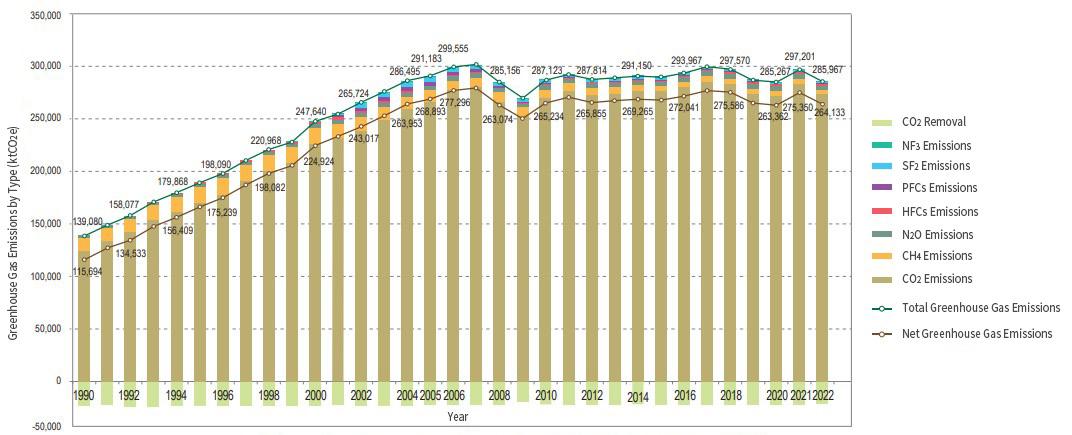
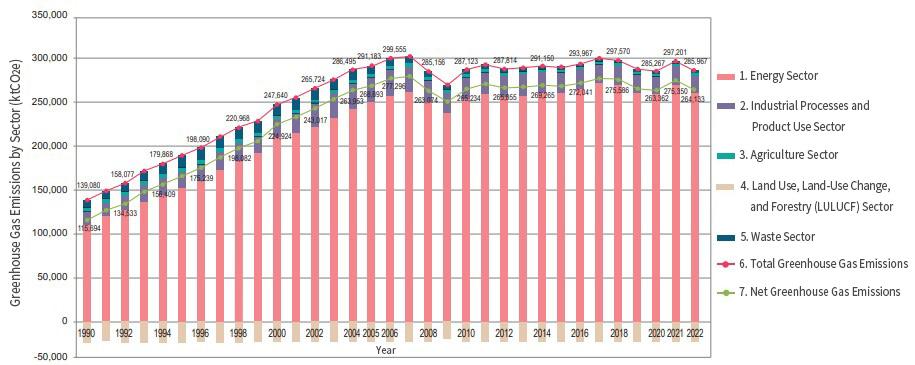
Taiwan’s GHG emission statistics cover seven types of greenhouse gases: carbon dioxide (CO 2), methane (CH 4), nitrous oxide (N 2O), hydrofluorocarbons (HFCs), perfluorocarbons (PFCs), sulfur hexafluoride (SF 6 ), and nitrogen trifluoride (NF3). Among these, CO2 is the primary greenhouse gas, with emissions amounting to 273,683 kilotons (excluding the Land Use, Land-Use Change, and Forestry sector), and accounting for 95.70% of the total GHG emissions, as shown in Figure 1.
Chapter 3: Taiwan’s Policies and Measures for Greenhouse Gas Reduction
Since Taiwan announced its intention to engage with the UNFCCC in 2009, the government has actively participated in the Conference of the Parties (COP) as a Government Observer and has issued both the National Greenhouse Gas Report and the Nationally Determined Contribution (NDC). In 2021, the government declared its commitment
to achieving the 2050 net-zero emissions target, and in 2022, it published Taiwan’s Pathway to NetZero Emissions in 2050, clearly outlining four major transformation directions and 12 key strategies. In 2023, Taiwan amended the Climate Change Response Act to strengthen provisions for a just transition, carbon fee collection, and adaptation strategies, as well as to implement mechanisms for information disclosure and public participation. In 2024, President Lai Ching-te established the National Climate Change Committee to further advance green growth and net-zero transformation. The
Committee focuses on cross-sector collaboration across areas such as energy, digital technology, and finance, driving policy implementation and laying the foundation for Taiwan’s sustainable development.
In accordance with the Climate Change Response Act , Taiwan establishes phased control targets every 5 years. In 2022, the government approved the second phase of the Greenhouse Gas Reduction Action Plan and sector-specific action plans covering six major sectors, all aimed at achieving the 2050 net-zero emissions target. These sector-specific greenhouse gas reduction action plans are implemented based on phased targets, evaluation indicators, and annual objectives, with progress regularly reported to the Ministry of Environment and the Executive Yuan. The energy sector focuses on reducing greenhouse gas emissions by adjusting the energy structure and enhancing energy efficiency. The manufacturing sector promotes low-carbon transformation along with energy-saving and management. The transportation sector makes significant efforts to develop public transportation, promote electric vehicles, and improve the energy efficiency of transportation systems. The residential and commercial sector emphasizes the promotion of green buildings, the enhancement of energy efficiency in buildings, and the implementation of both voluntary and mandatory carbon reduction measures in the service industry, driving progress toward the net-zero target. The agriculture sector continues to implement measures such as afforestation and biogas power generation to achieve
significant carbon reductions and increase carbon removal. The environmental sector works to reduce methane emissions by promoting waste-to-resource initiatives and improving wastewater treatment. Through the ongoing efforts and implementation of measures across these six major sectors, Taiwan is gradually advancing toward its long-term carbon reduction goals.
Chapter 4: Greenhouse Gas Emission Forecasts
In accordance with Article 10 of the Climate Change Response Act , Taiwan establishes phased greenhouse gas control targets every 5 years. The decision-making process involves consultations with scholars, experts, government agencies, and civil society organizations. The setting of phased control targets is based on the energy-saving and carbon reduction potential of each sector. This includes forecasting national and sector-specific greenhouse gas emission trajectories and evaluating the effectiveness of policies.
The enforcement rules of the Climate Change Response Act require central government agencies to project emissions trends and conduct scenario analyses. These analyses categorize emissions into six major sectors—energy, manufacturing, transportation, residential and commercial, agriculture, and environment—and unify the management of various greenhouse gases, such as carbon dioxide and methane. The government is
Phase 3 Greenhouse Gas Periodic Regulatory Goals
(Peak)
INDC (2015) 20% reduction NDC (2022) 24±1% reduction;12 Key Strategies Proposed NDC(2024) 28±2%reduction (2007)
currently formulating the Third Phase Greenhouse Gas Phased Control Targets, which will forecast emissions for the period from 2026–2030. Using 2005 as the baseline year, the government plans to propose enhanced reduction targets for 2030, paving the way to achieve the ultimate goal of net-zero emissions by 2050.
To achieve these targets, the government has conducted projections for national energy demand, calculations of power emission factors, and emissions from both fuel combustion and non-fuel combustion across various sectors. Simultaneously, each sector employs different estimation models to simulate future emission scenarios, taking into account socioeconomic parameters such as overall economic growth rates and population figures. These projections serve as a basis for the effective implementation of policies and the planning of carbon reduction strategies.
Chapter 5: Impacts of Climate Change and Adaptation Strategies
Taiwan’s complex topography and highly variable climate make it particularly vulnerable to typhoons and extreme weather throughout the year, leading to threats such as floods and landslides. As climate change intensifies, extreme weather events are expected to become more frequent, presenting significant challenges to national security and socioeconomic development. In 2024, Taiwan combined historical data with the latest IPCC climate change simulations to produce Climate Change in Taiwan: National Scientific Report 2024. This report examines the risks associated with climate change in Taiwan, including rising temperatures, changes in rainfall patterns, and rising sea-levels. Future warming in Taiwan is inevitable, with temperature increases potentially reaching 3.4°C by the end of the century under high-emission scenarios. This will lead to shorter winters and longer summers. Sea levels are also expected to rise due to global warming, with projections indicating an increase of up to 0.8 meters by 2100, posing severe threats to coastal regions. Moreover, rainfall during the dry season is projected to decrease, whereas wet-season rainfall will increase, exacerbating the differences between dry and wet seasons. This intensification of seasonal disparities will heighten the risks of droughts and floods.
To address these impacts of climate change, the Taiwan government emphasizes the necessity of climate adaptation and risk assessment. Efforts focus on enhancing water resource management, urban flood prevention, and disaster mitigation in hillside areas to reduce damage caused by extreme weather events. The government also calls for collaboration across all sectors to actively promote adaptation measures, ensuring the sustainability of national security and economic development.
Following the passage of the Climate Change Response Act , Taiwan formulated the National Climate Change Adaptation Action Plan (2023–2026), promoting adaptation actions across seven key sectors: infrastructure, water resources, land use, oceans and coasts, energy supply and industries, agricultural production and biodiversity, and health. The action plans for each sector aim to reduce climate risks, enhance societal and industrial resilience, and strengthen disaster prevention and ecological protection measures through policies, regulations, and inter-ministerial coordination. To date, significant progress has been made, including regulatory transformations, disaster early warning mechanisms, and climate risk management. These efforts are steadily advancing Taiwan toward its sustainable development goals.
Chapter 6: Climate Change and Systematic Observation Research
To achieve the goals of the Paris Agreement, global collaboration is essential to promote greenhouse gas reduction, advance climate adaptation technologies, and establish accurate meteorological forecasting systems. Taiwan actively engages in scientific research on climate change and shares its findings through international cooperation. The National Science and Technology Council (NSTC), as the competent authority, coordinates climate change research and interdisciplinary integration projects. These efforts aim to enhance local climate modeling, disaster early warning capabilities, and green energy technologies. Since 2011, Taiwan has developed its own climate simulation system and participated in international research initiatives, such as CMIP6, thereby contributing to the global scientific foundation for addressing climate change while strengthening
disaster countermeasures and advancing green, lowcarbon technologies.
Taiwan’s meteorological observation system is managed by the Central Weather Administration (CWA) under the Ministry of Transportation and Communications. It oversees nationwide meteorological observations, including oceanic conditions, ozone levels, and ultraviolet radiation, which are categorized into surface, upper-air, and specialized meteorological observations. Surface observations use instruments to measure meteorological elements near the Earth’s surface, including maritime observations. Upper-air observations use balloons equipped with instruments to measure atmospheric conditions at various altitudes, focusing on wind direction, wind speed, and air pressure. Specialized observations target specific phenomena such as lightning, radar, and satellite monitoring.
As of 2023, Taiwan was operating 25 meteorological stations, 2 upper-air stations, and 644 automatic observation stations, which collect data on weather, precipitation, and temperature. As for satellite observation, the CWA receives data from multiple meteorological satellites, including those from the United States, the European Union, Japan, and Taiwan’s own Formosat satellites. These data are used for meteorological analysis and environmental monitoring. The 11 radars composing the meteorological radar network provide dense coverage of Taiwan and surrounding seas, which enhances the detection of weather systems. They are particularly useful for monitoring severe weather events such as typhoons. Oceanic observations rely on buoys and tide stations to monitor wave heights and tides. This improves typhoon forecasting and maritime surveillance capabilities.
These observation data are widely applied in areas such as agricultural disaster early warning, weather parametric insurance, smart meteorological services, and disaster prevention and early warning, ensuring that Taiwan maintains efficient and accurate meteorological observation and forecasting capabilities for responding to climate change and natural disasters.
Chapter 7: Technology Development, Demand, and Transfer
To address climate change, the global community is actively advancing technological innovation and cooperation, leveraging market mechanisms and climate finance to accelerate the development and transfer of technologies. Taiwan has also invested in climate technologies and industrial development, focusing on three major areas: net-zero technologies, mitigation and energy technologies, and climate services and adaptation technologies. Since 2007, Taiwan has launched the National Energy Program, which promotes advancements in energy-saving, alternative energy, smart grids, and offshore wind power technologies. In 2023, the government approved the Net-Zero Science & Technology Program, allocating NT$15 billion annually for the research and development of sustainable energy and grid resilience technologies. In the field of mitigation and energy technologies, Taiwan’s manufacturing sector, due to its high emissions, urgently needs to develop carbon reduction technologies such as carbon-free steel production, low-carbon petrochemicals, and greener electronics manufacturing processes. For adaptation technologies, the focus is on establishing comprehensive foundational data, such as typhoon and drought early warning systems, and enhancing risk assessment tools across various sectors. Regarding technology transfer, Taiwan promotes international cooperation in areas such as wind power, hydrogen energy, and power grids by introducing new technologies and conducting demonstration projects. Achieving a net-zero transition requires the support of a just transition mechanism to ensure fair resource allocation and societal consensus. Taiwan has established interministerial task forces to drive these efforts and has strengthened the role of financial institutions in climate transition by advancing carbon disclosure and ESG information platforms to promote sustainable development.
Technology transfer plays a pivotal role in global climate action. The UNFCCC has established a technology mechanism promoting the development, dissemination, and transfer of technologies to address climate change challenges. Technology transfer involves the sharing of intellectual property rights and training, with the aim of facilitating technological collaboration among nations. Taiwan actively participates in international technology transfer through institutions such as the Ministry of Foreign Affairs and the International Cooperation
and Development Fund (ICDF). These efforts include promoting the application of climate technologies in allied and other nations. For example, Taiwan has implemented disaster early warning system enhancement projects in Guatemala and Belize, solid waste management and recycling initiatives in Saint Kitts and Nevis, and agricultural and environmental technology development programs in the Philippines and the Marshall Islands. These cases highlight the critical importance of technology transfer in strengthening the global community’s capacity to respond to climate change.
Chapter 8: International Cooperation and Engagement
Although Taiwan cannot participate as a party to the UNFCCC, it actively expands its international involvement through multilateral and bilateral climate cooperation. These efforts strengthen the implementation of technology transfer, climate mitigation, and adaptation measures. Taiwan’s climate action initiatives include technology research and development, industrial collaboration, and energy transition. Through the ICDF, Taiwan supports allied and friendly nations in addressing climate change challenges. These actions enhance Taiwan’s visibility and influence in global climate action while demonstrating its commitment to contributing to global greenhouse gas reduction efforts.
Additionally, Taiwan participates in numerous international organizations that focus on cities as primary actors, fostering exchanges with global cities to demonstrate its determination to advance climate action. Among these organizations, Local Governments for Sustainability (ICLEI) is the world’s largest network of local governments dedicated to sustainable development, comprising over 1,000 members from 86 countries. Twelve of Taiwan’s city and county governments are members of ICLEI. Similarly, CityNet is an international network promoting sustainable urban development in the Asia-Pacific region. To date, Taipei, Taoyuan, Taichung, and Kaohsiung have joined CityNet, leveraging exchanges and collaborative initiatives to promote industrial development, accelerate energy transitions, and jointly advance low-carbon actions for sustainable urban development. Furthermore,
Taiwan’s industries and civil society organizations actively expand their participation in international organizations and play key roles in global climate forums. Through these diverse engagements, Taiwan shares its experiences in climate change mitigation and environmental protection, amplifying its voice and advancing its climate action on the international stage.
Chapter 9: Education, Training, and Outreach
In accordance with Article 6 of the UNFCCC, Taiwan’s government agencies actively promote climate change education, talent training, and public communication programs aimed at raising public awareness of climate change and cultivating related expertise. In the field of education, the Ministry of Education has been implementing the Newgeneration Environmental Education Development (NEED) blueprint since 2020. This initiative integrates climate change, sustainable development education, and the United Nations Sustainable Development Goals (SDGs) into Taiwan’s environmental education strategies. The program spans environmental education curricula from elementary school through high school, emphasizing whole-school governance and interdisciplinary learning. Through innovative teaching methods and living laboratories, the program fosters students’ environmental literacy and practical skills. At the tertiary level, universities and colleges focus on cultivating specialized talents by offering interdisciplinary courses and promoting industry–academia collaboration. These initiatives provide practical opportunities to deepen students’ understanding of climate change mitigation and adaptation.
Furthermore, to address the challenges posed by climate change in the future, Taiwan places great emphasis on vocational training for professionals. Various government agencies, based on their respective areas of responsibility, have launched talent cultivation programs for climate change mitigation and adaptation across six major sectors: energy, manufacturing, transportation, residential and commercial, agriculture, and environment. For example, the Ministry of Economic Affairs’ Bureau of Energy conducts energy management training courses and promotes local energy governance capacity-building programs. In the manufacturing
sector, efforts focus on strengthening corporate carbon reduction capabilities through carbon inventory assessments and carbon reduction guidance. The Ministry of Agriculture prioritizes agricultural and water resource adaptation, advancing the renewal and protection of farmland irrigation infrastructure. The Ministry of Environment collaborates with the financial industry to promote green finance and sustainable development, enhancing corporate awareness of climate change and facilitating industrial transitions toward lowcarbon practices. These comprehensive efforts are driving Taiwan’s progress toward the 2050 net-zero emissions target.