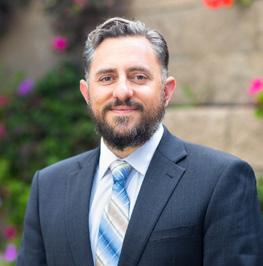
“At the College of Behavioral and Social Sciences, we believe every student is called to a purpose greater than themselves. Our programs are designed to equip you with the knowledge, skills and Christ-centered perspective needed to serve your community and make a lasting impact in the world. We invite you to join us on a transformative journey—one that prepares you not just for a career, but for a life of meaningful service and leadership.”
Brian Distelberg, PhD Dean, College of Behavioral and Social Sciences
Program Distinctives
01 02 03
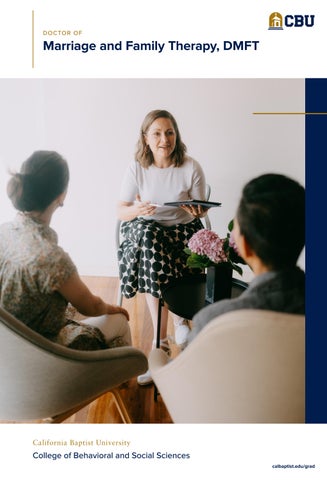
At CBU, the Doctor of Marriage and Family Therapy (DMFT) program provides advanced clinical training that equips students in becoming expert clinicians, supervisors and leaders in the field. Graduates emerge equipped for advanced roles, shaping the landscape of MFT practice.
Tailored for the working professional, the Doctor of Marriage and Family Therapy program is formatted in an online medium. All courses can be completed at home, one night a week.
CBU’s faculty are distinguished scholars and mental-health clinicians, providing students with insights drawn from real-world experience.
Program Details at a Glance
Program Length
56 units
2 years
Program Cost*
Program Start Term $45,920
Fall (September)
Class Format
Classes are offered online in an asynchronous format, with live instruction held on Thursday evenings.
*Based on current academic year. Subject to change.
Accreditation
WASC Senior College and University Commission (WSCUC)
Be the difference one culture, one community and one person at a time.
About the College of Behavioral and Social Sciences
The College of Behavioral and Social Sciences (CBSS) is widely recognized and highly respected by public, private and faith-based agencies throughout the Inland Empire community.
As one of the oldest and largest colleges at California Baptist University, the CBSS is well known for its variety of program offerings, research and scholarship, practicum and training sites and service to the community.
The vision of the College of Behavioral and Social Sciences is to develop quality graduates that are equipped to face the challenges of the world and serve at the highest caliber in their fields. Our distinct philosophy includes a significant student-professor interaction, an intentional integration of a mature, biblical worldview, a holistic, interdisciplinary approach and an emphasis on sound academic instruction to prepare students to compete with others in academia and in the job market.
As a faculty, we strive to exemplify the cooperative, relational aspect of our field as behavioral scientists in order to best model successful integration and cross-disciplinary partnership. Our vision is to graduate students of strong, mature faith who are academically and professionally prepared for real-world application of their skills. One of the greatest advantages of training
at the College of Behavioral and Social Sciences is undoubtedly the holistic method with which we approach learning and application.
While theoretical frameworks are explored alongside historical perspectives of each discipline, it is the direct application of knowledge that sets us apart from other programs. The College of Behavioral and Social Sciences offers students many opportunities to put their skills into practice in a setting that provides individual attention and faculty guidance.
Faculty Spotlight
Stacey Gerhart,
DMFT,
LPCC Assistant Professor of Psychology Director, Doctor of Marriage and Family Therapy
Since taking my first psychology course as a high school elective, I have been deeply drawn to the field of behavioral sciences. I am fascinated by how the brain works, how thoughts and emotions interact to shape behavior and influence relationships. I am compelled to the field of Marriage and Family Therapy because of its systemic perspective. Individuals do not exist in isolation. Rather, they are part of interconnected systems, including family, neighborhood, community and broader societal structures that profoundly shape who they are. Viewing the client, organization, or student in this way allows for a holistic understanding that creates deeper and long-lasting change.
My interest in this area developed through both my academic training and direct engagement with students and families navigating increasingly digital lives. Observing how technology shapes relationships and well-being sparked my commitment to understanding its impact on family systems and the development of youth. At the same time, my work in higher education and student support services deepened my dedication to creating data-informed, culturally responsive programs that support diverse student populations.
My research sits at the intersection of technology, mental health and family systems. I am particularly interested in how digital environments are transforming the relational landscape for children, adolescents, and families and what that means for human flourishing. I also have a sustained interest in higher education. My dissertation project reinforced my commitment to data-informed, culturally responsive programming in higher education.
I have built my career across clinical practice, higher education administration and faculty roles, affording me an integrative perspective. My clinical experience spans more than a decade working with individuals, couples and families in diverse counseling settings, and I currently maintain a private practice, Wisdom Wellness Counseling. In higher education, I have held leadership roles including Director of Student Wellness, Director of Career Development and most recently Assistant Professor and Director of the Doctor of Marriage and Family Therapy program at California Baptist University. I earned my Doctor of Marriage and Family Therapy (DMFT) from Loma Linda University, with a concentration in program development and assessment.
I gain a deep sense of purpose and reward from the work that I do with each and every client, and that same commitment to supporting individual growth extends into my work in higher education. Developing and launching the Doctor of Marriage and Family Therapy program at California Baptist University has been a meaningful chapter in my career. Building a doctoral program from the ground up, designing graduate courses and constructing its conceptual framework, has demanded the full range of my professional experience. What makes the work especially meaningful, however, is the recognition that this effort ultimately supports individuals, whether they are students growing into their professional identities or the clients they will one day serve. Knowing that CBU graduates will go on to care for individuals, couples and families in communities that need well-trained therapists gives the work a lasting sense of purpose and legacy.
My work is guided by integrity, curiosity and a deep care for people, all of which are rooted in my faith. I approach both therapy and teaching with the belief that individuals are created with inherent value and purpose, and we are all called to the ultimate calling of “love.” This perspective enables me to remain present, attentive and humble, resisting the urge to offer quick solutions and instead honoring the complexity of each person’s lived experience.
Your lived experience is a meaningful asset; it cultivates empathy in ways no textbook can. At the same time, graduate training invites you into disciplined self-awareness: learning to recognize how your history shows up in the room and how to work with it thoughtfully rather than reactively. Stay curious. Stay humble. And when the work feels challenging, as it inevitably will, do not disengage. Growth in this field happens at the edge of difficulty, not in its absence. Seek out supervisors and mentors who will gently but firmly push you, rather than simply affirming what you already do well. What differentiates a good therapist is one who remains committed to their own ongoing work.
Admissions Requirements
Students must be eligible for the California License of Marriage and Family (LMFT) prior to the start of the DMFT program. Students must also have a current clinical practice (required to achieve the final stages of the LMFT).
Application for admission with a $45 application fee.
Official transcript from an accredited college or university reflecting the completion of a master’s degree.
Minimum 3.0 GPA cumulative or last 60/90 unit GPA. Additional opportunities may be available for a student to overcome an unsatisfactory GPA.
Written statement of purpose and an interview.
Written statement (500-word maximum) and interview will address:
• What are your educational goals?
• How will the DMFT program help meet those goals?
• What makes you a good fit for CBU?
Additional requirements may be requested.
• Meeting standard admission requirements does not guarantee admission.
How to Apply
Provide any supplemental documents required. 01 02 03
Submit a graduate application at calbaptist.edu/gradapp.
Send official college or university transcripts.
Application Deadlines
Fall
Priority
Standard May 15 August 1
Ready to take the next step? Follow this QR code to start your application!