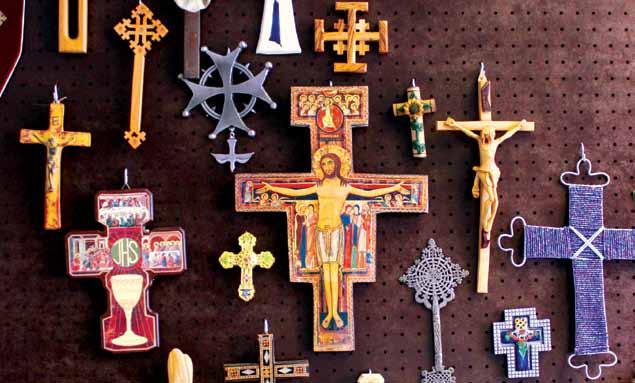
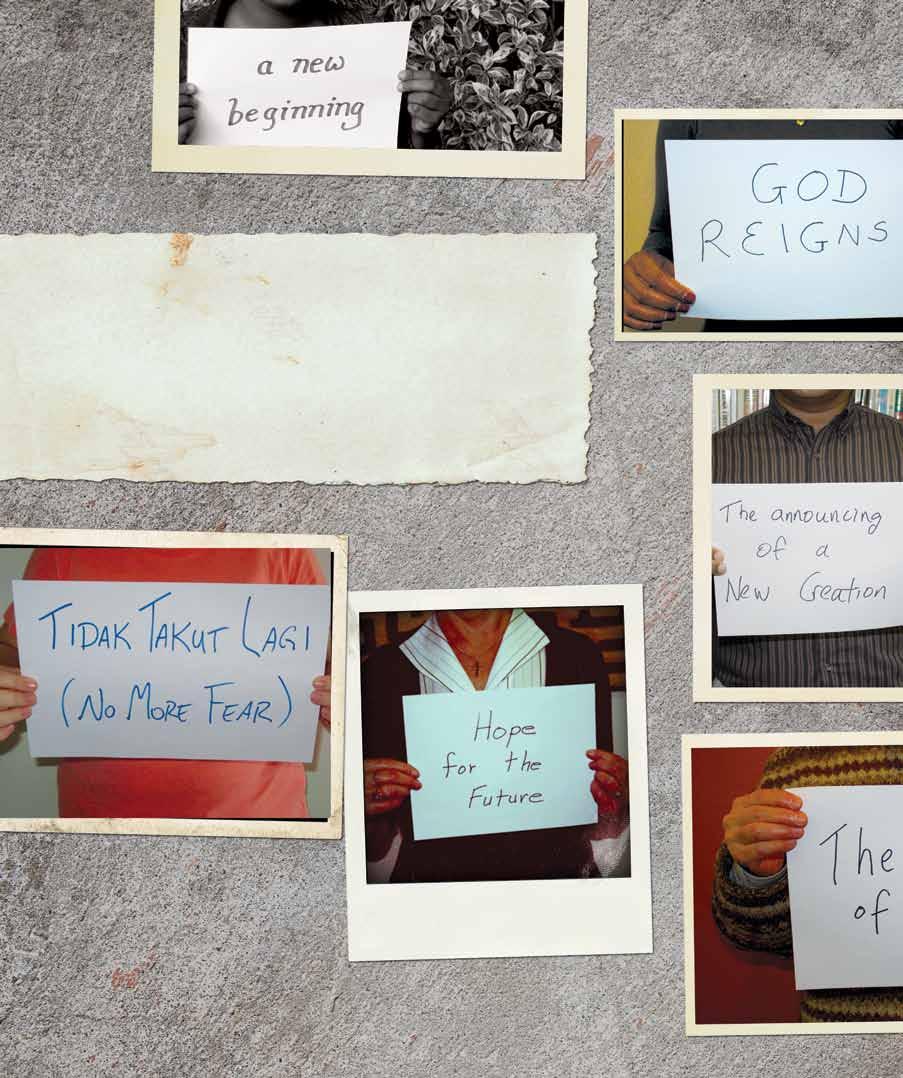
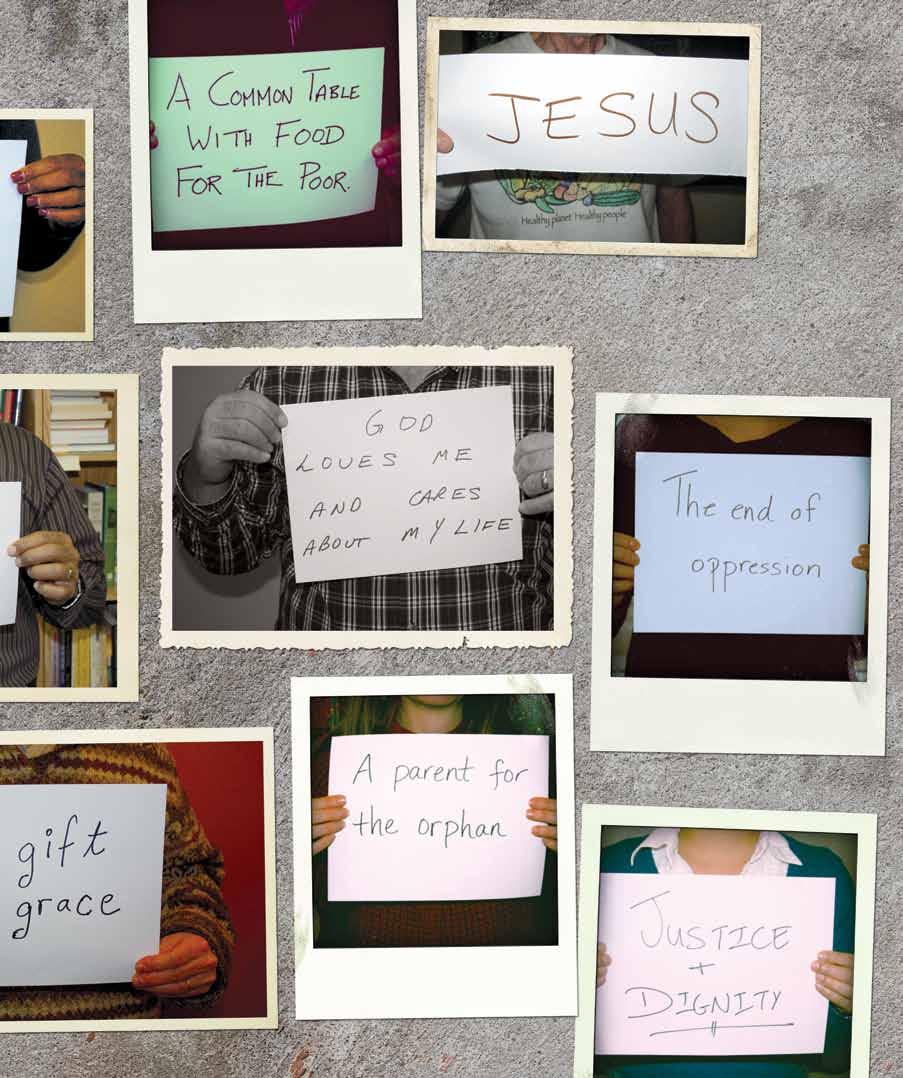
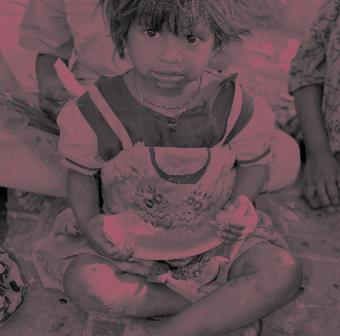
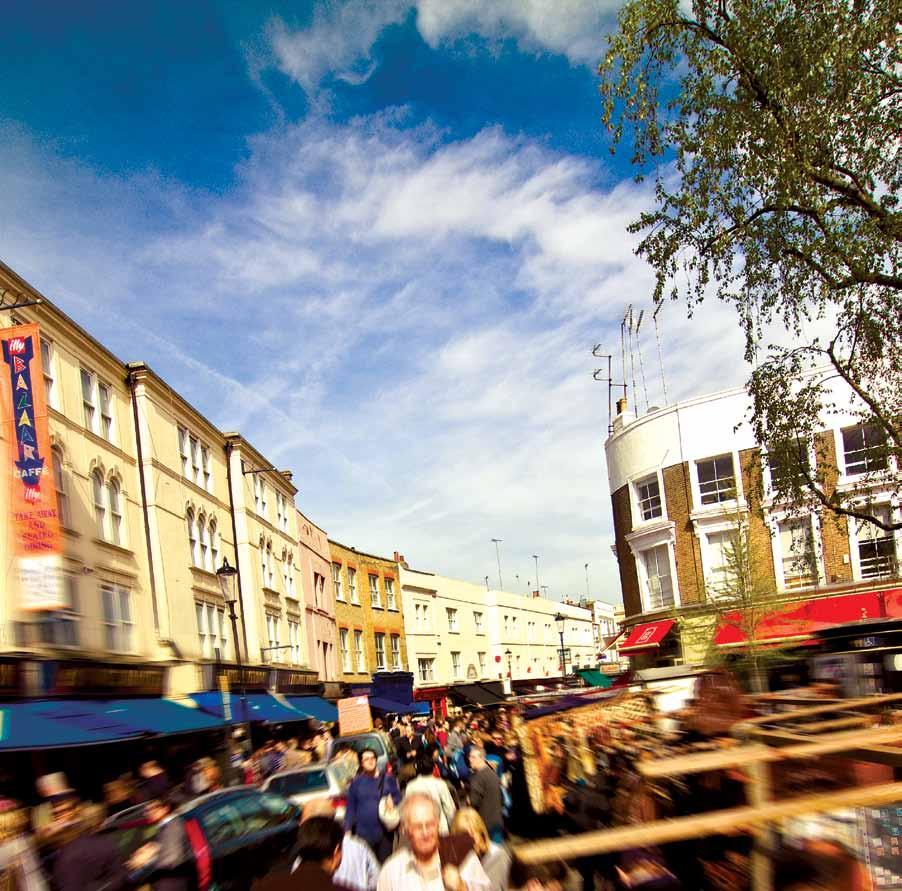
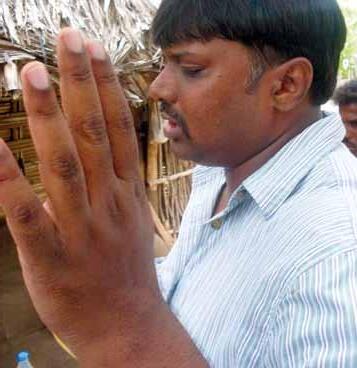
“What gives you hope?” we often ask during an interview with someone who faces incredible challenges. We wonder how they persevere. An orphan now heading up the household after his parents have died from AIDS. A young woman raped in war and now shunned by her community. A person now living alone after losing family in an earthquake… a car accident, divorce…tragedy is everywhere. But so too is hope. Time and time again, the answer to our question is, “God’s love. God’s grace.” These are people who have encountered the Good News and become part of God’s story. It’s also part of the story of global evangelism and global discipleship. The Church is a living testimony of hope — that in a world full of fear and despair, God intervenes in all kinds of ways. God cares for us and through us.
It’s not a perfect story. There are times we fail. We don’t engage in our world. We don’t confront injustice. We have wrong motives or attitudes. We need to keep going back to the roots, to tend the seed first planted.
For God so loved the world — so loved you, so loved me — that he gave his only son… Imagine if we dared to really believe and trust and act in this love. We would be both audacious and authentic as we shared the Good News for all people — poor, oppressed, imprisoned, downtrodden and disheartened — on the mountain, over the hills and everywhere.
Page 10 Beyond the Great Wall
Page 11 One Year in Lebanon
Page 12 J U st Thi N k What’s the Good News?
I continue to be stunned when i hear people say that “Christianity is a Western religion.” Christianity certainly didn’t start that way, and it is not that way today. This was obvious as i participated in Cape Town 2010 — The Third Lausanne Congress on World Evangelization
The Lausanne Movement began in 1974 when John Stott and Billy Graham called the evangelical leaders of the world to come together and think about the future of world mission. It was the first such gathering where Majority World leaders were well represented. Out of it came the Lausanne Covenant, which remains one of the foremost statements of the Christian movement and its missiology (i.e. approach to mission). Lausanne II took place in Manila in 1989, and in October 2010, Cape Town hosted Lausanne III, with 5,000 people from 198 countries as participants.
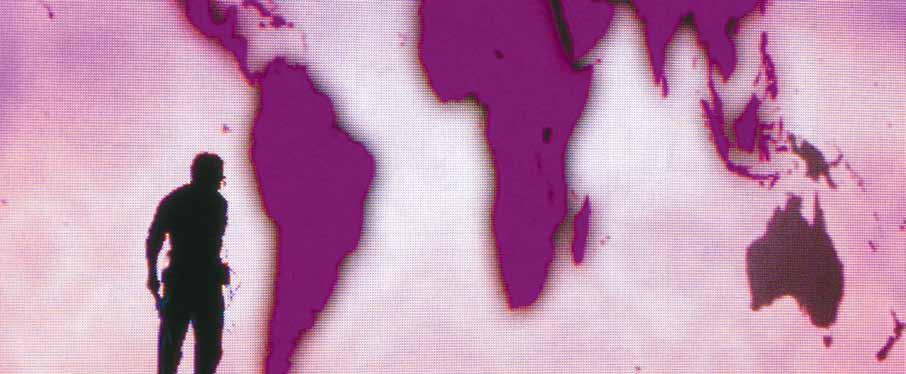
It is remarkable to be in a room where the face of the global church is obvious: lots of Africans and Latin Americans and Asians, and, yes, still some North Americans and Europeans!
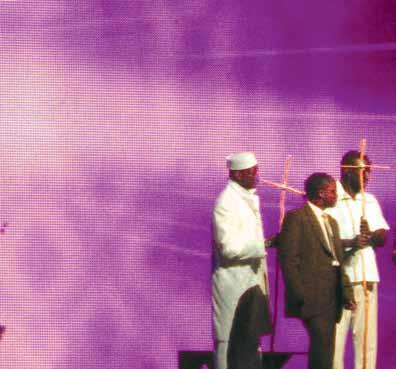
We worshipped together in multiple languages, which for me was an anticipation of heaven. In the midst of such a gathering it is easy to be hopeful for the future of the Church — to see how powerfully the Spirit is moving, birthing new expressions of the Church and calling new people into leadership. We live in an exciting time as God’s people.
Let me briefly share a few of my highlights from the Congress, each of which would take a book to unpack:
• Mission today is from everywhere to everywhere.
• Mission is about the words of Jesus and the works of Jesus: it is integral mission.
• We who live in the comfort of a Western lifestyle need to be challenged to a deeper obedience
by Rev. Sam Chaise General Secretary of CBM
that may include hardship. Many Christ-followers in the world already live in this reality.
• Our creativity and entrepreneurship in ministry needs to make space for partnering with others. Diversity is not an excuse for division; unity is embodied through partnership and collaboration.
• Our mission needs to be based in love and flow out of love — not our definition of love, but the love that flows out of the Trinity of Father, Son and Spirit.
Much of the Lausanne Congress is available for viewing on their website: www.lausanne.org/cape-town-2010. I encourage you to have a look.
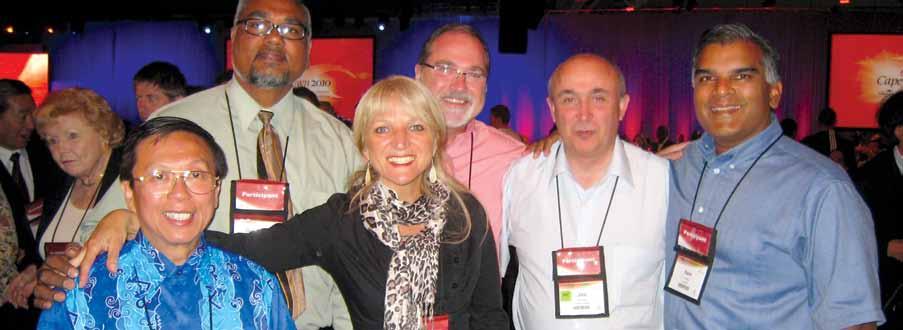
Sam’s small group at the Lausanne Congress in South Africa: from Jamaica, Malaysia, Serbia, Indonesia, Brazil, and Canada.
Confessions of a Repentant Evangelist
by Terry Smith CBM’s Director of International Partnerships
I admit it: I was a tireless evangelist committed to sharing my faith daily on high school and university campuses.
With a dog-eared Bible, an ample inventory of surveys and the Four Spiritual Laws, I wandered the cafeterias, residence lounges and student union building, looking for students I could buttonhole, asking if they would like to complete a short questionnaire and hear a brief summary of the reasons to believe in Jesus. At the end of each week, I submitted a written report of the number of times I had shared my faith and how many people I had led to Christ, along with the highlights of my week and the struggles I had encountered, recounting how I had done my little part to help fulfill the Great Commission.
Amazingly, every once in a while, it actually worked! I recall a student at the Université de Montreal named Claude, who not only responded to my request to complete a religious survey but stunned me by asking if I could tell him how he could become a Christian. After hearing me fumble my way through ‘Les Quatre Lois Spirituelles,’ Claude asked if he could pray the Sinner’s Prayer right there in the cafeteria, repenting of his sins and asking Christ to come into his life.
But for every ‘Claude’ I met, a host of more hostile agnostics pounced on me with their philosophical diatribes. One PhD student challenged me to a verbal duel in the student union building. After listening to just the very first line of the Four Laws (“God loves you and has a wonderful plan for your life”),
Jim Elliot, resonated in my heart: “He is no fool to give what he cannot keep to gain what he cannot lose.”
But the ah-ha moment came when a group of us were out witnessing in a public square in the heart of Paris, France. Street theatre, singing, sketch board drawings and literature distribution were our handy forms of public distraction. A well-heeled Parisian looked quizzically at me and asked, “Are you with those people over there?” and pointed across the square to a group of anarchists holding court among passersby. I reassured her that we were Christians, not utopian idealists.
“Oh, then you must be with them,” she said, waving her gloved hand at a small throng of New Agers signing up potential recruits.
“Heavens no,” I said. “We have the truth. They are following a lie.”
espoused a view that somehow, it all depended on me — my testimony, shared with my efforts and (inadequate) skills, to achieve my desired results.
he attacked my presuppositions relentlessly, with at least seven points of disagreement with just that one sentence: (1) Does God exist? (2) Does he have a name? (3) How can we know what God loves? (4) How can we know anything? etc., etc. I felt like pulling a fire alarm and fleeing in shame.
I was part of a generation of young people who felt that our spiritual and moral duty was to ‘come help change the world.’ Truth was propositional — a set of creedal affirmations that invited belief and obedience. I genuinely felt that it was my duty to God and humanity to be part of a great student army of crusaders. The testimony of the young Christian martyr,
After quizzing me on our affiliation with a wide array of religious folk, visionaries and charlatans, she snubbed her nose at me, and said, “Frankly, how do you expect me to believe in your God when you do exactly like everyone else.”
Many years later, I look back on that time of evangelistic fervor with a myriad of conflicting sentiments. I learned to be bold in my faith and concerned for the eternal destiny of humankind without God. The Gospel is good news. But some deeply disturbing aspects of that ‘aggressive evangelism’ approach haunt me, even today: its simplistic and reductionist conversion-based content, disincarnated format, inadequate view of the local church and a failure to call Christ-followers to a kingdom perspective of life and service. I had
Frankly, how do you expect me to believe in your God when you do exactly like everyone else.
Much of the discussion on evangelism in the 20th century has been encapsulated in catch-phrases replete with grandeur and zeal: ‘The evangelization of the world in this generation’; ‘The whole Church bringing the whole Gospel to the whole world’; ‘Reaching the world by 2,000 AD.’ These phrases have all helped capture the urgency of the task of evangelism, while often displaying a naïve optimism and preoccupation with quantifiable goal-setting. Our devotion to the Great Commission has, at times, subjugated our faithfulness to the Good News. Evangelicals in the West became convinced that ‘sharing the Gospel’ was the supreme purpose of the Christian life. We stood in condemnation of any agenda that didn’t place evangelism at the heart of mission. Donald McGavran, among many others, was a fierce advocate of this singular vision of proclamation evangelism and he unrelentingly warned about a world of two billion people who were condemned to an eternity without God if we didn’t preach the Gospel.
A people of the Good News: My understanding of evangelism has morphed into a broader, kingdombased vision of God’s mercy and justice, helped by authors like Os Guinness. His writings, now spanning more than 40 years, have shaped a generation of Christians. He often challenged young evangelicals to think in believing and believe in thinking. Evangelicals are ‘a people of the Good News’ who define their lives and their faith by a devotion
to the Gospel, embracing it, thinking it, living it, and sharing it. Central to our understanding of the Christian experience is the premise that we have come to faith and we have in common a passion for sharing our faith with others. Guinness helps us remember that the plausibility of the message and the credibility of the witness are intrinsically related. Simply stated, we cannot effectively share the Good News unless our lives are characterized by the impact of good news in every dimension of our lives, individually and collectively.
…we
cannot effectively share the Good News unless our lives are characterized by the impact of good news in every dimension of our lives, individually and collectively.
Polemical views flourish: For some Christians, mission is reduced to evangelism: preaching the Gospel and calling people to repentance. Any other expression of Christian mission is secondary and serves only to soften the soil for the seeds of conversion to take root. This approach held sway in the latter half of the 20th century and may still be found in some more fundamentalist milieus. At the recent Lausanne Congress, where many presenters articulated a comprehensive and integral view of the Gospel, one influential American Baptist, John Piper, resuscitated the old argument, challenging the attendees to be moved by God’s heart for human suffering, but to be more moved by God’s heart for the eternal destiny of the lost. According to this perspective, community development, environmental concern, compassion and justice initiatives are fine and dandy, but we could leave them to non-Christians. We must get on with the task of preaching the Gospel.
At the other end of the spectrum, all evangelism is banished. In a post-Enlightenment, post-Christian, post-modern era, we dare not state any position or meta-narrative too strongly. This view sees Christianity’s truth claim of Jesus being the only way and the call to faith and repentance as vestiges of a bygone, Bible-thumping era of revivalist preaching. How could anyone be so arrogant as to claim they have the truth? Evangelism is associated with an imperialistic expansion of Western ideology. According to this perspective, in today’s relativistic world, followers of Christ must be humble enough to accept other belief systems and admit that no one possesses the truth.
Another tension within evangelicalism is the attempt to separate ‘believing’ and ‘belonging,’ to distinguish between believing in Christ as our personal Saviour and our admission into the family of faith, the Church. George Hunter’s delightful book, The Celtic Way of Evangelism, calls the Church today to return to a Celtic model of mission. The author outlines what he sees as a stark contrast between the Roman and the Celtic model of reaching people for Christ. In the Roman model, you reach ‘civilized’ people by presenting the Christian message, inviting them to believe in Christ and become his followers, and, if they decide positively, welcoming them into the church and Christian fellowship. Presentation–Decision–Assimilation.
The Celtic model, demonstrated by St. Patrick in his mission to Ireland, was to first establish a community among the people you seek to impact, or invite them into your community of faith, then, within that community, to engage in conversation, prayer, ministry and worship with them. In time, as they discover that they, too, now believe, you invite them to commit themselves to discipleship and ministry within and outside of the community.
Clearly, the way we define evangelism predicates our engagement in the task of sharing the Good News. The more broadly worded the definition, the more encompassing our evangelism. Narrowly defined, evangelism might be just sharing the story of Christ’s sacrificial death and resurrection and calling people to repent and believe. This was my approach on the university campuses. But more broadly, the Good News might entail a radical transformation and restoration of relationships, a call to radical living and an engagement in shaping a broken world. As a teenager, I was swayed by the saying that evangelism is one thirsty beggar telling another thirsty beggar where to find water. In other words, it was about sharing a sense of hope and salvation for the here-below and the here-after. It might even be giving a cup of cold water to a thirsty person. But if everything is evangelism, then nothing is evangelism.
David Bosch’s construct is helpful: “Announcing that God, Creator and Lord of the universe, has personally intervened in human history and has done so supremely through the person and work of Jesus of Nazareth, who is
the Lord of history, Saviour and Liberator.” This view of evangelism helps us see that (1) evangelism is a process of announcing or sharing God’s story for humanity, (2) the centrality of the work of Jesus in restoring humanity to a right relationship with God, and (3) Christ is king over the earth. Evangelism is really about spreading the good news that God is mending a broken world through Christ’s death and resurrection, and he calls us to reject any other alternative but Jesus as our new reality.
from the storm. God is saying, “Here is my blessing, wrapped up in Christ’s death and life. Get rid of your old way of thinking. Grab hold of a new way. Accept the gift of my love and forgiveness.”
I have just returned from China where I was struck over and over again by the power of the witness of the Church. I heard testimonies of the lives of men and women whose lives and families, belief systems and worldviews had been transformed by the Good News. The health of the Church in China is intrinsi-
We must add to our evangelism a concern for the poor, theological depth and a commitment to justice.
A personal invitation
Clearly, evangelism includes an invitation to respond. If, in Christ, God has satisfied the need for justice while demonstrating his mercy and love, we are asked to say yes (or no). It isn’t enough to state the news that God offers us hope and salvation in Christ, we are called to reject other alternatives, to believe it, to accept it and give ourselves wholly to it. Today, many Christians are reluctant to elicit a response. The good news of Jesus is likened to hearing about a sunny weather forecast for the May long weekend. It’ll just happen — enjoy it. You can’t do anything about it. But such a view minimizes our humanity and discredits our need to embrace change. Repentance, or metanoeia in Greek, means an about-face. Turn away
cally related to the confidence of Christians to share the story of Jesus Christ as Lord. In one church, which has grown from 40 members in 1995 to over 1,000 people today, I asked the pastor how she mobilized people to share their faith. She told me that people who had been changed by the Good News found it normal to share the news with others. Reminding me of the Chinese proverb, ‘He who deliberates fully before taking a step will spend his entire life on one leg,’ she said that the evangelistic passion of the church involves confidence and action. “We must add to our evangelism a concern for the poor, theological depth and a commitment to justice. But in response to God’s love, we must take that first step.”
For 20 years, terry smith and his wife Heather were involved in ministries in France ranging from inner-city youth work, church planting, outreach programs for Muslims, theological education and leadership development. in 2003, he joined the CBM Leadership Team as the Director of Partnerships and initiatives. his responsibilities include mission strategy, partnership building and supervision of Global Field Staff. in 2010, Terry obtained his Doctorate of Ministry in Missiology at Acadia University in Nova Scotia, Canada.
Good News in
B o l i v i a
by Jim McBeth, CBM’s Team Leader in Latin America
When Canadian Baptist missionary Archibald Reekie first arrived in the Bolivian mining town of Oruro in 1898, there had not yet been a single Protestant church established in the entire country. At the time, the Bolivian government prohibited any direct evangelistic ministry, and so Reekie began reaching out to the community by teaching classes in English, and then founding a primary school in Oruro. Out of that mission strategy came the first converts to evangelical faith, and the first evangelical churches in Bolivia were born.
And so right from those early beginnings, Canadian Baptist mission in Bolivia has always had a dual focus on both the verbal proclamation of the Gospel and the practical demonstration of the Gospel, specifically in the areas of education, land reform, healthcare, agriculture and community development.
Today our national partner, the Bolivian Baptist Union (BBU), continues to have a strong vision to reach the nation of Bolivia with the life-changing message of hope through Jesus Christ. Sometimes that takes place through organized evangelistic “cruzadas,” where dozens of local churches work together to reach their communities. One of these crusades recently took place in the city of Santa Cruz, where Christians from all over
Bolivia and South America participated.
Part of the BBU’s strategy over the next five years is to plant 100 new congregations in communities and neighbourhoods where there are presently no evangelical churches. In their desire to reach some of the more remote, unreached areas of the country, they recently commissioned a missionary family to begin a new work in the town of Cobija, in the heart of the Amazon Rainforest right on the northern frontier with Brazil.
But there is also a strong emphasis on combining evangelism with social concern for the poor and the marginalized. Evangelism in Bolivia will not be effective unless it includes a vision to address some of the very real material and social challenges the people face. In the city of Cochabamba, where we live
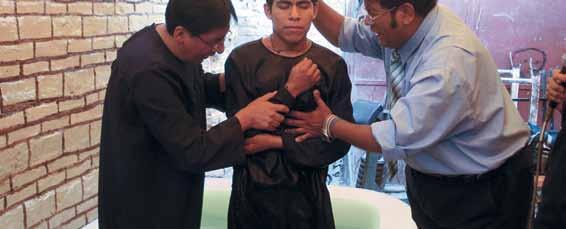
and work, a vital outreach supported by The Sharing Way takes place among prisoners and their families. Casa de la Amistad (Friendship House) provides a place of refuge and nurture for the children of prisoners, many of whom must live with their parents right in the jail. Every day over 100 children come to the Casa to get help with their schoolwork, enjoy a nutritious lunch, and receive lots of love and care from the staff. This is where many of them hear the good news about Jesus for the first time. The Casa also has an outreach to the prisoners themselves, and this year nine of them were baptized and now hold Bible studies in the jail.
A number of local churches in Cochabamba also run day programs for children where they attend classes, eat lunch, and receive instruction in biblical and ethical values. These programs provide a vital link between churches and the needs of the communities around them. One church just outside of Cochabamba runs a rehabilitation and vocational training program for men trying to overcome drug and alcohol addiction.
Many of the local churches in Bolivia send mission teams to outlying areas several times a year. For example, the little local church we attend in Cochabamba will send teams to Aiquile, a small rural area south of Cochabamba, to do evangelistic services and provide clothing and other necessities to the people in that community.
In these and many other ways, the churches of Bolivia are seeking to transform their nation, both proclaiming and demonstrating “good news to the poor.”
A baptism in a Bolivian prison.
From Under the ree
by Colin Godwin, CBM’s Team Leader in Africa
Evangelism in Africa used to be as simple as gathering the village under a tree, opening the Bible, explaining the Gospel in the local language and asking people to make a commitment to follow Christ. Through simple methods of evangelism, large numbers of people were brought to faith in Christ. Today, there are new challenges and opportunities in sharing the Good News — modern media, urbanization and consumerism.
only through justice initiatives and compassion for the poor that the Church can regain its prophetic voice in society.”
In nearby Rwanda, the challenges are strikingly similar. Benjamin Nkusi is a Methodist pastor and vice-rector of the Rwanda Institute of Evangelical Theology, which CBM supports in partnership with the Association of Baptist Churches in Rwanda. “When I was a young man and a new convert, we did not have enough Bibles,” Nkusi relates. “Technology of all kinds has made such a difference to spreading the Good News.” But evangelists in Rwanda are still despised and poorly funded. For a time, Nkusi was the head of the evangelism department for his church, but it was difficult to do any work because they had an annual budget of zero! There is still a tendency in Rwanda today to see evangelists as beggars, making it difficult for them to find a sympathetic hearing.
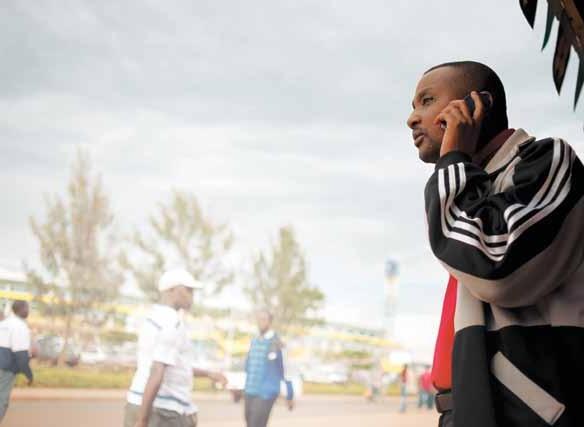
Bishop Timothy Ndambuki of the Africa Brotherhood Church shared how when he was a boy, it was difficult to get access to radio broadcasts in his village. In modern Kenya, the wealthy have access to the Internet and television, and only the poorest of the poor do not have an inexpensive cell phone owned by a family member. This has made it easier to proclaim the message of Jesus over the airways, but it has also seen the rise of unscrupulous preachers who promise the poor that they will become wealthy if they give all of their possessions to the church.
Accompanying the rise of modern communication has been the move of people to the cities and increasing consumerism. There have been some good aspects to this more cosmopolitan Kenya. As Ndambuki shares, “you are less likely today to hear a preacher using
the Old Testament to forbid people intermarrying with another tribe.”
However, it has also led to what he describes as “the slow dismantling of the communal structure of Kenyan life.”
Consumerism means people have less time to devote to their faith, and people outside the church may be more interested in becoming wealthy than they are in seeking the Lord.
Evangelism in Kenya has come a long way from the village tree where it started. The gospel message is not only about eternal salvation, it is about belonging to God’s Church in the here and now. In an effort to restore a sense of community to new converts, evangelists in the Africa Brotherhood Church have been gathering them into small groups. The plague of consumerism has to be confronted head-on by evangelists because, as Ndambuki says, “it is
Echoing Ndambuki’s concern for regaining the prophetic voice of evangelism in Kenya, Nkusi relates that “churches in Rwanda have lost the confidence of the people because of the participation of church leaders in the genocide in 1994. Rwandans ask how they can trust the Christian message when those who spoke for Christ either said nothing or actively participated in the deaths of nearly a million people — on tribal grounds.” So while people are open to the Gospel in Rwanda, the church must also regain a prophetic voice in order to speak credibly about peace between God and humanity.
Urbanization, consumerism, technology and the media… these are challenges for Christians all over the planet who seek to proclaim the Gospel. In Africa, Christian leaders concerned about evangelism see these challenges as opportunities to make sure that the message that is preached is a prophetic one: a gospel for the poor, the weak and those who need to be reconciled.
Beyond the Great Wall
A look at church in China and the Chinese diaspora around the world
by Rev. Pak Loh, CBM’s Chinese Ministries Team Leader
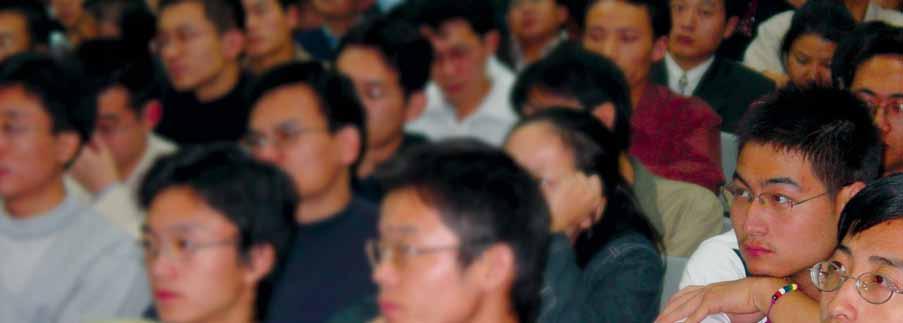
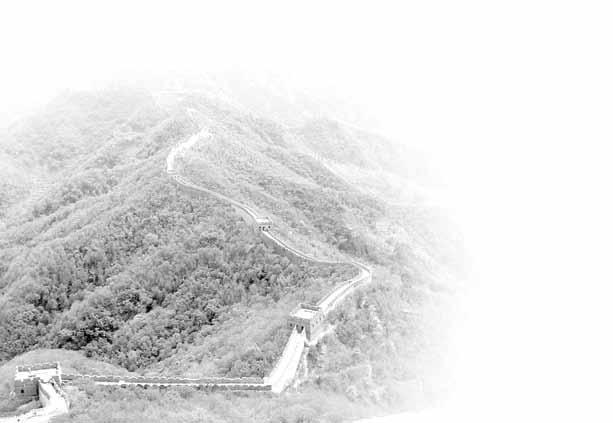
The growth of Christianity in China is a miracle in modern church history. Within the past 60 years, the number of Christians has jumped from less than one million to more than 70 million* — a conservative estimate.
In Beijing, a survey found that 60 percent of university students were open to the Gospel. A church that began with 150 people three years ago has since grown to 1,000 attending Sunday worship. Another small city church in a poor region of China that started a university and career fellowship with five students two years ago has now grown to 50. A taxi driver became a Christian when driving three visiting pastors to church on Sunday, and stayed with them at church the whole day.
However, while people are open to the Gospel, one basic hurdle remains — the notion of Christianity as a Western or foreign religion. The universality of the Gospel is still a strange concept to many Chinese people because they tend to hold a worldview that separates East and West. They see Christianity as a product of the West, particularly from the United States. To become a Christian, then, implies letting go of one’s Chineseness and embracing a Western religion.
Another issue is the rapid pace of urbanization, where people are thrust from rural villages into the cities. Today there are 300 million migrant workers in most of the major cities in China. This presents a huge and unexpected burden for any modern city. For example, Shanghai has a population of 20 million people, nearly half (eight million) of whom are migrant workers. Some churches have reached out to serve abandoned street kids, beggars, uneducated migrant workers and their children. There is also the need to reach academics and professionals who are faced with materialism and burgeoning divorce rates.
As young and employable people move into the cities, the elderly and children are left behind in the villages. This presents another challenge and opportunity for evangelism. Cults are generally more prevalent in the rural areas. In fact, the Eastern Lightning, a fierce Chinese cult, has taken advantage of this social dynamic to expand their influence in rural areas. They are very caring and persistent. Many rural Christian meeting points have been infiltrated when the host of the Christian meeting point is converted. Rural churches in China are crying out for solid biblical and lay-pastor training.
There is a saying that wherever the moon shines, you will find Chinese people — 1.3 billion in China and 40 million outside China, everywhere around the globe. The growth of diaspora Chinese communities goes hand in hand with emerging global economic opportunities. Chinese can be found in Venezuela building the railway, in Angola building the highway, in Bosnia doing trading, in Russia operating Chinese grocery stores. They seek to make a decent living overseas so they can send money back to China or to become established in their new communities.
Students are a key segment of the Chinese diaspora. More than 200,000 Chinese students study abroad every year, and about ten percent of the average 70,000 who return have become Christians. Students face many challenges while studying in a new country, including loneliness, communication barriers, academic pressure, and parental expectations. Two years ago, CBM deployed John and Ruth Chan to Germany to minister among Chinese students. Their goal is not to plant a big church, but to establish a discipleship and training base to care for and nurture the students who will return to China upon their graduation. At 85 percent, Germany has one of the highest Chinese student return rates. The Chans have created a fellowship of 30 who meet on Sundays. There are more than 60 such Chinese fellowship points and worship places in Germany and only 15 workers like the Chans.
As we seek to build strategic partnerships, we cannot ignore the significance and needs of the Chinese diaspora. CBM’s Chinese Ministries must be borderless.
* No one really knows the exact number of Christians in China. However, it is estimated that the number is in the range of 70 to 130 million.
Did you know that…
• The current ratio of pastor to church member in Sichuan Province is 1:10,000. (Rev. Long, Sichuan Christian Council)
• Scarborough Chinese Baptist Church is the largest Canadian Baptist Church with approximately 2,000 regular attendees.
From Beijing to Germany
Life as a Foreign Student
by John Chan CBM Strategic Associate
B.R. left Beijing to study in Germany. He met and fell in love with a girl and after several years they decided to get married. Sadly, their marriage lasted only two months. A painful divorce left B.R. battling depression. For the next two years, he was unable to sleep or focus on his studies. He lost the will to go on.
During this time, B.R. started reading the Bible. Although he didn’t understand it fully, he was intrigued. Then he found some books that his ex-wife had borrowed from our church’s mobile library. he called to return them.
i visited B.R. at his dorm and listened to his story. i told him of another story, the story of Jesus and his love for us. B.R. responded, accepting Christ as his Saviour and putting his trust and hope in God.
Since then, B.R.’s life has started to turn around. he was baptized last year and is maturing in his faith in our Christian community. he still has many ups and downs: he continues to battle bouts of depression and is cramming to catch up with his studies, but he is receiving counselling and hopes to graduate next year. The Word of God is working in his life and the change is unmistakable. B.R.’s spiritual growth reminds us that we may sow or water the seed, but it is God himself who makes the person grow!
connecting…
You can support outreach and church-planting in Africa, Asia and Latin America. Call 905.821.3533 or give online today at www.cbmin.org.
One Year in Lebanon
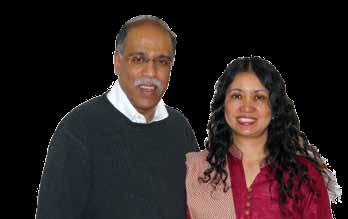
An interview with Rupen and Mamta Das, CBM Global Field Staff in Lebanon
by Giselle Culver, CBM’s Global Discipleship Coordinator
mosaic: Some reflections on your first year in Lebanon…
We have spent the first year listening, observing and trying to discern what God is already doing here and where he wanted us to fit in. We are doing a major study to better understand what poverty looks like here… besides material poverty, we are seeing marginalization, voicelessness and powerlessness. New vulnerable groups are emerging, including vulnerable children — street kids, working kids, children of prisoners, refugee children, children of migrant workers, and so on. We are right now looking at who and where these children are. Based on that, we’ll be designing programs that will enable local churches to respond.
mosaic: Can you give us a brief overview of the historical, political and religious context of the region? What impact does this have on Christian witness and mission?
Wow! How does one make 6,000 years of conflict brief! This is a society and region deeply fragmented by ethnic, religious and tribal differences. Conflicts go back centuries. Violence and brutality is a reality that few in the West can imagine. In this kind of context, it
is hard to verbally witness to the reality of God. Yet people are hungering for a reality of God that they don’t get from any of the major organized religions in the region. So the challenge for Christian witness is not just to provide an intellectual argument for Christ but to demonstrate the reality of the Kingdom of God — to cross religious, ethnic and tribal boundaries in the process.
mosaic: Can you address misconceptions/misunderstandings that exist regarding Palestine…
People in the West forget that there are Arab and Palestinian Christians who have a vibrant faith and are reaching out to the poor, the marginalized and the lost at great cost to themselves. Regardless of our theology regarding Israel, we must not forget those who are caught in the middle of the geopolitical struggles and who have lost home, family, material possessions and all hope for the future. What is the church’s responsibility towards them? Are we people who build bridges? Are we peacemakers? We sometimes spiritualize “blessed are the peacemakers for they shall be called the sons of God” to mean that we are to be only peacemakers between God and man, and forget we are also called to cross barriers between communities and be agents of peace.
You can become a Partner in Mission with the Dases. Call 905.821.3533 today.
Mangos on a Mission
What does planting a mango orchard have to do with the mission of the church? There is a remarkable story behind a little orchard in India.
by Das Sydney,
This story begins with a devout widow in India, Mrs. Ramanarsamma, who wanted to do something for God. She was also a dreamer. She dreamed of a clinic that would serve the many poor villages of her area. She donated a two-acre tract of land to her church for such a clinic. Sadly, the clinic never became a reality. No medical staff wanted to live in that impoverished part of the country. Economic conditions were grim and life was hard for everyone. Farmers despaired of life in the country, and many abandoned their land and family homes to seek a better livelihood in the city. Very few were successful.
Enter Dr. Judson, another dreamer. Along with other members of the South Lallaguda Church, a remarkable dream took shape. What if they could use this property to develop a demonstration farm, to show these desperate farmers a new way of farming, such that they could make a very good income? They researched various possibilities,
Senior Pastor of Highland Baptist Church — Kitchener, Ontario
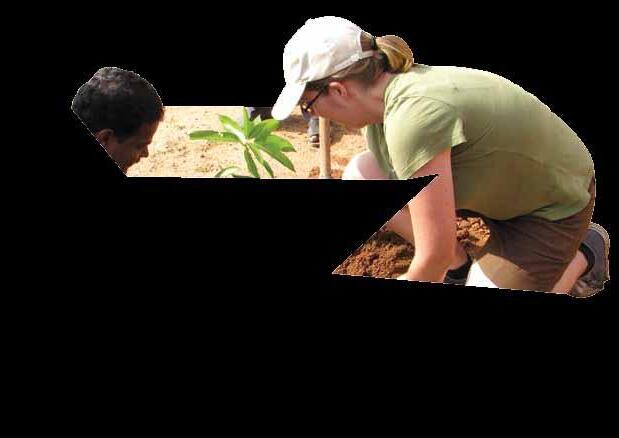
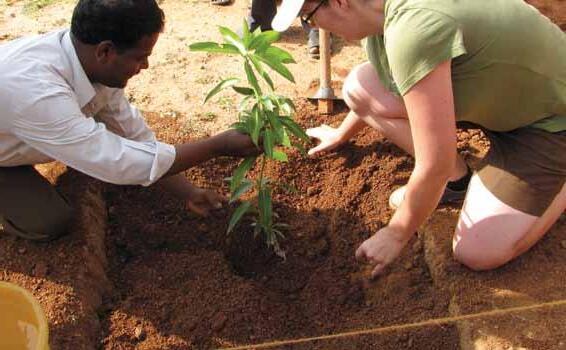
Jennifer Sparks-Piggott, one of the team members from highland Baptist Church, helps plant a mango seedling.
and came up with a plan. We were there as a short-term mission team to help them make this dream and their plans a reality.
On one acre we were to plant 70 mango seedlings. The other half would be filled with vegetables, millet and fodder. It would be surrounded by a green fence — a thorny bush plant — to keep out the goats.
Why mangos? What they discovered is that in this arid land, drenched seasonally by the monsoons, the mango tree could survive. What they dared to believe is that a small investment in mango seedlings would reap a rich dividend. Each mango tree seedling costs about 10 dollars. In four to five years, if properly cared for, each tree will produce 150 mangos, and the orchard will generate close to $3,000 a year — an amazing income for those struggling to live on a little more than a dollar a day.
hands on “untouchable” lepers. He stopped to talk to women like the Samaritan at the well, despite the barrier of race. Jesus shattered every barrier between people that he encountered.
What does it mean in our day to break down the barriers of distance, culture and race? It is to build bridges of trust, love and partnership.
In India, poverty is worst in the states of Bihar and Orissa, both states with political unrest and Maoist activity. With high infant mortality,
What does it mean in our day to break down the barriers of distance, culture and race? It is to build bridges of trust, love and partnership.
Parts of India are highly industrialized and sophisticated. While we were in India, a local paper reported that an Indian rocket had put a Canadian communications satellite into orbit. Nonetheless, about half of the people of India languish in unimaginable poverty.
There are barriers of custom and culture, language and education, distance and borders between Canada and India. Let us consider Christ’s attitude to barriers. With him, barriers came tumbling down. Jesus violated social customs by hanging around with unsavoury characters and the outcasts of the day: prostitutes, political radicals and lower-class labourers. He laid
high unemployment and grinding poverty, people are easily drawn into the rhetoric of extremists. How do you help people in desperate straits rise out of the dark hole of despair? What do you do when such giant need faces a whole subcontinent?
To paraphrase an ancient proverb, you can light a little candle of hope, rather than curse the darkness. There are many ways in which the South Lallaguda Church is bringing hope: offering AIDS care and support, teaching health and hygiene, building safe latrines, giving micro-enterprise loans. The church has also found effective ways to integrate serving
ministries with the proclamation of the good news of Jesus Christ. It has planted over 20 satellite churches. We were privileged to participate in one of their projects — developing a demonstration farm to show poor farmers in rural India what is possible with their dry, sandy soil. That was our small but meaningful effort to spread the good news, one mango seedling at a time.
connecting…
New short-term mission opportunity for 2011: Join Blair Clark, CBM’s Associate General Secretary for an educational tour of Turkey this April 28–May 12.
For Youth: Spots still available to visit Czech Republic this May 6–May 20 and participate in ESL activities. More information and application forms are available at www.cbmin.org
Stats at a glance:
in india, 421 million people live in extreme poverty.
Almost 50 percent of South Asia’s one billion people are poor.
Good news in india, moving from despair to hope through integral mission.
Cry of the Foreigner Among Us
Refugees are not a recent phenomenon in the Middle East. During times of famine, Abraham, Jacob and Naomi all travelled to other lands with their families. Daniel and his friends were prisoners of war. Mary, Joseph and Jesus were refugees in Egypt, running away from a murderous situation. Priscilla, Aquila and many others had to leave Rome because the Emperor expelled the Jews.
by David Phillips, CBM Global Field Staff in the Middle East
Today only a few countries receive refugees. Canada is one of these countries, but significant difficulties with the Turkish authorities have prevented refugees from being resettled in Canada for the past five years. During the last year, Cathie and the team at Istanbul Inter-Parish Migrant Program (IIMP) received clients from 58 nations around Turkey. When they arrive they do not know the language, they have no chance of getting a job, and no place to live (there are no refugee camps in Turkey as there are in other parts of the world).
A., a beautiful, lively young woman, comes from a country east of Turkey. After finding out about her and her parents’ new-found faith in the Messiah, angry relatives burned their home. They moved to a city, but the relatives followed them there. They threw acid on A., missing her face, but causing third-degree burns on most of her body. She continues to suffer. A long series of operations stretches ahead as her body — from neck to knees — needs careful skin reconstruction.
In the meantime, she and her family await a possible relocation to a country that accepts refugees. My wife Cathie and the team at IIMP are carefully
working on this long process. I think of the biblical story of the little girl who was taken as a prisoner and became a blessing in the house of Naaman, the enemy general who contracted leprosy. We believe A. will become a great blessing in the Kingdom of God, as well.
R. comes from an African country that has been deeply wounded by
months the Ex-Minors group was given a place for eight young African men to stay. R. continues to raise awareness, funds and care for those who, like him, are victims of long-lasting wars in Africa.
A small group of dedicated, insightful, creative workers and volunteers at IIMP is making a huge
Many have come to a saving faith in the Lord Jesus after having gone through untold suffering.
conflict and bloodshed. His family was killed when he was about 16. Somehow he found the means to come to Turkey. As a minor, he was cared for by the Turkish government. However, when R. turned 18 he was put out on the street. Undaunted, he proceeded to form an association, called Ex-Minors, to help care for other young men like him.
He went to IIMP and other church groups asking for support. After many
difference in the life of A. and R. and many other young men and women. They are there through all kinds of crises. Thank God for these dedicated people who have the love of Christ in their hearts. Thank the Lord, too, for the “miracles” — daily provisions that make this care possible. Many have come to a saving faith in the Lord Jesus after having gone through untold suffering.
v i e w the
Suraj Komaravalli
CBM National Field Staff in India, shares a little of his life and ministry
From my childhood…
I heard of CBM through my father, late Rev. Dr. David Komaravalli, who grew up with the support of CBM missionaries and shared the vision of those who were then ministering in Andhra Pradesh (one of 28 states), where he was a Professor of New Testament and Principal at Andhra Christian Theological College.
I am encouraged by…
A visit to Kenya and Rwanda showed me that CBM values each and every individual, opening up possibilities for creativity and collaboration in ministry work. This surely speaks volumes, especially in my context where church administration is crippled with many self-centred and power-craving people. Churches and many Christian organizations have suffered with strife…this situation burns on my heart.
I was drawn to teaching the Bible because…
Many of the churches in Andhra Pradesh struggle to live as the body of Christ. Today there is a deficiency in committed Christian leadership. In this context, the seminary provides leadership formation. The best place to begin is with young students who have not yet been polluted by factional behaviour and unnecessary politics in the church.
Almost all of the young students belong to the grassroots, the Dalits. They have a commitment to preach the word but are financially not in a position to be equipped at a seminary. It is a challenge to train such young students as there is always the temptation to imitate some of the factious leaders. But a sound biblical basis gives young students the strength and ability to think clearly and express Christian beliefs, values, conviction and commitment, and to encourage and generate a spirit of unity in a congregation. It also gives them a deep sensitivity to the needs of people — to motivate the church to address issues such as poverty, political unrest, gender issues and caste barriers.
Two or three essential ingredients of transformational leadership are…
Humility under God, trustworthiness and hearing God’s Word. Self-examination, walking in Christ, serving…
(Mk. 10:45) Being neither self-centred nor power hungry… Transformational leaders begin today (Lk 4:21). After informing the community of his mission in the temple, Jesus put his ministry into action.
My message to the Church in India…
In Andhra Pradesh, the Church has been in a comfort zone of preaching and hearing the Gospel within the four walls of the church building. The Church may have many examples of creative, energetic congregational life, but at a deeper and broader level, it lacks a coherent sense of what ministry demands. Some local churches are serving to uplift the poor but are passive in addressing political unrest and violence in society.
The Church in India has to realize that it is meant to be salt and light, an agent of change in society. To position itself as an agent of change, the Church needs to make its witness to Christ a reality...We need to live in society and realize that we are part of society…to begin to study and analyze situations of unrest…to collaborate with local churches to strengthen unity in Christ…to make an impact through our unified witness.
When: Monday afternoon
Where: Western kalimantan, indonesia
Who: Mr. Musan
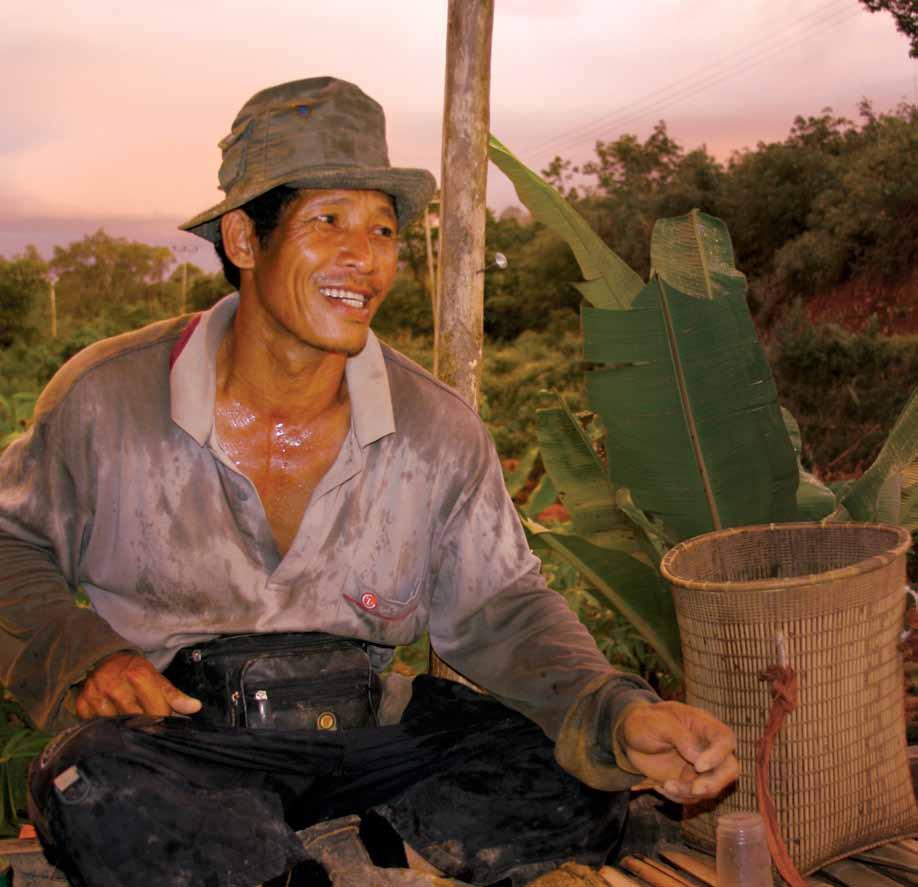
The rain started to pour down. We jumped off our motorbikes and ran for the small “pondok” (farm shelter), clambering up and under the small thatch roof. The sweet smell of rain infused the little hut as the sun set. The light turned bright red. Dusk fell, then darkness. I reflected on those around me — Johnny, myself and our daughters. Nikson and Marina, the national missionaries to the area, and their daughter. Three families from the area. Mr. Hendrik and his wife own a beauty salon and photography shop in the village. Mr. Andre and his wife own a bakery. Mr. Musan works and also owns this farm. A small community of believers who support each other, encourage the work of Rev. Nikson and seek to be a witness to the Good News in this place.
by Paige Byrne-Mamahit
Editor’s Note: After 10 years of faithful service as CBM Global Field Staff in indonesia, Johnny and Paige returned to Canada at the end of December to pursue a call to new ministry. They will be on home assignment until April 2011.
Your Gifts in Action
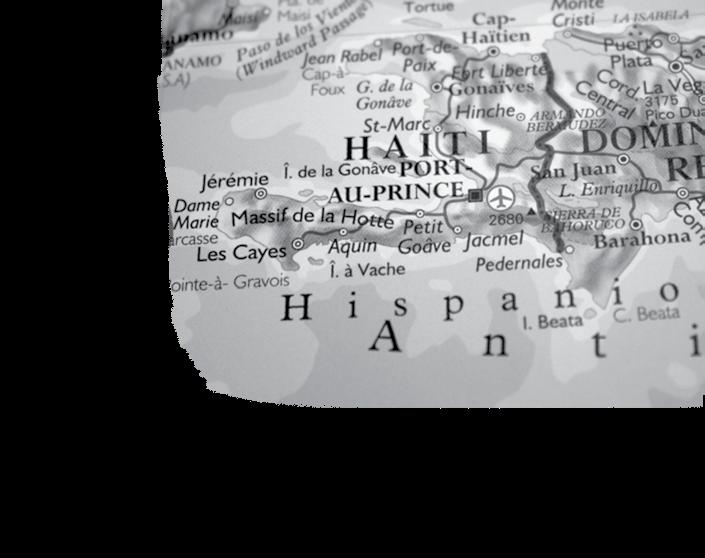
Haiti
The clinic is packed with patients — about 40 beds and camp cots are crowded into three rooms and the hallway, with IV bags hanging from window shutters and nails in the wall. Each patient has a bucket beside their bed because of the frequent vomiting. Family members must bring bed sheets and clean the floor.
This report comes from a volunteer in Haiti, where a medical team from EMAS Canada, supported by The Sharing Way, helped to respond to the current epidemic of cholera.
Cholera is a highly contagious waterborne disease, most commonly spread through contaminated water and sometimes contaminated food. Without immediate medical treatment, it can be fatal.
The Sharing Way is also funding the Siloe Centre project of the Baptist Convention of Haiti, which is in an area affected by the cholera outbreak. This project will provide much needed community services such as skills training for women, as well as improved sanitation facilities.
The Sharing Way is also helping in Haiti by giving tuition support to students in secondary and post-secondary agricultural programs whose lives and studies were disrupted by the earthquake, and participating in a baseline survey, along with Christian Reformed World Relief Committee, to determine how families are coping with the economic consequences of the earthquake. The information obtained will be used to identify ways of creating employment opportunities through training and microcredit.
Solidarity Sunday
On Mother’s Day, May 8, 2011, join Canadian Baptists across the country as we stand in solidarity with vulnerable families in kenya. Mark the date and/or order your free solidarity ribbons early.
For more information, email communications@cbmin.org or visit our website at www.cbmin.org