
mosaic is published three times a year by Canadian Baptist Ministries. Copies are distributed free of charge. Bulk quantities available by request.
contact
7185 Millcreek Drive Mississauga, ON l5n 5r4
Tel: 905.821.3533 mosaic@cbmin.org www.cbmin.org
Managing Editor Jennifer Lau
Editor Laurena Zondo
Associate Editor Giselle Randall
Design Genesis XD www.genesis xd .com
Connect with us.
@canadianbaptist
cbminorg.wordpress.com facebook.com/cbmin.org
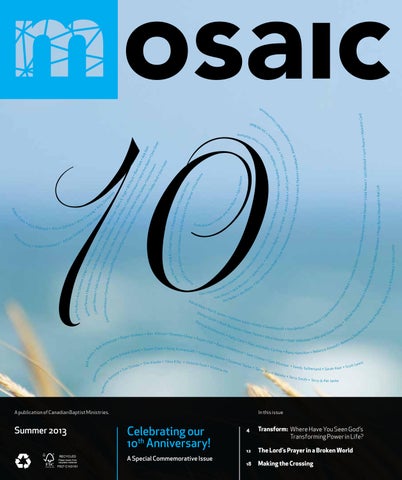
Cover illustration: We thank all the contributors to mosaic over the past 10 years.
Mission of Canadian Baptist Ministries
Encouraging passionate discipleship for local and global mission.
As partners in the Canadian Baptist family we exist to serve the local church in its grassroots mission. Together we impact our communities and beyond through the love of Christ.
“remember,”
in the old testament God’s people are to remember their rescue from slavery and the promise of shalom in the Land of Promise. In the New Testament God’s people are to remember their rescue from spiritual slavery and the promise of shalom in the Kingdom of God. To remember roots us in God’s Story, re-articulates our identity and call, and prevents us from being tossed and turned by every passing change in our world.
However, we are also told to not look back! “No one who puts a hand to the plow and looks back is fit for service in the Kingdom of God.” (Luke 9:62) Jesus says this as he speaks of the cost of following him.
We are to be rooted in our past but not trapped in it. Remembering our past builds faith and endurance in us as we recall God’s faithfulness, but the past is not meant to be a source of comfort or refuge: God is. There is knowledge and wisdom to be mined from our past, but the past is not meant to be repeated or cloned.
This issue of mosaic is our 10 th anniversary issue. It contains stories from the past 10 years that are meant to ignite

imagination and propel us forward. These stories are not about “looking back” — rather, they are meant to remind us of God’s faithfulness and generate energy to look forward and move into God’s future for us.
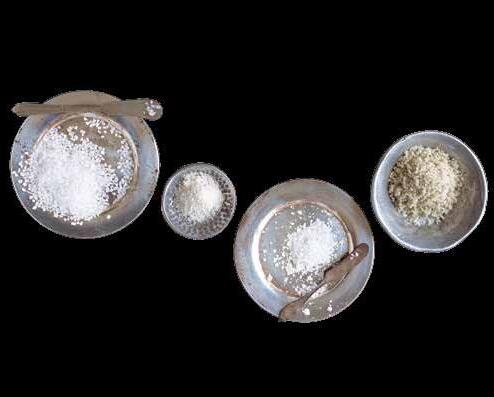
At CBM our vision is that local churches are to be the primary catalyst for transformation in our world. Imagine if every church on the planet was an influence on their neighbourhood and a community that brought blessing and God’s grace. The way the blessing is expressed depends on the needs of the community, but it is all blessing and it all bears witness to the Gospel and introduces people to God’s love. At CBM we believe that the most powerful and long-lasting way to change the world is to change the church, helping it become all God calls it to be — salt and light.
2013 is a re-envisioning year for CBM. We are engaging with partners, churches, staff, and other stakeholders, to shape a vision and strategy that will carry us into 2018. Please pray for us that we may “remember” but not “look back”! We want to look forward and tilt into God’s future intention for us!
Grace and peace, Rev. Sam Chaise General Secretary of CBM
The Dymaxion map does not have any “right way up.” Buckminster Fuller argued that in the universe there is no up and down, or north and south. He at tributed the north-up-superior/southdown-inferior presentation of most other world maps to cultural bias.

Purpose of mosaic mosaic is a community forum of local and global voices united by a shared mission. mosaic will serve as a catalyst to stimulate and encourage passionate discipleship among Canadian Baptists and their partners.


W HE r E HAv E you s EE n
Go D ’s T r A ns For M in G P oWE r in li FE ?
That’s the question that mosaic is asking for our commemorative issue. What is the one experience that most stands out from the past 10 years of ministry? What did you learn or change as a result?
Here are excerpts from some of the responses that we have received from CBM Global Field staff, office staff, board members, strategic Associates, and representatives of our global church partners.

&
most memorable experience:
the team at college elim des gonaives in haiti takes advantage of the 10 th anniversary of mosaic to express our gratitude to CBM for its substantial financial support to assist student victims of the earthquake disaster of January 12, 2010. One month later we welcomed 162 young survivors back to the College, many of whom had lost close family. They had no more hope to live a normal life. They were bruised, traumatized and distraught. By the solidarity and generosity of the friends of CBM, pupils received psychosocial assistance, educational and basic school material to continue and make a success in their studies.

Profoundly touched by your love and compassion, students gave thanks to God for their benefactors.
A few Sundays ago we were in the small Baptist Church in Zahle in the Bekaa Valley with two visiting Canadian teams. With the brutal conflict raging only about 20 kms. away in Syria which has pitted Sunni Muslims against Alawites against Kurds, and with the Christians caught in-between, we worshipped at the church which comprised of not only Christians but also Sunnis, Alawites and Kurds, most of whom had only recently decided to become followers of Christ. We were witnessing the transforming power of Christ and getting a glimpse of what the Kingdom of God is really like.
We were comforted and very encouraged by the work and support of CBM which had a considerable positive impact on the future of these young people who saw all their dreams collapsing in a few seconds and who did not believe any more in the future. They now have hope and a new taste for life. May the Lord, our God, bless you all and continue his work of restoration of wounded life, broken life, through you.

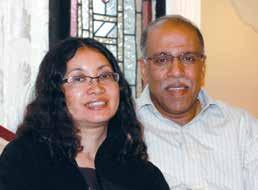
& Laura Lee
(previously served in Indonesia)
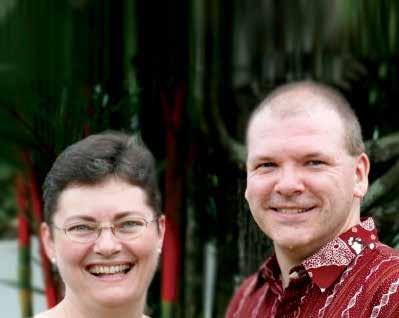
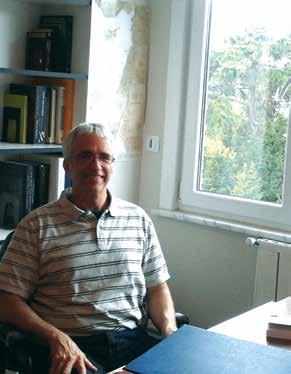
we are always so thrilled when we see young students graduate from seminary becoming the next generation of pastors and church leaders who are making a transformational impact in their communities. Their ministry confirms the importance of CBM’s commitment to Leadership Development.
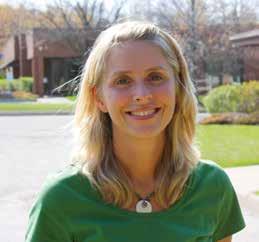
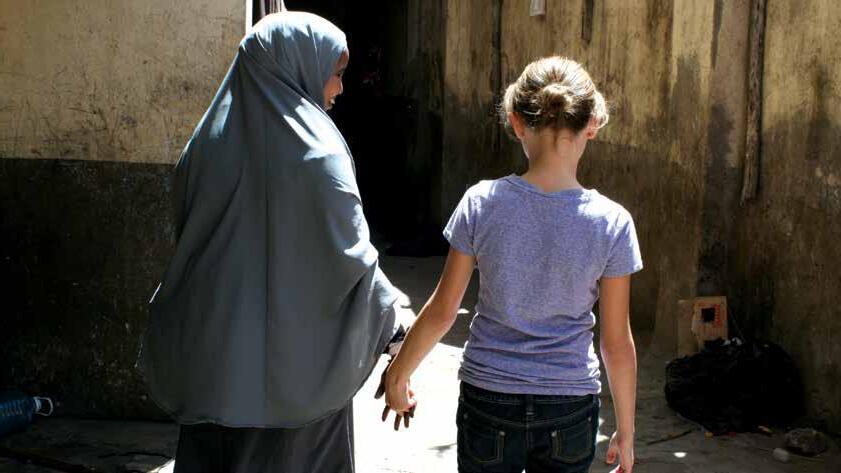
the experience that stands out most for me is the first time we brought a Guardians of Hope (* GOH) group together with one of the Muslim Ministry SelfHelp Groups (SHG) for skills training in Nairobi, Kenya. Seeing Christian women take Muslim women under their wing and teaching them the skills they have learned through GOH was such a gift! To me, this is the embodiment of Christ’s mission! At the end of the two-day training, the GOH women and the Muslim SHG women were singing and dancing together! Everyone felt God’s spirit in their midst.
* GOH is a CBM program that helps families most impacted by HIV and AIDS in Africa and India.
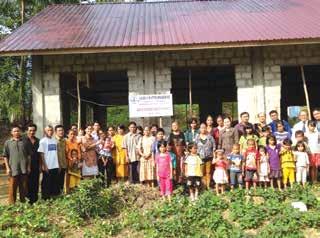
One of the new church plants in Indonesia.
Lidia Terok Indonesia
having a relationship with cbm and the churches they represent has been a great blessing to our churches. Through the provision of small loans to families in our churches and communities we are seeing real transformation in all aspects of the lives of these families. We have also received a CBM short-term mission team who helped in construction at our camp (which is the centre of all of our denominational ministry) and this youth exchange was something fabulous, a time of spiritual growth. Another area of mutual enrichment has been in integral mission through Christian education and theological education, with leadership formation and building capacity — areas in which we will soon see the fruits.
for me, the 40 years of togetherness in gospel ministry of CBM and Convention of Baptist Churches of Indonesia. A wonder of the transformation is seeing the impact on tribal people who are experiencing God in their lives through faith in Christ Jesus. These marginalized people reached in the gospel ministry are experiencing transformation in their perspective of life; in their attitude toward each other; in the relationship among the family, especially in the treatment toward children, girls and women; in their growth in mission, ministry, relationship, fellowship as well as worship of God in their daily life.
George Bristow Turkey
it is wonderful to see the grace of god bringing new shoots out of dry ground in Turkey. At Hasat Church Ministries we are particularly encouraged to have a number of new national teachers being trained and leading seminars now. With CBM’s help we are helping to water new fledgling fellowships that are being planted throughout the country by providing biblical teaching and training. We see many eagerly drinking in the water of the Word and pray our work together will bear long-lasting fruit.
Jeff Carter Czech Republic
a particular ministry visit moved me in ways that I can hardly describe. I was asked to teach and train young Baptist leaders in Palestine in two of the four churches there and to work with the young man who is the shepherd that God has placed in that region. Hearing the passion and the quiet stories of faith and what God was doing in an area that is under tremendous political and religious strain had a deep impact on me. Being able to share the Arabic version of HORIZONS and to be even a small part of encouragement to these leaders has made it worth all the effort.
over a period of 40 years
African Christian Church & Schools and CBM have jointly worked as partners with the aim of providing a holistic ministry which is contextual and relevant to the lives of the people in Kenya. One of the outstanding experiences is how we urgently responded to the post election violence of 2007-2008 by providing relief food to thousands of Kenyans who had been internally displaced and to communities living in Maai Mahiu, a drought-prone region. After the relief program we together discovered the need of providing a more sustainable project that would empower the communities to be able to produce their own food and live dignified lives. We have been able to train and introduce drought tolerant crops to the same communities that participated in the relief project, helping them become self-reliant in terms of food. In addition we have also been able to assist communities to access clean drinking water, reducing the distance they used to travel in search of water from 7 kms. to 1 km.
the transforming power of god at work: Confession and reconciliation are powerful dimensions of God’s work in the life of His people. One of the most amazing scenes in CBM’s work with the 24 churches of the Garissa Christian Fellowship (North Eastern Province, Kenya) was a time of confession and reconciliation among the churches who had little to do with each other for the past three decades. After months of working with the pastors and leaders, it was breathtaking to see them joining hands in unity. Beyond forgiveness, these leaders forged a commitment to work together against forces of persecution and hostility, to demonstrate the love and compassion of Christ to each other and to their Muslim neighbours.
in 2004, i was part of a cbm short-term mission trip to bolivia One of the places we visited that left a deep impression on me was the women’s prison in Cochabamba. It was truly a place of darkness. Seeing the women in horrible living conditions and knowing that their children lived with them was overwhelming. But just down the street we headed to a place of light — Casa de la Amistad. As I met the prison children involved in this outreach program, I sensed God’s power in the midst of brokenness. It was encouraging to see that these children were receiving care despite the fact that each evening they would head back “home” to prison. Questions filled my mind. I wondered
how effective it is to work with children during the day knowing that each night they would perhaps experience trauma. What would the long-term effects be on these children living in prison? But as I thought about this, it seemed very important to understand that we must not stop doing good even when we do not have all the answers. Even when brokenness is all around, God is there. We cannot always address the systemic issues that cause this brokenness but we must not stop trying to. This is the lesson I brought back home to Canada. And when I work with newcomers in Toronto, women who have experienced trauma, this experience comes back to mind.
my ministry highlight is yattani gollo. Meeting him in a bar in Eastleigh (where we were helping to launch a new church). Sensing a divine appointment. Introducing Yattani to the beauties and battles of North Eastern Province. Realizing that God was gifting us, the Kenyan church and the northern Muslim people with a Jesus-filled bridge and community builder. Gaining a friend. Watching his skills, impact and family grow. Seeing him embraced and empowered by the CBM family as a national field staff member. Witnessing (now from afar) his patience and hope as ministry in Muslim communities is challenged.
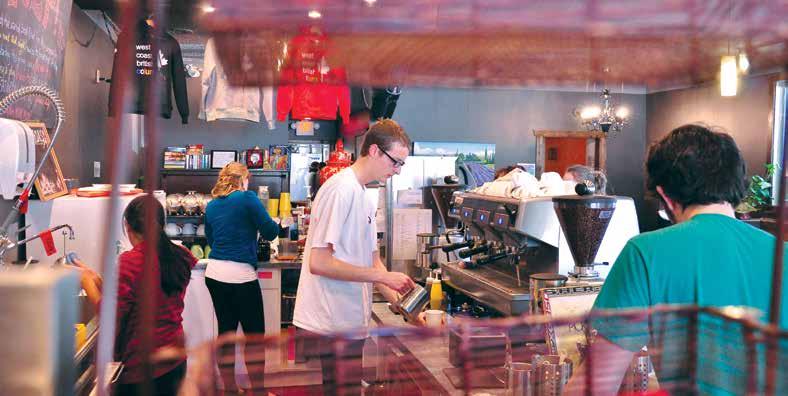
the greatest experience is to see lives changed: people who have taken courses and have gotten jobs, have furthered their education, have supported their families, have received hope and passed it on, have studied God’s Word and been prayed for. In the midst of this, many have come to know Jesus better and have seen His face in the faces of those who work with me at Free Flight. While the everyday challenges get tiring, the results are encouraging and uplifting and show God’s presence and activity in everything.
i have been fortunate to see first-hand the work that CBM does among the Dalits in India, particularly the many Christian communities of the Saura tribes. They are persecuted for their faith and CBM has stood by them for many years, serving as a very visible sign of God’s transforming love for these poor farmers and their families.
hearing stories of students at the Arab Baptist Theological Seminary in Lebanon was a life-changing experience for me. Many come from Muslim backgrounds. They shared how God had called them to become followers of Jesus. This commitment could cost them their life but they are more than willing to do what it takes to be a devout follower. Their lives were a testimony to me and begged the question, How devout is my commitment to follow Jesus? When I share their story as I speak in churches, I am still challenged as I challenge others.
editor’s note:
Where Have you s een God’s Transforming Power in l ife? Join the celebration! Post your answer and also see more of the responses we received to celebrate 10 years of ministry.
v isit www.facebook.com/cbmin.org.
Our lives are becoming thinner, shallower, and less abundant as a result of the deeper truth that the things that we think we are consuming are actually consuming us.
FA i THF ul
D is C i P l E s H i P in
A so C i ET y o F
Consu MPT ion
By Jonathan R. Wilson
We are consumers. Aren’t we used to hearing that in Canada? In fact, isn’t it so familiar that we barely pause to notice it anymore? The accusation that we consume a disproportionate share of the world’s resources is so much a part of our mental landscape that we simply absorb it and move on. It is like the old billboard advertisement that you don’t even notice on your morning commute — until a new, visually shocking ad replaces the old.
Let’s move beyond the familiar, ineffective “we are consumers” and “we consume a disproportionate share of resources.” Here is a deeper and more deadly truth: we are being consumed.
Our lives are becoming thinner, shallower, and less abundant as a result
of the deeper truth that the things that we think we are consuming are actually consuming us. We are becoming less human, even as we consume more and more. And part of this deadly dynamic of consumption is that as we become less human, our anxiety rises and we frantically consume more. This sends us into a whirlpool of ever deepening despair and anxiety.
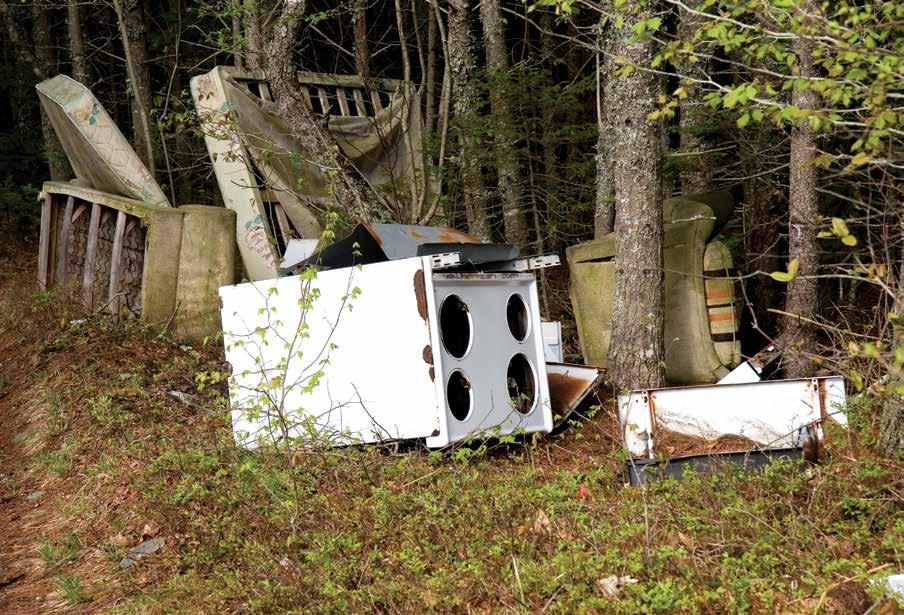
The Old Testament prophet Joel describes in powerful, imaginative detail how waves of locusts strip the land bare of life. Those who sink into spiraling consumer debt know that same cycle of being stripped bare of life. But so do those of us who can pay our bills and even give to the church, but whose lives are consumed by advertisements, sales flyers,
internet shopping, and the desire for things.
This dynamic is why things never satisfy — and why we still pursue them even when we have experienced that disappointment.
The message of Deuteronomy (the Hebrew book of laws), the prophets, Jesus, and Apostle Paul is that when we participate in unjust patterns of consumption, we are devouring others. We are consuming their lives in the way that we live ours. To put it in a shocking image, we are cannibalistic.
This disturbing image and its truth is reality for us today in the midst of a world that is marked by increasing insecurity about food and water. This is true in the ways that we in the west both produce food and distribute it. It is also true in our use of water in manufacturing and recapturing it.
The message of Deuteronomy, the prophets, Jesus, and Apostle Paul is also that God will not tolerate injustice because it is contrary to life. Injustice destroys us; it destroys others. Justice is not an arbitrary rule dictated by a capricious God; justice is the order of things that leads to human flourishing and, indeed, the flourishing of all creation. Justice aligns us with God and the life that God has created.
At this point you may be thinking about and expecting an account of “just consumption.” That is, you may be looking for me to give an account of how we can participate in a “Society of Consumption” as disciples of Jesus Christ in a way that is just and promotes a just order.
But it is wrong for followers of Jesus Christ to think that we can simply make our way within a society of consumption and “make the best of it”
The phrase ‘economy of communion’ is not common. I hope that it shocks us out of our complacent consumptive lifestyle.
given what we have. To think this way is to accept the fallen order of things; it is the opposite of “repent and believe the good news: the kingdom is at hand.”
to repent is to change our way of thinking and living — and to begin to serve and witness to the kingdom of God, we must turn from an “economy of consumption” to an “economy of communion.” As long as our vision, our thinking, our longing, and our acting is framed by an economy of consumption and a view of ourselves as consumers, we cannot break free from our enslavement to our present, consumptive way of “life” — which is in reality a way of death.
The phrase “economy of communion” is not common. I hope that it shocks us out of our complacent consumptive lifestyle. What a strange notion, “economy of communion.” What could it mean?
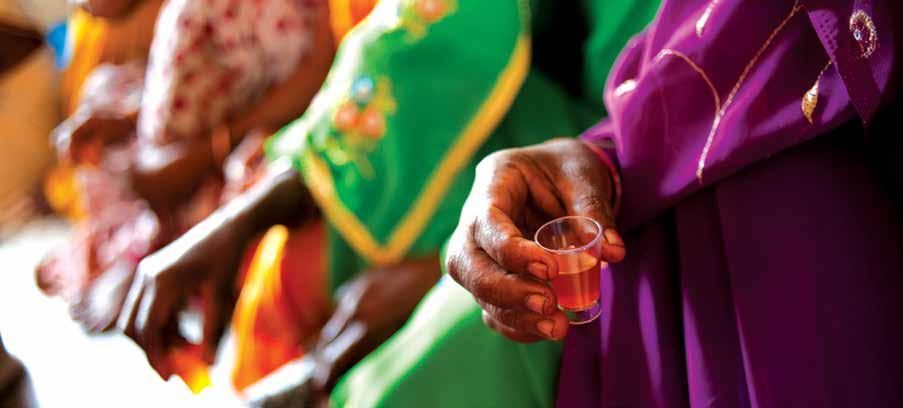
to repent is to change our view of ourselves from consumer to communer — we must begin where the economy of communion is memorialized and entered into today: the Lord’s Supper. Here we learn that life is sustained not by competition and consumption but by gift and communion.
that’s right: every breath I take, every beat of my heart, the continuing knitting together of the molecules in my body, all of this depends on God’s grace climactically enacted in the gift of Jesus Christ.
Jesus Christ is God the Son communing with humankind fully — even to the point of bearing our sin, including our injustice and our consumptive lives. In that economy of
communion we are forgiven, redeemed, reconciled, adopted, and given abundant, eternal life. An economy of communion begins with the recognition that my life is a gift from God, not a human achievement. Life is sustained by God’s grace, not by human effort. Life is not a zero-sum game in which I am competing for limited resources. True life is abundant and eternal. That economy of communion is the reality of God’s own eternal life. Without beginning or end, God lives by communing as Father, Son, and Holy Spirit. The Father is “father” because of his relationship with the Son — that’s what makes him Father. And the Son is “son” because of his relationship with the Father. And Father and Son are united by the power of the Holy Spirit, whose relationship with the Father and Son is an expression of their love for one another. In other words, God lives eternally by the giving of the Father, Son, and Holy Spirit in communion. Therefore, when followers of Jesus Christ move from an economy of consumption to an economy of communion,
we move more deeply into an understanding of the work of Christ and the life of the triune God.
What I have described as the economy of consumption — consuming, being consumed, and consuming others — is what was happening on a local level in the church at Corinth almost 2,000 years ago. As I have done, Apostle Paul addressed the Corinthian disciples on the basis of their celebration of the Lord’s Supper (1 Cor. 10:14-22; 11:17-34).
We must refuse to let the world press us into the mold of an economy of consumption. Instead, we must be transformed by God’s economy of communion. When this happens, we will grow in our recognition that God is life and we will learn to confess with the psalmist, “Whom have I in heaven but you? And earth has nothing I desire besides you. My heart and my flesh may fail, but God is the strength of my heart and my portion forever.” (Psalm 73:25-26)
God’s economy of communion means that we will seek to live ever more deeply in communion with the life of the triune God. The consumptive desires that have ruled our lives will fade away. The energy that we have misdirected toward illusions and counterfeit pleasures will be redirected toward the good life for which God has created and redeemed us, and has shown us in the way of Jesus Christ.
As our desires are purified and as we participate more fully in Christ (1 Cor. 10:16), we will grow in knowing that our life is guaranteed for eternity by the life, death and resurrection of Jesus Christ. The presence of the Holy Spirit in us is the sign,
seal, and down payment on that promise.
God’s economy of communion means that we who are guaranteed eternal life can joyfully give our lives in generosity and hospitality to others. In an economy of consumption, such generosity would be either a manipulative act from which I expect to receive more in return or else an act in which I ultimately extinguish or destroy myself. But in God’s economy of communion, such self-giving is an act of communion in which my true life in Christ flourishes. Finally, if God’s economy of communion transforms my vision, my attitude, and my way of living, then I will always live in communion with other disciples of Jesus Christ. I will be conscious of their presence with me when I shop, when I eat, when I plan my vacation, my professional travel, my giving to the church. If I am truly being transformed, this consciousness will not be merely a dialogue that goes on in my head, it will be a reality practised in my everyday relationships when I invite others to participate with me and examine me as I seek to be transformed.
Jonathan R. Wilson is the Pioneer MacDonald Professor of Theology at Carey Theological College in Vancouver. His most recent book is God’s Good World: Reclaiming the Doctrine of Creation.
Connecting
Join the conversation at cbmjustice. blogspot.ca, a blog for those interested in issues of faith and justice.
T HE lor D ’s Pr Ay E r is THE only r ECor DED P r Ay E r WE HAv E THAT J E sus
TAu GHT H is D is C i P l E s. C H ris T i A ns
TH
rou GH ou
T
THE CE n T uri
E
s HAv
E r EPEATED i T s Wor D s Coll ECT iv E ly W i TH in CH ur CHE s A n D in D ivi D uA lly
in P rivATE P r Ay E r.
At its heart, it is a community prayer. We begin by saying, “Our Father.” Today, as we repeat this prayer with sisters and brothers from Africa, Latin America and Asia in hundreds of dialects and languages, most of whom live in circumstances of poverty, hunger and despair, we must consider more closely the implications of what we are seeking.
historical context
Some knowledge about the social setting of Galilee in the time of Jesus helps us understand the original background of the Lord’s Prayer. Galilee was ruled by an occupying army. Roman soldiers were battle-hardened and cruel. Public crucifixions were used to humiliate and intimidate. The Roman Empire had established a new economic order in which fish and crops from Galilee were transported to other parts of the empire, including the city of Rome. Herod Antipas, the appointed dictator, increased taxes, required forced labour, and lived lavishly. Rural families were falling into debt. The only option was to sell family properties and live as day laborers. The majority of people who listened to Jesus’ teaching had first-hand experience of poverty and malnutrition. The seeds of armed rebellion were being sown throughout Galilee.
This brief description helps us understand why the Lord’s Prayer resonates so profoundly with God’s people in southern countries. Their daily experiences of life have many points of contact with the situation of Jesus’ original followers. By saying the Lord’s Prayer in solidarity with them, we too are able to enter more deeply into its meaning with our hearts and our minds.
our relationship with god
The Lord’s Prayer begins with the words, “Our Father in heaven.” This phrase creates an immediate and striking contrast between two realities, heaven and earth. The sovereign God does not belong to this world. We call out to him to a place beyond the limited and sometimes painful experiences of this life.
This is a crucial element of our faith. Everything in this world is subject to disappointment,
erosion and decay. The great empires of the world all come to an end. Military and economic power is impressive, but transitory. Leaders create hopes that are seldom fulfilled. Creation itself is compromised and threatened by unrestrained human development. At a personal level, our bodies mature and then enter into a period of decline. The disciple of Jesus calls out to the invisible Creator and Sovereign God who is holy, exalted and lives in heaven.
And yet, we address the transcendent God using a word from our homes. We say, “Our Father.” We say these words boldly and reverently with the faith that Jesus invites us to enter into his own personal and intimate relationship with God. New Testament scholars have shown that Jesus used the Aramaic word “abba” when he spoke of God as father. Small children in Galilee used “abba”
As part of celebrating our 10 th anniversary, we have reprinted some of the thought-provoking features of mosaic over the years. This was our feature article in the Winter 2005 issue.
The Lord’s Prayer begins with the words, “Our Father in heaven.” This phrase creates an immediate and striking contrast between two realities, heaven and earth.
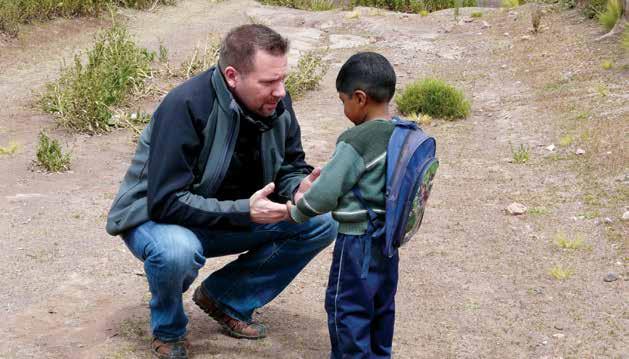
when they addressed their fathers. The most appropriate English translation is “daddy.”
Many people today may find it difficult to even think of God as father because they have been deeply wounded by painful and destructive family experiences. Yet, in our hearts we all long to know that we are loved and valued unconditionally. To call God “father” is to open ourselves to a relationship of love that offers healing, restoration, compassion and care without any dark sides.
In the midst of suffering, to call God “father” is an act of testimony. It is a cry to God through which a woman in Bolivia affirms that her life has value; an unemployed man in India remains confident that God hears his desperate prayers; an AIDS orphan in Kenya finds comfort and strength knowing that God understands the fears and sorrow of her heart.
In their suffering they have discovered that God, whose name is hallowed, calls them His children! Our southern
partners challenge us to say “Our Father” with open and passionate hearts so that we too may be embraced and sustained by God’s love and grace.
our dependency on god Modern society promotes the image of the successful, independent and self-sufficient person. This is particularly true in the developed world. We live in an environment where the experience of community life and family relationships often take second place to consumerism and financial security. Why would we ever need for God’s kingdom to come when we can obtain our security through careful financial planning?
Yet, we know in our hearts that this illusion of self-sufficiency can be destroyed in a moment. A serious disease. An accident. The loss of employment. A broken relationship.
The Lord’s Prayer teaches us to recognize and confess our dependence on God. This is represented by the petition in which the disciple of Jesus asks
for the bread necessary for only the current day. We understand this phrase in a symbolic manner. The disciple humbly and expectantly asks God to provide those things that are necessary for a full and meaningful life. By standing in solidarity with God’s people in southern churches, we can begin to understand what it means to wholeheartedly lift our voices to ask our Father to provide food, clothing, health, a home and supportive relationships. We confess our dependency and repent of the arrogance of thinking ourselves as self-sufficient.
The request for forgiveness is also an expression of dependency. We all need forgiveness like the other necessities of life no matter whether we are poor or prosperous. We stand together with our southern sisters and brothers to confess that our relationships are distorted by egotistical attitudes and actions that do not exemplify the great commandments to passionately love God and others. Followers of Jesus humbly ask God for pardon and a renewal of His embrace.
The Lord’s Prayer reminds us that forgiveness is fundamental to our relationship with God and with those who live around us. We share a common disposition to be selfish, judgmental and arrogant in our relationship with others. We cannot ask with integrity for God’s forgiveness if we are unwilling to extend grace to others.
our life in the world
The Lord’s Prayer begins with God in heaven and concludes with a desperate cry for protection from evil in the world. The
3 billion people (40% of the world’s population) live on $2.50 a day or less. They survive but lack resources to build a future for their children and to cope with unpleasant surprises such as a health crisis or rising food prices.
followers of Jesus ask for the coming of God’s rule in compassion and justice. In a broken world we express our longing that God’s will should triumph in our world as it does in heaven. We conclude by asking for protection from evil during the days of this life.
The Lord’s Prayer recognizes that there are two faces of evil in our lives. Jesus teaches us to ask God for safety from personal temptations that may cause us to deviate from the way of discipleship. We recognize that we are vulnerable. We ask that we will not find ourselves in a position of hard testing in which we will betray the values of God’s Kingdom. But evil is more than personal sin for which each of us is accountable. The other face of evil is revealed in those inhuman forces that diminish or destroy the lives of people created in the image of God. Often this deep evil is beyond our understanding. We feel helpless to halt these unseen forces of destruction and chaos. We live in the reality of a world in which:
• Infectious diseases prey on the poor because they are undernourished, lack clean water and basic sanitation, and cannot access basic medical services. Health is related to one’s place of residence.
• Organized gender based violence inflicts trauma and injury on women and girls in diverse locations.
• More money is spent on arms than on poverty reduction. Violence continues to destroy lives and communities in places like Congo, Afghanistan, Iraq, Syria and Sudan.
• Multinational corporations locate where there is weak labour and environmental legislation.
1.2 billion (or 17%) suffer from hunger (a deficiency in calories and protein). 28% of children in the global south are diagnosed as underweight and stunted.
These are examples of social evils that go beyond the personal actions of individuals. We are made unwilling participants in some of these destructive forces simply by our place of birth, the priorities of our governments, and the investments of our mutual funds.
Most often, it’s those who live in southern countries who feel the greatest impact while in northern countries we offer explanations and sometimes talk about solutions. But can we reduce the impact of AIDS on millions of families
to an epidemiological disease? Can we explain unemployment to a Bolivian miner simply in terms of global supply and demand? Can we comfort a victim of civil war in Angola with an explanation of political and economic ideologies? Wouldn’t that be like trying to comfort a neglected teenager in Canada by referring to sociological theories about the breakdown of the family?
Many of our brothers and sisters in southern churches are acutely aware of an inherent evil in the structures and social forces of the world. They cry out to God for protection from evil and the coming of His Kingdom. As we pray in solidarity with them we are increasingly aware that our analysis is shallow and our proposed solutions offer little hope for a broken world.
Solidarity, then, is not about offering quick answers. However, through solidarity we begin to depend on God and to support one another, praying with sincerity and fervour for our Father’s protection from evil and the coming of His rule in justice and mercy.
mutuality
One of our key words at CBM is mutuality. This concept expresses a core value for a new age in the mission of the church. Mutuality means that we open our hearts to give and to receive in a relationship with brothers and sisters from around the world. This experience of solidarity with each other allows us to enter more deeply into the Lord’s Prayer. Together we discover what it means to live as followers of Jesus in a broken world.
Gordon King is CBM’s Global Discipleship and Canadian Engagement Resource Specialist, and David Nacho serves as a CBM Global Field Staff in Bolivia.