mosaic is published four times a year by Canadian Baptist Ministries. Copies are distributed free of charge. Bulk quantities available by request.
Contact us at:
7185 Millcreek Drive
Mississauga, ON L5N 5R4
Tel: 905.821.3533
mosaic@cbmin.org www.cbmin.org
Managing Editor: Jennifer Lau
Editor: Laurena Zondo
Associate Editor: Giselle Randall
Design:
7 Take
A visit to Lebanon
There was silence on the other end of the phone line. I had just told my friend that I was going to Lebanon. “Really? Why?” he finally asked, stunned by the news.
Mission of Canadian Baptist Ministries
Encouraging passionate discipleship for local and global mission.
As partners in the Canadian Baptist family we exist to serve the local church in its grassroots mission. Together we impact our communities and beyond through the love of Christ.
That may be your question too. Why devote a whole issue of mosaic to Lebanon? I must admit that before I first visited Lebanon, in 2008, it had never been on my list of “places I want to visit.” But by the end of that visit, I had been inspired by what God is doing there, and throughout the Middle East. My hope is that as you read the stories in this issue of mosaic, you, too, will be inspired.
Scan this code using your smart device to us on Facebook
• The mix of faith groups in Lebanon means that it is a laboratory for learning how to live with peace and goodwill with people of different religions. Without watering down our devotion to Jesus Christ, we grow in our love for the people Jesus loves, regardless of their particular faith commitment.
Why is CBM involved in Lebanon?
• Lebanon is one of the rare countries in the Middle East that has significant populations of both Christians and Muslims. This means that Christians from all over the Middle East can come to Lebanon to be trained at Arab Baptist Theological Seminary (ABTS). By being involved in one country, Lebanon, we can share God’s love throughout many countries in the Middle East.
• We were invited to be involved in Lebanon… by God, I think. A few years ago a man walked into the CBM office and told us that God was calling him to return to Lebanon to provide leadership at ABTS. It was Elie Haddad. And he asked us if we could help make it happen. We said “Yes!” Sometimes God works through ongoing planning and routine work, and sometimes he surprises us with something totally unexpected. It is wise to be attentive to both.
The Lebanese Baptists are demonstrating what it means to live as a minority-people in a culture that is dominated by another faith group. They are not withdrawing from the culture nor are they retreating into nostalgia for the “good old days”; rather, with focus and passion they are demonstrating God’s love in a multitude of ways.
In addition to the stories related to Lebanon in this issue of mosaic, you will also find a special insert: Sharing Hope: Year in Review 2011. CBM is owned by Canadian Baptist individuals and churches, and we take seriously our need to be accountable to you. The Year in Review is one of the ways we try to do that. We hope you are encouraged to see your faithful generosity at work in the world, sharing the love of God, in word and deed.
Grace and Peace,
Rev. Sam Chaise
General Secretary of CBM
Editor’s Note
@samchaise_cbm
facebook.com/cbmin.org cbminorg.wordpress.com
mosaic sent Associate Editor Giselle Randall to Lebanon in April 2011. This issue is the result of her visit.
Genesys Creative Inc.
Purpose of mosaic mosaic is a community forum of local and global voices united by a shared mission. mosaic will serve as a catalyst to stimulate and encourage passionate discipleship among Canadian Baptists and their partners.
The Crossing
Building Bridges Between Faiths and Cultures in Lebanon
by Giselle Randall Associate Editor of mosaic
Welcome to a very challenging and complex region of the world, covered by a nice veneer.
This is how someone described Lebanon to me shortly after i arrived.
Leaving the airport, we drove through the southern suburbs of Beirut, a poor area, and passed Bourj el Barajneh, a Palestinian refugee camp. The main route from the airport no longer goes this way, diverted to avoid the ugliness of poverty and maintain the city’s prosperous, sophisticated image. Beirut was once known as the Paris of the Middle East. On the coast of the eastern Mediterranean, between sea and mountain, it was a destination for the international jet set, with private beach clubs, luxurious hotels and resorts, designer boutiques, nightclubs and casinos. In 1966, Life magazine described the city as “a kind of Las Vegas-Rivera-St. Moritz flavoured with spices of Araby.” 1
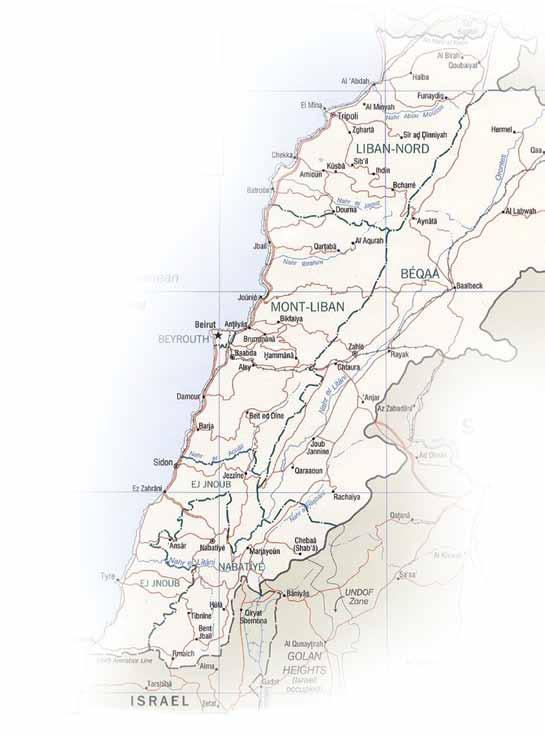
Arab East meets European West in Lebanon, a country whose borders were drawn by France after the end of the First World War. France annexed parts of Syria and attached them to Mount Lebanon, combining the Muslim population of the coastal plain and Bekaa Valley with the Maronite Christian majority of the mountains.
They created a country unique in the Arab world — one with a large and influential Christian population and cultural ties to the West.
The mountains of Lebanon have provided a haven for many religious minorities. Today, there are 18 official religious groups, known as confessions, and political power is divided among them. This confessional system — where identity is based on shared ethnicity and religion, and religion is inseparable from politics — is at the heart of Lebanese society, and is, arguably, a source of its complex tensions. Christians make up about 40 percent of the population, and within this group there exists a small evangelical Christian community, one wrestling with what it means to be a reconciled and reconciling people, to be agents of transformation, of the Kingdom of God, in this place. I’m here to meet some of them, to listen to their stories, and to learn from their efforts to overcome the barriers that divide people, to overcome fear with love.
In 1948, hundreds of thousands of Palestinians fled their homes and land due to upheaval in the new state of Israel. They sought refuge in neighbouring countries — Egypt, Syria, Jordan and Lebanon. Most families took their house keys with them, believing they would return soon. More than 60 years later, the Palestinians are still stateless, a nation of refugees. Their ongoing plight is a major issue.
Based on the first — and only — official census, conducted in 1932 under French Mandate government, Lebanon’s sectarian system requires the President to be a Christian, the Prime Minister a Sunni Muslim, and the Speaker of Parliament a Shiite Muslim. In the following decades demographics have shifted, but the census has never been repeated to avoid upsetting the sectarian balance and causing conflict.
But from the beginning, questions of national identity, the distribution of power, and political reform caused cracks in Lebanon’s stability. Throughout Lebanon’s golden age, discontent with social, political and economic inequality simmered below the surface. There was tension between the numerous different groups living together in close proximity. In 1975, the pressure of internal and external forces reached its breaking point, and the country exploded in violence. Lebanon slipped quickly into a civil war that would last 15 years.
Beirut was soon split between the Christian east and the Muslim west, as much of the population moved to find safety within their own sectarian communities, served by their own schools, banks, and newspapers, defended by their own militias. On each side of the line — known as the Green Line — that divided the city, people withdrew behind physical and psychological walls.
This was a war with no front line, just opposing militias where soldiers wearing sneakers fought each other
1. Sandra Mackey, A Mirror of the Arab World: Lebanon in Conflict (New York: W.W. Norton & Company, 2008), 65.
on street corners “behind barricades built of broken, discarded furniture, ruined refrigerators, and the debris of bombedout buildings.”2 Thousands of civilians died in the conflict.
The constant threat of violence suspended life. “There would be six months of peace, then six months of war,” remembers one woman. Keeping a bag packed with food, first aid, passport and ID, house documents and jewellery was a fact of life.
“You’d be asleep at night and hear something hitting the street, a bomb, so you’d run down to the underground. Or you’d be driving or walking down the street and a car would explode.” During one period of fighting, her family spent 10 days underground, with little food and no washroom, taking turns sleeping on a mattress.
“You feel unstable, unsettled, always on your toes. After graduating from university, work was scarce. No one was getting married or building homes,” she says. “We were living in fear, with no hope for the future.” Seeing no end to the conflict, unable to make plans, she decided to leave Lebanon and start over — sad to leave her family but longing for peace. As the boat left the harbour, it was bombed behind her.
The war interrupted many lives — and yet life still carried on. For another woman, this meant crossing the Green Line every Monday morning to go to work. She commuted with her father, who also worked in West Beirut. Roadblocks and shooting could make the trip take several hours. One day, her father travelled to work alone. He never made it. “My father is one of 17,000 people kidnapped during the war that no one knows anything about,” she says.
In 1989, regional actors brought various Lebanese parties who were involved in the civil war together in Taif, Saudi Arabia. Negotiations and discussions aimed to end the conflict and attempted to chart a way forward. The resulting document of national reconciliation is known as the Taif Accord. It brought an end to the civil war; however, years of hostility between groups were not swept away. Entrenched communal identities remained, and maintaining a balance of power was crucial to maintaining peace. The war was over, but its shadow remained.
The damage caused by the civil war was staggering. More than 150,000 people were killed — 40,000 were children under the age of 15. Another one million people were injured, and half of those were permanently disabled. An estimated 500,000 people emigrated to escape the war. More than 40 percent of those who stayed were displaced from their homes or neighbourhoods. Rebuilding efforts faced massive
destruction to civil infrastructure and a crippled economy.
Bulldozers removed the barricades that divided Beirut, but the barriers between people aren’t as easily torn down.
The Lebanese Society for Educational and Social Development (LSESD), CBM’s partner, seeks to cross these social, political and religious barriers and build bridges between communities.
“Reconciliation is at the heart of the Christian faith,” says Nabil Costa, LSESD’s Executive Director. “So the responsibility for peace lies very much in the hands of Christians. We are a small group of Baptists trying to light a few candles in the darkness of the world.”
LSESD is the umbrella organization for several ministries, including Arab Baptist Theological Seminary (ABTS) and its Institute for Middle East Studies, the Beirut Baptist School (BBS), SKILD Centre for Smart Kids with Individual Learning Differences, Dar Manhal al Hayat publishing house, Baptist Children and Youth Ministry, and Lebanon Baptist Aid. Each of these ministries offers a unique opportunity to build relationships, share the gospel and demonstrate the reality of the Kingdom of God.
Protestants are a very small minority among the Christian population in Lebanon. Many left during the war, and many churches — like other communities — isolated themselves, turning inward to survive. “It’s a challenge to overcome the barriers, the history and baggage and years of war,” says Elie Haddad, CBM Global Field Staff in Lebanon and President of ABTS.
“It’s very easy to be threatened by people different than us, especially if we perceive them as hostile to us. But if they are created in the image and likeness of God, if Jesus died to redeem them and we are the agents of reconciliation, then we have a role to play… These are our neighbours, these are the people we are called to reach. If we don’t love them, we can’t reach them.”
2. Ibid. 113.
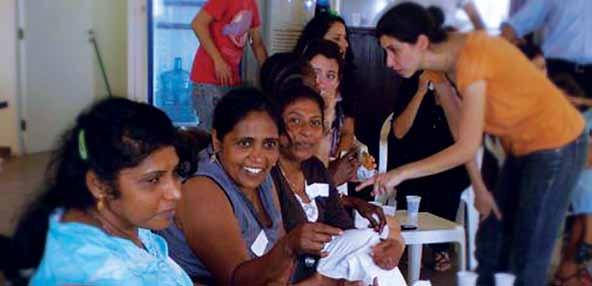
Come and Be Served: A new ministry of Hadath Baptist Church in Beirut among foreign domestic workers, one of the most marginalized groups in the country.
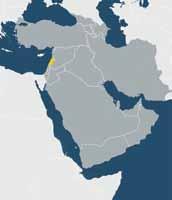
Lebanon Facts
Population 4.3 million (UN, 2010)
Capital Beirut
Area 10,452 sq km
Languages Arabic (official), French, English, Armenian
Religions Muslim 59.7%, Christian 39%, Other 1.3%* Ethnic Groups Arab 95%, Armenian 4%, Other 1%
Refugees and internally displaced persons by country of origin:
Palestinian refugees 405,425
Iraq 50,000 – 60,000
IDPs** 17,000
July 2006 War 200,000
* 18 religious sects recognized ** 1975-90 civil war & Israeli invasions
In July 2006, Lebanon was ravaged by war once again, this time with Israel. Within Lebanon the war killed at least 1,200 people, severely damaged property and infrastructure, and displaced more than a million people.
ABTS and BBS provided shelter and relief for more than 1,000 Muslim families during the 34-day war, living out the love of Jesus. “I see Christian mission as how do we reflect Jesus Christ in a practical manner to the people around us,” says Nabil. “Before we go to them with our doctrines and beliefs, it’s very important for them to see how we live.” The war was a turning point for LSESD, helping to break down walls of fear and build relationships.
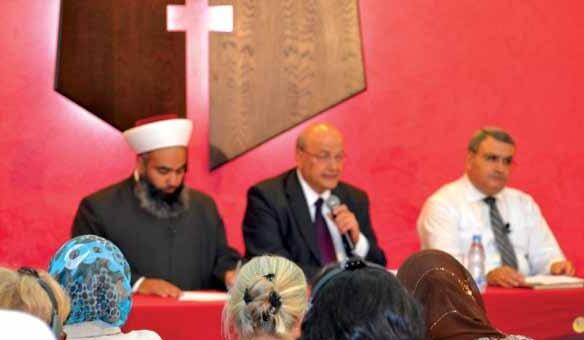
Every year, ABTS invites Muslim scholars and religious leaders to participate in a conference to encourage understanding and dialogue between Christians and Muslims. At the next conference after the 2006 war, a sheikh who lived in southern Beirut, an area that was heavily bombarded, spoke up. “When my family and I did not know if we would see the sunrise again and the whole country is in trouble, I received a phone call from the president of ABTS asking if my family is fine and if there’s anything they can do,” he said. “That is Christianity for me.” This respectful relationship resulted in an invitation for an ABTS faculty member to teach a course on the Christian faith at their religious centre.
The war also opened doors for community development, as many of the families who found shelter at ABTS and BBS asked for further help when they returned to their villages after the ceasefire. This led to the forming of Lebanon Baptist Aid and a new focus on integral mission — spiritual and social transformation — with the underlying goal of helping churches recover this outward-looking, missional identity.
“We persevere in seeking to become peacemakers as we carry our message of peace, building relations with moderate Muslims, and working alongside the local churches that they may realize their biblical mission and break out of isolation to regain
effective witness and God-intended missional focus,” says Nabil.
Hikmat Kashouh, Academic Dean at ABTS and pastor of Hadath Baptist Church, remembers Rupen Das, CBM Global Field Staff, asking him: If your church ceased to exist, would anybody in your neighbourhood notice? He had to answer no. After prayer and completing a community assessment with the support of CBM, the church began to reach out to the neighbourhood. Instead of completing construction on their unfinished sanctuary, they decided to build a children’s ministry centre and organize activities for mothers and toddlers during the week. Next they built a youth and community centre, offering language, music and computer classes, a gym, and a drop-in for teens. A new ministry for foreign domestic workers, one of the most marginalized groups in Lebanon, is just beginning. The church building is now a hub of activity throughout the week as it serves the community. And the church is growing.
During my trip, I celebrated Easter at Hadath Baptist Church. As I reflected on my time in Lebanon, the old story took on new meaning. “For he himself is our peace, who has made the two groups one and has destroyed the barrier, the dividing wall of hostility… His purpose was to create in himself one new humanity out of the two, thus making peace, and in one body to reconcile both of them to God through the cross, by which he put to death their hostility.”
(Ephesians 2:14-16)
In a place that has seen so much suffering, so much war and bloodshed, so much darkness, a place that includes barriers and divisions and hostility, reconciliation is possible. Peace is possible. As the speaker that Easter Sunday reminded us, the resurrection is sure evidence that Jesus is the Lord of life, the one who crushed, destroyed and undid death. The one who brings light to life. Light has come and the darkness cannot overcome it.
Photo: Julie Davidson
Do what you want. You’re already dead.
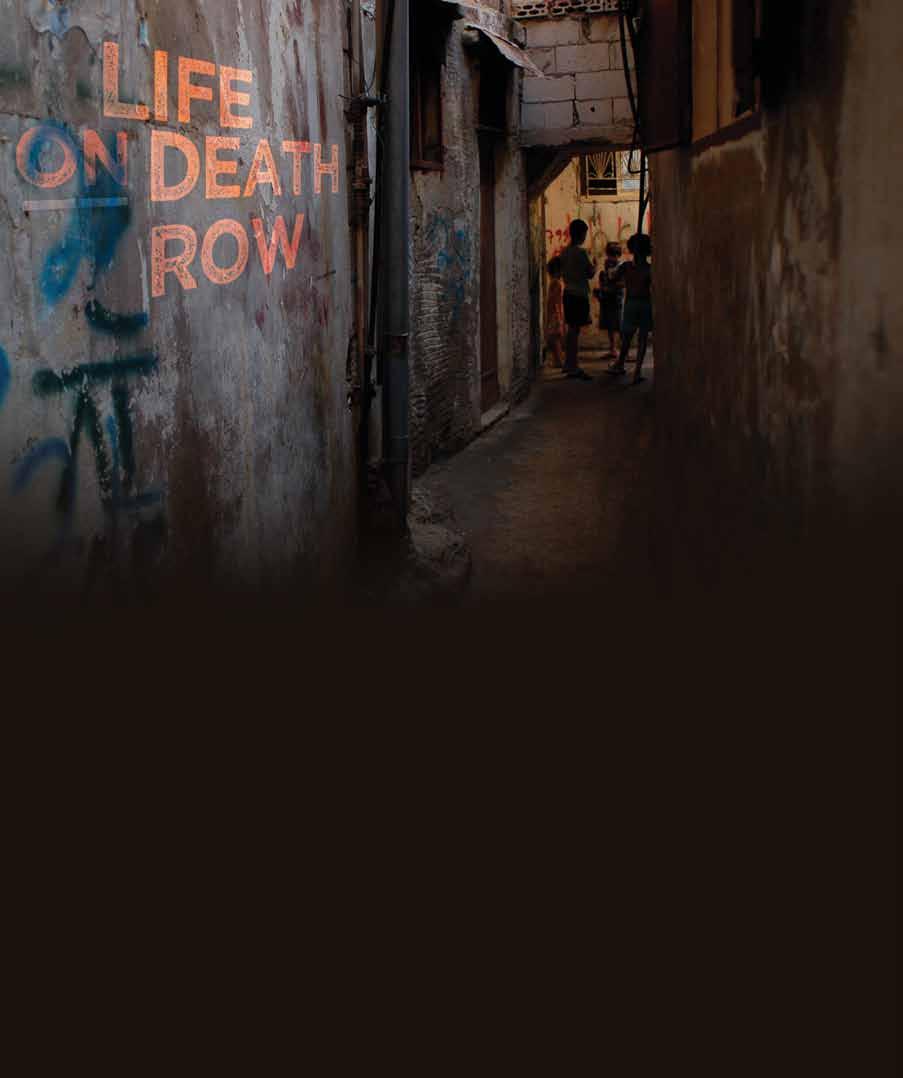
This was scrawled on a bulletin board at a community centre in Bourj el Barajneh, a Palestinian refugee camp in the southern suburbs of Beirut. The camp is a maze of narrow alleys winding through small, crumbling houses stacked on top of each other. Tangled knots of electrical wires hang dangerously low as children play nearby. Approximately 20,000 people live here, crowded into one square kilometer.
Bourj el Barajneh is one of 12 camps in Lebanon. These camps, along with 39 unofficial settlements, house between 260,000 and 280,000 Palestinian refugees — those who lost their homes and livelihoods during the 1948 ArabIsrael War, and their descendants. Although a 1948 UN resolution calls for their “right to return,” the door is closed. Four generations of Palestinians have now grown up in refugee camps, “holding pens for people suspended between the despair of the present and the hopelessness of the future.” 1
Palestinian refugees in Lebanon lack many basic rights. They are restricted from the public school system and from
employment in most professions, have limited access to the legal system and are not allowed to own or inherit property. Close to 60 percent are unemployed, and those able to find jobs usually work as casual labourers. For many young people, employment restrictions make education seem futile, and the school dropout rate is high. Most refugee families live in poverty, unable to afford healthcare, improve their homes, or save for the future. They exist on the margins of society, with no way to change their situation and no political solution on the horizon.
“The Palestinian refugee situation is a long-term emergency,” says Rob Pelgrim, general manager of Inma Foundation, a Lebanese development organization that works in the camp.
“An emergency that we all know about, like the tsunami in Japan, there’s attention, there are donors, people go there to help, to clean up, rebuild, help people in trauma, and in four or five years things are back to normal. The refugee problem in Lebanon… The problem is not known. I don’t see that there’s an end coming up.”
Inma’s Education and Peace Initiative project, supported in part by CBM, strives to meet some of the needs voiced by the community. The project sponsors 60 children to attend preschool, giving them a better foundation for elementary school. During the school year, a weekly kids club for older children provides educational support
and a place to play in a safe and nonsectarian environment. In the summer, the kids club becomes a day camp, with fun activities and outings. Each month, the mothers of the sponsored preschool children meet to learn about and discuss parenting issues, and share a meal, strengthening their social support network. Bridges are built as the principals of the partner preschools, which represent rival political factions in the camp, meet together.
The impact of these efforts to support children and families and encourage dialogue between sectarian groups goes beyond measurable results. For people who often feel forgotten by the rest of the world, the love, attention and respect offered by Rob and his wife Harriet, who also works with Inma, is significant — a witness to the incarnational love of Jesus.
And yet the reality of the political situation cannot be avoided. “When I think about the future, what their chances are to do something with their life, and when I talk to the mothers of the children, to see this hopelessness and not much opportunity, to face that daily, is very difficult,” says Harriet.
Coming to Bourj el Barajneh is like “visiting death row,” Rob says. “The future is blocked. Full stop.”
“But on a human perspective, a justice perspective, a faith perspective, I think this is what I should do.”
Photo: Elizabeth Cooper
1. Sandra Mackey, A Mirror of the Arab World: Lebanon in Conflict (New York: W.W. Norton & Company, 2008), 87.
Christian-Muslim Dialogue
An interview with Dr. Martin Accad, Director, institute of Middle East Studies at Arab Baptist Theological Seminary
Q:
What mutual misperceptions exist between Christians and Muslims?
What are the consequences?
Particularly since 9/11, there’s a tendency in the West to view Islam as a religion of violence. In recent years, our ideas about Islam have been strongly influenced by a radical interpretation of Islam but it’s certainly not the only interpretation, and by no means the one held by the majority of the world’s Muslim population. The “war against terror” only exacerbates radicalism and prevents moderate Muslim leadership from standing up for what they believe is authentic Islam. And this misperception and misrepresentation is mutual. Muslims tend to perceive anything coming from a so-called “Christian West” as a reflection of Christianity as a whole. This includes factors as diverse and irrelevant to Christianity (from our point of view) as the moral framework promoted by the Hollywood film industry, and the perceived warfare against Arab peoples by western (so-called “Christian”) nations. Muslims and people in the Middle East often perceive the West as very pro-Israel with a strong Zionist ideology, and assume that all evangelicals, and sometimes all Christians, hold this perspective. So both sides discern no diversity, drawing caricatures of each other that cause misunderstanding and conflict, leading our world to the brink of disaster.
Q:
What are the goals of the Institute of Middle East Studies (IMES) and the Middle East Conference?
More than new techniques or methods for mission, the church needs a profound rethinking of our assumption about ministry in Muslim contexts. Our vision is to see the church communally engaged with Islam and Muslims in a way that leads to transformed mutual perceptions. We want to see Christians embracing their identity simply as “followers of Jesus,” in a context where “Christian” and “Christianity” are seen as a socio-political reality. What we want to stir at IMES is a kerygmatic approach to Islam (kerygma being a Greek word for proclamation and witness). The first premise of this approach is that we consciously decide to offer a listening ear and learning attitude to Islam. This is what our annual Middle
East Conference is about. The second premise, which balances the first, is a clear missional approach with a deep desire to share the good news with Muslims — that God has invited us into a relationship with him through Christ — without it sounding like we are inviting adherents of one religion to embrace another religion, or leave their culture. Our message is Christ, not Christianity. Christ supersedes religion and overcomes cultural barriers.
Q:
In what other ways does IMES contribute to peacebuilding?
The Institute and Conference are the main ways we promote a balanced understanding of Islam and model respectful dialogue as we seek to equip the church in its role as peacemaker. We are also involved in an intentional peacebuilding initiative at the political level called TAWASUL (which means inter-communication). We bring together the leaders of the youth branches of the main political parties — who often come from diametrically opposed political views — for a meal, to just sit together and talk, to meet at a human level. We’ve been able to build personal relationships and trust, and start conversations about what it means to be accountable to God as someone involved in politics, to ask them to share how they have contributed to greater peace in Lebanon.
Editor’s Note
This June, thanks to a generous donor, CBM is helping to sponsor a team of Canadian Baptist youth pastors and leaders to attend the Middle East Conference IX: Love Your Neighbour as Yourself — the Church and the Palestinian in Light of God’s Command for Justice and Compassion.
A s mall s chool with a BIG Vision
Arab Baptist Theological Seminary is more than just a seminary — it is an educational movement with local, regional and global impact, and a vision “to see God glorified, people reconciled, and communities restored through the church in the Arab world.”
“We’re very small but we have this huge vision for the whole Arab world,” says Elie Haddad, CBM Global Field Staff in Lebanon and President of Arab Baptist Theological Seminary (ABTS).
Lebanon stands at the crossroads between East and West, a strategic gateway to the Arab world. As the only country in the region where students from Muslim backgrounds can legally study at seminary, ABTS trains women and men from across the Middle East and North Africa who return to their countries committed to serve as pastors, church planters, evangelists, or in ministry in the marketplace. Currently, 36 students from eight countries — Morocco, Algeria, Sudan, Egypt, Jordan, Iraq, Syria and Lebanon — are learning to become missional leaders.
Students like Michael and Diana, who moved to Lebanon from Egypt to study at ABTS shortly after getting married, leaving their jobs, home, and family behind. Although many people questioned their decision, they knew they were following God’s plan for their lives, even when Michael lost his job and their home was severely damaged when the foundation cracked.
“Everything that was happening was logically bad, but the Lord was telling us you need to trust me more because I
have something even better for you,” Diana says. “We learned to live by faith.” Throughout their studies, God provided for their needs. “It’s like living in a tent. Although we didn’t know exactly what the Lord wanted from us, he was moving us from one place to another according to his will.”
Michael and Diana are sensing a call from God to serve in a country where the Bible cannot be preached publically, although they don’t yet know where or how. “But we are sure he wants us to do this so we are open for what will happen,” Michael says. “We told God we are free, we don’t have a place or a job so he can move us, like Diana said, by tent.”
The impact of ABTS reaches far beyond Lebanon’s borders. It serves the church in the Arab world by equipping leaders and providing resources through:
• TEACH, an innovative, online distance education program developed in partnership with several other organizations to make theological training accessible for Christian leaders throughout the region who are unable to study in Lebanon.
• The Educational Ministries Resource Centre, which provides support to local churches by facilitating training for elders and pastors, leaders of women’s groups, youth and Sunday School teachers, and camp leaders. It has developed a range of creative educational resources in Arabic — such as music, games, crafts and activities for children’s leaders; resources for those working with children at risk; and teaching DVDs for small groups — and made them available for free online. At the international level, the Centre assists
other theological faculties in designing and implementing curriculum.
• ABTS also equips leaders by writing, translating and publishing theological material in Arabic in cooperation with Dar Manhal al Hayat, one of the foremost Christian publishers in the Middle East.
• The Institute of Middle East Studies is a research and resource centre that seeks to raise awareness about Islam and the Middle East, dispel mutual misperceptions between Christians and Muslims, and inspire transformed practice for the wider Christian community. The Institute organizes an annual Middle East Conference that challenges participants to reach out to the Arab world with missiological approaches that are sensitive to the context, and promotes and models dialogue by inviting Muslim students and religious leaders to participate in parts of the program.
ABTS seeks to engage in critical theological reflection, calling the church to live out its missional identity as “a church that is primarily concerned for the world…a church that sees itself as an agent of hope and reconciliation in a hopeless and troubled world,” notes Elie. connecting…
Support ABTS students like Michael and Diana by donating online at www.cbmin.org.
Michael and Diana moved to Lebanon from Egypt to study at ABTS.
Facing Poverty
A New Heart for the Marginalized in Lebanon
Last spring, thousands of refugees fled across the border into Lebanon to escape the escalating crisis in Syria. Lebanese Baptists coordinated a relief project to respond to their needs.
“Many organizations came and made lists of our names and our needs, but none of them came back,” said one man. “But you came again and again to help, and we knew that you were sincere and that you cared.”
Lebanon Baptist Aid, LSESD’s relief and development ministry, began in 2006 in response to the outbreak of war with Israel. The war killed at least 1,200 people, destroyed property and infrastructure, and displaced one quarter of the population. “Though we were not a relief agency, we could not just stand by and watch our people suffer,” says Nabil Costa, LSESD’s Executive Director.
Through two of their schools, Arab Baptist Theological Seminary and Beirut Baptist School, LSESD provided safety to more than 1,000 people. They offered food, water, and medical care as well as daily social and educational activities to help traumatized children and youth. Teams of volunteers spent long hours caring for these displaced families, most of whom were Muslim, demonstrating the compassion and love of God. The war was a turning point for LSESD, leading to a new focus on integral mission — spiritual and social transformation with the involvement of the local church.
“In the midst of it all, God put in our hearts a new vision, set before us new horizons, and opened wider doors for ministry,” says Nabil. “We realized our humanitarian and spiritual responsibilities towards our fellow Lebanese, especially those from different religious backgrounds.” After
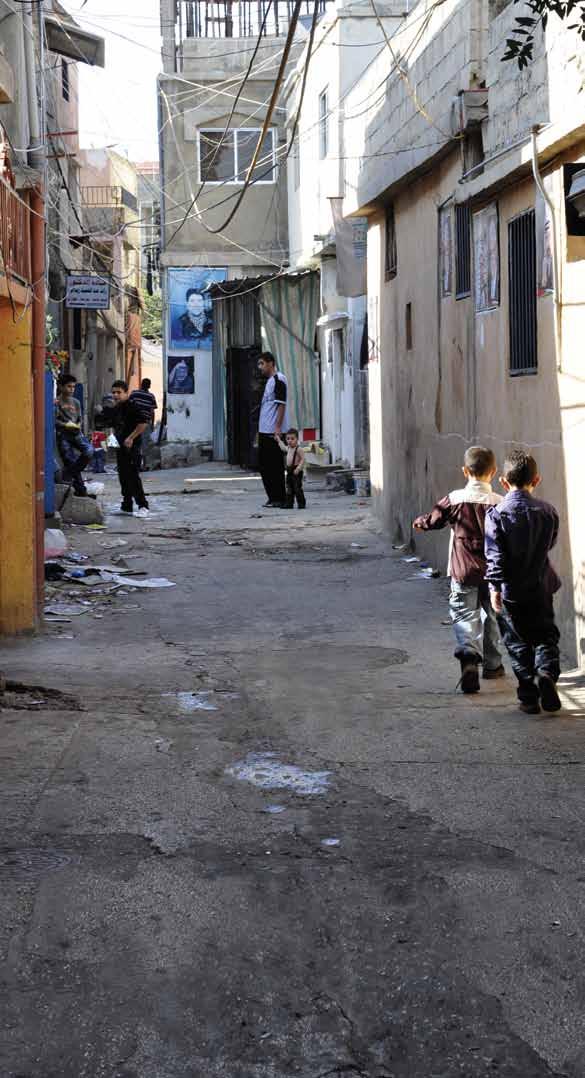
A street in el Buss Camp
Photo: Julie Davidson
the ceasefire, this relief ministry led to several community rehabilitation projects, including water projects in south Lebanon and the Bekaa Valley, implemented in partnership with the local church.
In 2009, Rupen and Mamta Das were appointed as CBM Global Field Staff in Lebanon. Rupen provides leadership to LSESD’s new commitment to respond to the needs of the poor through sustainable community development. Although Lebanon is considered an “upper middle-income” country, a 2008 UNDP study found that 28 percent of the population is poor or extremely poor — a statistic that doesn’t include the large numbers of foreign populations such as migrant domestic workers or Palestinian refugees.
To better understand the nature and causes of poverty in Lebanon, Rupen led a research team in conducting a major poverty assessment, studying eight communities representing the country’s geographic, ethnic, religious and political diversity. The study, published as Profiles
of Poverty: The Human Face of Poverty in Lebanon, balances statistical analysis with a narrative approach that allows the poor to describe their own experience and perceptions of poverty.
“We are thrown out here and no one is helping us,” says one person from
where they won’t be afraid to buy cattle or do business, where they don’t fear that someone will come at night and destroy it…” says a young woman.
The study looked for answers to two questions: who are the poor in Lebanon, and why are they poor? “The causes
My heart was full of anger, hatred and bitterness because of what had happened ... It was good to hear about Jesus’ way of responding to those who hurt us; to see that it frees us from becoming like that ourselves.
Wazzani, a small agricultural community in the province of Marjayoun. “There is no one that will take a second look at us… The government, who is responsible and in a position of authority, doesn’t care. No one asks about us. Lebanon is beautiful, but…sustaining a life and family is difficult.”
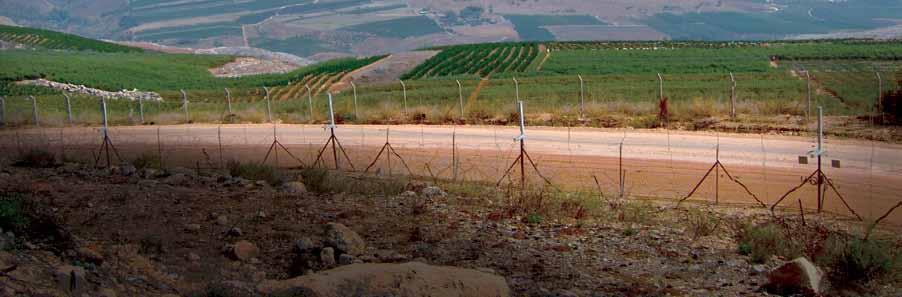
Wazzani is located on the border in the south, an area under constant threat of renewed conflict and violence. “Since 1948, we’ve never had peace. Our peace is related to the peace of Lebanon and there is none,” says one man.
“I am hoping for a more stable situation when people don’t fear growing crops or building because of war,
vary, but it’s not just the fact that people don’t have enough money,” says Rupen. “The real cause is that the poor belong to marginalized communities, excluded from the mainstream of society.” Some of these marginalized communities include refugees, the Bedouins, the Dom (commonly referred to, derogatorily, as gypsies), and migrant workers. Whether geographically or socially isolated, Lebanon’s communal and religious social structure makes moving out of poverty even more difficult.
After listening to the voices of the poor, CBM and LSESD are developing projects to respond to the needs of vulnerable communities, including a community centre in Marjayoun that will provide education, healthcare, activities for children and youth, and agricultural training; a community centre for vulnerable youth in Beirut that will provide skills training; and education and livelihood projects where the relief project for Syrian refugees and their host families took place.
“My heart was full of anger, hatred and bitterness because of what had happened,” said one refugee. “It was good to hear about Jesus’ way of responding to those who hurt us; to see that it frees us from becoming like that ourselves.”
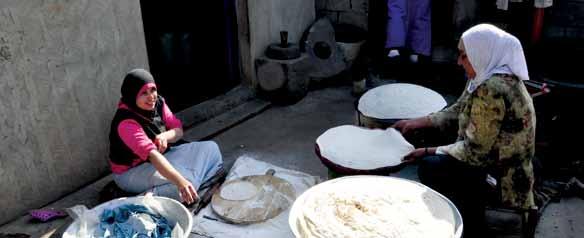
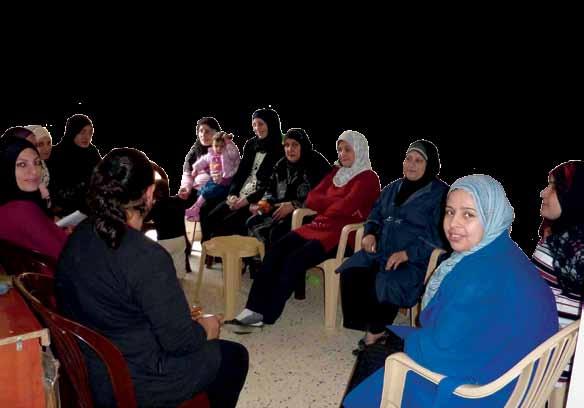
With the support of i nma Foundation (a partner of LSESD), Palestinian mothers meet once a month to discuss parenting issues and share a meal. CBM sponsors many of their children to attend preschool.
A pastor of a small Baptist church in a village near the Lebanon-Israel border shares about life and ministry on the frontlines of peace.
You live in such a beautiful area, surrounded by rocky hillsides covered with olive trees — some that are 2000 years old — and yet it has seen such turmoil. Can you share a little of your experience?
We have many, many wars in this region. Through the years, every time trouble began, we felt unsafe because of the close distance to the border. We left our homes many times during the war… It was a terrible time, every day explosions, tanks and bombs…I stay because this is my ministry…It is unsafe but we feel that it is God’s will…the place the Lord wants us to be. We feel very privileged that in this place of danger and poverty, God wants to have a church and ministry here.
How do you live with uncertainty and the possibility of conflict?
We have faith that God is with us and he has protected us and he will protect us. We have many previous experiences of how God provided for us. Even though the situation is not
stable, we have peace in our hearts. God is faithful…even the dangerous place is safe when God is near.
What image would you use to describe your church?
A lighthouse because I think people without Jesus are living in the dark and this church is here to send some light — even small — but we need that light to shine more and more to reach every village, everybody in this region.
What is your vision for your church?
Our vision is to begin a Bible study in some homes and surrounding villages.
How do Muslim families respond to you and your church?
There is respect…it’s not easy to preach publically but we have visits with families and we talk about faith. They believe in God, we have some common points…I teach in a Muslim school…sometimes I share with the other teachers Christian books. We
are known as peacemakers. Where we work, people share their problems and troubles with us and trust us to try to make things better. When there are misunderstandings between people at the school, always I try to reconcile them.
How would you describe the good news?
God loves us and we have promises from God…
What do people here need?
They need Jesus. They need job opportunities. They need peace.
Words of encouragement or a challenge for Christians in Canada?
We need to feel that we are one in Christ and we are thankful many churches visited us and are praying for us. My challenge — make the most of every opportunity, serve with all your strength because you’re living in a land that’s free and stable and peaceful.
Who: Youth leader and camper
Where: Beirut, Lebanon
What: A camp for vulnerable children at Easter
With these kids, God is love, we love them, no matter what they do, no matter who they are… says a volunteer youth leader at one of the children’s camps held by Baptist Children and Youth Ministry (BCYM) in Lebanon.
Since 2006, BCYM has held Christian camps throughout the year for children from local churches. In 2008, they began reaching out to disadvantaged children in the community.
As well as an opportunity to share the love of Jesus and plant hope in the hearts of children, these camps help to train young leaders in the church. Local volunteers and teams from overseas partner churches help to lead the camp activities. Contact CBM’s
for more information about how you can participate in a BCYM camp.
your gifts in action
As a Partner in Mission with CBM Global Field Staff Elie and Mireille Haddad and Rupen and Mamta Das in Lebanon, you are helping to train new leaders, provide resources and strengthen the witness of the local church in the Arab world through the ministries of CBM’s partner, the Lebanese Society for Educational and Social Development (LSESD).
“God has been at work in Lebanon throughout the centuries and is still at work today,” says Elie.
“What LSESD is trying to do is to find out where God is at work and join him. This is our story.”
Welcome to My Neighbourhood: What’s for Dinner?
Available late spring.
CBM’s new mission curriculum presents inspiring stories of children and their families who are growing their own food around the world. Learn more about hunger and how you can help families in Bolivia, India, Kenya and Rwanda have good, nutritious food.
Email communications@cbmin.org
As President of Arab Baptist
Theological Seminary (ABTS), Elie provides critical leadership to ensure that students from across the region are equipped for ministry when they return to their countries. This year’s students come from Morocco, Algeria, Sudan, Egypt, Iraq, Syria, Lebanon and Armenia. Mireille works with a compassionate ministry called Heart for Lebanon. She serves with the part of the ministry that works with Iraqi refugees. Her role is with the women’s ministry, attending to their physical and spiritual needs, including Bible study groups and visitations.
As Director of Community Development with LSESD, Rupen works with local churches to complement their verbal proclamation of the gospel by responding to social needs in the community, enabling them to design and implement relief and development projects. Rupen is also Program Director for the new Master of Religion in Middle Eastern and North African Studies offered at the Institute of Middle East Studies, which is a part of ABTS. Mamta has a background in teaching and has completed her diploma as a personal support worker.
You can be part of God’s story in the Middle East. Become Partners in Mission today.