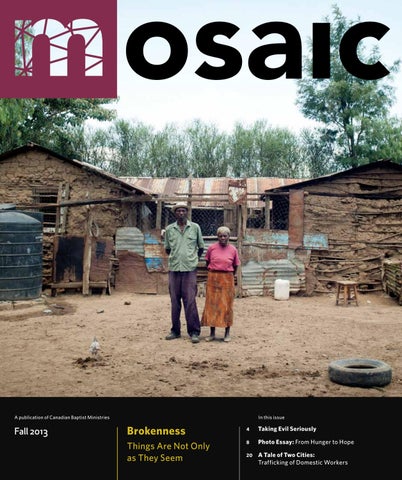
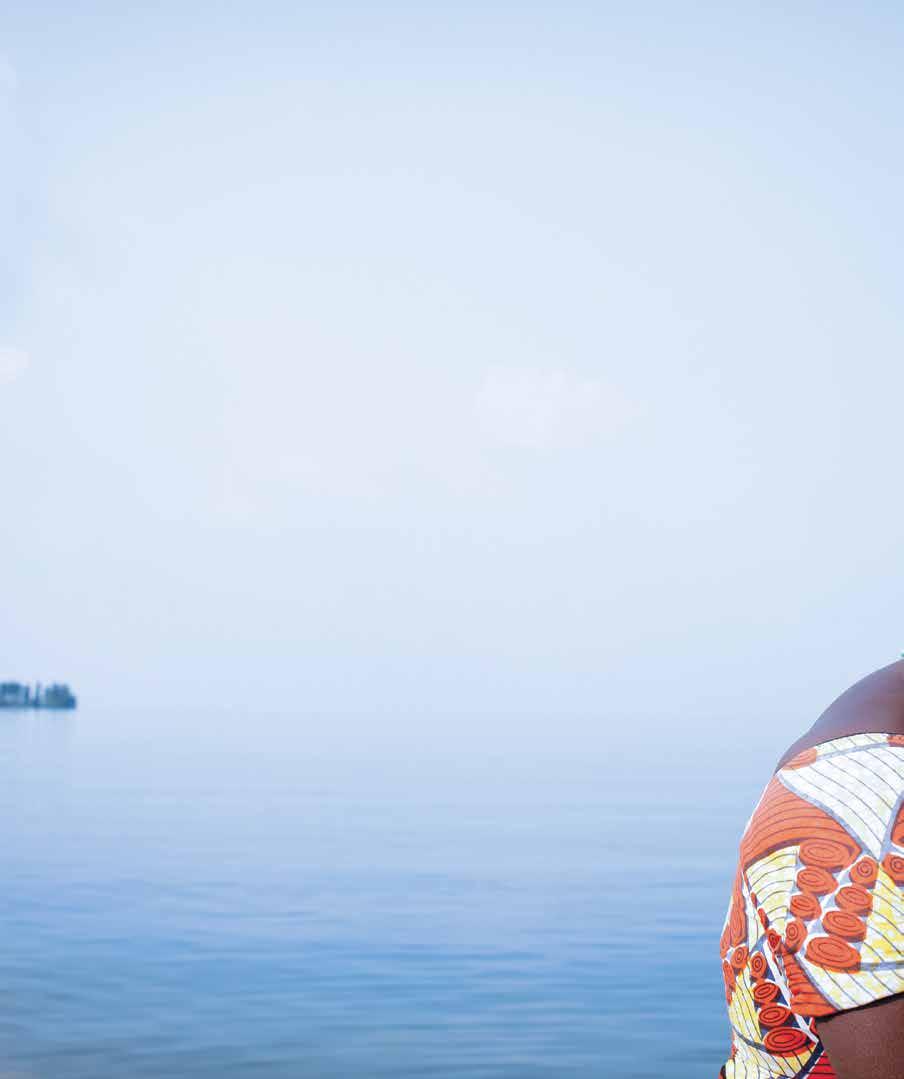
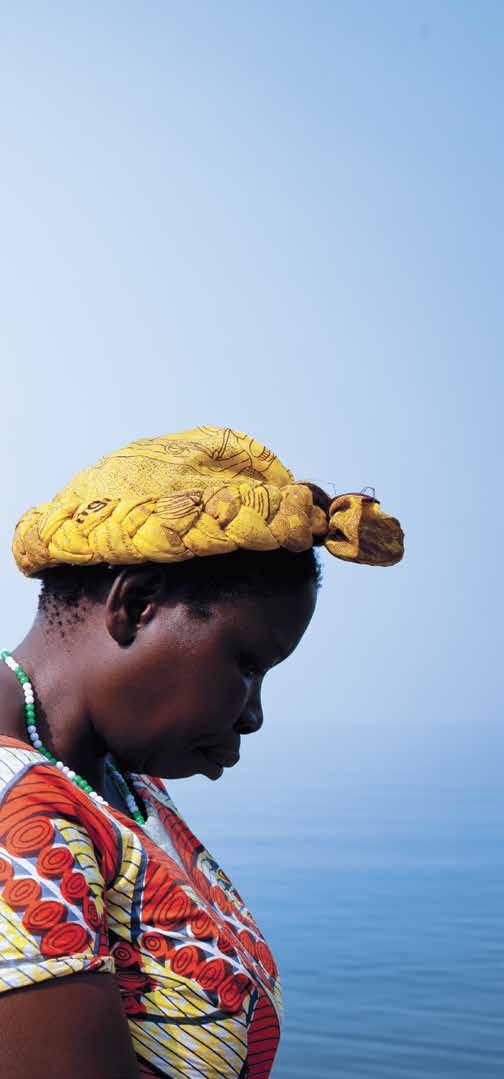
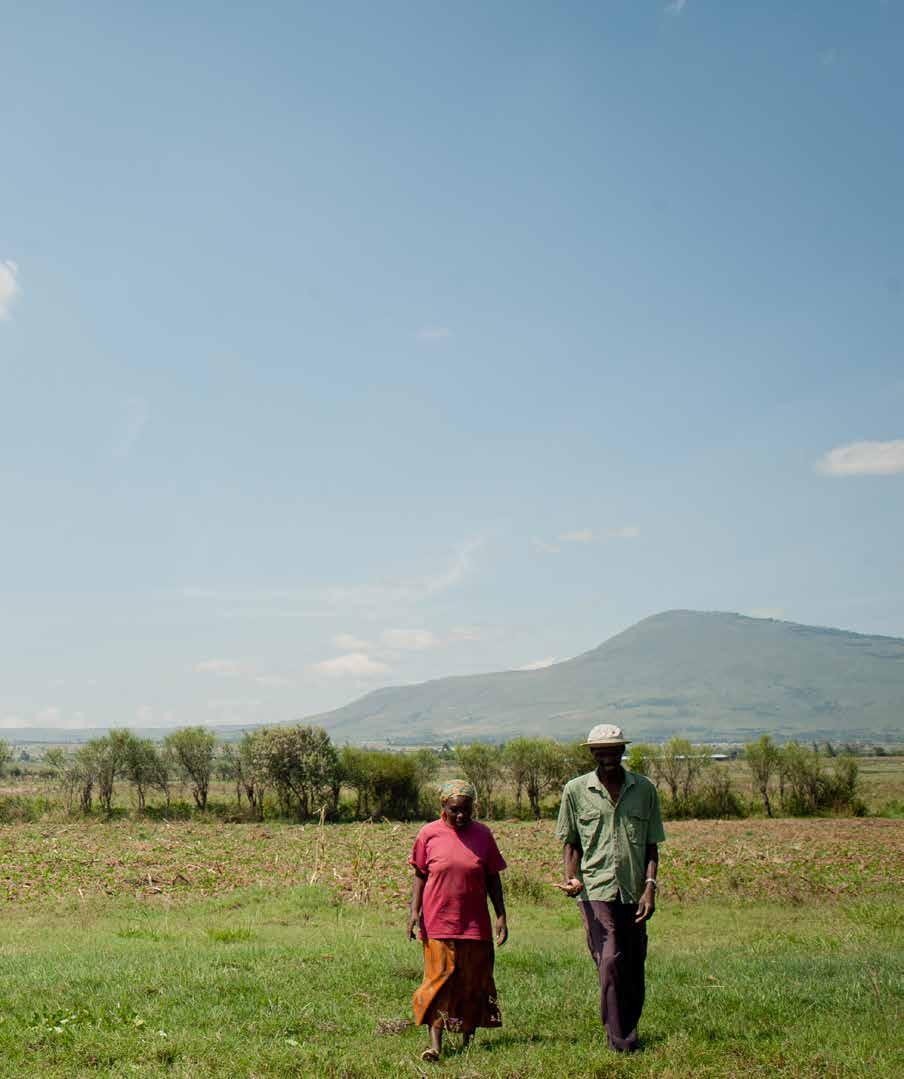
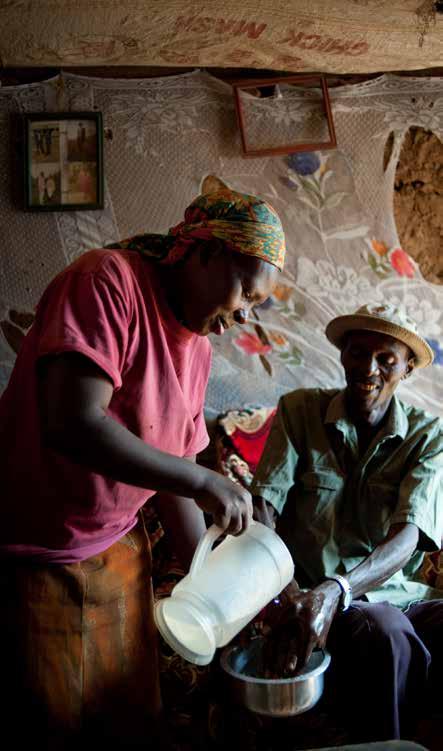
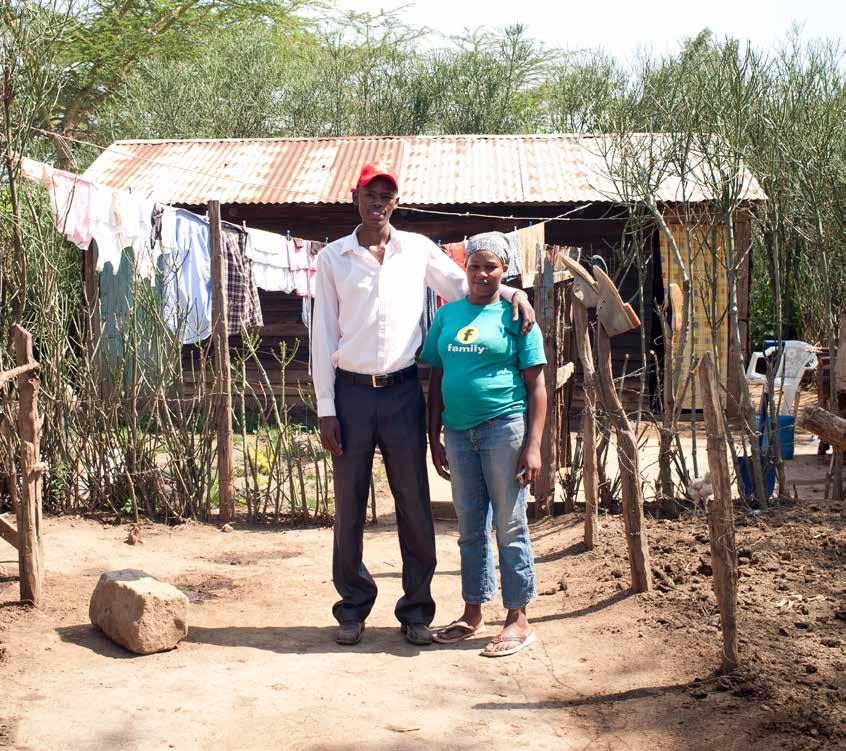
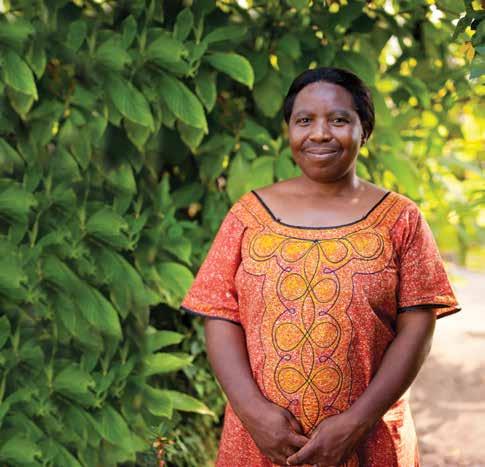
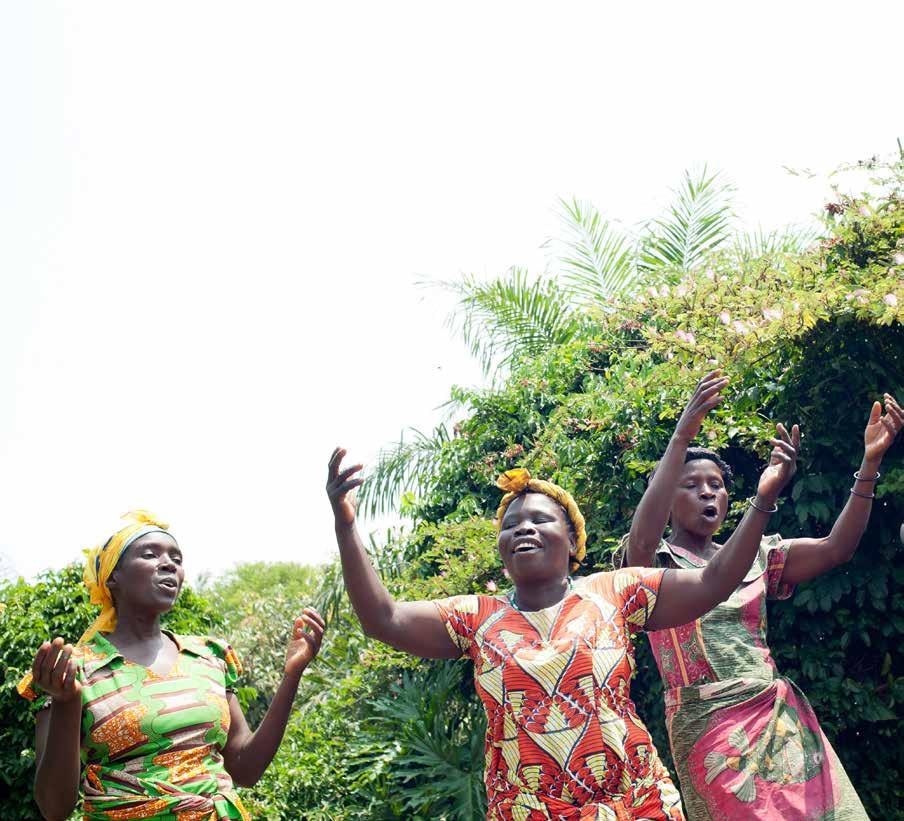
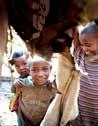
Cover: From Hunger to Hope See full story on page 8.
Photo: Johnny Lam Photography
Mission of Canadian Baptist Ministries
Encouraging passionate discipleship for local and global mission.
As partners in the Canadian Baptist family we exist to serve the local church in its grassroots mission. Together we impact our communities and beyond through the love of Christ.
“all have sinned and fallen short of the glory of god.”
when i was younger and taught how to share God’s Story with others, that phrase was the first line of the story — that there’s a problem (sin). However, biblically, that is not the first line of the story.
Biblically, the first line is that God made a glorious, beautiful, awe-inspiring Creation, in which He placed humans to steward and explore — to tend Creation as a garden and represent the Creator. God looked at all that He had made and said that it was “good”. The first line of the story is not a problem; the first line is something wonderful.
But, of course, something went wrong. Genesis 1 begins the story but Genesis 3 follows. The man and woman God placed in the garden failed to trust and depend on Him and disobeyed his command not to seek knowledge independent of God. Their relationship with God, with each other, and with Creation was broken. The glory of Creation was shattered and disfigured, and ever since then, God has been working to restore what has
been lost, and transform it into a new Creation.
This year at CBM we have been working to “re-vision” — to clarify our existing vision and sharpen and re-energize it. Through this process we have been reaffirmed that God calls us to work with local churches around the world to engage in integral mission (mission that intertwines word and deed) in order to bring healing to a broken world.
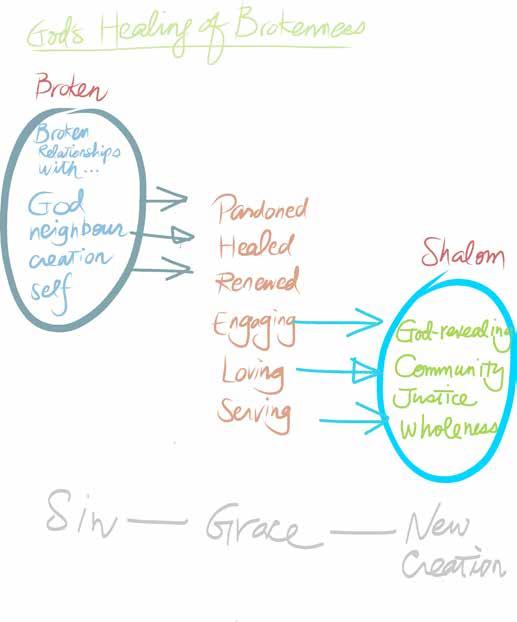
“Brokenness” has become a word that is important to us. See my illustration on brokenness on the next page. We are not an organization that simply wants to address material poverty, nor are we an organization that simply wants to address the fact that many people don’t know Jesus. Rather, God is calling us to care about all of human brokenness — to be used by God to help restore and renew all that went wrong in Genesis 3.
This issue of mosaic includes stories of churches that are responding to a broken world with the healing God offers. Our prayer is that it will inspire you.
Grace and peace, Rev. Sam Chaise
Executive Director of CBM
taking evil
seriously
M i SS ion in A B rok E n worl D
By Gordon King CBM Global Discipleship and Canadian Engagement Resource Specialist
See Parting Shot for her story
+i often use the adjectives “broken” and “wounded” to describe the world. Placed together they express the collective impact of evil and destructive patterns of behaviour on human lives. The wounded hearts and bodies of people and the broken social fabric of communities contrast with God’s intention to bless his creation with peace. The Hebrew word “shalom” conveys the meaning of wholeness or health. A person who enjoys God’s gift of peace lives fully and meaningfully with God, family, community and the environment. Justice, compassion and faith are active values in locations of shalom.
the terms broken and wounded can be used to convey the circumstances of:
• A farmer in Kenya whose crops have failed because of climate change.
• A Syrian woman raped as part of the violent intimidation of civilian populations.
• A mother in Bangladesh who lost her daughter when fire engulfed a clothing factory.
• The retired pharmacist in Greece whose suicide note said that he retained too much dignity to look for food in the garbage.
• A 15-year-old girl in India who will be married to a man three times her age because he paid a dowry to her family.
• A teenager in Canada who struggles with an anxiety disorder and contemplates ending his life.
It is not difficult to find wounded and broken people; it is challenging to analyze and constructively deal with the evil or sin that causes their suffering.
The starting point is to affirm that God did not intend that life in Kenya, Syria, Bangladesh, Greece, India and Canada should be this way. Humans are responsible for oppressive political
photo: Johnny Lam Photography
Mission in a wounded and broken world requires the Church to take seriously personal sin and social evils.
regimes, inequitable economic systems, pumping hydrocarbons into the atmosphere, unsafe working conditions, gender discrimination and destructive social pressures.
The next statement might be a humble confession that we are confused and bewildered by the forces of evil in our world. Perhaps we discovered clothes from Bangladesh in our closet. We want to defend our virtue but feel implicated in an economic system that exploits workers to produce cheap garments and ends in a human tragedy.
A New Testament story has helped me understand the way in which evil can subtly become imbedded in the social and economic patterns of a culture.
the story
(1 Corinthians 11:17-34)
Community dinners were an important part of the life of the early church in Corinth. The shared meals, accompanied by the celebration of the Lord’s Supper, helped define the distinct nature of the Christian movement in this great Mediterranean city.
However, these social occasions were never easy to organize and manage. Only the wealthy owned homes large enough to accommodate such gatherings. Labourers and slaves arrived late because they exercised little control over their working hours. Usually the best food and wine had been consumed and only a few leftovers remained for those on the bottom rungs of the social ladder.
It is easy to condemn the actions of the upper class members of the church. The issues at stake would not have been so clear for an observant outsider. The social world of the Mediterranean gave importance to honour as a virtue. The cultural code assumed distinctions in seating arrangements, the quality of food and wine, and in the quantities served among the guests of different ranks. Social relations in the Roman Empire functioned in this way and were seldom questioned.
The Apostle Paul took a dissident position. The inequity of community meals were evidence that the church participated in the evil and brokenness of the world around it. He offered a stunning critique that accused the honoured members of the congregation of humiliating the poor, showing contempt for the church, and participating in the Eucharist in an unworthy manner. He warned them some church members may have died as a sign of God’s judgment.
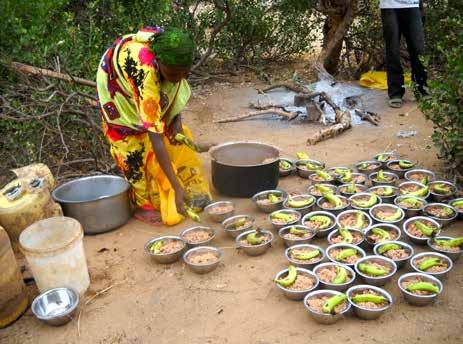
[right] feast in the middle of famine — One of the feeding programs for children and families at risk supported by CBM through local church partners in response to the drought and famine in the North Eastern Province of Kenya.
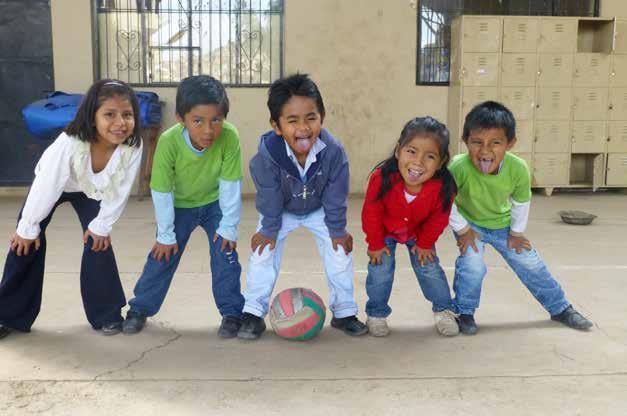
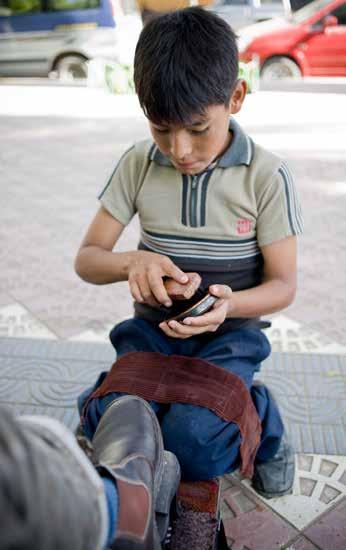
[above] taking a break from work — A group of child labourers in Bolivia get a chance to play. See full story p. 19.
reflections on the story
We can draw at least four conclusions from this story:
1. Our definition of sin or evil needs to be expanded beyond individual actions such as dishonesty, gossip, avarice, violence, addictions and compulsive behaviours that are destructive in nature.
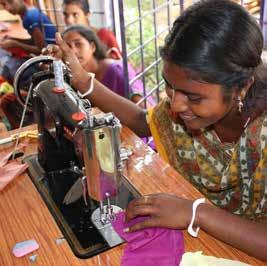
a stitch of dignity — Young girls at risk in India access valuable life and vocational skills training with support from CBM.
their consequences are easily pushed from view by self-interest and convenience.
+mission in a broken world
Mission in a wounded and broken world requires the Church to take seriously personal sin and social evils. We are challenged to go back to the core elements of our faith so that we may individually and collectively:
• Discern and critically examine the evils of our time in history.
• Confess and seek God’s forgiveness for personal and social sins that compromise our faithfulness.
compromise our faithfulness.
• Celebrate the generous grace of our God.
• Demonstrate the fruits of repentance by living as dissidents who strive for the Kingdom of God and his righteousness (Mt. 6:33).
In this way we work for God’s shalom and healing in our world.
2. We may participate in evil by uncritically embracing cultural norms and patterns of behaviour that reinforce the broken nature of our world.
3. God’s intention and will are that all people have the opportunity to live with a sense of dignity and a share in the common good of creation.
4. The Church’s mission requires healing actions that begin with the proclamation of Christ crucified and lead to consideration of the needs of others, social equality, and the primacy of love. At CBM we use the term integral mission to represent this kind of engagement with the world.
The Corinthian story makes us aware that individuals can have high standards of personal morality and simultaneously be perpetrators of social evil in a broken world. Albert Speer, Hitler’s Minister of Armaments and War Production, was an exemplary husband, devoted father, dedicated bureaucrat, and trustworthy colleague who claimed to have no knowledge of the Holocaust. He would later say: “If I did not see it was because I chose not to see.” I fear that I may make the same confession when I stand before God and account for my life. The forces of evil and
I conclude with a story from our own time that continues to inspire me. It is commonly known that Nelson Mandela was tried in 1963 in a South African court for treason. The prosecutor, Percy Yutar, demanded the death penalty; the judge sentenced him to life imprisonment. Mandela spent 27 years in prison, the majority on Robben Island where he laboured in a lime quarry and lived in isolation. He was released from prison in 1990 and elected president of South Africa in 1994. Within months President Mandela invited Yutar to the president’s office for lunch. The shared meal was used to communicate forgiveness for the pain and injustice that had been inflicted. It was a bold and controversial act. Mandela recognized that hope for peace depended upon individual decisions to seek reconciliation rather than revenge.
The mission of the Church is not to be overcome by evil but to overcome evil with good (Romans 12:21). Faithfulness to this mission requires prayer, discernment and courage as we follow Jesus into a broken and wounded world.
Connecting
Discover: A Guide to Discerning Your Church’s Mission Heart
CBM has an exciting new tool available to help pastors, leaders, and congregants engage in thoughtful reflection and conversation on social and spiritual needs that are local, regional and global; to evaluate present mission commitments (both financial and volunteer time) and dream together about the calling of their church to witness to God’s grace and love in a broken world.
Email communications@cbmin.org to find out more.
A Photo Essay from Kenya’s Rift Valley
Photos: Johnny Lam Photography
Captions: Laurena Zondo, editor of mosaic
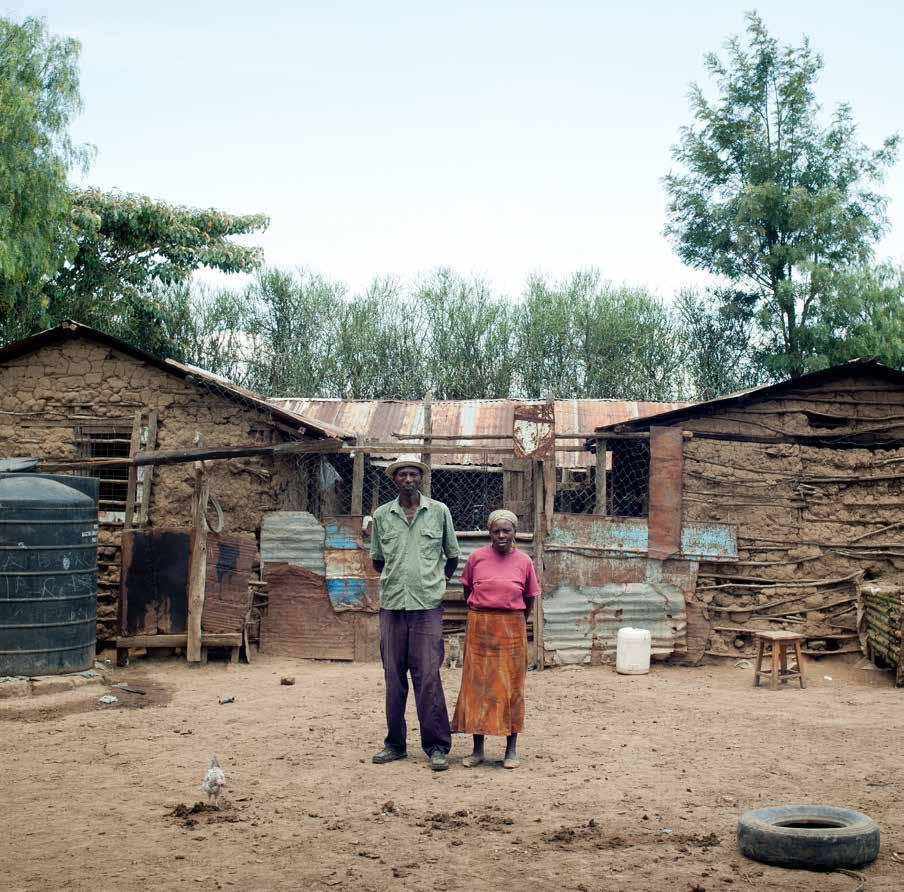
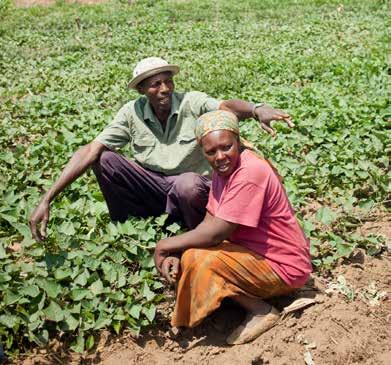
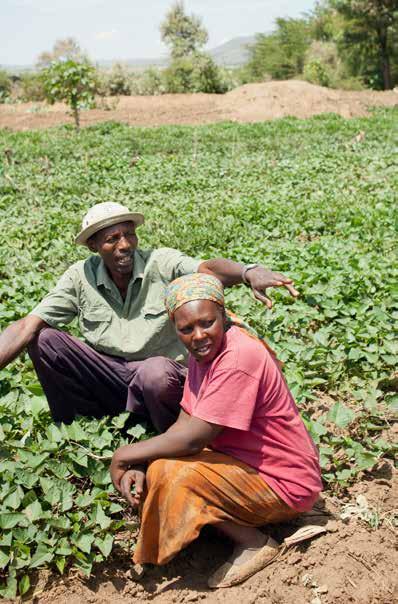
Stephen and his wife ruth farm in kenya’s r ift Valley where climate change and deforestation have intensified the severity and frequency of droughts.
Three years ago, everything died — crops, livestock, and hope. ”We had no food and no money to buy food,” recalls Stephen. “I couldn’t find work. Life was so hard, I felt like running away.”Ruth also felt despair. “When there is drought, women suffer because there is nothing in the kitchen. You feel humiliated because your children are going without food.” But then the African Christian Church & Schools, CBM and the Canadian Foodgrains Bank stepped in with emergency relief followed by a project that’s helping 1,200 families become food secure.
i rrigating fields
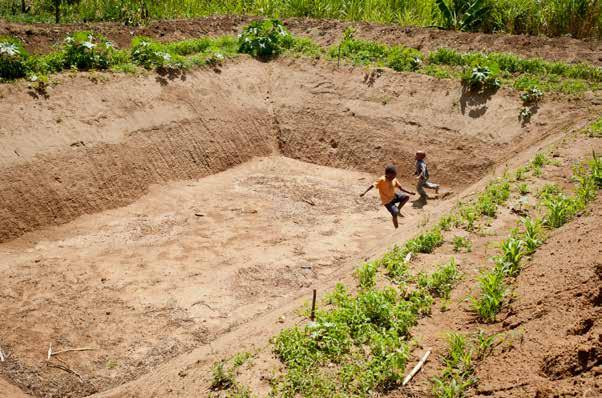
When rain does come, land is too dry to absorb it. Stephen learned to dig trenches in his fields — and a deep reservoir (pictured) — to collect rain and prevent soil erosion. It took four weeks to dig. “It was hard work, but my sons helped because they now see the benefit of farming.”
Harvesting rain
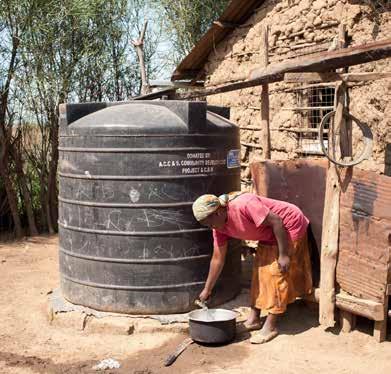
The project provided households with tanks to collect rain from the roof for drinking and cooking, reducing the cost and travel time to find and buy water.
Food in all seasons
“The training has really helped us to fight drought,” says Stephen. He and Ruth learned new techniques such as mulching, to conserve soil moisture, and diversifying crops. Some new crops include pigeon peas, kale, tomatoes, and bananas. "I want to grow more vegetables, not just for consumption, but for income so I’m able to pay school fees for my children,” says Ruth.
Good neighbours
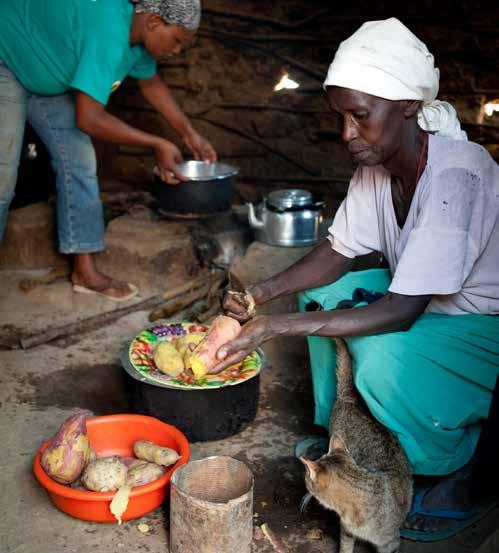
“I’m so happy and thankful to God because of this couple,” says a neighbour (pictured cooking). “I always see them in the field together, working so hard. I see that it is good work and I have been trying to do the same.” Ruth wants to become a trainer, “so more people can come to my fields and I can show them what we are doing.”
Fruits of labour
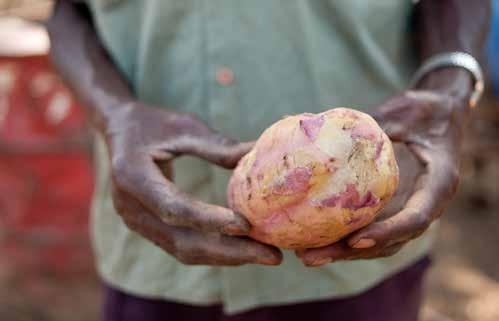
“We’ve planted drought resistant crops, like sweet potato,” says Stephen. "I am so happy to God that he has given me enough that I am able to also share food with a suffering neighbour.”
Planting for the future
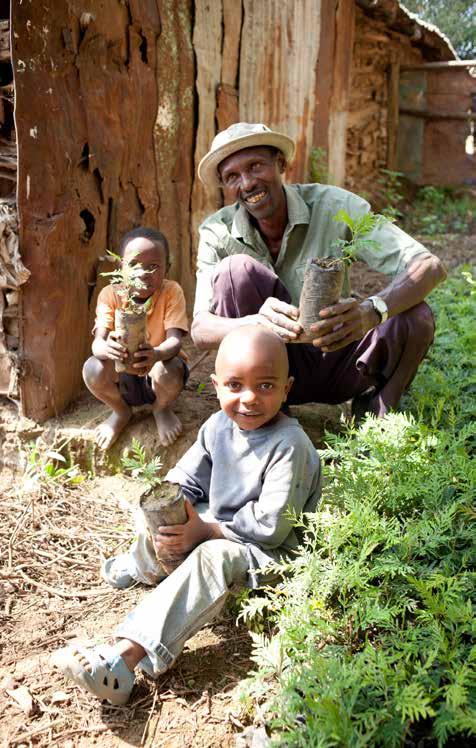
Stephen with his grandchildren in his new tree nursery. The government encourages farmers to plant at least 10% of their farm with trees to fight deforestation. Stephen earns income selling seedlings to others and has planted trees to improve his land, the environment, and even family nutrition — with fruit trees such as mango and avocado.
A hopeful home
“With the training, I see that I can do all things, and God has helped me,” says Stephen, sitting down to a meal of fresh sweet potatoes from his fields. “We have seen God doing miracles.”
Proud to be a farmer
“I’m very proud of my parents,” says John (pictured with his wife). “But I wasn’t proud before because we went hungry.” Many youth leave farming for jobs in town. “Parents discourage us from becoming farmers,” says John. “They tell us to work hard in school so that we don’t become farmers like them. But now I see that farming can provide for your family, even provide for your neighbours.” John is now a field assistant in the food security project. The story continues. See video clips at facebook.com/cbmin.org
“
My People are in Prison”
By Kathy Cheveldayoff
Consider These Statistics
• 70% unemployment
• 50% of children living in poverty
• 66% school drop-out rate
• Epidemic suicide rate
“ wHE r E i S TH i S?” You M i GHT won DE r. Surprisingly, it’s not in some foreign ghetto. It’s right next door, in your local First Nations community. Alarmed at this great need in our midst, an informal group of Christians in the Duncan region (Vancouver Island) have banded together to support the leaders of the Cowichan Tribes. Several churches, including Mill Bay Baptist Fellowship and New Life Community Baptist Church, are involved.
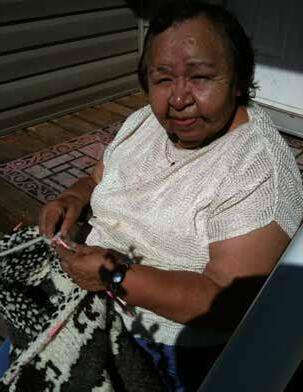
Sarah, 82 years old, is one such tribal elder whom we work with. Some of her own children experienced the tragedy of the boarding school abuse we hear about so frequently. Sarah is grieved at the lingering impact as children returned, ashamed and angry at their parents and their culture. Many in turn became abusive and
some now pass on their distrust and animosity towards “white” people to the next generation. But Sarah has been able to deal with the ghosts of her family’s past and has been instrumental in creating initiatives to help others. She was the first one to put into action the Cowichan knitting project — buying wool, washing, carding, dyeing and making the yarn for the traditional sweaters that are so sought after by tourists. Currently she is working with the Catholic sisters, visiting communities, distributing food and other necessities. She also spends a lot of time counselling young people in marriage and family issues.
“My people are in prison. They don’t know who they are,” says Sarah, describing the lostness she sees. Sarah fervently believes that only faith in Christ can heal the trauma in her people. She has become a dear friend and is a great help in navigating protocol and cultural issues as we seek to help our First Nations neighbours.
Se’Shen Youth Development Society is one such initiative. Se’Shen means “Step up” in Coast Salish and its vision is to inspire and mentor First Nations youth. The program centres on a Wednesday afternoon drop-in where youth can grab a burger, kick back, converse, get homework help, and play. One of the popular activities is the
feather ceremony — where everyone gives thanks to our Creator God for His blessings in our lives. There is also a food pantry that offers emergency assistance to struggling moms and grandmothers raising children.
Some of the other outreach activities include a Saturday afternoon kid’s club — a puppet theatre run by New Life Community Baptist Church over the summer; a weekly craft class for women held at Grace Church; and a teaching and social services network established by St. Anne’s Catholic Church.
We recently asked some of the youth at Se’Shen what it means to them. We were amazed at their response: “It is a place of belonging; a place of friendships; a place of safety; a place of learning; a place of love and trust.”
We thank God for these dear young lives and the radiant hope they exude. May they continue to discover purpose and fulfilment through the abundant life of Christ.
Kathy Cheveldayoff is a retired CBM Global Field Staff who served with her husband Laurence for 30 years in Bolivia and Brazil. Today they live in Duncan, B.C. and volunteer in local church ministries.
[top] Sarah, an 82-year-old elder of the Cowichan Tribes, started a knitting project to help her people.
[right] Se’Shen sponsored three youth (pictured) to attend summer camp where they took another step of faith and were baptized. “I am so glad, I feel much closer to God now,” said one of the youth.
Home Church
By Giselle Randall Associate Editor, mosaic
“ THE r E i wAS , li V in G in THE ST r EET. Homeless, friendless, drugs and alcohol my only companions,” Kevin said as he shared his testimony before being baptized. “Let me tell you — winter is very, very cold in those conditions.”
Some people helped him find a room in an apartment. “I lay on the bed, over the blankets, too afraid of what I might find under them. I started to have convulsions … but when the ambulance came, I refused their help.”
Feeling like he was about to die, Kevin suddenly felt God’s hand on him. He remembered the words of an ex-girlfriend: “Don’t wait to lose everything before stopping all this.” With the last of his energy, he reached out for help and went back to a detox centre.
After rehab, Kevin began attending Église Voix de l’Evangile, a small church in Saint Jean-sur-Richelieu, Quebec.
“He’d go away and we wouldn’t see him for a while, then he’d come back and we’d receive him and just show him love,” says the pastor, Michel Martel. “Slowly but surely, by being
patient with him, just being with him at times, he’s starting to really understand what it means to be a Christian.”
Kevin was one of five people baptized on Sunday, August 4, 2013 at Église Voix de l’Evangile, a church plant that started as a small group in Pastor Michel Martel’s home in 2009. Today the church meets in a coffee house downtown and has grown from 12 to 40 people on average. It is one of about five evangelical churches in Saint Jean-sur-Richelieu, a city of 100,000. Only one percent of Quebec’s population identify as evangelical Christian.
“Quebec is a mission field,” says Martel. “For many years, the door was closed to anything that wasn’t Catholic. And then people turned off to religion in general, became more secular, not interested in spiritual things. They put us in the same bag — you’ve just got another religion. What God offers us is a relationship with Christ. That’s what Jesus brought, not a religion.”
Église Voix de l’Evangile is one of three churches receiving support as part of Challenge 25, a joint initiative between CBM and the French Baptist Union (FBU) to stimulate church planting in Quebec. For every dollar raised by the FBU, CBM will multiply it by three.
“The need is tremendous,” says Martel. “We need missionaries, we need people who are open to the fact of being called by God to come and open churches, but it’s not necessarily going to be easy.”
The need is tremendous... we need people who are open to the fact of being called by God to come and open churches, but it’s not necessarily going to be easy.
[above]
Pastor Michel Martel and his wife Barbara
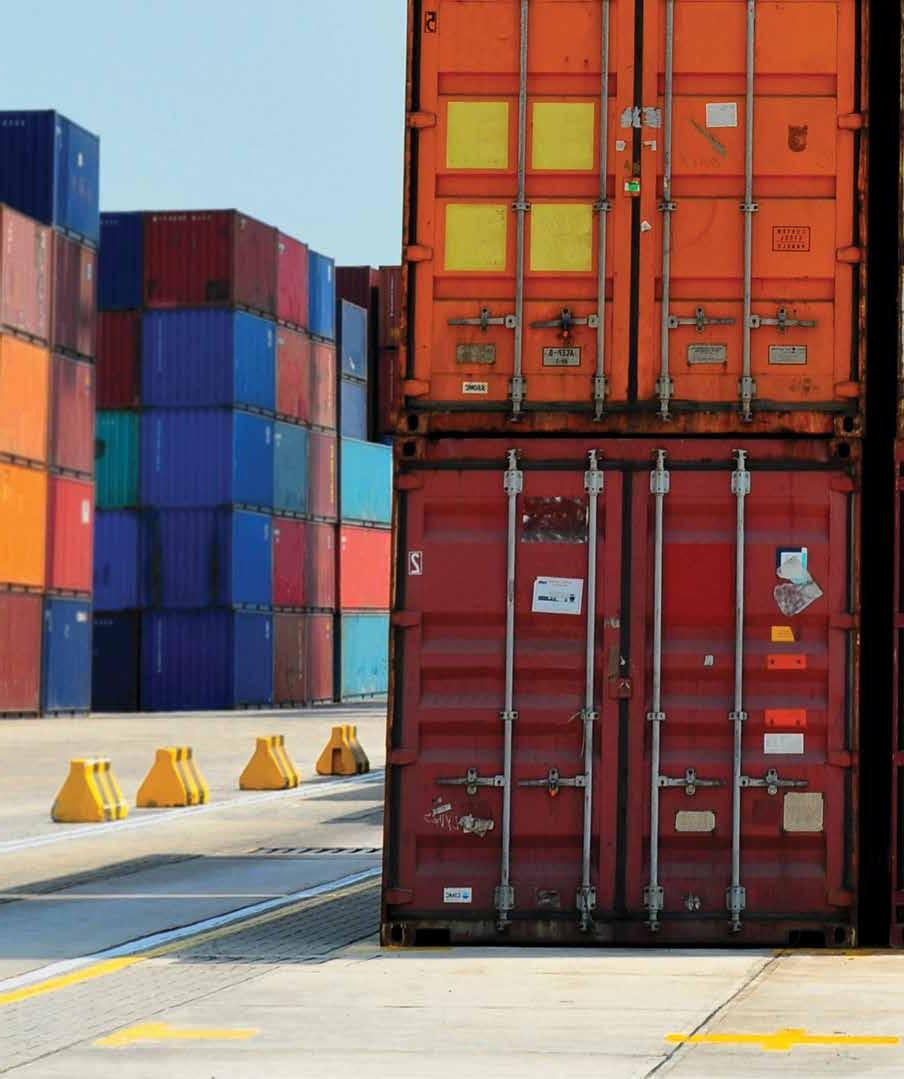
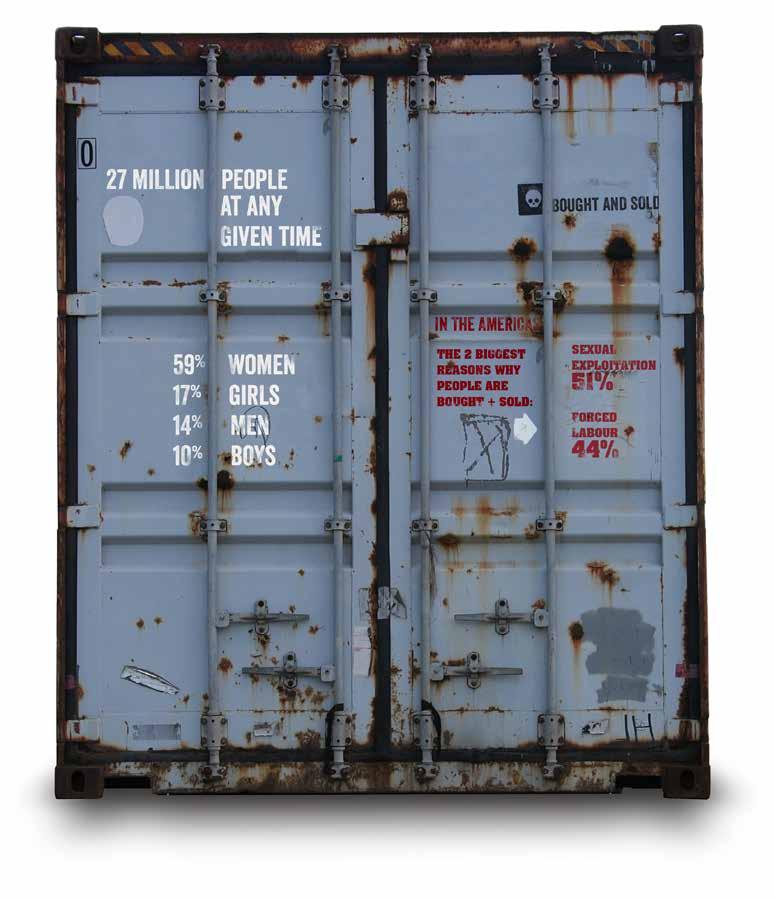
The Modern Slave Trade
one person is trafficked across a border every minute
... an exciting example of how business and mission can be brought together in highly transformative ways.
BROKEN NESS AND BUSINESS
By Duane Guthrie CBM Global Field Staff in Bolivia
martin luther king, jr. once said, “Injustice anywhere is a threat to justice everywhere. We are caught in an inescapable network of mutuality, tied in a single garment of destiny. Whatever affects one directly affects all indirectly.”
From young mothers abandoned by their husbands, to children living with their parents in prison, Bolivia has more than its fair share of brokenness, the injustice of poverty and abuse.
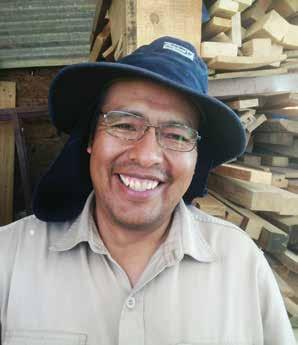
Much of the work we do at CBM is a direct attempt at confronting these areas of brokenness by offering a message of renewal and redemption, both in word and deed, through various social justice programs that operate around the country. One such program, run by one of our ministry network partners, teaches young men a trade to help them find meaningful work. This carpentry shop is an exciting example of how business and mission can be brought together in highly transformative ways.
I remember one young man named Alex, who entered the program with virtually no experience in woodworking. With help, Alex grew to become an exceptional craftsperson, eventually taking over the entire program and helping others learn new skills. But Alex didn’t stop there. Not satisfied being an employee, he took out a small loan and purchased the carpentry shop, fulfilling his dream of being self-employed. Now a for-profit institution, the shop no longer needs subsidies and is fully engaged in business as mission.
Alex continues to produce fine furniture that is sold in the markets, providing an income for his family. He also continues to share his skills and his faith with others and even dreams of being able to help launch new businesses as a way of giving back to his community.
Alex and his carpentry shop are an example of how a business can contribute to the common good, and fight against the injustice that leads to brokenness.
Alex is not alone. There is a growing movement of business people in Bolivia and around the world that are waking to the possibilities that exist when the marketplace is seen as a mission field and business is seen as way of addressing the brokenness that grips our world.
I like to remind Alex that Jesus too was a carpenter and long before he began his public ministry he served his community through the use of his hands. Jesus, the master carpenter, is actively engaged in overcoming brokenness and repairing broken lives. Sometimes he works through a small carpentry shop located in the south end of Cochabamba, where he looks very much like a young Bolivian man with a large smile on his face.
Hope for Child l abourers in Bolivia
By Laurena Zondo editor of mosaic
a sad fact of extreme poverty is that many children in developing countries such as Bolivia have to work to help their families survive. And many families become stuck in an endless cycle of poverty. Since 1998, Jireh has provided care and mentorship to more than 200 of these children at risk who work on the streets and in the marketplace to help support their families. Some of the jobs they do to earn a few dollars a day include shining shoes, selling juice, gum, candy, and washing car windows.
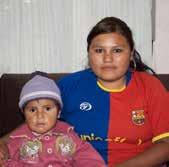
Blanca (pictured above with her youngest child) is one of the original group of children supported by Jireh. She shares her story
I was shining shoes in the square when a friend who was in Jireh took me and my little brother to the project. At Jireh, they said that I could study and learn. I had never been to school. But my dad told me that outside of polishing shoes, learning wasn’t going to put food on our table. It was difficult because I couldn’t only study — I needed to work to support my family. I had to give money to my parents. My dad didn’t work, but he drank a lot. Brother Thomas (one of the Jireh staff) told me that God was going to help me, that God would bless my life.
Brother Thomas helped me to get set up so that I could study at night classes and this way I could still work in the morning and afternoon polishing shoes. My dad got angry and told me that I couldn’t study, but Brother Thomas went to talk to him and encouraged him that it would be a good thing. I was able to study up to Grade 8.
I also met my husband at Jireh. He also shines shoes. We have three sons and we moved to Brazil to find better jobs. It was very difficult. I found work but after a while my husband left me there with our children and returned to Bolivia to shine shoes. I was both father and mother to my children. I worked day and night, not resting. I woke up at 6 a.m. and didn’t go to sleep until 1 a.m. to provide for my family. I did not think God could help me, but He has been great for me and He helped me.
I’ve prayed day and night and I know God will bless my life more. When I returned to Bolivia with my children to join my husband, I visited Jireh and asked to have our children in the project. I’m so happy that now our children can study. I’m going to continue working, shining shoes. I will polish very early while my husband works at night, so we can keep our children. We’ve progressed further in life, at least for our children. I am so thankful to all of the brothers and sisters in the church and Jireh who have helped us.
Today Jireh operates out of a local Bolivian church (Sinai Baptist, in Cochabamba) and cares for 50 children and youth at risk, ranging in age from 5 to 21. They aim to improve the condition of life through an integral approach that includes health, nutrition and medical care, tutoring with school homework, life and vocational skill training, and Christian counselling and nurture.
Connecting
Jireh is one of the Children at Risk programs supported by CBM. Give a gift today at www.cbmin.org
photo:
Johnny
Lam Photography
A Tale of Two Cities
Tr AFFiCkin G o F DoMESTiC work E r S
Excerpt of a blog post by Arthur Brown, Assistant Director, Institute of Middle East Studies at the Arab Baptist Theological Seminary, Lebanon
Scan to see full blog post or visit www.imeslebanon.
wordpress.com/2013/07/18/
last week, a high-profile case of alleged trafficking involving a Saudi princess was reported across the media. Meshael Alayban (42), one of the wives of Saudi Prince Abdulrahman bin Nasser bin Abdulaziz, was arrested for human trafficking in Irvine, California, USA.
It is alleged that in 2012 Alayban employed a Kenyan woman and brought her to Saudi Arabia for the purposes of carrying out domestic work. The contract stated that the woman would receive $1,600 a month for working five eighthour days per week. The reality it seems turned out to be very different as the Kenyan woman was forced to work 16 hours a day, seven days a week, and was paid only $220 per month since March 2012. This equates to less than 50 US cents per hour!
Upon moving to Southern California, the Kenyan woman was also forced to work in four different apartments in the building within which she was trapped. Furthermore, the woman’s passport was taken by Alayban and only given back long enough for her to enter the US, when she, along with four other migrant women from the Philippines, arrived in May of this year.
The Kenyan woman managed to escape and flag down a bus on which she explained to a fellow passenger that she thought she might be a victim of human trafficking. The passenger subsequently helped her to alert the authorities and, as a result, police later raided Alayban’s building. Following an investigation, Alayban was arrested.
the un’s palermo protocol describes a variety of different terms used for human trafficking, like:
• Involuntary [domestic] servitude
• Slavery or practices similar to slavery
• Debt bondage
• Forced labour
It is easy to find examples of each in Lebanon.
The central issue within Lebanon and many other Middle Eastern countries is that of the ‘sponsorship system’ — which ‘ties’ migrant domestic workers to their employers. Migrant domestic workers are not protected by Lebanese
labour laws and as a result become vulnerable to abuse.
As if this is not bad enough, employers are in fact required, under contractual agreement with the agencies responsible for ‘procuring’ domestic workers, to retain their employees’ passports. This naturally results in a situation whereby migrant domestic workers who escape from abusive situations become automatically criminalized. And if caught, they potentially face additional punishment, rather than protection, at the hands of the Lebanese authorities.
Christians were at the forefront of the abolishment of the slave trade. It seems that there needs to be a renewed call by people of faith today to rise up and make a stand against inhumane practices that directly confront the dignity given to all people by God, regardless of race, sex, socio-economic status or any other category within which we artificially categorize our human sisters and brothers.
cry of A syrian refugee
An UpdAte on
CBM’s Response to the sy R iAn C R isis
By Rupen Das CBM Global Field Staff in Lebanon
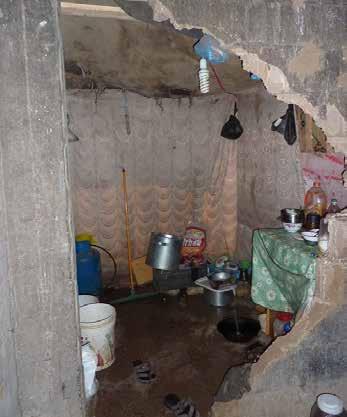
khalid 1 , his wife, and three young children live in a small room in an unfinished building that is part of a cement factory. They arrived in Lebanon about a year ago after a shell hit their home in northern Syria and armed men on the street started threatening members of the family. Some members of their extended family were killed. Khalid fled with his family and what little they could carry. It was a perilous journey across the mountainous border area — a desperate attempt to avoid checkpoints and skirmishes in the civil conflict that is tearing up his country.
Khalid, who used to own a grocery store in his homeland, now works as a day labourer whenever he can find work — which is not often. What he is able to earn pays the rent. If his family did not receive monthly food assistance from the small Baptist church nearby, they would have nothing to eat. His children — who are between the ages of 8 and 12 — have been unable to attend school. But they are able to meet, play, and learn with other children at the church’s Sunday School and occasional day camps organized by the Lebanese Society for Educational and Social Development (LSESD/Lebanese Baptists). Even though they are of a different faith, they feel welcome and loved.
1 For protection of those involved, the name has been changed.
The Syrian crisis is the most brutal conflict in the world today with close to 2 million refugees in neighbouring countries and more than 5 million displaced within Syria. The level of violence and destruction is unprecedented. One journalist commented that he hadn’t seen this level of urban destruction in the past several decades.
CBM’s partner, the LSESD, is working through a network of inter-denominational churches in Lebanon and inside Syria to provide food aid for close to 30,000 people, medicine and medical assistance, safe places for children through local church programs, and non-food items such as blankets, mattresses, stoves and fuel (in winter). LSESD helps local churches organize to be able to identify displaced families that are in need. Each
church then mobilizes its members to visit the families and manage the relief distributions.
One pastor inside Syria noted how so many of the displaced families are overwhelmed with emotion when the church approaches them and provides them assistance. For families that have lost everything and seen their dreams shattered, the fact that anybody cares is extraordinary. But it’s not just physical assistance that the churches give. When appropriate, the pastors and their teams also offer to pray with the families.
“You mean God would hear me, that he actually cares?” is the comment often heard in response.
Connecting
CBM’s emergency fund helps local churches respond immediately to the crisis in their midst, saving lives as well as participating in the reconstruction of homes and livelihoods to reduce people’s vulnerability before, during and after the emergency. It’s a powerful example of the love and concern of God for all humanity expressed through his people — the local church. Give a gift of emergency relief today. Donate at www.cbmin.org.
[right] Cooking area in a refugee shelter.
THE V i E w
Two leaders share their view on conflict, violence, and their church’s response in Dr Congo.
Your church started ministry to women victims of sexual violence because... We saw that rape is the biggest trouble women feel in their life ... and that it was necessary to accompany them, first, with counselling for the challenge of healing in their minds and hearts ... Women often feel ashamed of what happened and do not go anywhere for help, even if they feel ill or have a disease, they are ashamed to talk about it. They feel isolated. o ther challenges you face in this ministry... One challenge is financial. After a woman is raped, she is afraid to go to the fields. In our country, especially in the villages, families live by farming. So if a woman stops farming, she can’t get food for her family. But there are activities that she can do, at home or in the market, to earn income. That’s why we began microfinance projects to begin small activities.
Another big challenge is justice. We need to see those who raped charged so that such a thing is not tolerated in our country. But sometimes even when this happens and the person spends one or two nights in jail, they can escape or be released because they have given money ... corruption is a big challenge.
i t is difficult to hear these stories of violence. You process the grief you feel by... Yes, it is difficult, and sometimes I weep. It is difficult to understand these events [rape], but when I remember that I am the one there to help, I try to stay strong to help the other one. Only God knows all things done to us. I find strength in God.
o ne of your church’s greatest challenges is...
I think the biggest challenge is to help women [who have been raped] ... they are the backbone of our society as well as the church. If we cannot really help them to resume a normal life, then we will have a big trouble to rebuild our society.
We also need to help youth ... rape has become part of the society, children are witnessing the brutality, girls are raped at home ... some youth have been exposed to intense violence as child soldiers. I was talking to one youth [a former child soldier] who said, “Of course I killed many people.” He also said that he and his colleagues buried people alive. All these violent memories were still in his mind when he came back to school. But thanks to the chaplaincy that we have initiated in our schools to help youth with trauma, he is recovering. When he finishes his studies, he wants to go into the army with the hope that he can be a positive influence, to help the soldiers to not be harmful to the people and instead be good protectors.
Rape is being used as a weapon of war, to destroy your enemy… so we have started a chaplaincy ministry among soldiers. They are very open to the gospel and their attitudes are changing.
w hat lies behind the conflict in your region is...
[above] Kavira Nganza, Director of the Women and Family Department of the Baptist Community in Central Africa, DR Congo [below] Dr. Kakule Molo, President of the Baptist Community in Central Africa, DR Congo
The Great Lakes region, which includes Rwanda, Congo, Uganda and Burundi, has been exposed to conflicts for over 20 years. Different people of these regions have been exposed to cycles of violence. When you look at this problem closely, you come to realize that the problem is not that people have difficulty living together. It is because there has been manipulation from politicians who are trying to fulfill some of their political ambitions. Usually it does not end up being for the benefit of the people but to the benefit of those manipulating the people. It comes at the expense of the people because they start fighting each other.
That is why our church is trying to appeal not only to the church members but also to politicians — we encourage them to really do their best, to work for and put in place structures which foster peace and harmony because actually, in the long run, even those who foster conflict don’t benefit.
photo: Johnny Lam Photography
one day rebels arrived at my village and entered some houses. mine was one of the houses. they raped me in front of my children and my husband.
after this, i couldn’t live in the village so i went with my children to stay with relatives in Goma. My husband left. I don’t know where he went.
I heard that a church was looking to help victims like me. They counselled me and gave me some money to start a business. I now sell cooking oil, but life is still hard. It’s a small income and it’s not easy to take care of all the children’s basic needs. Then I started to go to women’s workshops in other areas and share my story. When my husband heard all these good things, he returned.
I thank God for this program. The counselling really comforted me. At first it was difficult for me to leave the house and go out and see others, but the counsellor said that God loves us as we are, raped women or not. That God loves everybody — and considers us all the same. These words brought peace, hope, and comfort in my life.
Listen to Ange and her friends sing about God's goodness. www.vimeo.com/cbminorg/ hopefromthecongo
ANGE (pictured center) peace, hope and comfort restored
DR Congo-Rwanda border
photo: Johnny Lam Photography
grassroots heroes
Greetings,
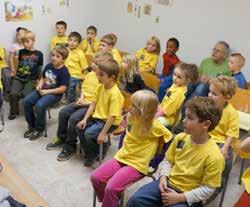
Enclosed is a cheque for $1,000, shared by the elementary age children who come every Wednesday evening to Super Friends at Grand Bay Baptist Church in Grand Bay, New Brunswick. One of the aims of our program is to encourage the children to experience the fun and joy of sharing what they have rather than spending it on themselves and they do just that! It is fun to watch the children jostle to drop their coins in the yellow happy face buckets we use for our shared money.
o ur choice of recipient is the Help a Family Feed Themselves [in the 2012-2013 CBM Gift Catalogue]. We began the year with the goal of helping five families ($725) — which would be the most we have given. But by early April, we had surpassed our goal and began aiming for six families. By our last meeting night we needed $60 to reach our goal of six families; that would be the most money we had ever collected in one night. By the end of our last meeting, $85 was in our Happy Buckets! We are so very happy to share this with the six families who need what we take for granted: income and food.
wondering what to get a loved one this Christmas?
Give the gift of hope and change.
Each unique item from CBM’s Hopeful Gifts for Change catalogue provides a life-changing opportunity for children and families in need around the world. For you it’s an opportunity to show your love to friends and family in a way that is truly meaningful — by giving a gift that brings hope.
Shop online today at www.cbmin.org or email communications@cbmin.org to order your CBM Hopeful Gifts for Change 2013 - 2014 catalogue.
Thank you for being a responsible and trustworthy partner in our desire to help and in our desire to share.
May the Lord bless you from his great treasury of riches,