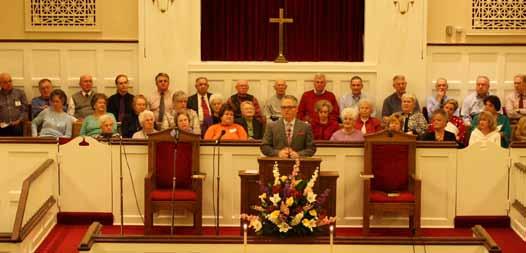
Blenda Sloniker, Hickory Financial Report: November 2010 Contributions Undesignated - $100,331 Designated - $153,299 December 2010 Contributions Undesignated - $144,942 Designated - $277,126 April 2010 - March 2011 Monthly Undesignated Goal: $110,538
Racial Reconciliation
“Instead, I want to see a mighty flood of justice, an endless river of righteous living. ” Amos 5:24
Baptist Women In Ministry of North Carolina celebrates its annual convocation at Calvary Baptist Church in Asheville on Friday , March 25. Fellowship begins at 9:15 am Business at 10 am Worship at 10:15 am For more information about BWIMNC , please visit www bwimnc org
May 12, 2011 First Baptist, Asheville 10am-3:30pm
Pastoral and ministry staff, congregational leaders and leadership teams invited.
Church Leader Resources for the Missional Journey
For several years, Fellowship Baptists have emphasized the missional church.
CBFNC has sharpened our focus on strengthening and developing missional community. Of course, we still struggle to adequately define the word “missional.” Some argue that, like the Kingdom of God, it’s beyond definition but insist that “you know it when you see it.” So, we spend a good deal of time and energy sharing glimpses of missional faithfulness – pictures of missional faith and ministry being exhibited in congregations and ministry partners.
But what about those who are called to provide big picture leadership? Are there resources to assist us in moving congregations in a missional direction at the macro level? I’ve recently come across two excellent books that are must reads for any pastor, staff minister or lay leader who wishes to help his or her congregation undergo missional transformation. Here are two brief reviews of these books that I commend for further study.
n Learning to Count What Counts
Reggie McNeal, Missional Renaissance:
Changing the Scorecard for the Church
Much of my professional reading in recent years has been on the Missional Church. I truly believe it is not only the most authentic way to understand the Church of Jesus Christ, but this vision of the church provides the greatest hope for free and faithful Baptist congregations who are trying to find their way in these changing times. Unfortunately, most of the books on the Missional Church I have read are either too academic or too “non-Baptist” to be accessible to most of the folks with whom I work. This book is, thankfully, a huge exception to that rule.
by Larry Hovis, CBFNC Executive Coordinator
n Leadership Structures that Empower Rather than Impede Ministry
Dan Hotchkiss, Governance and Ministry: Rethinking Board Leadership
Just about every congregation has already attempted, is currently involved in, or sees the need to redesign its leadership structure. That’s because most Baptist churches are designed for inertia. How many creative ministry ideas get caught up in a vicious cycle of bouncing around from one church-management group to another – deacons, committees, councils, teams, etc.? No group feels empowered to act without checking in with other groups, and by the time everyone has signed off on the particular ministry initiative, energy is lost and no one cares anymore!
In this work, McNeal uses language and concepts that are familiar to Baptists (he worked for many years for the South Carolina Baptist Convention). He accurately and compellingly shares a new vision for the church based on missional theology. Eminently practical and thoroughly readable, I think every pastor, staff minister and lay leader should purchase and devour this book.
In general, McNeal argues that effective ministry in our time requires that churches and church leaders make three major shifts: from internal to external, from program development to people development, and from church-based to kingdom-based. For each shift, he suggests practical ways to change the scorecard so that churches can measure what matters when it comes to our efforts to pursue the mission of God in the world. He states:
These three shifts call for a new scorecard for the missional church. The typical church scorecard (how many, how often, how much) doesn’t mesh with a missional view of what the church should be monitoring in light of its mission in the world. The current scorecard rewards church activity and can be filled in without any reference to the church’s impact beyond itself (p. xvii)
Dan Hotchkiss, a consultant with the Alban Institute, sees this phenomenon at work in churches of various denominations all across the country. He’s developed a better approach, one that will further the church’s pursuit of God’s mission, maintain appropriate methods of accountability, and engage as many persons as possible in meaningful ministry. Hotchkiss’s ideas are captured in a book with a rather uncreative title, but the concepts are powerful. I commend his book to you, but even more importantly, Hotchkiss will be in North Carolina on May 6 (see ad on page 8) to conduct a one-day workshop on this topic. I strongly urge all ministers, deacon officers and other key church leaders, especially those frustrated by your church’s current organizational structure, to take advantage of this valuable resource.
The following section from the Preface provides a taste of how Hotchkiss approaches this important subject:
Once upon a time, Americans joined congregations in the secret hope that one day someone might ask them to serve on a committee. Today that rarely happens … among the fastest-growing congregations and their imitators, [there] has been a movement to reduce bureaucracy to make room for ministry … Growing congregations often are the ones that have reformed their structures for governance and ministry, whether they are liberal or conservative in their theology. Even more strikingly, declining congregations across the theological spectrum often share specific organizational patterns. I think those patterns are one factor in their decline – a factor, unlike social and cultural trends, that a congregation can control.
Workshops include:
Following the Spirit to the Soccer Field
Praying with Scriptures - Sophia Steibel
Rural and Urban Poverty Simulations
Eat, Pray, Save the Planet
Racial Reconciliation and the Body of Christ
At the Intersection of Church and State
Brent Walker
Jeremiah: Patriotism of a Different Sort
Gerald Keown
The Faith We Live: A Christian, Muslim and Jewish Conversation
Planting New Churches
Stop Human Trafficking
Church’s Care of Caregivers - Cindy Miles
Vanishing Appalachia - Bill Leonard
Walking In Their Shoes - Hyaets Community
THE HEART OF JESUS:
& living justice mercy
The Care and Feeding of Kree-8-ive Ministry
Bo Prosser
Exploring Authentic Youth Ministry
Curtis Freeman, LeAnne Ryan, Chris Schelin
"We know love by this, that [Jesus] laid down his life for us .... Little children, let us love, not in word or speech, but in truth and action." (1 John 3:16-18 NRSV)
"We know love by this, that [Jesus] laid down his life for us .... Little children, let us love, not in word or speech, but in truth and action." (1 John 3:16-18 N RS V)
Justice and Mercy for the Immigrant - Russell Hilliard
Pilgrimage and Preaching - Darryl Aaron and panel
Missions Workshops: Belize, Lebanon, Ukraine, NC
Caring for Youth and Children in Stressful Times
Marketing Your Congregation: Beyond Billboards and Brochures
Reaching Out to the Forgotten Students
Biblical Foundations for Active Justice
Cal Robertson, Jim McConnell
Involving Your Congregation in Hands-On Missions
Mark Abernathy
Scattered and Gathered: World Missions
A Spirituality for Preaching - Guy Sayles
Social Networking and the Church
Ten Things You Can Do for the Unity of the Church
Steven R. Harmon
Tax Aspects of Church Property
The Dialogue of Worship - Tony Spencer
Hymnody of Justice and Mercy - Larry Ballard
The Mental Health of the Missional Congregation
Steve Scoggin
From the Bed’s Eye View (for chaplains and counselors)
Trends in the Worldwide Baptist Community
Dick Pierard
How to Have a Difficult Conversation Without Breaking Your Congregation Apart - Chris Gambill
Creating Redemptive Relationships and Structures
Eddie Hammett
March 25-26, 2011
First Baptist, Asheville
FRIDAY worship speaker:
Rev. Dr. David P. Gushee, Distinguished University Professor of Christian Ethics at Mercer University
SATURDAY worship speaker:
Rev. Nancy Hastings sehested, Co-Pastor of Circle of Mercy in Asheville, NC, and Chaplain for the NC Department of Corrections
Friday, March 25
11:00 a.m. Registration and Exhibits Open 12:30 p.m. Welcome and Orientation 1:00-5:00 p.m. Ministry Workshop Sessions 4:45-6:15 p.m. Fellowship Dinner (requires pre-registration) 6:45 p.m. Worship 8:15 p.m. Fellowship Reception
The 2011 General Assembly offering will support CBF's Haiti Housing Network ministry
The ministry’s goal is to construct 1000 permanent houses in the area of Grand Goave, Haiti, over the next three years, at a cost of $3,500 per house.
Another giving opportunity at the General Assembly:
We will be collecting kid-friendly food items for the MANNA Foodbank packs. These items include: one-pound boxes or bags of dried beans, rice or pasta; protein/main dish items like SpaghettiOs, soup, beanie weenies, chili, or mac and cheese; small fruit cups such as mixed fruits or applesauce; dried fruit pouches; cereal or granola bars; peanut butter or cheese and cracker snack packs; small boxes of animal or graham crackers; individual cereal boxes or bowls; pudding or jello cups; canned vegetables; and dinner mixes such as Hamburger or Tuna Helper.
CBFNC Prophetic Photography Contest
This year, a photo contest will be a part of our General Assembly. Photographs should illustrate this year’s theme: “The Heart of Jesus: Living Justice and Mercy” based on the Scripture, “We know love by this, that [Jesus] laid down his life for us .... Little children, let us love, not in word or speech, but in truth and action.” (1 John 3:16-18 NRSV)
We prefer that you register online at www.cbfnc.org, but if you are unable to do so, please fill out the form below.
CBFNC General Assembly Registration
Mail your registration and payment to: CBFNC, 8025 North Point Blvd., Suite 205, Winston-Salem, NC 27106.
Number of dinners ________ x $9 =$_______ TOTAL ___________
You may pay by check or credit card. We gladly accept: r Visa r Mastercard r Discover
Name (as it appears on card)
Learn more about General Assembly details and registration, ministry workshop titles, discounted hotel options, childcare reservations, and exhibitor applications at www.cbfnc.org.
Call the CBFNC office at
Could This Be Your sister?
“What I grew up hearing about people in China – that they didn’t know about the Bible and they didn’t know about God’s love for them – I’ve discovered that’s not just in China. That’s what I deal with every day.” Carol Sasser Dalton is a chaplain at the Swannanoa Correctional Center for Women in the mountains of North Carolina.
How does one become a prison chaplain?
Most don’t take Carol’s route. “I went to seminary after being a church secretary for 10 years, thinking I was going to be leading discipleship in a local church. But after a long period of searching and interviewing, several chaplain friends contacted me on the same day and told me about the interim position at the prison. It was to be a one-year job. In the meantime, the prison was to move into a new facility an eighth of mile from my house.”
Carol applied for and got the job. At the end of the year, she stayed in the ministry at the prison in a role funded by a non-profit set up by area churches, Ministry of Hope (www.ministryofhopewnc.org). That was four years ago. Carol is one of 603 chaplains and pastoral counselors who are endorsed by the national Cooperative Baptist Fellowship, 105 of whom are based in our state.
“Most of my time in ministry is spent listening. Many of these are young women, most addicted to something, and most have been abused in childhood or even as adults. Some call themselves agnostic or atheists. But really, they are seekers. One woman came to me recently after her addiction treatment session saying, “Chaplain, they told me I needed to believe in a higher power and that it could be anything – a table, a chair, anything. But I need more than that.” Carol was able to help this woman in her search for recovery and truth. “Many are dealing with shame,” Carol says, “both for what they’ve done and for what they cannot do to help loved ones on the outside. Especially in times of grief, they feel like, ‘I should’ve been there to be with them before they died, instead of being here.’ They come to the quiet chapel and can sit and cry – or scream – if they want. God is there in that holy place of loss.”
by Rick Jordan, Church Resources Coordinator
stay connected even after their release. The volunteers give the inmate someone to talk with, even to hold them accountable.”
Most inmates are not in for major crimes. “The majority are in for drug-related crimes. Many of them are initially placed on probation. You have to pay to be on probation, but you might have had your driver’s license revoked, so it’s hard to get or keep a job to earn the money to pay for your probation. All of this works against them. They violate probation and get sent to prison.” As volunteers and church members hear these women’s stories, they realize they have nothing to fear in ministering to them.
Once somebody hears a person ’ s story, they start realizing ‘ Oh, this could be my child or sister or mother, and I would want somebody to reach out to her. ’
Like any minister, Carol realizes she cannot serve alone. “These churches are amazingly supportive. There are huge numbers of volunteers who come to do worship services and Bible studies. When a prisoner becomes Level 2, they can have a community pass for 6 hours a week. Volunteers take them to church or out to eat. The prisoner must pay her own way, so if they have no money they walk around a park or do something else free. Some volunteers
For those inmates who are Christian, there are some opportunities for worship and Bible study. A program to help them go deeper in their faith is from Kairos Prison Ministry (www. kairosprisonministry.org).
“We have 24 women who come once a month to the chapel. Outside volunteers come to support, but the inmates do the service. Two share their stories. They pray, then go into small groups to discuss questions like ‘Where have you seen God at work this week? How has God used you this week? What’s really happening in your life?’” They come to the chapel every Wednesday at 7:30am for 30 minutes.
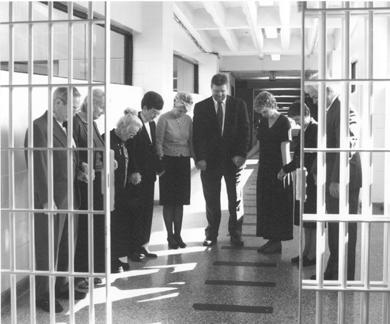
Chaplain Dalton encourages you to become involved in a jail or prison ministry in your community. “Yes, they did something wrong, but any one of us could be here in six months if you ran a red light and killed somebody. Once somebody hears a person’s story, they start realizing ‘Oh, this could be my child or sister or mother, and I would want somebody to reach out to her.’”
“It is the blessing of my life and the most exciting ministry I have been involved with. Never have I felt so excited or so changed. The closeness of dealing with them one by one – this could be my child – my heart breaks for them. I have tremendous love for them,” Bobbie Smith confesses. She has been involved in jail ministry through her church, First Baptist of Wilmington, for the last eight years. “It began in a deacon’s meeting. There was concern that, here the church sits next to the jail, but we have no ministry to those prisoners.” As a ministry began, some ladies in Bobbie’s Sunday School class became involved. “One lady insisted, ‘Just try it one time.’ She kept insisting. Finally I did and now I’m hooked!”
Now Bobbie leads ministry to women prisoners while Jim Glass leads the men’s prison ministry. The women’s team leads a Bible study every Sunday for 15 inmates. “We always have two from our church present. One leads the Bible study while the other sits with the ladies. Sometimes, they may cry or want to talk with someone privately, so it is good to have two from the church in the room.”
The men’s group leads Bible studies on Thursday, Friday and Sunday. The room can accommodate ten prisoners at a time.
“The most wonderful part is that when people are brought into the system they are at their lowest point in their lives, so you are ministering to them at this point and they are very open to the Lord. I’ve taught Sunday School all my life, yet never had the opportunities like this ministry. They become tearful. We have had professions of faith. If they have to go further into the prison system, if they will send me their location, I follow them and send them copies of the sermons,” Bobbie says.
by Rick Jordan, Church Resources Coordinator
of several non-profit agencies which work to touch lives and fill them with purpose, hope and healing.”
Some of the male prisoners also want follow-up. They are given free Bibles, a special edition published by the American Bible Society for those incarcerated. They are stamped in the front from FBC. “It is amazing how we hear how this impacts them all over the nation as they are moved around. One inmate has begun his own ministry and even sends a weekly tithe back to our church.”
A recent feature of the jail ministry is an e-mailed prayer request list that goes to 60-70 church members. “That has educated our members to the needs of people in these circumstances. The church reaching out has initiated a feeling for people in need. There is a more compassionate spirit and a love of people in need now.”
Recently, a new jail was constructed and the church purchased the old jail. According to the church’s website, www. fbcwilmington.org, “The Jo Ann Carter Harrelson Center continues its metamorphosis from a place of incarceration to a place of transformation. Previously housing the New Hanover County Detention Center, the Harrelson Center is now the home
Ken Crawley has been involved in the jail ministry of his church, First Baptist of Shelby, for ten years. He schedules Bible studies for visitors from his church, as well as for 10 to 12 other churches. Every Thursday night, they teach a one-hour lesson to about 10 prisoners, then teach the same lesson the next hour to 10 more prisoners. What really excites Ken is the time he has in visitation with the inmates. Church members save good magazines and Sunday School literature for the men to take on their visits. They also take new copies of the New Testament. “We ask if they have/want a Bible. Ninety-nine percent say they want one if they don’t have one. We explain that we’ve come to tell them what a Christian is, and if they aren’t yet a Christian, we ask if they’d like to become one. We have prayer with those who want before we move on to the next cell. I’ve never had one to say ‘No I don’t want to become a Christian.’ We share the four spiritual laws, have a sinner’s prayer and rejoice with them. If people have never experienced it, it is something that really changes the person who leads them to Christ, to feel so close to God, to watch him work. It is amazing to see what God can do.” Ken says.
Because the jail has high turn-over, he seldom sees the same people twice in his weekly visits. “But one Saturday morning, I was at a Bojangles when a man came up to me. He recognized me and came up and said ‘Aren’t you the man who came to our jail cell and led me to the Lord?’ and he thanked me for leading him to Christ. We encourage them to go to church when they get out. You never know where they end up or how much their lives really change, but you just leave that in God’s hands.”
Bobbie Smith concludes, “The hardest Scripture for me was always when Jesus said, ‘I was in prison and you visited me.’ So I tried it. Just try it one time, then you’ll know if you are called to it. Go with someone who has been doing this. Just go to observe at first. If you don’t like it, we certainly understand. But it is absolutely the safest environment once you are there.”
Governance and Ministry
for the Missional Church
May 6, 2011 9 am – 3:30 pm
Longview Baptist Church in Raleigh
Cost: Early Bird Pricing (due April 15): $30. Regular Pricing (due April 29): $35.
Cost includes book, lunch and snacks. Conference leader: Dan Hotchkiss, senior consultant with the Alban Institute, and author of Governance and Ministry: Rethinking Board Leadership,
Effective congregational ministries start with clearly defined roles and authority. It succeeds when pastors, staff and lay leaders conduct ministry together as collaborating partners.
How much time do deacons and committees spend managing programs? How much time do your congregational leaders — paid and volunteer — spend seeking approval for choices they could be trusted to make on their own? True partnership begins with clear role boundaries, effective delegation and a constructive system of accountability. Hotchkiss helps participants with their specific needs, whether they want to sharpen their leadership skills, reorganize to enhance growth, or consider an entirely new model for church organizational structures.
This seminar helps you to:
• Keep your congregation’s mission at the center of its ministry.
• Clearly define roles and authority.
• Set clear policies.
• Streamline decision-making.
• Maintain clear limits.
• Trust others to make their own decisions.
• Create behavioral covenants.
• Make space for spiritual discernment and holy conversations, and
• Give up micromanaging!
Register at www.cbfnc.org.
Trustworthy?
by Rick Jordan, Church Resources Coordinator
Can you trust God? Even if you have unanswerable questions?
That was the theme of day one of this year’s youth ski retreats. After a beautiful day of skiing in the West Virginia mountains, the youth gathered for a meal and a worship service. Chris Hughes, the first week’s preacher, told a story of finding the courage to jump off a cliff into a river with some friends. There was an element of trust in basic physics – gravity and buoyancy – but the real trust happened because of the relationship he had with his friends. Belief can be passive, but trust is active.
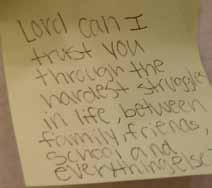
Louisa Monroe, the preacher for week two, shared how her trust in God was shaken by the murder of one of her friends. It took a year or so to regain trust in God after that experience. Both speakers invited youth to consider questions that keep them from trusting in God. Each youth had a post-it that they wrote a question on, then put on a large banner proclaiming “TRUST.” They then went to church group devotions led by their youth ministers.
The next morning, the youth found each of their names on another banner. After a message reminding them to trust in God in spite of their questions, they were also challenged to accept God’s trust in them. Church group by church group came to the banner to find and take their post-it with their name on it, to reveal behind all those post-its the word “GOD.” The retreat was planned by a group of youth ministers around the Message’s translation of Proverbs 3:5-6, “Trust God from the bottom of your heart; don’t try to figure out everything on your own. Listen for God’s voice in everything you do, everywhere you go; he’s the one who will keep you on track.”
Matt Dinkins, youth minister of Mt. Gilead Baptist Church in Pittsboro, said of his first experience at a CBFNC youth retreat, “I applaud CBFNC for providing a retreat weekend with a theme that used probing and questioning to connect my youth to God when often the alternative is to induce guilt and use fear tactics. The Saturday evening worship service was very meaningful to my youth. I loved that the service tackled the fact that we all have hard questions about life that can confound us, yet we trust that God will see us through these things. I especially liked the idea of sticking the questions to the “TRUST” banner. I believe God has been working behind the scenes here because I had already been allowing them to ask these hard questions during our recent youth meetings and this weekend was an extension and reinforcement of that. It’s great to see God at work!”
Grounded in Past, Investing in Future
by Len Keever, First Baptist, Dunn
During the last six years, First Baptist Church of Dunn has had the opportunity to participate in partnership mission trips to both the Village of Hope in Bucha, Ukraine, and Gethsemane Baptist Church in Santa Clara, Belize. People ask, “What are the differences? Which would you recommend?” As I have thought of this, I have found meaning in the metaphor that one strengthens the bonds of our past while the other reaches toward our future; one keeps us grounded while the other gives us wings.
At the Village of Hope, we care for our brothers and sisters who live in Eastern Europe. They are under tremendous hardship as they work to strengthen their witness and deepen the faith experience of the Church in that part of the world. Years of communism and scarcity have deeply eroded the foundation of Christian presence. We are helping to create a Christian neighborhood where children can grow up with the understanding that “Christ is Lord of all.” I cannot help but think that if we intentionally join in caring for their needs and help to rebuild what was lost, we will model for future generations the care we ourselves might one day require. Being connected to our past is important in knowing not only who we are, but also in preparing for where we are going.
On the other hand, work in Belize connects us to our future. It is well documented that Christianity is growing faster in the Third World than in Europe or North America. God is doing wonderful things among the believers in Third World countries. By being connected to the exciting things that are happening in Belize, CBFNC Christians are investing in their future. The believers in that part of the world inspire and encourage us to join God’s work there. Their needs are many and their resources, like those in Ukraine, are very limited. Working in Ukraine, I was reminded of the faith community returning from Babylon to help strengthen the remnant. Working in Belize, I was reminded of the churches in the book of Acts being formed by the Holy Spirit. It was exciting to witness God’s presence among both generations of our Christian family.
We are very blessed that CBFNC provides us two wings with which to fly.
A few weeks ago, soon after returning from Belize, my children and my mother came to visit. Three generations were in our house enjoying the fellowship and meaning of our family’s identity. I found myself standing comfortably in the middle enjoying the memories and reminders of my heritage represented by my mother’s presence, and excited about our family’s future through my children and grandchildren’s prospects.
The answer to the question of comparing differences or suggesting which one is best cannot be answered with either/or answers. The answers are both/and. We are at an exciting time in our lives as Christians. We have the opportunity both to teach future generations how to care for their past in our reaching back and to participate with the future by reaching forward. We are very blessed that CBFNC provides us two wings with which to fly. It is important to remember that a one-winged bird does not go very far.
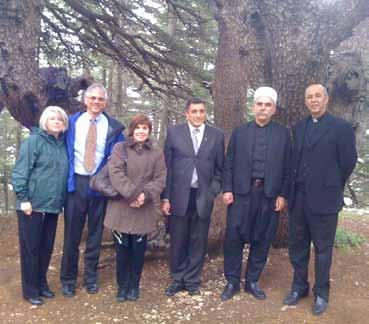
Last April, I had the privilege of traveling to Beirut, Lebanon, with Steve and Janet Ayers. Our purpose ... to help with the Spring Evangelism Celebration that Chaouki and Maha Boulos, CBF field personnel, undertake annually. Steve preached nightly and I was able to share a prayer during the service. Many people, young and old, Muslim and ... whatever, made professions of faith in Jesus Christ! It was exciting to see that happen. More than that, our experiences – traveling the countryside, having Turkish coffee with the chief military judge and his wife, walking through the Cedars of Lebanon, meeting top Muslim leaders with whom Chaouki has formed friendships, and having conversations with a Catholic priest – all have remained in my memory of how stupendous God is and how he uses us for his purposes in a mighty way.
I am amazed at what God is doing in Lebanon through Chaouki and Maha. In addition to these experiences, seeing a retreat center being built that will minister to many, many people in several area countries is reason enough to get involved with this ministry. Chaouki is looking for individuals and churches to join him and to join God at work in Lebanon. He is looking for financial support to continue building the retreat center or to help with the costs of the Evangelism Celebrations held every April, July and August. He welcomes individuals and teams to minister in Lebanon. Come be a part of it!
For more information, head to our CBFNC website, www.cbfnc.org, or email Linda Jones at ljones@cbfnc.org.
God is at Work in Lebanon by Linda Jones, Missions Coordinator
New Contributing CBFNC Partner Churches (As of January 31, 2011)
First, High Point (new MRP* contributor)
Hobbsville, Hobbsville (new MRP* contributor)
Longview Baptist Church, Raleigh (new MRP* contributor)
Lower Creek, Lenoir
Mill Creek, Monroe (new MRP* contributor)
Wake Forest, Wake Forest (new MRP* contributor)
*Mission Resource Plan - visit www.CBFNC.org
Coordinator Visits
November-December 2010
Fair Bluff, Fair Bluff
First, Burlington
First, Elizabeth City
First, Forest City
First, Hickory
First, Kannapolis
First, Marion
First, Weaverville
Greystone, Raleigh
Hester, Oxford
Louisburg, Louisburg
Roberts Chapel, Pendleton
Snapshots
from “Joining
God in the World: A Fresh Look at Missions and Evangelism”
This event took place February 1, 2011, at First, Graham.
Ministers on the Move
Compiled by Jack Causey, Ministerial Resources Coordinator
Our encouragement and support go to the following ministers who have recently moved:
Charles Brawly has been called as the pastor of College Avenue Baptist Church in Lenoir.
Swift Creek Baptist Church in Cary has called David Vess as their pastor.
Christopher Turner has been called as the pastor of Neill’s Creek Baptist Church in Angier.
Jonesboro Heights Baptist Church has called Richard Wood as their Associate Pastor of Family Ministry.
When you make a move or know of someone who has changed places of ministry, let us know at jcausey@cbfnc.org. For vocational placement or search committee requests, visit our vocations page on our website at www.cbfnc.org or call 336-759-3456 or 888-822-1944.
Audio recordings and additional resources are available at our website, www.cbfnc.org.
Return
Upcoming Events ~ March/April Edition
Staff Minister’s Retreat
February 28-March 3, 2011
North Myrtle Beach, SC
Youth Choir Festival
March 18-19, 2011
FBC, Greensboro
CBFNC General
Assembly
The Heart of Jesus: Living Justice and Mercy
March 25-26, 2011
Christian Coaching
Certificate Training
First Class - 501Building Blocks to Christian Coaching
April 28-29, 2011
Governance and Ministry
May 6, 2011
First Baptist, Asheville
The Big GAME
General Assembly
Mission Experience for youth
March 25-27, 2011
”The Spirituality of Jesus”
Adult spiritual formation retreat
April 8-10, 2011
Caraway Conference Center
Longview Baptist Church, Raleigh
Racial Reconciliation & The Body of Christ
May 12, 2011
First Baptist Church, Asheville
Hispanic Men’s Retreat: Walking By Faith
May 13-14, 2011
Camp Mundo Vista, Asheboro
Christian Coaching
Certificate Training
Second Class - 502 - Establishing a Dynamic Coaching Relationship