Manual de Convivencia INGLÉS - Colegio Bolivar 2025
School Handbook
Rights and Responsibilities of the Bolívar Community
PREAMBLE
In accordance with Article 87 of Law 115 of 1994, the Coexistence Manual defines the rights and obligations of the students and of each member of the educational community. Through it, the characteristics and conditions of interaction and coexistence are established, as well as the due process that the educational institution must follow in the event of noncompliance. It is a tool created, evaluated, and adjusted by the educational community, with the participation of students and parents, and it is mandatory in both public and private educational institutions. It is also an essential component of the Institutional Educational Project.
In addition to the above, the manual must incorporate the definitions, principles, and responsibilities established by Law 1620 of 2013 and other related regulations, upon which the factors of promotion, prevention, and care of the Comprehensive School Coexistence Care Route will be developed.
TABLE OF CONTENTS
CHAPTER I: PHILOSOPHY OF THE SCHOOL
CHAPTER II: ACADEMIC ORGANIZATION, EVALUATION AND PROMOTION SYSTEM AND
GOVERNMENT, INSTITUTIONAL
HAPTER V: SITUATIONS THAT AFFECT SCHOOL COEXISTENCE, HUMAN, SEXUAL AND REPRODUCTIVE RIGHTS, PROTOCOLS AND DUE PROCESS
CHAPTER I
PHILOSOPHY OF COLEGIO BOLIVAR
Article 1.1. History and Characteristics: Colegio Bolívar was founded in 1947 as a private, coeducational, non-denominational, non-profit day school. Since then, it has offered a bilingual, bicultural, and binational education to Colombian families seeking this type of education for their children, as well as to children of North American and international families residing in Cali. Colegio Bolívar values the potential and creativity of its students and promotes excellence in education through an educational program at the forefront of research, technology, and resources.
Currently, the school offers more than 50 children an early childhood education inspired by the Reggio Emilia philosophy at its Early Childhood Center - El Nido. It also offers more than 1,300 students a formal education, in English and Spanish, from Kindergarten 4 through Grade 12, comparable and compatible with that offered by the best schools in its category in Colombia, the United States, and international communities around the world. Throughout its history, Colegio Bolívar has operated under the authority and support of its General Assembly of Bondholders, the founding companies of the school. This Assembly elects a ten-member Board of Directors, comprised of parents of students enrolled at the school, who ensure compliance with the school's mission, v ision, and objectives. The Board of Directors operates in accordance with the law and ensures the participation of the entire educational community.
Colegio Bolívar offers a Comprehensive Bilingual Academic Program with the highest quality standards worldwide, which allows it to prepare its students to successfully continue their education in local and international colleges and universities.
Thus, administrative and financial matters are handled by the legal entity and its governing bodies; while academic and disciplinary matters are handled by the educational institution through the school governing bodies provided for by law.
Colegio Bolívar's curricular and extracurricular programs comply with all applicable Colombian and U.S. standards and are based on the educational traditions of both countries, as well as the expertise of its highly qualified, mostly bilingual faculty.
Article 1.2. Mission: Colegio Bolívar is a bilingual community of creative learners that inspires its members to live the values of our educational institution as catalysts for change, incorporating multiple perspectives and committing to the highest aspirations for the well-being of individuals, society, and the planet.
Article 1.3. Vision: Where do we want to go?
Bolivar School will be an exemplary learning community with highly qualified individuals capable of making a positive impact on the planet and society.
Article 1.4. Values:
1. Respect: Shows due consideration for the feelings, wishes, and rights of others.
2. Integrity: Act with our values in mind, even if you are not being seen.
3. Personal Excellence: Believe in yourself, give your best in whatever you do
4. Curiosity: Observe, discover, question and learn with passion
5. Autonomy and Responsibility: Stop, decide, act and be responsible for your words and actions
6. Bolívar Sense of Community: Cultivate a sense of belonging and collaborate to meet your needs and those of others
7. Social Commitment: Be an empathetic, critical, active, and committed citizen with others and the environment.
Article 1.5. Common and Specific Commitments:
COMMON
1. I contribute to the fulfillment of the Mission and Vision of the institution.
2. I care for the members of the Educational Community, respect differences and ensure the inclusion of diversity.
3. I face challenges with a growth and hope mindset.
4. I take care of the environment, the campus, my belongings and those of others.
5. I listen carefully, and I am responsible with my verbal, nonverbal, and digital communication.
6. I comply with the school calendar, schedules, policies and established agreements.
STUDENTS:
1. I cultivate joy, passion and desire for learning.
2. I constantly develop personal, social, digital, and academic skills.
3. I take responsibility for my actions and reactions.
4. I develop a critical and creative spirit and the skills to work in a group.
5. I maintain discipline, perseverance and effort.
6. I make connections between what I learn and the situations I face.
PARENTS:
1. I am aware of the importance of my example as a father.
2. I help my son build the foundations of his personality, helping him deal with emotions and resolve conflicts.
3. I encourage my son's socialization and pass on family values and cultural traditions.
4. I foster my child's passion for learning, responsibility, and autonomy.
5. I care for my son's privacy, emotions, and relationships, as well as those of his peers.
6. I exercise authority with love and consistency, setting clear boundaries.
7. I commit to attending and participating in meetings, parent education programs, and preventative and educational events, serving as a partner of the school in my child's education.
TEACHING EMPLOYEE:
1. I cultivate joy and passion for educational practice.
2. I maintain an open, investigative, and constantly learning attitude, both personally and professionally.
3. I demonstrate teamwork skills and build support networks.
4. I model respect, responsibility, inspiration, and admiration for my students through my teaching practices, relationships, and interventions.
5. I focus my professional practice on the student, ensuring the construction of bonds and providing the necessary learning conditions.
6. I promote a critical and reflective learning model that includes multiple languages, fosters transfer, and generates a culture of well-being.
7. Promoting emotional regulation and conflict resolution skills in students.
8. I encourage students to build the resilience needed to cope with the effects of today's world.
NON-TEACHING EMPLOYEE:
1. I carry out my duties with enthusiasm, recognizing the needs of the different members of our Educational Community.
2. I maintain an open and constantly learning attitude, both personally and professionally.
3. I build support networks with community members.
4. I cultivate teamwork skills.
Article 1.6. Principles:
Considering the importance of the rights of minors, as well as the fundamental rights to privacy and good name, equality and non-discrimination, due process, free development of personality, and access to
education, the Bolívar School Educational Community supports its mission with the following principles:
1. Education is the most valuable tool available to improve the quality of life.
2. The practice of democracy is a guideline that fosters dialogue, respect, and a sense of community.
3. Personal excellence is supported by the educational environment of the College.
4. Language proficiency is crucial for learning.
5. The School has the responsibility to meet the needs and support the individual talents of students, regardless of learning style, race, religion/belief, sexual orientation or gender identity.
6. Taking responsibility for oneself, one's environment, and society is the obligation of every educated person.
7. A community is created by creating a safe environment, with special consideration for children and adolescents in vulnerable situations, as well as fostering relationships of affection and trust among all its members.
***Safe environment means freedom from: Any type of prejudice, discrimination, harassment, violence, aggression, mockery, contempt, intimidation or exclusion.
Article 1.7. Goals:
a) To value education, we:
• We foster a desire to learn. We focus on the intellectual, ethical, and social development of our students.
• We live by a code of honor based on honesty and integrity.
• We dedicate time and resources to educating children by supporting their strengths and potential.
b) To implement democratic practices, we:
• We develop an enabling environment, conditions and processes that promote dialogue.
• We create and maintain an environment of learning, respect, tolerance, collaboration, and discipline.
• We recognize and celebrate the cultural, religious, and social diversity within the College community.
• We generate structures for participation and decision-making.
• We give students freedom of choice, consistent with their stage of development, and we hold them accountable for the consequences of their decisions.
c) To sustain excellence, we:
• We promote a learning style that is active, self-directed, discovery-based, and engaging for the student.
• We provide experiences where students can achieve excellence, recognizing the value of hard work and commitment.
• We implement performance standards based on a curriculum that defines essential learning outcomes.
• We use effective assessment methods that help students focus, direct, and reflect on their own learning.
• We acquire essential technologies and resources to enrich learning in all areas.
• We prepare students for the professions of the future.
• We offer a school and a functional and aesthetically pleasing physical plant.
d) Recognizing the relevance of language, we:
• We provide students with a comprehensive, bilingual educational program.
• We develop language in its broadest sense: verbally, mathematically, scientifically and artistically.
• We meet the individual needs of students in the areas of language, reading, and writing.
e) To respond to the individual needs of students, we:
• We provide health and psychological counseling programs to students, in collaboration with parents.
• We provide enrichment programs and services and integrate these activities into the classroom.
• We provide support and guidance for special learning needs through a multidisciplinary program of support services.
• We promote a program of complementary activities for the development of student talent.
• We provide active protection for students to prevent and address any form of prejudice, discrimination, harassment, violence, aggression, teasing, contempt, intimidation, or exclusion.
f) To meet our social responsibilities, we:
• We create social awareness and responsibility; concern and respect for each other and for ourselves.
• We provide opportunities for all students to experience the value of helping others through an extensive community service program.
• We emphasize environmental issues and prepare students to face the reality of humankind's growing capacity to alter the environment.
g) To develop a sense of community, we:
• We value all members of the school community and promote solidarity, tolerance, and respect for differences through multiple institutional programs.
• We create community dynamics at the classroom, grade, and section levels.
• We promote strategies for teamwork among the different levels of the Educational Community.
• We are partners with parents as essential collaborators in the educational process and vital members of the community.
Article 1.8. Our Strategic Purposes
Well-being: Ensure that diversity, equity, and inclusion are core aspects of our community, while fostering a school culture of social-emotional well-being for all.
Personal Excellence: Ensure that every student has the opportunity to reach their potential and meet the expectations of the Colegio Bolívar Graduate Profile.
Innovation: Provide a challenging environment where learners innovate and create to navigate a complex and changing world.
Sustainability: Guiding our community to achieve a better, more sustainable future for all through knowledge creation and problem-solving.
Article 1.9. Graduate Profile
With the success and well-being of our Colegio Bolívar graduates in mind, we have developed this profile, which specifies the personal, cognitive, and social capabilities that graduates need as agents of their own learning. Constructed with input from all levels, this document provides a clear direction for what we do at the school. As part of our institutional philosophy, this profile aligns with our mission, vision, values, and principles of Deeper Learning. It must be communicated to the entire educational community, ensuring we have a shared, inspiring purpose.
As graduates of Colegio Bolívar, our students will:
Exemplify Good Character: Live our Bolívar Values of Respect, Integrity, Personal Excellence, Curiosity, Autonomy and Responsibility, Bolívar Sense of Community, and Social Commitment.
Embrace a Growth Mindset: Pursue continuous learning and face challenges with resilience and hope. Transferring Fundamental Knowledge and Skills: Applying the competencies of Bilingualism,
Communication, Collaboration, Character, Citizenship, Creativity, and Critical Thinking in contexts beyond the school setting.
Be Catalysts for Change: Take action to positively impact the well-being of individuals, society, and the planet by incorporating multiple perspectives.
Article 1.10. Institutional Declaration of Colegio Bolívar on Diversity, Equity and Inclusion
At Colegio Bolívar, we defend the rights of every person to safety, a sense of belonging, and freedom from discrimination. These rights are valued, honored, and protected by the Colombian Constitution, through international conventions, and by our school's core values, policies, and protocols.
We commit to recognizing, affirming, and protecting all members of the community, with special attention to those who may be marginalized because of their identity, including, but not limited to, race, color, ethnicity, religion, gender identity and expression, sexual orientation, national origin, language, citizenship status, physical ability, neurodiversity, socioeconomic status, political opinions, or age. We recognize that this work is ongoing and requires the collective effort and commitment of our entire community.
As an educational institution, we believe that our commitment to diversity, equity, and inclusion empowers our community members and advocates for a more just world. Learning and working environments are enriched and enhanced by the contributions, perspectives, and presence of diverse participants. The diversity of our students, community, and staff is a benchmark that must be fostered.
To provide our community with exposure to a broad range of perspectives that enhances learning and critical thinking skills, we commit to the following:
Diversity: We recognize that there is more than one way to exist, to be valued, and to add value to this world. We are committed to understanding how personal, cultural, and historical aspects of identity contribute to enriching our community and to reflecting this in our school practices.
Equity: We recognize that for people to truly thrive in today's world, we must provide the systems necessary for all members of our community to fully participate and contribute positively. We are committed to creating an environment where everyone has an equal opportunity to succeed, regardless of their background or circumstances.
Inclusion: We recognize that inclusion refers to how diversity is leveraged to create a fair, equitable, healthy, and high-performing community in which all people are respected, engaged and motivated, and their contributions are valued to achieve institutional and societal goals. We are committed to fostering a sense of belonging, where diverse voices are heard and everyone can fully participate.
Article 1.11. Sustainability Policy.
The Sustainability Policy aims to provide the College with institutional guidance on its commitments to contribute to a more sustainable present and future for all, through knowledge building, learning experiences, and problem-solving from the perspective of social, environmental, and economic sustainability. The policy establishes guarantees of institutional coherence and enforceability in the administrative, operational, and pedagogical components, determining the involvement of the various levels of the community.
STRATEGIES OF POLICY:
1. Ensure compliance with the guidelines of this policy in the ongoing processes of reflection, monitoring, and decision-making in the administrative, operational, and pedagogical areas, guaranteeing resources for the implementation of programs and projects for the sustainability of the College.
2. Raise awareness and educate the educational community so that it actively participates in the
implementation of sustainability practices in the social, environmental, and economic spheres.
3. Promote a sustainable physical infrastructure with environmental standards and social commitment criteria that reflect the proper management of buildings, technology, devices, services, and facilities necessary for the College's operations.
4. Integrate the sustainability perspective into the planning, execution, and ongoing evaluation of institutional activities aimed at preventing, mitigating, correcting, or offsetting the environmental, social, and economic impacts generated by the development of institutional activities.
5. Articulate the sustainability perspective with the school's pedagogical approach, considering curricular connections, extracurricular experiences, interdisciplinary integration projects, a focus on innovation and problem-solving with an emphasis on the community.
6. Promote environmental education initiatives, humanitarian actions, and social service for the community aligned with social, environmental, and economic sustainability.
7. Promote well-being, social, and economic development plans for the College's employees, ensuring financial and human resources for their creation, planning, and implementation.
Article 1.12. Initial Institutional Position in Relation to Artificial Intelligence
Bolívar College embraces and promotes the responsible, ethical, and safe use of artificial intelligence (AI) as an opportunity to foster innovative teaching and deeper learning for all students. Recognizing the opportunities that AI offers, we will empower all students to effectively, ethically, and equitably use and interact with AI systems across the College, equipping them with the skills and knowledge necessary to leverage AI while minimizing its risks.
CHAPTER II
ACADEMIC ORGANIZATION, EVALUATION AND PROMOTION SYSTEM and LEARNING SUPPORT SERVICES
PROGRAMS BY ACADEMIC SECTIONS
Article 2.1. Early Childhood Education: El Nido Early Stimulation Center
The pedagogical approach of our El Nido Early Stimulation Center provides a space for early childhood that recognizes the emphasis placed on relationships, affection, and connection as crucial elements for the development of the whole person. Inspired by the enriching educational experience of the internationally recognized Italian schools in the Reggio Emilia region, the El Nido teaching team creates spaces for social interaction that enhance children's world and the multiple ways they express emotions and ideas. Through playful, creative, and exploratory experiences, children are the protagonists of their own learning, discovering their surroundings and constructing knowledge.
Article 2.2. Preschool, Basic and Secondary Education:
The school offers formal education at the preschool, primary, junior secondary, and senior secondary levels. Each of the four sections has compliant curricula and comprehensive, detailed curricula that are periodically updated and evaluated according to pedagogical needs .
The grades or courses at Colegio Bolívar compared to other schools nationwide are:
Table of Equivalences
Bolívar College Degree
Kindergarten 4 **
General Education Law
Pre-Kindergarten
Kindergarten 5 Garden
First Transition
Second First Third Second Room Third
Fifth Room
Sixth
Fifth
Seventh Sixth Eighth Seventh Ninth Eighth
Tenth Ninth
Eleven Tenth
Twelve (last) Eleven
** The entry age for Kindergarten 4 or Pre-Kindergarten is 4 years old by June 30
Academic Sections:
Bolívar School
Preschool (Kindergarten 4, Kindergarten 5 and Grade 1)
Primary (Grades 2, 3, 4 and 5)
Basic Secondary School (Grades 6, 7 and 8)
Upper Secondary School (Grades 9, 10, 11 and 12)
General Education Law
Preschool (Pre-Kindergarten, Kindergarten and Transition)
Basic Primary (Grades 1st to 5th)
Basic Secondary Education (Grades 6th to 9th)
Media (Grades 10 and 11)
These changes are due to the requirements that Colegio Bolívar must meet with the United States Department of State and the accrediting entity COGNIA, formerly known as AdvancED.
All academic sections at Colegio Bolívar seek to develop each student's maximum potential through curricula appropriate for each level. The curriculum is a solid academic program , reinforced with social and values-based activities that reflect the reality of Colombia and with a varied program of complementary activities. The curricular program is characterized by directly linking the student to their learning and evaluation process, through small classes , with personalized attention and study units in accordance with the standards and indicators of the grade . Special emphasis is placed on the integral development of the person, where each student learns to be responsible for their own success. Students are given ample opportunity to develop and demonstrate their knowledge, skills, and talents during regular classes and special events.
Bolívar School expects all students to learn and demonstrate their knowledge and skills, taking into account their interests and learning styles. Within our school, we offer a variety of assessment methods that allow us to view students as whole individuals and evaluate their learning process.
A. Pre-primary – Kindergarten 4, Kindergarten 5, and 1st Grade (ages 4 to 6)
During this period of childhood, teaching practices revolve around learning centers, small group work, and selected activities with the children. A bilingual program is offered, designed to continually provide learning experiences linked to students' prior knowledge and allowing them to progress according to their ability and learning style.
The following areas are included in the bilingual PRE-PRIMARY curriculum: Language (Spanish and English), Mathematics, Social Studies, Science, Physical Education, Music, Art, and Values Education. In the learning practices, all areas are integrated around specific projects or themes.
B. Primary - Grades 2, 3, 4 and 5 (ages 7 to 10)
Our work with children during these four years of primary school seeks to develop each student's full potential through a curricular program that promotes integration among the different disciplines: English, Mathematics, Science, Spanish, Social Studies, Technology, Music, and Physical Education.
Students are always actively involved in the processes of knowledge construction and self-assessment. Students lead semester-long meetings with their parents, in which they share their portfolios of work from each term.
Classrooms are comprised of small groups, allowing for more individualized attention to all students. We have an excellent interdisciplinary team of professionals who provide support services (specialists in psychopedagogical evaluations, English as a foreign language, literacy, and learning disabilities; remedial support teachers; an enrichment program coordinator; and two counselors) to ensure that all students' academic needs are met.
The Pre-Primary and Primary Schools operate on a semester-by-semester basis. Primary students assess their own performance based on specific objectives through an individual conference led by them and attended by their parents and teachers. Pre-Primary students are assessed only once at the end of the school year.
C. Basic Secondary School - Grades 6, 7 and 8 (from 11 to 13 years old)
The Middle School curriculum is designed to meet the needs of our students' ages: pre-adolescents. We strive to support and foster their academic, physical, emotional, and social growth.
The curriculum is divided into academic courses that cover core and complementary areas according to the requirements for graduating with both degrees. The required courses are taught throughout the academic year, while the complementary courses are taught semester-by-semester.
The subjects included in the curriculum are: English, Spanish, Science, Mathematics, Social Studies in English, Social Studies in Spanish (6th grade), and Physical Education. Other subjects that comprise the semester-long curriculum include Technology, Ethics, and the electives: Drama, Fine Arts, Dance, Music, Creative Writing, Leadership, etc.
We have a support program for students experiencing difficulties. They have the opportunity to attend tutoring classes Monday through Thursday with their subject teachers. Additionally, the Learning Resource program is available to assist students with specific learning needs throughout the school year.
The secondary school schedule (primary and upper secondary) is divided into eight subjects. Each day consists of five periods of 70 minutes each (except for the fifth period, which is 60 minutes). This means that a class cycle takes eight days to complete.
As the previous example shows, each day is different with this class cycle:
CLASS PERIOD
DAY (A – H)
One Period One – 7:30 to 8:40 TO
Period Two – 8:45 to 9:55 B
9:55 to 10:25 Rest
Period Three – 10:25 to 11:35 C
Period Four – 11:40 a.m. D
12:50 to 1:30 Lunch
1:30 to 2:30 AND
Two
Period One – 7:30 to 8:40 F
Period Two – 8:45 to 9:55 G
9:55 to 10:25 Rest
Period Three – 10:25 to 11:35 H
Period Four – 11:40 a.m. TO 12:50 to 1:30 Lunch
1:30 to 2:30 B
Three Period One – 7:30 to 8:40 C Period Two – 8:45 to 9:55 D
9:55 to 10:25 Rest
Period Three – 10:25 to 11:35 AND Period Four – 11:40 a.m. F 12:50 to 1:30 Lunch
1:30 to 2:30 G
Four Period One – 7:30 to 8:40 H
Period Two – 8:45 to 9:55 TO 9:55 to 10:25 Rest
Period Three – 10:25 to 11:35 B
Period Four – 11:40 a.m. C
12:50 to 1:30 Lunch
1:30 to 2:30 D
Five Period One – 7:30 to 8:40 AND Period Two – 8:45 to 9:55 F
9:55 to 10:25 Rest
Six
Seven
Period Three – 10:25 to 11:35 G
Period Four – 11:40 a.m. H
12:50 to 1:30 Lunch 1:30 to 2:30 TO
Period One – 7:30 to 8:40 B
Period Two – 8:45 to 9:55 C
9:55 to 10:25 Rest
Period Three – 10:25 to 11:35 D
Period Four – 11:40 a.m. AND 12:50 to 1:30 Lunch 1:30 to 2:30 F
Period One – 7:30 to 8:40 G
Period Two – 8:45 to 9:55 H
9:55 to 10:25 Rest
Period Three – 10:25 to 11:35 TO Period Four – 11:40 a.m. B
12:50 to 1:30 Lunch 1:30 to 2:30 C
Eight
Period One – 7:30 to 8:40 D
Period Two – 8:45 to 9:55 AND 9:55 to 10:25 Rest
Period Three – 10:25 to 11:35 F
Period Four – 11:40 a.m. G
12:50 to 1:30 Lunch 1:30 to 2:30 H
There are mandatory subjects and a variety of electives, which may change depending on the school year.
Special Programs in Basic Secondary School:
• Leadership and Group Dynamics Program: Workshops held on a course designed with a series of obstacles that allow for reflection on teamwork, interpersonal communication, commitment, risktaking, and the discovery of creative solutions.
• Student Council and Houses: The Student Council and House structure provides opportunities for students to develop governance and leadership skills. Student leaders represent their classmates by leading, organizing activities, and acting as a voice for students at important events.
This academic section has two counselors who support the social and emotional well-being of the students in their care.
D. Upper Secondary School - Grades 9, 10, 11 and 12 (from 14 to 18 years old)
The High School curriculum meets the most demanding Colombian and American standards, allowing students to graduate with both diplomas: the Colombian baccalaureate and the American high school diploma. The courses required to earn these two diplomas include honors courses, AP (Advanced Placement) courses, arts courses, and a variety of electives, giving students the option to design a personalized program to explore their interests and prepare specifically for their college careers. To complete their studies, each student must choose and develop an independent research project, called a "Senior Project," demonstrating their skills in research, presentation, defense, and critical thinking. The
rigorous four-year academic program seeks to enhance students' analytical thinking skills in order to prepare them for college.
Through Student Project Programs such as Model United Nations, Student Council, the Environmental Committee, Student Ambassadors, and Community Assemblies, among others, students are provided with a space for developing a culture of citizenship and democratic relationships, where they build community, communication strategies, and gain self-confidence.
In Upper Secondary School, we have two counselors who guide students' personal and emotional growth. We also have a pre-college counselor and a college placement assistant who specializes in the college selection and application process. This section leads community meetings, gives lectures, and organizes various activities that provide students with greater opportunities to develop their character and leadership, define their values and priorities, improve decision-making strategies and career planning, and explore other areas of personal growth.
The school schedule is the same as in Junior Secondary School, and reinforcement classes are also offered.
The requirements to graduate, to obtain the academic bachelor's degree ( Colombian ) and that of the United States, are those set forth in the Institutional Educational Project, PEI.
STUDENT EVALUATION AND PROMOTION SYSTEM
Article 2.3. Student Evaluation and Promotion System: The Student Evaluation and Promotion System at Colegio Bolívar is a set of principles, norms, and procedures that govern the comprehensive evaluation and promotion of our students from one grade to the next. This system was approved by the Colegio Bolívar Educational Community, including the Board of Directors, administrators, teachers, parents, and students. The system is based on the Mission, Vision, and Principles of the School, as well as Colombian legislation. The norms and procedures described below help us fulfill our mission:
PRINCIPLES: Why do we evaluate?
At Colegio Bolívar we evaluate our students to:
• monitor and provide evidence of student progress
• validate how students learn
• take into account the learning styles of our students
• provide feedback to students on how they can improve
• inform future planning and lessons
• enable teachers to evaluate the school program periodically
• facilitate more precise communication with other stakeholders, especially parents
• assume responsibilities before our institutions
EVALUATION AGREEMENTS (based on the research of Marzano, Pollock, Guskey, Cooper, Stiggins, O'Connor and Chappuis)
• Evaluation serves different purposes at different times.
Formative assessments are used to continually inform students of their current skill levels in order to help them improve. Formative assessments are also used to inform our teachers about the success of their teaching strategies.
Summative assessments inform others about students' achievement against standards and should constitute 100% of a student's academic grade.
• The Evaluation must be planned and purposeful.
All assessments are directly and explicitly aligned with our educational institution's academic standards, as reflected in our academic curriculum. Academic instruction is planned with these standards in mind to achieve meaningful assessment.
The Assessment must be balanced to include oral, performance and written tasks.
Because students learn in different ways and have diverse intelligences, they should also be given the opportunity to be assessed differently. Our students are not penalized by limited assessment methods.
We use multiple assessments of each standard where possible to achieve greater rating reliability.
Assessment and academic instruction are inseparable since effective assessment informs learning.
• Learning objectives and expectations are clearly described for students in rubrics based on performance scales agreed upon by grade-level/subject-area teams; students use assessment criteria to monitor their own progress toward the goals.
• For assessment to be helpful to students, it must provide timely and actionable feedback.
Students should be provided with written descriptions to visualize and understand what success looks like at different levels of performance.
• Evaluation must be a collaborative process.
Students always understand the components of their academic grades and have the opportunity to discuss them at any appropriate time. Students have the opportunity to reflect on their evaluations and set goals for improvement. Our goal is to work to strengthen our students' selfassessment.
During grade-level and PLC team meetings, teachers collaborate with their colleagues to ensure consistency within grades and departments.
• Performance standards are an essential component of effective evaluation.
• Behavior, late assignments, or work submitted late, and participation in the training process are monitored and evaluated through Be Bolivar grading.
• In group projects, only individual contributions are recognized through academic grades.
• Grading and reporting student performance is a careful and sensitive process that requires the professional judgment of teachers.
• Teachers provide academic grades that are accurate and aligned with students' learning of standards.
Article 2.4. Assessment and Grading: The School bases student assessment on a combination of formative and summative strategies. Assessment of student learning occurs in a variety of ways, allowing students to demonstrate their knowledge and skills while also taking into account their strengths, needs, and preferences, and providing students with options to choose from.
Formative assessments are conducted continuously throughout the academic periods and must be recorded in the grade book, but they do not count toward the final grade. Monitoring formative assessments allows students, teachers, administrators, and parents to stay informed about the learning process. These assessments provide students and teachers with the feedback they need to improve their learning and for teachers to adjust their practice.
Summative Assessment is conducted each academic period, seeking to gather information on each student's performance level at specific times (end of unit, learning goal cycle, before a reporting date, and to confirm that the student is ready for the next grade).
Teachers are expected to enter formative and summative assessment grades into PowerSchool to establish trends and more accurately, systematically, and continuously monitor student progress. Only summative grades will count toward the overall grade calculation. Completing formative assessments and/or other assignments is a requirement for participation in remedial activities.
Effective teaching is part of the learning process and is based on effective assessment practices. For this reason, Colegio Bolívar expects all assessments conducted by its teachers to provide accurate information on student performance. Each assessment strives to meet the following quality standards: 1) it must be aligned with the indicators; 2) it must assess what has been taught; and 3) it must use appropriate methodology.
Assessment is an integral part of the academic program as it determines not only whether students achieve the learning level indicators, but also when and how they do so. The feedback generated offers important information for planning, instruction, and evaluation processes. Various assessments provide evidence of student learning. Teachers seek to offer constructive and actionable feedback as a resource for refining the learning process, ensuring that all students achieve performance commensurate with their potential.
Assessments are tools that help develop cognitive skills that motivate students to empower themselves in their personal education (learning to learn) and take ownership of their learning process. The following are support strategies for the comprehensive evaluation of our students' performance:
• Constant, actionable and timely feedback
• Authentic assessment
• Common Assessments (developed by Professional Learning Community teams)
• Learning Support Services (psychometric testing, DRA, etc.)
• Standardized tests and reading inventories (MAPS and Fountas & Pinnell, etc.)
• Self-assessment (1st to 12th)
• Teacher meetings with the section head/counselors/Learning Support Services team
• Evaluation and Promotion Committee Meetings
Article 2.5. Grading Systems: Grades are recorded electronically for all students and can be viewed by both students and parents, depending on the stage of development corresponding to each academic section.
A. Bolívar School Academic Grading Scale
*Notes: - Grades of 3.5 and
performance must be clearly presented to students.
- For students taking honors or advanced placement courses, grades above 4.0 are possible. Academic grades from credits earned at institutions other than Colegio Bolívar (e.g., K12, exchange programs, etc.) are not considered when calculating the Grade Point Average (GPA).
- K4 and K5 assign “pass/fail” grades.
-From 1st to 4th grades, “pass/fail” grades are assigned in arts and Physical Education.
-In 5th grade, “pass/fail” grades are assigned in the arts, but not in Physical Education.
Subject curricula are composed of standards, and standards are divided into indicators. Assessments are graded on a 4-point scale aligned either to standards (summative) or indicators (formative) included in Colegio Bolívar's curriculum documents. These gr ades per standard contribute to the final grade. Since averages do not necessarily fully reflect a student's progress, professional judgment and grade trend information are considered in the final grade.
All students are assigned a grade for their social and emotional learning to indicate their level of compliance with Bolívar School's behavioral and responsibility expectations. These grades are independent of academic grades and are reported on the report card. Teachers must ensure that, when assigning weights, these indicators are weighted at 0.1 and do not count toward the final grade.
Why does Colegio Bolívar use a 4-point scale? Colegio Bolívar's use of a 4-point scale helps promote:
• Impartiality
Equality versus equity
• Motivation
Intrinsic versus extrinsic
• Reduction of subjectivity
• Accuracy and consistency
• Student involvement in the academic grading system
• Elimination of practices that distort achievement
• The use of standards-based rubrics and indicators
• The domain of learning
• Evaluating to learn
Besides:
• It will be equipped with the Colombian qualification system
• It will be equated to the 4.0 scale of universities in the United States
• Reward improvement and progress
• Reduces the impact of low notes
• Reduces errors in subjectivity and promotes objectivity
B. Policy on Late Submissions of Work
Each academic section has its own policies regarding late submissions (see each section's handbooks).
C. Homework Policy
Bolívar School believes that homework, taking into account both the appropriate context and the students' developmental level, can have a positive effect on learning. Research (Hattie, 2009 and Hattie & Yates, 2013) shows that appropriate homework should meet the following criteria:
• Daily homework should be used primarily as formative assessment and should receive meaningful feedback.
• No numerical grade should be assigned to any assignment*, but these should be assessed and monitored closely by the teacher;
• The assignment should be specific, concise, and not include complex material;
• Homework should be used to extend learning and encourage additional practice;
• Parents should support students' independent completion of homework and should avoid direct participation in instruction;
• Homework should not undermine student motivation or lead the student to internalize incorrect routines;
• When assigning homework, special consideration should be given to students who have diverse learning needs.
* Sometimes an assignment may be assigned to complete a portion of longer assignments, such as projects or essays, which are summative and therefore may receive a grade.
Article
2.6. Standardized Tests:
A. International Tests
To monitor our students' progress, inform our academic programs, and measure student performance against international standards, Colegio Bolívar uses the following standardized tests:
• MAP Measures of Academic Progress (1st -10th grades)
o Reading and Math / 2nd to 10th / Spring
o Language Usage / 3rd to 10th / Winter
o Reading Fluency Spanish / 1st and 2nd / Fall & Spring
• Fountas and Pinnell / 1st – 8th grades and at-risk readers in 9th
• PSAT Preliminary Scholastic Aptitude Test / 10th grade / Fall
• SAT Scholastic Aptitude Test / 11th and 12th grades / Optional
• AP Advanced Placement / 10th, 11th, and 12th grades / Optional
• ACT American College Testing / 11th and 12th grades / Optional / Fall or Spring
• TOEFL – Test of English as a Foreign Language / 11th and 12th grades / Optional
B. National Tests
All 12th-grade students at Colegio Bolívar must take the national exam given by the Colombian Ministry of Education and the Icfes (Colombian Institute for the Evaluation of Education) in March, called Saber 11 (also known as the Icfes Exam). The mock exams must be taken during the last week of January for 11th and 12th grades and the last week of August for 12th grade.
The Evaluate to Advance tests are administered in grades 6-10 for Spanish, Science, and Citizenship, in the fall and spring.
Article 2.7. Evaluation and Promotion:
• Academic Performance is understood as the achievement of objectives, competencies, and skills based on the standards and indicators determined for each subject.
• Social and emotional readiness is considered in the assessment process. Learning is understood as meeting the expectations of a Colegio Bolívar graduate in accordance with each individual's personal development and growth.
• Class attendance, homework completion, maturity, social and/or emotional readiness, understanding of basic concepts, development of motor and language skills in both English and Spanish, as well as the learning profile, are all factors taken into account in relation to student progress. *Note: Behavior, effort, and organization are evaluated according to the Bolívar Values indicators.
• Teachers must provide multiple and varied forms of assessment and offer feedback to improve understanding and academic development.
• Attendance is vital to a student's academic development. Any student with more than 27 absences may not be considered for promotion to the next academic level, as determined by the Evaluation and Promotion Committee, except under the following conditions: - Decree 2845 of 1984 (art. 48): Educational, sports, and/or academic outings approved by the director of each section.
• Academic dishonesty is handled based on the standards established in Chapter III of the School's Coexistence Manual.
• Students taking Advanced Placement (AP) courses will receive an additional 0.2 points on their final grade. If they pass the AP course exam with a score of 3 or higher, they will receive an additional 0.2 points. However, the maximum grade will be 4.2. Students taking honors courses in high school will receive an additional 0.2 points on their final grade.
• Taking the SABER 11 test can improve a student's final grade. Additional points will be awarded in each subject, except English, based on the results of the exam taken by seniors at the end of the second semester.
• A student who fails a subject cannot receive additional points for that subject, taking into account their result on the SABER 11 Test.
The following is the scale for calculating points:
11 SCORE
A. Self-assessment
The goal of the self-assessment process is to develop independent and autonomous students who have the ability to seek out and acquire new skills and knowledge, and who are able to reflect and identify the steps necessary to grow in their learning. Self-assessment covers both academic and socio-emotional aspects.
B. Additional strategies for improving academic performance
In addition to the RTI approach described in the section on Student-Centered Instruction, the following are strategies implemented to support and improve student performance throughout the school year:
• Plans for working from home
• Advisory program
• Recovery and Enablement (as detailed in this document)
• Monitoring support from external specialists
Article 2.8. Promotion Criteria
Students are promoted when they demonstrate that they have achieved at least the basic performance for each level established by the current system. To be promoted, students are required to:
• Have a grade of 2, for Pre-Primary (1st) and Primary, in the basic areas
• Have a grade of 2 or higher in all subjects in Secondary School
• Have met the minimum attendance requirement
• Successfully enable any subjects the student has failed (maximum 2)
Article 2.9. Retention Criteria
A. Pre-primary
A preschool student will be automatically promoted to the next grade, Kindergarten 4 and Kindergarten 5, unless the school, with the approval of the parents, deems retention in the same grade necessary. A form is used for this purpose, which is shared with parents. This form records the observations and analysis conducted by teachers, counselors, support teachers, and the principal of the section. If the student does not demonstrate the academic skills or emotional maturity necessary to succeed in the next grade, retention is the last option once interventions have been made with the learning support services team, external tutoring, or the required specialists who can support the child in achieving the expectations of the current grade. For first-grade students who do not meet academic and/or socio-emotional objectives at the end of the school year, retention will be recommended without parental consent.
B. Primary
The status of students who have failing grades in two or more of the following subjects: Spanish, English, or Mathematics, or in any of the above in addition to Science and Social Studies, will be reviewed by the Evaluation and Promotion Committee, which will decide whether to promote or retain them. Students will not be promoted if they fail to comply with the attendance policy.
C. Basic Secondary and Upper Secondary: The student will not be promoted if he/she:
• Does not comply with the class attendance policy detailed in this document
• Fails three subjects at the end of the school year (no remediation offered)
• Fails two subjects and does not pass either of the two qualifying assessments the week before the start of classes
The qualifying exams are held in August for junior and senior secondary students. This opportunity is offered to students with an academic grade lower than 2 in any subject. Students who fail one or two subjects must qualify for them in the week before the start of classes. Students who fail two qualifying exams fail the year. The final grade for a student who passes the qualifying exam will be a 2. If the student loses the qualifying exam, the final grade will be the original final grade. No subject with a grade lower than 1 may be re-qualified.
The cases of students considered for retention are presented to the Evaluation and Promotion Committee, which decides whether or not to promote the student. A student can be promoted despite failing a class, so it is up to the professor to design a plan for the student to achieve a basic level of proficiency. Effective completion of this plan, demonstrated by passing a qualifying exam, is required to pass the class.
Article 2.10. Early Promotion
Below are the requirements for the College to consider early promotion of a student who consistently shows outstanding performance:
• Have all grades at a higher performance level (4) for two consecutive years.
• Demonstrate readiness, based on testing and performance, for the knowledge and skills needed to enter the desired grade level
• Show readiness from the socio-emotional aspect according to the level of development These cases will be reviewed by the Evaluation and Promotion Committee and will require parental approval.
Article 2.11. Graduation Requirements.
Requirements for the Colegio Bolívar Diploma (Colombian Baccalaureate + American Diploma – Cognia )
• Four years of English (4 credits – Grades 9 to 12 )
• Four years of Spanish (4 credits – Grades 9 to 12 )
• Four years of Science (4 credits)
o Grade 9 - Biology
o Grade 10 or - Chemistry
o Grade 11 or - Physics
o Grade 12 or - At least one Science elective
• Four years of Mathematics (4 credits)
o 9th Grade - PreAP Algebra 1
o 10th Grade - PreAP Geometry with Statistics
o 11th Grade - PreAP Algebra 2 or AP Precalculus
o Grade 12 - Calculus and Statistics or AP Calculus AB
• Four years of Social Studies (6 credits)
o 9th Grade - Colombian and Latin American Studies / PreAP World History and Geography
o 10th Grade - Colombian and Latin American Studies / History / AP Human Geography
o 11th Grade - US and World History / AP World History
o Grade 12 - Colombian and Latin American Studies
• Two years of Physical Education (2 credits)
o 9th Grade
o 10th Grade
• One year of Philosophy / Ethics (1 credit)
o 11th Grade
• Half year of ICT (0.5 credits)
o ICT Grade 9 or Principles of Computer Science
• Service Learning (0.5 credits) – 80 hours
o Grades 8, 9, or 10
• Career Week
o Grade 11
• Senior Project or AP Research for Grade 12.
Total of 32 Credits: 26 credits in core subjects plus 6 credits of elective courses from Grade 9 to Grade 12
Optional AP Capstone Diploma: To earn this diploma, a student must take the following courses and pass the corresponding AP exam with a score of 3 or higher:
• AP Seminar (Grade 10)
• AP Research (Grade 11 or 12)
• Four additional AP courses of the student's choice
NOTE: A student who completes Grade 12 or has insufficient credits to graduate has a five-year grace period from the date of graduation to accumulate the missing credits. Up to two credits may be accepted upon receipt of official transcripts from a duly accredited institution. If the five-year grace period expires, the student will lose the ability to receive a Colegio Bolívar graduation diploma. No credit concessions will be made.
United States High School Diploma :
• Four years of English (4 credits)
• Spanish (Spanish course or equivalent in each school year of attendance at Colegio Bolívar, for a total of 4 possible credits)
• Four years of Social Studies or History (4 credits)
• Three years of Science (3 credits)
• Three years of Mathematics (3 credits)
• Two years of Physical Education (2 credits)
• Half year of ICT (0.5 credits)
• Service Learning (0.5 credits)
• Career Week (Grade 11)
• Degree Project (Grade 12 or )
MINIMUM NUMBER OF CREDITS: 28. 21 required credits plus 7 credits of effective courses from Grade 9 through Grade 12
Optional AP Capstone Diploma: To earn this diploma, a student must take the following courses and pass the corresponding AP exam with a score of 3 or higher:
• AP Seminar (Grade 10)
• AP Research (Grade 11 or 12)
• Four additional AP courses of the student's choice
NOTE: A student who completes Grade 12 or has insufficient credits to graduate has a five-year grace period from the date of graduation to accumulate the missing credits. Up to two credits may be accepted upon receipt of official transcripts from a duly accredited institution. If the five-year grace period expires, the student will lose the ability to receive a Colegio Bolívar graduation diploma. No credit concessions will be made.
Article 2.12. Student Performance Communication
Communication of student progress occurs in the following ways:
• Report Cards
• Progress Reports defined by each section.
• Conferences – Individual meetings between parents and school staff. Three-way conferences, including the student, begin in first grade.
• Friday phone calls are held in secondary schools (at least three times a year, parents are called when students are performing at a grade level 2 or below, or if a teacher is particularly concerned about a student's performance). In some cases, communication will be via email.
• Informal Methods: Communication between teachers, parents and/or the student
• Family access to the student information system (PowerSchool)
A. Report Cards
Report cards are generated at the end of each grading period. Parent-Teacher conferences are held at least twice a year in all academic sections.
B. Academic Progress Reports
In Preprimary, teachers meet three times a year to discuss student progress. If there are any learning difficulties, parents are scheduled for a conference to inform them and coordinate strategies to help the student.
In Primary, Junior Secondary, and Senior Secondary, two progress reports are issued each year in October and March. This represents the midpoint of the semester.
Article 2.13. Student Performance Information
Principles for Managing Student Performance Information
1. Student assessment data must be used to support and advance student learning and success. Therefore, we:
• We will use standardized testing information as soon as it becomes available and protect the time to do this work.
• We will use formative and summative information when planning for future student learning, as soon as it becomes available.
2. Student assessment data is most powerful when used for continuous improvement and personalized learning. Consequently, we:
• We will ensure that PLC teams use this information when planning for continuous improvement of student learning.
• We will use this information for curriculum reviews.
• We will use information from formative and summative assessments to personalize student learning and allow them to set their own learning goals.
3. Student and school assessment data must be used as a tool to inform, motivate, and empower students, families, teachers, staff, and system leaders for continuous improvement. Therefore, we will: Use protocols to analyze assessment data and train students, families, teachers, staff, and leaders in the use of assessment data dialogue to set goals and empower students to improve organizational effectiveness.
4. Students, families, and educators must have timely access to information collected about the student.
5. Student assessment information, educators' professional perspectives, observations, formative and summative assessments should be used when examining student progress.
6. Students' personal information should only be shared under terms or agreements with service providers for legitimate educational purposes, and established school policies for such purposes must be followed.
7. All those who have access to students' personal information must be trained on how to use it effectively and ethically to protect and secure it. Therefore:
• We will periodically train staff in dialogue about evaluative information.
• We will train staff in the ethical use of this information, including signing an annual confidentiality agreement (included in the contract).
8. Bolívar College, having the authority to collect and maintain personal information of students, must:
• Have a governance system that designates rules, procedures, and the individual(s) responsible for making decisions regarding information collection, use, access, sharing, and security, as well as the use of online educational programs;
• Have a notification policy in case of any misuse or loss of information and the available corrective measures;
• Provide a place on our website and in the contract that families and students sign each year where they can learn about their rights and answer questions about data collection, use, and security.
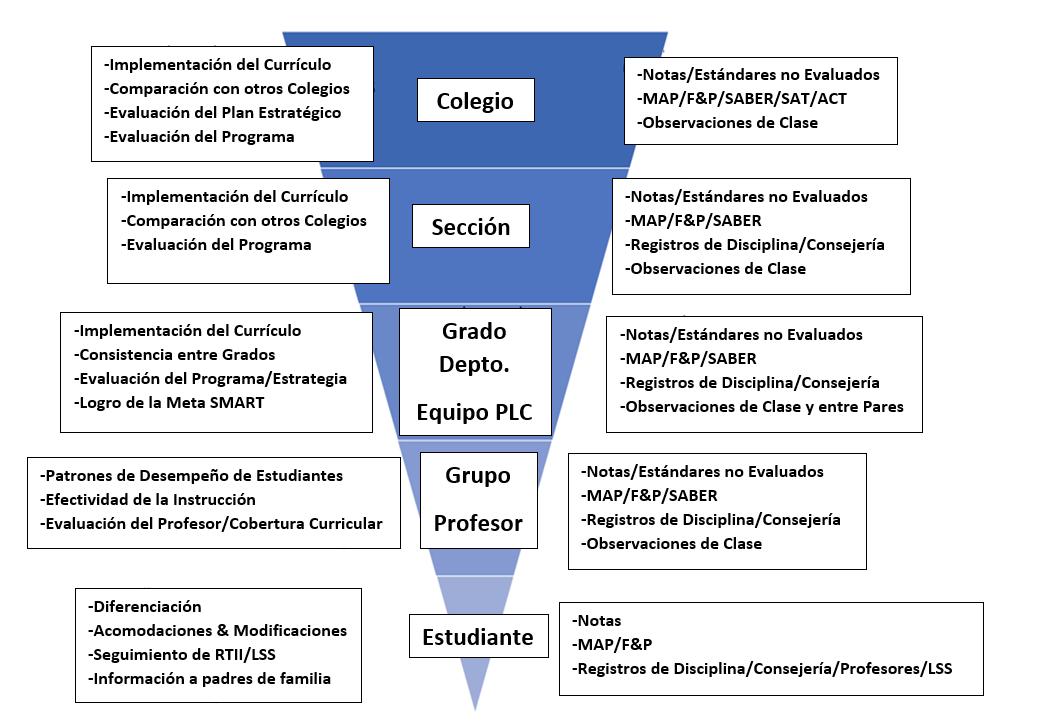
Article 2.14. Levels, Uses and Types of Information
Article 2.15.
Roles and Responsibilities
All departments at Colegio Bolívar have specific roles and responsibilities related to assessment and evaluation. The following are the roles and responsibilities of each department:
Students:
• Do your best in every task
• Use assessment information to self-reflect, define goals, and work toward achieving them
• Complete all assignments and tasks on time
• Deliver school communications to parents
• Celebrate successes
• Check class websites and platforms regularly for notes, assignments, and project and report due dates.
• Be prepared for assessments
• Get adequate sleep, have good nutrition, and arrive at school/class on time every day.
Teachers:
• Clearly and in advance articulate the evaluation criteria for each assignment that will be graded
• Publish and communicate daily learning goals to your students
• Align assessments directly with academic program standards and indicators
• Provide rubrics/templates for each assessment activity, including exams
• Post project and assignment rubrics online
• Use data from multiple sources, including the prior year, to inform academic instruction and assessment
• Provide and explain results to students and parents regularly and in a timely manner
• Provide assessments agreed upon at the school level, as well as other assessments selected by teachers
• Provide complementary resources
• Provide assessment information (course overview, assignments, and grading policies)
• Actively participate in Professional Learning Communities teams
• Celebrate successes
• Use examples of student work to demonstrate the learning process over a period of time
• Use pre-assessments to access prior knowledge
• Facilitate opportunities for peer and self-reflection
• Using assessment information to guide differentiated academic instruction
• Identify and refer students with special needs to LSS
• Collaborate with LSS staff on RTIi interventions and/or the development/implementation/monitoring of individualized plans
• Maintain records of assessments
• Generate grade reports to facilitate tripartite conferences
• Stay up-to-date with changes in important external assessments (i.e., SAT, AP, SABER Tests, MAP, etc.)
Administration:
• Facilitate regular evaluation and data reviews
• Provide time for the work of the Professional Learning Community teams
• Provide professional learning time for teachers to review data regularly, including curriculum days and half-days.
• Review the data and use it in the development of the continuous improvement of the School
• Provide sufficient resources to ensure effective evaluation and reporting
• Ensure that the academic program is reviewed regularly
• Ensure the common use of assessments and communication between grades and sections
• Celebrate successes
• Be sure to review the data with teachers individually.
• Monitor that discipline and counseling information is uploaded to the appropriate platforms
• Review the mission/vision from the perspective of data management goals in the institutional plan
• Ensure that data management practices are aligned with the principles of Deeper Learning
• Monitor that the data is valid and reliable
• Informs parents about institutional progress
• Hold meetings twice a semester to identify the focus of the analysis. The data coordinator then prepares the necessary reports, which are then submitted to the individual sections, departments, or grade levels with the help of instructional coaches.
Parents:
• Be aware of your children's abilities, strengths, and areas that require improvement
• Support all school policies and appropriately assist the student at home
• Maintain open communication with teachers and the rest of the team (i.e., ask and obtain clarifications)
• Review and read the College's communications
• Attend conferences and meetings
• Celebrate successes
• Check class websites and Schoology/PowerSchool platforms regularly for notes, assignments, project due dates, and feedback on reports.
• Making sure your child is prepared for assessments: Getting adequate sleep, good nutrition, and arriving to school on time every day
Article 2.16. Review of the Evaluation and Promotion System
The Evaluation Committee meets once a year to review and update this document, if necessary. Feedback from various stakeholders is taken into consideration in this process. All reflections and observations (management reviews, checklists, and comments from formal observations), as well as conclusions from professional learning opportunities, provide further information for the review process.
Article 2.17. Glossary:
Activities
: Sample tasks that can be used to teach the standards and indicators. In Colegio Bolívar's unit plans, activities are not considered mandatory, but rather "Illustrative Examples" that attempt to show what the standards and indicators will look like.
Criteria:
The qualities that must be met to achieve a standard. Asking what a criterion is means asking what teachers should look for when examining students' products or performances to validate whether they were successful. How will teachers determine whether work is acceptable?
Curriculum:
It is the "road map" that provides a detailed guide for translating the school's mission into practice. It is also the "contract" that the school establishes with each student and their parents.
Competence Scales
A proficiency scale is a table used by teachers and students to determine a student's actual level of progress toward meeting a standard. Proficiency scales indicate a student's performance relative to a given standard and use a four-point system, with a score of 3.0 indicating proficiency within a standard.
Standard
In common terms, the term usually refers to specific criteria by which students are expected to learn and be able to do so. These standards take two forms in the academic program:
• Content (similar to what was previously called goals and objectives), which indicate what students are expected to know and be able to do in various subjects, such as mathematics and science.
• Performance, which specifies expected learning levels. A performance standard specifies how well students are expected to perform.
Assessment:
Techniques for analyzing student achievement against specific objectives and criteria, including paperand-pencil tests, displays, interviews, surveys, and observations. Good assessment requires a balance of techniques, as each is limited and subject to error.
Collective or Common Evaluation
An assessment collaboratively agreed upon by more than one teacher responsible for the same grade level or course and delivered to all students in the same course or grade level.
Summative Assessments
These are used to assess student learning, skill acquisition, and academic achievement at the end of a given academic period usually at the end of a project, academic unit, course, semester, program, or academic year. Summative assessments are generally defined by three main criteria:
• Tests, assignments, or projects are used to determine whether students have learned what they were expected to learn. In other words, what makes an assessment "summative" is not the design of the test, assignment, or self-assessment, per se, but rather the way it is used i.e., to determine whether and to what extent students have learned the material taught.
• Summative assessments are given at the conclusion of an academic term, and therefore are generally evaluative rather than diagnostic – ie, they are most appropriately used to determine learning progress and achievement, to evaluate the effectiveness of educational programs, to measure progress toward improvement goals, or to make decisions about courses, among other possible applications.
• The results of summative assessments are commonly tabulated into scores or grades which are then used to determine the student's academic record, whether it ends up being
A letter grade on a report card or results sheet used for college admissions. While summative assessments are a core component of the grading process in the vast majority of schools and courses, not all summative assessments are graded.
Indicator
• Adequate content or performance standard.
• The best possible examples of work to achieve an evaluation.
Formative Feedback
This term refers to a variety of methods teachers use to conduct ongoing assessments of students' understanding, learning needs, and academic progress during a lesson, academic unit, or course. Formative assessments help teachers identify concepts students are struggling to grasp, skills they are failing to acquire, or learning standards they have not met, so they can adjust lessons, teaching techniques, and academic support.
* Formative assessments are commonly compared to summative assessments, which are used to evaluate student learning progress and performance at the end of an instructional period typically at the end of a project, academic unit, course, semester, program, or school year. In other words, formative assessments are for learning, while comprehensive assessments are for learning.
Rubrics
Specific descriptions of the performance of a specific task at different levels of quality.
Assessment
The process of interpreting or making a judgment about information to determine how well students are achieving educational objectives.
LEARNING SUPPORT SERVICES
Article 2.18. Students with Outstanding Performance
In Pre-Primary, English language enrichment classes are offered to students who demonstrate outstanding English skills. The Optimal Match program is offered in Primary to students who show outstanding academic performance. In Junior and Senior High School, Colegio Bolívar offers advanced placement courses (Honors, Pre-AP, and AP) to students with outstanding academic performance.
Article 2.19. Students with Low Performance or with Differentiation in their Learning Processes
Bolívar School implements a variety of processes and strategies to help underperforming students. The Learning Support Services department provides assistance to identified students following the Response to Intervention model. This department and counselors provide support not only to students but also to teachers and guidance to parents.
Additionally, in junior and senior high school, students are offered academic instruction after school to help them overcome some of their difficulties.
Article 2.20. Differentiation and Student-Centered Instruction
Colegio Bolívar implements a variety of teaching and assessment strategies. Students have multiple opportunities to demonstrate what they have learned, and their teachers provide ongoing feedback so they can clearly see their progress.
The school offers various opportunities for students to achieve the benchmarks and standards defined by each educational level. The school designs follow-up activities to improve student performance throughout the academic year. This includes remedial strategies that support students with any difficulties they may face with the standards established by their academic section for their grade and stage of development. The following are some of these strategies:
• Differentiated Instruction
• Internal reinforcement
• Internal referrals to the Learning Support Department and external referrals to specific professionals or tutors.
• Accommodation Plans and Modified Curriculum Plans (PIAR)
• Plan for working from home
• Follow-up on the recommendations made to the students regarding their performance and understanding
• Help from the Department of Learning Support Services
• Other strategies based on the individual needs of the student
Article 2.21. Learning Support Model – Learning Support Services (LSS)
Our learning support model is inspired by the Response to Instruction and Intervention (RTI) model. RTI is a multi-tiered system for students that offers increasingly intense levels of support, academic interventions, and assessments. RTI involves the use of data, collected through multiple, varied, and frequent assessments, to make decisions about instructional needs. Different types of internal and external data are used to monitor student learning, as follows:
1. Grades assigned to learning objectives, recorded in the gradebook, and trend analysis.
2. Various data sources are used to identify high-priority areas. Currently, the most commonly used are:
• Fountas & Pinnell (F&P), grades 1-8, and within this framework, the data produced by the Leveled Literacy Intervention (LLI).
• MAP Tests
• Master Track Assessments in Mathematics
• Regular learning support follow-up meetings and student progress meetings in preschool (PP) and primary (P).
• Results of monitoring with traffic light system (primary and middle school)
• Monthly meetings by grade level in upper secondary (HS).
Standardized psychometric test data are used to identify specific areas of strength and challenge for students who are not meeting or falling below grade-level expectations. The following diagnostic assessments are used to refine universal screening data and identify the causes of gaps: WISC, WPPSI, PROLEC, BASC, BRIEF 2 (for students in levels II and III), among others.
Article 2.22. In implementing RTIi, Colegio Bolívar considers three levels of support: Level I Support:
Tier 1 support is addressed through Differentiated Classroom Instruction available to all students. After identifying the key concepts students must learn and the essential skills they must develop, teachers will design differentiated learning strategies targeting at least three different levels of achievement and regularly collect data on student performance. Based on this data (qualitative and/or quantitative), teachers design and redesign learning strategies to consistently target students' "zones of proximal development." Records of student learning needs, the strategies used to address them, and the recommendations made are maintained for further analysis and decision-making.
At this level, all students receive instruction from highly qualified teachers using effective, research-based instructional methods and strategies. Level 1 is designed to provide any student with the support and/or challenge needed to achieve expected outcomes and/or growth. Students may work in small groups while the teacher uses differentiated instruction to target different skill levels and learning styles. Instructional coaches and LSS teachers provide support and assistance to teachers at this learning level.
If after systematic differentiation the student does not show the expected growth, several actions can be taken before considering Tier II support:
• Design an additional plan that includes other strategies.
• Submit a referral for consideration by the Learning Support Services (LSS) team, based on the decision made at an internal meeting.
Tier 1 support also includes executive function support for all students and the implementation of accommodations when necessary. Executive function support at this level is provided when teacher observations and qualitative records indicate that students are struggling with time, tasks, and materials. In this case, various types of strategies are implemented (emphasis on the use of planners, clear and consistent routines, use of graphic organizers, division of tasks into subtasks, use of reflection forms, etc.).
If necessary, different types of accommodation plans are designed to address students' specific learning needs. Accommodations provide strategies and recommendations for adjusting the environment, instruction, and assessment for some students without affecting curricular expectations and learning objectives. To design accommodation plans, LSS teachers and classroom teachers consider a combination of the following elements: student academic records (current and historical), F&P Assessment System scores, MAP test results, teacher feedback, classroom observations, and input from parents and students.
Primary learning leaders: Classroom teachers, instructional coaches, department heads, and the Learning Director.
Support Team: The Learning Support Services (LSS) team provides guidance and support in terms of differentiation and adaptation strategies for learning and assessment.
Level II support:
Implementation of supplemental instruction to address specific student needs that arise in the course of Tier 1 instruction. (Ibid.)
Tier II provides moderate-intensity support to complement Tier I strategies for students who are not making adequate progress after differentiated instruction. Two types of support are available in Tier II:
1. Systematic support of classroom instruction on fundamental concepts or skills so that some students achieve specific learning objectives (LSS add-on support).
2. Implementation of programs that are designed as small-group interventions to enable identified students to achieve specific learning objectives (e.g., Leveled Literacy Intervention - LLI).
After a course of systematic intervention, additional assessments will be conducted to determine whether students may still need support; or whether a Tier III program is considered for students who are not showing any growth. In this case, a referral for NIII is completed to determine further actions: testing, Tier III internal intervention, a Modified Classroom Instruction Plan (MCIP), or external support/therapy.
In Junior High School, various classes are offered to address the needs of Level II students: Reading and Math Workshops, Learning Support Services (LSS), and Study Skills. In LSS classes, students can anticipate and prepare, develop, strengthen, and sustain the academic skills necessary to meet the demands of school. This is done through individualized or small-group instruction in self-help skills, cognitive and learning strategies, math, reading and writing strategies, study skills, and organization, according to individual needs.
In Junior High and ninth grade, students who need support to address specific learning gaps are enrolled in specific instructional classes called Reading Workshop or Math Workshop. Decisions regarding students' continued use of this type of support are made in Senior High and LSS team meetings.
In lower and upper secondary schools, extracurricular reinforcement sessions, tutoring, and/or online programs that support the school curriculum are offered on an ongoing basis.
Learning support teachers from all sections can also assume the role of co-instructors, depending on the specific classroom, resource availability, and/or student needs. Co-teaching experiences at CB are structured based on different theoretical models, depending on the teachers' roles, level of responsibility, and target population. Co-teaching involves a long-term commitment, co-planning, and an openness on the part of both the classroom teacher and the incoming support teacher to a mutual willingness to learn and achieve broader classroom support for student learning and growth.
Executive functioning support is provided at Level II when systematic observations and qualitative teacher records reveal that specific students have consistent difficulties managing emotions, time, tasks, and materials. In this case, different types of strategies are implemented: inviting students to an external observation to recommend follow-up plans, administering the BRIEF 2 with recommendations to address executive functioning difficulties, and participating in study skills classes, among others. Study Skills classes in secondary school address students' executive functioning needs (organizational support, time management, planning, task follow-up, initiation).
Primary Learning Responsibility: The team consists of the Tier II Learning Support teacher or co-teacher and the classroom teacher (homeroom or special area). Coordination and shared responsibility are requirements for the success of Tier II students. These requirements will be evident in all aspects of planning, instruction, and assessment.
Classroom or area teachers remain primarily responsible for promoting and reporting student academic progress. Both the classroom teacher and the LSS teacher should be responsible for following up on future actions once a referral is submitted.
Support Team: Instructional Coaches, LSS Coordinator, Section Directors, and Learning Director.
Level III Support:
"Implementation of highly specialized instruction to meet the intensive needs of a small group of students." (Ibid.)
Students who, despite support in Tiers I and II, are not growing as expected and need more comprehensive instruction in specific foundational skills or need more challenging and enriched instruction will receive individualized support in the areas they need. This support will be provided systematically and continuously , outside of the regular classroom. In Preschool and Elementary, the areas in which we provide this level of support are: English Language (Reading, Writing, Listening, and Speaking), Mathematics, prerequisite skills, and for enrichment, we work on Mathematics and English.
At Level III the following aspects must be considered:
• An effective Level III intervention should be offered regularly and consistently (ideally in 45-minute sessions per day).
• Students receiving Tier III support may also be eligible to receive Tier II and Tier I support.
• LSS and classroom teachers should monitor closely, periodically communicating observations about students' needs, performance, and growth so that interventions can be adjusted accordingly.
• In some cases, when students are still not showing growth despite support at Tiers II and III, a PIAR or Modified Plan is recommended. Accommodations and modifications are made accordingly for both internal standardized tests and the University Orientation Program (UCAP) and external standardized tests. All of these are structured for Tier III students and those with PIARs.
Executive Function support is also provided at Tier III through study skills classes in both Middle and High School, where instruction is provided either individually or in very small groups. Additionally, LSS teachers incorporate executive function support strategies for students in need during their regular Tier III intervention time throughout the school. Student enrichment is delivered differently, depending on the tier, as described above.
Primary learning responsibilities: Learning Support Teachers, classroom teachers, LSS Coordinator, Counselors, Section Leaders. Students at this level often also receive support from external professionals.
Support team : Psychometrist, Neuropsychologists, Counselors or other external professionals in the areas of Psychology, Speech Therapy or Occupational Therapy.
Article 2.23. Individual Reasonable Adjustment Plan (IRAP) or Modified Curriculum Instruction Plan (MCIP)
The Individualized Instructional and Pedagogical Adjustment Plans, combined with all elements of the RTI process, aim to address the Colombian requirements of the Individual Reasonable Adjustment Plan (PIAR) Decree 1421 of 2017, specifically for the inclus ion of students with disabilities.
At Colegio Bolívar, it is established that for those students who, despite the classroom support provided and the LSS intervention provided, are two or more years below grade-level expectations according to the MAP and/or Fountas and Pinnell tests and/or the Learning Profile, and whose grades or comments in the grade book reflect low performance, an Individualized Adjustment Plan (IRAP) or Modified Curricular Instructional Plan (MCIP) that affects the regular curriculum is designed and implemented. The plan is the new basis for the student's evaluation and grading, and this information will be reflected in grade reports and academic records. Students who have an IRAP will also have classroom instructional adjustments based on their needs. An IRAP does not replace occupational, speech, or psychological therapy and/or medical treatment that the student must receive to address a specific need.
In some cases, students with a professionally identified learning difference (dyslexia, dyscalculia) that affects their literacy or numeracy skills, and whose overall performance is not two years below expectations, but whose conditions impact the development of some specific skills, may also have some minor curriculum modifications related to these identified learning needs.
The PIARs are designed by a team composed of classroom teachers, the LSS teacher, the Tier 1 facilitator, the LSS coordinator, the section head, and the counselor. The plan is reviewed and approved by the Section Head and the Director of Learning in a timely manner. Once the plan is ready, it is shared with parents and formalized as an educational agreement between the student's family and the school. The PIAR is implemented by classroom teachers (with LSS support as needed), under the supervision of the section head. This process of implementation and student learning requires periodic follow-up meetings (involving parents, the section head, the counselor, teachers, and LSS staff as needed) to assess student progress and re-evaluate the plan throughout the academic year.
Depending on the student's specific learning needs and abilities, a PIAR may be extended to other subject areas that rely on these skills. In upper secondary school, these may include subjects that require advanced thinking, making connections, and using prerequisites in language or mathematics. Conversely, a modified plan may be finalized when the student's performance approaches grade-level expectations, learning gaps are closed, and the student is significantly more mature and autonomous.
If the plan is agreed upon during the first half of the school year, this will be reflected in the grade book, with a class named "Modified X" where grades will be entered and the class will be in effect for the entire school year.
If the plan is implemented starting in the second semester, teachers will take the curricular changes into account when adjusting their assessment and grading expectations from that point forward. However, grades will continue to be entered in the "regular" class of the system, and a note will be written in the gradebook to explain the start of the PIAR implementation and the modification in teachers' expectations. This procedure is established to avoid two different bases for student evaluation (regular classroom curriculum and modified curricular expectations). If the student has met the modified goals by the end of the school year, the overall grade for the subject will be a passing grade (2 or higher).
In some cases, when some or all of the above supports have been addressed and the student still requires supervision and support from a close adult to perform at a minimal level, the family may be asked to provide support from an Inclusion Teacher. The role of the inclusion teacher is generally defined in the School Integration Protocol – Guidelines for Inclusion Teachers document, but the final individual guidelines depend on the student's specific profile and needs.
The PIAR and the support of the inclusion teacher do not guarantee academic success at Colegio Bolívar. If, having exhausted all school intervention resources, a student still does not meet the minimum academic requirements, they will not be able to remain enrolled at the school, as the CB does not meet their educational needs.
Primary Implementation Responsibility: Classroom teachers with some guidance from the LSS Level I Facilitator, LSS Coordinator, section directors, and the Director of Learning.
Support Team: The Learning Support Services facilitator provides a long-term perspective on the definition and implementation of different PIARs over time.
Article 2.24. Classification of students according to their needs: Based on these different levels of needs and support, the CB student population can be distributed into the following groups:
Tier 1 (all CB/ Prevention students): Receive "daily classroom differentiation," where teachers focus on students' learning differences to help them access the general education curriculum. This term also refers to students who require classroom instructional accommodations: accommodations may address academic, emotional, developmental, and/or behavioral needs.
Tier 2 (some students/ intervention ): Receive temporary support with specific skills or concepts identified through trends in qualitative (observations, teacher logs) or quantitative (gradebook, grades, other evidence) data. Students typically receive support in small groups.
Tier 3 (a few students/ remediation): Students who have significant learning needs and gaps, identified through the LSS referral system: referrals, diagnostic tests or examinations, and/or external assessments. These students should receive structured support to fill in the gaps and develop the skills they lack. Not all students receiving Tier 3 support have an established diagnosis, nor may they require adaptations or a PIAR. They have not responded adequately to Tier 2 intervention. They work in small groups or individually.
PIAR Students – T3, plus PIAR and accommodations – Students with an identified long-term need, who may or may not have a diagnosis, and who require a different learning structure, such as modifying learning expectations, learning pace, timeframes, or even ways of communicating and demonstrating learning. All of these students also have accommodations and a close follow-up process. All of these elements comprise the Individual Reasonable Adjustment Plan (PIAR) Decree 1421 of 2017. This is the population that, according to Colombian law, can be referred to as “inclusion students.”
Students with temporary or long-term needs for individualized support (Inclusion Teachers). These students' needs generally arise from a pervasive lack of maturity, which may be evident in their learning process, emotional/behavioral needs, or executive functioning, impacting their academic learning or behavior and the learning environment of others. This resource is used when students need consistent adult support to connect with their learning and/or help regulate their behaviors.
Article 2.25. Registration in the Colombian National Registry System (SIMAT)
Students with a professionally identified diagnosis or medical conditions consistent with disabilities or learning disorders established by the Ministry of Education will be registered as such in the SIMAT (National Enrollment System).
Article 2.26. Inclusion quota
Taking into account the school's characteristics, pedagogical approach, and available resources, the school may define an admission threshold for the number of students with specific learning needs. Within the Institutional Education Project (PEI), Colegio Bolívar is a bilingual (English and Spanish) academic school that follows the Deeper Learning framework, which focuses on the transfer of knowledge and skills from the classroom to real-life situations. It is a challenging model that encourages higher-order thinking in both languages.
Using Learning Support data from the last five years, the inclusion quota for Primary and Pre- Primary is determined by the number of students receiving Level 2 and Level 3 support. In both sections, this figure cannot exceed 20% of the total student population in Pre-Primary and Primary. For Lower Secondary, the quota will be 15% of the population in the section receiving Level 2 and Level 3 support, and for Upper Secondary, it is 5% of the population.
If a student has been at Colegio Bolívar since K4, and despite all the support provided, the student has not achieved the expected development in the second language by the middle of third grade, the school may no longer be able to offer educational services to the student.
Article 2.27. PROCEDURES AND ROUTE:
Referral Process:
If, after implementing differentiation strategies in the classroom and utilizing various data sources, the teacher determines that the student requires further support to address their educational needs most effectively, both the homeroom teacher and the Spanish teacher write a referral as the first step in the referral process. The referral form should contain details of the student's performance, behavior, health, and emotional characteristics, as well as information on previously used differentiation plans and strategies. It should also include samples of student work to illustrate levels of understanding and performance.
A student's eligibility for LSS support for individual needs is conditional on the availability of resources and the family's response and commitment to any school requirements that aim to improve the student's learning conditions and well-being.
Procedures and expectations regarding the mandatory (versus optional) nature of the referral process are established and explained during Orientation Week and included in teacher handbooks (see handbooks for more section-specific information). Student progress/grade-level/Learning Support Services meetings, with input from the LSS team and appropriate teachers, will be used to clarify and discuss student performance and special needs in all academic areas. This may also lead to the initiation of the referral process.
In Junior High School, referrals are decided in grade-level meetings after teacher consensus, and gradelevel leaders are responsible for logistics or achieving this consensus. The grade-level counselor contacts parents to inform them and authorize the test.
In middle school , the referral process may be initiated by the Learning Support Services Team (6th-12th grade counselors, LSS teachers, and the dean of students), but teachers must be responsible for completing the referral form. All previous reports of academic performance below grade-level expectations and/or recommendations from transfer meetings must be considered.
The submission and maintenance of official records of all referrals are conducted at regular Learning Support Services (LSS) staff meetings. Actions to be taken and recommendations made are decided upon and recorded.
In all sections (from preschool to secondary), teachers will be asked to specify, on the referral form, what differentiation strategies they have been using before referring a student.
Psychometric Testing: Referred students may request an assessment of their learning profile, conducted by the school's psychometric testing specialist. When necessary, testing will be supplemented by classroom observation by a professional psychometrist. The LSS team analyzes the information collected through the application of different standardized batteries to determine additional levels of intervention and available school services. The results of the learning profile are for internal use only, that is, for decisionmaking and recommendations regarding student needs. They will only be shared with neurologists or psychiatrists upon request.
Areas of Evaluation:
Cognitive skills
Higher-order thinking functions
Perception, memory and attention.
Executive Function
Academic skills: such as reading, writing, math operations, and problem solving.
Emotional and behavioral aspects may also be assessed at the request or suggestion of the section counselor.
Article 2.28. External professional references:
Based on the results of internal psychometric testing, students may be recommended or, if necessary, required to undergo additional evaluations in the areas of speech therapy, physical therapy, occupational therapy, psychology, or various medical specialties.
Speech and language therapy:
Students who have difficulties with phonological articulation, reading, writing, or verbal reasoning may be referred to a speech-language pathologist for an external evaluation. The external therapist will identify the needs and diagnosis and determine the course of action.
Recurrent referrals, along with a lack of expected growth despite targeted support, may indicate that the student may have a learning difference in language processes. A diagnosis can be confirmed in 3rd grade, when the development of literacy skills should be consolidated. Therefore, until a diagnosis is confirmed, intervention at the school from the Learning Support Services department will address the reading and writing prerequisites in perception, phonetics, and phonological awareness.
If the student is referred again in third grade for the same difficulties, highly specialized internal testing will be administered and the student will be referred to a specialist to identify and confirm the diagnosis. Once a differentiation in reading and/or writing has been established, interventions will be adjusted and instructional accommodations for the student will be formalized.
Occupational Therapy (OT):
Referrals to OT tend to be more frequent in preschool. Most children describe difficulties with attention, spatial management, and weak posture. After an external evaluation, needs will be identified and a course of action determined.
If, despite external support, a student is referred again for difficulties with attention, organization, and/or behavior regulation, specific behavioral guidelines may be applied. If results continue to indicate attention problems, parenting guidelines will be recommended, emphasizing home routines, rules and limits, managing authority, organization, and executive functions.
Attention can sometimes be affected by emotional situations, including anxiety. When this is suspected as the cause of attention difficulties, the student will be referred for external psychological support.
In some cases, attention difficulties may persist or worsen. If, by third grade, a student continues to show attention difficulties, despite consistent external support and adaptive parenting practices, they may be
referred to a physician, pediatrician, neurologist, or psychiatrist for evaluation of a disorder such as ADD, ADHD, conduct disorder, ODD, etc.
Psychology:
Student learning is greatly affected by emotional dynamics both at home and at school. Emotional difficulties at home, lack of stability, parenting, and self-esteem issues all affect students' maturity, disposition, and willingness to learn.
Often, when this situation is identified, school counselors explore the root causes of the problem with parents and recommend some adjustments at home. In cases where the situation persists, they may be referred to outpatient psychological or psychiatric therapy. These referrals will be formalized with the department administration.
The school expects families to be consistent and committed to any recommended external processes. These processes are an integral part of the intervention efforts aimed at supporting the child's progress.
Exit/Integration: Decisions to end or change intervention at any of the levels described above are made by the Learning Support Team in the broadest sense of the term, based on reports of student performance in the classroom and performance data from various sources.
CHAPTER III
EDUCATIONAL COMMUNITY
According to the Colombian Political Constitution and the General Education Law (Law 115 of 1994), the educational community is understood to be made up of students, parents or guardians of students, graduates, teachers, school principals, and school administrators.
Article 3.1. Parents and Guardians: Parents of students at Colegio Bolívar are considered to be parents, according to the Colombian Civil Code. Guardians are those who legally represent the student, even if they are not the student's parents.
When Parents are mentioned in this manual, the student's guardians will be understood to be included in this category.
Parents and guardians are jointly obligated to attend all meetings held by the School to discuss matters related to the student's education and to participate jointly in meetings convened by the School.
It is understood that any of the parents or guardians may represent the student before the institution, which is why, if they are summoned to the educational establishment, the presence of one of them will be sufficient for all proceedings to be understood to have been completed.
Article 3.2. Rights of Parents or Guardians: Parents must provide the institution with the necessary collaboration and support to carry out its mission, following the goals and principles it has established, in order to provide their children with the best possible education and training. The school has and implements policies regarding the channels of communication that must be established between parents and the school, whether through meetings, phone calls, emails, or correspondence. Parents must guarantee their children the rights contemplated in the Colombian Political Constitution, Law 115 of 1994, Decree 1860 of 1994, and those contained in the Code of Children and Adolescents.
Additionally, in relation to the educational process of their children, Decree 1290 of 2009 stipulates the following rights of parents or guardians:
1. Learn about the Student Evaluation and Promotion System (SIEP): criteria, procedures, and evaluation and promotion instruments from the beginning of the school year.
2. Accompany the students' evaluation process.
3. Receive periodic evaluation reports.
4. Receive timely responses to concerns and requests regarding your children's evaluation process.
5. Receive clear and timely information about your child's academic, disciplinary, social-emotional, and general personal well-being.
6. To be treated with respect and dignity, without discrimination, by all members of the educational community.
7. Formulate suggestions, using regular channels, for the improvement of institutional processes.
8. Other rights recognized by Colombian law and the College.
9. Elect and be elected to community participation and representation bodies within the school government.
Article 3.3. Duties of Parents or Guardians: The duties of parents and guardians are:
1. Participate, through school government bodies, in defining criteria and procedures for assessing student learning and promoting students.
2. Continuously monitor the evaluation process of your children.
3. Analyze periodic evaluation reports.
4. Provide respectful and dignified treatment, without discrimination, to all members of the educational community.
5. Punctually attend assemblies, conferences, talks, meetings and appointments convened by the College.
6. Comply with and have your child comply with the provisions and regulations of the School, as well as abide by the recommendations and requirements of an academic or disciplinary nature that the School establishes.
7. Cancel, on the established dates, the financial obligations acquired with the College.
8. Communicate your concerns to the appropriate people through regular channels.
9. Read all communications (circulars, notes, letters, newsletters, email, the school website) sent by the school and return the completed slips promptly when required.
10. Promote a positive image of the school by promoting its programs, projects, and activities. Refrain from sharing information through channels other than those used by the school, such as WhatsApp groups or private social media, where the school is not represented.
11. Contribute to ensuring that educational services are in harmony with the exercise of the right to education and in compliance with its social and legal purposes.
12. Comply with the obligations established in the enrollment process and in the Coexistence Manual to facilitate the educational process.
13. Punctually fulfill all financial obligations and commitments acquired and agreed upon with the Institution.
14. Pay for damages caused by their children to other people and to the property, physical plant or equipment of the Educational Institution.
15. Contribute to building a climate of respect, tolerance, and mutual responsibility that fosters the education of children and fosters better relationships among members of the educational community.
16. Promptly report, and first and foremost, to the school authorities any irregularities of which you become aware, including those related to child abuse, sexual abuse, and illicit drug trafficking or use. If you do not receive a prompt response, contact the appropriate authorities.
17. Support the School in developing actions that lead to the improvement of educational services and raise the quality of learning, especially in the formulation and development of institutional improvement plans.
18. Accompany the educational process in fulfilling their responsibility as their children's primary educators, to improve personal orientation and the development of civic values.
19. Participate in the educational establishment's annual self-evaluation process.
20. Responsibly assume the proper education of their children as their first homeschoolers and fulfill the responsibilities outlined in Article 7 of the General Law on Family Education and as stipulated in Law 1098 of 2006, within the parameters of ethics and good morals.
21. Contribute in solidarity with the Educational Institution in the education of their children.
22. Promote respect for others, superiors, institutions, and legitimate forms of authority in your children at home, setting a good example.
23. Collaborate in developing good manners in your children both inside and outside of school and set an example of good behavior for your children and/or those you represent at all times and places.
24. Provide courteous and appropriate treatment to managers, teachers, students, and employees of the Educational Institution.
25. Avoid insulting and/or threatening the institution's directors, teachers, and administrative staff, whether in person, by phone, by letter, by email, or to third parties, for any reason.
26. Respect the regular procedures proposed in this coexistence manual and make use of it for the peaceful resolution of conflicts and the good social coexistence of the educational community.
27. Be objective and fair when making claims and refrain from making inappropriate or unfounded complaints and angry demands.
28. Refrain from making comments that affect the institution's image in the community. In case of concerns or disagreements, please express them directly to the people involved or to the school administration, with due respect.
29. Avoid negative comments about the institution or its members to members of the educational community or to people outside the school that are detrimental to the institution or its staff.
30. Refrain from drinking alcoholic beverages or smoking on campus in the presence of students.
31. Provide private and appropriate use for film and photographic documents that you are permitted to record during school activities and special events.
Article 3.4. Prohibitions for Parents and/or Guardians : Parents and/or guardians of the Institution are prohibited from:
1. Initiate reckless legal or administrative actions against Colegio Bolívar, which are intended to cause harm to the Institution.
2. Showing up at the institution while intoxicated or under the influence of psychoactive substances.
3. The application of physical or degrading punishments to those represented due to their performance in the institution.
4. Using foul or vulgar vocabulary within the institution when addressing your representative or any member of the educational community.
5. Uttering insults and/or threats against the institution's directors, teachers, and administrative staff, in person, by telephone, by letter, by email, or to third parties, for any reason.
6. The use of false documents or information for student registration.
7. Disclosure of information related to the institution, whether malicious or unfounded.
8. The embezzlement of funds or assets of the association.
9. Sexual harassment.
10. The use of leadership positions on boards or associations, or the institution's assets, for political proselytizing.
11. Carry out actions that hinder the normal academic development of the institution.
12. No parent or guardian may enter classrooms to resolve problems with students without respecting established procedures.
13. Record and share in photographs or videos the institution's daily activities, especially those of its students and employees, with the exception of special school activities, such as festivals, celebrations of special days, birthday parties, in which the recording of photographs or videos is authorized, understanding in all cases that their private and appropriate use will be the responsibility of the parents who record them.
Article 3.5. Parental Participation in School Activities : Modern education increasingly demands greater commitment from parents to the comprehensive education of their children, which fosters unity of opinion between parents and educators.
The school offers various opportunities for participation to parents through their involvement as Group Representatives or as members of the various school improvement committees and organizations.
Parents' participation in field trips, sporting events, talks, and organizing and supporting educational programs is highly appreciated. Since parents are invited to many special events throughout the school year, it is important that they accompany their children to these events.
The authorization given by parents for their child(ren) to participate in the special activities of the School (Festivals, Celebration of special days, birthday parties, etc.) includes the implicit consent for their child(ren) to be photographed by other members of the educational community, who will be in charge and under their responsibility, to give private and appropriate use to said documentary records.
Article 3.6. Student Status: To become a student at Colegio Bolívar, you must be officially admitted; accept, either yourself or through your parents, legal representatives, or guardians, the institutional philosophy and regulations, and sign the respective enrollment contract.
Article 3.7. Student rights: Colegio Bolívar describes a right as the ability of a person to act, decide, or demand something, taking into account the limitations imposed by the rights of others, always respecting the norms and agreements that contribute to establishing order in interpersonal relationships, ensuring healthy coexistence.
Within the training programs offered by the College, students have the right to:
1. Receive education in accordance with the Constitution, the Law and the Institutional Educational Project - PEI.
2. To be recognized for their dignity and treated with respect and courtesy by all members of the Educational Community.
3. Not to be discriminated against, in accordance with the definition of justice contained in the principles and values of this Manual, the Constitution and the Law.
4. Respectfully express your ideas and participate in the life and functioning of the institution.
5. Receive support from the College to develop their individual talents.
6. Feel safe and enjoy certainty about your personal integrity.
7. To due process in decisions that affect it.
8. To be evaluated fairly, in accordance with the parameters of the Institutional Educational Project PEI.
9. Elect and be elected to student representative bodies to participate in decision-making that affects the development of the College's life.
10. To be comprehensively evaluated in all academic, personal and social aspects.
11. Understanding students' SIE: criteria, procedures, and evaluation and promotion instruments from the beginning of the school year.
12. Know the results of the evaluation processes and receive timely responses to concerns and requests submitted regarding them.
13. Receive advice and support from teachers to overcome their learning weaknesses.
14. To enjoy honor and a good name; freedom of conscience and worship, as long as they do not violate established law and order.
15. Benefit from the College's facilities, human resources, materials, and technological equipment, in accordance with the rules and regulations for their use.
16. Represent the College in all types of events for which it is elected or selected.
17. Other rights that the Constitution, the Law and the College Regulations recognize.
Article 3.8. Duties of students: To achieve the goals set by the College, students must:
1. Be responsible for your actions within and outside the College
2. Refrain from resorting to physical, verbal, or virtual aggression as a way to resolve differences and conflicts that arise.
3. Carry out the tasks assigned to you on your own.
4. Be punctual to start or finish any activity and to submit assigned work.
5. Respect the property of others.
6. Always do your best.
7. Be supportive of your colleagues, helping them achieve their best.
8. Use your time in the best possible way.
9. Use appropriate language, free of profanity and vulgarity.
10. Maintain an appropriate personal appearance, respecting dress codes appropriate to the student context.
11. Fulfill the academic and coexistence commitments defined by the School.
12. Comply with the recommendations and commitments made to overcome weaknesses.
13. Know and comply with what is described in the Institutional Educational Project, and especially in this Coexistence Manual.
14. Demonstrate loyalty to the School and respect its name, uniform, and institutional emblems at all times, in all activities, and in all places. Present a positive image of the School by positively promoting its programs, projects, and activities. Refrain from sharing information through channels other than those used by the School, such as WhatsApp groups or private social media, where the School is not represented.
15. Attend classes or school activities punctually during the school year and promptly submit justified permission slips and excuses for tardiness and absences.
16. Comply with the curricular and extracurricular obligations planned by the School.
17. Deliver in a timely manner, to the appropriate person, the correspondence (notes, bulletins, circulars, etc.) that the School sends to homes and vice versa.
18. Preserve, care for, and maintain the College's property, belongings, and equipment in good condition, taking responsibility for any damage or loss.
19. Comply with the established disciplinary and coexistence rules.
20. Participate and collaborate positively in all school activities, demonstrating exemplary behavior.
21. Inform your superiors about any activity that you are aware of that affects the normal progress and well-being of yourself and/or the educational community.
22. Respect national symbols, both Colombian and those of any other country or culture.
23. Act at all times in accordance with the criteria and values established by the fundamental principles of community life, both inside and outside the school.
24. Arrive at classes and school-related activities in full use of their physical and mental faculties.
25. Communicate your concerns to the appropriate people by consulting the College's organization and chain of authority following the regular channel.
26. To worthily represent the College in any public or private activity.
27. Protect life by abstaining from consuming, selling, and carrying alcohol, narcotics, tobacco, or similar substances.
28. Do not use firearms or sharp objects, magazines, or pornographic material at any time.
29. Fulfill the responsibilities that come with being elected as a member of school governing bodies.
30. Adopt appropriate behavior inside and outside the School, in such a way as to preserve the good name of the School.
31. Provide support seeking the common good of the community members and those we wish to serve.
32. Comply with the other guidelines and duties established in the Law and in this Coexistence Manual.
33. Fulfill the responsibilities of national or international academic tests such as SABER, SAT, and TOEFEL, always with your best effort and attitude.
Article 3.9. Prohibitions for students: Students at Colegio Bolívar are expressly prohibited from:
1. Enter or leave the school premises on foot, except when the student resides near the school and when the parents make an express request.
2. Leaving the school without proper authorization.
3. Driving a vehicle within the College premises, except in cases authorized by the institution.
4. Entering or leaving the school at times other than those established or on non-working days, except with the authorization of a representative of the institution designated by the institution.
5. Entering restricted areas, except with express authorization.
6. Coming to school under the influence of alcohol, narcotics, or any prohibited substance; using or distributing them, or possessing them on school property. Smoking or possessing cigarettes, including e-cigarettes, vapes, vaporizers, etc., on school property.
7. Bringing to school, viewing, or circulating within the school, magazines, books, brochures, or any other pornographic material, as well as accessing such websites on the Internet. Wearing T-shirts or other clothing with obscene or degrading motifs or refer encing psychoactive substances is prohibited.
8. Disrupt the normal development of academic, cultural or sporting activities.
9. Using electronic devices inside the school during class time or other school activities that are not necessary for school work and that distract or harm them.
10. Stealing, appropriating, hiding, or taking books, notebooks, school supplies, computer files, or any other objects from classmates, teachers, administrators, or any other person without their consent, and engaging in any other conduct that violates the discipline and moral standards required by the School.
11. Selling items within the school, unless it is a community activity planned by the board of directors or there is express authorization from them.
12. Altering, adulterating, or falsifying documents, engaging in fraud, or engaging in any conduct that constitutes a criminal violation or infraction under Colombian law, or committing fraud, cheating, or plagiarism in evaluations, academic work, or other academic activities.
13. Carrying out, disseminating or participating in subversive activities or illegal groups, using obscene or vulgar language.
14. Carrying, supplying or using weapons or elements that go against the physical, social or moral integrity of the people who make up the educational community.
15. Performing a sexual act or access against another person, inducing them to engage in abusive, degrading, or dishonorable practices, or in any way attacking or violating their sexual freedom or negatively influencing their sexual education.
16. Inducing, manipulating, coercing, or forcing another person to commit an act that constitutes an academic or disciplinary infraction, or that in any way violates the morality, law, health, and good customs required by Colegio Bolívar.
17. Physically or verbally attacking any member of the community, as well as having offensive, disrespectful, or discriminatory attitudes toward any of them.
18. Repeatedly disobeying, being insubordinate, or openly defying the authority of any teacher or administrator.
19. Causing or attempting to cause damage to the facilities and belongings of the School or other people.
20. To engage in gambling or betting.
Article 3.10.
Teachers' Rights.
Teachers have the right to develop their professional and personal abilities and characteristics, to be recognized for their merits and dedication, to receive an objective evaluation of their work, and to receive respectful and courteous treatment from all members of the Colegio Bolívar community. Teachers' rights are also protected by labor and education laws and by the teacher's manual.
Article 3.11. Duties of Teachers. The teachers at Colegio Bolívar must model the principles and values the school seeks to promote in its students and work together with parents and other members of the community to fulfill the institution's mission, goals, and objectives. Teachers must also enforce the provisions established by the school and follow the educational procedures necessary to maximize the benefits of student development. The specific duties of teachers are:
1. Promote a safe classroom environment that fosters social and academic learning.
2. Take discipline in its positive sense, that is, keep students interested and completing their homework.
3. Manage disciplinary situations in their particularity, promoting individual and social responsibility.
4. Report any School Coexistence situation that requires immediate attention to the Section Director, Counselor, or Dean of School Coexistence.
5. Participate in meetings with the Section Director, Counselor, and Dean of the section, students, and parents, when necessary.
6. Assume the obligation to always govern their professional practice in accordance with ethical and scientific principles inherent to teaching and/or professional practice.
7. Respect the political ideas and opinions and privacy of the people with whom you interact professionally, regardless of nationality, sex, gender identity, sexual orientation, age, social position, or any other characteristic.
8. Scrupulously respect the physical and mental integrity of students, colleagues, coworkers, and parents, especially those of their students, avoiding manipulation and personal gain that could harm their students or others.
9. Maintain a professional and mutually respectful relationship with your students, avoiding attitudes and actions that suggest seduction or personal harassment.
10. Avoid initiating, promoting, and/or maintaining romantic relationships with students at Colegio Bolívar.
11. Avoid personal contact and communication with students via the Internet, electronic media, and social media, unless it concerns strictly academic matters related to the educational process and is permitted by the institution.
12. Avoid all types of inappropriate physical contact with the institution's students.
13. Avoid sharing information about your students and/or parents that is not your responsibility or that is confidential, and avoid making comments that discredit students and/or their families, such as labeling, humiliating, mocking, etc.
14. Not practicing their profession when their professional capacity is limited by alcohol, drugs, illness, or physical and/or psychological disabilities.
15. Comply with the Dress Code established by Colegio Bolívar.
16. Ensure punctuality and take advantage of the time allocated to educational activities under your responsibility.
17. Do not use your position or the name of Colegio Bolívar to obtain personal gain or benefit from students, parents, and/or third parties related to the educational community.
18. Maintain confidentiality regarding information and/or documentation from Colegio Bolívar that has not previously been made public.
19. Strictly comply with the institution's Code of Ethics, as well as its conflict of interest, confidentiality, and copyright policies.
20. Incorporate their normal work capacity, exclusively, in the performance of the duties for which they have been contracted, annexed and complementary, in accordance with the current manuals of functions and procedures, with the Internal Work Regulations and in general to the orders and instructions given by Colegio Bolívar or its Representative.
21. Strictly observe the rules set by the institution for carrying out the work for which he was hired.
22. Maintain absolute confidentiality, unless expressly authorized by the school, of all information that comes to your knowledge due to your work and that is private in nature.
23. Dedicate your entire workday to fully fulfilling your duties.
24. Schedule your work daily and punctually attend the meetings held by the College to which you have been summoned.
25. Maintain complete harmony and understanding with students, parents, superiors, and coworkers in their personal relationships and in the performance of their work.
26. Permanently comply with the institution in a spirit of loyalty, collaboration, and discipline.
27. Not to attend to matters other than those entrusted to you by the College during working hours, without prior authorization from the College through its representatives.
28. Refrain from providing labor services, either directly or indirectly, to other educational institutions considered to be in direct competition with Colegio Bolívar, as well as from carrying out teaching or teaching-related activities on one's own account in entities that pose a conflict of interest, during the term of the employment contract.
29. Refrain from performing tasks outside of working hours that affect your mental or physical health and cause wear and tear on your body in a way that prevents you from effectively providing the agreed service.
Article 3.12. Teacher Prohibitions: Teachers at Colegio Bolívar will be subject to the following prohibitions.
1. Subjecting students or coworkers to sexual or non-sexual harassment.
2. Maintain romantic and sexual relationships with students.
3. Exposing the student to situations that endanger their physical, mental and moral integrity.
4. Discriminate based on sex, gender, age, race, religion, economic or social status, political beliefs, academic performance, or physical limitations.
5. Introducing or allowing the introduction into the educational center of toxic and hallucinogenic objects and/or substances that threaten health, morals, good customs, and individual or collective safety.
6. Showing up at the school without personal grooming appropriate to your professional status.
7. Provide the student with part or all of the test that will be administered prior to the exam.
8. Promoting or failing a student arbitrarily without complying with the respective evaluation standards.
9. Requesting or accepting gifts or rewards as compensation for the work carried out in their position.
10. Directly or indirectly soliciting or collecting money, contributions, or financial support from students and parents for any purpose.
11. Occupy students with personal matters.
12. Requiring students to purchase books or school supplies for personal gain.
13. Talk to students or parents about confidential matters related to THE SCHOOL or about work-related situations, personal matters, or those of other students or parents at the institution.
Article 3.13. Responsibilities of the College: In relation to the system of evaluation and promotion of students, the College has the following responsibilities:
1. Define, adopt, and disseminate the Institutional Student Evaluation System, after its approval by the Academic Council.
2. Incorporate into the institutional educational project the evaluation criteria, processes, and procedures, as well as strategies for overcoming weaknesses and promoting students, as defined by the Board of Directors.
3. Conduct meetings with teachers and school administrators to analyze, design, and implement ongoing assessment and support strategies to address student weaknesses and provide recommendations to students, parents, and teachers.
4. Promote and maintain dialogue with parents and students to present periodic assessment reports, plan support activities to address weaknesses, and agree on commitments by all involved.
5. Create committees or other bodies to monitor student evaluation and promotion processes if deemed appropriate.
6. Address the needs of parents and students, and schedule meetings with them when necessary.
7. Through the Board of Directors, it serves as a body for deciding on complaints filed by students or their parents regarding evaluation and promotion.
8. Periodically analyze assessment reports to identify school practices that may be affecting student performance and make any necessary changes to improve.
9. Present all students enrolled in the grades evaluated for the SABER census tests, and collaborate with them in the registration and test administration processes, as required.
Colegio Bolívar complies with the obligations stipulated for educational institutions in Articles 42, 43, and 44 of Law 1098 of 2006, the Children and Adolescents Code.
Article 3.14. Special Obligations of Educational Institutions: In order to fulfill their mission, educational institutions shall have, among others, the following obligations:
1. Facilitate children and adolescents' access to the system and ensure their continued presence.
2. Provide relevant and quality education.
3. Respect the dignity of the members of the Educational Community at all times.
4. Facilitate student participation in the academic management of the educational center.
5. Open spaces for communication with parents to monitor the educational process and foster democracy in relationships within the educational community.
6. Organize remedial programs for students who have learning differences or are behind in the school year and establish psychopedagogical and psychological guidance programs.
7. Respect, allow, and encourage the expression and understanding of diverse national and foreign cultures and organize extracurricular cultural activities with the Educational Community for this purpose.
8. To stimulate the cultural expressions and inclinations of children and adolescents, and promote their artistic, scientific, and technological production.
9. Ensure the use of technological means for accessing and disseminating culture and provide the establishment with an adequate library.
10. Organize activities leading to the knowledge, respect, and conservation of the national environmental, cultural, architectural, and archaeological heritage.
11. Promote the study of national and foreign languages and special languages.
12. Avoid any discriminatory behavior based on sex, gender identity, sexual orientation, ethnicity, creed, socioeconomic status, or any other reason that affects the exercise of their rights.
Article 3.15. Fundamental ethical obligation of educational institutions. Primary and secondary education institutions, whether public or private, shall have the fundamental obligation to guarantee children and adolescents full respect for their dignity, life, and physical and moral integrity within the school environment. To this end, they must:
1. To educate children and adolescents to respect the fundamental values of human dignity, human rights, acceptance, and tolerance of differences among individuals. To this end, they must instill respectful and considerate treatment of others, especially those with disabilities, special vulnerabilities, or outstanding abilities.
2. Effectively protect children and adolescents from all forms of abuse, physical or psychological aggression, humiliation, discrimination, or mockery from their peers and teachers.
3. Establish in its regulations appropriate deterrent, corrective, and re-educational mechanisms to prevent physical or psychological aggression, mockery, contempt, and humiliation toward children and adolescents with learning or language difficulties, or children and adolescents with outstanding or special abilities.
Article 3.16. Additional obligations of educational institutions. The directors and teachers of academic institutions and the educational community in general shall implement mechanisms to:
1. Check the birth registration in the civil registry.
2. Establish timely detection, support, and guidance for cases of malnutrition, abuse, neglect, sexual abuse, domestic violence, and economic and labor exploitation, as well as contemporary forms of servitude and slavery, including the worst forms of child labor.
3. Check students' affiliation with a health plan.
4. Guarantee that children and adolescents' dignity, life, and physical and moral integrity are fully respected within the school environment.
5. Effectively protect children and adolescents from all forms of abuse, physical and psychological aggression, humiliation, discrimination, or mockery from their classmates and teachers.
6. Establish in its regulations appropriate deterrent, corrective, and re-educational mechanisms to prevent physical or psychological aggression, mockery, contempt, and humiliation toward children and adolescents with learning difficulties, language difficulties, or children and adolescents with outstanding or special abilities.
7. Prevent the trafficking and consumption of all types of psychoactive substances that cause addiction within educational facilities and request that the competent authorities impose effective sanctions against trafficking, sale, and consumption around educational facilities.
8. Coordinate the pedagogical, therapeutic, and technological support necessary for the educational access and integration of children and adolescents with disabilities.
9. Report to the competent authorities any cases of abuse, mistreatment, or the worst forms of child labor detected in children and adolescents.
10. Guide the Educational Community in training in sexual and reproductive health.
Article 3.17. General Duties of All Members of the Educational Community: The following are common duties for all members of the Educational Community:
1. Knowledge of the philosophy and respect for the institutional values defined in this Manual.
2. Knowledge, appropriation, and compliance with the guidelines of the Institutional Educational Project (PEI), the Coexistence Manual, and other Institutional regulations.
3. The constant and coordinated work of the community aimed at achieving the goals designated to fulfill the institutional mission.
4. Attend meetings convened by the school's management and administration to ensure harmonious work, participation, and the preservation of adequate channels of communication among members of the educational community.
5. Promote the well-being of all members of the Educational Community and respect the dignity and rights of the people who comprise it.
CHAPTER IV.
SCHOOL GOVERNMENT, INSTITUTIONAL ORGANIZATION,
STUDENT AND PARENTAL PARTICIPATION BODIES
ORGANIZATIONAL STRUCTURE
Article 4.1. Bondholders and Board of Directors: The Board of Directors of Colegio Bolívar represents the highest authority of the institution, that is, the General Assembly of Bondholders. It exercises legislative authority over the School as a legal entity, in accordance with the laws in force in the country, and all members of the educational community must submit to its authority. It determines policy, delegates executive supervisory and instructional authority to its employees, and measures the results obtained in light of the goals of the school system. The Board of Directors is made up of 10 members, elected for a one-year term by the General Assembly of Bondholders. Its members must be parents of students formally enrolled at the School.
Colegio Bolívar has been accredited by COGNIA, formerly AdvancED (Advancing Excellence in Education Worldwide), the world's largest educational community, since 1961, and by the Ministry of National Education. Its structure provides an educational environment with high academic motivation and a range of opportunities for the comprehensive development of its students in all areas; a space to create
connections, explore, discover, and develop individuals who make a difference in the world. In accordance with the regulations applicable to the matter, the following are the School Government bodies:
Article 4.2. Board of Directors: It is the highest authority through which the educational community participates in the academic and administrative operations of the institution. The Board of Directors is governed by the guidelines stipulated in Article 144 of Law 115 of 1994 and Decree 1860 of 1994.
The Board of Directors, made up of representatives from the Board of Directors, the School Administration, teachers, parents, students, alumni, and the community at large, ensures the participation of the school community. At Colegio Bolívar, the Student Representative or his or her substitute is invited to these meetings.
According to the applicable legal regulations, the Board of Directors has the following functions:
a) Make decisions that affect the functioning of the institution, except those assigned to another authority.
b) Resolve conflicts that arise between teachers and administrators and students once the procedures in the Coexistence Manual have been exhausted.
c) Decide in the second instance the appeal filed in matters of school coexistence whose decision in the first instance corresponded to the Rector.
d) Adopt the Coexistence Manual and the Regulations.
e) Assume the defense and guarantee of the rights of the educational community.
f) Participate in the planning and evaluation of the IEP, curriculum, and study plan and submit them for consideration by the Ministry of Education.
g) Stimulate and monitor the proper functioning of the educational establishment.
h) Establish incentives and sanctions for the student's academic and social performance.
i) Participate in the evaluation of teachers and administrative staff.
j) Recommend the establishment's participation in cultural, sports and recreational activities.
k) Promote academic, sports, and cultural relationships with other educational institutions.
l) Promote the formation of parent-teacher and student associations.
m) Approve the income and expenditure budget of the resources.
n) Give your own rules.
Article 4.3. Rector: The Rector is the legal representative of the Institution and responsible for implementing the decisions made by the Governing and Academic Councils.
According to Law 155 of 1994 and Decree 1860 of 1994, the Rector has the following functions:
a) Guide the implementation of the IEP, together with the Director of Learning, and implement the decisions of the School Government.
b) Ensure compliance with teaching functions.
c) Promote the improvement of the quality of education.
d) Maintain relationships with educational authorities, sponsors, and the local community for academic progress.
e) Exercise the disciplinary functions assigned to it by law, regulations and the Coexistence Manual.
f) Channel the improvement of the PEI.
g) Promote activities of social benefit
h) Apply the provisions of the State for the provision of public education services.
i) Decide in the first instance the corrective actions that correspond to it in accordance with the School Coexistence Manual.
j) Chair the School Coexistence Committee.
k) Report, together with the Deans of School Coexistence, any cases of bullying and school violence and violations of the sexual and reproductive rights of children and adolescents at the educational
establishment, in his or her capacity as president of the school coexistence committee, in accordance with current regulations and the protocols defined in the Comprehensive Care Route, and follow up on such cases.
l) The other functions assigned to it by the Law, the PEI and the Coexistence Manual.
Article 4.4. Academic Council : This council comprises the Rector, section directors, the director of learning, faculty, and representatives from the institution's various academic levels and/or areas. It serves as a technical advisor to the governing board for curriculum design and decides on the evaluation of students' academic performance and development, as well as their promotion.
The College's Academic Council has the following functions:
a) Serve as an advisory body to the Board of Directors in the review of the Institutional Educational Project (PEI) proposal.
b) Study the curriculum and promote its continuous improvement, introducing modifications and adjustments.
c) Organize the curriculum and guide its implementation.
d) Participate in the annual institutional evaluation.
e) To establish teacher councils for the periodic evaluation of student performance and for promotion, assign them their duties, and oversee the overall evaluation process.
f) Receive and decide on student complaints regarding educational evaluation.
g) Other functions related to or complementary to the above that are assigned by the PEI.
PARTICIPATING BODIES
Article 4.5. Student Council . This is the highest collegiate body that ensures and guarantees the continued exercise of participation by students. It seeks to foster student commitment and responsibility by being part of the school government. The Student Council promotes a series of activities throughout the year and develops leadership skills among its members.
The Primary, Lower Secondary, and Upper Secondary sections are represented on it. It is composed of at least one spokesperson from each of the grade levels offered by the school.
Its functions include: developing its own regulations; electing the student representative to the school's Board of Directors and advising them on their performance; inviting students who present initiatives for the development of student life to its deliberations; and any other related or complementary activities assigned to it in the Coexistence Manual.
Candidates must be perceived as a positive leader, possess excellent behavior, and be respected by their peers. They must understand and respect the school's honor code and disciplinary procedures. Candidates are expected to have committed no serious or particularly serious offenses during their time at Colegio Bolívar. Students with a probative disciplinary warning letter from the Principal are not eligible to apply.
Article 4.6. Parents' Council: According to Decree 1286 of 2005, the Parents' Council is a participation body for parents of the educational establishment intended to ensure their continued cooperation in the educational process and to improve the quality of service.
Within the framework of the Solidarity Agreement, the Principal of Colegio Bolívar and the Parents' Association (ASOPADRES) jointly manage the functioning of the Parents' Council. Within this framework, the Principal delegates to ASOPADRES the functions of organizing, composing, and convening the Council. This body is made up of two representatives per grade and meets monthly. As a collegiate body, its members actively participate in the Advisory Committees of each academic section
of the College. Its main mission is to ensure the smooth running of the institutional educational process.
Other functions supporting the work of the College include:
a) Contribute to the principal or director in the analysis, dissemination and use of the results of periodic competency assessments and state tests;
b) Support the artistic, scientific, technical, and sports activities organized by the school, aimed at improving students' skills in various areas, including citizenship and the creation of a culture of legality.
c) Participate in the development of improvement plans and in achieving the stated objectives.
d) Promote parent training activities aimed at developing strategies to support students to strengthen learning, encourage extracurricular study habits, improve self-esteem and the environment, and especially those aimed at promoting children's rights.
e) Promote a climate of trust, understanding, integration, solidarity and consensus.
f) Submit proposals for improving the coexistence manual.
g) Collaborate in activities aimed at promoting the physical and mental health of students and detecting school integration problems .
h) Choose the parent who will participate in the evaluation and promotion committee.
i) Present the proposed modifications to the IEP that arise from the parents.
j) Elect the two representatives of the parents' families to the Board of Directors of the School, except when the number of members of the Parents' Association reaches half plus one of the parents of the students of the School, in which case the Assembly of the Parents' Association will elect one of the two representatives of the parents to the Board of Directors of the School.
k) The Parents' Council will perform the above functions in direct coordination with the Principal and/or Director of the academic section and will require express authorization when assuming responsibilities that compromise the School before other bodies or authorities.
Procedure, Protocol and Policies for the Election and Management of the Parents' Council:
General Objective
Establish the guidelines, procedures, and institutional policies that govern the convening, nomination, election, formation, and operation of the Parents' Council, ensuring the democratic, responsible, and ethical participation of Colegio Bolívar families.
This procedure applies to all grades and sections at Colegio Bolívar and is mandatory for parents who wish to run for office, participate in the election, or serve as representatives on the Parent Council.
Application Requirements:
• Be the parent of a student enrolled in the corresponding grade.
• Apply for only one degree.
• Have time available to attend regular and extraordinary meetings.
• Assume the institutional commitment to well-being, ethics, and confidentiality involved in serving as a representative
• Ensure that none of their children have recurring Type 1 disciplinary situations, or any active Type 2 or Type 3 situations, either currently or during the immediately preceding school year.
• Not having lost the right to apply for office due to unjustified absences exceeding 20% of meetings in the previous period, nor having any active recalls.
• Expressly accept the Communication Channel Use Policies, Confidentiality Agreement, and other rules defined in this document.
• Election Process
Call and Application (May)
The official announcement of the call will be made in May by the Rector's Office and ASOPADRES.
Applicants should send their full name, grade level, and child's name, ID-sized photo, email address, and cell phone number via the institutional email address cbasopadres@colegiobolivar.edu.co
Mandatory
Virtual Meeting
A meeting will be held, which will be recorded, to share the functions, principles, policies, and commitments, as well as the role of facilitator rather than individual case manager of this position. Unexcused absence or withdrawal from the meeting will result in automatic disqualification from the application.
Votes :
In order to ensure massive participation in this election process, it has been agreed that it will be held during the registration period for the upcoming year. Voting will only be held if there are more than two nominations per grade; if there are two or fewer candidates per grade, the appointment will be automatically confirmed. Voting will be conducted virtually, controlled by ID. Each parent may vote for a maximum of two candidates from that grade. The results will be sent by email, and the entire process will be available at the Community Development & Well-being Office (D-1).
Formation and Operation of the Council
The selection of Section Leaders will be carried out jointly with the Section Directors. The General Coordinator will be appointed by the Rector and ratified during the General Assembly.
Participation Policies and Use of Communication Channels
Using the Official Chat:
• The only authorized means for Parents' Council communications.
• Respect timing, content and tone of messages.
• It is forbidden to open parallel chats (except with express authorization).
• The groups will be updated annually.
• The use of databases for personal purposes or for purposes subsequent to the exercise of the role is prohibited.
Attendance
and Commitment:
• Minimum attendance required: 4 meetings per section + 4 general meetings.
• Two unjustified absences: summoned to the Compliance Committee.
• Mandatory signature of the Confidentiality and Commitment Agreement . Institutional Conduct and Role:
• Be a channel, not a direct spokesperson for individual cases.
• Promote coexistence, dialogue, respect, legality and Bolívar values.
• Refrain from acting outside institutional channels.
• Actively participate in authorized institutional improvement processes.
Withdrawal, Resignation or Replacement of Representatives
Voluntary withdrawal will be made through written notification to ASOPADRES. Removal will be made for repeated unjustified absences and breach of duties, violation of the confidentiality agreement, or improper use of databases. The replacement will follow the extraordinary application guidelines defined by ASOPADRES and the Rector's Office.
Protection of Personal Data
The contact and family databases are for the exclusive and temporary use of the Board in office. Their use for purposes other than those established by Colegio Bolívar is prohibited.
Any unforeseen situation will be resolved by the Rector's Office and the Executive Committee of ASOPADRES.
Article 4.7. Parents' Association: The Bolívar School Parents' Association (ASOPADRES) is a non-profit social, cultural, and technical service organization with legal status. It is formed by the parents and/or
guardians of Bolívar School students through the annual payment of a membership fee. The Executive Committee is the governing body of the association and is governed by its own regulations. The Executive Committee is composed of the president, vice president, treasurer, secretary, and four members with their respective alternate members. The members are the coordinators of the working committees established by the Executive Committee to further the association's objectives.
INSTITUTIONAL ORGANIZATION ENTITIES
Article 4.8. Administrative and Academic Management: This is a body of Private Educational Establishments that assists the Rector in the administrative and financial aspects of the School. The administrative team of Colegio Bolívar is made up of the Rector, the Directors of each Academic Section, the Learning Director, the Administrative Management, and the Financial Management. It is responsible for making decisions related to the administration of financial, property, and labor resources, according to the PEI and the statutes of the entity that owns the Educational Establishment
The Academic Section Directors
Colegio Bolívar is organized to provide its educational services in four sections: Pre-primary (including El Nido), Primary, Junior Secondary, and Higher Education. The highest administrative authority within each section is the Section Director, who is responsible for implementing and supervising academic policies and community life within each section. The school is supported by professionals to ensure the best possible development of its activities.
Director of Learning
The Director of Learning leads the School's Professional Development and Professional Learning processes, under the guidance of the Principal's Office and in coordination with the rest of the Administrative Team. He or she is supported in this by the educational coordinators/leaders and instructional coaches who report directly to him or her. He or she systematically supports the alignment of Curriculum Development and Professional Learning with the School's Philosophy (Mission/Vision/Values/Graduate Profile), the Pedagogical Approach (Deeper Learning), and the priorities of the Strategic Plan.
Article 4.9. Student Ombudsman and Student Comptroller. These are senior students, elected by vote, and responsible for promoting the exercise of students' rights and duties enshrined in the Political Constitution, laws, regulations, and the Student Coexistence Manual. The ombudsman works hand in hand with student representatives from the School Government.
Anyone wishing to run for student representative must submit their candidacy for consideration by the students and may apply alongside another senior student who will serve as the Comptroller and/or Alternate Representative. All candidates must read and understand the Colegio Bolívar Student Relations Manual and understand and abide by the honor code, discipline policy, and rules and procedures for student relations.
According to article 28 of Decree 1860 of August 3, 1994, the Ombudsman has, among other functions:
a. Promote compliance with the rights and duties of students.
b. Receive and evaluate complaints submitted by students regarding violations of their rights and complaints regarding failure to fulfill student obligations.
c. Submit to the Rector or Director of the respective academic section the necessary requests to protect the rights of students.
d. When deemed necessary, appeal to the Board of Directors the Rector's decisions regarding requests submitted through him.
According to Law 2195 of 2022, The Student Comptroller's objective is to develop in students a critical, participatory and responsible awareness regarding the use of public resources or institutional assets, promoting a culture of transparency, integrity and social control from the school.
Among its functions are:
a. Disseminate citizens' rights and duties.
b. Report on social control mechanisms.
c. Promote transparency and care for the school's assets.
d. Promote active student participation.
e. Submit proposals for responsible use of resources.
The student representative and comptroller will be elected within forty-five calendar days following the start of classes for the annual term. To this end, the principal will convene all students enrolled in grades 4 through 12 to elect them by simple majority and secret ballot. The position of student representative is incompatible with that of student representative to the Board of Trustees; however, students are invited to the meetings to receive their comments and learn their perspectives on the topics to be discussed.
In addition to the roles established by law, the Ombudsman and Comptroller/Deputy Ombudsman will have the following functions:
1- The student profile for this position should embody the mission and principles of Colegio Bolívar. The student must be a person of integrity, respectful, demonstrate a collaborative spirit, and have the highest aspirations for the well-being of both the individual and the community.
2- These positions are expected to operate within the scope of their duties to ensure that the College administration takes the voice of students into account in an appropriate and respectful manner.
3- The Ombudsman and Comptroller are required to maintain strict confidentiality regarding any matter received while exercising this position.
4- The Ombudsman or his or her substitute must be available to hear disciplinary cases of particular severity that may result in a student's temporary or permanent removal from the College.
5- The Ombudsman or his or her alternate must represent Colegio Bolívar excellently when presenting meetings addressed to the Ombudsmen of educational institutions at the local or national level.
Conditions and Expectations for serving as Student Ombudsman and Comptroller.
1- Must be a student enrolled in the last school year at Colegio Bolívar, that is, Grade Twelve.
2- Students whose enrollment is conditional on poor academic performance or who have received a probationary warning letter for discipline from the Rector cannot apply.
3- The candidate must have attended Colegio Bolívar as a student since the ninth grade of High School.
4- The candidate must be perceived as a positive leader, possess excellent behavior, and be respected by his or her peers. He or she must understand and respect the honor code and disciplinary procedures. Candidates are expected to have committed no serious or particularly serious misconduct during grades six through eleven.
5- In the event that the Ombudsman , the Comptroller or the Alternate Ombudsman commits a serious or particularly serious offense during his campaign or the election process or once he has been elected to this position, the administration will consider this infraction as just cause to remove him from office.
Reasons for the removal from office of the Ombudsman or the Comptroller/Substitute Ombudsman:
The Ombudsman, Comptroller, or Alternate Ombudsman may be removed from office in the following situations, provided that due process is followed.
1- Failure to comply with or respect the College's code of conduct for any of the following reasons:
a. Committing a serious or particularly serious offense in accordance with the guidelines of the Coexistence Manual.
b. In the event that the representative or substitute representative is on probation or conditional registration.
2- By meeting the minimum average required for this position
3- Failure to comply with the established process for the elections of this position
4- Failure to assume with the necessary responsibility the duties and obligations assigned for this position
5- Failure to meet expectations and fulfill the objectives and profile established for this position. At this point, any member of the educational community may send a clear and concise written communication to the School Principal informing them of the dissatisfaction and misrepresentation by the Ombudsman or the Comptroller/Alternate Ombudsman.
Due Process: Once the formal complaint about the performance or behavior of the ombudsman or the Comptroller/Alternate Ombudsman has been received, the College Rector will carry out the following due process:
1- The Ombudsman or alternate ombudsman must send a written statement informing the Rector of the situation or event about which they are being questioned. The student's parents may add their point of view to the written statement that will be sent to the Rector.
2- The Rector will have five business days to review the facts, evidence, and the student's defense and issue a decision. If the Rector deems the offense or behavior of the ombudsman or alternate ombudsman to be serious or particularly serious, he or she may remove the student from his or her position while the investigation is conducted.
3- The ombudsman or alternate ombudsman may appeal this decision to the Board of Directors within five days of notification of the Rector's decision. The Board of Directors will have a maximum of 10 business days to deliberate, request additional evidence, and decide on the case in question.
4- If the Board of Directors decides to remove only the representative from office, the alternate representative will assume the position immediately. If both the representative and the alternate representative are removed from office, the elections must be repeated as established in this Coexistence Manual.
Article 4.10. School Coexistence Committee: The School Coexistence Committee of the Colegio Bolívar Educational Institution is governed by the following principles, which correspond to those established for the National School Coexistence System: participation, co-responsibility, autonomy, diversity, and integrity. The School Coexistence Committee, within its scope of powers, will develop actions to promote and strengthen training for citizenship and the exercise of human, sexual, and reproductive rights; to prevent and mitigate school violence and teenage pregnancy; and to address situations that affect school coexistence and the exercise of human, sexual, and reproductive rights through the implementation, development, and application of the strategies and programs outlined by the National School Coexistence Committee and the respective Municipal or Departmental School Coexistence Committee, with absolute respect for the Constitution and the law.
The School Coexistence Committee is made up of
• The Rector of the College, who presides over it
• The student representative
• The teacher with a guidance function - Counselor
• The Deans of School Coexistence
• The president of the parents' council
• One (1) teacher who accompanies the processes or strategies of school coexistence.
When deemed appropriate, the Committee may invite, with voice but no vote, members of the educational community or external advisors who are able to make significant contributions in terms of information or any other aspects, and who can contribute to the fulfillment of some of its functions.
The functions of the School Coexistence Committee are:
a. Identify, document, analyze, and resolve, within their jurisdiction, conflicts that arise between teachers and students, administrators and students, between students, and between teachers.
b. To lead actions at the school that promote coexistence, the development of citizenship, the exercise of human, sexual, and reproductive rights, and the prevention and mitigation of school violence among members of the educational community.
c. Promote the school's involvement in community and citizenship-building strategies, programs, and activities that are being carried out in the region and that respond to the needs of its educational community.
d. Convene, when relevant and appropriate, a conciliation forum to resolve conflict situations that affect school coexistence, at the request of any member of the educational community or ex officio when deemed appropriate to avoid irreparable harm to members of the educational community. In these forums, students must be accompanied by a parent, guardian, or a classmate from the educational institution.
e. Activate the Comprehensive Care Route for School Coexistence defined in article 29 of the Law 1620 of 2013, in the face of specific situations of conflict, bullying, high-risk behaviors of school violence or violation of sexual and reproductive rights that cannot be resolved by this committee in accordance with the provisions of the coexistence manual, because they transcend the school environment, and have the characteristics of the commission of punishable conduct, which is why they must be addressed by other bodies or authorities that are part of the structure of the System and the Route.
f. Lead the development of strategies and instruments aimed at promoting and evaluating school coexistence and the exercise of human, sexual, and reproductive rights.
g. Monitor compliance with the provisions established in the coexistence manual and submit reports to the respective body that is part of the National System for School Coexistence and Training for Human Rights, Sexuality Education, and the Prevention and Mitigation of School Violence, on any cases or situations that the Committee has learned about.
h. Propose, analyze, and implement pedagogical strategies that allow for a more flexible pedagogical model and the integration of different areas of study that reflect the educational context and its relevance to the community to determine more and better ways of interacting in the construction of citizenship.
Paragraph 1. This Committee must have its own regulations, which must cover the corresponding sessions and other procedural aspects, such as those related to the election and permanence in the committee of the teacher who leads processes or strategies for school coexistence.
Paragraph 2. The School Coexistence Committee will exercise its powers in accordance with the provisions of the School Coexistence Manual, the Law and the regulations.
Article 4.11. Support and Oversight: When deemed necessary, students may meet with the Dean of School Life or the Director of the corresponding Section to discuss any academic, disciplinary, or liferelated issues that may arise. At these meetings, students have the right to present their views and concerns, which will be heard and taken into account Each academic section will establish the criteria for permanence in student representative positions.
Article 4.12. Support Services and Complementary Activities: The following areas provide advice to the Rector, Section Directors, students, teachers and parents as a complement to the pedagogical, educational and socio-affective and emotional work:
a) Counseling
b) Career Guidance Counseling
c) Deans of School Coexistence
d) Extracurricular Activities
e) Learning Support Services (LSS) which includes Psychometrics and Academic Enrichment (Optimal Match) and support teachers.
f) Social service
g) Medical Service
CHAPTER V.
SITUATIONS THAT AFFECT SCHOOL COEXISTENCE, HUMAN, SEXUAL AND REPRODUCTIVE RIGHTS, PROTOCOLS AND DUE PROCESS
Article 5.1 Premises and Basic Aspects of School Coexistence: In its positive conception, coexistence is the ability of human beings to live in the company of others in an environment of harmony, where mutual respect, tolerance, solidarity and otherness are evident.
From an educational perspective, discipline is understood as an essential element in the ongoing training process, leading to conscious self-mastery of the individual's will, body, and character.
At Colegio Bolívar, discipline accompanies the daily fulfillment of its mission, encouraging students to develop a strong sense of responsibility and facilitating their personal, academic, and social growth.
The school's disciplinary policy is based on clear values, such as respect for human dignity, honesty, and mutual cooperation.
Bolívar School assumes, as an inherent premise of its work, the inescapable responsibility of providing an environment that encourages healthy coexistence and, as a necessary complement, a set of standards that allow for the fulfillment of its educational mission. At the same time, it understands that in the development of the personality and character of the children, adolescents, and young adults who attend its classrooms, the family is the first and direct educator.
Article 5.2. Definitions : For the purposes of this chapter, the following concepts are defined:
1. Civic Competencies: This is the set of knowledge and cognitive, emotional, and communicative skills that, when combined, enable citizens to act constructively in a democratic society.
2. Conflicts . These are situations characterized by a real or perceived incompatibility between one or more people regarding their interests.
3. Inadequately managed conflicts . These are situations in which conflicts are not resolved constructively and give rise to events that affect school coexistence, such as altercations, confrontations, or fights between two or more members of the educational community, at least one of whom is a student, as long as there is no harm to the body or health of any of those involved.
4. School bullying . Any action carried out by one or more members of the educational community that seeks to affect or negatively affects other members of the educational community, at least one of whom is a student. School bullying can be physical, verbal, gestural, relational, or electronic.
a) Physical aggression. Any action intended to cause or actually causes harm to another person's body or health. This includes punching, kicking, shoving, slapping, biting, scratching, pinching, hair pulling, among others.
b) Verbal aggression. Any action that uses words to degrade, humiliate, intimidate, or belittle others. It includes insults, name-calling, mockery, and threats.
c) Gestural aggression. Any action that seeks to degrade, humiliate, intimidate, or discredit others through gestures;
d) Relational aggression. Any action that seeks to affect or negatively affects the relationships others have. It includes excluding people from groups, deliberately isolating them, and spreading rumors or secrets intended to negatively affect a person's status or image in the eyes of others.
e) Electronic bullying. Any action that seeks to negatively affect others through electronic means. It includes sharing intimate or humiliating photos or videos online, making insulting or offensive comments about others through social media, and sending insulting or offensive emails or text messages, both anonymously and when the sender's identity is revealed.
5. Bullying . According to Article 2 of Law 1620 of 2013, bullying is any negative, intentional, methodical, and systematic conduct involving aggression, intimidation, humiliation, ridicule, defamation, coercion, deliberate isolation, threats, or incitement to violence or any form of psychological, verbal, physical, or electronic abuse against a child or adolescent, carried out by a student or several of their peers with
whom they maintain an asymmetrical power relationship, which occurs repeatedly or over a period of time. It can also occur by teachers against students, or by students against teachers, with the indifference or complicity of those around them. Bullying has consequences for the health, emotional well-being, and academic performance of students, and for the learning environment and school climate of the school.
6. Cyberbullying. According to Article 2 of Law 1620 of 2013, it is any form of intimidation involving the deliberate use of information technology (the Internet, virtual social networks, mobile phones, and online video games) to cause persistent psychological abuse.
7. Sexual violence. According to Article 2 of Law 1146 of 2007, "sexual violence against children and adolescents is understood to be any sexual act or behavior inflicted on a child or adolescent, using force or any form of physical, psychological, or emotional coercion, taking advantage of the conditions of defenselessness, inequality, and power relations existing between the victim and the aggressor."
8. Violation of the rights of children and adolescents. Any situation of harm, injury, or damage that prevents children and adolescents from fully exercising their rights.
9. Restoration of the rights of children and adolescents. This is the set of administrative and other actions carried out to restore their dignity and integrity as rights holders, and their capacity to effectively enjoy the rights that have been violated.
Article 5.3. School Coexistence Committee and Incorporation of Definitions, Principles and Responsibilities into the Coexistence Manual: This school coexistence manual will include the definitions, principles, and responsibilities established by Law 1620 of 2013 for all members of the educational community. These principles will serve as a basis for developing the promotion, prevention, care, and monitoring components of the Comprehensive Care Plan for School Coexistence within the manual. Colegio Bolivar has a School Coexistence Committee led by the Principal with the support of the School Coexistence Coordinator.
Article 5.4 Colegio Bolívar as part of the National System of School Coexistence and Training for Human Rights, Sexuality Education, and the Prevention and Mitigation of School Violence. Within the framework of the National System of School Coexistence and Training for Human Rights, Sexuality Education, and the Prevention and Mitigation of School Violence, Colegio Bolívar fulfills the following duties:
1. It guarantees its students, educators, school administrators, and other staff respect for the dignity and physical and moral integrity of school life, as well as human, sexual, and reproductive rights.
2. Implements the school coexistence committee and ensures the fulfillment of its functions in accordance with the provisions of the School Coexistence Manual and the law.
3. It develops prevention, promotion, and protection components through the coexistence manual and the implementation of the Comprehensive Care Route for School Coexistence, in order to protect students against all forms of bullying, school violence, and violations of human, sexual, and reproductive rights by other students, teachers, or school administrators.
4. It reviews and adjusts the institutional educational project, the coexistence manual, and the institutional student evaluation system annually, in a participatory process that involves students and the educational community in general, in light of the rights-based, competency-based, and differential approaches, in accordance with the General Education Law, Law 1098 of 2006, and the regulations that implement them.
5. Annually reviews the school's coexistence conditions and identifies risk factors and protective factors that impact school coexistence, the protection of human, sexual, and reproductive rights, and the institutional self-assessment or quality certification processes, based on the implementation of the Comprehensive Care Route and the decisions made by the school coexistence committee.
6. Take actions that involve the entire educational community in a process of pedagogical reflection on the factors associated with violence and bullying, the violation of sexual and reproductive rights, and their impact . This includes incorporating relevant knowledge about body care and relationships with others, instilling tolerance and mutual respect.
7. Develops strategies and tools to promote school coexistence based on assessments and monitoring of the most common forms of bullying and school violence.
8. Adopt strategies to encourage attitudes among members of the educational community that promote and strengthen school coexistence, mediation and reconciliation, and the dissemination of these successful experiences.
9. Generates pedagogical strategies to articulate training processes between the different areas of study
Article 5.5. Pedagogical Projects : The projects referred to in numeral 1 of article 15 of Law 1620 of 2013 must be developed at all levels of the educational establishment, formulated and managed by teachers from all areas and grades, built collectively with other actors in the educational community who, without a specific subject, respond to a contextual situation and are part of the institutional educational project or the community educational project.
Sexuality education pedagogical projects, which aim to develop students' skills to make informed, autonomous, responsible, pleasurable, healthy, and well-being-oriented decisions, and to learn to handle situations where they say "No" to proposals that affect their physical or moral integrity, must be developed gradually according to age, from each of the mandatory areas outlined in Law 115 of 1994, related to the body and human development, human reproduction, sexual and reproductive health, and contraceptive methods, as well as reflections on attitudes, interests, and skills related to emotions, the cultural construction of sexuality, cultural gender behaviors, sexual diversity, sexuality, and healthy lifestyles, as fundamental elements for building a student's life plan.
Education for the exercise of human rights in school involves the experience and practice of human rights in everyday school life. Its objective is to transform learning environments. Conflicts are embraced as a pedagogical opportunity that allows for their resolution through dialogue, consensus-building, and recognition of differences. This allows children and adolescents to develop the skills to act as active subjects of rights in school, family, and community settings. To this end, the pedagogical project will emphasize human dignity, human rights, and the acceptance and appreciation of diversity and differences.
In the curriculum, the educational institution must make explicit the time and conditions allocated to the projects, in accordance with the provisions of articles 76 to 79 of Law 115 of 1994 regarding the curriculum and study plans.
Article 5.6. Family participation : The family, as part of the educational community, within the framework of the National System of School Coexistence and Training for Human Rights, Education for Sexuality and the Prevention and Mitigation of School Violence, in addition to the obligations enshrined in Article 67 of the Political Constitution, in Law 115 of 1994, Law 1098 of 2006, Law 1453 of 2011 and other current regulations, must:
1. Provide your children with spaces and environments at home that generate trust, affection, care, and protection for themselves and their physical, social, and environmental surroundings.
2. Participate in the formulation, planning, and development of strategies that promote school coexistence, human, sexual, and reproductive rights, participation and democracy, and the promotion of healthy lifestyles.
3. Provide ongoing and active support to their children throughout the educational process the school provides for coexistence and sexuality.
4. Assume responsibility for activities to take advantage of their children's free time to develop civic skills.
5. Comply with the conditions and obligations established in the coexistence manual and respond when your child violates any of the rules defined therein.
6. Know and follow the Comprehensive Care Route when a case of school violence, violation of sexual and reproductive rights, or a situation warranting it occurs, in accordance with the instructions provided in the coexistence manual of the respective educational institution.
7. Use existing legal mechanisms and those established in the Comprehensive Care Route referred to in this law to restore the rights of their children when they are abused.
Article 5.7. Promotion Component Actions : Promotional actions are considered to be institutional policies that focus on fostering coexistence and improving the school climate, in order to generate an environment for the real and effective exercise of human, sexual and reproductive rights in the terms established in Law 1620 of 2013. Under the promotional component, the School Coexistence Committee must carry out the following actions:
1. Propose institutional policies that promote individual and collective well-being, which can be developed within the framework of the Institutional Educational Project (PEI), in accordance with the provisions of Article 73 of Law 115 of 1994.
2. Lead the development of training initiatives for the educational community on topics such as human rights, sexual and reproductive rights, sexuality, civic competencies, child and adolescent development, coexistence, and mediation and conciliation, to strengthen the National School Coexistence System.
3. Strengthen the implementation and evaluation of educational projects for sexuality education and citizenship development beginning in preschool, which reflect the sociocultural specificities of the educational institution's context. These projects must guarantee the right of children and adolescents to receive information based on scientific evidence so that they can progressively develop the skills that facilitate autonomous decision-making regarding the exercise of sexuality and the realization of life plans.
4. Coordinate the design, implementation, monitoring, and evaluation of projects for the development of civic competencies aimed at strengthening a positive school and classroom climate that address, at a minimum, topics related to clarifying rules, defining decision-making strategies, coordinating and negotiating interests and objectives, and exercising communication, emotional, and cognitive skills to promote school coexistence, among others.
5. Generate mechanisms and tools to ensure the development of civic competencies and training for the exercise of human, sexual, and reproductive rights are carried out transversally in all mandatory and fundamental areas of knowledge and training established in the institutional educational project.
Article 5.8. Actions of the Prevention component : Prevention actions are considered to be those that seek to intervene promptly in behaviors that could affect the effective realization of human, sexual and reproductive rights in order to prevent them from becoming patterns of interaction that alter the coexistence of the members of the educational community:
1. The identification of the risks of occurrence of the most common situations that affect school coexistence and the exercise of human, sexual and reproductive rights, based on the particularities of the school climate and the analysis of external family, social, political, economic and cultural characteristics, which affect the interpersonal relationships of the educational community, in accordance with the provisions of section 5 of article 17 of Law 1620 of 2013.
2. Strengthening actions that contribute to mitigating situations that affect school coexistence and the exercise of human, sexual, and reproductive rights, identified based on the specificities mentioned in section 1 of this article.
3. The design of protocols for the timely and comprehensive response to the most common situations affecting school coexistence and the exercise of human, sexual, and reproductive rights.
Article 5.9. Actions of the Care component: The School develops strategies that allow to assist the child, adolescent, father, mother or guardian, or the educator in an immediate, pertinent, ethical, and comprehensive manner, when a case of violence and bullying or aggressive behavior that violates human, sexual and reproductive rights occurs, in accordance with the protocol and within the framework of the competences and responsibilities of the institutions and entities that make up the National System of School Coexistence and Training for Human Rights, Education for Sexuality and the Prevention and Mitigation of School Violence.
The care component of the route will be activated by the School Principal, with support from the Deans of School Coexistence, based on the guidance, observations, and conclusions of the School Coexistence Committee.
Article 5.10. Follow-up Actions. Once the coexistence measures have been applied, if applicable, plus the comprehensive repair or restoration agreements, the Dean of School Coexistence will present a followup report to the School Coexistence Committee in the regular session that will be held every two (2) months for the follow-up of the cases, or in an extraordinary session if necessary. At the end of each school year, a brief report on the conduct of the students involved in the cases addressed will be submitted during the evaluation and promotion meeting for each academic section.
The Director of the Academic Section is responsible for monitoring the school coexistence of the students in his or her course and will have the initiative to request the intervention of the Dean of School Coexistence and inform the Rector.
Article 5.11. Corrective Measures. Corrections applied for noncompliance with school rules are intended to be formative, dissuasive, and restorative, with a guarantee of respect for the rights of both the student and others, in order to improve, establish, or repair, to the extent possible, the relationships between the members of the educational community involved. In any case, when correcting violations, it will be important to note that corrective measures that cause harm to the student's physical integrity or dignity may not be imposed. The imposition of corrections will be proportional to the student's conduct and must contribute to improving their educational process. The competent bodies responsible for conducting the school rules procedure or imposing corrections will take into account the student's age and awareness of their actions, both when deciding to initiate the procedure and when assessing the student's responsibility, and when graduating the application of the measure when appropriate.
Article 5.12. Situations requiring intervention by other authorities. Without prejudice to the procedure for addressing school coexistence situations, situations of high risk of school violence or violation of the sexual and reproductive rights of children and adolescents that cannot be resolved through the means established in the School Coexistence Manual and require the intervention of other entities or agencies, will be transferred by the Principal of the institution, in accordance with the decisions of the School Coexistence Committee, to the ICBF, the Family Police Station, the Municipal or District Ombudsman's Office and the Child and Adolescent Police, as the case may be, among others as appropriate. Likewise, all types 2 and 3 school coexistence situations must be reported to the Unified School Coexistence Information System (SIUCE).
When the situation of school coexistence has the characteristics of the commission of a crime as established by law, the Rector will advance the report and referral to the Adolescent Criminal Responsibility System, and to the specialized judicial authorities, without prejudice to what is the responsibility of the other administrative entities comprising this System such as the SIUCE, ICBF, the Family Police Station, the District Ombudsman's Office or the Child and Adolescent Police, as the case may be.
Article 5.13. Guarantee of rights and application of principles. In all actions carried out within the framework of the various components of the Comprehensive Care Route for School Coexistence, the application of the following principles must be guaranteed:
a) The prevalence of fundamental rights.
b) Comprehensive protection, including the right not to be re-victimized.
c) The best interests of children and adolescents.
d) Co-responsibility with duties.
e) The rights of children and adolescents from ethnic groups, vulnerable populations, and inclusion with a differential approach.
f) The principle of proportionality in the measures adopted in situations that affect coexistence.
g) Data protection is contained in the Constitution, international treaties, and Law 1581 of 2012.
h) The gender approach in cases of gender-based violence or violation of rights.
Article 5.14. Type I Situations. This type includes conflicts that are handled inappropriately and those sporadic situations that negatively impact the school climate and in no way cause physical or health harm. The following are Type I situations:
1. Negatively affecting the learning environment or the normal development of school activities through undue interruptions in classes or general events of the educational community.
2. Committing acts of indiscipline in school spaces and activities, which do not constitute a type II or III situation.
3. Inciting and/or participating in disorder on the school route, in classrooms or in any area of the school.
4. Ignorance and failure to comply with dress code obligations.
5. Repeated lateness in complying with the schedules and dates established by the School.
6. Unjustified absences from activities or meetings convened by the College.
7. Leaving the classroom, school activity or the school without any authorization or justification.
8. The organization, promotion, or participation in games of chance involving betting, whether on or off College premises while participating in an activity sponsored by or on behalf of the institution.
9. Selling products or services within the school without proper authorization. If this offense occurs, the products will be retained and later delivered to the parents or guardians by the academic director.
10. The obvious expressions of affection between students that are characteristic of individual intimacy.
11. Improper use of cell phones, audio and/or video players during class hours.
12. Ignoring instructions to wear seat belts on buses and/or school vehicles.
13. The manifest or notorious discourtesy in dealing with observations of an academic or disciplinary nature.
14. The use of vulgar or rude vocabulary or discourteous treatment toward classmates, teachers, or any other member of the educational community.
15. Neglecting personal hygiene or actions that affect the cleanliness and cleanliness of the school.
16. Eating food in the classroom during classes or without authorization.
17. Not having the required work materials for classes without any justification.
18. Misuse of the institution's property and equipment and spaces used by it.
19. Disrespecting institutional and national symbols.
20. Driving vehicles on school grounds and in the surrounding area. Except in cases permitted by the administration.
21. Failure to comply with the provisions established in the sections on change of address, permits and passes, birthday celebrations at the School, lost or recovered objects, and use of lockers in the School Environment section, policies and procedures of this Manual.
Article 5.15. Regarding the protocols of educational establishments, purpose, content and application: The protocols of educational establishments will be aimed at establishing the necessary procedures to promptly assist the educational community in situations that affect school coexistence and the exercise of human, sexual, and reproductive rights.
These protocols must define, at a minimum, the following aspects:
1. The method of initiating, receiving, and filing complaints or reports about situations that affect school coexistence and the exercise of human, sexual, and reproductive rights.
2. The mechanisms to guarantee the right to privacy and confidentiality of documents in physical or electronic media, as well as of the information provided by the persons involved in the proceedings and of all information generated within them, in the terms established in the Political Constitution, international treaties, in Law 1098 of 2006, in Statutory Law number 1581 of 2012, in Decree number 1377 of 2013 and other regulations applicable to the matter.
3. The mechanisms by which those who report situations that affect school coexistence and the exercise of human, sexual, and reproductive rights are protected from possible actions against them.
4. Strategies and alternative solutions, including pedagogical mechanisms to use these situations as opportunities for learning and practicing civic skills within the educational community.
5. The applicable consequences must comply with the principle of proportionality between the situation and the measures adopted, and must be in accordance with the Constitution, international treaties, the law, and coexistence manuals.
6. The ways of monitoring cases and the measures taken, in order to verify whether the solution was effective.
The Colegio Bolívar prevention and care protocols for the special situations established by the School Coexistence Law are incorporated into this Manual. In cases not covered in this Manual or its special protocols, the protocols accepted by the education sector authorities will apply where compatible.
Article 5.16. Protocol for Type I Situations. Without prejudice to any appropriate corrective measures, reflective, preventive, and formative pedagogical measures will be preferred for Type I situations. These actions may be led by the Director of the academic section, the Dean of School Coexistence, teachers, and/or counselors.
The teacher, Director of the academic section or the Dean of School Coexistence must listen to the reasons and accounts of the student(s) involved, verbally or in writing. When the situation deems it necessary to listen to the parents or guardian, or at the express request of the student, the parents or guardian will be notified by the most expeditious means so that they can accompany the student to his or her version, which must occur within a period of no more than three (3) business days, after which the corresponding decision will be adopted. In any case, the school coexistence measure must be notified to the student and his or her parents or guardian via email registered in the personal data system. Against these decisions, the only appeal for reconsideration is available before the same person who issued it, within three business days following the notification.
When there are two or more students involved, the following procedure will be followed:
1. To bring together the parties involved in the conflict and mediate in an educational manner so that they can express their points of view and seek reparation for the damage caused, the restoration of rights, and reconciliation within a climate of constructive relationships at the school.
2. Determine the method of resolution in an impartial, equitable, and fair manner, aimed at seeking reparation for the damage caused and reconciliation within a climate of constructive relations within the group involved or within the College. This action will be recorded in writing.
3. Monitor the case and commitments to verify whether the solution was effective or whether new strategies are required, in accordance with the social, restorative, and pedagogical measures.
Paragraph. In cases of conflict between students, mediation may be used to help restore interpersonal relationships between the students involved.
Article 5.17 Corrective Measures. For Type I situations, one of the following corrective measures shall be applied:
1. Verbal warning. A teacher, dean of school coexistence, section director, or principal gives a student a warning to correct their behavior that is contrary to school coexistence.
2. Assignment of temporary activity outside the classroom. This corresponds to the activity that the student will perform for a minimum of fifteen (15) minutes and a maximum of two (2) hours, aimed at reflecting on his or her behavior. Once the time is up, the student will return to work in the classroom. This measure may be imposed by a teacher, the Dean of School Coexistence, a section director, or the school principal.
3. Special Activity Assignment. These are activities that the student must complete during the regular school day or after school. These activities may be defined by the Dean of School Life, Section Director, or Principal and will be directly related to the student's school life situation.
4. Written warning. This warning must be recorded in the student's behavioral record book. The student agrees not to engage in the same behavior. This warning may be issued by a teacher, Dean of School Behavior, Section Director, or Principal.
Article 5.18. Type II Situations. This type includes school aggression, bullying, and cyberbullying that do not constitute a crime and that meet any of the following criteria:
1. That they occur repeatedly or systematically.
2. That cause harm to the body or health without generating any disability for any of those involved.
3. That there is an imbalance of power between those involved.
Any behavior that significantly harms harmony, justice, and peaceful coexistence among members of the educational community, as well as the smooth running of educational work, the physical or moral integrity of other students, and/or the good image of Colegio Bolívar, is also considered a Type II Situation. For this reason, in order to qualify a student's behavior, their social behavior will be taken into account, not only within the School facilities or in activities organized and supervised by the institution's authorities, but also any social behavior that is considered public, and in particular, that harms or calls into question the position or reputation of the student.
School as an educational institution. This type of behavior harms the institution's successful educational activities.
In addition to bullying situations, the following are also specifically established as Type II Situations:
1. Injure or violate the dignity and fundamental rights of a member of the Educational Community.
2. Deliberately inducing members of the Educational Community to engage in situations contrary to school coexistence.
3. Being an accomplice or concealer of situations contrary to school coexistence.
4. Engaging in fraud, plagiarism, or any other academic violation; falsifying or altering signatures, books, documents, notes, or other school communications; cheating or deliberately using unauthorized materials, media, devices, or mechanisms, information, and/or educational aids in any academic exercise. This category may include the following behaviors:
a) Looking at or copying another person's exams, tests, essays, and other work, or using a copy sheet while taking an exam.
b) Submit a research paper that has been purchased or received from another source.
c) Submitting the same work more than once without the teacher's permission.
d) Using any unauthorized electronic equipment that contains or is used to obtain exam or assessment information.
e) Using someone else's answers to solve homework or assignments.
f) Lying about the source of information or authorship of a work.
g) Lending work or allowing another person to copy your answers during an exam or assignment.
h) Give answers to other students from other sections of the same class.
5. Possessing, consuming, or supplying tobacco or devices that produce smoke or vapor, such as ecigarettes or vapes, or alcoholic beverages at any school activity or any other activity scheduled by the school.
6. Adopting inappropriate postures and attitudes during drills or activities related to the emergency or disaster prevention plan.
7. Remove, damage, destroy or attack by any means the private property of the School or any member of the School Community.
8. Transporting, possessing, or using items that may be dangerous or engaging in any other conduct that may endanger the health, integrity, or well-being of other members of the School Community.
9. Behaving at school or outside of school in such a way that harms or attacks the good name of the school or any member of the educational community.
10. Using foul language within the school, on school routes, or during academic, cultural, artistic, or sports activities held off campus.
11. Committing acts of physical or verbal aggression against any member of the educational community.
12. Manifestation of racial, social, ethnic, cultural, sexual, religious discrimination.
13. Disrespect for gender identity or sexual orientation.
14. The repetition of three or more Type I situations or unjustified disregard for the Measures for Type I situations.
Article 5.19. Protocol for Type II situations. This protocol begins with the activation of the care route by the Rector, in which the following actions will be arranged and carried out:
a) The school will immediately notify the parents or guardians of all students involved by any effective means, and a record of this action will be kept.
b) In cases of physical or mental health problems, the section coordinator or principal will order the student to be referred to the appropriate health care provider, a written record of which will be kept.
If the situation requires medical attention and the school has medical transportation, it will be used unless the parents or guardians express their desire to carry out the transfer by their own means. This is excepted if life is at risk, in which case the transfer will be carried out by the available means of transportation.
The principal will designate a delegate from the educational establishment to provide accompaniment during the transfer by the Child and Adolescent Police to the competent entity and/or health entity, in cases where the parent and/or guardian are not present.
1. The Principal will convene the School Coexistence Committee to discuss and analyze the case and report on the measures taken. The committee will conduct an analysis and follow-up to verify whether the solution was effective or whether other complementary strategies are needed. The School Coexistence Committee will record everything that happened and the decisions made in minutes, which will be signed by all members and participants.
2. When measures to restore rights are required, the Principal will forward the report to administrative authorities such as the Colombian Institute of Family Welfare, pursuant to Law 1098 of 2006. A written record of the actions will be kept. The report will briefly outline the facts, the measures adopted by the school, and the parents' contact information.
3. Necessary preventive measures will be adopted to prevent the school coexistence situation from continuing, and these measures will be recorded.
4. Through the School Coexistence Coordination, spaces will be created in which the parties involved and the students' parents or guardians can present and clarify what happened, while preserving, in all cases, the right to privacy, confidentiality, and other fundamental rights.
5. The School Coexistence Coordinator will promote restorative actions that seek to repair the damage caused and achieve reconciliation within a climate of constructive relationships at the school, as well as applicable consequences for those who have promoted, contributed to, or participated in the reported situation, in accordance with the disciplinary procedure outlined in this School Coexistence Manual.
6. The president of the School Coexistence Committee (Principal) will report the information on the case to the application implemented for this purpose in the Unified School Coexistence Information System (SIUCE) and will make referrals to the relevant entities, as appropriate, according to the comprehensive school coexistence route.
Article 5.20. Corrective Measures: For Type II Situations. Corrective measures will have formative, persuasive, and restorative purposes. The Rector will delegate or authorize the Director of the Academic Section to adopt the corresponding measure.
In Type II Situations, one of the following corrective measures may be applied:
1. Teaching session in the ABC classroom: The student will report to school to carry out their teaching session in the ABC classroom, completing their academic assignments and under the supervision of the teacher assigned for this purpose. Students must complete this measure with all the necessary materials and be prepared to work. The academic section will keep an individual record of these suspensions. Likewise, reflection time may be assigned during extracurricular hours depending on the severity of the behavior. The type of activity, date, and duration will be determined at the time of imposing the measure, as appropriate, without exceeding ten (10) days . The student's reluctance to comply with this corrective measure, or the unjustified opposition of the parents or guardian, constitutes just cause for termination of the educational services provision contract.
2. Commitment Agreement: This involves signing a commitment agreement with the Principal. It will be in effect for the end of the school year from the moment the disciplinary measure becomes final.
3. Probationary Period or Conditional Enrollment: It consists of the change from Ordinary Enrollment to Conditional Enrollment, conditioned to be reviewed after six (6) months have elapsed from the moment in which the respective disciplinary measure or the requirement that the student or his/her parents must comply with becomes final.
4. Temporary cessation of activities at educational facilities. This consists of the temporary cessation of academic activity for a period of (one) to fifteen (15) days. In this case, the student may not attend regular school hours or any educational or sports activities related to the school during the duration of the measure. Students who are imposed this corrective measure are responsible for catching up academically through communication with their teachers and through the platforms. In all cases, the Director of the academic section will establish a hybrid academic monitoring plan.
5. Loss of representation: As an additional measure, the student will lose the right or dignity to represent Colegio Bolívar in sporting, cultural, civic and/or social activities inside and outside of school.
6. Subsequent disqualification from holding office or mandate: As an additional measure, if the student is part of the school government, he or she will be disqualified from continuing to hold the position or dignity.
7. Temporary Withdrawal: This consists of the withdrawal of a student from Colegio Bolívar for a maximum of one school year, so that they can continue their studies at another educational institution duly approved by the Municipal Education Secretariat. Once the school year at the other educational institution has been successfully completed, the student may apply for re-entry and continue their studies at Colegio Bolívar. The student must demonstrate that they have successfully completed the school year at the other educational institution, pass the Colegio Bolívar re-entry exams, and comply with the therapeutic and academic support recommended by the respective academic section.
Without prejudice to the corrective measures corresponding to Type II situations, in proven cases of fraud and/or plagiarism, the test will be immediately cancelled and the parents will be informed, and one of the following additional measures may be applied to the student:
a) Withdrawal from the Honor Society (if applicable).
b) Annotation on your transcript when accumulating 2 or more cases.
c) Notification to universities upon accumulating 2 or more cases (Grades 9 to 12)
Article 5.21. Type III Situations. These are situations that injure or undermine the dignity, physical, or moral integrity of any member of the educational community and prevent other students from safely enjoying their right to education. This type of situation includes school aggression that constitutes alleged crimes against freedom, integrity, and sexual development, as referred to in the Criminal Code, or when it constitutes any other crime established in current Colombian criminal law.
The classification of the fault will also take into account the following points:
a) Recurrence of two or more Type II situations or unjustified disregard for corrective measures for Type II situations.
b) Being an accomplice, remaining silent or refraining from communicating any Type III situation for the purpose of covering up.
They are Type III Situations:
A. Situations related to harassment, threats and physical violence
1. Intimidating peers to benefit from assignments, work, evaluations, or material goods.
2. Defamation or violation of the good name, or false accusations against the institution or a member of the Educational Community.
3. Threatening, blackmailing, or bribing any member of the educational community to achieve any personal or collective benefit.
4. To appropriate the property of other people or the institution.
5. Scam in any of its forms and with any member of the educational community.
6. Verbal or physical aggression towards any member of the educational community with disabling effects lasting more than five (5) days.
7. Inciting hatred or violence against another person or group of people for political, gender, ethnic, economic, family, religious, language, philosophical, or other reasons.
8. Promote dangerous or antisocial behavior.
B. Situations related to the violation of sexual and reproductive rights
1. Engaging in sexual activities within the school or during any extracurricular program carried out by the school.
2. Performing an act or having access to another person, with or against their will, at school or at schoolscheduled activities; inducing abusive, degrading, or dishonorable practices, or in any way violating their sexual freedom or negatively influencing their sexual education.
3. Engaging in or inducing peers to engage in inappropriate sexual conduct that violates modesty and decency, such as: prostitution, exhibitionism, pornography, sexual harassment or abuse, human trafficking, among others.
4. Sharing real or altered images of a sexual nature of members of the Colegio Bolívar community with other people.
5. Sharing, socializing, or reproducing comments that denigrate the sexual modesty of another member of the educational community.
These situations apply to both the person who produces the information or content and the person who replicates or reproduces it through any means of communication, social network, or chat, whether private or institutional.
C. Situations related to the use, sale, and incitement to try psychoactive substances, alcohol, and vaping.
1. Entering, carrying, ingesting, or being under the influence of alcoholic beverages, narcotics, or substances not permitted on College premises or when acting on its behalf.
2. Carrying or using vapes with or without nicotine and/or cannabis, cigarettes, or other products containing tobacco, cannabis, or other psychoactive substances on College premises or when acting on behalf of the College.
3. Carrying or consuming narcotics, psychotropic or psychoactive substances inside or outside of school
4. Inciting, selling, distributing, giving away, or supplying alcoholic beverages, vapes, products containing tobacco or cannabis, narcotics, synthetic drugs, or medicinal products to minors INSIDE OR OUTSIDE of school.
5. Failure to comply with or refusal to undergo rehabilitation assessments or treatments when psychoactive substance or alcohol use has been detected or is suspected.
6. The student's refusal, or the lack of authorization from parents or guardians, to undergo inspections, tests, medical evaluations, or laboratory examinations when there are indications of possession or use of psychoactive substances or alcohol. The refusal of parents or students to seek health and rehabilitation services will result in the termination of the educational services contract, without prejudice to the report that must be filed with the ICBF.
D. Security and public order
1. Forming, belonging to, or inciting others to form or participate in gangs, illegal groups, and/or criminal groups that commit acts that violate human dignity or disrupt public order.
2. Inviting gangs, illegal groups, and/or groups dedicated to disrupting public order to threaten or attack any member of the educational community or to carry out acts of vandalism or crime.
3. Entering the facilities of Colegio Bolívar, carrying or handling within the premises, or in activities programmed by the school or other environments with members of the CB community, real weapons, traumatic or pellet weapons, sharp or toy objects, explosives or pyrotechnic material, flammable liquids, other elements that threaten physical integrity and life and/or toxic substances.
4. Playing pranks with acids, allergens, gunpowder, and/or games that threaten the health or physical integrity of any member of the educational community.
5. Interfering with, tampering with, or damaging security devices, including alarms, fire systems and extinguishers, security cameras, smoke and vapor detectors, among others.
6. Encouraging other students to participate in challenges or activities that put their safety and/or integrity at risk, whether in person or online.
E. School Integrity
1. Defying or disobeying an instruction given by a teacher, administrator, or employee of Colegio Bolívar, or engaging in blatant insubordination, creating a situation that endangers the safety, fundamental rights, or dignity of members of the community.
2. Committing actions or making biased or reckless accusations that interfere with the normal operations of school systems or affect the academic or administrative activities of the educational institution.
3. Leaving school without authorization, fraudulently, or through deception during school hours.
4. Filming, photographing, or manipulating or altering images of teachers or other members of the educational community inside or outside of school for the purpose of ridiculing, defaming, or threatening them.
5. Removing, altering, hiding, disappearing, damaging, falsifying, or amending signatures, seals, assessment records, minutes, certificates of study, notifications, or other documents, including magnetic media and information stored on the school's platforms and systems.
6. Inducing, manipulating, threatening, or forcing another person to commit an act that constitutes an academic or disciplinary infraction, or that in any way violates the morals, law, health, and good practices required by the school.
7. Engaging in academic dishonesty on external exams (e.g., SAT, PSAT, SABER 11, AP), and/or in high academic value activities (senior project, final exams, etc.)
F. Regulations and Rights
1. Engaging in conduct classified by law as a crime or violation, and any act that contributes to criminal or judicial intervention, loss of liberty, or confinement in rehabilitation and observation centers for minors or therapeutic communities.
2. Carrying out acts that violate the dignity of any member of the community and their human, sexual, gender, and reproductive rights.
3. Appropriating, hiding, disappearing, or destroying property, items, documents, and belongings of classmates, teachers, administrative staff, or private individuals and/or property, possession, or holding of Colegio Bolívar.
4. Publicly uttering expressions that affect the good name of Colegio Bolívar, or of any member of the educational community, its teachers, administrative staff, colleagues, or individuals who carry out activities within the educational institution.
5. Using false documents and/or ID cards inside or outside the School.
6. Bribing or attempting to bribe managers, teachers, or administrative or service staff to obtain training, academic, or service benefits.
7. Affecting the educational community of Colegio Bolívar by starring in public scandals.
G. The digital environment and media use
1. Carrying, disseminating, or accessing any type of pornographic material online within the school, using print, virtual, digital, or other media.
2. Misuse of the educational, scientific, technical, or technological resources available to Colegio Bolívar, creating a situation that endangers the safety, fundamental rights, or dignity of community members.
3. Creating, promoting, or following groups, pages, etc. on social media that are intended to denigrate, violate the fundamental rights of the community, share images of a sexual nature, generate cyberbullying, or commit any other crime, without direct participation.
4. Submit, follow groups, publish, create, use, or display any defamatory, inaccurate, racially offensive, abusive, unlawful, obscene, profane, derogatory to religion, culture, sexual orientation, or gender, or threatening material, whether in public or private messages.
5. Change settings, delete, or move essential files from programs, apps, and school platforms and systems.
6. Hacking activities and/or any attempt to circumvent school network security and/or filtering, create hotspots, or access and configure proxies or virtual private networks (VPNs), or actions that intentionally disrupt the functionality of school networks.
7. Gaining unauthorized access to the school's computing resources, platforms, and systems, obtaining copies or modifying files or other data, or obtaining and communicating passwords belonging to other users.
8. Engage in illegal or malicious conduct, insulting, pornographic or obscene conduct, or disseminate it by electronic or physical means.
9. Carrying out acts that constitute bullying (and/or cyberbullying), understood as any negative, intentional, methodical, and systematic conduct involving aggression, intimidation, humiliation, ridicule, defamation, coercion, deliberate isolation, threats, or incitement to violence; or any form of psychological, verbal, physical, or electronic abuse against a member of the educational community, by a student or several of their peers with whom they maintain an asymmetrical power relationship, which occurs repeatedly or over a specific period of time inside or outside of school.
10. Carrying out acts that constitute virtual school aggression (Cyberbullying), understood as any intimidating behavior with the deliberate use of information technologies to carry out psychological abuse inside or outside of school.
Actions or behaviors not contemplated in this article, but which are classified as such in laws and regulations on coexistence and citizen security, may also be considered Type III Situations.
Article 5.22. Protocol for handling Type III situations. The following procedure must be followed:
1. The school will immediately notify the parents or guardians of all students involved by any effective means, and a record of this action will be kept.
2. In cases of physical or mental health problems, the section coordinator or principal will order the student to be referred to the appropriate health care provider, a written record of which will be kept.
3. If the situation requires medical attention and the school has medical transportation, it will be used unless the parents or guardians express their desire to carry out the transfer by their own means. This is excepted if life is at risk, in which case the transfer will be carried out by the available means of transportation.
4. The Principal will designate a delegate from the educational establishment to provide accompaniment during the transfer by the Child and Adolescent Police to the competent entity and/or health entity, in cases where the parent and/or guardian are not present.
5. The president of the School Coexistence Committee (Principal) will immediately and expeditiously report the situation to the National Police, and a record of the incident will be kept. This is without prejudice to filing a criminal complaint if the principal has knowledge of the facts. In any case, the Principal will forward the report of the reported events to the Attorney General's Office for its jurisdiction.
6. The Principal will convene the School Coexistence Committee to discuss and analyze the case and report on the measures adopted. The committee will conduct an analysis and follow-up to verify whether the solution was effective or whether other complementary strategies are needed. The School Coexistence Committee will record everything that occurred and the decisions made in minutes, which will be signed by all members and participants.
7. When measures to restore rights are required, the Principal will forward the report to administrative authorities such as the Colombian Institute of Family Welfare, pursuant to Law 1098 of 2006. A written record of the actions will be kept. The report will briefly outline the facts, the measures adopted by the school, and the parents' contact information.
8. Necessary preventive measures will be adopted to prevent the school coexistence situation from continuing, and these measures will be recorded.
9. Through the School Coexistence Coordination, spaces will be created in which the parties involved and the students' parents or guardians can present and clarify what happened, while preserving, in all cases, the right to privacy, confidentiality, and other fundamental rights.
10. The School Coexistence Coordinator will promote restorative actions that seek to repair the damage caused and achieve reconciliation within a climate of constructive relationships at the school, in accordance with the guidelines provided by the competent judicial or administrative entities. It will also apply corrective measures to those who have promoted, contributed to, or participated in the reported situation, in accordance with the disciplinary procedure outlined in this School Coexistence Manual.
11. Even if a situation has been brought to the attention of the competent authorities, the School Coexistence Committee will immediately adopt the measures appropriate to the educational establishment, tending to protect, within the scope of its powers, the victim, the person to whom the aggression is attributed, and the persons who have reported or are part of the situation presented, action of which will be recorded.
12. The president of the School Coexistence Committee (Principal) will report the information on the case to the application implemented for this purpose in the Unified School Coexistence Information System (SIUCE) and will make referrals to the relevant entities, as appropriate, according to the comprehensive school coexistence route.
13. Cases subject to this protocol will be monitored by the School Coexistence Committee.
PARAGRAPH. In cases where a student's conduct occurs outside of the educational establishment and involves Type III situations classified as crimes or violations under Colombian law, the preventive or precautionary measures mentioned in this Coexistence Manual may be adopted. If the incident has consequences for school coexistence or involves another member of the educational community, the corresponding corrective measures may also be adopted.
Article 5.23. Corrective Measures for Type III Situations: The objective of corrective measures is to encourage students to reflect on their behavior and thus prepare for life. Disciplinary bodies are autonomous in determining corrective measures, provided they adhere to the provisions of this Manual regarding the types of situations, strategies and procedures for coexistence, compliance with due process, as well as the conditions of proportionality, reasonableness, and necessity. These measures will be adopted by the institution's Rector.
The following are corrective measures for Type III Situations:
1. Teaching session in the ABC classroom: The student will report to school to carry out their teaching session in the "ABC" classroom, completing their academic assignments and under the supervision of the teacher assigned for this purpose. Students must complete this measure with all the necessary materials and be prepared to work. The academic section will keep an individual record of these suspensions. Likewise, reflection time may be assigned during extracurricular hours depending on the severity of the behavior. The type of activity, date, and duration will be determined at the time of imposing the measure, as appropriate, without exceeding thirty (30) days . The student's reluctance to comply with this corrective measure, or the unjustified opposition of the parents or guardian, constitutes just cause for termination of the educational services provision contract.
2. Commitment Agreement: This involves signing a commitment agreement with the Principal. It will be in effect for the end of the school year from the moment the disciplinary measure becomes final.
3. Probationary Period or Conditional Enrollment: It consists of the change from Ordinary Enrollment to Conditional Enrollment, conditioned to be reviewed after six (6) months have elapsed from the moment in which the respective disciplinary measure or the requirement that the student or his/her parents must comply with becomes final.
4. Temporary suspension of activities at the school. This consists of the temporary cessation of academic activity for a period of up to thirty (30) days. In this case, the student will not be able to attend regular school hours or any school-related pedagogical or sports activities during the suspension period. Students who are subject to this corrective measure are responsible for catching up academically through communication with their teachers and through the platforms. In all cases, the Director of the academic section will establish a hybrid academic monitoring plan.
5. Loss of representation: As an additional measure, the student will lose the right or dignity to represent Colegio Bolívar in sporting, cultural, civic and/or social activities inside and outside of school.
6. Subsequent disqualification from holding office or mandate: As an additional measure, if the student is part of the school government, he or she will be disqualified from continuing to hold the position or dignity.
7. Temporary Withdrawal: This consists of the withdrawal of a student from Colegio Bolívar for a maximum of one school year, so that they can continue their studies at another educational institution duly approved by the Municipal Education Secretariat. Once the school year has been successfully completed at the other educational institution, the student may apply for re-entry and thus continue their education at Colegio Bolívar. The student must demonstrate that they have passed the school year at the other educational institution, pass the Colegio Bolívar re-entry exams, and comply with the therapeutic and academic support recommended by the respective academic section.
8. Non-renewal of the enrollment contract for the following school year: Refrain from renewing the enrollment for the following school year of a student who has incurred in Type II and III situations with aggravating circumstances, without showing any willingness to change their behavior.
9. Cancellation of Enrollment Contract: Cancellation of the student's enrollment, indicating immediate and permanent withdrawal and non-renewal of enrollment for the following school year, which means the loss of student status at Colegio Bolívar.
Article 5.24. Criteria for determining the corrective measure to be imposed. To determine the corrective measure to be imposed in any of the Situations, at least the following criteria must be considered:
1. The degree of responsibility or intentionality of causing harm.
2. The severity of the impact on the pedagogical activity being carried out.
3. Consideration for colleagues, teachers and other members of the educational community.
4. The repetition of conduct or behavior.
5. The representativeness that the student has before the educational community.
6. The disruptive effect that the conduct produces in the educational community.
7. The modalities and circumstances in which the situation occurs, which will be assessed taking into account the planning and preparation of the act (premeditated conduct).
8. Having committed the offense by taking advantage of the trust placed in him.
9. The degree of participation in the commission of the offense.
10. The determining reasons for irregular behavior.
11. The involvement of several people in the commission of the offense.
12. To incur in the situation to hide or execute another.
13. To incur in the situation by taking advantage of the physical or mental inferiority of other people.
14. Acceptance of the situation and intention to compensate for the damage caused.
Article 5.25. Criteria for imposing corrective measures and mitigating or aggravating disciplinary measures. In all cases, corrective actions will be imposed based on the following criteria:
1. Proportionality between the school coexistence situation and the corrective measure to be imposed.
2. The structural, social, idiosyncratic and psychological components that give rise to conflict.
3. Reasonableness, that is, that the corrective measure pursues pedagogical purposes.
4. The need for corrective measures, which is expressed in the lack of an effective alternative means to preserve coexistence and ensure the adequate training of students.
5. Compliance with due process and the right to contradiction and defense.
To determine the degree of the corrective measure, whether to aggravate or mitigate as the case may be, the competent authority will take into account, among others, the following criteria:
1. The social behavior of the student(s) involved in the events constituting the situation, both in the School facilities and in the activities organized and supervised by the Institution's authorities, as well as in other public settings.
2. The structural, social, idiosyncratic and psychological components that gave rise to the conflict.
3. The degree of damage to the image of the School and its function as an educational institution.
4. The age, psycho-affective, mental, volitional development and personal, family and social circumstances of the accused.
5. The premeditation, treachery and advantage in incurring in the situation.
6. Student collaboration in the process and recognition of their disciplinary status.
7. The student's recognition of the conflict, its consequences, and the role he or she plays in it.
8. The willingness or commitment to restore the damage caused.
9. The student's defiant or arrogant attitude.
10. Having agreed to improvement commitments and not fulfilling them.
11. Compensation for damage or compensation for harm caused, before the corrective measure is imposed.
12. The student's current disciplinary record.
13. The fact of having acted for noble or altruistic reasons.
14. Having been induced to commit the act by another person of age and/or psycho-affective maturity.
Article 5.26. Principles of Due Process. The application of the disciplinary procedure involves conducting an investigation into the facts that may constitute a serious or particularly serious offense. This strategy is based on the principle of the presumption of innocence of students and is carried out with due process and the right to defense as elements prior to the determination and application of corrective action. Its purpose is to protect members of the educational community from conduct that harms them and also seeks to guarantee the responsibility and co-responsibility of students. Under no circumstances may the decision of the second instance aggravate the sanction imposed by the first instance.
In special cases or when circumstances warrant it, at the discretion of the respective authority, the identity of students, families, and/or employees who testify in a given disciplinary process may be protected.
Security video recordings certified by the security company may also be considered as evidence in disciplinary proceedings.
Pedagogical and corrective measures, for their part, are the strategies, means, and decisions adopted by the school to strengthen students' sense of self-discipline, leading them to reflect on the failures they have experienced in their school life, how to repair the damage caused, and how to change their attitude toward compliance with institutional rules.
The College's bodies are autonomous in determining the pedagogical or corrective measure and will be subject to the provisions of this Manual regarding jurisdiction, classification of offenses, strategies and procedures for healthy coexistence, compliance with due process, as well as the conditions of proportionality, reasonableness, and necessity.
In any case, no corrective measure may represent public ridicule for the student or in any way affect his or her personal dignity. No student may be subjected to cruel, inhuman, or degrading corrective measures.
mediation may be used . This instrument consists of supporting, through dialogue guided by a third party called a mediator, the resolution of conflicts in the community or preventing their escalation into other types of conflicts. This mechanism allows for agreed-upon solutions, not only between members of the same group, but also between different groups within the school (students, parents, teachers, counselors, and administrators). It seeks to bring the conflicting parties closer together, proposes communication strategies, and facilitates the achievement of an agreement that allows for the restoration of good relations and good treatment.
It is understood that any of the Parents or Guardians may represent the Student before the institution, which is why, in the event that they are called to appear before any disciplinary instance before the School, the presence of one of the Parents and/or Guardians will be sufficient to understand that all legal and institutional actions that make up school life have been completed and notified.
Article 5.27. Due Process for Corrective Measures in Type II and III Situations.
1. The member of the educational community or any external person who observed the situation or was aware of it will inform the Director of the academic section and/or the Dean of Coexistence, who, together with the section Counselor, will analyze the situation and determine whether it warrants initiating disciplinary proceedings for school coexistence. If there are grounds for initiating disciplinary proceedings and/or proceedings before the School Coexistence Committee, this person will be asked to formally report the situation in writing.
2. As a precautionary measure, depending on the severity of the alleged situation, while due process is carried out and a substantive decision is made in the disciplinary proceedings, the Rector, upon request of the Section Director, may, when deemed pertinent and necessary for the protection and safety of the student or the educational community, by means of a reasoned decision, decree the temporary separation of the student or their provisional withdrawal from the institution, without affecting their academic continuity or progress. Likewise, in cases of flagrant misconduct, the Institution's professors or administrators may take the necessary urgent measures to resolve the situation, without prejudice to the respective determination of responsibility and the adoption of the corrective measures provided for in this manual at a later date.
3. The Director of the respective section and/or the Dean of School Coexistence will inform the student of the situation or complaint and the opening of due process. A meeting will be scheduled with the student, the parent(s) and/or guardian to explain the facts, either by phone or email. The Director of the respective Section and the Dean of School Coexistence of the respective Section may make a preliminary evaluation of the behavior(s) reported as a school coexistence situation(s).
4. During this hearing, the student involved will be heard freely and spontaneously, with their parents or guardians present. A record of this meeting will be signed by those attending. If the parent or guardian
does not attend the school's summons or refuses to sign, the corresponding Section Counselor will be called as a witness to the notification, the presentation of evidence, and the release of defenses. No one other than members of the school community, such as students, parents, guardians, educators, counselors, or administrators, will be allowed to attend this meeting.
5. The student and his/her family have three (3) business days, after signing the minutes, to present other evidence in writing or verbally, to challenge the initial evidence against him/her and to provide the necessary evidence to support his/her discharge and defense.
6. The Director of the respective section requests the Dean to convene the School Coexistence Committee in Type II and III situations according to the national school coexistence system, along with the written report of the person who reported the school coexistence situation in which the student incurs; likewise, the Dean will present the student's file duly completed, with the respective evidence of the charges and the discharges presented by the student. The Committee in charge will have 6 (six) business days, after its meeting, for the respective analysis after knowing the case. The Committee will issue a record where it will establish the type of situation, its recommendations and strategies for reparation and reconciliation with the victim. A copy of these records will be sent to the parents or guardians of the students involved, to the Director of the respective academic section and to the Rector.
7. The Director of the academic section, together with the Dean of Coexistence, will study the student's disciplinary situation and will prepare a decision-making report within a maximum period of 6 (six) business days from the receipt of the Committee's recommendation (if applicable) or from the date of the discharge proceedings, which must include: the observed facts, the inquiries, the student's free version of events, evidence of the charges and discharges, and any recommendations or corrective actions, as well as strategies for reparation and reconciliation with the victim, if necessary. A copy of this report will be sent to the parents or guardians of the student involved and to the Rector.
8. In the face of the imposition of corrective actions established by the Director of the academic section for Type II and III Situations other than temporary withdrawal, cancellation of the enrollment contract or non-renewal of the contract for the following school year, both the student and the parents or guardians may file an Appeal before the Principal of Colegio Bolívar within three (3) business days following the date on which the disciplinary decision is notified or they receive the decision record.
9. The appeal against the Section Director's decision will be granted with suspensive effect and will be resolved by the School Principal within ten (10) business days following the filing of the appeal. During this period, the Principal may request additional meetings with those involved or request additional evidence. The Principal's decision must be duly justified and may not refer to facts other than the subject of the coexistence process. This administrative act must be notified to the student and parent in person, by email, or by certified mail, as appropriate.
10. Corrective measures or Disciplinary Sanctions that directly affect the student's continuity at Colegio Bolívar, consisting of Temporary Withdrawal, Non-Renewal of the Enrollment Contract for the following School Year or Cancellation of the Enrollment Contract will be taken exclusively by the Principal of the School or whoever acts in his place, with prior opinion of the Section Director, after completing the procedure established in numerals 1 to 7. The Section Director will inform the student and the parents about this concept and will send the case file to the Principal's Office. The Principal will issue the decision within a maximum period of six (6) business days and during these days may meet with those involved and request additional evidence.
In this case, the student and the parent and/or guardian will have the right to file an Appeal for Reconsideration before the principal (Art. 41, numeral 7 - Law 1098) and, as a subsidiary, an appeal before the Board of Directors, against the Resolution that decides the corrective measure, within three (3) business days following notification of the decision.
a) The appeal for reconsideration will be resolved by the Rector within three (3) business days following the expiration of the term for filing it. If he does not reverse his decision, once the term of three (3) days for resolving said appeal has expired, he will forward the complete file to the board of directors for a decision on the appeal.
b) The appeal, which will be heard by the Board of Directors, will be resolved within ten (10) business days following receipt of the file; this decision will be notified in accordance with the provisions of this coexistence manual.
If the appeals are not filed within the stipulated period, the decision will become final.
PARAGRAPH 1: The School Coexistence Committee may invite members of the educational community who are familiar with the facts, with a voice but no vote, for the purpose of expanding the information.
PARAGRAPH 2: In the event of a conflict of interest or a cause for impediment as established in article 11 of Law 1437 of 2011, it must be referred by whoever has knowledge, to the Rector who will decide immediately within three (3) days and, if necessary, will assign an ad hoc official to continue the process. In the event of a conflict of interest or cause for impediment of the Rector, the Board of Directors will appoint an ad hoc rector for the case, who must be a person at the management level of the College.
Article 5.28. Other reasons for student discontinuation. In addition to the cases provided for in the school curriculum, a student may be withdrawn from the school if:
1. He/she shows low commitment in the English learning process that affects his/her performance in other subjects in that language (reading, comprehension, oral and written production).
2. He has failed to be promoted for two consecutive school years.
3. If you fail a second year, even if it is not consecutive, your case will be reviewed by the Evaluation and Promotion Committee, based on your academic performance, behavior, and attitude, and said committee may recommend whether or not you continue at the College.
4. Upon receiving a warning letter from the Rector, he/she fails to comply with the requirements set forth in the letter or fails the academic year he/she is enrolled in.
5. Parents fail to comply with requests, requirements, improvement plans, requested tutoring, suggested external referrals for their children, or with the duties assigned to them in the Coexistence Manual.
Article 5.29. Dress Code – Personal Appearance: Students must maintain good personal hygiene to attend school. At Colegio Bolívar, the daily use of a uniform is not mandatory, except for the physical education uniform, as a way of guaranteeing students' right to free personal development. At the same time, dress codes are established that contribute to the educational process of all students, from El Nido to Grade 12.
Locker room.
● All clothing items must be in good condition (without rips or tears) and must not contain any reference to pornography, profanity, discriminatory slogans, political propaganda, illegal products, or anything offensive from the perspective of the Colegio Bolívar Values.
● During physical education class, uniforms are mandatory. Accessories that endanger students' physical safety will not be permitted.
● The use of footwear that guarantees student safety is mandatory at all times. Flip-flops, sandals without heel straps, heels or platforms, and traditional Crocs-style shoes are not permitted.
● Student clothing must meet the following specifications:
o Shorts, skirts and dresses must reach at least mid-thigh.
o Underwear should not be visible.
o Students may not participate in school activities topless.
o The use of a swim shirt is required for swimming activities.
● The use of dark glasses is not permitted during class unless there is a medical condition.
● Visible tattoos may not contain any reference to pornography, profanity, discriminatory slogans, political propaganda, illegal products, or anything offensive from the perspective of Colegio Bolívar's values.
● The use of a beard or mustache is permitted as long as the student keeps it properly groomed.
● Article 5.30. Right to Petition: Every person has the right to present respectful petitions to the authorities, for reasons of general or particular interest, and to obtain a prompt solution (Colombian Constitution, Art. 23). The educational institution has 15 business days from receipt to respond to the request.
CHAPTER VI.
SCHOOL ENVIRONMENT
Article 6.1. Parent-Teacher Meetings. Meetings between parents and teachers are essential for a continuous understanding of student development and progress. The secretary of each academic section will schedule these meetings. When required, support professionals (counselors, deans, specialists) and/or the Section Director will participate in these meetings.
Article 6.2. School Communications: The School has established communication channels such as the website www.colegiobolivar.edu.co , POWERSCHOOL, the "Make Bolivar Better" suggestion box, the Principal's Letters, the School's online newsletters and magazines, the Tribuna magazine, and the Annual Calendar. The School also has a messaging channel through the institutional WhatsApp and emails sent from different departments. Various events held at the School, as well as news of interest to the Bolívar Community, are communicated through these channels.
The official channel or means of communication between parents and the school will be the email address the family registered during the enrollment process.
Article 6.3. Access to Students or Teachers During Class Hours: As a general rule, teachers and students should not be interrupted during class hours. If a parent or guardian needs to deliver an item to a student, they should hand it over to the corresponding section secretary, who will deliver it at the appropriate time. The best way to resolve any problems in this regard is to ensure that students have everything they need for the day ready before leaving home: notebooks, textbooks, materials, physical education uniform, money, permission slips, etc. Parents are prohibited from visiting their children while they are in class.
Article 6.4. Separated or Divorced Parents: The parent with legal custody of the child must inform the school by letter accompanied by a copy of the legal documents, to be attached to the student's file. Unless there are written agreements and the corresponding department secretary is notified, the student may only leave school on the assigned bus or in the company of the parent with legal custody. If the other parent wishes to pick up the child from school, they must bring a letter signed by the parent with legal custody.
If a document exists proving shared custody by both parents, both have the same right to remove their child when necessary, without needing written authorization from the other parent.
Article 6.5. Change of Address: It is the responsibility of parents to inform the Office of Community Development and Well-being in writing when there is a change of address or telephone number.
Article 6.6. Permits and Passes: To ride a bus or car other than the one assigned, a student must submit a written request from the parent to the corresponding section secretary no later than 11:00 a.m. that day, in order to obtain authorization from the section director. These permits will be limited according to space availability on the buses. Permits will not be issued if requested by phone.
Students may only leave the school on the assigned bus or in an authorized vehicle.
The use of school passes is regulated by the Student Handbook for each section. Passes are issued only with written authorization from the parent.
Article 6.7. Birthday Celebrations at School: Birthday parties or any other celebrations are not permitted at school. Parents are permitted to bring or send a cake to share with classmates. Invitations, entertainers, surprises, or classroom decorations are not permitted. Distribution of invitations that do not extend to the entire class to which the student belongs is prohibited.
Article 6.8. Lost and Found Items Lost and found items within the school must be taken to the corresponding office, where the owners can claim them upon identification. After four weeks, if these items are not claimed, they will be donated to one of the school's social service program institutions.
Article 6.9. Textbooks and Reading Books: The school provides most textbooks and reading books to students. The care of borrowed books is the student's responsibility. In case of loss or damage, the value will be determined according to the book's market price, and parents must pay the amount. Damaging books used for instruction in various subjects is considered an offense against school regulations.
Article 6.10. Make-up Work and Exams: Teachers offer students the opportunity to make up missed work and exams during an absence, provided that there is a written excuse that, in the opinion of the section director, is valid (disability, force majeure, etc.) and it is presented within five (5) calendar days following the date on which the absence occurred. The dates for submitting missed work, projects, or exams must be agreed upon with the teacher of each subject.
Article 6.11. Transfer to another school: When a student is transferred to another educational institution, the Records Office and the corresponding department director must be notified well in advance. This allows for the timely submission of legal documents and transcripts.
Article 6.12. Student Records: The cumulative file maintained for each student consists of all official records and data directly related to the student, including all material added year after year. This file is for internal use by the school and is completely confidential. This information specifically includes identification data, academic courses taken, performance level, grades, standardized test results, teacher and counselor observations, and behavioral reports.
Article 6.13. Access to Records:
1. Parents or whoever has legal custody of the student may access these records upon written request to the Academic Section Directorate, Records Office or the Rector's Office.
2. Parents or legal guardians of the student, or the student themselves if 18 years of age or older, may, upon written request, receive an interpretation of the records and have the right to request explanations of them. If differences of opinion arise, a letter from the parents stating their position must be allowed to be filed in the student's cumulative record.
3. Only individuals authorized by the College have access to these records. All College data will be handled in accordance with the Data Protection Policy established for this purpose.
Article 6.14: Forwarding Academic Information to Other Educational Institutions (Transcripts)
1. To send a student's records to another school in which they wish to enroll, the parents or guardians, or even the student if they are of legal age, must make a written request to the academic section or the Academic Records Office.
2. To receive any certificate and/or student record, you must be in good standing with the institution.
Article 6.15. Sale of Items: The sale of any type of item within the school is prohibited. The Section Director may authorize sales on certain occasions for charitable purposes.
Article 6.16. Fundraising for School Activities:
1. Students may carry out fundraising activities at the College, provided they have the express authorization of the Director of their Academic Section.
2. The sale of items for personal gain is considered a violation of the College's regulations.
3. Fundraising for a student and/or faculty organization must be approved by the respective Section Director and have the guidance of a "Sponsor" faculty member.
4. Ten percent of the funds raised by any student organization at Colegio Bolívar must be donated to projects within the Colegio's Social Service Program.
Article 6.17. Organizations and Publications: It is important to the school that students participate in clubs, publications, projects, and other productive activities. The formation of student organizations, and all publications, must be approved by the Director of Academic Affairs and must conform to the community's acceptance guidelines. Such publications may not contain offensive or defamatory content of any kind. The school's leadership reserves the right to edit all publications generated within the institution.
Article 6.18. Cell Phone and Electronic Device Use Policy: As an educational institution, it is our duty and responsibility to support our students' learning process and prioritize their mental health and wellbeing. The presence and use of mobile devices (cell phones and smartwatches) during the school day (7:00 a.m. to 4:30 p.m.), including during extracurricular activities or field trips, impacts students' learning and socialization processes.
Based on the above, students are prohibited from using cell phones or devices with access to social media during the school day, which includes breaks, lunch, extracurricular activities, and field trips, sports activities, and social gatherings. We continue to reinforce the educational process regarding the importance of responsible digital citizenship for our students.
Use on school routes: Middle and high school students may use their cell phones while traveling on school routes, only for listening to music with headphones, as long as the devices remain in their bags. Any violation of this rule will be reported to the class principal.
The use of cell phones during the school day or during school activities is confiscated by the teacher or administrator.
Process:
1. The teacher requests that the student hand over the device, properly turned off. The student will not be allowed to remove the SIM card from their phone.
2. The device is sent to the respective academic section office. A delivery report is compiled with the equipment's description and condition.
3. The academic section secretary contacts parents to inform them that the device has been retained and when they can pick it up.
Consequences:
• First Offense: The device will be held in the office for 8 calendar days.
• Second Offense: The device will be retained for 30 calendar days.
• Third Offense: The device will be retained for 90 calendar days.
In case of emergency, the student may request the use of the office telephone from the secretary of his or her academic section.
This regulation aims to reduce distractions, promote mental well-being, and foster an environment in which students can focus and engage in their academic and personal growth.
Article 6.19. Policies on the Appropriate Use of Technology: Students will be responsible for the ethical use of their school network access accounts, computers, and other electronic devices. The purpose of the
following policy is to guide students toward the proper use of these resources. The school may restrict or terminate access to these resources at any time if deemed necessary to safeguard the security and availability of the systems. Other disciplinary measures may be imposed as indicated in the student manual, the manuals corresponding to each section, or as explained in this document.
Students must respect the use of technology resources at the school and abide by the instructions of the Systems Department staff, teachers, and student technology assistants (TAs). This includes following these guidelines:
1. Do not consume food, sweets, or drinks in the areas where computer equipment is located.
2. Report any software or hardware problems to your teacher immediately.
3. It is important to remember that rough play or jokes in poor taste can cause harm to other students or the team.
4. Use only your network access account. Protect your password, don't share it, and change it regularly.
5. Immediately report any loss, theft, or damage to your account or password to the Systems Department.
6. Use only programs authorized by the College. If you need to install a program, software patches, or updates, please contact the IT department.
7. Save all your files only to the Cloud storage locations assigned by the College in the assigned Microsoft and Google Apps accounts (OneDrive or Drive).
8. You are responsible for the websites you visit, the files in your personal folder, and all material you receive through your network account.
9. When using technological resources, adhere to the regulations of national and College laws regarding any type of plagiarism and when using information resources and citations appropriately.
10. Use technological devices in a manner that does not violate the privacy of others or interfere with their productivity.
11. Personal use of computers and email should not interfere with the use of computers by students who need them to perform school work.
12. Save and conserve consumables such as paper, ink, and other supplies used in technology classrooms.
13. Do not disclose personal information: name and surname, address, telephone number, and credit card details through the College network.
14. Report any suspicious behavior or privacy violations to your professor, IT Department, or TA.
15. Disconnect your user from the network once you're finished, and leave the workspace tidy.
16. Cell phones must be turned off during class hours.
Students must not use the technology resources available at the School in an inappropriate manner that: distracts or attempts to cause problems to other users, is illegal or defamatory, interferes with the normal operation of the School's systems, incites hatred or violence, endangers the safety or well-being of others, incites drug use, incites pornography or obscene material, incites dangerous or antisocial behavior, is threatening or offensive, may damage the reputation of the School
Students are warned that there will be consequences if they participate in inappropriate activities as described below:
A. Category 1 – Inappropriate activities that will result in administrative disciplinary action
Students who engage in any of the following inappropriate activities will be disciplined. This may lead to parent conferences, loss of computer privileges, failure to perform, suspension from class, or expulsion from school. Activities falling into this category are considered serious because they interfere with the normal operation of our system or may be harmful to members of our community. Even first-time offenders may face serious consequences.
• Hacking: Under no circumstances should students attempt to modify network resources without authorization. Students engaging in suspicious activities such as tampering with the school's
security software, snooping, falsifying their identity, or hiding files will be considered a threat to the security of the school's network.
• Files : Students should not store inappropriate files in their directories or on any of the school computers.
• Privacy: Students should not attempt to use or interfere with other people's private resources, such as their account, password, email, or files. Students should not take images of other community members without their explicit consent. Students should not distribute images of community members in any media without their consent.
• Games: Students should not install games on school computers. Students should not play games unless authorized by a teacher as part of an academic activity. Students should not store game files on the school network.
• Email: Students should not send inappropriate messages via email.
• Internet: Students must respect the website restrictions assigned by the school. They may not create websites that threaten the integrity of the Bolívar Community or promote antisocial behavior.
• Dishonesty: Students should not engage in activities that promote dishonesty, including plagiarism, file sharing to cheat, or stealing the electronic work of others.
• Copyright: Students should not copy and paste text, graphics, or photos from copyrighted websites without proper acknowledgement or permission from the copyright holder.
• Licenses: Students must not use programs for which the School does not have a valid license.
• Security: Students should not send other people's information that could put their security at risk.
B. Category 2 – Inappropriate activities that will be reported in a report
Students who engage in the following activities cause annoying problems and interfere with other people's use of computers. These actions often divert technology staff resources and time from restoring network resources.
These students can wait to be summoned by their section director, have the report prepared by the Systems Department group attached to their file, and may even lose the privilege of using the computers. Repeat offenses can lead to a Category 1 offense.
1. Students should not install or download programs without the authorization of the teacher or IT staff.
2. Students should not change the way their computers are configured: cursor, color, screen saver, background.
3. Students should not send emails that cause inconvenience to others: spam, chain letters, junk mail.
4. Students must not use school computers for commercial purposes (e.g., creating a Web page and selling advertising).
5. Students should not use their network folders to store personal documents not related to school, such as MP3 files, music videos, and personal photos.
6. Students should not use computers as music listening centers.
7. Students should not use the sites for chatting unless authorized by the teacher for academic use.
Rules for good use of ICT:
1. Bring Your Own Device (BYOD) updates may occur at any time. The new version of the BYOD policy always prevails and supersedes previous versions.
2. The use of laptops will be permitted at the discretion of teachers and school guidance staff.
3. Student lockers are the only secure facilities for storing laptops and are under the student's responsibility.
4. The student is responsible for their personal device at ALL times. School staff assumes no responsibility for lost or damaged devices. Any defective or damaged laptop should be left at home.
5. The purpose of using the laptop at school is strictly educational. Gaming on the laptop is NOT permitted.
6. Laptops are for use during instructional time only.
7. Laptops are a daily requirement and the only permitted device. Tablets are not acceptable (unless they act as a temporary replacement).
8. Any unauthorized creation or distribution of videos or images of students and staff is strictly prohibited.
9. Hacking of any kind is prohibited. Any attempt to circumvent school network security and/or filtering, bypass security, create hotspots, or access and configure proxies or virtual private networks
10. (VPN) is strictly prohibited and is considered a serious or very serious offense.
11. Seeking to obtain or gain unauthorized access to information resources, obtaining copies or modifying files or other data, or obtaining and communicating passwords belonging to other users is strictly prohibited and is considered a serious or very serious offense.
12. Using technological resources to harm others in the community, or using technology that causes harm to others, is strictly prohibited and considered a serious or very serious offense.
13. Submitting, publishing, creating, using or displaying any defamatory, inaccurate, racially offensive, abusive, unlawful, obscene, profane, sexually oriented or threatening material, or public or private messages is strictly prohibited and is categorized as a very serious offense.
PROHIBITIONS OF USE
1. Do not allow anyone else at school to use your laptop.
2. Using the laptop at school for any purpose other than learning.
3. Using chats, web messages, emails, or social media to send or post messages that are harmful, disrespectful, or threatening to others.
4. Carrying the laptop while the screen is open.
5. Using the laptop on the playground during recess and lunch, or on the way to or from school. Students may only use laptops outside of class with explicit instructions from the teacher.
6. Accessing inappropriate websites, data, or images on their laptops.
7. Use your laptop to access social media or other games at any time while at school.
8. Using the Internet to harass, harm, discriminate against, or threaten the safety of others.
9. Using the laptop to take photos/videos at school, unless the teacher gives permission to use it in a class activity.
PRIVACY:
Software and online platforms, content residing on the "colegiobolivar.edu.co" / colegiobolivar.org domain via Google Apps, data, and internet browsing conducted during school hours may be reviewed. Students and parents should be aware that laptops are subject to searches by school administrators if the laptop is suspected of violating the student code of conduct. If the laptop is locked or password-protected, the student will be asked to unlock it (this can be done by the section head). In the above circumstances, they will always be assisted by the Section Representative and the Section Counselor. The school may cancel a subscription or change a student's password at any time.
Article 6.20. Evacuation Procedure: The College has an evacuation plan for emergencies such as fire, earthquakes, floods, threats, and public order situations. Each Academic Section Director or Administrative Department must notify the need for evacuation within a pre-established area. During this event, students must leave their books in their classrooms and go to the designated area. Detailed evacuation procedures can be found in the manuals for each academic section and on the College's website.
Article 6.21. Drivers and Bodyguards: The school is aware of the concerns some parents have for their children's safety, which leads them to take precautions such as having permanent bodyguards for their children's travels. However, it is school policy that no one may carry any firearm on school premises. All bodyguards must register with the school's Security Office.
Article 6.22. Carrying Weapons: To ensure the safety of all persons on the school campus, the carrying of weapons of any kind is strictly prohibited, whether they be knives, firearms, or blunt weapons such as bats, brass knuckles, martial arts "chacos," or chains.
The only possible exception may be when students use a short, sharp, or blunt instrument in academic or athletic activities; this must always be supervised and approved by the respective teacher. If any violation of this provision by a student is reported and proven to be a violation of the school, the student must be immediately dismissed.
Article 6.23. Use of School Buses: The Student Code of Conduct also applies while students are on the school bus during daily bus rides, extracurricular activities, or field trips and field trips. A bus monitor accompanies students on all bus rides to help them follow the rules of good conduct and maintain the safety of all. Students who fail to comply with the established rules (see section handbooks) will be reported to the Directors of their respective academic section. If the violation warrants it, Section Directors will contact parents if a suspension of transportation service for a few days is necessary.
When students get off at locations other than their home, they must have the corresponding permit in hand and hand it to the monitor or driver upon boarding the bus. The same must be done with permanent passes. Pre-primary students may not use a different bus than their assigned one or get off at a location other than their home. These route changes are subject to available capacity on each bus. Parents should refer to their section handbook.
Article 6.24. Medical Service: Colegio Bolívar offers a medical service equipped to handle emergencies that may arise during the school day. This office is staffed by a physician. The school recognizes that some students may require prescription medication. In these cases, the school physician is the only person authorized to administer such medication. Parents are responsible for keeping their children's medical records up to date.
Article 6.25. Use of Lockers. Each student in both junior and senior high school is assigned a locker to securely store their belongings and school-related materials. The rules governing the use of lockers will be given to students at the beginning of the school year. The use of lockers is essential for greater security. Lockers are the property of the school, and the school has access to them even without the student's permission.
Article 6.26. Assistance:
A. School Schedule
The Nest
Kindergarten 4 to Grade 12
Extracurricular Day
7:30 am to 12:30 pm (extracurricular hours until 2:30 pm)
7:30 am to 2:30 pm
2:40 pm to 4:20 pm
Students may arrive at school no later than thirty (30) minutes before the start of classes (7:00 a.m.). They should not remain before or after classes without the express authorization of their teacher or Section Director and for a specific purpose. Any student arriving after 7:30 a.m. must report to the corresponding section office to pick up a class pass.
Bolívar School requires 85% attendance. Learning takes place at school, and as a result, absences hinder student learning. A student fails the school year when he or she has missed 15% or more of the allotted time, excused or unexcused, except in the following cases:
• Decree 2845 of 1984 (Art. 48).
• Educational trips, academic and sports trips when these have been approved by the Section Director.
Each academic section will specify when an excuse is considered valid and how absences will be counted for compliance purposes.
Maximum Absence Period at the Beginning of the School Year: The maximum period of absence for a student at the beginning of the school year will be ten (10) business days counted from the date of entry in August of the corresponding grade. This term applies if the student is out of school, that is, is not enrolled in another educational institution.
Extracurricular Activities. The school offers voluntary extracurricular sports and recreational activities to students. This activity begins at 2:40 p.m. and ends at 4:30 p.m.
B. Justified Absences:
In any of the following cases: domestic disaster, legal proceedings, illness or medical incapacity, or athletic representation, the absence is considered justified. It is the student's responsibility to catch up on all academic assignments, requesting support from teachers when necessary. The following should be kept in mind:
B.1 Domestic Calamity and Legal Diligence: It is the duty of parents or guardians to inform their academic section when the student must be absent due to a domestic calamity or due to having to comply with a legal diligence.
B. 2 Illness or Medical Disability:
1. When a student is sick, they must stay home. Parents or guardians must inform the academic department of the absence due to illness, and if the illness lasts more than three days, they must provide the appropriate medical leave.
2. In the case of a contagious or serious illness, a medical certificate must be attached to be readmitted to class.
3. When a student faces a medical condition that requires isolation and prevents them from attending school in person, the academic department will guarantee their educational continuity through an academic support plan, ensuring their follow-up and adaptation until their medical treatment is completed.
B. 3 Sports Representation – High-Performance Student Athletes
Colegio Bolívar provides support to high-performance student athletes who participate in sports competitions outside of school at the municipal, departmental, national, or international levels. A highperformance athlete is defined as a student who consistently practices highly demanding sports and has achieved national or international recognition in their field.
The student must meet the Eligibility Criteria set out below:
Essential requirements: To be considered a high-performance athlete, the student must necessarily meet the following criteria:
a) Train a minimum of ten (10) hours per week. This training must be duly certified by the federation or your corresponding club.
b) Participate in at least one (1) tournament per two-month period during the school year. This participation must be duly certified by the federation or your corresponding club, accompanied by the tournament schedule.
Other requirements: To be considered a high-performance athlete, the student must meet one of the following criteria:
a) They are selected at the municipal, departmental, national, or international level in their team sport.
Individual selections must be ranked among the top 10 nationally and/or top 3 departmentally.
b) They are selected by their club in their team sport to represent it in a national tournament approved by the federation. Individual players must be ranked among the top 10 nationally and/or top 3 departmentally in their sport.
c) Compete in federation-approved tournaments at the professional or semi-professional level in their sport. Professional or semi-professional athletes are those who receive compensation for their sports activities.
Student Commitments: The School requires that students, considered high-performance athletes, assume the following responsibility:
1. Inform the academic department in advance of your selection, presenting proof of your ranking or selection notice. You must attach a schedule with training dates and times to meet the requirement, as well as the dates of tournaments and/or sporting events.
2. You must maintain your ranking or be called up for selection during the school year.
3. To be a model of character, good behavior, and sportsmanship inside and outside of school in accordance with the Bolivar Values.
4. It is the student's responsibility to keep up with class content and maintain good academic performance. The student must not be at academic risk.
Student Benefits: For students who meet the above-mentioned characteristics, the school will provide the following benefits to promote their athletic development:
1. During intensive training periods or participation in a sporting event (competitions, competitions, etc.), students will have the opportunity to use the Physical Education class block as study time, with the library or designated classroom as their workspace.
2. You will be allowed to use your Physical Education class time to develop specific training programs assigned by your coach or federation.
3. You will not be required to complete any physical assessments or tests that would interfere with your specific training plan.
4. The school has granted you permission to attend the competitions; your absence will be excused, and you must catch up on your class content.
5. You will be granted extensions for submitting assignments and homework in all areas, as long as the deadlines coincide with periods of absence related to your sports activity.
6. For grades 11 and 12, high-performance athletes will be recognized for social service equivalent to 40 hours (See Chapter X Coexistence Manual Mandatory Social Service for high-performance athletes.)
Recognition: High-performance student athletes, members of the different leagues of Cali or Valle del Cauca, who participate in national and international events and who can be duly certified during the course of their 11th and/or 12th grade, may be subject to recognition equivalent to 40 hours of mandatory Social Service referred to in Article 12 of Decree 1002 of 1984. This recognition is given for the valuable social work of being a model of character and healthy lifestyles for other young people, and for the time spent training responsibly and representing the municipality, department and/or country in different events.
For students who must be absent for periods of more than 9 weeks due to their participation in sports tournaments, the school will establish a study plan through which students can acquire the necessary knowledge for the degree they are currently pursuing.
C. Delays
Each school section will determine, in accordance with its Student Handbook, the actions to be taken in the event of late arrivals. The policies defined in this regard must be clearly communicated and understood by the students in the respective sections.
D. Avoiding School Attendance
Not attending school when parents and teachers expect a student to be there is a problem of safety and indiscipline.
E. Other Absences
Extending vacations or long weekends seriously interferes with the academic progress of students and the class, and also encourages an irresponsible attitude toward homework. The school expects parents not to plan vacations or other activities when their student is expected to be at school. Each academic department has stipulated the procedure for handling this situation in its handbook.
F. Excuses After an Absence
After an absence, students must present a written excuse on the first day they attend school. Only students who have brought an excuse signed by a parent or guardian may make up academic work missed during their absence.
G. Leaving School before the End of the School Day
Students may leave school before the end of the school day only with written permission signed by a parent or guardian, or if one of the aforementioned parents or guardians is picking the student up from school. A form must always be signed before leaving school premises. If the student leaves for an unjustified reason, the absence will be considered unexcused.
H. Educational Outings
The school periodically schedules field trips to supplement academic work. All students must have written permission from their parents or guardians to attend these trips. Students without parental permission must attend school for academic activities.
The school offers trips to attend sports competitions, social gatherings, and retreats for students, who have the option to participate voluntarily. Students who do not attend these outings or trips must attend school to continue their education.
The behavior of the school's students defines their image in any location, activity, or social group in which they find themselves. In this case, all the school's rules and regulations of discipline apply. There are also rules that more specifically regulate the steps and precautions to be taken before leaving for the trip, during the trip, during hotel stays, and while participating in events. These rules will be made known to students and parents when they participate in the aforementioned activities.
CHAPTER VII. ADMISSIONS
The legal entity that owns Colegio Bolívar is a private non-profit association dedicated to providing public education services , protected by the constitutional guarantee contained in article 38 of the Political Charter and by the legal provisions that enshrine the institutional autonomy of private entities.
As an autonomous, independent and private entity, it has the right to establish its own statutes and regulations, to set criteria and priorities for the admission of students who will be enrolled in the educational establishment, and to implement its educational policies , in accordance with its criteria and values, all under the supervision of the competent authorities .
With this autonomy as its fundamental pillar, the Admissions Process at Colegio Bolívar begins once the applicant's family submits the duly completed Application for Admission form , along with all required documentation , to the School's Admissions Office . This process, per se, does not imply acceptance of the applicant into the school program offered by our institution.
The School's Admissions Process consists of several stages during which the following aspects are evaluated, among others: the qualities and abilities of the applicants and their families, the availability of spaces for each of the grades offered, the families' affiliation and seniority in the School's educational community, personal references, the parents' ability to pay, and other additional criteria that are important for getting to know the applicants and their families. These stages must be fully completed before the School makes the final decision to accept or deny the applicant's admission to the institution.
Article 7.1. Admission Criteria: The School carries out the selection process for its students based on the following criteria:
1. Review of the duly completed application for admission and the additional documents requested with it, in accordance with the guide to documents for completing the application for admission.
2. Analysis of the data collected from the following sources of information:
a) Meetings with small groups of parents who aspire to enroll their children in the school
b) Information about the kindergarten or educational institution the applicant attends. (School Report)
c) Observations of the candidates in playgroups
d) Interviews with each family and parents' report on the family context (Your Child Profile)
e) Required Letters of Recommendation
3. availability for each of the degrees offered
4. applicant 's admission to the College will not be denied for considerations of nationality, race or political or religious belief.
5. The applicant's admission to the College is approved or failed. by the Admissions Committee, a delegated committee of the College's Board of Trustees. The specific names of the Admissions Committee members will remain confidential for security reasons . Applicants' applications are reviewed by the director and advisor of the academic section, with the approval of the Admissions Committee, and the following are determined:
a) The applicant's potential to benefit from available educational services;
b) The capacity of the College to satisfy the educational needs of the applicant.
6. Additionally, the following aspects will be taken into consideration, which will prioritize the admission of an applicant:
a) Applicants from families with children already enrolled in the School
b) Children of people who work in the College's Bondholding Companies and are sponsored by them
c) Children of the institution's teaching staff
d) Applicants returning to the College after a period of voluntary absence (Re-entry)
e) The order and date of receipt of the application and as space becomes available.
7. Applicant students must take admission exams established by the school. All applicants for grades from first to twelfth grade must take assessments in basic math, English, and Spanish skills. They must also submit academic records from their home institution, which must demonstrate good academic performance and good discipline.
8. In order for an applicant to be accepted into the School in a grade other than Kindergarten 4, he or she must demonstrate a level of bilingualism in English equivalent to the level of the students at the School who are enrolled in the corresponding grade , except in those cases in which the candidate has the profile to enter the program in question, taking into account the student's profile versus the requirements of this program.
9. Applicants who meet all admission criteria and requirements will be admitted to the corresponding degree, if space is available.
Article 7.2. Conditions for Admission and Permanence: The admission of families and applicants to the School is subject to the following conditions:
1. Parents and the applicant must agree to the requirements outlined in the Admission Application form. The applicant's parents are responsible for completing the forms truthfully and transparently. Any omission or falsification in completing the forms will affect the student's admission and retention.
2. Parents and the applicant must accept the conditions established in the Enrollment Contract, this Coexistence Manual and the Institutional Educational Project PEI , from the moment of enrollment and throughout their stay at the institution
3. The student must demonstrate adherence to the principles and values of the College, complying with the rules of discipline and respecting the traditions of the Educational Community.
4. Applications for admission to grades eleven and twelve will only be accepted if they are:
a) Bondholding companies
b) Children of professional and teaching staff
c) Children of families who have recently settled in Cali, coming from another country or city
These applicants must meet all the requirements of the regular admissions process. These applications must be directly approved by the College's Board of Directors.
Once the entire admissions process described here has been completed, the College's Admissions Committee will decide on all applications for admission based on the considerations and criteria mentioned in this chapter. In all cases, the College reserves the right to admit or reject a specific applicant or their family. Decisions made by the College's Admissions Committee regarding the admission or rejection of applicants are final and binding, and the reasons for reaching their decision are completely confidential. Therefore, no explanation will be provided under any circumstances.
Article 7.3. Admission Ages: The School, through the Early Admission Program, offers applicant families the opportunity to obtain priority in the admission process for applicants under (4) four years of age, who
wish to enter the school. El Nido offers its services from 18 months of age.
Students entering the first year of school, Kindergarten 4, must be four (4) years old by June thirtieth ( 30 ) of the year of entry, and so on. Students are assigned to class groups based on their age. However, factors such as their background, measures of aptitude and achievement, physical and emotional development and other determining factors are also considered.
Article 7.4. Renewal of the Registration Contract: To renew their enrollment contract, returning students must present a certificate of good standing for all purposes issued by the College and other requirements indicated in the enrollment guide for the relevant year.
Article 7.5. Loss of Student Status : Student status at the College is lost due to:
1. Expiration of the term of the registration contract;
2. Non-renewal of the registration contract;
3. Cancellation of Enrollment and Withdrawal from the Institution.
4. Failure or negligence by parents or guardians to comply with requests and requirements from school management.
5. Duly proven force majeure events or fortuitous events;
6. For the other reasons established in the Institutional Educational Project, the enrollment contract and this Coexistence Manual.
Article 7.6. Readmissions: Any student who has voluntarily withdrawn may apply for re-entry following the regular admissions process. Students who withdraw under the FINAL WITHDRAWAL/EXPULSION category will NOT be eligible for re-entry.
CHAPTER VIII
EDUCATIONAL COSTS
Article 8.1. Enrollment and Payment Contract: Through the Enrollment Contract signed by the student's parents and/or guardians, among other aspects, the criteria that govern the payments of tuition, fees, periodic charges and other established charges are established, as stated in the PEI. Each school year the amounts of tuition, fees, periodic charges and other established charges are approved by the Board of Directors in accordance with the guidelines given by the Ministry of National Education and the Secretariat of Education of the Municipality of Cali .
Payment of the annual cost contract must be made in monthly installments, before the first fifteen (15) days of each month, broken down as follows:
Tuition: one annual payment
Pension: 11 monthly payments (August to June)*
*Note: At the Extraordinary Assembly of the Parents' Association of Bolívar School held in the second semester of the 95-96 school year, at the request of the parents, it was agreed to defer the annual value of the educational costs into twelve (12) payments, namely: one payment for registration and eleven (11) payments for tuition, in order to reduce the monthly fee. This explains the August fee.
Tuition: This is the amount paid when a student formalizes their enrollment at the school or when this enrollment is renewed each academic year. Its value must not exceed ten percent (10%) of the annual fee. This amount must be paid once a year.
Tuition: Represents 90% of the annual fee paid as compensation for the student's right to participate in the educational services offered by the school during the respective academic year. This cost includes textbooks and textbooks. The payment method and terms are established in the respective enrollment contract.
As an additional benefit, the school offers its families the Asobolívar Educational Fund. This fund is backed by an insurance company legally authorized by the Superintendency of Finance, through a group insurance policy. Its purpose is to provide a long-term solution in the event of the death or total and permanent disability of the insured parent. Detailed and complete information about the Asobolívar Educational Fund is available to all parents in the Community Development and Well-being Office, as well as in the school's Financial Department. Parents who decide to send their child on an exchange program must cover a percentage of the school year's costs if they wish to maintain the coverage of the Asobolivar Educational Fund.
Article 8.2. Voluntary Costs:
A. Extracurricular Activities This extracurricular program enhances the comprehensive education offered by Colegio Bolívar and involves an additional cost for the institution and the parent. The program takes place after school and is voluntary.
B. Transportation Service. The school offers transportation services to families who require it and are within the school bus service area.
C. Educational and Sports Trips . Educational and sports trips complement our students' comprehensive education, allowing them to discover and develop their diverse interests and talents in areas beyond their academic pursuits. These trips provide our students with educational, cultural, and sports opportunities, among other areas.
D. Inclusion or Shadow Teacher: When a student's needs require it, the school will offer an inclusion or shadow teacher, who will accompany the student during the school day in order to support them academically and pedagogically.
E. Others. Any other voluntary costs, other than those mentioned above, will be established with the parent's approval.
Tuition, fees, periodic charges, and other established fees are set based on the study of educational costs and services prepared by the Administrative Directorate and, specifically, on the results of the SelfAssessment and Classification process for private educational institutions, which the school must conduct annually. The increases applied to these fees are approved by the Ministry of National Education and the Municipal Education Secretariat.
Article 8.3. Conditions for Renewal of Registration
A. Enrollment is renewed each year only when the student is in good standing and shows satisfactory performance and good behavior.
B. The College reserves the right to renew if there is a breach of the current registration contract ( article 201 of Law 115 of 1994 )
1. He/she has ongoing difficulties in learning English that affect his/her performance in other subjects in that language (reading, comprehension, oral and written production).
2. He has failed to be promoted for two consecutive school years.
3. If you fail a second year, even if it is not consecutive, your case will be reviewed by the Evaluation and Promotion Committee, based on your academic performance, behavior, and attitude, and said committee may recommend whether or not you continue at the College.
4. Upon receiving a warning letter from the Rector, he/she fails to comply with the requirements set forth in the letter or fails the academic year he/she is enrolled in.
5. Parents fail to comply with improvement plans, requested tutoring, suggested external referrals for their children, or with the duties assigned to them in the Coexistence Manual.
Additionally, please note that the School reserves the right to deliver or issue any type of official document on its behalf to a student or their parents if they are not, for any academic, disciplinary, or financial reason, in good standing with the institution. All of the above is based on the guidelines of the Ministry of National Education.
School Handbook
PBX: (57-602) 485-5050 387-6160
Calle 5 No. 122-21 Vía Pance - Cali, Colombia
Accredited by COGNIA – ADVANCED Advancing Excellence in Education Worldwide and SACS, Southern Association of Colleges and Schools since 1961 and the Colombian Ministry of Education