FEBRUARY 2009 volume 21, number 1
New Year Brings Fresh Cuts to Legal Aid in B.C.
In early 2002 the B.C. Government announced $35 million in cuts to legal aid funding. This took the overall budget of the Legal Services Society (LSS) to under $54 million, a reduction of approximately 40 per cent. The fact the LSS was able to survive this hit to their balance sheet while still delivering reduced but high quality services, is testament to their staff’s commitment to provide legal services to low-income individuals. Despite their resilience, the LSS was thereafter not able to deliver the same level of access to justice to lowincome British Columbians.
Now almost six years later, the public’s fundamental right of access to justice is under a renewed assault. The realities of an ever-increasing demand for the services of the LSS and a legacy of close to a decade of underfunding has forced them to implement deep cuts to their programs and staffing levels. Cuts include layoffs of 16 per cent of LSS staff in the Lower Mainland, the equivalent of 38 positions, and a drastic reduction in their advocacy efforts designed to integrate legal aid and promote reform in the justice system.
At BarTalk press time, a meeting between the LSS and the Honourable Wally Oppal, QC, Attorney General and Minister Responsible for Multiculturalism is anticipated to discuss the significant increased demand for LSS services and the resource levels required to meet the critical need for these services. The Canadian Bar Association
B.C. Branch (CBABC) hopes that this meeting will be a first step toward meeting the need for adequate legal aid services.
CBABC President Miriam Maisonville said:
“The CBABC calls upon the government to work on an urgent basis with all of the B.C. justice system stakeholders to restore proper funding for legal aid services in British Columbia, crucial to low-income individuals.”
Equal access to all income groups is especially pertinent in these difficult economic times as a greater number of British Columbians are unable to finance legal representation without governmental assistance. This year, the CBABC is focusing on a new confidence in the judiciary, an initiative to which access to justice is closely tied. Fostering faith in a justice system that does not provide access for those most in need is a tall order indeed. The CBABC supports the efforts of the Attorney General and the LSS in working toward a well-funded justice system that provides equal access for all.
To keep up-to-date or become involved in CBABC advocacy efforts and new developments in the practice of law, please visit our website at www.cba.org/bc. As we have throughout our history, the CBABC will continue to draw attention to and advocate for access to justice in B.C. This new year may bring with it new challenges but also new opportunities to strengthen and renew our justice system. BT
Bar Moves uu
Have you recently changed firms or opened a new firm? Send your bar moves submission (maximum 25 words) to cba@bccba.org.
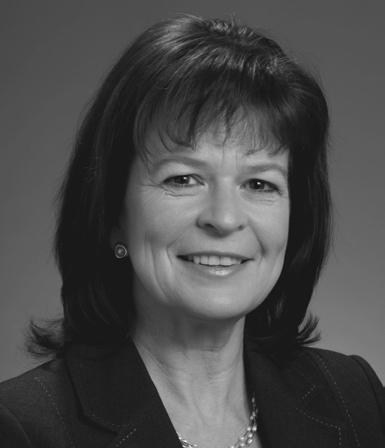




SALLY DENNiS has joined Farris as a partner. She will take on a leadership role in the wealth preservation, business succession and estate planning practice. Sally’s expertise includes advising high net worth individuals and family business owners on all aspects of inter-generational wealth transfer, succession and estate planning, including wills and trusts, philanthropy and corporate reorganizations.
RoLF WARBURtoN recently left the commercial litigation boutique of Patrick G. Guy Law Corp. and now practises with the Civil Litigation group of the Ministry of Attorney General, Legal Services Branch.
ANDREW MAYER has moved from the Vancouver maritime law boutique firm Bernard & Partners to join the Prince Rupert Port Authority as director, Commercial Affairs.
After 15 years at Terasen Inc., ANNA K. FUNg, QC has joined the legal team at Intrawest ULC headed up by her former boss, Steve Richards, Chief Legal Officer.
LiSA StEWARt has joined McCullough O’Connor Irwin LLP as an associate, where she will continue her practice in the area of corporate and securities law matters.
DAviD BoRiNS has joined Heenan Blaikie LLP as a partner continuing his practice in labour and employment law, civil litigation and international trade law.
DoUgLAS R. EYFoRD and MARY LoCKE MACAULAY are pleased to announce the formation of Eyford Macaulay, Barristers & Solicitors. They will be continuing their litigation practices in commercial and aboriginal law at their new office in the Scotia Tower located in Vancouver, B.C.
PEtER D. LARLEE and RYAN N. RoSENBERg are pleased to announce that they have entered into partnership and will now practice immigration law as Larlee Rosenberg, Barristers & Solicitors. Vivian Yuen will remain with the firm as an associate.
Health & Wellness TIP
Move Smart – incorporate Physical Activity into Meetings
uuu Any meeting that lasts more than an hour should have a physical activity break to keep participants fresh, engaged and energized. It’s especially important to schedule regular activity breaks for meetings that stretch over many hours or days.
Sally Dennis lisa Stewart mary locke macaulay
David borins Douglas r eyford
From strategies for effectively dealing with stress (p. 12), advice on choosing a care home for an elderly relative (p. 15), tips on incorporating environmental considerations into your practice (p. 13) to guidance on engaging with pro bono opportunities (p. 17), this issue of BarTalk aims to assist readers in effectively meeting professional and personal challenges in 2009. Throughout the year, BarTalk will help you keep up-to-date on new rules and Acts that will affect your practice, including an explanation of Client Identification and Verification Rules that have recently been put in force (p. 18) and our regularly running Legislative Update (p. 19).
FEAt URED t H i S i SSUE
Send your L E tt ERS to t HE E D ito R to:
Jesse Tarbotton, barTalk Senior editor
Canadian bar Association, b.C. branch
Fax: 604-669-9601
Toll-free fax: 1-877-669-9601
email: jtarbotton@bccba.org
gREEN YoUR BUSiNESS – PAtRiCiA JoRDAN (voL. 20, No. 5)
Thank you for your article called “Green Your Business” in the October 2008 BarTalk. I applaud the CBA’s move to reduce, reuse and recycle. However, let’s focus on the first pillar of “going green” – reduction, and one place that the legal profession needs to most help – reducing paper consumption.
To this end, I am wondering if the CBA could give members the option of receiving BarTalk and all the advertisements that come with it electronically. Think, every BarTalk/ad package is about two centimetres thick... if there are only 1000 CBABC members, that results in a stack of paper 20 metres high! Think of the environmental and economic savings if we reduced that number, even by half.
My firm, like some others, has implemented a green initiative that aims to scrutinize all of our operations and implement “green” alternatives whenever possible. One of our initiatives is to eliminate all of our printed newsletters in favour of electronic distribution. In my view, going “paperless” is one of the most effective ways to “go green.” Of course, this must coincide with the efforts of others (like the CBA and our clients) to adopt and implement effective and reliable software and technology.
More to the point, most of the greenhouse gas emissions that a law firm emits are indirect – they are emitted by our landlords, suppliers and service providers, though at our request or at least, with our acquiescence. To be truly effective, therefore, any effort to “go green” must involve taking a critical look at those we are in business with – i.e. industry associations, landlords, caterers, courier companies, paper and office product suppliers, etc
There is only so much one law firm can do in order to effect some positive change – but there is strength in numbers – imagine if the CBABC, as our industry representative, helped to facilitate positive action by preferred suppliers. I realize that the slowing economy has focused attention to cost savings. However, efficiency measures pay for themselves eventually, and, paradoxically, now may be the best time to take concerted action – after all, when, if not now, will suppliers and service-providers be hungry enough for our business to listen to our calls for change?
– Michal Jaworski Clark Wilson LLP
From the Senior Editor
CbAbC staff and the barTalk editorial board are actively examining strategies to reduce barTalk’s environmental footprint while maintaining our service to all of b.C.’s legal professionals. Currently, barTalk is published with funds entirely derived from our advertisers. However, we are exploring other revenue models as well as enhanced online options (barTalk is available online at www.cba.org/bc). In 2008 we began printing barTalk on FSC certified and recycled stock as a direct result of feedback from members. We welcome your comments and suggestions.
Canadian bar Association, b.C. branch 10th Floor, 845 Cambie Street vancouver, b.C. v6b 5T3
Tel: 604-687-3404
Toll-free (in b.C.): 1-888-687-3404
bartalk@bccba.org
barTalk is published six times per year by the Canadian bar Association, british Columbia branch and is available online at www.cba.org/bc.
BarTalk Senior Editor
Jesse Tarbotton
BarTalk Editor
Deborah Carfrae
Staff Contributors
Fran Hodgkins
Jineane Payne
Jennifer Weber
Editorial Board Chair
Dierk ullrich
Editorial Board Members
Paul Arvisais
Katharina byrne
Carol Anne Finch-noyes
nicole Holas
beverly maclean
Jack micner
Pamela murray
Craig Watson
michael Welsh
Susan Wishart
© Copyright the british Columbia branch of the Canadian bar Association 2008.
This publication is intended for information purposes only and the information herein should not be applied to specific fact circumstances without the advice of counsel.
The Canadian bar Association, british Columbia branch represents more than 6,099 b.C. members and is dedicated to improving and promoting access to justice, reviewing legislation, initiating law reform measures and advancing and improving the administration of justice.
barTalk Publication Sales Agreement #40741008

Practice Management in an Uncertain Economic Climate
2008 was the year for the introduction of a number of new words – “bailout,” and not in the criminal law sense, “economic recovery” packages, “stimulus programs,” and the reintroduction of old words –“depression” and “recession.” How will the economy impact on our legal practices? What steps can we take to ensure a thriving practice? And what can the CBA do to assist using Practice Management tools in these uncertain times to help your practice?

miriam maisonville
President 2008/2009
b.C.
branch
Canadian
bar Association
The key in any uncertain economic time is trying to ensure that our practices are as recession-proof as possible. Critical to that, of course, is ensuring a steady stream of new working opportunities and new clients. Networking is the mantra of numerous employment coaches. The networking opportunities at events and Section meetings are invaluable to help you create your own networking group. For women, the CBABC Women Lawyers Forum is a fun way to connect with women from all areas of practice. We are told by the experts to get involved in our community. Participation in leadership opportunities in the profession include CBA committee work, serving on CBABC-appointed bodies and other volunteer opportunities. Volunteering helps to ensure that others know what you do in your practice and your calibre of work.
The CBA has a National Section also devoted to this end. The Practice Management and Technology Section is concerned exclusively with the business of the practice of law. Areas of focus are of course practice management and include: recruitment and retention of legal talent; marketing of legal services; pricing of legal services; e-lawyering and compensation systems for law firm partners and associates and for in-house counsel.
The CBABC is committed to offering the best for the profession. Our CBABC website home page, at a quick glance in early January, showed several different ongoing learning opportunities touching on practice management matters from Optimizing Accounting in Your Legal Practice, to a WLF dinner meeting and the upcoming Work Life Balance speaker series. Also posted were volunteering possibilities.
We’ve also heard it said numerous times – “work smarter, not harder.” One favourite time-saving tip is to never look at a document more than once – act on it.
Read that email but once, before responding or filing or deleting it. Also today it is impossible to consider the area of practice management divorced from technology. This includes using laptops as much as possible and more importantly, developing a good electronic filing system for quick retrieval of important items. One of the most successful professional development courses at the CBA annual conference in Quebec City, concerned advanced emailing and use of BlackBerrys. The problem is finding the time to learn all the applications out there available to practitioners, and this is where the CBA can help by offering more courses such as those offered at the popular CBA mid-winter meeting.
But proper practice management and how-tos serve an even more important purpose. In a world where the federal government is warning of further losses to come, the proper management of your practice is not just smart but essential. It is also important for you so you can find the time to achieve a balance in your personal and professional life.
I wish you all the best for a prosperous and healthy 2009. BT
Reputation Matters
Why “branding” is a concept worth your time and investment
What do people say and think about you? Do you know? Whatever it is, that’s your “brand.” You can’t control it. You can’t market or advertise or PR it into something else you wish they would say. And you can’t force people to become or stay customers if they don’t connect in some meaningful way with your brand.

Caroline nevin executive Director b.C. branch Canadian bar Association
Branding is a simple term for a complex concept. It is not a logo or mission statement. It’s a scientific process of discovery, clarification and integration of what is meaningful about your service, into every aspect of what people experience about you. It’s about getting clear on what your purpose is, what you’re really great at and what you promise to the world you will always, consistently deliver.
Look at Singapore Airlines (SA) – from the look and feel of the seat fabric, the quality of food, the custom-made scent of the hot towels and attendants’ perfume, to the top-to-bottom consistency of the “Singapore Girls” attendants. The airline’s goal is that you instantly associate a whiff of its signature scent, for example, with an experience of relaxation and care unrivalled by any other travel experience. The success of the SA branding isn’t simply its novel courting of all the senses, but its complete dedication to ensuring that every single aspect of its business delivers on its brand promise.
But you’re not in the business of pampering airline customers, you’re in the legal profession. So why should you invest some time and thought into branding? Three good reasons:
YoUR PRoFESSioN’S StANDiNg
We know that in a vacuum, people use their own
measures to determine an entity’s brand. Without consistent care and attention by the legal profession, the lawyer “brand” is in danger of being defined as “self-interested monopoly.” We all know that the profession’s standing, and the privilege of self-regulation, is contingent upon public support. It’s important that we invest in making sure that the profession’s integrity and worth are clear to the world (one more reason why your CBA membership is so important).
YoUR MARKEt SHARE
The old marketing approach was to say how much better you are than the competition. But research shows that the public expects all lawyers to be competent. What they want is a clear message about what you’re really good at, the values you hold, and what you promise to consistently deliver. From that, they will decide if your brand is a positive fit with their own values and needs. The more consistent you are in articulating and delivering your brand, the more enduring your business relationships.
YoUR FiRM’S AttRACtivENESS
The workforce is shrinking, and “meaningful work,” not money, is the determining factor in attracting and retaining good people. A star potential employee’s decision becomes easier when an employer’s brand is crystal clear.
The CBA has just completed a significant branding process, to focus our organization on what we consistently and passionately do best for the profession. For more about what we learned, and resources to help you with branding, view this article online at cba.org/bc under Publications. BT
When the going gets tough
Getting back to basics…
Wheneveryou’reintrouble won’tyoustandbyme oh,now,now,standbyme…
Words and music by ben e. King, performed by J. lennon.
Law firms are facing unprecedented challenges. Across the world businesses are failing – law firms among them. By all forecasts, this recession will be deep and long. What could lawyers and law firms do – now – to improve their financial outlook, for both the short and long term? When times get tough, it is important to come back to business fundamentals to ensure that your foundation is solid and that you have a good base on which to build your future. Here is a selection of tips put forward in this regard:
BUiLD A BUDgEt

David J. bilinsky is the Practice management Advisor for the lSbC. email: daveb@lsbc.org blog: www.thoughtfullaw.com
Don’t forget “giving back,” since a large part of our self-worth is dependent on feeling like you are helping build a better community. By focusing on your targets you ensure that you are not spending time on matters of lesser importance.
HAvE A PLAN
Working until you drop is not a great plan. The CBA has published a good booklet on planning for your retirement. If you define your retirement goals, you can start working toward those golden years – and implement strategies to transition your practice over to younger lawyers in a way that benefits both you and them.
FoCUS oN YoUR KEY CLiENtS
Now more than ever before, you need to know the financial road map that you must follow. Place everything under a microscope – and ask if you are receiving a satisfactory ROI on each category on which you spend money. If you are not sure – you need to think about how to measure the results of your expenditures. For example, ask every new client how he or she came to your firm. If no one replies: “I saw your ad in the Yellow Pages,” divert those funds to more successful marketing campaigns.
DEFiNE SUCCESS
It sounds odd, but how do you know if you are successful unless you define what success is for you? Income and financial terms are only part of the equation. Studies have shown that personal satisfaction derives from other criteria – doing the kind of work that you want to do; having time for personal interests and family, meeting health and travel goals, playing in a band and the like.
No people will be more important to your continued success than your key client base. We know from numerous studies that high client loyalty and ensured repeat business is highly dependent on not just meeting but wildly exceeding their expectations. Accordingly, seek out opportunities to meet with your key clients and ask the hard questions that you need answered to ensure that you are not just meeting their needs. But be prepared –once you ask what you can do to improve your service, you need to follow through as these same clients will be watching you to see if you are going to walk your talk.
PRotECt YoUR KEY ASSEtS
Every firm has certain key people whose loss would disproportionately affect the entire firm. Engage these individuals and take steps to reassure you and them that the relationship will continue for the foreseeable future.
While all of us are facing the same economic troubles, it is comforting to know that you have your goals, a good plan, good clients and good staff to stand by you. BT
Charlie Don’t Skate
Time to start thinking about Post Elizabethan Canada
My only real-life experience with Her Majesty Queen Elizabeth 2nd was during her 1971 tour to mark B.C.’s 100th year in Confederation. I was a drummer with the Lansdowne Junior High School Band in Victoria, which was royally tasked with playing some music for the Queen near the Provincial Museum. As she strolled by, a gust of wind came out of nowhere, and my sheet music lofted above fellow drummer Iain Benson (of the B.C. Bar), toward trombonist Dave Reid (also of the B.C. Bar), past French Horn player Terry King (also of the B.C. Bar), eventually blowing almost as close to the Queen as the shoe that was recently winged at George W. Bush. The Queen looked at me as if it was my fault (it was), and I’m sure she’d be amazed to know that so many members of the same Junior High School band that played for her in 1971 eventually became B.C. lawyers.

If you agree with Tony’s views this month, send a copy of this article (or its link on the web) to your mP, your mlA and the media. If you don’t agree, write barTalk an email and let them know why.
the country of A-Levels, cricket, Lordships and Knighthoods seems just too far removed from the world of Alberta oil, Quebec, and the Stanley Cup. (Face it. Anaheim is more of a hockey town than London is.) And if you read the U.K. papers on the web as much as I do, you’ll know the Brits are more interested in Europe and the U.S. than with anything that happens in Canada. Prince Charles seems to be a fairly nice chap, despite talking to trees, and his thing with polo. He does good charitable work, and I recall he was once married to a Princess. But the world of polo and Princesses is the world of my long dead English grandparents, who came to Canada to colonize it as part of the Empire. The sun has set on that Empire.
Since that windy day almost 40 years ago, I’ve had to deal with Her Majesty in numerous pleasant ways, including taking oaths, drafting contracts and registering trademarks in her name. By all accounts, Her Majesty is a pretty nice girl, but she doesn’t have a lot to say for Canada anymore; a country that has more or less outgrown the monarchy of its grandparents. Don’t get me wrong. I’m not anti-monarchy. It’s just that it’s not our monarchy. “But it’s the mother country,” I hear some of you say. So why have the Queen as our Head of State, the monarch of a country that won’t let us get off the plane at Heathrow without a passport? Some mother! Some country! There really isn’t much left that binds Canada to the U.K. anymore. It’s a great place to visit, but
The Queen is 83, and God Save Her. Keep her photograph up in the lobby of government buildings to confuse the Americans. Keep her picture on the money to confuse us. Allow her ostensible doppelganger, the Governor General to prorogue Parliament in her name to confuse the media.
But when she passes on, as she must, so must we. We must sever the formal constitutional relationship we have with the House of Windsor and send King Charles a diplomatic note (by polo pony express!), that he and his heirs won’t be Kings of Canada or its provinces. We’ll keep our membership in the Commonwealth. We’ll keep the “British” in British Columbia. We’ll even keep giving out QC’s. But we’ll find a new name for the Governor General and the Crown, and with good wishes and good intentions, it’ll be the right time to say good-bye, so long, and Good Luck Chuck when the Elizabethan era ends.
You see, Charlie don’t skate. He plays polo. And that kind of says it all, doesn’t it? BT
Practice Resources
At the Canadian Bar Association (CBA), we are working to provide better access to resources that will assist you in your law practice. I invite you to visit CBA websites and explore the wealth of information provided online. Here is a brief introduction to a few practice resources at cba.org/bc.
CBA PRACtiCELiNK: StARtiNg oUt

Patricia Jordan is the CbAbC Web manager. She welcomes your comments, questions and suggestions.
Whether you are starting your career or charting a new career course, firsts can be challenging. CBA PracticeLink has several insightful articles that focus on new lawyers as well as solo and small-firm challenges. Recent articles include:
Tel: 604-646-7861
email: pjordan@bccba.org
• Better Public Speaking for Lawyers
• Independence Day: Starting Your Own Law Firm
• Secrets of the Business of Law – Opening Your Own Office: What Will It Cost?
• Solo Practitioners Explore a Range of Networking Options
• Starting a New Firm: Top Ten Mistakes to Avoid and Top Ten Tips for Success
• What You Didn’t Learn in Law School: Top Tips for New Lawyers
MEDiA RELAtioNS Kit
Whether you initiate contact or a reporter calls you, you need to have a clear understanding of your ethical limits as a lawyer and the key messages you or your client want to get across. This kit offers media relations tips and the basics of what to do when you are on camera, on the air, or on record. Learn more in “Information Kits and Standard Forms” under “Practice Resources.”
LAWYERS FoR LitERACY PRoJECt
This Branch initiative helps lawyers improve their
client communications, particularly when their clients’ literacy skills may not be adequate to deal with written legal material. Lawyers who want to learn more about adapting their practice procedures can get a free copy of the kit by calling 604-6873404 or toll free 1-888-687-3404.
PRACtiCE ADviSoRY PANELS
Practice Advisory Panels (PAP) are listings of senior practitioners who volunteer to assist other lawyers seeking advice on a particular aspect of the law. The PAP member has usually practised for more than 10 years, and is generally experienced enough in his particular area of law as to be capable of making a CLE presentation on the subject. A list of lawyers is available in “Practice Resources.”
CBA/CBABC SECtioN LiStSERvS
Section listservs are discussion groups that come to you through your email. They are provided and administered by CBA for the professional benefit of its members. Section listservs are intended to provide an effective and active vehicle for member communications respecting professional interests, including matters of law, practice and procedure, and legislative developments. Visit “Practice Resources” at cba.org/bc for information about listservs.
SitE DU JoUR
Site du Jour
CBA PracticeLink: www.cba.org/cba/ PracticeLink
CBA’s national award-winning online collection of practical articles, tools and tips on law practice management. Topics include clients, finances, leadership, life balance, marketing, people, starting out, trends/ideas and technology. BT
Section Update
Keep your practice current
The following are brief summaries of several recent Section meetings held throughout the province. For enrolled CBA members, more detailed information and available minutes from the Section meetings go online to www.cba.org/bc in Sections under Professional Development.

ABoRigiNAL LAW –vANCoUvER
MEEtiNg: December 10, 2008
SPEAKER: michael J. mcDonald, mcDonald & Company
toPiC: Implementing
Agreements: Structuring and negotiation of First nations businesses and Joint ventures Michael McDonald addressed the Section about the various steps to maximizing business opportunities for First Nation businesses arising from various Impact Benefit Agreements and Accommodation Agreements. This informative session provided practical and handson advice on structuring options for First Nations’ businesses, maximizing business preferences and negotiating joint ventures, including a review of sample agreements and Memoranda of Understanding. In particular, based on his many years of experience in organizing and establishing aboriginal corporations and businesses, Mr. McDonald discussed the contracting procedure of Open Book Negotiations, which he has found successfully maximizes and promotes First Nation opportunities for businesses that are owned or

Section Chairs
SPOTLIGHT
controlled by the First Nation or its members while not unnecessarily increasing project costs. Aboriginal law lawyers also benefited from Mr. McDonald’s practical tips on negotiating joint ventures including a discussion on key business terms of a joint venture that is created in order to take advantage of business opportunities in various IBA’s or other Accommodation Agreements. The session ended with a review of a sample MOU and precedent covering letter from an Aboriginal business to a prospective co-venturer.
ADMiNiStRAtivE LAW
MEEtiNg: December 1, 2008
SPEAKER: James Casey, managing Partner of Field law in edmonton toPiC: The effective Advocacy of Jurisdictional objections to Tribunals
Mr. Casey, author of the Regulation of Professions in Canada and A Guide to the Health Professions Act is an expert in administrative law, labour law and alternate dispute resolution. He provides advice to professional organizations and has appeared before numerous administrative tribunals and courts including the Supreme Court of Canada. The topic canvassed the challenges associated with making a technical, legal objection to a tribunal which is not legally trained. This practical presentation, attended by
Charlotte Salomon
Charlotte, a partner at mcConnan bion o’Connor and Peterson law Corporation with whom she articled in 1995, is in her second year as Chair of the Civil litigation –vancouver Island Section. She just completed her term as President of the Saanich Gulf Islands Federal liberal riding Association and prior to that, was President of the victoria Federal liberal riding Association. In addition to being a Section Chair, ms. Salomon’s involvement in the CbA currently includes participation on the b.C. branch Government relations Committee and Court Services Committee. Charlotte, an executive member of the victoria bar Association since 2003, is presently the vice-President and is expected to be President in 2010. As a mother of two preschoolers, when she does have free time, she enjoys jogging, event planning and public speaking.
From left to right: ming Song, michael mcDonald
50 Section members, and several by Webinar, included a discussion of how to effectively make representations to the tribunal on jurisdiction without alienating the tribunal from which you are hoping to obtain a positive ruling on the merits. An outlined copy of Mr. Casey’s presentation included details of “Preliminary Considerations,” “Jurisdictional Objections on Which the Advocate Anticipates Failing at the Tribunal Level” and “Jurisdictional Objections on Which He Hopes to Succeed at the Tribunal Level.” His presentation focused on cases where the admin-istrative tribunal had a lay (nonlawyer) component; in that event the strategic considerations are particularly acute, but are also applicable to tribunals whose members are lawyers.

CoMPUtER LAW, BUSiNESS LAW, AND CoRPoRAtE CoUNSEL (JoiNtLY)
MEEtiNg: December 10, 2008
SPEAKER: brian lee: Partner, lawyer and Patent Agent with Gowling lafleur Henderson llP toPiC: The Patent Troll: Strategies and Tactics for Dealing with “non-Practicing entities”
Mr. Lee’s presentation included discussion on the legal and economic context in which patent trolls emerged; proactive and preventative strategies that a business can employ to mitigate the threat that patent trolls represent; strategies a business should consider when a patent troll alleges patent infringement; and how a recent en banc United States Federal Circuit Court of Appeals decision, In re Bilski, may weaken the legal position of many patent trolls. In particular, Mr. Lee noted that financial service providers, software developers, online retailers, and businesses that provide services over the Internet are those businesses that are particularly vulnerable to patent trolls. Proactive strategies for dealing with patent trolls were discussed including acquiring or licensing intellectual property
that may pose a threat before a patent troll has an opportunity to acquire it; conducting “freedom to operate” searches in order to better assess the risk of conducting business in a certain area; and structuring contracts to mitigate the risks of patent litigation, such as by including indemnity clauses with suppliers. Reactive strategies included the topics of how to analyze and respond to an initial cease and desist letter; when and how to settle patent troll litigation; and the advantages and disadvantages of unilaterally commencing patent impeachment proceedings or an action seeking declaratory relief. This well-attended lunch meeting addressed a timely and important issue to practitioners of all three Sections.
FAMiLY LAW – vANCoUvER AND WEStMiNStER (JoiNtLY)
MEEtiNg: December 3, 2008
SPEAKERS: The Honourable madam Justice boyd, The Honourable mr. Justice brine
Section Name Change
A resolution was passed at the December 6, 2008 Provincial Council meeting changing the name of the Poverty law Section to the Social Justice Section which was proposed and unanimously agreed upon by Section members at their September 10, 2008 meeting.
toPiC: Judicial Case Conferences and Spousal Support Advisory Guidelines: Perspectives from the bench This joint dinner meeting at the Hart House Restaurant in Burnaby was attended by 70 Family Law Section members and was sold-out two weeks prior to the event. Mr. Justice Brine commented that the Spousal Support Advisory Guidelines (SSAG) have been embraced by the B.C. courts and are now routinely cited according to the authors, Professors Rollie Thompson and Carol Rogerson. B.C. has generated the most decisions referencing the SSAG which is a useful tool in determining quantum and duration of support. Significant discretion is allowed by judges in awarding spousal support in consideration of the individual circumstances of each case. Parties with reasonable expectations can more often resolve issues without recourse to the courts. Judicial Case Conferences (JCCs) which began in Westminster County grew to become a valuable tool controlling and managing the chambers and trial lists. In Madam Justice Boyd’s experience the settlement rate for JCCs is around 75 per cent. Litigants appearing at JCCs begin to understand the high cost of appearing in court and are surprised that so much can be accomplished at a JCC, resulting in savings of legal fees. BT
From left to right: Prentice Durbin, roch ripley and brian lee
the illusion of Control
tHE QUEStioNS
Do you get stressed when your clients are late? Do you want your work colleagues to be more like you and less like themselves? Do your colleagues, friends or family do “stupid” things and you want to yell “I told you so!” Ultimately, are you feeling angry, stressed, overwhelmed and overscheduled?
tHE PRoBLEM

Karen
bresler, b.A., llb, life Coach, Ignite Coaching Inc. www.ignite-coaching.com
If you said yes to any of these questions, you may be suffering from a normal human tendency which is to attempt to control situations according to your version of how things should be. You may not even be aware that you are attempting to control things; you simply get frustrated and irritated when you can’t have things your way. The problem is everyone has their own version of how things should be and there are as many versions as there are people. It is a huge illusion that we can control people and situations. The only thing you can control is yourself.
tHE SoLUtioN
The solution is twofold.
1. Get clear on your values;
2. Slow down to being in the moment. Getting clear on your values means that you will take decisions and make choices from a powerful space – a space that honours what is hugely important to you. Sadly, a lot of people never take the time to get clear on their values and then make decisions or choices not knowing whether the decision or choice honours their values – or not. Their life reflects the results of those decisions or choices. When you make decisions and choices from the powerful
place of your values, you do have control. You have control over your own thoughts, your own reaction, your words and actions.
Slowing down and being in the moment takes practice. Take this very moment to appreciate it fully. Breathe it in. Feel it in your body. This very moment is your life. You will never have this moment again so make it count. Treat it with deep appreciation and reverence. Our future hinges on our choices. Your words, thoughts, reactions and actions are all choices over which you have control. Try this four step approach now:
1. Close your eyes and take a deep breath, from the belly up; repeat a few times to calm and centre yourself and to take in the quiet;
2. Say silently or aloud: “I have control over my thoughts, my reactions, words and actions”;
3. Ask yourself: “What can I let go of here?”
4. Choose your words, thoughts, reaction and actions in response.
“Success isn’t a result of spontaneous combustion. you must set yourself on fire.”
– Arnold H. Glasgow
If you think you need a moment, ask the other person to give you one. Take that moment. Let the other person know you are taking some time to properly consider their request or situation. Telling them this is what you are doing creates a framework in which you can both be heard and decisions and choices can be made from a powerful space as opposed to a controlling space. Does this mean that you are compromising or giving up? Actually, it means that you are focusing very closely, using your own unique powerful thoughts and words to create empowering reactions and actions. BT
Environmental Contamination
My lands smell funny
Lawyers like chasing down “environmental angles” on their files just about as much as they like chasing tax angles. Whether it’s a corporate or commercial transaction, or a matter dealing directly with real property, clients these days need guidance on lurking environmental issues.
A convenient example is one encountered every day by commercial solicitors: the purchase and sale of land. If there is one thing unwitting purchasers of contaminated land have in common, it is that each wishes they had simply found out before closing that the site was contaminated. There are some obvious steps one can take which will provide insight into that which you simply can’t see.

richard
bereti is Chair of Harper Grey llP’s environmental Practice Group and Adjunct Professor of environmental law at ubC.
RESPoNSiBLE PERSoNS (RPs): RPs are defined in the Environmental Management Act (EMA) as current and former owners, operators, producers and transporters connected to a “contaminated site.” They are jointly, severally, retroactively and absolutely liable. The purchaser of contaminated land is a current owner and is potentially responsible for cleaning up the site even having played no role in polluting it.
iNNoCENt PURCHASERS: However, the EMA and its closest friend, the Contaminated Sites Regulation (CSR), provide some innocent purchasers with an escape route in the form of an exemption found at Section 46 (1)(d) of the EMA and 28 (a) of the CSR. Together, they essentially exempt from liability a purchaser who is not a polluter and, before buying, took all reasonable steps to determine prior owners and uses of the site, and undertook other investigations to minimize their potential liability.
iNvEStigAtioNS: With modern technology, ascertaining prior owners and uses can be done in a relatively efficient manner. If the results reveal red
flags, such as former automotive repair activities or ownership by an energy company, then further investigations can be undertaken or the purchase abandoned. Risk can also be measured through the testing of soils, search for underground oil tanks and by searching the contaminated sites registry and other public records.
A LLo CAti N g Ri SK : Sometimes, however, with or without investigating the environmental status of a given site, a purchaser will want to buy real property that carries a degree of environmental risk. One way of addressing this is to propose that the seller either reduce the price or clean up any contamination or potential contamination by a date certain (subject clause or term of agreement).
If the seller is prepared to share “potential” risk, a purchaser may seek an indemnity from the seller which would see the seller receive full price for the property, but would allow the purchaser to, in effect, claw back some of that money if the purchaser is faced with environmental liability in the future. Indemnities can take many forms and are as varied as the circumstances of a given case and the imagination of counsel.
The EMA does not reward risk-takers, but does seek to support business decisions made by those attempting to manage the risks inherent in many corporate, commercial and real property transactions. The EMA does not completely ignore contract or common law, nor does it attempt to strip the court of its equitable bent. Rather, terms such as “just” and “fair” are explicitly used to guide the court in allocating liability amongst RPs.
Client protection in these cases starts with the obvious – and this is often enough. However, when the easy questions reveal an odour, tear it down and let in the light. BT
Canadian Conference on Elder Law
Academics, practitioners and other experts gather to discuss adult guardianship law
The fourth annual Canadian International Conference on Elder Law was held November 13-15th, 2008 at the Sheraton Wall Centre in Vancouver. The event was hosted by the Canadian Centre for Elder Law, which is a division of the British Columbia Law Institute. The conference brought together lawyers, community members, health specialists, researchers, and older adults to examine issues of law and ageing within Canada and around the world. The conference, held in conjunction with the International Guardianship Network, drew more than 150 experts from across Canada, the United States, Australia, Europe, the Middle East, Caribbean and Asia to discuss this year’s theme – adult guardianship.

focusing on the need for increased legal services for seniors. This session discussed a variety of ways to involve community, volunteers, students, and others in providing access to justice for seniors. Joan Braun, Executive Director of the B.C. Centre for Elder Advocacy and Support, reported on the new B.C. Elder Law Clinic, which now joins Toronto based Advocacy Centre for the Elderly (ACE) as the only legal aid clinics in Canada to provide such service to seniors.
The conference began with a well-attended World Study Group, which is a forum in which academics from around the world can discuss developments within their jurisdictions. The event was also the launch of Theories on Law and Ageing, edited by Dr. Israel Doron and published by Springer.
With the theme of the conference focused on adult guardianship, special attention was made to the upcoming changes in British Columbia’s guardianship regime. B.C.’s Public Guardian and Trustee Jay Chalke, QC and Dr. Robert Gordon, Director, School of Criminology, Simon Fraser University, gave a legislative update on the changes to guardianship, personal care planning, and care facility admission once Bill 29 is brought into force. International guardianship recognition and the “portability” of guardianship plans across borders were also discussed in many plenary and workshop sessions. This is an area of growing importance as older adults and their supporters are increasingly multi-jurisdictional.
Canadian Bar Association National Elder Law Section President Judith Wahl moderated a session
Oliver Lewis, Executive Director of the Mental Disabilities Advocacy Centre (Budapest) gave an excellent overview of his work on modernizing guardianship legislation in Eastern European nations. Through test cases, public education, and lobbying efforts he is pressing governments to modernize their guardianship regimes, as many people with capability issues are having basic civil rights taken away.
Peter Whitehead, Public Trustee, NSW Australia and Sue Field, Public Trustee Fellow in Elder Law and Anita Smith, President, Tasmanian Guardianship Tribunal all provided key insights into the Australian guardianship models. Dr. Makoto Arai delivered the first International Guardianship Network lecture, discussing the Japanese model of guardianship and the need for increased long-term care in Japan –which has one of the oldest populations in the world.
The conference was highlighted by addresses from speakers such as the Honorable Alexa McDonough, as well as media wunderkind Moses Znaimer. Mr. Znaimer has recently become the president of the Canadian Association for Retired Persons, and in that capacity gave a dynamic dinner address followed by questions and answers from the attendees.
Thank you to all attendees and sponsors for a highly successful event. For more information on past and future conferences, or to access conference materials please visit BCLI’s website at www.bcli.org/ccel. BT
World study group attendees
Some thoughts on Choosing a Care Home
Mother was in the hospital after falling and breaking her hip. A few months later, she is still confused and disoriented. Or perhaps Dad is losing weight and looking haggard as he copes with his wife’s deteriorating health. These are two common situations that lead Canadian families to the inescapable fact that it is time to choose a residential care home.

norman, Administrator St. Jude’s Anglican Home
Finding a care home that best fits the elder is an important and usually stressful task for family members. For most people, care homes are completely unfamiliar territory. Ask friends and neighbours, physicians, social workers and others in the healthcare field for recommendations. Most homes have regular tours during the week that must be booked in advance. Review their websites and request written material to discuss with those involved in the decision-making process.
What are the priority considerations to ensure the elder’s safety and satisfaction with the home? What about the family members’ concerns to provide the best environment possible for their parent or spouse? Here are some features to discuss as a family and prioritize:
• Can cultural, language or religious needs be met?
• Is the facility secure? Is it equipped to deal with wandering patients?
• Is there an opportunity to access a private room if admitted to a shared room?
• How many hours of nursing care are provided each day? For example, in the Vancouver area, the average is 2.3 hours per day while in Ontario 3.2 hours are funded.
• Does the social/recreational program contain familiar and engaging activities throughout the day and evening?
• Is the home accredited by Accreditation Canada’s nation-wide standards of care and service?
• Is the atmosphere happy and homey?
• Are staff welcoming and helpful?
• Is the location of the home convenient for visiting friends and relatives?
No care facility will meet every family’s criteria, but the goal is to get the best match possible. Of course, the choice of care homes is very limited in smaller centres and rural areas.
In British Columbia and other jurisdictions, admission to a care home is on a “first available bed” system. If care is urgently required, the expectation is that the elder will be admitted to any bed that is open with the option to transfer to their preferred care home at a later time. Some care homes have “private pay” beds that allow the elder to be admitted to wait for a government funded bed to become available. Fees for private beds currently start at $5000. Keep in mind that admissions are handled differently depending on your health region and province.
Preparing an elder for a move to a care home depends greatly on their attitude toward the move. Some will merely need assurance that their favourite items will accompany them and friends will still visit, while those with advanced dementia may need a family member present to assure them that this is their room, and their new home. Whatever the approach, if it is done with the utmost care for the elder’s well-being and the knowledgeable assistance of the care home’s staff, it will be the best possible transition to their new home.
For more information on home and community care services go to http://www.health.gov.bc.ca/ library/publications/year/2007/Guide_to_Your_ Care_Booklet2007_Final.pdf. BT
Chris
Sunny Professional Development in Beautiful San Diego
The 2008 CBABC Winter Conference, the Spirit of San Diego, was held on November 21 and 22 in Southern California at the Westin San Diego. The conference featured a number of speakers from the U.S. and British Columbia, including the Honourable Wally Oppal, Attorney General of B.C., and the Honourable Mr. Justices Hinkson and Myers of the British Columbia Supreme Court. The conference seminars covered a broad range of legal issues, including such topics as judicial activism, document management, ethics, lawyer marketing and electronic discovery issues.
The Westin San Diego is situated near the Gaslamp Quarter, a premier dining, shopping and entertainment district which provided a truly eclectic blend of food, fun and culture, all within one of San Diego’s most historic areas.
The conference was attended by more than 75 lawyers from across the province and the program allowed them to obtain 11 hours of voluntary professional development for the annual report to the Law Society of British Columbia.
The relaxed surroundings of San Diego permitted the attendees to receive information on a variety of practice issues that face British Columbia lawyers as well as having an opportunity to enjoy the sites of San Diego.
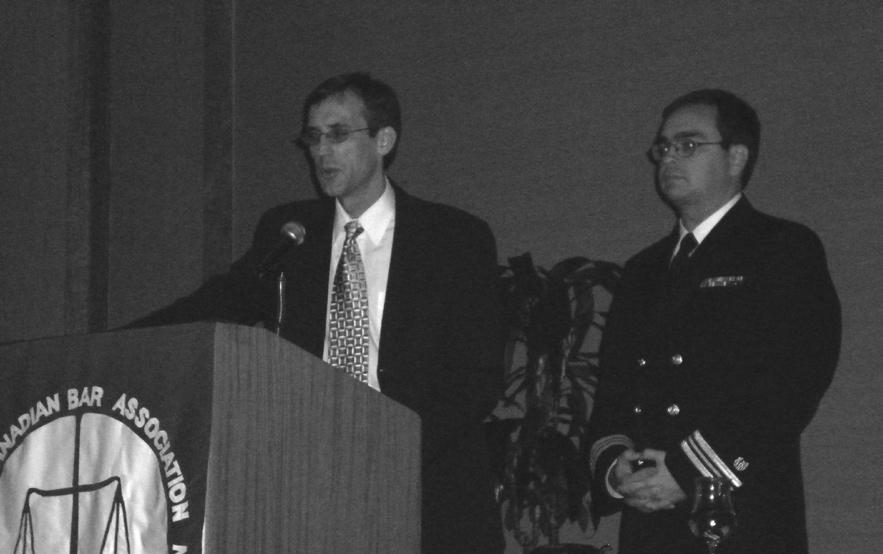
Attendees were provided with a unique opportunity to mingle with colleagues of the Bench and Bar and their Attorney General at social events during the course of the conference. At the closing dinner, attendees were addressed by guest speaker, Lieutenant Commander William Kuebler, a U.S. military lawyer, who provided some insight into the international legal issues involving the U.S. prosecutions of Guantanamo Bay inmates, including Canadian citizen, Omar Khadr. It was an informative and provocative presentation.
Your CBABC Branch invites you to register for the upcoming 2009 Winter Conference (details and registration at www.cba.org/midwinter) which will also provide a great opportunity for you to complete the professional development hours that is mandatory for B.C. lawyers starting January 1, 2009. BT

Co-Chair brad martyniuk and lieutenant Commander William Kuebler
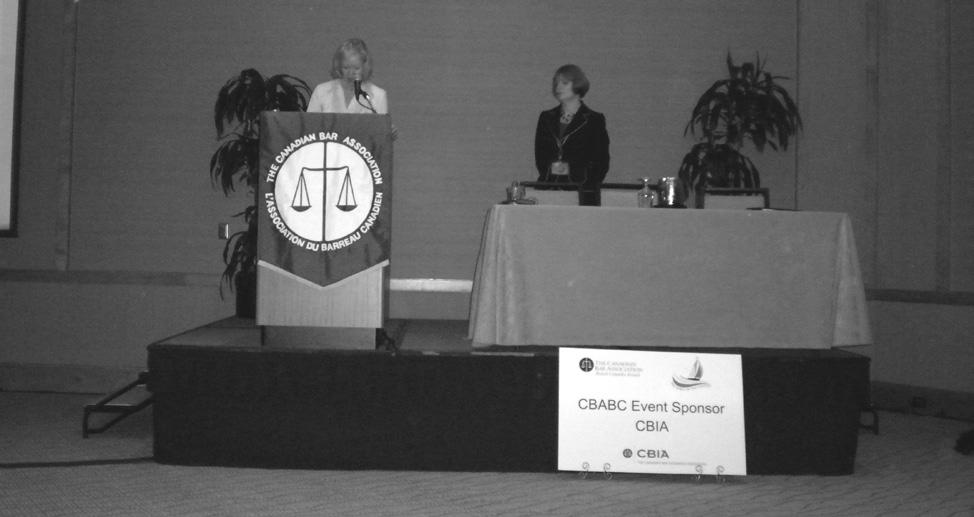
Co-Chair Katherine robinson and Speaker Fiona Walsh Closing dinner attendees
Pro Bono opportunities Abound
Troubled economic times bring increased need for pro bono legal services, and increased pro bono capacity and opportunity on the flip side. As law firms experience a cyclical slow-down in some departments, pro bono serves as an effective vehicle for skills development and an excellent morale booster for lawyers. Small firm lawyers and sole practitioners also benefit from pro bono by honing their skills and broadening their practice areas. And no matter the state of the economy, doing pro bono always feels good. So where can lawyers find pro bono opportunities that are both deserving and fulfilling?

PRo BoNo LEgAL REPRESENtAtioN oPPoRtUNitiES
Fortunately, British Columbia is very organized in the variety and scope of pro bono opportunities that it offers to its lawyers. Whether a lawyer seeks to assist low-income individuals or non-profit organizations of limited means, there are several options from which to choose – ranging from opportunities to staff clinics on the front lines of pro bono, to opportunities that can be served directly from the office.
PRo BoNo LEgAL ADviCE oPPoRtUNitiES
The Western Canada Society to Access Justice and the Salvation Army Pro Bono Program both operate pro bono legal advice clinics throughout the province. In their clinics, lawyers meet with low-income individuals in half-hour appointments to provide summary legal advice in all areas of the law. Lawyers typically commit two to four hours per month to the clinics, and do not assume responsibility for ongoing assistance or underlying administrative arrangements. Access Justice and the Salvation Army engage lawyers according to their capacity and areas of expertise.
To volunteer as a clinic lawyer, call Access Justice at 604-482-3195 or the Salvation Army at 604-694-6647.
Pro Bono Law of B.C. (PBLBC) operates several roster programs whereby litigators and solicitors provide pro bono assistance and representation to individuals and non-profit organizations of limited means in specific areas of the law. Such areas include: appellate law, family law, judicial review, wills and estates law, mediation and charity and non-profit law. For each roster program, PBLBC receives screened client referrals from lawyers, advocates and law students, and then presents meritorious opportunities to roster lawyers according to their location, stated interest and capacity. Roster lawyers can pursue or pass on pro bono opportunities as they see fit.
PBLBC also operates the Civil Chambers Duty Counsel Project at the Vancouver courthouse. The Project provides one-day representation services to low-income individuals appearing in Court of Appeal and Supreme Court civil chambers. It is in dire need of small firm lawyers and sole practitioners to assist and represent respondents in foreclosure and bankruptcy proceedings.
All of the above pro bono opportunities are open to practising, non-practising, in-house, government and retired lawyers alike, since PBLBC extends full insurance coverage to lawyers involved in approved programs. Limited disbursement coverage is also available to lawyers who provide pro bono representation to lowincome individuals, whatever the source of the file.
There are many more pro bono opportunities available to B.C. lawyers through independent programs and law schools. To volunteer as a PBLBC roster lawyer or for information on other pro bono programs, contact PBLBC at 604-893-8932 or at info@probononet.bc.ca. BT
Jamie maclaren, executive Director, Pro bono law of b.C.
Client identification and verification Rules in Force
The Law Society of B.C.’s client identification and verification rules (Rules 3-91 to 3-102) came into effect on December 31, 2008. The rules, based on the Federation of Law Societies of Canada’s Model Rule, are designed to codify the steps prudent lawyers take in the normal course to identify their clients.

The Benchers originally adopted the rules on November 14. At their December 12 meeting, the Benchers amended Rules 3-91 to 3-95, Rule 3-97 and Rule 3-102, based on revisions to the Model Rule.
The rules, including the December amendments, are in force and available for viewing on the Law Society website (look under Publications and Forms). Copies of the rules adopted in November were included in the Members’ Manual amendment package. Note that the December amendments were not included in that package and so lawyers must view the amendments online until the next mailing.
Lawyers must take reasonable steps to identify their clients and, where a “financial transaction” (as defined in Rule 3-91) is involved, to verify their clients’ identity. Identification and verification of identity are two distinct concepts.
The rules specify timing for identification and verification procedures, procedures for verifying the identity of clients who are individuals not present before the lawyer, information and documents to be recorded and copied, and retention periods.
Lawyers are encouraged to read the rules carefully and to pay attention to the definitions. Some of the terms may not be consistent with common usage. For example, “client” includes another party that a lawyer’s client represents or on whose behalf the client otherwise acts in relation to obtaining
legal services from the lawyer. When a lawyer is acting for an organization, not only does the lawyer have to obtain information about the organization itself but the lawyer must also obtain information about the person instructing the lawyer on behalf of the organization.
Some of the December rule amendments include the following:
• The verification requirements do not apply if the client is a “financial institution,” “public authority” or “reporting issuer” (Rule 3-94);
• The defined term “reporting issuer” replaced the term and definition of “public company” (Rule 3-91(1));
• The exemption from verification requirements when a lawyer “pays money to another lawyer in trust, on the direction of the client” was deleted because it could result in the source of funds not being verified;
• An exemption for electronic funds applies, provided the transfer is conducted at both ends by financial institutions in Canada or other Financial Action Task Force countries and neither the sender nor the beneficial receiver of the funds handle or transfer the funds (Rule 3-94 (c)).
Three resources are available on the Law Society website (under Practice Support) to help lawyers and law firms understand and follow the rules:
• A free online course (webcast archive);
• A question and answer document;
• A client identification and verification checklist.
For more information about the rules or the resource materials, contact Barbara Buchanan, Practice Advisor at 604-697-5816 or bbuchanan@lsbc.org. BT
barbara buchanan law Society of british Columbia
every effort is made to ensure the accuracy of the information provided to you in this article but the information should not be relied upon. lawyers should refer to the specific legislative or regulatory provision. you will see a reference in some cases to the number of the bill when it was introduced in the House. This number may be different from the chapter number of the new Act which is quoted after the title of the Act and which is the proper citation for the Act. The bill number has been given to make it easier for you to note up the bills you may have in your library.
CURRENt FRoM NovEMBER 4 to DECEMBER 31, 2008
legislative update is provided as part of the CbAbC legislative and law reform program. It is a service funded by CbA membership fees, and is, therefore, provided as a benefit of CbA membership. The full version of legislative update is now only published online and available to CbA members exclusively at www.cba.org/bc.
ACtS iN FoRCE
E-HEALtH (PERSoNAL HEALtH iNFoRMAtioN ACCESS AND PRotECtioN oF PRivACY) ACt, S.B.C. 2008, C. 38 (BiLL 24)
Sections 1 to 7, 11 to 16, 18 to 26 and 31 to 33 are in force November 7, 2008. Sections 8 to 10 are in force June 30, 2009. Sections 43(a), 44 and 46 are in force April 1, 2009
FoREStS AND RANgE StAtUtES
AMENDMENt ACt, 2008, S.B.C. 2008, C. 4 (BiLL 8)
Sections 15, 17(a) and 28 are in force December 9, 2008
gREENHoUSE gAS REDUCtioN (EMiSSioNS StANDARDS)
StAtUtES AMENDMENt ACt, 2008, S.B.C. 2008, C. 20 (BiLL 31)
Sections 32 and 33(c) and (d) are in force December 9, 2008. Section 1, Section 2, insofar as it enacts Sections 76.2, 76.21 and 76.5, of the Environmental Management Act, Section 6, insofar as it enacts Sections 114(1)(a) to (f) and (2) of the Environmental Management Act, and Section 11, insofar as it enacts Section 120(2) (a) to (d) and (f) to (h) and Section 120(3)(a) to (e) of the Environmental Management Act are in force January 1, 2009
gREENHoUSE gAS REDUCtioN (RENEWABLE AND LoW CARBoN FUEL REQUiREMENtS) ACt, S.B.C. 2008, C. 16 (BiLL 16)
Sections 1 to 5, 9, 11(1), (2), (5) and (6), 12 to 14, 15(1) and (3) to (6), 16 to 25 and 27 to 29 are in force January 1, 2010
HEALtH CARE CoStS RECovERY ACt, S.B.C. 2008, C. 27 (BiLL 22) Act is in force April 1, 2009
HEALtH PLANNiNg StAtUtES AMENDMENt ACt, 2002, S.B.C. 2002, C. 15 (BiLL 19)
Sections 16 and 27 are in force April 1, 2010
HEALtH PRoFESSioNS AMENDMENt ACt, 2003, S.B.C. 2003, C. 57 (BiLL 62)
Sections 42, 49(a), 51, 52, 57 and 58(a) are in force March 1, 2009. Sections 47, 49(b), 53 and 58(b) are in force April 3, 2009. Section 58(f) is in force March 1, 2009. Sections 17, 45, 46, 48, 55 and 58(c) are in force June 1, 2009
HEALtH PRoFESSioNS AMENDMENt ACt (No.2),2003, S.B.C. 2003, C. 73 (BiLL 81)
Act, except Section 12, is in force April 1, 2009
HEALtH PRoFESSioNS (REgULAtoRY REFoRM) AMENDMENt ACt, 2008, S.B.C. 2008, C. 29 (BiLL 25)
Section 48, enacting Sections 50.5 to 50.53, of the Health Professions Act is in force December 9, 2008. Section 24(b) is in force December 15, 2008. Sections 17(z), 20, 21, 35, 48 enacting Sections 50.54 to 50.65 of the Health Professions Act and 55 to 58 are in force March 16, 2009
HEALtH StAtUtES AMENDMENt ACt, 2006, S.B.C. 2006, C. 23 (BiLL 29)
Section 7 enacting Section 15.1(4) of the Health Professions Act is in force April 1, 2009. Sections 1(b) and 7 enacting Section 15.1 (1) and (5) of the Health Professions Act are in force March 1, 2009. Sections 1(a) repealing paragraph (b) of the definition of “health care professional” in Section 51(1) of the Evidence Act and Section 7 enacting Section 15.1(2) of the Health Professions Act are in force April 3, 2009. Sections 1(a) repealing paragraph (a) of the definition of “health care professional” in Section 51(1) of the Evidence Act, Section 7 enacting Section 51.1(3) of the Health Professions Act, Section 10 and 32 are in force June 1, 2009
HEALtH StAtUtES AMENDMENt ACt, 2007, S.B.C. 2007, C. 19 (BiLL 26)
Sections 29(a) and (b), 30, 31, Section 32 enacting Section 13.1(1) and (2) of the Pharmacy Operations and Drug Scheduling Act, Section 33, 34(a), 35(a) and 36 are in force April 1, 2009
LoCAL govERNMENt StAtUtES
AMENDMENt ACt, 2008, S.B.C. 2008, C. 5 (BiLL 7)
Sections 81 and 82 are in force November 28, 2008. Sections 76 to 79 are in force January 1, 2009
MiSCELLANEoUS StAtUtES
AMENDMENt ACt (No.2),2005, S.B.C. 2005, C. 35 (BiLL 16)
Section 3, except as it enacts Section 142.1(2) (e) of the Business Practices and Consumer Protection Act is in force December 9, 2008
MiSCELLANEoUS StAtUtES
AMENDMENt ACt, 2008, S.B.C. 2008, C. 30 (BiLL 33)
Sections 9, 10, 62, 63 and 65 are in force December 9, 2008
MiSCELLANEoUS StAtUtES
AMENDMENt ACt (No.2),2008, S.B.C. 2008, C. 42 (BiLL 43)
Sections 106, 107 and 108(a) are in force November 28, 2008. Sections 104, 105, 108(b) and (c) and 109 to 111 are in force June 1, 2009. Sections 106, 107 and 108(a) are in force November 28, 2008. Sections 104, 105, 108(b) and (c) and 109 to 111 are in force June 1, 2009
PHARMACY oPERAtioNS AND DRUg SCHEDULiNg ACt, S.B.C. 2003, C. 77 (BiLL 82)
Act is in force April 1, 2009
PUBLiC SAFEtY AND SoLiCitoR gENERAL (giFt CARD CERtAiNtY)
StAtUtES AMENDMENt ACt, 2008, S.B.C. 2008, C. 15 (BiLL 17)
Section 15 is in force January 1, 2009
SoCiAL WoRKERS ACt, S.B.C. 2008, C. 31 (BiLL 35)
Act is in force November 20, 2008
tRADE, iNvEStMENt AND LABoUR MoBiLitY AgREEMENt iMPLEMENtAtioN ACt, S.B.C. 2008, C. 39 (BiLL 32)
Sections 26 to 29 are in force November 7, 2008. Sections 58 to 70 are in force January 1, 2009. Sections 5 and 6 are in force April 1, 2009. Section 56 is in force November 28, 2008. Sections 45 and 46 are in force December 9, 2008. Section 77 is in force
December 9, 2008. Sections 3 and 4 are in force April 1, 2009. Sections 50, 51 and 76 are in force April 1, 2009

Animal Law –New CBABC Section
on December 6, 2008, the CbAbC Provincial Council unanimously approved a new CbAbC Section called Animal law. It will be chaired by rebeka breder of boughton law Corporation in vancouver, british Columbia.
Animal law is a relatively new and evolving area of law that intersects traditional legal practices, including property law, product liability, wills and estates (who hasn’t heard of leona Helmsley’s $12 million dollar trust fund for her pooch?), criminal law, environmental law, municipal law, tort law, etc
The American bar Association has created several Animal law Sections throughout the united States since the early 2000s. The CbAbC should be proud of creating the first Animal law Section in Canada, as it provides an avenue to lead the way in developing an organized and formally recognized area of the law (although “animal law” has already existed in many different forms in Canada).
Please contact rebeka breder at rbreder@boughton.ca or at 604-647-6437 for more information or contact the b.C. branch to enrol in the Section.
CBABC Women Lawyers Forum Update
The CBABC Women Lawyers Forum held a series of successful networking events in October and November of last year. Our first Senior Women Lawyers Dinner was organized by Margaret Ostrowski, QC and had such a high response that we will be holding the next one in the spring.
In order to include women lawyers who practise outside the downtown core, Kathy Sainty and Rebecca Darnell continued a successful tradition of Christmas lunches in Langley at the Coza Restaurant that was also well-attended and a great deal of fun.
Anna Fung, QC kindly hosted our annual Fall Potluck Dinner in her home which allows networking in a more informal setting than the usual law firm boardroom or hotel.
And finally, our Mentoring Program held its annual Celebration at the end of November, celebrating the close of our fifth year of mentoring women lawyers.
All of these events were great networking opportunities for women at all stages of their careers to get to know lawyers from other firms and other practices.
Remember to “Sign-in”
your attendance at Section meetings in-person, by teleconference or Webinar now counts toward your mandatory Continuing Professional Development (CPD) requirements (12 hours per year). The CbAbC will keep track of your hours only if you register at meetings. Don’t forget to sign-in!
New B.C. Superior Courts Website
The b.C. Superior Courts are pleased to announce the forthcoming launch of their new website. The website address is the same: www.courts.gov.bc.ca. The new website’s features include:
• improved look and feel
• improved navigation bars
• improved judgment search template
• improved hearing lists for both Court of Appeal and Supreme Court matters
• online access to Supreme Court scheduling information without requiring recourse to Scheduling staff
• enhanced practice resources, e.g., Practice Directions, court forms, reference to self-help resources, links to other useful websites
• easier access to court registry and location information
The website launched in January 2009.
PSt on Settlement Amounts
The Government relations Committee of the CbAbC is collecting personal stories and experiences to put a personal face to the impact of PST on the people of british Columbia. We believe there is a great deal of anecdotal evidence regarding contingency settlements, but few statistics or actual personal impact statements. Please note client consent must first be obtained before any personal information” (as defined by the Personal Information Protection Act) is disclosed.
Send your submissions to: Chair, Government relations Committee Canadian bar Association – b.C. branch 10th Floor, 845 Cambie Street vancouver, b.C. v6b 5T3 or email them to jrsilver@bccba.org with “PST on settlement amounts” in the subject line.
DAVE's TECH TIP
Technology Tip from Dave Bilinsky’s Award-Winning Blog (www.thoughtfullaw.com):
I am starting a new thread on my blog – the technology-oriented “Cheap is Good but Free is better!” thread. This thread will concentrate on how to do more with less. It is a response to today’s economic situation and is intended to be a collection of cost-effective tips for technology in a law office.
This first post is on how to create a PDF of something that is displayed on your desktop. It could be an image, it could be instructions that are on the screen (but you don’t want to print the whole web page) or it could be video playing in a browser.
If you are on a PC you can use “print screen” (by pressing both shift and “PrtScr” on your keyboard) in Windows to capture an image of your desktop. Then go to “Paint” (click on “Start” then “All Programs” then “Accessories” then “Paint”) and then paste the screen capture image into Paint (click on “edit” then “Paste” in Paint). From there, if you only want to use a part of the image, select a portion of the image with your mouse and right click in the middle of the box to cut out that section and save it to your clipboard.
you can save the final cropped selection as a bitmap, a JPeG, a GIF, TIFF or PnG.
If you want to make it into a PDF, you can use one of the free PDF converters such as Primo PDF (http:// tinyurl.com/3ygjr9). note that there are no licence restrictions on Primo PDF, which is probably why it is #1 most popular business & Productivity software download on CneT’s Download.com.
of course, on my mac – I just use “Grab” (”Finder” then “utilities” then “Grab”), which comes with oS X. From there, you can choose between a Selection, a Window, a Screen or a Timed Screen and save your image as a *.TIFF or print it as a *.PDF (which saves it as a PDF file).
back to the Windows world for a moment, if you want to get fancier than what mS Paint will do, admittedly at increasing levels of cost, you will have to go to something like:
* SnagIt (http://www.techsmith.com)
* Gadwin PrintScreen (http://www.gadwin.com/printscreen/) or Irfanview (www.irfanview.com)
* Camtasia (http://www.techsmith.com/camtasia.asp)
* Adobe Captivate (http://www.adobe.com/products/captivate)
of course you can try the low-cost solutions first – you may find that they are perfectly adequate – without breaking the bank.
Branch and Bar Calendar (see cba.org/bc for details)
February - March 2009
February 7
February 11
Professional Development Seminar: Ethics in Action – Practice & Community (Fairmont Hot Springs Resort)
Lawyers Assistance Program Workshop: Overcoming Procrastination
February 12 The Canadian Centre for Policy Alternatives: An Evening With Maher Arar (Fraserview Hall, Vancouver)
February 13
CBABC Executive Committee Meeting (CBABC Boardroom)
February 20-22 CBA Mid-Winter Meeting (Fairmont Château Lake Louise, Lake Louise, Alberta)
February 27
February 27
March 7
March 26
CBABC Work Life Balance Committee Series
Victora Bar Association Battle of the Bar Bands (Westin Golf Resort and Spa)
CBABC Provincial Council Meeting (Delta Airport Hotel, Richmond)
CBABC Work Life Balance Committee Series: Russell Hunter
April 1 The Lawyers Show 2009 (Waterfront Theatre, Vancouver)
April 3
April 4-5
CBABC Executive Committee Meeting (CBABC Boardroom)
CBABC Executive Planning Retreat
CBABC offers Exceptional Professional Development
As of January 2009, the law Society of b.C.’s Continuing Professional Development program has been implemented. All b.C. lawyers are now required to complete 12 hours of professional development activities each year, 2 hours of which must be on ethics or practice management. The Canadian bar Association b.C. branch (CbAbC) is partnering with local and County bar Associations to provide an easy, enjoyable way to meet this requirement.
CbAbC is recognized by the law Society of b.C. as an approved provider of professional development activities, and CbAbC membership provides the simplest and most cost-effective way to obtain your mandatory professional development hours.
CbAbC also provides yearly conferences and workshops which offer specialized resources and networking opportunities to advance your career, your practice and your business.
SIGN UP TODAY!
Call for Nominations
You are encouraged to honour a colleague and fellow CBABC member through their nomination for one of the following prestigious awards:
The Equality and Diversity Award celebrates the accomplishments of a CBABC member who has succeeded in advancing equality in the legal profession or generally in B.C.
The Harry Rankin, QC Pro Bono Award was established in recognition of the immense contribution of Harry Rankin, QC in supporting access to justice for the poor. The Award recognizes outstanding contributions by a member of the CBABC in the area of pro bono work.
The Work Life Balance Award recognizes a CBABC member, law firm or organization who demonstrates leadership in promoting work life balance within the practice of law.
Additional information on these awards and nomination forms are available on the home page at cba.org/bc under “Call for Nominations.”

Dublin 2009: Your Passport to international Legal trends
Dublin, Ireland is the place to connect with legal minds from both Canada and europe. meet private practitioners, corporate counsel, judges, scholars, practice management specialists and other experts in common law and civil law at the CbA’s 2009 Canadian legal Conference (ClC), August 13 to 18, 2009. you will hear internationally renowned speakers discussing key issues in Canadian and international law and legal trends, and meet other legal professionals sharing their insight in complex times.
Details and registration uuu www.cba.org/dublin2009
iNtERNAtioNAL tRENDS
Former Irish President Mary Robinson will open the conference on Sunday, August 17 and will address key global issues in law, governance and the economy. As founder of The ethical Globalization Initiative, President robinson will also discuss the state of human rights in the 21st century.
SUBStANtivE LEgAL iNSigHt
The 2009 ClC also features skills development and Continuing legal education programs that are recognized for the quality standards that the CbA continues to uphold. Choose from a number of programs and sessions that cater to different legal and practice management interests, including:
• Trends and changes in the profession
• Winning advocacy skills at the Supreme Court of Canada
• Immigration strategies for global immigration lawyers
• International minority rights
• Global anti-corruption compliance, cross-border fraud, and risk management for corporate counsel
SoCiAL AND NEtWoRKiNg EvENtS
your registration also includes an exclusive, private performance of Riverdance, an evening at the historic Dublin Castle, and closing celebrations at the Guinness Storehouse and Museum. The CbA’s 2009 Conference offers a unique opportunity to network and discuss the state and business of the law in the world with Canadian, Irish and european colleagues.
WHERE to StAY AND WHAt to SEE AND Do
The Conference is centred around St. Stephen’s Green, in the heart of Dublin. meetings and sessions take place at venues and hotels that surround this central, public park. you can access conference rates at hotels around the Green catering to all tastes and budgets. Please be sure to book your accommodation early on our conference website.
National Mid-Winter Meeting of Council, Lake Louise Feb. 20-22, 2009
Changes to the CBA Code of Professional Conduct on conflicts of interest, a report on barriers to CBA leadership and CBA National President hopefuls are all part of the 2009 Council Meeting agenda. Meetings of the Board of Directors, some standing committees and Sections as well as a Western BBQ and President’s Dinner are also taking place. If you’re not a national Council member and would like to attend and participate in the debate, please contact CBABC Executive Director Caroline Nevin (604-687-3404) to be accredited as an alternate.
Details and registration uuu www.cba.org/midwinter
every issue of barTalk highlights regular discounts available to members from a range of national and regional preferred suppliers. Seasonal promotions and special offers to members are promoted weekly via CbAbC News & Jobs. Don’t miss any promotion by subscribing to the member services e-bulletin: email members@bccba.org or fill in and fax the sign-up box below to: 1-877-669-9601 (toll-free) or 604-669-9601 (lower mainland).
TeCH TIP: member services are available 24/7 via the CbAbC website. To access member services on the site, log onto www.cba.org/bc, then choose member Savings from the drop-down list under Membership on the Member Savings page, you will find links to the suppliers highlighted below, plus many more.
Auto Leasing/Sales
ProGroup: their name says it all. For more than 20 years, ProGroup has provided members of professional groups and associations with an easy, hassle-free way to acquire a vehicle, brand new or pre-owned. They start by offering great value on trade-ins. before you sign with a local dealer, contact ProGroup and you will likely save some dollars. TeCH TIP: Select Auto leasing, rental & Sales on the Member Savings page for the link to ProGroup.
Mortgage transactions Simplified
Assyst Real Estate from TeluS is an online solution that links lenders to lawyers electronically. It allows lawyers to receive electronic mortgage instructions from participating lenders directly to their desktop. Assyst Real Estate simplifies the way a mortgage transaction is instructed, funded and reported. It also facilitates electronic registration and streamlines how mortgage files are processed. With Assyst Real Estate, the next generation of mortgage processing is here. TeCH TIP: Select Technology & online Services from the member Services page, or email brett.horton@telus.com for more information.
on the go, on the Fly
When you need a car anywhere in north America, your CbA membership gets you preferred rates on vehicle rentals at Avis and now Budget Rent-A-Car as well. TeCH TIP: Select Auto leasing, rental & Sales Members Savings page for links to Avis and budget car rentals.

If you’re flying out of yvr, remember Park ‘n Fly offers members a standing discount of 24 per cent off regular rates, and access to seat selection and boarding passes for Air Canada customers via on-site electronic kiosks. TeCH TIP: Select Travel on the Members Savings page for Park ‘n Fly ongoing and special promotional discounts.
Lindt Chocolates for Your Sweetheart
For all the sweethearts in your home and office, Lindt Chocolates offers a special 30 per cent discount off regularly-priced merchandise for CbAbC members. looking ahead to easter, bookmark the Chocolate link for member specials from lindt in April. TeCH TIP: Select Chocolate on the Member Savings page to download the coupon valid February 6-13, 2009 at the robson Street boutique at Sears (vancouver).
Sign Me Up!
q yes, please send me monthly updates on the latest CbAbC promotions.
name: ____________________________________
Fax: ______________________________________
email: ___________________________________
Please complete this form and fax back to 604-669-9601/ toll-free 1-877-669-9601 or sign up by emailing your information to members@bccba.org.
The Board of Governors of the Law Foundation of B.C. met on November22,2008andapproved funding for a number of continuingprogramsandprojects.
Chair Mary Mouat is pleased to announce that funding totalling $2,060,391 was approved for the following10projects:
Funding totalling $398,101 was approved for the following 4 Child WelfareFundprojects:
$100,000
HAiDA CHiLD AND FAMiLY SERviCES SoCiEtY Haida Family Group Conferencing Project
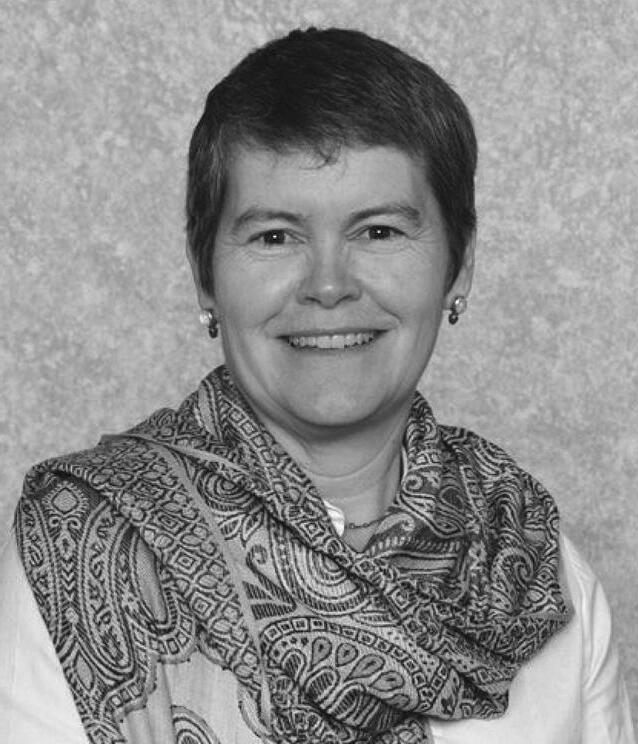
$100,000
NUU-CHA-NULtH tRiBAL CoUNCiL
Usma Nuu-chah-nulth Alternative Dispute Resolution
$99,604
KLA-HoW-EYA ABoRigiNAL CENtRE oF SURREY ABoRigiNAL CULtURAL SoCiEtY
Circle 5 Alternative Dispute Resolution Project: Focus on Alternative Dispute Resolution for Aboriginal Centre
$98,497
vANCoUvER ABoRigiNAL CHiLD AND FAMiLY SERviCES SoCiEtY 2008 Child Welfare Initiative
Funding totalling $1,542,290 was approved for the following 4 new initiativeprojects:
$795,000
CANADiAN BAR ASSoCiAtioN, B.C. BRANCH
Rural Education & Access to Lawyers Initiative
$478,790
WESt CoASt PRiSoN JUStiCE SoCiEtY
Beyond Liberty Prison Justice Litigation Fund/ Prisoner’s Human Rights Project
$148,500
B.C. CoURtHoUSE LiBRARY SoCiEtY Provincial Legal Services Mapping Initiative
$120,000
ECoJUStiCE CANADA SoCiEtY
Public Interest Environmental Law Conference
Funding totalling $120,000 was approvedforthefollowing2grants:
$60,000
CoMMUNitY LEgAL ASSiStANCE SoCiEtY
Public Interest Articling Fellowship
$60,000
UNivERSitY oF viCtoRiA
Public Interest Articling Fellowship
For full details of the programs and projectsthatreceivedfunding,please visit the Law Foundation of B.C. websiteatwww.lawfoundationbc.org.
Mary Mouat Elected New Chair of the Law Foundation
The board of Governors is pleased to announce that mary mouat of victoria has been elected as Chair of the law Foundation beginning January 1, 2009. ms. mouat succeeds Warren Wilson, QC of vancouver who has been Chair of the law Foundation since 2006. ms. mouat earned her law degree from the university of victoria and was called to the bar in british Columbia in 1988. She is a partner of the Quadra legal Centre in victoria, practising in the areas of family mediation and collaborative law. ms. mouat is a qualified Family law mediator and Collaborative law lawyer. She has been active in many communities and bar organizations including the victoria bar Association, the executive of the CbA (b.C. branch), the Family Tariff Committee of the legal Services Society, the law Courts education Society, and the victoria Women’s Sexual Assault Centre. most recently she was a member of the Family Justice reform Working Group created by the Justice review Task Force.
She has been a Governor of the Foundation since 2006 and has served on the Child Welfare Fund, new Grants (as Chair), and bursary, Scholarship and Fellowship committees.
The law Foundation of british Columbia is a non-profit foundation which receives the interest on lawyers’ pooled trust accounts and distributes it by means of grants for legal education, legal research, legal aid, law reform and law libraries in the province.
NEW MEMBERS
The CBABC Branch welcomes its newest members! The following new members joined in the months of November and December of 2008:
Regular Members
StEvEN BRiNE Rockies Law Corporation Kimberley
RoME CARot
MiCHAEL L. ELLiott Slater Vecchio LLP
Vancouver
SoNg J. HiLL Fasken Martineau DuMoulin LLP
Vancouver
JENNiFER J. LUM Jabour Sudeyko North Vancouver
BRiAN C. MAN
Vancouver
CoLLEEN A. o’KEEFE Basham Thompson & Yu LLP
Vancouver
M. RiCHARD PARKES
ICBC-Litigation Department New Westminster
CHARLENE MARiA tHoMAS Great-West Life Assurance Company
Winnipeg
SAMiR viRANi
Vancouver
DAviD P. voN DER PoRtEN Boughton Law Corporation Vancouver
Scholar
JoHN HiNDESS Vancouver
Articling Students
StEPHANiE AXMANN McCarthy Tétrault LLP Vancouver
JARED E. BRoWN Nixon Wenger LLP Vernon
ERiN CRAM Rush Ihas LLP Kelowna
SAMANtHA CUNLiFFE McCarthy Tétrault LLP
Vancouver
SARAH gALESKi Fraser Milner Casgrain LLP
Vancouver
RoBYN gERvAiS Legal Services Society Vancouver
KEviN PAtRiCK HYDE McQuarrie Hunter LLP Vancouver
MiCHELLE JoNES
LAURENCE KLASS Watson Goepel Maledy LLP
Vancouver
DANiEL MAH Lawson Lundell LLP Vancouver
tAMSiN MiLEY Bowen Island
MARK PiDKoWiCH
ANgELA RoY Tessmer Law Offices Kelowna
StEPHANiE SANgER Fasken Martineau DuMoulin LLP Vancouver
JEFFREY SHiDEi Fulton & Co Kamloops
KELLEY StEWARt Fasken Martineau DuMoulin LLP
Vancouver
MAttHEW WALKER Lawson Lundell LLP
Vancouver
To view all new members, including the 67 Law Students, please visit uuu http: www.cba.org/ bc/bartalk_06_10/02_09/membership.aspx.
CLEBC Update
tiMELY 2009 PUBLiCAtioNS
The Community Charter has been in place for five years, enabling both municipal and regional district governance. The courts have pronounced on some of the Charter’s important changes. local Government under the Community Charter, to be published in march 2009, will include an overview of the Charter, a topic-by-topic review of how it works with other enabling legislation, insights into the courts’ views on the new approach to enabling local government, and full text of the legislation.
The 2009 edition of Annual review of law & Practice promises to be packed with accessible commentary on the major legislative, case law and practice changes in 2008. In its 18th edition, and slated for march publication, this essential practice tool is a reliable way to keep up to speed on pivotal trends.
CRUCiAL CoURSES iN 2009
municipal law has its own unique practices and pitfalls. Municipal Law Basics on April 3, 2009 will guide you through the practice, including provincial-municipal relations, concurrent authority, municipal services and governance, regulatory powers, local government finance, and more.
The economy has changed; so must the focus of lawyers advising construction industry clients. Join us for Construction Law 2009, a detailed seminar on advising clients when money is tight. review essential contract clauses, then let seasoned practitioners walk you through the game of musical chairs and show you how to find relief for your client when the music stops.
Further information on these publications and programs is available from Cle customer service at 604-893-2121 (toll-free in Canada at 1-800-663-0437) or on the ClebC website at www.cle.bc.ca.
Work Life Balance –Luncheon Speaker Series
The Work life balance Committee’s luncheon Speaker Series continues with:
• “Lawyer Wellness and Resiliency – The Importance of Maintaining Peak Performance”
Friday, February 27, 2009 (Please note the change of date from Thursday, February 12, 2009)
• “Energy Management not Time Management is the Key to Lawyer Performance”
Thursday, march 26, 2009 AND
• The Second Annual Work Life Balance Award, to be presented by the Attorney General, Wally Oppal, QC and sponsored by Corporate Occupational Solutions, Inc., (COS), Workplace Health and Wellness Specialists
Thursday, June 25, 2009
SAvE tHESE DAtES!
All events will be held from 12:00 p.m. – 2:00 p.m. at the Sutton Place Hotel, 845 burrard Street, vancouver, Tel: 604-682-5511, unless otherwise advised.
Please register online noW on the CbAbC website: www.cba.org/bc to guarantee your place for the remaining events in this series and for the Second Annual Work life balance Award luncheon.
CALL FoR NoMiNAtioNS FoR SECoND ANNUAL WoRK LiFE BALANCE AWARD
The Work life balance Committee invites nominations for its Work life balance Award. nominations must be received by the CbAbC Committee Coordinator by 4:30 p.m. on April 30, 2009. For the full nomination process, please check online at the CbAbC website www.cbabc.org/bc. Full details of the nomination and selection procedures for the Award will be provided in the April issue of barTalk and on the CbAbC website.
Electronic Filing
international Assistance Section
The International Assistance Section gratefully acknowledges the generosity of Thomson Carswell, Canada Law Book, and LexisNexis in assisting the work of the Legal Resources Centre (LRC) in South Africa. The LRC has been defending the rights of the poor, vulnerable and historically disadvantaged in South Africa since the apartheid years. With the new Constitution in 1996, the LRC started a constitutional unit that was assisted for a number of years by the Canadian Bar Association through a CIDAfunded program. That unit has argued a number of significant cases before South Africa’s Constitutional Court and has used Canadian law to support its arguments. Canadian resources are of key importance to the work of the LRC as the Constitutional Court in South Africa has followed much of the Supreme Court of Canada’s jurisprudence. These publishers have agreed to donate constitutional materials to the LRC so that it can continue to use Canadian jurisprudence in its valuable work in South Africa. The lawyers at the LRC were overwhelmed by the generosity of these publishers and grateful that Canadians appreciate the value of the work they are doing and the need for them to look abroad for ideas and guidance as they develop their own constitutional jurisprudence.
The land Title and Survey Authority has enabled more than 80 new transaction types to be offered through its electronic Filing System. Transactions now offered include the ability to submit Power of Attorney, Certificates of Pending litigation, Caveats and Survey Plans. With these additions, practically all land title transactions can now be submitted electronically. For eFS training, please call 1-800-663-6102.
CLASSiFiED (per line)
CbAbC members/Firms
$25
Commercial organizations $50
Next deadline: march 6
DiSPLAY
3” x 2.5”
CbAbC members/Firms $450
Commercial organizations $900
6” x 2.5”
CbAbC members/Firms
Commercial organizations
Next deadline: march 6
iNSERt (all of B.C.)
CbAbC members/Firms
Commercial organizations
Next deadline: march 11
Next mailing: April 6
$810
$1,620
$1,200
$2,400
Direct Bartalk advertising inquiries to: Jesse Tarbotton
barTalk Senior editor
Tel: 604-646-7856 or 1-888-687-3404 email: jtarbotton@bccba.org
Practice Restricted To WCB
Sec. 257 Determinations, Opinions and Court Applications on referral
Claims and appeals
Vice Chair at Review Board for 6 years
More than 25 years personal injur y litigation
Cell 604-868-3034 Fax 604-264-6133 vishkanian@pepito.ca Vahan A. Ishkanian
Barristers & Solicitors
C oACH i N g
CoACHiNg: Do you have a coach? Join the growing trend to be coached. Coaches get you from where you are, to where you want to be. What’s next for you? Be coached by a lawyer coach. Visit us at www.ignite-coaching.com and let us help you make your next move – in law and in life. soar@ignite-coaching.com 604-202-1040.
S ER vi CES
iNtELLECtUAL PRoPERtY: Let us assist you in providing protection for your clients. Douglas B. Thompson Law Corporation –Registered Patent Agent, Registered Trade Mark Agent. Practice restricted to Intellectual Property, Victoria, B.C. (www.BCpatents.ca) Email: doug@BCpatents.ca.
AtKiNSoN LAW Office Business/Immigration, www.AtkinsonLaw.com referrals paid.
WCB & CPP DISABILITY CLAIMS
GOSAL & COMPANY
Barristers & Solicitors
Over 14 YEARS of Workers’ Compensation Claims & Appeals Experience*
P o S itio N AvA i LABLE
oPEN DooR LAW CoRP. has a FT or PT position available commencing in March for a junior solicitor with 1-3 years of experience in a solicitor’s practice. The ideal candidate must be easy to work with, have an exceptional work ethic and be eager to assist the firm’s growth. Please apply in confidence with a resumé to Fiesal Ebrahim at fiesal@opendoorlaw.com.
LoCUMS – OnPoint Law Corp. is looking for exceptional litigators and solicitors to join its Locum Division. Successful applicants must have at least five years experience in one area of law, and be available for flexible placements. Please send a resumé to Sarah Picciotto at spicciotto@onpointlaw.com or call 604-879-4280.
REgioNAL LEgAL CAREERS oFFiCER
#254, 12899-76th Avenue Surrey, B.C. V3W 1E6 www.gosalandcompany.com info@gosalandcompany.com FREE CONSULTATION 604-591-8187
SARJ GOSAL*, B.A., LL.B. GAIL SAHOTA, B.Comm., LL.B.
The Canadian bar Association b.C. branch invites applications for a regional legal Careers officer to develop and manage strategies for attracting law students and new lawyers to rural/small communities in b.C. It is expected that the officer will work off-site with close liaison with the Committee, law schools and local and County bar Associations and lawyers.
The Ideal Candidate
• Thorough knowledge of life, business and legal practice realities in rural/small town b.C.
• Direct experience in marketing and promotion of destinations, academic institutions or career options
• Passion for matching the right people with the right opportunity.
• Inspires respect and ease both in the boardrooms of senior practitioners, and in the classrooms of young law students
• law degree and legal career experience is beneficial but not mandatory
• experience in self-directed employment, including hands-on management of budgets and administrative details
• Personable, curious, action oriented puzzle-solver
• Able to travel extensively.
This position is funded by the law Foundation of british Columbia. For a full description and application process visit our website at www.cba.org/bc/about_us/main/jobs.aspx.