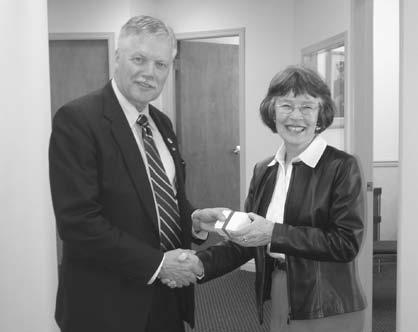
From Community Courts to mediated disputes and international treaties, our justice system, the foundation upon which our democracy is built, is adapting to meet the needs of a society undergoing significant cultural and technological change. The courts must adapt if they are to “meet the needs of the community more effectively,” was the strong assertion of Chief Judge Hugh C. Stansfield in the pages of BarTalk’s April 2008 edition. In the courts and beyond, CBABC members are working as judges, lawyers, mediators, judicial justices of the peace, and in a myriad of other roles on the cusp of significant changes to our justice system.
Alternative Dispute Resolution (ADR), the focus of this month’s publication, is a multi-faceted tool that can function alongside, whilst simultaneously being complimentary to, the court system. Lawyers practicing ADR, or in non-traditional roles, have the opportunity to operate outside of the courtroom setting while working toward the same goal of helping to resolving disputes, in all their manifestations, in a fair and efficient manner. In this edition we hear from a wide variety of legal practitioners examining ADR from both practice and legislative perspectives. Gordon Sloan, a lawyer and mediator, provides a glimpse into a day in his working life, touching on challenges and the rewards of his position from the early morning through to the end of the day. The Chair of the Justice Review Task Force, M. Jerry
While the totality of advancements in ADR and our justice system as a whole are simply too vast to be given their due in a single edition of our humble publication, we hope to have at least hinted at the scope of changes and their importance to lawyers across the province. CBABC members, in all of their roles, are at the forefront of our ever changing Justice System. You can find more information on initiatives that the CBABC is participating in, such as the Justice Review Task Force, at our website www.cba.org/bc. BT JUNE 2008 volume 20, number 3
McHale, QC writes in his article, “Mediation in Civil and Family Cases in B.C.,” about both the character and history of mediation practice in B.C. especially as it pertains to family law. On the international front, we hear from Dierk Ullrich, a lawyer with Fasken Martineau and chair of the BarTalk editorial board, who recounts recent developments in legislation pertaining to the settlement of international disputes and the challenge of existing regulations being inconsistently applied across the provinces. From the domestic scene, Gregory S. Pun, Law Officer with the Court of Appeal examines the ongoing pre-hearing judicial settlement conference pilot project and how it has developed since its commencement in Autumn 2004. The preceding briefs are just a small selection of the articles that comprise this month’s BarTalk which also includes contributions from Jack Giles, QC, our regular columnists and many others.
Alternative Dispute Resolution (ADR), processes and techniques that fall outside of the judicial process, are the focus of this edition of BarTalk. From developments in the field of ADR in the British Columbia and beyond, to a day in the life of a mediator, we highlight dispute resolution beyond the courtroom.
Canadian bar Association, b.C. branch
10th Floor, 845 Cambie Street
vancouver, b.C. v6b 5T3
Tel: 604-687-3404
Toll-free (in b.C.): 1-888-687-3404 bartalk@bccba.org
barTalk is published six times per year by the Canadian bar Association, british Columbia branch.
The Canadian bar Association, british Columbia branch represents more than 6,000 b.C. members and is dedicated to improving and promoting access to justice, reviewing legislation, initiating law reform measures and advancing and improving the administration of justice.
barTalk Publication Sales Agreement #40741008
ACCESS TO JUSTICE – CHIEF JUDGE HUGH
C. STANSFIELD (APRIL 2008 – VOL. 20, NO. 2)
Unfair to dinosaurs!
Chief Judge
Send your L ETTERS TO THE E DITOR to:
Jesse Tarbotton, barTalk Senior editor
Canadian bar Association, b.C. branch
Fax: 604-669-9601
Toll-free fax: 1-877-669-9601
e-mail: jtarbotton@bccba.org
Hugh Stansfield of the Provincial Court of B.C. tells us, “Like the dinosaur, we must adapt or perish.” This simile perpetuates a popular stereotype whereby it is said that the dinosaur perished for the specific reason of the failure to adapt to change. Hence the popular epithet “You dinosaur!” – an out-of-date fuddy-duddy who is not changing.
Yet the need for change is greatly, greatly over-rated. Dinosaurs survived much, much longer that we homo sapiens have been on earth. Dinosaurs did not need to change as long as their environment remained stable – as it did for eons. Dinosaurs were very, very well-adapted. What caused dinosaurs to “perish” was a catastrophic event that no dinosaur could possible adapt to: chance collision of the earth with an asteroid some 65 million years ago. It wiped out roughly half the marine invertebrates along with the dinosaurs.
Yet no one lectures us, “Like the marine invertebrates, we must adapt or perish.” That would be unfair to marine invertebrates, as unfair as it is to dinosaurs. Who could ever “adapt” to asteroid collision? Creatures that survived catastrophic collision did so only by good fortune. “Oh fortune!”
As for survival in general, the last (grim) word goes to John Maynard Keynes: “In the long run, we’ll all be dead.” Adapting only postpones, and does not prevent, inevitable perishing. Law, too, shall pass away.
– Greg Lanning Barrister and Solicitor
PROFESSIONAL DISCOURTESy – TONy WILSON (APRIL 2008 – VOL. 20, NO. 2)
I enjoyed reading about Tony Wilson’s daring exploits swimming with what many believe to be our professional equals (superiors?) – sharks. I am encouraged by the efforts of people like Tony to promote the value of lawyers and the profession of law.
I was equally impressed with his examples of our work, including the fact we help ensure the ability to live in a country where publishing cartoons depicting Muhammand, Jesus, et al is not a capital offence, but rather protected free speech.
I wonder however if Tony is aware that one of our colleagues, Calgary lawyer Ezra Levant, is currently before the Alberta Human Rights Tribunal for the very act of publishing the so-called Danish cartoons depicting Muhammad in the now-defunct Western Standard magazine. It seems that in Alberta at least, the protection of this form of free speech is not yet settled law.
–
Major Sean Raleigh
Ken ne TH WAlTon
On Being President
Being President is like a practicum, a year of true learning; in my case, 36 years after I was last a Law Student. In all sincerity it has been a wonderful experience. The reasons: one sees all aspects of our great profession.
Some of you who read this will be future Presidents of this Branch. So here in 2008 is what the experience was like:
Kenneth Walton President 2007/2008 b.C. branch Canadian bar Association
First, your member lawyers are in the thousands; 6,200 and growing. These are the people whose diverse interests you try and put first. This is done at a macro level by trying to promote practical initiatives such as decreasing high tuition fees and pension reform; having RRSPs protected from creditor seizure so that we, the self employed, are on an equal footing with the organizationally employed.
As President you promote the interests of all by maintaining good relations with the Attorney General, the courts, The Law Society and the law schools. The challenge, as leader, is that not all actions of these groups necessarily coincide with the interests of your constituents.
It is fascinating to attend Bencher’s meetings and see the way our profession’s self-governance works. It gives you a new appreciation of how imperative it is to preserve the rule of law. Taking a few hours of continuing legal education is a small price for staying this way.
The job also requires you to sit on Judicial Council, the venue which selects Provincial Court judges and other judicial officers, and has responsibility for education and discipline. Again it’s all about the rule of law. Who will best serve in this important court? Who will be able to have compassion and understanding for our fellow citizens while at
the same time having the gumption to punish if that is what is called for?
You get to greet new appointees to all levels of the judiciary. In order to speak knowledgeably of the new judge, you must research the background of the appointee. Most are terrifically accomplished people in whom the public trust is in good hands.
Regularly, the President meets local Bar representatives; annually the Attorney, and frequently the Chief Justices and Chief Judge at a variety of functions like Law Week. You also sit as the CBABC voice on the Queen’s Counsel Selection Committee.
Perhaps surprisingly, the best way to prepare for this job is to become a member of a reasonably sized Board of a community organization. In my case, it was many committees; a church council, the YM/YWCA, Goodwill Enterprises, Oak Bay Lodge, Kinsmen, and Rotary at a variety of levels.
Board decisions are made sometimes through compromise, and often because, after examination of various points of view, the logic of the answer becomes apparent. The majority of time, the wisdom of the collective which results is the best answer regardless of one’s personal view.
The best preparation I ever had for this job was joining Kinsmen which taught meeting procedure. It was a great school for leadership.
I have loved every minute of being President. It’s such fun. I thank you for the opportunity. I regret nothing about anything I have done in this office. We have a great profession. You should be proud to be a member.
I wish you success in your practice and personal life. BT
The Upside of Gamers
Gamers bring a new perspective to the workplace
Do you have a Facebook page, a Flickr account, a constantly chirping Blackberry receiving Twitter messages, IM on your screen all day, and a hugely important social life (and multiple personas) online? Do you have trouble concentrating on the droning person in front of you or on the phone? Incapable of functioning on one channel of input at a time? No? Well, chances are you employ, parent or work with people who fit this profile – those who grew up in the Gaming Era – and you’re perplexed by the challenge of dealing with them.
Caroline nevin executive Director b.C. branch
Canadian bar Association
There is an upside to this, though. Gamers:
• Are better at handling risk and uncertainty
• Are more creative and have better problem solving skills
• Are more sociable and have a greater need for human relationships
• Think of themselves as experts and want to tackle problems head-on
• Aren’t discouraged by failure and believe each setback is just a chance to try again
• Are more flexible about change
• Are better at seeing problems in a deeper perspective
• Are great at learning in informal ways
• Are more globally oriented and outwardlooking
• Are more confident and have a more positive outlook on life.
Source: Beck, J. & Wade, M. “The Kids are Alright” www.nslg.net/gotgamebook
Every generation brings something new to the workplace, and potentially vital to the future
success of organizations (see page 19). It’s worth approaching the Gamer perspective with respect and curiosity, asking the most important question of all: How can we combine our differences and strengths to create something truly exceptional? Create a meaningful Quest and you’ll be amazed at what happens!
Want to know more about topics like this? The CBA makes a specialty of targeting key business practice issues and delivering speakers (and Law Society credits) that give you in-depth knowledge in bite-size portions.
We take up-to-date info and mix it with great networking over 60, 90 or 120 minutes. We make it available all across the province through technology or direct delivery – just ask the Kamloops Bar, where we sponsored a fast and informative “Accounting for Lawyers” session with KPMG in May.
There’s great CBA Professional Development (PD) at the Canadian Legal Conference (CLC) in Quebec City in August, and at our renowned CBABC Conference in San Diego in November. There’s a huge opportunity for mixing pleasure and PD at the August 2009 CLC in Dublin, Ireland. And let’s not forget the upcoming Work Life Balance Retreat in Penticton during the Okanagan Wine Festival in October – given the stresses and generational conflicts in today’s law firms, isn’t it time you learned what it takes to become a sustainable firm of engaged and productive lawyers?
At $53 a month (less if you’re a young lawyer), CBA membership gives you a great deal on PD as the Law Society gets ready to make 12 hours mandatory on January 1. Things are changing fast – let us help you make life easier! BT
CBIA Announces Expanded Eligibility
The Canadian Bar Insurance Association is now offering its life insurance products to the children and spouses of lawyers and Quebec notaries. If your children are eligible, let them know that they can now enjoy the savings offered by some of the lowest life insurance rates in Canada.
On the Appointment Process to the Supreme Court of Canada
CBA President Bernard Amyot: “Whenever there is a vacancy on the Supreme Court of Canada, legal, media, and political circles start buzzing with speculation about the next appointment to the country’s highest bench. In this respect the replacement of retiring Justice Michel Bastarache has proven no different.”
Book Early to Avoid Disappointment: Quebec 2008 –August 17-19
Combine business with pleasure and make your trip to Quebec City this summer a memorable one! The CbA’s Canadian legal Conference, Aug. 17-19, is packed with professional development programs and guest speakers to appeal to just about every speciality and interest. For family and guests, Quebec City’s 400th anniversary celebrations offer myriad activities for every age and taste. With hotels filling up very quickly, it’s essential to book early. Plus, take advantage of early bird rates and save up to $100 until June 30.
Details and registration uuu http://www.cba.org/cba/quebec2008/main/
A sampling of what Quebec City has in store this summer:
• Espace 400e : the heart of the festivities From June to September 2008 bassin louise, old Port
• The Visionnaires Garden
June 6 to october 13, 2008 musée de la civilisation
• Le Louvre à Québec : Les arts et la vie June 5 to october 26, 2008
• Le chemin qui marche: a glowing tribute to the St. Lawrence River on the evening of August 15, 2008
Take your Practice to the Next Level: Hire a Coach
A growing number of lawyers have discovered personal coaching as a highly effective way to improve their careers. Since the key elements of a lawyer’s career are uniquely individual, it makes sense that individual, tailored coaching is the most effective route to get there quickly. This month on CbA Practicelink, find out how a coach can help take your practice to the next level.
All this and much more uuu http://www.cba.org/practicelink
CBA Welcomes Reforms to Land Claims Process
The CbA supports bill C-30 (SpecificClaimsTribunalAct) which creates a much-needed independent tribunal with the power to decide long-standing claims between First nations and the Crown. “legislative reform of the specific claims process is long overdue,” Christopher Devlin of victoria, past Chair of the CbA’s national Aboriginal law Section, told the Commons Committee on Aboriginal Affairs and northern Development on April 9, 2008. “We anticipate that the bill will address serious problems of delay and backlog under the current regime.”
The CbA supports the specific claims process as a necessary alternative to litigation for resolving claims, but notes that the process has been clearly unable to cope with the sheer volume of claims from First nations.
The Webby Awards, the leading international honour for the Web, have recognized the CbA’s website (CbA.org) as an official Honouree, a distinction that recognizes work exhibiting remarkable achievement. Hailed as the “oscars of the Internet” by the new York Times, the Webby Awards are the leading international award honouring excellence on the Internet, including websites, interactive advertising, online film and video, and mobile websites.
Law Day 2008
Standing Up For The Rule of Law
CBA President Bernard Amyot appeared before the Commons Committee on Foreign Affairs & International Development, Subcommittee on International Human Rights, on May 6. The subcommittee is looking into the situation of Omar Khadr, who has been detained in Guantanamo Bay for the past six years, and is in the process of being tried there by an American military court. In his statement, Bernard Amyot outlined the CBA position calling for the closing of the prison facility at Guantanamo Bay, and the repatriation of Omar Khadr to Canada where, if the Crown finds that charges are warranted, he would be subject to the Canadian criminal justice system.
The following is an excerpt from the statement: “The focus of our concern is the lack of respect for the rule of law. It’s easy to provide legal rights to those aligned with popular causes. Our commitment to justice is challenged where the individual is unpopular and accused of terrible crimes. It’s at times like this that we must speak out, and defend those rights. This is what the rule of law requires –that we recognize the rights of all, not just the favoured few.”
Full statement: uuu http://www.cba.org/CBA/news/pdf/ 2008-05-05_khadr.pdf
Federal Justice minister rob nicholson was the featured guest at ottawa’s law Day on April 17. He was joined by CbA President bernard Amyot and some 650 high school law students, who attended the event that included a mock trial, career panel, and special presentations by the President and the minister. After meeting with minister nicholson, bernard Amyot walked the short distance to Parliament Hill to visit the Senate, where Senator Hugh Segal read a law Day statement on the subject of the rule of law.
CbA President bernard Amyot (left) with federal Justice minister rob nicholson on law Day 2008 in ottawa.
Section Update
Keep your practice current
The following are brief summaries of several recent Section meetings held throughout the province. More detailed information and available minutes from the Section meetings are accessible online at www.cba.org/bc in Sections/Forums, for enrolled CBA members.
HUMAN RIGHTS
MEETING: march 18, 2008
SPEAKERS: Judith T. Doulis, vicky e. Shillington, and Don J. Jordan, QC
TOPIC: Applications to Dismiss before the b.C. Human rights Tribunal
The three guest speakers provided the 40 Section members in attendance with a comprehensive review of recent Tribunal and court decisions regarding application to dismiss human rights complaints Ms. Doulis of the Community Legal Assistance Society practises human rights law from the Complainant’s perspective and discussed cases under each heading of Sections 27(1) which empowers the Tribunal to dismiss all or part of the complaint on a preliminary application. Vicky Shillington of the B.C. Human Rights Coalition discussed the Complainant’s point of view when an application to dismiss is brought forward. Mr. Jordan who practises employment/human rights law from the Respondent Employer perspective at the law firm Taylor Jordan Chafetz discussed
the recent SCC case: Dunsmuir v. Her Majesty the Queen in Right of the Province of New Brunswick as represented by Board of Management and the Supreme Court of B.C. decision: Gichuru v. Law Society of British Columbia 2007 BCSC 1767. Following the presentations, a question and answer period discussed the circumstances when the Tribunal will order an oral hearing on an application to dismiss.
TOPICS: How the office of the Police Complaint Commissioner Contributes To better Public Administration in the Province
Mr. Ryneveld, spoke to the Section about the Office of the Police Complaint Commissioner, giving a historical background and then discussing Part 9 of the Police Act which sets out the complaint procedure and the powers of the PCC. He discussed
WILLS AND TRUSTS – OKANAGAN
MEETING: April 17, 2008
SPEAKER: Jennifer Davenport, Public Guardian and Trustee, vancouver
TOPIC: Trust and Settlement variation Act
Ms. Davenport provided an overview of the role of the Public Guardian and Trustee’s office (PGT) which was created to protect the legal and financial interests of those under a legal disability. It is important that the PGT be kept apprised on any changes such as beneficiaries, residency changes or the need for a litigation guardian. Under the Trust and Settlement Variation Act (TSVA) changes require a written notice be given to the PGT as well as writing a letter to the court explaining what the variation is seeking. Jennifer’s detailed notes summarized what the PGT will consider under the TSVA.
“We don’t always get it right, we try to get it right, but we always look for practical solutions.”
– Ms.
Davenport
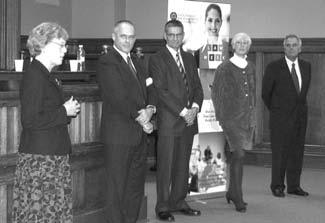
From left to right: Jennifer Davenport, Joel Wiseman, Stan rule, Geoff White, and Don blakely
the ways in which the Office and the complaint process add to quality policing and trust in law enforcement. He detailed how this is achieved through different corrective measures, and where warranted, public hearings. This Section meeting was available to members outside the Victoria area by webinar.
REAL PROPERTy –VANCOUVER
MEETING: February 11, 2008
SPEAKER: Thomas G. Keast, QC, Watson Goepel maledy llP
TOPIC: Commercial Tenancies: Case Study and environmental remediation obligations on Surrender in Canadian national railway Company v. Imperial oil limited (2007 bCSC 1557)
Did you Know?
The Tenant’s arguments centred on the string of leases and whether the new leases were to be read with reference to the predecessor agreements. Through Mr. Keast, the Landlord successfully argued that there was an underlying obligation for the Tenant to return the site to the Landlord in clean state.
• More than 3,700 CBA members are enrolled in Sections
• Attendance at Section meetings counts toward l aw Society of b.C. professional development reporting hours
• Listservs are available for most Sections and are a convenient way for members to share information, and ask and answer questions
• Section Papers are available online, at no charge to all CbA members
This topic and presentation by Mr. Keast was particularly interesting for those involved in leasing and environmental issues. Imperial Oil Limited (IOL) had been a tenant of Canadian National Railway (CN) on the Prince Rupert waterfront for many years pursuant to a string of a number of leases. In 2002, IOL gave notice not to renew its lease, admitting the site was contaminated. IOL unsuccessfully took issue with respect to its responsibility to restore the site to a clean state.
• 2008 – 2009 Section Enrolment forms will be circulated to all b.C. lawyers in June.
SENIOR LAWyERS
MEETING: February 13, 2008
SPEAKER: Acting Sergeant michael Drummond, vancouver Police Department
TOPIC: Performance by City Police officers of their Duties in relation to the multitude of legal restrictions
Mr. Drummond’s policing experience with the RCMP, the West Vancouver Municipal Police, and the Vancouver Police Department supported his remarks and descriptions of the many incidents he has been involved in during his career. Mr. Drummond spoke on several current issues, and explained that the constant educational upgrading officers are subjected to ensures they are aware of the latest revisions to applicable statutes, regulations and by-laws, and the chan ges resulting from court decisions. BT
Section Chairs
SPOTLIGHT
Heather M.B. Ferris
Since 1996, ms. Ferris, a partner at lawson lundell llP and head of its Insolvency and restructuring Practice Group, has been Chair of the b.C. branch Insolvency law Section. Heather’s significant experience and leadership have benefited CbAbC members who attend monthly Section meetings in this practice area. ms. Ferris’ practice covers large-scale insolvencies, restructuring and corporate work-outs. She routinely advises companies in restructuring under the Companies’ Creditors Arrangement Act and has contributed articles for the Advocate, Canadian bar review, Pacific business and law Institute and Insolvency reporter. This June, Heather will retire as Insolvency law Section Chair but her involvement and dedication with the CbA will continue. She will Co-Chair the 2008 Pan Pacific CbA Insolvency Conference being held in vancouver, September 18-19, 2008. Thank you Heather for your invaluable contribution to the Sections Program!
The United Nations Comes to B.C.
Giving ODR a chance…
Integrations, mediations, united nations, congratulations All we are saying is give peace a chance…
Words and music byJohn lennon.
On June 17, 2008, at Royal Roads University, B.C. will host a United Nations conference on Online Dispute Resolution (ODR). This is an auspicious occasion – as B.C. lawyers and others – can play a role in the shaping of the future of dispute resolution in an online forum.
David J. bilinsky is the Practice management Advisor for the law Society of british Columbia e-mail: info@thoughtfullaw.com blog: www.thoughtfullaw.com
Now lawyers have been involved in the settlement of disputes between parties for centuries. However, as they say, the times they are a’ changing. For example, ODR World (www.odrworld.com) offers an online dispute resolution method for the settlement of claims. While the amounts that can be settled with this service are not typically large, the implications of such a dispute resolution service are potentially quite momentous.
For example, buyers and sellers having a dispute can use the ODR World on-line dispute resolution service – currently $15 – for assisted or automated negotiation for 14 days. If you wish, you can engage a professional mediator to help resolve the dispute in addition to the online dispute resolution process for $38 for 14 days. By way of contrast, arbitration services are much more expensive: they range from $380 to $1200.
Compare this to a Small Claims proceeding for the same matter – in terms of time, cost, delay, and the availability of assistance. You can see how ODR can be seen as a “disruptive technology” to the
entire dispute resolution process in general and the use of lawyers (and the courts) to resolve disputes in particular. Now you may say that these claims are such that it doesn’t pay lawyers to handle them in any event. Quite true. However, the funny thing about disruptive technologies is that they don’t quite know when to quit – once they gain a foothold their obvious economic advantages start to work in favour of their application to a wider market.
New ODR systems that take advantage of “game theory” (think of the movie “A Beautiful Mind” about its discovery and its discoverer) have application to multi-party, multi-issue disputes (for example, www.smartsettle. com). These disputes are those that typically involve lawyers and large amounts of money. The possibility that these disputes could be resolved by the use of Online Dispute Resolution techniques should cause lawyers (and the courts) to give pause – and to be concerned – in fact, to be very concerned. For example, Access to Justice is enhanced under an ODR system. Parties do not need to travel (access is via the Internet), they do not need to communicate in a synchronous manner (they can access the system as their timetables permit) and the process is not procedurally difficult. ODR has already been used in family disputes, child custody, insurance claims, and consumer claims. And more importantly, it has a future in resolving major international disputes.
In your humble scribe’s opinion, lawyers are at a crossroads. If they adopt ODR as part of their arsenal of tools to be used to resolve disputes and immerse themselves into the development of ODR, they stand a fair chance of being involved in the growth of the ODR process. However, if they choose to stand apart
and allow the development of ODR in a manner that does not involve the use of lawyers, then they will witness the creation of an entirely different but parallel system for the resolution of disputes. Those who have disputes to settle will face a choice: the use of the courts and lawyers (with the attendant delays, costs and uncertainty of litigation) or the use of ODR (which potentially offers speedy and inexpensive dispute resolution that allows the claimant to help craft the eventual resolution).
I see it as vitally important for lawyers to be present at the development of ODR to ensure that their thoughts, contributions and ideas are included
in the future growth of ODR. This June 17th, the 7th International Forum on Online Dispute Resolution in collaboration with the United Nations Social and Economic Commission for the Asia Pacific will be held at Royal Roads University (www.odrforum2008.org). This UN Conference will be a major opportunity to help develop and guide the standards, certifications, the best practices underlying ODR and the future growth of ODR. Lawyers who have an interest in this area should be making plans to attend this conference. I hope to see you there and hopefully we can all try to give peace a chance. BT
DAVE's TEch Tip
Technology Tip from Dave’s Award-Winning Blog: (www.thoughtfullaw.com):
I have run across the absolutely coolest application that I have seen in a long time… and it has quickly become indispensable to how I work. And the best part of it all is that it is also one of the simplest pieces of technology that I have seen in quite a while.
This particular application is an intelligent filing assistant for microsoft outlook (I have used it in both outlook 2003 and outlook 2007). At least that is how it is described on the web. I simply call it magic.
Here is how it works: SimplyFile (http://www.techhit.com/SimplyFile/), once installed, sits in your Outlook as a toolbar. Now, click on an e-mail – any e-mail. SimplyFile guesses into which folder this particular e-mail should go. Amazingly, it seems to guess right at least 80-90 per cent of the time. Click on “File message” and zap the e-mail goes into the right folder. When you reply to an e-mail, it also guesses which folder the reply should go. SimplyFile is $39.95 per user, with a volume discount available for those who may wish to take advantage of this.
I am sure that it does more, but I really don’t care. When it comes to saving ourselves from the e-mail avalanche, we have to just keep it simple and that’s that.
The views expressed herein are strictly those of the author, and may not be shared by the law
Let Us Know What you Think
barTalk is published six times per year, and sent to the entire legal profession in b.C. With so much information available in print and online, we want to be sure that we continue to keep barTalk relevant. Is there a topic you think we should cover? Do you want to submit an idea or article? let us know! e-mail bartalk@bccba.org.
Have you moved? Let us know!
If you have changed firms, addresses, e-mail addresses, or phone/fax numbers, you need to let us know. e-mail us at data@bccba.org, phone 604-687-3404 or fax 604-669-9601 or contact us toll-free (phone 1-888-687-3404, fax 1-877-669-9601).
Society of b.C.
The Dumbing Down of Radio 2
No more Mozart in the morning... but we do have Burton Cummings for you
I’m partial to any law firm that puts me “on hold” with CBC Radio 2 playing in the background when I phone. There are a lot of law firms using very bad radio to entertain callers on hold, and more often than not, they’re stations where DJ’s tell penis and fart jokes and provide the latest Paris Hilton Celebrity Gossip. So when I hear CBC Radio 2 on the phone, I say to myself, “this Law Firm has some class.” I wake up to Radio 2 in the morning and often have it on in my office while I draft complicated documents because there’s statistical evidence that classical music causes the human brain to work better and dairy cows to give more milk.
vancouver Franchise lawyer
Tony Wilson isn’t a total pompous ass. He has plenty of Pat metheny, Peter Gabriel and even led Zeppelin on his iPod, and always enjoys listening to larry and Willy… if he’s in someone else’s car.
But now the CBC wants to throw the milk out with the cow and get rid of my early morning and late afternoon classical music. They want to play more “Popular Music,” forcing me to listen to Feist or Jann Arden instead of Mozart or Faure (presumably because Mozart and Faure aren’t Canadians). Although the CBC will claim Radio 2 doesn’t belong to any “genre,” the switch to “Canadian Top 40” (or whatever their spin doctors will call it) is another example of the great “dumbing down” of our media. Classical music isn’t hip, sexy or in People Magazine, so let’s give them Burton Cummings and Celine Dion! Regrettably, the moment I hear Anne Murray or Feist on Radio 2 in the hours I should be hearing Ravel or Jordi Saval, I will vote with my Canadian feet and look for a Classical Music station in the US. Sorry CBC, I just refuse to have Feist feisted on me. I can hear her anywhere.
If you think the CBC is dumbing you down in a world gone culturally cuckoo, have a listen to two websites that admittedly don’t deal in Classical Music. They deal in Ideas! In Our Time is a BBC Radio 4
show where host Melvin Bragg interviews experts about everything from the Peloponnesian War to the Origin of the Social Contract to Quantum Physics. It’s smart without being snobby. It’s popular without being patronizing. Admittedly, it’s not breakfast music, but at least there aren’t any penis or Paris Hilton jokes to suffer through. The other great site is TED.com. Focusing more on revolutionary ideas that will shape the future, TED’s Tagline is “ Ideas worth Spreading.” You can pick from hundreds of 18-minute downloadable lectures like a brain specialist analysing her own stroke; Richard Dawkins’ call to arms for militant atheism; the trend toward the collaborative economics that gave us Wikipedia; the Darwinian basis for romantic love; how law stifles artistic creativity; and the end of the (law) office as we know it. Their “Not Business as Usual” theme is indispensable to understanding technological and sociological trends that our clients haven’t even thought of yet. It’s the New Yorker on Steroids, its jaw droppingly good and if you download this on your iPod instead of Survivor, I guarantee you won’t go stupid!
Appealing to the lowest common denominator may be fine for commercial broadcasters pandering to the Hat Backwards crowd, but I would have hoped our CBC would shoot a little higher. Surely there is something to be said about saving one station on the public airwaves to promote the greatest music of our culture, which over my morning toast and coffee, is still classical.
If all our modern culture is remembered for is money, Survivor and People Magazine, no-one will be listening to our great ideas or our great music in 200 years. There just won’t be any. BT
Cybercrime
Protecting your computer and network
Cybercrime, once dominated by hackers and their worms and viruses, has become increasingly subjugated by a new breed of cybercriminal. Cybercrime includes all criminal offences that are committed with the aid of a computer, network, or hardware device. Motivated by fraud, cybercriminals are constantly searching for unprotected computers and networks that can be used to commit a cybercrime. There are a variety of types of cybercrime. One type is a single event when a victim unknowingly downloads a Trojan horse that installs a keystroke logger, virus, or rootkit from a compromised website or an e-mail. A rootkit is a program that is designed to take unauthorized control of a computer or network. Examples of this type of crime include, but are not limited to, denial-of-service attacks, economic or industrial espionage, identity theft, malicious code, phishing, spamming, theft of service, and unauthorized access.
CyBERCRIME SERVICES
Patricia Jordan is the CbAbC Web manager. Tel: 604-646-7861
e-mail: pjordan@bccba.org
strong passwords and protect your personal information. Change the default administration username and password if you use a wireless network (WiFi) and turn on wireless encryption and enable the firewall in your wireless router. Each device that is connected will need a firewall as well. Give your network a unique ID. The service set identifier (SSID) is the name you see when you look for available wireless connections with your laptop. Refrain from using default names such as “linksys” or “default,” as other people in your neighbourhood may do the same. If you use WiFi access in public places, take precautions to ensure you are not broadcasting passwords and other personal information to anyone running a “sniffer” program in the vicinity.
CyBERCRIME VICTIMS
Cybercriminals are now using online cybercrime services to install crimeware toolkits rather than dealing with the technical challenges of running a crimeware server. Services include automatic updates, support and enhancements such as evasive anti-forensics techniques and integration of code-obfuscation. It has been difficult to prosecute distributors of crimeware, as they did not commit the cybercrime that was committed with their product.
CyBERCRIME PREVENTION
You can protect your computer by ensuring it is configured securely and keeping it current with the latest software patches and updates. Choose
If you are the victim of an online attack, immediately disconnect your computer from the Internet by disconnecting your wireless connection or unplugging the network cable, phone, or cable line from your computer. You can also disable the network connection by clicking on the Windows start menu and selecting “Settings,” then “Network Connections.” You will then need to right-click on “Network Connections” and select the “disable” option. If your computer or network has been compromised, scan it with an up-to-date antivirus program and back up critical information. You may also need to re-install your computer’s operating system.
SITE DU JOUR
Norton™ from Symantec
For more information about cybercrime and securing your computer or network visit: www.symantec. com/norton/cybercrime/index.jsp. BT
every effort is made to ensure the accuracy of the information provided to you in this article but the information should not be relied upon. lawyers should refer to the specific legislative or regulatory provision. You will see a reference in some cases to the number of the bill when it was introduced in the House. This number may be different from the chapter number of the new Act which is quoted after the title of the Act and which is the proper citation for the Act. The bill number has been given to make it easier for you to note up the bills you may have in your library.
CURRENT FROM MARCH 1 TO MAy 2, 2008 legislative update is provided as part of the CbAbC legislative and law reform program. It is a service funded by CbA membership fees, and is, therefore, provided as a benefit of CbA membership. The full version of legislative update is now only published online and available to CbA members exclusively at www.cba.org/bc.
ACTS IN FORCE
ATTORNEy GENERAL STATUTES
AMENDMENT ACT, 2007, S.B.C. 2007, C. 14 (BILL 33)
Section 9 regarding the Court of Appeal is in force May 2, 2008
MISCELLANEOUS STATUES
AMENDMENT ACT, 2007, S.B.C. 2007, C. 8 (BILL 12)
Sections 20 to 40 regarding the Engineers and Geoscientists Act are in force May 2, 2008.
Sections 7, 8, 46 and 52 regarding the Coal Act and Mineral Tenure Act are in force
June 2, 2008
Family Rules Online Forum Submissions Invited to June 30
SECURITIES AMENDMENT ACT, 2006, S.B.C. 2006, C. 32 (BILL 20)
Section 18, to the extent that it repeals Sections 63(3) and (4) and 66 to 71 of the Securities Act, Sections 20, 21, 39, 47(b) and 64 and Section 66(a) to the extent that it adds “81,” to Section 184(2)(b.1) of the Securities Act are in force March 17, 2008
Sections 49, 52(b), 109 and 112(b) insofar as it enacts Section 97(2)(p.1) of the Residential Tenancy Act are in force March 10, 2008
Justice professionals are invited to make submissions, via an online forum at: www.bcjusticereviewforum.ca/, on a B.C. Justice Review Task Force (JRTF) concept draft of the proposed new Supreme Court family rules. The opportunity to make submissions is available until June 30.
The rules flow from the 2005 report of the Family Justice Reform Working Group, which was appointed by the JRTF to make recommendations for changes to the family justice system. The report, A New Justice SystemforFamiliesandChildren, outlines a new vision for the family justice system and addresses a range of family justice services and processes that are, or should be, available to people experiencing family breakdown. The report makes 37 recommendations, including those related to the establishment of family justice “hubs,” consensual dispute resolution, rules, and family court structure.
Recommendations related to court rules include: that rules and forms for family cases be simplified and streamlined to allow for expedited,
• economical resolution of all cases, with processes proportional and appropriate to the value and importance of the case; and that every family law form and procedure be made easier for unrepresented individuals to use
• and understand.
The JRTF formed the Family Rules Working Group to draft new Supreme Court and Provincial Court family rules.
In addition to inviting feedback through the online forum, the JRTF conducted consultation sessions with the Bar in Victoria, Nanaimo, Kelowna and Vancouver. The feedback received through the consultations will inform a revised draft of the proposed new Supreme Court family rules. It is anticipated that the rules will go forward to Cabinet in fall 2008, with a target date for implementation for the Supreme Court rules early in 2010.
A completion date for a consultation draft of new Provincial Court family rules has not yet been established.
– Hon.WallyOppal,AttorneyGeneral
Continuedfrompage3
NEW SUPREME COURT RULES OF CIVIL PROCEDURE – THE HONOURABLE WALLy OPPAL, QC,
(APRIL 2008 – VOL. 20, NO. 2)
The most dangerous attacks on our liberties often come from the most innocuous proposals. Ontario’s Chief Justice Winkler has observed that “numerous case conferences may be justifiable on a theoretic basis, but each and every one of these steps costs money, and will drain away resources that litigants could otherwise use on steps that will have greater value in the long-run.” This is because “every step which is added to a proceeding must be presumed to be an impediment to justice.” His comments are apt, especially in B.C. where the provincial government imposes high court access fees, taxes legal fees, and shuts down court houses. Having put in place all those impediments, the government feigns shock that litigation is costly.
Attorney General Oppal’s update on the proposed new Rules of Civil Procedure in your April 2008 edition ignores all of that and starts instead with the assertion that “[f]eedback … has generally been positive” to the proposals. I do not agree. Set aside, for the moment, the government’s own charges on accessing justice. Focus just on the proposals. The Law Society, the CBABC and the TLABC (which I have the honor of serving as First Vice President) have all written critiques. Senior counsel and judges have provided either pithy or detailed comments questioning them. Articles published by CLE, The Advocate, newspapers, and blogs online argue that the case for the changes has not been made out.
If the new rules are enacted, counsel, in apprehensive tones, will come to say that a lawsuit has contracted “case management.” A serious bout of “case management” will mean many trips to the learned doctor of the law assigned to “actively” manage the case. The treatment will be long and there will be no guarantee of a cure. Many lawsuits will die of “case management.” What are now sporadic outbreaks of “case management,” will become an epidemic. Many will wonder if the cure is worse than the disease.
Attorney General Oppal opines that the new rules will work wonders. He argues that “increased judicial involvement in case management” and “an expanded role for lawyers” will lead to a promised land of civility and justice. Hark back to the
words of Chief Justice Winkler. Contrast them with what Attorney General Oppal theorizes: “active case management” by judges and “expanded roles” by lawyers are “principles” that will reduce the process, delay, and cost of litigation. Those concepts are at war with each other. Where is the “expanded role” for lawyers? Is it to deal with judges who are actively managing their cases? How does either of those concepts square with reducing delay and cost? What does any of this have to do with getting at the truth and achieving a just result?
“It is very difficult to summarize changes to 400 pages of civil rules in a paragraph.” But the “400 pages” are the new rules. The old ones had the advantage of being succinct and the product of experience. Edmund Burke’s words get forgotten that “it is with infinite caution that any [one] ought to venture upon pulling down an edifice which has answered in any tolerable degree for ages the common purposes of society.”
The Attorney General says that the new rules will require “a new case initiation and defence process” – formerly known as pleadings – and will require that parties “accurately and succinctly state the facts and issues” – declarations parties must make before being allowed to pass “Go” and get on with their lawsuit. He adds that the proposals call for limiting discovery – presumably on the notion that if less diagnostic techniques are applied, diagnosis will be all the easier. Litigants have, until now, been able to hold governments and other institutions to account in the courts. Carrier Lumber, a case the government lost after its failure to produce relevant documents was uncovered and its wrongs were proven, is a leading example. But sadly it has led the government to fear discovery. Attorney General Oppal also says that the new rules will “limit the parameters of expert evidence.” Where is that in the proposals? If these points are so, we will be treated to the spectacle of the court deciding cases before hearing evidence and without allowing the parties to present their case.
Lewis Carroll wrote of a courtroom scene in Alice in Wonderland: “‘Consider your verdict,’ the King said to the jury. ‘Not yet, not yet!’ the Rabbit hastily interrupted. ‘There’s a great deal to come before that!’ ‘Call the first witness,’ said the King.”
Think carefully on all of this. Justice depends upon it.
– Robert D. Holmes Holmes & King
A Day in the Life of a Mediator
MORNING
5:31 The sun is up and I should be too. Time to grab some food (three fruit, two cheese, one juice, sweet and milky tea) before a day in the life of this mediator begins.
5:47 At the computer, sifting spam, opening interesting messages. One from a Masters student wondering how to enter the field. One from a legal assistant wanting to book an urgent mediation in the next three days (fat chance). One from a union leader in Winnipeg wanting negotiation training for his executives at Corrections Canada.
Gordon Sloan was called in 1975. He is a mediator and educator who works across Canada.
6:02 Conference call with people in Calgary and Halifax together with their boss in Ottawa about a workplace assessment we’re doing for a poisoned working environment in the Halifax office. The assessment is going well, and we will need to follow up with a meeting of the staff and some anti-harassment training. I book the flights.
6:38 Short call with National Defence to settle the venue for a mediation in Toronto next week about a demoted officer who has sued for his wrongful dismissal. Something about a notorious prosecution after a soldier’s death in a military exercise. Sounds enticing.
6:50 Quick call to my partner about the workplan for the new edition of the training manual and changes to the website. Side calls with the associates in Ottawa and Edmonton. Confirm with the administrator.
7:10 Finish e-mails to the Law Society about whether mediation is always the practice of law when engaged in by lawyers (yawn!).
7:50 Get on a float plane from Victoria to Vancouver to mediate a four party estate dispute (wills variation, undue influence, incapacity all alleged).
9:30 - 4:10 The mediation is polite but there is seething resentment apparent between the black sheep and his two sisters, all in their forties. The second parent to die is now gone and the knives are out. Counsel are helpful and generally serve their clients well. That’s not always the case. After much discussion, the parties agree to proportions of the estate, management of the three storey walk-up apartment that remains in trust and distribution of family pictures and junk jewelry. No one will be getting together with the black sheep for Thanksgiving dinner – that’s for certain.
5:20 Float plane home after checking messages and e-mails. I wonder why I ever practised conventional law. I rethink that sentiment. Just as I begin to appreciate the broad background my first decade provided, I nod off.
EVENING
7:00 Dinner with my wife and discovery of what’s been up all day. She’s lovely and I remember how our long relationship is an oasis.
8:40 Game of squash with someone I’ve been putting off for a week or so. He destroys me and I deserve it. Not getting back to the centre of the court enough! But then maybe that’s like life!
10:15 In bed. Tired as a dog. Damnit! – if I had only worked harder in the second game, I could have taken that set – I’m sure of it.… BT
Note on the Court of Appeal Judicial Settlement Conference
The Court of Appeal’s pre-hearing judicial settlement conference pilot project commenced in the autumn of 2004 under Civil Practice Directive #8 (revised 1 February 2005). Although the Practice Directive states that the project is a “pilot project [that] will operate for two years,” the project remains in force at this time.
Gregory S. Pun law officer, Court of Appeal
The roster of judges participating in the project includes: Chief Justice Finch, Madam Justice Rowles, Madam Justice Prowse, Mr. Justice Donald, Madam Justice Levine, and Mr. Justice Chiasson. The settlement conference is interest-based, not rights-based, which is to say that the presiding judge does not speak to the factual or legal merits of the appeal, but rather seeks to find a mutually-agreeable resolution with the parties.
Participation in settlement conferences is entirely voluntary. All parties involved must consent to the process and anyone can revoke consent at any time. If consent is revoked during the process, the process comes to an end.
The process involves two steps. First, following the joint request for a settlement conference, the parties (or their counsel) have an initial telephone conference with a judge, to determine if the matter is suitable for a settlement conference. If the matter is deemed suitable, the second step, a settlement conference, takes place.
The first request for a settlement conference was made in December 2004 and the most recent, the eleventh request, was made in September 2007.
Of the 11 requests, four involved family law matters; the other seven have been a mix: two involved personal injury, two involved commercial issues, one was a wrongful dismissal case, one was a human rights case, and one involved a civil procedure issue (an appeal from an order striking out a statement of claim).
“Participation in settlement conferences is entirely voluntary. If consent is revoked during the process, it comes to an end. The settlement conference is interest-based, not rights-based.”
The procedure is set out in Practice Directive #8. In brief, a joint request for a settlement conference must be made, which takes the file out of the usual appeal stream and thus suspends time limits during the settlement conference process. Settlement conference procedure is handled by the Law Officer, not the regular registry staff; accordingly, materials relating to the settlement conference remain with the Law Officer and are not part of the regular appeal file.
So far, four requests have progressed to a full settlement conference. In one case, the parties settled after the conference.
In the other three, the parties settled at the conference.
The remaining seven cases did not go to a settlement conference for various reasons: (a) at the initial teleconference a determination was made by the judge or the parties that the matter was not suitable for settlement conference; (b) a party withdrew consent; and (c) the parties agreed to discontinue the settlement conference process.
The establishment and the operation of the project through 2007 were due to the efforts of Ms. Meg Gaily, the Court’s former Law Officer. Her contributions to the project are gratefully acknowledged. BT
Mediation in Civil and Family Cases in B.C.
Three forms of mediation are used in British Columbia today: voluntary, quasi-mandatory, and fully mandatory. Voluntary mediation began to be used for family law disputes about 25 years ago. Use soon spread to personal injury and general commercial claims disputes. No statistics are available, but it is clear that the use of voluntary mediation in B.C. to resolve civil and family disputes is now pervasive.
m. Jerry mcHale, QC Assistant Deputy minister, ministry of Attorney General
Child protection issues are frequently mediated under a voluntary scheme that has been in operation for some years. Mediation is supported by a Ministry for Child and Family Development policy directing social workers to make collaborative processes the default option for resolving child welfare disputes. Use of mediation has climbed dramatically over the last three years. Settlement rates of all issues exceed 70 per cent.
British Columbia’s first experience with quasi-mandatory mediation was with the Notice to Mediate (Notice). First introduced for motor vehicle personal injury cases in the Supreme Court in 1998, this “party-driven” process enables any party to an action to require other parties to attend a single mediation session. The process is unique to B.C., and is now used in more than 4000 personal injury cases annually. While it requires only attendance not settlement, such cases usually do settle. Settlement rates at mediation have held steady over 10 years at approximately 75 per cent. In 1999 the Notice was made available for residential construction cases in the Supreme Court, and in 2001 it was expanded to a wide range of civil, non-family, cases. As a pilot project, the Notice has recently been made available for family law cases in the Victoria,
Duncan and Nanaimo Supreme Court registries.
In fully mandatory mediation schemes all parties are compelled, usually by rule or regulation, to attend a single mediation session. Research has shown that parties who are compelled to mediate will settle at approximately the same rate as parties who mediate voluntarily. As well, process satisfaction levels are typically very high regardless of whether the mediation was voluntary or compelled.
As part of the justice reform initiative developed jointly with the Provincial Court, the provincial government is currently piloting mandatory mediation for claims in the Robson Square Small Claims Court registry. In this pilot, all cases between $5,000 and $25,000, and all personal injury cases, are referred to a two-hour mediation session. The mediators are assigned by the B.C. Dispute Resolution Practicum Society at no-cost to the parties.
This pilot builds on the success of the Court Mediation Program (CMP) which has operated in five Small Claims registries for several years. In addition to providing voluntary mediation services, a limited number of cases each month are referred to mandatory mediation. Settlement rates in the CMP are approximately 60 per cent, with an overall program satisfaction rate reported by participants of 4.27/5.
Provincial Court rules provide for the mediation by judges of the court of matters in dispute in small claims, child welfare, and family law cases. In small claims and child welfare cases parties are required by the rules to attend to address unresolved issues. While such conferences are not mandatory for family cases they are directed by the court in a majority of unresolved cases. BT
Managing the Generational Divide
Never before have we seen such a diverse workforce with four distinct generations working together: The Silents or Traditionalists, The Boomers, Generation X and Generation Y.
Each generation is a distinct entity with unique skills and flaws, which all combine to create a powerful mixture of strengths and weaknesses. And each generation is surprised that the next generation does not behave the same.
Such diversity in values, beliefs, experience and expectations in the work place can pose many challenges as well as great opportunity. By utilizing each generation’s strengths, and understanding generational expectations, we can potentially create a cohesive and stronger work force.
THE SILENT GENERATION (1900-1945)
Make up 10 per cent of the current workforce; the dwindling generation. They were children during the great depression, young adults during WW11, parents during Vietnam.
Typically they are the classic overachievers, they hold procedures to be sacred, and are true bureaucrats. Fairness in the workplace is crucial to them. Silent employees know the meaning of sacrifice for the greater good. Often viewed by the other generations as traditional and inflexible, overly cautious and technically incompetent.
Key Message: Work hard and you will get ahead. Save – pay cash.
THE BOOMER GENERATION (1946-1964)
By contrast, they were born in the midst of post war prosperity; shaped by the Vietnam War and the hippie movement as young adults, and the indulgent climate of the 80s as parents.
They are perceived as idealistic, diplomatic, driven, and process oriented. Fiercely competitive, due to their sheer numbers, they push themselves to be the best, are said to be defined by their work and are accused of the adage that they “work to live.” Silents accuse them of being self absorbed, the Xers perceive them as micro managers, while the Millenials claim that they are people pleasers who can’t make decisions.
Key Message: You can do anything, be anything if you put your mind to it. Spend cautiously, save for retirement.
GENERATION X (1965-1980)
Often born into dual career families, or raised in single parent homes facing high divorce rates, this generation is known as the latch key generation. As a result they are particularly self-reliant. Their parents experienced layoffs/loss in the Dotcom crash and thus disdain traditional career paths.
They are said to have a gift for adapting to changing environments, desire challenge as they bore easily. This cohort seeks work-life balance. They prefer to work alone, are technology savvy, and prefer e-mails to face to face. The perception of the other generations is that Xers are too pragmatic and tend to be cynical. They will leave a job easily, if not satisfied by it.
Key Message: No jobs for life. Work smarter, not harder. Buy now, pay much later.
THE MILLENIALS/ THE y GENERATION (1981-1999)
Nearly half of this generation is still too young to work. This group is considered the uber stroked generation. They are plugged in – technology is a birthright. Expecting instant gratification and constant stimulation in the workplace.
Key Message: You inc. Spend fast, spend lots, don’t worry about paying. BT
marisa Castelo, Interlock
Sport Sponsorship Gives Employees a New Perspective
What better way to engage your employees in the pursuit of excellence than by sponsoring promising athletes and teams, and sharing their stories of motivation and dedication?
Three law firms are multi-year sponsors of local sport organizations, enabling their employees to see the pursuit of athletic excellence from a different perspective. These firms talk about the benefits they are seeing from their sponsorship:
SPONSORSHIP: Skate Canada, b.C. and Yukon Territory
Susan Archibald is the managing Director, marketing and revenue Generation, for 2010 legacies now. For more information, contact Susan at sarchibald@2010legaciesnow.com or 778-327-5118.
What prompted Bull Housser & Tupper to sponsor Skate Canada, B.C. and Yukon Territory (Skate Canada BC/YT)? We were looking for a way to get involved in sport that would give us a meaningful and direct link with the athletes. A key component for us was finding personal connections with the skaters. With Skate Canada BC/YT we’ve worked together creatively to make a meaningful impact with our sponsorship. What are some ways you are leveraging the sponsorship? Skate Canada BC/YT’s junior development team of 8-10 athletes is named after us – the BH&T Team. We’ve gotten to know these athletes personally, with their biographies and competition updates posted on our internal website Ice Dreams. Our employees can send messages to the athletes by posting them to Ice Dreams. In addition, we’ve had a Family Skate giving our lawyers and staff the opportunity to see live demonstrations from the BH&T Team.
JAMES BOND: Partner, lang michener llP
SPONSORSHIP: Canadian Snowboard Federation
What prompted Lang Michener to sponsor the Canadian Snowboard Federation (CSF)?
We wanted to ensure that if we sponsored an organization, it would involve more than just “writing a cheque.” We wanted to create ongoing relationships between the team and our clients and staff which would benefit everyone. The CSF is a national organization but is locally based, and many of the upcoming events will be held at local venues. Team members are also likely to win medals on the world stage, which adds to the excitement for our clients and staff.
What are some ways you are leveraging the sponsorship?
Our clients and staff have opportunities to attend upcoming National and World Cup events as VIPs (they even get snowboard lessons from Team members). Many of our employees plan to volunteer at these events. Team members will be invited to client and staff events as guest speakers. Our staff also came up with the idea of selling Team jerseys (with the Lang Michener logo) and giving the money raised back to the CSF.
JOHN SMITH: managing Partner, lawson lundell SPONSORSHIP: Canadian Freestyle Ski Association
What prompted Lawson Lundell to sponsor the Canadian Freestyle Ski Association?
Freestyle skiing is a fun, growing sport and we’re proud to help our Canadians maintain a strong profile in it. There is also a good geographic connection as many high-profile events are held in B.C.
What are some ways you are leveraging the sponsorship?
Our sponsorship includes three levels: sponsorship of the association, of three World Cup events and of athlete Warren Tanner. The sponsorship encompasses many aspects: exposure, hosting, financial, and moral support for the athletes and ultimately, a way for us to enable our firm to identify with major upcoming sport events. BT
Inch by Inch: Canada Moves Toward New Investment Protection Legislation
Since Cabaret we know that “Money makes the world go round.” Indeed, Statistics Canada reports that in the fourth quarter of 2007, direct investment by Canadian firms abroad climbed to $508.6 billion, whereas foreign direct investment in Canada rose to $521.1 billion. With royal assent to the Settlement of International Disputes Act (“SIIDA”) on March 14, 2008, Canadians may look forward to an additional and effective layer of protection of their foreign investment. The legislation will implement, at the federal level, the 1966 Convention on the Settlement of Investment Disputes between States and Nationals of other States (“ICSID”). British Columbia and four other jurisdictions have enacted parallel legislation.
the same treatment as domestic or other foreign investors; establish a minimum standard of treatment; and prohibit expropriation without compensation, or allow repatriation of funds. Certain free-trade agreements concluded by Canada, such as the NAFTA establish similar investment protection regimes. FIPAs and NAFTA provide a choice of fora to resolve investment-related disputes, including ICSID arbitration. However, until Canada ratifies ICSID, its dispute settlement and enforcement mechanisms will not be available to Canadian investors.
ICSID establishes an international forum to resolve disputes between foreign investors and the recipient state of the investment (“host state”) by arbitration. ICSID monetary awards are binding on all member states. Thus, under the SIIDAs, awards will not be “subject to appeal, review, setting aside, or any other remedy.” For host states, the main benefits of ICSID membership are attractiveness for foreign investments, the de-politicization of disputes and increased protection for its nationals investing in other ICSID states. Currently, ICSID has 144 members, which may use its dispute resolution facilities. Although Canada signed ICSID in December 2006, it is the only G-8 state and one of only three OECD states not to ratify it.
To protect Canadian investment abroad, the federal government has concluded 25 “Foreign Investment Promotion and Protection Agreements” or FIPAs, and is negotiating a further nine with countries like China. FIPAs create reciprocal rules, which typically guarantee investors from either state
Since ICSID does not contain a federalism clause, provincial legislation is needed to implement the treaty across Canada. The federal government has lobbied its provincial counterparts for several years to ensure a uniform application of ICSID. Now, however, there is speculation Canada may move ahead with ratification, without waiting for the hold-out provinces. It has been suggested that Canada may invoke Article 70 of ICSID, which would allow Canada to identify by written notice the territories to which the treaty would not apply. Based on the treaty’s drafting history and its context, commentators have expressed doubt whether this provision would be available for situations other than a state’s overseas territories.
Assuming Canada could ratify ICSID with limited territorial application, the resulting regulatory patchwork would raise significant issues for Canadians planning to invest abroad. For example, if access to ICSID is a substantial factor, B.C., which has enacted the SIIDA, would be an appropriate incorporating jurisdiction, whereas Alberta would not. Although the passage of SIIDA has not attracted much public attention, it is an important development to watch for all involved in international business transactions. BT
Dierk ullrich Fasken martineau
The Fundamental Idea
The question is, what is the fundamental idea that makes necessary the existence of an organized body of men and women known as “the Bar”? The answer is as simple as it is profound. If individual human freedom under law is to survive, each member of such a Bar must be kept free to truly stand in the shoes of anyone in want of access to the law and act as their “legal mind.”
Jack Giles, QC (retired) has been a member of the CbA (now honorary) since 1958. He has been much involved in the fight to protect the independence of the bar.
There is nothing new about this idea. It is reflected by the fact that self-government has been exercised by the English Inns of Court since the middle of the fourteenth century. It has been recognized since Roman times that no one may be excused from their legal obligations by any lack of knowledge or understanding of the law – ignorantia juris neminem excusat. If this were not so, the rule of law would soon be unseated by the fact that most people do not and cannot be expected to know and understand the law. The rule of law would soon disappear if such ignorance could be a basis for escaping legal obligations. It follows that the preservation of the rule of law is not possible without an organized body of men and women who are competent to know and understand the law and available to assist anyone needing to access it. As the Supreme Court of Canada put it: “There cannot be a rule of law without access.” (BCGEU vrs AG (BC) 1988, 2SCR p214 @ 230).
While the fundamental idea is not new, the constitutional character of all its implications have only come to be fully recognized in more recent times. It is now recognized that all members of the Bar are constitutionally guaranteed the independence necessary to truly stand in the shoes of anyone in want of access to the law, and to act as their legal mind.
The public perception of this independence is as essential as its reality. It can be neither attained nor maintained unless:
a) Each member of the Bar is required to afford every client undivided and non-waiveable loyalty as well as freedom from all conflicting interests, and;
b) There is a guarantee of permanent confidentiality covering everything the lawyer learns about a client or potential client (whether privileged from admissibility in evidence or not) without which the necessary disclosures to the lawyer would and could not take place.
Anything less than independence of this character would mean that fair and effective access by every member of the community, not only to courts of justice, but also to the whole world of law, would not be available. In consequence, the rule of law would be displaced by a rule not of law, the proper administration of justice defeated, and a free and democratic society under law impossible to maintain. John Locke put it in five words: “Where law ends, tyranny begins.”
For these reasons no consideration should ever be given to the scope of questions having to do with lawyers’ independence, conflicts of interest, loyalty, and confidentiality in isolation from each other, and most importantly in isolation from the fundamental idea that gives rise to their constitutional character. In particular, recent well-intentioned suggestions that the necessary constitutional requirements respecting lawyers’ obligations to be free from conflicting interests be modified because they are too great a “burden,” or “out of step with modern practise” are hopelessly irreconcilable with the constitutional guarantee of an independent Bar necessitated by the fundamental idea. BT
Immigration Issues At Sentencing
Since 2005, the British Columbia Court of Appeal has heard a number of sentence appeals involving the effect of a two year sentence on a permanent resident’s ability to appeal a deportation order. The issue appears to have arisen first in Ontario in R. v. Hamilton (2004), 186 C.C.C. (3d) 129 (C.A.) and R. v. Spencer (2004), 186 C.C.C. (3d) 181 (C.A.).
These decisions underscore the critical importance of ascertaining a client’s immigration status and advising the sentencing judge accordingly.
If a permanent resident has been convicted of an offence in Canada for which a maximum term of imprisonment of 10 years or more could be imposed, he or she becomes inadmissible to Canada and will be issued a deportation order. A permanent resident has the right to appeal such a deportation order to the Immigration Appeal Division, but this right of appeal is lost if the permanent resident receives a sentence of two years or more. The calculation of two years includes pre-trial custody, so an individual who receives a one year sentence in addition to double credit for six months pre-trial custody, has received a two year sentence.
In R.v.Kanthasamy, [2005] B.C.J. No. 517, BCCA 135, the appellant received the equivalent of a two year sentence. His counsel did not alert the sentencing judge to the effect of a two year sentence on the appellant’s status in Canada. In allowing the appeal and reducing the sentence by one day, Mr. Justice Donald said: [23] In my view, the substitution of a term of two years less a day does no violence to the sentence imposed by the trial judge and avoids an unintended consequence of great significance. I am persuaded by the appellate authority to which I have referred that the adjustment in the sentence is within our review power and should be exercised to prevent the disproportionate ramifications of a single day of imprisonment. Kanthasamy has been followed in a number of decisions, including R. v. Leila, [2008] B.C.J. No. 30 and R. v. Q.A.M., [2005] B.C.J. No. 2700. Leila is noteworthy for two reasons. First, Mr. Leila entered
a guilty plea to a number of offences, the most serious of which was possession of stolen property in excess of $5,000. That offence, which is fairly common, carries a maximum period of imprisonment of 10 years and thus has the potential to trigger a deportation problem. Second, Mr. Leila’s counsel actually sought a two year sentence so his client could access federal programs. The sentencing judge acceded to what was effectively a joint submission. When the deportation issue became apparent, a sentence appeal was pursued. The Court of Appeal reduced the sentence so it was effectively two years less a day.
Offenders who receive sentences well in excess of two years may not expect reductions in sentence as a result of the risk of deportation. In R.v.Worrell, [1989] B.C.J. No. 236, an appeal against a six year sentence, Mr. Justice Seaton noted “The likelihood, or possibility, of deportation might be a proper factor for consideration in the case of a minor offence, but I think it’s not a factor of significance in a serious offence and I think this to be an extremely serious offence.” The Court reached a similar conclusion in R. v. Fuentes (1994), 51 B.C.A.C. 164 and R. v. Dhillon, 2006 BCCA 531.
Most recently, in R. v. Edy Arismendy MartinezMarte, 2008 BCCA 136, the Court of Appeal refused an extension of time for a drug trafficker who sought to appeal an effective sentence of three years imprisonment. The appellant wanted to argue that the sentence had a serious unintended consequence to his status in Canada and should be reduced to two years less a day. Chief Justice Finch for the Court noted that the sentence sought was below the range of appropriate sentence for the offence committed and would not have been possible, given the very serious circumstances of the offence. The Chief Justice concluded by saying: [19] A number of recent cases in this Court have raised this issue. It is to be hoped that in the future, the record will demonstrate adequate consideration of the immigration consequences of any sentence to be imposed. It is perhaps not too much to ask the Crown to address these matters before the sentencing judge in the event that defence counsel fails to do so. BT
Law Week 2008
Access to Justice: Breaking Down Barriers
Barry Sullivan Law Cup Public Speaking Contest and Dial-A-Lawyer
Left: leanne Sullivan, eunice Hii (First runner up), leo liu (Winner), olympia Koziatek (Second runner up), Dawne Waddell and Shannon Sullivan. Middle: Dawn Waddell, Chief Judge Stansfield, Chief Justice Finch, Associate Professor elizabeth edinger and Chief Justice brenner. Right: lawyer rita Sidhu takes a quick break from volunteering at CbAbC’s annual Dial-A-lawyer Day.
Fort St. John, Nanaimo, and Kamloops Open House
Left: Participants of the Fort St. John’s mock Trial pose for a quick photo, including recently appointed Provincial Court Judge rita bowry. Middle: Judge Saunders of the Provincial Court of b.C. presides over the mock Trial of “Three little Pigs” held in nanaimo. Right: David Dundee (AKA the big bad Wolf), a long-standing CbAbC member, is escorted from the courtroom after his starring role in the Kamloops mock Trial.
Vancouver Mock Trial, Fun Run and Open House
Left: Held in the Historic Courtrooms at the vancouver Art Gallery, eric Hamber Secondary Students participate in vancouver’s mock Trial. Middle: members, families and friends participating for fitness and fun in CbAbC’s Annual Fun run. Right: At vancouver’s law Day, crowds gather around displayers from all corners of b.C.’s legal Community.
Highly successful Law Week events were held across the province in Victoria, New Westminster, Port Coquitlam, and in the communities depicted on the preceding page. Law Week events wouldn’t be possible without the tireless work of CBABC members and our partner organizations. Please visit the Law Week 2008 website for a full rundown of CBABC events and we hope you’ll consider getting involved in the 2009 events throughout the province! www.bclawweek.org
Law Week Sponsors and Partners
We would like to thank our sponsors of this year’s Law Week events:
Bar Association
VICTORIA
Bar Association
Bar Association
In addition, we would also like to thank our partner organizations for all their contributions to this year’s events:
Finally, we would also like to thank the many lawyers and others for volunteering their valuable time to make these events a huge success.
NANAIMO
KAMLOOPS
The Balancing Act – Maximizing your Balance in the Practice of Law
WOW! Wine Tasting and Learning?
Please mark your calendars and join the CBA Work Life Balance committee on October 3rd and 4th for the first retreat dedicated to learning about work life balance and actually practicing it through some amazing wine tasting in the Okanagan. This event is sure to fill up quickly so make sure you register early and make room in your trunk for several boxes of Canada’s best wines.
The learning is being held at the Penticton Trade and Convention Centre while the accommodations at the Lakeside Resort, Convention Centre & Casino (www.pentictonlakesideresort.com) provide an amazing venue to kick start your commitment to creating work life balance for yourself and your firm.
In this labour shortage market, you will walk away from the retreat with the tools to attract and retain the best and brightest professionals.
In addition to the various work life balance techniques and methods you will take back to your office, this will also be an excellent opportunity for you to “practice what you are about to preach.” There will be various opportunities to socialize with your colleagues, participate in wine tasting events, or just unwind and enjoy the recreation and amenities that Penticton and the Okanagan have to offer.
This is a must attend event for everyone committed to enhancing the lives of their employees and themselves.
We look forward to seeing you in Penticton!
health & Wellness Tip
Recognize Others
uuu When you lead a team project, be sure to recognize the contributions of the team and the individual team members. Without question, your co-workers will respect your willingness to share credit. At the same time, company management will be made aware of your ability to achieve results collaboratively – a fundamental leadership skill.
New Website: Learn About the Small Claims Court Pilot Project
SmallClaimsbC.ca is a website that explains the new Small Claims Court project that is currently being piloted at the robson Square and richmond courthouses. visitors to the new website can view a video introduction, narrated by Hugh C. Stansfield, Chief Judge of the Provincial Court of b.C.
This website is meant to help people learn about the Small Claims Court procedures. The website provides helpful introductions to Summary Trials, Simplified Trials, mediations, Trial Conferences, and Trials. Also on this site are: Frequently Asked Questions, information in other languages, a glossary, forms that can be downloaded, and other useful resources.
For more information, please visit the site at www.SmallClaimsbC.ca or contact laureen.Tang@lawcourtsed.ca if you are interested in receiving promotional business cards with the website address.
Prof. John McLaren Honoured With Award
Prof. John McLaren, retired faculty member from University of Victoria’s faculty of law, is the recipient of the 2008 Craigdarroch Gold Medal for Career Achievement in Research. Now retired, McLaren is considered a leading legal historian in the common law world.
His thoughtful examinations ranged from the collision of religious belief and common law to the role of law as a moral regulator in areas such as prostitution, obscenity and public nudity. He has also peeled back years of legal history to examine the role that law has played in creating and maintaining social order, granting and withholding civil rights, and creating colonial societies.
Established in 2003, the annual Craigdarroch awards honour research excellence at UVic. They are named for Craigdarroch Castle, home to the university’s predecessor institution, Victoria College.
The WLF Education Committee Hosted Their Most Successful Event yet on April
25th
eighty-one women gathered to hear about “What Women(Lawyers) Want – and How To Get It.” In the morning, speakers and panellists covered topics about parenting, caring for aging parents, and mentoring. later, the participants were treated to insights into the value of volunteerism, attaining a balanced life and how to ask for a raise. The day ended with a session on how to deal with difficult people and create more collegial work environments.
The feedback from participants was glowing. The WlF education Committee will continue to offer quality programs geared to women lawyers, which you can enjoy at discounted course fees as a member of CbAbC Women lawyers Forum. For more information on the Women lawyers Forum, go to http://www.cba.org/bc/ Sections_Groups/wlaw/default.aspx.
Branch and Bar Calendar (see cba.org/bc for details)
Vancouver Battle of the Bar Bands (The Commodore Ballroom)
Lawyers Assistance Program Workshop: Creating Happiness (Vancouver)
CBABC and Vancouver Bar Association Golf Tournament (University Golf Club)
Lawyers Assistance Program 8th Annual Gratitude Lunch (Law Courts Inn Restaurant, Vancouver)
CBABC Provincial Council (Delta Airport Hotel)
Fraser Valley Bar Association and New Westminster Bar Association Golf Tournament (Guildford Golf Course)
CBABC Committee Appointment Day
International Society for the Reform of Criminal Law 22nd International Conference (Dublin Castle, Dublin, Ireland)
Lawyers Assistance Program Workshop: Creating Happiness (Vancouver)
CbAbC offers members a wide range of professional and personal services. Keep up with special offers in CBABC News & Jobs delivered to your Inbox every week. Click on the Savings link on the CbAbC home page for new and ongoing offers including this issue’s highlights.
Summer Getaways
Wherever you go this summer, stay in style and comfort while enjoying great rates. Preferred rates for CbAbC members at Delta Hotels and Coast Hotels & resorts throughout b.C.
meetingmax offers member deals at vancouver Pan Pacific and Whistler Pan Pacific hotels, and at select hotels in b.C. and ontario.
may 1 through october 15, enjoy CbA preferred rates from $179/night for a Sutton Guestroom at the Sutton Place Hotel and $200/night for a Traditional Guestroom at Sheraton vancouver Wall Centre.
Car Lease or Purchase
As their name suggests, ProGroup streamlines the business of acquiring a new vehicle that’s tailored to your professional needs. buying or leasing, get the CbAbC member advantage.
Rogers Wireless
Digital Communications is your CbAbC authorized rogers Wireless provider specializing in the latest wireless solutions including blackberry, Windows mobile, and custom wireless data solutions. Get the best corporate rates from rogers Wireless whether you have one line or 1000 lines; 25 per cent discount on accessories.
The Right Stuff
If you think pens and mugs when you think corporate gift, think again. CbA boutique features all kinds of merchandise – most with CBABC logo – from men’s and ladies’ golf shirts in a variety of colours and textures, to stainless steel mugs and travel flasks, umbrellas, and more. brAnD neW: executive-style uSb keys; 1Gb stainless-steel uSb key with CbAbC logo.
Need a Treat?
lindt Chocolates offer truffles and special chocolate selections for business gifts, or to sweeten any occasion. member discounts are 25 per cent off regularly priced items.
Shape Up For Summer
It’s never too late (or too soon!) to take charge of your personal health and wellness. What better excuse than a summer shape-up to take advantage of member discounts offered by two favourite vancouver clubs?
Best Case Scenario
bugatti makes lawyer cases that work for those in the profession. Choose from six styles, some with wheels, personalize with embossing, all sized for laptops between 15-17 inches.
The downtown vancouver YWCA offers CbA members a competitive Workplace Wellness package beginning at $51.50/month (after one-time joining fee). Swim or join aqua fitness in the deluxe ozonated pool, attend free monthly fitness clinics, choose from more than 70 classes every month including yoga and pilates, train in the cardio room and separate and co-ed weight rooms. If well-being is key to your wellness strategy, it’s time to check out the amenities of Terminal City Club. This executivelevel facility features all the services and deluxe appointments of a premier social club – dining room, pub, games rooms, concierge and meeting facilities – plus a spa, fitness centre and ozonated pool with breathtaking view of Stanley Park and the north Shore. CbA members enjoy a 25 per cent discount on membership fees.
Still can’t get enough member savings? Subscribe to the member Services e-newsletter by sending an e-mail to members@bccba.org with “subscribe” in the subject line.
Bar Moves
Have you recently changed firms or opened a new firm? Send submissions (maximum 25 words) to bar moves at cba@bccba.org.
LAUREL ELIzABETH HUDSON (formerly Laurel Bieber) is pleased to announce the change of her company’s name from Bieber Law Corporation to Laurel Hudson Law Corporation.
Chen & Leung is pleased to announce the following additions to the firm: ANNA L. PERRy has joined the firm in September 2007 as an associate, to practise real estate development, commercial leasing, and commercial lending; JOHN NALLEWEG has joined the firm in November 2007 as an associate, to practise general litigation and to assist in the management of the firm.
WINNIE SUNG, SHAWN D. TILLIS, and MELANIE L. TEETAERT have joined Hungerford Tomyn Lawrenson and Nichols in Vancouver. Winnie is continuing her general solicitors practice and Melanie and Shawn have joined the litigation group to practise general civil litigation, including commercial, insurance defense, and employment matters.
BARBARA JANzEN has joined Bull, Housser & Tupper LLP as Associate Counsel with the Tax and Trusts Group. Barbara has experience in the areas of wealth management, estate planning, trusts, estate administration, and incapacitated adult matters.
BRONSON TOy has left Steele Urquhart of Vancouver, and is now Associate Counsel practising with Forstrom Jackson of Vancouver, where he will continue his practice in the areas of civil and criminal litigation, as well as securities regulatory matters. Bull, Housser & Tupper LLP is pleased to welcome RICHARD SARABANDO into the partnership effective January 1, 2008.
BETTA GUSTAFSON has joined the Public Guardian and Trustee’s in-house legal team as the Information and Privacy lawyer. Before joining the PGT, Betta practised law at the firm of Fasken Martineau DuMoulin.
DAN ORSETTI joined the Public Guardian and Trustee’s in-house legal team in the Child and Youth Services Division. Dan practised personal injury and estate law at McQuarrie Hunter in New Westminster and Surrey before joining the PGT.
ALASTAIR BURNETT has joined the Public Guardian and Trustee’s in-house legal team in the Child and Youth Services Division. Before joining the PGT, Alastair practised personal injury and insurance law with the litigation department of ICBC in Vancouver.
BILL SOKOLOFF joined the Public Guardian and Trustee’s in-house legal team in the Child and Youth Services Division. Bill practised personal injury litigation for many years with Murphy, Battista before joining the PGT.
SABRINA FERRARI (formerly Sabrina Starr) has moved her law practice at Starr & Company in White Rock to the firm of Goodwin & Mark in New Westminster, where she will practise primarily in the areas of real estate and commercial law, and wills and estates.
CHRISTIAN J. WILSON will be joining Cardinal Law in Victoria as a new associate in May 2008. Christian will be practising in the areas of general civil litigation, family law, and wills and estates.
barbara Janzen
Winnie Sung
melanie l. Teetaert
Sabrina Ferrari
richard Sarabando
CLEBC Update
The ClebC website (www.cle.bc.ca) recently underwent a major update and ClebC is pleased to announce the enhancement of several features on the site. The most exciting feature is the addition of an online store. This new enhancement allows for easy one stop shopping to meet all your practice needs, including the ability to register for courses, live webcasts, and video repeats, as well as make purchases from a selection of more than 150 course materials and 53 publications. A new search engine allows for easy navigation through the website and visitors can now view a 12 month calendar with links to upcoming courses.
In August, vancouver will be the host city for the 44th Annual ACleA meeting. The Association for Continuing legal education is the primary organization for improving the performance of Cle professionals. This year’s conference will attract more than 200 Cle professionals from around the world. ClebC will be well represented at this summer’s conference. Acting Director of Programs, rob Seto, is Co-Chairing the event, while Director of education, ron Friesen, is presenting “Access and online: Seeking new landscape and Having new eyes,” and Program lawyer, meredith Woods, is presenting “Your Customers Have Something to Say: Are you listening?” The conference takes place from August 2-5, 2008 at the Hyatt regency vancouver.
NEW MEMBERS
The CBABC Branch welcomes its newest members! The following new members joined in the months of March and April of 2008:
OLWyN BURKE Bull, Housser & Tupper LLP
Vancouver
VARINDER DHAMI
Regular Members
MARK E. COLAVECCHIA Fasken Martineau DuMoulin LLP
Vancouver
NIKOLAOS D.
GALANOPOULOS Morton & Company
Vancouver
KIM F. HAWKINS Grahamstown, South Africa
CHRISTOPHER K. JACKSON Blake, Cassels & Graydon LLP
Vancouver
DAVID A. JONES Quay Law Centre New Westminster
JENNIFER METCALFE Prisoner’s Legal Services Abbotsford
ANGELA C. PRICESTEPHENS Murphy, Battista
Vancouver
PETER F. SCHMIDT
Burke Tomchenko & Fraser Port Moody
MAIA TSURUMI Fasken Martineau DuMoulin LLP
Vancouver
Articling Students
KATE BICKERTON Bull, Housser & Tupper LLP
Vancouver
Vancouver
SELINA KOONAR
Vancouver
KENDRA MILNE
Community Legal Assistance Society
Vancouver
KELSEy MOORE Goodwin & Mark New Westminster
JACQUELyN A. SHAW
Vancouver
Law Students
FREDA BONNIE
Vancouver
MATTHEW DEBOCK
Richmond
MARIA FEOKTISTOVA
Vancouver
LAURA HODGINS
Vancouver
CORRINE LONGWORTH Bull, Housser & Tupper LLP
Vancouver
KAREN OSACHOFF
Vancouver
Associate Member
ELLEN SUSSER KIEF
Law Office of Ellen S. Kief Weston, MA
Ms. Glover is our BarTalk Survey iPod Winner
CbAbC President Ken Walton presents Georgeann Glover, Corporate Counsel with Associated building Credits ltd., with the barTalk readers Survey prize. Completed electronically by 147 respondents, the survey results will be featured in the August barTalk.
The Board of Governors of the Law Foundation of B.C. met on March29,2008.ChairDevDley, QCispleasedtoannouncethat fundingtotalling$10,471,834 wasapprovedfor17continuing programsand51projects.
Funding totalling $6,335,790 was approved for the following 24 new projects:
LEGAL SERVICES SOCIETy
$1,135,000 Civil Integrated Services Initiative
– New Westminster Office
$736,564 Telephone Triage Project
$1,000,000
LEGAL SERVICES SOCIETy/LAW FOUNDATION OF B.C. Legal Research Fund
B.C. MEDIATOR ROSTER SOCIETy
$600,000 Improving Public Access to Family Mediation Project
$150,000 Phase 2: Technology – Assisted Family Mediation Pilot Project
$541,000
COMMUNITy LEGAL ASSISTANCE SOCIETy Junior Lawyer Project
$356,689
B.C. PUBLIC INTEREST ADVOCACy CENTRE Poverty Law Enhancement Project
$355,000
CANADIAN LEGAL INFORMATION INSTITUTE
Supreme Court of Canada Project
$310,000
B.C. ASSOCIATION OF SPECIALIzED VICTIM ASSISTANCE AND COUNSELLING PROGRAMS
Analysis and Action on Policy Barriers Facing Women
$300,000
PEOPLE’S LAW SCHOOL SOCIETy Violence Against Minority Women Project
UNIVERSITy OF VICTORIA
$292,500 Public Interest Work Placements
$20,000 Religious Diversity and the Rule of Law in Canada
$15,000 Canadian Criminal Jury Instructions
$10,022 Accounting for Facts in Corporate Law
Public Interest Articling Fellowships
$120,000 B.C. LAW INSTITUTE
$120,000 ENVIRONMENTAL LAW
CENTRE, UNIVERSITy OF VICTORIA
$60,000 B.C. CIVIL LIBERTIES ASSOCIATION
$56,900 GREATER VANCOUVER LAW STUDENTS’ LEGAL ADVICE SOCIETy
$50,000
B.C. LAW INSTITUTE
Real Property Law Reform Project
$30,000
INTERNATIONAL INSTITUTE FOR CHILD RIGHTS AND DEVELOPMENT
Child Participation in B.C. Family Justice Processes Development Grant
$27,115
PEOPLE’S LAW SCHOOL
Speakers’ Program Pilot Project
UNIVERSITy OF BRITISH COLUMBIA
$20,000 Development Grant-Family Consensual Dispute Resolution
$20,000 Autonomous Motherhood, Changing Family Norms and Law Reform
$11,000 Law Reform and Problem-solving Courts
Funding totalling $27,200 was approved for the following Child Welfare Fund project:
Family Justice Education and Support for Fathers Project
$15,000
B.C. COALITION OF PEOPLE WITH DISABILITIES
Transition Magazine: Special Edition on Changes to Part 7 Accident Benefits
$15,000
BCAA TRAFFIC SAFETy FOUNDATION
Legal Education on Dementia and Driving
$15,000
CANADIAN BAR ASSOCIATION, B.C. BRANCH
Dial-A-Law Digital Audio Access
$15,000
DOGWOOD INITIATIVE
A Community Response to Coastal Liquid Natural Gas
$15,000
DOWNTOWN EASTSIDE WOMEN’S CENTRE
Legal Information for Hard to House Women
$15,000
GREATER VANCOUVER ALLIANCE FOR ARTS & CULTURE
Legal Education Workshops: Art and the Olympics
$15,000
INTERNET CORPORATION FOR ASSIGNED NAMES AND NUMBERS (ICANN)
7th International Forum on Online Dispute Resolution
$15,000
MPA – MOTIVATION, POWER & ACHIEVEMENT SOCIETy
Legal Information for Mentally Ill from Ethnic Communities
$15,000
MULTIPLE SCLEROSIS SOCIETy, B.C. DIVISION
Volunteer Legal Advocacy Program
$15,000
NIDUS PERSONAL PLANNING
RESOURCE CENTRE ASSOCIATION
Personal Planning Legislation – Public Legal Education Materials
$15,000
NORTH SHORE COMMUNITy RESOURCES
Legal Clinics and Public Legal Education Project
$15,000
P’EGP’IG7IHA COUNCIL
P’egpig7iha Constitution Analysis and Education
$15,000
PENTICTON & DISTRICT
MULTICULTURAL SOCIETy
Seasonal Farm Worker & Immigrant Farm Operator Program
$15,000
ST. PAUL’S ANGLICAN CHURCH Self-Help Legal Information
$15,000
VERNON WOMEN’S TRANSITION HOUSE SOCIETy
Vernon Legal Assistance Pro Bono Clinic
$15,000
WESTCOAST GENESIS SOCIETy Legal Education and Advocacy Manual
$15,000
yWCA OF VANCOUVER Custody, Access, Kids and Courts Resource Brochure Translation
$14,040
ASSOC. DES JURISTES D’EXPRESSION FRANCAISE DE LA B.C. Journee de droit 2008
$13,500
SUNSHINE COAST COMMUNITy
RESOURCE CENTRE
Family Law Workshops
$13,330
WESTERN INSTITUTE FOR THE DEAF AND HARD OF HEARING
Legal Workshops for the Deaf Community in the Okanagan Valley
$12,000
NORTH SHORE WOMEN’S CENTRE Women’s Legal Clinic Development Project
$8,315
QUESNEL TILLICUM SOCIETy The Tillicum Law Experience Project
$7,950
COMOX VALLEy TRANSITION SOCIETy
Empowering Women Through Legal Information Assistance & Access
$7,758
LOWER SIMILKAMEEN COMMUNITy SERVICES SOCIETy
Family Law Workshops
$3,120
PRINCE RUPERT UNEMPLOyED CENTRE SOCIETy Village Outreach
For full details of the programs and projects that received funding, please visit The Law Foundation of British Columbia’s website at www.lawfoundationbc.org.
Next deadline: July 4
DISPLAy
Next deadline: July 4
INSERT
Next deadline: July 9
Next mailing: August 1
Direct BarTalk advertising inquiries to: Jesse Tarbotton
barTalk Senior editor
Tel: 604-646-7856 or 1-888-687-3404
e-mail: jtarbotton@bccba.org
S ERVICES
INTELLECTUAL PROPERTy: Let us assist you in providing protection for your clients. Douglas B. Thompson Law Corporation –Registered Patent Agent, Registered Trade Mark Agent. Practice restricted to Intellectual Property, Victoria, B.C. (www.BCpatents.ca) E-mail: doug@BCpatents.ca.
Join other CbAbC members from across british Columbia in San Diego, California at this year’s Winter Conference. mingle with members of the bench, chat with colleagues and pick up some tips on improving your practice in the relaxed surroundings of San Diego. look for details on the agenda, speaker list and registration in the August issue of barTalk