While litigation doesn't always change the world, British Columbia is poised to shake it up substantially with two landmark cases
On October 19, 2005, the appeal and crossappeal will be heard in Christie v. AGBC. Attorneys General from across Canada are paying close attention to this case; there are fundamental issues at stake about what governments can charge individuals when they need access to legal services. The argument put forward in Christie is that a tax on legal services impedes access to justice because it is a barrier to obtaining legal representation when necessary.
The original decision in Christie offered a partial victory: the Social Services Tax Amendment Act was declared ultra vires as it applies to people with incomes below the threshold for receiving duty counsel services from the Legal Services Society.
The Attorney General is seeking to have that decision set aside; Mr. Christie's pro bono counsel, Darrell Roberts, Q.C. of Miller Thomson is seeking to have it expanded to include all persons who require legal services The outcome has important implications for every individual, business, and institution that uses legal services.
In a second matter, B.C.'s Supreme Court will be the first jurisdiction to hear a nat ional test case to establish a constitutional right to legal aid in civil matters. Surrounded by reporters in Vancouver on
June 20, CBA President Susan McGrath announced the filing of a ground breaking case widely expected to reach the Supreme Court of Canada. The legal team for the case includes J.J. Camp and Sharon Matthews of Camp Fiorante Matthews, as well as Marina Buckley, Ph.D. and Gwen Brodsky, Ph.D.
The test case is unusual, in that the plaintiff is the CBA itself and not an individual or individuals specifically affected by lack of access to legal aid The case will rely on novel legal arguments that seek to establish a broad right to legal representation, rather than narrow interpretations of law focused on a particular individual's case.
The essential basis of the test case legal arguments is that the current structure oflegal aid funding, by both the federal and provincial governments and the Legal Services Society as their administrator of legal aid services, denies access to justice to people who cannot afford legal counsel in matters that threaten their fundamental interests as protected by the Charter, the Constitution Act, 1982 and international human rights law. For the full statement of claim, visit www.cba org.
The legal aid test case is supported financially by a three - year pledge from every CBA Branch in the country, as well as the National office, t o a total of $500,000. The Christie challenge is supported by $5,000 pledged by the B.C. Branch toward disbursements. Stay tuned to www.cba.org/bc for more news on both of these exciting cases. BT The Canadian Bar Association British Columbia
The summer is drawing to a close, and it is a time of change and reflection: we welcome the new Chief Judge, and bid farewell to an outgoing CBABC President. Change is exciting and energizing, and we are all looking forward to a new year of CBA Section meetings. A brand new slate of CLE seminars is planned. Many will be attending the CBA Conference this month. For these reasons, it is a time of year when thoughts turn to professional development. Best of all, you can report some time spent reading BarTalk, but read it because you like it, not just because it's good for you.
If you have changed firms, addresses, e-mail addresses or phone/fax numbers, you need to let us know. E-mail us at data@bccba.org, phone 604-687-3404 or fax 604-6699601 or contact us toll-free (phone 1-888-687-3404, fax 1877 - 669-9601].
Canadian Bar Association, B.C. Branch 1Oth Floor, 845 Cambie Street Vancouver, B C V6B 5T3 Tel: 604-687-3404
Toll-free (in B C.I : 1- 888-687-3404
BarTalk is published six times per year by the Canadian Bar Association, British Columbia Branch
This publication is intended for information purposes only and the information herein should not be applied to specific fact circumstances without the advice of legal counsel.
The Canadian Bar Association, British Columbia Branch represents more than 5,600 members within British Columbia and is dedicated to improving and promoting access to justice, reviewing legislation , initiating law reform measures and advancing and improving the administration of justice
BarTalk Publication Sales Agreement #40741008
AESOP'S FABLES OF ARTICLING
(VOL. 17, NO.3)
When moved to Victoria from Nanaimo to launch a branch off ice I took in an articling student who turned out very well. Two other for free candidates I took in on the
Send your LETTERS TO THE EDITOR to : Caroline Nevin, BarTalk Senior Editor
Canad ian Bar Association, B.C. Branch
Fax: 604 - 669-9601
Toll-free fax: 1-877-669-9601
E-mail : cnevin@bccba.org
basis that they be paid based on their work. They both then earned more than the sa lar ied one. S he probably wished she had had the same terms.
Historically I d id summer articles for two summers My post-grad articles ended in an immediate partnership. I had no student-loan debt because such was not available, but I worked afternoons as a carpenter, and evenings teaching dancing and as a salaried gatekeeper for all social events at my university I had asked the Bursar if I could pay half tuition down and the other half at xmas . He agreed. Then I asked him to give me some employment so that I could pay h im at xmas Thus the gatekeeper job. At a grad reunion I learned of others who were employed as part-time Law Librarians which paid better but d id not give the free admission to social events I enjoyed. I think t hat getting articles calls for creative ingenuity
-Ron Macisaac [grad 1948}
WORK-LIFE BALANCE (VOL. 17, NO. 3)
In the June 2005 issue of Bar Talk Cheryl Stephens wrote a letter to the editor addressing the work-l ife balance issue I'm a lawyer/single mom with a toddler I've been trying for two years to get my boss to agree to part-time, even for a year or two, with no luck. My practice is easily cut into two . I provided my boss with names of several qua lif ied Lawyers who would love to take up the rest of the time; I showed her articles indicating the cost of losing an associate and how to keep staff productive with flexibility; I offered to work 60% for 50% pay, to work from home to not take up office space and to forego benefits I am looking for a part-time salaried pos ition as I do not have the time to se t up my own practice. I' ve consulted a headhunter and am willing to move Do part-time law practices exist, and if not, why not?
-Name withheld by request
CIV IL JUSTICE EXPERIMENT (VOL. 17, NO.3)
May I suggest that the Provincial Court of B.C. be split into three divisions: Criminal, Family, and Civ il. The days when JPs presided over provincial court matters are long gone Now we have qualified and experienced lawyers presiding at the sittings of our provincia l courts Why should we label the civil claims in the provincial courts as "" petty claims'" or small claims'" It is a civil claim, and so should it be called Why should we limit claims to $25,000? Why not $100,000 If someone is not happy with the j udgment of the prov incial court there should be provision for appeal to the Supreme Court.
-Rudy Mishra
Foursome Tickets
Congratulations to Claudia L. Losie who won two tickets to Foursome at the Stanley Theatre in Vancouver.
2005 BARTALK
A Successful Repositioning
With over 5,600 members in British Co l umbia having "reupped" as voluntary members of the CBA, the B.C . Branch remains in the upper part of the class, in its membership rate . With the transition to voluntary membership, even that good news has left a significant reduction in income for the Branch. Through careful financial stewardship, the Branch has not only continued all of its on-going programs and initiatives , it has added meaningful new initiatives at the same time.
To name just a few:
Michael C Woodward President 2004/2005
B C Branch Ca n adian Bar Associat ion
• With financing provided by all Branches , we have commenced a test case on the constitutional entitlement to legal aid.
• We have reduced Section fees - this year, your first Section enrolment is included with your membership
• The Women Lawyers Forum, pioneered in B.C., has been created as a national conference
• The B.C. Branch campaign to eliminate the arbitrary, unfair, discriminatory, and partially unconstitutional social services tax on legal services is moving forward, with real traction.
As I told Provincial Council at its meeting in June:
In general, I am satisfied with what the Branch has achieved during 2004-2005. While we have many issues before us (such as the SST campaign, legal aid funding, membership fee questions, and public statements by National) we are methodically and effectively working through these. From what I am seeing andfrom what I am hearing, the Branch is held in high regard in the profession, and is impressing many.
All of this is attributable to the effective work of the volunteers
who people our Executive, our Provincial Counci l, our Sections and Committees, and to the diligent efforts of our committed staff. This group, with careful use of the resources that your membership fees provide, does a tremendous amount of heavy lifting on our behalf. We are, all of us, deeply in their debt .
Our 5,600 members also continue as the CBA's second largest branch. That is important, as it
gives us a strong springboard for advancement of the "BC message " Over my service on the National Board of Directors, I have seen that room exists for improvement in relations between National and the large branches. I believe that there are further gains for the Branch in that area.
In my first President's column, I observed that voluntary CBA membership brings with it the opportunity for differential positioning of the Branch with respect to other organizations in our legal system Over this past year, the Branch has taken positions on selected Law Society issues, as a matter of advancement of CBA member interests. This has been done and will continue to be done with civility and with respect. The CBABC and the Law Society will not always agree on appropriate approaches, given the Law Society's primary mandate to act in the public interest, and given the primary mandate of the CBA is to act in the interest of lawyers . Having separate bodies to serve these separate mandates favours the continuation of a self-regu lating, independent profession. The CBABC, having independent views in fact, enhances the distinction between the two organizations.
CONTINUED ON PAGE 7.
KRAEMER
News from the June Provincial Council Meeting
I am using this column to report on the Branch's June Provincial Council meeting, as many of the meetings where reports of Council activities could be made occur less frequently in the months of July and August.
CBA FEES
At the December 2004 meeting of Provincial Council, a Resolution was passed calling on the Branch to bring a Reso lution at the MidWinter Meeting in Charlottetown to rescind a provision of the National Bylaws that provides for
Frank Kraemer
Executive Director B.C. Branch
law students, and lawyers who had been called two years, seven years and fifteen years One of the findings of the study was that lawyers who had been called two years were significantly less satisfied with their careers than either the law students or those lawyers who had been practising for a longer period of time. Provincial Council members fully appreciated that this lack of satisfaction could have a profound effect on the profession over time and may in part account for the significant Canadian Bar Association
an annual COLA on member ship fees. Because the fee increase proposed by the National Finance Committee (which included a cost -of-living provision) passed at the Mid - Winter Meeting, CBABC's Resolution was ruled out of order. At this meeting of Provincial Council, the Executive Committee sought direction as to what position the Branch should take at the upcoming Canadian Legal Conference (CLC) in Vancouver on this subject.
After debate, there was a clear consensus of Provincial Council that the Branch ought to do what it can to reverse the Charlottetown decision, which would see fees increase by 5 per cent annually for the next three years, but that it ought not to pursue amendment of the Bylaws with respect to the annual cost-of-living increase on fees. The Branch has filed a Resolution seconded by the Ontario Branch to rescind the Charlottetown Fee Increase Resolution
DARRELL BRICKER PRESENTATION
Darrell Bricker, President oflpsos - Reid Corporation provided Provincial Council with a fascinating report about the changing attitude of law students and lawyers to the practice oflaw. The report is part of the work undertaken by the National Futures Committee. The study involved four distinct groups:
departure of young lawyers from the practice of law.
BUDGET
Provincial Council passed the Budget for the fiscal year 2005/2006. The Budget, as approved, anticipates a deficit of $198,000. This is the second year in the non-universal membership world in which the Branch has budgeted a deficit However, past experience indicates that any deficit is likely to be less than that which is budgeted. As well, on the advice of the Branch's auditors, the Branch will now be recording membership revenue in the fiscal year in which the services will be provided. Although that has an impact on revenue in the current fiscal year, it is a one-time adjustment only
OTHER PRESENTAT I ONS
Provincial Council also received a presentation on the LSBC Interim Report on Delegation and Qualification of Paralegals, an update on the work of the Branch on the Trust Administration Fee as well as information about a resolution proposed to be brought to the CLC in August, respecting the recognition of Indigenous legal systems in judicial appointments, particularly at the Appellate Court level, including the Supreme Court of Canada. BT
Family courts and judicial compensation
The CBA welcomes the introduction of Bill C-51, which amends the Judges Act, the Federal Courts Act and other Acts. The Bill calls for the appointment of 29 additional judges, 27 of whom would be dedicated to an expanded Unified Family Court and the appointment of more specialist judges. The Bill also proposes to increase judicial salaries, as recommended by the Judicial Compensation and Benefits Commission in its May 2004 report and accepted by the federal government in November of2004.
In March 2005, the CBA President wrote to the Minister ofJustice to implement the recommendations of the Judicial Compensation and Benifits Commission . The CBA welcomed the government's acceptance of the major recommendations of the Commission and called for legislation as a matter of priority. Judicial compensation commissions provide an effective and non - partisan method of reviewing and setting judicial remuneration and play a pivotal role in ensuring the independence of the judiciary. The CBA also supports Unified Family Courts to facilitate integration of services for separating families, including counselling, conciliation and enforcement.
• To view the CBA letter, please visit: www.cba.org/CBA/submissions/2005eng/05_15.asp
Leading the Canadian law firm in the 21st century
Intense competition, rapid technologica l change, demanding expectations of clients, and changing attitudes of lawyers and staff are realities in the operation of today"s law firms. If you're a managing partner, you'll want to join industry experts, managing partners and in-house counse l for an in-depth analysis of the latest challenges and techniques to address issues such as marketing, leadership, compensation, and recruitment. This unique program takes place in Halifax, Sept. 15-17, 2005. For program details and registration information, please visit: www.cba.org/cba/cle/cle00/leading_05.asp
On Guard for Thee
Once again, the CBA is hard at work monitoring and where appropriate, intervening on proposed legislation that may have a profound impact on lawyers, their clients, and their practices. The Joint CBA/Canadian Institute of Chartered Accountants (CICA) Committee on Taxation is urging that Bill C - 33 (implementing parts of the March 23, 2004 federal budget) be redrafted to eliminate the retroactive nature of the amendment to the general anti-avoidance rule ("GAAR") in section 245 of the Income Tax Act. The proposed amendment is retroactive to 1988. In its letter to the Senate Committee on National Finance, the Joint Committee on Taxation said the proposal is not a mere "clarification" of the law, but will expand the scope of one of the most important and far-reaching provisions of the Income Tax Act.
• To view the submission to the Senate Committee on National Finance, visit: www.cba org/CBA/submissions/2005eng/05 _29.asp
• To view the letter to the Minister of Finance, visit: www cba.org/CBA/submissions/2004eng/04_29.asp
Every effort is made to ensure the accuracy of the information provided to you in this art icle but the information should not be rel ied upon. Lawyers should refer to the specific legislative or regulatory provision. You will see a reference in some cases to the number of the Bill when it was introduced in the House. This number may be different from the chapter number of the new Act which is quoted a fter the title of the Act and w h ich is the proper citat ion for the Act. The Bi ll nu mber has been given to make it easier for you to note up the Bills you may have in your library
CURRENT FROM MAY 1 to JULY 4, 2005
Legis l at ive U pdate is provided as part of the CBABC l eg islation and law reform program It is a service funded by CBA membership fees, and is therefore provided as a benefit of CBA membership The fu ll version of L eg is l ative Update is now published online, avai l ab l e to CBA members exclusively at www.cba org/bc.
ACTS IN FORCE
COMMUNITY LIVING
AUTHORITY ACT, S.B.C. 2004, C. 60 (BILL 45)
Sections 1 to 32, 53, 61 , 87, 95 to
Stua r t Rennie
B C Branch Legislation & Law
Refo r m Officer
Tel: 604-949-1490
E-mail : srennie@bccba org
102 and 104 to 110 are in force July 1, 2005.
HEALTH PROFESSIONS
AMENDMENT ACT, 2003, S. B.C. 2003, C. 57 (BILL 62)
Summary
Section 43, insofar as it repeals paragraph (c) of the definition of "health care professional" in section 51 (1) of the Evidence Act
Section 44 , 54 and 56 are in force
August 19, 2005 Section 58 (d) and (e) is in force April 1, 2006
FROM THE
PRESIDENT-
CONTINUED FROM PAGE 7
In the course of this year, I have had the opportunity to meet with members in each of our seven counties, and with the leaders of the courts , ministries, and organizations that constitute our legal system . In my case, familiarity has not bred skepticism - precisely the opposite. I have been in many cases awed and in all cases impressed , by the intelligence, insight, drive, and dedication to mission of all of these men and women. I believe our system is in capable hands I believe our CBA , as our advocate, plays an important role in that system. It has a fundamental and well executed check and bal a nce function in that system. I think that the current climate presents unprecedented opportunities to demonstrate our worth and significance to our members and to the public who engage them each and every day.
I am confident that the already high effectiveness of the Branch will only increase in time. We have, with voluntary membership, successfully repositioned the good ship CBABC . I thank you for the opportunity to have served as your President during this most fascinating of years BT
The CBABC spo n sors 69 Sect i ons wh i ch play a v ital role in keeping members informed both on changes in the law, and legal and po li tical issues affec ti ng a g iven area of pract i ce They are the main resource uti l ized by the CBABC in legislat ive review, law reform init iat ives , and in res pondin g to matte r s aff ecting the profession What fo ll ows is a samp l e of the recent activities of some Sections
ERRATUM aging population.
The June 2005 (Voll7, number 3) issue of Bar Talk Section Ta l k column which covered a presentation to the Vancouver Fam ily Law Section on a law reform proposal, incorrectly reported remarks made regard i ng the current state of the law with respect to the rights of a surviving spouse when the other spouse dies after a triggering event under Part 5 of the Family Relations Act has occurred.
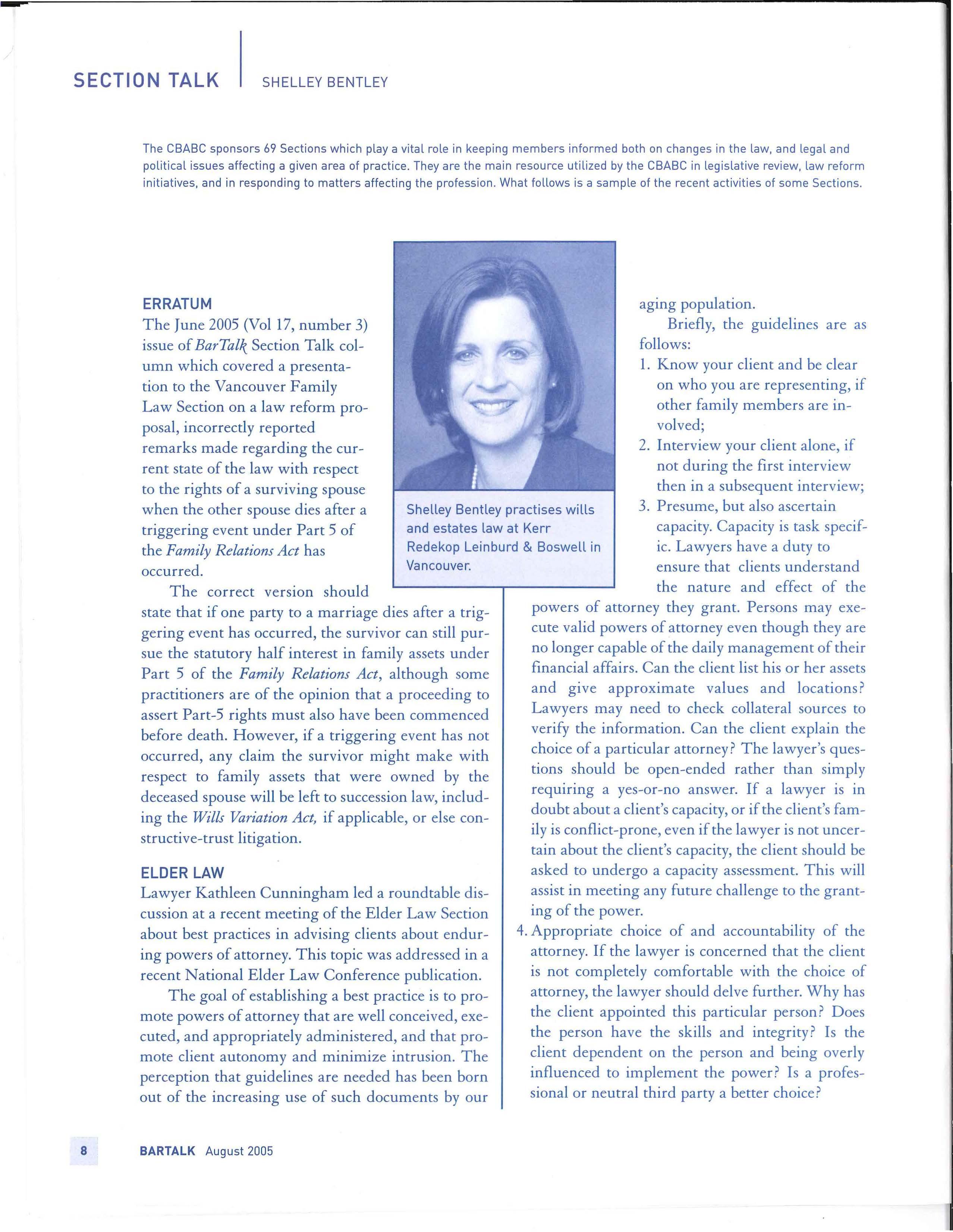
Bentley practises wills and estates law
The corre c t version shou ld state that if one party to a marr iage dies after a triggering event has occurred, the survivor can still pursue the statutory half interest in family assets under Part 5 of the Family Relations Act, although some practitioners are of the opinion that a proceeding to assert Part-5 rights must also have been commenced before death However, if a triggering event has not occurred, any claim the survivor might make with respect to family assets that were owned by the deceased spouse will be left to succession law, including the Wills Variation Act, if applicable, or else constructive - trust litigation.
ELDER LAW
Lawyer Kathleen Cunningham led a roundtable discussion at a recent meeting of the Elder Law Section about best practices in advising clients about enduring powers of attorney. This topic was addressed in a recent Nat ional Elder Law Conference publication.
The goal of establishing a best practice is to promote powers of attorney that are well conceived, executed, and appropriately administered, and that promote client autonomy and minimize intrusion. The perception that guidelines are needed has been born out of the i ncreasing use of such documents by our
Briefly, the guidelines are as fo ll ows:
1. Know your client and be clear on who you are representing, if other family members are involved;
2. Interview your client a lone, if not during the first interview then in a subsequent interview;
3 Presume, but also ascertain capacity. Capacity is task specific. Lawyers have a duty to ensure that clients understand
the nature and effect of the powers of attorney they grant. Persons may execute valid powers of attorney even though they are no longer capable of the daily management of their financial affairs. Can the client list his or her assets and give approximate values and locations? Lawyers may need to check collatera l sources to verify the information. Can the client explain the choice of a particular attorney? The lawyer 's questions should be open-ended rather than simply requiring a yes-or-no answer. If a lawyer is in doubt about a client's capacity, or if the client's family is conflict-prone, even if the lawyer is not uncertain about the client's capacity, the client should be asked to undergo a capacity assessment. This will assist in meeting any future challenge to the granting of the power.
4. Appropriate choice of and accountability of the attorney. If the lawyer is concerned that the client is not completely comfortable with the choice of attorney, the lawyer should delve further. Why has the client appointed this particular person? Does the person have the skills and integrity? Is the client dependent on the person and being overly influenced to implement the power? Is a professional or neutral third party a better choice?
Shelley
at Kerr Redekop Leinburd & Boswell in Vancouver.
5. Advise the attorney. It is recommended that the attorney's fiduciary duties, ethical obligations and standards of care be set out for the attorney 's information, if not in the document itself then in a separate letter. The document could require the attorney to report periodically to the lawyer during the attorney's mandate.
6 Addres s special needs or wishes There is a danger that the client's specific needs are not being addressed in the standard form document frequently used Does the client have assets in another jurisdiction? Will that jurisdiction recognize the power of attorney? Does the client have dependants? Does the client want to compensate the attorney?
FAMILY LAW- VANCOUVER
Professor Rollie Thompson of Dalhousie University gave a presentation on the Draft Proposal for Spousal Support Advisory Guidelines, released by the Department ofJustice on January 27,2005. Professor Thompson is co - author of the Guidelines with Professor Carol Rogerson of the University of Toronto. The guidelines are advisory only; however, it is expected that judges, mediators and lawyers will use them extensively to determine spousal support. The guidelines attempt to mirror current practice under the existing legislative framework and are based on emerging trends and developing patterns in spousal support law. They are not committed to any particular theory of spousal support, but attempt to come up with a formula to reflect existing results found in the case law. The guidelines will not be legislated and will not have binding force. They are intended as a starting point for negotiations.
Professor Thompson gave an overview of the draft guidelines, their structure and the two proposed formulas, "with child support" and "without chi ld support."
At the centre of the proposed spousal support advisory guidelines is the concept of income sharing. Under the proposed approach, the use ofbudgets will be replaced with an income-driven approach to calculation of spousal support. The issue of entitlement is not dealt with under the proposed advisory guidelines.
Two different formulas are needed to deal with spousal support, depending on whether there are
dependent children involved There are different tax treatments, a nd the theory for spousal support may be different depending on whether there are dependent children .
Where there ar e no children, the calculation of spousal support relies heavily on the length of marriage to determine both quantum and duration . Gross - income figures are used and the calculation is fairly simple Where there are dependent children there are compensatory claims flowing from the assumption of primary responsibility for the children, both during the marriage and aft e r marriage breakdown. Quantum will b e calculated taking into consideration the payment of child support . In addition , there are different tax treatments of spousal and child support that need to be addressed.
The proposed advisory guidelines will deal with duration as well as quantum an d will provide narrow ranges for these figures. Differing fa ct situations will allow for appropriate negotiat ion wi t hin those ranges. They will set down the circumstances in which support will be indefinite.
In order for the advisory guidelines to be useful to lawyers and judges , Professor Thompson commented th a t they must reflect current outcomes while providing structure a nd consistency, in order to reduce the transactional cost of negotiation. However, he recognized that ther e will be cases outside of the norm for which the guidelines will not be appropriate. Exceptions will be formulated to allow departures from the formul a s. The exceptions will not be e x haustive , but will try to limit the cases where departures from the formu las are appropriate. BT
Women Lawyers Forum Event
The CBABC Women Lawyers Forum invites you to attend a luncheon with :
The Rt. Han Beverley Mclachlin, Chief Justice of Canada , speaking on "WHY WE NEED WOMEN IN LAW', January 27, 2006.
Please mark your calendars and look for further details in the next issue of BarTalk
Pacific Legal Technology Conference 2005
Paper to Pixels Transforming the Practice of Law
}, The future's in the air I can fee l it everywhere }, Blowing with the wind of change Words and music by Klaus Meine, recorded by The Scorpions.
The 3rd Pacific . Legal Technology Conference (PLTC) is coming to Vancouver on Friday, October 14,2005 at the Vancouver Trade and Convention Centre (Canada Place). For those who haven't attended a PLTC before, it is comprised of several components. First and foremost are the 16 hours of pure educational pre-
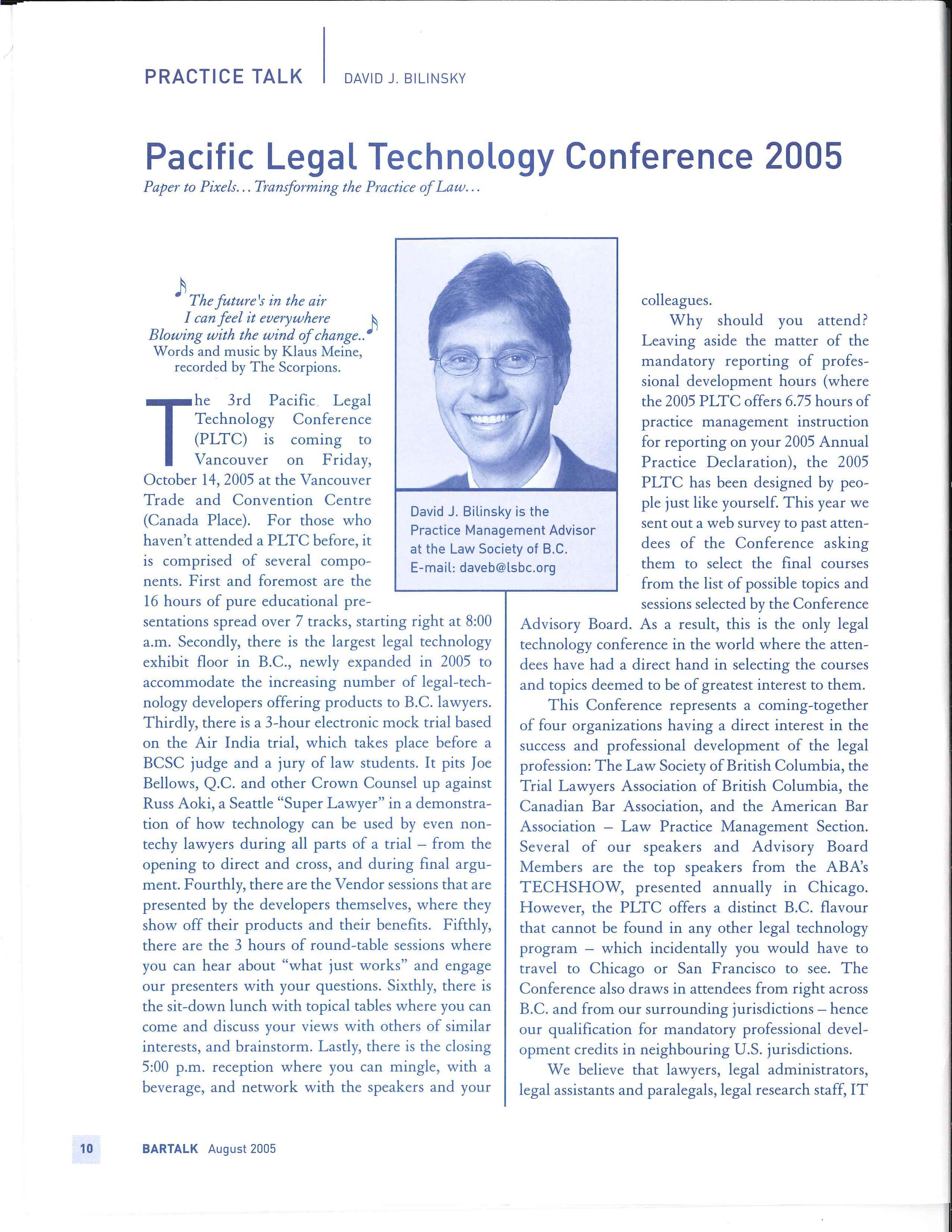
David J. B i linsky is
the
colleagues.
Why should you attend?
Leaving aside the matter of the mandatory reporting of professional development hours (where the 2005 PLTC offers 6.75 hours of practice management instruction for reporting on your 2005 Annual Practice Declaration), the 2005 PLTC has been designed by people just like yourself. This year we sent out a web survey to past attendees of the Conference asking them to select the final courses from the list of possible topics and Practice Management Adv i sor at the Law Society of B C E-mail: daveb@lsbc.org
sentations spread over 7 tracks, starting right at 8:00 a.m. Secondly, there is the largest legal technology exhibit floor in B C., newly expanded in 2005 to accommodate the increasing number of legal-technology developers offering products to B.C. lawyers. Thirdly, there is a 3-hour electronic mock trial based on the Air India trial, which takes place before a BCSC judge and a jury of law students. It pits Joe Bellows, Q.C. and other Crown Counsel up against Russ Aoki, a Seattle "Super Lawyer" in a demonstration of how technology can be used by even nontechy lawyers during all parts of a trial - from the opening to direct and cross, and during final argument. Fourthly, there are the Vendor sessions that are presented by the developers themselves, where they show off their products and their benefits. Fifthly, there are the 3 hours of round-table sessions where you can hear about "what just works" and engage our presenters with your questions. Sixthly, there is the sit-down lunch with topica l tables where you can come and discuss your views with others of similar interests, and brainstorm. Lastly, there is the closing 5:00 p.m. reception where you can mingle, with a beverage, and network with the speakers and your
sessions selected by the Conference Advisory Board. As a result, this is the only legal technology conference in the world where the attendees have had a direct hand in selecting the courses and topics deemed to be of greatest interest to them This Conference represents a coming - together of four organizations having a direct interest in the success and professional development of the legal profession: The Law Society of British Columbia, the Trial Lawyers Association of British Columbia, the Canadian Bar Association, and the American Bar Association - Law Practice Management Section . Several of our speakers and Advisory Board Members are the top speakers from the ABA's TECHSHOW, presented annually in Chicago. However, the PLTC offers a distinct B.C. flavour that cannot be found in any other legal technology program - which incidentally you would have to travel to Chicago or San Francisco to see. The Conference also draws in attendees from right across B.C. and from our surrounding jurisdictions- hence our qualification for mandatory professional development credits in neighbouring U.S. jurisdictions. We believe that lawyers, legal administrators, legal assistants and paralegals, legal research staff, IT
professionals, and others can all stand to benefit from this Conference. All the sessions have an indicated "technical level" - from "green circle" to "blue square" or "black diamond" - in order that you can select courses appropriate to you.
Speaking of the speakers, the educational sessions are all presented by lawyers, legal researchers, law office administrators, IT professionals - but not vendors (who have the exclusive control of the Vendors' Track). At the educational sessions, you are hearing it from people just like yourself who are "in the trenches," and who have wrestled with the issues and the problems, and who have come prepared to share their experiences and their views, warts and all.
We have leading speakers from both inside B.C. and elsewhere - people like Ross Kodner, a top presenter on legal technology across North America, Jeff Flax, National Co-ordinator of Technology for the Office of the U.S.
Public Defender, and Tom Grella, the upcommg chair of the ABA's
to "kick the tires" and see the largest collection of legal technology offerings anywhere in B.C. This is an opportunity to see and discuss how these technologies can be applied to a practice just like yours.
When it comes to going to court, there is nothing like seeing stuff in action. Accordingly, the electronic mock trial is our way of not just ta l king about technology - we put it on trial! The electronic mock trial has been the highest rated of all the sessions at past PLTC's.
The Conference includes a continental breakfast prior to our 8:00 a.m. start and also includes a sitdown lunch and coffee breaks.
The price is $295 +taxes= $315.65 for the earlybird registration until Sept 16, 2005- after that date registration is $395 + taxes = $422.65. We believe that this price offers incredible value, but for the final word on the conference, we turn to our past attendees. In the written evaluations received
to their colleagues."
F u
Conference information including the Conference session schedule, speaker information, and registration forms can be found at www.pacificlegaltech.com.
The future is in the air. I hope that the winds of change find you at the Pacific Legal Technology Conference come this October! BT
In the written evaluations received from the last conference, without exception the past attendees said, "They would from the last conference, without exception the past attendees said, "They would recommend this Conference Law Practice Management Section. From across Canada, we have Simon recommend this Conference to their colleagues." Chester and Dan Pinnington from Toronto, bringing their acclaimed session on using PowerPoint direct from ABA Techshow, together with Cory Furman, an IP lawyer showing how technology can be applied for great results in small firms. And last but certainly not least we have 23 other top presenters from B.C., drawn from all sizes of firms and areas of practice, who are ready, willing and able to share with you how they have applied technology to their practices.
The sessions are divided among 8 tracks such as litigation, e-novations (focusing at the changes in efiling, e-searching and e-practice in the B C. Government registries), Effective Tools Track, Tips and Techniques Track, and others.
The Vendor track and exhibitor floor allows you
The views expressed herein are strictly those of the author and may not be shared by the author"s employer, the Law Society of B.C.
Married to the Law (Sort of)
When I first started this column two years ago, I said I'd write something on what two married lawyers talk about at home, given the fact that my wife is also a lawyer. It's is a topic we're asked with amazing regularity. When people first meet us as a couple, they seem shocked that we ' re both lawyers, forgetting the fact that teachers marry teachers, policemen marry policewomen and actor s marry - and divorceactresses with incessant regularity. "Oh, you two must be rolling in dough" has been a staple comment from acquaintances in the public
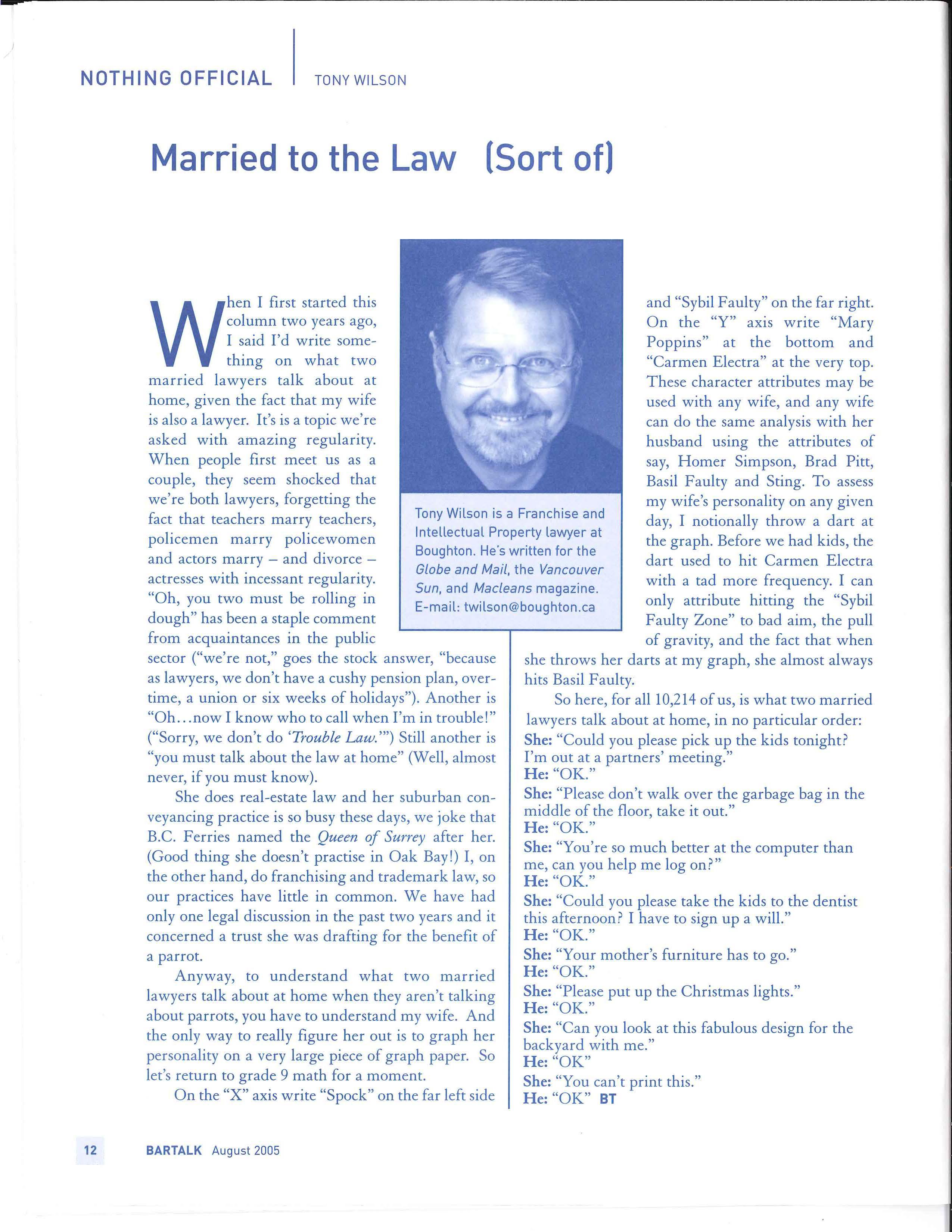
Tony Wilson is a Franchise and Intellectual Property lawyer at Boughton. He's written for the Globe and Mail, the Vancouver
Sun, and Macleans magazine E-mail: twilson@boughton .ca
sector ("we're not," goes the stock answer, "because as lawyers, we don't have a cushy pension plan, overtime, a union or six weeks of holidays"). Another is "Oh now I know who to call when I'm in trouble!" ("Sorry, we don't do 'Trouble Law."') Still another is "you must talk about the law at home " (Well , almost never, if you must know)
She does real-estate law and her suburban conveyancing practice is so busy these days, we joke that B.C. Ferries named the Queen of Surrey after her. (Good thing she doesn't practise in Oak Bay!) I , on the other hand, do franchising and trademark law, so our practices have little in common We have had only one legal discussion in the past two years and it concerned a trust she was drafting for the benefit of a parrot.
Anyway, to understand what two married lawyers talk about at home when they aren't talking about parrots, you have to understand my wife And the only way to really figure her out is to graph her personality on a very large piece of graph paper. So let's return to grade 9 math for a moment
On the "X" axis write "Spock" on the far left side 12 BARTALK Augus t 2005
and "Sybil Faulty" on the far right. On the "Y" axis write "Mary Poppins" at the bottom and "Carmen Electra" at the very top These character attributes may be used with any wife, and any wife can do the same analysis with her husband using the attributes of say, Homer Simpson, Brad Pitt, Basil Faulty and Sting To assess my wife's personality on any given day, I notionally throw a dart at the graph. Before we had kids, the dart used to hit Carmen Electra with a tad more frequency I can only attribute hitting the "Sybil Faulty Zone" to bad aim, the pull
of gravity, and the fact that when she throws her darts at my graph, she almost always hits Basil Faulty.
So here , for alll 0,214 of us, is what two married lawyers talk about at home, in no particular order:
She: "Could you please pick up the kids tonight? I'm out at a partners' meeting."
He:"OK ."
She: "Please don't walk over the garbage bag in the middle of the floor, take it out."
He:"OK."
She: "You're so much better at the computer than me, can you help me log on?"
He:"OK."
She: "Could you please take the kids to the dentist this afternoon? I have to sign up a will."
He:"OK."
She: "Your mother's furniture has to go " He:"OK "
She : "Please put up the Christmas lights." He:"OK."
She: "Can you look at this fabulous design for the backyard with me. "
He:"OK"
She: "You can't print this."
He: "OK" BT
Professional Development
Resources Online
The CBA offers many benefits to its members, such as professional development through Sections and CBA National CLE programs. Sections are practice-focused groups designed to meet the educational, advocacy and professional needs oflawyers. No other legal organization in Canada has the scope and depth of experts influencing legislative reform , contributing to legal education, and exchanging practical advice. Section membership provides you with an excellent means to enhance your legal expertise, net-
work, a nd contribute to your profession.
ing, and networking. The recently created National WLF provides a forum for sharing resources with other legal jurisdictions, women in the judiciary, other professions, and organizations of professional women. For more information about the WLF visit cba.org/bc/sections_groups.
The CBA MLA Network, under the jurisdiction of the Government Relations Committee, plays a pivotal ro le as the profession's first line of contact with elected provincia l officials. The MLA Network pairs members of Manager, Interactive Med ia. She welcomes your comments, questions and suggestions Tel: 604-646-7861
E-mail : pjordan@bccba org
Enrolment in Sections offers you quick update s in your area of practice and is a great way to st a y current and satisfy the Law Society 's recommended t a rgets for professional development. In 2006, many Section meetings will be held by teleconference, making it easier for you to attend. Section members have online access to meeting notices, minutes, executive contact inform a tion, and more at cba.org/bc in "Sections & Groups. "
Many interesting and informative papers are presented to members of various Sections and are distributed to Section members. To assist you in receiving these papers if you are not enrolled in specific Sections, the Branch publishes quarterly lists of all available Section Papers. As a benefit of CBA membership , Section Papers are published online in "CBA Publications."
Special-interest groups are also an excellent resource for professional development. The very successful B.C. Women Lawyers Forum (WLF) promotes the stature and interests of women in the legal profession through programs for educ a tion, mentor-
Provincial Council with each of B.C.'s MLAs at a local, or constituency level. Network members work to foster dialogue and consultation between government and the Bar, and to advance the profession's position on key issues and legislation. Learn more about the Network and its objectives at cba.org/bc in "Sections & Groups."
The CBA offers a full range of National Conferences that provide a va luable skills - improvement forum and an opportunity to exchange ideas with colleagues and Bar leaders from across Canada and around the world. W ith your Conference membership, you'll enjoy many advantages such as referral networks, mentoring programs, and networking opportunities with colleagues, governments, and related national and international organizations. National Conferences also provide leading - edge bulletins and programs on practice tips, substantive legal developments, and coming trends in practice and in the law. Newsletters, handbooks, videos, and other products to assist you in your day-to-day practice are also available. For more information, visit cba org/ CBNgroups/main. BT
See site du jour on page 18
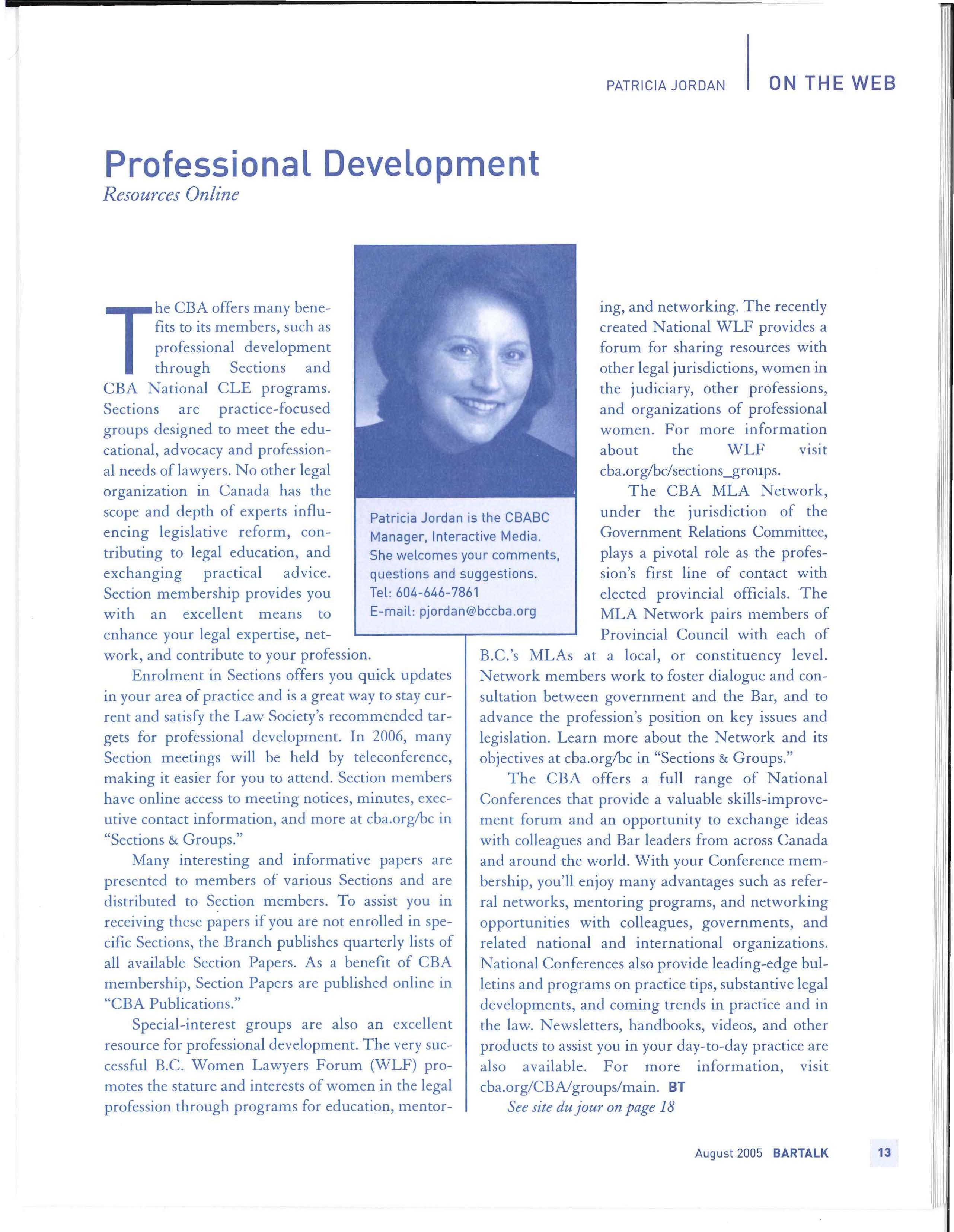
Patricia Jordan is the CBABC
Executive Committee 2005/2006
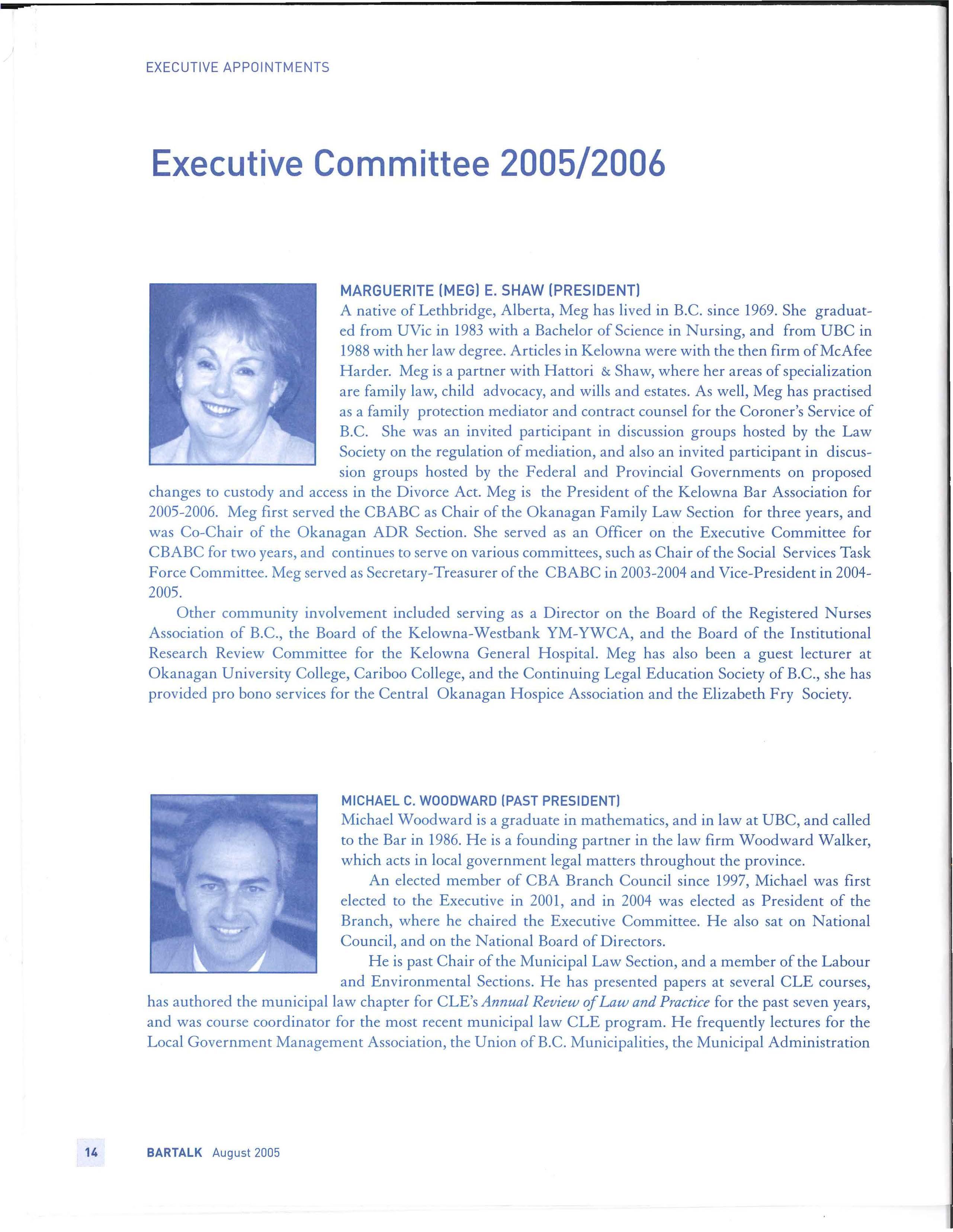
MARGUERITE !MEG) E. SHAW !PRESIDENT)
A native of Lethbridge, Alberta, Meg has lived in B.C. since 1969. She graduated from UVic in 1983 with a Bachelor of Science in Nursing, and from UBC in 1988 with her law degree. Articles in Kelowna were with the then firm of McAfee Harder. Meg is a partner with Hattori & Shaw, where her areas of specialization are family law, child advocacy, and wills and estates. As well, Meg has practised as a family protection mediator and contract counsel for the Coroner's Service of B .C. She was an invited participant in discussion groups hosted by the Law Society on the regulation of mediation, and also an invited participant in discussion groups hosted by the Federal and Provincial Governments on proposed changes to custody and access in the Divorce Act. Meg is the President of the Kelowna Bar Association for 2005-2006 Meg first served the CBABC as Chair of the Okanagan Family Law Section for three years, and was Co-Chair of the Okanagan ADR Section. She served as an Officer on the Executive Committee for CBABC for two years , and continues to serve on various committees, such as Chair of the Social Services Task Force Committee. Meg served as Secretary- Treasurer of the CBABC in 2003-2004 and Vice-President in 20042005.
Other community involvement included serving as a Director on the Board of the Registered Nurses Association of B.C., the Board of the Kelowna-Westbank YM-YWCA, and the Board of the Institutional Research Review Committee for the Kelowna General Hospital. Meg has also been a guest lecturer at Okanagan University College, Cariboo College, and the Continuing Legal Education Society of B.C., she has provided pro bono services for the Central Okanagan Hospice Association and the Elizabeth Fry Society.
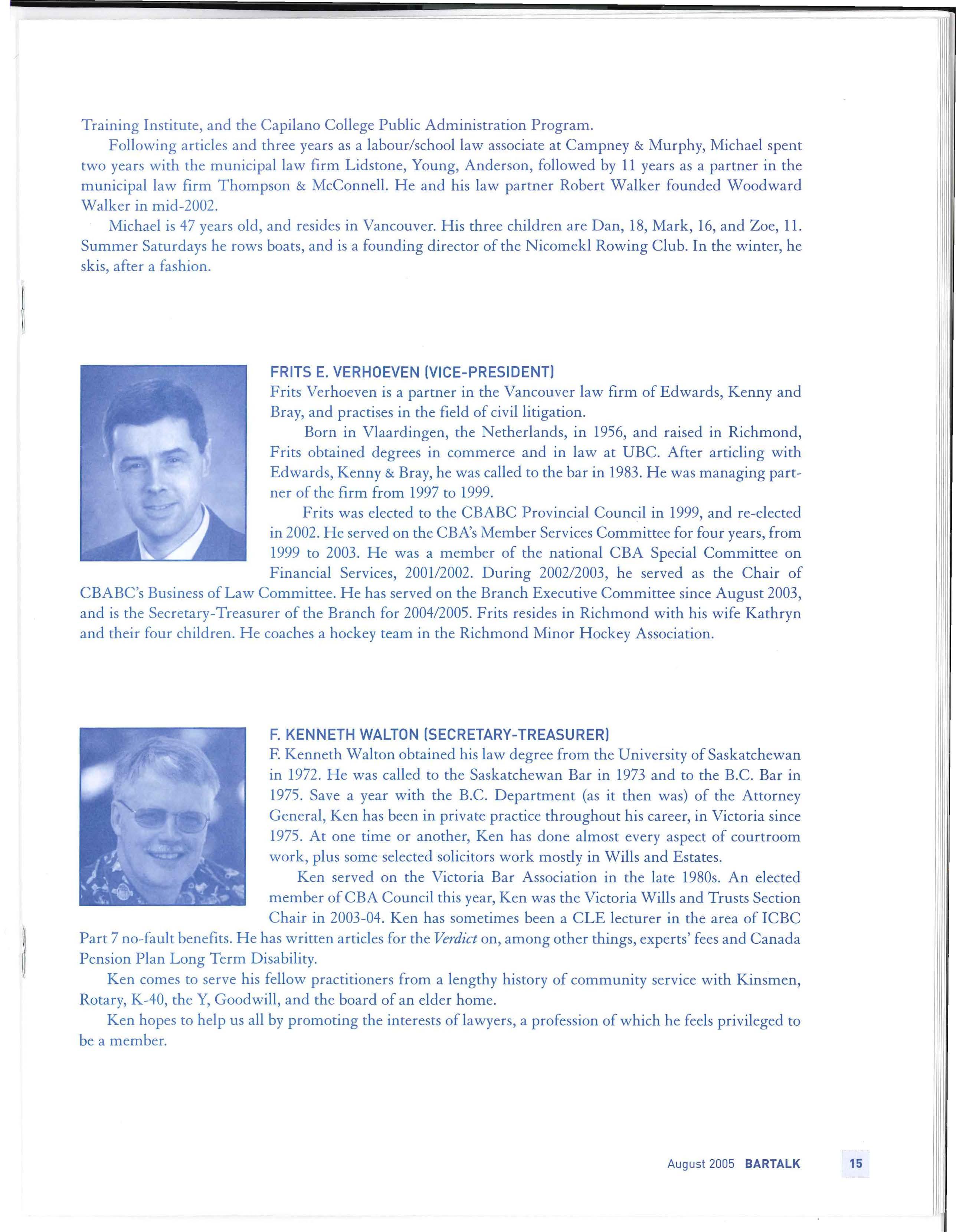
MICHAEL C. WOODWARD (PAST PRESIDENT)
Michael Woodward is a graduate in mathematics, and in law at UBC, and called to the Bar in 1986. He is a founding partner in the law firm Woodward Walker, which acts in local government legal matters throughout the province.
An elected member of CBA Branch Council since 1997, Michael was first elected to the Executive in 2001, and in 2004 was elected as President of the Branch, where he chaired the Executive Committee. He also sat on National Council, and on the National Board of Directors.
He is past Chair of the Municipal Law Section, and a member of the Labour and Environmental Sections. He has presented papers at several CLE courses, has authored the municipal law chapter for CLE's Annual Review of Law and Practice for the past seven years, and was course coordinator for the most recent municipal law CLE program. He frequently lectures for the Local Government Management Association, the Union of B.C. Municipalities, the Municipal Administration
Training Institute, and the Capilano College Public Administration Program.
Following articles and three years as a labour/school law associate at Campney & Murphy, Michael spent two years with the municipal law firm Lidstone, Young , Anderson, followed by 11 years as a partner in the municipal law firm Thompson & McConnell. He and his law partner Robert Walker founded Woodward Walker in mid-2002.
Michael is 47 years old, and resides in Vancouver. His three children are Dan, 18, Mark, 16, and Zoe, 11. Summer Saturdays he rows boats, and is a founding director of the Nicomekl Rowing Club. In the winter, he skis, after a fashion.
FRITS E. VERHOEVEN (VICE-PRESIDENT)
Frits Verhoeven is a partner in the Vancouver law firm of Edwards, Kenny and Bray, and practises in the field of civil litigation.
Born in Vlaardingen, the Netherlands, in 1956, and raised in Richmond, Frits obtained degrees in commerce and in law at UBC. After articling with Edwards, Kenny & Bray, he was called to the bar in 1983. He was managing partner of the firm from 1997 to 1999
Frits was elected to the CBABC Provincial Council in 1999, and re-elected in 2002. He served on the CBA's Member Services Committee for four years, from 1999 to 2003. He was a member of the national CBA Special Committee on Financial Services, 200112002. During 2002/2003, he served as the Chair of CBABC's Business of Law Committee. He has served on the Branch Executive Committee since August 2003, and is the Secretary- Treasurer of the Branch for 2004/2005. Frits resides in Richmond with his wife Kathryn and their four children. He coaches a hockey team in the Richmond Minor Hockey Association.
F. KENNETH WALTON (SECRETARY- TREASURER)
F. Kenneth Walton obtained his law degree from the University of Saskatchewan in 1972. He was called to the Saskatchewan Bar in 1973 and to the B.C. Bar in 1975. Save a year with the B C. Department (as it then was) of the Attorney General, Ken has been in private practice throughout his career, in Victoria since 1975. At one time or another, Ken has done almost every aspect of courtroom work, plus some selected solicitors work mostly in Wills and Estates.
Ken served on the Victoria Bar Association in the late 1980s. An elected member ofCBA Council this year, Ken was the Victoria Wills and Trusts Section Chair in 2003-04. Ken has sometimes been a CLE lecturer in the area of ICBC Part 7 no-fault benefits. He has written articles for the Verdict on, among other things, experts' fees and Canada Pension Plan Long Term Disability.
Ken comes to serve his fellow practitioners from a lengthy history of community service with Kinsmen, Rotary, K-40 , the Y, Goodwill, and the board of an elder home.
Ken hopes to help us all by promoting the interests of lawyers, a profession of which he feels privileged to be a member.
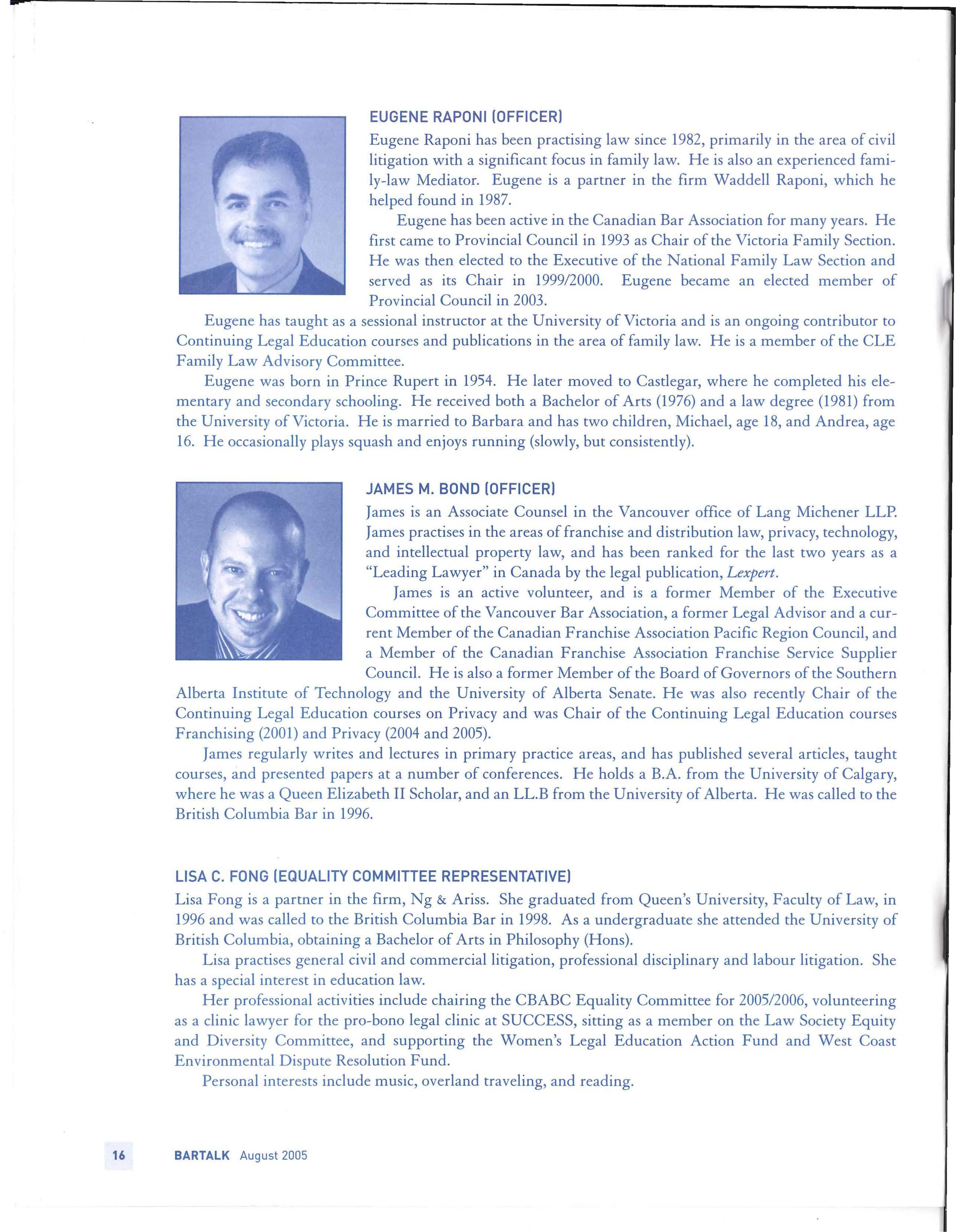
EUGENE RAPONI (OFFICER)
Eugene Raponi has been practising law since 1982, primarily in the area of civil litigation with a significant focus in family law He is also an experienced family-law Mediator. Eugene is a partner in the firm Waddell Raponi, which he helped found in 1987.
Eugene has been active in the Canadian Bar Association for many years He first came to Provincial Council in 1993 as Chair of the Victoria Family Section. He was then elected to the Executive of the National Family Law Section and served as its Chair in 1999/2000 . Eugene became an elected member of Provincial Council in 2003
Eugene has taught as a sessional instructor at the University of Victoria and is an ongoing contributor to Continuing Legal Education courses and publications in the area of family law. He is a member of the CLE Family Law Advisory Committee
Eugene was born in Prince Rupert in 1954 . He later moved to Castlegar, where he completed his elementary and secondary schooling. He received both a Bachelor of Arts (1976) and a law degree (1981) from the University of Victoria . He is married to Barbara and has two children, Michael, age 18, and Andrea , age 16. He occasionally plays squash and enjoys running (slowly, but consistently)
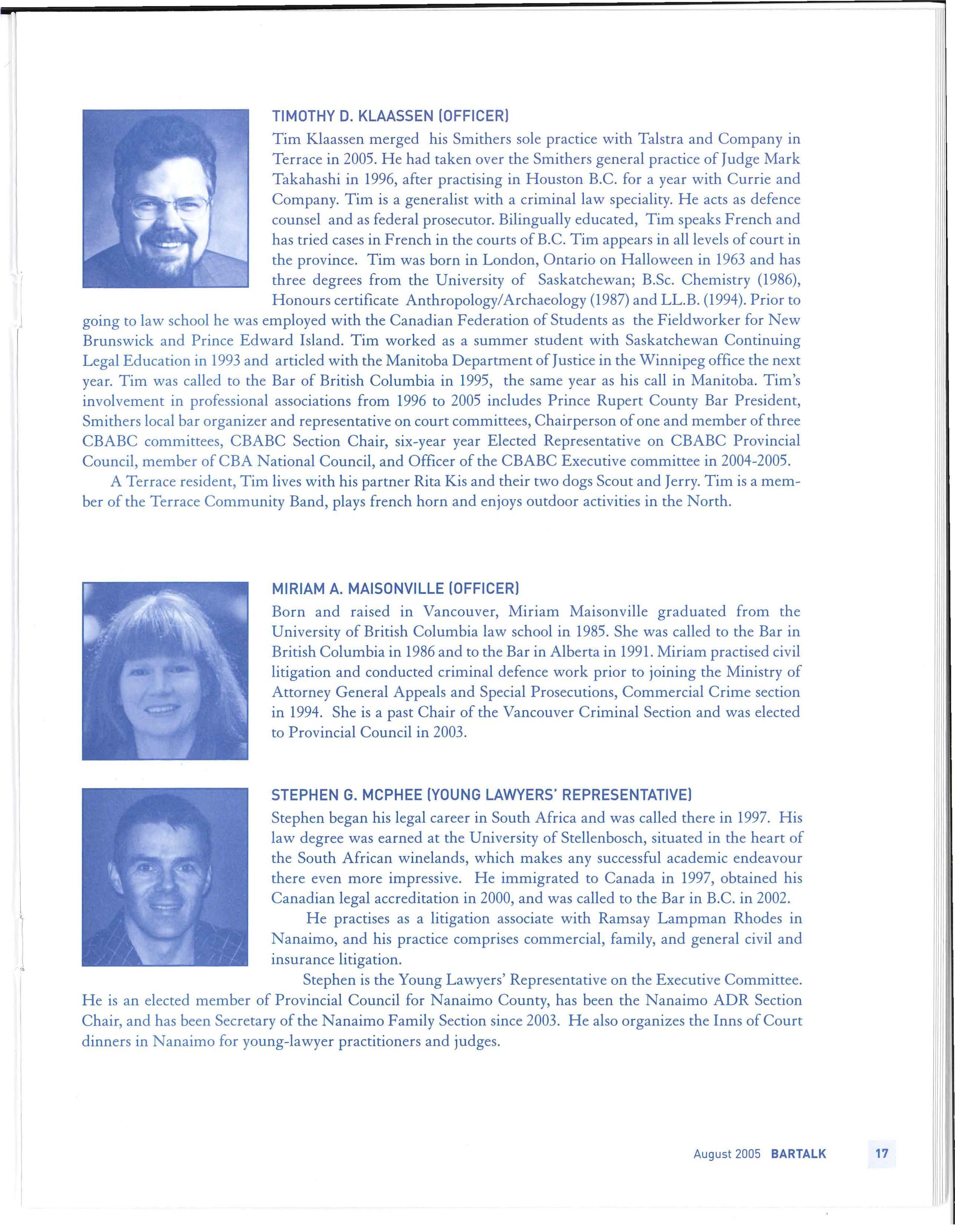
JAMES M. BOND (OFFICER)
James is an A sso ciate Counsel in the Vancouver office of Lang Michener LLP. James practises in the areas of fran chise and distribution law, privacy, technology, and intellectual property law, and has been ranked for the last two years as a "Leading Lawyer" in Canada by the legal publication, Lexpert.
James is an active volunteer, and is a former Member of the Executive Committee of the Vancouver Bar Association, a former Legal Advisor and a current Member of the Canadian Franchise Association Pacific Region Council, and a Member of the Canadian Franchise Association Franchise Service Supplier Council. He is also a former Member of the Board of Governors of the Southern Alberta Institute of Technology and the University of Alberta Senate. He was also recently Chair of the Continuing Legal Education courses on Privacy and was Chair of the Continuing Legal Education courses Franchising (2001) and Privacy (2004 and 2005) .
James regularly writes and lectures in primary practice areas, and has published several articles, taught courses, and presented papers at a number of conferences. He holds a B.A. from the University of Calgary, where he was a Queen Elizabeth II Scholar, and an LL.B from the University of Alberta. He was called to the British Columbia Bar in 1996.
LISA C. FONG (EQUALITY COMMITTEE REPRESENTATIVE)
Lisa Fong is a partner in the firm, Ng & Aris s. She graduated from Queen's University, Faculty of Law, in 1996 and was called to the British Columbia Bar in 1998. As a undergraduate she attended the University of British Columbia, obtaining a Ba chelor of Arts in Philosophy (Hons).
Lisa practises general civil and commercial litigation, professional disciplinary and labour litigation. She has a special interest in education law.
Her profession a l activities include chairing the CBABC Equality Committee for 2005/2006, volunteering as a clinic lawyer for the pro-bono legal clinic at SUCCESS, sitting as a member on the Law Society Equity and Diversity Committee, and supporting the Women's Legal Education Action Fund and West Coast Environment a l Dispute Resolution Fund.
Personal interests include music, overland traveling, and reading.
TIMOTHY D. KLAASSEN (OFFICER)
Tim Klaassen merged his Smithers sole practice with Talstra and Company in Terrace in 2005. He had taken over the Smithers general practice of Judge Mark Takahashi in 1996, after practising in Houston B.C. for a year with Currie and Company Tim is a generalist with a criminal law speciality. He acts as defence counsel and as federal prosecutor. Bilingually educated, Tim speaks French and has tried cases in French in the courts of B.C. Tim appears in all levels of court in the province. Tim was born in London, Ontario on Halloween in 1963 and has three degrees from the University of Saskatchewan; B.Sc. Chemistry (1986), Honours certificate Anthropology/Archaeology (1987) and LL.B. (1994). Prior to going to law school he was employed with the Canadian Federation of Students as the Field worker for New Brunswick and Prince Edward Island. Tim worked as a summer student with Saskatchewan Continuing Legal Education in 1993 and articled with the Manitoba Department ofJustice in the Winnipeg office the next year. Tim was called to the Bar of British Columbia in 1995, the same year as his call in Manitoba. Tim's involvement in professional associations from 1996 to 2005 includes Prince Rupert County Bar President, Smithers local bar organizer and representative on court committees, Chairperson of one and member of three CBABC committees, CBABC Section Chair, six-year year Elected Representative on CBABC Provincial Council, member of CBA National Council, and Officer of the CBABC Executive committee in 2004 -2005
A Terrace resident, Tim lives with his partner Rita Kis and their two dogs Scout and Jerry. Tim is a member of the Terrace Community Band, plays french horn and enjoys outdoor activities in the North.
MIRIAM A. MAISONVILLE (OFFICER)
Born and raised in Vancouver, Miriam Maisonville graduated from the University of British Columbia law school in 1985. She was called to the Bar in British Columbia in 1986 and to the Bar in Alberta in 1991. Miriam practised civil litigation and conducted criminal defence work prior to joining the Ministry of Attorney General Appeals and Special Prosecutions, Commercial Crime section in 1994. She is a past Chair of the Vancouver Criminal Section and was elected to Provincial Council in 2003.
STEPHEN G. MCPHEE (YOUNG LAWYERS" REPRESENTATIVE)
Stephen began his legal career in South Africa and was called there in 1997. His law degree was earned at the University of Stellenbosch, situated in the heart of the South African winelands, which makes any successful academic endeavour there even more impressive. He immigrated to Canada in 1997, obtained his Canadian legal accreditation in 2000, and was called to the Bar in B.C. in 2002.
He practises as a litigation associate with Ramsay Lampman Rhodes in Nanaimo, and his practice comprises commercial, family, and general civil and insurance litigation.
Stephen is the Young Lawyers' Representative on the Executive Committee. He is an elected member of Provincial Council for Nanaimo County, has been the Nanaimo ADR Section Chair, and has been Secretary of the Nanaimo Family Section since 2003 He also organizes the Inns of Court dinners in Nan a imo for young -lawyer practitioners and judges.
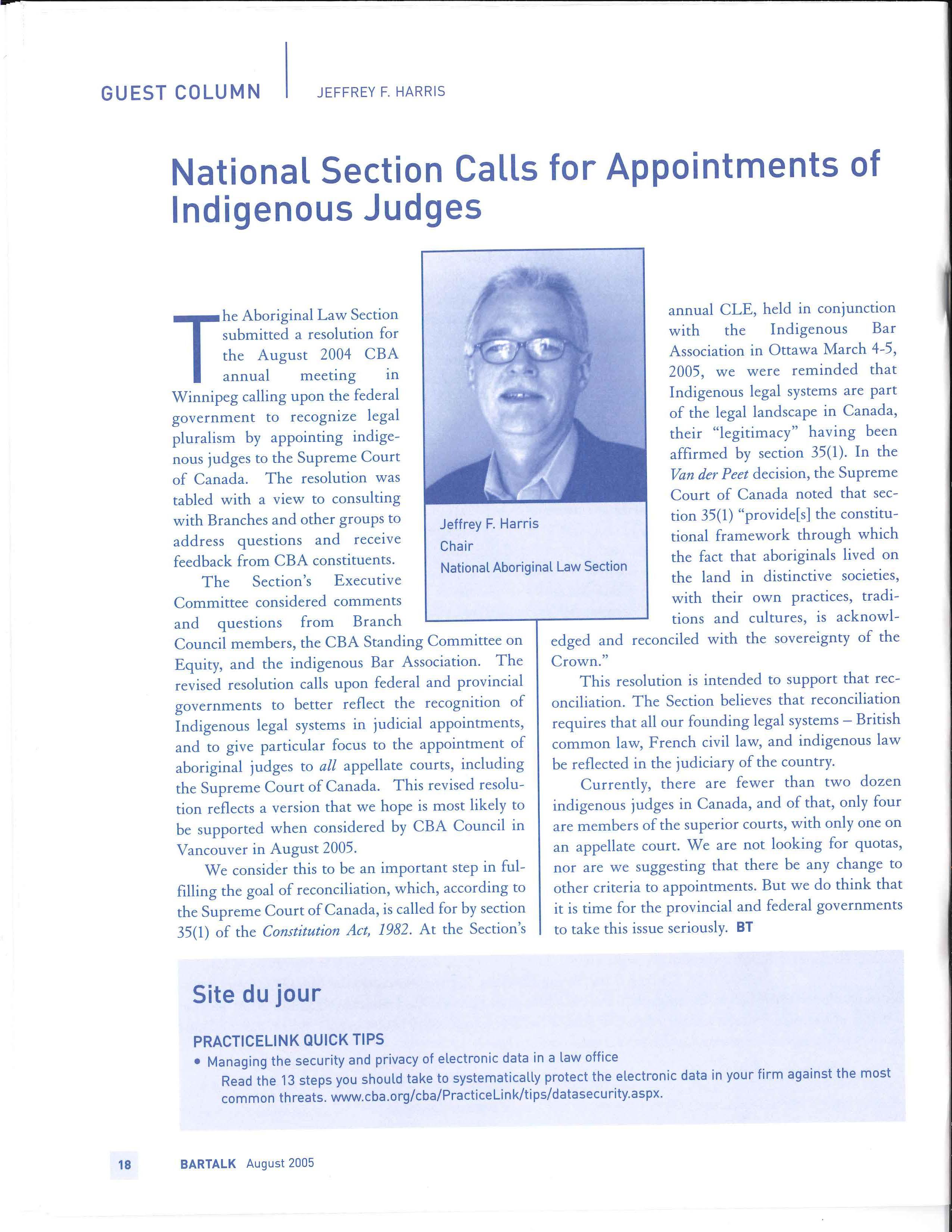
National Section Calls for Appointments of Indigenous Judges
The Aboriginal Law Section submitted a resolution for the August 2004 CBA annual meeting in Winnipeg calling upon the federal government to recognize legal pluralism by appointing indigenous judges to the Supreme Court of Canada . The resolution was
tabled with a view to consulting with Branches and other groups to address questions and receive feedback from CBA constituents.
The Section's Executive Committee considered comments
Jeffrey F. Harris Chair
National Aboriginal Law Section
annual CLE, held in conjunction with the Indigenous Bar Association in Ottawa March 4-5, 2005, we were reminded that Indigenous legal systems are part of the legal landscape in Canada, their "legitimacy" having been affirmed by section 35(1). In the Van der Peet decision , the Supreme Court of Canada noted that section 35(1) "provide[s] the constitu-
tional framework through which the fact that aboriginals lived on the land in distinctive societies, with their own practices, traditions and cultures , is acknowl- and questions from Branch Council members , the CBA Standing Committee on Equity, and the indigenous Bar Association. The revised resolution calls upon federal and provincial governments to better reflect the recognition of Indigenous legal systems in judicial appointments, and to give particular focus to the appointment of aboriginal judges to all appellate courts , including the Supreme Court of Canada. This revised resolution reflects a version that we hope is most likely to be supported when considered by CBA Council in Vancouver in August 2005.
We consider this to be an important step in fulfilling the goal of reconciliation , which, according to the Supreme Court of Canada, is called for by section 35(1) of the Constitution Act, 1982 . At the Section 's Site du jour
PRACTICELINK QUICK TIPS
edged and reconciled with the sovereignty of the Crown ."
This resolution is intended to support that reconciliation The Section believes that reconciliation requires that all our founding legal systems- British common law, French civil law, and indigenous law be reflected in the judiciary of the country. Currently, there are fewer than two dozen indigenous judges in Canada, and of that, only four a re members of the superior courts , with only one on an appellate court. We are not looking for quotas, nor are we suggesting that there be any change to other criteria to appointments . But we do think that it is time for the provincial and federal governments to take this issue seriously. BT
• Managing the security and privacy of electronic data in a law office
Read the 13 steps you should take to systematically protect the electronic data in your firm against the most common threats www.cba.org/cba/Practicelink/tips/datasecurity.aspx.
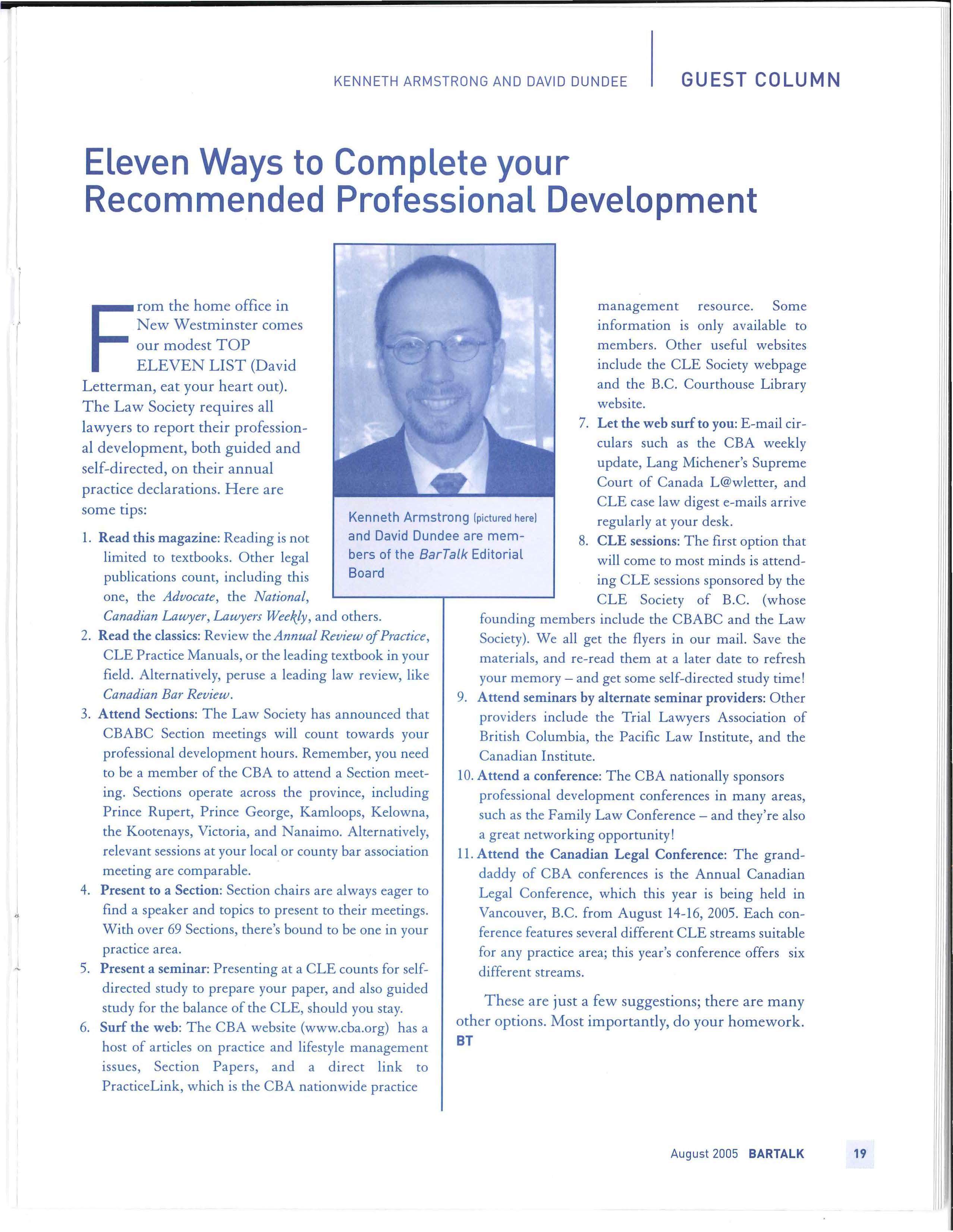
Eleven Ways to Complete your Recommended Professional Development
From the home office in New Westminster comes our modest TOP ELEVEN LIST (David
management resource. Some information is only avai lable to members Other useful websites include the CLE Society webpage and the B.C. Courthouse Library website. Letterman, eat your heart out). The Law Society requires all lawyers to report their professional development, both guided and self-directed, on their annual practice declarations. Here are some tips:
1. Read this magazine: Reading is not limited to textbooks. Other lega l publications count, including this one, the Advocate, the National,
Kenneth Armstrong !pictured here I and David Dundee are members of the Bar Talk Editorial
7. Let the web surf to you: E - mail circulars such as the CBA weekly update, Lang Michener's Supreme Court of Canada L@w letter, and CLE case law digest e -mai ls arrive regularly at your desk .
8. CLE sessions: The first option that will come to most minds is attending CLE sessions sponsored by the CLE Society of B.C (whose Board Canadian Lawyer, Lawyers Weekly, and others.
2. Read the classics: Review the Annual Review of Practice, CLE Practice Manuals, or the leading textbook in your field. Alternatively, peruse a leading law review, like Canadian Bar Review.
3 Attend Sections: The Law Society has announced that CBABC Section meetings will count towards your professional development hours. Remember, you need to be a member of the CBA to attend a Section meeting. Sections operate across the province, including Prince Rupert, Prince George, Kamloops, Kelowna, the Kootenays, Victoria, and Nanaimo. Alternatively, relevant sessions at your local or county bar association meeting are comparable.
4. Present to a Section: Section chairs are always eager to find a speaker and topics to present to their meetings. With over 69 Sections, there's bound to be one in your practice area
5. Present a seminar: Presenting at a CLE counts for selfdirected study to prepare your paper, and also guided study for the balance of the CLE, should you stay.
6. Surf the web: The CBA website (www.cba.org) has a host of articles on practice and lifestyle management issues, Section Papers , and a direct link to PracticeLink, which is the CBA nationwide practice
founding members include the CBABC and the Law Society). We all get the flyers in our mail. Save the materials, and re-read them at a later date to refresh your memory- and get some self-directed study time!
9. Attend seminars by alternate seminar providers : Other providers include the Trial Lawyers Assoc iation of British Columbia, the Pacific Law Institute, and the Canadian Institute.
10. Attend a conference : The CBA nationally sponsors professional development conferences in many areas, such as the Family Law Conference- and they're also a great networking opportunity!
11. Attend the Canadian Legal Conference: The granddaddy of CBA conferences is the Annual Canadian Legal Conference, which this year is being held in Vancouver, B.C. from August 14-16, 2005. Each conference features several different CLE streams suitable for any practice area; this year's conference offers SI X different streams
These are just a few suggestions; there are many other options. Most importantly, do your homework.
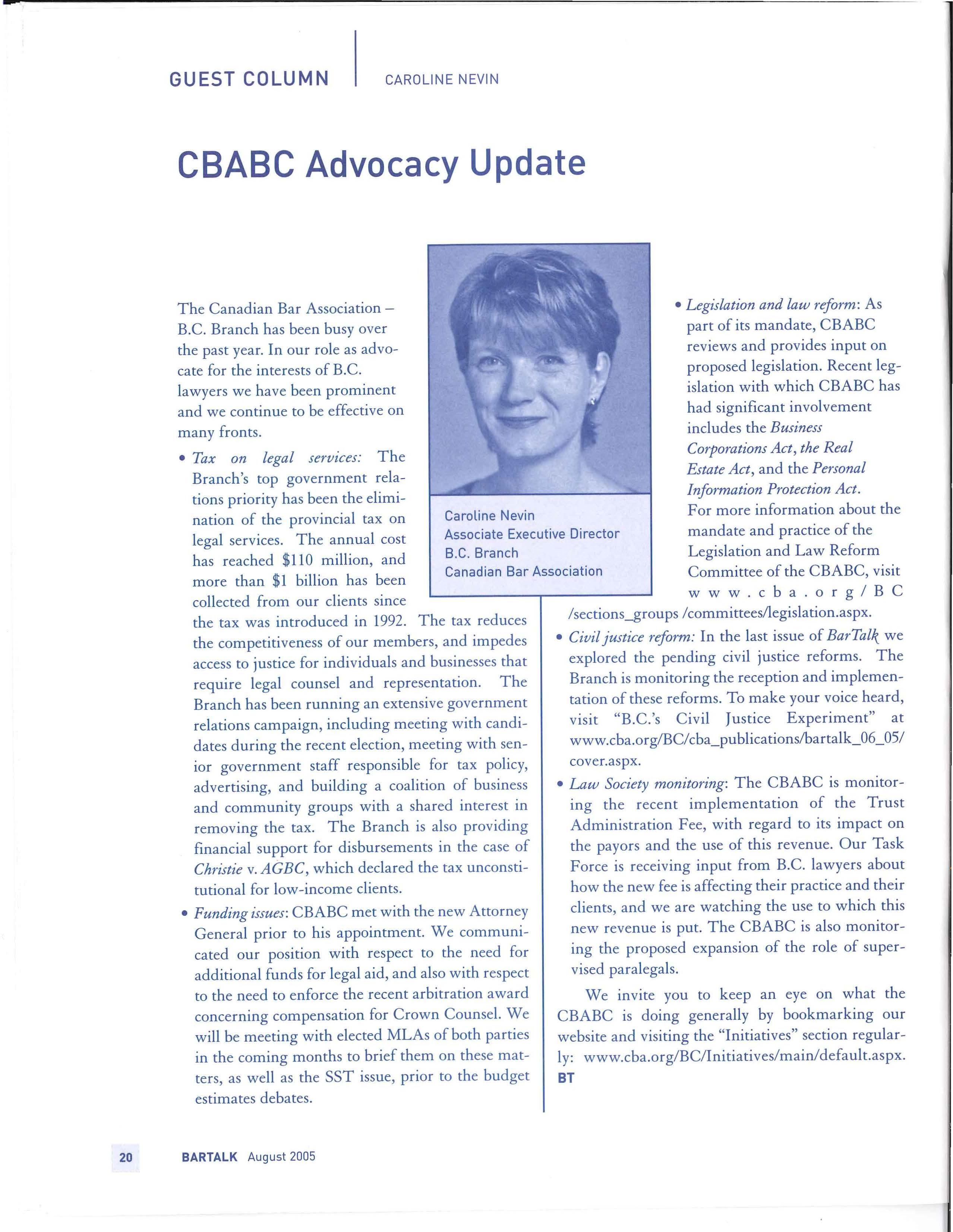
CBABC Advocacy Update
The Canadian Bar AssociationB.C. Branch has been busy over the past year. In our role as advocate for the interests of B.C. lawyers we have been prominent and we continue to be effective on many fronts.
• Tax on legal servzces: The
• Legislation and law reform: As part of its mandate, CBABC reviews and provides input on proposed legislation. Recent legislation with which CBABC has had significant involvement includes the Business Corporations Act, the Real Estate Act, and the Personal Information Protection Act. Branch's top government relations priority has been the elimination of the provincial tax on legal services. The annual cost has reached $110 million, and more than $1 billion has been
Associate Executive Director B.C. Branch
Canadian Bar Association collected from our clients since the tax was introduced in 1992 The tax reduces the competitiveness of our members, and impedes access to justice for individuals and businesses that require legal counsel and representation. The Branch has been running an extensive government relations campaign, including meeting with candidates during the recent election, meeting with senior government staff responsible for tax policy, advertising, and building a coalition of business and community groups with a shared interest in removing the tax. The Branch is als o providing financial support for disbursements in the case of Christie v. AGBC, which declared the tax unconstitutional for low-income clients.
• Funding issues: CBABC met with the new Attorney General prior to his appointment. We communicated our position with respect to the need for additional funds for legal aid, and also with respect to the need to enforce the recent arbitration award concerning compensation for Crown Counsel. We will be meeting with elected MLAs of both parties in the coming months to brief them on these matters, as well as the SST issue, prior to the budget estimates debates.
For more information about the mandate and practice of the Legislation and Law Reform Committee of the CBABC, visit www cba.org/BC
/sections_groups /committeesllegislation.aspx.
• Civil justice reform: In the last issue of Bar Talk we explored the pending civil justice reforms. The Branch is monitoring the reception and implementation of these reforms. To make your voice heard, visit "B.C.'s Civil Justice Experiment" at www.cba.org/BC/cba_publications/bartalk_06_05/ cover.aspx.
• Law Society monitoring: The CBABC is monitoring the recent implementation of the Trust Administration Fee, with regard to its impact on the payors and the use of this revenue. Our Task Force is receiving input from B.C. lawyers about how the new fee is affecting their practice and their clients, and we are watching the use to which this new revenue is put The CBABC is also monitoring the proposed expansion of the role of supervised paralegals.
We invite you to keep an eye on what the CBABC is doing generally by bookmarking our website and visiting the "Initiatives" section regularly: www.cba.org/BC/Initiatives/mainldefault.aspx. BT
Caroline Nevin
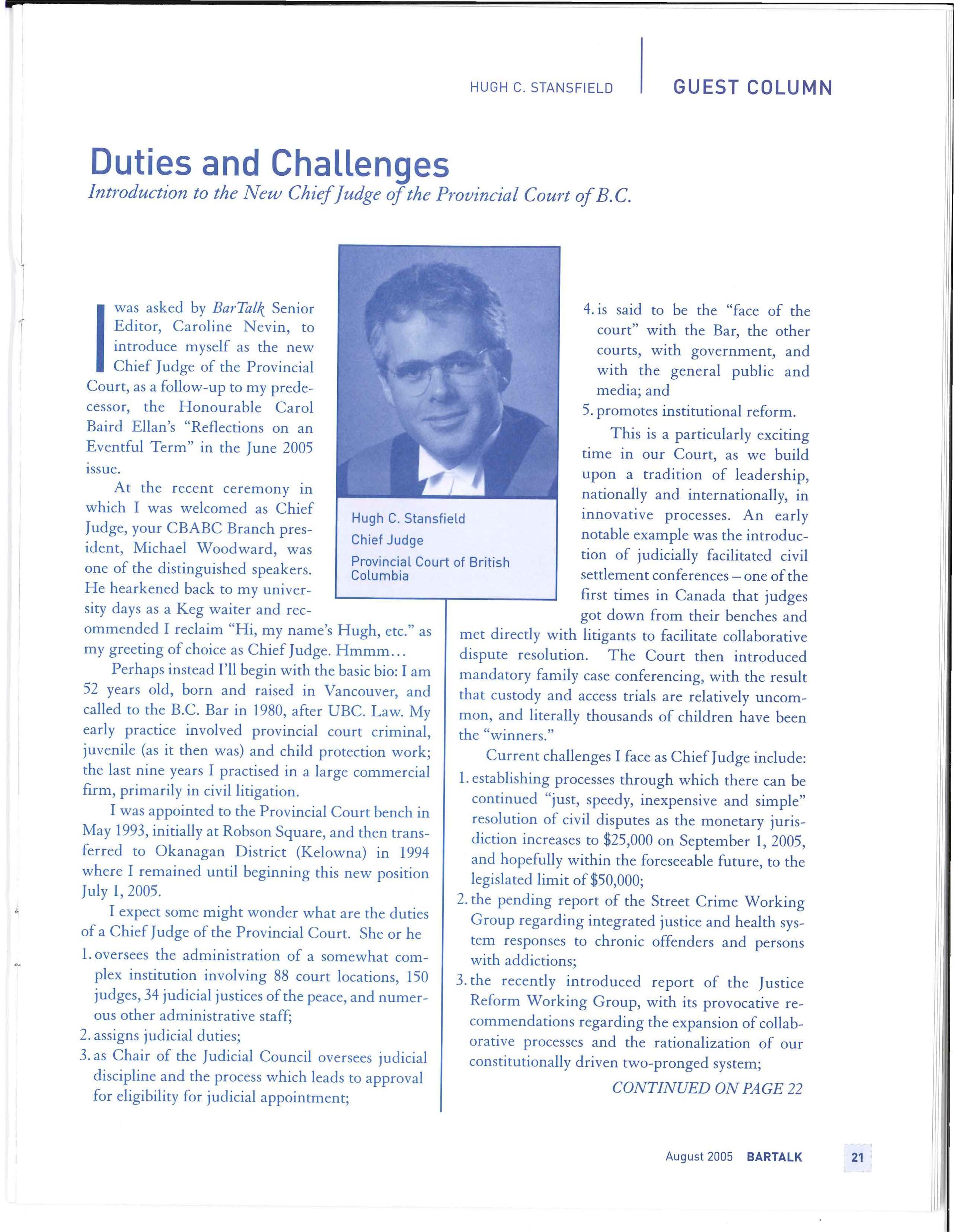
Duties and Challenges
Introduction to the New Chiefjudge of the Provincial Court of B.C.
Iwas asked by BarTalk Senior Editor, Caroline Nevin, to introduce myself as the new Chief Judge of the Provincial Court, as a follow-up to my predecessor, the Honourable Carol Baird Ellan's "Reflections on an Eventful Term" in the June 2005 ISSUe.
At the recent ceremony in which I was welcomed as Chief Judge, your CBABC Branch president, Michael Woodward, was one of the distinguished speakers. He hearkened back to my university days as a Keg waiter and rec-
Hugh C. Stansfield Chief Judge
Provincial Court of British Columbia
ommended I reclaim "Hi, my name's Hugh, etc." as my greeting of choice as Chief Judge. Hmmm
Perhaps instead I'll begin with the basic bio: I am 52 years old, born and raised in Vancouver, and called to the B.C. Bar in 1980, after UBC. Law. My early practice involved provincial court criminal, juvenile (as it then was) and child protection work; the last nine years I practised in a large commercial firm, primarily in civil litigation.
I was appointed to the Provincial Court bench in May 1993, initially at Robson Square, and then transferred to Okanagan District (Kelowna) in 1994 where I remained until beginning this new position July 1, 2005.
I expect some might wonder what are the duties of a Chief Judge of the Provincial Court. She or he
1. oversees the administration of a somewhat complex institution involving 88 court locations, 150 judges, 34 judicial justices of the peace, and numerous other administrative staff;
2. assigns judicial duties;
3. as Chair of the Judicial Council oversees judicial discipline and the process which leads to approval for eligibility for judicial appointment;
4. is said to be the "face of the court" with the Bar, the other courts, with government, and with the general public and media; and 5. promotes institutional reform.
This is a particularly exciting time in our Court, as we build upon a tradition of leadership, nationally and internationally, in innovative processes. An early notable example was the introduction of judicially facilitated civil settlement conferences- one of the
first times in Canada that judges got down from their benches and met directly with litigants to facilitate collaborative dispute resolution. The Court then introduced mandatory family case conferencing, with the result that custody and access trials are relatively uncommon, and literally thousands of children have been the "winners."
Current challenges I face as ChiefJudge include:
1. establishing processes through which there can be continued "just, speedy, inexpensive and simple" resolution of civil disputes as the monetary jurisdiction increases to $25,000 on September 1, 2005, and hopefully within the foreseeable future, to the legislated limit of $50,000;
2. the pending report of the Street Crime Working Group regarding integrated justice and health system responses to chronic offenders and persons with addictions;
3. the recently introduced report of the Justice Reform Working Group, with its provocative recommendations regarding the expansion of collaborative processes and the rationalization of our constitutionally driven two-pronged system;
CONTINUED ON PAGE 22
Chief Judge Stansfield- coNTINUED FRoM PAGE 21
4. reversing the decline in public confidence in the justice system, a trend which threatens the underpinnings of the justice system we know and the rule of law itself.
In all of this, I look forward to continuing our collegial relationship with the Bar. BT
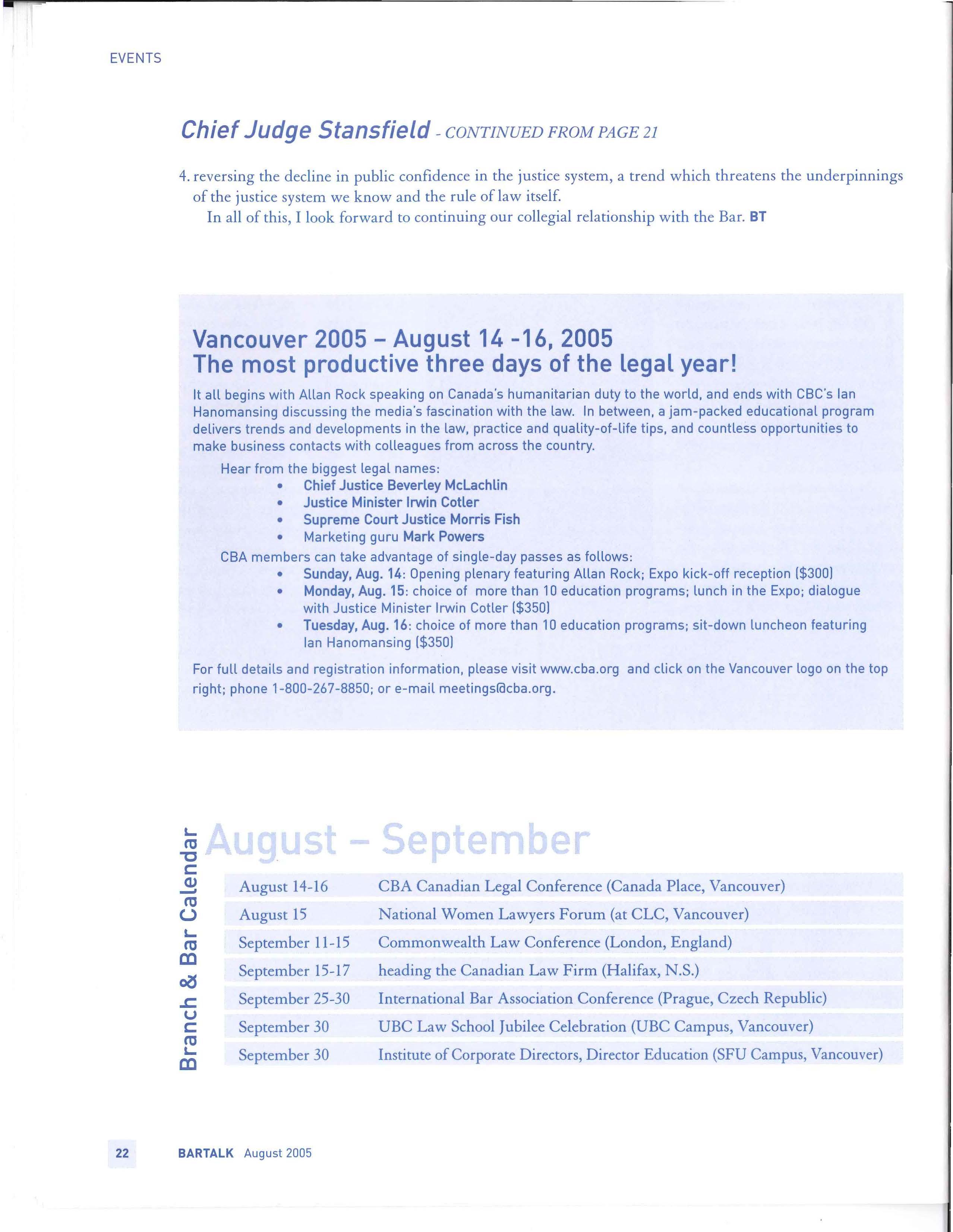
Vancouver 2005 - August 14 -16, 2005
The most productive three days of the legal year!
It al l begins with Allan Rock speaking on Canada's humanitarian duty to the world, and ends with CBC 's Jan Hanomansing discussing the media's fascination with the law. In between, a jam-packed educational program delivers trends and developments in the law, practice and qua l ity-of-life tips, and countless opportunities to make business contacts with colleagues from across the country.
Hear from the biggest legal names :
• Chief Justice Beverley Mclachlin
• Justice Minister Irwin Cotler
• Supreme Court Justice Morris Fish
• Marketing guru Mark Powers
CBA members can take advantage of sing l e-day passes as follows:
• Sunday, Aug. 14: Opening plenary featuring Allan Rock; Expo kick-off reception ($300]
• Monday, Aug. 15: choice of more than 10 education programs; lunch in the Expo; dialogue with Justice Minister Irwin Cotler ($350]
• Tuesday, Aug. 16: choice of more than 10 education programs; sit-down luncheon featuring Jan Hanomansing ($350]
For full details and registration information, please visit www cba.org and click on the Vancouver logo on the top right; phone 1-800-26 7-8850; or e-mail meetingstacba.org.
August 14-16
August 15
September 11-15
September 15-17
September 25-30
September 30
September 30
Se e ber
CBA Canadian Legal Conference (Canada Place, Vancouver)
National Women Lawyers Forum (at CLC, Vancouver)
Commonwealth Law Conference (London, England)
heading the Canadian Law Firm (Halifax, N.S.)
International Bar Association Conference (Prague, Czech Republic)
UBC Law School Jubilee Celebration (UBC Campus, Vancouver)
Institute of Corporate Directors, Director Education (SFU Campus, Vancouver)
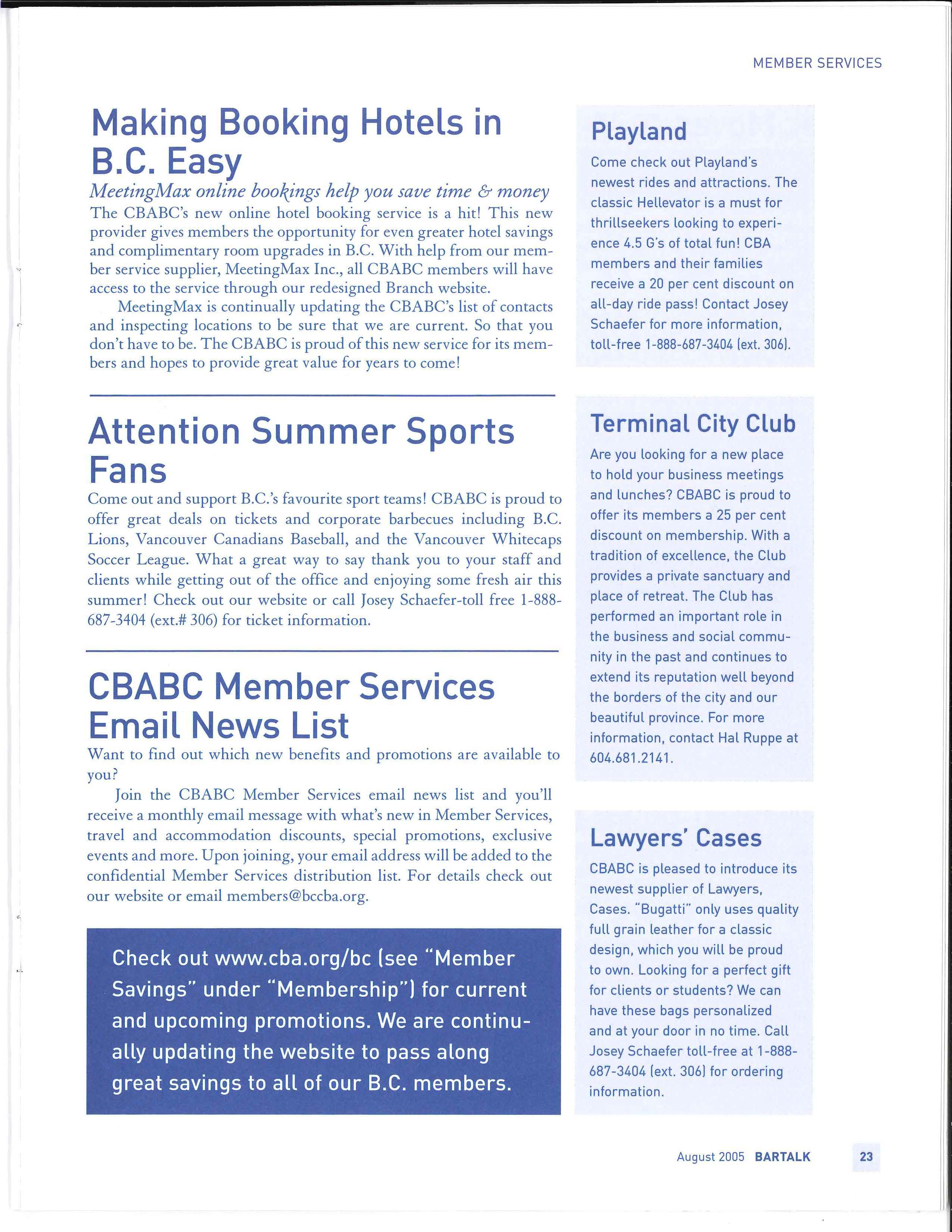
Making Booking Hotels in
B.C. Easy
MeetingMax online bookings help you save time & money
The CBABC 's new online hotel booking service is a hit! This new provider gives members the opportunity for even greater hotel savings and complimentary room upgrades in B C With help from our member service supplier, MeetingMax Inc., all CBABC members will have access to the service through our redesigned Branch website. MeetingMax is continually updating the CBABC's list of contacts and inspecting locations to be sure that we are current. So that you don't have to be . The CBABC is proud of this new service for its members and hopes to provide great value for years to come!
Attention Summer Sports Fans
Come out and support B.C.'s favourite sport teams! CBABC is proud to offer great deals on tickets and corporate barbecues including B.C. Lions, Vancouver Canadians Baseball, and the Vancouver Whitecaps Soccer League. What a great way to say thank you to your staff and clients while getting out of the office and enjoying some fresh air this summer! Check out our website or call Josey Schaefer-toll free 1-888687-3404 (ext.# 306) for ticket information.
CBABC Member Services
Email News List
Want to find out which new benefits and promotions are available to you?
Join the CBABC Member Services email news list and you'll receive a monthly email message with what's new in Member Services , travel and accommodation discounts, special promotions, exclusive events and more. Upon joining, your email address will be added to the confidential Member Services distribution list. For details check out our website or email members@bccba.org
Check out www.cba.org/bc (see "Member Savings" under "Membership") for current and upcoming promotions. We are continually updating the website to pass along great savings to all of our B.C. members.
Playland
Come check out Playland's newest rides and attractions. The classic Hellevator is a must for thrillseekers looking to experience 4.5 G's of total fun! CBA members and their famil ies receive a 20 per cent discount on all-day ride pass! Contact Josey Schaefer for more information , toll-free 1- 888-687-3404 [ext. 3061.
Terminal City Club
Are you looking for a new place to hold your business meetings and lunches? CBABC is proud to offer its members a 25 per cent d iscount on membership With a tradition of excellence, the Club provides a private sanctuary and place of retreat. The Club has performed an important role in the business and social community in the past and continues to extend its reputation well beyond the borders of the city and our beaut iful province . For more information, contact Hal Ruppe at 604 .681.2141.
Lawyers' Cases
CBABC is pleased to introduce its newest supplier of Lawyers, Cases "Bugatti " only uses quality full grain leather for a class ic design, which you will be proud to own . Looking for a perfect gift for clients or students? We can have these bags personalized and at your door in no t ime Call Josey Schaefer toll-free at 1-888687-3404 [ext. 306) for ordering information.
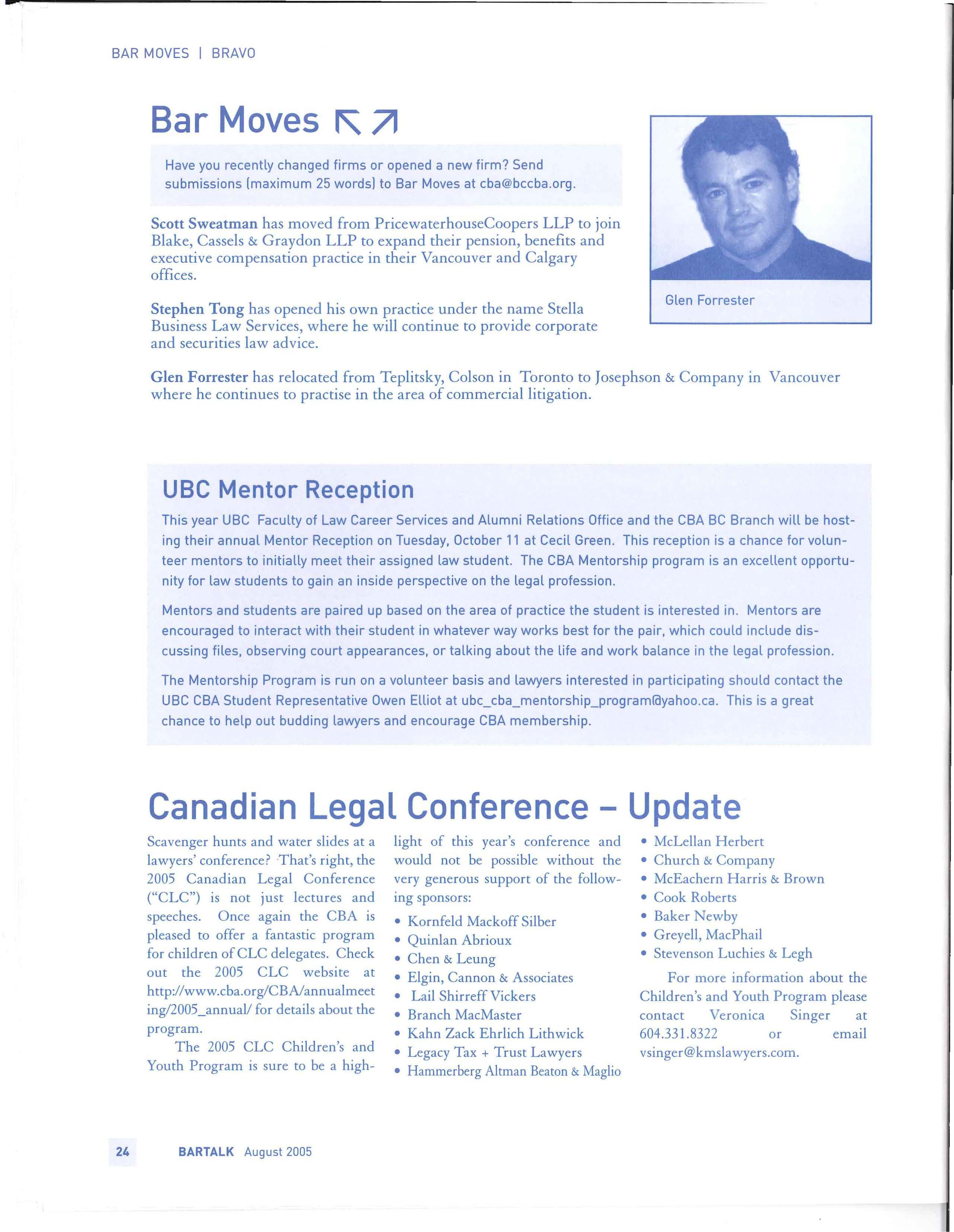
Bar Moves "71
Have you recently changed firms or opened a new firm? Send submissions !maximum 25 wordsl to Bar Moves at cba@bccba.org.
Scott Sweatman has moved from PricewaterhouseCoopers LLP to join Blake, Cassels & Graydon LLP to expand their pension, benefits and executive compensation practice in their Vancouver and Calgary offices.
Stephen Tong has opened his own practice under the name Stella Business Law Services, where he will continue to provide corporate and securities law advice.
Glen Forrester has relocated from Teplitsky, Colson in Toronto to Josephson & Company in Vancouver where he continues to practise in the area of commercial litigation.
UBC Mentor Reception
This year UBC Faculty of Law Career Services and Alumni Relations Office and the CBA BC Branch will be hosting their annual Mentor Reception on Tuesday, October 11 at Cecil Green. This reception is a chance for volunteer mentors to initially meet their assigned law student. The CBA Mentorship program is an excellent opportunity for law students to gain an inside perspective on the legal profession.
Mentors and students are paired up based on the area of practice the student is interested in. Mentors are encouraged to interact with their student in whatever way works best for the pair, which could include discussing files, observing court appearances, or talking about the life and work balance in the legal profession.
The Mentorship Program is run on a volunteer basis and lawyers interested in participating shou ld contact the UBC CBA Student Representative Owen Elliot at ubc_cba_mentorship_programfayahoo.ca. This is a great chance to help out budding lawyers and encourage CBA membership.
Canadian Legal Conference - Update
Scavenger hunts and water slides at a lawyers' conference? That's right, the 2005 Canadian Legal Conference ("CLC") is not just lectures and speeches. Once again the CBA is pleased to offer a fantastic program for children of CLC delegates. Check out the 2005 CLC website at http://www.cba.org/CBA/annualmeet ing/2005_annual/ for details about the program
The 2005 CLC Chi ldren's and Youth Program is sure to be a high-
light of this year's conference and would not be possible without the very generous support of the followmg sponsors:
• Kornfeld Mack off Silber
• Quinlan Abrioux
• Chen & Leung
• Elgin, Cannon & Associates
• Lail Shirreff Vickers
• Branch MacMaster
• Kahn Zack Ehrlich Lith wick
• Legacy Tax + Trust Lawyers
• Hammerberg Altman Beaton & Maglio
• McLellan Herbert
• Church & Company
• McEachern Harris & Brown
• Cook Roberts
• Baker Newby
• Greyell, MacPhail
• Stevenson Luchies & Legh
For more information about the Children's and Youth Program please contact Veronica Singer at 604.331.8322 or email vsinger@kmslawyers com.
Glen Forrester
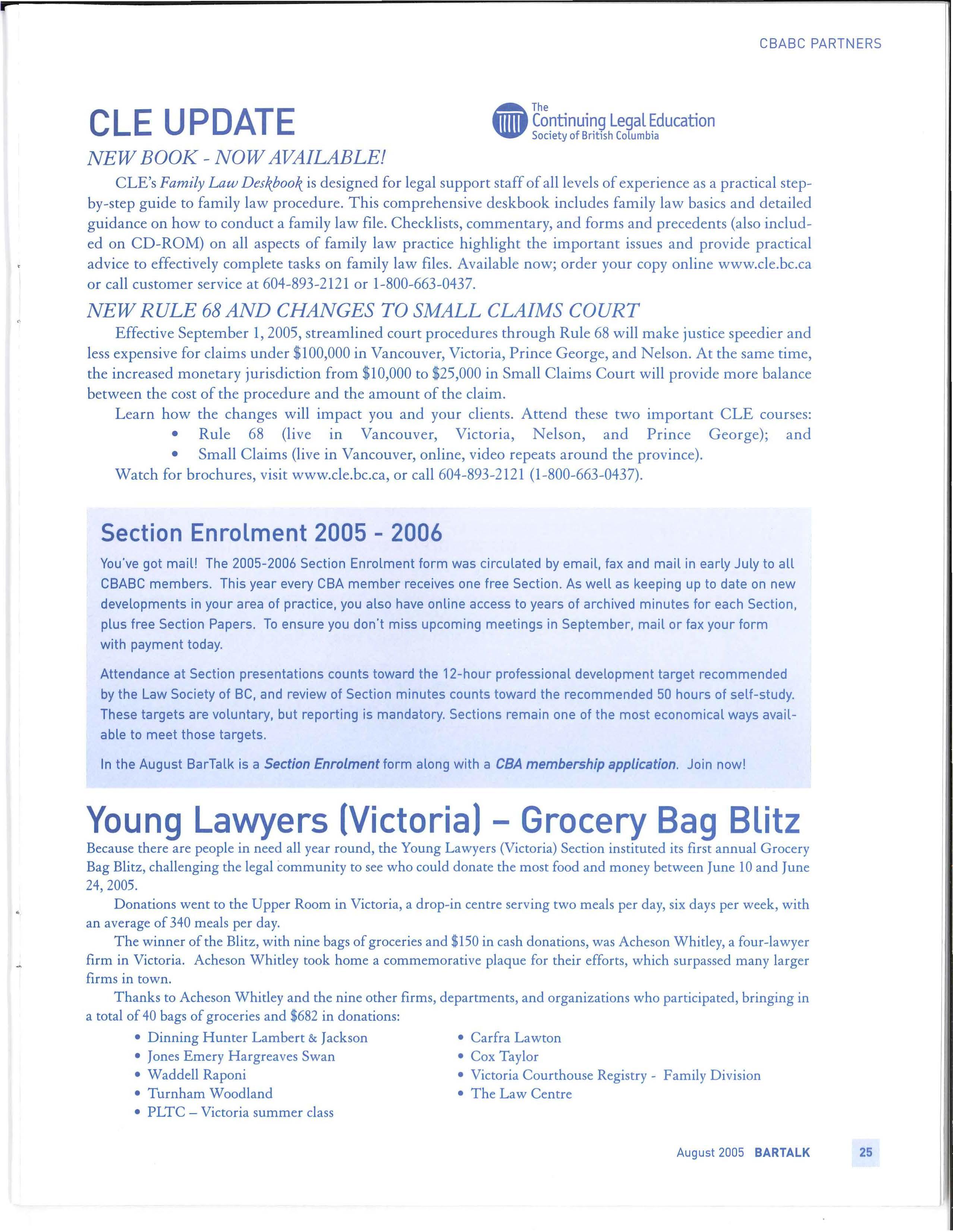
CLE UPDATE
NEW BOOK- NOW AVAILABLE!
•
The Continuing Legal Education
Society of British Columbia
CLE's Family Law Deskbook is designed for legal support staff of all levels of experience as a practical stepby-step guide to family law procedure. This comprehensive deskbook includes family law basics and detailed guidance on how to conduct a family law file. Checklists, commentary, and forms and precedents (also included on CD-ROM) on all aspects of family law practice highlight the important issues and provide practical advice to effectively complete tasks on family law files Available now; order your copy online www cle.bc.ca or call customer service at 604-893-2121 or 1-800-663-0437.
NEW RULE 68 AND CHANGES TO SMALL CLAIMS COURT
Effective September 1, 2005, streamlined court procedures through Rule 68 will make justice speedier and less expensive for claims under $100,000 in Vancouver, Victoria, Prince George , and Nelson. At the same time , the increased monetary jurisdiction from $10,000 to $25,000 in Small Claims Court will provide more balance between the cost of the procedure and the amount of the claim
Learn how the changes will impact you and your clients . Attend these two important CLE courses:
• Rule 68 (live in Vancouver , Victoria, Nelson , and Prince George); and
• Small Claims (live in Vancouver, online, video repeats around the province).
Watch for brochures, visit www.cle.bc.ca, or call604-893-2121 (1-800-663-0437) .
Section Enrolment 2005 - 2006
You"ve got mail! The 2005-2006 Section Enrolment form was circulated by email, fax and mail in early July to all CBABC members. This year every CBA member receives one free Section As well as keeping up to date on new developments in your area of practice, you also have online access to years of archived minutes for each Section, plus free Section Papers To ensure you don"t miss upcoming meetings in September, mail or fax your form with payment today.
Attendance at Section presentations counts toward the 12-hour professional development target recommended by the Law Society of BC, and review of Section minutes counts toward the recommended 50 hours of self-study. These targets are voluntary, but reporting is mandatory. Sections remain one of the most economical ways available to meet those targets
In the August BarTalk is a Section Enrolment form along with a CBA membership application. Join now!
Young Lawyers (Victoria) - Grocery Bag Blitz
Because there are people in need all year round, the Young Lawyers (Victoria) Section instituted its first annual Grocery Bag Blitz, challenging the legal community to see who could donate the most food and money between June 10 and June 24,2005.
Donations went to the Upper Room in Victoria, a drop-in centre serving two meals per day, six days per week, with an average of 340 meals per day.
The winner of the Blitz, with nine bags of groceries and $150 in cash donations, was Acheson Whitley, a four-lawyer firm in Victoria. Acheson Whitley took home a commemorative plaque for their efforts, which surpassed many larger firms in town.
Thanks to Acheson Whitley and the nine other firms, departments, and organizations who participated, bringing in a total of 40 bags of groceries and $682 in donations:
• Dinning Hunter Lambert & Jackson
• Jones Emery Hargreaves Swan
• Waddell Raponi
• Turnham Woodland
• PLTC - Victoria summer class
• Carfra Lawton
• Cox Taylor
• Victoria Courthouse Registry- Family Division
• The Law Centre
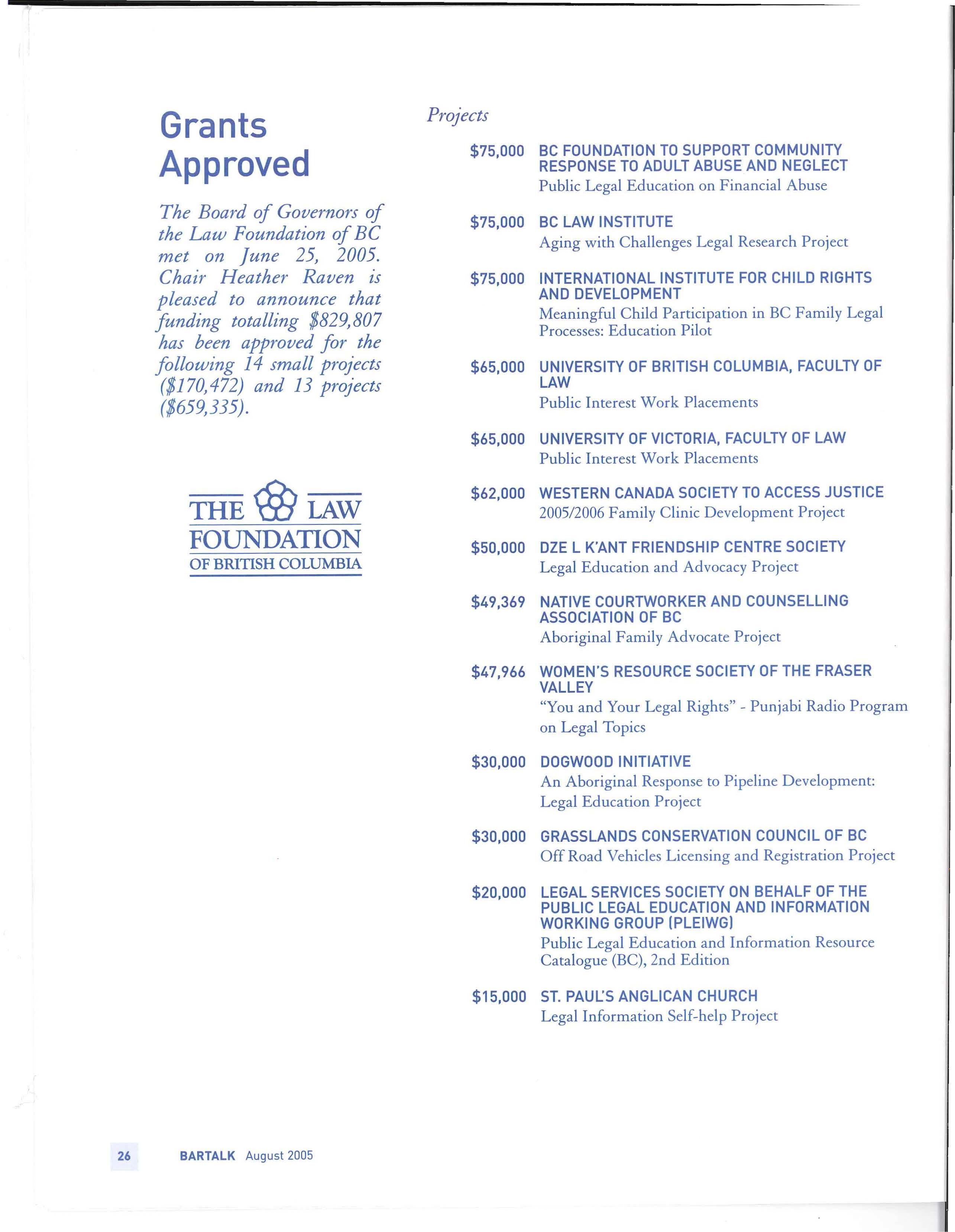
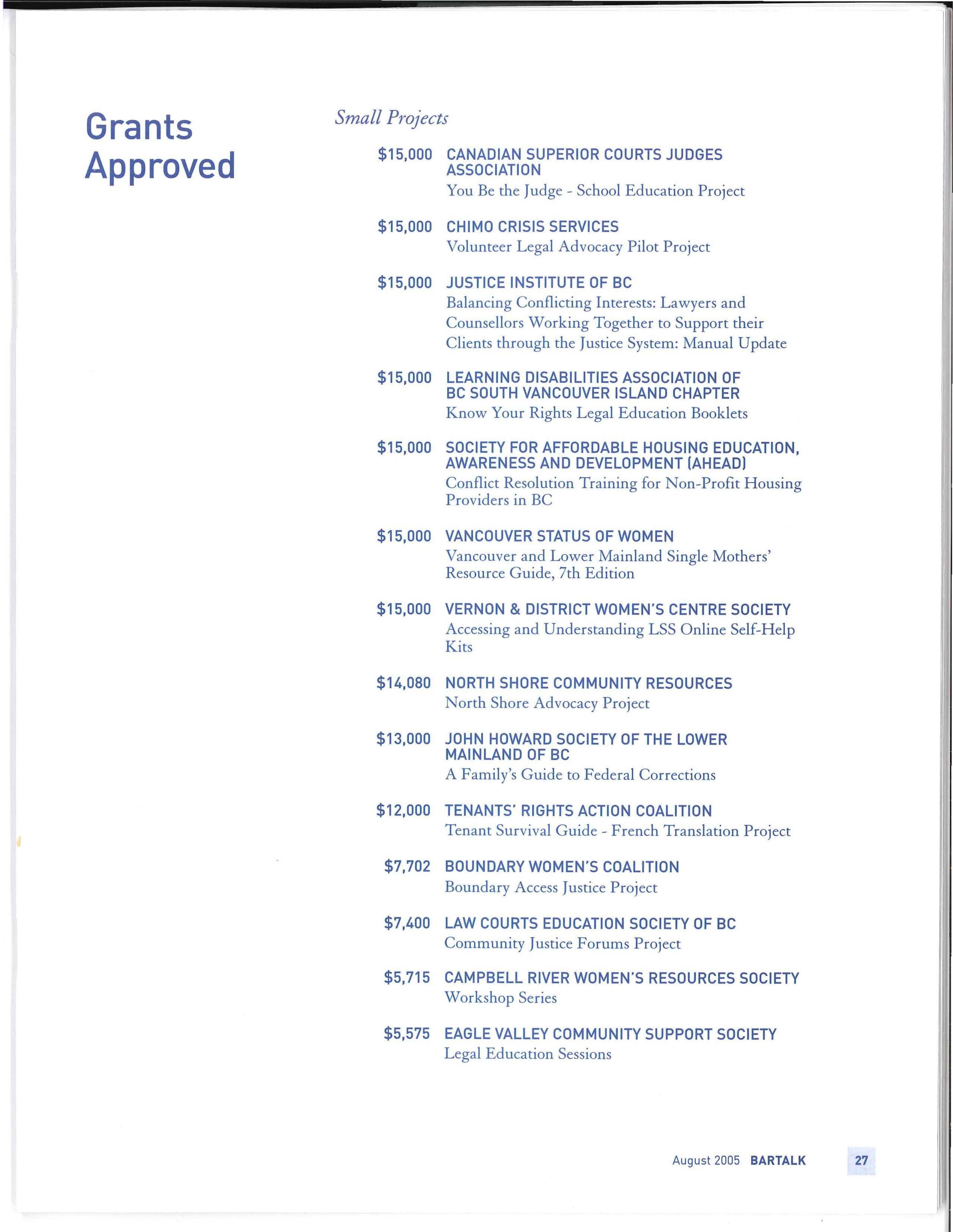
Grants Approved
The Board of Governors of the Law Foundation of BC met on June 25, 2005. Chair Heather Raven is pleased to announce that funding totalling $829,807 has been approved for the following 14 small projects ($170,472) and 13 projects ($659,335).
THE@LAW FOUNDATION
OF BRITISH COLUMBIA
Projects
$75,000 BC FOUNDATION TO SUPPORT COMMUNITY RESPONSE TO ADULT ABUSE AND NEGLECT
Public Legal Education on Financial Abuse
$75,000 BC LAW INSTITUTE
Aging with Challenges Legal Research Project
$75,000 INTERNATIONAL INSTITUTE FOR CHILD RIGHTS AND DEVELOPMENT
Meaningful Child Participation in BC Family Legal Pro cesses: Education Pilot
$65,000 UNIVERSITY OF BRITISH COLUMBIA, FACULTY OF LAW
Public Interest Work Placements
$65,000 UNIVERSITY OF VICTORIA, FACULTY OF LAW
Public Interest Work Placements
$62,000 WESTERN CANADA SOCIETY TO ACCESS JUSTICE 2005/2006 Family Clinic Development Project
$50,000 DZE L K'ANT FRIENDSHIP CENTRE SOCIETY Legal Education and Advocacy Project
$49,369 NATIVE COURTWORKER AND COUNSELLING ASSOCIATION OF BC Aboriginal Family Advocate Project
$47,966 WOMEN'S RESOURCE SOCIETY OF THE FRASER VALLEY "You and Your Legal Rights"- Punjabi Radio Program on Legal Topics
$30,000 DOGWOOD INITIATIVE
An Aboriginal Response to Pipeline Development: Legal Education Project
$30,000 GRASSLANDS CONSERVATION COUNCIL OF BC Off Road Vehicles Licensing and Registration Project
$20,000 LEGAL SERVICES SOCIETY ON BEHALF OF THE PUBLIC LEGAL EDUCATION AND INFORMATION WORKING GROUP (PLEIWG)
Public Legal Education and Information Resource Catalogue (BC), 2nd Edition
$15,000 ST. PAUL'S ANGLICAN CHURCH Legal Information Self-help Project
Grants Approved
Small Projects
$15,000 CANADIAN SUPERIOR COURTS JUDGES ASSOCIATION
You Be the Judge- School Education Project
$15,000 CHIMO CRISIS SERVICES Volunteer Legal Advocacy Pilot Project
$15,000 JUSTICE INSTITUTE OF BC Balancing Conflicting Interests: Lawyers and Counsellors Working Together to Support their Clients through the Justice System: Manual Update
$15,000 LEARNING DISABILITIES ASSOCIATION OF BC SOUTH VANCOUVER ISLAND CHAPTER Know Your Rights Legal Education Booklets
$15,000 SOCIETY FOR AFFORDABLE HOUSING EDUCATION, AWARENESS AND DEVELOPMENT (AHEAD)
Conflict Resolution Training for Non-Profit Housing Providers in BC
$15,000 VANCOUVER STATUS OF WOMEN
Vancouver and Lower Mainland Single Mothers' Resource Guide, 7th Edition
$15,000 VERNON & DISTRICT WOMEN'S CENTRE SOC IETY
Accessing and Understanding LSS Online Self- Help Kits
$14,080 NORTH SHORE COMMUNITY RESOURCES North Shore Advocacy Project
$13,000 JOHN HOWARD SOCIETY OF THE LOWER MAINLAND OF BC A Family's Guide to Federal Corrections
$12,000 TENANTS ' RIGHTS ACTION COALITION Tenant Survival Guide - French Translation Project
$7,400 LAW COURTS EDUCATION SOCIETY OF BC Community Justice Forums Project
$5,715 CAMPBELL RIVER WOMEN'S RESOURCES SOCIETY Workshop Series
$5,575 EAGLE VALLEY COMMUNITY SUPPORT SOCIETY Legal Education Sessions
SERVICES
INTELLECTUAL PROPERTY: Let us assist you in providing protection for your clients. Douglas B. Thompson Law CorporationRegistered Patent Agent, Registered Trade Mark Agent. Practice restricted to Intellectual Property Victoria, B C. (www.BCpatents.ca) E-mail: doug@BCpatents.ca
THE INTERPRETERS' GROUP INC: Cer't Translators, 100+ languages. Global capability. E & 0 Ins: Tel: 604-961-9341 or 1-888-828-9673
LEADING LEGAL RECRUITER for Lawyers, Patent Agents, Law Firms & Corporations for over 16 years. Call Advocate Placement first for best results! Contact Eric M. Singer LLB at esinger@advocateplacementcom or 1-800-461-1275
Can be reconfigured to suit. Contact: Tanya @ 604-734-7003 or email mbw@mbwlaw.ca
POSITION AVAILABLE
People with multiple sclerosis are often faced with a variety of legal/advocacy challenges involving human rights, employment equity, estate planning and family law issues The Multiple Sclerosis Society's Vo lunteer Legal Advocacy Program was developed to provide a resource of volunteers with legal and advocacy expertise to work towards meeting the specific needs of our members. This program is successfully growing and we need your help. Lawyers in all areas of law (Kamloops + Kelowna), family law lawyers (Vancouver, Victoria, Nanaimo, Kelowna + Kamloops areas) For more information or to get involved, please contact 1-800268-7582 or adrianne.boothroyd@mssociety.ca.
PRACTICES FOR SALE
Solicitor in well established practice (Southern Mid Is land) wishes to retire and sell- seeks successor or Associate. Real estate, mortgages, corporate, wills, estates. Email: citylaw@shaw ca
Next mailing: October 7
Direct BarTalk advertising inquiries to: Jesse Tarbotton, BarTalk Editor Tel: 604-646-7856 or 1-888-687-3404 E-mail: cba@bccba.org
Catalyst Consulting is delighted to welcome Simon Taylor to the partnership. Simon has over fifteen years experience in helping individual partners and associates improve and grow their business. Prior to joining Catalyst, Simon practised commercial law in both London and Hong Kong. He was a partner in a UK International law firm for approximately 20 years, his final position in the firm being the Asian Managing Partner. In 2000 he formed his own consultancy in London.
Simon Taylor has dual admission as a solicitor in England and Hong Kong, and is a Master of Arts from Oxford University. He will be based in Vancouver effective August 1, 2005 and can be reached at staylor@catalystlegal.com.
Catalyst Consulting specializes in working with law firms, intellectual property firms and corporate counsel across North America, Europe and Asia Pacific. Catalyst Consulting has been designated the Preferred Supplier for Legal Services Consulting by both the Canadian Bar Association and the Canadian Corporate Counsel Association.