IONTALK
President's report
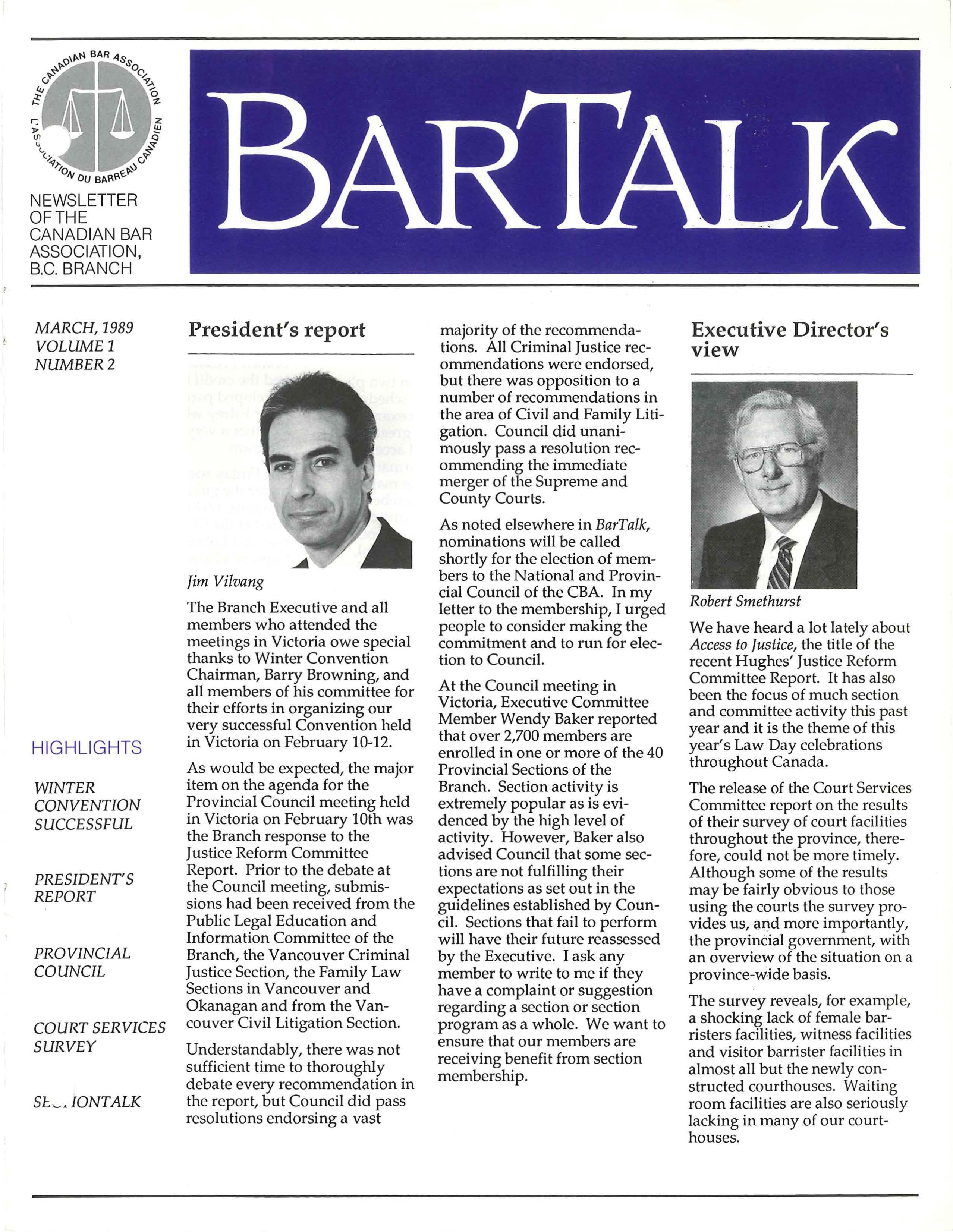
Jim Vilvang
The Branch Executive and all members who attended the meetings in Victoria owe special thanks to Winter Convention Chairman, Barry Browning, and all members of his committee for their efforts in organizing our very successful Convention held in Victoria on February 10-12.
As would be expected, the major item on the agenda for the Provincial Council meeting held in Victoria on February lOth was the Branch response to the Justice Reform Committee Report. Prior to the debate at the Council meeting, submissions had been received from the Public Legal Education and Information Committee of the Branch , the Vancouver Criminal Justice Section, the Family Law Sections in Vancouver and Okanagan and from the Vancouver Civil Litigation Section.
Understandably, there was not sufficient time to thoroughly debate every recommendation in the report, but Council did pass resolutions endorsing a vast
majority of the recommendations. All Criminal Justice recommendations were endorsed, but there was opposition to a number of recommendations in the area of Civil and Family Litigation. Council did unanimously pass a resolution recommending the immediate merger of the Supreme and County Courts.
As noted elsewhere in BarTalk, nominations will be called shortly for the election of members to the National and Provincial Council of the CBA. In my letter to the membership, I urged people to consider making the commitment and to run for election to Council.
At the Council meeting in Victoria, Executive Committee Member Wendy Baker reported that over 2,700 members are enrolled in one or more of the 40 Provincial Sections of the Branch. Section activity is extremely popular as is evidenced by the high level of activity. However, Baker also advised Council that some sections are not fulfilling their expectations as set out in the guidelines established by Council. Sections that fail to perform will have their future reassessed by the Executive. I ask any member to write to me if they have a complaint or suggestion regarding a section or section program as a whole. We want to ensure that our members are receiving benefit from section membership.
Executive Director's view
Robert Smethurst
We have heard a lot lately about Access to Justice, the title of the recent Hughes' Justice Reform Committee Report. It has also been the focus of much section and committee activity this past year and it is the theme of this year's Law Day celebrations throughout Canada.
The release of the Court Services Committee report on the results of their survey of court facilities throughout the province, therefore, could not be more timely. Although some of the results may be fairly obvious to those using the courts the survey provides us, <iDd more importantly, the provinCial government, with an overview of the situation on a province-wjde basis.
The survey reveals, for example, a shocking lack of female barristers facilities, witness facilities and visitor barrister facilities in almost all but the newly constructed courthouses Waiting room facilities are also seriously lacking in many of our courthouses.
The report is helpful in that it pinpoints problem areas in the individual courthouses and it, therefore, should be of considerable assistance to the government in helping them establish their priorities with respect to courthouse renovations and new construction.
The public and the profession need, and are entitled to receive, minimum acceptable standards of facilities. It is an integral part of the process of making justice accessible to all. Although significant improvements to courthouse facilities have been made in recent years in the more populous areas of the province, the report clearly indicates that much remains to be done in the less populated areas if their facilities are to be brought up to even minimum acceptable levels.
We urge our provincial government to carry through on its task of making justice more acceptable to its citizens. Part of that task should be the carrying out of the needed improvements to the many courthouse facilities as quickly as possible.
Winter convention successful
best in recent years. Attendance substantially improved over past Winter meetings.
Two hundred and nineteen delegates, 156 guests, 99 children, 23 panelists and eight guest panelists registered for the meeting.
The Benchers also took their February meeting to Victoria to associate, in part, with the Winter Convention and the Provincial Council of the B.C. Branch also met during the Convention.
On Friday afternoon two plenary sessions were scheduled. Delegates heard an examination of the prospects of greater computerization of and access to public registry information This was followed by the major session -a seven member panel examination of the Justice Reform Committee's Report Access to Justice. The panel, under the chairmanship of Branch Secretary-Treasurer Terry LaLiberte included the Attorney General, The Honourable "Bud" Smith; a lay member of the Committee, Mrs. Susan Brice; the Master of the Supreme Court, Mr. Tom Halbert; and lawyers Russell Lusk, Terry Warren and Peter Leask, the latter three pinch hitting for the Chief Justice of
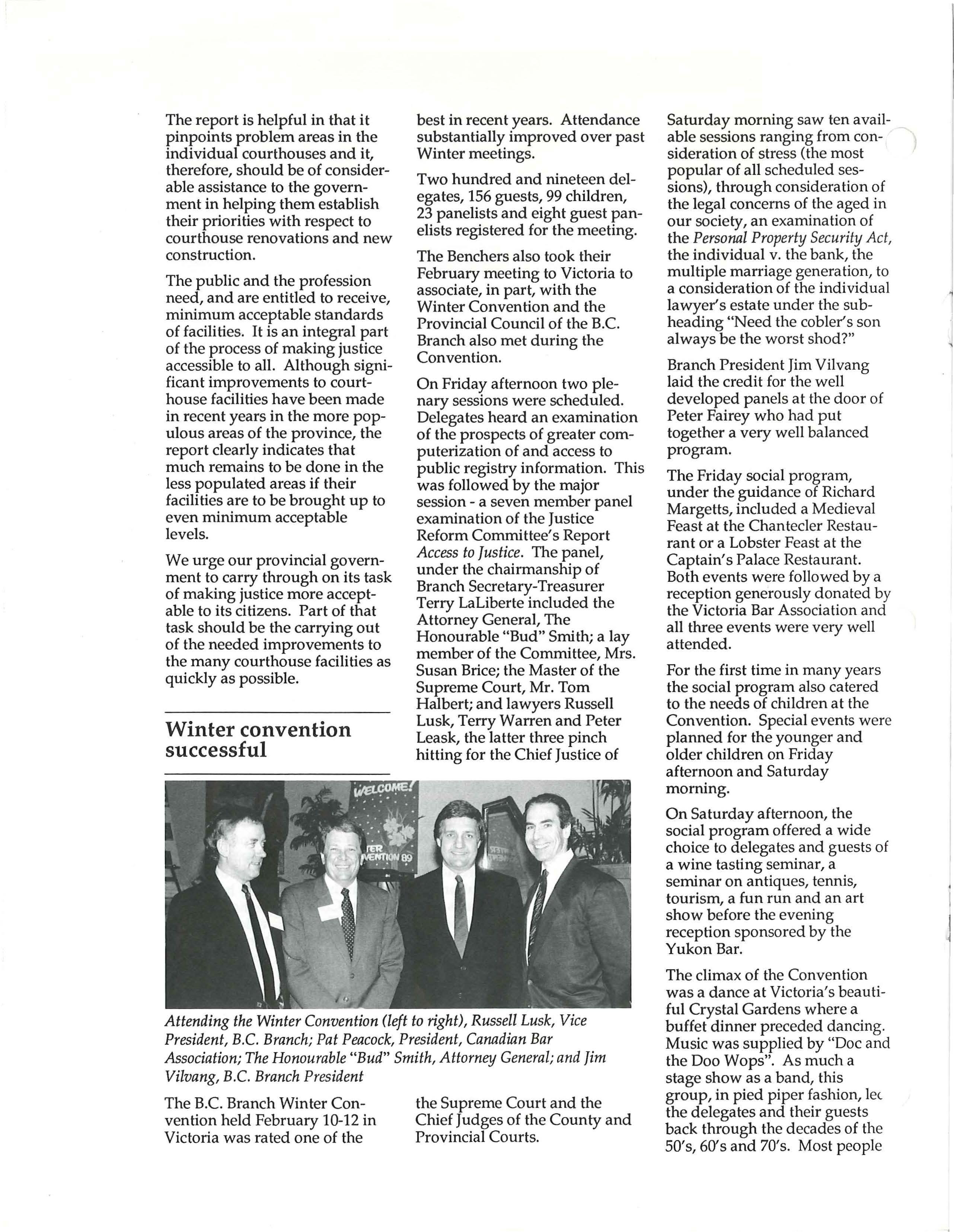
The B.C. Branch Winter Convention held February 10-12 in Victoria was rated one of the
the Supreme Court and the Chief Judges of the County and Provincial Courts.
Saturday morning saw ten available sessions ranging from consideration of stress (the most popular of all scheduled sessions), through consideration of the legal concerns of the aged in our society, an examination of the Personal Property Security Act, the individual v. the bank, the multiple marriage generation, to a consideration of the individual lawyer's estate under the subheading "Need the cobler's son always be the worst shod?"
Branch President Jim Vilvang laid the credit for the well developed panels at the door of Peter Fairey who had put together a very well balanced program
The Friday social program, under the guidance of Richard Margetts, included a Medieval Feast at the Chantecler Restaurant or a Lobster Feast at the Captain's Palace Restaurant. Both events were followed by a reception generously donated b y the Victoria Bar Association and all three events were very well attended.
For the first time in many years the social program also catered to the needs of children at the Convention. Special events wer e planned for the younger and older children on Friday afternoon and Saturday morning.
On Saturday afternoon, the social program offered a wide choice to delegates and guests of a wine tasting seminar, a seminar on antiques, tennis, tourism, a fun run and an art show before the evening reception sponsored by the Yukon Bar .
The climax of the Convention was a dance at Victoria's beautiful Crystal Gardens where a buffet dinner preceded dancing. Music was supplied by "Doc and the Doo Wops". As much a stage show as a band, this group, in pied piper fashion, le( the delegates and their guests back through the decades of the SO's, 60's and 70's. Most people
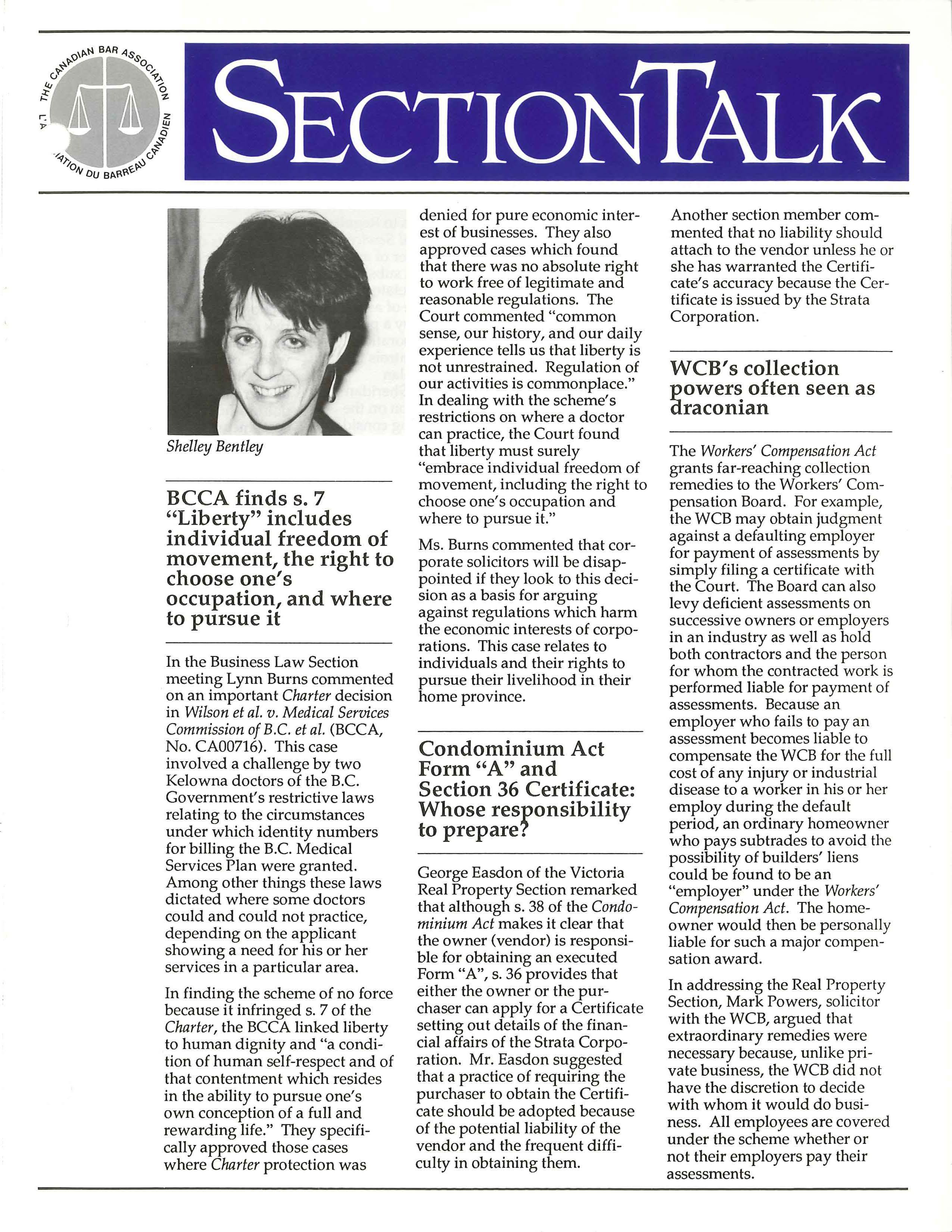
Shelley Bentley
BCCA finds s. 7 "Liberty" includes individual freedom of movement, the right to choose one's occupation, and where to pursue it
In the Business Law Section meeting Lynn Burns commented on an important Charter decision in Wilson et al v Medical Services Commission of B.C. et al. (BCCA, No. CA00716). This case involved a challenge by two Kelowna doctors of the B.C. Government's restrictive laws relating to the circumstances under which identity numbers for billing the B.C. Medical Services Plan were granted. Among other things these laws dictated where some doctors could and could not practice, depending on the applicant showing a need for his or her services in a particular area.
In finding the scheme of no force because it infringed s. 7 of the Charter, the BCCA linked liberty to human dignity and "a condition of human self-respect and of that contentment which resides in the ability to pursue one's own conception of a full and rewarding life " They specifically approved those cases where Charter protection was
denied for pure economic interest of businesses They also approved cases which found that there was no absolute right to work free of legitimate and reasonable regulations . The Court commented "common sense,. our history, and our daily expenence tells us that liberty is not unrestrained. Regulation of our activities is commonplace ." In dealing with the scheme's restrictions on where a doctor can practice, the Court found that liberty must surely "embrace individual fr ee dom of movement, including the right to choose one's occupation and where to pursue it."
Ms. Burns commented that corwill be disappomted tf they look to this decision as a basis for arguing against regulations which harm the economic interests of corporations. This case relates to individuals and their rights to pursue their livelihood in their home province.
Condominium Act Form "A" and Section 36 Certificate: Whose responsibility to prepare?
George Easdon of the Victoria Real Property Section remarked that although s . 38 of the Condominium Act makes it clear that the owner (vendor) is responsible for obtaining an executed Form "A", s. 36 provides that either the owner or the purchaser can apply for a Certificate setting out details of the financial affairs of the Strata Corporation. Mr. Easdon suggested that a practice of requiring the purchaser to obtain the Certificate should be adopted because of the potential liability of the vendor and the frequent difficulty in obtaining them.
Another section member commented that no liability should attach to the vendor unless h e or she has warranted the Certificate's accuracy because the Certificate is issued by the Strata Corporation.
WCB's collection often seen as araconlan
The Workers' Compensation Act grants far-reaching collection remedies to the Workers' Compensation Board. For example, the WCB may obtain judgment against a defaulting employer for payment of assessments by simply filing a certificate with the Court . The Board can also levy deficient assessments on successive owners or employers in an industry as well as hold both contractors and the person for whom the contracted work is performed liable for payment of assessments. Because an employer who fails to pay an assessment becomes liable to compensate the WCB for the full cost of any injury or industrial disease to a worker in his or her employ during the default period, an ordinary homeown er who pays subtrades to avoid the possibility of builders' liens could be found to be an " employer" under the Workers' Compensation Act. The homeowner would then be personally liable for such a major compensation award.
In the Real Propert y Section, Mark Powers, solicitor with the WCB, argued that extraordinary remedies were necessary because, unlike private business, the WCB did not have the discretion to decide with whom it would do business. All employees are covered under the scheme whether or not their employers pay their assessments.
Will the legal profession oe exempted from the new federal sales tax?
In a recent meeting of the Taxation Section the Chairman noted that Finance Minister Wilson has exempted dentists from the application of the new federal sales tax. Consequently, a resolution was passed by the Taxation Section that the legal profession should be exempted as well.
Caution advised with regard to notes on statements of adjustments
Victoria Real Property members expressed concern over the proliferation of notes appearing on statements of adjustments from Victoria practitioners. UVic Professor Waldron expressed the view that adding extensive notes might be taken as evidence that negotiations between the parties had not closed and that acounteroffer was being made. Section member Keith Reed thought that there was a positive obligation on an acting solicitor to strike out notes which add to or amend the original contract. It was concluded that establishment of a uniform local practice in this area would be difficult and that this topic would be useful for the Closing Procedures Committee to consider .
New changes in tax on transfer otbusiness assets between related entities
Recent amendments to Regulation 3.14 of the Social Service Tax Act deal with transfer of assets between parent and subsidiaries, now referred to as related corporations, and the sale of assets to a new corporation by a person, partnership, or corporation which owns and controls the new corporation. Alan Robertson and Bob Sheridan provided a discussion on the practice and planning considerations following these changes in a recent meeting of the Taxation Section. They commented that this regulation had not been substantially amended since it was first introduced in 1949 and, prior to the recent changes, did not adequately reflect current commercial practices or government policy. Mr. Sheridan outlined some of the most significant conditions which must be met before the tax exemption would apply. Assets transferred to a newly incorporated company are tax exempt if they are available to the new company on the first day that it commences to carry on business and all other conditions are met. Where business assets are transferred tax exempt between parent and subsidiary, the relationship between the corporations must be maintained for at least eight months after the transfer. Asset transfers are only tax exempt when transferred amongst a related group to a new company so long as 95% of the outstanding shares of each class of the issued share capital was beneficially owned by the transferor (who has held those shares for eight months).
Failure to conduct a Nuans search when reserving corporate names may constitute negligence?
Proponents of the Nuans syst e m argue that when incorporating a company in B.C. and searching the company name in this jurisdiction only, a solicitor runs the risk of obtaining a name already in use in another jurisdiction, or worse, of infringing a trade mark. In such a situation a lawyer might be negligent in not doing a full name search. Any costs incurred in changing the company name may be chargeable to the lawyer involved . Business Law Section members discussed the issue of whether it is necessary to lobby the Provincial Government to implement a Nuans system in B.C. It was argued that many people prefer to deal directly with the B.C. Registrar of Companies rather than through an intermediary. Further it is possible for a B.C. practitioner to search company names in other jurisdictions, to search trade marks, and even to use the Nuans system in other jurisdictions.
wore appropriate costumes of these decades
Over 200 people attended the farewell Sunday morning brunch at the Harbour Towers Hotel. While it is too early to say if the Winter Convention was a financial success, there seems no doubt that it provided an intellectual stimulant and was a social success.
Provincial Council
The National Task Force on paralegals of the CBA has called for reports from each Branch on the status of paralegals in their respective jurisdictions . Council Member Parker McCarthy reported to the February lOth Council meeting on the work of two committees on which he serves as a B.C. Branch representative A special Law Society committee is studying paralegals as well as the National Task Force.
McCarthy advised Council that the problem is becoming very serious in Ontario and, if not properly handled, could become a more serious problem in B C. eventually .
The main item for debate at the Council meeting was response to the Justice Reform Committee Report. While endorsing many major recommendations, Council passed a number of resolutions suggesting amendments.
Council unanimously recommended an immediate merger of the Supreme and County Courts. Council also adopted as policy recommendations from the Public Legal Information and Education Committee of the Branch which applauded the JRC's efforts to improve access to the justice system, particularly through the use of plain language, increased information and educational programs for the public.
Among various resolutions passed, Provincial Council asked the Attorney General that: a . there be an immediate merger of the Supreme and County Courts of the province with judges resident in each area of the province.
b . all recommendations contained in the JRC's report regarding criminal justice be approved.
c. the B.C. Supreme Court have exclusive jurisdiction over family law matters and that qualified Masters be appointed, but Provincial Court judges should not automatically be appointed Masters of the Supreme Court.
d. Masters should hear procedural pre-trial applications in Supreme Court family law matters, but should not conduct case management, pre-trial and settlement conferences.
e. Provincial Court judges be given discretion to grant costs in family matters.
f there be dual jurisdiction of the B.C. Supreme Court and the Provincial Court (Family Division) in connection with family and child service applications and that the parties should be entitled to move a proceeding from the Provincial Court to the Supreme Court to provide the benefits of the inherent jurisdiction of the higher court.
In the area of civil litigation, Council fully supported certain JRC recommendations, supported several recommendations with changes or qualifications and rejected others.
Council Member Robert Gill of Victoria suggested that the Branch go on record as recommending that draft legislation emanating from the JRC report be widely distributed to the public, including the Branch, before being tabled in the Legislature
Court services survey
The Court Services Committ ee of the Attorney General's Court Services Branch and the B.C. Branch of the CBA conducted a survey to determine the profession's view of the state of court facilities in the province .
A report on the results of the survey will be publish ed in th e Advocate Over 700 responses were received from the profession and this large response clearly shows concern which members of the Bar have for th e delivery of Court Services.
The report will be submitted to the Provincial Council of the B.C. Branch and to the Attorney General. Senior officials of th e Ministry have already given assurance that the report will b e given serious consideration.
This is the first province-wid e survey of the profession seeking their views on the adequacy of court facilities throughout the province. In reviewing the results of the survey, it is significant to note that court facilitie s recently constructed in major centers received higher ratings from the profession. Older facilities received very low ratings.
Further comment on the survey appears in the Executive Director's view printed elsewhere in this issue of BarTalk
Legislative update
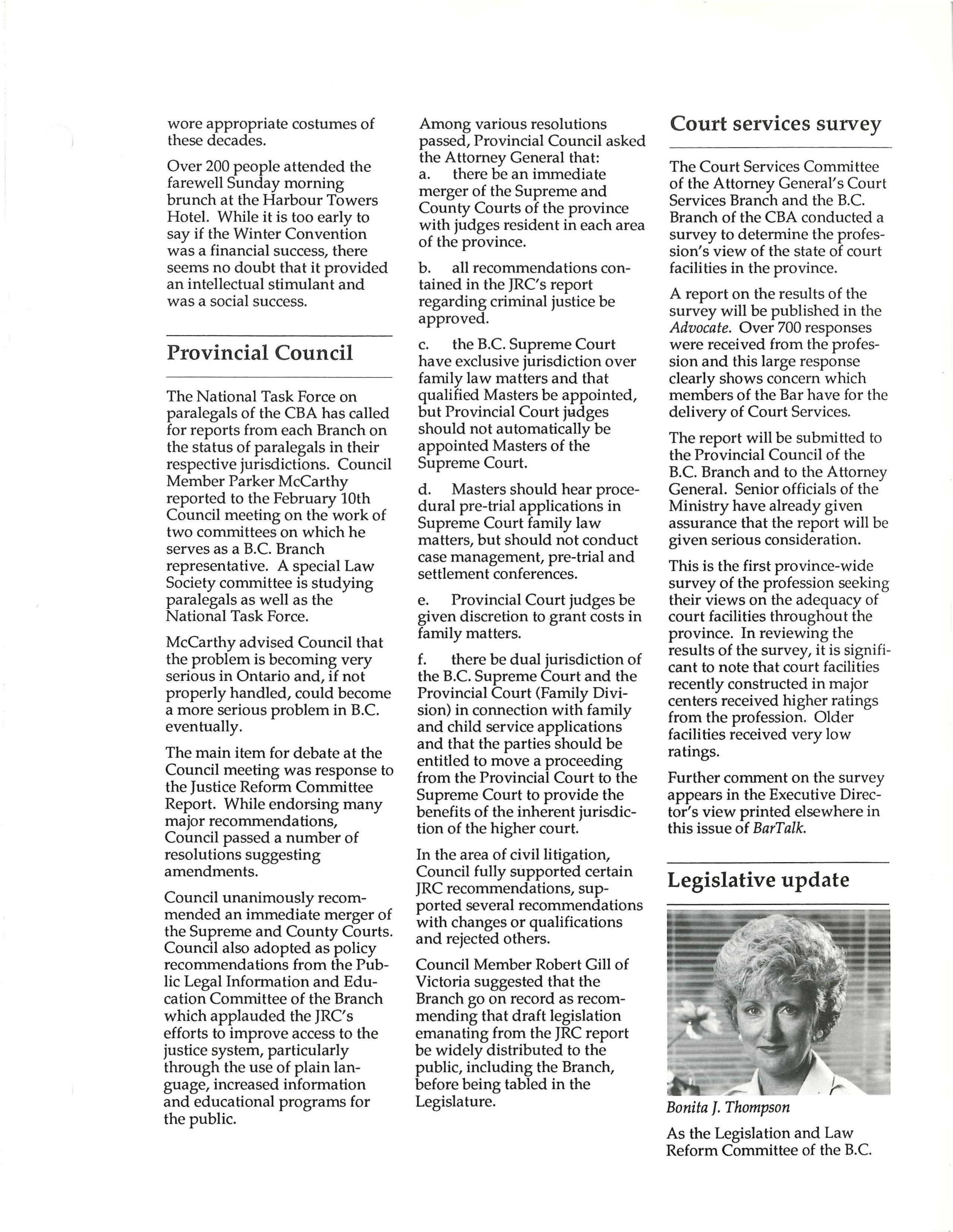
Bonita J. Thompson
As the Legislation and Law Reform Committee of the B.C.
Branch of the Canadian Bar Association will be requesting the assistance of the Subsections and individual practitioners to comment upon proposed legislation of the Province of British Columbia in the next weeks, it is important to make you aware of the conditions upon which such legislation is referred to the Canadian Bar Association for comment.
The Liaison Procedures in Government Legislation of the CBA state as follows :
a. Aim
One function of the Legislation Committee is to provide a focus through which the membership of the British Columbia Branch of the Canadian Bar Association may assist the government of British Columbia and, particularly the Attorney General of British Columbia, in ensuring that new or amending legislation is as comprehensible, workable and as unambiguous as possible and that it does not violate the rule of law .
The Bar does not seek any special privileges. Its members wish only to offer their skills on a voluntary basis to the government, hopefully to the advantage of everyone involved with or affected by the administration of justice
b. Terms of reference
The function of the Legislation Committee is to comment on government bills, with the comments directed to :
i. observance of the law, ii. constitutionality, iii. drafting, including comprehensibility and avoidance of ambiguity, iv. practical effects or consequences, and v. administration.
It is not the function of the Legislation Committee to make comments on matters of policy. Any comments made after first reading should not reveal that confidential comments were
made to the Attorney General before first reading.
Where the Canadian Bar Association is sent draft legislation on which to comment, it is sent under the following conditions :
"Under the terms of an arrangement between the Attorney General of British Columbia and the B.C. Branch of the Canadian Bar Association, the Legislative Counsel is prepared to send to the Legislation Committee copies of Bills to be introduced by the Attorney General before those Bills are given first reading. The Bills are sent on a confidential basis and can be released only to the Legislation Committee or members selected by the Legislation Committee . Members must undertake, and this undertaking has been given on their behalf by the Canadian Bar Association, not to make public any of the terms of the Bill, either generally or specifically, nor any comments that they may have thereon until after the Bill has been given first reading. Any comments made after first reading should not reveal that confidential comments were made to the Attorney General before first reading."
This advance review of draft legislation under "strict confidence" is a privilege which the Canadian Bar Association values and its continued and excellent relationship with the Attorney General and the Government of B.C. depends upon our members honouring this undertaking in spirit and in fact.
Regulations to note
1. Guaranteed Available Income for Need Act, B.C. Reg. 479/76, is amended by repealing s. 3(7) and substituting the following:
(7) A person who has grounds to claim federal unemployment insurance benefits and has not applied for those benefits is not eligible for income assistance. effective December 23, 1988
2 Insurance Act, B.C. Reg. 485/88, enacts a regulatim exempting seven Canadian companies from the necessity of being a licensed insurer under the Act where they are paying a claim or providing services related to warranties sold by International Warranty Company Ltd
effective December 23, 1988
3. Land Title Act, B.C. Reg. 488-490/88, enacts regulations for the purpose of applying the Torrens System to Indian land owned by the Sechelt Indian Band.
effective December 23, 1988
4. Milk Industn; Act, B C. Reg. 464/81, is amended by adding a new section which states that no person shall add bacterial culture or preculture to milk or transport raw milk to which it has been added. The provision exempts milk at a dairy plant as part of the processing of milk.
effective December 23, 1988
5. Motor Vehicle Act, B.C. Reg. 26/58, is amended by adding a new Division (37)Safety Code which specifies safety certificates and safety requirements along with penalty provisions for commercial motor vehicles.
effective January 1, 1989
6. Highway Act and Land Title Act, B.C. Reg 8/89, enacts a regulation respecting alternate access for subdivisions adjoining controlled access highways. effective January 20, 1989
7. Waste Management Act, B.C. Reg. 63/88, is amended by adding definitions respecting PCBs and providing for short term storage of PCB wastes. effective January 20, 1989
Legislation to note Land Title Amendment Act, S.B.C. 1988, c. 41, brings into force new "Part 25- Registration of Title h Indian Lands."
effective December 23, 1988