Bird News welcomes articles, letters and comments relevant to birdwatching in Cheshire and Wirral. Please either email or post your contributions to the Editor at the address shown above.
The views expressed by contributors are not necessarily those of the Society, the Council of the Society, or the Editor. Appearance of advertisements in this publication does not infer any recommendation or approval by the Society for the products and services being promoted.
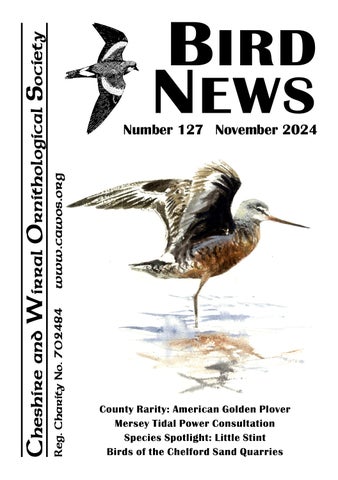
Front cover: Hudsonian Godwit, BMW by Ray Scally
Other illustrations by Phil Jones and Ray Scally
Note: the copy date for the next issue is 8th February 2025
Guest Editorial
It’s impossible to read or watch the news at the moment and not see signs of climate breakdown everywhere. There are still some people who look at the carnage in eastern Spain, where a year’s worth of rain fell in 8 hours and their first thought is how it affects their planned flight to the sun, but the need to do something urgently to cut our use of fossil fuels is finally becoming a mainstream view. What is less apparent except to those who carefully record our flora and fauna, is that we are already several decades into the biodiversity crisis. Regular repeated observations such as WeBS counts, or monumental efforts of local patch recording such as that in Steve Barber ’s ebook on Chelford Sand Quarries are two of the ways we can track long-term population trends in birds and provide robust evidence to report these changes. Similar studies have shown disastrous falls in the numbers of insects. Gone are the days of not being able to read a car number plate after a long drive, on account of a thick veneer of splatted insects. It’s also easy to forget that we are measuring recent declines against already catastrophically depleted baselines.
The biodiversity crisis and the climate crisis are deeply interconnected, each amplifying the other ’s impacts. Climate change drives biodiversity loss by altering habitats, increasing extreme weather events, and pushing species beyond their ability to adapt, while the loss of biodiversity undermines ecosystems ’ resilience to climate change. For instance, forests and oceans, rich in biodiversity, act as critical carbon sinks; as they degrade, more carbon is released into the atmosphere. Achieving net zero emissions is crucial, but without addressing biodiversity loss, the ecosystems that regulate the climate will continue to weaken, making climate goals unsustainable. Carbon reductions alone won ’ t save us; we must also protect and restore biodiversity to stabilise the planet ’s natural systems that support life and mitigate climate impacts. Which brings me neatly to Dermot Smith’s article on the Mersey Barrage. Plans for a barrage on the Mersey have been around for as long as I can remember, but it seems to be getting closer to reality now. That said the consultation referred to by Dermot is still so vague that it ’s impossible to really give a meaningful response yet. Regardless of the lack of detail in the proposals currently, I can ’ t see how any sort of barrage which affects the intertidal zone, so critical to huge numbers of birds that rely on Special Protection Area (SPA) or Ramsar site, can go ahead under the existing international environmental protections in place. It might be possible to argue the case for overriding public interest, and hence derogate the law at the Secretary of State level, but that is only possible if there is like-for-like mitigation within the same SPA. You can ’t replace lost feeding grounds for the species cited as qualifying features of the SPA: Dunlin, Black-tailed Godwit, Redshank Golden Plover, Pintail and Teal, if the tidal nature of the Mersey Estuary is affected. The data collected over many years by WeBS surveyors like Dermot will inform the pushback from the RSPB, BTO, CAWOS and Natural England. It ’s clear we do need to generate all of our power needs without burning fossil fuels, and that wave and tidal energy can be used in periods where the isn ’ t much wind or sunlight available, but I would be much happier to see smaller-scale generation. There is no point in taking action to achieve net zero if we destroy biodiversity on an industrial scale in the process.
Steve Young ’s article on the biodiversity gains achievable on golf courses is a lovely illustration of what is possible if just a few members lobby for a small change of emphasis in land use. One of the great things about biodiversity recovery is that even small patches of land, kept free of pesticides and herbicides and managed to allow native plants to diversity and flourish, will help enormously. Never mind no-mow May, I ’ve gone for a no-mow decade, and my garden is an oasis of invertebrate activity. It ’s paying dividends bird-wise. I ’ ve caught four Yellow-browed Warblers and a Barred Warbler in it this autumn so far.
I said earlier that the Mersey barrage should not be possible under existing Environmental legislation. Of course, that needs for there to be no change to the protections and for the relevant authorities to correctly interpret and apply the existing laws correctly. Just this week we ’ve had a significant ruling relating to West Kirby beach, where this summer a 0.5 hectare area of Atlantic Salt Meadow was removed to increase the area of the amenities beach at West Kirby. The area
lies within the Dee Estuary SSSI, abuts the Red Rocks SSSI and is in the Dee Estuary Special Area of Conservation, Special Protection Area and Ramsar site. In July 2023 Natural England gave conditional consent, arguing that the area was only 0.02% of the entire Dee SSSI salt marsh and would recover. They informed Wirral Borough Council that it was their responsibility to ensure that they complied with Environmental legislation relating to the SAC, SPA, and Ramsar sites. WBC went ahead with the removal this summer.
A complaint was made against Natural England by botanist, Josh Styles, which was escalated all the way through to the Office for Environmental Protection. The OEP ruling, released on Oct 31 st , was that NE ’s decision to allow removal on the Dee SSSI was probably a breach of Environment Laws since the recoverability was dependent on the area not raking the area afterwards. They went on to make an unsolicited ruling against WBC regarding damage to the SAC and Ramsar site. The OEP reserved its right to use their enforcement powers, on this occasion, but they would monitor for future breaches. This prompted the Chartered Institute of Ecology and Environmental Management to write to the OEP asking for clarification on the ‘ triggers ’ for a full investigation.
Extra scrutiny applied to local Authorities and Natural England has to be a good thing for protecting Biodiversity, whether at Hoylake beach or indeed on the Mersey SPA and Ramsar site.
Jane Turner
MESSAGE FROM THE EDITOR
Please get in touch if you would be willing to write a future Guest Editorial. Don ’t be shy. Ed.
Note: the copy date for the next issue is 8 th February 2025
CAWOS News
There have been two Council meetings since the last Bird News - in July and September. The Membership Survey was a prominent agenda item at both meetings, and you can find a summary on the CAWOS website: www.cawos.org. I won ’ t dwell on those findings now other to thank all those who took part and to say that, despite the many positive comments, the exercise has given us a number of pointers as to how we can improve the membership experience. I hope you will see evidence of that in the coming months.
The final work on the 2023 Bird Report is underway. Ted Lock is carrying out his final edit before stepping back from the role. I can tell you that we had serious concerns about the future of our Bird Report, and therefore the future of CAWOS itself as, despite our appeals, no-one had offered to take over the Bird Report editor role. Fortunately, David Steventon has offered to be editor for the 2024 report. We are extremely grateful to David for giving up his time and lending his considerable experience to the role.
Council decided at the July meeting that it will be necessary to increase membership subscription rates. Obviously, this decision was not taken lightly but was necessary due to increases in all the costs we incur, namely printing, postage and room hire. This decision was ratified at the Extraordinary General Meeting held along with the first Member Meeting of the new season on 4th October. That meeting was held by Zoom and the following meeting, on 1st November will be ‘ face-to-face ’ at the Mere and Tabley Community Club. I hope many of you will have been able to attend.
I also hope that by the time you read this article the depressing wet weather has improved and that you are able to get out and about and see some winter arrivals.
David Hiley, Secretary
MEMBERSHIP UPDATE
A warm welcome to new members Debbie Knight, Steve Brooks and Sally Heard - thanks for joining CAWOS.
Current total membership is now 284.
Eagle-eyed members might have noticed the change in membership fees for 2025. If you have a Standing Order PLEASE change it from £15 to £18 (or £22 for family).
Finally, thanks again to all those who completed our recent membership-survey. A results summary can be found on the website: www.cawos.org.
Best wishes
Caroyn Bailey, Membership Secretary
County Round-Up
Some of the records may be unauthenticated and therefore will require review by the Society’s Rarities Panel or the BBRC. This report covers the period from May to August 2024.
SITE REPORTS
Chester area
Quail calling at Farndon, Aug 3 rd and 13 th. Common Crane over Chester, May 21 st ,three White Storks, Puddington, May 1 st and Glossy Ibis, Mickle Trafford, May 18 th. Red Kite at Mickle Trafford, May 25 th and two Redstarts, Shocklach, May 12 th .
Congleton area
Common Scoter, Astbury Mere, May 7 th. Red Kite, Congleton, May 12 th .
Crewe and Nantwich area
Glossy Ibis by Phil Jones
Green-winged Teal at EHF, Jun 12 th to 15 th and Common Scoter, Doddington, May 7 th . Two Common Cranes at Marbury Mere, May 8 th and Black-necked Grebe at EHF, Aug 3 rd and 4 th. Two Avocets were at EHF, Jun 11 th with three Ringed Plovers, Aug 25 th, single Bar-tailed Godwit at Doddington, May 14 th, Curlew Sandpiper, Pump House Flash, May 1 st, Sanderling, EHF, May 13 th , Wood Sandpiper, PHF, May 2 nd and two Greenshanks, Doddington, Aug 19 th. A Caspian Tern was at EHF, Jul 6 th with Sandwich Tern, May 13 th and three Common Terns on May 3 rd. Osprey noted at EHF, May 23 rd and three Red Kites at Lea Forge, Jun 7 th
Ellesmere Port and Neston area
Three Garganeys, BMW, Aug 13 th and 22 nd with Green-winged Teal, Jun 15 th to 19 th. Quail was at Burton Marsh, Jun 22 nd and 24 th with others at BMW, Jun 27 th and Denhall, Aug 3 rd. Waders included: 176 Bar-tailed Godwits, BMW, May 30 th, Cheshire’s first Hudsonian Godwit here on Aug 12 th to 22 nd, three Turnstones, Denhall, Aug 26 th, three Sanderlings, BMW, Jun 7 th with Little Stint, Jun 5th, Pectoral Sandpiper, BMW/Parkgate, Jul 27 th to Aug 8 th, Wood Sandpiper, BMW, May 7 th and Jul 12 th and 10 Greenshanks, Parkgate, Aug 9 th. Little Gull, BMW, May 1 st
Three White Storks over BMW, May 1st, seven Spoonbills, Parkgate, Aug 28 th and 30 th and Bittern, BMW, Jun 23 rd. An Osprey was at BMW, May 9 th with Honey Buzzard, May 26 th, whilst three Hobbies were at Ness on Jul 17 th. 10+ Waxwings noted at Saughall, May 3 rd and two Tree Pipits, Denhall, Aug 11 th .
Halton area
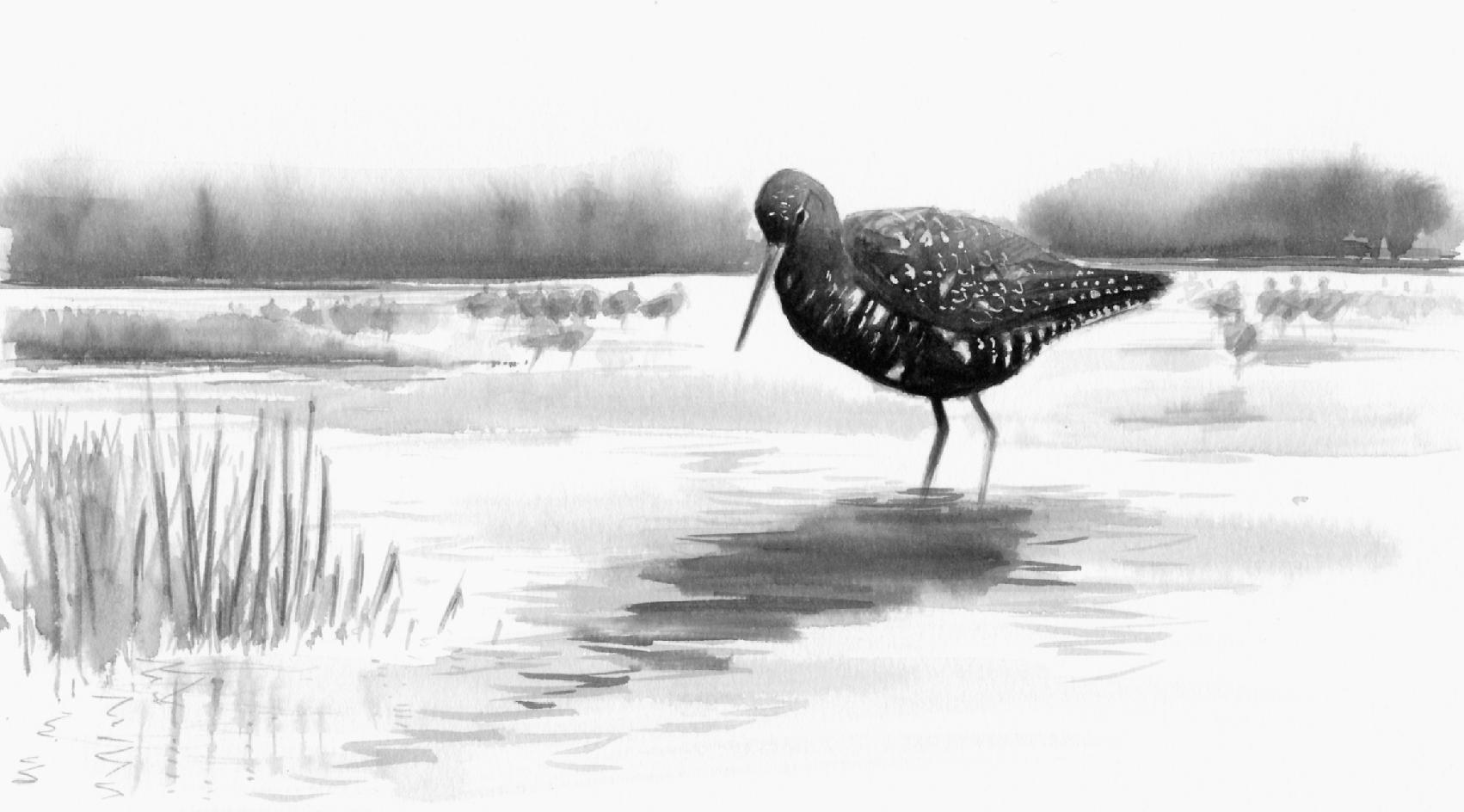
Spotted Redshank by Ray Scally
Two Common Scoters, Hale, Aug 4 th. 24 Avocets were on the Mersey at Spike Island, Aug 28 th,600 Ringed Plovers were at Hale, May 24 th with three Whimbrels, May 4 th, two Turnstones, May 4th and 24 th , two Curlew Sandpipers, May 26 th , two Sanderlings, May 24 th , two Little Stints, Jun 2 nd, Wood Sandpiper several dates in Aug and Spotted Redshank, Aug 22 nd . Little Gull, Hale were at Jun 1 st and Jul 16 th , single Caspian Gull, Widnes, Jun 15 th, two Sandwich Terns, Hale, Jul 16 th, Little Tern, Jul 16 th, 27 Common Terns, Jul 16 th whilst single Guillemots were at Hale on Aug 23 rd and Pickering’s Pasture on 28 th. Three Spoonbills at Hale, May 20 th, 29 Cattle Egrets, Hale, Aug 10 th. Single Ospreys were at Hale, May 4 th and Jun 15 th. Ring Ousel at Hale, May 1 st and 3 rd with Redstart, May 2 nd, 10+ Whinchats, May 1 st and two Channel Wagtails, Hale, May 17 th .
Macclesfield area
13 Egyptian Geese were at Acre Nook SQ, Aug 18 th with two Common Scoters on Jul 6 th. Six Common Cranes over Siddington, Jul 30 th, Black-necked Grebe at Lapwing Hall Pool, Aug 4 th. 13 Avocets were at Neumann ’s Flash, Aug 1 st. Four Little Gulls at Mere Farm SQ, May 1 st and Black Tern, Acre Nook SQ, May 4 th. Osprey at Mere Farm SQ, May 9 th, three Red Kites, Wildboarclough, Aug 12 th and four Hobbies, Acre Nook SQ, May 12 th and 14 th. Three Ring Ousels, Danebower, May 5 th, three Spotted Flycatchers, Wildboarclough, May 27 th whilst single Pied Flycatchers were at Danebower, May 5 th and Wildboarclough, Jun 18 th
Vale Royal area
Six Egyptian Geese were at Neumann’s Flash, Aug 29th to 30th with two Garganeys, May 6th, Scaup, May 16th to 22nd and Common Scoter, Frodsham, Jul 21 st. Common Crane, noted at Frodsham Marsh, May 12th and Sutton Weaver, 13th. 13 Avocets reported from Neumann’s Flash, Aug 1st, three Ringed Plovers, Marbury CP, May 17th, 73 Whimbrels, Frodsham Marsh, May 7th, 81 Black-tailed Godwits, Ashton’s Flash, May 7th and two Wood Sandpipers, Frodsham Marsh, Aug 7th to 9th
A Little Tern was at Ashton ’s Flash, May 30 th, six Common Terns, Rostherne, May 18 th and Jul 4 th and three Black Terns, Marbury CP, Aug 12 th. 17 Cattle Egrets were at Helsby, Jun 23 rd. Osprey over Comberbach, Jun 17 th, Frodsham, May 12 th, three Marsh Harriers at Ashton ’s Flash, May 6 th and five Red Kites, Winsford, Jun 27 th and three Hobbies, Ashton ’s Flash, Jun 19 th. Five Ravens, Neumann ’s Flash, Jun 3 rd, Wood Warbler, Delamere, May 8 th, two Spotted Flycatchers, Marbury CP, Jun 27 th, Pied Flycatcher, Delamere, May 11 th and Redstart, Little Budworth, May 4 th and Delamere on 11 th .
Warrington area
At least nine Garganeys were at Woolston Eyes, May 1 st with Lesser Scaup, May 4 th. A singing Quail heard at Silver Lane Pools, Aug 17 th whilst a possible Corncrake reported at Burtonwood, Jun 30 th . Three Avocets were on the Mersey at Fiddler ’s Ferry, May 12 th , four Whimbrels, Woolston Eyes, May 4 th, with 100 Black-tailed Godwits, Jul 3 rd, Turnstone, May 14 th and Wood Sandpiper, Aug 8 th. Kittiwake at Woolston Eyes, May 13 th, Little Gull, May 4 th, two Common Terns, May 4 th with five Arctic Terns on the same day
Wirral area
Wildfowl included: a single Brent Goose at Hilbre, Aug 26 th with 420 Pink-footed Geese, May 5 th , 18 Eiders, May 6 th and 340 Common Scoters, Leasowe, Jun 13 th. Alpine Swift at Birkenhead, Jul 9 th . Waders of note included: 147 Whimbrels at Heswall, May 5 th , 103 Bar-tailed Godwits, Thurstaston, May 3 rd, 5700 Black-tailed Godwits, Caldy, Aug 18 th, 224 Turnstones, New Brighton, Jul 24th, c6000 Knots, Meols, Jul 21st, Curlew Sandpiper, Meols, May 2nd and 28th, Hoylake, May 25th and three Little Stints, Meols, Jun 11 th. Single Little Gulls were at Hoylake, Leasowe and Meols on
Sandwich Terns, Hilbre, Aug 12 th , 30 Little Terns and two Black Terns Aug 12 th and 13 Arctic Skuas, Hoylake, Aug 25 th. 25 Guillemots and two Razorbills were off Hilbre, May 5 th with Black Guillemot and two Puffins on 6 th and 19 th
Scally
Elsewhere 123 Red-throated Divers off Hilbre, May 5th, two Storm Petrels, New Brighton, Jul 1 st and 2 nd, Fulmar, Hilbre, Jun 1 st and 16 th, six Manx Shearwaters, Hoylake, Aug 25 th and 150 Gannets, Hilbre, Jun 16 th. Ospreys were observed at Heswall, Hilbre, Hoylake, Leasowe, Pensby, West Kirby and Wallasey, with a possible Montagu ’s Harrier reported from Leasowe, May 9 th. Single Hooded Crows were at Prenton May 7 th and Leasowe, May 19 th . Two Iberian Chiffchaffs at Leasowe, May 3 rd , a late Fieldfare, Heswall, May 4 th , two Spotted Flycatchers, Leasowe, May 12 th and 15 th, Black Redstarts noted at Greasby, Jul 27 th, Leasowe and New Brighton on May 2 nd and 3 rd. Otherwise, Blue-headed Wagtail at Leasowe, May 6 th, two Tree Pipits, Leasowe, May 4 th and three Crossbills, West Kirby, Jul 3 rd
Tony Parker , 41 The Park, Penketh, Warrington, Cheshire, WA5 2SG Tel: 01925 726986 Email: tonyparker@cawos.org
Thanks/acknowledgments to : Dee Estuary Website, SECOS, WECG, Dermot Smith (Mersey WeBS), NNHS, Frodsham Marsh Birdlog, Birdwatching Magazine, Manchester Bird Forum, whatsapp groups (Cheshire, Marbury and Sandbach), Rob Cockbain, Bill Bellamy and everyone else who passed records on.
County Rarities
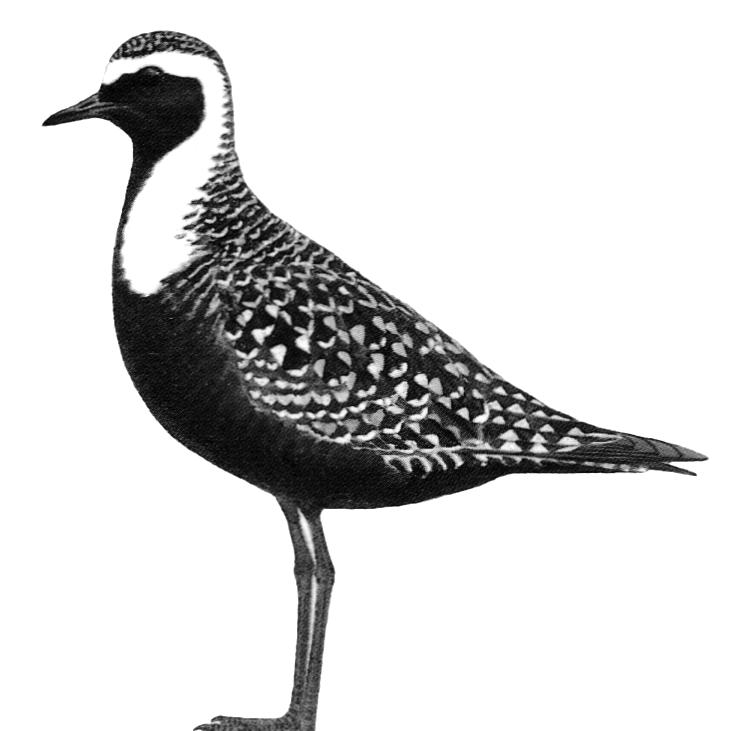
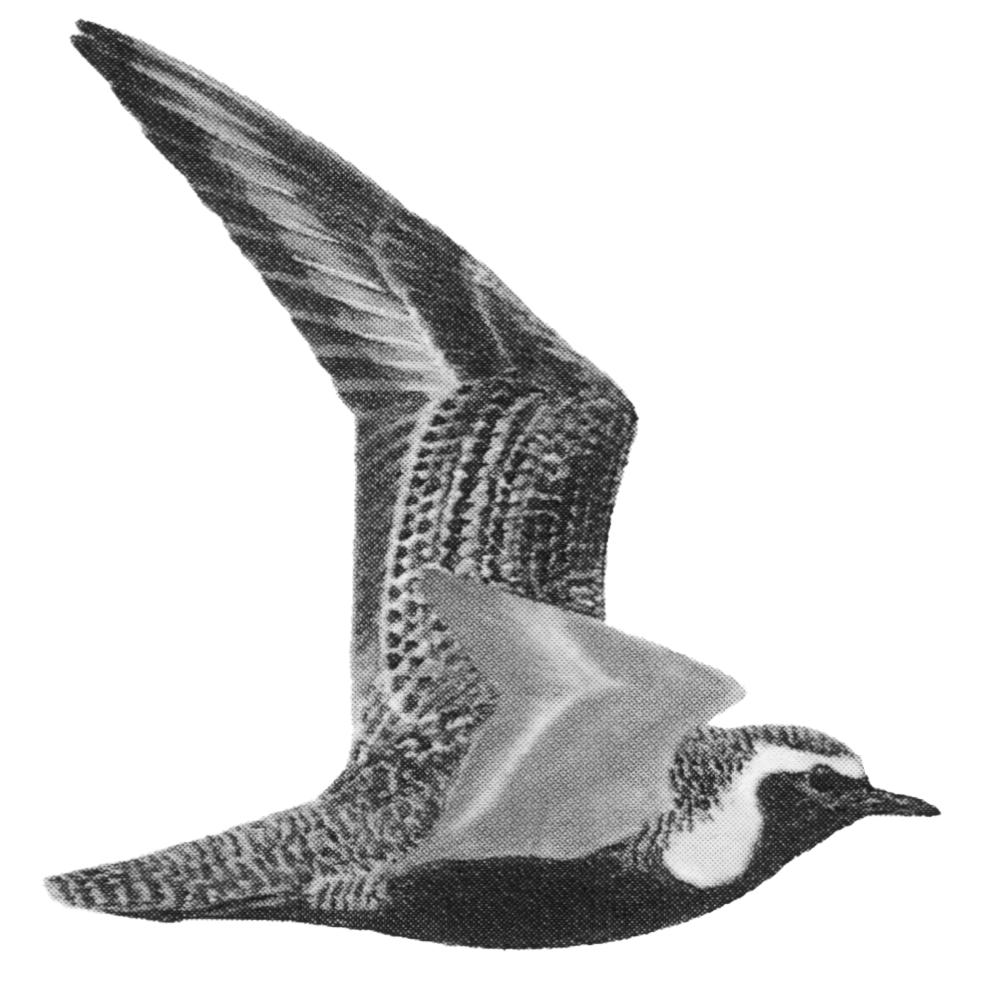
AMERICAN GOLDEN PLOVER Pluvialis dominica
Until the recent bird that took up residence on newly developed Hoylake green beach, which then relocated to Frodsham, American Golden Plovers (AGP) have always been fleeting visitors to Cheshire and identifying one requires laser-like focus on the key ID features.
Like their very close relative Pacific Golden Plover (PCP) Pluvialis fulva, which is still a BBRC description species, they are conspicuously slimmer and ‘ pointier ’ birds than European Golden Plover Pluvialis apricaria (EGP). If you are lucky enough to encounter a bird on the ground they can appear very distinctive, looking very leggy and very long-winged, with the primaries extending well beyond the tail and a primary projection approximately equal to the tertials in length. Both juveniles and adults are much more cold and monochrome looking above than EGP - actually quite reminiscent of Grey Plover in that regard, and in some ways an out of context Grey Plover, without a way to assess size, it can be more of an ID challenge than you might expect. Grey Plover of course has distinctive black arm-pits and a strikingly strong wing bar. The underparts of summer adult AGPs are much more solidly black that EGP and they have a very bold white supercilium. This is also present in younger birds and it often the first thing you notice on a bird on the ground.
Adult summer
Encountering a suspected AGP in flight is in some ways easier than finding one on the ground, since you will immediately be aware of the grey auxiliaries (arm pits). If the bird is quite high it ’s the lack of contrast between the auxiliaries, the body and the flight feathers that stands out. On EGP you can see a strong contrast between the white auxiliaries, the rest of the wing and especially the flanks. Unfortunately, it ’s hard to determine the subtle structural and plumage differences from PGP in flight. I know this to my cost since I had to let go a ‘ Lesser ’ Golden Plover that flew over my head at Red Rocks in the period after the split, but while both species were still BBRC description birds. That bird called, and had I been passive recording at the time, I could have proven which of the pair it was. Both species sound less mournful than EGP. AGP is a rather slow, squeaky, rising “chu-wee”, while PGP is a quicker less-squeaky, but more ‘cheerful’ call which can sound very like Spotted Redshank.
So if you find a suspected AGP, make a careful note of the relative position of the primary tips, tertial tips and tail, don ’ t miss an opportunity to describe its underwing, and if at all possible get a sound recording!
Jane Turner
AMERICAN GOLDEN PLOVER: CHESHIRE AND WIRRAL STATUS
The American Golden Plover was once of rare enough occurrence nationally for records to be considered by BBRC. However, numbers occurring increased and records have not been considered by that Committee since 2005. Nevertheless, as will be seen, the species remains a considerable rarity in Cheshire and Wirral.
First recorded in 1987 when a bird remained at Middlewich Lime Beds and nearby fields from October 20th to 24th. This bird was followed relatively quickly by one by the River Mersey at Penketh on 13th October 1991. Almost a dozen years passed before the species next appeared on the sea defence embankment at Leasowe on 20th September 2003. All three of these birds were juveniles.
Juvenile
Subsequently records have come relatively thick and fast. Flight only birds were at Leasowe on 11th October 2009, in 2012 over Hilbre on September 23rd and Red Rocks on September 27th, while in 2021 an immature bird on the beach at Hoylake on Aug 7th and 8th allowed great views for many birders before re-locating to Frodsham Marsh, where it was seen on August 14th and 15th.
So, a total of eight records probably involving six birds of which at least four were immatures. Three of the records are of birds calling in flight and five are from the North Wirral coast. The 2021 bird stands out as the only one seen in August while the date range of the others is from September 20th to October 24th.
Truly a Cheshire and Wirral rarity!
Steve Barber
Note: the copy date for the next issue is 8 th February 2025
W e cannot guarantee that material received after this date will be published in that issue. If you are aware that your material may be delayed, please let the Editor know as soon as possible
Ringing News
Ringing plays an important part in developing our knowledge of birds. In this feature we invite ringing groups (or individual ringers) active in Cheshire and Wirral to contribute their own accounts of their activities. In general, the idea is that these should provide a means of updating local birders on the groups ’ work - both by way of information about birds ringed or recovered, and news of other events (or incidents).
Future contributions from other groups and/or individuals will be welcomed.
COLOUR RING REPORT
This report is a summary of the records obtained by the Dee Estuary Colour-ring Birding Group from July 2024 to September 2024.
Shelduck
The longevity record for a Shelduck (established by colour ringing) is 19 years and 10 months. This was a bird ringed at the Lower Derwent Valley NNR in Yorkshire, and last seen in 2021. Also ringed at the same site is a Shelduck with a black ring inscribed with the letters ‘ ST ’, which we have recorded at Thurstaston several times including September 2024 when it was 17 years and 3 months old - so only two and a half years to go before it breaks that longevity record!
Cormorant
A Cormorant with green ring inscribed with letters ‘ CPP ’ was on East Hoyle Bank near Hilbre in August. It was ringed on Puffin Island in June 2011 and it has an interesting history being recorded most winters on the Normandy Beaches used for the D-Day landings. Most records are from the Beauguillot National Nature Reserve which is just to the south of Utah Beach.
Black-tailed Godwit
Fascinating birds, Black-tailed Godwits. They have been colour-ringing them for something like 30 years, so they are well studied. Here, on the Dee Estuary, we ’ve been recording them for around 22 years and in September this year we saw our 314 th colour-ringed ‘ blackwit ’. We have found that that each bird has its favourite site for their summer moult, their favourite wintering area and their favourite spring moult site before they fly to Iceland to breed. For some these favourite spots can be in one relatively small area (perhaps the Dee and Mersey estuaries), for others they can range through the whole of western Europe such as Dutch-ringed bird with code L5YLBR.
This one spends late summer in the Dee Estuary area before moving south for the winter. There is a gap of several months between it leaving here and arriving at the Tagus Estuary in the second half of the winter, perhaps it spends this time on the Atlantic coast of France or northern Spain. Most records in Portugal are when it is feeding in the rice fields where large flocks are present. In late winter/spring it flies north-east to the Netherlands (via northern Spain) before heading northwest to Iceland to breed. This north-east movement is seen a lot with godwits that winter in Spain and Portugal; we think they probably fly with the continental race of Black-tailed Godwits ( Limosa limosa ) which are returning to the Netherlands to breed after spending the winter in Africa.
Mediterranean Gull
‘ Med ’ Gulls are increasing in number every year here on the Dee Estuary, and we usually record several colour-ringed ones in late summer when they are dispersing away from their breeding grounds. This year we had a particularly interesting one which has been recorded 50 times since it was ringed near Hamburg as a chick in 2012.
After the breeding season this bird flies westwards to the Liverpool Bay area where it has been recorded from July to around mid-September. The next set of records all come from southern Portugal, mostly on the Algarve, where it enjoys the winter sun up until January. There are a couple of records from northern Spain in January but then there is a gap in sightings until it turns
up back in the Hamburg area in April where it breeds - sometimes on rooftops and sometimes on islands in the River Elbe.
Looking at records of other Mediterranean Gulls breeding on the continent this movement west followed by them heading south to the Iberian Peninsula for the winter seems to be typical of this species.
Note: If you want to be part of the Dee Estuary Colour-ring Birding Group all you have to do is submit a colour-ring sighting either to myself or copy me in on any submission you may make elsewhere so I can include it in our database. Email: richard@deeestuary.co.uk.
Note there is a monthly colour-ring update on the Dee Estuary Birding Website: www.deeestuary.co.uk.
Richard Smith
MID-CHESHIRE BARN OWL GROUP
To coin a football term, regarding Barn Owl breeding, 2024 has been a year of two halves; not in terms of time, but in terms of location. Overall Barn Owl breeding in our part of Cheshire is around 30% down on last year, both in terms of the number of breeding pairs and chicks. However, it is the more northerly parts which have seen the greatest decline (over 50% in some cases), whilst the southern parts, particularly the South Cheshire Group, have seen the number of breeding pairs and chicks on a par with last year ’s numbers.
This decline does not overly concern us at the moment. We ’ ve had 8 good years, and usually have a poor one every 4 or 5 years which reflect the cyclical nature of the vole and shrew breeding cycle (these being the Barn Owls main food source); hence a poor year has been overly due. Also the start of the year was not good for Barn Owls, alternating between very wet, warmer than usual, strong winds and gales, etc.
An optimistic note is that, although there has been a significant decline in breeding activity this year, there have been quite a number of single and paired Barn Owls found in boxes but where no breeding has taken place. Hopefully, these ‘dormant ’ birds are waiting for their breeding chances in 2025.
But dare I risk an overly optimistic prediction. In the past a poor year (like 2024) has invariably been followed by a very good year. There, I ’ ve gone and done it. But let ’s hope 2025 follows this ‘ usual’ course.
As my now usual final comments - we do our best, but it stretches our limited resources to help support these beautiful and iconic birds. We get a great deal of satisfaction out of the conservation work we do. But we are always in need of more help.
To repeat our usual concerns and plea - if you have seen any Barn Owls recently please could you let us know, either direct or by our sighting report on the website www.cheshirebarnowls.co.uk); as you will appreciate it is important that we know where the birds are regularly seen.
John Mycock, Chairman Tel: 07970 235437
HILBRE BIRD OBSERVATORY (HiBO)
Ringing June 2024 to end of October 2024
cheshirebarnowls@gmail.com
The summer and autumn ringing at Hilbre has seen the continuation of the Rock Pipit project started in 2023 and the participation of the bird observatory in a project set up by the BTO to monitor Yellow-browed Warblers in the UK by colour ringing. Rock Pipits continue to do well on Hilbre and a further 10 have been colour-ringed in 2024. We are keen to receive data on sightings around the island and the Wirral. Thanks are due to
everybody who has reported one of our birds locally. We have not had any sightings away from the Wirral but we live in hope. Hilbre has never supported a long-term permanent colony of Rock Pipits and one of the objectives of the present study is to see if our Rock Pipits turn up at other sites or if we can identify a location that provides birds for our population.
The Yellow-browed Warbler project is very timely given that it is intended to study the movement of Yellow-browed Warblers. 2024 has turned out to be a bumper autumn for these tiny, eastern migrants in the UK. The project provides colour rings for the birds which have been distributed to the bird observatories round the UK and over 100 birds had been ringed by the middle of October, six of them being ringed on Hilbre out of seven birds seen so far - a record year for the islands and for Cheshire and Wirral for this species. Yellow-browed Warblers, like other so called rare birds from the east, are considered by some to get to the UK by a process called reverse migration. Instead for taking their usual migration route and ending up near the Indian subcontinent they move off 180 degrees out of phase and get to Europe instead. Birds undertaking this manoeuvre often die but the Yellow-browed Warblers seem to be doing it more regularly in bigger numbers which may indicate a change in migration strategy. Please report any colour-ringed birds you see.
Another project that Hilbre is involved with is the implementation of a Motus receiver as part of Motus network throughout the UK. The Motus network started off in Canada and spread very quickly to the USA where it is providing highly detailed tracking of migrating birds. The birds it tracks have been fitted with a broadcasting tag that has a range of about 20 miles so that when a bird passes within 20 miles of a base station, like the one on Hilbre, its signal is picked up and recorded. The network in Europe has far fewer stations than the one in North America but it has started and the station at Portland Bird Observatory, Dorset, has had a UK hit on a Yellow-browed Warbler tagged in the Netherlands in October this year. Just the kind of data we are hoping for when being part of the UK’s Motus network.
John Elliott, on behalf of the Hilbre Bird Observatory
CHESHIRE SWAN STUDY GROUP
Since my last report the Swan Study Group has ringed 2 adults and 12 cygnets.
The maximum counts of flocks of Mute Swans since my last report are as follows:
- Acre Dell Pools, nr Congleton: 12 on 24 th Jun, 13 on 2 nd Sep.
- Bottom Flash, Winsford: 55 on 19 th Aug and 59 on 2 nd Sep.
- Budworth Mere, Northwich: 6 on 21 st Jul, 6 on 18 th Aug.
- Comber Mere, nr Whitchurch: 6 on 21 st Jul, 7 on 18 th Aug.
- Doddington Mere, nr Nantwich: 93 on 25 th Jun, 97 on 23 rd Jul, 83 on 4 th Aug and 81 on 9 th Sep.
- Neumann ’s Flash, Northwich: 12 on 9 th Jun, 3 on 21 st Jul, 8 on 18 th Aug and 19 on 22 nd Sep.
- Queens Park Lake, Crewe: 10 on 21 st Jun, 9 on 21 st Jul, 9 on 18 th Aug and 7 on 22 nd Sep.
- Sankey Valley CP, Warrington: 14 on 21 st Jul, 14 on 18 th Aug and 13 on 22 nd Sep.
- Tatton Park, Knutsford: 19 on 21 st Jul, 17 on 18 th Aug and 9 on 22 nd Sep.
- Woolston NR, Warrington: 54 on 18 th Aug.
Movements
CNA8(G) ringed as a female cygnet on 3-12-18 at Hosewood, Hilderstone, near Stoke-on-Trent. Seen on 22-9-24 at the weir, River Dove, Mapleton, near Ashbourne = 25kms.
Sightings of all swans, geese and Mallards should be sent to: David Cookson at cheshireswans@gmail.com, giving details of place (6-fig map ref), colour/character combination of ring and, if with other birds, total number present in the flock. All sightings will receive a printout of the history for the relevant bird(s).
David Cookson , on behalf of Cheshire Swan Study Group
Conservation News
MERSEY TIDAL POWER CONSULTATION
Plans for Tidal Barrage on the Mersey Estuary
The Mersey estuary, which is Cheshire ’s second-best wetland and the UK’s 11 th most important place for birds, is under threat. Liverpool City region have announced plans to build a tidal barrage across the estuary. There is a public consultation on the plan which closes on 15 th November: https://lcrlistens.liverpoolcityregion-ca.gov.uk/tidal/mersey-tidal/. There is also a Community Consultation Booklet (11.9 MB pdf document) at the bottom of the website that tells you more about the proposal.
There is a short section on the environment on page 20 that will tell you that the estuary is nationally and internally important, yes internally important , I think they mean internationally important. They also tell you that it is a Special Area of Conservation, which it isn ’ t. It is a Special Protection Area under the Birds Directive and a Ramsar site.
The Importance of the Estuary
What these designations don’ t put into context is how incredibly important the estuary is to birds and other wildlife. The table below is taken from the British Trust for Ornithology BTO WeBS Reports . It shows the best sites in the UK for overwintering waterbirds. The Mersey Estuary has over the last five years had an average of 90,000 birds, making it the 11 th best place for birds in the UK.
Table 1 the Most Important Sites for Overwintering Waterbirds in the UK
Internationally Important Species
The estuary is internationally important for six species and for three species the estuary is especially important.
Dunlin have declined by at least 20% globally since the early 2000s, resulting in them being moved one category from ‘ Least Concern ’ to ‘ Near Threatened ’ on the IUCN Red List. On the Mersey, for most of this century, the estuary was their most important site in the UK. It has recently been overtaken by the Ribble, meaning it is now the second most important place. It has a 5-year average of over 40,000, which is 13% of the UK overwintering population.
The estuary is also the second most important place in the UK for Redshank with an average of over 9,000 birds, representing about 10% of the UK population.
Like Dunlin the estuary was, for most of this century, the most important place in the UK for Shelduck , it has recently dropped to third. With an average of 7,000 this represents about 15% of the UK population.
For Black-tailed Godwit , which are also classed as ‘Near Threatened’ , the estuary is the 8th most important place and for Ringed Plover it is the 9 th best place.
The sixth species of international importance is Pink-footed Goose . This is recent arrival with an average of nearly 12,000 birds roosting during the night in winter.
Species 5-yr average max UK ranking where Percentage
up to 2022-23 in the top 20
*Where the current BTO WeBS data is significantly different to the current average, ie up to 2024, I have used the most recent.
Nationally Important Species
The estuary is also nationally important for 10 species. Grey Plover have declined by more than 30% globally since the late 1990s. Their conservation status has recently moved two categories from ‘Least Concern ’ to ‘ Vulnerable ’ .
Significant Risk
Many of the species are dependent on the intertidal muds that are rich in food. These are the very habitats that are likely to be affected by a tidal barrage as it will have an impact on sedimentation. How significant this impact will be has yet to be assessed.
Tidal barrages are a relatively unproven technology with only two previous tidal barrages cited by Mersey Tidal. There is one in France at La Rance near St Malo that was built in 1966. There is also one opened in 2011 in South Korea, the Sihwa Lake Tidal Power Station. Both generate about 240 Mega Watts of electricity. The Mersey proposal will generate 1GW. This is quite a risk we would be taking using an unproven technology, 4 times the size of the only other operating schemes, on one of our most important estuaries for a 1.3% increase in the UK ’s electricity generating capacity.
There is also a question whether it will generate this amount of electricity as there is a possibility that, because the Mersey is a high sediment river, unlike the La Rance scheme, it may well silt up.
Contributing to Net Zero?
Another issue with this scheme is that to hit our carbon reduction targets we need low carbon electricity production now. The barrage will take 7 to 10 years to build. It will take at least 4 years to get permission, do the detailed design and appoint a contractor, so the earliest it will be ready is 2038. In Britain we are not renowned for building such big projects on time, so it is more likely to be ready sometime in the 2040s. Due to the huge amount of concrete and steel needed it will have its own carbon footprint that will take some time to negate. Therefore, it will only make a very small contribution to our net zero goals right at the end of the target date, but could have quite devastating impacts.
There are many other risks from this project and many uncertainties. The next few years will be crucial in deciding whether such a scheme is worth the potential impacts. So, what is important is that we all contribute our views and scrutinise the evidence. I have been working with the Mersey Tidal team helping them to develop their baseline surveys to ensure any assessment is based on sound evidence.
Want to Help?
The data in this article is collected by volunteers who take part in the Monthly Wetland Birds Survey (WEBS) counts. If you are interested in joining the WeBS counters I am always looking for new birders to join the crew. You will get to see some spectacular sights and visit the best areas where there is no public access, where there are vast saltmarshes and mudflats, heaving with birds, where there is no public access. If you are interested, please email: dermot.smith71@gmail.com.
Dermot Smith, Mersey Estuary Conservation Group Chair, Mersey Estuary Wetland Bird Survey Local Organiser since 2012, Mersey Estuary WeBS counter since 1994.
Projects and Surveys
OUR DEE ESTUARY PROJECT
The River Dee catchment area (the entire area the water for the river comes from) covers an area of 2,251 sq kms, mainly in Wales but also in England. The River Dee ’s journey begins at the source in the mountains and lakes of the Snowdonia National Park and it runs to the internationally significant intertidal and wading bird habitat of the Dee Estuary. This is where the Our Dee Estuary project area begins.
Our Dee Estuary is a cross-border partnership project led by Cheshire Wildlife Trust, on behalf of the Tidal Dee Catchment Partnership and funded by the National Lottery Heritage Fund. It brings together a variety of local organisations with an interest in the Dee Estuary. These include local authorities, water companies, Natural England, Natural Resources Wales and the RSPB.
Our Dee Estuary aims to inspire coastal communities around the Dee Estuary, in both Wales and England, with their natural heritage to create a new community of stewardship to effectively conserve and safeguard the wildlife significance of the Dee Estuary.
Key aims of our project are to:
· Improve governance and collaboration between stakeholders around the Dee Estuary. Reduce negative environmental impacts along our estuary. Break down access barriers and help a wider range of people enjoy the estuary and develop new knowledge without putting the heritage at risk.
· Create a nature-based sense of place around the Dee Estuary, increasing engagement with the estuary from local communities.
· Improve wellbeing of communities and create a better place to live / work / play.
· Increase understanding of habitat importance and the species present along the Dee.
· Better manage, protect and record our natural areas.
As I ’ m sure you ’re all well aware, the Dee Estuary is home to at least 120,000 wetland birds each winter. This is the 7th highest overwintering population on an estuary in the UK. The Dee Estuary is also a Site of Special Scientific Interest (SSSI), Special Protection Area (SPA), Special area of Conservation (SAC) and Ramsar Site. SPA ’s and Ramsar sites are specific to bird species and wetland habitats, again demonstrating the importance of the Dee Estuary for wetlands birds on a national and global scale.
Our project started back in 2021, with thanks to national lottery players, and since then we ’ve managed to achieve a lot. Our funding has allowed for big habitat conservation works to occur at: ·Neston reedbeds which included a channel of wet barriers through the reedbed.
·development of a 1.5ha wader scrape at RSPB Burton Mere. ·improved access at Heswall Fields, as well as improving access in Gronant and Bettisfield.
Aside from the practical work, our project also runs regular species-specific surveys throughout the summer months, as well as warden and volunteer roles such as that at North Wales Little Tern Group at Gronant. Having close connections with local friends of groups means we can truly listen to what it is needed. We are part of ‘ Operation Seabird’ which aims to address issues of wildlife disturbance through education and we regularly partner with Dee Estuary Volunteer wardens, RSPB Burton Mere and Little Tern Group North Wales for birdwatches that are open for the public to drop by. Coming up, we will be holding winter wader webinars through the winter as well wading bird walks out on the Dee Estuary itself and these will be run alongside professionals in the field from RSPB, the BTO and Wirral Country Park Rangers.
You can find out more about our project here: https//ourdeeestuary.co.uk and more about the Tidal Dee Catchment Partnership here: https//catchmentbasedapproach.org.
Carys McMillan, cmcmillan@cheshirewt.org.uk
WeBS NEWS
Thanks are needed for Colin Lythgoe , who also retired from WeBS this year, after 25 years of counting in Cheshire.
Additionally, a special mention is needed for Bob Groom , for whom June 2024 marked 40 years of doing WeBS counts at Tabley Mere, Cheshire! Hearing about these achievements is truly inspiring and makes us feel lucky to have dedicated and passionate counters supporting WeBS!
A very special thanks is also needed for Phil Hampson who has recently retired as the Local Organiser for not one, not two, not three, but four WeBS regions, plus as the Northern England representative on the Local Organiser Advisory Committee! Phil has always been an expert and dependable LO and our thanks and best wishes go out to him for the future.
Volunteers needed - sign up now for the January Winter Gull Survey
The BTO are running a Winter Gull Survey (WinGS) over two winters, the first survey was last winter (2023/24) and the next is this coming winter, 2024/25. Prior to this, the last gull survey ran from 2003/04 to 2005/06 so this survey is long overdue. Information collected in this winter’s survey will start to fill the gaps in our knowledge which have developed since the last survey 20 years ago. This is particularly important given that gulls have been impacted by the ongoing
outbreak of highly pathogenic avian influenza (HPAI), and we are still seeking to understand the full implications of this. Previously the surveys have taken place approximately every 10 years since the first such survey in 1952/53.
Volunteers are still sought for inland gull roost sites around Cheshire.
Survey aims and purpose
The project ’s aim is to provide updated information on the numbers and distributions of wintering gulls in the UK. Information will be provided for all gull species, but with a focus on Black-headed Gull, Common Gull, Lesser Black-backed Gull, Herring Gull and Great Black-backed Gull as the five most numerous and widespread species that occur in the UK during the non-breeding seasons.
The survey will also assess how numbers have changed since the 2003/04 - 2005/06 survey and will enable updated 1% thresholds to be calculated to help identify sites of national importance for gulls.
Get Involved
The amount of time you spend volunteering for WinGS depends on the count(s) you take part in:
A single visit to a key site around dusk to count roosting gulls, in January 2025
Counting a sample site on a single visit in January 2025
You will also need to spend time submitting your data to the BTO within the WinGS Webapp. Survey sign-up is now available by visiting the BTO website, for more information on the survey you can visit www.bto.org/wings . On the ‘Taking Part’ page you can find more information on the survey methods and there are also gull ID training videos for anyone who may need them. From here you can also find a link to the survey portal where you can check the ‘Vacant Sites Map’
Some key sites are still requiring volunteers in our area so if you regularly visit Budworth Mere/ Neumann ’s Flash areas, the meres around Tatton, Sandbach Flashes or Delamere and you would like to help then please visit the Vacant Sites Map and get involved.
Sites to Watch
WOOLSTON EYES
Woolston Eyes is a large nature reserve and SSSI, located just east of Warrington, roughly two miles from the town centre. The reserve is owned by the Manchester Ship Canal Company (MSCCo) and managed jointly by local voluntary group Woolston Eyes Conservation Group (WECG) and the RSPB. A key and annual permit may be purchased for a small cost at https:/ /woolstoneyes.com/visiting/#permit-applications-and-group-visits.
The reserve itself is made up of four dredging beds nestled between the River Mersey to the north and Manchester Ship Canal to the south. The two westernmost beds, No.3 and No.4 Beds, are accessible to permit-holders. In 2019, WECG, in collaboration with MSCCo, RSPB, Natural England and Carbon Landscape, raised £650,000 to create a large new wetland on No.4 Bed. At the time of writing the wetland is now complete bar a few final touches and has already proved a great success. Black-necked Grebes colonised whilst the wetland was still being dug, with birds using the site to both stage on migration and breed. Rarities include White-tailed Lapwing, Temminck ’s Stint, Ferruginous Ducks and Penduline Tit.
No.3 Bed is a mature wetland, with large stands of Phragmites and wet willow scrub. There is a pedestrian footbridge by the small car park for access, as the bed is surrounded by the Mersey oxbow — an underwatched part of the reserve that looks prime for a Night Heron. It was favoured by a pair of Ferruginous Duck in Spring 2024. The bed itself is where the main Blackheaded Gull and Black-necked Grebe colony can be found and can be viewed from six hides
around the lagoon. The willow scrub remains one of the best places to see Willow Tit locally. Woolston Weir basin is situated just north-east of No.3 Bed and can host decent Aythya flocks in winter. It is also one of the last places in Cheshire that Goldeneye may be regularly encountered, and the best part of the reserve to look for Common Scoter on passage.
Wildfowl counts here started in 1979 and have taken place every year since, though counts have only been conducted between September to April, until 2024. With a 45-year dataset, population changes are inevitable, and WeBS data helps to outline this. In the early days illegal shooting was still occurring on the reserve, though this was quickly stopped. Wildfowl counts show that the wintering population of Teal rose from 400 to 1,600 because of this. Over 400 Pintail wintered several times during the 1980s, with a peak of 782 in 1982, but now a handful of birds would constitute a ‘good showing ’ . Other high dabbling duck counts include 5,500 Teal, 915 Mallard and 605 Shoveler. Numbers of all species are now much lower, though have all seen an increase following the completion of the new wetland. Aythya have had mixed fortunes too. Gone are the days of 1,700 wintering Pochard and 2,600 Tufted Duck. However, breeding success has increased, with a new peak of 36 successful broods of Pochard in 2023. Unfortunately, Tufted Duck have declined on both accounts, though this species is showing signs of recovery as a breeding species with 24 broods in 2023.
One species in particular is bucking the trend. Gadwall has undergone a dramatic rise throughout the reserve’s history. Woolston has a decent breeding population, with 22 successful broods in 2023, and many more unsuccessful attempts. However, a large number of moulting adults congregates from mid-June onwards. A count of 300 was made for the first time in 2000 and has increased steadily since. A new record was set in 2024 with 1,115 counted across the reserve in late July. Once the birds have finished moulting and are able to fly again they leave the reserve in mid-August. Another, smaller, build-up occurs in September.
Garganey is another species faring well. Following suspicions, I set out and first confirmed breeding in 2019 - this was the first confirmed breeding in Cheshire for 50 years. Thereafter, breeding has been confirmed most years since. Numbers of this summer visitor have been increasing too. A count of four in 1989 remained the highest until 2019. During July 2023, 16 present on the reserve became a new county record and a minimum of nine were present in Spring 2024.
Woolston is arguably the most important site for breeding Black-necked Grebe in the country, with the species breeding here since 1986. To this day the species is doing very well at the site, and productivity is very high. The reserve ’s first brood of four arrived in 2023 and all four chicks fledged. Other grebe species fare well too, and Woolston is recognised as the best site for breeding Little Grebes in the county, with over 20 pairs.
Waders are largely restricted to passage. This can occur throughout the year, but typically spring and late summer are best. Most species just pass straight through or stop briefly. Typical passage species include Dunlin, Ringed Plover, Black-tailed Godwit, Curlew, Whimbrel, Greenshank and Ruff. Typical coastal species such as Sanderling, Bar-tailed Godwit and Grey Plover occur less often and are always a treat. Lapwing and Little Ringed Plover both breed annually, with Oystercatcher and Ringed Plover attempting on occasion. Common Sandpiper, Snipe and Redshank have all bred historically.
Ringing is an important aspect to the reserve’s ornithology, with several ongoing colour ringing projects taking place by Merseyside Ringing Group. Green Sandpipers have been colour ringed at the reserve for several years now, with resightings in Lancashire and Slimbridge WWT. The birds are fitted with an orange darvic with two black numbers on the left tibia and a small green ring on the right tibia.
Woolston Eyes is undoubtedly a special place throughout the year. With important numbers of wintering wildfowl replaced by large numbers of both breeding and moulting birds in the summer months. It ’s a privilege to help maintain the site, and WeBS plays a key role in monitoring such numbers. The site should also serve as hope and demonstrates how successful a site can be with cooperation from different bodies.
Dan Owen (first published in Waterbirdnews Autumn 2024, BTO)
TATTON PARK
The spread of Ring-necked Parakeets over the country has been well documented. Here at Tatton, we have had infrequent sightings over the years, but I think we all knew it was a matter of time before we had a more regular presence. This is now the case but, not the way it would have probably been expected. I thought we may just have a pair set up home within the park somewhere and see an increase from there. Instead, it has been a full-on invasion over the space of a couple of weeks. They are now seen daily, with flocks of over 20 birds seen up on the Beech Avenue area and smaller pockets dotted around the park in various locations. The group that frequents the walled garden and orchard area are causing a few concerns with the gardeners!
I am aware of the large flocks in the southern parks of Manchester such as Fletcher Moss and after recently speaking to a colleague from Dunham Massey realised that they are now breeding there too. According to the Dunham Ranger, they have ousted the breeding pair of Green Woodpeckers by competing for nesting sites. Dunham are in the process of having a survey conducted by Salford University. I am in the early stages of involving them here at Tatton and linking in on this project. Having at least three pairs of Green Woodpeckers breeding here and perfect habitat for both them and Ring-necked Parakeets, the thought of losing Green Woodpeckers as a breeding species is a concerning prospect.
The parakeets have piqued public interest here at Tatton and with close to one million visitors a year it ’s now frequent part of the job to be explaining their origins via the urban myths of the Jimi Hendrix and African Queen film set stories, but was likely due to the mass releases by cage and aviary bird enthusiasts due to fear of a transmittable disease and escapes post-storm damage over the years.
Stonechats bred here again over the summer, and it was rewarding to see three fledglings on the banks of Melchett Mere. Ravens also had a good year as did our herons at Higmere.
Another success story from the bird world graced us with his presence in early October in the form of a Great White Egret, a welcome visitor and still present at the time of writing, he has set up home at the outflow of Tatton Mere much to the disgust of the resident Grey Heron that normally has priority in this prime fishing spot. He was a very confiding individual and at the time of being discovered, a group of wildlife filmmaking students from university were on a visit. Some of which were glued to their phones, I politely suggested they had a look at him as it was quite a privileged sight as some of us had to travel to Essex for the day to see one back in 1985!
Now you may be wondering why I am continually referring to him as a he? Well, he has an obvious ring on his leg and being so confiding, I was able to read it easily. Pointed in the right direction by Knutsford Ornithological Society stalwart, Tony Usher, I was contacted by Alison Morgan who is involved with a ringing project of this species. This bird, red ring number AFU, was ringed in the nest on 29/4/24 at RSPB Ham Wall. It was one of a brood of three, one of which failed to fledge, and the other was a female which has been reported from Cassington Lakes in Oxfordshire. There is more about this project here: www.alisonmorgan.co.uk/Naturalworld.htm. Darren Morris, Tatton Park Ranger
ROSTHERNE MERE NATIONAL NATURE RESERVE
Newsletter Jul-Sep 2024
It has been an interesting quarter with some noteworthy bird sightings. However, a question that I heard repeatedly during the summer was “Where have all the insects gone?”. I will return to this topic later.
Two Great White Egrets arrived in Jul and one remained until the end of Aug, previously they have only been day trippers. Little Egrets were also frequent visitors during this period. A Bittern was spotted in Jul, the first record for the year. High numbers of Great Crested Grebes were seen in Aug peaking at 100. They had a good breeding year with four broods recorded. During Sep single Black-necked Grebes visited. Goosanders started to return with four noted while Water Rails
were heard calling from several locations. Tufted Ducks bred for the third consecutive year after a break of 25 years. There were 57 Mandarin Ducks roosting in Jul. Wintering ducks including Shoveler, Wigeon, Teal and Pochard started to return during Sep and the first returning Pinkfooted Geese flocks of around 200 birds were seen flying over.
Waders included Lapwing, Common Sandpiper, Green Sandpiper and Redshank. A very rare sight was that of two Spoonbills descending low over the Mere during Sep. Gull numbers started to build with over 250 Black-headed Gulls, 160 Lesser Black-backed Gulls and a first winter Mediterranean Gull seen in the evening roost during late Sep. A single Great Black-backed Gull was a common visitor, and a Yellow-legged Gull was recorded in Aug.
It was an excellent time to see raptors. There were fantastic views of Hobbies feeding on dragonflies around the shoreline. They were seen daily from early Aug with four in Sep. A Peregrine hunted over the Mere and woodland on several dates. Buzzard, Sparrowhawk and Kestrel all bred. A Red Kite and Marsh Harrier were recorded, and an Osprey dropped in briefly during a Sep evening.
It was a good breeding season for Great Spotted Woodpecker with several nests recorded, while a Green Woodpecker was seen in Sep and a Lesser Spotted Woodpecker in Aug. However, there was a marked increase in Ring-necked Parakeet sightings during Sep, peaking at five. They are now established in Dunham Massey and are becoming prevalent in Tatton Park, 20 the recent maximum there! They appear to be having a detrimental impact on woodpeckers, especially Green Woodpeckers, at both sites!
Around 200 Sand Martins descended to feed over the Mere after heavy rainfall in early Jul. There were frequent sightings of House Martins and Swifts both peaking at 40, but Swallow numbers were generally low and recorded in single figures. However, once again, they bred at Briddonweir Farm.
There were wonderful views of Kingfishers feeding near the Bittern Hide. Ravens bred locally with a family party of seven seen on several dates. A single Spotted Flycatcher in a mixed flock was recorded in Shaw Green. Around 130 Rooks roosted in Mere Covert and up to 1000 Starlings started to roost in the reed beds in late Aug. A total of 21 Mistle Thrushes were seen on passage in Wood Bongs during Sep.
Malcolm Calvert and John Adshead worked very hard with their mist nets and ringing pliers with an amazing total of 634 birds covering 25 species ringed for the year by the time of writing. This included 179 Reed Warblers, 95 Chiffchaffs, 93 Blue Tits, 17 Sedge Warblers and 14 Cetti ’s Warblers. John trapped on many extra days and was rewarded by some great catches including a male Kingfisher, Meadow Pipits and Grey Wagtails.
The low numbers of many groups of insects, particularly butterflies, hoverflies, bees and wasps provided a talking point throughout the quarter. A recent article in the British Trust of Ornithology (BTO) Bird Table magazine indicated that the reasons are complex, but to summarise a spring that came on too fast after a winter too warm pulled many insects out of their overwintering states too early, but habitat loss (97% of the UK ’s wildflower meadows have vanished since the 1930s) and pesticides, particularly neonicotinoids all have a part to play.
Finally, the new Natural England Reserve Manager (Steve Ormerod) has restarted the practical volunteer group, colloquially known as the “Eager Beavers”. We meet on most Thursdays and please contact Steve on Stephen.Ormerod@naturalengland.org.uk if you ’re interested in getting involved as you would be most welcome.
Bill Bellamy
Note: the copy date for the next issue is 8th February 2025 - please be prompt
We cannot guarantee that material received after this date will be published in that issue. If you are aware that your material may be delayed, please let the Editor know as soon as possible.
Species Spotlight
LITTLE STINT Calidris minuta
On September 22nd 1960 there were 350 Little Stints at Shotton Lagoons here on the Dee Estuary (Ref 1); that is still the highest count ever recorded in the British Isles. This was during an unprecedented influx of Little Stints into the UK with total numbers probably well in excess of 3,000 (Ref 2). 1996 was the next really big influx, we didn ’ t have such large numbers here that year but nearby Frodsham Marsh had the highest count in the country with 250 - 300 on September 29th. We couldn ’ t match that but still had some impressive flocks and I quote from the 1996 Cheshire and Wirral Bird Report :
“On the Dee 16 were at Heswall on Sept 23rd and 39 on 26th; max at Inner Marsh Farm were 22 on Sept 26th, (when 11 were also at Boathouse Flash), and 14 in Oct; Denhall Marsh often held birds in the first half of Oct, max 40+ on 7th.”
Most years numbers peak in September when the juveniles pass through, as demonstrated in the bar chart below. Very much like Curlew Sandpipers the young tend to follow the coastline whereas the adults fly overland. We get large numbers of juveniles here when they ’ve had a good breeding season combined with an easterly wind which diverts them west from the more direct route along the North Sea coasts.
Little Stints on the Dee Estuary and North Wirral Sum of monthly max 2001 to 2023 Shown as monthly distribution
The spring passage is always much smaller with just the odd one or two adults spotted on their way north. The small number we do see usually pass through in May, June records are very scarce so it was good to see three at Meols this year on June 11th, 2024. To me that seemed a very late date and my first thought was that these must be non-breeders. But a quick look at my BWP (Ref 3) revealed that Little Stints don ’t start laying eggs until the last week in June so these three still had plenty of time to fly to the high arctic in northern Norway, or even further east to Siberia. Incidentally, there has only been one other June record this century on the Dee Estuary that was six at Burton Mere Wetlands (BMW) in 2006 - also on June 11th. Birds passing through so late are probably ones which spent the winter far to the south - many spend the winter as far as South Africa which means they fly as much as 12,000 km to reach their Siberian breeding grounds, an incredible feat for such a tiny wader (Ref 4)!
The second bar chart (below) shows the sum of monthly max for each year this century. Although not as many birds were involved as 1960 or 1996 the influx in 2001 made it another exceptional
September. One thing about these large influxes is that they tend to be concentrated over just a few days and in 2001 20 were on Burton Marsh on Sep 22nd and 23 at Inner Marsh Farm on Sep 25th and 26th and that was about it.
Little Stints on the Dee Estuary and North Wirral Sum of monthly max 2001 to 2023 Shown as annual totals
After 2001 numbers have been much lower and the bar chart shows no obvious trend which is probably what we would expect as we are on the extreme western edge of their range. But the current status of the European breeding population as a whole has been subject to some debate - Wetlands International reckoned, in 2012, that they were steadily increasing but that the confidence in the data was low (Ref 5). However, a more recent study, at Ottenby Bird Observatory in southern Sweden, found a significant decrease (Ref 6).
Where to see Little Stints
Little Stints can be found just about anywhere - on sandy beaches on our Liverpool Bay coasts, on thick mud inside the estuary or at freshwater sites such as BMW. And it is BMW which has more records than anywhere else and notable counts in recent years include 10 in September 2017 and six as recently as September 2023. They ’ ve also had over wintering birds there with singles present throughout the winters of 2017/18 and 2021/22. High tide at Hoylake in September can result in really close views, they are nearly always with Dunlins and, if we’re lucky, Curlew Sandpipers. But remember that, even in September, they are likely to be very scarce and you will need some luck to see one!
References
1. T. Hedley Bell, The Birds of Cheshire , 1962.
2. British Birds 53: 532 (Recent Reports and News - 1960).
3. Birds of the Western Paleartic app . NatureGuides Ltd, 2020.
4. Ed Stubbs, “Small Wonder”, Birdwatch magazine 387 (September 2024).
5. Wetlands International, Waterbird Population Estimates (Fifth edition), 2012.
6. J. Waldenstron et al. , Long-term trends in abundance...... of Little Stints during autumn migration in southern Sweden, Ornis Svecica 33: 30 - 48.
Note: Dee Estuary Little Stint records for this article came from various sources including this website (www.deestuary.co.uk), Cheshire and Wirral Bird Reports and Clwyd/North-east Wales Bird Reports. Richard Smith (article first published on the Dee Estuary Birding Website http// www.deeestuary.co.uk)
Notes and Letters
MESSAGE FROM THE EDITOR
This section is a chance for members to contribute, whether a few lines, or a long article, which might be split over several issues. Some ideas might be amusing (or otherwise!) anecdotes, unusual avian behaviour, special memories, ringing and/or survey stories, and looking back over the years – even back to childhood! The list is almost endless – it’s up to members. Also, we are always interested in your views on any of our articles or on the newsletter itself. Ed.
GOING THE EXTRA MILE FOR CARBO
It was a busy morning on 30 th August at Rostherne Mere as John Adshead and I were amongst the mist nets at Old Hall Wood and Dolls Meadow extracting a catch of 60 birds, ringing and processing them in the comfort of Dave ’s hide. A welcome Great White Egret was in flight around the mere but we were less than happy with the appearance of Rose-ringed Parakeets as they passed over the wood and threatened to establish themselves in the local avifauna.
With a degree of satisfaction I returned home in good time for lunch and lazily watched the news on television when the telephone rang. Gill, our elder daughter, phoned from her home in Holmes Chapel having walked her cockapoo, Pip, for her usual exercise. As Gill approached her drive she stopped in amazement in sheer disbelief as her way was blocked by an unusual animal. On the footpath of a near neighbour stood a black image with a long neck; it was clearly out of its comfort zone. Whereas a cat might have been expected, a juvenile Cormorant Phalacrocorax carbo was not.
Gill enquired if I could help. Fortunately, I remembered that Hugh Pulsford had dealings with a wildlife hospital - Lower Moss Wood Wildlife Hospital at Ollerton - I was able to contact Hugh and arrange for the errant bird to be taken into care. Gill and her husband, Paul, adapted a cardboard box in which to deposit ‘Carbo ’ , which we located hiding behind the recycling bin. Gardening gloves protected my hands as I grabbed the bird ’s neck and lifted it with hand under wings and body in swan-style, but I was fearful of the bird arising from the box as I drove to Ollerton. Gill drove me there in her car and I was able to prevent any unwanted flapping during the journey.
Sadly, I learned that the bird had died overnight.
LANGFIELDS AREA IN HOYLAKE
Malcolm Calvert
I was very interested to read about the proposed wetland reserve on the Langfields area in Hoylake [July Bird News ]. When I began birdwatching, as we called it then, in 1954, I was living on the south end of Meols with fields at the back of our house. These fields in those days had many ponds and wet areas. These have subsequently been drained and filled in. The River Birket also crossed the land and it flooded on many occasions. The deepest flood was in August 1956. I had a regular walk from our back garden to Carr Lane and back. Over the period I954 to 1958 I saw a lot of birds which I took for granted. Nowadays some would be quite rare. The most interesting birds seen in the area were as follows: a pair of Garganey visited 1954 and 1955 - they may have bred; in the winter of 1954 there were 9 Short-eared Owls in the area; several Ruff in the floods; up to 100 Redshanks and Greenshanks; Green Sandpipers seen on autumn passage - I saw my first ever 29/7/55 with David Ebbutt, who was also a regular in the area; Yellow Wagtails, Whitethroats, Grey Partridges; Snipe drumming most years; Black Terns 4/ 9/56; occasional Golden Plovers; Sedge Warblers very common in the ditches.
I hope the new proposed wetland is as good as the area was when it was my patch.
Alan Booth
RESCUED HEN HARRIER
First published on 6 th August 2024 www.10x50.com/latest.htm (Knutsford Ornithological Society website).
Local sightings of Hen Harriers are few and far between; I once caught up with an adult male in Tatton, on a snowy January morning many years ago but can ’t recall another since then. So a posting on a Knutsford facebook group with news of a juvenile harrier found on Blackhill Lane came as quite a surprise!
“Today I helped rescue a juvenile Hen Harrier which I saw this morning on the fields by Bextonclearly couldn’t fly as my dogs ran at it but was advised to leave in case parents about or it could just be resting, but also that is was VERY rare to see in this area. So I left it but had an urge to go and check later which I did and another dog walker had seen it and we found it again but it snook off through fence to near railway line, so we called British Rail and they sent somebody from Stockport to help capture it and we did! Now at Lower Moss Wood Nature Reserve and Wildlife Hospital being assessed - but how it is here is a mystery.”
As luck would have it Hugh Pulsford was at Lower Moss Wood at the time the bird was brought in.
From Hugh..... “I thought you might like chapter and verse on this remarkable sighting. I was at LMW animal hospital picking up a rehabilitated Buzzard and two Tawny Owls for ringing and release when the lady came in with this Harrier. It possibly had collided with some wires and came down near the railway line and was picked up by this lady who also volunteers at LMW. I identified it by the five primary tips as a Hen Harrier and a female by iris colour and wing length. This morning it was actively feeding and although showing some wing strain it was decided to send it to a more specialist raptor rehabilitation centre to be suggested by the RSPB and the Hen Harrier project group. I expect it will be satellite tagged prior to release. Given it was not ringed suggests it came from a UK nest of not known location-wise and what it was doing heading across Cheshire is a bit of a mystery.”
Tony Usher
Update from Hugh Pulsford:
The Hen Harrier was picked up from Lower Moss Wood and taken to a RSPB rehabilitation centre in Yorkshire. There it was examined by their vet team, and although the X-ray did not show any obvious breakages or fractures to the right wing and as it rapidly gained weight (when brought in it was only half the weight it should have been) there were high hopes it would make a full recovery, but it was not to be. Flight attempts with the bird on a tether were not successful and further vet examination did suggest that the right wing had sustained some damage. After further discussion with the Vets, the RSPB and the Hen Harrier contacts, it was reluctantly agreed to euthanise the bird.
A sad end to an interesting story. I had requested that should the bird survive back to full health and release, that as it would be satellite tagged and colour ringed, whether the scenario of releasing the bird at a Dee Estuary site was a possibility. If it had teamed up with our other wintering Hen Harriers, it might have answered the question as to which population our wintering birds in Cheshire come from.
A BLOCKED DITCH AND A DROP OF RAIN
With the winter ahead of us, this seemed a good time for a few words about an unexpected local birding bonus brought about, in part, by the weather last winter.
Many of the fields around the village of Marton are pasture drained by ditch systems. Having walked the lanes around the village for 20 years we fairly quickly became aware that although the hedgerows and small copses of the area attract a decent variety of birdlife the pasture fields generally do not.
However, in late October of last year we became aware that, in addition to the usual grazing cattle, a corner of one field was holding an area of water. Four Egyptian Geese and a Grey Heron
were among five species present on that first day. As the winter wore on, to and beyond the turn of the year, the rain seemingly continued to fall and the area of water grew in extent. At its greatest extent the area of water was very irregularly shaped but 320m long and 190m wide, the total area approx. twice that of a football pitch. During April the extent of water was obviously diminishing and by mid-May it had gone. Fortunately well before the turn of the year the cattle were removed and we were able to observe the birds without having to peer around the cattle.
As might be expected, a number of species featured on many visits through this period. A max of 400 Black-headed Gulls were seen in early January, otherwise 120 was the largest count. Canada Geese peaked at an exceptional 455 in late November, mostly less than 50 were present. Lapwing numbers were at their highest in January and February, max 200. 95 Lesser Black-backed Gulls were seen on October 24th and 180 next day, but usually just one or two were seen. Single figures of Mallard were ever present, 27 at the end of April was an unexpected high. Teal are usually present on local field ponds in winter so up to eight regularly on the flood were no surprise. What was a surprise was the presence to late March of Wigeon, numbers peaking at 42 in late January.
To the naked eye the field has always looked pretty flat, however as it turned out there was enough depth to the water to attract some ‘ divers ’ . Coot were present from late November peaking at 19 in early March, at times birds grazed the adjacent fields but also dived for food. Six Tufted Ducks appeared in mid- February, counts were usually in single figures but 16 were there on April 22nd at a time when more rain had somewhat replenished the rapidly shrinking pool. There appeared to be a delay in some resident or common wintering species ‘ finding ’ the pool. For instance Pied Wagtails only appeared in early January and up to three were then seen occasionally to the end of April. Moorhen and Mute Swans weren ’ t seen until mid-February then only one of the former and up to nine of the latter were regular until late-April. Shovelers only appeared in late December and were then regularly seen into early May with a max of 14 in mid-February. Gadwalls were noted only in April and early May when a pair was present.
Gadwall by Phil Jones
Curlew were a brief but impressive feature, birds appeared in mid-February - 120 flew in late on 14th, numbers peaked at 225 on 21st and 143 were present on 24th after which birds appear to have moved on.
A number of species were infrequent or rare visitors. After being among the first species we noted on the pool Grey Heron was seen on only two other dates and Egyptian Goose once. Herring Gull appeared on just two dates in October and January. One or two Greylag Geese were seen on just two dates in December and April. Two Pink-footed Geese were by the pool on January 5th and six on February 14th. A Goosander was present on February 27th, in April a Common Sandpiper was present on 18th, a Little Egret and two Little Grebes on 22nd and a flyover Whimbrel on 24th.
Several species which turned up may have bred but for the pool drying out. A pair of Oystercatchers present from mid-February seemed to be nesting but disappeared in early May. Up to five Shelducks, also from mid-February also disappeared in early May. Two Little Ringed Plovers present from late Apr into May could have been attracted by the combination of water and bare, dried ground but moved on when the water disappeared. Two broods of Lapwings were seen in late April and at least two chicks survived well into May but their fate is not known.
Sand Martins first seen on April 22nd were presumably from a nearby sand-quarry and numbers peaked at 30, while only odd Swallows were noted, presumably birds intent on breeding at local farms.
In all some 33 wetland associated species were seen at this ‘ accidental’ pool - great local birding/ habitat, shame it was only temporary!
Steve and Gill Barber
CETTI’S WARBLERS
First published on 22 nd August 2024 www.10x50.com/latest.htm (Knutsford Ornithological Society website).
So, for the average birder, locally, things seem a bit quiet, but it’s a time of plenty for the local ringers and the reedbeds at Rostherne and Knutsford Moor have provided some interesting records, especially those concerning Cetti ’s Warblers. Hugh Pulsford and Malcolm Calvert have kindly sent me details of their recent activities.
Hugh first ........ ”I thought folks might like to know that we have now caught 4 recently fledged Cetti’s at Knutsford Moor in July/August proving that the bred nearby. I guess many will have heard males in song during the spring in the area so it’s nice to get confirmation. There were 2 females and 1 male, and one we couldn’t sex. Cetti’s males have longer wings and are heavier with only a small overlap area.” ...........
From Malcolm ........ ”Cetti’s Warblers are now well established at Rostherne Mere but as a male bird may have up to 3 or 4 mates it is not possible to ascertain the number of pairs on the reserve.
A singing male in October 2009 (caught and ringed in December) remained into the following year when a female was netted in May carrying colour rings from Droitwich in Worcestershire, having been ringed in the previous summer as a juvenile. They produced at least one young and claimed the second breeding record in Cheshire.
Fallow years followed with only the capture of a female in September 2015 and another in October 2018. 2019 was the turning point with 6 juveniles caught; 2020 also had 6 juveniles trapped. Although there was much activity on the reserve in 2021 and breeding may have occurred, no young birds were encountered.
5 juveniles were captured in each of 2022 and 2023; 4 juveniles have been ringed so far in the current year. John Adshead and I found a nest of 4 eggs in early May, necessitating the issue of a Schedule 1 licence, but sadly the nest was predated: a Weasel was sighted nearby.
In June 2024 we controlled a male from Woolston Eyes, ringed there as a juvenile in 2023.
5 of the young females marked at Rostherne have been controlled elsewhere in the following season: at Welwyn, Hertfordshire (2020); Rutland Water (2022); Betley Mere, Staffordshire (2023); Woolston Eyes (2024); Pickmere (2024).”
Tony Usher
YELLOW-BROWED WARBLERS AT WOOLSTON EYES
There is always a feeling of anticipation at Woolston Eyes when we haul ourselves up to an elevated position on No.1 bed at dawn to undertake a morning ’s visible migration watching. Anything can turn up and regularly does. The weather was good, overcast early on before becoming sunny and warm. The main movements involved 1,300 Pink-footed Geese heading south-east, a local movement of a similar number of Woodpigeons, 90 Meadow Pipits, 68 Redwings, 1 Goosander, 3 Great Egrets and 2 Little Egrets. By 9.00 am migration had slowed and after doing a yomp around for Snipe and Jack Snipe, turning up one of each, plus a Green Sandpiper, we spent the rest of the morning searching for Yellow-browed Warblers, diligently scouring every feeding flock of tits between No.1 bed and Bollin Point. The effort paid off, as we found five of these beautiful little, wind-drifted, Siberian-breeding warblers. When added to the one which was ringed on No.1 bed yesterday, plus the six present at the western end of the Reserve, our total was brought to an exceptional 12 . The scrutiny of feeding flocks also enabled us to obtain counts of some other species, including: 55 Goldcrests, 12 Chiffchaffs, 2 Blackcaps, 2 Yellowhammers, 1 Stonechat, 28 Siskins, 2 Lesser Redpolls, 3 Nuthatches and 2 Treecreepers.
David Bowman, 12 October 2024
…..A late morning mooch around the bed then turned up 2 Yellow-browed Warblers, which may have been new arrivals, given that none had been seen throughout the week.
David Bowman, 27 October 2024
WILDLIFE TO A TEE
Golf clubs are often portrayed poorly when it comes to wildlife and some conservationists have also been critical, seemingly painting all with the same brush, a picture of non-caring golfers and clubs with manicured grass that should be closed down and rewilded. Some may fall into the ‘ it ’s a golf club, not a nature reserve ’ category, but in September 2021 I joined Childwall Golf Club in Liverpool that I found had a different view. ‘Photography’ is included in my email address so at my interview I was asked what sort of images I took. When I replied with ‘birds and wildlife ’ , I was surprised at the reaction and was told the club had a very active Ecological Committee with various projects outlined for further improving the course for wildlife. This was great news, and once accepted into the club, I was given the chance to attend the next ECO committee meeting, at which I was asked if I would be interested in photographing the birds and wildlife of the course. It would be a voluntary job, but I gladly accepted even though I realised it wouldn ’t be simple; it was just great that the club cared so much about wildlife that they wanted it documenting
The course
Originally formed in 1912, the club moved to its current site in 1938, buying a farm that was for sale. It is now a mature parkland course with various small woods, hedges and a variety of trees including rowan, oak and beech. It is a golf course first and foremost, and must be maintained as such for the benefit of its members and visitors, so rough is not allowed to grow high and certain areas have to be manicured.
But, away from the main course are bits of ground that aren ’ t used, areas that with a little management have now become wildlife havens. Four small patches have been developed as Wildflower Zones and are seeded with a variety of mixes. These areas are protected and have been very successful with insects, bees and butterflies (and golfers) all enjoying the spectacle at different times of the year. Orange-tip, Holly Blue, Speckled Wood, Meadow Brown, and Small and Large Skippers have all been seen.
A ‘ wild area ’ was allowed to grow early in 2022 and became a mass of buttercups in spring, with a pair of Eurasian Wrens nesting, while it became a favoured spot for a hunting Common Kestrel during the autumn. This area was almost doubled in size in 2023 so will be even more attractive in years to come.
Wood piles are cut from any dead trees that are felled, or blown down in storms, and stacked at various points within woods and copses to provide insect habitat.
Birdlife at the course
In January 2022 I started the bird survey and after a short while became obsessed with it, visiting more often to photograph and record the birds than I did to actually play golf! It was a struggle to get close to the woodland species so I suggested a feeding station, situated near to the clubhouse so members could sit and watch if they wanted to. It was agreed and we bought and borrowed some cheap feeders, but learned our lesson quickly when they were destroyed by Grey Squirrels. We now have squirrel-proof feeders and the station is a great success, allowing excellent views of many species and also enabling me to have some idea of how many birds are in the area. Four Eurasian Nuthatches together showed there was more than the one pair I had previously recorded, while Great Spotted Woodpeckers found the peanuts within a week.
Redwings and Fieldfares were present during the winter months, while I also noted small numbers of Ring-necked Parakeets - overspills from the local park populations. However, it was during spring that the course really came alive with birdsong – even a non-birder I was playing with said how good it made him feel.
Song and Mistle Thrushes are present in good numbers, while Eurasian Treecreeper and Eurasian Nuthatch also breed. Numerous nestboxes are dotted around the woods with five occupied by Blue Tits and two by Great Tits. Common Buzzard nests in one of the woods and in 2023 I found
a Eurasian Sparrowhawk nesting. Our migrant breeders include at leastfour pairs of Blackcap, plenty of Common Chiffchaffs and a pair each of Willow Warbler and Common Whitethroat. I was amazed by the numbers of Goldcrest and four pairs of Great Spotted Woodpeckers bred. But the highlight of 2022 came when checking a report of a Common Kestrel sitting in a tree near a nestbox which had been erected five years previously I wandered down, stood around for an hour and was stunned to hear a kestrel call and a female appeared at the box entrance. By the end of May we had five young kestrels sitting around the nestbox – a great success story and reward for our head greenkeeper, Mark, who scaled the tree with ropes to erect the box. Four young were raised in 2023.
As well as discovering what the course had to offer, I was always hopeful of stumbling across a scarcity or two, but it ’s yet to happen. Best so far has been a Spotted Flycatcher seen very early morning in May feeding from the treetops. The hoped-for Mediterranean Gull is yet to appear among the small Black-headed Gull flocks that feed on the fairways during winter, but I live in hope!
As with all local patching you forget those boring days when you see nothing, but species such as Common Buzzard always seemed to show better when I didn ’ t have my lens with me and was playing golf! My ‘ worst ’ moment came one December morning when I was about to hit my second shot into the green: a Eurasian Woodcock flew across the fairway at close range in front of me. Instead of my usual 500-mm lens, I could only point a golf club in its direction!
The 2022 Wildlife Survey Report was sent to England Golf, which was impressed enough by the club ’s efforts to send their Sustainability Officer to visit and see what we were doing and how we went about it.
Butterflies, bees and more
The butterfly species recorded were much as I expected, nothing unusual but good numbers of species such as Orange Tip and Holly Blue, the latter producing a good second brood in late summer. Speckled Wood was abundant around the wooded areas, but the grassland species such as Meadow Brown and Gatekeeper were only seen in small numbers in 2022, I ’ m hoping that increasing grass height in areas will lead to higher numbers.
Unusually for a parkland course there aren ’ t any ponds, but a few drainage ditches and the bordering stream seem to provide enough habitat for a few species of dragonflies. Only seven have been recorded but they include Emperor, Black-tailed Skimmer, Migrant Hawker and Common Darter; the last is seen in good numbers.
Bee-hives are situated a safe distance from the clubhouse and are maintained by the Liverpool Beekeeper ’s Association. Some of the honey produced is sold to members and put back into the club funds, while the kitchen also uses it to flavour some of the meals.
Mammals are harder to record, but Foxes are breeding with young seen this year, while my images of kestrels with prey show. Field Voles seem to be the main source of food; Grey Squirrels are ever-present, Stoat (or Weasel) has been claimed, while European Hedgehogs are occasionally seen. A number of bat boxes were erected earlier this year and hopefully they will become occupied soon.
A variety of wildflowers appear during the year including nice areas of Bluebells and Snowdrops, while many species of fungi are also present, including some lovely displays of Fly Agaric.
Golf Environment Organisation Certification
GEO Certified is golf ’s internationally accredited eco-label which is awarded based on a club demonstrating a commitment to continual improvement in six main areas of sustainability: water, nature, energy, supply chain, pollution control and community. Childwall GC was issued with this certificate in 2022, meeting all these main sustainability areas and achieving all the set target guidelines.
Particularly pleasing, considering the current sewage-release problems in the UK, were the monthly water samples taken from the brook that borders the course. Readings were excellent
with no sign of any pollution from the club itself, nor any discharge from the local sewage plant noted – the waters ran clear and clean on all testing.
Only a small percentage of golf clubs in the UK are GEO-certified, so it shows the progress our club has made in the last few years. More courses need to do more; we can only do our bit and hope others will be inspired to follow.
The future
Childwall GC will continue to recognise the importance of good environmental practices and try to introduce ideas which promote sustainability, minimising its impact on the environment. Plastic golf tees are no longer sold in the professional shop, with only bamboo tees available. Reusable aluminium water bottles can be purchased and filled free of charge at the halfway house.
Future projects include the continuation of bird and butterfly reports, and a survey will be carried out during the winter to designate further areas that could be allowed to grow wild, plus sections where the grass could grow longer to help grassland butterflies.
Planned events for 2024 include bird, fungi, flower and fauna walks, as well as bat evenings with a sonar device for identification. We now also have a gallery area with a display of wildlife photos taken on the course.
The club is in a very good environmental state. It has taken a lot of hard work by a small group of people to bring the wildlife on site to everyone ’s attention. Obviously not all members will be interested, but the number of positive comments has been very encouraging and even visitors have taken on board what we are trying to do, saying they will speak to their own clubs about doing something similar.
Steve Young, https://birdsonfilm.smugmug.com/ ( First published by www.birdguides.com 18 July 2024)
Update from Steve Young:
This year [2024] was even better on the course; the feeding station really took off with a flock of 27 Siskin taking up residence for two months, joined by two Redpolls and a Brambling, the last two both first records. There were at least four pairs Great Spotted Woodpeckers (I found two nest holes and saw two other birds with food flying to other sites I couldn’ t find) and two pairs of Nuthatch, one used a nestbox. Kestrels bred again, raising three young in a different nest box to 2023, while Buzzard and Sparrowhawk again nested.
Note: If YOU see anything of interest in your local paper, on the Internet, or even in the national press, relevant to Cheshire and Wirral, please bring it to the Editor ’s attention. Either scan in the article and email it, or cut it out and put it in the post. Please make sure the source and date are clear. Editor ’s contact details are on the inside front cover of Bird News .
CAWOS Programme
The 2024-2025 programme will be done by a mixture of indoor meetings (in person), or by Zoom, as detailed below. Indoor meetings will be held in the Mere and Tabley Community Club, Warrington Road, Knutsford, WA16 0PU, starting at 7.45pm. If by Zoom, instructions will be sent via email to members, so please make sure we have your up-to-date email address.
6 th DECEMBER 2024 (Zoom)
‘CANARY ISLANDS’ by Mark Woodhead
Situated in the Atlantic Ocean off the west coast of Africa and just north of the Tropic of Cancer, the Canary Islands have a unique location, isolation, vegetation and climate. This has led to a continuously evolving bird diversity ranging from Berthelot ’s Pipits to Blue Chaffinches. I hope to show you most of the island endemics in this presentation. If you haven’ t already visited, I hope that my talk will persuade you to add this destination to your ornithological bucket list.
3 rd JANUARY 2025 (Zoom)
‘PRAIRIES TO POLES’ by Colin Bradshaw
Colin Bradshaw is an English physician, ornithologist, and musician who was chairman of the British Birds Rarities Committee from 1997 to 2008. The ‘ Prairies to Poles ’ is a new talk and has lots of photos of American Warblers, shorebirds, wildfowl and sparrows as well as other wildlife.
7 th FEBRUARY 2025 (in person)
‘CURLEWS IN THE LANDSCAPE’ by Andrew Brockbank
Andrew Brockbank hails from the Western Lake District from where he gained his love of nature and the desire to work in the field of countryside management and conservation. Curlews nested in hay fields close to home; with their evocative call a prominent part of the spring soundscape. Were we slow to notice the decline of the Curlew population as changes in agricultural systems brought dramatic changes to the countryside? And should we be surprised to find the Curlew at the centre of some contentious current issues in conservation? From the transition in upland agricultural to the push for net-zero, or the controversy over grouse moors to the impacts of recreation, the Curlew’s future hangs in the balance! Andrew’s illustrated talk will highlight a range of actions for Curlew recovery and touch on the prospects for other shoreline, moorland, and farmland birds amongst the complex challenges we face in working for nature ’s recovery.
7 th MARCH 2025 (in person)
AGM followed by ‘SUMMER WINGS - SAVING SWIFTS, SWALLOWS AND MARTINS’ by Louise Bentley
Swifts, Swallows and martins have lived alongside us for centuries, as our close companions, but how well do we know these summer visitors? Discover more about these magical migrants, as slowly they reveal their secrets to us. Find out why it’s not all bad news and how conservation measures can make a difference to our Swifts & hirundines. An upbeat, highly informative, illustrated and interactive presentation by Louise Bentley of Bolton and Bury Swifts. Our project supports Swift and martin conservation locally, encouraging boxes, bowls and bricks in new developments. I am also an RSPCA accredited rehabilitator for Swifts and hirundines.
CHANGE IN MEMBERSHIP SUBS 2025
If you have a Standing Order PLEASE change it from £15 to £18 (or £22 for family).
DECEMBER 2024
1 KOS Marshside RSPB and Martin Mere WWT, ring for details
6 CAWOS‘CANARY ISLANDS’ by Mark Woodhead (Zoom)
13 KOS Christmas Party
13 SECOS ‘ BIRDING ON THE DOORSTEP ’ by Chris Galvin
15 SECOSCarsington Water, ring for details
30 KOS Neumann ’s Flash / Marbury CP, ring for detail
JANUARY 2025
3 CAWOS‘PRAIRIES TO POLES’ by Colin Bradshaw (Zoom)
10 SECOS ‘ SKYDANCERS ’ by Keith Offord
11 KOS Tatton Park, ring for details
19 SECOSMartin Mere WWT and Mere Sands Wood LWT, ring for details
24 KOS ‘ WHERE EAGLES FLY - WHAT SATELLITE TRACKING HAS SHOWN US ’ by Dr Alan Fielding
FEBRUARY 2025
7 CAWOS‘CURLEWS IN THE LANDSCAPE’ by Andrew Brockbank (in person)
9 KOS Northwich Woodlands / Neumann ’s Flash /Marbury CP, ring for details
14 SECOS ‘ AMAZING BIRDS’ by Chris Collins (by Zoom)
16 SECOSNorth Wales Coast, ring for details
28 KOS ‘ WILD ISLANDS: THE NATURE OF THE FALKLANDS ’ by Mark Sissons
MARCH 2025
7 CAWOSAGM followed by ‘SUMMER WINGS - SAVING SWIFTS SWALLOWS AND MARTINS’ by Louise Bentley (in person)
14 SECOS ‘ A CELEBRATION OF BRITISH BIRDS ’ by Nick Martin
15 KOS Leighton Moss RSPB, ring for details
16 SECOSBurton Mere Wetlands RSPB, ring for details
28 KOS ‘ VIBRANT SRI LANKA: BLUE MAGPIES, BLUE WHALES AND BLUE SKIES ’ by Ashley Grove
APRIL 2025
12 KOS Woolston Eyes, ring for details
25 KOS AGM and MEMBERS ’ IMAGES
25-28SECOSNorfolk weekend, ring for details
MAY 2025
11 KOS Belvide Reservoir, ring for details
11 SECOSLeighton Moss RSPB, ring for details
Will affiliated societies, who wish to advertise meetings of relevance to CAWOS, please send their programme to:- Sheila Blamire, Woodruff Cottage, Clamhunger Lane, Mere, Cheshire, WA16 6QG or, preferably please, by email: sheilablamire@cawos.org
AFFILIATED SOCIETIES (Meetings
are a mixture of Indoor and
Zoom)
ADNHS Altrincham & District Natural History Society http://mpettipher.me.uk/altnats
Meetings: Jubilee Centre, The Firs, Bowdon at 7:30pm, contact: info@altnats.org.uk
CAWOS Cheshire and Wirral Ornithological Society www.cawos.org
Meetings: Mere and Tabley Community Club, Warrington Road, Knutsford at 7:45pm, or by Zoom, as detailed in the programme, contact Sec. David Hiley 07484 836652
CRSPB Chester RSPB Members’ Group https://group.rspb.org.uk/chester Meetings: Christleton Parish Hall, Christleton, CH3 7AS at 7:30pm, contact: RSPBChester@googlegroups.com
HPRSPBHigh Peak RSPB Members’ Group https://group.rspb.org.uk/highpeak Meetings:
Senior Citizens ’ Hall, Marple at 7:30pm, contact David Knass 07879 646856
KOS Knutsford Ornithological Society www.10x50.com Meetings: Jubilee Hall, Stanley Road, Knutsford at 8pm, contact Sec. Karina Stanley 07532 833083
MRSPB Macclesfield RSPB Members’ Group https://group.rspb.org.uk/macclesfield Meetings: Macclesfield Community Centre, Macclesfield at 7:45pm, contact Ray Evans 01625 432635
NNHS Nantwich Natural History Society
Occasional meetings throughout the year, contact Sec. Roger Crow, 01270 618416
SECOS South-East Cheshire Ornithological Society www.secos.org.uk
Meetings: Ettiley Heath Church Community Centre at 7:30pm, contact Mike Tonks 07484 306147
WGBG Wilmslow Guild Birdwatching Group http://wgbwcopy.wikidot.com/wgbg Meetings: Wilmslow Guild at 7:30pm, contact Stuart Mollison 07505 254306
***BIRDS OF THE CHELFORD SAND QUARRIES***
1963-2020
Steve Barber has prepared a document marking the cessation of quarrying in the Chelford Sand Quarries area.
Over the years birders have amassed in excess of 175,000 records from over 15,700 visits to the quarries.
These observations have been compiled into individual species accounts which, with the help of an abundance of tables and graphs, attempt to detail the changing status of the area’s birds in a local and national context. Together with the descriptions of the individual Sand Quarries, during and post quarrying, the species accounts allow the reader to compare the relative value to wildlife of the habitats created, naturally and mostly accidentally, during the quarrying process with the apparent paucity of consideration and ambition in the planning process when it was considered how the individual sites could best be restored and managed for wildlife post-quarrying. The future for the Sand Quarries is uncertain but it is hoped that this document will provide both a history and a benchmark against which future changes in the birdlife of the area can be measured. The only photos are of Sand Quarries in various stages of their life; it includes a new map of the area and runs to 265 pages. It is freely available in digital format (15 MB pdf) to any CAWOS member interested. email: steve.barber50@googlemail.com