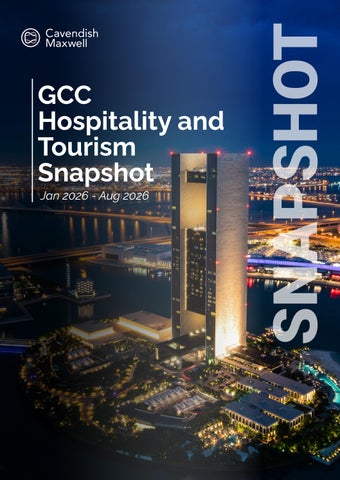
Jan 2026 - Aug 2026
1
SNAPSHOT
GCC Hospitality and Tourism Snapshot
Hotel Occupancy and Average Daily Rate (ADR) Jan 2026 - Aug 2026 Kuwait
Dubai
38.4%
Hotel Occupancy ADR
-18.4% Y-on-Y
$ 198.66
+3.2% Y-on-Y
57.6%
Hotel Occupancy ADR
-27.1% Y-on-Y
$ 167.90
-8.9% Y-on-Y
Saudi Arabia
59.2%
Hotel Occupancy ADR
-2.9% Y-on-Y
$ 198.69
+0.6% Y-on-Y
36.8%
Hotel Occupancy ADR
-31.4% Y-on-Y
$ 168.73
-7% Y-on-Y
Bahrain Hotel Occupancy ADR
Hotel Occupancy
59.6%
-13.3% Y-on-Y
ADR
$ 117.43
-4.5% Y-on-Y
Qatar
-13.1% Y-on-Y
$ 142.01
+0.9% Y-on-Y
Oman Hotel Occupancy ADR
Source: STR, a CoStar Group Company, Cavendish Maxwell
47.9%
59.1%
-24.6% Y-on-Y
$ 165.07
-7% Y-on-Y
UAE
Existing Supply and Upcoming Supply 2026 -2030 (No. of Keys)
Kuwait
Dubai
Existing Supply
10,132
Upcoming Supply
754
Existing Supply
151,379
Upcoming Supply
11,180
Saudi Arabia Existing Supply
180,849
Upcoming Supply 94,447
Existing Supply
19,221
Upcoming Supply
1,007 Bahrain
Existing Supply
42,744
Upcoming Supply
2,223
Existing Supply
24,667
Upcoming Supply
4,500 Oman
Qatar Existing Supply
212,135
Upcoming Supply 23,007 UAE Source: STR, a CoStar Group Company, Cavendish Maxwell
Market Outlook The GCC hospitality market entered 2026 with considerable momentum, but ongoing regional tensions from March onwards triggered a pronounced demand shock, disrupting international air connectivity, dampening traveller confidence and creating challenging trading conditions across the region. The trajectory from Q1 through Q3 has been one of sharp contraction followed by gradual and uneven recovery, with meaningful divergence in both the depth of the decline and the pace of improvement across individual markets. Saudi Arabia has recorded the smallest occupancy decline among the major GCC markets, supported by robust domestic tourism, pilgrimage activity and continued development under Vision 2030. Religious tourism provides a structural demand base that is less exposed to international travel disruption, while strong domestic activity has helped cushion the impact of softer inbound arrivals. This has left Saudi Arabia comparatively better positioned as the region moves into the final quarter of the year. The UAE, led by Dubai, has been among the markets most affected by the disruption, given its exposure to long-haul international travel. Monthly occupancy fell sharply from above 84% in January before beginning to improve gradually through the summer. The restoration of air connectivity remains a primary driver of any further improvement, supported by a combined AED 2.5 billion (USD 681 million) government relief package and intensified destination marketing. By year-end, Dubai’s average occupancy is forecast at between 60% and 66%, with Average Daily Rate (ADR) between USD 163 and USD 184, both below 2025 levels following the softening experienced in H1. Oman entered the year as one of the GCC’s stronger performers before a sharp Q2 reversal. The Khareef season in Dhofar anchors H2 demand, while limited new supply through the remainder of the year should limit additional competitive pressure. Rate performance has held up better than occupancy on a cumulative basis, and a stronger Q4 is possible, although full-year RevPAR is still expected to close below 2025 levels. In Qatar, the international visitor market is gradually normalising, with the year-on-year decline in arrivals narrowing from 82% in March to approximately 6% by August. GCC nationals have accounted for nearly 41% of arrivals, providing an important regional demand base while long-haul travel remained disrupted. The Q4 outlook should benefit from a stronger events calendar, with the Qatar MotoGP currently scheduled for 6–8 November and the Formula 1 Grand Prix later in November. Together, these events could provide additional support for occupancy and rate performance during an important seasonal period. However, whether both events ultimately proceed as scheduled remains to be seen given the ongoing regional situation. Kuwait and Bahrain have also experienced weaker trading conditions through 2026. Q4 will be an important period for the GCC. Cooler temperatures, the holiday season and a denser events calendar should provide seasonal support, including the Abu Dhabi Formula 1 Grand Prix in
early December. The event could provide a boost to hotel demand in Abu Dhabi and surrounding markets, although whether it ultimately takes place as scheduled will also depend on developments in the region. More broadly, these seasonal and event-driven tailwinds should support demand, but their impact will ultimately depend on connectivity and traveller confidence. Occupancy is likely to lead any improvement as operators compete to rebuild volumes, with ADR potentially following as demand strengthens and the need for promotional pricing diminishes. Ultimately, the pace of improvement will depend on regional conditions, the restoration of international air connectivity and the strength of returning visitor demand. The timing and extent of any improvement remain uncertain, with individual markets continuing to be influenced by their source-market mix, seasonality, events calendars and supply dynamics.
Key Contacts Vidhi Shah
Siraj Ahmed
Director, Head of Strategy and Consulting siraj.ahmed@cavendishmaxwell.com +971 50 382 4409
Director, Head of Commercial Valuation vidhi.shah@cavendishmaxwell.com +971 56 690 3186
Ali Siddiqui
Zacky Sajjad
Research Manager ali.siddiqui@cavendishmaxwell.com +971 50 877 0190
Director, Business Development and Client Relations zacky.sajjad@cavendishmaxwell.com +971 50 644 5089
Dubai +971 4 453 9525 dubai@cavendishmaxwell.com 2204 Marina Plaza, Dubai Marina, P.O. Box 118624, Dubai, UAE Dubai
Abu Dhabi
Sharjah
Ajman
Ras Al Khaimah
Muscat
Kuwait City
Riyadh
cavendishmaxwell.com
Disclaimer: The information and analysis contained in this publication are derived from sources generally considered reliable and based on assumptions deemed reasonable and current at the time of undertaking market research. However, no representation or warranty, express or implied is made regarding their accuracy or completeness. We reserve the right to vary our methodology and to amend or discontinue the indices at any time for regulatory or other reasons. The information and its analysis in this publication do not constitute legal, financial, or any other form of advice. Furthermore, it does not constitute a formal valuation, feasibility study or analysis of any property interest and should not be construed as such. Such analysis, including forward-looking statements are opinions and estimates only, and are based on a wide range of variables which may not be capable of being determined with accuracy. Variation in any of these indicators can have a material impact on the analysis and we draw your attention to this. Cavendish Maxwell accepts no liability whatsoever for any loss or damage whether direct or indirect arising from reliance on this information.