T
he first part draws us together, as we ask for forgiveness, pray together and form a common mind through reflecting on the words of Scripture. On the basis of that unity we offer our gifts of bread and wine, and receive back from God the supreme gift of the Real Presence of Christ in the Eucharist, which brings us reconciliation, peace and a deep intimacy with God.
I
n such circumstances you do what you can to get to Mass, even going to Mass on another day when you have time off. The Sunday ‘Vigil’ Mass, celebrated on Saturday evening, which is the first Mass of Sunday is always an option. If you can’t attend Sunday Mass for good reasons in such circumstances then it is not a sin, because you’d be there if you possibly could. In conclusion o the obligation in the Ten Commandments to keep the Sabbath holy became the duty of a Christian to celebrate the Mass on a Sunday.
S
For More Information Catechism of the Catholic Church Paras: 1357 and 1358. Key Books to Read A Simple Prayer Book, CTS (D665) Compendium of the Catechism, CTS (Do742)
Why should I go to Mass on Sunday?
Eucharist, CTS (Do714) Keeping the Lord’s Day Holy, CTS (Do445) Transforming your Life through the Eucharist, John A. Cane The Eucharist, our sanctification, R. Cantalamessa The Lamb’s Supper, Scott Hahn Why go to Mass?, CTS (Do639)
Working on Sundays? he Church expects and encourages all who can to go to Mass on Sunday, and to rest on the Lord’s Day. There are some people who are genuinely obliged to work on a Sunday, for example doctors, nurses, and emergency services. There are others who may be subject to unfair, even unjust, pressures that are placed on them forcing them to work on Sunday. Christians should be alert to this and attempt to resist where possible.
T
N
ot to do so would be to reject one of the Ten Commandments and one of the most important instructions of Jesus, which would therefore be a very grave sin. That is why the Church teaches us that we have an obligation to go to Mass on Sundays, unless we are too ill or are physically unable to reach a Church where Mass is being celebrated.
Visit: www.CTSbooks.org A wide range of inexpensive publications is available from CTS to help nurture your faith and keep you informed about a wide range of issues. If you would like to receive further information please contact us: CTS, 40-46 Harleyford Road, London SE11 5AY Or visit www.CTSbooks.org Tel: 020 7640 0042 Fax: 020 7640 0046
ISBN 978 1 86082 252 0
LF 5
All rights reserved. ©2004 Incorporated Catholic Truth Society. Pictures © Corbis Images/© Lorenzo Lees/ © Bridgeman Art Library/ © Carlos Reyes-Manzo.
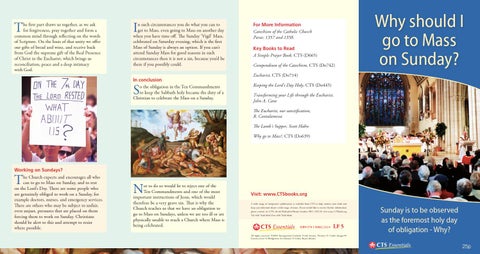
Sunday is to be observed as the foremost holy day of obligation - Why? 25p
LF 5 - Why Should I go to Mass on Sunday? - Leaflet.indd 2
23/01/2013 14:23
Why is Sunday so special? he first Christians were all Jews, and the Jews kept Saturday as their holy day or Sabbath. This was a fundamental part of Jewish life - after all, it was written into the Ten Commandments! It was the day of the week they set aside to put God first. It was an opportunity to rest and spend time together as family and community, with God at the centre, without the distraction of work.
T
Can’t I pray to God on my own? ome people think that our spiritual life is simply an individual experience, but God made us social beings. The most spiritual part of ourselves is our ability to love; God is love and we are made in his image and likeness. And love needs to be given and received. So being together with others is vital for us to be fully human and for us to be fully spiritual persons.
S
A
nd on the night that Jesus was betrayed He gave very clear instructions about what His followers should do to remember Him. He didn’t say go off on your own and use your imagination. He gathered the apostles together for the Last Supper and told them to ‘do this in memory of me’.
What does Jesus say? esus commanded His followers to love their neighbour as themselves; from the outset of his ministry He lived and worked with the twelve apostles, and was constantly teaching and healing people who came to Him in crowds and groups. He even said that where ‘two or three are gathered in my name, I am in the midst of them’.
J
What do we celebrate at Mass? he Catechism explains what we are doing at Mass in this way: “We carry out this command of the Lord by celebrating the memorial of his sacrifice.
T
In so doing, we offer to the Father what he has himself given us: the gifts of his creation, bread and wine which, by the power of the Holy Spirit and by the words of Christ, have become the body and blood of Christ. Christ is thus really and mysteriously made present. We must therefore consider the Eucharist as:
• Thanksgiving and praise to the Father. • The sacrificial memorial of Christ and his Body. • The presence of Christ by the power of his word and of his Spirit.”
What are the key parts of the Mass?
• The first part of the Mass focuses upon
listening to God speak to us through the Bible.
C
hristian Jews continued to keep the Sabbath, but because Jesus rose from the dead on a Sunday, they gradually switched to keeping Sunday as their holy day. As St Ignatius of Antioch put it, “Those who lived according to the old order of things have come to a new hope, no longer keeping the Sabbath, but the Lord’s Day, in which our life is blessed by him and by his death”.
LF 5 - Why Should I go to Mass on Sunday? - Leaflet.indd 1
• The second part of the Mass focuses on the
N
ot surprisingly in the New Testament, Christians tried to gather daily, to ‘break bread’ (their term for celebrating the Mass). Christians have continued to do this ever since, especially on a Sunday, the Lord’s Day.
consecration of the bread and wine into the Body and Blood of Christ.
23/01/2013 14:23