Finding God in Anxiety and Depression
Fr Antonio Ritaccio
All booklets are published thanks to the generosity of the supporters of the Catholic Truth Society
Fr Antonio Ritaccio
All booklets are published thanks to the generosity of the supporters of the Catholic Truth Society
You will seek me and find me, when you seek me with all your heart. (Jer 29:13)
These days it seems that everyone knows someone who suffers from anxiety or depression. It’s hardly surprising, since they are among the most common mental health issues in the world today, especially in the wake of the Covid-19 pandemic.1 Much has been done to increase awareness, both in the Church and in the world at large. A lot of effort has gone into providing information about the issues surrounding mental health, such as the work done by the Association of Catholic Mental Health Ministries (CMHM)
1 The Adult Psychiatric Morbidity Survey (APMS), commissioned by NHS Digital, occurs roughly every seven years. Data from the 2014 survey shows that one in six adults in England experience a common mental disorder, such as anxiety or depression in any given week, though this excludes the impact of the COVID-19 pandemic and recent trends. Results from the latest survey are expected by July 2025. The Office for National Statistics (ONS) reported a rise in mental healthrelated work absences, with 18.5 million sick days in 2022, up by over two million since 2020. Globally, the World Health Organization (WHO) recorded a 25% rise in anxiety and depression during the COVID-19 pandemic’s first year. However, we can never really fully understand what numbers we are dealing with as it is reasonable to suppose that many cases go unreported.
working around the world to support parishes and dioceses in establishing mental health ministries. A World Mental Health Awareness Day has also been established each year on 10 October. Valuable work is also being carried out by charitable organisations to support individuals and communities, including innovative use of the internet and e-technology. These efforts have transformed countless lives and continue to offer much-needed support. Nevertheless, some feel that despite these efforts, not enough has been done over the past decade and as a result, we are now in the middle of a growing mental health crisis affecting everyone from school children to adults in the workplace.2 With alarming developments in the world such as the threat of war, climate change and the cost of living crisis, the Church invites anyone struggling with poor mental health to accept the invitation of Jesus, who understands perfectly the meaning of suffering and sorrow:
Come to me, all who labour and are heavy laden, and I will give you rest. Take my yoke upon you, and learn from me, for I am gentle and lowly in heart, and you will find rest for your souls. For my yoke is easy, and my burden is light. (Matt 11:28-30)
To find God in anxiety and depression is to find a family. He is the Father of Mercies who sent His Son – the Man of
2 Mind UK issued their first annual review in 2024, called “The Big Mental Health Report” with Dr Sarah Hughes, CEO, painting a very bleak picture of “a mental health crisis” with little progress and underfunding as causes for concern.
Sorrows – to bring us back, and the Holy Spirit who comforts us. He is one God – a communion of three persons, the Trinity in mission, searching for us.3
The terms ‘Generalised Anxiety Disorder’ and ‘Clinical depression’ are the usual names for these two illnesses. They have a scale of severity, ranging from mild to moderate to severe. They often co-occur because they share common symptoms like always feeling tired, sleep problems, appetite changes, and brain fog.4 Depression often presents itself with a sense of hopelessness, guilt and worthlessness. Life tends to lose its lustre, and nothing seems to matter anymore. Anxiety on the other hand carries a persistent sense of foreboding and constantly being on edge, fearful of an unknown threat.
Anxiety and depression are hidden illnesses because they are mood disorders. All too often, those who suffer from anxiety or depression experience misunderstanding and stigma, being labelled as morally weak, lazy, selfish or even crazy. Anxiety and depression can’t simply be shrugged off with a bit of willpower, and so comments like “Try harder”, “Don’t worry” or “Look on the bright side” are not helpful and can even make things worse. It can be particularly
3 Catechism of the Catholic Church (henceforth CCC) 257-260, 689, 850.
4 The International Classification of Diseases (ICD) provides the official criteria for anxiety and depression diagnoses in the UK and can be accessed online through the World Health Organisation (WHO). https://icd.who.int/en accessed 8 April 2025.
heartbreaking in family relationships where dependent family members and friends can feel neglected or shut out. Children of parents who suffer from anxiety and depression can often go on themselves to develop these conditions, growing up with deep-seated feelings of rejection and anger.
The causes of anxiety and depression can be very different from person to person and are often complicated. As with all mental health conditions, they are often influenced by three interconnected areas which usually need to be treated together for successful recovery.
Our environment and the world we live in can play a large part in our mental health. These can include situations such as breakdown of families, abusive relationships, loneliness, social isolation, unemployment and poverty, homelessness and prison, which can all have a huge impact on mental health. The COVID-19 pandemic made these stressors significantly worse for many, with the long periods of lockdown, uncertainty and isolation.
Our physical health, including the brain, plays a foundational role in having good mental health. Neurological conditions such as Alzheimer’s disease, dementia and strokes can lead to the development of anxiety and depression. Neurodivergent conditions like ADHD, RSD, Dyslexia and Autism also affect
mental health, impacting levels of stress and anxiety. We also need to consider gut, heart and blood health, thyroid function, and chronic conditions such as Parkinson’s disease, diabetes, and fibromyalgia, which can all have an impact on mental health. Factors like the quality of sleep, diet, and regular physical activity are critical.
The third aspect is our psychological health, influenced by our thought patterns and emotional responses to trauma.
Experiences such as Post Traumatic Stress Disorder (PTSD) from past abuse or neglect, or moments of intense humiliation, shame or rejection can leave deep mental scars. We can grow up never being validated, being told that we are worthy of love or shown how to deal with difficult relationships in life. Unhealthy thought patterns, often fuelled by feelings of shame or worthlessness may make anxiety and depression worse. Treatments like talking therapies, including Cognitive Behavioural Therapy, can often help address these thought patterns, giving tools to reframe negative thinking and find better ways of coping.
There is a fourth essential dimension which links all three areas of influence on our mental health. This is our spiritual life. It includes not only our relationship with God and His Church but also the way in which we respond to the experience of “evil and suffering, injustice and death” (CCC 164).
Even those who have been faithful Catholics all their lives can find themselves losing sight of God, gripped by feelings of abandonment and despair that can tempt them to turn their hearts against God. When we feel enveloped by the darkness of poor mental health, we might naturally question what meaning and value our lives have. Perhaps we have even cried out to God in exasperation: “Why is my life so unbearable?” only to be met with silence. We can find ourselves at the bottom of a deep hole unable to climb out. We can even be tempted to believe that God does not exist and so our lives can seem to have no design, no meaning or purpose. Our existence can seem to be the result of mere chance. As the Second Vatican Council teaches in Gaudium et Spes: “Without the Creator, the creature disappears” (GS §36). However, in the face of these lies, the Church announces the truth: God is real. He loves you. He has a plan for your life, and He longs for you to see Him, to find Him!
For some, the idea of finding God in anxiety and depression feels as unlikely as wading through a muddy field on a cold, wet day and stumbling across buried treasure. Yet, in 2019 that’s what happened to seven metal detectorists in the Chew Valley in Somerset. While out treasure hunting, they uncovered an incredible hoard of silver coins from the Norman Conquest era, hidden in a field. It was widely
reported to have been the most significant and valuable find ever in the UK. It’s not hard to imagine the impact it had on their lives.
God is like that – the Gospel tells us that “The kingdom of heaven is like treasure hidden in a field, which a man found and covered up; then in his joy he goes and sells all that he has and buys that field” (Matt 13:44-46). Yet, finding God in the muddy field of anxiety and depression is a matter of trust, because even once we have found our treasure we still have to wade through the saturated soil as we carry our trove. What changes is our relationship to the field –it becomes a gift-wrap for what is precious. Who would imagine that anyone could be thankful for a muddy field! In the same way, our relationship with anxiety and depression changes when we find our hidden treasure – with God, we find meaning and purpose.
Today, God wants to accompany you. As you read these pages, hear his voice inviting you to pray. Ask God to reveal Himself to you in a new way and to show you His plan for your life. The following pages offer some rays of light for your journey. However, if you or someone you know is struggling with anxiety or depression and finding it hard to cope, please don’t hesitate to reach out to any of the helpline numbers which can be found towards the end of these pages. Make an appointment to see your doctor; consider joining a support group such as Emotions Anonymous; or speak to your parish priest about any help that might be available.
Above all, it is important to know that your anxiety and depression is not a mark of failure. On the contrary: God identifies with your condition through the suffering of His Son Jesus, who endured His cross and His death as a sacrifice for our sins. You can be confident in the knowledge that, in your pain, you are very close to the suffering heart of God. You are close to Christ’s death and His Resurrection!
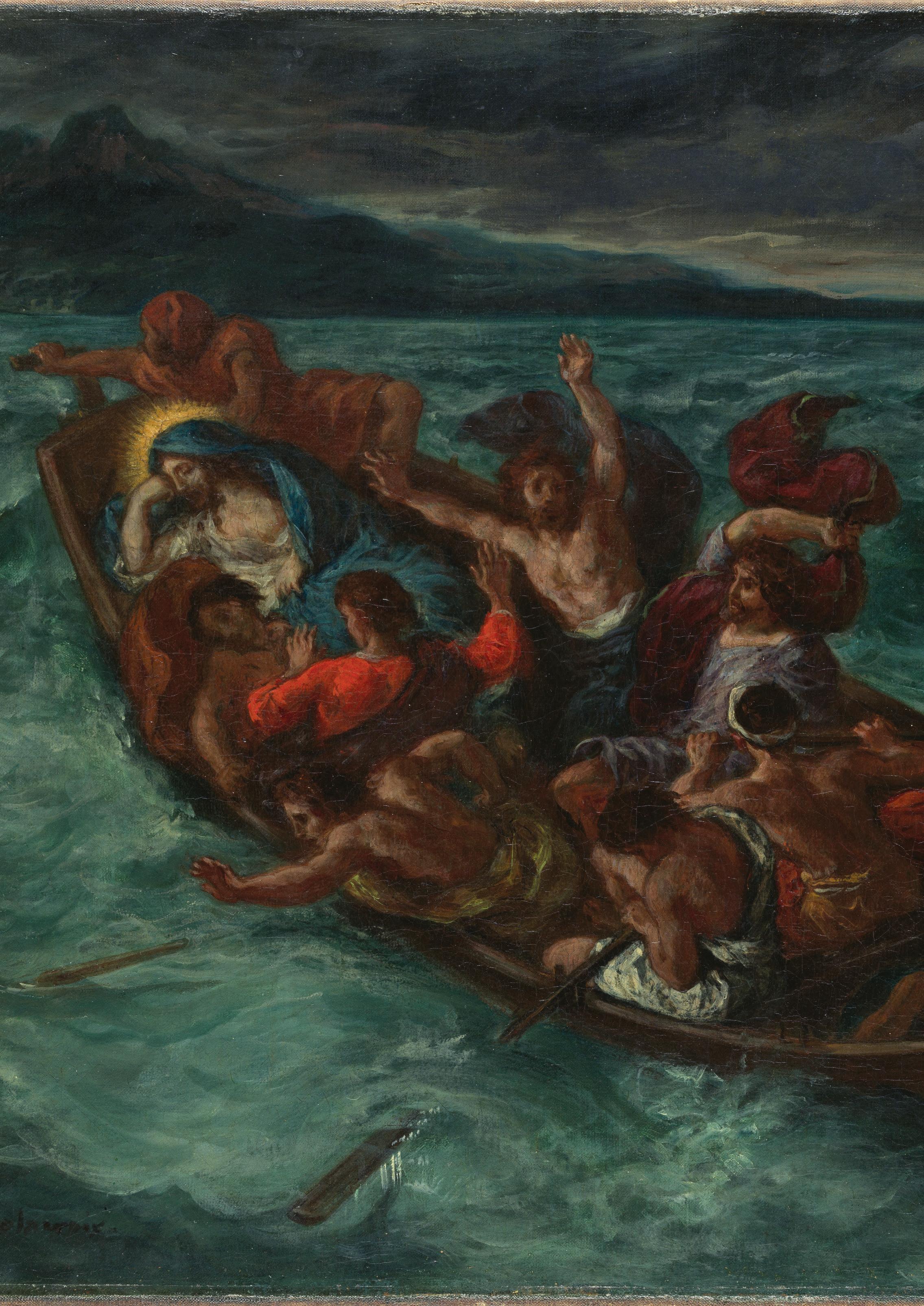
There is an extraordinary episode in the Gospels, known as “The Calming of the Storm.” The disciples receive a sharp lesson in trust. Fearful for their lives, they find Jesus asleep on the boat even though they are in the middle of a violent storm. So they presume He doesn’t care. We might ask, “Why was Jesus asleep?” Yet perhaps our question should be “Why were they so afraid?” When we listen carefully to the Gospel, we can find an invitation from God to trust Him. Here is the passage:
On that day, when evening had come, Jesus said to his disciples, “Let us go across to the other side.” And leaving the crowd, they took him with them in the boat, just as he was. And other boats were with him. And a great windstorm arose, and the waves were breaking into the boat, so that the boat was already filling. But he was in the stern, asleep on the cushion. And they woke him and said to him, “Teacher, do you not care that we are perishing?” And he awoke and rebuked the wind and said to the sea,
“Peace! Be still!” And the wind ceased, and there was a great calm. He said to them, “Why are you so afraid? Have you still no faith?” And they were filled with great fear and said to one another, “Who then is this, that even the wind and the sea obey him?” (Mark 4:35-41)
Anyone who has ever felt overwhelmed by anxiety or depression might relate to the desperation of the disciples. They called out to Jesus from a place of fear because they had not yet fully discovered who He was. Only gradually and guided by the Holy Spirit, did they come to understand His words: “Come to me, all who labour and are heavy laden, and I will give you rest” (Matt 11:28). By sleeping during the storm, Jesus taught His disciples the meaning of true rest. The stern becomes a school: it reminds us of the manger, in which His mother, Mary, rocked Him to sleep. It is the Cross too, where He would sleep in death. It is the tomb, where He would fulfil the Sabbath rest. It is His heavenly throne, to which He would ascend after His Resurrection, and from where He calls the souls of the just to join Him in their Eternal Rest. Where is this place that Jesus invites us to rest with Him? It is “in the bosom of the Father” (John 1:18).
There were other boats
Resting with Jesus means surrendering to His power and love and giving up trying to deal with our problems alone. It involves reaching out to our communities in which we live for help – be it our family, our church or support group –
and speaking up about our problems that keep us isolated and in darkness. It calls us to take steps of faith with Jesus, to forgive those who have wounded us. Above all rest comes when we dare to open our hearts to receive the blessings of our Heavenly Father over our identity, purpose and destiny. For many of us, asking for help isn’t a quick or easy journey. Yet knowing that God longs for us to find Him, in the storms and in the mud, can give us the courage to carry on.
The Gospel mentions that there were other boats with them in the storm, just as there are others around us who suffer from anxiety and depression. God wants us to find Him, not just for ourselves but “so that we may be able to comfort those who are in any affliction, with the comfort with which we ourselves are comforted by God” (2 Cor 1:3-4). The most effective evangelisers are those who have known firsthand the healing power of God’s Grace.
Giving her testimony in the Emotions Anonymous handbook, a cloistered nun in the Holy Land called Miriam, describes herself as “powerless” over the illness of her emotional life. Yet, having undertaken a journey of recovery, working through the Twelve Steps of the programme, she lovingly embraces her mental illness, sharing with others the help from God that she herself received. She writes:
Today, I thank God for my illness because it is also my living link with you; it is a special bond that cannot be broken. My consecrated life is based on the promise that my daily prayer and all that I suffer is used by God to
help you in your needs. I need you just as much as you need me – just as together we need God.5
Like Miriam, God wants us to know the peace of His kingdom within the storms of our suffering. He wants us to walk confidently with hope as disciples of Jesus, through the muddy fields of anxiety and depression, carrying within us the treasure of His kingdom so that we may help others in the same way that He has helped us.
Anxiety and depression can deeply challenge our faith in God’s goodness for our lives. Anyone who has ever witnessed a loved one’s life fall apart because of poor mental health knows how heavy this burden can be. St Louis Martin, the father of St Thérèse of Lisieux (1873-1897), suffered from declining mental and physical health due to cerebral arteriosclerosis, which progressively worsened after she entered Carmel in 1888. St Thérèse herself had to contend with deep emotional and spiritual struggles, including anxiety and a sense of spiritual desolation. Yet she shares in her autobiography, Story of a Soul, how her father’s faith inspired her. It led him to live his illness as a type of martyrdom, uniting his suffering with Christ. She writes:
Yes, Papa’s three years of martyrdom appear to me as the most lovable, the most fruitful of my life; I wouldn’t
5 Emotions Anonymous, 2014, Twelve-Step Recovery Program. E-book Emotions Anonymous World Services, Inc.
exchange them for all the ecstasies and revelations of the saints. My heart overflows with gratitude when I think of this inestimable treasure that must cause a holy jealousy to the angels of the heavenly court.6
Without faith, mental illness makes no sense apart from meaningless suffering. More than ever, like St Louis Martin, each one of us is called to live as disciples of hope.
The fear of being stigmatised can add to a sense of hopelessness, making it difficult for us to open up about our struggles. None of us wants to be identified solely by our mental illness or to be given well-meaning but unhelpful advice that implies we are simply not trying hard enough. Many cope by masking their depression or isolating in anxiety, trying to survive alone. As a result, we can become very good at hiding our condition and pretending that everything is okay. We can feel helpless, drowning in our struggles, completely humiliated. The consequences of masking our problems can be devastating, as the document Cherishing Life by the bishops of England and Wales tells us:
Most, if not all, of us, have to contend with illness at some time or other. Illness is an occasion of spiritual need. It provides a challenge to our faith, our hope and our love
6 St Thérèse of Lisieux, Story of a Soul: The Autobiography of St Thérèse of Lisieux, translated by John Clarke, OCD, 3rd ed. (Washington, DC: ICS Publications, 1996), Chapter VII.
to remain able to appreciate life even in the midst of suffering. Particularly distressing is the phenomenon of mental illness, which may deprive someone of the ability to direct their own lives. People suffering from mental health problems will often isolate themselves, even seeking to end their lives violently. Many people experience depression to differing degrees, and some require intense medical treatment in hospital, prolonged psychotherapy, or life-long medication. The wider community has a responsibility to provide people who are ill with adequate and reliable support and access to the help they need. Neither mental or physical illness nor disability can strip people of their dignity as human beings, no matter how severe the condition.7
Those who suffer from anxiety and depression can face intense temptations towards despair and even viewing suicide as a solution to end their pain. The Catechism tells us that “We should not despair of the eternal salvation of persons who have taken their own lives. By ways known to him alone, God can provide the opportunity for salutary repentance. The Church prays for persons who have taken their own lives” (CCC 2283).
The increasing promotion of so-called assisted dying or, “euthanasia” is an unacceptable development, since it is an industry aimed at those already diminished by suffering
7 (CL) Cherishing Life, Catholic Bishops’ Conference of England and Wales, CTS & Colloquium (CaTEW) Ltd, 2004.
under the guise of compassion. It justifies extinguishing life on the grounds that dignity is not inherent but is afforded like a garment a person puts on when they meet a threshold of acceptable standards. It also obscures the fact that it offers the end of pain by ending existence. The Church understands that those who contemplate taking their own lives want permanent relief from their unbearable pain, not an end to their life. To extinguish life in this case is like a conductor offering to help a violinist, who confesses her shame at not being able to keep up with the rest of the orchestra anymore, by offering to smash her violin. Pain becomes unbearable only when it lacks meaning, value, hope. True compassion recognises that dignity and self-worth are not dependent on how useful a person is, or the perceived quality of life since these things vary from culture to culture. Our dignity is inherent because the Father made us for heaven, and it is drawn out through love and accompaniment.
If you are suffering with anxiety and depression, God wants to make of you a witness to hope. To accompany the countless men and women who suffer with anxiety and depression, who believe the lie that their lives have no value, no dignity. He invites you to console and inspire them like St Louis Martin and countless others who have made the words of St Paul their own: “Now I rejoice in my sufferings for your sake, and in my flesh, I am filling up what is lacking in the afflictions of Christ for the sake of his body, that is, the church” (Col 1:24).
OGod, I don’t want to doubt your love for me, but at times, I feel so overwhelmed by my thoughts, that I struggle to hear your voice. Yet, I thank you, because you have promised that I will find you – my treasure – even in the dark places where I don’t want to go. Please guide me by the Power of Your Holy Spirit, so that I may find you there.