DOMUS ORATIONIS
How Were Mediæval Churches Really Used?
3 o 4
Fr Jerome Bertram MA FSA Cong Orat
Edited and completed by Julien Chilcott-Monk
All books are published thanks to the generosity of the supporters of the Catholic Truth Society
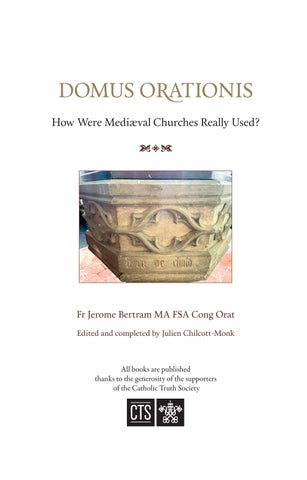
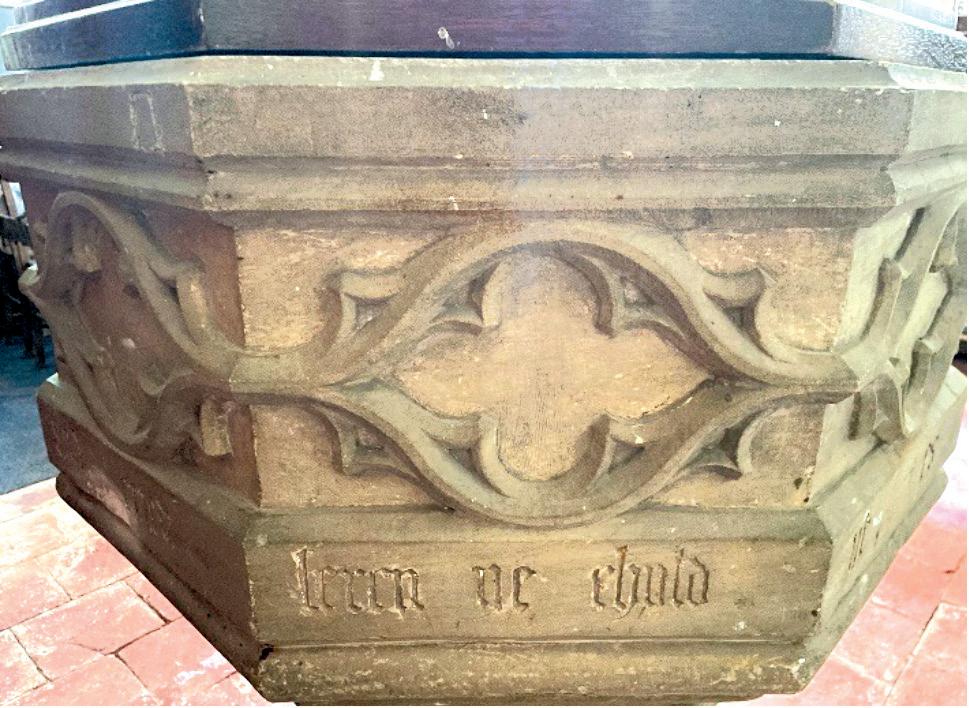
First page: The font at St. George’s, Bradley, Lincs.
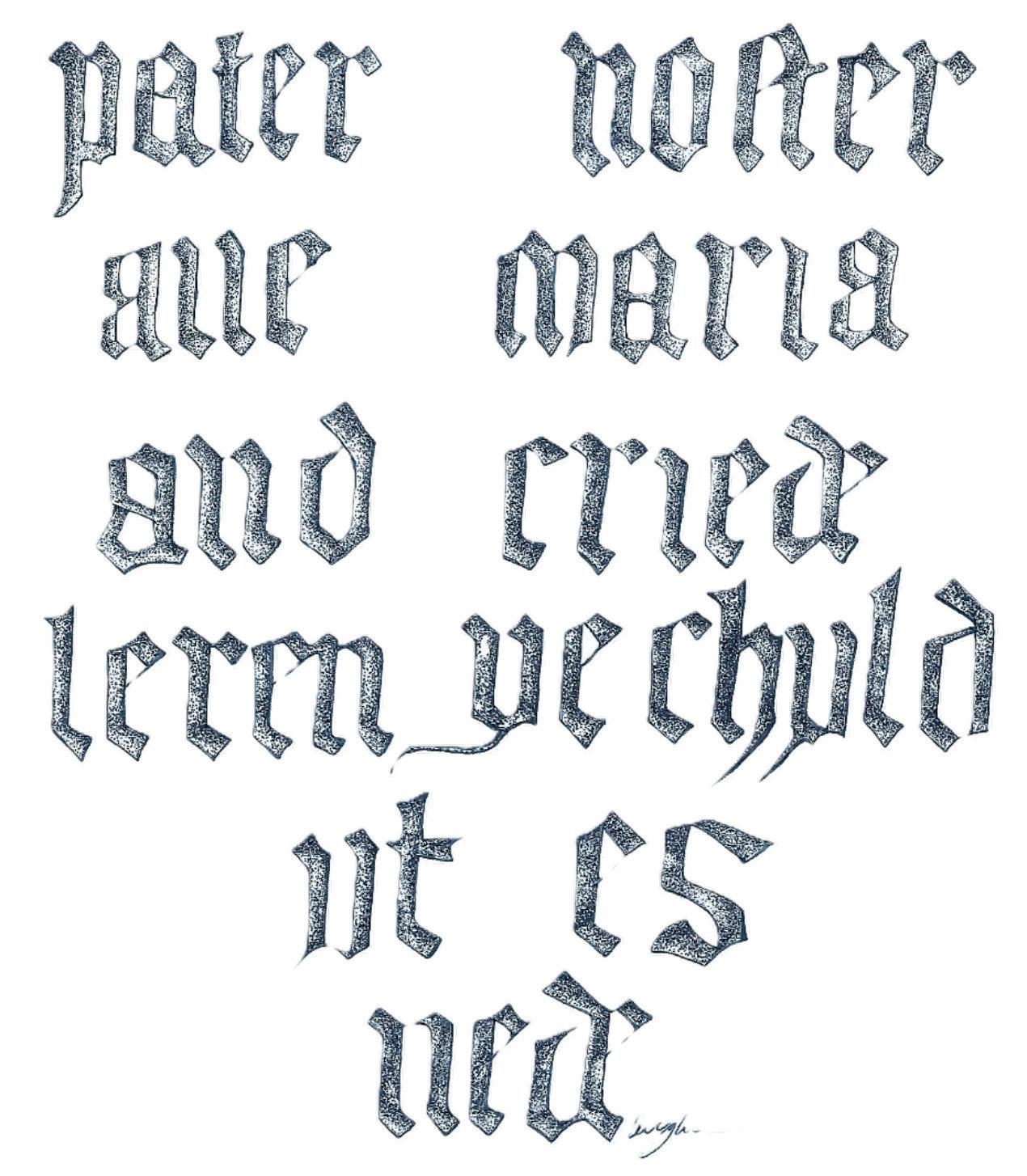
Above: The text carved on the six sides of the font. © Lucy Loydell Pater Noster, Ave Maria and Criede (Creed), leren (teach) the child – it is nede (a necessity – necessary)
Picture Credits: Front cover: Vicars' Close, Wells. © Annie Spratt/Unsplash. Images 1. and 2. © Katie Newcombe. All other images © Julien Chilcott-Monk.
All rights reserved. First published 2026 by The Incorporated Catholic Truth Society Cabrini Community Campus, Forest Hill Road, Honor Oak, London, SE23 3LE Tel: 020 7640 0042 Copyright © 2026 The Incorporated Catholic Truth Society. Design © 2026 The Incorporated Catholic Truth Society.
www.ctsbooks.org
ISBN 978 1 78469 865 2
FOREWORD
Churches and cathedrals, ruined abbeys and castle chapels, dating from the late Middle Ages, are still to be seen through every shire of England. They are visited by millions of tourists, trippers, grockles and sightseers every year – and some even venture in to worship. But what wild and misleading information is offered by guidebooks and living guides, each copying the mistakes of the one before, and adding new fantasies as the whim takes them?
What were these buildings really for? Why did people pay for them? Why were they built in the way they were? How were they furnished? How were they really used? The answers to these questions are not always easy to find, and we must admit that some questions remain unanswered, but on the whole if you search through the published sources, you can piece together a reasonable story to correct some of the weird misunderstandings that float around.
Let us look at these mediæval churches, then, imagine what the experience of visiting them would be like for mediæval people, and try to understand their meaning. They may have been stripped and scoured, or re-furnished in wonderful and imaginative ways, but if we look carefully at what remains, we can still detect the evidence for a very different idea of worship, a very different approach to church visiting, from what we generally experience today, even if we are regular worshippers.
What do I mean by “mediæval”? The “Middle Ages” has come to mean the period between the disintegration of the Western Empire, traditionally in 410 AD, and the revival of Classical art and architecture, which in England means about 1550. There are of course mediæval churches all over Europe, the Middle East and even Central America, and they can often give us useful examples of what no longer exists in England, but I am on the whole confining my remarks to what you can visit in England.
Almost all the buildings and ruins you can visit actually date from the late Middle Ages, for churches were continually being rebuilt and enlarged right up to the devastating change of religion in the middle of the sixteenth century. Yes, there are a few survivors from the early Middle Ages, particularly in Ireland, and significant Saxon remains of small churches in England, with some splendid “Norman” ones from the High Middle Ages but by and large, it is “Gothic” buildings of the fourteenth, fifteenth and early sixteenth centuries that you will find. And even they are much modified by well-meaning but often misinformed nineteenth-century restorers.
There are plenty of useful handbooks that will tell you about the development of church architecture, as “Saxon” gives place to “Norman” or “Romanesque”, and these in turn to the various phases of pointed construction that have implausibly but irrevocably been labelled “Gothic”. Church fittings also have been written up extensively, and you can find all you want to know about the styles and dates of rood-screens and fonts, choir-stalls and misericordes, piscinas, stoups, effigies
and especially monumental brasses. Not how were they made, but why were they made? What were mediæval churches really for and how were they used?
Thanks are due to the Oratory community for encouraging me to keep writing, and to all those who looked at draft texts, notably Fr Seán Finnegan, who knows more about the Sarum Use than anyone since 1558, Julien Chilcott-Monk, whom I have dubbed my ‘literary executioner’, John Whitehead who is knowledgeable on mediæval churches, especially in Yorkshire, Christian Steer also a knowledgeable mediævalist, and others who commented rather more on style and presentation.
Fr Jerome Bertram
o 4
EDITOR’S NOTE
When Fr Jerome’s time was running out, I promised to complete anything he left unfinished, and so something on the nineteenth century background to the life of St John Henry Newman fell to me as did this book on a subject close to Fr Jerome’s heart. In it he dismisses or corrects so many of the misconceptions there are about what really went on in the mediæval parish church.
Fr Seán Finnegan commented in detail on the first draft and Fr Jerome was pleased to accept most of his suggestions gratefully. I have added clarification and elucidation here and there, enlarged the glossary, included useful addenda, and provided photographs of a few of the mediæval features mentioned in the text, still to be found here and there in the pre-Reformation parish churches.
I am most grateful to the clergy and church officers who assisted me by granting access and giving permission to photograph. I was particularly grateful to Jenny Camm for kindly providing the photographs of the fourteenth century font at Bradley, Lincs. Armed with these photographs, I was able to ask the artist, Lucy Loydell to present the text carved on the six sides of the font in a readily readable form, which she has accomplished admirably. It seems to me that this text illustrates well one of the principal points of this volume – that there is plenty of evidence the laypeople, from infancy, were instructed in and taught the rudiments of the faith.
Julien Chilcott-Monk
THE PARISH CHURCH
The overwhelming majority of mediæval church buildings still standing in England are village parish churches, so we may begin by looking at them in some detail. What were they for? How were they planned and built? How did the clergy use them? How did the ordinary parishioner treat them?
Let us indulge ourselves for a moment or two, without quite becoming a sentimental fireside nanny, and begin with the assistance of an imaginary parishioner, a woman, I think. It is the late Middle Ages, somewhere in England.
An Afternoon Visit to Your Parish Church
You are making your way through the village, one winter afternoon. All is tidy at home; there is time to pop into the village church.
You come in through the churchyard, pausing to murmur a prayer for your friends and relations clustered around the path. Most lie under a simple cross of wood or stone, except that some of the betteroff families have invested in a chest-tomb, with carved
panels on the sides, and one even has an inscription inlaid in lead on the top. It is a quiet place, tended by the parish clerk, the grass always neatly scythed, the bushes and trees kept trimmed.
The churchyard path leads into the south porch, and in you go. That’s where you were married, when you stood side by side before the priest as he heard your vows, that commitment never regretted. There was room for a few of the family to stand there as witnesses, but it was, you remember, rather a wet day, so most of the guests had already gone to shelter inside the church itself. You take holy water from the stoup on the right of the main door, and sign yourself with the Cross, just as you were signed in Baptism, almost sixteen years before your wedding. The door is unbarred, heavy maybe, but you know the trick of how to push it open, and so you can come inside the church. Immediately opposite as you enter is the huge painting of St Christopher, with its comforting promise that those who look on it will not die unprepared this day. Well, you have come to church, so you are not unprepared, but you murmur a quick Pater Noster, then, for those who are sick, and in particular for all travellers and pilgrims, as well as for yourself this day.
Just to your left is the font where your gossibs held you when you first came into this building, one day old. You’ve stood gossib to several of your family since then, but of course you were not there for your own babies’ Baptism, since you were enjoying the privilege of a month’s lying-in, to rest and give thanks. You brought them soon enough for bishopping [Confirmation], when His Lordship was in the village, for they must be
not actually the Salve this time of year, it’s the Alma Redemptoris Mater, and the boys manage that great opening crescendo marvellously, though not quite as well as your husband John did it when he was twelve and you first began to notice him among the boys of the village.
But now it’s time to go, nods and smiles to the villagers, it’s almost dark as you make your way home carefully through the mud to have everything ready for the men as they come in from the fields.
TThe Evidence from Church Law
he evidence for the above imaginative reconstruction comes from many sources, recent academic research, mediæval church legislation, and just looking at churches. In the thirteenth century a great deal of ecclesiastical legislation was passed by different local synods throughout Western Europe. These decrees were copied from one diocese to another, and often appear in exactly the same words, to be collected into handy text-books as the corpus of Canon Law took shape. The earlier collections, and the various local synods and bishops’ decrees, can be found in the massive thirty-one folio volume collection edited by Mansi. For those who do not have their own copy handy, the 2012 bilingual edition of Denzinger is more accessible, and has an English translation.
The most detailed decrees from an English source are those of Bishop Quivil or Quinil of Exeter, promulgated in 1277, which may be found in Mansi, XXIV, columns
783-847. His decrees were copied by many other English dioceses, so they give us a good picture of what was expected at the time when Norman was giving place to Gothic. Earlier sources are sometimes useful, and we have cited some paragraphs from the Liber Legum Ecclesiasticarum, ascribed to Theodulf of Orleans, which was translated by Ælfric of Winchester in 994-5 (Mansi XIX, 179-94, cited as LLE).
That reminds us that the passing of a law or decree does not necessarily mean that this is the first time anyone has thought of it. Obviously, no one passes a law unless at some time or in some place an abuse has occurred which needs to be corrected. But that does not mean that these abuses were common at the time when the legislation was written down – you may not imagine that churchyards in Exeter diocese were regularly being used for markets, dances and cattle grazing right up to the year 1277 when Bishop Quivil said you should not. Simply, once a church law has been established, later codes repeat the same laws, because if they omitted them it would imply the laws had been repealed. That is how law codes grow. When we find that time and time again decrees prohibit any secular use of a church or churchyard, it does not necessarily mean that the existing law was not being observed, just that these rules are part of the heritage of Canon Law. It is rare that a new problem arises: if it does, then there is new legislation.
Nor have we the right to assume that clergy and people regularly disregarded the law, though certainly from time to time some of them did, and laws were broken. It was the task of bishops on their visitations to put things right. Because the visitation reports only mention the problems