November 7, 2025
catholicnewsherald.com charlottediocese.org S E RV I N G C H R I ST A N D C O N N EC T I N G C AT H O L I C S I N W E ST E R N N O R T H C A R O L I N A
Catholic Charities gears up amid SNAP crisis 28A
What local Catholics said in survey Lo que dijeron los católicos locales en la encuesta
6-7A, 20-21A
Subscribe today! Call:
704-370-3333
FUNDED BY THE PARISHIONERS OF THE DIOCESE OF CHARLOTTE THANK YOU!
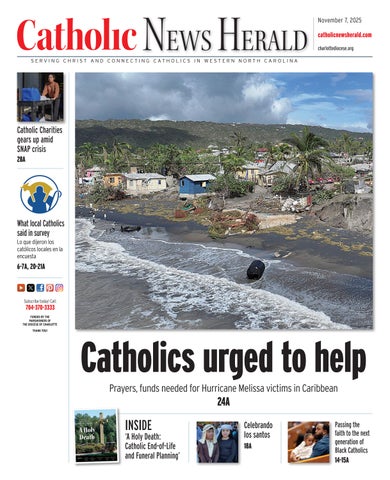
Catholics urged to help Prayers, funds needed for Hurricane Melissa victims in Caribbean
24A
INSIDE
‘A Holy Death: Catholic End-of-Life and Funeral Planning’
Celebrando los santos 18A
Passing the faith to the next generation of Black Catholics 14-15A
At a glance 2A
catholicnewsherald.com | November 7, 2025 CATHOLIC NEWS HERALD
CATHOLIC ALL WEEK
NOVEMBER 7, 2025 VOLUME 35 • NUMBER 3
1123 S. CHURCH ST. CHARLOTTE, N.C. 28203-4003 catholicnews@rcdoc.org
704-370-3333 PUBLISHER The Most Reverend Michael T. Martin, OFM Conv., Bishop of Charlotte
W
Timely tips for blending faith & life
hat is the role of Catholic education? In an Oct. 28 apostolic letter, “Drawing New Maps of Hope,” Pope Leo XIV reflected on this question 60 years after the Oct. 28, 1965, proclamation of “Gravissimum Educationis,” the Second Vatican Council’s declaration on Christian education. In light of modern challenges, the pope said a Catholic education should courageously teach the whole human person. “The Church celebrates a fruitful educational history but also faces the imperative to update its proposals in light of the signs of the times,” the pope wrote. In the eightpage document, the pontiff identifies three educational priorities, listed below, that we all can learn from, regardless of our age.
INDEX Contact us...................................2A Español.....................................19-21A Our Diocese........................... 4-16A Our Faith......................................3A Our Schools............................... 17A Scripture.............................3A, 19A U.S. news...................................22A Viewpoints...........................26-27A World news.......................... 24-25A
STAFF EDITOR: Trish Stukbauer 704-370-3392, tmstukbauer@rcdoc.org ADVERTISING MANAGER: Kevin Eagan 704-370-3332, keeagan@rcdoc.org MULTIMEDIA DESIGNER: David Puckett 704-808-4521, dwpuckett@rcdoc.org EDITORIAL TEAM: Kimberly Bender 704-370-3394, kdbender@rcdoc.org Lisa Geraci 704-370-3294, lmgeraci@rcdoc.org Troy C. Hull 704-370-3288, tchull@rcdoc.org
AN INTERIOR LIFE 1 CULTIVATE “Young people seek depth; they need spaces of silence,
discernment and dialogue with their consciences and with God,” the pope wrote. Make space for the young people in your life – and for yourself – by purposely blocking out time to pray and reflect every day. In our over-scheduled world, setting aside even short periods of time in the morning, while commuting or before bedtime and keeping them sacred is one way to ensure daily time for reflection. TECHNOLOGY WISELY 2 USE Creating a positive digital culture that emphasizes
the dignity of every individual is essential, the pope said. “We must educate in the wise use of technology and AI, placing the person before the algorithm, and harmonizing technical, emotional, social, spiritual and ecological forms of intelligence,” he wrote. While schools and society can not ignore technology, people must be discerning about how we use digital platforms and tools like AI. “No algorithm can replace what makes education human: poetry, irony, love, art, imagination, the joy of discovery, and even education in error as an opportunity for growth. The decisive point is not technology but the use we make of it,” the pope noted.
IN PEACEFUL LANGUAGE 3 SPEAK The pope’s third priority is bringing peace
into our world by building bridges. “Let us educate in nonviolent language, reconciliation and bridge-building rather than wall-building; may ‘Blessed are the peacemakers’ – (Mt 5:9) – become both the method and the content of learning.” Have conversations with your children – and reflective time with yourself – on ways to learn about and positively connect with people of differing backgrounds and beliefs.
— Catholic News Herald, Catholic News Service and Vatican Media
Christina Lee Knauss 704-370-0783, clknauss@rcdoc.org
Scan the QR code for this week’s recommended prayers and activities
Brian Segovia 704-370-3235, bmsegovia@rcdoc.org COMMUNICATIONS ASSISTANT/CIRCULATION: Amelia Kudela 704-370-3333, catholicnews@rcdoc.org COMMUNICATIONS DIRECTOR: Liz Chandler 704-370-3336, lchandler@rcdoc.org ASSISTANT COMMUNICATIONS DIRECTOR: Patricia L. Guilfoyle 704-370-3334, plguilfoyle@rcdoc.org THE CATHOLIC NEWS HERALD is published by the Roman Catholic Diocese of Charlotte 26 times a year. NEWS: The Catholic News Herald welcomes your news and photos. Please e-mail information, attaching photos in JPG format with a recommended resolution of 150 dpi or higher, to catholicnews@rcdoc.org. All submitted items become the property of the Catholic News Herald and are subject to reuse, in whole or in part, in print, electronic formats and archives. ADVERTISING: Reach 165,000 Catholics across western North Carolina! For advertising rates and information, contact Advertising Manager Kevin Eagan at 704-370-3332 or keeagan@rcdoc.org. The Catholic News Herald reserves the right to reject or cancel advertising for any reason, and does not recommend or guarantee any product, service or benefit claimed by our advertisers. SUBSCRIPTIONS: $17.25 per year for registered families of the Diocese of Charlotte and $25 per year for all others. POSTMASTER: Periodicals Class postage (USPC 007-393) paid at Charlotte, N.C. Send address corrections to the Catholic News Herald, 1123 S. Church St., Charlotte, N.C. 28203.
Diocesan calendar of events ESPAÑOL VIÑEDO DE RAQUEL: Sanando Heridas del Aborto. Un retiro de fin de semana se ofrecerá del 5 al 7 de diciembre. Viñedo de Raquel es un retiro confidencial de fin de semana, ofrecido durante todo el año en diversas partes de la diócesis, para hombres y mujeres que buscan apoyo y sanación de un aborto pasado. Para más información llamar a Lorena Haynes (828) 585-0483. PRAYER SERVICES VIGIL OF THE TWO HEARTS: Vigil begins with 8 p.m. First Friday Mass on Nov. 7, followed by nocturnal Eucharistic Adoration, and concludes with the 8 a.m. First Saturday Mass on Nov. 8. St. Patrick Cathedral, 1621 Dilworth Road East, Charlotte. Sign up for an hour of Adoration at www.defendthefamily.org/two-hearts. HOLY HOUR FOR RACIAL HEALING: St. Peter Catholic Church invites all to join in a Holy Hour for Racial Healing at 10:15 a.m. Sunday, Nov. 16, in the church sanctuary at 507 S. Tryon Street.
MASS OF CONSOLATION FOR MISCARRIAGE AND STILLBIRTH LOSS: St. Mark and the Family Life Office are hosting this annual Mass at 9 a.m. on Saturday, Nov. 15 at 14740 Stumptown Road, Huntersville. Mass will be followed by a reception. Contact respect.life@ stmarknc.org. FINAL IGBO CATHOLIC MASS OF 2025: The Igbo CatholicCommunity -Diocese of Charlotte will celebrate their last Mass for the year at 1 p.m. on Sunday, Nov. 23. at Our Lady of Consolation Catholic Church, 1235 Badger Court, Charlotte, 28206. This is the first time the Mass will be celebrated in the city of Charlotte. Transportation and carpooling services will be provided from the Triad area. Contact Dr. Godfrey Ejimakor at 336-392-9640 or Sir Austin Nwokolo at 336-303-8626. TALKS NEXT GENERATION LEADERS WEBINAR: “A Discussion About Understanding, Encouraging, and Uplifting the Next Generation of Black Catholic Ministry Leaders” with nationally known figures at 8 p.m. Thursday, Nov. 13. Register at www.KOFPC. org/1113.
Our faith
November 7, 2025 | catholicnewsherald.com CATHOLIC NEWS HERALDI
3A
Pray for vocations this November Pope Leo XIV
Pope calls for unity among world’s religions
A
t a time when so many people and the planet are suffering, the world’s religions need to come together to promote truth, compassion, reconciliation, justice and peace, Pope Leo XIV said. “Today we are called upon to rekindle that hope in our world, devastated by war and our degraded natural environment,” the pope said Oct. 29 during his weekly general audience in St. Peter’s Square. “Let us collaborate, because if we are united, everything is possible. Let us ensure that nothing divides us,” he said, addressing representatives of Christianity, Judaism, Islam, Hinduism, Jainism, Sikhism, Buddhism and other religions present at the audience. Many of the leaders had been in Rome for a meeting of religions for peace sponsored by the Community of Sant’Egidio and a series of events, including a nighttime celebration Oct. 28, marking the 60th anniversary of “Nostra Aetate,” the Second Vatican Council’s declaration on relations with Judaism, Islam and other world religions. Pope Leo set aside his ongoing series of talks on the Jubilee theme, “Jesus Christ our Hope,” to dedicate the audience to “Nostra Aetate.” The first focus of the landmark document “was toward the Jewish world,” the pope said. “For the first time in the history of the Church, a doctrinal treatise on the Jewish roots of Christianity was to take shape, which on a biblical and theological level would represent a point of no return.” While much has been achieved in Jewish-Catholic dialogue over the past six decades, he said, “we cannot deny that there have been misunderstandings, difficulties and conflicts in this period, but these have never prevented the dialogue from continuing.” “Even today, we must not allow political circumstances and the injustices of some to divert us from friendship, especially since we have achieved so much so far.” The Catholic Church, “mindful of the patrimony she shares with the Jews and moved not by political reasons but by the Gospel’s spiritual love, decries hatred, persecutions, displays of anti-Semitism directed against Jews at any time and by anyone,” he said to applause, quoting “Nostra Aetate.” “Since then, all my predecessors have condemned anti-Semitism with clear words,” he said. “And so I too confirm that the Church does not tolerate antisemitism and fights against it, on the basis of the Gospel itself.” Today, more than ever, he said, all of the world’s religions need to act together. “Our world needs our unity, our friendship and our collaboration.”
CHARLOTTE — This Nov. 2-8 marks the annual celebration of National Vocations Awareness Week across the United States. The week is dedicated to promoting vocations of priests, deacons and consecrated men and women religious (nuns and brothers) through prayer and education. It’s also a time to renew our prayers and support for those who are considering one of these vocations, which is particularly important for families of young adults. “Vocations week is an excellent chance for us to focus on God’s will for our lives,” said Father Brian Becker, director of formation at St. Joseph College Seminary and vocations promoter for the Diocese of Charlotte. Father Becker encourages family members and friends not to underestimate the positive influence they can have in the lives of young people discerning vocations. “I speak to so many young men and women about their vocational journey, and usually somewhere in their story is a question from a parent, teacher, coach or catechist: ‘Have you thought of being a nun? Of being a priest?’” Father Becker said. “Most young people need a little encouragement. They need to know that others see in them what they’re suspecting that they see in themselves, a call to follow Christ more closely.” Currently, the Diocese of Charlotte has 45 seminarians discerning a call to the
Prayer for vocations God our Father, we thank You for calling men and women to serve in Your Son’s Kingdom as priests, deacons and consecrated persons. Send Your Holy Spirit to help others to respond generously and courageously to Your call. May our community of faith support vocations of sacrificial love in our youth and young adults. Through our Lord Jesus Christ, who lives and reigns with You in the unity of the Holy Spirit, God, forever and ever. Amen.
interest you. Many offer “come and see” days or retreats that are opportunities to learn more and meet others who have accepted God’s call to religious life. For young men and women, there are summer discernment retreats offered by the Diocese of Charlotte and hosted at Belmont Abbey College: Quo Vadis Days for young men, and Duc in Altum for young women. Information about 2026 retreats is posted online at www.charlottediocese.org/ vocations.
Diocesan Vocations Office n Father John Eckert, vocations director: vocationsmail@rcdoc.org n Father Brian Becker, vocations promoter: bjbecker@rcdoc.org TROY C. HULL | CATHOLIC NEWS HERALD
Family members, friends and role models should not underestimate the positive impact they can have on a child discerning his or her vocation, experts say. priesthood. National Vocations Awareness Week began in 1976 when the U.S. bishops designated the 28th Sunday of the liturgical year for special recognition of those discerning vocations. In 2014, it was moved to the first full week of November. While this week celebrates religious vocations, Pope Leo XIV recently emphasized the importance of sacramental marriage as a vocation. “Among the vocations to which men and women are called by God, marriage is one of the most noble and exalted,” he said, noting that it can increase joy in the good times, give strength during hard times and is a path to true holiness.
Vocation resources
If you or someone you know is contemplating a vocation, talk with your pastor, reach out to the diocese’s vocations promoter, read up on consecrated life and the various religious communities that exist, and contact communities that
General information n www.foryourvocation.org: Set up by the U.S. Conference of Catholic Bishops, the site is dedicated to the promotion of vocations to the priesthood and consecrated life for both men and women. They are also on Facebook and YouTube. Find resources for parents and teachers, questions to ask yourself if you feel God is calling you, videos of vocation stories from priests and religious all over the U.S., and more.
Considering becoming a deacon? If you are interested in serving as a permanent deacon in the Charlotte diocese, visit www.charlottediocese.org/vocations/ diaconate to learn more about who deacons are, what they do, and how to become one. Ready to take the next step? Contact Deacon David Faunce, formation director, at dmfaunce@rcdoc.org – Catholic News Herald
Daily Scripture readings NOV. 9-15
Sunday (Feast of the Dedication of the Lateran Basilica in Rome): Ez 47:1-2, 8-9, 12, Ps 46:2-3, 5-6, 8-9, 1 Cor 3:9c-11, 16-17, Jn 2:13-22 Monday (Memorial of St. Leo the Great, Pope and Doctor of the Church): Wis 1:1-7, Ps 139:1b-3, 4-6, 7-8, 9-10, Lk 17:1-6 Tuesday (Memorial of St. Martin of Tours, Bishop): Wis 2:23-3:9, Ps 34:2-3, 16-17, 18-19, Lk 17:7-10 Wednesday (Memorial of St. Josaphat, Bishop and Martyr): Wis 6:1-11, Ps 82:3-4, 6-7, Lk 17:11-19 Thursday (Memorial of St. Frances Xavier Cabrini, Virgin): Wis 7:22b-8:1, Ps 119:89, 90, 91, 130, 135, 175, Lk 17:20-25 Friday: Wis 13:1-9, Ps 19:2-3, 4-5ab, Lk 17:26-37 Saturday: Wis 18:14-16; 19:6-9, Ps 105:2-3, 36-37, 42-43, Lk 18:1-8
NOV. 16-22
Sunday (Thirty-third Sunday in Ordinary Time): Mal 3:19-20a, Ps 98:5-6, 7-8, 9, 2 Thes 3:7-12, Lk 21:5-19 Monday (St. Elizabeth of Hungary, Religious): 1 Mac 1:10-15, 41-43, 54-57, 62-63, Ps 119:53, 61, 134, 150, 155, 158, Lk 18:35-43 Tuesday: 2 Mac 6:18-31, Ps 3:2-3, 4-5, 6-7, Lk 19:1-10 Wednesday: 2 Mac 7:1, 20-31, Ps 17:1bcd, 5-6, 8b and 15, Lk 19:11-28 Thursday: 1 Mac 2:15-29, Ps 50:1b-2, 5-6, 14-15, Lk 19:41-44 Friday (Presentation of the Blessed Virgin Mary): 1 Mac 4:36-37, 52-59, 1 Chron 29:10bcd, 11abc, 11d-12a, 12bcd, Lk 19:45-48 Saturday (St. Cecilia, Virgin and Martyr): 1 Mac 6:1-13, Ps 9:2-3, 4 and 6, 16 and 19, Lk 20:27-40
NOV. 23-29
Sunday (Solemnity of Our Lord Jesus Christ, King of the Universe): 2 Sam 5:1-3, Ps 122:1-2, 3-4, 4-5, Col 1:12-20, Lk 23:35-43 Monday (St. Andrew Dung-Lac, Priest, and Companions, Martyrs): Dan 1:1-6, 8-20, Dan 3:52, 53, 54, 55, 56, Lk 21:1-4 Tuesday: Dan 2:31-45, Dan 3:57, 58, 59, 60, 61, Lk 21:5-11 Wednesday: Dan 5:1-6, 13-14, 16-17, 23-28, Dan 3:62, 63, 64, 65, 66, 67, Lk 21:12-19 Thursday: Dan 6:12-28, Dan 3:68, 69, 70, 71, 72, 73, 74, Lk 21:20-28 Friday: Dan 7:2-14, Dan 3:75, 76, 77, 78, 79, 80, 81, Lk 21:29-33 Saturday: Dan 7:15-27, Dan 3:82, 83, 84, 85, 86, 87, Lk 21:34-36
Our diocese 4A
catholicnewsherald.com | November 7, 2025 CATHOLIC NEWS HERALD
For the latest news 24/7: catholicnewsherald.com
In Brief Priest from Vietnam joins St. Mary’s Parish GREENSBORO — Vincentian Father Paul Phuong Van Kim Pham has joined St. Mary’s Parish as parochial vicar effective Oct. 1, 2025, Bishop Michael Martin, OFM Conv., has announced. Father Pham was ordained on Aug. 20, 2025, by the Most Rev. Dominic Nguyen Van Manh, bishop of the Diocese of Da Lat, Vietnam. Father Pham’s hometown has produced numerous religious vocations, and he was inspired to join the Vincentians by the example of a Pham Vincentian priest from his community. Reflecting on his journey, Father Pham said he first sensed God’s call to the priesthood while in high school. That call deepened throughout college and remained strong after graduation. After working for a company for several years, he chose to answer God’s call to serve as a priest. Established in 1928, St. Mary’s Parish is one of the most ethnically diverse parishes in the diocese and has been staffed since 1939 by the Congregation of the Mission, otherwise known as the Vincentians. Father Pham will live in community with the other Vincentians at the parish and will serve the growing Vietnamese Catholic community in the Greensboro area, which has outgrown the space available at St. Mary’s and since last fall has been worshiping at a new site, Holy Family Vietnamese Mission Church, at 4112 Romaine St.
St. Peter to host Holy Hour for Racial Healing CHARLOTTE — St. Peter Church invites all to a Holy Hour for Racial Healing at 10:15 a.m. Sunday, Nov. 16, in the church at 507 S. Tryon St.
Bishop Martin named to leadership board LOS ANGELES, California — The Catholic Campus Ministry Association has appointed Bishop Michael Martin, educator Kathleen Duncan and Mike Laughery, president of Saint Paul’s Outreach, to its executive board of directors. “We are delighted to welcome these exceptional individuals to our executive board,” said Rosie Chinea Shawver, executive director of CCMA, noting they have a breadth of experience across education, leadership, ministry and innovation. — Catholic News Herald
PHOTOS BY LISA M. GERACI | CATHOLIC NEWS HERALD
Bishop Michael Martin presides over St. Benedict the Moor’s 85th Anniversary Mass. In his homily, he celebrated the diversity for which the parish is known.
St. Benedict the Moor Parish commemorates 85 years LISA M. GERACI lmgeraci@rcdoc.org
WINSTON-SALEM — St. Benedict the Moor, one of four historically Black churches in the Diocese of Charlotte, marked its 85th anniversary Oct. 25 with a Mass celebrated by Bishop Michael Martin. Alongside the bishop, parochial administrator Father Melchesideck Yumo and the first Black priest to serve the parish, Father Basil Sede, shared in the joyous day. The celebration recognized the parish’s founding during the Jim Crow era in 1940 to serve persecuted Black Catholics, as well as its modern transition into a predominantly Hispanic parish. “We come here today grateful, grateful to those who came before us. And as much as we look around and imagine what they must have thought, what will people 85 years from now say about all of us?” the bishop asked in his homily. The once all-Black parish now consists of predominantly Hispanic members who work tirelessly to ensure the next generation remembers the church’s history. The Hispanic population has exploded across the Diocese of Charlotte since the late 1990s, now comprising roughly 50% of the diocese’s more than 565,000 Catholics. St. Benedict the Moor celebrated its first Spanish Mass in 1999. “We started coming here 15 years ago because I wanted to receive my Confirmation in Spanish, and we just fell in love with this small church and the big
Father Melchesideck Yumo takes a moment to share laughter and memories with parishioners during the anniversary celebration. community,” parishioner Angelica Leonides said. “Father Yumo has definitely brought both communities together, and he’s made the church better. We love him.” At the anniversary Mass, Black parishioners sat among their LatinAmerican brothers and sisters in Christ, knowing the newcomers will inherit the small church they started, a common reality they have grown to love and accept. “If these walls could talk, think about what they would say to us after these last 85 years. Think of what they heard, what they have seen,” Bishop Martin said. Though the walls can’t literally speak, a living “piece of history,” Willie King,
reverently nicknamed “King Willie,” can. He was the first baby baptized in the church in 1943 and has been an altar server for the past 72 years. King may be 86, but he remembers the roots of the Catholic faith which bear the names of his ancestors. “I remember my grandfather had to sit in the back of St. Leo, but one day he said, ‘We aren’t doing this anymore,’” King said. “A Franciscan priest overheard, and they commissioned a church to be constructed for $50,000. That church sits right here.” The church from his youth may not be the same today as it was, but it is not dying anytime soon. That reality comforts King. King explains how many in the community converted to Catholicism while attending St. Benedict Grammar School or St. Ann Academy, both closed in the 1970s. “Now that the school closed, we don’t have the influx we used to have,” King said. The Gospel reading from Matthew reminded the congregation of the instruction “Come to me, all you who labor and are burdened, and I will give you rest.” The bishop pondered how many people have found rest from their burdens over the years as they walked through St. Benedict the Moor’s double doors. The walls are painted with layers of endurance, parishioner Harold Holmes said, and that endurance is the glue that bonds the communities together. Holmes, leader of the parish council, has PARISH, SEE PAGE 28A
November 7, 2025 | catholicnewsherald.com CATHOLIC NEWS HERALDI
5A
Couples celebrate saying ‘yes’ during wedding anniversary Mass LISA M. GERACI lmgeraci@rcdoc.org
CHARLOTTE — Married couples from across the Diocese of Charlotte gathered at St. Patrick Cathedral Oct. 26 to celebrate their silver and gold marriage anniversaries during a Wedding Anniversary Mass presided over by Bishop Michael Martin. Sixty-seven couples attended the annual Mass, hosted by the Office of Family Life to honor those who have reached the milestones of 25 and 50 years of marriage. In his homily, the bishop reflected on the “miracle” of marriage. “Let’s rejoice in that miracle that you were graced with … to say ‘yes’ when you didn’t know who that spouse you are marrying would become,” Bishop Martin said. “That’s belief, and that belief speaks to the whole world that says you can’t do that, you can’t trust that,” he noted. “You said, ‘I know, but I trust in God that He will let me love whoever she (he) becomes … 25 to 50 years from now.’” He applauded how the couples “stepped into” a covenant, unaware of what the future may hold. “The scriptures are full of stories reminding us to step forward in faith when we don’t know all the answers,” Bishop Martin said. “You didn’t know all that it would entail, but you still said ‘yes.’” While some believe it gets easier, the bishop noted that marriage may get harder as they have to continually recommit themselves to an imperfect person. What the world needs most is forgiveness, and marriage is a testament to the world of unconditional forgiveness, he said. Bishop Martin ended his homily by having the couples repeat four words from the Gospel reading from John, “Remain in My love.” The couples then stood, held each other’s hands, and gazed in one another’s eyes while renewing
SEAN RICHARD | CATHOLIC NEWS HERALD
their commitments to one another before God. At the reception afterward, the couples explained how those four words, “Remain in My Love,” have impacted their marriages. Deacon Tom McGahey and his wife, Nancy, both parishioners at St. Mark in Huntersville, have been married for 50 years. They met during a required marriage class at a Catholic high school in Michigan and are still observing their lessons. As Deacon McGahey recalled, “It was the only class I actually got an A in.”
Married couples celebrate their 25th and 50th jubilee years at St. Patrick Cathedral. Together they stood united, renewing their bonds of fidelity and love. The two are still earning A’s in their marriage. The key is “sharing a common faith and worshipping together,” Nancy said. “I’ve had 50 years of her teaching me, and I’m still learning. I’m a real tough student,” Deacon McGahey laughed. Fellow parishioners John and Delores Vernersky from St. Mark also met in high school and agreed
the Church was the perfect place to continue their 50-year love adventure. “We started in the Church, and I thought it was important for it to continue in the Church,” Delores Vernersky said. They intentionally work hard to remain close to and to believe in one another but readily admit it’s their faith that helps with the rest. “I can probably count on one hand how many times we have missed Sunday Mass,” John Vernersky said. “It is just part of our lives.” Earlier in the month, Pope Leo XIV wrote about the importance of marriage as a vocation. “Among the vocations to which men and women are called by God, marriage is one of the most noble and exalted,” the pope wrote on Oct. 18. The pope used the first couple canonized together, Sts. Louis and Zélie Martin, as a prime example of God’s love played out through holy matrimony. In their youth, each felt a pull to religious vocations, but both were turned away. God had different plans. They married three months after first setting eyes on each other. Their five daughters, including Thérèse of Lisieux, carried out their parents’ nudge by choosing the consecrated life. Pope Leo XIV said their example “bears witness to the ineffable happiness and profound joy that God grants, both here on earth and for eternity, to those who commit themselves to this path of fidelity and fruitfulness.” After 25 years of marriage, Amy and Sergio Miranda, members of Our Lady of Consolation in Charlotte, agree. “You work for fidelity, not for happiness,” Sergio Miranda said. “At some point you are just not going to be happy. There are always ups and downs with marriage, but if you work towards fidelity, you are building that relationship. You are building that commitment together.”
Coming this month: Two ways to combat poverty at home and around the world CHARLOTTE — The Catholic Campaign for Human Development (CCHD) is one of the Church’s primary means of fighting poverty at the grassroots level – both here in the Diocese of Charlotte and across the United States. The annual collection, which will be taken up Nov. 22-23, is a source of both national and local funds to support organizations that address the root causes of poverty in America. Seventy-five percent of the funds collected go to the U.S. Conference of Catholic Bishops to support national grant funding, and the other 25 percent remains in the Charlotte diocese to fund local antipoverty efforts. Nationally, your generosity helped to provide grants supporting the work of two
organizations: the Coalition to Save Our Mental Health Centers in Chicago and Communities Organized for Relation Power in Action in California. Both organizations work to remove the stigma of mental illness and mental health challenges that often go hand in hand with stress and anxiety affecting those living at or below the poverty line. The 25% of the CCHD collection that remains for use in the Diocese of Charlotte enables Catholic Charities to provide local CCHD grants of up to $5,000 to non-profit organizations across the diocese that are both headquartered in and are fighting poverty in the geographic boundaries of the Diocese of Charlotte. 2026 applications are due via email by Monday, Feb. 16, 2026.
Each grantee partners in some way with a Catholic parish or entity of the diocese familiar with the work of the nonprofit, and the parish provides a letter of endorsement with the grant application.
WORLD DAY OF THE POOR
The 2025 World Day of the Poor will be recognized Nov. 16. The theme this year is “You are my hope” (from Psalm 71:5). To mark the Ninth World Day of the Poor, Pope Leo XIV urges Christians to recognize the poor not as just as objects of charity but as “protagonists of hope.” “The poor are not a distraction for the Church, but our beloved brothers and sisters, for by their lives, their words and their wisdom, they put us in contact with
the truth of the Gospel,” the pope wrote in his annual message. The Holy Father will celebrate Mass for the World Day of the Poor on Nov. 16 in St. Peter’s Basilica. —Catholic News Herald and Joe Purello
Learn More At www.ccdoc.org/cchdcrs: Find out more information about the Catholic Charities’ CCHD Local Grants Program. At www.pcpne.va/content/pcpne/en.html: Read the Holy Father’s message for the 2025 World Day of the Poor. At www.census.gov/topics/income-poverty/ poverty.html: Read more about poverty in the United States.
catholicnewsherald.com | November 7, 2025 CATHOLIC NEWS HERALD
6A
DISCIPLE MAKER INDEX Diocese-wide results of a 2025 survey of 24,332 Catholics from across western North Carolina about insights on faith and parish life.
What 24,000+ Catholics said
R
Survey reveals strong Catholic identity, room to grow as missionary disciples
egular Mass-going Catholics across the Diocese of Charlotte express a deep love for their faith and strong bonds with their local church, yet many say they feel less confident answering the call to be missionary disciples who share their faith with others. That’s one of the key findings from the Disciple Maker Index (DMI) survey, an anonymous survey conducted earlier this year by the Catholic Leadership Institute (CLI), a nonprofit apostolate that provides leadership training and pastoral support to U.S. Catholic dioceses and parishes. More than 24,300 people across the diocese participated in the DMI, offering insights into their personal beliefs and spiritual practices, their experience of parish life and Sunday Mass, and how prepared they feel to evangelize. While every Catholic adult in the diocese was invited to participate, the survey results largely reflect the views of those already active in their parishes: 98% of respondents identified as Catholic, 93% said they attend Mass weekly or more, and more than half (51%) said they have been part of their parish for 11 years or longer. The survey was conducted at no cost to the diocese as part of an effort to help Bishop Michael Martin, OFM Conv., develop a longterm strategic plan for the local Church. CLI tabulated the DMI results for the diocese as a whole, as well as individualized data for each of the 78 parishes and missions that took part. Pastors have
7 7
Membership Duration
23%
28%
already received their DMI reports and are being encouraged to share the information with parishioners. Over the next several editions, the Catholic News Herald will explore the diocese-wide DMI survey results, highlighting the primary factors – or “key drivers” – that CLI has found help strengthen people’s faith, build effective parishes and inspire missionary discipleship. Among the questions examined: Do people feel welcome at their parish? Are Masses and homilies spiritually uplifting? Do parishes help people grow in faith and equip them to evangelize? And would parishioners recommend their parish to others? From the answers, CLI identified six “strengths” and six “opportunities” for the diocese:
In the Disciple Maker Index survey, St. Francis of Assisi Parish in Lenoir was one of the top-ranked parishes for the percentage of people who said they found their church welcoming and said they would recommend it to others.
STRENGTHS n 93% said they agree that the Eucharist is truly the Body and Blood of Christ. n 94% said they agree that Scripture is the divinely inspired word of God. n 65% said they strongly agree that the Church is critical to their relationship with God. n 93% said they attend Mass weekly or more. n 88% said they pray at least weekly. n 46% said they pray with someone outside of Mass at least weekly.
OPPORTUNITIES n Only 33% strongly agreed that their parish helps form them as a disciple of Jesus. n Only 25% strongly agreed that their parish equips them to have conversations about their faith by growing their confidence in the Church’s teachings so they can answer people’s questions. n 62% have never attended a retreat. n 78% have not invited a young man to consider a priestly vocation in the past year.
16%
17%
9%
7%
17%
25% 9%
2 7%
PATRICIA L. GUILFOYLE | CATHOLIC NEWS HERALD
n 72% have not invited anyone to consider a religious vocation (nun or brother) in the past year. n Of the Sunday Mass experience, only 35% strongly agreed that their parish offers music that deepens their desire to participate more fully in the liturgy. The Disciple Maker Index survey used a five-point scale instead of open-ended questions to provide a standardized “snapshot” of a parish, said Tricia Cellucci, a consultant with CLI who oversaw the diocese’s DMI survey. This format will help the diocese and parishes compare and contextualize results, identifying strengths and opportunities for growth, Cellucci said.
“The data are not intended to provide all the answers,” she said. “Rather, the data are intended to start conversations at a parish level as to why parishioners responded in such a way and what it means.” In addition to parishes sharing their survey results with parishioners, Bishop Martin is also reviewing the data in the broader context of independent research and other feedback CLI collected earlier this year from priests, diocesan employees and other key stakeholders. Drawing on all these insights, he plans to present a strategic pastoral vision that will guide the diocese’s growth and better equip the faithful to proclaim and live the Gospel. — Patricia L. Guilfoyle
Demographic data about parishioners who took the Diocese of Charlotte DMI survey: Ethnicity/Race Membership Duration
22
69% 23%
28%
16%
LEGEND 20+ years
11-20 years
6-10 years
3-5 years
1-2 years
Asian-American
Caucasian
Hispanic/Latino
<1 year
Marital Status Ethnicity/Race
22
14%
69%
74%
5% 8% 25% 2
98% 74%
5% 8%11
Black or African-American
Other
Spiritual Identity Marital Status
14%
Single
Married
Male
Female
Divorced
Widowed
Sex Spiritual Identity
36%
98%
64%
11
Age Sex
1 4 7%
15% 36%
17%
Approach to Financial Giving Age
19%
64%20%
17%
<18
18-25
25-35
36-45
46-55
56-65
66-75
76+
November 7, 2025 | catholicnewsherald.com CATHOLIC NEWS HERALDI
DISCIPLE MAKER INDEX
7A
INTRO: The Big Picture...........................Nov. 7, 2025 PART 1: Core Catholic Teaching...........Nov. 7, 2025 PART 2: Spiritual Practices...................Nov. 21, 2025 PART 3: Sunday Experience...................Dec. 5, 2025 PART 4: Parish Effectiveness..............Dec. 19, 2025 PART 5: Parish Effectiveness (cont.)... Jan. 9, 2026 PART 6: Missionary Impulse................Jan. 23, 2026
Part 1: Belief in Core Catholic Teaching
Now
Past
Upcoming
Catholics who took the DMI survey report strong personal beliefs
R
egular Mass-going Catholics across the Diocese of Charlotte are personally devoted to their faith and broadly agree with Church teachings. That’s among the findings from the Disciple Maker Index (DMI) survey, conducted earlier this year at 78 of the diocese’s 93 parishes and missions. More than 24,300 people participated in the anonymous survey, most of whom identified as frequent Mass-goers. While the DMI results are not a random or representative sample of the diocese’s Catholic population, they do provide a snapshot of the faith among its most active parishioners. Overall, the diocese’s DMI results reflect a high level of belief and adherence to core Church teachings among respondents. In the survey, 93% of respondents agreed that the Eucharist is the body and blood of Jesus Christ – a fundamental tenet of the Catholic faith. Likewise, nearly all respondents – 96% – agreed that Jesus died and rose from the dead for our salvation, 94% agreed that
1
Scripture is the divinely inspired word of God, and 91% said they agreed with Jesus’ moral teachings for their life as taught by the Church. Furthermore, 86% of respondents said they agreed in the teaching authority of the Catholic Church, and 87% also agreed that the Church is critical to their relationship with God. Yet how strongly people agreed with core Catholic beliefs, such as the Real Presence of Jesus in the Eucharist or the authority of the Church, varied by race and age. Regarding the Eucharist, 87% of Hispanic respondents and 85% of AsianAmerican respondents said they strongly agreed with belief in the Real Presence – higher than the diocesan average of 82% who said they strongly agreed. Among white respondents that percentage was 80%, and for black respondents, 79%. Younger respondents were more likely to say they strongly agreed in the Real Presence than older respondents. (See chart below.) Hispanic and Asian-American respondents were also more likely to say they strongly agreed in the teaching authority of the Church – 69% and 67%, respectively, above the diocesan average of 60% who strongly agreed – versus 58% for white respondents and 54% for black
respondents. Younger people were more likely than older people to say they personally believed in the teaching authority of the Church and that the Church is critical to their relationship with God. Among respondents aged 26-35, for example, 71% said they strongly agreed in the Church’s teaching authority and 73% said the Church is critical to their relationship with God. Among respondents aged 66-75, however, those percentages were 54% and 60%, respectively. The high numbers of people who said they strongly agreed about the Eucharist, Scripture and the Church’s authority were among the top “strengths” identified in the diocese’s overall DMI results by the survey’s organizer, the Catholic Leadership Institute. “One way to look at the data is to see what the strongest positive and negative results were – Cellucci that is, those who said they strongly agreed on a particular question versus those who are neutral to disagreeing,” explained Tricia Cellucci, a CLI consultant who oversaw
EDITOR’S NOTE: The Disciple Maker Index survey, conducted in March-April 2025 at the diocese’s 93 parishes, drew responses from 24,332 people at 78 parishes and missions in the Diocese of Charlotte. While not a random or representative sample of all Catholics in the diocese, the results largely captured the views of active Catholics who regularly attend Mass and chose to participate in the 75-question survey. Data were tabulated by the Catholic Leadership Institute, which conducted the DMI for free as part of a future strategic plan for the diocese. the diocese’s DMI survey. “People who strongly agreed will be among your most committed and enthusiastic parishioners, so having a high number of people who strongly agree on the question indicates a key strength. And conversely, when a person responds neutrally or disagrees, strongly or not, with a statement, we see that as an area of growth.” — Patricia L. Guilfoyle COMING NEXT: CLI’s research shows that how strongly someone is devoted to their faith is closely tied to how they practice their faith. In Part 2, we’ll look at the DMI results on questions related to spiritual practices and how respondents describe their faith journey.
Diocesan-wide responses on questions related to how strongly people believe in core teachings of the Catholic faith: Jesus died and rose from the dead for my salvation: Jesus died and rose from the dead for my salvation:
87% 87%
9% 9%
The Eucharist really is the body and blood of Jesus Christ: The Eucharist really is the body and blood of Jesus Christ:
14% 14%
In the teaching authority of the Church: In the teaching authority of the Church:
65% 65%
2 3 2 3
Among those who said they ‘strongly agreed,’ the strength of that belief changed depending on age: AGE 18-25 26-45 46-65 66-75 75+
85% 84% 83% 81% 77%
1% 1%
8% 2 3 8% 2 3
26% 26%
The Church is critical to my relationship with God: The Church is critical to my relationship with God:
22% 22%
6% 3 2 2 6% 3 2 2 1% 1% 1% 1%
In Jesus’ moral teachings for my life as taught by the Church: In Jesus’ moral teachings for my life as taught by the Church:
69% 69%
3 3
11% 2 3 11% 2 3
80% 80%
60% 60%
LEGEND
1% 1%
82% 82% Scripture is the word of God: Scripture is the word of God:
1% 1%
22% 22%
4% 3 4% 3
Among the 65% of people who ‘strongly agreed’ the Church is critical to their relationship with God, more young adults said they strongly agreed than older adults: AGE 18-25 26-35 36-45 46-55 56-65 66-75 75+
72% 73% 70% 69% 65% 60% 56%
Strongly Agree Agree Neither Agree nor Disagree Disagree Strongly Disagree I Do Not Know
8A
catholicnewsherald.com | November 7, 2025 CATHOLIC NEWS HERALD
INTERFAITH IN OUR TIME
Local religious leaders celebrate 60 years of dialogue to stand here as a believer in the Roman Catholic Church,” he said. “‘Nostra Aetate’ calls all Catholics to own our own pedigree rooted in Judaism.” CHARLOTTE — Bishop Michael Martin joined The bishop said the document offered the Church local religious leaders Oct. 28 on the campus of a true blessing in its encouragement of positive Queens University to celebrate the 60th anniversary engagement and dialogue with other faiths, which of “Nostra Aetate,” the Second Vatican Council’s has been a longstanding tradition in the Diocese of declaration on relations with Judaism, Islam and Charlotte. other world religions. “‘Nostra Aetate’ freed the Catholic world to find Held at the Belk Chapel, the evening brought truth and goodness and wisdom and holiness in members of the community together to honor the walking with Jewish brothers and sisters, with past and envision the future of multi-faith Muslims, members of Christian denominations, collaboration. with Buddhists and Hindus,” Bishop Martin “Nostra Aetate” was promulgated said. on Oct. 28, 1965, by Pope Paul VI and Dr. Marc Zvi Brettler, the Bernice was the Church’s intentional effort and Morton Lerner Distinguished to bridge divisiveness, resulting in Professor in Judaic Studies at Duke wide-reaching efforts at ecumenical University, was the keynote speaker. dialogue. The expert on Jewish Scripture and Much of the event focused on the co-editor of the award-winning Jewish history of Catholic-Jewish relations Study Bible explored the evolution and the groundbreaking document’s in Catholic-Jewish relationships efforts to affirm the spiritual bond since “Nostra Aetate,” including between Catholics and Jews and repudiate positive developments and areas where anti-Semitism. “NOSTRA AETATE” improvements are needed. Bishop Martin offered a reflection on LOGO PROVIDED The evening also featured a multifaith the history of “Nostra Aetate” and the panel discussion focused on how to opportunities it offers for ongoing improvement in improve interfaith relations. Participants included interfaith relations. On the anniversary, Catholics representatives from the Muslim, Buddhist and are called both to acknowledge the painful realities Hindu communities; Dr. Adrian Bird, chaplain at of Church mistreatment of Jewish people in the Queens University and president of the Mecklenburg past and to feel joy in the renewed relationships the Metropolitan Interfaith Network; and Gianna Mars, document fostered, he said. president of the Catholic Campus Connection at the The strength of the Catholic-Jewish connection is university. embodied in the Holy Family, a Jewish family that As Pope Leo XIV noted in his Oct. 29 general raised and nurtured Jesus, he said. audience, today, more than ever, all of the world’s “My roots as a Catholic have to be grounded in religions need to act together, “Our world needs our that Holy Family and the thousands of years that unity, our friendship and our collaboration.” came from Abraham on forward that allow me CHRISTINA LEE KNAUSS clknauss@rcdoc.org
BRIAN SEGOVIA | CATHOLIC NEWS HERALD
Bishop Michael Martin shares a moment with keynote speaker Dr. Marc Zvi Brettler.
Event fosters ecumenical conversation on ministry LISA M. GERACI lmgeraci@rcdoc.org
CHARLOTTE — An ecumenical meeting of minds gathered Oct. 31 to debate “The Role of the Ordained Ministry In and For the Church” at Gordon-Conwell Theological Seminary, a multi-denominational seminary. The event featured interfaith theologians, including Father Benjamin Roberts, the Diocese of Charlotte’s ecumenical officer and pastor of Our Lady of Lourdes Parish in Monroe; Father Jay Scott Newman,
chancellor of the Diocese of Charleston and pastor of St. Mary’s Church in Greenville, South Carolina; and Dr. Alessandro Rovati, chair of the Theology Department at Belmont Abbey College. They were joined by the Rev. Dr. Steven Harmon, Co-Secretary of the International Baptist-Roman Catholic Dialogue, professor of theology at Gardner-Webb University and a Baptist, The Rev. Dr. Jonathan Mumme, Lutheran associate professor of theology at Hillsdale College, and the Rev. Dr. Nathan Yoder, Lutheran professor of theology at
LISA M GERACI | CATHOLIC NEWS HERALD
(From left) A Belmont Abbey College student talks with Dr. Alessandro Rovati, Belmont Abbey Theology Department Chair; Father Jay Scott Newman, VF, Chancellor of the Diocese of Charleston; and Father Benjamin Roberts, President of the Catholic Association of Teachers of Homiletics. Gordon-Conwell Theological Seminary. Together, they discussed issues including the hierarchy of holy orders, the ordination of women in different faith traditions, and the ordination process in general. Ideas were exchanged in an effort to foster dialogue between faiths and encourage understanding, even if that understanding ended in an agreement to disagree. “What can we draw from these four talks that we heard? First and foremost, the ministry that we speak about is a gift from
Christ that is in some way a continuation and an extension of the ministry of Jesus Christ, made present to His people here and now,” said Father Roberts. “How that call is validated, affirmed and commissioned are topics for another day, but we can agree … that the ministry we are talking about today is a gift from Christ and for the Church.” The Conference was sponsored by the McDaniel-Yoder Center for Theology, which is directed by The Rev. Dr. Andrew Weisner.
November 7, 2025 | catholicnewsherald.com CATHOLIC NEWS HERALDI
LISA M. GERACI | CATHOLIC NEWS HERALD
Room At The Inn’s keynote speaker, former Carolina Panther linebacker Luke Kuechly, shares how his faith helped him through his career while encouraging attendees to support one of his favorite ministries.
Room At The Inn’s annual banquet fuels God’s hope in the Triad LISA M. GERACI lmgeraci@rcdoc.org
WINSTON-SALEM — Around 700 clergy and supporters from across the Diocese of Charlotte – including former Carolina Panther’s linebacker Luke Kuechly – attended Room At The Inn’s annual banquet held Oct. 2. RATI helps local homeless pregnant women and new mothers by providing them with God’s hope through housing, counseling, education and day care programs. The Catholic nonprofit organization has helped 750 mothers over the past 30 years and continues to grow and thrive. After Bishop Michael Martin opened the event at the Benton Convention Center with a blessing, CEO and founder Alfred Hodges took the stage to honor and recognize those who drive his ministry – his residents. Residents included Diamond from Greenville, who found RATI while pregnant with her second child. Committed to an adoption plan, her plans abruptly changed during a routine checkup. The child in her womb would die, as his brain would never fully form. The doctor urged her to have an abortion, but she could not bring herself to go through with it. RATI welcomed Diamond into the historic Mary Nassbaum Maternity Home, where she gave birth to her son Sincere. He lived one beautiful day cradled in the loving arms of his mother. Diamond let Hodges hold her baby, and in her eyes, Hodges can still see those moments that motivate him and the entire organization. “She was determined Sincere would have a life,” Hodges said. When Sincere died the next day, Father Robert Ferris buried him. “He was our first little saint,” Hodges said. “… I always tell people, the women
in our house, they are not little angels, and they are not little devils, either. They’re heroic, and they are certainly my heroes.” His “heroes” were present at the banquet – their glowing faces, packed phone photo albums and parenthood stories a living testament of the gap God fills when people step forward in faith and choose life. Keynote speaker Kuechly shared anecdotes about his top plays as well as some lessons from life, football and his Catholic faith. Kuechly applauded RATI’s work to save lives. “Let’s be honest about what you guys do. You are saving a life,” Kuechly said. “You are providing a safe place for someone to save a life and have an opportunity to make a choice to create life.” Proceeds from the fundraiser will help with RATI’s current operations and programs. Future endeavors include a new 20acre campus in Kernersville called “The Promise Center,” for which they will soon break ground. The four-building facility will consist of a child development center, educational facility, volunteer center and additional housing to help the poorest of the poor mothers. Hodges ended the evening by thanking and sharing the limelight with the One truly responsible for the conversion of hearts and souls: Jesus. “That’s what binds us together: Jesus,” he said. “I hope that everyone that comes here (to RATI), all these women, can see Jesus.”
Learn more At www.roominn.org: Explore how Room At The Inn helps homeless women in the Triad and learn how you can help support its mission
9A
PHOTO PROVIDED
Babies shout with glee as the crowd cheers on their mothers, who chose a path of parenthood and love while still maintaining their education. MiraVia has on-campus housing to help students facing unplanned pregnancies.
MiraVia celebrates 31st annual banquet “Expectant Hope” LISA M. GERACI lmgeraci@rcdoc.org
CHARLOTTE — More than 1,500 prolife supporters gathered at the Charlotte Convention Center Oct. 25 to celebrate the work of MiraVia and recommit to defending the unborn as they heard from nationally known keynote speaker Lila Rose. MiraVia, a haven and source of hope for pregnant college women, celebrated its 31st annual banquet with a hopeful message. “Charlotte is blessed with a world-class pro-life community,” said Executive Director Debbie Capen. “We are so grateful for your generosity of time, talent and treasure in supporting moms and babies.” The annual banquet helps raise hundreds of thousands of dollars to support the lifesaving work of the Catholic non-profit organization. Since it was founded in 1994, MiraVia has helped more than 14,000 mothers through its Outreach Center in Charlotte and a 15-suite residence for pregnant college students on the campus of Belmont Abbey College. MiraVia plans to double in both size and reach by 2030, “one life and family at a time,” Capen told the enthusiastic crowd. “MiraVia calls us to the importance of fostering life,” said Bishop Michael Martin, who opened the event with a blessing. “When the world says there is no way, there is a way.” Rose, the founder of Live Action, a Catholic-based organization that advocates for the pro-life cause through online advocacy and media, shared some good news at the event. “We can win this,” she said. “It is going to happen, but we have to ask for it. … There is a movement right now by the Holy Spirit of conversion.” She cited recent federal legislation that temporarily prohibits federal Medicaid funding to abortion providers, including Planned Parenthood, the nation’s leading
abortion provider. And abortion facilities around the United States continue to close following the reversal of Roe v. Wade in 2022. Yet the work to change people’s hearts about abortion must continue, she said. Rose said she would like to see a MiraVia on every college campus. The need is there, the culture is shifting, and people are coming to God, she said. Rose urged the crowd to always “speak the truth and never compromise on it with love and humility,” “give generously” and pray – “ask the Blessed Mother for intercession.” Supporters heard about MiraVia’s ongoing impact, including the testimony of Kathleen and Caleb Fleeman. Through tears of happiness and love, the couple called MiraVia “a lighthouse in rough seas.” They described how Kathleen, then a Belmont Abbey College student, went from being a MiraVia volunteer to a resident after discovering she was pregnant. When the news came, she was scared, but she knew where to turn: MiraVia. She explained the seamless transition into the residential home on campus. Volunteers and staff encouraged her to continue her path of higher education as they supported her with meals, baby supplies, a private suite and a support system enabling her and her son to thrive. Caleb, also a student at Belmont Abbey at the time, felt encouraged to visit MiraVia and fulfill his role as father, spending time with their young son and courting the love of his life and now mother of his child. Kathleen and Caleb both graduated college and married. They are now expecting their second child, a girl.
How to help At www.miravia.org: Learn more about MiraVia and how you can support their work to help expectant mothers in need
catholicnewsherald.com | November 7, 2025 10A CATHOLIC NEWS HERALD
November 7, 2025 | catholicnewsherald.com CATHOLIC NEWS HERALDI
11A
catholicnewsherald.com | November 7, 2025 12A CATHOLIC NEWS HERALD
PHOTOS PROVIDED
Seminarian John Harrison (left) spent two weeks on a mission trip in Vietnam. Elijah Buerkle (above) had an audience with Pope Leo XIV in Rome. Ronan Ostendorf (below) made a pilgrimage on the Camino Primitivo in Spain.
CHRISTINA LEE KNAUSS clknauss@rcdoc.org
CHARLOTTE — Four seminarians from the Diocese of Charlotte recently stepped outside the classroom for a different kind of learning experience – traveling the world, serving the poor and visiting holy sites in Europe and Asia. John Harrison, Gabriel Lugo, Ronan Ostendorf and Elijah Buerkle are studying at the Pontifical North American College in Rome. During a recent school break, they kept up their formation by learning more about how God is working in the world. Buerkle’s break entailed Italian language studies and visiting holy sites in Siena, Assisi and Rome, an audience with Pope Leo XIV, and attending the canonization Mass for Sts. Pier Georgio Frassati and Carlo Acutis in St. Peter’s Square. One of his most memorable spiritual moments came during a six-day retreat all new students at the NAC make before beginning their studies. This year’s retreat took place in the town of Greccio. Buerkle left after Vespers one evening to make a two-hour hike from the retreat center to a humble chapel on a mountaintop where St. Francis of Assisi once lived. “Sitting by the campfire, I was able to give thanks to a kind soul who had left some firewood stacked by the chapel and savor the sweet, silent dance of the mountain valley and the night sky,” Buerkle said. “The answer to God’s question was clear to my mind: I am here to share this moment and every moment of my life with God and to do His will.”
SHARING GOD’S LOVE IN VIETNAM
Harrison spent two weeks on a mission to Vietnam with Redemptorist Father Peter Vang Cong Tran and others from the Viet Toc Foundation, a Concord-based nonprofit
Seminarians share God’s love, have adventures during their school break that funds education for children and other needs of the very poor in rural Vietnam. He spent the first week living at a parish boarding school north of Hanoi. The missionaries took trips into nearby mountains, meeting families with scarce clean water and no farmland to sustain themselves, hoping to build relationships that will help the foundation provide them more lasting, practical aid. Harrison then flew on his own to the city of Pleiku in southern Vietnam, where he stayed with a family from the Montagnard or “Highland” group of people. In Pleiku, Harrison traveled by motorbike or car to distribute supplies. He discovered that he was one of a very few Americans, if not the only one, many of the local residents had ever seen. He and Father Vang visited a community of people suffering with leprosy, and the home of an elderly husband and wife who were both blind from the effects of the chemical Agent Orange used during the Vietnam War. “We learned that they had married after having gone blind and so they had never even seen each other, yet despite the strong objections from their families, their love for each other prevailed,” Harrison said.
PHOTO PROVIDED
Seminarian Elijah Buerkle visited several holy landmarks in Italy and went on retreat in the town of Greccio with other first-year students, where highlights including a hike to a mountain-top house where St. Francis of Assisi once lived. “They had a tiny rice field and a little shack for a house, but they were happy together.” Harrison said he felt at home with the people he met, moved by their faithfulness and happiness despite living difficult lives.
“The furthest thing from God is the noise and luxury of the world, so I felt grounded in reality and at peace by living in these communities of poor and simple Christians,” he said.
VISITS TO ITALY AND THAILAND
Gabriel Lugo spent the first part of the summer in Canale d’Agordo, the hometown of Pope John Paul I. He worked with a local priest, serving at many Masses at the local church and helping out at a summer camp for middle schoolers. “At the camp, I was struck by the campers, who were all filled with the joy of youth, but many of them didn’t take the faith seriously,” Lugo said. “Hardly any of them attended Mass regularly. I prayed a great deal for them and also had an opportunity to reflect on the gift of grace and to be grateful to God and my parents that I was instructed in the faith and learned to appreciate and love it.” Lugo also got to work on his Italian through lessons with one of the local parishioners. He spent a few days of vacation in Assisi and was able to serve at a Mass presided over by Cardinal Matteo Zuppi, Archbishop of Bologna, then joined fellow seminarian Ostendorf on a mission trip to Thailand. There, the two helped out at schools and orphanages and visited the Shrine of the Thai Martyrs in Songkhon, which honors seven Thai Christians executed in 1940.
WALKING ‘THE ORIGINAL WAY’
Ostendorf made a pilgrimage in northern Spain on the Camino Primitivo (“Original Way”), a route between the cities of Oviedo and Santiago de Compostela for more than 1,100 years beginning with its first pilgrim, King Alfonso II of Asturia. Most pilgrims SEMINARIANS, SEE PAGE 28A
November 7, 2025 | catholicnewsherald.com CATHOLIC NEWS HERALDI 13A
Pastor’s dream realized as endowment to feed the poor continues to grow COURTNEY MCLAUGHLIN catholicnews@rcdoc.org
GREENSBORO — Those who knew, worked and worshipped with Monsignor Anthony Marcaccio – the beloved late pastor of St. Pius X Church in Greensboro – describe him as witty, compassionate and deeply generous. While Monsignor Marcaccio passed away at 61 on July 19, 2024, after a short battle with appendiceal cancer, his legacy of compassion continues to feed bodies and souls. His giving spirit and commitment to those less fortunate lives on through the Marcaccio Family St. Anthony Bread Endowment Fund. He established the endowment in 2019 to honor his parents – Tony and Rose Marcaccio – and the family’s favorite saint, St. Anthony of Padua. At his passing, he gifted $531,000 to the endowment fund, which was half of his retirement account. The Marcaccio Family St. Anthony Bread Endowment Fund helps feed the poor in the Triad and Asheville areas. “This is something to honor my parents and to help the poor,” Monsignor Marcaccio told the Catholic News Herald in 2019. “My parents always acted in charity, and this endowment continues that legacy.” As Derek Ritzel a friend and longtime parishioner of St. Pius X recalls, “Generosity was at the core of who he was, with his time, talent and treasure. He would constantly keep in contact with everyone. Texts. Phone calls. Cards. He always had time for you, even when he didn’t actually have the time.” Donations from St. Pius X parishioners, Monsignor
FILE PHOTOS | CATHOLIC NEWS HERALD
The late Monsignor Anthony Marcaccio was known for his generous spirit. He established an endowment in memory of his parents dedicated to feeding those in need. When he passed in 2024, he left an estate gift to ensure that its work continued. Marcaccio’s estate gift and growth of investments have brought the value to over $870,000 – closing in on his $1 million goal. “Because of this bequest, people my parents never knew, people I will never know … even generations long after us, will benefit from the impact of this endowment,” Monsignor Marcaccio said in 2019. Father Christian Cook, current pastor of St. Pius X Parish in Greensboro, describes Monsignor Marcaccio as a builder. “In addition to building the physical buildings and facilities of a parish church and school, he knew the faith would continue to be propagated by leaving a lasting legacy in the
form of an endowment,” Cook said. An endowment is a permanent fund, the principal of which is invested – not spent – that generates income to help pay for projects and programs specified by the donor. Endowments are tax deductible and help sustain the strength and viability of the diocese and its entities, paying for capital improvements, charitable outreach, education and parish operations. “Monsignor wanted his estate gift to be known so he could encourage other individuals in the diocese to do the same thing he did and set up named endowments that can do good for parishes, schools, ministries and the diocese itself,” said Jim Kelley, diocesan development director. “He also was hopeful that friends of his would consider giving to this endowment to help it reach $1 million in value. We are so grateful for Monsignor Marcaccio’s commitment to taking care of the poor for generations to come.” As Father Cook emphasized, “The beauty of an endowment is that the initial financial gift does not get spent down. The principal of the original gift continues to grow in the Foundation of the Diocese of Charlotte, such that Monsignor’s financial gift will continue to yield financial support in perpetuity.”
FUND AN ENDOWMENT Interested in setting up – or adding to – an endowment to benefit your parish? Establish an endowment in the Diocese of Charlotte Foundation by leaving a bequest in a will, a beneficiary designation from a retirement plan, a trust or annuity, or a gift of real estate, life insurance, cash or securities. Join more than 1,700 parishioners who have informed the diocese they plan to remember the Church in their estate plans. For details, contact Gina Rhodes at 704-370-3364 or gmrhodes@rcdoc.org.
Father John Eckert shares words on grief on radio show LISA M. GERACI lmgeraci@rcdoc.org
SALISBURY — Father John Eckert, pastor of Sacred Heart and vocations director for the Diocese of Charlotte, shares another title that few are aware of: spiritual director on Relevant Radio’s popular show called “The Inner Life,” hosted by Patrick Conley. Relevant Radio, headquartered in Green Bay, Wisconsin, broadcasts messages from Father Eckert approximately once a month, as he delves Eckert into Catholic topics such as the saints, the sacraments and everything in between. On a recent episode, Father Eckert spoke about grief – something he said he has much experience with as a priest. “We go from the height of joy through weddings, house blessings and baptisms,
and then leave from there to celebrate a funeral or get an emergency call,” Father Eckert told listeners. He described a particularly challenging Easter Vigil Mass, where he had to deliver the unfortunate news to a parishioner’s sister that her brother had died from a gunshot wound, only to return to the church that night and welcome 30 new Catholics into the faith. The juxtaposition of events is often jarring, Father Eckert acknowledges, yet it makes him more steadfast and dependent upon his faith life. He said he often looks for guidance to Our Lady of Sorrows, who stood at the foot of the cross. He also reflected on Jesus’ interactions with people. “He knew He was going to resurrect Lazarus but still wept. You can’t let your emotions rule you, but you can’t pretend they are not there, either.” On difficult days, or when he has to switch from those high moments of excitement to that valley of tears, Father Eckert said he receives solace through Eucharistic Adoration.
Sometimes he walks over to the school, and the kids with their high fives and broad smiles remind him of the joy that Christians should always have. Mass is the supreme weapon he uses for spiritual “armor,” he said. The more you go to Mass, the closer you get to Him, he said. Father Eckert said he still remembers the words Monsignor Roger Arnsparger told him during his first Mass: “Remember, Father, every time at the consecration when the Host gets lifted, it is Him holding you up, not you holding Him up.” Even in the most extreme cases, Father Eckert said he joyfully endures and encourages his flock to reach out to him in their grief and when an anointment for the sick presents itself. Death is hard to process, and Father Eckert is unable to comprehend how people without faith remain without the comfort of the Lord and the knowledge that the Redeemer lives. “One day Jesus will wipe every tear from our eyes,” he said. “You have to have Our Lord in the center, and then everything else goes in place.”
LISA M. GERACI | CATHOLIC NEWS HERALD
Father Eckert, pastor of Sacred Heart, often spends time with the students at Sacred Heart School because they understand the meaning of joy.
Retired St. Mark deacon passes away HUNTERSVILLE — The Rev. Dr. Ronald David Sherwood, PhD, passed away into the arms of his Heavenly Father Oct. 23, 2025, in Charlotte, with his family by his side. The Mass of Christian Burial was celebrated Wednesday, Oct. 29, 2025, at St. Mark Catholic Church in Huntersville. Burial followed at Mt. Zion Community Cemetery in Cornelius. Ronald Sherwood was born April 28, 1941, in Grand Rapids, Michigan, the son of Donald Sherwood and Regina (Hammer) Sherwood. He earned his Doctor of Philosophy in
the field of theology from Hamilton University. He was ordained a deacon in the Diocese of Youngstown, Ohio, in 1977. He faithfully served the Church first in Ohio. After he and his wife, Vicky, moved to North Carolina, he served at St. Sherwood Mark Catholic Parish in Huntersville from 2004 until his retirement in 2013. He was also a proud U.S. Navy veteran.
His siblings wish to express their gratitude to his daughter-in-law, Carolynn Sherwood, as she used her talent as a nurse to love and care for him throughout his illness. We will remember Ronny for his love of his family, old Westerns, and cracking jokes to bring a smile to people’s faces every day. He will be lovingly missed. Precious in the eyes of the Lord is the death of his saints. (Psalm 116:15) He was preceded in death by his parents, by his brothers Rodney of Arizona and Michael of Florida, and by Donna, his infant sister of Michigan.
Survivors include his wife Virginia (Vicky); his two sons, Ronald Jr. and his wife Carolynn and Stephen and his partner Julie; and his two beloved granddaughters, Presley and Sydney Sherwood. Also surviving are his brothers: Walter Sherwood and his wife Susan of Michigan, Frederick Leiter and his wife Brenda of Florida, and his sister Carol Koster of Michigan. James Funeral Home of Huntersville is in charge of the arrangements. — Catholic News Herald
catholicnewsherald.com | November 7, 2025 14A CATHOLIC NEWS HERALD
PHOTOS BY TROY C. HULL | CATHOLIC NEWS HERALD
During Black Catholic History Month, we recognize the parents, clergy, mentors and elders who passed their Catholic faith onto the next generation and learn how to nurture the seeds of the faith in our own communities.
Rooted in faith, growing in hope: Passing the Black Catholic faith to the next generation STORY BY ROSHEENE L. ADAMS and FATHER CHUKWUNONSO A. NNEBE-AGUMADU
A SHEPHERD’S JOURNEY: FR. CHUKWUNONSO’S STORY
E
ach November, as the Church celebrates Black Catholic History Month, we are reminded that faith is not only taught, but also lived, shared and passed from one heart to another. Across generations, Black Catholics have carried a legacy of resilience, worship and witness that continues to shape the Church today. From the elders who taught us to “keep on praying,” to the youth who lift their voices in praise, our faith story is one of continuity and hope. This year, we reflect on what it means to pass the faith to the next generation, to help young people see that their culture, history and talents are not only welcomed, but essential to the life of the Church.
FAITH AND CULTURE: THE LEGACY WE INHERIT
Black Catholic spirituality is a gift of the Spirit that unites faith and culture. It is expressed through vibrant music, heartfelt preaching, call-and-response prayer and the joyful conviction that God walks with His people. It is a spirituality of hope forged through adversity, yet always rooted in love and community. From the first hymns sung in praise houses to the voices that now rise from our parish pews, this heritage reminds us that the Church is most alive when every culture brings its full self before God. Our ancestors’ faith endured through struggle and perseverance. They built schools, led choirs,
Seeing clergy live out lives of faith can serve as an inspiration for the next generation of Catholics. Passing on the faith is not merely about instruction, it is also about relationships. taught catechism and modeled discipleship long before they were fully recognized in Catholic history. Their witnesses continue to light the way for the generations who follow. Passing the faith, therefore, is not merely about instruction, it is about relationships. It is about seeing Christ in one another and helping young people find their voice in the sacred story that has always included them, as it did for Father Chukwunonso A. Nnebe-Agumadu.
“The story of my life begins in Washington, D.C., my place of birth, but takes a quick turn to Nigeria, the country in which I grew up. It was while I was in Nigeria that my journey to priesthood started. This vocation crossed my mind for the first time after I received my first Holy Communion at eight years old. I remember being in awe of what the priest did on the altar. I thought it was the coolest thing ever, and so I became an altar boy. The thought remained in my mind, and the practice in my home kept it alive. My family would pray the rosary together daily, my dad would take me with him to Eucharistic Adoration, and we would always go to Mass on Sundays and Holy Days. “The highlight of my youth would be my twin brother and I convincing our boarding school’s administration to organize Catholic Masses for us. Confirmation classes also came out of that venture. “Arriving at my vocation to the priesthood took several twists and turns. By high school, my family had returned to the United States, and although I had wanted to speed the process of entering seminary, I was advised by a priest to attend college first. I applied to a Catholic university, but insufficient scholarship funds changed my plans. To that disappointment, my dad told me, “I’m sure God has a plan.” “And God sure did! “I ended up attending North Carolina A&T, one of the top FAITH, SEE PAGE 15A
November 7, 2025 | catholicnewsherald.com CATHOLIC NEWS HERALDI 15A
What is Black Catholic History Month?
Black Catholic culture is expressed through vibrant music, heartfelt preaching, call-and-response prayer and the joyful conviction that God walks with His people. It is felt in moments spent with family, in quiet reflection, in communal prayer and in teaching musical traditions to the next generation.
FAITH FROM PAGE 14A
historically Black colleges and universities in the country, and what a blessing it was to be an Aggie. At the conclusion of my freshman year, a new campus minister, a Nigerian priest, became my spiritual director. I was an altar server at a nearby parish, and the pastor showed an interest in fostering my vocation. One summer, he paid for me to attend the diocese’s discernment camp. “At A&T I was blessed with friends who saw faith as paramount. My college major was biology, and my teachers saw science as a study of God’s creative work. I had an academic advisor who understood that following God’s will was the path to a fulfilled life. I wanted to be a doctor, but God would use my internship at a medical school to draw my heart to the priesthood. I noticed during the internship that what I most wanted was to work with the hospital chaplain. That helped me see that a career in medicine would leave my heart restless. After that, I was determined to pursue my vocation. After six years of seminary, I was ordained as the first priest in my family and the first from the village in which I grew up. Praise God!”
WALKING WITH THE NEXT GENERATION
The same guidance and encouragement that shaped Father Chukwunonso’s vocation are the gifts we are called to offer the next generation. His witness shows how faith grows when it is shared, when one life touches another and invites it closer to Christ. Yes, young people today live in a world filled with distractions, competing identities and shifting values, yet it is also a world alive with creativity, courage and deep longing for meaning. In that search, young believers are encountering Christ in their studies, friendships, service and music. Their daily choices and quiet acts of faith remind us that God’s presence is not confined to the sanctuary; it is alive in classrooms, on playing fields and in conversations that shape hearts. As a Church, we are invited to walk beside them, to listen deeply, celebrate their gifts, and create spaces where faith feels real and shared. This means inviting participation, offering mentorship and ensuring that young voices are included in shaping parish life. Together, we can build a Church where every person knows they belong and where every generation contributes to the mission of Christ.
PLANTING SEEDS OF FAITH
When faith is modeled with patience, authenticity and joy, it becomes something tangible and trustworthy. Through every conversation, shared prayer and act of encouragement, we help our young see that they are not simply the future of faith; they are its living expression today.
Our Church continues to grow through the seeds of faith we plant today. We can see that the Church is evolving before our eyes, and it is both our responsibility and our joy to nurture this growth. This planting begins in the ordinary and sacred moments of parish life. It takes shape in the catechists who make Scripture come alive, in parents who pray at the dinner table and share stories of saints who look like their children, and in priests and deacons who invite young believers to serve at the altar, proclaim the Word or help plan liturgies. Each of these small acts becomes a seed of faith, watered by love and trust that the Holy Spirit will bring forth abundant fruit. To truly help faith take root, we must offer more than instruction, we must issue invitations. Let’s invite young Catholics to take ownership of their faith through music ministry, parish technology and communications teams, social justice outreach and service projects that connect Gospel values to the world around them. Youth choirs, lectors, altar servers and parish ambassadors not only gain confidence in leadership but also see their faith come alive through service. Mission trips, retreats and mentoring programs create sacred spaces where young disciples can ask questions, find guidance and discern their unique callings. Adults can grow in faith by walking alongside younger believers, learning from their openness, their questions and their courage to live the Gospel in a changing world. Every act of inclusion strengthens the foundation of tomorrow’s Church, reminding us that we are co-workers in God’s vineyard, each planting, nurturing and celebrating the seeds of faith that will continue to bear fruit for generations to come.
Statistics on African American Catholics
Father Chukwunonso A. Nnebe-Agumadu’s vocation journey was shaped by a supportive family, a college mentor, and an undeniable pull to the priesthood that was stronger than that of academia.
ROSHEENE L. ADAMS leads the African American Affairs Ministry in the Diocese of Charlotte. She and Father Chukwunonso A. Nnebe-Agumadu shared their views on how to pass on the faith to the next generation.
There are 3 million African American Catholics in the United States. Of Roman Catholic parishes in the United States, 798 are considered to be predominantly African American. About 76 percent of African American Catholics are in diverse or shared parishes, and 24 percent are in predominantly African American parishes. As of October 2025, there are 13 living African American bishops – including Charleston Bishop Jacques Fabre-Jeune, whose diocese includes all of South Carolina – one cardinal and one archbishop. Currently, four U.S. dioceses are headed by African American bishops. — USCCB
What is the diocese’s African American Affairs Ministry?
GROWING TOGETHER IN FAITH AND HOPE
As we honor Black Catholic History Month, may we each take a moment to remember those who planted the first seeds of faith in our lives and to reflect on the soil we are preparing for those who will come after us. Our ancestors tended this faith through prayer, perseverance and hope, cultivating a legacy that continues to bear fruit in our parishes, families and hearts. Passing the faith is both a gift and a responsibility. It calls each of us to reflect on what has taken root in us and what we are planting for the next generation. The Church of tomorrow is growing among us through young believers who bring fresh life to our ministries and worship. Through their growth, creativity and faith, we find the enduring truth of our heritage: The God who guided our ancestors still guides us and continues to call us forward, together, as one family of faith.
On July 24, 1990, the National Black Catholic Clergy Caucus of the United States designated November as Black Catholic History Month to celebrate the history and heritage of Black Catholics. November is significant because two important Black saints are commemorated during the month: St. Martin de Porres’ feast day (Nov. 3) and St. Augustine’s birthday (Nov. 13). With All Saints and All Souls’ Day, we also remember the saints and souls of Africa and the African Diaspora.
Passing on the Catholic faith is both a gift and a responsibility. It is taught in Catholic schools (above) and demonstrated in the lives of role models who prioritize planting the seeds of faith for the next generation (below).
On May 17, 1985, a group of 10 people calling themselves the Committee for Concerned Black Catholics met to discuss issues and concerns that were particular to Black Catholics in the diocese. They urged then-Bishop John Donoghue to coordinate efforts of Black Catholics in the diocese. In July 1985, the ministry was officially begun as the Diocesan Committee on Black Catholic Ministry and Evangelization and was a part of the diocesan Ministry for Justice and Peace. In 1989 it became a separate office to address and serve the needs and concerns of Black Catholics. Since then, the African American Affairs Ministry has grown. Its main goal is to make visible the work, contributions, traditions and culture of Black Catholics to the Church and to society, and to propose adequate diocesan responses to racism and other social injustices. — www.charlottediocese.org
More online At www.catholicnewsherald. com: Read more about Black Catholics throughout history, including popes, saints and notable Black Catholic leaders.
catholicnewsherald.com | November 7, 2025 16A CATHOLIC NEWS HERALD
Together in Holiness conference for married couples coming Nov. 22
PHOTOS PROVIDED
A quilt-making ministry has been active for five years and provides quilts for the newly baptized, for parishioners who are homebound, hospitalized or seriously ill and most recently for a social worker who distributes them to children going into foster homes.
Quilts from those who care BRIAN SEGOVIA bmsegovia@rcdoc.org
CANDLER — The quilt ministry at St. Joan of Arc Parish is expanding its mission of creating handmade blankets, lovingly crafted by volunteers who choose colors and fabrics that convey hope. Now, through collaboration with a social worker from Buncombe County, they hope to provide a sense of comfort and hope through the gift of a quilt during the difficult times when children may find themselves separated from their families temporarily or entering foster care. At St. Joan of Arc Parish, more than 10 volunteers have been working over the past five years in the quilt ministry, making small blankets and quilts for children. Adult parishioners receive these quilts when they are homebound, hospitalized or seriously ill. Children in the parish receive quilts when they are hospitalized, sick or newly baptized as a way to welcome them into the parish family. Laura Pease, the leader of this quilt effort, says it’s a way for the community to feel supported. “Especially with newly baptized children, the parents feel very joyful,” she
The quilt ministry of St. Joan of Arc Parish held a market and raffle on Oct. 25–26, with all proceeds going to support the ministry’s work. says. But this year, besides providing these quilts to adults and children in the parish, the ministry has started giving them to a social worker for Buncombe County who delivers them to children being moved from their home into foster care. Pease mentioned that they began to see
Stations of the Cross
how their efforts could have an impact beyond the parish. “We asked ourselves, why don’t we try to reach out to other people with this same love?” recalls Pease. The social worker, Laura Berls, now receives tote bags made by the ministry, each containing a special quilt embroidered with the words “From those who care.” Although they cannot include the parish’s name, they want the children to know they are loved. “Many children, when they are temporarily separated from their parents, are unable to bring their belongings with them,” she explains. “We hope that the quilt provides some comfort during difficult times.” Berls has five quilts ready at any one time to comfort children in her care. As the ministry continues to grow, the parish sees the possibility of reaching even more people. So far, the ministry remains selfsupporting but holds market and raffle events to continue providing quilts and blankets to those in need. “To be able to provide the tote bags, we have to get everything ready as soon as possible,” she says. “We are always in need of help.”
Marian Grotto
Greensboro
CHARLOTTE — Couples can learn about the Church’s vision of marriage and how to incorporate holiness into their relationships and families at an event coming to the Diocese of Charlotte in mid-November. The 7th annual Together in Holiness marriage conference will take place from 8 a.m. to 3:15 p.m. Nov. 22 at two locations to better serve couples and families across the diocese. Couples can register to attend at either St. Barnabas Church in Arden or St. Ann Church in Charlotte. The event is presented by the diocesan Office of Family Life in partnership with the St. John Paul II Foundation. This year’s theme is “Courageous Hope in Marriage and Family,” and the conference will feature national and local speakers on topics that include “Hope Does Not Disappoint: A Firm Foundation for Marriage and Family,” “In Good Times and In Bad” and “The Family as a Beacon of Hope for Others.” The day also includes access to the sacraments, Mass and a marriage blessing. “Taking the time to invest in your relationship with your spouse will not only lead to the flourishing of your family, but also of our local Church,” wrote Bishop Michael Martin in a statement about the conference. “I pray that this day of prayer and conversation strengthens your family to become a living sign of God’s hope within the world.” “This left us feeling on fire to go home and become saints and raise saints!” one past participant wrote. — Catholic News Herald
Make plans to attend To learn more or to register for the Nov. 22 event, go online to www.togetherinholiness. org/doc. The cost is $64 per couple or $40 per individual. On-site childcare will be available for $5 per child. Full and partial scholarship opportunities are available.
Commemoration of the unborn
Greensboro
Lenoir
Eagle Scout projects beautify spaces Eagle Scout projects are a vital part of earning the prestigious Eagle rank, showcasing each Scout’s leadership, creativity, and commitment to service. These projects often involve improving a religious space, school, or local community – a lasting contribution that reflects a Scout’s values and vision. Each year, nearly 30,000 Scouts nationwide pursue the Eagle rank, a respected achievement that can open doors to scholarships, college admissions, and even future career opportunities. Completing the Eagle journey typically takes three to six years, a testament to the perseverance and dedication required.
STATIONS AND MARIAN GROTTO
A brother and sister from Our Lady of Grace Parish in Greensboro were quite busy over the past few months. Caroline Braden, with the assistance of her all-girls Scout troop, decided to devote her Eagle Scout project to help her parish, Our Lady of Grace. She built outdoor Stations of the Cross that feature solid bronze castings from Italy. Her younger brother Julian, from Pack 149, built the Marian grotto. The area right outside the church was chosen because it is easily accessible from the sidewalk. When Father Casey Coleman saw them, he said they
turned out better than he could have ever imagined. “Everybody said they look absolutely fantastic,” he said.
PRO-LIFE COMMEMORATION
LENOIR — Eagle Scout Isaac Nolten decided to focus his project on a pro-life commemoration of the unborn. Now, along the side of St. Francis of Assisi Church in Lenior, there is a fountain and black granite gravestone dedicated to remembering the 66 million lives taken by abortion. Nolten teamed up with volunteers from the local Knights of Columbus and his project took about nine months from planning to completion.
Our schools
November 7, 2025 | catholicnewsherald.com CATHOLIC NEWS HERALDI 17A
PHOTOS BY TROY C. HULL | CATHOLIC NEWS HERALD
Blessed moment: Ribbon-cutting marks dedication of Marian Grotto CHARLOTTE — Students, faculty and friends of Our Lady of the Assumption School gathered Oct. 23 for the blessing of their new Marian Grotto – an amphitheater designed for reflection, prayer and community. Principal Elizabeth Jenkins opened the event that featured a Mass celebrated by Father Timothy Reid, vicar for education for Catholic schools, and a blessing with Father José
Enrique González Gaytán, pastor of Our Lady of the Assumption Church, and Deacon David Reiser. Also on hand to celebrate were Dr. Greg Monroe, superintendent of Catholic schools; Craig Gannaway, president of contractor Carolina Site; and Rutilio Gonzalez, owner of Picazo Landscaping.
THE ORATORY
434 Charlotte Avenue, P.O. Box 11586 Rock Hill, SC 29731-1586
(803) 327-2097
Center for Spirituality rockhilloratory.org
oratorycenter@gmail.com
FACEBOOK.COM/ CATHOLIC NEWS HERALD ESPAÑOL
catholicnewsherald.com | November 7, 2025 18A
Colchas de quienes se preocupan BRIAN SEGOVIA bmsegovia@rcdoc.org
CANDLER — El ministerio de colchas de la parroquia Santa Juana de Arco en Candler está ampliando su misión de crear mantas hechas a mano, confeccionadas con amor, involucrando a voluntarios que eligen colores y telas que transmiten esperanza. Ahora, a través de la colaboración con una trabajadora social del Condado de Buncombe, esperan poder dar un sentido de esperanza mediante el regalo de una colcha en medio de situaciones difíciles, cuando los niños pueden verse separados de sus familias o tener que entrar en un hogar de acogida.
En la parroquia Santa Juana de Arco más de 10 voluntarios han estado trabajando en los últimos cinco años en un ministerio de colchas. Allí desde el 2021, un pequeño grupo de feligreses se reúnen para crear mantas pequeñas y colchas para niños. Los feligreses adultos reciben estas colchas cuando están confinados en casa, hospitalizados o gravemente enfermos. Los niños de la parroquia reciben colchas cuando están hospitalizados, enfermos o recién bautizados, como una forma de
darles la bienvenida a la Familia Parroquial de Santa Juana de Arco. Laura Pease, la líder de esta operación de colchas dice que es para que la comunidad se pueda sentir apoyada. “Especialmente con los niños recién bautizados, se sienten muy alegres los padres,” dice Pease. Pero comenzando este 2025 aparte de proveer estas colchas a adultos y niños en la parroquia, ahora el ministerio ha empezado a proporcionarlas a una trabajadora social del Departamento de Servicios Sociales del Condado de Buncombe, quien las entrega a los niños que estan en cuidado temporal o se estan trasladando a un hogar de acogida. Pease menciona que ellos empezaron a ver que sus esfuerzos podrían ser de impacto más allá de la parroquia. “Nos preguntamos entre nosotras, ¿porque no tratamos de alcanzar a otras personas con este amor?,” recuerda Pease. La trabajadora social, llamada Laura Berls, ahora recibe bolsas de mano elaboradas por el ministerio con una colcha-especial bordada con las palabras, “de quienes se preocupan.” Aunque no pueden poner el nombre de la parroquia, quieren que los niños sepan que son amados. “Muchos niños, cuando son separados de sus padres temporalmente, no alcanzan a llevar sus pertenencias,” explica Pease. “Esperamos que la colcha les dé algo de consuelo en los momentos difíciles.” A medida que el ministerio continua creciendo, ven la posibilidad de alcanzar aún más personas. Hasta el momento el ministerio sigue siendo autosuficiente pero mantienen eventos de mercado y rifa para siguer apoyando a personas con mantas y colchas. “Para poder proveer las bolsas de mano, tenemos que tener todo listo lo más pronto possible,” dice Pease. “Nosotros siempre tenemos necesidad de ayuda.”
FOTO PROPORCIONADA
El ministerio de colchas de Santa Juana de Arco organizó un mercado y rifa los días 25 y 26 de octubre, destinando la totalidad de los fondos recaudados al apoyo de sus labores y programas. Durante ambos días, los participantes pudieron adquirir artículos hechos a mano, participar en la rifa benéfica y conocer más sobre el valioso trabajo que realiza el ministerio en favor de quienes lo necesitan.
Celebrando los santos KANNAPOLIS — El 1 de noviembre, con motivo del Día de Todos los Santos, los niños del catecismo de la parroquia San José en Kannapolis se vistieron de sus santos favoritos después de haber investigado sobre ellos y los presentaron antes y después de la Santa Misa. El párroco redentorista, padre Blas Cáceres, les pidió que entraran en procesión y caminaran alrededor de la iglesia para que todos los feligreses pudieran disfrutar de su presentación. FOTO PROPORCIONADA
November 7, 2025 | catholicnewsherald.com CATHOLIC NEWS HERALDI 19A
Patrona de los inmigrantes Pope Leo XIV
El Papa León llama a la unidad entre las religiones del mundo
E
n un momento en el que tantas personas y el planeta están sufriendo, las religiones del mundo deben unirse para promover la verdad, la compasión, la reconciliación, la justicia y la paz, afirmó el Papa León XIV. “Hoy estamos llamados a refundar esa esperanza en nuestro mundo devastado por la guerra y en nuestro entorno natural degradado”, dijo el Papa el 29 de octubre durante su audiencia general. “Colaboremos, porque si estamos unidos todo es posible. Hagamos que nada nos divida”, dijo, dirigiéndose a los numerosos representantes del cristianismo, el judaísmo, el islam, el hinduismo, el jainismo, el sijismo, el budismo y otras religiones que estaban presentes en la audiencia. De hecho, el Papa León suspendió su serie de charlas sobre el tema del Jubileo, “Jesucristo, nuestra esperanza”, para dedicar la audiencia del 29 de octubre a la “Nostra Aetate”, promulgada hace 60 años: el 28 de octubre de 1965. El primer objetivo del histórico documento “fue hacia el mundo judío”, afirmó el Papa. “Por primera vez en la historia de la Iglesia, debía tomar forma un tratado doctrinal sobre las raíces judías del cristianismo, que representara un punto de no retorno en el plano bíblico y teológico”. Aunque se ha avanzado mucho en el diálogo entre judíos y católicos durante las últimas seis décadas, afirmó, “no podemos negar que en este período también ha habido malentendidos, dificultades y conflictos, pero estos nunca han impedido la continuación del diálogo”. “Tampoco hoy debemos permitir que las circunstancias políticas y las injusticias de algunos nos alejen de la amistad, sobre todo porque hasta ahora hemos logrado mucho”, afirmó. Citando la “Nostra Aetate”, la Iglesia Católica, “consciente del patrimonio que tiene en común con los judíos, y movida no por motivos políticos, sino por la caridad religiosa evangélica, deplora los odios, las persecuciones y todas las manifestaciones de antisemitismo de cualquier tiempo y persona”, dijo entre aplausos. “Desde entonces, todos mis predecesores han condenado el antisemitismo con palabras claras”, afirmó el Papa León. “También yo confirmo que la Iglesia no tolera el antisemitismo y lo combate, en razón del Evangelio mismo”, lo que también fue seguido de aplausos. “El espíritu de Nostra aetate sigue iluminando el camino de la Iglesia”, que reconoce que todas las religiones pueden reflejar “un destello de aquella Verdad que ilumina a todos los hombres”, afirmó, citando el documento. Hoy más que nunca, dijo, todas las religiones del mundo deben actuar juntas. “Nuestro mundo necesita nuestra unidad, nuestra amistad y nuestra colaboración”. “Cada una de nuestras religiones puede contribuir a aliviar el sufrimiento humano y a cuidar de nuestra casa común, nuestro planeta Tierra”, afirmó.
Agustín Cabrini era un acaudalado agricultor cuyas tierras se encontraban cerca de Sant’ Angelo Lodigiano, entre Pavía y Lodi. Su esposa, Estela Oldini, era de Milán. Tuvieron trece hijos, el menor de los cuales, nacido el 15 de julio de 1850, recibió los nombres de María Francisca en su bautismo, a los que más tarde añadió Javier. Los padres de Francisca, que deseaban que fuese maestra de escuela, la enviaron a estudiar en la escuela de las religiosas de Arluno. La joven pasó con éxito los exámenes a los dieciocho años. En 1870, tuvo la pena enorme de perder a sus padres. Durante los dos años siguientes, Francisca vivió apaciblemente con su hermana Rosa. Su bondad sin pretensiones impresionaba a cuantos la conocían. Francisca quiso ingresar en la congregación en la que había hecho sus estudios; pero no fue admitida a causa de su mala salud. También otra congregación le negó la admisión por la misma razón. Pero Don Serrati, el sacerdote en cuya escuela enseñaba Francisca, no olvidó las cualidades de la joven maestra. En 1874, Don Serrati fue nombrado preboste de la colegiata de Codogno. En su nueva parroquia había un pequeño orfanato, llamado la Casa de la Providencia, cuyo estado dejaba mucho que desear. El obispo de Lodi y Mons. Serrati invitaron a Francisca a ir a ayudar en esa institución y a fundar ahí una congregación religiosa. La joven aceptó, no sin gran repugnancia. Francisca con sus compañeras fundó la comunidad de las Hermanas Misioneras del Sagrado Corazón, bajo la inspiración del gran misionero jesuita San Francisco Javier. Cuando Francisca hizo los votos religiosos tomó el nombre del santo y, en 1877, hizo los primeros votos con siete de sus hermanas religiosas. En Codogno había un antiguo convento franciscano, vacío y olvidado. Dos años más tarde, se inauguró la primera filial en Gruello, a la que siguió pronto la casa de Milán. La madre Cabrini había soñado en China desde la niñez. Pero no faltaban quienes querían convencerla de que volviese los ojos hacia otro continente. Mons. Scalabrini, obispo de Piacenza, había fundado la sociedad de San Carlos para trabajar entre los italianos
ACI PRENSA
Santa Francisca Javier Cabrini fue la primera ciudadana estadounidense canonizada por la Iglesia católica. que partían a los Estados Unidos, y rogó a la madre Cabrini que enviase algunas de sus religiosas a colaborar con los sacerdotes de la sociedad. La santa no se dejó convencer. Entonces, el arzobispo de Nueva York, Mons. Corrigan, insistió personalmente. La santa estaba indecisa, porque todos, excepto Mons. Serrati, apuntaban en la misma dirección. La madre Francisca tuvo por entonces un sueño que la impresionó mucho y determinó consultar al Sumo Pontífice. León XIII le dijo: “No al oriente sino al occidente”. Siendo niña, Francisca Cabrini se había caído al río, y desde entonces tenía horror al agua. A pesar de ello, cruzó el Atlántico por primera vez, con seis de sus religiosas, y desembarcó en Nueva York el 31 de marzo de 1889.
MISIONERA A ESTADOS UNIDOS
Una multitud de europeos pobres, italianos, polacos, ucranios, checos, croatas, eslovacos, Etc., emigraban a los Estados Unidos. Cuando llegó la madre Cabrini, había unos 50,000 italianos solo en Nueva York y sus alrededores. La mayoría de ellos no sabían siquiera los rudimentos de la doctrina cristiana; apenas unos 1,200 habían asistido
alguna vez en su vida a la misa. El clero tenía sus dificultades, pues de cada doce sacerdotes italianos en los Estados Unidos, diez habían tenido que salir de su patria por mala conducta. Y las condiciones económicas y sociales de la mayoría de los inmigrantes estaban a la altura de las condiciones religiosas. La acogida que se dio a las religiosas en Nueva York, no fue precisamente entusiasta. Se les había pedido que organizaran un orfanato para niños italianos y que tomaran a su cargo una escuela primaria; pero, al llegar a Nueva York, donde se les dio cordialmente la bienvenida, se encontraron con que no tenían casa, de suerte que por lo menos la primera noche tuvieron que pasarla en una posada sucia y repugnante. Cuando la madre Cabrini fue a ver a Mons. Corrigan, se enteró de que, debido a ciertas dificultades entre el arzobispo y las bienhechoras, se había renunciado al proyecto del orfanato. Por otra parte, aunque abundaban los alumnos, no había edificio para la escuela. El arzobispo terminó diciendo que, en vista de las circunstancias, lo mejor era que la madre Cabrini y sus religiosas regresasen a Italia. Santa Francisca replicó con su firmeza y decisión habituales: “No, monseñor. El Papa me envió aquí, y aquí me voy a quedar”. El arzobispo quedó impresionado al ver la firmeza de aquella pequeña lombarda y el apoyo que le prestaban en Roma. Por lo demás, hay que confesar que era un hombre que cambiaba fácilmente de idea. Así pues, no se opuso a que las religiosas se quedasen en New York y consiguió que por el momento se alojasen con las hermanas de la Caridad. En julio de 1889, fue a hacer una visita a Italia, y llevó consigo a las dos primeras religiosas italoamericanas de su congregación. Nueve meses después, regresó a los Estados Unidos con más religiosas para tomar posesión de la casa de West Park, sobre el río Hudson, que hasta entonces había pertenecido a los jesuitas. La santa trasladó allá el orfanato, que ya había crecido mucho, y estableció ahí mismo la casa madre y el noviciado de los Estados Unidos. La congregación prosperaba, tanto entre los inmigrantes CABRINI, PASA A LA PÁGINA 23A
Lecturas Diarias 9–15 DE NOVIEMBRE
Domingo (Fiesta de la Dedicación de la Basílica de Letrán en Roma): Ez 47,1-2.89.12, Sal 46,2-3.5-6.8-9, 1 Cor 3,9c-11.16-17, Jn 2,13-22 Lunes (Memoria de San León Magno, Papa y Doctor de la Iglesia): Sab 1,1-7, Sal 138,1b-3.4-6.7-8.9-10, Lc 17,1-6 Martes (Memoria de San Martín de Tours, Obispo): Sab 2,23–3,9, Sal 33,2-3.1617.18-19, Lc 17,7-10 Miércoles (Memoria de San Josafat, Obispo y Mártir): Sab 6,1-11, Sal 81,3-4.6-7, Lc 17,11-19 Jueves (Memoria de Santa Francisca Javier Cabrini, Virgen): Sab 7,22b–8,1, Sal 118,89.90.91.130.135.175, Lc 17,20-25 Viernes: Sab 13,1-9, Sal 18,2-3.4-5ab, Lc 17,26-37 Sábado: Sab 18,14-16, 19,6-9, Sal 104,23.36-37.42-43, Lc 18,1-8
16–22 DE NOVIEMBRE
Domingo (Trigésimo tercer domingo del Tiempo Ordinario): Mal 3,19-20a, Sal 97,56.7-8.9, 2 Tes 3,7-12, Lc 21,5-19 Lunes (Santa Isabel de Hungría, Religiosa): 1 Mac 1,10-15.41-43.54-57.62-63, Sal 118,53.61.134.150.155.158, Lc 18,35-43 Martes: 2 Mac 6,18-31, Sal 3,2-3.4-5.6-7, Lc 19,1-10 Miércoles: 2 Mac 7,1.20-31, Sal 16,1bcd.56.8b.15, Lc 19,11-28 Jueves: 1 Mac 2,15-29, Sal 49,1b-2.5-6.14-15, Lc 19,41-44 Viernes (Presentación de la Santísima Virgen María): 1 Mac 4,36-37.52-59, 1 Crón 29,10bcd.11abc.11d-12a.12bcd, Lc 19,45-48 Sábado (Santa Cecilia, Virgen y Mártir): 1 Mac 6,1-13, Sal 9,2-3.4.6.16.19, Lc 20,27-40
23–29 DE NOVIEMBRE
Domingo (Solemnidad de Nuestro Señor Jesucristo, Rey del Universo): 2 Sam 5,1-3, Sal 121,1-2.3-4.4-5, Col 1,12-20, Lc 23,35-43 Lunes (San Andrés Dung-Lac, Presbítero, y Compañeros, Mártires): Dan 1,1-6.8-20, Dan 3,52.53.54.55.56, Lc 21,1-4 Martes: Dan 2,31-45, Dan 3,57.58.59.60.61, Lc 21,5-11 Miércoles: Dan 5,1-6.13-14.16-17.23-28, Dan 3,62.63.64.65.66.67, Lc 21,12-19 Jueves: Dan 6,12-28, Dan 3,68.69.70.71.72.73.74, Lc 21,20-28 Viernes: Dan 7,2-14, Dan 3,75.76.77.78.79.80.81, Lc 21,29-33 Sábado: Dan 7,15-27, Dan 3,82.83.84.85.86.87, Lc 21,34-36
catholicnewsherald.com | November 7, 2025 20A CATHOLIC NEWS HERALD
DISCIPLE MAKER INDEX Resultados diocesanos de una encuesta de 2025 realizada entre 24,332 católicos, con información sobre su fe y su vida parroquial.
Lo que dijeron más de 24,000 católicos
Encuesta revela una fuerte identidad católica y oportunidades para crecer como discípulos misioneros
L
os católicos que asisten regularmente a Misa en toda la Diócesis de Charlotte expresan un profundo amor por su fe y fuertes lazos con su iglesia local, pero muchos dicen sentirse menos seguros al responder al llamado de ser discípulos misioneros que comparten su fe con los demás. Esa es una de las conclusiones claves de la encuesta Disciple Maker Index (DMI), realizada de forma anónima a principios de este año por el Catholic Leadership Institute (CLI), un apostolado sin fines de lucro que ofrece capacitación en liderazgo pastoral a diócesis y parroquias católicas. Más de 24,300 personas en toda la diócesis participaron en la DMI, ofreciendo información sobre sus creencias personales y prácticas espirituales, su experiencia de vida parroquial y de la Misa dominical, y cuán preparados se sienten para evangelizar. Aunque se invitó a participar a todos los adultos católicos de la diócesis, los resultados reflejan en gran medida la opinión de quienes ya están activos en sus parroquias: el 98% de los encuestados se identificó como católico, el 93% dijo asistir a Misa semanalmente o con mayor frecuencia, y más de la mitad (51%) afirmó haber pertenecido a su parroquia durante 11 años o más. La encuesta se realizó sin costo para la diócesis como parte del esfuerzo por ayudar al obispo Michael Martin, OFM Conv., a desarrollar un plan estratégico a largo plazo para la Iglesia local. CLI tabuló los resultados del DMI tanto a nivel diocesano como individual para cada
7 7
una de las 78 parroquias y misiones que participaron. Los párrocos ya han recibido sus informes y están siendo alentados a compartir esa información con sus feligreses. En las próximas ediciones, el Catholic News Herald explorará los resultados diocesanos de la encuesta DMI, destacando los factores principales – o “impulsores clave” – que CLI ha identificado como elementos que ayudan a fortalecer la fe, construir parroquias efectivas e inspirar el discipulado misionero. Entre las preguntas analizadas: ¿Las personas se sienten bienvenidas en su parroquia? ¿Las Misas y homilías son espiritualmente edificantes? ¿Las parroquias ayudan a las personas a crecer en la fe y las preparan para evangelizar? ¿Recomendarían los feligreses su parroquia a otros? A partir de las respuestas, CLI identificó seis “fortalezas” y seis “oportunidades” para la diócesis:
FORTALEZAS n 93% dijo estar de acuerdo en que la Eucaristía es verdaderamente el Cuerpo y la Sangre de Cristo. n 94% dijo estar de acuerdo en que la Sagrada Escritura es la palabra de Dios inspirada. n 65% dijo estar totalmente de acuerdo en que la Iglesia es fundamental en su relación con Dios. n 93% dijo asistir a Misa semanalmente o con mayor frecuencia. n 88% dijo rezar al menos semanalmente. n 46% dijo rezar con otra persona fuera de la Misa al menos una vez por semana.
OPORTUNIDADES n Solo el 33% dijo estar totalmente de acuerdo en que su parroquia les ayuda a formarse como discípulos de Jesús. n Solo el 25% dijo estar totalmente de acuerdo en que su parroquia les capacita para hablar de su
En la encuesta Disciple Maker Index, la parroquia de San Francisco de Asís en Lenoir fue una de las parroquias mejor clasificadas por el porcentaje de personas que dijeron que encontraban su iglesia acogedora y que la recomendarían a otros. PATRICIA L. GUILFOYLE | CATHOLIC NEWS HERALD
fe, aumentando su confianza en las enseñanzas de la Iglesia para responder a preguntas. n 62% nunca ha asistido a un retiro espiritual. n 78% no ha invitado a un joven a considerar una vocación sacerdotal en el último año. n 72% no ha invitado a nadie a considerar una vocación religiosa en el último año. n En cuanto a la experiencia de la Misa dominical, solo el 35% dijo estar totalmente de acuerdo en que su parroquia ofrece música que profundiza su deseo de participar más plenamente en la liturgia. La encuesta Disciple Maker Index utilizó una escala de cinco puntos en lugar de preguntas abiertas para proporcionar un “retrato” estandarizado de una parroquia, explicó Tricia Cellucci, consultora de CLI que supervisó la encuesta DMI de la diócesis. Este formato ayudará a la diócesis y a las parroquias a comparar y contextualizar
los resultados, identificando fortalezas y oportunidades de crecimiento, dijo Cellucci. “Los datos no están destinados a proporcionar todas las respuestas”, señaló. “Más bien, los datos están destinados a iniciar conversaciones a nivel parroquial sobre por qué los feligreses respondieron de esa manera y qué significa eso”. Además de que las parroquias compartan sus resultados con los feligreses, el obispo Martin también está revisando los datos dentro del contexto más amplio de la investigación independiente y otros comentarios que CLI recopiló este año de sacerdotes, personal diocesano y otros líderes. Basándose en todas estas ideas, planea presentar una visión pastoral estratégica que guíe el crecimiento de la diócesis y ayude a los fieles a proclamar y vivir mejor el Evangelio. — Patricia L. Guilfoyle
Membership Duration
23%
28%
16%
17%
9%
7%
17%
25% 9%
2 7%
Datos demográficos sobre los feligreses que respondieron la encuesta DMI de la Diócesis de Charlotte: Ethnicity/Race Duración de laDuration membresía Membership
22
69% 23%
28%
16%
LEGENDA 20+ años
11-20 años
6-10 años
3-5 años
1-2 años
<1 año
Marital Status Etnicidad/Raza Ethnicity/Race
22
14%
69%
74%
5% 8% 25% 2
98% 74%
5% 8%11
Afroamericano
Asiático-estadounidense
Caucásico/a
Hispano/Latino
Otros
Spiritual Identity Estado civil Marital Status
14%
Soltero/a
Casado/a
Hombres
Mujeres
Viudo/a
Divorciado/a
Sexo Sex Spiritual Identity
36%
98%
64%
11
Edad Age Sex
1 4 7%
15% 36%
17%
Approach to Financial Giving Age
19%
64%20%
17%
<18
18-25
25-35
36-45
46-55
56-65
66-75
76+
November 7, 2025 | catholicnewsherald.com CATHOLIC NEWS HERALDI 21A
DISCIPLE MAKER INDEX
INTRO: La Visión General.......................Nov. 7, 2025 PARTE 1: Enseñanza central católica...Nov. 7, 2025 PARTE 2: Prácticas espirituales..........Nov. 21, 2025 PARTE 3: Experiencia dominical...........Dec. 5, 2025 PARTE 4: Eficacia parroquial...............Dec. 19, 2025 PARTE 5: Eficacia parroquial (cont.).... Jan. 9, 2026 PARTE 6: Impulso misionero...............Jan. 23, 2026
Parte 1: Enseñanza central católica
Ahora
Pasado
Próximo
Católicos que participaron en la encuesta DMI reportan fuertes creencias personales
L
os católicos que asisten regularmente a Misa en toda la Diócesis de Charlotte están personalmente comprometidos con su fe y, en general, están de acuerdo con las enseñanzas de la Iglesia. Esa es una de las conclusiones de la encuesta Disciple Maker Index (DMI), realizada a principios de este año en 78 de las 93 parroquias y misiones de la diócesis. Más de 24,300 personas participaron en la encuesta anónima, la mayoría de las cuales se identificaron como asistentes frecuentes de Misa. Aunque los resultados de la DMI no constituyen una muestra aleatoria ni representativa de toda la población católica de la diócesis, sí ofrecen un vistazo al estado de la fe entre sus feligreses más activos. En líneas generales, los resultados de la DMI reflejan un alto nivel de creencia y adhesión a las enseñanzas fundamentales de la Iglesia entre los encuestados. En la encuesta, el 93% de los participantes afirmó estar de acuerdo en que la Eucaristía es el Cuerpo y la Sangre de Jesucristo, un principio fundamental de la fe católica. Asimismo, casi todos los encuestados –el 96%– dijeron creer que Jesús murió y resucitó para nuestra
1
salvación; el 94% estuvo de acuerdo en que la Sagrada Escritura es la Palabra de Dios inspirada divinamente; y el 91% afirmó creer en las enseñanzas morales de Jesús para su vida, tal como las enseña la Iglesia. Además, el 86% de los participantes dijo estar de acuerdo con la autoridad de enseñanza de la Iglesia Católica, y el 87% afirmó que la Iglesia es esencial para su relación con Dios. Sin embargo, el grado de acuerdo con estas creencias fundamentales – como la Presencia Real de Jesús en la Eucaristía o la autoridad de la Iglesia – varió según la raza y la edad. En cuanto a la Eucaristía, el 87% de los encuestados hispanos y el 85% de los encuestados asiático-estadounidenses dijeron estar “totalmente de acuerdo” con la creencia en la Presencia Real, cifras superiores al promedio diocesano del 82% que sostuvo estar totalmente de acuerdo. Entre los encuestados blancos, ese porcentaje fue del 80%, y entre los afroamericanos, del 79%. Los encuestados más jóvenes fueron más propensos a decir que estaban totalmente de acuerdo con la Presencia Real que los de mayor edad. (Ver gráfico a continuación). Los encuestados hispanos y asiáticoestadounidenses también fueron más propensos a decir estar totalmente de acuerdo con la autoridad de enseñanza de la Iglesia – el 69% y el 67%, respectivamente,
por encima del promedio diocesano del 60%. En comparación, el 58% de los blancos y el 54% de los afroamericanos dijeron estar totalmente de acuerdo. Las personas más jóvenes también fueron más propensas que las mayores a decir que creen personalmente en la autoridad de enseñanza de la Iglesia y que la Iglesia es esencial para su relación con Dios. Entre los encuestados de 26 a 35 años, por ejemplo, el 71% dijo estar totalmente de acuerdo con la autoridad de enseñanza de la Iglesia, y el 73% dijo que la Iglesia es clave para su relación con Dios. Entre los encuestados de 66 a 75 años, esos porcentajes fueron del 54% y 60%, respectivamente. Los altos porcentajes de personas que dijeron estar totalmente de acuerdo sobre la Eucaristía, la Escritura y la autoridad de la Iglesia figuran entre los principales “puntos fuertes” identificados en los resultados generales de la DMI en la diócesis, según la organización encargada de la encuesta, el Catholic Leadership Institute (CLI). “Una forma de ver los datos es identificar los resultados más positivos y negativos: es decir, aquellos que dijeron estar totalmente de acuerdo con una pregunta frente a los que se mostraron neutrales o en desacuerdo”, explicó Tricia Cellucci, consultora de CLI que supervisó la encuesta DMI en la
NOTA DEL EDITOR: La encuesta Disciple Maker Index, realizada entre marzo y abril de 2025 en las 93 parroquias y misiones de la diócesis, recibió respuestas de 24,332 personas. Aunque no es una muestra aleatoria ni representativa de todos los católicos de la Diócesis de Charlotte, los resultados reflejan en gran medida las opiniones de los católicos activos que asisten regularmente a Misa y decidieron participar en las 75 preguntas de la encuesta. Los datos fueron tabulados por el Catholic Leadership Institute.
diócesis. “Las personas que respondieron que están totalmente de acuerdo suelen ser los feligreses más comprometidos y entusiastas, por lo que un número alto de este tipo de respuestas indica una fortaleza clave. Por el contrario, cuando alguien se muestra neutral o en desacuerdo, ya sea ligeramente o firmemente, lo interpretamos como un área de oportunidad o crecimiento.” — Patricia L. Guilfoyle PRÓXIMO: El grado de devoción de alguien a su fe está estrechamente relacionado con cómo vive su fe. En la Parte 2, exploraremos los resultados de la DMI en torno a las prácticas espirituales y cómo los encuestados describen su camino de fe.
Respuestas diocesanas sobre la firmeza de las creencias en las enseñanzas básicas de la fe católica: Jesús died murióand y resucitó de the entre los for muertos para mi salvación: Jesus rose from dead my salvation: Jesus died and rose from the dead for my salvation:
87% 87%
9% 9%
La Eucaristía realmente el Cuerpo y la Sangre de Christ: Jesucristo: The Eucharistes really is the body and blood of Jesus The Eucharist really is the body and blood of Jesus Christ:
80% 80%
14% 14%
In the teaching authority of the Church: Enthe la autoridad de enseñanza la Iglesia: In teaching authority of thede Church:
65% 65%
3 3
11% 2 3 11% 2 3
Las Sagradas son la palabra de Dios: Scripture is theEscrituras word of God: Scripture is the word of God:
The Church is critical to my relationship with God: La esisfundamental mi relación con Dios: TheIglesia Church critical to mypara relationship with God:
LEGENDA
1% 1%
82% 82%
60% 60%
1% 1%
2 3 2 3
EDAD 18-25 26-45 46-65 66-75 75+
85% 84% 83% 81% 77%
1% 1%
8% 2 3 8% 2 3
26% 26%
22% 22%
6% 3 2 2 6% 3 2 2
1% 1% In Jesus’ moral teachings for my life as taught by the Church: In moral teachings fordemy life as taught by the EnJesus’ las enseñanzas morales Jesús para mi vida, tal Church: como las enseña la Iglesia:1% 1%
69% 69%
Entre quienes dijeron que “están totalmente de acuerdo”, la fortaleza de esa creencia varió según la edad:
Totalmente de acuerdo De acuerdo Ni de acuerdo ni en desacuerdo En desacuerdo Totalmente en desacuerdo No lo sé
22% 22%
4% 3 4% 3
Entre el 65% de las personas que dijeron “estar totalmente de acuerdo” en que la Iglesia es fundamental para su relación con Dios, más adultos jóvenes dijeron estar totalmente de acuerdo que los adultos mayores: EDAD 18-25 26-35 36-45 46-55 56-65 66-75 75+
72% 73% 70% 69% 65% 60% 56%
Our nation
catholicnewsherald.com | November 7, 2025 22A CATHOLIC NEWS HERALD
Migration, AI and health care directives on US bishops’ fall meeting agenda GINA CHRISTIAN OSV News
BALTIMORE —At their upcoming annual fall meeting, the nation’s Catholic bishops have a full agenda of both temporal and spiritual matters – including votes for key leadership roles as well as discussions on migration, health care directives, artificial intelligence, Eucharistic devotion and liturgical texts. On Oct. 22, the U.S. Conference of Catholic Bishops announced details regarding its 2025 fall plenary assembly, which will take place in Baltimore Nov. 10-13 and which Bishop Michael Martin will attend. Public portions of the assembly will be livestreamed on Nov. 11 and 12 at usccb.org/meetings. Private executive and fraternal dialogue sessions, informational breakouts, prayer and daily liturgies will round out the schedule. Opening the plenary will be Archbishop Timothy P. Broglio of the U.S. Archdiocese for the Military Services, who will complete his three-year term as USCCB president upon the assembly’s conclusion. Cardinal Christophe Pierre, papal nuncio to the U.S., will address the gathering. The USCCB will vote for a new president and vice president, who will commence three-year terms Nov. 13, along with chairmen for six committees. They typically first serve one year as chairman-elect and will begin their three-year terms following next year’s fall plenary. While the agenda has not yet been fully finalized and remains subject to change, the USCCB said in its press
GREGORY A. SHEMITZ | OSV NEWS PHOTO
A banner featuring an image of the Sacred Heart of Jesus is seen during an Oct. 14 Eucharistic procession through the Midtown Manhattan section of New York City. At their fall meeting, the nation’s Catholic bishops will hold votes on scheduling the next National Eucharistic Congress and consecrating the U.S. to the Sacred Heart of Jesus. release that the public session will feature “discussion and response to the evolving situation impacting migrants and refugees.” Artificial intelligence – an issue prioritized by Pope Leo XIV – will also be treated at the assembly, with a public session presentation set to take place on “the ethical
implications of AI, its growing impact on society, and the opportunities and challenges it presents to the life of the Church,” said the USCCB. The bishops will discuss and vote on a revised text of the “Ethical and Religious Directives for Catholic Health Care Services,” which guides U.S. Catholic health care facilities. Now in its sixth edition, the document – developed in consultation with medical professionals and theologians, and regularly reviewed by the USCCB – articulates ethical standards for health care in light of church teaching, and provides authoritative guidance on moral issues encountered by Catholic health care. Other items to be considered by the bishops during the public sessions include a vote on the USCCB’s 2026 budget, and a vote to consecrate the United States to the Sacred Heart of Jesus on June 12, 2026, as the nation celebrates the 250th anniversary of the signing of the Declaration of Independence. Following a report from the National Eucharistic Revival initiative – a three-year effort to rekindle devotion to the real presence of Christ in the Eucharist –the bishops will vote on scheduling the next National Eucharistic Congress during the summer of 2029. Two action items regarding liturgical texts from the USCCB’s Committee on Divine Worship will be discussed and voted upon. The bishops will receive updates from the USCCB Subcommittee on the Catechism on the Catechetical Accompaniment Process, and from The Catholic University of America and the Pontifical Mission Societies USA.
November 7, 2025 | catholicnewsherald.com CATHOLIC NEWS HERALDI 23A
CABRINI VIENE DE LA PÁGINA 19A
a los Estados Unidos como en Italia. Al poco tiempo, la madre Cabrini hizo un penoso viaje a Managua de Nicaragua; a pesar de que las circunstancias eran muy difíciles y aun peligrosas, aceptó la dirección de un orfanato y abrió un internado. En el viaje de vuelta, pasó por Nueva Orleans, como se lo había pedido el santo arzobispo de la ciudad, Francisco Janssens. Los italianos de Nueva Orleans, que procedían en gran parte del sur de Italia y de Sicilia vivían en condiciones especialmente amargas. Había entre ellos algunos criminales indeseables, y poco antes una chusma enfurecida de americanos, no menos criminal, había linchado a once de ellos. El resultado de la visita de Santa Francisca fue que fundó una casa en Nueva Orleáns. Naturalmente, en 1895, ese viaje era mucho más difícil que en la actualidad; pero la madre Cabrini gozaba enormemente con los paisajes, y ello le aligeró un tanto las molestias del viaje. En Buenos Aires inauguró una escuela secundaria para jovencitas. Como algunas personas le advirtiesen que la empresa era muy difícil y pesada, la santa respondió: “¿Quién la va a llevar a cabo: nosotras, o Dios?” Las constituciones de la Hermanas Misioneras del Sagrado Corazón fueron finalmente aprobadas en 1907. Para entonces, la congregación, que había comenzado en 1880 con ocho religiosas, tenía ya más de 1000 y se hallaba establecida en ocho países. Santa Francisca había hecho más
de cincuenta fundaciones, entre las que se contaban escuelas gratuitas, escuelas secundarias, hospitales y otras instituciones. Las religiosas no se limitaban en los Estados Unidos a trabajar entre los inmigrantes italianos. En efecto, el día del jubileo de la congregación, los presos de Sing-Sing enviaron a la santa una conmovedora carta de gratitud. En 1911, la salud de la fundadora comenzó a decaer. Tenía entonces sesenta y un años, y estaba físicamente agotada. Pero todavía pudo trabajar seis años más. El fin llegó súbitamente. La madre Francisca Javier Cabrini murió durante uno de sus viajes a Chicago, el 22 de diciembre de 1917. Fue canonizada en 1946. Su cuerpo se halla en la capilla de la “Cabrini Memorial School” de Fort Washington, en el estado de Nueva York. Sin duda, que antes de Santa Francisca hubo muchos santos en los Estados Unidos y que seguirá habiéndolos en el futuro; pero ella fue la primera ciudadana americana cuya santidad fue públicamente reconocida por la Iglesia mediante la canonización. Francisca Javier Cabrini es una gloria de los Estados Unidos, de Italia, de la Iglesia y de toda la humanidad. Nadie que no fuese un santo como ella hubiese podido hacer lo que ella hizo y en la forma en que lo hizo. Así lo reconoció León XIII, casi cuarenta años antes de la canonización de la santa, cuando dijo: “La madre Cabrini es una mujer muy inteligente y de gran virtud... Es una santa”. Santa Francisca Javier Cabrini es considerada Madre de los emigrantes y su fiesta es cada 13 de noviembre. - ACI Prensa
®
Thank You to Our Leading 2025 Banquet Sponsors
KEYNOTE SPEAKER
HONORARY RECEPTION
AVE MARIA
MICHAEL & ADRIANA GRAEHLER JOE & MARY ELLEN GUSTAINIS
KURT & LAURA KENKEL REV. MR. PETER & LUCIE TONON HERITAGE CIRCLE
PARISH PARTNER
JOE & CAROL GIGLER
PATRON CIRCLE JASON & MOLLY BECKERT PATRICK & MEREDITH HOEFLING BUTCH & AMY MAYER NICK & LAURA JEAN RABIIPOUR
ST. MATTHEW CATHOLIC CHURCH
DIOCESE OF CHARLOTTE
ADVOCATE CIRCLE
ANONYMOUS ATRIUM HEALTH WOMEN’S- NFP OB/GYN THE CURTIS FAMILY IN MEMORY OF LUCAS ROSATI CHARLIE & DAWN O’CONNOR
THE ORATORY
434 Charlotte Avenue, P.O. Box 11586 Rock Hill, SC 29731-1586
(803) 327-2097
Center for Spirituality rockhilloratory.org
oratorycenter@gmail.com
MiraVia, a Catholic, 501 (c)(3) non-profit, is a safe haven and source of hope for pregnant mothers and their children through its College Residence and Outreach Center programs. MiraVia has been serving the Charlotte community since 1994.
/MIRAVIALIFE
MIRAVIA.ORG
Our world
catholicnewsherald.com | November 7, 2025 24A CATHOLIC NEWS HERALD
OCTAVIO JONES, REUTERS | OSV NEWS
(Left) Camilla Powell 27, and daughter Destiny Ellington, 5, stand outside of their home in Alligator Pond, Jamaica, Oct. 29 after Hurricane Melissa swept through the area. People carry bags as they walk amid debris at an affected area in Black River, Jamaica, Oct. 30. (Below) One of the strongest Atlantic hurricanes on record, Melissa has left dozens dead and widespread destruction across Jamaica, Cuba and Haiti.
Faithful urged to pray for, support Hurricane Melissa victims in the Caribbean WASHINGTON — As Hurricane Melissa continued its devastating course through the Caribbean, Archbishop Timothy Broglio, president of the U.S. Conference of Catholic Bishops, urged Catholics to pray for and support the people and communities impacted by one of the strongest Atlantic hurricanes on record. In the Caribbean region, “families face severe risk of flooding, landslides, displacement and infrastructure damage with little resources to respond” due to the strongest storm the planet has seen this year, the archbishop said in a statement released Oct. 29. “Our brothers and sisters in small island nations like Jamaica, Cuba and Haiti are the most vulnerable to the impact of such strong storms, often intensified by a warming climate.” Melissa has left dozens dead and caused widespread destruction across Jamaica, Cuba and Haiti. It made landfall in southwestern Jamaica near New Hope Oct. 28 before heading toward Cuba, where it made landfall Oct. 29. “After lashing Cuba,” Melissa set its sights on
the Bahamas and Bermuda, The Weather Channel reported. “The Church accompanies, through prayer and action, all people who are suffering,” said Archbishop Broglio, head of the U.S. Archdiocese for the Military Services. “I urge Catholics and all people of good will to join me in praying for the safety and protection of everyone, especially first responders, in these devastated areas.”
“Let us stand in solidarity,” he added, “by supporting the efforts of organizations already on the ground such as Caritas Haiti, Caritas Cuba and Caritas Antilles, as well as Catholic Relief Services, who are supplying essential, direct services and accompaniment to those in need.” At the Vatican on Oct. 29, Pope Leo XIV assured storm victims of his “closeness” and his prayers. “Thousands of people have been displaced, while homes, infrastructure and several hospitals have been damaged,” he said. “I assure everyone of my closeness, praying for those who have lost their lives, for those who are fleeing and for those populations who, awaiting the storm’s developments, are experiencing hours of anxiety and concern.” “I encourage the civil authorities to do everything possible and I thank the Christian communities, together with voluntary organizations, for the relief they are providing,” the pope added. – OSV News
HOW TO HELP Catholic Relief Services is already in place in impacted areas providing shelter, food and water, sanitation supplies, mental health support and is gearing up for long-term recovery efforts. You can donate: n Online: crs.org/ donate/tropical-stormmelissa n By phone: 1‑877‑HELP‑CRS n By check: Catholic Relief Services, Hurricane Melissa P.O. Box 5278, Tipton, IA 52772‑0517
Cuba’s national Marian shrine damaged by Hurricane Melissa DIEGO LÓPEZ COLÍN Catholic News Agency
COURTESY OF DIOCESE OF CIENFUEGOS
The Shrine of Our Lady of El Cobre is located in the area of the island hardest hit by Hurricane Melissa.
The passage of Hurricane Melissa left a trail of destruction in Cuba, significantly damaging the Basilica of Our Lady of Charity of El Cobre, the country’s patroness. The hurricane made landfall in Cuba on Oct. 29 at 3:05 a.m. striking the Guamá area in Santiago de Cuba province as a Category 3 hurricane with sustained winds of 120 mph, primarily affecting the eastern part of the country. The town of El Cobre, located at the foot of the Sierra del Cobre mountains, about 12 miles west of the city of Santiago de Cuba, was one of the hardest-hit areas. Father Rogelio Dean, rector of the shrine, said on Facebook that during the hurricane there were “extremely tense, stressful and
worrisome moments.” Speaking on behalf of the community, the priest explained that “they had never seen anything like it.” Regarding the damage to the church, Dean explained that Melissa “tore up the shrine … some stained-glass windows are unfortunately damaged. Water came in, and well, it has been a very difficult time.” The priest has observed that “people have lost practically everything. We are experiencing a very painful situation right now. Very, very painful.” In addition, Caritas Cuba reported the overflowing of local rivers in the wake of the hurricane, flooding a high percentage of homes and institutions in the eastern region. Faced with this emergency, Dean called on society and institutions to “turn their attention to eastern Cuba at this time.”
“We are activating parish-based Caritas to provide food, which is what we can do for the moment. Obviously, we still have no electricity,” the priest explained. The Conference of Catholic Bishops of Cuba called Melissa’s impact “a catastrophe of enormous proportions” and noted that this disaster adds “to the already difficult daily reality of our people.” The prelates asked for “everything” for the victims: food, clothing, mattresses, household items and shelter, “especially for the many elderly people living alone and all those who are naturally experiencing this time with sadness and discouragement.” Finally, they appealed for solidarity “from Cubans in other parts of the world and throughout the country, to all those who with goodwill want to and are able to help us.”
November 7, 2025 | catholicnewsherald.com CATHOLIC NEWS HERALDI 25A
For the latest news 24/7: catholicnewsherald.com
In Brief Pope names St. John Henry Newman ‘doctor of the Church’ VATICAN CITY — The lives of St. John Henry Newman and of all the saints teach Christians that “it is possible to live passionately amidst the complexity of the present without neglecting the apostolic mandate to ‘shine like stars in the world,’” Pope Leo XIV said. Celebrating Mass Nov. 1, the feast of All Saints, Pope Leo concluded the Jubilee of the World of Education and proclaimed St. Newman the 38th doctor of the Newman Church for his decisive contributions to theology and spirituality. Earlier in the week, Pope Leo had officially recognized St. Newman as co-patron of education, along with St. Thomas Aquinas. While St. Newman’s theology, philosophy and thoughts about university education were cited in the Dicastery for the Causes of Saints presentation at the Mass, Pope Leo chose to quote in his homily from the British saint’s poem “Lead, Kindly Light,” now a popular hymn. “In that beautiful prayer” of St. Newman’s, the pope said, “we come to realize that we are far from home, our feet are unsteady, we cannot interpret clearly the way ahead. Yet none of this impedes us, since we have found our guide” in Jesus.
Rabbi: ‘Nostra Aetate’ continues to ‘set a new course’ for relations ROME — Hours after the Vatican’s commemorations of the 60th anniversary of “Nostra Aetate” (“In Our Time”) – the Second Vatican Council’s decree on the Catholic Church’s relations with other religions, in which the Church formally denounced antiSemitism – OSV News spoke with Rabbi Noam Marans, director of interreligious affairs for the American Jewish Committee, about his participation in the celebrations and the increased relevance of “Nostra Aetate” amid a time of rising anti-Semitism. Rabbi Marans said that “Nostra Aetate” set “a new course for the Catholic Church and its relationship with the Jewish people – beginning with rejecting the Marans collective guilt of the Jewish people in the death of Jesus, but particularly, at this time, to reaffirm very publicly the Church’s commitment to oppose anti-Semitism with all the tools in its arsenal at a time of a crisis of resurgent anti-Semitism.” Catholics today can live out the document’s call by seeking a better understanding of Jews and Judaism, rejecting anti-Semitism in everyday interactions and participating in ongoing Catholic-Jewish dialogue.
2, the feast of All Souls, the pope offered special prayers for the victims in el-Fasher, capital of Sudan’s North Darfur state. The pope said he was following “the tragic news” with “great sorrow.” The Sudanese paramilitary Rapid Support Forces claimed control of el-Fasher from government forces Oct. 26 after more than a year of the city being under siege with little to no food allowed in. “Indiscriminate violence against women and children, attacks on unarmed civilians and serious obstacles to humanitarian aid are causing unbearable suffering for a population already exhausted by long months of conflict,” the pope said Nov. 2.
Faith thrives in community, not isolation, pope tells young adults VATICAN CITY — Pope Leo XIV encouraged an international group of young adults to reach out to their peers and invite them to be active members of a parish community rather than trying to live their faith alone. The pope met Oct. 31 with members of the International Youth Advisory Body, a group of 20 young adults from around the world who serve three-year terms as advisers to the
FAITH
Brazilian cardinal calls for peace, solidarity after deadly raid RIO DE JANEIRO — In Brazil, Cardinal Orani João Tempesta of Rio de Janeiro urged peace and reconciliation after a massive police raid left more than a hundred people dead. The Oct. 28 operation, targeting the Red Command drug gang, sent 2,500 officers into two Rio favelas. What followed was described by witnesses as an “all-out street war” that claimed 132 lives, including four police officers. Authorities say those killed resisted arrest, but residents accuse police of excessive force, and human rights groups – including the U.N. – are calling for an investigation. – Catholic News Service and OSV News
FAMILY
FRATERNITY
Knights of Columbus
Consider joining the over 2 million members of the largest, lay Catholic order in the world by signing up online today at: www.kofc.org/joinus
Pope calls for end to violence in Sudan and Tanzania VATICAN CITY — With reports of a massacre in Sudan and election-related violence in Tanzania, Pope Leo XIV pleaded for peace and dialogue. After reciting the Angelus prayer Nov.
Dicastery for Laity, the Family and Life. Pope Leo had a prepared speech for the group but handed them a copy of the text. “You know that in recent years many young people have approached the faith through social media, successful programs and popular online Christian witnesses,” he wrote. “The danger is that a faith discovered online is limited to individual experiences.”
For a Limited Time – FREE Online Membership – Use Promo Code (BLESSEDMCGIVNEY)
As a prolife Church and a prolife community, it is not enough to condemn abortion. We must walk with these women and families as they transition to new lives of healthy, hope-filled independence. We need your help to provide these life changing services for the most vulnerable of the state, homeless pregnant women and children. Please prayerfully consider making a year-end financial gift to support our ministry.
Together, we can make...
Serving homeless, pregnant women from anywhere in North Carolina and built on a foundation of hope, our four pillars of service include:
• Residential Maternity Care and Supported
...Room At the Inn a place where Hope is born.
Community Services
• College and Job Training • Childcare and Child Development Services • Transportation and Support Services
*NCDHHS-licensed *Accredited by the Council on Accreditation *Listed in the Official Catholic Directory
For more information: Visit: RoomInn.org or call 336-996-3788
To contribute:
ViewPoints
catholicnewsherald.com | November 7, 2025 26A CATHOLIC NEWS HERALD
Laura Kelly Fanucci
The tender theology of lullabies
W
hen I was a child, I thought I was the luckiest kid in the world because I got four lullabies sung to me every night, one each from my mother, father, sister and brother. I can still hear their voices – soprano, alto, tenor and bass – singing my favorite songs. To be loved like that, so specifically and tenderly, night after night, year after year, was one of the strongest shaping influences from my childhood. But it wasn’t until I started singing lullabies to my own children that I realized the power of this bedtime ritual. Lullabies sing a tender theology, soft words of love and comfort to remind a child they are safe and cherished, all through the night. Lately I’ve been musing on the words I sing to my youngest children in the dark, and I realized that their favorite songs hold deep truths of our faith. “Tender Shepherd” sings of God as the Good Shepherd watching over us. The Shaker song “Simple Gifts” gives thanks for forgiveness and the gift of turning back to each other in love. Even “Frère Jacques” sings of waking with the morning bells, the monastery’s call to prayer. With gentle rocking rhythms, generations of parents have hushed their children to sleep with the same songs, the tunes we know by heart, the words we heard from our elders, the gifts we now pass to our young. A therapist once told me that the same routines that help to calm children – rocking in the dark to gentle music – can help adults struggling with anxiety, too. Our bodies remember the first rhythms of comfort, starting with the soft swaying within our mother’s womb, her heartbeat our first lullaby. Lullabies even evoke what is central to our Catholic liturgies: remembering God’s faithfulness through daily prayers and practices. The beauty of making music together. The traditions that anchor us in a turbulent world. The rituals that make us who we are. The greatest gift of my life has been mothering my children, singing them songs of love through the years. The deepest hope of my heart is that the memory of that tender love will linger with them long after I am gone, just like a lullaby echoing in the hushed dark. LAURA KELLY FANUCCI is an author, speaker and founder of Mothering Spirit, an online gathering place on parenting and spirituality.
Protecting God’s Children We proclaim Christ to the world around us by our efforts to provide a safe environment for all people, especially the young and the vulnerable.
The Catholic Church is absolutely committed to the safety of children. Together we can make a Promise to Protect and a Pledge to Heal. Suspect sexual abuse or misconduct? If you have information about possible sexual abuse or misconduct by any clergy, employee or volunteer of the Diocese of Charlotte, report concerns safely, securely and anonymously 24/7 over the phone using the diocese’s new hotline, 1-888-630-5929, or online: www.RedFlagReporting.com/RCDOC Please note: If you suspect a child is in danger, please contact 9-1-1 or your local law enforcement agency. Safe Environment training Every Church worker must go through abuse prevention and education training. Find more information about the Diocese of Charlotte’s Safe Environment program, sign up for Protecting God’s Children training and more: Go to www.charlottediocese.org and click on “Safe Environment” For more information or questions, please contact the diocese’s Safe Environment Office: www.safeenvironment@rcdoc.org or 704-370-3222
Daria Sockey
Ancient liturgy of prayer grows in popularity D uring his pontificate, Pope Benedict XVI said that there was one prayer that he wished all Catholics would learn to use. Can you guess what it is? Not the rosary. Not the Divine Mercy Chaplet, either. Here are some hints: This prayer is nearly as old as the Church itself. Most laity have no idea what it is, but your pastor says it every day. Give up? It’s the Liturgy of the Hours, also known as the Divine Office. The Liturgy of the Hours is a repeating four-week cycle of psalms, biblical canticles, prayers and Scripture readings that has been part of the Church’s public prayer almost from the beginning. The prayers vary in accordance with the liturgical season and also, like the Mass, commemorate the feasts of the Church calendar. The complete Liturgy of the Hours is contained in four books, commonly known as the breviary. It is prayed at morning, midday, evening, night, plus a “floating hour” that can be done at any time. Normally, laypeople who pray the hours only use one or two of these. Praying the two principal hours of Morning Prayer and Evening Prayer, either individually or in common, is especially encouraged by the Church. The single volume “Christian Prayer: the Liturgy of the Hours” contains both Morning and Evening Prayer, as well as Night Prayer, and is well-suited for the busy layperson. The Liturgy of the Hours is also available on a number of websites and mobile apps. The term “hours,” by the way, does not refer to the length of the prayers, which take perhaps 10 minutes to say. These short sets of psalms, readings and petitions are spaced throughout the day in order to sanctify the various parts of our day, hence the name “hours.”
FROM THE APOSTLES TO APPS
The Acts of the Apostles refers several times to St. Peter or other apostles going to the temple to pray at morning, afternoon or evening. Early Christians adopted this Jewish custom, adding New Testament elements to the Old when they gathered for daily prayers. Desert hermits and monastics expanded the daily hours of prayer. St. Benedict, with his vision of liturgical prayer as the “work of God,” laid the foundation for the hours as they exist today, although there have been many revisions since his time. For many years, the Liturgy of the Hours was seen as the spiritual territory of clergy and religious. The breviary was
completely in Latin. Each of the hours took longer to say, since the entire 150 psalms were recited or chanted over the course of each week. Cloistered orders, such as the Carthusians, Carmelites and Benedictines, saw the Liturgy of the Hours as their primary spiritual work. They assembled in chapel every few hours around the clock to pray, even rising in the middle of the night to do so. Active religious and parish priests also had to devote considerable parts of their day to the liturgy, although they were dispensed from chanting it and from having to say the prayers at rigidly fixed times of day. Vatican II called for the revision of the Liturgy of the Hours in the 1960s. It was simplified in several ways in order to make it easier both for busy priests and for the laity. The hours were shortened, so that the cycle of psalms is now recited over the course of a month rather than a week. The Scripture readings became more varied. Vernacular editions were developed. St. Paul VI expressed the wish that the revised Liturgy of the Hours would become “the prayer of the whole people of God,” recommending that it be prayed in parishes and by individuals at home. St. John Paul II also promoted the Liturgy of the Hours. Quoting “Sacrosanctum Concilium” from Vatican II, he reminded Catholics at an April 2001 general audience that when we pray the hours, Jesus “attaches to Himself the entire community of mankind and has them join Him in singing His divine song of praise.”
DIGITAL REVOLUTION MAKES IT EASIER
More than 40 years after its revision, the Liturgy of the Hours is starting to gain ground among the laity. Its growing popularity has happily intersected with the digital revolution. Although today’s version of the Liturgy of the Hours is simpler than its older form, it still takes patience to learn to navigate a printed breviary, with its many sections and ribbon markers. The advent of online breviaries and mobile breviary applications now makes the Liturgy of the Hours accessible to everyone. Some of these even include audio versions of the hours so that beginners can hear the prayers and have a “virtual community” to pray with. Try it. You might like it. DARIA SOCKEY is the author of “The Everyday Catholic’s Guide to the Liturgy of the Hours.” She is also director of faith formation at St. Joseph Church in Oil City, Pennsylvania.
November 7, 2025 | catholicnewsherald.com CATHOLIC NEWS HERALDI 27A
Maria Servold
No diagnosis needed – our struggles make us human
W
hat does it mean to be human? That is an unnecessarily vague question with a multitude of answers, but a few things may come to mind: to have a body, to have a soul, to be created by God, to seek truth, to believe. We might also define humanity by its problems: We get sick, we make mistakes, we hurt each other, we hurt ourselves. We are flawed in any number of ways. In an excellent piece in The Free Press, “Nobody Has a Personality Anymore,” author Freya India argues that modern man has been swept up in a storm of diagnoses: that anything “wrong” or “different” about us isn’t just part of our personality, it’s a disorder and should be fixed. “Anything too human – every habit, every eccentricity, every feeling that’s too strong – has to be labeled and explained,” she writes. We don’t simply admit we made a mistake and apologize for being late or forgetting something: We say we have ADHD and, because of that, we can’t be on time or remember things. We aren’t responsible for our actions; our diagnoses and disorders are to blame for everything.
SELF-DEFINED BY PROBLEMS
Social media is filled with people selfdiagnosing serious ailments and narrating their journeys in ways that feel more narcissistic than informative. According to a 2024 study India quotes in her article, 72 percent of Generation Z women said, “Mental health challenges are an important part of my identity.” This should shock us. A large percentage of the up-and-coming generation defines itself by its problems, not its capabilities. This is misguided and concerning. Our identity should not be defined by what’s in our medical chart. Those who do suffer from diagnosable and treatable mental illness should be diagnosed and treated. But those diagnoses alone do not a person make. “There are no experiences anymore, no phases or seasons of life, no wonders or mysteries, only clues about what could be wrong with us,” India writes. “Everything that happens can be explained away; nothing is exempt.” But she misses one key thing: We are the way we are because God made us that way.
PERFECT, EVEN WITH FLAWS
The idea that the way we are made is perfect – flaws and all – is not even on most people’s radar. God accepts our imperfections and allows us to struggle with them. There isn’t a story about a great saint that doesn’t include a line about something challenging in their lives or a sin they struggled with, and that’s exactly why we should rely on them as examples of what it means to be fully human. We’re still left with a mystery: Why do some people have to deal with more suffering than others? We don’t have answers to that question, but we do know to whom our questions and wonderings should be directed: our heavenly Father, who created
each of us to be unrepeatable and perfect, even with our flaws. The mystery and beauty of humanity, even in its brokenness, is what makes the world a diverse, organic, everchanging, ever-growing place. Modern man’s drive to categorize, explain, treat and eliminate all “disorders,” even if they are nothing more than parts of us, continues to draw mankind further from an understanding of life that accepts and appreciates the unknown. Even more tragically, it argues that our stories are “complete” when they are diagnosed. If science is the ultimate good and diagnosis the ultimate answer, where else is there to go?
‘Why do some people have to deal with more suffering than others? We don’t have answers to that question, but we do know to whom our questions should be directed: our heavenly Father.’ FALLIBLE, SUFFERING = HUMAN
Faith tells us that there is more. There is trust in our heavenly Father, who seeks our good always. There is trust in the redemption of Jesus Christ, who suffered for us and gives us an example to follow. There is trust in the Holy Spirit, who guides us and breathes life into our suffering. And of course there are the saints, who provide concrete examples of what it means to be fallible, flawed, suffering humans and yet glorify God. If we spend all our time focusing on our problems and how to solve them, we’ll miss opportunities to grow in holiness and see the magnificent world for all that it is. “My worry is that … a generation might realize that the only problem they had, all along, was being human,” India concludes. We cannot let our preoccupation with finding, naming and eliminating sources of suffering lead us to eliminating the human condition itself. Instead, let us look to God and His Church, allowing His grace and love to help our “flaws” shine. MARIA SERVOLD is president of the Early Pregnancy Loss Association, teaches journalism at Hillsdale College and is a freelance writer and editor. This is excerpted from wordonfire.org, where it was originally published.
Most-read stories on the web
‘Such a fullness of life and joy in Christ is what we hope for and await with all our being.’ Pope Leo XIV
From online story: “Prayer for beloved dead is sign of hope of being together again, pope says” The Catholic News Herald reached the Facebook and Instagram feeds of more than 645,000 people in English and Spanish last month. The most talked about post? Coverage of St. Benedict the Moor in Winston-Salem’s 85th anniversary. Join the conversation: www.facebook.com/CatholicNewsHerald. On YouTube over last 30 days, videos produced by the Catholic News Herald have been viewed more than 6,800 times. The most popular video? Touchdown moment melts hearts, fulfills dream Over the last 30 days ending Nov. 4, 30,000 visitors to www.catholicnewsherald.com have viewed a total of 53,000 pages. The top 10 trending headlines are: n Touchdown moment melts hearts, fulfills dream......................................................................... 3,215 n St. Charbel’s relic to visit three churches in diocese....................................................................1,925 n St. Lawrence Basilica celebrates beginning of historic renovations....................................... 1,472 n Animals blessed in honor of St. Francis.............................................................................................1,721 n Capital campaign aims to position parish to serve future generations...................................884 n Respect Life Sunday.................................................................................................................................719 n New mural brings to life the mission of St. Matthew School........................................................635 n Happy Hallowtide: A celebration of saints and souls.................................................................... 558 n Dozens of relics to be displayed for All Saints Day.........................................................................474 n Local religious leaders celebrate 60 years of dialogue.................................................................396
Join the conversation online
facebook.com/ catholic newsherald
@CatholicNewsCLT
Diocese of Charlotte
Pinterest.com/ charlottecnh
Catholicnewsclt
Letters policy The Catholic News Herald welcomes letters from readers. We ask that letters be originals of 250 words or fewer, pertain to recent newspaper content or Catholic issues, and be written from a perspective of Christian charity. To be considered for publication, each letter must include the name, address and daytime phone number of the writer for purpose of verification. Letters may be condensed due to space limitations and edited for clarity, style and factual accuracy.
The Catholic News Herald does not publish poetry, form letters or petitions. Items submitted to The Catholic News Herald become the property of the newspaper and are subject to reuse, in whole or in part, in print, electronic formats and archives. E-mail: catholicnews@rcdoc.org Mail: Letters to the Editor
Catholic News Herald 1123 S. Church St. Charlotte, N.C. 28203
catholicnewsherald.com | November 7, 2025 28A CATHOLIC NEWS HERALD
Catholic Charities works to feed families amid SNAP crisis CHRISTINA LEE KNAUSS clknauss@rcdoc.org
CHARLOTTE – Catholic Charities Diocese of Charlotte is stepping up to help people facing hunger across western North Carolina as SNAP benefits hang in the balance due to the ongoing federal government shutdown. The Trump administration said Nov. 3 it will follow court orders directing it to pay benefits for the Supplemental Nutrition Assistance Program – known as SNAP – but that only partial payments will be issued in November. Benefits originally were set to be cut off altogether on Nov. 1. Even with partial benefits being paid, many people will still face a shortage in their food budgets, according to Gerard Carter, executive director and CEO of Catholic Charities Diocese of Charlotte. “SNAP is a supplement – people typically get only half of what they need to feed a family,” Carter said. “Even if benefits are given at half of full value, it’s going to hurt children and families. It’s like cutting half of your budget in half again.” One in eight Americans (about 42 million people) rely on SNAP benefits, which
help low-income families buy groceries, according to the USDA. In 2023, 79% of recipient households included either a child, an elderly person or a person with a disability. Catholic Charities’ three food banks – in Charlotte, Winston-Salem and
Asheville – have food on hand and have begun locating additional food supplies. Agency directors met Monday to discuss strategies to address the situation – which could include releasing emergency funds, staging local food drives, and raising new funds to address the crisis. Carter said the ongoing situation could impact benefit recipients indefinitely. “We are looking at this as a long term food insecurity crisis, so we are putting a structure in place to respond over the long term,” he said. Catholic Charities USA is trying to get ahead of demand by sending seven pallets of vegetables, shelf-stable milk, pasta and other staples to western North Carolina to help the agency’s three food pantries respond to the increased needs. Carter encourages those who want to help to send monetary donations designated for Catholic Charities’ food pantries so the agency can purchase what clients need during this initial phase of the response. The agency also is ramping up efforts to work with parishes to serve as collection points for donations of food and supplies. – OSV News contributed to this report
How to help Donate online at ccdoc.org/donate and write “food pantries” in the dedicate my donation box. You may write a check payable to Catholic Charities Diocese of Charlotte and designate “food pantries” in the subject line and mail to: Catholic Charities Diocese of Charlotte, Attn: Central Processing Office, 1123 South Church St., Charlotte, NC 28203-4003. You can reach Catholic Charities at 704-370-3228. Catholic Charities runs three food pantries in our diocese: Charlotte Area Address: 1123 S. Church Street, Charlotte, NC 28203 Phone: 704-370-3262 or text “FOOD” to 704268-9821 Hours: Tuesday 10 a.m. – 12 p.m., Thursday 1 p.m. – 3 p.m. Winston-Salem Area Schedule all food pantry appointments online at www.ccdoc.org/choice-ws. Address: 1612 14th Street NE, Winston-Salem, NC 27105 Hours: Thursday 9 a.m. – 12 p.m. Asheville Area Address: 50 Orange Street, Asheville, NC 28801 Phone: 828-255-0146 Hours: Wednesday 11:00 a.m. – 1 p.m.
Pope Leo XIV to virtually attend U.S. youth conference WASHINGTON D.C., – Pope Leo XIV will meet the youth of the United States through a real-time digital encounter at the National Catholic Youth Conference general session at 10:15 a.m. on Friday, Nov. 21. The Holy Father is expected to address the up to 15,000 registered young people ages 14-18 from Catholic youth movements across the United States and engage directly with them during a 45-minute live
dialogue. This historic moment will mark a powerful opportunity for young people to witness the Universal Church’s care and concern for their voices, experiences and hopes. “We are humbled and thrilled to welcome the Holy Father to NCYC,” said Christina Lamas, executive director of the National Federation for Catholic Youth Ministry. “His presence is a profound reminder that young people are at the heart of the
PARISH
called the youth the ‘now of God.’” A select number of young people will be chosen to directly converse with Pope Leo during the session. Youth who register at https://tinyurl. com/24yuh7ax will have access to a pre-event gathering on Nov. 11 featuring special guests, behind-the-scenes content and giveaways. - Catholic News Herald
SEMINARIANS
FROM PAGE 4A
attended the church since the early 80s. “This day is humbling because I have had both children and grandchildren cycle through here,” Holmes said. “But the Church endures through thick and thin. … The goal is to see this church carrying out its original purpose – to endure.” During his homily, the bishop instructed members to do something powerful with what they have been given. “Is this the last chapter in the life of this parish?” the bishop asked. Betty Alexander, a Black parishioner since the 70s, is creating not just a new chapter but an entire book. For the past 10 years, her team, the St. Benedict the Moor History Committee, has gathered documents, pictures and testimonials, compiling everything into a manuscript. “I heard what the bishop said about what would be our legacy. Hopefully this will be our legacy,” said fellow history committee member Lois Jones. Bishop Martin, a Conventual Franciscan friar, said it was his honor to preach in the same church his religious brothers before him helped construct.
Church and that their voices matter.” As the Most Rev. Nelson J. Pérez, who serves as Archbishop of Philadelphia as well as episcopal advisor and board member for NFCYM, noted, “Even in a globalized world, the Church can seem far away for young people. The Holy Father’s choice to encounter the American youth in this way is an expression of his closeness to Catholic youth, following in the footsteps of his predecessor, Pope Francis, who
FROM PAGE 12A
LISA M. GERACI | CATHOLIC NEWS HERALD
Parishioners celebrated 85 years by sharing food, friendship and memories of the history of this diverse parish. The bishop ended his homily by asking parishioners not to limit the celebration to the 85-year-old structure but to bring the Good News out to their schools, soccer games and work. “There are people out there dying of malnutrition in the Holy Spirit,” he warned. “We have to start sharing and inviting and bringing people along with us so that 85 years from now they will look back on us and say, ‘Praise God for what they did. Because of what they did, we are here today,’” Bishop Martin said.
make the 190-mile hike in about 13 days. “Many of the people who hike the Camino are not exactly pilgrims,” Ostendorf said. “For many it’s just a good hiking route. Others are re-evaluating their lives after major events. Still others seek respite from war-plagued homelands. … A few see it as a way to get closer to God. It’s a remarkable microcosm of humanity.” The long walk through the countryside to Santiago de Compostela, where the apostle St. James the Greater is buried, taught him lessons about not worrying and trusting in the Lord. “Every day I walked, I met different people, had important decisions to make, problems to solve and opportunities to rest and pray,” Ostendorf said. “I never knew for sure where I would eat or sleep. But day after day, carrying everything I needed on my back, I learned to worry less. All one had to do was stick to the way and keep moving forward. “So it is with our Way, who is Truth and Life. Yes, life gets very complex, but when we really focus on Him, reality snaps back into focus, and it’s good and peaceful.”
PHOTO PROVIDED
Seminarian Gabriel Lugo visits with students at one of the schools he visited on a mission trip to Thailand with fellow seminarian Ronan Ostendorf. The two helped out at schools and orphanages.
N O V E M B E R 7, 2 0 2 5
S U P P L E M E N T TO T H E C AT H O L I C N E W S H E R A L D
CATHOLIC END-OF-LIFE & FUNERAL PLANNING
A Holy Death INSIDE:
Planning a Burial vs. Local Catholic cemeteries Catholic funeral cremation explained and columbaria 3B, 6-11B
8-9B, 12B
8B
Why do we pray Guidance on endfor the dead? of-life health care 14-15B
17-19B
2B
catholicnewsherald.com | November 7, 2025 CATHOLIC NEWS HERALD
The end of the world as we know it: What the Catholic Church teaches about the last days CARL E. OLSON OSV News
C
uriosity about the end of the world abounds. For many, it is both frightening and exciting to think they will witness “The End.” Wars and natural
disasters are commonly interpreted as signs of an approaching apocalypse; future famines and ecological crises are often promoted as hastening the same.
PAUL HARING | CNS FILE PHOTO
“The Last Judgment” by Michelangelo Buonarroti is pictured in the Sistine Chapel in the Vatican Museums.
But are we really living in the end times? And what, exactly, does the Catholic Church teach about the end of the world? For Catholics, the terms “end times” and “last days” refer both to the conclusion of history at some future point, and also – even primarily – to the last 2,000 years. “In times past, God spoke in partial and various ways to our ancestors through the prophets,” wrote the author of the Letter to the Hebrews, “in these last days, he spoke to us through a son, whom he made heir of all things and through whom he created the universe” (Heb 1:1-2). It was the Incarnation, the entrance of God into time and space, that ushered in the end times and the last days. Yet God’s work of salvation and judgment still continues. The message of the Gospel is that man can only be saved from the trials of history – especially sin and death – through God’s work within temporal history.
THY KINGDOM COME
Compared with the often fevered beliefs of certain fundamentalist and New Age groups, the church’s teaching might appear decidedly mundane. But false teachings and skewed sensationalism cannot compare with the authentically radical teachings of the church about history, salvation and the eschaton – the culmination of time and history. The heart of this teaching is Jesus’ proclamation that he was establishing the kingdom of God (see Mt 12:28;
Mk 4:11; Lk 8:1-10). This everlasting kingdom was realized through his death, resurrection and ascension into heaven. In fact, Christ himself is the kingdom. He calls for all men to enter into his divine life, which on earth is found in
‘It could be many more centuries or millennia before Christ comes again – or it could be very soon.’ his Mystical Body. This is the work of divine restoration spoken of often by the prophets in the Old Testament. Thus, the last days are all about a new creation and a new people, chosen by Jesus Christ and growing within history. This is the time of the New Covenant, the gathering together of God’s people in the church. Therefore, Christ’s first coming established the kingdom of God on earth and Christians are now living in that kingdom – the church – which is still growing, by the power of the Holy Spirit, throughout the world. At the end, the return of Christ in glory will fully reveal and manifest the kingdom.
That Catholics believe in the Second Coming surprises many non-Catholic Christians. But each week at Mass, we proclaim, in reciting the Creed, that Jesus Christ will “come again in glory to judge the living and the dead.” This is not symbolic language, but real belief in the bodily return of the risen Savior. This coming is the “parousia,” a Greek word meaning “presence” or “arrival.” The Parousia began when the Son became a man and continues with the presence of the Holy Spirit.
WE DON’T KNOW WHEN
We’ve all wondered: When will Christ return? Some people are obsessed with figuring out the exact date. Groups have set dates for the end – and then re-set them. Date-setting is not an option for followers of Christ. Jesus said, “But of that day or hour, no one knows, neither the angels in heaven, nor the Son, but only the Father” (Mk 13:32). But he also warned the disciples to be prepared for his return. The delay emphasizes God’s merciful desire for all men to receive his freely offered salvation. It could be many more centuries or millennia before Christ comes again – or it could be very soon. The church teaches there are also at least three significant events that must take place before the Second Coming: an unparalleled period of tribulation and apostasy, LAST DAYS, SEE PAGE 4B
November 7, 2025 | catholicnewsherald.com CATHOLIC NEWS HERALDI
3B
Understanding and planning Catholic funerals MICHAEL R. HEINLEIN OSV News
C
atholic funerals express the Christian hope in eternal life and the resurrection of the body on the last day. Every component of Catholic funeral rites should express these fundamental beliefs and hopes. Instead of what sometimes is called “a
celebration of life,” a funeral is really a privileged opportunity to return to God the gift of the deceased, hoping to usher them into paradise with the aid of our prayers. Our love for the departed is expressed after death, above all else, in our prayer for them.
GREGORY A. SHEMITZ | OSV NEWS FILE PHOTO
A priest sprinkles holy water on the casket following a funeral Mass at Our Lady of Lourdes Church in Massapequa Park, N.Y. Whenever possible, the church recommends that the family should be involved in planning the funeral rites – from choices of texts and readings to music and liturgical ministers. Parish staff should guide family members through the process. Death is a new beginning for Christians. “In the face of death, the Church confidently proclaims that God has created each person for eternal life and that Jesus, the Son of God, by his death and resurrection, had broken the chains of sin and death that bound humanity” (Order of Christian Funerals (OCF), 1). This maxim guides the Christian approach to funerals. There needs to be direct communication with the parish and funeral home. Usually, funeral homes are fully aware of each parish’s expectations and regulations. But it is important to be in communication with the parish directly.
MAKING DECISIONS
One of the first decisions to be made is whether the deceased will be buried or cremated. The church’s tradition prefers burial over cremation. However, cremation is allowed, so long as this option is not chosen to express anything contrary to the hope in the resurrection of the body. More and more families are opting for cremation today with hopes to decrease funeral expenses. In either case, a place of burial needs to be chosen.
Bodies are to be disposed of in a fitting and dignified way, consonant with the human dignity that should be afforded everyone, as we are made in the image of God. Cremated remains must be buried -- not placed in the home, spread on land or at sea, etc. This need not be only in a cemetery grave, but perhaps a parish columbarium
‘The wake also is a time for devotions that might have been significant in the faith life of the deceased.’ -- or niches, akin to mausoleums. Burial at sea is also permitted, so long as the body or cremated remains are in a sealed container (not spread openly). In cases of burial, choices regarding attire should recall the respect to be shown toward the body. Consideration should be given to display some Christian symbols in or near the casket at the time of a wake or to be buried with the deceased, such as a crucifix, rosary or Bible.
The church advises that, where possible, friends and family should be included in taking part in the preparation of the body. It is preferable that a funeral Mass be celebrated in the presence of the body of the deceased, but not required. As the Order of Christian Funerals states, “The Mass, the memorial of Christ’s death and resurrection, is the principal celebration of the Christian funeral.” There are times, however, that a funeral Mass might not be preferable or might not be permitted. This should be discussed with parish staff during the planning stages. If a funeral Mass is not chosen, it is desirable that a memorial Mass should be scheduled for the deceased’s intention at a later date. If Mass is not chosen, a funeral Liturgy of the Word and final commendation of the deceased is celebrated. These may be conducted at the church, the funeral home, in a chapel at the cemetery or even at the graveside.
WAKES AS PRAYER
Wakes, or viewings, are opportunities for family and friends to come together, console one another, and recall the impact the deceased had on them. Though typically in a funeral home, this is sometimes conducted in a church FUNERALS, SEE PAGE 4B
4B
catholicnewsherald.com | November 7, 2025 CATHOLIC NEWS HERALD
LAST DAYS FROM PAGE 2B
the spread of the Gospel to all the world, and the recognition of Jesus as the Christ by “all Israel” (see Catechism, Nos. 674-677). Of the time of tribulation, the Catechism states, “Before Christ’s second coming, the Church must pass through a final trial that will shake the faith of many believers (see Lk 21:12; Jn 15:19-20)” (No. 675). This time of trial will be marked by religious deception, apostasy from the true faith and the rise of the Antichrist. History has witnessed much speculation about the Antichrist. What is clearer is that when history draws to a close, Satan and his followers will seek to destroy as many souls as possible. In the Olivet Discourse, Jesus told the disciples: “And this gospel of the kingdom shall be preached in the whole world as a witness to all nations, and then the end will come” (Mt 24:14). Has this occurred? Arguments can be made either way. Of the third event, the church states Israel’s recognition of Jesus as the Messiah will take place prior to the Parousia. This is based on Romans 9-11 and St. Paul’s teaching that “hardening has come upon Israel in part, until the full number of Gentiles comes in” (Rom 11:25). It is far from evident how this “full inclusion” of ethnic Israel into the church will come about.
ROOTED IN HOPE
When will we be judged by God? The usual answer is, “After I die.” The Letter to the Hebrews states, “It is appointed that human beings die once, and after this comes judgment” (9:27). But
judgment also takes place each time man commits sin and rejects God. Judgment occurs every moment of every day. Our eternal destination originates from our response to God in this life. Catholics, however, do not have a despairing view of the future, but one rooted in hope. Far from the action of an angry and vengeful God, judgment is an act of love, an act of transcendent justice spurring man to conversion and holiness. Judgment is an integral part of The End, for at the final judgment things will appear as they really are. When God fully reveals himself to man at the end of time, the heart of every man will be exposed. The final judgment is not about vengeance, but holiness and truth, for they are at the heart of each man’s relationship with the Righteous One. It will bring to completion God’s redemptive, saving work. Catholic doctrine emphasizes individual eschatology – that is, hell, purgatory and heaven – because we possess free will and are accountable for our actions and choices. Jesus didn’t want his disciples to cease anticipating his return. Anticipation and readiness need not turn into despair, fear or the error of date-setting. Yes, calculating the exact day of the end might seem far more emotionally stimulating than growing in grace and holiness. But it means nothing if we are not focused on being true children of God. This life will end one way or another, to be followed by judgment and the revelation of who we have become and who we really are. The end of history might be centuries away, but the end of our lives is always near; each will be required to give an account to our Maker. CARL E. OLSON is editor of Catholic World Report and Ignatius Insight.
FUNERALS FROM PAGE 3B
facility – a matter that would need to be discussed with parish staff. Wakes find their origins in the Christian celebration of vigils, often associated with major events or feasts. The vigil for the dead is intended to be dedicated to prayer for the deceased. The church supplies a liturgical rite for wakes to be celebrated by a sacred minister of the church; they may be celebrated by a lay minister in some cases. This is a combination of readings, a brief homily or reflection, prayers and possibly music. The wake also is a time for devotions that might have been significant in the faith life of the deceased, such as the rosary or the Divine Mercy chaplet. Another option for the wake is to celebrate the Office of the Dead from the Liturgy of the Hours – the church’s daily prayer, composed of psalms, readings and prayers.
GOD SPEAKS THROUGH READINGS
During the funeral, the readings from Scripture “provide the family and the community with an opportunity to hear God speak to them in their needs, sorrows, fears and hopes” (OCF, 22). There are four readings for a Catholic funeral. The parish staff usually provides families with readings from which they can choose. The readings should be one each from the Old and New Testaments (though during the Easter season both readings come from the New Testament) in addition to a Gospel passage. There also is a psalm, which is usually sung. Be aware that there are a variety of readings, particularly for use in unique or special circumstances.
Special prayers are a key part of the liturgy. The orations of the presiding minister address God on behalf of the entire church in their prayer for the deceased. In addition to general orations, there are a variety of options that may be suited to more specific circumstances – such as for a young person, for one who suffered a long illness or for one who died suddenly, etc. The music chosen for a Christian funeral “should express the paschal mystery of the Lord’s suffering, death, and triumph over death and should be related to the readings from Scripture” (OCF, 30). As a resource to those planning funerals, many parishes will often have a list of appropriate hymns. “The music at funerals should support, console, and uplift the participants” (31). There are normally three hymns chosen for use: at the entrance, at the preparation of the gifts and at the reception of Communion, in addition to musical settings for the Mass responses. There also is what is called the song of farewell, sung at the end of the funeral Mass during the final commendation. Moments of silence are important, too, to “permit the assembly to reflect upon the word of God and the meaning of the celebration” (OCF, 34). Because many roles for volunteers at funerals are liturgical, great care must be taken to ensure that these ministers are well trained and suitable. You may wish to choose readers for the first and second readings, to present the gifts at the offertory or to serve the Mass. In addition to liturgical ministers, there might be the need for pallbearers (usually six) or representatives of the family or close friends to place the pall and Christian symbols on the casket or near the cremated remains.
November 7, 2025 | catholicnewsherald.com CATHOLIC NEWS HERALDI
5B
How to help a grieving friend LORENE HANLEY DUQUIN OSV News
Some people know instinctively how to help a grieving person. But for most of us, dealing with someone else’s grief is a little more uncomfortable. We might be at a loss for words. We might be uncertain about what to do. We might not know how to respond to the raw emotions a grieving person exudes. Our greatest temptation might be to avoid the person or ignore the situation. But that is the worst thing we can do. The word “bereavement” means “to be torn apart.” It describes the deep emotional wound caused by the death of a loved one. Grief is not an illness or a disease. It is a normal human reaction to the painful void that death creates. Grief is the process by which healing takes place. Each person experiences grief differently, but most people find themselves struggling through five key areas: accepting the reality of the death, feeling the pain of loss, adjusting to life without the person, repositioning the person as a memory and finding new meaning in life.
HELP BY LISTENING
There is no magic formula for dealing with a grieving person. The best way to reach out to someone will depend on your relationship with that person and where he or she is in the grieving process. If you don’t have a close relationship with the person grieving, you still might be the first person they have seen since the news of their loss. If the death just occurred, let the person know that you are saddened to hear the news. Expressions of genuine sympathy offer the assurance that someone else cares. You will know instantly whether the grieving person wants to share the details of what happened. Most people in the early stages of grief struggle with shock and disbelief. Telling the story of what happened allows them to come to grips with the reality of the death. You can help by listening. A good listener doesn’t interrupt or try to change the way the person is feeling. A good listener just listens. When grieving people begin to share their story, they sometimes get emotional. Assure the person that it’s OK to cry or to express anger or frustration. Don’t say: “I know how you feel,” “You’ve got to be strong.” “It’s a blessing in disguise.” “God never gives us more than we can handle.” Instead, say: “I can’t imagine how painful this must be.” “It’s okay to cry.” “What I’m hearing you say is.” “Anytime you want to talk.” Immediately after a death, grieving people
are often in a state of shock. They may be uncertain of what needs to be done. You can ask if they need help: Making phone calls to let family members and friends know what happened; shopping for food or supplies; preparing food; caring for children or pets; picking up family members from the airport; helping with arrangements for the wake, funeral or burial; creating memory boards with photos for the wake; or designing a program for the funeral Mass.
SHARE YOUR MEMORIES
A wake allows people to pay their last respects to the deceased and to comfort the bereaved. You can help by sharing your own memories and ways that person impacted your life. These kinds of stories add to the memory bank of grieving family members. You can also be present for prayers at the wake service or for the recitation of the rosary or Divine Mercy Chaplet. Keep the grieving family members in your prayers. If you are unable to attend the wake, sending a sympathy card or a Mass card with a heartfelt note can be a real consolation for the family. Some funeral homes also invite online messages. A grieving person will also appreciate your presence at the funeral. Catholic funerals allow us to give the person to God with renewed hope in the resurrection of the body and eternal life. You can also help by serving as a greeter and distributing funeral programs, taking part in an honor guard, or helping with the liturgy as an altar server, reader or Eucharistic minister. Some
Faith guides your life, why not your financial decisions? For over 140 years, the Knights of Columbus has been committed to helping families plan their financial future and achieve economic security, a tradition carried on today through its insurance products.
Bob Gordon 516-551-7838
robert.gordon@kofc.org Fraternal Benefits Advisor
Book a complimentary financial needs analysis today.
No purchase necessary. 1 Columbus Plaza, New Haven, CT 06510
parishes offer a funeral meal after the burial. Or you can assist at a family reception by bringing food, helping with set up and clean up, and just being available for any need that arises. The grieving need a good friend long after the funeral. Within a few weeks, visits, cards, meals and other special attention come to an end. Grieving people often feel alone and afraid. They may experience insomnia, fatigue, headaches and other physical symptoms of grief. They may suffer from mood swings, restlessness, forgetfulness and the inability to concentrate.
What most people do not realize is that the most difficult time for a grieving person is between the fourth and the ninth month after the death. Holidays and anniversaries can be particularly painful. As special days approach, memories of past holidays surface and feelings of loss intensify. Your presence throughout the year after the death can make a profound difference in the life of a grieving person. Meanwhile, honor confidentiality. When grieving people share their fears, failures, disappointments and difficulties, they expect that you will not tell anyone else what they said. The simple rule of thumb is: Don’t share what anyone has told you unless you have the person’s explicit permission. The only exception is if you suspect that the person needs outside intervention. For example, you might feel the need to seek help for someone if there are signs of excessive weight loss, neglecting basic self-care, the use of drugs or alcohol, or suicidal thoughts. These may be indications of clinical depression. Grief has no timetable. People grieve at different intensities for different lengths of time. You will know that someone is nearing the end of their bereavement when they show signs that they are adjusting to their new life: They begin to laugh again, they express gratitude, their energy increases, they show interest in doing things, their memories become comforting instead of painful, and they feel a sense of hope for the future. Until then, remember: A good listener just listens.
CF CC Carolina Funeral Service & Cremation Center Funeral Service Direct Cremation Church Services
Cremation Services International Shipping of the deceased
Pre-Planned & Pre-Paid Arrangements
Steve Kuzma Funeral Service Licensee
Leslie Pina Office Administrator & Hispanic Relations Funeral Service Intern (se habla español)
5505 Monroe Road, Charlotte, NC 28212 | 704-568-0023 cfccbusiness@carolinafuneral.com www.carolinafuneral.com
6B
catholicnewsherald.com | November 7, 2025 CATHOLIC NEWS HERALD
Catholic funeral rites explained ‘At the death of a Christian, whose life of faith was begun Introduction Upon the death of a loved one, please contact the funeral home so that they may assist you in in the waters making the necessary funeral arrangements. We encourage parishioners to do pre-planning of baptism and to make a difficult time easier for your family. Funeral home services are very willing to help in this process. strengthened at youNormally, the funeral home will contact the parish to secure the date and time of the funeral. the Eucharistic At St. Mark we will do everything we can to accommodate family needs, but please know that a busy parish the church may be in use for table, the Church asother events during the time period first chosen. Once the date and time have been decided, the family will be contacted by one of the parish intercedes priests or deacons to plan the Mass of Christian Burial and other funeral rites. This involves on behalf of choosing readings, hymnody and discussing how family and friends might be involved in the funeral liturgy. While there is always an the deceased element of the funeral rites that are personalized to reflect the life of the deceased, it should During a Mass of Christian Burial, a pall is draped over the coffin of the deceased to symbolize the baptismal garment, and a because of its always be remembered that Christians celebrate crucifix and a Bible – symbols of Christian life – are placed on top. Before the final commendation, the deceased is sprinkled the funeral rites to offer worship, praise and with holy water and incensed. The sprinkling is a reminder that through baptism the person was marked for eternal life and to God for the gift of a life which incensation signifies respect for the body as the temple of the Holy Spirit. confident belief thanksgiving has now been returned to God, the author of life and the hope of the just. The Mass, the that death is memorial of Christ’s death and resurrection, is Christ’s death and resurrection and can look for exercising a ministry of the Church, are to be the principal celebration of the Christian funeral the day when all the elect will be raised up and practicing members of the Catholic Church. (“Order of Christian Funerals,” no. 5). united in the kingdom of light and peace (“Order not the end, nor Catholic funeral rites consist of three principal of Christian Funerals,” no. 129). parts or movements: the vigil or wake, the Mass The funeral Mass includes the reception of LITURGY OF THE EUCHARIST Christian Burial, and the burial rites. Each of the body, the celebration of the Liturgy of the At the funeral Mass, the community having does it break the ofthese is discussed briefly here: Word, the Liturgy of the Eucharist, and final been nourished by the Word of God, turns for commendation and farewell. spiritual nourishment to the Eucharistic sacrifice bonds forged in in which the community with the priest offers to the Father the sacrifice of the New Covenant. The RECEPTION OF THE BODY Liturgy of the Eucharist takes place in the usual life.’ The Vigil for the Deceased The rite of reception takes place at the manner. Members of the family or friends of the EDITOR’S NOTE: St. Mark Church in Huntersville has produced this guide to funeral planning that is applicable for Catholics. While each pastor sets his own guidelines within the Church’s “Order of Christian Funerals,” we offer this guide as a reference for your family to consider and discuss:
MARY ANN LUEDTKE | CATHOLIC NEWS HERALD
Order of Christian Funerals, no. 4
More online At www.usccb.org/ prayer-and-worship/ sacraments-andsacramentals/ bereavement-andfunerals: Get more information on Catholic funeral guidelines, prayers, suggested readings at funeral Masses, and more
At www. catholicsensibility. wordpress.com/ funeral-rites: Read the entire Order of Christian Funerals as well as explanations of each section
(sometimes called the Wake)
The Vigil for the Deceased is the principal rite celebrated by the Christian community in the time after death and before the funeral liturgy. “At the vigil the Christian community keeps watch with the family in prayer to the God of mercy and finds strength in Christ’s presence,” “Order of Christian Funerals,” no. 56.) The Vigil can be celebrated at the funeral home, the home of the deceased or at the parish church. During the course of the Vigil service, there will be a brief proclamation of the Word of God, intercessory prayer, and blessing. If someone in the family would like to offer a personal remembrance of the deceased (eulogy) this may be done at the conclusion of the Vigil service.
The Funeral Liturgy/ Mass of Christian Burial The funeral liturgy is the central celebration of the Christian community for the deceased. At the funeral liturgy the community gathers with the family and friends of the deceased to give praise and thanks to God for Christ’s victory over sin and death, to commend the deceased to God’s tender mercy and compassion, and to seek strength in the proclamation of the Paschal Mystery. Through the Holy Spirit the community is joined together in faith as one Body in Christ to reaffirm in sign and symbol, word and gesture that each believer through baptism shares in
beginning of the funeral liturgy or Mass. It begins with the greeting of the family, the sprinkling of the coffin with holy water as a reminder of baptism, and the placing of the pall which symbolizes the baptismal garment. If the family so chooses, they may drape the pall over the coffin of the deceased. The entrance procession follows with the ministers leading the coffin and family members into the church. During the procession an entrance hymn will be sung. The family remains standing with the remainder of the congregation in the pews until the conclusion of the opening prayer. It is our practice at St. Mark to place a crucifix and Bible on the coffin at the conclusion of the entrance procession. These symbols of Christian life are carried in the entrance procession and can be placed on the coffin by family members if the family chooses to do so. Otherwise, they will be placed by one of the ministers.
deceased should bring the gifts to the altar.
FINAL COMMENDATION AND FAREWELL
The final commendation is a final farewell by the members of the community, an act of respect for one of their members, whom they entrust to the tender and merciful embrace of God. During the rite, the body is again sprinkled with holy water and incensed. The sprinkling is a reminder that through baptism the person was marked for eternal life and incensation signifies respect for the body as the temple of the Holy Spirit.
PROCESSION TO THE PLACE OF COMMITTAL
At the conclusion of the funeral liturgy, the procession is formed and the body is accompanied to the place of committal. This final procession of the funeral rite mirrors the journey of human life as a pilgrimage to God’s kingdom of peace and light, the new and eternal Jerusalem.
LITURGY OF THE WORD
After the opening prayer, the Liturgy of the Word begins. The readings include an Old Testament reading (during the Easter season the first reading is taken from the Acts of the Apostles or the Book of Revelation), a Responsorial Psalm (sung), a New Testament reading and a Gospel reading. The Order of Christian Funerals provides a complete listing of the Scripture readings that can be used in the funeral rites, and the family is encouraged to assist in making the selections of readings for the funeral. In addition, members of the family or friends of the deceased are invited to assist by serving as readers. During the funeral Mass, those who read, since they are
Rite of Committal The rite of committal, the conclusion of the funeral rites, is the final act of the community of faith in caring for the body of its deceased member. In committing the body to its resting place, the community expresses its hope that, with all who have gone before marked with the sign of faith, the deceased awaits the glory of the resurrection. It normally takes place beside the grave or mausoleum where the remains of the deceased are to be placed. — “Funeral Planning Guide for the Mass of Christian Burial,” St. Mark Church in Huntersville
November 7, 2025 | catholicnewsherald.com CATHOLIC NEWS HERALDI
The right to a funeral liturgy Church law stipulates that funeral services are a right, not a privilege, of all members of the Church, both the faithful and the catechumens (Canons 1176; 1183, §1). The Order of Christian Funerals also provides for the celebration of funeral rites for children whose parents intended them to be baptized (Canon 1183, §2). “Christians celebrate the funeral rites to offer worship, praise, and thanksgiving to God for the gift of a life which has now been returned to God, the author of life and the hope of the just. The Mass, the memorial of Christ’s death and resurrection, is the principal celebration of the Christian funeral.” (“Order of Christian Funerals,” no. 5) “At the funeral liturgy the community gathers with the family and friends of the deceased … – to give praise and thanks to God for Christ’s victory over sin and death, – to commend the deceased to God’s tender mercy and compassion, – and to seek strength in the proclamation of the paschal mystery. Through the Holy Spirit the community is joined together in faith as one Body in Christ to reaffirm in sign and symbol, word and gesture that each believer through baptism shares in Christ’s death and resurrection and can look to the day when all the elect will be raised up and united in the kingdom of light and peace.” (“Order of Christian Funerals,” no. 129)
‘As you consider the funeral, try to remember that planning a funeral is not a burden, but a privilege. Think of the funeral as a gift to the person who died as well as his friends and family. It is a chance for all to think about and express the value of the life that was lived. It is also a chance to say goodbye.’ “Preparing for Funeral Liturgies,” St. Matthew Church in Charlotte
A mourner has some quiet time at the grave of a loved one at Northlake Memorial Gardens in Huntersville.
Non-practicing Catholics may receive Catholic funerals It is an unfortunate reality that many baptized Catholics no longer practice their faith and may consider themselves to have been away from the Church for too long to be ever welcomed again by the Church. Such individuals or their families may feel uncomfortable in a church and ultimately decide against having a Catholic funeral. By our baptism, however, we have been made equal in dignity before the Lord, and the Church, our Mother, bears the suffering of all those who became her sons and daughters through baptism. Thus, the Church offers funeral rites (including a funeral Mass) even for nonpracticing Catholics and, under certain circumstances, for non-Catholic Christians. Although the deceased may not have participated fully in the life of the Church on earth, the Church longs for her separated children to share in Christ’s blessings. She desires to pray for them and with their loved ones so that their sins may be forgiven and they may dwell forever in the presence of God in heaven. — “Catholic Funeral Planning Guide,” Diocese of Portland, Maine; Canon 1183, §3
What about miscarried or stillborn babies? Depending on the possibility of your collecting the remains, the baby should be named and buried. If you are in a hospital, the remains of the baby will be sent to the pathologist. You should request that you receive the remains. Most hospitals have little caskets which they offer you. If the baby is more developed you may need to obtain a larger casket from a funeral director. You should ask your pastor for a Mass of Christian Burial and bury the baby appropriately and in a marked grave. — “Catholic Funeral Guide,” St. Michael Church in Gastonia
7B
PHOTO PROVIDED BY AMY BURGER
‘Now and at the hour of our death’ We prepare for eternal life by choosing to love and follow God now, in our daily lives and decisions. For example, through prayer and regular reception of the sacraments, especially confession and the Eucharist, we obtain grace to live in ever-deeper communion with God and with one another in lives of faith, charity and justice. We ask for Our Blessed Mother’s help now, and we entrust ourselves to her further as we “surrender ‘the hour of our death’ wholly to her care.” (Catechism of the Catholic Church, 2677) — USCCB
What is the ordinary manner of preparing for death and burial? n Save and/or purchase insurance to properly provide for a casket, funeral services and burial. n Remember that the Church desires the full body to be present for the Mass of Christian Burial and for the body to be buried in a cemetery. n Leave instructions that someone will call the priest when death seems close. n Ensure that someone will call the priest for the last rites (confession, anointing and Communion) before death. n Ensure that someone will call the priest when death occurs. n The Prayers for the Dead are to be prayed. (Editor’s note: See pages 12-13B for more info.) n The body is prepared for burial by the funeral directors. n Arrange for someone to meet with the funeral director to begin preparing for the funeral rites.
How should I prepare for a good death? n Live a Catholic sacramental life. n Develop a Catholic understanding of life and death. n Pray to St. Joseph, patron of a happy death. n Develop an understanding of the Catholic funeral rites. n Prepare with a good confession, the anointing of the sick, and Communion as “Viaticum.” Make sure someone
calls the priest. If you are going to have surgery which requires general anesthetic, ask the priest to hear your confession and administer the sacrament of the sick before you go to the hospital. n If you are going to be in the hospital or any nursing care facility, be sure to list the parish priest, deacon and others from the parish whom you wish to visit; otherwise, they will not be able. n Make advanced plans with your parish priest for the funeral rites; read the policies of your parish for funerals. n Save for the expenses of a proper Catholic funeral; most people have insurance policies for this. n Talk with family members and your attorney. Be sure your legal documents give a Catholic understanding of caring for the sick and dying. Be sure your will provides for food and water to be given until you cannot assimilate it as a part of ordinary care when appropriate. Appropriate ordinary means of life support should also be given where there is hope of cure. Think of appointing a Health Care Power of Attorney with your instructions to be followed. (Editor’s note: See pages 14-17B for more info.) n Make provisions for your funeral in your will; remember that your requests must be in agreement with your parish priest and the Church. n Contact a funeral home to make pre-arrangements. n Purchase a burial site. — “Catholic Funeral Guide,” St. Michael Church in Gastonia
Joseph, Patron of Dying and Solace of the Afflicted What a blessed death to see God before you die and for God Himself to tell you to go. This was Joseph’s gift from his Son, who would hand His father over to His Father. Thus has Christ entrusted Joseph to have particular intercessory power for all those at the moment of death.
More online At www.yearofstjoseph.org: Learn more about St. Joseph’s virtues and titles, find intercessory prayers to St. Joseph, and more educational resources from the Diocese of Charlotte’s Year of St. Joseph
8B
catholicnewsherald.com | November 7, 2025 CATHOLIC NEWS HERALD
BURIAL VS. CREMATION
Catholic cemeteries are important in the life of the Church. Cemeteries St. Frances of Rome Mission, Sparta St. Helen Mission, Spencer Mountain (parishioners only) St. Francis of Assisi Church, Jefferson
Cemeteries with columbaria Our Lady of Annunciation, Albemarle Immaculate Conception Mission, Canton Holy Family Church, Clemmons (parishioners only) (Right) St. Aloysius Church in Hickory is one of about two dozen parishes in the diocese with a columbarium. Other parishes have traditional cemeteries or a combination of both options.
Holy Cross Church, Kernersville Sacred Heart Church, Salisbury St. James the Greater Church, Concord St. John the Evangelist Church, Waynesville
Columbaria only
PHOTO PROVIDED
Cemeteries vs. columbaria in the Diocese of Charlotte? Did you know? In general in the United States, burial options include: in-ground burial with monument graves, flush marker graves, lawn crypts or family estate lots; above-ground burial in mausoleums; and cremation with interment in mausoleum niches, columbaria, or in-ground in cremation graves or lawn crypts.
Church law (Canon 1240) stipulates, “Where possible, the Church is to have its own cemeteries or at least areas in civil cemeteries that are designated for the deceased members of the faithful and properly blessed.” Because of limited space at many parishes across the diocese, a cemetery on parish grounds is not always practicable. Identifiably Catholic sections in public cemeteries have become an alternative option, as well as columbaria on parish grounds. But columbaria for cremated remains cannot be the only option provided. Diocesan policy states: “If a parish wishes to make a columbarium available to the faithful, it will also make available at the same location as the columbarium, spaces for burial of the bodies of the deceased. The number of spaces available for placing cremated remains in a columbarium shall not be more than the number of spaces available for burial of bodies of the deceased. The expectation is that more spaces will be available for burial of the bodies of the deceased than spaces in a columbarium for the placing of cremated remains, since burial of the body is the norm of Christian burial.”
St. Eugene Church, Asheville (parishioners only) St. Elizabeth Church, Boone Sacred Heart Church, Brevard (full) St. Joan of Arc Church, Candler (full) St. Gabriel Church, Charlotte (full) St. Matthew Church, Charlotte St. Peter Church, Charlotte St. Thomas Aquinas Church, Charlotte St. Vincent de Paul Church, Charlotte (full) Immaculate Heart of Mary Mission, Hayesville St. Aloysius Church, Hickory Christ the King Church, High Point Immaculate Heart of Mary Church, High Point (full) Our Lady of the Mountains Mission, Highlands St. Paul the Apostle Church, Greensboro St. Pius X Church, Greensboro (full, with waiting list) St. Margaret of Scotland Church, Maggie Valley (full) St. Luke Church, Mint Hill (full) St. William Church, Murphy
At www.catholicnewsherald.com: Read the Diocese of Charlotte’s policy on cemeteries and columbaria Every Catholic cemetery features a crucifix as a reminder of Christ’s victory over death and the promise of our own resurrection. Pictured is Sacred Heart Parish cemetery in Salisbury. FILE | CATHOLIC NEWS HERALD
St. Margaret Mary Church, Swannanoa St. Leo the Great Church, Winston-Salem (full)
Public cemeteries with Catholic sections Stanly Gardens, Albemarle
‘The Church earnestly recommends that the pious custom of burying the bodies of the deceased be observed; nevertheless, the Church does not prohibit cremation unless it was chosen for reasons contrary to Christian doctrine.’ Canon 1176, §3
Sharon Memorial Park, Charlotte Westlawn Cemetery, Clemmons Mt. Zion Community Cemetery, Cornelius Northlake Memorial Gardens, Huntersville Forest Lawn East Cemetery, Matthews
November 7, 2025 | catholicnewsherald.com CATHOLIC NEWS HERALDI
9B
BURIAL VS. CREMATION
If cremation is desired for legitimate reasons, the Church prefers that the funeral liturgy occur before cremation. Cremated remains are always to be buried or interred.
‘Although cremation is now permitted by the Church, it does not enjoy the same value as burial of the body. The Church clearly prefers and urges that the body of the deceased be present for the funeral rites, since the presence of the human body better expresses the values which the Church affirms in those rites.
How should a Catholic plan for cremation? First , discuss your questions with a knowledgeable pastor or parish staff person. Second, if your decision is to be cremated, make your wishes known in your will or in documents designed to help plan your funeral and burial. Provide copies of these documents to family members, your pastor, funeral home, or Catholic cemetery. Lastly, as you plan, keep in mind the therapeutic value to your family of celebrating the full funeral liturgy with the body present.
When should cremation take place? The Church prefers that cremation take place after the full funeral liturgy with the body. Sometimes, however, it is not possible for the body to be present for the funeral liturgy. When extraordinary circumstances make the cremation of the body the only feasible choice, pastoral sensitivity must be exercised by all who minister to the family of the deceased. Think of cremation of the body and committal of the remains as the conclusion of a funeral with the body.
What does a Catholic do with the cremated remains after the funeral liturgy is completed? The Church requires that the cremated remains be either buried in the ground in a cemetery or placed in a mausoleum or columbarium, preferably in a Catholic cemetery. The Church recommends that the place of burial or entombment be permanently memorialized with a traditional memorial stone, crypt/niche front, or bronze plaque, minimally marking the name and dates of birth and death of the deceased person. Since the human body was the temple of the Holy Spirit during life, was fed at the Eucharistic table, and will share in the bodily resurrection, contemporary cultural practices like scattering the cremated remains over water or from the air or keeping the cremated remains at home are not considered reverent forms of disposition that the Church requires. Other practices such as commingling cremated remains or dividing up cremated remains among family members or friends are not acceptable for Catholics. — www.catholic-cemeteries.org
PHOTO PROVIDED
The entrance to the columbarium at St. Peter Church in Charlotte.
CREMATION: Q&A on the proper handling of ashes CATHOLIC NEWS SERVICE
WASHINGTON, D.C. — In 1963, the Vatican Congregation for the Doctrine of the Faith issued an instruction permitting cremation as long as it was not done as a sign of denial of the basic Christian belief in the resurrection of the dead. The permission was incorporated into the Code of Canon Law in 1983 and the Code of Canons of the Eastern Churches in 1990. Church law, however, had not specified exactly what should be done with “cremains,” so several bishops’ conferences asked the congregation to provide guidance. That request led to “Ad resurgendum cum Christo” (“To Rise With Christ”), an instruction “regarding the burial of the deceased and the conservation of the ashes in the case of cremation,” issued Oct. 25, 2016. The document was approved by Pope Francis after consultation with other Vatican offices and with bishops’ conferences and the Eastern Churches’ synods of bishops. The document has prompted many Catholics to ask whether it changes any regulations about cremation. Catholic News Service provided some of those questions to the staff of the U.S. Conference of Catholic Bishops’ Secretariat of Divine Worship to be answered: Q: The 2016 document from the Congregation for the Doctrine of the Faith spells out regulations regarding cremation. Does it change anything in how the Church in this country has regulated this issue? A: No, the document from the CDF doesn’t change anything for us in this country. For example, we already have permission to have a funeral Mass in the presence of cremated remains. What the instruction does do, however, is reiterate the Church’s preference for the burial of the body in normal circumstances, and, when cremation is necessary, its insistence that the remains be properly interred. Q: If the document says that traditional burial is preferred, does that mean cremation is wrong? A: If the Church saw cremation as “wrong,” it wouldn’t permit it. Sometimes cremation can truly be necessary. However, the ancient custom and the preference of the Church is to bury the body, whenever possible. Q: What should I do if I’ve already scattered the ashes? A: We can’t change the past, of course, and if you truly didn’t realize at that time that it shouldn’t be
done, then you shouldn’t burden yourself with guilt. Remember that what happens to a person’s body after death has no bearing on what happens when that person’s soul meets the Lord on judgment day. However, you might wish to offer extra prayers for the person’s happy repose. Q: If I plan to donate my body to science, after which it will be cremated, is that OK? What if the laboratory disposes of these ashes? A: This would seem to be a valid reason for cremation. However, it would be important to make sure that arrangements are made for a funeral Mass, and that a trusted relative or friend is able to receive the remains and see to their proper burial. Q: How do I convince my dad to let me bury my mother’s ashes, which he now has at home? A: Only you would know the best way to approach a situation like that, and it would depend a lot on his reasons for keeping the remains and on his own personal faith. Perhaps making him aware of the Church’s preference would be enough to convince him? Or the assurance that his own earthly remains will one day be buried alongside those of his wife? Also, the Vatican’s instruction itself articulates some compelling reasons: “The reservation of the ashes of the departed in a sacred place ensures that they are not excluded from the prayers and remembrance of the Christian community. It prevents the faithful departed from being forgotten, or their remains from being shown a lack of respect…” (5). Q: Many people die and are never buried properly. Perhaps they die at sea or in an explosion or whatever. Why is the Vatican worried about something like this when there are so many other problems in the world? A: This instruction isn’t concerned with those kinds of situations. Burial at sea is necessary at times, as is cremation. The main purpose for this instruction is to help foster a healthy respect for the human body, even after death, especially in light of the move in recent years away from traditional burial in favor of more expedient and economical means. Where contemporary culture today may well question what difference it makes, the Church is reminding us to recall that the human body is an integral part of the human person deserving of respect even after death. The earliest Christians buried the bodies of their dead, and this set them apart from many of their contemporaries. We bury our dead out of reverence for God our Creator, and as a sign that we look forward to the resurrection on the last day.
Order of Christian Funerals’ Appendix on Cremation, no. 413
‘The cremated remains of a body should be treated with the same respect given to the human body from which they come. This includes the use of a worthy vessel to contain the ashes, the manner in which they are carried, and the care and attention to appropriate placement and transport, and the final disposition. The cremated remains should be buried in a grave or entombed in a mausoleum or columbarium. The practice of scattering cremated remains on the sea, from the air, or on the ground, or keeping cremated remains at the home of a relative or friend of the deceased are not the reverent disposition that the Church requires.’ Order of Christian Funerals’ Appendix on Cremation, no. 417
catholicnewsherald.com | November 7, 2025 10B CATHOLIC NEWS HERALD
Funeral pre-planning guide Use these worksheets to plan your funeral service or as a guide to discuss your wishes with your family Preparing and planning now can assure the type of funeral service appropriate for your loved one. Often times pre-planning and even pre-
funding your funeral arrangements can not only provide peace-of-mind to you, but also to those who suffer emotionally at the time of their loss.
Full name: _____________________________________________________________________________ Social Security Number: __________________________________________________________________________ Date of birth: ________________________________________________________ Place of birth: _____________________________________________________________________________________________________ Father’s name: _________________________________________________________________________ Mother’s maiden name: __________________________________________________________________________ Education: ______________________________________________________________________________________________________________________________________________________________________________ Marital Status: ____ Married
____ Never Married
____ Widowed
____ Divorced
Married to: _____________________________________________________________
Date: ______________________________
Place: ______________________________________________________
Children: ________________________________________________________________________________________________________________________________________________________________________________ Places lived: ___________________________________________________________
Employment: __________________________________________________________
_______________________________________________________________________
_______________________________________________________________________
_______________________________________________________________________
_______________________________________________________________________
Civil, fraternal and other involvement: _____________________________________________________________________________________________________________________________________________________ ________________________________________________________________________________________________________________________________________________________________________________________ If you are a veteran, complete this information or attach copy of discharge: Veteran of which war? _________________________________________________
Place of Enlistment: _______________________ Date of Enlistment: __________
Service Number: _____________________ VA Claim Number: ______________
Place of Discharge: ________________________________
Branch of Service: ____________________ Rank: __________________________
Date of Discharge/Retirement: __________________________________________ County in which my discharge is on file with Clerk/Registrar of Deeds: ______
People to be notified immediately: ________________________________________________________________________________________________________________________________________________________ ________________________________________________________________________________________________________________________________________________________________________________________ Obituary announcement to be sent to: _____________________________________________________________________________________________________________________________________________________
IMPORTANT DOCUMENTS Collect the following important papers and documents, and tell your family where they are kept: * Military discharge * Mortgage(s) and deeds * Will * Birth certificate * Attorney * Bank account information * Insurance policies * Stocks/bonds
* Safe deposit box * Cemetery deed * Living will or advance directive * Durable Power of Attorney
* Health Care Power of Attorney * Computer/website passwords
FUNERAL PRE-PLANNING DETAILS I have a pre-need funeral trust established with: ____________________________________________________________________________________________________________________________________________ I have a funeral insurance policy with: __ ___________________________________________________________________________________________________________________________________________________ I have looked at caskets/urns/burial vaults and would prefer: ___________________________________________________ _____________________________________________________________________________ I have considered a marker or monument and would prefer: ___________________________________________________ ______________________________________________________________________________ Memorials may be made to: ___________________________________________________ ___________________________________________________________________________________________________________
CEMETERY INFORMATION Cemetery preferred: _________________________________________________________________________
Address: _______________________________________________________________
Phone: _________________________________________________________________ I ____ own ____ prefer Type of burial rights: ____ Ground burial
____ Columbarium
____ Mausoleum
____ Lawn crypt
If owned, name of burial right holder is/are: ____________________________________________________________________________________________________________________________ Legal description of burial rights: ____ Lot # ____ Section ____ Row
____ Block
Grave number: __________________________________________________________________
CREMATION I would prefer to be cremated.
____ Yes
If cremation, what type of disposition? ____ Burial
____ No ____ Niche
Cremation vault: ____ Yes
____ No
Donation of organs or body? Describe: ____________________________________________________________________________________________________________________________________________________
November 7, 2025 | catholicnewsherald.com CATHOLIC NEWS HERALDI
11B
Funeral rites planning form FUNERAL HOME: _________________________________________________________________________ Address: ________________________________________________________________________________________ _________________________________________________________________________ Phone: _________________________________________________________________________________________
PLACE OF SERVICE: _______________________________________________________________________________________________________________________________________________________________________ (Church name) (Address)
____ Funeral Mass Casket:
____ Memorial Mass
____ Open during Wake
____ Church Service
____ Cemetery/Chapel
____ Graveside
____ Closed during Wake
Type of casket:
____ Wood
____ Metal
____ Cremation coffin
____ Other: ______________________________________________
Cremation – Type of urn:
____ Wood
____ Bronze
____ Marble
____ Other: ______________________________________________
Clergy (if preferred): _____________________________________________________________________________________________________________________________________________________________________ Musical selections (in keeping with the liturgy; please consult priest or music minister): ________________________________________________________________________________________________________________________________________________________________________________________ ________________________________________________________________________________________________________________________________________________________________________________________ Liturgy of the Word desired readings (please consult priest or parish office): Old Testament: ______________________________________________________________ Responsorial Psalm: _________________________________________________________ New Testament: _____________________________________________________________ Gospel: _____________________________________________________________________ Will family place a pall on casket? Use incense?
____ Yes ____ Yes
____ No ____ No
Lector 1: __________________________________________________________________________________ Lector 2: _________________________________________________________________________________ Prayers of the Faithful: _____________________________________________________________________ Offertory Gifts: ____________________________________________________________________________
____ Cross or Bible placed on casket?
WAKE/COMMITTAL SERVICE Wake/Rosary Service: ____ Yes Viewing: ____ Public
____ No
____ Private
Location: _______________________________________ Officiant: _________________________________________________________________________________
____ None
Participating organizations at Wake or Committal Service (military, fraternal, lodge, etc.): ________________________________________________________________________________________________________________________________________________________________________________________ ________________________________________________________________________________________________________________________________________________________________________________________ Flag (Committal Service only): ____ Draped
____ Folded
Clothing preference: ____ From current wardrobe
____ New
Presented to: ______________________________________________________________________________________________________________ ____ Other: ___________________________________________________
Description/color: ________________________________________________________________________________________________________ Personal accessories:
____ Wedding band ____ Eyeglasses ____ Other
____ Stays on ____ Stays on ____ Stays on
____ or Returned to: ___________________________________________ ____ or Returned to: ___________________________________________ ____ or Returned to: ___________________________________________
Pallbearers: ________________________________________________________________________________________________________________________________________________________________________________________ (Name) (Relationship) (Phone #) ________________________________________________________________________________________________________________________________________________________________________________________ (Name) (Relationship) (Phone #) ________________________________________________________________________________________________________________________________________________________________________________________ (Name) (Relationship) (Phone #) ________________________________________________________________________________________________________________________________________________________________________________________ (Name) (Relationship) (Phone #) ________________________________________________________________________________________________________________________________________________________________________________________ (Name) (Relationship) (Phone #) ________________________________________________________________________________________________________________________________________________________________________________________ (Name) (Relationship) (Phone #) ________________________________________________________________________________________________________________________________________________________________________________________ (Name) (Relationship) (Phone #) ________________________________________________________________________________________________________________________________________________________________________________________ (Name) (Relationship) (Phone #)
SPECIAL INSTRUCTIONS (Include floral preferences, notes, awards, life achievements, pictures, obituary requests, items to be placed with the remains, etc.) ________________________________________________________________________________________________________________________________________________________________________________________ ________________________________________________________________________________________________________________________________________________________________________________________
NOTE: Share a copy of this funeral Mass plan with your family, your funeral home (if you have a pre-plan), and your parish office.
At www.catholicnewsherald.com: Download a copy of these forms to use with any funeral home or funeral pre-planning guide
catholicnewsherald.com | November 7, 2025 12B CATHOLIC NEWS HERALD
BURIAL VS. CREMATION
Water cremation and body composting fail to respect the body as a sacred vessel FATHER NOAH C. CARTER catholicnews@rcdoc.org
In a time when we seemingly embrace new technologies every day, alkaline hydrolysis and body composting have been gaining attention as potential alternatives to the traditional practices of full body burial and total incendiary cremation and interment in the Catholic Church. While these practices have sparked discussion, guidance from the U.S. Conference of Catholic Bishops is clearly not in favor of these methods. Alkaline hydrolysis, sometimes referred to as “water cremation,” “resomation,” or “aquamation,” has been more widely available in recent years from the funeral service industry in the United States. The process involves the reduction of human remains in a heated solution of water and a robust alkaline mixture, which leaves behind minerals and bone fragments that are then collected and returned to the family. In body composting, the human body is placed in plant matter in such a way as to speed the decomposition of the body. This process does not yield any discernable remains to be buried or interred. At the moment, the universal Church has not issued a definitive teaching on these novel practices, but bishops and pastors throughout the world have generally opposed Carter them for many years. The Church has always preferred the burial of the entire body or, otherwise, the committal of the remains of an incendiary cremation in a permanent resting place. This ancient practice is due to the Christian belief that the body is the sacred vessel. The body is animated by a soul directly created by God and endowed with the intellect and will. God spiritually nourishes men and women through their bodily experience of the sacraments that communicate sanctifying grace to the soul. Alkaline hydrolysis and body composting, however, are generally understood to violate the sacredness of the human body, as if the body is ordinary material that can be dissolved or eradicated after this earthly life is finished. Instead, we know that Christ will raise our bodies and transform them in the life to come. Our cemeteries, church yards and columbariums become a place of joyful hope in the resurrection and places to pray for the faithful departed. With growing awareness of these new technologies, the U.S. Conference of Catholic Bishops’ Doctrine Committee offered an official statement to guide individuals and families in choosing the best option for the treatment of the human body after death. In the March 2023 statement, U.S. bishops’ Doctrine Committee Issues Statement “On The Proper Disposition of Bodily Remains,” Catholics are reminded that the Church considers burial as the most appropriate method, expressing faith in the resurrection. Cremation is permitted except when it is for reasons contrary to the Catholic faith or the cremated remains will be divided or scattered. The committee evaluated alkaline hydrolysis and human composting, concluding that these methods do not meet the Church’s requirements for respecting the bodies of the deceased. Concluding its statement, the committee said that Catholics may not choose these new methods of body disposal, and emphasized the importance of respecting bodily existence throughout life and after death, reflecting faith in the resurrection. FATHER NOAH CARTER is director of the diocese’s Divine Worship Office and pastor of Holy Cross Parish in Kernersville.
TROY C. HULL | CATHOLIC NEWS HERALD
A 720-niche columbarium is a natural extension of the prayerful atmosphere at St. Francis Springs Prayer Center in Stoneville. The columbarium’s architecture was inspired by the bucolic setting and features four semi-circular stone walls, each housing three rows of niches.
Vatican offers guidance on handling cremains CAROL GLATZ Catholic News Service
VATICAN CITY — The Vatican Dicastery for the Doctrine of the Faith upheld a rule mandating that the ashes of the deceased be preserved in a consecrated place, but it also said family members could request “a minimal part of the ashes” be kept in a sacred place “of significance for the history of the deceased person.” The dicastery also said a parish or diocese could establish “a defined and permanent sacred place” where the cremains of multiple people would be commingled and preserved together. The permission came in a “note” from the dicastery in response to a letter from Italian Cardinal Matteo Zuppi of Bologna requesting clarification about the preservation of ashes. The Vatican published the note signed by Cardinal Víctor Fernández, dicastery prefect, Dec. 12, 2023; it said it was approved by Pope Francis Dec. 9, 2023. Cardinal Zuppi said his archdiocese had been seeking “to give a Christian response to problems arising from the increasing number of people desiring to cremate the bodies of the deceased and scatter their ashes in nature.” An archdiocesan commission he set up to study the matter wanted to ensure people were not compelled to scatter ashes due to the economic costs of burial, and it wanted to give guidance regarding what to do with ashes once the term for their preservation in a cemetery had expired. The cardinal asked that, given “the canonical prohibition against scattering the ashes of the deceased, is it possible to prepare a defined and permanent sacred place for the commingled accumulation and preservation of the ashes of the
baptized, indicating the basic details of each person so as not to lose the memory of their names, similar to what occurs in ossuaries.” The dicastery’s note upheld its recommendation to preserve ashes in a special urn and to keep ashes “in a sacred place, such as a cemetery, or in an area dedicated to this purpose.” “An attitude of sacred respect” must be had toward the ashes of the deceased person, which are to be kept in “a sacred place suitable for prayer.”
of significance for the history of the deceased person.” The dicastery had issued an instruction in 1963 permitting cremation as long as it was not done as a sign of denial of the belief in the resurrection of the dead. However, since Church law had not specified exactly what should be done with “cremains,” the dicastery provided further guidance with the 2016 instruction, “Ad resurgendum cum Christo” (“To Rise with Christ”).
Preserving the ashes of the departed in a sacred place ‘ensures that they are not excluded from the prayers and remembrance of their family or the Christian community.’ The faith teaches that “the body of the resurrected person will not necessarily consist of the same elements that it had before it died. Since it is not a simple revivification of the corpse, the resurrection can occur even if the body has been totally destroyed or dispersed,” it said. Therefore, the dicastery said, “a defined and permanent sacred place can be set aside for the commingled accumulation and preservation of the ashes of deceased baptized persons, indicating the identity of each person so as not to lose the memory of their names.” In addition, “the ecclesiastical authority, in compliance with current civil norms, may consider and evaluate a request by a family to preserve in an appropriate way a minimal part of the ashes of their relative in a place
That instruction emphasized the hurch’s recommendation to follow the pious practice of burying the dead in cemeteries or other sacred places, as it is one of the corporal works of mercy. Anonymous burial or scattering of ashes is not compatible with the Christian faith, it said. Preserving the ashes of the departed in a sacred place “ensures that they are not excluded from the prayers and remembrance of their family or the Christian community.” “The conservation of ashes of the departed in a domestic residence is not permitted,” the 2016 instruction said, except for “grave and exceptional cases.” “The ashes may not be divided among various family members,” it said.
November 7, 2025 | catholicnewsherald.com CATHOLIC NEWS HERALDI 13B
When families face loss, Burial Assistance Program offers hope
Anointing of the Sick: A gift of grace in the Holy Spirit WHAT IS ANOINTING OF THE SICK?
Anointing of the Sick is a sacrament in which a person who is ill is anointed with blessed oil and prayed over by a priest. It is meant not only for people who are dying, but for anyone who seeks forgiveness, comfort, and strength from Christ the Divine Physician. If you are suffering serious illness or facing surgery, or if you are an elderly person whose frailty has become more pronounced, you are encouraged to seek this sacrament. The hoped-for effect is that – if it is God’s will – the person be physically healed of illness. But even if there is no physical healing, the primary effect of the sacrament is a spiritual healing by which the sick person receives the Holy Spirit’s gift of peace and courage to deal with the difficulties that accompany serious illness or old age.
Joe looks at photos of his late wife Lisa, who died unexpectedly in 2014. With help from Catholic Charities Diocese of Charlotte’s Burial Assistance Program, he was able to give his wife a dignified burial.
LAST RITES
PHOTO PROVIDED BY CATHOLIC CHARITIES DIOCESE OF CHARLOTTE
CHARLOTTE — “It was a tragic day — a very tragic day. I lost someone who I cared for deeply, who I loved with all my heart.” That’s how Joe, a participant of Catholic Charities Diocese of Charlotte, remembers the morning in 2024 when his wife, Lisa, suddenly passed away. She had left for work as usual – only to be struck and killed by a car minutes later. In the days that followed, Joe discovered that grief often comes with another burden: the cost of laying Lisa to rest. For many families, funeral and burial expenses – often totaling between $10,000 and $15,000 – are an overwhelming financial challenge. For those already struggling to make ends meet, the unexpected cost deepens the emotional weight of loss. Amid that heartbreak, Catholic Charities offers something families need most: hope. In the wake of profound grief, Catholic Charities’ Burial Assistance Program stands as a living expression of mercy, offering hope and practical help when families face one of life’s hardest moments.
person even in death. Since 1994, when Mecklenburg County ceased funding indigent burials, Catholic Charities has worked in partnership with funeral homes, social workers, local officials and caring community members to fill that void. What began in Mecklenburg County has now expanded to serve all 46 counties across the Diocese of Charlotte, ensuring that families throughout western North Carolina can access respectful burial or cremation support.
A FAITH-ROOTED MISSION
COMPASSION IN PARTNERSHIP
One of the Church’s corporal works of mercy is to bury the dead, upholding the dignity of every
SERVING AMID GROWING NEED
The burial program is designed for families who have no insurance, cannot negotiate payment plans, or lack the resources for traditional funeral costs. In the past year, Catholic Charities assisted with 199 dignified burials or cremations across the diocese. “Walking alongside families in their grief can be very hard,” says Sylvia Sekle, Direct Assistance Coordinator in Charlotte. “But offering even a small measure of relief gives me hope – hope that they can feel honored in loss, not crushed by it.” Catholic Charities handles eligibility screening and program coordination at no cost to grieving
Offering hope through action According to the National Funeral Directors Association and other national sources, the cost of a dignified farewell (2025 estimates) is: n $8,300 – Average cost of a traditional funeral with viewing and burial n $9,995+ – Average total including burial vault and cemetery fees n $6,200–$6,500 – Average cost of a funeral with cremation and viewing n $10,000–$12,000+ – Typical full-service funeral and burial in many areas For families already facing hardship, these costs can be devastating. Catholic Charities’ Burial Assistance Program helps ensure that every person is laid to rest with dignity,
families. Financial assistance comes from the generosity of individual donors, parishes and civic groups. Local funeral homes play a vital role as partners, offering services at reduced or flexible rates where possible. “Donors and funeral homes are the backbone of this ministry,” says Dr. Gerard Carter, CEO of Catholic Charities. “Through their generosity and partnership, we can live out the Church’s mission – offering hope, compassion and dignity even in the depth of loss.”
RESTORING HOPE THROUGH DIGNITY
Joe still becomes emotional when he speaks of Lisa and the support he received. “I didn’t know where to turn. I didn’t know what to do. The funeral home told me about Catholic Charities, and the person there was extraordinary – kind, respectful and dignified. She treated me like a human being.” With Catholic Charities’ help, Joe was able to bury Lisa with dignity. In that act, he found a glimmer of hope in his grief. “They gave me hope,” he says quietly. “Hope that things would be OK – and they were.” - Catholic Charities Diocese of Charlotte
regardless of financial means.
How you can help give hope Your gift directly supports families in need of burial assistance.
MAKE A DONATION Visit www.ccdoc.org/donate or contact Virginia Garramone at vgarramone@ccdoc.org or 704-370-3349 to learn more.
BECOME A PARTNER IN COMPASSION Funeral homes, parishes, and community organizations can partner with Catholic Charities to provide compassionate, affordable burial options. Contact Silvia Sekle at smsekle@ ccdoc.org or 704-370-3295 to learn more.
PRAY FOR THOSE WHO MOURN Join us in prayer for all who grieve the loss of a loved one. Your prayers bring comfort, peace, and the hope of eternal life.
The last rites (also known as the Commendation of the Dying) are the last prayers and ministrations given, when possible, shortly before someone’s death. In general, under normal circumstances, last rites for a Catholic might include the sacraments of Penance, Anointing of the Sick, and Holy Communion. When Holy Communion is administered to a Catholic who is dying, it is called “viaticum” – food for the final journey, Christ accompanying us with the hope of resurrection with the food of heaven.
REQUIREMENTS
Any baptized Catholic who has reached the age of reason (usually around the age of 7) and is in danger due to sickness or old age, facing surgery, or near death may request the sacrament of Anointing of the Sick. Search the Diocese of Charlotte’s parish directory online at www.charlottediocese.org to find a priest near you. If you have a sacramental emergency (a Catholic who is in imminent danger of dying and wishes to receive last rites), call the church nearest your location, ask for a priest and tell them it is a sacramental emergency.
FAQs Does a person have to be dying to receive Anointing of the Sick? No. This sacrament is certainly used for that purpose, but it is also efficacious for people who are facing surgery, awaiting a diagnosis or experiencing serious health concerns. Reception of the sacraments when a Catholic is near death is called “last rites.” The last rites (also known as the Commendation of the Dying) are the last prayers and ministrations given, when possible, shortly before someone’s death. In general, under normal circumstances, last rites for a Catholic might include Anointing of the Sick, as well as the sacraments of Penance and Holy Eucharist.
Can you be anointed only once? No. A person can receive this sacrament multiple times.
Do you have to be Catholic to receive this sacrament? A baptized non-Catholic can receive this sacrament in certain limited situations, particularly if they are at the point of death. Contact a parish near you for more information.
catholicnewsherald.com | November 7, 2025 14B CATHOLIC NEWS HERALD
MEMORIALS
Many parishes have bereavement ministries or grief support groups. Check your parish’s website or bulletin, or call the parish office. Offering Masses for the dead The Catechism of the Catholic Church states: “From the beginning the Church has honored the memory of the dead and offered prayers in suffrage for them, above all the Eucharistic Sacrifice, so that, thus purified, they may attain the beatific vision of God” (1032). It is normal to have a Mass offered as soon as possible for the deceased. Most people leave provision for this in their wills. When possible the “month’s mind,” a Mass on the one-month anniversary and then on other anniversaries, is a good practice. If Masses are not available on those days in your parish, your parish priest may be able to send them to be offered in the missions. Arranging a Mass for a deceased loved one is easy. Simply contact a Catholic church in the community where you would like to have the Mass celebrated, or at your own parish if you would like to attend the Mass. A stipend of usually $5-$20 per Mass is offered for the priest who will offer the Mass. Every parish has a Mass offering book, usually kept at the parish secretary’s desk, so that when you call or stop by the parish it is easy to ask for a Mass intention. Sometimes you may be able to pick a specific day to have the Mass celebrated in memory of the deceased, but at times you may have to accept whatever date is available. You will receive a Mass card from the parish with the time, date and church name where the Mass will be offered. You can give the Mass card to the family of the deceased so they know when the Mass will be offered in their loved one’s honor. Don’t forget to mark down the details on your own calendar so that you can attend the Mass or remember to offer your prayers on that day.
Why is it important to have a grave? Our cemeteries are places of great sign value as were the catacombs of old. The grave and the marker are visible signs that a person did live and that it mattered that he or she lived. Years from now someone will walk by our graves and remember us and that it was important that we lived and died. Cemeteries are places of catechesis about death and they are places of prayer in the context of the communion of saints and our waiting for the final coming of the Lord. We visit the grave often to pray for the deceased and we decorate the graves regularly, especially on Nov. 2, All Souls’ Day. — “Catholic Funeral Guide,” St. Michael Church in Gastonia
PHOTO PROVIDED BY AMY BURGER
Praying for the dead is a spiritual work of mercy.
Why do we pray for the dead? CAROL ZIMMERMANN Catholic News Service
WASHINGTON, D.C. — Praying for the dead might not make sense to nonbelievers but for Catholics it is part and parcel of the faith tradition, rooted in Old Testament readings and supported by the Catechism and the Church’s funeral liturgy. “Our faith teaches us to pray for the dead,” said Bishop Edward K. Braxton of Belleville, Ill., in a 2015 All Saints’ Day reflection, stressing that although people hope that those who die are with God and the angels and saints, it is not necessarily a guarantee. “Scripture teaches that all of the dead shall be raised. However, only the just are destined for the kingdom of God,” the bishop wrote. According to the Catholic Encyclopedia, the clearest Bible reference about prayers for the dead is from the Second Book of Maccabees. When soldiers were preparing the bodies of their slain comrades for burial they discovered they were wearing amulets taken from a pagan temple which violated the law of Deuteronomy so they prayed that God would forgive the sin these men had committed. The New Testament echoes this notion in the second letter of Timothy when Paul prays for someone who died named Onesiphorus, saying: “May the Lord grant him to find mercy from the Lord on that day.” The Catechism of the Catholic Church also has something to say about prayers for the dead, stating: “All who die in God’s grace and friendship, but still imperfectly purified, are indeed assured of their eternal salvation; but after death they undergo purification, so as to achieve the holiness necessary to enter the joy of heaven” (1030). The Roman catacombs where early Christians were buried also were places of prayer. Today, prayers for the dead begin at the moment of death, often when family members are gathered around the bedside of the person who has died. Prayers for death and grieving are among the “Catholic Household Blessings and Prayers,” published in 2007 by the U.S. Conference of Catholic Bishops, that includes prayers immediately after death, prayers for mourners, prayers at the graveside and a more general prayer for the dead. Of course these prayers continue in the funeral liturgy, which is the “central liturgical celebration of the Christian community for the deceased,” according to the U.S. Conference of Catholic Bishops’
Did you know?
overview of Catholic funeral rites, online at www.usccb.org/prayer-and-worship/ The acronym “RIP” or bereavement-and-funerals/overview-ofR.I.P. is an abbreviation catholic-funeral-rites.cfm. of the Latin phrase The funeral liturgy, the website points “requiescat in pace” out, is “an act of worship, and not merely or the English “Rest in an expression of grief.” peace.” It is a time when the Church gathers with the family and friends of the deceased “to give praise and thanks to God for Christ’s victory over sin and death, to commend the deceased to God’s tender mercy and compassion, and to seek strength in the proclamation of the Paschal Mystery,” it adds. The prayers in the funeral liturgy express hope that God will free the person who has died from any burden of sin and prepare a place for him or her in heaven. “The funeral rite is a prayer for the dead, designated by the Church as the liturgy of Christian burial,” wrote Bishop Braxton in his reflection. He noted that many parishes “regularly disregard” the emphasis of this liturgy by printing funeral programs which say: “the Mass of the Resurrection: A Celebration of Life,’ even though the person has obviously not yet been raised from the dead.” According to the Catechism, most Catholics who don’t merit hell still need purification before entering heaven and pass through a state when they die that the Church describes as purgatory. In a question-and-answer page on www.BustedHalo.com, a Paulist-run website, Paulist Father Joe Scott said praying for the dead has “further origins in our belief in the communion of saints.” The priest, an associate pastor at St. Paul the Apostle Catholic Community in Los Angeles, added that living members of this communion can “assist each other in faith by prayers and other forms of spiritual support.” “Christians who have died continue to be members of the communion of saints,” he wrote. “We believe that we can assist them by our prayers, and they can assist us by theirs.”
Pray regularly for the faithful departed, especially on Nov. 2 (All Souls’ Day).
November 7, 2025 | catholicnewsherald.com CATHOLIC NEWS HERALDI 15B
MEMORIALS Prayers for the dead The Mass is the highest form of prayer in the Church, and the most effective prayer that could be said on behalf of those who have gone before us. In Masses for the dead, and especially funeral Masses, “the Church offers the Eucharistic sacrifice of Christ’s Pasch for the dead so that, since all the members of Christ’s Body are in communion with one another, what implores spiritual help for some, may bring comforting hope to others.” (“General Instruction of the Roman Missal,” 379)
PRAYING WITH THE DYING
OSV NEWS | JON CHERRY, REUTERS
Peter Johnson visits the grave of his best friend’s son, Mark Goyet, in Section 60 at Arlington National Cemetery in Virginia on Memorial Day May 29, 2023. Commemorating death anniversaries can be an important part of the grieving and healing process.
With death anniversaries, many find comfort in rituals Many cultures celebrate the death anniversary of loved ones by gathering together as families and sharing special foods. Catholics often mark the anniversary of a loved one’s death by attending Mass or having a Mass offered for the deceased. Catholics also celebrate feast days which are the anniversaries of saints’ deaths. The anniversaries of deaths of loved ones will likely not be celebrated in the same manner as they are for major saints: with festivals and parades through streets, but recollections on this day share the same idea: recalling when one’s life on earth ended and eternal life began. For many people, the idea of being festive on the anniversary of someone’s death is hard to imagine and might never happen, but for those grieving a loss there are signs that healing has begun and that comfort or renewed strength is present. Father Eamon Tobin, pastor of Ascension Catholic Community in Melbourne, Fla., who wrote a parish column about coping with loss, says signs of healing after grief include:
CAROL ZIMMERMANN Catholic News Service
WASHINGTON, D.C. — A tricky thing about grief is that it is not a one-shot deal. Although it is often strongest when it’s first experienced, it can sneak up at any time. It especially reappears on the anniversary of the death of a loved one. Some have labeled these days as “deathversaries” and even though they are days that can bring up painful memories, they should not be ignored nor do they need to be completely depressing. The internet, which is not always a place of solace, actually has plenty of advice for coping with anniversaries of a loved one’s death. Websites including www.modernloss.com or www.whatsyourgrief.com offer the following suggestions: n Take flowers to the gravesite or other place where you remember your loved one. n Look at old photos and home videos or put digital photos into photo album. n Volunteer with a charity or cause your loved one liked, or make a donation to the charity in his or her name. n Host a dinner party and invite those who knew this person best and cook foods they liked or gather at the person’s favorite restaurant. n Do something your loved one would have enjoyed. n Write about your loved one; write them a letter or plant a tree in their name. n Take the day off work. n Ask friends or family members for help. The Mayo Clinic, based in Rochester, Minn., notes on its website, www.mayoclinic.org, that reawakened grief can occur years after a loss, particularly when people are confronted with reminders of their loved one’s death. The site advises people to be prepared,
FILE | CATHOLIC NEWS HERALD
Pictured is a statue of St. Joseph at St. Thomas Aquinas Church in Charlotte. St. Joseph is patron of the dying. especially for anniversary reactions and to plan a distraction for the day or reminisce about the relationship. It reiterates some of the suggestions previously mentioned and also urges people to allow themselves to “feel a range of emotions. It’s OK to be sad and feel a sense of loss, but also allow yourself to experience joy and happiness. As you celebrate special times, you might find yourself both laughing and crying.” “There’s no time limit for grief, and anniversary reactions can leave you reeling. Still, the intensity of grief tends to lessen with time,” it adds.
n Being able to talk about your loved one in a more comfortable manner. n Realizing that while “life is not the same, it can be good again.” n Grief becomes less engrossing. n New inner resources are developed or strengthened. “Grief work, though very painful,” he writes, “is good and holy.” The priest also wrote that “grief is the way God intended for us to deal with loss.” He said the “world’s way is denial. It tells us to ‘move on’ even before we have started to grieve. Grief work (and it is work) is the only thing that will heal our loss or at least help us to live with it.”
As death approaches, the Church stays close to the one who is dying, to give comfort and support. The family should ask that Communion be brought to the dying (this is called “Viaticum,” Latin for “food for the journey”). Members of the local church may wish to join the family in a vigil of prayer. After the person’s death, the family is encouraged to continue praying, and to participate in the preparation of the vigil (wake) and funeral liturgies. The following prayer may be recited with a dying person, alternating with times of silence. The Our Father, Hail Mary and Glory Be are also appropriate. The dying person may also be signed on the forehead with the cross, as was done at baptism. Holy Mary, pray for me. St. Joseph, pray for me. Jesus, Mary, and Joseph, assist me in my last agony.
IMMEDIATELY AFTER DEATH The following prayer may be recited immediately after death and may be repeated in the hours that follow: V. Eternal rest grant unto him (her), O Lord. R. And let perpetual light shine upon him (her). V. May he (she) rest in peace. R. Amen. V. May his (her) soul and the souls of all the faithful departed, through the mercy of God, rest in peace. R. Amen.
AT THE GRAVESIDE O God, by whose mercy the faithful departed find rest, send your holy Angel to watch over this grave. Through Christ our Lord. R. Amen. At www.usccb.org/prayers/ prayers-death-and-dying: Find more prayers and Scripture readings for the dying and for the dead At www.catholicnews agency.com/resources/ prayers: Find more prayers, including a prayer to St. Joseph for a holy death
catholicnewsherald.com | November 7, 2025 16B CATHOLIC NEWS HERALD
What is pre-planning? Pre-planning is making your cemetery and funeral arrangements before your death. This allows your wishes to be known, thus eliminating an incredible burden on your loved ones during the very stressful and painful hours after your death. Pre-planning is a concrete sign of your love for surviving family members.
What are the benefits of pre-planning? The most obvious benefit is that you will relieve your loved ones of the burden of making your cemetery and funeral arrangements at a time of tremendous grief. Your advance planning will give your family the guidance they need to feel comfortable that they are carrying out the decisions you made. Pre-planning may prevent disagreement among survivors at an emotionally charged time and can assure that emotional over-spending does not occur. By pre-planning and pre-funding cemetery and funeral arrangements, you might be creating exempt assets should you ever have to go on public assistance. The costs of cemetery property have been escalating at the rate of 100 percent every 10 years. By purchasing in advance, you are locking in today’s pricing.
At what age should I consider pre-planning cemetery and funeral arrangements? Adults of any age who make their own decisions should have a plan. Like your will, it can be revised throughout your life as needs change. In general, the earlier you preplan the more options you have. Your cemetery and funeral options
will probably never cost less than they do today. Statistics show that 43 percent of all deaths are unexpected; we are not guaranteed any tomorrows. In our culture, few families are comfortable discussing death and loss. This is just one of those things that does not get easier as time goes by. Now is the best time for you to get your plan in order.
Why should I choose to be buried in a Catholic cemetery? First and foremost, Catholic cemeteries are a vital part of our Church’s heritage of caring for and burying the bodies of the dead in blessed ground — one of the corporal works of mercy. — www.catholic-cemeteries.org
Can I donate my body to a university? Yes. But you must be sure that the body will be buried properly when the experimentations are completed. In this case a Mass should be offered for the deceased.
Also online At www.ncbfs.org: Learn more about preneed funeral trusts, funeral insurance, cremation vs. burial costs, and how to calculate funeral costs At www.catholicnewsherald.com: See a list of local parishes’ funeral planning guides
‘A person tends to die as he has lived. If my life has been a journey with the Lord, a journey of trust in His immense mercy, I will be prepared to accept the final moment of my earthly life as the definitive, confident abandonment into His welcoming hands, awaiting the face to face contemplation of His Face. This is the most beautiful thing that can happen to us: to contemplate face to face the marvelous countenance of the Lord, to see Him as He is, beautiful, full of light, full of love, full of tenderness.’ — Pope Francis
General Audience of Nov. 27, 2013
November 7, 2025 | catholicnewsherald.com CATHOLIC NEWS HERALDI 17B
END-OF-LIFE CARE
Life itself is always a good, and is a quality that can never be lost. Ordinary/ proportionate vs. extraordinary/ disproportionate means of preserving life Ordinary or proportionate means are those that (in the judgment of the patient assisted by health care professionals) offer a reasonable hope of benefit and do not entail an excessive burden or impose excessive expense on the family or the community. A person has a moral obligation to use ordinary means. Extraordinary or disproportionate means are those that (in the judgment of the patient assisted by health care professionals) do not offer a reasonable hope of benefit, do entail an excessive burden, or do impose excessive expense on the family or the community. A person may forgo extraordinary means.
A note on general principles regarding end-of-life care
Nutrition and hydration In principle, there is an obligation to provide patients with food and water, including medically assisted nutrition and hydration for those who cannot take food orally. Medically assisted nutrition and hydration become morally optional when they cannot reasonably be expected to prolong life or when they would be excessively burdensome for the patient or would cause significant physical discomfort.
Euthanasia and assisted suicide Euthanasia is an act or omission that of itself or by intention causes death to alleviate suffering. Catholics may never condone or participate in euthanasia or assisted suicide in any way. Dying patients who request euthanasia should receive loving care, psychological and spiritual support, and appropriate remedies for pain and other symptoms so that they can live with dignity until the time of natural death. — National Catholic Bioethics Center. Learn more online at www.ncbcenter.org.
No summary can substitute for thorough catechesis, but some general principles are clear. We are entrusted by God with the gift of life, and in response, we care for our lives and health in obedience and gratitude to our Creator. This obliges us to make use of appropriate, effective medical care. However, even effective treatments may at times impose such a great burden that we, in good conscience, may forgo or discontinue them. This applies even to life-sustaining treatments. Of course, nothing should be done or deliberately omitted to hasten death. The Church affirms the inviolable dignity of every person, regardless of the duration or extent of the person’s incapacity or dependency. Nothing diminishes the unchangeable dignity and sanctity of a person’s life, or the obligation to protect and care for it. In principle, assisted feeding and hydration should be provided unless it cannot sustain life or is unduly burdensome to the patient, or if death is imminent whether it is provided or not. Moreover, no one should choose suicide, nor counsel or assist another to take his or her own life.
DISCERNING TREATMENT OPTIONS
Judging the effect and burden of treatments can be difficult, especially as death draws near. To understand health facts and treatment options, we need professional medical advice. To understand Catholic moral teaching, we need to consult Church teaching and those who can faithfully explain it.
SPEAKING WITH LOVED ONES
After informing our consciences, we need to inform our families. If we are unable to make decisions, they
most often have legal authority to make surrogate decisions on our behalf. Or we may designate a health care agent by a durable power of attorney. Though it is often helpful to also have written, signed documentation, no living will “check box” can ever replace clear conversations about our faith-guided principles. The best option is to choose an agent who will make medical decisions on our behalf in accord with our Catholic faith and Church teaching. We should also inform family of our pastoral care preferences, and make clear that after death, we desire prayer, funeral rites and Christian burial.
ACCOMPANIMENT BEFORE AND AFTER DEATH
Those who are sick should not be alone, as multiple popes have reminded us in messages for the annual World Day of the Sick. Patients who have serious or life-threatening illnesses, as well as their families, can be provided with physical, psychological and spiritual care through team-based palliative care. Hospice care can provide similar integrated care for those nearing death and for their families. Pastoral care is integral to both palliative and hospice care, and includes making available the sacraments: Eucharist, confession, anointing of the sick and Viaticum. It also includes supportive prayer and support for decision-makers. It may be helpful to familiarize ourselves with local services available in preparation for our own passing or that of loved ones. Even after death, accompaniment continues. Our prayers can help those who are being purified in purgatory, so it is a spiritual work of mercy to pray for those who have died. — USCCB
The Church affirms the inviolable dignity of every person, regardless of the duration or extent of the person’s incapacity or dependency.
catholicnewsherald.com | November 7, 2025 18B CATHOLIC NEWS HERALD
END-OF-LIFE CARE
What kind of legal documents or arrangements about your end-of-life medical care should you have? An “Advance Medical Directive” and “Durable Power of Attorney for Health Care” (or “Health Care Proxy”) are legal documents that take effect if the patient becomes incompetent. Even though these documents can be written without the assistance of an attorney, some states give them considerable legal weight. An Advance Medical Directive specifies what medical procedures the patient wishes to receive or to avoid. (An Advance Medical Directive sometimes is called “A Living Will,” but because of its association with the advocacy of euthanasia, we have chosen to avoid this phrase.) Durable Power of Attorney specifies a particular individual (variously called a “proxy,” “agent,” or “surrogate”) to make medical decisions on behalf of the patient (or the “principal”) when the patient is no longer able to do so. When neither of these instruments is drawn up, the task of making important medical decisions usually falls to the family. Most states have laws governing the use
Caring for Charlotte Area Catholic Families in Their Hour of Need Since 1926
Mc
FUNERAL SERVICE, INC. Charlotte 704-334-6421 Pineville 704-544-1412 Mint Hill 704-545-4864 Derita 704-596-3291
and implementation of the Advance Medical Directive and Durable Power of Attorney. All hospitals and health care facilities are required by law to provide written information to the patient about the right to accept or refuse medical treatment and the right to formulate an Advance Directive and/or designate Durable Power of Attorney. The health care facility must also provide written policies stating how the patient’s Advance Directive or Durable Power of Attorney will be implemented. People should remember that they do not have to sign any Advance Directive given to them by the hospital.
WHICH ONE SHOULD YOU CHOOSE?
Make certain that your Advance Directive forbids any action that the Catholic faith considers to be immoral, such as euthanasia or physician-assisted suicide. (A Catholic hospital, in any case, will not follow a directive that conflicts with Church teaching.) Once a directive is made, copies should be distributed to the agent and anyone else the patient deems appropriate. One
Please pray for the following priests who died during the month of November:
More online At www.ncbcenter.org: What are the Church’s teachings on end-of-life decisions and how difficult will it be to follow them? Must we endure a great deal of pain? What if I am no longer able to make medical decisions for myself? Order or download a copy of “A Catholic Guide to End-of-Life Decisions,” which describes how you might approach end-of-life decisions in light of the teachings of the Church.
should periodically review the provisions of an Advance Directive and, when there is a revision, all previous copies should be destroyed. The usefulness of an Advance Directive, which gives specific instructions for care, is limited because of its inflexibility. If circumstances change significantly between writing the Advance Directive and its implementation, the instructions may be of little value to those acting on a patient’s behalf, or may even hinder their freedom to make good decisions. There may also be a problem of interpreting the document when it is not clearly written. An Advance Directive oftentimes does not allow for adequate informed consent because one must make a decision about a future medical condition which cannot be known
in advance. When drawing up an Advance Directive, therefore, one should focus on general goals rather than on specific medical procedures. Assigning Durable Power of Attorney is preferable to an Advance Directive because it leaves decisions in the hands of someone whom the patient has personally chosen. A proxy agent also can be more sensitive and responsive to the decision-making that is necessary for a given case. When assigning Durable Power of Attorney one should choose an agent of good moral character – someone who is known to be capable of making sound decisions under stressful circumstances. The agent should know the teachings of the Church and possess the practical wisdom to apply them to changing circumstances. An agent, of course, must also survive the patient. One may designate alternate agents in case one’s first choice, for some reason, is unable to act. A good agent makes decisions for the patient in light of what the patient would choose if able to do so. The proxy, therefore, should be very familiar with your moral convictions and wishes. When there is an Advance Directive from you, this should be the guide. When there is not, the agent must act on the oral instruction that has been given. Sometimes, however, acting in your best interests means ignoring instructions that are obviously unwarranted or clearly immoral. No agent is bound to carry out actions that conflict with morality and the faith.
ALSO NOTE
When formulating any Advance Directive and discussing end-of-life issues, avoid using the expression “quality of life” because it is used by advocates of euthanasia to suggest that some lives are not worth living. While illness and other circumstances can make life very difficult, they cannot diminish the inestimable worth of each human life created by God. Life itself is always a good, and is a quality that can never be lost. Still, we need not cling to this life at all costs (what’s called “therapeutic obstinacy”), since the life to which we have been called in Christ is incomparably better. — National Catholic Bioethics Center
“ Is your family protected? ”
Msgr. Richard Bellow – 2023 Abbot Oscar Burnett, OSB – 2017 Rev. John P. Bradley – 2003 Rev. Raphael Bridge, OSB – 1996 Rev. Brian Cook – 2023 Rev. Msgr. John P. Manley – 1981 Rev. Bernard A. Manley Jr. – 2016 Rev. Charles T. Reese – 2017 Rev. John A. Regan – 1976
ESTATE PLANNING
Rev. D. Edward Sullivan – 2009
Take our free risk assessment and call me today!
Rev. Stephen A. Sullivan - 1989
St. Matthew’s Parishioner
|
PROBATE
704 843 1446 www.ncestateplanninginfo.com ■
■
6406 Carmel Road, Suite 301 | Charlotte, North Carolina 28226
November 7, 2025 | catholicnewsherald.com CATHOLIC NEWS HERALDI 19B
END-OF-LIFE CARE
Frequently Asked Questions What is the difference between foreseeing death and intending death?
and the teachings of the Catholic Church.
What is the difference between an advance directive and a POLST?
The difference ultimately lies in the intentionality of the patient or health care professional. A person should never intend in any way the death of a patient or the hastening of a patient’s death. Sometimes it is difficult to determine whether a medical decision made during end-of-life care includes such an intention. Certain means can be used to alleviate a patient’s pain, for example, by a physician who foresees that the patient’s life may be shortened as a result (as an indirect, non-intended but tolerated effect of the therapy), but similar means could be used to intentionally shorten a patient’s life.
An advance directive is a legal document that allows a person to identify a proxy or surrogate decision maker and express his wishes about receiving or forgoing health care, including life-sustaining treatment, in the event that he is no longer able to communicate such wishes. An optimal advance directive is written in general terms that identify principles on which a surrogate is to base decisions, made with the assistance of a physician, in the specific health care situation encountered by the patient. A POLST is a medical order about receiving or forgoing lifesustaining treatment that takes effect from the moment the health care provider signs it, even if the patient is competent and not terminally ill.
Are proportionate or ordinary means the same for everyone? Basic care (such as nutrition and hydration, pain relief, antibiotic treatment, and postural change) is generally the same for all patients and should always be provided. The evaluation of proportionate or disproportionate means, however, is based on objective and subjective factors for an individual patient. For example, total parenteral nutrition may be a proportionate means in an industrialized country but a disproportionate means in a developing country, where it is not affordable or is technically too difficult to administer. A treatment may also be disproportionate because it is futile or because it causes complications that are too hard for the patient or the patient’s family to bear.
Why is the designation of a health care proxy or surrogate morally preferable to use of a POLST?
What ethical problems are there with advance directives? The right of patients to self-determination can lead them to include morally illicit requests in advance directives, such as requests to have ordinary care withdrawn. An effective therapeutic alliance between a physician, a patient and the patient’s proxy is the best way to address end-of-life issues. Requests made by a patient in an advance directive may preclude therapeutic dialogue, preventing such an alliance. A patient may react to an illness or a specific therapy differently than expected, or medical advances occurring after a directive was written may change the patient’s treatment options in unexpected ways. In such situations, an advance directive may prevent objective moral analysis. Advance directives are often difficult to interpret and apply in the actual circumstances encountered by health care professionals, relatives and proxies. Advance directives that do not differentiate between proportionate and disproportionate treatments may be promoted by pro-euthanasia associations as a first step toward acceptance of euthanasia.
What is a Provider Orders for Life-Sustaining Treatment (POLST)? A Provider Orders for Life-Sustaining Treatment (POLST) is a medical order specifying whether life-sustaining treatment is to be used or withheld for a specific patient in various circumstances. It carries the signatures of the health care provider and sometimes the patient. It differs from a do-not-resuscitate order
LISA M. GERACI | CATHOLIC NEWS HERALD
A new statue of Christ the King graces the columbarium at Christ the King parish in High Point. The statue was purchased from Vietnam by parishioners and friends at St. Joseph Vietnamese Church in Charlotte just in time for All Souls’ Day. and a traditional advance directive in that it is actionable from the moment it is signed by the health care provider, even if the patient is still competent and is not terminally ill. One reason given for use of a POLST and similar instruments is the avoidance of futile or unwanted treatment. Even without a POLST, however, patients are never obligated to submit to health care procedures whose burdens outweigh therapeutic benefits. Decisions about forgoing life-sustaining treatment should be made at the time and in the circumstances in which the decisions are needed (not years ahead), and they should be made by the patient or the patient’s surrogate in consultation with the patient’s attending physician, in line with the patient’s known wishes and best interest (not by health care workers who are strangers to the patient but have access to his POLST). The details of a patient’s medical condition at a specific time need to be considered when such decisions are made, including the imminence of anticipated death, the likely risks
and side effects of treatment, the suffering treatment is likely to cause, and the expense to the patient’s family and community. An optimal advance directive is written in very general terms. Instead of specifying treatment, it designates a health care proxy or surrogate who will make decisions if the patient is incompetent, someone who knows the will of the patient
Unless death is imminent, it is virtually impossible to compare the benefits and burdens of treatment before a patient has encountered a specific health care situation. Thus, pre-signed checklists of treatments to be received or withheld are not helpful for making decisions based on the best interest of the patient and consistent with the patient’s wishes. A well-informed proxy who knows the patient, understands the values held by the patient, and respects the natural moral law can provide a far better understanding of how the patient’s wishes are to be respected than can a general checklist that is not tied to any specific patient care situation. — National Catholic Bioethics Center
More online At www.ncbcenter.org: Find more resources and helpful guidelines on end-of-life care
catholicnewsherald.com | November 7, 2025 20B CATHOLIC NEWS HERALD
Opportunities for giving Everything we have, everything we are, and everything we will become is a gift from God. As stewards of those gifts, we are called to return a portion of our time, talent and treasure in gratitude for God’s great bounty. The Diocese of Charlotte – with its parishes, offices, agencies, schools and outreach ministries – has many ways for you to give back in gratitude to God:
Donate online Secure donations can be made online via credit card or direct debit at www. charlottediocese.org/donations for: Catholic Charities Catholic Conference Center Catholic Schools Catholic Campus Ministry Charlotte Catholic High School Capital Campaign Christ the King High School Capital Campaign Combined Mission Collection Diocese of Charlotte Prison Ministry Diocesan Support Appeal (DSA) Dr. Stanley Michalski Jr. Endowment Fund Eucharistic Congress Franciscan Friar Ministry Office of Family Life Priests’ Retirement & Benefits Collection Seminarian Education Campaign St. Ann’s Raising Saints Campaign St. Joseph College Seminary
Donations of furniture and household goods are accepted at various locations for Catholic Charities. See the details below and call them for details.
Planned giving and endowments
PHOTOS PROVIDED BY CATHOLIC CHARITIES DIOCESE OF CHARLOTTE
There are multiple ways to donate to the parishes, offices, agencies, schools and outreach ministries with the Diocese of Charlotte as well as the diocese as a whole.
Donate by mail Donations in any amount may be made via mail directly to the Diocese of Charlotte, or to any of the ministries mentioned at left. Checks should be made payable to the particular program (as listed above), except for Campus Ministry, which should be made payable to the Roman Catholic Diocese of Charlotte. Please designate in the memo section of your check where your gift should be directed. Please send donations to: Diocese of Charlotte Attn: Finance Office 1123 South Church St. Charlotte, NC 28203-4003
Making a gift in your will
Securities (stocks, bonds, mutual funds) Gifts of stock may be made via electronic transfer or by physical certificate. The Diocese of Charlotte maintains a brokerage account with Wells Fargo Advisors for the purpose of processing electronic transfers to the diocese for the benefit of the diocese or any of its parishes, schools or agencies. Refer to the Stock Donations Form section at https:// tinyurl.com/227wyyf8 for detailed guidance on initiating a transfer of stock.
Many people choose to contribute to the future of the Church in western North Carolina through planned gifts, including real estate, life estate, retirement account plans, life insurance policies, charitable gift annuities, charitable remainder trusts, and gifts made through a will, living trust or beneficiary designations. The Foundation of the Roman Catholic Diocese of Charlotte aims to provide longterm financial stability for the diocese and its parishes, schools, ministries and agencies. Through endowments and other planned gifts, it provides a means to generate income to help sustain the long-term strength and viability of Catholic institutions in western North Carolina. The foundation currently has almost 400 endowments.
Catholic Charities Diocese of Charlotte offers a Wee Care Shoppe that allows parents to receive essential baby supplies needed to care for newborns and toddlers.
To leave a bequest to the Church in your will, use the following language: n For a parish, Catholic school or Catholic agency, the listing should be: “Michael T. Martin, Bishop of the Roman Catholic Diocese of Charlotte, or his Successors in Office for the (name and city of parish, school or agency).” n For the diocese, the listing should be: “Michael T. Martin, Bishop of the Roman Catholic Diocese of Charlotte, or his Successors in Office.” n For the Diocese of Charlotte Foundation, the listing should be: “Foundation of the Roman Catholic Diocese of Charlotte to be added to or establish the (name) endowment fund.” n For more information, contact Gina Rhodes at 704-370-3364 or gmrhodes@rcdoc.org.
Help a neighbor in need: Help Catholic Charities Donate online Donate securely online at ccdoc.org/donate, using a credit or debit card or EFT/ACH.
employer’s matching gift. If you would like to donate via stock, IRA contribution, family foundation or charitable gift fund, call 704-370-3349.
Donate by mail
Food donations
Donations may be mailed to: Catholic Charities Diocese of Charlotte Attn: Central Processing Office 1123 South Church St. Charlotte, NC 28203-4003 Checks should be made payable to Catholic Charities Diocese of Charlotte. (Please include your address and daytime phone number.) Double the impact of your donation with your
Catholic Charities Diocese of Charlotte’s food pantries in Charlotte, Winston-Salem and Asheville rely heavily on donated food and nonfood items for weekly distribution to clients. For food pantry locations and drop-off times, visit ccdoc.org/donate-grocery-items.
Vehicle donations Catholic Charities also has opportunities
for you to donate your car, truck, RV, boat, motorcycle or other vehicle. For details, visit www.ccdoc.org/donate/donate-cars-vehicles, or call (toll-free) 855-930-GIVE or 855-9304483 to speak with Catholic Charities’ partner, Charitable Auto Resources.
Furniture, household items Catholic Charities depends on donations of gently used furniture and household items to prepare a comfortable, welcoming home for newly arriving refugee families in the area as well as for homeless vets and other partner agencies. Donated items must be clean and
in good repair. ASHEVILLE: Donations needs are ever evolving, so please consult our sign-up form for details. Please send details of the items you have to offer. Donations should be clean and in good condition. Questions? Email: AVLrefugee@ccdoc.org. CHARLOTTE: Please email Mohamed Ali at maali@ccdoc.org with a list and photos of items, along with donor contact information and pick-up location. If you have questions, call 704-370-3251. WINSTON-SALEM: Furniture and household items are not generally accepted at this location. Questions? Call: 336-727-0705.