Canadian speaker discusses ways to combat medical euthanasia
Adequate care and pain relief give critical support
CHRISTINA LEE KNAUSS
clknauss@rcdoc.org
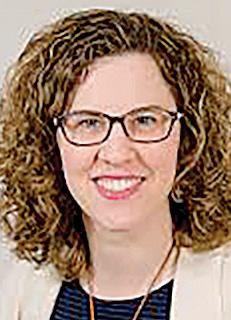
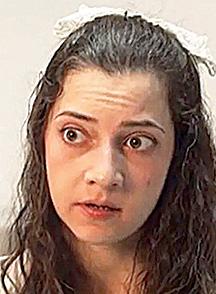
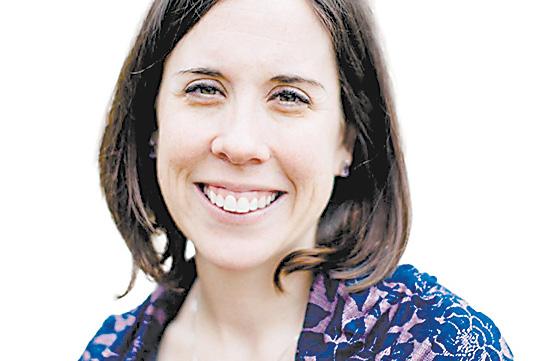
BELMONT — Amanda Achtman is a young adult from Canada who has dedicated her life to battling euthanasia and assisted suicide.
Her home country is one of several nations that have legalized dying by euthanasia, an issue that U.S. Catholics and people of faith should be concerned about as more states are legalizing assisted suicide, she recently told audiences in North Carolina.
The key difference between the countries is that the United States does not allow euthanasia, which is administration of life-ending medication by a doctor.
Several states do allow assisted suicide, which occurs when a patient selfadministers life-ending medication.
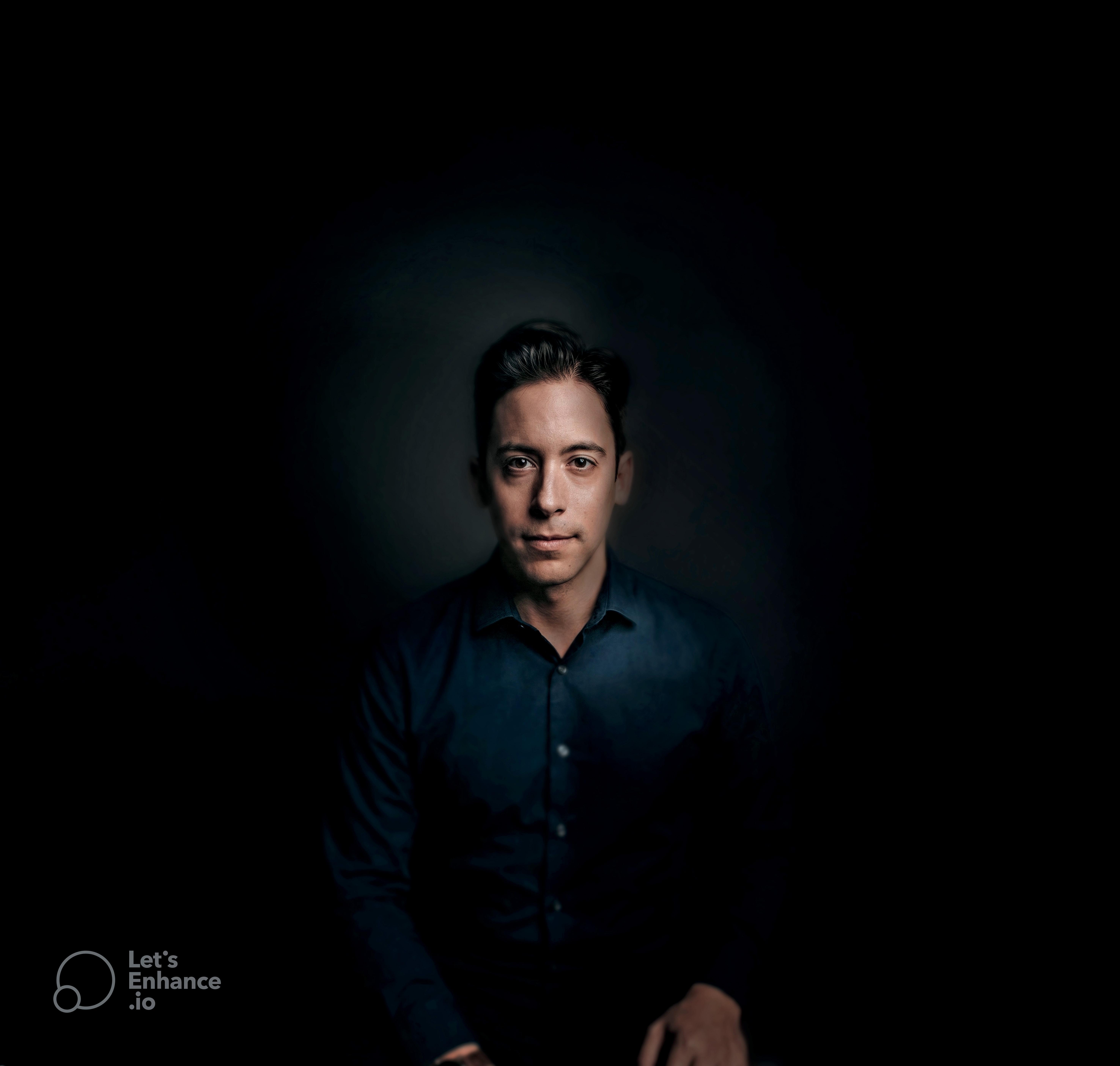
Achtman, the founder of the Dying to Meet You Project – a program that combats euthanasia and promotes hope, recently spoke at Belmont Abbey College and the Converging Roads Catholic medical conference in Charlotte. She is also the ethics director for Canadian Physicians for Life and an instructor of Catholic Bioethics for St. Bernard’s School of Theology and Ministry in Rochester, N.Y.
In Canada, she said, statistics show “one in 20 deaths is caused by a doctor or nurse. … What started out as exceptional and the most extenuating of circumstances has
become routine.”
Canada legalized assisted suicide and euthanasia in 2016. The procedure is most often known as MAID (Medical Assistance In Dying). In the past decade, statistics show that more than 76,000 Canadians have chosen euthanasia. Once available only to the terminally ill, the nation has extended euthanasia to people with disabilities and is set to make it available to some people with mental illness in March 2027.
As the justifications have expanded, Achtman has heard from disabled and elderly people who have been offered euthanasia when they were simply seeking medical treatment.
“MAID is an attack on self-worth – it deflates and defeats a person’s self-worth and self-value just to have it offered,” she said. “I’ve had Canadians with disabilities say, ‘MAID is the only thing the government tells me I qualify for right now.’ That’s very dehumanizing. That kind of language signals that there is a category of people who should just not be here. This is why euthanasia is a life issue that’s coherent with all other life issues – it’s a situation where life is discarded, dismissed and discounted.”
What are euthanasia and assisted suicide? Where are they legal?
Assisted suicide occurs when a patient administers life-ending medication. Euthanasia occurs when a doctor administers life-ending medication with patient permission.
n Assisted suicide is legal in 13 states as well as Washington, D.C.: California, Colorado, Delaware, Hawaii, Illinois, Maine, Montana, New Jersey, New Mexico, New York, Oregon, Vermont and Washington. Euthanasia is not legal anywhere in the United States.
n Euthanasia is legal in several countries, including Australia, Austria, Belgium, Canada, Colombia, Luxembourg, the Netherlands, New Zealand, Portugal and Spain.
— Source: Dignity in Dying
Euthanasia also brings up core issues of the patient’s relationship with their loved ones and their God-created self.
“We all know that other people can dehumanize us and mistreat us, but do we have the humility to recognize when we do it to ourselves?” she asked. “That is what is happening in Canada – people are discarding themselves subconsciously because of fears of being a burden, living too long and using up inheritance money, fears that if they are not independent then life is not worth living. … Our life is more than appearances and achievements.”
People wanting to end their lives because of suffering need a healthcare system that offers them adequate care and relief, such as hospice and palliative care in terminal situations, she said. She also emphasized that people seeking an end to physical or mental suffering desperately want and need loved ones to advocate for
them.
“We don’t always have the strength at any given moment to be strong and fight for our own value,” she said. “People throughout life experience depression and sometimes suicidal ideation, and what should not be accepted and what we shouldn’t abide is letting people concede and capitulate to that ideation. Resistance to suicidal ideation is always an act of love.”
She called euthanasia “quite literally the opposite of love,” a procedure that “goes to the heart of the issue of whether it is good to be a person in the world after all.”
“We who are full of hope and ideals and faith have to look out at the culture … and say we love you too much to see you go through with this,” Achtman said. “You are worth fighting for, and we’re going to create a culture where life is valued rather than death.”
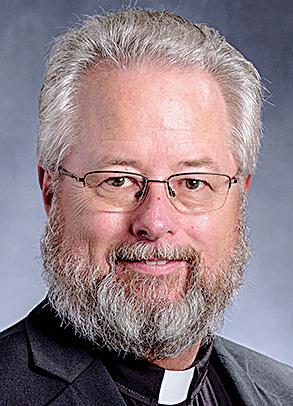
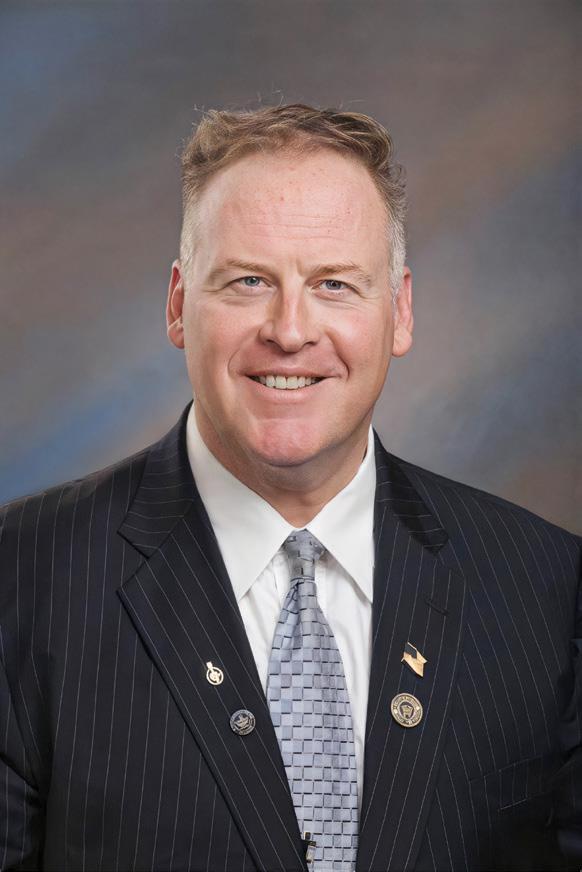
Achtman
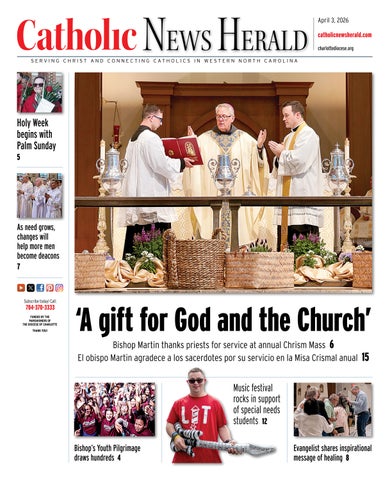
‘Un regalo para Dios y la Iglesia’
El
obispo Martin agradece a los sacerdotes por su servicio en la
CHRISTINA L. KNAUSS clknauss@rcdoc.org
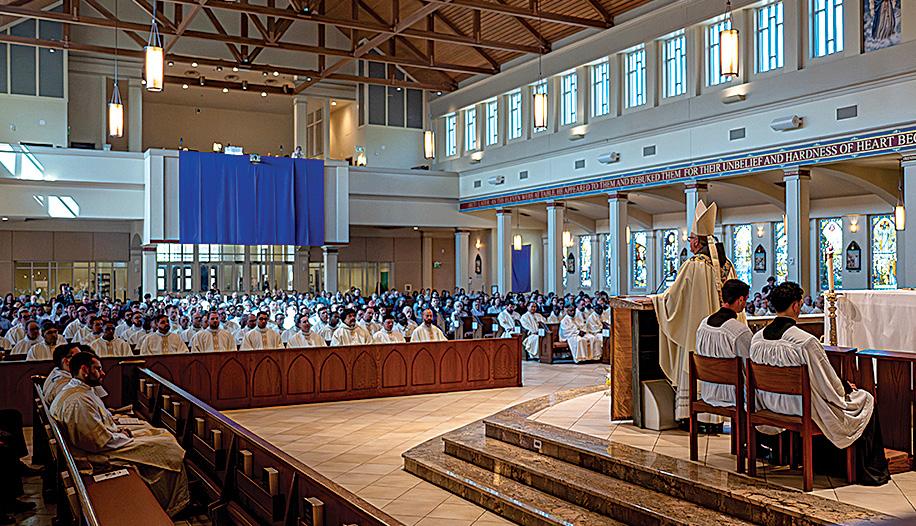
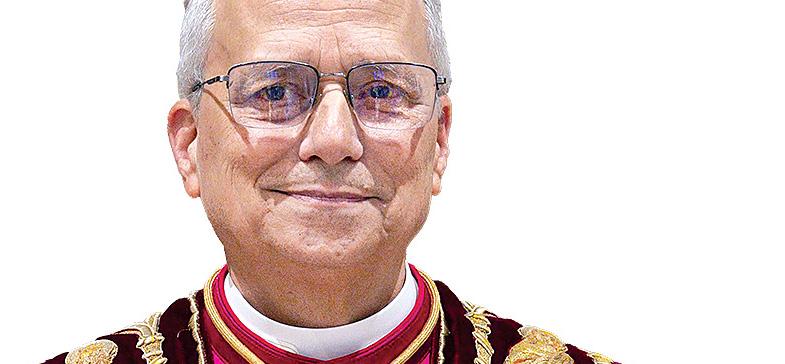
HUNTERSVILLE — Una larga fila de sacerdotes avanzó de dos en dos hacia la parroquia St. Mark en Huntersville el martes por la tarde, mientras el coro parroquial cantaba el himno “A Jesucristo, nuestro Rey Soberano”. Más de 100 sacerdotes de toda la Diócesis de Charlotte se reunieron para renovar las promesas de su sacerdocio en la Misa Crismal anual celebrada por el obispo Michael Martin. Celebrada cada año al comienzo de la Semana Santa, esta liturgia especial es el momento en que se bendicen los óleos utilizados en los rituales sagrados y sacramentos de la Iglesia, y los sacerdotes renuevan sus promesas y su compromiso con su ministerio.
A los sacerdotes se unieron más de 300 personas que acudieron a orar y rendir culto junto a los hombres que los sirven durante todo el año y los ayudan a acercarse más a Cristo.
La homilía del obispo Martin se inspiró en los temas de las lecturas del día de Isaías, el Apocalipsis y el Evangelio de Lucas, centradas en el concepto del “siervo sufriente”: alguien que soporta dolor, agotamiento y, a veces, incluso burlas, pero que aun así continúa haciendo la obra del Señor. También habló sobre el concepto especial de ser ungido, reflexionando tanto sobre los santos óleos utilizados en la unción como sobre el papel que desempeñan los sacerdotes en la vida de la Iglesia. Contó una historia de los primeros años de su sacerdocio, cuando, siendo director de una escuela secundaria católica en Baltimore, tuvo la triste tarea de acompañar a la policía para informar a una familia que su hijo, estudiante de segundo año, había muerto en un accidente automovilístico. Aunque la madre del estudiante estaba abrumada por el dolor, su padre pidió que todos se arrodillaran en el suelo de la sala para orar. Ese padre, dijo el obispo, encarnó al “siervo sufriente”.
“Este hombre, en la mayor agonía de su vida, llevó el consuelo y la consolación de la oración a un momento que
tanto lo necesitaba”, dijo, comparando ese momento con el papel de los sacerdotes al brindar alivio a sus feligreses cuando enfrentan sus propios desafíos.
De cara a los días que conducen a la alegría de la Pascua, dijo a sus hermanos sacerdotes: “debemos reflexionar sobre nuestra condición de siervos sufrientes y hacer (a Dios) la pregunta que muchos de nosotros hemos estado haciendo durante años: ‘¿Por qué me elegiste? ¿Por qué me ungiste?””.
“El misterio de ser ungido, el misterio de ser elegido, no es algo que jamás tendremos la certeza de comprender en esta vida”, dijo, señalando que Dios toma la bondad y la fragilidad de todos aquellos a quienes llama y utiliza ambas para el bien mayor. “Si Él puede tomar nuestras faltas, si puede tomar nuestras necesidades y ungirlas, lo mismo puede ser cierto para el pueblo de Dios. Él utilizará nuestra fragilidad para Su gloria”.
Misa Crismal annual
Es durante la Misa Crismal, esta celebración que los sacerdotes de la diócesis también renuevan sus promesas y su compromiso con el ministerio.
Animó al clero a ir más allá de los muros de sus iglesias en su ministerio pastoral, diciendo que la razón por la que han sido ungidos es “para los humildes, los quebrantados, los cautivos, los prisioneros y los que lloran. Es por la fragilidad del mundo que hemos sido ungidos como sus sacerdotes”.
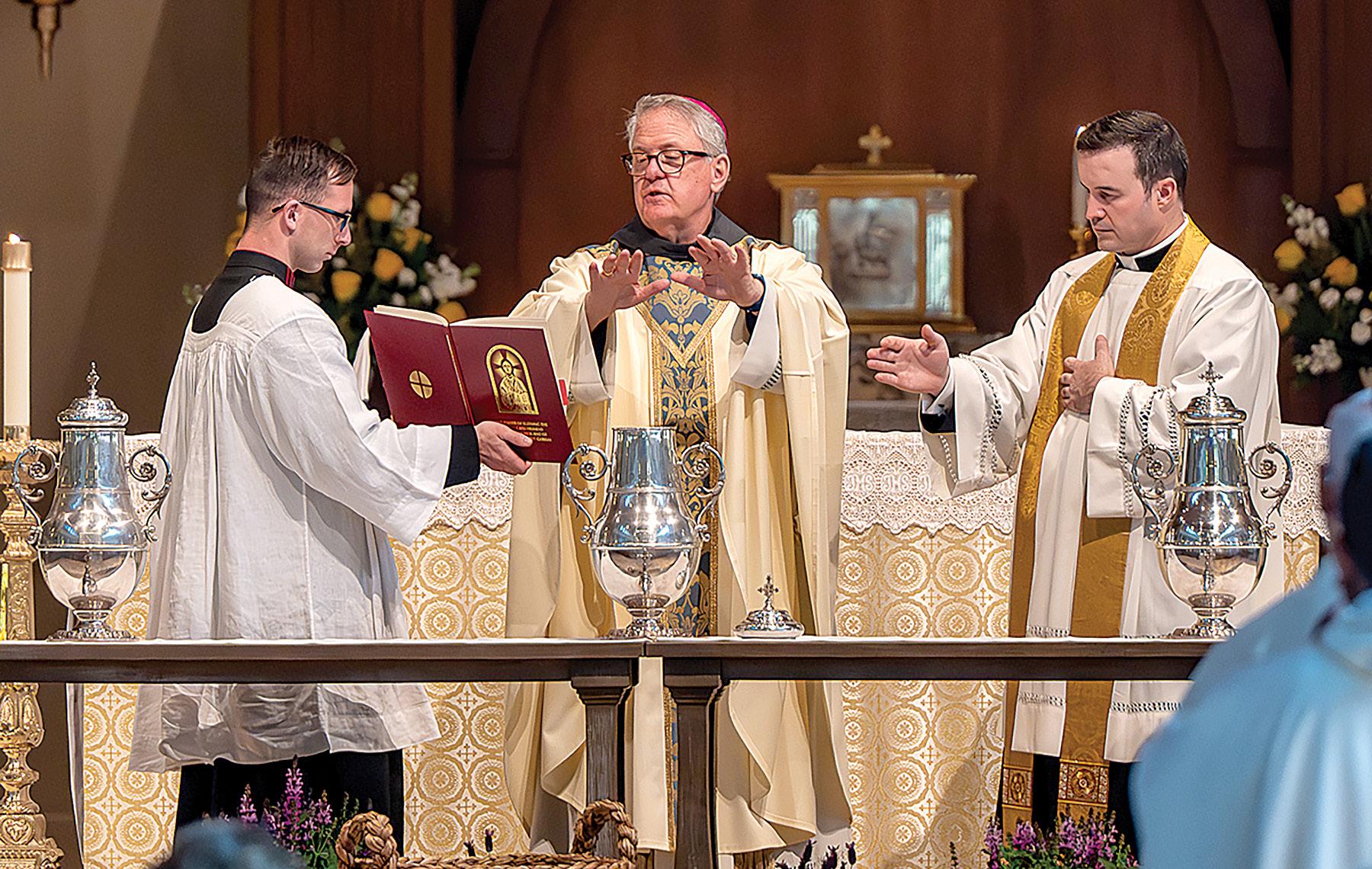
Después de la homilía, los sacerdotes renovaron sus promesas sacerdotales a la Iglesia y la congregación se unió en oración por ellos. Luego, el obispo Martin bendijo los santos óleos que se utilizan en los sacramentos del bautismo, la confirmación, la ordenación de sacerdotes y la unción de los enfermos, así como en la consagración de iglesias y altares.
Al final de la liturgia, el obispo Martin agradeció a los sacerdotes por su ministerio y exhortó a las personas en los bancos a apoyarlos, añadiendo: “Nunca los den por
sentado. Yo ciertamente no lo hago”. “Estos son hombres que han comprometido sus vidas al servicio», dijo. «Son de carne y hueso. Tienen necesidades y también son sanadores heridos: siervos sufrientes que son bendecidos por los fieles cuando se acercan con una palabra de Cuidado”.
Después de la Misa, los sacerdotes recibieron botellas de los óleos para llevar de regreso a sus iglesias y utilizarlos durante el próximo año.
Patricia Hayes, quien asiste a la parroquia St. Luke en Mint Hill, acudió a la Misa Crismal por primera vez.
“Me pareció hermosa, una maravillosa oportunidad para orar por los hombres que hacen tanto por nosotros”, dijo. “Somos muy afortunados de tener a estos sacerdotes, y especialmente de tener a tantos jóvenes que ingresan al sacerdocio. Estamos muy bendecidos aquí.”
FOTOS POR TROY C. HULL | CATHOLIC NEWS HERALD
Durante la Misa Crismal, celebrada cada año al comienzo de la Semana Santa, el obispo Michael Martin bendijo los óleos que son utilizados por las iglesias en los sacramentos.
A medida que crezca la necesidad, cambios abrirán el diaconado a más hombres
CHRISTINA LEE KNAUSS clknauss@rcdoc.org
CHARLOTTE — Los diáconos desempeñan funciones esenciales en la vida parroquial, desde bautizar a los bebés hasta asistir en los funerales; sin embargo, menos de la mitad de las parroquias y misiones de la diócesis cuentan actualmente con un diácono asignado. Para abordar esta creciente necesidad, un cambio en la estructura de la formación diaconal permitirá que más hombres se preparen para ser diáconos permanentes en la Diócesis de Charlotte.
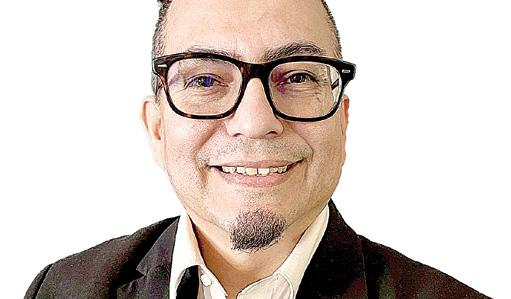
La incorporación de una segunda clase de preparación con un inicio escalonado permitirá a la diócesis tener eventualmente ordenaciones cada dos o tres años en lugar del promedio actual de cinco años, sin reducir el tiempo que cada individuo dedica a su preparación, según el diácono William Schreiber, director del diaconado permanente de la diócesis.
“El objetivo principal es poder ordenar con mayor frecuencia y ofrecer más oportunidades a los hombres”, dijo el diácono Schreiber.
Se requieren cinco años para convertirse en diácono permanente en la diócesis.
Los hombres deben primero presentar una solicitud y luego ser invitados por el obispo a unirse a una clase.
Después pasan por dos años de aspirantado, durante los cuales aprenden más sobre el papel de los diáconos en la vida de la Iglesia. A esto le siguen tres años de formación, durante los cuales los candidatos y sus esposas reciben instrucción adicional en las áreas humana, espiritual, intelectual y pastoral.
Tener dos clases en diferentes etapas de preparación al mismo tiempo permitirá que más hombres estudien para la ordenación y acelerará el proceso de incorporar diáconos permanentes al servicio en las parroquias que los necesitan. Actualmente, 44 de las 93 parroquias y misiones de la diócesis no tienen un diácono asignado.
Como primer paso en ese proceso, una nueva clase comenzó el 21 de marzo, con 11 hombres que iniciaron las primeras etapas de su camino en la iglesia St. Philip the Apostle en Statesville, que probablemente será el lugar donde se lleve a cabo la mayor parte de la instrucción en adelante.
Los 11 hombres que comienzan su camino hacia el diaconado se unen a otros 14 que están en camino de ser ordenados en 2027.
La nueva estructura también reducirá los tiempos de espera para quienes sienten el llamado a servir.
El diácono Schreiber dijo que el objetivo inmediato es iniciar una nueva clase cada dos años, lo que permitirá que más hombres desempeñen los importantes roles que cumplen los diáconos.
“La mayoría de la gente piensa que el diácono es solo el hombre que siempre está allí para ayudar en la misa, pero eso es solo la punta del iceberg”, dijo el diácono Schreiber.
“Los diáconos bautizan, ayudan en los funerales, llevan la Comunión a los enfermos, preparan a las parejas para el matrimonio, enseñan el OCIA; lo que sea, lo hacemos. El diaconado es, ante todo, un ministerio de servicio caritativo”.
‘No tengan miedo’
Inviten
a Dios a las luchas y a las alegrías de la vida, predica el obispo Martin en el Domingo de Ramos
PATRICIA L. GUILFOYLE plguilfoyle@rcdoc.org
CHARLOTTE — La mezcla de alegría y sufrimiento del Domingo de Ramos es una “extraña yuxtaposición” que refleja la realidad de la vida de las personas, y una invitación a dejar que Dios entre en cada parte de ella, dijo el obispo Michael Martin. El obispo Martin saludó a una multitud que llenaba totalmente la Catedral de San Patricio el 29 de marzo, cuando la Iglesia comenzó la Semana Santa, que conmemora los últimos días de la vida de Jesús que conducen a su pasión, muerte y resurrección en la Pascua.
La liturgia comenzó con la bendición de las palmas, y se proclamó la Pasión según San Mateo (Mt 26,14–27,66), relatando tanto la alegría de la entrada triunfal de Jesús en Jerusalén como, pocos días después, su arresto, tortura y muerte en la cruz.
En su homilía, el obispo Martin reflexionó sobre lo que llamó estas “dos dinámicas que no parecen ir muy bien juntas”.
“Por un lado, estamos llamados con nuestras palmas a alabar a nuestro Dios; por otro, estamos gritando para crucificarlo”, dijo. “Es uno de los grandes conflictos en la vida litúrgica de la Iglesia: que las mismas voces que al inicio de la proclamación del Evangelio de hoy pueden estar alabando a Jesús, en un momento después están pidiendo su muerte.”
La vida de las personas también está marcada por una mezcla similar de alegría y dolor, predicó el obispo Martin.
“De muchas maneras, hoy venimos aquí con una alegría, sabiendo que Jesús quiere transformar nuestras vidas. Venimos creyendo en un Dios que nos ama, un Dios que nos ha perdonado, un Dios que quiere grandes cosas para nosotros — y, sin embargo, también reconocemos que en nuestras propias vidas hay discordia, que no hemos puesto todo sobre la mesa para que Jesús lo transforme.
“Por mucho que queramos que nos salve, por mucho que queramos que transforme nuestras vidas, todavía hay partes de nuestras vidas a las que nos aferramos y tenemos miedo — o sentimos vergüenza, o tal vez incluso a veces nos hemos vuelto un poco perezosos”, dijo.
“Ni siquiera pensamos en cómo Cristo podría querer ser parte de esa dinámica de nuestras vidas, para elevarla, para transformarla”, dijo.
“Seguimos revolcándonos en el pecado… viendo la obra salvadora de Dios y, al mismo tiempo, reconociendo nuestra propia fragilidad.”
La Semana Santa es una oportunidad para enfrentar esa realidad y profundizar la fe, dijo el obispo Martin.
“Será un poco incómodo, será un poco frustrante y puede que no nos resulte agradable”, dijo, “pero está en el corazón del camino cristiano que hemos estado celebrando durante casi 40 días en esta Cuaresma, y que se intensifica aún más durante la Semana Santa.”
“No tengan miedo de emprender ese camino. No tengan miedo de mirar la extraña yuxtaposición, difícil de aceptar, de lo que el Espíritu Santo está haciendo en sus vidas”, animó a la gente.
Dios quiere ser parte de todos los aspectos de nuestras vidas, santificando tanto los momentos de alegría como los de dolor, dijo el obispo Martin, así que pidan su gracia “para hacer nuestras vidas completas, para hacer nuestras vidas santas, durante esta Semana Santa y para siempre.”
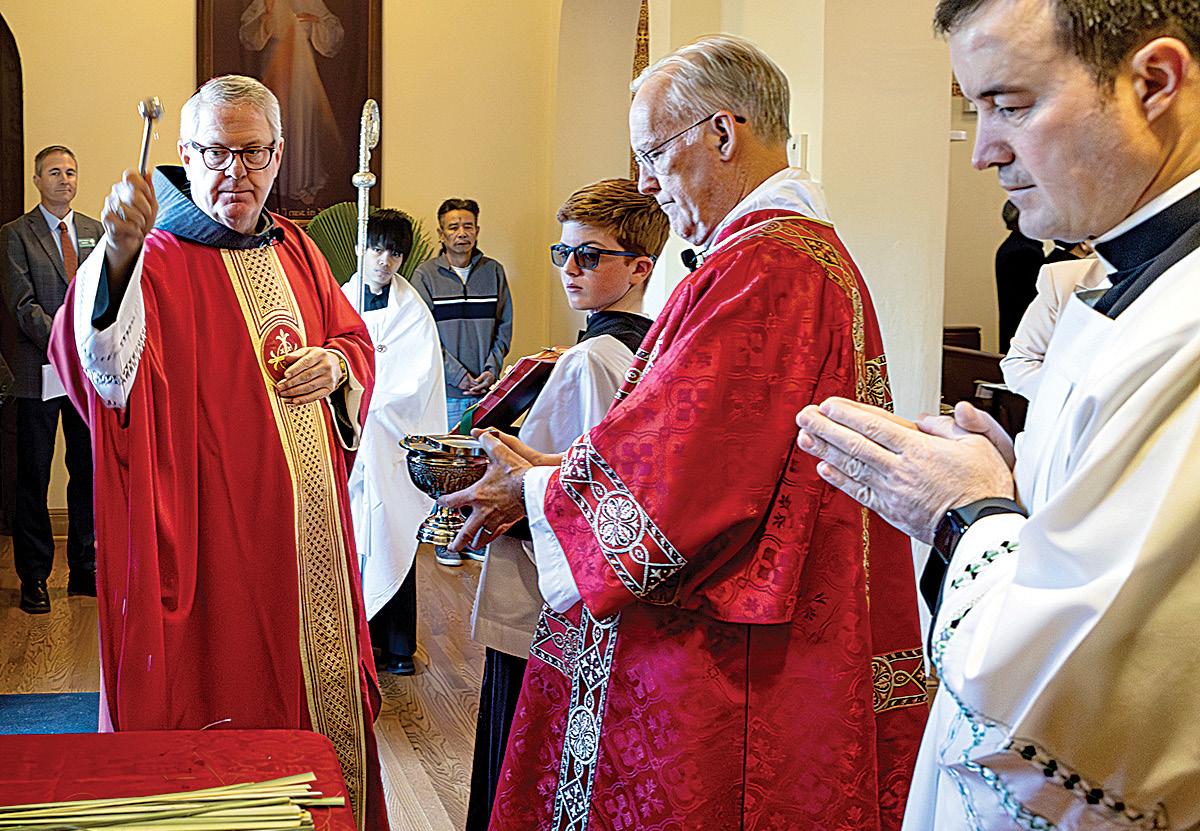
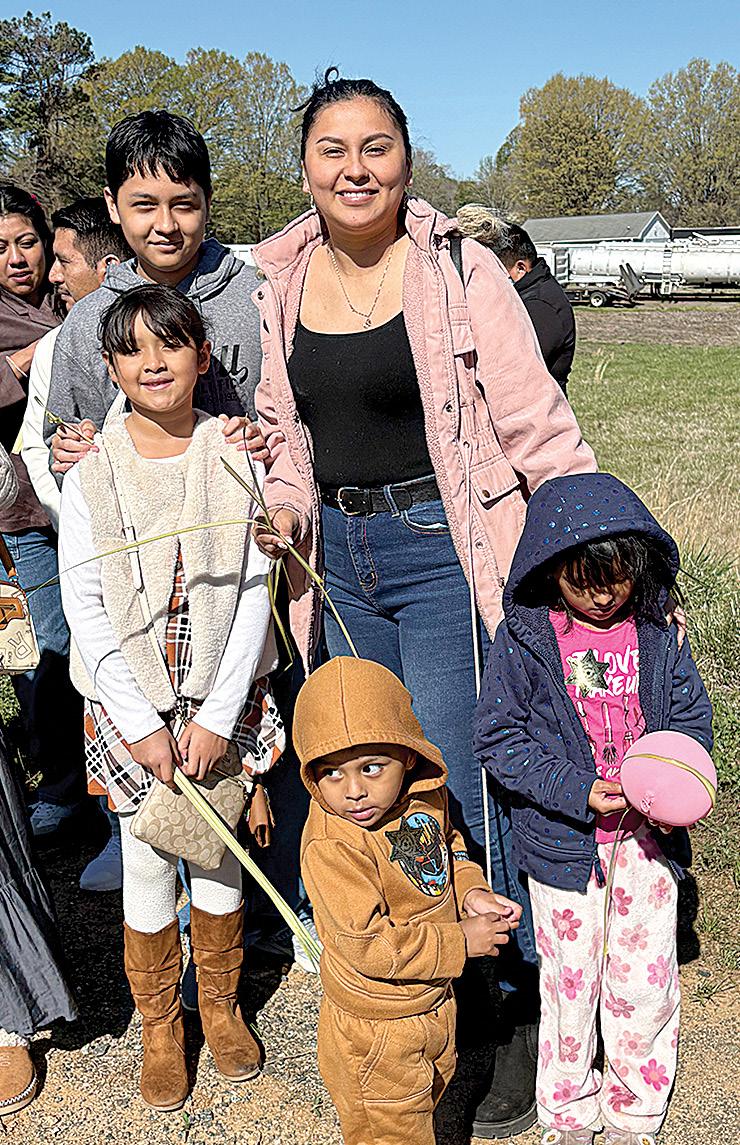
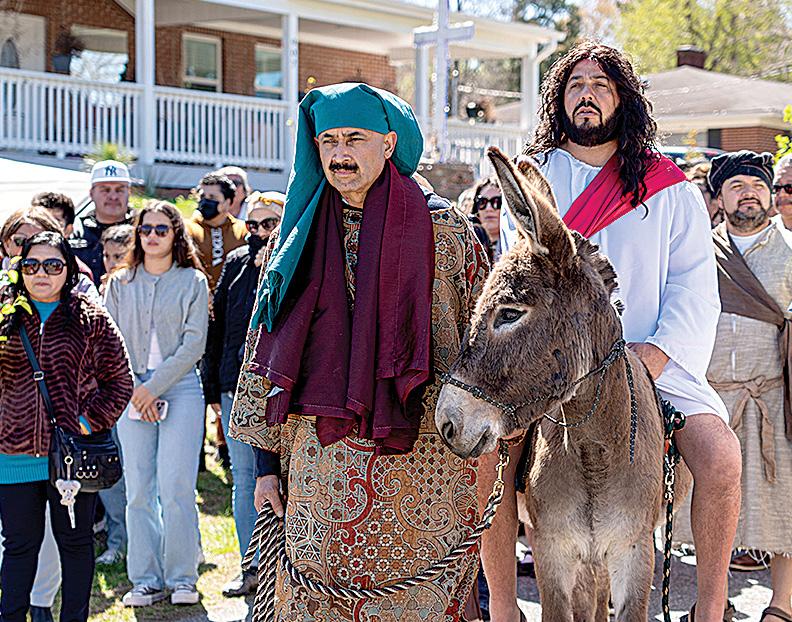
Las iglesias de toda la diócesis celebraron el Domingo de Ramos con sus propias tradiciones. (De arriba hacia abajo) El obispo M. Michael Martin inició la Semana Santa bendiciendo las palmas antes de la misa en la Catedral St. Patrick en Charlotte. En la iglesia St. Francis of Assisi en Mocksville, los feligreses se reúnen al aire libre para una misa celebrada por el padre Eric Kowalski. La procesión anual del Domingo de Ramos en la iglesia Our Lady of the Highways en Thomasville contó con participantes vestidos como los apóstoles que acompañaban a Jesús, quien recorría la ruta montado en un burro.
Schreiber
ED CHAPLINSKY, LISA M. GERACI Y BRIAN SEGOVIA | CATHOLIC NEWS HERALD
Todos los católicos participan de la misión de la Iglesia
Los laicos no son miembros pasivos, sino participantes activos en la misión de la Iglesia, llamados a vivir y difundir el Evangelio en la vida cotidiana, afirmó el Papa León XIV. Continuando con su serie de catequesis sobre los documentos del Concilio Vaticano II durante su audiencia general, el Santo Padre enfatizó que todos los bautizados, no solo el clero, son discípulos misioneros de Cristo.
“Por esta razón, los laicos y las laicas están particularmente llamados a llevar la presencia de Cristo a todas las esferas de la vida y así transformarlas desde dentro, dando testimonio de la belleza de una vida en Cristo y del poder elevador de su gracia”, dijo el 1 de abril en su discurso a los angloparlantes.
El Papa León profundizó en la Constitución dogmática “Lumen Gentium”, señalando que el Vaticano II arrojó luz sobre la dignidad de los laicos, después de siglos de haber sido definidos “simplemente como aquellos que no forman parte de los clérigos o de los consagrados”.
“Antes que cualquier diferencia de ministerio o de estado de vida, el Concilio afirma la igualdad de todos los bautizados”, dijo el Papa.
El Pueblo de Dios no es una “masa informe”, sino el cuerpo de Cristo, que une al clero y a los laicos, dijo. Al ser bautizados, los laicos “participan en el mismo sacerdocio de Cristo”, añadió. El Papa también hizo referencia a San Juan Pablo II y al Papa Francisco, destacando su énfasis en el papel activo de los laicos en la misión de la Iglesia. Continuó diciendo que la responsabilidad de los laicos no se limita a la Iglesia, sino que abarca el mundo entero. Afirmó que el mundo debe estar impregnado del espíritu de Cristo, algo que se hace posible a través de la “contribución, el servicio y el testimonio” de los laicos.
“La Iglesia, de hecho, está presente en todos los lugares donde sus hijos profesan y testimonian el Evangelio: en los ambientes de trabajo, en la sociedad civil y en todas las relaciones humanas, allá donde ellos, con sus elecciones, muestran la belleza de la vida cristiana, que anticipa aquí y ahora la justicia y la paz que serán plenas en el Reino de Dios”, dijo.
En su discurso dirigido a los de habla árabe, el Papa continuó con sus llamamientos a la oración por las víctimas inocentes de la guerra, tras semanas de condenar los conflictos en curso en Oriente Medio.
A principios de la semana, el Papa León XIV llamó a los católicos a orar por los sacerdotes, especialmente aquellos que enfrentan soledad, dudas y agotamiento. En su intención de oración de abril, el Santo Padre pide a los fieles que apoyen a los sacerdotes con compasión, gratitud y oración sincera.
Conoce al cineasta católico detrás de una nueva serie sobre ‘Las
KATIE YODER
OSV News
Cuando el veterano guionista y productor René Echevarria comenzó a trabajar en un nuevo programa dedicado a las mujeres de la Biblia, supo que el proyecto era una respuesta a sus oraciones.
“‘Dios, úsame’; esa fue mi oración”, dijo Echevarria, productor ejecutivo de “The Faithful: Women of the Bible” (Las fieles: Las mujeres de la Biblia). “Si es de tu agrado, úsame para contar tu historia”. Echevarria, un católico más conocido por su trabajo en “Star Trek”, habló con OSV News sobre “The Faithful” antes de su estreno en FOX el 22 de marzo.
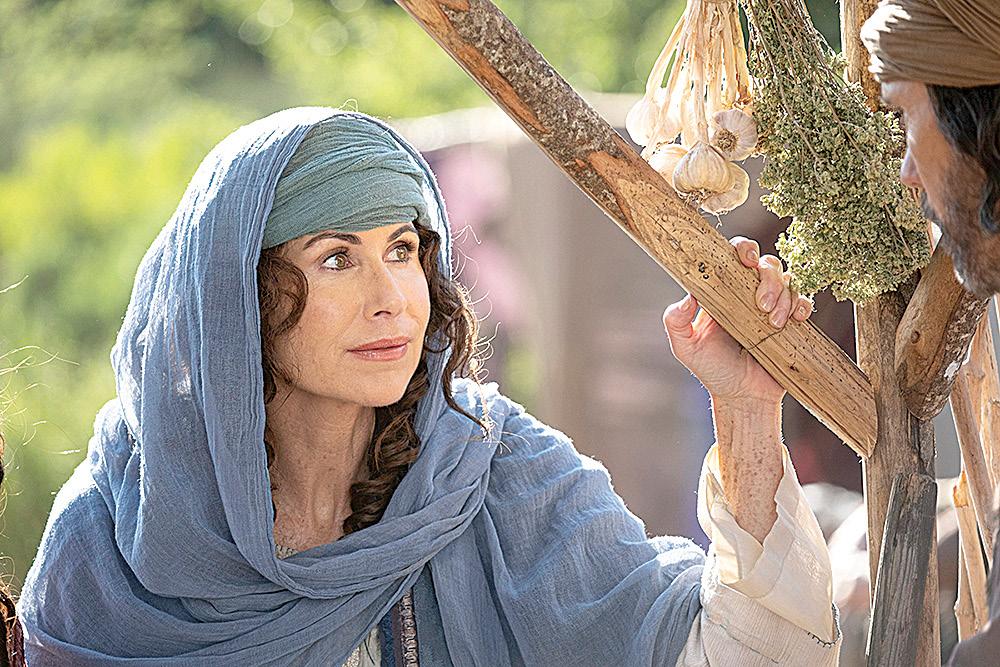
La serie promete dar vida a la Biblia a través de los ojos de cinco matriarcas del Antiguo Testamento: Sara (Minnie Driver) y su sierva Agar (Natacha Karam), la sobrina nieta de Sara, Rebeca (Alexa Davalos), y las sobrinas de Rebeca, las hermanas Lea (Millie Brady) y Raquel (Blu Hunt). La serie presenta a estas mujeres interconectadas como personas valientes e imperfectas a la vez, mientras navegan por el amor, el matrimonio, la maternidad, la tentación y la fe.
La serie de tres episodios se transmitirá semanalmente por FOX a partir del 22 de marzo y concluirá el 5 de abril, día de Pascua. La serie, que se filmó en Roma y Matera, Italia, también estará disponible para su transmisión en Hulu al día siguiente de su emisión.
Además de Echevarria, Carol Mendelsohn (“CSI: Crime Scene Investigation”) y Julie Weitz (“Game of Silence”) se desempeñan como productoras ejecutivas.
Echevarria, quien también escribió el episodio piloto y es el showrunner, aporta una gran experiencia a “The Faithful”, desde su trabajo en “Star Trek” hasta colaboraciones con James Cameron (“Dark Angel”), Steven Spielberg (“Terra Nova”) y Guillermo del Toro (“Carnival Row”).
Se involucró en “The Faithful” después de decidir hace unos años que quería que su próximo proyecto estuviera basado en la fe.
“Cuando tomé la decisión de intentar hacer... algo que honrara a Dios, rechacé algunas oportunidades”, dijo Echevarria a OSV News. “Hollywood es voluble y puede ser un poco duro, así que para mí fue un ejercicio de fe”.
Pasaron un par de años antes de que el agente de Echevarria lo pusiera en contacto con Mendelsohn, otro productor ejecutivo, después de que este expresara su deseo de trabajar en un proyecto sobre las mujeres de la Biblia.
Echevarria dijo que no dudó en aprovechar la oportunidad.
Para crear esta serie, Echevarria explicó que los cineastas se inspiraron en la Biblia y consultaron a expertos cristianos y judíos. Decidieron que, si iban a dramatizar una escena bíblica, se ceñirían a lo que la Biblia dice que ocurrió, afirmó. A veces, eso significaba incluir diálogos textuales.
“Incluso cuando leemos entre líneas e imaginamos creativamente cómo unir los puntos, siempre tuvimos cuidado de crear un espacio donde, pasara lo que pasara, uno pudiera seguir imaginando: ‘Ah, vale, eso pasó’”, dijo.
Los cineastas también querían presentar a estas matriarcas bíblicas como personas
mujeres de la Biblia’
reales. Echevarria recordó haber seguido un consejo concreto de Mendelsohn.
“Cuando me dispuse a escribir el primer borrador, ella me dijo: ‘René, escríbelas como si no supieran que son personajes bíblicos’”, contó. “Eso se convirtió en algo importante. Les dijimos a los demás guionistas e incluso a los actores que interpretaran esto como si no supieran que son personajes bíblicos”.
‘Cuando tomé la decisión de intentar hacer... algo que honrara a Dios, rechacé algunas oportunidades.’
René Echevarria Productor
“Espero que se sienta cercano y humano”, agregó. “Esa era nuestra ambición”.
A lo largo del proceso, los cineastas buscaron la opinión de dos consultores: la rabina Wendy Zierler, profesora del Hebrew Union College de Nueva York, y el teólogo cristiano Russell Moore. Echevarria calificó de gratificante que ambos consultores dieran su visto bueno a algunas de las decisiones más importantes de los cineastas.
“En un sermón, puedes decir: ‘Bueno, algunos eruditos dicen esto y otros dicen aquello’”, comentó. “Tuvimos que tomar decisiones”.
Como católico, Echevarría señaló que los católicos tienen margen para crecer en lo que respecta a la lectura de la Biblia. Él estudió en una escuela secundaria
católica y, al igual que sus hijos, en una escuela primaria católica.
“Fui a St. Jude’s en St. Petersburg, Florida”, comentó, “y mis hijos fueron a St. Jude’s en Westlake Village, California”.
Compartió que su hijo menor está en proceso de recibir el sacramento de la confirmación. Hoy en día, sus hijos asisten a una escuela secundaria cristiana no confesional, ya que no hay una escuela secundaria católica local.
“Tengo que quitarme el sombrero ante ellos por el estudio de la Biblia”, dijo Echevarria sobre la escuela. “Ha sido fascinante para mí ver eso y apreciarlo” Mientras se grababa el programa en Roma, Echevarria abrazó su fe católica y recordó haber asistido a Misa en iglesias antiguas de esa ciudad.
“Una de las bendiciones de la Iglesia es que sigue siendo (la) Misa”, dijo al referirse a asistir a Misa en un idioma diferente. “Aunque no la entiendas, sabes lo que se está diciendo, y puedes participar estés donde estés en el mundo”. Ahora que la serie se prepara para su estreno, Echevarria espera que los espectadores capten el mensaje más amplio de la bondad de Dios.
“Son mujeres con defectos y cometen errores; a veces son sumamente nobles y heroicas, y otras tropiezan”, dijo. “Pero Dios saca algo bueno de todo ello”. Puso como ejemplo a Sara, la esposa de Abraham, y su relación con su esclava, Agar. El primer episodio de la serie cuenta la historia que se encuentra en Génesis de cómo Sara, que lucha contra la infertilidad, entrega a Agar a Abraham, para que Agar le dé un hijo. Agar queda embarazada de Ismael.
“Sara pierde un poco la fe en que Dios vaya a cumplir su promesa de darle un hijo, así que toma el asunto en sus propias manos, e Ismael viene al mundo”, dijo Echevarria. “Y, sin embargo, (Dios) sacó algo bueno de eso”.
“Dios también lo bendijo”, añadió. “Dios siempre saca algo bueno incluso de nuestra falta de fe y de nuestros errores”.
Papa León XIV
FOX | OSV NEWS
Minnie Driver interpreta a Sara en una escena de la serie “The Faithful: Women of the Bible”, que se estrena en FOX el 22 de marzo de 2026.
Hundreds rally with bishops to protest mass deportations
EL PASO, Texas — On March 24, to commemorate the feast day of the martyr St. Óscar Romero, hundreds of people joined in a march and vigil calling for an end to mass
seeking information about their products and sent a similar letter to the U.S. Food and Drug Administration, their committee’s Republican majority said March 25.
The letters come amid frustration from prolife groups that the status of the FDA’s review of mifepristone, a drug commonly, but not exclusively, used for first trimester abortion,
Caring for Charlotte Area Catholic Families in Their Hour of Need Since 1926
Their letter to the FDA urged the agency to use the “numerous tools at its disposal to prevent misbranded and unapproved versions of the chemical abortion drugs from being marketed in the U.S. by online retailers in violation of federal law.”
The FDA “must do more,” they said, than warn on its website that “there are serious
Please pray for the following priests who died during the month of April:
FUNERAL SERVICE, INC.
Charlotte 704-334-6421
Pineville 704-544-1412
Mint Hill 704-545-4864
Derita 704-596-3291
Rev. Joseph C. Ayathupadam
Rev. James P. Cahil
Rev. Francis M. Cintula
Rev. Msgr. Charles Gable
Rev. Richard P. Hokanson
Rev. Msgr. Joseph A. Kerin
Rev. Joseph J. Lash
Rev. Samuel Orlando
Rev. Msgr. William N. Pharr
Sponsored by the Knights of Columbus
You shouldn’t have to compromise your values when it comes to investing. That conviction is among the many reasons I support Ave Maria Mutual Funds and why I’m proud to serve on their board.
Since 2001, Ave Maria Mutual Funds has refused to invest in companies that profit from pornography, abortion or attacks on the family. Their strong, long-term performance proves that principled, Pro-Family, Pro-Life investing works.
mission of the Ave Maria Mutual Funds.” – Michael Past performance does not guarantee future results. Schwartz Investment Counsel, Inc., a registered investment adviser established in 1980, serves as investment adviser for Ave Maria Mutual Funds and invests only in securities that meet the Funds’ investment and religious requirements. The returns may be lower or higher than if decisions were based solely on investment considerations. The method of security selection may or may not be successful and the Funds may underperform or outperform the stock market as a whole. All mutual funds are subject to market risk, including possible loss of principal. Request a prospectus, which includes investment objectives, risks, fees, charges and expenses and other information that you should read and consider carefully before investing. The prospectus can be obtained by calling 1-866-283-6274 or it can be viewed at www.avemariafunds.com. Distributed by Ultimus
At his first Palm Sunday Mass, Pope Leo says Jesus cries out from the cross against war
COURTNEY MARES OSV News
VATICAN CITY — In his first Palm Sunday homily, Pope Leo XIV proclaimed that Jesus, the King of Peace, embraces all suffering in human history and cries out from the cross against war.
“Brothers and sisters, this is our God: Jesus, King of Peace, who rejects war, whom no one can use to justify war,” the pope said in St. Peter’s Square March 29.
“He does not listen to the prayers of those who wage war, but rejects them, saying: ‘Even though you make many prayers, I will not listen: your hands are full of blood’ (Is 1:15).”
Pope Leo repeated the phrase “King of Peace” seven times throughout his homily, weaving it through different moments of the Passion of Christ, pointing to Jesus as a victim of unjust violence who never took up arms in His own defense.
“Christ, King of Peace, cries out again from His cross: God is love! Have mercy! Lay down your weapons! Remember that you are brothers and sisters,” Pope Leo said.
He emphasized that Jesus, in allowing Himself to be nailed to the cross, embraced “every cross borne in every time and place throughout human history.”
“As we set our gaze upon Him who was crucified for us, we can see a crucified humanity. In His wounds, we see the hurts of so many women and men today,” the pope said.
“In His last cry to the Father, we hear the weeping of those who are crushed, who have no hope, who are sick and who are alone. Above all, we hear the painful groans of all those who are oppressed by violence and are victims of war.”
Pope Leo’s first Holy Week began under sunny skies with a solemn Palm Sunday procession through St. Peter’s Square, where cardinals, bishops and lay people carried large palm branches. The congregation held olive branches, as is customary in Italy.
The Passion narrative from the Gospel of Matthew was solemnly chanted during the Mass; at the moment of Jesus’ death,
the square fell silent as tens of thousands of people, including the pope, knelt down in prayer.
At the end of the Mass, Pope Leo led the crowd in the Angelus prayer in Latin and made an impassioned appeal for Christians in the Holy Land, where Catholic leaders in Jerusalem initially had to cancel or postpone key Holy Week liturgies, including Palm Sunday, due to wartime restrictions.
Cardinal Pierbattista Pizzaballa, the Latin patriarch of Jerusalem, and Father Francesco Ielpo, the custos of the Holy Land, were prevented from entering the Church of the Holy Sepulcher by Israeli police on Palm Sunday, March 29.
In a statement published March 30, the Latin patriarchate said that “access for representatives of the Churches has been secured in order to conduct the liturgies and ceremonies and to preserve the ancient Easter traditions at the Church of the Holy Sepulcher.”
“Naturally, and in light of the current state of war, the existing restrictions on public gatherings remain in force for the time being. Accordingly, the Churches will ensure that the liturgies and prayers are broadcast live to the faithful in the Holy Land and throughout the world,” the statement read.
As Pope Leo said at the Palm Sunday Angelus, “At the beginning of Holy Week, our prayers are more than ever with the Christians of the Middle East, who are suffering the consequences of a brutal conflict and, in many cases, are unable to observe fully the liturgies of these holy days.”
“Just as the Church contemplates the mystery of the Lord’s Passion, we cannot forget those who today are truly sharing in his suffering,” he said, adding “their
ordeal challenges all our consciences.”
The pope also prayed for migrants who have died at sea, particularly those who perished recently off the coast of Crete.
In his homily, Pope Leo quoted Servant of God Antonio “Tonino” Bello, an Italian bishop and vocal critic of the Gulf War who died of cancer in 1993 and is on the path to sainthood.
“‘Holy Mary, woman of the third day, grant us the certainty that, in spite of all, death will no longer hold sway over us; that the injustices of peoples are
numbered; that the flashes of war are fading into the twilight; that the sufferings of the poor are breathing their last. And grant, finally, that the tears of all the victims of violence and pain will soon be dried up like frost beneath the spring sun,’” the pope said, quoting Bello, whom he referred to by his nickname “Tonino.” Pope Leo has a busy Holy Week schedule ahead, which includes a return to the tradition of Holy Thursday Mass in St. Peter’s Basilica and includes Stations of the Cross in the Colosseum.
REMO CASILLI, POOL VIA REUTERS | OSV NEWS
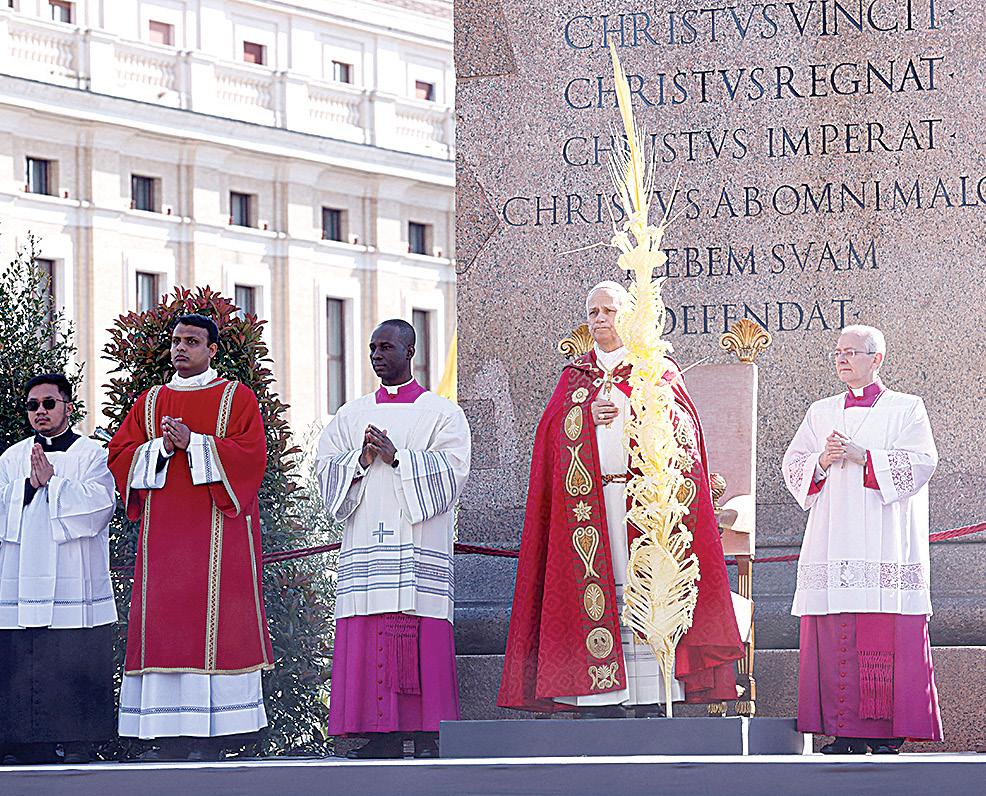
Pope Leo XIV holds a palm branch as he celebrates the Palm Sunday Mass in St. Peter’s Square at the Vatican. The pope used his first Palm Sunday homily to make a plea for peace in the Holy Land.
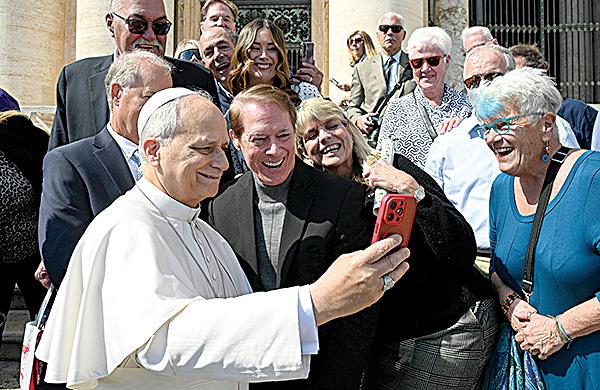
Pope Leo XIV reunites with his eighth-grade classmates
ROME — On the steps of St. Peter’s Basilica in Rome, Pope Leo XIV met with some of his eighth-grade classmates from St. Mary of the Assumption lower school in south Chicago, where he grew up.
Of the 82 eighth-graders with whom he attended St. Mary’s in 1969, 10 greeted him after the general audience on March 18, exchanging laughs, gifts and warm handshakes.
During the meeting, his former classmates gave him a photograph of the class of 1969, which he held up as he posed for another group shot more than 50 years later.
Jerome Clemens pointed out the young Robert Prevost standing among his classmates to the L’Osservatore Romano, the Vatican newspaper: “Here he is, our friend, the pope,” showing the back of the photo with Prevost’s old autograph and his new one, which he signed, “Leo XIV.”
Another former classmate, Sherry Stone (née Blue), dropped a sign she held that read “God bless you Pope Leo” when the pope approached her.
Visiting off-duty police prevent robbery at Roman church
ROME — Three Spanish policemen who were visiting Rome as tourists prevented a robbery at one of the city’s most iconic churches – the Basilica of the Holy Cross of Jerusalem – on March 21.
The policemen – one of whom is stationed at the Spanish Embassy to the Holy See – were off duty when they intervened in response to a priest’s call for help.
After hearing the priest’s shouts, they managed to intercept the suspect, who had reportedly just stolen several items.
After questioning the suspect, the policemen recovered two lockpicks, 480 euros (about $555), two watches and five lottery tickets.
The officers then proceeded to notify the Italian State Police of the incident, who took over the case.
The Basilica of the Holy Cross of Jerusalem is one of the most renowned churches in the Eternal City, owing to the spiritual treasures it holds within its walls.
According to tradition, the basilica’s chapel houses three fragments of the cross of Christ as well as one of the nails with which soldiers affixed Christ to the cross and two thorns from Christ’s crown. These objects were transported from Jerusalem to Rome thanks to St. Helena, mother of the Roman Emperor Constantine.
Spanish bishops: Euthanasia for 25-year-old a ‘collective failure’
MADRID — Spain’s bishops are urging a renewed commitment to care and accompaniment following the euthanasia death of 25-year-old Noelia Castillo.
In a March 26 statement, leaders of the Spanish bishops’ conference said the response to human suffering “cannot be to shorten the path, but to walk it together.”
Castillo, who became paraplegic after a suicide attempt in 2022 following years of trauma and abuse, was granted legal permission to end her life. Courts in Catalonia and Europe upheld the decision. She died March 26 in Barcelona.
The bishops said her case reflects not just personal anguish but broader societal failures, including gaps in psychological care and support. They stressed that euthanasia is not a true medical response, but a “breaking of the bond of care.”
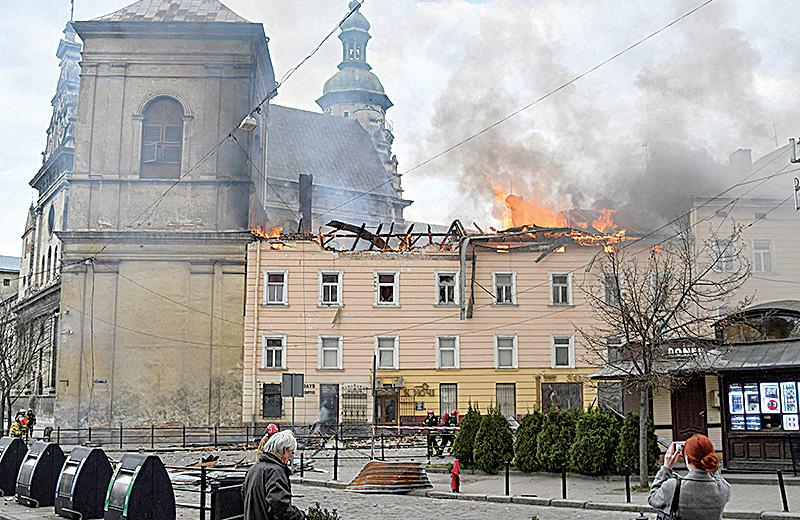
LVIV, Ukraine — Drone strikes hit religious and residential sites in Lviv, western Ukraine, on March 24, just days before Holy Week, damaging a historic monastery complex and St. Mary Magdalene’s Church.
Local officials say the attack was part of the largest 24-hour assault since Russia’s full-scale
invasion began in 2022.
The 16th-century Bernardine monastery, located in Lviv’s UNESCO-listed historic center, suffered damage to its tower, while nearby apartment buildings caught fire. At St. Mary Magdalene’s Church, shattered windows and debris littered the interior.
Archbishop Mieczyslaw Mokrzycki said the timing likely prevented fatalities.
After initial denial, Israel allows Church leaders to celebrate Holy Week in Jerusalem
JERUSALEM — The Latin Patriarchate of Jerusalem said an agreement with Israeli authorities will allow Holy Week and Easter liturgies at the Church of the Holy Sepulcher, after Catholic leaders were barred on Palm Sunday.
In a March 30 statement, church officials said access is now secured for clergy, though wartime limits on public gatherings remain, with celebrations livestreamed worldwide.
The dispute followed a March 29 incident in which Israeli police blocked Cardinal Pierbattista Pizzaballa and Father Francesco Ielpo.
Israel’s president, Isaac Herzog, expressed regret, citing security concerns tied to missile threats. Israeli officials later reversed course, while Pizzaballa urged respect for both safety and the right to worship. Cardinal Pizzaballa tried to ease tensions by calling the incident the result of a “misunderstanding.”
— OSV News and Catholic News Agency
OSV NEWS | REUTERS
ViewPoints
Laura Kelly Fanucci
When Lent is extra Lenty, you need Holy Week even more
Propped up on pillows, ice packs piled on my aching chest, I watched our parish livestream of the celebration of the Lord’s Passion on Good Friday. After the painful biopsy earlier that morning, I could not make it to church – one more loss in an unexpectedly hard Holy Week.
Two weeks earlier I had found a lump in my breast. The routine exam turned into a mammogram, then an ultrasound, then the biopsy.
That year Lent turned into a physical suffering I carried in my body. During Holy Week, caught in the harrowing in-between, all I had was Christ’s own passion to hold my anxiety and fear.
TEARS AND A DIAGNOSIS
On that Good Friday, my husband had taken our five boys to church alone – and since our youngest had just turned 3, we were still firmly front-row people: the pew where we knew our brood had the best chance to pay attention.
But the angle of the livestream camera between the altar and the ambo was also aimed at the front pew. So for the entire solemn service, I watched my beloved family somber-faced without me at their side. Wincing from my incisions, I wrestled with my worst fears: It looked like I was watching my own funeral. My bereaved spouse. My motherless children.
Needless to say, I wept through that Good Friday. Holy Saturday brought extra weight as we waited for the biopsy results. Even Easter felt hard that year – especially when Easter Monday brought the news that the tumor was cancer. How could I rejoice when I felt my own mortality breathing down my neck?
Three years later, cancer-free and preparing for another Easter on the horizon, I look back on that hardest Holy Week with unexpected perspective. Not a blithe and bright “everything happens for a reason” cliche. But a bone-deep gratitude for a faith that never shies away from the hardest parts of living, that embraces Christ’s own suffering as a transformation of our grief and loss. There is nowhere we can go that God has not gone before us.
‘HOW LONG, O LORD?’
This Lent has felt extra Lenty, personally and communally. In my home state of Minnesota, friends and neighbors are still reeling from unexpected suffering, fear and violence. Our world has once again descended into the chaos of war. At home, my own list of petitions runs long: a couple struggling with infertility, parents and children estranged because of mental illness, families grieving for grandparents and a community suffering from the latest gun violence.
Nearly every day I pray the same plaintive plea: “How long, O Lord?”
Yet the reality of resurrection remains the bedrock of my faith. Our family, our home and our hopes are built on this firm ground. I will not let seasons of suffering define who we are forever.
As St. John Paul II said, “We are an Easter people, and Alleluia is our song.” Christ’s suffering and dying transform our own, but it is His rising that gives us eternal life. No matter how long our seasons of Lent stretch, Easter is waiting for us.
HOLD NOTHING BACK
In the years when life becomes extra Lenty, the gift of the Triduum becomes even more clear. As a Church we enter completely into the passion, death and resurrection of Jesus. We hold nothing back. All our personal losses and griefs are gathered into Christ’s embrace on the cross – only to be transformed by the astonishing joy of Easter morning. If this Lent, this year, or what feels like your whole lifetime has been hard and heavy, may you and those you love find hope in the promise of what Holy Week holds. When everything looks like death, God is already at work to bring new life. Even the longest Lents pale in comparison to the stunning light that Easter brings.
LAURA KELLY FANUCCI is an author, speaker and founder of Mothering Spirit. Her latest book is “Living Easter: 50 Days to Practice Resurrection.”
Prayer, sacrifice and charity in this season of Lent
More than 25 years ago, I was working in the Office of Life and Family in the Diocese of Providence, Rhode Island, when I received a phone call. A sidewalk counselor was speaking to a young pregnant woman who was considering aborting her baby. Because the person did not speak Spanish, he handed her the phone so I could speak with her.
That is how I was able to talk with Marta and offer her help and support.
For more than a decade, my wife and I accompanied this young mother. The baby Rosa was born and became the joy of her life. Eventually, Marta moved to another state and we lost contact, but it fills me with joy to think that somewhere there is a woman continuing her life alongside her daughter, who became the greatest source of her hope.
We are now in the season of Lent, a time that invites us to pause in our routines and focus on three spiritual pillars: prayer, sacrifice and charity.
MAKE SPACE FOR GOD
Perhaps you do not yet have a consistent habit of prayer. This season can be an opportunity to give a little more space to God in your daily life.
For example, when you wake up in the morning you can thank God for the gift of a new day. On your way to work, you might say a short prayer or listen to religious music that lifts your soul and fills you with peace, so that you can be a light to others in your workplace and in your community.
I often take my daughter to school, and when we reach the halfway point of the drive, we always begin a prayer. We pray for people in our circle of friends and family who need our prayers, as well as for our deceased loved ones.
The holy rosary is also a very powerful spiritual tool. If you are not used to praying it, you can begin with just one decade or set aside one evening a week to pray the rosary as a family.
The Irish priest Father Patrick Peyton, who has been declared “venerable” on the path toward sainthood, promoted family rosary prayer for
decades and is remembered for a well-known phrase: “The family that prays together stays together.”
SACRIFICE FOR THE POOR
Lent also invites us to practice sacrifice. Traditionally, Catholics abstain from eating meat on Fridays, but for some people that may not represent much of a sacrifice. There are always other ways to practice fasting.
For example, we could give up buying a daily coffee and save that money to help those who are most in need. One concrete suggestion is to divide our offerings into three parts: one for our parish, one for the diocesan appeal, and one to help the poorest people in the world.
The bishops of the United States have a humanitarian agency called Catholic Relief Services, through which the Church helps the poorest people in some of the most remote and vulnerable places on the planet.
Last year, the current administration eliminated a large portion of international humanitarian aid programs, and other countries also reduced their contributions. As a result, many communities around the world are facing hunger, poverty and a greater risk of disease.
In the Gospel of Matthew, chapter 25, Our Lord Jesus Christ reminds us that on the day of judgment we will be evaluated by how we treated the smallest and most vulnerable among us.
GIVE GENEROUSLY
Generosity should be part of our Catholic culture of stewardship. This means regularly setting aside a portion of our income to share our blessings with those who are most in need. But in order to be generous, we must first organize our finances, our budget and our spending so that we can intentionally reserve a portion for charity.
I like to think of a simple formula: allocating about 70% of our income for our expenses, 20% for savings and 10% to help those in need, whether through our parish, our diocese or global charitable works such as CRS.
When we organize our expenses well and try to live simply – without the constant pressure to buy the newest or latest things – we discover that there is plenty of room to live with more prayer, a little sacrifice and abundant generosity in our charity. Let us always remember that there is more joy in giving than in receiving.
It brings me great joy to remember the young Marta and her daughter Rosita, whom my wife and I were able to help for many years. Perhaps we cannot change the whole world, but we can make a difference, one life at a time.
“For I was hungry and you gave Me food, I was thirsty and you gave Me drink, I was a stranger and you welcomed Me” (Mt 25:35).
SILVIO CUÉLLAR is a writer, liturgical music composer and journalist. He is a former coordinator of the Hispanic Ministry office and editor of El Católico de Rhode Island newspaper in the Diocese of Providence.
Silvio Cuéllar
PILGRIMAGE
PAGE 4
forgiveness of Our Lord was quite beautiful,” said Michael Krafchek, 18, from St. Matthew Parish who is expecting to be confirmed in May. “Beautiful humility is what it is. A way of saying, ‘God, I want to be better. Make me better.’”
The day of pilgrimage ended with Adoration and a Eucharistic procession led by Benedictine Abbot Placid Solari, the college’s chancellor.
“The Eucharistic procession gave me a chance to slow down and reflect on my own thoughts, to look at the literal reality that God is walking with us right now,” said Nicole Neuse, who is being welcomed into the Church at the Easter Vigil. “It is not like a metaphor – like we are walking with Christ. We really are, like, right behind Him.”
ASK THE RIGHT QUESTION
Belmont Abbey’s new president, Dr. Jeffrey Talley, told the young people they were probably used to being asked what they want to be when they grow up, but that may not be the right question.
“The right question is, ‘What does God want you to be?’ And that is an easy answer. You are called to be a saint,” Talley said. “It all starts with Jesus. Pray: ‘Lord, what do you want me to be?’”
The young pilgrims left eager to spread the Good News they learned.
“I thirst,” Krafchek said. “We need God. It is something we are longing for. It is literally causing us discomfort not to have Him.
“When you are lacking God, it is like lacking water – you are lacking something vital to your system.”
More online
At www.catholicnewsherald.com : See more photos and a video highlight from the 2026 Bishop’s Youth Pilgrimage
CONFERENCE
FROM PAGE 10
institution but responded well when treated with respect.
“He just wanted a cup of coffee, a pair of shoes that fit and to call his mother,” she said. “He got two of these three identified needs before he even sat down with a psychiatrist. … We didn’t need any more exceptional resources to handle him. We just needed to treat him like a human being.”
While the first part of the conference was filled with uplifting stories, the afternoon tackled some jarring realities.
Dr. Jessica Peck, a Baylor University professor, pediatric nurse and policy advocate, spoke about the global human trafficking industry that is estimated to generate $236 billion annually.
“Human trafficking is second only to the drug trade, and I believe it will soon surpass it, because drugs are commodities that need to be packaged and hidden, and while it is very difficult to hide drugs, it is very easy to hide a person,” Peck said. “One victim makes traffickers about $300,000 a year.”
Peck said while trafficking can happen to anyone, the likelihood of becoming a victim increases with environmental factors that include abuse, low self-esteem, and a family with addiction problems.
“Anyone can be a victim of human trafficking, and traffickers can be family members, elected officials, pastors, principals, teachers, anyone,” Peck said, noting that 35% of traffickers are related to their victim. “The cycle is always generally the same. They will befriend and establish trust, intoxicate and introduce drugs and alcohol, and alienate and separate them from their family.”
She said recruiters are now using artificial intelligence to find and groom vulnerable children on social platforms.
“Parents are so worried about the stranger on the street, but at the same time they’re allowing their child to invite thousands of strangers into their bedroom almost every night,” Peck said.
By the end of the conference, medical professionals took away six professional development credit hours and a renewed understanding of human dignity from a Catholic lens.
As Broghammer said, “Hope comes from your faith, and I see hope embodied in the dignity of every individual I work alongside.”
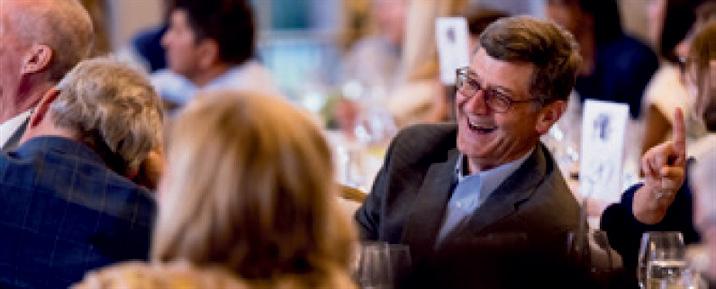
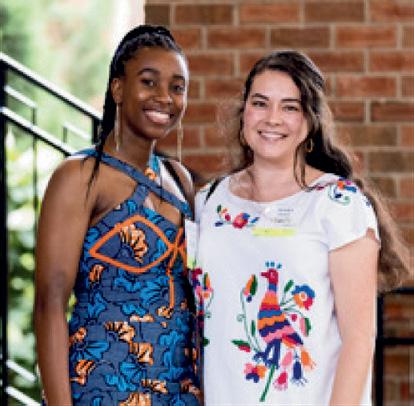
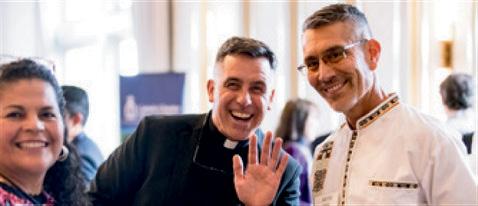
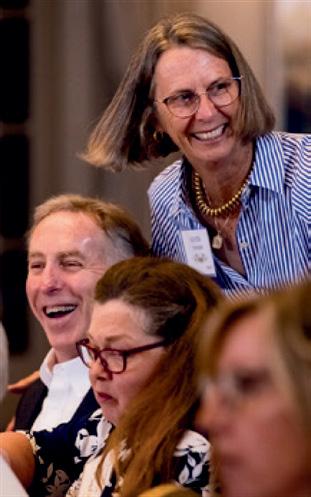
PHOTOS BY TROY C. HULL AND AIDAN CRETER | CATHOLIC NEWS HERALD
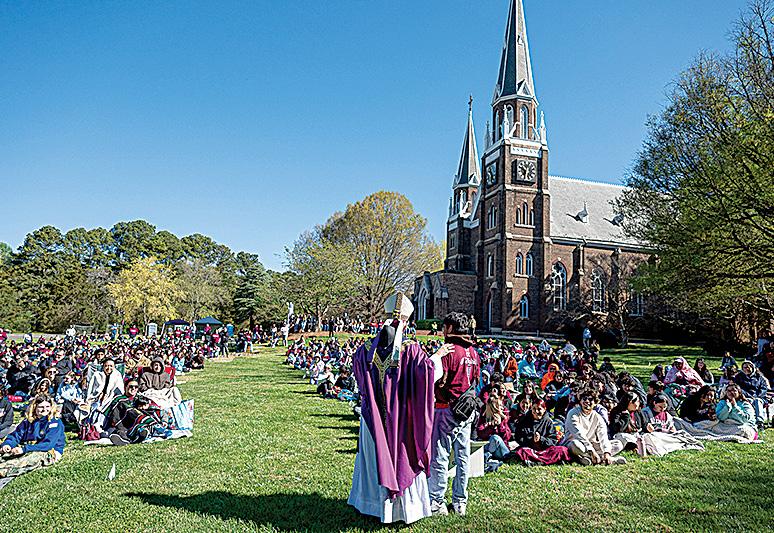
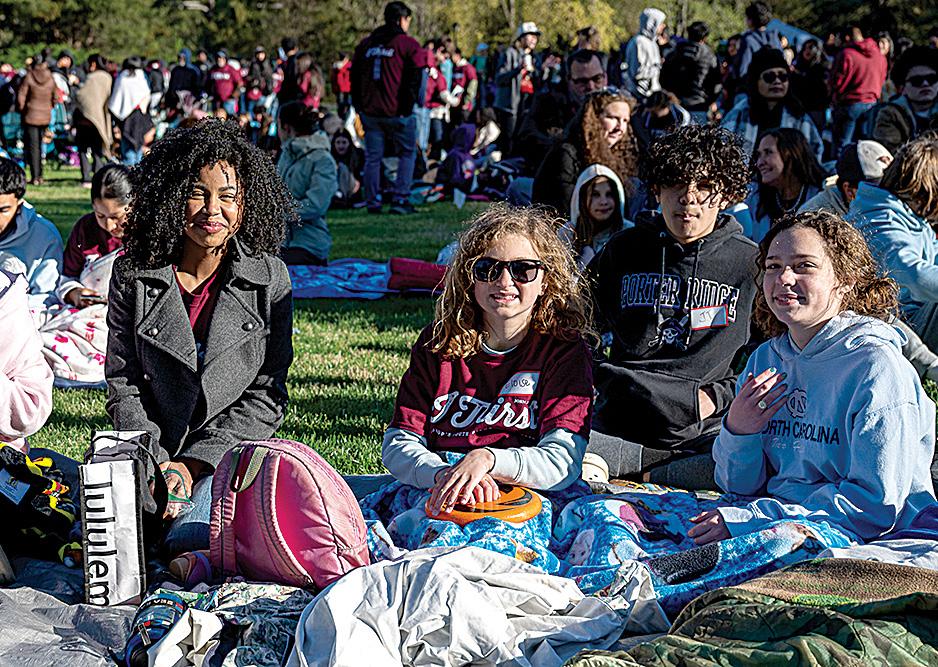
Held on the grounds of Belmont Abbey College, the Bishop’s Youth Pilgrimage gives young people from across the diocese the opportunity to get together for a day of fun and inspirational activities.