



FEBRUARY 6, 2026
VOLUME 35 • NUMBER 9
1123 S. CHURCH ST. CHARLOTTE, N.C. 28203-4003 catholicnews@rcdoc.org 704-370-3333
PUBLISHER
The Most Reverend Michael T. Martin, OFM Conv., Bishop of Charlotte
Love is one of the primary focuses of the calendar in early February, as the Church celebrates National Marriage Week (Feb. 7-14) and World Marriage Day (Sunday, Feb. 8) as well as the Feast of St. Valentine (Feb. 14). While there are actually three St. Valentines in the church calendar, all of them were martyrs and all are remembered on Feb. 14. According to tradition, St. Valentine risked his life to marry Christian couples during a time of persecution in the third century. Here are some ideas for bringing faith into your Valentine’s Day celebrations:
EDITOR: Trish Stukbauer
704-370-3392, tmstukbauer@rcdoc.org
ADVERTISING MANAGER: Kevin Eagan 704-370-3332, keeagan@rcdoc.org
MULTIMEDIA DESIGNER: David Puckett 704-808-4521, dwpuckett@rcdoc.org
EDITORIAL TEAM: Kimberly Bender 704-370-3394, kdbender@rcdoc.org Lisa Geraci 704-370-3294, lmgeraci@rcdoc.org
Troy C. Hull 704-370-3288, tchull@rcdoc.org
Christina Lee Knauss 704-370-0783, clknauss@rcdoc.org Amelia Kudela 980-374-3411, arkudela@rcdoc.org Brian Segovia 704-370-3235, bmsegovia@rcdoc.org
COMMUNICATIONS ASSISTANT/CIRCULATION: Maria De Ugarte 704-370-3333, catholicnews@rcdoc.org
COMMUNICATIONS DIRECTOR: Liz Chandler 704-370-3336, lchandler@rcdoc.org
ASSISTANT COMMUNICATIONS DIRECTOR: Patricia L. Guilfoyle 704-370-3334, plguilfoyle@rcdoc.org
THE CATHOLIC NEWS HERALD is published by the Roman Catholic Diocese of Charlotte 26 times a year.
NEWS: The Catholic News Herald welcomes your news and photos. Please e-mail information, attaching photos in JPG format with a recommended resolution of 150 dpi or higher, to catholicnews@rcdoc.org All submitted items become the property of the Catholic News Herald and are subject to reuse, in whole or in part, in print, electronic formats and archives.
ADVERTISING: Reach 165,000 Catholics across western North Carolina! For advertising rates and information, contact Advertising Manager Kevin Eagan at 704-370-3332 or keeagan@rcdoc.org. The Catholic News Herald reserves the right to reject or cancel advertising for any reason, and does not recommend or guarantee any product, service or benefit claimed by our advertisers.
SUBSCRIPTIONS: $17.25 per year for registered families of the Diocese of Charlotte and $25 per year for all others
POSTMASTER: Periodicals Class postage (USPC 007-393) paid at Charlotte, N.C. Send address corrections to the Catholic News Herald, 1123 S. Church St., Charlotte, N.C. 28203.

Valentine’s Day from a Catholic perspective is about sharing God’s love with those in your family and with the wider community. Fun ideas for the day include baking heart-shaped treats and sharing them with others, sending handmade scriptural Valentine’s Day cards with Bible verses about love, or creating prayers jars. To make the jars, write caring ideas on strips of paper – such as praying for each other, doing a good deed, or offering Mass or adoration for another’s intentions – and then fill a mason jar with the strips. Each day, pull one out randomly and fulfill the task.
“Together with Purpose” is the theme of National Marriage Week 2026. The website www.marriageweek.org offers links to live broadcasts diving deeper into this year’s theme as well as helpful resources for couples who want to strengthen their marriage, navigate a rough patch, work through blended family issues or get Catholic dating advice.
“Love for the poor – whatever the form their poverty may take – is the evangelical hallmark of a Church faithful to the heart of God,” Pope Leo XIV wrote in “Dilexi Te” (“I Have Loved You”), an apostolic exhortation “to all Christians on love for the poor.” The document was begun by Pope Francis, but Pope Leo added to it and signed the document on Oct. 4, 2025, the feast of St. Francis of Assisi. There are many volunteer opportunities available through local parishes that allow individuals and families to help the poor directly by contributing to food banks and supply drives, or assisting at shelters. Check with your parish or Catholic Charities Diocese of Charlotte to learn more. — Catholic News Herald, Catholic News Agency, USCCB
recommended prayers and activities
BIRTHRIGHT OPEN HOUSE : Birthright of Charlotte will host an open house, 2-4 p.m. Sunday, Feb. 15, at its facility at 4435 Monroe Road, Charlotte.
MUSIC OF EAST AND WEST AT THE ABBEY 8 p.m. Monday, Feb. 16, at the Abbey Basilica, 100 Belmont-Mt. Holly Road, Belmont. Concert of European folk-inspired music by Chopin, Liszt, Bartok, Schubert, Grieg and more, featuring German-Greek pianist Danae Doerken. Presented by Arts at the Abbey. Free; donations welcome.
PRAYER SERVICES
ANOINTING OF THE SICK MASS : 10 a.m. Saturday, Feb. 28, St. Luke Church, 9800 Fairview Road, Mint Hill. The sacrament of anointing of the sick will be offered for anyone who needs healing from
physical or mental illness, or someone having surgery. For information, call Mary Adams at 704-545-1224.
ORGAN TRANSPLANT SEMINAR “Is Brain Death Truly Death?”, a pro-life presentation by Dr. Paul Byrne examining the dangers of brain death and organ transplants, 7-9 p.m. Wednesday, Feb. 11, St. Thomas Aquinas Church’s Aquinas Hall, 1400 Suther Road, Charlotte. Sponsored by the Carolina Pro-Life Action Network. Learn more at www.defendthefamily.org/braindeath.
VIGIL OF THE TWO HEARTS : Vigil begins with 8 p.m. First Friday Mass on Friday, March 6, followed by nocturnal Eucharistic Adoration and concludes with the 8 a.m. First Saturday Mass on March 7. St. Patrick Cathedral, 1621 Dilworth Road East, Charlotte. Sign up for an hour of Adoration at www.defendthefamily.org/two-hearts.
Bishop Michael Martin, OFM Conv., will participate in the following events over the coming weeks:
FEB. 7 – 11 A.M.
World Day for Consecrated Life Mass
St. Patrick Cathedral, Charlotte FEB. 8 – 11:30 A.M. Campus Ministry Mass * Wake Forest University, Winston-Salem
FEB. 11 – 6 P.M.
Confirmation Christ the King Church, High Point
FEB. 14 – 10 A.M.
Rite of Acolyte and Affirmation of Promises for Deacons
St. Patrick Cathedral, Charlotte FEB. 16 – 6 P.M.
Confirmation
Our Lady of the Annunciation Church, Albemarle
FEB. 18- 6:30 P.M. Ash Wednesday Mass
St. John Neumann Church, Charlotte
* Denotes a private event.
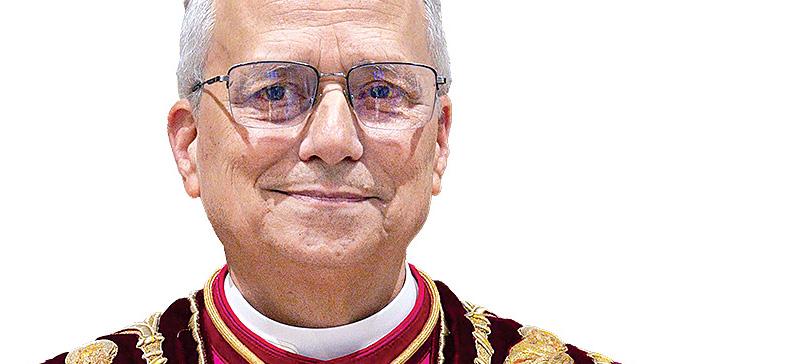
‘in every age’
Pope Leo XIV said Scripture is meant to speak directly to believers in today’s world, emphasizing that the Bible is the word of God expressed through human authors during his weekly general audience.
“In every age, the Church is called to re-propose the Word of God in a language capable of being embodied in history and reaching hearts,” he said Feb. 4.
He warned that when Scripture “loses touch with reality, with human hopes and sufferings,” or is proclaimed in language that is “incomprehensible, uncommunicative or anachronistic,” it becomes “ineffective.”
Continuing his catechesis series on Vatican II, the pope said the Bible is not a relic of the past but a living dialogue meant to lead people to know and love God. God chose to communicate through His people, demonstrating His mercy and desire to be close to humanity, the pope said.
Citing the Second Vatican Council’s document “Dei Verbum,” the pope said, “the words of God, expressed in human language, have been made like human discourse, just as the word of the eternal Father, when He took to himself the flesh of human weakness, was in every way made like men.”
It is important to note, he said, that while God is the principal author of Scripture, human beings were also “true authors,” not simply passive “scribes” sharing God’s words, the pope said, “God never mortifies human beings and their potential!”
He also warned against reading Scripture as though it had no divine origin and were only a relic of the past.
“While Scripture is a text rooted in historical truth, it also contains a limitless spiritual depth that speaks to people of all times and places, communicating above all God’s love and his desire to save us,” the pope said.
Pope Leo said that God, “in his goodness, ensures our lives do not lack the essential nourishment of His word, and let us pray that our words, and even more so our lives, do not obscure the love of God that is narrated in them.”
In an appeal he made at the end of the audience, the pope said a prayer for the people of Ukraine, who have endured frequent bombing recently.
sets
to mark 800th year since St. Francis’ death
JUNNO AROCHO ESTEVES OSV News
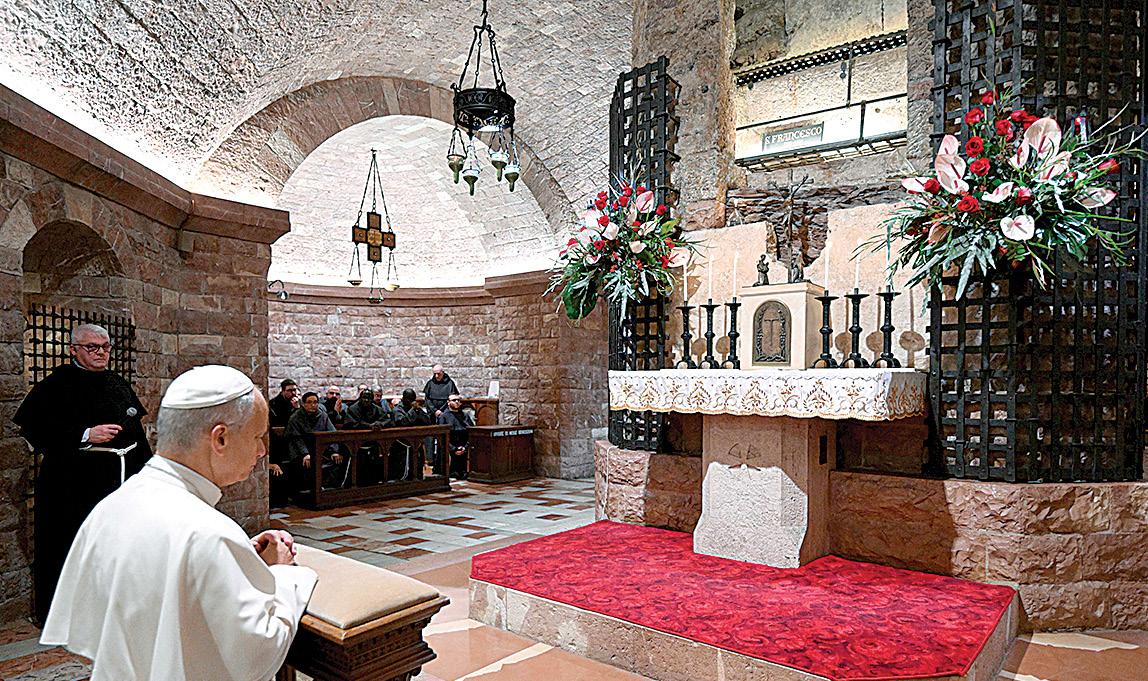
Pope Leo XIV has proclaimed a special Jubilee Year coinciding with the 800th anniversary of the death of St. Francis of Assisi. The Apostolic Penitentiary, a Vatican tribunal, issued a decree published by the Franciscan Friars Jan. 10, declaring a yearlong celebration in honor of the Poverello, or the Little Poor One.
According to the decree, Pope Leo has established that from Jan. 10, 2026, through Jan. 10, 2027, a special Year of St. Francis may be proclaimed, in which every Christian, “following the example of the Saint of Assisi, may himself become a model of holiness of life and a constant witness of peace.”

Noting previous jubilee celebrations related to the works of St. Francis – such as the eighth centenary commemorations of the first Nativity scene, his composition of the “Canticle of the Creatures” and his receiving the stigmata – the decree stated that “2026 will mark the culmination and fulfillment of all previous celebrations.”
PLENARY INDULGENCES GRANTED
St. Francis in our backyard Bishop Michael Martin is a Franciscan, and four parishes in our diocese are named for the saint. Consider a pilgrimage to each:
St. Francis of Assisi 167 St. Francis Pl., Jefferson, N.C. 28640 (336) 246-9151

www.stfrancisofassisi-jefferson.org
St. Francis of Assisi 328-B Woodsway Lane NW, Lenoir, N.C. 28645 (828) 754-5281

In its decree, the Apostolic Penitentiary announced that plenary indulgences will be granted to Catholics “under the usual conditions (sacramental confession, Eucharistic communion and prayer for the intentions of the Holy Father), which can also be applied in the form of suffrage for the souls in Purgatory.”
The indulgence will be granted to those who participate in a pilgrimage “to any Franciscan conventual church, or place of worship in any part of the world named after St. Francis or connected to him for any reason,” it stated. (See the list of parishes in our diocese at right.)
The sick, the elderly and caretakers unable to leave their homes can also obtain a plenary indulgence under the usual conditions “if they join spiritually in the Jubilee celebrations of the Year of St. Francis, offering their prayers to the Merciful God, the pains or sufferings of one’s life.”
Our own Bishop Michael Martin is a Conventual Franciscan. He strives to “not just parrot the words” but to live the life that St. Francis modeled, he told the Catholic News Herald last year, it is a life of service, ministry to the marginalized, and evangelization that inspires people to carry on as
www.stfrancislenoir.com
St. Francis of Assisi 299 Maple St., Franklin, N.C. 28734 (828) 524-2289
www.stfrancisassisifranklin.org
St. Francis of Assisi 862 Yadkinville Road, Mocksville, N.C. 27028




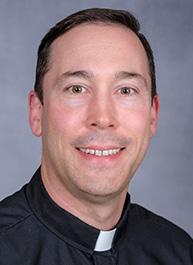
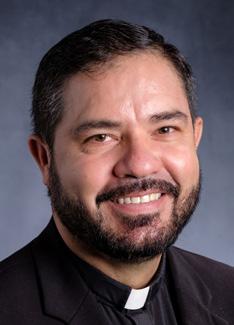
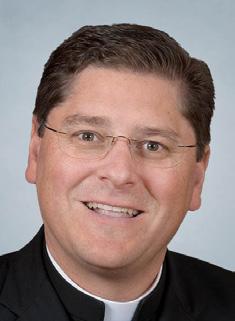
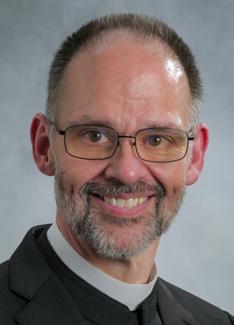
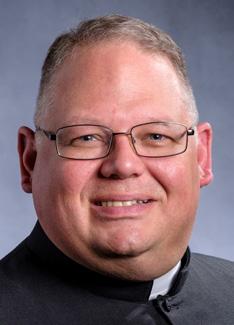
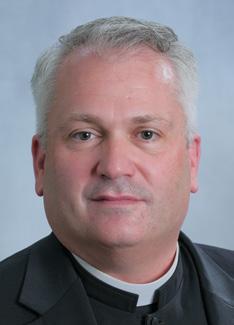
CHARLOTTE — Bishop Michael T. Martin, OFM Conv., announces the following appointments for the new term of the Diocese of Charlotte College of Consultors:
n Father J. Patrick Cahill, pastor of St. Matthew Parish in Charlotte and mission director for the diocese
n Father Julio C. Dominguez, pastor of St. Joseph Parish in Newton
n Father Christopher M. Gober, pastor of St. Leo the Great Parish in Winston-Salem and vicar forane of the Winston-Salem Vicariate
n Father John T. Putnam, pastor of St. Mark Parish in Huntersville and judicial vicar for the diocese
n Father Benjamin A. Roberts, pastor of Our Lady of Lourdes Parish in Monroe, diocesan ecumenical officer, and vicar forane of the Albemarle Vicariate
n Monsignor Patrick J. Winslow, vicar general and chancellor of the diocese
A College of Consultors is a group of priests drawn from the larger Diocese of Charlotte Presbyteral Council who advise and assist the bishop in governing the diocese, particularly on significant decisions related to administering the diocese’s temporal goods. Every diocese is required by Church law to have a College of Consultors.
Members serve five-year terms. The current term of College of Consultors runs from Jan. 15, 2026, to Jan. 15, 2031.
— Catholic News Herald
Reflect on God’s love for us all on this Valentine’s Day
CHARLOTTE — Want to do something different for Valentine’s Day? Invite your special someone to a lunch and reflection on love and the apostolic exhortation of Pope Leo XIV, “Dilexi te” (“I Have Loved You”).
The program, entitled “The Love That Calls Us Back,” will be presented by Deacon Scott Gilfillan, founder and executive director of the Font of Mercy, who will focus on God’s unconditional love for everyone and the special place the poor hold in Jesus’ heart.
It will be held from 10 a.m. to 1:30 p.m. on Saturday, Feb. 14, in Curtin Hall on the Sisters of Mercy campus, 101 Mercy Dr. in Belmont. Doors open at 9:30 a.m.
The event is sponsored by Catholic Charities and the Sisters of Mercy.
Visit www.ccdoc.org/education to register by Tuesday, Feb. 10.
BRIAN SEGOVIA bmsegovia@rcdoc.org
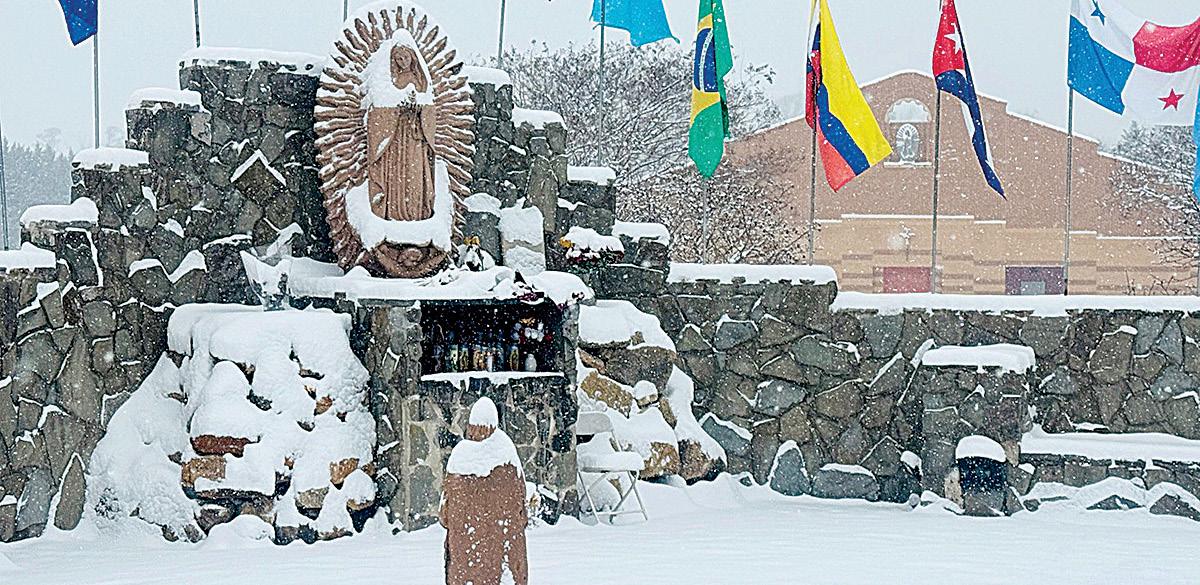
CHARLOTTE — Severe winter weather brought most of western North Carolina to a standstill for two consecutive weekends, forcing widespread cancellations and schedule changes for Masses, parish events and schools across the Diocese of Charlotte.
Over Jan. 24-25 and Jan. 31-Feb. 1, powerful storms delivered ice, snow, freezing rain and dangerously cold temperatures.
The N.C. State Climate Office called the Jan. 31 storm “our most widespread wintry event in more than a dozen years,” recording measurable snowfall in all 100 North Carolina counties for the first time since January 2014.
Snowfall totals ranged from 6 to 13 inches in the mountains and Asheville area, while the Piedmont and Triad were hit harder. Charlotte recorded about 11 inches, with more than a foot reported north of the city along the I-85 corridor. According to the National Weather Service, Rowan and Davidson counties saw the highest totals, with local reports exceeding 16 inches.
The snowstorm came one week after an Arctic front covered the region with ice, sleet and freezing rain Jan. 24 – downing power lines and making roads impassable for days.
The back-to-back storms prompted parishes and schools to cancel or postpone Masses, faith formation classes and other weekend events. Some offered livestreamed liturgies, ensuring that those at home could still participate in worship without risking icy commutes.
Bishop Michael Martin issued a dispensation from the obligation to attend Mass, urging people to prioritize safety and avoid travel in the hazardous conditions.
Catholic Schools Week celebrations at the diocese’s 20 schools were curtailed or rescheduled, and some schools closed or shifted to virtual learning Jan. 26-27 and Feb. 2-3.
The Mass for the Rite of Acolyte and Affirmation of Promises by Deacons, originally scheduled for Jan. 31 at St. Patrick Cathedral in Charlotte, was rescheduled for 10 a.m. Saturday, Feb. 14.
Yet not everything ground to a halt. At Sacred Heart Church in Salisbury, Father

John Eckert officiated at the wedding of Logan and Madyson Hamilton on Saturday afternoon as heavy snow fell outside.
Father Eckert cheered parishioners with a Facebook video message he recorded standing in the snow outside
the church.
“As we hit another Sunday where it is going to be a little bit harder to get to church, remember it is still a great day to keep the day holy,” he said, smiling. “Remember our Lord is with us in the sun and in the snow. He’s with us all the time.”
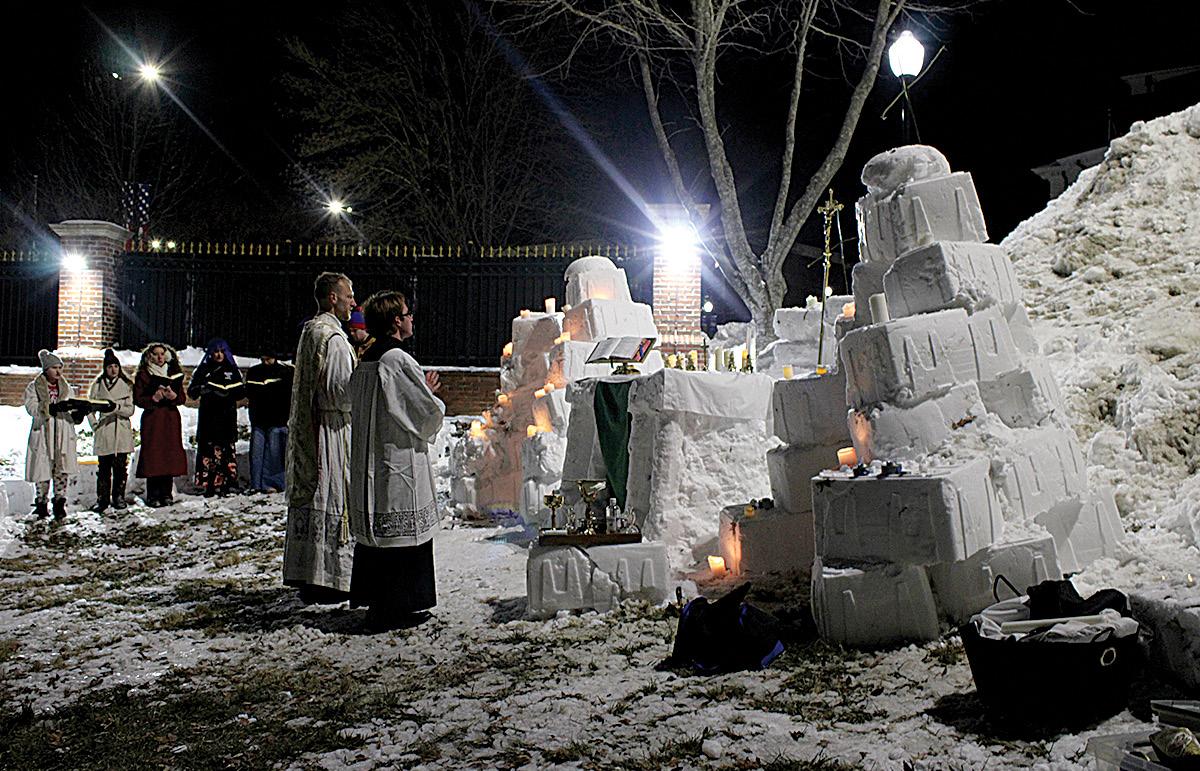
In High Point, Father Matthew Harrison had 60 campus ministry students attend a candlelight Mass in the snow despite temperatures below 20 degrees.
“Our Knights of Columbus college chapter spent the whole day working on the altar and the cruciform outline of the church,” he said. “By the time Mass was ended, our holy water in the holy water font was frozen into a block of holy ice.”
Churches that were able to offer Masses reported near-empty pews. Deacon Sigfrido Della Valle, Hispanic Ministry coordinator for the Smoky Mountains Vicariate, said some parishes saw attendance drop to the single digits.
While no buildings were reported damaged, the storms took a financial toll. Our Lady of the Highways Church in Thomasville, which sits atop a hill
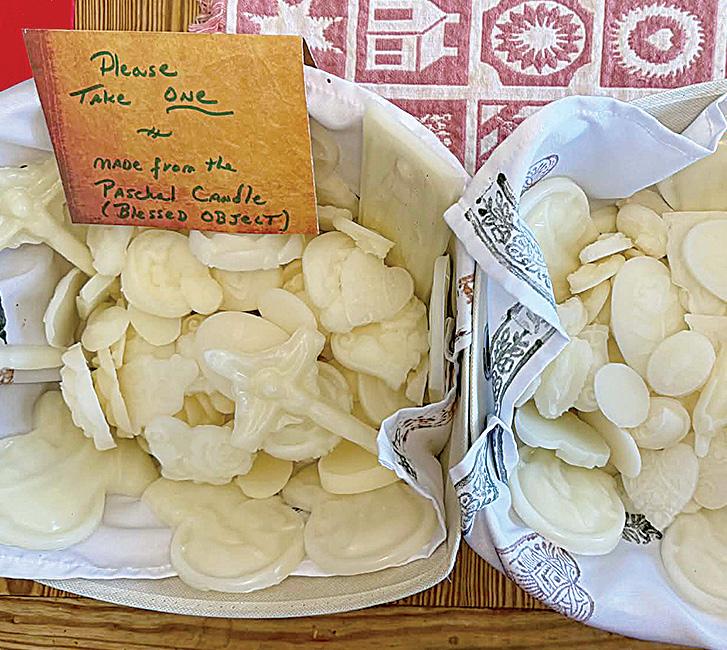
CHARLOTTE — Icy conditions and snow-covered roads kept Tricia Kent safely at home with her three grandchildren for the first time in 10 years instead of attending the Candlemas celebration at her parish, St. Thomas Aquinas. The Feb. 2 Feast of the Presentation of the Lord, also known as Candlemas, marks the end of the 40-day Christmas-Epiphany season. Kent, a candle painter, typically spends Candlemas presenting wax votives she creates from last year’s Paschal candle to parishioners after the candles are blessed. Because of the inclement weather this year, however, her husband Greg Kent went to church in her place to ensure her creations made it safely into parishioners’ hands and homes.
LISA M. GERACI lmgeraci@rcdoc.org
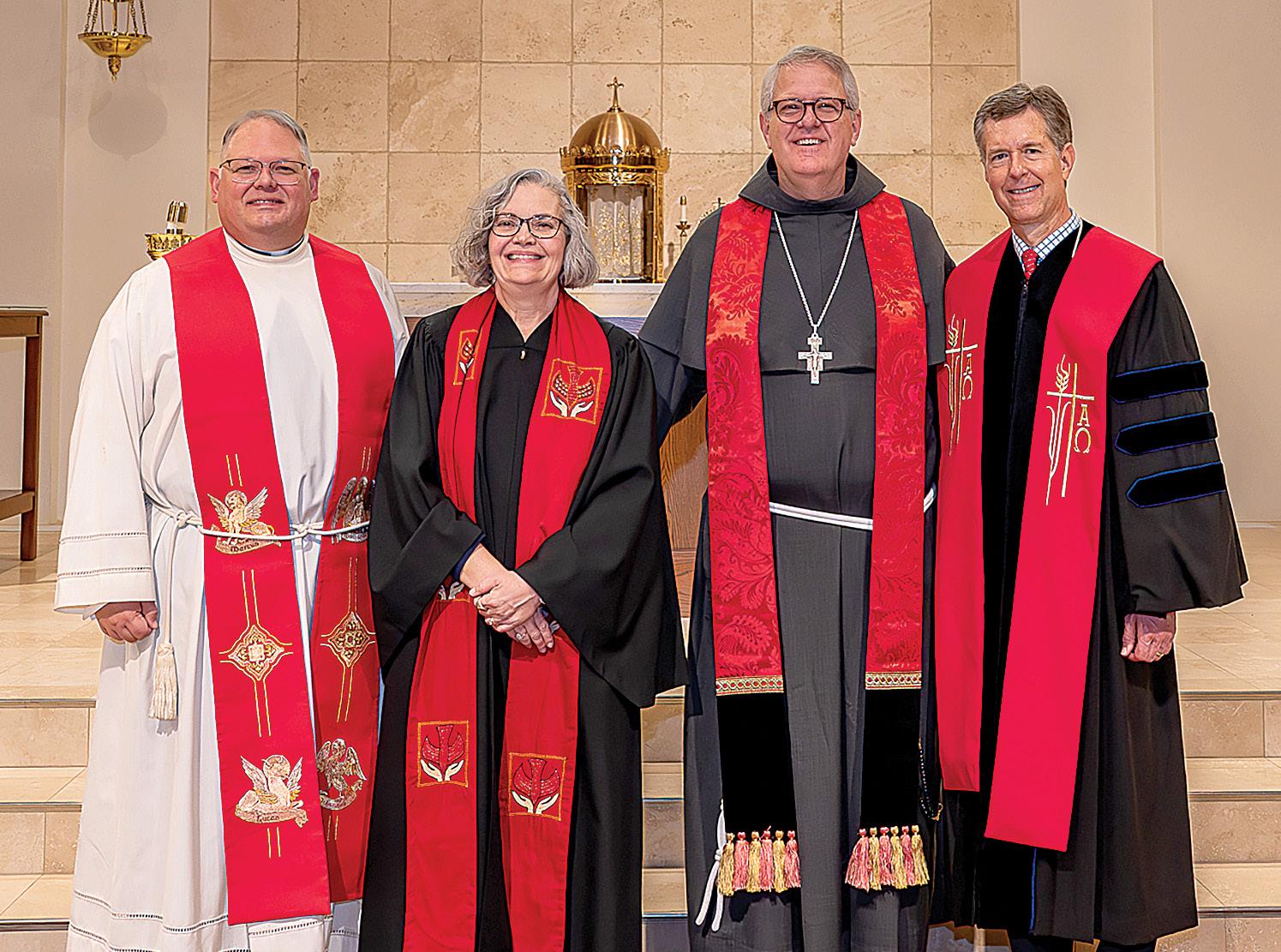
MINT HILL — Bishop Michael Martin hosted an ecumenical gathering designed to build bridges across faiths during the Week of Prayer for Christian Unity.
The Jan. 20 “Service of Ecumenical Friendship” at St. Luke Church featured songs, scripture and spoken word – all aimed at fostering understanding, reflecting on shared values, and building friendships.
The Week of Prayer for Christian Unity has its roots more than a century ago with Pope (now St.) Pius X. The eight-day global commemoration, always held Jan.18-25, is organized through the Vatican’s Dicastery for Promoting Christian Unity and the World Council of Churches.
This year’s celebration focuses on St. Paul’s letter to the Ephesians: “There is one body and one Spirit, just as you were called to the one hope of your calling” (Eph 4:4).
The local prayer service, organized by the Diocese of Charlotte’s ecumenical officer, Father Benjamin Roberts, featured talks by Charlotte-area religious leaders on what ecumenism looks like today.
Father Roberts, the Rev. Dr. Steven Harmon, co-secretary for the Baptist-Roman Catholic Dialogue – Phase III, and the Rev. LeDayne McLeese Polaski, executive director of the Mecklenburg Metropolitan Interfaith Network (MeckMIN), reflected on three common methods of promoting conversations and connections among the Christian faiths: official ecumenism, practical ecumenism and spiritual ecumenism.
“There is one body and one Spirit, just as you were called to one hope …” (Eph 4:4)
Official ecumenism centers on doctrinal consensus gained from over a century of faith-based dialogue. The Rev. Steven Harmon, a Baptist minister and professor of historical theology at GardnerWebb University, explained this history, which rooted itself in 1910 through the Faith and Order Movement, later paving the way to form the World Council of Churches in 1948.
He went on to highlight the current Baptist-Catholic International Dialogue between the Vatican and the Baptist World Alliance, of which he is an active participant.
“It would be difficult to imagine a more seemingly polarized pair of ecumenical dialogue partners than Baptists and Catholics, at least according to the stereotypes,” he said.
Yet these international dialogues, which began in 1984, have yielded meaningful
Ecumenism is the effort to foster unity and cooperation among Christian faiths. Rooted in a Greek word meaning “the whole inhabited world,” it seeks to bridge divisions among Catholics, Protestants and Orthodox through dialogue, shared prayer and collaboration on shared goals like helping the poor.
with the money.’
“Only people who have studied together, have prayed together, and have eaten together can joke about such serious matters,” he said. “It is something only friends can do.”
Fostering friendship among Christians is something the Catholic Church – and individual Catholics in the pews – are called to do, Father Roberts said.
That call was reiterated during the Second Vatican Council, in its 1964 decree “Unitatis Redintegratio” (“Restoration of Unity”), he said.
In it the Church called for spiritual ecumenism – a personal commitment to unity that is lived by making an effort to live holier lives according to the Gospel, having a “change of heart,” and praying both publicly and privately.
agreement on key Christian beliefs, Harmon said, including: “God’s saving revelation in Jesus Christ, the necessity of personal commitment to God in Christ, the ongoing work of the Holy Spirit, and the missionary imperative that emerges with God’s redemptive activity on behalf of humankind.”
A 100-page consensus report, drafted in 2023, highlights where beliefs held by the Catholic Church and the Baptist denomination converge. Though the draft is still being reviewed before official approval, it reiterates the intent of witnessing together, Harmon said.
To make a real difference, though, these reports and shared statements need to move to the grassroots level where Christians can work together and act visibly, he said.
“If our two communions can find ways forward toward visible forms of community, then there is generous space for yet other Christian communions to envision places within our Baptist-Catholic convergences,” Harmon said.
“...to equip his people for works of service, so that the body of Christ may be built up ...” (Eph 4:12)
The Rev. LeDayne McLeese Polaski, also a Baptist pastor, spoke about practical ecumenism. What does that look like? Polaski described this scenario: “A heavyhanded government occupies the city. Armed men are everywhere, and their word is law. Paranoid
officials stoke cultural resentment. They ruthlessly target anyone standing against them.”
That described the situation Jesus and His disciples faced 2,000 years ago, Polaski said. Yet despite that and knowing of His impending Passion and death, Jesus told His disciples to love one another as He loved them, she said.
“‘I have made all known to you. Therefore, I call you friends,’” Polaski paraphrased from the Last Supper discourse in the Gospel of John. Then she posed this question to attendees: “Could knowing be the key to friendship, which is the key to love?”
Through her experiences as executive director of MeckMIN, Polaski said, she has learned that knowing does make a difference.
In March 2020, when the COVID-19 pandemic hit, Polaski and her team of interreligious leaders sat through video conferencing calls, determined to help those marginalized by the crisis. They started with distributing coins for laundry machines, finding homes for the unhoused, and giving resources to people in need. Then when the pandemic ended, they kept going – expanding their efforts to address other unmet needs around Mecklenburg County and later helping victims of Tropical Storm Helene. Now, they are helping immigrants navigate the uncertainty of the current political climate.
Just like Jesus and despite denominational nuances – and called to imitate God’s love through advocacy, social justice and disaster relief – they found a
way to truly walk ecumenically through faith and action, Polaski said.
“It’s not magic. Just as in the day of Jesus and the disciples, betrayals, denials, arrests and even crucifixion still take place,” she said. “Still, He turns around and says, ‘I call you friends.’ In the midst of a very scary world in a very scary time, He still calls us to know and be known, to love and be loved, to lay down our lives for one another. And, in the end, what else is there to say except this: Brothers and sisters, let us be friends.”
“Be completely humble and gentle; be patient, bearing with one another in love.” (Eph 4:2)
Father Roberts, a former Lutheran who converted to Catholicism and now serves as the diocese’s ecumenical officer, spoke about the importance of continuing faith journeys together.
Father Roberts recounted to attendees what he learned at the Summer Course in Ecumenism and Interreligious Dialogue at the Centro Pro Unione in Rome. The experience gave him a deeper understanding of spiritual ecumenism, he said.
He recalled with a smile, “Standing in St. Peter’s Square, facing that magnificent basilica, the Lutheran pastor and the Anglican bishop (fellow retreat participants) both put their hands on my shoulders, pointed to the basilica, and said, ‘Well, Benjamin, at least you all did something nice
“We should pray to the Holy Spirit for the grace to be genuinely self-denying, humble, gentle in the service of others, and have an attitude of brotherly generosity,” Father Roberts said.
Spiritual ecumenism does not require an official letter or plan to follow, he said. It is available to all, and Father Roberts suggested people start by deepening their commitment to their relationship with Jesus Christ, reading the scriptures, coming to the Lord in prayer, and joining in the worship of the Church.
“You are already participating,” he told attendees.
“Spiritual ecumenism calls us to look within to our own conversion and growth, to look around to enjoy the witness of friendship, and to look ahead to that place enjoyed by the martyrs and the holy ones where unity has already been accomplished in God’s Kingdom,” he said.
Bishop Martin concluded the ecumenical service with prayer, taking the opportunity to warn people against sowing division – especially in their everyday conversations and social media activity.
“We scroll each and every day on our phones…that we think connect us to one another,” the bishop said. “Let’s not forget, it is in those spaces where it is much easier to pit us one against the other. To situate us in two camps, us and them. And it is in that framing of the world’s reality that evil triumphs and Christ – His message of true friendship – is missed.”
CHRISTINA LEE KNAUSS clknauss@rcdoc.org
ASHEVILLE — For the first time in recent memory, severe winter weather hit the Diocese of Charlotte two weeks in a row – first a mix of snow and ice, then a blanket of near record-breaking snow that fell from the mountains to the Triad area.

Both storms also brought frigid temperatures at a time when Catholic Charities Diocese of Charlotte is working to help Tropical Storm Helene survivors in the mountains keep warm as they rebuild their homes or seek permanent housing.
Many people are still in transitional housing, living in campers that often weren’t designed to withstand severe cold.
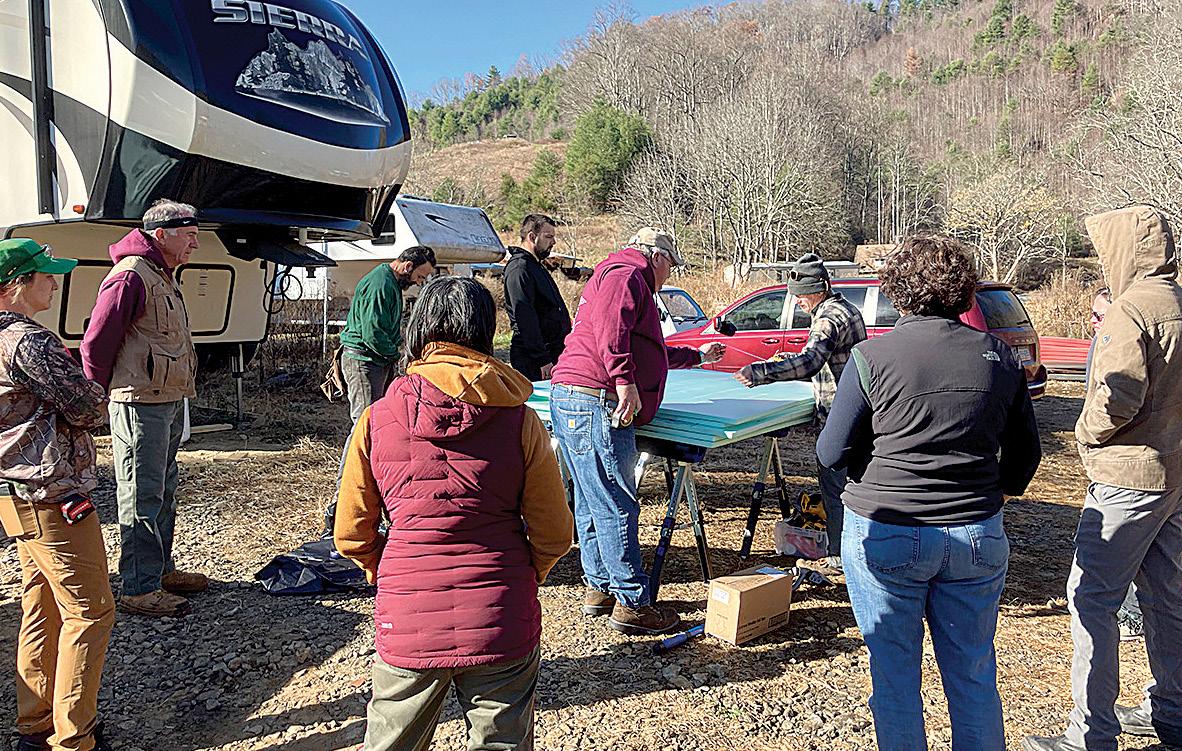
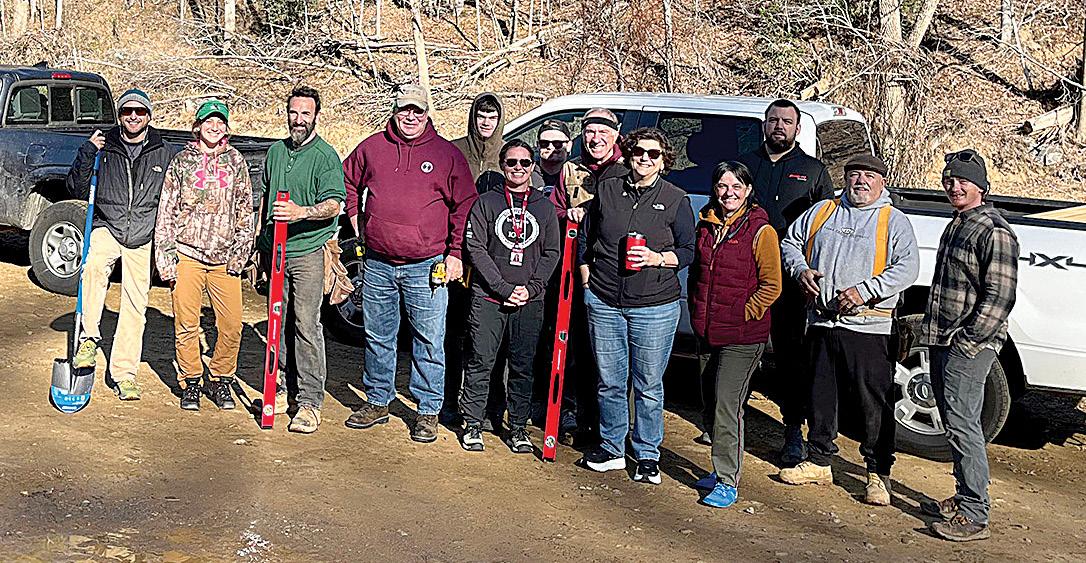
In response, Catholic Charities has been working with two regional recovery groups –Rebuild Haywood and Beacon Network – to help more than 250 families with weatherization work to keep their campers warm, said Glenn Middleton, disaster parish and community resource coordinator for Catholic Charities in Asheville.
Weatherizing a camper involves multiple steps, including protecting plumbing systems, sealing gaps, and improving insulation on windows, doors and under the floor.
Rebuild Haywood focuses on the central and southern counties in the region such as Haywood, Jackson, Buncombe, McDowell, Henderson, Transylvania and Polk, while The Beacon Network handles clients in the high country area, including Yancey, Avery, Madison and Mitchell counties.
“These groups determine what material is necessary for each camper and have a process where people can contact them,” Middleton explained, “and then
their folks come out to do the actual weatherization – it’s a seamless process.” The agency is also working
CATHOLIC CHARITIES Catholic Charities Diocese of Charlotte has been working alongside two regional recovery groups in the mountains to help ensure that temporary housing for Helene victims is as weatherproof as possible.
to launch a program to supply propane for residents who use the versatile fuel to heat their campers or homes.
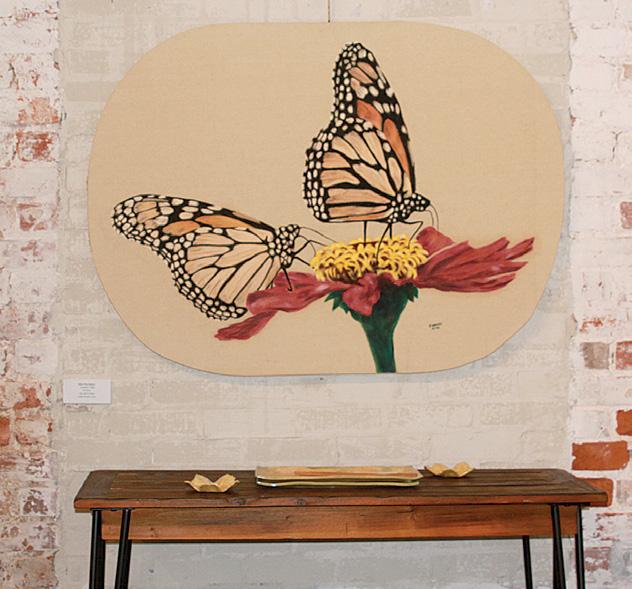
BELMONT — Holy Angels, a nonprofit that serves 80 differently-abled residents who require 24-hour specialized care and medical treatment, also runs Bliss Gallery on Main, where they sell resident-made art and work from different artists. “Nature and Spirituality,” on exhibit through Feb. 26, features works by Holy Angels founders, the Sisters of Mercy. The artwork was created from varied materials and focuses on natural subjects such as sand dunes, butterflies, cardinals and water.
Middleton said the agency is in contact with long-term recovery groups and partner organizations that are working to identify families with ongoing needs for propane and to find local or regional propane distributors who could provide 20-gallon tanks.
Initial estimates indicate a propane distribution program would help about 1,000 families who have been identified with ongoing heating needs.
The agency was working on organizing funding for the distribution program as of Feb. 1.
The long-term goal for these families is getting them out of temporary housing and back into permanent homes, whether that’s securing new housing or completing rebuilds on homes damaged by the storm.
“Most of the folks who are in transitional housing either need or want to stay there, but don’t want to stay there for very long,” Middleton said. “We’re still hopeful for permanent housing for these folks, but it’s not going to happen for most folks this winter. When the weather warms up, the rebuilds can start.”
CHARLOTTE — In 2025, 16 parishes and two Catholic ministries in the Diocese of Charlotte received $1,000 Catholic Charities CRS Rice Bowl MiniGrants to assist people in need.
Grant recipients represented the geographic diversity of the diocese, with the 18 grantees located in nine of the diocese’s 10 geographic divisions. Locations of 2025 grant recipients included: Albemarle, Asheville (2), Belmont (2), Boonville, Charlotte (4), Clemmons, Eden, Greensboro, Lexington, Mint Hill, Morganton, Spruce Pine and Sylva.
A dozen of the grants helped fund parish food relief programs, including two weekend backpack programs that give supplies to students. The remaining six grants helped ministries that
assist the homeless, offer utility assistance, host a parish-based health program, provide supplies for a community garden, and sponsored an educational event on opioid addiction.
These grants were made possible through the Lenten CRS Rice Bowl Collection. Each year, 25% of proceeds remain in the Diocese of Charlotte to help at the local level. The other 75% goes to Catholic Relief Services to help fund humanitarian assistance overseas.
Queen of Apostles Parish in Belmont received a grant for its Backpack Weekend Food Program. As project coordinator Julie Russo noted, “Children who would be hungry on the weekends are being provided well-balanced meals and are ready to learn Monday morning.”
In Lexington, Our Lady of the Rosary Parish used the grant to distribute Lenten Food Bags in the community. The program directly helps those in need and raises awareness of food insecurity in the community.
As program coordinator Marla Silbernagel explained, an additional benefit is “getting our parish name out in the community. We will be distributing paper grocery bags printed with our parish name and
address.”
Our Lady of Consolation Parish in Charlotte used their grant funds for community outreach for students.
“The grant funds will be used to provide nutritious snacks for students at Druid Hills Academy, helping to ensure that children in our neighborhood have access to healthy options that support their well-being and academic success,” said parishioner Chanele Jackson, project leader and youth stewardship volunteer.
Grant recipients are appreciative that the program allows their ministries to do more.
As Jackson said, “we are grateful for the trust you have placed in our parish and for the meaningful work CRS makes possible. This grant will allow us to continue
serving our community with compassion, stewardship, and a commitment to justice.”
The 2026 CRS Rice Bowl Program begins on Ash Wednesday, Feb. 18. Catholic Charities Diocese of Charlotte is grateful for all the parishes and schools that participate in the CRS Rice Bowl, which has been a program of CRS for more than 50 years.
Founded in 1943, CRS is the official overseas relief and development agency of the U.S. Conference of Catholic Bishops and is a member of Caritas International. For more information, visit www.crs.org.
— Joseph Purello, CRS Diocesan Director and Catholic Charities Social Concerns and Advocacy
LISA M. GERACI lmgeraci@rcdoc.org
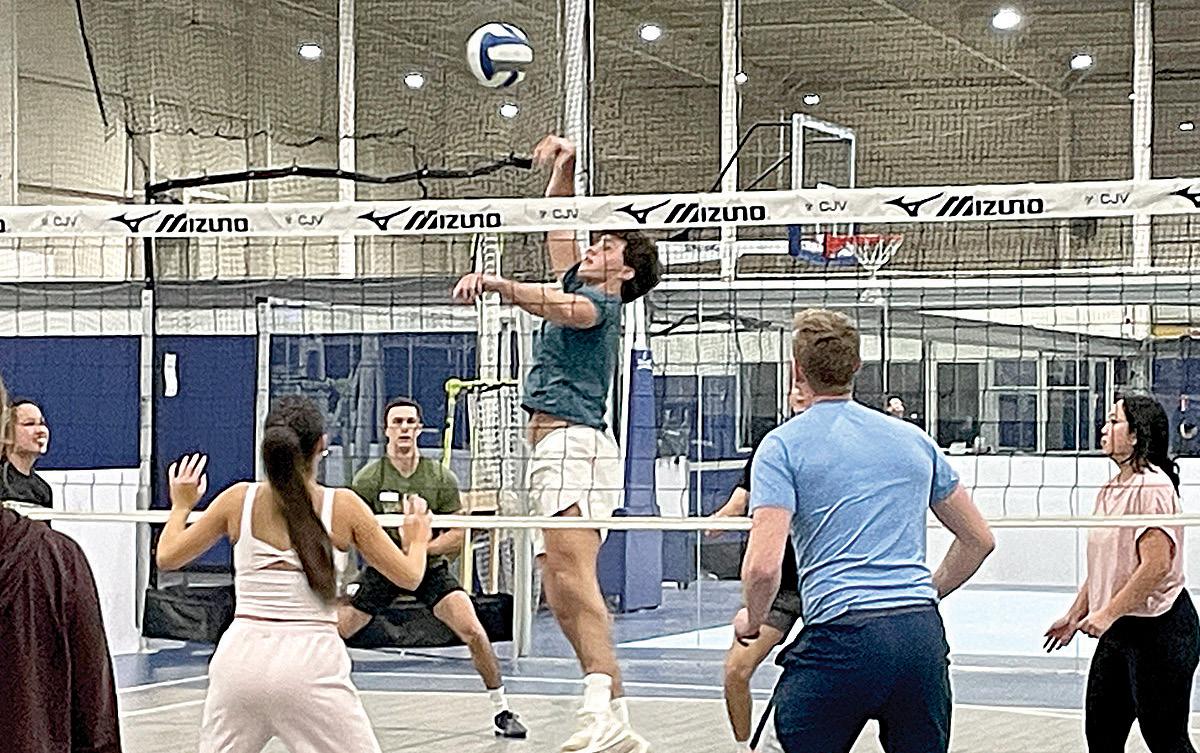
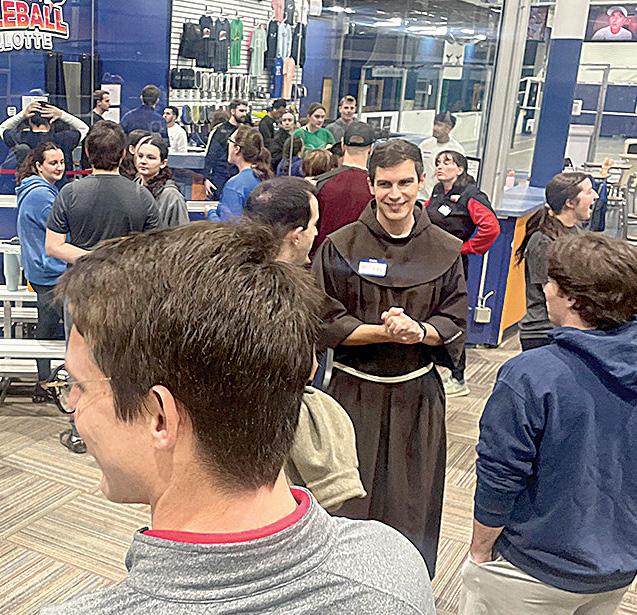
HUNTERSVILLE — About 100 young adult Catholics equipped with pickleball paddles and volleyballs took over SportsLink, a sports and social club in Huntersville, to participate in the launch of Catholic Sports in the Diocese of Charlotte.
“This is awesome. I didn’t really have a strong Catholic community growing up that I can relate to, so this is going to be great,” said Jeff Kromer, a parishioner from St. Thomas Aquinas in Charlotte.
Catholic Sports, a volunteerled nonprofit already active in eight cities, has started its newest chapter in Charlotte. Liz Kenney, a local Catholic, Belmont Abbey graduate, and, of course, a sports enthusiast, launched the chapter. With the help of her sister Sarah Kenney and about a dozen friends, Kenney managed to raise money and awareness to start the recreational sport league under a local nonprofit.
“Denver started from nothing back in 2012 and now has over 1,200 players. I believe this can be us in about 15 years,” said Kenney. “Even if we are not the ones playing, it will be our kids, our nieces, our nephews.”
Young adults of different skill levels and ages, 18 to 50, came out for the opportunity to share faith, fun and community. For some, it was their first time touching a volleyball, while others reminisced about their glory days playing on college or high school teams.
People interested in the faith or
an evening of competitive fun also attended the event with Catholic friends, family or neighbors.
Kenney believes the program helps evangelize and ultimately wins more souls for Christ.
“Charlotte has lots of great opportunities for young adults in regard to prayer meetings and Bible studies. But this is a way to break the ice, have fun face-to-face, and start to get to know each other easier,” Kenney said. “I just wanted
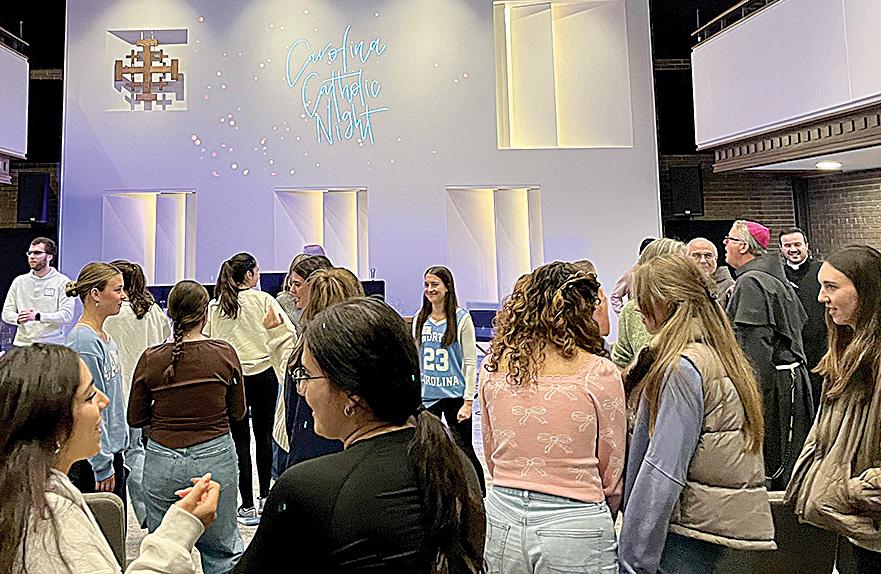
a different route where people can get together and meet people through sports.”
Kenney approached Bishop Michael Martin with the idea about nine months ago, and he offered his full support.
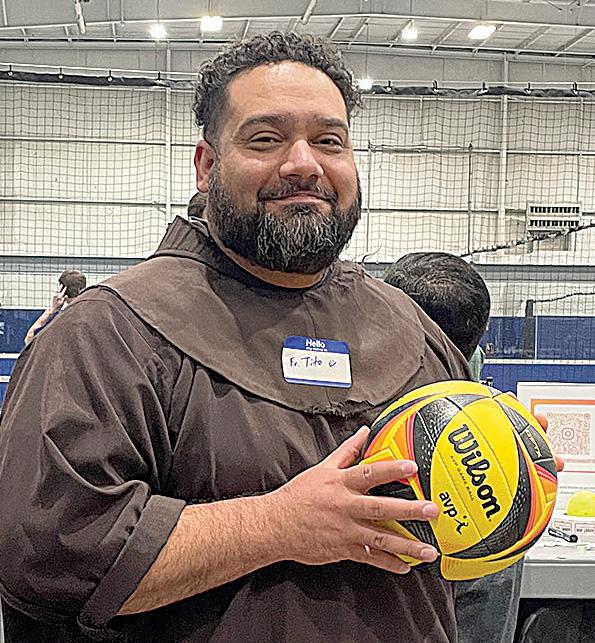
Franciscan Father Casey Cole and Father Tito Serrano, known for taking to the streets of Uptown Charlotte through their new outreach ministry SEARCH, dropped in, even though Father
Casey is recovering from foot surgery and couldn’t play.
Father Tito finds his new Charlotte home to be much like the young adults volleying balls and swinging paddles all around him.
“Charlotte is much like a teenager, still finding its own individuality, vibe and personality,” Father Tito said. “I really love it, and I love meeting young adults and immersing them in the faith.”
Kenney anticipates having enough people for the first co-ed six-week season of Sunday Sand Volleyball, which starts Sunday, March 8, at Renaissance Park in Charlotte. There will be a casual 6 v. 6 league and a competitive 4 v. 4 league that will face-off from 4 to 6 p.m. every Sunday. Players can sign up individually or with an entire team.
The hope is for another sand volleyball league to start during the summer and to add soccer and ultimate frisbee leagues next fall. Down the line, she said, she plans on adding Bible studies.
“Overall, the mission of Catholic Sports is for a lot of young adults within the faith to meet people and not feel isolated,” Kenney said. “Hopefully, they will bring their friends or coworkers that may not be Catholic, and people will learn that Catholics can be a lot of fun. They can ask more questions about the Church and truly learn what we are all about.”
Interested in playing? Sign up at www.bit.ly/4jNnlmd.
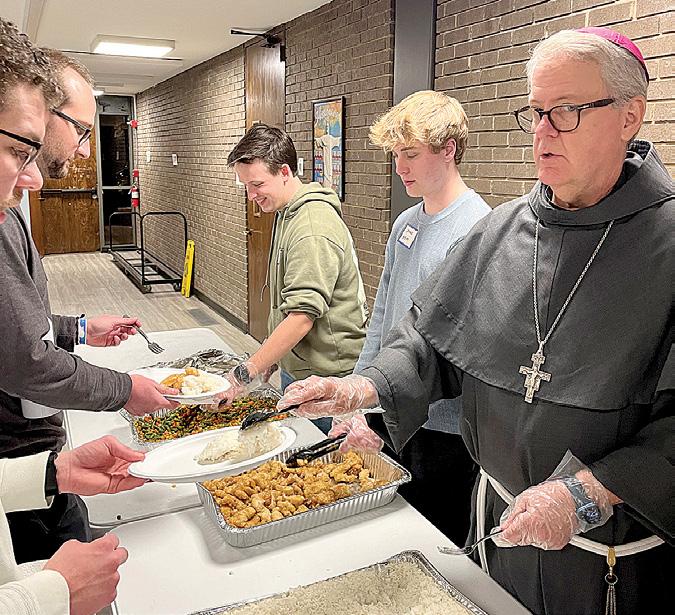
CHAPEL HILL — You can be a victim that is focused inward or you can be a witness that is focused on sharing how blessed we all are, Bishop Michael Martin told University of North Carolina-Chapel Hill students gathered last week at the Newman Catholic Student Center.
Dropping in on their weekly Wednesday night gathering, the bishop served food, traded stories and encouragement, and challenged students to make the move from believers to disciples that are empowered to build the Kingdom of God in the places they frequent every single day.
BELMONT — Where can high school students dive into the works of great philosophers and then take the plunge into whitewater rafting?
Registration is now open for the Schola Program at Belmont Abbey College, which offers a week of learning, fellowship and fun.
Schola offers an opportunity for students to read classic works of literature and philosophy, take part in group discussions with faculty from Belmont Abbey’s Honors College, experience Charlotte’s culture and recreation and meet
new people.
The theme for the July 5-11 program is “Love and Friendship.”
It is open to in-state and out-of-state students who will have completed one year of high school by this summer.
Schola is designed to help participants nurture their faith by participating in the spiritual life of the college, including daily Mass, Adoration,and prayer with the Benedictine monks from Belmont Abbey.
They will also participate in a
variety of rotating activities that recently have included rafting at the U.S. National Whitewater Center, hiking, talent shows and chances to explore the city of Charlotte.
“It was nice to have a summer program that focused on spirituality, learning and friendship. It was really a good mix of everything,” said previous participant Monica Amery in a promotional video for the program. Amery ended up attending the college partly due to her summer
experience. “Schola was a week that was really focused on not just learning from books so we could apply it to something, but more of learning for the love of wisdom.”
Kevin Gillett, who came to the program from Colorado, said, “it immediately felt like a second home.”
Gillett appreciated the accessible spirituality and the chance to get to know fellow students. It was “a really special balance of intensive learning and free time and activities. I think that really
enabled us to learn a lot about each other and about what we thought, and that really led to some deep friendships in a short period of time.”
The cost for the week-long session is $750, which includes room and board on campus, seminar sessions, and cultural and recreational activities.
To learn more, go to www. belmontabbeycollege.edu/ academics/honors-college/scholasummer-program.
— Catholic News Herald
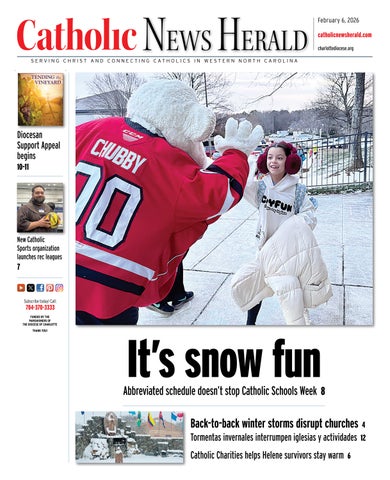
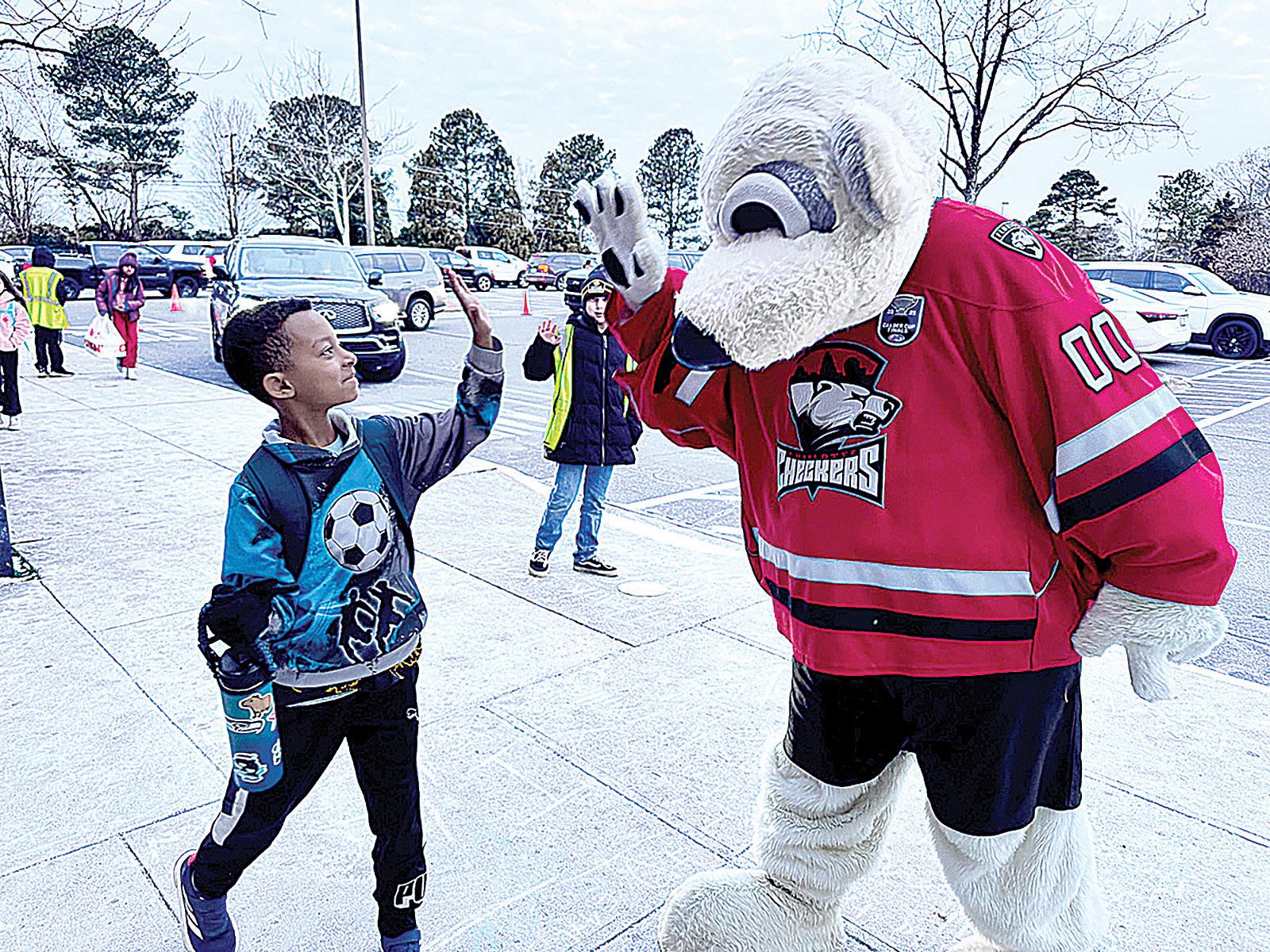
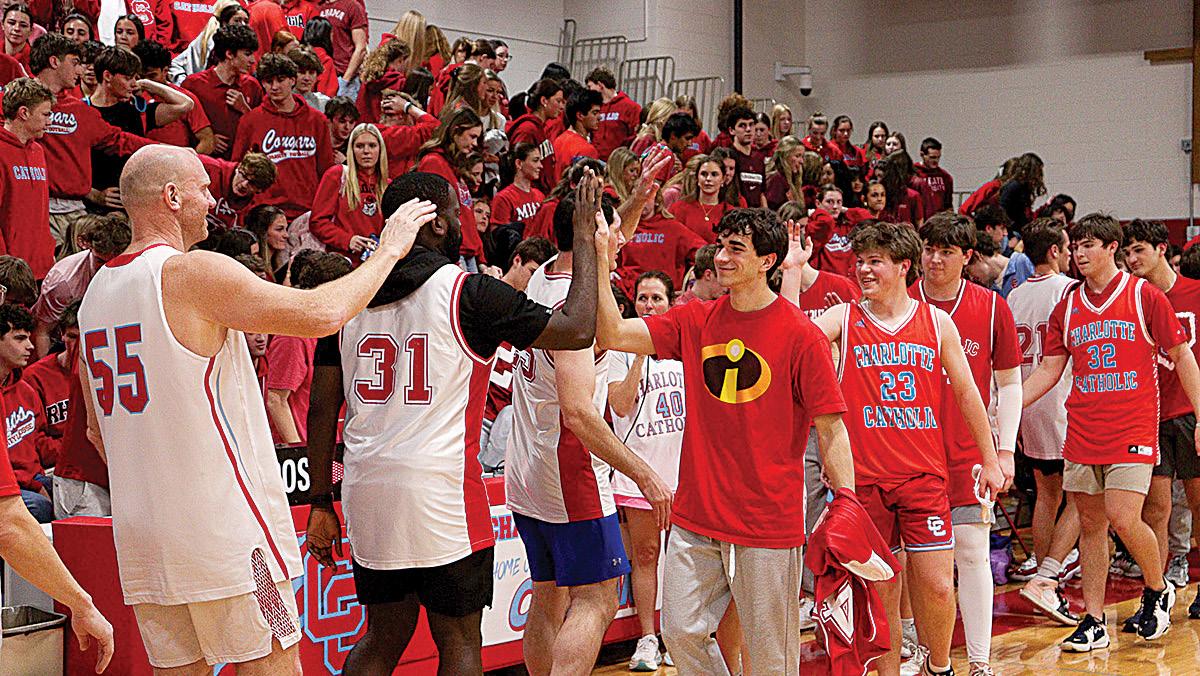
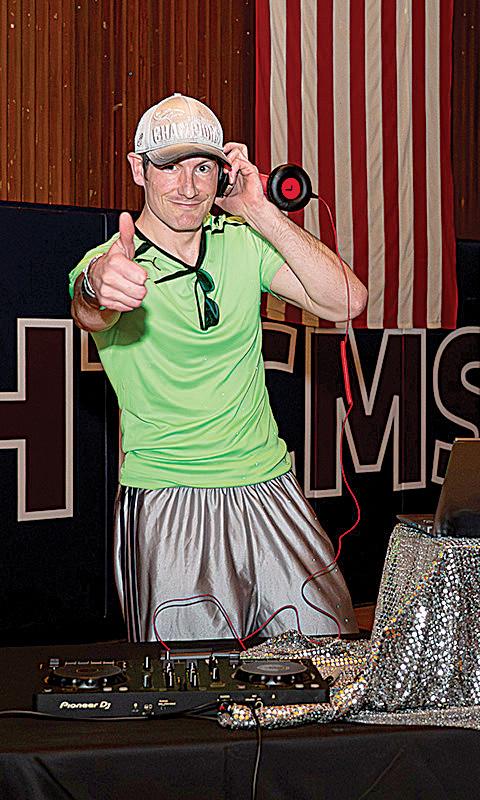
Catholic Schools Week was bookended by weather events – sleet at the beginning of the week and a near record-breaking snowfall at the end – that led to event cancellations and reschedulings across the diocese. That didn’t stop students from celebrating when they could, getting together to work on service projects, celebrate Masses, learn new things and gather for some spirited fun.
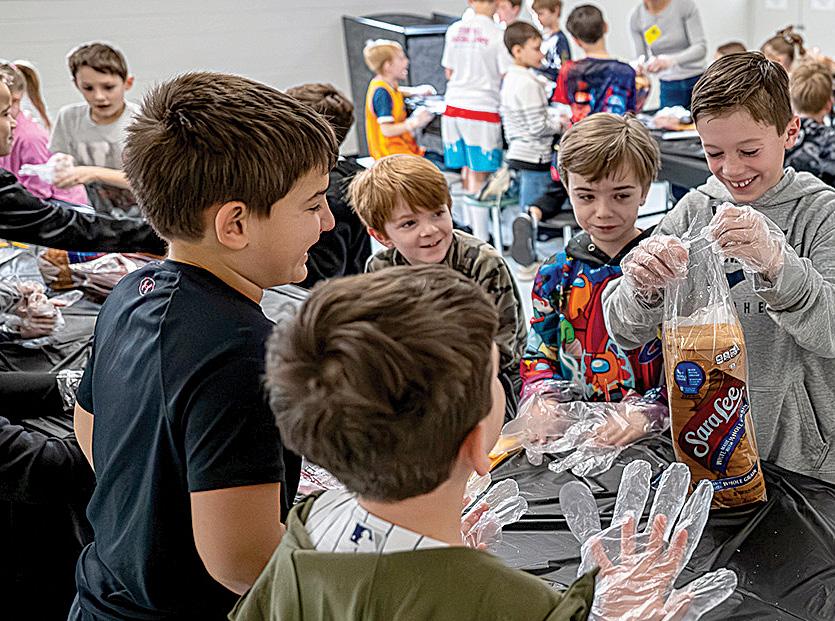
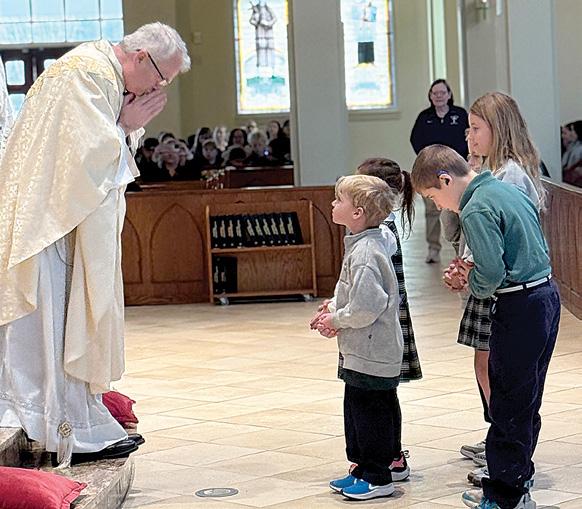
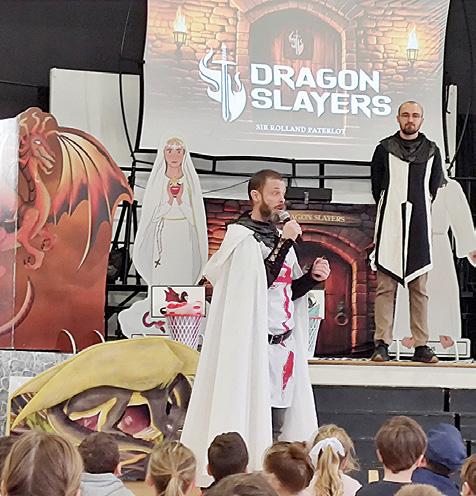
CHRISTINA LEE KNAUSS clknauss@rcdoc.org
CHARLOTTE — Charlotte Catholic High School has launched a capital campaign to fund exciting and extensive new improvements to the campus off PinevilleMatthews Road.
The campaign, called “Grounded in Tradition, Focused on the Future” seeks to raise $8.5 million for several large projects to enhance student life at the school, including upgrading the existing athletic field and sideline from grass to a premium artificial turf, renovating the media center into a multi-faceted student life center, creating the “CTE Innovation Center” with space for engineering and technology classes, and building a multi-functional fieldhouse.
The total cost for the entire project is expected to reach $10.5 million, including a $2 million contribution from the Mecklenburg Area Catholic Schools (MACS) Capital Fee.
Phase one of the project, which includes the new artificial turf, media center renovations and renovating the CTE building, is expected to cost $6.8 million. Phase two, construction of the field house,
is estimated at $3.7 million.
The campaign was slated to formally launch Feb. 6 with a pep rally at the school.
The campaign will run through June 30, but work will begin on putting artificial turf on the school’s existing athletic field as soon as the school year ends in late May. The turf will expand daily access to the field by the school’s teams, as well as the marching band and cheerleading and dance squads. It will also improve safety by providing consistent footing and better shock absorption.
The new field will also reduce the need for Charlotte Catholic teams to travel off campus for practice, a move that would save money on rental fees.
“Having an artificial turf field will allow more teams to stay on campus both to practice and play games,” said Kurt Telford, head of school at CCHS. “With the grass field we currently have, we can’t practice there because it would cause too much wear and tear. The turf field won’t completely solve the issue of having to leave campus, but it will put a dent in the number of students who have to travel.”
In the next phase of renovations, the existing library will be transformed into a contemporary student life center
featuring advanced technology, modern moveable furniture, new flooring, lighting and ceilings, a modernized computer lab, flexible meeting rooms and other spaces that can be used for a wide variety of activities.
“We want to transform the library into space that’s more up-to-date and in tune with the 21st century,” Telford said.
The next phase of the campaign will transform a small office building adjacent to the campus recently purchased by MACS into the CTE Innovation Center, which will support classes in engineering, robotics and other technologies. The building will include specialized learning labs, classrooms and makerspaces, outdoor project and work areas and flexible gathering spaces.
“The future is really the use of technology, and this building will enable our students to expand their experiences in technology and also enhance collaboration between students,” Telford said.
Finally, the new field house and flexible space complex will be designed to offer a multi-purpose hub that will include areas for sports performance, recovery and athletic training, dedicated spaces for health and wellness education and
team meetings, and a flexible space with movable walls that can easily be transformed from classrooms during the day to larger spaces for after-school activities. The space will also include an integrated concession stand and space for stadium operations facilities.
“This will be a space that won’t be just limited to use by student athletes, but create more flexible space on campus that can be used in a variety of ways by all students,” Telford said.
Mercy Sister Paulette Williams, who served as principal at the school from 1980 to 2000, serves as the honorary chairperson for the campaign committee and said she was excited to be involved because of her ongoing love of the school.
“I’ve been involved in other ministries in the past 25 years, but my heart belongs to Charlotte Catholic,” she said. “This campaign will allow the school to keep up with the needs and desires of the students and will enhance their lives. It’s important to take this next big step to help the students there live out their dreams. These are all necessary improvements, and I think it’s important that we continue to progress so we can provide the best for the students.”
LISA M. GERACI lmgeraci@rcdoc.org
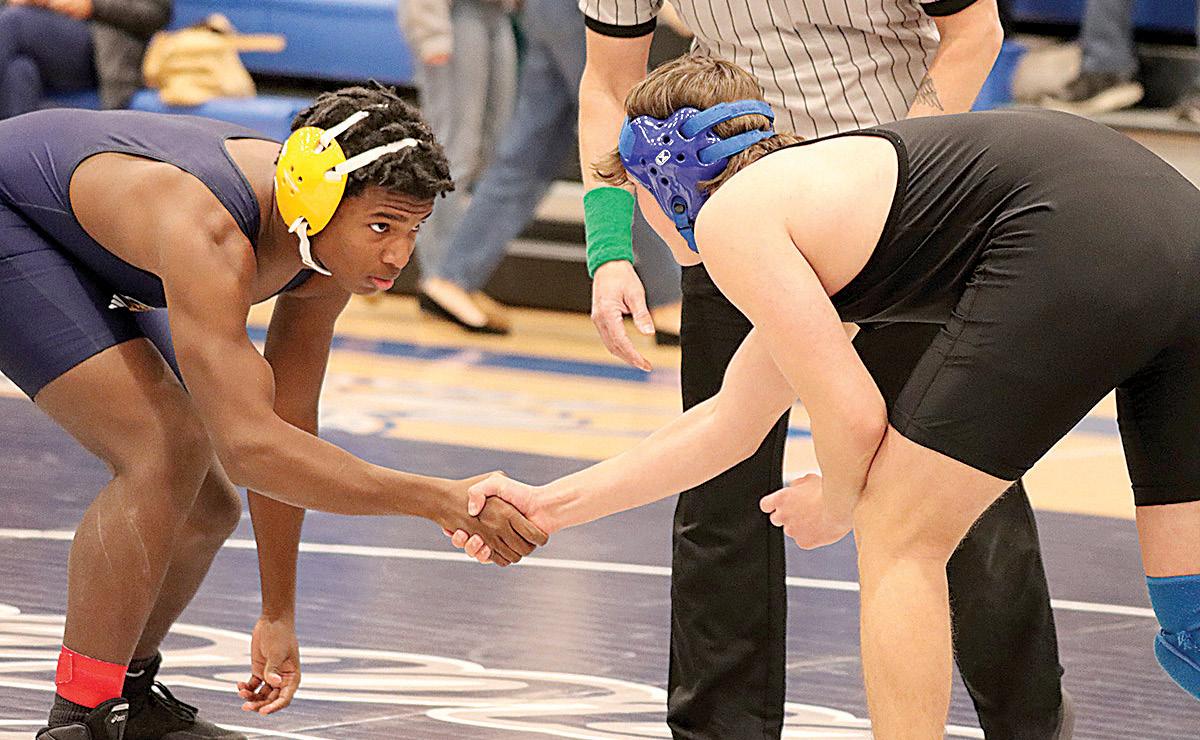
HUNTERSVILLE — The Crusaders wrestling team at Christ the King High School in Huntersville is now two seasons strong, with 18 members and close to a full roster, only missing a heavy-weight.
During this winter 2025-2026 season, the team had a lot of firsts. They hosted their first home match, wrestled on their first competitive mat, and will battle it out for the first time in the 2A division state duals on Feb. 4 at Avery County High School.
“Right now, it is all about the little goals, like not getting pinned in a match or making it through the first period,” head coach Joseph Aiello said. “Stepping out on a mat oneon-one against another young man is a hard thing to do, and it takes a lot of courage.”
Aiello is proud of how the young team doesn’t shy away from a challenge, even when the odds are not in their favor.
“A lot of kids go through life never putting themselves in a position to really get beat. Most wrestlers lose, so it is a sport that’s very humbling,” Aiello said. “It is for the tenacious. For those who can persevere, it is less about being an athlete and more about putting in the effort.”
Team members have been pulling their weight, training, lifting, and practicing technique for two hours a day, five to six days a week. During the off-season, they trained and attended camp at Appalachian State University in Boone.
“It is a sport that is largely about experience and mat time, so we are doing our best trying to catch up, because these kids at CTK are all basically brand new and competing against some kids that maybe have been wrestling since the first grade,” Aiello said.
For Aiello, witnessing the growth of his players is
inspiring, particularly since he didn’t set out to be a coach.
When touring CTK as a possible place to send his son, Hank, the school hit all the marks. A Catholic education with spiritual direction and academic excellence was everything he and his wife wanted – well, almost everything.
“The only problem with CTK was there was no wrestling team, and I just knew it was such a great sport for Hank,” Aiello recalled.
Aiello approached Assistant Principal Dr. Brian Keenan and asked if they ever considered adding a wrestling team.
The administrative team had been discussing the possibility but had no mat, no supplies, no money, and no coach.
“I just thought I could help maybe raise some money for
the mats once it was started, but time kept getting closer and closer to school starting, and by freshman orientation, we still didn’t know if there was even going to be a team,” said Aiello. His wife asked the critical question at orientation, “Are we going to have a wrestling team?”
“That’s when I kind of became head coach out of default,” Aiello said. “I have never coached before, but I was motivated to do it, not just for my own son but for all these boys.”
He gathered a collection of fathers to help, including Justin Ewing, Robert Yates, Pete Tomos and team manager Amor Comatcho. He then recruited his old wrestling buddies, Rusty Lee and Zack Nellas.
“Every one of us has benefitted from the sport of wrestling, and I think that’s why we are all doing it. It is a way of giving back,” Aiello said. “They brought a whole breadth of technical experience and knowledge.”
Last season, the new team received a $1,900 donation to purchase some very used practice mats, but the coaches knew a competition mat, which cost about $10,000, was the goal.
“Eventually, we had one donor who donated $5,000. As a group, we raised another $5000 for the mat. Part of that was from some of the guys giving back their stipend,” Aiello said. “We just had our first-ever home competition this season, and that never would have happened without our own mat.”
They won both home matches and with a 10 -18 record thus far, the young team keeps fighting.
As Aiello explained, “Dan Gable, pro wrestler, said, ‘Once you wrestle, everything else in life is easy.’ In my life personally, there was no more difficult day than I had on the wrestling mat. Practices can be hard. Mentally, it can all be tough. In the end, it is just you out there. But…you truly get what you put in.”
CHRISTINA LEE KNAUSS clknauss@rcdoc.org
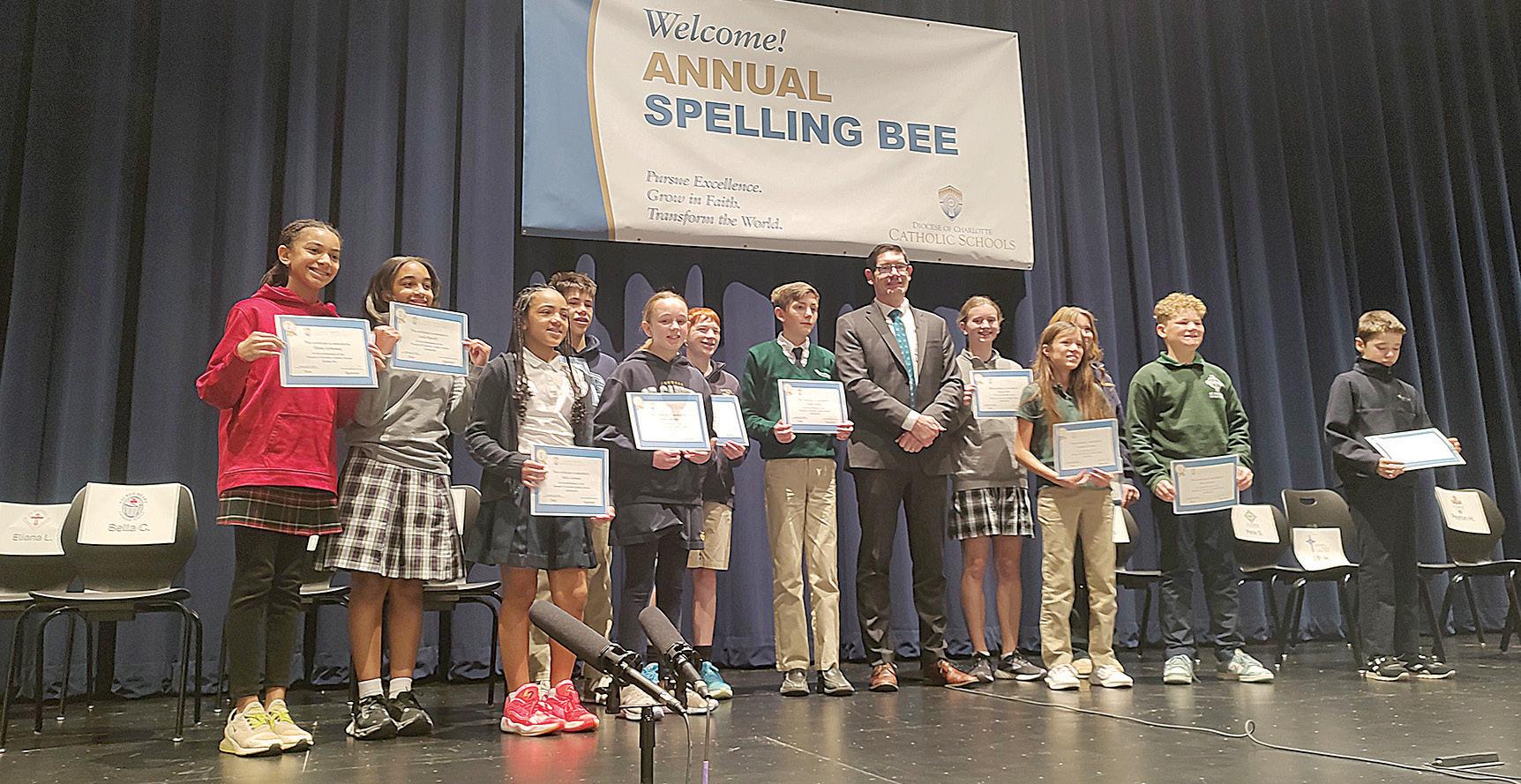
CHARLOTTE — Hydrophobia. Irrevocable. Feckless. Cryptic.
Those were just a few of the words that challenged 12 students from across the Diocese of Charlotte who took to the stage for more than 20 rounds at the annual Diocesan Spelling Bee on Jan. 22. The event is open to fourth- through eighthgraders who win first at the school level, and it serves as the unofficial kickoff to Catholic Schools Week, which began Jan. 25.
Students study words from a specific list in preparation for the bee and are eliminated from competition once they misspell one. During the competition, they have the option of asking the moderators for the definition and origin of the words they are given.
Competitors faced a wide variety of words, ranging from “squabble,” “deployment” and “isolation” to “bodega,” “leviathan” and “minestra” (a kind of Italian soup).
Two seventh-graders, Gus Blankenbaker from St. Mark School in Huntersville and Peyton Hill from St. Pius X School in Greensboro, battled 15 rounds to see who would come out on top. Hill ended up winning the day by spelling “dissolution” correctly.
Her victory came after a little over two weeks of studying the list of words she received after winning her school’s bee on Jan. 8.
“I’d work on it in my free time,” she said. “It was challenging because I also had Irish dance, horseback riding and basketball, but I practiced whenever I had the time.”
Along with all those other activities, Peyton also said she is a voracious reader.
Even after all the preparation she did, she was still happy and surprised at her victory.
“It feels very awesome to win this,” she said. “It’s exhilarating because I thought I would go out in the first round.”
Her parents Morgan and Sandy Hill of
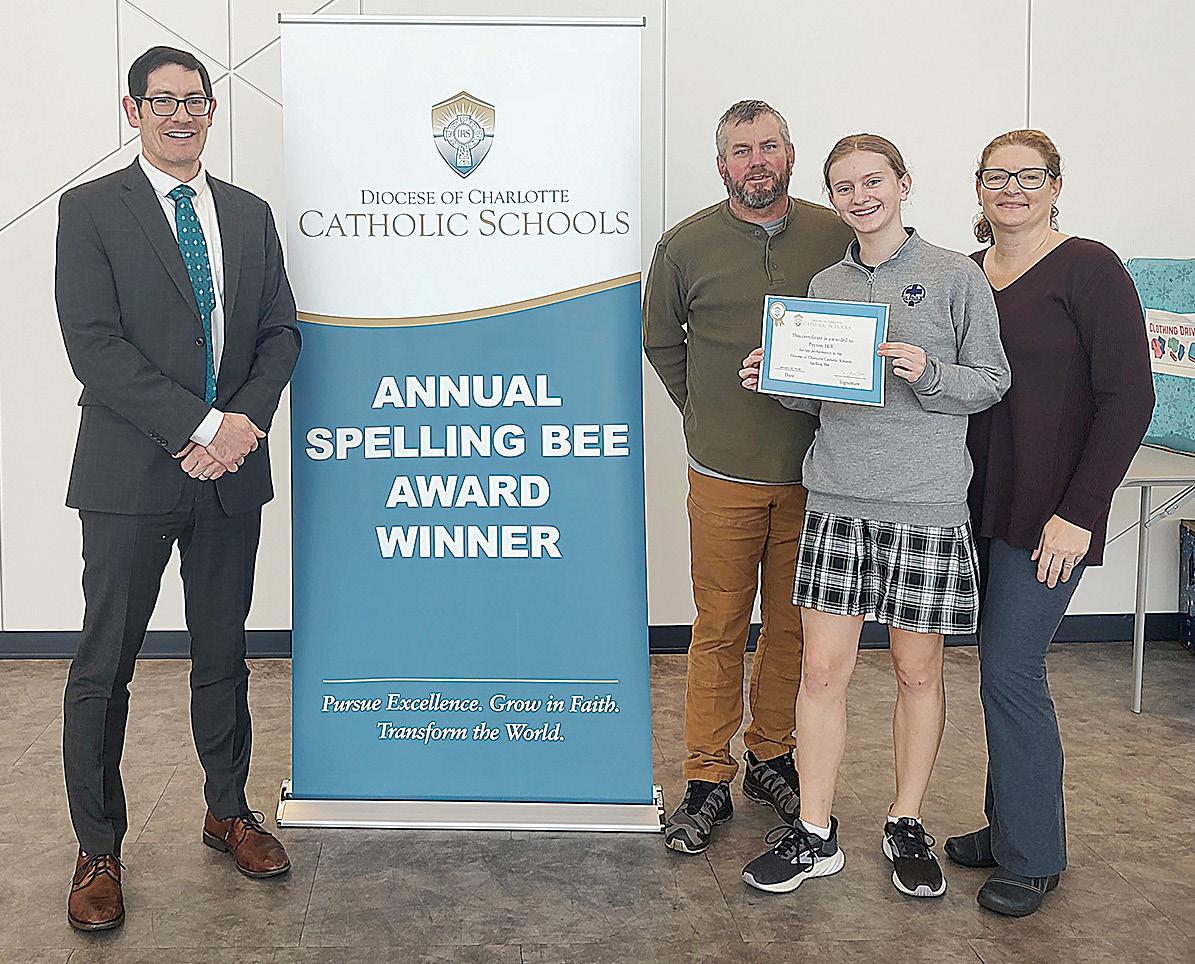
Greensboro were beaming at the end of the bee. Morgan Hill said his daughter had been working toward this victory for several years after first competing in spelling competitions when she was
in the fifth grade.
“It’s just a proud moment to see her win,” he said.
Peyton will stay in the spelling spotlight for a while longer. With her win, she earned the chance to participate in an upcoming spelling bee sponsored by the Carolina Panthers. Two online competitions will be held – one in North Carolina, the other in South Carolina – and the victors of each will meet in a head-to-head championship in Charlotte. The winner of that bee will earn a trip to the National Spelling Bee in Washington, D.C., in May.
At the end of the bee, the diocese’s superintendent of schools, Dr. Greg Monroe, thanked the parents for helping their students reach the spelling bee.
“We couldn’t do what we do in and out of the classroom without your support,” he said.
Other participants in the bee were:
n Bella Coleman from Sacred Heart School in Salisbury
n Frank Gareis from St. Michael School in Gastonia
n J.P. Hammond from Our Lady of Grace School in Greensboro
n Annabelle Hillard from Holy Trinity Middle School in Charlotte
n Emmie Huntley from St. Gabriel School in Charlotte
n Eliana Lieberman from St. Matthew School in Charlotte
n Layla Murrell from Our Lady of Mercy School in WinstonSalem
n Anthony Owens from St. Ann School in Charlotte
n Pete Stewart from St. Patrick School in Charlotte
n Valentina Zamora from St. Leo School in Winston-Salem
Ministries and offices supported by the DSA EDUCATION
• Campus Ministry
• Catholic Schools Office
• Faith Formation Office:
- Catechetical Certification
- Diocesan Catechetical Conference
- In-Services - OCIA
- Special Needs Resource Group
- Totus Tuus
• Young Adult Ministry
• Youth Ministry
MULTICULTURAL MINISTRIES
• African American Affairs Ministry
• Hispanic Ministry VOCATIONS
• Permanent Diaconate
• Seminarian Education
CATHOLIC CHARITIES
DIOCESE OF CHARLOTTE
• Burial Assistance
• Case Management
• Disaster Relief
• Elder Ministry
• Food Pantries
• Housing Permanency Services
• Legal Immigration Services
• Mental Health Counseling
• Pregnancy Support & Adoption
• Refugee Services
• Social Concerns & Advocacy
• Stay the Course
• Supportive Services for Veteran Families
• Transition Out of Poverty
• Wee Care Shoppes
• Youth Empowerment Opportunity Program
OTHER
• Eucharistic Congress
• Family Life Office:
- Marriage Prep
- NFP
- Respect Life
Cultivating the Kingdom of God in our diocese through care, patience and faithful stewardship is at the heart of this year’s Diocesan Support Appeal that kicks off the weekend of Feb. 7-8.
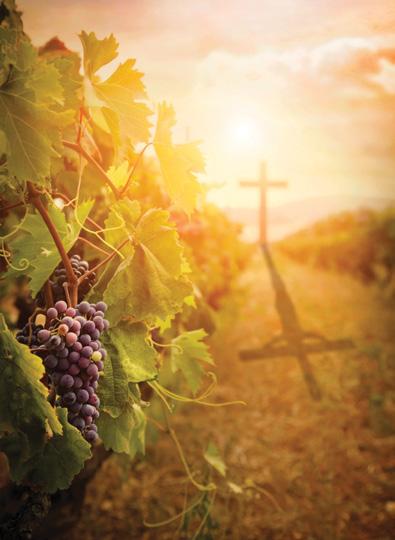
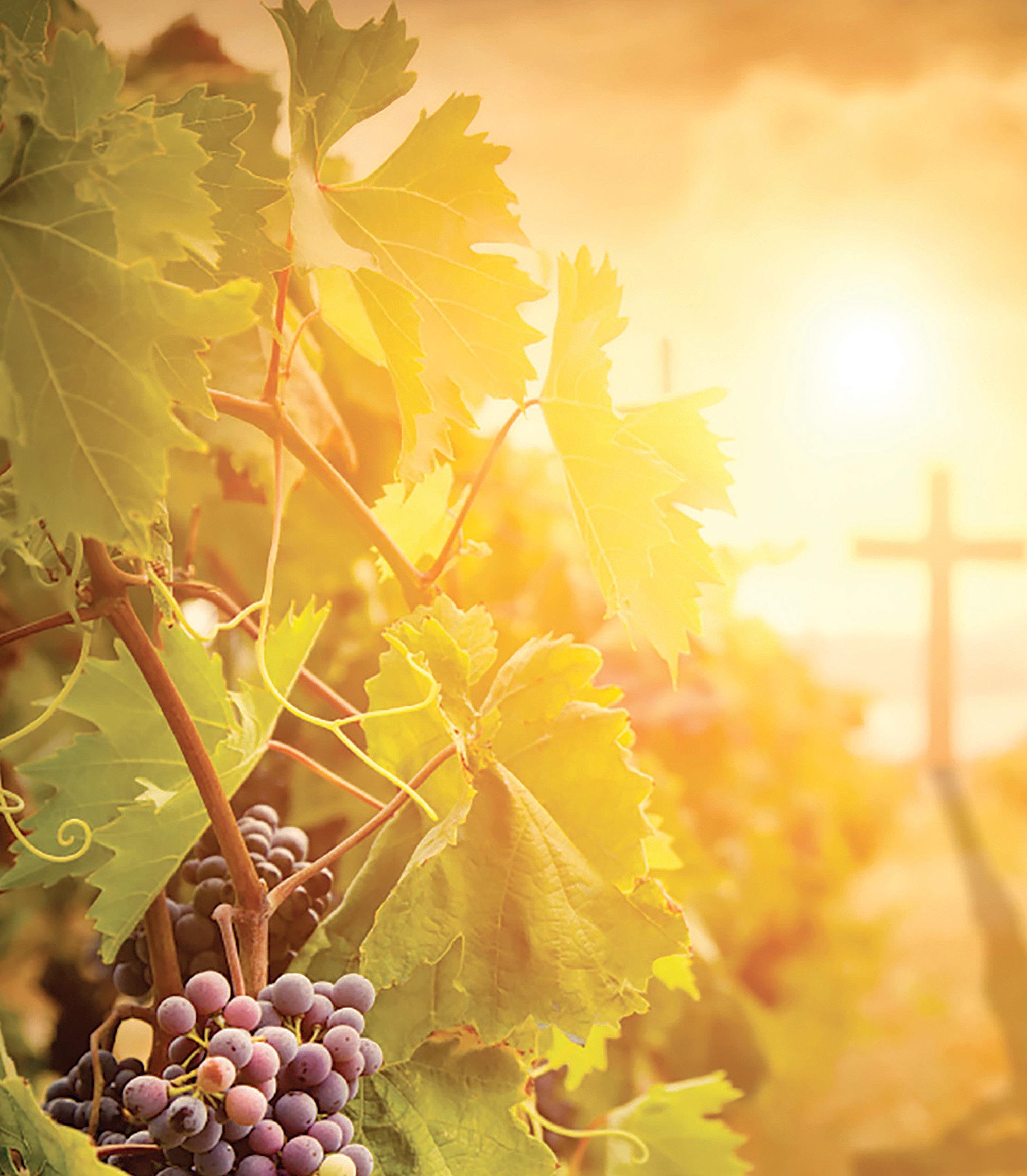
The theme of the 2026 DSA is “Tending the Vineyard,” which draws upon John 15:5: “I am the vine and you are the branches. Whoever remains in me and I in him will bear much fruit, because without me you can nothing.”
Bishop Michael Martin launched the campaign in a video message that called the faithful to strengthen our diocesan community. “Just as a vineyard flourishes when carefully tended, so too does the church grow stronger when we nurture it together” he said.
The 2026 DSA campaign supports more than 50 ministries and programs throughout the western half of North Carolina (see full list at left). Programs include seminarian education, faith formation, permanent deacons, multicultural ministries, the Family Life Office, and the annual Eucharistic Congress.
The DSA campaign also significantly funds the vital work of Catholic Charities, which continues to support those ravaged by Tropical Storm Helene in addition to its regular casework. Last year, Catholic Charities served more than 25,000 people with emergency aid, counseling, housing support and more.
In 2025, parishioners contributed more than $7.4 million to the DSA – exceeding the campaign’s goal by 6%.
This year’s DSA goal totals $7,235,914, with each parish and mission pursuing a goal based on its offertory collections. Parishes that exceed their goal receive a rebate for 100 percent of the additional funds collected. Parishes that fall short of their goal make up the difference from their operating budgets.
Since 1987, parishioners have invested nearly $150 million in the Church’s mission of charity and pastoral care, changing the lives of more than 1 million people.
Using our resources to make a tangible impact on people’s lives is the way Bishop Martin hopes the faithful will invest in the future of our Church.
“Here in the Diocese of Charlotte, God has entrusted us with a beautiful vineyard: our parishes, schools, Catholic Charities, and the many ministries that bring people closer to Christ,” the bishop said. “Each of us has a role in cultivating this vineyard and stewarding the faith so that future generations may also know the joy of the gospel. Your gift to the diocesan support appeal is one way we work side by side in this mission. Together we strengthen the roots of our faith, care for those in need, and bear fruit that will last generations.”
Watch online
At www.catholicnewsherald.com : Watch a video spotlighting some of the ministries you support through the DSA

PLEDGE: Make a pledge in response to a mailing you receive or in-pew appeal at your local parish. An individual DSA pledge may be paid in up to 10 installments by EFT, credit card or check. Pledging allows you to make a greater gift over time. You will receive monthly reminder statements in the mail or by email until your pledge is paid, or until Dec. 31, 2026.
ONLINE: Donate online at www.charlottediocese.org/dsa. Either make a one-time gift or set up a pledge with monthly payments via credit or debit card. (If you give online, please do not complete a pledge envelope at your local parish. This could result in having two gift records.)


Cultivar el Reino de Dios en nuestra diócesis mediante el cuidado, la paciencia y una administración fiel está en el corazón de la Campaña de Apoyo Diocesano de este año, que comienza el fin de semana del 7 y 8 de febrero. El tema de la DSA 2026 es “Cuidar la Viña”, inspirado en Juan 15:5: “Yo soy la vid y ustedes los sarmientos. El que permanece en mí y yo en él, ese da mucho fruto; porque separados de mí no pueden hacer nada.”
El obispo Michael Martin presentó la campaña con un mensaje en video, invitando a los fieles a fortalecer nuestra comunidad diocesana. “Así como una viña florece cuando se cuida con esmero, también la Iglesia se fortalece cuando la cultivamos juntos”, dijo.
La campaña DSA 2026 apoya a más de 50 ministerios y programas en la mitad occidental de Carolina del Norte, incluyendo la formación de seminaristas, la formación en la fe, el diaconado permanente, los ministerios multiculturales, la Oficina de Vida Familiar y el Congreso Eucarístico anual.
La DSA también financia de manera significativa el trabajo vital de Caridades Católicas, que continúa apoyando a quienes fueron devastados por la tormenta tropical Helene, además de su labor regular. El año pasado, Caridades Católicas atendió a más de 25,000 personas con ayuda de emergencia, consejería y apoyo para vivienda. En 2025, los feligreses aportaron más de 7,4 millones de dólares a la DSA, superando la meta de la campaña en un 6%.
La meta de la DSA de este año es de $7.235.914, con objetivos parroquiales basados en las colectas del ofertorio. Las parroquias que superan su meta reciben un reembolso del 100% de los fondos adicionales; las que no la alcanzan cubren la diferencia con sus presupuestos operativos.
Desde 1987, los feligreses han invertido casi 150 millones de dólares en la misión de caridad y cuidado pastoral de la Iglesia, transformando la vida de más de 1 millón de personas. Utilizar nuestros recursos para tener un impacto tangible en la vida de las personas refleja la visión del obispo Martin para el futuro de nuestra Iglesia. “Aquí, en la Diócesis de Charlotte, Dios nos ha confiado una viña hermosa: nuestras parroquias, escuelas, Caridades Católicas y los muchos ministerios que acercan a las personas a Cristo”, dijo el obispo. “Cada uno de nosotros tiene un papel en el cultivo de esta viña y en la custodia de la fe para que las futuras generaciones también conozcan la alegría del Evangelio. Su donativo a la Campaña de Apoyo Diocesano es una de las maneras en que trabajamos codo a codo en esta misión. Juntos fortalecemos las raíces de nuestra fe, cuidamos a los necesitados y damos frutos que perdurarán por generaciones”.
Véalo online
En www.catholicnewsherald.com: Vea un video que destaca algunos de los ministerios que usted apoya a través de la DSA


BRIAN SEGOVIA bmsegovia@rcdoc.org
CHARLOTTE — El clima invernal severo paralizó gran parte del oeste de Carolina del Norte durante dos fines de semana consecutivos, obligando a cancelaciones generalizadas y cambios de horario para Misas, eventos parroquiales y escuelas en toda la Diócesis de Charlotte. Durante el 24 y 25 de enero y el 31 de enero y 1 de febrero, poderosas tormentas trajeron hielo, nieve, lluvia helada y temperaturas peligrosamente frías. La Oficina Estatal de Climatología de Carolina del Norte calificó la tormenta del 31 de enero como “nuestro evento invernal más extendido en más de una docena de años”, registrando nieve medible en los 100 condados de Carolina del Norte por primera vez desde enero de 2014. Los totales de nieve oscilaron entre 6 y 13 pulgadas en las montañas y el área de Asheville, mientras que las regiones del Piedmont y el Triad fueron las más afectadas. Charlotte registró alrededor de 11 pulgadas, con más de un pie reportado al norte de la ciudad a lo largo del corredor de la I-85. Según el Servicio Meteorológico Nacional, los condados de Rowan y Davidson vieron los totales más altos, con informes locales que superaron las 16 pulgadas. La tormenta de nieve llegó una semana después de que un frente ártico cubriera la región con hielo, aguanieve y lluvia helada el 24 de enero, tumbando líneas eléctricas y haciendo que las carreteras fueran intransitables durante días. Las tormentas consecutivas llevaron a parroquias y escuelas a cancelar o posponer Misas, clases de formación de fe y otros eventos de fin de semana. Algunas ofrecieron liturgias transmitidas en vivo, asegurando que aquellos en casa pudieran participar en el culto sin arriesgarse a viajar por caminos helados. El obispo Michael Martin emitió una dispensa de la obligación de asistir a Misa, instando a las personas a priorizar la seguridad y evitar viajar en las condiciones peligrosas.
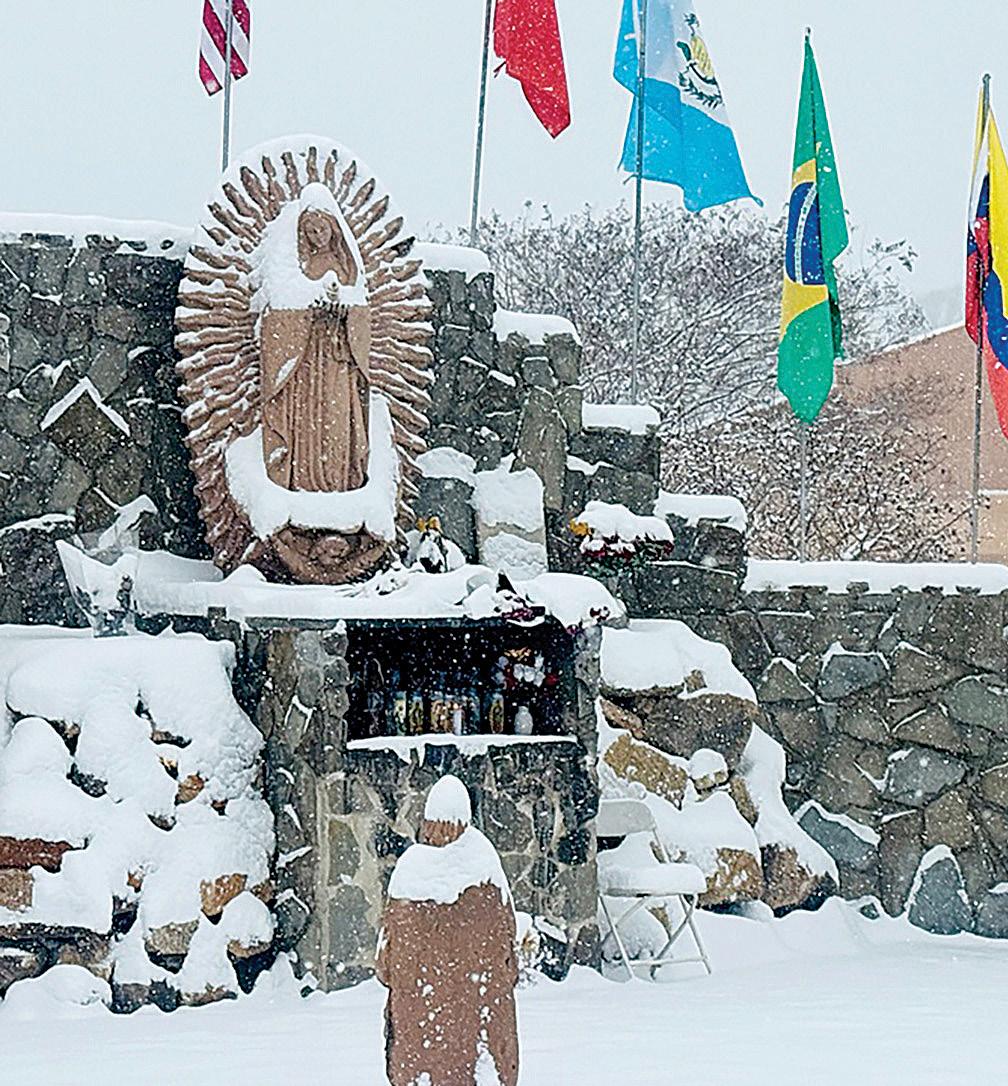
En la Parroquia de Nuestra Señora de Guadalupe en Charlotte, el domingo 21 de febrero se cancelaron cuatro de sus siete Misas.
Las celebraciones de la Semana de las Escuelas Católicas en las 20 escuelas de la diócesis se vieron reducidas o reprogramadas, y algunas escuelas cerraron o pasaron a aprendizaje virtual el 26 y 27 de enero y el 2 y 3 de febrero. La Misa por el Rito del Acólito y la Afirmación de Promesas por los diáconos, originalmente programada para el 31 de enero en la Catedral de San Patricio en Charlotte, fue reprogramada para las 10 a.m. del sábado 14 de febrero. Sin embargo, no todo se detuvo. En la Iglesia del Sagrado Corazón en Salisbury, el padre John Eckert ofició la boda de Logan y Madyson Hamilton el sábado por la tarde mientras caía nieve intensa afuera. El padre Eckert animó a sus feligreses con un mensaje especial en video en
Facebook que grabó junto a la iglesia, de pie en la nieve. “Mientras llegamos a otro domingo en el que será un poco más difícil llegar a la iglesia, recuerden que todavía es un gran día para mantener el día santo”, dijo sonriendo. “Recuerden que nuestro Señor está con nosotros en el sol y en la nieve. Está con nosotros todo el tiempo.”
En High Point, el padre Matthew Harrison contó con la asistencia de 60 estudiantes de ministerios universitarios a una Misa a la luz de las velas celebrada en la nieve, a pesar de que las temperaturas estaban por debajo de los 20 grados.
“Nuestro capítulo universitario de los Caballeros de Colón pasó todo el día trabajando en el altar y en el diseño cruciforme de la iglesia”, dijo el padre Harrison. “Para cuando terminó la Misa, el agua bendita de la pila se había congelado y se había convertido en un bloque de hielo bendito”.
Las iglesias que pudieron ofrecer misas reportaron bancos casi vacíos. El diácono Sigfrido Della Valle, Coordinador del ministerio hispano para la Vicaría de Smoky Mountains, dijo que algunas parroquias vieron que la asistencia caía a una sola cifra. Aunque ningún edificio fue dañado, las tormentas tuvieron un costo financiero. La Iglesia Nuestra Señora de los Caminos en Thomasville, que se encuentra en la cima de una colina con vista a la U.S. Hwy. 29, canceló todas las Misas y actividades ambos fines de semana debido a que el hielo y la nieve hacían inseguro el acceso. El padre Gabriel Carvajal-Salazar, pastor, dijo que las 10 Misas canceladas —cinco cada fin de semana— significaron colectas de ofrendas perdidas y una reducción de los ingresos parroquiales. “El impacto económico es fuerte. Si no hay colecta, ¿qué vamos a hacer?”, dijo el padre Carvajal-Salazar. “Muchos de nuestros feligreses hispanos tienden a dar donaciones en efectivo en la Misa, y muy pocos donan en línea.”
Aun así, tan pronto como se despejaron los cielos, los voluntarios tomaron palas para retirar la nieve y el hielo y ayudar a que la iglesia reabriera a mediados de semana. El padre Carvajal-Salazar dijo que el apoyo de la comunidad ha sido inmenso. “En medio de todo, noté un espíritu fraternal entre la comunidad”, dijo. “Salieron a ayudar unos a otros y fueron muy caritativos.”
BRIAN SEGOVIA bmsegovia@rcdoc.org
CHARLOTTE — Durante el comienzo de la Semana de las Escuelas Católicas, que destaca el valor de la educación católica con Misas especiales, jornadas de puertas abiertas y proyectos de servicio comunitario del 25 al 31 de enero, estudiantes en el oeste de Carolina del Norte estuvieron fuera de clases el lunes y martes.
Una de esas estudiantes es Mónica Bernal-Arroyo, alumna de séptimo grado en la escuela de Our Lady of the Assumption en Charlotte, quien acompañó a su padre, el diácono Eduardo Bernal, Coordinador del ministerio hispano para la Vicaría de Charlotte, a su oficina en el centro pastoral de la Diócesis de Charlotte.
Mónica, una estudiante dedicada, estaba trabajando en sus tareas mientras su padre realizaba su labor. Mónica, quien ha estado asistiendo a la escuela católica desde kinder, dice que su escuela ha sido formativa en su desarrollo.
“Mis profesores siempre nos empujan para ser nuestra mejor versión,” dice Bernal-Arroyo. “Nos enseñan a ser curiosos y a desarrollar nuestra relación con Dios.”
OLA ofrece varias oportunidades para el crecimiento espiritual a través de la oración diaria, liturgias semanales, adoración eucarística mensual y reconciliación trimestral.
Mónica, en su octavo año en la escuela Our Lady of the Assumption, resaltó la diversidad de la escuela como uno
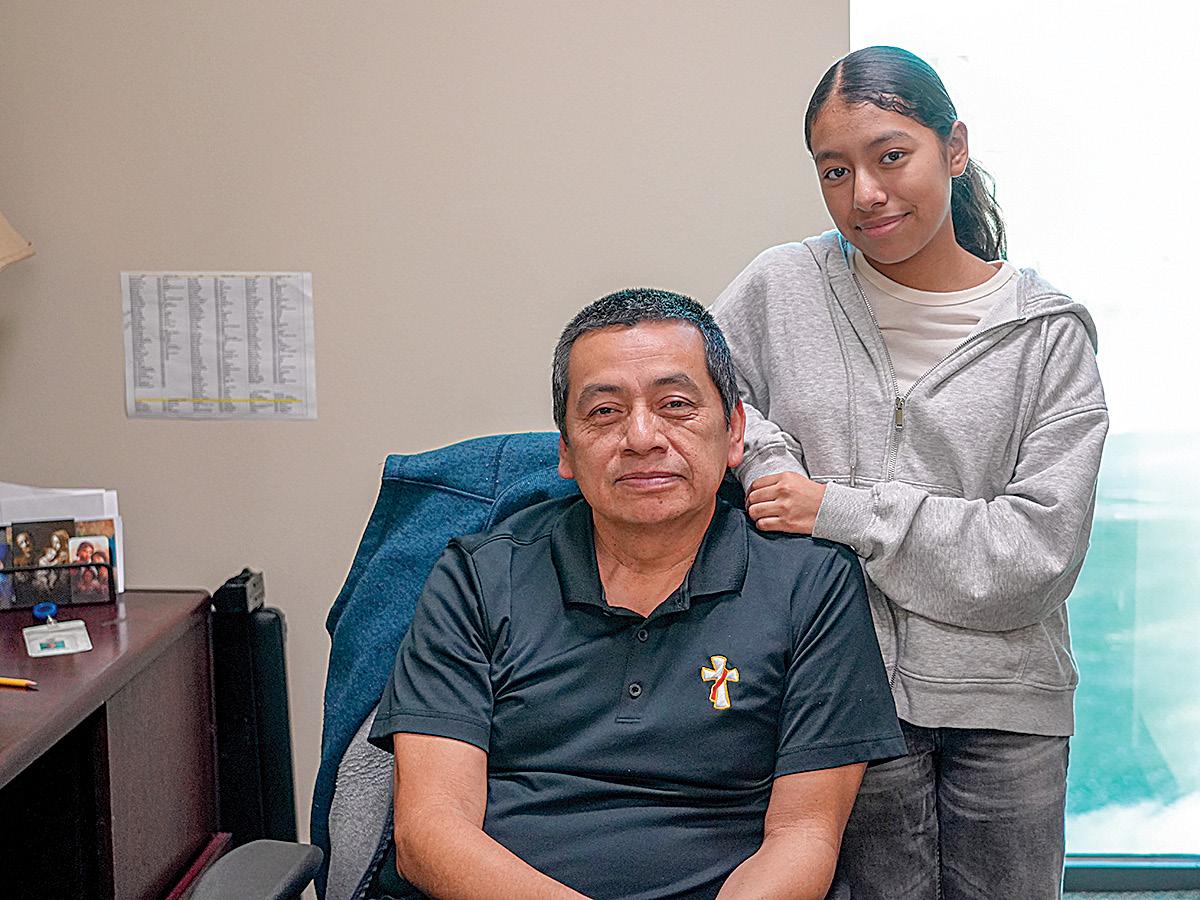
La estudiante
de los aspectos que más disfruta y cómo esto ayuda a los estudiantes a valorar distintas culturas.
“Me encanta ver la diversidad de la escuela,” dice Mónica. “Hay muchos programas diferentes y cada
estudiante aprende cosas nuevas unos de otros.”
Su padre, el diác. Eduardo Bernal, dice que el impacto positivo de la educación católica en su hija ha sido invaluable. Él resalta el rigor académico como una de las partes más importantes. “Les han enseñado a ser responsables, a crecer académicamente y a formar su fe,” dijo.
Diác. Bernal, quien ha estado trabajando por los últimos siete años en la parroquia más hispana de la Diócesis de Charlotte, Nuestra Señora de Guadalupe, cuenta que muchos padres se sienten frustrados. Al preguntarles quiénes tienen hijos en escuelas católicas, pocos levantan la mano; muchos sienten que los costos son muy altos y no saben a quién pedir ayuda.
“Yo trato de explicarles que existen oportunidades y becas para que puedan asistir,” dice el diác. Bernal. “Siempre animo a los padres a acercarse a las oficinas para ver cuáles son los recursos a los que pueden acceder.” Una de las opciones disponibles para las familias son las Becas de Oportunidad de Carolina del Norte, un programa estatal que ayuda a cubrir la matrícula y las cuotas de escuelas privadas elegibles para estudiantes desde kindergarten hasta el grado 12, con montos de beca que suelen oscilar entre aproximadamente $3,000 y $7,000 según los ingresos familiares. El periodo para presentar solicitudes nuevas comenzó el 2 de febrero y la fecha límite de prioridad es el 2 de marzo, y las familias pueden obtener ayuda para completar la solicitud a través de la oficina de escuelas católicas o en línea en el portal del programa.
El Papa León XIV afirmó que las Escrituras están destinadas a hablar directamente a los creyentes del mundo actual, y destacó durante su audiencia general que la Biblia es la palabra de Dios expresada a través de autores humanos.
“En cada época la Iglesia está llamada a proponer de nuevo la Palabra de Dios con un lenguaje capaz de encarnarse en la historia y de alcanzar los corazones”, dijo el Papa el 4 de febrero.
Advirtió que cuando la Escritura “pierde contacto con la realidad, con las esperanzas y los sufrimientos de los hombres”, o se proclaman en un lenguaje “incomprensible, poco comunicativo o anacrónico”, se vuelve “ineficaz”.
Continuando con su serie de catequesis sobre el Concilio Vaticano II, el Papa dijo que la Biblia no es una reliquia del pasado, sino un diálogo vivo destinado a llevar a las personas a conocer y amar a Dios. Dios eligió comunicarse a través de su pueblo, demostrando su misericordia y su deseo de estar cerca de la humanidad, dijo el Papa.
Citando el documento “Dei Verbum” del Concilio Vaticano II, el Papa León dijo: “Las palabras de Dios expresadas con lenguas humanas se han hecho semejantes al habla humana, como en otro tiempo el Verbo del Padre Eterno, tomada la carne de la debilidad humana, se hizo semejante a los hombres”. Es importante señalar, dijo, que, aunque Dios es el autor principal de las Escrituras, los seres humanos también fueron “verdaderos autores”, no simplemente escribas pasivos que compartían las palabras de Dios, dijo el Papa: “¡Dios no mortifica nunca al ser humano y sus potencialidades!”. También advirtió contra la lectura de las Escrituras como si no tuvieran origen divino y fueran solo una reliquia del pasado.
“Si bien la Escritura es un texto arraigado en la verdad histórica, también contiene una profundidad espiritual ilimitada que habla a las personas de todos los tiempos y lugares, comunicando sobre todo el amor de Dios y su deseo de salvarnos”, dijo el Papa al leer su resumen en inglés.
El Papa León dijo que Dios, “en su bondad, no permite que en nuestras vidas falte el alimento esencial de su Palabra y oremos para que nuestras palabras, y más aún nuestras vidas, no oscurezcan el amor de Dios que en ellas se narra”. El Santo Padre rezó por el pueblo de Ucrania, que ha sufrido frecuentes bombardeos recientemente, lo que ha afectado aún más su acceso a la energía eléctrica. También reconoció que se esperaba que el 5 de febrero se firmara un nuevo tratado START entre Estados Unidos y Rusia, que frenaría la proliferación de armas nucleares.
ELY SEGURA OSV News
Amenos de una hora de Punta Cana, el destino turístico más famoso de la República Dominicana, se encuentra la Basílica Catedral de Nuestra Señora de la Altagracia, que, a su vez, es el destino religioso más concurrido de los dominicanos en la isla. Cada 21 de enero, los dominicanos celebramos a la Virgen de la Altagracia, la advocación mariana más venerada y querida de nuestro país. Con esta advocación, nuestra Madre del cielo recibe el título de “protectora” de la nación.
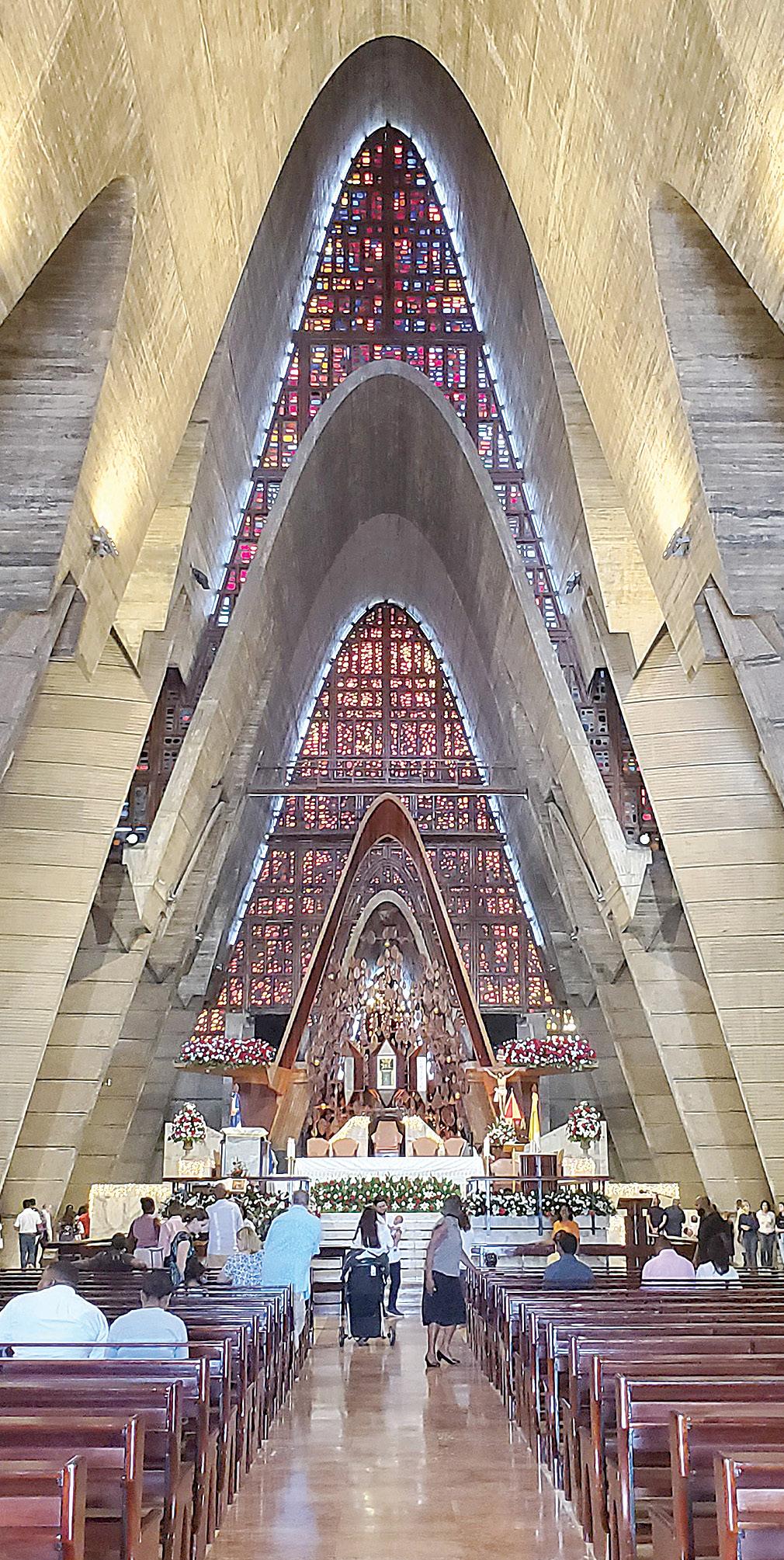
| OSV NEWS
El interior de la Basílica Catedral de Nuestra Señora de Altagracia en Salvaleón de Higüey, en la República Dominicana, se ve en una foto sin fecha. La imagen de Nuestra Señora de Altagracia, patrona del país, se encuentra detrás del altar de la basílica catedral.
El pueblo dominicano profesa un profundo amor a María, a quien se refiere cariñosamente como “Tatica”, diminutivo de Altagracia. A lo largo de todo el año, miles de mis compatriotas visitan su casa para agradecer su fiel compañía, convencidos del regalo de su constante intercesión. Así lo sentimos y creemos. De hecho, la misma arquitectura de la basílica hace eco de esta convicción: Cuando nos aproximamos, un arco de hormigón de
unos 80 metros de altura nos recibe, simbolizando las manos de la Virgen unidas en oración sosteniendo una cruz.
Desde niña me llamaba la atención el nombre de esta advocación. Me parecía curioso y hasta gracioso. Actualmente, en el país más de 300 mil personas lo llevan, e incluso es el nombre más frecuente entre las dominicanas. Claramente, este nombre es mucho más comprensible una vez invertidas las dos palabras de su composición. Es decir, “gracia alta”. Palabras aplicables perfectamente a María, la mujer de la hiperdulía; la que recibió la más altas de las gracias.
“Gracia” es un concepto teológico polisémico que me gusta y me interesa mucho. Me llena de regocijo y estupor escuchar y repetir aquel saludo del ángel Gabriel que todos conocemos por el Evangelio de Lucas. Cuán grato es para mí celebrar a quien recibió y aceptó generosamente el favor de Dios; a la elegida para ser su madre y la madre espiritual de toda la humanidad. Scott Hahn, en “Dios te salve, Reina y Madre”, afirma que el hecho de que la Virgen María viviera en un estado de gracia santificante ganado por los méritos de su hijo Jesús --como profesamos en la doctrina de la Inmaculada Concepción-- forma parte del plan divino de salvación.
En la misma obra, Hahn apunta que San John Henry Newman enseñó que la concepción inmaculada era un importante corolario del papel de María como nueva Eva. Y que no deberíamos temer afirmar que la Virgen, incluso, recibió el don de la gracia aún mayor que ésta. Verdaderamente, a través de ella, se recapitula nuestra historia de salvación.
En mi club de lectura hemos dedicado el mes de enero a ahondar en cuentos selectos de Flannery O’Connor. Ha sido, inexorablemente, también una oportunidad para reflexionar en la gracia.
La gracia no es sólo el estado de intimidad con Dios o el favor concedido por Él por su bondad y no por nuestros méritos, sino que también es una irrupción suya en nuestra cotidianidad; una revelación, una intervención radical que abre la posibilidad de volver a encauzar nuestras vidas a fin de alcanzar --como una nueva oportunidad-- la salvación.
Pero O’Connor añade que “toda la naturaleza humana se resiste vigorosamente a la gracia porque ella nos cambia y el cambio es doloroso”.
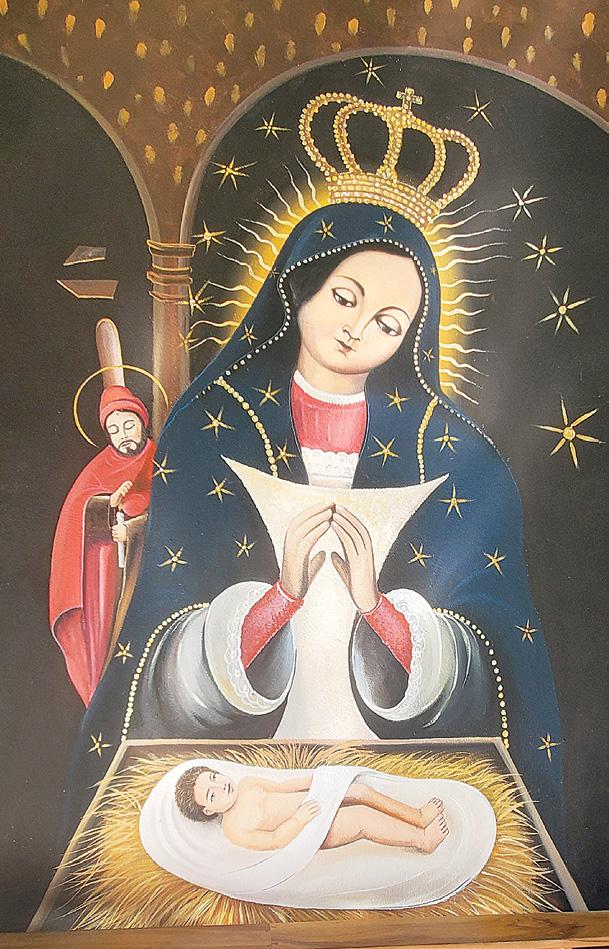
Oh, Madre, que podamos imitar tu firme fiat y derribar toda resistencia que nos aparte de la redención.
Cada peregrino que se dirige a Higüey, el municipio en donde se encuentra la basílica-catedral de Nuestra Señora de la Altagracias, encuentra también la posibilidad de rendirse, de reencontrarse y de abrirse a esa gracia divina por medio de María. Es imposible estar allí y no respirar su ternura.
La basílica se inauguró oficialmente en 1971, reemplazando el antiguo santuario que se encuentra a pocos metros, y que permanece allí desde 1572 con el nombre de Iglesia de San Dionisio. Ahí fue donde comenzó a venerarse la imagen de la Virgen de la Altagracia, y en donde cientos de fieles empezaron a testimoniar numerosos milagros concedidos por la intercesión de la Virgen.
A un costado de la basílica-catedral, se encuentra el Museo de la Altagracia, un lugar que promueve la historia y el arte sacro en torno a esta devoción. Allí me fascinó constatar, a través de leyendas, exvotos y obras pictóricas, la fervorosa fe de los fieles que se han confiado a María.
Que ella, la Altagracia; nuestro modelo de la fe y de caridad, reavive nuestra esperanza y nos prodigue su consuelo materno. Y que nos acompañe en nuestro peregrinar al cielo, en donde ella, coronada como reina, intercede por nuestras almas y nos espera.
ELY SEGURA es laica, creadora del proyecto Teófilo, una iniciativa para la formación en la fe de adultos hispanos en Estados Unidos. (www.proyectoteofilo.com).
GINA CHRISTIAN OSV News
Amid soaring domestic and global tensions, the head of the U.S. Conference of Catholic Bishops has called for a Holy Hour for peace as “a moment of renewal for our hearts and for our nation.”
In a Jan. 28 statement, Archbishop Paul S. Coakley of Oklahoma City, president of the USCCB, said that “the current climate of fear and polarization, which thrives when human dignity is disregarded, does not meet the standard set by Christ in the Gospel.”
He pointed to “the recent killing of two people by immigration enforcement officers in Minneapolis and that of a detained man in Texas,” referencing the deaths of Renee Nicole Good and Alex Pretti, respectively slain by federal agents Jan. 7 and 24 as they protested immigration enforcement actions in Minneapolis, and that of Cuban immigrant Geraldo Lunas Campos, whose Jan. 3 death in a Texas immigration detention facility has been ruled a homicide.
Campos, the third detainee to die at the facility, had pleaded for medication before apparently being slammed to the ground by guards, according to sworn court testimony by several fellow detainees. The Trump administration, which claimed Campos took his own life, was blocked from deporting the witnesses by a federal judge Jan. 27 until they could provide depositions.
The three deaths “are just a few of the tragic examples of
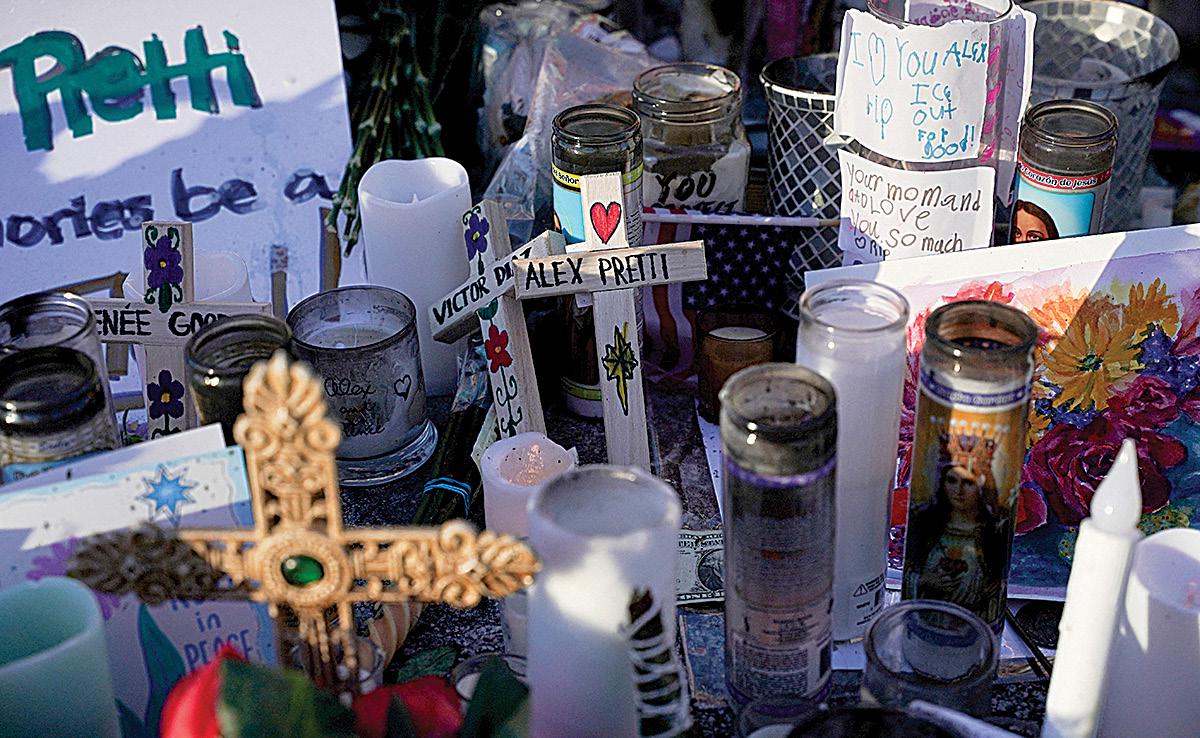
the violence that represent failures in our society to respect the dignity of every human life,” said Archbishop Coakley. ” Archbishop Coakley’s message comes amid a growing chorus of outcry from the nation’s Catholic bishops over
the increasingly frayed domestic and international order.
During their annual plenary meeting in November, the USCCB issued a pastoral message on immigration, which condemned “the indiscriminate mass deportation of people” and prayed for “an end to dehumanizing rhetoric and violence, whether directed at immigrants or at law enforcement.”
In his Jan. 28 message, Archbishop Coakley acknowledged that “many people today feel powerless in the face of violence, injustice, and social unrest.
“To those who feel this way, I wish to say clearly: your faithfulness matters. Your prayers matter. Your acts of love and works of justice matter,” he said.
Archbishop Coakley said he was “deeply grateful for the ways Catholics and all people of good will continue to serve one another and work for peace and justice.
“Whether feeding the hungry, welcoming the stranger, caring for the sick, accompanying the lonely, visiting the imprisoned, or striving daily to love their neighbors, no work of mercy or act of justice is ever wasted in the eyes of God,” said Archbishop Coakley.
“While proper laws must be respected, works of mercy, peacefully assembling, and caring for those in your community are signs of hope, and they build peace more surely than anger or despair ever could,” he said.
The archbishop invited bishops and priests to offer a Holy Hour for Peace. “I encourage Catholics everywhere to participate, whether in parishes, chapels, or before the Lord present in the quiet of their hearts for healing in our nation and communities,” he said.
RICHMOND, Va. — The Virginia General Assembly has sent an amendment enshrining a “fundamental right” to abortion in the Constitution of Virginia to a statewide referendum on the November ballot.
If the voters approve the amendment, it will establish abortion as a “fundamental right” in Virginia’s constitution. The only exception to that “right” would be a possibility for the state to regulate access in the third trimester under certain circumstances, according to the Guardian.
The amendment passed the General Assembly Jan. 16 despite the best efforts of the bishops and more than 600 pro-life advocates who met with legislators a day earlier.
Two proposed changes to the amendment were voted down: first, a proposal to keep the current parental consent law enforceable; second, a “born-alive” protection that would guarantee the right to medical care for a child born despite an attempted abortion.
Richmond Bishop Barry C. Knestout joined Arlington Bishop Michael F. Burbidge in calling the amendment “radical,” “extreme” and “shocking to the conscience” in a Jan. 16 statement.
The state Legislature first approved the proposed amendment in early 2025, but by Virginia law, the proposal must pass in two consecutive state legislatures. The House of
CORPUS CHRISTI, Texas — A solemn installation Mass Jan. 28 at Most Precious Blood Church marked the beginning of Bishop Mario A. Avilés’ ministry as the ninth bishop of Corpus Christi.
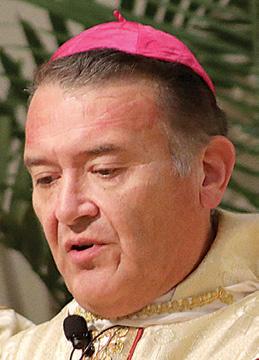
The liturgy drew Catholics from across the diocese and beyond, along with leaders of other faiths and civil officials. According to the Diocese of Corpus Christi, 25 bishops and more than 100 priests from around the country attended.
Archbishop Joe S. Vásquez of GalvestonHouston read the apostolic letter from Pope Leo XIV and led Bishop Avilés to the cathedra, the bishop’s seat. Cardinal Christophe Pierre, apostolic nuncio to the United States, was unable to attend because of a winter storm.
In his first homily, Bishop Avilés said his heart was filled with “a solemn sense of responsibility,” calling the moment “the dawn of a new chapter in the life of the Diocese of Corpus Christi, a chapter we embark upon together under the guidance of divine providence. God calls and we are sent.”
The 56-year-old bishop comes from the Diocese of Brownsville, Texas, where he served as auxiliary bishop. Speaking in English and Spanish, Bishop Avilés urged prayers, vocations, strong families, and collaboration with civil leaders.
by U.S. federal agents in Minneapolis, Cardinal Pietro Parolin, Vatican secretary of state, said the violence unfolding there is “unacceptable.”
“The position of the Holy See is always to avoid any kind of violence, obviously, and therefore we cannot accept episodes of this kind. That is our position, as you know,” he told reporters when asked about operations underway by the U.S. Immigration and Customs Enforcement (ICE) agents in Minnesota, which have led to the shootings and deaths of two U.S. citizens.
“Difficulties, problems and contradictions must be resolved in other ways,” he said Jan. 28, describing the situation as “unacceptable” and agreeing with recent statements by U.S. bishops. The cardinal spoke with reporters on the sidelines of an evening event at LUMSA University in Rome Jan. 28.
Asked about the possibility of the U.S. sending ICE agents to the Winter Olympics in northern Italy as part of security measures for the U.S. delegation, the cardinal said he was aware of the proposal, “but I know there is also controversy surrounding it. We don’t get involved” in such controversies.
WASHINGTON, D.C. — A federal appeals court ruled Jan. 28 that the Trump administration acted illegally when it ended legal protections for hundreds of thousands of people from Venezuela and Haiti, both predominantly Catholic countries, to remain in the United States without risk of deportation due to dangerous conditions in their homelands.
ruling that Noem exceeded her authority in ending TPS early for Haiti.
The ruling will not have an immediate effect for Venezuelan citizens, as the Supreme Court in October allowed Noem’s bid to end TPS to remain in effect while the lawsuit proceeds.
J. Kevin Appleby, senior fellow for policy at the Center for Migration Studies, said, “In any case, it provides some hope to these vulnerable groups, who otherwise may be forced to return to very dangerous situations in their home countries.”
— OSV News and Catholic News Service
Rev. Msgr. Anthony Kovacic -
Deadly violence in Minneapolis is ‘unacceptable,’


A three-judge panel of the 9th U.S. Circuit Court of Appeals upheld a lower court ruling that found Homeland Security Secretary Kristi Noem acted unlawfully when she ended temporary protected status for Venezuelans. They also separately upheld a lower court’s
JUNNO AROCHO ESTEVES OSV News
VATICAN CITY — In a message to the Archdiocese of Milan, Pope Leo XIV expressed his hope that the 2026 Winter Olympic and Paralympic Games will be an occasion of solidarity and bridge-building between peoples and cultures.
The papal message was read during a Jan. 29 Mass marking the arrival of the “Cross of Athletes” and the official launch of the archdiocese’s Olympic pastoral initiative, “For Each Other.”
In his message, which was signed on his behalf by Cardinal Pietro Parolin, Vatican secretary of state, the pope said he hoped the Olympic Games would bring about “sentiments of friendship and fraternity, strengthening awareness of the value of sport at the service of the integral development of the human person.”
“The Holy Father assures his prayers so that these days of healthy competition may contribute to building bridges between cultures and peoples, promoting hospitality, solidarity, and peace,” the message stated.
The Vatican Dicastery for Culture and Education will also co-sponsor the initiative. In a message read at the conference, Cardinal José Tolentino de Mendonça, prefect of the dicastery, highlighted the important role the church plays in fostering an atmosphere of genuine sportsmanship.
The Church, he said, wants to contribute to the sports’ world not by “denying the value of competition, but by guiding it so that it is not dominated by an individualistic mindset and instead is rather open to the dimension of the common good.”
The “For Each Other” initiative, which will coincide with the Feb. 6-22 Winter Olympics and the March 6-15 Paralympics, will feature activities, performances and events hosted in parishes across Milan.
At the heart of the activities will be the 11th-century Basilica di San Babila, dedicated to St. Babylas of Antioch, where the opening Mass was celebrated and which will be known as the “Church of Athletes” throughout the Olympic and Paralympic Games.
During the Mass, the “Cross of Athletes” was entrusted to the archdiocese by Athletica Vaticana, the

Holy See’s sports association. Blessed by Pope Francis at the 2013 World Youth Day in Rio de Janeiro, the cross has been placed in chapels in the Olympic host cities of London in 2012 and Paris in 2024.
According to the Archdiocese of Milan, the cross, which will remain at the altar in the Basilica di San Babila until the end of the Paralympics, “symbolizes the close bond between sporting activities and the values of solidarity, inclusion, and personal growth.”
In his homily, Archbishop Mario Delpini of Milan said the Olympic and Paralympic Games could serve as a form of rigorous spiritual education, describing the athletic competitions as a “school of asceticism” and a “school of life” where one learns how to handle both victory and defeat.
For Olympians and Paralympians, the games will be a chance to learn “what strength is needed to accept defeat without becoming depressed, to live victory without becoming arrogant, to live through the disordered reactions of others, the unexpected anger, the irritating stubbornness, the paralyzing discouragement.”
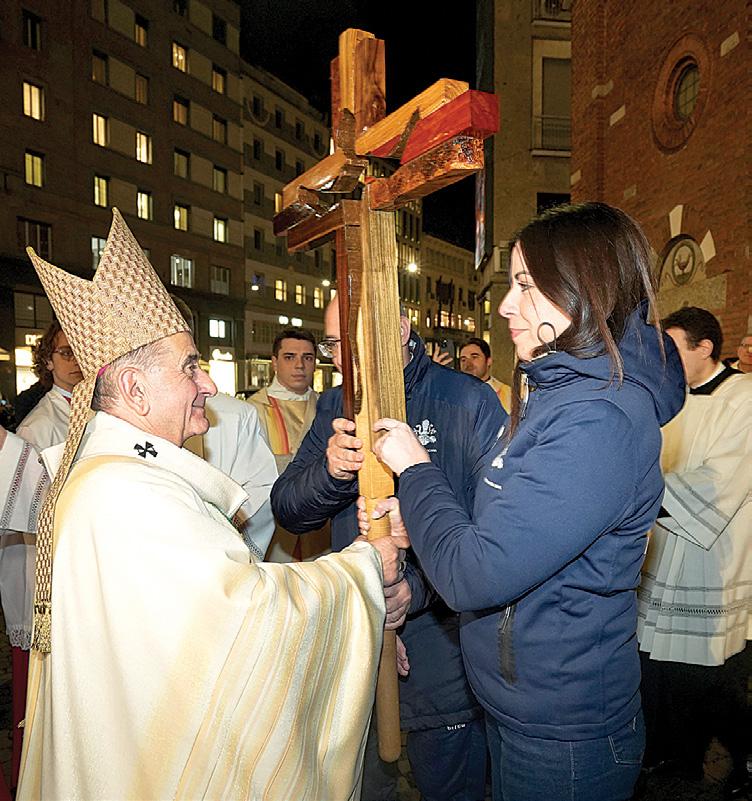
JUNNO AROCHO ESTEVES OSV News
MILAN, Italy — As the world prepares for the 2026 Winter Olympics and Paralympics in Milan and Cortina d’Ampezzo, the Catholic Church in the host city has launched an initiative to ensure that amid the competitions and stress, athletes can find a place to pray and reflect.
At a press conference in Milan Jan. 23, the Archdiocese of Milan unveiled the launch of “For Each Other,” a program that will coincide with the Feb. 6-22 Olympic Games and the March 6-15 Paralympic Games.
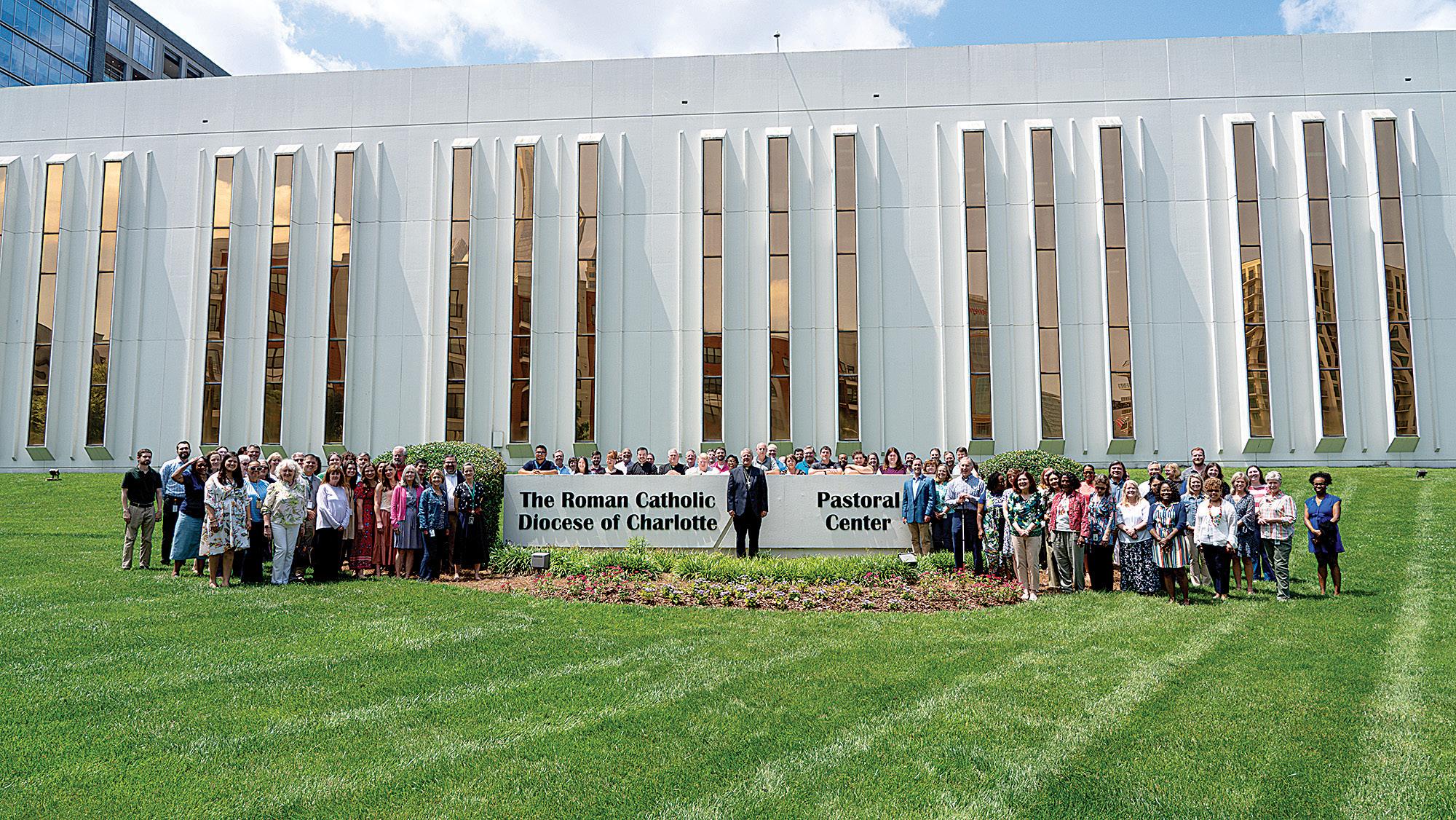
“For me, the aim of our contribution is to be against the banality of sport, meaning sport reduced to performance, to exaggerated competitiveness, to business, to idolatry,” said Archbishop Mario Delpini of Milan.
“Sport is good for people and not just for the excellent result achieved – which is naturally one of the goals of the competitions – but against banality. We want to say that people are made not only of a body that is perfect and capable of excellent performance but of a soul, of a relationship, of a capacity for sharing, of attention so that no one is left behind,” he added.
The archdiocese said “For Each Other” will run from Jan. 29 to mid-March and will feature activities, performances and events hosted in parishes across Milan.
Cardinal Tolentino also said that during the initiative’s Jan. 29 opening Mass, the “Cross of Sportspeople” will be formally entrusted to the archdiocese by Athletica
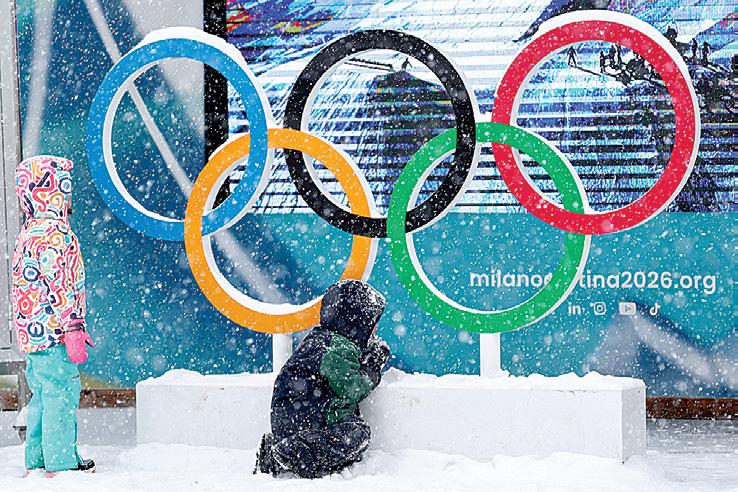
Vaticana, the Holy See’s sports association.
The 11th-century Basilica of San Babila will be known as the “Church of Athletes” throughout the Olympic and Paralympic Games.
Sunday Masses will be held in various languages, including English, French, German and Italian.
The church will also be the starting point of the “Tour of Sports Values,” which will count on the presence of some “13,000 young people from schools, youth and sports clubs in the diocese who have already signed up for the initiative.
Two local parishes will be known as “Values Villages,” each one named after the values espoused in the Olympic Chart: excellence, friendship and respect, the archdiocese said.
LONDON — Archbishop Sarah Mullally has been confirmed as the 106th Archbishop of Canterbury, becoming the first woman to lead the Church of England in what Anglicans claim as its “nearly 1,400-year history” – counted since Catholic St. Augustine of Canterbury arrived on the island.
A legal “Confirmation of Election” ceremony took place Jan. 28 at St. Paul’s Cathedral in London. Her formal installation is scheduled for March 26 at Canterbury Cathedral.
Appointed by King Charles III last October, Archbishop Mullally succeeds Archbishop Justin Welby, who resigned in 2024 following revelations about a sexual abuse cover-up.
In remarks after her confirmation, Archbishop Mullally called the role an “extraordinary and humbling privilege” and pledged a ministry focused on hospitality, unity and safeguarding.
In these “times of division and uncertainty, she said, “I pray that we will offer space to break bread together and discover what we have in common.”
Catholic leaders welcomed the appointment in October. Cardinal Vincent Nichols of Westminster assured her of Catholic prayers, noting the significant challenges ahead. While
many praised her historic leadership, opposition emerged from some Anglican groups, particularly in Africa, citing concerns over women’s ordination and same-sex marriage blessings. Archbishop Mullally acknowledged divisions and reiterated her commitment to listening to abuse survivors and strengthening safeguarding across the Church.
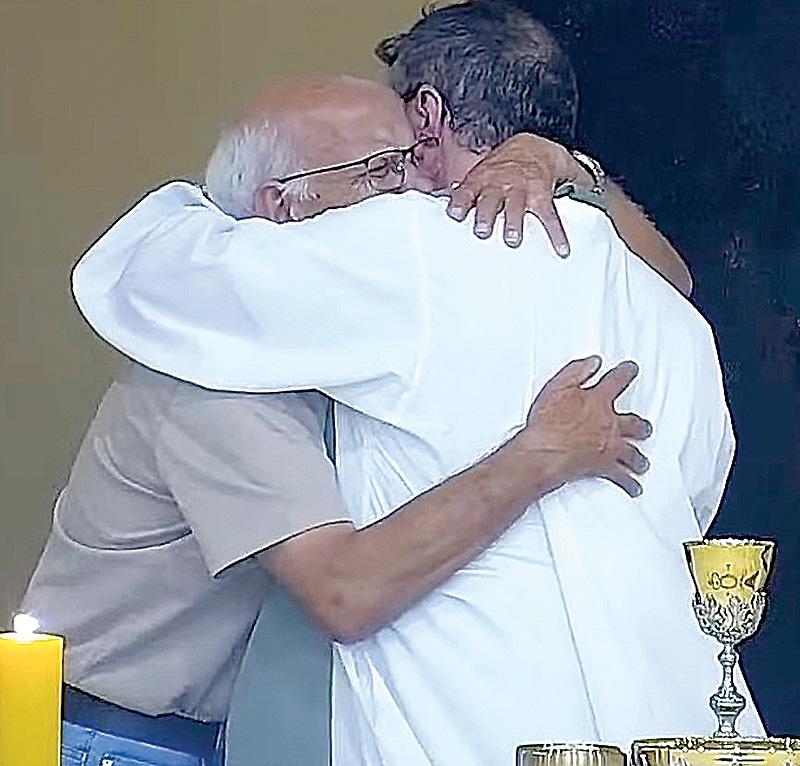
TUBARÃO, Brazil — A video of an elderly man approaching the altar in tears during Mass – and a priest interrupting the liturgy to embrace him – has gone viral in Brazil, moving millions online. The moment occurred Jan. 18 at St. Francis of Assisi Church in Santa Catarina state, where Father Carlos Henrique Fernandes was celebrating Mass.
Moments before giving Communion, the priest saw an elderly man coming to him. The man, Marcos, a longtime extraordinary minister
of Holy Communion, was attending Mass that day, along with his wife, but was not scheduled to help distribute Communion.
He had briefly left the church to receive a phone call that day and returned visibly distressed. Moments earlier, he had learned that his 20-year-old grandson had died by suicide.
Father Fernandes paused the Eucharistic prayer, hugged Marcos and later personally gave him Communion. Parishioners helped care for Marcos before he was taken home.
While most viewers praised the gesture as a powerful act of compassion, some criticized the interruption of the consecration. Father Fernandes defended his decision. He later said Marcos was calmer in the days after the Mass, adding that priests are called to walk closely with their people, especially in moments of suffering.
VATICAN CITY — The increasing number of people who do not see the Gospel as a fundamental resource for their life should inspire – not discourage – Catholics in rediscovering the joy of evangelization, Pope
Leo XIV said. The transmission of the faith is “a topic of great urgency,” the pope said in remarks to members of the Dicastery for the Doctrine of the Faith at the Vatican Jan. 27-29.
“We cannot ignore the fact that, in recent decades, there has been a breakdown in the way Catholics pass down the Christian faith” from generation to generation, he said, and that “there is an increasing number of people who no longer perceive the Gospel as a fundamental resource for their life, especially among the younger generations.”
In fact, he added, many young men and women “live without any reference to God and the Church, and while this causes us believers pain, it must also lead us to rediscover the ‘delightful and comforting joy of evangelizing,’ which is at the very heart of the life and mission” of the Church, which wants to be a missionary Church “that looks beyond itself, at others” and which proclaims the Gospel, “above all through the power of attraction,” reminding them that “it is not the Church that attracts, but Christ.”
Pope Leo highlighted the importance of the dicastery’s work, which includes offering clarification on Church doctrine.
— OSV News and Catholic News Service

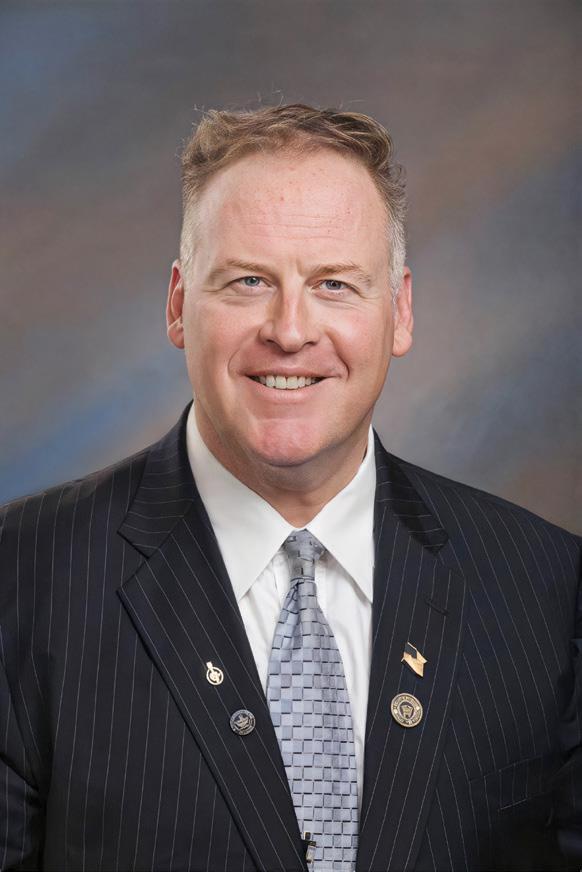
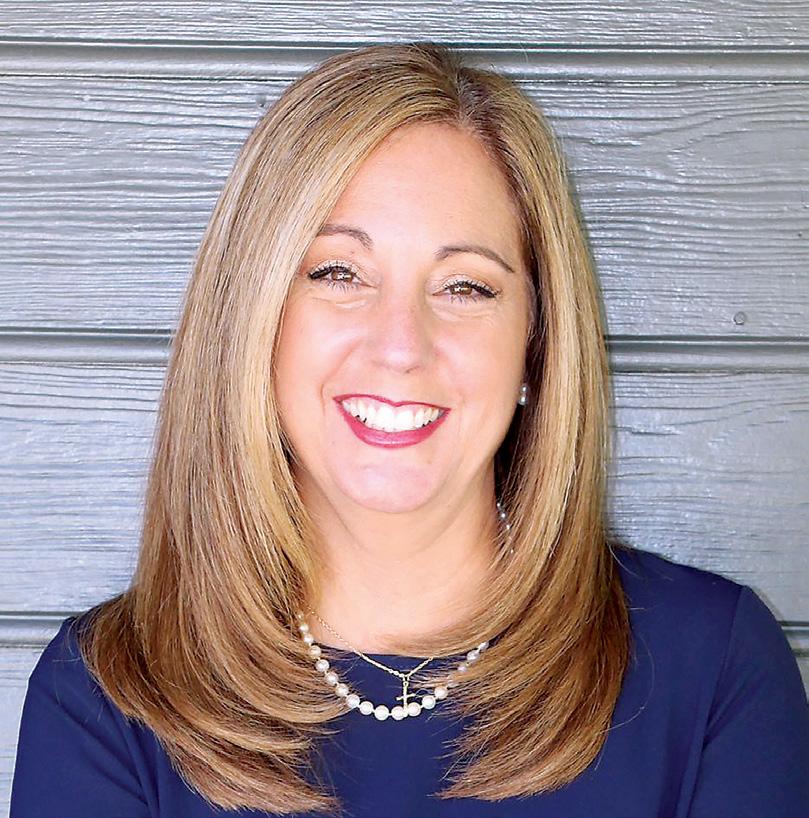
‘At the Last Supper, Jesus offers a prayer pleading for unity among His followers. He indicates that the very credibility of His message hinges upon that unity.’
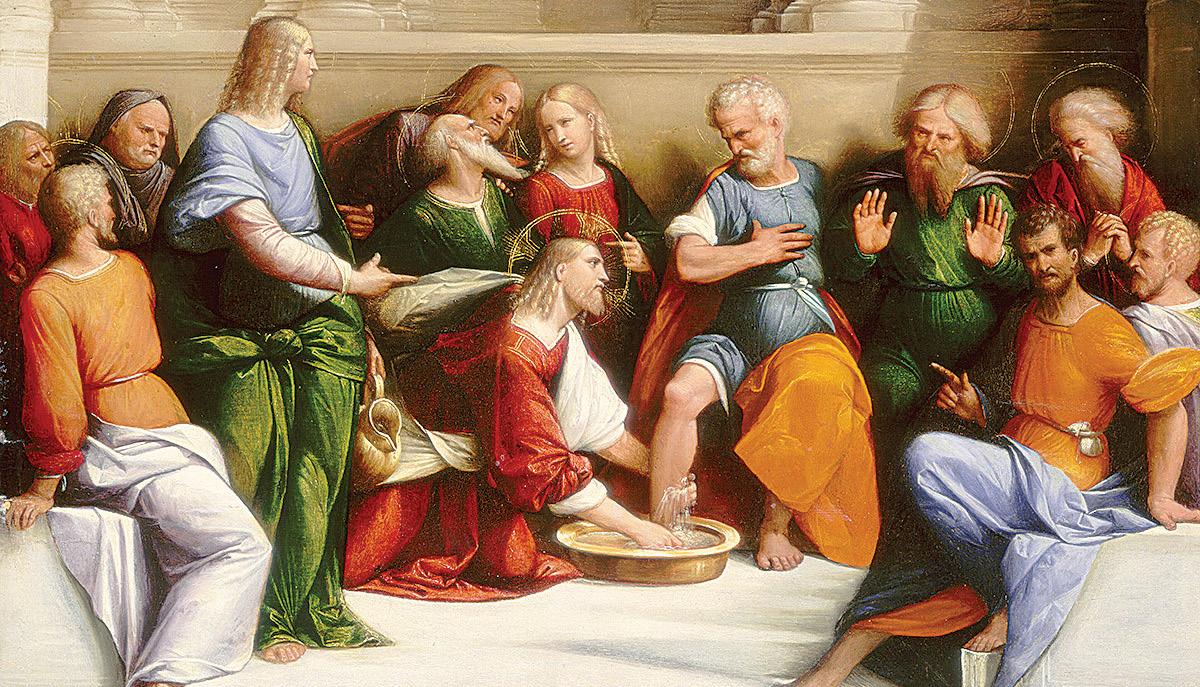
Michael R. Heinlein
It’s natural to think of the institution of the Eucharist when the Last Supper comes to mind. The sacramental memorial of Christ’s paschal mystery is, after all, as the Vatican II document “Lumen Gentium” says, “the source and summit of the entire Christian life.”
A close reading of John’s Gospel, however, sheds a different light on the Last Supper. In fact, he doesn’t write about the institution of the Eucharist directly at all. Instead, John primarily focuses on Jesus washing the feet of His apostles – an act of charity par excellence, connecting His impending sacrifice to service.
UNITE SO THE WORLD MAY BELIEVE
But there’s yet another aspect of John’s narrative of the Last Supper which has always stuck out to me. It comes from Jesus’ lengthy prayer to His Father – Christ’s prayer for unity. Fully aware of humanity’s fallen nature, Jesus anticipated the struggles and strife that would plague His followers in the future. And so here, in the context of the first Eucharist, Jesus offers a prayer pleading for unity among His followers. He indicates that the very credibility of His message hinges upon that unity.
“I pray not only for them, but also for those who will believe in Me through their word, so
that they may all be one, as you, Father, are in Me and I in You, that they also may be in Us, that the world may believe that You sent me” (Jn 17:20-21). Jesus prays that Christians be united “that the world may believe.”
And yet we aren’t.
OUR PART: PRAY FOR ECUMENISM
The regrettable separations and divisions in Christendom over the past millennium have been met in the last century by a realization of one of Christ’s last wishes. The ecumenical movement seeks to bring about the unity Christ wills for His Church – not to water down the deposit of the faith handed on by Christ to the Church to a least common denominator. Since the Second Vatican Council, the Catholic Church has been entirely committed to ecumenism. While much of the work to accomplish unity is handled at higher levels, we each need to do our part.
The most important thing we can do is pray for Christian unity. Christians throughout the world are invited to meditate on ways we can foster ecumenism.
MICHAEL R. HEINLEIN is author of “Glorifying Christ: The Life of Cardinal Francis E. George, O.M.I.” and a promised member of the Association of Pauline Cooperators.
How to get
Picture your favorite place to sit. A cozy recliner near the TV, a reading spot on your couch or your usual chair at the kitchen table. Remember how your body sinks into that space without a second thought. After a long day, there’s nothing better than settling in where we feel most at home.
Now picture the place where you usually sit at Mass. You might have a regular pew, a certain side of the church you love or the same exact seat every Sunday. Why do you pick this spot?
Maybe that’s where your family or friends have always sat. Maybe you like the view or the acoustics: You can see and hear well here. Or maybe you’re simply a creature of habit!
‘What if we took one step out of our comfort zone in 2026?’
There’s nothing wrong with having a favorite place. In a chaotic, everchanging world, our nervous systems sigh with relief at routines. We need the expected. Even Jesus liked to recline at table with his friends. But in this in-between stretch of Ordinary Time, between the high feast of Christmas and the solemn preparation of Lent, we find ourselves in a new place as we settle into the New Year. What will 2026 hold, the good and the bad? Who might we become by year’s end?
At home, at church, in our communities and in the wider world, we can find ourselves seeking what is comfortable. We like this kind of food, that style of worship, this grocery store or that politician. We feel at home in our particular camp. Yet Christ came both to comfort (with God’s mercy) and challenge (with God’s justice). His call to discipleship is always prophetic, asking each of us to leave behind the nets of our comfort zones and venture into the deep.
As a parent of children ranging from kindergarten to high school, I find myself thinking often about the home as a place of comfort – but also challenge.
I want our family home to be a space of safety, solace and love for our kids, but I also know it must be a source of difficult lessons: how to forgive, how to change and how to do the right thing even when it’s hard.
In 1902, humor columnist Finley Dunne coined a famous phrase about the duty of journalism, writing that the role of the newspaper is to “comfort the afflicted and afflict the comfortable.” Catholics sometimes say the same about the mission of the Church, too.
We need only look to the Gospels to see how Jesus comforted the suffering and spoke out strongly against the wealthy and powerful who did not care for the poor and vulnerable.
Where we stand (or sit) determines our view – of our home, Church and society. If we stand with the least among us as Christ did, we will see things very differently than if we side with the powerful, the popular or the strong.
What if we took one step out of our comfort zone in 2026?
It might be a small change, like sitting in a different pew to meet new parishioners in our community and see our physical church home from a new perspective.
It might be a big change, like deciding to volunteer as a family with a local food shelf to get to know our neighbors in need and serve them with our time and energy.
Or we might devote this short season of Ordinary Time to deeper prayer, asking God to lead us further in faith even when it gets uncomfortable.
When we know we have safe spaces where we can return – like our family home, our favorite chair or our regular parish pew – we can strike out in good faith and courage to do whatever challenging work God calls us to do.
I pray this for my children when they leave the house each day, that God might go with them and lead them home safely. I pray the same for each of us: that we will always remember there is nowhere we can go, even the farthest leap from our comfort zone, where God has not already gone before us.
and

Lately I’ve been thinking about gifts, and the meaning of them, because of the March for Life and its 2026 theme: “Life is a gift.”
For over a decade, I’ve written about the March for Life, which calls itself the “largest annual human rights demonstration in the world.” The event held in Washington began in response to the U.S. Supreme Court’s 1973 decision in Roe v. Wade, which legalized abortion nationwide. The 53rd march on Jan. 23
the human being in His own image and semblance (Gen 1:26),” he wrote. “It is not something that is obtained by merit or effort; nor does it depend on what we possess or achieve. It is a gift that goes before us. It is born of the look of love with which God wanted us, one by one, and continues to want us.”
He added, “On every human face, even when it is marked by fatigue or pain, there is the reflection of the Creator’s goodness, a light that no darkness can erase.”
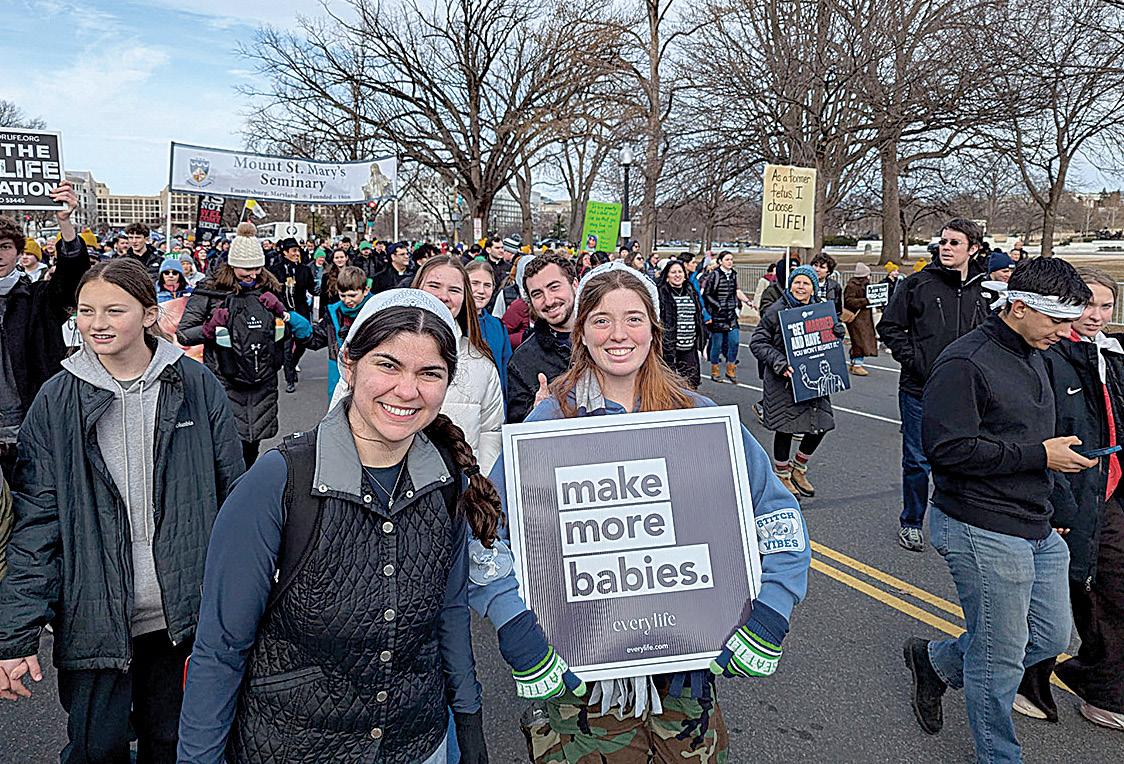
While human dignity is a gift, it does not promise a life free of suffering or pain, but it does guarantee a life where, in every moment, we are infinitely and eternally wanted and loved just as we are. It calls us to a life where we recognize that every person we encounter, born and unborn, is also wanted and loved.

Most-read stories on the web
‘Jesus does not speak of a distant consolation, but of a constant grace that always sustains us, especially in times of affliction.’
Pope Leo XIV
From online story: “Happiness cannot be bought or hoarded, only shared with others,” pope says

The Catholic News Herald reached the Facebook and Instagram feeds of more than 2 million people in English and Spanish last month. The most talked about post? The recent snow and ice storms that battered the region and impacted churches and schools. Join the conversation: www.facebook.com/CatholicNewsHerald.
marked the fourth one since the court overturned Roe with its 2022 decision in Dobbs v. Jackson Women’s Health Organization.
While the March for Life still seeks to impact law, it also focuses on changing the culture until abortion becomes unthinkable. The 2026 theme reflects that cultural approach by recognizing every human person as a gift from the moment of conception. It also prompts pro-life marchers, particularly Catholics and other Christians, to reflect on the question “A gift from whom?”
It’s a question the new pope – the first pope known to have attended the March for Life as a young man – recently addressed in remarks Jan. 9.
Consistent with Catholic Church teaching, Pope Leo XIV, who embraces a holistic approach to human dignity, condemned abortion as a practice that “cuts short a growing life and refuses to welcome the gift of life.” He called for “the protection of every unborn child and the effective and concrete support of every woman so that she is able to welcome life.”
THE GIFT OF HUMAN DIGNITY
Pope Leo said more on this in a Nov. 15 message, where he also called the dignity of the human person a gift.
“Dignity is a gift from God, who created
Today, many threats to human life exist, but the pro-life movement identifies the most pressing one as abortion, which ends the lives of more than 1 million unborn babies nationwide each year. The pro-life movement sees, as Pope Leo said Jan. 9, that “the protection of the right to life constitutes the indispensable foundation of every other human right.”
HELP TO BUILD A CULTURE OF LIFE
At a time when the abortion rate is rising, access to abortion drugs is increasing and the Hyde Amendment prohibiting public funding of abortion is up for debate, a cultural approach to life beckons us to see the human persons involved. It begs us to ask why women are seeking abortion – and to respond to that. One person’s response might look different from another’s, but every person can contribute to building a culture of life. It might look like volunteering at or donating to one of the thousands of pregnancy centers that exist to help women in need. It might mean babysitting for a neighbor, cleaning an expectant mom’s home or knowing about available resources in case someone asks. It might be as simple as speaking a word of encouragement to pregnant and parenting families or being present when someone needs to talk. It could look like a prayer; it could look like marching.
Life is a gift – a gift for us and, if lived well, a gift for others, too.
KATIE YODER writes for OSV News from Maryland.
On YouTube over the last 30 days, videos produced by the Catholic News Herald have been viewed more than 8,500 times. The most popular video? Highlights from the March for Life in Charlotte.
Over the past 30 days, ending Feb. 4, 40,000 visitors to www.catholicnewsherald.com have viewed a total of 62,000 pages. The top 10 trending headlines are:
College of Consultors appointed 4,878 n Due to impending winter storm, no Mass obligation this Sunday .........................................4,454
n Bishop Martin issues pastoral letter on norms for Holy Communion...................................... 903 n Father John Aurilia, OFM Cap. passes away 854
n Father Hoare returns to ministry to serve as chaplain at Pennybyrn 727
n Catholic funeral guide .............................................................................................................................696
n New young adult Catholic Sports organization brings rec leagues to diocese 571
n Diocese introduces pastoral year to enhance preparation for future priests ....................... 434 Join the conversation online

The Catholic News Herald welcomes letters from readers. We ask that letters be originals of 250 words or fewer, pertain to recent newspaper content or Catholic issues, and be written from a perspective of Christian charity.
To be considered for publication, each letter must include the name, address and daytime phone number of the writer for purpose of verification. Letters may be condensed due to space limitations and edited for clarity, style and factual accuracy.

The Catholic News Herald does not publish poetry, form letters or petitions. Items submitted to The Catholic News Herald become the property of the newspaper and are subject to reuse, in whole or in part, in print, electronic formats and archives.
E-mail: catholicnews@rcdoc.org
Mail: Letters to the Editor Catholic News Herald 1123 S. Church St. Charlotte, N.C. 28203

Is Cursillo for Me? What a great question! I remember reading an article last month in the Catholic News Herald (Jan 23rd) It summarized survey results from the Disciple Maker Index I was very interested to see the responses from parishioners across our Diocese to questions such as the last time you “Invited someone to join me for Mass?” “Prayed with another person outside of Mass?” “Shared my personal witness story with another person?” The article’s headline was “ Survey Highlights Need for Confidence in Faith Sharing.” Then it hit me. I realized that Cursillo is the reason I have the confidence to do these things. I lived my Cursillo in 2006 and through friendship with myself, Christ, and others, I gained the confidence in living my faith boldly and joyfully. Cursillo is a movement based on friendship –Make a Friend, Be a Friend, Bring a Friend to Christ I have witnessed this method change lives and environments in amazing ways. Christ is counting on us, by nature of our baptism, to grow closer to Him and live out our faith actively in our day to day lives Is Cursillo for you? Be not afraid. Start with prayer. Attend one of our FYI info sessions Ask questions. Visit our website. Talk with friends at your parish. Listen. Pray. I also invite you to email me: TriciaCharlotteCursillo@gmail.com Let us build up the Kingdom of God – one friend at a time! Patricia Bunch is the Charlotte Diocesan Cursillo Coordinator and is a member of St. Leo’s Catholic Church in Winston -Salem.

Monthly Ultreyas Contact local Parish Ambassador or and FYI Sessions visit www.CharlotteCursillo.com
February 11
Cursillo FYI Session with Q and A
6:00 p.m. St. Pius X Catholic Church – Simmons Center Greensboro, NC
February 12
Cursillo FYI Session with Q and A
7:00 - 8:00 p.m. St. Mark’s Parish House 14630 Stumptown Rd., Huntersville, NC
April 17 - 18 Regional Spring Encounter
July 23- 26
August 6 - 9
September 19
October 9 – 10
disciples “living the faith and trying to build a new heaven on Earth as we’re all called to do.”
In a statement announcing the decree’s promulgation, the Franciscan Friars invited Catholics to take part in the Jubilee celebrations and hope that St. Francis’ example would inspire participants “to live with authentic Christian charity towards our neighbor and with sincere longings for concord and peace among peoples.”
PEACE
In a Jan. 10 letter to the ministers general of the Conference of the Franciscan Family, Pope Leo said St. Francis’ message of peace was needed now more than ever.
“In this age, marked by so many seemingly interminable wars, by internal and social divisions that create mistrust and fear, he continues to speak. Not because he offers technical solutions, but because his life points to the authentic source of peace,” the pope wrote.
That peace, the pope added, “is not limited to the relations between human beings,” but extends to “the entire family of Creation.”
Pope Leo concluded his letter with a prayer
overlooking U.S. Hwy. 29, canceled all Masses and activities both weekends as ice and snow made access unsafe.
Father Gabriel Carvajal-Salazar, pastor, said the 10 canceled Masses – five each weekend –meant lost offertory collections and reduced parish income.
“The economic impact is strong. If there is
St. Mark Catholic Church, Wilmington, NC
Men’s 87th Cursillo Weekend
Catholic Conference Center – Hickory, NC
Women’s 89th Cursillo Weekend
Catholic Conference Center – Hickory, NC
Grand Ultreya – Dan Nicholas Park
Bishop Michael T. Martin, Celebrant
Regional Fall Encounter
St. Paul the Apostle Greensboro, NC
Beafrequentvisitortoourwebsite forthelatestnewsandupdates

to St. Francis, asking the saint’s intercession “to give us the courage to build bridges where the world raises up boundaries.”
“In this time afflicted by conflict and division, intercede for us so that we may become peacemakers: unarmed and disarming witnesses of the peace that comes from Christ,” the pope wrote.
Among the notable events taking place in Assisi will be the first public display of St. Francis’ body.
In October, the Basilica of St. Francis announced that Pope Leo had granted permission to display the saint’s body from Feb. 22 to March 26. According to the basilica’s website for the historic event, as of December, some 250,000 pilgrims have registered for the veneration of St. Francis’ remains.
The overwhelming number of people coming for the public display, the basilica said, is a testament to “the universality of the message of the Saint of Assisi and the timeless appeal of his figure.”
A free but mandatory online reservation system has been set up on the centenary website.
Celebrate the Jubilee Year

At charlottediocese.org : Learn more about celebrating the Jubilee Year of St. Francis
no collection, what are we going to do?” Father Carvajal-Salazar said. “Many of our Hispanic parishioners tend to give cash donations at Mass, and very few donate online.”
Yet as soon as the skies had cleared, volunteers picked up shovels to remove the snow and ice and help the church reopen by mid-week. Father Carvajal-Salazar said that community support has been immense.
“Amid everything, I noticed a fraternal spirit among the community,” he said. “They came out to help one another and were very charitable.”
Knights of Columbus
Consider joining the over 2 million members of the largest, lay Catholic order in the world by signing up online today at: www.kofc.org/joinus
For a Limited Time – FREE Online Membership –Use Promo Code (BLESSEDMCGIVNEY)
