February
catholicnewsherald.com
charlottediocese.org


ADENTRO: El obispo Martin anuncia su visión pastoral para la diócesis
February
catholicnewsherald.com
charlottediocese.org
FEBRUARY 20, 2026
VOLUME 35 • NUMBER 10
1123 S. CHURCH ST. CHARLOTTE, N.C. 28203-4003 catholicnews@rcdoc.org 704-370-3333
PUBLISHER
The Most Reverend Michael T. Martin, OFM Conv., Bishop of Charlotte
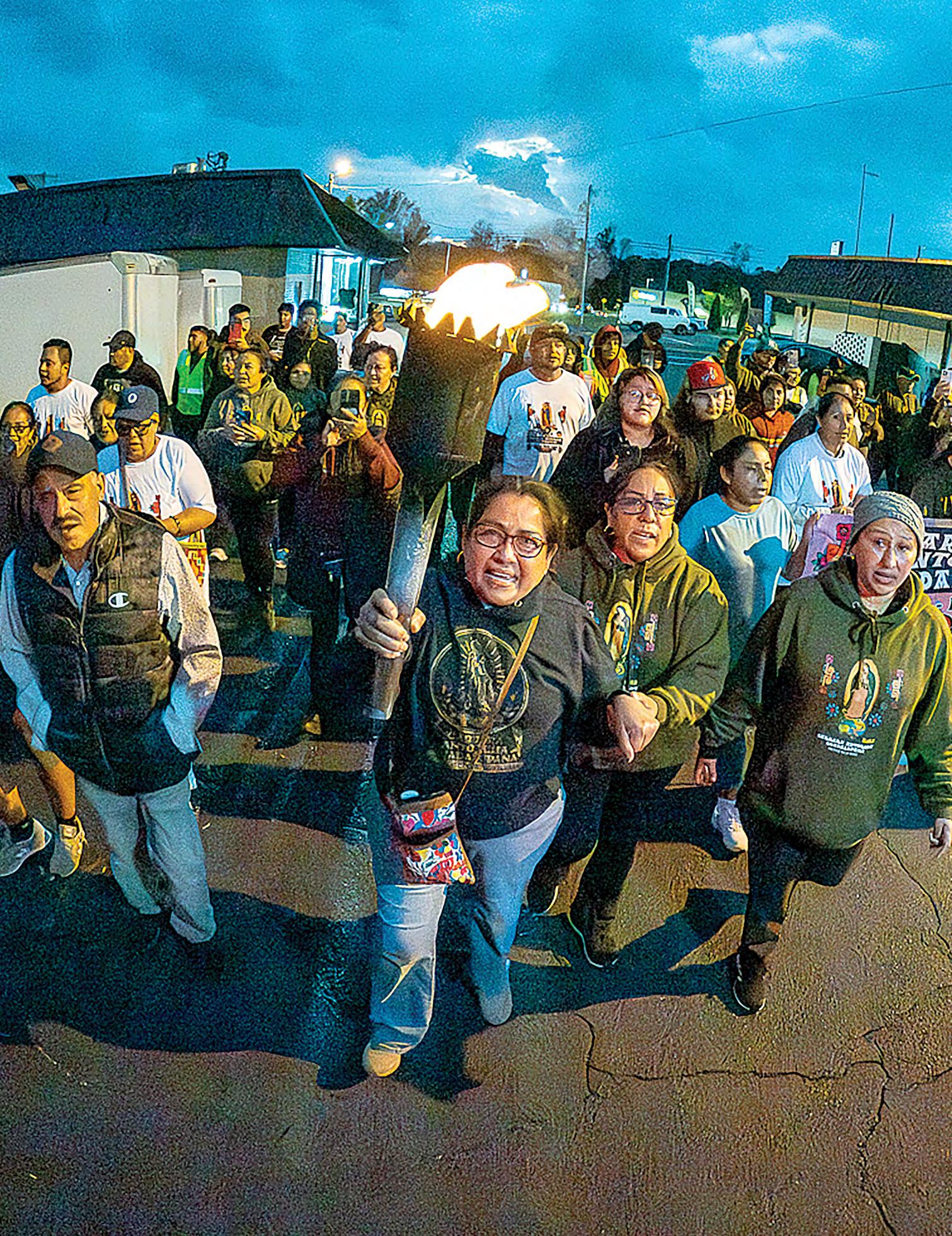
AshWednesday ushers in the season of Lent. This penitential time recalls the 40 days Jesus spent in the desert in preparation for His public ministry. Catholics traditionally use this time to grow closer to Jesus through three main practices: prayer, fasting and almsgiving. This year, make the most of your journey by finding creative – and meaningful –ways to pray, fast and be charitable. By Easter, you’ll feel rejuvenated in mind, body and spirit – ready to greet the Risen Lord.
Contact us 2
Español 20-21
Our Diocese 4-15
STAFF INDEX
EDITOR: Trish Stukbauer
3
704-370-3392, tmstukbauer@rcdoc.org
ADVERTISING MANAGER: Kevin Eagan
704-370-3332, keeagan@rcdoc.org
MULTIMEDIA DESIGNER: David Puckett 704-808-4521, dwpuckett@rcdoc.org
EDITORIAL TEAM: Kimberly Bender 704-370-3394, kdbender@rcdoc.org Lisa Geraci 704-370-3294, lmgeraci@rcdoc.org
Troy C. Hull 704-370-3288, tchull@rcdoc.org
Christina Lee Knauss 704-370-0783, clknauss@rcdoc.org Amelia Kudela 980-374-3411, arkudela@rcdoc.org Brian Segovia 704-370-3235, bmsegovia@rcdoc.org
COMMUNICATIONS ASSISTANT/CIRCULATION: Maria De Ugarte 704-370-3333, catholicnews@rcdoc.org COMMUNICATIONS DIRECTOR: Liz Chandler 704-370-3336, lchandler@rcdoc.org
ASSISTANT COMMUNICATIONS DIRECTOR: Patricia L. Guilfoyle 704-370-3334, plguilfoyle@rcdoc.org
THE CATHOLIC NEWS HERALD is published by the Roman Catholic Diocese of Charlotte 26 times a year.
NEWS: The Catholic News Herald welcomes your news and photos. Please e-mail information, attaching photos in JPG format with a recommended resolution of 150 dpi or higher, to catholicnews@rcdoc.org All submitted items become the property of the Catholic News Herald and are subject to reuse, in whole or in part, in print, electronic formats and archives.
ADVERTISING: Reach 165,000 Catholics across western North Carolina! For advertising rates and information, contact Advertising Manager Kevin Eagan at 704-370-3332 or keeagan@rcdoc.org. The Catholic News Herald reserves the right to reject or cancel advertising for any reason, and does not recommend or guarantee any product, service or benefit claimed by our advertisers.
SUBSCRIPTIONS: $17.25 per year for registered families of the Diocese of Charlotte and $25 per year for all others
POSTMASTER: Periodicals Class postage (USPC 007-393) paid at Charlotte, N.C. Send address corrections to the Catholic News Herald, 1123 S. Church St., Charlotte, N.C. 28203.
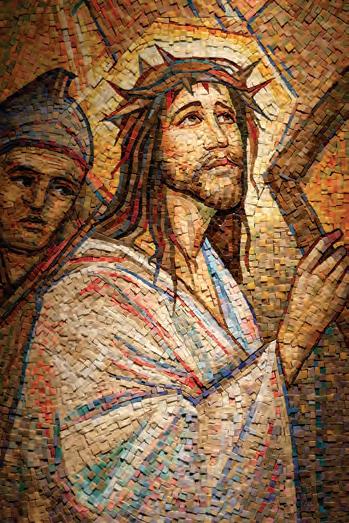

Remembering why we pray – to deepen our relationship with God – can help strengthen our prayer lives. This Lent, try something new – or something you have not done in a while – to get a fresh perspective on prayer. Follow the Stations of the Cross in your parish (learn about the Marian Stations of the Cross on page 3), pray the sorrowful mysteries of the rosary, find a new Lenten devotion on your favorite prayer app, or simply carve out some intentional time without distractions to talk to God in the quiet of a church, your home or in nature.
Giving up something for Lent should cause us to hunger – whether it’s for food, comfort or convenience. Hunger pangs remind us that only God can truly satisfy us. Adults (ages 18 to 59) are to abstain from eating meat and only consume one full meal on Ash Wednesday and Good Friday. Two smaller meals are permitted but combined should not equal a single normal meal. Additionally, Catholics (14 and older) are to
abstain from eating meat on Fridays during Lent. Meats include beef, pork, chicken and any other “flesh” meat. Fish and dairy are fine. Children, adults with physical and mental illness, and pregnant or nursing women are exempt from fasting. The U.S. bishops stress that “common sense should prevail” and that no one should jeopardize their health to fast. Consider also giving up a luxury or something that distracts you from time spent with Jesus – such as social media.
During Lent, we focus more intently on “almsgiving” by donating money, goods, time or talents to help lift up our brothers and sisters in need. Take this more active role in faith by donating to a charity that makes a difference (learn about Catholic Relief Services on page 5), giving away unneeded items or donating time and talent to an organization that needs volunteers.
— Catholic News Herald, OSV News, Catholic Relief Services

Scan the QR code for this week’s recommended prayers and activities

ESPAÑOL
VIÑEDO DE RAQUEL : ¿Es usted o un ser querido que busca la curación de los efectos de un aborto anterior? Los retiros de fin de semana son ofrecidos por Caridades Católicas para hombres y mujeres en todas las regiones de la Diócesis de Charlotte. Para obtener información, comuníquese con Karina Hernández: 336-267-1937 o karinahernandez@ live.com.
EVENTS
SAME SEAT: Celebrate Lent with Father Pat Cahill and friends in a six-week series of faith lived out in unexpected ways. 9:30-11 a.m. and 7-8:30 p.m. Wednesdays through March 25 at St. Matthew Church, 8015 Ballantyne Commons Pkwy., Charlotte, or online at its YouTube channel, @stmatthewcatholicchurch.
‘RISE, DO NOT BE AFRAID’: Annual women’s day of reflection 8:30 a.m.-12:30 p.m. Feb. 28 at St. Therese Church, 217 Brawley School Road, Mooresville. Sign up online at www. sainttherese.net/annual-womens-day-of-reflection-registration.
PRAYER SERVICES
ANOINTING OF THE SICK MASS: 10 a.m. Saturday, Feb. 28, St. Luke Church, 9800 Fairview Road, Mint Hill. For those who are seriously and physically ill because of sickness, mental health, or old age and those who are undergoing an operation when the sickness itself is serious and is the cause of the surgery. For information, call Mary Adams at 704-545-1224. VIGIL OF THE TWO HEARTS : Vigil begins with 8 p.m. First Friday Mass on Friday, March 6, followed by nocturnal Eucharistic Adoration and concludes with the 8 a.m. First Saturday Mass on March 7. St. Patrick Cathedral, 1621 Dilworth Road East, Charlotte. Sign up for an hour of Adoration at www.defendthefamily.org/two-hearts.
Ignorance of sacred Scriptures is ignorance of Jesus Christ, Pope Leo XIV said during his weekly general audience.
“The ultimate purpose of reading and meditating on the Scriptures,” he said Feb. 11, is “to get to know Christ and, through Him, to enter into a relationship with God, a relationship that can be understood as a conversation, a dialogue.”
Also, with Lent beginning Feb. 18, the pope said the season “is a time for deepening our knowledge and love of the Lord, for examining our hearts and our lives, as well as refocusing our gaze on Jesus and His love for us.”
“May these coming days of prayer, fasting and almsgiving be a source of strength as we daily strive to take up our own crosses and follow Christ,” he said during his audience in the Paul VI Audience Hall.
In his main catechesis, Pope Leo continued his series of talks on Vatican II, specifically the Dogmatic Constitution “Dei Verbum,” on divine revelation and the Word of God.
The Word of God is a source of comfort, guidance and strength for Christians, he said, and it should be shared with others, too, he said.
“Indeed, we live surrounded by so many words, but how many of these are empty!” he said.
“On the contrary, the Word of God responds to our thirst for meaning, for the truth about our life,” he said. “It is the only Word that is always new: revealing the mystery of God to us, it is inexhaustible, it never ceases to offer its riches.”
Sacred Scripture is “the means by which we come to know the incarnate living Word of God who is Jesus Christ,” the pope said. “Indeed, praying with Scripture opens the door for an intimate relationship with God who, through these sacred writings, invites us into conversation with Him.”
“As St. Jerome rightly points out, ignorance of Scripture is ignorance of God,” he said, encouraging all faithful to read and reflect on the word of God every day, so that it may “nourish our hearts and our minds and lead us to the fullness of life.”
ROBERT
FASTIGGI OSV News
Theseason of Lent directs us to recall our own baptism and prepare for the celebration of the paschal mystery of the passion, death and resurrection of Christ. It is a time of prayer, fasting and almsgiving, and it helps us grow closer to Jesus.
In celebrating Lent, it is good to recall the teaching of the Second Vatican Council, that the “Church honors with special love the Blessed Mary, Mother of God, who is joined by an inseparable bond to the saving work of her Son.”
Mary is the perfect companion for Lent, and Lent is a ideal time to deepen our love, knowledge and veneration of the Mother of God. Lent is also a season of conversion, and here, too, we receive great help from Mary who, as the Mother of Mercy, points us to her divine Son, Jesus Christ, who came into the world to reconcile sinners to himself (Lk 5:31-32).
In his general audience on Ash
These words of Pope Francis help us to appreciate one reason why Mary is the perfect companion for Lent: She is the model of the perfect disciple because she entrusted herself completely to God.
As our spiritual mother, Mary not only leads us to Christ, but she also protects and guides us from sin. Lent is a time to renew our devotion to Mary as our spiritual mother who cares for us in the midst of challenges and difficulties.
One of the oldest known prayers to Mary is known as the “Sub Tuum Praesidium” (“Under Thy Protection”), which goes
back to the third or fourth century. One translation of it reads: “We fly to Thy protection, O Holy Mother of God; Do not despise our petitions in our necessities, but deliver us always from all dangers, O Glorious and Blessed Virgin. Amen.”
Because Lent is a time to turn away from sin, it is also an ideal time to recognize the gift that Our Lord Himself gave us, giving us His own mother as our mother while He was dying on the cross (Jn 19:25-27). St. John Paul II recognized that Jesus gave Mary as mother not only to the beloved disciple but to all of the faithful.
Mary’s spiritual motherhood is the basis for the “Marian dimension” of the life of
While the Stations of the Cross are well known, there is the parallel pious exercise known as the “Via Matris” or “way of Mary.”
This devotion centers on the seven sorrows (or dolors) of Mary, which have a sure Scriptural foundation:
Mary and the disciple John stand at the foot of cross in this depiction of Christ’s crucifixion at Holy Family Church in the West Bank city of Ramallah.
There are many variations of Via Matris, with different opening and closing prayers, but all include meditation on the seven sorrows. The Directory on Popular Piety and the Liturgy, issued by the Congregation for Divine Worship and the Discipline of the Sacraments in 2002, says the “Via Matris” harmonizes well “with certain themes that are proper to the Lenten season.” It also notes that the Via Matris provides “stages on the journey of faith and sorrow on which the Virgin Mary has preceded the Church, and in which the Church journeys until the end of time.”

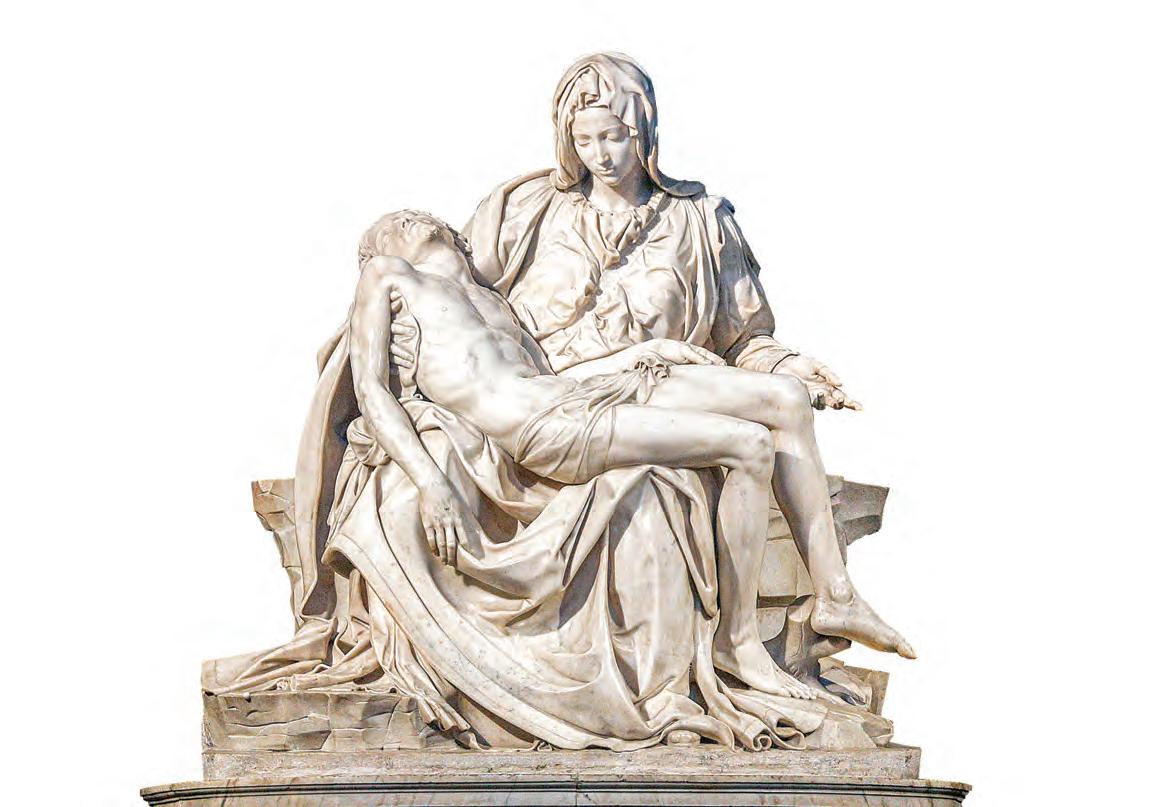
The prophecy of Simeon (Lk 2:34–35)
The descent of Jesus from the cross (Mt 27: 57–59) 2 1 3 4 5 6 7
The flight into Egypt (Mt 2:13)
The loss of Jesus in the Temple (Lk 2:43–45)
Daily Scripture readings “Those who are healthy do not need a physician, but the sick do. I have not come to call the righteous to repentance but sinners.”
— Luke 5:32, part of the daily readings for Feb. 21, the Saturday after Ash Wednesday
The meeting of Jesus and Mary on the way to Calvary (Lk 23:27)
The crucifixion of Jesus (Jn 19:25)
Snap the QR code (right) to get the Mass readings for every day, in English or Spanish, online at the U.S. Conference of Catholic Bishops’ website.
The burial of Jesus (Jn 19: 40–42)

For the latest news 24/7: catholicnewsherald.com
CHARLOTTE — Alan Ames, a Catholic evangelist who travels the world sharing his powerful conversion story and gift of healing, will visit three parishes in the area March 24-26. Each evening will begin with Mass and will be followed by a talk by Ames and then a time of prayer and a healing service.
Ames also visited the diocese in 2015 and 2017.
Ames was born in 1953 in London. In his youth, he was a member of a motorcycle gang, on a path fueled by violence and alcohol. After he was married, Ames moved to Australia with his family. The turning point of his life happened in 1993 when Ames saw his life displayed before him and experienced how his sins had hurt God. He saw how Jesus offered him forgiveness from the cross. After some struggles, Ames accepted the forgiveness offered by Jesus. The Lord helped him to come back to the sacraments and to the Church and changed his hatred and pain into love.
Later, God called him to be one of His witnesses, sent to carry God’s love into the world. He has brought hope and blessing to hundreds of thousands of people worldwide.
On Tuesday, March 24, Ames will be at Holy Family Church at 4820 Kinnamon Road, Winston-Salem. Mass will begin at 6 p.m.
On Wednesday, March 25, he will be at St. Philip the Apostle Church, 525 Camden Dr., Statesville. Mass will begin at 6 p.m.
On Thursday, March 26, he will be at St. Michael the Archangel Church, 708 St. Michael’s Lane, Gastonia. Mass will begin at 6:30 p.m.
A talk and healing service by Ames will be held immediately after Mass each evening. For more information about Ames and his healing ministry, go to www.alanames.org.
— Catholic News Herald
Catholics in the Diocese of Charlotte can take part in a national online Lenten Bible study that offers perspectives on Scripture combined with culturally relevant topics that Black Catholics are facing in today’s world.
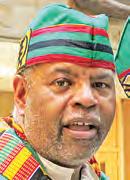
The Bowman Francis Bible Study, “Were You There? Journey Toward Hope,” will be offered online at 7 p.m. Wednesdays via Zoom from Feb. 25 through March 25.
The study will be led by Father Charles Smith, a priest of the Society of the Divine Word, based in Louisiana.
Each lesson clearly connects the truth of God’s Word to the user’s life and offers perspectives on spiritual growth and life transformation.
To register and download a copy of the study guide, visit www.bowmanfrancis.org.
— Christina Lee Knauss

‘Dig deeper’ this Lent
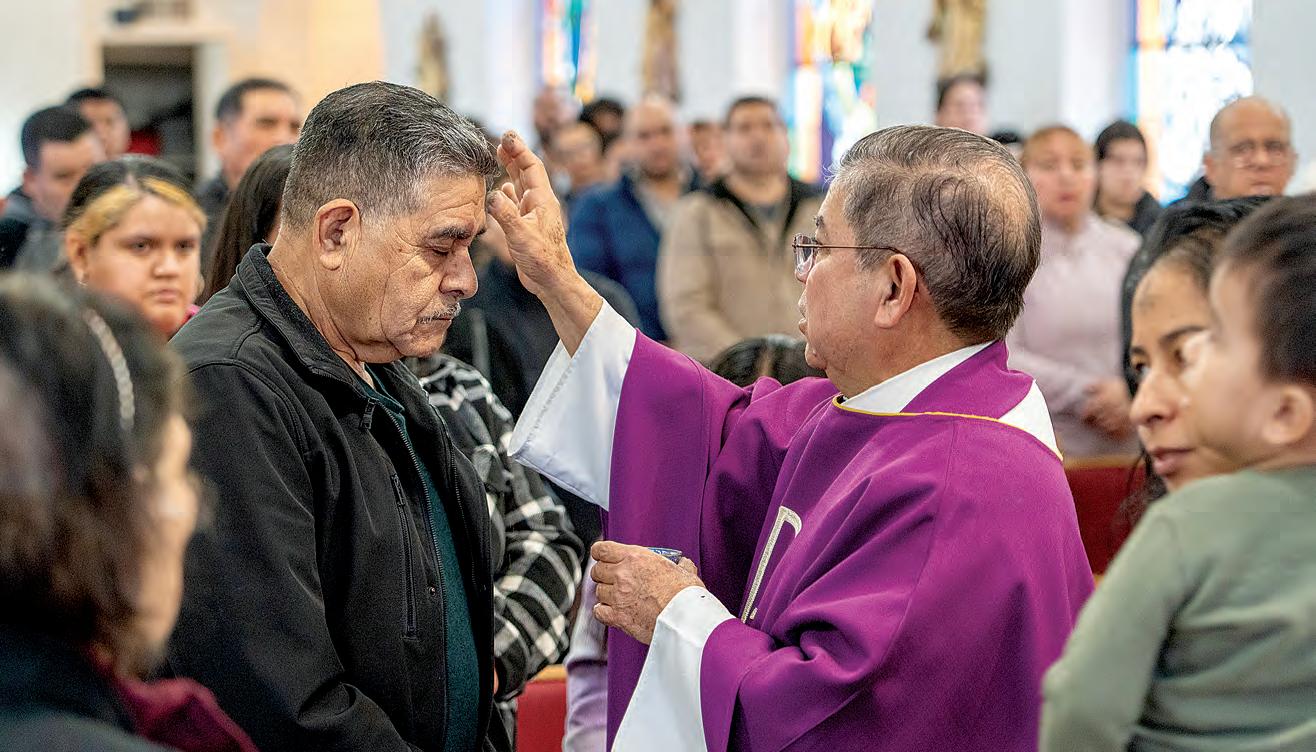
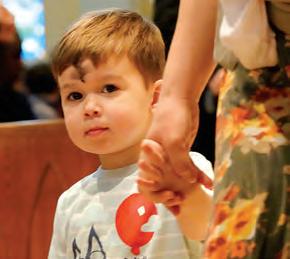
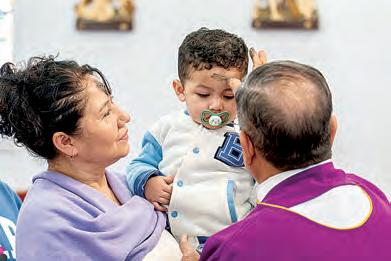
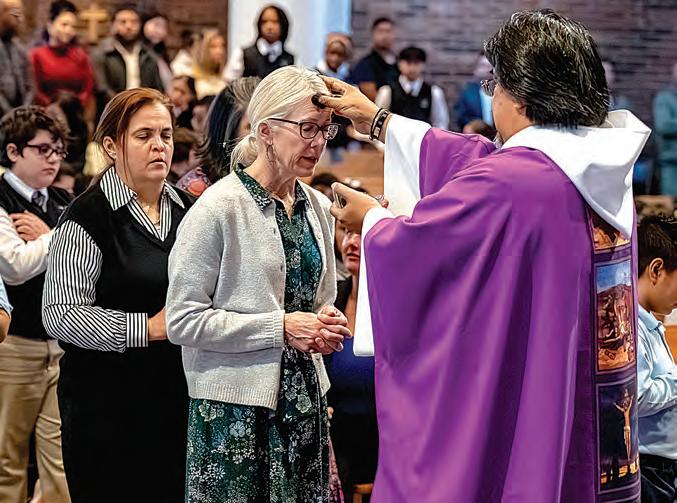
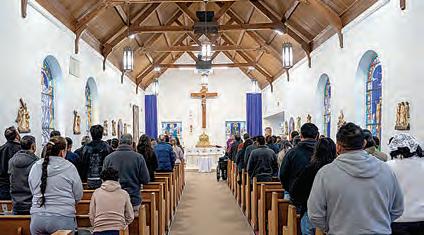
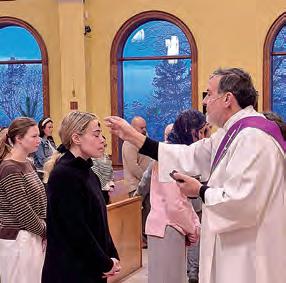
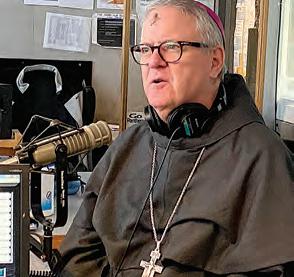
Ash Wednesday marked the start of the penitential season of Lent. It was a day of fasting, abstinence and prayer as Catholics prepared their hearts and minds for a spiritual journey over the next 40 days leading up to Easter Sunday. Around the Diocese of Charlotte, people turned out by the thousands to receive ashes – a visible sign of our fragile humanity and that we are all sinners in need of a Savior. In a message
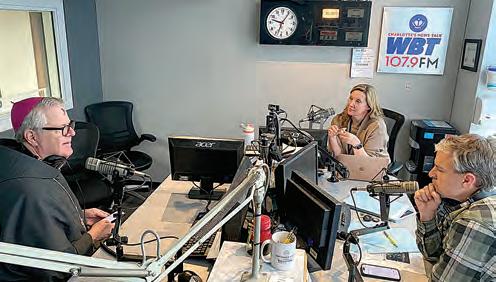
on social media and radio for Ash Wednesday, Bishop Michael Martin, OFM Conv., urged people to move from simply being believers to becoming disciples willing to carry Jesus’s message into the world: “My call to all Christians, in particular to Catholics in our diocese here, is to use these 40 days to dig a little deeper and to see whether or not they’re open to exploring deeper relationship with Christ in the Church through discipleship.”
Adriana, 14, attends a Catholic Relief Services nutrition education class in Timor-Leste, a southeast Asian island nation. Although she has to walk a long distance to school, she likes science and wants to become a doctor. Catholic Relief Services supported nutrition and health initiatives for adolescent girls and young women in 21 communities in Timor-Leste.
BENNY MANSER | CATHOLIC RELIEF SERVICES

Ascountries around the world reduce funding for international humanitarian aid and hunger continues to rise, Catholic Relief Services (CRS) invites Catholics across the United States to pray, fast and give alms through its annual Lenten program, CRS Rice Bowl.
Ongoing conflicts, extreme weather and persistent inflation are driving up food prices, pushing more families into hunger. According to the United Nations, nearly 700 million people worldwide face hunger today, just as cuts to humanitarian aid are leaving millions with fewer lifelines. This makes faith communities and programs like CRS Rice Bowl more critical than ever.
“The past year has been incredibly difficult for so many families around the world,” said Sean Callahan, CRS’s president and CEO. “We’re seeing more people go hungry just as the resources available to help them are being reduced. CRS Rice Bowl offers Catholics in the U.S. a meaningful way to respond and affirm that no one is forgotten.”
Rooted in Catholic social teaching and the Lenten practices of prayer, fasting and almsgiving, CRS Rice Bowl invites participants to live the principle of solidarity – recognizing that all people are part of one human family.
Donations to CRS Rice Bowl support CRS programs around the world that address hunger and poverty by tackling their root causes. In addition, 25% of funds collected remain in local dioceses to support hunger-relief efforts. As many families nationwide struggle with rising costs of living, these local investments are more vital than ever.
“As Catholics, we are called to serve those
most in need, especially when the challenges feel overwhelming,” Callahan said. “Right now, families everywhere are feeling the strain of rising costs, no matter where they live. CRS Rice Bowl offers Catholics in the United States a tangible way to live out their Lenten almsgiving, transforming small, personal sacrifices, like skipping a weekly coffee, into a greater impact for families facing hunger.”
Since its founding in 1975, CRS Rice Bowl has raised more than $350 million and impacted people like Adriana, a 14-year-old girl who lives in the remote village of Ermera in Timor-Leste.
Malnutrition is common among adolescent girls on the small southeast Asian island.
Adriana faces long treks to school, seasonal food scarcity and limited access to nutritious food.
The family’s income from coffee harvesting lasts only a few months each year, so balanced meals are rare outside of harvest season.
“If it’s the coffee harvest season, we have money and can have these types of [nutritious] foods weekly, but if it’s not coffee season, then it might be once every two weeks or once a month,” Adriana said.
Adriana attends monthly sessions put on by CRS and local organizations to learn how to improve her nutrition and self-care. In these sessions, Adriana learns about how conditions like anemia, often caused by low iron levels, lead to fatigue and weakness.
“When I attend the nutrition session, it helps me to understand more about the importance and benefit of food for my development,” Adriana said. “When I eat good nutritious food, it will help me to grow healthy to support my brain [functioning], so I can learn more and achieve my dream. I want to be a doctor, to be healthy and help others because in our villages there is no doctor.”
By fueling her body with nutritious food and her mind with plans to obtain a life-changing education, CRS Rice Bowl participants are creating futures filled with hope.

Batar Da’An is a satisfying stew made of squash, beans and corn and is beloved in Timor-Leste. Though it uses simple ingredients, it is packed with flavor and healthy nutrients. Servings: 4
PREPARATION
n In a large pot over medium heat, heat the
n Add onion and garlic and sauté until tender.
n Add water and squash, and increase heat until water is simmering.
n Add corn and kidney beans and cook, stirring occasionally for 15-20 minutes until squash is tender.
n Add salt and pepper to taste.
n Serve with rice.
CHRISTINA LEE KNAUSS clknauss@rcdoc.org
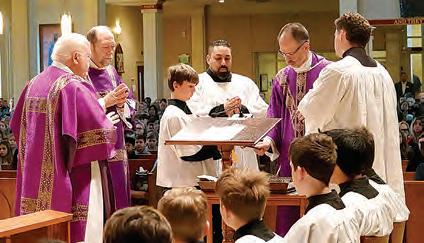
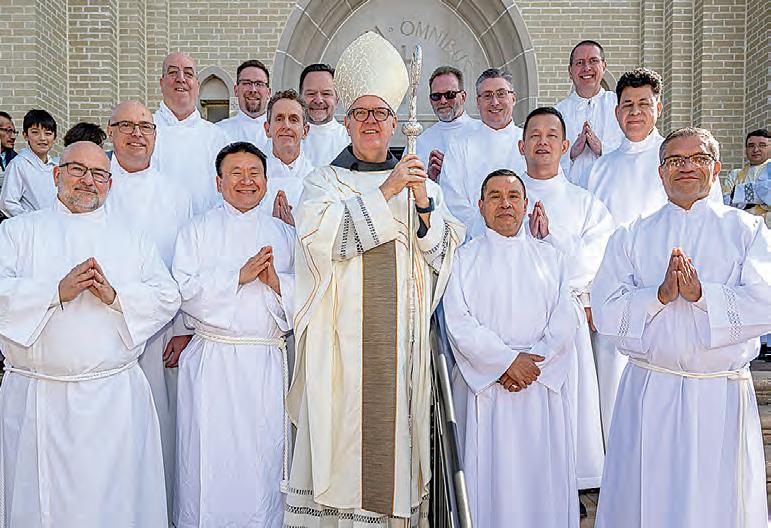
CHARLOTTE — The path to becoming permanent deacons became one step shorter for 14 men from across the Diocese of Charlotte as they were instituted to the role of acolyte Feb. 14 by Bishop Michael Martin, OFM Conv.
As acolytes, the men are now entrusted with the duties of attending to the altar, assisting the deacon and priest at Mass, and distributing Holy Communion as extraordinary ministers. This is the third important step on their way to becoming deacons, with ordination for this current group anticipated for 2027.
During the institution rite at St. Patrick Cathedral, the 14 men approached the altar one by one and knelt before the bishop. He placed a container used to hold consecrated hosts, called a ciborium, in their hands and said, “Take this vessel with bread for the celebration of the Eucharist. Make your life worthy of your service at the table of the Lord and of his Church.”
The 14 who became acolytes are: Francis Ahn of St. Matthew in Charlotte, John Baughman of Sacred Heart in Salisbury, Eduardo Gaspar of St. Charles Borromeo in Morganton, Eric Kennedy of St. Mark in Huntersville, Timothy Knorr of Immaculate Heart of Mary in High Point, Huy Le of St. Mary’s in Greensboro, Bruce Mlakar of St. Matthew, Christopher Neubauer of St. Paul the Apostle in Greensboro, Tracy Neumann of St. Therese in Mooresville, Jose Oviedo of St. James the Greater in Concord, William Parker of St. Pius X in Greensboro, William Tolone of St. Thomas Aquinas in Charlotte, Oswaldo Vargas of St. Joan of Arc in Candler, and Eric Yarrington of St. John the Evangelist in Waynesville.
A year earlier, Bishop Martin had instituted the same 14 men as lectors, and in his homily on Saturday he reflected on the bridge between their former and new roles.
As lectors, he said, they had the opportunity to not only proclaim the word of God for the people but to experience its power in their own lives. As acolytes, he said, they will face the responsibilities of
LISA M. GERACI lmgeraci@rcdoc.org
BELMONT — On the feast of St. Valentine, Feb. 14, about 80 people met at the Sisters of Mercy campus to focus not on their own intimate relationships but on love for “the least of His people” – the poor and the marginalized.
Deacon Scott Gilfillan, founder and executive director of Font of Mercy, a nonprofit supporting the homeless and marginalized, led the discussion into “Dilexi Te” (“I have loved you”), Pope Leo XIV’s first apostolic exhortation on love for the poor. The talk was sponsored by the Sisters of Mercy, Catholic Charities Diocese of Charlotte and the Font of Mercy.
“Deacon Gilfillan, in his presentation, ‘Dilexi Te: The Love that Calls us Back,’ beautifully shared Pope Leo XIV’s message of God’s unconditional love which calls us to respond with hearts of love for those who suffer and who are poor,” said Joseph T. Purello, director of Catholic Charities’ office of social concerns and advocacy.
serving at the altar as well as bringing the powerful message of the Eucharist to the people in the pews and the world outside the church walls.
“Now, as acolytes, you are called to make certain that the ritual (of the Mass) is carried out in a way that gives honor and glory to God and invites the people of God to bring their lives to the altar and place their lives in communion with Christ,” Bishop Martin said.
He told the men to allow their new role as acolytes to have a profound impact on their spiritual lives. He asked them to consider: “How are you bringing your own lives to the altar?”
“You will wrestle the challenge of both being in service and also being formed by what you do as acolytes,” Bishop Martin said. “For the rest of your life you will be recognizing that ‘I am part of something bigger.’ Serving for the many but also for your own spiritual wellbeing. God is willing to do something in you.
“Seek to understand the deep spiritual meaning of what you do.”
After the Mass, the new acolytes gathered on the steps of the cathedral for photos and talked joyfully with family members and friends.
“This experience is inspiring because yet another chapter in my spiritual journey starts today,” John Baughman said.
Francis Ahn said the experience of becoming an acolyte “felt amazing.”
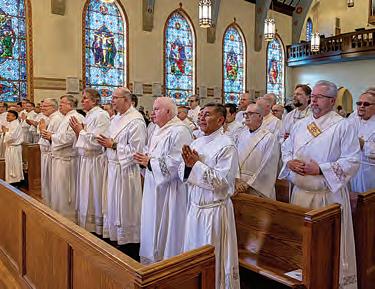
Deacons from across the diocese renewed their promises and witnessed 14 men taking the next step on their paths to becoming permanent deacons during a Feb. 14 Mass at St. Patrick Cathedral. The Mass was rescheduled due to the winter storms that impacted the region a few weeks ago. Their ordination as permanent deacons is anticipated to take place in 2027.
“It’s a wonderful feeling to just be blessed by the formation I’m receiving,” he said. “I’m so blessed that God called me to this path.”
The Mass also offered an opportunity for more than 35 deacons from around the diocese to renew the promises they made at their ordinations. They stood and answered a series of questions from Bishop Martin about the continued commitment they will show for their faith and duties as deacons, starting with: “Do you resolve to discharge the office of deacon with humble charity in order to assist the priestly order and to benefit the Christian people?”
Those promises brought back memories of 38 years in the permanent diaconate for Deacon Ron Caplette, who is retired but still serves at St. Aloysius in Hickory. At 89, Caplette, who served in the U.S. Marine Corps, is the oldest permanent deacon in the diocese. He said renewing his promises led him to look back on his years of service at his current parish as well as at St. Joseph in
Newton and St. Francis of Assisi in Lenoir.
“Being a deacon has been a wonderful journey for me,” Deacon Caplette said. “I have experienced God in so many different ways, especially when I was working with terminally ill people and doing work in hospitals.”
Deacon Caplette felt joy as he watched the 14 men become acolytes.
“It’s wonderful to see a new group of prospective deacons and rewarding to know that, as some of us seniors retire, there are new men coming in who are receiving great instruction and are ready to serve.”
More online
At www.catholicnewsherald.com : See more photos from the Mass for the Rite of Acolyte and Affirmation of Promises by Deacons
Day message of love focuses on care for the poor
“Dilexi Te” is a call to action stemming from Pope Francis’ encyclical “Dilexit Nos” (“He loved us”) and an invitation to follow in the footsteps of St. Francis of Assisi, St. Teresa of Calcutta, and St. Lawrence.
“If you love Jesus, you have to love the poor,” said Deacon Gilfillan, who also serves at St. Joseph Parish in Newton.
Deacon Gilfillan intertwined Bible passages mentioned in “Dilexi Te” in his message to illustrate that serving the poor is at the core of discipleship.
The burning bush Moses encountered symbolized where God saw the affliction and heard the cry of His people.
Mary Magdalene’s anointing of Jesus acknowledged the poor would always be with us. And, of course, Jesus worked as a carpenter and gleaned in fields for food.
“Mary and Joseph on their way to Bethlehem were homeless. Jesus was born in an animal feeding trough, exiled as a refugee to Egypt,” Deacon Gilfillan said. “Taking care of the poor is not just what we do, but who we are.”
Deacon Gilfillan said if Jesus were to come
into this world today, He would be at homeless shelters, at soup kitchens and curing the sick.
“God loves us so much, but He especially loves us when we are poor and when we are broken,” Deacon Gilfillan said.
Deacon Gilfillan shared his experiences as a volunteer for Strong Life Rescue Mission in Hickory. He said he intended to be a spiritual director but instead spends most Wednesdays driving a bus filled with unhoused people from the transport station to the day center or to government social services offices. The volunteer work seems tedious, yet it is on this bus where connections are made, evangelism takes place and he sees Christ’s face in the poor, he said. And in his work, he has learned he does not always play the role of evangelist.
“All of us should let ourselves be evangelized by the poor,” he urged.
For example, Lauren, a homeless woman with multiple sclerosis, has a daily mission of making Deacon Gilfillan smile, despite her own challenges, he said. Showing him the tattoo of her exhusband’s name on her neck, which she
later changed to a Bible verse by adding “1:9” to the end of the word “Joshua,” did make him grin.
“Do not be afraid; do not be discouraged, for the Lord your God will be with you wherever you go,” Deacon Gilfillan recalled the verse with a smile.
While he does a lot for the homeless who are easily seen on the streets, he noted that the socially marginalized, the morally and spiritually poor, and those who are culturally or medically impoverished may be hiding unnoticed.
He encouraged participants to look around and ask who they can help – and how.
Though many came to the seminar for different reasons, they found a new way to spread God’s love thanks to Deacon Gilfillan’s inspirational words.
“Deacon Gilfillan reminded me of what Christ did,” Mark Walters, a parishioner of St. Aloysius in Hickory, reflected. “Christ asked, ‘What can I do for you?’ and that is probably how I should start greeting every person.”
LISA M. GERACI lmgeraci@rcdoc.org
CHARLOTTE — Members of religious orders who serve in the Diocese of Charlotte came together Feb. 7 for the annual Consecrated Life Mass offered by Bishop Michael Martin, who also celebrates with them as a religious Conventual Franciscan.
The special Mass offered at St. Patrick Cathedral in Charlotte marked the 30th World Day of Consecrated Life, which was instituted by St. John Paul II in 1997 to honor women and men religious.
Bishop Martin echoed Pope Leo XIV’s sentiments spoken Feb. 2 at St. Peter’s Basilica designating men and women religious as “messengers who announce the presence of the Lord and prepare the way for Him.”
Bishop Martin called “the collection” of religious, including himself, an example of “prophetic witnesses of peace and justice” who continue to offer the same message of hope found in the readings about the prophets Isaiah and St. John the Baptist.
“As consecrated men and women, we are here today with purpose, regardless of our age, regardless of our charism of community, regardless of our degrees of fidelity, regardless of our number,” the bishop said.
“The special place of consecrated life has to be held up,” he said. “First and foremost, by us not to imagine ourselves as some appendage in the life of the Church, but rather at the heart of the Church. Calling her to something beyond this moment. Are you up for that?”
The 50 or more religious were up to it, listening as Bishop Martin urged them to live as an expression of justice and peace within their homes, never forgetting the call and zest God placed in them to be Christ-like examples.
“Look in your own residences, convents, communities, rectories,” the bishop said. “Where is the justice and peace emanating, screaming to the world, that this is how it should be?”
“That is the nature of the consecrated life,” he said, garnered through Mass readings from Isaiah 61 and John 15. “To stand, or sit, or tumble through this life. People should look to us and for us to say something that makes them a little uncomfortable but also gives them hope. What is that hope? A mission of justice and peace.”
“The diocese does not need your work,” he said. “It needs the witness of your life. What you bring to the local Church is not what you do but who you are, and that is
70 years: Mercy Sister Marian Joseph
Baird
60 years: St. Joseph Sister Janis McQuade
50 years: Mercy Sister Pat Coward; Benedictine Father Christopher Kirchgessner
25 years: Benedictine Brother Emmanuel Slobodzian
harder, a lot harder.”
He concluded his homily by encouraging the crowd to “lean into the call” by rediscovering their communities and recommitting to their charisms. Only then can the community be grounded in the rich gift of prophetic witness in the Church, he said.
Five were honored at the event as “jubilarians,” celebrating an anniversary milestone in their lives as consecrated religious.
JUBILARIANS RECOGNIZED
The jubilarians present were both Benedictine monks of Belmont Abbey. Father Christopher Kirchgessner celebrated his 50th anniversary and still teaches at Belmont Abbey as a professor of theology. Brother Emmanuel Slobodzian, who came to the order at the age of 54, celebrated his 25th year. He continues to find sheer joy in the way of the Church and living out his vocation day by day.
Although unable to attend, Sister Marian Joseph, a Mercy sister and missionary nurse who spent her youth serving the impoverished communities in Belize, was noted for her 70-year jubilee. Also recognized for her 50th anniversary was Sister Pat Coward, well known for leadership within the community.
The other Mercy Sisters shared congratulatory words about their sisters at the reception after Mass.
“Pat has been a voice for mercy for several years,” Mercy Sister Carmelita Hagan said. “She is a gift and a leader for our community, and I love her. Marian Joseph is a real witness of spiritual life for me. She spends a lot of time in chapel and prayer.”
The Benedictine monks of Belmont Abbey and the Sisters of Mercy have ministered in western North Carolina for more than 100 years.
Sister Janis McQuade of the Sisters of St. Joseph, who serves at St. Stephen Mission in Elkin, was also commended in her
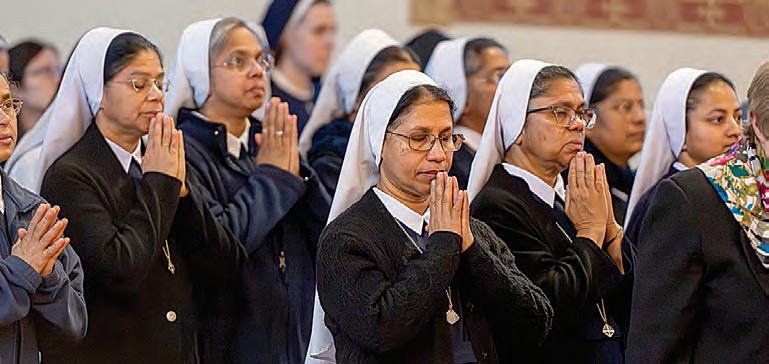
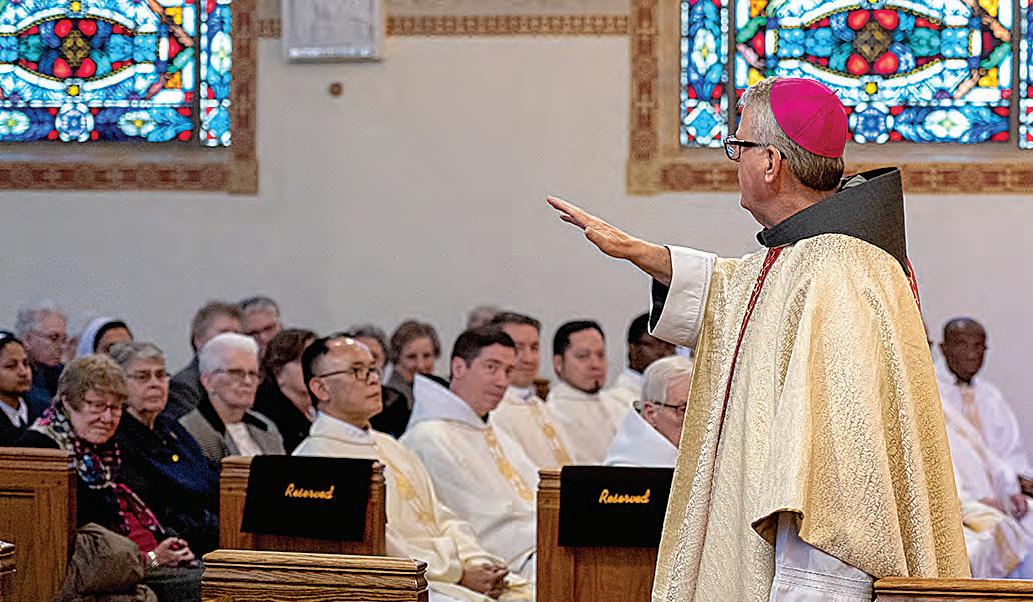
On the 30th World Day of Consecrated Life, members of religious orders from across the diocese came together to celebrate their calling. Bishop Michael Martin, who is a Conventual Franciscan, encouraged his brothers and sisters to be Christ-like examples who are not afraid to challenge others.
absence for her 60 years of consecrated life.
After Mass, everyone convened in the cathedral’s fellowship hall to share a meal and time together, the bishop encouraging them to sit apart from their orders.
While eating, the bishop asked them questions to answer among themselves.
“I think we are all witnesses to our love for God, and the bishop expressed that
very eloquently during Mass today,” Mercy Sister Laretta Rivera-Williams said. “But during our conversation today, we were told it was nice to see older religious. It gives the younger sisters something to look up to. Being a senior in this group, I want to cherish that and take it home. So sisters, if you are over 30, know that the younger sisters are looking up to you.”

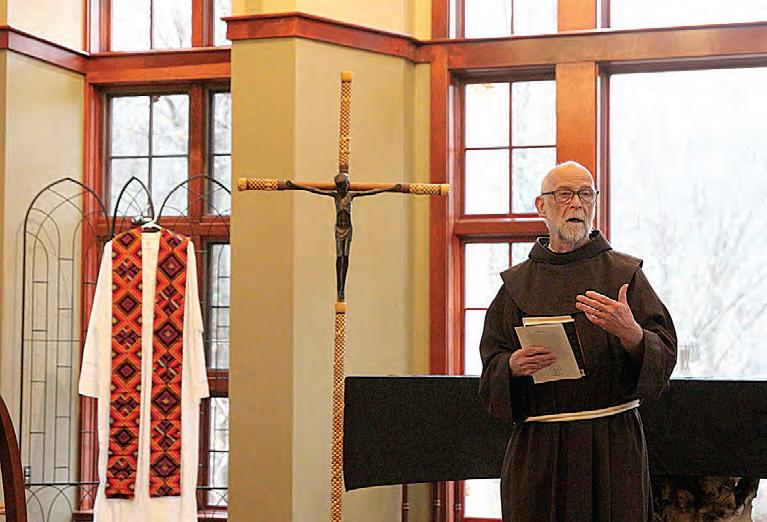
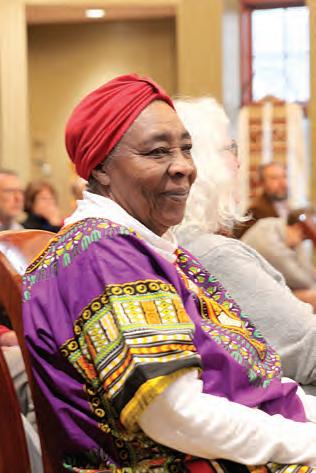
About 70 people gathered Feb. 15 at St. Francis Springs Prayer Center to dedicate a new outdoor worship space. The“Hush Arbor” honors the secret prayer gatherings once held in wooded clearings by enslaved African Americans. The dedication was the first event of the center’s Black History Month celebration.
BY
LISA M. GERACI
lmgeraci@rcdoc.org
STONEVILLE — Rain kept visitors from gathering beneath the trees, but it could not keep them from remembering why they had come.
On a cold, wet morning Feb. 15, about 70 people crowded into the small chapel at the St. Francis Springs Prayer Center to dedicate a new outdoor worship space called “Hush Arbor” – a place meant to honor the secret prayer gatherings enslaved African Americans once held in wooded clearings. The dedication was the first event of the center’s Black History Month celebration.
“Hush Arbor” is a new prayer space that pays tribute to the region’s history of African American slaves, who often resorted to secretly hiking through swamps to forgotten property edges that were protected by leafy pines or oak trees to practice their religion.
“They called it ‘Hush Arbor’ because it was behind trees and rocks of the
plantation, so the sound wouldn’t carry,” explained Franciscan Father Bob Menard, friar in residence at the St. Francis Springs Prayer Center. “That’s where they would sing their spirituals, share their information, and praise God.”
Though rain set the visitors apart from the space they had come to dedicate, Father Menard called the guests to imagine a different time, when slaves secretly gathered to share their humanity, love of God and unique gifts.
“The Africans during that time were from different countries and cultures, and this place is where they forged what would be recognized today as African American worship,” Father Menard said.
space, four celebrants poured water into a large container, which will be brought out to consecrate the grounds of Hush Arbor on a better weather day.
Father Menard prayed, “With the energy of Your love, help us to take what we have inherited and what we have heard and carry it, first in our hearts, so that they may radiate it in every fiber of our flesh, and we are able to walk with our ancestors, our heads held high … bringing peace, justice, mercy and sacrifice into the world in which we walk.”
Bible delivered by slaveowners, sermons focused on the need to obey a master, and hymns that reminded them how far from their African choral roots they were.
In that small natural space, many found a God who did not measure their worth by the color of their skin. Hush Arbors transcend time – their existence still evidenced in the hymns and preaching style found in Black churches throughout the United States.
The prayer vestments of African American ministers of the time hung in the four corners of the Franciscan chapel, while the Rev. Allen Jones sang plantation spirituals such as “Open Unto Me,” “Sing a New Song” and “Joy, Joy, God’s Great Joy.”
In an act of libation, bridging African American ancestral roots with the new spiritual worship
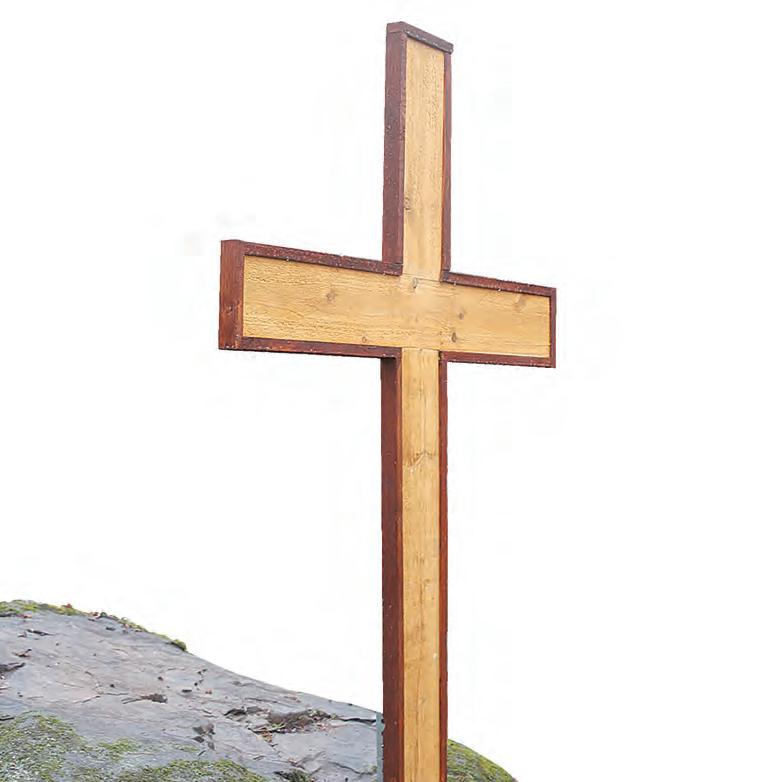
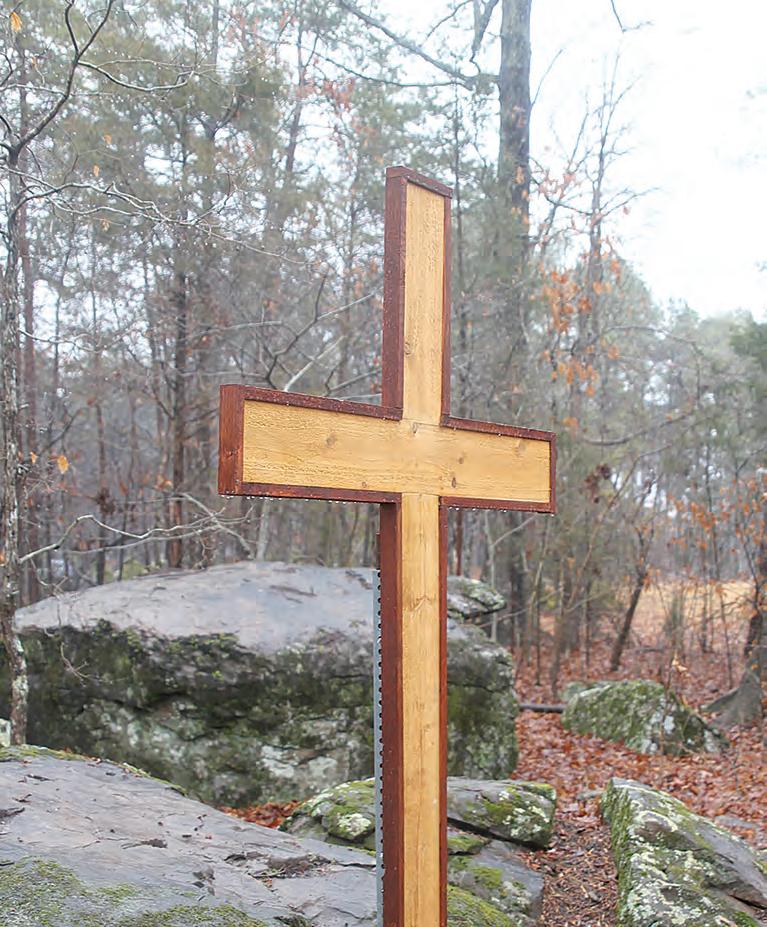
The new Hush Arbor, like those of old, is not easily found on the expansive 140-acre property. It consists of the same natural elements used in the original safe places that dotted the Carolina landscape from the late 1700s up to the end of the Civil War.
“They had the opportunity to cry out with all their strength and with their whole voice in the shelter of the Hush Arbor,” Father Menard said.
These “invisible churches” were where Blacks could celebrate liturgy on their own terms without biased interpretations of the
For some, St. Francis Springs Prayer Center has become a new Hush Arbor, a safe place for people to connect with God in nature.
“I keep a running list of the Black and Brown people that come to my office and explain how safe they feel here,” St. Francis Springs’s director Steve Swayne said. “That has happened to me 121 times in six years.”
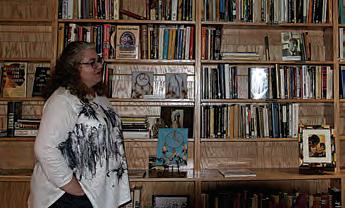
The space pairs well with the Library of the Disinherited, whose 1,800 books constitute the largest private collection of minoritywritten books in North Carolina.
It was started by the center’s former director Franciscan Father David Hyman, who spent most of his years ministering in African American communities.
“He collected 1,600 books, and the whole library is his collecting and reading and learning about Black culture,” Swayne said. “That whole library is basically dedicated to all the people who have been kicked around in America.”
There is also a prayer wall of African Americans in the process of becoming saints. While there are no canonized
The idea to recreate a Hush Arbor came from Father Menard. The prayer center made the beautiful outdoor, naturallooking chapel in an outcropping of trees, with graveled walkways and benches surrounded by trees and large rocks. Upon its completion, Director Steve Swayne was still in need of a name for the unique space.
“Have you ever heard of a ‘Hush Arbor’?”
Father Menard asked him.
Swayne was inspired by the recommendation and called 20 of his Black friends for feedback on the name suggestion, and they all agreed it was a great idea.
African American saints yet, on Feb. 9, the Diocese of Jackson, Mississippi, closed its investigation and sent Servant of God Sister Thea Bowman’s case to the Vatican to be reviewed. Others on the path to canonization are Venerable Pierre Toussaint, Venerable Henriette Delille, Venerable Augustus Tolton, Servant of God Mother Mary Lange, and Servant of God Julia Greeley.
“There are no Black saints in North America yet. So, we wanted to highlight those six and to encourage the Catholic Church to canonize them – like, now is the time,” Swayne said.

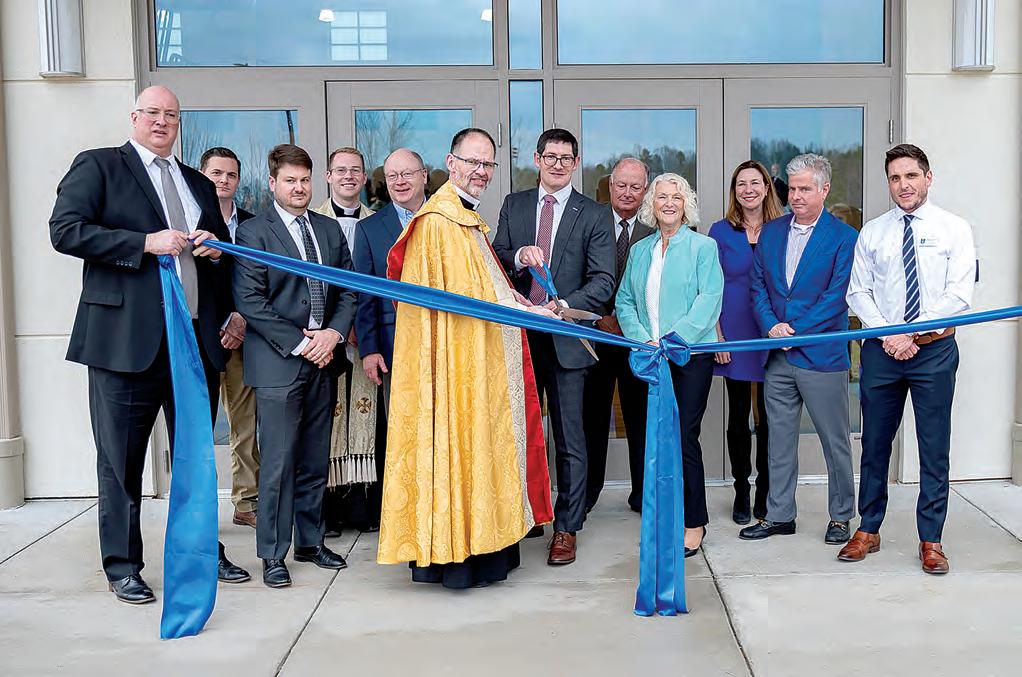
For 40 years, Jim Kelley has faithfully served the Diocese of Charlotte through steadfast leadership in development and philanthropy.
Catholic Schools across our region are deeply grateful for the impact of his work, which has expanded opportunity for students and ensured the continued vitality of our educational mission.
We celebrate Jim’s 40 years of service with profound gratitude for the legacy he has built and the lives he has touched.


Congratulations
We appreciate all that you do to support the work of Catholic Charities and the Diocese of Charlotte.
Best wishes from everyone at

LISA M. GERACI lmgeraci@rcdoc.org
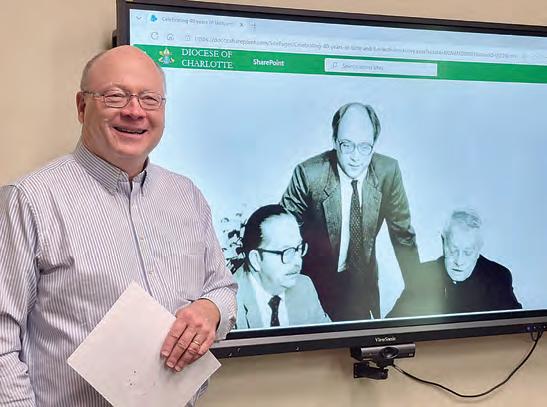
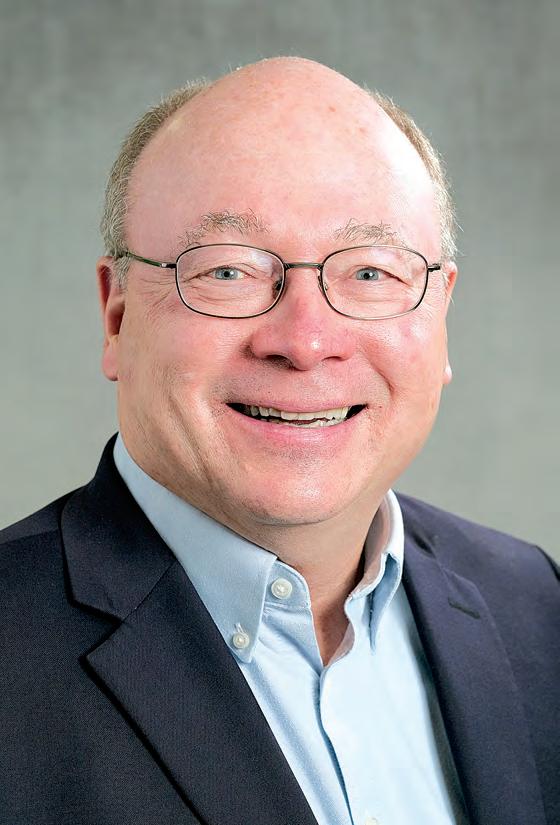
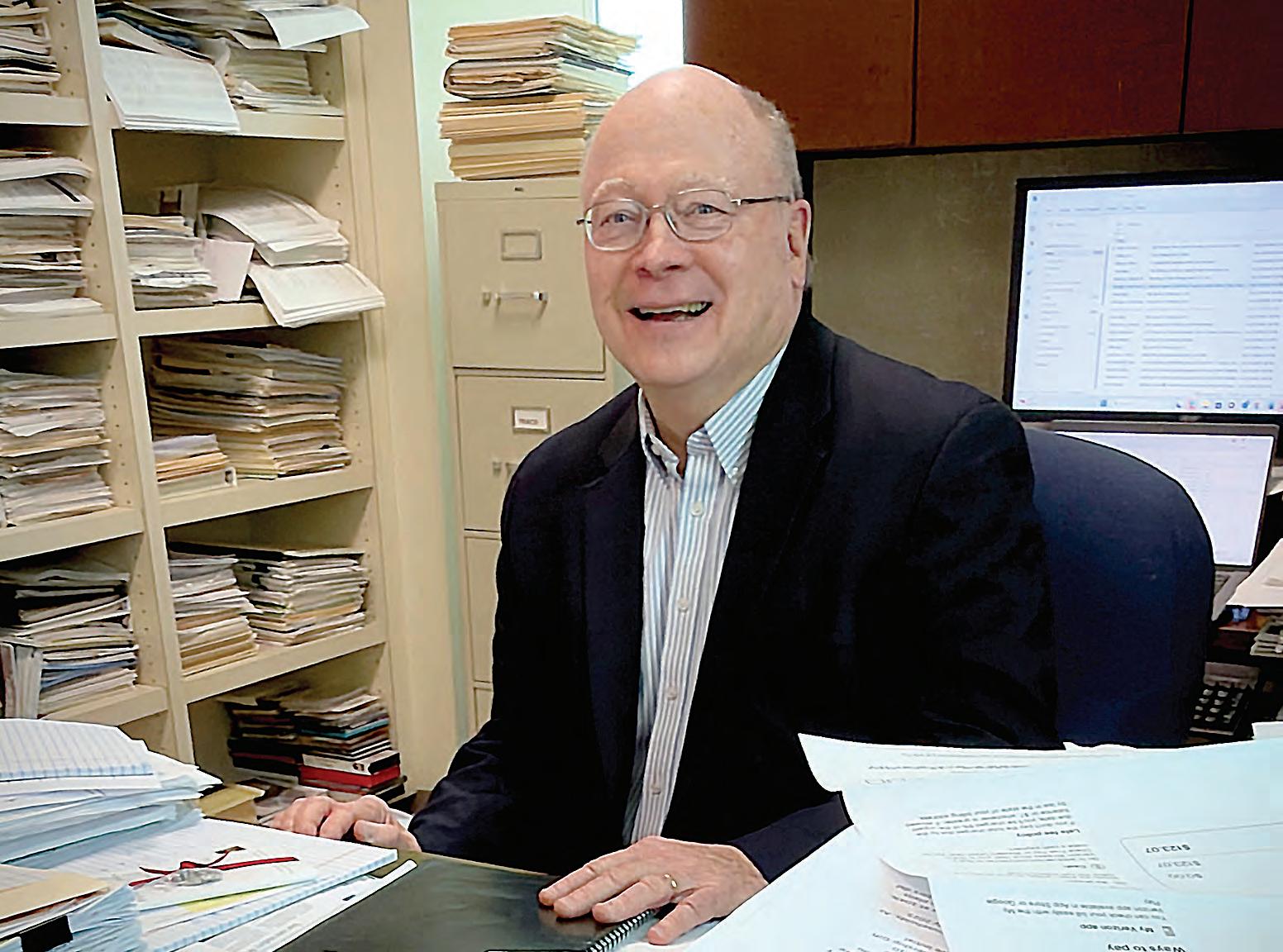
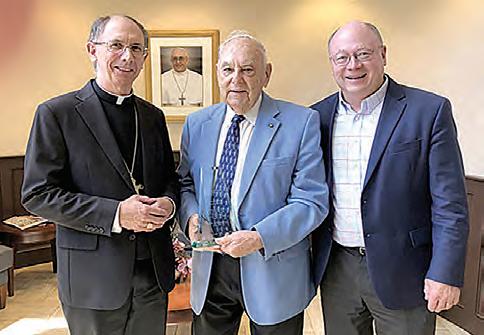
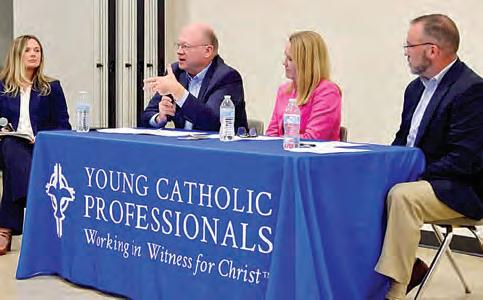
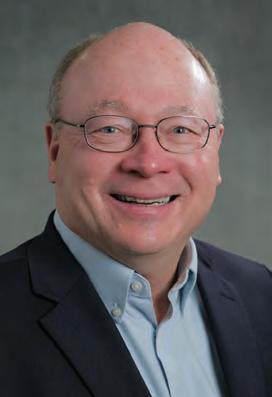
— The Diocese of Charlotte is buzzing as its “busy bee,” Director of Development Jim Kelley, celebrates four decades of faith, fun and compassion as the force behind helping raise more than $750 million for the mission and ministry of the Church in western North Carolina.
“I have loved my job every single day for the past 40 years,” Kelley says. “From my first day, I viewed the position as a calling. That is why I am still doing it. It has just been amazing for me to see how God has worked in my life through these decades.” Kelley, the omnipresent force of positivity who is always prepared with a meme and an ambitious campaign
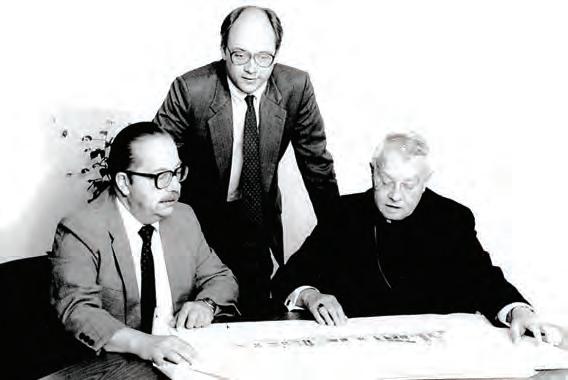

new churches and schools, funding seminarian education and priest retirement, launching countless ministries and establishing a financial foundation for future growth.
3,500+ contacts in his cell phone
1,800 people committed to estate gifts
$750 million helped raise
400 endowments
193 capital campaigns
142+ dioceses spoken at
93 churches visited, countless times over
68 phone calls in one day (personal record)
65 appointments in one week
slogan, has spent up to 70 hours a week for the past four decades encouraging parishioners to give their time, talent and treasure. Through prayer, discernment and tireless work, his efforts have helped parishes, schools and ministries across the diocese. During his tenure, the development office has managed over 190 capital campaigns,
countless parish stewardship initiatives, Diocesan Support Appeals, four other annual funds and 400 endowments, and it worked with 1,800 individuals who are remembering the Church in their estate plans. Kelley, who grew up in Akron, Ohio, and went to Yale University, where he studied psychology, has played an instrumental role in building
“I don’t think you can find a person whose personality, talents and skills are better suited for being a development professional,” says Bill Weldon, special assistant to the vicar general, who worked alongside Kelley for more than three decades in his role as the diocese’s CFO.
Kelley, who plans to work as long as he is healthy and helpful, is known for his boundless energy – often glued to his phone and known for sending a text, followed immediately by an email, then
50 states visited
42 years of marriage
36 priests have told his wife Joan she is “going straight to heaven”
30 boards served on
27 boards chaired
25 office shelves, each dedicated to a different job responsibility
15 countries visited to make stewardship presentations
4 bishops and vicars general served
3 CFOs served
2 children
1 grandson
0 people who could replace him
With gratitude, your parish family at St. Matthew celebrates your 40 years of faithful service to the Diocese of Charlotte and holds you in love and prayer.
Congratulations, Jim!


Congratulations to Jim Kelley, our favorite ex-o cio team member

We were going to “send you an email” but opted to place an ad in the newspaper you once ran to thank you for 40 years of sharing your faith and generous spirit with the people, parishes and ministries of our diocese.
e Diocese of Charlotte Communications O ce and the Catholic News Herald St. Matthew Catholic Church – Charlotte, NC

“God, My Wife, and Euchre” Mr. Jim Kelley
With thanksgiving for the 40 years in which you helped build our diocese.
Love and prayers from your friends at the seminary.
ST. JOSEPH COLLEGE SEMINARY

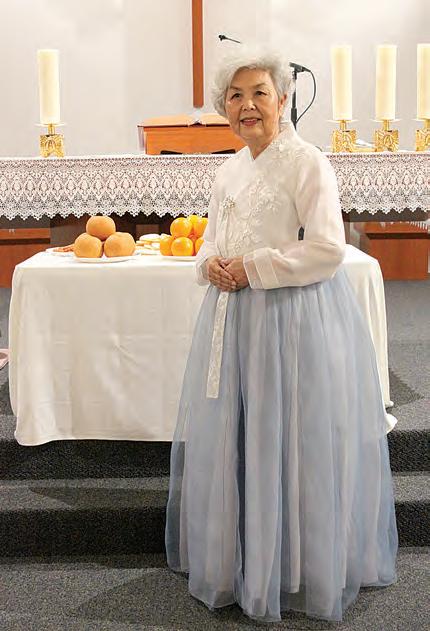
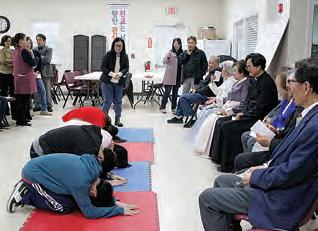
CHARLOTTE — Koreans celebrated the Lunar New Year Feb. 17. Hundreds of local Catholic Koreans spent the New Year weekend, also called “Seollal,” at St. John Lee Church in Charlotte.
Mass, offered by Father Jinhee Lee, started with a procession to a table before a ceremonial altar set with ripe pears, apples and baked rice cakes. After Mass, everyone gathered in the parish hall to dine on Tteokguk (rice cake soup), which is said to give the dinner guests another year of life. The soup is characterized by rice discs shaped like quarters, eggs, seaweed and shredded beef.
“Everyone from South Korea grew up making and eating this soup every New Year,” parish office administrator Yang Hancock said. “I can remember it ever since I was a little girl.”
After the meal, the elders sat in a long row wearing their traditional garments called Hanbok, while the youth stood facing them in their own line. In an act of respect, the youth took a formal bow, called a “Sebae,” before their elders
CHARLOTTE — The Diocese of Charlotte has updated its long-standing conduct policy for clergy, employees and adult volunteers who serve in its parishes, schools and ministries.
Bishop Michael Martin, OFM Conv., promulgated the updated policy Feb. 19, marking the culmination of several years of collaboration by the diocese’s Safe Environment Office, Lay Review Board, Presbyteral Council and diocesan leadership. The conduct policy, which addresses sexual misconduct, abuse and harassment, was previously issued in 2003.
Updates mostly reflect practices that have been in place for a number of years, including the diocese’s transition in 2024 from Virtus Online to CMG Connect as its required Safe Environment education and training system. CMG Connect consolidated background screening, onboarding and training into a single platform for all Church personnel and adult volunteers serving in the diocese’s 93 parishes, 20 schools, and 50-plus agencies and ministries.
Other changes reflect updated terminology in the U.S. Conference of Catholic Bishops’ “Charter for the Protection of Children and Young People” as well as recent changes in North Carolina law.
Conduct policies specific to clergy and other people engaged in pastoral care were also moved out of the general employee policy into a separate addendum for improved clarity, aligning it with Church law and with the diocese’s current standards for counseling sessions, potential conflicts of interest and recordkeeping.
Compliance with the conduct policy continues to be mandatory for all priests, deacons, seminarians, men and women serving in religious orders, lay employees, and volunteers age 18 and older. Annual training and recertification also remain mandatory. Background checks, once completed through CMG Connect, are monitored on a quarterly basis for any potential criminal charges.
The updated policy is posted online at www.charlottediocese.org/offices/ safe-environment.
“These updates simply bring our policy up to date with the diocese’s shift to CMG Connect, updated language used in the Charter, and with other changes over the years,” said David Vasquez, diocesan Safe Environment coordinator. “And it’s also a chance to reiterate our long-standing commitment to protecting children and vulnerable adults.”
— Catholic News Herald
CHRISTINA LEE KNAUSS clknauss@rcdoc.org
ASHEVILLE — Inmates in the 54 state prisons across North Carolina now have direct access to learning about the Catholic faith on the tablets issued to them by the state’s Department of Adult Correction.
The award-winning “Catholicism” series produced by Bishop Robert Barron’s Word on Fire organization was uploaded to all inmates’ tablets in late January, thanks to more than a year of dedicated efforts spearheaded by prison ministry workers from the Diocese of Charlotte.
Those involved say the series will provide easy access to valuable education about the faith to Catholic and non-Catholic inmates alike.
The devices offer every inmate in the state system access to approved educational courses, vocational training and entertainment. Those courses include religious learning opportunities which will now include the series on Catholicism.
“This does so much for us,” said David Coe, interim coordinator of prison ministry for the diocese. “It opens up vistas of Catholic training and teaching and enables us to more easily introduce the faith to inmates who are interested.”
The “Catholicism” series had previously been used successfully by prison ministry volunteers at Mountain View Correctional Institution in Spruce Pine, who showed the series to men in the OCIA program through use of a projector.
“The response was extremely positive from
inmates who viewed the series in that format,” Coe said. “Now that it is available on the tablets, we can readily use it in our ministry programs without having to bring in or borrow special technology. We can have group discussions or classes and simply ask the inmates to bring their tablets.”
Coe has been in contact with prison ministry workers in the Diocese of Raleigh about the program and has received notice that they plan to begin using it in their ministry.
Deacon Mike Vandiver, coordinator of prison ministry for the Raleigh diocese, said he has already heard positive reviews from inmates and he will use the series in his work with those going through the OCIA program.
Using the series was first suggested by Bill Irwin, a prison ministry volunteer who visits Alexander Correctional Institution in Taylorsville and Forsyth Correctional in Winston-Salem.
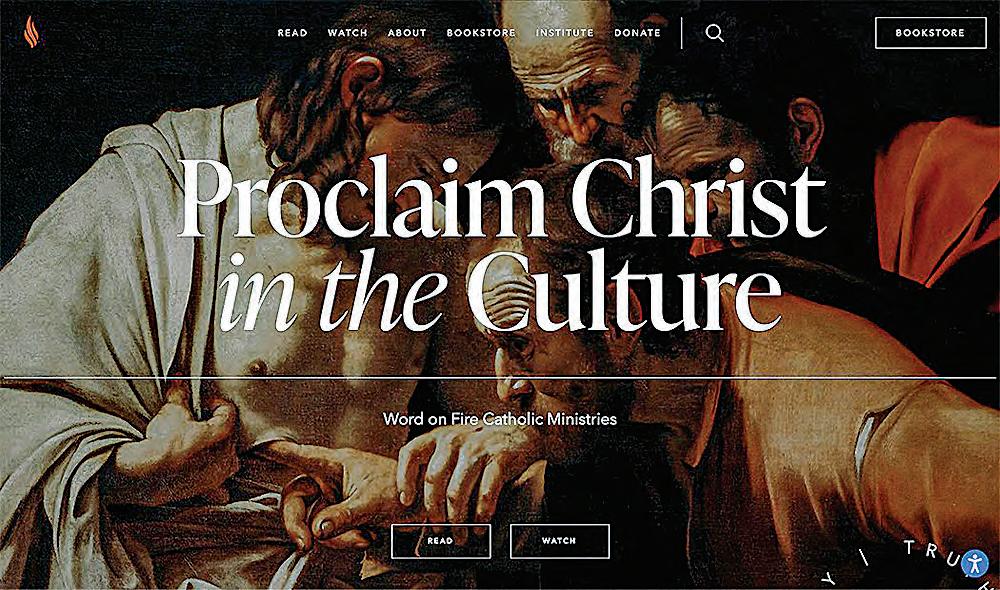
He heard about Word on Fire’s series being used successfully in prison ministry elsewhere and brought the idea to Coe and the diocese.
Irwin and others, headed up by Diocese Prison Ministry Team member Dennis Lanahan, then reached out to the Word on Fire offices in California. Staff members
there worked with Edovo, an app featured on every inmate’s tablet that serves as a launch platform for instructional material.
“Word on Fire is going to offer Catholic inmates reinforcement in their faith, and for those who aren’t Catholic but interested,
or who don’t understand the faith, it will give them real ideas and facts instead of the nonsense and misinterpretations they might hear,” Irwin said.
“They will get a better understanding of what we’re really about.”
The DSA provides funding for 50 ministries and programs.
When you make an annual contribution to the DSA, you join with thousands of our sisters and brothers in Christ throughout the diocese to do the Lord’s work – works of love and service that no one individual or parish can do alone.
CharlotteDiocese.org/DSA
Mail your pledge card to your parish office or the Diocese of Charlotte 1123 South Church St. Charlotte, NC 28203 Thank you for supporting
DIOCESE OF CHARLOTTE
1123 S. Church Street, Charlotte, NC 28203

704-370-3302 and make your gift by phone

BRIAN SEGOVIA bmsegovia@rcdoc.org
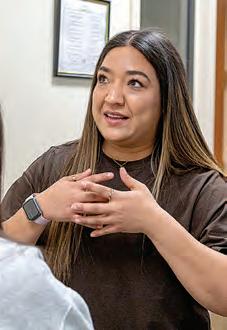
CHARLOTTE — After a production process of more than nine months, youth leaders from the Diocese of Charlotte gathered at the Diocesan Pastoral Center for the unveiling of a book that will serve as a guide in conversations about mental health and faith.
At the Feb. 7 workshop, young Hispanic ministries leaders connected with peers from 11 dioceses across the southeast to present the “Easter Book,” a bilingual text that each year applies the Paschal mystery to a topic participants consider important. This year’s book is “Mind, Soul and Heart: Let’s Talk About Mental Health Without Fear,” and its purpose is to open healthy conversations about mental health from the perspective of faith, explained Gabriella Escalante, Southeastern Pastoral Institute (SEPI) youth ministry coordinator and the workshop leader.
“It’s not as much about explaining the conditions of mental health as it is about opening a safe and respectful dialogue connected to our faith,” Escalante said.
In May, leaders held a discernment discussion to choose the theme, which was selected because the youth felt the need to respond to the mental health crisis affecting so many young people. They noted suffering related to comparison, the impact of social media and the digital world, and current events.
“Young people at this moment tend to
struggle with anxiety and depression and live under high levels of stress,” Escalante said. Amid increasing immigration raids and enforcement of immigration laws, many immigrant youth also identified fear as something that is affecting their mental health and that they are trying to bring to light.
“This was 100% a factor,” Escalante said. “The immigration aspect can be one of the root causes of the problem.”
‘The young people of Charlotte have such a unique and particular way of making faith appealing.’
Gabriella Escalante SEPI Youth Ministry Coordinator
Each year since 1980, the Easter Book has brought together experts and youth to develop a teaching theme that is used in each SEPI diocese. SEPI is the educational branch of the Southeast Regional Office for Hispanic Ministry, an organization of the U.S. bishops that coordinates and supports Hispanic ministry in 30 dioceses across the
southeast. It offers programs in formation, evangelization and leadership for lay ministers and youth, including ministry schools, workshops and a master’s degree in Hispanic Pastoral Ministry in collaboration with Barry University.
SEPI’s Youth Ministry office oversees producing the book and invites different dioceses to participate. The process consists of four meetings spread over several months, usually from May to February. Participants receive the book at the final workshop.
The Diocese of Charlotte has participated in the project since joining SEPI in 2001, with youth groups writing sections of the book and playing key roles in its development.
“The Diocese of Charlotte has never stepped away,” Escalante said. “The young people of Charlotte have such a unique and particular way of making faith appealing.”
At the presentation participants could not see the physical book due to shipping delays caused by winter storms, but they discussed how it can encourage conversations about mental health that break stigma while also showing the need to understand the topic both psychologically and spiritually.
The book, divided into a personal guide and a leader’s guide, includes resources such as reflections, prayers, music and theology tailored to each topic to assist in conversations and accompany youth.
Vicente Capistrano, director of communications at Our Lady of Guadalupe Parish in Charlotte and a contributor to the book for the past two years, said the book helps leaders ask good questions and create
conditions to normalize discussions about mental health. He said being part of the publication process for a motivational book that will be shared with people in different parts of the country has been rewarding.
“I never imagined this; it’s beautiful to be able to share it with others to help. It’s exciting,” Capistrano said.
The workshop included a recap of the production process, ideas for implementation, evaluations and activities to foster connection.
In addition to sharing experiences with facilitators, participants used the time to get to know one another and delve deeper into the topics discussed. They took turns openly talking about their experiences and exploring how to begin dialogues with people who feel anxiety or depression.
Rudy Reyes of St. Mary Parish in Greensboro said, “Although we feel fear at first, we can grow with the support of others.”
Similarly, Jackelyn Villamizar Serrano underscored the importance of peer support. “There are many who may need to hear something when they are going through a difficult time,” she said.
To encourage further dialogue, psychologist Gustavo Facio and Karla Rodriguez, who serves as coordinator of multicultural youth and young adult ministry in the Diocese of St. Augustine, inspired young people to share the book’s message.
“Having the courage to say how you feel is the way we want to see you,” Rodriguez said. “You don’t have to hide parts of yourselves to conform to others.”

HIGH POINT — The Rev. James Michael Byer, a much-loved priest of the Diocese of Charlotte, brother and uncle, passed away peacefully on Feb. 3, 2026, at Pennybyrn in High Point. He was 73.
The Mass of Christian Burial was celebrated at noon on Tuesday, Feb. 10, 2026, at the Pennybyrn Chapel, located at 109 Penny Road in High Point. Interment will take place at a later date at Mount St. Mary’s Seminary in Emmitsburg, Maryland.
Father Byer was born March 9, 1952, in Cleveland, Ohio, the son of Michael and Agnes (Jelinek) Byer. He knew he wanted to be a priest since he was in grade school, where he served often at Mass and was inspired by his pastor.
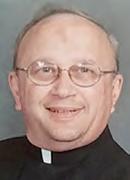
After graduating from St. Stanislaus School in Cleveland, he entered the seminary for the Diocese of Cleveland, first at St. Vincent de Paul Seminary in Boynton Beach, Florida, where he earned a Bachelor of Arts in 1975 and then at Mount St. Mary’s Seminary in Emmittsburg, where he earned a degree in theology.
It was at Mount St. Mary’s that he learned of a need for priests in the then-mission Diocese of Charlotte through a friend. He decided to move to the South, and on Feb. 21, 1981, he was ordained to the priesthood by Bishop Michael J. Begley, the diocese’s first bishop, at St. Patrick Cathedral in Charlotte. During nearly five decades of priestly ministry in the Charlotte diocese, Father Byer served at 10 parishes, including St. Gabriel and St. Ann in Charlotte, Holy Spirit in Denver, Holy Trinity in Taylorsville, Our Lady of Grace in Greensboro, Sacred Heart in Brevard, St. Leo the Great in Winston-Salem, St. Margaret of Scotland in Maggie Valley, and St. Philip the Apostle in
Statesville. After participating in Spanish study programs in Mexico and Miami to better minister to the diocese’s growing number of Hispanic Catholics, in 1994 Father Byer was appointed spiritual director of the Hispanic Community of Charlotte (now Our Lady of Guadalupe Parish).
While he was serving at St. Ann Parish in Charlotte, Father Byer was given the additional assignment of living with the then-retired Bishop Begley, who lived very close by the church. Father Byer later said that he thought it a blessing to live with the bishop who had ordained him and travel across the diocese with him as his master of ceremonies for confirmation Masses.
Father Byer also served as an assistant for the Diocese of Charlotte Tribunal and as state chaplain for the Catholic Daughters of the Americas.
After retirement, he spent time with his extended family in Ohio, where he enjoyed family get-togethers and good food. They will always remember “Uncle Jim” – “UJ” for short – as a fun-loving and kind man who absolutely loved being a priest. He enjoyed being able to offer the sacraments, especially the Holy Eucharist and penance, and he put a lot of effort and care into delivering relatable and insightful sermons.
Father Byer was preceded in death by his parents.
He is survived by his sister, Janis LaPorta, and her husband Michael; and two nieces, Stacy Kacirek, and Michele Kothe, her husband Neal and their children Gwendolyn and Grady.
In lieu of flowers, memorial donations may be made to AuthoraCare Collective Hospice & Palliative Care, online at www.authoracare. org/give, 800-588-8879, or by mail to 2504 Summit Ave., Greensboro, N.C. 27405.
Sechrest-Davis Funerals and Cremations of High Point was in charge of the arrangements.
— Catholic News Herald
BALTIMORE — Jesuit Father Vincent de Paul Alagia was called to eternal life on Jan. 23, 2026, at the St. Claude La Colombière Jesuit Community in Baltimore. He was 99 years old, a Jesuit for 79 years, and a priest for 67 years who once served in the Diocese of Charlotte.
The funeral Mass was celebrated Jan. 29, 2026, at the Colombiere Community Chapel. Interment was at Jesuit Cemetery in Woodstock, Maryland.
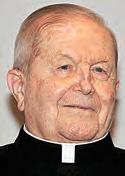
Father Alagia was born Jan. 12, 1927, in Baltimore. He attended Loyola Blakefield before entering the Society of Jesus at the Novitiate of St. Isaac Jogues in Wernersville, Pennsylvania, on July 28, 1946. After completing novitiate and classics studies, he studied philosophy at Woodstock College, earning a Bachelor of Arts in 1952. He later returned to Woodstock for theological studies and was ordained to the priesthood there on June 22, 1958.
Following ordination, Father Alagia devoted himself to Jesuit secondary education and student formation. He served at Georgetown Preparatory School as a teacher of English and Latin (1960-1963), student counselor (1963-1966), and student counselor and spiritual father (1967-1970). While there, he earned a master’s degree in guidance from The Catholic University of America.
Beginning in the 1970s, Father Alagia’s ministry increasingly focused on retreats, spiritual direction and marriage spirituality. He served as
SAPPHIRE — The Diocese of Charlotte recently reached a new milestone, its 55th gift of $1 million or more, from a couple whose generosity crossed continents.
Thomas Giesey, a traveling salesman for Goodyear Tire Co., and his wife, Gretchen Giesey, spent their nearly 63 years together sharing what they had with others –whether close to home or across the globe. Gretchen passed away on June 26, 2024, and her husband followed seven months later on Jan. 18, 2025.
The couple spent their summers in Sapphire, attending St. Jude Church for more than 24 years. After their deaths, the diocese received a $1.125 million gift from their estate. A portion of that gift will fund the Thomas and Gretchen Giesey Memorial Endowment Fund, which was established for the general needs of the Sapphire parish. The remaining money will go toward “Building Our Future Together,” St. Jude’s capital campaign, which has a goal of raising $9 million toward a new church and campus improvements. Current campus buildings are more than 50 years old and require updates to serve a community that is anticipated to grow by 10% to 13% in the next five years.
The Gieseys are two of the donors across the diocese who have given one-time gifts of $1 million or more either by cash or stock, pledged to capital campaigns or special projects, or left gifts in their estate plans. Such gifts benefit parishes, Catholic schools, the diocese’s foundation and St. Joseph College Seminary.
“The Gieseys left their mark in this community and were dedicated to securing the future of the parish,” said Father Jason Barone, pastor of St. Jude Parish. “We are thankful for their service and their intentional gift that was in keeping with their generous spirits.”
While Thomas Giesey’s career took the couple around the world, what they recalled most about their journeys were shared memories of helping others. During a life-changing trip to Johannesburg, South Africa, they became a second family to a young girl in need, cooking meals for her ailing father while keeping her and her siblings entertained with stories.
Beyond their travels, they believed in the power of education and consistently supported the academic pursuits of loved ones, assisted homeless children and young adults seeking opportunity, and gave to
a retreat director at Manresa-onSevern in Annapolis, Maryland, and led many Marriage Encounter retreats in Maryland and Washington, D.C., through 1977. He then served as retreat director at the Jesuit Center for Spiritual Growth in Wernersville (19771978), Loyola on the Potomac Retreat House in Faulkner, Maryland (19781981), and the Jesuit House of Prayer in Hot Springs, North Carolina, where he was retreat director (1982-1986) and later director (1989-1999).
Father Alagia also ministered in parishes, providing spirituality ministry at St. Mary Parish in Johnson City, Tennessee, and St. Peter Parish in Charlotte, where he served for more than 10 years. In his later years, he served in pastoral ministry while residing at the St. Claude La Colombière Jesuit Community in Baltimore (2011-2016).
From 2016 onward, Father Alagia was missioned primarily to a ministry of prayer for the Church and the Society of Jesus, residing at Wernersville and later at Manresa Hall in Merion Station, Pennsylvania, before returning to Colombière in late 2025.
Father Alagia was known for his deep commitment to Ignatian Spirituality, his gentle pastoral presence and his lifelong dedication to retreat ministry and spiritual accompaniment. Through decades of service as teacher, counselor, retreat director and spiritual guide, he helped countless people listen more attentively to God’s voice in their lives. May he rest in the peace of Christ, whom he served faithfully with generosity and love for others.
Mitchell Wiedefeld Funeral Home Inc. of Baltimore was in charge of the arrangements.
— Catholic News Herald
churches and ministries.
As Jim Kelley, diocesan development director, said, “Generous parishioners like the Gieseys have changed the lives of countless people, parishes and ministries across our diocese.”
“We are grateful for gifts of any amount,” Kelley said. “Couples like the Gieseys who chose to leave significant gifts of $1 million or more are demonstrating their confidence in the Church’s leadership and their commitment to carrying their faith forward to future generations.”
— Courtney McLaughlin
Interested in setting up – or adding to – an endowment to benefit your parish? Establish an endowment in the Diocese of Charlotte Foundation by leaving a bequest in a will, a beneficiary designation from a retirement plan, a trust or annuity, or a gift of real estate, life insurance, cash or securities.
Join more than 1,800 people who have informed the diocese they plan to remember the Church in their estate plans. For details, contact Gina Rhodes at 704-370-3364 or gmrhodes@rcdoc.org.
Please pray for the following deacons who died during the month of February:
Joseph Garavaglia 2/25/2002
George McMahon 2/15/2007
J. Daniel Carl 2/12/2010
Louis Rinkus 2/17/2010
Nicholas Fadero 2/10/2011
Franklin Manning 2/13/2011
John Burke 2/29/2012
Michael LeVon Stout 2/4/2020
Charles Brantley 2/27/2020
Luis Flores 2/1/2023
Sponsored by the Knights of Columbus www.kofcnc.org
CHRISTINA LEE KNAUSS clknauss@rcdoc.org
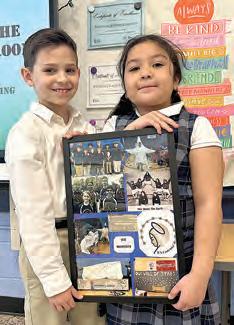
HENDERSONVILLE — One hundred years ago, the roaring ’20s were in full swing, Queen Elizabeth II was born, and a parish priest quietly turned a rectory into a school.
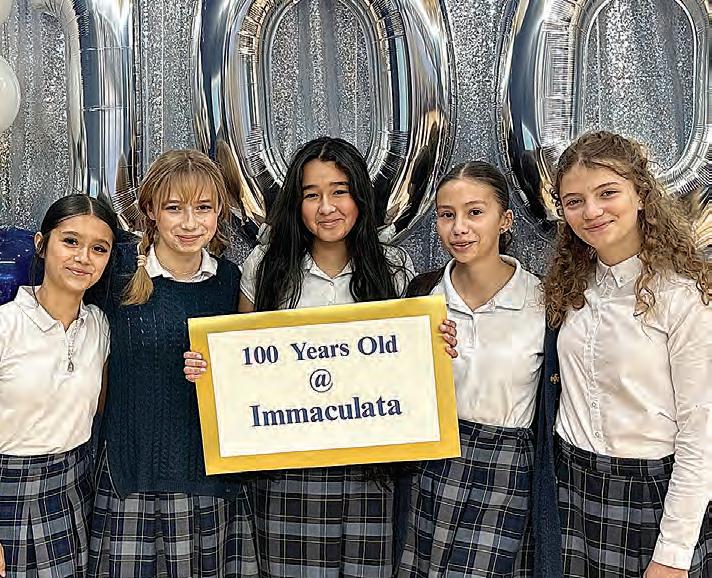
Immaculata Catholic School – the oldest school in the diocese – kicked off a celebration of its centennial with an event that offered a living look at the school’s long history.
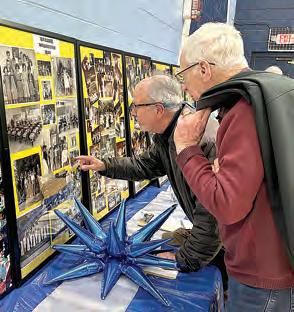
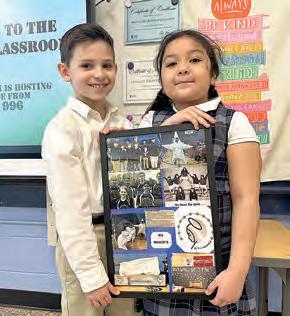
“A Walk Through Time” offered visitors a chance to walk from classroom to classroom, where students talked about the most significant events that happened during the decade assigned to their grade. Other students explained the significance of special school artifacts.
“It was a pretty amazing event and a once in a lifetime event to celebrate our 100th anniversary,” said Principal Margaret Beale. “We’ve been working on this for close to a year, and a lot of people dedicated a lot of their time to this. It’s an honor to be able to share the story of Immaculata and to be part of that story.”
The experience meant a lot to student participants like eighth-grader Natalia Corona Montiel.
“What I love most about Immaculata are my teachers and my classmates,” she said, underscoring how much she will miss the tight-knit faith community when she begins high school in the fall.
After being rescheduled by back-to-back ice and snow storms at the end of January, two walks took place on Feb. 12, with about 50 people attending the daytime event and more than 100 turning out for the evening walk. Dr. Greg Monroe, diocesan superintendent of schools, was on hand. The trek took about 45 minutes to complete.
As visitor Joanne Savage said, “The tour was wonderful. My husband and I have been supporters of the school for years and years.”
Beale said a large team of volunteers worked behind the scenes to put the event together, including one person who spent six months going through the school’s archives and separating material by decade.
Another “Walk Through Time” will be held at 1 p.m. May 8. The school will continue to commemorate its centennial throughout this year, including a special celebration for alumni at Oktoberfest on Saturday, Oct. 10.
Immaculata School was launched in 1926 by Father James
Manley, who was pastor of Immaculate Conception Parish at the time. He received permission from Bishop William Hafey of Raleigh to turn the existing rectory into a school. With the help of a parishioner, he made arrangements for three sisters whose motherhouse was in France to come to Hendersonville and begin the school. By 1927, there were 16 students. Father Paul Termer, pastor at Immaculate Conception in 1927, saw the need for a larger school and arranged for the purchase of a large brick home known as the Keith Estate on Oakland
Street to house the new school. Additional land was purchased in the early 1960s behind what was known as Allworden Estate and plans for a new school were launched. The school moved to its current location in 1961.
A series of renovations and expansions have taken place over the years. In 2024, the school served as a crucial supply hub for survivors of Tropical Storm Helene.
The school has an enrollment of 174 students in prekindergarten through the eighth grade.
CHRISTINA LEE KNAUSS clknauss@rcdoc.org
CHARLOTTE — Charlotte Catholic High School has named Michael Seeley, a longtime education leader and administrator, as its new president. Currently president of the Lafayette Catholic School System in Indiana, Seeley will begin his new role at Charlotte Catholic effective July 1. He will partner in leading the school with longtime principal Kurt Telford, who last year stepped into the role as head of school – serving as both principal and president – to assist in the school’s leadership transition. In July, Telford will return to his role as principal. Seeley’s appointment comes after a national search conducted by a committee of educators, parents and other stakeholders in the Charlotte Catholic community.
“I am honored and excited to accept the call to serve as president of Charlotte Catholic High School,” Seeley said in
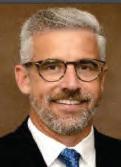
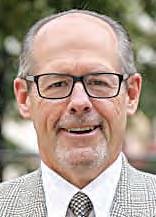
an announcement to the Charlotte Catholic community.
“Throughout the interview process, it became clear that the CCHS community expects excellence across all aspects of student formation: academics, athletics, service and above all faith. I look forward to working alongside dedicated and passionate students, teachers, staff and families as we fulfill our shared mission to graduate not only scholars and athletes but disciples of Christ.”
Seeley has more than two decades of senior leadership experience in both Catholic and independent school
settings, including the University of Notre Dame, Phillips Exeter Academy and Culver Academies. He has done extensive work in institutional advancement, admissions and enrollment management, and also worked closely with boards, donors and diocesan leaders.
In his current role as president of the Lafayette Catholic School System, he provides strategic and operational leadership across multiple campuses, overseeing enrollment, advancement, finances, governance and long-range planning.
As president of Charlotte Catholic, Seeley will focus on the school’s longrange planning, community relationships, financial and operational management, and fundraising.
“Michael brings a wealth of knowledge in academics, fundraising and strategic planning that will help us to grow and thrive as a community,” Telford said. “I am looking forward to this new chapter, which not only allows me to work with
Michael but also to return to my true love of working closely with students and teachers as principal.”
Dr. Greg Monroe, superintendent of schools for the Diocese of Charlotte, echoed that enthusiasm: “With his proven experience in top-tier school leadership and advancement, Mr. Seeley is well positioned to build upon Charlotte Catholic’s great traditions and Catholic identity, and to lead the school into a future marked by faith, hope and excellence.”
Seeley earned a bachelor’s degree at the University of Notre Dame and holds a master’s degree in education from Indiana University South Bend. He and his wife, Erin Seeley, have three children. Their youngest son will attend Charlotte Catholic as a ninth-grader beginning in the fall.
With an enrollment of more than 1,100 students in grades 9-12, Charlotte Catholic is the largest school in the Diocese of Charlotte Catholic schools system.
LISA M. GERACI lmgeraci@rcdoc.org
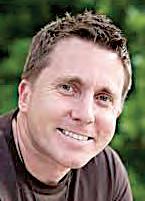
GREENSBORO — Catholic author and speaker Jason Evert visited the Diocese of Charlotte this week with a doublefeature talk called “Purified,” a humorous but compelling message presented to thousands of local middle and high school students.
His talks focused on topics including sexuality, virginity and gender identity and were held at St. Pius X Church in the Triad, Christ the King High School in Huntersville and Charlotte Catholic High School.
The subject is difficult to approach without invoking giggles and blushing faces, but participants were at the edge of their seats, laughing at Evert’s anecdotes.
In his first message, “Love or Lust,” he explained the beauty and gift of virginity and the importance of abstaining from sex until marriage.
The body is a precious gift for your spouse, and waiting for sex until marriage is a sacrifice well worth it for your future spouse, Evert said.
Evert drove home his point with a paraphrased scripture, Ephesians 5:25:
“Husbands, love your wives like Christ loved the Church, giving yourself up to her to make her holy.”
Evert told the boys, “You don’t want somebody else doing that (having sex) with the person you are going to marry – just set the same standard for yourself. This is a calling to real love … every guy in here has a temptation to lust or use, but he has a deeper desire to sacrifice and love.”
“If you really love her, if you really care about her, you would do what is best for her,” Evert emphasized.
Evert explored the messages of a secular society that leave people with misconceptions that cohabitation and intercourse before marriage are acceptable.
Through clothing, porn and media, sex sells – and people without God are easily buying it, Evert said. The ideology that you need to lose your virginity to be a real man, or that you have to give up your purity to make a guy stay in a committed
relationship, is not true, he said.
He warned the girls not to be seduced by an easily spoken but meaningless “I love you.”
“Real love brings you closer to family, friends and God,” Evert said. “If you want to find out if he really loves you, see if he will wait for marriage.”
At St. Pius X Church, during the break, students shared this was the longest time any adult had talked to them about sex, saying most of their ideas about sexuality come from peers, social media and Netflix – but not the Church.
“I liked and needed this talk,” said Harrison, an eighth-grader. “It was very helpful, it was really amazing, and I think it is going to make a huge impact on my life. A lot of the words he said really showed me a different way to think of things while I walk through these temptations.”
Holy Cross youth and family evangelization teacher Geraldine Abinader said the talk was the perfect springboard for a Life Teen series she has planned for her formation classes.
“It is good that we are talking about this in a Catholic context, because we are rooting God back into it,” she said.
The second half of the three-hour address, “Gender & the Theology of the Body,” focused on gender dysphoria and gender identity.
Evert eloquently compiled the teachings of St. John Paul II and modern-day medicine into one reasonably bite-sized package that was logical for both gradeschool students and adults.
He denounced gender reassignment procedures and hormone therapy, noting their impracticality and devastating mental effects.
He had a message of compassion for the people seeking out this new form of “bad medicine.” As Catholics, he reminded the audience, it is our duty, instead of shaming, berating or rebuking our brothers and sisters who are experiencing gender insecurities, to care for them, love them, listen to them, be honest with them and help them continue their walk toward God.
Evert ended the evening by urging youth to combat worldly pressures with prayer, Mass and the rosary.
Eucharistic Adoration followed the talk, where the teens were encouraged to leave their prayers, insecurities and future spouses in God’s hands.

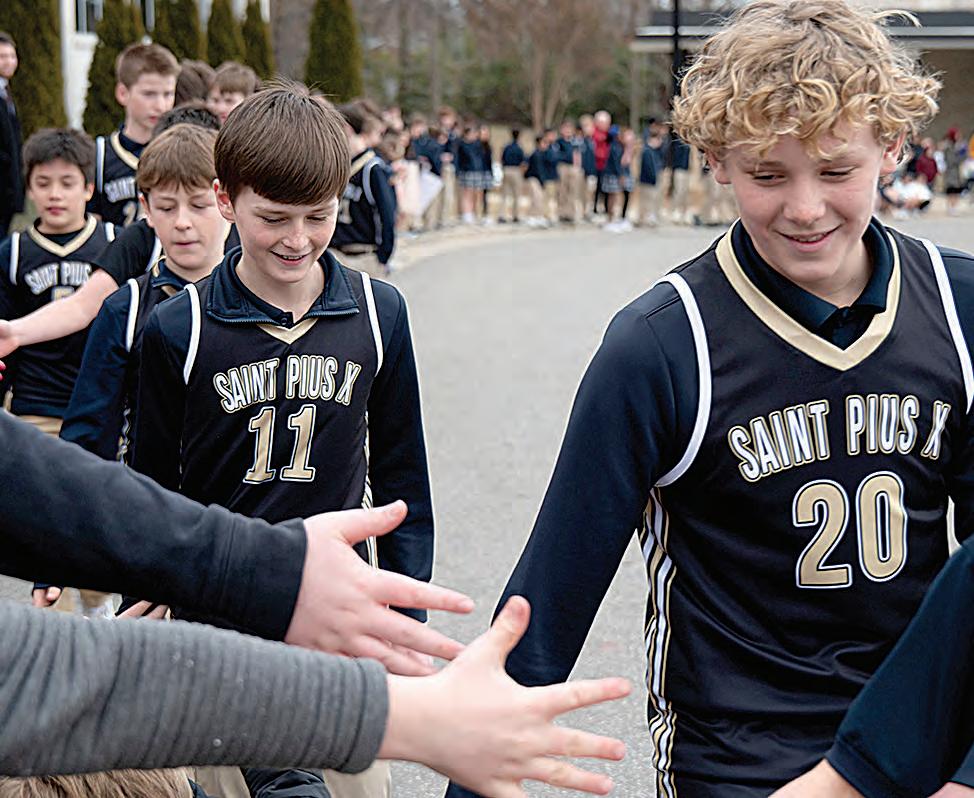
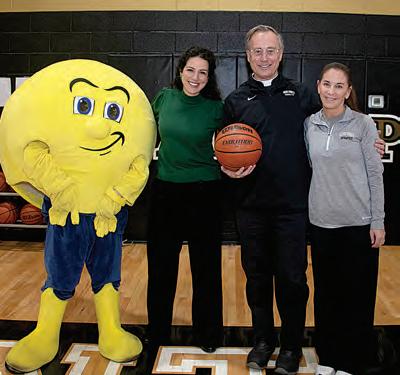
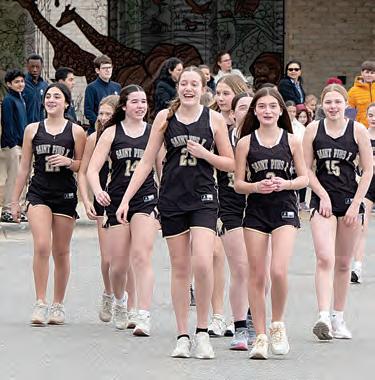
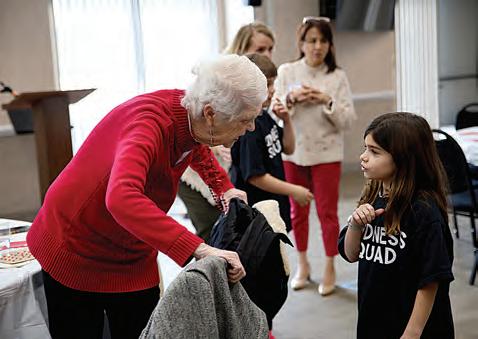
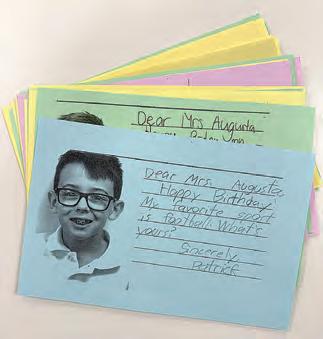
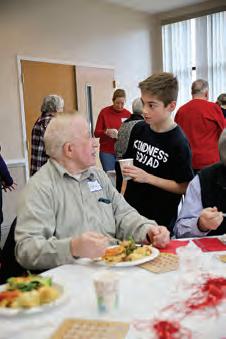
Students at St. Gabriel School help seniors, cheer on fellow students, and do what they can to spread kindness as part of a program inspired by a school in Florida.
PROVIDED; CHRISTINA LEE
KNAUSS | CATHOLIC NEWS HERALD
CHRISTINA LEE KNAUSS
clknauss@rcdoc.org
CHARLOTTE — Kindness. It’s a simple two-syllable word and a quality that many people will agree is sorely lacking in our society. But for the past several years, third-graders at St. Gabriel School have been working to promote it through a fun program known as the Kindness Squad.
Teacher Nikki Warren got the idea about seven years ago after hearing of an elementary school teacher in Florida who launched a similar program. The Kindness Squad gives members a chance to share the virtue with fellow students and parishioners at St. Gabriel Church.
Six students from Warren’s class assist at the parish’s monthly senior luncheon. The kids serve drinks, help some guests get their plates and have conversations with them.
On Feb. 10, the students served, talked and laughed with the roomful of senior citizens, many dressed in red to celebrate Valentine’s Day. Students then got to call
out numbers for the bingo game that was part of the day’s activities.
Helping at the luncheon requires some sacrifice – students miss their normal lunch period, recess and PE – but they don’t mind.
“I really enjoy helping out, working with the people and serving them their drinks,” said Ainsley Cowman, 8.
“When I know I’m helping lots of people, it feels great and it warms my heart,” said Colin Hinrichs, 8.
Serving at the luncheon benefits the students as well as the seniors, said Ana Lothspeich, pastoral care coordinator at St. Gabriel Parish.
“It’s an opportunity for kids to learn how to connect with the older generations,” she said. “Many don’t have grandparents close by, so they get a chance to learn how to relate to senior citizens.”
“I enjoy doing this – being kind to others makes me feel good,” said Beckett Belcastro, 9.
Lunch attendees enjoy seeing the students and are impressed with their work.
“I love seeing the kids – their youth
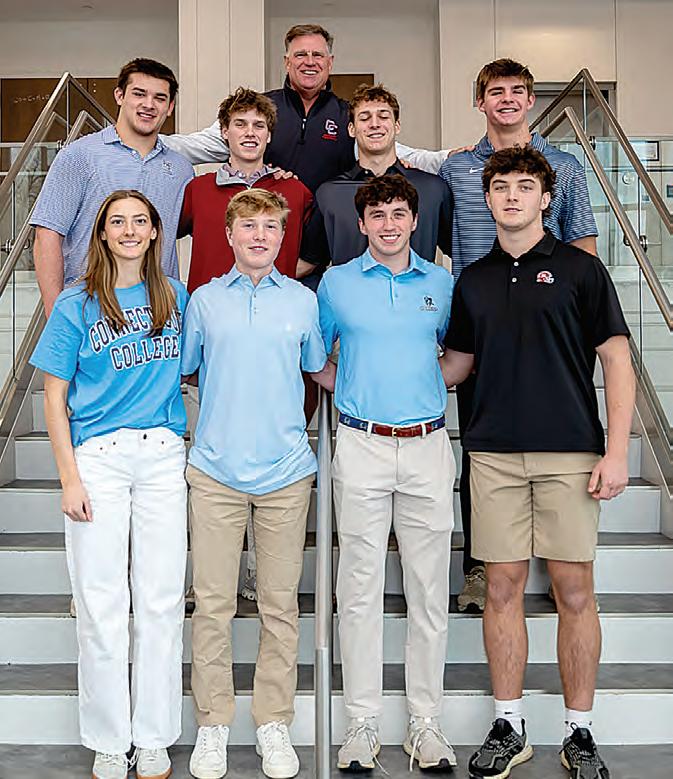
and energy is wonderful!” said Belle Radenbaugh.
Every month, the students also send birthday notes to parishioners over the age of 80. The notes include prayers, short reflections and a photo of the student. Each person receives 28 notes – one from each of Warren’s students.
Warren said the birthday notes are meaningful to recipients, many of whom write back.
“Parishioners have written and said my family forgot my birthday, and the letters were the best present they ever received,” Warren said. “Some people who are in nursing homes put the cards up on the walls of their rooms, and many recipients say they’ve kept the cards close to their chair and read them repeatedly. These senior parishioners are sometimes forgotten, and this little thing can mean a lot.”
The Kindness Squad also raises their schoolmates’ spirits. Every other month, Warren’s class greets students in the morning carpool line holding signs with
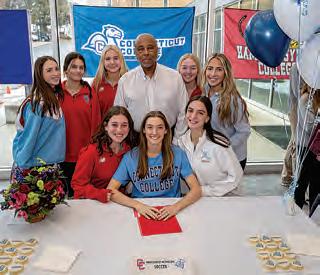
positive messages such as “Have a great day!” and “Glad you’re here!” Warren stands alongside and rings a cowbell.
At Christmas, the students dressed in their Kindness Squad T-shirts and Santa hats and gave students candy canes wrapped with positive messages. They also frequently give gifts and flowers to teachers and staff.
Students also used to deliver flowers and notes to parents picking up their children from The Cradle preschool run by St. Gabriel Parish. Warren heard firsthand the impact of that simple act from a preschool mother who received one of the notes.
“She told me that she received one of the notes when she was having a really rough day, and it really made her day,” Warren said. “Four or five years later, she still remembered it. That shows that the little things we do can go a long way. Our idea is that we’re really being the hands and feet of Jesus when we do these things.”
That story came full circle when the woman’s child later became a member of the Kindness Squad.
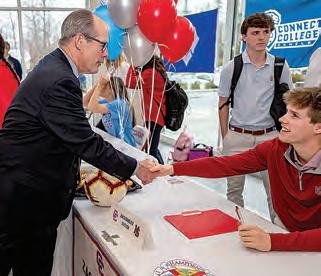
CHARLOTTE — Eight Charlotte Catholic High School student-athletes signed their college letters of intent Feb. 4, representing football, soccer and cross country/track. Some are staying close to home, while others are heading across the country, but all are taking the next step after years of discipline, sacrifice and belief.
(From top row left) Dominic Basrawala: U.S. Air Force Academy for football; Zach Deblit: HampdenSydney College for soccer; Caden O’Neill: Furman University for football; Lukas Lupinski: Columbia University for football; (bottom row) Margueritte McPhillips: Connecticut College for soccer; Duncan Smith: Washington and Lee University for cross country/track; Carter Garnett: Johns Hopkins University for football; and Keanen Teeter: LenoirRhyne for football.
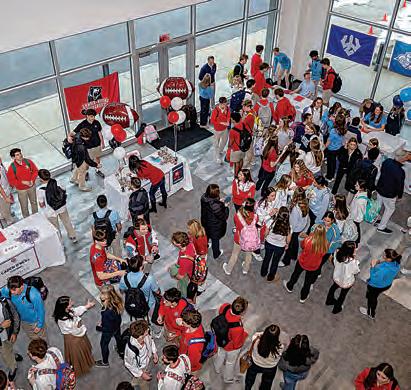
appearing at the desk of the recipient before they have had a chance to read either. That persistence in the name of a higher cause is what makes his ministry so successful.
“We encourage people to get connected to Christ and engage in their community,” Kelley says. “We want people to understand how blessed they are, be grateful because they are blessed, and then give back generously of their time, talent and treasure in gratitude.
I am grateful to the tens of thousands of individuals and couples who have given financial gifts and their time and talent in service to the Church as well as thousands of staff who serve our Lord every day.”
Since his first day in 1986, Kelley has collaborated with four bishops, three chief financial officers and four vicars general. The diocese has swelled from 65,000 to approximately 565,000 people, and 30 new church facilities have been built. Kelley has grown his office from just two –himself and current secretary Carol Flynt – to 14 people.
Through all of these changes, Kelley has remained a constant heartbeat of the diocese.
“Through decades of service in the Diocese of Charlotte, I have worked with Jim as a pastor as well as a diocesan administrator,” says Monsignor Patrick Winslow, vicar general and chancellor of the Diocese of Charlotte. “His passion, energy and optimism is apparent in all that he does.”
Longtime colleague and friend Lynne Roux says: “He is a balancing force. Whatever seems to happen, Jim wears the hat he needs to in order to stabilize every situation.”
HEAVY LIFTING WITH LIGHT HEARTS
The Catholic Conference Center in Hickory, Christ the King High School, St. Joseph College Seminary and 30 other facilities once were ideas that Kelley worked with clergy and parishioners to bring to fruition.
“We’ve spent a lot of time on the road together across the diocese, where I’ve been blessed to witness Jim inspire local leaders and give them the tools they need to achieve campaign success,” says Emmett Sapp,
director of construction and real estate, who has worked with Kelley for seven years.
One of those leaders is retired St. Pius X pastoral associate Pat Spivey, who still carves out time to help her church grow. After decades of phone calls, on-site visits and training with Kelley, she speaks on the parish’s annual stewardship efforts, runs capital campaigns and has helped form 40 new ministries at St. Pius X.
“Jim has expertly coordinated three capital campaigns here at St. Pius and helped us lay a lasting financial foundation through the establishment of our planned giving
who always trusts that God will provide.”
As her husband comments, “Next to my commitment to follow Jesus, marrying her was the second-most important decision I have made in my life.”
In his role, Kelley takes the same care with a $25 muffin ministry start-up as he does with a $7 million endowment.
“He is dedicated to meeting people where they are. If you are giving a penny or a million dollars, Jim treats every gift the exact same way,” Flynt says.
When asked about the best moments of his career, Kelley doesn’t list campaigns and
‘Jim saw that there was a need for a lot to happen in the diocese to prepare it for the future.’
Paul
Breitbach,
parishioner at St. Leo the Great in Winston-Salem
program,” Spivey says. “His most profound impact on St. Pius – and me personally – has been his constant, consistent guidance in helping us grow as a stewardship parish where we realize that everything we have is a gift – an ideal he exemplifies in every interaction I have with him.”
Kelley is less a salesman than a spiritual director and matchmaker, helping people connect their passions with existing needs.
Paul Breitbach, a parishioner at St. Leo the Great in Winston-Salem and a donor to the diocese, has worked with Kelley since the creation of the Diocese of Charlotte Foundation in 1994 and said his heart is always in the right place and focused on what’s ahead.
“Jim saw that there was a need for a lot to happen in the diocese to prepare it for the future, and he was going to try to do everything possible to make that happen,” he says.
A JOB
RICH IN HEART
Kelley’s family and friends agree that although he works with millions, money has never been a driving factor.
“He never chased money,” attests Joan, his wife of 42 years. “He is a man of deep faith
this Victim which she herself had brought forth” (“Lumen Gentium,” 58).
large church building projects, but instead notes parishioners’ names.
Mary Spinks, for example, a parishioner of Immaculate Conception in Hendersonville, who called Kelley on Christmas Eve with a dying request to establish an education endowment.
“I was touched. Here she was, dying the next day but thinking about kids,” Kelley recalled. He made a trip to the mountains that night to carry out her intentions.
As Sapp says, “Despite the grueling pace at which he’s worked for so long, he’s never stopped making it a priority to connect personally with the people he encounters.”
Whoever needs Kelley knows he is just a text or phone call away. With a contact list in the thousands, Kelley says he receives, on average, 50 calls and more than 100 emails each day.
“People know if they call Jim, he will be there,” his wife says, “and he will go above and beyond for them because he loves them.”
Kelley has visited all 93 churches in the diocese multiple times, on average spending two to three nights a week at meetings or events.
In his “downtime” he helped found a leadership gifts school in Charlotte for
the community. That five-day course has benefitted 104 nonprofits in Charlotte. He has traveled to 140 dioceses to make stewardship presentations, and he has taught diocesan leaders in 15 countries about stewardship. Since the 1990s, Kelley has been asked to serve three, six-year terms on the board of the International Catholic Stewardship Council, including terms as vice president and president.
“He has been to every state and multiple countries,” Joan Kelley says. “But it cracks me up, because he doesn’t care so much about seeing the world. He loves his life here in Charlotte.”
When Kelley is not working, he is habitual, his wife says. You can find him at a Cursillo group on Saturdays since 1998, at Mass at St. Matthew Church in Charlotte on Sundays, dining on a chopped salad at his favorite Charlotte restaurant, Mama Ricotta’s, every week, and serving as pastoral council chair at St. Matthew. He carves out time for Joan, their two children and grandson, and he seldom misses playing his favorite card game, Euchre, twice a month with friends.
“Jim is very predictable. To know Jim is to love him,” laughs Barbara Gaddy, Kelley’s retired assistant of 19 years. “He is truly a faith-filled person. And, I don’t know that many people know it, but I certainly did, and those who work with him know.”
The diocese learned to know him, and they do love him, with staff giving him his “busy bee” nickname because no one can outpace the Energizer Bunny.
Even energetic Bishop Michael Martin appreciates Kelley’s pace – and his heart.
“I have been blessed to work with a number of people in the development world, many of whom I call good friends. Jim stands alone in his status as ‘total package’ with priorities in the right order, namely, Jesus always first!” the bishop says.
Reflecting on his time with the diocese, Kelley’s eyes fill with tears.
“There is no question where God wants me to be. He called me here 40 years ago, and it has been a blessing every day of my life. When I look back, I can’t think of a better life I could have had. I try to give back, and I will keep doing that until the day I die.”
Christ ‘into his own home’ and brings her into everything that makes up his inner life” (“Redemptoris Mater,” 45).
MARY AS SORROWFUL MOTHER
Lent is a time to deepen our prayer life, and Mary provides the best example of prayer in her canticle, known as the Magnificat (Lk 1:46-55). This canticle expresses the attitudes of praise, gratitude and humility that are at the heart of all authentic prayer to God. St. Paul VI speaks of Mary as “the virgin in prayer” who “praises the Lord unceasingly and intercedes for the salvation of the world” (“Marialis Cultus,” 18). As our spiritual mother, Mary not only teaches us how to pray, but she prays for us “now and at the hour of our death.”
In the Gospel of Luke, Simeon told Mary that her heart would be pierced so that “the thoughts of many hearts will be revealed” (Lk 2:35). This prophecy was fulfilled when Mary stood beneath the cross witnessing her Son’s crucifixion (Jn 19:25-27). Vatican II tells us that Mary “faithfully persevered in her union with her Son unto the cross, where she stood, in keeping with the divine plan, grieving exceedingly with her only begotten Son, uniting herself with a maternal heart with His sacrifice, and lovingly consenting to the immolation of
Lent is a special time for venerating Mary as our sorrowful mother. This is done in the Stations of the Cross, which often includes the singing of parts of the medieval hymn the “Stabat Mater,” whose most memorable verses are: “At the cross her station keeping, Stood the mournful Mother weeping, Close to Jesus to the last. Through her heart, his sorrow sharing, All his bitter anguish bearing, Now at length
the sword had pass’d. Oh, how sad and sore distress’d. Was that mother highly blest, Of the sole-begotten One!”
Because Lent points to Holy Thursday, Good Friday and the Easter Vigil, Mary as Our Lady of Sorrows assumes particular importance. But even under the cross, Mary remains a teacher and a model. She shows how all of the faithful, like her, can unite their sufferings to the passion of Christ for the redemption of the world.
Mary’s “unique contribution to the
Gospel of suffering” (described by St. John Paul II in “Salvific Doloris”) shows us that suffering is not meaningless. Lent is a time to remember the sorrows of Mary and to join ourselves to her in offering her divine Son “in atonement for our sins and those of the whole world” (Chaplet of Divine Mercy).
There is no better companion for the journey of Lent than Mary. As she leads us closer to Jesus, she will serve – as we pray in the “Salve Regina” – “our life, our sweetness, and our hope.”
For over 140 years, the Knights of Columbus has been committed to helping families plan their nancial future and achieve economic security, a tradition carried on today through its insurance products. Book a complimentary financial needs analysis today. Faith guides your life, why not your financial decisions?


BRIAN SEGOVIA bmsegovia@rcdoc.org
CHARLOTTE — Después de un proceso de producción de más de nueve meses, líderes juveniles de la Diócesis de Charlotte se reunieron en el Centro Pastoral para la presentación de un libro que servirá de guía en conversaciones sobre la salud mental y la fe.
En el taller del 7 de febrero, jóvenes líderes de ministerios hispanos se conectaron con sus pares de 11 diócesis del sureste para presentar el “Libro de Pascua”, un texto bilingüe que cada año aplica el misterio pascual a un tema que los participantes consideran importante. Este año, el libro es “Mente, Alma y Corazón: Hablemos sobre la salud mental sin miedo”, y su propósito es abrir conversaciones saludables sobre la salud mental desde la perspectiva de la fe, explicó Gabriella Escalante, coordinadora de ministerio juvenil del Instituto Pastoral del Sureste (SEPI) y líder del taller.
“No se trata tanto de explicar las condiciones de la salud mental como de abrir un diálogo seguro y respetuoso conectado con nuestra fe”, dijo Escalante. En mayo, los líderes sostuvieron una discusión de discernimiento para elegir el tema, que fue seleccionado porque los jóvenes sintieron la necesidad de responder a la crisis de salud mental que afecta a muchos jóvenes. Señalaron el sufrimiento relacionado con la comparación, el impacto de las redes sociales y el mundo digital, y los acontecimientos actuales.
“Los jóvenes en este momento tienden a luchar con ansiedad y depresión y viven bajo altos niveles de estrés”, dijo Escalante. En medio del aumento de las redadas migratorias y la aplicación de las leyes de inmigración, muchos jóvenes inmigrantes también identificaron el miedo como algo que está afectando su salud mental y que están tratando de sacar a la luz.
“Esto fue 100 % un factor”, dijo Escalante. “El aspecto de la inmigración puede ser una de las causas raíz del problema.”
Cada año desde 1980, el Libro de Pascua ha reunido a expertos y jóvenes para desarrollar un tema de enseñanza que se utiliza en cada diócesis del SEPI. SEPI es la rama educativa de la Oficina Regional del Sureste para el Ministerio Hispano, una
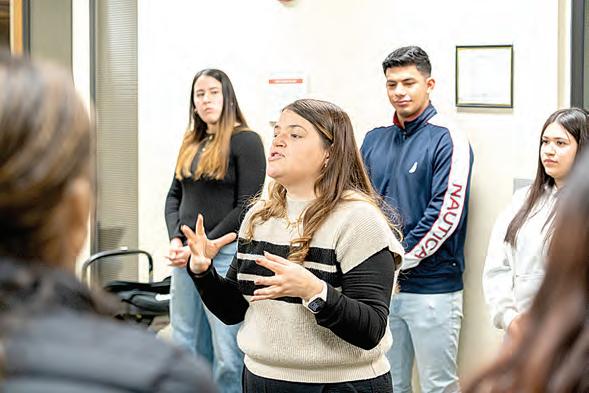
organización de los obispos de EE. UU. que coordina y apoya el ministerio hispano en 30 diócesis del sureste. Ofrece programas en formación, evangelización y liderazgo para ministros laicos y jóvenes, incluyendo escuelas de ministerio, talleres y una maestría en Ministerio Pastoral Hispano en colaboración con Barry University.
La oficina de Ministerio Juvenil de SEPI supervisa el Libro de Pascua e invita a diferentes diócesis a participar. El proceso consiste en cuatro reuniones repartidas en varios meses, por lo general de mayo a febrero. Los participantes reciben el libro en el taller final.
La Diócesis de Charlotte ha participado en el proyecto desde que se unió al SEPI en 2001, con grupos juveniles escribiendo secciones del libro y desempeñando un papel clave en su desarrollo.
“La Diócesis de Charlotte nunca se ha alejado”, dijo Escalante. “Los jóvenes de Charlotte tienen una forma única y particular de hacer que la fe sea atractiva.”
En la presentación, los participantes no pudieron ver el libro físico debido a retrasos en el envío causados por las tormentas de invierno, pero discutieron cómo puede fomentar conversaciones sobre la salud mental que rompan el estigma al mismo tiempo que muestran la necesidad de entenderla tanto psicológica como espiritualmente.
Considere unirse a los más de 2 millones de miembros de la organización fraternal católica más grande del mundo y registrándose en línea hoy en: www.kofc.org/joinus/es Caballeros de Colón
Por tiempo limitado - Membresía en línea GRATISUse el código de promoción (BLESSEDMCGIVNEY)
catholicnewsherald.com | February 20, 2026
(Izquierda)
Gabriella Escalante, coordinadora del ministerio juvenil del Instituto Pastoral del Sureste (SEPI), lidera un grupo de jóvenes hispanos en el Centro Pastoral de Charlotte. Escalante ha estado a cargo del ministerio de pastoral juvenil desde 2022.
BRIAN SEGOVIA | CATHOLIC NEWS HERALD
El libro, dividido en una guía personal y una guía para líderes, incluye recursos como reflexiones, oraciones, música y teología adaptados a cada tema para ayudar en las conversaciones y acompañar a los jóvenes.
Vicente Capistrano, director de comunicaciones de la Parroquia Nuestra Señora de Guadalupe en Charlotte y colaborador del libro durante los últimos dos años, dijo que el libro ayuda a los líderes a hacer buenas preguntas y crear condiciones para normalizar discusiones sobre la salud mental. Dijo que ser parte del proceso de publicación de un libro motivacional que se compartirá con personas en diferentes partes del país ha sido gratificante.
“Nunca imaginé esto; es hermoso poder compartirlo con otros para ayudar, es emocionante”, dijo Capistrano.
El taller incluyó un resumen del proceso de producción, ideas para la implementación, evaluaciones y actividades para fomentar la conexión. Además de compartir experiencias con los facilitadores, los participantes usaron el tiempo para conocerse y profundizar en los temas discutidos. Tomaron turnos para hablar abiertamente sobre sus experiencias y explorar cómo comenzar diálogos con personas que sienten ansiedad o depresión.
Rudy Reyes de la Parroquia St. Mary en Greensboro comentó: “Aunque sentimos miedo al principio, podemos crecer con el apoyo de otros.”
De manera similar, Jackelyn Villamizar Serrano subrayó la importancia del apoyo entre pares. “Hay muchos que pueden necesitar escuchar algo cuando están pasando por un momento difícil”, dijo.
Para alentar un diálogo más profundo, el psicólogo Gustavo Facio y Karla Rodríguez, coordinadora del ministerio multicultural de jóvenes y adultos jóvenes de la Diócesis de St. Augustine, inspiraron a los jóvenes a compartir el mensaje del libro.
“Tener el coraje de decir cómo te sientes es la forma en que queremos verte”, dijo Rodríguez. “No tienes que esconder partes de ti mismo para conformarte a los demás.”
La diócesis actualiza la política de conducta para clero, empleados y voluntarios
CHARLOTTE — La Diócesis de Charlotte ha actualizado su política de conducta de larga data para el clero, los empleados y los voluntarios adultos que sirven en sus parroquias, escuelas y ministerios.
El obispo Michael Martin, OFM Conv., promulgó la política actualizada el 19 de febrero, marcando la culminación de varios años de colaboración entre la Oficina de Ambiente Seguro de la diócesis, la Junta de Revisión Laical, el Consejo Presbiteral y el liderazgo diocesano. La política de conducta, que aborda la conducta sexual inapropiada, el abuso y el acoso, se emitió anteriormente en 2003.
Las actualizaciones reflejan en su mayoría prácticas que han estado en vigor durante varios años, incluida la transición de la diócesis en 2024 de Virtus Online a CMG Connect como su sistema obligatorio de educación y capacitación de Ambiente Seguro. CMG Connect consolidó la verificación de antecedentes, la incorporación y la capacitación en una sola plataforma para todo el personal de la Iglesia y los voluntarios adultos que sirven en las 93 parroquias, 20 escuelas y más de 50 agencias y ministerios de la diócesis. Otros cambios reflejan la terminología actualizada de la “Carta para la Protección de Niños y Jóvenes” de la Conferencia de Obispos Católicos de los Estados Unidos, así como recientes cambios en la ley de Carolina del Norte. Las políticas de conducta específicas para el clero y otras personas dedicadas al cuidado pastoral también se trasladaron fuera de la política general de empleados a un anexo separado para mayor claridad, alineándolas con el derecho canónico y con las normas actuales de la diócesis sobre sesiones de consejería, posibles conflictos de interés y mantenimiento de registros. El cumplimiento de la política de conducta sigue siendo obligatorio para todos los sacerdotes, diáconos, seminaristas, hombres y mujeres que sirven en órdenes religiosas, empleados laicos y voluntarios de 18 años o más. La capacitación anual y la recertificación también continúan siendo obligatorias. Las verificaciones de antecedentes, una vez completadas a través de CMG Connect, se supervisan trimestralmente para detectar posibles cargos penales. La política actualizada está publicada en línea en www.charlottediocese.org/ offices/safe-environment.
— Catholic News Herald
Desconocer las Sagradas Escrituras es desconocer a Jesucristo, afirmó el Papa León XIV durante su audiencia general.
“La finalidad última de la lectura y la meditación de la Escritura”, dijo el 11 de febrero, es “conocer a Cristo y, a través de Él, entrar en relación con Dios; relación que puede ser entendida como una conversación, un diálogo”.
Además, con la Cuaresma comenzando en el 18 de febrero, el Papa dijo que esta temporada “es un tiempo para profundizar nuestro conocimiento y amor por el Señor, para examinar nuestros corazones y nuestras vidas, así como para volver a centrar nuestra mirada en Jesús y su amor por nosotros”.
“Que estos días de oración, ayuno y limosna sean una fuente de fortaleza en nuestro esfuerzo diario por tomar nuestra cruz y seguir a Cristo”, dijo al pronunciar sus saludos en inglés durante su audiencia en la Sala Pablo VI.
En su catequesis principal, el Papa León continuó su serie de charlas sobre el Concilio Vaticano II, concretamente sobre la Constitución dogmática “Dei Verbum”, sobre la revelación divina y la Palabra de Dios.
La Palabra de Dios es fuente de consuelo, guía y fortaleza para los cristianos, dijo, y debe compartirse también con los demás.
“Vivimos rodeados de multitud de palabras; sin embargo, ¡cuántas de ellas son palabras vacías!”, afirmó el Santo Padre.
“En cambio, la Palabra de Dios sacia nuestra sed de sentido y de verdad sobre nuestra vida”, dijo. “Es la única Palabra siempre nueva: revelándonos el misterio de Dios es inexhaurible, no cesa nunca de ofrecer sus riquezas”.
La Sagrada Escritura es “el medio por el que llegamos a conocer la Palabra viva y encarnada de Dios, que es Jesucristo”, dijo el Papa en su resumen en inglés. “De hecho, orar con la Escritura abre la puerta a una relación íntima con Dios, quien, a través de estos escritos sagrados, nos invita a conversar con él”.
“Como señala acertadamente San Jerónimo, ignorar la Escritura es ignorar a Dios”, dijo, animando a todos los fieles a leer y reflexionar sobre la palabra de Dios cada día, para que “alimente nuestros corazones y nuestras mentes y nos conduzca a la plenitud de la vida”.
El Papa León dijo en su resumen en inglés que existe una “conexión profunda y vital” entre la palabra de Dios y la Iglesia católica.
“La Sagrada Escritura, que ha sido confiada a la Iglesia y es custodiada por ella, revela su significado y manifiesta su fuerza en la vida y la fe de la Iglesia, sobre todo en la celebración de la Sagrada Eucaristía”, afirmó.
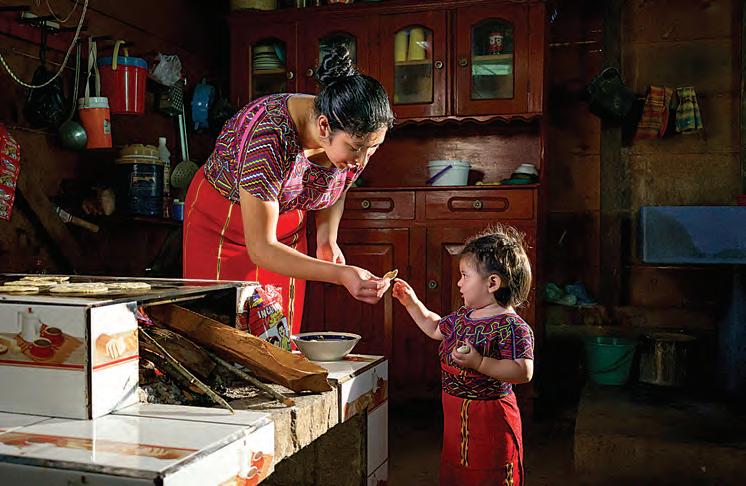
La hija de Aribel, Juanita, ama las tortillas que ella prepara con harina enriquecida con vitaminas. Las clases de nutrición de Catholic Relief Services en Guatemala educan a las familias sobre los tipos de nutrientes que se encuentran en diferentes alimentos.
CATHOLIC RELIEF SERVICES
ITodo comenzó con el deseo de marcar una diferencia. En 1975, católicos de Allentown, Pensilvania, rezaron, ayunaron y dieron limosna para ayudar a personas que sufrían hambre en la región del Sahel, en África, marcando el inicio de lo que se convertiría en Rice Bowl de Catholic Relief Services (CRS). Desde entonces, generaciones de católicos en todo Estados Unidos se han unido cada Cuaresma con un objetivo común: poner fin al hambre en el mundo.
En estos 50 años, CRS Rice Bowl ha compartido historias de cómo sus donaciones ayudan a las personas a romper el ciclo del hambre y a construir salud y resiliencia. Historias de personas como Maribel, en Janlay, Guatemala.
Maribel es una tejedora que crea güipiles tradicionales, las blusas bordadas que usan las mujeres indígenas en Centroamérica. También es mamá de una alegre niña llamada Juana, quien – como muchos niños pequeños – mantiene a Maribel siempre en movimiento. “Es una niña muy sana. Le encanta correr por la casa. Ella es quien trae la felicidad a nuestro hogar”, dice Maribel.
Cuando Juana tenía apenas 4 meses, el esposo de Maribel tuvo que viajar para buscar trabajo. Maribel se quedó en casa con Juana, haciendo todo lo posible por cuidarla. Necesitaba ayuda. Entonces se unió a un programa de CRS que ofrecía clases de nutrición, donde aprendió a tomar decisiones alimenticias saludables para su familia.
Ahora, Maribel alimenta a Juana con frutas, verduras, huevos

y cereal caliente lleno de vitaminas y proteínas. También prepara sus propias bebidas en lugar de comprar refrescos. Maribel también aprendió que es importante que ella tome vitaminas, como hierro, porque Juana las recibe a través de la leche materna. “Aprendimos que debemos mantenernos saludables por nuestros hijos, y no solo como madres. Es importante que todas las niñas tomen sus vitaminas para que estemos bien”, dice.
El programa también enseñó a la comunidad cómo ahorrar dinero y desarrollar mejores hábitos para la vida diaria. Hoy, Maribel está agradecida por el programa. Dice: “Por todo el apoyo que nos han dado, nos sentimos muy agradecidos. A través de una alimentación saludable y la práctica del ahorro, hemos podido mejorar la salud, la nutrición y el bienestar económico de nuestra familia”.
Hoy en día, los conflictos y las guerras, el cambio climático y el aumento del costo de los alimentos están contribuyendo a una crisis alimentaria mundial. Millones de personas viven sin acceso a los alimentos que necesitan para llevar una vida saludable. Esto es peligroso, especialmente para los niños, que necesitan una nutrición adecuada para crecer.
Ya sea que esta sea la primera vez que participa en CRS Rice Bowl o que haya crecido haciéndolo, la Cuaresma es un tiempo para ayudar a responder a esta necesidad urgente, porque todos merecen tener suficiente para comer.
— Catholic Relief Services
Aunque a menudo se comen como aperitivo en Guatemala, las tostadas también son excelentes como merienda o como una comida rápida en una noche ajetreada. Los ingredientes se reparten entre tres tortillas, dejando espacio para jugar con cualquier adición que desees.
INGREDIENTES
Guacamole:
3–5 aguacates grandes, partidos por la mitad y sin hueso 1/2 cebolla, finamente picada Jugo de 2 limas
1 cucharadita de orégano seco Sal y pimienta al gusto
Preparación
Tostadas:
12 tortillas de maíz
Aceite para freír (canola o de oliva) Guacamole preparado (ver arriba)
1 frasco de salsa roja
1 lata de frijoles refritos
10 onzas de queso seco (queso para desmoronar) o cualquier queso, rallado Cilantro picado
En un tazón grande, saca la pulpa del aguacate con una cuchara. Machácala con un tenedor hasta obtener la consistencia deseada. Incorpora la cebolla, el jugo de lima y el orégano. Agrega sal y pimienta al gusto. En una sartén grande a fuego medio-alto, vierte aproximadamente 1,25 cm (media pulgada) de aceite. Cuando el aceite esté caliente, agrega las tortillas en una sola capa y fríelas hasta que estén crujientes. Transfiérelas a un plato con papel absorbente para eliminar el exceso de aceite. Una vez que las tortillas se hayan enfriado, unta tres con guacamole, tres con frijoles refritos y tres con salsa. Decora con el queso y el cilantro.
PEORIA, Illinois — Venerable
Fulton J. Sheen, a 20th-century American media pioneer and evangelist, will soon be beatified now that the Vatican has given the green light, the Diocese of Peoria, Illinois, announced Feb. 9.
The announcement comes six years after the Holy See had postponed the beatification, initially scheduled for December 2019, only weeks before the event was to take place.
“The Holy See has informed me that the Cause for the Venerable Servant of God Archbishop Fulton J. Sheen can proceed to Beatification,” Bishop Louis Tylka of Peoria said in a Feb. 9 statement.
“The next step in the process is the celebration of the Beatification, in which Fulton Sheen would be declared Blessed.”
The bishop said the date and event details will be released soon through www.celebratesheen.com, the website for Archbishop Sheen’s cause.
“Archbishop Fulton Sheen was one of the greatest voices of evangelization in the Church and the world in the 20th century,” Bishop Tylka said. “I have long admired his lifelong commitment to serve the Church as a priest, rooted in his deep devotion to the Blessed Mother and the Eucharist. As he journeyed through the different stages of his life, his ability to share the Gospel and truly relate to people drew countless souls into an encounter with Jesus – one that transformed not only his life, but more importantly, the lives of those he touched.”
DELAYS OVERCOME
Archbishop Sheen’s cause for canonization, opened in 2002, has been stalled by two controversies – a public battle to relocate his remains from St. Patrick’s Cathedral in New York to its current location, the side chapel of the Cathedral of St. Mary of the Immaculate Conception in Peoria, and concerns that as bishop of the Diocese of Rochester, New York, from 1966 to 1969, he might have overlooked sexual abuse by at least one former diocesan priest.
In July 2019, then-Bishop Daniel R. Jenky of Peoria announced Pope
Francis had approved a miracle attributed to the intercession of Archbishop Sheen, which led the way to the announcement he would be beatified. A little more than two weeks later, a Dec. 3, 2019, news release from the Diocese of Peoria said it had been informed that the Holy See had decided to postpone the Dec. 21, 2019, ceremony “at the request of a few members” of the U.S. Conference of Catholic Bishops.
The Dec. 3 statement said, “In our current climate it is important for the faithful to know that there has never been, nor is
there now, any allegation against (Archbishop) Sheen involving the abuse of a minor.”
After intense investigation in December 2024, Monsignor Jason Gray, executive director of the Archbishop Fulton John Sheen Foundation, told OSV News that “Sheen is clean. … Not one accusation has been raised that impugned Sheen.”
Monsignor Gray said the foundation has examined “all of the pleadings” relevant to claims against the Rochester diocese, and “there hasn’t been anything that
Venerable Archbishop Fulton J. Sheen, one of the most influential Catholic evangelists in American history, harnessed modern media to proclaim the Gospel to millions.
Born in Illinois in 1895 and ordained for the Diocese of Peoria in 1919, Archbishop Sheen combined a philosopher’s rigor with a pastor’s heart. After early parish ministry, he taught for 25 years at The Catholic University of America, authoring dozens of books and earning a reputation as a spellbinding lecturer
who spoke without notes. He rose to national prominence through NBC radio’s “The Catholic Hour” and later television’s “Life Is Worth Living,” which drew audiences of up to 30 million and earned him an Emmy.
Appointed auxiliary bishop of New York in 1951, he directed global mission efforts, donating all media earnings to the missions.
Known for his wit, clarity and deep Eucharistic devotion, Archbishop Sheen also endured personal suffering
was brought up there” implicating Archbishop Sheen.
‘GOD’S MICROPHONE’
Archbishop Sheen is remembered as one of the most influential and innovative evangelists in American history. Once dubbed “God’s microphone,” Archbishop Sheen announced God’s truth in a nonconfrontational, yet no less lifegiving, manner to untold millions through radio, print and television.
Born in El Paso, Illinois, on May 8, 1895, Archbishop Sheen resolved to serve the Church as a priest from an early age. He was assigned to academic ministry following his ordination to the priesthood on Sept. 20, 1919, for the Diocese of Peoria.
After studies in Europe, a promising future as a professor awaited Archbishop Sheen. First, though, his bishop called him back to a parish in Peoria to test his obedience. And he zealously took on the task.
In less than a year, Archbishop Sheen landed a professorship at The Catholic University of America in Washington. For a quarter century, he was known there for his engaging and stimulating lectures. During that time, he published more than half of his over 60 books, informed by a lively and heroic faith.
During the 1930s and 1940s, then-Monsignor Sheen became a household name as host of “The Catholic Hour,” broadcast nationally from NBC radio in New York. The priest emerged as a national voice, a prophetic truth-teller who spoke out on a host of issues, particularly the threat of communism.
Having to give up his professorship after appointment as director of the Society for the Propagation of the Faith in 1950, Monsignor Sheen moved to New York City. He was appointed an auxiliary bishop of New York, ordained in Rome on June 11, 1951.
Beginning in 1952, Bishop Sheen spoke each Tuesday evening to tens of millions via his “Life Is Worth Living” TV program. After his first year on the air, Bishop Sheen
SHEEN, SEE PAGE 23
and controversy. He died in 1979 and was declared venerable in 2012. On Feb. 9, Bishop Louis Tylka of Peoria announced that the cause for the revered archbishop had been approved to proceed to beatification, and he is working with the Dicastery of the Causes of Saints at the Vatican to determine details. The date and event details are expected to be released soon at www. celebratesheen.com.
— OSV News
Venerable Fulton J. Sheen remains one of the most compelling Catholic voices of the 20th century, and he left a sizable body of written works in addition to his radio and television appearances. His 66 books offer something for everyone: heady theological dissertation, accessible theology and philosophy, astute cultural reflections and profound meditations on the lives of Christ and Mary.
Here is a selection of 10 of his books to add to your reading list:
n “Life of Christ”: This classic devotional reflects on the life of Christ with a mix of Scripture, history and philosophy in vivid detail.
n “Three to Get Married”: An approachable exploration of the philosophy and theology of Christian marriage.
n “A Declaration of Dependence”: Written in the middle of World War II, this book explores the irrationality, violence, hatred and division of war and its cause in society.
n “Treasure in Clay”: This autobiography was compiled shortly before his death.
n “The World’s First Love”: His love for the Blessed Mother shines through in this account of Mary’s life and role in the Church.
n “The Way of the Cross”: This short devotional paints a vivid account of walking with Christ on His road to Calvary.
n “Life Is Worth Living”: Trying to unplug from technology but want to learn from Archbishop Sheen’s broadcasts? Try this compilation of 44 of his television addresses.
n “The Rainbow of Sorrow”: He explores the meaning of pain and suffering while meditating on the seven last words of Christ from the cross.
n “Moods and Truths”: He urges Christians to live their faith in the public sphere.
n “The Priest Is Not His Own”: He explores the meaning of the priesthood.
— Megan Marley, OSV News
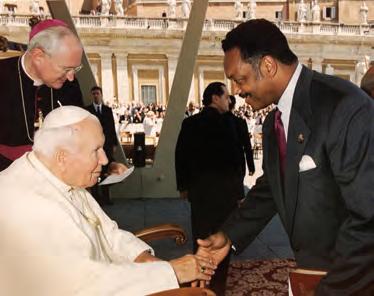
VATICAN | OSV NEWS
St. John Paul II greets the Rev. Jesse Jackson at the end of the pope’s weekly audience at the Vatican June 23, 1999. Jackson died Feb. 17.
WASHINGTON, D.C. — Catholic leaders were among those who praised the legacy of the Rev. Jesse Jackson, a Baptist minister and prominent civil rights leader, who died Feb. 17. He was 84.
Although, as a politician, Rev. Jackson took some public policy positions at odds with Catholic teaching – such as changing his original views opposing abortion to supporting it over the course of his life – Catholic leaders praised his work in the area of racial justice.
Bishop Daniel E. Garcia of Austin, Texas, chairman of the U.S. Conference of Catholic Bishops’ Subcommittee for the Promotion of Racial Justice and Reconciliation, said in written comments, “As an advocate for racial justice and a central figure in the civil rights movement, Rev. Jesse Jackson played a key role in securing equal rights for African Americans and offered prophetic witness to the dignity of people of all racial backgrounds.”
“He inspired generations to pursue racial justice, love goodness, and walk humbly with God. My prayers are with his family and close collaborators – may his legacy continue to inspire, guide and uplift all who strive for a more just world and an end to racism,” he said.
In a post on X, Bishop Robert E. Barron of Winona-Rochester, Minnesota, said, “Though we differed on a number of issues, I always admired Jesse Jackson. … Jackson consistently advocated for the transformative power of nonviolence. At a time when our social interaction is marked by terrible violence, this continues to be a welcome message.”
FREDERICKSBURG, Virginia — Some Catholic colleges – including Belmont Abbey College –rank among the best in the nation for pro-life support for women, while others are among the
worst for their ties to abortion clinics, a recent report found.
In an audit of more than 700 Christian colleges and universities, the Christian Schools Project ranked Belmont Abbey College the third best school for pro-life values. The report highlighted the college’s maternity home, its MiraVia residence for pregnant students.
The report also found that one in seven Christian colleges referred students to Planned Parenthood for healthcare or future jobs, among other pro-abortion “infractions.” One in 10 Catholic colleges had ties to abortion clinics, and about 25% of all the infractions were by Catholic universities.
“Despite this, Catholic schools also had 24 ‘A+’ schools: the most of any denomination,” the report continued.
Catholic colleges also made up more than half of the top 10 best schools in the report.
A date for the beatification of five Franciscans known as the Georgia martyrs has been set for Oct. 31, according to the Dicastery for the Causes of Saints’ website. It lists Cardinal Frank Leo of Toronto as the Mass’ celebrant.
The announcement on the dicastery’s homepage features an image of a painting of the martyrs, with the center figure holding a fan of palms, a symbol associated with martyrdom, the act of dying for one’s faith.
In 1597, the Spanish Franciscans Pedro de Corpa, Blas Rodríguez de Cuacos, Miguel de Añón, Antonio de Badajoz and Francisco de Veráscola were ministering at five missions along the coast of present-day Georgia when they were killed by a band of Indigenous men between Sept. 14-17.
Their murders were prompted by Father de Corpa angering the heir to a Guale chiefdom, Juanillo, by telling him that as a baptized Christian, he could not follow his culture’s custom and take a second wife. Juanillo and his men killed the priest at a mission near the modern city of Eulonia, Georgia, before killing four of the other five Franciscan missionaries ministering in the area.
Pope Francis recognized the friars’ deaths as martyrdom Jan. 27, 2025, paving way for their beatification.
Franciscans launched a cause for the Georgia martyrs’ canonization in 1950, but due to changes in the canonization process, the diocesan phase of the investigation did not begin until 1984 under Bishop Raymond W. Lessard of Savannah.
Officials at the Diocese of Savannah have yet to receive written confirmation from the dicastery of the Oct. 31 date. The diocese will publicize details of the beatification when it is in hand, Jill Parks, the diocese’s managing director of communications, told OSV News Feb. 17.
The date falls within the Jubilee Year of St. Francis, which commemorates the 800th anniversary of his death.
WASHINGTON, D.C. — Catholic leaders, including an official from the U.S. Conference of Catholic Bishops’ migration office, reiterated

a pastoral approach to the issue of child detentions by Immigration and Customs Enforcement.
In a Feb. 3 statement to OSV News, David Spicer, the policy and engagement director for the USCCB’s Secretariat of Migration, called for federal efforts to be “guided by Christ’s call in the Gospel to solidarity with ‘the least of these,’” citing Jesus’ words in Matthew 25:40.
Spicer reiterated the bishops’ call for “humane, community-based alternatives” to family detention following the recent release of a 5-year-old Minnesota boy from a Texas family detention facility and an investigative news report that found a sixfold increase in child detentions at that same facility.
The report by investigative journalists from the Marshall Project, a nonprofit media outlet specializing in criminal justice news, was posted days before the Jan. 31 release of Liam Conejo Ramos and his father, Adrian Conejo Arias.
The Marshall Project news analysis of children’s detentions in Dilley shows that, from the time President Donald Trump took office in January 2025 through October that year, ICE had detained about 170 children on an average day. On some days, ICE held 400 or more child detainees. In the period between September 2023 to January 2025, ICE detained an average of 25 children per day, according to the report.
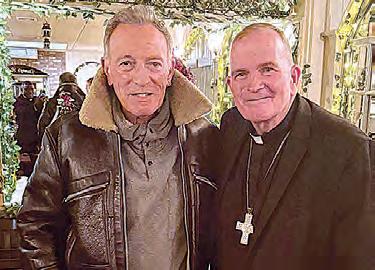
DIOCESE OF TRENTON | OSV NEWS
‘the Boss’
FREEHOLD TOWNSHIP, New Jersey — New Jersey-based rock legend Bruce Springsteen and Bishop David M. O’Connell of Trenton got together recently for an impromptu lunch Feb. 2 at Federici’s Restaurant in Freehold.
The lunch was arranged through Father Brian Butch, pastor of St. Anselm Parish in Tinton Falls, who is a friend of Springsteen’s.
It was the first time that Bishop O’Connell had met Springsteen, though he has been a fan of his music for many years. The bishop described the get-together as “delightful” to the Trenton Monitor, the diocesan news outlet.
Springsteen, who lives in the Diocese of Trenton, was raised Catholic and attended St. Rose of Lima School in Freehold, preserving his connection there to the present day.
While not currently a registered parishioner in the Diocese of Trenton, Springsteen has said publicly, “Once a Catholic always a Catholic.”
Many of the themes he espouses in his music reflect Gospel values and Church teaching.
Bishop O’Connell later noted that Springsteen’s songs “touch on so many themes consistent with our Catholic faith.”
— OSV News and Catholic News Agency
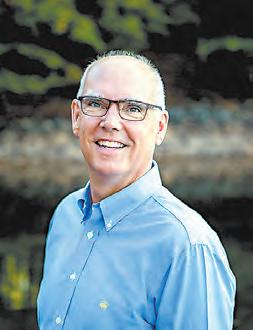
won an Emmy award for best television personality. Upon acceptance, he famously thanked his writers: Matthew, Mark, Luke and John.
Bishop Sheen was a charitable and attentive pastor who treated prince and leper alike. His intelligence, wit and sense of humor made him an effective evangelist. And with clear teaching and common sense, Bishop Sheen helped people make sense of life’s problems. He was never afraid to proclaim Christ and brought many converts to Catholicism.
Throughout his 60-year priesthood, Bishop Sheen sought to conform himself more closely to Christ by observing a daily Eucharistic Holy Hour, what he called “the hour that makes my day.” He also was intensely devoted to the Mother of God.
Bishop Sheen battled various temptations and difficulties throughout his life – including a decade of behindthe-scenes hostility from Cardinal Francis Spellman of New York, which caused Bishop Sheen great pain. But in the face of his troubles, Bishop Sheen persevered in virtue. He understood his sufferings in light of God’s providence:
“Christianity begins not with sunshine, but with defeat. During those days when my life was backed up against the cross, I began to know and to love it more.”
Despite his best efforts as bishop in Rochester, New York (1966-1969), Bishop Sheen’s brief tenure was met with great resistance, resulting in a good deal of self-described failure. After retirement, Bishop Sheen was appointed titular archbishop of Newport, Wales, by then-Pope Paul VI. Archbishop Sheen delivered retreats aimed at renewal of the priesthood throughout the country and maintained a voice in the public square through regular media appearances. He visited the Diocese of Charlotte at least twice in the 1970s.
The sufferings Archbishop Sheen faced intensified his union with Christ. Toward the end of his life, writing in his autobiography, Archbishop Sheen apologized for his failures, wondering, “Was I inspiring anyone to imitate Christ in the daily carrying of His Cross?”
After nearly two years in and out of the hospital following open-heart surgery, Archbishop Sheen died Dec. 9, 1979, in New York City, in the presence of the Blessed Sacrament. He was declared venerable in 2012.
Bishop Tylka said Archbishop Sheen “helped us recognize that the Church is meant for all people” and that “as members of the Church, we are called to serve everyone, especially those most in need and those longing to hear and experience the Gospel.”
JUNNO AROCHO ESTEVES OSV News
Since 2022, there has been a steady flow of harrowing images and videos of killings, war and destruction from the Holy Land, beginning with the Oct. 7, 2023, attack by Hamas, followed by Israel’s war on Gaza.
That, coupled with reported attacks on Christians in the West Bank by Jewish settlers, has led the land known as “The Fifth Gospel” to be nearly empty of pilgrims over the past two years.
Although a ceasefire agreement has been in place since October, Israel launched a deadly strike on Gaza Jan. 31 that killed more than 30 people, threatening an already shaky detente.
On Feb. 3, only a handful of sick and wounded Palestinians from Gaza were allowed to cross to Egypt after the Rafah
with Christians in the area whose livelihoods depend on pilgrims.
Meeting with pilgrims from Rome Jan. 7 at the Franciscan headquarters in Jerusalem, Father Ielpo said the presence of Christians from around the world visiting the Holy Land “generates hope and strengthens the reason for coming here – not to see a museum, but to encounter a living Church.”
Father Ielpo said he is often asked by many how “to help this land and these peoples.”
The most helpful thing, he said, according to Vatican News, was to “return as pilgrims to this land.”
Pilgrimages are “one of the principal sources of economic support, primarily – but not only – for the local Christian community,” he added.
For Michael Kelly, director of public

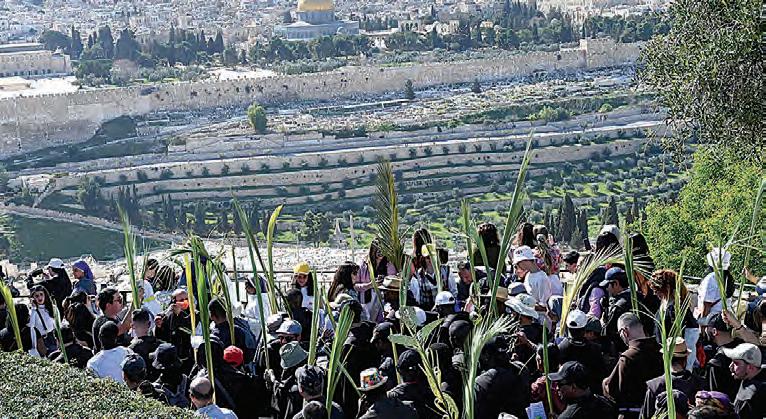
While the ceasefire in Gaza is fragile, “around Jerusalem, Bethlehem, Nazareth and the Sea of Galilee the situation is safe,”
Kelly said in a Jan. 28 email to OSV News.
Kelly, who said he has led dozens of group pilgrimages to the Holy Land over the past 20 years, urged pilgrims on the fence about visiting to “leave the hesitation at the door, because it is not outsiders telling people to come, it is the people who live the reality every single day who are asking pilgrims to come.”
“Even before the current war, people had a perception that the Holy Land is unsafe,” he said. “I used to say to people, take the words of Jesus to heart ‘come and see’ –and I can tell you honestly, of the 6,000 or so pilgrims I have brought to the Holy Land, not one said they were concerned or worried once they were there.”
With religious tourism slowing to a trickle, he lamented, Christians in Bethlehem and Jerusalem are reaching a breaking point, both economically and mentally.
“They are suffering isolation and hardship because pilgrims have not come in over two years,” he said. “They want people to come back, but not just for their material benefit (which is important) but because they want to share their lives of faith with Christians from all over the world.”
“Many of the workers in the hotels and restaurants are Christians, and by patronizing these businesses we are helping Christians to survive,” he added.
According to a report by the U.S. State Department, Christian clergy and pilgrims are facing increased harassment, including incidents of spitting and verbal assault by ultra-Orthodox extremists.
Asked how one reconciles the spiritual call to return with the reality of rising hostility on the streets, Kelly acknowledged that authorities in Jerusalem must do more to ensure that pilgrims “do not have negative experiences.”
“Jerusalem is a holy city for Jews, Christians and Muslims. All of these believers
must be allowed to be free to exercise their faith in the city,” he said, noting that rabbis in Jerusalem denounced Jewish extremists for their harassment, which is “not in keeping with authentic Judaism.”
“Any time I have witnessed an incident and I have reported it to the Israeli police, they took action immediately,” he said. “This hostility on the streets comes from a very small but vocal faction.”
Kelly also said when such incidents occur on pilgrimages he has led, he tells pilgrims, “This is how it was. The Lord did not have a sanitized walk to Calvary; try to enter more deeply into his passion with this very small experience of adversity.’”
“The streets of Jerusalem were hostile on that first Good Friday, when the Lord carried his cross,” he said. “Who are we to expect anything less?”
Nevertheless, the images of war and death remain the biggest hurdle in convincing pilgrims to return.
“People are rightly greatly troubled by the huge loss of life and the intensity of the violence,” Kelly said. While noting that major pilgrimage stops, such as Jerusalem, Bethlehem, Nazareth, the Sea of Galilee, Capernaum and the Jordan River are safe, he urged pilgrims to overcome their fear by visiting the Holy Land, deepening their faith, and supporting the Christian community.
“Many Christians are leaving – they see little hope,” he said. “They have not seen Christians from other parts of the world in over two years, (and) they begin to think that they are forgotten.”
“We have to help Catholics around the world understand that the importance of the Holy Land lies not just in the ancient sites there, but in the life of the local Christians descended from the first followers of Jesus,” Kelly said.
“My hope is that every Catholic parish in the world will give serious consideration to organizing a pilgrimage to the Holy Land, not only to see the holy sites associated with Jesus, but to be with the local Christian community – to show them that they are really part of the body of Christ, and we will support them,” he said.
COURTNEY MARES OSV News
ROME — Four hundred years after its consecration, St. Peter’s Basilica is getting a modern upgrade, with the Vatican unveiling plans for AI-powered translation services, expanded pilgrim access and high-tech structural monitoring as part of yearlong anniversary celebrations.
Cardinal Mauro Gambetti, archpriest of St. Peter’s Basilica, announced a wideranging slate of events and initiatives at a Feb. 16 Vatican press conference.
Pilgrims visiting St. Peter’s Basilica in 2026 will find expanded rooftop access, realtime Mass translations in 60 languages on their smartphones, extra weekly prayer and sacred music events, and a new temporary display of the Stations of the Cross.
The anniversary celebrations will culminate with Pope Leo XIV offering Mass in the basilica on Nov. 18, exactly four centuries after Pope Urban VIII solemnly dedicated the Renaissance basilica.
While Christians have been praying at the tomb of St. Peter for more than 1,950 years, the current basilica, which houses one of the world’s largest domes, dates back to the 16th century. The basilica took more than a century to build, with construction beginning in 1506 under Pope Julius II and finishing in 1615.
Cardinal Gambetti described the anniversary as “an opportunity to reunderstand the basilica as an ‘authentic event’ in the history of humanity,” noting that Pope Julius II’s decision to demolish the “old St. Peter’s Basilica,” the fourth-century basilica built by Roman emperor Constantine, sparked fierce debate at the time.
“In reality, far from wanting to erase the past, Julius II intended to reshape what existed, bringing it back to its source,” Cardinal Gambetti said. “It was a ‘renovatio,’ a renewal in continuity, as is proper to authentic ecclesial tradition: the foundation of the faith – the tomb of the Apostle Peter – remained intact and at the center of the new project.”
The new basilica, designed principally by Donato Bramante, Michelangelo and Carlo Maderno, with piazza and fittings by Gian Lorenzo Bernini, is the largest church in the world by interior measure.
Among the most practical changes announced is a streamlined online reservation system intended to reduce lines to enter the basilica. The Vatican is also introducing a multilingual platform
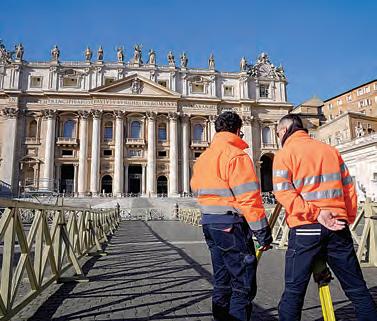
presented some new initiatives for the 400th anniversary of the dedication of St. Peter’s Basilica at a Feb. 16 news conference.
offering AI-assisted translations of Masses. Developed in partnership with the Dicastery for Communication and the tech company Translated, the system will allow pilgrims to scan QR codes at the entrance of the basilica to access audio and text translations on their smartphones without downloading additional apps.
More of the basilica’s terrace will open to the public, including a permanent exhibition on the basilica’s history and a highly anticipated expanded rooftop snack bar beneath Michelangelo’s dome that will be nearly double its current size.
Inside the basilica, a new Stations of the Cross designed by young Swiss artist Manuel Dürr, the winner of an international competition launched in 2023, will be on temporary display for Lent 2026.
In addition to the celebrations, an extensive conservation program is underway in partnership with Italian multinational energy company Eni to safeguard the basilica’s structural stability for future centuries.
The “Beyond the Visible” project employs advanced geophysical, geological, topographical and structural surveys.
The project revealed that the basilica’s foundations rest on clay and gravel layers with an active water table about 38 feet below the facade level. Annalisa Muccioli, head of research and development at Eni, described St. Peter’s Basilica as in a “good state of health” in 2026.
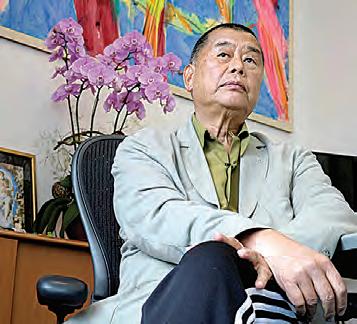
HONG KONG — Hong Kong media entrepreneur and Catholic pro-democracy advocate Jimmy Lai has been sentenced to 20 years in prison, in what critics say is the harshest penalty yet under China’s national security law. A Hong Kong court handed down the sentence Feb. 9, nearly six years after Lai’s arrest sparked international outrage. Lai, founder of the now-defunct Apple Daily, was convicted in December of sedition and conspiring to collude with foreign forces.
His family condemned the ruling as “heartbreakingly cruel,” warning that the 76-year-old’s declining health makes the sentence life-threatening. “If this sentence is carried out, he will die a martyr behind bars,” said Lai’s daughter Claire.
Imposed after mass pro-democracy protests in 2019, the security law has been widely criticized for eroding the city’s promised autonomy and silencing dissent. British officials called the case politically motivated, while Amnesty International said the sentence marks another step in Hong Kong’s shift from rule of law to rule by fear.
ROME — As brutal winter temperatures grip wartime Ukraine, the Vatican has stepped up emergency aid to help civilians facing power outages and health risks.
Vatican News reports that three trucks
carrying 80 generators – along with food and medicine – have reached Kyiv and nearby Fastiv after departing Rome’s Basilica of St. Sophia, known as the church of the Ukrainians. The shipment was sent at the request of Pope Leo XIV and coordinated by the Dicastery for the Service of Charity.
Cardinal Konrad Krajewski, the papal almoner, said the mission is a clear sign that the pope has not forgotten Ukraine’s suffering, especially as attacks on energy infrastructure leave families without heat or light.
Medicines included antibiotics, antiinflammatories, supplements and melatonin to help those struggling with trauma-related insomnia. The aid is distributed through local bishops and parishes and reaches Catholics, Orthodox Christians, and others alike.
The pope has also thanked Catholics across Europe for their solidarity, urging continued prayer and support as the war enters its fourth year. The papal almoner noted that the aid sent by the Vatican doesn’t just go to Catholics. “This truly is pure Gospel: to love,” he said.
Archbishop: Pope has solidarity with immigrants in the U.S.
VATICAN CITY — All Catholics are called to stand together by reaching out to their brothers and sisters in the faith of all ethnicities, especially those of Hispanic heritage, Archbishop Alexander K. Sample of Portland, Oregon, said.
“They are our brothers and sisters, we love them, and we stand with them in these difficult times,” he told Catholic News Service Feb. 11 during a visit to Rome and the Vatican, which included a private meeting with Pope Leo XIV Feb. 9.
“Our Holy Father has been a great source of encouragement and support for the United States bishops, I think, to be very strong in our statements and in our support for the immigrant community back home,” he said.
“I had the opportunity to speak with him, and I can say in the conversation, you could see that this was a matter of great concern for him,” said the archbishop.
When asked how Catholics in Portland could best accompany those possibly at risk of arrest or detention, he encouraged the English-speaking community to reach out to and build a real connection with those in the Hispanic community.
Launching a call for unity, peace and mutual support, the archbishop said Catholics of every ethnicity need to “see themselves as one and to really reach out to our brothers and sisters in the Hispanic community, especially right now … just get to know them, welcome them, help them, know that they are loved and very much a part of the body of Christ.”
— OSV News and Catholic News Service

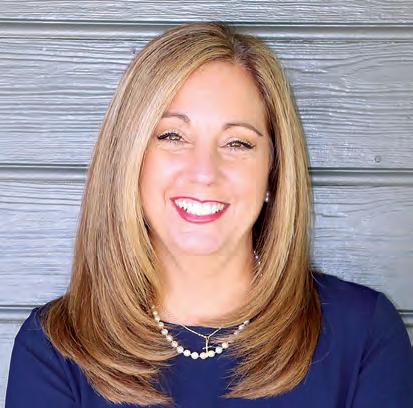

Ihad the privilege of attending Opera Carolina’s recent production of “Suor Angelica” by Giacomo Puccini, and I now understand why Puccini’s life changed after he saw his first opera. This is an art form that touches the soul and makes you feel alive.
While “Suor Angelica” is not a Catholic opera, it has been performed in churches such as the Basilica of St. Mary in Minneapolis and carries deeply Catholic themes. It is a moving portrayal of human suffering, redemption and God’s mercy that expresses remarkable beauty and restraint.
The opera tells the story of an aristocratic young woman sent to live in a convent by her family after having a child out of wedlock. Years later, her fragile peace is shattered when she learns devastating news about her son. Through unimaginable despair, she makes a tragic choice and is immediately overcome with remorse and conviction. While the story strays from Church teachings on suicide, its core themes of suffering, faith and redemption resonate deeply.
The ending left me in tears with my heart wide open as “Suor Angelica” pleaded for forgiveness in her final moments. She calls upon the Blessed Virgin Mary, who intercedes for her, miraculously reuniting mother and child. The story lingered with me long after the final note, especially as a young mother.
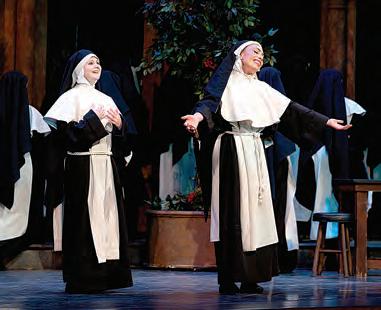
As this was my first time attending an opera, I was not entirely sure what to expect. What I experienced exceeded every expectation I thought I had. Before attending, I did what many firsttimers do and researched “how to prepare for your first opera.” I tried to do everything by the book, to make sure I had a full understanding and respect for what I was about to experience. I read the synopsis, familiarized myself with the characters, and had the honor of meeting some of the incredibly talented cast. However, I discovered that beyond trying to understand every phrase that is sung or trying to keep up with each line of the subtitles, opera is about feeling.
In many ways, it reminded me of my faith. For example, reading Scripture solely to understand each word cannot compare to the experience of encountering Christ personally and listening for what the Lord is speaking to my heart. The sweeping orchestral music, combined with the powerful voices and emotional acting, created something that cannot be fully captured in words.
I believe that young people would particularly benefit from experiencing the art of opera. There are so many times I encounter people around me who seem to be longing for more out of life. More community, more togetherness.
In a world and generation so often marked by division and noise, classical art returns us to the basics of our shared humanity. Experiencing something so profound together and sharing that inspirational feeling cultivates the connection and unity that people often yearn for. It is a beautiful reminder that art still has the power to inspire, to heal and to bring people closer to one another – just as it has since the beginning of time. I am also deeply grateful to Claudio and Alina of Opera Carolina, whose generosity and welcome helped make this first opera experience so meaningful. I encourage everyone to see a classical opera at least once in their lifetime. I cannot wait for the next one!
The history of the Church in the United States is a chronicle of evangelization.
Most of the Americans in the eternal hall of fame are distinguished as great missionaries: Sts. Frances Xavier Cabrini, Rose Philippine Duchesne, John Neumann, Katharine Drexel, Blessed James Miller, and the soon to be beatified martyrs of Georgia.
Some heroically left home to evangelize the indigenous and immigrants, Protestants, slaves and ex-slaves, lepers and yellow fever victims. Some risked and gave their lives as missionary martyrs.
We now have joyfully received news that there will soon be another American added to these disciple makers, arguably the most effective evangelist of them all: Archbishop Fulton J. Sheen, who will be beatified.
ELOQUENCE WITH EVERGREEN IMPACT
The most celebrated American Catholic of the middle of the 20th century, Sheen’s pioneering radio program “The Catholic Hour” and Emmy award-winning television program “Life is Worth Living” reached millions of Catholics and non-Catholics alike each week. His 66 books and three newspaper columns a week likewise informed the minds, hearts and lives of millions.
Sheen is not just a figure of the past. He is immensely popular among young Catholics, who watch his videos on YouTube and EWTN, listen to podcasts of his preaching, pray his eloquent Way of the Cross, and read his works.
Seminarians and young priests nourish their vocations by reading his books on the priesthood, listening to recordings of his famous retreats, and pondering his meditations on the seven last words of Christ on the cross.
Sheen’s popularity stems not just from the eloquence that gives him an evergreen impact. It’s because he symbolizes the type of shepherd so many young Catholics desire their bishops and priests to be: courageous and compelling heralds of the faith, unafraid to use modern means of communication to defend the faith.
He’s popular today for the same reasons that Bishop Robert Barron and Father Mike Schmitz are – and the young eventually discover that they are following in Sheen’s footsteps.
To understand Sheen, and why the Church is beatifying him, we need to get beneath his fame to his motivations.
He was, first and foremost, a devout disciple of Jesus. He not only knew about Jesus, but he knew Jesus personally, nourished by his more than 60 years’ worth of daily Eucharistic holy hours. Sheen is the greatest apostle of the Eucharistic Holy Hour in Church history; without a doubt he has helped spawn the revival of Eucharistic Adoration and the explosion of Perpetual Adoration chapels in the U.S.
That leads to the second point: Sheen wanted everyone to come to know that same Jesus.
That’s what drove his studies in philosophy and theology, so that he could pass on effectively the truth Christ proclaimed, something that
overflowed in his work in his packed classrooms, over the radio and television, in his writings and from the pulpit and dais.
It’s what explains his famous work, for 16 years, as the national director of the Society of the Propagation of the Faith, one of the four Pontifical Mission Societies, during which he sought to form American Catholics in missionary spirituality and help raise funds to spread the faith across the globe.
In his lifetime, Sheen donated over $10 million of his media earnings, raised $200 million for the missions (the equivalent of nearly $2.1 billion today), and left 40% of his estate and the royalties of his books and all his audio for the ongoing work of spreading the faith.
It would be almost impossible to enumerate the churches, schools, seminaries, convents and monasteries that exist today because of his work, not to mention the number of dioceses sustained and programs underwritten because of his efforts. With the possible exception of Pope Pius XI, no Catholic in the 20th century did more for the missions than Sheen.
The Church raises people to the altars not only to invoke them as intercessors but to propose them as models. While few will emulate Sheen’s eloquence, everyone can strive to imitate his love for the Lord Jesus and his zeal to help others come to know, love and serve Him in return. Therefore, the best way for us to prepare for Sheen’s upcoming beatification is to follow his example of prayer before the Eucharistic Jesus and his zeal to use whatever opportunities we have to help others come to know Jesus, both here in the U.S. and in the missions across the globe that were his great love.
MONSIGNOR ROGER J. LANDRY is the
In my adult lifetime, I don’t think there’s ever been a time when we the people have been more in need of repenting our collective sins.
This is not to suggest that it’s the most morally corrupt era in U.S. history. Surely nothing can compete with the onerous institution of chattel slavery that prevailed for some 250 years. But, with this exception, we may be living in the most morally corrupt era in U.S. history. And if we do not repent of our sins, our lives together will continue to be degraded into warring sects and factions.
It’s a dangerous game to cherry pick verses from the Hebrew Bible about blessings (or curses) of nations and apply them to the United States. In the first instance, such a practice tends to feed the pernicious myth that the United States is a chosen nation, or a Christian nation, or otherwise privileged by God over other nations. Catholic Christians should reject such ideas, as they tend toward idolatry, if they are not idolatrous notions in themselves.
But while it is a mistake to invoke God’s specific admonitions to Israel as applying anytime or anywhere else – especially to invoke God’s alleged favor – we can still learn what happens when a people turns its back on God.
‘While sins are the actions of individual persons, the cumulative effect of those actions have immediate social implications.’
First, however, we must dismiss the idea that we suffer from some mythical “national” or “institutional” sins. As with ancient Israel from time to time, it is not a “nation” in need of repentance, but rather the moral agents – the people – who constitute that nation. Institutions don’t sin. The people who administer them do.
ONLY PEOPLE CAN BE CORRUPT
Of course, when corruption, duplicity and violence are as widely spread and deeply entrenched as they are in the current era, it’s tempting to blame our current malaise on institutional structures. But only people have moral agency, and thus only people can be corrupt, duplicitous and violent. But those corrupt, duplicitous and violent moral agents can and do use institutional structures as their means to foment these human sins.
This is why, even though sin is the
personal failure of moral agents, we can identify “social sin,” in the words of St. John Paul II in his 1984 apostolic exhortation, “Reconciliation and Penance.” While sins are the actions of individual persons, the cumulative effect of those actions have immediate social implications, he explained.
In the first instance, “by virtue of human solidarity … each individual’s sin in some way affects others,” he said. Thus, one can speak of a “communion of sin, whereby a soul that lowers itself through sin drags down … the whole world,” he continued. “In other words, there is no sin, not even the most intimate and secret one, … that exclusively concerns the person committing it.” When we moral agents sin, it has “repercussions on … the whole human family.”
A second social implication of personal sins is more immediate and measurable. They are sins that “by their very matter constitute a direct attack on one’s neighbor,” he observed.
In the U.S., we can see this, for example, on both sides of the immigration issue. One side ignores the social harm done by unfettered illegal immigration, especially of organized career criminals. The other side condemns all immigrants in a blanket expression of nationalist xenophobia. I don’t need to cite any data or news stories for the reader to recognize the cumulative effects of these sins on particular communities in the U.S.
THE NEED FOR REPENTANCE
This suggests the third meaning of social sin, according to St. John Paul II. While he called it “class struggle,” one can translate that phrase into our current crisis of prejudicial, intolerant and violent “identity politics.” As the pope observed, “whoever the person who leads it or on occasion seeks to give it a theoretical justification, (this) is a social evil.”
After having described these “social sins,” John Paul II was quick to point out that they do not absolve individuals of their responsibility. “To speak even analogically of social sins must not cause us to underestimate the responsibility of the individuals involved,” he explained. Rather, recourse to “social sin” is “meant to be an appeal to the consciences of all, so that each may shoulder his or her responsibility seriously and courageously in order to change those disastrous conditions and intolerable situations.”
All sin is social sin because all sin implicates all persons in a given community. This season of Lent is the time for Catholic Christians to demonstrate to the world that reconciliation can only come through repentance – not of the “nation’s” sins, but of our own.
KENNETH CRAYCRAFT is a professor of moral theology at Mount St. Mary’s Seminary and School of Theology in Cincinnati and author of “Citizens Yet Strangers: Living Authentically Catholic in a Divided America” (OSV Books).

Pope Leo XIV often speaks of seeming hopelessness and the need to trust in God’s providence. In a memorable speech, he put it into the context of Holy Saturday: “… the mystery of Holy Saturday. It is the day of the Paschal mystery in which everything seems immobile and silent, while in reality an invisible action of salvation is being fulfilled” (General Audience, Sept. 24, 2025).
It was 100 years ago on Dec. 10, 1925, that Our Lady expressed her request to the venerable Sister Lucia of Fatima: “… all those who for five months, on the first Saturdays, go to confession, receive Communion, say five decades of the rosary and keep me company for 15 minutes meditating on the mysteries of the rosary, with the purpose of reparation
Most-read stories on the web
‘The
Olympic
to me, I promise to assist them at the hour of death with all the graces necessary for the salvation of their souls.”
Where are we in sharing and experiencing the Paschal mystery?
As Pope Leo XIV goes on to say, “Christ descends into the realm of the dead to bring the news of the Resurrection to all those who were in darkness and in the shadow of death. This event, which the liturgy and tradition have handed down to us, represents the most profound and radical gesture of God’s love for humanity.”
Have we answered affirmatively to Our Lady’s request for reparation for five months on First Saturdays?
JON GAUTHIER is an author and member of St. Matthew Parish in Charlotte.
Truce is built on the belief that participating in public sport with a spirit of “virtue and excellence” promotes greater fraternity, solidarity and the common good.’
Pope Leo XIV
From online story: “Church can help sports by flexing values, strengthening human dignity, pope says”

The Catholic News Herald reached the Facebook and Instagram feeds of more than 1.57 million people in English and Spanish last month. The most talked about post? Coverage of the diocese’s World Day of Consecrated Life Mass. Join the conversation: www.facebook.com/CatholicNewsHerald.
Over the past 30 days ending Feb. 18, 48,000 visitors to www.catholicnewsherald.com have viewed a total of 66,500 pages. The top trending headlines are: n Due to impending winter storm, no Mass obligation this


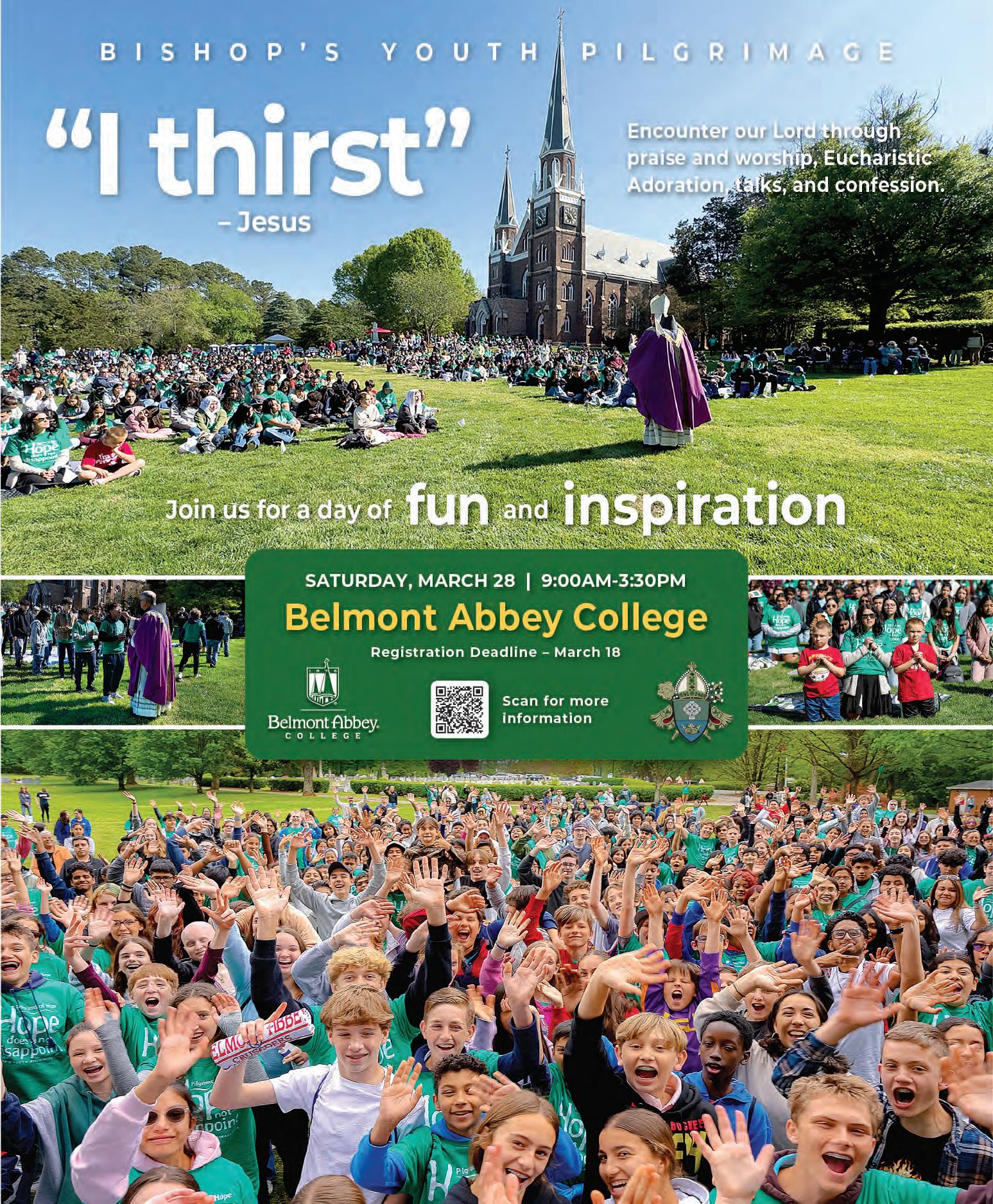

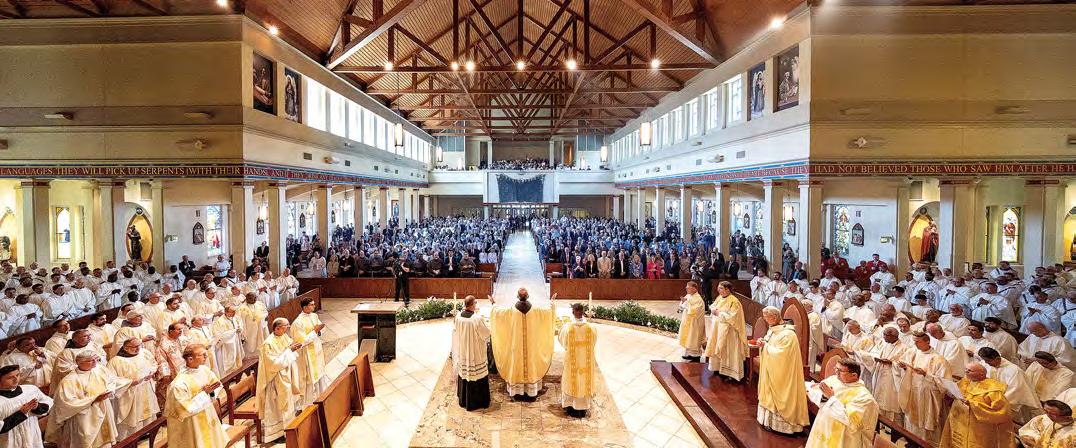
And as He gives us His love, He only asks us to be generous and to share what He has given us with others.”2
Since I first arrived to serve as your bishop, many have asked me what my vision for our diocese is. It is encapsulated in this simple statement:
Everyone so loves Jesus, we share Him with others.
These few words describe my prayers and hopes for the Catholic Church in western North Carolina. I want them to serve as the inspiration and guide for how we embody our faith in everything we are and do here in our diocese.
This is not something necessarily new, but rather builds upon so much that is already happening. From the mountains to the Triad to metro Charlotte, God’s grace is alive and bringing forth fruits in our parishes, schools, campus ministries and charitable outreach. What you have done to say yes to the invitation of Jesus to “come and follow me” is a witness to our world of what true freedom in Christ can look like. Praise God for His faithfulness and love!
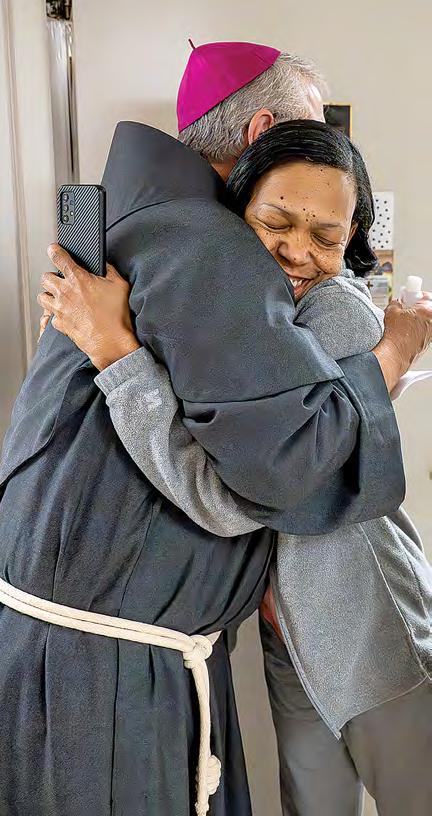
I use this moment to invite us all to fine-tune our own vision for a deeper response to the call of Christ.
In proposing this vision, I follow in the footsteps of the recent popes, who have all emphasized the need for a new evangelization. This vision also draws on what I have learned from visiting many parishes and communities across the diocese, reflecting on the fruits of the diocesan synodal
1 Leo XIV, “Homily for the Mass for the Beginning of the Pontificate,” May 18, 2025.
2 Leo XIV, “Video message to the Young People of Chicago and the Whole World,” June 14, 2025.
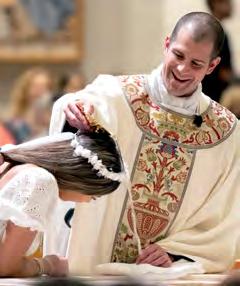
“We love because He first loved us.” — 1 John 4:19
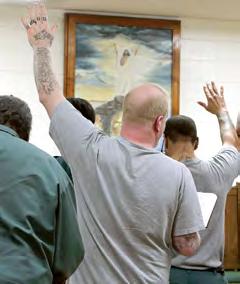
process, working on the findings of the Catholic Leadership Institute’s surveys and interviews, and consulting with diocesan leaders, lay experts, religious and priests. I am grateful for all the help I have received along the way.
Therefore, I offer, as your bishop, a vision for the Diocese of Charlotte that can help us grow in faith, plan for the future, and allocate our resources well.
We are in a unique moment in the life of our diocese when we can come together to make a difference in the future of the Catholic Church in western North Carolina.
Here are just a few key descriptors of our life as a diocese that include “the signs of the times” that have become evident during this process:
• Our Catholic faith continues to bear great fruit in our region, highlighting God’s unconditional love for us.
• Our greatest capital resource is our people, and while property development is always needed, real capital investment needs to be made in human resource development, especially in forming missionary disciples in our homes.
• Western North Carolina is growing rapidly and even amidst the real struggles of many, we are blessed with tremendous financial resources.
• An emerging Hispanic population is poised to play a significant role commensurate with its size and aligned with a cultural reality that is different than its countries of origin.
• The sight of more Catholics in the churches of our diocese is exciting
This can be a watershed moment in our diocese where we build upon the blessings of our past and embrace this moment with a renewed commitment to the life of the Holy Spirit in our midst.
and can at times mask the underlying reality of church disaffiliation, spiritual apathy and faith formation that is insufficient for 21st century Catholic discipleship here as in the rest of the country.
• The witness of so many during Hurricane Helene was incredible;
We often conceive of and experience our belonging to the Church as a matter of simple affiliation, based on our agreement with certain beliefs or our participation in some activities. Those are necessary, but not enough. We belong to the Body of Christ because of the gift we have received in our baptism, a gift entrusted to us by God for the good of ourselves and the entire world. Thus, faith must inform the whole of
however, we have yet to fully empower the Catholic laity of our diocese to take “ownership” of Catholic Charities as the primary local daily social outreach arm of our Church.
• We find the distances of our diocese a blessing but also a challenge that can keep us from being fully connected in the Body of Christ, inviting us to connect beyond our parish boundaries.
• Many sacrifice greatly for Christ in the Church and still the means by which too many of our parishes operate financially, and the knowledge of what it costs to be a healthy faith community, are insufficient to meet our financial reality, with the transactional thinking of our culture pervading much of our own giving.
our lives, so that we may experience the power of God’s grace in all aspects of our existence, especially the ones where we are most wounded and in need of healing.
This is why I invite you to transform all our families, parishes, faith formation programs, ministries, associations, schools, campuses, religious communities and diocesan offices into places where:
Everyone so loves Jesus, we share Him with others.
What would the Church in western North Carolina look like if we embodied this vision? How would we be changed as individuals and communities by drawing closer to Jesus and growing in our zeal to announce Him to the world?
The riches of Scripture, Catholic tradition, the lives of the saints, and the recent magisterium can help us meditate on what we need to love Jesus and share His love with others. Here, I want to suggest three things that seem to be especially important at this time. Think of them
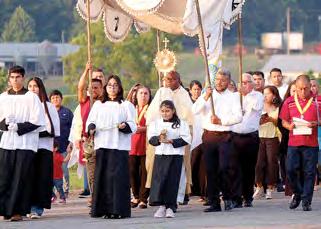
as three priorities we should direct our attention and resources toward, both as individuals and as a diocese. Most importantly, they are paths of conversion intended to help us grow in unity with the Lord and with one another, becoming the leaven the world needs.
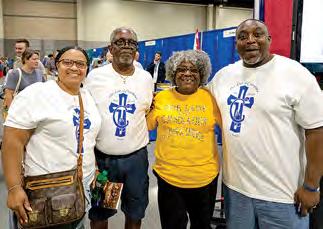
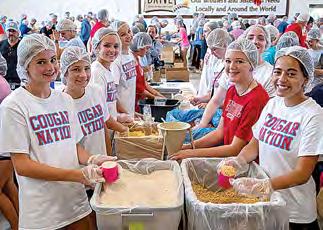
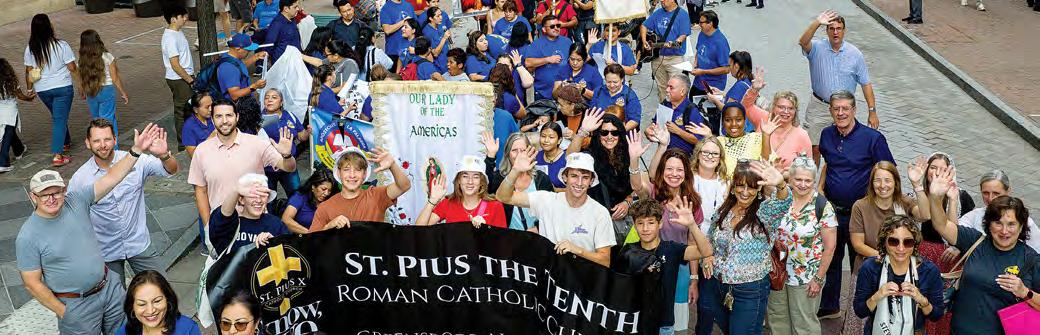
“Jesus called His disciples by drawing them close to Himself.”
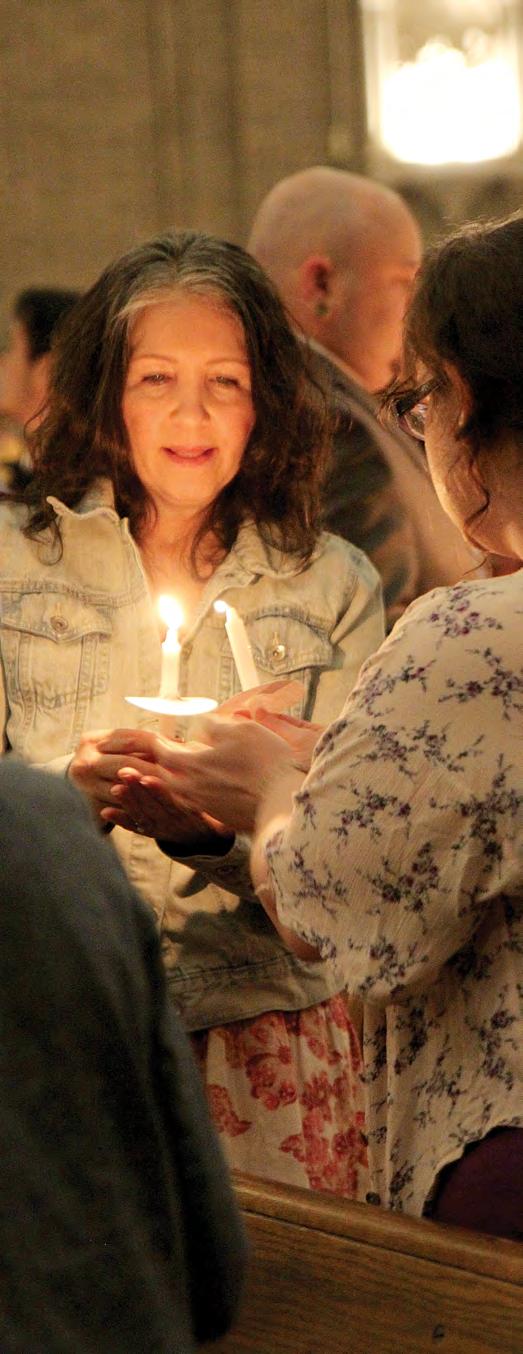
We often think of ourselves as believers, but the Lord invites us to become disciples – that is, people who love Him with all their heart, soul and mind. Jesus called and formed His disciples by drawing them unto Himself and growing into an intimate relationship. The Gospels often point out the difference between the crowd who listened to Jesus’s preaching occasionally and the men and women who followed Him closely, letting their whole lives be transformed by their encounter with Him.
Similarly, we too need to let ourselves be immersed in the relationship with Jesus. It is not a matter of adding some obligations to our busy schedules, but of letting Christ permeate and redeem every aspect of our existence.
This transformation that Jesus brings fills us with the passion and certainty necessary to announce Him to others in our personal, family, social, and even professional lives. But all of this requires conversion. Welcoming the Lord into our hearts, families and communities requires selfsacrifice and commitment. We need to turn away from the self-centered and worldly mentality that often seeps into our lives, so that we may have space for practices and relationships that renew God’s grace in us and allow us to know, love and serve Him more.
• Seek intimacy with Jesus
• Sanctify ordinary moments
• Spend more time with God’s Word, less on media
• Try fasting to connect with Jesus
The Church is called to be an “ark of salvation sailing through the waters of history and a beacon that illumines the dark nights of this world… not so much through the magnificence of her structures or the grandeur of her buildings… but rather through the holiness of her members.”3 Let us invest our time and resources in becoming missionary disciples – people who draw close to Jesus, experience the fullness of life that comes from His healing grace, and want to share such fullness with everybody.
Jesus invites all people to discover that they are beloved sons and daughters of God. Thus, the Church is called to become the family of God where we encounter, experience, and are transformed by Christ’s love for us. “As I have loved you, so you also should love one another” (John 13:34). Such love changes the entirety of a person’s life and, by God’s grace, spurs us to renew all relationships. As St. Paul teaches, we are “no longer strangers and aliens” but are “citizens with the saints and also members of the household of God” (Ephesians 2:19).
We who are members of Christ’s Body must become the living stones that make up God’s household. In the family of God, people forgive each other to repair fractured relationships, are humble and willing to listen to one another, and take concrete steps to be a sign of unity and communion. Families live as a domestic church, where parents transmit the faith to their children through their words and actions. They help create a soil that opens their children’s hearts to God and allows their vocation as Christian disciples to grow. Parishes welcome, nourish and enable all people to experience belonging, healing and connection that overcome the barriers the world builds around class, race, nationality and language. Faith formation programs, youth groups, Catholic schools and campus ministries take people’s desires and questions seriously and accompany them in their journey toward authentic freedom and happiness through the encounter with Christ. The whole Church transforms into the community of “those who are in harmony with their brothers and sisters and who love their neighbor.”4
• Display sacred images that inspire
• Forgive before bedtime
• Invest in relationships
• Meet people where they are
3 Leo XIV, “Homily for the Mass Pro Ecclesia,” May 9, 2025.
4 Leo XIV, “Mass for the Beginning of the Pontificate,” quoting Augustine’s Sermons, 359,9.
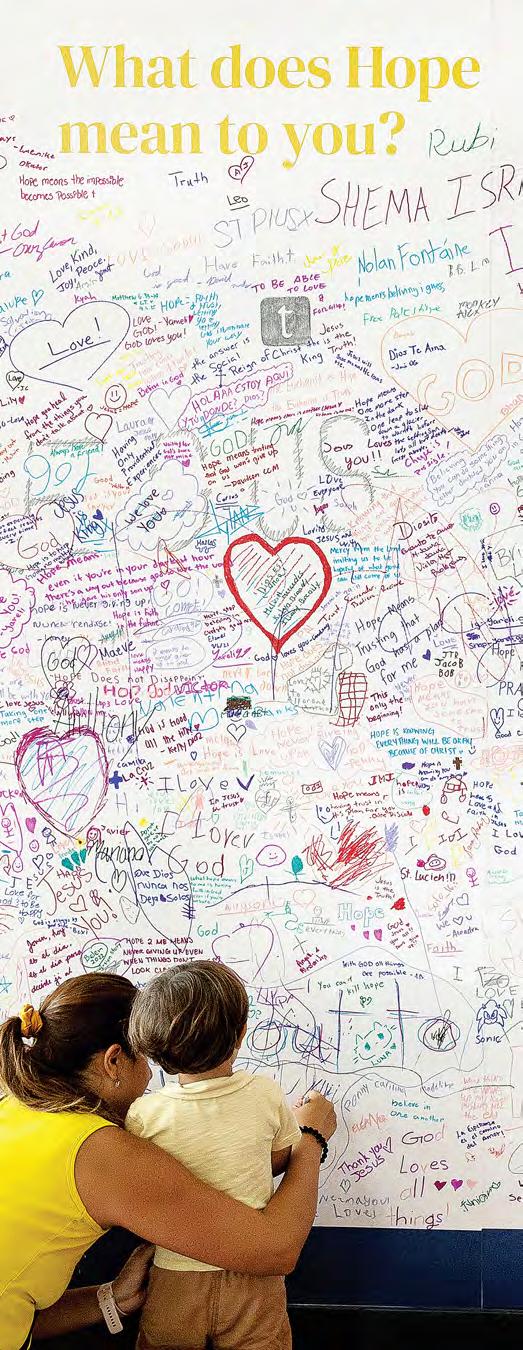
“We are no longer strangers, but members of the household of God.”
— Ephesians 2:19
TOO OFTEN WE HEAR...
“I’m Catholic.”
“She goes to Mass.”
“What do I get out of it?”
“I’m too ashamed to reach out to God to deal with this problem in my life.”
“My faith life is private.”
IMAGINE WE HEAR...
“I will love you, Jesus, and honor you for all of my days.”
“She reminds me of Jesus.”
“What am I called to do?”
“I admit I am powerless over this problem, and invite Jesus to help me.”
“I am strengthened by your faith journey and by sharing mine with you.”
TOO OFTEN WE HEAR...
“I am supposed to be nice.”
“I want them to see that I am right.”
“I give when they pass the basket.”
IMAGINE WE HEAR...
“Come Holy Spirit, fill my heart with the fire of your love.”
“I want to understand others rather than be understood by them.”
“I am grateful for what I have been given and prayerfully discern my tithe.”
TOO OFTEN WE HEAR...
“I just want to go to heaven.”
“We go to church to get something out of it.”
“What is the Church doing for me?”
IMAGINE WE HEAR...
“I cannot live my life in Christ without proclaiming His Good News to others.”
“We go to church to praise God and are blessed to receive Him with others.”
“I serve with and for the Church as I do with my family –it is who we are.”
To become the family of God, though, we need to move away from a passive consumer mentality that delegates personal responsibility and views the Church exclusively as a place we go to get something out of it for ourselves.
Instead, we are called by God to take ownership of our journey of faith and the formation of those entrusted to our care, to be hosts in the Church rather than simply guests, and to serve rather than only to be served. If we live the Church as an extension of our families, the way we think of our time, talent and treasure changes because we put them entirely at the service of Christ’s call. Instead of assuming that the needs of the most vulnerable among us are being addressed by someone else, our hearts will be moved by the desire to know that our beloved brothers and sisters in need are taken care of. As we become knit together by loving relationships that move us to serve, we will take greater ownership of our parish ministries, on the one hand, and of Catholic Charities and Catholic Relief Services, on the other.
Let us free ourselves of a vision rooted in scarcity in which we give only what is left over or what might return benefits to ourselves personally and realize that each person “has received a gift” and should “use it to serve one another as good stewards of God’s varied grace” instead (1 Peter 4:10).
“As the Father has sent me, so I send you” (John 20:21). Jesus’s commission is not for a select few. By virtue of baptism, every Catholic shares in Jesus’s prophetic mission and is called to proclaim the Gospel with both words and actions. The gift of a close intimacy with the Lord and the task of spreading the Good News are inseparable. Salvation is never exclusively a matter for the individual, nor is it mainly about seeking refuge for the self.
The road to salvation leads us necessarily into the lives of others as humble and joyful witnesses who want to say to the world: “Look to Christ! Come closer to Him! Welcome His Word that enlightens and consoles! Listen to His offer of love and become His one family: in the one Christ, we are one.”5
Words are not enough, though. “This is how all will know that you are my disciples, if you have love for one another” (John 13:35). It is the splendor of lives formed by charity – filled and ordered by the unconditional love of Jesus that heals and transforms us – that draws people to the faith. Men and women filled with love of God and love of neighbor, bearers of the light of the Gospel in all places: this is what our society desperately needs today. Jesus calls us to be a counter-witness to the world’s values.
Too often we have been formed by the world’s ways and algorithms in social media and cable news that cancel “them” rather than seek the other in love. We are summoned to break away from the polarized and adversarial mindset our culture is enamored with, to show joy and peace amidst challenges and suffering, to live out a commitment to each person’s sacred dignity, and to exhibit the virtues made possible by the gift of the Holy Spirit.
• Share God’s good work in you
• Ask others about their experience of faith
• Invite a few peers to meet regularly in faith
• Ask: Who am I called to serve?
Let us proclaim the Gospel with our entire lives. Let us turn our communities into a place of support for those who bear witness to their faith in the world. Let us structure all our offices and ministries to enable missionary disciples to go out and be more present in all parts of our large diocese and among those in need.
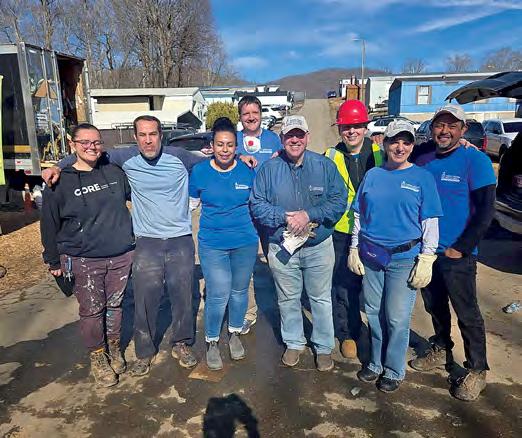

5 Leo XIV, “Mass for the Beginning of the Pontificate.”
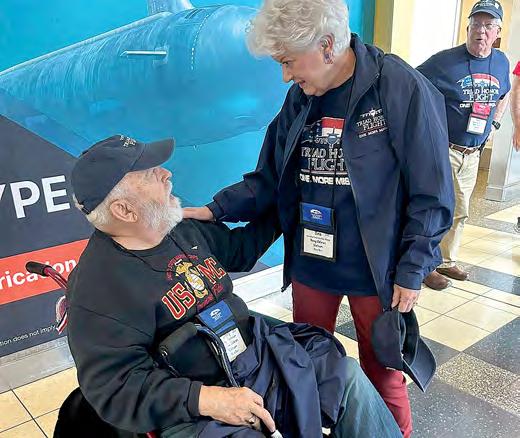
“As the Father has sent me, so I send you.”
— John 20:21
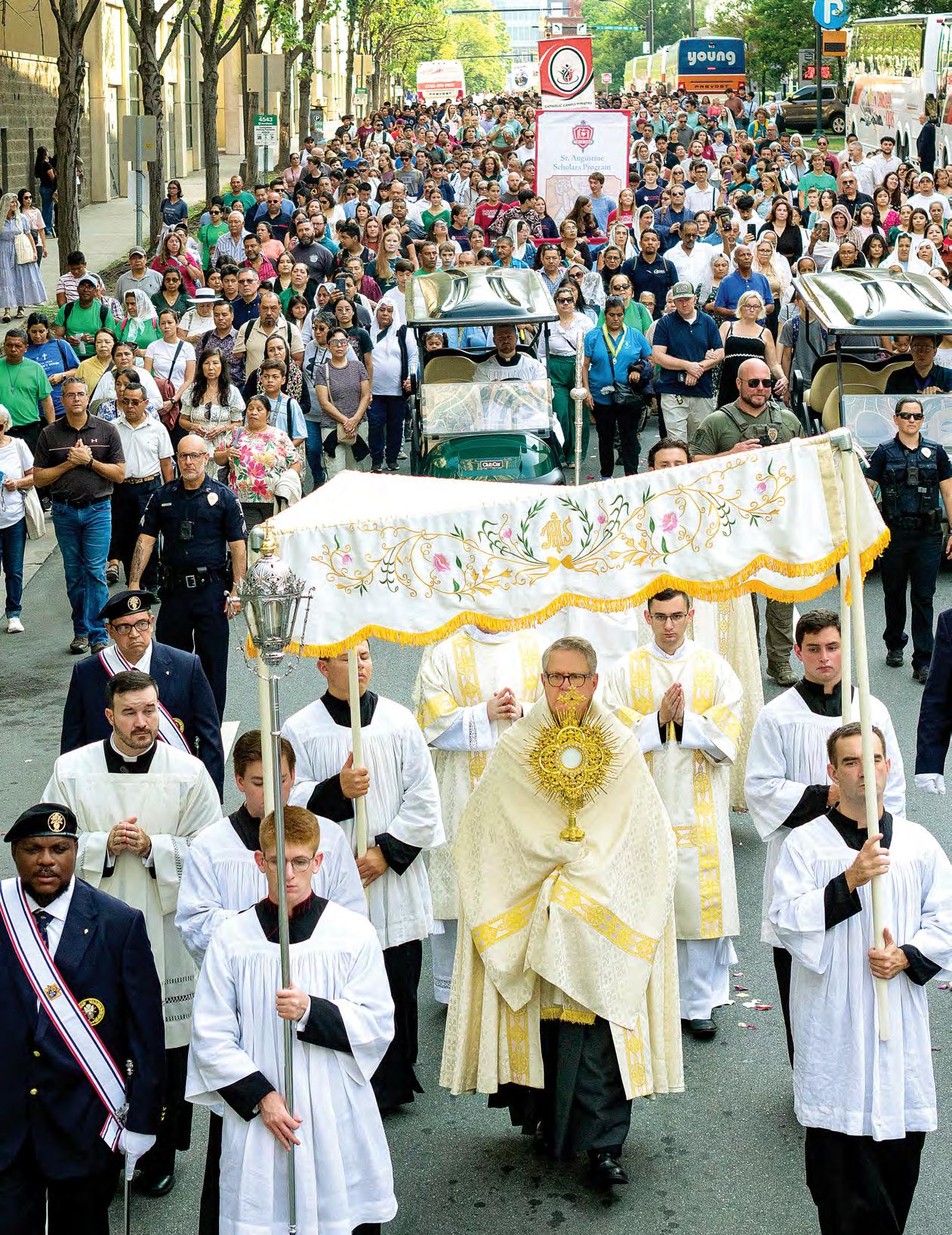
I invite all of you to prayerfully reflect on the vision for our diocese: Everyone so loves Jesus, we share Him with others.
Think of the three priorities I highlighted and ask the Holy Spirit to show you what small, concrete steps you can take to embody them more. Discern how the Lord calls you to become a missionary disciple in the everyday circumstances in which you find yourself, explore the opportunities for formation and spiritual growth that surround you, and find loved ones, friends and mentors with whom you can walk on this journey of conversion.
If you are part of a ministry, small group, fraternity, apostolic society, lay association, religious order or any other organization connected to the faith, find ways for your community to learn from this diocesan vision and priorities and to continue serving the needs of the local Church and its mission. If you work in one of our parishes, schools, campus ministries or diocesan offices, or if you hold any pastoral leadership, incorporate the diocesan vision and priorities in your planning and think of how it can support and expand your ministry.
I desire for each of you to let your creativity and the power of the Holy Spirit lead you in envisioning
• Affirm God’s unconditional love for you
• Humbly recognize your need for growth and conversion
• Choose one aspect of discipleship to live out personally, in your family, and in your parish
• Write it down and share it with someone
a reality where God’s kingdom is made real here on earth, incarnate in our daily lives with all joys and challenges. Jesus wants to draw each of us ever closer to Him, so that we
can experience His healing love and be filled with the desire that all friends, neighbors, co-workers, family members, and even strangers may experience this Good News as well.
I am excited about the future of the Catholic Church in western North Carolina as all of us are called to “go out into the deep for a catch,” even after we had been working hard all night! (Luke 5:4). I am grateful for the prayerful support that you have all offered to me as I try to respond to God’s call to be your bishop – that is, your lead missionary disciple. Know of my prayers and affection for you as together we open our minds, hearts and wills such that ...



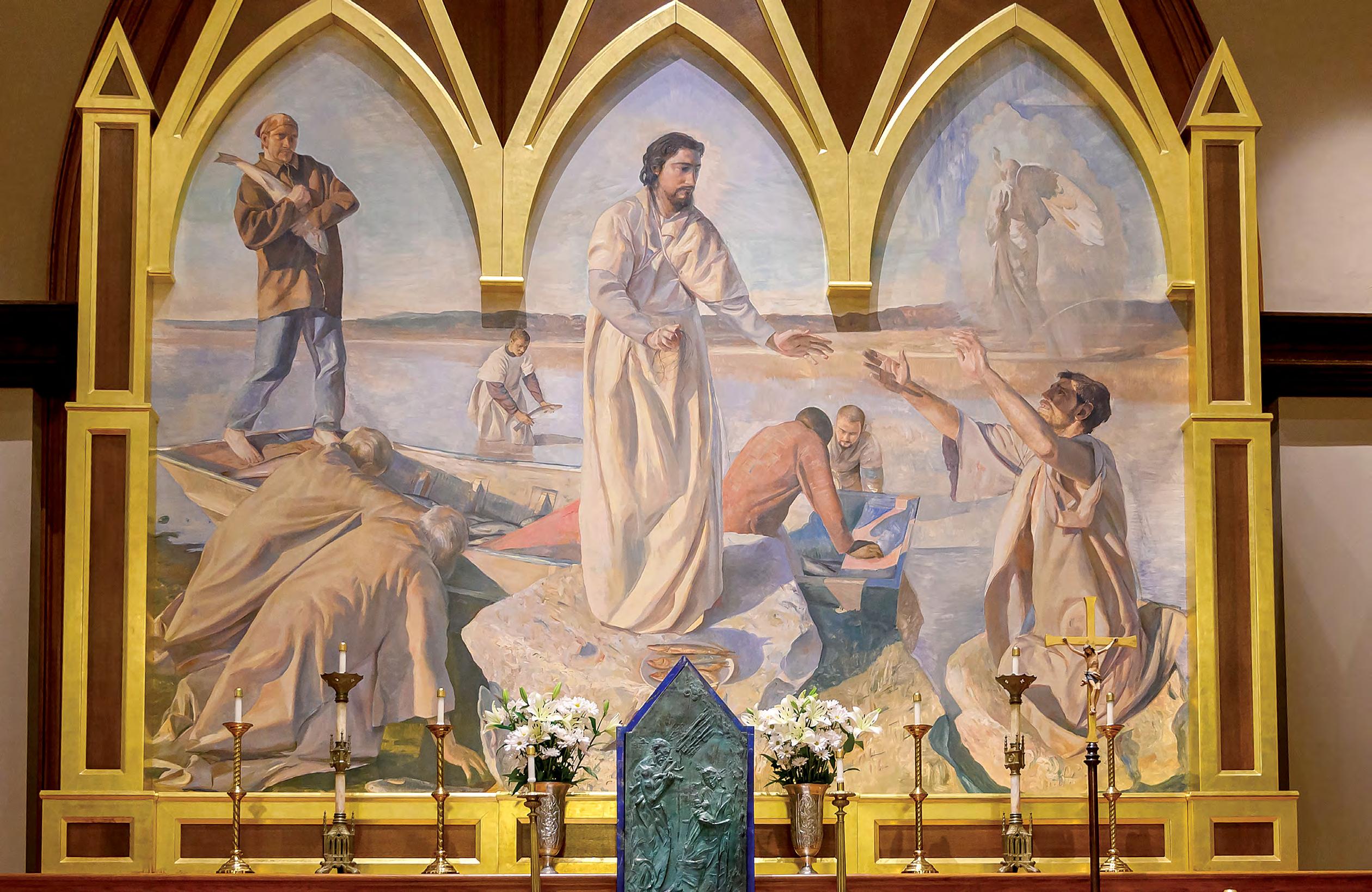
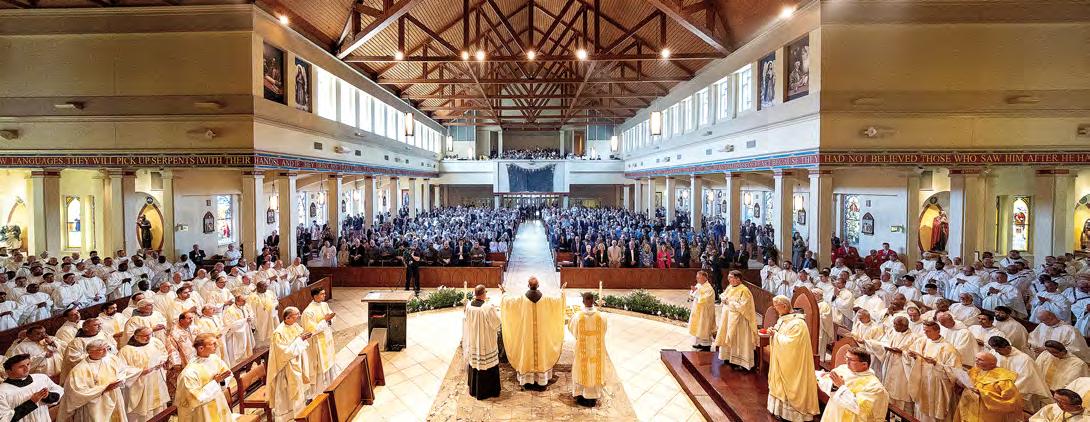
pide que seamos generosos y que compartamos con los demás lo que él nos ha dado.”2
Desde que llegué por primera vez para servirles como su obispo, muchos me han preguntado cuál es mi visión para nuestra diócesis. Está expresada en esta afirmación sencilla:
Todos amamos tanto a Jesús, que lo compartimos con los demás.
Estas pocas palabras describen mis oraciones y esperanzas para la Iglesia Católica en el oeste de Carolina del Norte. Deseo que sirvan de inspiración y guía para la manera en que encarnamos nuestra fe en todo lo que somos y hacemos aquí en nuestra diócesis. No se trata necesariamente de algo nuevo, sino que se apoya en mucho de lo que ya está sucediendo. Desde las montañas hasta el Triad y el área metropolitana de Charlotte, la gracia de Dios está viva y da frutos en nuestras parroquias, escuelas, ministerios universitarios y obras de caridad. Lo que ustedes han hecho al decir sí a la invitación de Jesús de “ven y sígueme” es un testimonio para nuestro mundo de lo que puede ser la verdadera libertad en Cristo. ¡Alabado sea Dios por su fidelidad y su amor!
Aprovecho este momento para invitarnos a todos a afinar nuestra propia visión y responder más profundamente al llamado de Cristo.
Al proponer esta visión, sigo los pasos de los Papas recientes, quienes han subrayado la necesidad de una nueva evangelización. Esta visión también se nutre de lo que he aprendido al visitar muchas parroquias y comunidades de la diócesis, al reflexionar sobre
1 León XIV, “Homilía para la Misa de inicio del pontificado”, 18 de mayo de 2025.
2 León XIV, “Mensaje en video a los jóvenes de Chicago y de todo el mundo”, 14 de junio de 2025.
“Nosotros amamos porque Él nos amó primero”.
— 1 Juan 4,19
los frutos del proceso sinodal diocesano, al trabajar con los resultados de las encuestas y entrevistas del Instituto de Liderazgo Católico, y al consultar con líderes diocesanos, expertos laicos, religiosos y sacerdotes. Estoy profundamente agradecido por toda la ayuda recibida en el camino. Por ello, ofrezco, como su obispo, una visión para la Diócesis de Charlotte que nos ayude a crecer en la fe, planificar el futuro y administrar bien nuestros recursos.
Nos encontramos en un momento único en la vida de nuestra diócesis, en el que podemos unirnos para marcar una diferencia en el futuro de la Iglesia Católica en el oeste de Carolina del Norte. A continuación, presento algunos rasgos clave de nuestra vida diocesana que reflejan “los signos de los tiempos” que han surgido durante este proceso:
• Nuestra fe católica continúa dando abundantes frutos en nuestra región, poniendo de relieve el amor incondicional de Dios por nosotros.
• Nuestro mayor capital son las personas; y aunque el desarrollo de propiedades es necesario, la inversión real debe hacerse en el desarrollo humano, especialmente en la formación de discípulos misioneros en nuestros hogares.
• El oeste de Carolina del Norte crece rápidamente y, aun en medio de las dificultades reales que enfrentan muchos, contamos con importantes recursos financieros.
• Una población hispana en crecimiento está llamada a desempeñar un papel significativo, acorde con su tamaño y con una realidad cultural distinta a la de sus países de origen.
CEste puede ser un momento decisivo en nuestra diócesis, en el que construimos sobre las bendiciones del pasado y abrazamos el presente con un compromiso renovado con la vida del Espíritu Santo en medio de nosotros.
• Ver a más católicos en las iglesias de nuestra diócesis es alentador, pero a veces puede ocultar la realidad subyacente de la desvinculación eclesial, la apatía espiritual y una formación en la fe insuficiente para el discipulado católico del siglo XXI, aquí como en el resto del país.
• El testimonio de tantos durante el huracán Helene fue extraordinario; sin embargo, aún no hemos capacitado plenamente a los laicos católicos de
on frecuencia concebimos y vivimos nuestra pertenencia a la Iglesia como una simple afiliación basada en nuestro acuerdo con ciertas creencias o en la participación en algunas actividades. Eso es necesario, pero no suficiente. Pertenecemos al Cuerpo de Cristo por el don recibido en el bautismo, un don que Dios nos confía para nuestro bien y el de todo el mundo. Por ello, la fe debe permear la totalidad de nuestras vidas,
nuestra diócesis para que asuman como propia a Caridades Católicas como el principal brazo local de acción social diaria de nuestra Iglesia.
• Las distancias dentro de nuestra diócesis son una bendición, pero también un desafío que puede dificultar nuestra plena comunión como Cuerpo de Cristo, invitándonos a conectar más allá de los límites parroquiales.
• Muchos se sacrifican generosamente por Cristo en la Iglesia, y aun así los medios financieros con los que operan demasiadas de nuestras parroquias – y el conocimiento de lo que cuesta ser una comunidad de fe saludable – son insuficientes para responder a nuestra realidad económica, con una mentalidad transaccional de la cultura que permea gran parte de nuestra manera de dar.
para que podamos experimentar el poder de la gracia de Dios en todos los aspectos de nuestra existencia, especialmente en aquellos donde estamos más heridos y necesitados de sanación. Por eso los invito a transformar todas nuestras familias, parroquias, programas de formación en la fe, ministerios, asociaciones, escuelas, campus, comunidades religiosas y oficinas diocesanas en lugares donde
Todos amamos tanto a Jesús, que lo compartimos con los demás.
¿Cómo sería la Iglesia en el oeste de Carolina del Norte si encarnáramos esta visión?
¿Cómo cambiaríamos como personas y comunidades al acercarnos más a Jesús y crecer en nuestro anhelo por anunciarlo al mundo?
Las riquezas de la Sagrada Escritura, la tradición católica, la vida de los santos y el magisterio reciente pueden ayudarnos a meditar sobre lo que necesitamos para amar a Jesús y compartir su amor con los demás. Aquí quiero proponer tres aspectos que parecen especialmente importantes en este momento.
I Formar discípulos misioneros
Considérenlos como tres prioridades hacia las cuales debemos orientar nuestra atención y nuestros recursos, tanto a nivel personal como diocesano. Más aún, son caminos de conversión destinados a ayudarnos a crecer en unidad con el Señor y entre nosotros, convirtiéndonos en la levadura que el mundo necesita.
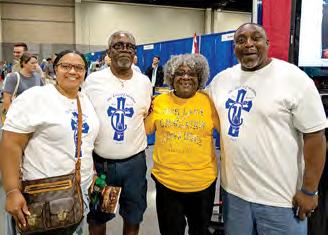
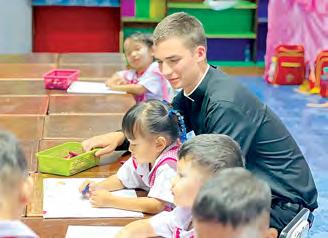
II Convertirnos en la familia de Dios III Salir a proclamar el Evangelio
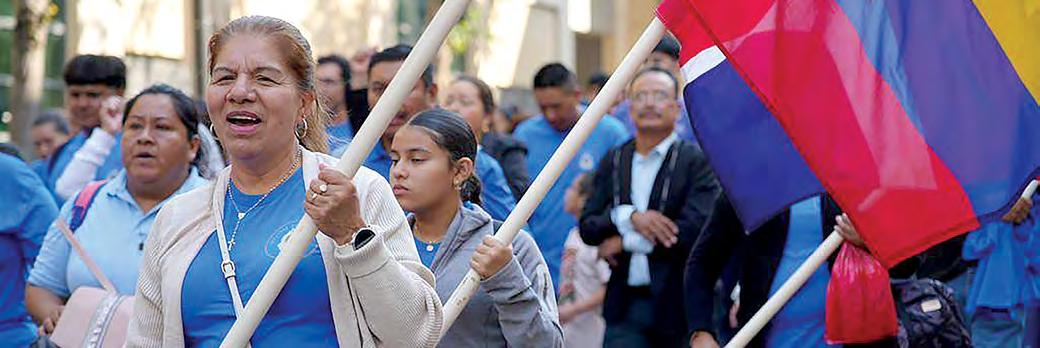
“Jesús llamó a sus discípulos acercándolos a sí mismo.”
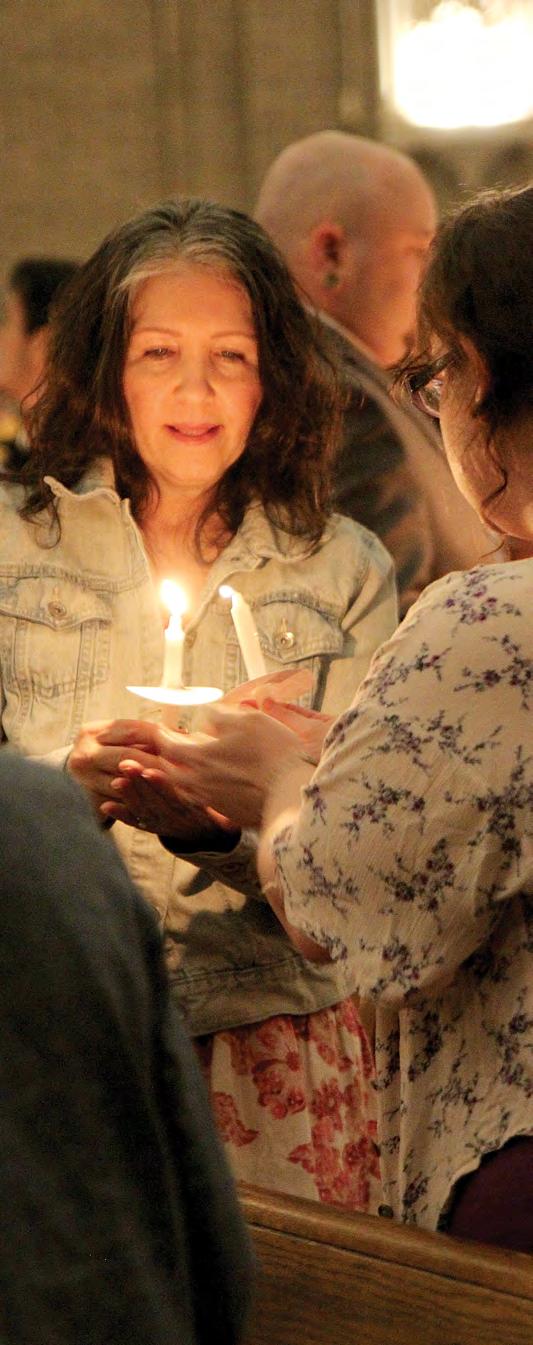
Con frecuencia nos consideramos creyentes, pero el Señor nos invita a ser discípulos: personas que lo aman con todo su corazón, alma y mente. Jesús llamó y formó a sus discípulos atrayéndolos hacia sí y cultivando una relación íntima con ellos. Los Evangelios distinguen entre la multitud que escuchaba ocasionalmente su predicación y los hombres y mujeres que lo seguían de cerca, permitiendo que toda su vida fuera transformada por el encuentro con él. Del mismo modo, nosotros necesitamos dejarnos sumergir en la relación con Jesús. No se trata de añadir obligaciones a agendas ya cargadas, sino de permitir que Cristo impregne y redima cada aspecto de nuestra existencia.
La transformación que Jesús realiza en nosotros nos llena de la pasión y la certeza necesarias para anunciarlo a otros en nuestra vida personal, familiar, social e incluso profesional. Pero todo esto exige conversión. Acoger al Señor en nuestros corazones, familias y comunidades requiere sacrificio y compromiso. Debemos apartarnos de una mentalidad egoísta y mundana que a menudo se filtra en nuestras vidas, para dar espacio a prácticas y relaciones que renueven la gracia de Dios en nosotros y nos permitan conocerlo, amarlo y servirlo mejor. La Iglesia está llamada a ser “un arca de salvación que navega por las aguas de la historia y un faro que ilumina las noches oscuras de este mundo… no tanto por la magnificencia de sus estructuras o la grandeza de sus edificios… sino por la santidad de sus miembros.”3 Invirtamos nuestro tiempo y recursos en convertirnos en discípulos misioneros: personas que se acercan a Jesús, experimentan la plenitud de vida que brota de su gracia sanadora y desean compartir esa plenitud con todos.
¿CÓMO COMIENZO?
• Busca una relación cercana con Jesús
• Santifica los momentos cotidianos
• Dedica más tiempo a la Palabra de Dios y menos a los medios
• Prueba el ayuno para unirte más a Jesús
Jesús invita a todos a descubrir que son hijos e hijas amados de Dios. Por ello, la Iglesia está llamada a convertirse en la familia de Dios, donde encontramos, experimentamos y somos transformados por el amor de Cristo. “Como yo los he amado, así también ámense unos a otros” (Juan 13,34). Este amor transforma la vida entera de una persona y, por la gracia de Dios, nos impulsa a renovar todas nuestras relaciones. Como enseña san Pablo, ya “no somos extranjeros ni forasteros”, sino “ciudadanos con los santos y miembros de la familia de Dios” (Efesios 2,19).
Quienes somos miembros del Cuerpo de Cristo debemos convertirnos en las piedras vivas que conforman la casa de Dios. En la familia de Dios, las personas se perdonan para sanar relaciones rotas, son humildes y dispuestas a escucharse mutuamente, y dan pasos concretos para ser signo de unidad y comunión. Las familias viven como iglesia doméstica, donde los padres transmiten la fe a sus hijos con sus palabras y acciones, creando un terreno fértil que abre el corazón de los niños a Dios y permite que crezca su vocación como discípulos cristianos. Las parroquias acogen, alimentan y permiten que todos experimenten pertenencia, sanación y conexión que superan las barreras de clase, raza, nacionalidad e idioma. Los programas de formación en la fe, los grupos juveniles, las escuelas católicas y los ministerios universitarios toman en serio los deseos y preguntas de las personas y las acompañan en su camino hacia la libertad y la felicidad auténticas mediante el encuentro con Cristo. Toda la Iglesia se transforma en la comunidad de “quienes viven en armonía con sus hermanos y hermanas y aman a su prójimo.”4
¿CÓMO LLEVARLO AL HOGAR?
• Coloca imágenes sagradas que inspiren
• Perdona antes de acostarte
• Cultiva tus relaciones
• Ponte en el lugar del prójimo
3 León XIV, “Homilía para la Misa Pro Ecclesia”, 9 de mayo de 2025.
4 León XIV, “Misa de inicio del pontificado”, citando los Sermones de san Agustín, 359,9.

“Ya no son extranjeros ni forasteros, sino conciudadanos de los santos y miembros de la familia de Dios”.
— Efesios 2,19
discípulos misioneros ESCUCHAMOS…
IMAGINEMOS QUE ESCUCHAMOS…
“Soy católico.”
“Ella va a Misa.”
“¿Qué saco yo de esto?”
“Me da demasiada vergüenza acudir a Dios para afrontar este problema en mi vida.”
“Mi vida de fe es privada.”
“Te amaré, Jesús, y te honraré todos mis días.”
“Ella me recuerda a Jesús.”
“¿A qué estoy llamado?”
“Reconozco que no puedo solo y pido a Jesús que me ayude.”
“Tu camino de fe me fortalece, y al compartir el mío contigo.”
Convertirnos en la familia de Dios ESCUCHAMOS…
IMAGINEMOS QUE ESCUCHAMOS…
“Se supone que debo ser amable.”
“Quiero que vean que tengo razón.”
“Doy cuando pasan la colecta.”
“Ven, Espíritu Santo, llena mi corazón con el fuego de tu amor.”
“Quiero comprender a los demás antes que ser comprendido por ellos.”
“Agradezco lo que he recibido y, en oración, discierno mi diezmo.”
Salir a proclamar el Evangelio ESCUCHAMOS…
IMAGINEMOS QUE ESCUCHAMOS…
“Solo quiero ir al cielo.”
“Vamos a la iglesia para sacar algo de ello.”
“¿Qué hace la Iglesia por mí?”
“No puedo vivir mi vida en Cristo sin anunciar su Buena Nueva a los demás.”
“Vamos a la iglesia para alabar a Dios y somos bendecidos al recibirlo con otros.”
“Sirvo con la Iglesia y para ella, como con mi familia: es lo que somos.”
Para convertirnos en la familia de Dios, debemos alejarnos de una mentalidad pasiva y consumista que delega la responsabilidad personal y ve a la Iglesia solo como un lugar al que acudimos para recibir algo. Estamos llamados a asumir la responsabilidad de nuestro propio camino de fe y de la formación de quienes se nos han confiado, a ser anfitriones en la Iglesia y no solo invitados, y a servir más que a ser servidos. Cuando vivimos la Iglesia como una extensión de nuestras familias, cambia nuestra manera de entender el tiempo, el talento y el tesoro, porque los ponemos al servicio del llamado de Cristo. En lugar de suponer que las necesidades de los más vulnerables ya están siendo atendidas por otros, nuestros corazones se conmueven por el deseo de asegurarnos de que nuestros hermanos y hermanas necesitados sean cuidados. Al fortalecernos mediante relaciones de amor que nos impulsan a servir, asumiremos mayor responsabilidad tanto en los ministerios parroquiales como en Caridades Católicas y Servicios de Ayuda Católica. Liberémonos de una visión basada en la escasez – en la que damos solo lo que sobra o lo que nos beneficia personalmente – y recordemos que cada persona “ha recibido un don” y debe “ponerlo al servicio de los demás como buenos administradores de la multiforme gracia de Dios” (1 Pedro 4,10).
III Salir a proclamar el Evangelio
“C
omo el Padre me envió, así también los envío yo” (Juan 20,21). El mandato de Jesús no es solo para unos pocos. Por el bautismo, todo católico participa de la misión profética de Cristo y está llamado a proclamar el Evangelio con palabras y con obras. El don de una intimidad profunda con el Señor y la tarea de anunciar la Buena Nueva son inseparables. La salvación nunca es solo un asunto individual, ni se trata principalmente de buscar refugio para uno mismo. El camino de la salvación nos conduce necesariamente a la vida de los demás,
como testigos humildes y alegres que desean decirle al mundo: “¡Miren a Cristo! ¡Acérquense a él! ¡Acojan su Palabra que ilumina y consuela! ¡Escuchen su oferta de amor y conviértanse en su única familia: en el único Cristo, somos uno!.”5
Sin embargo, las palabras no bastan. “En esto conocerán todos que son mis discípulos: si se aman los unos a los otros” (Juan 13,35). Es el esplendor de vidas formadas por la caridad, llenas y ordenadas por el amor incondicional de Jesús que sana y transforma, lo que atrae a las personas a la fe. Hombres y mujeres llenos de amor a Dios y al prójimo, portadores de la luz del Evangelio en todos los ámbitos: eso es lo que nuestra sociedad necesita urgentemente hoy.
¿CÓMO PUEDO COMPARTIR A JESÚS?
• Comparte la obra buena que Dios realiza en ti
• Pregunta a otros sobre su experiencia de fe
• Invita a algunos amigos a reunirse regularmente en la fe
• Pregúntate: ¿A quién estoy llamado a servir?
Jesús nos llama a ser un testimonio contracultural frente a los valores del mundo.
Con demasiada frecuencia hemos sido formados por las lógicas del mundo y los algoritmos de las redes sociales y de los medios que cancelan al “otro” en lugar de buscarlo con amor. Estamos llamados a romper con una mentalidad polarizada y confrontativa, a mostrar alegría y paz en medio de los desafíos y el sufrimiento, a vivir un compromiso con la dignidad sagrada de cada persona y a manifestar las virtudes que hace posibles el don del Espíritu Santo. Proclamemos el Evangelio con toda nuestra vida. Convirtamos nuestras comunidades en lugares de apoyo para quienes dan testimonio de su fe en el mundo. Organicemos todas nuestras oficinas y ministerios para que los discípulos misioneros puedan salir y estar más presentes en todos los rincones de nuestra extensa diócesis y entre quienes más lo necesitan.
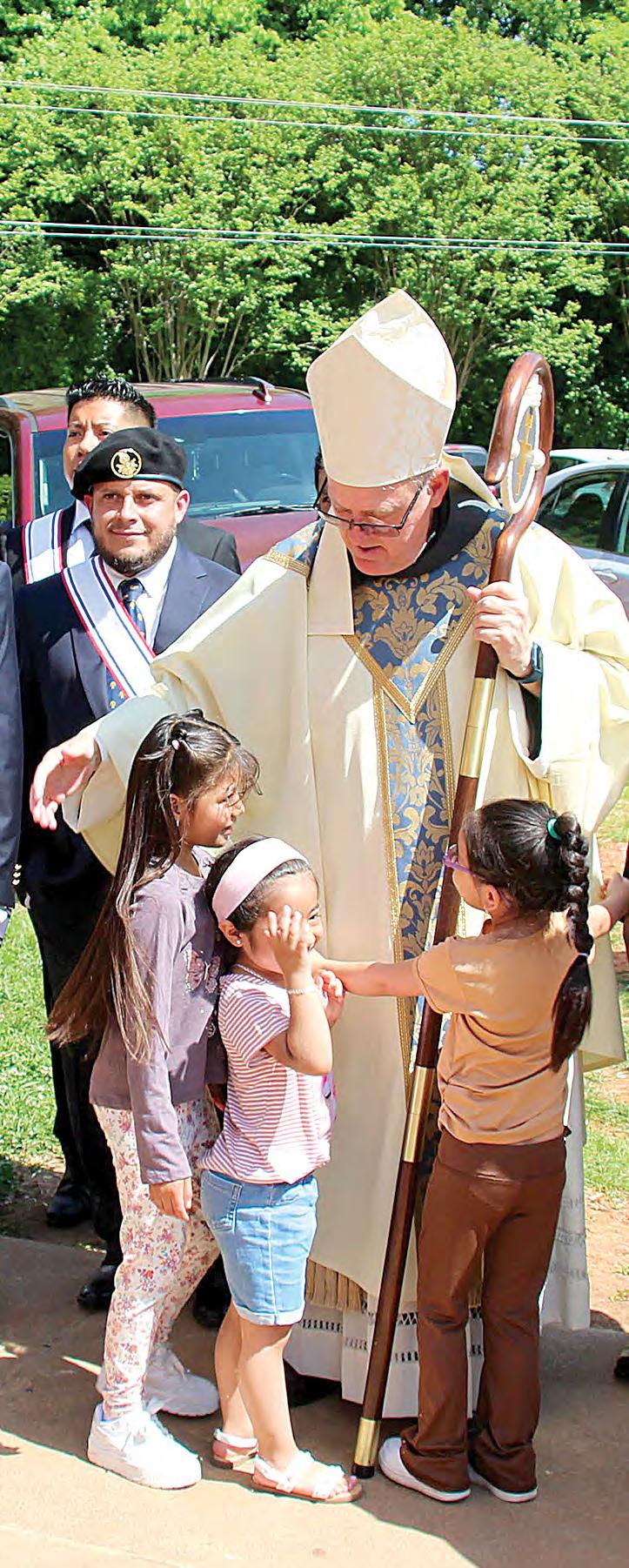
5 León XIV, “Misa de inicio del pontificado”.
“Como el Padre me envió, así también los envío yo”.
— Juan 20,21
Los invito a reflexionar en oración sobre esta visión para nuestra diócesis: Todos amamos tanto a Jesús, que lo compartimos con los demás.
Piensen en las tres prioridades que he señalado y pidan al Espíritu Santo que les muestre qué pasos pequeños y concretos pueden dar para vivirlas mejor. Disciernan cómo el Señor los llama a ser discípulos misioneros en las circunstancias cotidianas de su vida, exploren las oportunidades de formación y crecimiento espiritual que tienen a su alcance y busquen familiares, amigos y mentores con quienes puedan caminar en este proceso de conversión.
Si forman parte de un ministerio, grupo pequeño, fraternidad, sociedad apostólica, asociación laical, orden religiosa u otra organización vinculada a la fe, encuentren maneras de que su comunidad aprenda de esta visión y prioridades diocesanas y continúe sirviendo a la Iglesia local y a su misión. Si trabajan en alguna de nuestras parroquias, escuelas, ministerios universitarios u oficinas diocesanas, o si ejercen algún liderazgo pastoral, incorporen
• Afirma el amor incondicional de Dios por ti
• Reconoce con humildad tu necesidad de crecimiento y conversión
esta visión y prioridades en su planificación y reflexionen sobre cómo pueden fortalecer y ampliar su ministerio. Deseo que cada uno permita que su creatividad y la fuerza del Espíritu Santo los guíen para imaginar una realidad donde el Reino de Dios se haga presente aquí en la tierra, encarnado en nuestra vida diaria con todas sus alegrías y desafíos. Jesús quiere atraer a cada uno de nosotros cada vez más cerca de él, para que experimentemos su amor sanador y se despierte en nosotros el deseo de que amigos, vecinos, compañeros de trabajo, familiares e incluso desconocidos puedan conocer también esta Buena Noticia.
• Elige un aspecto del discipulado para vivirlo personalmente, en tu familia y en tu parroquia
• Escríbelo y compártelo con alguien
Me llena de esperanza el futuro de la Iglesia Católica en el oeste de Carolina del Norte, ya que todos somos llamados a “remar mar adentro para la pesca”, incluso después de haber trabajado toda la noche (Lucas 5,4). Agradezco profundamente las oraciones que me han brindado mientras procuro responder al llamado de Dios a servirles como su obispo, es decir, como su principal discípulo misionero. Sepan que los tengo presentes en mis oraciones y en mi afecto, mientras juntos abrimos nuestras mentes, corazones y voluntades, para que ...
Todos amemos tanto a Jesús, que lo compartamos con los demás.
El Reverendísimo Michael T. Martin, OFM Conv. Obispo de Charlotte
Escanee para ver al obispo Martin presentar esta visión pastoral: