D I O C E S E
O F
C H A R L O T T E
Annual Report 2025
2
!!"
AN N UAL R EPO RT 2024 -2025
DIOCESE OF CHARLOTTE
Table of contents
Tabla de contenidos
HELENE RECOVERY Diocese’s unprecedented response
RECUPERACIÓN DE HELENE
4
16 Respuesta sin precedentes de la diócesis
ENCUESTA DISCIPLE MAKER INDEX
DISCIPLE MAKER INDEX SURVEY
18 Perspectivas sobre la Iglesia local
6
Insights about the local Church
PASTORAL MINISTRY Making disciples, reaching out Vital statistics
MINISTERIO PASTORAL
8 8
20 Formando discípulos, alcanzando más personas 20 Estadísticas vitales
CHARITY
CARIDAD
Responding to the need 10
22 Respondiendo a la necesidad
EDUCATION & CATECHESIS
EDUCACIÓN Y CATEQUESIS
Teaching the young, sharing the faith 11
23 Enseñando a los jÓvenes, compartiendo la fe
STEWARDSHIP
CORRESPONSABILIDAD
Practicing good stewardship 12
24 Practicando una buena corresponsabilidad
HUMAN CAPITAL
CAPITAL HUMANO
Driving the mission 13
25 Impulsando la misión
FINANCIALS
FINANZAS
Report from the CFO 14
26 Informe del Director Financiero
Combined Financial Statements 15
27 Estados Financieros Combinados
SAFE ENVIRONMENT
AMBIENTE SEGURO
Protecting God’s children 28
Financial statements and footnotes are online here: www.charlottediocese.org/annualreport
28 Protegiendo a los niños de Dios
@
Los estados financieros y las notas al pie están online aquí: FROM THE www.charlottediocese.org/annualreport
COVER
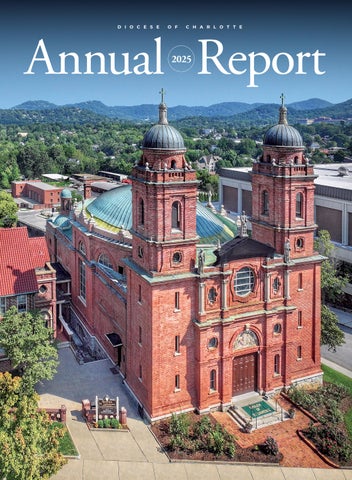
St. Lawrence Basilica in Asheville became a beacon of hope in the aftermath of Hurricane Helene. Fundraising to restore this historic landmark – one of the most architecturally significant buildings in the U.S. – is under way. Learn more: www.savethebasilica.org
PHOTO CREDITS
Cover: The Ghost Guild Inc. / Nelson Nauss; Other photos: Diocese of Charlotte, Catholic News Herald
!!"
A NNUA L RE P ORT 2024 -202 5
3
DIOCESE OF CHARLOTTE
A MESSAGE FROM THE MOST REVEREND
Michael T. Martin, OFM Conv. BISHOP OF CHARLOTTE
My Brothers and Sisters in Christ,
Mis Hermanos y Hermanas en Cristo,
As I reflect on my first year as your bishop, I am deeply grateful for your prayers, faith and support. This past year has seen challenges as
Al reflexionar sobre mi primer año como su obispo, estoy profundamente agradecido por sus oraciones, su fe y su apoyo. Este año ha traído desafíos y bendiciones, y en todo momento he sido testigo de la buena voluntad, la fortaleza y la generosidad del Pueblo de Dios en toda la Diócesis de Charlotte. Durante mis visitas a las parroquias y escuelas, he visto un discipulado poderoso en acción: vecinos ayudando a vecinos, estudiantes profundizando en su fe, feligreses sirviendo a los pobres y Catholic Charities atendiendo a los más vulnerables entre nosotros. El informe anual que sigue ofrece una instantánea de las actividades financieras de la diócesis del 1 de julio de 2024 al 30 de junio de 2025. Refleja la solidez general de nuestra diócesis y el impacto de su disposición a demostrar su fe mediante la entrega sacrificial. Cuando el huracán Helene dejó a más de la mitad de nuestra diócesis declarada como zona de desastre federal el pasado septiembre, ustedes respondieron con una compasión extraordinaria. En cuestión de horas, nuestra diócesis puso en marcha el mayor esfuerzo humanitario en sus 53 años de historia. Incluso ahora, un año después, muchos siguen reconstruyendo sus vidas, y quiero que sepan que no han sido olvidados: la Iglesia sigue caminando a su lado, ofreciendo ayuda, amor y esperanza. Mirando hacia el futuro, reconocemos que las 93 parroquias, 20 escuelas y más de 50 ministerios en nuestra diócesis, que crece rápidamente, han identificado necesidades críticas debido al rápido aumento de nuestra población católica durante la última década. En los últimos años se han propuesto cerca de 50 grandes proyectos – desde nuevas iglesias y escuelas hasta más programas y un mayor alcance pastoral. Una encuesta realizada esta primavera a más de 24,000 feligreses, sacerdotes y otros miembros de nuestra comunidad, por el Catholic Leadership Institute, reveló que la fe de las personas es fuerte y que están profundamente comprometidas con sus parroquias, pero no se sienten preparadas ni confiadas para compartir su fe como discípulos misioneros. Juntos debemos seguir respondiendo con visión y fe para: n Fortalecer y empoderar a las familias católicas como el corazón de nuestra Iglesia. n Motivar a los católicos de todas las edades a compartir su fe con valentía y a llegar a quienes están en los márgenes. n Continuar invirtiendo en el ministerio hispano para servir a nuestra próspera población hispana. n Ampliar el alcance hacia los jóvenes y aquellos alejados de la fe, con amor y creatividad. Nada de esto será posible sin la gracia de Dios – y sin su generosidad de tiempo, talento y tesoro. Demos gracias a Dios por sus abundantes bendiciones durante este año, y sigamos, unidos, al servicio los unos de los otros en el amor. Ustedes permanecen en mis oraciones cada día, y humildemente les pido las suyas también. Confiando en el Espíritu Santo, sigamos construyendo el Reino de Dios en el oeste de Carolina del Norte – proclamando con valentía la Buena Nueva de Jesús a un mundo que anhela Su amor.
well as blessings, and through it all I have witnessed the goodwill, resilience and generosity of the People of God across the Diocese of Charlotte. Throughout my visits to parishes and schools, I have witnessed powerful discipleship in action: neighbors helping neighbors, students deepening their faith, parishioners serving the poor, and Catholic Charities meeting the needs of the most vulnerable among us. The annual report that follows o$ers a snapshot of the diocese’s financial activities from July 1, 2024, to June 30, 2025. It shows the overall strength of our diocese and the impact of your willingness to demonstrate your faith through sacrificial giving. When Hurricane Helene left more than half of our diocese declared a federal disaster area last September, you responded with extraordinary compassion. Within hours, our diocese launched the largest humanitarian e$ort in its 53-year history. Even now a year later, many are still rebuilding, and I want them to know that they are not forgotten: the Church continues to walk with them, o$ering assistance, love and hope. Looking forward, we recognize that the 93 parishes, 20 schools and 50plus ministries in our rapidly growing diocese have identified critical needs as our Catholic population has grown so rapidly over the past decade. Nearly 50 major projects have been proposed in recent years – from new churches and schools to more programs and expanded outreach. A survey of more than 24,000 parishioners, clergy and others conducted this past spring by the Catholic Leadership Institute found that people’s faith is strong and they are deeply committed to their parishes, yet people do not feel equipped or confident in sharing their faith as missionary disciples. Together we must continue to respond with vision and faith to: n Strengthen and empower Catholic families as the heart of our Church. n Motivate Catholics of all ages to share their faith with courage and reach out to those on the margins. n Continue investing in Hispanic ministry to serve our thriving Hispanic population. n Expand outreach to young people and those disengaged from the faith, with love and creativity. None of this can be possible without God’s grace – and without your generosity of time, talent and treasure. Let us give thanks to God for His abundant blessings through this past year, and let us continue, united, to serve one another in love. You remain in my prayers each day, and I humbly ask for yours as well. Relying on the Holy Spirit, let us continue to build the Kingdom of God in western North Carolina – boldly proclaiming the Good News of Jesus to a world longing for His love. Peace,
Paz,
+ The Most Reverend Michael T. Martin, OFM Conv. Bishop of Charlotte
+ El Reverendísimo Michael T. Martin, OFM Conv. Obispo de Charlotte
4
!!"
AN N UAL R EPO RT 2024 -2025
DIOCESE OF CHARLOTTE
Bishop Michael Martin visited communities ravaged by Hurricane Helene as the diocese organized aid supplies and outreach to thousands in need.
Diocese’s unprecedented Helene response runs throughout FY 2025 – and beyond
T
he Diocese of Charlotte spent much of Fiscal Year 2025 helping to rebuild homes and lives after Hurricane Helene unleashed unprecedented flooding across Western North Carolina – killing 108 people and causing billions in property damage. An estimated 1 in 5 Catholics living in the diocese reside in the 25 counties immediately designated federal disaster areas after the storm struck on Sept. 27, 2024. At least 20 of the diocese’s churches were a$ected, with their parishioners – and communities – in desperate need of immediate and long-term help. The widespread devastation prompted a call to action throughout the diocese and beyond. During FY 2025, generous donors from across the diocese, all 50 states, and five continents contributed more than $12.8 million to support Helene relief e$orts – a spirit that continued into FY 2026. From its Pastoral Center in Charlotte and parishes across the western half of North Carolina, the diocese launched the largest humanitarian e$ort in its history – with thousands of Church employees and volunteers jumping into action. “Our diocese has never seen anything like this but everybody, guided by the Holy Spirit, stretched themselves to bring their talents and gifts to the relief
“
The diocese's relief and recovery efforts came down to one thing – heart. – Gerry Carter Executive Director and CEO Catholic Charities Diocese of Charlotte
“
e$ort,” Monsignor Patrick Winslow said at the oneyear anniversary. “We knew early on the initial recovery would take a year. What’s extraordinary is the depth of the response we’ve seen from the people of the Church and communities inside and outside of North Carolina.” As vicar general and chancellor of the diocese, Monsignor Winslow coordinated the response in partnership with new Charlotte Bishop Michael Martin, OFM Conv., who was just four months on the job when Helene hit. Bishop Martin jumped into action, within days of the storm visiting some of the hardest hit parishes,
helping to move supplies and bring comfort – then launching longer term recovery e$orts. “The Holy Spirit accompanied the people of the diocese on every step as we began to dig out and rebuild after Helene,” Bishop Martin said. “The evidence is obvious in the ways that everyone responded to help one another – from clergy and sta$ to Catholic Charities to volunteers and donors. And our recovery work will continue as long as it takes.”
Survival first
The diocese began by providing food, water and other basic necessities by the truckload, setting up a hub-and-spoke network that transformed its mountain churches and schools into relief centers. The first truck hit the road from Charlotte to Hendersonville within 48 hours of the storm. The e$ort continued for five weeks while many of those in the disaster zone remained without power and water. At the same time, individual parishes participated in airlifts, convoys and on-the-ground relief e$orts. As soon as roads became passable, Bishop Martin traveled to churches – in Hendersonville, Swannanoa, Mars Hill and Waynesville – to listen, help in relief e$orts, and pray with those a$ected. He quickly launched the diocese’s “Sister Parish Program” to
!!"
A NNUA L RE P ORT 2024 -202 5
5
DIOCESE OF CHARLOTTE
Helene by the numbers
25
North Carolina counties immediately declared federal disaster areas
4.1 1 in 5
million people in disaster zones
Catholics in the Diocese of Charlotte impacted
73,000
6,900+ roads and bridges destroyed
damaged homes
$44 billion in direct damage, billions more in economic impact
help parishes in the disaster zone replace declining o$ertories so they could continue their ministries and relief e$orts. The program paired parishes in the central and eastern parts of the diocese with those hit by the storm in the west, raising more than $466,000 for the a$ected churches. While the diocese’s church buildings su$ered little damage, parishioners and communities were hurting. They’d lost homes and jobs and loved ones. Many felt traumatized and faced daunting and expensive rebuilding challenges. By late October 2024, the diocese began to shift toward long-term recovery e$orts through its Catholic Charities agency – an e$ort that continues today.
Helping for the long haul
Catholic Charities hadn’t faced a disaster of such magnitude in the diocese since Hurricane Hugo in 1989, and had to transform itself to deliver desperately needed services. The agency focused on helping people who had little or no insurance or access to other resources. Compounding its challenge, sta$ on the front lines in the agency’s western regional o%ce had sustained damage to their own homes and were hampered by the lack of power or road access. The agency hired a dozen disaster case managers to ramp up the painstaking work of long-term recovery. By the end of FY 2025, the equivalent of 20 sta$ were working on Helene recovery. The agency multiplied its reach by partnering with Catholic Charities USA and more than 100 organizations to help storm survivors, building relationships at the grassroots level. It adopted the refrain: “When the flood waters recede, Catholic Charities is there.” Catholic Charities initially helped the diocese secure and distribute supplies to thousands of people. During the fiscal year, the agency extended direct support to those facing hardship, helping with financial needs,
home restoration, rent and temporary lodging, vehicle repairs or replacement, and burial expenses for families grieving the loss of loved ones. Catholic Charities primarily helped survivors find jobs, navigate housing and financial needs, and in some cases find mental health and spiritual counseling. Case workers continue to collaborate in “long-term recovery groups” in some of the hardest hit – and most di%cult to access – areas, including Chimney Rock and Bat Cave. “These are organizations that already know the community” and understand the importance of listening to community concerns, rather than prescribing solutions, said Disaster Program Supervisor Neal Foster, who remembered living through the aftermath of Hurricane Katrina.
People, parishes connect
Individuals, parishes and Catholic schools also continued relief e$orts throughout the fiscal year. From St. Mark’s airlifts and convoys. To St. Gabriel’s on-theground rebuilding e$orts. To the leadership and front-
line relief provided by St. Margaret Mary Church and Immaculata School in Swannanoa and Asheville. More than 30 parishes outside the impact zone contributed financially to the 20 churches in need, and countless volunteers formed the backbone of the diocese’s response. Of the $12.8 million in contributions received during the fiscal year, Catholic Charities spent $3.8 million on direct assistance for those impacted, case management, and on reconstruction of more than 100 homes, either rebuilt or underway. The agency is investing even more resources in case management and reconstruction of homes during FY 2026 – and is awarding grants to help jumpstart the economy in Asheville’s River Arts District. “The diocese’s relief and recovery e$orts came down to one thing – heart,” said Gerry Carter, Catholic Charities’ executive director and CEO. “People felt compassion and moved into action to help their brothers and sisters across Western North Carolina, across di$erences, across cultures, across income levels and geography. It’s what the Church is all about.”
6
AN N UAL R EPO RT 2024 -2025
!!"
DIOCESE OF CHARLOTTE
The diocese’s DMI survey results revealed a local Church with deep faith, yet clear opportunities for improvement.
DMI survey provides insights for renewal
T
housands of Catholics across the Diocese of Charlotte took part last spring in a wide-ranging look at their faith journey and their parish’s role in supporting spiritual growth. The “Disciple Maker Index” invited adults across western North Carolina to share insights on beliefs, parish participation, relationships and demographics. Administered for free by the Catholic Leadership Institute (CLI), the survey measured key aspects of parish life, including Mass experience and preaching. The results o$er a snapshot of how regular Mass-goers are living their faith – and where parishes can strengthen formation and outreach to form missionary disciples.
A snapshot of active Catholics
From March to April 2025, 24,332 people in 78 of the diocese’s 93 parishes and missions completed the 75-question DMI survey. While not a random or representative sample of all 565,000 Catholics in the 46-county diocese, the study captured the views of regular Mass-goers, plus about 200 disengaged Catholics who participated through targeted outreach. Bishop Michael Martin said the e$ort builds on the Church’s global Synod on Synodality, engaging the people of the diocese on what they think about their faith and their experience. “It is an occasion to look at our current circumstances,” Bishop Martin said, “and discern how the Holy Spirit is calling us to walk together, listen and learn from each other as each one of us is called to be missionary disciples of Christ.”
Core Catholic beliefs
The first major finding was clear: respondents exhibited deep personal devotion and strong adherence to core Catholic beliefs: n 93% agreed/strongly agreed on the Real Presence in the Eucharist n 96% agreed/strongly agreed on Jesus’ death and resurrection n 94% agreed/strongly agreed on the divine inspiration of Scripture n 91% agreed/strongly agreed with Jesus’ moral teachings for their life n 86% agreed/strongly agreed with the Church’s teaching authority n 87% agreed/strongly agreed the Church is critical to their relationship with God The high numbers of people who said they agreed about the Eucharist, Scripture
and the Church’s authority were among the top “strengths” that CLI identified in the diocese’s overall DMI results.
Spiritual practices
Respondents also reported high levels of spiritual practice: n 93% attend Mass at least weekly n 69% pray daily n 46% participate in devotions weekly or more n 36% attend Bible study weekly or more n 25% go to Eucharistic Adoration at least weekly
Most described themselves as growing spiritually, though the survey results noted opportunities for improvement: 62% had not attended a retreat in the past year, and 45% had not participated in a faith-formation class or workshop.
The ‘Sunday Experience’
The DMI survey underscored the importance of hospitality, reverent worship, relevant homilies, uplifting music and accessible parish information in what CLI calls the “Sunday Experience.” Thirty-five parishes scored above the diocesan average for Sunday experience. One of those top-performing parishes was St. Francis of Assisi in Lenoir, where hospitality is woven into parish culture. Volunteers brew co$ee and serve homemade food after Mass each Sunday, creating a warm environment. “Just being kind to people shows your love of Christ,” said parish hospitality leader Angela Smith. “You may be entertaining angels.” Yet only 50% of DMI respondents said they strongly agreed that their church makes them “feel welcomed and accepted.” That number was lower for older people (56 and over), divorced or widowed Catholics, and people without kids. CLI notes that parishioners who feel welcome are twice as likely to recommend their parish to others. Pastors are central to creating that sense of belonging. CLI research shows that respondents who feel positively toward their pastor are nine times more likely to recommend their parish.
!!"
7
A NNUA L RE P ORT 2024 -202 5
DIOCESE OF CHARLOTTE
Compelling preaching is also one of the strongest predictors of parishioner satisfaction and engagement. Parishioners who appreciate their pastor’s homilies are 1.7 times more likely to recommend their parish, CLI research has found. At St. Francis of Assisi, 81% of their DMI respondents strongly agreed the parish o$ers excellent homilies. Father Alfonso Gamez said he grounds his preaching in the real experiences of his people. “It’s a practical approach and it’s very accessible,” he explains, “because people know what they experience.” Priests also stressed the importance and joy of connecting with parishioners outside of Mass. Father John Eckert of Sacred Heart in Salisbury described greeting people after Mass as a “weekly family reunion.”
Parish effectiveness
How well a parish supports people personally and spiritually is a key factor in their ability to nurture their faith and become disciples. Respondents said besides the Eucharist, relationship with other parishioners is the next biggest factor that keeps them connected to parish life. Yet only 34% of respondents said they “strongly agreed” that their parish provides a community to support them or their family in times of need. Several high-performing parishes credit their success to intentional listening. Sacred Heart expanded confession times and Mass options after a parish-wide survey and prioritizes personalized service. Other parishes emphasize flexibility – whether that’s additional Masses and confession times, or weekend and evening programs and retreats. Expanded options for people to join small faith-sharing groups also play an important role in building community and strengthening discipleship.
More faith formation
A key opportunity identified in the DMI was catechesis. Only 33% strongly agreed their parish helps them grow spiritually by forming them as disciples of Jesus Christ; 45% strongly agreed their parish helps them grow spiritually as a Catholic; and only 20% strongly agreed that their parish equips them to share their personal witness story. Parishioners who say their church helps form them as a disciple are twice as likely to say their parish helps them grow spiritually as a Catholic, CLI research has found. Diocesan parishes that received high marks on this measure emphasize faith formation at all ages, scheduling programs and retreats that are relevant to busy families and young adults, as well as focusing on empowering parents to serve as the primary formators of their children.
Missionary impulse
The DMI results also highlighted a major disconnect: while regular Mass-goers said their personal faith is strong, confidence in sharing that faith is low: n 28% have never shared their personal witness story n 27% have never invited someone to Mass n 29% have never invited someone to a parish activity n 19% have never shared the story of Jesus with another person n 78% have never invited a man to consider the priesthood n 72% have never encouraged someone to consider religious life CLI research says that the greatest predictor of evangelization is whether parishioners feel equipped by their parish. Parishioners who feel confident answering questions about Church teaching are 1.6 times more likely to share their personal witness. Yet only a minority of the diocese’s DMI respondents say their parish gives them that confidence. Many respondents said they want more catechesis, and they look to their pastor for it. Father Gamez summarized the missionary challenge this way: “You can’t give what you don’t have. Our job is to feed people well, and from that abundance they will evangelize.”
Looking ahead
The diocese’s DMI results reveal a local Church with deep faith, yet clear opportunities for improvement – especially to help Catholics grow confident in sharing their faith and becoming missionary disciples. Bishop Martin is reviewing the DMI survey alongside other research, feedback from clergy and diocesan leaders, and the listening sessions of the local Synod. The result will shape a strategic vision for the diocese’s future – one grounded in listening and focused on forming disciples who can share the Good News in a rapidly changing world.
DMI survey results included:
Voluntary responses from 24,332 participants, primarily regular Mass-goers*
CORE BELIEFS The Eucharist really is the body and blood of Jesus Christ:
1%1% 1%
11% 2 3
82% Scripture is the word of God:
/2% 1/2%
1
80%
14%
2 3
The Church is critical to my relationship with God:
65%
22%
6% 3 2 2
SPIRITUAL PRACTICES Attended Mass:
11%
82%
4 12
Had individual prayer time with God:
69%
19%
4 23 2
Participated in Bible study or a prayer group:
11%
25%
8% 4%
14%
37%
PA R I S H E F F E C T I V E N E S S My parish helps me grow spiritually as a Catholic.
45%
36%
12%
5 2
My parish makes me feel welcomed and accepted.
50%
34%
10% 4 2
My parish offers vibrant and engaging Sunday Masses.
44%
34%
11%
7% 4
My parish offers preaching and homilies that connect my faith with my everyday life.
43%
36%
11%
6% 4
My parish equips me to have conversations about my faith by teaching me how to share the story of Jesus.
26%
40%
25%
7% 2
My parish helps me grow spiritually by forming me as a disciple of Jesus Christ.
33%
42%
19%
4%2
How often I would recommend my parish to a friend:
57%
29%
8% 4 2
MISSIONARY IMPULSE Invited someone to join me for Mass:
2
16%
9%
10%
36%
27%
Invited a man to consider a vocation to the priesthood:
2222
14%
78%
Shared the story of Jesus with another person:
10%
16%
13%
12%
30%
19%
LEGEND Strongly agree Agree Neither Agree nor Disagree Disagree Strongly Disagree Don't Know
Daily Weekly Monthly Quarterly 1-2x a year Never
* NOTE: Percentages may not total 100% due to rounding.
8
!!"
AN N UAL R EPO RT 2024 -2025
DIOCESE OF CHARLOTTE
PASTORAL MINISTRY
Making disciples, reaching out I
n 2025, the Diocese of Charlotte continued to grow in size and diversity, with the Catholic population surpassing an estimated 565,000 people. Amid this expansion, the diocese, led by new Bishop Michael Martin, undertook key leadership changes and expanded e$orts to listen to, respond to and reach out to the faithful – strengthening formation and preparing the next generation of clergy and lay leaders.
Nurturing vocations
The diocese’s vocations program continued to thrive in 2025 – nearly tripling from 16 seminarians in 2016 to 44 during the 2025-2026 academic year. Six seminarians were ordained priests for the Charlotte diocese in June, representing communities from across western North Carolina: Father Christopher Angermeyer of St. Thomas Six men were ordained priests for the Diocese of Charlotte in 2025. (Opposite) Three Aquinas Parish in Charlotte; Father Anthony del Cid Lucero Franciscans started a new evangelization effort in Uptown Charlotte; women religious of St. Joseph Parish in Newton; Father Nicholas Kramer of St. continued their ministries; 14 men furthered their formation to be permanent deacons. Margaret Mary Parish in Swannanoa; Father Kolbe Murrey of St. John the Baptist Parish in Tryon; Father Andrew Templeton of St. Michael the Archangel Parish in Gastonia; and Father became director, with Deacon David Faunce appointed formation director and Joseph Yellico of St. Mark Parish in Huntersville. Deacon Joseph Becker named assistant formation director. Working closely with Also in June, seven seminarians were ordained transitional deacons, taking the next Bishop Martin, they are developing a new formation structure intended to allow for step toward priestly ordination in 2026. Earlier in March, 14 men were instituted as diaconate ordinations every two to three years – rather than the current average of five lectors on the path to becoming permanent deacons for the diocese, with ordination – to help address the shortage of deacons. About half of the diocese’s 93 parishes and anticipated in 2027. missions currently do not have an assigned deacon. Women from 17 religious communities also continued their indispensable Seven young men were accepted to St. Joseph College Seminary in Mount Holly for ministries among the sick, disabled, elderly, homeless pregnant women, survivors of the 2025-2026 academic year, bringing to 22 the total number of college seminarians domestic violence, people with AIDS, and migrants and refugees. discerning the priesthood while attending nearby Belmont Abbey College. Nearly 300 young men and women also participated in vocations summer camps in June. The diocese’s emphasis on vocations awareness and seminarian formation remained strong under new leadership. Father John Eckert, pastor of Sacred Heart Parish in Salisbury, succeeded Father Christopher Gober, who stepped down in 2025 after 20 years as vocations director. Leadership also shifted within the Permanent Diaconate Program. After the retirement of Deacon John Kopfle in March 2025, Deacon William Schreiber
Reaching out
In 2025, the diocese invested additional resources and shifted leadership to strengthen pastoral outreach across the growing local Church, especially as many communities were stretched thin by the demands of growth or the impacts of Hurricane Helene. To support the needs of the faithful, Bishop Martin advanced an e$ort to place priests where their sacramental and pastoral gifts are most needed: in pastoral ministry,
Vital statistics
2 Bishops
565,120 Catholics
Michael T. Martin (current)
93 Parishes and Missions
3
Cathedrals or basilicas
Peter J. Jugis
141
143
Diocesan Priests
Deacons
20
8,037
21,612
Catholic Schools
Students
Children in religious education
(active and retired)
(retired)
12
Religious Brothers
82 Religious Sisters
1
College Seminary
49
Seminarians
4,458
Baptisms Infants – 3,643 Minors – 488 Adults – 327
4,371
First Communions
894
Received into Full Communion
3,829
Confirmations
768
Marriages
Source: 2025 Official Catholic Directory (reflects 2024 data)
!!"
9
A NNUA L RE P ORT 2024 -202 5
DIOCESE OF CHARLOTTE
rather than in administrative roles that can be fulfilled by laypeople. As part of that transition, several priests who had been serving as administrative directors of ministries returned to full-time parish ministry: Monsignor Roger Arnsparger, Vicar of Education for Catechetical and Faith Formation; Father Timothy Reid, who concluded five years as Vicar of Education for Catholic Schools; Father Julio Dominguez, who completed five years as Vicar of Hispanic Ministry; and Father Peter Ascik, who took over as pastor of St. Patrick Cathedral and transitioned out as director of the Family Life O%ce pending the appointment of a successor. In summer 2025, the diocese also welcomed three Franciscan friars – Fathers Casey Cole, Tito Serrano and Jason Damon – to launch a unique outreach to young adults, spiritual seekers and those disconnected from the Church. Their Charlotte-area ministry, named SEARCH (Seek, Encounter, Accompany, Renew, Convert, Heal), aims to meet people where they are: on the streets, in cafés and parks, and through conversation rooted in accompaniment. They coordinate this mission with Uptown Charlotte parishes and the diocese’s Campus and Young Adult ministries. Engagement with young people also continued through diocesan Youth Ministry events, including the 48th annual Diocesan Youth Conference, which drew high school students from 17 parishes. Hispanic Ministry continued to grow significantly, serving an estimated quarter-million Hispanic Catholics – now roughly half the diocesan population. Clergy and full-time coordinators in all 10 vicariates provided spiritual care, catechesis, outreach and leadership development. The Family Life O%ce expanded its e$orts to strengthen marriages and support families, reaching hundreds through its marriage enrichment conference, marriage prep workshops and pro-life initiatives. Elder Ministry connected more than 1,000 seniors – a 42% increase over 2024 – through community events, including its popular “Spring Fling” gatherings, which o$ered fellowship, educational and health resources, games, music and Mass. It also organized outreach to parishes and shared resources for caregivers. African American Ministry experienced increased participation in initiatives celebrating Black Catholic identity, particularly during observances of Black History Month in February and Black Catholic History Month in November. Vietnamese Ministry continued to flourish, with thriving communities in Charlotte and Greensboro. St. Joseph Vietnamese Parish in Charlotte advanced plans for a new church, while Greensboro’s Vietnamese Catholics moved into a church for
their new Holy Family Vietnamese Mission. The diocese also completed a three-year transition to assume oversight of Pennybyrn in High Point from the retiring Sisters of the Poor Servants of the Mother of God, who founded the retirement community in 1947. The diocese also continued expanding its communications outreach – telling the stories of the local Church and reaching hundreds of thousands through its website and the award-winning Catholic News Herald’s print and digital channels, all with the mission of inspiring discipleship and spreading the Gospel across western North Carolina.
Listening and connecting
Over the past year, the diocese also advanced its commitment to greater synodality as part of the universal Church’s multi-year dialogue on unity, engagement and missionary outreach, “For a Synodal Church: Communion, Participation, and Mission.” The Synod of Bishops’ final document, approved in the fall of 2024, highlighted key priorities for the global Church, including expanded lay participation, increased transparency and accountability in leadership, and renewed attention to marginalized communities. As Bishop Martin reminded the faithful in October 2024 as the Synod was underway in Rome, “Synodality helps us to realize the di$erence between being a believer and being a disciple. Jesus calls us all to be the latter, and synodality helps us to realize that this cannot be done in the silo of ‘my spiritual journey.’ Rather, discipleship is a communal act and requires first the willingness to hear the call and listen to those with whom we have been called.” As part of the Synod process, the diocese capped a three-year e$ort to gather the voices of the faithful with listening sessions conducted by diocesan ministries, clergy and parish lay leaders. The fruits of these conversations were incorporated into a national report forwarded to the Synod in Rome. That spirit of listening continued in the spring of 2025 with a diocesan-wide survey conducted by the Catholic Leadership Institute, in which thousands of people across the Diocese of Charlotte evaluated their faith journey and their parish’s role in supporting their spiritual growth. (See more on page 6.) These e$orts will help inform ongoing renewal – ensuring that, as the diocese continues to grow, it remains a community that listens, accompanies and strives together in faith.
VOCATIONS, CLERGY AND RELIGIOUS LIFE FINANCIAL HIGHLIGHTS FOR THE YEARS ENDING JUNE 30
2025
2024
REVENUE & OTHER SUPPORT
2025
2024
EXPENSES
Priests’ retirement collection FFHL contributions Priests’ Continuing Education & Seminarian Collection Seminarian Education Campaign St. Joseph Seminary building projects Other contributions Parish assessments Grants & Endowment Distributions DSA funding Supplemental DSA funding Foundation grant Other income Administration funding
$
TOTAL REVENUE & OTHER SUPPORT
$
1,323,687 -
$
1,270,789 17,395
565,830 1,296,246 2,766,954 662,502 635,057
507,864 1,194,386 3,888,851 381,514 586,042
405,499 225,000 285,881 602,515
771,543 181,000 328,000 147,181 716,404
8,769,172
$ 9,990,968
Seminarian formation Duc in Altum Quo Vadis Diaconate formation Care for priests not in ministry St. Joseph Seminary administration St. Joseph Seminary fundraising Priests’ retirement benefits Other
$
2,914,058 26,734 56,855 41,274 580,984 455,492 304,505 1,872,169 411,335
$
3,103,466 34,202 36,310 33,873 450,942 510,098 349,963 2,043,019 519,870
TOTAL EXPENSES
$ 6,663,405
$ 7,081,744
Surplus – St. Joseph Seminary earmarked for building project
$ 2,105,767
$ 2,909,224
10
!!"
AN N UAL R EPO RT 2024 -2025
DIOCESE OF CHARLOTTE
CHARITY
Responding to the need C
atholic Charities Diocese of Charlotte served a record 25,032 people in need during FY 2025, and more than 1,800 households were provided emergency and recovery services in the wake of Helene. In partnership with other diocesan ministries, Catholic Charities also served untold thousands in the immediate aftermath of the storm, providing food, water and other basic necessities as Catholic churches and schools transformed into relief centers (see page 4). More than $12 million was deployed for Catholic Charities’ programs and services in FY 2025, including approximately $3.8 million dedicated to supporting those impacted by Hurricane Helene. The agency reached significantly more people overall than in the prior year through its seven o%ces across the diocese, and remains committed to providing additional resources in FY 2026 to support the substantial and ongoing needs of those continuing to recover from the storm’s impact. In other programs, Catholic Charities saw a 47% decrease in refugee resettlements during FY 2025, after ticking up in previous years, as the U.S. government ended its contract with the U.S. Conference of Catholic Bishops to resettle refugees through Catholic Charities agencies across the country. It also saw declines in the number of people served through its immigration services and food pantry programs, after Helene temporarily shut down its Asheville food bank and supply lines across the mountains. Trending upward in FY 2025, the agency served more veterans experiencing homelessness, and through its elder ministry and mental health counseling programs. It also provided direct assistance to 1,100 more people to help them pay rent and utilities.
Catholic Charities
25,032 4%
people served
increase over 2024
14,729 people received food at 3 pantries families provided with 139 financial support to bury homeless or at-risk veterans received stable housing
184
departed loved ones including 13 children
289
refugees resettled in diocese through the U.S. government
CATHOLIC CHARITIES DIOCESE OF CHARLOTTE FINANCIAL HIGHLIGHTS FOR THE YEARS ENDING JUNE 30
2025
2025
2024
2024
REVENUE & OTHER SUPPORT Federal and state agency awards Other grants, contracts & awards Contributions - DSA funding Contributions - Hurricane Helene Contributions - Other Fees Contributions - Non-Financial Contributions - Non-Financial Federal Food Assistance Investment gain (loss) and other revenue
$
3,872,818 257,256 1,957,939 12,807,590 2,055,479 439,378 619,830 191,248 935,965
188,178 809,545
TOTAL REVENUE
$ 23,137,503
$ 9,889,089
$
3,593,187 282,371 1,917,773 2,062,589 431,890 603,556
Counseling Program $ Direct Assistance Hurricane Helene Program Family Life Services Office of Economic Opportunity Pregnancy Support & Adoption Refugee & Immigration Services Social Concerns & Advocacy Stay the Course/Teen Parenting Program Translation & Interpretation US Bishops’ Collections (CCHD & CRS) Veterans’ Services Youth Counseling Program Administrative expenses Fundraising expenses and direct benefits to donors TOTAL EXPENSES
526,043 2,707,281 3,756,859 116,459 21,540 39,924 3,061,744 176,840 151,472 54,295 1,417,708 15,726 1,518,827
$
486,964 2,645,412 119,981 23,208 10,291 3,277,228 168,019 163,241 461 78,979 940,533 13,875 1,485,040
429,777
382,756
$ 13,994,495
$ 9,795,988
!!"
A NNUA L RE P ORT 2024 -202 5
11
DIOCESE OF CHARLOTTE
EDUCATION & CATECHESIS
Teaching the young, sharing the faith T
he Education Vicariate and Catholic Schools O%ce continued to play a fundamental role in the diocese’s mission of shaping and inspiring disciples to spread the Good News. From schools and faith formation programs, to campus and youth ministries, to summer programs and catechist training, these initiatives reached more people than ever in FY 2025. Catholic schools experienced record enrollment in FY 2025 with 8,300 students. It was the first year all families became eligible for the North Carolina Opportunity Scholarship Program, opening the door to Catholic education for more people across the diocese’s 20 schools. To accommodate the ongoing influx of students, the diocese continued to expand and enhance schools facilities. New standards for social studies and history were introduced to broaden students’ academic knowledge and deepen their understanding of Catholic identity and mission. In September 2024, three schools were hit hard by Hurricane Helene – Asheville Catholic, Canongate and Immaculata – prompting schools across the diocese to mobilize and collect supplies for relief e$orts. Students also helped with cleanup and rebuilding work. More than 39,000 children and adults participated in religious education in the diocese during FY 2025, a testament to parish leadership and outreach, with a record of over 450 adult baptisms and reception of more than 1,300 people into full communion with the Church. The diocese continued its partnership with the Catechetical Institute by Franciscan University to provide ongoing ministry formation to more than 1,100 catechists charged with passing on the faith. The annual Diocesan
Catechetical Conference brought over 400 catechists from 40 parishes together for professional development, prayer and fellowship. The diocese blended faith and fun in its outreach to young people, one of Bishop Michael Martin’s top priorities. Hundreds of teens participated in the Diocesan Youth Conference and Catholic Family Day at Carowinds. The Bishop’s Youth Pilgrimage in March saw more than 1,000 middle and high school students come together for the annual event hosted by Belmont Abbey College. And the summer “Totus Tous” program in 2025 served 14 parishes, where 1,500 students participated in the week-long day camp of faith and fun. In Campus Ministry, 600 college students regularly attended Sunday Masses – up 50% – as part of the diocese’s programs at Davidson, High Point, UNC-Greensboro, Wake Forest and Western Carolina universities. At least 20 students received sacraments to join the Church. EUCHARISTIC CONGRESS: The 21st annual Eucharistic Congress featured more o$erings than in previous years – including the leadership of Bishop Martin, who worked to enhance activities and celebrated the closing Mass. With inspiring speakers, praise-and-worship concerts, Adoration and Mass, the September 2025 event drew more than 14,000 people to the Charlotte Convention Center. It included one of the nation’s largest Eucharistic processions, through the streets of uptown Charlotte. Opening night of the two-day event drew a record crowd of more than 4,000 people for a concert with nine-time Grammy Award nominee Matt Maher.
EDUCATION FORMATION OFFICES OF THE DIOCESE OF CHARLOTTE FINANCIAL HIGHLIGHTS FOR THE YEARS ENDING JUNE 30
2025
2024
REVENUE & OTHER SUPPORT
(Includes DSA funding of: $2,627,731 in 2025 and $2,227,512 in 2024) EXPENSES
$
3,348,374 $
2,888,599
$
3,348,374 $
2,888,599
DIOCESAN AND REGIONAL SCHOOLS
FINANCIAL HIGHLIGHTS FOR THE YEARS ENDING JUNE 30
2025
2024
Tuition and fees Parish support Campaign Contributions Other Contributions and gifts School activity revenue Income from rental property Other
$ 73,635,642 5,193,375 1,446,339 4,361,295 945,914 1,125,608 3,847,349
$ 66,934,430 5,021,555 203,284 3,617,090 967,852 1,043,350 3,457,367
TOTAL REVENUE & OTHER SUPPORT
$ 90,555,522
$ 81,244,928
Instructional personnel $ 41,067,197 Other instructional costs 4,412,886 Facilities 15,421,546 Administrative personnel 6,058,433 Supplementary programs and activities 6,583,441 Other 7,755,658
$ 37,600,389 3,880,211 13,702,701 5,460,520 6,117,469 6,601,075
TOTAL EXPENSES
$ 73,362,365
$ 81,299,161
21
%
increase
Catholic schools’ enrollment since 2020
12
!!"
AN N UAL R EPO RT 2024 -2025
DIOCESE OF CHARLOTTE
STEWARDSHIP
Practicing good stewardship T
he people of the diocese went above and beyond to provide financial support in response to Hurricane Helene and to support the regular work of our parishes, schools and ministries. Parish o$ertory collections were up more than 7% in FY 2025 from the prior year, and more than $12 million poured into the Helene Relief Fund from the diocese and beyond. The diocese also hit two milestones during FY 2025: More than 1,800 people in the diocese noted they have or will remember the Church in their estate plans – making them members of the diocese’s Catholic Heritage Society and making the diocese a national leader in planned giving. The diocese also received its 54th gift of $1 million or more. The diocese also added 25 endowments in FY 2025 – bringing the total to 392, with more than $100 million in assets. Managed through the Foundation of the
Roman Catholic Diocese of Charlotte, these endowments support parishes, schools, Catholic Charities, priest retirement, seminarian education, and outreach programs. Distributions by the foundation to fund various good works totaled $2 million in FY 2025 and more than $19 million since the foundation was established in 1994. In addition, the annual Diocesan Support Appeal (DSA) enabled the diocese to provide comfort to those in need and many other services throughout our diocese. Gifts to the 2024 appeal totaled $7.2 million from more than 11,993 donors, supporting over 50 ministries and programs. The DSA is one of five annual funds supporting the local Church. Others help fund priest retirement, priests’ continuing education and seminarian education, Catholic schools and Catholic Charities. Also in FY 2025, diocesan leadership began a study of parish capital and ministry needs to help determine immediate and long-term funding priorities across the diocese.
THE FOUNDATION OF THE ROMAN CATHOLIC DIOCESE OF CHARLOTTE FINANCIAL HIGHLIGHTS FOR THE YEARS ENDING JUNE 30
2025 ASSETS Cash Other receivables and assets Beneficial Interest in Advancement Corp. Investments TOTAL ASSETS
$
1,422,013 98,486 505 107,681,427
$ 109,202,431
2025
2024 1,186,744 340,698 20,847 97,152,042
$
$ 98,700,331
LIABILITIES Payables and unearned income Custodial and annuity obligations
$
62,084 30,892,808
2024 24,438 27,248,533
$
TOTAL LIABILITIES
30,954,892
27,272,971
NET ASSETS Net assets without donor restrictions Net assets with donor restrictions
24,889,137 53,358,402
22,763,912 48,663,448
TOTAL NET ASSETS
78,247,539
71,427,361
$ 109,202,431
$ 98,700,331
2025
2024
TOTAL LIABILITIES AND NET ASSETS
DIOCESAN SUPPORT APPEAL (DSA) MINISTRY FUNDING FOR THE YEARS ENDING JUNE 30
GRANTS TO CATHOLIC CHARITIES
2025
2024
$ 1,957,939
$ 1,917,773
EDUCATIONAL MINISTRIES Campus/Young Adult Ministry Faith Formation Office Youth Ministry Office of Family Life Catholic Schools Offices Office of the Vicar of Education TOTAL EDUCATIONAL MINISTRIES
1,008,134 624,969 158,289 254,095 477,397 104,847
885,750 601,002 150,098 182,138 296,633 111,892
$ 2,627,731
$ 2,227,512
SPECIAL COLLECTIONS
AMOUNTS COLLECTED FOR THE YEARS ENDING JUNE 30
2025 International/National Combined Collection Catholic Campaign for Human Development Religious Retirement Collection Combined Mission Collection World Mission Sunday Los Angeles Wildfires
$
205,202 128,856 281,918 306,876 227,719 115,468
TOTAL
$ 1,266,039
2024 $
248,657 133,991 265,058 266,396 193,102 -
$ 1,107,204
MULTICULTURAL MINISTRIES
$
VOCATIONS Seminarian Education Permanent Diaconate
936,564
$
328,669 76,830
877,270 684,028 87,515
TOTAL VOCATIONS
$
405,499
$
771,543
EUCHARISTIC CONGRESS
$
343,529
$
267,332
DSA CAMPAIGN COSTS
$
494,107
$
456,988
TOTALS
$ 6,765,369
$ 6,518,417
!!"
A NNUA L RE P ORT 2024 -202 5
13
DIOCESE OF CHARLOTTE
Diocesan Pastoral Center employees gathered for a team photo with Bishop Michael Martin during the summer.
HUMAN CAPITAL
Driving the mission G
alvanized by Bishop Michael Martin during his first full year, the diocese’s 2,787 employees in our parishes, schools, ministries and o%ces took to heart God’s call to discipleship. They worked in countless ways this year to provide comfort and sustain the people of the diocese, from marshaling an unprecedented response to Hurricane Helene, to performing acts of charity, to providing sacraments and other meaningful services. The diocese maintained its e$orts to attract the best talent and deepened its support of families by expanding its parental leave time. Its Human Resources O%ce also launched an employee orientation available in-person or online to help incoming sta$ across the diocese understand and embrace our mission of charity and evangelization. Financial highlights for the fiscal year ending June 30, 2025, follow. A detailed financial report can be found online at www.charlottediocese.org/annualreport.
THE COST OF EMPLOYEE BENEFIT PROGRAMS FOR ALL DIOCESAN ENTITIES FOR THE YEARS ENDING JUNE 30
2025
2024
EXPENSES Long Term Disability Health and Life Insurance Lay Pension Plan 403(b) Plan Contributions FSA/HSA Administration Fees
$
TOTAL EXPENSES
$ 18,761,074
227,823 13,512,006 (299,734) 5,294,468 26,510
$
225,630 11,132,677 273,746 4,855,518 29,537
$ 16,517,108
14
AN N UAL R EPO RT 2024 -2025
!!"
DIOCESE OF CHARLOTTE
REPORT FROM THE CHIEF FINANCIAL OFFICER
Dear Brothers and Sisters in Christ, Through the continued generosity of the faithful, the Diocese of Charlotte remains in sound financial health. To continue our commitment to accountability and transparency, I present to you the Annual Financial Report for the Diocese of Charlotte. In support of these efforts, I wish to thank the Diocesan Finance Council, which serves in an advisory capacity to Bishop Michael T. Martin, and all of you for the support you provide to our parishes, schools and ministries across the diocese. Net operating income for the fiscal year ended June 30, 2025 (before considering capital campaign activity), was $11.4 million. Net operating income increased $11.0 million over the prior year, primarily due to $12.8 million in contributions to Catholic Charities in support of the Hurricane Helene relief efforts. Financial resources (donor-restricted and general-purpose funds) spent during the past fiscal year went toward the following diocesan priorities: n
n
n
n
n
SOURCES OF REVENUE 42% School tuition and fees
15% Parish assessments and support
13% Donations and gifts 4% Diocesan Support Appeal 3% Capital campaigns 2% Fees and rent
Catholic Charities programs for our neighbors in need, $12.0 million ($3.8 million in support of Hurricane Helene relief) Capital additions and improvements at our regional and diocesan schools, $8.5 million;
18% Other sources, net of investment loss
3% Grants, contracts and awards
USES OF OUR RESOURCES 37% Education
21% Schools Administration
Our retired priests, seminarians and other clergy serving the faithful, approximately $5.0 million; Parish faith formation and support for our 20 schools by the Catholic Schools Office, $3.3 million; and
6% Other program expenses
Pastoral programs for our Catholic immigrant brothers and sisters, approximately $1.2 million.
6% Catholic charities programs
All of our initiatives are dependent on the good work of our many dedicated clergy and lay persons. During the fiscal year just ended, employee salaries and benefits totaled approximately $77.0 million, up from $67.7 million in fiscal 2024. This increase was primarily driven by growth in our regional and diocesan schools, and our benefit program for lay parish employees. Employee benefits include three health insurance programs from which employees may select, term life insurance, numerous employee-paid optional benefits, a generous schedule of paid time off and a 403(b) defined contribution pension plan. Non-temporary employees working at least 1,000 hours in a calendar year receive a contribution to their 403(b) account totaling 5% of their annual salary. In addition, they receive a match equal to 50% of the first 4% of pay they contribute to their pension account. Of course, the heart of the diocese is our parishes and schools. And, while this report covers the financial activities of many diocesan ministries and entities, it does not include those of our parishes (and parish and inter-parochial schools), which are independent entities and report separately to their parishioners. Results of operating activities for the year ended June 30, 2025 Expenses in support of our various program (ministry) services totaled $83.1 million, while all other operating expenses (excluding capital campaign expenses) totaled approximately $49.6 million, for a total of $132.7 million. We were blessed to receive $126.8 million in financial support without donor restrictions (excluding capital campaign income), and reclassified donorrestricted revenue totaling $11.3 million to unrestricted operating revenue as a result of fulfilling donor restrictions, for a total of $138.1 million in revenue without donor restrictions (excluding capital campaign revenue). The diocese recorded a net increase in donor-restricted operating funds (excluding capital campaign activities) of approximately $5.9 million for the year ended June 30, 2025. This represents the net of $17.2 million in donorrestricted donations/grants received and $11.3 million in donor-restricted gifts whose restrictions were fulfilled during the fiscal year. The pie charts included depict the major sources of revenue and summarize expenditures for the fiscal year just ended. Additional detail about revenue and a breakout of expenses by functional area, along with a comparison to fiscal 2024, are presented within the Statement of Activities on the next page. Capital campaign activity for the year ended June 30, 2025 There were four capital campaigns with activity during fiscal 2025. The Advancement Corporation recorded a net campaign activity loss of approximately $11,000 due to initial expenses for the new diocesan campaign, partially offset by contributions and the recovery of previously recognized losses on uncollectible pledges from the FFHL campaign. The campaign for development of St. Joseph College Seminary’s chapel recorded revenue, net of campaign costs, totaling $3.6 million during the fiscal year. Mecklenburg Area Catholic Schools (MACS) had two campaigns in the collection phase: (1) for the expansion of the gymnasium and athletic facilities at Christ the King Catholic High School, and (2) for the renovation of St. Ann Catholic School. The MACS campaigns recorded total revenue, net of campaign costs, of approximately $1.4 million during fiscal 2025.
6% Pastoral
2% Fundraising 3% Hurricane Helene program
7% Depreciation 6% Benefit programs for parish employees
$24.1 million, of which $6.5 million represents donor restrictions. During the prior fiscal year ended June 30, 2024, the diocese reported a gain on investments of approximately $22.0 million, of which $6.7 million represented donor restrictions. Net Asset Credit for the year ended June 30, 2025 The diocese recorded a $2.4 million credit to (increase in) net assets in fiscal 2025 due to our pension and post-retirement benefit plans’ most recent actuarial valuations. The primary drivers of this credit are better than expected net asset performance during the fiscal year, change in the discount rate, and funding in excess of the actuarial recommended contribution. Cash flows for the year ended June 30, 2025 Cash generated from operating activities totaled approximately $24.5 million, which assisted in providing the funds needed for the acquisition of property and equipment, which totaled $10.0 million. The remaining resources were allocated to investments as part of our strategic approach in support of our long-term diocesan goals and initiatives. Liquidity as of June 30, 2025 Although the pension and post-retirement benefit liabilities have a significant impact on our unrestricted net assets, they are long term in nature and do not affect our liquidity in the short term. As the Statement of Financial Position shows, cash and investments totaled $348.9 million at June 30, 2025, of which $107.7 million is invested in donor-restricted endowments, leaving a balance of $241.2 million. Receivables and other assets totaling $14.4 million are due within the coming year, resulting in liquid assets of $255.6 million. Of this amount, $144.6 million is either restricted as to use by donor stipulations or management designations or is required for FFHL and endowment distributions and grant commitments, further reducing funds available to $111.0 million. Of this amount, $73.9 million represents parish deposits held by DL Catholic, leaving a balance of $37.1 million for general operations, including payment of liabilities reported on the Statement of Financial Position at June 30, 2025. The complete audited financial statements, including notes, are located on our website. The QR code provided here will take you to that report, or you can locate it at www.charlottediocese.org/annualreport.
Results of nonoperating activities for the year ended June 30, 2025 Nonoperating activities consist of the return earned on diocesan investments. The diocese reported a gain on investments this past year of approximately
6% Administrative services and support
Matthew P. Ferrante Chief Financial Officer
!!"
15
A NNUA L RE P ORT 2024 -202 5
DIOCESE OF CHARLOTTE
THE ROMAN CATHOLIC DIOCESE OF CHARLOTTE COMBINED STATEMENTS FINANCIAL POSITION
THE ROMAN CATHOLIC DIOCESE OF CHARLOTTE COMBINED STATEMENTS OF ACTIVITIES FOR THE YEARS ENDED JUNE 30
AS OF JUNE 30, 2025 AND 2024 2025 ASSETS CASH AND CASH EQUIVALENTS
$ 29,297,995
$
45,156,460
PLEDGES RECEIVABLE—Net
9,422,355
10,895,505
OTHER ACCOUNTS RECEIVABLE—Net
7,215,915
6,003,924
NOTES RECEIVABLE—Net
7,880,570
11,283,881
ADVANCES TO PARISHES—Net
3,460,263
3,537,301
INVESTMENTS
319,634,446
255,786,601
PROPERTY AND EQUIPMENT—Net
115,068,274
112,161,615
BENEFICIAL INTERESTS IN PERPETUAL TRUSTS
11,627,647
10,909,105
751,936
989,858
1,015,816
1,139,350
$ 505,375,217
$ 457,863,600
DEFERRED RENT AND RIGHT-OF-USE ASSETS—Operating leases OTHER ASSETS TOTAL LIABILITIES AND NET ASSETS LIABILITIES: Accounts payable and accrued expenses Accrued salaries, wages, and benefits Accrued pension and postretirement benefits Unearned revenue Lease liabilities Custodial, annuity, and other obligations Total liabilities
$ 12,580,528 6,841,616 15,745,298 12,423,270 485,523 98,481,431
$
10,151,492 6,279,877 21,903,668 15,416,264 1,342,256 86,784,544
146,557,666
141,878,101
114,372,449
105,830,975
1,989,771
(372,949)
116,362,220
105,458,026
138,530,805
123,501,778
254,893,025
228,959,804
103,924,526
87,025,695
358,817,551
315,985,499
$ 505,375,217
$ 457,863,600
CONTINGENCIES (Note 12) NET ASSETS: Net assets without donor restrictions: Undesignated Net asset charge—Lay and Priest Retirement Plans and Retired Clergy Health Plan Total undesignated net assets without donor restrictions Designated Total net assets without donor restrictions Net assets with donor restrictions Total net assets TOTAL
2025
2024 REVENUES AND OTHER SUPPORT: School tuition and fees—net $ Contributions—Diocesan Support Appeal (DSA) Contributions—Hurricane Helene Contributions—non-financial Other support—DSA programs Other donations and gifts Parish assessments: Employee benefit programs Property liability insurance Catholic News Herald Central office Parish support of schools Federal and state agency awards Other grants and awards Fees for services rendered Rental income Interest income—parish loans Other income
(including footnotes) online at:
www.charlottediocese.org/annualreport
66,566,008 6,783,802 791,733 563,331 12,046,904 10,930,224 2,194,943 1,231,115 5,021,905 5,021,554 4,050,800 289,371 1,623,896 1,719,196 618,815 3,407,461
144,068,819
122,861,058
4,994,079 1,232,009 1,105,198 739,139
5,221,337 1,134,020 1,974,108 615,382
46,435,149 3,348,374 8,289,032 3,756,859 7,568,185 2,287,046 1,465,052 1,221,621 704,019
42,529,330 2,888,599 7,928,192 4,463,858 7,330,340 1,499,978 1,163,562 807,973
83,145,762
77,556,679
6,464,758 27,260,946 1,429,273 2,843,177 6,608 8,601,018 638,213
5,767,148 24,409,629 1,411,149 2,750,044 24,330 7,481,055 984,423
47,243,993
42,827,778
2,298,057
2,049,509
132,687,812
122,433,966
11,381,007
427,092
143,551 (16,434) (137,751)
35,914 (22,996) (1,065)
(10,634)
11,853
1,446,339 (29,462)
203,284 (12,860)
1,416,877
190,424
St. Joseph College Seminary: St. Joseph College Seminary—contributions St. Joseph College Seminary—fundraising expenses
3,861,490 (291,808)
4,120,653 (208,410)
Net St. Joseph College Seminary campaign activity
Total revenues and other support EXPENSES: Program expenses: Pastoral: Clergy, vocations, and support for retired priests Multicultural ministries Contributions, grants, and subsidies Other Education: Regional and diocesan schools Other education and faith formation Catholic Charities programs Hurricane Helene program Benefit programs for lay parish employees Risk management services/claims Publication of Catholic News Herald Conference/retreat centers Tribunal
Administrative: Central office administration Regional and diocesan schools administration Catholic Charities administration Interest—parish savings and investments Interest—lease obligations Depreciation and amortization Other Total administrative expenses Fundraising Total expenses CHANGE IN NET ASSETS BEFORE CAPITAL CAMPAIGN AND NONOPERATING ACTIVITIES AND NET ASSET CHARGE CAPITAL CAMPAIGN ACTIVITIES: Advancement Corporation: Advancement Corp.—contributions & recovery on uncollectible contributions Advancement Corp.—distributions to parishes Advancement Corp.—fundraising and other expenses
Audited Financial Statements
$
11,469,115 2,226,194 1,362,341 5,552,071 5,193,375 4,517,959 260,256 1,660,027 1,843,820 492,443 5,284,201
Total program expenses
Find complete
73,238,299 6,996,964 12,807,590 811,079 671,584 9,681,501
2024
Net Advancement Corp. campaign activity Mecklenburg Area Catholic Schools (MACS): MACS—contributions MACS—fundraising expenses Net MACS campaign activity
3,569,682
3,912,243
CHANGE IN NET ASSETS FROM OPERATING ACTIVITIES
16,356,932
4,541,612
NONOPERATING—Net investment return
24,112,400
21,953,724
CHANGE IN NET ASSETS FROM NONOPERATING ACTIVITIES
24,112,400
21,953,724
CHANGE IN NET ASSETS BEFORE NET ASSET CREDIT
40,469,332
26,495,336
NET ASSET CREDIT—Lay and Priest Retirement Plans and Retired Clergy Health Plan
2,362,720
8,368,217
CHANGE IN NET ASSETS
42,832,052
34,863,553
NET ASSETS: Beginning of year End of year
315,985,499
281,121,946
$ 358,817,551
$ 315,985,499
28
AN N UAL R EPO RT 2024 -2025
!!"
DIOCESE OF CHARLOTTE
SAFE ENVIRONMENT
|
AMBIENTE SEGURO
Protecting God’s children
Protegiendo a los niños de Dios
n 2002, the U.S. Conference of Catholic Bishops issued the Charter for the Protection of Children and Young People. The Charter addressed the issue of child sexual abuse by Church personnel and established steps that every diocese must take to ensure that children are protected and our environments are safe. The Diocese of Charlotte takes the Charter’s mandate very seriously and continues its e$orts to protect all children and vulnerable adults. The cornerstones of our Safe Environment program are our comprehensive policies, continuing education programs and mandatory – and regularly updated – background screenings. Our policies include a Code of Ethics and a Policy Regarding Sexual Misconduct by Church Personnel, which conform to the standards of the Charter. All clergy, religious, lay employees and volunteers must adhere to the provisions of these policies. During the past fiscal year, 10,516 people completed our updated safe environment educational awareness program, and 6,677 criminal background checks were completed. The diocese underwent an independent review of its adherence to nationally mandated child protection procedures, conducted by Stonebridge Business Partners in partnership with the USCCB, and passed for the 22nd consecutive year. The diocese also publishes an accountability site that provides information about abuse allegations involving clergy in the diocese, available publicly online at www.accountability.charlottediocese.org. The diocese also supports an independent hotline for the reporting of sexual abuse and misconduct. Reports can be made anonymously anytime by phone or online through a web portal, in many di$erent languages. These activities represent a significant financial commitment on the part of the diocese. The cost of the various programs and measures outlined herein totaled $220,967 during the fiscal year ended June 30, 2025. The diocese paid $1.56 million in attorney, litigation and resolution costs associated with historical claims asserted under the N.C. Safe Child Act. As in the past, none of these funds came from parishioner donations. The diocese remains firmly committed to protecting those in our care and continues to strengthen e$orts to involve everyone in creating a safe environment for all.
n 2002, la Conferencia de Obispos Católicos de los Estados Unidos promulgó la Carta para la Protección de Niños y Jóvenes. La Carta abordó el problema del abuso sexual de menores por parte de personal de la Iglesia y estableció las medidas que toda diócesis debe adoptar para garantizar que los niños estén protegidos y que nuestros entornos sean seguros. La Diócesis de Charlotte toma muy en serio el mandato de la Carta y continúa sus esfuerzos para proteger a todos los niños y adultos vulnerables. Los pilares de nuestro programa de Ambiente Seguro son nuestras políticas integrales, los programas de educación continua y las verificaciones de antecedentes obligatorias y actualizadas regularmente. Nuestras políticas incluyen un Código de Ética y una Política sobre Conducta Sexual Inapropiada por Parte del Personal de la Iglesia, que cumplen con los estándares de la Carta. Todos los clérigos, religiosos, empleados laicos y voluntarios deben adherirse a lo establecido en estas políticas. Durante el último año fiscal, 10.516 personas completaron nuestro programa actualizado de concientización sobre ambiente seguro, y se realizaron 6.677 verificaciones de antecedentes penales. La diócesis se sometió a una revisión independiente de su cumplimiento con los procedimientos nacionales de protección de niños, realizada por Stonebridge Business Partners en colaboración con la USCCB, y aprobó por 22.º año consecutivo. La diócesis también publica un sitio de rendición de cuentas que ofrece información sobre denuncias de abuso que involucren a clérigos en la diócesis, disponible públicamente online en www.accountability.charlottediocese.org. La diócesis también respalda una línea directa independiente para reportar casos de abuso y conducta sexual inapropiada. Los reportes pueden hacerse de manera anónima en cualquier momento, por teléfono o en línea a través de un portal web, en muchos idiomas diferentes. Estas actividades representan un compromiso financiero significativo por parte de la diócesis. El costo de los diversos programas y medidas descritos aquí totalizó $220.967 durante el año fiscal que finalizó el 30 de junio de 2025. La diócesis pagó $1,56 millones en honorarios legales, litigios y costos de resolución asociados con reclamaciones históricas presentadas bajo la N.C. Safe Child Act. Como en el pasado, ninguno de estos fondos provino de las donaciones de los feligreses. La diócesis permanece firmemente comprometida con la protección de quienes están bajo nuestro cuidado y continúa fortaleciendo los esfuerzos para involucrar a todos en la creación de un ambiente seguro para todos.
10,516
$220,967
People who completed Safe Environment training
Amount invested in Safe Environment programs
Personas que completaron la capacitación de Ambiente Seguro
Monto invertido en programas de Ambiente Seguro
I
E
The Roman Catholic Diocese of Charlotte Combined Financial Statements as of and for the Years Ended June 30, 2025 and 2024, and Independent Auditor’s Report
THE ROMAN CATHOLIC DIOCESE OF CHARLOTTE TABLE OF CONTENTS Page(s) INDEPENDENT AUDITOR’S REPORT
1–2
COMBINED FINANCIAL STATEMENTS AS OF AND FOR THE YEARS ENDED JUNE 30, 2025 AND 2024: Statements of Financial Position
3
Statements of Activities
4–7
Statements of Cash Flows
8–9
Statements of Functional Expenses
10–11
Notes to Combined Financial Statements
12–40
INDEPENDENT AUDITOR'S REPORT
To the Most Reverend Michael T. Martin, Bishop of Charlotte: Opinion
We have audited the accompanying combined financial statements of Roman Catholic Diocese of Charlotte (the "Diocese"), which comprise the combined statements of financial position as June 30, 2025 and 2024, and the related combined statement of activities, cash flows, and functional expenses for the years then ended, and the related notes to the combined financial statements (collectively referred to as the "financial statements"). In our opinion, the accompanying combined financial statements present fairly, in all material respects, the combined financial position of the Diocese as of June 30, 2025 and 2024, and the combined results of its activities, its cash flows and its functional expenses for the years then ended in accordance with accounting principles generally accepted in the United States of America. Basis for Opinion
We conducted our audits in accordance with auditing standards generally accepted in the United States of America (GAAS). Our responsibilities under those standards are further described in the Auditor's Responsibilities for the Audit of the Financial Statements section of our report. We are required to be independent of the Diocese and to meet our other ethical responsibilities, in accordance with the relevant ethical requirements relating to our audits. We believe that the audit evidence we have obtained is sufficient and appropriate to provide a basis for our audit opinion. Responsibilities of Management for the Financial Statements
Management is responsible for the preparation and fair presentation of the combined financial statements in accordance with accounting principles generally accepted in the United States of America, and for the design, implementation, and maintenance of internal control relevant to the preparation and fair presentation of combined financial statements that are free from material misstatement, whether due to fraud or error. In preparing the combined financial statements, management is required to evaluate whether there are conditions or events, considered in the aggregate, that raise substantial doubt about the Company's ability to continue as a going concern for one year after the date that the combined financial statements are available to be issued. Auditor's Responsibilities for the Audit of the Financial Statements
Our objectives are to obtain reasonable assurance about whether the financial statements as a whole are free from material misstatement, whether due to fraud or error, and to issue an auditor's report that includes our opinion. Reasonable assurance is a high level of assurance but is not absolute assurance and therefore is not a guarantee that an audit conducted in accordance with GAAS will always detect a
material misstatement when it exists. The risk of not detecting a material misstatement resulting from fraud is higher than for one resulting from error, as fraud may involve collusion, forgery, intentional omissions, misrepresentations, or the override of internal control. Misstatements are considered material if there is a substantial likelihood that, individually or in the aggregate, they would influence the judgment made by a reasonable user based on the combined financial statements. In performing an audit in accordance with GAAS, we: •
Exercise professional judgment and maintain professional skepticism throughout the audit.
•
Identify and assess the risks of material misstatement of the combined financial statements, whether due to fraud or error, and design and perform audit procedures responsive to those risks. Such procedures include examining, on a test basis, evidence regarding the amounts and disclosures in the combined financial statements.
•
Obtain an understanding of internal control relevant to the audit in order to design audit procedures that are appropriate in the circumstances, but not for the purpose of expressing an opinion on the effectiveness of the Diocese's internal control. Accordingly, no such opinion is expressed.
•
Evaluate the appropriateness of accounting policies used and the reasonableness of significant accounting estimates made by management, as well as evaluate the overall presentation of the combined financial statements.
•
Conclude whether, in our judgment, there are conditions or events, considered in the aggregate, that raise substantial doubt about the Diocese's ability to continue as a going concern for a reasonable period of time.
We are required to communicate with those charged with governance regarding, among other matters, the planned scope and timing of the audit, significant audit findings, and certain internal control-related matters that we identified during the audit.
October 20, 2025
-2-
-3-
-4-
-5-
THE ROMAN CATHOLIC DIOCESE OF CHARLOTTE COMBINED STATEMENT OF ACTIVITIES FOR THE YEAR ENDED JUNE 30, 2024
REVENUES AND OTHER SUPPORT: School tui6on and fees—net Contribu6ons—Diocesan Support Appeal (DSA) Contribu6ons—non-financial Other support—DSA programs Other dona6ons and giSs Parish assessments: Employee benefit programs Property liability insurance Catholic News Herald Central office Parish support of schools Federal and state agency awards Other grants and awards Fees for services rendered Rental income Interest income—parish loans Other income Net assets released from restric6on Total revenues and other support EXPENSES: Program expenses: Pastoral: Clergy, voca6ons, and support for re6red priests Mul6cultural ministries Contribu6ons, grants, and subsidies Other Educa6on: Regional and diocesan schools Other educa6on and faith forma6on Catholic chari6es programs Benefit programs for lay parish employees Risk management services/claims Publica6on of Catholic News Herald Conference/retreat centers Tribunal Total program expenses Administra6ve: Central office administra6on Regional and diocesan schools administra6on Catholic chari6es administra6on Interest—parish savings and investments Interest—lease obliga6ons Deprecia6on and amor6za6on Other Total administra6ve expenses Fundraising Total expenses
Without Donor Restric/ons
With Donor Restric/ons
$ 66,566,008 6,783,802 791,733 563,331 4,341,521
$
Total
7,705,383
$ 66,566,008 6,783,802 791,733 563,331 12,046,904
10,930,224 2,194,943 1,231,115 5,021,905 5,021,554 4,050,800 9,520 1,623,896 1,719,196 618,815 3,392,596 8,777,777
279,851 14,865 (8,777,777)
10,930,224 2,194,943 1,231,115 5,021,905 5,021,554 4,050,800 289,371 1,623,896 1,719,196 618,815 3,407,461 -
123,638,736
(777,678)
122,861,058
5,221,337 1,134,020 1,974,108 615,382
-
5,221,337 1,134,020 1,974,108 615,382
42,529,330 2,888,599 7,928,192 4,463,858 7,330,340 1,499,978 1,163,562 807,973
-
42,529,330 2,888,599 7,928,192 4,463,858 7,330,340 1,499,978 1,163,562 807,973
77,556,679
-
77,556,679
5,767,148 24,409,629 1,411,149 2,750,044 24,330 7,481,055 984,423
-
5,767,148 24,409,629 1,411,149 2,750,044 24,330 7,481,055 984,423
42,827,778
-
42,827,778
2,049,509
-
2,049,509
122,433,966
-
122,433,966 (Con6nued)
-6-
-7-
-8-
-9-
- 10 -
- 11 -
THE ROMAN CATHOLIC DIOCESE OF CHARLOTTE NOTES TO COMBINED FINANCIAL STATEMENTS AS OF AND FOR THE YEARS ENDED JUNE 30, 2025 AND 2024 1. ORGANIZATION The Roman Catholic Diocese of Charlotte (the “Diocese”) serves the Roman Catholic Church in western North Carolina. The Diocese comprises a geographic area of 20,470 square miles covering 46 counties ranging from the North Carolina piedmont region to the North Carolina mountain region. The accompanying combined financial statements do not include the assets, liabilities, or activities of individual parishes and interparochial schools as the financial operations of such entities are not under the auspices of the Diocese. These excluded activities are operating entities distinct from the offices and organizations included herein, maintain separate accounts, and carry on their own programs. The accompanying combined financial statements include the accounts of the following organizations, which operate under the auspices of the Diocese: •
The Central Administration, which provides administrative and other services to parishes, schools, and agencies of the Diocese. Services include coordination and support of educational programs and multicultural ministries; family enrichment services; the vocations program; continuing formation of priests and support of retired priests; employee benefit program; property/casualty insurance program; diocesan tribunal; operation of the Catholic Conference Center, Living Waters Reflection Center, and Cathedral Publishing, Inc., the publisher of the Catholic News Herald. The Living Waters Reflection Center closed on March 1, 2025.
•
Bishop McGuinness Catholic High School (“BMCHS”), which provides Catholic secondary education for the Winston-Salem, Greensboro, and High Point areas.
•
Mecklenburg Area Catholic Schools (“MACS”), which operates nine schools throughout Mecklenburg County as of June 30, 2025 and 2024.
•
Catholic Charities Diocese of Charlotte (“CCDOC”) continues the mission of providing direct social services in defined program areas and advocating with individuals, families, and faith communities for the promotion of a just and equitable society. Service provisions respond to human social needs existing within the 46-county service area. Advocacy efforts seek to empower others to address the conditions of society through education and information sharing.
•
The Foundation of the Roman Catholic Diocese of Charlotte, Inc. (the “Foundation”), which receives, administers, and disburses funds through the creation of endowments for educational, religious, and charitable purposes for the benefit of the Diocese and its various parishes, schools, and agencies.
- 12 -
•
DL Catholic, Inc. (“DL Catholic”), which holds funds on deposit from the Central Administration, parishes, schools, and other Catholic institutions in the Diocese. These amounts generally represent funds in excess of current operating needs that have been set aside to fund future programs and/or facility needs. Interest on deposits is paid based on rates established for the terms of the deposits selected by the depositors. DL Catholic also provides loans to the Central Administration, parishes, schools, and other Catholic institutions in the Diocese, which are primarily for funding the purchase of property and acquisition or construction of facilities.
•
The Catholic Diocese of Charlotte Advancement Corporation (the “Advancement Corporation”), which conducts diocesan-wide fundraising campaigns and the annual Diocesan Support Appeal (DSA) to support operating, capital, and endowment activities of the Central Administration and other entities of the Diocese of Charlotte.
•
Saint Joseph College Seminary (“SJCS”) which is a house of formation whose primary mission is to form undergraduate men for the Catholic priesthood while attending Belmont Abbey College.
The activities of the above organizations have been combined by functional area in the accompanying combined statements of activities. Intra-diocesan transactions have been eliminated in combination. 2. SUMMARY OF SIGNIFICANT ACCOUNTING AND REPORTING POLICIES Basis of Presentation—The combined financial statements have been prepared under the accrual basis of accounting in accordance with accounting principles generally accepted in the United States of America (U.S. GAAP) as set forth in the Financial Accounting Standards Board (FASB) Accounting Standards Codification (“ASC”), including FASB ASC 958, Not-for-Profit Entities. FASB ASC 958 requires the reporting of total assets, liabilities, and net assets in a statement of financial position; reporting the change in net assets in a statement of activities; and reporting the sources and uses of cash in a statement of cash flows. Use of Estimates in the Preparation of Financial Statements—The preparation of financial statements in accordance with accounting principles generally accepted in the United States of America requires management to make estimates and assumptions that affect the reported amounts of assets and liabilities and disclosure of contingent assets and liabilities at the date of the financial statements and the reported amounts of revenue and expenses during the reporting period. Significant estimates and assumptions are used for, but not limited to, valuation of pledges receivable, other accounts receivable, notes receivable, advances to parishes, valuation of beneficial interests in perpetual trusts, investments, accrued pension benefits, and accrued health benefits for retired priests. Actual results could differ from those estimates. Operating Activities—Transactions that are part of the ongoing major or central activities of the combined entities are reported as operating in the accompanying combined statements of activities. All other transactions are reported as non-operating.
- 13 -
Functional Expenses—The costs of program and supporting services activities have been summarized on a functional basis in the combined statements of activities. The combined statement of functional expenses presents the natural classification detail of expenses by function. Certain costs are attributed to more than one program or supporting function and, therefore, require allocation among the programs and supporting services benefited. We believe our allocations are done on a reasonable and consistent basis. Occupancy costs are allocated on a square footage basis. Most personnel costs, office expenses, professional services, travel and professional development costs, and grants and other assistance are identified with a specific program or supporting function at the time they are incurred and are reported accordingly. However, some of these expenses require allocation, which is done on the basis of estimates of time and effort. Cash and Cash Equivalents—The Diocese considers all highly liquid instruments with an original maturity of three months or less at the time of purchase to be cash equivalents. Cash equivalents are stated at cost, which approximates fair value. At various times throughout the year, the Diocese may maintain bank accounts in excess of the Federal Deposit Insurance Corporation-insured limit. Allowance for Doubtful Accounts—The Diocese recognizes an allowance when information available prior to the issuance of the combined financial statements indicates that it is probable that a receivable has been impaired as of the date of the combined financial statements and the amount of loss can be reasonably estimated. Beneficial Interests in Perpetual Trusts—Beneficial interests in perpetual trusts represent irrevocable interests in assets held by third parties under split-interest agreements and are measured at fair value, with the change in fair value reported within net investment return in the accompanying combined statements of activities. Investments—Investments consist primarily of marketable debt and equity securities and funds and fixed-income securities which are measured at fair value in the accompanying combined statements of financial position. Net investment return is reported within non-operating activities in the combined statements of activities and consists of interest and dividend income, realized and unrealized capital gains and losses, less external investment expenses. The Diocese utilizes financial institutions to provide custodial and recordkeeping services, in addition to investment managers with full discretionary authority, subject to the Diocese’s investment policies, to provide investment management services. Property and Equipment—Net—Upon acquisition, property and equipment is recorded at cost when purchased and at estimated fair value when donated. Depreciation expense is determined by using the straight-line method over the estimated useful lives of the assets. Equipment held under finance leases and leasehold improvements is amortized over the shorter of the lease term or the estimated useful life of the related asset. Property and equipment is reviewed for impairment whenever events or changes in circumstances indicate that the carrying amount of an asset may not be recoverable. Recoverability of assets to be held and used is measured by a comparison of the carrying amount of an asset group to future net undiscounted cash flows expected to be generated by the asset group. If such assets are considered to be impaired, the impairment recognized is measured by the amount by which the carrying amount of the assets exceeds the fair value of the assets. No impairment charges related to property and equipment were recognized during fiscal years 2025 and 2024.
- 14 -
The major classes of property and equipment represented as of June 30, 2025 and 2024, are as follows:
* The Diocese is the lessor in operating leases of various parcels of land, which are included in the land classification above. The cost basis for land leased totaled $875,132 as of June 30, 2025 and 2024. ** The Diocese is the lessor in an operating lease associated with the former All Saints School (see Note 11), which is included in the “Buildings and improvements” major class above. The cost basis for the property lease totaled $3,446,104 and $3,415,520 as of June 30, 2025 and 2024, respectively, and the accumulated depreciation totaled $2,927,684 and $2,845,000 as of June 30, 2025 and 2024, respectively. Accumulated depreciation related to right-of-use (ROU) assets (finance leases) totaled $1,688,394 and $1,128,734 at June 30, 2025 and 2024, respectively. Construction and work in progress at June 30, 2025 and 2024 consists primarily of expenditures for planning and construction associated with the chapel at SJCS, MACS and BMCHS school projects and Central Administration projects. In December 2024, MACs purchased property adjacent to Charlotte Catholic High School for the purpose of expanding the campus. The purchase price of $1,523,701 is recorded in “Land” and “Buildings and Improvements” as of June 30, 2025. In May 2024, MACS purchased land in Mint Hill for the purpose of building a new MACS school. The purchase price of $2,319,401 is recorded in “Land” as of June 30, 2025 and 2024. As of June 30, 2025 and 2024, contractual obligations for architectural services and construction of the SJCS chapel $18,809,202 and $1,293,429, respectively, of which $16,178,238 and $391,758 is unexpended at June 30, 2025 and 2024, respectively. Contract retainage as of June 30, 2025 for the SJCS chapel totaled $68,744 and is included in accounts payable and accrued expenses in the accompanying combined statements of financial position. There was no contract retainage at June 30, 2024.
- 15 -
The interest in St. Matthew’s Education Center shown above represents the total amount paid by MACS for the acquisition and construction of property and equipment in accordance with a joint-usage agreement with St. Matthew Catholic Church. It is being depreciated over the useful lives of the assets in which MACS has an interest. The depreciation is included in accumulated depreciation shown above. Gains and losses from the disposal of property are recognized in other income in the accompanying combined statements of activities. Interest expense incurred that relates to the acquisition or construction of property and equipment is capitalized. No interest expense was capitalized in fiscal year 2025 or 2024 in the accompanying combined statements of financial position. Custodial Obligations—Custodial funds are managed by the Diocese, as agent, on behalf of the originating organization. These funds are not recorded as contributions or net assets of the Diocese but rather are included as assets and corresponding custodial obligations in the accompanying combined statements of financial position. Principal additions to the custodial funds totaled $1,594,884 and $1,480,482 during the years ended June 30, 2025 and 2024, respectively. Distributions from custodial funds totaled $534,830 and $957,961 during the years ended June 30, 2025 and 2024, respectively. Cash flows from investing activities on the statements of cash flows is presented net of the related activity for custodial obligations. Pension and Other Retirement Benefit Plans—The Diocese accounts for its defined benefit pension and other postretirement benefit plans by recording an asset (liability) for the excess (deficit) of plan assets over the actuarially determined projected benefit obligation, with the net periodic benefit cost allocated to program and administrative expenses based on related salaries and wages. Changes in the funded status of the plans, other than net periodic benefit costs, are reported as net asset credit in the accompanying combined statements of activities. The net asset credit of $2,362,720 and $8,368,217 for the years ended June 30, 2025 and 2024, respectively, is attributable to the change in the discount rate, large contributions exceeding those actuarially recommended, and better than expected net asset performance, thereby decreasing liabilities. Employee Retirement Plans—The Diocese sponsors a noncontributory defined benefit pension plan (the “Lay Plan”) for all eligible diocesan lay employees. The Lay Plan provides for benefits based on an employee’s years of service and compensation. In fiscal year 2017, the Lay Plan was frozen for all participants except for those who were age 62 with 12 years of service. Effective January 1, 2022, the plan was frozen for all. Although the plan has been frozen, employees who are participants in the plan will retain benefits accumulated up to freeze date based on credited service and eligible earnings, in accordance with the terms of the plan. During fiscal years 2025 and 2024, each diocesan entity was assessed a percentage of lay employees’ salaries to fund the contribution to the Lay Plan and certain other employee benefits. The assessment rate was 5.6% during fiscal years 2025 and 2024. It is the intent of the Diocese for the minimum funding to be the actuarially recommended contribution amount. In addition to contributing the actuarially recommended contribution amount to the Lay Plan for fiscal years 2025 and 2024 of $738,587 and $1,322,171, respectively, the Diocese contributed $2,542,801 and $7,064,498 in additional contributions to the Lay Plan during fiscal years 2025 and 2024, respectively. Priest Retirement Plan—The Diocese sponsors the Diocese of Charlotte Priest Retirement Plan (the “Priest Plan”) to provide pension benefits for diocesan priests. The Priest Plan provides benefits for
- 16 -
priests who are fully vested, in a uniform monthly amount that is increased annually based on the change in the Consumer Price Index. The Diocese contributed the actuarially recommended contribution amount to the Priest Plan for fiscal years 2025 and 2024 of $751,300 and $715,524, respectively. Additional contributions of $471,624 and $666,828 were made to the plan during fiscal years 2025 and 2024, respectively. The Priest Plan received contributions directly from the Advancement Corporation of $17,395 during the year ended June 30, 2024 which are included in contributions from Advancement Corporation-FFHL in the accompanying combined statements of activities. There were no contributions from the Advancement Corporation to the Priest plan during the year ended June 30, 2025. Retired Clergy Health Plan—In addition to providing the Priest Plan discussed above, the Diocese sponsors the Diocese of Charlotte Retired Clergy Health Plan, which provides retired diocesan priests certain health and long-term care benefits. The Diocese contributed the actuarially recommended contribution amount to the Retired Clergy Health Plan of $178,414 and $169,918 for fiscal years 2025 and 2024, respectively, and also contributed $111,998 and $158,354 in additional contributions to the Plan during fiscal years 2025 and 2024, respectively. An annual collection is held at each parish to raise funds for the Priest Retirement Plan, the Retired Clergy Health Plan, and other priest benefits. Each parish was assigned 3.0% of annual offertory as their goal for this collection for fiscal years 2025 and 2024. Any shortfall from goal in the amount collected is paid by the parish. Annual collections from the parishes for this purpose are reported as collections in the accompanying combined statements of activities. The Diocese also sponsors a tax-deferred defined contribution plan under Section 403(b) of the Internal Revenue Code (IRC) for all eligible diocesan employees. Employer-matching contributions to the plan are based on a percentage of employee contributions. Each diocesan entity is responsible for funding the matching contribution remitted to the tax-deferred defined contribution plan. Matching contributions to this plan totaled $874,955 and $803,227 in fiscal years 2025 and 2024, respectively, and are reported within expenses in the accompanying combined statements of activities. In addition, all diocesan entities contribute 5% of eligible salaries (basic contribution) to the tax-deferred defined contribution plan on behalf of each eligible employee. The basic contribution expense totaled $2,265,231 and $2,055,671 in fiscal years 2025 and 2024, respectively and are reported within expenses in the accompanying combined statements of activities. The basic contribution for all diocesan entities is held by the Diocese until the end of the calendar year, at which time, participant eligibility for the basic contribution will be determined based on an employee’s hours worked in the calendar year. As of June 30, 2025 and 2024, funds held on behalf of parishes and combined entities totaled $2,100,687 and $1,936,064, respectively, which are included in accrued salaries, wages, and benefits in the accompanying combined statements of financial position.
- 17 -
Net Assets—Net assets and revenues, expenses, gains and losses are classified based on the existence or absence of donor-imposed restrictions. Accordingly, net assets consist of the following: Without Donor Restrictions—Net assets without donor restrictions consist of all resources that have no donor-imposed restrictions. The Diocese has designated unrestricted net assets/(deficit) as of June 30, 2025 and 2024, as follows:
With Donor Restrictions—Net assets subject to donor-imposed restrictions stipulating how, when and/or if the net assets are available for expenditure. Some donor-imposed restrictions are perpetual in nature, whereby the donor stipulates that resources be maintained into perpetuity. Others are temporary in nature, such as those that will be met by the passage of time or other events specified by the donor. Net assets are released from restriction and reclassified to net assets without donor restrictions when the stipulated time has elapsed, when the stipulated purpose for which the resource was restricted has been fulfilled, or both. Gifts of long-lived assets and gifts of cash restricted for the acquisition of long-lived assets are released from restriction when the (long-lived) assets are placed in service. The composition of net assets with donor restrictions as of June 30, 2025 and 2024 is presented in Note 15. School Tuition and Fees and Parish Support—Tuition and related fees represent amounts paid by students’ families, net of applied tuition assistance, and are recognized over the school year to which they apply. Parish support of schools represents contributions made by the participating parishes of the Diocese. Tuition and fees received in the current year for the following school year’s tuition are recorded as unearned revenue in the accompanying combined statements of financial position. North Carolina State Education Assistance Authority (NCSEAA) Grants—NCSEAA Grants represent funds provided by the North Carolina State Education Assistance Authority (NCSEAA) to support
- 18 -
students’ tuition and fees. These grant funds aim to enhance educational opportunities and resources for low-income families wishing to attend non-public schools. Parents apply directly to the NCSEAA for the scholarship program, and the state pays the tuition directly to the schools. Since these grants are parent-controlled funds, the Diocese records these payments similarly to other tuition payments. Therefore, they are not recorded as state grants but as tuition in the accompanying combined statements of activities and are recognized over the school year to which they apply. As of June 30, 2025, the total grant funds received from NCSEAA for tuition payments for the 2024-2025 school year totaled $13,858,506 for the MACS schools and BMCHS. The following table summarizes the NCSEAA grants received by the Diocese, categorized by program type and school, as of June 30, 2025: Other represents funding for Class Wallet and ACT Reimbursements.
- 19 -
As of June 30, 2024, the total grant funds received from NCSEAA for tuition payments for the 2023-2024 school year totaled $2,612,764 for the MACS schools and BMCHS. The following table summarizes the NCSEAA grants received by the Diocese, categorized by program type and school, as of June 30, 2024:
Parish Assessments and Fees for Services Rendered—Parish Assessments represent annual assessments made to parishes. Fees for Services Rendered represent fees charged for programs, parish accounting services, investment management of parish endowments, advertising, and various services rendered by Catholic Charities. Contribution Revenue, Pledges Receivable and Other Donations and Gifts—Contribution revenue and other donations and gift revenue is recognized upon receipt of assets (financial or nonfinancial) or an unconditional promise to give from a donor, and is measured at fair value. The classification of revenue as without donor restrictions or with donor restrictions is determined by the donor’s stipulations, or absence thereof, that limit the use of the donated assets. Fair value for unconditional promises to give is measured at net realizable value for pledges due within one year and at net present value for pledges to be collected in future years. The discounts on those amounts are computed using risk-adjusted interest rates applicable to the periods in which the promises are received. Management evaluates the value of pledges receivable on an ongoing basis for changes in the estimated timing or amounts of cash flows. Decreases in the value of restricted pledges receivable after initial recognition are recognized as losses on uncollectible contributions. Recoveries of previously recognized decreases in value of restricted pledges receivable (up to the amount of decreases previously recognized) would be recognized as a reduction of losses on uncollectible contributions. The amortization of discounts on pledges receivable are included in contributions in the accompanying combined statements of activities. Capital Campaign Contributions—Capital campaign contributions are limited in their use to the specific purposes outlined in the fund-raising materials. Contributions are classified as with donor restrictions, except for contributions allocated and classified as without donor restrictions designated for fund-raising and administrative costs. Proceeds from capital campaigns are released as donor stipulations are satisfied or upon completion of the related donor-specified activities.
- 20 -
Contributed Nonfinancial Assets—The Diocese records certain nonfinancial contributions, which primarily includes in-kind contributions of food, clothing, household and other goods. The contributed food, clothing, household and other goods are utilized for the Diocese’s standard business operations. In valuing the food, clothing, household and other goods, the Diocese estimated the fair value based on estimates of wholesale values that would be received for selling similar products in the United States. As of June 30, 2025 and June 30, 2024, Contributions—Non-Financial revenue were $811,079 and $791,733, respectively. Income Taxes—The Diocese and the entities comprising the combined financials are exempt from federal income tax under Section 501(c)(3) of the IRC and are generally exempt from federal and state income taxes. Accounting principles generally accepted in the United States of America prescribe a minimum recognition threshold that a tax position is required to meet before being recognized in the financial statements. Although these principles are primarily applicable to taxable business enterprises, an uncertain tax position may also include the characterization of income, such as a characterization of income as passive, a decision to exclude reporting taxable income in a tax return, or a decision to classify a transaction, entity, or other position in a tax return as exempt. The tax benefit from uncertain tax positions is recognized when it is more likely than not that the position will be sustained upon examination, including resolutions of any related appeals or litigation processes, based on the technical merits. The Diocese and the entities comprising the combined financial statements had no unrecognized tax positions as of and during the years ended June 30, 2025 and 2024. Fiscal year 2022 and thereafter are subject to examination by the federal and state taxing authorities. There are no income tax examinations currently in process. Risks and Uncertainties—The Diocese’s investments consist of various equity securities, fixed income securities, money market funds, and other investment securities. Investment securities are exposed to various risks, such as interest rate, market, and credit. Due to the level of risk associated with certain investment securities and the level of uncertainty related to changes in the value of investment securities, it is at least reasonably possible that changes in risks in the near term could materially affect the Diocese’s investment balances reported in the combined statements of financial position. Subsequent Events—The Diocese has evaluated subsequent events from the end of the most recent fiscal year through October 20, 2025, the date the combined financial statements were available to be issued.
- 21 -
3. LIQUIDITY AND AVAILABILITY Financial assets available within one year of the statement of financial position date, without donor or other restrictions limiting their use, comprise the following:
The Diocese’s endowment funds consist of donor-restricted endowments and funds designated by management as endowments. Income from donor-restricted endowments is restricted for specific purposes, with the exception of amounts available for general use. Donor-restricted endowment funds are not available for general expenditures and, thus, are not included above. All endowments, where funds have been held for a minimum of 12 months, are eligible for distributions of up to 5% annually of the most recent 12-quarter trend, as prescribed by the Foundation. Only the funds available for distribution in accordance with the Foundation spending rate policy are included above.
- 22 -
The Diocese manages its liquidity by developing and adopting annual operating and capital budgets that provide sufficient funds for general expenditures in meeting its liabilities and other obligations as they come due. Actual performance is reported and monitored monthly in comparison to the budgets. As part of the liquidity management plan, cash and savings program balances are invested in short-term investments. Adjustments are made to the plan as needed to ensure adequate liquidity. 4. PLEDGES RECEIVABLE—NET The following unconditional promises to give are included in pledges receivable, with the Diocesan Support Appeal included in Other, in the accompanying combined statement of financial position as of June 30, 2025 and 2024:
The change in the allowance for uncollectible pledges for the year ended June 30, 2025, related to the FFHL campaign reflects recoveries of prior year allowances of $20,492 on unconditional promises to give received in previous years and outstanding at June 30, 2025, plus actual write-offs of $26,788. The change in the allowance for uncollectible pledges for the year ended June 30, 2024, related to the FFHL campaign reflects recoveries of prior year allowances of $30,533 on unconditional promises to give received in previous years and outstanding at June 30, 2024, plus actual write-offs of $169,609. Pledges receivable due within one year as of June 30, 2025 and June 30, 2024, related to the FFHL campaign
- 23 -
include past due accounts totaling approximately $14,226 and $56,000, respectively. Past due accounts include the portion of pledge receivables not paid when due under the pledge agreements. 5.
NOTES RECEIVABLE—NET Notes receivable consists primarily of term loans and lines of credit from DL Catholic to parishes and schools. Loans structured as lines of credit typically finance construction and facility improvement projects and do not have specific maturity dates, rather are converted to term loans upon completion of the related project. Term loans are typically structured to have terms up to 15 years. Line of credit loans generally bear interest at prime rate less a percentage which varies based on market conditions. The interest rate for term loans is generally based on the market swap rate for the applicable term of the borrowing at loan initiation, plus an additional percentage, which varies depending on the term of the borrowing. These notes bear interest at rates ranging from 3.00% to 7.00% at June 30, 2025 and from 3.00% to 8.00% at June 30, 2024, respectively. As of June 30, 2025, the future repayment requirements of the loans, assuming the loans mature over their scheduled repayment terms, are as follows:
6.
ADVANCES TO PARISHES—NET The Diocese maintains a revolving loan fund that was established primarily from resources provided by bequests stipulated for advances to small or needy parishes at no interest. Advances outstanding at June 30, 2025 and 2024, totaled $4,236,648 and $4,588,206, respectively. These advances are long-term in nature and are reflected, net of allowances, at their estimated present value of $3,460,263 and $3,537,301 in the accompanying combined statements of financial position as of June 30, 2025 and 2024, respectively.
- 24 -
7.
INVESTMENTS The cost and fair value of investments as of June 30, 2025 and 2024, are summarized below:
The Diocese had no unfunded commitments to purchase investments as of June 30, 2025 or 2024. 8.
SAVINGS PROGRAMS DL Catholic administers savings and investment programs for the benefit of the Diocese, parishes, schools, and other Catholic institutions in the Diocese. These amounts generally represent funds in excess of current operating needs that have been set aside to fund future programs and/or facility needs. Interest rates are set by the DL Catholic Board of Directors with consideration to changes in the prime rate. Demand funds on deposit earned interest at 3.75% as of and during the year ended June 30, 2025 and at 3.75% as of June 30, 2024 with ranges from 3.75% to 5.00% during fiscal year 2024. Funds on deposit with an 18-month minimum investment period earned interest at the rate of 4.75% as of and during the year ended June 30, 2025 and at the rate of 4.75% at June 30, 2024 with ranges from 4.75% to 6.00% during fiscal year 2024. The prime rate was 7.5% and 8.5% at June 30, 2025 and 2024, respectively. Funds on deposit from non-combined entities along with accrued interest totaled $73,863,312 and $64,838,833 at June 30, 2025 and 2024, respectively, and are reflected as investments and custodial obligations in the accompanying combined statements of financial position.
- 25 -
9. PENSION AND RETIREMENT PLANS The funded status and other information of the Lay and Priest plans as of June 30, 2025 and 2024 is set forth in the following tables (in thousands):
- 26 -
The funded status and other information for the Retired Clergy Health Plan as of June 30, 2025 and 2024, is as follows:
- 27 -
The assumed health care cost trend rates used to measure the expected cost of benefits covered by the plan, the ultimate trend rate, and the fiscal year when that rate is expected to be achieved for the years ended June 30, 2025 and 2024, are as follows:
The assumed long-term rate of return for the Lay, Priest, and Retired Clergy Health plans are based on the respective target asset allocation and is determined using forward-looking assumptions in the context of historical returns for each asset class. The Plans’ investments are maintained in trust accounts that have been managed by Principal Custody Solutions (the “Trustee”). The Trustee has full discretionary authority, subject to the plans’ investment policies. The percentage of total investments by asset class for each plan as of June 30, 2025 and 2024, is as follows:
- 28 -
The Lay, Priest, and Retired Clergy Health plan investment policies stipulate allowable asset classes for inclusion in the portfolio and minimum and maximum allowable ranges. The following asset classes and corresponding ranges were allowable at June 30, 2025 and 2024:
The investment policies stipulate socially responsible investment guidelines, investment return objectives, both in the aggregate and relative to applicable investment benchmarks, minimum standards for investment holdings, and other guidelines for the investment of plan assets. The estimated contribution to the Lay, Priest, and Retired Clergy Health plans for fiscal year 2026 is $47,012; $788,865; and $187,335; respectively. Benefits expected to be paid over the next 10 fiscal years as of June 30, 2025, are as follows:
10. EMPLOYEE HEALTH BENEFITS The Diocese administers medical insurance coverage for eligible employees of the Diocese. The Diocese charges each organization premiums for the coverage of its employees on a monthly basis. The individual organizations have no liability for claims in excess of the premiums to be paid. The Diocese has an arrangement with a third party to administer the medical plan. During fiscal years 2025 and 2024, approximately 16.6% and 12.8%, respectively, of the premiums submitted by diocesan entities were paid to the third-party administrator for administrative services and the premiums for specific and aggregate stop-loss coverages. The remaining portion of the premiums is designated by the Diocese to pay claims, which are processed by the third-party administrator. The Diocese has specific stop-loss coverage at $200,000 per claimant in fiscal years 2025 and 2024, and aggregate coverage beginning at 125% of the actuarially projected total individual claims under $200,000 for fiscal years 2025 and 2024.
- 29 -
Total expenditures incurred for employee medical benefits were approximately $18,590,000 and $14,403,000 during fiscal years 2025 and 2024, respectively. 11. LEASES AND FACILITIES USAGE AGREEMENTS Operating Leases in Which the Diocese is the Lessee—The Diocese is the lessee in various operating leases for office equipment and for office space. These leases have fixed lease payments and do not contain options to extend or terminate early. Operating lease costs for the Diocese totaled $207,352 and $170,207 for the years ended June 30, 2025 and 2024, respectively. Right-of-use assets related to these leases is $232,746 and $361,411 as of June 30, 2025 and 2024, respectively, and is recorded in deferred rent and right-of-use-assets—operating leases in the accompanying statements of financial position. Operating Leases in Which the Diocese is the Lessor—The Diocese is the lessor in a ground lease agreement and the lessee in a space lease agreement with the same third party. In fiscal year 2003, the third party paid to the Diocese the net amount due for the entire terms of these lease agreements of $290,128. The Diocese is also responsible for monthly payments relating to the operating costs associated with the space lease agreement which are adjusted annually based on changes to the Consumer Price Index. Prepaid rent relating to the space lease of $393,414 and $428,671 as of June 30, 2025 and 2024, respectively, is reflected in deferred rent and right-of-use assets—operating leases in the accompanying combined statements of financial position. Unearned revenue relating to the ground lease of $460,165 and $500,768 as of June 30, 2025 and 2024, respectively, is reflected in unearned revenue in the accompanying combined statements of financial position. The prepaid rent expense on the space lease and the unearned revenue related to the ground lease are both being amortized on a straight-line basis over the lives of the respective leases. Rental expense related to the space lease, net of income related to the ground lease, totaled $55,889 and $49,860 for the years ended June 30, 2025 and 2024, respectively. The Diocese is a lessor in a ground lease with Guardian Angel Villa, LLC. During fiscal year 2020, a payment of $450,000 representing the entire lease term was received. Unearned revenue related to the ground lease of $414,696 and $420,663 as of June 30, 2025 and 2024, respectively, is reflected in unearned revenue in the accompanying combined statements of financial position. The unearned revenue related to the ground lease is being amortized on a straight-line basis over the life of the lease. Rental income related to the ground lease totaled $5,967 for each of the years ended June 30, 2025 and 2024. The Diocese is also the lessor in various property leases with various third parties, some of which have variable lease payments linked to the Consumer Price Index to which the lease payments are adjusted at specified intervals throughout the lease term. Rental revenue pertaining to these leases totaled $578,723 and $543,982 for the years ended June 30, 2025 and 2024, respectively. Undiscounted cash flows to be received on an annual basis for the remainder of these leases are $532,609 for fiscal year 2026, $534,562 for fiscal year 2027, $536,566 for fiscal year 2028, $538,604 for fiscal year 2029, $434,671 for fiscal year 2030, and $879,800 thereafter. The Diocese entered into an agreement to lease the former All Saints School to a third party for a 10-year period. The initial lease commenced on September 1, 2011 and expired on August 31, 2021. The lease term was automatically extended for a 5-year period, through August 31, 2026. Rental revenue is recognized on a straight-line basis over the term of the lease agreement which totaled $1,048,555 and $1,043,350 for fiscal years 2025 and 2024, respectively. As revenue recognized since inception has exceeded rental payments received since inception, a deferred rent asset of $125,807
- 30 -
and $199,776 is recorded in the accompanying combined statements of financial position as of June 30, 2025 and 2024, respectively. Undiscounted cash flows to be received on an annual basis for the remainder of this lease are $1,151,780 for fiscal year 2026 and $192,756 for fiscal year 2027. Finance Leases—The Diocese is the lessee in finance leases for computer equipment used in MACS and BMCHS. The corresponding right-of-use assets of $2,836,477 as of June 30, 2025 and 2024 is reported within property and equipment—net in the accompanying combined statements of financial position. The lease obligation was $257,226 and $980,845 as of June 30, 2025 and 2024, respectively. Total lease costs related to these leases was $573,881 and $748,804 for the years ended June 30, 2025 and 2024, respectively, of which $559,660 and $724,473 is amortization of the right-of-use assets and $14,221 and $32,021 is interest expense on lease liabilities for the years ended June 30, 2025 and 2024, respectively. Short-Term Leases—The Diocese is the lessee in a number of short-term leases (defined as 12 months or less) primarily for housing various Religious Order priests and Religious Order sisters involved in diocesan ministry. The Diocese has elected the permitted option to adopt the short-term lease exception for all asset classes and, therefore, does not record a right-of-use asset or lease liability for any of its short-term leases. The total short-term lease costs incurred were $139,941 and $116,964 for the years ended June 30, 2025 and 2024, respectively, and is reflected in other administrative expenses in the accompanying combined statement of activities. The Diocese is also the lessor in a number of short-term leases primarily of residential facilities that are not currently needed to house clergy or Religious Order sisters. The short-term rental revenue totaled $85,955 and $89,544 for the years ended June 30, 2025 and 2024, respectively, and is reflected in rental income in the accompanying combined statements of activities. Future Minimum Lease Payments—Future minimum rental commitments under non-cancelable operating and finance leases as of June 30, 2025, are as follows:
- 31 -
ROU assets related to operating leases are included in deferred rent and right-of-use assets-operating leases in the accompanying combined statements of financial position at June 30, 2025 and 2024. The ROU assets related to the finance leases are included in Property Plant & Equipment in the accompanying combined statements of financial position at June 30, 2025 and 2024 (see Note 2). Joint Facility Usage Agreements—MACS has agreements with participating parishes for their joint use, but not control, of various facilities with varying terms. These agreements provide for contingent rentals based on usage and may be amended or modified at any time. Expenses totaled $694,809 and $662,416 for fiscal years 2025 and 2024, respectively, and are reported within regional and diocesan schools administration expense in the accompanying combined statements of activities. 12. CONTINGENCIES From time to time, the Diocese is subject to various disputes and legal proceedings including those noted below arising in the ordinary course of business. Management has recorded an estimated accrual for these potential losses totaling approximately $4.7 million and $5.8 million as of June 30, 2025 and 2024, respectively. The Diocese is a defendant in a number of asserted claims alleging personal injury damages arising out of alleged sexual misconduct by former employees of the Diocese. The Plaintiffs are seeking compensatory remuneration from the Diocese in connection with these asserted claims. The Diocese has guaranteed various contingent payment obligations of its equity method investee, Curlin Commons Housing of Mooresville, Inc. (CCHM), related to an affordable housing project located in Mooresville, North Carolina. The maximum amount of the Diocese’s guarantee obligation was approximately $4,000,000 as of June 30, 2025; however, management believes the likelihood that the Diocese will have to make any such payments is remote. The Diocese has committed to providing funding of $8.2 million in connection with the construction of the chapel building to be located at the St. Joseph College Seminary. As of June 30, 2025, funding provided totaled $1,667,088. No funding was provided as of June 30, 2024. 13. FAIR VALUE MEASUREMENTS In accordance with accounting principles generally accepted in the United States of America, certain assets and liabilities are required to be measured at fair value on a recurring basis. For the Diocese, the assets and liabilities that are adjusted to fair value on a recurring basis are investments in money market funds, debt and equity securities, investments in commodity and bond funds, and beneficial interests in perpetual trusts. Other than Custodial Obligations held by the Foundation, the Diocese has no liabilities measured at fair value on a recurring basis. Fair value is defined as the exchange price that would be received for an asset or paid to transfer a liability (an exit price) in the principal or most advantageous market for the asset or liability in an orderly transaction between market participants at the measurement date. Additionally, the inputs used to measure fair value are prioritized based on a three-level hierarchy. This hierarchy requires entities to maximize the use of observable inputs and minimize the use of unobservable inputs. The three levels of inputs used to measure fair value are as follows: Level 1—Valuations based on unadjusted quoted prices for identical instruments in active markets that are available as of the measurement date
- 32 -
Level 2—Valuations based on quoted prices in markets that are not active or for which all significant inputs are observable, either directly or indirectly Level 3—Valuations based on inputs that are unobservable and significant to the overall fair value measurement The assets measured at fair value on a recurring basis (excluding cash) as of June 30, 2025 and 2024, based on the three levels of inputs within the fair value hierarchy, are summarized as follows:
- 33 -
The Diocese is responsible for determining the fair value of its investments. Fair values are determined using pricing and inputs that are current as of the measurement date and obtained through a thirdparty custodian using independent pricing services. The fair value of the investments classified within Level 1 of the fair value hierarchy are based on unadjusted quoted market prices for identical securities available as of the measurement date. The fair value of the money market funds, certificates of deposit, and other investments classified within Level 2 of the fair value hierarchy are measured using standard valuation techniques, such as the income or market approach, based on inputs that are observable for the assets, including the stated interest rate, maturity, and credit risk. Certain investments measured at net asset value per share (or its equivalent) (“NAV”) have not been classified in the fair value hierarchy. These investments are measured on the fair value of the underlying investments but may not be redeemable at that fair value. These investments are subject to customary monthly/quarterly/semi-annually redemption with notice periods of up to 90 days. When appropriate, the Diocese adjusts these net asset values for contributions and distributions, if any, made during the period beginning on the latest NAV valuation date and ending on the measurement date. There were no unfunded commitments related to unclassified investments as of June 30, 2025.
- 34 -
Accounting principles generally accepted in the United States of America also require that certain assets and liabilities be measured at fair value on a nonrecurring basis, generally as the result of impairment charges. The Diocese had no assets or liabilities adjusted to fair value on a nonrecurring basis as of June 30, 2025 and 2024. A summary of the levels within the fair value hierarchy used to determine the fair value of the pension and postretirement plan assets, excluding cash deposits measured at cost, as of June 30, 2025 and 2024, respectively, is summarized as follows:
- 35 -
14. ENDOWMENT FUNDS The Diocese’s endowment funds are managed by the Foundation and consist of donor-restricted funds and management designated funds established for the purposes as shown in Note 15, as well as custodial endowments established by organizations affiliated with the Diocese. Custodial endowments are not recorded as contributions and, therefore, are not reflected as net assets of the Foundation.
- 36 -
Management has interpreted the state of North Carolina’s enacted version of the Uniform Prudent Management of Institutional Funds Act (UPMIFA) as allowing the Foundation to appropriate for expenditure or accumulate so much of an endowment fund as the Foundation determines is prudent for the uses, benefits, purposes, and duration for which the endowment fund is established, subject to the intent of the donor as expressed in the gift instrument. As a result, the Foundation classifies as net assets with donor restrictions (a) the original value of gifts donated to the permanent endowment, (b) the original value of subsequent contributions to the permanent endowment, and (c) other accumulations to the permanent endowment as required by donor gift instruments. Gains (losses) on the investments of donor-restricted endowment funds are recorded as additions to (reductions of) net assets with donor restrictions, until those amounts are appropriated for expenditure by the Foundation consistent with the donor’s wishes, at which time they are reclassified to net assets without donor restrictions. There were no donor endowments with donor restrictions in which cumulative investment losses exceed cumulative investment gains (“underwater” endowments) as of June 30, 2025 and 2024. Although UPMIFA allows appropriations for expenditure from “underwater” endowments in an amount determined to be prudent given the specific circumstances, the Foundation’s policy precludes spending from “underwater” endowments, unless specifically approved by the donor, the donor’s representative or the Foundation’s Board of Directors. The Foundation has developed an investment policy for all its investable assets whose general purpose is to preserve the capital and purchasing power of the endowments and to produce sufficient investment earnings for current and future spending needs. The Foundation has adopted a total return strategy whose asset allocation is designed to give balance to the overall structure of the Foundation’s investment program over a long-term period. The Foundation has adopted a spending policy that limits the amount of funds available for distribution each year to 5% of the endowment funds’ average fair value over the prior 12 quarters, determined on a quarterly basis. In establishing this policy, the Foundation considered the long-term expected return on its investments and the objective to preserve purchasing power. During the years ended June 30, 2025 and 2024, approved distributions of $9,000 and $14,000, respectively, were made from endowments in which the distributions exceeded the spending policy at the time of the distribution. The endowment net asset composition by fund type as of June 30, 2025 and 2024, is as follows:
- 37 -
Changes in endowment assets for the year ended June 30, 2025, consisted of the following:
Changes in endowment assets for the year ended June 30, 2024, consisted of the following:
15. NET ASSETS WITH DONOR RESTRICTIONS Net assets with donor restrictions consist of contributions received from donors whose use by the Diocese is limited by donor-imposed stipulations. The restricted amounts as of June 30, 2025 and 2024,
- 38 -
and the corresponding purposes for which the income is expendable are as follows: 2025
Bishop McGuinness High School programs Meckleburg Area Catholic Schools capital projects Mecklenburg Area Catholic Schools programs Catholic ChariGes Diocese of CharloJe programs Elderly Outreach FFHL giQs for parishes FFHL giQs for Priest ReGrement Plan FFHL giQs for facility construcGon and improvements St. Joseph Seminary construcGon Direct Assistance - Hurricane Helene relief Other programs Amounts in excess of endowment corpus and annuiGes subject to expenditure for donor specified purposes: Parishes EducaGon Clergy/vocaGons Outreach programs and services Diocesan programs Nondiocesan programs
To be held in perpetuity to generate income for donor specified purposes: Endowments (including endowment cash, pledges and other receivables for future investment): Parishes EducaGon Clergy/vocaGons Outreach programs and services Other diocesan purposes Nondiocesan
FFHL giQs restricted for endowments: EducaGon Clergy/vocaGons Outreach programs and services Other diocesan purposes
- 39 -
$
357,455 1,957,041 690,528 581,768 487,331 3,774 121,074 1,880,752 14,441,950 9,063,089 1,735,563
2024 $
287,368 908,825 454,054 718,638 487,331 21,074 58,383 2,000,725 13,938,127 1,336,618
2,792,853 3,926,851 3,039,326 5,740,300 1,020,162 529,102
2,181,303 2,849,199 2,427,910 4,793,100 838,967 422,086
48,368,919
33,723,708
12,624,644 11,329,321 4,774,034 7,026,481 928,963 775,469
12,047,498 11,051,162 4,344,159 6,951,815 930,428 765,441
37,458,912
36,090,503
155 58 175 117
6,414 2,406 7,216 4,811
505
20,847
******
- 40 -