December 19, 2025
catholicnewsherald.com charlottediocese.org S E RV I N G C H R I ST A N D C O N N EC T I N G C AT H O L I C S I N W E ST E R N N O R T H C A R O L I N A
‘You are called to serve’ Three men ordained deacons
7
Our Lady of Consolation honors 70 years of faith 6 DISCIPLE MAKER INDEX
Personal connection, flexibility keys to vibrant parishes
12-13
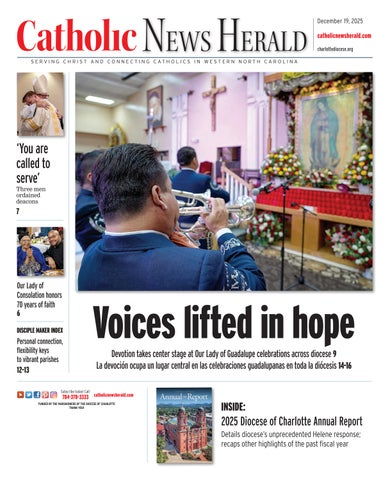
Voices lifted in hope Devotion takes center stage at Our Lady of Guadalupe celebrations across diocese 9 La devoción ocupa un lugar central en las celebraciones guadalupanas en toda la diócesis 14-16
Subscribe today! Call:
704-370-3333 catholicnewsherald.com
FUNDED BY THE PARISHIONERS OF THE DIOCESE OF CHARLOTTE THANK YOU!
INSIDE:
2025 Diocese of Charlotte Annual Report Details diocese’s unprecedented Helene response; recaps other highlights of the past fiscal year
At a glance 2
catholicnewsherald.com | December 19, 2025 CATHOLIC NEWS HERALD
CATHOLIC ALL WEEK
DECEMBER 19, 2025
Timely tips for blending faith & life
VOLUME 35 • NUMBER 6
1123 S. CHURCH ST. CHARLOTTE, N.C. 28203-4003 catholicnews@rcdoc.org
704-370-3333 PUBLISHER The Most Reverend Michael T. Martin, OFM Conv., Bishop of Charlotte
I
n our secular society, it is sometimes all too easy for the true meaning of Christmas to get lost amid the rush to wrap presents, decorate the house, attend celebrations with family and friends and to be present for all of the festivities. This Christmas season, give yourself and your family a special present – making time to feel the presence of Christ in your lives. Here are a few ways to slow down and reflect, and won’t feel like just one more thing to check off the list: 1
INDEX
While it goes without saying, Mass is at the heart of Catholic celebrations during the Advent and Christmas seasons. Spending this hour together as a family – or making the time to go with friends if you are single – can be a critical touchpoint during which your focus shifts to the real meaning of the season. Attending Mass together provides opportunities to discuss the homily, readings and any interactions that had a spiritual impact.
Contact us.....................................2 Español....................................... 14-19 Our Diocese............................. 4-13 Our Faith........................................3 Our Schools.................................20 Scripture................................. 3, 17 U.S. news..................................... 21 Viewpoints.............................26-27 World news........................... 23-25
STAFF EDITOR: Trish Stukbauer 704-370-3392, tmstukbauer@rcdoc.org ADVERTISING MANAGER: Kevin Eagan 704-370-3332, keeagan@rcdoc.org MULTIMEDIA DESIGNER: David Puckett 704-808-4521, dwpuckett@rcdoc.org EDITORIAL TEAM: Kimberly Bender 704-370-3394, kdbender@rcdoc.org Lisa Geraci 704-370-3294, lmgeraci@rcdoc.org Troy C. Hull 704-370-3288, tchull@rcdoc.org Christina Lee Knauss 704-370-0783, clknauss@rcdoc.org Amelia Kudela 704-370-3333, arkudela@rcdoc.org Brian Segovia 704-370-3235, bmsegovia@rcdoc.org COMMUNICATIONS ASSISTANT/CIRCULATION: Maria De Ugarte 704-370-3333, catholicnews@rcdoc.org COMMUNICATIONS DIRECTOR: Liz Chandler 704-370-3336, lchandler@rcdoc.org ASSISTANT COMMUNICATIONS DIRECTOR: Patricia L. Guilfoyle 704-370-3334, plguilfoyle@rcdoc.org THE CATHOLIC NEWS HERALD is published by the Roman Catholic Diocese of Charlotte 26 times a year. NEWS: The Catholic News Herald welcomes your news and photos. Please e-mail information, attaching photos in JPG format with a recommended resolution of 150 dpi or higher, to catholicnews@rcdoc.org. All submitted items become the property of the Catholic News Herald and are subject to reuse, in whole or in part, in print, electronic formats and archives. ADVERTISING: Reach 165,000 Catholics across western North Carolina! For advertising rates and information, contact Advertising Manager Kevin Eagan at 704-370-3332 or keeagan@rcdoc.org. The Catholic News Herald reserves the right to reject or cancel advertising for any reason, and does not recommend or guarantee any product, service or benefit claimed by our advertisers. SUBSCRIPTIONS: $17.25 per year for registered families of the Diocese of Charlotte and $25 per year for all others. POSTMASTER: Periodicals Class postage (USPC 007-393) paid at Charlotte, N.C. Send address corrections to the Catholic News Herald, 1123 S. Church St., Charlotte, N.C. 28203.
PRIORITIZE MASS
2
MAKE MOVIES MEANINGFUL
Odds are that families and friends will be gathered in front of the television for sporting events and movie nights at this time of the year. This is the perfect chance to make what you watch meaningful without sacrificing fun. Instead of hunkering down with hot cocoa in front of the Hallmark Channel, select a movie with spiritual depth. There are beloved classics that pack a powerful religious message, such as “The Bells of St. Mary’s,” “It’s a Wonderful Life” and even “A Charlie Brown Christmas,” as well as newer offerings such as “The Chosen: The Messengers.” See our website for more suggestions.
3
TAKE TIME FOR PRAYER
There are many opportunities to turn holiday traditions into moments of quiet prayer. When decorating the Christmas tree, set aside a minute before you flip the switch to bless the tree and remember the reason for its lights – the coming of Christ, the light of the world. When gathering for dinner on Christmas Eve or Christmas, turn the normal blessing into a seasonal one by giving thanks for the birth of Jesus. The music that provides the soundtrack of the season is also an opportunity to pray. Choose to play Christmas carols or Christian songs while wrapping gifts, baking, cooking and enjoying the moments that matter. — Catholic News Herald, Hallow, USCCB
Scan the QR code for this week’s recommended prayers and activities
Diocesan calendar of events EVENTS PRIESTS VS. SEMINARIANS ANNUAL SHOWDOWN: December basketball madness continues this year with the second annual showdown at 5:30 p.m. Sunday, Dec. 21, at Charlotte Catholic High School, 7702 Pineville-Matthews Road, Charlotte. CYCLE PREP FOR PARENTS WITH THEIR DAUGHTERS: This course helps parents give daughters the tools needed to navigate puberty positively, while building a foundation for continuing conversations. 4:30 p.m. Saturday, Jan. 17, at St. Matthew Church, 8015 Ballantyne Commons Pkwy., Charlotte. Registration is required. Email bnadcock@rcdoc.org. PRAYER SERVICES VIGIL OF THE TWO HEARTS: Vigil begins with 8 p.m. First Friday Mass on Friday, Jan. 2, followed by nocturnal Eucharistic Adoration and concludes with the 8 a.m. First Saturday Mass on Jan. 3. St. Patrick Cathedral, 1621 Dilworth Road East, Charlotte. Sign up for an hour of Adoration at www. defendthefamily.org/two-hearts.
Bishop Michael Martin, OFM Conv., will participate in the following events over the coming weeks: DEC. 24 – 4 P.M. Vigil Mass for the Feast of the Nativity of the Lord St. Gabriel Church, Charlotte DEC. 25 – 9 A.M. Mass for the Feast of the Nativity of the Lord St. Patrick Cathedral, Charlotte
DEC. 25 – NOON Mass for the Feast of the Nativity of the Lord Our Lady of the Assumption Church, Charlotte JAN. 1 – 9 A.M. Mass for the Solemnity of Mary, Mother of God St. Patrick Cathedral, Charlotte
Our faith
December 19, 2025 | catholicnewsherald.com CATHOLIC NEWS HERALDI
3
The fulfillment of our hope Pope Leo XIV
Live authentically with prayer, letting go of the unnecessary
T
he secret to living an authentic life is praying to understand what is truly beneficial according to God’s plan and letting go of the superfluous, Pope Leo XIV said. In fact, death “can be a great teacher of life. To know that it exists, and above all to reflect on it, teaches us to choose what we really want to make of our existence,” the pope said Dec. 10 at his weekly general audience in St. Peter’s Square. “Praying, in order to understand what is beneficial in view of the kingdom of heaven, and letting go of the superfluous that instead binds us to ephemeral things, is the secret to living authentically, in the awareness that our passage on earth prepares us for eternity,” he said. It was the pope’s first general audience after returning from his first apostolic trip, a visit to Turkey and Lebanon Nov. 27-Dec. 2. At the audience, he continued his series of talks on the Jubilee theme of “Jesus our hope,” focusing on “death in the light of the Resurrection.” “Our present culture tends to fear death and seeks to avoid thinking about it, even turning to medicine and science in search of immortality,” Pope Leo said in his English-language remarks. However, Jesus’ victory of passing from death to life with His resurrection “illuminates our own mortality, reminding us that death is not the end, but a passing from this life into eternity,” he said. “Therefore, death is not something to be feared, but rather a moment to prepare for.” “It is an invitation to examine our lives and so live in such a way that we may one day share not only in the death of Christ, but also in the joy of eternal life,” the pope said. “The event of the Resurrection of Christ reveals to us that death is not opposed to life, but rather is a constitutive part of it, as the passage to eternal life,” he said in his main catechesis in Italian. “He has prepared for us the place of eternal rest, the home where we are awaited; He has given us the fullness of life in which there are no longer any shadows and contradictions,” he said. Awaiting death “with the sure hope of the Resurrection preserves us from the fear of disappearing forever and prepares us for the joy of life without end,” he said.
W
e are now in the final month of the 2025 Jubilee year, which will officially conclude on Tuesday, Jan. 6, 2026, on the Feast of the Epiphany. Pope Francis opened this Jubilee in December 2024 with the theme, “Pilgrims of Hope.” In this Advent season, I find myself reflecting on the relationship between the Jubilee, hope and the coming of Christ. For us to understand what a Jubilee means for us today, we have to first understand what it meant to the people of Israel. According to the Law of Moses, every seventh day was to be observed as a day of rest. This is a pattern we are still familiar with, as the Church has retained the practice of maintaining a day of rest once each week to worship God. But in ancient Israel, the idea of a sabbath rest was not limited to a weekly observance. The people observed a sabbath year of rest every seven years. This might sound nice at first, but it was not a year-long vacation. Think about what a year of no work meant to the people of that time. It meant fields didn’t get planted. It meant vineyards were not pruned. It meant crops were not harvested. The land itself was allowed to rest. That made sabbath years times when Israel had to learn to trust God to provide for them and for their needs.
A SACRED YEAR
Every 49 years, Israel would complete a full cycle of seven sabbath years, so the year after that, the 50th year, was something very special. That was the Jubilee Year that we read about in Leviticus. “You shall treat this fiftieth year as sacred. You shall proclaim liberty in the land for all its inhabitants. It shall be a jubilee for you, when
SISTER MARY JUTTA, PIXABAY | OSV NEWS
An illustration of a Nativity scene shows Mary holding the Christ Child.
each of you shall return to your own property, each of you to your own family” (Lv 25:10). The restoration of ancestral land was of extreme significance. Every tribe of Israel had received a portion of the land of Canaan that was to be their inheritance. The land was something sacred that had been given to them by God. If economic hardship forced any family to sell or trade their land, it would be restored to them on the Jubilee. This guaranteed no tribe would ever be displaced by another. This was a great blessing for the people because it meant that
the hardship of losing your land would never be permanent. Something similar was done for human labor, with slaves being set free on Jubilee years. In ancient Israel, the institution of slavery existed as a safeguard for people who were destitute. If someone could not take care of themselves, they could enter into indentured servitude of a more prosperous family. In exchange for their service, their basic needs would be met. But the hardship of entering bonded servitude was also temporary. No person can ever own another because we all belong to God. So every slave was to be set free in the Jubilee year.
HOPE IN TIMES OF STRUGGLE
Jubilee years were more than just times of rest. They were times of liberation and restoration, reminders that God has sovereignty over His land and His people and that nothing would really be lost forever. Eventually everything would be restored,
no matter how bad things might get in the interim. That was the Jubilee promise of God. Trust in that promise would nurture in their hearts the virtue of hope. But eventually, the hope instilled by the Jubilee year would look ahead past another 50 years for its fulfillment to some future year of grace. Things would get bad for Israel. The tribes of Israel began to war among themselves, tearing the kingdom in two. Their kings turned to worship of foreign gods. The Assyrians would invade, wiping the 10 northern tribes off the map. The Babylonians would follow, sending Judah into exile. The walls of Jerusalem were torn down. The temple was destroyed. What would be rebuilt would be just a shadow of its former glory. Then would come the Greeks and later the Romans to rule over them. How could a Jubilee year restore land that was occupied by a foreign invader? How could it restore freedom to a people enslaved by a pagan empire? What does hope for restoration look like for a people in exile? You see the challenge here. But the hope instilled in their hearts by God did not die. It just looked further ahead to a future time of restoration when all would definitively be set right; not just for a year, but for all time. This future messianic kingdom of justice and righteousness is prophesied in many places in the Hebrew scriptures. Isaiah speaks of a shoot from the stump of Jesse blossoming forth (cf. Is 11:1), saying, “For to us a child is born, to us a son is given; and the government will be upon his shoulder, and his name will be called ‘Wonderful Counselor, Mighty God, Everlasting Father, Prince of Peace’” (Is 9:6). NEWSOME, SEE PAGE 22
Daily Scripture readings DEC. 21-27
Sunday (Fourth Sunday of Advent): Is 7:10-14, Ps 24:1-2, 3-4, 5-6, Rom 1:1-7, Mt 1:18-24 Monday: 1 Sam 1:24-28, 1 Sam 2:1, 4-5, 6-7, 8abcd, Lk 1:46-56 Tuesday: Mal 3:1-4, 23-24, Ps 25:4-5ab, 8-9, 10 and 14, Lk 1:57-66 Wednesday: 2 Sam 7:1-5, 8b-12, 14a, 16, Ps 89:2-3, 4-5, 27 and 29, Lk 1:67-79 Thursday (The Nativity of the Lord): Is 52:7-10, Ps 98:1, 2-3, 3-4, 5-6, Heb 1:1-6, Jn 1:1-18 or Jn 1:1-5, 9-14 Friday (Feast of St. Stephen, First Martyr): Acts 6:8-10, 7:54-59, Ps 31:3cd-4, 6 and 8ab, 16bc and 17, Mt 10:17-22 Saturday (Feast of St. John, Apostle and Evangelist): 1 Jn 1:1-4, Ps 97:1-2, 5-6, 11-12, Jn 20:1a and 2-8
DEC. 28-JAN. 3
Sunday (Feast of the Holy Family of Jesus, Mary and Joseph): Sir 3:2-6, 12-14, Ps 128:1-2, 3, 4-5, Col 3:12-21 or 3:12-17, Mt 2:13-15, 19-23 Monday: 1 Jn 2:3-11, Ps 96:1-2a, 2b-3, 5b-6, Lk 2:22-35 Tuesday: 1 Jn 2:12-17, Ps 96:7-8a, 8b-9, 10, Lk 2:36-40 Wednesday: 1 Jn 2:18-21, Ps 96:1-2, 11-12, 13, Jn 1:1-18 Thursday: (Solemnity of Mary, the Holy Mother of God): Num 6:22-27, Ps 67:2-3, 5, 6, 8, Gal 4:4-7, Lk 2:16-21 Friday (Memorial of Sts. Basil the Great and Gregory Nazianzen, Bishops and Doctors of the Church): 1 Jn 2:22-28, Ps 98:1, 2-3ab, 3cd-4, Jn 1:19-28 Saturday: 1 Jn 2:29-3:6, Ps 98:1, 3cd-4, 5-6, Jn 1:29-34
JAN. 4-10
Sunday (The Epiphany of the Lord): Is 60:1-6, Ps 72:1-2, 7-8, 10-11, 12-13, Ephesians 3:2-3a, 5-6, Mt 2:1-12 Monday (Memorial of St. John Neumann, Bishop): 1 Jn 3:22-4:6, Ps 2:7bc-8, 10-12a, Mt 4:12-17, 23-25 Tuesday: 1 Jn 4:7-10, Ps 72:1-2, 3-4, 7-8, Mk 6:34-44 Wednesday: 1 Jn 4:11-18, Ps 72:1-2, 10, 12-13, Mk 6:45-52 Thursday: 1 Jn 4:19-5:4, Ps 72:1-2, 14 and 15bc, 17, Lk 4:14-22 Friday: 1 Jn 5:5-13, Ps 147:12-13, 14-15, 1920, Lk 5:12-16 Saturday: 1 Jn 5:14-21, Ps 149:1-2, 3-4, 5-6a and 9b, Jn 3:22-30
Our diocese 4
catholicnewsherald.com | December 19, 2025 CATHOLIC NEWS HERALD
For the latest news 24/7: catholicnewsherald.com
In Brief
Bishop Martin issues pastoral letter on norms for Holy Communion PATRICIA L. GUILFOYLE plguilfoyle@rcdoc.org
The basketball game of the year! Priests vs. seminarians rematch CHARLOTTE — December basketball madness continues with a rematch of last year’s inaugural “Priests vs. Seminarians” showdown. Be there at 5:30 p.m. Sunday, Dec. 21, at Charlotte Catholic High School, 7702 PinevilleMatthews Road, as the priests see if they can build on last year’s victory, which may have had an assist from an NBA player. Food and drink proceeds will be donated to Holy Angels, an organization that cares for people with intellectual, developmental and medical disabilities.
Holy Spirit Parish in Denver continues Helene assistance DENVER — Holy Spirit Parish led by its Knights of Columbus, continues to assist Hurricane Helene survivors who face ongoing challenges. Father Carmen Malacari explained, “To date, the parishioners of Holy Spirit Parish have donated $54,254 in cash and approximately $30,000 in-kind donations of building supplies, food and water.” John Sullivan, Knights of Columbus member, noted that the team has given more than 3,000 hours of volunteer time over the past 15 months. “Besides generous donations of our parishioners and local merchants, we had a spaghetti dinner and bake sale that helped with the amount provided to those in need,” he said.
The Church again celebrates World Day of Peace on Jan. 1 Since 1968, the Church has celebrated the World Day of Peace each Jan. 1. The message issued on this day by the Holy Father is shared globally to heads of state, and the annual observance coincides with the liturgical feast of the Solemnity of Mary, Mother of God. The theme selected by Pope Leo XIV for his first World Day of Peace message is “Peace be with you all: Towards an unarmed and disarming peace.” According to the Vatican’s announcement, the pope’s message will be an invitation to reject the logic of violence and war, and to embrace an authentic peace based on love and justice. “This peace must be unarmed, that is, not based on fear, threats or weapons,” he said. You may read Pope Leo XIV’s message in its entirety on Jan. 1 at www.vaticannews.va and www.catholicnewsherald.com. — Joseph T. Purello, Catholic Charities
CHARLOTTE — Bishop Michael Martin, OFM Conv., is establishing guidelines for the reception of Holy Communion in the Diocese of Charlotte to strengthen unity in worship, uphold the Church’s liturgical norms, and encourage active participation by the faithful. Bishop Martin announced the new norms in a pastoral letter Dec. 17. The letter affirms the common posture of standing to receive Holy Communion, encourages priests to offer Communion under both bread and wine more often, and calls for the broader use of trained laypeople to serve as eucharistic ministers. “The liturgy of the Church is the work of God and the work on behalf of God in the life of the Church,” Bishop Martin wrote. “These norms for our diocese move us together toward the Church’s vision for the fuller and more active participation of the faithful. ...” In his pastoral letter, the bishop emphasized that the celebration of the Eucharist is a communal act of worship, not only an individual act of piety. “Throughout the ages and within the context of our rich liturgical traditions from the Martin East to the West, our unity as believers in Holy Communion is expressed through our postures and gestures that reflect our mystical communion and unity as fellow believers,” he said. The new guidance does not replace the diocese’s general liturgical norms established in 2005, but builds upon them and aligns closely with the Church’s universal norms (what is called the “General Instruction of the Roman Missal”) and directives set by the U.S. Conference of Catholic Bishops. The pastoral letter follows months of consultation with the diocese’s Office for Divine Worship and the Presbyteral Council of priests, which represents all priests of the diocese in administrative and policy discussions.
STANDING TO RECEIVE
In his pastoral letter, Bishop Martin affirmed the “normative posture” for receiving Holy Communion in the United States is standing, after bowing the head as a sign of reverence. The directive instructs any parishes that currently use altar rails for distributing Holy Communion to discontinue the practice and remove any portable kneelers or prie-dieus by Jan. 16, 2026 – noting that such practices are “a visible contradiction” to the prescribed posture of standing. “Instead,” his pastoral letter states, the Church “emphasizes that receiving Holy Communion is to be done as the members of the faithful go in procession, witnessing that the Church journeys
FILE | CATHOLIC NEWS HERALD
Bishop Michael Martin has issued guidance on reception of Holy Communion that, among other things, emphasizes the “normative posture” of standing to receive Holy Communion, encourages priests to offer Communion under both bread and wine more often, and calls for more trained laypeople to serve as eucharistic ministers.
Holy Communion: What’s new / What’s not changing Guidance set forth in Bishop Michael Martin’s pastoral letter on Holy Communion supplements the Diocese of Charlotte’s liturgical norms, in accord with broader norms from the Vatican and the U.S. Conference of Catholic Bishops. Key points include:
WHAT’S NEW
Standing affirmed as common posture for Communion, discontinued use of rails and kneelers n Greater encouragement of Holy Communion under both bread and wine n Guidelines for extraordinary ministers of Holy Communion (eligibility, training, staffing levels) n
WHAT’S NOT CHANGING Reception of Holy Communion standing or kneeling n Reception on the tongue or in the hand, at the communicant’s choice n
More online At www.catholicnewsherald.com: Read the full text of Bishop Martin’s “Pastoral Letter on Holy Communion”
forward and receives Holy Communion as a pilgrim people on their way.” In many churches, altar rails are architectural elements that differentiate the sanctuary from the nave and once were used for Communion distribution. Over the past decade or so, a small number of churches in the diocese reintroduced the use of rails or kneelers to distribute Holy Communion, but most
diocesan churches already follow the practice of receiving Communion while standing, consistent with U.S. norms. In his pastoral letter, the bishop reiterated that individuals may not be denied Holy Communion if they choose to kneel, yet he encouraged the faithful to “prayerfully consider the blessing of communal witness that is realized when we share a common posture.” Clergy and catechists, he added, “are to instruct communicants according to the normative posture in the United States” and “are not to teach that some other manner is better, preferred, more efficacious, etc.” In guidance to pastors that accompanied the bishop’s pastoral letter, the diocese’s Office for Divine Worship noted that if a communicant wishes to kneel but is physically unable, the pastor should address the situation privately. “He is to catechize and remind the person that standing to receive is no less reverent or worthy a way to receive Our Lord,” advised Father Noah Carter, diocesan liturgy director. “In both ways, the communicant who is properly disposed to receive Holy Communion gains the same graces and gifts contained in the Eucharist, regardless of standing or kneeling.”
COMMUNION UNDER BOTH KINDS
In his letter Bishop Martin also encouraged pastors, where and when possible, to distribute Holy Communion under the forms of both bread and wine more often. While affirming Church teaching that Christ is fully present – Body, Blood, Soul and Divinity – under either bread or wine, he encouraged priests to consider the “fuller sign” of distributing Holy Communion under both kinds to foster LETTER, SEE PAGE 22
December 19, 2025 | catholicnewsherald.com CATHOLIC NEWS HERALDI
5
‘Silent Night’: A brief history
I
Bishop Michael Martin
n “The Power of Silence” by Cardinal Robert Sarah, silent music is defined as “the notes produced by the harp of our heart when it is consumed with love.” But the first Christmas night was likely not silent. References in the second chapter of Luke’s Gospel describe the praising of God by angels
2025 CHRISTMAS MESSAGE
I
CHRISTINA L. REITZ, PH.D. catholicnews@rcdoc.org
God comes in silence
and shepherds, presumably in song. As such, this was likely the first Christmas music, but the magic and holiness of the season continue to inspire composers. A particular favorite of many is “Silent Night,” with words by Father Joseph Mohr and music by Franz Gruber.
t is difficult to get consensus on the most popular Christmas carol of all time, but one that must be atop most lists has to be “Silent Night.” Just those two words evoke a response in me, as if they were delivering the very thing for which most of us long and the very thing that most of us need. In our noisy world and busy lives, silence evokes awe and wonder. It positions us to be still and listen, knowing that there is a message that we need to hear but cannot create ourselves. Night calls us to rest from the weariness of our lives and challenges us to turn off all the glaring bulbs and screens that blind us from seeing the stars in the sky – to see that one star that points us to true light. God comes in silence. Christ shines in our darkness. Whatever burdens you carry this Christmas season, whatever challenges you face in your everyday life, God fulfills His promise to you and me that He wants to walk with us, to speak the eternal Word to us in the silence, and to lead us by the eternal light of Christ. Silent night, Holy night, All is calm, All is bright. Our Catholic Church in western North Carolina is here for you this Christmas season. Come not just for the “Silent Night,” but also for the loud and busy days that follow – where we want to walk with you, filled with awe and wonder that God loves you and me so much that He wants to share this life with us. Merry Christmas! BISHOP MICHAEL T. MARTIN, OFM Conv., leads the Diocese of Charlotte.
Celebrate the birth of Our Savior with Bishop Martin Bishop Martin will offer three Masses for the Solemnity of the Nativity of Our Lord: n 4 p.m. Wednesday, Dec. 24: St. Gabriel Church, 3016 Providence Road, Charlotte n 9 a.m. Thursday, Dec. 25: St. Patrick Cathedral, 1621 Dilworth Road East, Charlotte n Noon Thursday, Dec. 25: Our Lady of the Assumption Church, 207 Shamrock Dr., Charlotte
Neither of these two men made a lasting impression in music beyond this collaboration. Father Mohr (1792-1848) was ordained not long before writing the six-stanza poem in 1816 that subsequently became “Silent Night.” Gruber (1787-1863), like so many with a keyboard background, worked a second gig as a church musician to supplement his income. Their collaboration originates from 1818 in Oberndorf, Austria, when Father Mohr asked Gruber to set his poem to music. The church’s organ was unplayable for reasons that are difficult to separate fact from fiction (mice, rust, etc.). At any rate, the instrument was unusable for Christmas Eve Mass and thus the world premiere of “Silent Night
(Stille Nacht)” occurred with the priest and Gruber, who accompanied on guitar, at St. Nicholas Church. The well-known version in America varies slightly from the original melody but would be recognizable. The music is set as a “siciliana,” a slower piece in compound meter featuring dotted rhythms frequently used for a pastoral scene, appropriate for this work. The lyrics used in contemporary churches stem from a translation by the Episcopalian John F. Young and have since been translated into hundreds of languages, even Klingon! The original St. Nicholas Church is no longer in existence, but a small chapel now stands to commemorate this beloved carol’s unassuming
history. A replica of the chapel can be found in, of all places, Bonner’s Christmas Wonderland in Frankenmuth, Michigan. Deacon Matthew Newsome, campus minister at Western Carolina University and deacon at St. Mary, Mother of God Parish in Sylva says of the hymn: “There is something in the human heart that wants to elevate our speech when we communicate with God by putting it to music. In a homily on the psalms, St. Augustine wrote that ‘it belongs to the lover to sing.’ Because of Father Mohr’s desire that his words of love for God be put to music, we have this beautiful hymn today that continues to give expression to the love of our own hearts.”
Closing Masses for Jubilee Year set for January CHARLOTTE — In January, the Catholic world will mark the end of the Jubilee Year 2025 formally inaugurated by Pope Francis when he opened the Holy Door to St. Peter’s Basilica on Christmas Eve, 2024. “Pilgrims of Hope” has been a fitting and uplifting theme for this year marked by a papal transition and unrest in many areas of the globe. A holy year – or jubilee – is a time of pilgrimage, prayer, repentance and acts of mercy, based on the Old Testament tradition of a jubilee year of rest, forgiveness and renewal. Holy years are
a time when Catholics make pilgrimages to designated churches and shrines, recite special prayers, go to confession and receive Holy Communion to receive a plenary indulgence, which is a remission of the temporal punishment due for one’s sins. The celebration of a Jubilee Year every 25 years is an acknowledgment that “the Christian life is a journey calling for moments of greater intensity to encourage
and sustain hope as the constant companion that guides our steps toward the goal of our encounter with the Lord Jesus,” Pope Francis wrote when announcing the jubilee. As Bishop Michael Martin said in July, when he celebrated a Jubilee Year Mass at Immaculate Heart of Mary Church in High Point, “All of us are called to be bearers of hope. A whole year of hope has so much capacity in our
world, in our country, in our diocese, in our parish and in your hearts.” The closing Masses in the Diocese of Charlotte will be celebrated by Monsignor Patrick J. Winslow, vicar general and chancellor, at the same churches that opened the Jubilee Year. n 5 p.m. Saturday, Jan. 3: St. Lawrence Basilica, 97 Haywood St., Asheville n 1:30 p.m. Sunday, Jan. 4: St. Pius X Church, 2210 N. Elm St., Greensboro n 5 p.m. Sunday, Jan. 4, St. Mark Church, 14740 Stumptown Road, Huntersville — Catholic News Herald
6
catholicnewsherald.com | December 19, 2025 CATHOLIC NEWS HERALD
Our Lady of Consolation Parish honors 70 years of faith CHRISTINA LEE KNAUSS clknauss@rcdoc/org
CHARLOTTE — Harry Scott was 3 years old in 1955 when his late mother Marie Scott took him to the groundbreaking for a new Catholic church on Statesville Avenue in west Charlotte. Seventy years later, he is still a member at that parish – Our Lady of Consolation – as well as chairman of the parish council. On Dec. 13 and 14, he joined with hundreds of fellow parishioners to celebrate the 70th anniversary of the historically Black parish. Established when segregation was still in effect in the South, it quickly became not only a spiritual home for Charlotte’s Black Catholics but also an important source of outreach to the community. More than 300 people came together on Dec. 13 for a jubilee banquet and dance that featured special music and reflections on the parish history. On Dec. 14, Father Juan Miguel Sanchez, priest-secretary to Bishop Michael Martin, celebrated a joyful Mass for parishioners old and new that included music by the church’s four choirs. Father Marcel Amadi, parochial administrator at the parish since July, gave a homily centered around the true joy found through faith in God, and said that joy has enabled Our Lady of Consolation to give witness over the decades. “People kept coming back to Our Lady of Consolation over the years because they found joy here, and we hope joyful people will continue to be in this church for the next 70 years, the next 100 years,” he said. Charlotte Mayor Vi Lyles sent a letter paying tribute to the
parish’s role in the city, praising the parish’s “strength, faith and commitment … uplifting generations through your ministry and dedication to service.”
GENERATIONS OF MEMORIES
The celebration led long-time members like Scott to reflect on their many years at the parish. Scott’s treasured memories included being an altar server, especially at midnight Masses for Christmas. He attended the parish school from kindergarten through eighth grade, and remembered basketball games, school plays and the annual summer Vacation Bible School taught by the Oblate Sisters of Providence who staffed the school, which closed in 1988 when the sisters left the diocese. “Over the years, it always felt to me like it was a privilege to be able to be at Our Lady of Consolation, and for me now it is a matter of being home when I’m here,” he said. The parish is also home to generations of Bonita Graham’s family, whose grandparents and parents worshiped at St. Mary and Our Lady of Perpetual Help – the two smaller parishes that merged in 1955 to form Our Lady of Consolation. In the spring of 1956, construction began on parish buildings consisting of a rectory, school, auditorium and convent. Graham and her two siblings were baptized and received their other sacraments in the new church, Graham’s daughter was baptized and married there, and her granddaughter, now 10, was also baptized there. Like Scott, she has fond memories of attending the parish school, where she recalled the
PHOTOS BY TROY C. HULL | CATHOLIC NEWS HERALD
Father Juan Miguel Sanchez, priestsecretary to Bishop Michael Martin, celebrated a joyful Mass for Our Lady of Consolation parishioners old and new to mark the parish’s anniversary. Graham manned a booth taking orders for commemorative T-shirts. It was a lot of work, but not too much to ask to celebrate the parish she loves.
A SENSE OF BELONGING
nuns would join the students on the playground to play dodgeball and baseball. “They were involved in everything we did – they did not just sit on the sidelines,” Graham said. Many people in the majority
Black neighborhood would send their children to Our Lady of Consolation School because of its strong Catholic education, Graham said. Her love for her parish led her to play a big role in planning the celebration, and on Sunday
“For me, there is just such a sense of belonging here – everybody knows everybody, you are recognized by your priest, and there is a sense of friendship and community,” she said. “We greet everybody here, and everyone interacts with each other. When we have our annual revivals, visiting priests from other places always talk about Our Lady of Consolation and tell us that we have something very special here in the city of Charlotte.”
Celebrate Epiphany with traditional Puerto Rican art at the Mint Museum CHARLOTTE — The Mint Museum Randolph is hosting a special celebration of Epiphany, also known as Three Kings Day or El Dia de los Reyes, 1-5 p.m. Sunday, Jan. 4. Epiphany commemorates the visit of the Wise Men or Magi to the infant Jesus. For many Catholics, particularly in Latin American traditions, this major holiday marks the end of the Christmas season. The celebration coincides with the ongoing display of “Art of Devotion: The Santos de Paulo Tradition of Puerto Rico,” an exhibit of 150 traditional wooden saint statues crafted in Puerto Rico from the larger collection of Francisco Toste Santana and Nitza Mediavilla Pinero. The couple moved to Charlotte from their native Puerto Rico several years ago and have been collecting the traditional figures for more than 50 years. “Art of Devotion” will be on display at the museum through July 5, 2026. Three Kings Day events include
performances by a children’s choir and a Latin American band, plus a chance to sample international variations of Three Kings’ Day treats such as rosca de reyes (Three Kings’ bread), galette de rois (king cake) and guava pastilles (guava pastries). There will also be interactive crafts and games, including a scavenger hunt in the Santos del Palo exhibit, and a chance to craft your own Three Kings figures. Admission is free. — Christina Lee Knauss
More online At www.mintmuseum.org: Learn more about the event and the exhibit At www.catholicnewsherald.com: Read about the broader Santos de Paulo collection of wooden saint statues
December 19, 2025 | catholicnewsherald.com CATHOLIC NEWS HERALDI
7
‘YOU ARE CALLED TO SERVE’
Three men ordained deacons on path to priesthood CHRISTINA LEE KNAUSS clknauss@rcdoc.org
HENDERSONVILLE — Three men embarked on a new phase of their journey to the priesthood Dec. 6 as they were ordained as transitional deacons at Immaculate Conception Church by Bishop Michael Martin, OFM Conv., who thanked them for answering God’s call to serve. The church in the mountains was selected because all three have connections there. Daniel Chaves Peña and Juan González Hernández have served in varied capacities there for the past two years. James Connor Tweed is a Hendersonville native, and his home parish is St. John the Baptist in nearby Tryon. The bilingual Mass featured beautiful, soaring hymns in Spanish and English performed by the combined choirs at Immaculate Conception. Before a crowd of family, friends and well-wishers, the men received their first foundational sacramental ordination within holy orders. They made promises to serve the diocese and Bishop Martin with humility and charity, then prostrated themselves before the altar during the Litany of Supplication. Bishop Martin laid his hands on their heads and prayed over them in the ancient rite of ordination. The three were then vested with the stole, a sign of the deacon’s office of service, and the dalmatic, an outer garment used at Mass. The three chose to be vested by deacons who have been an inspiration to them in their vocations. Deacon González was vested by Deacon Bryan Ilagor, while Deacon Sigfredo Della Valle vested Deacon Chaves. Deacon Tweed was vested by Deacon Rich McCarron. The newly vested deacons again approached the sanctuary one by one, receiving the Book of the Gospels. As they received the book, Bishop Martin spoke three sentences that sum up their role as proclaimers of the Gospel and as deacons: “Believe what you read, teach what you believe and practice what you teach.”
ANSWERING THE CALL
Bishop Martin’s homily centered around the theme of responding to the call of Christ. “Daniel, Juan and James, the Lord has called you here, and you have responded,” he told the men. “You are ready and willing
PHOTOS BY TROY C. HULL | CATHOLIC NEWS HERALD
Immaculate Conception Church in Hendersonville hosted the ordination of three men as transitional deacons. It was held at the church because all three have close ties to the parish.
to listen to wherever God may want to call you, to whatever God may want of you, to wherever God may send you. Thank you for listening, but the listening is not over.” As the bishop reflected on the Scripture readings, he noted the first reading from Sirach spoke of gaining wisdom both from studying the Word of God and from
encountering God’s people in the world. “The three of you are encouraged to go out into the world to see the good and the bad, to better discern the one from the other, to listen to the people of God of every nation, of every area, to learn how God is at work in the world,” he said. He told the men they will see God’s wisdom “sometimes through the voice of an 8-year-old, other times in the face of a 90-year-old, and at times through the gentle encouragement or maybe even strong push of your family and friends.” The second reading from Paul’s letter to the Corinthians, the bishop said, urges the men to find God’s wisdom through sacred Scripture and then proclaim it to the world while realizing with humility that we are all broken earthen vessels. The bishop said Paul’s words encourage the men to realize that their work as
deacons and eventually as priests should always be focused on Christ rather than on themselves. Finally, he said, the Gospel reading from Matthew emphasized the role of service that comes with the role of transitional deacon. “You are called to serve,” Bishop Martin told the men. “You are laying down your lives, literally, saying, ‘How may I give of myself for the good of the Church?’ “And we will need your service,” he said. “We will need you to extinguish yourselves for the good of the Gospel.” The three deacons will now be able to proclaim the Gospel at Mass, preach at the invitation of the priest, prepare the altar for the sacrifice of the Eucharist, distribute Communion to the faithful, administer baptisms, officiate at marriages, bring the Eucharist to the dying, conduct funerals, instruct believers and nonbelievers in Church doctrine, preside over public prayer and perform works of charity. The newly ordained men are called “transitional” deacons instead of “permanent” deacons, a distinction that reflects their intent to serve a year in pastoral, liturgical and educational preparation before being ordained into the priesthood. Deacon is the first of three ranks of holy orders; the other two are priest and bishop.
ASSIGNMENTS ANNOUNCED
At the end of Mass, Bishop Martin announced the new deacons’ assignments. Deacon Tweed will return to seminary in Ohio to continue his studies while working in part-time pastoral ministry. Deacon Chaves is assigned to Holy Cross Parish in Kernersville, while Deacon González will serve at Our Lady of Lourdes Parish in Monroe. Each of the new deacons reflected on their feelings after the moving and powerful liturgy. “I saw God’s grace at work here,” said Deacon Chaves. “I especially reflected on the bishop’s words of how we are unworthy earthen vessels but filled with God’s love.” “I give thanks to God for this day,” Deacon González said. “I give thanks to Him for this vocation, and I hope to give everything to Him.” With a wide smile, Deacon Tweed said the day was hard to describe. “The Lord has blessed me beyond words – the immediacy of His love is so overwhelming right now.”
2026 special collections and their dates
Special collection dates for 2026 announced CHARLOTTE — The Diocese of Charlotte has announced the dates for nine special collections for 2026. These annual collections fund vital ministries and help support our priests and religious who give generously of their lives in service to the Church. On the Diocese of Charlotte’s website, www.charlottediocese.org, learn more about these special collections, as well as other ways to financially support the various ministries of the Church in the Diocese of Charlotte, including the Diocesan Support Appeal and the Foundation of the Diocese of Charlotte. — Catholic News Herald
JAN. 17-18: Nation Mission Collection to benefit the United States Mission Appeal (Black & Indian Missions) and Catholic Home Missions n APRIL 4-5: Seminarian Education Collection n MAY 16-17: International Collection to benefit Collection for the Holy Land, Collection for the Works of the Holy Father (Peter’s Pence), Church in Latin America, Church in Central and Eastern Europe, and Church in Africa n AUG. 29-30: Catholic University of America and Belmont Abbey College n SEPT. 19-20: Priests’ Retirement Benefits n OCT. 17-18: World Mission Sunday (Propagation of the Faith) n OCT. 31-NOV. 1: Catholic Relief Services n NOV. 21-22: Catholic Campaign for Human Development and Catholic Communications Campaign n DEC. 12-13: Religious Retirement n
8
catholicnewsherald.com | December 19, 2025 CATHOLIC NEWS HERALD
Taizé service unites participants in prayer LISA M. GERACI lmgeraci@rcdoc.org
STONEVILLE — Through the light of 100 candles and the harmony of 100 voices, the darkness was pierced with unity and love during the annual Taizé-style interfaith worship service Dec. 3 at St. Francis Springs Prayer Center. Taizé is a globally recognized ecumenical movement of reconciliation that was started after World War II in Taizé, France, by Brother Roger Schütz, a Protestant. Taizé Prayer is a Christian evening prayer that was recognized by then-Pope John Paul II. The distinctive prayer style features repetitive chants, group prayer and long periods of silence calling the faithful to focus deeply on Christ’s presence around us and within us. The Taizé worship at the prayer center is no exception. “They are not just hymns and not just songs. They are prayers that are easily learned,” instructed Sally Morris, former music director of St. Paul the Apostle Parish in Greensboro. She has led St. Francis Springs’ prayer service since it began 20 years ago. “You may notice that we may all breathe together, and we may all suddenly get louder or softer,” she said. “We are one voice in these solemn prayers.” The repetitive hymns of praise, meditation and silence guided guests to welcome in Advent through the simple beat. Taizé was brought to the prayer center by its founder, Franciscan Father Louis Canino. St. Paul choir member and Taizé bassist Efren Renteria remembers those beginnings. “Father Louie wanted to do something different. He wanted to put songs and prayer together. He mentioned the Taizé community, and we’ve been doing it ever since,” Renteria said. “I like doing it at Advent because it resets you. We can teach them easily, and the concept is once they get singing, they start putting the paper down and let the words show up.” Franciscan Father Bob Menard, friar-in-residence and spiritual director at St. Francis Springs, started the night by blessing hundreds of tea light candles and the Christians who entered the dark chapel holding the tiny flames.
LISA M. GERACI | CATHOLIC NEWS HERALD
The sounds of the harp were just one of the beautiful and touching moments experienced during an Advent Taizé service that brought together Christians of all faiths.
He said, “May we offer up this night to light up the darkness in our world, a world that continues to get darker.” One by one, each person slowly entered, chanting the short hymn of praise they practiced moments prior. They carried their candles beneath the Franciscan cross floating above the altar and beside the newly-lit Christmas tree, gently placing their small light with all the others on a candelabra. Then the soprano, alto, tenor and bass voices continued together, intoning the soft, repetitive choral, “The Lord is my light, my light and salvation, in God I trust,” which was accentuated by the sounds of the harp, flute, organ, bass and guitar. Just like the prayer center itself, Taizé seeks to offer meaningful, unified prayer in a common place regardless of language or denominational boundaries. Thousands of pilgrims travel to the Taizé monastic community in France each year, where brothers of the community and visiting Catholic and Protestant pilgrims live together in harmony. A few of these pilgrims were present in the small chapel in Stoneville, having voyaged to France after years of practice at the annual meditation to visit the site where it began. The movement spread globally, strengthening after the acceptance of then-Pope John Paul II, who propelled its popularity during World Youth Day Taizé services. The pope explained at the time, “One passes through Taizé as one passes close to a spring of water. The traveler stops, quenches his thirst, and continues on his way.” Cynthia Garrison is one such traveler, and St. Francis Springs Prayer Center is her spring. She is a Catholic from Hillsborough who visits frequently for the peace she finds on the grounds and the ecumenical dialogue she has come to love served alongside the community meals. “It is a lovely way to worship in an ecumenical way and to be still in God’s love, a beautiful combination of actively waiting for the Lord this Advent,” Garrison said. “Lifting our voices together in a community with so many you may be meeting for the first time or friends you made at St. Francis Prayer Center in years past is a beautiful reminder of our unity as children of God.”
Advent by Candlelight reminds women to take a needed pause LISA M. GERACI lmgeraci@rcdoc.org
MOORESVILLE — On Dec. 4, St. Therese Parish hosted one of its largest annual events, Advent by Candlelight, with 204 women gathering to renew their faith and rediscover themselves. “We are trying to get everyone in the mindset of why Advent exists, taking a pause and preparing for Jesus’ birth instead of just the hustle and bustle of Christmas,” said event organizer Sara Plouffe. Hosted by Walking with Purpose, a women’s Bible study group, the event is in its sixth year. Each of the 26 tables had a host who invited friends and decided on decorations and food weeks in advance. As parishioner Monica Dougherty explained, “Hosting a table is my favorite way to start the holiday season. We take a moment off from the craziest time of the year to step back and remember that Advent is a time of preparation to welcome the light of Jesus in our hearts. Cherishing time with close friends makes it even more special.” That evening, the hosts decked the parish hall – with Christmas tree tablecloths, candles, glittery plates, plastic wine glasses, and touches such as presents and cards – as people were in the church for confession. Many expressed the reasons they keep coming back year after year: the camaraderie and the speakers. This year’s keynote speaker, author and podcaster Mallory Smyth, brought some cold weather and good advice from Denver. A mother of five, she knows what it is like to try to be Superwoman during the Christmas season and admits it can feel draining. “As Catholic women, are we wearing purple or red and green?” asked Smyth, who was wearing sequined purple lace, the liturgical color of the season and the correct
LISA M. GERACI | CATHOLIC NEWS HERALD
More than 200 women gather at St. Therese Parish in Mooresville to hear nationally known speaker Mallory Smyth discuss how the message of Christmas can counteract the exhaustion felt by many during the holidays. answer to her question. “Secular Christmas and Advent offer two completely different messages,” Smyth said, “and whichever one we choose to believe is the way we are going to enter into both seasons.” The secular season promises family togetherness, carols around the Christmas tree and the nostalgia of childhood past, all while emptying wallets and inflating false hopes, she said. She said the world falsely promises that “if you just buy more stuff, if you strive a little more, if you believe enough, and if you just do enough stuff, you can finally be perfect and have this life you always wanted, and you
will feel worthy.” So each holiday season, women run off to find that perfect tree, bake countless cookies, wrap over-budget presents and find new ways to be creative with the Elf on the Shelf – but to what end? “The promises of the culture are just not true,” Smyth said. “There is not a month in the year that is going to make your life perfect. There is no amount of work that is going to make you the ultimate magic maker. Perfection is not something we can reach on this side of heaven.” Chasing the secular world’s idea of perfection leaves women exhausted, she said. “Buy the different message, the one that the Church offers,” Smyth encouraged. “If we enter in the mystery … we can start to find silence and rest, and we will come face to face with the incarnate God, a God that loved us so much that He decided to enter in the world to be with us.” Smyth reminded the women when Isaiah wrote his prophecy of the coming of the Lord – 700 years before the angel Gabriel appeared to Mary. “Can you imagine waiting?” Smyth asked. But then, she noted, Jesus “came into the world, and I can imagine man’s soul exhaling, because now he remembered God, and he remembered he was worthy of God’s love.” She encouraged participants to remember the true beauty of Advent and Christmas. “We don’t have to wait like they did, but we can’t forget the wait. The world will try to get us too distracted, too tired and too overwhelmed, but we can’t be tempted. We need to focus on who God is and who He says we are,” she said. “The Church wants you to come in and behold the truth you already know,” she said. “You have so much worth that the God of the Universe decided it was worth His trouble to enter into the human, to be born by a woman, and get to you.”
December 19, 2025 | catholicnewsherald.com CATHOLIC NEWS HERALDI
C
9
Guadalupe celebrations take center stage
elebrations for the Feast of Our Lady of Guadalupe took over the Diocese of Charlotte despite frigid temperatures Dec. 11-12. Crowds showed up in large numbers for this year’s celebrations despite anxiety in the Hispanic community due to recent federal immigration enforcement actions in the state. Faithful across western North Carolina spent time praying, dancing, singing and processing in devotion to the Blessed Virgin Mary. Some parishes celebrated from late Thursday evening into the morning hours Friday. The feast of Our Lady of Guadalupe refers to the apparition of the Blessed Virgin Mary to an indigenous man named Juan Diego on Tepeyac Hill near Mexico City in 1531, after which an image of her miraculously appeared on his cloak and became a central focus of devotion for millions of Catholics across the Americas.
Her image and shrine quickly grew into one of the most important religious sites in the Americas and became deeply woven into Mexican cultural and national identity, even serving as a symbol in the country’s struggle for independence and unity. With more than half of North Carolina’s foreign-born Latino population being from Mexico, the celebration of Our Lady of Guadalupe is entrenched in communities locally and the devotion has spread to people of all nationalities who are united in faith.
More online BRIAN SEGOVIA | CATHOLIC NEWS HERALD
Dancing from different traditions across Latin America was on full display in Charlotte this year, performed primarily by young people.
— Brian Segovia
At www.catholicnewsherald.com: See lots more photos and read more about celebrations across the diocese
PHOTO PROVIDED
At St. Therese in Mooresville the pews were packed by the faithful who participated in the Mass and singing. Father Engelbert Ofon delivered a message of hope in a bilingual homily, offering comfort to migrants, reminding everyone that they are not alone, since they have the Virgin Mary who leads them to Jesus. Quinceañeras also brought flowers to the Virgin Mary to demonstrate their great love and appreciation for her.
SIGFREDO DELLA VALLE | CATHOLIC NEWS HERALD
Parishioners at Prince of Peace Mission in Robbinsville join in a procession to Holy Redeemer Church in Andrews. The small mission church, located in what was once a carpet store, comes together every year to celebrate the Feast of Our Lady of Guadalupe with Holy Redeemer, according to parochial administrator Father Joseph Wasswa.
LISA M. GERACI |CATHOLIC NEWS HERALD AND PHOTO PROVIDED
Throughout the Diocese of Charlotte, many parishes such as Divine Redeemer in Boonville (above) featured a reenactment of the apparition of the Virgin of Guadalupe to St. Juan Diego as it has been remembered since 1531. (Left) Immaculate Heart of Mary in High Point began their celebrations on Dec. 7.
10
catholicnewsherald.com | December 19, 2025 CATHOLIC NEWS HERALD
Franciscan Brothers from Padua bring St. Anthony relics to Diocese of Charlotte part of their family, why they are friends with St. Anthony, and then some big or small miracles that are happening in their lives.” Father Conte related some of the miracles they have been hearing, including one of a young woman who did not believe in God but had a strong connection to St. Anthony. “After a few years, she said, St. Anthony led her towards God,” Father Conte said. “Anthony is a good intercessor because he takes people to Jesus.” Some stories in the diocese are just beginning their new St. Anthony chapters with the visit of the relics. Our Lady of Lourdes parishioner Elizabeth Garcia, just 17, braved the winter cold to visit the relics with her aunt. “I decided to come here tonight to have a more spiritual connection with God, because, like everybody, I have many sins that I regret a lot,” Garcia said. “This is pretty much a once-in-a-lifetime experience, which is crazy to us,” she said. “God gave me this opportunity in my life, and I never would have known He would give me this. When I wrote my petition, I believed it would come true.”
LISA M. GERACI lmgeraci@rcdoc.org
CHARLOTTE — Two relics of St. Anthony of Padua traveled from Padua, Italy, to a dozen churches in the Diocese of Charlotte from Dec. 5 to 14. At each stop, crowds came out to touch the relics of the saint many consider a personal friend. “This is the first time ever we have brought the relics to North Carolina from Padua, from our shrine,” said Father Fabio Turrisendo, who along with fellow Franciscan friar Father Mario Conte brought the relics from the Pontifical Basilica of St. Anthony, where the saint is buried. The friars were asked to bring the relics here by a fellow Franciscan, Bishop Michael Martin. “He invited us to come over here, so I said, ‘If he wants us to go, let’s go,’” Father Conte said during their stop at Our Lady of Lourdes Church in Monroe. Father Turrisendo noted that the diocese has been very welcoming. Both brothers said it is very moving to see the reactions of the faithful. “You can see some people crying, some people smiling, but there is a connection, there is something happening there at that particular moment,” Father Conte said. “St. Anthony is my best friend, and I always say that he really cares about people.”
JIM KELLEY | CATHOLIC NEWS HERALD AND PHOTOS PROVIDED
Hundreds came out to a dozen locations across the diocese as two relics of St. Anthony of Padua visited the Carolinas for the first time. They were brought to the United States by two Franciscan friars from his shrine. Wherever they visit, the relics draw crowds of people who feel a personal connection to the saint known to find lost things. “We are used to telling the story of St. Anthony. We go and do our preaching, but the other half of the story is what the people tell us,” Father Turrisendo said. “This completes the book of the miracles of St. Anthony. They tell you why his devotion is
More online At catholicnewsherald.com: See more photos of the St. Anthony relics tour across the diocese
Join the 20th annual March for Life Charlotte on Jan. 9 6TH
ST.
5TH
ST.
N
INDEPENDENCE SQUARE
ST.
3RD
ST.
S. COLLEGE ST.
BROOKLYN
VILLAGE AVE.
MOREHEAD ST.
Uptown Charlotte S TO N E WA L L
277 LIGHT RAIL
BANK OF BANK OF AMERICA AMERICA STADIUM STADIUM
3 R D S T. / CONVENTION CENTER
MLK JR. BLVD.
ST.
the Triad area. He also highlighted the work of parish-based Walking With Moms in Need ministries in providing concrete assistance to pregnant and parenting mothers. Father Ascik credited the Knights of Columbus councils, which regularly hold baby bottle campaigns to raise funds to support mothers and their babies, and Sidewalk Advocates for Life Charlotte, which works to connect with women outside of abortion centers and help them to choose life. Additional support for women and children can be found at Catherine’s House in Belmont and Birthright of Charlotte. “All of these efforts are part of a network of care dedicated to walking with moms in the Diocese of Charlotte,” Father Ascik said. — Catholic News Herald
4TH
ST. PETER CATHOLIC CHURCH
S. CHURCH ST.
More than 200 people braved frigid temperatures last year to attend the 19th annual Charlotte March for Life. The upcoming march will take place Friday, Jan. 9.
S. TRYON ST.
S. CHURCH ST.
S. MINT ST. FILE, TROY C. HULL | CATHOLIC NEWS HERALD
C T E /A R E N A
TRADE ST.
FINISH
S. TRYON
CHARLOTTE — Catholics in the Diocese of Charlotte are invited to make a public stand for life at the 20th annual March for Life Charlotte, scheduled for Friday, Jan. 9. Held each year in January, the event offers the faithful a chance for public witness as they gather to march and pray for the protection and sanctity of all human life. “This is a chance for people to give a visible witness as part of the body of Christ,” said Tina Witt, who leads the nonprofit group that coordinates the annual march. “The people who turn up for the march have a very powerful impact. It’s a chance for us to communicate the truth.” The day will begin with a Mass for the Unborn offered at 10 a.m. Jan. 9 at St. Patrick Cathedral, located at 1621 Dilworth Road East, Charlotte. Participants are asked to gather at 11 a.m. in the overflow parking lot across from the diocesan Pastoral Center at 1123 S. Church St. Marchers will receive instructions and have a chance for prayer beginning at 11:30 a.m. The march will kick off at noon and process from the parking lot to Independence Square at the intersection of Trade and Tryon streets in Uptown Charlotte. Father Brian Becker, director of formation at St. Joseph College Seminary and vocations promoter for the diocese, Becker will be the guest homilist. “The Charlotte March for Life is a chance for us all to give witness to Christ on our own streets,” Father Becker said. “As our experience with the march in the past has shown us, souls can be won for Christ in our very own city by our prayer and public witness to Him.” Participants will also pray the rosary and the Chaplet of Divine Mercy during the march. The March for Life is just one of the pro-life efforts that go on year-round in the Diocese of Charlotte, according to Father Peter Ascik, director of the diocese’s Family Life Office. Father Ascik pointed to groups like MiraVia, with their residence for pregnant college students, and Room At The Inn, which provides housing for single, pregnant women in
CARSON BLVD.
LIGHT RAIL STATIONS
CARSON
PALMER ST.
START
DIOCESAN PASTORAL CENTER
More online At www.marchforlifecharlotte.com: Get additional information about the 2026 March for Life Charlotte
December 19, 2025 | catholicnewsherald.com CATHOLIC NEWS HERALDI
11
Diocese Foundation awards $61,500 in grants CHARLOTTE — Fourteen parishes and ministries have received grants totaling $61,500 thanks to the Foundation of the Diocese of Charlotte. The annual awards, which range from $2,000 to $5,000, are based on need and the impact the money is expected to have on local communities. They are fueled by endowments people have made to the foundation in their wills or estate planning over the years. Types of projects and initiatives supported by the foundation in 2025 include support for homeless veterans living in transitional housing, responses to urgent food needs, upgrades to parish and education facilities, Hispanic youth religious education and activities, and faith formation materials. “The foundation is able to award these grants every year thanks to the forward thinking of the parishioners in the diocese,” said Gina Rhodes, diocesan director of planned giving. St. Benedict the Moor in Winston Salem received $5,000 for bathroom renovations in buildings used for Faith Formation and meetings. As parochial administrator Father Melchesideck Yumo noted, “Struggling parishes like mine have been blessed with assistance from the Foundation, which has taken a huge financial load off the parishioners who are barely managing with their families.” The BackPack Weekend Food Program at Queen of the Apostles Church in Belmont also received a $5,000 boost from the foundation. The program provides bags of non-perishable food for students to eat on weekends when school meals aren’t
available. Queen of the Apostles sponsors approximately 50 children each year.
‘Every single endowment we have is making a difference.’
St. Mary, Mother of God Parish — Hispanic youth religious education, activities and evangelization $5,000
Joe Gigler
Chair, Foundation of the Diocese of Charlotte Program coordinator Julie Russo notes it costs about $350 to feed one student for the full school year, and every contribution helps. “This money is doing something locally,” Russo said. “It is truly helping people.” “Every single endowment we have is making a difference,” said Joe Gigler, who chairs the foundation’s board. “I see every day the impact these grants make.” The foundation continues to grow, surpassing $100 million in assets in 2025. “It’s neat to think the gift you give today is going to continue to give into the future. It’s an exciting time to be a Catholic in the Diocese of Charlotte,” Gigler said. Since 2001, the foundation has awarded 440 grants totaling more than $1.26 million. These grants are distributed from three of the foundation’s 400-plus endowments, which are either for unrestricted or broader purposes. As Father Yumo noted, “Every gift makes a difference.” — Courtney McLaughlin
Mercy Sister Maureen Dees, longtime educator, passes away BELMONT — It is with heartfelt sadness and deep gratitude for her life that the Sisters of Mercy announce the passing of Sister Maureen Dees on Dec. 8, 2025. Professed with the Sisters of Mercy for 80 years, Sister Maureen dedicated her life to faith, education and service and touched countless lives with her kindness, humor and unwavering commitment to others. The Mass of Christian Burial was celebrated Dec. 15, 2025, at Sacred Heart Convent, Cardinal Gibbons Chapel in Belmont. Interment followed at Belmont Dees Abbey Cemetery. Sister Maureen was born Odessa Frances Dees on Aug. 25, 1925, in France, beginning a journey marked by both hardship and grace. She was adopted by James Frank Dees and Minnie Dees of North Carolina, and their hope was to have a long and happy life together. However, in 1930 her mother passed away and, due to her father’s inability to care for her, she was placed at Nazareth Orphanage in Raleigh. Her passion for service and learning led her to earn a bachelor’s degree from Belmont Abbey College. In 1945, she answered the call to religious life and joined the Sisters of Mercy, beginning a lifetime of service rooted in compassion
2025 Foundation Grant recipients
and faith. Sister Maureen’s vocation as an educator spanned several communities. She taught in many Catholic elementary schools throughout the dioceses of Charlotte and Raleigh, most notably Sacred Heart in Salisbury. Her dedication to her students extended beyond academics, as she inspired hope, curiosity and spiritual growth in every classroom she entered. Later in her ministry, Sister Maureen brought her caring spirit to Guam, where she volunteered for two years as a social worker and nursery worker, uplifting children and families with her gentle presence and practical support. Upon her retirement, Sister Maureen remained active in service. She volunteered at Catherine’s House in Belmont and supported her fellow Sisters of Mercy. Her commitment to helping others never waned, embodying her life’s motto: “All for Jesus through Mary.” Sister Maureen was known for her joyful humor, quick wit and warm, welcoming smile. She found peace and delight in fishing and cherished moments spent at the beach. Her laughter and compassionate heart left an indelible mark on all who knew her. In lieu of flowers, memorial donations may be made to the Sisters of Mercy, 101 Mercy Dr., Belmont, N.C. 28012. McLean Funeral Directors of Belmont was in charge of the arrangements. — Catholic News Herald
St. Benedict Church and World Relief Triad — ESL teacher and supplies
$3,000
St. Lawrence Basilica Community Ministries for veterans in transitional housing
$2,500
Our Lady of Guadalupe Parish — Casa Marillac social ministry and food pantry
$5,000
Church of the Epiphany Mission — Outdoor fellowship site
$5,000
St. Mary’s Parish — SALT program
$5,000
Queen of the Apostles Parish — Backpack weekend food program
$5,000
Christ the King Parish — Food and assistance for De Paul Academy
$2,500
St. Stephen Mission — Faith formation for Latino community
$5,000
Hispanic Ministry, Diocese of Charlotte — Evangelization retreats
$5,000
St. Benedict the Moor Parish — School restroom restoration
$5,000
Good Shepherd Mission — Kitchen renovation
$5,000
Hispanic Health Ministry — Professional training
$5,000
St. Joseph Parish and Our Lady of Guadalupe Mission — Faith formation materials TOTAL
$3,500 $61,500
Fund an endowment Interested in setting up – or adding to – an endowment to benefit your parish? Establish an endowment in the Diocese of Charlotte Foundation by leaving a bequest in a will, a beneficiary designation from a retirement plan, a trust or annuity, or a gift of real estate, life insurance, cash or securities. Join more than 1,800 parishioners who have informed the diocese they plan to remember the Church in their estate plans. For details, contact Gina Rhodes at 704-370-3364 or gmrhodes@rcdoc.org
12
catholicnewsherald.com | December 19, 2025 CATHOLIC NEWS HERALD
DISCIPLE MAKER INDEX
INTRO: The Big Picture...........................Nov. 7, 2025 PART 1: Core Catholic Teaching...........Nov. 7, 2025 PART 2: Spiritual Practices...................Nov. 21, 2025 PART 3: Sunday Experience...................Dec. 5, 2025 PART 4: Parish Effectiveness..............Dec. 19, 2025 PART 5: Parish Effectiveness (cont.)... Jan. 9, 2026 PART 6: Missionary Impulse................Jan. 23, 2026
Diocese-wide results of a 2025 survey of 24,332 Catholics from across western North Carolina about insights on faith and parish life.
Part 4: Effectiveness of Parish Support
Now
Past
Upcoming
Personal connection, flexibility keys to building vibrant parishes
E
piphany Church, as people call it, is a quaint stone church in Blowing Rock that serves a mostly seasonal influx of tourists and half-time residents, plus a small year-round community. Dawn Isabella has been worshiping there for about four years with her husband Vincent, their adult son Justin, and Vincent’s mother Mary Lou. Mary Lou and Justin are both in wheelchairs – Mary Lou has dementia and Justin has muscular dystrophy. But the family is there every Sunday for Mass, chairs set aside just for them near the statue of the Blessed Mother. “I look forward to going to Mass,” says Isabella, who is the full-time caregiver for Mary Lou and Justin. The 40 or 50 people who attend Mass there regularly look out for each other and pray for one another, she says, and they enjoy sharing their beautiful mountain church with visitors. “The community loves each other,” Isabella says, and encountering God at Mass and among her fellow worshipers
4
respondents said they “strongly agreed” that their parish provides a community to support them or their family in times of need.
THE POWER OF LISTENING
FILE | CATHOLIC NEWS HERALD
PHOTO PROVIDED
Church of the Epiphany in Blowing Rock offers a regular Sunday Mass year-round for residents besides a Saturday Vigil Mass for summer vacationers.
Dawn Isabella and her family – (from left) mother-inlaw Mary Lou, husband Vincent and son Justin – pose near where they sit during Mass.
brings her great consolation. How well a parish supports people personally and spiritually is a key factor in their ability to nurture their faith and become disciples. Christianity isn’t just about “me and Jesus” – it’s a faith meant to be lived and shared in community, and many times the parish is where that happens. Parishioners who say their church helps form them as a disciple are twice
as likely to say their church helps them grow spiritually as a Catholic, the Catholic Leadership Institute has found over the years through its survey, the Disciple Maker Index (DMI). Nearly 24,000 regular Mass-goers in the Diocese of Charlotte took the DMI earlier this year. Respondents said besides the Eucharist, relationship with other parishioners is the next biggest factor that keeps them connected to parish life. Yet only 34% of
It all comes down to listening, say leaders of churches that ranked highly on this facet of the DMI. Before it participated in the DMI, Sacred Heart Parish conducted its own parishwide survey in 2023, as part of a strategic planning process called for by the diocese, and made key operational changes as a result. Parishioners said they wanted more frequent access to the sacraments – more Masses, more confession times. “More priestly services meant we needed more priests, and that meant we needed to build a larger rectory,” says Michael Becker, the parish’s operations director. In 2024, newly ordained Father Matthew Dimock joined Father John Eckert at Sacred Heart, and construction was recently completed on a new, 5,000-squarePARISH, SEE PAGE 13
Diocesan-wide responses on questions related to how well the parish supports parishioners personally and spiritually. How often I would recommend my pastor to a friend:
52%
27%
11%
Top 10 churches most likely to be recommended by their members
6% 4
How often I would recommend my parish to a friend:
57%
29%
8% 4 2
My parish provides me with opportunities to serve those in need.
42%
40%
13%
42
Highest % of respondents who ‘strongly agreed’
Top 5 factors that keep someone connected to parish life Among all respondents
1 My parish provides a community to support me and/or my family in times of need.
34%
35%
24%
5 2
LEGEND Strongly agree Agree Neither Agree nor Disagree Disagree Strongly Disagree
3 4
Information about the parish is easy for me to find.
50%
2
39%
7% 3 1
5
Celebration of the Eucharist Relationship with other parishioners Relationship with the pastor Regular access to Eucharistic Adoration and Confession Parish-organized service and outreach to the community
1 2 3 4 5 6 7 8 9 10
St. Ann Immaculate Conception (Canton) St. Francis of Assisi (Lenoir) Sacred Heart (Salisbury) Our Lady of the Americas St. Joseph (Bryson City) St. Peter St. Jude Our Lady of the Mountains St. John the Evangelist St. Francis of Assisi (Mocksville) Our Lady of Guadalupe (Charlotte) Holy Trinity Church of the Epiphany The likelihood to recommend has been identified as the best predictor of any organization’s future growth or decline.
December 19, 2025 | catholicnewsherald.com CATHOLIC NEWS HERALDI
13
EDITOR’S NOTE: The Disciple Maker Index survey, conducted in March-April 2025 at the Diocese of Charlotte’s 93 parishes and missions, drew responses from 24,332 people at 78 parishes and missions. While not a random or representative sample of all Catholics in the diocese, the results largely captured the views of active Catholics who regularly attend Mass and chose to participate in the 75-question survey. Data were tabulated by the Catholic Leadership Institute, which conducted the DMI for free as part of a future strategic plan for the diocese.
PARISH FROM PAGE 12
foot rectory that can accommodate up to five priests on campus. Besides that, the church is open every day from 6 a.m. to about 9 p.m., and besides Masses, Adoration, innumerable activities and programs, Father Eckert says he and his fellow priests are in the confessional a lot. “Our confessions are like Chick-fil-A – open every day but Sunday,” he jokes. The parish is also expanding its cemetery, developing more retreats and programs, and planning to build a parish hall for large events and meetings. More than any one project or program, though, Becker says, parish leaders shifted their thinking to delivering personalized, responsive, high-quality customer service. Sacred Heart’s staff is now cross-trained to handle a wide range of Becker questions, ensuring most people get the help they need within a day – without being passed from person to person, he says. “We’re a one-stop shop.” Immediate and individualized customer service done with kindness, Becker says, “should be obvious. People recognize when that’s done well, no matter what their situation is.” Just like a business, “we are here to serve our customers,” he says, yet their work is more than any business. “This has spiritual ramifications. We’re dealing with people’s salvation.”
SOMETHING FOR EVERYONE
Listening leads to adapting to people’s needs. “We try to focus on listening to the needs of the people; we like to consult with our parishioners,” says Father José Cardenas-Bonilla of Holy Trinity Mission in Taylorsville. Home to about 100 registered families, the mission is close-knit and largely Hispanic, he says, including both longtime residents and newcomers from neighboring areas where the Hispanic population has grown in recent years. In October, in response to constant Cardenas-Bonilla overflow crowds in the 2,400-square-foot church and its small parking lot, Father Cardenas happily added a third Mass to his weekend lineup to accommodate more people more comfortably. It’s all about being flexible, he says. Our Lady of Guadalupe Parish in Charlotte also stays flexible. It has to, parish leaders say, because the church building doubles as a meeting space for its 30-plus ministries and as classrooms for its
St. Peter parishioners help plant trees with Trees Charlotte during the parish’s Oct. 25 “Day of Caring.” As an urban parish without the typical neighborhood boundaries, people choose St. Peter’s intentionally – some for the parish’s many outreach efforts. PHOTO PROVIDED BY JEAN NIEDERT OF ST. PETER PARISH
2,000 faith formation students, when it’s not in use for the eight Masses that routinely draw 6,300 people each weekend. “Every night there’s something going on, and the parking lot is always full,” says the parish’s Vincentian Father Bruce Krause. It’s about more than providing space, he says. It’s about feeding people spiritually. “We have retreats, workshops, Bible studies, rosary groups, Adoration – we try to make it accessible to everybody, and we make it accessible throughout the week, not just on Sundays,” says Vicente Capistrano, the parish’s communications director and youth ministry leader. The Charismatic Catholic group is one of the parish’s most active ministries, hosting multiple retreats, ongoing Bible studies and small faith-sharing groups that enable people to strengthen their faith together outside of Mass. “We try to cater to Capistrano everybody and not to limit them to one day, but to help them fall in love with God and then share that,” Capistrano says. Once people feel moved spiritually, “they have that joy and they want to continue sharing it.”
Father John Eckert, pastor of Sacred Heart Parish in Salisbury, preaches during Mass. Parishioners told leaders they want more frequent access to the sacraments – more Masses, more confession times – and the parish responded.
TROY C. HULL | CATHOLIC NEWS HERALD
OPPORTUNITIES TO SERVE
“Outreach efforts are one of our strengths,” says Allain Andry, a longtime parishioner and member of the DMI team at St. Peter Parish. Staffed by Jesuit priests since 1986, the parish in the heart of Uptown Charlotte embodies Ignatian spirituality and offers everyone “an activity, a niche that speaks to them,” Andry says, from small faith groups for young adults, families and seniors, to a wide range of service and advocacy ministries. The parish also tithes 10% of its offertory to local charities. Recently, an Oct. 25 “Day of Caring” offered parishioners six different hands-on opportunities to serve – from sorting shoes at Samaritan’s Feet or planting trees at a local school to making sandwiches for Roof Above’s emergency shelter.
PHOTO PROVIDED BY HOLY TRINITY PARISH
Holy Trinity Parish in Taylorsville regularly hosts programs and festivals for parishioners to form or deepen relationships with each other and to celebrate the various cultures of their diverse congregation. Their patronal feast day celebration in September drew a crowd of hundreds for games, music, dancing, food and fun. DMI respondents said they were very likely to recommend St. Peter Parish because they feel spiritually nourished. As an urban parish without the typical neighborhood boundaries, people choose St. Peter’s intentionally – and stay because it enriches their lives.
“Everyone here has picked St. Peter’s for a reason,” Andry says. “If they stay, it’s because they get something out of it.” — Patricia L. Guilfoyle COMING NEXT: In Part 5, we’ll continue our look at what DMI respondents had to say about their parish.
14
FROM TH
iiiDecember 19, 2025 | catholicnewsherald.com
Guadalupe convoca multitudes y
Decenas de parroquias de la Diócesis de Charlotte se centran en el ani
L
BRIAN SEGOVIA bsegovia@rcdoc.org
as celebraciones de la Fiesta de Nuestra Señora de Guadalupe se extendieron por toda la Diócesis de Charlotte a pesar de las temperaturas gélidas del jueves y viernes. Fieles del oeste de Carolina del Norte dedicaron tiempo a la oración, el baile, el canto y las procesiones en devoción a la Virgen María. Algunas parroquias celebraron desde la noche del jueves hasta las primeras horas del viernes, mostrando una devoción poderosa y continua que cautivó a todos los participantes.
Nuestra Señora de Guadalupe es un símbolo unificador de la fe en toda América Latina y la patrona de las Américas, profundamente arraigada en la historia y la cultura de la región. Su imagen representa esperanza, protección y dignidad, especialmente para los pobres y marginados. La fiesta de Nuestra Señora de Guadalupe se refiere a la aparición mariana de la Virgen María a un indígena llamado Juan Diego en el cerro del Tepeyac, cerca de la Ciudad de México, en 1531, tras la cual una imagen apareció milagrosamente en su tilma y se convirtió en un punto central de devoción para millones de católicos en todo el continente americano. Su imagen y santuario crecieron rápidamente hasta convertirse en uno de los sitios religiosos más importantes de las Américas y se entrelazaron profundamente con la identidad cultural y nacional de México, incluso sirviendo como símbolo en la lucha del país por la independencia y la unidad. Con más de la mitad de la población latina nacida en el extranjero en Carolina del Norte proveniente de México, la celebración de Nuestra Señora de Guadalupe está firmemente arraigada en las comunidades locales. De manera destacada, la celebración fue especialmente abundante y cautivadora en la parroquia de Nuestra Señora de Guadalupe en Charlotte, que cuenta con la mayor población hispana de la diócesis. Allí, desde las 6 p.m. del 11 de diciembre hasta la Misa del mediodía del 12 de diciembre, más de 800 feligreses honraron con alegría a la Virgen del Tepeyac durante cada hora. La velada comenzó con una Misa a las 6 p.m., seguida de bailes regionales tradicionales presentados por jóvenes
de El Salvador, Guatemala, Honduras y México, otra Misa y una dramatización de la aparición mariana a San Juan Diego. Posteriormente, vocalistas ofrecieron cantos de agradecimiento a María. A la medianoche, un vibrante grupo de mariachis ingresó a la parroquia para anunciar el inicio del día festivo con el canto de Las Mañanitas, que piden a la Santísima Virgen que colme el día de alegría y bendiciones, mientras la comunidad continuaba celebrando hasta la mañana. En la parroquia de Charlotte, las celebraciones guadalupanas han sido grandiosas durante muchos años, con una comunidad hispana que ha continuado creciendo en las últimas décadas. Con recientes acciones migratorias llevadas a cabo por la Oficina de Aduanas y Protección Fronteriza de Estados Unidos en el área de Charlotte durante el último mes, aún se percibe una sensación general de inquietud en la comunidad parroquial, lo que llevó a una ligera reducción de la magnitud de la fiesta. “Aun así, me sorprendió que tantas personas asistieran en persona”, dijo Vicente Capistrano, director de Comunicaciones de Guadalupe. “Había gente desbordando la parroquia, aunque fue menos que en años anteriores”. Las multitudes fueron abundantes durante la noche del jueves en Charlotte, y muchos permanecieron para varias
PHO
Los alegres sonidos de las bandas de mariachi se escucharon en las celebraciones de Nuestra Señora de Guadalupe en toda la diócesis
La gran mayoria de las celebraciones Guadalupanas incluyeron la danza de las conchas, una forma de oración en movimiento. Con oríg prehispánicos el baile se integró de manera especial, con la llegada del cristianismo, a las celebraciones religiosas, especialmente en a la Virgen de Guadalupe. Misas y participaron en cantos y oraciones frente a las imágenes de Nuestra Señora de Guadalupe. Los maestros de ceremonias que dirigían el programa ofrecieron al público la oportunidad de compartir testimonios sobre la importancia de la Virgen de Guadalupe en sus vidas. Una mujer llamada Leticia tomó el micrófono y, con una sonrisa, explicó que se sentía identificada con la “Virgen
morena” y que, como madre, siente su ayuda en la maternidad. “El amor de una madre es incomparable”, dijo Leticia, quien optó por no proporcionar su apellido. Apolonio Lara Nava, quien ha vivido en Estados Unidos durante los últimos cuatro años, también tomó el micrófono para hablar de lo importante que ha sido la Virgen de Guadalupe en su camino al dejar su país de origen y migrar a
Estados Unidos. “Cad se ponían difíciles, vo allí”, dijo Nava. “Ella Las celebraciones f en toda la Diócesis de parroquias que siguie programas para la fe
HICKORY
El viernes 12 de dic de San Luis Gonzaga
HE COVER
December 19, 2025 | catholicnewsherald.comiii
15
y toma el corazón de la diócesis
iversario de Nuestra Señora de Guadalupe con una devoción vibrante
Las celebraciones de la Virgen de Guadalupe suelen durar toda la noche, como ocurrió en varias parroquias locales, porque la tradición relata que la Virgen se apareció a San Juan Diego al amanecer del 12 de diciembre de 1531. Permanecer despiertos durante la noche con oración, música y devoción simboliza la vigilancia espiritual y la alegre espera de su día de fiesta.
OTOS BY BRIAN M. SEGOVIA, TROY C. HULL AND LISA M. GERACI | CATHOLIC NEWS HERALD AND PROVIDED
s de Charlotte, incluida la Iglesia de Nuestra Señora de Guadalupe.
genes n honor
(Izquierda) Leticia, una feligresa de la parroquia Nuestra Señora de Guadalupe, toma el micrófono para compartir su testimonio sobre la importancia de la Virgen “morenita”. (Derecha) Fieles de la parroquia Santa María en Greensboro procesaron juntos con la imagen de María el jueves.
da vez que las cosas olteaba y ella estaba a siempre está ahí”. fueron abundantes e Charlotte, con eron distintos estividad.
ciembre, la parroquia a en Hickory
celebró la fiesta de la Virgen María de Guadalupe, comenzando con el Santo Rosario en procesión alrededor de la parroquia, seguido de la Misa celebrada por el vicario parroquial, el padre Jervis Kewi Kebei. Al final de la Misa, el diácono Francisco Piña realizó consagraciones a la Santísima Virgen María. Posteriormente, el programa de la celebración continuó con bailes folclóricos, una convivencia familiar
y representaciones con explicaciones de las apariciones de Nuestra Señora de Guadalupe en México, así como de las apariciones de la Virgen María en Fátima, Portugal, y Lourdes, Francia.
THOMASVILLE
Como parte de la celebración en honor a Nuestra Señora de Guadalupe, el 11 de diciembre los fieles de Nuestra Señora de los Caminos se reunieron para orar
a la Virgen de Guadalupe. A partir de las 6 p.m., con el servicio penitencial de Adviento, alrededor de cinco sacerdotes escucharon confesiones durante más de tres horas. A las 9 p.m. comenzaron las actividades en honor a la Virgen con el Santo Rosario, seguido de la participación de varios grupos de danza que, a pesar del frío, bailaron en el estacionamiento de la iglesia. A las 10:30 p.m., todos se trasladaron al templo, donde los coros parroquiales y una banda musical honraron a María con una serenata que se prolongó hasta aproximadamente la 1 a.m. Durante la noche, estuvieron presentes más de 400 fieles. “También disfrutamos de diversos platillos y bebidas calientes que fueron donados por miembros de la comunidad en acción de gracias por todos los favores recibidos por la intercesión de la Virgen morena”, dijo Rosa Guzmán, feligresa de Nuestra Señora de los Caminos.
MOORESVILLE
En Santa Teresa de Mooresville, el viernes los fieles llenaron la parroquia con gran devoción a Nuestra Señora de Guadalupe. Una banda y mariachis cantaron a la Virgen, y los niños y
jóvenes bailaron. “La comida alimentó a todos no solo físicamente, sino también espiritualmente, mostrando el gran ejemplo de servicio de quienes sirven a la comunidad”, dijo Katie Reyes, feligresa de Santa Teresa. Las jóvenes que celebraban sus quinceañeras llevaron flores a la Virgen para mostrar su profundo amor y agradecimiento, y los sacerdotes y fieles participaron en una hermosa Misa solemne con un mensaje de esperanza impartido por el padre Engelbert Ofon, quien lo ofreció de manera bilingüe, brindando consuelo a los migrantes que ya han vivido semanas de miedo. “Nos recordó que no estamos solos: la tenemos a ella, quien nos conduce a su Hijo, nuestro Salvador”, añadió Reyes.
HIGH POINT
La parroquia del Inmaculado Corazón de María celebró su Fiesta de Nuestra Señora de Guadalupe el 7 de diciembre, cuando alrededor de 1,200 feligreses llenaron los bancos a las 2 p.m. para la Misa, vestidos con camisas coloridas, rebozos y atuendos que mostraban imágenes de Nuestra Señora de Guadalupe. GUADALUPE, PASA A LA PÁGINA 22
FACEBOOK.COM/ CATHOLIC NEWS HERALD ESPAÑOL
catholicnewsherald.com | December 19, 2025 16
‘ESTÁN LLAMADOS A SERVIR’
Obispo Michael Martin MENSAJE DE NAVIDAD 2025
Dios llega en silencio
E
s difícil llegar a un consenso sobre el villancico navideño más popular de todos los tiempos, pero uno que sin duda debe encabezar la mayoría de las listas tiene que ser Noche de Paz. Tan solo esas dos palabras evocan una respuesta en mí, como si ofrecieran precisamente aquello que la mayoría de nosotros anhela y aquello mismo que más necesitamos. En nuestro mundo ruidoso y en nuestras vidas ajetreadas, el silencio despierta asombro y admiración y nos dispone a quedarnos quietos y a escuchar, sabiendo que hay un mensaje que necesitamos escuchar pero que no podemos crear por nosotros mismos. La noche nos llama a descansar del cansancio de nuestras vidas y nos desafía a apagar todas las luces deslumbrantes y las pantallas que nos ciegan e impiden ver las estrellas en el cielo, para ver esa única estrella que nos señala la verdadera luz. Dios llega en el silencio. Cristo brilla en nuestra oscuridad. Cualesquiera que sean las cargas que lleves esta Navidad, cualesquiera que sean los desafíos que enfrentes en tu vida diaria, Dios cumple su promesa contigo y conmigo: que quiere caminar con nosotros, pronunciar para nosotros la Palabra eterna en el silencio y guiarnos por la luz eterna de Cristo. Noche de Paz, Noche Santa, Todo está en calma, Todo resplandece. Nuestra Iglesia Católica en el oeste de Carolina del Norte está aquí para ti en esta temporada navideña. Ven no solo por la Noche de Paz, sino también por los días ruidosos y ocupados que siguen, en los que queremos caminar contigo, llenos de asombro y admiración porque Dios nos ama tanto, que quiere compartir esta vida con nosotros. Feliz Navidad. EL OBISPO MICHAEL T. MARTIN, OFM Conv., dirige la Diócesis de Charlotte.
Celebre el nacimiento de nuestro Salvador con el obispo Martin El obispo Martin celebrará tres Misas para la Solemnidad de la Natividad del Señor, todas en el área de Charlotte: n 4 p.m., miércoles 24 de diciembre: Iglesia San Gabriel, 3016 Providence Road, Charlotte n 9 a.m., jueves 25 de diciembre: Catedral San Patricio, 1621 Dilworth Road East, Charlotte n 12 del mediodía, jueves 25 de diciembre: Iglesia Nuestra Señora de la Asunción, 207 Shamrock Dr., Charlotte
Tres hombres ordenados al diaconado transitorio CHRISTINA LEE KNAUSS clknauss@rcdoc.org
HENDERSONVILLE — Tres hombres iniciaron una nueva etapa en su camino hacia el sacerdocio el sábado, cuando fueron ordenados al diaconado transitorio en la Iglesia de la Inmaculada Concepción en Hendersonville por el obispo Michael Martin, OFM Conv., quien les agradeció por responder al llamado de Dios para servir. La iglesia en las montañas fue seleccionada porque los tres tienen vínculos allí. Daniel Chaves Peña y Juan González Hernández han servido en diversas funciones allí durante los últimos dos años. James Connor Tweed es oriundo de Hendersonville, y su parroquia de origen es San Juan Bautista en la cercana Tryon. La Misa bilingüe presentó hermosos y elevados himnos en español e inglés interpretados por los coros combinados de la Inmaculada Concepción. Ante una multitud de familiares, amigos y simpatizantes, los hombres recibieron su primera ordenación sacramental fundamental dentro del orden sagrado: el diaconado. Hicieron promesas de servir a la diócesis y al obispo Martin con humildad y caridad, luego se postraron ante el altar durante la Letanía de Súplica. El obispo Martin impuso sus manos sobre sus cabezas y oró por ellos en el antiguo rito de la ordenación. Luego, los tres fueron revestidos con la estola, signo del oficio de servicio del diácono, y la dalmática, una vestidura exterior usada en la Misa. Los tres escogieron ser revestidos por diáconos que han sido una inspiración para ellos en sus vocaciones. El diácono González fue revestido por el diácono Bryan Ilagor, mientras que el diácono Sigfredo Della Valle revistió al diácono Chaves. El diácono Tweed fue revestido por el diácono Rich McCarron. Los recién revestidos diáconos se acercaron nuevamente al santuario uno por uno, recibiendo el Libro de los Evangelios. Al recibir el libro, el obispo Martin pronunció tres frases que resumen su papel como proclamadores del Evangelio y como diáconos: “Crean lo que leen, enseñen lo que creen y practiquen lo que enseñan.”
RESPONDER A LA VOCACIÓN
La homilía del obispo Martin se centró en el tema de responder al llamado de Cristo. “Daniel, Juan y James, el Señor los ha llamado aquí, y ustedes han respondido,” les dijo. “Están listos y dispuestos a escuchar a dondequiera que Dios quiera llamarlos, lo que sea que
TROY C. HULL | CATHOLIC NEWS HERALD
La Iglesia de la Inmaculada Concepción en Hendersonville fue sede de la ordenación de tres hombres como diáconos transitorios. Se celebró en la iglesia porque los tres tienen vínculos estrechos con la parroquia. Dios quiera de ustedes, a dondequiera que Dios los envíe. Gracias por escuchar, pero la escucha no ha terminado.” Al reflexionar sobre las lecturas de la Escritura, señaló que la primera lectura del Eclesiástico hablaba de obtener sabiduría tanto del estudio de la Palabra de Dios como del encuentro con el pueblo de Dios en el mundo. “Están llamados a servir,” les dijo el obispo Martin. “Están entregando sus vidas, literalmente, diciendo, ‘¿cómo puedo darme por el bien de la Iglesia?’” “Y necesitaremos su servicio,” añadió. “Necesitaremos que se entreguen por el bien del Evangelio.” Ahora los tres diáconos podrán proclamar el Evangelio en la Misa, predicar con la invitación del sacerdote, preparar el altar para el sacrificio de la Eucaristía, distribuir la Comunión a los fieles, administrar bautismos, oficiar matrimonios, llevar la Eucaristía a los moribundos, celebrar funerales, instruir a creyentes y no creyentes en la doctrina de la Iglesia, presidir la oración pública y realizar obras de caridad. Los recién ordenados son llamados diáconos “transitorios” en lugar de “permanentes,” una distinción que refleja su intención de servir un año en preparación pastoral, litúrgica y educativa antes de ser ordenados sacerdotes. El diaconado es el primero de los tres grados del orden sagrado;
los otros dos son el sacerdocio y el episcopado.
ASIGNACIONES ANUNCIADAS
Al final de la Misa, el obispo Martin anunció las asignaciones de los nuevos diáconos. El diácono Tweed regresará al seminario en Ohio para continuar sus estudios mientras trabaja en un ministerio pastoral a tiempo parcial. El diácono Chaves está asignado a la parroquia Holy Cross en Kernersville, mientras que el diácono González servirá en la parroquia Nuestra Señora de Lourdes en Monroe. Cada uno de los nuevos diáconos reflexionó sobre sus sentimientos después de la liturgia conmovedora y poderosa. “Vi la gracia de Dios obrando aquí,” dijo el diácono Chaves. “Especialmente reflexioné sobre las palabras del obispo acerca de cómo somos vasijas de barro indignas pero llenas del amor de Dios.” “Doy gracias a Dios por este día,” dijo el diácono González. “Le doy gracias por esta vocación, y espero entregarle todo.” Con una amplia sonrisa, el diácono Tweed dijo que el día era difícil de describir. “El Señor me ha bendecido más allá de las palabras; la inmediatez de su amor es tan abrumadora en este momento.”
December 19, 2025 | catholicnewsherald.com CATHOLIC NEWS HERALDI
17
San Juan Diego Cuauhtlatoatzin: El primer santo indígena del continente americano Papa León XIV
Vive con autenticidad a través de la oración
E
l secreto para vivir una vida auténtica es orar para comprender lo que es verdaderamente beneficioso según el plan de Dios y dejar atrás lo superfluo, dijo el Papa León XIV. De hecho, la muerte “puede ser una gran maestra de vida. Saber que existe y, sobre todo, reflexionar sobre ella, nos enseña a elegir lo que realmente queremos hacer de nuestra existencia”, dijo el Papa el 10 de diciembre en su audiencia general semanal en la Plaza de San Pedro. “Rezar para comprender lo que es beneficioso en vista del reino de los cielos y desprenderse de lo superfluo que, en cambio, nos ata a las cosas efímeras, es el secreto para vivir con autenticidad, conscientes de que nuestro paso por la tierra nos prepara para la eternidad”, afirmó. Era la primera audiencia general del Papa León tras regresar de su primer viaje apostólico, una visita a Turquía y Líbano del 27 de noviembre al 2 de diciembre. Cerca del obelisco de la plaza se podía ver un árbol de Navidad de 25 metros de altura, que llegó el 27 de noviembre y que se decorará por completo y se inaugurará con el belén el 15 de diciembre. En lugar de utilizar su discurso de audiencia general para resumir su viaje, como era costumbre de sus predecesores inmediatos, el Papa lo hizo después de recitar el Ángelus el 7 de diciembre. En la audiencia, continuó su serie de catequesis sobre el tema del Jubileo “Jesús, nuestra esperanza”, centrándose en “la muerte a la luz de la Resurrección”. “Nuestra cultura actual tiende a temer la muerte y trata de evitar pensar en ella, recurriendo incluso a la medicina y la ciencia en busca de la inmortalidad”, dijo el Papa León en sus comentarios en inglés. Sin embargo, la victoria de Jesús al pasar de la muerte a la vida con su Resurrección “ilumina nuestra propia mortalidad, recordándonos que la muerte no es el final, sino un paso de esta vida a la eternidad”, dijo. “Por lo tanto, la muerte no es algo que deba temerse, sino más bien un momento para el que hay que prepararse”. “Es una invitación a examinar nuestras vidas y a vivir de tal manera que algún día podamos compartir no solo la muerte de Cristo, sino también la alegría de la vida eterna”, dijo el Papa. “El acontecimiento de la resurrección de Cristo nos revela que la muerte no se opone a la vida, sino que es parte constitutiva de ella como paso a la vida eterna”, dijo en su catequesis principal en italiano. “El Resucitado nos ha precedido en la gran prueba de la muerte, saliendo victorioso gracias al poder del Amor divino. Así nos ha preparado el lugar del descanso eterno, la casa en la que se nos espera; nos ha dado la plenitud de la vida en la que ya no hay sombras ni contradicciones”, dijo el Papa León.
“
Morenita del Tepeyac”. “Reina de México”. “Emperatriz de las Américas”. Estos son algunos de los nombres con los cuales la Virgen de Guadalupe es reverenciada no sólo en México, sino en toda Latinoamérica y el resto del mundo. Sin embargo, esta devoción no hubiera sido posible sin un humilde indígena llamado Juan Diego Cuauhtlatoatzin, quien vivió en el actual territorio mexicano desde 1474 a 1548 -- y quien presenció la aparición de la Virgen de Guadalupe por primera vez un 9 de diciembre de 1531 en el Cerro de Tepeyac. Fue el Papa Juan Pablo II quien lo canonizó el 31 de julio de 2002 en la Basílica de Guadalupe --la casa de la “Emperatriz de las Américas”, edificada en el mismo Tepeyac en Ciudad de México. En esta solemne ocasión, el Santo Padre destacó que “Juan Diego, al acoger el mensaje cristiano sin renunciar a su identidad indígena, descubrió la profunda verdad de la nueva humanidad, en la que todos están llamados a ser hijos de Dios en Cristo”. El Papa lo llamó un “indio sencillo y humilde” en su homilía y es que vivió una existencia modesta en Cuautitlán, entonces reino de Texcoco. De origen chichimeca, no mucho se sabe de la infancia y juventud de Juan Diego, quien se llamaba Cuauhtlatoatzin, que en su lengua materna significaba “Águila que habla”. Cuando los misioneros franciscanos llegaron a México en 1524, él y su esposa María Lucía estuvieron entre los primeros en recibir el sacramento del bautismo. La pareja también recibió el sacramento del matrimonio y vivieron un matrimonio cristiano hasta la muerte de María Lucía en 1529. El futuro santo de la Iglesia Católica nutría su fe constantemente a través del estudio del catecismo y la Eucaristía. Aquel 9 de diciembre de 1531, el campesino iba precisamente camino a la iglesia de Santiago, en Tlatelolco, con la intención de asistir a Misa. Fue al pasar por el Cerro de Tepeyac que se le apareció una resplandeciente Virgen María, que se le presentó como “la perfecta siempre Virgen Santa María, Madre del verdadero Dios”. Nuestra Señora de Guadalupe le manifestó --en náhuatl, la lengua materna de Juan Diego-- que era su voluntad que se erigiera una iglesia en aquel lugar. Lleno de júbilo, Juan Diego corrió a contar lo sucedido al obispo, Juan de Zumárraga, quien lo escuchó sin creerle. Tres días después, el 12 de diciembre, la Virgen se le volvió a aparecer y, esta vez, le pidió a Juan Diego que subiera a la cima del Tepeyac, recogiera rosas (a pesar de ser invierno), y se las llevara. Así lo hizo el humilde campesino, y después de reunir las flores las envolvió en su tilma. La Virgen le indicó que las presentara al prelado como prueba de la veracidad de sus apariciones. Ya en la presencia del obispo, el campesino dejó caer las más bellas rosas, revelando en su manto la imagen inexplicablemente impresa de la Virgen de Guadalupe. Fue así como Juan Diego, “facilitó el encuentro fecundo de dos mundos y se convirtió en protagonista de la nueva identidad mexicana, íntimamente unida a la Virgen de Guadalupe, cuyo rostro mestizo expresa su maternidad espiritual que abraza a todos los mexicanos”, expresó el Papa Juan Pablo II en su canonización. El obispo Juan de Zumárraga mandó a construir una ermita en el Tepeyac y Juan Diego, demostrando una fiel y profunda devoción por la Virgen de Guadalupe, dejó
Una pintura de Rick Ortega en honor a Nuestra Señora de Guadalupe y San Juan Diego, fotografiada el 20 de noviembre de 2019 en la Catedral de Nuestra Señora de los Ángeles en Los Ángeles. OSV NEWS | CORTESÍA DE LA ARQUIDIÓCESIS DE LOS ÁNGELES
todo y se mudó a una pequeña vivienda junto al lugar donde permaneció la tilma con la imagen de la Virgen de Guadalupe hasta que fue trasladad a la Antigua Basílica de Guadalupe, hoy conocida como el Templo Expiatorio de Cristo Rey. En esa ermita pasaría sus últimos años, cuidando aquel manto con la imagen de la Virgen impresa como un tesoro, ocupándose de la limpieza del lugar, y dando la bienvenida a peregrinos que iban a orar. Juan Diego, quien se convertiría en
el primer santo indígena del continente americano, murió a los 74 años, en mayo de 1548. La Iglesia Católica conmemora a San Juan Diego Cuauhtlatoatzin cada 9 de diciembre, recordando la primera aparición de la Virgen María de Guadalupe en el Cerro Tepeyac, el lugar donde la Basílica de Guadalupe atrae a millones de peregrinos cada año, quienes recurren a ella como la Madre que guía a Jesús. — OSV News
Lecturas Diarias DIC. 21–27
Domingo (Cuarto Domingo de Adviento): Is 7:10-14, Sal 23:1-2, 3-4, 5-6, Rom 1:1-7, Mt 1:18-24 Lunes: 1 Sam 1:24-28, 1 Sam 2:1, 4-5, 6-7, 8abcd, Lc 1:46-56 Martes: Mal 3:1-4, 23-24, Sal 25:4-5ab, 8-9, 10 y 14, Lc 1:57-66 Miércoles: 2 Sam 7:1-5, 8b-12, 14a, 16, Sal 89:2-3, 4-5, 27 y 29, Lc 1:67-79 Jueves (La Natividad del Señor): Is 52:710, Sal 98:1, 2-3, 3-4, 5-6, Heb 1:1-6, Jn 1:1-18 o Jn 1:1-5, 9-14 Viernes (Fiesta de San Esteban, primer mártir): Hch 6:8-10, 7:54-59, Sal 31:3cd-4, 6 y 8ab, 16bc y 17, Mt 10:17-22 Sábado (Fiesta de San Juan, apóstol y evangelista): 1 Jn 1:1-4, Sal 97:1-2, 5-6, 11-12, Jn 20:1a y 2-8
DEC. 28-ENE. 3
Domingo (Fiesta de la Sagrada Familia de Jesús, María y José): Eclo 3:2-6, 12-14, Sal 128:1-2, 3, 4-5, Col 3:12-21 o 3:12-17, Mt 2:13-15, 19-23 Lunes: 1 Jn 2:3-11, Sal 96:1-2a, 2b-3, 5b-6, Lc 2:22-35 Martes: 1 Jn 2:12-17, Sal 96:7-8a, 8b-9, 10, Lc 2:36-40
FE
Miércoles: 1 Jn 2:18-21, Sal 96:1-2, 11-12, 13, Jn 1:1-18 Jueves (Solemnidad de Santa María, Madre de Dios): Núm 6:22-27, Sal 67:2-3, 5, 6, 8, Gal 4:4-7, Lc 2:16-21 Viernes (Memoria de San Basilio Magno y San Gregorio Nacianceno, Obispos y Doctores de la Iglesia): 1 Jn 2:22-28, Sal 98:1, 2-3ab, 3cd-4, Jn 1:19-28 Sábado: 1 Jn 2:29-3:6, Sal 98:1, 3cd-4, 5-6, Jn 1:29-34
ENE. 4-10
Domingo (La Epifanía del Señor): Is 60:16, Sal 72:1-2, 7-8, 10-11, 12-13, Ef 3:2-3a, 5-6, Mt 2:1-12 Lunes (Memoria de San Juan Neumann, Obispo): 1 Jn 3:22-4:6, Sal 2:7bc-8, 10-12a, Mt 4:12-17, 23-25 Martes: 1 Jn 4:7-10, Sal 72:1-2, 3-4, 7-8, Mc 6:34-44 Miércoles: 1 Jn 4:11-18, Sal 72:1-2, 10, 12-13, Mc 6:45-52 Jueves: 1 Jn 4:19-5:4, Sal 72:1-2, 14 y 15bc, 17, Lc 4:14-22 Viernes: 1 Jn 5:5-13, Sal 147:12-13, 14-15, 19-20, Lc 5:12-16 Sábado: 1 Jn 5:14-21, Sal 149:1-2, 3-4, 5-6a y 9b, Jn 3:22-30
FAMILIA
FRATERNIDAD
Caballeros de Colón
Considere unirse a los más de 2 millones de miembros de la organización fraternal católica más grande del mundo y registrándose en línea hoy en: www.kofc.org/joinus/es
Por tiempo limitado - Membresía en línea GRATIS Use el código de promoción (BLESSEDMCGIVNEY)
18
catholicnewsherald.com | December 19, 2025 CATHOLIC NEWS HERALD
DISCIPLE MAKER INDEX
INTRO: La Visión General.......................Nov. 7, 2025 PARTE 1: Enseñanza central católica...Nov. 7, 2025 PARTE 2: Prácticas espirituales..........Nov. 21, 2025 PARTE 3: Experiencia dominical...........Dec. 5, 2025 PARTE 4: Eficacia parroquial...............Dec. 19, 2025 PARTE 5: Eficacia parroquial (cont.).... Jan. 9, 2026 PARTE 6: Impulso misionero...............Jan. 23, 2026
Resultados diocesanos de una encuesta de 2025 realizada entre 24,332 católicos, con información sobre su fe y su vida parroquial.
Part 4: Efectividad del apoyo parroquial
Ahora
Pasado
Próximo
Conexión y flexibilidad fortalecen la vida parroquial
L
a Iglesia de la Epifanía, como la llaman muchos, es una pintoresca iglesia de piedra en Blowing Rock que atiende principalmente a una población estacional de turistas y residentes de medio tiempo, además de una pequeña comunidad que vive allí todo el año. Dawn Isabella ha participado en la vida de la parroquia durante unos cuatro años junto con su esposo Vincent, su hijo adulto Justin y la madre de Vincent, Mary Lou. Mary Lou y Justin utilizan silla de ruedas: Mary Lou padece demencia y Justin tiene distrofia muscular. Aun así, la familia está presente cada domingo en la Misa, con sillas reservadas especialmente para ellos cerca de la imagen de la Virgen María. “Espero con ilusión ir a Misa”, dice Isabella, quien es la cuidadora a tiempo completo de Mary Lou y Justin. Las 40 o 50 personas que asisten regularmente a la Misa se cuidan unas a otras y oran entre sí,
4
Catholic Leadership Institute mediante su encuesta, el Disciple Maker Index (DMI). A principios de este año, casi 24,000 asistentes habituales a la Misa en la Diócesis de Charlotte participaron en el DMI. Los encuestados señalaron que, además de la Eucaristía, la relación con otros feligreses es el segundo factor más importante que los mantiene vinculados a la vida parroquial. Sin embargo, solo el 34% dijo estar “totalmente de acuerdo” en que su parroquia ofrece una comunidad que los apoye a ellos o a su familia en momentos de necesidad.
La Iglesia de la Epifanía en Blowing Rock ofrece una Misa dominical regular durante todo el año para los residentes, además de una Misa de vigilia los sábados para los visitantes de verano.
Dawn Isabella y su familia (de izquierda a derecha: su suegra Mary Lou, su esposo Vincent y su hijo Justin) posan cerca del lugar donde se sientan durante la Misa.
explica, y disfrutan compartir su hermosa iglesia de montaña con los visitantes. “La comunidad se quiere”, afirma Isabella, y el encuentro con Dios en la Misa y entre sus compañeros de fe le brinda un gran consuelo. La manera en que una parroquia apoya a las personas en lo personal y en lo espiritual es un factor clave para ayudarlas a nutrir su fe y convertirse en discípulos.
El cristianismo no se trata solo de “Jesús y yo”: es una fe que está llamada a vivirse y compartirse en comunidad, y muchas veces es en la parroquia donde eso sucede. Los feligreses que afirman que su parroquia los ayuda a formarse como discípulos tienen el doble de probabilidades de decir que su parroquia los ayuda a crecer espiritualmente como católicos, según ha constatado a lo largo de los años el
ESCUCHAR
Todo se reduce a saber escuchar, dicen los líderes de las parroquias que obtuvieron altas calificaciones en este aspecto del DMI. Antes de participar en el DMI, la parroquia del Sagrado Corazón realizó su propia encuesta parroquial en 2023, como parte de un proceso de planificación estratégica solicitado por la diócesis, y a partir de ello implementó importantes cambios operativos. PARROQUIAS, PASA A LA PÁGINA 19
Respuestas diocesanas sobre el apoyo parroquial personal y espiritual How often I would recommend my apastor to a friend: Con qué frecuencia recomendaría mi párroco a un amigo:
52%
27%
11%
Las 10 parroquias con mayor probabilidad de ser recomendadas por sus feligreses
6% 4
How often I would recommend my aparish to a friend: Con qué frecuencia recomendaría mi parroquia a un amigo:
57%
29%
8% 4 2
My parish provides me with opportunities to servir serve athose in need. Mi parroquia me brinda oportunidades para quienes lo necesitan.
42%
40%
13%
42
Mi parroquia ofrece una comunidad que me apoya a mí y/o a mi familia en momentos de necesidad. My parish provides a community to support me and/or my family in times of need.
34%
35%
24%
5 2
La información sobre parroquia esfor fácil Information about the la parish is easy medetoencontrar. find.
50% LEYENDA Totalmente de acuerdo De acuerdo Ni de acuerdo ni en desacuerdo En desacuerdo Totalmente en desacuerdo
39%
7% 3 1
Mayor porcentaje de encuestados que “estuvieron totalmente de acuerdo”
Los 5 principales factores que mantienen a una persona conectada con la vida parroquial Entre todos los encuestados
1
Celebración de la Eucaristía
2
Relación con otros feligreses
3
Relación con el párroco
4
Acceso regular a la Adoración Eucarística y a la Confesión
5
Servicio y alcance comunitario organizados por la parroquia
1 2 3 4 5 6 7 8 9 10
Santa Ana Inmaculada Concepción (Canton) San Francisco de Asís (Lenoir) Sagrado Corazón (Salisbury) Nuestra Señora de las Américas San José (Bryson City) San Pedro San Judas Nuestra Señora de las Montañas San Juan Evangelista San Francisco de Asís (Mocksville) Nuestra Señora de Guadalupe (Charlotte) Santísima Trinidad Iglesia de la Epifanía La probabilidad de recomendar se ha identificado como el mejor indicador del crecimiento o declive futuro de cualquier organización.
December 19, 2025 | catholicnewsherald.com CATHOLIC NEWS HERALDI
NOTA DEL EDITOR: La encuesta Disciple Maker Index, realizada entre marzo y abril de 2025 en las 93 parroquias y misiones de la Diócesis de Charlotte, recibió respuestas de 24,332 personas en 78 parroquias y misiones. Aunque no se trata de una muestra aleatoria ni representativa de todos los católicos de la diócesis, los resultados reflejan en gran medida las opiniones de los católicos activos que asisten regularmente a Misa y eligieron participar en las 75 preguntas de la encuesta. Los datos fueron tabulados por el Catholic Leadership Institute.
Feligreses de la parroquia de San Pedro ayudaron a plantar árboles junto con Trees Charlotte durante el “Día de Servicio” de la parroquia, el 25 de octubre. Como parroquia urbana sin los límites territoriales típicos, las personas eligen San Pedro de manera intencional, algunos atraídos por sus numerosos esfuerzos de alcance y servicio.
PARROQUIAS VIENE DE LA PÁGINA 18
Los feligreses dijeron que deseaban un acceso más frecuente a los sacramentos: más Misas y más horarios de confesión. “Más servicios sacerdotales significaban que necesitábamos más sacerdotes, y eso implicaba construir una rectoría más grande”, explica Michael Becker, director de operaciones de la parroquia. En 2024, el recién ordenado padre Matthew Becker Dimock se unió al padre John Eckert en Sacred Heart, y recientemente se completó la construcción de una nueva rectoría de 5,000 pies cuadrados que puede alojar hasta cinco sacerdotes en el campus. Además, la iglesia está abierta todos los días de 6 a.m. a aproximadamente 9 p.m. Y además de las Misas, la Adoración y numerosas actividades y programas, el padre Eckert señala que él y los demás sacerdotes pasan mucho tiempo en el confesionario. “Nuestras confesiones son como Chick-fil-A: abiertas todos los días menos los domingos”, bromea. La parroquia también está ampliando su cementerio, desarrollando más retiros y programas, y planificando la construcción de un salón parroquial para grandes eventos y reuniones. Más allá de cualquier proyecto o programa específico, Becker señala que los líderes parroquiales cambiaron su forma de pensar para ofrecer un servicio personalizado, ágil y de alta calidad. Ahora, el personal del Sagrado Corazón está capacitado de manera transversal para responder a una amplia gama de preguntas, lo que garantiza que la mayoría de las personas reciba la ayuda que necesita en el plazo de un día, sin ser derivadas de una persona a otra. “Somos una ventanilla única”, afirma. Un servicio inmediato e individualizado, ofrecido con amabilidad, dice Becker, “debería ser algo obvio. La gente reconoce cuando se hace bien, sin importar su situación”. Al igual que una empresa, “estamos aquí para servir a nuestros clientes”, señala, aunque su labor va más allá de cualquier negocio. “Esto tiene implicaciones espirituales. Estamos tratando con la salvación de las personas”.
ALGO PARA TODOS
Escuchar conduce a adaptarse a las necesidades de las personas. “Tratamos de enfocarnos en escuchar las necesidades de la gente; nos gusta consultar a nuestros feligreses”, dice el padre José Cárdenas-Bonilla, de la Misión de la Santísima Trinidad en Taylorsville. Con unas 100 familias registradas, la misión es unida y mayoritariamente hispana, explica, e incluye tanto residentes de larga data como recién llegados de zonas
19
FOTO PROPORCIONADA POR JEAN NIEDERT, PARROQUIA DE SAN PEDRO
vecinas donde la población hispana ha crecido en los últimos años. En octubre, como respuesta a las constantes multitudes que desbordaban la iglesia de 2,400 pies cuadrados y su pequeño estacionamiento, el padre Cárdenas añadió con gusto una tercera Misa de fin de semana para acomodar a más personas de manera más cómoda. Todo se trata de ser flexible, afirma. La parroquia de Nuestra Señora de Cardenas-Bonilla Guadalupe en Charlotte también se mantiene flexible. Debe hacerlo, dicen sus líderes, porque el templo funciona tanto como espacio de reunión para sus más de 30 ministerios como aulas para sus 2,000 estudiantes de formación en la fe, cuando no se utiliza para las ocho Misas que atraen habitualmente a unas 6,300 personas cada fin de semana. “Cada noche hay algo en marcha y el estacionamiento siempre está lleno”, dice el padre vicentino Bruce Krause. Se trata de algo más que ofrecer espacio, añade. Se trata de alimentar espiritualmente a las personas. “Tenemos retiros, talleres, estudios bíblicos, grupos del rosario, Adoración; tratamos de que sea accesible para todos y de ofrecerlo a lo largo de la semana, no solo los domingos”, dice Vicente Capistrano, director de comunicaciones de la parroquia y líder del ministerio juvenil. El grupo católico carismático es uno de los ministerios más activos de la parroquia, y organiza múltiples Capistrano retiros, estudios bíblicos continuos y pequeños grupos de fe que permiten a las personas fortalecer su fe juntas fuera de la Misa. “Tratamos de atender a todos y de no limitarlos a un solo día, sino de ayudarlos a enamorarse de Dios y luego compartir eso”, afirma Capistrano. Cuando las personas se sienten movidas espiritualmente, “tienen esa alegría y desean seguir compartiéndola”.
El padre John Eckert, párroco de la parroquia del Sagrado Corazón en Salisbury, predica durante la Misa. Los feligreses expresaron a los líderes su deseo de tener un acceso más frecuente a los sacramentos —más Misas y más horarios de confesión— y la parroquia respondió. TROY C. HULL | CATHOLIC NEWS HERALD
La parroquia de la Santísima Trinidad en Taylorsville organiza programas y festivales para fortalecer la comunidad y celebrar su diversidad. Su fiesta patronal en septiembre reunió a cientos de personas para juegos, música, baile y comida. FOTO PROPORCIONADA POR LA PARROQUIA DE LA SANTÍSIMA TRINIDAD
OPORTUNIDADES PARA SERVIR
“Los esfuerzos de alcance y servicio son una de nuestras fortalezas”, dice Allain Andry, feligrés desde hace muchos años y miembro del equipo del DMI en la parroquia de San Pedro. Atendida por sacerdotes jesuitas desde 1986, la parroquia, ubicada en el corazón del centro de Charlotte, encarna la espiritualidad ignaciana y ofrece a todos “una actividad, un espacio que conecte con ellos”, dice Andry, desde pequeños grupos de fe para jóvenes adultos, familias y adultos mayores, hasta una amplia variedad de ministerios de servicio y defensa de causas sociales. La parroquia también dona el 10% de su colecta a organizaciones benéficas locales. Recientemente, un “Día de Servicio” el 25 de octubre ofreció a los feligreses seis oportunidades prácticas para servir, desde
clasificar zapatos en Samaritan’s Feet o plantar árboles en una escuela local, hasta preparar sándwiches para el albergue de emergencia Roof Above. Los encuestados del DMI dijeron que era muy probable que recomendaran la parroquia de San Pedro porque se sienten espiritualmente nutridos. Como parroquia urbana sin los límites territoriales típicos, las personas eligen San Pedro de manera intencional y se quedan porque enriquece sus vidas. “Aquí todos han elegido San Pedro por una razón”, dice Andry. “Si se quedan, es porque reciben algo valioso”. — Patricia L. Guilfoyle PRÓXIMAMENTE: En la Parte 5, continuaremos analizando lo que los participantes del DMI compartieron sobre su parroquia.
Our schools 20
catholicnewsherald.com | December 19, 2025 CATHOLIC NEWS HERALD
Teen’s charity founded on idea: #prayerswork CHRISTINA LEE KNAUSS clknauss@rcdoc.org
CHARLOTTE — Brandon Wilson, a sophomore at Charlotte Catholic High School, started a charity in 2020 that has raised more than $15,000 to help the children of critically ill patients at Atrium Health. Through his charity, Beemer Inc., Brandon sells wristbands and mugs inscribed with the motto #prayerswork. He also bakes chocolate pies and cooks chicken enchilada take-home dinners, with all the proceeds going to help kids. He does it because of what he and his family went through during the pandemic. Brandon was 10 years old in May 2020 when his mother, Michelle, was hospitalized at Atrium, critically ill with COVID-19. She went into septic shock, developed organ failure and was placed on a ventilator. The prognosis was grim. Brandon and his father David weren’t allowed to be at her bedside because of pandemic restrictions. “The doctors told David and Brandon that the only thing left to do was pray,” Michelle Wilson said. “I was on maximum support and not showing improvement. So they prayed constantly. They prayed the rosary and other prayers Brandon learned at school.” Brandon’s fellow students at St. Ann Catholic School joined in praying on Zoom, their fellow parishioners at St. Gabriel Church prayed, and soon others joined in. During this difficult time, Brandon met Molly Whitt, a child life specialist at Atrium who helps
children of critically ill patients understand their loved ones’ situations. Whitt comforted Brandon, offered distractions like video games and helped him learn coping strategies. She got him an iPad so that he and his father could use Facetime to communicate with Michelle, who was in a coma. Every morning at 9 a.m., a nurse connected them as Brandon offered his mother a musical gift. “He had recently learned to play piano, and he would play ‘Amazing Grace,’” David Wilson said. “I would stand there holding up the iPad with tears pouring out of my eyes. It was very emotional.” More difficult days followed, and Michelle was placed on dialysis. But she slowly started to improve, and the prayers continued. Nine weeks after falling ill, Michelle left the hospital assisted by a walker. A crowd of people who had worked with her during her illness and her coworkers in Atrium’s NICU unit cheered and wept with relief and joy. So did her son. “It was the best day of my life – a great day,” Brandon said. “I cried.” As his mom slowly recovered at home, Brandon came up with an idea to spread the message of the importance of prayer. He designed #prayerswork wristbands and
gave them to family members for Christmas. He decided to sell the wristbands and give the proceeds to Whitt’s program at Atrium Health so she could help more children. The 11-yearold used his own allowance to establish a 501c3 organization, Beemer Inc., named after his nickname, “Beemer,” which relatives gave him because his initials are BMW. #Prayerswork coffee mugs followed. He learned to cook working alongside Michelle in the family kitchen, and that’s where the chocolate pies and chicken enchiladas came from. He even published a cookbook. Since making its first donation of $1,500 to Whitt’s program in 2022, Beemer Inc. has donated more than $15,000 to help children. Others have joined in. St. Ann, Holy Trinity Middle School and St. Mark School have held Dress Down Days, where students can dress casually for a day in exchange for a small donation. Beemer Inc. has also expanded its outreach. This year Brandon donated $500 in gas and meal cards to families in the hospital, and also gave funds and collected 100 board books for babies in Atrium’s NICU, a ward where he spent nine weeks after being born prematurely, weighing only two pounds. His work has won him community awards, but that’s not why Brandon continues. “I just do it to help others,” he said. “Seeing someone else smile because of something you did is one of the greatest feelings in the world.”
GEORGIANNA PENN | CATHOLIC NEWS HERALD
St. Pius X hosts first Snowflake Market GREENSBORO — St. Pius X School celebrated a vibrant week of community with its first Snowflake Market Dec. 4, drawing enthusiastic participation from students, parents and staff. Children proudly presented their handmade creations, engaging confidently with visitors and demonstrating budding entrepreneurial skills. Parents played a key role in the market’s success, offering their time, guidance and encouragement as students prepared. Their support was noted as a meaningful reflection of the school’s Catholic values. A special acknowledgment was given to Danielle Bezeredi and her team of staff volunteers, whose dedication helped bring the inaugural market to life. Their efforts contributed to an atmosphere of joy and generosity – qualities that continue to make St. Pius X a special place.
Our nation
December 19, 2025 | catholicnewsherald.com CATHOLIC NEWS HERALDI
21
Archbishop Hebda sees ‘a great sign of hope that Jesus is in’ Minneapolis church tabernacle in the sanctuary. “So many times when we gathered for prayer, people would look inside the church. You could still see through the glass front windows. They were saying how painful it was not to see the sanctuary candle lit.”
JOE RUFF The Catholic Spirit, OSV News
MINNEAPOLIS — Getting to know more deeply the people of Annunciation Catholic Church and School in Minneapolis since a fatal shooting Aug. 27 during an allschool Mass has made clear how important prayer has been in keeping them together, Archbishop Bernard A. Hebda said Dec. 6. “The community has been gathering for Mass weekly, even the first weekend” after the shooting that killed two students – Harper Moyski and Fletcher Merkel – and wounded 21 other people, “which had to be so difficult,” the archbishop of St. Paul and Minneapolis said. Weekly Masses have been held in the old church that’s part of the school, the archbishop said. “But I came many times for the evening rosary,” a practice of the Minneapolis parish since the shooting,” and saw “how devoted people were to prayer,” he added. “And so many of them had come to me and said, ‘Archbishop, when can we get back into the church? We miss Adoration.’”
A CHURCH RESTORED
The archbishop spoke in the hours after a special Mass and rite of reparation that restored the church for worship. The faithful of Annunciation were welcomed by other churches for adoration of the Eucharist in the three months after the shooting, but “to be able to pray in their own Blessed Sacrament Chapel before the Eucharist was something they were hungering for,” the archbishop said. “And to be able to do that now, I think, will be a game changer.” The rite of reparation includes sprinkling the altar and sanctuary, the church walls, and the congregation with holy water. It was a touching moment, the archbishop said.
A LIGHT IN THE DARKNESS
TIM EVANS, REUTERS | OSV NEWS
Archbishop Bernard A. Hebda of St. Paul and Minneapolis leads an interfaith prayer service at the Basilica of St. Mary in Minneapolis Aug. 28, following a shooting the previous day at Annunciation Catholic Church. The archbishop held a special Mass and rite of reparation that restored the church for worship. “I was glad to share that with the pastor, Father (Dennis) Zehren,” the archbishop said. “But I noticed how many people wept as the holy water was falling upon them. It’s a very simple ritual, but very beautiful as well.” During Mass, the Eucharist was placed in the tabernacle, and Deacon Kevin Conneely, who ministers at the parish, led a procession with the Eucharist into the Blessed Sacrament Chapel, the archbishop said. After the Mass, a reception was held for those who wished to visit. “Our church is so good with simple symbolism,” the archbishop said. “People were so grateful for the opportunity to come together and to pray, and how significant it was for them to have the Eucharist again in the church, both in the adoration chapel, but then in the
“Now, I think,” Archbishop Hebda added, “it is a great sign of hope that Jesus is in that church. He so much wants to be with us in times of trouble, those times when we’re really tried. Jesus wants to be part of that.” Another touching moment was Father Zehren’s emotion during the Liturgy of the Eucharist, when the archbishop and others at the altar laid their hands on Father Zehren’s arm in recognition of the hard moment. “The last time that he was in the church for Mass, it was disrupted,” Archbishop Hebda said. “To be back in that same space, I can’t imagine what was going through his mind. But it’s that sense of Jesus having come to die to give His body and blood to strengthen us. “It’s so meaningful as we pray the prayer of consecration and particularly praying, as Father Zehren did, for the members of the community, but also for those who have died.” As the Annunciation community moves forward, it will be important to recognize that people are not in the same place of healing, “and that we want to be patient and loving of our brothers and sisters who are still really having a difficult time,” the archbishop said. “I think this is going to be a long-term process to bring healing into this community, and people are going to be at different spots,” he said. “We want to make sure that we’re able to embrace all of them. That we continue to let all people know that they’re welcome here at this church, a church that offers hope, a church where Jesus reigns. I think that’s the way in which we’re going to move forward.”
22
catholicnewsherald.com | December 19, 2025 CATHOLIC NEWS HERALD
NEWSOME FROM PAGE 3
Later in Isaiah we read of the promised messiah saying, “The Spirit of the Lord God is upon me, because the Lord has anointed me; He has sent me to bring good news to the afflicted, to bind up the brokenhearted, to proclaim liberty to the captives, release to the prisoners, to announce a year of favor from the Lord and a day of vindication by our God” (Is 61:1-2). This “year of favor” would be a Jubilee to end all others; the ultimate time of restoration which all the Jubilees of the past foreshadowed. Luke’s gospel records Jesus entering the synagogue in Nazareth and reading this passage from Isaiah. Then, in what is perhaps both the shortest and most profound sermon ever preached, he says to the assembly, “Today this Scripture passage is fulfilled in your hearing” (Lk 4:20). The fulfillment of Israel’s hope arrived in Bethlehem over 2,000 years ago when a child was born to a virgin. He is the fulfillment of our hope, as well. We look around and continue to see war, poverty, disease and death. But we also see the light of Christ shining into the darkness, like the dawn of a coming day, and the darkness will not overcome it. Like the season of Advent, Jubilees foster a longing for a time when God’s kingdom is made fully manifest, and at the same time they remind us that the promised kingdom is already here, in the Church founded by Christ, and in the sacraments He gave us to sustain our hope until the day He comes again in glory. Come, Lord Jesus! DEACON MATTHEW NEWSOME, Catholic campus minister at Western Carolina University and regional faith formation coordinator for the Smoky Mountain Vicariate, is the author of “The Devout Life: A Modern Guide to Practical Holiness with St. Francis de Sales,” available from Sophia Institute Press.
GUADALUPE VIENE DE LA PÁGINA 15
Los himnos litúrgicos fueron interpretados por un mariachi mientras los danzantes recorrían la nave con vestimenta tradicional azteca, utilizada para conmemorar la conversión de la cultura indígena pagana al catolicismo gracias al milagro que San Juan Diego compartió de Nuestra Señora de Guadalupe. El padre Patrick O’Connor, párroco de IHM, presidió la Misa —con aforo completo— tras la cual la congregación se reunió frente a un pesebre que contenía una estatua de Nuestra Señora de Guadalupe y de San Juan Diego arrodillado a su lado. “Los feligreses quisieron diseñar el pesebre para que pareciera algo propio de las Carolinas, con una estructura tipo A en lugar de una tradicional mexicana”, dijo el padre O’Connor. Posteriormente, se llevó a cabo una recepción en el salón de la escuela de IHM, donde las bailarinas, con vestidos coloridos, giraban al ritmo del Jalisco, una danza que evoca la nostalgia de los feligreses con raíces mexicanas.
GREENSBORO
En Santa María de Greensboro, más de 800
LETTER FROM PAGE 4
“a deeper participation in the Eucharistic mystery,” consistent with prevailing Church practice. The bishop specifically noted that “a significant number of parishes” did not resume distribution of the Precious Blood in the wake of the COVID-19 pandemic. “To foster unity, it is helpful that we all practice a similar way of distributing Holy Communion,” he said. “Parishioners who travel from parish to parish because of their own needs may otherwise rightly
FOTO PROPORCIONADA
La parroquia Santiago Apóstol en Hamlet y la misión Sagrado Corazón en Wadesboro realizaron sus festividades de Guadalupe cómo exposición para toda la comunidad en el Cole Auditorium de Richmond Community College. miembros de la comunidad participaron en la Misa y en una gran procesión nocturna alrededor del Centro Parroquial. Allí, cantaron serenatas a la Virgen María y caminaron con su imagen portando velas encendidas. Después, muchos permanecieron hasta las 2 a.m. bebiendo bebidas calientes mexicanas y cantando, y más tarde regresaron a las 5
a.m., cuando las familias se turnaron para rezar rosarios durante todo el día. “Fue grandioso, fue increíble. Se puede sentir la espiritualidad. Tocó muchos corazones. Se veía a familias arrodilladas e incluso llorando durante las oraciones y mientras tocaba el mariachi. Fue hermoso”, dijo Evelyn Bermúdez, feligresa de Santa María en Greensboro.
question why the Precious Blood is always available in one church and never available in another.” The pastoral letter specifically recommends distributing the Precious Blood for at least one Mass every Sunday and for major solemnities, including Christmas, the Easter Vigil, Divine Mercy Sunday, Pentecost, Trinity Sunday, Corpus Christi, Christ the King Sunday and Holy Thursday. It also encourages distributing Holy Communion under both kinds for First Holy Communion Masses, wedding Masses, parish patronal feast days and church anniversaries. It reaffirms that the consecrated Host may be received either on the tongue or in the hand, at the discretion of the communicant. It explicitly prohibits the practice of intinction – dipping the Host into the Precious Blood before placing it on the communicant’s tongue – at public liturgies.
laypeople to help clergy with distributing Holy Communion. Priests and deacons are the “ordinary ministers of Holy Communion,” while laypeople may serve as “extraordinary ministers of Holy Communion” (EMHCs) when needed, such as when there are too many communicants for the clergy to distribute Communion efficiently. In many parishes, EMHCs also take Holy Communion to the sick and homebound. The diocese’s existing liturgical norms already call for EMHCs in such situations and provide for people to serve in threeyear terms. The new guidelines formalize practices that are already commonplace in the diocese and across the U.S. They set eligibility and formation requirements, and direct parishes to have enough eucharistic ministers “for roughly 75 communicants” at each Mass. Parishes are also directed to invite people to serve as EMHCs and offer training at least once a year. To be appointed, an EMHC must: n Be a practicing Catholic who has received the sacraments of initiation n Be at least 16 years old n “Demonstrate a deep reverence for and devotion to the holy Eucharist” n Be “distinguished in their Christian life, faith and morals” n Take part in the diocese’s Safe Environment training
EUCHARISTIC MINISTERS
In his pastoral letter, the bishop also encouraged parishes to enlist more
“ Is your family protected? ”
ESTATE PLANNING
St. Matthew’s Parishioner
|
PROBATE
Take our free risk assessment and call me today!
704 843 1446 www.ncestateplanninginfo.com ■
■
6406 Carmel Road, Suite 301 | Charlotte, North Carolina 28226
Please pray for the following deacons who died during the month of December: Leonard Pliska Joseph Weckbach Richard Kauth Gerard Schumacher Gerald LaPointe Thomas Rasmussen Patrick Devine III Alexander Lyerly
12/4/1990 12/4/1995 12/15/2005 12/1/2010 12/18/2016 12/22/2016 12/10/2020 12/17/2022
Sponsored by the Knights of Columbus www.kofcnc.org
Caring for Charlotte Area Catholic Families in Their Hour of Need Since 1926
Mc
FUNERAL SERVICE, INC. Charlotte 704-334-6421 Pineville 704-544-1412 Mint Hill 704-545-4864 Derita 704-596-3291
Our world
December 19, 2025 | catholicnewsherald.com CATHOLIC NEWS HERALDI ELIZABETH SCALIA OSV News
“Lebanon needed this embrace.” The words went out over a social media platform, made more poignant for the accompanying image of Pope Leo XIV consoling a weeping Lebanese woman. I couldn’t help thinking “perhaps the whole world needed it, and needs this pope, for this time.” Leo’s papacy, of nine months gestation, has revealed itself slowly – full of hope but also hidden, as though the first pope from the United States meant to show himself in small, unhurried measures. The office into which he had been thrust might quickly make its demands known, but this new pontiff seemed to be considering everything placed before him with care. The punditry, who had barely counted Cardinal Robert Prevost among the papabile going into the conclave, have been chomping at the bit to define the man, quickly comparing him to his predecessor or trying to label the new pontiff according to their preferences. Barely had we met him before one head-spinningly swift headline blared: “With Leo, there’s no going back from Francis,” while another editorial declared Prevost would be no “Francis 2.0 or even 1.5.” More thoughtful publications watched and waited to see what the first steps of this newborn pontificate would show – would he be cautious or take off running?
A steady light: Pope Leo XIV slowly reveals his papacy Our new Peter came with a papal name of both historic greatness and clear-minded engagement with changing times and trends, and that seemed to please everyone. As societies are roiled by the still-evolving, barely studied effects of techno-addiction on our minds and souls, increased government surveillance on our trust, mysterious use of bitcoin on economies and the thoughtless embrace of artificial intelligence on everything, there seemed to be a consensus of hope that this new Leo might be nodding toward Leo XIII, whose encyclical “Rerum Novarum” helped to define the moral concerns and rights of laborers during the Industrial Revolution.
23
When the new pope admitted as much, expectations grew that he would quickly address all of it, especially bringing Catholic sensibility to bear on the powers and problems inherent to AI. Meanwhile, the Augustinian who appeared on the balcony of St. Peter’s last May 8 kept his initial thoughts to himself. Making his first popemobile forays into the crowds attending his audiences, he greeted babies and made several spectacular catches as all manner of “Pope Leo” dolls came his way. “He seems quietly centered, and comfortable in his own skin,” I wrote to a friend. “But I wish he’d do something spectacular, already. I mean, why the reticence? He’s from Chicago!” “By way of the missions in Chiclayo, Peru,” I was reminded. “Be patient. Honestly, I like that Leo is taking his time and leaving a lot to the imagination. Showing an ankle, so to speak, not the whole leg.” As the Holy Father’s papacy progressed, I realized that what I’d thought of as “reticence” was instead an Augustine-rooted habit of careful thought. After the dramatic pipe organ of Pope John Paul II, the quiet piano of Benedict XVI, and the larger-than-life brass band that was Pope Francis (a man unfiltered while speaking offthe-cuff but capable of real elegance on paper), Prevost presented more like an acoustic guitar tuned by the master: soothing, inviting, complex and capable of great surprise.
Here are the top 5 “Pope Leo Moments” for 2025:
1
HIS FIRST INTERVIEW
In his first interview, Leo spoke clearly of his concerns for socio-economic issues, wealth inequality, the marginalized, environmental concerns, immigration, war and governmental overreach but also surprised many by insisting, “I don’t see my primary role as trying to be the solver of the world’s problems.” Rather, the new pope means to root the voice of the Church firmly to its source: “The values that the Church will promote in dealing with some of these world crises don’t come out of the blue, they come out of the Gospel.” It goes back, he added “to the very basic things of respecting one another, respecting human dignity …” And so, month by month, Pope Leo began to show us what he meant – by issuing a beautiful and moving exhortation on love of the poor; by praying with the leader of a historic persecutor of the Church; by addressing the marginalized, both outside and within the Church through Gospel lenses and with an eye toward bridging what has become polarized. He’s used digital encounters to stay in touch with young Catholics, to excellent effect. All of that added up to a great beginning for this infant papacy, but Leo’s slow revelation ended in Lebanon, where we saw a candle of steady light, burning with a full and compassionate heart for the suffering, a vigorous and deep uplifting faith and a humble yet firm sense of occasion.
2
with that beleaguered nation’s estimated 1.3 million Catholics demonstrably overjoyed to meet their new Papa. The Holy Father seemed similarly enthused, becoming the first pontiff to visit and pray before the shrine of St. Charbel Makhlouf, the great Melkite monk held in deep reverence by Catholic and even some Muslim Lebanese. Indeed, Pope Leo later acknowledged “the enduring truth that Christians, Muslims, Druze and countless others can live together and build a country united by respect and dialogue.” From there Pope Leo met with an enthusiastic group of young people, his stirring address spelling out the challenges of balancing technology and interpersonal relationships; he also consoled the families of those lost in a devastating 2020 explosion that killed hundreds – the “embrace Lebanon needed” – closing the trip with a Mass attended by an estimated 150,000 Catholics. There, he preached with forceful beauty: “Lebanon, stand up,” he said. “Be a home of justice and fraternity! Be a prophetic sign of peace for the whole of the Levant.”
3
MEETING AN EARTHLY KING
4
‘DILEXI TE’: CONTINUITY AND UNITY
VISIT TO TURKEY AND LEBANON
In considering the top five moments of this papacy thus far, Pope Leo’s visit to Turkey and Lebanon is an obvious standout. The photos from Leo’s pilgrimage to Iznik were breathtaking: standing above the submerged ruins of the ancient Basilica of St. Neophytos, the bishop of Rome joined in prayer with the Ecumenical Patriarch of Constantinople and with LOLA GOMEZ | CNS representatives of Eastern churches, both Catholic and other Orthodox, and helped the one, apostolic Church breathe with both lungs. In Istanbul he made a respectful visit to the famous Blue Mosque, leaving his shoes outside but – in a departure from his three predecessors – politely declining to pray with an innately American demurral, “That’s OK.” After that, Leo’s focus was Lebanon, Lebanon, Lebanon,
Precedent setting as it was, Pope Leo’s Apostolic Journey was not the first historic moment of his papacy. A month earlier he had welcomed Britain’s King Charles III, Supreme Governor of the Church of England, to St. Peter’s and for the first time since the Reformation, a pope and a British monarch prayed together, and in the Sistine Chapel, no less! There are still plenty of issues keeping us apart, but Leo is demonstrating that Christians praying together, in every part of the world, must always be the beginning dialogue for peace. PABLO ESPARZA | CNS
It was a beautiful sign of papal continuance when Pope Francis picked up Benedict XVI’s unfinished encyclical and completed it, issuing “Lumen Fidei” and graciously writing “I have taken up his fine work and added a few contributions of my own.” Likewise, “Dilexi te,” the apostolic exhortation Pope Francis was preparing before his death was finished by Leo XIV, who wrote, “I am happy to make this document my own … since I share the desire of my beloved predecessor that all Christians come to appreciate the close connection
between Christ’s love and his summons to care for the poor.” While notions of papal continuance too frequently rest upon shallow externals (“Will he eschew a mozzetta? Will he wear a camauro?”), in this cooperation of popes working as brothers toward the same end we see the continued presence of the Holy Spirit, who upholds the institutional Church, whether she is at her best or her worst. What a heartening thing.
5
PLAIN TALK FOR THE PLANE PRESSER
Leo’s three most recent predecessors agreed to in-flight press conferences, which are informal and can sometimes yield answers requiring later follow-up or clarification. On the return to Rome, the Holy Father, while doubtless still processing all that he had experienced in the Levant, covered an array of topics with clarity, discernment and discretion – no follow-ups required – and he even shared something of his personal prayer life. Perhaps in keeping with his stated belief that he is not meant LOLA GOMEZ | CNS to be “the solver of the world’s problems,” he refused to go into detail about delicate sociopolitico issues. Asked about a letter from Hezbollah, Leo delicately sidestepped the details, saying only, “Clearly, on the part of the Church there is the proposal that they lay down their arms and that we seek dialogue. But beyond this, I prefer not to comment at this time.” Responding to a query as to his state of mind when the possibility of his election became clear in conclave, the pontiff was natural and instructive. “I resigned myself to the fact. … I took a deep breath and said, ‘Here we go, Lord, you’re in charge, you lead the way.’” A prayer of surrender to an unimaginable change in life and station: “Here we go, Lord, you’re in charge.” By word and example, perhaps the best and most succinct example of lived and intimate prayer that a pope can make, unceremoniously offered as instruction to us all. ELIZABETH SCALIA is editor at large for OSV.
24
catholicnewsherald.com | December 19, 2025 CATHOLIC NEWS HERALD
Holy Family Hospital in Bethlehem keeps hope alive LISA M GERACI lmgeraci@rcdoc.org
GREENSBORO — About 85 Order of Malta members and parishioners attended the Holy Family Hospital Mass and Benefit Dinner Dec. 6 at St. Pius X Church in Greensboro to raise funds for a Catholic teaching hospital located in the heart of Jesus’ birthplace. Each year during the Christmas season, St. Pius X Parish hosts a benefit dinner for the hospital in Bethlehem. At Father Christian Cook’s invitation, Michele Bowe, ambassador of the Order to Palestine and president of the Holy Family Hospital of Bethlehem Foundation, travels to Greensboro to update the community on conditions there. The connection between St. Pius X, The Order of Malta and Holy Family Hospital is strong. The parish supports the birthplace of Jesus through prayer and financial assistance of the hospital and its state-of-the-art maternity facility. Father Cook and parishioners look forward to helping Bowe maintain some stability in Bethlehem. As St. Pius parishioner and emcee, Derek Ritzel, said, “They are preparing for a birth as well, but the birth of the next baby. The next baby will be born to a family in need that can’t afford to pay their own bills. They cannot afford the care their child needs, 1,500 steps from the manger where Jesus was born.” The staff of roughly 170 Palestinians, both Muslim and Christian, claim they see the face of Jesus in every child. Those faces are born to the poorest mothers, who are never turned away regardless of religion, origin or economic status. About 4,500 babies are delivered at Holy Family each year, with 500 requiring the hospital’s Neonatal Intensive Care Unit (NICU), the only one in the region able to assist micropreemies under 26 weeks or under two pounds. “Seventy percent of the people in Bethlehem are born there, and everyone else knows someone who works there. It is a birthplace of hope. It is a touchstone,” said Bowe. Bowe had the room laughing and crying at stories from the 63-bed maternity hospital. Recalling the struggle of a barely viable infant, she shared the doctor’s words: “‘You can’t force a miracle, and you can’t
LISA M. GERACI | CATHOLIC NEWS HERALD
A tree is decked with images from Holy Family Hospital during a Dec. 6 Mass and Benefit Dinner at St. Pius X Parish in Greensboro. prevent a miracle; no matter what you do, you have to do your best, but God is the author of life.’ That is really our leading principle at Holy Family.” The hospital serves the poorest of the poor, and due to current conditions, there are a lot. Located in the middle of the war zone on the West Bank, a 30-foot wall separating it from Israel, it faces challenges. With a majority of Bethlehem’s population economically dependent on tourism, the current conflict has been devastating – unemployment has soared from a hardly manageable 14 percent to more than 65 percent. “Bethlehem depends on tourists to stay in the hotels, to eat in the restaurants, to use the tour buses, to visit the stores, and all of that came to a halting stop in October of 2023,” Bowe said. Bethlehem remains a crossroads of religion and hope, and that hope is seen in the babies born at Holy Family, where dames and knights from the Order of Malta are personally invested. Considered the oldest surviving order of chivalry, the sovereign institution manages and funds the hospital that was
entrusted to them by St. Pope John Paul II in 1989. Ever since, the Holy Family of Bethlehem Foundation and the Order of Malta have made the hospital their top priority, often referring to it as their “crown jewel.” The late Monsignor Anthony Marcaccio, former pastor of St. Pius Church and chaplain of an Order of Malta chapter, took his flock to the Holy Land and its miracle hospital. “Monsignor loved Holy Family Hospital. He took many trips there and saw all the work being done firsthand,” said banquet organizer Al Abram. “We are grateful to Father Cook, who in his pastorate has continued the good work done at St. Pius X for the benefit of the mothers and babies of Bethlehem.” Many attendees have experienced the hospital firsthand. “You just cannot help but feel the joy that is there in what they do,” St. Pius Administrative Assistant Liz Pendergrass said. She initially visited the Holy Land in 2020 with Monsignor Marcaccio. At the time, Bowe showed them a statue of Mary with an object in her hand. “It was a key, and the reason that key is there is that there are many families that come to the Holy Family Hospital to have their babies, and the only thing that they have with them is the key to their home—that’s it. It’s a reminder of the circumstances under which some of the people at the hospital are under,” Pendergrass said. Pendergrass, mother of a son born prematurely at 28 weeks, sees it as a personal mission. She was amazed that the level of care at the war-torn hospital matches that in the United States, as babies have the same survival rate. Pendergrass said, “The Divine Creator is at work even on the very most vulnerable. And these babies are our Christian hope in the Holy Land.” Today, each little miracle is wrapped in a Maltese Crossemblemed swaddle blanket. “Each child is a child of God. ... We are 5,000 miles away, and we need to care about that one baby born in Bethlehem at 26 weeks, because it is our humanity,” Bowe said.
More online At www.birthplaceofhope.org: Learn more and donate.
Turn your unused car, truck, boat, RV, or motorcycle into a force for good. Donate it to Catholic Charities and help fund programs for those in need. And receive a tax benefit! All vehicle makes and models are accepted.
December 19, 2025 | catholicnewsherald.com CATHOLIC NEWS HERALDI
For the latest news 24/7: catholicnewsherald.com
In Brief Papal commission votes against ordaining women deacons for now VATICAN CITY — A commission set up by Pope Francis to study women deacons has voted against the possibility of ordaining women deacons while also supporting more study on the issue. It also expressed hope that women’s access to other ministries would be expanded. Pope Francis established the “Study Commission on the Female Diaconate” in 2020
as a follow-up to a previous group that studied the history of women deacons in the New Testament and the early Christian communities. The Vatican published the synthesis, including the results of votes the commission members took on eight different statements or “theses.” One proposition that showed members split 5-5 was: “The masculinity of Christ, and therefore the masculinity of those who receive Holy Orders, is not accidental but is an integral part of sacramental identity, preserving the divine order of salvation in Christ. To alter this reality would not be a simple adjustment of ministry but a rupture of the nuptial meaning of salvation.” A statement that received six votes against, two for and two abstaining was: “The undersigned is in favor of the institution in the Church of the female diaconate as understood as the third degree of holy orders.” — Catholic News Service
Leader
Be the GOD IS CALLING
YOU TO BE.
Faith guides your life, why not your financial decisions? For over 140 years, the Knights of Columbus has been committed to helping families plan their financial future and achieve economic security, a tradition carried on today through its insurance products.
Bob Gordon 516-551-7838
robert.gordon@kofc.org Fraternal Benefits Advisor
Book a complimentary financial needs analysis today.
No purchase necessary. 1 Columbus Plaza, New Haven, CT 06510
GRADUATE PROGRAMS
ROOTED IN OUR FAITH Master of Business Administration (MBA) Master of Science in Data Analytics (MSDA) Master of Arts in Leadership (ML) Master of Science in Nursing (MSN) Master of Arts in Communication Master of Arts in Classical and Liberal Education (MACLE) Master of Arts in Motorsport Management Master of Arts in Sport Management
AFFORDABLE
FLEXIBLE
100% ONLINE
bac.edu/graduate SCHOOL OF
Graduate & Professional Studies
25
ViewPoints 26
catholicnewsherald.com | December 19, 2025 CATHOLIC NEWS HERALD
Kathryn Heim
April Parker
This Advent, grow closer to our heavenly mother
W
e are each like our own mother in some way or another. Even if we have never known our real mother, we still share her DNA. Some part of her is written within us. As Christians we are blessed to have two mothers: our biological, earthly mother who brought our life into this world and our heavenly mother, Mary, who sustains that life. Mary is the mother of the Church, but she is more deeply connected with each one of us individually than we may think. Through the Eucharist, we are assimilated into Jesus’ own body, transfiguring into His likeness. Therefore, Mary, who is biologically and spiritually Jesus’ real mother, in fact becomes just as real of a mother to us as our own biological mothers here on earth.
FILLED WITH GRACE
The Angelus prayer reveals this truth. As we pray the Angelus, we are reminded that Mary, who is full of grace, was able to receive the conception of Christ by the Holy Spirit. By this grace, she was able to give her assent to God’s plan of salvation. So too, through this prayer, we ask to be filled with grace as Mary is, a grace freely given to us at our baptism. It is by this grace that Christ can be more fully present within us. By this grace, the Holy Spirit can bring Christ to the world through our faith and charity. It is also through faith-filled grace that we are saved by His passion and cross, for it is by the grace given us that we are able to fully assent to the Holy Spirit’s work within us, even the conception of Christ. We are one within Him, as He is in us. “As the Father is in me, so I am in the Father” (John 14:11). Our “yes” mimics the “yes” of our mother. “Behold the handmaid of the Lord, be it done unto me according to your will.” Our “yes” will bring Christ here to earth, within us, to all humanity. It will bring His kingdom to our world, which by His death and resurrection has already been inaugurated. We are, in fact, already bringing Christ and His kingdom to others each day by our daily “yes.” Scripture tells us that when we do something for the least of these – feed the poor, clothe the naked, satisfy the thirsty – we are doing so to Jesus Himself. We are acting as Him in this life, patterning our life after Him, to attend to Him. As Paul tells us, we are all one in Christ. The Church, with Mary as its mother, is one body. So what we do to the least of these, we are doing not only in Christ’s name, but to Christ Himself. Just as Mary cared for Him, nursed Him, clothed Him, fed Him, gave Him drink, we too serve Him daily with our humble “yes.” Therefore, like our mother Mary, by our “yes” we are worthy of the glory of Christ’s resurrection.
LIVES TRANSFORMED
Mary’s purity, her fullness of grace, allowed her to ascend body and soul into heaven. She was sinless. Unfortunately, we are not. Yet, through our own free will and by the grace given to us at baptism, we can transform our life to be more and more like her in our response to others around us each day. Mary protects us, prays for us, and directs us toward her Son. She is our new mother figure for Advent. Imagine Mary in the stable at Bethlehem. You are the baby she holds in her arms as she looks at you lovingly through the lens of God. He is our Father, who is well pleased with us so long as we keep ourselves in Jesus Christ. “As a mother comforts her child, so I will comfort you; and you will be comforted over Jerusalem” (Isaiah 66:13). This Advent, ask Mary to keep you in Christ, always watchful and humble and fully present to Him as He is in you. APRIL PARKER is a member of St. Pius X Parish in Greensboro and the assistant principal of St. Pius X School.
Heaven and nature still sing Christmas inspires generosity and cheer, even in the non-religious
T
he holiday season for many of us can be both joyful and challenging, frequently at the same time. I grew up in a non-religious household, my mother only finding her way back to the Catholic Church after my siblings and I were all grown, and for a long time Christmas was merely a hectic, stressful time of year when everyone spends too much money and indulges in too much food and drink. A few years working in retail over the holidays only seemed to cement my rather jaded perspective. I might have fond memories of watching “A Muppet’s Christmas Carol” and listening to “A Charlie Brown Christmas,” but generally the season was something
‘If you have ever had something truly momentous in your life to celebrate, you might know that sometimes joy simply cannot be contained.’ to survive and then move on from. After joining the Catholic Church, I came to love the liturgical celebrations surrounding the Nativity of Christ but was still turned off by our culture’s secular commercialism, which creeps into society earlier and earlier every year. My contrarian nature found it easy to embrace the penitential season of Advent with vigor, though it put me at odds with the majority of my family and friends, but that tendency also made me averse toward a festive spirit in general. I found myself becoming even more of a Scrooge, but under the guise of religious “piety.” However, when my husband and I got married, I soon realized that I needed, and wanted, a change in my attitude toward the holidays. Not only did I want to help make things joyful for him, but I wanted to fully participate and share in that joy as well. My husband and his family love the holiday season – the lights and decorations, baking cookies, watching classic Christmas movies. It was with them that I first watched the movie “It’s a Wonderful Life,” which has since become one of my own favorites. I certainly needed to learn a few of the same lessons as George Bailey, the movie’s protagonist. Like George, I had allowed myself to become bitter and hardened against the cheer and wonder of this time of year, caught up in my own perceived hardships and trials. I had become blind to the incarnate love that is truly the foundation of everything.
SOMETIMES JOY CAN’T BE CONTAINED
As my husband has slowly and patiently reeducated me on what it means to celebrate Christmas, it has made me ask: If my husband’s joy about the season is so contagious, what must the joy of God do to the world? If you have ever had something truly momentous in your life to celebrate, such as getting your dream job, marrying the love of your life, or the birth of a child after many prayers, you might know that sometimes joy simply cannot be contained. It bursts from inside of us, it calls out to be shared with others. Spotting someone newly in love is an easy feat, because their love seems to imbue every aspect of their life. Reading the Nativity narratives in the Gospels, we see all of creation celebrating the birth of Christ: A miraculous star appears in the sky, guiding the magi from the distant corners of the earth, and a multitude of angels appears to the shepherds, singing praises to God. One of my favorite Christmas hymns is “Joy to the World,” for it reminds us that at the birth of Christ “heav’n and nature sing” and “fields and floods, rocks, hills and plains, repeat the sounding joy.” Even the angels couldn’t contain their joy at the birth of Christ, as they sang the Gloria above the shepherds’ fields that night. That same joy echoes down through the ages. Charles Dickens’ “A Christmas Carol” is not a religious work – there is very little mention of God or of the birth of Christ except in passing – but the spirit of charity and kindness, love toward our neighbors and generosity to all are themes worthy of any good Christian seeking to honor our Lord. Even modern movies like “Elf,” starring Will Ferrell, can show us the importance of cheerfulness, family and an innocent delight and wonder about the world. There is something different, something special, about Christmas that causes even the non-religious to celebrate, to be a little kinder, and to move through the world with a little more cheer.
IT ALL COMES DOWN TO LOVE
This year will be my first Christmas as a mother, and I have been thinking a great deal about what traditions to establish with our young family and the attitude that I want to pass on to my son. It’s not easy to navigate a world of Santa Claus and elves while also maintaining the supremacy of Christ and the importance of His Incarnation and birth. But when you acknowledge that it all comes down to joy and love for others, then it also becomes easy to relate everything back to the love of God. Every charitable action, every kind word, every moment spent joyfully with our family and friends, it’s all an echo of God’s great love for each one of us. The gifts we give don’t have to be about material greediness, but about tangible signs that we put thought into the desires and needs of others. Perhaps Santa is so jolly and so generous because he simply can’t contain his own joy at the birth of Christ, and with the angels he is singing, “Glory to God in the highest and on earth peace to men of good will!” KATHRYN HEIM is an author, wife and mother living outside Salisbury, where she gardens, raises chickens, experiments with cooking and reads too many books. Find her work at www.kathrynheim.com.
December 19, 2025 | catholicnewsherald.com CATHOLIC NEWS HERALDI
27
Leonard J. DeLorenzo
Corridors of gratitude A
bout a decade ago, on pilgrimage to the National Shrine of Our Lady of Ta’Pinu in Gozo – the island next to Malta – I found myself walking through corridors lined floor to ceiling with tokens of answered prayer. Letters and paintings hung beside leg braces, arm casts, babies’ clothing, walking canes that belonged to the elderly. Each one told a story of someone who prayed for Our Lady’s intercession and received grace in return. There are thousands more not even on display. Standing there, I was overwhelmed imagining all these people who shared this world with us, and the mercy of God working through the Blessed Mother to bring them healing and kindle love in their hearts. What these objects represent is obvious enough: prayers answered, crises survived, desperate moments when someone cried out and grace broke through. But what strikes me is what they reveal about faith. These aren’t tidy stories. They’re
‘Not every prayer gets answered the way we want. Not every sick person gets healed. Not every disaster is averted.’ the evidence of collisions between our helplessness and God’s mercy. And they give voice to that plea from Mark’s Gospel that has always stopped me short: “Lord, I believe; help my unbelief.” I’ve never gotten over that line. The father bringing his demon-possessed son to Jesus doesn’t pretend to have faith he doesn’t possess. He doesn’t wait until he’s sorted out all his doubts. He just comes – belief and unbelief tangled together, hope mixed with doubt. And Jesus? He doesn’t scold him for his uncertainty. He heals the boy. Apparently partial faith, offered honestly and desperately, is enough.
TAKING A RISK ON HOPE
That’s what I see on those walls at Ta’Pinu. People who believed enough to pray, who doubted enough to be shocked when their prayers were answered, who suffered enough to know they needed help. These aren’t monuments to unwavering certainty. They’re evidence of faith that took a risk on hope even when it felt foolish. They mark the moments when ordinary people discovered that God doesn’t wait for us to get our spiritual act together before He moves on our behalf. He just asks us to turn toward Him with whatever we’ve got, however inadequate it feels. And yet, not every prayer gets answered the way we want. Not every sick person
gets healed. Not every disaster is averted. Some people have to keep their crutches. That leads me to grapple with a more difficult truth: Sometimes suffering itself becomes the gift. We don’t like to accept that. But saints and mystics, theologians and ordinary believers keep testifying to it across the centuries – that God uses our pain to draw us closer to Him in ways comfort never could. Teilhard de Chardin, that Jesuit priest who spent his life trying to see Christ in everything, wrote about the mystery of suffering with a clarity that’s almost unsettling: “That the Spirit may always shine forth in me, that I may not succumb to the temptation that lies in wait for every act of boldness, nor ever forget that you alone must be sought in and through everything, you, Lord, will send me – at what moments only you know – deprivations, disappointments, sorrow. What is to be brought about is more than a simple union: it is transformation, in the course of which the only thing our human activity can do is, humbly, to make ourselves ready, and to accept.”
THE GRACE TO ENDURE
Not every offering celebrates escape from pain; some celebrate the grace to endure it, the strength to carry it, the transformation that occurred within it. Some of these objects were likely left by people whose prayers were answered not by removal of suffering but by the gift of companionship within it – the discovery that Christ dwells most intimately in the place of our greatest need. Perhaps that is the paradox those corridors proclaim: Faith is not the absence of doubt, and grace is not the absence of suffering. Faith is the cry “I believe; help my unbelief,” offered again and again throughout a lifetime. And grace is the assurance that this cry is heard, that the Lord who welcomes our partial faith also welcomes our unadorned pain and works within both to accomplish what we could never achieve alone – not merely healing, but transformation; not merely relief, but union with Him. The walls of Ta’Pinu hold the stories of countless souls who learned this lesson before us. They came with broken bodies and broken hearts, with tentative faith and persistent hope. They came to ask for miracles, and they received them – sometimes in expected forms, sometimes in forms they could only recognize years later. They left behind these tokens of gratitude, these small monuments that together make a great testimony: that God is faithful, that prayer is heard, that mercy flows through Mary’s intercession, and that the journey from belief to fuller belief, from suffering to transformation, is the path we all must walk toward the fullness of life in Christ.
LEONARD J. DELORENZO, PhD, is professor of the practice in the McGrath Institute for Church Life and concurrent professor in the Department of Theology at the University of Notre Dame. You can find him online at www.leonardjdelorenzo.com.
Letters to the editor
Keep politics out of the paper I am writing in regard to the article from Archbishop Thomas Wenski in the Viewpoints section of the Nov. 21 edition, “Speak out against unjust laws amid mass deportations.” I find the article inappropriate for the Catholic News Herald as it is taking a political position on a subject that is very arguable and has very strong supporters on both sides of the issue. By contrast, the article written by Bishop Michael Martin on pages 4 and 5 of the same issue does very well to express support for those negatively affected, while at the same time avoiding language that would likely offend one side or the other. Although I disagree with most of what the archbishop has to say and question the accuracy of some of his statements, my primary reason for writing is to express my desire for the Catholic News Herald to remain “out of politics,” as I feel they have done very successfully up until this instance. There are many newspapers and television programs that I have stopped watching completely over the years due to their adopting a political bias instead of reporting news with neutrality. I do not want to see the Catholic News Herald follow them. DAVID ESPOSITO lives in Statesville.
Seek true joy by helping others
The recent regional bishops’ meeting yielded a call for us to become, as Pope Leo XIV urges, disciples in service to the poor. This must be viewed as a fulfillment for us to seek what our heart ceaselessly tries to sow, which is true joy. The bishops implore us to focus on “implementing the heart and mind of Christ in every human endeavor.” This is the Gospel on the front burner as we trust Him to help us use our resources as not just a side dish, but a main course in helping those frequently cast aside. Our “true joy lane” may be found when we sponsor a child or elder through Unbound.org. This is the world’s top-rated sponsorship organization, which was begun in 1981 by five ordinary Catholics. As a sponsor and unpaid volunteer, I feel called to attest to this uniquely wonderful and effective nonprofit that is solidly in accord with our Catechism that instructs us to “recognize Christ in the poorest.” The Unbound program bolsters income as families forge self-directed paths from extreme poverty. Groups of sponsored families form a support network to set personal and community project goals and to hold each other accountable. As a result, sponsored “friends” and their families become participating members of society. Become Christ’s starlight of hope for those in countries frequently ignored. Let “Fleeting Avenue” become overrated in favor of unconditional love and compassion: the only items allowed in our baggage upon our earthly departure. Visit Unbound.org. JOE SCHRAUFNAGEL lives in Reidsville.
Letters policy The Catholic News Herald welcomes letters from readers. We ask that letters be originals of 250 words or fewer, pertain to recent newspaper content or Catholic issues, and be written from a perspective of Christian charity. To be considered for publication, each letter must include the name, address and daytime phone number of the writer for purpose of verification. Letters may be condensed due to space limitations and edited for clarity, style and factual accuracy.
The Catholic News Herald does not publish poetry, form letters or petitions. Items submitted to The Catholic News Herald become the property of the newspaper and are subject to reuse, in whole or in part, in print, electronic formats and archives. E-mail: catholicnews@rcdoc.org Mail: Letters to the Editor
Catholic News Herald 1123 S. Church St. Charlotte, N.C. 28203
28
catholicnewsherald.com | December 19, 2025 CATHOLIC NEWS HERALD
Kernersville nonprofit celebrates new graduates • By Amanda Astillero, Staff Reporter | Kernersville News • Fri, November 7, 2025
T
his past Saturday, a cohort of a dozen mothers dressed in navy-blue scrubs and graduation caps entered the main hall of the Room At The Inn’s Volunteer Center in Kernersville.
With every step towards the stage, the tassels on their caps swayed, signaling the start of a new future. Each of the graduates were presented with certified nursing assistant diplomas. For the mothers, the diploma is not just a tangible result of their hard work, but a key to unlock new opportunities for their careers and their families. The Room At the Inn is a nonprofit organization that helps support pregnant women and single mothers in poverty or homelessness with services and professional- and personal-development opportunities.
Single pregnant women and single mothers with children experiencing homelessness or poverty from anywhere in NC, find the love and support they need because of your generosity. With your prayers and financial support, together we are able to make the Mercy of Jesus real and present to these mothers and babies.
The Room At The Inn partnered with Arise Health Training Institute to help give mothers access to health care education and professional training. Each of the mothers received full scholarships from Room At The Inn to pursue their education. Amanda Johnson, one of the CNA graduates, said the program gave her the support she needed to pursue a new career path.
“We got to know our instructor, and she was a motherly figure to all of us, and she was understanding of what we were going through with our struggles as parents and as individuals,” Johnson said. The owner of Arise, Lorna Pennix, said she was inspired by the mothers’ perseverance and determination despite the challenges they faced.
“I thought I was the one blessing them, but honestly, they blessed me and they blessed us,” Pennix said. “To see the things that they are going through, especially in life, and they’re trying to deal with all that. They have newborns coming or some of them already have a baby, and they’re still working, and they’re not giving up. It has been the most incredible thing to us, so we are really proud of them.” Tyara Morrison, a former Room At The Inn client, approached the podium, telling the graduates that they are celebrating the personal stories of resilience behind each diploma. “We gather to celebrate something far greater than a diploma. We are celebrating survival. We are celebrating strength. We are celebrating the power of the human spirit to rise, even from the darkest places,” Morrison said. “Every person sitting here in a cap and gown has a story, a story of persistence, sacrifice, and faith. But today, I want to take a moment to shed light on the fact they walked an even harder road: single mothers who faced homelessness, uncertainty, and pain, yet refused to give up.” Tarikah “Terry” Etheridge, another of the CNA graduates, said the program was a meaningful experience that allowed her to pursue her passion for service and caring for others. “It was very important because I can help my family members, help people on the outside, and I can really help everybody. The thought of helping the elderly touched my heart. I just want to be a change in the world,” Etheridge said.
Where
HOPE is born! To make a difference in their lives, please use the QR Code, or visit www.RoomInn.org. Thank you for your generosity!
D I O C E S E
O F
C H A R L O T T E
Annual Report 2025
2
DOC
AN N UAL R EPO RT 2024 -2025
DIOCESE OF CHARLOTTE
Table of contents
Tabla de contenidos
HELENE RECOVERY Diocese’s unprecedented response
RECUPERACIÓN DE HELENE
4
16 Respuesta sin precedentes de la diócesis
ENCUESTA DISCIPLE MAKER INDEX
DISCIPLE MAKER INDEX SURVEY
18 Perspectivas sobre la Iglesia local
6
Insights about the local Church
PASTORAL MINISTRY Making disciples, reaching out Vital statistics
MINISTERIO PASTORAL
8 8
20 Formando discípulos, alcanzando más personas 20 Estadísticas vitales
CHARITY
CARIDAD
Responding to the need 10
22 Respondiendo a la necesidad
EDUCATION & CATECHESIS
EDUCACIÓN Y CATEQUESIS
Teaching the young, sharing the faith 11
23 Enseñando a los jÓvenes, compartiendo la fe
STEWARDSHIP
CORRESPONSABILIDAD
Practicing good stewardship 12
24 Practicando una buena corresponsabilidad
HUMAN CAPITAL
CAPITAL HUMANO
Driving the mission 13
25 Impulsando la misión
FINANCIALS
FINANZAS
Report from the CFO 14
26 Informe del Director Financiero
Combined Financial Statements 15
27 Estados Financieros Combinados
SAFE ENVIRONMENT
AMBIENTE SEGURO
Protecting God’s children 28
Financial statements and footnotes are online here: www.charlottediocese.org/annualreport
28 Protegiendo a los niños de Dios
@
Los estados financieros y las notas al pie están online aquí: FROM THE www.charlottediocese.org/annualreport
COVER
St. Lawrence Basilica in Asheville became a beacon of hope in the aftermath of Hurricane Helene. Fundraising to restore this historic landmark – one of the most architecturally significant buildings in the U.S. – is under way. Learn more: www.savethebasilica.org
PHOTO CREDITS
Cover: The Ghost Guild Inc. / Nelson Nauss; Other photos: Diocese of Charlotte, Catholic News Herald
DOC
A NNUA L RE P ORT 2024 -202 5
3
DIOCESE OF CHARLOTTE
A MESSAGE FROM THE MOST REVEREND
Michael T. Martin, OFM Conv. BISHOP OF CHARLOTTE
My Brothers and Sisters in Christ,
Mis Hermanos y Hermanas en Cristo,
As I reflect on my first year as your bishop, I am deeply grateful for your prayers, faith and support. This past year has seen challenges as
Al reflexionar sobre mi primer año como su obispo, estoy profundamente agradecido por sus oraciones, su fe y su apoyo. Este año ha traído desafíos y bendiciones, y en todo momento he sido testigo de la buena voluntad, la fortaleza y la generosidad del Pueblo de Dios en toda la Diócesis de Charlotte. Durante mis visitas a las parroquias y escuelas, he visto un discipulado poderoso en acción: vecinos ayudando a vecinos, estudiantes profundizando en su fe, feligreses sirviendo a los pobres y Catholic Charities atendiendo a los más vulnerables entre nosotros. El informe anual que sigue ofrece una instantánea de las actividades financieras de la diócesis del 1 de julio de 2024 al 30 de junio de 2025. Refleja la solidez general de nuestra diócesis y el impacto de su disposición a demostrar su fe mediante la entrega sacrificial. Cuando el huracán Helene dejó a más de la mitad de nuestra diócesis declarada como zona de desastre federal el pasado septiembre, ustedes respondieron con una compasión extraordinaria. En cuestión de horas, nuestra diócesis puso en marcha el mayor esfuerzo humanitario en sus 53 años de historia. Incluso ahora, un año después, muchos siguen reconstruyendo sus vidas, y quiero que sepan que no han sido olvidados: la Iglesia sigue caminando a su lado, ofreciendo ayuda, amor y esperanza. Mirando hacia el futuro, reconocemos que las 93 parroquias, 20 escuelas y más de 50 ministerios en nuestra diócesis, que crece rápidamente, han identificado necesidades críticas debido al rápido aumento de nuestra población católica durante la última década. En los últimos años se han propuesto cerca de 50 grandes proyectos – desde nuevas iglesias y escuelas hasta más programas y un mayor alcance pastoral. Una encuesta realizada esta primavera a más de 24,000 feligreses, sacerdotes y otros miembros de nuestra comunidad, por el Catholic Leadership Institute, reveló que la fe de las personas es fuerte y que están profundamente comprometidas con sus parroquias, pero no se sienten preparadas ni confiadas para compartir su fe como discípulos misioneros. Juntos debemos seguir respondiendo con visión y fe para: n Fortalecer y empoderar a las familias católicas como el corazón de nuestra Iglesia. n Motivar a los católicos de todas las edades a compartir su fe con valentía y a llegar a quienes están en los márgenes. n Continuar invirtiendo en el ministerio hispano para servir a nuestra próspera población hispana. n Ampliar el alcance hacia los jóvenes y aquellos alejados de la fe, con amor y creatividad. Nada de esto será posible sin la gracia de Dios – y sin su generosidad de tiempo, talento y tesoro. Demos gracias a Dios por sus abundantes bendiciones durante este año, y sigamos, unidos, al servicio los unos de los otros en el amor. Ustedes permanecen en mis oraciones cada día, y humildemente les pido las suyas también. Confiando en el Espíritu Santo, sigamos construyendo el Reino de Dios en el oeste de Carolina del Norte – proclamando con valentía la Buena Nueva de Jesús a un mundo que anhela Su amor.
well as blessings, and through it all I have witnessed the goodwill, resilience and generosity of the People of God across the Diocese of Charlotte. Throughout my visits to parishes and schools, I have witnessed powerful discipleship in action: neighbors helping neighbors, students deepening their faith, parishioners serving the poor, and Catholic Charities meeting the needs of the most vulnerable among us. The annual report that follows offers a snapshot of the diocese’s financial activities from July 1, 2024, to June 30, 2025. It shows the overall strength of our diocese and the impact of your willingness to demonstrate your faith through sacrificial giving. When Hurricane Helene left more than half of our diocese declared a federal disaster area last September, you responded with extraordinary compassion. Within hours, our diocese launched the largest humanitarian effort in its 53-year history. Even now a year later, many are still rebuilding, and I want them to know that they are not forgotten: the Church continues to walk with them, offering assistance, love and hope. Looking forward, we recognize that the 93 parishes, 20 schools and 50plus ministries in our rapidly growing diocese have identified critical needs as our Catholic population has grown so rapidly over the past decade. Nearly 50 major projects have been proposed in recent years – from new churches and schools to more programs and expanded outreach. A survey of more than 24,000 parishioners, clergy and others conducted this past spring by the Catholic Leadership Institute found that people’s faith is strong and they are deeply committed to their parishes, yet people do not feel equipped or confident in sharing their faith as missionary disciples. Together we must continue to respond with vision and faith to: n Strengthen and empower Catholic families as the heart of our Church. n Motivate Catholics of all ages to share their faith with courage and reach out to those on the margins. n Continue investing in Hispanic ministry to serve our thriving Hispanic population. n Expand outreach to young people and those disengaged from the faith, with love and creativity. None of this can be possible without God’s grace – and without your generosity of time, talent and treasure. Let us give thanks to God for His abundant blessings through this past year, and let us continue, united, to serve one another in love. You remain in my prayers each day, and I humbly ask for yours as well. Relying on the Holy Spirit, let us continue to build the Kingdom of God in western North Carolina – boldly proclaiming the Good News of Jesus to a world longing for His love. Peace,
Paz,
+ The Most Reverend Michael T. Martin, OFM Conv. Bishop of Charlotte
+ El Reverendísimo Michael T. Martin, OFM Conv. Obispo de Charlotte
4
DOC
AN N UAL R EPO RT 2024 -2025
DIOCESE OF CHARLOTTE
Bishop Michael Martin visited communities ravaged by Hurricane Helene as the diocese organized aid supplies and outreach to thousands in need.
Diocese’s unprecedented Helene response runs throughout FY 2025 – and beyond
T
he Diocese of Charlotte spent much of Fiscal Year 2025 helping to rebuild homes and lives after Hurricane Helene unleashed unprecedented flooding across Western North Carolina – killing 108 people and causing billions in property damage. An estimated 1 in 5 Catholics living in the diocese reside in the 25 counties immediately designated federal disaster areas after the storm struck on Sept. 27, 2024. At least 20 of the diocese’s churches were affected, with their parishioners – and communities – in desperate need of immediate and long-term help. The widespread devastation prompted a call to action throughout the diocese and beyond. During FY 2025, generous donors from across the diocese, all 50 states, and five continents contributed more than $12.8 million to support Helene relief efforts – a spirit that continued into FY 2026. From its Pastoral Center in Charlotte and parishes across the western half of North Carolina, the diocese launched the largest humanitarian effort in its history – with thousands of Church employees and volunteers jumping into action. “Our diocese has never seen anything like this but everybody, guided by the Holy Spirit, stretched themselves to bring their talents and gifts to the relief
“
The diocese's relief and recovery efforts came down to one thing – heart. – Gerry Carter Executive Director and CEO Catholic Charities Diocese of Charlotte
“
effort,” Monsignor Patrick Winslow said at the oneyear anniversary. “We knew early on the initial recovery would take a year. What’s extraordinary is the depth of the response we’ve seen from the people of the Church and communities inside and outside of North Carolina.” As vicar general and chancellor of the diocese, Monsignor Winslow coordinated the response in partnership with new Charlotte Bishop Michael Martin, OFM Conv., who was just four months on the job when Helene hit. Bishop Martin jumped into action, within days of the storm visiting some of the hardest hit parishes,
helping to move supplies and bring comfort – then launching longer term recovery efforts. “The Holy Spirit accompanied the people of the diocese on every step as we began to dig out and rebuild after Helene,” Bishop Martin said. “The evidence is obvious in the ways that everyone responded to help one another – from clergy and staff to Catholic Charities to volunteers and donors. And our recovery work will continue as long as it takes.”
Survival first
The diocese began by providing food, water and other basic necessities by the truckload, setting up a hub-and-spoke network that transformed its mountain churches and schools into relief centers. The first truck hit the road from Charlotte to Hendersonville within 48 hours of the storm. The effort continued for five weeks while many of those in the disaster zone remained without power and water. At the same time, individual parishes participated in airlifts, convoys and on-the-ground relief efforts. As soon as roads became passable, Bishop Martin traveled to churches – in Hendersonville, Swannanoa, Mars Hill and Waynesville – to listen, help in relief efforts, and pray with those affected. He quickly launched the diocese’s “Sister Parish Program” to
DOC
A NNUA L RE P ORT 2024 -202 5
5
DIOCESE OF CHARLOTTE
Helene by the numbers
25
North Carolina counties immediately declared federal disaster areas
4.1 1 in 5
million people in disaster zones
Catholics in the Diocese of Charlotte impacted
73,000
6,900+ roads and bridges destroyed
damaged homes
$44 billion in direct damage, billions more in economic impact
help parishes in the disaster zone replace declining offertories so they could continue their ministries and relief efforts. The program paired parishes in the central and eastern parts of the diocese with those hit by the storm in the west, raising more than $466,000 for the affected churches. While the diocese’s church buildings suffered little damage, parishioners and communities were hurting. They’d lost homes and jobs and loved ones. Many felt traumatized and faced daunting and expensive rebuilding challenges. By late October 2024, the diocese began to shift toward long-term recovery efforts through its Catholic Charities agency – an effort that continues today.
Helping for the long haul
Catholic Charities hadn’t faced a disaster of such magnitude in the diocese since Hurricane Hugo in 1989, and had to transform itself to deliver desperately needed services. The agency focused on helping people who had little or no insurance or access to other resources. Compounding its challenge, staff on the front lines in the agency’s western regional office had sustained damage to their own homes and were hampered by the lack of power or road access. The agency hired a dozen disaster case managers to ramp up the painstaking work of long-term recovery. By the end of FY 2025, the equivalent of 20 staff were working on Helene recovery. The agency multiplied its reach by partnering with Catholic Charities USA and more than 100 organizations to help storm survivors, building relationships at the grassroots level. It adopted the refrain: “When the flood waters recede, Catholic Charities is there.” Catholic Charities initially helped the diocese secure and distribute supplies to thousands of people. During the fiscal year, the agency extended direct support to those facing hardship, helping with financial needs,
home restoration, rent and temporary lodging, vehicle repairs or replacement, and burial expenses for families grieving the loss of loved ones. Catholic Charities primarily helped survivors find jobs, navigate housing and financial needs, and in some cases find mental health and spiritual counseling. Case workers continue to collaborate in “long-term recovery groups” in some of the hardest hit – and most difficult to access – areas, including Chimney Rock and Bat Cave. “These are organizations that already know the community” and understand the importance of listening to community concerns, rather than prescribing solutions, said Disaster Program Supervisor Neal Foster, who remembered living through the aftermath of Hurricane Katrina.
People, parishes connect
Individuals, parishes and Catholic schools also continued relief efforts throughout the fiscal year. From St. Mark’s airlifts and convoys. To St. Gabriel’s on-theground rebuilding efforts. To the leadership and front-
line relief provided by St. Margaret Mary Church and Immaculata School in Swannanoa and Asheville. More than 30 parishes outside the impact zone contributed financially to the 20 churches in need, and countless volunteers formed the backbone of the diocese’s response. Of the $12.8 million in contributions received during the fiscal year, Catholic Charities spent $3.8 million on direct assistance for those impacted, case management, and on reconstruction of more than 100 homes, either rebuilt or underway. The agency is investing even more resources in case management and reconstruction of homes during FY 2026 – and is awarding grants to help jumpstart the economy in Asheville’s River Arts District. “The diocese’s relief and recovery efforts came down to one thing – heart,” said Gerry Carter, Catholic Charities’ executive director and CEO. “People felt compassion and moved into action to help their brothers and sisters across Western North Carolina, across differences, across cultures, across income levels and geography. It’s what the Church is all about.”
6
AN N UAL R EPO RT 2024 -2025
DOC
DIOCESE OF CHARLOTTE
The diocese’s DMI survey results revealed a local Church with deep faith, yet clear opportunities for improvement.
DMI survey provides insights for renewal
T
housands of Catholics across the Diocese of Charlotte took part last spring in a wide-ranging look at their faith journey and their parish’s role in supporting spiritual growth. The “Disciple Maker Index” invited adults across western North Carolina to share insights on beliefs, parish participation, relationships and demographics. Administered for free by the Catholic Leadership Institute (CLI), the survey measured key aspects of parish life, including Mass experience and preaching. The results offer a snapshot of how regular Mass-goers are living their faith – and where parishes can strengthen formation and outreach to form missionary disciples.
A snapshot of active Catholics
From March to April 2025, 24,332 people in 78 of the diocese’s 93 parishes and missions completed the 75-question DMI survey. While not a random or representative sample of all 565,000 Catholics in the 46-county diocese, the study captured the views of regular Mass-goers, plus about 200 disengaged Catholics who participated through targeted outreach. Bishop Michael Martin said the effort builds on the Church’s global Synod on Synodality, engaging the people of the diocese on what they think about their faith and their experience. “It is an occasion to look at our current circumstances,” Bishop Martin said, “and discern how the Holy Spirit is calling us to walk together, listen and learn from each other as each one of us is called to be missionary disciples of Christ.”
Core Catholic beliefs
The first major finding was clear: respondents exhibited deep personal devotion and strong adherence to core Catholic beliefs: n 93% agreed/strongly agreed on the Real Presence in the Eucharist n 96% agreed/strongly agreed on Jesus’ death and resurrection n 94% agreed/strongly agreed on the divine inspiration of Scripture n 91% agreed/strongly agreed with Jesus’ moral teachings for their life n 86% agreed/strongly agreed with the Church’s teaching authority n 87% agreed/strongly agreed the Church is critical to their relationship with God The high numbers of people who said they agreed about the Eucharist, Scripture
and the Church’s authority were among the top “strengths” that CLI identified in the diocese’s overall DMI results.
Spiritual practices
Respondents also reported high levels of spiritual practice: n 93% attend Mass at least weekly n 69% pray daily n 46% participate in devotions weekly or more n 36% attend Bible study weekly or more n 25% go to Eucharistic Adoration at least weekly
Most described themselves as growing spiritually, though the survey results noted opportunities for improvement: 62% had not attended a retreat in the past year, and 45% had not participated in a faith-formation class or workshop.
The ‘Sunday Experience’
The DMI survey underscored the importance of hospitality, reverent worship, relevant homilies, uplifting music and accessible parish information in what CLI calls the “Sunday Experience.” Thirty-five parishes scored above the diocesan average for Sunday experience. One of those top-performing parishes was St. Francis of Assisi in Lenoir, where hospitality is woven into parish culture. Volunteers brew coffee and serve homemade food after Mass each Sunday, creating a warm environment. “Just being kind to people shows your love of Christ,” said parish hospitality leader Angela Smith. “You may be entertaining angels.” Yet only 50% of DMI respondents said they strongly agreed that their church makes them “feel welcomed and accepted.” That number was lower for older people (56 and over), divorced or widowed Catholics, and people without kids. CLI notes that parishioners who feel welcome are twice as likely to recommend their parish to others. Pastors are central to creating that sense of belonging. CLI research shows that respondents who feel positively toward their pastor are nine times more likely to recommend their parish.
DOC
7
A NNUA L RE P ORT 2024 -202 5
DIOCESE OF CHARLOTTE
Compelling preaching is also one of the strongest predictors of parishioner satisfaction and engagement. Parishioners who appreciate their pastor’s homilies are 1.7 times more likely to recommend their parish, CLI research has found. At St. Francis of Assisi, 81% of their DMI respondents strongly agreed the parish offers excellent homilies. Father Alfonso Gamez said he grounds his preaching in the real experiences of his people. “It’s a practical approach and it’s very accessible,” he explains, “because people know what they experience.” Priests also stressed the importance and joy of connecting with parishioners outside of Mass. Father John Eckert of Sacred Heart in Salisbury described greeting people after Mass as a “weekly family reunion.”
Parish effectiveness
How well a parish supports people personally and spiritually is a key factor in their ability to nurture their faith and become disciples. Respondents said besides the Eucharist, relationship with other parishioners is the next biggest factor that keeps them connected to parish life. Yet only 34% of respondents said they “strongly agreed” that their parish provides a community to support them or their family in times of need. Several high-performing parishes credit their success to intentional listening. Sacred Heart expanded confession times and Mass options after a parish-wide survey and prioritizes personalized service. Other parishes emphasize flexibility – whether that’s additional Masses and confession times, or weekend and evening programs and retreats. Expanded options for people to join small faith-sharing groups also play an important role in building community and strengthening discipleship.
More faith formation
A key opportunity identified in the DMI was catechesis. Only 33% strongly agreed their parish helps them grow spiritually by forming them as disciples of Jesus Christ; 45% strongly agreed their parish helps them grow spiritually as a Catholic; and only 20% strongly agreed that their parish equips them to share their personal witness story. Parishioners who say their church helps form them as a disciple are twice as likely to say their parish helps them grow spiritually as a Catholic, CLI research has found. Diocesan parishes that received high marks on this measure emphasize faith formation at all ages, scheduling programs and retreats that are relevant to busy families and young adults, as well as focusing on empowering parents to serve as the primary formators of their children.
Missionary impulse
The DMI results also highlighted a major disconnect: while regular Mass-goers said their personal faith is strong, confidence in sharing that faith is low: n 28% have never shared their personal witness story n 27% have never invited someone to Mass n 29% have never invited someone to a parish activity n 19% have never shared the story of Jesus with another person n 78% have never invited a man to consider the priesthood n 72% have never encouraged someone to consider religious life CLI research says that the greatest predictor of evangelization is whether parishioners feel equipped by their parish. Parishioners who feel confident answering questions about Church teaching are 1.6 times more likely to share their personal witness. Yet only a minority of the diocese’s DMI respondents say their parish gives them that confidence. Many respondents said they want more catechesis, and they look to their pastor for it. Father Gamez summarized the missionary challenge this way: “You can’t give what you don’t have. Our job is to feed people well, and from that abundance they will evangelize.”
Looking ahead
The diocese’s DMI results reveal a local Church with deep faith, yet clear opportunities for improvement – especially to help Catholics grow confident in sharing their faith and becoming missionary disciples. Bishop Martin is reviewing the DMI survey alongside other research, feedback from clergy and diocesan leaders, and the listening sessions of the local Synod. The result will shape a strategic vision for the diocese’s future – one grounded in listening and focused on forming disciples who can share the Good News in a rapidly changing world.
DMI survey results included:
Voluntary responses from 24,332 participants, primarily regular Mass-goers*
CORE BELIEFS The Eucharist really is the body and blood of Jesus Christ:
1%1% 1%
11% 2 3
82% Scripture is the word of God:
/2% 1/2%
1
80%
14%
2 3
The Church is critical to my relationship with God:
65%
22%
6% 3 2 2
SPIRITUAL PRACTICES Attended Mass:
11%
82%
4 12
Had individual prayer time with God:
69%
19%
4 23 2
Participated in Bible study or a prayer group:
11%
25%
8% 4%
14%
37%
PA R I S H E F F E C T I V E N E S S My parish helps me grow spiritually as a Catholic.
45%
36%
12%
5 2
My parish makes me feel welcomed and accepted.
50%
34%
10% 4 2
My parish offers vibrant and engaging Sunday Masses.
44%
34%
11%
7% 4
My parish offers preaching and homilies that connect my faith with my everyday life.
43%
36%
11%
6% 4
My parish equips me to have conversations about my faith by teaching me how to share the story of Jesus.
26%
40%
25%
7% 2
My parish helps me grow spiritually by forming me as a disciple of Jesus Christ.
33%
42%
19%
4%2
How often I would recommend my parish to a friend:
57%
29%
8% 4 2
MISSIONARY IMPULSE Invited someone to join me for Mass:
2
16%
9%
10%
36%
27%
Invited a man to consider a vocation to the priesthood:
2222
14%
78%
Shared the story of Jesus with another person:
10%
16%
13%
12%
30%
19%
LEGEND Strongly agree Agree Neither Agree nor Disagree Disagree Strongly Disagree Don't Know
Daily Weekly Monthly Quarterly 1-2x a year Never
* NOTE: Percentages may not total 100% due to rounding.
8
DOC
AN N UAL R EPO RT 2024 -2025
DIOCESE OF CHARLOTTE
PASTORAL MINISTRY
Making disciples, reaching out I
n 2025, the Diocese of Charlotte continued to grow in size and diversity, with the Catholic population surpassing an estimated 565,000 people. Amid this expansion, the diocese, led by new Bishop Michael Martin, undertook key leadership changes and expanded efforts to listen to, respond to and reach out to the faithful – strengthening formation and preparing the next generation of clergy and lay leaders.
Nurturing vocations
The diocese’s vocations program continued to thrive in 2025 – nearly tripling from 16 seminarians in 2016 to 44 during the 2025-2026 academic year. Six seminarians were ordained priests for the Charlotte diocese in June, representing communities from across western North Carolina: Father Christopher Angermeyer of St. Thomas Six men were ordained priests for the Diocese of Charlotte in 2025. (Opposite) Three Aquinas Parish in Charlotte; Father Anthony del Cid Lucero Franciscans started a new evangelization effort in Uptown Charlotte; women religious of St. Joseph Parish in Newton; Father Nicholas Kramer of St. continued their ministries; 14 men furthered their formation to be permanent deacons. Margaret Mary Parish in Swannanoa; Father Kolbe Murrey of St. John the Baptist Parish in Tryon; Father Andrew Templeton became director, with Deacon David Faunce appointed formation director and of St. Michael the Archangel Parish in Gastonia; and Father Deacon Joseph Becker named assistant formation director. Working closely with Joseph Yellico of St. Mark Parish in Huntersville. Bishop Martin, they are developing a new formation structure intended to allow for Also in June, seven seminarians were ordained transitional deacons, taking the next diaconate ordinations every two to three years – rather than the current average of five step toward priestly ordination in 2026. Earlier in March, 14 men were instituted as – to help address the shortage of deacons. About half of the diocese’s 93 parishes and lectors on the path to becoming permanent deacons for the diocese, with ordination missions currently do not have an assigned deacon. anticipated in 2027. Women from 17 religious communities also continued their indispensable Seven young men were accepted to St. Joseph College Seminary in Mount Holly for ministries among the sick, disabled, elderly, homeless pregnant women, survivors of the 2025-2026 academic year, bringing to 22 the total number of college seminarians domestic violence, people with AIDS, and migrants and refugees. discerning the priesthood while attending nearby Belmont Abbey College. Nearly 300 young men and women also participated in vocations summer camps in June. The diocese’s emphasis on vocations awareness and seminarian formation remained Reaching out strong under new leadership. Father John Eckert, pastor of Sacred Heart Parish in In 2025, the diocese invested additional resources and shifted leadership to strengthen Salisbury, succeeded Father Christopher Gober, who stepped down in 2025 after 20 pastoral outreach across the growing local Church, especially as many communities were years as vocations director. stretched thin by the demands of growth or the impacts of Hurricane Helene. Leadership also shifted within the Permanent Diaconate Program. After the To support the needs of the faithful, Bishop Martin advanced an effort to place retirement of Deacon John Kopfle in March 2025, Deacon William Schreiber priests where their sacramental and pastoral gifts are most needed: in pastoral ministry,
Vital statistics
2
Bishops
565,120 Catholics
Michael T. Martin (current)
93
Parishes and Missions
3
Cathedrals or basilicas
Peter J. Jugis
141
Diocesan Priests
143
Deacons
20
Catholic Schools
8,037
Students
21,612
Children in religious education
(active and retired)
(retired)
12
Religious Brothers
82 Religious Sisters
1
College Seminary
49
Seminarians
4,458
Baptisms Infants – 3,643 Minors – 488 Adults – 327
4,371
First Communions
894
Received into Full Communion
3,829
Confirmations
768
Marriages
Source: 2025 Official Catholic Directory (reflects 2024 data)
DOC
9
A NNUA L RE P ORT 2024 -202 5
DIOCESE OF CHARLOTTE
rather than in administrative roles that can be fulfilled by laypeople. As part of that transition, several priests who had been serving as administrative directors of ministries returned to full-time parish ministry: Monsignor Roger Arnsparger, Vicar of Education for Catechetical and Faith Formation; Father Timothy Reid, who concluded five years as Vicar of Education for Catholic Schools; Father Julio Dominguez, who completed five years as Vicar of Hispanic Ministry; and Father Peter Ascik, who took over as pastor of St. Patrick Cathedral and transitioned out as director of the Family Life Office pending the appointment of a successor. In summer 2025, the diocese also welcomed three Franciscan friars – Fathers Casey Cole, Tito Serrano and Jason Damon – to launch a unique outreach to young adults, spiritual seekers and those disconnected from the Church. Their Charlotte-area ministry, named SEARCH (Seek, Encounter, Accompany, Renew, Convert, Heal), aims to meet people where they are: on the streets, in cafés and parks, and through conversation rooted in accompaniment. They coordinate this mission with Uptown Charlotte parishes and the diocese’s Campus and Young Adult ministries. Engagement with young people also continued through diocesan Youth Ministry events, including the 48th annual Diocesan Youth Conference, which drew high school students from 17 parishes. Hispanic Ministry continued to grow significantly, serving an estimated quarter-million Hispanic Catholics – now roughly half the diocesan population. Clergy and full-time coordinators in all 10 vicariates provided spiritual care, catechesis, outreach and leadership development. The Family Life Office expanded its efforts to strengthen marriages and support families, reaching hundreds through its marriage enrichment conference, marriage prep workshops and pro-life initiatives. Elder Ministry connected more than 1,000 seniors – a 42% increase over 2024 – through community events, including its popular “Spring Fling” gatherings, which offered fellowship, educational and health resources, games, music and Mass. It also organized outreach to parishes and shared resources for caregivers. African American Ministry experienced increased participation in initiatives celebrating Black Catholic identity, particularly during observances of Black History Month in February and Black Catholic History Month in November. Vietnamese Ministry continued to flourish, with thriving communities in Charlotte and Greensboro. St. Joseph Vietnamese Parish in Charlotte advanced plans for a new church, while Greensboro’s Vietnamese Catholics moved into a church for
their new Holy Family Vietnamese Mission. The diocese also completed a three-year transition to assume oversight of Pennybyrn in High Point from the retiring Sisters of the Poor Servants of the Mother of God, who founded the retirement community in 1947. The diocese also continued expanding its communications outreach – telling the stories of the local Church and reaching hundreds of thousands through its website and the award-winning Catholic News Herald’s print and digital channels, all with the mission of inspiring discipleship and spreading the Gospel across western North Carolina.
Listening and connecting
Over the past year, the diocese also advanced its commitment to greater synodality as part of the universal Church’s multi-year dialogue on unity, engagement and missionary outreach, “For a Synodal Church: Communion, Participation, and Mission.” The Synod of Bishops’ final document, approved in the fall of 2024, highlighted key priorities for the global Church, including expanded lay participation, increased transparency and accountability in leadership, and renewed attention to marginalized communities. As Bishop Martin reminded the faithful in October 2024 as the Synod was underway in Rome, “Synodality helps us to realize the difference between being a believer and being a disciple. Jesus calls us all to be the latter, and synodality helps us to realize that this cannot be done in the silo of ‘my spiritual journey.’ Rather, discipleship is a communal act and requires first the willingness to hear the call and listen to those with whom we have been called.” As part of the Synod process, the diocese capped a three-year effort to gather the voices of the faithful with listening sessions conducted by diocesan ministries, clergy and parish lay leaders. The fruits of these conversations were incorporated into a national report forwarded to the Synod in Rome. That spirit of listening continued in the spring of 2025 with a diocesan-wide survey conducted by the Catholic Leadership Institute, in which thousands of people across the Diocese of Charlotte evaluated their faith journey and their parish’s role in supporting their spiritual growth. (See more on page 6.) These efforts will help inform ongoing renewal – ensuring that, as the diocese continues to grow, it remains a community that listens, accompanies and strives together in faith.
VOCATIONS, CLERGY AND RELIGIOUS LIFE FINANCIAL HIGHLIGHTS FOR THE YEARS ENDING JUNE 30
2025
2024
REVENUE & OTHER SUPPORT
2025
2024
EXPENSES
Priests’ retirement collection FFHL contributions Priests’ Continuing Education & Seminarian Collection Seminarian Education Campaign St. Joseph Seminary building projects Other contributions Parish assessments Grants & Endowment Distributions DSA funding Supplemental DSA funding Foundation grant Other income Administration funding
$
TOTAL REVENUE & OTHER SUPPORT
$
1,323,687 -
$
1,270,789 17,395
565,830 1,296,246 2,766,954 662,502 635,057
507,864 1,194,386 3,888,851 381,514 586,042
405,499 225,000 285,881 602,515
771,543 181,000 328,000 147,181 716,404
8,769,172
$ 9,990,968
Seminarian formation Duc in Altum Quo Vadis Diaconate formation Care for priests not in ministry St. Joseph Seminary administration St. Joseph Seminary fundraising Priests’ retirement benefits Other
$
2,914,058 26,734 56,855 41,274 580,984 455,492 304,505 1,872,169 411,335
$
3,103,466 34,202 36,310 33,873 450,942 510,098 349,963 2,043,019 519,870
TOTAL EXPENSES
$ 6,663,405
$ 7,081,744
Surplus – St. Joseph Seminary earmarked for building project
$ 2,105,767
$ 2,909,224
10
DOC
AN N UAL R EPO RT 2024 -2025
DIOCESE OF CHARLOTTE
CHARITY
Responding to the need C
atholic Charities Diocese of Charlotte served a record 25,032 people in need during FY 2025, and more than 1,800 households were provided emergency and recovery services in the wake of Helene. In partnership with other diocesan ministries, Catholic Charities also served untold thousands in the immediate aftermath of the storm, providing food, water and other basic necessities as Catholic churches and schools transformed into relief centers (see page 4). More than $12 million was deployed for Catholic Charities’ programs and services in FY 2025, including approximately $3.8 million dedicated to supporting those impacted by Hurricane Helene. The agency reached significantly more people overall than in the prior year through its seven offices across the diocese, and remains committed to providing additional resources in FY 2026 to support the substantial and ongoing needs of those continuing to recover from the storm’s impact. In other programs, Catholic Charities saw a 47% decrease in refugee resettlements during FY 2025, after ticking up in previous years, as the U.S. government ended its contract with the U.S. Conference of Catholic Bishops to resettle refugees through Catholic Charities agencies across the country. It also saw declines in the number of people served through its immigration services and food pantry programs, after Helene temporarily shut down its Asheville food bank and supply lines across the mountains. Trending upward in FY 2025, the agency served more veterans experiencing homelessness, and through its elder ministry and mental health counseling programs. It also provided direct assistance to 1,100 more people to help them pay rent and utilities.
Catholic Charities
25,032 4%
people served
increase over 2024
14,729 people received food at 3 pantries families provided with 139 financial support to bury homeless or at-risk veterans received stable housing
184
departed loved ones including 13 children
289
refugees resettled in diocese through the U.S. government
CATHOLIC CHARITIES DIOCESE OF CHARLOTTE FINANCIAL HIGHLIGHTS FOR THE YEARS ENDING JUNE 30
2025
2025
2024
2024
REVENUE & OTHER SUPPORT Federal and state agency awards Other grants, contracts & awards Contributions - DSA funding Contributions - Hurricane Helene Contributions - Other Fees Contributions - Non-Financial Contributions - Non-Financial Federal Food Assistance Investment gain (loss) and other revenue
$
3,872,818 257,256 1,957,939 12,807,590 2,055,479 439,378 619,830 191,248 935,965
188,178 809,545
TOTAL REVENUE
$ 23,137,503
$ 9,889,089
$
3,593,187 282,371 1,917,773 2,062,589 431,890 603,556
Counseling Program $ Direct Assistance Hurricane Helene Program Family Life Services Office of Economic Opportunity Pregnancy Support & Adoption Refugee & Immigration Services Social Concerns & Advocacy Stay the Course/Teen Parenting Program Translation & Interpretation US Bishops’ Collections (CCHD & CRS) Veterans’ Services Youth Counseling Program Administrative expenses Fundraising expenses and direct benefits to donors TOTAL EXPENSES
526,043 2,707,281 3,756,859 116,459 21,540 39,924 3,061,744 176,840 151,472 54,295 1,417,708 15,726 1,518,827
$
486,964 2,645,412 119,981 23,208 10,291 3,277,228 168,019 163,241 461 78,979 940,533 13,875 1,485,040
429,777
382,756
$ 13,994,495
$ 9,795,988
DOC
A NNUA L RE P ORT 2024 -202 5
11
DIOCESE OF CHARLOTTE
EDUCATION & CATECHESIS
Teaching the young, sharing the faith T
he Education Vicariate and Catholic Schools Office continued to play a fundamental role in the diocese’s mission of shaping and inspiring disciples to spread the Good News. From schools and faith formation programs, to campus and youth ministries, to summer programs and catechist training, these initiatives reached more people than ever in FY 2025. Catholic schools experienced record enrollment in FY 2025 with 8,300 students. It was the first year all families became eligible for the North Carolina Opportunity Scholarship Program, opening the door to Catholic education for more people across the diocese’s 20 schools. To accommodate the ongoing influx of students, the diocese continued to expand and enhance schools facilities. New standards for social studies and history were introduced to broaden students’ academic knowledge and deepen their understanding of Catholic identity and mission. In September 2024, three schools were hit hard by Hurricane Helene – Asheville Catholic, Canongate and Immaculata – prompting schools across the diocese to mobilize and collect supplies for relief efforts. Students also helped with cleanup and rebuilding work. More than 39,000 children and adults participated in religious education in the diocese during FY 2025, a testament to parish leadership and outreach, with a record of over 450 adult baptisms and reception of more than 1,300 people into full communion with the Church. The diocese continued its partnership with the Catechetical Institute by Franciscan University to provide ongoing ministry formation to more than 1,100 catechists charged with passing on the faith. The annual Diocesan
Catechetical Conference brought over 400 catechists from 40 parishes together for professional development, prayer and fellowship. The diocese blended faith and fun in its outreach to young people, one of Bishop Michael Martin’s top priorities. Hundreds of teens participated in the Diocesan Youth Conference and Catholic Family Day at Carowinds. The Bishop’s Youth Pilgrimage in March saw more than 1,000 middle and high school students come together for the annual event hosted by Belmont Abbey College. And the summer “Totus Tous” program in 2025 served 14 parishes, where 1,500 students participated in the week-long day camp of faith and fun. In Campus Ministry, 600 college students regularly attended Sunday Masses – up 50% – as part of the diocese’s programs at Davidson, High Point, UNC-Greensboro, Wake Forest and Western Carolina universities. At least 20 students received sacraments to join the Church. EUCHARISTIC CONGRESS: The 21st annual Eucharistic Congress featured more offerings than in previous years – including the leadership of Bishop Martin, who worked to enhance activities and celebrated the closing Mass. With inspiring speakers, praise-and-worship concerts, Adoration and Mass, the September 2025 event drew more than 14,000 people to the Charlotte Convention Center. It included one of the nation’s largest Eucharistic processions, through the streets of uptown Charlotte. Opening night of the two-day event drew a record crowd of more than 4,000 people for a concert with nine-time Grammy Award nominee Matt Maher.
EDUCATION FORMATION OFFICES OF THE DIOCESE OF CHARLOTTE FINANCIAL HIGHLIGHTS FOR THE YEARS ENDING JUNE 30
2025
2024
REVENUE & OTHER SUPPORT
(Includes DSA funding of: $2,627,731 in 2025 and $2,227,512 in 2024) EXPENSES
$
3,348,374 $
2,888,599
$
3,348,374 $
2,888,599
DIOCESAN AND REGIONAL SCHOOLS
FINANCIAL HIGHLIGHTS FOR THE YEARS ENDING JUNE 30
2025
2024
Tuition and fees Parish support Campaign Contributions Other Contributions and gifts School activity revenue Income from rental property Other
$ 73,635,642 5,193,375 1,446,339 4,361,295 945,914 1,125,608 3,847,349
$ 66,934,430 5,021,555 203,284 3,617,090 967,852 1,043,350 3,457,367
TOTAL REVENUE & OTHER SUPPORT
$ 90,555,522
$ 81,244,928
Instructional personnel $ 41,067,197 Other instructional costs 4,412,886 Facilities 15,421,546 Administrative personnel 6,058,433 Supplementary programs and activities 6,583,441 Other 7,755,658
$ 37,600,389 3,880,211 13,702,701 5,460,520 6,117,469 6,601,075
TOTAL EXPENSES
$ 73,362,365
$ 81,299,161
21
%
increase
Catholic schools’ enrollment since 2020
12
DOC
AN N UAL R EPO RT 2024 -2025
DIOCESE OF CHARLOTTE
STEWARDSHIP
Practicing good stewardship T
he people of the diocese went above and beyond to provide financial support in response to Hurricane Helene and to support the regular work of our parishes, schools and ministries. Parish offertory collections were up more than 7% in FY 2025 from the prior year, and more than $12 million poured into the Helene Relief Fund from the diocese and beyond. The diocese also hit two milestones during FY 2025: More than 1,800 people in the diocese noted they have or will remember the Church in their estate plans – making them members of the diocese’s Catholic Heritage Society and making the diocese a national leader in planned giving. The diocese also received its 54th gift of $1 million or more. The diocese also added 25 endowments in FY 2025 – bringing the total to 392, with more than $100 million in assets. Managed through the Foundation of the
Roman Catholic Diocese of Charlotte, these endowments support parishes, schools, Catholic Charities, priest retirement, seminarian education, and outreach programs. Distributions by the foundation to fund various good works totaled $2 million in FY 2025 and more than $19 million since the foundation was established in 1994. In addition, the annual Diocesan Support Appeal (DSA) enabled the diocese to provide comfort to those in need and many other services throughout our diocese. Gifts to the 2024 appeal totaled $7.2 million from more than 11,993 donors, supporting over 50 ministries and programs. The DSA is one of five annual funds supporting the local Church. Others help fund priest retirement, priests’ continuing education and seminarian education, Catholic schools and Catholic Charities. Also in FY 2025, diocesan leadership began a study of parish capital and ministry needs to help determine immediate and long-term funding priorities across the diocese.
THE FOUNDATION OF THE ROMAN CATHOLIC DIOCESE OF CHARLOTTE FINANCIAL HIGHLIGHTS FOR THE YEARS ENDING JUNE 30
2025 ASSETS Cash Other receivables and assets Beneficial Interest in Advancement Corp. Investments TOTAL ASSETS
$
1,422,013 98,486 505 107,681,427
$ 109,202,431
2025
2024 1,186,744 340,698 20,847 97,152,042
$
$ 98,700,331
LIABILITIES Payables and unearned income Custodial and annuity obligations
$
62,084 30,892,808
2024 24,438 27,248,533
$
TOTAL LIABILITIES
30,954,892
27,272,971
NET ASSETS Net assets without donor restrictions Net assets with donor restrictions
24,889,137 53,358,402
22,763,912 48,663,448
TOTAL NET ASSETS
78,247,539
71,427,361
$ 109,202,431
$ 98,700,331
2025
2024
TOTAL LIABILITIES AND NET ASSETS
DIOCESAN SUPPORT APPEAL (DSA) MINISTRY FUNDING FOR THE YEARS ENDING JUNE 30
GRANTS TO CATHOLIC CHARITIES
2025
2024
$ 1,957,939
$ 1,917,773
EDUCATIONAL MINISTRIES Campus/Young Adult Ministry Faith Formation Office Youth Ministry Office of Family Life Catholic Schools Offices Office of the Vicar of Education TOTAL EDUCATIONAL MINISTRIES
1,008,134 624,969 158,289 254,095 477,397 104,847
885,750 601,002 150,098 182,138 296,633 111,892
$ 2,627,731
$ 2,227,512
SPECIAL COLLECTIONS
AMOUNTS COLLECTED FOR THE YEARS ENDING JUNE 30
2025 International/National Combined Collection Catholic Campaign for Human Development Religious Retirement Collection Combined Mission Collection World Mission Sunday Los Angeles Wildfires
$
205,202 128,856 281,918 306,876 227,719 115,468
TOTAL
$ 1,266,039
2024 $
248,657 133,991 265,058 266,396 193,102 -
$ 1,107,204
MULTICULTURAL MINISTRIES
$
VOCATIONS Seminarian Education Permanent Diaconate
936,564
$
328,669 76,830
877,270 684,028 87,515
TOTAL VOCATIONS
$
405,499
$
771,543
EUCHARISTIC CONGRESS
$
343,529
$
267,332
DSA CAMPAIGN COSTS
$
494,107
$
456,988
TOTALS
$ 6,765,369
$ 6,518,417
DOC
A NNUA L RE P ORT 2024 -202 5
13
DIOCESE OF CHARLOTTE
Diocesan Pastoral Center employees gathered for a team photo with Bishop Michael Martin during the summer.
HUMAN CAPITAL
Driving the mission G
alvanized by Bishop Michael Martin during his first full year, the diocese’s 2,787 employees in our parishes, schools, ministries and offices took to heart God’s call to discipleship. They worked in countless ways this year to provide comfort and sustain the people of the diocese, from marshaling an unprecedented response to Hurricane Helene, to performing acts of charity, to providing sacraments and other meaningful services. The diocese maintained its efforts to attract the best talent and deepened its support of families by expanding its parental leave time. Its Human Resources Office also launched an employee orientation available in-person or online to help incoming staff across the diocese understand and embrace our mission of charity and evangelization. Financial highlights for the fiscal year ending June 30, 2025, follow. A detailed financial report can be found online at www.charlottediocese.org/annualreport.
THE COST OF EMPLOYEE BENEFIT PROGRAMS FOR ALL DIOCESAN ENTITIES FOR THE YEARS ENDING JUNE 30
2025
2024
EXPENSES Long Term Disability Health and Life Insurance Lay Pension Plan 403(b) Plan Contributions FSA/HSA Administration Fees
$
TOTAL EXPENSES
$ 18,761,074
227,823 13,512,006 (299,734) 5,294,468 26,510
$
225,630 11,132,677 273,746 4,855,518 29,537
$ 16,517,108
14
AN N UAL R EPO RT 2024 -2025
DOC
DIOCESE OF CHARLOTTE
REPORT FROM THE CHIEF FINANCIAL OFFICER
Dear Brothers and Sisters in Christ, Through the continued generosity of the faithful, the Diocese of Charlotte remains in sound financial health. To continue our commitment to accountability and transparency, I present to you the Annual Financial Report for the Diocese of Charlotte. In support of these efforts, I wish to thank the Diocesan Finance Council, which serves in an advisory capacity to Bishop Michael T. Martin, and all of you for the support you provide to our parishes, schools and ministries across the diocese. Net operating income for the fiscal year ended June 30, 2025 (before considering capital campaign activity), was $11.4 million. Net operating income increased $11.0 million over the prior year, primarily due to $12.8 million in contributions to Catholic Charities in support of the Hurricane Helene relief efforts. Financial resources (donor-restricted and general-purpose funds) spent during the past fiscal year went toward the following diocesan priorities: n
n
n
n
n
SOURCES OF REVENUE 42% School tuition and fees
15% Parish assessments and support
13% Donations and gifts 4% Diocesan Support Appeal 3% Capital campaigns 2% Fees and rent
Catholic Charities programs for our neighbors in need, $12.0 million ($3.8 million in support of Hurricane Helene relief) Capital additions and improvements at our regional and diocesan schools, $8.5 million;
18% Other sources, net of investment loss
3% Grants, contracts and awards
USES OF OUR RESOURCES 37% Education
21% Schools Administration
Our retired priests, seminarians and other clergy serving the faithful, approximately $5.0 million;
6% Other program expenses
Parish faith formation and support for our 20 schools by the Catholic Schools Office, $3.3 million; and
6% Catholic charities programs
Pastoral programs for our Catholic immigrant brothers and sisters, approximately $1.2 million.
All of our initiatives are dependent on the good work of our many dedicated clergy and lay persons. During the fiscal year just ended, employee salaries and benefits totaled approximately $77.0 million, up from $67.7 million in fiscal 2024. This increase was primarily driven by growth in our regional and diocesan schools, and our benefit program for lay parish employees. Employee benefits include three health insurance programs from which employees may select, term life insurance, numerous employee-paid optional benefits, a generous schedule of paid time off and a 403(b) defined contribution pension plan. Non-temporary employees working at least 1,000 hours in a calendar year receive a contribution to their 403(b) account totaling 5% of their annual salary. In addition, they receive a match equal to 50% of the first 4% of pay they contribute to their pension account. Of course, the heart of the diocese is our parishes and schools. And, while this report covers the financial activities of many diocesan ministries and entities, it does not include those of our parishes (and parish and inter-parochial schools), which are independent entities and report separately to their parishioners. Results of operating activities for the year ended June 30, 2025 Expenses in support of our various program (ministry) services totaled $83.1 million, while all other operating expenses (excluding capital campaign expenses) totaled approximately $49.6 million, for a total of $132.7 million. We were blessed to receive $126.8 million in financial support without donor restrictions (excluding capital campaign income), and reclassified donorrestricted revenue totaling $11.3 million to unrestricted operating revenue as a result of fulfilling donor restrictions, for a total of $138.1 million in revenue without donor restrictions (excluding capital campaign revenue). The diocese recorded a net increase in donor-restricted operating funds (excluding capital campaign activities) of approximately $5.9 million for the year ended June 30, 2025. This represents the net of $17.2 million in donorrestricted donations/grants received and $11.3 million in donor-restricted gifts whose restrictions were fulfilled during the fiscal year. The pie charts included depict the major sources of revenue and summarize expenditures for the fiscal year just ended. Additional detail about revenue and a breakout of expenses by functional area, along with a comparison to fiscal 2024, are presented within the Statement of Activities on the next page. Capital campaign activity for the year ended June 30, 2025 There were four capital campaigns with activity during fiscal 2025. The Advancement Corporation recorded a net campaign activity loss of approximately $11,000 due to initial expenses for the new diocesan campaign, partially offset by contributions and the recovery of previously recognized losses on uncollectible pledges from the FFHL campaign. The campaign for development of St. Joseph College Seminary’s chapel recorded revenue, net of campaign costs, totaling $3.6 million during the fiscal year. Mecklenburg Area Catholic Schools (MACS) had two campaigns in the collection phase: (1) for the expansion of the gymnasium and athletic facilities at Christ the King Catholic High School, and (2) for the renovation of St. Ann Catholic School. The MACS campaigns recorded total revenue, net of campaign costs, of approximately $1.4 million during fiscal 2025.
6% Pastoral
2% Fundraising 3% Hurricane Helene program
7% Depreciation 6% Benefit programs for parish employees
$24.1 million, of which $6.5 million represents donor restrictions. During the prior fiscal year ended June 30, 2024, the diocese reported a gain on investments of approximately $22.0 million, of which $6.7 million represented donor restrictions. Net Asset Credit for the year ended June 30, 2025 The diocese recorded a $2.4 million credit to (increase in) net assets in fiscal 2025 due to our pension and post-retirement benefit plans’ most recent actuarial valuations. The primary drivers of this credit are better than expected net asset performance during the fiscal year, change in the discount rate, and funding in excess of the actuarial recommended contribution. Cash flows for the year ended June 30, 2025 Cash generated from operating activities totaled approximately $24.5 million, which assisted in providing the funds needed for the acquisition of property and equipment, which totaled $10.0 million. The remaining resources were allocated to investments as part of our strategic approach in support of our long-term diocesan goals and initiatives. Liquidity as of June 30, 2025 Although the pension and post-retirement benefit liabilities have a significant impact on our unrestricted net assets, they are long term in nature and do not affect our liquidity in the short term. As the Statement of Financial Position shows, cash and investments totaled $348.9 million at June 30, 2025, of which $107.7 million is invested in donor-restricted endowments, leaving a balance of $241.2 million. Receivables and other assets totaling $14.4 million are due within the coming year, resulting in liquid assets of $255.6 million. Of this amount, $144.6 million is either restricted as to use by donor stipulations or management designations or is required for FFHL and endowment distributions and grant commitments, further reducing funds available to $111.0 million. Of this amount, $73.9 million represents parish deposits held by DL Catholic, leaving a balance of $37.1 million for general operations, including payment of liabilities reported on the Statement of Financial Position at June 30, 2025. The complete audited financial statements, including notes, are located on our website. The QR code provided here will take you to that report, or you can locate it at www.charlottediocese.org/annualreport.
Results of nonoperating activities for the year ended June 30, 2025 Nonoperating activities consist of the return earned on diocesan investments. The diocese reported a gain on investments this past year of approximately
6% Administrative services and support
Matthew P. Ferrante Chief Financial Officer
DOC
15
A NNUA L RE P ORT 2024 -202 5
DIOCESE OF CHARLOTTE
THE ROMAN CATHOLIC DIOCESE OF CHARLOTTE COMBINED STATEMENTS FINANCIAL POSITION
THE ROMAN CATHOLIC DIOCESE OF CHARLOTTE COMBINED STATEMENTS OF ACTIVITIES
AS OF JUNE 30, 2025 AND 2024
FOR THE YEARS ENDED JUNE 30 2025
2025
2024
2024
ASSETS
REVENUES AND OTHER SUPPORT: School tuition and fees—net $ 73,238,299 $ 66,566,008 Contributions—Diocesan Support Appeal (DSA) 6,996,964 6,783,802 CASH AND CASH EQUIVALENTS $ 29,297,995 $ 45,156,460 Contributions—Hurricane Helene 12,807,590 Contributions—non-financial 811,079 791,733 PLEDGES RECEIVABLE—Net 9,422,355 10,895,505 Other support—DSA programs 671,584 563,331 Other donations and gifts 9,681,501 12,046,904 OTHER ACCOUNTS RECEIVABLE—Net 7,215,915 6,003,924 Parish assessments: Employee benefit programs 11,469,115 10,930,224 NOTES RECEIVABLE—Net 7,880,570 11,283,881 Property liability insurance 2,226,194 2,194,943 Catholic News Herald 1,362,341 1,231,115 ADVANCES TO PARISHES—Net 3,460,263 3,537,301 Central office 5,552,071 5,021,905 Parish support of schools 5,193,375 5,021,554 INVESTMENTS 319,634,446 255,786,601 Federal and state agency awards 4,517,959 4,050,800 Other grants and awards 260,256 289,371 PROPERTY AND EQUIPMENT—Net 115,068,274 112,161,615 Fees for services rendered 1,660,027 1,623,896 Rental income 1,843,820 1,719,196 BENEFICIAL INTERESTS IN PERPETUAL TRUSTS 11,627,647 10,909,105 Interest income—parish loans 492,443 618,815 Other income 5,284,201 3,407,461 DEFERRED RENT AND RIGHT-OF-USE ASSETS—Operating leases 751,936 989,858 Total revenues and other support 144,068,819 122,861,058 OTHER ASSETS 1,015,816 1,139,350 EXPENSES: TOTAL $ 505,375,217 $ 457,863,600 Program expenses: Pastoral: LIABILITIES AND NET ASSETS Clergy, vocations, and support for retired priests 4,994,079 5,221,337 Multicultural ministries 1,232,009 1,134,020 LIABILITIES: Contributions, grants, and subsidies 1,105,198 1,974,108 Accounts payable and accrued expenses $ 12,580,528 $ 10,151,492 Other 739,139 615,382 Accrued salaries, wages, and benefits 6,841,616 6,279,877 Education: Accrued pension and postretirement benefits 15,745,298 21,903,668 Regional and diocesan schools 46,435,149 42,529,330 Unearned revenue 12,423,270 15,416,264 Other education and faith formation 3,348,374 2,888,599 Lease liabilities 485,523 1,342,256 Catholic Charities programs 8,289,032 7,928,192 Custodial, annuity, and other obligations 98,481,431 86,784,544 Hurricane Helene program 3,756,859 Benefit programs for lay parish employees 7,568,185 4,463,858 Total liabilities 146,557,666 141,878,101 Risk management services/claims 2,287,046 7,330,340 Publication of Catholic News Herald 1,465,052 1,499,978 CONTINGENCIES (Note 12) Conference/retreat centers 1,221,621 1,163,562 Tribunal 704,019 807,973 NET ASSETS: Total program expenses 83,145,762 77,556,679 Net assets without donor restrictions: Undesignated 114,372,449 105,830,975 Administrative: Net asset charge—Lay and Priest Retirement Plans and Central office administration 6,464,758 5,767,148 Retired Clergy Health Plan 1,989,771 (372,949) Regional and diocesan schools administration 27,260,946 24,409,629 Catholic Charities administration 1,429,273 1,411,149 Total undesignated net assets without donor restrictions 116,362,220 105,458,026 Interest—parish savings and investments 2,843,177 2,750,044 Interest—lease obligations 6,608 24,330 Designated 138,530,805 123,501,778 Depreciation and amortization 8,601,018 7,481,055 Other 638,213 984,423 Total net assets without donor restrictions 254,893,025 228,959,804 Total administrative expenses 47,243,993 42,827,778 Net assets with donor restrictions 103,924,526 87,025,695 Fundraising 2,298,057 2,049,509 Total net assets 358,817,551 315,985,499 Total expenses 132,687,812 122,433,966 TOTAL $ 505,375,217 $ 457,863,600 CHANGE IN NET ASSETS BEFORE CAPITAL CAMPAIGN AND NONOPERATING ACTIVITIES AND NET ASSET CHARGE 11,381,007 427,092 CAPITAL CAMPAIGN ACTIVITIES: Advancement Corporation: Advancement Corp.—contributions & recovery on uncollectible contributions 143,551 35,914 Advancement Corp.—distributions to parishes (16,434) (22,996) Advancement Corp.—fundraising and other expenses (137,751) (1,065) Net Advancement Corp. campaign activity (10,634) 11,853 Mecklenburg Area Catholic Schools (MACS): MACS—contributions 1,446,339 203,284 MACS—fundraising expenses (29,462) (12,860) Net MACS campaign activity 1,416,877 190,424 St. Joseph College Seminary: St. Joseph College Seminary—contributions 3,861,490 4,120,653 St. Joseph College Seminary—fundraising expenses (291,808) (208,410) Net St. Joseph College Seminary campaign activity 3,569,682 3,912,243 CHANGE IN NET ASSETS FROM OPERATING ACTIVITIES 16,356,932 4,541,612 NONOPERATING—Net investment return 24,112,400 21,953,724 CHANGE IN NET ASSETS FROM NONOPERATING ACTIVITIES 24,112,400 21,953,724 CHANGE IN NET ASSETS BEFORE NET ASSET CREDIT 40,469,332 26,495,336 NET ASSET CREDIT—Lay and Priest Retirement Plans and Retired Clergy Health Plan 2,362,720 8,368,217 CHANGE IN NET ASSETS 42,832,052 34,863,553
Find complete
Audited Financial Statements (including footnotes) online at:
www.charlottediocese.org/annualreport
NET ASSETS: Beginning of year 315,985,499 281,121,946 End of year
$ 358,817,551 $ 315,985,499
16
DOC
AN N UAL R EPO RT 2024 -2025
DIOCESE OF CHARLOTTE
El obispo Michael Martin visitó comunidades devastadas por el huracán Helene mientras la diócesis organizaba suministros de ayuda y asistencia para miles de personas necesitadas.
Respuesta sin precedentes de la Diócesis a Helene se extiende por todo el AF 2025 – y más allá
L
a Diócesis de Charlotte dedicó gran parte del Año Fiscal 2025 a ayudar a reconstruir hogares y vidas después de que el huracán Helene desatara inundaciones sin precedentes en el oeste de Carolina del Norte, causando la muerte de 108 personas y daños materiales valorados en miles de millones de dólares. Se estima que 1 de cada 5 católicos que viven en la diócesis reside en los 25 condados declarados de inmediato como zonas de desastre federal después de que la tormenta azotara el 27 de septiembre de 2024. Al menos 20 iglesias de la diócesis se vieron afectadas, y sus feligreses – y comunidades – quedaron en urgente necesidad de ayuda inmediata y a largo plazo. La devastación generalizada provocó un llamado a la
“
La labor de alivio y recuperación de la diócesis se resumió en una palabra: corazón.
– Gerry Carter Director Ejecutivo y CEO Catholic Charities Diocese of Charlotte
“
acción en toda la diócesis y más allá. Durante el Año Fiscal 2025, donantes generosos de toda la diócesis, de los 50 estados y de cinco continentes contribuyeron con más de $12,8 millones para apoyar los esfuerzos de ayuda por Helene, un espíritu que continuó en el Año Fiscal 2026. Desde su Centro Pastoral en Charlotte y a través de parroquias en la mitad occidental del estado, la diócesis lanzó el esfuerzo humanitario más grande de su historia, movilizando a miles de empleados y voluntarios de la Iglesia. “Nuestra diócesis nunca ha visto algo así, pero todos, guiados por el Espíritu Santo, se esforzaron al máximo para aportar sus talentos y dones al esfuerzo de ayuda”, dijo Mons. Patrick Winslow en el primer aniversario. “Supimos desde el principio que la recuperación
DOC
A NNUA L RE P ORT 2024 -202 5
17
DIOCESE OF CHARLOTTE
inicial tomaría un año. Lo extraordinario ha sido la profundidad de la respuesta que hemos visto del pueblo de la Iglesia y de las comunidades dentro y fuera de Carolina del Norte”. Como vicario general y canciller de la diócesis, Mons. Winslow coordinó la respuesta en colaboración con el nuevo obispo de Charlotte, Michael Martin, OFM Conv., quien llevaba apenas cuatro meses en su cargo cuando Helene golpeó la región. El obispo Martin actuó de inmediato: en pocos días visitó algunas de las parroquias más afectadas, ayudó a trasladar suministros y consoló a los damnificados, para luego lanzar esfuerzos de recuperación a largo plazo. “El Espíritu Santo acompañó al pueblo de la diócesis en cada paso mientras comenzábamos a desenterrar y reconstruir después de Helene”, dijo el obispo Martin. “La evidencia es clara en todas las formas en que todos respondieron para ayudarse mutuamente – desde el clero y el personal hasta Catholic Charities, voluntarios y donantes. Y nuestro trabajo de recuperación continuará todo el tiempo que sea necesario”.
Primero, la supervivencia
La diócesis comenzó proporcionando alimentos, agua y otros suministros básicos por camiones, estableciendo una red de distribución que transformó iglesias y escuelas de las montañas en centros de ayuda. El primer camión salió de Charlotte hacia Hendersonville en menos de 48 horas. El esfuerzo continuó durante cinco semanas, mientras muchas comunidades en la zona del desastre seguían sin electricidad ni agua. Al mismo tiempo, varias parroquias participaron en puentes aéreos, convoyes y asistencia directa sobre el terreno. En cuanto los caminos fueron transitables, el obispo Martin viajó a parroquias en Hendersonville, Swannanoa, Mars Hill y Waynesville para escuchar, ayudar y orar con los afectados. También lanzó rápidamente el “Programa de Parroquias Hermanas”, con el fin de ayudar a las comunidades en la zona de desastre a compensar la caída de ofrendas y poder continuar con sus ministerios y esfuerzos de ayuda. El programa emparejó parroquias del centro y este de la diócesis con las afectadas en el oeste, recaudando más de $466.000 para las iglesias damnificadas. Aunque los edificios parroquiales sufrieron pocos daños, los feligreses y comunidades estaban devastados. Habían perdido hogares, empleos y seres queridos. Muchos estaban traumatizados y enfrentaban desafíos de reconstrucción costosos y abrumadores. Para finales de octubre de 2024, la diócesis comenzó a orientarse hacia esfuerzos de recuperación a largo plazo por medio de Catholic Charities, un esfuerzo que continúa hasta hoy.
Ayuda a largo plazo
Catholic Charities no había enfrentado un desastre de tal magnitud desde el huracán Hugo en 1989, por lo que tuvo que transformarse para ofrecer servicios desesperadamente necesarios. La agencia se enfocó en personas con poco o ningún seguro o acceso a otros recursos. A esto se sumaba que parte del personal de la oficina regional del oeste también había sufrido daños en sus propios hogares y tenía dificultades por la falta de
Helene en cifras
25
Condados de Carolina del Norte declarados zonas de desastre federal
4,1
1 de cada 5
millones de personas en las zonas afectadas
católicos de la Diócesis de Charlotte afectados
73.000
Más de
6.900 carreteras y puentes destruidos
viviendas dañadas
$44 mil millones
en daños directos, y miles de millones más en impacto económico
electricidad y acceso vial. La agencia contrató a una docena de gestores de casos para aumentar el trabajo minucioso de recuperación a largo plazo. Al cierre del AF 2025, el equivalente a 20 empleados trabajaba en la recuperación de Helene. Multiplicó su alcance asociándose con Catholic Charities USA y más de 100 organizaciones, estableciendo relaciones a nivel comunitario. Adoptó el lema: “Cuando las aguas retroceden, Catholic Charities está allí.” Inicialmente, Catholic Charities ayudó a la diócesis a asegurar y distribuir suministros a miles de personas. Durante el año fiscal, extendieron apoyo directo a quienes enfrentaban dificultades, ayudando con necesidades financieras, restauración de viviendas, renta y alojamiento temporal, reparaciones o reemplazo de vehículos, y gastos funerarios para familias que lamentaban la pérdida de seres queridos.
La agencia ayudó principalmente a sobrevivientes a conseguir empleo, navegar sus necesidades de vivienda y finanzas, y en algunos casos obtener asesoría espiritual y de salud mental. Los gestores de casos continúan colaborando en “grupos de recuperación a largo plazo” en algunas de las zonas más afectadas y de más difícil acceso, como Chimney Rock y Bat Cave. “Estas son organizaciones que ya conocen la comunidad” y entienden la importancia de escuchar las preocupaciones locales en lugar de imponer soluciones, dijo el supervisor del programa de desastres Neal Foster, quien recordó haber vivido las secuelas del huracán Katrina.
Personas y parroquias se conectan
Individuos, parroquias y escuelas católicas también continuaron los esfuerzos de ayuda durante todo el año fiscal. Desde los puentes aéreos y convoyes de St. Mark, pasando por los esfuerzos de reconstrucción sobre el terreno de St. Gabriel, hasta el liderazgo y la respuesta directa de St. Margaret Mary e Immaculata School en Swannanoa y Asheville. Más de 30 parroquias fuera de la zona afectada contribuyeron económicamente para apoyar a las 20 iglesias necesitadas, y innumerables voluntarios formaron la columna vertebral de la respuesta diocesana. De los $12,8 millones en contribuciones recibidas durante el año fiscal, Caridades Católicas destinó $3,8 millones a asistencia directa para los afectados, gestión de casos y la reconstrucción de más de 100 viviendas, ya sea terminadas o en proceso. La agencia está invirtiendo aún más recursos en la gestión de casos y la reconstrucción de viviendas durante el Año Fiscal 2026, y está otorgando subvenciones para ayudar a reactivar la economía en el distrito River Arts de Asheville. “La labor de alivio y recuperación de la diócesis se resumió en una palabra: corazón,” dijo Gerry Carter, director ejecutivo y CEO de Catholic Charities. “La gente sintió compasión y pasó a la acción para ayudar a sus hermanos y hermanas en el oeste de Carolina del Norte – superando diferencias, culturas, niveles económicos y geografía. Eso es lo que es la Iglesia.”
18
AN N UAL R EPO RT 2024 -2025
DOC
DIOCESE OF CHARLOTTE
M
La encuesta DMI ofrece perspectivas para la renovación
iles de católicos de la Diócesis de Charlotte participaron la pasada primavera en un amplio análisis de su camino de fe y del papel de sus parroquias en apoyar su crecimiento espiritual. El “Disciple Maker Index” invitó a adultos en todo el oeste de Carolina del Norte a compartir perspectivas sobre creencias, participación parroquial, relaciones y datos demográficos. Administrada gratuitamente por el Catholic Leadership Institute (CLI), la encuesta midió aspectos clave de la vida parroquial, incluida la experiencia de la Misa y la predicación. Los resultados ofrecen una instantánea de cómo los feligreses habituales viven su fe – y dónde las parroquias pueden fortalecer la formación y el alcance pastoral para formar discípulos misioneros.
El padre Alfonso Gámez, párroco de St. Francis of Assisi en Lenoir, reparte el boletín infantil “Kids Bulletin” al final de la Misa. Este recurso, popular entre las familias, apoya su formación en la fe – y la formación en la fe es un aspecto clave de una parroquia eficaz, según la encuesta DMI de la diócesis.
Una instantánea de los católicos activos De marzo a abril de 2025, 24.332 personas de 78 de las 93 parroquias y misiones de la diócesis completaron la encuesta DMI de 75 preguntas. Si bien no se trata de una muestra aleatoria o representativa de los 565.000 católicos en los 46 condados de la diócesis, el estudio captó las opiniones de los asistentes regulares a Misa, además de unos 200 católicos no practicantes que participaron gracias a un esfuerzo de alcance específico. El obispo Michael Martin dijo que este trabajo se basa en el Sínodo sobre la Sinodalidad de la Iglesia universal. “Involucra al pueblo de la diócesis – y también a quienes están algo alejados de la fe – para ayudarles a reflexionar sobre su fe y contarnos su experiencia… y discernir cómo el Espíritu Santo nos llama a caminar juntos, a escucharnos y aprender unos de otros, ya que cada uno de nosotros está llamado a ser discípulo misionero de Cristo”.
Creencias católicas fundamentales
El primer hallazgo fue claro: los encuestados demostraron profunda devoción personal y fuerte adhesión a las creencias centrales de la fe católica: n 93% de acuerdo/muy de acuerdo con la Presencia Real en la Eucaristía n 96% con la muerte y resurrección de Jesús n 94% con la inspiración divina de la Sagrada Escritura n 91% con las enseñanzas morales de Jesús para su vida n 86% con la autoridad docente de la Iglesia n 87% dijo que la Iglesia es fundamental en su relación con Dios Las cifras sobre la Eucaristía, la Escritura y la autoridad de la Iglesia se identificaron como algunas de las principales “fortalezas” en los resultados generales del DMI.
Prácticas espirituales
Los encuestados también reportaron altos niveles de práctica espiritual: n 93% asiste a Misa al menos semanalmente n 69% reza a diario n 46% participa en devociones semanalmente o más
n n
36% asiste a estudios bíblicos semanalmente o más 25% va a la Adoración Eucarística al menos una vez por semana
La mayoría se describió como creciendo espiritualmente, aunque los resultados señalaron oportunidades de mejora: 62% no asistió a un retiro en el último año y 45% no participó en ninguna clase o taller de formación en la fe.
La “experiencia del domingo”
La encuesta DMI destacó la importancia de la hospitalidad, la liturgia reverente, homilías relevantes, música inspiradora e información parroquial accesible, lo que CLI denomina la “experiencia del domingo”. Treinta y cinco parroquias superaron el promedio diocesano en esta medida. Una de ellas fue San Francisco de Asís en Lenoir, donde la hospitalidad es parte fundamental de la cultura parroquial. Voluntarios preparan café y sirven comida casera después de cada Misa, creando un ambiente acogedor. “Con solo ser amable con la gente muestras tu amor por Cristo”, dijo la líder de hospitalidad Angela Smith. “Puede que estés entreteniendo ángeles”. Sin embargo, solo el 50% de los encuestados dijo estar totalmente de acuerdo con que su parroquia los hace sentir “bienvenidos y aceptados”. Esa cifra fue más baja entre personas mayores (56+), católicos divorciados o viudos, y personas sin hijos. CLI señala que los feligreses que se sienten bienvenidos tienen el doble de probabilidades de recomendar su parroquia a otros. Los párrocos son centrales en crear ese sentido de pertenencia. La investigación de CLI demuestra que quienes sienten positivamente a su párroco tienen nueve veces más probabilidades de recomendar su parroquia. La predicación convincente también es uno de los indicadores más fuertes de satisfacción y compromiso parroquial. Quienes aprecian las homilías de su párroco tienen 1.7 veces más probabilidades de recomendar su parroquia. En San Francisco de Asís, 81% de los encuestados dijo estar totalmente de acuerdo
DOC
19
A NNUA L RE P ORT 2024 -202 5
DIOCESE OF CHARLOTTE
en que la parroquia ofrece excelentes homilías. El padre Alfonso Gamez dijo que fundamenta su predicación en las experiencias reales de su gente. “Es un enfoque práctico y muy accesible”, explica, “porque las personas reconocen lo que viven”. Los sacerdotes también destacaron la importancia y la alegría de conectar con los feligreses fuera de la Misa. El padre John Eckert, de Sacred Heart en Salisbury, describió el saludo dominical después de la Misa como una “reunión familiar semanal”.
Eficacia parroquial
El nivel en que una parroquia acompaña a las personas personal y espiritualmente es clave para ayudarlas a nutrir su fe y convertirse en discípulos. Los encuestados dijeron que, además de la Eucaristía, la relación con otros feligreses es el factor más importante que los mantiene conectados a la vida parroquial. Sin embargo, solo 34% dijo estar totalmente de acuerdo en que su parroquia les ofrece una comunidad que los apoye a ellos o sus familias en momentos de necesidad. Varias parroquias de alto desempeño atribuyen su éxito a la escucha intencional. Sacred Heart amplió los horarios de confesión y opciones de Misa después de una encuesta parroquial, y prioriza una atención personalizada. Otras parroquias enfatizan la flexibilidad – más horarios de Misa y confesión, programas y retiros de fin de semana o en la noche. Ampliar las oportunidades para unirse a pequeños grupos de fe también juega un papel crucial en fortalecer la comunidad y el discipulado.
Resultados de la encuesta DMI:
Respuestas de 24.332 participantes, en su mayoría asistentes habituales a Misa*
E N S E Ñ A N Z A C E N T R A L C AT Ó L I C A TheEucaristía Eucharist really is the bodyeland bloodyoflaJesus Christ: La es realmente Cuerpo Sangre de Jesucristo:
Impulso misionero
Los resultados del DMI también pusieron en relieve una gran desconexión: aunque los asistentes regulares a Misa dijeron tener una fe personal sólida, la confianza para compartir esa fe es baja: n 28% nunca ha compartido su testimonio personal n 27% nunca ha invitado a alguien a Misa n 29% nunca ha invitado a alguien a una actividad parroquial n 19% nunca ha compartido la historia de Jesús con otra persona n 78% nunca ha invitado a un hombre a considerar el sacerdocio n 72% nunca ha animado a alguien a considerar la vida religiosa CLI sostiene que el mayor predictor de evangelización es si los feligreses sienten que su parroquia los prepara. Quienes dicen sentirse confiados para responder preguntas sobre la enseñanza de la Iglesia tienen 1.6 veces más probabilidades de compartir su testimonio. Sin embargo, solo una minoría dice recibir esa confianza de su parroquia. Muchos expresaron que desean más catequesis y que buscan esa guía en su párroco. El padre Gamez resumió el desafío misionero así: “No puedes dar lo que no tienes. Nuestro trabajo es alimentar bien a la gente, y desde esa abundancia ellos evangelizarán”.
Mirando hacia adelante
Los resultados del DMI revelan una Iglesia local con una fe profunda, pero también con claras oportunidades de mejora – especialmente para ayudar a los católicos a ganar confianza para compartir su fe y convertirse en discípulos misioneros. El obispo Martin está revisando los resultados del DMI junto con otras investigaciones, comentarios del clero y líderes diocesanos, y las sesiones de escucha del Sínodo local. El resultado dará forma a una visión estratégica para el futuro de la diócesis – una visión basada en la escucha y enfocada en formar discípulos capaces de compartir la Buena Nueva en un mundo que cambia rápidamente.
11% 2 3
82% Scripture is the word of God:son la palabra de Dios: Las Sagradas Escrituras
/2% 1/2%
1
80%
14%
2 3
The Churches is critical to my relationship with God: La Iglesia fundamental para mi relación con Dios:
65%
22%
6% 3 2 2
PRÁCTICAS ESPIRITUALES Attended Asistió aMass: Misa:
11%
82%
4 12
Had individual prayer time with God: con Dios: Tuvo tiempo de oración personal
69%
19%
4 23 2
Participated Bible studybíblico or a prayer group:de oración: Participó eninun estudio o grupo
Más formación en la fe
Una oportunidad clave identificada en el DMI fue la catequesis. Solo 33% dijo estar totalmente de acuerdo en que su parroquia los ayuda a crecer espiritualmente formando discípulos de Jesucristo; 45% dijo lo mismo sobre crecer espiritualmente como católico; y solo 20% dijo que su parroquia los capacita para compartir su testimonio personal. La investigación de CLI señala que los feligreses que se sienten formados como discípulos tienen el doble de probabilidades de decir que su parroquia los ayuda a crecer espiritualmente. Las parroquias con altos puntajes en esta área enfatizan la formación en la fe en todas las edades, ofreciendo programas y retiros relevantes para familias ocupadas y jóvenes adultos, y fortaleciendo a los padres como los primeros formadores de sus hijos.
1%1% 1%
11%
25%
8% 4%
14%
37%
E F I C A C I A PA R R O Q U I A L My parish helpsme meayuda grow spiritually a Catholic. Mi parroquia a crecer as espiritualmente como católico.
45%
36%
12%
5 2
Mi meme hace bienvenido y aceptado. My parroquia parish makes feelsentir welcomed and accepted.
50%
34%
10% 4 2
My parroquia parish offers vibrant and engaging Sunday Masses. y atractivas. Mi ofrece Misas dominicales vibrantes
44%
34%
11%
7% 4
Mi ofrece predicación y homilías que conectan mi fe Myparroquia parish offers preaching and homilies that connect my faith with my everyday life.cotidiana. con mi vida
43%
36%
11%
6% 4
Mi meme capacita tener conversaciones sobre mi feme how to My parroquia parish equips to have para conversations about my faith by teaching share the story of Jesus. al enseñarme cómo compartir la historia de Jesús.
26%
40%
25%
7% 2
Mi parroquia me ayuda a crecer espiritualmente al formarme como My parish helps me grow spiritually by forming me as a disciple of Jesus Christ. discípulo de Jesucristo.
33%
42%
19%
4%2
How qué oftenfrecuencia I would recommend my parish to a friend: a un amigo: Con recomendaría mi parroquia
57%
29%
8% 4 2
IMPULSO MISIONERO Invitedasomeone me for Mass: Invitó alguien to a irjoin a Misa:
2
16%
9%
10%
36%
27%
Invitedaa un man to consider a vocationuna to the priesthood: Invitó hombre a considerar vocación al sacerdocio:
2222
14%
78%
Shared the story of Jesus another Compartió la historia dewith Jesús con person: otra persona:
10%
16%
13%
12%
30%
19%
Diario Semanal Mensual Trimestral 1–2 veces/año Nunca
* NOTA: Los porcentajes pueden no sumar el 100% debido al redondeo.
LEYENDA Totalmente de acuerdo De acuerdo Ni de acuerdo ni en desacuerdo En desacuerdo Totalmente en desacuerdo No lo sé
20
DOC
AN N UAL R EPO RT 2024 -2025
DIOCESE OF CHARLOTTE
MINISTERIO PASTORAL
Formando discípulos, alcanzando más personas E
n 2025, la Diócesis de Charlotte siguió creciendo en tamaño y diversidad, superando una población católica estimada de 565.000 personas. En medio de esta expansión, la diócesis, bajo el liderazgo del obispo Michael Martin, emprendió importantes cambios en su liderazgo y amplió sus esfuerzos para escuchar, responder y acercarse a los fieles, fortaleciendo la formación y preparando a la próxima generación de clérigos y líderes laicos.
Seis hombres fueron ordenados sacerdotes para la Diócesis de Charlotte en 2025. (Al lado) Tres franciscanos iniciaron un nuevo esfuerzo de evangelización en el centro de Charlotte.
Fomento de vocaciones
El programa vocacional continuó mostrando un crecimiento notable en 2025, casi triplicando el número de seminaristas: de 16 en 2016 a 44 al comenzar el año académico 2025-2026. En junio, seis seminaristas fueron ordenados sacerdotes para la diócesis, procedentes de parroquias situadas en diversas regiones del oeste de Carolina del Norte: Christopher Angermeyer (St. Thomas Aquinas, Charlotte); Anthony del Cid Lucero (St. Joseph, Newton); Nicholas Kramer (St. Margaret Mary, Swannanoa); Kolbe Murrey (St. John the Baptist, Tryon); Andrew Templeton (St. Michael the Archangel, Gastonia); y Joseph Yellico (St. Mark, Huntersville). Ese mismo mes, siete seminaristas fueron ordenados diáconos transitorios, dando el paso final hacia la ordenación sacerdotal prevista para 2026. En marzo, además, catorce hombres fueron instituidos lectores en su camino al diaconado permanente, con ordenación prevista en 2027. Siete jóvenes fueron aceptados en el St. Joseph College Seminary en Mount Holly para el año 2025-2026, elevando a 22 el total de seminaristas universitarios que disciernen el sacerdocio mientras cursan estudios en Belmont Abbey College. Casi 300
jóvenes, hombres y mujeres, participaron en los retiros vocacionales de verano organizados en junio. La promoción vocacional y la formación de seminaristas continuaron siendo una prioridad bajo nuevo liderazgo. El padre John Eckert, párroco de Sacred Heart en Salisbury, sucedió al padre Christopher Gober, quien concluyó veinte años de servicio como director de vocaciones en 2025. En el Programa del Diaconado Permanente también se produjeron cambios: tras la jubilación del diácono John Kopfle en marzo de 2025, el diácono William Schreiber asumió como director del programa; el diácono David Faunce fue nombrado director de formación; y el diácono Joseph Becker, subdirector de formación. Junto con el obispo Martin, trabajan en un nuevo modelo de formación que permita ordenaciones cada dos o tres años, en lugar del promedio actual de cinco, para atender mejor la creciente necesidad de
diáconos. Actualmente, cerca de la mitad de las 93 parroquias y misiones de la diócesis no cuentan con un diácono asignado. Mujeres de 17 comunidades religiosas también siguieron ofreciendo ministerios esenciales entre los enfermos, ancianos, personas con discapacidades, mujeres embarazadas sin hogar, sobrevivientes de violencia doméstica, personas que viven con VIH/ SIDA, y migrantes y refugiados.
Alcance y acompañamiento pastoral En 2025, la diócesis invirtió recursos adicionales y realizó cambios en su liderazgo para fortalecer la acción pastoral en toda la Iglesia local en crecimiento, especialmente mientras muchas comunidades estaban sobrecargadas por las exigencias del crecimiento o los
Estadísticas Vitales
2
Obispos
565.120 Católicos
Michael T. Martin (actual)
93
Parroquias y Misiones
3
Catedrales o basílicas
141
Sacerdotes Diocesanos
143
Diáconos
20
Escuelas Católicas
8.037
Estudiantes
21.612
Niños en la educación religiosa
Peter J. Jugis (retirado)
12
Hermanos Religiosos
82 Hermanas Religiosas
1
Seminario Universitario
49
Seminaristas
4.458 Bautismos Infantes – 3,643 Menores – 488 Adultos – 327
4,371
Primeras Comuniones
894
3.829
Recibidos en Confirmaciones Plena Comunión
768
Matrimonios
Fuente: Official Catholic Directory 2025 (refleja datos de 2024)
DOC
21
A NNUA L RE P ORT 2024 -202 5
DIOCESE OF CHARLOTTE
efectos del huracán Helene. Como parte de esa transición, varios sacerdotes que habían estado sirviendo como directores administrativos de ministerios regresaron al ministerio parroquial a tiempo completo: monseñor Roger Arnsparger, vicario de Educación para la Formación Catequética y de la Fe; el padre Timothy Reid, quien concluyó cinco años como vicario de Educación para las Escuelas Católicas; el padre Julio Domínguez, quien completó cinco años como vicario del Ministerio Hispano; y el padre Peter Ascik, quien asumió como párroco de la Catedral de San Patricio y dejó su cargo como director de la Oficina de Vida Familiar, en espera del nombramiento de un sucesor. En el verano de 2025, la diócesis también dio la bienvenida a tres frailes franciscanos – los padres Casey Cole, Tito Serrano y Jason Damon – para iniciar un apostolado singular dirigido a jóvenes, buscadores espirituales y personas desconectadas de la Iglesia. Su ministerio, llamado SEARCH (Seek, Encounter, Accompany, Renew, Convert, Heal), busca encontrar a las personas donde están: en las calles, cafés, parques y espacios cotidianos, a través de una presencia pastoral basada en el acompañamiento. La misión se desarrolla en coordinación con las parroquias de Uptown Charlotte y con los ministerios universitarios y de jóvenes adultos de la diócesis. La participación de los jóvenes siguió fortaleciéndose mediante varios programas diocesanos, incluyendo la 48.ª Conferencia Diocesana de Jóvenes, que reunió a estudiantes de secundaria de 17 parroquias. El Ministerio Hispano siguió expandiéndose de manera significativa, atendiendo a un estimado de 250.000 católicos hispanos – que representan cerca de la mitad de la diócesis. Sacerdotes y coordinadores de tiempo completo en los 10 vicariatos ofrecieron cuidado pastoral, catequesis, acompañamiento social y formación de nuevos líderes. La Oficina de Vida Familiar amplió su misión de fortalecer matrimonios y apoyar a las familias, ofreciendo conferencias de enriquecimiento matrimonial, talleres de preparación al matrimonio e iniciativas provida que alcanzaron a cientos de personas. El Ministerio para Personas Mayores conectó a más de 1.000 adultos mayores – un aumento del 42% con
respecto a 2024 – a través de eventos comunitarios, incluyendo sus populares encuentros “Spring Fling”, que ofrecieron convivencia, recursos educativos y de salud, juegos, música y Misa. También organizó actividades de alcance para las parroquias y compartió recursos para cuidadores. El Ministerio Afroamericano experimentó mayor participación en actividades de identidad católica negra, especialmente durante el Mes de la Historia Afroamericana en febrero y el Mes de la Historia Católica Afroamericana en noviembre. El Ministerio Vietnamita continuó floreciendo con comunidades vibrantes en Charlotte y Greensboro. La parroquia St. Joseph Vietnamese en Charlotte avanzó en sus planes para construir un nuevo templo, mientras que los católicos vietnamitas de Greensboro se trasladaron a su nueva iglesia como parte de la Misión Holy Family. La diócesis también completó una transición de tres años para asumir la supervisión de Pennybyrn en High Point, tras la jubilación de las Hermanas Poor Servants of the Mother of God, quienes fundaron la comunidad en 1947. Además, la diócesis continuó ampliando su alcance comunicacional – contando las historias de la Iglesia local y llegando a cientos de miles de personas a través de su sitio web y los canales impresos y digitales del galardonado Catholic News Herald, con la misión de inspirar el discipulado y difundir el Evangelio en el oeste de Carolina del Norte.
Escuchar y conectar
Durante el último año, la diócesis también avanzó en su compromiso con una mayor sinodalidad, como parte del proceso mundial “Por una Iglesia sinodal: comunión, participación y misión”. El documento final del Sínodo de los Obispos,
aprobado en 2024, destacó prioridades clave para la Iglesia universal, como una mayor participación laical, más transparencia y responsabilidad en el liderazgo, y una atención renovada hacia comunidades marginadas. Como recordó el obispo Martin a los fieles en octubre de 2024 mientras el Sínodo se desarrollaba en Roma, “La sinodalidad nos ayuda a darnos cuenta de la diferencia entre ser creyente y ser discípulo… el discipulado es un acto comunitario que requiere escuchar el llamado y a quienes comparten ese camino con nosotros”. Como parte del proceso sinodal, la diócesis
concluyó un esfuerzo de tres años para escuchar a los fieles mediante sesiones organizadas por ministerios diocesanos, sacerdotes y líderes parroquiales. Los frutos de estas conversaciones fueron incorporados al informe nacional enviado a Roma. Ese espíritu de escucha continuó en la primavera de 2025 con una encuesta diocesana realizada por el Catholic Leadership Institute, en la que miles de personas evaluaron su camino de fe y el papel de sus parroquias en su crecimiento espiritual. (Véase más en la página 18.) Estos esfuerzos servirán de guía para la renovación continua de la diócesis, asegurando que, a medida que sigue creciendo, permanezca como una comunidad que escucha, acompaña y camina unida en la fe.
VOCACIONES, CLERO Y VIDA RELIGIOSA
ASPECTOS FINANCIEROS DESTACADOS PARA LOS AÑOS QUE FINALIZAN EL 30 DE JUNIO
2025
2024
INGRESOS Y OTROS APOYOS Colecta para la jubilación de los sacerdotes $ Contribuciones FFHL Colecta para la educación continua de los sacerdotes y seminaristas Campaña de Educación para Seminaristas Proyectos de construcción St. Joseph College Seminary Otras contribuciones Valuación de las parroquias Subvenciones y Distribuciones del Fondo Patrimonial Financiamiento DSA Financiamiento adicional DSA Subvención de la Fundación Otros ingresos Financiamiento administrativo TOTAL DE INGRESOS Y OTROS APOYOS
2025
2024
GASTOS
$
1.323.687 -
$
1.270.789 17.395
565.830 1.296.246 2.766.954 662.502 635.057
507.864 1.194.386 3.888.851 381.514 586.042
405.499 225.000 285.881 602.515
771.543 181.000 328.000 147.181 716.404
8.769.172
$ 9.990.968
Formación de seminaristas Duc in Altum Quo Vadis Formación del diaconado Cuidado de los sacerdotes no en ministerio Administración St. Joseph College Seminary Recaudación de fondos St. Joseph College Seminary Beneficios para la jubilación de los sacerdotes Otros
$
2.914.058 26.734 56.855 41.274 580.984 455.492 304.505 1.872.169 411.335
$
3.103.466 34.202 36.310 33.873 450.942 510.098 349.963 2.043.019 519.870
TOTAL DE GASTOS
$ 6.663.405
$ 7.081.744
Superávit – St. Joseph College Seminary destinado al proyecto de construcción
$ 2.105.767
$ 2.909.224
22
DOC
AN N UAL R EPO RT 2024 -2025
DIOCESE OF CHARLOTTE
CARIDAD
C
Respondiendo a la necesidad
atholic Charities de la Diócesis de Charlotte atendió a un récord de 25.032 personas necesitadas durante el Año Fiscal 2025, incluidas más de 1.800 familias que recibieron servicios de emergencia y recuperación tras el paso del huracán Helene. En colaboración con otros ministerios diocesanos, Catholic Charities también asistió a miles de personas más en los días inmediatamente posteriores a la tormenta, proporcionando comida, agua y otros artículos de primera necesidad en iglesias y escuelas católicas que se transformaron en centros de ayuda (ver página 16). Se destinaron más de $12 millones a los programas y servicios de Catholic Charities en el Año Fiscal 2025, incluidos aproximadamente $3,8 millones dedicados a apoyar a quienes fueron afectados por el huracán Helene. La agencia atendió a muchas más personas en general que el año anterior a través de sus siete oficinas en toda la diócesis, y sigue comprometida a brindar recursos adicionales en el Año Fiscal 2026 para apoyar las necesidades sustanciales y continuas de quienes aún se están recuperando del impacto de la tormenta. En otros programas, Catholic Charities registró una disminución del 47% en reasentamientos de refugiados durante el Año Fiscal 2025, tras haber aumentado en años anteriores, debido a que el Gobierno de EE.UU. puso fin a su contrato con la Conferencia de Obispos Católicos de EE.UU. para reasentar refugiados a través de las agencias de Catholic Charities en todo el país. También se observaron descensos en el número de personas atendidas por sus servicios de inmigración y sus programas de despensas de alimentos, después de que Helene obligara a cerrar temporalmente su banco de alimentos en Asheville y afectara las rutas de suministro a través de las montañas. En tendencia al alza en el Año Fiscal 2025, la agencia atendió a más veteranos que experimentaban falta de vivienda, así como a más personas a través de sus programas de ministerio para adultos mayores y de consejería de salud mental. También ofreció asistencia económica directa a 1.100 personas más para ayudarlas a pagar el alquiler y los servicios públicos.
Caridades Católicas
25.032 personas atendidas
4%
aumento sobre 2024
14.729
personas recibieron alimentos en 3 despensas
apoyo financiero 139 184 Proporcionó para enterrar a sus seres queridos fallecidos
Vivienda estable para veteranos sin hogar o en riesgo
289
refugiados reasentados en la diócesis a través del gobierno de los EE. UU.
CATHOLIC CHARITIES DE LA DIÓCESIS DE CHARLOTTE
ASPECTOS FINANCIEROS DESTACADOS PARA LOS AÑOS QUE FINALIZAN EL 30 DE JUNIO
2025
2024
2025
2024
3.593.187 282.371 1.917.773 2.062.589 431.890 603.556
Programa de consejería $ 526.043 Asistencia directa 2.707.281 Programa del Huracán Helene 3.756.859 Servicios de vida familiar 116.459 Oficina de Oportunidades Económicas 21.540 Apoyo a la maternidad y adopción 39.924 Servicios de Refugiados e Inmigración 3.061.744 Preocupaciones sociales y defensa 176.840 Programa Stay the Course/Padres adolescentes 151.472 Traducción e interpretación Colectas de los obispos de EE. UU. (CCHD y CRS) 54.295 Servicios para veteranos 1.417.708 Programa de consejería juvenil 15.726 Gastos administrativos 1.518.827 Gastos de recaudación de fondos y beneficios directos a los donantes 429.777
$
TOTAL DE GASTOS
$ 9.795.988
INGRESOS Y OTROS APOYOS Subvenciones de agencias federales y estatales $ 3.872.818 Otras subvenciones, contratos y premios 257.256 Contribuciones - Financiamiento DSA 1.957.939 Contribuciones - Huracán Helene 12.807.590 Contribuciones - Otros 2.055.479 Cuotas 439.378 Contribuciones - No Financieras 619.830 Contribuciones - No Financieras Asistencia Alimentaria Federal 191.248 Ganancia (pérdida) por inversiones y otros ingresos 935.965
$
TOTAL DE INGRESOS
$ 9.889.089
$ 23.137.503
188.178 809.545
$ 13.994.495
486.964 2.645.412 119.981 23.208 10.291 3.277.228 168.019 163.241 461 78.979 940.533 13.875 1.485.040 382.756
DOC
A NNUA L RE P ORT 2024 -202 5
23
DIOCESE OF CHARLOTTE
EDUCACIÓN Y CATEQUESIS
Enseñando a los jóvenes, compartiendo la fe
E
l Vicariato de Educación y la Oficina de Escuelas Católicas continuaron desempeñando un papel fundamental en la misión diocesana de formar e inspirar discípulos para difundir la Buena Nueva. Desde las escuelas y los programas de formación en la fe, hasta los ministerios universitarios y juveniles, los programas de verano y la capacitación de catequistas, estas iniciativas llegaron a más personas que nunca durante el Año Fiscal 2025. Las escuelas católicas alcanzaron una matrícula récord en el Año Fiscal 2025, con 8,300 estudiantes. Fue el primer año en que todas las familias fueron elegibles para el North Carolina Opportunity Scholarship Program, lo que abrió las puertas de la educación católica a más personas en las 20 escuelas de la diócesis. Para atender el continuo aumento de estudiantes, la diócesis siguió ampliando y mejorando las instalaciones escolares. Se introdujeron nuevos estándares de estudios sociales e historia para ampliar el conocimiento académico de los estudiantes y profundizar su comprensión de la identidad y misión católicas. En septiembre de 2024, tres escuelas sufrieron graves daños por el huracán Helene – Asheville Catholic, Canongate e Immaculata – lo que llevó a escuelas de toda la diócesis a movilizarse y recolectar suministros para los esfuerzos de ayuda. Los estudiantes también ayudaron con las labores de limpieza y reconstrucción. Más de 39.000 niños y adultos participaron en la educación religiosa en la diócesis durante el Año Fiscal 2025, un testimonio del liderazgo y alcance parroquial, con un récord de más de 450 bautismos de adultos y la recepción de más de 1.300 personas en plena comunión con la Iglesia. La diócesis continuó su colaboración con el Instituto Catequético de la Universidad Franciscana para ofrecer formación
continua a más de 1.100 catequistas encargados de transmitir la fe. La Conferencia Catequética Diocesana anual reunió a más de 400 catequistas de 40 parroquias para un día de desarrollo profesional, oración y fraternidad. La diócesis combinó fe y diversión en su alcance a los jóvenes, una de las prioridades principales del obispo Michael Martin. Cientos de adolescentes participaron en la Conferencia Diocesana de Jóvenes y el Día Familiar Católico en Carowinds. La Peregrinación Juvenil del Obispo en marzo reunió a más de 1.000 estudiantes de secundaria y preparatoria para el evento anual celebrado en Belmont Abbey College. Y el programa de verano “Totus Tuus” de 2025 sirvió a 14 parroquias, donde 1.500 estudiantes participaron en este campamento diurno de una semana, centrado en la fe y la diversión. En el Ministerio Universitario, 600 estudiantes asistieron regularmente a las Misas dominicales – un aumento del 50% – como parte de los programas de la diócesis en las universidades Davidson, High Point, UNC-Greensboro, Wake Forest y Western Carolina. Al menos 20 estudiantes recibieron sacramentos para unirse a la Iglesia. CONGRESO EUCARÍSTICO: El 21.º Congreso Eucarístico anual ofreció más actividades que en años anteriores – bajo el liderazgo del obispo Martin, quien trabajó para enriquecer la programación y presidió la Misa de clausura. Con oradores inspiradores, conciertos de alabanza y adoración, adoración eucarística y la Santa Misa, el evento de septiembre de 2025 atrajo a más de 14.000 personas al Centro de Convenciones de Charlotte. Contó con una de las procesiones eucarísticas más grandes del país, recorriendo las calles del centro de Charlotte. La noche de apertura de los dos días del evento reunió a más de 4.000 personas para un concierto con Matt Maher, nueve veces nominado al premio Grammy.
OFICINAS DE FORMACIÓN Y EDUCACIÓN DE LA DIÓCESIS DE CHARLOTTE ASPECTOS FINANCIEROS DESTACADOS PARA LOS AÑOS QUE FINALIZAN EL 30 DE JUNIO
2025
2024
INGRESOS Y OTROS APOYOS
(Incluye la financiación del DSA de: $2,627,731 in 2025 y $2,227,512 in 2024) GASTOS
$
3.348.374 $
2.888.599
$
3.348.374 $
2.888.599
ESCUELAS DIOCESANAS Y REGIONALES
ASPECTOS FINANCIEROS DESTACADOS PARA LOS AÑOS QUE FINALIZAN EL 30 DE JUNIO
2025
2024
Matrículas y cuotas Apoyo parroquial Contribuciones a campañas Otras contribuciones y donativos Ingresos por actividades escolares Ingresos por propiedades de alquiler Otros ingresos
$ 73.635.642 5.193.375 1.446.339 4.361.295 945.914 1.125.608 3.847.349
$ 66.934.430 5.021.555 203.284 3.617.090 967.852 1.043.350 3.457.367
INGRESOS Y OTROS APOYOS TOTALES
$ 90.555.522 $ 81.244.928
Personal de instrucción $ 41.067.197 Otros costos de instrucción 4.412.886 Instalaciones 15.421.546 Personal administrativo 6.058.433 Programas y actividades complementarias 6.583.441 Otros gastos 7.755.658 TOTAL DE GASTOS
$ 37.600.389 3.880.211 13.702.701 5.460.520 6.117.469 6.601.075
$ 81.299.161 $ 73.362.365
21% Aumento del
La matrícula en las escuelas católicas desde 2020
24
DOC
AN N UAL R EPO RT 2024 -2025
DIOCESE OF CHARLOTTE
CORRESPONSABILIDAD
Practicando una buena corresponsabilidad E
l pueblo de la diócesis se superó en su generosidad para brindar apoyo financiero en respuesta al huracán Helene y para sostener el trabajo habitual de nuestras parroquias, escuelas y ministerios. Las colectas parroquiales aumentaron más del 7% en el Año Fiscal 2025 en comparación con el año anterior, y más de $12 millones ingresaron al Fondo de Ayuda por Helene desde dentro y fuera de la diócesis. La diócesis también alcanzó dos hitos durante el año: Más de 1.800 personas han incluido o prometido incluir a la Iglesia en sus planes patrimoniales, lo que los convierte en miembros de la Catholic Heritage Society de la diócesis y posiciona a la diócesis como líder nacional en donaciones planificadas. La diócesis también recibió su donación número 54 de $1 millón o más. Además, en el Año Fiscal 2025 se agregaron 25 nuevos fondos de dotación, elevando el total a 392, con más de $100 millones en activos. Administrados por la Fundación de la Diócesis Católica Romana de Charlotte, estos fondos apoyan a parroquias, escuelas, Catholic Charities, la jubilación de sacerdotes, la formación de
seminaristas y diversos programas de alcance pastoral. Las distribuciones de la fundación para financiar distintos esfuerzos benéficos totalizaron $2 millones en el Año Fiscal 2025 y más de $19 millones desde su creación en 1994. Asimismo, la Campaña Anual de Apoyo Diocesano (DSA, por sus siglas en inglés) permitió a la diócesis brindar consuelo a quienes lo necesitan y ofrecer muchos otros servicios en toda nuestra diócesis. Las donaciones a la campaña de 2024 sumaron $7,2 millones de más de 11.993 benefactores, apoyando más de 50 ministerios y programas. La DSA es uno de los cinco fondos anuales que sostienen a la Iglesia local. Los demás ayudan a financiar la jubilación de sacerdotes, la formación continua del clero y la educación de seminaristas, así como las escuelas católicas y Catholic Charities. Asimismo, en el Año Fiscal 2025, el liderazgo diocesano inició un estudio de las necesidades parroquiales de infraestructura y ministerio para ayudar a determinar las prioridades de financiación inmediatas y a largo plazo en toda la diócesis.
LA FUNDACIÓN DE LA DIÓCESIS CATÓLICA ROMANA DE CHARLOTTE ASPECTOS FINANCIEROS DESTACADOS PARA LOS AÑOS QUE FINALIZAN EL 30 DE JUNIO
2025 ACTIVO Efectivo Otras cuentas por cobrar y activos Interés beneficioso en la Advancement Corp. Inversiones TOTAL DE ACTIVOS
$
1.422.013 98.486 505 107.681.427
$ 109.202.431
2024 1.186.744 340.698 20.847 97.152.042
$
$ 98.700.331
2025 PASIVO Cuentas por pagar e ingresos no devengados Obligaciones fiduciarias y de anualidades TOTAL DE PASIVOS
$
62.084 30.892.808
2024 24.438 27.248.533
$
30.954.892
27.272.971
Activo neto sin restricciones de donantes Activo neto con restricciones de donantes
24.889.137 53.358.402
22.763.912 48.663.448
ACTIVO NETO TOTAL
78.247.539
71.427.361
$109.202.431
$ 98.700.331
2025
2024
ACTIVO NETO:
TOTAL DE PASIVOS Y ACTIVOS NETO
APOYO DIOCESANO (DSA) – FINANCIAMIENTO DE MINISTERIOS CORRESPONDIENTE AL EJERCICIO FINALIZADO EL 30 DE JUNIO
2025
2024
$ 1.957.939
$ 1.917.773
Ministerio Universitario/Jóvenes Adultos Oficina de Formación en la Fe Ministerio Juvenil Oficina de Vida Familiar Oficinas de Escuelas Católicas Oficina del Vicario de Educación
1.008.134 624.969 158.289 254.095 477.397 104.847
885.750 601.002 150.098 182.138 296.633 111.892
TOTAL DE MINISTERIOS EDUCATIVOS
$ 2.627.731
$ 2.227.512
SUBVENCIONES A CATHOLIC CHARITIES MINISTERIOS EDUCATIVOS
COLECCIONES ESPECIALES
MONTOS RECAUDADOS PARA LOS AÑOS QUE FINALIZAN EL 30 DE JUNIO
2025 International/National Combined Collection Catholic Campaign for Human Development Religious Retirement Collection Combined Mission Collection World Mission Sunday Incendios forestales de Los Ángeles
$
205.202 128.856 281.918 306.876 227.719 115.468
TOTAL
$ 1.266.039
2024 $
248.657 133.991 265.058 266.396 193.102 -
$ 1.107.204
MINISTERIOS MULTICULTURALES
$
VOCACIONES Educación de seminaristas Diaconado permanente
936.564
$
328.669 76.830
877.270 684.028 87.515
TOTAL DE VOCACIONES
$
405.499
$
771.543
CONGRESO EUCARÍSTICO
$
343.529
$
267.332
COSTOS DE LA CAMPAÑA DSA
$
494.107
$
456.988
TOTALES
$ 6.765.369
$ 6.518.417
DOC
25
A NNUA L RE P ORT 2024 -202 5
DIOCESE OF CHARLOTTE
Empleados del Centro Pastoral Diocesano se reunieron para una foto de equipo este verano con el obispo Michael Martin.
CAPITAL HUMANO
Impulsando la misión I
mpulsados por el obispo Michael Martin durante su primer año completo, los 2.787 empleados de la diócesis – en nuestras parroquias, escuelas, ministerios y oficinas – asumieron con seriedad el llamado de Dios al discipulado. Este año trabajaron de innumerables maneras para brindar consuelo y sostener a la gente de la diócesis: desde coordinar una respuesta sin precedentes al paso del huracán Helene, hasta realizar obras de caridad y ofrecer sacramentos y otros servicios significativos. La diócesis mantuvo sus esfuerzos por atraer al mejor talento y profundizó su apoyo a las familias ampliando el tiempo de licencia parental. La Oficina de Recursos Humanos también lanzó una orientación para empleados, disponible en persona o en línea, para ayudar al personal nuevo en toda la diócesis a comprender y acoger nuestra misión de caridad y evangelización.
COSTO DE LOS PROGRAMAS DE BENEFICIOS PARA EMPLEADOS PARA TODAS LAS ENTIDADES DIOCESANAS PARA LOS AÑOS QUE FINALIZAN EL 30 DE JUNIO
2025
2024
GASTOS Incapacidad a largo plazo Seguro de salud y vida Plan de pensiones para laicos Contribuciones al plan 403(b) Tarifas de administración de FSA/HSA
$
TOTAL DE GASTOS
$ 18.761.074
227.823 13.512.006 (299.734) 5.294.468 26.510
A continuación se presentan los aspectos financieros más destacados del año fiscal que terminó el 30 de junio de 2025. Un informe financiero detallado está disponible online en www.charlottediocese.org/annualreport.
$
225.630 11.132.677 273.746 4.855.518 29.537
$ 16.517.108
26
DOC
AN N UAL R EPO RT 2024 -2025
DIOCESE OF CHARLOTTE
INFORME DEL DIRECTOR FINANCIERO
Queridos Hermanos y Hermanas en Cristo,
Gracias a la constante generosidad de los fieles, la Diócesis de Charlotte continúa en buena salud financiera. Para mantener nuestro compromiso con la responsabilidad y la transparencia, les presento el Informe Financiero Anual de la Diócesis de Charlotte. En apoyo de estos esfuerzos, deseo agradecer al Consejo de Finanzas Diocesano, que sirve en calidad de asesor del Obispo Michael T. Martin, y también a todos ustedes por el apoyo que brindan a nuestras parroquias, escuelas y ministerios en toda la diócesis.
El ingreso operativo neto para el año fiscal que terminó el 30 de junio de 2025 (antes de considerar la actividad de campañas de capital) fue de $11,4 millones. El ingreso operativo neto aumentó $11,0 millones con respecto al año anterior, debido principalmente a los $12,8 millones en contribuciones a Caridades Católicas en apoyo de los esfuerzos de ayuda por el Huracán Helene. Los recursos financieros (fondos con restricciones del donante y de propósito general) utilizados durante el año fiscal pasado se destinaron a las siguientes prioridades diocesanas: n
n
n
n
n
FUENTES DE INGRESOS
15% Evaluaciones y apoyo parroquial
42% Matrículas y cuotas escolares
13% Donaciones y regalos 4% Diocesan Support Appeal
2% Cuotas y alquileres
USOS DE NUESTROS RECURSOS 37% Educación
Adiciones y mejoras de capital en nuestras escuelas regionales y diocesanas, $8,5 millones;
2% Recaudación de fondos
Nuestros sacerdotes jubilados, seminaristas y otros clérigos que sirven a los fieles, aproximadamente $5,0 millones;
3% Programa del huracán Helene
Programas pastorales para nuestros hermanos y hermanas inmigrantes católicos, aproximadamente $1,2 millones.
Todas nuestras iniciativas dependen del buen trabajo de nuestros numerosos clérigos y laicos dedicados. Durante el año fiscal recién concluido, los salarios y beneficios de los empleados totalizaron aproximadamente $77,0 millones, frente a $67,7 millones en el año fiscal 2024. Este aumento se debió principalmente al crecimiento de nuestras escuelas regionales y diocesanas, y al programa de beneficios para los empleados laicos de las parroquias. Los beneficios para empleados incluyen tres programas de seguro médico entre los cuales pueden elegir, seguro de vida a término, numerosos beneficios opcionales pagados por el empleado, un generoso programa de tiempo libre remunerado y un plan de pensiones 403(b) de contribución definida. Los empleados no temporales que trabajan al menos 1.000 horas en un año calendario reciben una contribución a su cuenta 403(b) equivalente al 5% de su salario anual. Además, reciben un aporte adicional equivalente al 50% de los primeros 4% de su sueldo que aportan a su cuenta de pensión. Por supuesto, el corazón de la diócesis son nuestras parroquias y escuelas. Y, aunque este informe cubre las actividades financieras de muchos ministerios y entidades diocesanas, no incluye las de nuestras parroquias (y de las escuelas parroquiales e interparroquiales), las cuales son entidades independientes y reportan por separado a sus feligreses. Resultados de las actividades operativas para el año terminado el 30 de junio de 2025 Los gastos en apoyo de nuestros diversos servicios pastorales (ministerios) totalizaron $83,1 millones, mientras que todos los demás gastos operativos (excluyendo los gastos de campañas de capital) totalizaron aproximadamente $49,6 millones, para un total de $132,7 millones. Recibimos $126,8 millones en apoyo financiero sin restricciones del donante (excluyendo ingresos de campañas de capital) y reclasificamos $11,3 millones en ingresos con restricciones del donante como ingresos operativos sin restricciones tras cumplir dichas restricciones, para un total de $138,1 millones en ingresos sin restricciones del donante (excluyendo ingresos de campañas de capital). La diócesis registró un aumento neto en fondos operativos con restricciones del donante (excluyendo actividades de campañas de capital) de aproximadamente $5,9 millones para el año terminado el 30 de junio de 2025. Esto representa el resultado neto de $17,2 millones en donaciones/ subvenciones con restricciones del donante recibidas y $11,3 millones en donaciones con restricciones cumplidas durante el año fiscal. Los gráficos circulares incluidos muestran las principales fuentes de ingresos y un resumen de los gastos del año fiscal recién concluido. Información adicional sobre ingresos y una distribución de gastos por área funcional, junto con una comparación con el año fiscal 2024, se presentan en el Estado de Actividades en la página siguiente.
3% Campañas de capital 3% Subvenciones, contratos y premios 21% Administración Escolar 6% Otros gastos del programa
6% Catholic Charities programs 6% Pastoral
Programas de Catholic Charities para nuestros vecinos necesitados, $12,0 millones ($3,8 millones en apoyo a los esfuerzos de ayuda por el Huracán Helene);
Formación en la fe en las parroquias y apoyo a nuestras 20 escuelas por parte de la Oficina de Escuelas Católicas, $3,3 millones; y
18% Otras fuentes, neto de pérdidas de inversión
6% Servicios y apoyo administrativo 7% Depreciación 6% Programas de beneficios para empleados parroquiales
Católicas del Área de Mecklenburg (MACS) tuvieron dos campañas en fase de recaudación: (1) para la expansión del gimnasio y las instalaciones deportivas de Christ the King Catholic High School, y (2) para la renovación de St. Ann Catholic School. Las campañas de MACS registraron ingresos totales, netos de costos de campaña, de aproximadamente $1,4 millones durante el Año Fiscal 2025. Resultados de las actividades no operativas para el año terminado el 30 de junio de 2025 Las actividades no operativas consisten en los rendimientos generados por las inversiones diocesanas. La diócesis reportó una ganancia en inversiones de aproximadamente $24,1 millones este año, de los cuales $6,5 millones representan restricciones del donante. Durante el año fiscal anterior, terminado el 30 de junio de 2024, la diócesis reportó una ganancia en inversiones de aproximadamente $22,0 millones, de los cuales $6,7 millones representaban restricciones del donante. Crédito a los activos netos para el año terminado el 30 de junio de 2025 La diócesis registró un crédito de $2,4 millones (aumento) a los activos netos en el Año Fiscal 2025 debido a las valuaciones actuariales más recientes de nuestros planes de pensión y beneficios posteriores al retiro. Los principales factores de este crédito fueron un mejor desempeño de los activos netos durante el año fiscal, el cambio en la tasa de descuento y aportaciones superiores a la contribución actuarial recomendada. Flujos de efectivo para el año terminado el 30 de junio de 2025 El efectivo generado por actividades operativas totalizó aproximadamente $24,5 millones, lo cual ayudó a proporcionar los fondos necesarios para la adquisición de propiedades y equipos, que totalizaron $10,0 millones. Los recursos restantes se asignaron a inversiones como parte de nuestra estrategia a largo plazo en apoyo de los objetivos e iniciativas diocesanas. Liquidez al 30 de junio de 2025 Aunque los pasivos de pensión y beneficios posteriores al retiro tienen un impacto significativo en nuestros activos netos sin restricciones, son de naturaleza a largo plazo y no afectan nuestra liquidez a corto plazo. Como muestra el Estado de Situación Financiera, el efectivo y las inversiones totalizaron $348,9 millones al 30 de junio de 2025, de los cuales $107,7 millones están invertidos en dotaciones con restricciones del donante, dejando un saldo de $241,2 millones. Las cuentas por cobrar y otros activos, que totalizan $14,4 millones, vencen durante el próximo año, lo que resulta en activos líquidos de $255,6 millones. De este monto, $144,6 millones están restringidos por estipulaciones de donantes o designaciones de la administración, o son necesarios para distribuciones y compromisos de subvenciones de FFHL y dotaciones, reduciendo aún más los fondos disponibles a $111,0 millones. De esta cantidad, $73,9 millones representan depósitos parroquiales mantenidos por DL Catholic, dejando un saldo de $37,1 millones para operaciones generales, incluyendo el pago de pasivos reportados en el Estado de Situación Financiera al 30 de junio de 2025.
Actividad de campañas de capital para el año terminado el 30 de junio de 2025
Los estados financieros auditados completos, incluidas las notas, se encuentran en nuestro sitio web. El código QR aquí proporcionado lo llevará a ese informe, o puede encontrarlo en www.charlottediocese.org/annualreport.
Hubo cuatro campañas de capital con actividad durante el Año Fiscal 2025. Advancement Corp. registró una pérdida neta de aproximadamente $11.000 debido a los gastos iniciales de la nueva campaña diocesana, parcialmente compensados por contribuciones y la recuperación de pérdidas previamente reconocidas por promesas incobrables de la campaña FFHL. La campaña para el desarrollo de la capilla del St. Joseph College Seminary registró ingresos, netos de costos de campaña, por un total de $3,6 millones durante el año fiscal. Las Escuelas
Matthew P. Ferrante Director Financiero
DOC
A NNUA L RE P ORT 2024 -202 5
27
DIOCESE OF CHARLOTTE
DIÓCESIS CATÓLICA ROMANA DE CHARLOTTE ESTADOS DE SITUACIÓN FINANCIERA COMBINADOS
DIÓCESIS CATÓLICA ROMANA DE CHARLOTTE ESTADO DE ACTIVIDADES COMBINADO CORRESPONDIENTE AL EJERCICIO FINALIZADO EL 30 DE JUNIO
AL 30 DE JUNIO DE 2025 Y 2024 2025
2024
2025
2024
INGRESOS Y OTRA ASISTENCIA: Matrícula y cuotas—Netas $ 73.238.299 $ 66.566.008 Aportes—Apoyo Diocesano (DSA) 6.996.964 6.783.802 EFECTIVO Y EQUIVALENTES DE EFECTIVO $29.297.995 $ 45.156.460 Aportes—Huracán Helene 12.807.590 Aportes—No financieros 811.079 791.733 COMPROMISOS POR COBRAR—Netos 9.422.355 10.895.505 Otra asistencia—Programas de DSA 671.584 563.331 Otras donaciones y obsequios 9.681.501 12.046.904 OTRAS CUENTAS POR COBRAR—Netas 7.215.915 6.003.924 Valuación de las parroquias: Programas de beneficios de empleados 11.469.115 10.930.224 DOCUMENTOS POR COBRAR—Netos 7.880.570 11.283.881 Seguro de responsabilidad de las propiedades 2.226.194 2.194.943 Catholic News Herald 1.362.341 1.231.115 ANTICIPOS A PARROQUIAS—Netos 3.460.263 3.537.301 Oficina central 5.552.071 5.021.905 Apoyo parroquial para escuelas 5.193.375 5.021.554 INVERSIONES 319.634.446 255.786.601 Asistencia de agencias federales y estatales 4.517.959 4.050.800 Otras subvenciones y asistencias 260.256 289.371 PROPIEDAD, PLANTA Y EQUIPO—Netos 115.068.274 112.161.615 Honorarios por prestación de servicios 1.660.027 1.623.896 Ingresos por renta 1.843.820 1.719.196 INTERÉS BENEFICIARIO EN FIDEICOMISOS PERPETUOS 11.627.647 10.909.105 Ingresos por intereses—Préstamos de parroquias 492.443 618.815 Otros ingresos 5.284.201 3.407.461 RENTA DIFERIDA Y ACTIVOS POR DERECHO DE USO— Arrendamientos operativos 751.936 989.858 Total de ingresos y otra asistencia 144.068.819 122.861.058 OTROS ACTIVOS 1.015.816 1.139.350 GASTOS: Gastos de programas: TOTAL $ 505.375.217 $ 457.863.600 Pastorales: Clero, vocaciones y apoyo a sacerdotes jubilados 4.994.079 5.221.337 PASIVO Y ACTIVO NETO Ministerios multiculturales 1.232.009 1.134.020 Aportes, subvenciones y subsidios 1.105.198 1.974.108 PASIVO: Otros 739.139 615.382 Cuentas por pagar y gastos acumulados $ 12.580.528 $ 10.151.492 Formación: Sueldos, salarios y beneficios acumulados 6.841.616 6.279.877 Escuelas regionales y diocesanas 46.435.149 42.529.330 Beneficios de pensión y posteriores a la jubilación acumulados 15.745.298 21.903.668 Otra educación y formación en la fe 3.348.374 2.888.599 Ingresos no devengados 12.423.270 15.416.264 Programas de Catholic Charities 8.289.032 7.928.192 Pasivos por arrendamientos 485.523 1.342.256 Programas de Huracán Helene 3.756.859 Obligaciones de custodia, anualidades y otras obligaciones 98.481.431 86.784.544 Programas de beneficios para empleados laicos de las parroquias 7.568.185 4.463.858 Pasivo total 146.557.666 141.878.101 Servicios/reclamos por gestión de riesgos 2.287.046 7.330.340 Publicación de Catholic News Herald 1.465.052 1.499.978 CONTINGENCIAS (Note 12) Centros de conferencias/retiros 1.221.621 1.163.562 Tribunal 704.019 807.973 ACTIVO NETO: Total de gastos de programas 83.145.762 77.556.679 Activo neto sin restricciones de donantes: Administrativos: No designado 114.372.449 105.830.975 Administración de la oficina central 6.464.758 5.767.148 Carga a activo neto—Planes de jubilación para personal laico Administración de escuelas regionales y diocesanas 27.260.946 24.409.629 y sacerdotes, y plan médico para clérigos jubilados 1.989.771 (372.949) Administración de servicios sociales 1.429.273 1.411.149 Intereses—Ahorros e inversiones parroquiales 2.843.177 2.750.044 Total del activo neto no designado sin restricciones Intereses—Obligaciones por arrendamientos 6.608 24.330 de donantes 116.362.220 105.458.026 Depreciación y amortización 8.601.018 7.481.055 Otros 638.213 984.423 Designado 138.530.805 123.501.778 Total de gastos administrativos 47.243.993 42.827.778 Total del activo neto sin restricciones de donantes 254.893.025 228.959.804 Recaudación de fondos 2.298.057 2.049.509 Activo neto con restricciones de donantes 103.924.526 87.025.695 Total de gastos 132.687.812 122.433.966 Activo neto total 358.817.551 315.985.499 VARIACIÓN DEL ACTIVO NETO ANTES DE LA TOTAL $ 505.375.217 $ 457.863.600 CAMPAÑA DE CAPITAL Y ACTIVIDADES NO OPERATIVAS Y CARGA A ACTIVO NETO 11.381.007 427.092 ACTIVIDADES DE CAMPAÑA DE CAPITAL: Advancement Corporation: —Recuperación de pérdidas sobre aportes incobrables 143.551 35.914 —Distribuciones a las parroquias (16.434) (22.996) —Recaudación de fondos y otros gastos (137.751) (1.065) Actividad de la campaña Advancement Corp. neta (10.634) 11.853 Mecklenburg Area Catholic Schools (MACS): MACS—Aportes 1.446.339 203.284 MACS—Gastos de recaudación de fondos (29.462) (12.860) Actividad de la campaña MACS neta 1.416.877 190.424 St. Joseph College Seminary (SJCS): SJCS—Aportes 3.861.490 4.120.653 SJCS—Gastos de recaudación de fondos (291.808) (208.410) Actividad neta de la campaña del SJCS 3.569.682 3.912.243 VARIACIÓN DEL ACTIVO NETO PROCEDENTE DE ACTIVIDADES OPERATIVAS 16.356.932 4.541.612 NO OPERATIVAS—Retorno neto sobre la inversión 24.112.400 21.953.724 VARIACIÓN DEL ACTIVO NETO PROCEDENTE DE ACTIVIDADES NO OPERATIVAS 24.112.400 21.953.724 VARIACIÓN DEL ACTIVO NETO ANTES DEL CRÉDITO A ACTIVO NETO 40.469.332 26.495.336 CRÉDITO A ACTIVO NETO—Planes de jubilación para personal laico y sacerdotes, y plan médico para clérigos jubilados 2.362.720 8.368.217 VARIACIÓN DEL ACTIVO NETO 42.832.052 34.863.553 ACTIVO NETO: Inicio del ejercicio 315.985.499 281.121.946 Cierre del ejercicio $ 358.817.551 $ 315.985.499 ACTIVO
Encuentre los estados
Financieros Auditados Completos (incluyendo notas al pie) online en:
www.charlottediocese.org/annualreport
28
AN N UAL R EPO RT 2024 -2025
DOC
DIOCESE OF CHARLOTTE
SAFE ENVIRONMENT
Protecting God’s children
I
n 2002, the U.S. Conference of Catholic Bishops issued the Charter for the Protection of Children and Young People. The Charter addressed the issue of child sexual abuse by Church personnel and established steps that every diocese must take to ensure that children are protected and our environments are safe. The Diocese of Charlotte takes the Charter’s mandate very seriously and continues its efforts to protect all children and vulnerable adults. The cornerstones of our Safe Environment program are our comprehensive policies, continuing education programs and mandatory – and regularly updated – background screenings. Our policies include a Code of Ethics and a Policy Regarding Sexual Misconduct by Church Personnel, which conform to the standards of the Charter. All clergy, religious, lay employees and volunteers must adhere to the provisions of these policies. During the past fiscal year, 10,516 people completed our updated safe environment educational awareness program, and 6,677 criminal background checks were completed. The diocese underwent an independent review of its adherence to nationally mandated child protection procedures, conducted by Stonebridge Business Partners in partnership with the USCCB, and passed for the 22nd consecutive year. The diocese also publishes an accountability site that provides information about abuse allegations involving clergy in the diocese, available publicly online at www.accountability.charlottediocese.org. The diocese also supports an independent hotline for the reporting of sexual abuse and misconduct. Reports can be made anonymously anytime by phone or online through a web portal, in many different languages. These activities represent a significant financial commitment on the part of the diocese. The cost of the various programs and measures outlined herein totaled $220,967 during the fiscal year ended June 30, 2025. The diocese paid $1.56 million in attorney, litigation and resolution costs associated with historical claims asserted under the N.C. Safe Child Act. As in the past, none of these funds came from parishioner donations. The diocese remains firmly committed to protecting those in our care and continues to strengthen efforts to involve everyone in creating a safe environment for all.
|
AMBIENTE SEGURO
Protegiendo a los niños de Dios
E
n 2002, la Conferencia de Obispos Católicos de los Estados Unidos promulgó la Carta para la Protección de Niños y Jóvenes. La Carta abordó el problema del abuso sexual de menores por parte de personal de la Iglesia y estableció las medidas que toda diócesis debe adoptar para garantizar que los niños estén protegidos y que nuestros entornos sean seguros. La Diócesis de Charlotte toma muy en serio el mandato de la Carta y continúa sus esfuerzos para proteger a todos los niños y adultos vulnerables. Los pilares de nuestro programa de Ambiente Seguro son nuestras políticas integrales, los programas de educación continua y las verificaciones de antecedentes obligatorias y actualizadas regularmente. Nuestras políticas incluyen un Código de Ética y una Política sobre Conducta Sexual Inapropiada por Parte del Personal de la Iglesia, que cumplen con los estándares de la Carta. Todos los clérigos, religiosos, empleados laicos y voluntarios deben adherirse a lo establecido en estas políticas. Durante el último año fiscal, 10.516 personas completaron nuestro programa actualizado de concientización sobre ambiente seguro, y se realizaron 6.677 verificaciones de antecedentes penales. La diócesis se sometió a una revisión independiente de su cumplimiento con los procedimientos nacionales de protección de niños, realizada por Stonebridge Business Partners en colaboración con la USCCB, y aprobó por 22.º año consecutivo. La diócesis también publica un sitio de rendición de cuentas que ofrece información sobre denuncias de abuso que involucren a clérigos en la diócesis, disponible públicamente online en www.accountability.charlottediocese.org. La diócesis también respalda una línea directa independiente para reportar casos de abuso y conducta sexual inapropiada. Los reportes pueden hacerse de manera anónima en cualquier momento, por teléfono o en línea a través de un portal web, en muchos idiomas diferentes. Estas actividades representan un compromiso financiero significativo por parte de la diócesis. El costo de los diversos programas y medidas descritos aquí totalizó $220.967 durante el año fiscal que finalizó el 30 de junio de 2025. La diócesis pagó $1,56 millones en honorarios legales, litigios y costos de resolución asociados con reclamaciones históricas presentadas bajo la N.C. Safe Child Act. Como en el pasado, ninguno de estos fondos provino de las donaciones de los feligreses. La diócesis permanece firmemente comprometida con la protección de quienes están bajo nuestro cuidado y continúa fortaleciendo los esfuerzos para involucrar a todos en la creación de un ambiente seguro para todos.
10,516
$220,967
People who completed Safe Environment training
Amount invested in Safe Environment programs
Personas que completaron la capacitación de Ambiente Seguro
Monto invertido en programas de Ambiente Seguro