December 2, 2005
The Catholic News & Herald 1
www.charlottediocese.org
Roman Catholic Diocese of Charlotte
Parish Profile:
Holy Family Church builds home for 1,600 families | Page 16
Established Jan. 12, 1972 by Pope Paul VI DecEMBER 2, 2005
Serving Catholics in Western North Carolina in the Diocese of Charlotte
vOLUME 15
no. 9
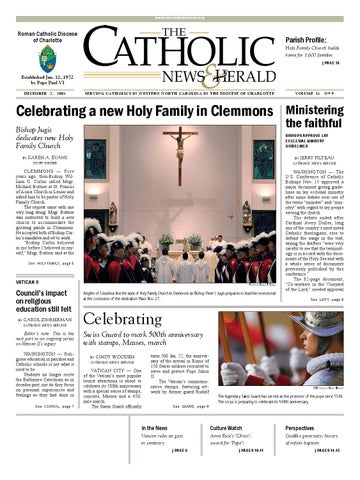
Celebrating a new Holy Family in Clemmons Ministering the faithful
Bishop Jugis dedicates new Holy Family Church by
Bishops approve lay ecclesial ministry guidelines
KAREN A. EVANS
by JERRY FILTEAU catholic news service
staff writer
CLEMMONS — Five years ago, then-Bishop William G. Curlin called Msgr. Michael Buttner at St. Francis of Assisi Church in Lenoir and asked him to be pastor of Holy Family Church. The request came with one very long string: Msgr. Buttner was instructed to build a new church to accommodate the growing parish in Clemmons. He accepted both of Bishop Curlin’s mandates and set to work. “Bishop Curlin believed in me before I believed in myself,” Msgr. Buttner said at the See HOLY FAMILY, page 5
Vatican II
Council’s impact on religious education still felt by
CAROL ZIMMERMAN catholic news service
Editor’s note: This is the next part in an ongoing series on Vatican II’s legacy. WASHINGTON — Religious education in parishes and Catholic schools is not what it used to be. Students no longer recite the Baltimore Catechism as in decades past, nor do they focus on personal experiences and feelings as they had done in See COUNCIL, page 7
Photo by Karen A. Evans
Knights of Columbus line the aisle of Holy Family Church in Clemmons as Bishop Peter J. Jugis prepares to lead the recessional at the conclusion of the dedication Mass Nov. 27.
WASHINGTON — The U.S. Conference of Catholic Bishops Nov. 15 approved a major document giving guidelines on lay ecclesial ministry after some debate over use of the terms “minister” and “ministry” with regard to lay people serving the church. The debate ended after Cardinal Avery Dulles, long one of the country’s most noted Catholic theologians, rose to defend the usage in the text, saying the drafters “were very careful to see that the terminology is in accord with the documents of the Holy See and with a whole series of documents previously published by this conference.” The 82-page document, “Co-workers in the Vineyard of the Lord,” needed approval See LAITY, page 8
Celebrating Swiss Guard to mark 500th anniversary with stamps, Masses, march by CINDY WOODEN catholic news service
VATICAN CITY — One of the Vatican’s most popular tourist attractions is about to celebrate its 500th anniversary with a special series of stamps, concerts, Masses and a 450mile march. The Swiss Guard officially
turns 500 Jan. 22, the anniversary of the arrival in Rome of 150 Swiss soldiers recruited to serve and protect Pope Julius II. The Vatican’s commemorative stamps, featuring artwork by former guard Rudolf See GUARD, page 9
CNS photo by Nancy Wiechec
The legendary Swiss Guard has served as the protector of the pope since 1506. The corps is preparing to celebrate its 500th anniversary.
In the News
Culture Watch
Perspectives
Vatican rules on gays in seminary
Anne Rice’s ‘Christ’; award for ‘Pope’?
Godlike generosity; history of infant baptism
| Page 6
| Pages 10-11
| Pages 14-15
2 The Catholic News & Herald
InBrief
December 2, 2005
Current and upcoming topics from around the world to your own backyard
Anniversary marks 60 years of little action to assist uninsured without insurance and millions of others who are underinsured or still can’t get the care they need?” Sister Keehan said. Sister Bernice Coreil, who has been working in health care for more than 50 years, said the key problem is the lack of a national will to achieve comprehensive health care coverage for all Americans. “We said we would get people to the moon by a certain time, and we did it, but we do not have a health care policy that says by the year 2015, every American will have access to health care,” said Sister Coreil, also a Daughter of Charity. The Catholic health care ministry must be a leader in efforts to cover the uninsured, said Mercy Sister Marie Hartmann, a veteran health care administrator with the Sisters of Mercy in Cincinnati. “We need to ... awaken our social conscience as we look to how to solve this tremendous problem, which has certainly been exposed as a disgrace to our nation,” Sister Hartman said.
Running on faith
Diocesan planner CNS photo by Kats Barry
Running cross country is a family activity for the Peters family. All of the children run cross country for the team at St. Matthew School in the Diocese of Nashville, Tenn., which their parents coach.
Tennessee clan makes cross-country running a NASHVILLE, Tenn. (CNS) — Meet Team Peters: Mom, Mary; Dad, Mark; 12-year-old Michael; 11-year-old Daniel; 9-year-old Emily; 7-year-old twins, Will and Tom; and 6-year-old Clare. The Peters are parishioners at St. Matthew Church in Franklin, and all of the children attend St. Matthew School. They all run cross country too. The family takes having fun at running very seriously. The Peters children participate in the Nashville diocesan cross-country running program, representing St. Matthew Church, and Mary and Mark Peters are coaches of the parish team. “I started running when I was in seventh grade, and have been running ever since,” Mark Peters said. “When I started dating Mary, running seemed to be part of our life together.” After Mark and Mary Peters married and children started coming on the scene, they just sort of fell into step. “When Michael and Daniel were just babies, we’d take the stroller to the track, and I ran laps while Mary walked them,” said Mark Peters. “So they’ve just always seen me doing it, and over time they became interested in it too.” As more sons and daughters joined the Peters team, running just became an integral part of the family picture. “It’s never been a forced effort,” Mary Peters said. “It’s just a fun, healthy lifestyle activity. And it’s a life sport; it’s something they can take with them anywhere.”
The Peters children are racking up the accolades. All six of them ran in five different races in this year’s final competition Oct. 16. Michael won an individual trophy, coming in first in the seventh- and eighth-graders’ race, and the St. Matthew boys’ team finished first. At some time during the 2005 crosscountry season, five of the six have won at least one race, with the oldest, Michael, winning four times. But winning isn’t everything. For many of the young competitors on the St. Matthew team, their goal is simply to improve on their own previous records. The Peters children have different reasons for participating. Daniel likes cross-country running because of the diverse terrains. Michael enjoys setting his own personal goals. Emily loves making new records, Tom thinks running is an exciting sport, and his twin brother, Will, likes getting the exercise but also enjoys running for his school. For Dad, running also means a chance to delve deeper into his faith. “I found that running was an opportunity to be away from the rat race of life, a time to collect my thoughts and think about the day and where life was headed,” he said. “It was a very cleansing thing, to think deeper thoughts, even spiritual.” “It’s hard not to think about God when it’s a beautiful day, you’re running through hills and different terrains where the trees are budding, and the smell is fresh and clean,” he said.
WASHINGTON (CNS) — For the 45.8 million people in the United States without health insurance and for leaders in Catholic health care nationwide, Nov. 19 marked 60 years of failed efforts to achieve national health reform resulting in universal coverage. On Nov. 19, 1945, President Harry S. Truman became the first U.S. president to call for such a plan, proposing that Social Security be expanded to include mandatory medical insurance. “Millions of our citizens do not now have a full measure of opportunity to achieve and enjoy good health,” he said. “The time has arrived for action to help them attain that opportunity and that protection.” For Sister Carol Keehan, a Daughter of Charity who is the new president and CEO of the Catholic Health Association, the anniversary offers “a dramatic reminder of how we continue to tolerate the intolerable,” she said Nov. 15. “How long can we tolerate millions
BOONE VICARIATE
will present Las Posadas Dec. 20 at 6:30 p.m. at the church, 3016 Providence Rd. This traditional Hispanic family festivity is a re-enactment of the Holy Family’s search for lodging in Bethlehem. For more information, call the church office at (704) 364-5431.
NORTH WILKESBORO — A Catholic Scripture Study group meets at St. John Baptiste de La Salle Church, 275 CC Wright School Rd. Visit www. catholicscripturestudy.com for more information. Classes meet Wednesdays, 7-8:30 p.m. Please call Rob Hicks at (336) 957-7193 for more information or if you plan to attend.
CHARLOTTE — The Young Adult Faith Reflection group meets at St. Vincent de Paul Church, 6828 Old Reid Rd., the first and third Mondays of each month. The group will read “The Faith Explained,” 3rd edition, by Leo J. Trese and a chapter will be covered at every meeting. For more information, call Jordan at (704) 737-1964 or Ryan at (704) 377-1328.
SPRUCE PINE — A Rosary of Intercession for Priests is recited each Friday at St. Lucien Church, 695 Summit St., before the 9 a.m. Mass. Prayers are offered for bishops, priests and deacons, and for an increase in vocations to the priesthood. For more information, call the church office at (828) 765-2224.
CHARLOTTE VICARIATE CHARLOTTE — Jesuit Father Thomas Gaunt, executive secretary, Jesuit Conference USA, will present “Religious Values in the Workplace: Revisiting the ‘Workbench of Life’ Twenty Years Later” at the next Just Second Fridays event, Dec. 9, 1-2 p.m., in the Atrium Room of the Annex Building of St. Peter Church, 507 S. Tryon St. Doors open at 12:30 p.m. and lunch is provided. Visit www.cssnc. org/justicepeace or call (704) 370-3225 for further information about this presentation. CHARLOTTE — A Blood Give-In will take place in the Parish Center Gym of St. Matthew Church, 8015 Ballantyne Commons Pkwy., Dec. 18, 8 a.m.1:30 pm. Donors will be required to provide identification such as a driver license or Red Cross blood donor card. Appointments are encouraged and will be honored. Walk-ins are welcome, but will be taken as time permits. For more information, call Ed Nenninger at (704) 366-6637 CHARLOTTE — The Hispanic Ministry and the choir “Alegría Hispana” from St. Gabriel Church
CHARLOTTE — The Vietnamese Cursillo of Charlotte School of Leaders meets the second Sunday of each month at 2:30 p.m. at St. Thomas Aquinas Church, 1400 Suther Rd. For more information, contact Nam Le at (704) 549-1525. CHARLOTTE — The Happy Timers of St. Ann Church meet the first Wednesday of each month with a luncheon and program at 1 p.m. in the Msgr. Allen Center, 3635 Park Rd. All adults age 55 and older are welcome. For more information, call Charles Nesto at (704) 398-0879.
GREENSBORO VICARIATE GREENSBORO — The Greensboro Council of Catholic Women will host a Christmas Tea Dec. 7, 2:30-4:30 p.m., at the Knights of Columbus Hall, 2780 Horse Pen Creek Rd. For more information, please call Carmen Wood at (336) 545-9266. GREENSBORO — The Ladies Ancient Order of Hibernians of Guilford County will have a Christmas Tea Dec. 17 at 3 p.m. at the O. Henry Hotel, 624 Green Valley Rd. Please call Marilyn Conte for information at (336) 632-1340. GREENSBORO — The Coffee Talk for Adults Advent Series will meet Dec. 4, 11 and 18, 10:30-11:15 a.m., in the Youth Room of St. Pius X Church, 2210 North Elm St. For more information, call the church office at (336) 272-468. GREENSBORO — The book club of St. Pius X
DECEMBER 2, 2005 Volume 15 • Number 9
Publisher: Most Reverend Peter J. Jugis Editor: Kevin E. Murray Staff Writer: Karen A. Evans Graphic DESIGNER: Tim Faragher Advertising MANAGER: Cindi Feerick Secretary: Deborah Hiles 1123 South Church St., Charlotte, NC 28203 Mail: P.O. Box 37267, Charlotte, NC 28237 Phone: (704) 370-3333 FAX: (704) 370-3382 E-mail: catholicnews@charlottediocese.org
The Catholic News & Herald, USPC 007-393, is published by the Roman Catholic Diocese of Charlotte, 1123 South Church St., Charlotte, NC 28203, 44 times a year, weekly except for Christmas week and Easter week and every two weeks during June, July and August for $15 per year for enrollees in parishes of the Roman Catholic Diocese of Charlotte and $23 per year for all other subscribers. The Catholic News & Herald reserves the right to reject or cancel advertising for any reason deemed appropriate. We do not recommend or guarantee any product, service or benefit claimed by our advertisers. Second-class postage paid at Charlotte NC and other cities. POSTMASTER: Send address corrections to The Catholic News & Herald, P.O. Box 37267, Charlotte, NC 28237.
The Catholic News & Herald 3
December 2, 2005
FROM THE VATICAN
Prepare for Advent, Christmas with ‘spiritual fervor,’ pope says tradition, but praises God as the “Father of Our Lord Jesus Christ.” The central figure is Christ, “in whom the work of God the Father is revealed and accomplished,” the pope said. By professing that Christians are chosen in Christ, filled with abundant grace and are made adopted sons and daughters of God through Christ, the hymn underlines the Christian vocation to brotherhood, unity and holiness, the pope said. The hymn, he said, emphasizes the “excess, the giving without limit or reserve” of God’s grace out of love and the fact that all creation was destined from the beginning of time to be united in Christ. Pope Benedict ended his talk by saying, “Let us pray: ‘Yes, Lord, draw us to yourself, draw the world to yourself and give us peace.’”
VATICAN CITY (CNS) — Wearing a heavy red cape to protect him from the cold, Pope Benedict XVI encouraged Christians to prepare for Advent, which begins Nov. 27, and for Christmas with “spiritual fervor.” “I ask you all to prepare for Advent with spiritual fervor, drawing from the word of God and the Eucharist interior energy for welcoming the Lord who comes,” he said at his Nov. 23 general audience. Because more than 25,000 people requested free tickets to the audience, the morning gathering was held in St. Peter’s Square, where the temperature stayed below 45 degrees Fahrenheit and a cold breeze blew. In his talk, the pope focused on the hymn of blessing found at the beginning of St. Paul’s Letter to the Ephesians. The pope said the hymn picks up similar “blessings” found in the Jewish
Church, 2210 North Elm St., will read “The Five People You Meet in Heaven” by Mitch Albom. Discussion dates are Jan. 8 at 12:45 p.m. with a buffet lunch and Jan. 9 at 7 p.m. with a dessert bar. For more information, call the church office at (336) 272-468.
Center. The meetings feature guest speakers and special events periodically. For more information, call Claire Barnable at (828) 369-1565.
SALISBURY VICARIATE CONCORD — The National Night of Prayer will take place Dec. 8, 9 p.m.-1 a.m., at St. James the Great Church, 139 Manor Ave., S.W., in unity of prayer with thousands across the country highlighting eucharistic adoration and silent prayer followed by recitation of the rosary and prayerful song and music. For more information contact Lisa Metz, St. James Respect Life Ministry, at (704) 785-9566 or e-mail sjmetz7@ msn.com. MOORESVILLE — A Support Group for Parents Who Have Lost a Child of any age meets the second Monday of each month at 7 p.m. at St. Therese Church, 217 Brawley School Rd. We draw strength from others’ experience of loss and grief. For more information, call Joy at (704) 664-3992. MOORESVILLE — Seniors ages 55 and up are invited to St. Therese Church, 217 Brawley School Rd., the second Saturday of each month following the 5:30 p.m. Mass for Senior Games Night, featuring games and a potluck dinner. Call Barbara Daigler at (704) 662-9752 for details.
SMOKY MOUNTAIN VICARIATE SYLVA — Knights of Columbus #9722 will sponsor an American Red Cross Blood Drive at St. Mary Church, 22 Bartlett St., Dec. 16, 1-5 p.m. For more information, call Allen or Anne Thurston at (828) 5860432 or (828) 507-0594.
WINSTON-SALEM VICARIATE
Dec. 7 — 3 p.m. Pro Ecclesia et Pontifice honors Diocesan Pastoral Center, Charlotte
First (grade) Thanksgiving
Is your parish or school sponsoring a free event open to the general public? Please submit notices for the Diocesan Planner at least 7 days prior to desired publication date (Fridays) in writing to Karen A. Evans at kaevans@ charlottediocese.org or fax to (704) 370-3382.
Courtesy Photo
First-graders at Our Lady of Grace School in Greensboro re-enact the first Thanksgiving during a play presented to fifth-graders Nov. 18 and to parents Nov. 21. The play showed how the Native Americans, especially one named Squanto, helped the pilgrims settle in their new land. Pictured are “Native Americans” holding a powwow to determine whether or not they should be like Squanto and help the pilgrims.
Bishop Peter J. Jugis will participate in the following events:
Dec. 4 — 2:30 p.m. Sacrament of Confirmation St. Gabriel Church, Charlotte
that underline a need for Catholics to be consistent in their commitment to protect human dignity and life. Katrina helped expose the immense poverty still plaguing America 40 years after President Lyndon B. Johnson declared a “war on poverty,” she said. “It was the elderly ... who died of gross neglect, and so aren’t their deaths as important as the deaths caused by abortion or euthanasia?” she asked. “No needless death is more tragic than another if every life is inviolable,” she said in her speech. If Catholics are to be true to the legacy left by “The Gospel of Life,” Catholics must “respect, protect, love and serve every human life.” Carl Anderson, supreme knight of the Knights of Columbus and a professor of family law at the John Paul II Institute in Washington, said a public culture that helps women and their children is lacking, and Catholics are uniquely suited to fill that vacuum.
WINSTON-SALEM — Spend Advent with Mary. Join us for four weeks with Mary as guide, model and companion during the Advent season. The retreat meets at Portiuncula Franciscan Spiritual Center, 211 W. Third St., Dec. 7, 14 and 21, 7-8:30 p.m. For additional information, call Sister Kathy Ganiel at (336) 624-1971 or e-mail portiuncula@ bellsouth.net.
FRANKLIN — The Women’s Guild of St. Francis of Assisi Church, 299 Maple St., meets the second Monday of each month at 1 p.m. in the Family Life
calendar
VATICAN CITY (CNS) — Pro-life concerns must include protecting the vulnerable and opposing unjust wars, said a U.S. nun who participated in a Vatican-hosted international congress. “If we want to be serious about creating a culture of life, we need to now think beyond things like abortion and euthanasia,” said Holy Family Sister Carol Taylor, who directs the Center for Clinical Bioethics at Georgetown University. The Pontifical Academy for Life and the John Paul II Institute for Studies on Marriage and the Family sponsored the Nov. 17-19 congress, which reviewed how ethical norms of Catholic teaching could better permeate modern science. It marked the 10-year anniversary of the publication of Pope John Paul II’s encyclical “Evangelium Vitae” (“The Gospel of Life”). In her Nov. 19 speech to the conference, Sister Taylor cited Hurricane Katrina and the war in Iraq as two events
CLEMMONS — The Knitting Ministry of Holy Family Church, 4820 Kinnamon Rd., meets Monday evenings, 6:30-8 p.m., to pray, learn to knit, reflect on life’s lessons and reach out to others in our community. Opportunities exist for the beginner to the experienced as we knit and purl Prayer Shawls, Preemie Blankets or Squares for Survivors. Please contact Rosemary at (336) 766-2315 or Carmel (336) 766-0650 for more information.
WAYNESVILLE — The Catholic Women’s Circle of St. John the Evangelist Church, 234 Church St., meets the second Monday of each month at 7 p.m. in the church hall. For more information, call the church office at (828) 456-6707.
Episcopal
U.S. nun says Catholics should extend pro-life concerns to poor, war
Dec. 8 — 10 a.m. Mass at Maryfield Retirement Community Groundbreaking for Pennybyrn at Maryfield High Point
Attention Readers! HAVE A STORY TO SHARE? Have you experienced a Christmas miracle, or have you had a special Christmas experience? If so, would you be willing to share it with the readers of The Catholic News & Herald ? Please contact Staff Writer Karen A. Evans at (704) 370-3354 or e-mail kaevans@charlottediocese.org.
4 The Catholic News & Herald
December 2, 2005
around the diocese
Dispensing help and hope
Hurricane relief funds being dispersed along Gulf Coast, in Diocese of by
DAVID HAINS
special to the catholic news & herald
CHARLOTTE — Due to the generosity of the people in the pews, the Diocese of Charlotte is distributing more than $700,000 for victims of Hurricane Katrina. Voluntary collections were conducted at nearly all of the 92 parishes and missions in the diocese in the aftermath of the hurricane that devastated the Gulf Coast in August. Unlike the January and February collections for the victims of the tsunami that struck Southeast Asia in December 2004, in which the money was forwarded to a single agency, these funds are being distributed by the diocese to agencies in the hurricane-stricken area as well as to agencies in North Carolina. “The people of the Diocese of Charlotte have once again demonstrated their love and concern for the victims of a disaster,” said Bishop Peter J. Jugis. Tsunami collections totaled $422,000 and were sent to the Baltimore-based Catholic Relief Services, the U.S. bishops’ overseas aid agency. From the hurricane collections, seven dioceses in Louisiana, two in Alabama and two in Mississippi are receiving a total of $520,000. The money will be
spent on needs as identified by local authorities. Ten service agencies within the Diocese of Charlotte responded to refugee needs in a variety of ways, including housing, food and health care. Those agencies, which are receiving $180,000, are in Charlotte, Mooresville and WinstonSalem. Catholic Campus Ministry at the University of North Carolina at Charlotte is receiving $10,000. “The students wanted to do something hands on to help a family. One week after we started talking about it, we had a house and a family of four living in it,” said Grey Nun of the Sacred Heart Sister Eileen Spanier, campus minister. “This ($10,000) grant will allow us to continue to meet the needs of Katrina evacuees,” she said. In addition to the $700,000 that was collected, the Diocese of Charlotte enrolled 47 students from hurricane-stricken areas in diocesan Catholic schools at no cost to the students’ families. The individual schools absorbed the costs associated and are not receiving funds from the collection. Parent Teacher Organizations at the schools helped evacuee families with textbooks, uniforms and supplies. Linda Cherry, superintendent of di-
ocesan Catholic schools, said some of the students have returned to the Gulf Coast. “My office and the individual schools have received several letters of thanks from the families who were helped,” said Cherry. Cherry said the schools participated
in a separate collection with the National Catholic Education Association. The “Child to Child” funds were distributed to faith formation programs in the devastated areas. David Hains is director of communi-
Diocese of Charlotte’s distribution of Hurricane Katrina funds PROVINCE OF MOBILE Mobile $40,000
$25,000
Birmingham $40,000
Butterfly Bin, Charlotte $25,000
Biloxi $60,000
Charlotte Community Health $25,000
Jackson $60,000
Salvation Army, Charlotte $25,000
PROVINCE OF NEW ORLEANS
Salvation Army, Winston-Salem $15,000
New Orleans $80,000 Alexandria $40,000 Baton Rouge $40,000 Houma-Thibodaux $40,000 Lafayette $40,000 Lake Charles $40,000
Helping Empower Local People, Charlotte $10,000 Mooresville Christian Mission, $5,000 Second Harvest Food Bank, Charlotte $15,000 Catholic Campus Ministry, UNC-Charlotte $10,000
Shreveport $40,000 OTHER DIOCESE OF CHARLOTTE Catholic Social Services, Charlotte
Federation of Southern Cooperatives $25,000
December 2, 2005
The Catholic News & Herald 5
around the diocese
Clemmons parish one happy Holy HOLY FAMILY, from page 1
conclusion of the Mass to dedicate the new Holy Family Church Nov. 27. The dedication Mass was celebrated by Bishop Peter J. Jugis, with Bishop Emeritus Curlin presiding. Msgr. Buttner, pastor, and Father Brian Cook, parochial vicar, concelebrated. Several priests and permanent deacons of the Diocese of Charlotte were also in attendance, along with approximately 1,000 parishioners, guests and local officials and clergy. In fewer than 30 years, Holy Family Church has grown to become the largest church in Clemmons and among the largest in Forsyth County. With an increased seating capacity from 575 to 1,250 worshippers, the new church can now accommodate its 1,600 registered families for its six weekend Masses. More than 1,000 parishioners participated in the capital campaign to finance construction of the $3.6 million church. The campaign began in September 2002 and ground was broken for the new church June 5, 2004. The new church includes Stations of the Cross imported from Italy, a skylight over the baptismal font, marble altar, ambo and altar of repose, altar flooring of Brazilian cherry wood, statues of Jesus, Mary and Joseph and crucifix imported from Spain. The new bell tower carillon is programmed with more than 100 hymns for daily Mass, Sunday Mass and special occasions such as Christmas, Easter, weddings and funerals.
Photos by Karen A. Evans
Deacon Gerard Schumacher lights a candle along the back wall of Holy Family Church in Clemmons during the dedication Mass for the new church Nov. 27. the facility. For the next five years, the Saturday evening Mass and religious education classes were held at Clemmons Moravian Church and Sunday Masses were celebrated at the Clemmons Vogler Funeral Home Chapel. Paulist Father Robert Scott was installed as the first pastor of Holy Family Church Aug. 15, 1980 with St. Francis of Assisi Church in Mocksville named as a mission. At that time, 200 families comprised the church’s registry. Construction on the original church was begun in February 1982, and the
first Mass was celebrated in December 1984. By the mid-1980s, 550 families were registered at Holy Family Church, indicating the steady growth that would follow for the next 20 years. “Our spiritual growth is infectious and has necessitated our expanded church. We have been blessed abundantly beyond our expectations,” Msgr. Buttner said. Contact Staff Writer Karen A. Evans by calling (704) 370-3354 or e-mail kaevans@charlottediocese.org. WANT MORE HISTORY? For more on the history of Holy Family Church, read the parish profile on page 16.
A life-size sculpture of the Holy Family, depicting Jesus as a12-year-old boy, stands at the front of Holy Family Church. In the background is the new bell tower carillon, which is programmed with more than 100 hymns.
The new church includes an enlarged choir area, a nursery, family room, handicapped access to the church and a-stateof-the-art audio system. Bishop Curlin provided the altar carpet as a gift for the new church. The old church will be used as a faith formation center, to be named the Bishop Curlin Faith Formation Center. “When we stand in awe of what God is doing at Holy Family Catholic Church, we can only be humbled by the many blessings he has bestowed on us,” said Msgr. Buttner. “We are hungry to share what God is doing in us and through us in the community, in our church and in our homes and to spread the love of Jesus throughout our area, so that others may experience a glorious life centered on our most holy Lord and God.” Holy Family Church was founded in 1976 as a mission of St. Leo the Great Church in Winston-Salem. The first Mass was celebrated July 15, 1978 in Clemmons Presbyterian Church by Msgr. Richard Allen, then-pastor of St. Leo the Great Church. While Clemmons Presbyterian Church had generously offered their hospitality, after two weekends of Masses, their Catholic guests were overflowing
6 The Catholic News & Herald
IN THE NEWS
Vatican says no ordaining homosexuals, men who support ‘gay by
CATHOLIC NEWS SERVICE
VATICAN CITY — A long-awaited Vatican document said the church cannot allow priestly ordination of men who are active homosexuals, who have “deepseated” homosexual tendencies or who support the “gay culture.” Such people have serious problems relating properly to men and women and present a risk of “negative consequences” that should not be underestimated, the document said. Prepared by the Congregation for Catholic Education, “Instruction Concerning the Criteria for the Discernment of Vocations With Regard to Persons With Homosexual Tendencies in View of Their Admission to the Seminary and to Sacred Orders,” was officially released by the Vatican Nov. 29. In recent weeks, some reports have suggested that the document would allow homosexual men to be ordained, as long as they had remained celibate for at least three years during seminary formation. But the document does not say that; there is no discussion of “celibacy” of homosexual candidates. What it does say is that fleeting homosexual tendencies experienced in youth should not represent a bar to ordination — as long as those tendencies are clearly overcome. The wording of the text presumes that homosexuality is not a permanent identity but a set of “tendencies” or an inclination that can, in fact, be overcome. But the instruction makes no attempt to define the difference between “deepseated” or “transitory” tendencies. Nor does it say what criteria would be used to determine whether a candidate had overcome such tendencies. In explaining why homosexuals should not be ordained, the instruction refers to the
teaching of the “Catechism of the Catholic Church,” which describes homosexual acts as sinful and the homosexual inclination as “objectively disordered.” It follows, it said, that homosexuality is a bar to a priest’s “affective maturity” and seriously impairs his ability to minister pastorally to the Catholic community. Bishop William S. Skylstad of Spokane, Wash., president of the U.S. Conference of Catholic Bishops, said “it is certainly not acceptable if a candidate practices homosexuality or ... identifies himself principally by a homosexual inclination or orientation.” The aim of seminary education is to develop priesthood candidates who “display an ‘affective maturity’ which enables them to relate properly to others as chaste, celibate priests who can faithfully represent the teaching of the church about sexuality,” he said. “The priesthood is conferred on men who have given proof that they have been called by God to the gift of chastity in absolute and perpetual celibacy,” said Bishop Peter J. Jugis of Charlotte, commenting on the document. Although described by some media reports as Pope Benedict XVI’s answer to clerical sex abuse, the decision to write the instruction predates the eruption of the sex abuse scandal and the pope’s election. Sources said the Congregation for the Doctrine of the Faith — then headed by Cardinal Joseph Ratzinger, the current pope — suggested in 1996 that the education congregation prepare such a document. A first draft was completed in 1998, a second draft in 2002 and the final version this year. Editor Kevin E. Murray contributed
December 2, 2005
December 2, 2005
FROM THE COVER
The Catholic News & Herald 7
Vatican II Council’s impact on religious education still felt in U.S COUNCIL, from page 1
to carry out. Another change was the development and availability of tools, texts and background materials to use in teaching the faith. Along with this new set of lay teachers and materials came necessary teacher formation and a means for determining if the newly published religious texts were in line with church teaching. Marie Scanlon, coordinator of assessment for catechesis for the USCCB, recalled leading a catechist formation program in the Archdiocese of Philadelphia in the ’70s that was not met enthusiastically by all participants, primarily because it was a change in the usual way things had been done. Today, she is involved in the review process of catechetical texts. Once these are approved by a bishops’ committee, the texts are deemed to be in conformity with the “Catechism of the Catholic Church.” Teaching the faith Scanlon told CNS that just as Pope John XXIII said he wanted to open the windows of the church to let in some “fresh air” with Vatican II, “a whole new window opened for religious education”
after the council. The council specifically dealt with education in one of its 16 documents, the Declaration on Christian Education (“Gravissimum Educationis”). This document affirmed the right of parents to choose the type of education they wanted for their children, upheld the importance of Catholic schools and defended freedom of inquiry in Catholic colleges and universities. But Scanlon pointed out that all of the council’s documents “have messages for educators” and her own copy of the documents, collected in a paperback version, is well-worn. “The documents refocused our efforts,” she said. “They spoke to educators about what we were to do.” She noted that educators are contantly evaluating their approach and thus in recent years Catholic leaders are taking a close look at what has been gained and lost in current religious education. As a result, there has been a renewed interest among educators to have students memorize basic prayers or even learn them in Latin. “The pendulum is not static,” said Scanlon, referring to the shifts in focus in religious education. “We are constantly searching for better ways to teach the faith.”
CNS Photo by Mike Crupi, Catholic Courier
Bridget Fichtner, a member of St. John of Rochester Parish in Fairport, N.Y., prepares for her first Communion at her Perinton, N.Y., home in late March. In religious education classes, students no longer recite the Baltimore Catechism as in past decades, nor do they focus on personal experiences and feeling as they had done in more recent decades. more recent decades. Instead, according to those in the field, religious education strives for a balance in handing down content and relating it to personal faith experiences. Msgr. Dan Kutys, deputy secretary for catechesis for the U.S. Conference of Catholic Bishops, said trends in religious education over the past several decades have been like a swinging pendulum. Prior to the Second Vatican Council, he noted, religious education primarily focused on content. In the ’70s and ’80s, the focus was more on how the content was taught, he told Catholic News Service Oct. 5. The pendulum, the priest said, came back to the center with the 1992 publication of the “Catechism of the Catholic Church,” which he said helped “reclaim universal truths” of the Catholic faith. The catechism and corresponding texts that have followed it, such as the Vatican’s General Directory for Catechesis, the U.S. bishops’ National Directory for Catechesis and the Vatican’s “Compendium of the ‘Catechism of the Catholic Church,’” currently available only in Italian, provide guidelines for religious educators on what aspects of the faith
should be taught. Religious educators today also implement modern teaching methods focusing on different learning abilities and the importance of linking doctrinal studies with personal faith experiences. Then and now Jerry Baumbach, director of the Center for Catechetical Initiatives at the University of Notre Dame in Indiana, said he thinks the dissonance is waning “between the content and methodology concerns of the past” referring to the disconnect some have perceived with handing down authentic teachings and focusing on how that is done effectively. Instead, he told CNS Oct. 19, “authentic catechesis is a rich sharing of content and methodology working together.” Baumbach, who was a parish catechetical leader in the ’70s in the Diocese of Albany, N.Y., just as the church was implementing Vatican II changes, said “a lot of good emerged from the council,” and noted that it was an exciting time to be working in church ministry. One immediate change for religious education was the newly emerging role of lay people in a ministry once primarily reserved for priests and women religious
8 The Catholic News & Herald
IN THE NEWS
December 2, 2005
Bishops approve lay ecclesial ministry guidelines
CNS photo by Paul Haring
Bishop Dale J. Melczek of Gary, Ind., right, is joined by Bishop Gerald F. Kicanas of Tucson, Ariz., in answering questions about proposed guidelines for lay ecclesial ministry at the U.S. Conference of Catholic Bishops meeting in Washington Nov. 14. LAITY, from page 1
by two-thirds of the entire membership of the conference. It passed by a vote of 190-49 with five abstentions. Bishop Dale J. Melczek of Gary, Ind., chairman of the bishops’ Committee on the Laity, and Bishop Gerald F. Kicanas of Tucson, Ariz., chairman of the Subcommittee on Lay Ministry, presented the document to the bishops. Bishop Melczek described it as a “resource for guiding the development of lay ecclesial ministry,” a rapidly growing phenomenon in Catholic parishes in the U.S. Bishop Kicanas stressed that “this document is not particular law. It does not lay down norms or prescriptions.”
Rather, he said, it seeks to give bishops guidance in overseeing the “faithful development” of the growing practice of employing lay ecclesial ministers in parishes and other church institutions. Redefining the ministry The document says lay ecclesial ministry does not describe a new rank or vocation in the church; rather, it is a generic term for a variety of positions held by nonordained people who engage in substantial public leadership positions in church ministry, collaborating with the ordained leadership under their authority. It sets out guidelines for the appropriate human, spiritual, intellectual and pastoral formation of those who are entrusted with such ministries. It also addresses the role of church authorities
in certifying, authorizing and appointing lay ecclesial ministers. It spells out the theology of lay ministry and the differences between ministry arising out of ordination and ministry arising out of the sacraments of initiation. According to the latest national study, there are about 1.6 paid lay ecclesial ministers per parish and they now outnumber priests engaged in parish ministry. According to the study more than 40 percent of lay ecclesial ministers in U.S. Catholic parishes are directors of religious education. About one-fourth are general pastoral associates, assisting the pastor in a wide variety of pastoral tasks. The National Association for Lay Ministry welcomed the document, saying it “takes an important step forward in recognizing and supporting the significant role these lay ecclesial ministers play in the Catholic Church. It publicly affirms their leadership, invites appropriate authorization for their ministry and clarifies their accountability within ecclesial structures.” Ministry and service Several bishops have questioned the use of the term “lay ecclesial minister,” suggesting a danger that Catholics may not understand clearly the difference between lay ministry and the ministry proper only to those who are ordained. Bishop Robert J. Baker of Charleston, S.C., argued that the church would
be better served if the term “ministry” were restricted to those who are ordained. He asked that “roles of service” replace “ministry” in the phrase “lay ecclesial ministry” throughout the document. Bishop Melczek said describing certain lay activities in the church as ministries is grounded in official church documents. Bishop Nicholas DiMarzio of Brooklyn, N.Y., asked that the document be remanded to the committee with a request that it be reviewed by the Committee on Doctrine before coming to the bishops for a vote. He said he did not have a problem with the word “ministry,” but with using “minister” to describe some lay people. Bishop Blase J. Cupich of Rapid City, S.D., said the document’s use of minister and ministry followed the clear practice of the church and official church documents. The bishops rejected a proposal by Bishop Allen H. Vigneron of Oakland, Calif., that the document be submitted to the Holy See and not be published until any changes suggested by the Vatican are incorporated. The committee rejected the suggestion as unnecessary, saying there was nothing in the document in the way of new teaching or legislation, norms or prescriptions that would require Vatican review or approval.
December 2, 2005
FROM THE COVER
The Catholic News & Herald 9
Swiss Guard to mark 500th anniversary GUARD, from page 1
Mirer, went on sale Nov. 22 at the Vatican and in Switzerland, marking the first Vatican-Swiss stamp package. Also in anticipation of the anniversary, a history of the Guard written by Sgt. Christian-Roland Marcel Richard was released Nov. 9. Col. Elmar Mader, commander of the Guard, said Richard’s work marked the first time that an active guard published a book describing life in the corps. Precise as the watches of his homeland, Richard said it took him 2,962 hours to write the book when he was not guarding the entrances to the Vatican, protecting the pope, working crowd control, continuing his training or performing ceremonial duties at Masses and visits from heads of state. In addition to the history of the Swiss Guard, the book includes a chapter on the rules governing the recruitment, training and discipline of the corps. The current Guard has 110 male Swiss citizens, all of whom are Catholic. They must have an impeccable reputation, be under age 30, unmarried when they begin their service and have served in the Swiss Army. Marching strong Unveiling plans for the anniversary
celebration during a Nov. 22 press conference, Mader — flanked by two guards in their traditional tri-colored uniforms — said Pope Julius chose the Swiss mercenaries because of the Swiss “passion for war and, especially, for their respect for the church.” “The pontiff wanted to be able to count on a well-prepared corps of guards which would safeguard him at critical moments and which could become the permanent nucleus of a larger army to be formed in case of necessity,” Mader said. Between April 7 and May 4, more than 100 former guards will march from Switzerland to Rome, following the route taken by their predecessors in 1506. The march was timed to allow the former guards to participate in the key moment of the anniversary celebration — a memorial Mass and swearing in of new members on the May 6 anniversary of the fall of 147 guards, killed in action in 1527 while protecting Pope Clement VII during the sack of Rome. Those in uniform Mader was asked if any thought had been given to changing the uniform of the guards, particularly after Richard’s book definitively laid to rest the legend that Michelangelo designed the costume. “It is not up to me to change the uniform of the Swiss Guard, which dates from the Renaissance and which the whole world recognizes,” he said. The commander also was asked —
CNS photo courtesy of the Swiss Guard
Col. Elmar Mader, commander of the Swiss Guard, stands in his dress uniform on the hill above St. Peter’s Basilica at the Vatican. Mader said a new book detailing the history of the Guard marked the first time an active guard published a book describing life in the corps.
and not for the first time — whether the Guard ever would include women. “I cannot imagine that we ever would have women in service,” he said. “We live in a very small barracks, and there would not be room for women.” “The men are young,” he said, “and I would not want to recruit problems” for discipline. “Obviously, women are capable of providing security services. That is not the point. It is a matter of discipline,” he said.
Mader said his men have a variety of reasons for seeking a place in the corps. “It is a mix of motivations, although you will find in all of them a certain religious sensitivity” and a desire to serve the church, he said. While there is a sense of prestige and honor in being a guard, Mader said, “it is not like it was 30 years ago, when a guard would return home and be seen as one of the pope’s men.”
1 0 The Catholic News & Herald
December 2, 2005
Culture Watch
A roundup of Scripture, readings, films and more
A different journey
Author sees ‘Christ the Lord’ series as her ‘life’s work’ by MARK PATTISON catholic news service
WASHINGTON — Even before “Christ the Lord: Out of Egypt” had made its appearance on The New York Times’ hardcover fiction best-seller list, its author, Anne Rice, had come a long way toward completing a follow-up novel. She envisions four books in all, telling the story of Jesus all the way through to his ascension into heaven. “It’s becoming my life’s work,” said Rice, 64, best known for her “Vampire Chronicle” novels. “This is the consuming passion,” Rice said in a telephone interview Nov. 21 with Catholic News Service. While promoting “Christ the Lord,” Rice, who was born Catholic, has talked freely about her decades spent as an atheist, and her return to Catholicism in 1998. She said that she sees her atheism as “part of the journey” she had to take to get to the faith she embraces today. “My earlier books, they were all part of the search for God, part of the conversation between God and the devil, finding the meaning of good and evil in the world,” Rice said. Those novels’ characters, she added, were “a reflection of who I was for years: seeking, searching down dark, dark corridors.” Rice finds her atheism was nuanced. “I never met any atheist who thought we were just here to have a good time,” she recalled. “I think most of us felt we were facing reality. We thought of religious people as deluded, people who needed mythology to get through life. We had to be the ones to make things better.” “I had a few more spiritual questions than many of them had,” Rice said. “I was never totally convinced. I was afraid there would be no God, but (did) not (believe) ‘there was no God.’” Her turnaround began while reading “the story of the Jews in history, thinking there was no explanation for the survival of these people,” Rice said. The process continued with what she called “more reading, studying, pondering.” Rice said, “I felt I was running and (God) saw me, saying, ‘I’m coming after you. It’s not going to be enough. You’re not going to find any peace without me.’
WORD TO LIFE
Sunday Scripture Readings: DEC. 11, 2005
Dec. 11, Third Sunday of Advent Cycle B Readings: 1) Isaiah 61:1-2a, 10-11 Psalm: Luke 1:46-50, 53-54 2) 1 Thessalonians 5:16-24 3) Gospel: John 1:6-8, 19-28
God is our light in the dark by BEVERLY CORZINE catholic news service
Anne Rice
By the end of 1998, I felt I was obsessed.” One example Rice gave that, regardless of where she was, when she turned on the television, “it would be on EWTN and there would be a priest saying Mass. It was uncanny. Here I am, this atheist, and I’d sit back in my easy chair watching the priest delivering his homily for an hour.” Rice rejects the notion that “Christ the Lord” is a refutation or recanting of her earlier books. “I think of it more as finding what I had to do, finding my realization that that’s what I was being prepared for all these years, part of a search,” she said. She does not read much other fiction, apart from the Brontes and Dickens. However, “I’m certainly reading (C.S.) Lewis with new eyes,” Rice said. “I’m very much committed to the idea of lay witness. We who believe in Christ have to witness in our own way. We have to tell the Christian story over and over again. “I’m intrigued by how (Lewis) became such a powerful and influential witness. I’m moved by his power and his simplicity and his simple eloquence,” she said. Rice said her first brush with Lewis was in the 1950s as a child. “My mother was reading ‘The Screwtape Letters’ and was knocked out by it,” said Rice. Much more recently, she added, “I read ‘Mere Christianity’ by C.S. Lewis and I was completely knocked out. That’s more my kind of reading.”
Hurley Whittaker, a former coal miner, possessed a keen wit and a faith that knew no bounds. Like other people who spend their lives in jobs where catastrophe and death are just around the corner, my grandfather was a master storyteller. When I was little I tagged along while he went about his daily chores. No matter what he was doing, it would be fun for me because he would tell me stories or silly jokes. Sometimes, however, he would talk about working deep in the ground in utter darkness. These were heart-stopping stories about courage, superstition and faith. My grandfather had a jagged scar on
his forehead that was the source of my favorite story from his coal mining days. He was digging on his knees when the ceiling of the tunnel collapsed. Hurt and bleeding, he lay in complete darkness. At this point in the story, I always would ask him about being scared. For me being caught in the dark was the ultimate terror of my young life. I never have forgotten his answer: He told himself he eventually would see the light of someone coming to get him. It would be the light of a fellow miner or the light of an angel. Either way, someone would come to take him home. As we begin this second full week of December, darkness falls sooner each day. Even in light-polluted cities, the short days leave their mark on us. In John’s Gospel the imagery of light and darkness helps us understand the astonishing miracle of God’s sending Jesus into our world. In today’s reading, John the Baptist differentiates between Jesus and himself, describing himself as one who is testifying to the “light” and preparing for Jesus’ arrival. We, like John the Baptist, must prepare for the coming of the light, but ours is a twofold mission. Right now we are consumed with preparing to celebrate the birth of Jesus. However, the larger task challenges us to live our lives so that we may be prepared to celebrate the Second Coming with the risen Christ, the eternal light who will come to take us home.
WEEKLY SCRIPTURE Scripture for the week of December 4 - December 10 Sunday (Second Sunday of Advent), Isaiah 40:1-5, 9-11, 2 Peter 3:8-14, Mark 1:1-8; Monday (Advent Weekday), Isaiah 35:1-10, Luke 5:17-26; Tuesday (St. Nicholas), Isaiah 40:1-11, Matthew 18:12-14; Wednesday (St. Ambrose), Isaiah 40:25-31, Matthew 11:28-30; Thursday (Immaculate Conception), Genesis 3:9-15, 20, Ephesians 1:3-6, 11-12, Luke 1:26-38; Friday (St. Juan Diego), Isaiah 48:17-19, Matthew 11:16-19; Saturday (Advent Weekday), Sirach 48:1-4, 9-11, Matthew 17:9, 10-13. Scripture for the week of December 11 - December 17 Sunday (Third Sunday of Advent), Isaiah 61:1-2, 10-11 Luke 1:46-50, 53-54, 1 Thessalonians 5:16-24, John 1:6-8, 19-28; Monday (Our Lady of Guadalupe), Zechariah 2:14-17, Luke 1:2638; Tuesday (St. Lucy), Zephaniah 3:1-2, 9-13, Matthew 21:28-32; Wednesday (St. John of the Cross), Isaiah 45:6-8, 18, 21-25, Luke 7:18-23; Thursday (Advent Weekday), Isaiah 54:1-10, Luke 7:24-30; Friday (Advent Weekday), Isaiah 56:1-3, 6-8, John 5:33-36; Saturday (Late Advent Weekday), Genesis 49:2, 8-10, Matthew 1:1-17.
The Catholic News & Herald 11
December 2, 2005
Honoring greatness
Made-for-TV movie about Pope John Paul II might get Golden Globe meant “the pope saw himself” as being accurately represented in the fictionalized version of his early life and “accepted the film.” After the viewing, Vatican spokesman Joaquin Navarro-Valls said the late pope “was very impressed” with the film’s portrayal. The two-and-a-half-hour film portrays the late pope’s early life, starting with Nazi Germany’s 1939 invasion of Poland, followed by the communist repression and ending with his 1978 election as pope. At the May 19 showing of the finished film at the Vatican, Pope Benedict XVI commended the film’s focus on Karol’s early heroism for “reviving in every right-minded person the duty to do
what he or she can so that such inhuman barbarism never happens again.” Valsecchi said Pope Benedict requested a copy of the film for the Vatican. “So I made 200 collector’s edition DVDs for the Vatican,” he said. A Golden Globe nomination would be a great honor and give greater exposure to a film that, he said, “offers a very important message in these times of war.” As pope and in his early life, Karol Wojtyla is “a model for young people to be open to the world, to care for the least and defenseless,” said Valsecchi. “It’s very important Karol’s example seep in” today’s society “in order to carry his message forward” and keep it alive. CNS photo from Hallmark Channel
Piotr Adamczyk portrays Karol Wojtyla in “A Man Who Became Pope,” which aired on the Hallmark Channel in August. The made-for-TV movie may get a Golden Globe nomination, said the film’s Italian producer, Pietro Valsecchi. The movie and television awards, run by the Hollywood Foreign Press Association, will be presented Jan. 16 with the nominations announced Dec. 13. by CAROL GLATZ catholic news service
ROME — The made-for-TV movie, “A Man Who Became Pope,” may get a Golden Globe nomination, said the film’s Italian producer, Pietro Valsecchi. The movie and television awards, run by the Hollywood Foreign Press Association, will be presented Jan. 16 with the nominations announced Dec. 13. Valsecchi told Catholic News Service he heard hints that his movie about the early life of the late Pope John Paul II may have a chance at a Golden Globe nomination. Even though a nomination “would be a miracle,” it would also reflect the great success the film had in Poland, Italy and the United States, he said. The movie, which aired in August on cable’s Hallmark Channel in the United States, was based on the Vaticanapproved book, “Stories of Karol: The
Unknown Life of John Paul II,” by Gian Franco Svidercoschi. According to the Vatican, Pope John Paul had seen the movie in its entirety during a private viewing before his death April 2. Valsecchi said the pope was only able to see the film’s first rough cut, which had no musical score. “I had a feeling I wouldn’t get this film finished in time for the pope to see it,” he said. After Valsecchi sent the Vatican a rough cut of the movie on DVD in early December, Msgr. Pawel Ptasznik, an official at the Vatican’s Secretariat of State who served along with Cardinal Roberto Tucci as Vatican consultants to the filmmakers, called Valsecchi asking him to send a VHS copy of the film “because they didn’t have a DVD” player. Soon after, Msgr. Ptasznik and Cardinal Tucci told Valsecchi their names could be associated with the film and listed in the credits, which for Valsecchi
1 2 The Catholic News & Herald
IN OUR SCHOOLS
December 2, 2005
CCHS junior wins new CHARLOTTE — Andy Tinson, a junior at Charlotte Catholic High School, was named the first recipient of a new scholarship. Andy received the Gregory Bazluki Sr. Memorial Scholarship, named for a longtime Charlotte Catholic assistant football coach who passed away recently. The award is dedicated to those who give back to their school community through volunteer athletic service and includes a plaque and a $1,500 scholarship to Charlotte Catholic. Andy received the award before the
opening kickoff of the Charlotte Catholic homecoming game versus West Mecklenburg High School Oct. 21. Ranked in the top 15 percent of his class, Andy is actively involved with the high school’s sports medicine program, which helps provide care and rehabilitation to the school athletes. “The scholarship is intended for someone who gives back to the Charlotte Catholic High School community through athletic service and represents the volunteerism that is promoted by the school and Christian, Catholic teachings,” said
Classifieds EMPLOYMENT COMMUNITY GROUP HOME MANAGER: (adults) – Live in (7 days on, 7 days off). Prepare/ serve meals, transportation, recreation, cleaning, med treatments, work goals. Requirements: HS/ GED & group home & MR/DD experience. Holy Angels, Inc., 6600 Wilkinson Boulevard, Belmont, N.C. 28012. (704) 825-4161 SERVICES COUNSELING SERVICES: Individuals. Couples. Family. Lucille Moses, BSN, M.Ed. North Carolina Licensed Professional Counselor. 1802 East 5th Street, Charlotte, NC. 704-366-6507 or 704-942-4334.
Licensed General Contractor. Kitchens, Baths, Additions, Handyman services, etc. All size jobs completed. (704) 684-0301(T); (704)7190808(cell) for free consultation. PI A N O T U N I N G & R E S TOR AT I ON : Hi-Quality Used Pianos. PIANO CRAFT (336) 454-2000. Al Buecia, formerly of Steinway & Sons. IHM Parishioner. FOR RENT VACATION CABIN: Lake Lure. Mountain views! A great holiday get-away! 2 bedrooms, 2 baths, fully furnished. Reasonable rates. Call 828299-3714.
EMERALD HOME REMODELING: NC
Classified ads bring results! Over 125,000 readers! Over 49,000 homes! Rates: $.70/word per issue ($14 minimum per issue) Deadline: 12 noon Wednesday, 9 days before publication How to order: Ads may be E-mailed to ckfeerick@charlottediocese.org, faxed to (704) 370-3382 or mailed to: Cindi Feerick, The Catholic News & Herald, 1123 S. Church St., Charlotte, NC 28203. Payment: For information, call (704) 370-3332.
Marjorie Bazluki, Gregory Bazluki’s daughter. “This is a tremendous honor for Andy,” said Al Tinson, Andy’s father. “He puts a lot of effort into his role as a student athletic trainer at Charlotte Catholic and we are grateful to the Bazluki family for this recognition for him,” said Tinson. “And I think it is a wonderful tribute to Coach Bazluki that his family has chosen to honor him in a way that will keep his memory in the forefront of the Charlotte Catholic community in the years ahead.”
Courtesy Photo
Andy Tinson, a junior at Charlotte Catholic High School, receives the first Gregory Bazluki Sr. Memorial Scholarship during the opening kickoff of the Charlotte Catholic homecoming game Oct. 21. Pictured is Andy (fourth from left) as well as members of his family (on left) and members of the Bazluki family (on the right).
December 2, 2005
Lasting spirit
AROUND THE DIOCESE
Holy Angels honors resident, employees at banquet BELMONT — As a prelude to the 50th anniversary of Holy Angels and the 50th birthday of its first resident, Maria Morrow, Holy Angels announced the establishment of the Maria T. Morrow Spirit Award. Regina Moody, Holy Angels president and CEO, presented the award to Morrow during the Holy Angels 17th annual employee awards banquet held in Belmont Nov. 19. Moody said Morrow was being rec-
ognized for a number of honorable traits, including her “spirit, … commitment to making a difference, encouragement and determination.” Morrow’s life and example have made an impact on the lives of the families and their children who are residents at Holy Angels, which was founded in 1956 by the Sisters of Mercy. The nonprofit corporation provides services to children and adults with varying degrees of mental retardation, some of
whom have physical disabilities and are medically fragile. Morrow, who was born Dec. 20, 1955, with multiple disabilities, was not expected to live; if she did, doctors expected her to have serious medical problems, severe retardation and physical disabilities. Morrow’s young mother sought help from the Sisters of Mercy, who operated a day care center under the direction of Mercy Sister Marie Patrice Manley.
The Catholic News & Herald 13
When Morrow became seriously ill, her mother asked the sisters to care for her child. Each sister took turns caring for the infant Maria, who began to thrive with their attention and medical care. She grew and developed far better than expected. Soon, other parents of children with multiple disabilities and mental retardation asked the Sisters of Mercy for help. The sisters set up the home that eventually became Holy Angels. At the banquet, Holy Angels presented 10 employees with the Achievement of Excellence Award that recognizes outstanding job performance. The winners, who were nominated by fellow staff members, were: Shelia Boyden, Dawn Ford, Fannie Rendleman, Keith Roper, Deborah Adams, Laura Shive, Barbara Haley, Patsy Kell and Justin Maulden. Also, Don Shew, who serves on the Holy Angels Foundation board of directors, received the Dr. C. Ellis Fisher Caring Hands, Caring Heart Award, which recognizes distinction, excellence, commitment, generosity and vision. Fisher, for whom the award is named, currently serves as Holy Angels medical director, a position he has held for more than 25 years. Holy Angels will officially begin its 50th year with the dedication and official opening of the fifth intermediate care facility on Dec. 20.
Courtesy Photo
Larry Sprinkle, weather anchor for 6News Today in Charlotte, presents a plaque to Maria Morrow, the first resident of Holy Angels in Belmont, during an open house ceremony Dec. 20, 2004.
1 4 The Catholic News & Herald
December 2, 2005
Perspectives
Pope urges world to continue its fight against The holidays for those HIV/AIDS A collection of columns, editorials and viewpoints
who live alone Solitude allows ‘ownership’ of life, guided by God During the holidays I hear again from friends who live alone how lonely they feel at this time of year. I relate to what they are saying with empathy. People live alone for many reasons. Some choose this lifestyle, but for many it is a situation imposed on them: A spouse dies, a child moves away. Most of the time we don’t think about the days to come when we will be without companionship in our home. Then that day arrives. We no longer have loved ones to talk with, eat with, quarrel with, pray with, work or laugh with. We face a turning point and an atfirst unknown future, but one that definitely will be different. I went through this lifestyle change when all my children left home as they entered adulthood. I remember sometimes walking from room to room, feeling a loneliness that almost defied description. I still had my job to go to every day, and that was good. It kept me too busy to keep focusing on my loneliness. But the emptiness was there, and the quiet. I had no one to cook for, or argue with, or listen to. In all honesty, I think I felt my best usefulness was at an end. Of course, living alone is not a situation unique to only few of us. In fact, 28 million Americans live alone. That information is found in a new book I grabbed recently because the title caught my attention, “A Party of One, Meditations for Those Who Live Alone,” by Joni Woelfel. The best part of the book was the spirit of it. Woelfel says it bluntly: “As in all stations in life, the unique dynamics of living alone bring their own challenges, lessons, joys and rewards.” Woelfel’s situation arrived unexpectedly. After many years of marriage, and especially having to survive the suicide of a beloved son, she was given the
The Bottom Line ANTOINETTE BOSCO cns columnist
surprising and terrifying news from her husband that he was leaving her. They subsequently reconciled. But she learned so much from that time when she was suddenly thrust into aloneness that she found herself writing about it. I found it amazing that she could stay so positive, actually even upbeat, when her life so sadly had plunged her into aloneness. When you have to live alone “for whatever reason,” she tells readers, you can “take ownership” of your life if you remain confident that you are being guided and “upheld by God.” A word she speaks many times is “empowerment,” and she tells how she found ways to get comfort, inspiration and eventually wisdom in her new and sudden situation of living alone. Often I felt myself relating to her situation. One chapter, in particular, where she talks about getting sick with influenza, brought back memories. She writes, “As a person living alone, there was no one to bring me chicken soup, a cup of tea or a word of encouragement.” I could relate, especially when she admits so honestly there was nothing she could do “but float with the experience.” Yet, this somehow, paradoxically, gave her a sense of peace knowing she “was in God’s hands, come what may.” Woelfel’s advice was what I have learned — that those of us who live alone must take “ownership” for our lives, “confident in being guided and upheld by God.” Remembering that, we all can rejoice in this holiday season.
Write a Letter to the Editor
The Catholic News & Herald welcomes letters from readers. We ask that letters be originals of 250 words or less, pertain to recent newspaper content or Catholic issues, and be in good taste. To be considered for publication, each letter must include the name, address and daytime phone number of the writer for purpose of verification. Letters may be condensed due to space limitations and edited for clarity, style and factual accuracy. The Catholic News & Herald does not publish poetry, form letter or petitions. Items submitted to The Catholic News & Herald become the property of the newspaper and are subject to reuse, in whole or in part, in print, electronic formats and archives. Send letters to Letters to the Editor, The Catholic News & Herald, P.O. Box 37267, Charlotte, N.C. 28237, or e-mail catholicnews@charlottediocese.org.
by CAROL GLATZ catholic news service
VATICAN CITY — As the number of people affected by HIV/AIDS continues to rise, Pope Benedict XVI urged the world to persevere in its fight against the disease and offer needed assistance to those hit by the virus. On the eve of the Dec. 1 World AIDS Day, the pope made the special appeal at the end of his weekly general audience in St. Peter’s Square. The U.N.-sponsored day “aims to draw attention to the scourge of AIDS and invite the international community to a renewed commitment in the field of prevention and supportive assistance for those” affected by the virus, said the pope. Approximately 40 million people live with HIV, and nearly 5 million people were infected by the virus in 2004 alone, according to figures released by UNAIDS, the joint U.N. program on HIV/AIDS. More than 3 million people died last year because of AIDS, it said. Calling the latest statistics alarming, the pope expressed his solidarity with those suffering from AIDS and their families. He encouraged the people who worked through “the many initiatives dedicated to overcoming this disease,” especially the work carried out by the church. “Closely following Christ’s example, the church has always considered healing the sick an integral part of its mission,” he said. Some 23,000 pilgrims gathered under drizzling rain in St. Peter’s Square for the pope’s first general audience for the season of Advent. The pope dedicated his catechesis to Psalm 137, recalling the exile of the Jews and their enslavement by the Babylonians. He said the psalmist’s image of the Jews weeping for their destroyed city of Jerusalem while in the hands of their
The Pope Speaks POPE BENEDICT XVI
captors “by the streams of Babylon” was “almost a symbolic foreshadowing of the extermination camps” of the last century which were “an infamous operation of death that remain a permanent disgrace in the history of humanity.” Even though the psalmist expresses a longing for violent revenge against the Babylonians, the pope said, “God, who is the ultimate judge of history, will know ... how to read and receive even the cries of the victims beyond the bitter tones they carry at times.” He said St. Augustine taught that “even among the people of Babylon, there are people who work for peace and the good of the community” even though they may not believe in the God of the Bible. God will lead these people of good will “toward the heavenly Jerusalem, rewarding them for their pure conscience,” said the pope. Though they may not know God, they possess “a sparkle of desire for the unknown and transcendent” which is “a form of faith” or belief in hope, he said. This faith and longing for the transcendent is “really a journey toward the real Jerusalem (in heaven) and toward Christ,” said the pope in remarks apart from his text. The pope reminded Christians to remain open to God and the transcendent and to “not always become attached to material things and the here and now, but to be on the path toward God.”
The Catholic News & Herald 15
December 2, 2005
Our Advent protagonist: St. John the This season, we must ready ourselves for Jesus’ coming “Prepare a way for the Lord, make straight his path!” Whose voice was this crying out in the desert? It was that of St. John the Baptist, who wore a garment of camelskin and lived on locusts and wild honey, according to St. Mark’s Gospel. As we continue our journey through Advent, we see that St. John’s message is not really easy. John did not make things easy for people. He called for radical change, not a superficial one. Change, as we know it, is uncomfortable; it requires work and determination. Have you ever done any painting? Not the kind of painting such as by Leonardo da Vinci or Pablo Picasso, but the ordinary painting of a wall, window or chair. If you have ever painted the proper way, you know that the most important, tedious and exhausting part is not applying the paint. It is preparing the surface to be painted: sanding, cleaning, scraping. Only then, after much work, can we paint. Advent is like painting. You cannot apply new paint if the surface is not ready. Sometimes blaming society, the world or others is an easy way out, but the Gospel speaks to me and to you personally — John the Baptist is talking to us, as uncomfortable as it may seem. He is the messenger, the prophet; he is not a fortune teller, spending time in horoscopes and palm readings. The prophet is the one who speaks for God
Guest Column CAPUCHIN FATHER JOHN AURILIA guest columnist
to us. Guess what — we are supposed to be prophets. The Gospel reminds us: “Be on your guard, stay awake” (Mk.13:33). Spiritually, we have no time to sleep or to get tired. Time has a unique quality — if it is not used properly, it is lost for ever. I read in a magazine once the following statistics: No matter how tired we may be, our exhaustion is fully justified, as can be proven by simple arithmetic. The United States has a population of some 200 million. Of these, 72 million are past retirement age, leaving 128 million in the work force. When you subtract the 75 million people who are either too young or still in school, you get 53 million left to do the work. There are 24 million employed by the federal government, which leaves only 29 million in the work force. Subtract from that 12 million in the military and the work force is down to 17 million.
Vatican II: 40 years later
An anniversary worthy of our attention the well-off and powerful. It challenges individuals, governments and corporations to turn from selfishness and seek the common good, saying: “In many instances there exists a pressing need to reform economic and social structures. ... There must be an abolition0 of excessive desire for profit, nationalistic pretensions, the lust for political domination, militaristic thinking. ... “Some nations with a majority of Christians have an abundance of this world’s goods, while others are deprived of the necessities of life and are tormented with hunger, disease and every kind of misery. This situation must not be allowed to continue, to the scandal of humanity.” The world’s Catholic bishops courageously confronted an increasing war mentality. They taught that the accumulation of weapons does not build genuine peace, it threatens it, and it does nothing to address the causes of war, such as economic inequalities. Their document says: “The arms race is an utterly treacherous trap for humanity, and one which injures the poor to an intolerable degree.” Pressing forward, the bishops urged us to think outside the box. They said, “Let us find means for resolving our dis-
Dec. 8 marks the 40th anniversary of the Second Vatican Council’s closing. During that gathering — the 21st ecumenical council in church history — more than 2,500 of the world’s bishops approved 16 documents designed to enliven Catholic spirituality and make the church far more relevant to the modern world. The most challenging and prophetic of these documents was the Pastoral Constitution on the Church in the Modern World. It is arguably the most important document in the rich tradition of Catholic social teaching. To label a document of an ecumenical council “pastoral” was in itself unique. The pastoral nature of this document meant that it was calling the Catholic world to serve the larger world — above all to serve humanity’s suffering masses. Its very first words powerfully illustrate this call: “The joys and the hopes, the griefs and anxieties of the men of this age, especially those who are poor or in any way afflicted, these too are the joys and hopes, the griefs and anxieties of the followers of Christ.” While speaking on behalf of the world’s poor, hungry, war-torn and unborn, the Pastoral Constitution on the Church in the Modern World confronts
Another 15,765,000 are in state and municipal offices; 520,000 in hospitals and mental institutions, and this reduces the work force to 715,000. Of these, 462,000 are vagrants without jobs, leaving only 253,000 in the work force. But there are 252,998 people incarcerated, leaving just two people — you and me! No wonder we are tired and burned out! In our feverish activity of the busiest season of the year, we make a common and big mistake: we don’t control the activity, the activity controls us. The Gospel guides us as it warns us to be awake and to be alert. Yes, it is very healthy and peaceful to be awake to our loving process and to be alert to his message of faith and hope. The perfect image of this paradox is the running water, always clear, healthy and flowing, and yet still peaceful and joyful. In fact, what an inner peace you experience just watching for a few minutes the running water of a river or stream or the waves of the ocean. In John’s Gospel, there is an episode in which the first words spoken by “some Greeks” to the disciple Philip are, “Sir, we wish to see Jesus” (Jn.12:21). That is indeed the most sincere desire of our hearts: we wish to see Jesus and encounter him on a one to one relationship. This Advent, let us prepare the surface and stay alert for Jesus’ coming. Capuchin Father John Aurilia is pastor of Immaculate Conception Church in Hendersonville.
Making a TONY MAGLIANO cns columnist
putes in a manner worthy of man. Divine Providence urgently demands of us that we free ourselves from the age-old slavery of war.” While many nations were preparing to launch full-scale war on the unborn and newly born, the council fathers declared, “From the moment of its conception, life must be guarded with the greatest care, while abortion and infanticide are unspeakable crimes.” Four decades have passed since the Pastoral Constitution on the Church in the Modern World was approved, and the world largely has ignored its critical messages. Countless Catholics have also ignored these authoritative teachings. How many more lives must be sacrificed to the gods of war, greed and indifference before we — especially the disciples of Jesus — stand up and cry out: “No more!” At Vatican II’s final public session, Pope Paul VI summed it all up with these inspiring words: “On the face of every human being, especially when marked by tears and sufferings, we can and must
Generosity, the true nobility The Human Side FATHER
EUGENE HEMRICK cns columnist
To be generous is to be Godlike
“September’s collection was for the victims of Katrina and Rita. It was followed by collections for earthquake victims and then by the Cardinal’s Appeal! We’re tapping out,” someone said recently. Numerous national disasters and the rising costs of recovery from them may leave us wondering when the limits of our giving will be reached. In Latin, the word generous means “of noble birth,” and the word noble means having elevated or high character. We don’t have to be born into high-class nobility to be noble. Being noble implies that we believe in elevating the well-being of others and act to do something about this. Nobility is selflessness. The noble person is the opposite of a self-centered miser. Being a generous giver, however, goes beyond having noble character. To be truly generous requires imitating Christ incarnate, who divested himself of his divine powers to become one of us. Not only did Christ do all of that, but he took the form of a slave as well. To show his enormous love, he died on the cross, literally pouring himself out whole and entire for us. Ultimately, to be generous is to be Godlike by pouring ourselves out as Christ did. It often implies that we die to certain things that we love and cherish. Christians who truly have poured themselves out for others are among our canonized saints. The contributions they made to society were awesome and often were considered beyond human imagination. Take, for example, the work of Blessed Mother Teresa of Calcutta in modern times. When we honestly reflect on all the resources at our disposal, it leaves us with the feeling of being truly blessed. When the spirit of Christ’s generosity and that of the saints takes hold of us, its nobility and inspiration override fears that we’ll be tapped out, replacing them with a heartfelt desire to dig deep into our pockets for the unfortunate. No doubt about it, many of us already are tightening our belts to the point of suffocating. If we live as noble Christians, however, we won’t suffocate. In fact, we will breathe a new, refreshing, intoxicating air. At the end of the movie “Schindler’s List,” Schindler decries the fact that he could have done more to save Jewish lives. We have been blessed more than we realize. We become even more blessed when we give to those who have less than us. More often than not, we don’t miss what we have given.
December 2, 2005
The Catholic News & Herald 16
PARISH PROFILE
Holy Family Church a home for many Catholics in Forsyth County the first pastor of Holy Family Church as a parish on Aug. 15, 1980, with St. Francis of Assisi Church in Mocksville named as its mission. Then-Bishop Michael J. Begley canonically established the parish under the patronage of the Holy Family. The name was one of the choices proposed by the parishioners and was chosen based on the “Year of the Family.” In that same year the first building committee was created with 170 registered families. Pastors succeeding Father Scott included Fathers Tom Clements, Cecil Tice, Tom Walsh, Frank J. O’Rourke and the current pastor, Father Michael Buttner. In April 1981, plans were under way to build a 9,200-square-foot structure comprised of a worship area, reconciliation room, offices, nursery, kitchen and a concourse for social events, classes and overflow of the worship area. The following year, parish registration had grown to 329 families. Bishop Begley conducted a groundbreaking ceremony for the new church building March 4, 1984 and the first Mass was celebrated in the new building in December. Parish registration had then grown to 550 registered families. Then-Bishop John F. Donoghue dedicated the new Holy Family Church building March 10, 1985, his first dedication as Bishop of Charlotte. A youth center was constructed in 2002 to provide space for a variety of youth-oriented educational and organization functions. Sunday evening classes are conducted there for the youth ministry program. These programs help the parish meet the spiritual and educational needs of middle and high school youths. By 2002, Holy Family Church was home to more than 1,500 registered families. Overcrowded Masses, lack of classroom space for faith formation programs and cramped office space inspired a plan to accommodate the continuing growth. In September 2002, a capital campaign was initiated to raise $3.2 million dollars to build a new church that will seat more than 1,200 parishioners and
Holy Family Church 4820 Kinnamon Road Clemmons, N.C. 27013 (336) 778-0600 Vicariate: Winston-Salem Pastor: Msgr. Michael Buttner Parochial Vicar: Father Brian Cook Permanent Deacon: Deacon Gerard Schumacher Number of Households: 1,600
Msgr. Michael Buttner
Courtesy Photo
Holy Family Church is the largest church in Clemmons and one of the largest in Forsyth County. More than 1,250 families worship each weekend at six Masses. open up much-needed space for the growing faith formation programs. On June 5, 2004 a new chapter in the history of Holy Family Church began at a groundbreaking ceremony for the new church. On Nov. 27, 2005, Bishop Peter J. Jugis celebrated the dedication Mass for the new Holy Family Church. The new facility will support the growth of the parish and ensure adequate space for the worship and ministerial needs of the parish for many years to come. This day became a reality because of the hard work and generosity of Holy Family parishioners. Staff writer Karen A. Evans contributed to this story.
In 1976, the significant growth of St. Leo the Great Church in Winston-Salem prompted the Diocese of Charlotte to purchase 10 acres of land to build a new church in Clemmons. At the same time, a home on the corner of Knob Hill Avenue and Peace Haven Road was purchased as a rectory and also served as a chapel for weekday Mass, office and meeting space and religious education classes.
Father James Solari, assigned to St. Leo the Great Church at the time, served as resident priest of what was known then as the Clemmons mission during the years 1977-78. Father John Vianney Hoover arrived to replace Father Solari at what was becoming known as “St. Leo’s West” from 1978-79. The first Mass was celebrated July 15, 1978 in the Clemmons Presbyterian Church by Msgr. Richard Allen, thenpastor of St. Leo the Great Church. While they had generously offered their hospitality, after two weekends of Masses, Catholics were overflowing their facility. For the next five years, the Saturday evening Mass and religious education classes were held at the Clemmons Moravian Church and Sunday morning Masses were held at the Clemmons Vogler Funeral Home Chapel. Paulist Father Robert Scott became