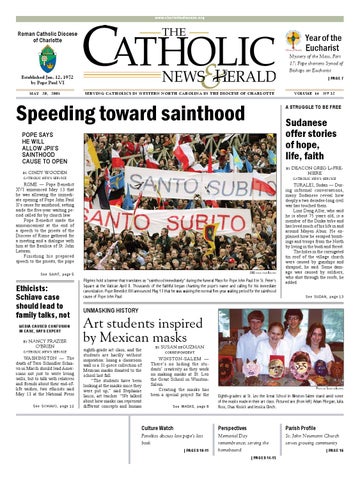
May 20, 2005
The Catholic News & Herald 1
www.charlottediocese.org
Roman Catholic Diocese of Charlotte
Year of the Eucharist
Mystery of the Mass, Part 17; Pope shortens Synod of Bishops on Eucharist Established Jan. 12, 1972 by Pope Paul VI May 20, 2005
| Page 7 Serving Catholics in Western North Carolina in the Diocese of Charlotte
Speeding toward sainthood
Sudanese offer stories of hope, life, faith by
by CINDY WOODEN catholic news service
CNS photo from Reuters
See SAINT, page 5
by
NANCY FRAZIER O’BRIEN
catholic news service
WASHINGTON — The death of Terri Schindler Schiavo in March should lead Americans not just to write living wills, but to talk with relatives and friends about their end-oflife wishes, two ethicists said May 13 at the National Press See SCHIAVO, page 12
DEACON GREG LaFRENIERE catholic news service
ROME — Pope Benedict XVI announced May 13 that he was allowing the immediate opening of Pope John Paul II’s cause for sainthood, setting aside the five-year waiting period called for by church law. Pope Benedict made the announcement at the end of a speech to the priests of the Diocese of Rome gathered for a meeting and a dialogue with him at the Basilica of St. John Lateran. Finishing his prepared speech to the priests, the pope
Media caused confusion in case, says expert
no. 32
A struggle to be free
Pope says he will allow JPII’s sainthood cause to open
Ethicists: Schiavo case should lead to family talks, not
vOLUME 14
Pilgrims hold a banner that translates as “sainthood immediately” during the funeral Mass for Pope John Paul II in St. Peter’s Square at the Vatican April 8. Thousands of the faithful began chanting the pope’s name and calling for his immediate canonization. Pope Benedict XVI announced May 13 that he was waiving the normal five-year waiting period for the sainthood cause of Pope John Paul.
TURALEI, Sudan — During informal conversations, many Sudanese reveal how deeply a two decades-long civil war has touched them. Lino Deng Aller, who said he is about 75 years old, is a member of the Dinka tribe and has lived much of his life in and around Mayen Abun. He explained how he escaped bombings and troops from the North by living in the bush and forest. The holes in the corrugated tin roof of the village church were caused by gunships and shrapnel, he said. Some damage was caused by soldiers, who shot through the roofs, he added. See SUDAN, page 13
Unmasking history
Art students inspired by Mexican masks eighth-grade art class, and the students are hardly without inspiration: lining a classroom wall is a 31-piece collection of Mexican masks donated to the school last fall. “The students have been looking at the masks since they were put up,” said Stephanie Iauco, art teacher. “We talked about how masks can represent different concepts and human
by
SUSAN deGUZMAN correspondent
WINSTON-SALEM — There’s no hiding the students’ creativity as they work on making masks at St. Leo the Great School in WinstonSalem. Creating the masks has been a special project for the See MASKS, page 8
Photo by Susan deGuzman
Eighth-graders at St. Leo the Great School in Winston-Salem stand amid some of the masks made in their art class. Pictured are (from left) Adam Morgan, Julia Ross, Chas Kissick and Jessica Clinch.
Culture Watch
Perspectives
Parish Profile
Panelists discuss late pope’s last book
Memorial Day remembrance; serving the homebound
St. John Neumann Church serves growing community
| Pages 10-11
| Pages 14-15
| Page 16
2 The Catholic News & Herald
InBrief
May 20, 2005
Current and upcoming topics from around the world to your own backyard
WASHINGTON (CNS) — A majority of Americans oppose federal funding of stem-cell research involving the destruction of human embryos, according to a new poll commissioned by the U.S. bishops’ Secretariat for Pro-Life Activities. For the government to promote the destruction of human life “when a clear majority of the taxpayers ... reject this approach would be especially irresponsible,” said Richard Doerflinger, deputy director of the secretariat. The poll was released May 16 as the U.S. House of Representatives was considering legislation that would allow federal funding of stem-cell research using embryos created but not used for in vitro fertilization. A vote was expected on the legislation before the summer recess. In the survey conducted by International Communications Research, 1,010 Americans were told that “Congress is considering the question of federal funding for experiments using stem cells from human embryos” and that embryos
Striding forward
CNS photo by James Baca, Denver Catholic Register
John Foppe, who was born without arms, signs a book with his foot as his wife, Christine Fulbright-Foppe, looks on following a speech at Denver’s Hyatt Regency Tech Center April 29. More than 500 people turned out to hear Foppe’s message of faith, hope and love in overcoming his disabilities.
Speaker born without arms talks about challenges he has DENVER (CNS) — Born without arms, John Foppe knows a lot about challenges — and about transcending them. More than 500 people turned out at an April 29 luncheon to hear his message of faith, hope and love as he described how he overcame his disabilities to find personal fulfillment and professional success as a motivational speaker. The 35-year-old Foppe, who uses his feet as his hands, calls his physical disability a “condition.” “A condition is basically anything that can get in your way of living a full, happy and productive life,” Foppe said. “It’s never about the condition itself. It’s always about our response to it.” Foppe drives without any special equipment — he uses his feet but the vehicle must have automatic transmission and power steering. He has lived alone, has skied, has snorkled and has earned a master’s degree. He also has written a book, “What’s Your Excuse? Making the Most of What You Have,” now required reading for all freshmen at St. Louis University. Foppe earned his bachelor’s degree and master’s degree at the Jesuit-run university. “Our only real handicaps in life are the mental and emotional ones that prevent us from participating in life — pity, anger, fear, guilt, doubt, prejudice, igno-
Poll finds majority of Americans oppose embryonic stem-cell research
rance,” Foppe said. “Those are the real cripplers in life, those thoughts we have that blind us to the possibilities in life.” He said that despite being raised in a loving Catholic family of eight boys and being educated in the local Catholic school he had developed a “victim mentality” by the time he was 10. But his mother ended that with “tough love.” She forbade his siblings from helping him with daily tasks. The first morning that Foppe had to dress himself became a turning point. He embarked on a journey to discover what he really can and cannot do that continues to this day, Foppe said. He credits his family’s sacrificial love and the acceptance and encouragement he received at his Catholic grade school with helping him along that path. After becoming a successful speaker several years ago, Foppe achieved something else that as a child he believed was impossible. He fell in love and married. Today, Foppe is grateful for — even proud of — his condition. “There was a time in my life when the condition had me,” he said. “But no longer. I have a condition. What’s yours?”
Diocesan planner ASHEVILLE VICARIATE
ASHEVILLE — Join us as we pray the rosary and support our sidewalk counselors who offer real help to women going in for abortions at Femcare in Asheville, at 62 Orange St., Wednesdays and Fridays at 9 a.m., Saturdays at 8 a.m. No prayer is ever wasted. The Culture of Life needs you. Call (828) 689-9544 for more information and directions. BOONE VICARIATE NORTH WILKESBORO — If you have a special need for prayers, or would like to offer your time in prayer for others’ needs, please call the Rosary Chain at St. John Baptist de La Salle Church. The Rosary Chain is a sizable group and all requests and volunteers are welcome. For details, call Marianna de Lachica at (336) 667-9044. CHARLOTTE VICARIATE HUNTERSVILLE — A Mass to Honor Deceased Loved Ones will be celebrated the last Friday of each month at 7:30 p.m. St. Mark Church, 14740 Stumptown Rd. For more Pam Schneider at (704) 875-0201. CHARLOTTE — A reunion for Charlotte Catholic High School, O’Donoghue School and Our Lady of Mercy School classes of 1954 through 1965 is being considered for Fall 2005. E-mail Madeleine Chartier Crawford at madeleine@harpermachinery.com or call Joyce Hartis O’Keefe at (704) 536-5049 if you are interested in celebrating Charlotte Catholic High School’s 50th anniversary.
“would be destroyed in their first week of development to obtain these cells.” Asked whether they “support or oppose using your federal tax dollars for such experiments,” 36 percent were in support, 52 percent were opposed, 10 percent didn’t know and 2 percent refused to answer. Next, respondents were told stem cells “can also be obtained from adults, from placentas left over from live births, and in other ways that do no harm to the donor” and that “scientists disagree on which source may end up being most successful in treating diseases.” Twenty-two percent said they supported “all methods, including those that require destroying human embryos, to see which will be most successful,” while 60 percent said they favored “research using adult stem cells and other alternatives to see if there is no need to destroy human embryos for research.”
givers of a family member with memory loss meet the last Monday of each month, 10-11:30 a.m. at St. Gabriel Church, 3016 Providence Rd. For more information, contact Suzanne Bach at (704) 376-4135. HUNTERSVILLE — Elizabeth Ministry is a peer ministry comprised of St. Mark Church parishioners who have lost babies before of shortly after birth. Confidential peer ministry, information and spiritual materials are offered at no cost or obligation to anyone who has experienced miscarriage, stillbirth or the death of a newborn. For details, call Sandy Buck at (704) 948-4587. CHARLOTTE — Thank God It’s Friday (TGIF), a weekly support group for separated and divorced women, meets every Wednesday, 6:30-8:30 p.m. in the New Life Center building, room 114, of St. Matthew Church, 8015 Ballantyne Pkwy., including a potluck dinner. Divorced men are invited every third Wednesday of the month. TGIF is a healing ministry sponsored by Catholic Social Services, Charlotte Regional Office and St. Matthew Church. For details, call Karen Wepasnick at (704) 5411891 after 3 p.m. CHARLOTTE — The Ancient Order of Hibernians, Sons of Erin Mecklenburg County Division, the oldest and largest order of Irish Catholic men, is seeking Irish Catholic men to join them for meetings, community activities and social events. Contact Tim Lawson at (704) 522-9728 or e-mail ncaoh@aol.com for more information including meeting times and location. CHARLOTTE — New Creation Monastery invites you to a day of silence and solitude in the presence of Almighty God. The monastery
CHARLOTTE — A support group for care-
May 20, 2 005 Volume 14 • Number 32
Publisher: Most Reverend Peter J. Jugis Editor: Kevin E. Murray Staff Writer: Karen A. Evans Graphic Designer: Tim Faragher Advertising Representative: Cindi Feerick Secretary: Deborah Hiles 1123 South Church St., Charlotte, NC 28203 Mail: P.O. Box 37267, Charlotte, NC 28237 Phone: (704) 370-3333 FAX: (704) 370-3382 E-mail: catholicnews@charlottediocese.org
The Catholic News & Herald, USPC 007-393, is published by the Roman Catholic Diocese of Charlotte, 1123 South Church St., Charlotte, NC 28203, 44 times a year, weekly except for Christmas week and Easter week and every two weeks during June, July and August for $15 per year for enrollees in parishes of the Roman Catholic Diocese of Charlotte and $23 per year for all other subscribers. The Catholic News & Herald reserves the right to reject or cancel advertising for any reason deemed appropriate. We do not recommend or guarantee any product, service or benefit claimed by our advertisers. Second-class postage paid at Charlotte NC and other cities. POSTMASTER: Send address corrections to The Catholic News & Herald, P.O. Box 37267, Charlotte, NC 28237.
The Catholic News & Herald 3
May 20, 2005
FROM THE VATICAN
Israeli official says pope plans to visit synagogue in Germany Cologne synagogue, it would be only the second time in modern history that a pope visited a synagogue. Pope John Paul went to the Rome synagogue in 1986.
VATICAN CITY (CNS) — Pope Benedict XVI praised the “heroic dedication” of a German-born priest who, during World War II, persuaded Nazi officials to spare the lives of Jews and political dissidents imprisoned in Rome. Salvatorian Father Pancrazio Pfeiffer was general superior of the Society of the Divine Savior in Rome during the nine months Italy was occupied by German troops. He became known as “the pope’s
offers private spiritual retreats for lay people. Write to Father John Vianney Hoover at New Creation Monastery, 11517 Spreading Oak Ln. Charlotte, NC 28226, stating why you want to go on retreat and when. For more information, call (704) 541-5026. GREENSBORO VICARIATE GREENSBORO — The Greensboro Council of Catholic Women invites all women to a luncheon May 25 at Cardinal Country Club, 5700 Cardinal Way. Pre-lunch social will begin at 11:30 a.m. and lunch will be served at 12 p.m. The program will be presented by Sheila Duell, music director of Our Lady of Grace Church. For more information, please call Carmen Wood at (336) 545-9266. GREENSBORO — If you have a special need for prayers, or would like to offer your time in prayer for others’ needs, please call the Prayer Chain at Our Lady of Grace Church. The Prayer Chain is a sizable group committed to praying for your needs and the needs of your family and friends on a daily basis. To request a prayer or to participate in the Prayer Chain, call the church office at (336) 274-6520, ext. 10 and leave your name, address and phone number. GUILFORD COUNTY — The Ancient Order of Hibernians Guilford County Division, the oldest and largest order of Irish Catholic men, is looking for more Irish Catholic men to join them for meetings, educational seminars and social events. Contact Michael Slane at (336) 665-9264 for time and location. HICKORY VICARIATE HICKORY — St. Aloysius Church, 921 Second St. NE, is offering a weekly Catholic Scripture
Episcopal calendar
VATICAN CITY (CNS) — Israel’s ambassador to the Vatican said Pope Benedict XVI told him he would visit a historic synagogue in Cologne, Germany, in August. Ambassador Oded Ben-Hur told an Israeli newspaper the pope made the promise May 12 at the end of an audience with diplomats accredited to the Holy See. The Vatican press office had no comment on the ambassador’s remarks. Officials involved with planning Pope Benedict’s August trip to Cologne for World Youth Day said May 16 they were still working with the Aug. 18-21 dates for the papal trip set when Pope John Paul II was still alive. As of mid-May, they said, the only definite events on Pope Benedict’s schedule in Germany involved World Youth Day, although the papal itinerary was still open to change. If Pope Benedict does go to the
Pope honors ‘heroic’ German priest for saving Jews during WWII
Study. Catholic Scripture Study is a program whose members not only learn the Scriptures, but come to a deeper understanding of their faith in a setting that builds Christian fellowship. Evening and daytime classes will be held each at the church, Wednesdays, 6:45-8:30 p.m., and Thursdays 9:30-11:15 a.m. For more information, call Ann Miller at (828) 441-2205, or email stalscss@charter. net. SALISBURY VICARIATE
VATICAN CITY (CNS) — Rebuilding Southeast Asia after December’s devastating tsunamis will require continued cooperation between the area’s Buddhists and Christians, said a top Vatican official. The Dec. 26 disaster triggered “an outpouring of prayers, expressions of
Papal postage
SMOKY MOUNTAIN VICARIATE WAYNESVILLE — Adult Education Classes are held the first three Wednesday evenings of each month beginning at 6:45 p.m. in the St. John the Evangelist Church Social Hall, 234 Church St. For more information, call Charles M. Luce at (828) 648-7369 or e-mail luce54@aol.com. Is your parish or school sponsoring a free event open to the general public? Please submit notices for the Diocesan Planner at least 15 days prior to the event date in writing to Karen A. Evans at kaevans@charlottediocese.org or fax to
May 23 — 7 p.m. Sacrament of Confirmation St. Thomas Aquinas Church, Charlotte
May 29 — 5 p.m. Sacrament of Confirmation Holy Infant Church, Reidsville
May 25 — 7 p.m. Sacrament of Confirmation St. Mary Margaret Church, Swannanoa
May 31 — 7 p.m. Sacrament of Confirmation Holy Trinity Church, Taylorsville
May 28 — 11 a.m. Ordination to the Priesthood Cathedral of St. Patrick, Charlotte
Rebuilding after tsunamis requires cooperation, Vatican official says
compassion and acts of generosity on a scale the world has rarely witnessed,” said Archbishop Michael L. Fitzgerald, head of the Pontifical Council for Interreligious Dialogue. Many people of different religions came together to help the victims and map out the future of their communities, he said. “The long-term requirements of reconstruction call, however, for a continuation of these interreligious expressions of solidarity,” the archbishop said in an annual message to Buddhists. The Vatican released the written message May 16 as Buddhists worldwide prepared for the May 22 feast of Vesakh, which commemorates the principal events in the life of Buddhism’s founder, Siddhartha Gautama. However, “this year’s feast of Vesakh will find many families missing some of their members,” the archbishop wrote. “I wish to assure them that their loved ones will not be forgotten but will be remembered in our prayers.” The tsunamis that swept through 11 countries in Asia and East Africa left more than 170,000 people dead, tens of thousands missing and hundreds of thousands homeless. Some countries where Buddhists and Christians “live and work side by side” already have been cooperating in social development and peace, said the archbishop. But in the wake of the tsunamis, “nowhere has the need for col-
SALISBURY — Elizabeth Ministry is a peer ministry comprised of Sacred Heart Church parishioners who have lost babies before of shortly after birth. Confidential peer ministry, information and spiritual materials are offered at no cost or obligation to anyone who has experienced miscarriage, stillbirth or the death of a newborn. For details, call Renee Washington at (704) 637-0472 or Sharon Burges at (704) 633-0591.
Bishop Peter J. Jugis will participate in the following events:
May 26 — 7:30 p.m. Bishop McGuinness High School Baccalaureate Mass Our Lady of Grace Church, Greensboro
messenger” as he took advantage of his German origins to gather information and mediate on behalf of Pope Pius XII with German authorities to get immunity for religious institutes in Rome and win clemency for Jewish and political prisoners. Because Father Pfeiffer developed numerous personal contacts with some members of the German forces, he was able to save the lives of hundreds of prisoners. On the occasion of the 60th anniversary of Father Pfeiffer’s death May 12, the Vatican’s secretary of state, Cardinal Angelo Sodano, sent a telegram on behalf of Pope Benedict praising the priest’s example. The pope “wishes the shining example of this eager religious may encourage a renewed dedication to the building of a civilization of love,” said the telegram.
June 1 — 7 p.m. Baccalaureate Mass, Charlotte Catholic High School St. Matthew Church, Charlotte
CNS photo from Reuters
German Finance Minister Hans Eichel, left, and Cardinal Karl Lehmann of Mainz, Germany, present an oversized version of the new German postage stamp honoring the late Pope John Paul II during a ceremony in Mainz May 17.
Pope names bishop of Honolulu, coadjutor for Fort Worth March 2004. As coadjutor, Bishop-designate Vann will automatically become head of the Fort Worth Diocese upon the death or retirement of Bishop Joseph P. Delaney, 70, who has headed the diocese since 1981. The appointments were announced May 17 in Washington by Archbishop Gabriel Montalvo, apostolic nuncio to the United States.
WASHINGTON (CNS) — Pope Benedict XVI has appointed Father Clarence Silva, vicar general of the Diocese of Oakland, Calif., as bishop of Honolulu. He also named Msgr. Kevin W. Vann, vicar for priests in the Diocese of Springfield, Ill., and pastor of Blessed Sacrament Church in Springfield, as coadjutor bishop of the Diocese of Fort Worth, Texas. Bishop-designate Silva succeeds Bishop Francis X. DiLorenzo, who was named bishop of Richmond, Va., in
4 The Catholic News & Herald
Bonds of marriage
around the diocese
Advocates trained to assist in marriage nullity cases by
KEVIN E. MURRAY editor
BELMONT — The Diocese of Charlotte now has 35 advocates to assist people after divorce and in pursuing marriage nullity. After attending monthly classes from September 2004 through May 2005, the participants had their last class at the Sisters of Mercy community in Belmont May 14. The new advocates took the tribunal oath, administered by Father John Putnam, judicial vicar for the Diocese of Charlotte and pastor of Sacred Heart Church in Salisbury, and received certificates of completion. The advocates, both deacons and laity from parishes around the diocese, were recommended by their pastors to participate in the program. Currently, 19 parishes have at least one tribunal advocate to assist the parish with its ministry to divorced and remarried people. The advocates also may accompany divorced persons in their petitions to the diocesan tribunal for a declaration of marriage nullity. “The program is geared to provide more in-field contact with both the peti-
tioners and the respondents,” said Father Putnam. “The advocates will provide more personal contact and better instruction for the cases, which will benefit everyone all the way around.” To complete the program, advocates had to be thoroughly trained in a variety of topics, including the theology of marriage, human sciences, an overview of canon law, the canonical process, jurisprudence (dealing with the sanctity of marriage), impediments and canonical form. Bishop Peter J. Jugis addressed the new advocates and spoke of the importance of canon law in advocacy, and the importance of the tribunal in the marriage nullity process. “Through the process of the tribunal, the truth gradually emerges, and truth brings peace,” said Bishop Jugis. He instructed the advocates to perform their jobs with this message: “Meet them as Christ would meet them.” Correspondent Deacon Gerald Potkay contributed to this story.
Photo by Deacon Gerald Potkay
Deacons and laity prepare for a lecture on canon law presented by Father John Putnam, judicial vicar for the Diocese of Charlotte, during the third week of the tribunal advocate program at the diocesan Pastoral Center Nov. 20, 2004.
May 20, 2005
Spreading the words
Courtesy Photo
The Ancient Order of Hibernians, Sons of Erin Division in Mecklenburg County made its third annual donation of books to Charlotte Catholic High School April 27. Pictured are Tim Lawson, division president; Linda Meckes, Charlotte Catholic media specialist; and John Eury, Hibernians book drive chairman. The category of this year’s donation was “historical fiction” pertaining to Ireland, Irish Americans and the Catholic Church. The Hibernians also donated several books on Ireland and Irish saints to Holy Trinity Catholic Middle School in Charlotte April 29, with plans to donate more books next year. The Hibernians also made a recent contribution to support the diocesan seminarian program.
May 20, 2005
from the cover
The Catholic News & Herald 5
A decision ‘to dispense from the five-year period of waiting ...’
Pope Benedict to push Pope John Paul’s sainthood SAINT, from page 1
said he had a “joyful announcement” to make before he listened to the priests’ comments and questions. He then read, in Latin, a letter from Cardinal Jose Saraiva Martins, prefect of the Congregation for Saints’ Causes, to Cardinal Camillo Ruini, papal vicar of Rome. The letter said that at an April 28 audience, Pope Benedict, “considering the special circumstances that were explained,” had decided “to dispense from the five-year period of waiting after the death of the servant of God, Pope John Paul II. ...” Pope Benedict had to wait several minutes to finish the sentence — saying he was authorizing the immediate opening of the “cause for beatification and canonization” — because the priests broke into a loud and sustained standing ovation. When they quieted, he said, “I see you all understand Latin very well.” The comment brought more applause. Complex procedure Although the process for considering the holiness of Pope John Paul was to
IX and John XXIII in 2000 — 122 and 37 years, respectively, after their deaths. Just the interview with the pope’s longtime personal secretary, Archbishop Stanislaw Dziwisz, “will take days,” Father Molinari said. Then there are hundreds of other people, collaborators in the Roman Curia, longtime friends, bishops and priests, who also must be interviewed. His published work will be examined, but also letters, articles and poems held in archives in Poland and in other parts of the world, Father Molinari said. The material must be compiled into a multivolume biography, then a “positio” or position paper on how the candidate heroically lived the Christian virtues is written. Historians and theologians examine the material and make recommendations to members of the Congregation for Saints’ Causes, whose opinion is presented to the pope. Verifying miracles After the pope declares a candidate lived a life of heroic virtue, beatification still requires the verification of a miracle attributed to his intercession. Separate boards of theologians and of physicians are called to examine miracles alleged to have occurred after the candidate’s death. Father Molinari said that when Pope Benedict decided he would preside only
CNS photo from L’Osservatore Romano
Pope Benedict XVI meets with priests from the Diocese of Rome at the Basilica of St. John Lateran May 13. At the end of his speech, the pope announced he was waiving the normal five-year waiting period for the sainthood cause of Pope John Paul II. over canonization ceremonies — leaving Cardinal Saraiva Martins to celebrate beatification Masses — “he made it clear that he was not simplifying the process for beatification.” The Jesuit said he was not surprised the pope set aside the waiting period because of the widespread public acclaim of Pope John Paul’s holiness and because of Pope Benedict’s long relationship with him. “He has been a faithful servant of John Paul II. He had a personal relationship with him and admiration for him,” Father Molinari said. During Pope John Paul’s April 8 funeral, people held up signs and banners proclaiming the late pope a saint or calling for his canonization. Cardinal Saraiva Martins said that while popular recognition of holiness was important, “canonical recognition” that someone is a saint requires the certainty that comes from a process developed and refined over the years.
begin immediately, it was not expected to conclude quickly. Even after the normal five-year waiting period, causes for beatification and canonization require years, if not decades of studying the person’s life, writings and relationships. Those who knew the candidate are interviewed, and everything the person wrote must be scrutinized, a process that may take years, especially for a pope who was a prolific writer and speaker. Two years after the 1997 death of Mother Teresa of Calcutta, Pope John Paul set aside the five-year waiting period for the opening of her cause, but she was not beatified until 2003. Jesuit Father Paolo Molinari — who helped prepare her cause and is working on the cause of Pope Paul VI, who died in 1978 — said the process for a pope entails much more work. “If this is done properly, it will take years,” he said. Pope John Paul beatified Popes Pius
6 The Catholic News & Herald
may crownings
May 20, 2005
Devoted to Mary
Courtesy Photo
Eighth-grader Patricia Flanery crowns a statue of Mary during the crowning ceremony at Our Lady of Mercy School in Winston-Salem May 13. Students Diego Ruiz and Patrick Cunningham served as Patricia’s escorts during the crowning.
In schools across the Diocese of Charlotte, students celebrate the month in which Mother’s Day falls by honoring the mother of Jesus and participating in special services for the May crowning of the Virgin Mary. Since the Council of Nicea in 787, the Catholic Church has often asserted that it is lawful to venerate images of Christ, Mary and the saints. The official liturgical “Order of Crowning an Image of the Blessed Virgin Mary,” published in 1987 by the U.S. Conference of Catholic Bishops, states coronation is one form of reverence frequently shown to images of the Blessed Virgin Mary. The popes not only endorsed this devout custom but also “on many occasions, either personally or through bishop-delegates, carried out the coronation of Marian images.” According to the document, the queen symbol was attributed to Mary because she is a perfect follower of Christ, who is the absolute “crown” of creation.
Courtesy Photo
Eighth-grader Ben Messer assists second-grader Gabrielle Wylie as she places a crown on a statue of Mary during the May procession at St. Michael School in Gastonia May 16. The second-grade class, dressed in their first Communion attire, led the procession of students.
Courtesy Photo
Dressed in their first Communion outfits, second graders from St. Ann School in Charlotte line the aisle of St. Ann Church and await May Queen Megan Shaul to crown a statue of Mary during the school’s annual May procession May 12. Photo by Susan deGuzman
Jessica Clinch places a ring of roses on the statue of Mary during the May Crowning at St. Leo the Great School in Winston-Salem May 13. Father Thomas Kessler, pastor of St. Leo the Great Church, led the school body in reciting the Hail Mary in English, Spanish and French.
May 20, 2005
year of the eucharist
The offertory procession and preparation Understanding the Mystery of the Mass, Part 17 We have spent the past few weeks focusing on the significance of the offertory. We discovered that ultimately Christ is offering himself as both the priest and victim of the sacrifice of the Mass. And since we are members of his mystical body, the Catholic Church, we are also offering ourselves with him. “Through him, with him and in him,” we offer ourselves as a gift to the Father. But before the offerings and gifts are consecrated, they must be collected and presented for sacrifice. Let us return to the ritual of the liturgy of the Eucharist to see how this is accomplished. At the beginning of the offertory, the altar is prepared. A square linen cloth, called the corporal, is unfolded in the center of the altar. The name “corporal” comes from the Latin corpus meaning “body,” since this linen cloth is unfolded to catch particles of the host or drops of precious blood. Along with the corporal, the chalice and communion chalices (if Communion is distributed under both species) are also brought to the altar with their purificators. The purificator is the linen cloth used to wipe and cleanse the chalices or other sacred vessels. Finally, the Roman Missal is placed on the altar. The altar is now prepared to receive the gifts of bread and wine. Previously we recalled that the first action of the offertory is the collection. Here, the faithful have the opportunity to support the various material needs of the church with their generous contributions. We also recognized that these donations not only support the needs of the church, but also purchase the bread and wine that are also presented. Ultimately, the collection symbolically represents ourselves: our work is rewarded with money, from which a portion is given to God as a sacrificial offering. It is important to note that the bread and wine, along with the collection, are brought forward in procession by members of the faithful. In the early church, the faithful would bring various gifts to be offered and presented at the offertory, including bread and wine, and other items for the poor, such as food,
Guest Column Father Matthew Buettner guest columnist
money and clothing. Since we live in a society where money is the basic mode of exchange, we generally limit these offerings to the essential gifts of bread and wine, along with the collection. Still, the ritual allows the presentation of other gifts that are “for the sake of charity toward the poor,” but these must be placed away from the altar of sacrifice (Redemptionis Sacramentum 70). The gifts of bread and wine are accepted by the priest or deacon and carried to the altar with the assistance of servers. During the offertory collection and procession, the Offertory Hymn or chant may be sung by the choir or the congregation, at least until the gifts have been placed on the altar. As the gifts arrive at the altar, the celebrant raises the paten above the altar and offers a prayer in silence or, if there is no music, he may recite the prayer aloud. This prayer praises God for providing the elements for man to produce the bread used in the sacrifice. After this prayer, the celebrant places the paten and any ciboria with hosts on the corporal. The chalice is prepared by the deacon or, if there is no deacon, by the celebrant. He adds a drop of water into the wine and recites a prayer in silence: “By the mystery of this water and wine may we come to share in the divinity of Christ, who humbled himself to share in our humanity.” It was common in ancient Roman society to drink wine mixed with water. This social practice entered the sacred rites of the Mass and assumed a spiritual significance: the wine represents the divinity of Christ and the water, his humanity. The mixture of wine and water also represents the mystery of divinization: the water represents man elevated by God (as the fathers of the church taught, “God became man that man might become God”). After the chalice is prepared, it is elevated above the altar while another short prayer of praise is recited silently or aloud by the celebrant. He places the chalice and any Communion chalices on the corporal and he may cover the chalice with a stiff square cloth, called the “pall.” We will conclude our discussion of the offertory next week. Father Buettner is parochial vicar at St. Dorothy Church in Lincolnton. WANT PREVIOUS COLUMNS? Father Buettner’s “Mystery of the Mass” series is available online at www.charlottediocese.org
The Catholic News & Herald 7
Pope confirms, shortens October Synod of Bishops on by CAROL GLATZ catholic news service
VATICAN CITY — Though Pope Benedict XVI confirmed October’s world Synod of Bishops on the Eucharist, he decided to cut back on the length of the meeting by nearly a week. The assembly of the world’s bishops had been convoked by Pope John Paul II and scheduled to run Oct. 2-29 at the Vatican. But after Pope John Paul’s death April 2, the synod and other major Vatican initiatives were suspended. The Vatican announced May 12 in a written statement that Pope Benedict reconvoked the synod, but that it would be shortened by six days and run Oct. 2-23. The reduced number of weeks dedicated to the synod suggests there would be changes made in how the synod was to be organized and scheduled. “Perhaps the pope feels the work of the synod can get done in that amount of time instead of dragging on and on,” said one Vatican official. Though the official said he did not know the pope’s reasons for the change, he noted that the usual length of the synods — about four weeks — kept bishops and archbishops away from their dioceses “a long time.” While no “big changes” were on the horizon, he said, some modifications would be expected given the reduced schedule.
Details of the changes were set to be published in the next few weeks with the release of the “instrumentum laboris” or working document on the synod. The May 12 Vatican statement said Pope Benedict also reconfirmed the four cardinals and the archbishop chosen by Pope John Paul to lead the synod discussions. The late pope had chosen Italian Cardinal Angelo Scola of Venice to be the synod’s general rapporteur, or recording secretary, introducing and later summarizing the bishops’ discussion. Though Pope Benedict, as pontiff, is president of the synod, three cardinals will take turns presiding over the synod’s daily sessions. They will be Cardinals Francis Arinze of Nigeria, prefect of the Congregation for Divine Worship and the Sacraments, Juan Sandoval Iniguez of Guadalajara, Mexico, and Telesphore Toppo of Ranchi, India. The synod’s special secretary will remain French Archbishop Roland Minnerath of Dijon. The theme of the synod, also chosen by Pope John Paul, is “The Eucharist, Source and Summit of the Life and Mission of the Church.” The October gathering will be the 11th worldwide Synod of Bishops to be held since the Second Vatican Council. The last synod was held in 2001 and focused on the role and ministry of the bishop.
Pope asks new priests to lead people to Christ through VATICAN CITY (CNS) — Maintaining a tradition of his predecessor, Pope Benedict XVI ordained 21 priests and urged them to lead people to Christ through the Eucharist. By centering their mission on the Eucharist, the new priests can bring “the joy of Christ to those who suffer, those in doubt and even those who are reluctant,” the pope said during the Mass in St. Peter’s Basilica May 15. The newly ordained, who completed their priestly studies in the Diocese of Rome, included 11 from Italy and 10 other countries in Europe, Africa and South America. During his homily, the pope said the Eucharist should be the focus of the priest’s spiritual life and the stimulus for their evangelizing work. “Consider the possibility of worthily celebrating the Eucharist as the center of every day,” he said. “Lead people again and again to this mystery. Help them, starting out from the Eucharist, to bring the peace of Christ into the world.” The pope framed his remarks about the priesthood in a description of the “mission of the Holy Spirit” and the church’s duty to spread the Gospel. That is a task that has implications for human freedom, he said. He said the Ten Commandments represent the foundation for the just ordering of freedom in human society, which cannot exist without reference to God. The Holy Spirit, he said, helps
people understand this perspective and helps the church spread its message. “The church must continually become what it already is: It must open borders between peoples and break down the barriers between classes and races,” he said. “In the church there are only the free brothers and sisters of Jesus Christ.” The pope asked the priests to remember that the strength given by the Holy Spirit is in a special way “the strength of forgiveness.” “Forgiveness comes from the cross; (Christ) transforms the world with the love he gives ... and only this grace can transform the world and build peace,” he said. He added that the forgiveness given in the sacrament of penance is one of the church’s “precious treasures.” The pope, noting that it was Pentecost Sunday, made a point he has touched upon more than once in the first month of his papacy: the “indissoluble link that exists in the church between the Spirit and the institution.” That link extends to the church’s teaching authority, he said. “Without the Holy Spirit, the church would be reduced to a merely human organization, weighed down by its own structures,” he said. In God’s plan, the Holy Spirit works through human means to affect history, he said, and this helps explain the church’s role.
8 The Catholic News & Herald
around the diocese
Student art inspired by donated Mexican masks MASKS, from page 1
characteristics. They (the students) were encouraged to go beyond what they usually think of as a traditional mask and to use different art elements, such as texture, shape and color.” “I enjoyed being able to be creative with the mask instead of following specific guidelines,” said student Chas Kissick. The Mexican masks were a gift from Nelson Grice, an anthropologist who lived in the Winston-Salem area and often traveled to Mexico on field studies. He visited the school several years ago to speak with students about his work and, according to Iauco, he never forgot the polite behavior and genuine interest shown by the students. Last year, before moving to New Mexico, Grice donated some of the masks he had collected over the years to the school. The masks not only offer lessons in Mexican folk art, but also tell the history of the country’s religion and society. “All art is based in culture,” said Iauco. “It helps us to understand the world around us.” “There are a lot of religious concepts in art that our [parochial school] children understand,” she said. “The whole spiritual concept is more real to them. They have a deeper appreciation for symbolic aspects of other cultures since they have studied the history of the church and religious symbolism.”
Masks have been an integral part of Mexican life, even before the Spanish took over the country in the early 16th century, according to Iauco. In pre-Hispanic times, she said, the Indians held ceremonies at certain times of the year in which masks were worn in processions, dances and theatrical-type performances. This was done not only for the Indians to honor and entertain their deities, but also to encourage the blessing of abundant rain, fertile crops, good health and general well-being. It was also a way to gather communities together for fun and enjoyment, said Iauco. Descriptions of these festivals and of the masks that were worn are included in chronicles from Catholic priests during the first decades after the Spanish arrived. As the Spanish brought Christianity to the region, they influenced the Mexican festivals. The priests who worked in the villages persuaded the Indians to adopt a Catholic festival cycle — Christmas, Holy Week, All Saints and All Souls days, feast days for the Virgin Mary and popular saints, and others. The priests assigned each village a patron saint, whose feast day became highly celebrated. The priests also introduced Spanish dramas to the Indians as a means for teaching Christianity. Many of these dramas told the story of the defeat and expulsion of the Moors from Spain. Christian morality plays, which depict conversion and the struggles of good and evil, were also introduced in this way. The plays and festivals soon became a blend of the two cultures and are still
Photo by Susan deGuzman
Pictured are some of 31 Mexican masks displayed at St. Leo the Great School in Winston-Salem.
May 20, 2005
Moving onward
BAC graduates 181, honors N.C. leaders with honorary degrees BELMONT — Hundreds of families and friends cheered and applauded as the graduating class of 2005 made their way across the stage. Belmont Abbey College presented 181 traditional and adult graduates with diplomas during the 127th annual commencement ceremony May 7. The college also presented honorary doctorates to Bishop Joseph F. Gossman of Raleigh; Paul Polking, a retired vice president of Bank of America; and Helmut Deussen, a member of the college board of trustees who in 1995 was selected by Textile World magazine as one of the top 10 leaders in the industry. Benedictine Father Christopher Kirchgessner, an Abbey professor, served as this year’s master of ceremonies; graduate Katherine Bogie was named valedictorian; and graduate Sean Dunne was named Student of the Year. After graduation, Dunne plans to join the monastery at Belmont Abbey. The college also recognized faculty achievements, including associate professor of math and physics Stephen Brosnan as the recipient of the 2005 Adrian popular today. The various festivals and plays have certain important characters in them. Each mask represents a different symbol, many of which have Christian connotations. “A double-faced mask commonly portrays the fight of good versus evil,” said Iauco. “Some masks are exaggerated forms of people, while others take on animal forms and represent different strengths and weaknesses,” she said. “The jaguar represents beauty and physical prowess, but also the underworld with mysterious qualities.” The mask collection at St. Leo the Great School includes masks made from clay, wood, tin, yarn and coconut husk.
Courtesy Photo
Graduate Sean Dunne jumps for joy as he is named Belmont Abbey College Student of the Year during commencement ceremonies May 7. Faculty Excellence Award. Ranked one of the best liberal arts colleges in the South by U.S. News and World Report, Belmont Abbey College is home to students from more than 34 states and 17 countries. Located near Charlotte, the 650acre campus consists of the college, the Benedictine monastery and the Abbey Basilica. Founded in 1876, the college celebrates its heritage and is inspired by the Benedictine monastic tradition.
Inside more than half the masks, notes Iauco, there are tiny “shelves” positioned under the wearer’s chin to help hold the masks in place. On many of these shelves are worn pieces of linen. “This is a good indication that these masks were really used,” said Iauco.
May 20, 2005
advertisement
The Catholic News & Herald 9
1 0 The Catholic News & Herald
May 20, 2005
Culture Watch
A roundup of Scripture, readings, films and more
Panelists say Pope John Paul II’s last book rooted in his Polish homeland by TRACY EARLY catholic news service
NEW YORK (CNS) — “Memory and Identity,” the last book by Pope John Paul II, shows him developing his thought from the specific perspective of his home country, according to participants in a panel who discussed the book in New York May 16. Cardinal Edward M. Egan of New York said that in this book the pope “let his hair down” and allowed his love for his native land and culture to show through.
In “Memory and Identity,” the pope developed his philosophy and theology through the lens of his own experience as a “son of Poland,” and created a work that will help in understanding his more formal writings, the cardinal said. Held at the Italian Academy of Columbia University, the panel was arranged by the Crossroads New York Cultural Center, a recently established agency of the lay Catholic movement, Communion and Liberation. The publisher of the pope’s book, Rizzoli, jointly sponsored the event. Rizzoli’s president told the audience that the book was doing “extremely well” in sales. The book was issued in Italian in February, and the panel was arranged to help call attention to its availability now in English. Msgr. Lorenzo Albacete, spiritual leader of Communion and Liberation in the United States, was panel moderator. Carl Anderson, supreme knight of the Knights of Columbus, also emphasized the Polish influence on the development of Pope John Paul’s thought in “Memory and Identity.” The pope saw in the experience of Poland a “universal value” and affirmed the moral value of patriotism, Anderson said. He suggested that the pontificate of Pope John Paul II could mark the beginning of a spiritual renewal coming from Poland equivalent to that which emerged
from the work of St. Ignatius Loyola, the Jesuit founder. “Memory and Identity” will have special significance for the intellectual formation of Catholics who want to work for the transformation of culture, Anderson said. That the pope’s last book is rooted in his experience as part of the Polish nation was developed more fully by Father Richard John Neuhaus, director of the Institute on Religion and Public Life, based in New York, and editor of its journal, First Things. “How very Polish it is,” he commented. Patriotism, the nation and the church all come together for the pope in this book, Father Neuhaus said. He said the pope also saw Poland as the embodiment of the suffering of Christ and, as one who played a role in the resurrection of his crucified country, found salvation history inseparable from his experience in his homeland. When he was elected pope, he believed that in some sense Poland had been elected, Father Neuhaus said. The pope, he said, was right in seeing the unfolding of a Catholic cultural possibility in Poland. However, Father Neuhaus also emphasized that the situation of American Catholics was quite different from that of Polish Catholics. While Pope John Paul could look back to the “baptism of Poland” in its conversion to Christianity a millennium before, American Catholics cannot look to any comparable event in the history of their nation, Father Neuhaus said. He also noted that the pope could call for building on the Catholic tradition of his country as a way of obeying the Fourth Commandment to honor parents, but American Catholics could not look in a similar way to Native Americans or early settlers such as the Puritans. And as a nation of immigrants from all countries of the world, the United States does not have a national culture comparable to that of Poland, Father Neuhaus said. Noting that the United States remains a Christian country sociologically, he said it was also “a very Protestant country.” These factors bring about a “necessary tension” between Catholic Americans and the culture of their country, not a convergence, Father Neuhaus said. Catholic Americans hope there will not be a conflict between their allegiance to their country and their faith, but their primary allegiance is to their church, he said.
WORD TO LIFE
Sunday Scripture Readings: MAY 29, 2005
May 29, Most Holy Body and Blood of Christ Cycle A Readings: 1) Deuteronomy 8:2-3, 14b-16a Psalm 147:12-13, 14-15, 19-20 2) 1 Corinthians 10:16-17 3) Gospel: John 6:51-58
Everything about Jesus is action by JEAN DENTON catholic news service
When I was a young girl I had an enormous fear of going to Communion. I attended a Protestant church, so the Communion ritual was held only once a month. My parents let me stay in the pew because I had such anxiety about the whole thing: I got nervous. I’d break out in a sweat, and my hands would shake so much that I could barely hold the tiny glass without spilling the grape juice. I was comfortable in my role at church as spectator and was afraid to stand up, walk to the altar and “partake” in front of everybody. Too much responsibility. But in receiving the consecrated body and blood of Jesus in the Eucharist as an adult Catholic, I discovered it to be “true food” and “true drink,” as John’s
Gospel says. As such, it naturally creates in believers an appetite for the life of Christ within us. This weekend’s readings remind us that the body and blood of Christ is active, not static. It nourishes and flows. The essence of the body of Christ is that it is alive and requires our active participation in it to carry its meaning into the world. Everything about Jesus is action. Here is your God: walking, teaching, touching, living, healing, praying, suffering, dying, being resurrected, forgiving, seeking, preaching, hungering. He gives us his body and blood, not for us to observe, but to feed us and flow through us for action — the way to salvation, the way to life. I was not the first to want simply to sit still and in awe before Jesus. The disciples who witnessed his Transfiguration were struck in the same way. But Jesus himself discouraged them from building booths and instead led them down the mountain to participate in his life of struggle and action. As Paul explained in his letter to the Corinthians, participation is the key to the life of Christ. He wants to be actively part of us and for us to be part of him. Jesus is not to be kept at arm’s length — his own words insist otherwise: “Unless you eat the flesh of the Son of Man and drink his blood, you do not have life within you.”
WEEKLY SCRIPTURE Scripture for the week of May 22-28 Sunday (The Most Holy Trinity), Exodus 34:4-6, 8-9, Daniel 3:52-56, 2 Corinthians 13:11-13, John 3:16-18; Monday, Sirach 17:20-24, Mark 10:17-27; Tuesday, Sirach 35:1-12, Mark 10:28-31; Wednesday (St. Bede, St. Gregory VII, St. Mary Magdalene de’ Pazzi), Sirach 36:1, 4-5, 10-17, Mark 10:32-45; Thursday (St. Philip Neri), Sirach 42:15-25, Mark 10:46-52; Friday (St. Augustine of Canterbury), Sirach 44:1, 9-13, Mark 11:11-26; Saturday, Sirach 51:12-20, Mark 11:27-33. Scripture for the week of May 29 - June 4 Sunday (The Body and Blood of Christ), Deuteronomy 8:2-3, 14-16, 1 Corinthians 10:16-17, John 6:51-58; Monday, Tobit 1:3; 2:1-8, Mark 12:1-12; Tuesday (The Visitation of the Blessed Virgin Mary), Zephaniah 3:14-18, Isaiah 12:2-6, Luke 1:39-56; Wednesday (St. Justin), Tobit 3:1-11, 16-17, Mark 12:18-27; Thursday (Sts. Marcellinus and Peter), Tobit 6:10-11; 7:1, 9-14; 8:4-9, Mark 12:28-34; Friday (Most Sacred Heart of Jesus), Deuteronomy 7:6-11, 1 John 4:7-16, Matthew 11:25-30; Saturday (Immaculate Heart of Mary), Tobit 12:1, 5-15, 20, Tobit 13:2, 6, Luke 2:41-51.
The Catholic News & Herald 11
May 20, 2005
Two top Vatican Radio officials convicted of polluting environment VATICAN CITY (CNS) — Two top officials at Vatican Radio were convicted of polluting the environment with electromagnetic waves from radio broadcasting towers in a suburb north of Rome. A Rome court May 9 found Jesuit Father Pasquale Borgomeo, Vatican Radio’s general director, and Cardinal Roberto Tucci, president of the radio’s management committee, guilty of “dangerous showering of objects,” a criminal charge, and sentenced them to 10 days in jail. The court decision comes after a five-year legal battle waged by residential and local environmental groups against the radio’s top directors. Inhabitants around the radio’s transmission center alleged that its levels of electromagnetic radiation had increased the risk of cancer in children. Jesuit Father Federico Lombardi, Vatican Radio’s program director, said the radio would appeal the court’s decision. While the radio “appreciated the acquittal of one of the defendants,” it would challenge the court decision that “remains clearly unjustified,” Father Lombardi said May 9. He said the radio’s transmission center outside Rome had always met with international norms of accepted levels of electromagnetic radiation “even before the existence of Italian standards.” When Italy established its own stricter radiation levels in 1998, the radio began to “carefully respect” the new norms, said Father Lombardi. Their adherence to the norms could be verified by a joint commission from Italy and the Vatican that has been in charge of monitoring radiation levels, he said. The joint commission convened May 16 to review the radio’s compliance with the norms, according to a Vatican statement May 18. Experts from Italy’s environmental
and communications agencies told the commission that the electromagnetic radiation emissions were “in conformity with” the levels required by law, the Vatican statement said. When constructed five decades ago, the transmission center occupied open countryside in Rome’s northern outskirts, but Italian authorities allowed housing construction to surround the site. In an effort to meet Italy’s more stringent norms, in 2001 Vatican Radio began to reduce the power of some of its antennae. The radio also moved some of its European broadcasts to a transmission center in France and other locations. During the commission’s May 16 meeting, the Vatican said it was continuing to convert some of the radio’s shortand medium-wave transmitters to digital, which would “permit Vatican Radio to air its programs with less power and lower emissions” as well as with “better broadcasting quality.” Even though the World Health Organization concluded in 1996 that there was no convincing scientific evidence of a link between radio frequencies and cancer, it called for further studies to investigate possible health risks associated with electromagnetic fields. Father Lombardi said May 9 that with the strict standards in place limiting electromagnetic radiation “there is no justified reason for local residents to be worried.” He said he hoped the Italian courts would eventually recognize that radio officials had always acted “properly.” He also expressed his wish that the justice system would someday help “clear away the dark shadows” that tainted the radio’s “good reputation and contributed to feeding unfounded fears in people.” The Rome court also decided that Vatican Radio would have to pay all the plaintiffs’ legal fees. Italian news reports May 10 said representatives of some of the plaintiffs said they were “satisfied” with the court’s
1 2 The Catholic News & Herald
fighting for life
May 20, 2005
Schaivo case should inspire talks and wills SCHIAVO, from page 1
Club in Washington. “Of the 100 things that can happen at the end of life, a living will will typically cover two of them,” said David Magnus, director of the Center for Bioethics at Stanford University School of Medicine in Palo Alto, Calif. “There are a million variants.” “Living wills are not the solution” to disputes among family members over end-of-life care, said Art Caplan, chairman of the medical ethics department and director of the Center for Bioethics at the University of Pennsylvania. Both ethicists were critical of the media handling of what Caplan called the “soap opera” surrounding Schiavo, the severely brain-damaged Florida woman whose March 31 death came 13 days after her feeding tube was removed at the direction of her husband, Michael. Bob and Mary Schindler, Terri Schiavo’s parents, had fought for years in the courts and in the media to keep their daughter alive. Legislators in Florida and in the U.S. Congress passed special laws written to aid the Schindlers in their efforts. “But was anything broken” regarding termination-of-care practices in the United States, Caplan asked, responding in the negative.
Classifieds EMPLOYMENT ARCHIVES ASSISTANT: Employee will retrieve, prepare, scan, process, file and ready for destruction archival documents; will perform clerical tasks in diocesan Archives. Applicant must be proficient in Microsoft Office, well organized, detail-oriented and self-motivated; must have neat, legible handwriting, verbal and interpersonal skills. Resumes must be received by June 2 at Diocese of Charlotte, Archives Department, 1123 South Church Street, Charlotte, NC 28203. RN/NURSE SUPERVISOR: 2nd shift, fulltime - 40 hours plus alternate weekends. Care and treatment children/adults MR/DD. Requirements: Supervisor, pediatric and/or acute care experience. SOCIAL WORKER: 1st shift, fulltime. Responsible for social casework services to clients and their families; liaison with community resource agencies; Family Association. Requirements: BSW- ICF/MR experience. Prefer: knowledge of Medicaid, Social Security Benefits, medical background. Apply in person: Holy Angels, MondayFriday 8:30 am - 7:00 pm, 6600 Wilkinson Blvd, Belmont, NC. info@holyangelsnc.org TEACHERS, COUNSELOR: Immaculata Catholic School announces the following fulltime professional openings beginning with the 2005/06 school year:- Middle School Language
“Did (Schiavo) have adequate protections under the law?” he added. “I believe she did. Does medicine know what it’s doing regarding PVS (persistent vegetative state)? I think it does.” Caplan said the media contributed to public misunderstandings about the persistent vegetative state, giving the impression that it is “an uncertain diagnosis,” that patients in this state “can suffer” and that people can awaken from a persistent vegetative state. For patients such as Schiavo, whose brain was deprived of oxygen for a time, persistent vegetative state is “a rocksolid diagnosis,” he said. Magnus said the media were guilty of causing “confusion between balance and showing two sides” in the dispute over Schiavo. “When we have a broad consensus, with 99.9 percent of neurologists in agreement” about persistent vegetative state in general and Schiavo’s condition in particular, it is not balanced journalism to find one doctor who disagrees and then to present each view as equal, Magnus said. Magnus said state laws on termination of care vary widely, adding that if the Schiavo case had taken place in Texas or California Schiavo’s death “could have taken place much, much earlier, even against the wishes of Michael Schiavo.”
Terri Schiavo’s parents meet Vatican official, thank him for support Arts Teacher, Middle School Science and Social Studies Teacher, School Counselor (certified or certifiable with strong background in student learning differences). Send letter of application and resume by June 10 to: William Meehan, Principal, Immaculata Catholic School, 711 Buncombe St., Hendersonville, NC 28791 SERVICES INSURANCE: Affordable health insurance, low cost life insurance. Covering most people regardless of health. Also, low cost Medicare Supplement. 1-800-252-6110 or 704-566-1212. LATIN BAND: For weddings and special events. We play salsa, merengue, bossa- nova, etc. For info visit: www.etacarina.net or call 828-216-3647, Iliana. FOR RENT VACATION CABIN: For rent at Lake Lure. Mountain views! 2 bedrooms, 2 baths, fully furnished. Reasonable rates. Call for details. 828299-3714 TRAVEL MEDJUGORJE PILGRIMAGE: with group from Charlotte, October 2005. Contact Lisa Basse at LMBasse@aol.com or Grace Narus at jan4nc@ bellsouth.net for information.
Classified ads bring results! Over 125,000 readers! Over 49,000 homes! Rates: $.70/word per issue ($14 minimum per issue) Deadline: 12 noon Wednesday, 9 days before publication How to order: Ads may be E-mailed to ckfeerick@charlottediocese.org, faxed to (704) 370-3382 or mailed to: Cindi Feerick, The Catholic News & Herald, 1123 S. Church St., Charlotte, NC 28203. Payment: For information, call (704) 370-3332.
VATICAN CITY (CNS) — The parents of the late Terri Schindler Schiavo visited a top Vatican official to thank him for his defense of their daughter’s right to life. Cardinal Renato Martino, head of the Pontifical Council for Justice and Peace, received Bob and Mary Schindler, parents of the 41-year-old Florida woman who died March 31, nearly two weeks after a court ordered her feeding tube to be disconnected. At his May 17 meeting with the Schindlers, Cardinal Martino reiterated his condemnation of “the killing of this woman in one of the most inhumane and cruel ways, through hunger and thirst.”
The Schindlers “expressed their appreciation to the cardinal for making bold efforts to save the life of their daughter” who was “practically condemned to die by the U.S. courts on the petition of the woman’s husband,” a Vatican statement said. Before Terri Schiavo died, numerous church leaders, including Cardinal Martino, had made public appeals to save her life. The council’s statement said the Schindlers were scheduled to take part in Pope Benedict XVI’s general audience May 18.
May 20, 2005
from the cover
The Catholic News & Herald 13
Sudanese stories of hope, life, faith Sudan , from page 1
As Aller talked about how his faith sustained him during the war years, he said that of his eight children only six are alive; two of his sons were killed in the war. His oldest son, Mario Malou, who would now be about 37, left in the late 1970s to avoid being forced to join the army. “He wanted to be free ... he went away. I think he is in the United States now; someone told me that is where he went,” Aller said. Touching his heart, Aller added: “If you can find my son, tell him my foundation is empty. He will understand.” Deacon Francis Lemyama, 37, said that for about 12 years the Nuba Mountains region was cut off from the rest of the country. “There was nothing coming in, and people simply learned to go without” things like clothes, soap and salt, he said, adding that no relief agencies worked in the area. “The only thing the people had was the diocese,” he said. Deacon Lemyama remembered what a great occasion it was when a bishop brought sweets for the children, many of whom did not know what candy was. Captured dreams Makuc Akec, 28, left the South in 1988 and fled to northern Sudan, hoping it would be safer there. He was living in El Obeid and had gone to the river to get water when he was surrounded and captured by troops. He said the soldiers tied him to a tree and told him, “We can kill you.” Akec said the soldiers put him into a cattle camp, where he was forced to watch the herd. After two years of living with the militia, he escaped one night. The soldiers quickly found him and sent him to a second cattle camp in the North. Akec managed to escape a second
time, only to be captured again and taken back. This time he managed to rejoin his wife and two sets of twin girls, who lived with him in the cattle camp for a year. Adior Thuc, his wife, looked away and answered softly when asked if she or her daughters had been abused. With her face shielded from view and her eyes averted, she said they were beaten and abused. Bishop Macram Max Gassis of El Obeid interrupted the silence that followed and suggested Thuc probably had experienced things simply too difficult for her to share. Later, Akec recalled how he was duped by the soldiers. They told him that if he stayed with them for one year he would get a cow to help restart his life. However, after the year they did not give him anything. Eventually rebel troops negotiated his release from the government camp and his return to Turalei. Akec said after his release he walked away without any belongings, but at least his wife and daughters were with him. Akec and Thuc said they hope their children will be able to attend school in Turalei. The sets of twins — 15 and 5 years old — have never attended school. Fleeing for freedom Father Joseph Mogga, a parish priest in Turalei, said he entered a minor seminary when his family fled to the refugee camps in neighboring Uganda; he did not see them for another 12 years. “My younger sisters didn’t even recognize me ... they didn’t know who I was,” he said. Father Mogga’s mother, now in her 70s, has spent more than 20 years in refugee camps. “However,” he said, “her one dream is to die in Sudan.” Father Mogga said his older brother, John, fled to Khartoum, as the war intensified. He then migrated to Egypt to
CNS photo by Deacon Greg LaFreniere, Long Island Catholic
Children in Turalei, Sudan, wait for the start of Mass during the week after Easter. Many of the youngsters have returned from refugee camps in northern Sudan or neighboring countries. avoid joining the army. He has been in Canada for 25 years and has not seen his family, although he has kept in touch through letters. Ahmed Hran, 45, an Arab Muslim, fled his village in western Sudan’s Darfur region after an attack by government and militia troops. “Everything was destroyed,” he said, adding that he and friends left all their belongings when they fled.
He said troops destroyed all the houses and cut down all the trees in his village, but “we don’t know why.” “Those who couldn’t run away were killed, and all the animals were killed,” he said. “We need the truth to get out ... let everyone, especially the Catholics and Christians, come to Sudan to search for and see what is wrong,” he said.
1 4 The Catholic News & Herald
May 20, 2005
Perspectives
A collection of columns, editorials and viewpoints
Reflections stirred by serving the homebound Church community is for giving, getting help bound (a much nicer word than “shutins”), and we report on the month’s activity. Ruth — no real names used — lives with her daughter and relies on oxygen. A medication for arthritis took a toll on her lungs. Now well into her 80s, she is cheerful and alert, and always ready for a good long visit. The little women at one of the nicest assisted-living homes remain about the same. One is sliding more into dementia, and there is a question about whether one of the women who wants to receive is really Catholic. We consult with our deacon or priest over these thornier issues of eligibility, but sometimes we are forced to make our own pastoral judgments on the spot. The care provider at one assistedliving facility has begun telling us “it’s not a good time” to visit Emma. She’s in the third stage of dementia, we’re told, not having good nights. We ponder whether it’s legitimate, this being turned away, and someone remarks that the home — an in-home care center — seems “creepy.” Inevitably, our attention turns to how nice it would be to have more help, and from there we view the wider parish picture. We all know someone who needs support, someone who’s received a devastating diagnosis, someone who’s having a knee replacement, someone whose husband is moving into dementia. “This church is our community,” remarks the woman next to me. “This is where people should turn for help.” We talk about whether things are coordinated enough at the parish. We have committees, but are they in touch with each other? Can we get the word out on the needs we have? “There are so many people out there who would help, if they just knew some need they could fill,” someone says. Our dormant stewardship committee finally has been reborn, and it has a big job to do coordinating all the people who could help with all the people who need help, motivating the folks in the pews to be more than Sunday Catholics. I look around at our committee. We’re middle-aged and beyond. The day will come when some of us will need the help we now give. The day is still lovely as I head to my car, spring still beckoning. But my mood is just a little more reflective now.
For the Journey EFFIE CALDAROLA cns columnist
As I drive into the parish parking lot, I savor the absolute beauty of this spring morning. It’s spring, and in one dramatic, synchronized gesture, all the birch trees have exploded with triumphant little leaves. Heading for the meeting room, I note there’s not a cloud in the sky. When I emerge from the windowless room in an hour, this perfect day will still be there for me. I have soil to overturn, I’ve seen plenty of Saturday garage sale signs that piqued my interest, and the dog will be eager for a walk. But sometimes when I leave our monthly “Care and Compassion” meetings, I’m not quite the woman I was when I walked in. This day is like that. We acknowledge that our little committee is misnamed. Our singular mission is taking the Eucharist to the homebound on Sunday. There are other committees (like “Outreach”) that solve problems such as how someone without transportation gets to a doctor’s appointment or how a family struck with devastating illness gets a warm evening meal. Our job is to ensure that those who can’t make it to Mass partake of the body of Christ nonetheless. We have our little list of the home-
Pope Benedict says Pope John Paul ‘is watching us from on high’ by JOHN THAVIS catholic news service
VATICAN CITY — Marking the birthday of his predecessor, Pope Benedict XVI told pilgrims they can be certain that Pope John Paul II “is watching us from on high and is with us.” The pope spoke at a general audience May 18, before some 25,000 visitors who braved intermittent rain showers in St. Peter’s Square. “I’d like to recall that today is the birthday of Pope John Paul II. He would have been 85 today. And we are sure that he is watching us from on high and is with us,” the pope said before beginning his regular audience talk. “On this occasion, we want to give great thanks to the Lord for the gift of this pope, and we want to say thank you to the pope himself for all that he did and all that he suffered,” Pope Benedict said, as the crowd broke into sustained applause. Hundreds of thousands of people have come to St. Peter’s to visit the tomb of the late pontiff, who died April 2. On May 13, Pope Benedict said he was allowing the immediate opening of Pope John Paul’s cause for sainthood, lifting the usual five-year waiting period. Pope Benedict continued the series of audience talks begun by Pope John Paul on the psalms. He explicated Psalm 113, which praises the Lord for his care of the world’s poor and humble. The pope noted that after extolling God’s name and glory in heaven the psalmist “turns his attention to our earthly horizon”: “He raises up the lowly from the dust; from the dunghill he lifts up the poor to seat them with princes ... .” The psalmist thus praises a God who is “very different from us in his greatness, but at the same time very close to his creatures who suffer,” the pope said. He looks on the world not with “the cold
Is there an angel named Q. As a grade-school religion teacher, I begin each year by discussing angels, especially guardian angels. Recently I have seen religious catalogues advertising statues of an Archangel Uriel. Who is this? If he is an archangel, why do we only hear of Michael, Raphael and Gabriel? (Maryland) A. The name Uriel occurs in apocryphal Jewish scriptures, the Books of Enoch, as one of four archangels. Enoch, our Bible says, was the father of Methuselah. Genesis (5:24) tells us Enoch “walked with God, and he was no longer here, for God took him.” This implies, so it was believed, that Enoch did not die but, like the prophet Elijah (2 Kings 2), was taken alive to heaven.
heroes of faith who did not “see death” but was taken up to God (Heb 11:5). Other Christian theologians often refer to these books. The Letter of Jude quotes them at least once (v. 14). With such a well-known work devoting considerable attention to the angel Uriel, among other things placing him in charge of the netherworld, it is perhaps understandable that even today certain religious groups honor him. Only the three angels named in the Bible — Raphael, Gabriel and Michael — are honored by name in Christian history and tradition. Questions may be sent to Father John Dietzen, Box 3315, Peoria, IL 61612, or e-mail: jjdietzen@aol.com.
The Pope Speaks POPE BENEDICT XVI
eyes of an emperor” but with sympathy, he said. The pope said the psalm foreshadows the Magnificat, the canticle of Mary in St. Luke’s Gospel, which he said is even more radical in saying of God: “He has thrown down the rulers from their thrones but lifted up the lowly.” The pope later delivered greetings in several languages, welcoming in English a group of Japanese Buddhists. Through an aide, he extended greetings in Russian to a group of Russian Catholic pilgrims led by Moscow Archbishop Tadeusz Kondrusiewicz. To Polish pilgrims he again recalled Pope John Paul, calling him an “unforgettable pope who is in everyone’s hearts.” On May 19, Pope Benedict was scheduled to attend a Vatican screening of a three-hour TV movie on the life of Pope John Paul. At the end of the audience the pope gave individual greetings to a long line of people in wheelchairs, who were brought past him one by one. Then he spent about 20 minutes greeting other pilgrims lined up along the barricades. He blessed newlywed couples, kissed babies, heard individual petitions, accepted homemade gifts and had his hand kissed hundreds of times.
Question Corner FATHER JOHN DIETZEN cns columnist
The three Books of Enoch were known widely in the early years of Christianity. Written around the time of Christ, they significantly influenced early Christian writings, including the New Testament. They are the first to designate the Messiah with names like the Son of Man, the Righteous One (e.g. Acts 3:14) and the Chosen One (e.g. Lk 9:35). The New Testament Letter to the Hebrews names Enoch as one of the ancient
The Catholic News & Herald 15
May 20, 2005
Of war’s remembrance: An archbishop’s story
Memorial Day good time to remember, honor those who serve others We are a remembering people, we Catholic Christians. We remember the Lord “in the breaking of the bread.” We remember our past in art and architecture, in the lives of our saints, in the history of missionary activity, ecumenical councils and so much more. Remembering is part of who we are. So it is quite congenial for us to participate each year in our nation’s Memorial Day celebration, the civic remembrance of those who fought and died in military service. Even those among us who are opposed to war are open to prayer and reflection prompted by this annual end-of-May day of remembrance. This year, as the nation marked the 60th anniversary in early May of the end of our war with Nazi Germany, Baltimore Catholics were pleased to read in their daily newspaper the story of the bravery of their retired Archbishop William Donald Borders. Many were unaware that he saw combat duty as a chaplain in World War II. The Baltimore Sun reporter coaxed out of him some of the details of the heroic action that won for him the Bronze Star for Valor. He was a battalion chaplain, not
Looking Around FATHER WILLIAM J. BYRON, SJ cns columnist
quite 30, with the 91st Infantry Division in Italy in September 1944. During an attack on a German position, one of the American troops was hit and lay wounded on the battlefield. Chaplain Borders ran out under machine-gun fire, lifted the fallen soldier to his shoulder and moved him to safety. “After I anointed him, they sent him to the rear, and I never saw him again,” the now retired archbishop told the reporter. As to bravery in the face of danger, “it didn’t enter your mind one way or another, you’re too busy. You’re involved all the time. When you’re involved, you’re thinking about what you’re doing, not: Am I brave, or am I not brave. It just doesn’t enter your mind. “Another person says you’re coura-
The wisdom of Archbishop Romero Priest’s legacy lives on in faithful world.” Those words so truly apply to Archbishop Romero. He called himself “the voice of the voiceless,” working for his people, so poor, so oppressed by those in power in Latin America. He said the church no longer could be silent when an area of 300 million people, mostly Catholic, were poor, undernourished and always under the control of those in authority waving their guns. For this he was assassinated while celebrating Mass. He was hated by the country’s rulers because he spoke the truth. They couldn’t have a respected man of God telling his people: “Woe to the powerful when they do not take into account the power of God, the only powerful one, when they try to subjugate people to their power by torturing, by killing, by massacring! What terrible idolatry is being offered to the god of power, the god of money! So many victims, so much blood, for which God, the true God, the author of human life, will charge a high price from these idolaters of power!” Admittedly, to think or speak this way does not place one in a very popular
I’ve been reading a book called “Cloud of Witnesses” that brings us the voices of remarkable people — some home with the Lord, some very much alive on earth. What they all have had in common is that they lived, or are living, their lives according to the Beatitudes. I give great credit to Jim Wallis and Joyce Hollyday, who selected what I would call gems of writings from such lovers of the Lord as Henri Nouwen, Martin Luther King Jr., Sojourner Truth, Dietrich Bonhoeffer, Penny Lernoux, Archbishop Oscar Romero, Father Jon Sobrino and so many more. I was especially moved by Father Sobrino’s words expressing what he learned from the personal pain of so much killing in his years in Latin America, particularly in El Salvador, the country so loved by Oscar Romero, the archbishop of San Salvador who was assassinated 25 years ago. “I don’t know how you can show love in this world of sin without being in solidarity with the victims of this world. And if you are in solidarity with the victims of this world, I don’t see how you can avoid the cross. The theology of the cross is the theology of love in our real
geous. You don’t think of it. The motivation is somebody needs help, pure and simple.” Now 91, Archbishop Borders has been helping people in a variety of circumstances and in many places over the years. “Nobody prepares you for battle,” Archbishop Borders told the reporter. “You can’t do it. How do you prepare for someone dying?” What did he do on the battlefield? “If they were conscious, I talked to them, gave them counsel, administered the sacraments of penance and the holy Eucharist, and anointed many people who were dying. I don’t have any idea how many. You don’t keep statistics. It wasn’t constant, of course. Combat is never constant. It comes and goes.” With the help of the annual Washington, D.C., Memorial Day Concert, seen live or on public television from the West Lawn of the Capitol on the Sunday evening before the holiday, millions of Americans can understand what Archbishop Borders meant when he closed out the newspaper interview by saying softly, “It was a long time ago, but you never forget something like that.” With the 60th anniversary of V-J Day approaching in mid-August, this will be a summer of remembrance for a nation that is grateful to all its known and unknown heroes. Catholics all across the nation, not just in Baltimore, are humbly proud and proudly humble to have been served by the likes of William Donald Borders, who has been reaching out for so many years simply because “somebody needs help.”
The Bottom Line ANTOINETTE BOSCO cns columnist
earthly position. The archbishop knew that the reality that had shaped his life — his choice to remain faithful to God’s justice and the Gospel of Jesus Christ — put his life in danger. Certainly Archbishop Romero was a man of courage, deserving of our deepest respect. He must have had a premonition he would be killed. In his own words he acknowledged this, yet said: “If I am killed, I shall arise in the Salvadoran people. I say so without boasting, with the greatest humility. ... Let my death, if it is accepted by God, be for my people’s liberation and as a witness of hope in the future.” He is not forgotten by his people, for as Dr. Juan Romagoza, executive director of La Clinica del Pueblo, wrote this March, “His prophetic voice continues to echo during these times of injustice and oppression.” And he gives a promise to Archbishop Romero: “In a world where massacres, saturation bombing and wars are promoted, we will follow your example. We will become instruments of peace.” Romero lives!
Contemporary secularism’s message for us The Human Side FATHER EUGENE HEMRICK
cns columnist
Throughout history, secularism and the profane have been adversaries of Christianity. With the United States and other countries becoming increasingly secular and profane, the new millennium could find itself in a serious crisis. To understand why, let’s define these two adversaries and their effects on the world. The Dutch theologian C. A. Van Peursen says secularism is the deliverance of man, first from religious and then from metaphysical control over his reason and language. It is the loosening of the world from religious and quasireligious understandings of itself, the dispelling of all closed worldviews, the breaking of all supernatural myths and sacred symbols. Secularization occurs when we become engrossed in this world and this time, meaning we are locked into the age we live in, with no other age to look ahead or back to. Our Christian moral standards are a way we show God at work in the world. We forever are looking beyond this world for guidance. We also look back to Catholic tradition and the values it embraces. Secularism would have us live only for today and not toward God or past history. Once this happens, the moral constraints based on God’s laws and Christian traditions tend to disappear. Many people end up doing whatever gives them pleasure, which, more often than not, ends in self-destruction and harming others. “Profane” means “outside the temple.” It has to do with being nonreligious. Why are secularism and the profane life on the increase? One reason is that evangelization is not keeping up with growing populations. Churches aren’t effectively educating people about religion, either due to outdated programs or they aren’t getting out to the people. They are also in competition with the media, which tends to be more secular than religious, and some religious leaders, who have badly damaged religion’s image. I believe also some people fear religion because knowing God means keeping God’s commandments. This is often misinterpreted as losing one’s freedom. The dramatic increase in secularism and the profane life should not be feared, but rather seen as a crisis. The word “crisis” refers to a crossroads. At present, we are at a crossroads that should prompt us to envision the new, exciting types of leadership and programs that are needed to get people looking heavenward — in awe, rather
May 20, 2005
PARISH PROFILE
St. John Neumann Church serves St. John Neumann Church 8451 Idlewild Road Charlotte, N.C. 28227 (704) 536-6520 Vicariate: Charlotte Pastor: Augustinian Father Thomas Meehan Parochial Vicar: Augustinian Father Arthur Johnson Permanent Deacon: Deacon John Parrish Number of Households: 1,865
Photo by George Cobb
St. John Neumann Church in Charlotte is home to a thriving, young community of Catholics. John Neumann Church, the first Augustinians to minister in Charlotte. Augustinian Father Thomas Meehan became the parish’s first Augustinian pastor, a position he continues to hold today. In June 2005, he will celebrate the 25th anniversary of his ordination to the priesthood. Since its beginning phases, the church has incorporated the theme “Building Together a Community of Faith” into its daily life. Through that theme, the St. John Neumann parish community has established a variety of commissions dedicated to evangelization, liturgy, Respect Life activities, family and community life and communications. Adult education programs and Scripture study sessions offer other opportunities for adults, while younger parishioners take part in educational, sporting and social programs. The women’s club, 50+ club, Secular Franciscans, RCIA program
and Knights of Columbus and its ladies auxiliary are among the parish groups active in social and spiritual actively on a regular basis. The Knights council is North Carolina’s second largest. St. John Neumann Church continues to experience growth and change. In June 1997, then-Bishop William G. Curlin celebrated a Mass at the church marking the retirement of the church’s debt. A pastoral plan for the next 10 years is in the process of being written. According to Father Meehan, St. John Neumann parish is young and thriving. More than 800 children are enrolled in faith formation, and evangelization is a major focus of the parish. “We reach out to anyone and everyone we can,” Father Meehan said. Staff Writer Karen A. Evans contributed to this story.
CHARLOTTE — Three decades ago, seven Catholic churches served all the Catholics in Charlotte, the city that in 1972 had been designated the see city of a newly formed diocese. By that time, Catholicism was becoming more firmly rooted in western North Carolina and Bishop Michael J. Begley was faced with the task of building more churches to accommodate the growing numbers of Catholics settling in the region. It was from that need in the southeast Charlotte-Mint Hill area that Charlotte’s
The Catholic News & Herald 16
eighth parish, St. John Neumann Church, was created in 1977. Msgr. Lawrence Newman, thenpastor of Our Lady of the Assumption Church, assumed the first pastorate of St. John Neumann Church. About 250 families, many from Our Lady of the Assumption Church, formed the registry of the new parish. The parish began plans to build a church while Msgr. Newman celebrated Saturday vigil Mass at a Methodist church and Sunday liturgies at the Idlewild Country Club. Weekday Masses were celebrated at the rectory, a house that already existed on the church property on Idlewild Road. A church soon was built, and Bishop Begley dedicated the new structure on June 17, 1979. Msgr. Newman died in January 1981 and was succeeded by Father Frank O’Rourke, currently pastor of Our Lady of Grace Church in Greensboro and vicar forane for the Greensboro vicariate. Rapid parish growth prompted the need for a larger church in the mid1980s. Then-Bishop John F. Donoghue dedicated the new building June 23, 1985. In 1987, Father O’Rourke was appointed the rector of St. Patrick Cathedral across town, and the Conventual Franciscan Friars arrived at St. John Neumann Church. Conventual Franciscan Father (now Msgr.) Richard Bellow then became the church’s pastor. Msgr. Bellow is now pastor of St. Mark Church in Huntersville and vicar forane for the Charlotte vicariate. In March 1998, at the request of then-Bishop William G. Curlin, the Augustinians came to Charlotte to staff St.