May 14, 2004
The Catholic News & Herald 1
www.charlottediocese.org
Roman Catholic Diocese of Charlotte
Journey into heritage Black Catholics commemorated, celebrated | Page 11
Established Jan. 12, 1972 by Pope Paul VI May 14, 2004
Serving Catholics in Western North Carolina in the Diocese of Charlotte
Best of the best
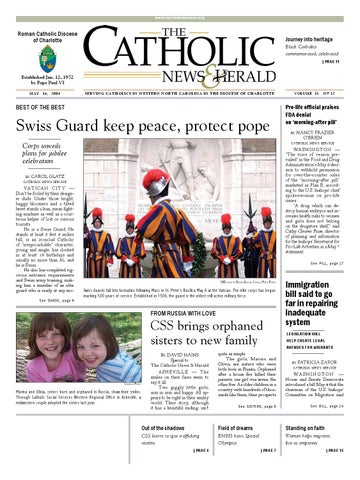
Swiss Guard keep peace, protect pope Corps unveils plans for jubilee celebration
See SWISS, page 9
no. 32
Pro-life official praises FDA denial on ‘morning-after pill’ by
NANCY FRAZIER O’BRIEN
catholic news service
WASHINGTON — “The voice of reason prevailed” in the Food and Drug Administration’s May 6 decision to withhold permission for over-the-counter sales of the “morning-after pill” marketed as Plan B, according to the U.S. bishops’ chief spokeswoman on pro-life issues. “A drug which can destroy human embryos and increases health risks to women and girls does not belong on the drugstore shelf,” said Cathy Cleaver Ruse, director of planning and information for the bishops’ Secretariat for Pro-Life Activities, in a May 7 statement.
by CAROL GLATZ catholic news service
VATICAN CITY — Don’t be fooled by their designer duds. Under those bright, baggy bloomers and a tilted beret stands a lean, mean fighting machine as well as a courteous helper of lost or curious tourists. He is a Swiss Guard. He stands at least 5 feet 8 inches tall, is an ironclad Catholic of “irreproachable” character, young and single, has clocked in at least 19 birthdays and usually no more than 30, and he is Swiss. He also has completed rigorous entrance requirements and Swiss army training, making him a member of an elite guard who is ready at any mo-
vOLUME 13
See PILL, page 17
CNS photo by Alessia Giuliani, Catholic Press Photo
Swiss Guards fall into formation following Mass in St. Peter’s Basilica May 6 at the Vatican. The elite corps has begun marking 500 years of service. Established in 1506, the guard is the oldest still-active military force.
From Russia with Love
CSS brings orphaned sisters to new family
Courtesy Photo
Marina and Olivia, sisters born and orphaned in Russia, show their smiles. Through Catholic Social Services Western Regional Office in Asheville, a midwestern couple adopted the sisters last year.
By DAVID HAINS Special to The Catholic News & Herald ASHEVILLE — The smiles on their faces seem to say it all. Two giggly little girls, arm in arm and happy. All appears to be right in their smiley world. Their story, although it has a beautiful ending, isn’t
Immigration bill said to go far in repairing inadequate system Legislation will help create legal avenues for migrants
quite as simple. The girls, Marina and Olivia, are sisters who were both born in Russia. Orphaned after a house fire killed their parents, one girl was seven, the other five. As older children in a country with hundreds of thousands like them, their prospects
WASHINGTON — House and Senate Democrats introduced a bill May 4 that the chairman of the U.S. bishops’ Committee on Migration said
See SISTERS, page 5
See BILL, page 14
by PATRICIA ZAPOR catholic news service
Out of the shadows
Field of dreams
Standing on faith
CSS learns to spot trafficking victims
BMHS hosts Special Olympics
Woman helps migrants live as amputees
| Page 4
| Page 7
| Page 15
2 The Catholic News & Herald
InBrief
May 14, 2004
Current and upcoming topics from around the world to your own backyard
Judge overturns feeding tube law; court battles likely to continue CLEARWATER, Fla. (CNS) — Despite a Florida judge’s May 6 ruling overturning Terri’s Law as “unjustifiable state interference” with constitutionally protected privacy rights, the court battles over braindamaged Terri Schiavo’s feeding tube were likely to continue. Schiavo, 40, was left brain-damaged in 1990 after a heart stoppage and has received nutrition and hydration through a feeding tube. But her estranged husband, Michael, has been battling in court to have the feeding tube removed, saying Terri would not want to be kept alive artificially. Six days after Terri’s feeding tube was removed in October 2003, the Florida Legislature approved a bill allowing Florida Gov. Jeb Bush to issue an executive order that tube-feeding be resumed. In his May 6 decision, Pinellas Circuit Court Judge Douglas Baird of
SIGNS OF stigmata?
Diocesan planner ASHEVILLE VICARIATE CNS photo courtesy of David Irion
David Irion observes the crucifix at Immaculate Heart of Mary Church in Marshall, Alaska. Some parishioners claimed the crucifix began to bleed from the nail markings during the Easter Vigil April 10. Bishop Donald J. Kettler of Fairbanks sent a representative to investigate and later said the person “couldn’t see any changes” on the crucifix.
Reports of bleeding crucifix bring pilgrims to
ANCHORAGE, Alaska (CNS) — Reports that a crucifix started bleeding from classic stigmata points has drawn visitors to a remote Alaskan village church. Immaculate Heart of Mary Church in Marshall, an Eskimo village of about 360 people, has been abuzz since the Easter Vigil, when a group of parishioners say the church’s main crucifix began to bleed from the feet, hands and side. Anna Polty, 73, and her friend Sophie Shorty claim they saw something happening to the crucifix during the April 10 Easter Vigil. A closer inspection after the vigil revealed the crucifix was bleeding. “Where they nailed his hands, and on his feet and on that cut on his side it was starting to bleed,” Polty said. “His knee starting to bleed too, and his elbow too. Started sliding down, all that blood.” Polty and Shorty asked three remaining parishioners and the visiting priest — Marshall does not have a resident pastor — to go look at the crucifix. Everyone agreed something strange was going on, Polty said. The visiting priest was unable to be reached for comment, but Polty said the priest couldn’t explain why the crucifix was bleeding. By Easter morning, the village was astir with the reports, and locals poured into the church to see for themselves.
Some noticed a change in the crucifix and others didn’t, according to Immaculate Heart parish administrator Clara Shorty. Over the next few days, people from surrounding villages started showing up to pray and study the crucifix. Clara Shorty estimated that in the three weeks after Easter, at least two dozen visitors had flown into Marshall — there are no roads to the village — some from hundreds of miles away. Bishop Donald J. Kettler of Fairbanks, whose diocese includes Marshall, sent a representative to check out the crucifix a few days after Easter. He said the representative “looked carefully and couldn’t see any changes.” But, the bishop added, that report does not mean that nothing happened. “As long as people are using it to strengthen their faith and are staying within the message of Jesus Christ, we can see it as a blessing, whatever it is,” he said. The bishop sent a letter about the crucifix to the parishes of his diocese, saying he will “continue to gather information and will proceed slowly, carefully and prayerfully.”
ASHEVILLE — The St. Martin De Porres Dominican Laity Chapter meets the fourth Monday of each month at 7 p.m. in the rectory building at the Basilica of St. Lawrence, 97 Haywood St. Inquirers are welcome. For more information, contact Beverly Reid at (423) 6338-4744 or bebereid@adelphia.net. HENDERSONVILLE — The St. Francis of the Hills Fraternity of the Secular Franciscan Order meets the fourth Sunday of each month 3-5 p.m. at Immaculate Conception Church, 208 7th Ave. West. Visitors and inquirers are welcome. For more information, call Helen Gillogly, SFO, at (828) 883-9645. BOONE VICARIATE SPARTA — St. Frances of Rome Church, Hendrix and Highlands Rds., sponsors the Oratory of Divine Love Prayer Group in the parish house the second and fourth Tuesday of each month at 1 p.m. Call (336) 372-8846 for more information. CHARLOTTE VICARIATE HUNTERSVILLE — St. Mark Church, 14740 Stumptown Rd., will host a Festival of Praise May 22, 8-10 p.m. The evening will feature praise and worship music by St. Mark’s LIFE TEEN band in addition to Adoration of the Blessed Sacrament. All are welcome. For details, call Debra Lemmon at (704) 948-1306. CHARLOTTE — The music ministry of St. Matthew Church, 8015 Ballantyne Commons Pkwy., will host a Christian Coffeehouse May 22 at 7:30 p.m. Single and married adults of all ages have found this to be a
Clearwater said the Florida Constitution “guarantees to every citizen the right to be the master of his or her own personal private medical decisions.” But the new law allows “unjustifiable state interference with the privacy right of every individual without any semblance of due process protection,” he added. Gov. Bush plans to defend the constitutionality of the law, and the issue is expected to reach the Florida Supreme Court. Burke Balch of the Robert Powell Center for Medical Ethics, a department of the National Right to Life Committee, said he hoped Baird’s decision would be reversed on appeal. He also expressed support for the Florida Starvation and Dehydration of Persons with Disabilities Prevention Act, a more comprehensive version of Terri’s Law that failed to pass in Florida’s recently ended legisla-
great place for entertaining and warm spiritual messages, evangelization and an opportunity for praise and worship music in a Christian environment. There is no charge to attend. To reserve a table for a group of six or more, call Kathy Bartlett at (704) 400-2213. HUNTERSVILLE — The Newcomers Women’s Ministry of St. Mark Church invites women who are new or still feel new to the area to a 10-week course entitled, “After the Boxes are Unpacked” based on the book by Susan Miller. We will talk about the spiritual, emotional and practical needs associated with moving. Classes will meet through June 23 in Room 200 of St. Mark Church, 14740 Stumptown Rd., 10:15 -11:45 a.m. followed by lunch. Call Gerry Phillips at (704) 895-2388 or Colleen Siadak at (704) 987-7920 for more information. CHARLOTTE — All women are invited to join Women in the Word for weekly gatherings for prayer, reflection on Sunday scripture, music and sharing experiences of Christ in daily life. The group meets each Thursday, 9:4511:45 a.m. in the family room of St. Gabriel Church, 3016 Providence Rd. For details, call Linda Flynn at (704) 366-9889. For childcare reservations, call Jurga Petrikene at 704) 9070205. CHARLOTTE — Thank God It’s Friday (TGIF), a weekly support group for separated and divorced women, meets every Wednesday, 6:30-8:30 p.m. in the New Life Center building, room 114, of St. Matthew Church, 8015 Ballantyne Pkwy., including a potluck dinner. Divorced men are invited every third Wednesday of the month. TGIF is a healing ministry sponsored by Catholic Social Services, Charlotte Regional Office and St. Matthew Church. For details, call Karen Wepasnick at (704) 5411891 after 3 p.m. GREENSBORO VICARIATE
maY 14, 2 0 0 4 Volume 13 • Number 32 Publisher: Most Reverend Peter J. Jugis Editor: Kevin E. Murray Staff Writer: Karen A. Evans Graphic Designer: Tim Faragher Advertising Representative: Cindi Feerick Secretary: Sherill Beason 1123 South Church St., Charlotte, NC 28203 Mail: P.O. Box 37267, Charlotte, NC 28237 Phone: (704) 370-3333 FAX: (704) 370-3382 E-mail: catholicnews@charlottediocese.org
The Catholic News & Herald, USPC 007-393, is published by the Roman Catholic Diocese of Charlotte, 1123 South Church St., Charlotte, NC 28203, 44 times a year, weekly except for Christmas week and Easter week and every two weeks during June, July and August for $15 per year for enrollees in parishes of the Roman Catholic Diocese of Charlotte and $23 per year for all other subscribers. The Catholic News & Herald reserves the right to reject or cancel advertising for any reason deemed appropriate. We do not recommend or guarantee any product, service or benefit claimed by our advertisers. Second-class postage paid at Charlotte NC and other cities. POSTMASTER: Send address corrections to The Catholic News & Herald, P.O. Box 37267, Charlotte, NC 28237.
The Catholic News & Herald 3
May 14, 2004
FROM THE VATICAN
Iraq abuse stories belie work of ‘great democracy’ disfigurement of the human person, represented by torture, could be perpetrated under its flag.” It said the photos of the Iraqi prisoners, “humiliated physically and morally in order to weaken their resistance to interrogators,” have rightly triggered widespread indignation. The scandal erupted after CBS released pictures showing grinning U.S. soldiers allegedly abusing and humiliating prisoners, some of them naked, in the Iraqi prison. Administrative and criminal investigations have begun and President George W. Bush, in interviews broadcast on Arab TV stations May 5, promised that the soldiers responsible would be punished. VATICAN CITY (CNS) — Bishops
GREENSBORO — Notre Dame Catholic High School is planning an alumni reunion for Aug. 14, 2004. For more information, call Nicholas Schnyder at (336) 333-3456 or e-mail nicholas. schnyder@bellsouth.net. HIGH POINT — Immaculate Heart of Mary Church, 512 Montlieu Ave., offers free “Gentle Fitness” classes Wednesdays and Fridays, 1:302:30 p.m. The classes are structured to the fitness levels of seniors and anyone wanting lowimpact aerobic workout. For more information, call Deana Collis at (336) 885-7029. GREENSBORO — Lucy Wellmaker, parishioner and life coach, will lead a follow-up session on Rick Warren’s book “The Purpose-Driven Life” May 19, 10-11:30 a.m. and 6:30-8 p.m. Both sessions will be held in the Kloster Center at St. Pius X Church, 2210 N. Elm St. These sessions are open to anyone who has read the book. For more information e-mail lwellmaker@triad.rr.com. HICKORY VICARIATE NEWTON — The Little Flowers Catholic Girls’ Group is for all Catholic girls ages five and up. The group meets the fourth Monday of each month at St. Joseph Church, 720 West 13th St., at 4 p.m. in the Holy Family Hall. For more details, call Debbie Vickers at (828) 495-2039. HICKORY — A Grief Support Group meets the second and fourth Wednesday of each month at 6:30 p.m. in the parlor of St. Aloysius Church, 921 Second St. NE. For more information, call the church office at (828) 327-2341. SMOKY MOUNTAIN VICARIATE
VATICAN CITY (CNS) — The abuse of Iraqi prisoners by U.S. soldiers represented an “unequivocal and inadmissible contrast with the principles of a great democracy,” the Vatican newspaper said. The report May 6 in L’Osservatore Romano was the first Vatican comment on the scandal over revelation of alleged torture and abuse of Iraqi captives at the Abu Ghraib prison in Baghdad. “The detailed revelations about the torture — in some cases deadly — inflicted on prisoners by forces engaged in Iraq and Afghanistan are affecting world public opinion and especially public opinion in the United States,” the newspaper said. Beyond global criticisms, it said, “it is precisely the U.S. people who have been most wounded in learning that this
Father Richard Cannuli will be this year’s director. The talks will focus on different aspects of St. Rita’s life and how her life has meaning for us today. For more information, call the parish office at (828) 456-6707. WINSTON-SALEM VICARIATE
Pope urges U.S. bishops to be close to their priests, encourage them must love, listen to, support and correct the priests in their diocese, Pope John Paul II told bishops from Michigan and Ohio. “As a spiritual father and brother to his priests, the bishop should do everything in his power to encourage them in fidelity to their vocation and to the demands of leading a life worthy of the calling they have received,” the pope told the bishops May 6 as part of their “ad limina” visit. The bishop, he said, must be close to all the people in his diocese, and built up the unity and communion of the church “in faith, hope and love” by establishing “an ever-closer relationship with your priests.” Pope John Paul said each bishop should relate to his priests “as a father and brother who loves them, listens to them, welcomes them, corrects them, supports them, seeks their cooperation and, as much as possible, is concerned for their human, spiritual, ministerial and financial well-being.”
The pope said the “bonds of fraternal unity” with and among priests must be strengthened, particularly through reinforcing the spiritual life and identity they share and their “life of celibate chastity.” Pope John Paul urged the bishops to take seriously their personal responsibility for the seminaries in their dioceses and for the training of candidates to the priesthood to produce men with “mature and balanced personalities, men capable of establishing sound human and pastoral relationships, knowledgeable in theology, solid in the spiritual life and in love with the church.” Bishops also must ensure that ongoing formation programs are in place for men who already have been ordained. “In this way, they will grow ever more fully into ‘men of the church,’ imbued with a truly catholic spirit and authentic missionary zeal,” the pope said.
The towering Mary
MT. AIRY — Holy Angels Church, 1208 N. Main St., offers Eucharistic Adoration every Wednesday, 6:30-7:30 p.m., and every Thursday, 10-11 a.m. Adoration concludes with Benediction. CLEMMONS — Holy Family Church, 4820 Kinnamon Rd., offers Eucharistic Adoration every Thursday. Exposition begins at 6 p.m. and benediction is at 9 p.m. WINSTON-SALEM — The Healing Companions is a grief support group for the bereaved that meets the first and third Thursdays of the month in conference room B at St. Leo the Great Church, 335 Springdale Ave. For further details, call Joanne Parcel at (336) 924-9478.
Is your parish or school having an event? Please submit notices for the Diocesan Planner at least 15 days prior to the event date in writing to Karen A. Evans at kaevans@charlottediocese.org or fax to (704) 370-3382.
WAYNESVILLE — St. John the Evangelist Church, 234 Church St., will hold three days of prayer in honor of St. Rita of Cascia, Augustinian nun, May 20 and 21 at 7 p.m. and May 22 at 11 a.m., followed by brunch. Augustinian
Episcopal
CNS photo by Karen Callaway, Northwest Indiana Catholic
calendar
Bishop Peter J. Jugis will participate in the following events:
May 16 — 12 p.m. Sacrament of Confirmation St. John Neumann Church, Charlotte May 17 — 7:30 p.m. Sacrament of Confirmation Queen of the Apostles Church, Belmont May 18 — 7 p.m. Sacrament of Confirmation Immaculate Heart of Mary Church, High Point
May 19 — 7 p.m. Sacrament of Confirmation St. Francis of Assisi Church, Lenoir May 22 — 5 p.m. Ordination to the priesthood of Jesus Guadarrama Our Lady of Guadalupe Church, Charlotte May 24 — 7 p.m. Sacrament of Confirmation
Residents of Hammond, Ind., view a 33-foot statue of the Virgin Mary outside Van’s Industrial Sheet Metal May 9. The giant statue was to have its first cleaning since its completion. Named Our Lady of the New Millennium, the piece was created by Wilmington, Del., sculptor Charles Cropper Parks for a Chicago man. It has traveled throughout the United States since its unveiling during Pope John Paul II’s 1999 visit to St. Louis.
Correction Several paragraphs were inadvertently omitted from the story “Welcoming the Stranger: Diocese of Charlotte reaches out to Hispanic immigrants” on page 8 of the May 7 issue. The complete story can be downloaded from the diocesan Web site at http://www.charlot-
4 The Catholic News & Herald
around the diocese
CSS welcomes new area director
Out of the shadows
by
JOANITA M. NELLENBACH correspondent
Courtesy Photo by Joseph Purello
Lauri Latuda, grants and programs administrator for the U.S. bishops’ Office of Migration and Refugee Services, speaks to 70 Catholic Social Services employees during an in-service training day at St. Aloysius Church in Hickory April 22.
CSS learns to spot trafficking victims by
KEVIN E. MURRAY editor
HICKORY — Catholic Social Services of the Diocese of Charlotte is continuing its efforts to bring the hidden problem of human trafficking out of the shadows. Seventy CSS employees learned to identify the signs and symptoms of human trafficking and how to assist victims during an in-service training day at St. Aloysius Church in Hickory April 22. The day’s featured presenter was Laurie Latuda, a grants and programs administrator with the Office of Refugee Programs in the U.S. bishops’ Migration and Refugee Services (MRS). “Oftentimes the only contact that people who have been trafficked have with the outside world is through religious ministers,” said Latuda. While those who profit from the trade in human beings often keep their victims under close watch, attending weekly Mass might be the only activity that the trafficker allows them to do alone. “In almost all cases, language barriers, lack of contacts in the new land, beatings and fear of reprisals on family members left behind combine to keep the victims silent and unable to flee to safety,” said Joe Purello, director of the diocesan Office of Justice and Peace of CSS. An estimated 18,000 to 20,000 victims of human trafficking — most of them women and children — enter the United States each year. The number of people brought across international borders worldwide for the sex trade or other forced labor is placed at anywhere from 400,000 to a million or more annually. These victims “often believe they are coming here to find the American dream,” said Latuda. Instead, she said, many victims find forced labor, sexual exploitation or other contemporary forms of slavery.
May 14, 2004
Because of the lack of legal immigration options, they sometimes pay people to smuggle them into the United States “and sometimes (the smugglers) turn out to be traffickers who enslave them,” she said. “It’s quite profitable,” Latuda added. “There are networks ... who traffic in people, just like there are networks of drug traffickers or arms traffickers.” “We must do all we can to fight our culture’s overwhelming trend to turn sexual activity into a commodity to be bought and sold,” said Purello, adding that, “the trend to turn sex into a commodity (on TV, in movies, in popular music) often involves packaging sex with violence.” “We are also called to be much more conscious of the working conditions of laborers who make and provide the goods we buy,” he said. “If a serious dent can be made in the demand side of the human trafficking business, then we will also see a significant fall in the number of people being trapped and exploited.” Anyone who suspects a trafficking situation that has not yet been reported or investigated should start by calling the Justice Department’s Trafficking in Persons and Worker Exploitation Task Force complaint line at (888) 428-7581, advised Latuda. That will initiate a federal investigation into the matter. People also can help the trafficked person obtain free or low-cost legal services from an attorney familiar with the provisions of the federal law. Latuda and others like her at MRS, who can be reached at (202) 541-3385, can help the trafficked person connect with local social service agencies that will help them before and after they are certified as trafficking victims. Nancy Frazier O’Brien of Catholic News Service contributed to this story. 1. Why and how did the person come into the country? Many trafficking victims are smuggled into the U.S. or come on
ASHEVILLE — Making the Catholic Social Services Western Region Office (CSS/WRO) very visible and better known so that it’s a place where people “can come and get help when they’re hurting” is one of Debra Braese’s goals. Braese has succeeded Sister Marie Frechette as CSS/WRO’s area director. Sister Frechette, of the Missionary Servants of the Most Blessed Trinity, is now heading the order’s mission advancement office in Philadelphia. “I saw this as an opportunity to work in an environment that supported my faith belief,” said Braese, a parishioner at St. Andrew the Apostle in Mars Hill. “I don’t think that opportunity comes along very often, so it was a good mix of my experience and my faith,” said Braese. “This position includes all the parts of social work and ministry that I like: counseling, outreach to the community, working with parishes and program development.” Braese has been a social worker for 24 years. She has worked in child protective services in the Buncombe County Department of Social Services (DSS), as a children’s outpatient therapist in a mental health center in Burlington, as assistant director of Haywood County DSS and as program manager for Buncombe County DSS. Braese holds a master’s degree in social work from the University of North Carolina at Chapel Hill. She said that it’s “important ... that CSS not be seen as a nonprofit agency that stands on its own, but that it is an extension of God’s light, that there’s hope and healing and outreach in the services that we provide. If parishes can embrace us as an agency that can help take care of our community, that’s a unique position to be in.”
Located in Asheville, WRO/CSS serves western North Carolina from Alleghany, Wilkes, Caldwell, Burke and Rutherford counties to the Tennessee border. Staff members, in addition to Braese, who provides individual counseling, are Lori Gilcrist, office manager; Ada Volkmer and Jerry Tudela, immigration specialists; Svetlana Gundorin, refugee specialist for people from the former Soviet
Debra Braese Union; Carol Meyerriecks and Michele Sheppard, international and domestic adoption workers; and Shelly Kilgore, adoption administrative assistant. Sheppard also handles pregnancy support. Contact Correspondent Joanita M. Nellenbach by calling (828) 627-9209 or e-mail jnell@dnet.net. WANT MORE INFO? For more information about services and any applicable fees, call (828) 255-0146.
How to Identify a Trafficked Person legitimate visas with the promise of a good job. Once here, they may be forced into a different job and/or work off their travel “debt.” 2. How was the person recruited? Many victims are recruited by acquaintances/people in their ethnic group who offer “success stories” in the U.S. Terms of their contract before departure are vague and they are surprised to learn they owe exorbitant debts for travel, lodging, food, etc. 3. Does the person have identification papers? Many victims have their documents seized upon arrival by their traffickers or employers. 4. Does the person owe money to his/ her employer? The person may have been promised a good job with pay but learned he/she must work off his/her travel debt. While doing so, he/she is charged exorbitant fees for rent, food and clothes leading them into a cycle of debt to his/her employer. 5. Does the person get paid a fair
wage? How many hours does he/she work? Does he/she receive compensation or does it go directly to the employer? 6. Where does the person live? Is their freedom restricted in any way? Victims may be forced to live in the same place where they work. They may not be allowed to leave the premises and/ or may be frightened into staying inside due to their immigration status and lack of documents (if the employer is holding them). 7. Has the person been threatened to prevent him/her from leaving? In addition to physical harm, the person may be subject to psychological intimidation and/or coercion through threats to family members if he/she tries to leave. — Migration and Refugee Services, Office of Refugee Programs
May 14, 2004
The Catholic News & Herald 5
around the diocese
Orphaned sisters find new home through CSS SISTERS, from page 1
for the stability and love of an adoptive home weren’t good. But thanks to Catholic Social Services (css) and a loving couple from Minnesota, Marina and Olivia traveled more than 6,000 miles from southeastern Russia to the Midwestern prairie of the United States. They now have a new country, a new home and new parents. The story of the sisters and the adoptive parents, Randy and Rita Ward of Eden Prairie, Minn., is heartwarming and typical for the International Adoption Program, based in the Western Regional Office of Catholic Social Services in Asheville. “We are the only Catholic agency in the country with a direct placement program in Russia,” said Carol Meyerriecks, international adoption director. Direct placement means the CSS office deals directly with Russian authorities in placing children in U.S. homes, usually making the adoption faster and less expensive than an agency that does not have direct placement capability. Still, adoption is expensive; according to Meyerriecks, the average cost of an international adoption is $24,000. The Wards, married for 16 years, decided several years ago that they wanted
Courtesy Photo
Marina and Olivia traveled more than 6,000 miles from southeastern Russia to the United States to live with Randy and Rita Ward. The adoption was made possible by the Western Region Office of Catholic Social Services in Asheville. to adopt. “Our lives forever changed after Randy’s parents died and then my 20-yearold son died,” said Rita Ward. “All we could do was turn to God and trust God to hold us through each day. When we thought about older kids who have lost parents, we knew that grief and loss was something we had experience with.” The Wards are somewhat unusual in that they are older than the typical adoptive parents. Randy is 50, Rita is 46. “Because of our ages, we wanted to
adopt sisters so that the children would always have someone they could to cling to, no matter what happens to us,” said Rita. “I prayed for this for a long time. My husband thought we would never get what we wanted, but every day I got on the Internet and sent out a few e-mails,” she said. “Last summer, I found a list of agencies certified for adoption by the Russian government, and that’s when I wrote to Carol.” The Wards have never met Meyerriecks in person, although they’ve talked on the telephone and exchanged e-mails many times. Usually in an adoption, the initial contact is followed by a home study, which is an in-depth background
check that certifies an applicants’ fitness to be adoptive parents. Since a home study had already been completed for the Wards, their adoption of the girls, which began in August, was completed by the fall. “International adoptions usually go quickly because there is a tremendous need for adoptive parents and the Wards were willing to take older children,” said Meyerriecks. The CSS staff in Asheville arranges happy endings, like the Wards and their new children, all the time. But Meyerriecks would like to do more. “Most couples prefer infant adoptions,” she said. “There are lots of great older kids out there who need a home.” In October 2003, the Wards traveled to Kirov, a five-hour drive from Moscow, and met their daughters-to-be. “Everyone was so very nice to us. It was very emotional for the orphanage since ours was their first adoption,” said Rita. “On the first night, we stayed in a hotel with the girls and got to know one another. They got very giggly and we all had a great time.” As with most adoptive parents, it was love at first sight, even though there was a language barrier. Neither of the Wards speaks Russian. “Randy and I have gotten very good at charades and sign language,” said Rita. “The girls always laugh whenever I try to pronounce something in Russian.” Marina and Olivia, who are in the second grade and kindergarten respectively, are adjusting to life in the United States with ease; they make regular trips to the nearby Mall of America and are learning about the Catholic faith at the Pax Christi Catholic community in Eden Prairie. Marina and Oliva will be baptized over the Memorial Day weekend. “They had no experience with church or prayer before coming here. They are celebrities at our parish,” said Rita. “Olivia gets mixed up sometimes and thinks Father Tim Power is Jesus, to which he responds ‘I’m a close personal friend.’” David Hains is director of communications for the Diocese of Charlotte. Contact him at (704) 370-3336 or e-mail dwhains@charlottediocese.org.
6 The Catholic News & Herald
around the diocese
May 14, 2004
Graduation day
Nearly 200 Abbey seniors join in 126th commencement exercises
Bishop Jugis receives honorary degree Abbey Basilica. John Paul II in St. Peter’s Basilica in Nearly a thousand students call Belmont Abbey home. The students, with diverse religious and cultural backgrounds, represent more than 18 countries and 34 states and pursue undergraduate degrees in a number of liberal arts course offerings. Founded in 1876, the college celebrates its heritage and is inspired by the Benedictine monastic tradition. Listed on the National Register of Historic Places, the college and Abbey Basilica greet thousands of visitors each year.
Rome. In 1993, Bishop Jugis received his doctorate in church canon law from Catholic University of America in Washington, D.C. Other recipients of honorary doctorates were Rev. Richard Boyce, professor of preaching and pastoral leadership at Union Theological Seminary and Presbyterian School of Christian Education in Charlotte, and Jim Palermo, executive in residence at Johnson & Wales University in Charlotte. Belmont Abbey College was named one of the country’s leading private liberal arts colleges by U.S. News and World Report. The 650-acre campus consists of the college, the monastery and the
Courtesy Photo
Almost 200 seniors receive degrees during Belmont Abbey College’s commencement ceremonies May 8. BELMONT — Graduating seniors bid a final adieu to the Abbey during Belmont Abbey College’s 126th commencement exercises May 8. The college presented to 193 graduates Bachelor of Arts and Bachelor of Science degrees. Faculty achievements were also recognized, including Dr. Sheila Reilly as the recipient of the 2004 Adrian Award. Bishop Peter J. Jugis was one of three leaders in the Charlotte community to receive honorary doctorates during the ceremonies. Ordained bishop of the Diocese of Charlotte at St. Matthew Church Oct. 24, 2003, Bishop Jugis previously served as
Courtesy Photo
Bishop Peter J. Jugis receives his honorary doctorate during Belmont Abbey College’s commencement ceremonies May 8.
pastor of Our Lady of Lourdes Church in Monroe and judicial vicar of the diocesan tribunal. A native of Charlotte, Bishop Jugis is a graduate of South Mecklenburg High School and earned a bachelor’s degree in business administration from the University of North Carolina at Charlotte before he entered Pontifical North American College, a seminary in Rome. He was ordained in 1983 by Pope
May 14, 2004
in our schools
Field of dreams
The Catholic News & Herald 7
BMHS student to join Radford basketball team Highlanders sign Smith in late signing
Courtesy Photo by Kernersville News
An athlete makes a long jump during the Forsyth County Special Olympics Spring Games held at Bishop McGuinness High School in Kernersville April 19-21. Approximately 600 athletes from schools throughout the county participated.
Bishop McGuinness hosts Special Olympics 600 Olympians compete in Spring Games KERNERSVILLE — Special athletes ages eight and up walked, ran, raced in wheelchairs, long-jumped and threw balls for winning ribbons during the Forsyth County Special Olympics Spring Games held at Bishop McGuinness Catholic High School. The games, held on the school’s field April 19-21, were part of the countywide Special Olympics program. The program allows children and adults with mental retardation or other closely related developmental disabilities to train and compete in a wide array of sports. It allows winning athletes to advance to international competitions. Approximately 600 athletes from schools throughout the county competed in the Spring Games, which were attended by approximately 1,200 parents, volunteers and athletes, according to Lisa Kiser, Forsyth County Special Olympics volunteer coordinator. “Every student in our school participated in some way,” said Ann Lynch, Bishop McGuinness director of advancement. “Bishop McGuinness has a long history of being involved with the Special Olympics as volunteers.” According to Shirley Shaw, Bishop McGuinness Spanish teacher, who coordinated the event and has been involved with Special Olympics for the past 10
years, this year’s Spring Games were held at the school rather than at Wake Forest University, their regular location, because of construction at the university. “Our folks loved it and would like to do it again,” said Shaw. “It just turned out really well and was really exciting.” Kiser said Bishop McGuinness’ long history of involvement made it a great choice for the Spring Games. “They are heavily involved,” said Kiser. “A quarter of their students are involved with Special Olympics sometime during the year.” Shaw said the volunteers have found through the years that by being involved, they receive even more than the athletes do. “The fact that they care so much and work so hard is really inspiring to us,” said Shaw. According to Lynch, although students had classes on Monday and Wednesday, the entire day Tuesday was devoted to volunteering at the games. Tuesday, which was the day the elementary-age Olympians competed, the school hosted a carnival, complete with games, food and drinks, a Krispy Kreme doughnut decorating machine and over 5,000 prizes, all of which were donated. The games began on Monday with an opening ceremony, at which all the
RADFORD, Va. — Radford University men’s basketball coach Byron Samuels announced his first signing of the late signing period, inking Bishop McGuinness Catholic High School student Branden Smith to a National Letter of Intent April 29. A senior at Bishop McGuinness in Kernersville, Smith will add more athleticism to Radford’s perimeter game. The 6-3, 180-pound combo-guard averaged 21.0 points per game and 5.0 rebounds per game. Smith also tallied 4.4 assists and 4.1 steals per game at Bishop McGuinness. Smith has a 43-inch vertical leap, giving him the ability to play under the basket, but he also has skill from beyond the arc, shooting 46 percent from threepoint land. “Branden Smith is a difference maker. He’s an excellent shooter and strong athlete. His size and strength help us immediately,” said Samuels. “What sets Branden apart are his love for playing and his love for competing. I’m 100 percent confident in Branden as a person, student and basketball player,” he said. In addition to his athleticism and shooting ability, Samuels is also excited about what role Smith, a native of Chesapeake, Va., will play for the Highlanders. “I envision him ... giving us one of elementary, middle, high school and adult competitors were present. Athletes were able to compete in various categories, including motor activities, jumps, shot puts, softball and tennis ball throws, relays, dashes, walks and wheelchair races. Game winners were awarded ribbons throughout the event. Brittany Shoemaker, 13, who has competed in Special Olympics for the past
Courtesy Photo
Radford University Men’s Basketball Coach Stan Kowalewski watches as Bishop McGuinness Catholic High School senior Branden Smith signs his National Letter of Intent to attend Radford University. the best backcourts in the Big South Conference and beyond,” said Samuels. “Branden can flat-out play, and I’m proud to have him in the Radford basketball family.” Smith will join Radford University this fall as a freshman with four years of eligibility. Smith is the third committed recruit the Highlanders have in place.
two years, said she enjoys everything about the event. “Everything is fun about it,” said Shoemaker. “I especially like running and swimming, and we only get like one minute of school.”
Courtesy Photo
Bishop McGuinness Catholic High School students volunteered at the Forsyth County Special Olympics Spring Games held at Bishop McGuinness Catholic High School April 19-21 From left: Thomas Porter, Brittany Bohannon, Jillian Smith, Marleny Ruiz, Ashley Moore, Marc Russel and Ashley Payne.
8 The Catholic News & Herald
After Africa
Priest returns to discuss mission work in Zambia CHARLOTTE — From Charlotte to Zambia and back again, Capuchin Father Steve Hoyt is living his dream. Father Hoyt, former chaplain at Charlotte Catholic High School, departed for Zambia in September 2002. His journey was the fulfillment of a dream to serve as a missionary since joining his order almost 20 years ago. Father Hoyt will return to the school to discuss his work in Zambia on Sunday, May 16. The free event will include presentations about issues facing young Zambians and how they can be assisted through prayer, service and awareness. Father Hoyt first got a taste of mission life in February 2002, when his order arranged a visit to the Capuchin mission headquarters in Zambia’s capital. He described the experience as humbling. “So many Zambians expressed their honor and pleasure to meet me,” he said. “They gave me so much more than I could possibly give them. I witnessed their endurance, suffering and the beauty of their faithfulness and love stemming from the family.” When he left for Zambia in September 2002, he was one of 35 Capuchins working at three mission sites separated by 300-400 miles. Capuchin mission work in Zambia, which is about the size of Texas, originated in 1932 when the Irish Capuchins established the first mission in Loanja. In 1965, U.S. Capuchins took over missions in Chinyingi and Zambezi. They have continued to expand their reach and establish new missions. Want to Go?
The “meet and greet” with Capuchin Father Steve Hoyt will take place in the chapel of Charlotte Catholic High School on Sunday, May 16. Mass is at 1 p.m.; Father Hoyt’s presentation is at 2 p.m.
May 14, 2004
AROUND THE DIOCESE
Holy Angels honors volunteers at annual banquet
Courtesy Photo
Missy Tiber, Dr. Richard Rankin, Lora Grant and Brittany Hampton display their awards at Holy Angels’ 14th Annual Volunteer Appreciation Banquet April 22. BELMONT — Holy Angels presented volunteer awards during the 14th Annual Volunteer Appreciation Banquet April 22 as part of Volunteer Appreciation Week celebrations. Founded in 1956 by the Sisters of Mercy, Holy Angels is a nonprofit corporation providing residential services programs for children and adults with varying degrees of mental retardation and physical disabilities, some of whom are medically fragile. Volunteer of the Year went to Brittany Hampton of Stanley. Hampton has been a volunteer in the Oakcrest Fox Run ICF/MR (Intermediate Care Facilities for the Mentally
Retarded) since September 2003. A junior at East Gaston High School, Hampton developed an interest in volunteering following a presentation on Holy Angels at her school. Volunteer Group of the Year went to Gaston Day School in Gastonia. This past year, Holy Angels and Gaston Day School formed a unique partnership. The two organizations have similar goals for the students they serve — to help each individual reach his or her highest potential through creative programs and services. Both organizations were committed to making this a most interesting and innovative partnership, filled with oppor-
tunities for the students to participate in a variety of educational and service activities. The students were offered opportunities with the potential to change the way they view the community and accept the differences of the people who live there. The Holy Angels residents enjoyed soccer, basketball and volleyball games — many for the first time. Several students volunteered during their afterschool hours. Gaston Day School students also raised over $9,000 during the Hands Around Our School fundraiser. The Ed Sabatini Advocacy Award went to Lora Grant of Belmont. Named in honor of the late Ed Sabatini, the award recognizes an individual or group who serves as an advocate of Holy Angels. Grant has been a creative, enthusiastic and driving force behind many Holy Angels programs. She was often an ambassador to recruit volunteers for activities for Holy Angels, such as the Angel Bowl, and worked to promote Holy Angels’ Cherubs Café & Candy Bouquets in Belmont. The Dennis McClain Volunteer of the Year Award went to Missy Tiber of Cramerton. Dennis McClain was a classroom volunteer at the former Maria Morrow Center who signed up as a volunteer after learning he had a terminal illness. McClain came with his wife, Maria, two hours each week to assist students with a variety of classroom activities. His last visit was just days prior to his death. Tiber, Belmont Abbey College’s women’s basketball coach, has been a volunteer since August 2003. She has accompanied residents on field trips, assisted the Holy Angels Foundation with the Hands Around Our School project, and recently ran for Holy Angels in the “Run for the Money” race where she won second place in her division.
May 14, 2004
Protecting the SWISS, from page 1
ment to sacrifice his life for the pope. The papal Swiss Guard tradition has been marching on for nearly 500 years — making it the oldest, continually active military corps in history. On May 5, the corps unveiled plans for its 2006 jubilee celebration. Events will include a commemorative march from Switzerland to Rome to re-enact the Guard’s entry into Rome half a millennium ago and to reaffirm that the corps’ spirit and dedication to protect the pope have never dimmed. Poised and ready Many people, however, do not see that side of the guards as they stand duty at one of the Vatican’s entrances. Most tourists see them as the perfect setup for a souvenir snapshot. “They’re not just buttoned up, ready for show; they’re very highly trained for any emergency,” said Msgr. Charles Burns, a church historian who spent more than 25 years as an official of the Vatican archives. “And they’re not sloppy guards. You won’t see them slouching or hanging around smoking a cigarette like the carabinieri,” he said, referring to the Italian military police. The Swiss Guards “take their job very seriously and bring great commitment to it,” he said. Pope John Paul paid tribute to that centuries-old commitment in a May 6 address to 33 new recruits before they took their oath of allegiance later that day in the Vatican. “Thank you for your service to the successor of Peter and his collaborators here in the Vatican. It is a demanding commitment and perhaps sometimes tiresome, but God will re-
The Catholic News & Herald 9
FROM THE COVER
ward you,” he said. Enduring 24-hour shifts, most Swiss Guards find their greatest battle is putting up with thousands of tourists asking the same questions: “Is there a bathroom?” “Which way to the museum?” and “Why can’t I see the pope?” The Swiss Guards attend to the same questions day after day with poise and sometimes even a smile. The pope’s speech to the new recruits came on the day the Vatican honored the 147 Swiss Guards who lost their lives defending Pope Clement VII in the sack of Rome in 1527. Only 42 guards survived. On this anniversary the Vatican holds a swearing-in of all new guards to help remind them of the seriousness of their commitment. History of loyalty The sack of Rome marked the bloodiest day in Swiss Guard history. After that, no other combat deaths have been recorded. Wielding nothing but Renaissance weaponry, this tiny army kept Nazi soldiers out of Vatican City as Germany occupied Rome during World War II. The last time the Swiss Guard ever lost to an invader was in 1798 when Napoleon swept through, disarmed and disbanded the corps and abducted two popes in two years. One of those popes, Pius VI, died in captivity. After that, the guard’s record is impeccable, keeping popes and papal territory safe and protected since their troops regrouped in 1800. It was an undercover Swiss Guard who helped shield Pope John Paul II during the assassination attempt against his life May 13, 1981, in St. Peter’s Square. Perhaps the darkest moment in the Guard’s history occurred in 1998 when its former commander, Col. Alois Estermann, and his wife, were
CNS photo by Alessia Giuliani, Catholic Press Photo
Swiss Guards stand in formation at the Vatican May 6. The elite corps has begun marking 500 years of service. Established in 1506, the guard is the oldest still-active military force.
CNS photo from Reuters
A Swiss Guard stands near as Pope John Paul II prays during a special audience at the Vatican April 3. murdered by a disgruntled corpsman, Cedric Tornay, who then turned the gun on himself. Today, numbering 110 men, the Swiss Guard may still be the world’s smallest army. The long march Pope Julius II formally requested the service of Swiss mercenaries — famed for their courage and loyalty — in June 1505. Just three months later, a regiment left Switzerland and headed on foot for Rome. One hundred and fifty Swiss sol-
diers arrived at the Vatican Jan. 22, 1506, the day that marks the official founding of the corps. Now, nearly 500 years later, the Swiss Guard is gearing up for a full year-and-a-half of jubilee celebrations. Lt. Gen. Beat Fischer, commander of the Swiss Army Corps and president of the Swiss Guard jubilee committee, said at a Vatican press conference May 5 that at least 100 former guards will leave from Bellinzona, Switzerland, in early April 2006 and head to Rome on foot. After Milan, Italy, they will follow the historical pilgrims’ route, the Via Francigena. By leaving in April, the modernday marchers will avoid trekking across the Alps in the winter. They will also make just 26 stops along the way — representing Switzerland’s 26 cantons — to arrive in Rome a month later in time for the annual swearing-in ceremony for new guards May 6, 2006, in the Vatican. Any likelihood of there someday being a Miss Swiss Guard? Nixed. “Not under my command,” said Col. Elmar Mader, commander of the Swiss Guard. “It’s a very ecclesial environment” and “60 percent of our corps is under the age of 25; women in the same barracks (as the men) would create big problems,” he said. Avoiding the battle of the sexes just might be their riskiest campaign yet.
1 0 The Catholic News & Herald
FAITH AND HERITAGE
Revival energizes black Catholics By Mary Ann Wyand Catholic News Service INDIANAPOLIS — An hour of praise and worship and a nearly-twohour revival energized participants at the National Black Catholic Convocation April 20 at St. Rita Parish in Indianapolis. During the revival, Father Patrick Smith, pastor of St. Teresa of Avila Parish in Washington, challenged black Catholics to grow in faith and to reach out to young people who desperately need to hear about the good news of Jesus Christ. His talk was based on Ezekiel’s vision of dry bones that are brought to life by God, as described in chapter 37, verses 1-14. “What God wants to do is change the lyrics of your life. We need to take the time to listen to the word,” Father Smith said. “We need to talk about teen pregnancy and abortion, stuff we don’t talk a whole lot about sometimes,” he said. “But, realistically, why talk about the teen pregnancy rate or the abortion rate or the divorce rate or the illiteracy rate or the teacher turnover rate in inner-city schools or the crime rate or the homicide rate or the unemployment rate? Why talk about all that if there is no solution?” The priest added, “Unless we bring this stuff into the light, we’ll never be healed of it. Things change when they get brought into the light. But I think we’re just basically afraid.” God brings life to dry bones, he said, referring to Ezekiel. “He wants you to see just what it looks like when he’s not present,” Father Smith said. “He wants you to see the mess as it really is. He wants you to know that you can’t fix it yourself. ... I can’t revive anybody. That’s not my
May 14, 2004
job. It’s God’s job. The question is: Are we ready to be revived by him?” After the revival, Father Smith said “young people are ready for the radical Gospel, of truly imitating Christ. They’re waiting for the (church) leadership to say, ‘OK. Let’s go.’ They need to hear it.” Msgr. Ray East, director of the Office of Black Catholics for the Archdiocese of Washington, led the praise and worship. After the revival, Msgr. East said many teenagers and young adults are very involved in ministry and mission outreach. The challenge is to involve all youths in church ministries. “They’re today’s church leaders,” he told The Criterion, newspaper of the Indianapolis Archdiocese. “All we need to do is give them the microphone. The Lord is already using them. They’re already in ministry.” During the National Catholic Youth Conference last November in Houston, Msgr. East said, he heard teens share powerful mission stories. “Young people had already gone on mission trips,” he said. “They had already been to Guatemala, Honduras, El Salvador and Haiti, and they were sharing their mission stories. They were trained missioners, and they were only 14 and 16 years old. I couldn’t believe it. “What we need to do is highlight what they’re doing and support them in the ministry that God has already given them,” he said. “I think they have so much to teach us. It’s like God speaks to us through the young people and, with open minds and open hearts, we’ll learn from them. I believe that our young people will lead us.”
CNS photo by Mary Ann Wyand, The Criterion
Musician Roscoe Hager from the Leon C. Roberts Liturgical Institute drums during the National Black Catholic Convocation revival at St. Rita Church in Indianapolis April 20. He is a member of St. Augustine Church in Washington.
Journey into heritage
Black Catholics comm by
KAREN A. EVANS staff writer
BALTIMORE — Forty-seven Catholics made a heritage pilgrimage to Baltimore and Washington, D.C., April 30-May 2, the second such trip sponsored by the African American Affairs Ministry (AAAM) of the Diocese of Charlotte. “We selected sites that were of particular interest to black Catholics and those interested in the contributions of blacks to our faith and our society,” said Rev. Mr. Curtiss Todd, vice-chancellor of the diocese and vicar for the AAAM. The AAAM was established in 1985 “to coordinate the efforts of black Catholics in the Charlotte Diocese,” wrote then-Bishop John F. Donoghue. “This coordination would give visibility to the work of black Catholics in the diocese and educate various diocesan groups to the needs and contributions of black Catholics in the church.” The pilgrims, most of whom are parishioners of Our Lady of Consolation Church in Charlotte and of St. Benedict the Moor Church in Winston-Salem, first visited the National Shrine of the Immaculate Conception in Washington, where the highlight of the tour was Our Mother of Africa Chapel. A gift of African-American Catholics under the leadership of the Black Bishops of the United States and the National Black Catholic Congress (NBCC), the chapel was dedicated by Cardinal James Hickey Aug. 30, 1997. The pilgrims were notably excited when they reached the chapel, several murmuring, “Here’s our chapel,” and “This one is ours.” A few members of the group took a moment to pray at the foot of the bronze statue of Mary and the infant Jesus, while others snapped photos of the sculptures of the four gospel writers, each depicted with African features. According to the NBCC Web site, Our Mother of Africa Chapel is char-
acterized by the term “sacred conversation” — the integration of sacred persons into a single scene, illustrated by a narrative bas-relief sculpture chronicling the African-American odyssey. A black ebony Christ was created using a centuries-old African carving tradition. The marble inlay at the threshold of the chapel shows the “Henrietta Marie,” a 17th-century slave ship. The mahogany vault ceiling is reminiscent of the hulls of such sailing vessels. Saturday afternoon was devoted to visiting the Great Blacks in Wax Museum in Baltimore. Committed solely to the study and preservation of African-American history, the museum contains more than 100 wax figures depicting nearly 3,500 years of black history, from the pharaoh Akhenaton, who ruled Egypt 1380-1362 B.C., to current U.S. Secretary of State Colin Powell. A somber mood overtook the group as they walked through the slavery exhibit depicting the inhumane conditions slaves endured on “The Middle Passage” — the crossing of the Atlantic Ocean from West Africa to the Americas — as well as the horrible conditions of their captivity. However, the museum focuses primarily on the contributions blacks have made to the world — from the writings of Alexander Pushkin and Phyllis Wheatley to the space exploration of Dr. Mae Jemison and Dr. Ronald McNair. It also celebrates the achievements of Harriet Tubman; Frederick Douglass; educators George Washington Carver and Booker T. Washington; Bishop Richard Allen, founder of the African Methodist Episcopal Church, and many others. Sunday morning the pilgrims attended Mass at St. Francis Xavier Church, the first Catholic church in the United States officially established for blacks. The church was founded in 1863 by a group of black Catholic San Domingo refugees and the Sulpician Fathers, who had fled the French Revolution and settled in
May 14, 2004
FAITH AND HERITAGE
The Catholic News & Herald 11
memorated, Baltimore. The pilgrimage concluded with a visit to the motherhouse for the congregation of the Oblate Sisters of Providence, the first order of black nuns. Led by Mother Mary Lange (nee Elizabeth Clarissa Lange), four free black Catholic women founded the Oblates in 1828. Despite being a free black in a slave-holding state, a woman in a maledominated society, Catholic at a time when it was not popular to be Catholic and French-speaking in an American city, Lange was determined to serve the Catholic Church and to serve her people. Through her leadership, the Oblates offered vital services to blacks in the Baltimore area, including educating children and providing homes for orphans. Today, Oblate sisters work in the
areas of parish planning, administration, adult education and retreats, with education continuing to be their primary focus. They can be found in ministries in seven states, the District of Columbia, Costa Rica and the Dominican Republic. When Our Lady of Consolation Church in Charlotte had a parochial school, it was administered by Oblates sisters, so several of the pilgrims received an enthusiastic welcome from their former teachers and principal. Rev. Mr. Todd said he hoped the pilgrims came away from the trip with a sense of pride and a deeper knowledge and appreciation of what early black Catholics endured. For example, the Oblate sisters faced severe prejudice and discrimination, and still do today. He also hoped the pilgrims gained a sense of gratitude and a deepening of
Photo by Karen A. Evans
Amidst the scaffolding set up for the renovation of the church, Catholics from the Diocese of Charlotte listen to the homily during Mass at St. Francis Xavier Church in Baltimore May 2.
Black Catholics in
The Popes
Pope St. Victor I Born in Africa, St. Victor served as pope from 189 until 198. St. Victor condemned and excommunicated Theodore of Byzantium for his denial of the divinity of Jesus Christ. He was buried near the body of the apostle Peter in St. Peter’s Basilica. Some reports relate that St. Victor died of natural causes, while other accounts state he suffered martyrdom. Pope St. Melchiades St. Melchiades occupied the papacy from 311 to 314. St. Melchiades decreed that none of the faithful should fast on Sunday or on the fifth day of the week, because this was the custom of the pagans. St. Melchiades led the church to final victory over the Roman Empire. Pope St. Gelasius I St. Gelasius occupied the papacy from 492 until 496. He delivered the city of Rome from the peril of famine. He was known for his austerity of life and liberality to the poor.
The Saints Photo by Karen A. Evans
Cheyenne Lipscomb prays before the statue of Mary and the infant Jesus in the Our Mother of Africa Chapel at the National Shrine of the Immaculate Conception in Washington, D.C. May 1.
St. Augustine St. Augustine was born in Tegaste, Africa. The Christian training by his mother, St. Monica, influenced his entire life. He was highly educated and used his great abilities to lead men to love God. His letters, sermons, tracts and books instructed the early church and have relevance for the church today. Two of his most famous books are his autobiography, “Confessions,” and “City of God.”
St. Benedict the Moor St. Benedict the Moor was born in Sicily in 1526. The son of African slaves, he was freed at an early age. When he was 21, he was insulted because of his color, but his dignified bearing caused a group of Franciscan hermits to invite him to join their community. In 1564, he joined the Franciscan friary in Palermo and worked in the kitchen until 1578, when he was chosen superior of the group. He carried through the adoption of stricter interpretation of the Franciscan rule. St. Martin de Porres At age 11, St. Martin took a job as a servant in the Dominican priory and was later placed in charge of the infirmary, where he became known for his care of the sick and his miraculous cures. In recognition of his deep devotion, his superiors dropped the stipulation that “no black person may be received to the holy habit or profession of our order.” On May 16, 1962, Pope John XXIII made Martin de Porres the first black American saint. St. Monica Through her patience, gentleness and prayers, St. Monica converted her pagan husband. She gave thorough religious training to her son, only to see him later scorn all religion and live a life of disrepute. Before her death, St. Augustine had returned to God and was using all his energies to build Christ’s Church. Source: The National Black Catholic Congress
1 2 The Catholic News & Herald
May 14, 2004
Culture Watch
A roundup of Scripture, readings, films and more
New Jersey nun writes coloring book on life of Pope Pius XII by JOHN THAVIS catholic news service
ROME — Of the myriad books — pro and con — written about Pope Pius XII in recent years, “Pius XII: The Children’s Pope” is certainly one-of-a-kind. It is a coloring book with a narrative text that touches on the late pope’s ecclesial career, his assignment as nuncio to Germany during the Nazi rise to power, his actions during the Holocaust and his relations with the United States — all in 28 pages. Written by Sister Margherita Marchione, a member of the Religious Teachers Filippini order in Morristown, N.J., the coloring book has been released in
CNS photo by Alessia Giuliani, Catholic Press Photo
New Jersey Sister Margherita Marchione displays a portrait of Pope Pius XII in St. Peter’s Square in early December. The member of the Religious Teachers Filippini order recently wrote “Pius XII: The Children’s Pope,” a 28-page coloring book with a narrative text that touches on the late pope’s ecclesial career, his assignment as nuncio to Germany during the Nazi rise to power, his actions during the Holocaust and his relations with the United States.
two bilingual editions: English/Spanish in the United States and Italian/English in Italy. “I took a copy to (Pope John Paul II’s) secretary, and he was delighted. I told him we should have it translated into
Polish, too,” Sister Marchione said during a visit to Rome in late April. Sister Marchione has been one of the staunchest defenders of Pope Pius XII against the accusation of “silence” during the Nazi persecution of Jews. In several books, she has presented evidence that the pope quietly worked to help save the lives of Jews and others. Her coloring book, not surprisingly, takes a sympathetic tone and avoids any hint of controversy. Written in very simple language, it describes the pontiff as a gentle, caring soul who battled adversity all his life. “I think it’s important that children discover the goodness of this man. By getting the children interested, you’ll get the parents interested,” she said. In a page titled “The Holocaust,” the book says, “In Germany, Adolf Hitler killed thousands of Jewish people and others. The pope saved many by hiding them in the Vatican and in convents and monasteries. He also provided them with money, food and clothing.” It cites a letter from Jewish concentration-camp survivors thanking the pope for his actions. Elsewhere, it relates that as a young priest he helped a Jewish family flee to Jerusalem when they were treated badly by Italians. The coloring book recalls how Pope Pius once found an injured bird in the Vatican Gardens and nursed it back to health. It would perch on his shoulder during mealtimes, hopping down to eat from its own dish of seeds and keeping him company. Sister Marchione said these are human touches that risk being overlooked in the debate about the pope’s wartime role. The nun said Paulist Press is publishing this book in the United States at the price of $1. The Vatican is in the early stages of considering the sainthood cause of Pope Pius XII, which involves the drafting of a “positio” or dossier with thousands of pages of evidence and testimonials.
WORD TO LIFE
Sunday Scripture Readings: MAY 23, 2004
May 23, Seventh Sunday of Easter Cycle C Readings: 1) Acts 7:55-60 Psalm 97:1-2, 6-7, 9 2) Revelation 22:12-14, 16-17, 20 3) Gospel: John 17:20-26 by BEVERLY CORZINE catholic news service
The Easter Season that we anticipated through the long weeks of Lent is itself drawing to a close. For me, the Vigil this year began on a cold wet Saturday night that seemed more like November than early April. Outside the church the Boy Scouts, not deterred in their efforts to build the Easter fire, proudly stood watch over the Easter flames. Our priest prepared the candle with ancient words of prayer that mark the passage of another year of our Lord; then the great paschal candle began its journey into the warm darkness of the church. “Christ Our Light!” the deacon chanted at the threshold of the church. Our community responded with joy, “Thanks be to God!” Once the paschal candle reached its destination by the baptismal font, the words of the Easter Proclamation filled the darkened church, reminding us with each verse that this holy night was like no other in the year. “This is our Passover feast.” The repetitive “This is the night” continued rhythmically through the Exultet, bringing home the truth of God’s love for us and the importance of remem-
bering the stories of salvation history. In the candlelight, I looked into the faces of our candidates for baptism and of those who had been baptized in other Christian communities and soon would be received into the church. Joy and expectation filled their faces. Here were ordinary people, both young and older, who had stories of how the God of the universe somehow had invited each of them to this very moment. I have been blessed this past year because I have come to know each of them and have been entrusted with their stories of struggle and coming to faith. In the life of each person there, listening to the Easter Proclamation and waiting to receive the sacraments for the first time, there were people who pointed the way to Jesus. Some, in fact, may never know how important they have been in someone’s journey of faith. In John’s Gospel, Jesus prays not just for the disciples “but also for those who will believe in me through their word so that they may all be one, as you, Father, are in me.” In the long continuum of time, men and women wish to be one with the Father and Son because someone passed on the faith. Someone became a beacon of light in a dark world. Questions: Who are some of the people who have pointed the way to Jesus for you? How have you helped light the way in someone’s journey of faith? Scripture to Illustrate: “To them I have revealed your name, and I will continue to reveal it
WEEKLY SCRIPTURE Scripture for the week of May 16 - May 22 Sunday (Sixth Sunday of Easter), Acts 15:1-2, 22-29, Revelation 21:10-14, 22-23, John 14:23-29; Monday, Acts 16:11-15, John 15:26—16:4; Tuesday (St. John I), Acts 16:22-34, John 16:5-11; Wednesday, Acts 17:15, 22—18:1, John 16:12-15; Thursday (Ascension of the Lord), Acts 1:1-11, Ephesians 1:17-23, Luke 24:46-53; Friday (St. Christopher Magallanes and Companions), Acts 18:9-18, John 16:20-23; Saturday (St. Rita of Cascia), Acts 18:23-28, John 16:23-28 Scripture for the week of May 23 - May 29 Sunday (Seventh Sunday of Easter), Acts 7:55-60, Revelation 22:12-14, 16-17, 20, John 17:2026; Monday, Acts 19:1-8, John 16:29-33; Tuesday, Acts 20:17-27, John 17:1-11; Wednesday (St. Philip Neri), Acts 20:28-38, John 17:11-19; Thursday, Acts 22:30; 23:6-11, John 17:20-26; Friday, Acts 25:13-21, John 21:15-19; Saturday, Acts 28:16-20, 30-31, John 21:20-25
DON’T PROCRASTINATE! CALL NOW!!
The Catholic News & Herald 13
May 14, 2004
‘Fog of War’ makes clear the mind of former defense by ANNE NAVARRO catholic news service
NEW YORK — Director Errol Morris’ documentary “The Fog of War” is a riveting look at a man, a government and a turbulent time in a country’s history that both examines the past and contemplates the present. Morris peers into the mind of Robert McNamara, the U.S. secretary of defense under Presidents John F. Kennedy and Lyndon B. Johnson, and what is revealed is at turns intimate, anticipated and surprising. Still full of energy and opinions at age 85, McNamara is a fine subject, an entertaining character as well as a man of substance. He seems like a man trying to make amends, but on his own terms. It is as if he wants to reshape his image into one of a more gentle, thoughtful man, even during the time of his appointment. It is easy to see why “The Fog of War” won the Academy Award for Best Documentary. Morris tightly weaves varying elements into his story, from history to personalities to morality, using McNamara as a guide. Yet Morris clearly conveys to the audience the guide’s biases and inclinations. (McNamara fully admits he has learned to answer not the question that was asked, but the question he would have wanted asked.) It is a film as much about McNamara as a high-powered government official attempting to balance power, ambition and moral responsibility as it is about the Vietnam War and Cold War. On its surface, the film is visually slick, using precise editing, gripping wartime footage and clever illustrations to drive home a point. All of this is tied together with a synergetic score that punctuates the film’s theme that humans are fallible creatures and war is messy
business. McNamara, eyes twinkling, imparts lessons he has learned along the way about human nature and the nature of warfare. Morris divides these into 11 title cards, encapsulating each tutorial succinctly with headings such as “No. 1, Empathize with your enemy,” “No. 8, Be prepared to re-examine your reasoning,” and “No. 9, In order to do good, you may need to engage evil.” Although it is not closely examined, the morality of going to war weighs heavily in the air. McNamara describes World War I as a celebration in the belief that the world could now avoid war among great nations. There is no need to elaborate any more on the irony of his point. He declares, “War is so complex, we can’t comprehend all the variables,” a thought that resonates with Americans, especially now. It is in his revelations of closed-door discussions that the viewer can begin to grasp the machinations of engaging the enemy. And given our own turbulent times, the viewer anticipates that McNamara will comment on the war in Iraq, which he disappointingly does not do. “The Fog of War” engages with its pitch-perfect tone and finely crafted storytelling, leaving the viewer wanting more. Because of some frightful scenes of war and a few instances of profanity, the USCCB Office for Film & Broadcasting classification is A-II — adults and adolescents. The Motion Picture Association of America rating is PG13 — parents are strongly cautioned. Some material may be inappropriate for children under 13.
‘Minute’ is double-trouble fun
CN S photo from Warner Bros. Pictures
Mary-Kate and Ashley Olsen star in “New York Minute,” a cotton-candy comedy about twin sisters with polar opposite personalities who wind up being pursued around Manhattan by a bungling gangster and an overzealous truant officer. The frothy but forgettable fluff keeps its screwball silliness sanitary while promoting a family-value message, that, compared to harder-edged teen fare, most parents would take in a New York minute. Some slight sibling issues and mild sensuality. The USCCB Office for Film & Broadcasting classification is A-II — adults and adolescents. The Motion Picture Association of America rating is PG — parental guidance suggested.
Movie capsules “Mean Girls” Catty teen comedy about an insecure 15-year-old, home-schooled for most of her life and raised in the African bush, who gets a crash course in the law of the social jungle when she is thrust into a public high school and gets stung by its reigning queen bee. The film explores the psychological minefields navigated by many young girls and imparts a positive self-esteem message, but its hard-edged sexual references make it unsuitable for the ‘tween and teen audience it seems aimed at. Recurring crude language and humor, some drug references and implied underage drinking. The USCCB Office for Film & Broadcasting classification is A-III — adults. The Motion Picture Association of America rating is PG-13 — parents are strongly cautioned. Some material may be inappropriate for children under 13.
“Van Helsing” Dreadful action adventure about a notorious monster hunter sent to Transylvania by a secret Vatican agency and charged with helping a local vampire slayer rid the world of Count Dracula and other fiendish creatures including werewolves and Frankenstein’s monster. Despite stylishly gothic atmospherics, this long, loud and ludicrous monster mash amounts to little more than overwrought special-effects sequences without any thought given to story — let alone characters to sink your teeth into. Incessant comic-book violence, an implied sexual encounter, some innuendo and frightening images. The USCCB Office for Film & Broadcasting classification is A-III — adults. The Motion Picture Association of America rating is PG-13 — parents are strongly cautioned. Some material may be inappropriate for children under 13.
1 4 The Catholic News & Herald
IN THE NEWS
Immigration bill to fix BILL, from page 1
would go far to repair an inadequate immigration system. The Safe, Orderly Legal Visas and Enforcement, or SOLVE, Act would allow people who have entered the country illegally to apply for legal residency if they have been here for more than five years and held jobs. It also would break through backlogs in applications for family reunification visas and create two programs for workers in low-skilled, temporary jobs. In a statement the same day, Coadjutor Bishop Thomas G. Wenski of Orlando, Fla., offered his support for the bill as chairman of the migration committee. The bill reforms “crucial areas of our immigration system in a way that protects the rights of U.S. and foreign workers; promotes family unity; and grants migrant workers and their families in the United States the opportunity to become permanent residents, and if they so choose, U.S. citizens,” Bishop Wenski said in the statement. In introducing the bill in the Senate, Sen. Edward Kennedy, D-Mass., said much of the nation’s economy depends upon immigrant labor, yet millions of those workers lack the legal right to be in the country. “These workers and their families live in constant fear of deportation and are easy targets of abuse and exploitation by unscrupulous employers and by criminals,” he said. “Many risk great danger and even death to cross our borders.” Bishop Wenski said the legislation will help create legal avenues for migrants to come to the United States and join their families. “It will significantly repair an immigration system which is inadequate to meet the migration flows of the 21st cen-
tury and which all too often undermines the basic rights and dignity of the human person,” his statement said. The U.S. bishops “witness almost daily the exploitation and abuse of migrant workers who seek to support themselves and their families; the discord in local communities, especially along our southern border, which are impacted by immigration; and, most disturbingly, the deaths of migrants, including women and children in remote areas of the American Southwest,” Bishop Wenski said. Kennedy said the legislation would benefit both workers and businesses by improving wages and working conditions, and would strengthen national security by encouraging people without legal documentation to come forward and legalize their status. A statement from the National Council of La Raza said it is unlikely that the SOLVE Act would pass this legislative year, but that it offers the best approach to immigration reform of the several bills introduced so far. “It neither increases nor decreases immigration,” said the statement from council president Raul Yzaguirre. “Rather, it makes legality the norm by bringing hard-working immigrants out of the shadows and allowing them to earn their legal status, and by creating the necessary legal channels for needed workers to enter the United States in the future,” he said. The bishops of the United States and Mexico in 2003 issued a joint pastoral letter in which they called for the governments of both countries to change policies, including making it easier to legally immigrate to the United States, creating a system for illegal immigrants to legalize their status and better protecting the civil rights of migrants. Bishop Wenski’s statement said the new bill would make necessary reforms
May 14, 2004
Bill would require hospitals to report illegal
WASHINGTON (CNS) — Legislation that would require hospitals to report on patients’ immigration status would create a new role for hospital personnel, “that of border patrol agents,” according to the Catholic Health Association. The bill, HR 3722, would require hospitals to ask patients about their immigration status, get fingerprints or photos of those who cannot prove their legal residency if asked, and send the information on to the Department of Homeland Security’s Immigration and Customs Enforcement bureau. Compliance with the reporting law would be a requirement for hospitals to be reimbursed by the federal government for treating illegal immigrants who have no medical insurance and cannot afford to pay their bills. In a letter Congress urging them to oppose the legislation, the Catholic Health Association and six other hospital groups said the bill “would virtually ensure that illegal immigrants will avoid getting the appropriate and timely life-saving health care they need, when they need it.”
in those areas. Besides commending the sponsors of the bill, Bishop Wenski also credited President George W. Bush’s proposals to reform the immigration system and said the bishops look forward to working with him and member of Congress “to enact
The bill’s sponsor, Rep. Dana Rohrabacher, R-Calif., said the bill would help address “the greatest threat to the American people ... the still uncontrolled flood of illegal immigration into our society.” Marcela Urrutia, of the National Council of La Raza, said HR 3722 “will create such fear among immigrant families it will lead to deaths,” because people will not seek medical care for fear of being deported. Current federal law requires hospitals to provide treatment to anyone seeking it and prohibits asking patients about their immigration status. If passed, Rohrabacher’s bill would supercede that provision. Would a woman in labor have to be sure she takes her immigration papers with her to the hospital to avoid triggering an inquiry as she is giving birth? asked Eliseo Medina, vice president of the Service Employees International Union. “Will everyone be asked for their documents or only some people? On what basis? Skin color? Last name?” Medina asked. “It’s a quagmire the health system doesn’t
legislation which provides a measure of justice to the migrant, while also serving the common good of all.”
May 14, 2004
The Catholic News & Herald 15
IN THE NEWS
Standing on faith
Mexican woman helps migrants deal with life as amputees by JO TUCKMAN catholic news service
TAPACHULA, Mexico — Wilmer Dubon said every day he thanks God he is still alive after members of a violent youth gang pushed him off a freight train laden with hundreds of Central American migrants heading for the United States. Dubon, who lay for eight hours on the track before he was taken to a hospital to have his left leg amputated at the thigh, said learning to feel grateful has not been easy. “At first I wanted vengeance. I wanted to kill the people who had done this to me,” said the 25-year-old Honduran farmer who left his tiny village for the United States because it was the only hope he felt he had to pull his family out of poverty. “I didn’t feel like living any more,” Dubon said, telling of a feeling of uselessness after waking up from the anesthesia to discover he had lost a leg. “But now things are getting a bit better.” Dubon has found some solace in a threadbare charity shelter for Central American amputees in the sticky lowland Mexican city of Tapachula, near the Guatemalan border where the train begins its journey north. The Good Shepherd Shelter was set up by a Mexican charismatic Catholic, Olga Sanchez, who promised God to dedicate her life to others 13 years ago after she recovered from cancer. She decided to concentrate on helping the train’s victims after witnessing their struggle to come to terms with their broken bodies and shattered dreams. “I know what it is like to feel that everything is over, to feel helpless,” Sanchez said. “I tell them my experience and I tell them that you don’t need arms or legs to live and do God’s work.” Sanchez, 46, recounted her own depression when doctors told her she had six months to live. She said she was close to committing suicide when a woman she met in church persuaded her to visit a herbalist she now credits with her recovery. “I believed in God before, but not the
CNS photo by Juan de Dios Garcia Davish
Undocumented workers from Central America hop rail cars in an attempt to escape Mexican authorities in the state of Chiapas, Mexico, in autumn 2003. Hopeful of finding work, immigrants board trains headed for the United States, but some lose their limbs in accidental falls or from train-gang violence. The Good Shepherd Shelter run by Olga Sanchez in Tapachula, Mexico, provides physical and spiritual care for amputees.
way I do now,” said Sanchez, who runs a prayer meeting in the shelter every night. “He rescued me.” Sanchez said there are three types of amputees who end up in her shelter: those who fell while trying to jump onto a train, those who slipped off from exhaustion and those, like Dubon, pushed off by gangs. “They all come traumatized, and many don’t want to live, especially the ones who have lost their legs,” said Sanchez before cleaning out the wounds of a recent amputee. “They are ashamed to go back to their own countries; they think that they cannot work anymore,” she said. Dressed in white with her black hair flowing down her back and a heavy crucifix swinging around her neck, Sanchez seeks to keep the atmosphere positive
CNS photo by Jo Tuckman
Honduran Wilmer Dubon, his leg amputated after he was pushed off a freight train headed for the United States, regains his life at the Good Shepherd Shelter in Tapulcha, Mexico, April 23.
in the shelter she set up five years ago after running out of space to tend to the patients in her own house. With 25 to 30 amputees at any one time, the shelter is at capacity; Sanchez said she dreams of building a larger shelter on the outskirts of Tapachula. Sanchez said the Good Shepherd Shelter is run entirely from donations garnered from knocking on doors and selling second-hand clothing. She recently received a more substantial gift from a Swiss benefactor for the purchase of artificial limbs for her guests to take with them when they are deported by the
Mexican authorities. Massive migration from Central America to the United States dates back to the region’s civil wars of the 1980s. Now migrants are striking out for economic reasons. Enough make it for the risks to seem worthwhile, even though it is common knowledge that their chances of being caught and deported are high and the possibility of mutilation or death is real. Last year, Mexican authorities detained 155,000 undocumented Central Americans, sending the vast majority home within hours. During the first three months of 2004, they detained nearly 65,000 — 50 percent more than during the same period in 2003. The huge increase reflects not only the rising tide of Central American migration, but also a Mexican crackdown along traditional routes such as the freight trains that start just before Tapachula and crisscross the country, headed for the northern border 1,300 miles away. More and better-organized raids are pushing migrants to take more risks. Each day, for the hundreds who take the train, this means constantly leaping on and off moving train cars. The migrants also are frequent victims of a violent Salvadoran and Honduran gang, Mara Salvatrucha, which uses the railways in southern Mexico as its new domain. The vast majority of the current wave of Central Americans heading north are from Honduras, Guatemala and El Salvador. The contingent from Honduras is growing particularly fast as Hondurans give up hope that their economy will recover from the devastating blow dealt by Hurricane Mitch. Most of the patients in the Good Shepherd Shelter are Honduran. This has prompted Sanchez to begin exploring the possibility of setting up a workshop for the amputees from that country so that they might have some job skills once they return home. “Honduras is a difficult place for them,” said Sanchez. She said she has driven many of her patients back to their tiny hillside hamlets where moving around with artificial limbs or in wheelchairs poses particular challenges. Leticia Melia looks with suspicion at her two new legs lying on her bed in the shelter. She set out from Honduras a few months ago with a cousin and a friend, leaving her baby and two young children with her mother. The threesome traveled through Guatemala with relatively little trouble, but once in Mexico Melia bungled her jump onto the train near Tapachula and lost both her legs as a result. “Sometimes I don’t want to go,” Melia says of her impending return home, weighing the desire to see her children again with the shame she feels at the manner of her return. “I went to work to help my family, and now I am just going to be a burden.” Editor’s Note: Olga Sanchez may be contacted by e-mail at: olgasanchezmartinez@hotmail.com or vraselli@ gmx.ch. The address for Good Shepherd Shelter is: 11 privada sur, No. 305, Tapachula, Chiapas, Mexico.
1 6 The Catholic News & Herald
around the diocese
BAC names new associate dean
Dr. Elaine Sipe to head adult and continuing education program BELMONT — Belmont Abbey College has appointed Dr. Elaine Sipe to the newly created position of associate dean for adult and continuing education. Sipe, who is currently dean of University College and a professor of education at Concordia University, had previously served as director of the Adult Degree Program at Belmont Abbey College. “I am preparing with eager anticipation to return to Belmont to continue my profession as an adult educator,” said Sipe, who is now planning for her Abbey homecoming. “I look forward to listening to members of the Belmont Abbey community and local citizens regarding their educational dreams and to making those dreams a reality,” she said. As associate dean for adult and continuing education, Sipe will oversee all aspects of the Adult Degree Program at Belmont Abbey College. She will be responsible for working closely with the academic dean, faculty, ADP staff and local businesses and organizations in conducting a thorough review of the program, evaluating the needs of the greater Charlotte region and developing a longrange plan to strengthen and promote continuing adult education. “Given the highly competitive and dynamic nature of adult and continuing
Classifieds EMPLOYMENT DIRECTOR OF FAITH FORMATION: Dynamic and welcoming faith community seeking experienced Director of Faith Formation with master’s degree in religious education. Send resume and a statement of your vision of Faith Formation to: St. Paul the Apostle Catholic Church, Faith Formation Search Committee, 2715 Horse Pen Creek Road, Greensboro, NC 27410; fax (336) 294-6149; e-mail jmalmfelt@stpaulcc.org. TEACHING POSITIONS: K-8. Immaculate Heart of Mary School has openings for two primary school teaching positions, a full-time Art teacher, a part-time Spanish teacher and Teacher’s Aids positions for the 2004-2005 Academic year. Teachers must be North Carolina certified - minimum successful three years’ experience preferred. Please fax resume, cover letter and references to (336) 884-1849) or email to Nachter@ihmchurch. org or mail directly to Immaculate Heart of Mary School, 605 Barbee Avenue, High Point, NC 27262 - ATTN: Principal. Deadline is May 21, 2004. YOUTH MINISTER: Dynamic and welcoming faith community seeking experienced Youth Minister with bachelor’s degree. Send resume and a statement of your vision of Youth Ministry to: St. Paul the Apostle Catholic Church, Youth Minister
Dr. Elaine Sipe
education, Dr. Sipe’s expertise and familiarity with the mission and values of Belmont Abbey will serve us extremely well,” said Dr. Dean de la Motte, academic dean at Belmont Abbey College. “I am thrilled that after being so involved in the Adult Degree Program in its early days at Sacred Heart (College) and here at the Abbey, she has agreed to return at this moment in our history,” he said.
Search Committee, 2715vision HorseofPen Creek Road, and a statement of your Youth Ministry Greensboro, NC 27410; (336) 294-6149; to: St. Paul the Apostlefax Catholic Church, e-mail Youth jmalmfelt@stpaulcc.org Minister Search Committee, 2715 Horse Pen Creek Road, Greensboro, NC 27410; fax (336) 294-6149; e-mail jmalmfelt@stpaulcc.org FOR SALE INSURANCE: Best FOR Health Insurance plans at best SALE rates! Call Mike Wilkinson (704) 845-1416. INSURANCE: Best Health Insurance plans at best VAN: Dodge 99Wilkinson Maxi - 1 (704) ton. Church or school rates! Call Mike 845-1416. van. 65,000 miles. Front-rear air. Stereo, full power. White.99 Super clean. 704-309-5666. VAN: Dodge Maxi - 1 ton. Church or school van. 65,000 miles. Front-rear air. Stereo, full power. White. Super clean. 704-309-5666. FOR RENT CONDO: Hilton Head, BR/2 BA Condo, FOR 2RENT top pool, steps from beach, Coligny Plaza (502) 454-4324 CONDO: Hilton Head, 2 BR/2 BA Condo, top pool, steps from beach, Coligny Plaza (502) 454-4324 SERVICES
roofarea. roofarea.
MOBILE AUTO DETAILING: Marie’s MultiSERVICES Cleaning Services. Interior Vacuuming and Dressing. hand washing. MOBILE Comprehensive AUTO DETAILING: Marie’s Expert Multiwaxing polishing. At YOUR convenience. Cleaningand Services. Interior Vacuuming and Call 704-392-4617. Dressing. Comprehensive hand washing. Expert waxing and polishing. At YOUR convenience. Call 704-392-4617.
Classified ads bring results! Over 125,000 readers! Over 49,000 homes! Rates: $.60/word per issue ($12 minimum per issue) Deadline: 12 noon Wednesday, 9 days before publication How to order: Ads may be E-mailed to ckfeerick@charlottediocese.org, faxed to (704) 370-3382 or mailed to: Cindi Feerick, The Catholic News & Herald, 1123 S. Church St., Charlotte, NC 28203. Payment: For information, call (704) 370-3332.
May 14, 2004
May 14, 2004
fighting for life
The Catholic News & Herald 17
Pro-life official praises FDA denial of ‘morningPILL, from page 1
Plan B, marketed by Barr Pharmaceuticals, is designed to be taken within 72 hours after unprotected intercourse. It involves a large dose of progestin-only birth control pills, which are available only by prescription. Ruse said Plan B is “marketed and advertised as a ‘contraceptive’ but its own proponents admit that it works before and after conception.” “The Plan B distributor may argue that it’s all the same, but preventing human life from beginning is not the same as destroying life that has already begun,” Ruse said. “Women deserve to know the truth about drugs that are marketed to them, and teenage girls should not be sold potentially dangerous abortifacient drugs off the shelf.” In its decision, the FDA left the door open for approval of over-thecounter sales of Plan B in the future. “You have not provided adequate data to support a conclusion that Plan B can be used safely by young adolescent women for emergency con-
traception without the professional supervision of a practitioner licensed by law to administer the drug,” said Dr. Steven Galson, acting director of the FDA’s Center for Drug Evaluation and Research, in a letter to Barr. The letter suggested that Barr “provide additional data demonstrating that Plan B can be used safely by women under 16 years of age without professional supervision” or submit a revised application for approval of over-the-counter sales only to those 16 and over, while keeping a prescriptiononly option for those under 16. Bruce Downey, chairman and CEO of Barr, said the company was encouraged by the FDA’s suggestions, and looked forward “to working with the agency toward approval of Plan B for over-the-counter use.” “It is frightening to think that young women could potentially be able to obtain this drug over the counter,” said Maggi Nadol, program director of the diocesan Respect Life office. “Even more frightening is the way it is attempting to pretend that actions have no consequences — just pop a pill
CNS photo by Paul Haring
Amanda Gilbert, 26, walks away from an anti-abortion demonstrator pleading his position during the March for Women’s Lives April 25 in Washington. “The voice of reason prevailed” in the Food and Drug Administration’s May 6 decision to withhold permission for over-the-counter sales of the “morning-after pill,” said the U.S. bishops’ chief spokeswoman on pro-life issues. and all traces of having sex are removed,” said Nadol. “What about the emotional repercussions, the possibility of sexually transmitted diseases and the most ignored issue, the moral implications?” The FDA’s decision also drew comment from officials of the American Life League and the Population Research Institute, among other groups. “While we are quite pleased” with the FDA action, it “is far from being totally satisfactory,” said Judie Brown, president of American Life League, in a statement. “There are no studies indicating the long-term side effects of these pills when used by adolescents, nor are there studies to help us understand what will happen to a young woman who relies solely on the megadoses these pills dump into her system each time she takes the pills,” she said.
“The best thing the FDA can do now for American women and their progeny is to take the next logical step and remove these pills from the market altogether,” Brown added. Stephen W. Mosher, president of the Population Research Institute, said approval of over-the-counter sales of Plan B “would be an act of almost unprecedented recklessness where women’s lives are concerned — especially the lives of very young women.” “The law has a teaching role,” he added. “How many people — especially teenage girls — are inclined to think, ‘It’s legal, so it must be OK; if it weren’t safe, they wouldn’t legalize it’?” Editor Kevin E. Murray contributed to this story.
1 8 The Catholic News & Herald
May 14, 2004
Perspectives
A collection of columns, editorials and viewpoints
Pope, at audience, encourages faithful to always by CINDY WOODEN catholic news service
VATICAN CITY — In the face of serious trouble and even death, believers are called to trust in God, “who remains ever faithful to his promises” to save those he created and loves, Pope John Paul II said. At his May 12 weekly general audience, the pope said Psalm 30 “demonstrates that we must never let ourselves be entrapped by the dark snare of desperation when it appears that all is lost.” The human longing for God’s help in overcoming trials and death is, in the end, an expression of a hope for eternal life, he said. “The satisfaction of this powerful aspiration was fully assured with the resurrection of Christ, for which we can never thank God enough,” the pope said. The crowd of 15,000 people at the general audience in St. Peter’s Square included some 900 religious women from more than 65 countries participating in the assembly of the International Union of Superiors General, as well as a handful of Polish children who received their first Communion in Rome. Speaking in Polish, the pope said, “I entrust to God all of the children who, at this time of year, are receiving Christ in their hearts for the first time.” “May they learn to love Jesus with their whole lives and, with the help of the mother of God, may they always persevere in the faith,” he said. Pope John Paul also prayed that as
Coming of Age KAREN DIETLEIN CNS Columnist girls at once. (They really want a guy who goes from girl to girl like that? Ugh!) The girls change who they essentially are to survive the rose ceremonies and stay on the Bachelor’s good side, sublimating their own special qualities in order to mold themselves into the Bachelor’s ideal woman. Whatever happened to loving someone for who he or she is? I think there’s very little truth in the backstabbing and bickering of “Survivor,” in the forced “love” of “The Bachelor” and in the homes of the “Real World.” Yet, it’s still everywhere: in our conversations, our books, our schools, our music and our philosophies. And, in the process, they are becoming our reality.
The Pope Speaks POPE JOHN PAUL II
children receive first Communion their parents and siblings will grow in faith. The pope also welcomed 180 military officers participating in courses at the Rome-based NATO Defense College, which offers programs on political, military and security issues and prepares officers for NATO command positions. Speaking in English, the pope offered the college personnel “prayerful good wishes for their efforts to promote international peace and security.” Also attending the audience were residents and supporters of RondineCittadella della Pace, an experiment in building a model town dedicated to peace education and hospitality. “To them and to everyone present, I renew my call to pray for peace in the world, especially in Iraq and in the Middle East,” the pope said. “With the support of the international community, may those beloved populations set out with determination on the path of reconciliation, dialogue and cooperation,” he said.
An emotional connection with God?
“I liked your article on contemplation,” a reader wrote, “but there is still something nagging at me. Why is it so hard for me to connect with the everpresent, loving, pure, brilliant Supreme Being?” Alas, St. Augustine had the same problem. He said, “Our hearts are restless until they rest in Thee O Lord.” We all feel the same frustration, yet the Holy Spirit is dwelling within us. Some ask in exasperation: “Is he really there? If so, why doesn’t he make his presence felt?” Good people from the beginning of time have done everything from sacrificing their young to almost starving themselves to death in order to connect with their Creator. We all wonder about it. If you love someone and that person loves you, shouldn’t there be some way to experience that person’s presence? Shouldn’t there be an emotional connection with God? With human relationships, the answer is yes, but in the realm of the supernatural we have to do it God’s way. Occasionally he does lift someone up to mystical heights, but only rarely. More often than not, prayer can be terribly dry. Disappointment is inevitable, unless you persevere. Why not begin to approach prayer differently? Why not freshen it with joy? “Choose” to be joyful. “Believe” deeply in God’s love, and “reject” those negative thoughts and feelings. When Mary and Martha complained to Jesus about his not being there when their brother Lazarus died, he answered, “Your brother will rise again.” Martha didn’t like that answer: “I know that he will rise again in the resurrection at the last day.” Jesus interrupted: “I am the resur-
FATHER JOHN CATOIR rection and the life. Those who believe in me will live, even though they die, and everyone who lives and believes in me will never die” (Jn 11:25). This is a strange way of saying “Trust me.” He doesn’t apologize. He doesn’t offer an excuse. He simply challenges Martha. He is telling her to disregard her feelings of confusion and doubt. He wants her to make a leap of faith. Here’s a little test for you: When Jesus says, “The kingdom of God is within you,” do you believe him? This belief is not a matter of feelings; it’s a matter of intellectual acceptance. Faith is knowledge given by someone you trust. Either you believe or you don’t. God is present to your soul no matter what you may be feeling at any given moment. When you say yes to this truth, you come alive. Listen to these words of the Psalms: “In your presence there is the fullness of joy; in your right hand are pleasures forevermore.” “You make us glad with the joy of your presence.” “You turn our mourning into dancing.” These are all expressions of exuberance. Such feelings are repeated over and again in the Bible. Usually they are manifest within the context of communal prayer. When you have a whole community around you singing praises to God, the feeling of God’s presence becomes more palpable. St. Paul said, “In him we live and
Vote me off the island, please the fashionista, the homophobe, the gay man, the macho jock. To win on “Survivor,” you have to outfox people intent on stabbing you in the back while you attempt to do the same to them. Never mind that if I were stranded in the middle of nowhere with only a bathing suit, a set of brains and eight other people, I’d probably want them around to help me hunt, gather and construct some decent shelter. For many world cultures, community ties — helping each other out, creating a better world for one another — are crucial to an individual’s very existence. For our TV survivors, having those ties and loyalties are signs of weakness. Scrambling to the top on the backs of others, forsaking friends and betraying neighbors are cardinal virtues. “Survivor” is not the kind of world I want to live in. I watched “The Bachelor” for a little while, only to succumb to a sense of nausea watching him smooch, snog and woo 12
Vote me off the island, please. This particular Average Jane has had quite enough of the bachelors, big brothers, idols and survivors that have come to rule our cultural roost the past few years. I was standing in line at the drugstore with aspirin and Altoids, killing time by paging through a magazine. On the cover was a picture of a square-jawed, handsome man — the new “Bachelor,” the caption said. Behind me, two women were engaged in an anti-Trump tirade, cursing out the real-estate czar for sacking Kwame. Over the speaker system, “American Idol” finalist Clay Aiken sang about invisibility. It was too much. I hoped to find a refuge from the reality-show onslaught in my car, where a local DJ took calls from listeners defending American Idol contestant LaToya London. “Yo, vote for Fantasia! It’s more important than the presidential election!” he joked. After hoping desperately that people
don’t actually believe him, I conceded that the DJ may be partially right. My drugstore experience only goes to show how omnipresent reality shows are and how much influence they’ve had on pop culture and the way we look at the world. And I’m not sure that’s a good thing. On MTV’s “The Real World” each season — come on, you know the drill — eight strangers are picked to live in a house together. Their every move is filmed and aired once a week to millions who watch them fight, talk on the phone and spill their secret confessions to MTV cameras. While I enjoyed the show, there was nothing “real” about it. The houses were huge, with amenities the average 20-something couldn’t hope to own: private docks, new furniture, backyard Jacuzzis and gourmet kitchens. And interactions sometimes rang hollow due to the blatant black-and-white stereotypes that ruled over a few seasons — the ultrareligious Christian girl, the punk-rock atheist,
The Catholic News & Herald 19
May 14, 2004
How much is a parish secretary One of the few pieces of practical pastoral advice I got in the seminary was, “When you get to the parish make friends with two people, the cook and the secretary.” Since our parish does not have a cook, there is one crucial person to make friends with: the secretary. People not intimately connected with parish life probably don’t have an appreciation of how essential a parish secretary is to a healthy parish. She — generally a she — is often the first point of contact for people with our parish. If she is friendly, the parish is perceived as friendly. Our parish secretary is unfailingly friendly, greeting people with sympathy and kindness. The parish secretary is also, in many ways the repository of the parish memory. She keeps the sacramental records and the parish rolls. She remembers who is coming and who is going; who has had a baby, wedding, funeral or tragedy. The parish secretary, in many parishes, outlasts the pastor. Our secretary has served three pastors here and understands the different styles and plans of each one. In my case we have worked together for nine years, and she still knows more about the community and the families than I ever will. Like the pastor, the parish secre-
Parish Diary FATHER PETER J. DALY CNS Columnist tary has to be skilled at a variety of tasks and has to have seemingly contradictory or at least “contrasting” skills. She has to be a detail person, recording Mass intentions and paying bills with accuracy. She also has to be a people person, ready to stop and talk with the people who come in about a funeral or a sick loved one. Being a parish secretary often calls for long hours, low pay and hard work. Our parish secretary works six days per week. We pay her for five, but she donates each Saturday as her gift to the parish as part of her tithing of her time, talent and treasure. People sometimes presume too much of her. They always presume that she will be there to unlock the door whenever they arrive. They presume that she will not only reserve a room for their group but find them trash
The forms of the sacrament of penance is common and popular in many parishes today. Among other advantages, as the official ritual notes, it emphasizes the fact that none of our sins are “private.” They all involve other people, in fact the whole church community, in some way. Admitting our sins and asking absolution together emphasize that critical aspect of sin and forgiveness. The third official form for the rite of penance is the one you suggest. All the first part of the ceremony remains, but after necessary explanations one priest ministers absolution to everyone at the same time. By church regulations, this third rite may now be used only on certain very limited occasions, to be determined, if necessary, by the bishop of the diocese.
The Holy Land village of Ein Karem
Q. I am searching for information about a village in the Holy Land called Ein Karem. I am Lebanese American, and our family name is similar. We’ve been told that it comes from that little town, where supposedly the visitation of Mary to Elizabeth took place. We’d be grateful for any information you can give. (Ohio) A. Ain Karem (the name means spring of the vineyard) is a lovely village about five miles from Jerusalem, surrounded for thousands of years by
Question Corner FATHER JOHN DIETZEN CNS Columnist Q. At my parish before Easter, we have five priests in different locations for the sacrament of penance. After some Scripture, prayers and music, people line up by each priest to confess their sins and receive absolution. Since there is such a shortage of priests, why can’t one priest give a general absolution to everyone? (Iowa) A. The Catholic Church’s Rite of Penance provides three forms for ministering and receiving this sacrament. The first is the one-on-one encounter with the priest, which was the exclusive form most of us older Catholics grew up with. Second is the form you describe. The ritual prescribes a ceremony of Scripture readings, homily, examination of conscience and prayers, and usually some music, with all penitents present and participating. The pastor tries to recruit a sufficient number of priests from the surrounding area who provide opportunity for individual confession and absolution. This way of celebrating
bags, set aside a can of coffee for them and put up signs advertising their meeting. She does all those things, besides getting the bulletin out, running off inserts and recording all the contribution records. Secretaries in parishes always are working under deadlines. They have the liturgical season, with feasts that require programs to be run off and schedules to go out for all the various ministries. They also have the endless details that people expect to be exactly right. Each year our secretary has the huge task of getting out about 1,000 statements of contributions so that people can take deductions on their taxes. That means she has to record all their gifts every week. People sometimes presume she should know that the unmarked $20 in the collection should have been attributed to them. This past week, I certainly found out how much our parish secretary does. Ours was out sick for her first sick day in 18 years. That is an unbelievable record. With the constant flow of people on the phone and through the door, I realized how indispensable she really is and how much any pastor depends on a secretary. I am happy to do my own cooking, but I know I could never replace our parish secretary.
olive trees and vineyards. Since the time of St. Helena (fourth century), tradition has identified it as the home of Zechariah and Elizabeth, and birthplace of John the Baptist. It would thus have been Mary’s destination when she “set out and traveled to the hill country of Judah, where she entered the house of Zechariah and greeted Elizabeth” (Lk 1:39-40). For centuries the town was mostly Arab, predominantly Muslim, but about 10 percent Christian. It has changed dramatically, however, in the last two generations. Since 1948 it has been part of the Palestinian territory occupied by Israel, and the population is mostly Jewish. Some monasteries and convents still exist however. The ancient Church of the Visitation was totally rebuilt during the last century. It, along with the Church of St. John the Baptist, are two jewels of the Holy Land. More information than you will want to absorb is available by an Internet Google search for “ain karem.” A free brochure answering questions Catholics ask about the sacrament of penance is available by sending a stamped, self-addressed envelope to Father John Dietzen, Box 325, Peoria, IL 61651. Questions may be sent to Father Dietzen at the same address, or e-mail: jjdietzen@aol.com.
The selling of religion The Human Side FATHER
EUGENE HEMRICK CNS Columnist During a visit to Malta, I took a liking to the Maltese Cross. Its two crossbars are even in length, with two points at each of their four ends. The eight points on a Maltese Cross represent the eight Beatitudes. I thought, “What a wonderful gift this would make for friends.” I bought several of the crosses and later was sorry I hadn’t purchased more. Most people would think my desire to buy crosses was normal, perhaps even thoughtful. But after reading Vincent Miller’s book “Consuming Religion: Christian Faith and Practice in a Consumer Culture,” I am revisiting that question. Miller encourages readers to reflect on the pros and cons of a consumer age glutted with commodities, and the effect this has on religion. He asks whether in selling religious goods, religion makes itself all too much like other marketers. The Maltese Cross symbolizes noble knights who fought for religious principles. More important, it symbolizes a way of life according to Christ that is antithetical to the way people usually live. Did those to whom I gave this cross see it as jewelry that would be admired or was it cherished as a reminder of how they should live? Miller raises other soul-searching questions. For example, Pope John Paul II is a celebrity whom people will travel thousands of miles to hear. When he is on television, they make it a point to watch him. As a commodity, Pope John Paul II sells well. But when people hear him, do they hear his message and act upon it? Miller gives another example of religion as a best-selling commodity. Before and during Holy Week, there were a number of Scripture scholars on television commenting on variations in the Scripture accounts of the Passion. How, for example, did a large crowd appear to condemn Christ, especially since this was a high Jewish feast time when they would be busy preparing their sacrifices? I don’t mean to be crass, but programs of this type sell well. People need religion. Marketers know this and also know how to package it. But in consuming such programs, are people consciously or unconsciously seeking the bizarre or are they searching for a way to better know Christ? We live in an era of new needs. There is the need for therapy and things that both soften and invigorate our lives, bringing comfort and energy. It is an era that also challenges us to take a better look at how consumerism
2 0 The Catholic News & Herald
May 14, 2004