May 7, 2004
The Catholic News & Herald 1
www.charlottediocese.org
Roman Catholic Diocese of Charlotte
Precious cargo Week to appreciate school bus drivers | Page 6
Established Jan. 12, 1972 by Pope Paul VI May 7, 2004
fighting for life
Serving Catholics in Western North Carolina in the Diocese of Charlotte
Prayers rising like incense
by MARK PATTISON catholic news service
See ABORTION, page 4
no. 31
Catholics, Lutherans look back, forward as dialogue ends one phase
New poll shows growing shift toward pro-life position WASHINGTON — The results of a new poll indicate increasing support for a pro-life position, according to representatives of several pro-life organizations. The April 15-17 poll conducted by Zogby International showed that 56 percent of those responding said that abortion should never be legal or be legal only when the mother’s life is in danger or in cases of rape and incest. Forty-two percent of the respondents said abortion should be legal for any reason for the first, first and second, or
vOLUME 13
by CANDY CZERNICKI catholic news service
Photos by Kevin E. Murray
Bishop Peter J. Jugis incenses the altar of St. Joseph Vietnamese Church in Charlotte during the dedication Mass May 2.
New home, old traditions
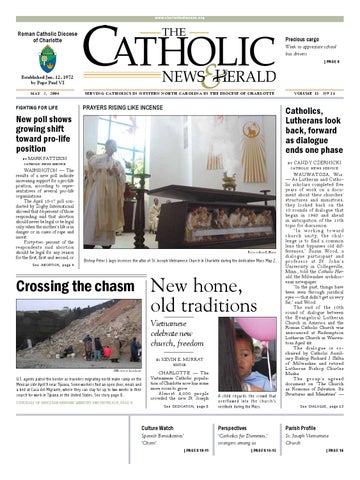
Crossing the chasm
Vietnamese celebrate new church, freedom by
KEVIN E. MURRAY editor
CNS photo by Jason Lange
U.S. agents patrol the border as travelers migrating north make camp on the Mexican side April 9 near Tijuana. Some workers find an open door, meals and a bed at Casa del Migrante, where they can stay for up to two weeks in their search for work in Tijuana or the United States. See story page 8. coverage of diocesan Hispanic ministry and outreach, page 9.
CHARLOTTE — The Vietnamese Catholic population of Charlotte now has some more room to grow. Almost 2,000 people crowded the new St. Joseph See DEDICATION, page 5
A child regards the crowd that overflowed into the church’s vestibule during the Mass.
WAUWATOSA, Wis. — As Lutheran and Catholic scholars completed five years of work on a document about their churches’ structures and ministries, they looked back on the 10 rounds of dialogue that began in 1965 and ahead in anticipation of the 11th topic for discussion. “In working toward church unity, the challenge is to find a common lens that bypasses old differences,” Susan Wood, a dialogue participant and professor at St. John’s University in Collegeville, Minn., told the Catholic Herald, the Milwaukee archdiocesan newspaper. “In the past, things have been seen through juridical eyes — that didn’t get us very far,” said Wood. The end of the 10th round of dialogue between the Evangelical Lutheran Church in America and the Roman Catholic Church was announced at Redemption Lutheran Church in Wauwatosa April 22. The dialogue is cochaired by Catholic Auxiliary Bishop Richard J. Sklba of Milwaukee and retired Lutheran Bishop Charles Maahs. The g roup’s ag reed document on “The Church as Koinonia of Salvation: Its Structures and Ministries” — See DIALOGUE, page 13
Culture Watch
Perspectives
Parish Profile
Spanish Benedictines’ ‘Chant’
‘Catholics for Dummies,’ strangers among us
St. Joseph Vietnamese Church
| Pages 10-11
| Pages 14-15
| Page 16
2 The Catholic News & Herald
May 7, 2004
InBrief
Current and upcoming topics from around the world to your own backyard
Repression of Christians in Vietnam ‘grave concern,’ U.S. bishop says WASHINGTON (CNS) — The violent repression of the Montagnard people in Vietnam is a matter of “grave concern,” the head of the U.S. bishops’ international policy committee said in a letter to Vietnam’s ambassador to the United States. In his April 28 letter to Ambassador Nguyen Tam Chien, Bishop John H. Ricard of Pensacola-Tallahassee, Fla., also called for the release of Father Thaddeus Nguyen Van Ly, who was sentenced to 15 years in jail following his 2001 testimony to the U.S. Commission on International Religious Freedom. Bishop Ricard told the ambassador that by imprisoning Father Ly, “an otherwise obscure human rights advocate, your government has converted him into one of the world’s better-known prisoners of conscience and given greater reason for criticism of Vietnam’s record on human rights and religious freedom.” Human Rights Watch reported that Montagnards, mainly Protestants, were
Seeing through Christ’s eyes
Diocesan planner CHARLOTTE VICARIATE CNS photo by Kate Oatis, Catholic Chronicle
Father Richard Saelzler, a counselor at St. Thomas More University Parish in Bowling Green, Ohio, poses at his computer, which has software that speaks to him. The priest, who lost his sight two years ago after undergoing surgery for cancer of the esophagus, says blindness has made him a better counselor.
Blind priest says own suffering has made him better counselor TOLEDO, Ohio (CNS) — Father Richard Saelzler, who lost his eyesight two years ago, is a firm believer that those who are “willing to share in the blessings” have to also be “willing to share in the cup” and endure struggles. “I’m struggling to take up my cross every day, just like everybody else,” Father Saelzler told the Catholic Chronicle, newspaper of the Toledo Diocese. The priest, known to most as Father Ric, is in residence at St. Thomas More University Parish in Bowling Green. He works at the parish as a counselor. He went blind when he suffered complications following surgery for cancer of the esophagus. He almost died when his blood pressure dropped dramatically and he “crashed,” he said. His doctors saved his life, but a lack of oxygen to his optic nerve destroyed his eyesight. He was in a coma in intensive care for days. When he lost his sight, Father Saelzler said, his immediate reaction was to ask, “What am I going to do?” “My world was so visual. My favorite hobbies were gardening, watching movies, photography. After I left the hospital for the nursing home, I
started praying that I would die,” he said. But now he has a different outlook, and even though there are still some depressing times he does not give in to despair. The priest said he has felt lonely, but never angry. “Anger is useless. I saw my blindness as a part of nature,” he said. “There’s no one to be angry at. I could be angry at the world for spending money on war but ignoring AIDS in Africa. No, anger’s not it.” What has carried him through, he said, has been uniting his suffering to that of Jesus. And he is quick to point out that his faith isn’t just a crutch to get him through the rough times. “In the midst of suffering, there is redemption, transformation. If there isn’t resurrection, this is, indeed, a curse,” he said. “There is a constant transformation going on in me.” Father Saelzler said the transformation has made him “more positive when counseling people.” “I listen better now. I encourage people to celebrate their victories and not beat themselves up over failures,” he added.
HUNTERSVILLE — St. Mark Church, 14740 Stumptown Rd., will host a Festival of Praise May 22, 8-10 p.m. The evening will feature praise and worship music by St. Mark’s LIFE TEEN band in addition to Adoration of the Blessed Sacrament. All are welcome. For details, call Debra Lemmon at (704) 948-1306. CHARLOTTE — The music ministry of St. Matthew Church, 8015 Ballantyne Commons Pkwy., will host a Christian Coffeehouse May 22 at 7:30 p.m. Single and married adults of all ages have found this to be a great place for entertaining and warm spiritual messages, evangelization and an opportunity for praise and worship music in a Christian environment. There is no charge to attend. To reserve a table for a group of six or more, call Kathy Bartlett at (704) 400-2213. CHARLOTTE — The 50+ Club of St. John Neumann Church, 8451 Idlewild Rd., meets the second Wednesday of each month at 11 a.m. with a program and lunch in the parish hall. The May 12 meeting will honor those couples celebrating 50 years of marriage. For reservations and more information, call Lucille Kroboth at (704) 537-2189. HUNTERSVILLE — The Newcomers Women’s Ministry of St. Mark Church invites women who are new or still feel new to the area to a 10-week course entitled, “After the Boxes are Unpacked” based on the book by Susan Miller. We will talk about
beaten and some killed during Easter Week demonstrations in Vietnam’s Central Highlands, and the Montagnards were seeking to “peacefully press for religious freedom and return of ancestral land in the Central Highlands.” The Vietnamese government charged that antigovernment elements are inciting the Montagnards to seek a separatist state, Human Rights Watch said. “Vietnam’s policy of repression on Montagnard Christians is only fueling the unrest,” said Brad Adams of the Asia Division of Human Rights Watch. Human Rights Watch said it “continues to receive credible reports” of Vietnamese officials forcing Montagnard Christians to “abandon Christianity and cease all political or religious activities in public self-criticism sessions or by signing written pledges.”
the spiritual, emotional and practical needs associated with moving. Classes will meet through June 23 in Room 200 of St. Mark Church, 14740 Stumptown Rd., 10:15 -11:45 a.m. followed by lunch. Call Gerry Phillips at (704) 895-2388 or Colleen Siadak at (704) 987-7920 for more information. CHARLOTTE — All women are invited to join Women in the Word for weekly gatherings for prayer, reflection on Sunday scripture, music and sharing experiences of Christ in daily life. The group meets each Thursday, 9:45-11:45 a.m. in the family room of St. Gabriel Church, 3016 Providence Rd. For details, call Linda Flynn at (704) 366-9889. For childcare reservations, call Jurga Petrikene at 704) 907-0205. CHARLOTTE — The Ladies Ancient Order of Hibernians, St. Brigid Division 1, an IrishCatholic group of women dedicated to their faith, country and Irish heritage, will meet at St. Ann Church, 3635 Park Rd., May 19 at 7:30 p.m. Anyone interested in membership, call Jeanmarie Schuler at (704) 554 0720. GREENSBORO VICARIATE
GREENSBORO — Lucy Wellmaker, parishioner and life coach, will lead a follow-up session on Rick Warren’s book “The PurposeDriven Life” May 19, 10-11:30 a.m. and 6:30-8 p.m. Both sessions will be held in the Kloster Center at St. Pius X Church, 2210 N. Elm St. These sessions are open to anyone who has read the book. For more information e-mail lwellmaker@triad.rr.com. GUILFORD COUNTY — The Ancient Order of Hibernians Guilford County Division, the oldest and largest order of Irish Catholic men, is looking for more Irish Catholic men to join them for meetings, educational
MAY 7, 2 0 0 4 Volume 13 • Number 31 Publisher: Most Reverend Peter J. Jugis Editor: Kevin E. Murray Staff Writer: Karen A. Evans Graphic Designer: Tim Faragher Advertising Representative: Cindi Feerick Secretary: Sherill Beason 1123 South Church St., Charlotte, NC 28203 Mail: P.O. Box 37267, Charlotte, NC 28237 Phone: (704) 370-3333 FAX: (704) 370-3382 E-mail: catholicnews@charlottediocese.org
The Catholic News & Herald, USPC 007-393, is published by the Roman Catholic Diocese of Charlotte, 1123 South Church St., Charlotte, NC 28203, 44 times a year, weekly except for Christmas week and Easter week and every two weeks during June, July and August for $15 per year for enrollees in parishes of the Roman Catholic Diocese of Charlotte and $23 per year for all other subscribers. The Catholic News & Herald reserves the right to reject or cancel advertising for any reason deemed appropriate. We do not recommend or guarantee any product, service or benefit claimed by our advertisers. Second-class postage paid at Charlotte NC and other cities. POSTMASTER: Send address corrections to The Catholic News & Herald, P.O. Box 37267, Charlotte, NC 28237.
The Catholic News & Herald 3
May 7, 2004
FROM THE VATICAN
Vatican official calls on Christians, tected, loved and educated.” However, many children lack a stable and loving family, he said. “Even worse, there are little ones who have been profoundly hurt by the violence of adults through sexual abuse, prostitution, forced begging, involvement in the sale and use of drugs, conscription, etc.,” said Archbishop Fitzgerald. The tragedy of HIV/AIDS also has brought immense suffering to many children’s lives, he said. The archbishop said Buddhists and Christians should mobilize their “forces and resources,” and if Buddhists and Christians help children “governments, civic bodies and all people of good will, through our own example, can be inspired to greater involvement in the welfare of all children.”
VATICAN CITY (CNS) — Christians and Buddhists must address the needs of children, especially those who have been abandoned, abused by adults, or are affected by HIV/AIDS, said a top Vatican official. “As religious believers, we must turn our gaze to the needs of children, in our own families and in society as a whole,” said Archbishop Michael Fitzgerald in an annual message to Buddhists. The Vatican released the message April 29 as Buddhists worldwide prepared for the May 4 feast of Vesakh, which commemorates the principal events in the life of Buddhism’s founder, Siddhartha Gautama. Archbishop Fitzgerald, who heads the Pontifical Council for Interreligious Dialogue, said children must be “pro-
seminars and social events. Contact Michael Slane at (336) 665-9264 for time and location.
Brawley School Rd., the second Saturday of each month following the 5:30 Mass for Senior Games Night, featuring games and a potluck dinner. Call Barbara Daigler at (704) 662-9752 for details.
HICKORY VICARIATE
HICKORY — The 18th Annual Spring Fling will be held at St. Aloysius Church, 921 Second St. NE, May 13, 9 a.m.-3:30 p.m. The day will feature music, games, bingo, door prizes and more. Father Ed Sheridan will celebrate the closing Mass. Spring Fling is hosted by Catholic Social Services Elder Ministry. For registration information, please call Sandra Breakfield at (704) 370-3220. HICKORY — A Grief Support Group meets the second and fourth Wednesday of each month at 6:30 p.m. in the parlor of St. Aloysius Church, 921 Second St. NE. For more information, call the church office at (828) 327-2341. SALISBURY VICARIATE
CONCORD — Discover how beautiful God’s plan for marriage really is! Natural Family Planning classes are being offered at St. James Church, 251 Union St., Tuesdays at 6:30 p.m. Learn a natural method that is just as effective as the Pill and is in accord with Catholic teaching. Contact Susan Chaney at (704) 720-0772 for more information or email questions to sujo94@aol.com. MOORESVILLE — A Support Group for Parents Who Have Lost a Child of any age meets the second Monday of each month at 7 p.m. at St. Therese Church, 217 Brawley School Rd. We draw strength from others’ experience of loss and grief. For more information, call Joy at (704) 664-3992. MOORESVILLE — Seniors ages 55 and up are invited to St. Therese Church, 217
Episcopal
calendar
May 8 — 9 a.m. Baccalaureate Mass Belmont Abbey College May 10 — 7 p.m. Sacrament of Confirmation St. Aloysius Church, Hickory May 12 — 7 p.m. Sacrament of Confirmation Holy Spirit Church, Denver
SMOKY MOUNTAIN VICARIATE
SYLVA — St. Mary Church is in the initial stage of forming a court of the Catholic Daughters of America. Women from neighboring parishes, ages 18 and older, are welcome to join. For more information, contact Angie Erst at (828) 488-6560 or Pat Pickering at (828) 497-4999. WAYNESVILLE— St. John the Evangelist Church, 234 Church St., offers Adoration of the Blessed Sacrament the first Friday of every month following the 9 a.m. Mass until 4:15 p.m. For information, call the church office at (828) 456-6707 or Christine Ryan at (828) 926-1331. SYLVA — St. Mary Church offers Adoration of the Blessed Sacrament the first Saturday of every month following the 9 a.m. Mass until 3 p.m. For information, call (828) 586-9496.
Pope calls for renewed missionary zeal based on love for Eucharist VATICAN CITY (CNS) — Pope John Paul II called for renewed missionary zeal based on a “constant relationship” with the Eucharist. In his message for World Mission Sunday 2004, the pope said the church’s mission of evangelization was “still only at the beginning” even after 2,000 years of service. “The social and religious challenges facing humanity in our day call believers to renew their missionary fervor. Yes. It is necessary to relaunch mission ‘ad gentes’ with courage,” he said in his written message, released by the Vatican April 29, ahead of World Mission Sunday, which will be celebrated Oct. 24 in most dioceses. Addressing this year’s theme, “Eucharist and Mission,” the pope focused on the importance of the Eucharist in sparking and sustaining the call to spread the Gospel. He asked, “How could the church fulfill her vocation without cultivating a constant relationship with the Eucharist, without nourishing herself with this food which sanctifies, with-
out founding her missionary activity on this indispensable support?” The keys to helping the church fulfill that vocation are dedicated priests — “apostles who are ‘experts’ in the celebration, adoration and contemplation of the Eucharist,” he wrote. The pope said that the Eucharist is vital for men and women missionaries. “The Eucharist is the comfort and the pledge of final triumph for those who fight evil and sin; it is the ‘bread of life’ which sustains those who, in turn, become ‘bread broken’ for others, paying at times even with martyrdom their fidelity to the Gospel,” he said. The pope made an appeal to the faithful to help support “spiritually and materially” the church’s apostolic activities by the pontifical mission societies so that “through their contribution, the proclamation of the Gospel may reach all peoples of the earth.”
Through the stained
Is your parish or school having an event? Please submit notices for the Diocesan Planner at least 15 days prior to the event date in writing to Karen A. Evans at kaevans@charlottediocese.org or fax to (704) 370-3382. CNS photo by Mike Crupi, Catholic Courier
Bishop Peter J. Jugis will participate in the following events: May 14 — 7 p.m. Sacrament of Confirmation St. Therese Church, Mooresville May 16 — 12 p.m. Sacrament of Confirmation St. John Neumann Church, Charlotte May 17 — 7:30 p.m. Sacrament of Confirmation Queen of the Apostles Church, Belmont
Amanda Zielinski of Pike Stained Glass Studios in Rochester, N.Y., carefully removes lead from a window that is being restored for Sacred Heart Cathedral in Rochester. Windows were being re-leaded and cleaned by the studio this spring as part of the cathedral’s renovation. According to studio owner Valerie O’Hara, stained-glass windows are low-maintenance but should be restored about every 100 years to maintain structural integrity.
THIS MONTH IN —1917 Our Lady of Fatima
Beginning May 13, 1917, three Portuguese children received apparitions of Our Lady. Mary asked them to pray the rosary and gave them three secrets. The first concerned devotion to the Immaculate Heart of Mary. The second was a vision of hell. Pope John Paul II directed the third secret to be revealed in 2000; it spoke of a ‘bishop in white’ being shot with bullets and arrows. Many people linked this to the assassination attempt against the pope May 13, 1981.
4 The Catholic News & Herald
fighting for life
May 7, 2004
New poll shows growing shift ABORTION, from page 1
all three trimesters of pregnancy. Asked if they considered themselves “pro-life” or “pro-choice,” 49 percent said pro-life while 45 percent said prochoice. By a 61-34 percent margin, poll respondents said abortion should not be permitted after the fetal heartbeat has begun. Zogby interviewed 1,209 Americans by telephone. The poll’s margin of error was plus or minus 2.8 percent. It was made public April 23 in Washington. By even greater margins: — Sixty-five percent agreed that abortion should not be permitted after fetal brainwaves are detected; 28 percent disagreed with that statement. — Seventy-four percent said tax dollars should not be used to pay for abortion, while 22 percent said they should. — Seventy-seven percent favored laws requiring that before they have an abortion, women who are 20 or more weeks pregnant be given information about fetal pain caused by an abortion. Sixteen percent disagreed. Carol Tobias, political director for the National Right to Life Committee, which commissioned the poll, said “only 13 percent of the public” supports the “extreme position” taken by leaders of the April 25 March for Women’s Lives of “abortion on demand throughout pregnancy.” She made her comments at a Washington press conference where the poll results were released. In the poll, 25 percent of those surveyed favored abortion for any reason for the first trimester; 4 percent approved of abortion for any reason during the first two trimesters; and 13 percent favored
abortion at any time during pregnancy. Poll results also indicate a greater pro-life stance among African-Americans, Hispanics and young people. Twenty percent of those polled were ages 18-29. Of this group, 60 percent said abortion should never be legal or be legal only when the mother’s life is in danger or in cases of rape and incest, as opposed to 39 percent who favored abortion for any reason during the first trimester, the first and second trimester, or all three trimesters. Of all those surveyed, African-Americans accounted for 11 percent of respondents; Hispanics made up 8 percent. Of the African Americans, 62 percent said abortion should never be legal or be legal only when the mother’s life is in danger or in cases of rape and incest; 38 percent favored abortion for any reason during the first trimester, the first and second trimester, or all three trimesters. Among Hispanic respondents, the margin was 78 percent to 21 percent. “A poll released last year by UCLA showed that just a slim majority of 54 percent of college students support abortion, down from 67 percent a decade ago,” said Cathy McLeod, mid-Atlantic regional coordinator for American Collegians for Life. “The abortion lobby has failed to capture the hearts and minds of college women my age because they offer us one choice: abortion,” she said. Cathy Cleaver Ruse, director of planning and information for the U.S. bishops’ Secretariat for Pro-Life Activities, talked about other numbers related to abortion that have not yet been quantified. “After 31 years we know almost nothing about abortion’s impact on women’s health, on marriages, or on surviving siblings. We don’t even know with certainty how many children have died,” Ruse said. “Legalized abortion has been an unchecked, unstudied experiment.”
She cited a 2003 study by the Centers for Disease Control and Prevention showing that “multiple abortions are now the norm.” Ruse added, “The survey didn’t ask why these abortions occurred,” but she referred to an Alan Guttmacher Institute study from the late 1980s that suggested some reasons.
“The two overarching reasons that women have abortions are a lack of financial and emotional support,” she said. “In other words, women abort their babies because they need practical help and emotional support, and no one will give it to them.”
May 7, 2004
New Vietnamese church dedicated DEDICATION, from page 1
Vietnamese Church dedicated by Bishop Peter J. Jugis during a special Mass May 2. The celebration included fireworks and a festival featuring Vietnamese music and food. “Even though the culture may be foreign to some Catholics in the Diocese of Charlotte, the parish of St. Joseph Vietnamese is another wonderful example of God’s presence in our world,” said Bishop Jugis. “The growth of the Vietnamese community and this church is testament that wherever the seed of Jesus Christ is planted, good things will grow,” he said. Concelebrating the Mass with Bishop Jugis was Father Peter Tan Van Le, pastor; Msgr. Mauricio W. West, vicar general and chancellor; Capuchin Father Stan Kobel, parochial vicar of St. Thomas
Photo by Kevin E. Murray
A colorful procession makes its way to the church’s entrance before the dedication Mass May 2.
around the diocese
Aquinas Church; visiting clergy Msgr. Francis Pham Van Phuong; Msgr. Peter Nguyen Van Tai; and other Vietnamese priests. The dedication was a visual pageant, featuring native Vietnamese dress, music and expression of worship. Wide-eyed children peered around parents for glimpses of the procession to the church. Smiling men and women donned traditional costumes of celebration. Balloons, banners and drums accentuated the din of excitement. After Bishop Jugis cut the ceremonial ribbon across the church’s entrance, firecrackers exploded as parishioners and guests filed into the modern church that features a tabernacle, altar, baptismal font, Stations of the Cross and furniture from Vietnam. The $1.8 million facility, which includes offices and an education center, totals almost 22,300 square feet. The worship space can accommodate 725 people, more than double the existing church that connects to the new facility. Despite all the room, worshippers overflowed into the church’s vestibule, the cry room and the old church, where the Mass was shown on closedcircuit television. The Vietnamese Catholic community began in 1981 as a mission program of three churches, Our Lady of the Assumption, Our Lady of Consolation and St. Ann. The 20 or so original Vietnamese families were political refugees, resettled in North Carolina by a number of humanitarian organizations including Catholic Social Services. Many of the Vietnamese Catholics had been imprisoned by the Communists for their beliefs prior to coming to Charlotte in search of jobs and religious freedom, said Father Tan Van Le.
The Catholic News & Herald 5
Bishop Peter J. Jugis prepares to cut the ribbon across the entrance of St. Joseph Vietnamese Church before the dedication Mass May 2.
The priest, who was imprisoned for 13 years and had to celebrate Mass in secret, came to Charlotte from the Diocese of Vinh Long in Vietnam via a diocesan sponsorship. The parish continued to grow and purchased a Baptist church in 1998. Then-Bishop William G. Curlin dedicated the church and cultural center in November 1999. The church’s congregation has since blossomed to 385 families. The Vietnamese community in the 46-county Diocese of Charlotte is now estimated at 9,200 people. “We have the first Vietnamese church in Charlotte, and our community is growing,” said Neilson Chung, a parishioner. “We are very proud of what we have done.” “The church allows Charlotte’s Vietnamese community to have a place of worship, a place of education for young people and a place for us to preserve the mother language, tradition and morals of our culture,” said Father Tan Van Le.
Photos
by Kevin
E. Murray
Children cover their ears while processing into the church as firecrackers explode in celebration of the dedication Mass May 2.
Contact Editor Kevin E. Murray by calling (704) 370-3334 or e-mail kemurray@charlottediocese.org.
6 The Catholic News & Herald
Precious cargo
in our schools
May 7, 2004
Week to appreciate school bus drivers by
KEVIN E. MURRAY editor
CHARLOTTE — The best part of Patrick Loftus’ day is seeing the kids. “I greet them every morning by name,” he said. A school bus driver for Mecklenburg Area Catholic Schools for almost two years, Loftus and the other drivers will be honored during School Bus Driver Appreciation Week May 10-16. “The drivers are a big asset,” said Ty Canipe, MACS transportation director. “They’re the first and last person the students see every day. If the driver starts the students’ day positive, their whole day may be positive.” Canipe oversees 14 school buses for the eight MACS schools and a half a dozen for Bishop McGuinness Catholic High School in Kernersville. The drivers “all take their jobs very seriously,” he said. “They take pride in their job responsibilities, including keeping the bus clean inside and out,” said Canipe. “But most of all they take a very professional approach when it comes to dealing with the parents, school staff and the students.” “Being on time is very important,” said Regina Horne, a driver of eight years. “Many parents depend on it.” The drivers begin their day at 5:30 a.m. by reporting in and checking their buses for mechanical problems. They complete morning runs by about 8:30 a.m. They return around 2:30 p.m. and most drivers finish between 5-5:30 p.m. “However, on many days if the traffic is not cooperative, the last bus may not return until well after 6 p.m.,” said Canipe. The drivers also are called upon to transport classes on field trips, an average of four a day, “from the mountains to the zoo,” said Canipe. “The motto for the department is ‘you call, we haul.’” During the spring and fall, the number of field trips can get as high as 10-12 per day, he said. Because of the traffic congestion and pollution in Charlotte, the MACS transportation department encourages parents
to utilize the school buses. “Yearly cost is $650, a bargain considering the cost of fuel and time spent on the road,” said Canipe. Gov. Michael Easley proclaimed School Bus Driver Appreciation Week because “every month of the year, in darkness and daylight, bitter cold and brutal heat, North Carolina’s school bus drivers travel thousands upon thousands of miles on everything from dirt paths to multilane highways in order to deliver our precious school students to their places of learning and then home again.” Easley proclaimed April 25-May 1, 2004 to celebrate the week, but Canipe said MACS chose to celebrate their bus drivers the second week of May. “We’re having a lunch for them on May 11, and a little something special planned each day,” he said. “The schools are welcome to do something for them, too.” Loftus likes to do kind things for the students — such as give them good news. “On Friday, or before a holiday, I tell them the bus will not be in operation tomorrow,” he said. “That usually gets a cheer.” Contact Editor Kevin E. Murray by calling (704) 370-3334 or e-mail kemurray@charlottediocese.org.
MACS school bus facts
13 full time drivers. 1 part-time substitute. 850 MACS students ride buses each day: — 550 at Holy Trinity Catholic Middle School; — 150 at Charlotte Catholic High School; — 150 at St. Mark School, Our Lady of the Assumption School, St. Ann School and St. Patrick School. MACS buses travel an average of 100 miles each day.
Photo by Kevin E. Murray
Driver Regina Horne welcomes students aboard her school bus outside St. Patrick School in Charlotte May 4. Pickups are as far away as Rock Hill, S.C.; Weddington; and Davidson ( Lake Norman). Possible future pickups may include Gastonia and Belmont for Charlotte Catholic High Scho o l .
May 7, 2004
The Catholic News & Herald 7
HISPANIC OUTREACH
Crossing the border
Migrants regroup at Tijuana church-run shelter by JASON LANGE catholic news service
TIJUANA, Mexico — As darkness descended, Juan Balerio nervously went over his plan to cross an arid stretch of mountains into the United States. First, he would buy a gallon of water and several boxes of crackers. The hike can take anywhere from eight hours to two or three days, so food and water were important. Then, at 8 p.m., he planned to take a bus to the outskirts of Tijuana to a mountainous slum called “Nido de las Aguilas,” or the Eagle’s Nest. That’s where the border fences end as rolling hills give way to dusty crags. Balerio said that with a little patience and luck he would be in San Diego the next afternoon. “If I survive,” he said with a smile. The 22-year-old has illegally crossed the border near Tijuana three times since he left his impoverished home town in central Mexico at age 15 in search of work, and he is aware of the dangers. Speaking from the staging ground of his plan, a Catholic migrant shelter in Tijuana called Casa del Migrante, he said: “It can get very cold or very hot, and there are many snakes. You hear stories about people dying.” By the hundreds. Deadly crossings Last year alone, more than 400 migrants perished trying to cross the 2,000mile border that divides the United States and Mexico, according to migrant groups that keep tabs on the deaths. Most died of exposure as they braved deserts and mountains. Others suffocated after migrant smugglers locked them in sweltering truck trailers. Many drowned swimming the Rio Grande. The deaths amount to a small portion of the estimated 300,000 Mexicans that cross illegally every year. Around Balerio, some 30 men with
CNS photos by David Maung
Above: Migrants chat in the courtyard of Casa del Migrante in Tijuana, Mexico, April 19. The center, run by Scalabrinian missionaries, offers temporary shelter to travelers migrating to the United States through the Tijuana border crossing. Below: Migrant workers pray before the evening meal at Casa del Migrante April 19. worn clothes and tired faces walked about the migrant shelter’s central courtyard. Most of them had traveled hundreds of miles to cross the border before running out of luck in Tijuana. “Many were robbed and were sleeping on the streets before coming here,” said Scalabrinian Father Luis Kendzierski, who runs Casa del Migrante. Desert shelter Casa del Migrante, run by Scalabrinian missionaries, provides hot meals, showers and a place to sleep for about 80 migrants each night. Since its founding in 1987, Casa del Migrante has sheltered some 130,000 migrants. Residents can stay for two weeks. Father Kendzierski knows many plan their next move — usually an attempt to cross the border. Doctors come to the shelter twice a week, usually to treat blistered feet or wounds from a beating. “Thugs here know all too well migrants arrive with money to pay
the coyote,” or migrant smuggler, said Father Kendzierski. The shelter’s staff also works to educate the migrants on sexually transmitted diseases and drug addiction, ills often not found in their home communities but more common along the border and in the United States. Father Kendzierski and another priest offer spiritual guidance to the migrants, who are mostly Catholic. Originally founded to assist Italian migrants arriving in the United States and South America in the late 19th century, the Scalabrinians now operate migrant shelters in 25 countries, including France, Australia, the Philippines and the United States. Searching for work Most of the migrants who pass through Casa del Migrante hope to cross the border, said Father Kendzierski. The shelter also assists migrants from other parts of Mexico drawn to work in Ti-
juana’s many factories. Julian Toledo, 23, said at least Tijuana has electricity and jobs, something his home town in the mountains of southern Oaxaca state does not have. “I don’t want to leave my country,” Toledo said. The young men sharing the bench with Toledo do not hesitate to ridicule him. “In Tijuana you’ll earn $10 or $15 a day,” Francisco Santiago, a one-time construction worker in San Francisco, told Toledo. “Up there (in America) you can make that in an hour.” Jobs are relatively plentiful in Tijuana, where the North American Free Trade Agreement triggered a boom in low-wage, low-skill factory jobs in the 1990s. The factories send vans to the migrant shelter every morning looking for people to work their assembly lines. Oscar Sandoval earned 150 pesos (US$13) earlier in the day at a food processing plant. That money will not go far in Tijuana, where living expenses are higher than in the rest of Mexico. “They tell us that should be enough to rent a room, buy food and pay for bus fare to work,” Sandoval said. A week earlier, Sandoval was earning $18 per hour as a truck driver in Los Angeles. He was deported after police discovered he did not have a valid driver’s license. “If I return and they catch me, the border patrol agents said I’d do two years in a federal prison,” Sandoval said. High stakes About 16,000 foreign migrants, or 10 percent of the U.S. federal prison population, are currently locked up for migration offenses — namely illegal border crossings, according to statistics from the U.S. Federal Bureau of Prisons. U.S. migration authorities said Sandoval could re-enter the United States after one year; the Sonora state native plans to do his best in Tijuana until then. Father Kendzierski said about 40 percent of the migrants who come to Casa del Migrante are deportees, dropped off by U.S. Border Patrol agents in Tijuana. Those with family in the United States try to convince relatives there to pay a migrant smuggler’s fee — usually $1,000-$1,500. Those who cannot raise the money might try to cross anyway, although they risk jail time if caught on multiple occasions. “I’m going to try one more time tomorrow,” said 31-year-old Gaspar Torres after returning from the food processing plant. The money he earned during the week would be enough for food and water for his hike from Nido de las Aguilas and for a bus to Los Angeles, if he is not caught. “I’ll be praying that they don’t catch me,” he said. Local Outreach
For Hispanic outreach efforts in the Diocese of Charlotte, see coverage on pages 8-9.
8 The Catholic News & Herald
May 7, 2004
HISPANIC OUTREACH
‘Welcoming the Stranger’
Diocese of Charlotte reaches out to Hispanic immigrants by
KEVIN E. MURRAY editor
CHARLOTTE — As Hispanic ministry in the Diocese of Charlotte moves forward, ministry leaders and Hispanics are looking back and reassessing their needs. The diocese’s three-year Hispanic Pastoral Plan is being reviewed to ensure its success in light of the U.S. bishops’ November 2002 document, “Encuentro and Mission: A Renewed Pastoral Framework for Hispanic Ministry.” “That document has some very important aspects of Hispanic ministry that the bishops are asking us to focus on and take into consideration,” said Franciscan Sister Andrea Inkrott, director of diocesan Hispanic Ministry. “We’re also halfway through the plan and we wanted to stop and see how we were doing, and what we can be doing with the new focus that the bishops asked us to consider,” said Sister Inkrott. The Hispanic Pastoral Plan 20022005, an updated and diocese-focused version of three previous national Hispanic pastoral plans developed by the National Conference of Catholic Bishops, was adopted by the Diocese of Charlotte in November 2002 after almost a year of meetings of Hispanic ministry coordinators, social service personnel, vicars forane and Hispanic community leaders. With the growing number of Hispanics in the Diocese of Charlotte — estimated to be more than 203,000 — the Hispanic Pastoral Plan addresses their ever-developing pastoral, health and human services needs. Diocesan members will review the plan at the Catholic Conference Center May 19. “The immigrants who are arriving in North Carolina are bearers of gifts,” said Sister Inkrott. “If I look at persons who are different from me as objects of fear or suspicion, I will miss seeing the gifts that they offer and I will be the poorer for it.” An ideal home Hispanic Catholics are quickly becoming the majority in the 46-county Diocese of Charlotte. Bishop Peter J. Jugis discussed the Hispanic growth with Pope John Paul II during a private audience March 29, part of the bishop’s “ad limina” weeklong visit to the Vatican. Bishop Jugis described the warm reception Catholics in the diocese have given to the Hispanics living in western North Carolina. The pope expressed surprise that so many had come to the diocese. “I told him that there are many people moving into our area because of the job opportunities and the quality of life,” said Bishop Jugis. “I also told him of the efforts of diocesan priests to minister to the Latino population.” In order to help meet the growing needs of the Hispanic population, Father Julio Cesar Dominguez and Fa-
Photo by Kevin E. Murray
Bishop Misael Vacca Ramirez of Yopal, Columbia, and Father Jose Juya, Hispanic apostolate at St. Michael Church in Gastonia, lead a procession honoring the Lady of the Rosary of Chiquinquira outsideJose the church Sept.Gonzalez-Gaytan, 13, 2003. Many parishes are “Every finding different to reach out to the ther Enrique Latinways American country diversenatives Hispanicofcultures in their churches. both Mexico, were ordained has a version of Mary,” said Juan in the Diocese of Charlotte June 7, Garcia, a St. Michael parishioner. He 2003. likened the Lady of Chiquinquira to They were among the nine Histhe Lady of Guadalupe, who helped panic priests of the diocese to meet convert millions of Mexicans to Cawith Bishop Jugis in September 2003, a tholicism. month before his ordination as bishop. “Father José organized this to The meeting allowed the bishop to gather the Colombians and bring them become familiar with the priests and into community,” said Sister Inkrott. their needs, and discuss the Hispanic “It’s a chance to draw strength from Pastoral Plan. each other in their faith.” Parishes with strong Hispanic To coincide with an annual fiesta congregations throughout the diohonoring the Lady of the Incarnation, cese have begun Spanish-language the patron saint of Aquacatan in GuaMasses and Hispanic ministries. Retemala, the large Guatemalan populacent church dedications have featured tion of St. Charles Borromeo Church bilingual Masses and celebrations. in Morganton held a weekend celebraBut the Catholic Church is chaltion April 30-May 2. Father Kenneth lenged to develop ministries that Whittington, pastor, and Father Luis respond to the needs of Hispanics Ixcoy, a priest from the Diocese of coming from different countries with Huehuetenango in Guatemala, particidifferent traditions despite their compated in the celebrations. mon heritage. “It’s important to serve the people “A mariachi Mass is not for Salin your parish and increase our awarevadorans or Argentines or Chileans,” ness of what the church really is, which said Ronaldo Cruz, executive director is unity,” said Father Whittington. of the U.S. bishops’ Secretariat for The Diocese of Charlotte and Hispanic Affairs. Belmont Abbey provided grants to In January 2003, the U.S. and help Lissette Westover, a St. Michael Mexican bishops issued their first joint parishioner, establish La Casa Latinopastoral letter pledging cooperation americana de las Carolinas at Belmont on pastoral care of migrants. Within Abbey in 2003. La Casa provides interthe Diocese of Charlotte, parishes are pretation, translation and other servicfinding ways to welcome the diverse es, as well as doctor and job referrals. Hispanic cultures. Continuing efforts Gastonia has a strong Colombian presence, according to Sister Inkrott. Diocesan offices of Catholic Social Father José Juya, Hispanic apostolate Services continue to address the needs at St. Michael Church, invited Bishop of Hispanics around the Diocese of Misael Vacca Ramirez of Yopal, Charlotte. Colombia, to lead a special Mass for Since 1990, Casa Guadalupe, a Colombians honoring the Lady of the CSS program with offices in WinstonRosary of Chiquinquira at the GastoSalem and Greensboro, has provided nia parish in September 2003. critical services and information to the Piedmont-Triad Hispanic community,
including helping immigrants achieve legal, permanent residency and citizenship. Between the two offices, Casa Guadalupe assists an estimated 600700 people per week, according to Lisa Reyna, program director. “Immigration, interpreting, translating — anything where language is a barrier, we help with,” said Reyna. “We defend the rights of those who can’t speak for themselves.” For its efforts, in 2002 Casa Guadalupe was honored with a Defenders of Justice Award in the Grassroots Empowerment category, given by the North Carolina Justice and Community Development Center. Casa Guadalupe participated in N.C. United Power’s First Statewide Assembly in Durham April 25. More than 1,400 delegates from across North Carolina, representing more than 30 countries, discussed issues including a repeal of the new DMV policy restricting driver’s licenses to immigrants and expanded bilingual services. The Hispanic Center of High Point, a CSS program originally located in Christ the King Church, provides classes, counseling, individual and group therapy, victim assistance and child and youth services. Program Esperanza, a program of the CSS Charlotte Regional Office that grew out of a partnership with United Way of Central Carolinas in 1997, helps link Hispanics to community resources and services such as English classes, health care, employment, immigration services, school and legal representation. Uniting over dividing “The right to emigrate also certainly exists,” said Pope John Paul II in a December 2003 message for the 2004 celebrations of World Day for Migrants and Refugees. Marked by Catholics on different days in different countries, the United States celebrated National Migration Week Jan. 4-10 of this year. The earth and its resources belong to all people, the pope said, and while governments have a right to regulate migration, people have the right to seek safety and dignified lives for themselves and their families abroad. While people may be afraid of the impact immigrants will have on their country and economy, overcoming the fear and welcoming newcomers (as brothers and sisters) is a contribution to peace all are called to make, he said. “If the dream of a peaceful world is shared by many and if the contribution of migrants and refugees is valued, humanity can become increasingly the family of all and our Earth (can become) a real common home,” the pope said. “If one promotes a gradual integration of migrants while respecting their identities and safeguarding the cultural patrimony of the population welcoming them, one reduces the risk that immigrants will concentrate in one area, creating real ghettoes,” he said. Isolation from one’s neighbors and from the culture of the host country, he said, “sometimes ends up increasing the desire for a gradual conquest of the territory,” which creates further
May 7, 2004
The Catholic News & Herald 9
HISPANIC OUTREACH
Breaking down barriers
El Día de los Niños
Task force forming to address Hispanics’ needs
Children’s Day celebrated in Canton
by
JOANITA M. NELLENBACH correspondent
ASHEVILLE — Catholics are continuing to reach out to Hispanics in western North Carolina. “The Western Region Office of Catholic Social Services (CSS/WRO) is spearheading a task force which is the outgrowth of a Latino Steering Committee (LSC) that has met monthly for networking,” said Debra Braese, CSS/ WRO’s area director. The LSC meets, Braese said, “in response to concerns expressed by parishes about Hispanic needs and is the Western Region Office’s way to explore, collaborate and find solutions.” LSC’s May 19 meeting at St. Eugene Church will include the steering committee plus pastors, parishioners and anyone else who is a member of or interested in working with the Hispanic community in CSS/WRO’s service area: western North Carolina, from Alleghany, Wilkes, Caldwell, Burke and Rutherford counties to the Tennessee border. “The meeting May 19 will be to see if we want to move from networking to advocacy and, if so, how Catholic Social Services can help that,” said Ada Volkmer, CSS/WRO immigration specialist. The meeting is for anyone “who wants to get together to brainstorm about creating ways to break down barriers that Latinos face.” The meeting will explain what the LSC does and where there are gaps in services to western North Carolina’s Hispanic population. “The Latino Steering Committee has always been hosted and moderated by CSS,” Volkmer said. LSC is made up of western North Carolinians who want to work with Hispanics. Included are health department employees, Realtors, Girl Scout leaders, legal aid staffers, University of North
Carolina at Ashville students and educators, among others. LSC’s database contains about 250 names, with 25-30 people attending meetings the third Wednesday of each month at CSS/WRO’s office at 50 Orange St. in Asheville. They network and share concerns and event announcements. Sometimes guest speakers present programs, such as updates in various areas of the law. Concerns include the need for more education about the fact that Hispanics in western North Carolina come from many countries, not just Mexico. “Community advocates have reported that Puerto Ricans (who are U.S. citizens) have been asked for their Mexican birth certificates,” Volkmer said. “Or birth certificates from countries other than Mexico are regarded as fake.” No reservations are required to attend the May 19 meeting. Anyone wanting to stay after the meeting to mingle and get acquainted should bring a bag lunch and something to drink. For more information, call Ada Volkmer at (828) 258-2617, ext. 22. Contact Correspondent Joanita M. Nellenbach by calling (828) 627-9209 or e-mail jnell@dnet.net. Want to Go?
The Latino Steering Committee’s first meeting is May 19, 10-11:30 a.m. at St. Eugene Catholic Church, 1 Culvern St., Asheville. Directions: Exit 5 off I-240, turn right at end of exit. Go about 11 stoplights to intersection of Beaverdam Road. Turn right, then make the first left. The church is at the end of the street.
by
JOANITA M. NELLENBACH correspondent
CANTON — Just for the kids, Immaculate Conception Church held its first El Día de los Niños. El Día de los Niños (Children’s Day) is celebrated in Latin American schools on April 30. (Several Asian countries also celebrate Children’s Day.) Immaculate Conception’s El Día de los Niños roared into action May 2, with 31 preteen children, their parents and older siblings piling into the balloon-festooned church hall after Father Shawn O’Neal celebrated a Hispanic Mass. The day is especially tailored for children up to sixth-grade age. Rainy weather put a crimp in the planned outdoor games, but everyone enjoyed chocolate cake and Neapolitan ice cream in the church hall. The children also received small bags of sweets and toys. A story in the Idaho Press-Tribune last year, shortly before Idaho became the first state to have an official Children’s Day, noted that, “El Día de los Niños began in Latin American countries as a day to recognize youth. It is widely celebrated in Mexico, where movie theaters show free movies, ice cream flows freely and kids dress up in costumes and parade through town.” Martha Calderon was at Immaculate Conception with her children. She recalls that in her native Mexico, teachers also dressed in costumes the children chose. They demolished piñatas and played musical chairs and hide-
Photo by Joanita M. Nellenbach
Nicole Castro, 3, collects a bag of toys and treats from the other kids during the El Día de los Niños celebration at Immaculate Conception Church April 30. and-seek. There was a special lunch, with sweets later in the afternoon. “It was a whole day from beginning to end devoted to the children — games and food,” she said. “The whole day was nothing but for the kids.” Contact Correspondent Joanita M. Nellenbach by calling (828) 627-9209 or e-mail jnell@dnet.net.
Migration en masse
The U.S. Census Bureau estimates that 52 percent of the nation’s 32.5 million foreign-born population in 2002 came from Latin America. While the entire foreignborn population comprises only 11.5 percent of the U.S. total, the massive flow from Latin America is radically changing the demographics of the U.S. church. Hispanics are estimated to constitute about 40 percent of the current U.S. Catholic population and their number is projected to continue growing. Latin Americans plus U.S.-born Latinos make Hispanics the fastest growing ethnic group in the U.S. church. The church’s attitude toward immigrants is expressed by a 2000 document by the U.S. bishops: “Welcoming the Stranger Among Us: Unity in Diversity.” The infusion of so many Latinos, especially clandestine flows across the U.S.-Mexican border, has raised concerns among some groups — accelerated since the terrorist attacks of Sept. 11 — for tighter border controls.
The Center for Immigration also raises the issue that so many Spanishspeaking immigrants may form a closed community hindering “assimilation and integration of immigrants by creating a critical mass necessary to foster linguistic and spatial isolation.” Ronaldo Cruz, executive director of the U.S. bishops’ Secretariat for Hispanic Affairs, discounts such concerns. Immigrants are highly motivated, coming to better their lives and they know that they have to learn English to succeed, he said. “They will become English-speaking. If the first generation doesn’t, the next generation will speak English,” he said. The same is true of adapting to U.S. ways of doing things and to incorporating U.S. values, said Cruz. “People are born in different countries, but their kids are as American as can be,” he said.
Photo by Joanita M. Nellenbach
Veronica Martin feeds chocolate cake to her 10-month-old son Alexander, held by his father, Aristeo Martin, during the El Día de los Niños celebration at Immaculate Conception Church April 30.
1 0 The Catholic News & Herald
May 7, 2004
Culture Watch
Spanish Benedictines’ ‘Chant’ CD returns by MARK PATTISON catholic news service
WASHINGTON — The music world has had to deal with its share of pop stars who would just as soon make their music and then be left alone. But nobody takes it to the level of the Benedictine Monks of Santo Domingo de Silos in Spain, who recorded their Gregorian chants between 1973 and 1979 while maintaining their cloistered lifestyle. It took more than a decade, but the monks’ chants caught on. The first wave of success came from their native Spain. That was followed in 1994 by top-10 status for “Chant” on Billboard’s pop charts for eight weeks; it spent 25 weeks atop Billboard’s classical music chart.
Before the phenomenon subsided, “Chant” had sold 3 million copies over two years. And it’s still selling at a clip of about 300 copies a week, according to Mark Forlow, vice president of classics for EMI Classics and Virgin Classics, which distribute the monks’ recordings on the Angel label. In a telephone interview from New York, Forlow told Catholic News Service that at the peak of the “Chant” craze “I remember there were reporters who were showing up at the door of the monastery, and the monks just wishing they’d go away.” Also, Forlow recalled, “there were certain monks who were no longer with the order who came out of the woodwork and said, ‘We want to be paid!’” Forlow said the craze was fueled by an Associated Press story about the
WORD TO LIFE
A roundup of Scripture, readings, films and more
Spanish success of the monks’ music “that seemed to run simultaneously in every newspaper available.” The “Chant” success story resulted in three additional CDs of chant music that also was recorded during the 1970s by the Santo Domingo de Silas monks. A feminine counterpart to the monks’ music was released, also by Angel, called “Vision: The Music of Hildegard von Bingen” by Emily Van Evera and Benedictine Sister Germaine Fritz. And before it was all over, popular greeting card artist Sandra Boynton, who had studied Latin at a Quaker day school, put together the Ad Hog Camerata for a gentle porcine spoof called “Grunt: Pigorian Chant from Snouto Domoinko de Silo.” Now, the monks’ original music is returning. EMI-Virgin’s Spanish subsidiary, which started the “Chant” madness, developed a “greatest hits” compilation of sorts for European audiences — selling 300,000 copies — and offered it to EMIVirgin in the States. Forlow said EMI-Virgin tweaked it somewhat, using new liner notes and cover art, and has named it “Chant: The Anniversary Edition,” a two-CD set. It was to be available in record stores May 4, retailing for the cost of a single CD. “We’ve got almost everything from the original ‘Chant’ as well as material from the last three albums,” Forlow told CNS. He added that only the original “Chant” and its immediate successor, “Christmas Chants,” are still available, but the other two albums are not. Forlow said the first “Chant” benefited from the “stress-busting” trends at the time. He added the 10th anniversary edition will be marketed to religious bookstores as well as publications that focus on meditation and healing. “We’re certainly going to look to the Christian community to get the word out again,” he said. But any sales that come will have to be generated by the quality of the music. The Benedictine Monks of Santo Domingo de Silos continue to be unavailable for interviews.
DON’T PROCRASTINATE! CALL NOW!!
Sunday Scripture Readings: MAY 16, 2004
May 16, Sixth Sunday of Easter Cycle C Readings: 1) Acts 15:1-2, 22-29 Psalm 67:2-3, 5, 6, 8 2) Revelation 21:10-14, 22-23 3) Gospel: John 14:23-29 by
SHARON K. PERKINS catholic news service
About 15 years ago when I was pregnant with our second child, I was completing a master’s thesis — no small feat with a husband, a household, a 4-year-old, a job and no word processor. What made it all possible was the tremendous support I received from family and friends. A sister-in-law stepped in with child care one day a week, friends gave me a key to their house so I could use their computer day or night and my husband took over household chores. They lifted numerous burdens so that I could finish my degree before baby No. 2 came along. It’s hard to overestimate the positive impact of burdens lifted, whether those encumbrances are physical, psychological or social. A person freed from unnecessary burdens is one free to dream, to create, to achieve and to love. Both the readings from Acts and from the Gospel of John highlight the presence of the Holy Spirit as having this effect. The apostles are prompted by the
Spirit to reduce religious restrictions for the gentile converts. Jesus gives the Spirit to free our hearts from the burden of fear. Every time you or I lighten the load of another human being, we are acting in the power of the Spirit. The amazing truth is that often what we perceive as small, inconsequential words or actions have great capacity to make another’s life less burdensome. I’m sure that my colleagues don’t realize how much their words of encouragement and their daily acts of kindness free me to be my best self, and yet this happens daily. St. Paul says in Galatians 6:2: “Bear one another’s burdens, and so you will fulfill the law of Christ.” The law of Christ is life in the Spirit and the lifting of burdens in a variety of life-giving ways. Questions: How has someone lifted a burden for you, and in what way did that free you? What is one burden that you can lift for another today? Scripture to Illustrate: “It is the decision of the holy Spirit and of us not to place on you any burden beyond these necessities” (Acts 15:28).
WEEKLY SCRIPTURE Scripture for the week of May 9 - May 15 Sunday (Fifth Sunday of Easter), Acts 14:21-27, Revelation 21:1-5, John 13:31-33, 34-35; Monday (Bl. Damien Joseph of Moloka’i), Acts 14:5-18, John 14:21-26; Tuesday, Acts 14:19-28, John 14:24-31; Wednesday (Sts. Nereus and Achilleus, St. Pancras), Acts 15:1-6, John 15:1-8; Thursday, Acts 15:7-21, John 15:9-11; Friday (St. Matthias), Acts 1:15-17, 20-26, John 15:9-17; Saturday (St. Isidore), Acts 16:1-10, John 15:18-21 Scripture for the week of May 16 - May 22 Sunday (Sixth Sunday of Easter), Acts 15:1-2, 22-29, Revelation 21:10-14, 22-23, John 14:23-29; Monday, Acts 16:11-15, John 15:26—16:4; Tuesday (St. John I), Acts 16:22-34, John 16:5-11; Wednesday, Acts 17:15, 22—18:1, John 16:12-15; Thursday (Ascension of the Lord), Acts 1:1-11, Ephesians 1:17-23, Luke 24:46-53; Friday (St. Christopher Magallanes and Companions), Acts 18:9-18, John 16:20-23; Saturday (St. Rita of Cascia), Acts 18:23-28, John 16:23-28
The Catholic News & Herald 11
May 7, 2004
‘Godsend’ is anything but
‘Laws’ breaks rules of attraction
Cloning dilemma lost in standard ghost-story devices by DAVID DiCERTO catholic news service
CNS photo from New Line Cinema
Two rival divorce lawyers (Julianne Moore and Pierce Brosnan) wake up married after a drunken evening and must continue as opposing attorneys on a bitter court case while carrying on a spousal charade in the underwhelming romantic comedy “Laws of Attraction.” Implied sexual encounters following inebriation, impersonation of a cleric, a few crude expressions and an instance of profanity. The USCCB Office for Film & Broadcasting classification is A-III — adults. The Motion Picture Association of America rating is PG-13 — parents are strongly cautioned. Some material may be inappropriate for children under 13.
NEW YORK — When a tragedy takes their young son’s life, a couple strikes a Faustian bargain to get him back, with unforeseen consequences, in the cautionary thriller “Godsend” (Lions Gate). Fueled by the debate surrounding advances in reproductive technologies, the film touches on important issues concerning bioethics and the moral implications of artificially creating human life. But while the questions raised are thought-provoking, the only thing the movie itself provokes in viewers is the urge to check their watches. Greg Kinnear and Rebecca RomijnStamos star as Paul and Jessie Duncan, a couple whose lives are shattered when their 8-year-old son, Adam (Cameron Bright), is killed in a traffic accident. Robert De Niro plays Richard Wells, an enigmatic geneticist with the incredible offer to clone Adam and give them back their happy life. The couple resettles near Wells’ Godsend Fertility Clinic, and they sever all ties with their former life to keep the illegal procedure secret. Jessie is fertilized with stem cells carrying Adam’s DNA, and soon after gives birth to second “Adam.” As Adam reaches his eighth birthday — the age his duplicate died — things begin to take an ominous turn. He starts to have vivid nightmares, and his lovable personality darkens, revealing a sinister streak. Adam’s cryptic references to “another boy” spark fears that he is somehow “remembering” things from the first Adam’s life, forcing Paul and Jessie to come to terms with their decision and setting in motion a series of chilling revelations about Wells’ shadowy past. Kinnear and Romijn-Stamos both con-
vincingly convey the devastation of losing a child, allowing viewers to empathize with their pain-prompted decision. However, Catholics should be careful not to interpret such emotional commiseration as justification for condoning their course of action. The film wisely relies on subtlety and suggestion to create an atmosphere of psychological suspense. The movie is full of allegorical references and images that underscore the themes explored. Adam, an obvious allusion to Genesis, is the first child ever successfully cloned. Unfortunately, after an intelligent setup, the story’s philosophical pretensions quickly give way to spooky atmospherics and standard ghost-story devices which detract from the central moral dilemma posed. The rickety script’s emotionally unsatisfying ending leaves too much unresolved. The church teaches that medical science does not have the moral right to do something simply because that something is now doable — especially when that something denies the sacred dignity of the human person, and reduces humans to mere objects which can be manipulated. Due to a sexual encounter, a problematic theme of cloning, recurring profanity, sporadic crude language and some scary sequences, the USCCB Office for Film & Broadcasting classification is A-III — adults. The Motion Picture Association of America rating is PG-13 — parents are strongly cautioned. Some material may be inappropriate for children under 13. DiCerto is on the staff of the Office for Film & Broadcasting of the U.S. Conference of Catholic Bishops.
1 2 The Catholic News & Herald
around the diocese
THIS MONTH IN —1994 Bishop Begley celebrates anniversary
Bishop Michael J. Begley celebrated the 60th anniversary of his priestly ordination in May 1994. As a young man in Massachusetts, Bishop Begley mentioned to the parish assistant that he “might want to become a priest ... to take care of the (Catholic) Church.” That very weekend, he met Bishop William J. Hafey of North Carolina. Eight years later, the future bishop was a priest serving in the mission territory that would become the Diocese of
Classifieds EMPLOYMENT CAREGIVERS: CAREGiving is a Joy! Join us in making a difference in the lives of the elderly. Non-medical companionship and home care. Flexible, part-time, day, evening and weekend hours available. Car needed. Home Instead Senior Care. Call 704.344.9739. DIRECTOR OF FAITH FORMATION: Dynamic and welcoming faith community seeking experienced Director of Faith Formation with master’s degree in religious education. Send resume and a statement of your vision of Faith Formation to: St. Paul the Apostle Catholic Church, Faith Formation Search Committee, 2715 Horse Pen Creek Road, Greensboro, NC 27410; fax (336) 294-6149; e-mail jmalmfelt@stpaulcc.org. Pre-K Teacher: Asheville Catholic School is seeking an experienced, NC certified Pre-K teacher for the 2004-2005 school year. A practicing Catholic with Catechist certification is preferred. Please mail resume and copies of your teaching certificate and diploma to: Principal, Asheville Catholic School, 12 Culvern Street, Asheville, NC 28804 SOCIAL WORKER: Room At The Inn, a Catholic maternity home located in Charlotte is seeking a full time Lead House Manager. Position requires strong managerial, organizational, and interpersonal skills with a minimum of a BSW and 5 years experience. Reporting directly to the Program Director, this position is responsible for the daily
operation, organization, and management of the 6 mother/6 baby group home and supervision of two house managers. Fax resume to Executive Director at 704-521-2751. Visit our Web site at www.rati.org. YOUTH MINISTER: Dynamic and welcoming faith community seeking experienced Youth Minister with bachelor’s degree. Send resume and a statement of your vision of Youth Ministry to: St. Paul the Apostle Catholic Church, Youth Minister Search Committee, 2715 Horse Pen Creek Road, Greensboro, NC 27410; fax (336) 294-6149; e-mail jmalmfelt@stpaulcc. org. FOR SALE INSURANCE: Best Health Insurance plans at best rates! Call Mike Wilkinson (704) 845-1416. VAN: Dodge 99 Maxi - 1 ton. Church or school van. 65,000 miles. Front-rear air. Stereo. Full power. White. Super clean@ 704-309-5666. FOR RENT CONDO: Hilton Head, 2 BR/2 BA Condo, rooftop pool, steps from beach, Coligny Plaza area. (502) 454-4324. WANTED TO BUY ORGAN: Looking for older model Hammond organ. 704-641-1910.
Classified ads bring results! Over 125,000 readers! Over 49,000 homes! Rates: $.60/word per issue ($12 minimum per issue) Deadline: 12 noon Wednesday, 9 days before publication How to order: Ads may be E-mailed to ckfeerick@charlottediocese.org, faxed to (704) 370-3382 or mailed to: Cindi Feerick, The Catholic News & Herald, 1123 S. Church St., Charlotte, NC 28203. Payment: For information, call (704) 370-3332.
May 7, 2004
May 7, 2004
The Catholic News & Herald 13
in the news
Catholic-Lutheran dialogue ends one phase DIALOGUE, from page 1
which includes 10 recommendations to the churches — was to be made public May 5. At a joint celebration and worship service April 23 at the Cathedral of St. John the Evangelist in Milwaukee, Bishop Maahs said the adoption of the document “really is kind of a culmination. In many ways, (it is) building on the foundation of the work that has been done in the past by theologians and scholars of both of our communions.” He reiterated earlier comments by Bishop Sklba about the friendships that have developed from the dialogue. “Those who work so closely together (are) kind of a model of the way in which the two faiths can celebrate our oneness in Christ and our understanding of the Gospel which is so similar,” Bishop Maahs said. Wood said the basic church structure is the congregation for Lutherans and the parish for Catholics. The congregation or parish, in turn, belongs to a regional structure, such as a synod (for Lutherans) or a diocese (for Catholics). While Lutherans have no equivalent to the Catholics’ national structure, such as the U.S. Conference of Catholic Bishops, both have worldwide structures — the Lutheran World Federation, defined as a communion of churches, and the “universal church” under the direction of the pope. For Lutherans, Wood said, “the congregation is considered to have the fullness of church.” In Catholicism, the diocese is the basic unit of church. “Lutherans don’t have a well-developed theology of the episcopacy, and
Catholics don’t have one of the parish,” she said. Michael Root, a Lutheran seminary professor, said while some might say the 10th round of dialogue “deals with internal structures rather than the needs of the real world” the talks were changed by the signing in 1999 of a Lutheran-Roman Catholic declaration on justification, in which both churches agreed that people are saved by grace alone. “How does a Christian stand before a righteous God? That was ‘the’ issue of the Reformation,” Root said. “Now this needs no longer divide Lutherans and Catholics.” Root added that “the remaining problems deal with church ministry and authority. Lutherans and Roman Catholics can’t share Eucharist because of differences over appropriate eucharistic ministers. The ministry issue is at the heart of what divides Lutherans and Roman Catholics nationally and internationally.” “These questions seem trivial, lower in the hierarchy of truths, not essential to the faith yet in some ways more difficult,” he said. “Not being able to solve it is more of a rub. Ecumenism is about relationships between churches — concrete communities, real people.” Structural questions about people and actions they take, he said, require “a certain minimum agreement about structure. It’s where the ecumenical rubber meets the institutional road.” Bishop Maahs said the next step in the dialogue is to recommend a topic for the 11th round to both traditions’ advisory boards, but “we’re still in the process of working on that right now. I can’t tell you what that might be.” Previous rounds included discussions of Mary and the saints, Eucharist, papal primacy, baptism, teaching authority, Scripture and tradition, justification by faith, and the Nicene Creed.
1 4 The Catholic News & Herald
May 7, 2004
Perspectives
A collection of columns, editorials and viewpoints
Resurrection of the body Body to be respected, not worshipped body and the soul are redeemed and sanctified by God in the sacraments. It is this truth that governs Catholic doctrine and practice. It is this truth that forms the basis for the Catholic “golden mean” (navigating safely between two extremes). In the Catholic “golden mean,” the body is considered good, consecrated and therefore, must be respected. We are stewards of our bodies, since they are a divine gift. We ought to eat and drink and exercise in moderation, carefully avoiding extremes. Less than 100 years ago, journalist G.K. Chesterton wrote a prophetic statement for our day: “The true religion of today does not concern itself with dogmas and doctrines. It concerns itself almost entirely with diet.” Many people are religious about their diet and appearance. With tremendous zeal and fervor, many even “evangelize” about the benefits of their respective diets. And certainly we have sufficient examples of this extreme in our society (thank you multimillion dollar diet industry, et al). So, the obsession with the body’s perfection is tempered by the belief that the body is created to be perfected by grace in this life and enjoy final perfection in heaven. But the opposite extreme is to be avoided as well. The body is indeed sacred and has an eternal destination and purpose. We should avoid extremes of food and drink and smoking, which often increase our attachment to bodily pleasures. Indeed, the body, though deeply wounded by original sin and imperfect in appearance, is perfected and sanctified by our Lord. As a result, the body is considered good and is to be respected; the body is not, however, a god and is not to be worshipped. Putting the belief of the resurrection of the body into practical application means avoiding two extremes: obsession with appearance or health on the one hand and blatant disregard on the other. Only by following the “golden mean” will we ensure eternal happiness and possibly save ourselves $40,000 in the meantime. Father Buettner is parochial vicar at St. Gabriel Church in Charlotte.
Guest Column Father Matthew Buettner Guest Columnist image in the mirror and is attempting to perfect it at all costs. Such is the popularity behind the “reality” television show “Extreme Makeover” (which I have not seen, but is mentioned in the newspaper article). Considering that plastic surgery itself is not intrinsically evil, what is fundamentally wrong with this obsession with appearance? Rather than delivering a theological treatise on the resurrection of the body, I seek to demonstrate the practicality of the Catholic belief in the resurrection of the body and life everlasting, a timely topic for the Easter season, a timely topic for our world. Let us begin with the truth that has been professed since the Twelve Apostles: “I believe in the resurrection of the body and the life everlasting.” In the fifth century, St. Augustine commented, “On no point does the Christian faith encounter more opposition than on the resurrection of the body” (Catechism of the Catholic Church, 996). This fundamental, yet controversial belief has informed and shaped Catholic faith and practice for 2,000 years. Belief in the resurrection of the body is rooted deeply in the cleansing and restorative power of baptism. But we must first take into account the state of man before baptism. Created in the image and likeness of God, man is an integral union of body and soul (CCC 362). The whole human person, body and soul, damaged by original sin, is afflicted by sin and death and in need of redemption by Jesus Christ through the sacraments of the Church (CCC 405; 1122-1130). Beginning in baptism, the body and soul are cleansed of original and personal sin and are therefore, perfected, consecrated, set-apart; hence, the body becomes a “temple of the Holy Spirit” (CCC 1265). Consequently, the baptized person, body and soul, continues to be sanctified throughout life by the other sacraments: anointed with sacred chrism in Confirmation, nourished by the body and blood of Christ in Holy Communion, forgiven in the sacrament of penance, healed in the sacrament of anointing of the sick, etc. Both the
Humans, all creation are part of God’s plan for salvation, pope says by CINDY WOODEN catholic news service
VATICAN CITY — Human beings are not bits of dust randomly scattered in the universe, but were created by a loving God and are destined for salvation in Christ, Pope John Paul II said. At a May 5 general audience threatened by rain, the pope offered what he said would be the first of several reflections on the hymn to Christ in St. Paul’s Letter to the Colossians. The canticle proclaims that all things created in heaven and on earth were created in Christ and that Christ reconciled all creation to himself through his sacrifice on the cross. “In the hymn,” the pope said, “there emerges the great figure of Christ, Lord of the cosmos.” The canticle proclaims that God is at work in every aspect of creation through his Son, the pope said. “He also is the lord of the history of salvation, which is manifest in the church and is accomplished by ‘the blood of his cross,’ the source of peace and harmony for humanity,” he said. Pope John Paul said the canticle reassures believers that everything in creation and everything in history is subject to God’s power and that Christ will triumph no matter what happens. “In this way, the hymn paints a
The Pope Speaks By POPE JOHN PAUL II stupendous fresco of the universe and of history, inviting us to trust,” he said. “We are not a useless speck of dust lost in a senseless space and time, but we are part of a wise plan flowing from the love of the Father,” the pope said. Speaking in Polish, the pope said, “The whole world that surrounds us, and especially the human person, carries in itself the fingerprint of the eternal word of God and, simply by its existence, it witnesses to God and his love.” At the end of the audience, the bishops of Michigan and Ohio joined Pope John Paul in blessing an estimated 12,000 people in St. Peter’s Square. The bishops were in Rome for their “ad limina” visits, which bishops make every five years to report on the status of their dioceses.
Write a Letter to the Editor
The Catholic News & Herald welcomes letters from readers. We ask that letters be originals of 250 words or less, and pertain to recent newspaper content or Catholic issues. To be considered for publication, each letter must include the name, address and phone number of the writer for purpose of verification. Letters may be condensed due to space limitations and edited for clarity, style and taste. Send letters to Letters to the Editor, The Catholic News & Herald, P.O. Box 37267, Charlotte, N.C. 28237, or e-mail catholicnews@charlot-
During a recent retreat in Toronto, I perused a local newspaper and was struck by an article about a woman “nipped, tucked for 18 years.” Indeed, the woman “has spent as many years creating a new body as she did living with the old one.” The article catalogues the woman’s 18-year quest to achieve happiness with her appearance from her first plastic surgery at 18 years old (breast reduction). Since then, she has undergone the following procedures: “a brow lift, Botox injections for forehead frown lines, laser vision surgery, blepharoplasty (eyelid tightening) for droopy eyelids, carbon dioxide laser beam treatments for dark under-eye bags, electrolysis for upper lip hair, adult braces, dental bleaching, microdermabrasion (skin sanding) for acne scars, liposuction under her chin,
upper abdomen, stomach, upper buttocks and inner thighs, a tummy tuck, cellulite treatments and varicose vein removal.” In all, the woman admits to spending “somewhere in the ballpark of $40,000 on cosmetic surgery, about what her ... degree in business administration cost.” And, if asked, she would say that “reshaping her body has been worth more to her than training her mind.” This story is not all that unique in our western society. The article states “new statistics show 2003 was a banner year for the [plastic surgery] profession, with double-digit increases in everything from facelifts to fat injections to plump up sunken skin. And the upward curve shows no sign of falling.” Indeed, the prevailing secular culture, which is so often dominated by trends and fads, sees its disfigured
The Catholic News & Herald 15
May 7, 2004
The strangers among us “Him? Been here a few days I guess. Not from around here; I couldn’t understand a word he said. The clerk down at the builder’s supply said he heard the guy was trying to get work as a carpenter.” What kind of a reception did Joseph get when he and his family showed up in some Egyptian town? We don’t know from Matthew 2:13-15 what their refugee lives were like. I like to think their neighbors helped the family settle in, helped Joseph find work. But what if they had a terrible time in their new home? Maybe one of their neighbors, another refugee from Israel and one who’d learned to speak the local language, said there’d been talk: “Just what we need, another one moving in to take our jobs,” he’d heard someone say. “Why don’t these people stay home? They don’t have any right to be here.” “Both the Old and New Testaments tell compelling stories of refugees forced to flee because of oppression,” Franciscan Father Thomas Betz writes in “A Guide to Understanding Catholic Social Teaching on Immigration and the Movement of Peoples” (hereafter, Guide), which the U.S. Conference of Catholic Bishops published in 2003. Guide, based on the USCCB’s “Welcoming the Stranger Among Us: Unity in Diversity,” published in 2000, is a resource your parish can use “as a study guide, discussion starter, and
Working Matters JOANITA M. NELLENBACH Guest Columnist guide to action ....” Oppression can be political or economic. Whatever the reason, Catholic social teaching makes these points: migration is a right, nations can regulate their borders and the regulation must be just. As defined in Guide, the first principle is that “People have the right to migrate to sustain their lives and the lives of their families.” Because we are all equal in God’s sight, we all have the same rights, as Guide says, to “what is necessary for life — food, clothing, shelter. Moreover, every person has the right to education, medical care, religion, and the expression of one’s culture.” “In many places people live in fear, danger, or dehumanizing poverty,” Guide continues. “Clearly, it is not God’s will that some of his children live in luxury while others have nothing .... When a person cannot achieve a meaningful life in his or her own land, that person has the right to move.” In a perfect world, of course, all of the
A column for dummies er; the section on celibacy is called “Flying Solo for Life.” Despite the attempt at mirth, the scholarship beneath the titles is solid. Father Trigilio of Marysville, Pa., and Father Brighenti of Raritan, N.J., wrote the book after being approached by an agent. The two, who have been friends since seminary in the mid 1980s, are celebrities to anyone who watches Eternal World Television Network (EWTN), where they are featured on the program “Council on Faith.” Their goal was to write a book that was similar to the “Catechism of the Catholic Church,” but was easier to read. You’d be surprised at who is reading the book. Although it was written for nonCatholics and non-practicing Catholics, the two priests find that many Catholics enjoy the easy-to-read prose. The book is also being used as a college textbook at Seton Hall University and in RCIA courses around the country. “We’ve gotten very positive feedback on the book especially from the parents of fallenaway Catholics who say the book helped their adult children come back to the faith,” said Father Triglio. “Part of being a priest is to be a teacher,” said Father Brighenti. “It’s nice to live in a technological age where we can use TV and books to get out the good news of Christ.” The book has sold well. The “For Dummies” series is one of the most successful brands in book publishing with more than 950 titles in print. The authors of “Catholicism for Dummies” say their book has sold 49,000 copies in its first year. The publisher, Wiley Publishing, won’t discuss specifics about sales but says the book is doing very
I used to breeze by the section of the bookstore that displays the “For Dummies” books. I’m sure you’ve seen the familiar blackand-yellow covers with the words “For Dummies” in a yellow chalk-like font to give you the impression that you are in grade school. Since the mascot of the book, “Dummies Man,” has a triangular face that looks like an upside-down dunce cap, I assumed the books weren’t for me. That is until I came across “Catholicism For Dummies.” At first glance it looks a little insulting, because as anyone at Mass will tell you, Catholicism isn’t for dummies. But two priests, Father John Triglio and Father Kenneth Brighenti, authored the book, so surely it wasn’t making fun of our religion. And the book carries an Imprimatur, meaning a church authority has reviewed it and it is free of doctrinal error. “Catholicism for Dummies” makes understanding the faith far easier than any book I’ve ever read. The “For Dummies” books are written so that a casual reader can find information fast. The table of contents is eight pages, the index runs for 19. You know you are reading a good reference book when you flip to a page and find something that interests you and then leads you to another topic. That happened to me several times while glancing through the book. The book is also full of icons with titles such as “From the Bible” and “Remember” that direct the reader to important points. Some of the catchy chapter and subchapter titles border on blasphemy: “The Official Scoop on Mary” describes the Blessed Moth-
earth’s resources would be equally divided and none of us would be scarfing up more than our share (we would even be willing to do with less so that others could have more) but, since that hasn’t happened yet, we have immigration. However, the second principle states, “A country has the right to regulate its borders and to control immigration.” Guide explains that, “while people have the right to move, no country has the duty to receive so many immigrants that its social and economic life are jeopardized.” So, do these principles cancel each other out? Not if read in the context of the third principle: “A country must regulate its borders with justice and mercy.” For instance, “A merciful immigration policy will not force married couples or children to live separately from their families for long periods.” Yet, as Elizabeth Dudas said in “Making Room at the Table,” it normally takes five years for an immigrant with residency status to bring his or her family to this country. How would similar immigration policies have affected Jesus, Mary and Joseph? Would they have been considered criminals because they didn’t have legal permission to live in Egypt? Would they have had to live apart for years as they struggled to establish residency? Would they have been exploited because they feared that if they complained they’d be deported? What would their lives have been like as “undocumented aliens”?
Catholics & the Media DAVID HAINS Guest Columnist
well. Father Brighenti finds it all very humbling. “I’m just doing my job as a priest,” he said. Father Trigilio feels the book is part of a renaissance. “In an uncertain world, with the war and the economy as they are, people seem to want to know the content of their faith as well as the practice of it.” Both men donate their proceeds from the book and others they have co-authored — Father Brighenti to the Religious Teachers Filippini, Father Trigilio to Sister Angelica and EWTN. “Catholicism for Dummies” has traveled far. Father Trigilio sent a copy to Pope John Paul II and received a note from the pope’s office congratulating the priests for their ministry. The next book they are thinking about has a working title of “The Papacy for Dummies.” I wonder how the Holy Father would react to that? David Hains is the director of communications for the Diocese of Charlotte. Contact him at dwhains@charlottediocese. org.
The intersection of prayer and fitness Our Turn THERESE J. BORCHARD CNS Columnist Prayer gradually has been re-entering hospital rooms and doctors’ offices over the past decade. A number of recent studies are stacking up in favor of faith and spirituality in the healing process and in the treatment of many illnesses, diseases and psychiatric disorders. But now prayer is going even further into the world of health. Yoga studios and gyms are beginning to “see the light,” incorporating faith into various fitness and wellness programs. The most obvious example is The Lord’s Gym. Founded in 1997 as an alternative to the “meat market” environment of most fitness centers, the Lord’s Gym fosters an “environment where men and women can exercise without the discomfort of gawkers and those flaunting their bodies openly.” Aiming to be a “morally wholesome” environment, the gyms play Christian music, feature huge murals of Jesus carrying a cross, and include Scripture cards on the treadmills, stationary bikes and weight benches. Members can participate in Chariots of Fire (spinning), Praise and Stretch, Stairway to Heaven (step aerobics) or Karate for Christ, among several exercise programs. A cycling class takes participants on a virtual trip through the streets of Jerusalem. Another example, the Ridgely Retreat facility in Annapolis, Md., began as a place where people with arthritis could exercise. However, now it offers everything from Candlelight Yoga to retreat rooms to a Creative Playhouse with group activities for children. The intersection of prayer and fitness doesn’t surprise me and many in my generation. As a runner from the time I was a high school freshman, I’ve always used that quiet time to pray (and to distract me from the pain I feel at the second mile). I’ll either have a casual conversation with God, recite the prayer of St. Francis or say a novena. When I ran around the University of Notre Dame campus as a student, I’d visit the grotto as my last water stop, pause to say a prayer and sometimes light a votive candle for a special intention. There I’d see a half dozen students doing the same at the beginning, middle or end of their runs. As a Catholic I’ve always believed in the power of prayer to heal. As someone who enjoys food too much, I’ve always exercised. And when I put the two together I feel twice as empowered. In an age when we desperately need prayer and exercise, it makes sense to combine the two.
May 7, 2004
The Catholic News & Herald 16
PARISH PROFILE
St. Joseph Vietnamese Church symbolizes religious freedom for growing community St. Joseph Vietnamese 4929 Sandy Porter Road Charlotte, N.C. 28273 (704) 504-0907 Vicariate: Charlotte Pastor: Father Peter Tan Van Le Parochial Vicar: Father Peter Pham Number of Households: 385
Father Peter Tan Van Le
Photo by Kevin E. Murray
The new St. Joseph Vietnamese Church in Charlotte was dedicated by Bishop Peter J. Jugis May 2. The 22,300-square foot facility includes a new church, offices, an education center and the original worship space. CHARLOTTE — Many at St. Joseph Vietnamese Church have crossed oceans of water and endured unbelievable hardships to build their new church. Immediately following the evacuation of U.S. troops from Vietnam in 1975, some 135,000 Vietnamese — mostly ex-military and government officials who had worked for the United States during the war, and their families — fled to America. In the nearly 30 years since Saigon fell to the Communists, Vietnamese
have come to comprise the largest population of Southeast Asian refugees to have settled in the United States. With their American-born children, they number nearly 1 million. Through worldwide humanitarian efforts and sponsorships from American individuals and organizations, including Catholic Social Services, Vietnamese refugees received opportunities to come to North Carolina. Ministry to Vietnamese immigrants developed in the Diocese of Charlotte during the early 1980s, with the small
community gathering for Mass at Our Lady of the Assumption Church, Our Lady of Consolation Church and St. Ann Church in Charlotte. Charlotte’s Vietnamese Catholic community numbered about 20 families when they chose St. Joseph as their patron in May 1981. By 1988, the community was 400 strong and growing. Through a diocesan sponsorship, Father Peter Tan Van Le arrived to serve as chaplain to the Vietnamese community in April 1993 from the Diocese of Vinh Long, which was home to some 300,000 Catholics south of Ho Chi Minh City, Vietnam. Many members of the Vietnamese Catholic community had been imprisoned by the Communists for their beliefs prior to coming to Charlotte in search of jobs and religious freedom, said Father Tan Van Le. Having been imprisoned for 13 years and celebrating Mass in secret, Father Tan Van Le came via a diocesan sponsorship. In September 1994, the St. Joseph
community began meeting weekly for Mass and other activities at St. Ann Church. In May 1995, the community received permission from then-Bishop William G. Curlin to build its own church. Almost three years of enthusiastic fund-raising activities ensued, and in February 1998, the community purchased the former Steele Creek Baptist Church, a nearby house and the surrounding property. The first Mass was celebrated Aug. 30 of that year. The 300-seat church served as a cultural center for the 1,500 Vietnamese Catholics in the Charlotte area at the time, as well as the locality’s greater Vietnamese population of close to 10,000. The Vietnamese Catholic community of Charlotte dedicated its new church and cultural center Nov. 29, 1999. Then-Bishop Curlin concelebrated the Mass with Father Tan Van Le. The dedication Mass and festivities, attended by some 2,500 people, crystallized a dream which had been almost 20 years in the making. The liturgy highlighted two days of celebrating the dedication of St. Joseph Vietnamese Church. Youth activities, the sacrament of reconciliation and a Mass honoring Vietnamese saints added to the weekend occasion. Regular Masses celebrated in Vietnamese continued over the years, with Vietnamese-language classes being taught to children and catechism classes in Vietnamese and English offered to both children and adults. Almost 2,000 people crowded the new St. Joseph Vietnamese Church dedicated by Bishop Peter J. Jugis May 2, 2004. Like the previous church’s dedication, the event included a weekend-long celebration with traditional music, food and expression of worship. The $1.8 million facility, which includes offices and an education center, totals almost 22,300 square feet. The worship space, featuring religious items from Vietnam, can accommodate 725 people, more than double the existing church that connects to the new facility. Masses in Vietnamese are celebrated daily, with perpetual adoration of the Blessed Sacrament Monday through Saturday. The Vietnamese community in the 46-county Diocese of Charlotte is now estimated at 9,200 people.