February 11, 2005
The Catholic News & Herald 1
www.charlottediocese.org
Roman Catholic Diocese of Charlotte
Year of the Eucharist
Understanding the Mystery of the Mass, Part 7
| Page 7
Established Jan. 12, 1972 by Pope Paul VI February 11, 2005
Catholic Schools Week
Serving Catholics in Western North Carolina in the Diocese of Charlotte
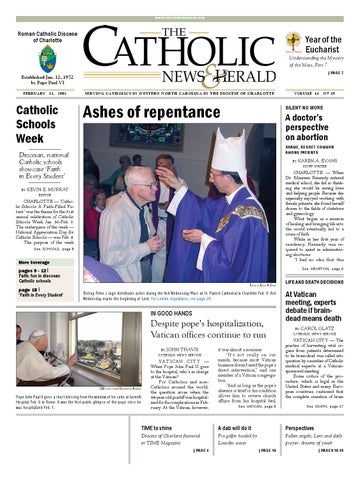
Ashes of repentance
A doctor’s perspective on abortion Shame, regret common among patients by
KAREN A. EVANS staff writer
CHARLOTTE — When Dr. Maureen Kennedy entered medical school, she did so thinking she would be saving lives and helping people. Because she especially enjoyed working with female patients, she found herself drawn to the fields of obstetrics and gynecology. What began as a mission of healing and bringing life into the world eventually led to a crisis of faith. While in her first year of residency, Kennedy was required to assist in administering abortions. “I had no idea that this
KEVIN E. MURRAY editor
CHARLOTTE — “Catholic Schools: A Faith-Filled Future” was the theme for the 31st annual celebration of Catholic Schools Week Jan. 30-Feb. 5. The centerpiece of the week — National Appreciation Day for Catholic Schools — was Feb. 2. The purpose of the week See SCHOOLS, page 8
More Coverage
See ABORTION, page 6
pages 9 - 12 I Faith, fun in diocesan Catholic schools page 18 I ‘Faith in Every Student’
no. 19
Silent no more
Diocesan, national Catholic schools showcase ‘Faith in Every Student’ by
vOLUME 14
Photo by Karen A. Evans
Bishop Peter J. Jugis distributes ashes during the Ash Wednesday Mass at St. Patrick Cathedral in Charlotte Feb. 9. Ash Wednesday marks the beginning of Lent. For Lenten regulations, see page 20.
In good hands
Despite pope’s hospitalization, Vatican offices continue to run by JOHN THAVIS catholic news service
CNS photo from L’Osservatore Romano
Pope John Paul II gives a short blessing from the window of his suite at Gemelli Hospital Feb. 6 in Rome. It was the first public glimpse of the pope since he was hospitalized Feb. 1.
VATICAN CITY — When Pope John Paul II goes to the hospital, who’s in charge at the Vatican? For Catholics and nonCatholics around the world, the question arose when the 84-year-old pontiff was hospitalized for flu complications in February. At the Vatican, however,
it was almost a nonissue. “It’s not really on our minds, because most Vatican business doesn’t need the pope’s direct intervention,” said one member of a Vatican congregation. “And as long as the pope’s absence is brief or his condition allows him to review church affairs from his hospital bed, See VATICAN, page 5
Life and death decisions
At Vatican meeting, experts debate if braindead means death by CAROL GLATZ catholic news service
VATICAN CITY — The practice of harvesting vital organs from patients determined to be brain-dead was called into question by a number of Catholic medical experts at a Vaticansponsored meeting. Some critics of the procedure, which is legal in the United States and many European countries, cautioned that the complete cessation of brain See DEATH, page 17
TIME to shine
A dab will do it
Perspectives
Diocese of Charlotte featured in TIME Magazine
Pro golfer healed by Lourdes water
Fallen angels; Lent and daily prayer; dreams of youth
| Page 4
| Page 16
| Pages 18-19
2 The Catholic News & Herald
InBrief
February 11, 2005
Current and upcoming topics from around the world to your own backyard
Efforts to reform U.N. in its 60th year draw interest of UNITED NATIONS (CNS) — Efforts to reform the United Nations and its approach to peace and security as it observes its 60th anniversary this year have drawn the interest and support of the Vatican. Recent attention has been focused on the report of a high-level panel to examine “threats, challenges and change” the international organization is facing in the 21st century. Archbishop Celestino Migliore, the Vatican’s U.N. nuncio, told the General Assembly Jan. 31 that the report “in many ways coincides with the Holy See’s views.” The nuncio welcomed a broadening of the approach to peace and security that emphasizes preventing conflict and the attention to development goals that would contribute to that objective. The panel, a 16-member group,
Standing up for life
Diocesan planner CHARLOTTE VICARIATE
CNS photo from Reuters
La Salette Sister Constancia Parcasio (right), a guest of U.S. first lady Laura Bush, applauds during President George W. Bush’s State of the Union address at the U.S. Capitol in Washington Feb. 2. Another guests pictured with the first lady was Homira Nassery of Afghanistan.
Nun who works in prison ministry a guest at State of the ARLINGTON, Va. (CNS) — Sister Constancia Parcasio, a Missionary Sister of Our Lady of La Salette, was one of about two dozen people chosen by the White House to sit with first lady Laura Bush for President George W. Bush’s State of the Union address Feb. 2. Sister Parcasio is the director of prison ministry for Catholic Charities in the Diocese of Arlington. She was invited to the president’s speech before Congress as a representative of a faithbased group and as an acknowledgment of her work with prison inmates. When Sister Parcasio received a letter from the White House telling her that the president and first lady wanted her to be present at the State of the Union address, she insisted that because she was just a diocesan employee it would be more fitting for the bishop or the director of Catholic Charities to go instead. But she was told, “Sister Connie, you are the choice of the president. You will represent the faith.” When she heard this, she accepted the invitation. “Certainly God’s ways are totally different from ours” said the Filipino nun. “His flare for choosing the insignificant, the weak and the poor as instru-
ments to put across his message is just beyond my imagination.” “Whatever good will come out from my being elevated to so high a pedestal is for God alone to measure,” she said. “But I was happy to be made a symbol and witness for those who believe in the existence of God. I guess my veil has served its purpose once again.” She met the president after the speech and thanked him for his support on issues related to the sanctity of life. She said the president praised Catholic Charities for the help it provides to communities. Laura Bush thanked Sister Parcasio for her work in prison ministry. The president referred to programs like Sister Parcasio’s prison ministry in his speech, noting that the U.S. government would “continue to support faithbased and community groups that bring hope to harsh places.” He also announced an expanded use of DNA evidence to prevent wrongful convictions and said he would be sending a proposal to Congress to fund training for defense counsel in capital cases, adding that “people on trial for their lives must have competent lawyers by their side.”
CHARLOTTE — As the 40th anniversary of the closing of Vatican Council II approaches, many Catholics are still unaware of the importance of this ecumenical council. Msgr. John McSweeney will be giving several presentations on what Vatican II really was and its importance to the Church. All sessions will meet in the New Life Center, Room 102, of St. Matthew Church, 8015 Ballantyne Commons Pkwy. The program meets Mondays, Feb. 28; March 7 and 21; and April 4 from 7-8:15 p.m. or Tuesdays, March 1, 8 and 22; and April 5, 6:30-7:45 p.m. Childcare is available by reservation at (704) 543-7677 ext. 1011. CHARLOTTE — Bishop Peter J. Jugis will celebrate Mass for Women of the Diocese Feb. 16 at 7:30 p.m. at St. Vincent de Paul Church, 6828 Old Reid Rd. For more information, call Peggy Pohlheber at (704) 588-7311. CHARLOTTE — Larry DeWalt of Hospice of Charlotte will present “Children and Grief ” Feb. 16, 6:30-8 p.m. in the St. Gabriel Ministry Center, 3016 Providence Rd. All are invited to learn how death impacts children. Topics covered will be how children understand death at different ages, how children grieve, the ways parents can help children heal after a loss and what children want to hear. For more information, call B.J. Dengler at (704) 704-364-5431 ext. 212. CHARLOTTE — The Anointing of the Sick is a anointing powerfully demonstrates Jesus’ presence among us as our healer and comforter. We invite all those who are experiencing any physical, mental or emotional afflictions, advanced age or facing surgery to
called development “the indispensable foundation for a collective security system that takes prevention seriously” because it helps combat the threats to security found in poverty, infectious disease, environmental degradation, civil war, terrorism and organized crime. Archbishop Migliore said that when the United Nations was founded in 1945, security was mainly viewed as protecting nations against aggression by other nations, but now the concept has to be much broader to include threats not tied to a particular country. Noting that the Vatican was not pacifist, he said that even though use of force was necessary at times it was “much more necessary to remove the root causes of insecurity and instability in the social, economic and cultural fields.”
receive this sacrament at a special Mass Feb. 20 at 2:30 p.m. at St. Matthew Church, 8015 Ballantyne Commons Pkwy. For more information, call the church office at (704) 543-7677. CHARLOTTE — The Society of Mary and Martha, formerly Women’s Talks, meets the third Monday of each month at 7:30 p.m. at St. Vincent de Paul Church, 6828 Old Reid Rd. For more information, call Peggy Pohlheber at (704) 588-7311. CHARLOTTE — We invite you to join us so that we may be with you in your illness and pain be it mental, spiritual or physical. We will pray with you in the name of the Lord Jesus for your healing. Come and know the gentleness and unconditional love of the Lord. Claim his promise of healing and give praise and thanks for all that will be done in the Lord’s holy name. We meet the third Monday of every month in the St. Matthew Chapel, 8015 Ballantyne Commons Pkwy., at 7:30 p.m. For more information, contact Barbara Gardner at CHLT5NC@aol. com. GASTONIA VICARIATE BELMONT — A Lenten Supper-Study Series will take place in the Kovacic Center at Queen of the Apostles Church, 503 N. Main St., Wednesdays, Feb. 16, 23, March 2 and 9. A shared meal begins at 6 p.m., and catechesis begins at 6:45 p.m. The theme this season is “The Eucharist as Sacrament, as Devotion, as Uniter/Divider and as Way of Life.” Free and open to all — no fees or preregistration necessary. Please call Dennis Teall-Fleming at (704) 825-9600, ext. 26 or e-mail teallfleming@yahoo.com if you have any questions. BELMONT — Father Jim Hawker, vicar of education, will be the keynote speaker at the Young
FEBRUARY 11, 2 0 0 5 Volume 14 • Number 19 Publisher: Most Reverend Peter J. Jugis Editor: Kevin E. Murray Staff Writer: Karen A. Evans Graphic Designer: Tim Faragher Advertising Representative: Cindi Feerick Secretary: Deborah Hiles 1123 South Church St., Charlotte, NC 28203 Mail: P.O. Box 37267, Charlotte, NC 28237 Phone: (704) 370-3333 FAX: (704) 370-3382 E-mail: catholicnews@charlottediocese.org
The Catholic News & Herald, USPC 007-393, is published by the Roman Catholic Diocese of Charlotte, 1123 South Church St., Charlotte, NC 28203, 44 times a year, weekly except for Christmas week and Easter week and every two weeks during June, July and August for $15 per year for enrollees in parishes of the Roman Catholic Diocese of Charlotte and $23 per year for all other subscribers. The Catholic News & Herald reserves the right to reject or cancel advertising for any reason deemed appropriate. We do not recommend or guarantee any product, service or benefit claimed by our advertisers. Second-class postage paid at Charlotte NC and other cities. POSTMASTER: Send address corrections to The Catholic News & Herald, P.O. Box 37267, Charlotte, NC 28237.
The Catholic News & Herald 3
February 11, 2005
FROM THE VATICAN
Vatican official says Ukrainians are example to world Minister Victor Yanukovych the winner of a Nov. 21, 2004, presidential election, hundreds of thousands of Ukrainians protested peacefully. Opposition candidate Victor Yushchenko charged fraud and appealed to the Supreme Court, which ordered the Dec. 26 rerun. Yushchenko was declared the new president. The archbishop also praised Ukrainians who made many sacrifices under Soviet communist rule in order to profess their faith in God and their “desire to remain in union” with the pope. “The experience of your martyrs under communism and the experience of the recent peaceful transition here in Ukraine” stand out as “some of the most effective communication imaginable — a communication of faith and a communication of freedom,” he said. VATICAN CITY (CNS) — The
VATICAN CITY (CNS) — Ukrainians have stood up for their rights and adhered to their principles despite decades of communism and a recent election scandal, proving themselves to be an example to the world, said a Vatican official. Ukrainians “have given a splendid example to the world of the defense of a principle — the principle of the need for fair and honest elections in a democratic society,” said U.S. Archbishop John P. Foley in a Feb. 7 address to staff and students of the Ukrainian Catholic University in Lviv. Archbishop Foley, head of the Pontifical Council for Social Communications, praised the country for what has been called “a miracle of peaceful protest and transition to a democratically elected government.” After Ukraine declared former Prime
Adult Day of Reflection, Feb. 19, 10 a.m.-4 p.m. at the McCarthy Spiritual Center on the Sisters of Mercy Campus. Themed “Share the Vision, Tell the Story,” the event will focus on the Gospel of St. Matthew. For registration information, contact Kay Jordan at (704) 370-3243 or e-mail wkjordan@charlottediocese.org. GREENSBORO VICARIATE
MOORESVILLE — An Ignatian Prayer Night will be held Feb. 15, 7-8:30 p.m. at St. Therese Church, 217 Brawley School Rd. Learn about Ignatius of Loyola and experience the Jesuit way of prayer. For details, call the church office at (704) 664-3992. MOORESVILLE — Bishop Emeritus William G. Curlin will present a retreat for Knights of Columbus and their spouse entitled, “A Personal Relationship with Jesus.” The retreat will take place Feb. 19 at 11 a.m. at St. Therese Church, 217 Brawley School Rd. For details, call the church office at (704) 664-3992. SMOKY MOUNTAIN VICARIATE
GREENSBORO — The Greensboro Council of Catholic Women will present its annual Lenten Mini Retreat at the Franciscan Center, 233 N. Greene St. Mass will be celebrated at 10 a.m. followed by coffee and light refreshments. The retreat dates are Thursdays, Feb. 17 and 24 and March 3, 10 and 17. This is an opportunity for all of us to do something extra during Lent. For more information, please contact Carmen Wood (336) 545-9266. HICKORY VICARIATE NEWTON — “The poor do not need our condescending attitude or our pity. They only need our love and tenderness.” — Mother Teresa. Women of Grace will meet Feb. 16 at 7 p.m. in Holy Family Hall of St. Joseph Church, 720 West 13th St. The Group will discuss quotations from Mother Teresa on the subject of love. All are welcome. For details, call the church office at (828) 464-9207. HICKORY — St. Aloysius Church, 921 Second Street NE, will host Landings, an outreach program for those who have left the Catholic Church and are thinking of returning. Landings will meet Monday evenings, through March 14, 6:30-8:30 p.m. Anyone interested in participating should call Bonnie Tamrack, at (828) 994-2233. SALISBURY VICARIATE
Episcopal
calendar
Feb. 19 — 2 p.m. Rite of Election St. Thomas Aquinas Church, Charlotte
Vatican’s top liturgy official said Rainbow Sash wearers disqualify themselves from receiving Holy Communion because they are demonstrating their opposition to church teaching on homosexuality. Cardinal Francis Arinze, head of the Congregation for Divine Worship and the Sacraments, made the comment in early February. Rainbow Sash, which describes itself as an organization of gay and lesbian Catholics and their families and friends, has criticized church statements on homosexuality, including the church’s teaching that homosexual acts are “intrinsically disordered” and that homosexual orientation is “objectively disordered.” To underline their point, the group’s members sometimes attend Mass and receive Communion wearing the sash. Cardinal Arinze discussed the issue with at least one U.S. archbishop during U.S. bishops’ visits to the Vatican in 2004. Asked about his position by CNS, Cardi-
nal Arinze said: “Rainbow Sash wearers are showing their opposition to church teaching on a major issue of natural law and so disqualify themselves from being given holy Communion.” The church teaching that homosexual acts are contrary to natural law and that the homosexual inclination is “objectively disordered” is contained in the “Catechism of the Catholic Church,” which was revised and corrected in 1997. The church also teaches that homosexuals must be accepted with love and respect and that they should not be discriminated against. Some bishops have denied the Eucharist to Rainbow Sash members on the grounds that they were using the Eucharist to manifest opposition to church teaching. Some Rainbow Sash members have said they consider their wearing of the sash an act of celebration, not protest.
Ongoing care
MURPHY — Rev. Chester Jones, pastor of Peachtree Memorial Baptist Church, will preach the first in a series of Community Lenten Worship Services Feb. 16, 12-12:30 p.m. at St. William Church, 765 Andrews Rd. Rev. John Rice will preach the second service, Feb. 23, 12-12:30 p.m. The series is designed to strengthen ecumenical bonds within the community. For more information, call Joan Kennedy at (828) 837-8519. WINSTON-SALEM VICARIATE WINSTON-SALEM — A course on Natural Family Planning will begin Feb. 20. Classes will meet for 90 minutes once a month for four consecutive months. Please call Todd and Stephanie Brown at (336) 765-2909 for more information.
Is your parish or school sponsoring a free event open to the general public? Please submit notices for the Diocesan Planner at least 15 days prior to the event date in writing to Karen A. Evans at kaevans@ charlottediocese.org or fax to (704) 370-3382.
Bishop Peter J. Jugis will participate in the following events:
Feb. 17 — 10 a.m. Foundation of the Diocese of Charlotte Catholic Conference Center, Hickory
Vatican official says Sash wearers disqualified from Communion
Feb. 20 — 3 p.m. Rite of Election St. Barnabas Church, Arden
CNS photo by Paul Har
U.S. Camillian Father Scott Binet, a medical doctor from Milwaukee, examines a woman displaced by tsunamis in a camp about an hour outside of Banda Aceh, Indonesia, Jan. 19. The priest is in the process of opening a medical clinic on the grounds of the only Catholic parish in Banda Aceh.
CORRECTIONS In a Jan. 28 Catholic News Service story about Green Bay Packers quarterback Brett Favre, family friend Patricia Ladner was incorrectly identified as a current member of the Sisters of Mercy. She was a Sister of Mercy for seven years but is no longer a member of the congregation. In our Feb. 4 issue, Estelle Wisneski was misidentified as a parishioner of St. Gabriel Church. She is a parishioner of St. Vincent de Paul Church in Charlotte. Bishop Emeritus William G. Curlin’s February retreat at St. Mary Church in Shelby for Knights of Columbus, listed in the Diocesan Planner, was incorrect. Bishop Curlin will not speak at
4 The Catholic News & Herald
February 11, 2005
in the news
Catering to commuters
Diocese of Charlotte featured in TIME Magazine Article highlights growth of Catholicism in South by
DAVID HAINS
special to the catholic news & herald
Courtesy Photo
Bishop Gerald M. Barbarito of Palm Beach, Fla., stands with Catholic airport chaplains during their annual meeting at Our Lady of Florida Spiritual Center in North Palm Beach Jan. 25-28. Those pictured include Deacon Ben Wenning (back row, third from left) and Rick Hanners (seated) from the Diocese of Charlotte.
Chaplains from Charlotte airport attend conference Brochure lists chaplains for Mass, sacraments NORTH PALM BEACH, Fla. — Three members of the Diocese of Charlotte recently represented the chapel at Charlotte’s airport at a gathering of Catholic airport chaplains. Deacon Ben Wenning, director of the permanent diaconate; Deacon Jerry Hickey, permanent deacon at St. Vincent de Paul Church in Charlotte; and Rick Hanners, a parishioner of St. Gabriel Church, attended the National Conference of Catholic Airport Chaplains’ annual meeting at Our Lady of Florida Spiritual Center Jan. 25-28. All three men are chaplains at Charlotte Douglas International Airport. Deacon Wenning was recognized for 14 years of service on the NCCAC administrative board, serving
as Secretary for eight of those years. Hanners was elected to the board as a member-at-large. Other elections included Chicago airport chaplain Father Michael Zaniolo as president and Pittsburgh chaplain Father Jack Fitzgerald as vice-president. Bishop Gerald M. Barbarito of Palm Beach welcomed the chaplains and celebrated Mass with them on the opening day of the conference, which included presentations of progress reports from the various chaplains across the country. A brochure on “Catholic Civil Aviation Apostolate,” published by the NCCAC, lists the airports where Catholic Mass is offered on Sundays, weekdays and holy days; where the
CHARLOTTE — St. Patrick Cathedral and School and Our Lady of the Assumption Church in Charlotte, as well as St. Mark Church in Huntersville are all featured in TIME Magazine. The article, “Mass Appeal, BibleBelt Catholics,” by Miami Bureau Chief Tim Padgett in the Feb. 14 issue, explains how churches in the Diocese of Charlotte are responding to notable growth by “...being born again in the cradle of born-again Christianity — the South.” Padgett spent three days in the diocese, visiting schools and churches and talking with members of the clergy and the faithful as well as interviewing Bishop Peter J. Jugis. Included in the three-page article are four photographs of worshipers, Catholic school students, clergy and Bishop Jugis. Father Christopher Roux, master of ceremonies, and Father Paul Gary, rector of St. Patrick Cathedral sacraments of reconciliation and anointing of the sick are available; and which airports — with or without a chapel — have Catholic chaplains available for “a simple ministry of presence.” A map in the brochure depicts each of the 35 U.S. airports at which a chapel or chaplain is available. Most are in the eastern half of the United States. “The availability of pastoral services in airports is a rather recent development,” the brochure notes, adding that Cardinal Richard Cushing established the first airport chapel at Logan International Airport in Boston in 1950. “Today over 100 airport chapels in
in Charlotte, also were photographed as they celebrated a Catholic Schools Week Mass at St. Patrick with Bishop Jugis. The bishop described the article as “a tremendous statement in the mainstream media affirming our faith in Jesus Christ and the presence of the Holy Spirit in our diocese.” “Through this exploration of our diocese, I hope that Catholics and all who are seeking Christ will grow in their own faith and love for the Lord,” said Bishop Jugis. TIME Magazine is a weekly news publication with a circulation of 4.1 million. David Hains is director of communications for the Diocese of Charlotte. Contact him at dwhains@charlottediocese.org. WANT MORE INFO?
The TIME Magazine article can be found by visiting the diocesan Web site at www.charlottediocese.org.
50 nations offer pastoral care,” it adds. Chaplains minister not only to passengers but to airport and airline personnel, families, visitors, the homeless and refugees, the brochure says. The chapel at Charlotte Douglas airport is located on the ticketing level, adjacent to TSA checkpoint “B.” The chapel, which is staffed by 12 volunteers, is open 24 hours a day. WANT MORE INFO?
Donations and volunteer assistance at the Charlotte Douglas International Airport are welcomed. For more information, contact Deacon Ben Wenning at (704) 359-4040
February 11, 2005
from the cover
The Catholic News & Herald 5
Vatican continues to run, despite pope’s VATICAN, from page 1
there’s simply no problem,” the official added. In fact, Vatican sources said, some important church business was already being sent over for papal review on the second day of the pope’s hospitalization at Rome’s Gemelli Hospital. There are some things only the pope can do, like appoint bishops, make curial appointments or approve some major documents. But the bulk of the daily work performed by the more than 30 major offices of the Roman Curia does not need the pope’s immediate supervision. “We see the pope three times a year. So if it’s a short-term hospital stay, there’s virtually no effect on our work,” said one member of the Congregation for Saints’ Causes. The heads of a few other congregations — for doctrine, bishops and evangelization — typically meet with the pope once a week, so the pope’s absence would impact them more. But, in general, the curial machinery grinds on. “We’re handling 100 letters a day out of the Secretariat of State. You’d think there might be a slowdown, but there’s not,” said one Vatican official. Inside the Apostolic Palace, the five-story building that houses the papal residence and top Vatican offices, it was business as usual during the pope’s fourth day in the hospital. A few steps down the marble corridor from the pope’s apartment, prelates carrying sheaves of papers hurried toward the offices of the Secretariat of State’s second section, which deals with international affairs. At the elevator, a diplomat arrived for an appointment. “The work is continuing at its usual pace. In the past, if there’s something that urgently requires the pope’s attention, Cardinal (Angelo) Sodano takes it to the Gemelli. In this situation, I don’t know if the pope’s condition allows that yet,” said one official.
Cardinal Sodano, the Vatican’s secretary of state, is the one expected to “take care of everything” until the pope returns, the official said. That presumes the pontiff is absent for a short time and is not incapacitated for a longer period. As church law experts have pointed out, the church has no clear mechanism to deal with the situation of a pope who goes into a long coma, for example, or is otherwise “impeded,” to use the church’s term. It is possible the pope has prepared instructions for such an eventuality, but if so they have not been published. The prospect of a lengthy absence seemed far from the minds of Vatican officials, even as the pope’s hospital stay lengthened. While outsiders might have expected an atmosphere of crisis inside the Vatican walls, that was not in evidence. “It seems like he’s over the worst part and is improving. There’s no big worry here. People are relaxed,” said one highly placed monsignor. “He’ll be back in a few days and will be around for a few more years,” a Swiss Guard predicted confidently. At the Vatican typographical offices, a nun said she was convinced the pope was helped by the prayers of the world. “It’s true he is an elderly man and with all the health problems he’s had the flu is not a minor thing,” she said. She added something that’s become a signature comment about this pope: “But he’s got a very strong character.” Inside the Vatican gates, life went on: Employees lined up at the Vatican bank, pilgrims came to order papal blessings, priests and bishops arrived for meetings, and the Pontifical Academy of Sciences hosted a conference. At the Vatican newspaper’s photo office, where pilgrims order photos of papal audiences and liturgical events, there was a marked reduction in traffic. With audiences canceled indefinitely, the place was almost empty. No photos of the pope had been made available since Jan. 30, when he made his last public appearance at his apartment
CNS photo from Reuters
A woman touches a marble relief of Pope John Paul II at the Sanctuary of Our Lady of Divine Love outside Rome Feb. 4, the third day the pope was being treated at Rome’s Gemelli Hospital after being admitted with breathing difficulties.
Vatican official’s comment reignites debate over papal VATICAN CITY (CNS) — When a top Vatican official said papal resignation should be left to the “conscience” of Pope John Paul II, it reignited a debate that has been smoldering for years. Inside and outside the Vatican, prelates and lay experts have fallen into two camps: those who think the pope would resign if he felt he could not lead the church, and those who say it will never happen — that the pontiff has clearly decided to stay at the church’s helm until God takes him. With a weakened pope in the hospital for flu-related breathing problems, Cardinal Angelo Sodano, the Vatican secretary of state, was asked Feb. 7 by reporters if he thought the pope would consider resigning. He gave an answer that appeared to recognize resignation as an eventual possibility: “We have to have enormous trust in him. He knows what he should do.” For the media and papal commentators, that was enough to start the wheels turning. No one questions whether a pope can resign: It’s happened before, the last time
in 1294 when Pope Celestine V abdicated. The papal resignation option is explicitly written into the Code of Canon Law. It says a pope may step down, but stipulates that the decision must be made freely and “duly manifested.” Those are two crucial conditions and would be problematic if a pope becomes so sick that he cannot express his wishes unequivocally. Some have suggested that Pope John Paul, who suffers from a debilitating neurological disease, may have already prepared a letter of resignation in case that happens. Pope Pius VI prepared a similar letter in his old age. But church law experts say even that kind of letter might leave some doubt, because it would be papal aides who ultimately determine when it should be implemented. A number of cardinals have said they believed the pope would resign for the good of the church if he were unable to physically bear the burden of the papacy. But no one has said in public that the time for resignation has come. On the contrary, Vatican officials and others have marveled at the ability of the pope to somehow carry on, year after year, even as he has lost the ability to walk, to speak clearly and to endure long audiences. Indeed, the pope’s perseverance has convinced some that he will stay in the papacy to the end. Those close to the pope have insisted that the pope’s management abilities may be of secondary importance compared to the spiritual witness he is giving. Many Vatican officials say the pope — never much of a hands-on manager — in his present frail condition has delegated even more responsibility to selected aides. The pope’s public presence has been reduced, too. Even before his hospitalization, many of the pope’s public events featured stand-ins who read the pope’s talk or celebrated the liturgies for him. For the Catholic faithful, resignation is also a sensitive issue. When asked, many of those who see the pope in action express mixed sentiments: admiration for his courage and deep concern about his ability to keep going.
6 The Catholic News & Herald
fighting for life
Doctor discusses ABORTION, from page 1
would be part of my job,” she said. “No one prepared you or talked about it.” One night when she came in to work, she was told by an intern that there was a patient who was terminating her pregnancy. Kennedy was responsible for inserting laminaria suppositories into the cervix, which dilates the cervix prior to delivery or a surgical abortion. Kennedy referred to administering abortions as “scut work that was pawned off on interns” while more senior residents worked in labor and delivery. Kennedy said she didn’t know she had the option of refusing to participate in abortion procedures. None of the other doctors in the hospital, some of whom were Catholic also, talked about the ethics of abortion. “It can be difficult to risk being criticized by others, especially in a professional setting,” said Maggi Nadol, director of the diocesan Respect Life Office. “However, we are called to spread the message of Psalm 139: ‘Truly you have formed my inmost being; you knit me in my mother’s womb.’” Like many women who have had abortions, doctors are also shamed into silence about their roles in abortion, according to Kennedy. “I justified it by saying, ‘She is someone else’s patient’ and told myself I was just doing my job,” said Kennedy, who was raised in a pro-life Catholic family. “In my heart of hearts I felt bad about it.” Kennedy felt she had no pro-life role models in the hospital. After a while, she refused to take part in administering abortions, causing tension with her fellow residents, who had already “done their stints” and now had to perform abortions again. A few years later, as an OB/GYN in private practice, she saw firsthand the physical and emotional aftereffects abortion had on her patients. Kennedy recalled one of her former patients, a woman who had had several abortions prior to becoming her patient. While under her care, the patient had precancerous cells removed. “She was a young person who had gotten into a bad situation,” Kennedy said. Because of her abortions and various medical procedures, “carrying a baby to term was going to be very high risk, very difficult for her.” Kennedy became frustrated, feeling like the woman was “using up her options” each time she had an abortion. Another patient, pregnant with her first child, came to see Kennedy and was worried about her pregnancy. “She was worried above and beyond the normal ‘first-time jitters,’” said Kennedy, who later learned she had aborted a pregnancy prior to her marriage. “She was worried that because she had had an abortion, something bad was going to happen ... not that God would get her back, but from a purely medical standpoint.” According to Kennedy, women don’t come to their OB/GYN and “spill their guts.” “Abortion isn’t one of those things
that people are proud of or (admit) matter of factly,” said Kennedy. “It was always one of those things that was a secret.” Most patients would not admit to an abortion unless they were asked directly by their doctors. “A number of them had never shared it with their husbands,” she said. “There is a lot of secrecy about (abortion). There aren’t a lot of people who say ‘it was the best thing I ever did.’” What Kennedy heard more often were stories of shame, regret and guilt. “The people I saw who came back (after having had an abortion) were always regretful and distraught,” Kennedy said. Having a family of her own prompted Kennedy to “get right” and return to her Catholic roots. She retired from private practice to raise her three children, now ages 16 months to 6 years old. A member of St. Barnabas Church in Arden, Kennedy is now active with her parish Respect Life Committee and promotes Natural Family Planning. NFP, the only method of birth control accepted by the Catholic Church, is based on the observance of physical signs of a woman’s fertility. “I commend Dr. Kennedy for coming forward with her story,” said Nadol. “Her willingness to share her personal journey can serve as an example to witness to the sanctity of life.” “I owe it to women in honor of all the women I’ve taken care of and the ones that I didn’t help to be ‘silent no more,’” said Kennedy. “I feel like I’m doing the right thing now. I thank God I had that re-awakening.” Contact Staff Writer Karen A. Evans by calling (704) 370-3354 or e-mail kaevans@charlottediocese.org.
February 11, 2005
Growing in faith
Reciting the rosary
Photo by Karen A. Evans
Peter Rusciolelli pr ays the rosar y at the Pro-Life Rosar y and Benediction at St. Patrick Cathedral in Charlotte Jan. 18. The annual event is held each January to commemorate Respect Life Month and to pray for an end to abortion.
Respect Life is one of 36 ministries funded by contributions to the Diocesan Support Appeal.
Courtesy Photo
Gathering for life Bishop Peter J. Jugis (rear, center) stands with youths from St. Mark Church in Huntersville and Sacred Heart Church in Salisbury at the March for Life in Washington Jan. 24.
February 11, 2005
Kyrie Eleison
YEAR OF THE EUCHARIST
Guest Column
Understanding the Mystery of the Mass, Part 7 Last week we began our discussion of the Introductory Rites of the Mass. We already discussed the entrance procession, incensation of the altar, the Sign of the Cross and the celebrant’s greeting. We continue our discussion of the Introductory Rites this week by examining the “Penitential Rite.” As we mentioned earlier, from beginning to end the Mass is a prayer; in fact, the highest act of prayer known to mankind, since the Mass is the worship of the Son of God unto the Father. As members of Christ’s mysti-
cal body, the Church, we participate in his perfect worship. The Mass teaches us how to pray. And the first lesson of prayer, the primary movement of the Mass, is humility. In imitation of Christ — who humbled himself to become man; who humbled himself to take upon himself our sins; who humbled himself to undergo his passion, crucifixion and death on our behalf — we must humble ourselves. And so the Church seeks to imitate the humility of Christ by first recognizing our sins and acknowl-
The Catholic News & Herald 7
edging the fact that we are sinners in desperate need of God’s mercy. We must first recognize that we are empty before we can be filled. Therefore, the celebrant invites us to pause, examine our consciences in silence and ask for God’s mercy and forgiveness. During this brief moment of silence at the beginning of the Mass, we might be wondering what to think about: what I did last night; or the movie I saw last week; or what to eat for breakfast after Mass. However, we should examine our consciences, recalling particular sins, but also our overall need for forgiveness and
Father Matthew Buettner guest columnist
mercy for the sins we have committed and the good we have omitted, which we may have forgotten. It is a moment to prepare our souls to abandon our old sinful habits and seek the grace and mercy that God has prepared for us in receiving his body and blood in holy Communion. If we become conscious of serious mortal sins, we should resolve to go to the sacrament of reconciliation as soon as possible and refrain from receiving holy Communion. Although the Penitential Rite does not grant absolution for mortal sins, it does help us to receive forgiveness for our less serious, venial sins, which are forgiven when we receive holy Communion with humility and love. After a few moments of silence, the celebrant begins a prayer, known by its first word in Latin, the Confiteor: “I confess to Almighty God ....” As a community, we confess that we are guilty of sins in thought, word and deed. Then, we seek the intercession of “Blessed Mary, ever Virgin,” who was conceived without sin and remained sinless throughout her life; the angels, who battle with Satan and defeat evil; the saints, who were sinners like us, but cooperated with God’s grace and mercy to defeat their own sinfulness; and finally, the members of the Church Militant, “and you, my brothers and sisters, to pray to the Lord our God for me.” The celebrant completes this prayer with a prayer that begs for God’s mercy, seeks forgiveness and leads us to heaven. Finally, the Penitential Rite closes with the ancient threefold litany: Kyrie eleison, Christe eleison, Kyrie eleison [“Lord have mercy, Christ have mercy, Lord have mercy”]. This litany of mercy is the only surviving vestige of the Greek language remaining in the Latin Rite of the Catholic Church. Whether the Mass is offered in Latin, English, Spanish or Swahili, this Greek prayer may be recited or chanted by the celebrant, deacon or cantor. This formula, “Lord, have mercy,” really comes straight from the Gospel. Oftentimes a great healing by Christ is preceded by the humble cry of a beggar: “Son of David, have mercy on me!” That is precisely where we find ourselves at the beginning of Mass: poor beggars in need of God’s mercy. And that is why we approach the throne of our Heavenly Father in humility from the very beginning. Now that we have acknowledged our sinfulness before God and our neighbors, we can sing the biblical hymn of praise, known by its first word in Latin, The Gloria, which we will examine next week. Father Buettner is parochial vicar of St. Dorothy Church in Lincolnton.
8 The Catholic News & Herald
February 11, 2005
catholic schools week
Schools focus on ‘Faith in Every SCHOOLS, from page 1
was to build support and recognition for the more than 8,000 Catholic elementary and secondary schools nationwide, including the 18 schools in the Diocese of Charlotte. “Beginning on Sunday, Jan. 30, through the entire week of travels to our schools, it was amazing to see the variety of activities taking place,” said Linda Cherry, superintendent. “No matter where I was or what was going on, the spirit of our Catholic Schools was present.” Dominican Sister Glenn Anne McPhee, secretary for education at the U.S. Conference of Catholic Bishops, said that the theme of “Faith in Every Student” underscores two guiding principles of Catholic education — the fact that faith is an important value at the foundation of a Catholic school curriculum and that Catholic schools have faith that every student can achieve. “Catholic school leaders are committed to making a difference,” said Sister McPhee. “Our goal is to graduate students who have strong moral standards and fine academic skills who will become good citizens and able members of the workforce.” “I loved the theme of this year’s Catholic Schools Week. I think that says it all,” said Sandra McMonagle, principal of Our Lady of Mercy School in WinstonSalem. “It (the theme) is something we really practice — we do have faith in every student.” McMonagle said Catholic students are expected to behave as Christians and follow Gospel values. “We have high expectations for them,” she said, “and we want them to succeed as best they can with their Godgiven abilities. They can do whatever God has given them the ability to do.” The ability to openly celebrate the Catholic faith is one unique aspect of Catholic schools. During the week, many schools held special Masses. On Feb. 3, the feast of St. Blaise, Father Thomas Kessler, pastor of St. Leo the Great School in Winston-Salem, and Father Johnathan Hanic, parochial vicar, visited the school to bless the throats of students. At Immaculata School in Hendersonville, students placed carnations in vases in their classrooms to serve as a “symbolic remembrance” of the Indian Ocean tsunami victims. The students prayed for the victims daily, said Principal Bill Meehan. Throughout the week, the schools celebrated the parish family, the community, the volunteers and the students, and many dioceses encouraged parents to
Courtesy Photo by Donna Birkel
Students at St. Leo the Great School in Winston-Salem hold signs reading “Faith in Every Student,” the theme of Catholic Schools Week 2005, which ran Jan. 31-Feb. 4. enroll their children in Catholic schools by offering open houses. “The week calls attention to the uniqueness of our schools, and demonstrates the impact we make in our communities,” said Meehan. “It gives us the opportunity to reach out and publicize.” “Service to the community is an important aspect to our Catholic schools,” said Faye Almon, president of St. Patrick School’s Parent Teacher Organization in Charlotte. St. Patrick students organized a canned food drive for Catholic Social Services and collected books for a local public elementary school with a high number of low-income families. St. Patrick fifthgraders delivered the books and read to the school’s younger students.
At Our Lady of Mercy School, students helped deliver food for Meals on Wheels and the Salvation Army, as well as baked and delivered cookies to a local nursing home. At Immaculate Heart of Mary School in High Point, students delivered baked goods to local fire fighters, police and emergency services personnel and took Valentine’s Day presents to residents at Maryfield Nursing Home. The first annual Catholic Schools Week was in 1974, and became part of The National Marketing Campaign for Catholic Schools in 1991, a joint effort by the National Catholic Educational Association (NCEA) and the USCCB. “Catholic education is one of the great and generous works of the church,” said Michael J. Guerra, NCEA president.
“Our graduates have become leaders of this country, teachers, religious men and women and business entrepreneurs. Without a doubt, our schools have had a far-reaching impact on shaping the world.” “We truly appreciate our students and our responsibility as leaders, to ensure that the faith within them stays alive and grows while they are in our Catholic schools,” said Cherry. National Appreciation Day was established to showcase the great accomplishments and contributions of Catholic schools to the country. A delegation of more than 150 Catholic school students, teachers and parents visited Capitol Hill in Washington to meet with congressional leaders to promote Catholic schools Feb. 2. The delegation hand-delivered letters from chief administrators of Catholic education to their representatives and provided a background package on Catholic schools to every congressional office. “Catholic Schools weeks is a way to remind us of the value of a Catholic education and the impact that it can have on a child’s life,” said Paola Scilinguo, director of advancement at Bishop McGuinness Catholic High School in Kernersville. “If we continue to have faith in every student, then we can be sure that each and every one of them will reach their full potential, and we will be changing the world one student at a time,” said Scilinguo. Contact Editor Kevin E. Murray by calling (704) 370-3334 or e-mail kemurray@charlottediocese.org.
February 11, 2005
The Catholic News & Herald 9
catholic schools week
Faith and fun at St. Leo
Outreach project, special visitors highlight CSW by
SUSAN deGUZMAN correspondent
WINSTON-SALEM — A living rosary, a blessing of the throats, special Masses, visits from a congresswoman and an appearance on the local news made for a fun and meaningful Catholic Schools Week at St. Leo the Great School. While the theme of this year’s Catholic Schools Week, “Faith in Every Student,” was celebrated with a different emphasis each day, an ongoing outreach project that truly defined the week’s theme. The “Blanket Our Community” project started during the week and continues through Valentine’s Day, Feb. 14. Donated by school families, a collection of blankets — many already lining the halls of the school — will be donated to local homeless people. “The students understand that faith is expressed through service to others,” said Principal Georgette Schraeder. “We have used the ‘Faith in Every Student’ theme throughout the year with collections for the military in Iraq, tsunami victims, those suffering from natural disasters, as well as with our regular Christmas, Easter and Caring Friends outreach efforts,” she said. Visits from Congresswoman Virginia Foxx (R-NC 5th) and Judith Marsh, a Department of Veterans Affairs Repre-
sentative, highlighted “With Our Community” Day Jan. 31. When asked by a student about her favorite subject in school, Foxx replied that it was reading and English. “You can do anything you want if you can read,” she said. Presented with a book of prayers from the students, Foxx said she would ask the congressional chaplain if he would read one of the prayers at the opening of the congressional session, thereby securing its place in the permanent record. A gift of “Valentines for Vets” drew the attention of the local media which featured the school in a segment on the evening news. Marsh, who had previously visited the school on Veterans Day in November 2004, returned to accept the Valentine gifts made by students for patients in nearby veterans’ hospitals. Marsh also accepted a large handprinted flag made by the eighth-grade class after the Sept 11, 2001 tragedies. “With Our Community” Day also included a student presentation about the life of St. John Bosco and a clown show by Timothy Kiefer, a N.C. School of the Arts student. John Egan, a youth minister at St. Leo the Great Church, explained that St. John Bosco, the patron of clowns, actors and performers, was devoted to the welfare of youths. The saint would captivate his young audiences with his clown performances and include Gospel teachings as
Photo by Susan deGuzman
Father Thomas Kessler, pastor of St. Leo the Great Church in Winston-Salem, blesses the throat of seventh-grader Jennie Wittmer at St. Leo the Great School on the feast of St. Blaise, Feb. 3, during Catholic Schools Week. part of his act. Dino Gaudio, assistant coach of men’s basketball at Wake Forest University in Winston-Salem, visited the school for “With Our Students” Day Feb. 1. Gaudio spoke to students about how to achieve success in their lives. His three key ingredients were to care about other people, have pride in what you do and deal with difficulties and adversities in life — don’t try to avoid them, he said, but expect them. He also told students that their names are the most important things that they own, that all relationships are based
on trust and that their role models are not Britney Spears or Michael Jordan, “but the people who sit with you at the dinner table each night.” The remainder of Catholic Schools Week included a living rosary on “With Our Nation” Day Feb. 2; a blessing of the students’ throats on the feast of St. Blaise, and a lunch and dinner gatherings for “With Our Families” Day Feb. 3; and a Mass and visit from Superintendent Linda Cherry in celebration of “With Our Clergy, Faculty and Staff” Day Feb. 4.
Fun, crafts at OLM School Students at Our Lady of Mercy School in Winston-Salem create masks during Student Appreciation Day Feb. 2 as part of Catholic Schools Week. Also during the day, middle school students volunteered in the community and then spent the afternoon bowling. Fourth- and fifth-grade students went roller skating, while younger students went to the school theater. Courtesy Photo
1 0 The Catholic News & Herald
catholic schools week
February 11, 2005
Saintly skit
Drumming up faith
Photo by Carole McGrotty
Musician Billy Jonas guides Asheville Catholic School students in playing percussion instruments fashioned from cans, containers and other items on Feb. 4 during Catholic Schools Week.
Speakers, performers educate, entertain at Asheville Catholic by
CAROLE McGROTTY correspondent
ASHEVILLE — A variety of speakers and performers entertained students at Asheville Catholic School for Catholic Schools Week. James Mullen Jr., chancellor of the University of North Carolina at Asheville, was one of the speakers at the all-school assembly Jan. 31. Mullen, a Catholic, encouraged the students to “take lessons learned in Catholic school and take them into the community.” Other speakers included Robert Gabordi, editor of the Asheville Citizen-Times and representatives of Our Place, a home for abused children that
is assisted by student volunteers from Asheville Catholic School. Poet Glenis Redmon entertained the students Feb. 1 and discussed how she crafts her poetry. Billy Jonas, a musician who visited the school in December, returned Feb. 4 with his unique style of music and comedy. Working with fourth- and fifthgraders, Jonas guided the students in crafting and playing percussion instruments made from large garbage cans, industrial-sized plastic containers and other objects. Other Catholic Schools Week activities included student skits about their parishes and teachers, and a musical performance.
Courtesy Photo
John Egan, a youth minister at St. Leo the Great Church in Winston-Salem, and Timothy Kiefer, a N.C. School of the Arts student, perform a skit about the life of St. John Bosco, the patron of clowns, actors and performers, at St. Leo the Great School during Catholic Schools Week. Egan explained that St. John Bosco was devoted to the welfare of youths, and that the saint would captivate his young audiences with his clown performances and include Gospel teachings as part of his act.
February 11, 2005
catholic schools week
The Catholic News & Herald 11
Emphasis on the Catholic faith and religious activities, such as Mass, is a unique part of the Catholic school environment. Special Masses and other religionthemed events were scheduled at schools throughout the Diocese of Charlotte as part of Catholic Schools
Courtesy Photos
Above: Bishop Emeritus William G. Curlin celebrated Mass at Bishop McGuinness Catholic High School in Kernersville Feb. 2 as part of Catholic Schools Week. Pictured are (from left) Richard Valittuto, student council president; Father Joe Kelleher, retired; Linda Cherry, superintendent; Msgr. Joseph Showfety, retired; Jennifer Williams and Erica Sickelbaugh, students. Below: Msgr. John McSweeney, pastor of St. Matthew Church in Charlotte, talks to students at St. Matthew School about religion and vocations Jan. 31.
Photo by Karen A. Evans
Students at Charlotte Catholic High School listen to Bishop Peter J. Jugis’ homily during a schoolwide Mass Feb. 3. The Mass, which was celebrated during Catholic School Week, featured a choir from St. Ann School.
1 2 The Catholic News & Herald
catholic schools week
February 11, 2005
Service to the community is an important aspect in Catholic schools throughout the Diocese of Charlotte. Students took part in numerous outreach and community-oriented projects as part of Catholic Schools Week. Many of the projects are ongoing.
Courtesy Photos
Above: Fifth-grader Perusi Benson and firstgrader Brady Johnson were among the students at Immaculate Heart of Mary School in High Point making Valentine’s Day cards for residents of Pennybyrn at Maryfield in High Point and the veteran’s hospital in Salisbury Feb. 2 as part of Catholic Schools Week. Right: Firefighters from Fire Station 13 in High Point receive a “thank you” card and homemade desserts from Immaculate Heart of Mary School students Jan. 31. School representatives are (clockwise from bottom) kindergartener Lauren Soltis, third-grader Olivia Herschel, parent Vicki Owen and sixth-grader Alissa Terpedino.
Courtesy Photo
A student from St. Patrick School in Charlotte reads to students at Westerly Hills Elementary School in Charlotte Feb. 1 as part of a school service project for Catholic Schools Week. St. Patrick School students also collected new and gently used books and delivered them to Westerly Hills Elementary.
February 11, 2005
advertisement
The Catholic News & Herald 13
1 4 The Catholic News & Herald
February 11, 2005
Culture Watch
Two books — one negative, one positive — explore pope’s reviewed by GRAHAM G. YEARLEY catholic news service
Reading “The Pontiff in Winter: Triumph and Conflict in the Reign of John Paul II” by John Cornwell (the author of the best seller, “Hitler’s Pope”) is like watching someone knock down an old man and give him a few kicks for good measure. The observer is horrified but fascinated. “The Pontiff in Winter” is mean-spirited, sloppily edited and repetitive. The book begins with a quick biographical sketch of the pope’s childhood and adulthood leading up to his elevation to the papacy. Then in loose chronological order, Cornwell lays out the various social questions and political
situations Pope John Paul II has dealt with (or refused to deal with): communism, religious oppression, pluralism, materialism, women as priests, sexuality, ecumenism, to name a few. In every case, Cornwell finds Pope John Paul’s response either wrong-headed or callously dismissive. However, the relentless negativity numbs the reader to the moments where Cornwell’s outrage is appropriately incisive. For example, on the pope’s opposition to the use of condoms, even in the face of the rapid spread of AIDS in Africa, Cornwell’s comments have a Swiftean anger and power. In other places, Cornwell seems to fault the pope for not adopting his agenda — that of a liberal Western Catholic — when Pope John Paul has made it clear that the liberal Western agenda is not his. Cornwell seems particularly irked that the pope has not resigned as his health declines. He seems oblivious to the fact that no pope in modern history
WORD TO LIFE
A roundup of Scripture, readings, films and more
has resigned and that the idea of retirement to this pope is abhorrent, no matter how ill he becomes. The editing of “The Pontiff in Winter” is so sloppy that it makes plain the haste in which the book was rushed to publication. For example, Cornwell’s reaction to the revelation of the “third secret of Fatima” is brought up once and then, strangely, restated a hundred pages later in almost the same wording. The short chapters dealing with various problems read like short articles written for other publications and hastily shoved into book form. After “Hitler’s Pope” — Cornwell’s book on Pope Pius XII and the Nazis — it seems a wonder anyone at the Vatican would let Cornwell sit at a major ceremony no more than 10 feet from the pope, musing on how ill and feeble he looks, knowing those musings would show up in print. The Holy Father’s own book, “Rise, Let Us Be on Our Way,” is his second volume of autobiography and meditation, covering the years from 1958, when he was made a bishop, to his elevation to the papacy in 1978. The first book, “Gift and Mystery,” contained perhaps more dramatic portions of his life — his brief acting career, the Nazi occupation of Poland, and his secret seminary training during the war years. But this volume charts his development as a bishop and archbishop, periods that are more crucial to understanding his papacy. Pope John Paul comes off as a Polish Will Rogers; he never seems to have met a priest or religious or lay person he didn’t like. Only the communist governments of the Eastern bloc get the cold shoulder and, then, no individuals are named. When the names of Polish bishops, nuns and priests, unknown to most, become stultifying, the meditations on the episcopacy, St. Joseph and modern saints reawaken readers to the fact that Pope John Paul is a man of profound faith and a writer of memorable prose. Yearley studies theology at the Ecumenical Institute of St. Mary’s Seminary and University in Baltimore.
Sunday Scripture Readings: feb. 20, 2005
Feb. 20, Second Sunday of Lent Cycle A Readings: 1) Genesis 12:1-4a Psalm 33:4-5, 18-19, 20, 22 2) 2 Timothy 1:8b-10 3) Matthew 17:1-9
God has a plan for everyone by
SHARON K. PERKINS catholic news service
About 18 months ago, my husband and I were immersed in the emotionally and physically draining activities of burying my mother-in-law and taking our oldest daughter out of state to begin college. For us “40-somethings,” returning home after those few whirlwind days and settling back into a routine was a welcome respite. Then came the morning when I casually remarked for the umpteenth time, “I really wish I were beginning my doctorate” — and my husband replied, “Then why don’t you?” Five months later I was applying to university programs, and six months after that we were packing up the family and all our belongings to move to Ohio after more than 40 years of living in Texas. (If that wasn’t crazy enough, imagine going back to college after 20 years away from it!) The amazing circumstances and events that accompanied our move are
too numerous to mention, but they confirmed in many ways that God indeed was directing our steps, no matter how fearful I felt or how outlandish I thought our decision was at times. Indeed, I could completely identify with today’s Genesis story! In both the Abram narrative and Matthew’s account of the Transfiguration, God clearly is telling or showing people a vision by which they are to come to a deeper understanding of their role in the divine scheme of things. As bizarre as these revelations must have seemed, God, knowing human frailty, accompanied them either with providential signs or the words, “Don’t be afraid.” Abram was encouraged to experience God’s presence in the moment. Only then, reassured, was he able to leave Haran for a land he did not know, just as Jesus’ transfigured presence empowered the disciples to descend the mountain with him toward a series of events they could not have anticipated. Sure, there are still times I find myself wondering: “Why me? Why now?” I certainly haven’t been shown the entire vision for my future, how the completed doctoral degree will fit into the picture or the specific ways I will be called to serve God and others. Nevertheless, strengthened by God’s provision and peace, I am certain that, for the present, I am where I need to be. For it is in the present that God’s sustaining “presence” is found. Questions: When have you experienced God
WEEKLY SCRIPTURE Scripture for the week of February 13-19 Sunday (First Sunday in Lent), Genesis 2:7-9, 3:1-7, Roman 5:12-19, Matthew 4:1-11; Monday (Sts. Cyril and Methodius), Leviticus 19:1-2, 11-18, Matthew 25:31-46; Tuesday (Lenten Weekday), Isaiah 55:10-11, Matthew 6:7-15; Wednesday (Lenten Weekday), Jonah 3:1-10, Luke 11:29-32; Thursday (Seven Founders of the Servite Order), Esther C:12, 14-16, 23-25 or 4:17 (Ester’s prayer), Matthew 7:7-12; Friday (Lenten Weekday), Ezekiel 18:21-28, Matthew 5:20-26; Saturday (Lenten Weekday), Deuteronomy 26:16-19, Matthew 5:43-48. Scripture for the week of February 20-26 Sunday (Second Sunday of Lent), Genesis 12:1-4, 2 Timothy 1:8-10, Matthew 17:1-9; Monday (St. Peter Damian), Daniel 9:4-10, Luke 6:36-38; Tuesday (The Chair of St. Peter), 1 Peter 5:1-4, Matthew 16:13-19; Wednesday (Lenten Weekday), Jeremiah 18:18-20, Matthew 20:17-28; Thursday (Lenten Weekday), Jeremiah 17:5-10, Luke 16:19-31; Friday (Lenten Weekday), Genesis 37:3-4, 12-13, 17-28, Matthew 21:33-43,45-46; Saturday (Lenten Weekday), Micah 7:14-15, 18-20, Luke 15:1-3, 11-32.
The Catholic News & Herald 15
February 11, 2005
Professor examines Hollywood’s depiction of Muslims and Arabs by MARK PATTISON catholic news service
WASHINGTON (CNS) — The Hollywood depiction of Muslims and Arabs has taken a decidedly more ambivalent tone in the past half-century, according to Lourdes Alvarez, an assistant professor of modern languages at The Catholic University of America. “Political events and shifts in American perceptions of the Middle East” have played a large role in the shift from what had been a more benign and respectful treatment of Islam, Alvarez said in a Feb. 1 presentation at Catholic University. Now, she said, there are “ubiquitous Hollywood representations of the Middle East as a place of religious extremism, violence and terrorism.” In an earlier era, when “the United States was not yet dependent on foreign oil and thus not yet vulnerable to fluctuations in price or supply, the creation of the state of Israel in 1948, and the subsequent war with its Arab neighbors, made fantasy films about the Orient a much less marketable prospect at the box office,” Alvarez said in her presentation, “Thieves of Baghdad: Hollywood Revisits the Arabian Nights.” “As the Middle East loomed ever larger in strategic importance to the United States, as Middle Eastern interests were increasingly perceived to be in conflict with those of the United States, Hollywood portrayals became more negative,” Alvarez said . Alvarez said there are three distinct types of Hollywood films with Arabs and Islam at their center:
— Stories based on “The Arabian Nights,” also known as the “1,001 Nights.” — “Sheik” films ranging from the Rudolph Valentino silent-era classics to “Lawrence of Arabia,” whose protagonists are “Westerners who have adopted Arab ways and are now on some level more Arab than the Arabs,” said Alvarez. — Arabian action films along the lines of “Raiders of the Lost Ark,” in which, Alvarez said, “there aren’t really any Arabs.” The tales have also spawned a variety of cartoon representations, including the 1992 Disney animated film “Aladdin,” whose $200 million box-office take was the highest up to that time for an animated picture. Alvarez noted that 18th-century Frenchman Antoine Galland looked for additional tales to flesh out “The Arabian Nights.” As a result, two of the most famous stories — “Ali Baba and the Forty Thieves” and “Aladdin and the Magic Lamp” — are of dubious scholarship as they are not found in any of the early manuscripts. “Arabian Nights” films “present a more varied array of characters” than their sheik or action counterparts, Alvarez said. “There are good and bad Arabs here.” The movies also tend to portray both positives and negatives about Arab culture, she said. On the positive side is “the idea of the East as a repository of ancient knowledge or wisdom, of values that have been lost in the West,” Alvarez added, while on the negative side, “the East is portrayed as a place of ignorance, credulity, corruption,
‘Winn-Dixie’ satisfies kids, adults
CNS photo from 20th Century Fox
AnnaSophia Robb and a dog named Winn-Dixie star in “Because of Winn-Dixie,” a gentle and disarming story based on an award-winning best-seller. The film is beautifully acted and imparts a heart-tugging message about people’s loneliness and need to connect, making satisfying entertainment for adults as well as children. The USCCB Office for Film & Broadcasting classification is A-I — general patronage. The Motion Picture Association of America rating is PG — parental guidance suggested.
savagery and decadence.” Comparing the evolution of the Hollywood Western with the Hollywood “Eastern” — Alvarez’s term for Arabianthemed movies — Arab characters have moved from a more benign persona to an evil persona, while American Indian characters have done the opposite. “As time passed and memories of the brutal clashes of the 19th century faded, Indians were no longer perceived as
threatening to U.S. interests. Westerns begin depicting Indians as more noble, as the possessors of ancient spiritual truths that have been forgotten by modern civilization,” she added. “You even get a film like ‘Dances With Wolves,’ which features Kevin Costner adopting Indian ways, not altogether unlike those early Valentino films in which Westerners adopt the rugged lifestyle of the desert,” she noted.
1 6 The Catholic News & Herald
February 11, 2005
living the faith
A dab will do it
Pro golfer attributes healing to Lourdes water Free books offered to asthma, allergy sufferers by
KEVIN E. MURRAY editor
HENDERSONVILE — People might say Ron Garcia has many blessings for which to be thankful. Between 1970 and 1982, the professional golfer won 16 Florida Winter Tournaments and other mini tours; set five course records, at least three of which are still intact; made the longest hole-inone in 1974; and shot a double eagle using a driver and an eight-iron on a 511-yard par 5. Despite his achievements on the green, Garcia said it is a spiritual experience that is his greatest success story. And he wants to share it with others. “It’s a powerful avenue to pray to the Blessed Mother for intercessions,” said Garcia. “I think my faith in that is why I
received this blessing.” Garcia, a life member of the Professional Golfer’s Association, had suffered from debilitating asthma and year-round allergies since his youth. For years, he had to use medicines that made him “lethargic and irritable,” and were possibly generating glaucoma in his eyes. In what he described as “spur of the moment” in 1995, Garcia tried something different, something divine, to cure him of his ailments. And it worked. “My allergist said she had no explanation for it,” said Garcia. “Well, I do.” Garcia had acquired a small bottle of water from Lourdes, France. The pamphlet cautioned that while some people who used the water were cured of their ailments, many others were
Classifieds EMPLOYMENT BOOKKEEPER: Position is available with St. Matthew Catholic Church. Must have prior accounting experience. Submit letter of interest and resume to Parish Business Manager, St. Matthew Catholic Church, PO Box 49349, Charlotte, NC 28277. No phone calls, please. ORGANIST/PIANIST: The Sisters of Mercy have an opening for a part-time organist/pianist. Salary will be based on degree and experience. Must be available for Sunday, Holy Days, funer-
als, and other major celebrations. Send resume to: Sister Mary Angela Perez, Sisters of Mercy, 101 Mercy Drive, Belmont, NC 28012. SERVICES INSURANCE: Best health insurance plans at b e s t r at e s ! C a l l M i ke W i l k i n s o n (704) 845-1416. PRAYERS & PETITIONS Thanksgiving to Blessed Virgin Mary for special family intention. T.A.W.
Classified ads bring results! Over 125,000 readers! Over 49,000 homes! Rates: $.70/word per issue ($14 minimum per issue) Deadline: 12 noon Wednesday, 9 days before publication How to order: Ads may be E-mailed to ckfeerick@charlottediocese.org, faxed to (704) 370-3382 or mailed to: Cindi Feerick, The Catholic News & Herald, 1123 S. Church St., Charlotte, NC 28203. Payment: For information, call (704) 370-3332.
File Photo by Diane Riggs
Ron Garcia holds the bottle of Lourdes water from which he believes God healed him of asthma and almost all of his former allergies. not.
But after putting the water on his nose and cheeks, he received a “tremendous blessing.” The asthma and allergies immediately went away, he said. “It is really important to me that it’s understood I never had asthma again,” said Garcia. However, approximately four months later, the allergies came back. “I was shocked, confused,” he said. Garcia was forced back on the allergy medicine. But in May 1996, he used a second application of the Lourdes’ water. Since then, he takes the allergy medicines only two months of the year. Doctors who examined Garcia’s lungs a few years ago told him he has the lung capacity of a 25 year old. “I’m healthier now than when I was 16 years old,” he said. A cradle Catholic born and raised near Pittsburgh, Garcia grew up dedicated to his faith, attributing this to his parents and education by the Sisters of Saint Joseph. He was fascinated with the appearances of Mary at Fatima, Guadalupe and especially Lourdes. The miracle of Lourdes began in
1858, when Mary appeared 18 times to Bernadette Soubirous in a grotto near Lourdes. Mary told the girl to dig in the grotto and a spring appeared. Many people have had illnesses cured by the spring’s waters, including the 66 cures deemed miraculous by a church-appointed medical board, according to Catholic News Service. While drawn to Lourdes, Garcia saw no way to travel to southern France. Then a flyer advertising Lourdes water came in the mail from the Franciscan Mission Associates in Mt. Vernon, N.Y. “I sent for it immediately,” he said, but did not apply it right away. “I sort of saw it for life-threatening experiences.” It was six months before he made the first application in 1995. Now, as a result of his healing, Garcia, who currently works as a professional trader of stocks and bonds, describes himself as “more Catholic than ever.” “The appearances of Mary are a cornerstone of my faith,” he said. “God obviously wants us to pray to Blessed Mary to intercede for us with Christ.” Compelled to share his experience of being healed by God and his own family’s “five decades of interaction with the Blessed Mother,” Garcia wrote a book titled “Another Blessing from Lourdes.” To celebrate both the feast of Our Lady of Lourdes Feb. 11 and the 10 years since his religious experience, Garcia is giving away 10 free copies of his book. “I would prefer to give them away to people with asthma and allergies ... because there is a lot of valuable information for them,” he said. “But, the book offers more than that.” There are four personal stories in the book — Garcia’s religious experience with the Lourdes water, his mother’s experience with the Blessed Mother, his sister’s death and his hole-in-one story. Garcia said his book shows that the power of Mary and Lourdes, and the Catholic faith, are alive and well. “We’ve had some terrible things happen in the Catholic Church, but I’m proud of my church,” he said. “My book shows that the Catholic faith is as strong as it ever was.” WANT A FREE COPY?
February 11, 2005
from the cover
Experts discuss brain DEATH, from page 1
activity might not indicate the actual death of the person. “Brain death is not death,” said U.S. Dr. Paul Byrne, former president of the Catholic Medical Association. In a brain-dead patient, “the heart beats, the body is warm, vital organs like the liver and kidney are functioning and there is respiration, albeit supported” by a mechanical ventilator, he said during a Feb. 3-4 meeting sponsored by the Pontifical Academy of Sciences. Pope John Paul II called for the special
meeting “in order to re-study the signs of death and verify at a purely scientific level the validity of the criterion of brain death,” said the chancellor of the academy, Bishop Marcelo Sanchez Sorondo. In 1985 and again in 1989, the Pontifical Academy of Sciences upheld brain death as “the true criterion for death, given that the complete cessation of cardiorespiratory functions leads very quickly to brain death,” the bishop said in introductory remarks to the meeting. Bishop Sanchez said the academy “invited those who are critical” of the Vatican’s current position on brain death and organ donation in order to hear their arguments and determine
whether there is enough new material to warrant another more formal gathering. A just balance The Vatican wants to maintain a “virtuous and just” balance between the two immoral extremes of hastening someone’s death and refusing to allow someone to die, he said. The bishop said people should not impose “death (euthanasia) even with the aim of saving another’s life through transplantation,” nor should they overuse life-support machines, which the pope has defined as “persistent or aggressive medical treatment.” In an Aug. 28, 2000, speech to an international congress on transplantation, the pope, too, cautiously endorsed
The Catholic News & Herald 17
total brain death as an indicator of a potential organ donor’s death. In that speech, he agreed with the consensus of the scientific community that “the complete and irreversible cessation of all brain activity (in the cerebrum, cerebellum and brain stem) if rigorously applied, does not seem to conflict with the essential elements of anthropology.” But some doctors and philosophers debate whether a brain-dead patient is truly dead. The definition is important, they say, because if the person is in some way alive or his condition is reversible, then the removal of vital organs for transplant is tantamount to homicide. “Organs are taken while a person is still alive,” Stuart Youngner, head of the Department of Bioethics at Case Western Reserve University in Cleveland, said. Otherwise organs such as the heart, lungs and liver would no longer be viable for transplantation, he said, because when an individual’s heart and breathing have stopped organs and tissues begin to degenerate. Some organs “like the heart, lungs and liver deteriorate so quickly they must be obtained from living bodies,” said Dr. David Hill, a British anesthetist. But whether a living body without a functioning brain is equivalent to a living person was the crux of the meeting’s debates. Human rights “Human zygotes, human blastocysts and human embryos do not have a brain or brain function,” but the church considers these very early stages of a human embryo to still be a human with the right to life, said Bishop Fabian W. Bruskewitz of Lincoln, Neb. The bishop even called into question the morality of organ donation. “In vitro fertilizations, gamete transfer techniques and similar undertakings have been clearly taught as immoral, married couples having been told very clearly that there is no intrinsic right to have children,” he wrote. “Similarly, it may be necessary to determine from a moral as well as canonical point of view whether there is a right to have donated organs from other human beings inserted into one’s body,” he said. French Dr. Didier Houssin said that the phenomenon of brain death has “resulted from the progress of emergency medical care.” Massive head trauma or a brain hemorrhage and resulting brain damage today no longer always result in immediate death because “modern medical techniques” of ambulatory and intensive care provide for rapid reanimation, he said in his presentation. The body of a brain-dead patient appears alive because of sophisticated life support measures, such as artificial ventilation, he said. But brain death brought with it the possibility for new life through organ donation, he said. Taking the living organs from a brain-dead patient is “an act of generosity and gives sense to the brutal and unacceptable end of the deceased for its grieving family,” he wrote. Using organs after brain death is an example of solidarity that entails the “acceptance of death after intense lifesaving efforts” and the will “to fight for the life of patients waiting for an organ transplant,”
1 8 The Catholic News & Herald
February 11, 2005
Perspectives
A collection of columns, editorials and viewpoints
Catholic Schools Week: ‘Faith in Every Theme captures truth that God gifts children of a rainbow, to point beyond themselves to the divine. So often the extraordinary is made apparent in the ordinary, the truly significant is contained within the seemingly insignificant. Day after day as children and youth participate in the graced environment of the Catholic school, they are enabled to recognize and appreciate the gift of faith and challenged to perform acts of faith. In short, from that two-fold perspective, the theme of this year’s Catholic Schools Week, “Faith in Every Student,” captures succinctly the comforting and challenging truth that the children and youth are both gifted by God and called to be gifts to others. Long before the blessed event at Sacred Heart School, I was the beneficiary of a memorable message from my mother. Shortly after my graduation from Cathedral High School in Boston, she shared an insight that I continue to treasure. She said, “Jimmy, remember your roots, remember that you are related, dependent and responsible.” Every Catholic School, if it is to be true to its identity and mission, must echo in action that sentiment shared with me 50 years ago. How, then, might that school be described? It is a grace-filled environment within which its participants are assisted to cultivate their identity as God’s children. It is a setting within which they are guided to remember their roots, as they come to a deeper appreciation of the truth that their lives are rooted in the love of Jesus Christ. It is a unique context within which they are enabled to appreciate that they are related to God and neighbor. They are dependent upon the love of their Father in Heaven and responsible for being attentive and responsive to the needs of their neighbors. The Diocese of Charlotte is blessed beyond measure by the devotion and dedication of so many administrators and teachers who, together with parents, are attentive to Faith in Every Student. Father Hawker is vicar of education in the Diocese of Charlotte and pastor of St. Luke Church in Mint Hill.
Guest Column FATHER JAMES HAWKER guest columnist
I recall the scene so vividly. I was preparing to celebrate Mass with the fifth-graders at Sacred Heart School in Quincy, Mass. In my approach to the altar, I was impressed deeply by the multicolored banner that the youngsters had fashioned for the faith-filled festivities. Its message was both simple and sublime. Beneath the image of a resplendent rainbow were etched the words, “I believe in God because of rainbows.” So often I have reflected upon that childlike profession of faith. As my life has unfolded, I have been impressed more and more by the wisdom contained in that statement of belief. All of us can acknowledge unhesitatingly that we believe in God because of rainbows. After all, from a visual perspective, the rainbow consists of a series of colors standing together there complimentarily. Who can deny that our faith is a dynamic, evolving reality? What one of us would not agree that word, worship and witness blend together so that our faith might become living, conscious and active? Isn’t it true that parents, teachers and other caring people have enabled us, by their selfless generosity, to discover the passionate presence of God in our lives? Each of these experiences and relationships blends together, like the colors
What made the fallen angels’ choice ‘irrevocable’? Q. My question arises not only from my own curiosity, but from my children. I realize no one can say whether or not anyone is in hell, since we have no window into God’s mercy. But I don’t understand this “irrevocable choice” of the angels, which the Catechism of the Catholic Church speaks of (No. 393). What made it irrevocable? Why was there no turning back? (Illinois) A. It is Catholic teaching, going back centuries, that some angels sinned against their Creator in such a grave way that they lost their presence with God forever. This belief is rooted most of all in numerous Scriptural passages, both Old and New Testament, such as Satan falling from heaven (Luke 10:18), being driven from heaven (Rev 12), and “the devil and his angels” occupying a place apart from God, where those who reject our Lord’s command of love and service to neighbor are destined to go (Matt 25:41). Apart from this, and that we humans enjoy the guardianship of some angels, we know little or nothing about details of the angels’ nature and fate. Our information comes almost entirely from philosophical reasoning about what pure spirits must be like, and from the — often obscure — references in the Scriptures. Endless theological guesses have tried to identify what their sin may have been, but there is general agreement that somehow it involved a grievous offense of pride against God. If angels, as Christians believe, have no body or bodily functions and passions like ours, they are simply incapable of many of the immoral actions we humans are prone to. This begins to address your question about how angelic sin could be irrevocable. One of the consequences of the angels being pure spirits would be that their intelligence and will functions quite differently from ours. They would not seem subject to all the limitations and weaknesses of mind that afflict human beings, especially considering the consequences of “original sin.”
Question Corner FATHER JOHN DIETZEN cns columnist
Whatever our original fault may have been exactly (the catechism calls it “sin” only in an analogical sense), or precisely how it came about, the natural limits that our human nature places on us are worsened by the fact that this nature is somehow wounded. We are inclined to stumble, fall, misjudge and see so many circumstances only partially and darkly. All of us have plenty of personal experience of this sightlessness and frailty. As the catechism notes, quoting Vatican Council II, our weak situation extends even “to the negative influence exerted on people by communal situations and social structures that are the fruit of men’s sins.” (No. 407; Church in the Modern World, 37) Apparently none of this infirmity and partial blindness would apply to angels. Because of their nature, their intellects not being clouded as ours are, their knowledge would be more immediate and encompassing, their decisions more definitive. They would, so to speak, become aware of nothing “tomorrow” that they didn’t know today. In other words, there would be no surprises in the consequences of their rejection of intimate friendship with God, no new insights or wonder to bring them to repentance. It’s a most interesting subject that arouses our curiosity, but I believe this is about as far as we can go in speculating about the fall of the angels. The catechism discusses the angels’ sin briefly in Nos. 391-395. Questions may be sent to Father Dietzen at the same address, or e-mail: jjdietzen@aol.com.
Write a Letter to the Editor
The Catholic News & Herald welcomes letters from readers. We ask that letters be originals of 250 words or less, pertain to recent newspaper content or Catholic issues, and be in good taste. To be considered for publication, each letter must include the name, address and daytime phone number of the writer for purpose of verification. Letters may be condensed due to space limitations and edited for clarity, style and factual accuracy. The Catholic News & Herald does not publish poetry, form letter or petitions. Items submitted to The Catholic News & Herald become the property of the newspaper and are subject to reuse, in whole or in part, in print, electronic formats and archives. Send letters to Letters to the Editor, The Catholic News & Herald, P.O. Box 37267, Charlotte, N.C. 28237, or e-mail catholicnews@charlottediocese.org.
The Catholic News & Herald 19
February 11, 2005
Lent: Finding your way into daily Prayer must be first thing scheduled, not last When I was a young college student, I sometimes felt lonely. I would go to the beautiful old church on our campus and look at the huge white columns that reflected light from the stained-glass windows. I would find myself wistfully daydreaming. If only, I thought, Christ himself could step out of the shadows and come down and sit by me in this pew. I could tell him all my problems and confusion. He would understand. He would provide wise counsel, clear direction. The memory of those moments of longing is strong. As I’ve grown older, I realize that what I was experiencing was a deep desire for prayer. Although it took years, I was fortunate to develop a daily habit of prayer that continues to grow stronger. I know prayer has changed my life. Recently I had the opportunity to interview a young Jesuit for an article in my local Catholic newspaper. He clearly illustrated the difference daily prayer can make in a person’s life. He was a West Point graduate, a bright guy with every intention of making the military his life’s career. But, after a few years in the Army, something didn’t feel quite right. A friend suggested he make a weekend retreat. And so he did. Now, the retreat did not provide any bolt-of-lightning answers, no “Ah-ha!” mo-
For the Journey EFFIE CALDAROLA cns columnist
ments of revelation. But within months he left the military, and not too long after that he was on the road to priesthood. What called forth such a radical change in this man’s journey? “My prayer life began again as a result of the retreat,” he told me. “I realized my deep desires had been covered up by my successes.” A daily prayer life allowed him to see the true desires God had placed in his heart. Opening up to a life of prayer is, on the one hand, simple. If you wish to “give up” something for Lent, give up 10 or 15 minutes each day, as a beginning, to listen to God. On the other hand, that can sound quite difficult. How does a busy young mother with babies and an erratic schedule find the right time for prayer? How do we fit silence into our noisy days? And how do we pray? How do we know whether we are listening to God or to our
Your impossible dreams Youths need to believe in themselves a phase. Tell that, 10 years later, to the teen-agers who still listen to bands like Green Day, Evanescence and the Yeah Yeah Yeahs. “They” told two guys named Orville and Wilbur that human flight was impossible, but in 1903 the Wright brothers defied the odds at Kitty Hawk, N.C., with the first controlled airplane. “They” told Helen Keller’s parents that their daughter always would be useless, stuck in a world of silence and darkness due to her twin disabilities. Once a teacher named Anne Sullivan taught Helen to read and write, Helen went on to become one of America’s most inspirational success stories. These days, “they” are still getting it wrong. Four years ago, “they” told Apple Inc. that nobody wanted to buy songs off of the Internet. Once folks got used to Napster and illegal downloading, “they” said nobody was going to be so silly as to pay for a song they could get by Googling it. “They” must be singing a different tune now. Apple has quietly announced that four years after its original release date, the company’s iTunes music store is handling more than 1 million downloads a day. That’s more than $990,000 every 24 hours. Not too bad for an idea that “they” originally rejected as being stupid.
“They’re” coming. Are you ready? It may sound, on the surface, like a line from a bad movie about zombies. In reality, it is one of the most important questions to consider if you have big ideas and impossible dreams. “They” are the faceless, judgmental aggregate, a gathered mass of experts you can’t identify by name, affiliation or location. But you hear them within yourself and allow them to influence your most important views and decisions. “They” will tell you that you are wrong, though “they” are very rarely right themselves. You already know their work, found in such statements as “They will think I can’t sing, so I won’t audition for the school musical.” The most wonderful ideas always masquerade as impossible dreams. Personal experience has taught me that the ability to deal effectively with these unseen “authorities” can mark the difference between crossing the finish line and never even leaving the starting gate. I try not to listen to “them” because they rarely condone or support good ideas. Popularity and common opinion can make them seem wise and all-knowing, but the truth is that they have made a shocking number of offbase predictions throughout the years. When I was 14, “they” said that alternative rock, like Nirvana, was just
own chatter instead? For me, the first and largest hurdle was finding the right time and sticking to it. Simply hoping I would fit prayer in never worked. Prayer must be the first thing scheduled, not the last. For me, and for many, early morning is the best time for prayer. My soldier-turned-Jesuit friend put it well: “Morning prayer set straight my whole day.” The “how-to” of prayer can be helped along by Scripture. I had a spiritual director once who told me to pray with the day’s Scripture — the daily Mass readings. Pick one, read it slowly; prayerfully ask God to show you what it might be saying to you. A wonderful way to find help with this is at www.sacredspace.ie, a prayer site run by the Irish Jesuits. This site will guide you in a 10-minute meditation using each day’s Scripture. Creighton University’s wonderful Online Ministries has a site devoted to Lenten prayer this year. Pray with them at www.creighton.edu/CollaborativeMinistry/Lent. Perhaps the best advice was offered by another spiritual director, a no-nonsense religious sister who displayed this sign in her office: “Just do it!” I’m sure she’d agree that Lent is a good time to begin.
Coming of Age KAREN DIETLEIN cns columnist
“They” said polio was incurable. Two men named Salk and Sabin found a vaccine, and Americans are now basically immune to polio from their first year of life. “They” said people never could walk on the moon. Today, walking on the moon is something we learn about in the history books. More often than not, I’ve found that what seems to be distant and impossible actually is achievable if I work hard enough and believe in what I am doing. Could I have imagined, 10 years ago, that I would graduate from college? Be a reporter? Have my own place? I would have thought it was impossible at 14. I’ve now attained all of that, and have more dreams waiting in the wings. If “they” are telling you that your dreams are impossible, don’t listen. Instead, prove them wrong. Believe in yourself and put the pedal to the metal. This is the way to go. Your iPod could tell you that!
Marching for life The Human Side FATHER EUGENE HEMRICK
cns columnist
Pace is slow, steady, but unrelenting Washington, D.C., witnessed the March for Life Jan. 24. Though it was accompanied by cold weather, thousands of marchers from around the United States descended upon the city. The French word for “march” connotes pacing off a boundary. It also means to walk with regular steps of equal length, denoting steady advance and progress. In music, a march has a steady, even beat. Marchers for life represent defenders of the boundaries that God advocates for preserving life. When those boundaries are overstepped, everything is “out of step”; the harmony and order necessary for excellence in life are jeopardized. Racism is one of life’s enemies. Racism violates the boundaries that safeguard human dignity and wrongs life’s nobility. To deny the unborn the right to live is to assault the selfless love of God. When euthanasia is touted as a way to end suffering, the very Christian principles that help us to understand and cope with suffering are undermined. When capital punishment is accepted as a means of curtailing violent crimes, life’s endless capacity for redemption and forgiveness is ignored. Marching for life is one of the most powerful instruments we have for keeping sight of life’s sacred reality and for reminding us that when we violate God’s boundaries, we violate the essence of life. The March for Life is a slow, steady movement up Capitol Hill to the U.S. Supreme Court. The pace of the march is a reminder that winning the battle for the sanctity of life requires steadfastness. Ironically, the Supreme Court, where the March for Life ends, lauds a symbol of perseverance in a frieze chiseled above its pillars. In it are a rabbit and a turtle; they recall Aesop’s fable in which a slow, steady turtle doesn’t lose spirit in a race against a quick-footed rabbit,. As we know, the turtle does win, teaching us that we should never let anything break our spirit. A march also has a unique ability to solidify people. As people march along together, their esprit d’corps soars. They are bound together as a team. Marching for life requires that marchers put aside individualism and become a team. It is the kind of team they are that makes such a difference. This is God’s team protecting God’s boundaries. The role of marchers for life is to keep people from abandoning Christian values and to invite them to
February 11, 2005
Lent 2005
Pope distributes ashes to doctors in hospital room Mass Catholics gather for Ash Wednesday, offer prayers for pope by JOHN THAVIS catholic news service
ROME — Pope John Paul II invited all of his doctors to an Ash Wednesday Mass in his hospital room and personally distributed ashes to them, the Vatican newspaper said. The newspaper, L’Osservatore Romano, said the Feb. 9 liturgy underscored the “spiritual vigor” of the 84-year-old pontiff, who was spending his ninth day in the hospital for flu-related respiratory problems. Placing ashes on the foreheads of the small group in his room, the pope pronounced the Lenten reminder: “You are dust and to dust you shall return.” The pope received ashes from one of the concelebrants. Cardinal Camillo Ruini, papal vicar of Rome, visited the pope later in the day and told reporters, “I found him doing really well.” He said the two had discussed the beginning of Lent in the Diocese of Rome. The cardinal encouraged people to have “full trust” in the pope’s recovery. The Vatican said Feb. 7 the 84-yearold pontiff was improving steadily, but did not say when he could leave the hospital. The next medical bulletin was expected Feb. 10. As Catholics, including top Vatican cardinals, gathered in St. Peter’s Basilica to receive ashes at the beginning of Lent, they offered special prayers for Pope John Paul II. U.S. Cardinal J. Francis Stafford, head of the Apostolic Penitentiary, presided over the Feb. 9 Ash Wednesday prayer service for Pope John Paul. The cardinal told the congregation he had “the joy and honor of presiding over this solemn liturgy in the name of the Holy Father.” “We feel his spiritual presence
CNS photo from Reuters
U.S. Cardinal J. Francis Stafford receives ashes from Cardinal Angelo Sodano, Vatican secretary of state, during an Ash Wednesday service in St. Peter’s Basilica at the Vatican Feb. 9. among us and we remember him with affection, asking the Lord to grant him the necessary graces for his primatial charism of confirming the brothers and sisters in the unity of the faith,” Cardinal Stafford said. In his homily, Cardinal Stafford said the conversion to which all people are called — especially during Lent — involves three things: “almsgiving, which is sharing; prayer, which is entrusting yourself to the Lord; and fasting, which is knowing how to place limits on yourself.” The cardinal said that obviously even the cardinals, bishops and priests who work at the Vatican “experience each day our limits and our fragility.” But almsgiving, prayer and fasting prepare the heart to receive God’s grace and help each believer become a true witness of his peace in the world, the cardinal said.
The Catholic News & Herald 20
Lenten regulations A general introduction to the season
Lent is the season the Catholic Church gives us to review our lives, to root out all that is not good and true and replace it with the faithful and the holy. In these 40 days, the Catholic Church turns to the ancient penitential practices of fasting, almsgiving and prayer. These practices remain as rich and life-giving in the year 2005 as they were when practiced by the early Christians and by our Jewish forbearers. Fasting reminds us of our hunger for God, which no worldly thing can satisfy. Almsgiving reminds us that love of God and love of neighbor are inextricably intertwined, and that we bear responsibility for each other. Prayer reminds us to center our lives on God who alone gives meaning to all we do. The liturgies and devotions of Lent call us to a kind of spiritual “spring cleaning,” identifying relationships that are disordered and sins that imprison and then seeking forgiveness and healing. We root out the darkness of sin so as to enter the Easter mysteries with a clean heart bathed in the healing, life-giving light of Christ. Guidelines for Lent 1) The time of Lent is to be observed by Catholics as a special season of prayer, penance and works of charity. 2) Ash Wednesday, Feb. 9, and Good Friday, March 25, in particular, are the most important penitential days of the liturgical year. They are days of both fast and abstinence. All Fridays in Lent are days of abstinence. 3) The rule of fasting states that only one full meal a day can be taken. Two small meals, “sufficient to maintain strength,” are allowed, but together they should not equal another full meal. Eating between meals breaks the fast, but drinking liquids does not. The rule of fasting binds all Catholics from age 18 to 59. 4) Abstinence refers to the eating of meat. Under the present law, it does not
include egg or milk products, meat stock soups or gravies. The rule of abstinence binds all Catholics 14 years old and older. 5) The substantial observance of the laws of fast and abstinence is a serious obligation. Those whose work or health would be impaired are excused from fasting and abstaining. The individual conscience can decide if there is a proper cause to excuse. A more serious reason should be present to excuse from Ash Wednesday and Good Friday penance. 6) Self-imposed fasting on the other weekdays of Lent is recommended. Abstinence on all Fridays of the year is also highly recommended. The Peace Pastoral of the American Bishops, stating that prayer is incomplete without penance, urges Friday abstinences as something all American Catholics should offer up for the sake of world peace. 7) Children who are not bound by the laws of fasting and abstinence should be raised in an atmosphere that is conducive to a sense of penance. 8) The faithful should be clearly and positively encouraged to receive the sacrament of reconciliation during Lent. There should be adequate time scheduled for confessions before Easter. Group reconciliation services should not be scheduled for the last days of the Holy Week. At no time is it permitted to schedule a group reconciliation service for the purpose of giving general absolution without individual confessions. 9) The liturgical directions of the Sacramentary and the Lectionary must be faithfully observed regarding all the special Holy Week rites. 10) Funeral Masses are not allowed on Holy Thursday, Good Friday or Holy Saturday. The funeral rite outside of Mass can be held either in church or at the chapel on those days, with a funeral Mass later. 11) The RCIA is incorporated into the liturgy during Lent. The Rite of Election is celebrated on the first Sunday of Lent. On the third, fourth and fifth Sundays of Lent,