May 6, 2005
The Catholic News & Herald 1
www.charlottediocese.org
Roman Catholic Diocese of Charlotte
Year of the Eucharist
Mystery of the Mass, Part 15; Children’s Communion helps whole parish
| Page 7
Established Jan. 12, 1972 by Pope Paul VI May 6, 2005
Serving Catholics in Western North Carolina in the Diocese of Charlotte
Locks of Love
vOLUME 14
no. 30
Fighting for Life
Women converge on Capitol Hill to tell Senate of their pro-life views by
NANCY FRAZIER O’BRIEN
catholic news service
WASHINGTON — From college students to grandmothers, an assortment of women from around the country came to Capitol Hill April 27 to tell their senators that pro-life and anti-cloning views represent “real women.” The “Real Women’s Voices” lobbying day, sponsored by
six pro-life or pro-family organizations, brought more than 200 women to Washington, gave them a crash course in lobbying and sent them to meet with their senators about cloning, federal judicial nominees and parental notification before an abortion. Another 1,200 women signed up online to participate See WOMEN, page 6
Discussing the pope
Panelists consider direction of the papacy under Benedict XVI by PATRICIA ZAPOR catholic news service
Photo by Kevin E. Murray
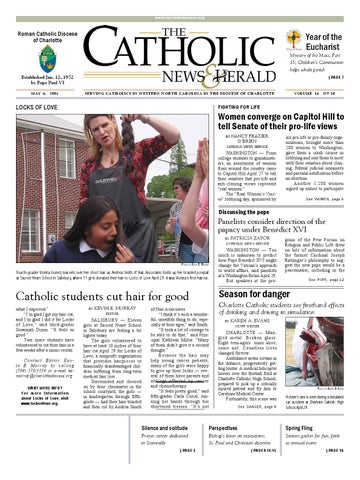
Fourth-grader Violeta Gomez marvels over her short hair as Andrea Smith of Hair Associates holds up her braided ponytail at Sacred Heart School in Salisbury, where 11 girls donated their hair to Locks of Love April 29. It was Violeta’s first haircut.
Contact Editor Kevin E. Murray by calling (704) 370-3334 or e-mail kemurray@charlottediocese.org. WANT MORE INFO? For more information about Locks of Love, visit www.locksoflove.org.
by
KEVIN E. MURRAY editor
SALISBURY — Eleven girls at Sacred Heart School in Salisbury are feeling a bit lighter today. The girls volunteered to have at least 10 inches of their hair cut April 29 for Locks of Love, a nonprofit organization that provides hairpieces to financially disadvantaged children suffering from long-term medical hair loss. Surrounded and cheered on by their classmates in the school courtyard, the girls — in kindergarten through fifthgrade — had their hair braided and then cut by Andrea Smith
See POPE, page 12
Season for danger
Catholic students cut hair for good what I expected.” “I’m glad I got my hair cut, and I’m glad I did it for Locks of Love,” said third-grader Susannah Dixon. “It feels so good.” Two more students have volunteered to cut their hair in a few weeks after a music recital.
WASHINGTON — Too much is unknown to predict how Pope Benedict XVI might change the Vatican’s approach to world affairs, said panelists at a Washington forum April 29. But speakers at the pro-
gram of the Pew Forum on Religion and Public Life drew on bits of information about the former Cardinal Joseph Ratzinger’s philosophy to suggest the new pope would be a peacemaker, including in the
of Hair Associates. “I think it’s such a wonderful, unselfish thing to do, especially at their ages,” said Smith. “It took a lot of courage to be able to do that,” said Principal Kathleen Miller. “Many of them didn’t give it a second thought.” Because the hair may help young cancer patients, many of the girls were happy to give up their locks — several of them have parents and siblings affected by cancer and chemotherapy. “It feels pretty good,” said fifth-grader Carla Curiel, running her hands through her shortened tresses. “It’s not
Charlotte Catholic students see firsthand effects of drinking and driving in simulation by
KAREN A. EVANS staff writer
CHARLOTTE — Mangled metal. Broken glass. Eight teen-agers: some alive, some not. Countless lives changed forever. Ambulance sirens scream in the distance, progressively getting louder. A medical helicopter hovers over the football field at Charlotte Catholic High School, prepared to pick up a critically injured patient and fly him to Carolinas Medical Center. Fortunately, this scene was See DANGER, page 9
Photo by Karen A. Evans
A victim’s arm is seen during a simulated car accident at Charlotte Catholic High School April 29.
Silence and solitude
Perspectives
Spring Fling
Prayer center dedicated in Stoneville
Bishop’s letter on executions; St. Paul and Christian doctrine
Seniors gather for fun, faith at annual event
| Page 5
| Pages 14-15
| Page 16
2 The Catholic News & Herald
InBrief
May 6, 2005
Current and upcoming topics from around the world to your own backyard
Faith not a factor in Americans’ patriotism, Bush tells media WASHINGTON (CNS) — Nonbelievers are “equally as patriotic” as people of faith, President George W. Bush said in a nationally televised press conference April 28. “I view religion as a personal matter,” the president said in response to a question about whether he agreed with the opinion that the Senate filibuster against his judicial nominees was “an attack against people of faith.” “I think a person ought to be judged on how he or she lives his life or lives her life,” he added. “And that’s how I’ve tried to live my life: through example.” Bush said he thought some opposed his judicial nominees “because they don’t like the judicial philosophy of the people I’ve nominated” and because “they would like to see judges legislate from the bench.” But, he added, “I don’t ascribe a person’s opposing my nominations to an
Prayers and persecution
Diocesan planner BOONE VICARIATE
CNS photo from Reuters
A Chinese Catholic woman prays March 27 at the state-sanctioned St. Ignatius Cathedral in Shanghai. Members of the underground church in China have sent messages of congratulations to Pope Benedict XVI while urging him not to forget that they are a persecuted community in a country that lacks religious freedom.
Chinese underground Catholics tell pope, ‘Do not ROME (CNS) — Members of the underground church in China have sent messages of congratulations to the new pope while urging him not to forget that they are a persecuted community in a country that lacks religious freedom. One underground community of Catholics in northwest China wrote to Pope Benedict XVI asking him “not to forget the suffering church in China” because it struggles “without any freedom at all,” said an April 29 report by Asianews, an Italian-based missionary news agency. “Ever since China’s religious affairs regulations came into effect March 1, underground Catholic priests must report weekly to religious affairs officials on their activities and must ask public security officials for permission to leave the parish,” the Catholic community said in its message to the pope. China created a government-approved Chinese Catholic Patriotic Association in 1957 to bring the church in line with communist goals and to separate it from “foreign interference,” such as ties with the Vatican. An underground church continued to exist and face persecution. In recent years, Hong Kong church officials said up to two-thirds of the underground bishops have reconciled se-
cretly with the Vatican, and at the parish level, there is some mingling of the two churches. Asianews said underground Catholics in Wenzhou Diocese in eastern China wrote Pope Benedict with their hopes that he would visit China soon and bring them “light and freedom” as well as lead them “in love and truth toward full communion with the universal church.” The news agency said the pope’s choice of name had special meaning for Catholics in China. Pope Benedict XV, who was pope from 1914-1922, “made special efforts for the church in China, enabling his successor, Pope Pius XI, to ordain the first Chinese bishops in 1926,” it said. In his note of congratulations to Pope Benedict, retired underground Bishop Casimir Wang Milu of Tianshui, in northwest China, said he was “praying intensely” that the new pope might visit China someday. The bishop also wrote that Pope Benedict XV’s 1919 apostolic letter, “Maximum Illud,” called on Catholics in China “to sacrifice themselves for the sake of evangelization, not to indulge in court disputes, not to ask for compensation, but to forgive with love.”
NORTH WILKESBORO — If you have a special need for prayers, or would like to offer your time in prayer for others’ needs, please call the Rosary Chain at St. John Baptist de La Salle Church. The Rosary Chain is a sizable group and all requests and volunteers are welcome. For details, call Marianna de Lachica at (336) 667-9044.
CHARLOTTE VICARIATE CHARLOTTE — The next Just Second Fridays will take place May 13 at St. Peter Church Annex, Atrium Room. Edward Welch, professor at the School of Labor and Industrial Relations at Michigan State University, will present “Moral Values and the Marketplace: Searching for a Balance.” Doors open at 12:30 p.m. and the presentation will begin at 1 p.m. Sandwiches and cold drinks are provided. For details, visit www. cssnc.org/justicepeace, “Upcoming Events.” CHARLOTTE — St. Ann Church, 3635 Park Rd., will offer a one-day workshop on the spiritual practice of Centering Prayer May 14, 9 a.m.-3 p.m. Centering Prayer is an ancient way of knowing God through love in silence. Instruction in the tradition and method of Centering Prayer will be offered as well as experiences of Centering Prayer. The workshop is open to all Christians. Reservations are requested. For reservations or more information, call (704) 523-4641. CHARLOTTE — All women are invited to an Evening of Reflection with Mercy Sister Jeanne Marie Kienast May 17 at 7 p.m. at St. Vincent de Paul Church, 6828 Old Reid Rd. The evening’s topic will be “What does Mary say to women today?” For more information, contact
issue of faith.” Bush, a Methodist, said he took “great strength from my faith” but would not “condemn somebody in the political process because they may not agree with me on religion.” “The great thing about America is that you should be allowed to worship any way you want,” he added. “And if you choose not to worship, you’re equally as patriotic as somebody who does worship. “And if you choose to worship, you’re equally American if you’re a Christian, a Jew, a Muslim,” the president said. “And that’s the wonderful thing about our country and that’s the way it should be.” Bush’s hourlong news conference focused primarily on Social Security reform, high gasoline prices, the war against terrorism and the situation in Iraq. Roz Spinks at (704) 554-1281. CHARLOTTE — All women are invited to the Women’s Talk May 18 at 7:30 p.m. in the reception room of St. Vincent de Paul Church, 6828 Old Reid Rd. Father Larry LoMonaco, parochial vicar at St. Patrick Cathedral, will speak on “How to Love Someone who is Hard to Love.” For more information, call the church office at (704) 554-7088. CHARLOTTE — The Vietnamese Cursillo of Charlotte School of Leaders meets the second Sunday of each month at 2:30 p.m. at St. Thomas Aquinas Church, 1400 Suther Rd. For more information, contact Nam Le at (704) 549-1525. MINT HILL — G.E.M.S. Daily is a prayer/support group for mothers of children with disabilities. The group meets the second Wednesday of each month, 10 a.m.-12 p.m. at St. Luke Church, 13700 Lawyers Rd., to share concerns, praise and prayers. For details, call Michelle Roth at (704) 321-1717. CHARLOTTE — The 50+ Club of St. John Neumann Church, 8451 Idlewild Rd., meets the second Wednesday of each month at 11 a.m. with a program and lunch in the parish hall. For reservations and more information, call Lucille at (704) 537-2l89. CHARLOTTE —The Young Widowed Group meets at 7 p.m. on the second Thursday of each month in the Fellowship Hall of St. Gabriel Church, 3016 Providence Rd. For more information, contact facilitator Sister Therese Galligan at (704) 362-5047, ext. 216.
GASTONIA VICARIATE MOUNT HOLLY — Father John Vianney Hoover invites all to celebrate the 29th Anniversary of his Ordination to the Priesthood May 22 at 4 p.m. at St. Joseph Church on Hwy. 273. Bring a picnic to share after Mass. For details, call (704) 541-5026.
GREENSBORO VICARIATE
mAY 6, 2005 Volume 14 • Number 30
Publisher: Most Reverend Peter J. Jugis Editor: Kevin E. Murray Staff Writer: Karen A. Evans Graphic Designer: Tim Faragher Advertising Representative: Cindi Feerick Secretary: Deborah Hiles 1123 South Church St., Charlotte, NC 28203 Mail: P.O. Box 37267, Charlotte, NC 28237 Phone: (704) 370-3333 FAX: (704) 370-3382 E-mail: catholicnews@charlottediocese.org
The Catholic News & Herald, USPC 007-393, is published by the Roman Catholic Diocese of Charlotte, 1123 South Church St., Charlotte, NC 28203, 44 times a year, weekly except for Christmas week and Easter week and every two weeks during June, July and August for $15 per year for enrollees in parishes of the Roman Catholic Diocese of Charlotte and $23 per year for all other subscribers. The Catholic News & Herald reserves the right to reject or cancel advertising for any reason deemed appropriate. We do not recommend or guarantee any product, service or benefit claimed by our advertisers. Second-class postage paid at Charlotte NC and other cities. POSTMASTER: Send address corrections to The Catholic News & Herald, P.O. Box 37267, Charlotte, NC 28237.
The Catholic News & Herald 3
May 6, 2005
FROM THE VATICAN
Protecting culture includes recognizing religion, Vatican Religious treasures of this type are not covered in the draft convention, he said. He said religion is not isolated to individuals’ private lives, but it also has an impact on the “public domain” and, therefore, deserves consideration for inclusion in the U.N. document.
Pope names Cardinal Sodano dean of College of Cardinals
VATICAN CITY (CNS) — Pope Benedict XVI confirmed the election of Cardinal Angelo Sodano, Vatican secretary of state, as the new dean of the College of Cardinals. The post became empty April 19 when German Cardinal Joseph Ratzinger was elected pope. The six top-ranking cardinals of
GREENSBORO — Anyone currently unemployed or concerned about their present employment situation is invited to attend the Re-employment Support Group held in the Parish Life Center, Room 8, of St. Paul the Apostle Church, 2715 Horse Pen Creek Rd. The group will meet May 12 and 26, 7:30-9 p.m. For more information, call Colleen Assal, (336) 294-4696, ext. 226. Anyone with knowledge of job opportunities is asked to call Colleen to share them with the group. HIGH POINT — All are invited to Immaculate Heart of Mary Church’s first International Festival on Pentecost Sunday, May 15, 4-8 p.m., at the church, 4145 Johnson St. The festival will feature music, dance and exhibits from a variety of nations as well as food from the Philippines, Mexico, Vietnam, Poland and Turkey. Admission is free, but everyone is invited to bring a dish, preferably representing a foreign country, to share. For details, contact Larry Kwan at hlkwan@lexcominc.net or Rita Leonard at (336) 454-3758. GREENSBORO — The Ladies Ancient Order of Hibernians, Guilford Division, Our Lady of Knock, is planning a trip to the Franciscan Prayer Center in May. Those interested in attending this outing are encouraged to call Mary Giff at (336) 855-7014 for further information.
HICKORY VICARIATE HICKORY — St. Aloysius Church, 921 Second St. NE, is offering a weekly Catholic Scripture Study. Catholic Scripture Study is a program whose members not only learn the Scriptures, but come to a deeper understanding of their faith in a setting that builds Christian fellowship. Evening and daytime classes will be held each at the church, Wednesdays, 6:45-8:30 p.m., and Thursdays 9:30-11:15 a.m. For more information, call Ann Miller at (828) 441-2205, or email stalscss@charter.net.
SALISBURY VICARIATE STATESVILLE — St. Philip the Apostle Church, 525 Camden Dr., will offer 40 Hours of Eucharistic Adoration May 11-13. The Blessed Sacrament will be exposed continually, and prayers and supplications will be offered throughout the obser-
Episcopal
calendar
VATICAN CITY (CNS) — The protection of cultural diversity must include recognition of the importance of religion, said the permanent observer of the Holy See at UNESCO. The observer, Msgr. Francesco Follo, addressed an April 27 meeting of the U.N. Educational, Scientific and Cultural Organization’s executive council in Paris. The U.N. agency has been working on finalizing a preliminary draft convention that would promote cultural diversity and exchanges. Some countries already recognize “the cultural heritage of religious interests,” which would be cultural or artistic treasures that the Catholic Church or other religions “regard as testimonies of faith” and are used in activities related to worship or other rituals, Msgr. Follo said. vance. The observance will begin with Mass May 11 at 7 p.m. There will be a prayer service May 12 at 7 p.m. and closing Mass May 13 at 7 p.m. For more information, contact the church office at (704) 872-2579. MOORESVILLE — Seniors ages 55 and up are invited to St. Therese Church, 217 Brawley School Rd., the second Saturday of each month following the 5:30 Mass for Senior Games Night, featuring games and a potluck dinner. Call Barbara Daigler at (704) 662-9752 for details.
SMOKY MOUNTAIN VICARIATE SYLVA — Court St. Mary, Mother of God of the Catholic Daughters of the Americas will hold an open meeting May 14, following the 9 a.m. Mass. The meeting will be in the Fellowship Hall of St. Mary Church, 28 Bartlett St. Any woman interested in knowing what the organization is all about is cordially invited to attend. For further information, call Sandy Beauchemin at (828) 586-1136 or Gwen Parris at (828) 631-4127.
International cooperation needed to stop crime, says Vatican diplomat
VATICAN CITY (CNS) — International cooperation is needed to prevent crime, especially crimes that attack human dignity and threaten peace, a Vatican diplomat said. “Crime prevention is no more a question to be resolved locally,” Archbishop Salvatore Pennacchio, the Vatican’s nuncio to Thailand, told the U.N. Congress on Crime and Criminal Justice April 18-25 in Bangkok. Archbishop Pennacchio said the Vatican’s primary concerns were trafficking in humans, especially women and children; the sale and possession of firearms; corruption; establishing law and order in post-conflict situations; and defending the rights of prisoners. He said the Vatican supported the idea of developing an international “Charter of the Fundamental Rights of Prisoners.”
“In this document, particular attention should be devoted to a treatment of prisoners fully respectful of their human dignity and their meaningful reinsertion into society,” he said. On the issue of human trafficking, he told the congress that the problem is related to increasing restrictions on legal migration worldwide, creating a market for the unscrupulous who promise to help the poor or desperate get to a new country and find work. Many end up basically enslaved and forced into prostitution. The archbishop also urged much stronger international controls on the sale and possession of guns and other weapons. “Clearly, there is a link between crime and trafficking in firearms that feeds terrorism at national and international levels,” he said. “A reduction in the availability of firearms will facilitate the establishment of peace and security.” International cooperation also is needed to fight corruption, which undermines the rule of law and justice, erodes democracy, creates havoc with the economy and increases the suffering of the poor, he said. Corruption also is a frequent part of the criminal scene in countries trying to re-establish peace, justice and normal social structures after a war, he said. Unless there are competent police officers and judges, effective laws and a fair application of them, crime can destabilize a nation struggling to return to normalcy, transforming “the hope and trust of a population into skepticism, desperation and disillusionment,” Archbishop Pennacchio said.
Helping Mother Earth
WINSTON-SALEM VICARIATE KERNERSVILLE — Holy Cross Church, 616 S. Cherry St., hosts a Senior Coffee House the first and third Monday of each month, 10 a.m.12 p.m. in Salesian Hall in the Child Development Building. Call the church office at (336) 996-5109 ext. 12 for directions or information.
Is your parish or school sponsoring a free event open to the general public? Please submit notices for the Diocesan Planner at least 15 days prior to the event date in writing to Karen A. Evans at kaevans@ charlottediocese.org or fax to (704) 370-3382.
Bishop Peter J. Jugis will participate in the following events:
May 7 — 11 a.m. Sacrament of Confirmation Sacred Heart Church, Salisbury
Confirmation Our Lady of the Highways Church, Thomasville
May 10 — 11:00 a.m. Presbyteral Council Diocesan Pastoral Center, Charlotte
May 15 — 12:30 p.m. Sacrament of Confirmation Cathedral of Saint Patrick, Charlotte
May 11 — 7 p.m. Sacrament of
the Roman Curia elected the dean from among their membership; approval of the election by Pope Benedict was announced April 30 at the Vatican. Just five days earlier, Pope Benedict had promoted Nigerian Cardinal Francis Arinze, prefect of the Congregation for Divine Worship and the Sacraments, to his former place among the cardinal bishops, as the rank of the six is called. Cardinal Arinze participated in the election of the new dean.
Courtesy Photo
Second-graders at Our Lady of Mercy School in Winston-Salem help make the school grounds a bit greener by planting flowers on Earth Day April 22.
4 The Catholic News & Herald
around the diocese
Scouts earn Eagle ranks LINCOLNTON — James Quentin Judge and Cameron Joseph Judge, members of Boy Scout Troop 112, recently earned the rank of Eagle Scout, the highest rank in Boy Scouts. James and Cameron, parishioners of St. Dorothy Church in Lincolnton, received their recognition during a ceremony at First United Methodist Church in Lawndale March 19. Father Matthew Buettner, parochial vicar at St. Dorothy Church, gave the invocation and Benediction. Among the key presenters was Mike O’Brien, mayor of Lawndale and former member of Troop 112. “I appreciate the opportunity to be here today to recognize these young men, who have undertaken a journey down the same path sought by many great community leaders before them,” said O’Brien. “On behalf of the Town of Lawndale, I would like to say to the young men here and to Scouts everywhere, thank you for a job well done,” he said. For his Eagle Scout project, James spent 147 hours in April collecting 2,007 pounds of food and other items as part of a food drive to benefit the U-CAN (Upper Cleveland Area Need) at the Bliss Center
in Lawndale. James recruited fellow Scouts and family, Bliss Center staff and members of local churches for the project, which helped restore much of the center’s food supply, depleted during the ice storm in December 2002. Cameron’s project involved partnering with the Cleveland County Sheriff’s Department and Cleveland Regional Medical Center to help fingerprint and provide identification for more than 200 children during the Cleveland County Fair in September 2003. Cameron recruited fellow Scouts and family, 25 students from Crest High School and eight law enforcement officers to fingerprint, photograph and fill out forms at the fair. The project took 110 hours to complete. In addition to serving as altar servers, James and Cameron are active in helping the Knights of Columbus clean up the church grounds and with Operation LAMB.
May 6, 2005
Confirming
Courtesy Photo
Bishop Peter J. Jugis stands with nine youths who were confirmed during a bilingual confirmation Mass at St. James Church in Hamlet April 26. Pictured (from left): Curtis Sands, Joseph Rizzo, Ben Jackson, Bishop Jugis, Ismael Gomez, Rodriguez Medina, Angel Lopez, Michael Cinco, Omar Juarez and Lesvia Juarez.
Courtesy Photo
Father Matthew Buettner, parochial vicar of St. Dorothy Church in Lincolnton, is flanked by Joseph and Quentin Judge, who earned their Eagle Scout ranks in March.
May 6, 2005
around the diocese
The Catholic News & Herald 5
A place of silence and solitude Hundreds gather for St. Francis Springs Prayer Center dedication by
DEACON GERALD POTKAY correspondent
STONEVILLE — The prayers and vision of Franciscan Father Louis Canino recently became a reality as the St. Francis Springs Prayer Center was dedicated in Stoneville. More than 600 people attended the April 23 dedication of the new nonprofit, interfaith retreat center where all denominations are welcome for spiritual growth. “The purpose of this center is to foster contemplation, justice and peace; to help people grow in the depth of their prayer; to strengthen their desire to find God; as well as to implement the values of justice, peace and charity,” said Franciscan Father John Frambes, co-director of the center. “This center is dedicated to seeking peace for those who find themselves bringing justice to the world,” said Franciscan Father John Felice, minister provincial of the Friars of Holy Name Province in New York. “I can’t get over how beautiful it is,” said Father Felice. “What he (Father Canino) has managed to accomplish
of justice and peace, with classrooms for study. “It is so unique. Every room has a view of the outdoors,” said Ann Bauer, the center’s business coordinator. “We are here to help people see how beautiful it really is out here.” Numerous volunteers helped make the center a reality. Eunice Barr, a parishioner of St. Pius X Church in Greensboro, said her husband Clifford and Dan Camia, a parishioner of St. Paul the Apostle Church in Greensboro, volunteered almost a year of their time working on the grounds. “I’m glad to be a part of the whole thing,” said Dora Garnier, a kitchen volunteer and parishioner of St. Joseph of the Hills Church in Eden. “I’m very proud of what Father Louis accomplished.” During the dedication ceremony, Father Canino thanked all those involved with the financing and construction of the center. “This is a beautiful and peaceful facility,” said Richard Crapse, a parishioner of Holy Infant Church in Reidsville. “It was remarkable that when Father Louis mentioned God, the sun broke
Photo by Deacon Gerald Potkay
Franciscan clergy and more than 600 people process into the St. Francis Springs Prayer Center in Stoneville during its dedication ceremony April 23. through the clouds and stayed through that entire prayer. That inspired me.” “If everyone had a neighbor like Father Louis, what a wonderful world it would be,” said Toby Koles, a parishioner of St. Joseph of the Hills Church. Contact Correspondent Deacon Potkay by calling (336) 427-8218 or e-mail gpotkay@triad.rr.com. WANT MORE INFO? For more information about the St. Francis Springs Prayer Center in Stoneville, call (336) 573-3751.
is no simple thing. His purpose is so wonderful. Father Louis was the driving force to make this happen.” Father Felice said Father Canino, director of the Franciscan Center in Greensboro, approached him in the mid-1990s with the idea of a prayer center to serve those in the Triad area. The request was unusual, he said, because at that particular time the Franciscans were closing prayer centers around the United States. “Within every human being there is a call to be contemplative. Many are not aware of this potential,” said Father Canino. “The human psyche longs for solitude, silence and internal harmony,” he said. “St. Francis Springs Prayer Center brings an ambience that will bring that into our lives.” “It is important to retain the contemplative spirituality of St. Francis while ministering to all sorts of people as Francis did,” said Father Frambes. The center features a chapel wing and a wing dedicated to the education
6 The Catholic News & Herald
fighting for life
Pro-life women converge on Capitol Hill WOMEN, from page 1
“in spirit” by contacting their senators that day by phone, fax or e-mail. “Women are the bearers of human life and we must therefore be the protectors of human life,” said Kara Klein, a freshman at The Catholic University of America in Washington, at a press conference on the event. “We must stand up for those who cannot speak for themselves and say no to the violence of abortion, no to the violence of death by starvation and dehydration, and no to all violence that is perpetrated against women,” she added. The Rev. Alveda C. King, a grandmother, linked the fight against abortion to the civil rights movement led by her late uncle, the Rev. Martin Luther King Jr. “If the dream of Dr. Martin Luther King Jr. is to live, our babies must live,” she said. “Our mothers must choose life.” Rev. King said she underwent two abortions before her six children were born, and suffered from guilt for years but eventually achieved healing. “The doctor told me (the abortion) wasn’t going to hurt any more than having a tooth pulled,” she said. “It did.” Rachel Campos-Duffy, a former participant in MTV’s “The Real World” reality series, described herself as “a product and former face of the MTV generation” — a generation, she noted, that has “never known a time when abortion was not legal.” Although women her age have been told since childhood that “the right to abortion was a hard-fought gift to us,” she said, “my generation has more firsthand experience with the painful aftermath of abortion” than any other generation. “We know that abortion represents failure: women in time of need being failed by their boyfriends, husbands, parents, friends and, of course, our society,” added Campos-Duffy, who currently cohosts the weekly cable series, “Lifetime’s
Speaking of Women’s Health,” with Florence Henderson. Helen Alvare, an associate professor of law at Catholic University who recently was part of the five-member U.S. delegation to the Mass inaugurating the papal ministry of Pope Benedict XVI, said the new pope and his predecessor, Pope John Paul II, both “seamlessly ... wove together respect for the unborn alongside respect for every other human person — women, religious minorities, refugees and the poor, to name just a few.” “By contrast, how incongruous is the United States in allowing unlimited abortion rights alongside its many fine statements and demonstrations of respect for women and human rights,” she said. “It doesn’t fit together.” The “real women” lobbyists took messages to their senators in support of an up-or-down vote on President George W. Bush’s judicial nominees, against human cloning and in favor of the Child Custody Protection Act, which would ban efforts to circumvent parental notification or consent laws in one state by taking a minor to another state for an abortion. The House version of that bill, the Child Interstate Abortion Notification Act, was approved on a 270-157 vote April 27. Its chief sponsor, Rep. Ileana Ros-Lehtinen, R-Fla., expressed confidence at the press conference that the bill — already approved three times by the House — would also pass in the Senate this year. Speaking about the rationale behind the bill, the congresswoman said, “A minor who is forbidden to drink alcohol, to stay out past a certain hour, or to get her ears pierced without parental consent is certainly not prepared to make a lifealtering, hazardous and potentially fatal decision, such as abortion, without the consultation or consent of at least one parent.” Sponsors of the lobbying day were the Susan B. Anthony List, National Right to Life Committee, Eagle Forum,
May 6, 2005
Pro-life official praises House passage of parental notification bill
WASHINGTON (CNS) — The U.S. bishops’ chief pro-life spokeswoman hailed the April 27 House passage of legislation that would outlaw the practice of taking minors over state lines for abortions to circumvent parental notification or consent laws in the girl’s home state. Cathy Cleaver Ruse, director of planning and information for the U.S. bishops’ Secretariat for Pro-Life Activities, said in an April 28 statement that “taking teens across state lines for secret abortions strikes at the heart of the family and the rights of parents.” “But more than that, it presents a grave danger to the girls who are subjected to an invasive surgical procedure without their medical history or records, and with no medical follow-up or intervention,” she added. About half the states currently have laws requiring parental notification or consent, or a judicial bypass, before a minor can obtain an abortion. The Child Interstate Abortion Notification Act, sponsored by Rep. Ileana Ros-Lehtinen, R-Fla., was approved by a 270-157 margin in the House April 27. The legislation, then called the Child Custody Protection Act, has passed the House three times — in 1998, 1999 and 2002 — but the Senate has not acted on it. The version now pending in the Senate is sponsored by Sen. John Ensign, R-Nev., and has 38 co-sponsors.
“Yesterday’s vote affirms the proposition that parents should be involved in abortion decisions affecting their teenage daughters — even when their daughters are taken across state lines,” Ruse said. “Abortion advocates have lost another round against a common-sense measure supported by most Americans,” she added. A poll released April 27 showed that 75 percent of Americans strongly disagreed and another 7 percent somewhat disagreed with the statement, “A person should be able to take a minor girl across state lines to obtain an abortion without her parents’ knowledge.” Only 7 percent strongly agreed and 8 percent somewhat agreed with the statement in the poll commissioned by the National Right to Life Committee. “This is very encouraging, but another example of how far down the ‘slippery slope’ we have descended,” said Maggi Nadol, coordinator of the diocesan Respect Life Office. “The idea that a minor could be taken, without parental permission, for surgery to another state for a life altering procedure is incomprehensible,” she said.
Silent No More Awareness Campaign, Family Research Council and Concerned Women for America. Jane Abraham, president of the Susan B. Anthony List, said the lobbying day was organized “because we know our nation is at a crossroads.” “We know that our senators’ votes on
judges, cloning and other pro-life issues this session will be decisive in determining what our nation will stand for in the coming generation — a nation that honors the dignity of women and children’s lives or one that pits one against the other,” she added.
Editor Kevin E. Murray contributed to this story.
May 6, 2005
year of the eucharist
Vatican official: Children’s first Communion can help whole by CINDY WOODEN catholic news service
VATICAN CITY — Children’s innocence, openness and ability to be awed mean that, when properly prepared, their first Communion can be a moment when the whole parish witnesses how great a gift the Eucharist is, said Cardinal Dario Castrillon Hoyos. As soon as children are able to recognize the difference between regular bread and a consecrated host, preparations for their first Communion should begin, said the cardinal, prefect of the Congregation for Clergy. In a January letter posted in Spanish, Italian and German on the congregation’s Web site — www.clerus. org — the cardinal urged priests, in consultation with their bishops, to ensure that children in their parish are able to receive their first Communion when they reach “the age of reason,” generally agreed to be 7 years of age. In many countries, while Communion preparation classes accept 7-year-olds, many of the children do not receive their first Communion until they are 8 or 9. Cardinal Castrillon said that in 1910, when Pope Pius X authorized publication of a decree saying that children could receive their first Communion “from about the seventh year,” it “marked an important change for the pastoral care of children.” Pope Pius’ decree noted that “a few errors” had been made in determining the “age of reason,” so that until 1910 children under the age of 10 — and in some dioceses, under the age of 14 — were prevented from receiving Communion. Allowing children to receive the Eucharist at a young age “has brought great grace to the church,” Cardinal Castrillon said. He told priests that Pope John Paul II praised the decision to allow young children to receive Communion. In his autobiographical book, “Rise,
Let Us Be on Our Way,” Pope John Paul said Pope Pius’ decision was “a touching testimony of pastoral love for children.” The future Pope John Paul received his first Communion in May 1929, just after his ninth birthday. Cardinal Castrillon told priests, “I think that one of the greatest joys for a pastor is to hear the first confession of children and then let them receive their first Communion.” “The younger they are,” he said, the more certain a priest can be that the children “are worthy to receive in their hearts the sacramental Christ.” “In fact, the mind of a child who has reached the age where they begin to reason — and today this age is reached quickly — is open and available to welcoming the divine light that makes the mystery of God’s love for man penetrate where it is able,” the cardinal wrote. “Faith raises us beyond reason,” he said, “and this faith, which we frequently experience in our parishes, is very alive in children who are able — sometimes more than we are — to express their closeness to the Lord with prayer.” The cardinal did not mention ongoing discussions in the church about preparing mentally handicapped children for their first Communion and was not available Jan. 25 to discuss the question. Cardinal Castrillon told the priests he hoped the “holy practice” of allowing young children to receive their first confession and first Communion would be better appreciated and followed during the Year of the Eucharist, which runs from October 2004 to October 2005. The cardinal prayed, “May love for the most holy Eucharist be transmitted from the most tender age and the desire to receive the body of Christ become the surest path for building a future of peace and holiness, not only for the individual, but for the whole Christian community.”
The Catholic News & Herald 7
The first movement: The offertory Understanding the Mystery of the Mass, Part 15 Last week, we were reminded that the Paschal Mystery — the passion, death and resurrection of Jesus Christ — is unfolded for us in every Mass in three distinct movements: the offertory, the consecration and the reception of holy Communion. Again, we discovered that these three movements together give glory to God and bring about the fulfillment of our redemption by applying the fruits of Christ’s gift of redemption to our individual souls. This week, we will take a closer examination of the offertory by answering the question: What is being offered at the holy sacrifice of the Mass? 1) The Collection. The first liturgical movement of the offertory involves the collection. To support the financial needs of the clergy and the material needs of the church is one of the six precepts of the church. But more than an obligation, we have the opportunity to participate in the missionary efforts of the church by the funds that are collected at each Mass. Our hard-earned money pays the bills to keep the church open and operational, supports the clergy, contributes to the work of evangelization and charity, and, most notably, buys the bread and wine that are necessary for the Mass. Obviously, we do not have the capacity to give to God the thanksgiving that He deserves for all the generous gifts we have received, but we do make the best attempt by making a sacrifice of our own resources. The money represents our own time and talent given at work. And so the collection symbolizes the more important gift of ourselves given to God. 2) Bread and wine. Along with the collection, bread and wine are offered by the faithful in the offertory procession at the Mass. These elements are so necessary for the celebration of the Mass that without bread and wine, a priest is unable to offer the sacrifice of the Mass. We will explore the use and significance of bread and wine in more detail in our next discussion. 3) Prayer, sacrifice, intentions. The collection, bread and wine are offered and presented to the priest during the offertory. But more importantly, we also bring our spiritual gifts. During the offertory, we are invited to collect and present our prayers, sacrifices and intentions that are unique to the celebration of each Mass. We are given the opportunity to unite our own prayers, the many small sacrifices that we offered throughout the day or the
Guest Column Father Matthew Buettner guest columnist
week and the many intentions we bring with the perfect sacrifice of Christ in the consecration. 4) Ourselves. These prayers, sacrifices and intentions are the spiritual form of the offering. When combined with the material offering of money, bread and wine, they collectively represent the meager gift of ourselves, generously presented to God for sacrifice. 5) The priest. All of these offerings are collected and presented to the priest, physically and spiritually in the offertory of the Mass. The priest accepts these gifts. And on behalf of the entire church, he offers them to the Father in union with the perfect sacrifice of Christ on the cross. 6) Christ. Here, we finally discover that ultimately, the offertory of the Mass does not primarily answer the question, “What is being offered?” but rather, “Who is being offered?” And through the eyes of faith, with the light of reason and expressed through the liturgy of the Mass, we come to discover that it is Christ, the high priest, who offers himself to the Father. And because we are members of his mystical body through the sacrament of baptism, we are also offering ourselves in union with Christ. As he freely sacrificed himself to the Father on the cross, so we are invited and encouraged to follow his perfect example. There we will find salvation. What is being offered in the Mass? It is Christ, the head of the church, in union with his mystical body, you and me. Next week, we will continue our examination of the offertory by answering the following question: What is the purpose and the significance of the bread and wine used at the Mass? Father Buettner is parochial vicar at St. Dorothy Church in Lincolnton. WANT PREVIOUS COLUMNS? Father Buettner’s “Mystery of the Mass” series is available online at www.charlottediocese.org/mysteryofmass.html
8 The Catholic News & Herald
May 6, 2005
in our schools
‘The Sound of Music’
Calculating the value of math by
CAROLE McGROTTY correspondent
ASHEVILLE — Fourth- and fifthgraders set up their exhibits in the gymnasium of Asheville Catholic School for the first Math Fair Feb. 25. Student participants explained their math projects to a panel of judges as well as to students, staff and guests. A group of students were then selected to compete at the 2005 State Mathematics Fair, sponsored by the North Carolina Council of Teachers of Mathematics, at Appalachian
State University in Boone March 19. Fourth-grade teacher Pete Hutchens plans to make the fair an annual event. “It’s a way for students to express ideas and an excellent way for them to see math used all the time and to know that math is everywhere,” he said. Representatives competing against other schools at the math fair at Appalachian State were fourth-graders Emily Bradley (first-place winner), Robbie Mangone, Abby Lenderman and Natalie Beach, and fifth-grader Patrick Eckerd.
Photo by Carole McGrotty
Students perform “The Sound of Music” at Asheville Catholic School April 15-17.
Asheville Catholic stages successful musical by
CAROLE McGROTTY correspondent
ASHEVILLE — The halls were alive with the “Sound of Music” at Asheville Catholic School. Seventy-five students participated in the school drama department’s production that played to sold-out audiences April 15-17. Under the guidance of Alyssa Kennedy, religion teacher and drama coach, the production showcased the varied
talents of the students, from acting and stagehands to cooking and making programs, tickets and costumes. Pete McHugh, a parishioner of St. Eugene Church in Asheville who once managed the von Trapp Family Singers, had brought pictures and background information to the students prior to their production. The musical’s story is based on that of Austria’s von Trapp family, who fled their Nazi-occupied country in 1938.
Photo by Carole McGrotty
A group of Asheville Catholic School students competed in the 2005 State NCCTM Mathematics Fair in Boone March 19. Pictured (from left): Natalie Beach, Emily Bradley, Abbey Lenderman, Patrick Eckerd and Robbie Mangone.
May 6, 2005
The Catholic News & Herald 9
in our schools
High school students see drunk driving DANGER, from page 1
Photos by Karen A. Evans
Above: A Mock DWI Fatality was held at Charlotte Catholic High School April 29 to warn students about drinking and driving. Right: Charlotte firefighters work with students portraying crash victims.
only a simulation designed to show the students of Charlotte Catholic what could happen if they drink alcohol before getting behind the wheel. With proms and graduation celebrations approaching, the April 29 Mock DWI Fatality was well-timed as a warning to students about the all-too-real repercussions of drinking and driving. “This is the season when kids get hurt,” said Lonnie Billard, Charlotte Catholic’s drama teacher who coached the students for the simulation. “It seems to be the consensus that students are going to drink, then drive,” said Beverly Doyle, English teacher. Hosted by the Mecklenburg County Sheriff’s Office, participants in the Mock DWI Fatality included the Mecklenburg EMS Agency, Charlotte Fire Department, Med Center Air, North Carolina State Highway Patrol, Charlotte Catholic chapter of Students Against Drunk Driving and other agencies. Matt Bazluki of the special services division of the Mecklenburg County Sheriff’s Office and Captain Jim Dedmon of the public information office of the Charlotte Fire Department initiated the demonstration. Both men are graduates of Charlotte Catholic. The Mock DWI Fatality featured two cars that had been wrecked in actual recent accidents. In one car, the “driver” and “passengers” — student actors from Charlotte Catholic — had been drinking, while the occupants of the other car were all sober. Radio traffic from the responding emergency agencies was broadcast over the stadium’s loudspeakers so the students could hear all the communication between police, fire and ambulance
crews. At the end of the simulation, the names and conditions of each victim were read over the loudspeakers. One occupant of each vehicle died; the rest suffered various degrees of injury. “It drove home the point that this is what happens when you drink and drive,” said Christine Lawson, a senior at Charlotte Catholic and parishioner of St. John Neumann Church. Fellow senior Lauren Maier agreed. “(The presentation) gave us a visual image of what can happen,” said Lauren, a parishioner of St. Ann Church. “It was more effective than other presentations we’ve seen.” Billard said his students asked him difficult questions, such as how they can protect themselves from drunk drivers. But unfortunately there is no answer to that question. “I hope they see the reality of drinking and driving,” said Jerry Healy, principal of Charlotte Catholic. “If it makes one kid stop and think (before drinking), it’s worthwhile.” Contact Staff Writer Karen A. Evans by calling (704) 370-3354 or e-mail kaevans@charlottediocese.org.
1 0 The Catholic News & Herald
Culture Watch
May 6, 2005
WORD TO LIFE
A roundup of Scripture, readings, films and more
‘Crash’ has redeeming effects?
Sunday Scripture Readings: May 15, 2005
May 15, Pentecost Sunday Cycle A Readings: 1) Acts 2:1-11 Psalm 104:1, 24, 29-31, 34 2) 1 Corinthians 12:3b-7, 12-13 3) Gospel: John 20:19-23
Each person has gifts to share by
SHARON K. PERKINS
catholic news service
CNS photo from Lions Gate
Thandie Newton and Matt Dillon star in a scene from the movie “Crash,” a powerful, beautifully crafted film with a strong moral center about a disparate, racially mixed group of Los Angeles residents whose lives will intersect in unlikely and redemptive ways. Writer-director Paul Haggis takes a story and milieu that at first seems sordid and ugly, and with the help of a terrific ensemble cast, has fashioned a transcendently moving essay on the benevolence that may lie beneath racial intolerance, and the interconnectedness of human beings, showing how good and bad can coexist in all of us, and how the former generally prevails. Much rough and crude language, some violence, many racial epithets, sexual situations, including one encounter with partial nudity, another with suggestive groping and innuendo, and a bloody traffic-accident injury. The USCCB Office for Film & Broadcasting classification is L — limited adult audience, films whose problematic content many adults would find troubling. The Motion Picture Association of America rating is R — restricted.
Several years ago I had the privilege of coordinating our diocese’s first synod, an endeavor which lasted three years from the initial stages of planning to the closing liturgy and publication of the synod proceedings. It was a powerful experience of local church that I’ll never forget. Because it was our “first” synod, and since I for one had never coordinated anything of that magnitude, I had a great deal to learn. There was much discernment involved in selecting a task force, so I gathered names of prospects, thinking about the abilities and talents each person would bring to the table — some were bilingual, speaking Spanish or Vietnamese; some represented rural parishes; others had experience with youth; and still oth-
ers were good communicators. In addition, each person had to be able to fulfill a three-year commitment of meetings and tasks. While the task force of men and women indeed offered the competencies that I expected, I was surprised nonetheless to discover gifts in them that I never would have anticipated — gifts that benefited us greatly in the ensuing months of preparation. One woman in particular wondered aloud whether she had any skills to offer, yet her prayerfulness and peaceful presence sustained us through many a meeting. Another member proved to be my “rock” of encouragement, calling me up for lunch just when I was feeling overwhelmed by one challenge or another. In addition to the surprising gifts brought by each individual, a collective spirit of good humor and optimism emerged that was contagious, spreading from that small group of 12 throughout the delegation of more than 500 men and women who met for the synod. From that experience, I learned what it meant to trust in the Holy Spirit’s creative and bountiful outpouring for the good of the church. Both the seemingly small and the considerably larger needs of God’s people can and will be filled if each person surrenders to that life-giving Spirit and extends his or her own gifts for the benefit of others. Questions:
WEEKLY SCRIPTURE Scripture for the week of May 8-14 Sunday (Seventh Sunday of Easter), Acts 1:12-14, 1 Peter 4:13-16, John 17:1-11; Monday, Acts 19:1-8, John 16:29-33; Tuesday (Bl. Damien de Veuster), Acts 20:17-27, John 17:1-11; Wednesday, Acts 20:28-38, John 17:11-19; Thursday (Sts. Nereus and Achilleus, St. Pancras), Acts 22:30; 23:6-11, John 17:20-26; Friday (Our Lady of Fatima), Acts 25:13-21, John 21:15-19; Saturday, Acts 1:15-17, 20-26, John 15:9-17. Scripture for the week of May 15-21 Sunday (Pentecost), Acts 2:1-11, 1 Corinthians 12:3-7, 12-13, John 20:19-23; Monday, Sirach 1:1-10, Mark 9:14-29; Tuesday, Sirach 2:1-11, Mark 9:30-37; Wednesday (St. John I), Sirach 4:11-19, Mark 9:38-40; Thursday, Sirach 5:1-8, Mark 9:41-50; Friday (St. Bernardine of Siena), Sirach 6:5-17, Mark 10:1-12; Saturday (St. Christopher Magallanes and Companions), Sirach 17:1-15, Mark 10:13-18.
The Catholic News & Herald 11
May 6, 2005
Catholicism, marathons twin themes for ‘Saint Ralph’ writer-director by MARK PATTISON catholic news service
WASHINGTON — Michael McGowan, writer-director of the feature film “Saint Ralph,” about a high school freshman who believes winning the Boston Marathon will be the miracle needed to bring his mother out of a coma, is like his film’s protagonist: a Catholic and a runner. McGowan, who has run and won marathons, still runs four to five times a week to keep fit. “I can remember being a child and wondering, ‘Why do people
walk?’” he said. With “Saint Ralph” playing the film-festival circuit before its release in theaters, McGowan has been running — well, really, flying — from city to city to take questions from audiences and journalists about his movie. And in the meantime he still has a family to tend to in Mulmur Hills, Ontario; his family includes a 6-year-old son and a 19-month-old daughter. McGowan said he set “Saint Ralph” in 1953 and ’54 to join its Catholic theme with its marathon theme.
Catholicism provided “the bookends of people’s lives” a half-century ago, he said. And, he added, it’s plausible that a teenager who was a first-time marathoner back then would think he had a shot at winning the Boston Marathon if in the 1980s 16-year-olds were able to run a marathon in two hours and 16 minutes. He noted that the winning time of the 1954 Boston Marathon was 2:29. The Toronto-born McGowan, like the movie’s Ralph Walker (Adam Butcher), was educated by the Basilian Fathers
at St. Michael High School, an all-boys school in Toronto. “It was a great experience,” he said. But that, the Catholic faith and the marathoning may be the only similarities between him and his character. Ralph is an only child; “I’m one of six kids,” McGowan said. And while Ralph is in danger of being orphaned should his mother die, “both of my parents are quite alive.” In the film, Ralph exhibits all the drive and confusion of a 14-year-old. Once his hospitalized mother slips into a coma and is told that only a miracle will bring her out of it, Ralph — recently assigned to the school’s cross-country team to channel his energy — comes to the conclusion that winning the Boston Marathon would be that miracle. “Saint Ralph” received a classification of A-III — adults — by the U.S. bishops’ Office for Film & Broadcasting for “profanity, rear nudity, a nonexplicit masturbation scene, underage drinking and smoking.” The Motion Picture Association of America rating is PG-13, which means parents are strongly cautioned and some material may be inappropriate for children under 13. “But make no mistake,” said Office for Film & Broadcasting director Harry Forbes in his review, “for adults and older adolescents, this is a lovely, extraordinarily touching film that conveys an admirable picture of filial devotion, self-sacrifice, faith, good sportsmanship and universal fellowship.” Among references to Catholicism in “Saint Ralph” is the use of “title cards” to mark the passage of time. In addition to artwork of stained glass, the cards note a saint’s feast celebrated that month, and the people or devotion for which he or she is a patron. To be honest, McGowan said, “we backpedaled” to include the cards after filming had been completed. “There are a million saints for every month, and we tried to retrofit them” into the finished film, he said. Among the saints featured are St. Jude Thaddeus, the patron of hopeless causes, and St. Bruno, referred to in the movie as the “patron of the possessed.”
1 2 The Catholic News & Herald
May 6, 2005
from the cover
Panelists discuss papacy POPE, from page 1
Middle East, and might well continue his predecessor’s efforts to bring world religions together. They also suggested a pope with a lower public profile than that of the late pope might be healthy for the church. Raymond Flynn, ambassador to the Holy See from 1993-97, told of arriving in Italy to take that job and meeting with Pope John Paul II to discuss the U.S. government’s diplomatic interests at the Vatican, including working for peace in the Middle East. The pope said, according to Flynn, “if I had any problems I was to talk to Ratzinger — that’s how he said it.” Pope John Paul added that then-Cardinal Ratzinger was “very committed” to peace in the Middle East. “He wants to see this happen,” Flynn said he was told by the pope. Flynn said the biggest challenge to the new pope’s peacemaking efforts will be to bring together leaders of various religious faiths “so they can step over the political leaders” and encourage peace efforts by the people of their countries. “I think he can do it,” he said. Newsweek contributing editor Kenneth L. Woodward, who has covered religion for the magazine since 1964, said he would expect Pope Benedict to make few changes in how the church approaches relationships with European nations and to continue to pursue peace and justice around the world. Less certain is how the new pope will approach the question of whether the Vatican might back down from its strict opposition to the use of condoms in areas where HIV/AIDS is rampant, he said. “I’m not so sure this pope is quite so intractable on this as his predecessor was,” Woodward said, adding that it might depend upon what Benedict hears on the topic from the bishops of Africa. A third panelist, Father J. Bryan Hehir, a professor of religion and public life
Classifieds EMPLOYMENT NANNY NEEDED: Happy family with toddler and soon a newborn seeks loving, energetic PT/FT live out nanny. South Charlotte. 704-953-0302 SALES: Educational Outfitters is looking for high energy, hard working employees for summer and permanent (full-time and part-time) positions available in retail sales. Call 704-525-3344 or email mandy@educationaloutfitters.com. South Charlotte location. TEACHER: SOCIAL STUDIES. Immaculate Heart of Mary Catholic School has an opening for a full-time 8th grade teacher with emphasis on Middle School Social Studies for the 2005-2006 academic year. The ability to teach Middle School
at Harvard University, was even more reluctant than Woodward and Flynn to try to predict the direction Pope Benedict might take the Vatican and devoted much of his commentary to discussing the differences in challenges for the new pope and his predecessor. Pope Benedict stepped into a very changed world from the one that faced Pope John Paul in 1978, Father Hehir said. The late pope became the head of the church at a time when the world’s politics and problems were much more black-and-white. Since then, the Cold War has ended, political boundaries have become less clearly defined and relationships of governments have gone from interdependence to globalization, he explained. Because most of the official documents of the Vatican are written as collaborations, and are not just the work of the pope, Father Hehir said, he expects continuity in most areas. Flynn said in some ways the attention of the last 26 years to the individual at the head of the church has been misdirected. “We’ve been putting too much emphasis on the pope as a person,” Flynn said. “There should be more emphasis on Mrs. O’Malley,” meaning average Catholics. “We shouldn’t be looking to the Vatican for every point ... about the faith,” he said. Woodward said it might be a good thing for the church if Pope Benedict is more of a stay-at-home, low-profile kind of pope than Pope John Paul was. Much of the recent image of the church and the papacy has been directly related to the personal charisma of Pope John Paul II, Woodward said. A pope who is not as highly visible in all the workings of the church would open the opportunity for the world’s cardinals to become more of the voice of the church, he said. “We might see that the cardinals have something to say, something worth Math class is a plus. Must be North Carolina Certified. Please fax or email cover letter, resume, references and required salary range to (336) 8841849 or nachter@ihmchurch.org or mail directly to: IHM School, 605 Barbee Avenue, High Point, NC 27262 - ATTN: Principal. Deadline is May 27, 2005. SERVICES INSURANCE: Affordable health insurance and low cost life insurance. Covering most people regardless of health. Also, low Medicare Supplement rates. 1-800-252-6110. LATIN BAND: For weddings and special events. We play salsa, merengue, bossa- nova, etc. For info visit: www.etacarina.net or call 828-216-3647, Iliana.
Classified ads bring results! Over 125,000 readers! Over 49,000 homes! Rates: $.70/word per issue ($14 minimum per issue) Deadline: 12 noon Wednesday, 9 days before publication How to order: Ads may be E-mailed to ckfeerick@charlottediocese.org, faxed to (704) 370-3382 or mailed to: Cindi Feerick, The Catholic News & Herald, 1123 S. Church St., Charlotte, NC 28203. Payment: For information, call (704) 370-3332.
May 6, 2005
ADVERTISEMENT
The Catholic News & Herald 13
1 4 The Catholic News & Herald
Perspectives
May 6, 2005
A collection of columns, editorials and viewpoints
God protects, guides his people through hardships, says pope by CAROL GLATZ catholic news service
Calling for an end to the death himself — cases in which the execution of the offender is an absolute necessity are very rare, if not practically non-existent.” The Church’s teaching on the death penalty is based on the principle that all human life is sacred, made in the image and likeness of God. If the innocent of society can be protected from aggressors with non-lethal means, then indeed, such means are preferable to the use of lethal force. Modern society has the resources to separate the violent offender from society and protect the innocent, a choice that also gives the violent offender the opportunity to reflect on wrongdoings and seek the path to redemption. The Church’s teaching on the death penalty (expressed in the very first sentence of the catechism’s statement on the death penalty) states that this most severe and final of all punishments is to be used only when the guilty party’s identity and responsibility have been fully determined. Support for a death penalty moratorium receives added weight and increased urgency from recent case histories and research documenting that the death penalty sentencing process has erred in convicting innocent people. At least 119 people have been released from death row in the U.S.A. since 1976, of which five have been released from prison in North Carolina. Even assuming that there may be a limited and just reason to use the death penalty to protect society, the death penalty process must ensure that innocent persons are not executed. Since the evidence clearly suggests that we are not sure that this will always be the case, further study of the death penalty process is warranted. It only seems prudent that executions should be halted while a study of the death penalty process takes place. An execution is currently planned for May 6, 2005 in Raleigh. Does it make sense for our state to continue executions in the coming weeks, when we know full well that the House of Representatives will soon consider HB 529? Would it not be prudent that our state cease executions until the House of Representatives has at least had a chance to vote on HB 529? The Church’s teaching on the death penalty offers us a path to diminish violence in our society, not increase it. The teaching also considers the immortal soul of the evildoer, the one guilty of the terrible crime who is justly separated from society and punished for his transgressions. As we proclaim Christ’s “Good News,” our desire is that all might hear and accept Christ’s message of salvation, including those among us who have committed heinously sinful acts. The Church’s opposition to the use of the death penalty in modern society and the Church’s current concern that the death penalty process needs to be studied (to eliminate bias and errors in its application) in no way diminishes the Church’s heartfelt concern for the victims of terrible acts. I call on all the faithful to reach out to those who have experienced the violent death of loved ones. Let us pray for their healing and for the souls of their departed loved ones. Many of you respond to the advocacy appeals of the diocesan Respect Life Office and Office of Justice and Peace that encourage respect for human life. I commend such action that heightens our society’s respect for human life. In contacting your legislators and executive leaders to urge passage of laws that promote the values and teachings of our Church, especially those that relate to the protection of human life, you promote the “Gospel of Life.” In time, such action can only serve to have a positive effect in increasing respect for the dignity of all human life, at all stages of development and growth. Please continue to join your prayers with mine as we humbly ask our Lord to strengthen our efforts to promote a respect for all human life. Sincerely yours in Christ,
Most Reverend Peter J. Jugis Bishop of Charlotte
VATICAN CITY — God will watch over and protect his people at all times, even as they encounter life’s dangers, temptations and hardships, Pope Benedict XVI said at his May 4 weekly general audience. “The divine shepherd knows no rest in his work of protecting his people,” he said. “God will take care of us at every moment with love, protecting our life from every evil.” For his second general audience, Pope Benedict gave his first catechesis on a series of psalms and canticles Pope John Paul II had begun before his death April 2. In Psalm 121, “a psalm of trust,” Pope Benedict said that God is shown to be the vigilant, attentive and caring “custodian” or “sentinel” that guards his people, keeping them “from every risk and danger.” The pope explained how this ancient psalm still has resonance today in people’s lives. As the psalmist speaks of the people of Israel who on their long journey toward Jerusalem resisted the temptations of the pagan temples on the hills by holding to their faith in God, Pope Benedict said people today will face similar temples of deceit on “our pilgrimage of life.”
The Pope Speaks POPE BENEDICT XVI
The lofty ideals of “wealth, power, prestige, a comfortable life, (are) heights which are temptations because they really appear to be the promise of life,” the pope said. “But we in our faith” in God know that these “summits are not true, are not life,” he said. Pope Benedict said those who put their faith in God have the “confidence of not being abandoned” during times of “trial, the assault of evil, persecution.” God protects at all times, “even during the night of our life,” he said. The pope ended his audience with a reminder that the month of May was dedicated to Mary, and he called on young people to “turn to the school of Mary in order to learn to love and follow Christ.”
Dear Brothers and Sisters in Christ, May the Grace of our Lord Jesus Christ be with you. It is very likely that in the next several weeks the North Carolina House of Representatives will vote on House Bill 529, which calls for a two-year suspension on executions in North Carolina. During this proposed two-year hiatus on executions, a thorough review of how the death penalty is administered in North Carolina will take place. The Catholic Church calls for the death penalty to be rarely used, if it is to be used at all. In March, the U.S. Conference of Catholic Bishops launched the Catholic Campaign to End the Use of the Death Penalty. My voice is joined with those of my fellow bishops of the United States in calling for an end to the use of the death penalty in our land. Our renewed call to end this most severe of punishments comes at a time when U.S. Catholics are becoming less supportive of the use of the death penalty (as revealed in a opinion poll conducted in November 2004 by the noted pollster John Zogby). Whether or not our society chooses to end the use of the death penalty, the Catholic Church lends its most urgent support to all measures that seek to eliminate bias in the application of the death penalty and that ensure innocent persons are not erroneously charged with capital crimes and sentenced to death. I therefore support a moratorium on the use of the death penalty in the state of North Carolina as called for in House Bill 529. I share with you below section 2267 of the Revised Catechism of the Catholic Church (1997): “Assuming that the guilty party’s identity and responsibility have been fully determined, the traditional teaching of the Church does not exclude recourse to the death penalty, if this is the only possible way of effectively defending human lives against the unjust aggressor. If however, non-lethal means are sufficient to defend and protect people’s safety from the aggressor, authority will limit itself to such means, as these are more in keeping with the concrete conditions of the common good and more in conformity with the dignity of the human person. “Today, in fact, as a consequence of the possibilities which the state has for effectively preventing crime, by rendering one who has committed an offense incapable of doing harm — without definitely taking away from him the possibility of redeeming WANT MORE INFO? A tri-fold brochure by the Office of Justice and Peace, “Seeking Justice, Seeking Fairness, Promoting Life,” on the Catholic Church’s teaching on the death penalty and on the current campaign for a moratorium on executions in N.C. can be found online at www.cssnc.org/ justicepeace (go to “Resources”).
The Catholic News & Herald 15
May 6, 2005
Radio, the lost “Radio, it’s the theatre of the mind.” So said Al Gardner of Charlotte’s 50,000-watt powerhouse, WBT-AM, during a recent interview with Bishop Peter Jugis. The bishop and Gardner were guests on “The David Chadwick Show,” a weekly program devoted to spiritual issues and hosted by Rev. David Chadwick, pastor of Forest Hill Presbyterian Church in Charlotte. Bishop Jugis was on the program to talk about our new pope, Benedict XVI, and the spiritual journey we Catholics have been on during the last month. It was a wonderful discussion by men of God that provided listeners with an hour’s worth of insight and spiritual nourishment. Unfortunately, The David Chadwick Show and Gardner’s own morning news programs are two of few bright spots on what is a becoming a barren, almost dangerous landscape in the medium of talk radio in America. Too often the theatre of the mind of American radio is a shrill voice of complaint against the people for whom America isn’t the land of milk and honey. Gays, Hispanic refugees and the media are favorite targets for on-air diatribes that last for hours, days and weeks. And it isn’t just the hosts. Callers to these “shows” often voice hate-filled opinions that suggest imprisonment, banishment and even death for the target of the day. And all too often, the hosts encourage these venomous speakers with smirking
silence or out-and-out agreement. If radio can be “theatre of the mind,” as Gardner suggested, then a nightmarish vision of a radio netherworld can be found in the movie, “Hotel Rwanda.” The film depicts the ethnic cleansing and genocide that killed more than 1 million people in Rwanda in 1994. At the start of “Hotel Rwanda,” the audience hears the soothing, convincing voice of a radio announcer making racist comments about the Tutsi minority. As the country descends into the bloody chaos of civil war, the radio announcer is heard again and again. Each time he is more strident and bloodthirsty as he calls upon the Hutu majority to murder innocent people. Finally the announcer directs mobs from one killing zone to another in the capital city of Kilgali. It is the nature of media to push constantly toward the outer bounds of sensibility. Elvis’ gyrating hips were too risqué for a 1950s television audience. Beer-guzzling revelers on an MTV spring break program would laugh “the King” off the beach for being overdressed. In talk radio, this change has led to louder voices, less tolerant attitudes and more sensational parsing of the facts. A significant portion of the medium is in a downward spiral. I know it’s a free country and opinions are like cell phones — everyone
How did St. Paul learn Christian doctrine? Pharisee. But neither this nor any other previous experience could prepare him for that kind of conversion. After his famous encounter with the Lord on the road to Damascus, it seems he went to “Arabia” for three years, then preached the Gospel in Damascus before returning to Jerusalem where he met the apostles for the first time (Gal 1, Acts 9). Clearly, he did not vacillate about his authority as an apostle, even to the point of challenging (and convincing) Peter and the Christians “reputed to be important” in Jerusalem about the need to be circumcised before baptism. Key to his conversion and theological formation, of course, was his mysterious personal confrontation with Christ as Paul was on his way to Damascus to attack the followers of Jesus. Paul asked, “Who are you, sir?” The Lord answered, “I am Jesus whom you are persecuting.” For the rest of his life, those words remained alive in Paul as a fountain of theological learning. Practically all the dominant themes of his teaching flowed significantly from his reflection on what Jesus said at that moment, particularly his majestic image of the church as the body of Christ. On that day Christ did not say: I am Jesus whose friends or followers you are persecuting. He literally identified himself with those who believe in him. Over the years Paul drew the con-
Q. Recently there have been some interesting questions, both at home and in our Catholic education classes, about St. Paul. The first is about his self-described “thorn in the flesh” (2 Cor 12:7). I’ve heard he was the first recorded stigmatic. Second, where did he get his Christian training and authority? He had a dramatic encounter with Christ, but never met him in person. He did not know the other apostles until later. Where did he acquire the background he needed to teach Christian doctrine? (Indiana) A. That’s a very good question, because Paul’s history as a Christian authority is special; there’s no one else like him. The simplest answer to your question is that he received his “Christian education” and authority to preach the Gospel directly from Jesus, no one else. Paul himself insists on this point. In his letter to the Christians in Galatia, he refutes attacks on his teaching with the claim, “I did not receive it from a human being, nor was I taught it, but it came through a revelation of Jesus Christ” (Gal 1:12). Other information in his letters and the Acts of the Apostles supports that claim. Born in Tarsus in Asia Minor of Jewish parents, Paul eventually went to Jerusalem, where he became a disciple of the illustrious rabbi Gamaliel. Paul was a fervent rabbi himself and a rigid
Catholics & the Media DAVID HAINS
Letters to the Editor
guest columnist
has one. But at some point we have to recognize that the level of discourse in America is sinking and we have no one to blame but ourselves. As I watched “Hotel Rwanda,” I wondered: How different is the radio announcer in the film from the real-life announcers we listen to every day? It is a matter of degrees. How long would it take for talk radio to spiral down to the lowest level of hatred and the promotion of violence? Two years? Five years? Perhaps it will be longer, but the clock on the downward spiral is ticking. When are we going to stop listening and stop supporting the talk-radio trash? When are we going to demand that stations who are given the privilege of using the public airwaves be more fair minded and respectful of the diversity of American culture? David Hains is director of communications for the Diocese of Charlotte. WANT TO LISTEN? You can listen to the interview with Bishop Jugis by visiting the diocese Web site at www.charlottediocese.org.
Question Corner FATHER JOHN DIETZEN cns columnist
clusion he expands on, for example, in 1 Corinthians 12 and 13. You have a variety of talents and gifts, he told them, bestowed by the one Spirit. But that Spirit of Jesus makes all of you one with him; you are together “Christ’s body, and individually parts of it.” Another large element in Paul’s formation, together with his mystical experiences (see for instance 2 Cor 12:1) is the conflict with the other apostles, referred to above, over the requirement that Christian converts be held to traditional Jewish laws. The resolution of that struggle contributed much to the development of the major themes of Paul’s theology. There’s no question that Paul’s total and immediate transformation by Jesus Christ has no parallel in Christian history, perhaps in all the history of religion. Speculation never stops about the “thorn in the flesh.” Was it sickness? Disability? Temptation? Pain? Interestingly, Hebrew Scripture sometimes uses that expression as we use “thorn in the side,” referring to a person. The context of those words certainly is open to that possible meaning. But there’s no way to know. A free brochure describing basic
Governor poor example of Catholic politician I find it a little over-reaching when The Catholic News & Herald features Gov. Jeb Bush of Florida as an example of a Catholic politician who balances church and secular laws (“Governor says Catholic politicians can balance church, secular laws,” April 29). I don’t know if we are to be edified or dismayed by Gov. Bush’s approach to rationalizing his support of the pope’s positions on abortion and end-of-life issues. For Bush, Vatican positions on abortion and end-of-life help him realize the “value of life,” while Vatican positions on the war in Iraq and capital punishment only “cause him some concern.” He even gets uneasy when the Vatican writes him letters about a deathpenalty case. What is unsaid, however, is that Bush is not about to change his mind about capital punishment and the Iraq war, both of which are politically expedient issues, especially in Florida. In my opinion, Gov. Bush is not a good example of a politician who can balance church and secular laws. — Kenneth C. Schammel Newland
No room for ‘silliness’
It was disheartening to see the picture of a stain some thought to resemble the Blessed Virgin Mary on an underpass in California in such a prominent place in The Catholic News & Herald (“Our Lady of the Underpass,” April 22). It’s a shame such silliness gets reported in our diocesan newspaper. — R. Lawton Blandford, Jr.
Write a Letter to the Editor
The Catholic News & Herald welcomes letters from readers. We ask that letters be originals of 250 words or less, pertain to recent newspaper content or Catholic issues, and be in good taste. To be considered for publication, each letter must include the name, address and daytime phone number of the writer for purpose of verification. Letters may be condensed due to space limitations and edited for clarity, style and factual accuracy. The Catholic News & Herald does not publish poetry, form letter or petitions. Items submitted to The Catholic News & Herald become the property of the newspaper and are subject to reuse, in whole or in part, in print, electronic formats and archives. Send letters to Letters to the Editor, The Catholic News & Herald, P.O. Box 37267, Charlotte, N.C. 28237, or e-mail catholicnews@charlottediocese.org.
May 6, 2005
around the diocese
The Catholic News & Herald 16
Springing into fun
Senior citizens enjoy camaraderie, education at annual Spring Fling event by
KAREN A. EVANS staff writer
HUNTERSVILLE — Once again, seniors from across Diocese of Charlotte descended upon St. Mark Church in Huntersville for a day of enrichment and entertainment at the 19th Annual Spring Fling April 28. More than 225 seniors gathered for recreation, camaraderie and safety presentations. This year’s fling featured storyteller Barbara Freeman, who entertained the participants in the morning. Bishop Peter J. Jugis celebrated the closing Mass to conclude the day’s events. Each year, the diocesan Office of Elder Ministry hosts the Spring Fling as a day where seniors can forget the demands of life and join others in the spirit of oneness and friendship, said Sandra Breakfield, director of Elder Ministry. All costs for the event are covered by registration fees. Elder Ministry, a division of Catholic Social Services, provides guidance to parishes within the Diocese of Charlotte in order to enhance the well-being of
older adults. Annual events such as the Spring Fling and Fall Day of Reflection provide an opportunity for senior citizens to gather for entertainment, camaraderie, education and spiritual enrichment. “Our goal is that the seniors enjoy being together and participating in the activities,” Breakfield said. “The spirits and faces of the people spoke volumes — everyone seemed to enjoy themselves,” she said. Many of the attendees took advantage of the opportunity to participate in several of the recreational activities, including chair exercise, crafts, line dancing and more. Aside from an abundance of recreational activities, the seniors had several opportunities to focus on their health and security. Participants were offered a free osteoporosis screening and information on arthritis. They also could learn about fraud and scam prevention from Maryanne Dailey from the Better Business Bureau. “We try to offer opportunities for fun and fellowship, but also add a learn-
Photos by Karen A. Evans
Above: Bingo turns into a team sport for two women at the Elder Ministry Senior Spring Fling. The annual event took place at St. Mark Church in Huntersville April 28. Right: Barbara Sajdak of Holy Spirit Church in Denver enjoys making a handmade bracelet in the crafts workshop.
ing component to the day,” Breakfield said. “That way, there’s something for everyone.” Contact Staff Writer Karen A. Evans by calling (704) 370-3354 or e-mail kaevans@charlottediocese.org.