
Mission Statement
We, at Catholic Health Services, humbly join together to bring Christ’s healing mission and the mission of mercy of the Catholic Church expressed in Catholic health care to our communities.
St. Joseph Hospital Service Area
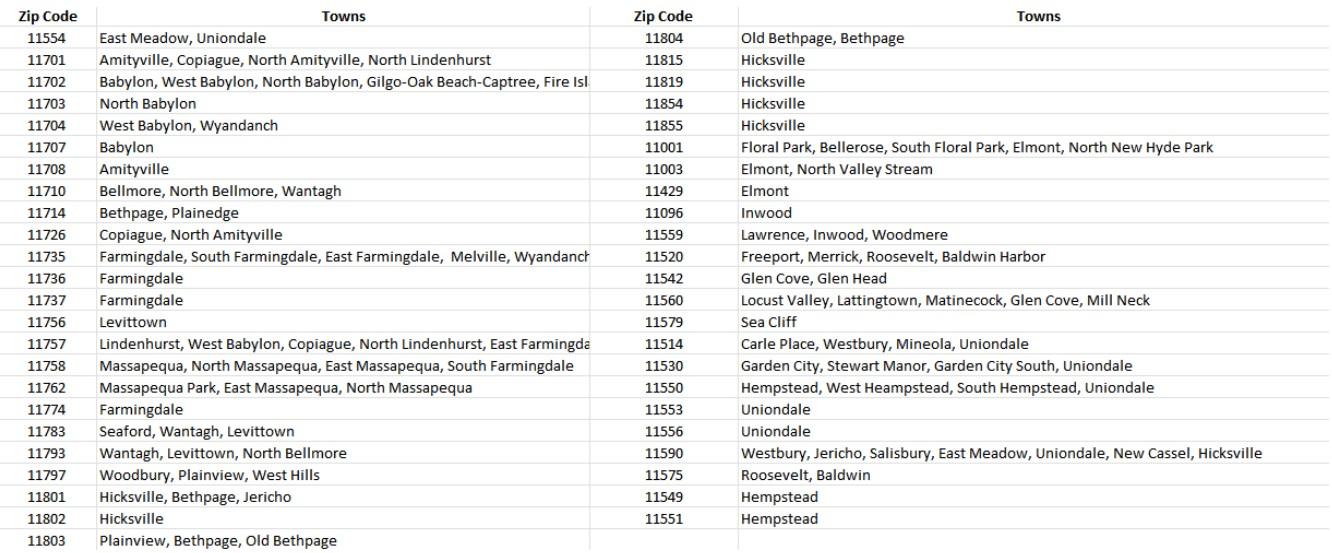
St. Joseph Hospital is a 203-bed community hospital serving Nassau County and nearby communities. St. Joseph is located in Bethpage, NY. The hospital’s primary service area is Nassau County, but St. Joseph also serves patients from eastern Queens and western Suffolk. The chart below defines the zip codes and municipalities comprising St. Joseph’s service area.
Demographics
Nassau County’s total population as of 2020 is 1,395,774 (47.3% male; 49.8% female). Those ages 15-44 represent 35.1% of females; 37.5% of males; ages 60 plus represent 22.6% of males and 26.6% of females; 18 plus represent 77.3% of male and 79.5% of females. The region is predominately White at 58.5% with 10.9% Black/African American (a decrease from 11.5% last report) and 11.7% Asian (up from 9.1%). Hispanic or Latino represent 18.3% of the population1, a two percent increase from the last report.
Geographic description
Nassau County is situated east of New York City and spans 453 miles. It is one of two counties that comprise Long Island, the eastern-most part of New York State. Nassau County is comprised of two cities: Long Beach and Glen Cove and three townships: Hempstead, North Hempstead, and Oyster Bay. Long Island is bounded on the north by Long Island Sound and on the east and south by the Atlantic Ocean. The west of the county is joined to Queens County and Kings County (or Brooklyn). These are two of the five boroughs of New York City. In addition to Nassau County, Catholic Health (CH) serves patients in eastern Queens and parts of western Suffolk County.
1U.S. Census Bureau, 2020 Decennial Census Socioeconomic information
In terms of income, 31% of the population earn less than $74, 999 (up from 26.5% in the last report) with 13.5% of that group earning less than $34,999 annually. Of the population, 6.2% of those under 18 years of age live in poverty, while 5.1% of those ages 18 to 64 live in poverty and for those ages 18 to 34 years of age, 6.4% live in poverty.2 The percentage of the population (5 years and over) that speaks a language other than English at home is 28.8%, with Spanish the dominant other language spoken (12.8%) followed by other Indo/European languages (9.9%) and Asian languages (4.9%). In terms of education, for those age 25 and over, 91.6% are high school graduates or higher, 46.7% hold a bachelor’s degree or higher. The percent of the total population uninsured is 4.1%. Of that percent, non-citizens represent 36.3%, Hispanic Latino (43%) and Black/African American (13.6%), Asian (12.8%) and White (43.2%). Of the uninsured, 40.4% earn less than $74,999 household income and 10.1% earn under $25,000 household income. Approximately 8.5% of the total non-institutionalized population is disabled. By race/ethnicity, 11.4% of the Native Hawaiian/Pacific Islander population is disabled, 10.8% of the American Indian/Alaska Native population is disabled, 9.7% of the White population is disabled, 5.4% of the Hispanic Latino population is disabled and 7.1% of the Black/African American population is disabled. Native American/Pacific Islanders account for less than one percent of the county’s population.3
Income—one social determinant of health—precludes individuals from low-income communities from accessing preventive and/or medical care due to their difficulty to afford co-payments/deductibles (if insured) or care at all if they are uninsured. The inability to afford co-pays and deductibles consistently rises to the top as a barrier to health care on the LIHC’s Community Health Assessment Survey year after year. The median household income in the past 12 months by race is $124,300 (White), $105,331 (Black), $95,890 (Hispanic/Latino). Mean income for the past 12 months per capita by race is $60,972, $38,622 and $31,976, respectively.4 This is why income is such a driving factor for health disparity and why the region has selected to focus on interventions and strategies that level the playing field for communities that are pockets of poverty in a rather affluent region.
Key Health Partners
Partnering with community-based organizations is the most effective way to determine how the health priorities will be addressed. As part of our collective impact strategies to promote health and well-being for residents in our communities, St. Joseph Hospital has strong relationships with local and regional community-based organizations, libraries, schools, faith-based organizations, the local health department, local fire departments and municipalities that support and partner with us to reduce chronic disease, mental health and substance misuse, and to promote health equity. Some of St. Joseph’s partners include: the Long Island Health Collaborative (LIHC), Nassau County Department of Human Services, Catholic Charities and Catholic Faith Network (CFN).
Public Participation
St. Joseph Hospital, along with CH’s other five hospitals, worked with the Long Island Health Collaborative (LIHC) and the Nassau County Department of Health (NCDOH), and dozens of community-based organizations, libraries, schools and universities, local municipalities, and other community stakeholders to produce this CHNA. NCDOH representatives offered input and consultation, when appropriate, regarding the data analyses conducted by the LIHC and DataGen. Top, high-level findings include a continued prevalence of chronic disease incidence,
2U.S. Census Bureau, 2016-2020 American Community Survey, Five-Year Estimate
3U.S. Census Bureau, 2016-2020 American Community Survey, Five-year Estimates
4U.S. Census Bureau, 2016 – 2020 American Community Survey Five-Year Estimates particularly heart disease and diabetes, obesity, and cancer. Further, surging rates of mental health and substance misuse issues among all demographic categories was found with disparity seen among youth, and low-income
communities of color continuing to experience a higher burden of disease overall. In 2022, members of the LIHC reviewed extensive data sets selected from both primary and secondary data sources to identify and confirm New York State Prevention Agenda priorities for the 2022-2024 Community Health Needs Assessment cycle. Data analysis efforts were coordinated through the LIHC, which served as the centralized data return and analysis hub.
Results of Community-Wide Survey
Primary data was obtained from a community health needs assessment sent to individuals and a similar survey to community-based organization leaders5. Additionally, we looked at results from two qualitative studies to round out our primary data.6 Secondary data was derived from publicly-available data sets curated by DataGen into its proprietary data analytics platform, CHNA Advantage ™, offering 200 plus metrics to determine health issues within Suffolk County.7 As such, priorities selected for the 2022- 2024 cycle remain unchanged from the 2019 – 2021 cycle selection, and the selected health disparities in which partners are focusing their efforts rests on the inequities experienced by those in historically underserved communities and communities of color.
Community Health Priorities for 2023-2025
Primary and secondary data demonstrate that residents living in Nassau and Suffolk County are experiencing poor mental health status. The 2021 Robert Wood Johnson Foundation County Health Rankings examining Suffolk County in Quality-of-Life Health Outcomes demonstrates an average of 4.0 poor mental health days per 30 days in Suffolk County.8 Mental health issues have soared in the past two years, spurred in part, by the effects of the pandemic. Using data from the U.S. Census Bureau’s COVID19 Household Pulse Survey (April 23, 2020 – October 26, 2020), a New York State Health Foundation analysis found that more than one-third of adult New Yorkers reported symptoms of anxiety and/or depression, with racial and ethnic groups of color as well as low-income New Yorkers, reporting the highest rates of poor mental health. However, the 18 – 34-year-old age group reported the highest rates (49%) of poor mental health.9 High school students (grades 9 through 12) fared just as badly. A number of studies found poor mental health along with suicide ideation intensified during the pandemic for high schoolers. An April 2022 analysis of data from the 2021 Adolescent Behaviors and Experiences Survey revealed that 37.1% of students experienced poor mental health during the pandemic, and 31.1% experienced poor
5Community Health Assessment Survey (CHAS) assessing responses from individuals, summary report and survey instrument (Appendix A) CBO Survey Analysis 2022, assessing responses from community-based organization leader, summary report and survey instrument (Appendix B)
6Qualitative Analysis of Key Informant Interviews Conducted Among Community-Based Organization Leaders (Appendix C) Long Island Libraries: Caretakers of the Region’s Social Support and Health Needs: Qualitative Analysis (Appendix D)
7Statewide Planning and Research Cooperative System (SPARCS), New York State Prevention Agenda dashboard, Behavioral Risk Factor Surveillance System (BRFSS), Extended Behavioral Risk Factor Surveillance System (eBRFSS), New York State Community Health Indicators by Race/Ethnicity Reports, Community Health Indicator Reports, Prevention Quality Indicators, CDC Places, and U.S. Census Bureau. The CHNA Advantage™ data analytics platform includes these and other state and national level indicators. It also encompasses social risk measures offered by Socially Determined, Inc.
8https://www.countyhealthrankings.org/app/new-york/2021/compare/snapshot?counties=36_059%2B36_103
9https://nyhealthfoundation.org/resource/mental-health-impact-of-the-coronavirus-pandemic-in-new-york-state/#:~:text=The %20proportion%20of%20New%20Yorkers,health%20throughout%20the%20survey%20period mental health during the preceding 30 days.10 The pandemic made a bad situation worse, especially for
youth, as mental health issues and suicides were already increasing prior to the COVID-19 pandemic. 11 12 13 14
With the shortage of mental health care workers and the lingering psychological effects of the pandemic, mental health services remain a top priority for the region. The county also saw an uptick in opioid-related overdoses and deaths after having made some gains prior to the pandemic. New York State Department of Health statistics report that for 2020 in Nassau County there were 223 deaths from any opioid, 77 heroin overdose deaths, and 214 deaths involving opioid pain relievers (including illicitly produced opioids such as fentanyl).15 For 2019, the numbers were 173, 47, and 163, respectively via categories listed above.16
Another health disparity identified in primary and secondary research is adult obesity. Nassau County continues to experience high rates of obesity and overweight adults. Twenty-three percent of the population (age 20 and older) reports a body mass index (BMI) greater than or equal to 30 kg/m.17 According to the New York State Department of Health, obesity is a significant risk factor for many chronic diseases including type 2 diabetes, high blood pressure, asthma, stroke, heart disease and certain types of cancer.
The prevalence of chronic diseases is persistent in the county. Nationally, communities of color experience higher rates of chronic disease. Using diabetes as an example, the American Indian/Alaska Native population represents 14.5 percent of adults 18 or older who are diagnosed with diabetes followed by Black, non-Hispanic at 12.1% and Hispanic overall at 11.8% in the United States. Asians and Whites experience the disease at 9.5% and 7.4% respectively.18 Health providers report that many individuals delayed preventive care and routine screenings due to the pandemic, leading to more complicated cases and unfavorable outcomes. Chronic diseases are preventable conditions sensitive to lifestyle (diet/physical activity) habits but hampered by the obstacles presented by social determinant of health factorsincome/employment, race/ethnicity, food access, housing/neighborhood location, and level of education. The county and hospitals identified in this report through collaborative efforts and facility-specific programming acknowledge and address these determinants regularly.
10https://www.cdc.gov/mmwr/volumes/71/su/su7103a3.htm? s_cid=su7103a3_w
11https://www.cdc.gov/mmwr/volumes/66/wr/mm6630a6.htm
12https://www.cdc.gov/nchs/fastats/mental-health.htm
13Weinberger, A. et al. (August 2017) Trends in depression prevalence in the USA from 2005 – 2015: widening disparities in vulnerable groups. Psychological Medicine, 1-10
14Bitsko, R et al. (2018) Epidemiology and impact of healthcare provider-diagnosed anxiety and depression among US children. Journal of Developmental and Behavioral Pediatrics, 1-9.
15https://www.health.ny.gov/statistics/opioid/data/pdf/nys_apr22.pdf
16https://www.health.ny.gov/statistics/opioid/data/pdf/nys_jan21.pdf
17https://www.health.ny.gov/statistics/prevention/injury_prevention/information_for_action/docs/2021- 02_ifa_report.pdf
18https://www.cdc.gov/diabetes/health-equity/diabetes-by-the-numbers.html
St. Joseph Hospital Interventions, Strategies and Activities
Priority Number One: Prevent Chronic Disease
Goals and selected interventions concentrate on Focus Area 4: Chronic Disease Preventive Care and Management, with additional programming addressing other focus areas.
Interventions, Strategies and Activities:
1. Live Better Awareness Campaign: Promote healthy eating and food security to increase skills and knowledge to supply healthy food and beverage choices. The goal is to decrease the percent of adults over 18 with obesity in low-income communities of color.
Process measures:
On 2/13/25, healthy eating suggestions were offered at the Senior Center at St. Rose of Lima Sunshine Club to 55 attendees.
On 4/15/25, diabetes education with healthy eating was presented at the Grumman Senior Center to 22 attendees.
On 9/17/25, a Food for Thought presentation was given virtually to more than 400 AARP members.
On 10/8/25, an SJH diabetes educator presented Healthy eating tips to Roosevelt retirement group; 22 attended.
2. Offer health education for local EMS providers covering timely health care updates on cardiac disease, stroke and other relevant topics.
Process measures:
On 2/13/25, EMS CME lecture covering New Stroke Protocols; 85 EMS personnel attended.
On 4/29/25, EMS CME lecture covering Trauma Management; 22 EMS personnel attended.
On 6/24/25, EMS CME lecture on Submersion – Drowning; 25 EMS personnel attended.
On 7/29/25, EMS CME lecture on Combustion – 30 EMS personnel attended.
On 10/30/25, EMS CMS SEPSIS – 28 attended.
3. Offer free education and workshops on chronic disease, health and wellness.
Process measures:
On 1/23/25, Free CPR/AED certification for high school students at the hospital – 12 attendees.
On 1/28/25, Free CPR/ AED certification for high school students at the hospital – 12 attendees.
On 1/30/25, at SJH, SFH outreach screened 18 attendees for BMI, BP and provided education.
On 2/7/25, Heart Health education offered by cardiologist at Grumman Senior Center; 130 attendees.
On 2/13/25, St. Rose of Lima Sunshine Club healthy eating discussion with dietician; 55 attendees.
On 3/19/25, Colon cancer education with Dr. Kennings at Bethpage Senior Center for the Aging; 25 attendees.
On 3/27/25, Health care in aging seniors with Dr. Chiryal at Brady Park Senior Center Massapequa Park; 95 attendees.
On 4/15/25, Diabetes education offered at Grumman Senior Center; 22 attendees
On 5/28/25 and 5/29/25 Stroke presentation to Nassau County Police Department; 220 attendees.
On 5/29/25 Stroke awareness presentation at SJH 15 attendees.
On 8/13/25, at the hospital, Catholic Health’s outreach bus screened 13 people for BMI, BP and provided education.
On 8/27/25, at the hospital, there was a Narcan training for the community and employees; 28 attendees.
On 10/3/25, Dr. Mancuso educated over 150 people at the Bethpage Office of the Aging on Breast health in seniors.
CH participated in Oyster Bay’s annual OysterFest on 10/18/24 and 10/19/24, providing a total of 269 blood pressure screenings and education over 2 days.
On 10/30/25, SJH held a Stop the Bleed event and certified 12 community members.
On 11/5/25 CH hosted a Medication Management seminar in North Merrick- 45 people attended and a SJH pharmacy assistant presented.
4. Host a health fair providing education to the community and an opportunity to meet with clinical staff.
Process measures:
On 4/26/25, Farmingdale Library Health Expo; 350 attendees
On 9/20/25, Catholic Health hosted its annual health fair in Melville; more than 200 people attended, 54 screened and 27 flu shots were administered.
5. Walk Safe with a Doc and Talk with a Doc.
Process measures:
The hospital hosts a “Let’s Walk” program where physicians are encouraged to walk and discuss topics with staff and community. There is an average of 10-12 walkers per week.
Catholic Health works directly with AARP exclusively, providing experts on a variety of topics. See below.
o On June 18, Catholic Health’s John Hansen, M.D., a urologist, discussed Benign Prostatic Hyperplasia (BPH) Diagnosis and Treatment Options; 45 attended.
o On July 16, Dr. Joy Curran presented, Keep Your Sight as You Age; 100 attendees.
o On August 20, a social worker presented, Concepts of Grief and How to Cope; 45 attended.
o On September 17, a registered dietician presented, Food for Thought; more than 400 attended.
On July 25, at Bethpage Park, Dr. Joe Chirayil spoke about senior wellness; 15 attendees walked.
Priority Number Two: Promote Well—Being and Prevent Mental and Substance Use Disorders
Goals and selected interventions concentrate on Focus Area 2: Mental and Substance Use Disorders Prevention, with additional programming addressing other focus areas.
Interventions, Strategies and Activities:
1. Employ a Patient and Family Advisory Committee on behalf of patients and families.
Process measures:
We employ a full-time patient advocate on behalf of patients and their families. From January to December there were 402 patient and family interactions.
2. Offer an education conference for health care professionals.
Process measures:
On 9/25/25, CH hosted a stroke presentation for EMS and employees; more than 250 attendees.
3. Promotion of all programs, events, education offered by Long Island Health Collaborative (LIHC) members who speak to the prevention of mental and substance use disorders. Posts in LIHC weekly communications newsletter, social media postings, cross promotion of member events, programs on all media platforms. Promotion on Catholic Faith Network (CFN) and CH social media, website, and community-targeted publications.
Process measures:
The hospital works with the Long Island Health Collaborative (LIHC) to disseminate information about the importance of proper nutrition and physical activity among the general public to assist Nassau residents in better managing their chronic diseases and/or preventing the onset of chronic diseases. The hospital also collaborates with the LIHC to disseminate information about mental health prevention and treatment services and programming, as well as relevant information about substance misuse. Dissemination of information is achieved through the bi-weekly Collaborative Communications enewsletter, which is sent to 560 community-based organization leaders, and strategic use of social media platforms. These efforts are ongoing.
Priority Number Three: Promote a Healthy and Safe Environment
Interventions, Strategies and Activities:
1. Conduct a first aid lecture and hands-on demonstration to establish basic first aid techniques with children. Program also enables scouts to achieve a first aid badge.
Process measures:
On 4/8/25, at John Quincy Elementary offered Teddy Bear clinic/First aid/Swim safety to 350 students.
On 4/9/25, Girl Scouts earned a first aid badge with Teddy bear clinic/First aid clinic at SJH; 65 attendees.
On 7/8/25, Town of Oyster Bay sponsored with SJH a pool safety clinic for 450 children, consisting of CPR, first aid and pool safety tips.
On 8/6/25, ACDS in Plainview hosted a Teddy bear clinic, first aid presentation and ambulance tour; 150 students attended.
On 9/14/25, Girls Scouts hosted a 5K Thin Mint Run. An SJH medical team was present for education and injury.
On 10/15/25, Girl Scouts earned a first aid badge while participating in a Teddy bear clinic and first aid clinic at the hospital; 65 attended.
Priority Number Five: Prevent Communicable Diseases
Interventions, Strategies and Activities:
1. Offer free flu vaccinations at events in underserved communities, at Healthy Sunday’s events, hospital health fairs and other community venues.
Process measures:
10/22/25, AARP Bethpage senior group – 12 flu shots administered
10/24/25, Bethpage Mosque – 13 flu shots administered
11/16/25 Healthy Sunday at St. Kilian – 10 flu shots administered.
Living the Mission
The CH mission is the driving force behind all community outreach activities. In addition to the interventions summarized above, St. Francis Hospital, along with the overall system and CH skilled nursing facilities, Catholic Health Home Care and Good Shepherd Hospice, provide additional outreach programs that promote the health care ministry of the Catholic Church and address social determinants of health.
Interventions, Strategies and Activities:
1. Virtual education series streaming on YouTube, providing short videos on various topics
Currently there is a Keeping Your Child Safe at Every Age, Child and Adolescent Mental Health, Alzheimer’s and dementia series. These have garnered more than 30,000 total views.
Catholic Health also offers an ongoing Health Tips series discussing topics such as Stroke vs. Aneurysm, What You Need to Know about C-Sections, and Prostate Cancer Awareness, among others. From January-December 2025, there have been 3 videos posted, with more than 90 views on YouTube.
The “On-Call with Dr. Jason Golbin” show is designed for physicians and advanced practice providers. In each monthly episode, Catholic Health’s Chief Medical Officer Jason Golbin, DO, speaks with our physician leaders about the system’s emerging technologies and newest clinical resources while offering a glimpse into their personal stories and the compassionate care delivered. From January to December, these videos have had more than 411,000 views across multiple platforms.
2. Broadcast health-related television shows for the public, in collaboration with Catholic Faith Network, provide education and prevention lectures to improve knowledge related to specific diseases and conditions, preventive care, and up-to-date treatment options.
From January-December 2025, seven new shows with Catholic Health Cardiologist David D’Agate, DO, aired on CFN and were posted to Catholic Health’s YouTube channel. The “Stronger Together” series with Dr. D’Agate discusses topics such as cardiac health, sleep, fertility, and access to care. This show airs on CFN every four to five weeks and is promoted via Catholic Health’s internal and external communications, including a substantial social media campaign. Across multiple platforms, these videos have more than 913,000 views. Additionally, a Catholic Health segment on CFN Live, “Trending Health Topics,” produced 2 segments from January-December 2025. These videos have more than 170 views on YouTube.
There are also quarterly shows on CFN with Catholic Health President and CEO Patrick O’Shaughnessy, DO. The shows with Dr. O’Shaughnessy and Monsignor Jim Vlaun bring the latest in research and information on medical procedures and advancements. There have been 3 videos posted in 2025, totaling more than 280 views.
Additionally, Catholic Health airs a “Catholic Health Update” weekly, highlighting events or activities taking place across the system. From January-December 2025, these videos received more than 2.1 million views across all platforms.
3. Promotion of all programs, events, and education is on the CH website and all CH social media outlets, including Facebook, Twitter, Instagram, and LinkedIn.
This includes the promotion of all education, healthy recipes, health tips and support groups. Some of these include education on how to stay hydrated during the summer, facts on various cancers and screening, children’s health and more.
4. Lectures in Catholic schools, local libraries, and other community organizations.
The Catholic Health Speakers Bureau provides speakers to community organizations. From JanuaryDecember 2025, there have been 84 speaking engagements. Topics have included Heart Health, Fitness for Seniors, Breast Health, Medication Management, Seasonal Depression, and Sleep Health.
Catholic Health has partnered with AARP to host a virtual lecture series. These lectures are being held monthly from June through December.
6/18/25 – Men’s Health; 40 attended.
7/16/25 – Keep Your Sight as You Age; more than 100 attended.
8/20/25 – Concepts of Grief and How to Cope; 45 attended.
9/17/25 – Food for Thought; more than 400 attended.
12/17/25 – Safely Stay Active During the Winter: 33 attended.
5. Community Outreach Screening Buses
The Catholic Health buses travel across Long Island to different community-based organizations, providing free health screenings, including blood pressure, cholesterol, body mass index and glucose. From January through December 12, the mobile buses screened 7,493 people.
6. Healthy Sundays
In this volunteer program, we partner with different community organizations to provide BP and BMI screenings, flu vaccinations, health education and referrals to follow up care. In this volunteer program, we partner with different community organizations to provide BP and BMI screenings, flu vaccinations, health education and referrals to follow up care. Twelve events were held through December; 471 people attended.
7. Additional Community Outreach
On 4/1/25, CH employees packed food for Meals of Hope. Forty-seven employees participated and 46 boxes of food were prepared, equaling almost 10,000 meals.
On 4/12/25, CH attended Tomorrow’s Hope 10th Annual Run in Garden City and provided cardiac screenings to 6 people.
On 5/23/25, 5/24/25, and 5/25/25, CH attended the Jones Beach Air Show and provided blood pressure screenings to a total of 195 people.
On 9/20/25, Catholic Health held its annual system-wide health fair; more than 200 people attended, 54 people received blood pressure, cholesterol, glucose and body mass index screenings and 27 flu shots were administered.
On 9/27/25, CH attended St. Vincent de Paul’s annual Friends of the Poor Walk, providing health information. More than 850 people attended.
CH participated in Oyster Bay’s annual OysterFest on 10/18/24 and 10/19/24, providing a total of 269 blood pressure screenings and education over 2 days.
Dissemination of the Plan to the Public
The St. Joseph Hospital Community Service Plan will be posted on the hospital’s website at https://www.catholichealthli.org/st-joseph-hospital/community-health. Copies will be available at local free health screenings and can be mailed upon request.
By encouraging friends and neighbors to complete the LIHC Wellness Survey online or at local screenings, the Community Health Needs Assessment will help St. Joseph continue to develop ways to best serve our community.
Conclusion
The Community Service Plan is intended to be a dynamic document. Utilizing the hospital’s strengths and resources, St. Joseph along with community partners, will work to continue to best address health disparities and needs. The hospital will strive to improve the overall health and well-being of individuals and families by expanding free health promotion and disease prevention/education screenings and programs in communities where they are most needed. St. Joseph Hospital is committed to continue to develop ways to best serve the community.